Cambridge IGCSE Sciences - Co-ordinated (Double) 0654 — 2021 Oct/Nov Paper 1 · Variant 3
0654/13/O/N/21 · 40 questions · 40 marks · ≈45 min
The question paper and its mark scheme, free to read here and free to download. This is Cambridge’s own paper, exactly as it was sat.
Question paper16 pages
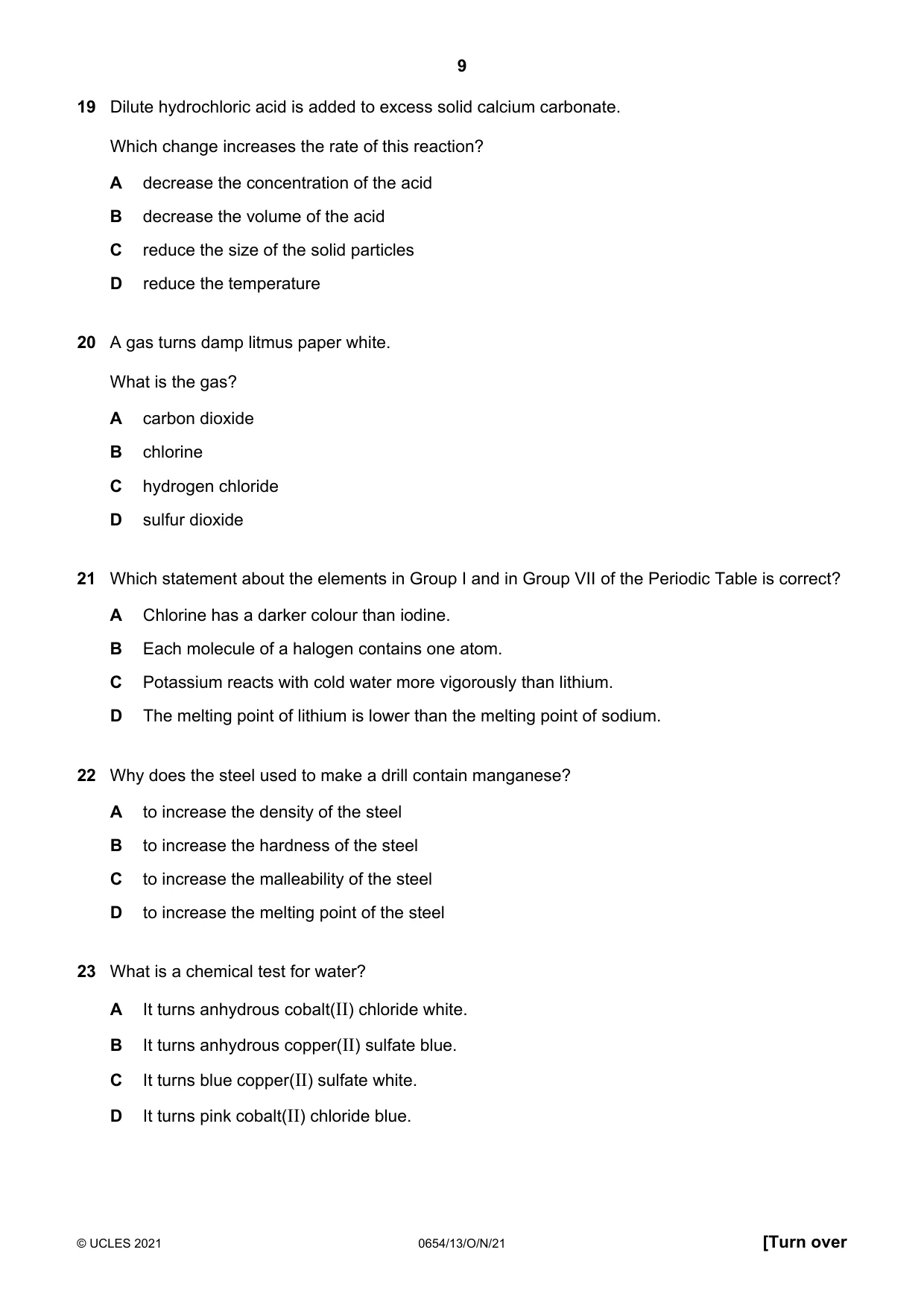
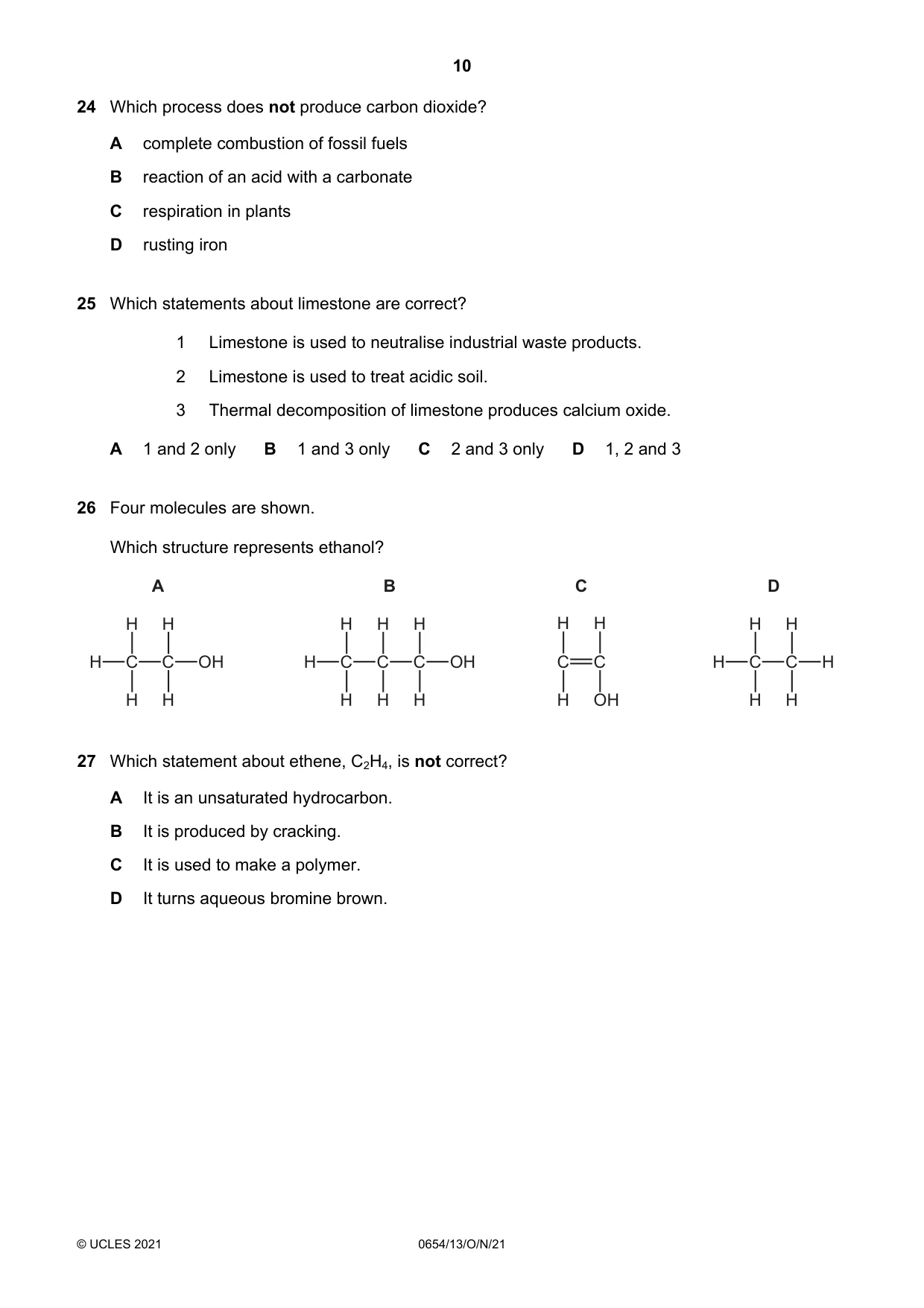
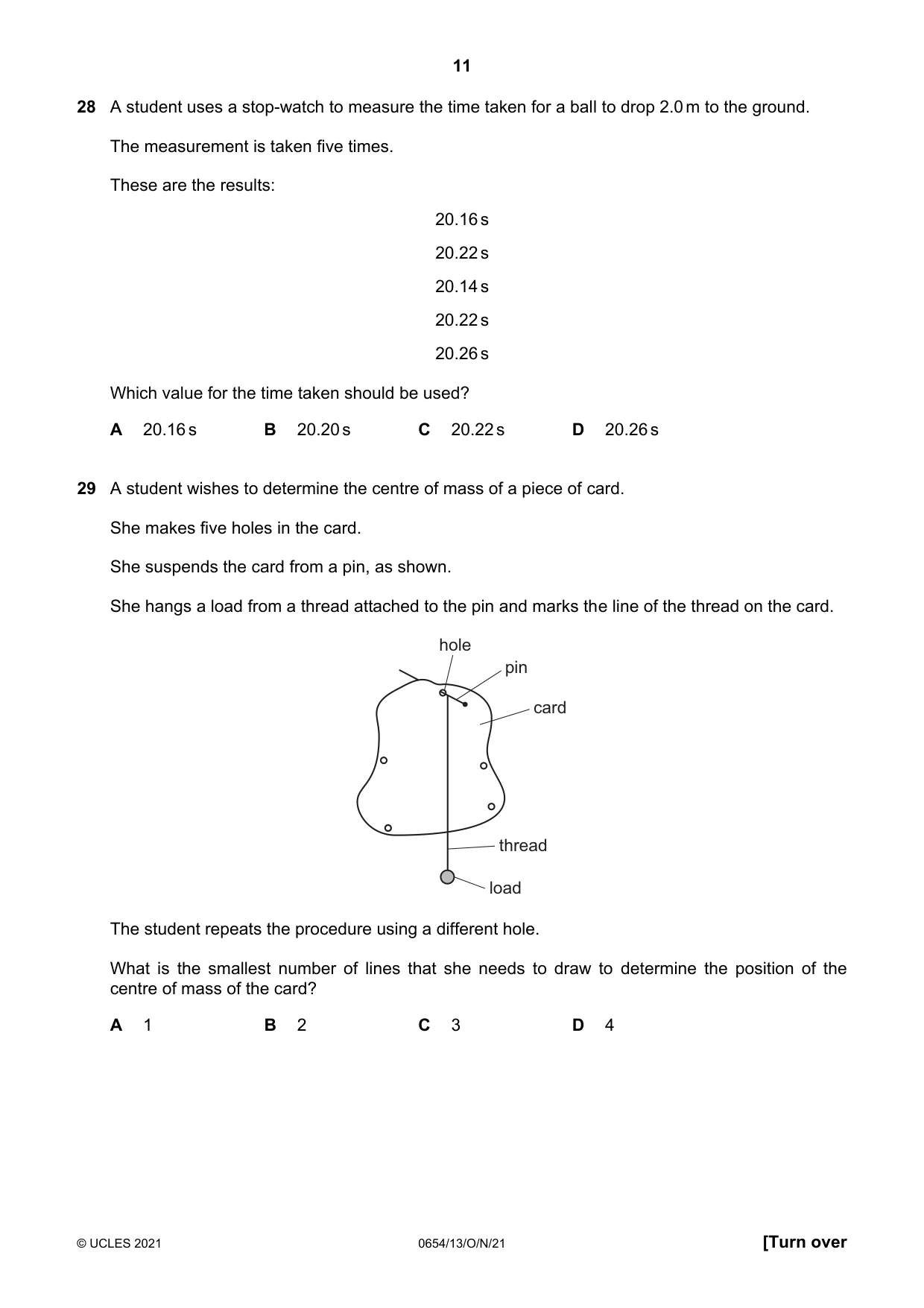
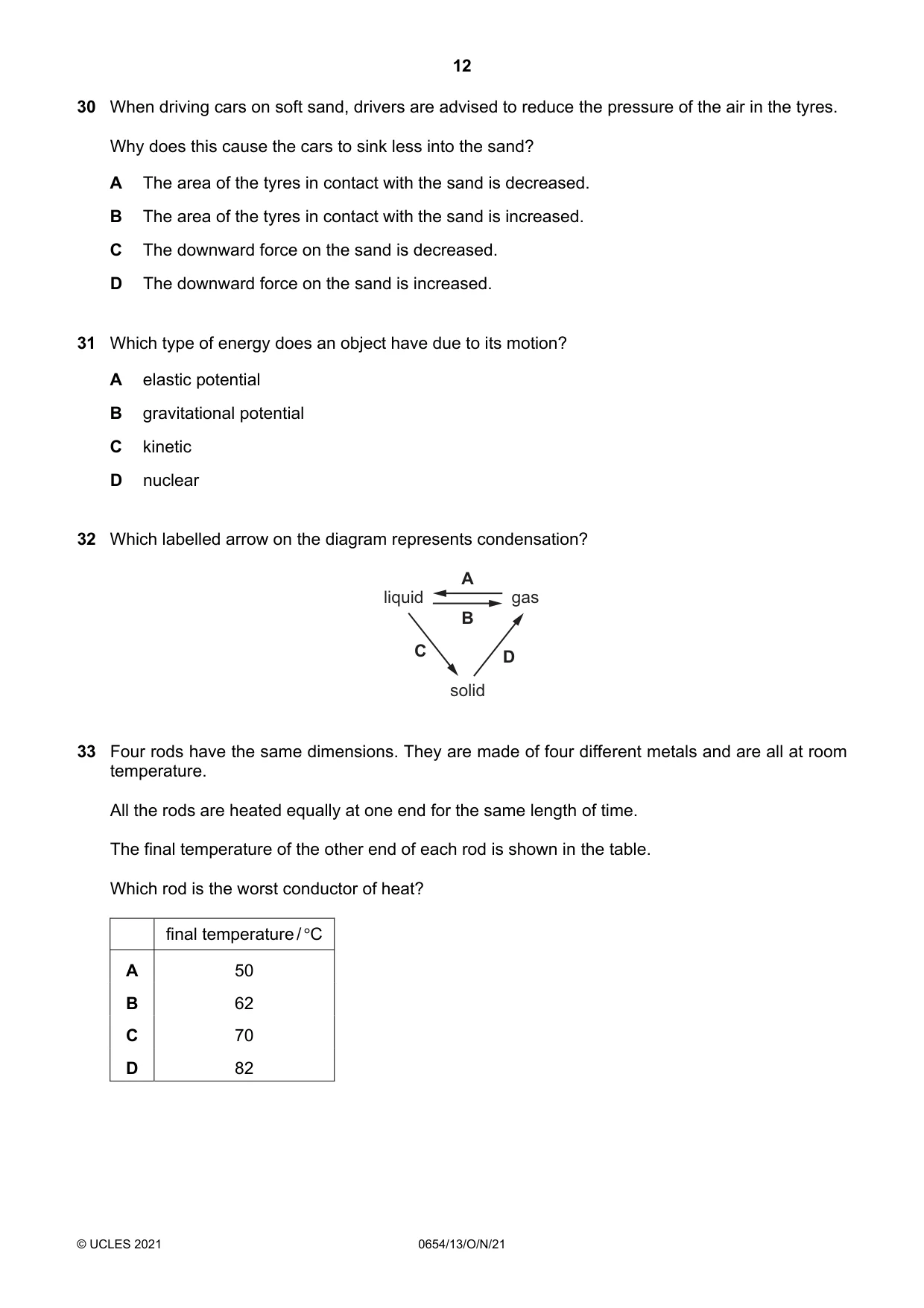
Mark scheme3 pages
Answers below. Sit the paper first if you are practising.
Questions as text
Q1 · All living organisms can break down nutrient molecules to release energy
1 All living organisms can break down nutrient molecules to release energy. What is this process? A excretion B growth C nutrition D respiration
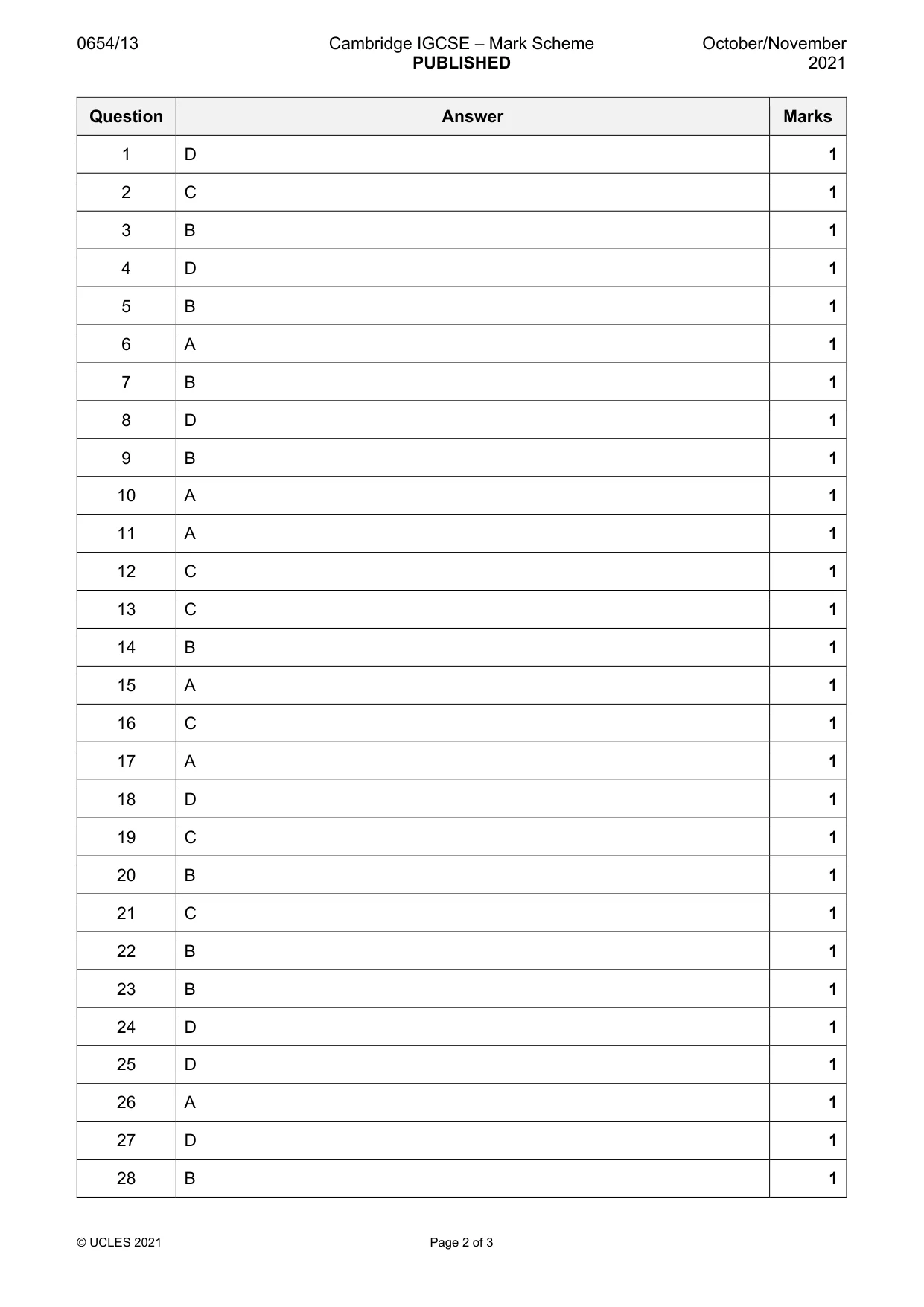
Mark scheme: D
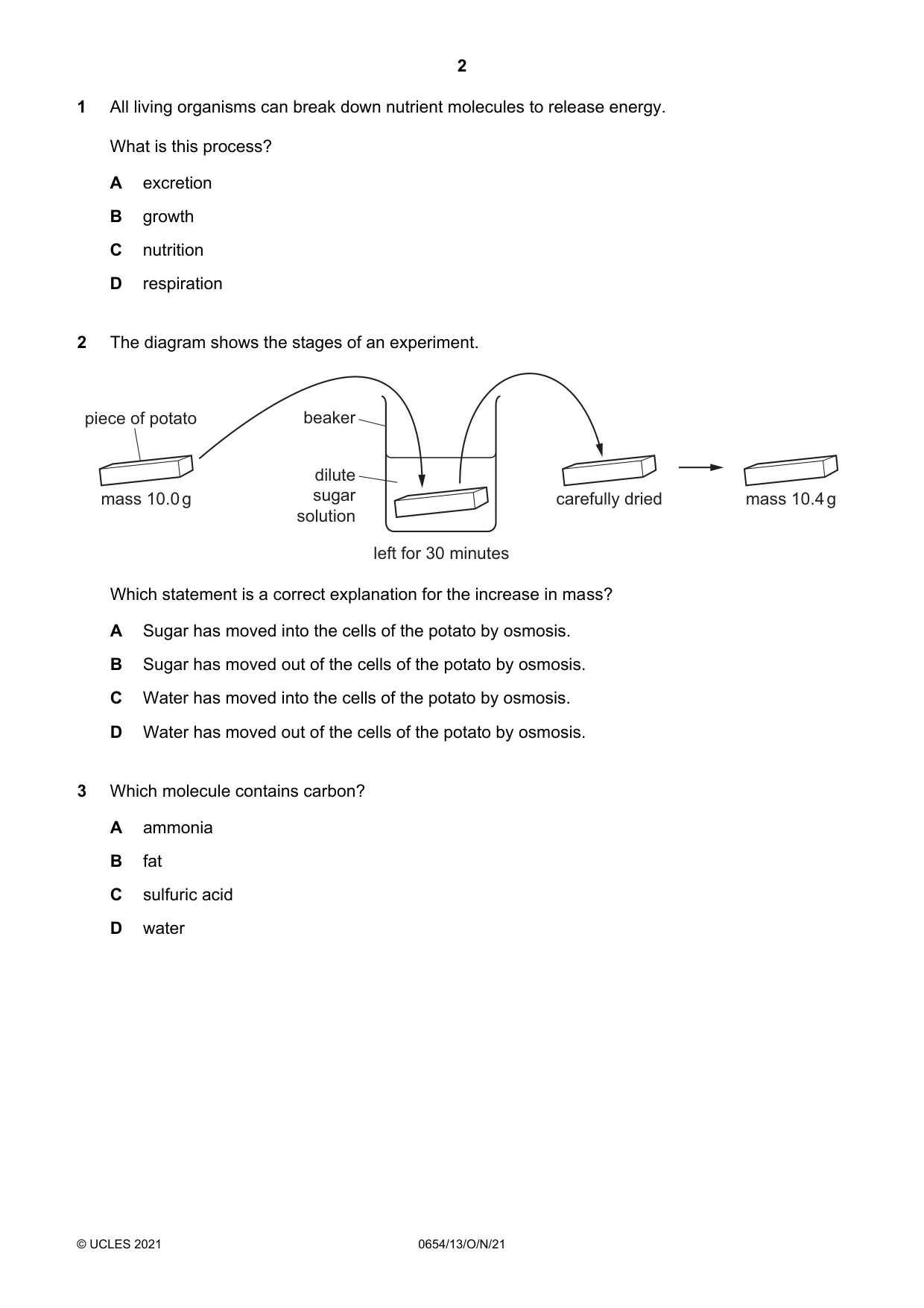
Q2 · The diagram shows the stages of an experiment
2 The diagram shows the stages of an experiment. piece of potato beaker dilute mass 10.0 g sugar carefully dried mass 10.4 g solution left for 30 minutes Which statement is a correct explanation for the increase in mass? A Sugar has moved into the cells of the potato by osmosis. B Sugar has moved out of the cells of the potato by osmosis. C Water has moved into the cells of the potato by osmosis. D Water has moved out of the cells of the potato by osmosis.
Mark scheme: C
Q3 · Which molecule contains carbon?
3 Which molecule contains carbon? A ammonia B fat C sulfuric acid D water
Mark scheme: B
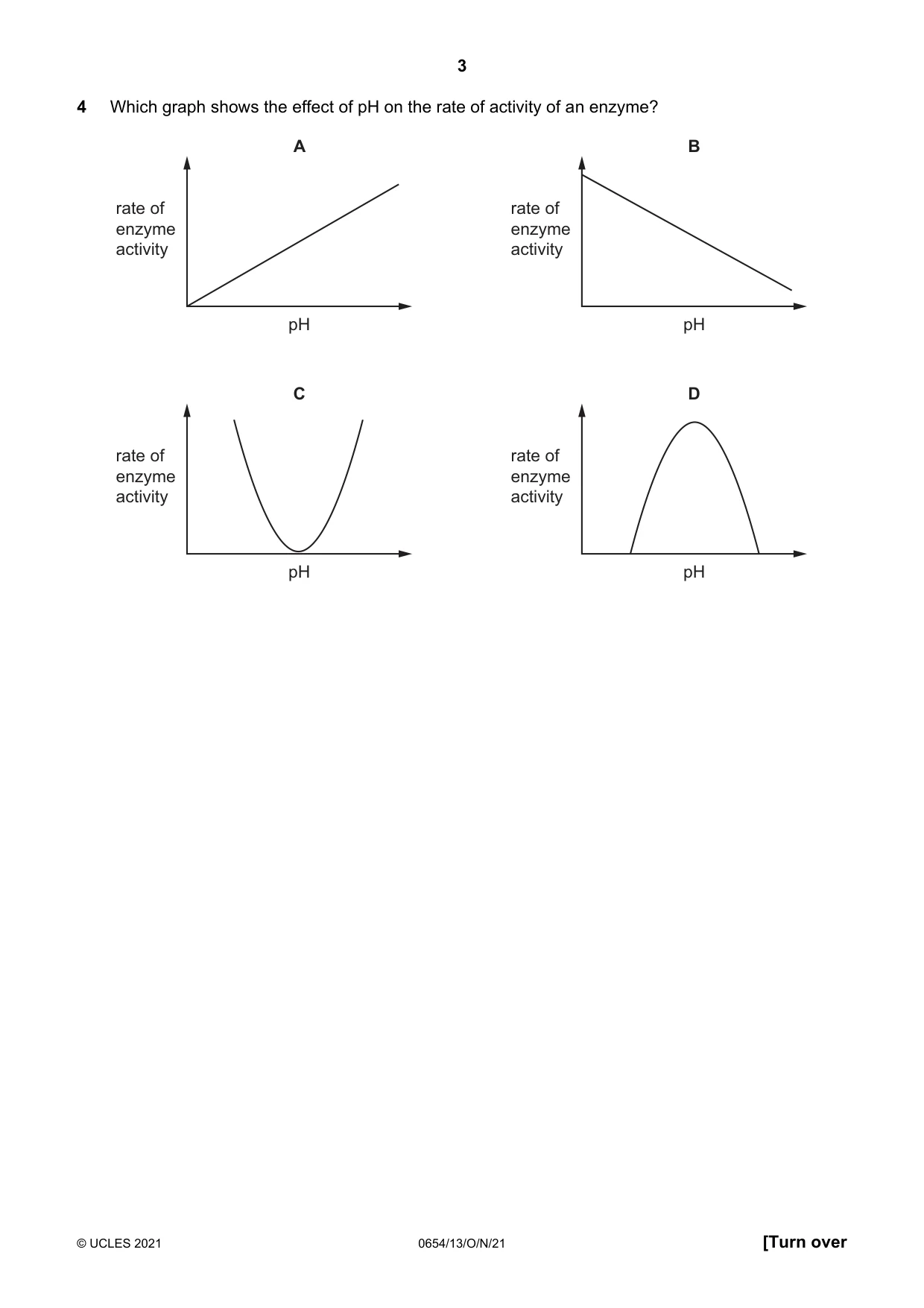
Q4 · Which graph shows the effect of pH on the rate of activity of an enzyme?
4 Which graph shows the effect of pH on the rate of activity of an enzyme? A B rate of rate of enzyme enzyme activity activity pH pH C D rate of rate of enzyme enzyme activity activity pH pH
Mark scheme: D
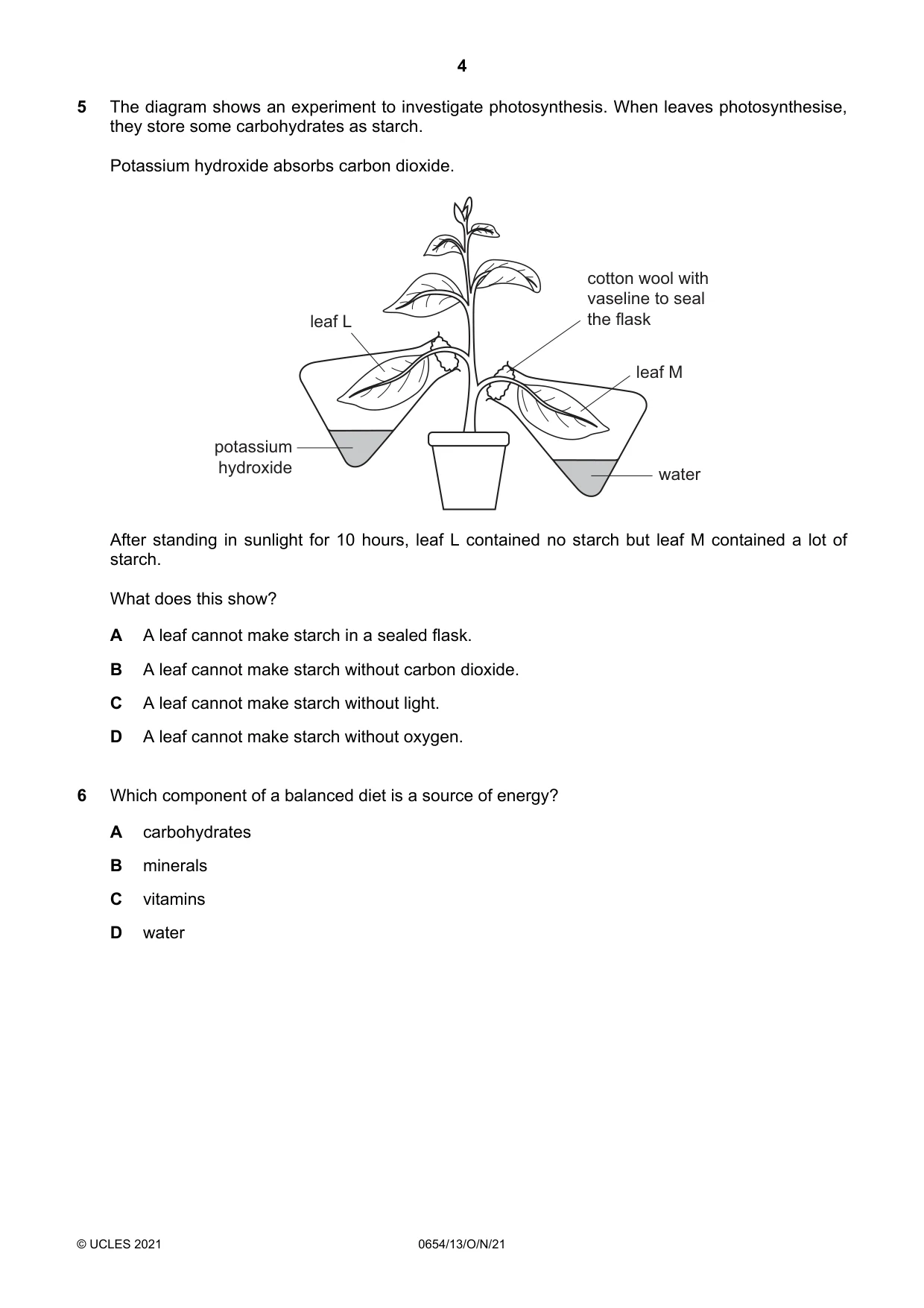
Q5 · The diagram shows an experiment to investigate photosynthesis
5 The diagram shows an experiment to investigate photosynthesis. When leaves photosynthesise, they store some carbohydrates as starch. Potassium hydroxide absorbs carbon dioxide. cotton wool with vaseline to seal leaf L the flask leaf M potassium hydroxide water After standing in sunlight for 10 hours, leaf L contained no starch but leaf M contained a lot of starch. What does this show? A A leaf cannot make starch in a sealed flask. B A leaf cannot make starch without carbon dioxide. C A leaf cannot make starch without light. D A leaf cannot make starch without oxygen.
Mark scheme: B
Q6 · Which component of a balanced diet is a source of energy?
6 Which component of a balanced diet is a source of energy? A carbohydrates B minerals C vitamins D water
Mark scheme: A
Q7 · The diagram shows a transverse section through a plant stem
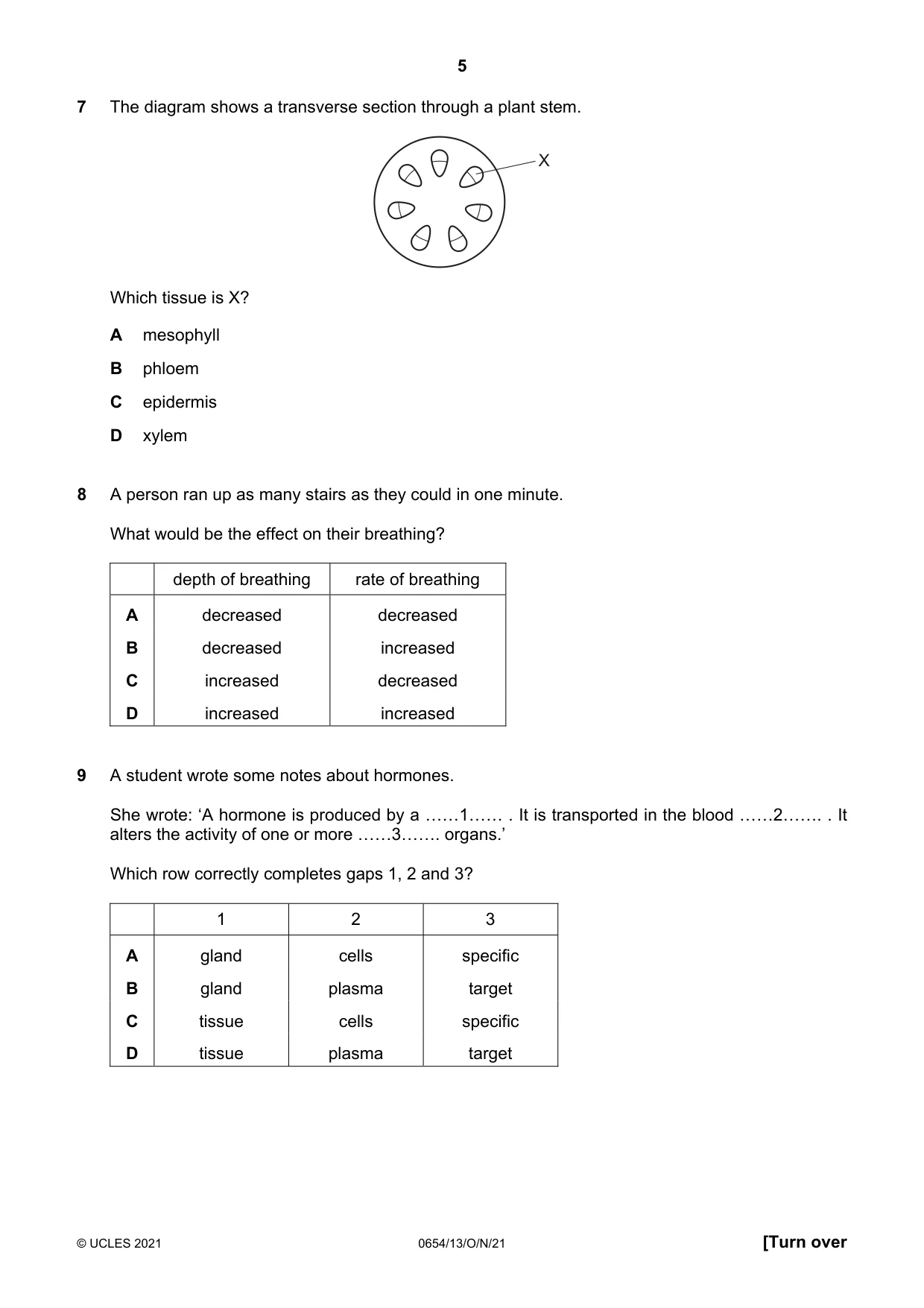
7 The diagram shows a transverse section through a plant stem. X Which tissue is X? A mesophyll B phloem C epidermis D xylem
Mark scheme: B
Q8 · A person ran up as many stairs as they could in one minute
8 A person ran up as many stairs as they could in one minute. What would be the effect on their breathing? depth of breathing rate of breathing A decreased decreased B decreased increased C increased decreased D increased increased
Mark scheme: D
Q9 · A student wrote some notes about hormones
9 A student wrote some notes about hormones. She wrote: ‘A hormone is produced by a ……1…… . It is transported in the blood ……2……. . It alters the activity of one or more ……3……. organs.’ Which row correctly completes gaps 1, 2 and 3? 1 2 3 A gland cells specific B gland plasma target C tissue cells specific D tissue plasma target
Mark scheme: B
Q10 · In which structure is pollen made?
10 In which structure is pollen made? A anther B ovary C sepal D stigma
Mark scheme: A
Q11 · Two parents with genotypes of BB and Bb were crossed
11 Two parents with genotypes of BB and Bb were crossed. Which genotypes and ratios would be expected in the offspring? A 1 BB : 1 Bb B 1 Bb : 1 bb C 3 BB : 1 Bb D 3 Bb : 1 BB
Mark scheme: A
Q12 · A producer is an organism which makes its own organic nutrients
12 A producer is an organism which makes its own organic nutrients. Which process does a producer use and what is the source of energy? process source of energy A photosynthesis dead organic matter B respiration sunlight C photosynthesis sunlight D respiration dead organic matter
Mark scheme: C
Q13 · The diagram shows a simplified carbon cycle
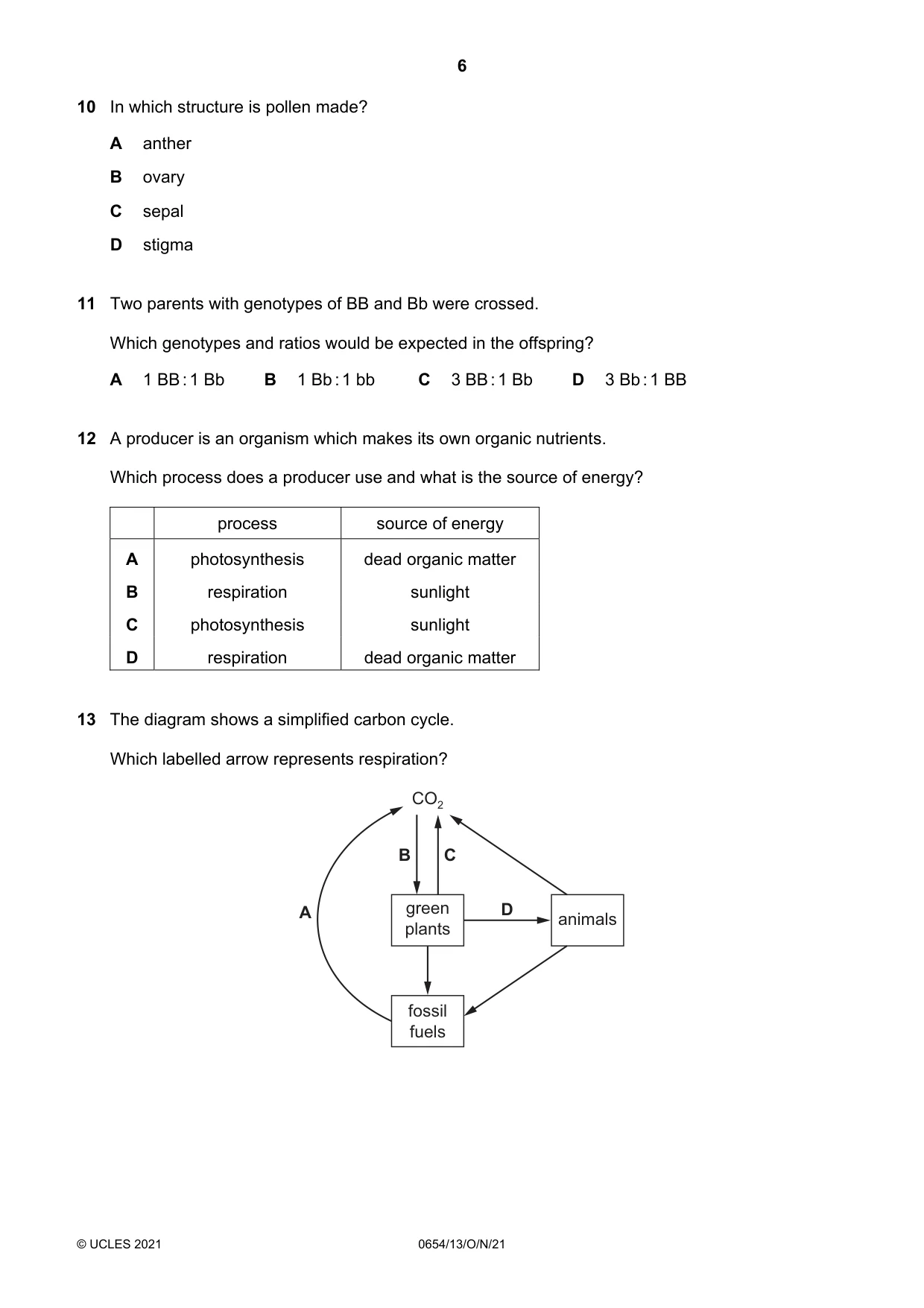
13 The diagram shows a simplified carbon cycle. Which labelled arrow represents respiration? CO2 B C A green D animals plants fossil fuels
Mark scheme: C
Q14 · The protons, neutrons and electrons in a particle are shown
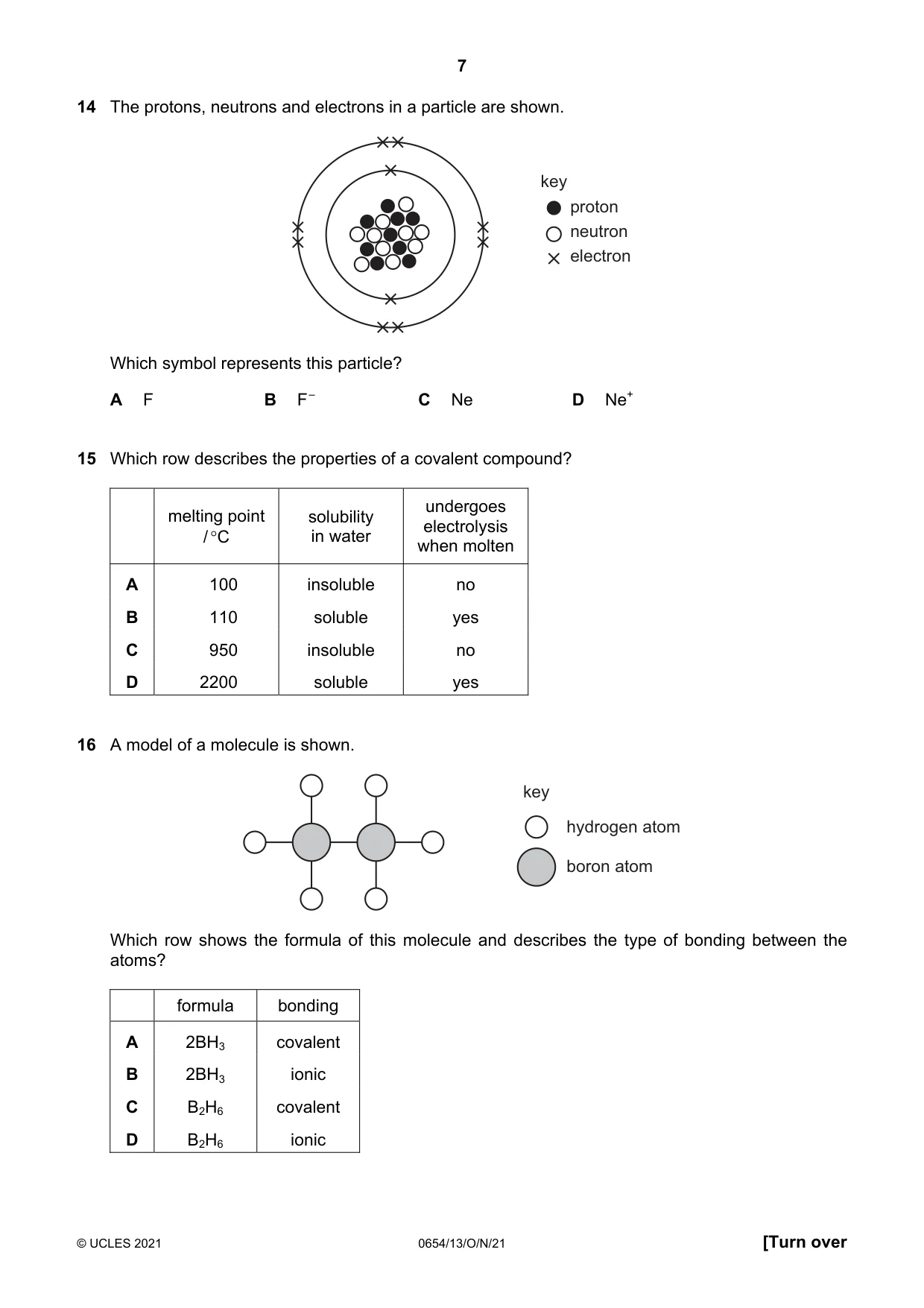
14 The protons, neutrons and electrons in a particle are shown. key proton neutron electron Which symbol represents this particle? A F B F – C Ne D Ne+
Mark scheme: B
Q15 · Which row describes the properties of a covalent compound?
15 Which row describes the properties of a covalent compound? undergoes melting point solubility electrolysis / C in water when molten A 100 insoluble no B 110 soluble yes C 950 insoluble no D 2200 soluble yes
Mark scheme: A
Q16 · A model of a molecule is shown
16 A model of a molecule is shown. key hydrogen atom boron atom Which row shows the formula of this molecule and describes the type of bonding between the atoms? formula bonding A 2BH3 covalent B 2BH3 ionic C B2H6 covalent D B2H6 ionic
Mark scheme: C
Q17 · The diagram shows the electrolysis of a compound
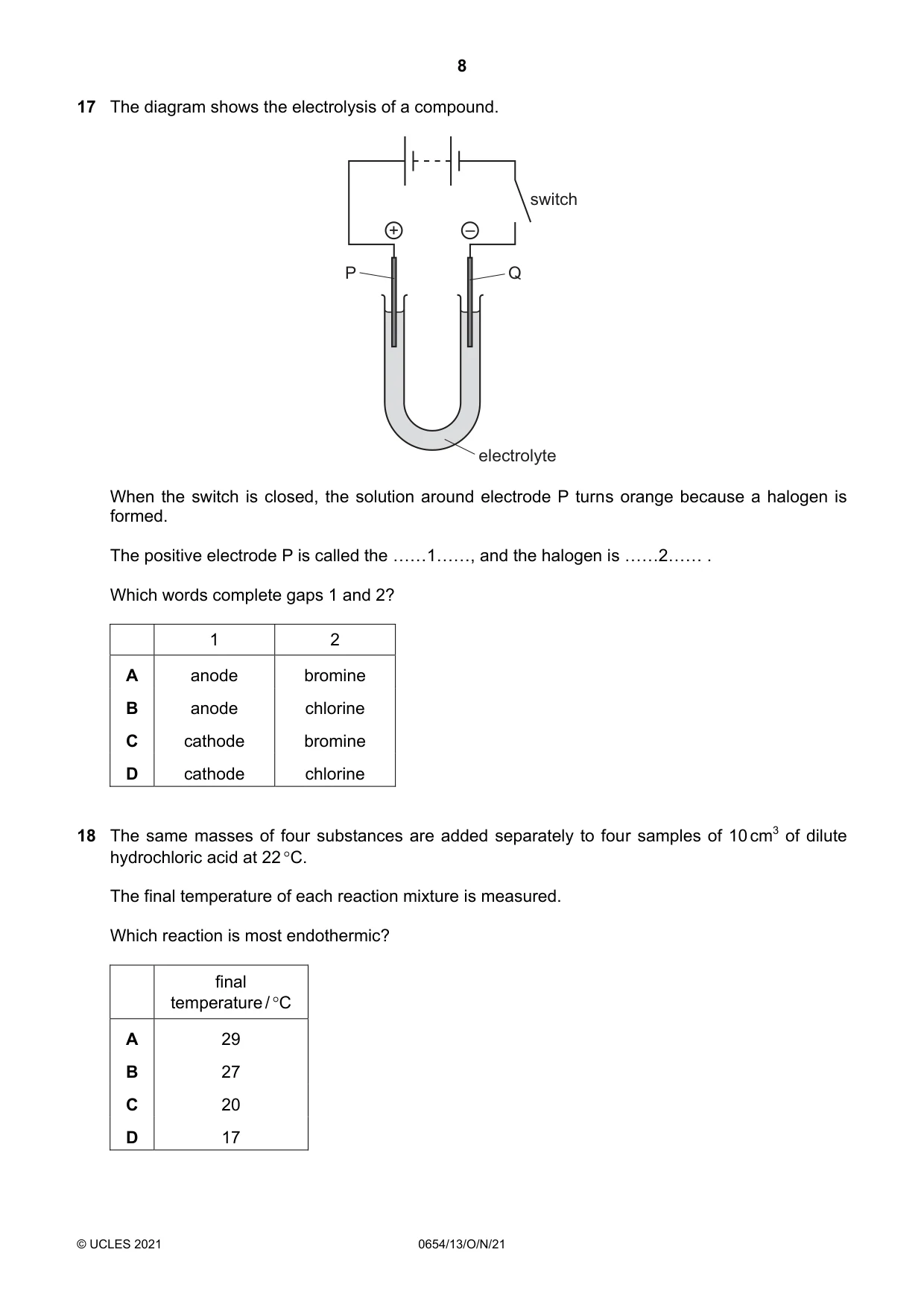
17 The diagram shows the electrolysis of a compound. switch + – P Q electrolyte When the switch is closed, the solution around electrode P turns orange because a halogen is formed. The positive electrode P is called the ……1……, and the halogen is ……2…… . Which words complete gaps 1 and 2? 1 2 A anode bromine B anode chlorine C cathode bromine D cathode chlorine
Mark scheme: A
Q18 · The same masses of four substances are added separately to four samples of 10 cm3 of…
18 The same masses of four substances are added separately to four samples of 10 cm3 of dilute hydrochloric acid at 22 C. The final temperature of each reaction mixture is measured. Which reaction is most endothermic? final temperature / C A 29 B 27 C 20 D 17
Mark scheme: D
Q19 · Dilute hydrochloric acid is added to excess solid calcium carbonate
19 Dilute hydrochloric acid is added to excess solid calcium carbonate. Which change increases the rate of this reaction? A decrease the concentration of the acid B decrease the volume of the acid C reduce the size of the solid particles D reduce the temperature
Mark scheme: C
Q20 · A gas turns damp litmus paper white
20 A gas turns damp litmus paper white. What is the gas? A carbon dioxide B chlorine C hydrogen chloride D sulfur dioxide
Mark scheme: B
Q21 · Which statement about the elements in Group I and in Group VII of the Periodic Table is…
21 Which statement about the elements in Group I and in Group VII of the Periodic Table is correct? A Chlorine has a darker colour than iodine. B Each molecule of a halogen contains one atom. C Potassium reacts with cold water more vigorously than lithium. D The melting point of lithium is lower than the melting point of sodium.
Mark scheme: C
Q22 · Why does the steel used to make a drill contain manganese?
22 Why does the steel used to make a drill contain manganese? A to increase the density of the steel B to increase the hardness of the steel C to increase the malleability of the steel D to increase the melting point of the steel
Mark scheme: B
Q23 · What is a chemical test for water?
23 What is a chemical test for water? A It turns anhydrous cobalt(II) chloride white. B It turns anhydrous copper(II) sulfate blue. C It turns blue copper(II) sulfate white. D It turns pink cobalt(II) chloride blue.
Mark scheme: B
Q24 · Which process does not produce carbon dioxide?
24 Which process does not produce carbon dioxide? A complete combustion of fossil fuels B reaction of an acid with a carbonate C respiration in plants D rusting iron
Mark scheme: D
Q25 · Which statements about limestone are correct?
25 Which statements about limestone are correct? 1 Limestone is used to neutralise industrial waste products. 2 Limestone is used to treat acidic soil. 3 Thermal decomposition of limestone produces calcium oxide. A 1 and 2 only B 1 and 3 only C 2 and 3 only D 1, 2 and 3
Mark scheme: D
Q26 · Four molecules are shown
26 Four molecules are shown. Which structure represents ethanol? A B C D H H H H H H H H H H C C OH H C C C OH C C H C C H H H H H H H OH H H
Mark scheme: A
Q27 · Which statement about ethene, C2H4, is not correct?
27 Which statement about ethene, C2H4, is not correct? A It is an unsaturated hydrocarbon. B It is produced by cracking. C It is used to make a polymer. D It turns aqueous bromine brown.
Mark scheme: D
Q28 · A student uses a stop-watch to measure the time taken for a ball to drop 2.0 m to the…
28 A student uses a stop-watch to measure the time taken for a ball to drop 2.0 m to the ground. The measurement is taken five times. These are the results: 20.16 s 20.22 s 20.14 s 20.22 s 20.26 s Which value for the time taken should be used? A 20.16 s B 20.20 s C 20.22 s D 20.26 s
Mark scheme: B
More questions on Physical quantities and measurement techniques
Q29 · A student wishes to determine the centre of mass of a piece of card
29 A student wishes to determine the centre of mass of a piece of card. She makes five holes in the card. She suspends the card from a pin, as shown. She hangs a load from a thread attached to the pin and marks the line of the thread on the card. hole pin card thread load The student repeats the procedure using a different hole. What is the smallest number of lines that she needs to draw to determine the position of the centre of mass of the card? A 1 B 2 C 3 D 4
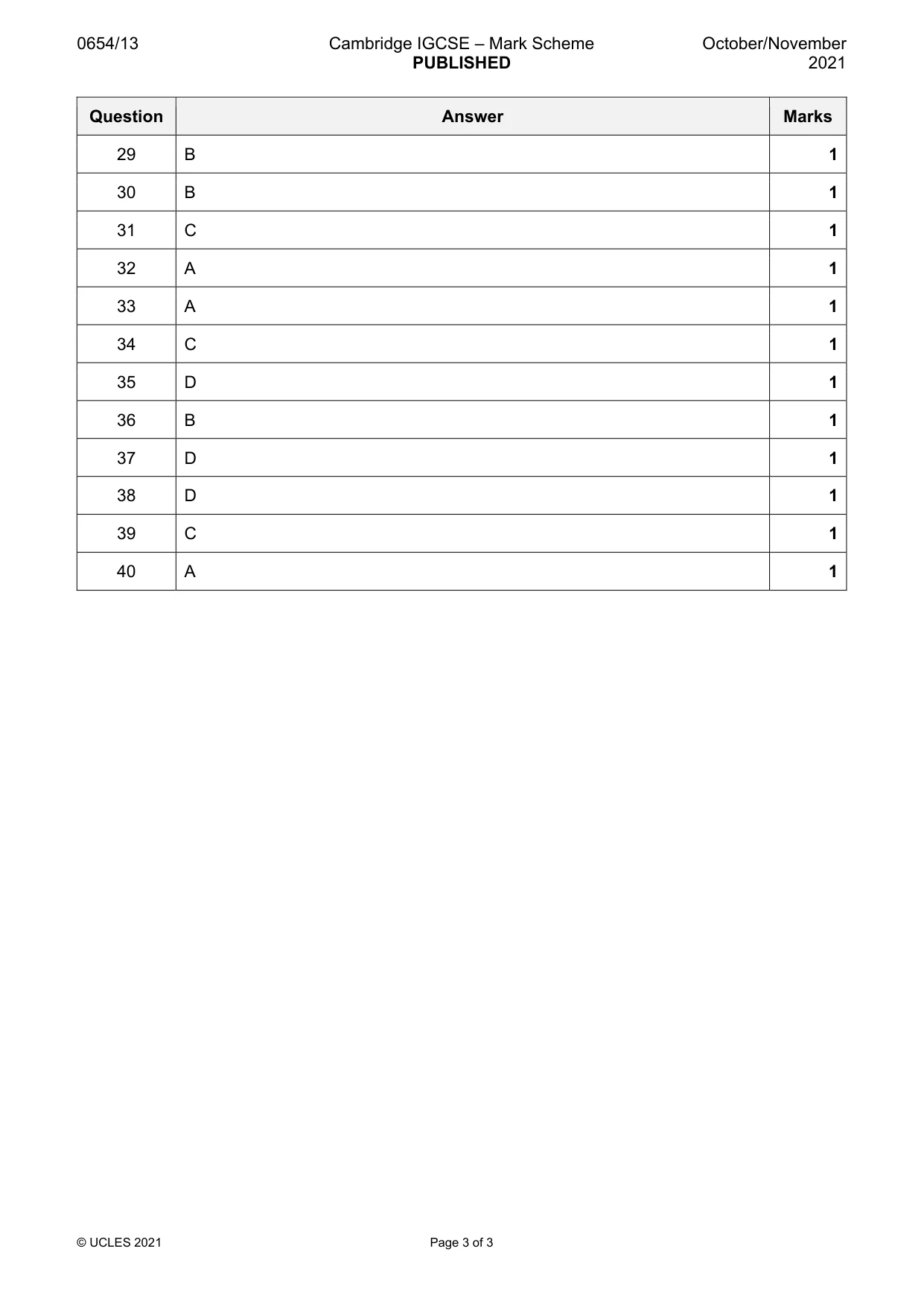
Mark scheme: B
Q30 · When driving cars on soft sand, drivers are advised to reduce the pressure of the air in…
30 When driving cars on soft sand, drivers are advised to reduce the pressure of the air in the tyres. Why does this cause the cars to sink less into the sand? A The area of the tyres in contact with the sand is decreased. B The area of the tyres in contact with the sand is increased. C The downward force on the sand is decreased. D The downward force on the sand is increased.
Mark scheme: B
Q31 · Which type of energy does an object have due to its motion?
31 Which type of energy does an object have due to its motion? A elastic potential B gravitational potential C kinetic D nuclear
Mark scheme: C
Q32 · Which labelled arrow on the diagram represents condensation?
32 Which labelled arrow on the diagram represents condensation? A liquid gas B C D solid
Mark scheme: A
Q33 · Four rods have the same dimensions
33 Four rods have the same dimensions. They are made of four different metals and are all at room temperature. All the rods are heated equally at one end for the same length of time. The final temperature of the other end of each rod is shown in the table. Which rod is the worst conductor of heat? final temperature / °C A 50 B 62 C 70 D 82
Mark scheme: A
Q34 · The diagram shows a ray of light striking a plane mirror
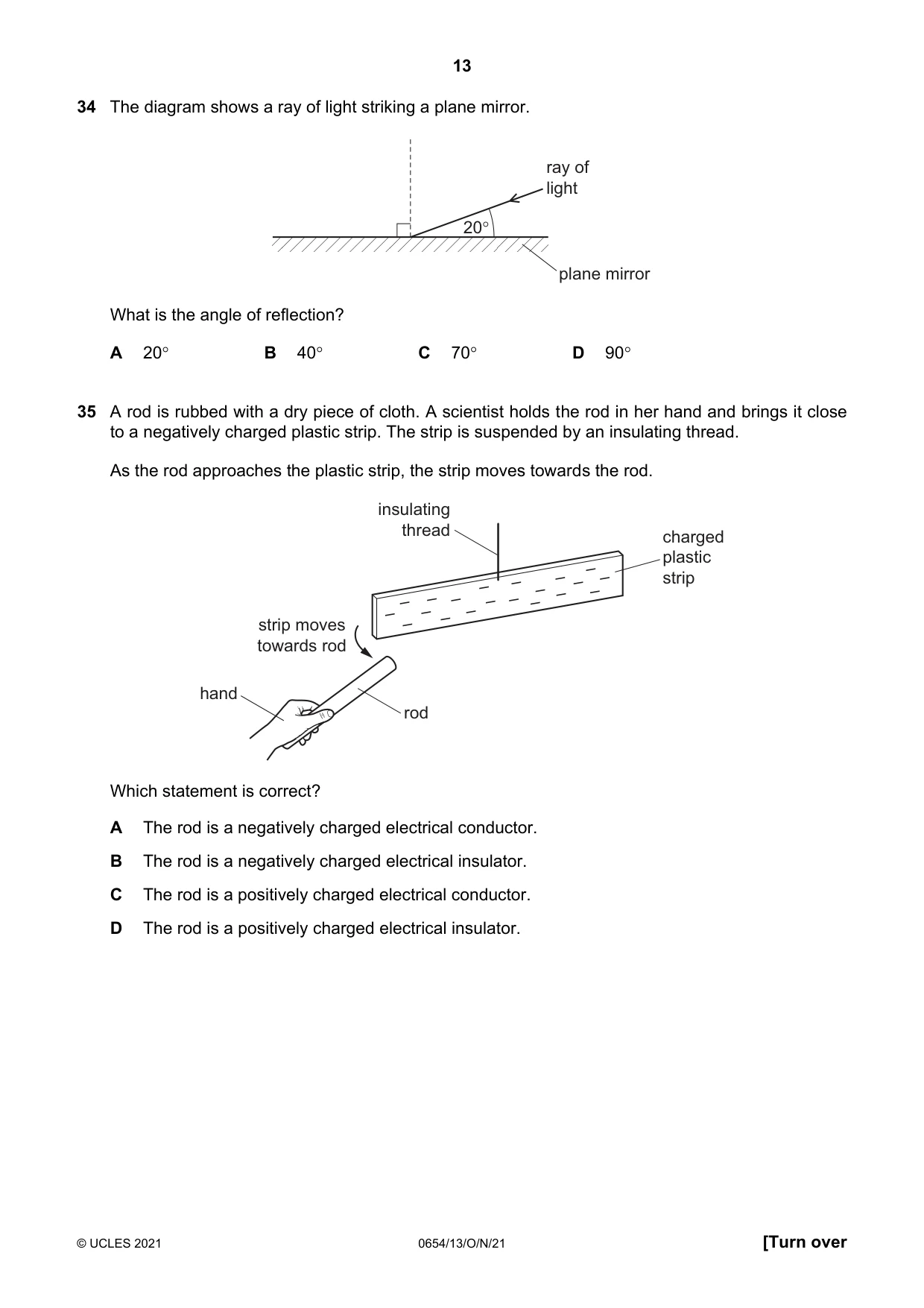
34 The diagram shows a ray of light striking a plane mirror. ray of light 20° plane mirror What is the angle of reflection? A 20 B 40 C 70 D 90
Mark scheme: C
Q35 · A rod is rubbed with a dry piece of cloth
35 A rod is rubbed with a dry piece of cloth. A scientist holds the rod in her hand and brings it close to a negatively charged plastic strip. The strip is suspended by an insulating thread. As the rod approaches the plastic strip, the strip moves towards the rod. insulating thread charged plastic – – – – – –– strip – – – – – – – – – – – – strip moves – towards rod hand rod Which statement is correct? A The rod is a negatively charged electrical conductor. B The rod is a negatively charged electrical insulator. C The rod is a positively charged electrical conductor. D The rod is a positively charged electrical insulator.
Mark scheme: D
Q36 · An ammeter is used to measure the current in a metal wire
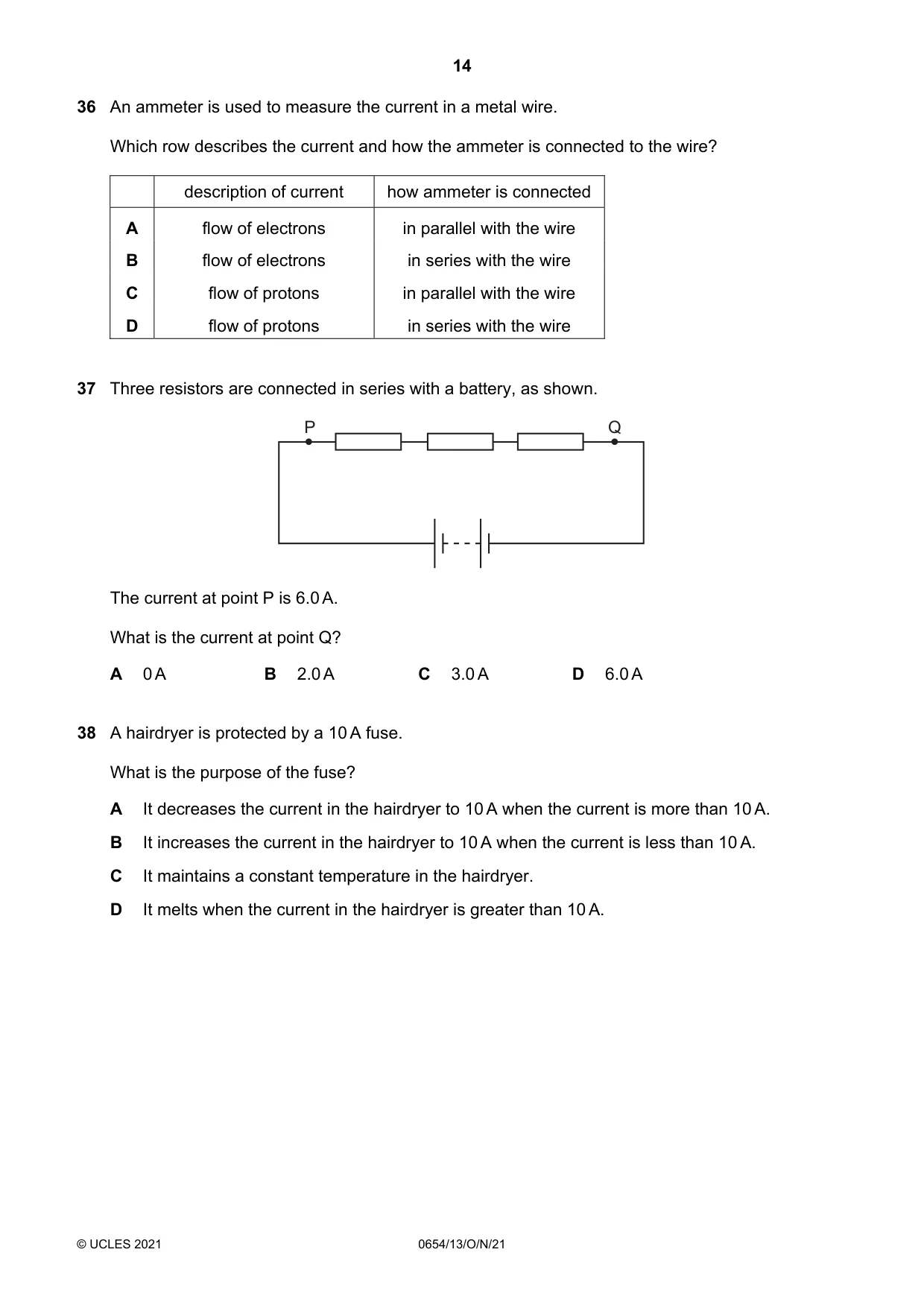
36 An ammeter is used to measure the current in a metal wire. Which row describes the current and how the ammeter is connected to the wire? description of current how ammeter is connected A flow of electrons in parallel with the wire B flow of electrons in series with the wire C flow of protons in parallel with the wire D flow of protons in series with the wire
Mark scheme: B
Q37 · Three resistors are connected in series with a battery, as shown
37 Three resistors are connected in series with a battery, as shown. P Q The current at point P is 6.0 A. What is the current at point Q? A 0 A B 2.0 A C 3.0 A D 6.0 A
Mark scheme: D
Q38 · A hairdryer is protected by a 10 A fuse
38 A hairdryer is protected by a 10 A fuse. What is the purpose of the fuse? A It decreases the current in the hairdryer to 10 A when the current is more than 10 A. B It increases the current in the hairdryer to 10 A when the current is less than 10 A. C It maintains a constant temperature in the hairdryer. D It melts when the current in the hairdryer is greater than 10 A.
Mark scheme: D
Q39 · The diagrams show the cross-section of a straight wire carrying a current into the page
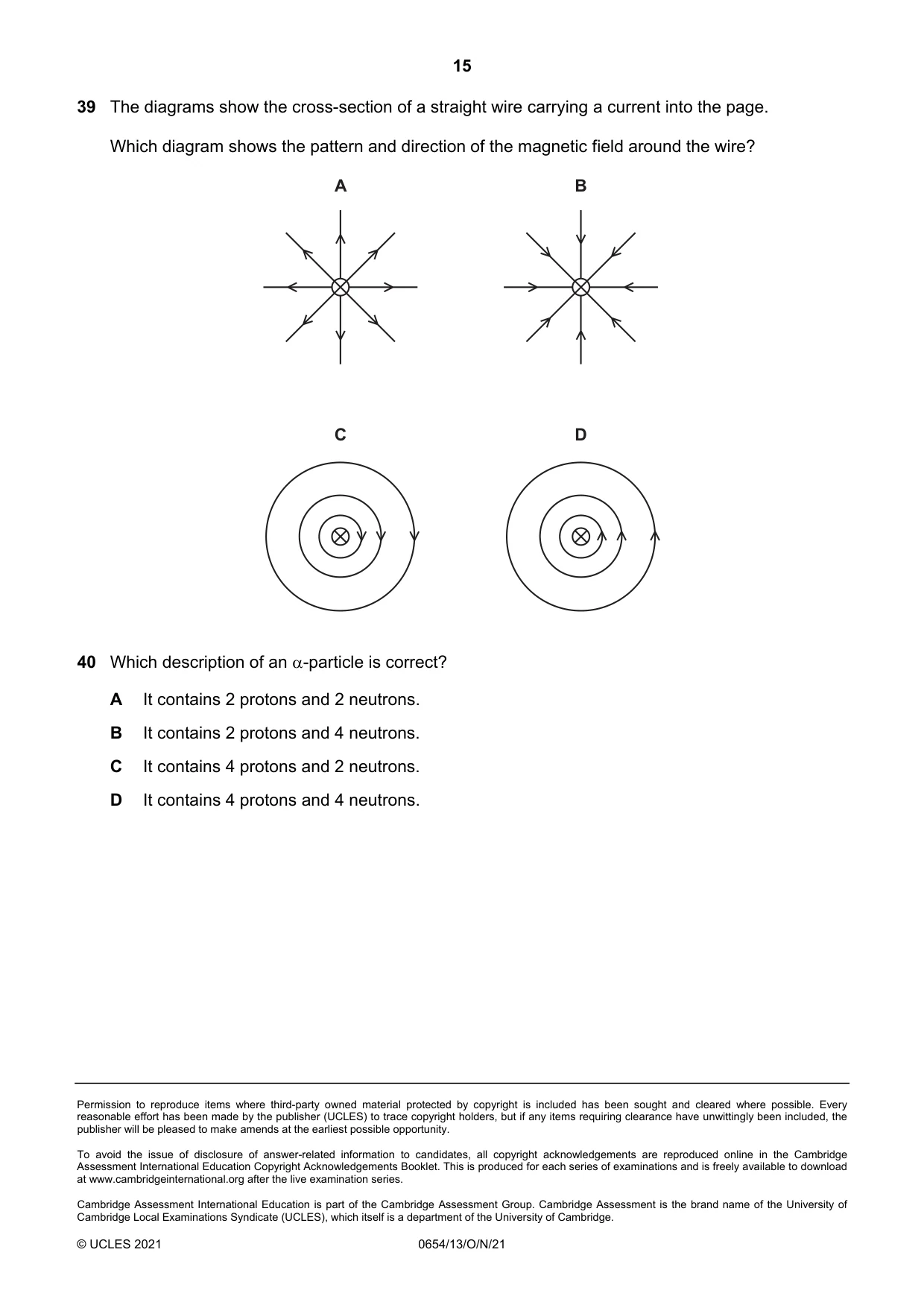
39 The diagrams show the cross-section of a straight wire carrying a current into the page. Which diagram shows the pattern and direction of the magnetic field around the wire? A B C D
Mark scheme: C
Q40 · Which description of an -particle is correct?
40 Which description of an -particle is correct? A It contains 2 protons and 2 neutrons. B It contains 2 protons and 4 neutrons. C It contains 4 protons and 2 neutrons. D It contains 4 protons and 4 neutrons.
Mark scheme: A
What was in this paper
The subtopics covered by these 40 questions, and how many questions each got. Open one in a new tab to see every Cambridge question on it.
2Air quality and climate1Alcohols1Alkenes1Alloys and their properties1Atomic structure and the Periodic Table1Biological molecules1Carbon cycle1Characteristics of living organisms1Diet1Electrical circuits1Electrical quantities1Electrical safety1Electrolysis1Electromagnetic effects1Energy flow1Energy, work and power1Enzymes1Exothermic and endothermic reactions1Forces1Gas exchange in humans1Group I properties1Hormones1Identification of ions and gases1Kinetic particle model of matter1Leaf structure1Light1Monohybrid inheritance1Osmosis1Oxides1Photosynthesis1Physical quantities and measurement techniques1Pressure1Radioactivity1Rate of reaction1Sexual reproduction in plants1Simple phenomena of magnetism1Transfer of thermal energy1Water1What you needed in this session
Cambridge’s own grade thresholds for 2021 Oct/Nov, Paper 1 · Variant 3. A higher threshold means an easier paper — the bar moves with how the cohort did.