Questions as text
Q1 · Some physical properties of five elements, P to T 0654/31 May/June 2017
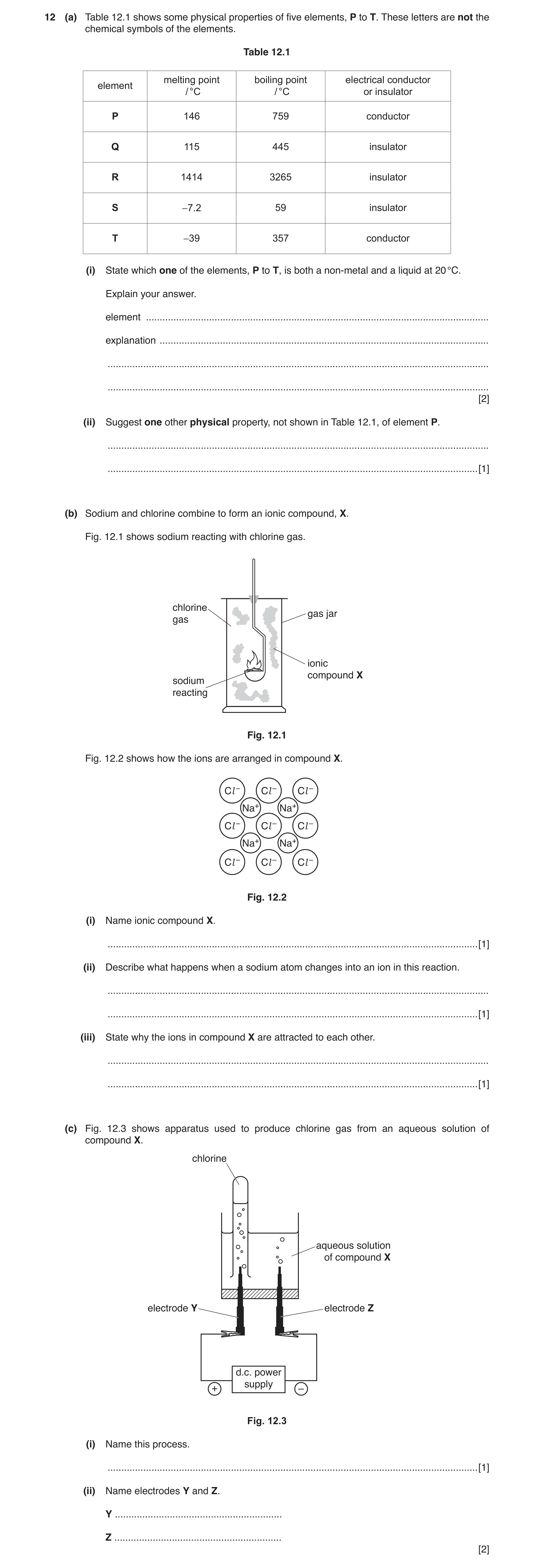
12 (a) Table 12.1 shows some physical properties of five elements, P to T. These letters are not the chemical symbols of the elements. Table 12.1 melting point boiling point electrical conductor element / °C / °C or insulator P 146 759 conductor Q 115 445 insulator R 1414 3265 insulator S −7.2 59 insulator T −39 357 conductor (i) State which one of the elements, P to T, is both a non-metal and a liquid at 20 °C. Explain your answer. element … explanation … … … [2] (ii) Suggest one other physical property, not shown in Table 12.1, of element P. … … [1] (b) Sodium and chlorine combine to form an ionic compound, X. Fig. 12.1 shows sodium reacting with chlorine gas. chlorine gas jar gas ionic compound X sodium reacting Fig. 12.1 Fig. 12.2 shows how the ions are arranged in compound X. Cl – Cl – Cl – Na+ Na+ Cl – Cl – Cl – Na+ Na+ Cl – Cl – Cl – Fig. 12.2 (i) Name ionic compound X. … [1] (ii) Describe what happens when a sodium atom changes into an ion in this reaction. … … [1] (iii) State why the ions in compound X are attracted to each other. … … [1] (c) Fig. 12.3 shows apparatus used to produce chlorine gas from an aqueous solution of compound X. chlorine aqueous solution of compound X electrode Y electrode Z d.c. power supply + – Fig. 12.3 (i) Name this process. … [1] (ii) Name electrodes Y and Z. Y … Z … [2]
9 marks
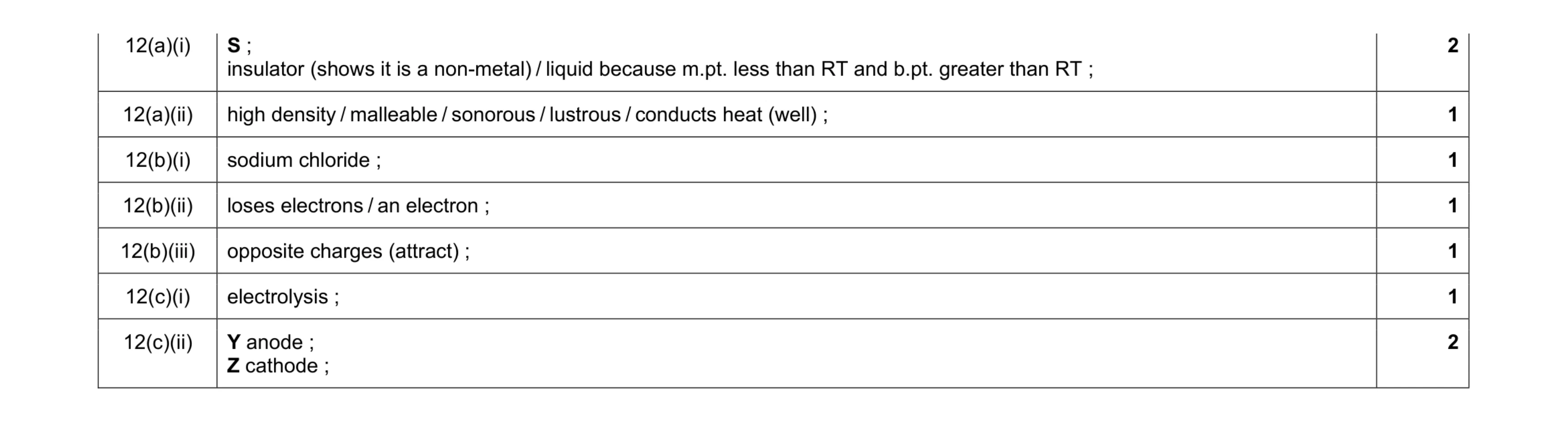
Mark scheme: 12(a)(i) S ; insulator (shows it is a non-metal) / liquid because m.pt. less than RT and b.pt. greater than RT ; 2 12(a)(ii) high density / malleable / sonorous / lustrous / conducts heat (well) ; 1 12(b)(i) sodium chloride ; 1 12(b)(ii) loses electrons / an electron ; 1 12(b)(iii) opposite charges (attract) ; 1 12(c)(i) electrolysis ; 1 12(c)(ii) Y anode ; Z cathode ; 2
This question in 0654/31 May/June 2017
Q2 · Electrolysis occurs when an electric current passes through a solution that contains ions 0654/32 May/June 2017
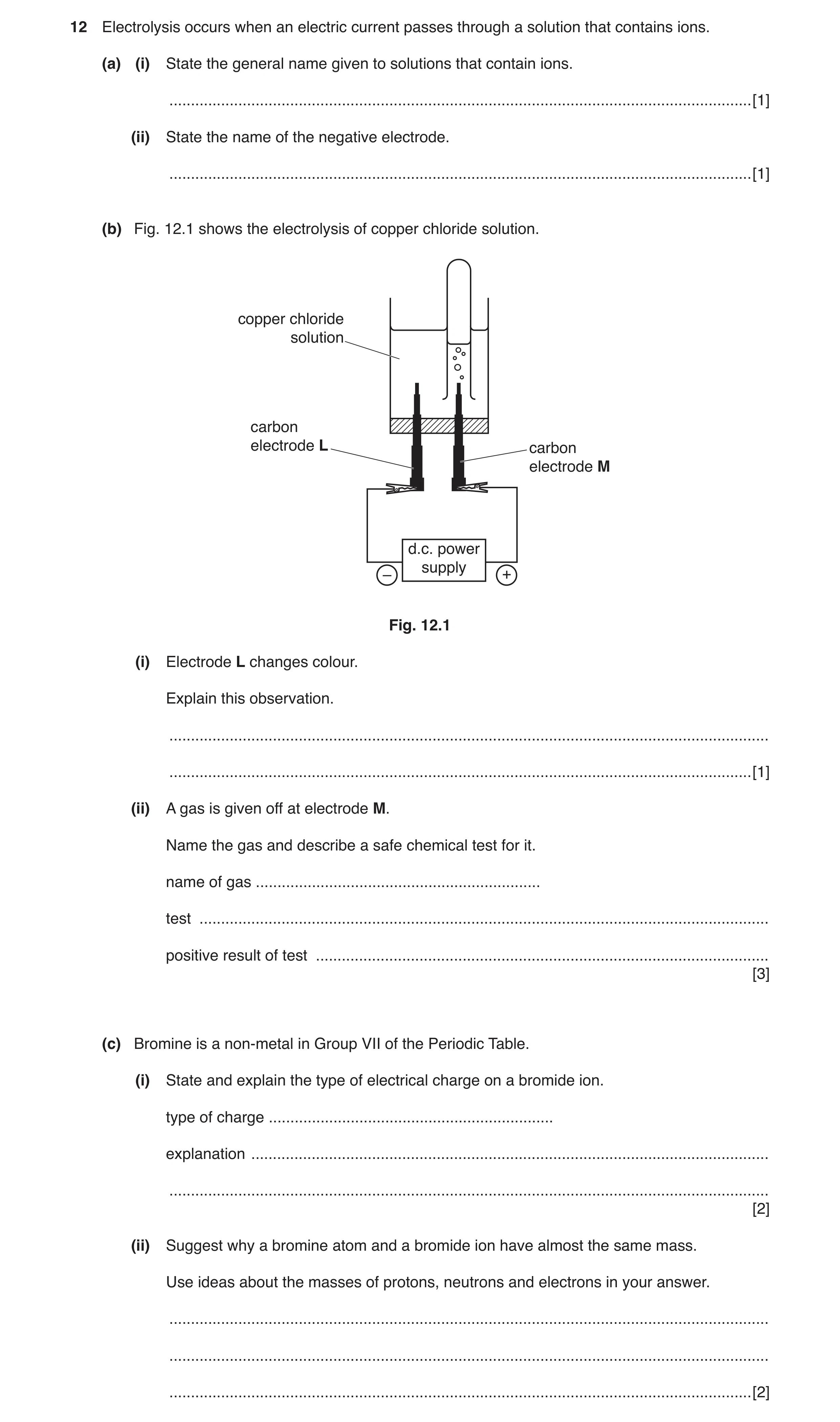
12 Electrolysis occurs when an electric current passes through a solution that contains ions. (a) (i) State the general name given to solutions that contain ions. … [1] (ii) State the name of the negative electrode. … [1] (b) Fig. 12.1 shows the electrolysis of copper chloride solution. copper chloride solution carbon electrode L carbon electrode M d.c. power supply – + Fig. 12.1 (i) Electrode L changes colour. Explain this observation. … … [1] (ii) A gas is given off at electrode M. Name the gas and describe a safe chemical test for it. name of gas … test … positive result of test … [3] (c) Bromine is a non-metal in Group VII of the Periodic Table. (i) State and explain the type of electrical charge on a bromide ion. type of charge … explanation … … [2] (ii) Suggest why a bromine atom and a bromide ion have almost the same mass. Use ideas about the masses of protons, neutrons and electrons in your answer. … … … [2]
10 marks
Mark scheme: 12(a)(i) electrolyte ; 1 12(a)(ii) cathode ; 1 12(b)(i) reference to formation of copper / a copper layer ; 1 12(b)(ii) chlorine ; (damp) litmus / (Universal) indicator paper ; bleached ; 3 12(c)(i) negative ; non-metals form anions / bromine atoms gain (an) electron ; 2 12(c)(ii) the idea that there is only an electron difference ; electrons have no/negligible mass ; 2
This question in 0654/32 May/June 2017
Q3 · Black ink in marker pens is a mixture of several dyes (coloured compounds) 0654/33 May/June 2017
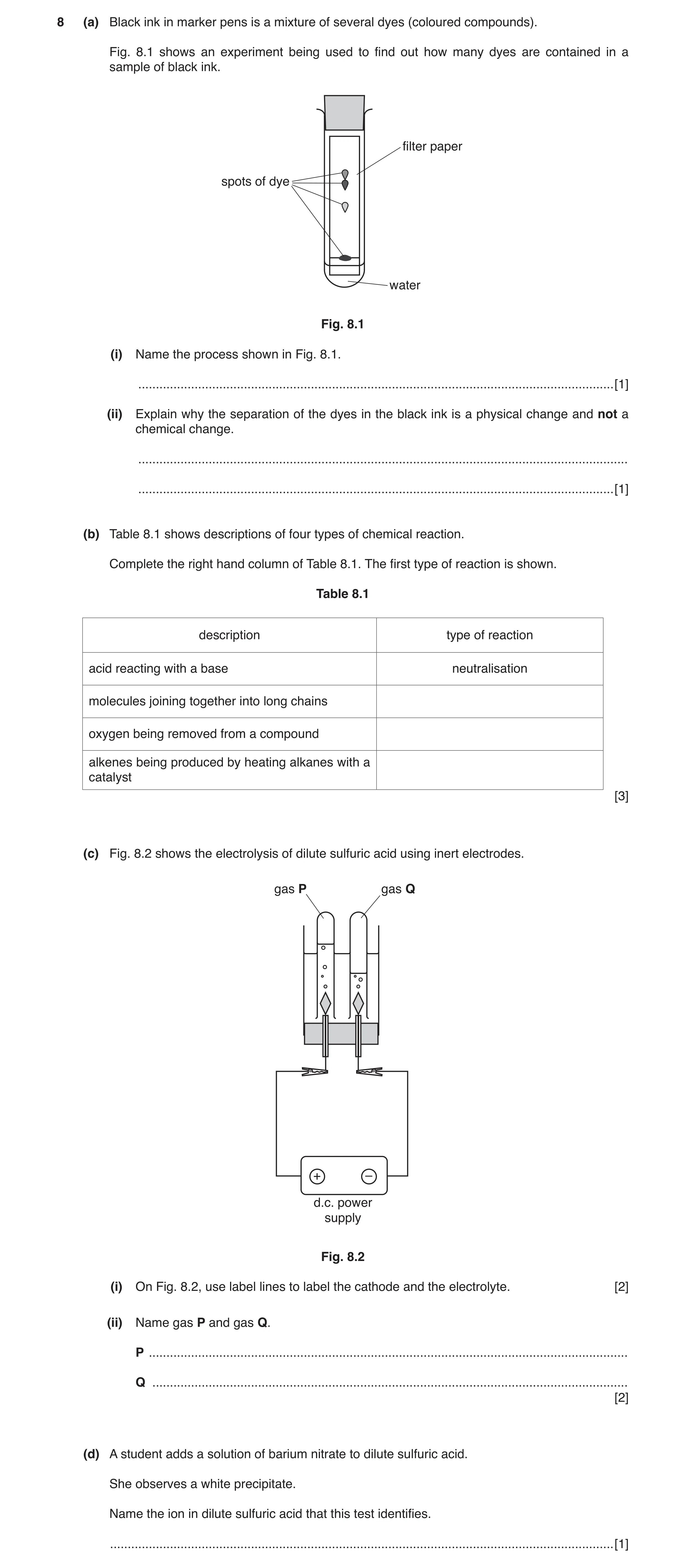
8 (a) Black ink in marker pens is a mixture of several dyes (coloured compounds). Fig. 8.1 shows an experiment being used to find out how many dyes are contained in a sample of black ink. filter paper spots of dye water Fig. 8.1 (i) Name the process shown in Fig. 8.1. … [1] (ii) Explain why the separation of the dyes in the black ink is a physical change and not a chemical change. … … [1] (b) Table 8.1 shows descriptions of four types of chemical reaction. Complete the right hand column of Table 8.1. The first type of reaction is shown. Table 8.1 description type of reaction acid reacting with a base neutralisation molecules joining together into long chains oxygen being removed from a compound alkenes being produced by heating alkanes with a catalyst [3] (c) Fig. 8.2 shows the electrolysis of dilute sulfuric acid using inert electrodes. gas P gas Q + – d.c. power supply Fig. 8.2 (i) On Fig. 8.2, use label lines to label the cathode and the electrolyte. [2] (ii) Name gas P and gas Q. P … Q … [2] (d) A student adds a solution of barium nitrate to dilute sulfuric acid. She observes a white precipitate. Name the ion in dilute sulfuric acid that this test identifies. … [1]
10 marks
Mark scheme: 8(a)(i) chromatography ; 1 8(a)(ii) no new substances produced / only separating existing substances ; 1 8(b) polymerisation ; reduction ; cracking ; 3 8(c)(i) negative electrode inside the tube labelled cathode ; solution labelled electrolyte ; 2 8(c)(ii) P is oxygen ; Q is hydrogen ; 2 8(d) sulfate ; 1
This question in 0654/33 May/June 2017
Q4 · Group VII of the Periodic Table contains reactive non‑metallic elements called the… 0654/31 Oct/Nov 2018
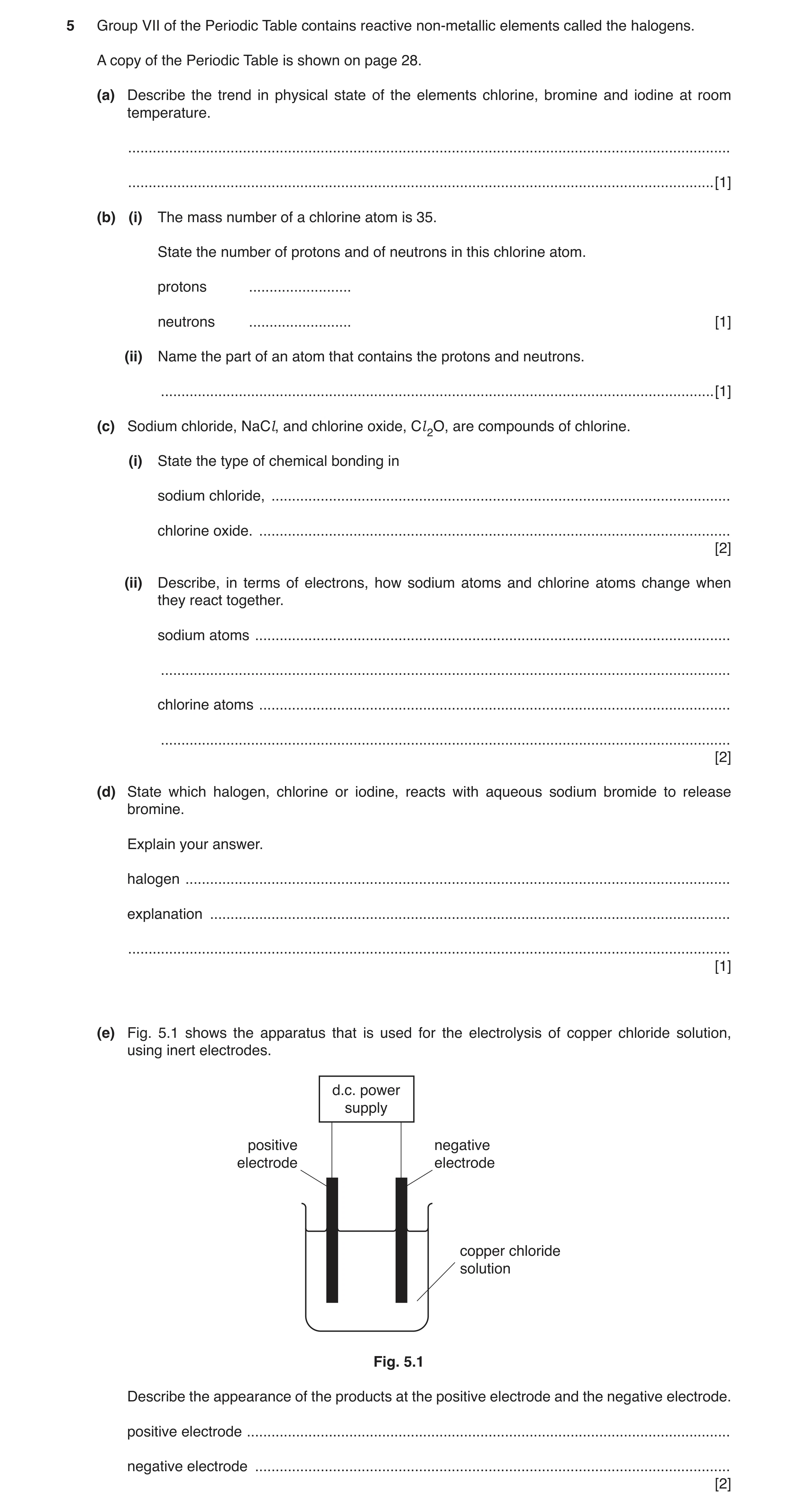
5 Group VII of the Periodic Table contains reactive non‑metallic elements called the halogens. A copy of the Periodic Table is shown on page 28. (a) Describe the trend in physical state of the elements chlorine, bromine and iodine at room temperature. … … [1] (b) (i) The mass number of a chlorine atom is 35. State the number of protons and of neutrons in this chlorine atom. protons … neutrons … [1] (ii) Name the part of an atom that contains the protons and neutrons. … [1] (c) Sodium chloride, NaCl, and chlorine oxide, Cl 2O, are compounds of chlorine. (i) State the type of chemical bonding in sodium chloride, … chlorine oxide. … [2] (ii) Describe, in terms of electrons, how sodium atoms and chlorine atoms change when they react together. sodium atoms … … chlorine atoms … … [2] (d) State which halogen, chlorine or iodine, reacts with aqueous sodium bromide to release bromine. Explain your answer. halogen … explanation … … [1] (e) Fig. 5.1 shows the apparatus that is used for the electrolysis of copper chloride solution, using inert electrodes. d.c. power supply positive negative electrode electrode copper chloride solution Fig. 5.1 Describe the appearance of the products at the positive electrode and the negative electrode. positive electrode … negative electrode … [2]
10 marks
Mark scheme: 5(a) gaseous to liquid to solid ; 1 5(b)(i) (protons) 17 (neutrons) 18 ; 1 5(b)(ii) nucleus ; 1 5(c)(i) (sodium chloride) ionic / electrovalent ; (chlorine oxide ) covalent ; 2 5(c)(ii) (sodium atoms) lose electrons ; (chlorine atoms) gain electrons ; 2 5(d) chlorine – no mark chlorine more reactive than bromine ; 1 5(e) at positive gas is released / bubbles produced ; at negative brown / copper-coloured solid (layer) ; 2
This question in 0654/31 Oct/Nov 2018
Q5 · Electrolysis is a process which uses electricity to break down a compound 0654/32 May/June 2019
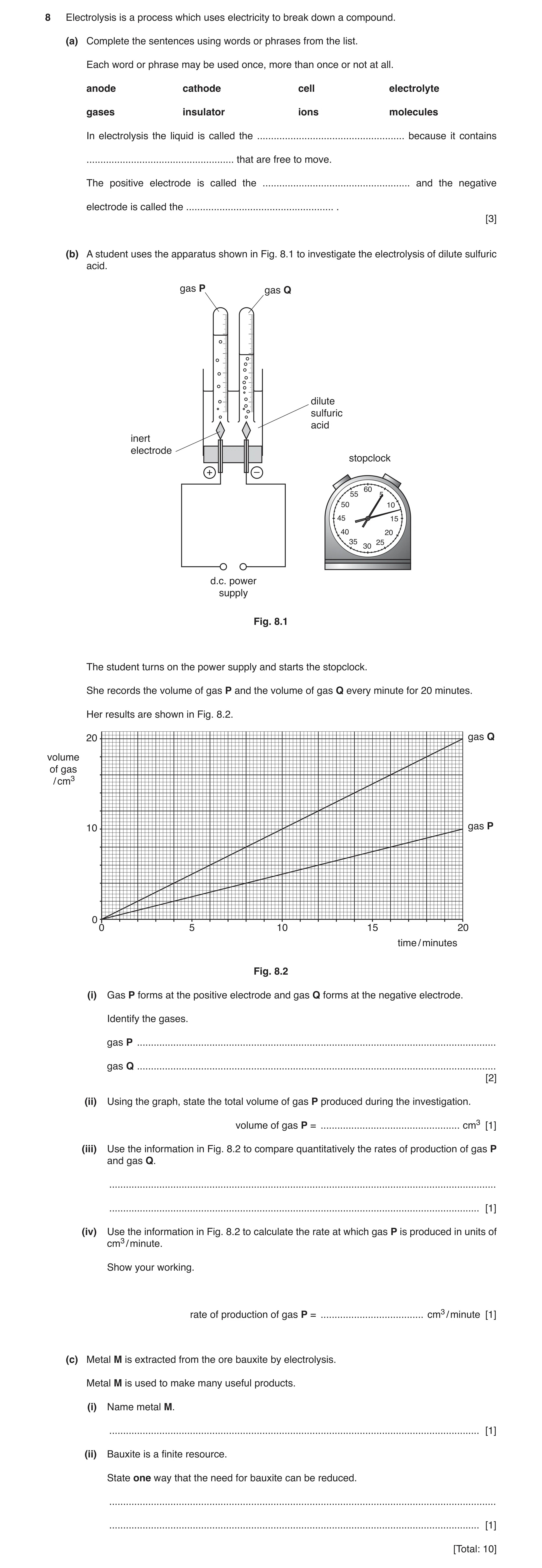
8 Electrolysis is a process which uses electricity to break down a compound. (a) Complete the sentences using words or phrases from the list. Each word or phrase may be used once, more than once or not at all. anode cathode cell electrolyte gases insulator ions molecules In electrolysis the liquid is called the … because it contains … that are free to move. The positive electrode is called the … and the negative electrode is called the … . [3] (b) A student uses the apparatus shown in Fig. 8.1 to investigate the electrolysis of dilute sulfuric acid. gas P gas Q dilute sulfuric acid inert electrode stopclock + – 60 55 5 50 10 45 15 40 20 35 25 30 d.c. power supply Fig. 8.1 The student turns on the power supply and starts the stopclock. She records the volume of gas P and the volume of gas Q every minute for 20 minutes. Her results are shown in Fig. 8.2. 20 gas Q volume of gas / cm3 10 gas P 0 0 5 10 15 20 time / minutes Fig. 8.2 (i) Gas P forms at the positive electrode and gas Q forms at the negative electrode. Identify the gases. gas P … gas Q … [2] (ii) Using the graph, state the total volume of gas P produced during the investigation. volume of gas P = … cm3 [1] (iii) Use the information in Fig. 8.2 to compare quantitatively the rates of production of gas P and gas Q. … … [1] (iv) Use the information in Fig. 8.2 to calculate the rate at which gas P is produced in units of cm3 / minute. Show your working. rate of production of gas P = … cm3 / minute [1] (c) Metal M is extracted from the ore bauxite by electrolysis. Metal M is used to make many useful products. (i) Name metal M. … [1] (ii) Bauxite is a finite resource. State one way that the need for bauxite can be reduced. … … [1] [Total: 10]
10 marks
Mark scheme: 8(a) electrolyte ; ions ; anode and cathode ; 3 8(b)(i) P oxygen / O2 ; Q hydrogen / H2 ; 2 8(b)(ii) 10 (cm3 ) ; 1 8(b)(iii) Q is produced at twice the rate of P ; 1 8(b)(iv) 10 ÷ 20 / = 0.5 ( cm3 / minute) ; 1 8(c)(i) aluminium ; 1 8(c)(ii) recycle metal M / aluminium ; 1
This question in 0654/32 May/June 2019
Q6 · Electrolysis is a process which uses electricity to break down a compound 0654/33 May/June 2019
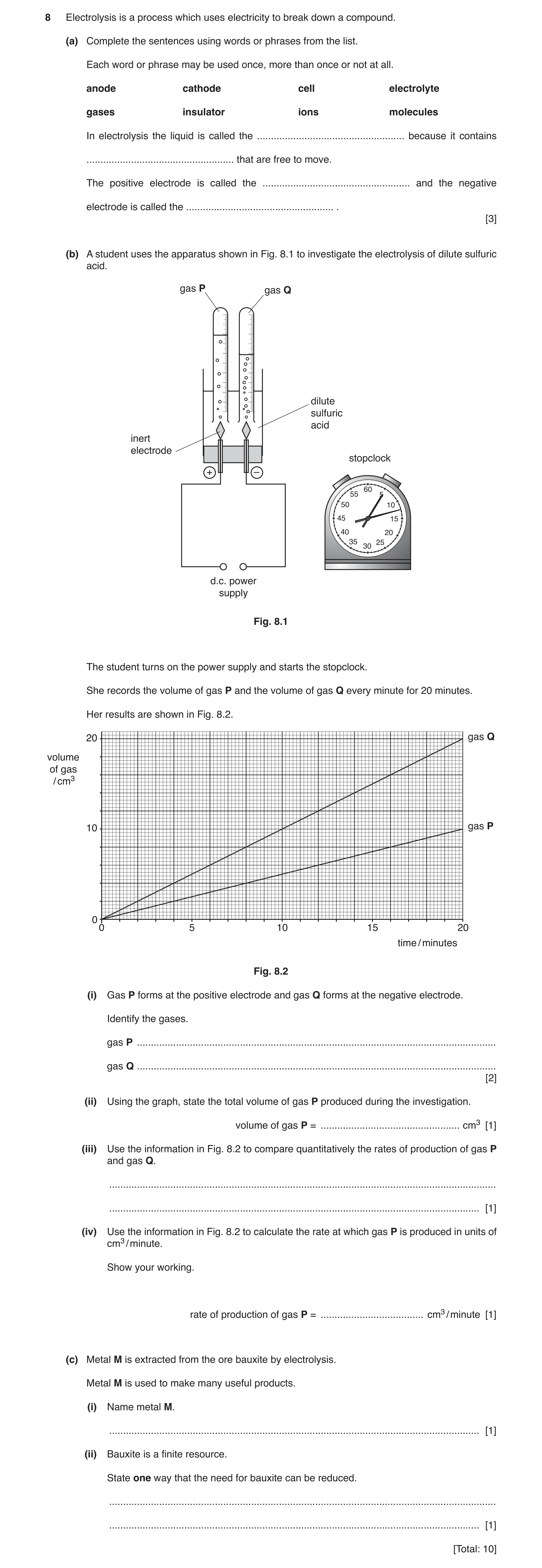
8 Electrolysis is a process which uses electricity to break down a compound. (a) Complete the sentences using words or phrases from the list. Each word or phrase may be used once, more than once or not at all. anode cathode cell electrolyte gases insulator ions molecules In electrolysis the liquid is called the … because it contains … that are free to move. The positive electrode is called the … and the negative electrode is called the … . [3] (b) A student uses the apparatus shown in Fig. 8.1 to investigate the electrolysis of dilute sulfuric acid. gas P gas Q dilute sulfuric acid inert electrode stopclock + – 60 55 5 50 10 45 15 40 20 35 25 30 d.c. power supply Fig. 8.1 The student turns on the power supply and starts the stopclock. She records the volume of gas P and the volume of gas Q every minute for 20 minutes. Her results are shown in Fig. 8.2. 20 gas Q volume of gas / cm3 10 gas P 0 0 5 10 15 20 time / minutes Fig. 8.2 (i) Gas P forms at the positive electrode and gas Q forms at the negative electrode. Identify the gases. gas P … gas Q … [2] (ii) Using the graph, state the total volume of gas P produced during the investigation. volume of gas P = … cm3 [1] (iii) Use the information in Fig. 8.2 to compare quantitatively the rates of production of gas P and gas Q. … … [1] (iv) Use the information in Fig. 8.2 to calculate the rate at which gas P is produced in units of cm3 / minute. Show your working. rate of production of gas P = … cm3 / minute [1] (c) Metal M is extracted from the ore bauxite by electrolysis. Metal M is used to make many useful products. (i) Name metal M. … [1] (ii) Bauxite is a finite resource. State one way that the need for bauxite can be reduced. … … [1] [Total: 10]
10 marks
Mark scheme: 8(a) electrolyte ; ions ; anode and cathode ; 3 8(b)(i) P oxygen / O2 ; Q hydrogen / H2 ; 2 8(b)(ii) 10 (cm3 ) ; 1 8(b)(iii) Q is produced at twice the rate of P ; 1 8(b)(iv) 10 ÷ 20 / = 0.5 ( cm3 / minute) ; 1 8(c)(i) aluminium ; 1 8(c)(ii) recycle metal M / aluminium ; 1
This question in 0654/33 May/June 2019
Q7 · Name the type of chemical bond between: a metallic element and a non-metallic element …… 0654/31 Oct/Nov 2019
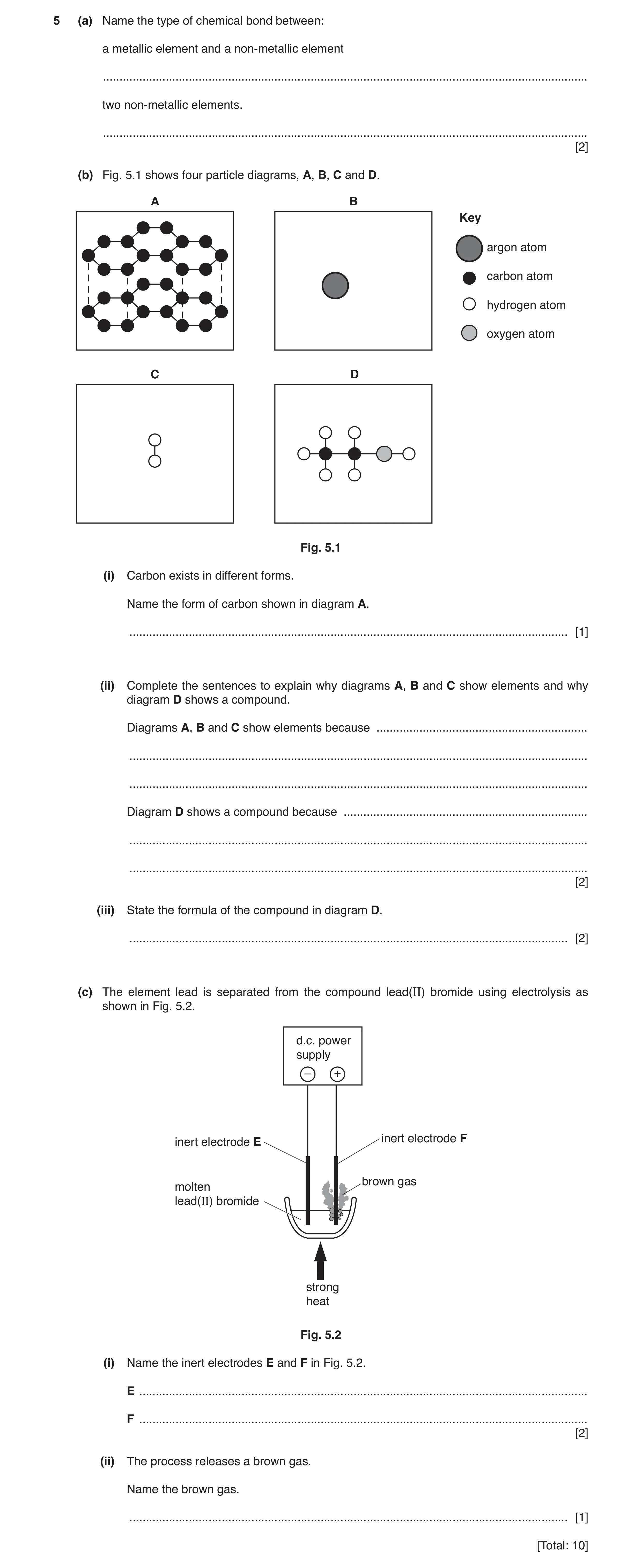
5 (a) Name the type of chemical bond between: a metallic element and a non-metallic element … two non-metallic elements. … [2] (b) Fig. 5.1 shows four particle diagrams, A, B, C and D. A B Key argon atom carbon atom hydrogen atom oxygen atom C D Fig. 5.1 (i) Carbon exists in different forms. Name the form of carbon shown in diagram A. … [1] (ii) Complete the sentences to explain why diagrams A, B and C show elements and why diagram D shows a compound. Diagrams A, B and C show elements because … … … Diagram D shows a compound because … … … [2] (iii) State the formula of the compound in diagram D. … [2] (c) The element lead is separated from the compound lead(II) bromide using electrolysis as shown in Fig. 5.2. d.c. power supply – + inert electrode F inert electrode E brown gas molten lead(II) bromide strong heat Fig. 5.2 (i) Name the inert electrodes E and F in Fig. 5.2. E … F … [2] (ii) The process releases a brown gas. Name the brown gas. … [1] [Total: 10]
10 marks
Mark scheme: 5(a) ionic / electrovalent ; covalent ; 2 5(b)(i) graphite ; 1 5(b)(ii) (A, B and C are elements because) they contain only one type of atom ; (D is compound because) it shows different types of atom bonded together ; 2 5(b)(iii) C2H6O symbols correct ; subscripts correct ; 2 5(c)(i) E – cathode ; F – anode ; 2 5(c)(ii) bromine ; 1
This question in 0654/31 Oct/Nov 2019
Q8 · Sodium is a very reactive metallic element 0654/32 Oct/Nov 2019
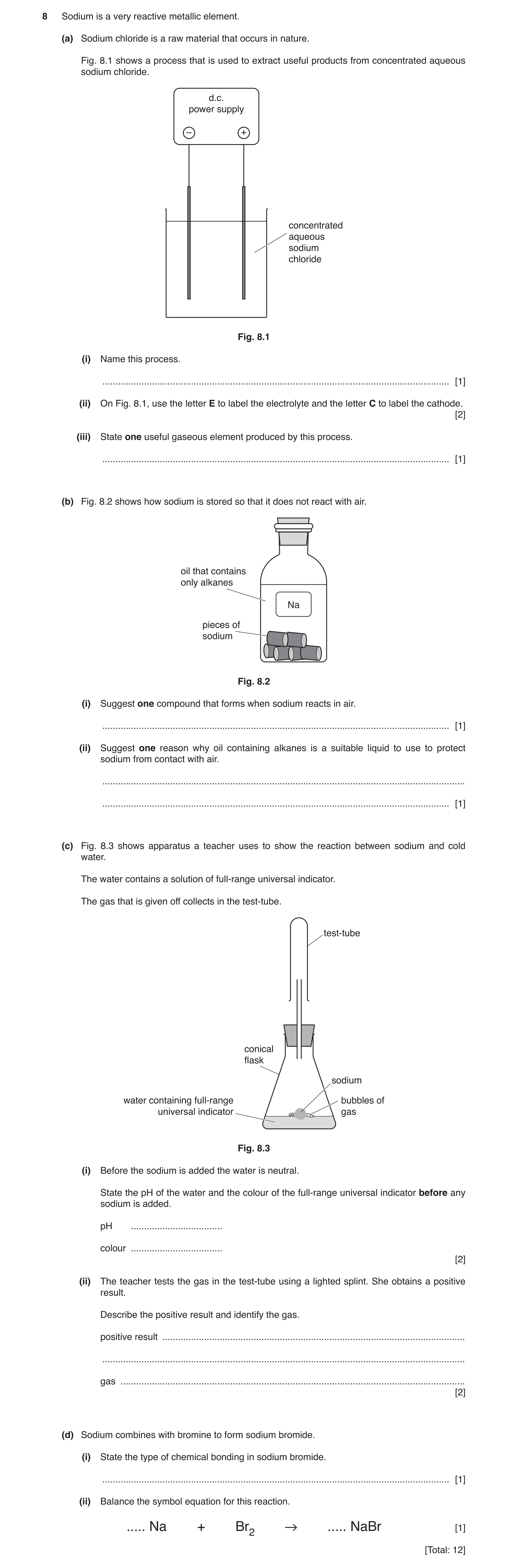
8 Sodium is a very reactive metallic element. (a) Sodium chloride is a raw material that occurs in nature. Fig. 8.1 shows a process that is used to extract useful products from concentrated aqueous sodium chloride. d.c. power supply – + concentrated aqueous sodium chloride Fig. 8.1 (i) Name this process. … [1] (ii) On Fig. 8.1, use the letter E to label the electrolyte and the letter C to label the cathode. [2] (iii) State one useful gaseous element produced by this process. … [1] (b) Fig. 8.2 shows how sodium is stored so that it does not react with air. oil that contains only alkanes Na pieces of sodium Fig. 8.2 (i) Suggest one compound that forms when sodium reacts in air. … [1] (ii) Suggest one reason why oil containing alkanes is a suitable liquid to use to protect sodium from contact with air. … … [1] (c) Fig. 8.3 shows apparatus a teacher uses to show the reaction between sodium and cold water. The water contains a solution of full-range universal indicator. The gas that is given off collects in the test-tube. test-tube conical flask sodium water containing full-range bubbles of universal indicator gas Fig. 8.3 (i) Before the sodium is added the water is neutral. State the pH of the water and the colour of the full-range universal indicator before any sodium is added. pH … colour … [2] (ii) The teacher tests the gas in the test-tube using a lighted splint. She obtains a positive result. Describe the positive result and identify the gas. positive result … … gas … [2] (d) Sodium combines with bromine to form sodium bromide. (i) State the type of chemical bonding in sodium bromide. … [1] (ii) Balance the symbol equation for this reaction. [1] … Na + Br2 … NaBr [Total: 12]
12 marks
Mark scheme: 8(a)(i) electrolysis ; 1 8(a)(ii) electrolyte labelled anywhere ; negative electrode labelled ; 2 8(a)(iii) chlorine / hydrogen ; 1 8(b)(i) sodium oxide / hydroxide / carbonate ; 1 8(b)(ii) alkanes (relatively) unreactive / alkanes do not react with sodium ; 1 8(c)(i) pH 7 ; green ; 2 8(c)(ii) squeaky pop ; hydrogen ; 2 8(d)(i) ionic / electrovalent ; 1 8(d)(ii) 2 Na + Br2 → 2 NaBr ; 1
This question in 0654/32 Oct/Nov 2019
Q9 · A chart showing the composition of clean air 0654/33 Oct/Nov 2019
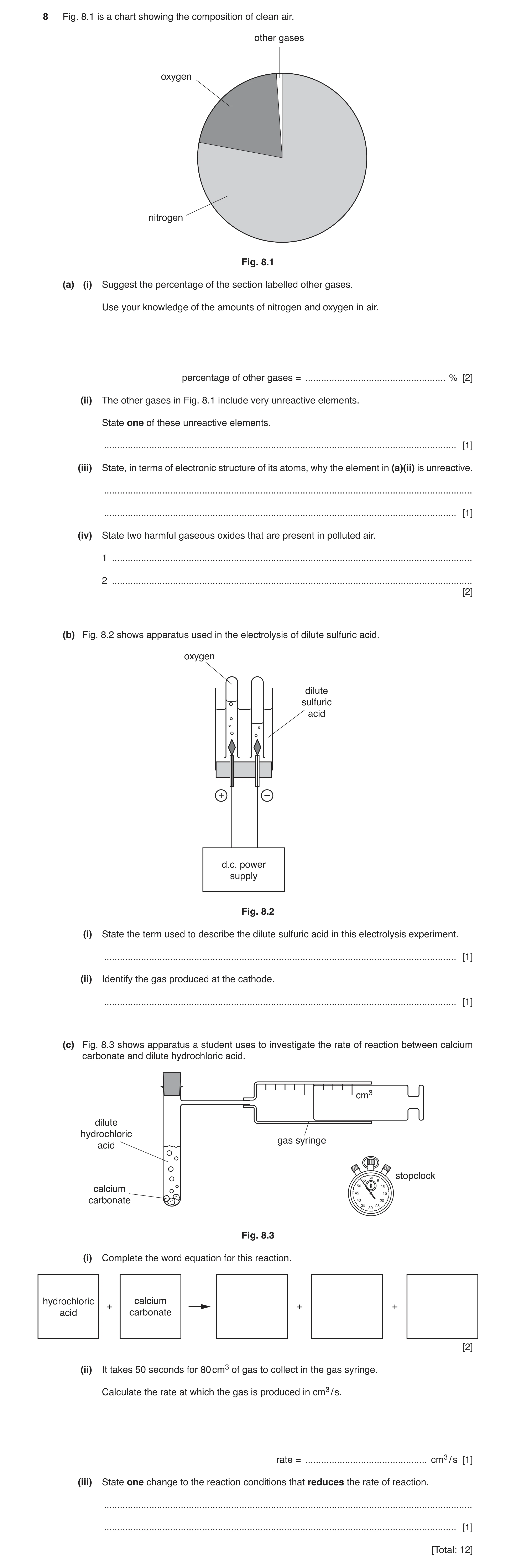
8 Fig. 8.1 is a chart showing the composition of clean air. other gases oxygen nitrogen Fig. 8.1 (a) (i) Suggest the percentage of the section labelled other gases. Use your knowledge of the amounts of nitrogen and oxygen in air. percentage of other gases = … % [2] (ii) The other gases in Fig. 8.1 include very unreactive elements. State one of these unreactive elements. … [1] (iii) State, in terms of electronic structure of its atoms, why the element in (a)(ii) is unreactive. … … [1] (iv) State two harmful gaseous oxides that are present in polluted air. 1 … 2 … [2] (b) Fig. 8.2 shows apparatus used in the electrolysis of dilute sulfuric acid. oxygen dilute sulfuric acid + – d.c. power supply Fig. 8.2 (i) State the term used to describe the dilute sulfuric acid in this electrolysis experiment. … [1] (ii) Identify the gas produced at the cathode. … [1] (c) Fig. 8.3 shows apparatus a student uses to investigate the rate of reaction between calcium carbonate and dilute hydrochloric acid. cm3 dilute hydrochloric gas syringe acid stopclock calcium carbonate Fig. 8.3 (i) Complete the word equation for this reaction. hydrochloric calcium + + + acid carbonate [2] (ii) It takes 50 seconds for 80 cm3 of gas to collect in the gas syringe. Calculate the rate at which the gas is produced in cm3 / s. rate = … cm3 / s [1] (iii) State one change to the reaction conditions that reduces the rate of reaction. … … [1] [Total: 12]
12 marks
Mark scheme: 8(a)(i) nitrogen 78% + oxygen 21% = 99% / or equivalent ; so other gases = 100 – 99 = 1% ; 2 8(a)(ii) any noble gas ; 1 8(a)(iii) reference to full outer shell ; 1 8(a)(iv) sulfur dioxide / SO2 ; carbon monoxide / CO ; nitrogen oxides (named oxide) / NOx ; max 2 2 8(b)(i) electrolyte ; 1 8(b)(ii) hydrogen ; 1 8(c)(i) → calcium chloride ; + carbon dioxide + water ; 2 8(c)(ii) 80 ÷ 50 = 1.6 (cm3 / s) ; 1 8(c)(iii) decrease temperature / decrease acid concentration / decrease surface area of calcium carbonate ; 1
This question in 0654/33 Oct/Nov 2019
Q10 · Calcium and copper are metals 0654/31 May/June 2020
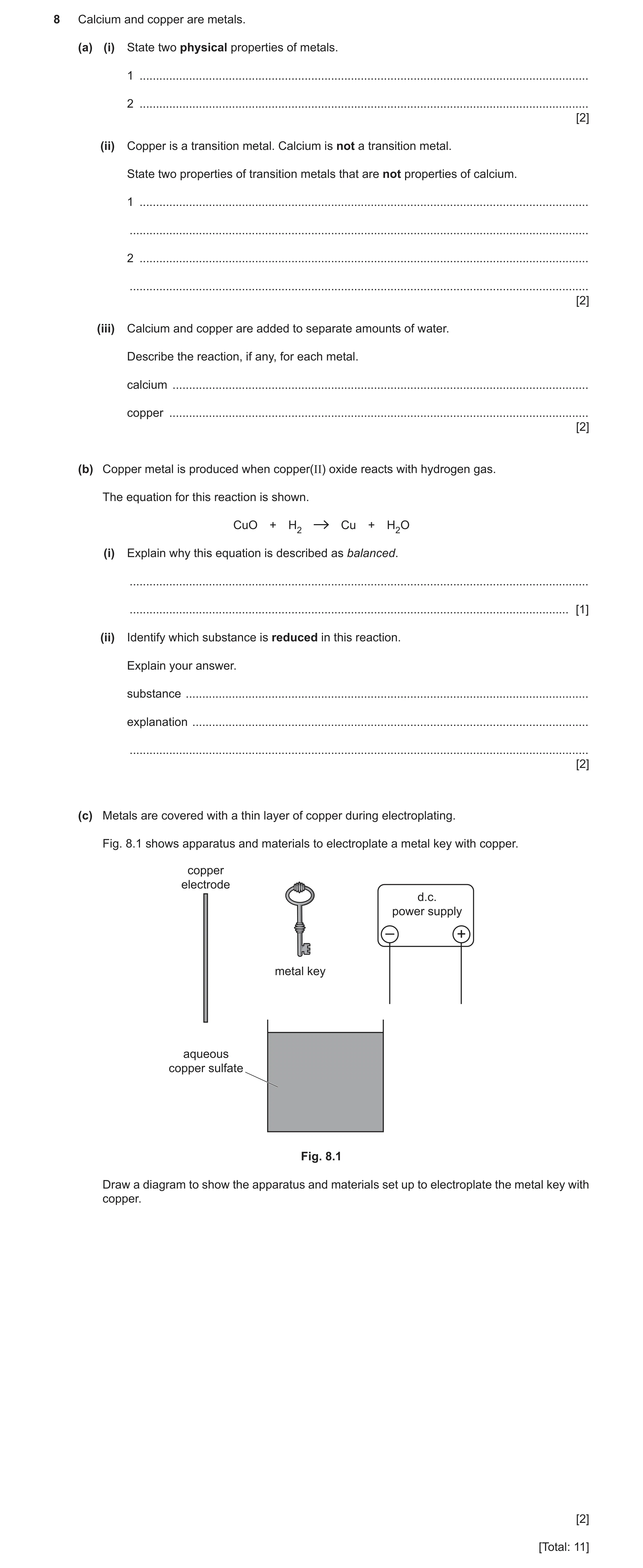
8 Calcium and copper are metals. (a) (i) State two physical properties of metals. 1 … 2 … [2] (ii) Copper is a transition metal. Calcium is not a transition metal. State two properties of transition metals that are not properties of calcium. 1 … … 2 … … [2] (iii) Calcium and copper are added to separate amounts of water. Describe the reaction, if any, for each metal. calcium … copper … [2] (b) Copper metal is produced when copper(II) oxide reacts with hydrogen gas. The equation for this reaction is shown. CuO + H2 Cu + H2O (i) Explain why this equation is described as balanced. … … [1] (ii) Identify which substance is reduced in this reaction. Explain your answer. substance … explanation … … [2] (c) Metals are covered with a thin layer of copper during electroplating. Fig. 8.1 shows apparatus and materials to electroplate a metal key with copper. copper electrode d.c. power supply – + metal key aqueous copper sulfate Fig. 8.1 Draw a diagram to show the apparatus and materials set up to electroplate the metal key with copper. [2] [Total: 11]
11 marks
Mark scheme: 8(a)(i) any two from: (good) electrical conductor (good) thermal conductor solid / high melting / boiling point malleable / ductile lustrous / sonorous ;; 8(a)(ii) (a transition metal ) forms coloured compounds ; can act as a catalyst ; has (relatively) high density / melting point ; max 2 8(a)(iii) (calcium) gas evolved / metal dissolves / white insoluble solid forms ; (copper) no change ; 2 8(b)(i) same number of all types of atom on LHS and on RHS / shown in reactants and products ; 1 8(b)(ii) Cu2+ ; reference to the loss of oxygen ; 2 Question Answer Marks 8(c) key and copper electrode connected and dipping into the solution ; correct polarity ; 2
This question in 0654/31 May/June 2020
Q11 · A pie chart showing the percentages of some of the elements in the Earth’s crust 0654/32 May/June 2020
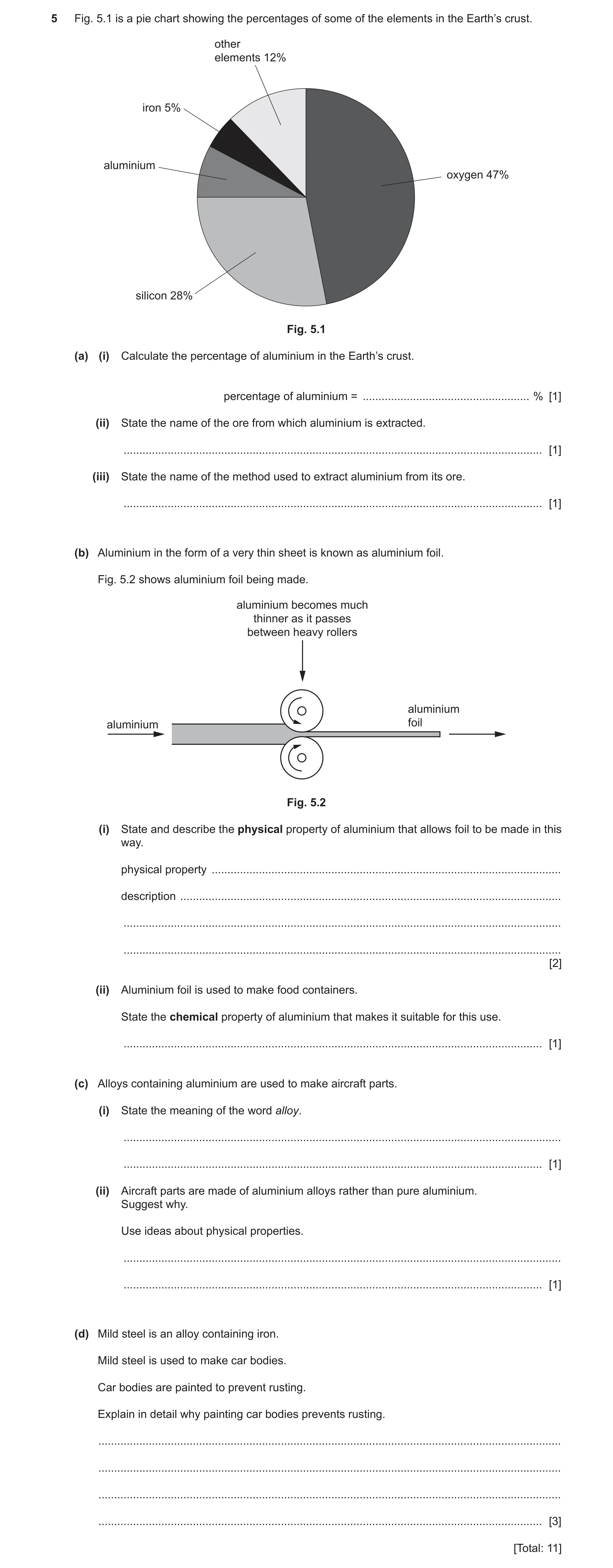
5 Fig. 5.1 is a pie chart showing the percentages of some of the elements in the Earth’s crust. other elements 12% iron 5% aluminium oxygen 47% silicon 28% Fig. 5.1 (a) (i) Calculate the percentage of aluminium in the Earth’s crust. percentage of aluminium = … % [1] (ii) State the name of the ore from which aluminium is extracted. … [1] (iii) State the name of the method used to extract aluminium from its ore. … [1] (b) Aluminium in the form of a very thin sheet is known as aluminium foil. Fig. 5.2 shows aluminium foil being made. aluminium becomes much thinner as it passes between heavy rollers aluminium aluminium foil Fig. 5.2 (i) State and describe the physical property of aluminium that allows foil to be made in this way. physical property … description … … … [2] (ii) Aluminium foil is used to make food containers. State the chemical property of aluminium that makes it suitable for this use. … [1] (c) Alloys containing aluminium are used to make aircraft parts. (i) State the meaning of the word alloy. … … [1] (ii) Aircraft parts are made of aluminium alloys rather than pure aluminium. Suggest why. Use ideas about physical properties. … … [1] (d) Mild steel is an alloy containing iron. Mild steel is used to make car bodies. Car bodies are painted to prevent rusting. Explain in detail why painting car bodies prevents rusting. … … … … [3] [Total: 11]
11 marks
Mark scheme: 5(a)(i) 8(%) ; 1 5(a)(ii) bauxite ; 1 5(a)(iii) electrolysis ; 1 5(b)(i) malleability / it is malleable ; the idea that it can be forced to change shape without breaking ; 2 5(b)(ii) resistant to corrosion / it does not react with food ; 1 5(c)(i) a (solid) mixture containing metals / a mixture of a metal and other elements; 1 Question Answer Marks 5(c)(ii) alloy is stronger / less likely to bend or break ; 1 5(d) reference to reaction with / need for oxygen ; reference to reaction with / need for water ; description of paint as a barrier between steel and oxygen / water ; 3
This question in 0654/32 May/June 2020
Q12 · A pie chart showing the percentages of some of the elements in the Earth’s crust 0654/33 May/June 2020
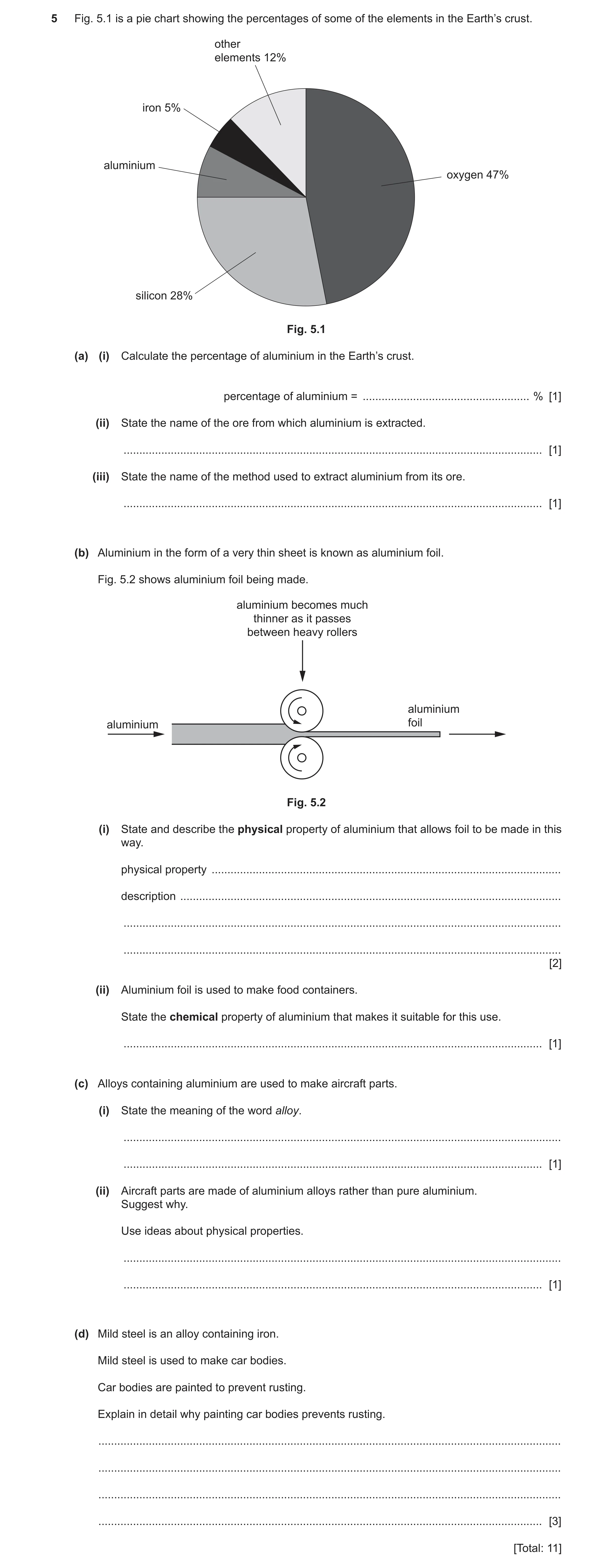
5 Fig. 5.1 is a pie chart showing the percentages of some of the elements in the Earth’s crust. other elements 12% iron 5% aluminium oxygen 47% silicon 28% Fig. 5.1 (a) (i) Calculate the percentage of aluminium in the Earth’s crust. percentage of aluminium = … % [1] (ii) State the name of the ore from which aluminium is extracted. … [1] (iii) State the name of the method used to extract aluminium from its ore. … [1] (b) Aluminium in the form of a very thin sheet is known as aluminium foil. Fig. 5.2 shows aluminium foil being made. aluminium becomes much thinner as it passes between heavy rollers aluminium aluminium foil Fig. 5.2 (i) State and describe the physical property of aluminium that allows foil to be made in this way. physical property … description … … … [2] (ii) Aluminium foil is used to make food containers. State the chemical property of aluminium that makes it suitable for this use. … [1] (c) Alloys containing aluminium are used to make aircraft parts. (i) State the meaning of the word alloy. … … [1] (ii) Aircraft parts are made of aluminium alloys rather than pure aluminium. Suggest why. Use ideas about physical properties. … … [1] (d) Mild steel is an alloy containing iron. Mild steel is used to make car bodies. Car bodies are painted to prevent rusting. Explain in detail why painting car bodies prevents rusting. … … … … [3] [Total: 11]
11 marks
Mark scheme: 5(a)(i) 8(%) ; 1 5(a)(ii) bauxite ; 1 5(a)(iii) electrolysis ; 1 5(b)(i) malleability / it is malleable ; the idea that it can be forced to change shape without breaking ; 2 5(b)(ii) resistant to corrosion / it does not react with food ; 1 5(c)(i) a (solid) mixture containing metals / a mixture of a metal and other elements; 1 Question Answer Marks 5(c)(ii) alloy is stronger / less likely to bend or break ; 1 5(d) reference to reaction with / need for oxygen ; reference to reaction with / need for water ; description of paint as a barrier between steel and oxygen / water ; 3
This question in 0654/33 May/June 2020
Q13 · Electrolysis is used to extract some elements from their ores 0654/31 Oct/Nov 2020
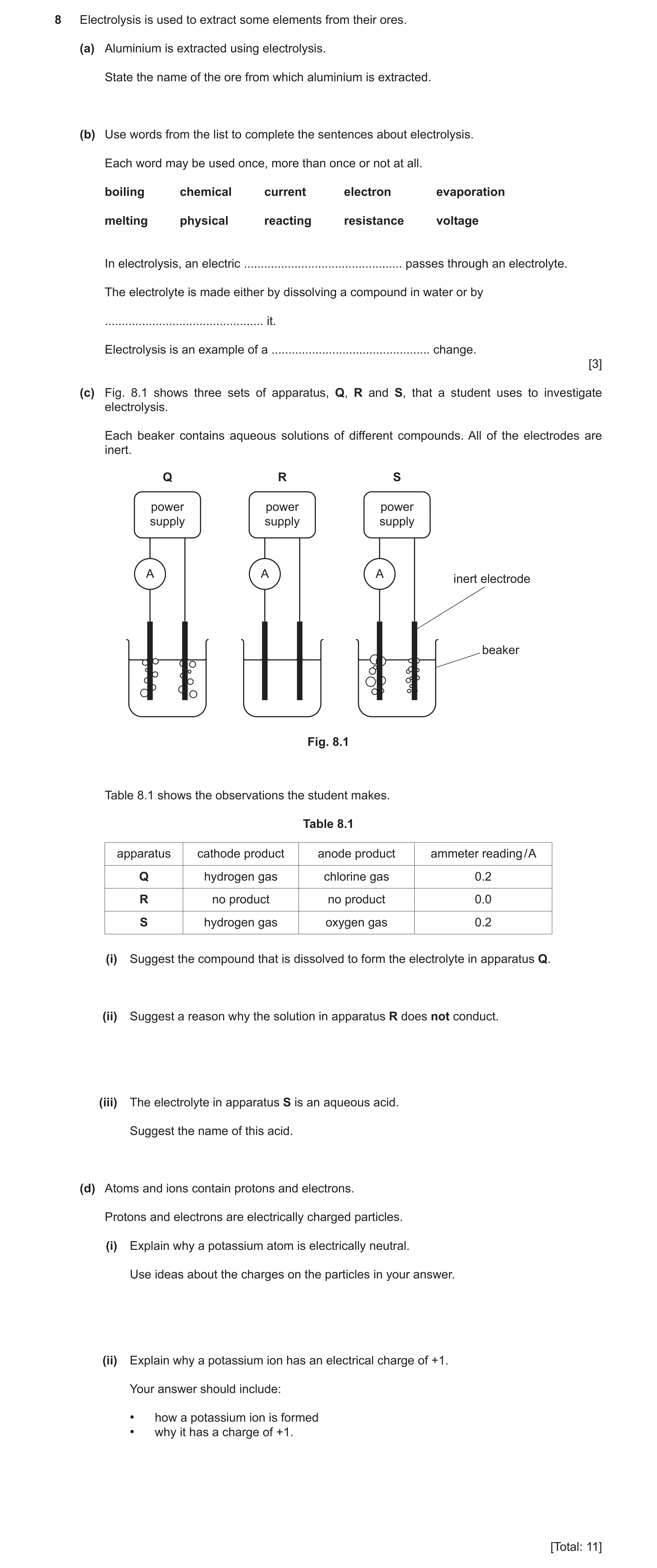
8 Electrolysis is used to extract some elements from their ores. (a) Aluminium is extracted using electrolysis. State the name of the ore from which aluminium is extracted. (b) Use words from the list to complete the sentences about electrolysis. Each word may be used once, more than once or not at all. boiling chemical current electron evaporation melting physical reacting resistance voltage In electrolysis, an electric … passes through an electrolyte. The electrolyte is made either by dissolving a compound in water or by … it. Electrolysis is an example of a … change. [3] (c) Fig. 8.1 shows three sets of apparatus, Q, R and S, that a student uses to investigate electrolysis. Each beaker contains aqueous solutions of different compounds. All of the electrodes are inert. Q R S power power power supply supply supply A A A inert electrode beaker Fig. 8.1 Table 8.1 shows the observations the student makes. Table 8.1 apparatus cathode product anode product ammeter reading / A Q hydrogen gas chlorine gas 0.2 R no product no product 0.0 S hydrogen gas oxygen gas 0.2 (i) Suggest the compound that is dissolved to form the electrolyte in apparatus Q. (ii) Suggest a reason why the solution in apparatus R does not conduct. (iii) The electrolyte in apparatus S is an aqueous acid. Suggest the name of this acid. (d) Atoms and ions contain protons and electrons. Protons and electrons are electrically charged particles. (i) Explain why a potassium atom is electrically neutral. Use ideas about the charges on the particles in your answer. (ii) Explain why a potassium ion has an electrical charge of +1. Your answer should include: • how a potassium ion is formed • why it has a charge of +1. [Total: 11]
11 marks
Mark scheme: 8(a) bauxite ; 1 8(b) current ; melting ; chemical ; 3 8(c)(i) sodium chloride / other correct ; 1 8(c)(ii) the liquid is not an electrolyte / does not contain (free) ions / the compound dissolved is not ionic ; 1 8(c)(iii) sulfuric (acid) / other correct ; 1 8(d)(i) reference to protons being positive and electrons being negative ; in atom proton and electron numbers are equal ; 2 8(d)(ii) ion forms when one electron is lost ; so in ion number of protons / positive charges is one more than electrons / number of negative charges ; 2
This question in 0654/31 Oct/Nov 2020
Q14 · Aluminium is used in industry to make many different products 0654/32 Oct/Nov 2020
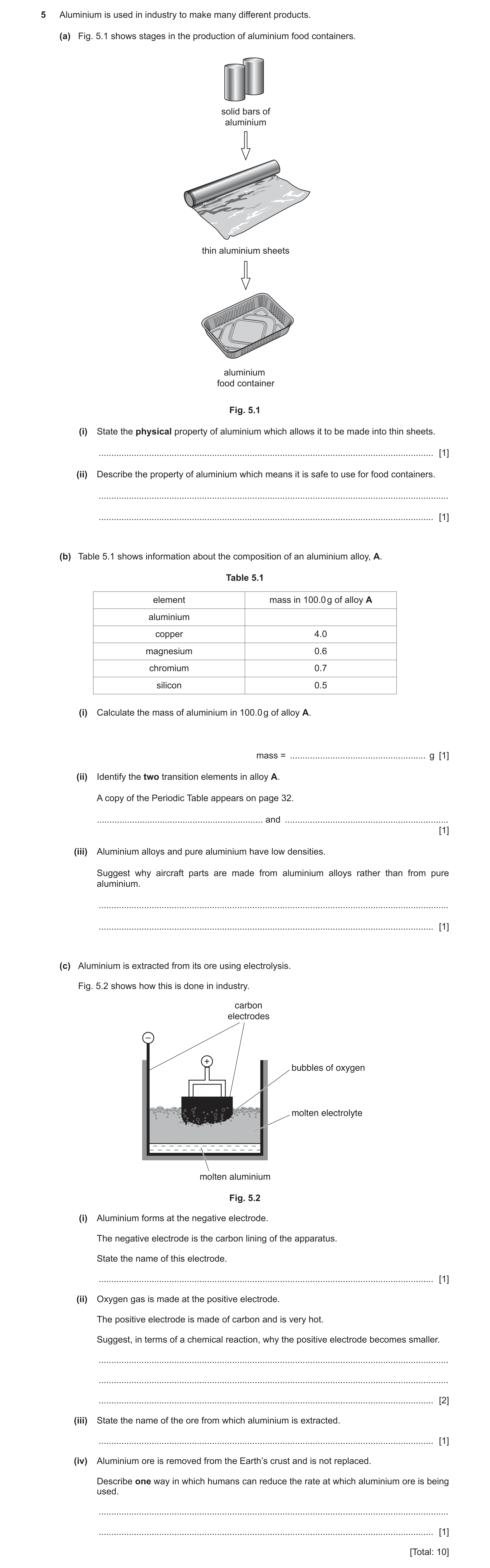
5 Aluminium is used in industry to make many different products. (a) Fig. 5.1 shows stages in the production of aluminium food containers. solid bars of aluminium thin aluminium sheets aluminium food container Fig. 5.1 (i) State the physical property of aluminium which allows it to be made into thin sheets. … [1] (ii) Describe the property of aluminium which means it is safe to use for food containers. … … [1] (b) Table 5.1 shows information about the composition of an aluminium alloy, A. Table 5.1 element mass in 100.0 g of alloy A aluminium copper 4.0 magnesium 0.6 chromium 0.7 silicon 0.5 (i) Calculate the mass of aluminium in 100.0 g of alloy A. mass = … g [1] (ii) Identify the two transition elements in alloy A. A copy of the Periodic Table appears on page 32. … and … [1] (iii) Aluminium alloys and pure aluminium have low densities. Suggest why aircraft parts are made from aluminium alloys rather than from pure aluminium. … … [1] (c) Aluminium is extracted from its ore using electrolysis. Fig. 5.2 shows how this is done in industry. carbon electrodes – + bubbles of oxygen molten electrolyte molten aluminium Fig. 5.2 (i) Aluminium forms at the negative electrode. The negative electrode is the carbon lining of the apparatus. State the name of this electrode. … [1] (ii) Oxygen gas is made at the positive electrode. The positive electrode is made of carbon and is very hot. Suggest, in terms of a chemical reaction, why the positive electrode becomes smaller. … … … [2] (iii) State the name of the ore from which aluminium is extracted. … [1] (iv) Aluminium ore is removed from the Earth’s crust and is not replaced. Describe one way in which humans can reduce the rate at which aluminium ore is being used. … … [1] [Total: 10]
10 marks
Mark scheme: 5(a)(i) malleability / it is malleable ; 1 5(a)(ii) unreactive / does not react with food ; 1 5(b)(i) 100 – (4.0 + 0.6 + 0.7 + 0.5) = 94.2 (g) 1 5(b)(ii) copper and chromium ; 1 5(b)(iii) alloy is stronger ; 1 5(c)(i) cathode ; 1 5(c)(ii) carbon oxidises / carbon burns / C + O2 → CO2 ; the idea that a gaseous product is released ; 2 5(c)(iii) bauxite ; 1 5(c)(iv) recycle (waste) aluminium ; 1
This question in 0654/32 Oct/Nov 2020
Q15 · Electrolysis is used to extract some elements from their ores 0654/33 Oct/Nov 2020
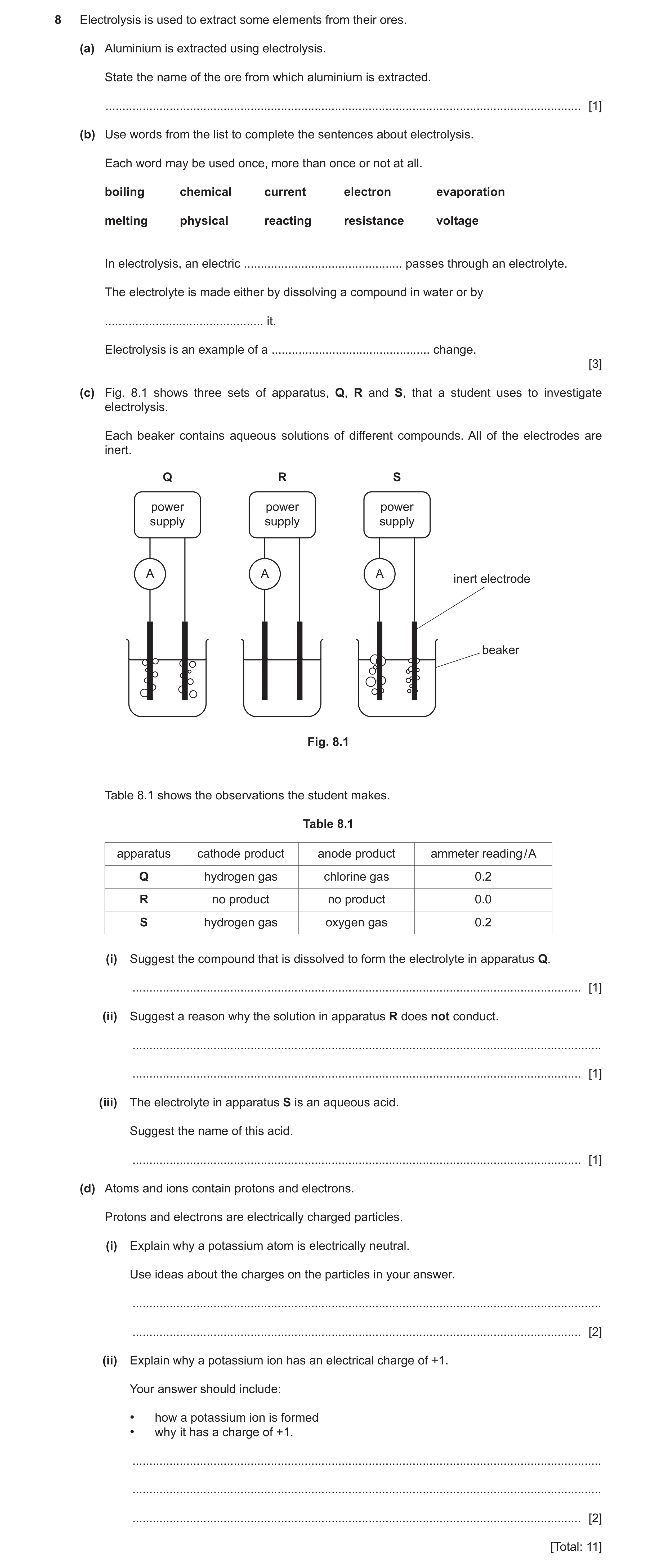
8 Electrolysis is used to extract some elements from their ores. (a) Aluminium is extracted using electrolysis. State the name of the ore from which aluminium is extracted. … [1] (b) Use words from the list to complete the sentences about electrolysis. Each word may be used once, more than once or not at all. boiling chemical current electron evaporation melting physical reacting resistance voltage In electrolysis, an electric … passes through an electrolyte. The electrolyte is made either by dissolving a compound in water or by … it. Electrolysis is an example of a … change. [3] (c) Fig. 8.1 shows three sets of apparatus, Q, R and S, that a student uses to investigate electrolysis. Each beaker contains aqueous solutions of different compounds. All of the electrodes are inert. Q R S power power power supply supply supply A A A inert electrode beaker Fig. 8.1 Table 8.1 shows the observations the student makes. Table 8.1 apparatus cathode product anode product ammeter reading / A Q hydrogen gas chlorine gas 0.2 R no product no product 0.0 S hydrogen gas oxygen gas 0.2 (i) Suggest the compound that is dissolved to form the electrolyte in apparatus Q. … [1] (ii) Suggest a reason why the solution in apparatus R does not conduct. … … [1] (iii) The electrolyte in apparatus S is an aqueous acid. Suggest the name of this acid. … [1] (d) Atoms and ions contain protons and electrons. Protons and electrons are electrically charged particles. (i) Explain why a potassium atom is electrically neutral. Use ideas about the charges on the particles in your answer. … … [2] (ii) Explain why a potassium ion has an electrical charge of +1. Your answer should include: • how a potassium ion is formed • why it has a charge of +1. … … … [2] [Total: 11]
11 marks
Mark scheme: 8(a) bauxite ; 1 8(b) current ; melting ; chemical ; 3 8(c)(i) sodium chloride / other correct ; 1 8(c)(ii) the liquid is not an electrolyte / does not contain (free) ions / the compound dissolved is not ionic ; 1 8(c)(iii) sulfuric (acid) / other correct ; 1 8(d)(i) reference to protons being positive and electrons being negative ; in atom proton and electron numbers are equal ; 2 8(d)(ii) ion forms when one electron is lost ; so in ion number of protons / positive charges is one more than electrons / number of negative charges ; 2
This question in 0654/33 Oct/Nov 2020
Q16 · Copper and sodium are metals 0654/32 Feb/March 2021
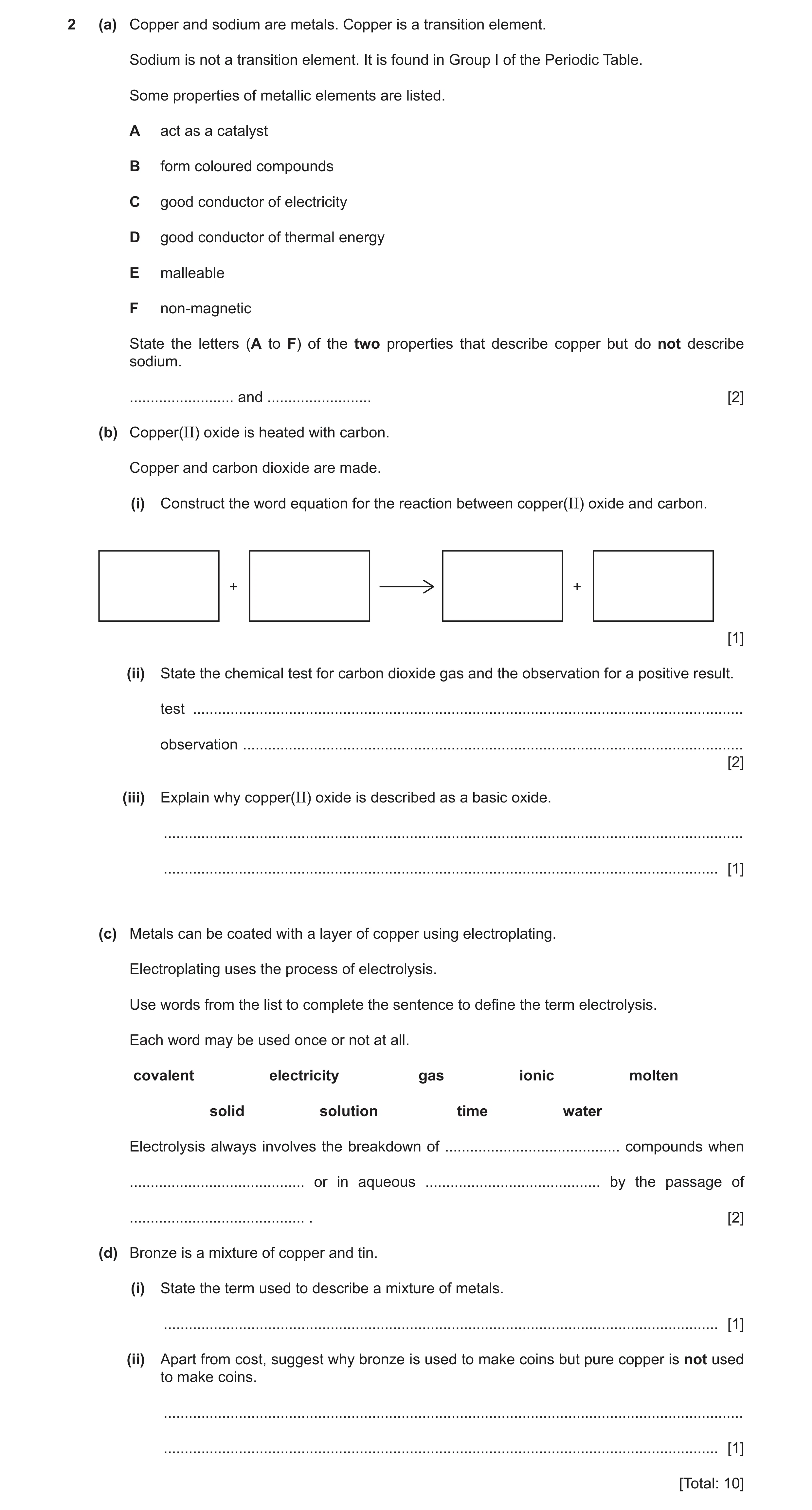
2 (a) Copper and sodium are metals. Copper is a transition element. Sodium is not a transition element. It is found in Group I of the Periodic Table. Some properties of metallic elements are listed. A act as a catalyst B form coloured compounds C good conductor of electricity D good conductor of thermal energy E malleable F non-magnetic State the letters (A to F) of the two properties that describe copper but do not describe sodium. … and … [2] (b) Copper(II) oxide is heated with carbon. Copper and carbon dioxide are made. (i) Construct the word equation for the reaction between copper(II) oxide and carbon. + + [1] (ii) State the chemical test for carbon dioxide gas and the observation for a positive result. test … observation … [2] (iii) Explain why copper(II) oxide is described as a basic oxide. … … [1] (c) Metals can be coated with a layer of copper using electroplating. Electroplating uses the process of electrolysis. Use words from the list to complete the sentence to define the term electrolysis. Each word may be used once or not at all. covalent electricity gas ionic molten solid solution time water Electrolysis always involves the breakdown of … compounds when … or in aqueous … by the passage of … . [2] (d) Bronze is a mixture of copper and tin. (i) State the term used to describe a mixture of metals. … [1] (ii) Apart from cost, suggest why bronze is used to make coins but pure copper is not used to make coins. … … [1] [Total: 10]
10 marks
Mark scheme: 2(a) A; B; 2 2(b)(i) copper oxide + carbon → copper + carbon dioxide; 1 Question Answer Marks 2(b)(ii) (bubble through) limewater; goes cloudy / milky; 2 2(b)(iii) produces solution with pH above 7 / copper(II) oxide is a metal oxide; 1 2(c) ionic molten solution electricity;; 2 2(d)(i) alloy; 1 2(d)(ii) tougher / stronger; 1
This question in 0654/32 Feb/March 2021
Q17 · Information about three Group VII elements 0654/31 May/June 2021
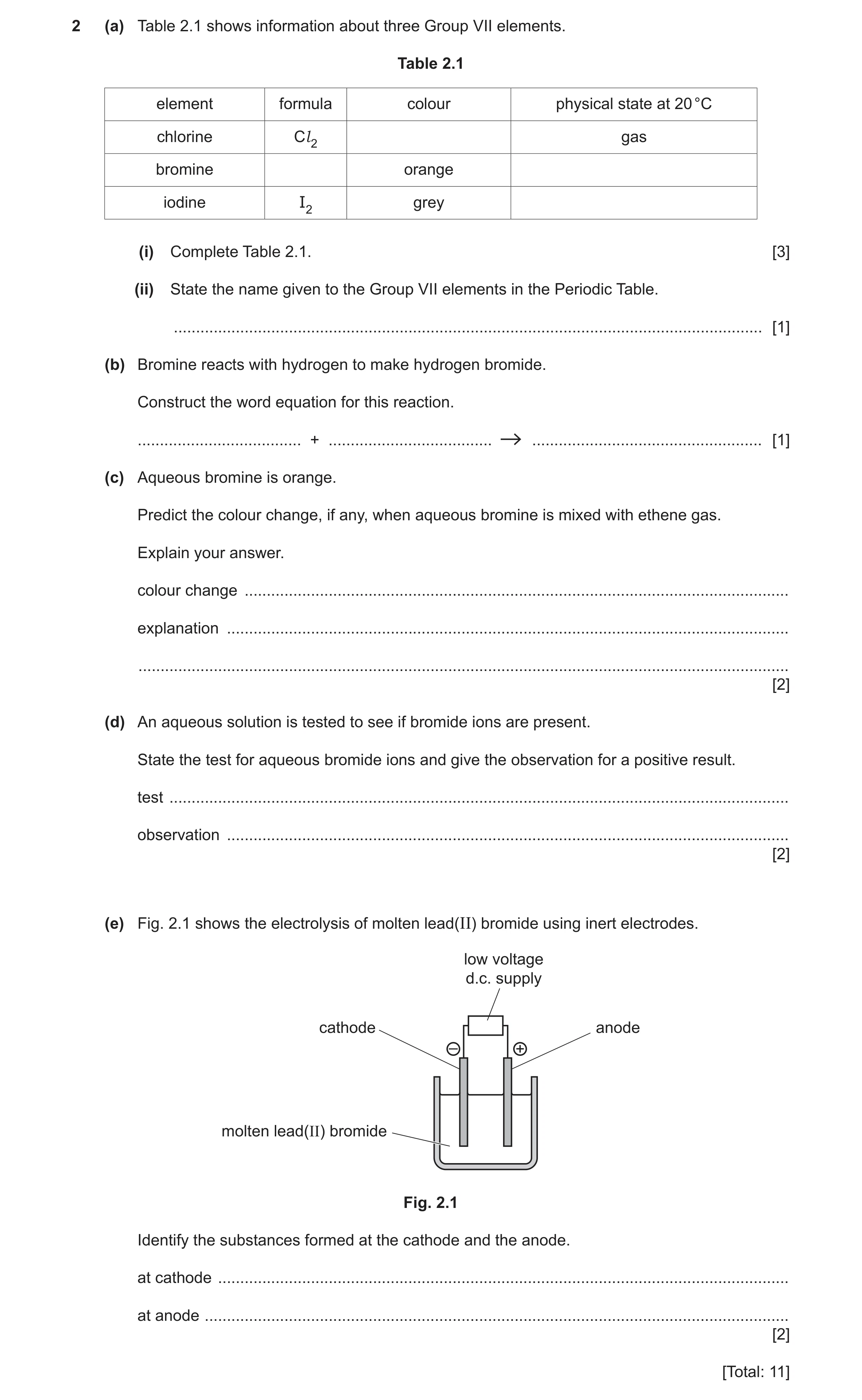
2 (a) Table 2.1 shows information about three Group VII elements. Table 2.1 element formula colour physical state at 20 °C chlorine Cl 2 gas bromine orange iodine I2 grey (i) Complete Table 2.1. [3] (ii) State the name given to the Group VII elements in the Periodic Table. … [1] (b) Bromine reacts with hydrogen to make hydrogen bromide. Construct the word equation for this reaction. … + … … [1] (c) Aqueous bromine is orange. Predict the colour change, if any, when aqueous bromine is mixed with ethene gas. Explain your answer. colour change … explanation … … [2] (d) An aqueous solution is tested to see if bromide ions are present. State the test for aqueous bromide ions and give the observation for a positive result. test … observation … [2] (e) Fig. 2.1 shows the electrolysis of molten lead(II) bromide using inert electrodes. low voltage d.c. supply cathode anode – + molten lead(II) bromide Fig. 2.1 Identify the substances formed at the cathode and the anode. at cathode … at anode … [2] [Total: 11]
11 marks
Mark scheme: 2(a)(i) formula Br2; colour (pale) green for Cl2 ; physical state liquid for Br2 and solid for I2 ; 3 2(a)(ii) halogens ; 1 2(b) hydrogen + bromine → hydrogen bromide ; 1 2(c) (orange to) colourless; ethene is unsaturated / has a double bond ; 2 Question Answer Marks 2(d) (aqueous) silver nitrate ; cream coloured precipitate ; 2 2(e) cathode – lead ; anode – bromine ; 2
This question in 0654/31 May/June 2021
Q18 · The melting points and reactivity with water of three Group I metals 0654/32 Oct/Nov 2021
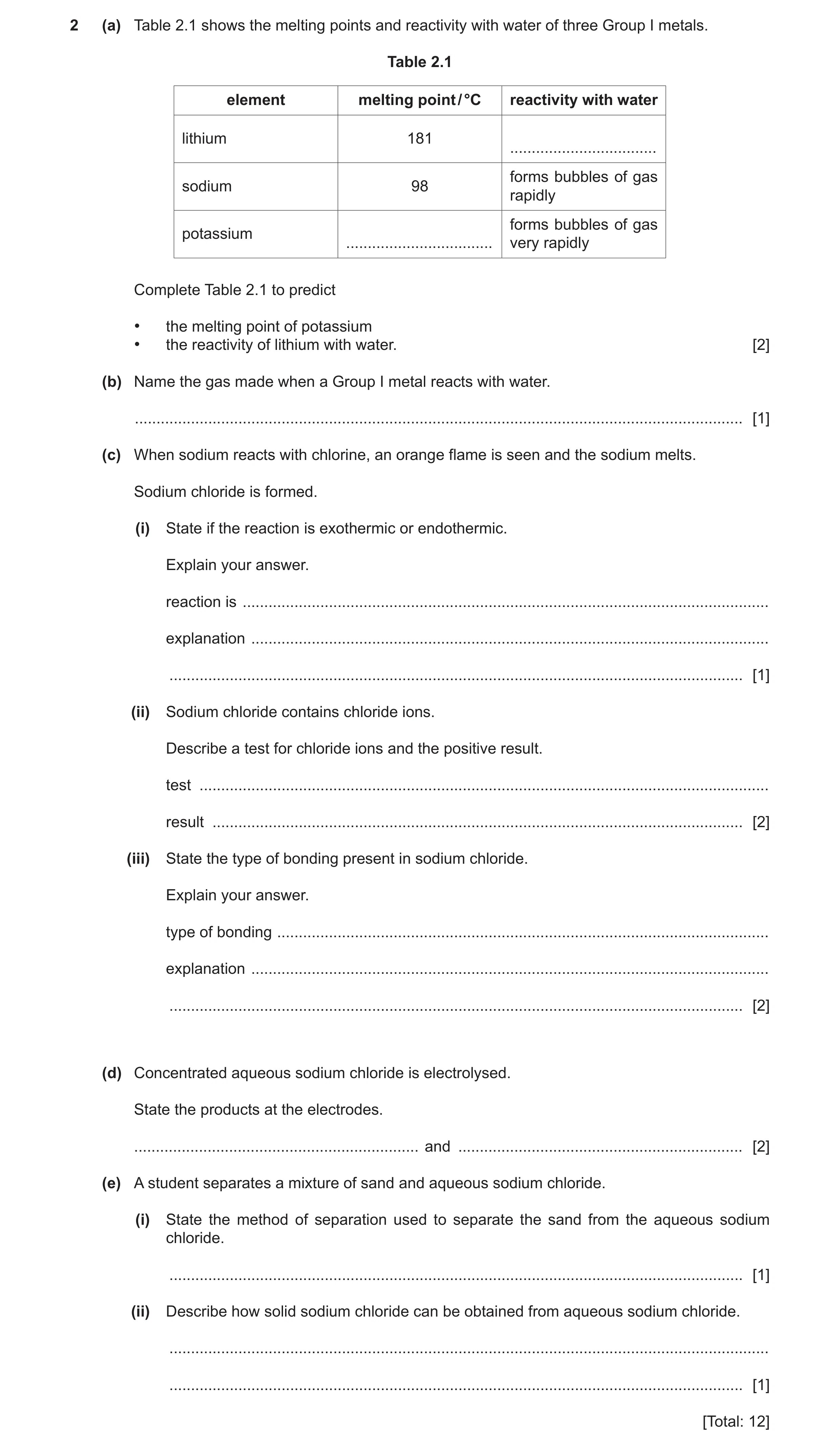
2 (a) Table 2.1 shows the melting points and reactivity with water of three Group I metals. Table 2.1 element melting point / °C reactivity with water lithium 181 … forms bubbles of gas sodium 98 rapidly forms bubbles of gas potassium … very rapidly Complete Table 2.1 to predict • the melting point of potassium • the reactivity of lithium with water. [2] (b) Name the gas made when a Group I metal reacts with water. … [1] (c) When sodium reacts with chlorine, an orange flame is seen and the sodium melts. Sodium chloride is formed. (i) State if the reaction is exothermic or endothermic. Explain your answer. reaction is … explanation … … [1] (ii) Sodium chloride contains chloride ions. Describe a test for chloride ions and the positive result. test … result … [2] (iii) State the type of bonding present in sodium chloride. Explain your answer. type of bonding … explanation … … [2] (d) Concentrated aqueous sodium chloride is electrolysed. State the products at the electrodes. … and … [2] (e) A student separates a mixture of sand and aqueous sodium chloride. (i) State the method of separation used to separate the sand from the aqueous sodium chloride. … [1] (ii) Describe how solid sodium chloride can be obtained from aqueous sodium chloride. … … [1] [Total: 12]
12 marks
Mark scheme: 2(a) below 90 °C ; reacts / forms bubbles of gas slowly / moderately ; 2 2(b) hydrogen ; 1 2(c)(i) exothermic because (thermal) energy released (to melt sodium) ; 1 2(c)(ii) aqueous silver nitrate ; white precipitate ; 2 Question Answer Marks 2(c)(iii) ionic ; bonding between a metal and a non-metal / electron transfer ; 2 2(d) hydrogen ; chlorine ; 2 2(e)(i) filtration ; 1 2(e)(ii) evaporation / crystallisation ; 1
This question in 0654/32 Oct/Nov 2021
Q19 · The formula of sulfuric acid is H2SO4 0654/33 Oct/Nov 2021
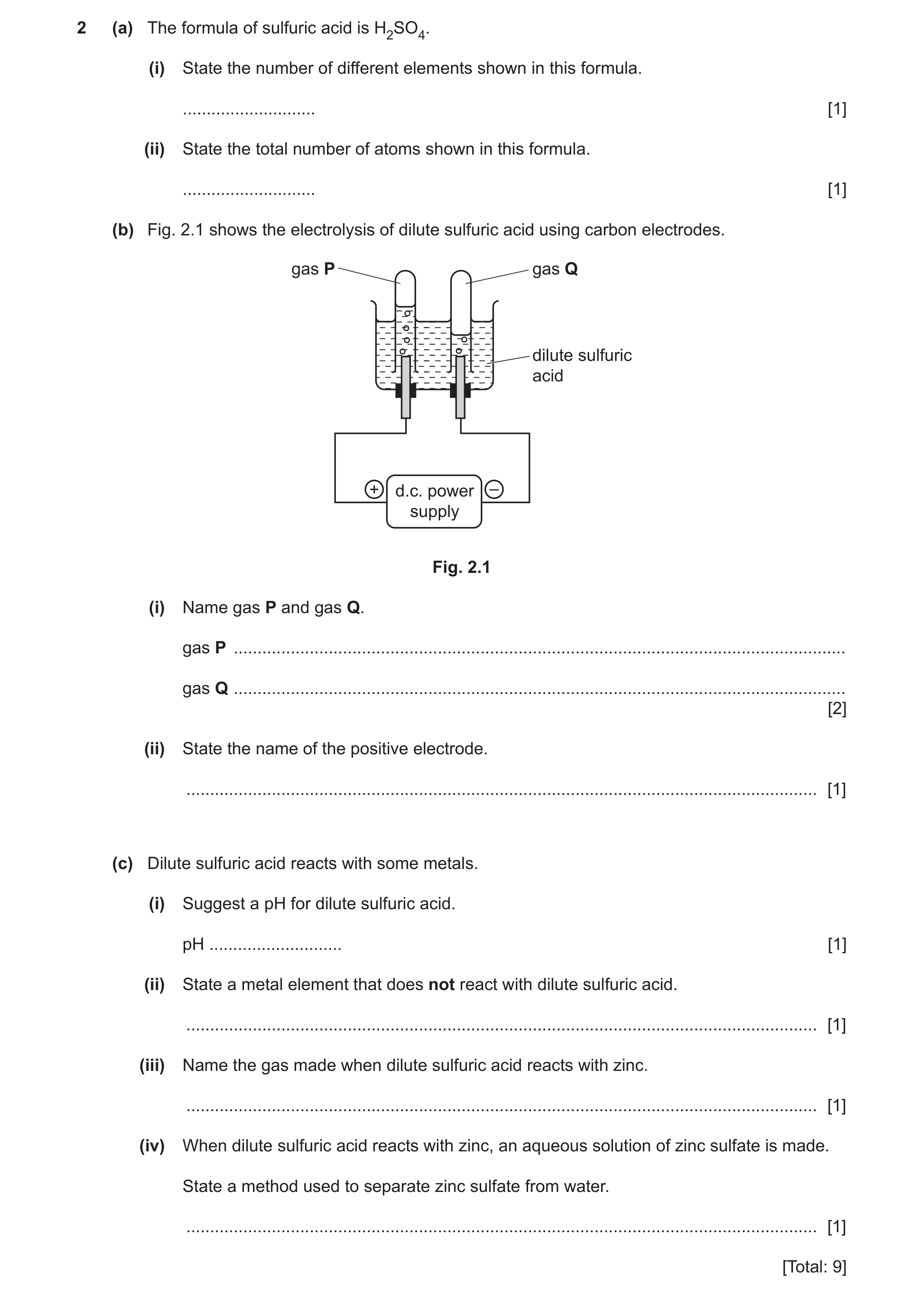
2 (a) The formula of sulfuric acid is H2SO4. (i) State the number of different elements shown in this formula. … [1] (ii) State the total number of atoms shown in this formula. … [1] (b) Fig. 2.1 shows the electrolysis of dilute sulfuric acid using carbon electrodes. gas P gas Q dilute sulfuric acid + d.c. power – supply Fig. 2.1 (i) Name gas P and gas Q. gas P … gas Q … [2] (ii) State the name of the positive electrode. … [1] (c) Dilute sulfuric acid reacts with some metals. (i) Suggest a pH for dilute sulfuric acid. pH … [1] (ii) State a metal element that does not react with dilute sulfuric acid. … [1] (iii) Name the gas made when dilute sulfuric acid reacts with zinc. … [1] (iv) When dilute sulfuric acid reacts with zinc, an aqueous solution of zinc sulfate is made. State a method used to separate zinc sulfate from water. … [1] [Total: 9]
9 marks
Mark scheme: 2(a)(i) 3 ; 1 2(a)(ii) 7 ; 1 2(b)(i) P – oxygen ; Q – hydrogen ; 2 2(b)(ii) anode ; 1 2(c)(i) any number less than 7 ; 1 2(c)(ii) copper ; 1 2(c)(iii) hydrogen ; 1 2(c)(iv) evaporation / crystallisation ; 1
This question in 0654/33 Oct/Nov 2021
Q20 · A list of seven metals from the Periodic Table 0654/32 Feb/March 2022
11 (a) Table 11.1 shows a list of seven metals from the Periodic Table. Table 11.1 metal calcium copper iron lithium magnesium potassium sodium (i) Identify three metals from Table 11.1 that have only one electron in their outer shell as a neutral atom. 1 … 2 … 3 … [1] (ii) Identify the two metals from Table 11.1 that are Group II metals. 1 … 2 … [1] (b) State three general physical properties that distinguish metals from non-metals. 1 … 2 … 3 … [3] (c) Copper is used in electroplating. Use words from the list to complete the description of electroplating. Each word may be used once, more than once or not at all. electrode electrolyte negative neutral positive solute Electrolysis is used to electroplate objects with copper. The object to be plated, such as a metal pan, is connected to the … terminal of the power supply. This is called the cathode. A piece of copper is connected to the … terminal. This is called the anode. The anode and cathode are placed in aqueous copper(II) sulfate. This aqueous copper(II) sulfate is called the … . [2] [Total: 7]
7 marks
Mark scheme: 11(a)(i) lithium , potassium and sodium; 1 11(a)(ii) calcium and magnesium; 1 11(b) any three from: good thermal conductors; good electrical conductors; (relatively) high melting point / boiling point; malleable; 3 11(c) negative and positive; electrolyte; 2
This question in 0654/32 Feb/March 2022
Q21 · Information about some of the halogens in the Periodic Table 0654/32 May/June 2022
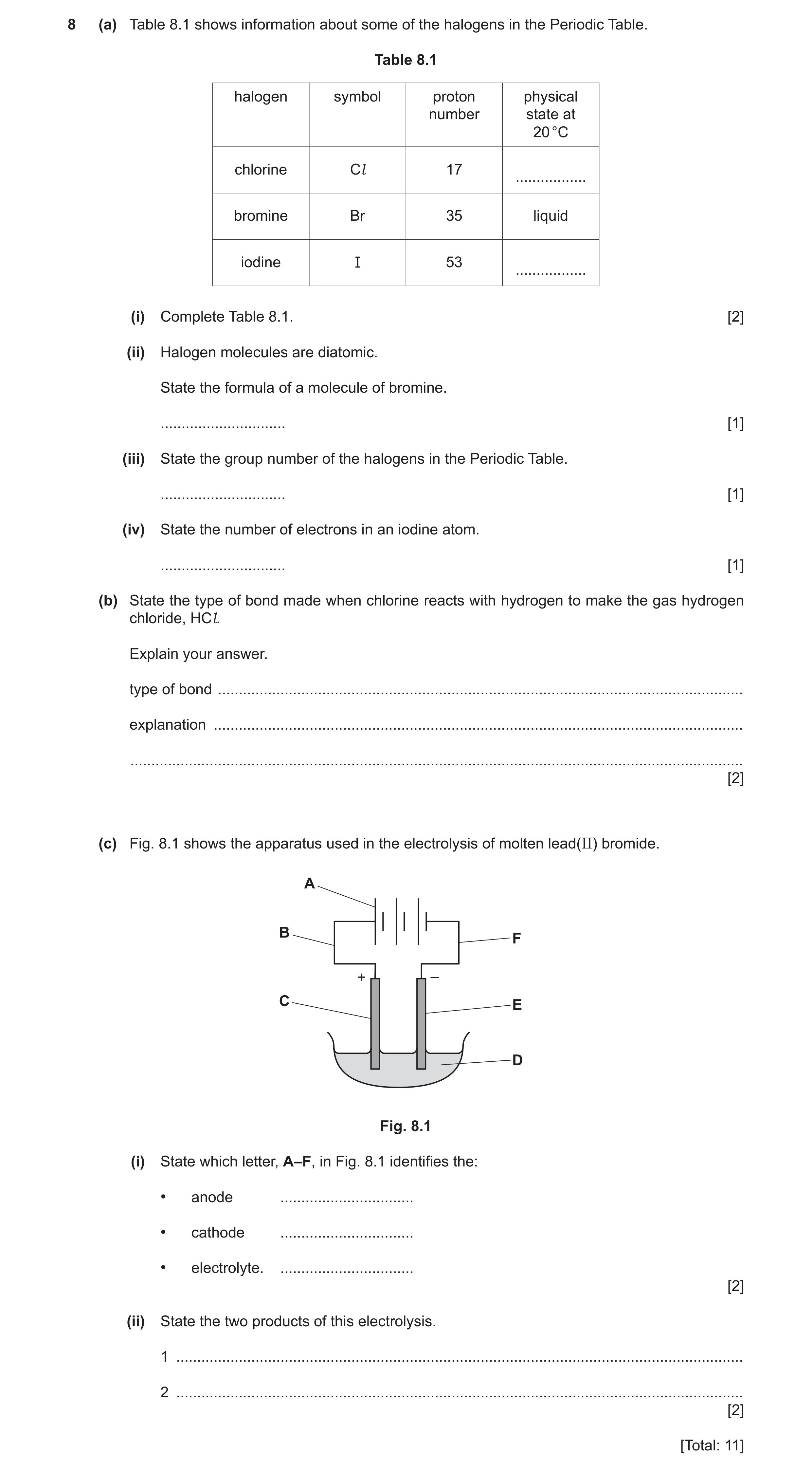
8 (a) Table 8.1 shows information about some of the halogens in the Periodic Table. Table 8.1 halogen symbol proton physical number state at 20 °C chlorine Cl 17 … bromine Br 35 liquid iodine I 53 … (i) Complete Table 8.1. [2] (ii) Halogen molecules are diatomic. State the formula of a molecule of bromine. … [1] (iii) State the group number of the halogens in the Periodic Table. … [1] (iv) State the number of electrons in an iodine atom. … [1] (b) State the type of bond made when chlorine reacts with hydrogen to make the gas hydrogen chloride, HCl. Explain your answer. type of bond … explanation … … [2] (c) Fig. 8.1 shows the apparatus used in the electrolysis of molten lead(II) bromide. A B F + – C E D Fig. 8.1 (i) State which letter, A–F, in Fig. 8.1 identifies the: • anode … • cathode … • electrolyte. … [2] (ii) State the two products of this electrolysis. 1 … 2 … [2] [Total: 11]
11 marks
Mark scheme: 8(a)(i) chlorine – gas; iodine –solid ; 2 8(a)(ii) Br2; 1 8(a)(iii) seven / VII ; 1 8(a)(iv) 53; 1 8(b) covalent ; between two non metals/electrons are shared; 2 8(c)(i) anode correctly identified (C) and cathode correctly identified (E); electrolyte correctly identified (D); 2 8(c)(ii) bromine; lead; 2
This question in 0654/32 May/June 2022
Q22 · Information about some of the halogens in the Periodic Table 0654/33 May/June 2022
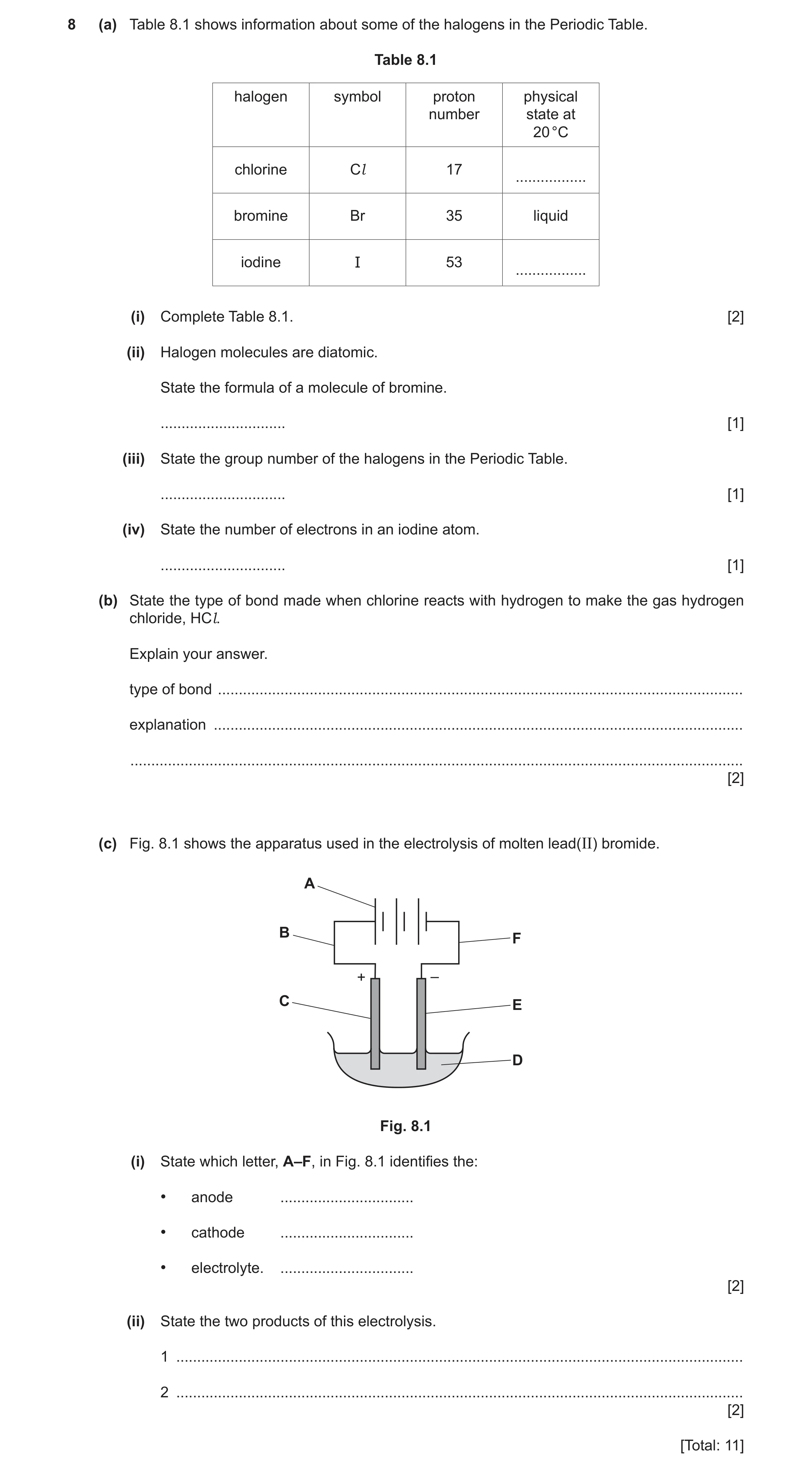
8 (a) Table 8.1 shows information about some of the halogens in the Periodic Table. Table 8.1 halogen symbol proton physical number state at 20 °C chlorine Cl 17 … bromine Br 35 liquid iodine I 53 … (i) Complete Table 8.1. [2] (ii) Halogen molecules are diatomic. State the formula of a molecule of bromine. … [1] (iii) State the group number of the halogens in the Periodic Table. … [1] (iv) State the number of electrons in an iodine atom. … [1] (b) State the type of bond made when chlorine reacts with hydrogen to make the gas hydrogen chloride, HCl. Explain your answer. type of bond … explanation … … [2] (c) Fig. 8.1 shows the apparatus used in the electrolysis of molten lead(II) bromide. A B F + – C E D Fig. 8.1 (i) State which letter, A–F, in Fig. 8.1 identifies the: • anode … • cathode … • electrolyte. … [2] (ii) State the two products of this electrolysis. 1 … 2 … [2] [Total: 11]
11 marks
Mark scheme: 8(a)(i) chlorine – gas; iodine –solid ; 2 8(a)(ii) Br2; 1 8(a)(iii) seven / VII ; 1 8(a)(iv) 53; 1 8(b) covalent ; between two non metals/electrons are shared; 2 8(c)(i) anode correctly identified (C) and cathode correctly identified (E); electrolyte correctly identified (D); 2 8(c)(ii) bromine; lead; 2
This question in 0654/33 May/June 2022
Q23 · An atom of copper has a proton number of 29 and a nucleon number of 63 0654/31 Oct/Nov 2022
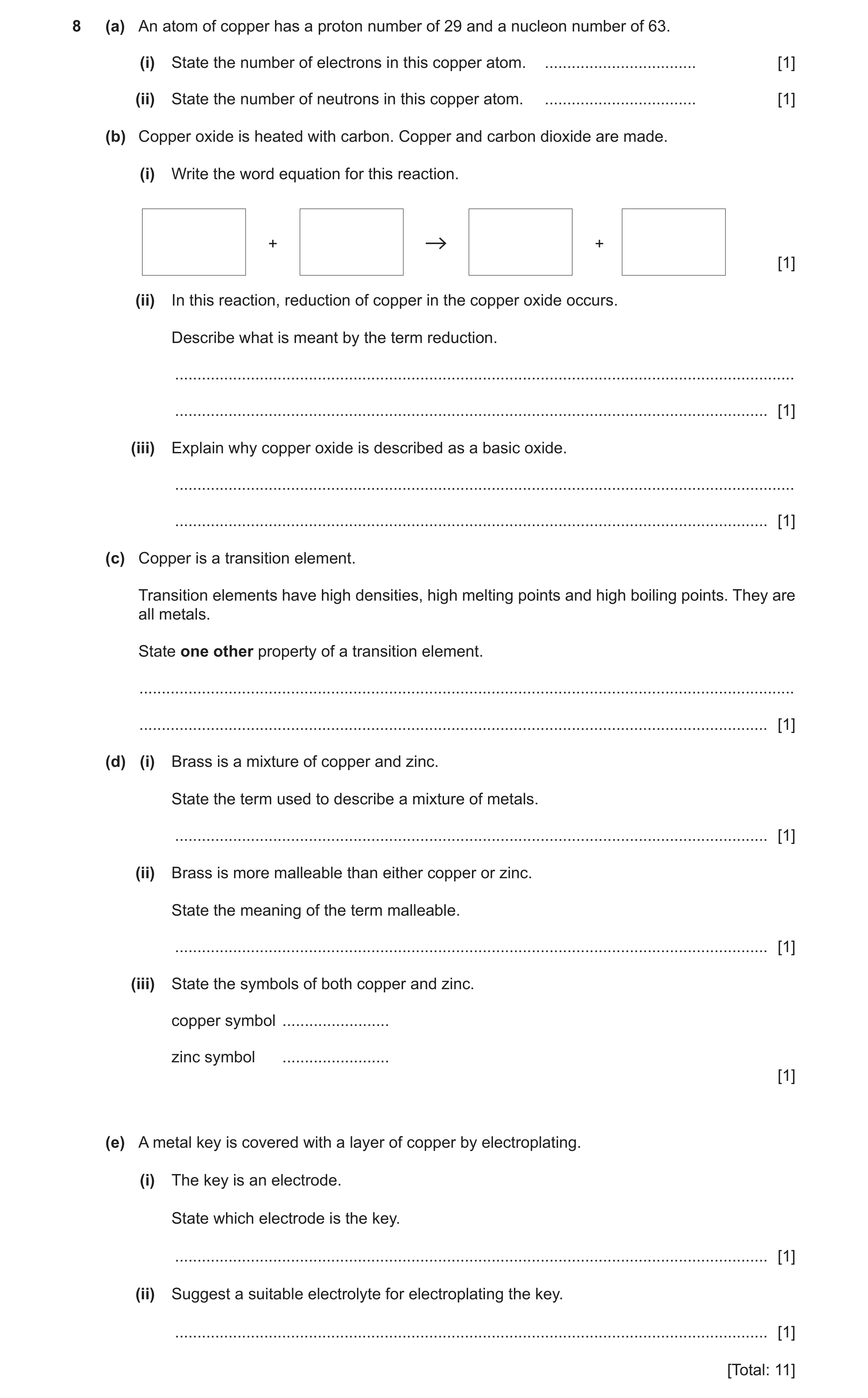
8 (a) An atom of copper has a proton number of 29 and a nucleon number of 63. (i) State the number of electrons in this copper atom. … [1] (ii) State the number of neutrons in this copper atom. … [1] (b) Copper oxide is heated with carbon. Copper and carbon dioxide are made. (i) Write the word equation for this reaction. + + [1] (ii) In this reaction, reduction of copper in the copper oxide occurs. Describe what is meant by the term reduction. … … [1] (iii) Explain why copper oxide is described as a basic oxide. … … [1] (c) Copper is a transition element. Transition elements have high densities, high melting points and high boiling points. They are all metals. State one other property of a transition element. … … [1] (d) (i) Brass is a mixture of copper and zinc. State the term used to describe a mixture of metals. … [1] (ii) Brass is more malleable than either copper or zinc. State the meaning of the term malleable. … [1] (iii) State the symbols of both copper and zinc. copper symbol … zinc symbol … [1] (e) A metal key is covered with a layer of copper by electroplating. (i) The key is an electrode. State which electrode is the key. … [1] (ii) Suggest a suitable electrolyte for electroplating the key. … [1] [Total: 11]
11 marks
Mark scheme: 8(a)(i) 29 ; 1 8(a)(ii) 34 ; 1 8(b)(i) copper oxide + carbon → copper + carbon dioxide ; 1 8(b)(ii) loss of oxygen ; 1 8(b)(iii) metal oxide / reacts with an acid to make a salt / neutralises an acid ; 1 8(c) any one from: 1 forms coloured compounds ; acts as catalyst ; variable valency ; 8(d)(i) alloy ; 1 8(d)(ii) can be beaten into shape; 1 8(d)(iii) Cu and Zn ; 1 8(e)(i) cathode / negative ; 1 8(e)(ii) copper (II) sulfate ; 1
This question in 0654/31 Oct/Nov 2022
Q24 · Sodium and chlorine are elements 0654/31 Oct/Nov 2022
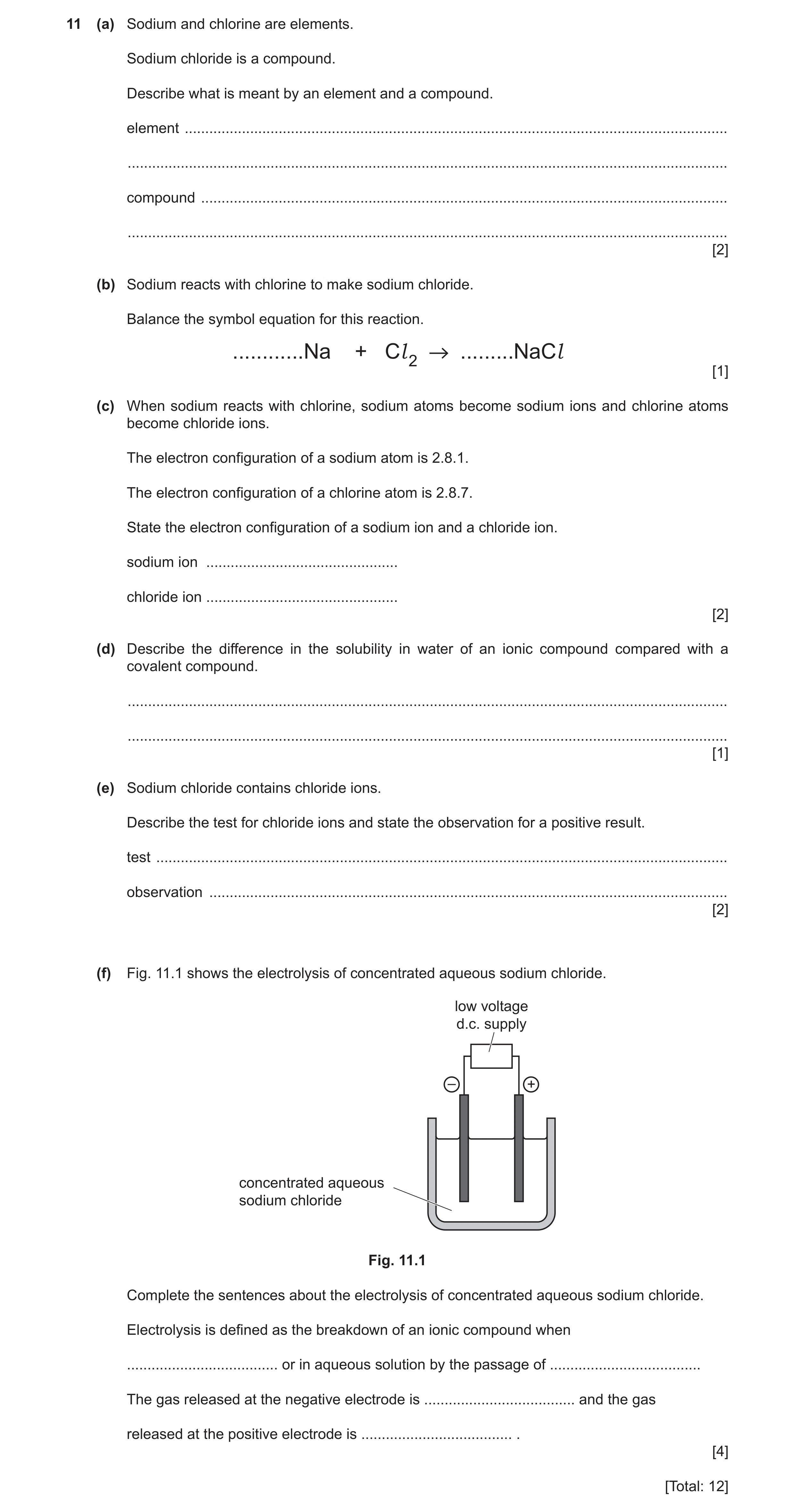
11 (a) Sodium and chlorine are elements. Sodium chloride is a compound. Describe what is meant by an element and a compound. element … … compound … … [2] (b) Sodium reacts with chlorine to make sodium chloride. Balance the symbol equation for this reaction. … Na + Cl2 … NaCl [1] (c) When sodium reacts with chlorine, sodium atoms become sodium ions and chlorine atoms become chloride ions. The electron configuration of a sodium atom is 2.8.1. The electron configuration of a chlorine atom is 2.8.7. State the electron configuration of a sodium ion and a chloride ion. sodium ion … chloride ion … [2] (d) Describe the difference in the solubility in water of an ionic compound compared with a covalent compound. … … [1] (e) Sodium chloride contains chloride ions. Describe the test for chloride ions and state the observation for a positive result. test … observation … [2] (f) Fig. 11.1 shows the electrolysis of concentrated aqueous sodium chloride. low voltage d.c. supply – + concentrated aqueous sodium chloride Fig. 11.1 Complete the sentences about the electrolysis of concentrated aqueous sodium chloride. Electrolysis is defined as the breakdown of an ionic compound when … or in aqueous solution by the passage of … The gas released at the negative electrode is … and the gas released at the positive electrode is … . [4] [Total: 12]
12 marks
Mark scheme: 11(a) element – contains only one type of atom ; 2 compound – contains two or more elements (chemically combined) ; 11(b) 2Na + Cl2 → 2NaCl ; 1 11(c) sodium ion 2.8 ; 2 chloride ion 2.8.8 ; 11(d) solubility of ionic compound is greater ; 1 11(e) add acidified aqueous silver nitrate ; 2 white precipitate ; 11(f) molten ; 4 electricity ; hydrogen ; chlorine ;
This question in 0654/31 Oct/Nov 2022
Q25 · Potassium is an element in the Periodic Table 0654/33 Oct/Nov 2022
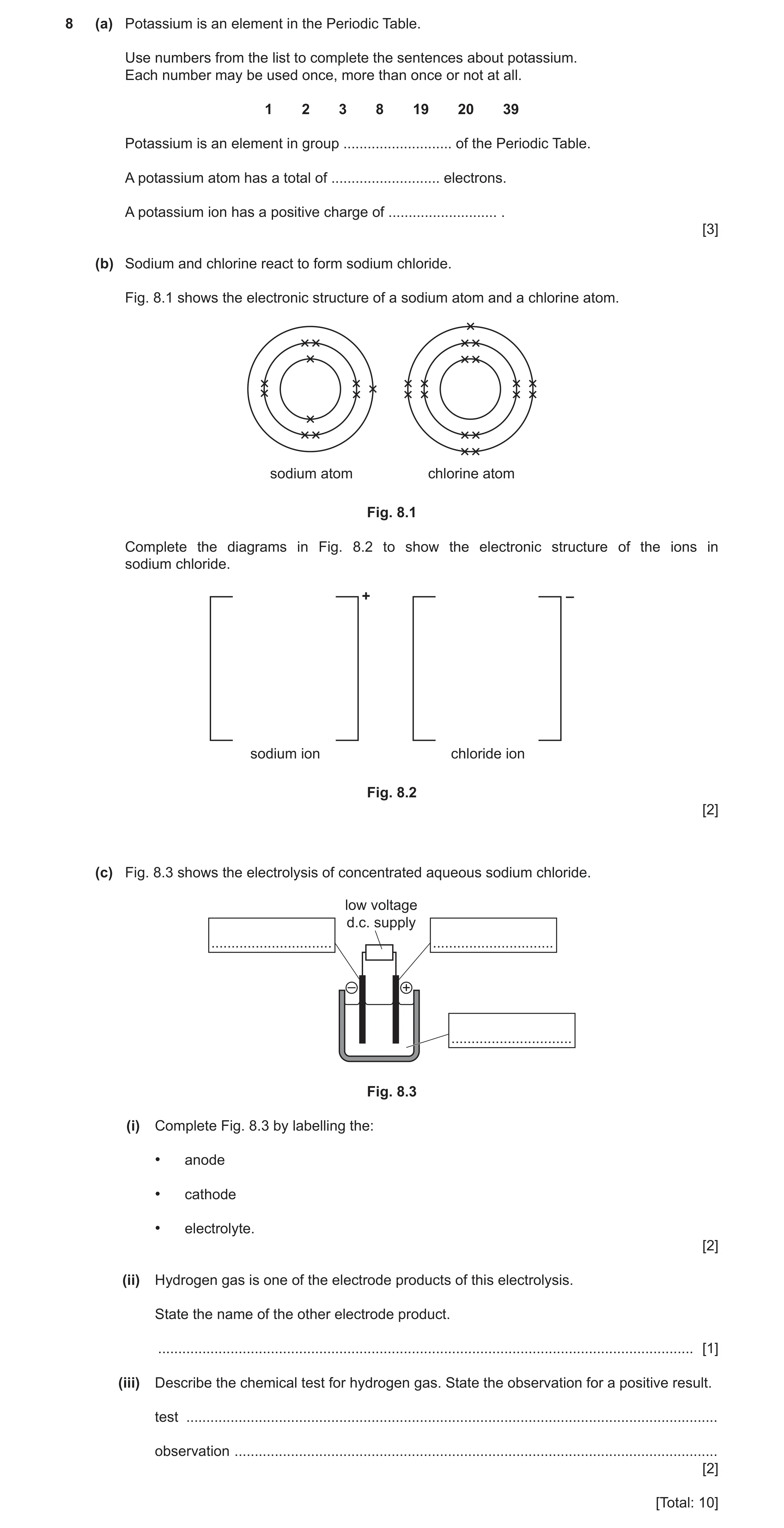
8 (a) Potassium is an element in the Periodic Table. Use numbers from the list to complete the sentences about potassium. Each number may be used once, more than once or not at all. 1 2 3 8 19 20 39 Potassium is an element in group … of the Periodic Table. A potassium atom has a total of … electrons. A potassium ion has a positive charge of … . [3] (b) Sodium and chlorine react to form sodium chloride. Fig. 8.1 shows the electronic structure of a sodium atom and a chlorine atom. sodium atom chlorine atom Fig. 8.1 Complete the diagrams in Fig. 8.2 to show the electronic structure of the ions in sodium chloride. + – sodium ion chloride ion Fig. 8.2 [2] (c) Fig. 8.3 shows the electrolysis of concentrated aqueous sodium chloride. low voltage d.c. supply … … – + … Fig. 8.3 (i) Complete Fig. 8.3 by labelling the: • anode • cathode • electrolyte. [2] (ii) Hydrogen gas is one of the electrode products of this electrolysis. State the name of the other electrode product. … [1] (iii) Describe the chemical test for hydrogen gas. State the observation for a positive result. test … observation … [2] [Total: 10]
10 marks
Mark scheme: 8(a) 1 ; 3 19 ; 1 ; 8(b) 2 sodium ion chloride ion sodium ion 2.8.; chloride ion 2.8.8 ; 8(c)(i) one correctly labelled ; 2 three correctly labelled ; 8(c)(ii) chlorine ; 1 8(c)(iii) lighted splint ; 2 goes pop ;
This question in 0654/33 Oct/Nov 2022
Q26 · Chlorine, bromine and iodine are halogens in Group VII of the Periodic Table 0654/32 Oct/Nov 2023
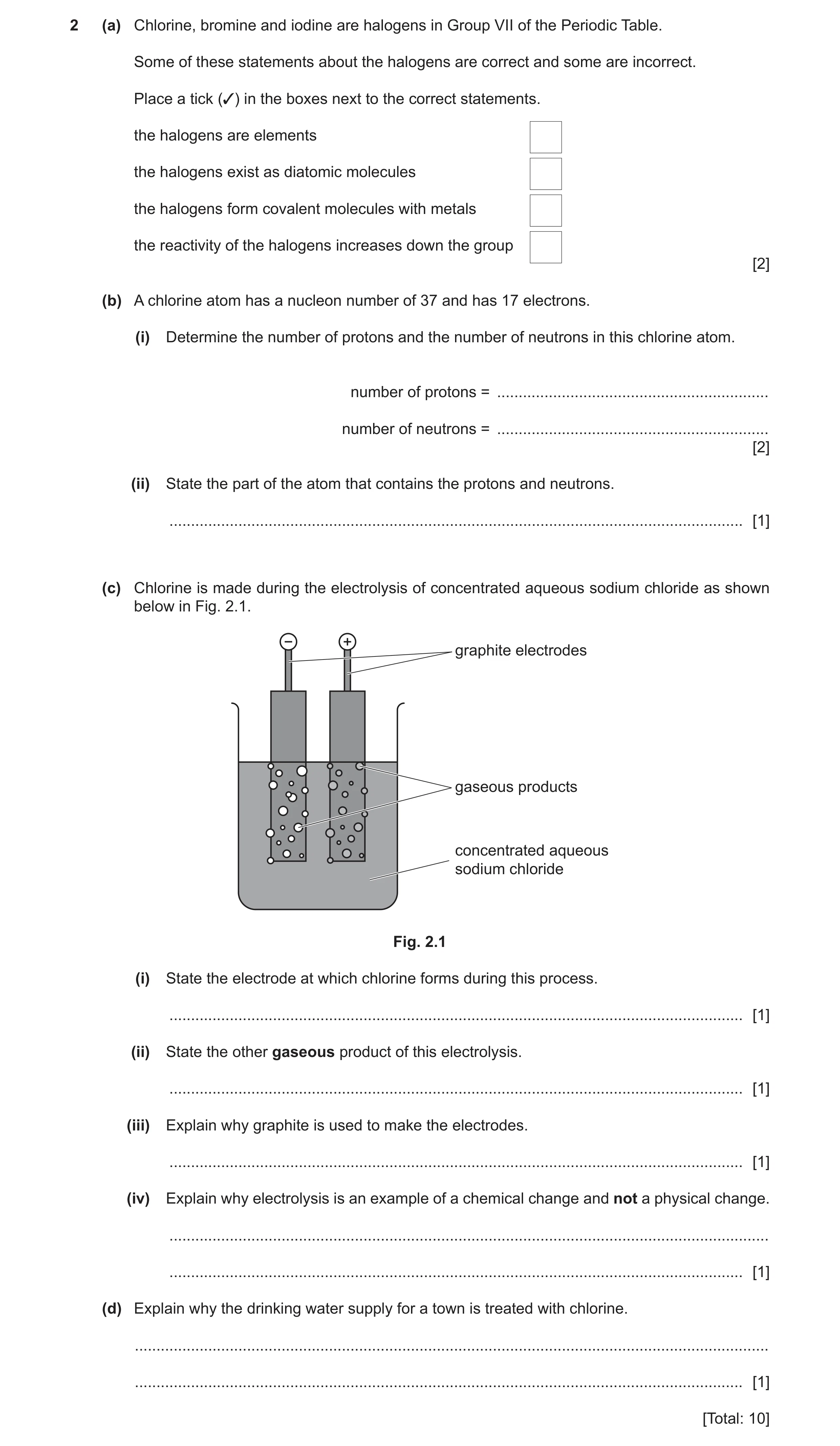
2 (a) Chlorine, bromine and iodine are halogens in Group VII of the Periodic Table. Some of these statements about the halogens are correct and some are incorrect. Place a tick (✓) in the boxes next to the correct statements. the halogens are elements the halogens exist as diatomic molecules the halogens form covalent molecules with metals the reactivity of the halogens increases down the group [2] (b) A chlorine atom has a nucleon number of 37 and has 17 electrons. (i) Determine the number of protons and the number of neutrons in this chlorine atom. number of protons = … number of neutrons = … [2] (ii) State the part of the atom that contains the protons and neutrons. … [1] (c) Chlorine is made during the electrolysis of concentrated aqueous sodium chloride as shown below in Fig. 2.1. graphite electrodes gaseous products concentrated aqueous sodium chloride Fig. 2.1 (i) State the electrode at which chlorine forms during this process. … [1] (ii) State the other gaseous product of this electrolysis. … [1] (iii) Explain why graphite is used to make the electrodes. … [1] (iv) Explain why electrolysis is an example of a chemical change and not a physical change. … … [1] (d) Explain why the drinking water supply for a town is treated with chlorine. … … [1] [Total: 10]
10 marks
Mark scheme: 2(a) 2 the halogens are elements the halogens exist as diatomic molecules ;; 2 ticks 2 correct = 2 marks 3 ticks 2 correct = 1 mark 2 ticks 1 correct = 1 mark 1 tick 1 correct = 1 mark 4 ticks 2 correct = 0 marks 2(b)(i) protons = 17 ; 2 neutrons = 20 ; 2(b)(ii) nucleus ; 1 2(c)(i) anode / positive ; 1 2(c)(ii) hydrogen ; 1 2(c)(iii) it is inert / will not react / good electrical conductor ; 1 2(c)(iv) new substances formed / cannot be reversed ; 1 2(d) kills microbes / sterilise water ; 1
This question in 0654/32 Oct/Nov 2023
Q27 · There are different methods of separating mixtures 0654/33 Oct/Nov 2023
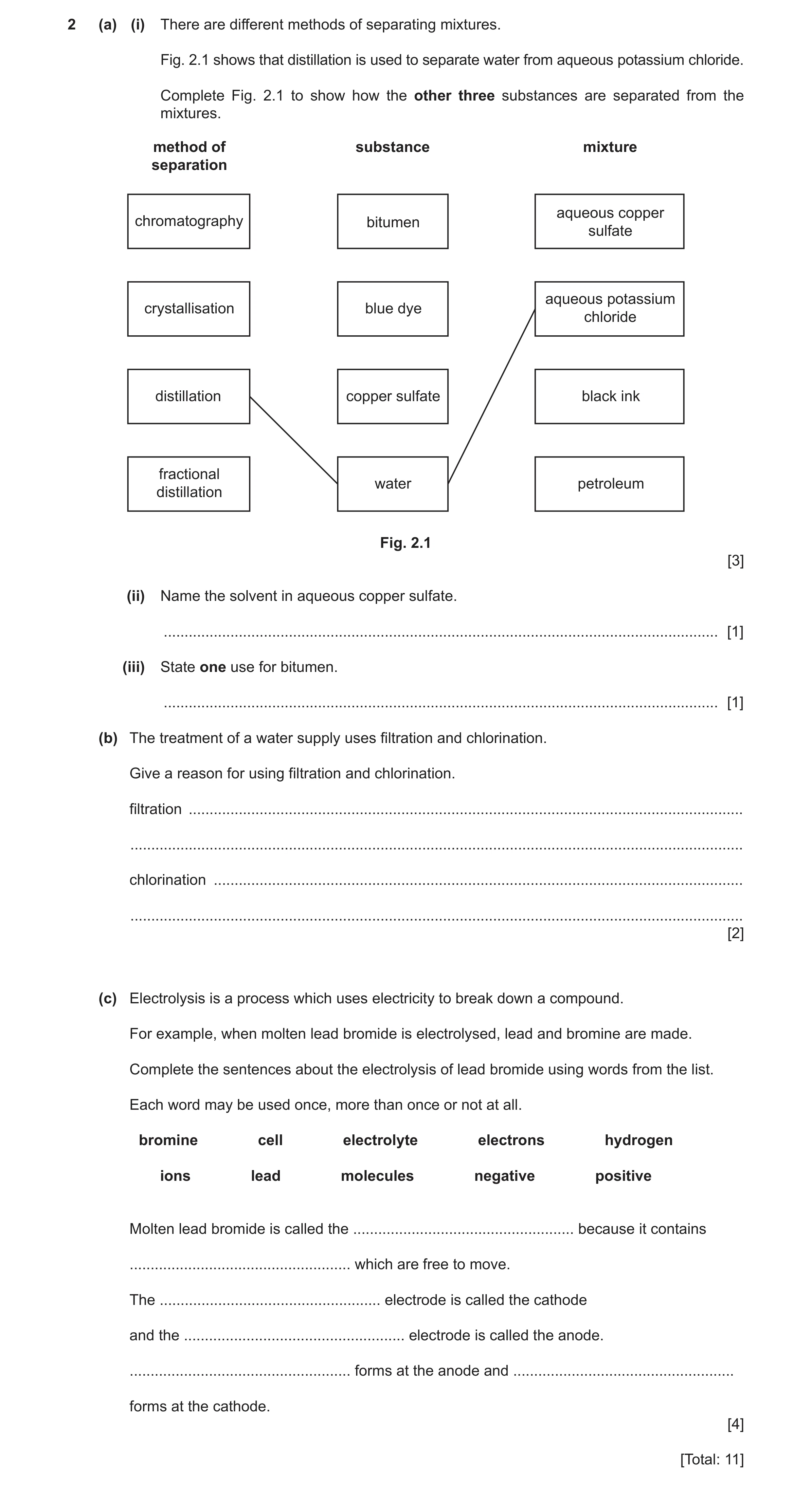
2 (a) (i) There are different methods of separating mixtures. Fig. 2.1 shows that distillation is used to separate water from aqueous potassium chloride. Complete Fig. 2.1 to show how the other three substances are separated from the mixtures. method of substance mixture separation aqueous copper chromatography bitumen sulfate aqueous potassium crystallisation blue dye chloride distillation copper sulfate black ink fractional water petroleum distillation Fig. 2.1 [3] (ii) Name the solvent in aqueous copper sulfate. … [1] (iii) State one use for bitumen. … [1] (b) The treatment of a water supply uses filtration and chlorination. Give a reason for using filtration and chlorination. filtration … … chlorination … … [2] (c) Electrolysis is a process which uses electricity to break down a compound. For example, when molten lead bromide is electrolysed, lead and bromine are made. Complete the sentences about the electrolysis of lead bromide using words from the list. Each word may be used once, more than once or not at all. bromine cell electrolyte electrons hydrogen ions lead molecules negative positive Molten lead bromide is called the … because it contains … which are free to move. The … electrode is called the cathode and the … electrode is called the anode. … forms at the anode and … forms at the cathode. [4] [Total: 11]
11 marks
Mark scheme: 2(a)(i) 3 method of separation substance mixture aqueous copper chromatography bitumen sulfate aqueous potassium crystallisation blue dye chloride distillation copper sulfate black ink fractional water petroleum distillation one pair of links correct ; two pairs of links correct ; three pairs of links correct ; 2(a)(ii) water ; 1 2(a)(iii) road surfaces ; 1 2(b) filtration – removes solid particles ; 2 chlorination – kills microbes / sterilises water ; 2(c) electrolyte ; 4 ions ; negative and positive (in that order) ; bromine and lead (in that order) ;
This question in 0654/33 Oct/Nov 2023
Q28 · A teacher reacts sodium with water 0654/32 May/June 2024
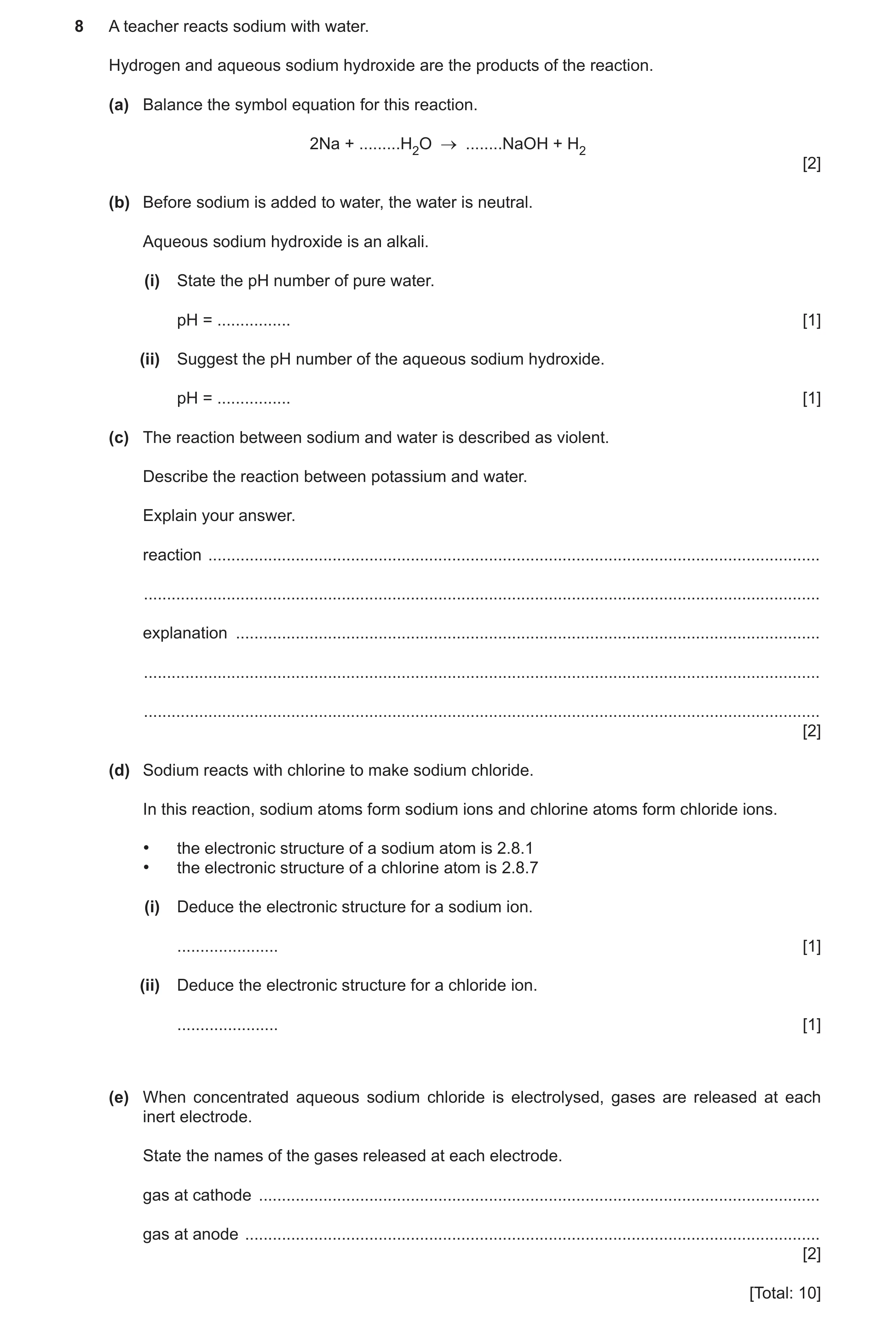
8 A teacher reacts sodium with water. Hydrogen and aqueous sodium hydroxide are the products of the reaction. (a) Balance the symbol equation for this reaction. 2Na + … H2O … NaOH + H2 [2] (b) Before sodium is added to water, the water is neutral. Aqueous sodium hydroxide is an alkali. (i) State the pH number of pure water. pH = … [1] (ii) Suggest the pH number of the aqueous sodium hydroxide. pH = … [1] (c) The reaction between sodium and water is described as violent. Describe the reaction between potassium and water. Explain your answer. reaction … … explanation … … … [2] (d) Sodium reacts with chlorine to make sodium chloride. In this reaction, sodium atoms form sodium ions and chlorine atoms form chloride ions. • the electronic structure of a sodium atom is 2.8.1 • the electronic structure of a chlorine atom is 2.8.7 (i) Deduce the electronic structure for a sodium ion. … [1] (ii) Deduce the electronic structure for a chloride ion. … [1] (e) When concentrated aqueous sodium chloride is electrolysed, gases are released at each inert electrode. State the names of the gases released at each electrode. gas at cathode … gas at anode … [2] [Total: 10]
10 marks
Mark scheme: 8(a) 2Na + 2 H2O 2 NaOH + H2 ;; 2 8(b)(i) 7 ; 1 8(b)(ii) 8–14 ; 1 8(c) even more violent / explosive ; reactivity increases down the group / potassium is more reactive than sodium ; 2 8(d)(i) 2.8 ; 1 8(d)(ii) 2.8.8 ; 1 8(e) cathode–hydrogen ; anode–chlorine ; 2
This question in 0654/32 May/June 2024
Q29 · A teacher reacts sodium with water 0654/33 May/June 2024
8 A teacher reacts sodium with water. Hydrogen and aqueous sodium hydroxide are the products of the reaction. (a) Balance the symbol equation for this reaction. 2Na + … H2O … NaOH + H2 [2] (b) Before sodium is added to water, the water is neutral. Aqueous sodium hydroxide is an alkali. (i) State the pH number of pure water. pH = … [1] (ii) Suggest the pH number of the aqueous sodium hydroxide. pH = … [1] (c) The reaction between sodium and water is described as violent. Describe the reaction between potassium and water. Explain your answer. reaction … … explanation … … … [2] (d) Sodium reacts with chlorine to make sodium chloride. In this reaction, sodium atoms form sodium ions and chlorine atoms form chloride ions. • the electronic structure of a sodium atom is 2.8.1 • the electronic structure of a chlorine atom is 2.8.7 (i) Deduce the electronic structure for a sodium ion. … [1] (ii) Deduce the electronic structure for a chloride ion. … [1] (e) When concentrated aqueous sodium chloride is electrolysed, gases are released at each inert electrode. State the names of the gases released at each electrode. gas at cathode … gas at anode … [2] [Total: 10]
10 marks
Mark scheme: 8(a) 2Na + 2 H2O 2 NaOH + H2 ;; 2 8(b)(i) 7 ; 1 8(b)(ii) 8–14 ; 1 8(c) even more violent / explosive ; reactivity increases down the group / potassium is more reactive than sodium ; 2 8(d)(i) 2.8 ; 1 8(d)(ii) 2.8.8 ; 1 8(e) cathode–hydrogen ; anode–chlorine ; 2
This question in 0654/33 May/June 2024
Q30 · The observations for the reactions of four metals with water 0654/31 Oct/Nov 2024
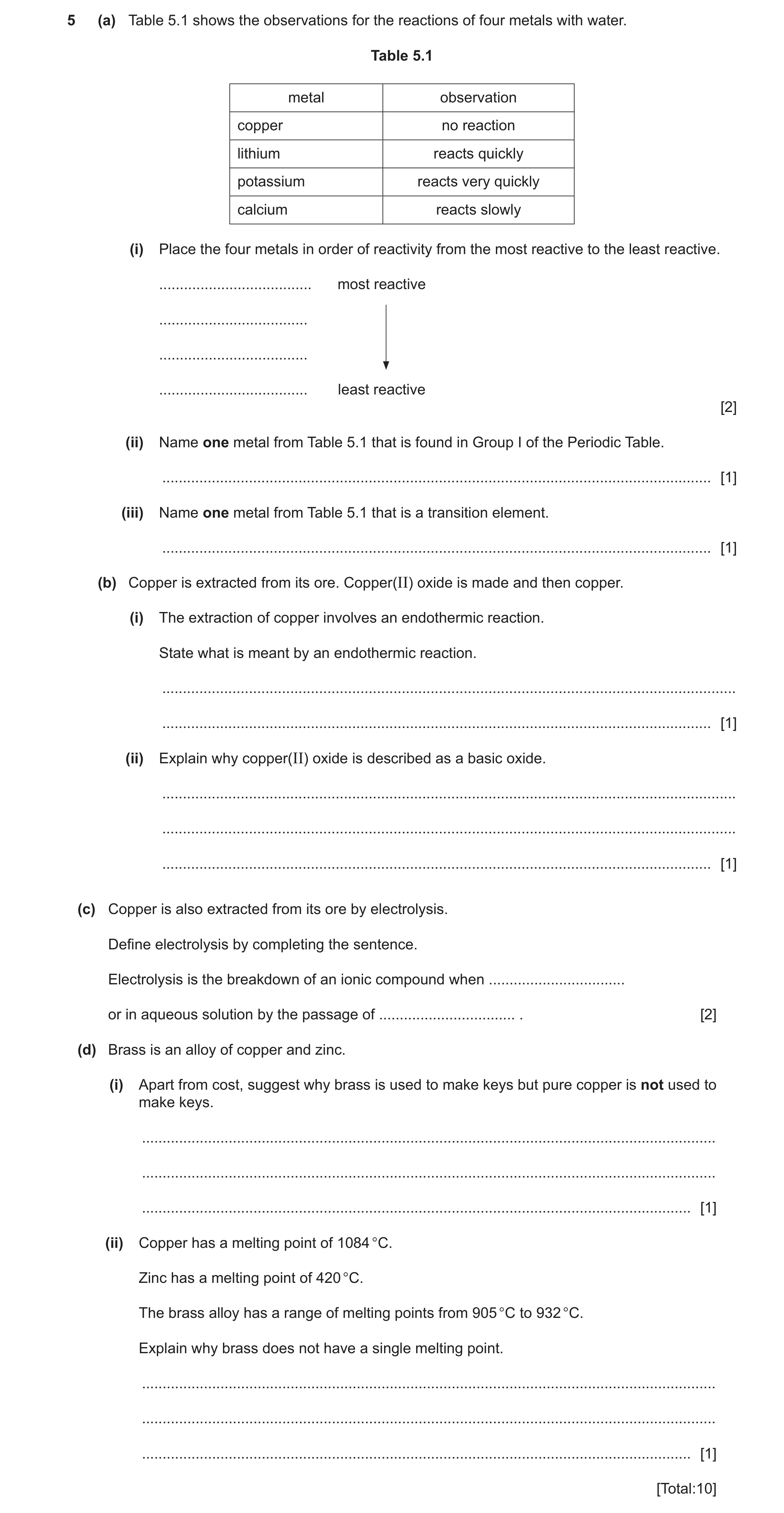
5 (a) Table 5.1 shows the observations for the reactions of four metals with water. Table 5.1 metal observation copper no reaction lithium reacts quickly potassium reacts very quickly calcium reacts slowly (i) Place the four metals in order of reactivity from the most reactive to the least reactive. … most reactive … … … least reactive [2] (ii) Name one metal from Table 5.1 that is found in Group I of the Periodic Table. … [1] (iii) Name one metal from Table 5.1 that is a transition element. … [1] (b) Copper is extracted from its ore. Copper(II) oxide is made and then copper. (i) The extraction of copper involves an endothermic reaction. State what is meant by an endothermic reaction. … … [1] (ii) Explain why copper(II) oxide is described as a basic oxide. … … … [1] (c) Copper is also extracted from its ore by electrolysis. Define electrolysis by completing the sentence. Electrolysis is the breakdown of an ionic compound when … or in aqueous solution by the passage of … . [2] (d) Brass is an alloy of copper and zinc. (i) Apart from cost, suggest why brass is used to make keys but pure copper is not used to make keys. … … … [1] (ii) Copper has a melting point of 1084 °C. Zinc has a melting point of 420 °C. The brass alloy has a range of melting points from 905 °C to 932 °C. Explain why brass does not have a single melting point. … … … [1] [Total:10]
10 marks
Mark scheme: 5(a)(i) potassium 2 lithium calcium copper potassium and copper correct ; lithium and calcium correct ; 5(a)(ii) lithium / potassium ; 1 5(a)(iii) copper ; 1 5(b)(i) temperature decreases / thermal energy is absorbed (from the surroundings) ; 1 5(b)(ii) is a metal oxide ; 1 5(c) molten / liquid ; 2 electricity ; 5(d)(i) brass is more hardwearing / stronger ; 1 5(d)(ii) brass is a mixture ; 1
This question in 0654/31 Oct/Nov 2024
Q31 · Copper is a metal in high demand that is now often recycled 0654/32 Oct/Nov 2024
8 (a) Copper is a metal in high demand that is now often recycled. To recycle copper, it must be melted down into a liquid. (i) Suggest one reason other than cost why copper and other metals are recycled. … … [1] (ii) Describe two differences between the arrangement and motion of atoms in molten copper and the arrangement and motion of atoms in solid copper. arrangement … … motion … … [2] (b) A metal coin is covered with a layer of copper by electroplating. (i) The coin is used as one of the electrodes. State for which electrode the coin is used. … [1] (ii) Suggest a suitable solution to be used as the electrolyte for electroplating the coin. … [1] (iii) Electroplating uses the process of electrolysis; a definition is provided. Electrolysis is the breakdown of a covalent compound when solid or in aqueous solution by the passage of electricity. This definition of electrolysis is not correct. Circle the two words in the definition that are not correct. [2] [Total: 7]
7 marks
Mark scheme: 8(a)(i) copper (ore) is a finite resource ; 1 8(a)(ii) arrangement – solid regular and liquid irregular ; 2 motion – solid vibrate (about fixed point) only / do not move AND liquid are able to move about ; 8(b)(i) cathode ; 1 8(b)(ii) copper sulfate / copper chloride ; 1 8(b)(iii) covalent ; 2 solid ;
This question in 0654/32 Oct/Nov 2024
Q32 · Chlorine is an element in Group VII of the Periodic Table 0654/32 Feb/March 2025
8 (a) Chlorine is an element in Group VII of the Periodic Table. Chlorine molecules are diatomic. (i) State the type of chemical bonding in a chlorine molecule. … [1] (ii) Astatine, At, is also a diatomic molecule. State the formula for a molecule of astatine. … [1] (b) When chlorine gas reacts with solid sodium, an orange flame is seen and the sodium melts. Solid sodium chloride is formed. (i) Explain how these observations show that the reaction is exothermic. … … [1] (ii) Complete the balanced equation for the reaction between chlorine and sodium. Include state symbols. … Na(s) + Cl 2( … ) → … NaCl ( … ) [2] (c) Fig. 8.1 shows the electronic configuration of a sodium atom and a chlorine atom. sodium atom chlorine atom Fig. 8.1 A sodium ion and a chloride ion are formed when a sodium atom reacts with a chlorine atom. Complete the dot-and-cross diagrams in Fig. 8.2 to show the electronic configurations of a sodium ion and a chloride ion. Include the charges on the ions. Na Cl sodium ion chloride ion Fig. 8.2 [3] (d) Fig. 8.3 shows an experiment in which an electric current is passed through concentrated aqueous sodium chloride. d.c. power supply – + negative positive electrode electrode concentrated aqueous sodium chloride Fig. 8.3 (i) State the names of the positive electrode and the negative electrode. positive electrode … negative electrode … [1] (ii) Identify the gases produced at the positive electrode and at the negative electrode in this experiment. gas at positive electrode … gas at negative electrode … [2] [Total: 11]
11 marks
Mark scheme: 8(a)(i) covalent ; 1 8(a)(ii) At2 ; 1 8(b)(i) (thermal) energy released ; 1 8(b)(ii) 2Na (s) + Cl2 ( g) → 2NaCl ( s) 2 ; ; 8(c) (the electronic configuration shown on the diagram) 3 sodium ion- 2, 8 ; chloride ion- 2, 8, 8 ; (the charge on the ions in diagram) sodium ion +1 and chloride ion -1 ; 8(d)(i) anode 1 cathode ; (in that order) 8(d)(ii) chlorine ; 2 hydrogen ; (in that order)
This question in 0654/32 Feb/March 2025
Q33 · Sulfuric acid has the formula H2SO4 0654/31 May/June 2025
6 (a) Sulfuric acid has the formula H2SO4. Determine the relative molecular mass, Mr , of sulfuric acid. [Ar : H, 1; O, 16; S, 32] relative molecular mass = … [1] (b) Fig. 6.1 shows the apparatus used for the electrolysis of dilute sulfuric acid. + – Fig. 6.1 (i) On Fig. 6.1, draw a label line and the letter A to indicate the anode and a label line and the letter C to indicate the cathode. [1] (ii) On Fig. 6.1, draw a label line and the letter E to indicate the electrolyte. [1] (iii) Name the gas formed at the anode and the gas formed at the cathode in Fig. 6.1. anode … cathode … [2] (iv) Graphite is often used as inert electrodes. Graphite is a giant covalent structure formed of carbon atoms. Name one other giant covalent structure formed of carbon atoms. … [1] (c) (i) Describe the effect of dilute sulfuric acid on: blue litmus indicator … methyl orange indicator. … [2] (ii) Suggest the pH of dilute sulfuric acid. pH = … [1] (iii) State the two products of the neutralisation reaction between an acid and an alkali. 1 … 2 … [1] [Total: 10]
10 marks
Mark scheme: 6(a) 98 ; 1 6(b)(i) anode and cathode correctly indicated ; 1 A C 6(b)(ii) electrolyte correctly indicated ; 1 E 6(b)(iii) anode – oxygen ; 2 cathode – hydrogen ; 6(b)(iv) diamond ; 1 6(c)(i) goes red ; 2 goes red ; 6(c)(ii) 1– 6 ; 1 6(c)(iii) salt and water ; 1
This question in 0654/31 May/June 2025
 36 / 54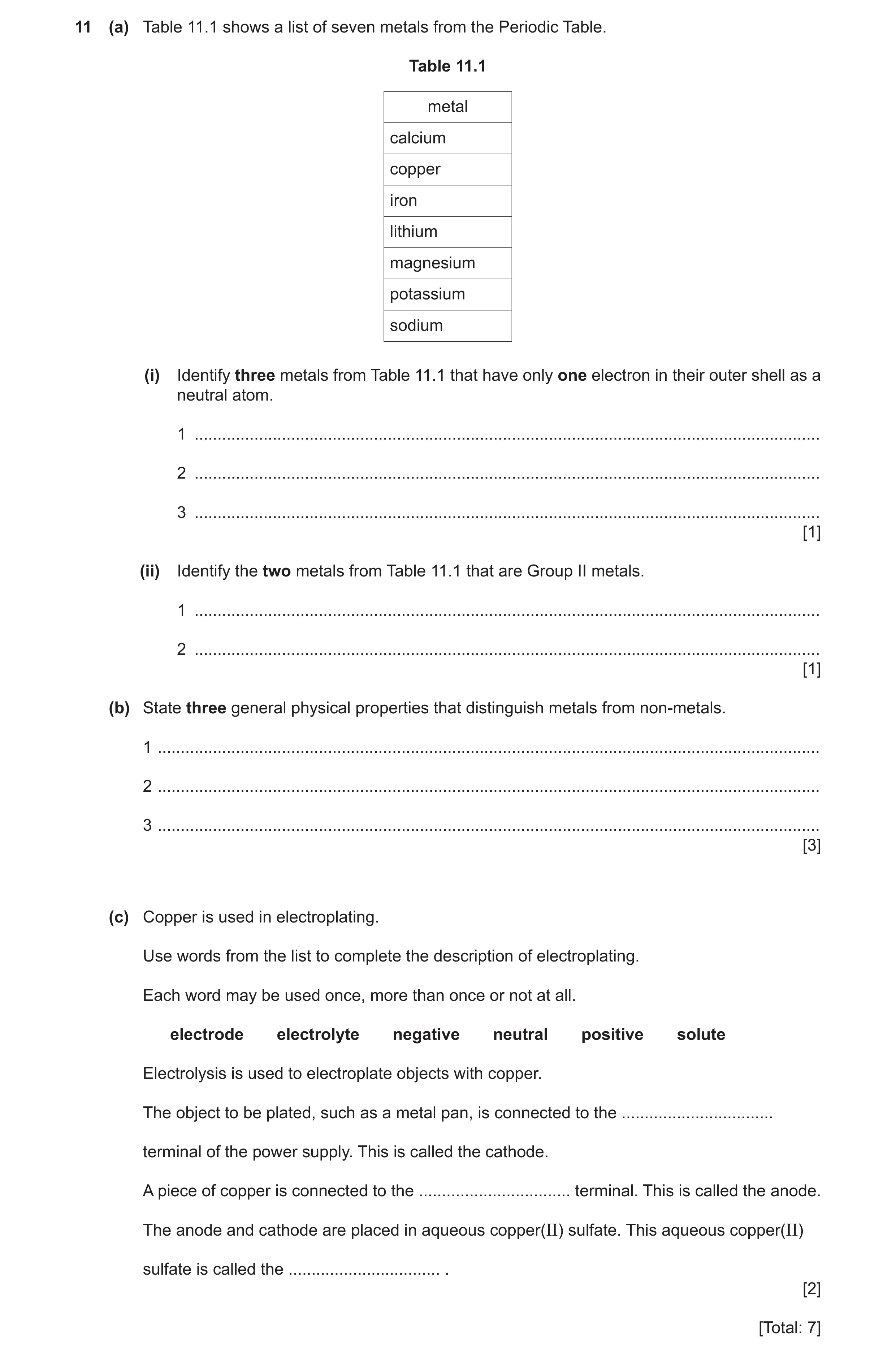
 51 / 54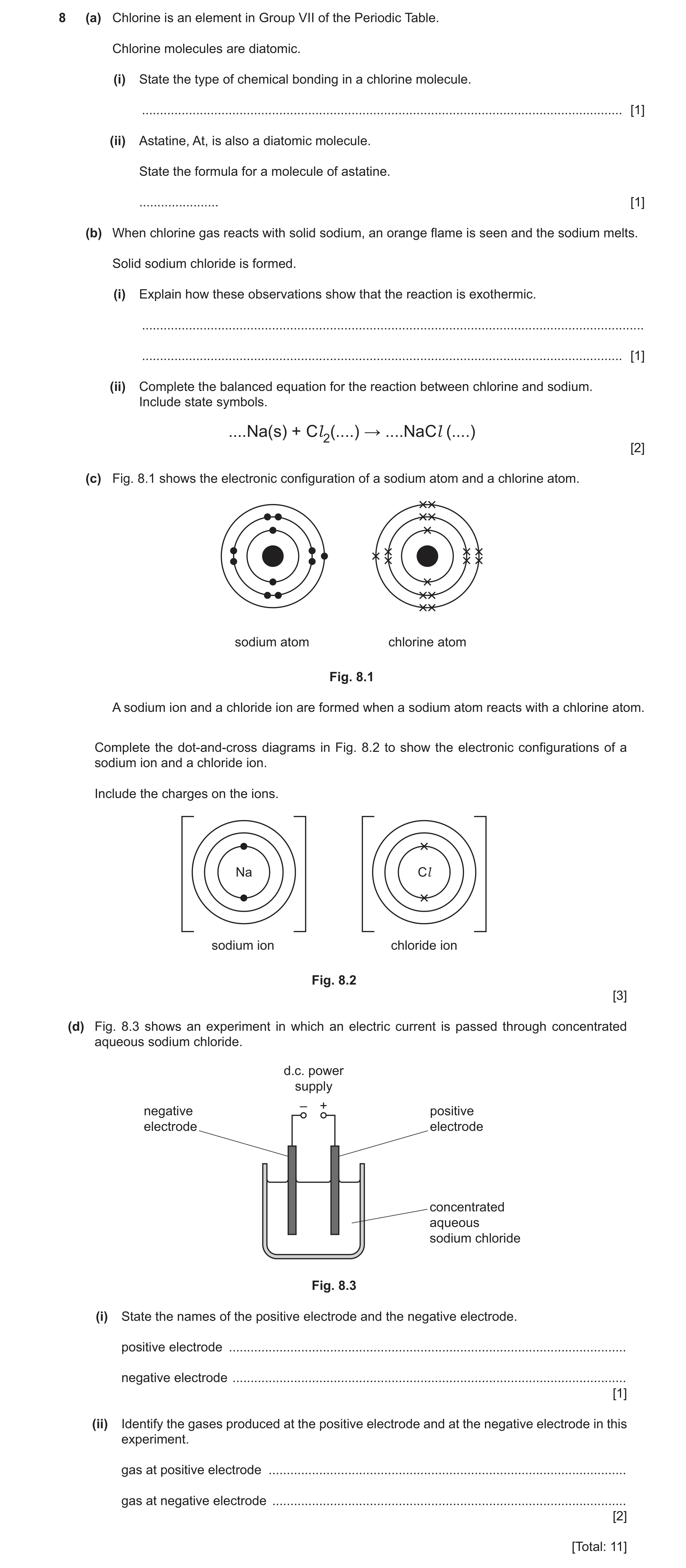
![Question 33: (a) Sulfuric acid has the formula H2SO4. Determine the relative molecular mass, Mr , of sulfuric acid. [Ar : H, 1; O, 16; S, 32] relative m…](https://img.pastlit.com/crops/9c236bbd-0fcd-4db6-93fa-2963f2bf9776/q6.webp)
 9
9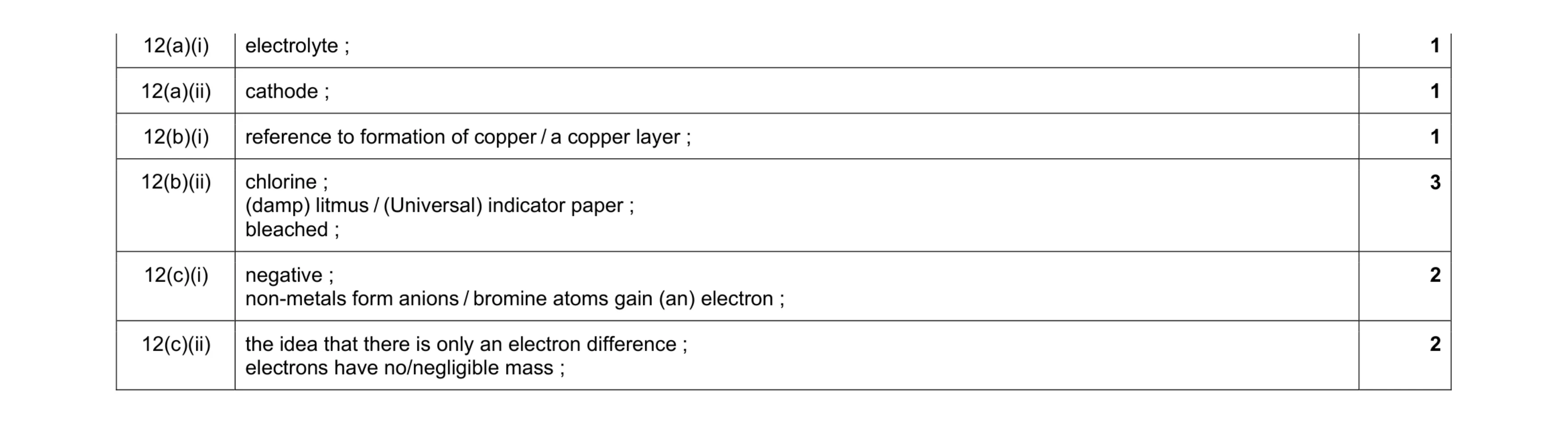 10
10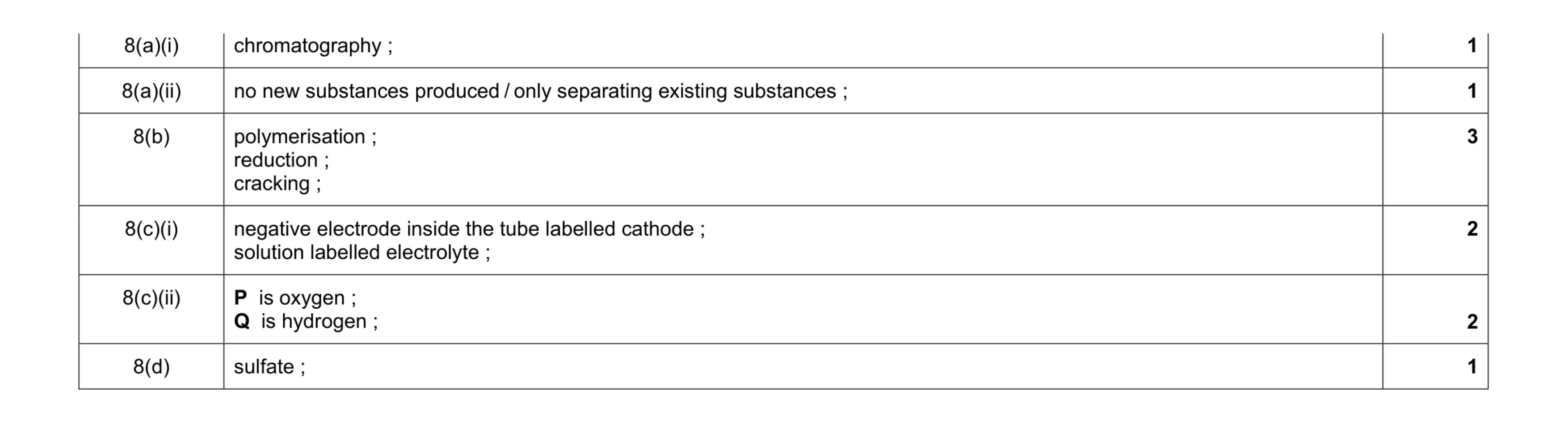 10
10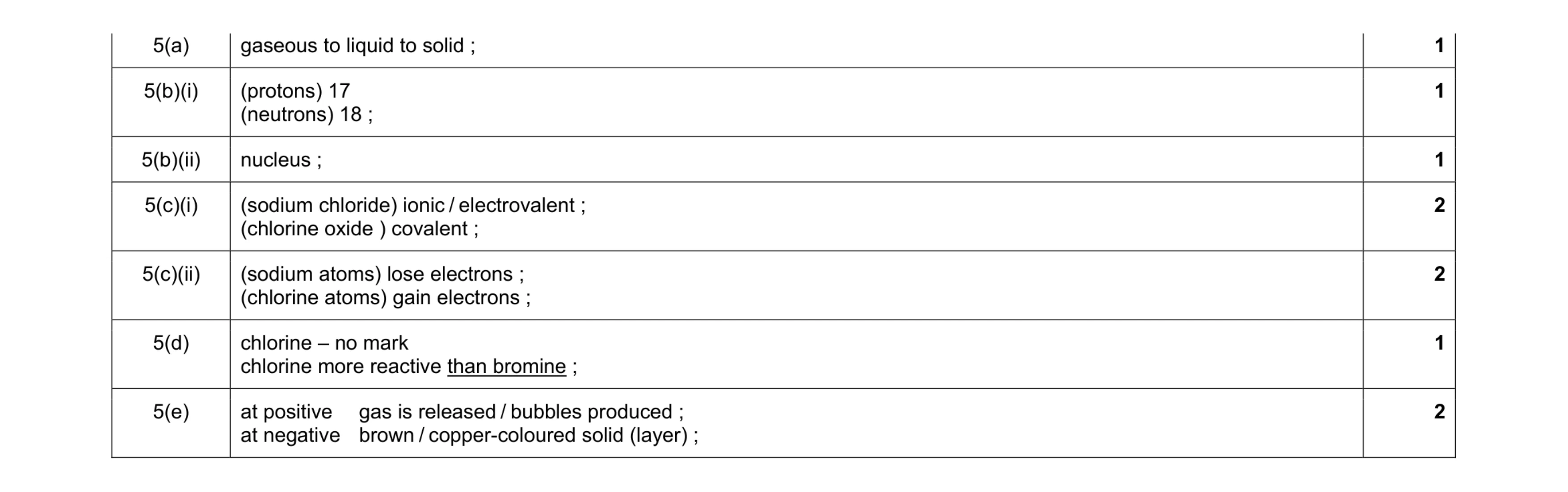 10
10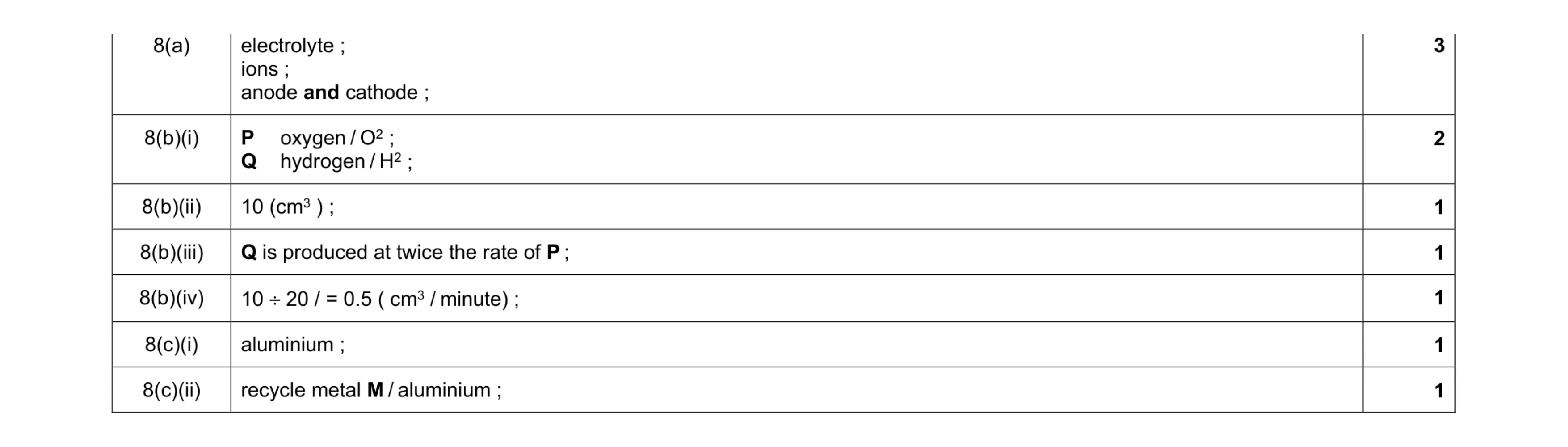 10
10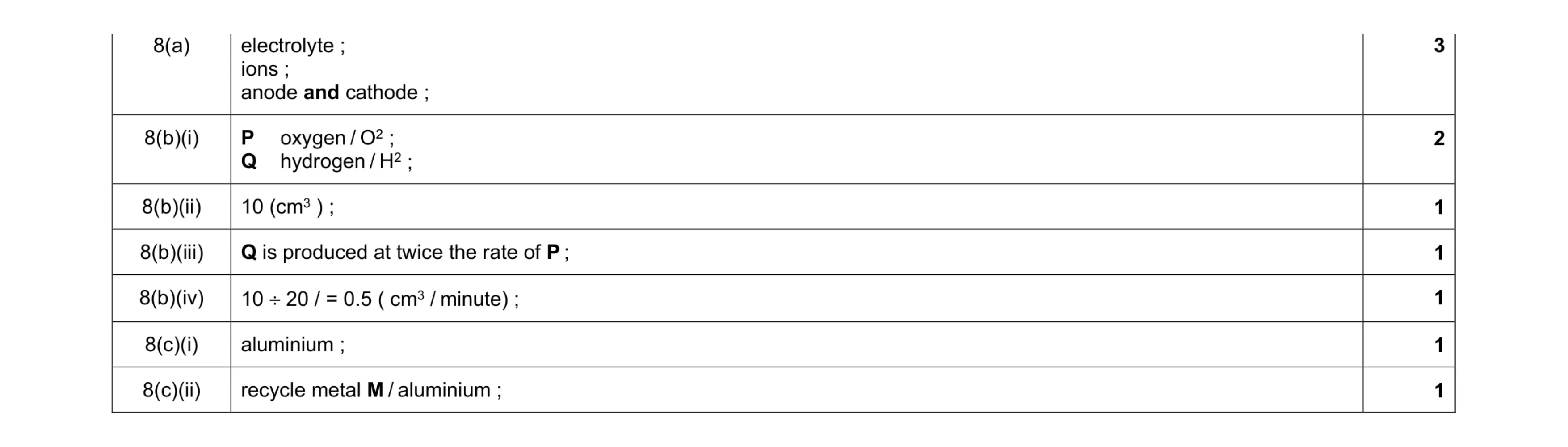 10
10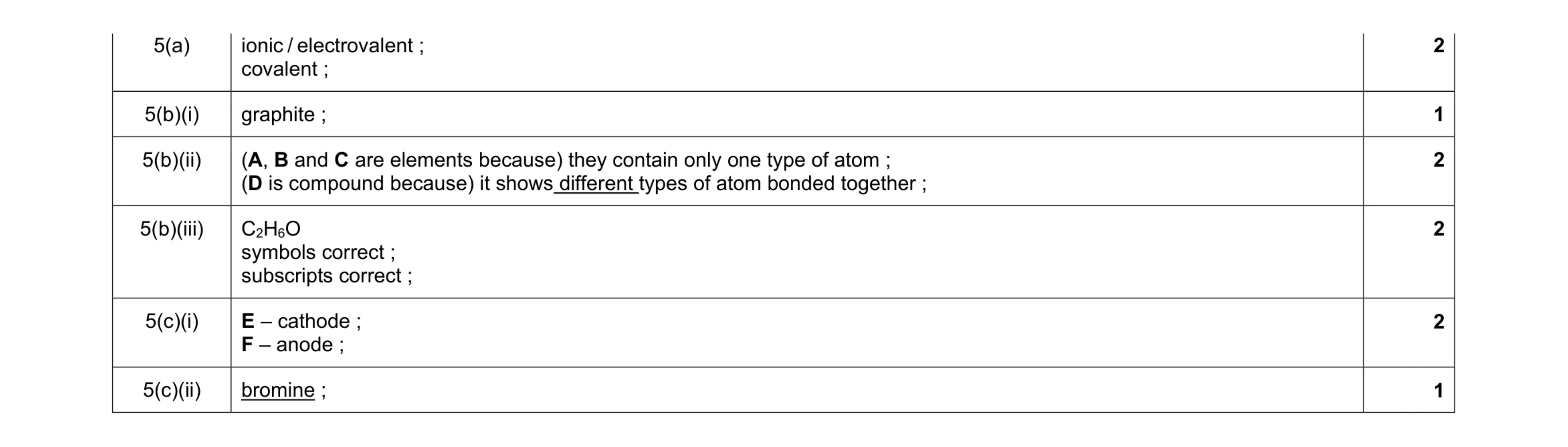 10
10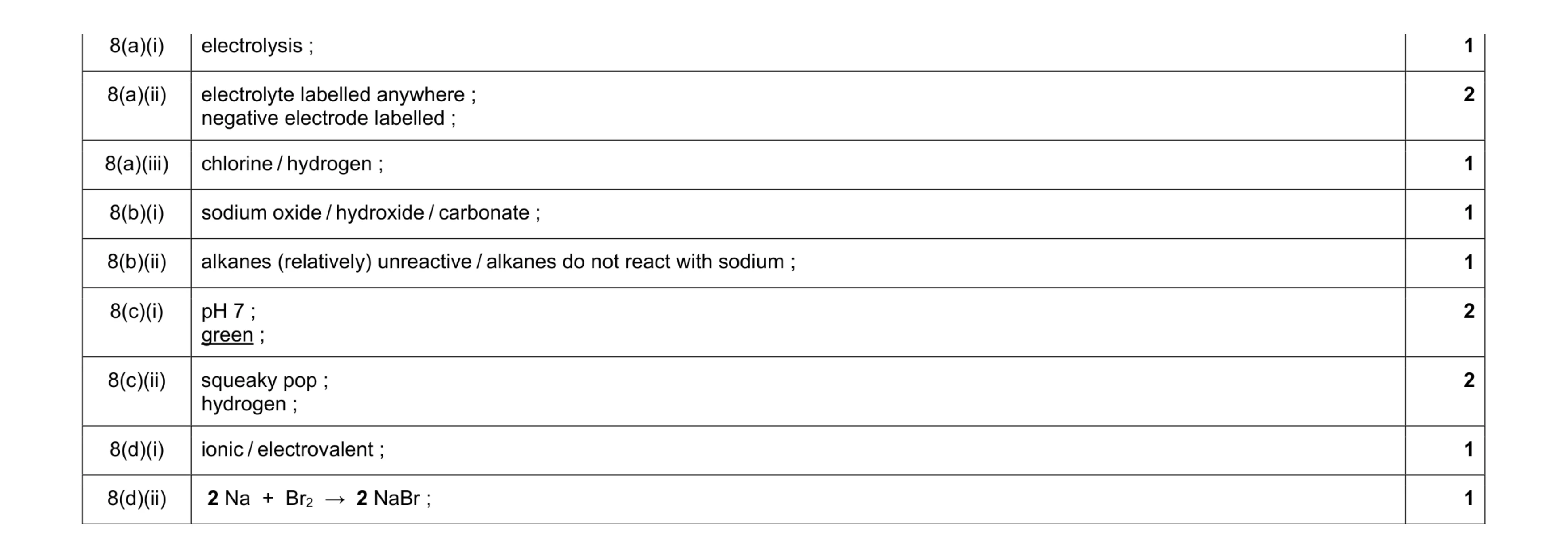 12
12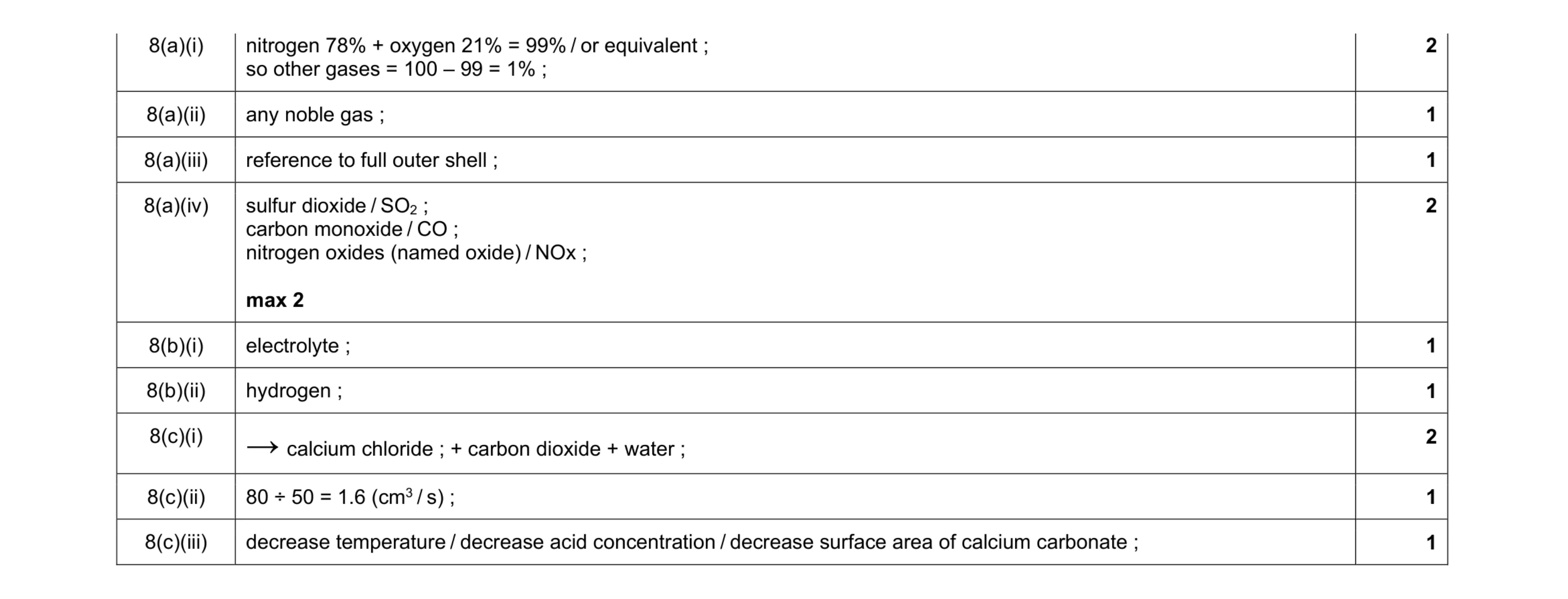 12
12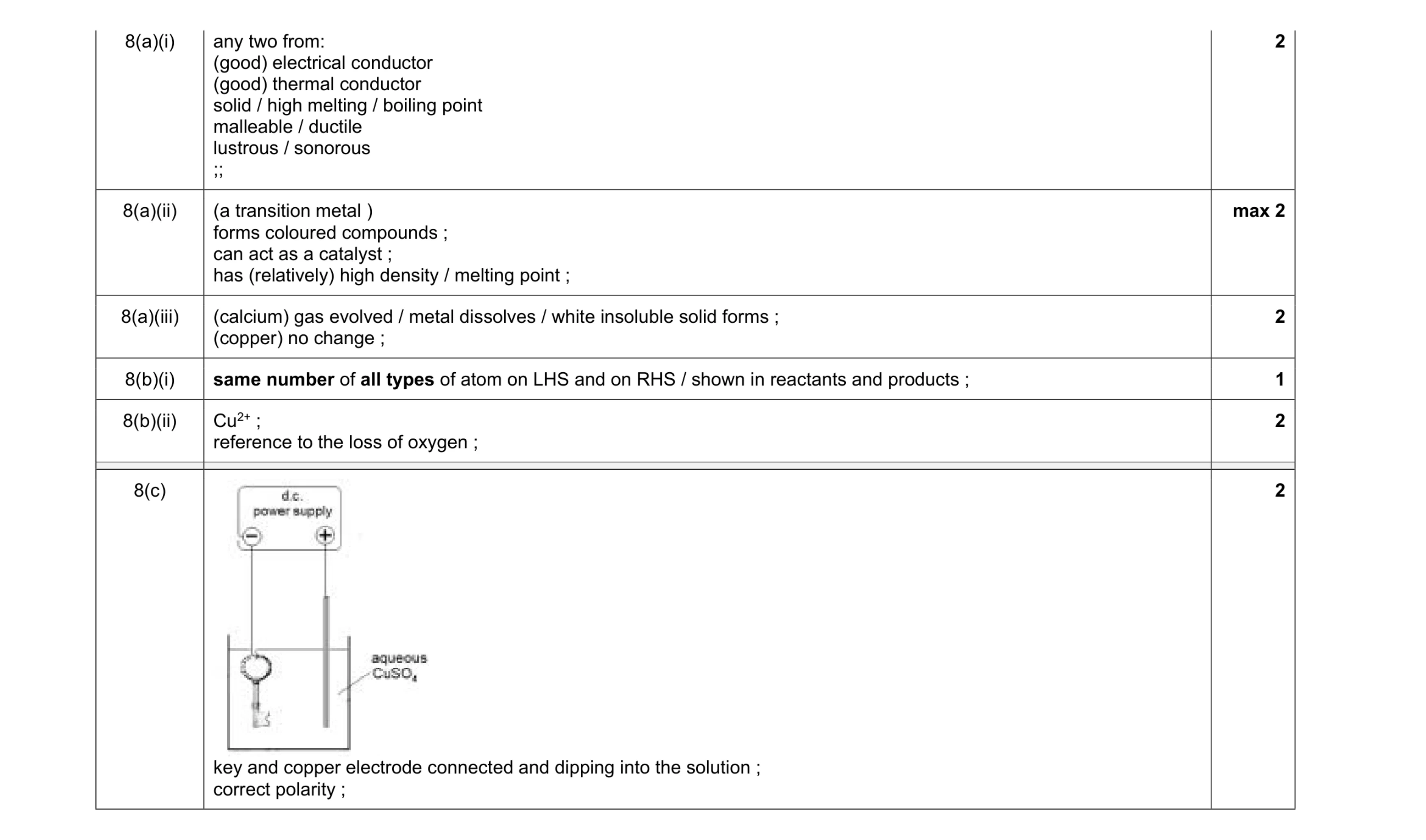 11
11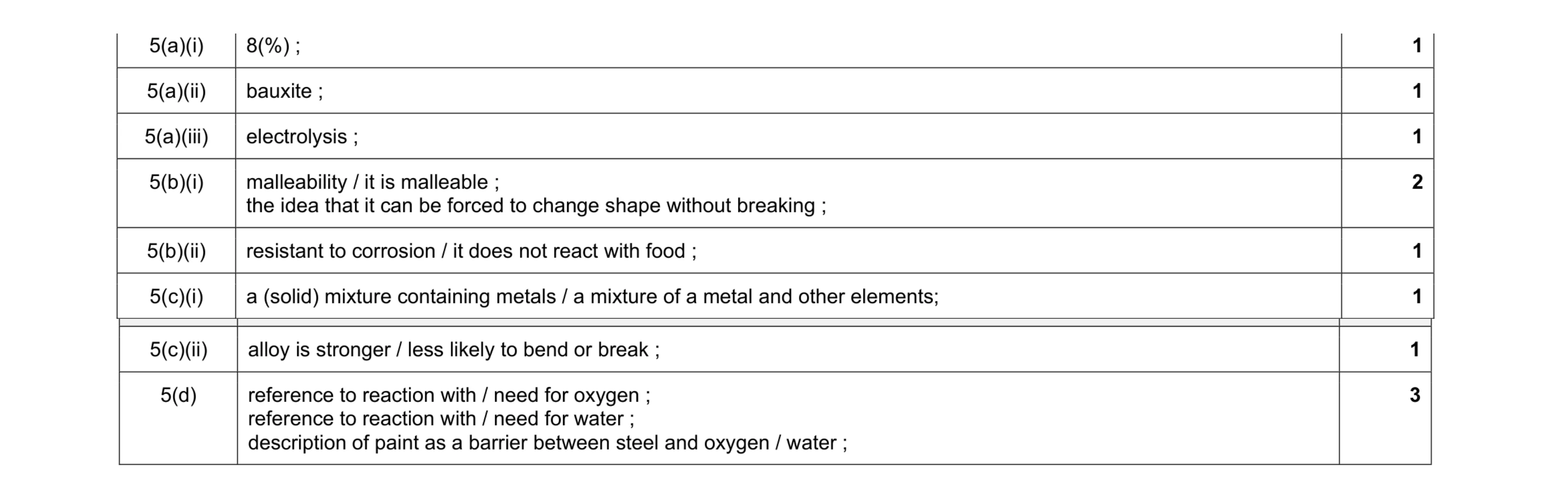 11
11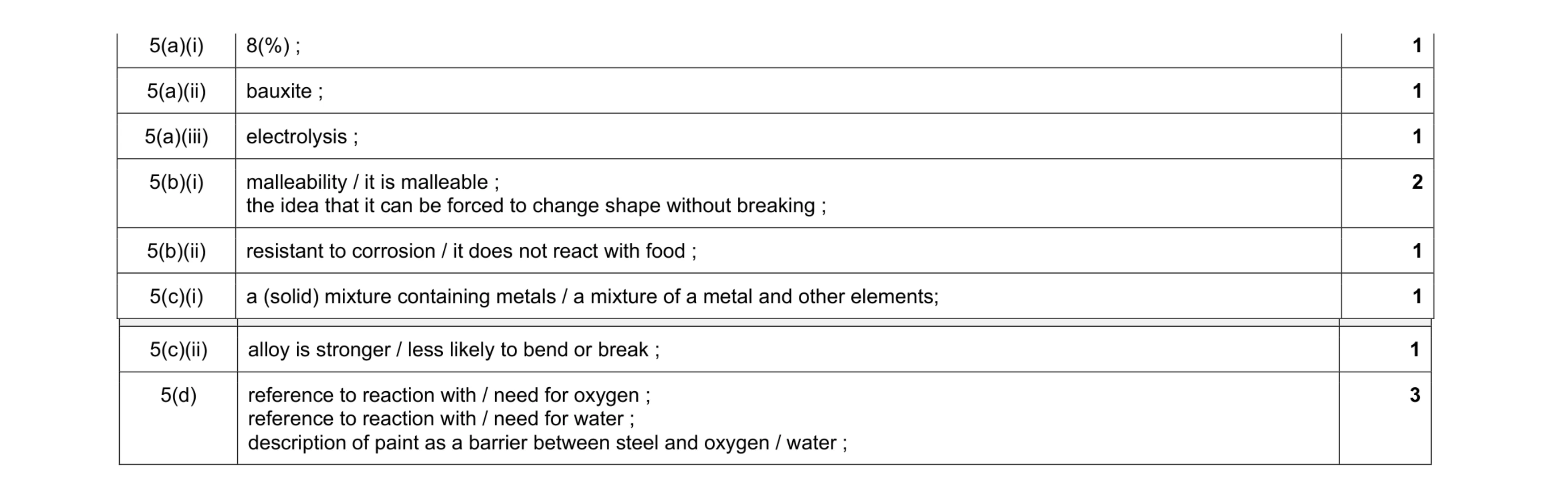 11
11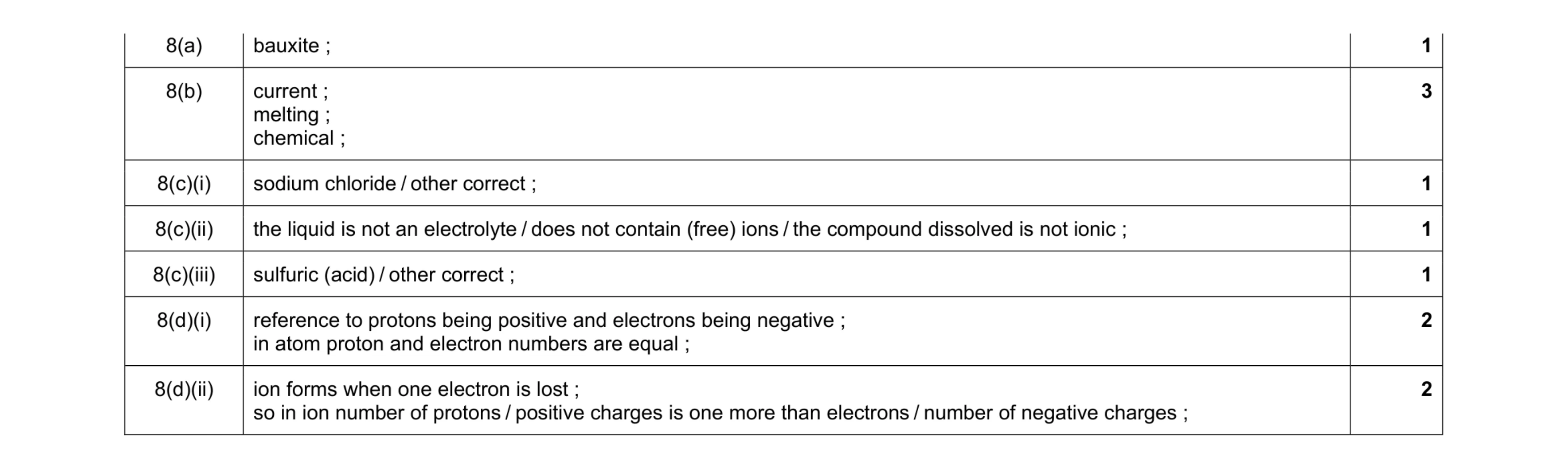 11
11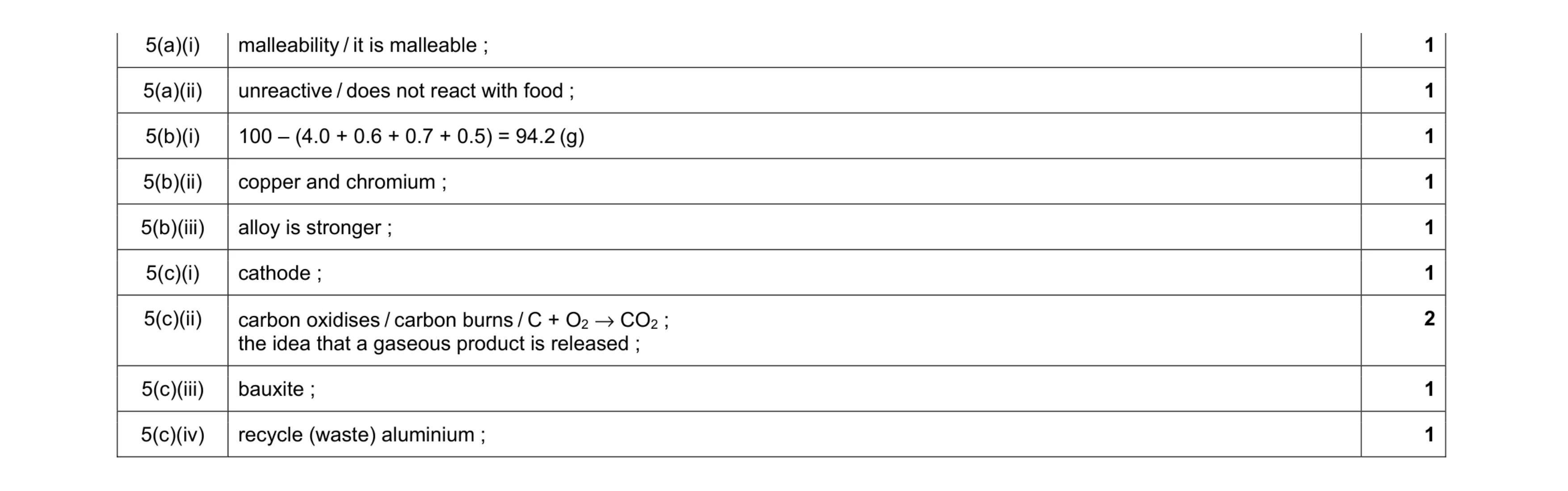 10
10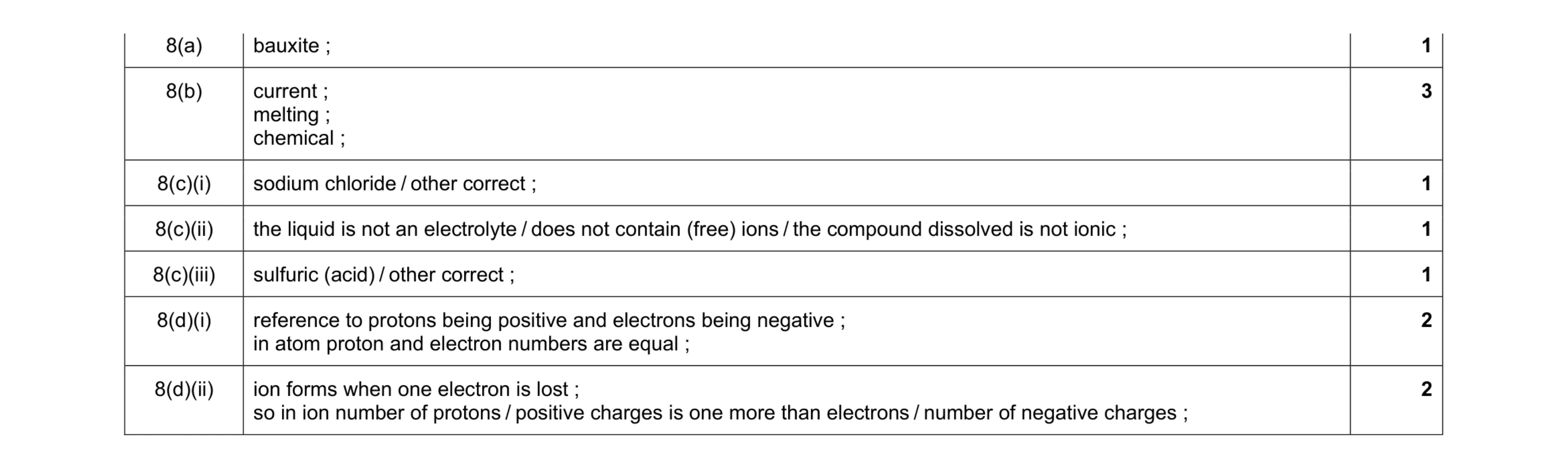 11
11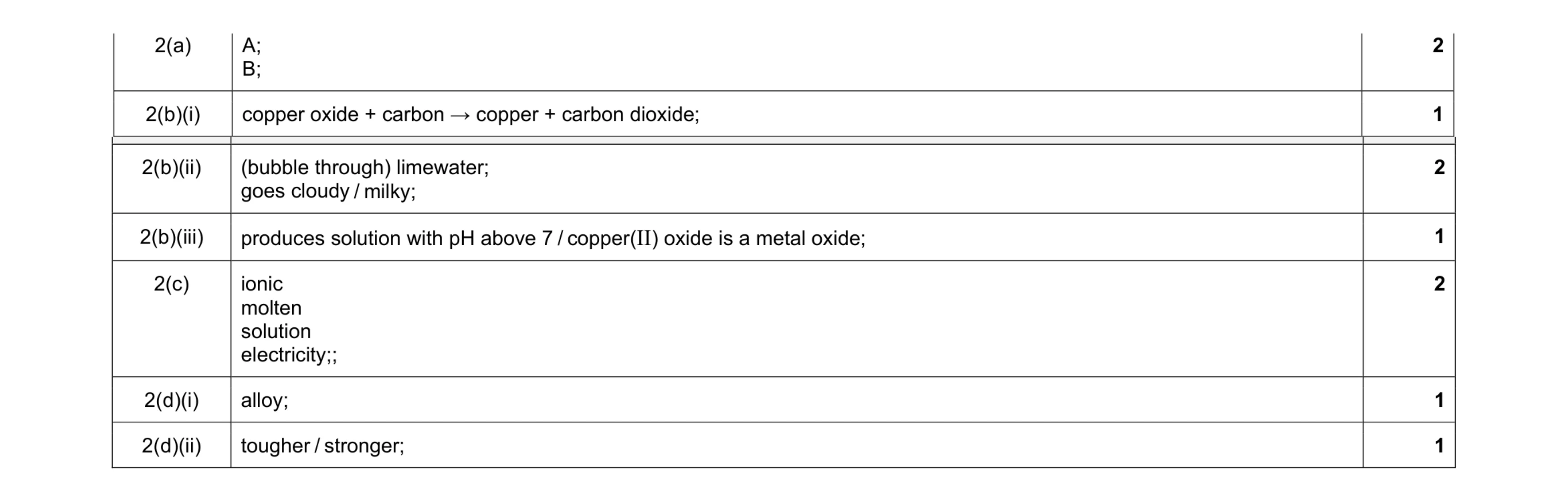 10
10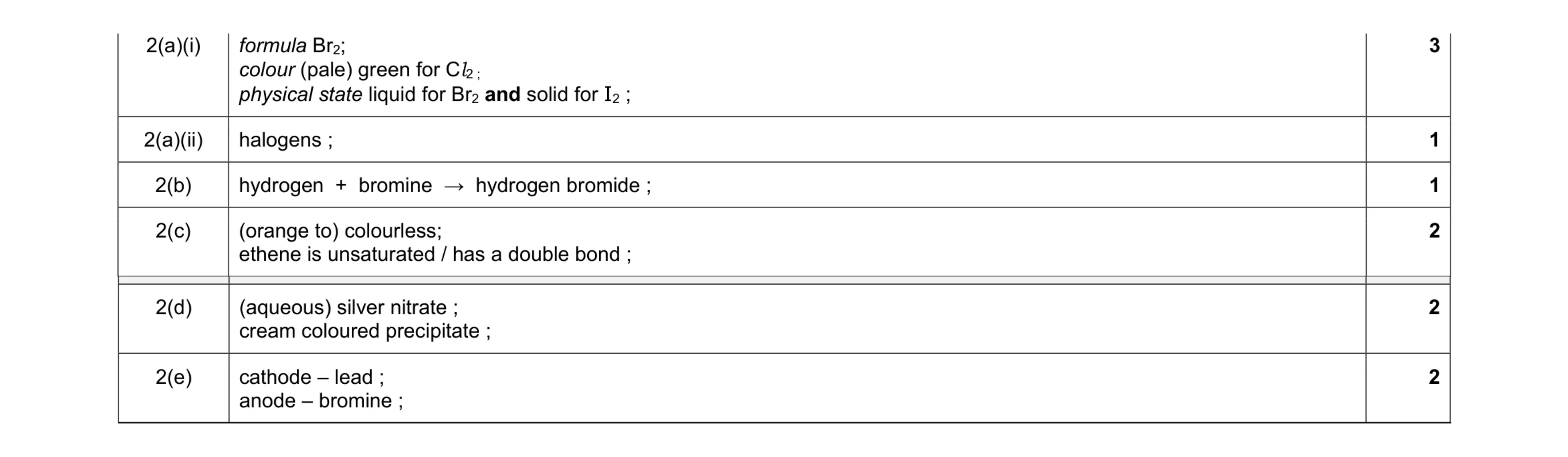 11
11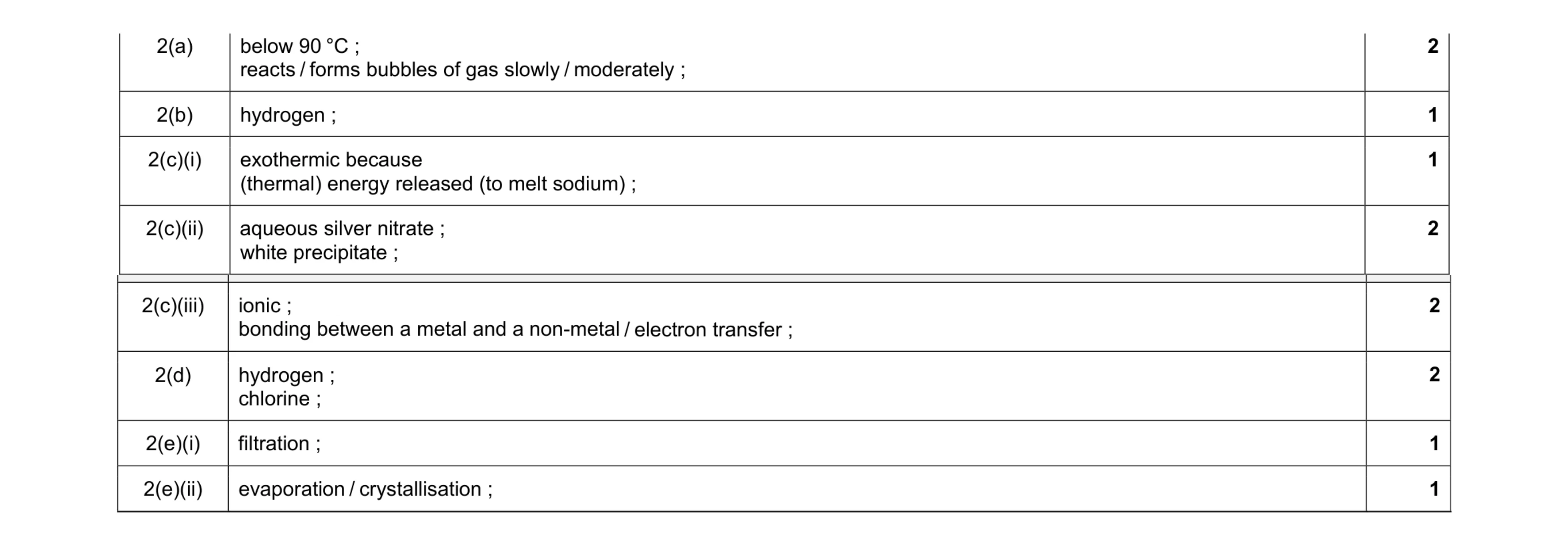 12
12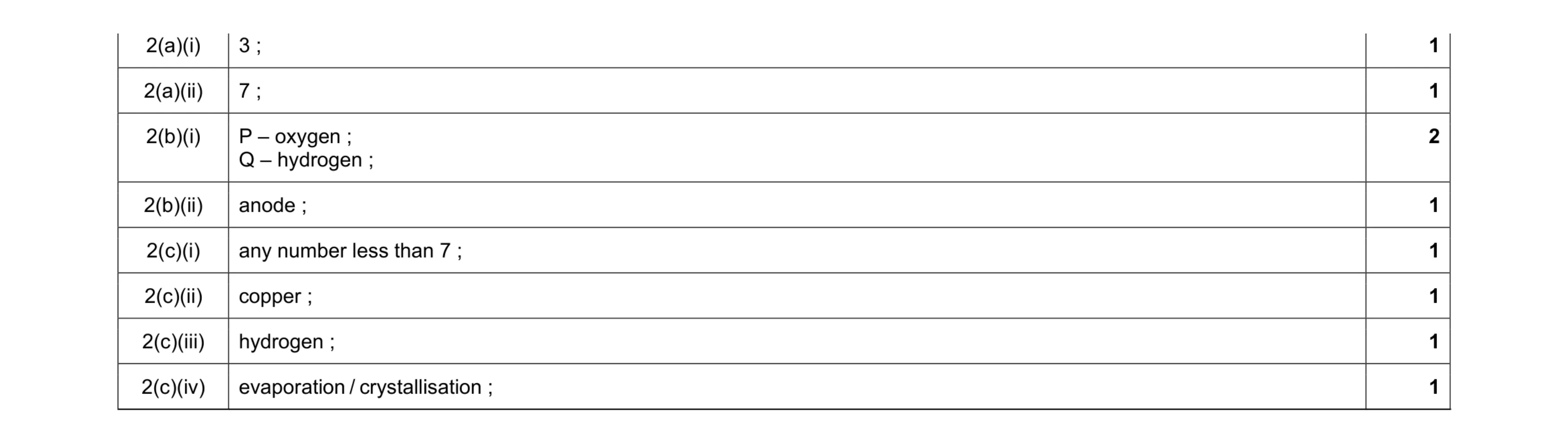 9
9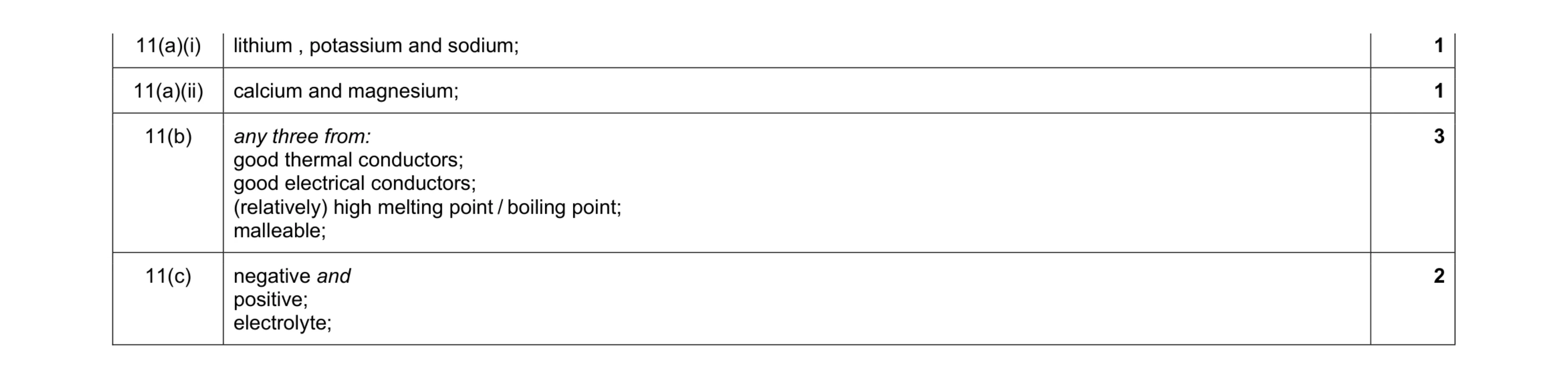 7
7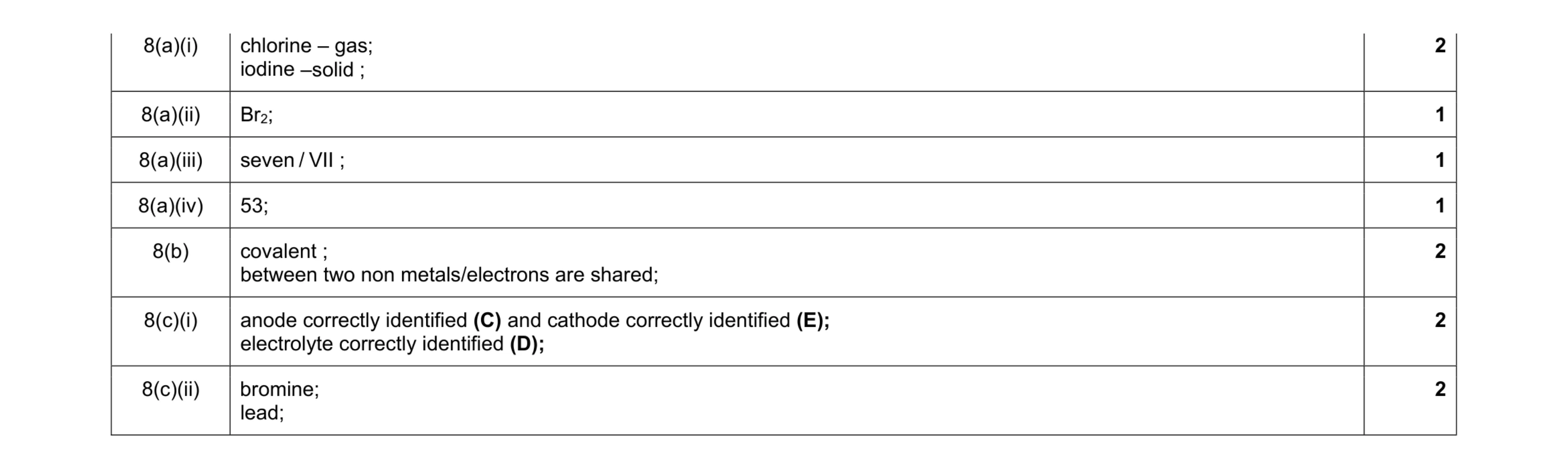 11
11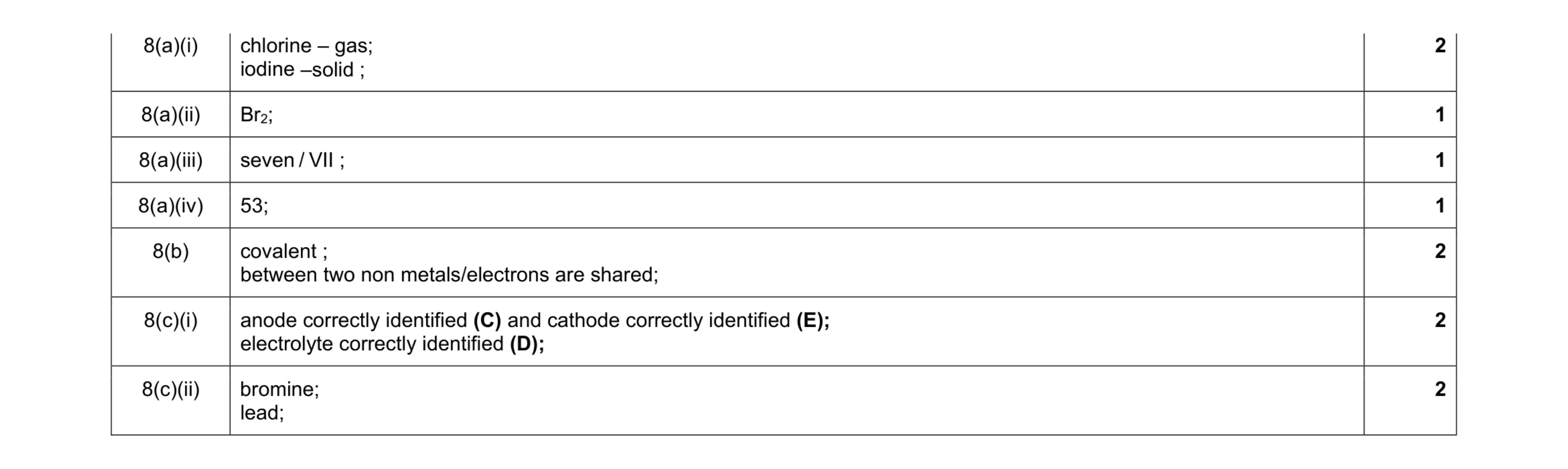 11
11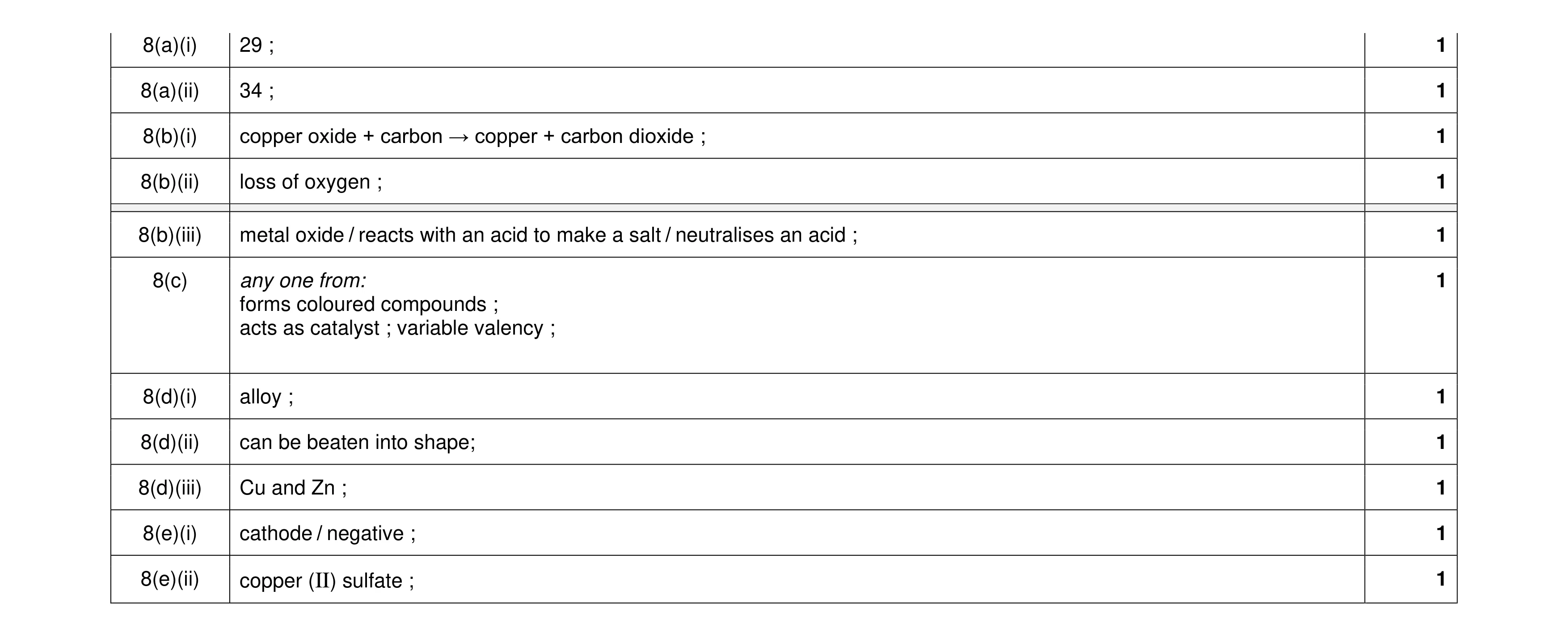 11
11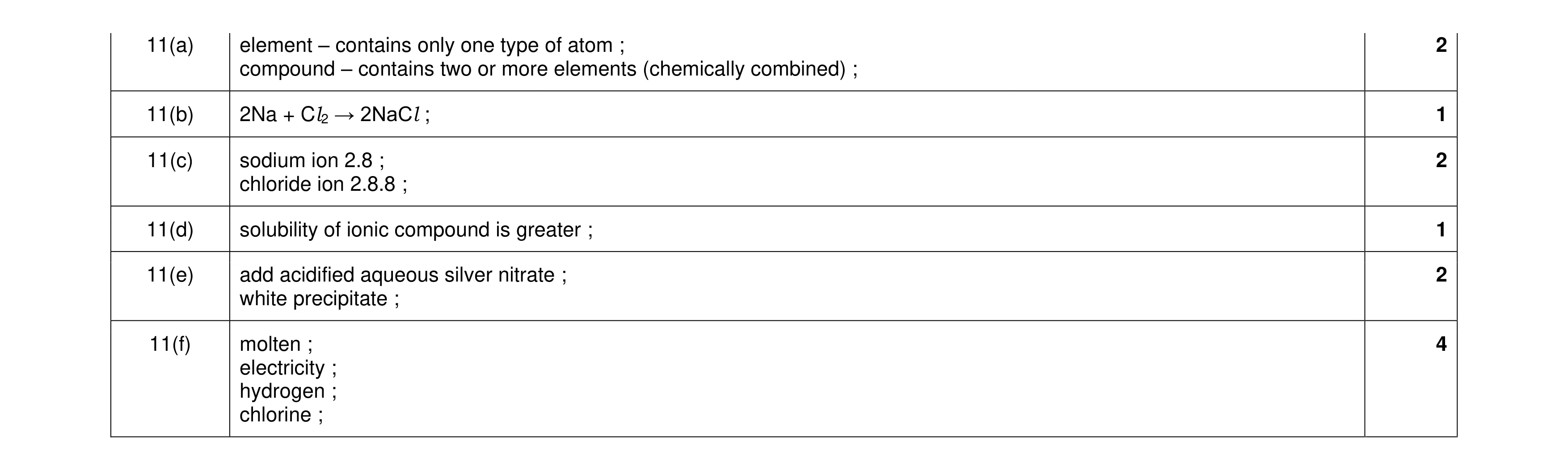 12
12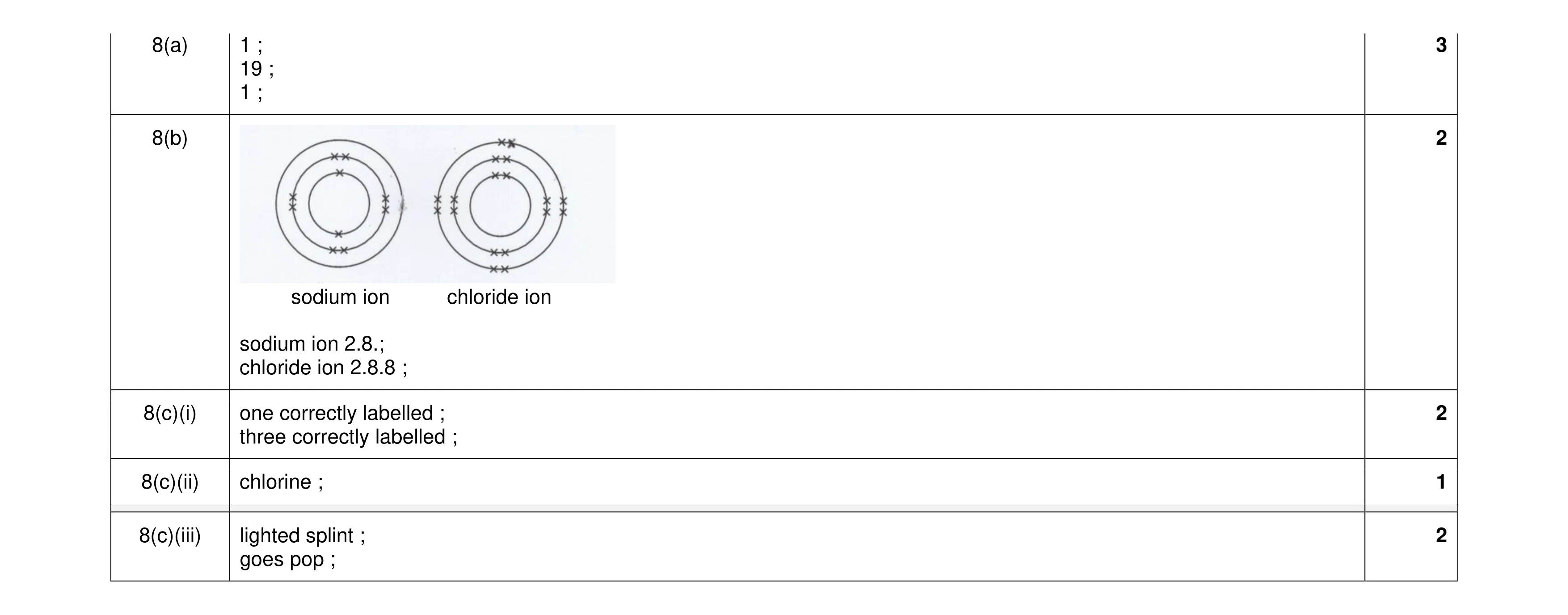 10
10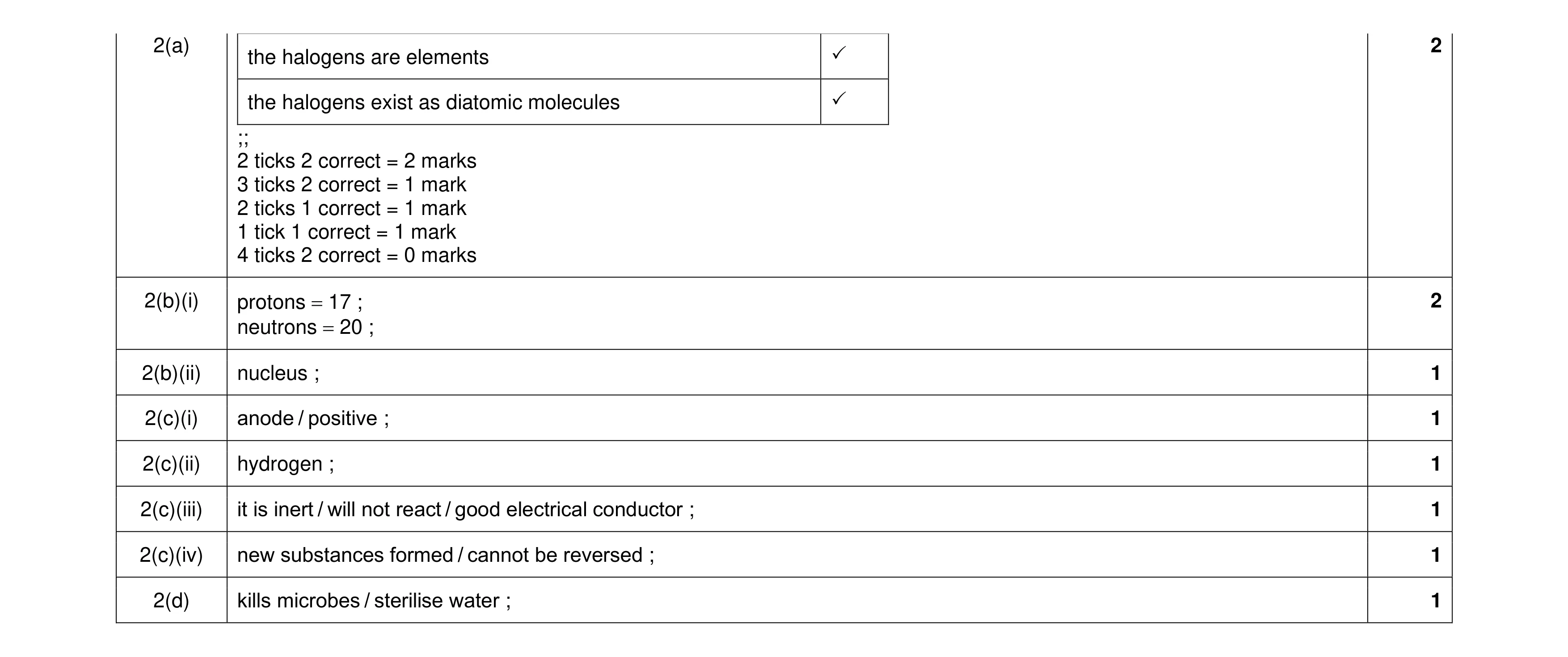 10
10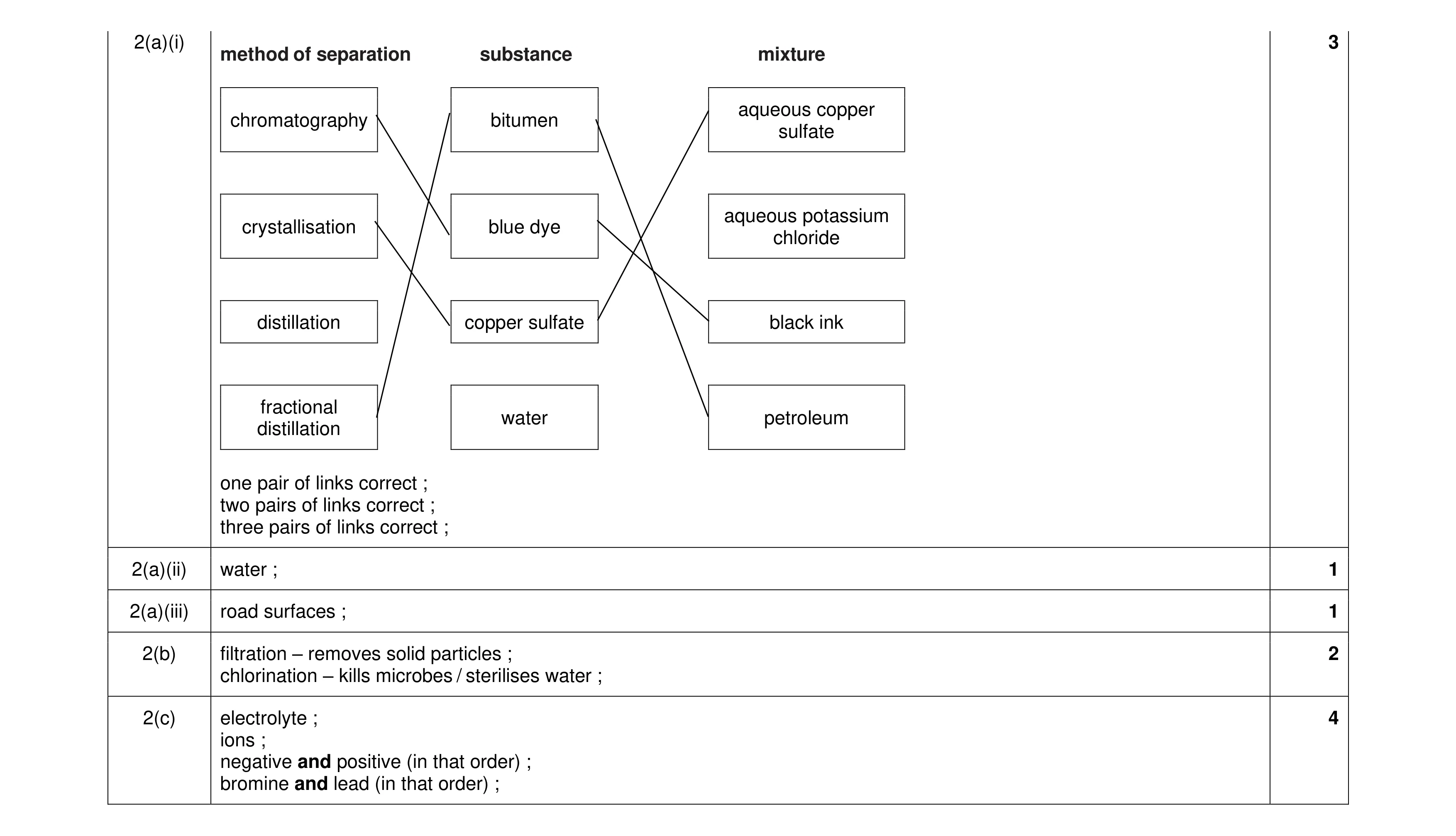 11
11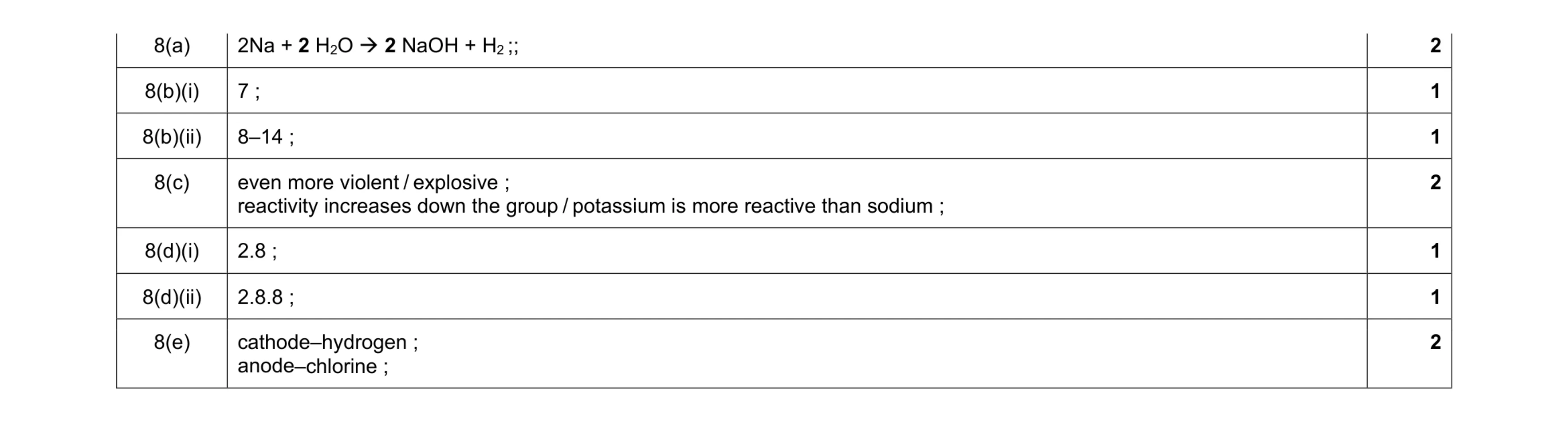 10
10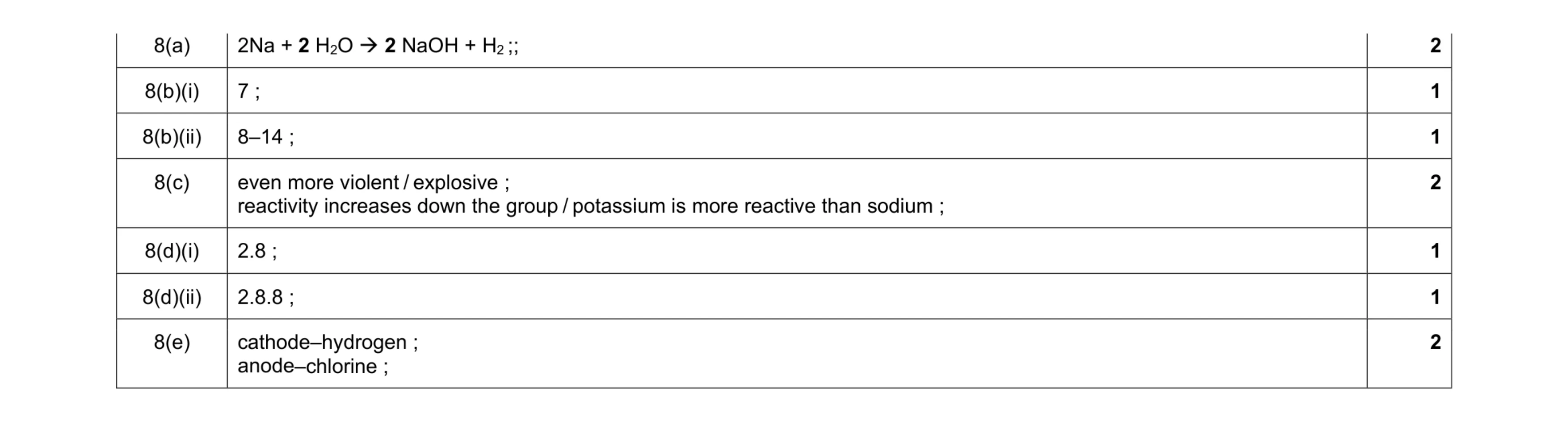 10
10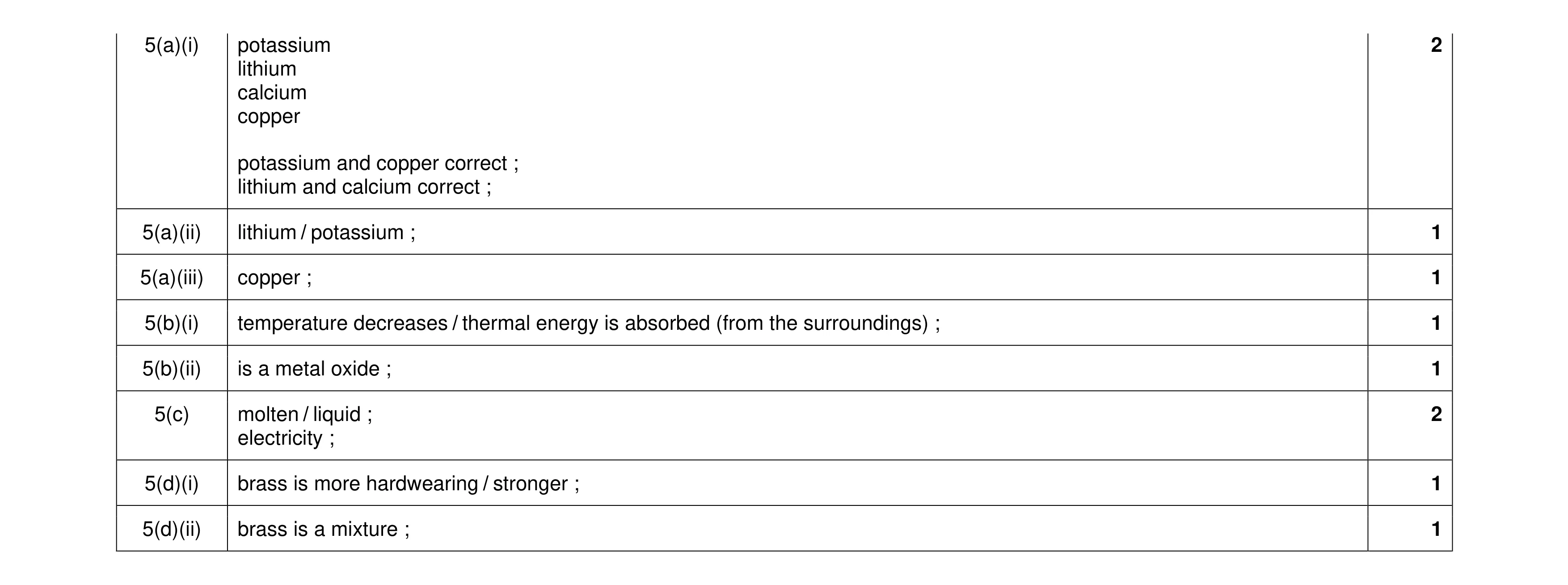 10
10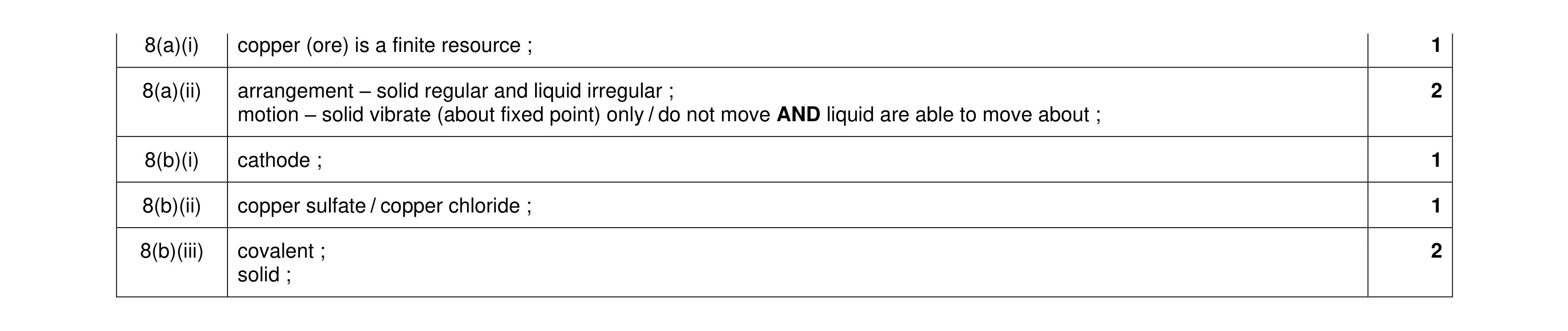 7
7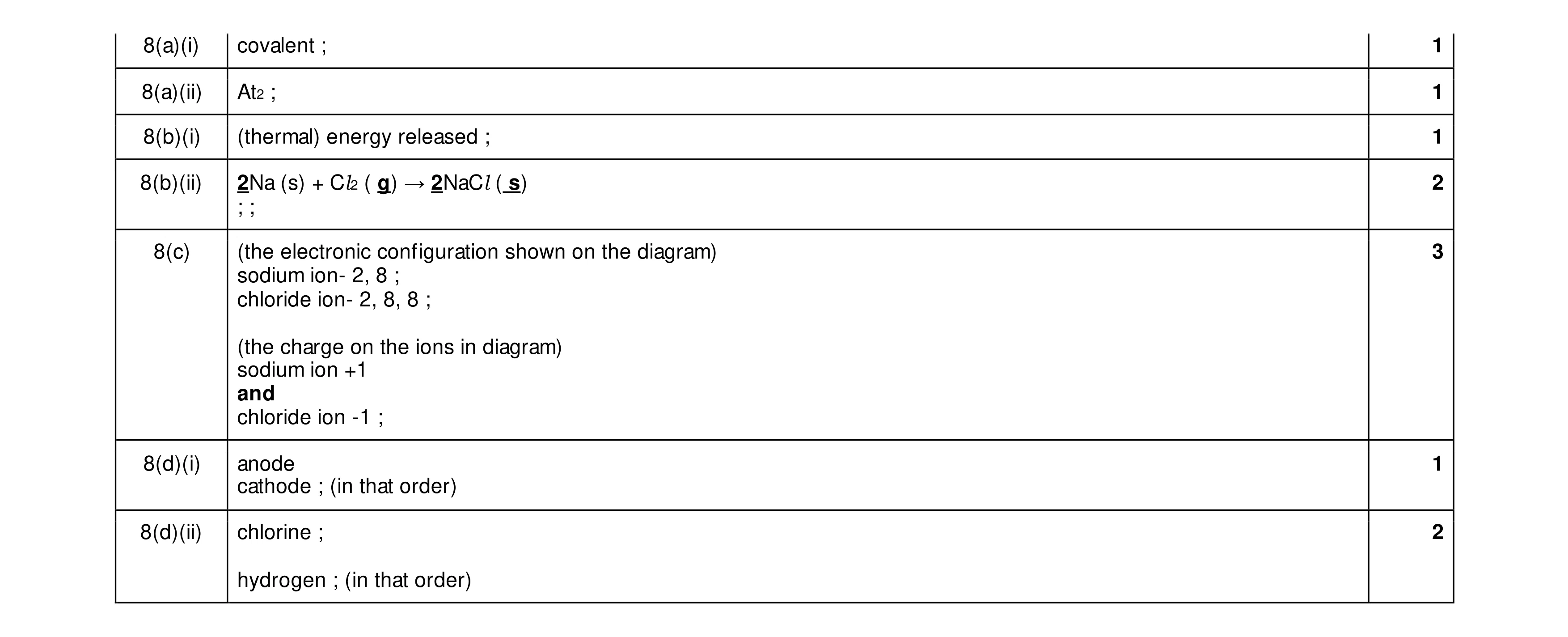 11
11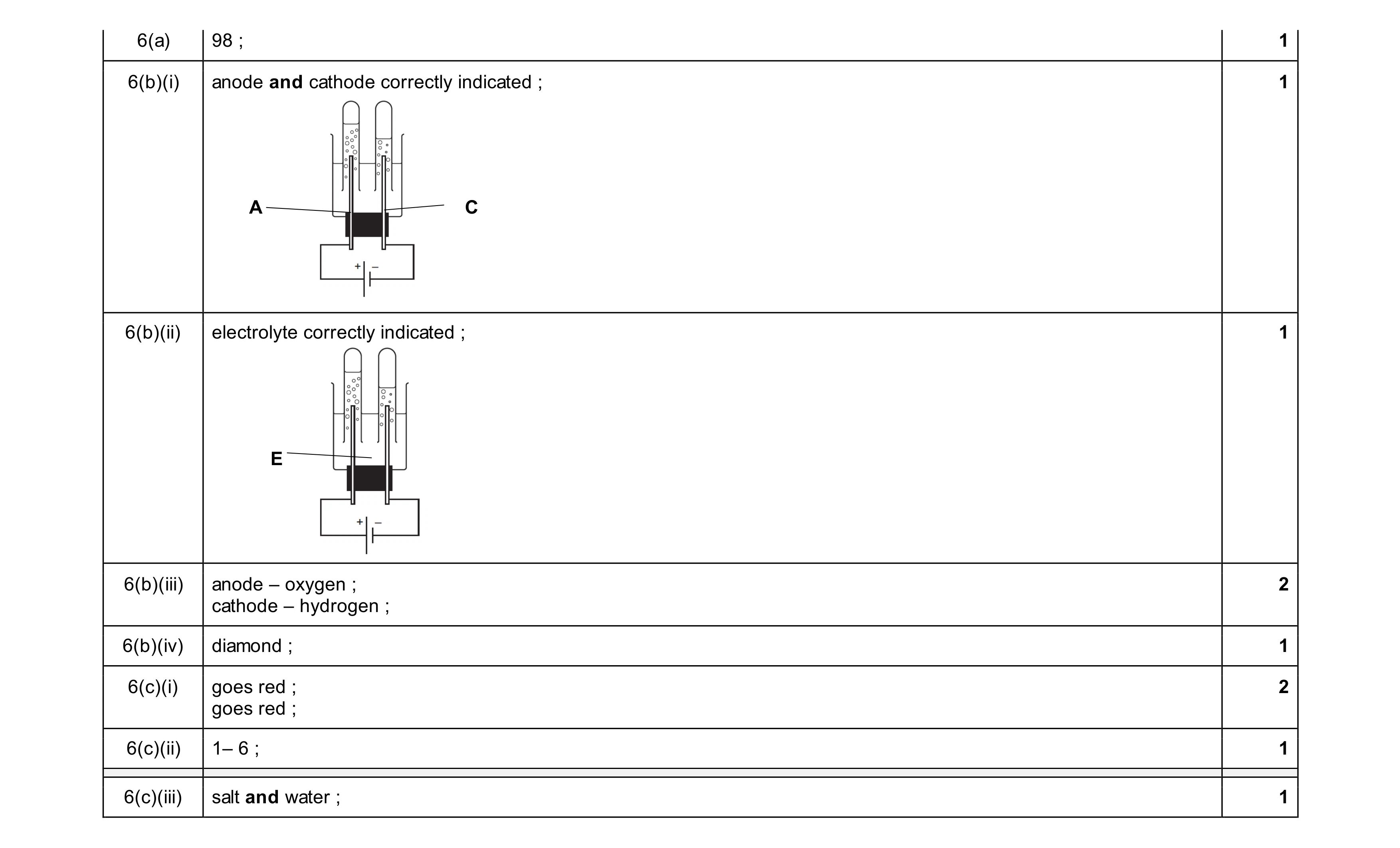 10
10