Cambridge IGCSE Sciences - Co-ordinated (Double) 0654 — 2015 May/June Paper 1 · Variant 3
0654/13/M/J/15 · 40 questions · 40 marks · ≈45 min
The question paper and its mark scheme, free to read here and free to download. This is Cambridge’s own paper, exactly as it was sat.
Question paper16 pages
Mark scheme2 pages
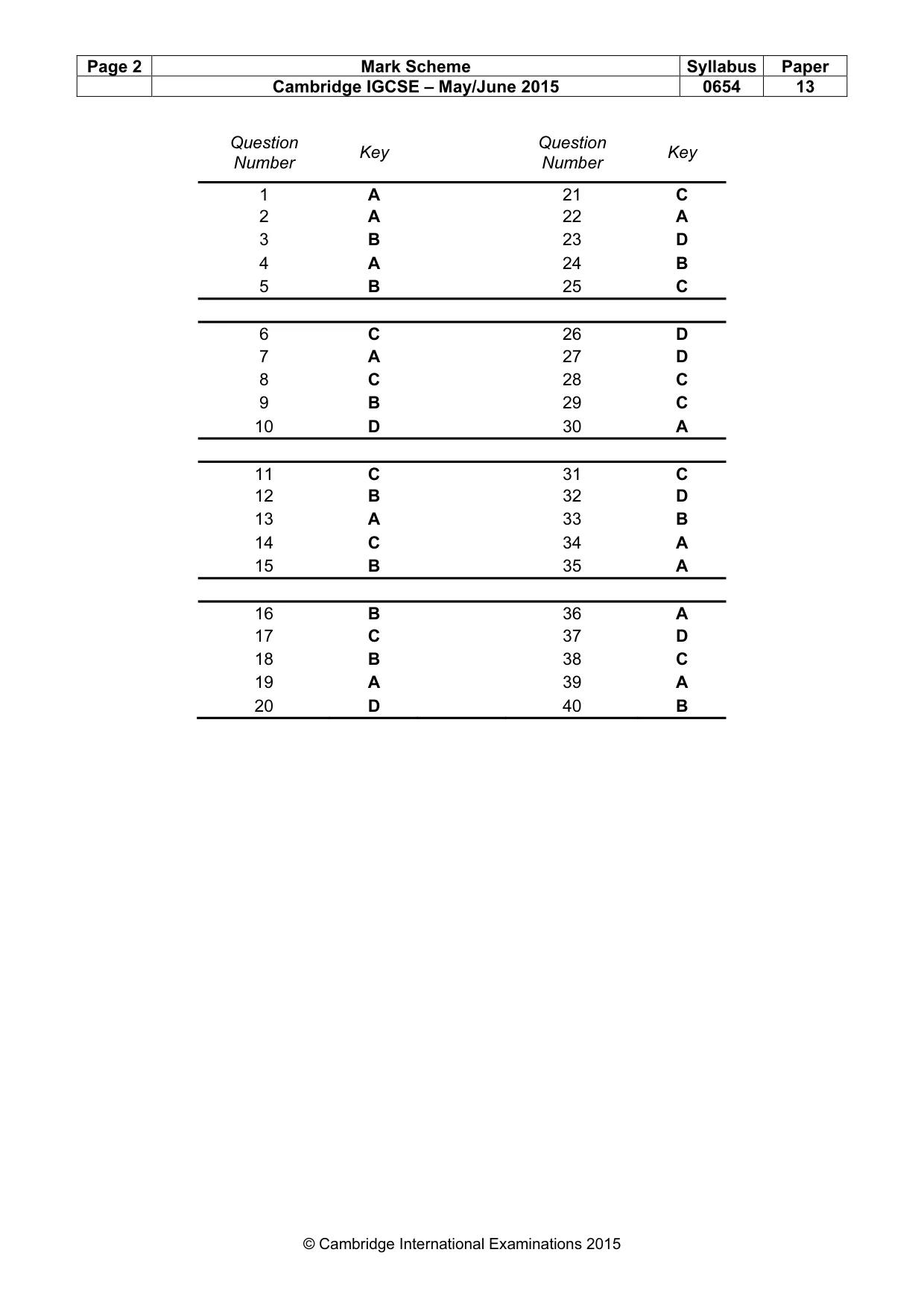
Answers below. Sit the paper first if you are practising.
Questions as text
Q1 · What are all living things capable of?
1 What are all living things capable of? A excretion B digestion C photosynthesis D sexual reproduction
Mark scheme: A
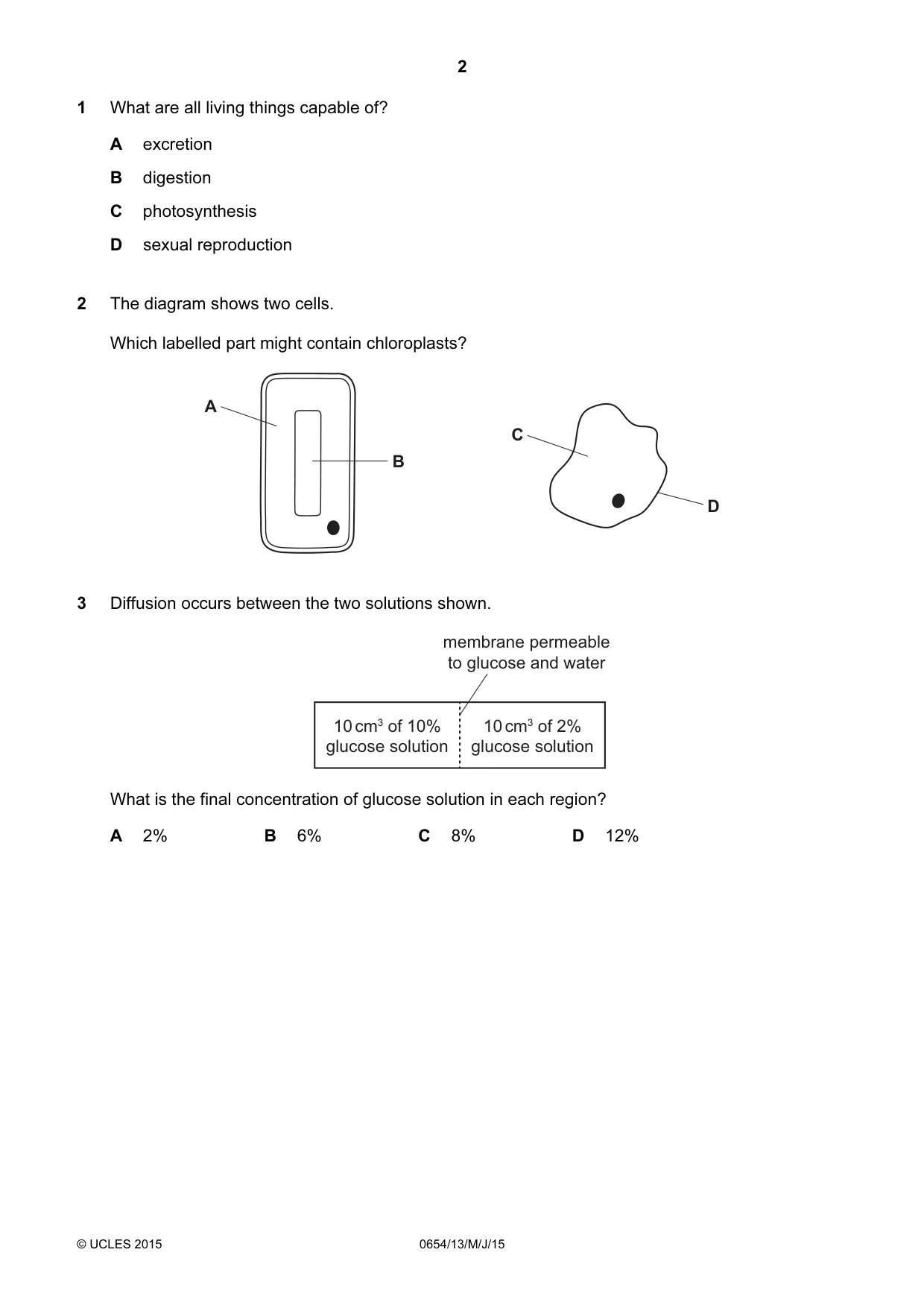
Q2 · The diagram shows two cells
2 The diagram shows two cells. Which labelled part might contain chloroplasts? A C B D
Mark scheme: A
Q3 · Diffusion occurs between the two solutions shown
3 Diffusion occurs between the two solutions shown. membrane permeable to glucose and water 10 cm3 of 10% 10 cm3 of 2% glucose solution glucose solution What is the final concentration of glucose solution in each region? A 2% B 6% C 8% D 12%
Mark scheme: B
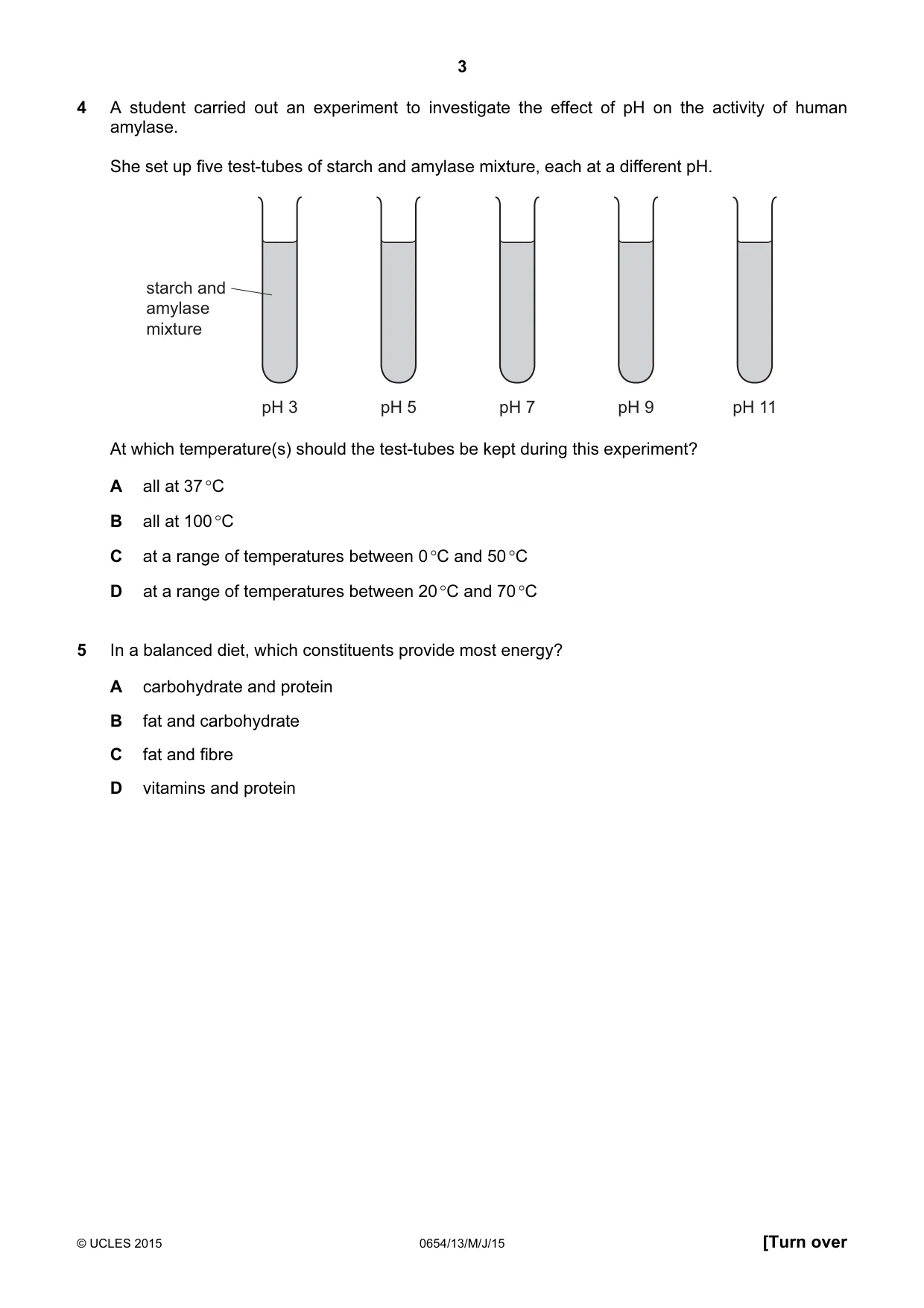
Q4 · A student carried out an experiment to investigate the effect of pH on the activity of…
4 A student carried out an experiment to investigate the effect of pH on the activity of human amylase. She set up five test-tubes of starch and amylase mixture, each at a different pH. starch and amylase mixture pH 3 pH 5 pH 7 pH 9 pH 11 At which temperature(s) should the test-tubes be kept during this experiment? A all at 37 °C B all at 100 °C C at a range of temperatures between 0 °C and 50 °C D at a range of temperatures between 20 °C and 70 °C
Mark scheme: A
Q5 · In a balanced diet, which constituents provide most energy?
5 In a balanced diet, which constituents provide most energy? A carbohydrate and protein B fat and carbohydrate C fat and fibre D vitamins and protein
Mark scheme: B
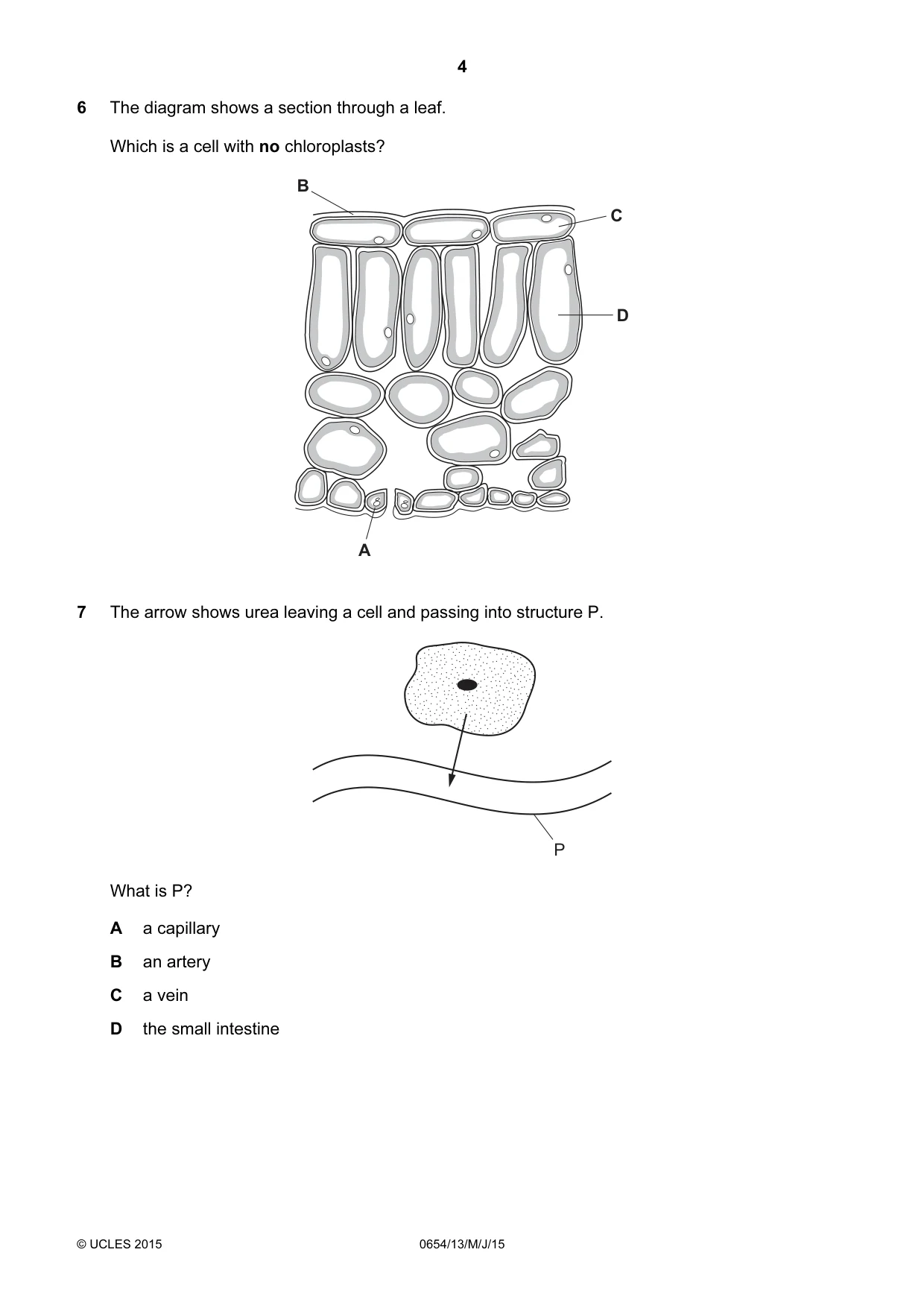
Q6 · The diagram shows a section through a leaf
6 The diagram shows a section through a leaf. Which is a cell with no chloroplasts? B C D A
Mark scheme: C
Q7 · The arrow shows urea leaving a cell and passing into structure P
7 The arrow shows urea leaving a cell and passing into structure P. P What is P? A a capillary B an artery C a vein D the small intestine
Mark scheme: A
Question 8
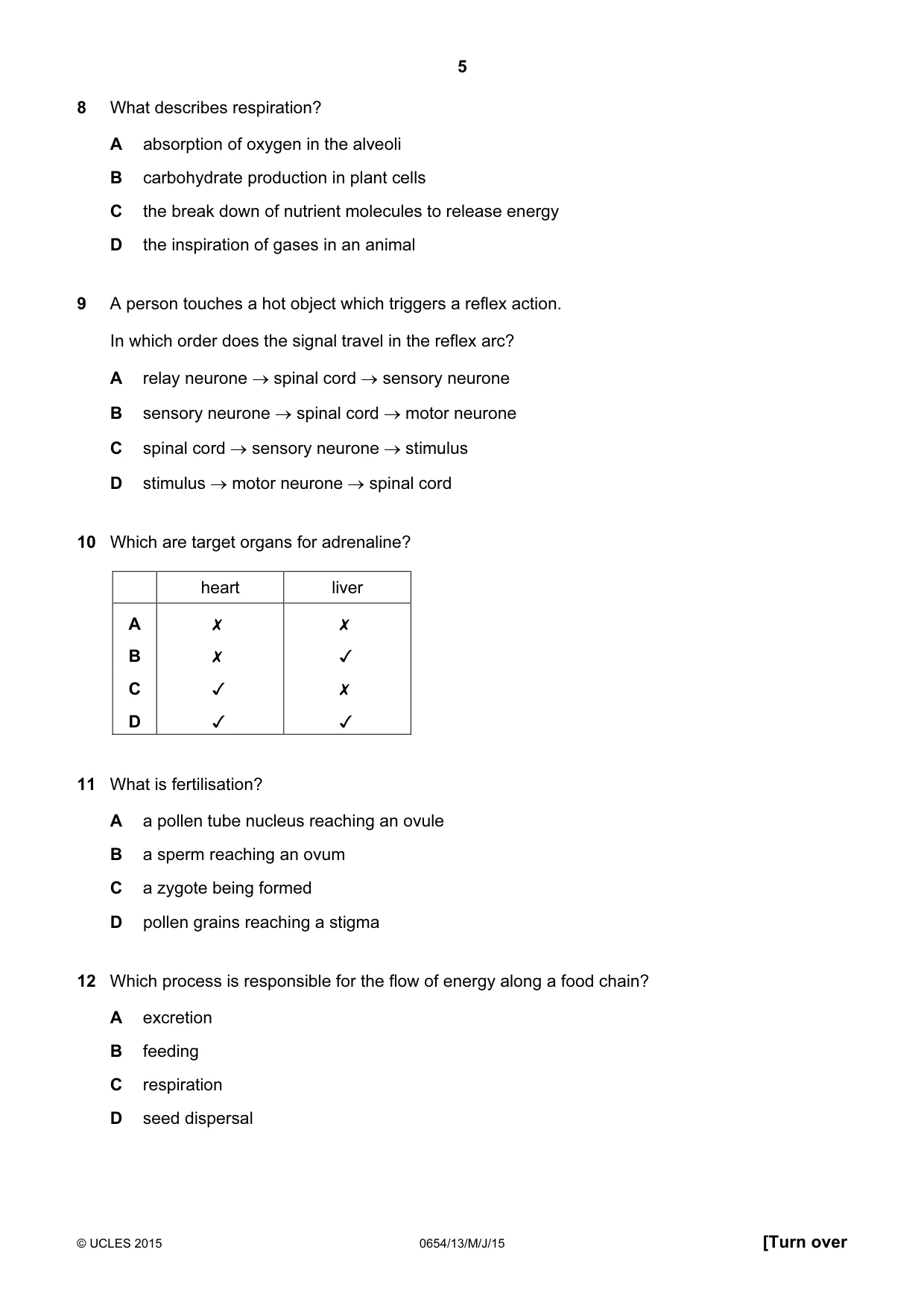
8 What describes respiration? A absorption of oxygen in the alveoli B carbohydrate production in plant cells C the break down of nutrient molecules to release energy D the inspiration of gases in an animal
Mark scheme: C
Q9 · A person touches a hot object which triggers a reflex action
9 A person touches a hot object which triggers a reflex action. In which order does the signal travel in the reflex arc? A relay neurone → spinal cord → sensory neurone B sensory neurone → spinal cord → motor neurone C spinal cord → sensory neurone → stimulus D stimulus → motor neurone → spinal cord
Mark scheme: B
Q10 · Which are target organs for adrenaline?
10 Which are target organs for adrenaline? heart liver x x loom > x v v x v v
Mark scheme: D
Question 11
11 What is fertilisation? A a pollen tube nucleus reaching an ovule B a sperm reaching an ovum C a zygote being formed D pollen grains reaching a stigma
Mark scheme: C
Q12 · Which process is responsible for the flow of energy along a food chain?
12 Which process is responsible for the flow of energy along a food chain? A excretion B feeding C respiration D seed dispersal
Mark scheme: B
Q13 · Which two gases are considered to be air-polluting gases and contribute to global warming?
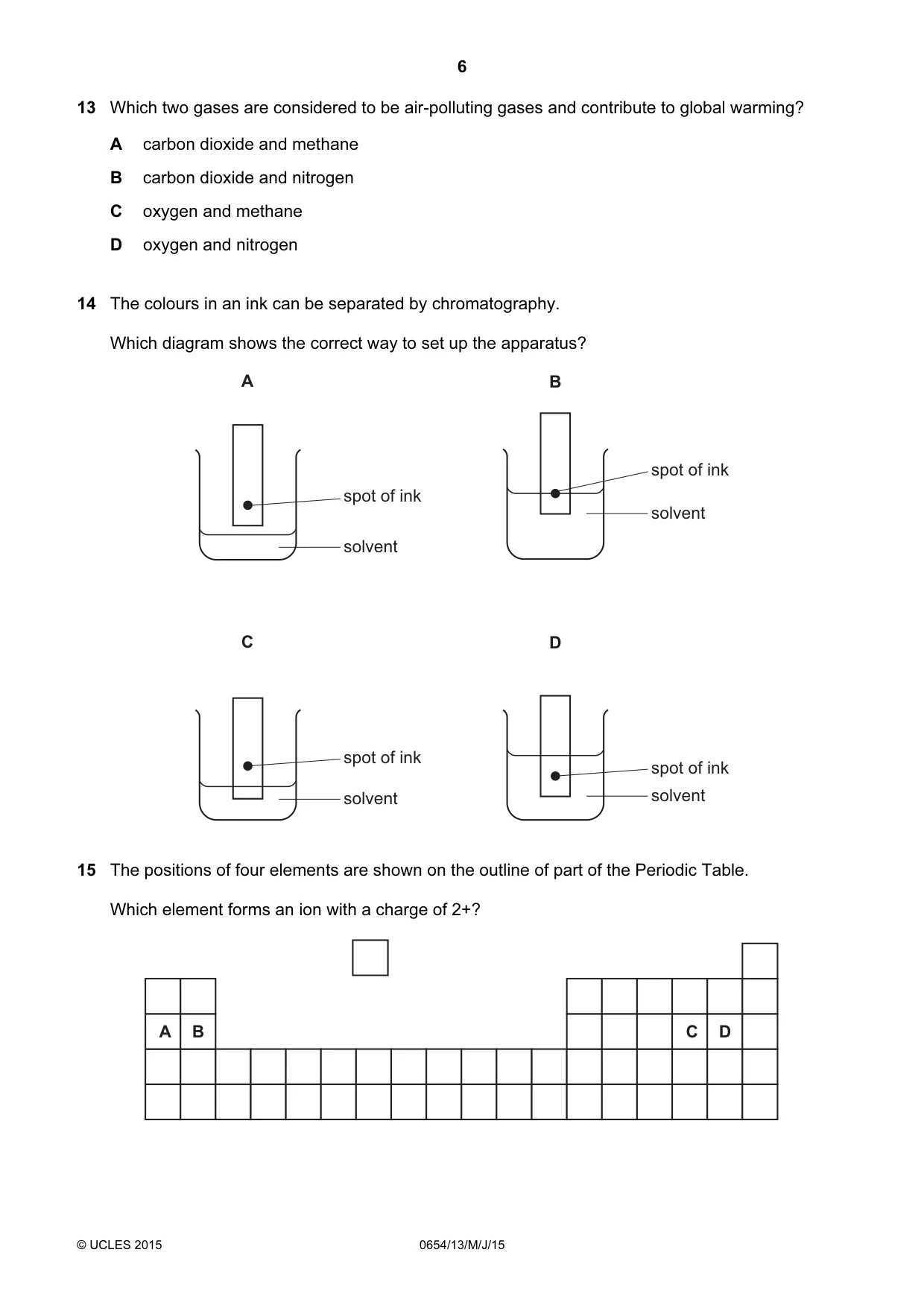
13 Which two gases are considered to be air-polluting gases and contribute to global warming? A carbon dioxide and methane B carbon dioxide and nitrogen C oxygen and methane D oxygen and nitrogen
Mark scheme: A
Q14 · The colours in an ink can be separated by chromatography
14 The colours in an ink can be separated by chromatography. Which diagram shows the correct way to set up the apparatus? A B spot of ink spot of ink solvent solvent C D spot of ink spot of ink solvent solvent
Mark scheme: C
Q15 · The positions of four elements are shown on the outline of part of the Periodic Table
15 The positions of four elements are shown on the outline of part of the Periodic Table. Which element forms an ion with a charge of 2+? A B C D
Mark scheme: B
Q16 · The diagram shows an electroplating experiment
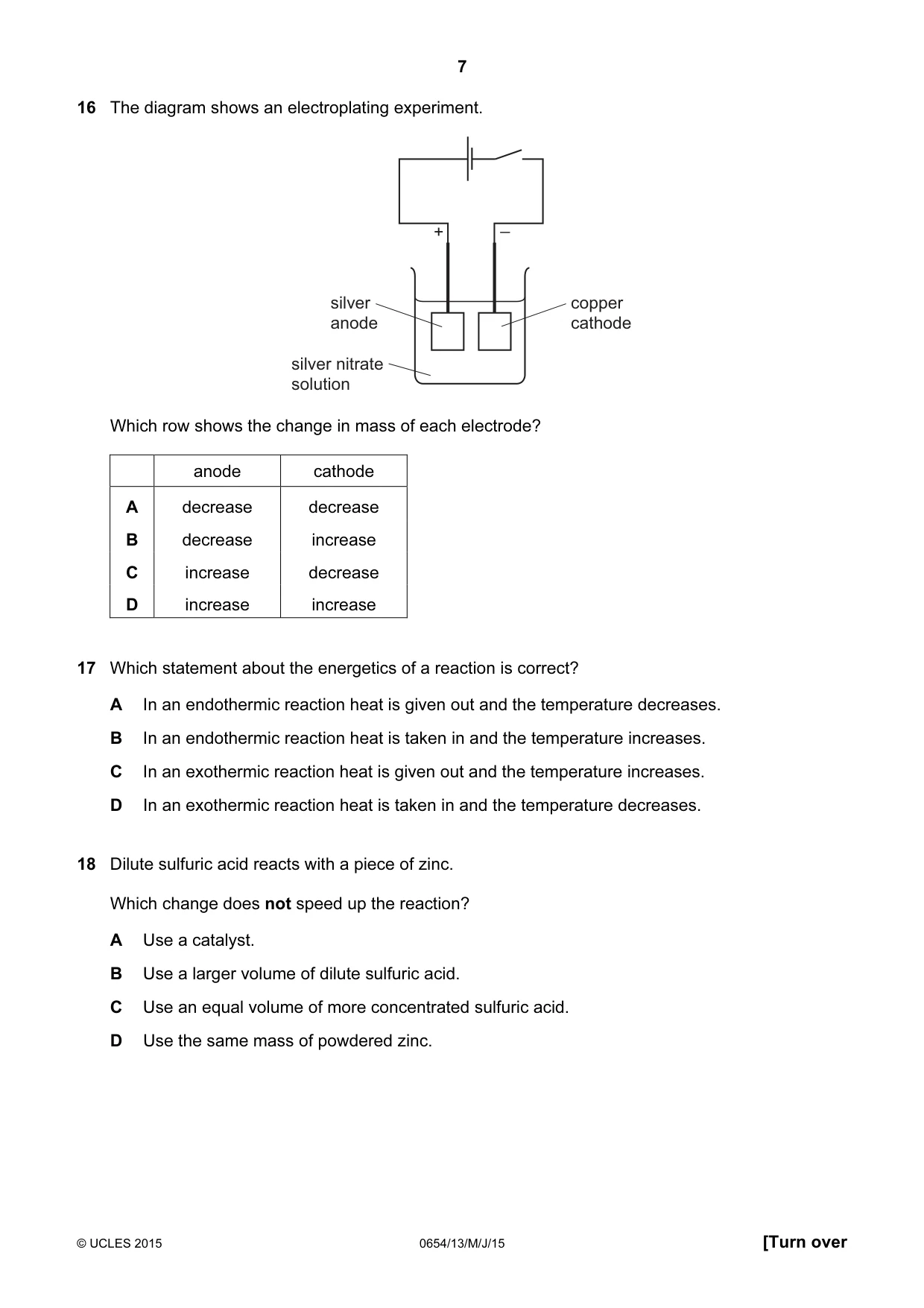
16 The diagram shows an electroplating experiment. + _ silver copper anode cathode silver nitrate solution Which row shows the change in mass of each electrode? anode cathode A decrease decrease B decrease increase C increase decrease D increase increase
Mark scheme: B
Q17 · Which statement about the energetics of a reaction is correct?
17 Which statement about the energetics of a reaction is correct? A In an endothermic reaction heat is given out and the temperature decreases. B In an endothermic reaction heat is taken in and the temperature increases. C In an exothermic reaction heat is given out and the temperature increases. D In an exothermic reaction heat is taken in and the temperature decreases.
Mark scheme: C
Q18 · Dilute sulfuric acid reacts with a piece of zinc
18 Dilute sulfuric acid reacts with a piece of zinc. Which change does not speed up the reaction? A Use a catalyst. B Use a larger volume of dilute sulfuric acid. C Use an equal volume of more concentrated sulfuric acid. D Use the same mass of powdered zinc.
Mark scheme: B
Q19 · Hydrogen and oxygen react explosively to form water
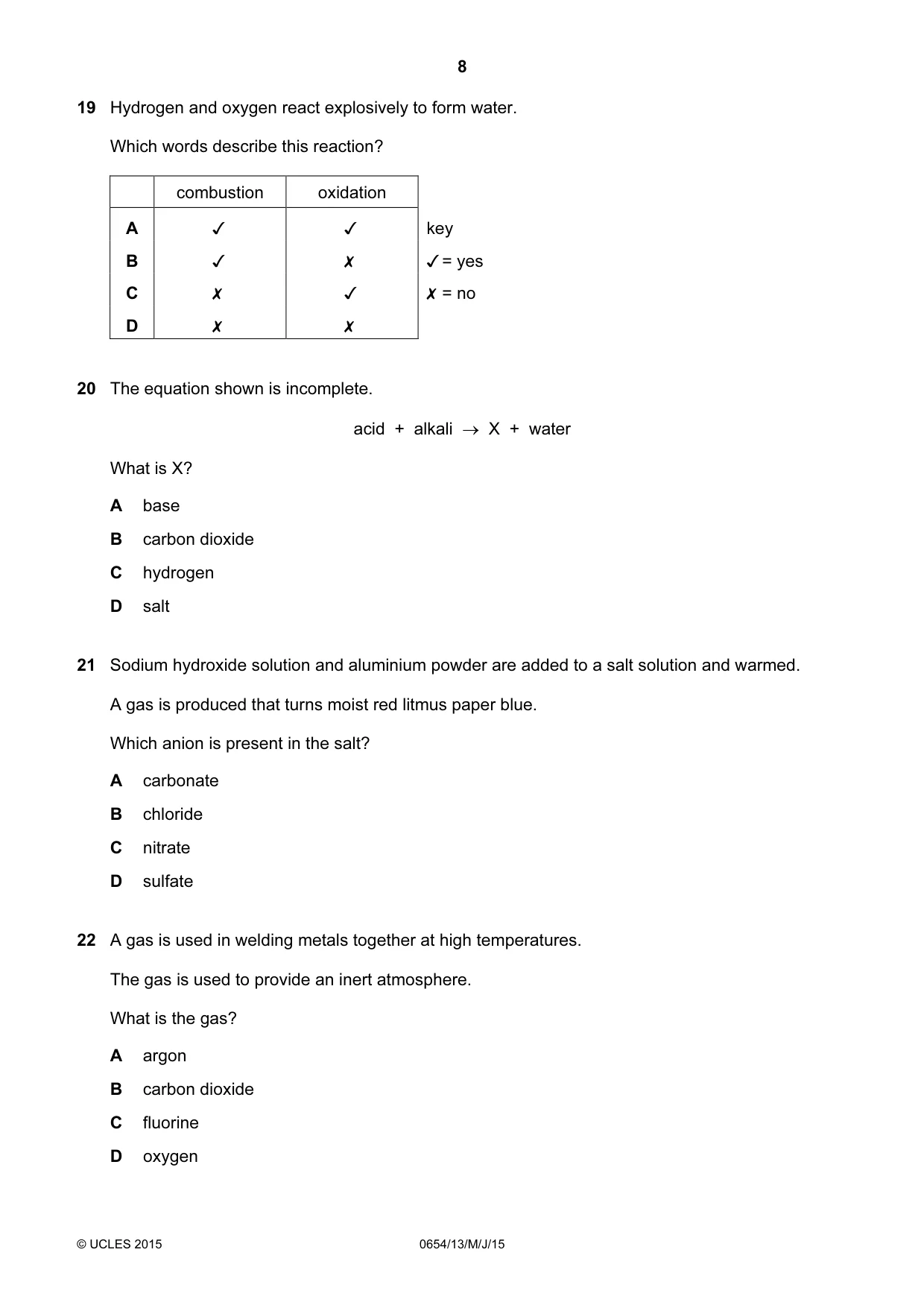
19 Hydrogen and oxygen react explosively to form water. Which words describe this reaction? combustion oxidation A v v B v x Cc x v D x x key v/=yes X =no
Mark scheme: A
Q20 · The equation shown is incomplete
20 The equation shown is incomplete. acid + alkali → X + water What is X? A base B carbon dioxide C hydrogen D salt
Mark scheme: D
Q21 · Sodium hydroxide solution and aluminium powder are added to a salt solution and warmed
21 Sodium hydroxide solution and aluminium powder are added to a salt solution and warmed. A gas is produced that turns moist red litmus paper blue. Which anion is present in the salt? A carbonate B chloride C nitrate D sulfate
Mark scheme: C
Q22 · A gas is used in welding metals together at high temperatures
22 A gas is used in welding metals together at high temperatures. The gas is used to provide an inert atmosphere. What is the gas? A argon B carbon dioxide C fluorine D oxygen
Mark scheme: A
Q23 · The table shows information about some minerals
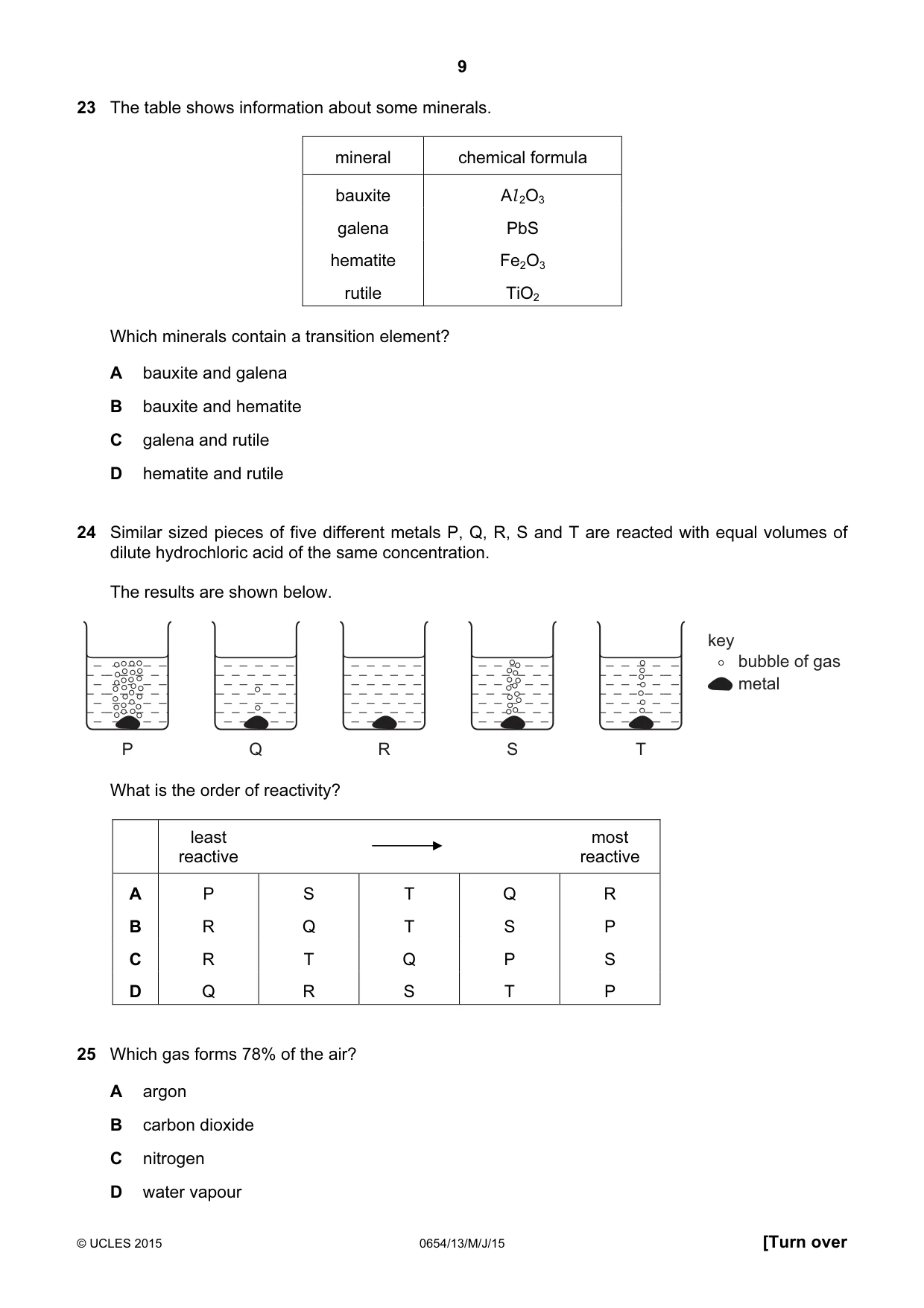
23 The table shows information about some minerals. mineral chemical formula bauxite Al 2O3 galena PbS hematite Fe2O3 rutile TiO2 Which minerals contain a transition element? A bauxite and galena B bauxite and hematite C galena and rutile D hematite and rutile
Mark scheme: D
Q24 · Similar sized pieces of five different metals P, Q, R, S and T are reacted with equal…
24 Similar sized pieces of five different metals P, Q, R, S and T are reacted with equal volumes of dilute hydrochloric acid of the same concentration. The results are shown below. key bubble of gas metal P Q R S T What is the order of reactivity? least most reactive reactive A P S T Q R B R Q T S P C R T Q P S D Q R S T P
Mark scheme: B
Q25 · Which gas forms 78% of the air?
25 Which gas forms 78% of the air? A argon B carbon dioxide C nitrogen D water vapour
Mark scheme: C
Q26 · The structures of four organic molecules are shown
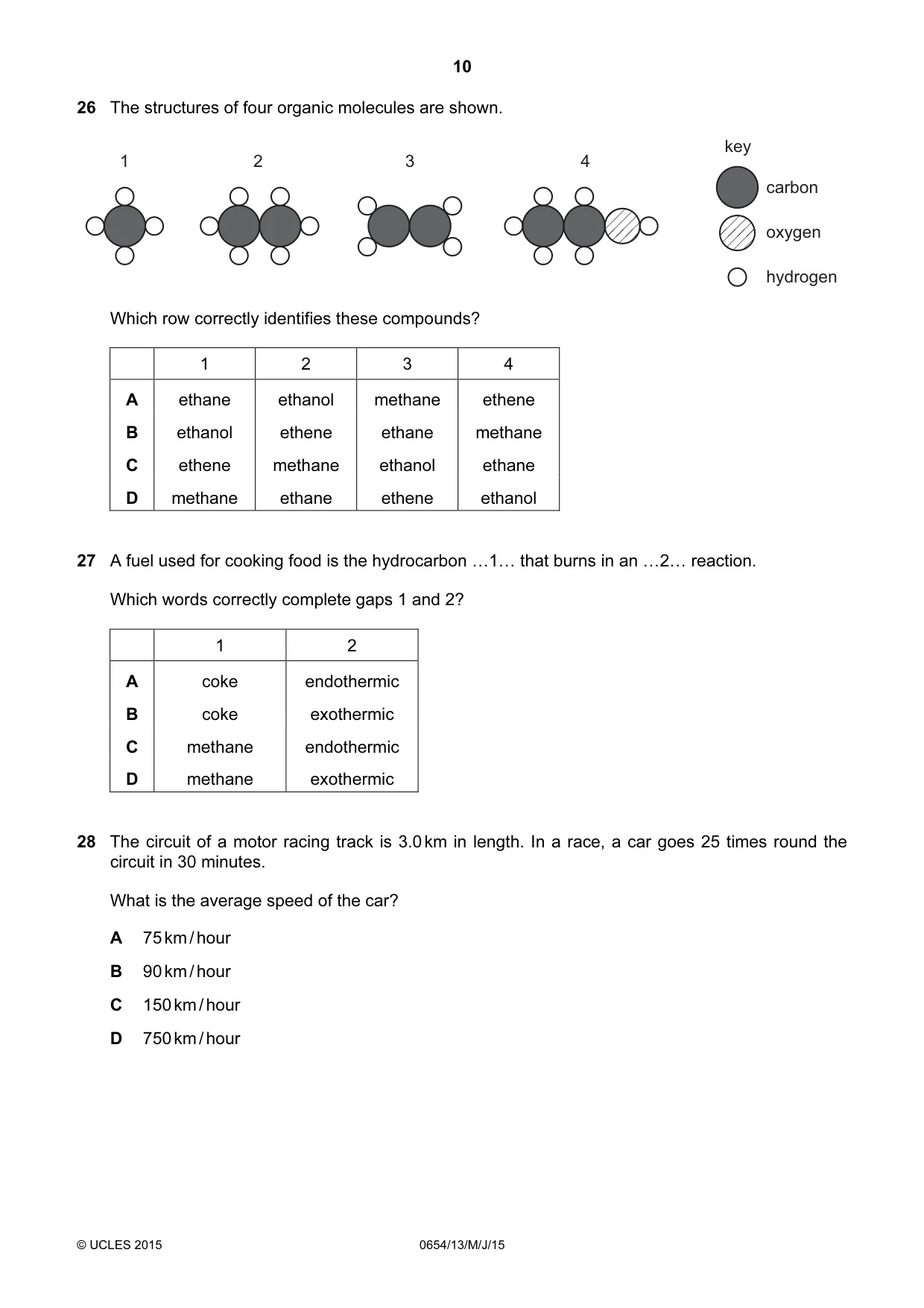
26 The structures of four organic molecules are shown. key 1 2 3 4 carbon oxygen hydrogen Which row correctly identifies these compounds? 1 2 3 4 A ethane ethanol methane ethene B ethanol ethene ethane methane C ethene methane ethanol ethane D methane ethane ethene ethanol
Mark scheme: D
Q27 · A fuel used for cooking food is the hydrocarbon …1… that burns in an …2… reaction
27 A fuel used for cooking food is the hydrocarbon …1… that burns in an …2… reaction. Which words correctly complete gaps 1 and 2? 1 2 A coke endothermic B coke exothermic C methane endothermic D methane exothermic
Mark scheme: D
Q28 · The circuit of a motor racing track is 3.0 km in length
28 The circuit of a motor racing track is 3.0 km in length. In a race, a car goes 25 times round the circuit in 30 minutes. What is the average speed of the car? A 75 km / hour B 90 km / hour C 150 km / hour D 750 km / hour
Mark scheme: C
Q29 · Inside an aeroplane, a parachutist has a mass of 70 kg
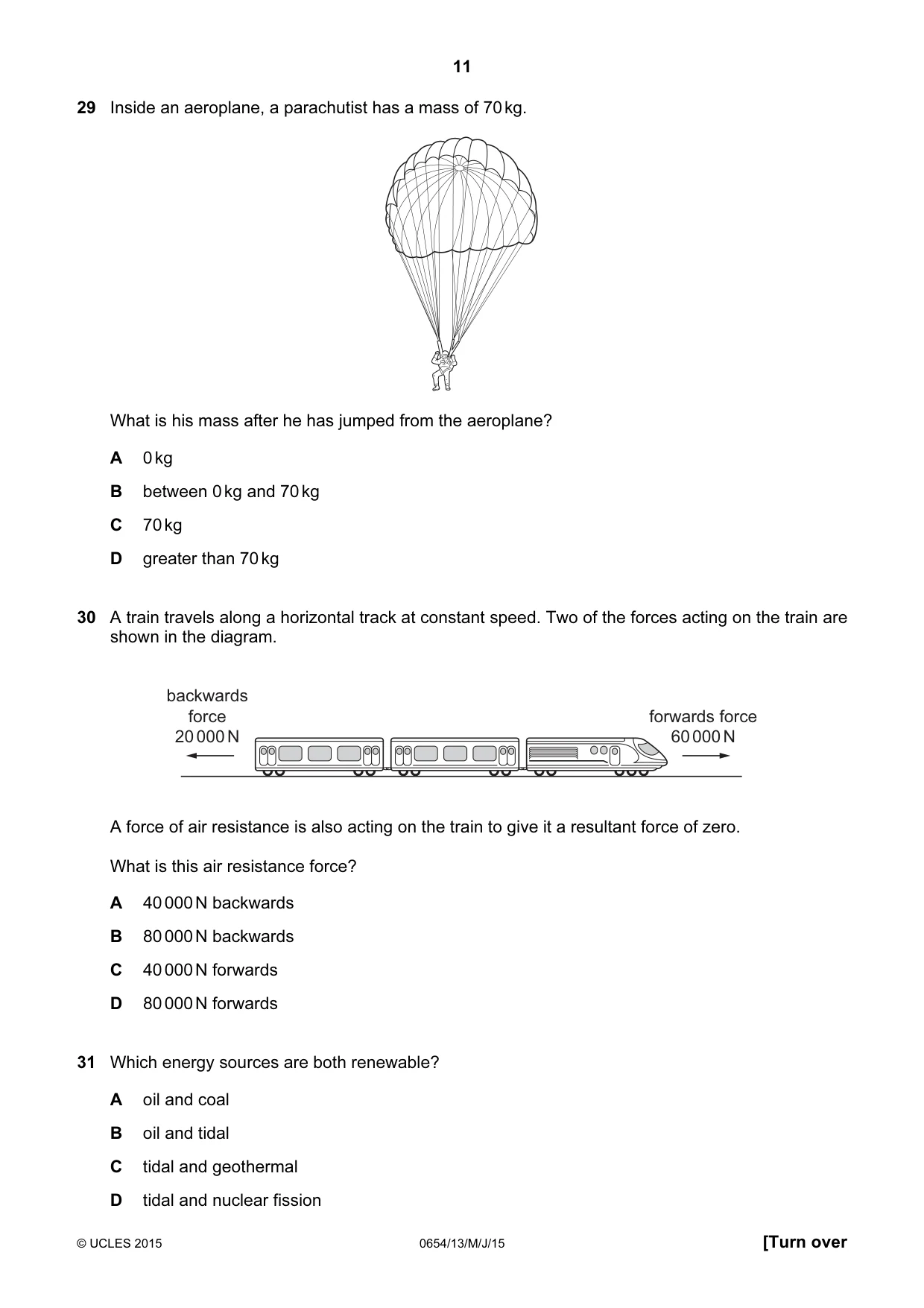
29 Inside an aeroplane, a parachutist has a mass of 70 kg. What is his mass after he has jumped from the aeroplane? A 0 kg B between 0 kg and 70 kg C 70 kg D greater than 70 kg
Mark scheme: C
Q30 · A train travels along a horizontal track at constant speed
30 A train travels along a horizontal track at constant speed. Two of the forces acting on the train are shown in the diagram. backwards force forwards force 20 000 N 60 000 N A force of air resistance is also acting on the train to give it a resultant force of zero. What is this air resistance force? A 40 000 N backwards B 80 000 N backwards C 40 000 N forwards D 80 000 N forwards
Mark scheme: A
Q31 · Which energy sources are both renewable?
31 Which energy sources are both renewable? A oil and coal B oil and tidal C tidal and geothermal D tidal and nuclear fission
Mark scheme: C
Q32 · Which row describes the molecules of a solid at 0 °C, a liquid at 0 °C and a gas at 0 °C?
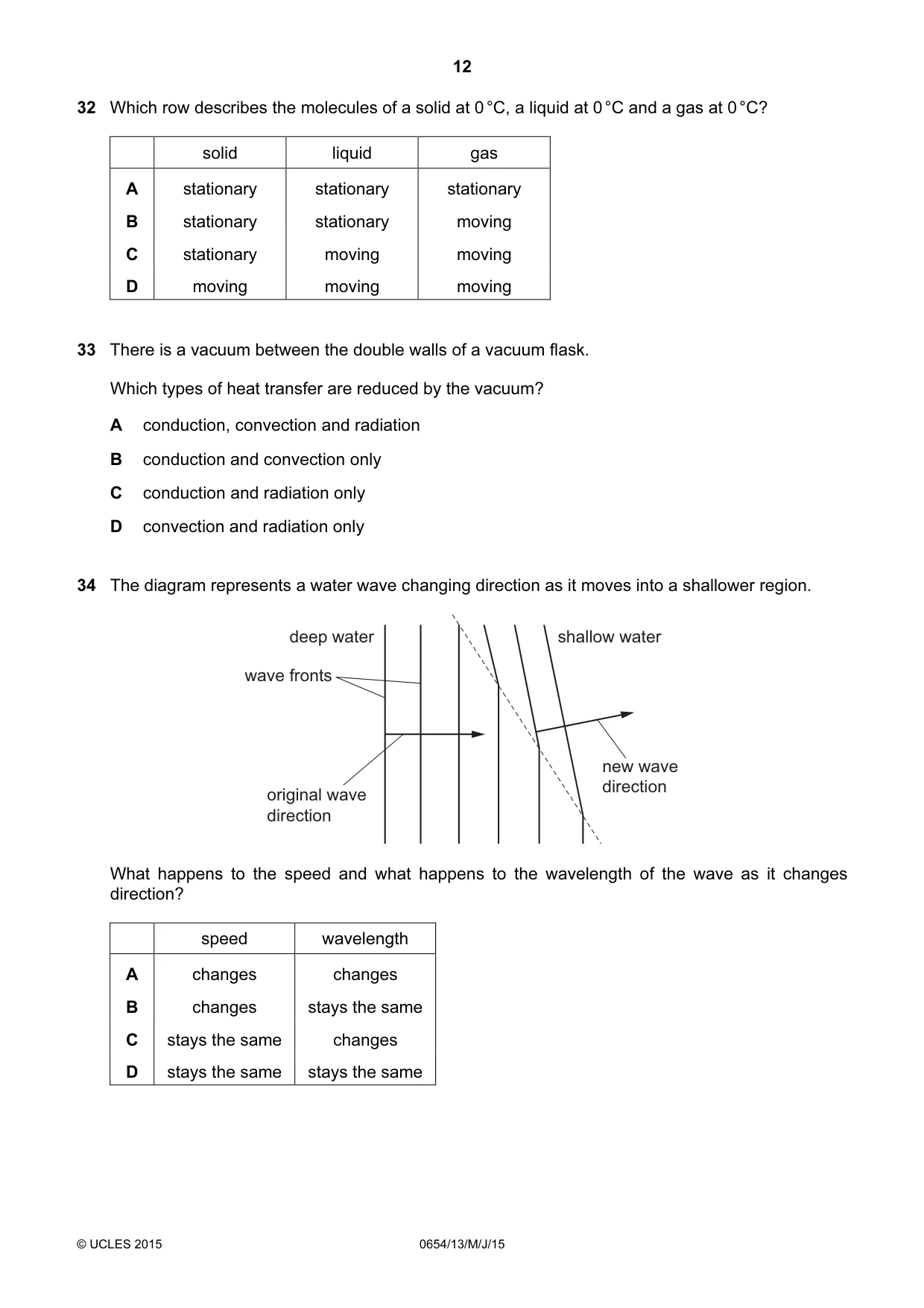
32 Which row describes the molecules of a solid at 0 °C, a liquid at 0 °C and a gas at 0 °C? solid liquid gas A stationary stationary stationary B stationary stationary moving C stationary moving moving D moving moving moving
Mark scheme: D
Q33 · There is a vacuum between the double walls of a vacuum flask
33 There is a vacuum between the double walls of a vacuum flask. Which types of heat transfer are reduced by the vacuum? A conduction, convection and radiation B conduction and convection only C conduction and radiation only D convection and radiation only
Mark scheme: B
Q34 · The diagram represents a water wave changing direction as it moves into a shallower region
34 The diagram represents a water wave changing direction as it moves into a shallower region. deep water shallow water wave fronts new wave direction original wave direction What happens to the speed and what happens to the wavelength of the wave as it changes direction? speed wavelength A changes changes B changes stays the same C stays the same changes D stays the same stays the same
Mark scheme: A
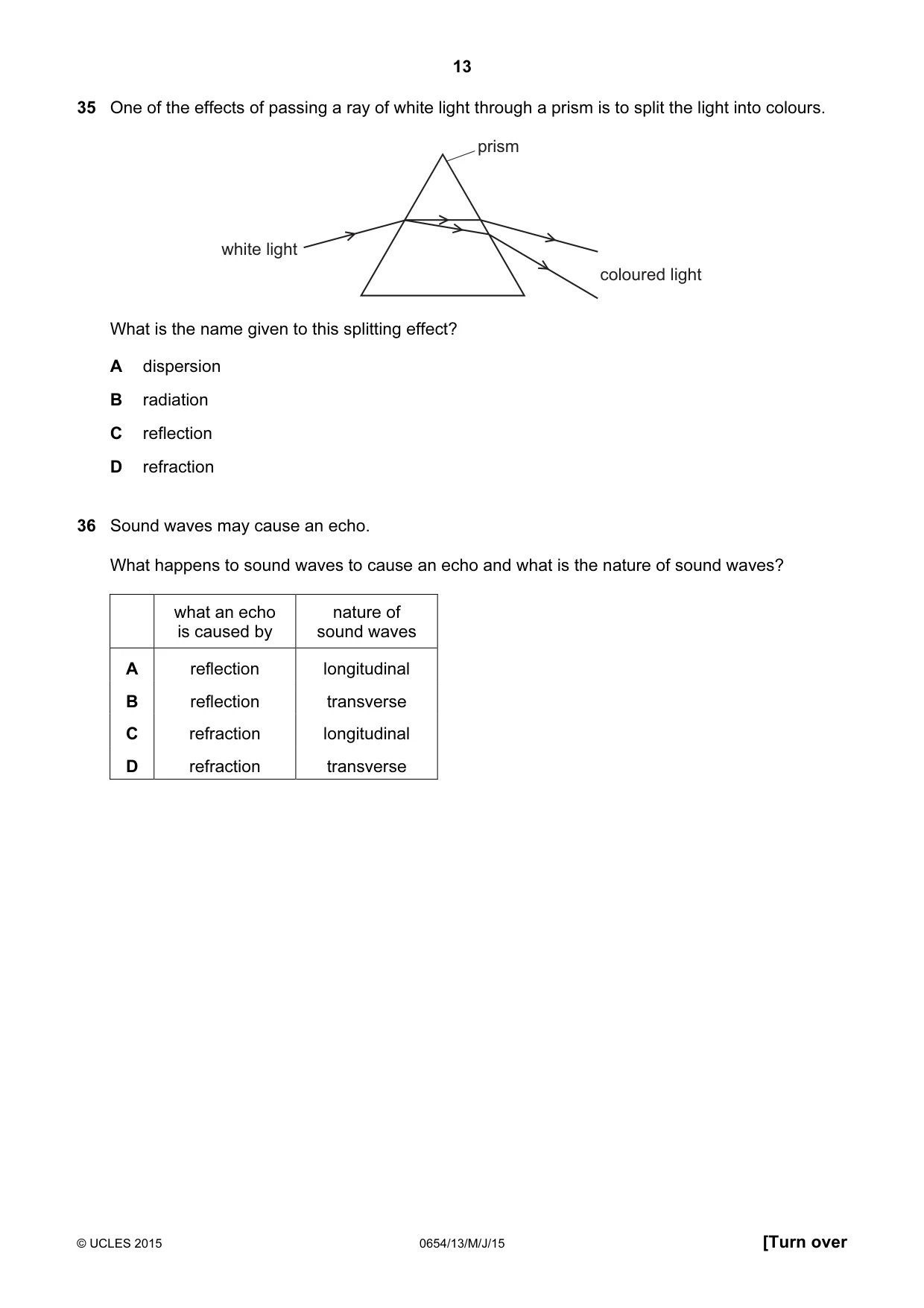
Q35 · One of the effects of passing a ray of white light through a prism is to split the light…
35 One of the effects of passing a ray of white light through a prism is to split the light into colours. prism white light coloured light What is the name given to this splitting effect? A dispersion B radiation C reflection D refraction
Mark scheme: A
Q36 · Sound waves may cause an echo
36 Sound waves may cause an echo. What happens to sound waves to cause an echo and what is the nature of sound waves? what an echo nature of is caused by sound waves A reflection longitudinal B reflection transverse C refraction longitudinal D refraction transverse
Mark scheme: A
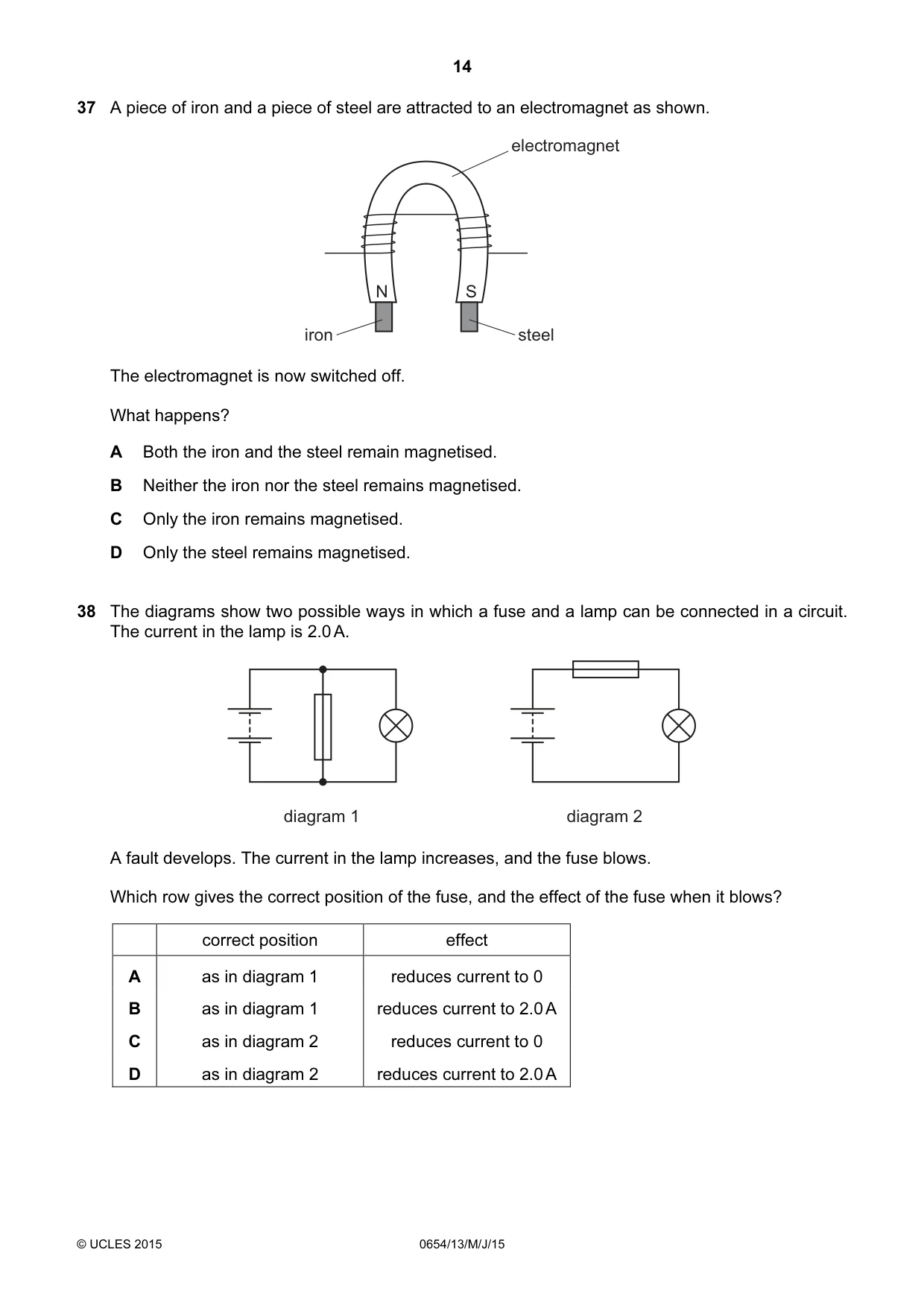
Q37 · A piece of iron and a piece of steel are attracted to an electromagnet as shown
37 A piece of iron and a piece of steel are attracted to an electromagnet as shown. electromagnet N S iron steel The electromagnet is now switched off. What happens? A Both the iron and the steel remain magnetised. B Neither the iron nor the steel remains magnetised. C Only the iron remains magnetised. D Only the steel remains magnetised.
Mark scheme: D
Q38 · The diagrams show two possible ways in which a fuse and a lamp can be connected in a…
38 The diagrams show two possible ways in which a fuse and a lamp can be connected in a circuit. The current in the lamp is 2.0 A. diagram 1 diagram 2 A fault develops. The current in the lamp increases, and the fuse blows. Which row gives the correct position of the fuse, and the effect of the fuse when it blows? correct position effect A as in diagram 1 reduces current to 0 B as in diagram 1 reduces current to 2.0 A C as in diagram 2 reduces current to 0 D as in diagram 2 reduces current to 2.0 A
Mark scheme: C
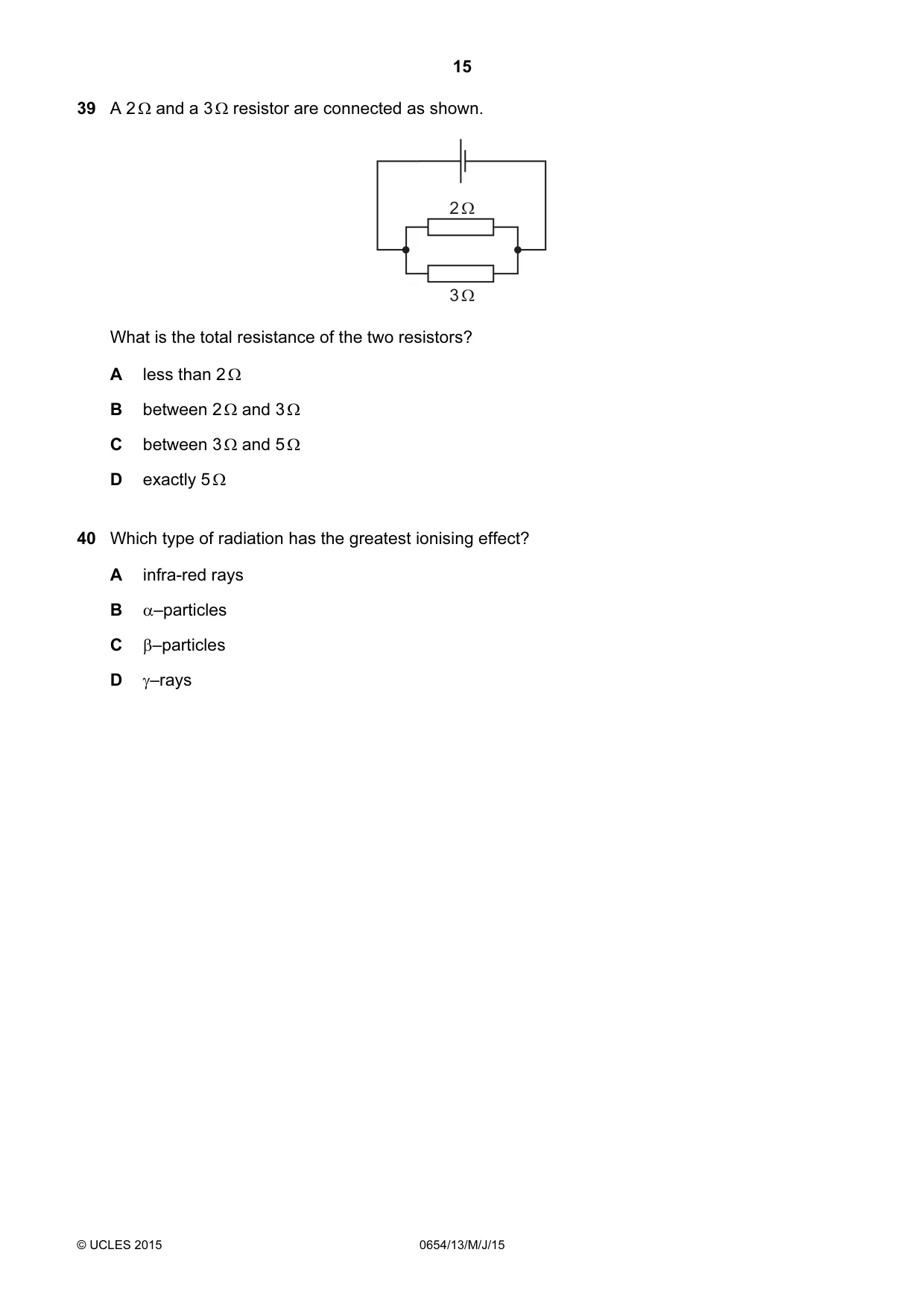
Q39 · A 2 Ω and a 3 Ω resistor are connected as shown
39 A 2 Ω and a 3 Ω resistor are connected as shown. 2 Ω 3 Ω What is the total resistance of the two resistors? A less than 2 Ω B between 2 Ω and 3 Ω C between 3 Ω and 5 Ω D exactly 5 Ω
Mark scheme: A
Q40 · Which type of radiation has the greatest ionising effect?
40 Which type of radiation has the greatest ionising effect? A infra-red rays B α–particles C β–particles D γ–rays
Mark scheme: B
What was in this paper
The subtopics covered by these 40 questions, and how many questions each got. Open one in a new tab to see every Cambridge question on it.
2Blood vessels1Cell structure1Characteristics of living organisms1Chromatography1Coordination and response1Diet1Diffusion1Electrical circuits1Electrical safety1Electrolysis1Energy flow1Energy, work and power1Enzymes1Exothermic and endothermic reactions1Forces1Fuels1General properties of waves1Hormones1Identification of ions and gases1Ions and ionic bonds1Kinetic particle model of matter1Leaf structure1Light1Mass and weight1Motion1Naming organic compounds1Noble gases1Preparation of salts1Radioactivity1Rate of reaction1Reactivity series1Redox1Respiration1Sexual reproduction1Simple phenomena of magnetism1Sound1Transfer of thermal energy1Transition elements1What you needed in this session
Cambridge’s own grade thresholds for 2015 May/June, Paper 1 · Variant 3. A higher threshold means an easier paper — the bar moves with how the cohort did.