Cambridge IGCSE Sciences - Co-ordinated (Double) 0654 — 2015 Oct/Nov Paper 1 · Variant 2
0654/12/O/N/15 · 40 questions · 40 marks · ≈45 min
The question paper and its mark scheme, free to read here and free to download. This is Cambridge’s own paper, exactly as it was sat.
Question paper20 pages
Mark scheme2 pages
Answers below. Sit the paper first if you are practising.
Questions as text
Q1 · Which statement about the characteristics of living organisms is correct?
1 Which statement about the characteristics of living organisms is correct? A Excretion is the breakdown of molecules to release energy. B Nutrition is the removal of excess substances, toxic materials and waste products. C Respiration is the taking in of organic substances and mineral ions. D Sensitivity is the ability to detect and respond to changes in the environment.
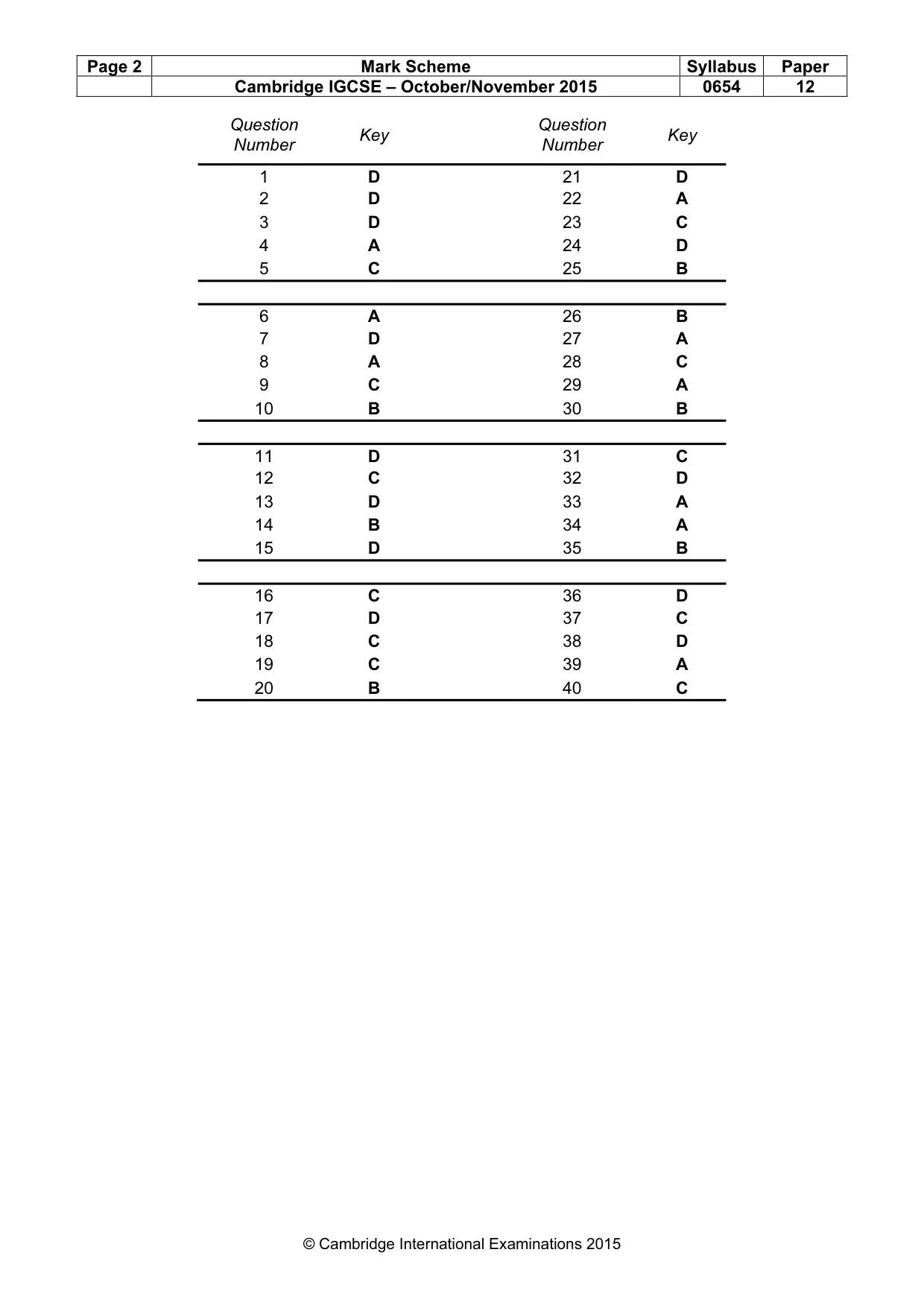
Mark scheme: D
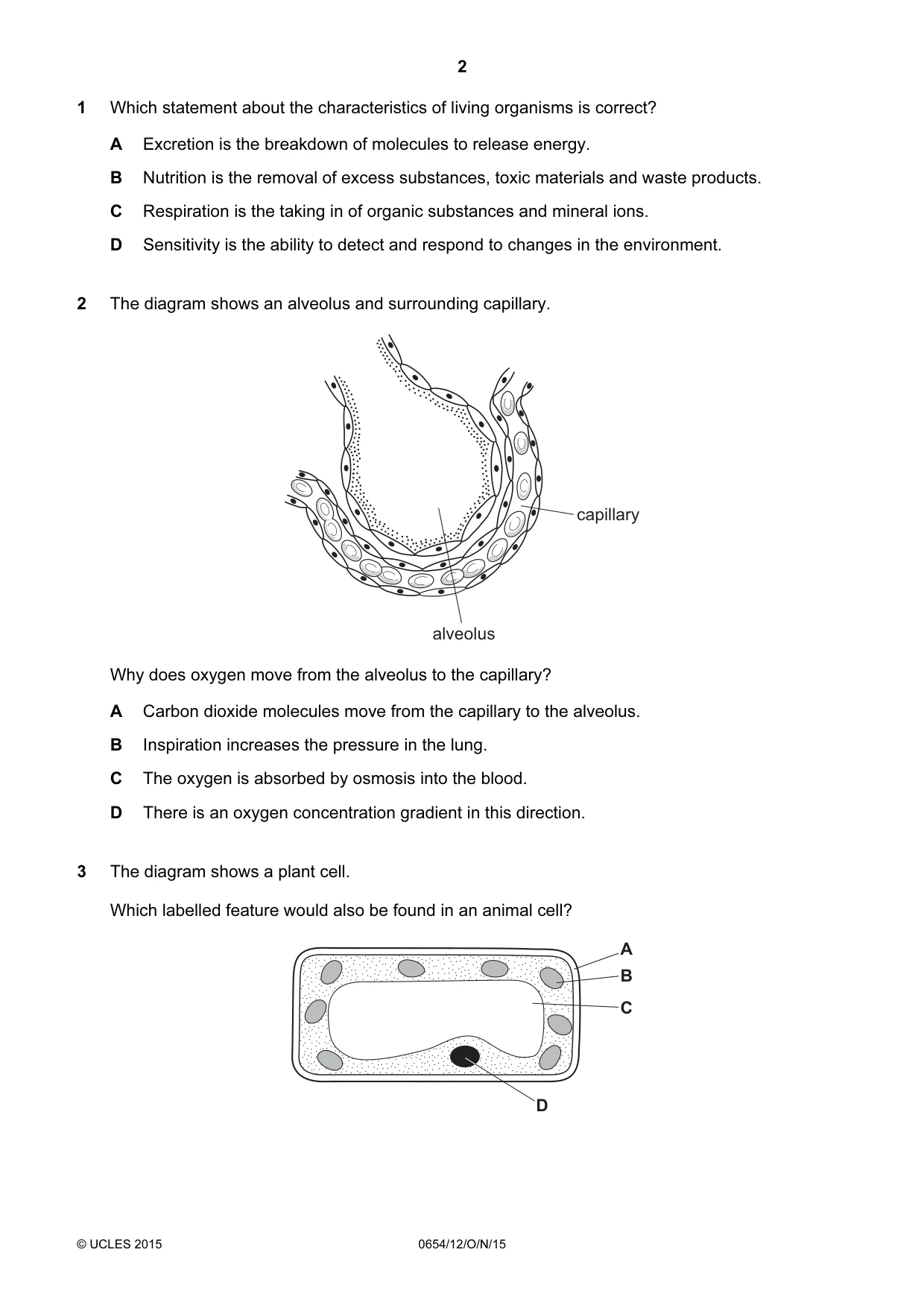
Q2 · The diagram shows an alveolus and surrounding capillary
2 The diagram shows an alveolus and surrounding capillary. capillary alveolus Why does oxygen move from the alveolus to the capillary? A Carbon dioxide molecules move from the capillary to the alveolus. B Inspiration increases the pressure in the lung. C The oxygen is absorbed by osmosis into the blood. D There is an oxygen concentration gradient in this direction.
Mark scheme: D
Q3 · The diagram shows a plant cell
3 The diagram shows a plant cell. Which labelled feature would also be found in an animal cell? A B C D
Mark scheme: D
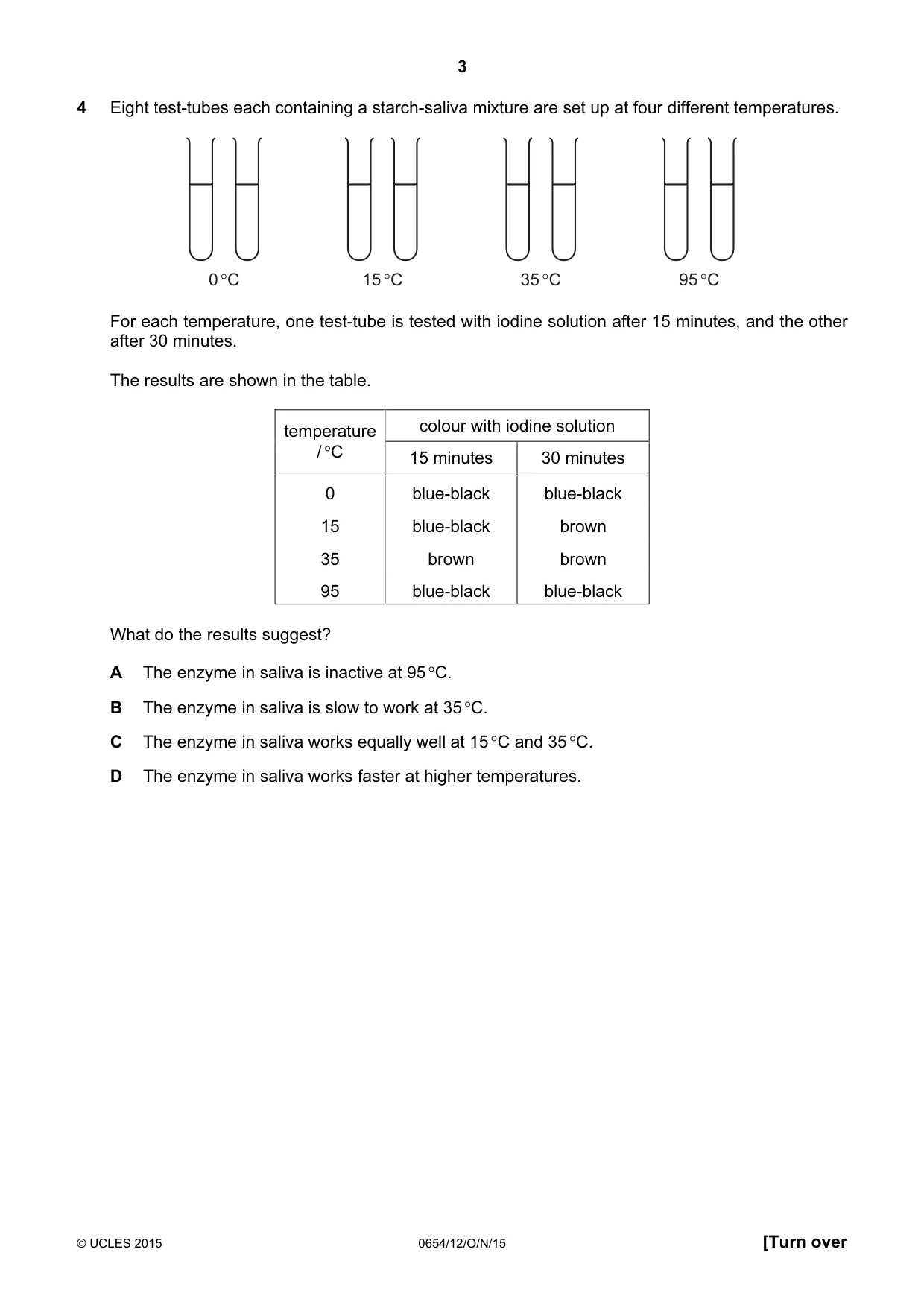
Q4 · Eight test-tubes each containing a starch-saliva mixture are set up at four different…
4 Eight test-tubes each containing a starch-saliva mixture are set up at four different temperatures. 0 °C 15 °C 35 °C 95 °C For each temperature, one test-tube is tested with iodine solution after 15 minutes, and the other after 30 minutes. The results are shown in the table. temperature colour with iodine solution / °C 15 minutes 30 minutes 0 blue-black blue-black 15 blue-black brown 35 brown brown 95 blue-black blue-black What do the results suggest? A The enzyme in saliva is inactive at 95 °C. B The enzyme in saliva is slow to work at 35 °C. C The enzyme in saliva works equally well at 15 °C and 35 °C. D The enzyme in saliva works faster at higher temperatures.
Mark scheme: A
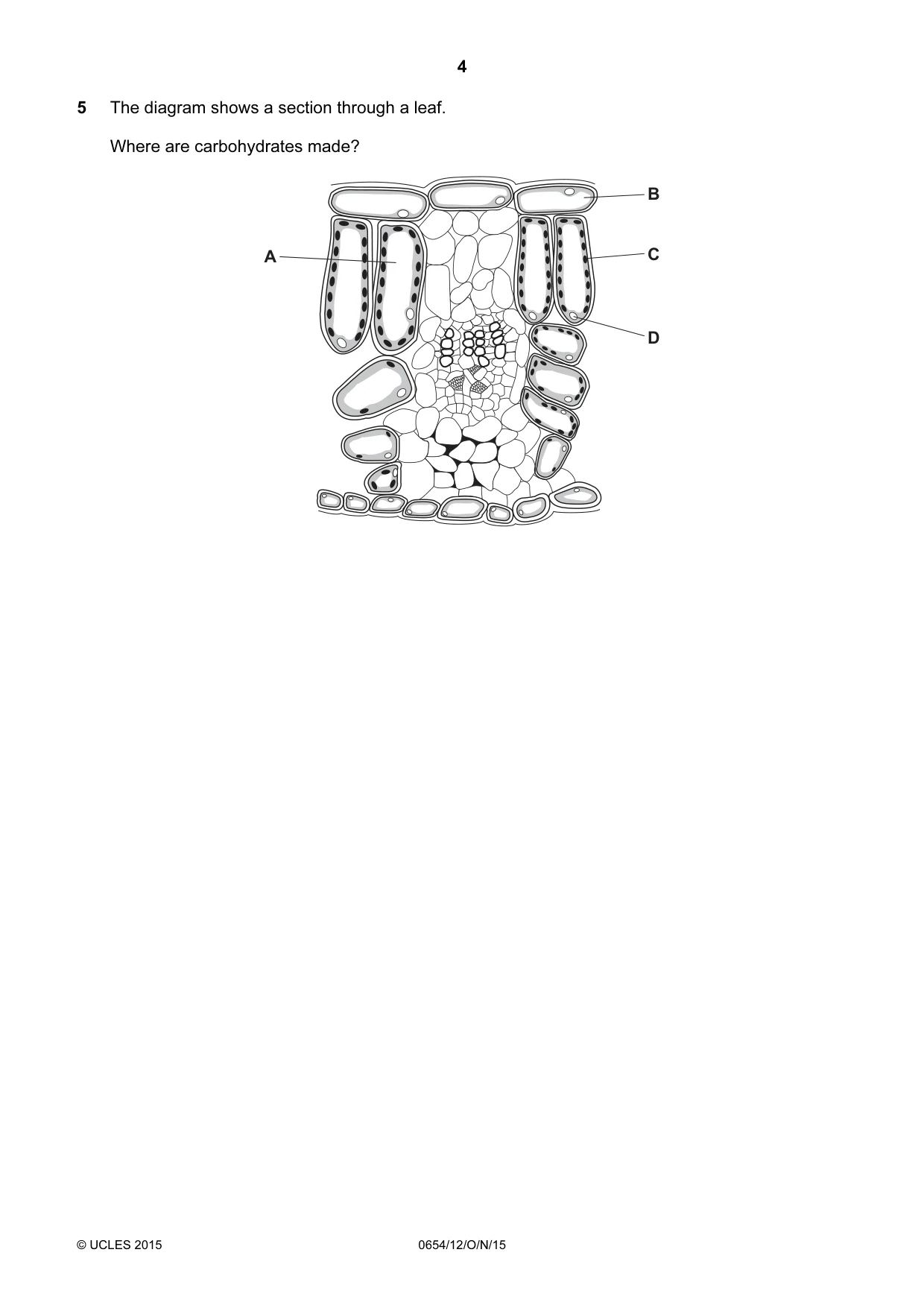
Q5 · The diagram shows a section through a leaf
5 The diagram shows a section through a leaf. Where are carbohydrates made? B A C D
Mark scheme: C
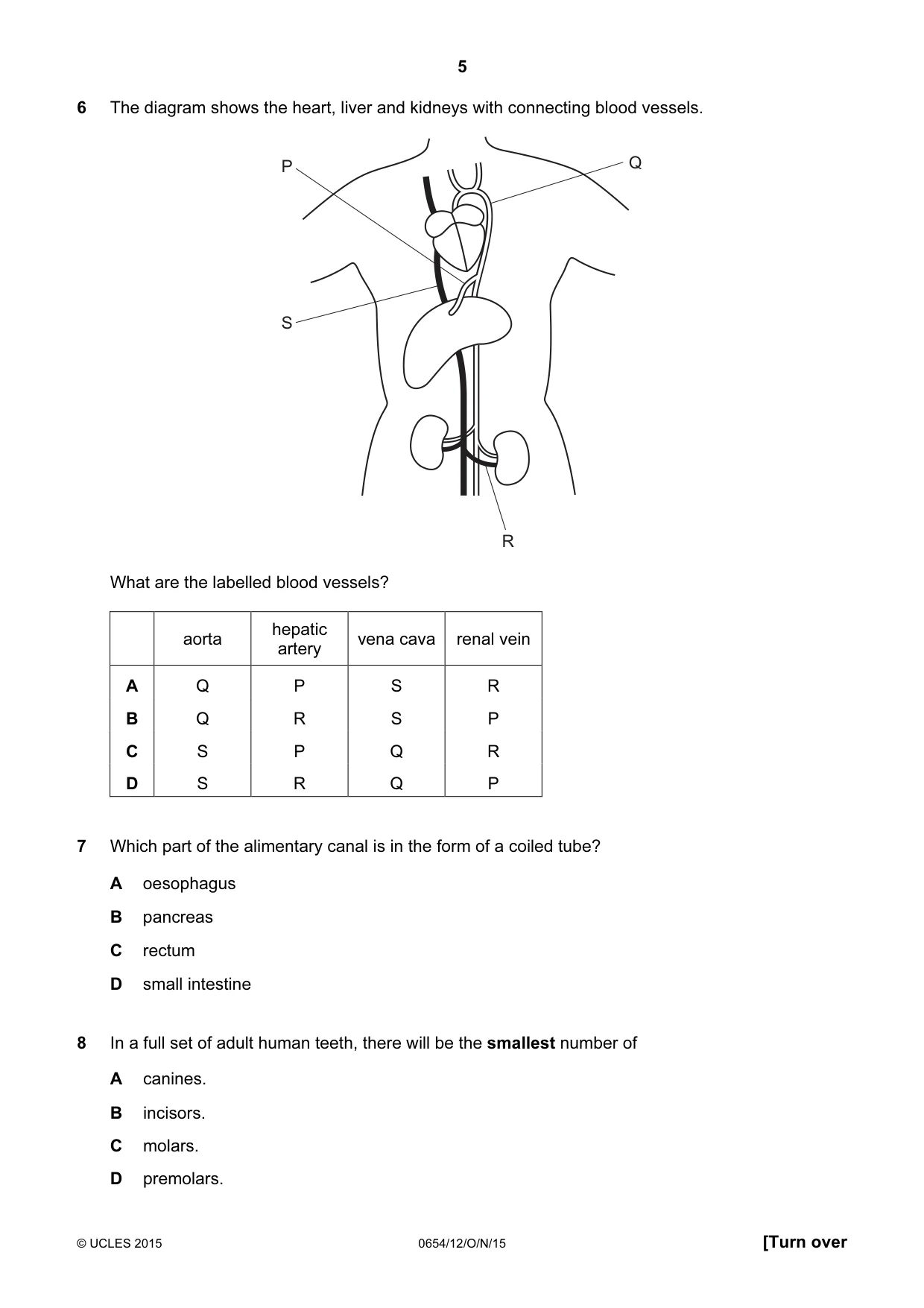
Q6 · The diagram shows the heart, liver and kidneys with connecting blood vessels
6 The diagram shows the heart, liver and kidneys with connecting blood vessels. P Q S R What are the labelled blood vessels? hepatic aorta vena cava renal vein artery A Q P S R B Q R S P C S P Q R D S R Q P
Mark scheme: A
Q7 · Which part of the alimentary canal is in the form of a coiled tube?
7 Which part of the alimentary canal is in the form of a coiled tube? A oesophagus B pancreas C rectum D small intestine
Mark scheme: D
Q8 · In a full set of adult human teeth, there will be the smallest number of A canines
8 In a full set of adult human teeth, there will be the smallest number of A canines. B incisors. C molars. D premolars.
Mark scheme: A
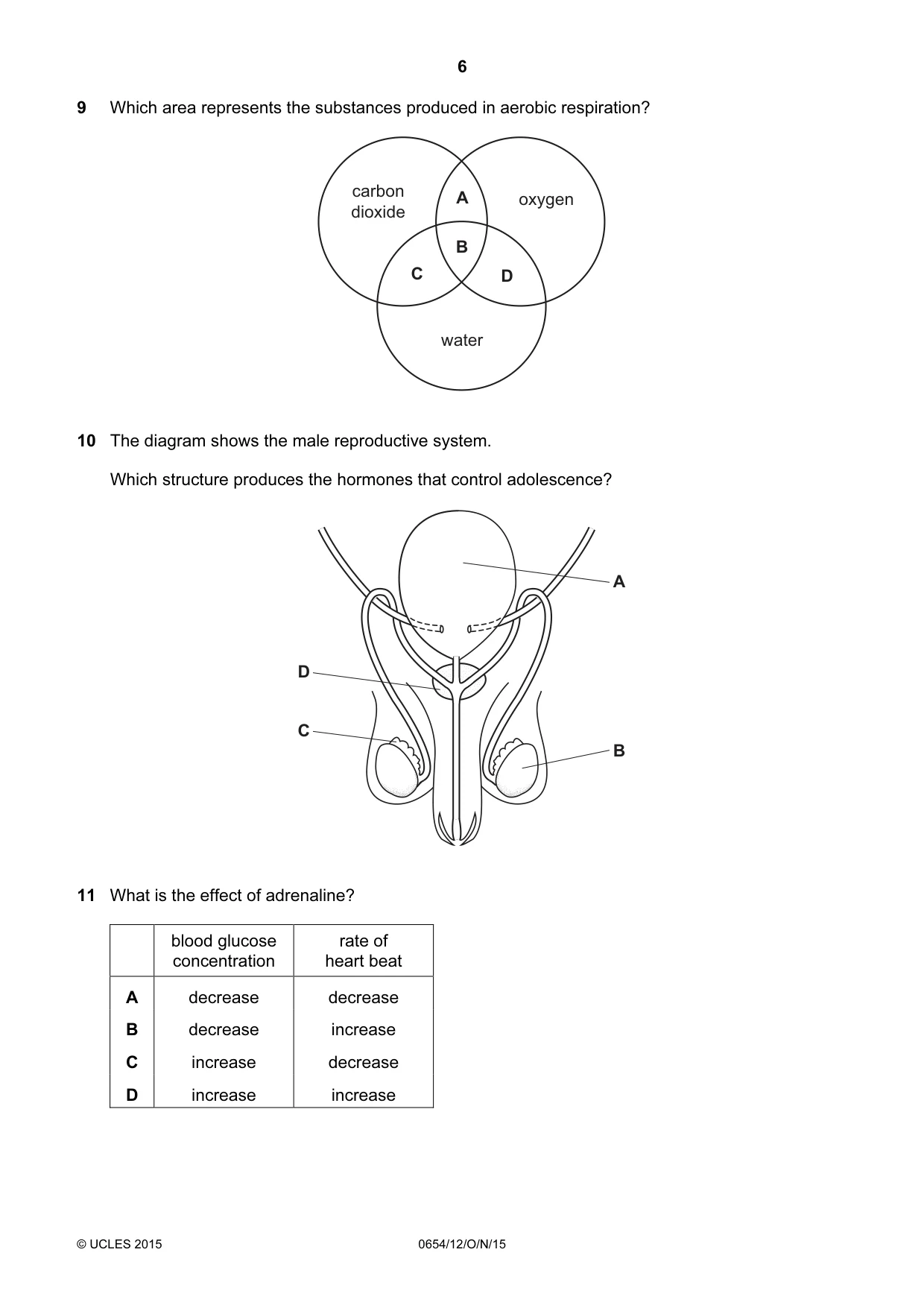
Q9 · Which area represents the substances produced in aerobic respiration?
9 Which area represents the substances produced in aerobic respiration? carbon A oxygen dioxide B C D water
Mark scheme: C
Q10 · The diagram shows the male reproductive system
10 The diagram shows the male reproductive system. Which structure produces the hormones that control adolescence? A D C B
Mark scheme: B
Q11 · What is the effect of adrenaline?
11 What is the effect of adrenaline? blood glucose rate of concentration heart beat A decrease decrease B decrease increase C increase decrease D increase increase
Mark scheme: D
Q12 · Which chemical supplies carnivores with energy and plays a part in the carbon cycle?
12 Which chemical supplies carnivores with energy and plays a part in the carbon cycle? A carbon dioxide B fibre (roughage) C glucose D water
Mark scheme: C
Q13 · What is an effect of increased methane in the atmosphere?
13 What is an effect of increased methane in the atmosphere? A a decrease in soil erosion B an increase in new plant species C the cooling of the Earth’s atmosphere D the melting of the polar ice caps
Mark scheme: D
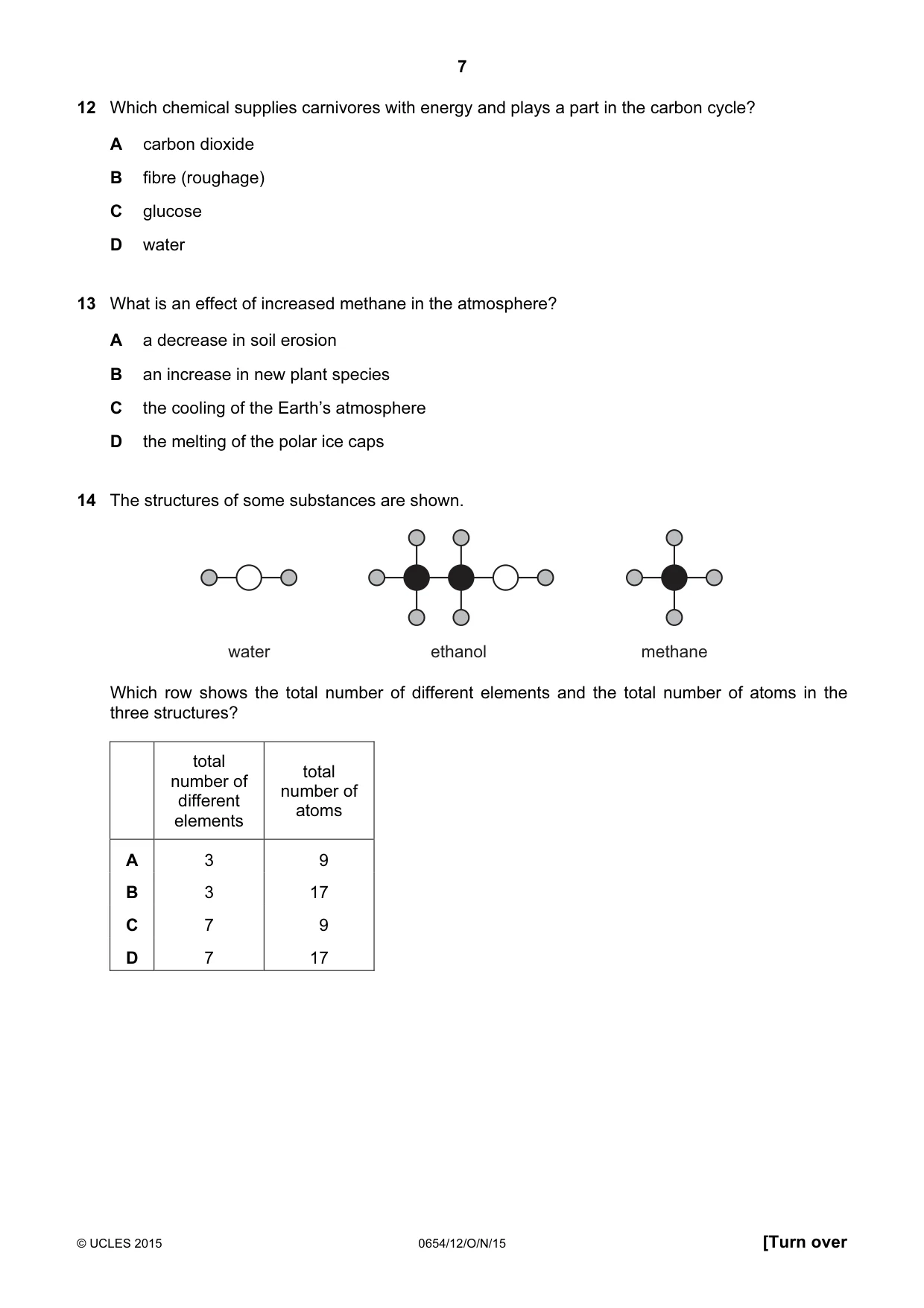
Q14 · The structures of some substances are shown
14 The structures of some substances are shown. water ethanol methane Which row shows the total number of different elements and the total number of atoms in the three structures? total total number of number of different atoms elements A 3 9 B 3 17 C 7 9 D 7 17
Mark scheme: B
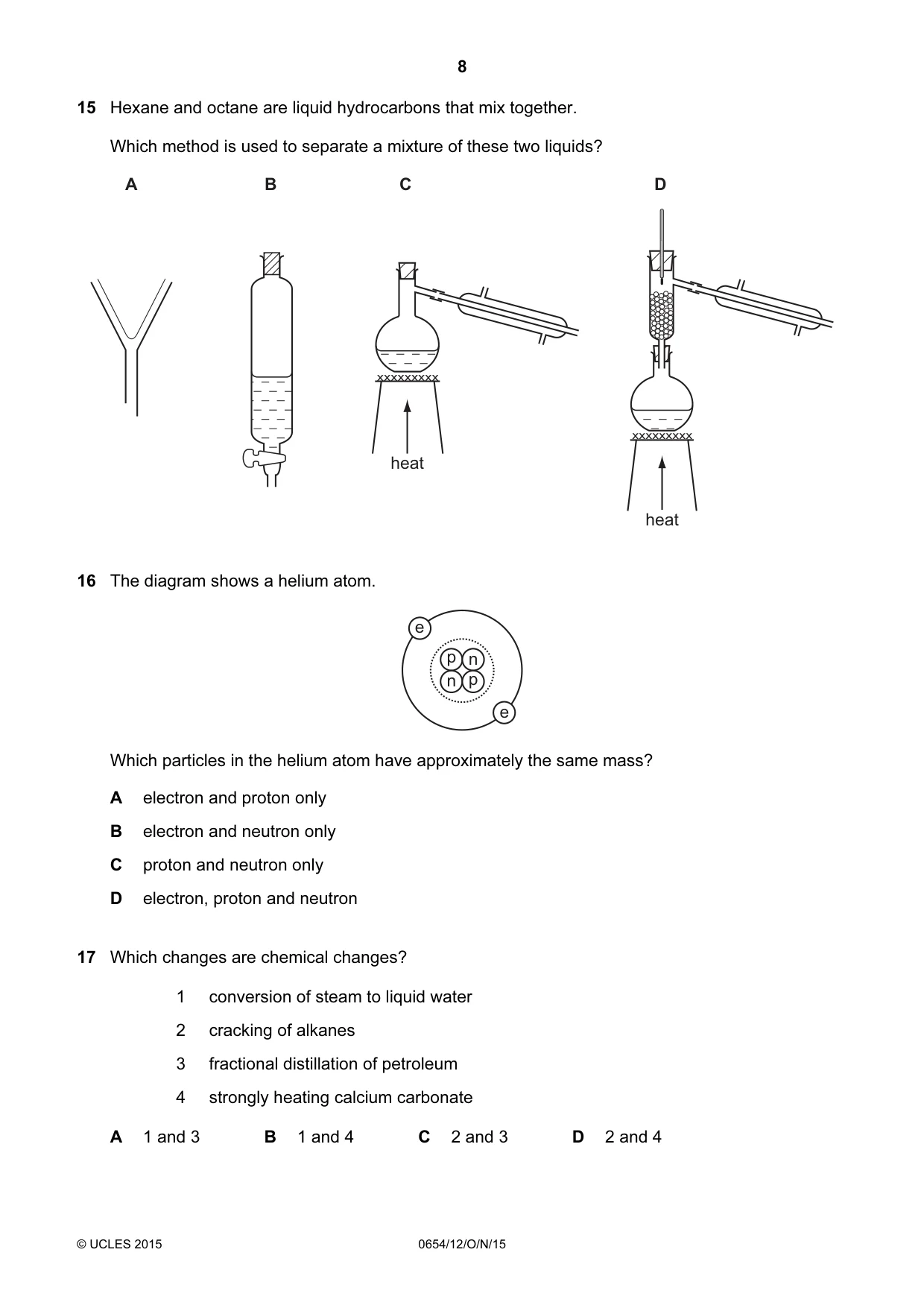
Q15 · Hexane and octane are liquid hydrocarbons that mix together
15 Hexane and octane are liquid hydrocarbons that mix together. Which method is used to separate a mixture of these two liquids? A B C D xxxxxxxxx xxxxxxxxx heat heat
Mark scheme: D
Q16 · The diagram shows a helium atom
16 The diagram shows a helium atom. e p n n p e Which particles in the helium atom have approximately the same mass? A electron and proton only B electron and neutron only C proton and neutron only D electron, proton and neutron
Mark scheme: C
Q17 · Which changes are chemical changes?
17 Which changes are chemical changes? 1 conversion of steam to liquid water 2 cracking of alkanes 3 fractional distillation of petroleum 4 strongly heating calcium carbonate A 1 and 3 B 1 and 4 C 2 and 3 D 2 and 4
Mark scheme: D
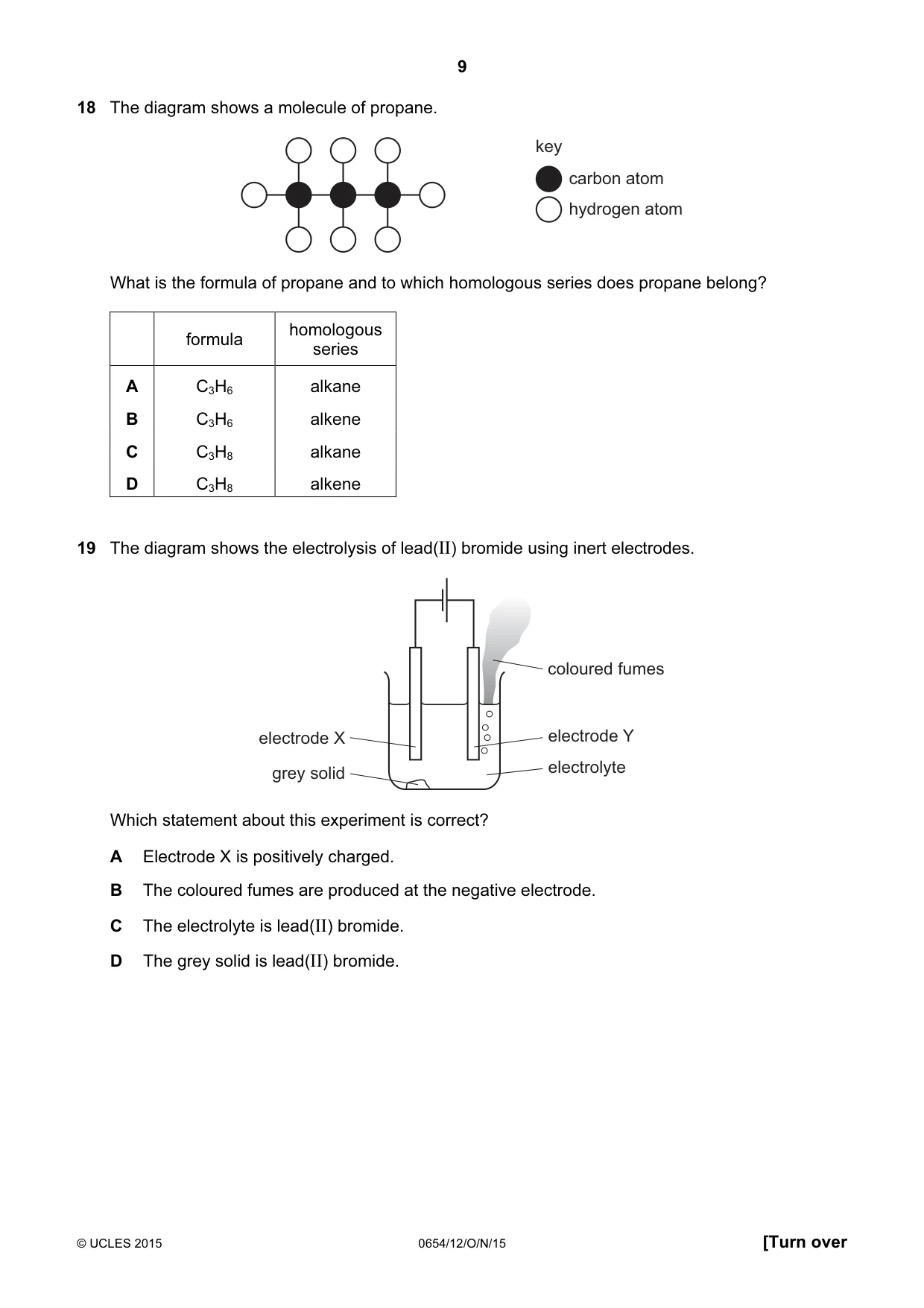
Q18 · The diagram shows a molecule of propane
18 The diagram shows a molecule of propane. key carbon atom hydrogen atom What is the formula of propane and to which homologous series does propane belong? homologous formula series A C3H6 alkane B C3H6 alkene C C3H8 alkane D C3H8 alkene
Mark scheme: C
Q19 · The diagram shows the electrolysis of lead(II) bromide using inert electrodes
19 The diagram shows the electrolysis of lead(II) bromide using inert electrodes. coloured fumes electrode X electrode Y grey solid electrolyte Which statement about this experiment is correct? A Electrode X is positively charged. B The coloured fumes are produced at the negative electrode. C The electrolyte is lead(II) bromide. D The grey solid is lead(II) bromide.
Mark scheme: C
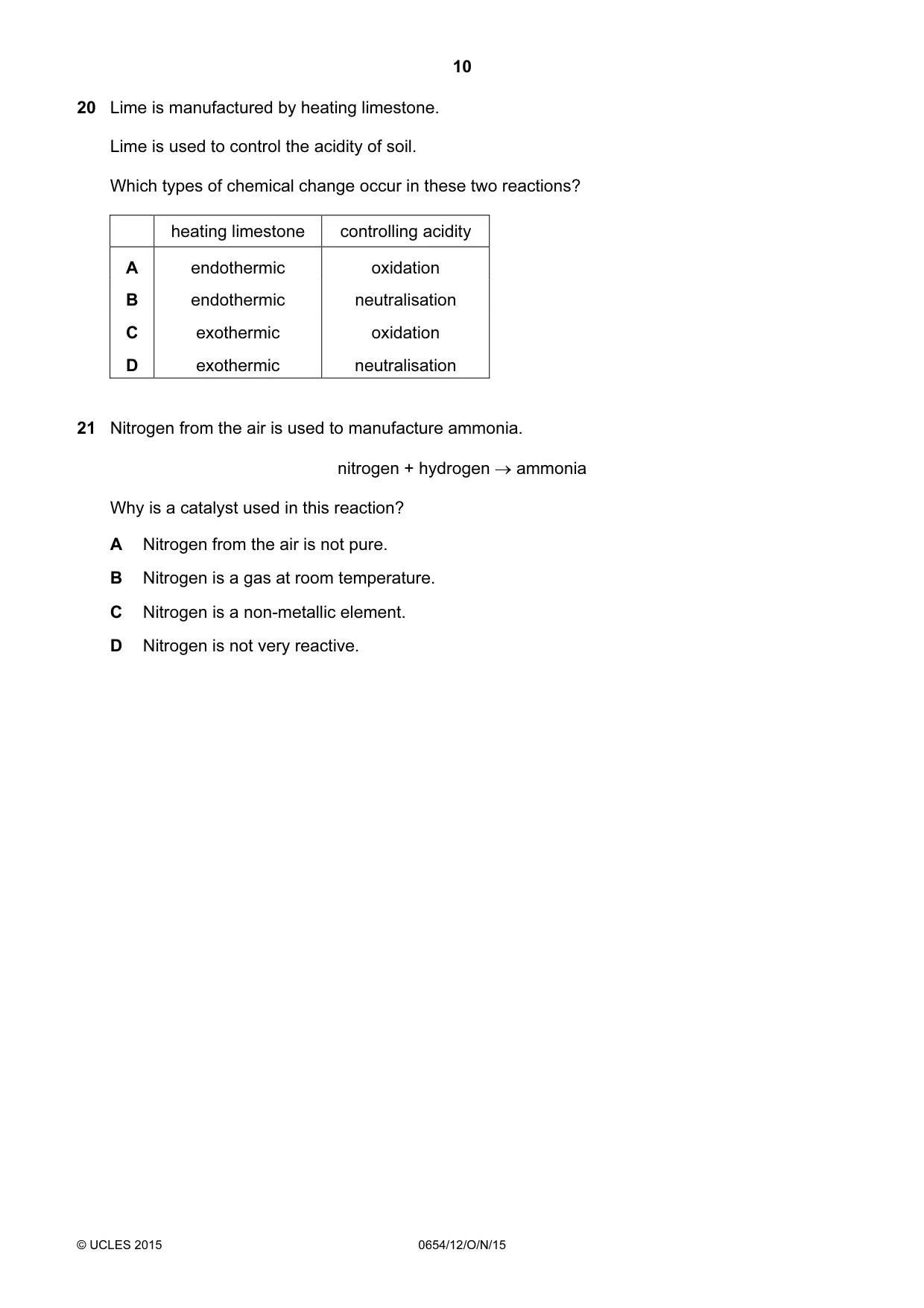
Q20 · Lime is manufactured by heating limestone
20 Lime is manufactured by heating limestone. Lime is used to control the acidity of soil. Which types of chemical change occur in these two reactions? heating limestone controlling acidity A endothermic oxidation B endothermic neutralisation C exothermic oxidation D exothermic neutralisation
Mark scheme: B
Q21 · Nitrogen from the air is used to manufacture ammonia
21 Nitrogen from the air is used to manufacture ammonia. nitrogen + hydrogen → ammonia Why is a catalyst used in this reaction? A Nitrogen from the air is not pure. B Nitrogen is a gas at room temperature. C Nitrogen is a non-metallic element. D Nitrogen is not very reactive.
Mark scheme: D
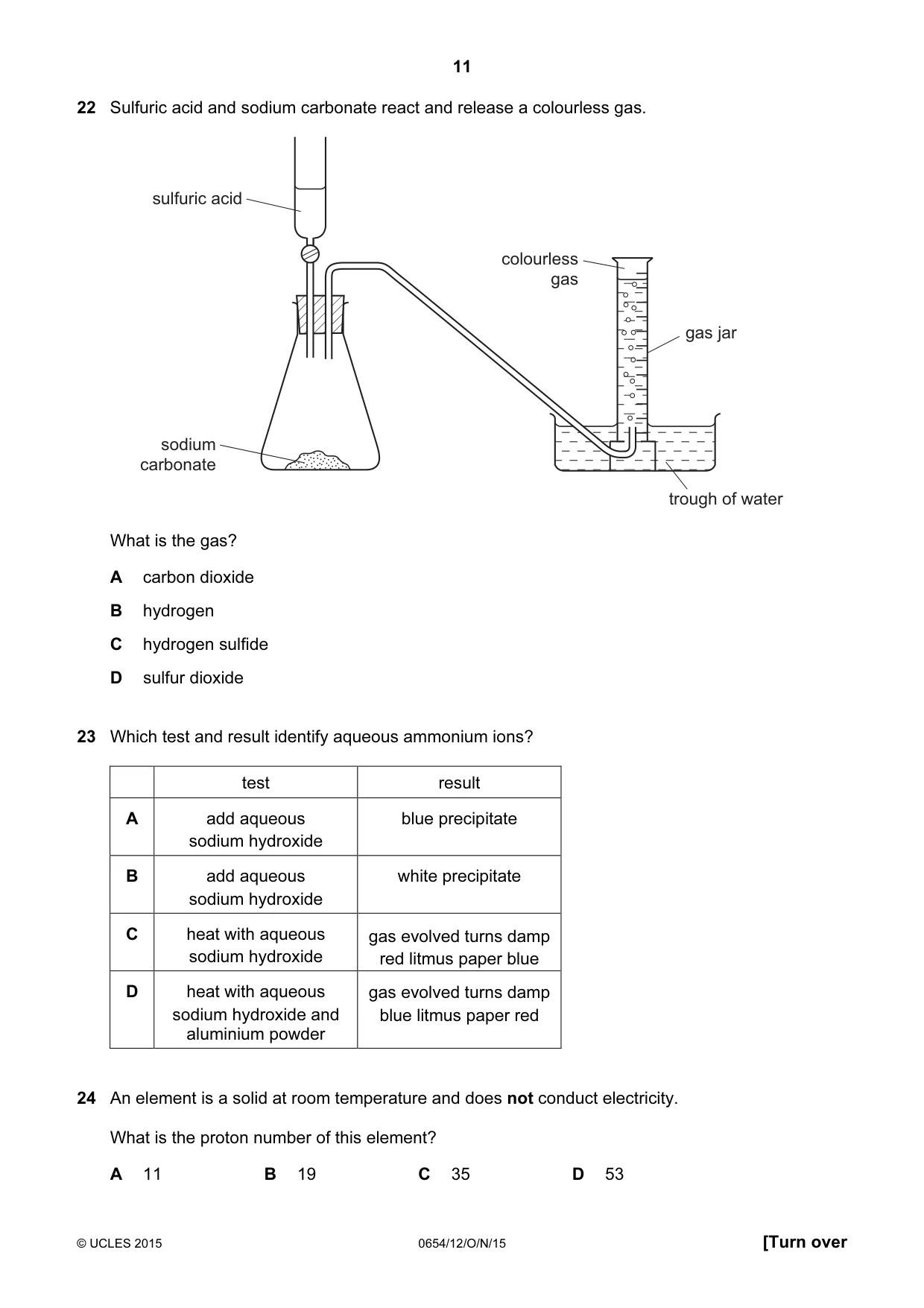
Q22 · Sulfuric acid and sodium carbonate react and release a colourless gas
22 Sulfuric acid and sodium carbonate react and release a colourless gas. sulfuric acid colourless gas gas jar sodium carbonate trough of water What is the gas? A carbon dioxide B hydrogen C hydrogen sulfide D sulfur dioxide
Mark scheme: A
Q23 · Which test and result identify aqueous ammonium ions?
23 Which test and result identify aqueous ammonium ions? test result A add aqueous blue precipitate sodium hydroxide B add aqueous white precipitate sodium hydroxide C heat with aqueous gas evolved turns damp sodium hydroxide red litmus paper blue D heat with aqueous gas evolved turns damp sodium hydroxide and blue litmus paper red aluminium powder
Mark scheme: C
Q24 · An element is a solid at room temperature and does not conduct electricity
24 An element is a solid at room temperature and does not conduct electricity. What is the proton number of this element? A 11 B 19 C 35 D 53
Mark scheme: D
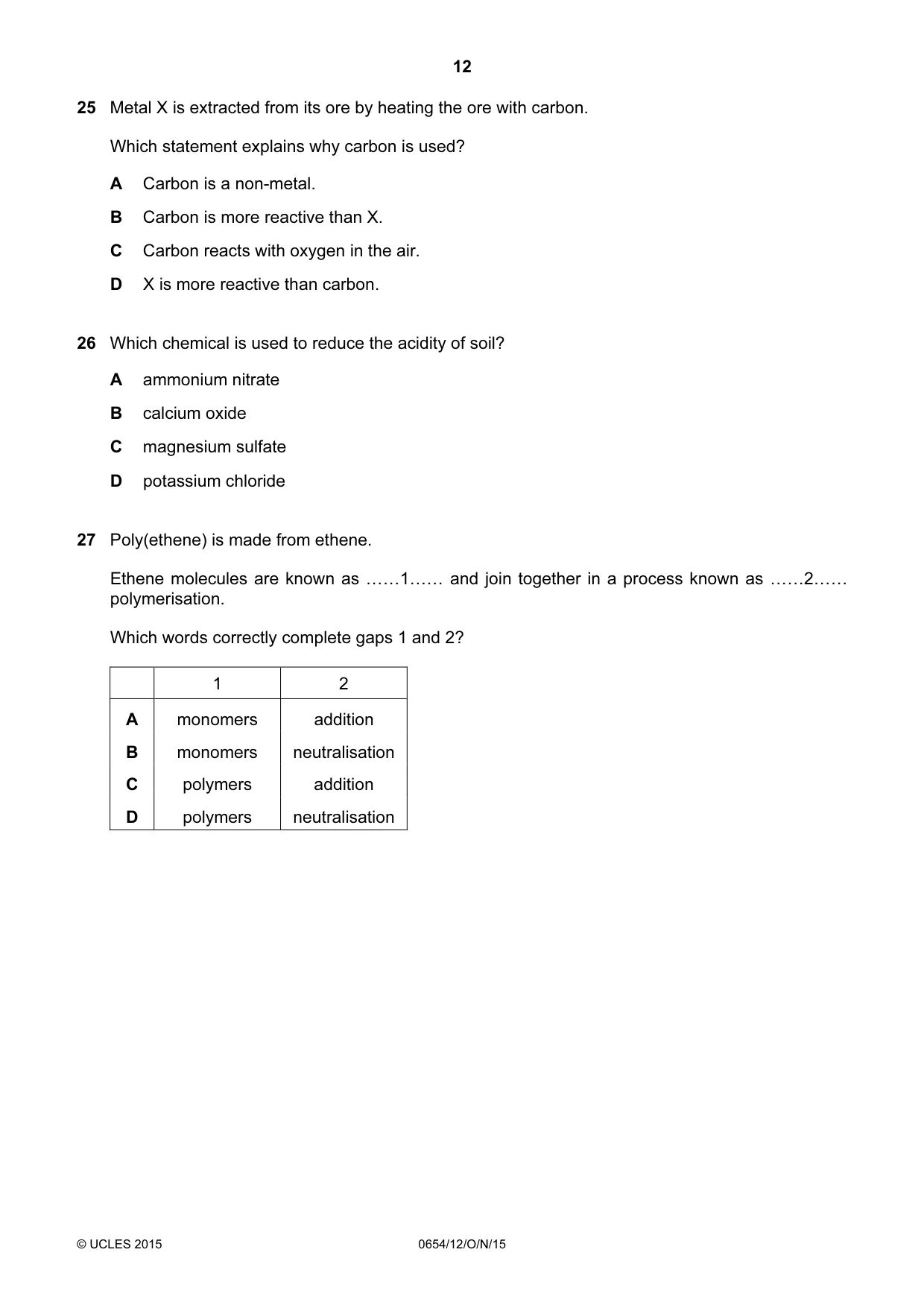
Q25 · Metal X is extracted from its ore by heating the ore with carbon
25 Metal X is extracted from its ore by heating the ore with carbon. Which statement explains why carbon is used? A Carbon is a non-metal. B Carbon is more reactive than X. C Carbon reacts with oxygen in the air. D X is more reactive than carbon.
Mark scheme: B
Q26 · Which chemical is used to reduce the acidity of soil?
26 Which chemical is used to reduce the acidity of soil? A ammonium nitrate B calcium oxide C magnesium sulfate D potassium chloride
Mark scheme: B
More questions on The characteristic properties of acids and bases
Q27 · Poly(ethene) is made from ethene
27 Poly(ethene) is made from ethene. Ethene molecules are known as ……1…… and join together in a process known as ……2…… polymerisation. Which words correctly complete gaps 1 and 2? 1 2 A monomers addition B monomers neutralisation C polymers addition D polymers neutralisation
Mark scheme: A
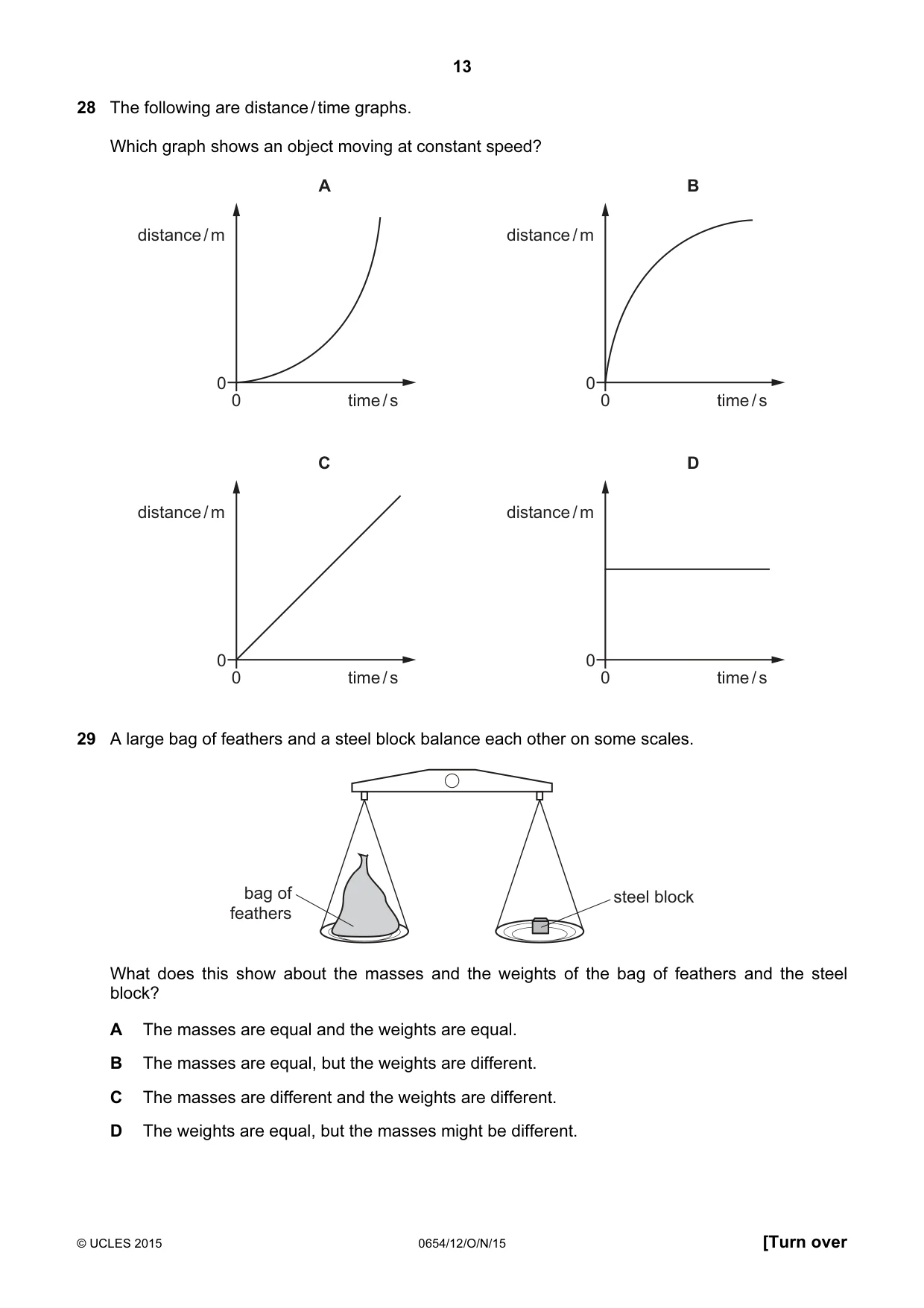
Q28 · The following are distance / time graphs
28 The following are distance / time graphs. Which graph shows an object moving at constant speed? A B distance / m distance / m 0 0 0 time / s 0 time / s C D distance / m distance / m 0 0 0 time / s 0 time / s
Mark scheme: C
Q29 · A large bag of feathers and a steel block balance each other on some scales
29 A large bag of feathers and a steel block balance each other on some scales. bag of steel block feathers What does this show about the masses and the weights of the bag of feathers and the steel block? A The masses are equal and the weights are equal. B The masses are equal, but the weights are different. C The masses are different and the weights are different. D The weights are equal, but the masses might be different.
Mark scheme: A
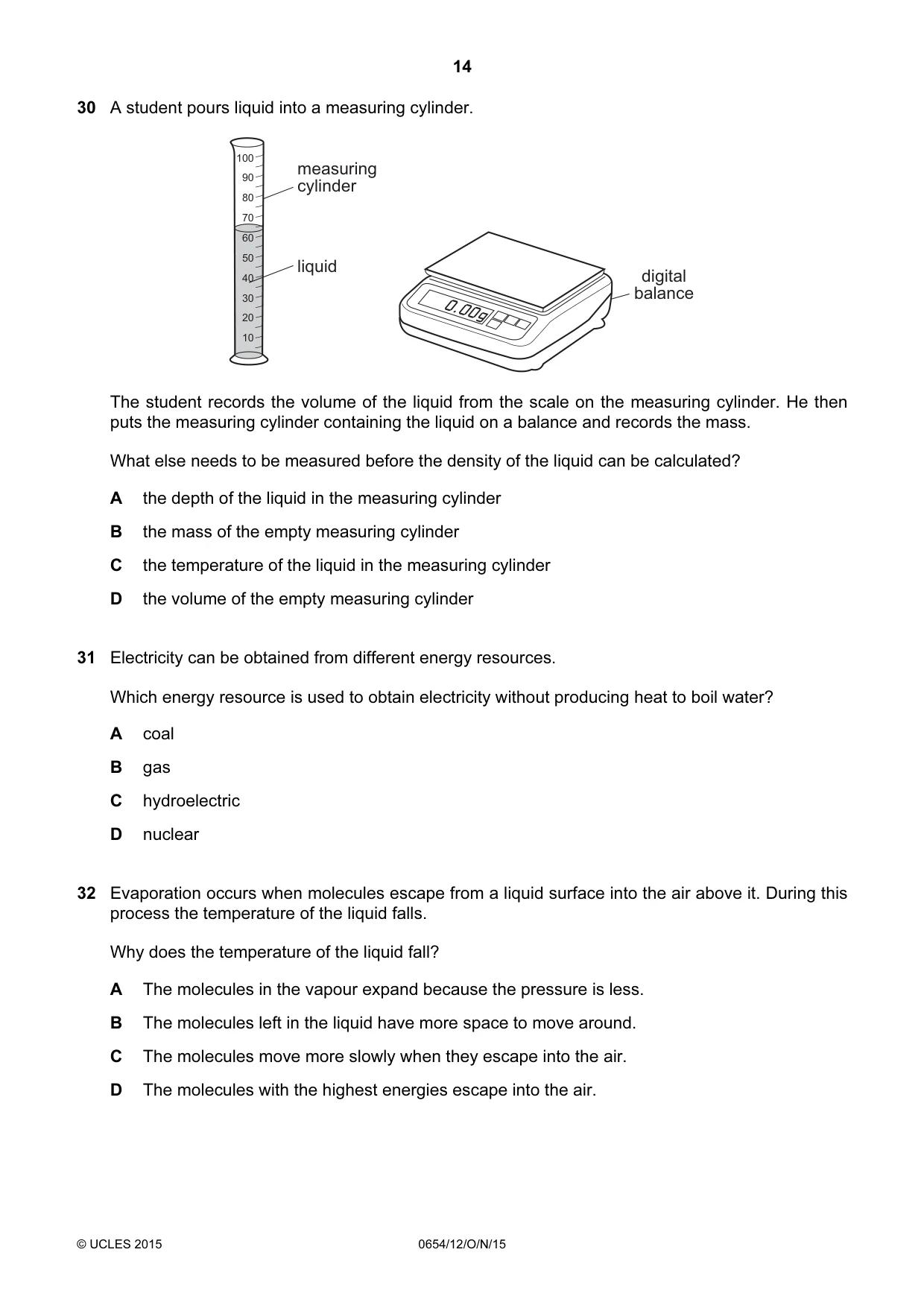
Q30 · A student pours liquid into a measuring cylinder
30 A student pours liquid into a measuring cylinder. 100 measuring 90 cylinder 80 70 60 50 liquid 40 digital balance 30 20 10 The student records the volume of the liquid from the scale on the measuring cylinder. He then puts the measuring cylinder containing the liquid on a balance and records the mass. What else needs to be measured before the density of the liquid can be calculated? A the depth of the liquid in the measuring cylinder B the mass of the empty measuring cylinder C the temperature of the liquid in the measuring cylinder D the volume of the empty measuring cylinder
Mark scheme: B
Q31 · Electricity can be obtained from different energy resources
31 Electricity can be obtained from different energy resources. Which energy resource is used to obtain electricity without producing heat to boil water? A coal B gas C hydroelectric D nuclear
Mark scheme: C
Q32 · Evaporation occurs when molecules escape from a liquid surface into the air above it
32 Evaporation occurs when molecules escape from a liquid surface into the air above it. During this process the temperature of the liquid falls. Why does the temperature of the liquid fall? A The molecules in the vapour expand because the pressure is less. B The molecules left in the liquid have more space to move around. C The molecules move more slowly when they escape into the air. D The molecules with the highest energies escape into the air.
Mark scheme: D
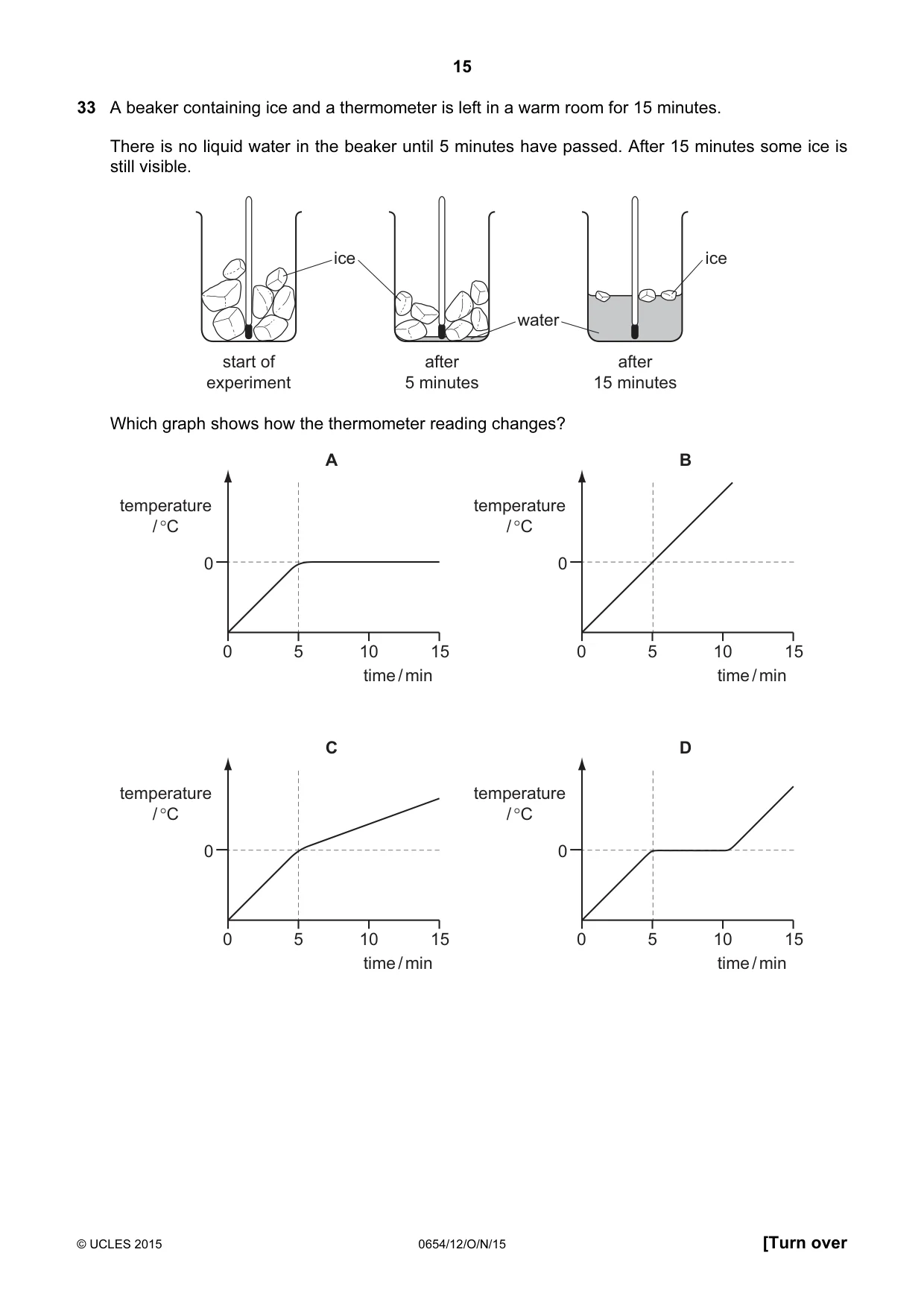
Q33 · A beaker containing ice and a thermometer is left in a warm room for 15 minutes
33 A beaker containing ice and a thermometer is left in a warm room for 15 minutes. There is no liquid water in the beaker until 5 minutes have passed. After 15 minutes some ice is still visible. ice ice water start of after after experiment 5 minutes 15 minutes Which graph shows how the thermometer reading changes? A B temperature temperature / °C / °C 0 0 0 5 10 15 0 5 10 15 time / min time / min C D temperature temperature / °C / °C 0 0 0 5 10 15 0 5 10 15 time / min time / min
Mark scheme: A
Q34 · Hot liquid in a vacuum flask cools extremely slowly
34 Hot liquid in a vacuum flask cools extremely slowly. This is because some methods of heat transfer do not take place in a vacuum. Which methods do not take place in a vacuum? A conduction and convection only B conduction and radiation only C convection and radiation only D conduction, convection and radiation
Mark scheme: A
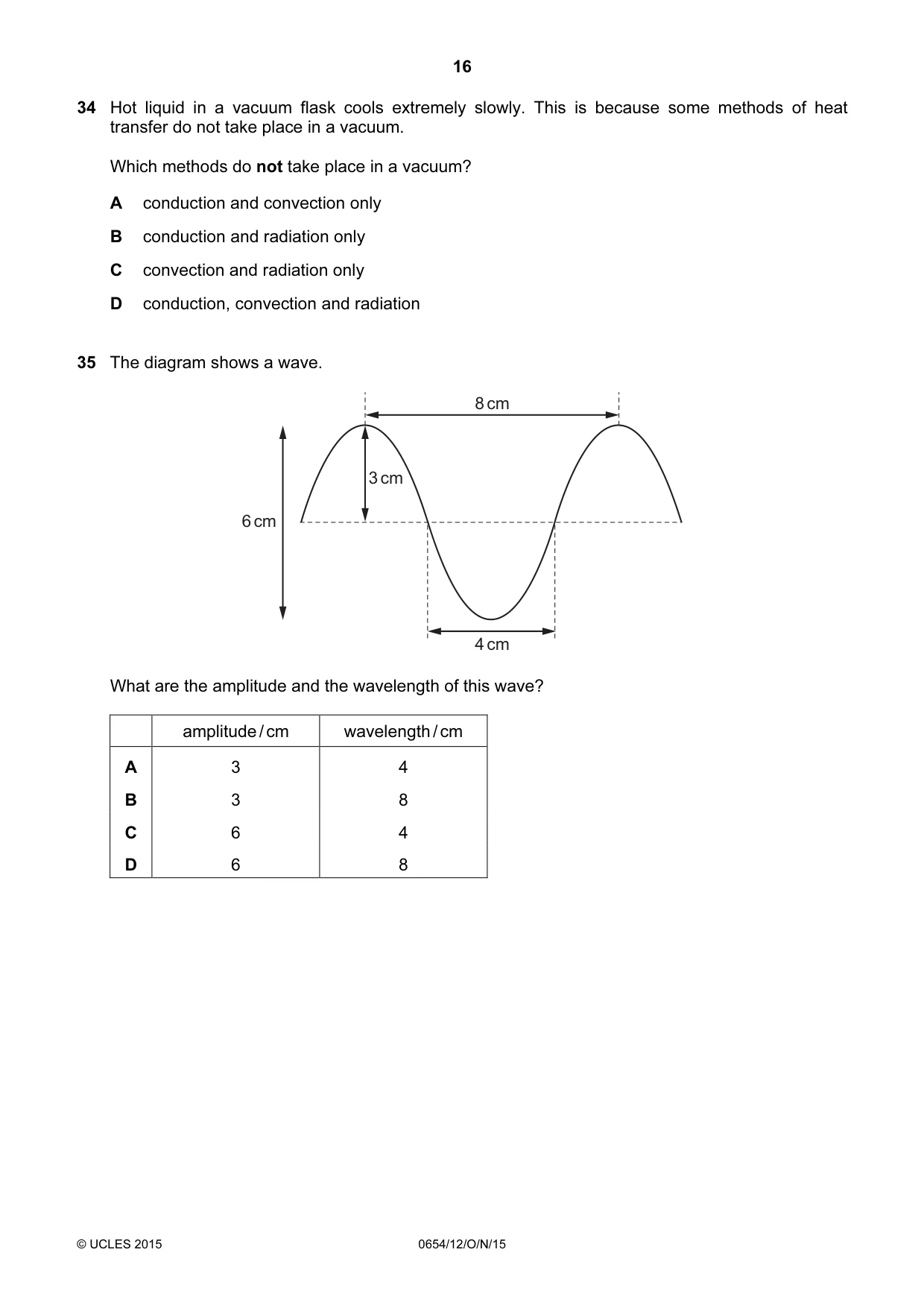
Q35 · The diagram shows a wave
35 The diagram shows a wave. 8 cm 3 cm 6 cm 4 cm What are the amplitude and the wavelength of this wave? amplitude / cm wavelength / cm A 3 4 B 3 8 C 6 4 D 6 8
Mark scheme: B
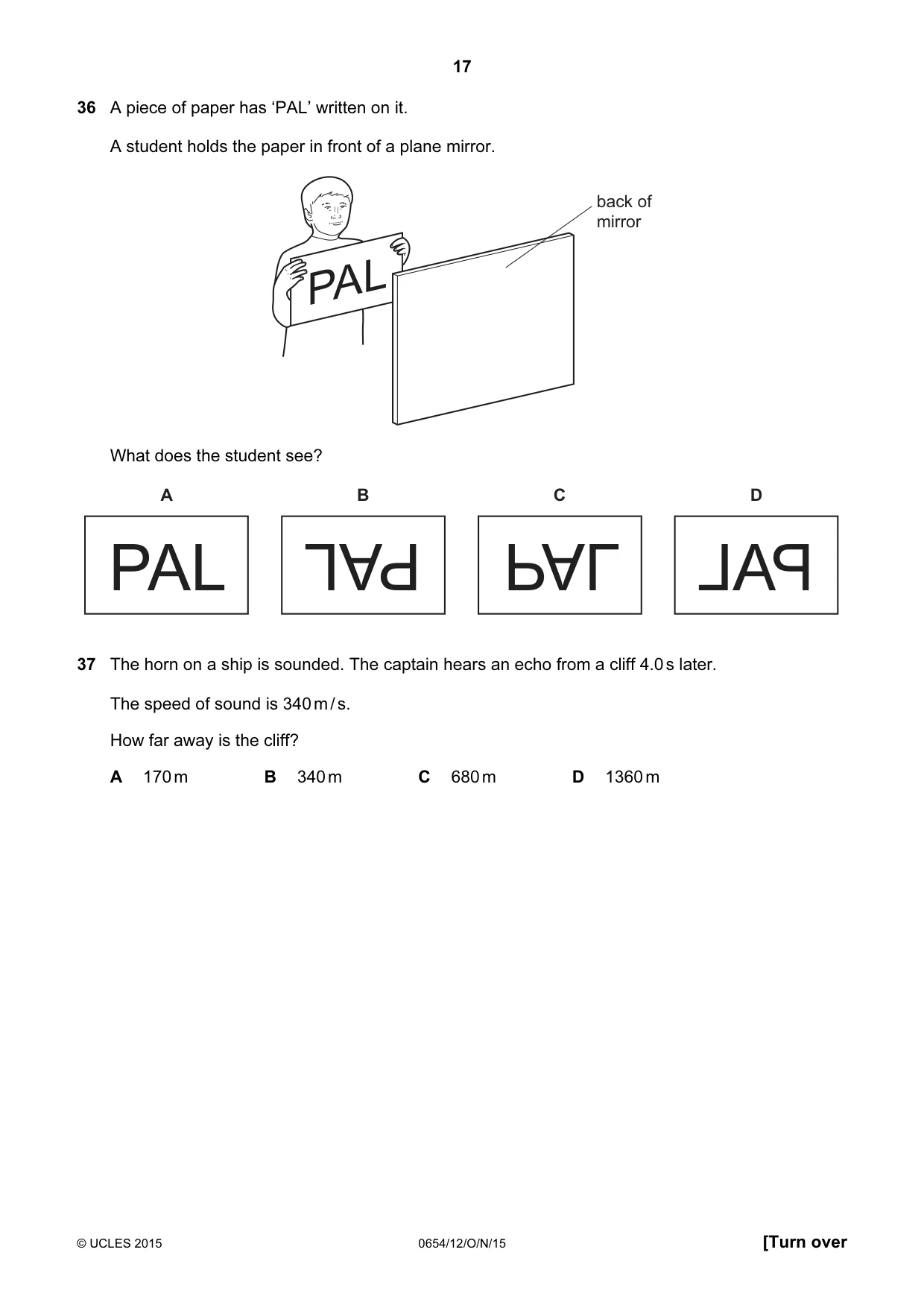
Q36 · A piece of paper has ‘PAL’ written on it
36 A piece of paper has ‘PAL’ written on it. A student holds the paper in front of a plane mirror. back of mirror PAL What does the student see? A PAL B C D PAL PAL PAL
Mark scheme: D
Q37 · The horn on a ship is sounded
37 The horn on a ship is sounded. The captain hears an echo from a cliff 4.0 s later. The speed of sound is 340 m / s. How far away is the cliff? A 170 m B 340 m C 680 m D 1360 m
Mark scheme: C
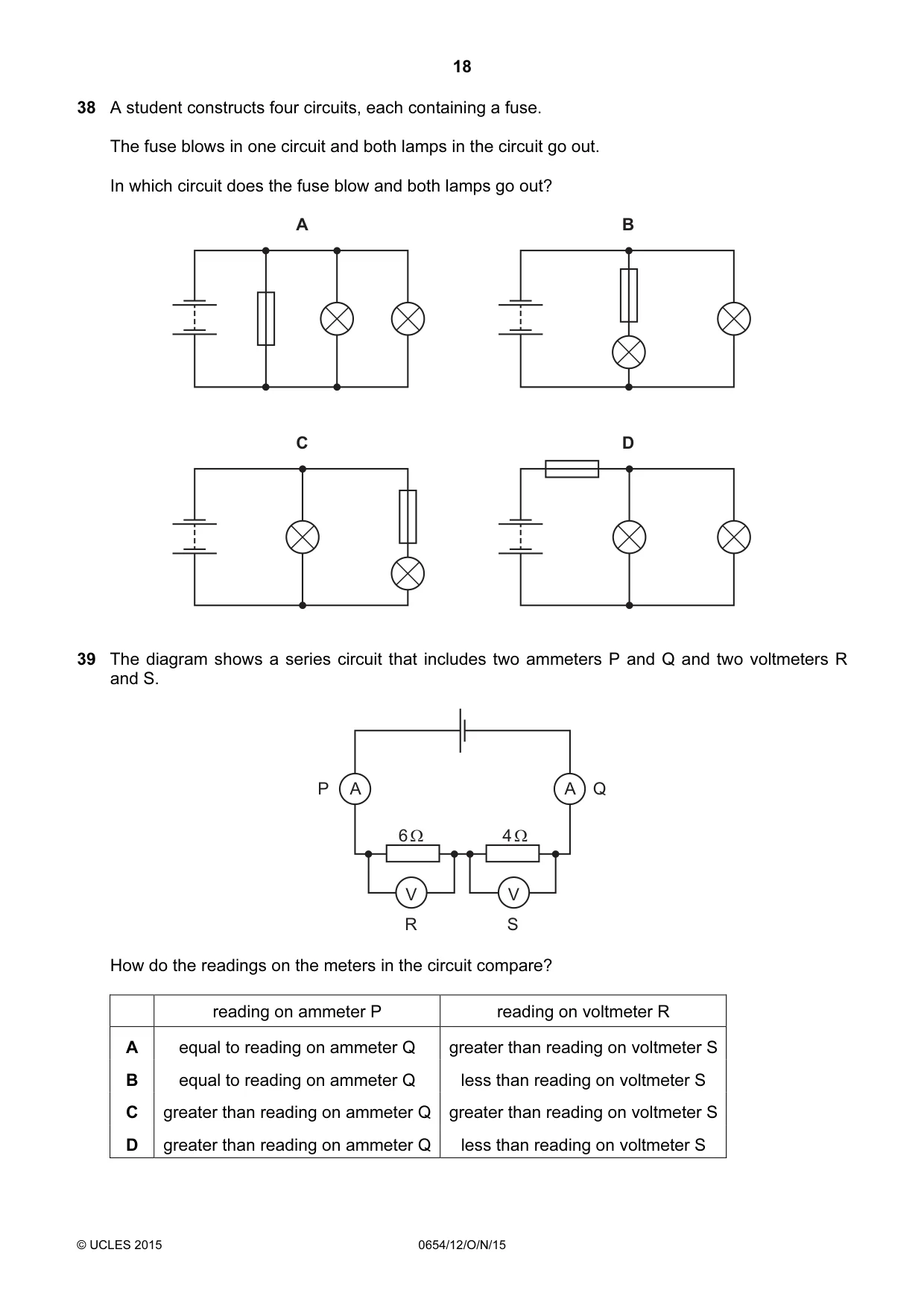
Q38 · A student constructs four circuits, each containing a fuse
38 A student constructs four circuits, each containing a fuse. The fuse blows in one circuit and both lamps in the circuit go out. In which circuit does the fuse blow and both lamps go out? A B C D
Mark scheme: D
Q39 · The diagram shows a series circuit that includes two ammeters P and Q and two voltmeters…
39 The diagram shows a series circuit that includes two ammeters P and Q and two voltmeters R and S. P A A Q 6 Ω 4 Ω V V R S How do the readings on the meters in the circuit compare? reading on ammeter P reading on voltmeter R A equal to reading on ammeter Q greater than reading on voltmeter S B equal to reading on ammeter Q less than reading on voltmeter S C greater than reading on ammeter Q greater than reading on voltmeter S D greater than reading on ammeter Q less than reading on voltmeter S
Mark scheme: A
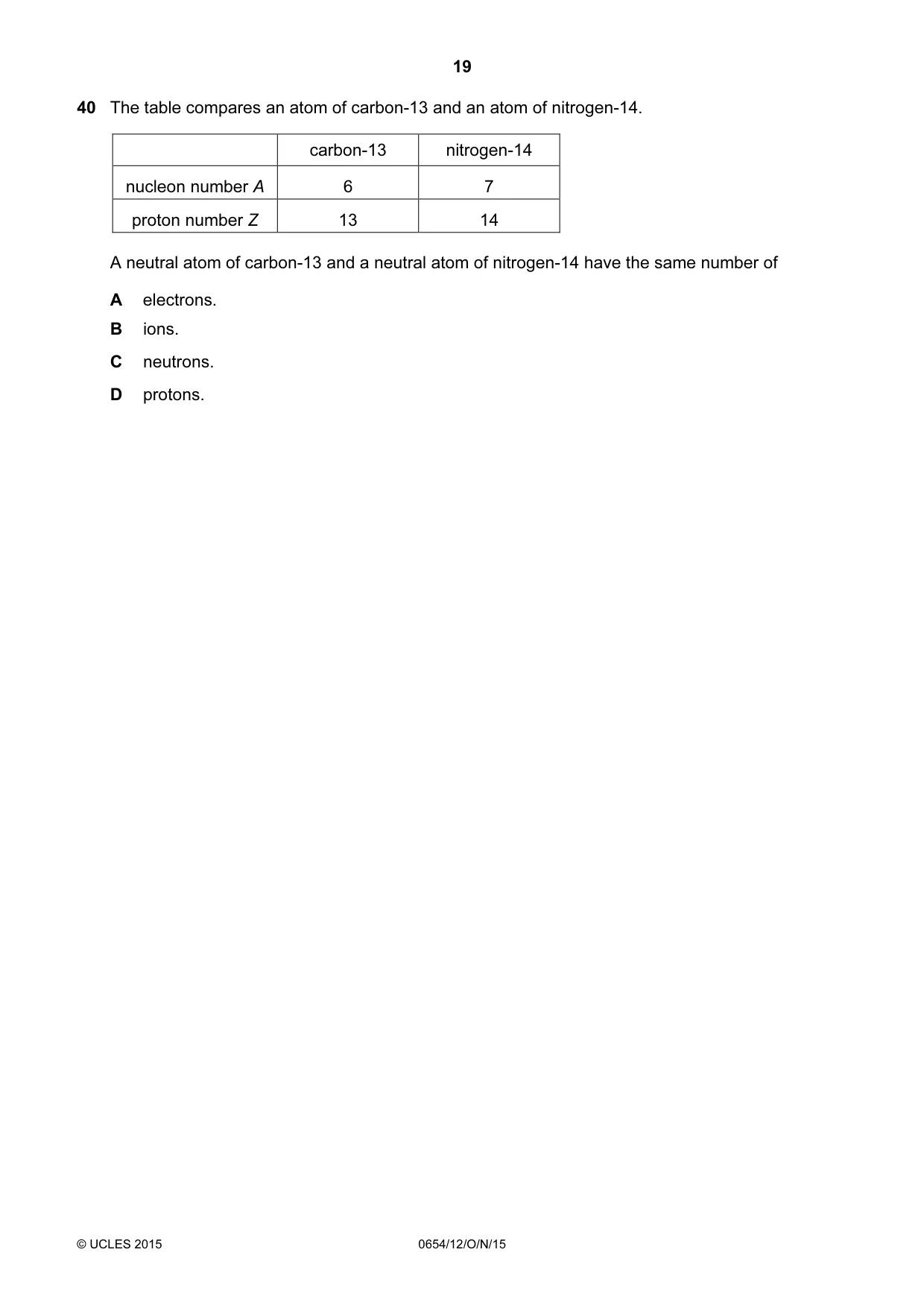
Q40 · The table compares an atom of carbon-13 and an atom of nitrogen-14
40 The table compares an atom of carbon-13 and an atom of nitrogen-14. carbon-13 nitrogen-14 nucleon number A 6 7 proton number Z 13 14 A neutral atom of carbon-13 and a neutral atom of nitrogen-14 have the same number of A electrons. B ions. C neutrons. D protons.
Mark scheme: C
What was in this paper
The subtopics covered by these 40 questions, and how many questions each got. Open one in a new tab to see every Cambridge question on it.
2Hormones2Identification of ions and gases2Air quality and climate1Alkanes1Arrangement of elements1Atomic structure and the Periodic Table1Blood vessels1Cell structure1Characteristics of living organisms1Density1Electrical circuits1Electrical safety1Electrolysis1Elements, compounds and mixtures1Energy flow1Energy, work and power1Enzymes1Exothermic and endothermic reactions1Gas exchange in humans1General properties of waves1Kinetic particle model of matter1Light1Mass and weight1Motion1Photosynthesis1Physical and chemical changes1Polymers1Rate of reaction1Reactivity series1Respiration1Separation and purification1Sound1The characteristic properties of acids and bases1The nucleus1Thermal properties and temperature1Transfer of thermal energy1What you needed in this session
Cambridge’s own grade thresholds for 2015 Oct/Nov, Paper 1 · Variant 2. A higher threshold means an easier paper — the bar moves with how the cohort did.