Cambridge IGCSE Sciences - Co-ordinated (Double) 0654 — 2015 May/June Paper 1 · Variant 1
0654/11/M/J/15 · 40 questions · 40 marks · ≈45 min
The question paper and its mark scheme, free to read here and free to download. This is Cambridge’s own paper, exactly as it was sat.
Question paper20 pages


Mark scheme2 pages
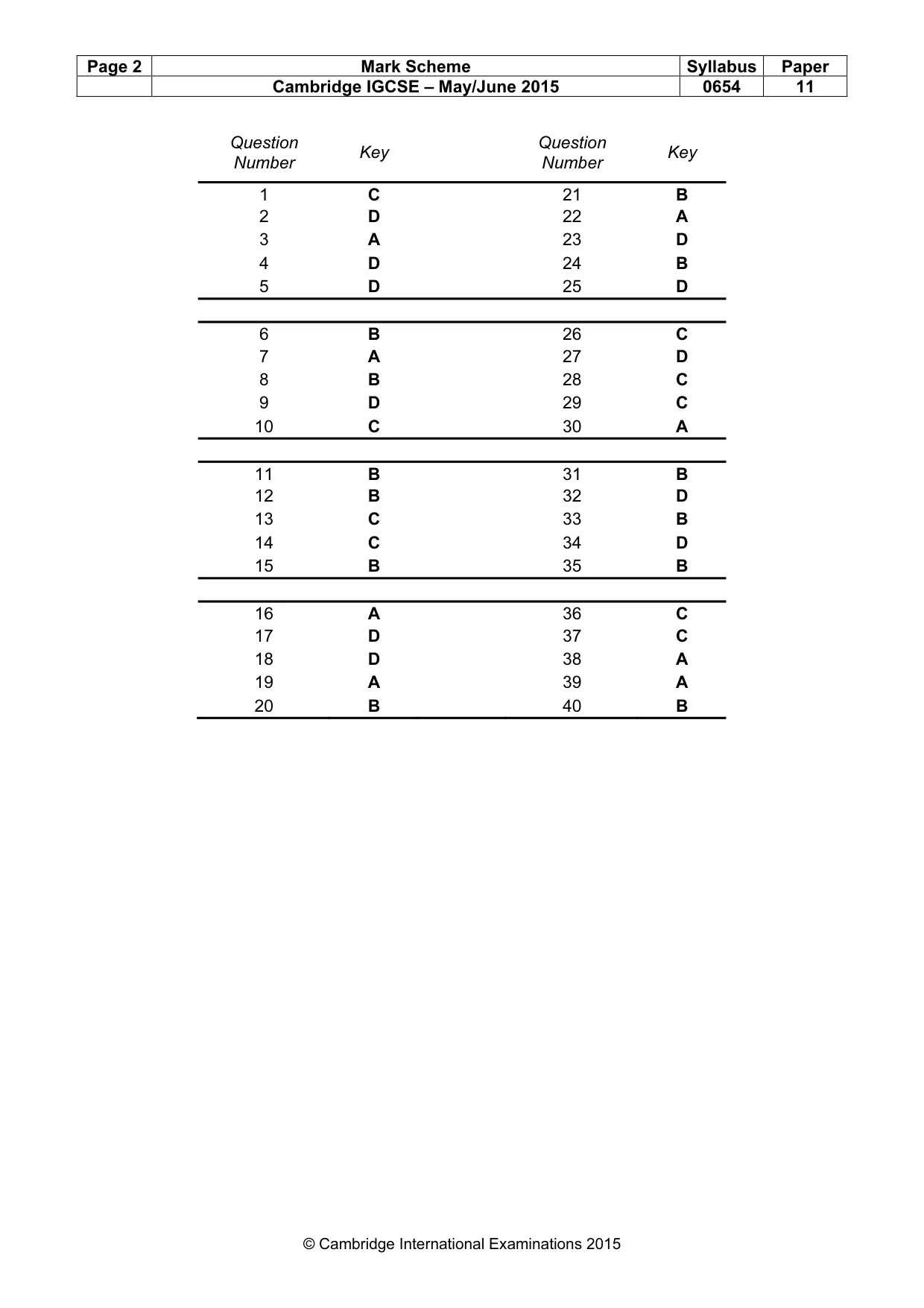
Answers below. Sit the paper first if you are practising.
Questions as text
Q1 · Which is a characteristic of all living things?
1 Which is a characteristic of all living things? A a heart B breathing C excretion D sexual reproduction
Mark scheme: C
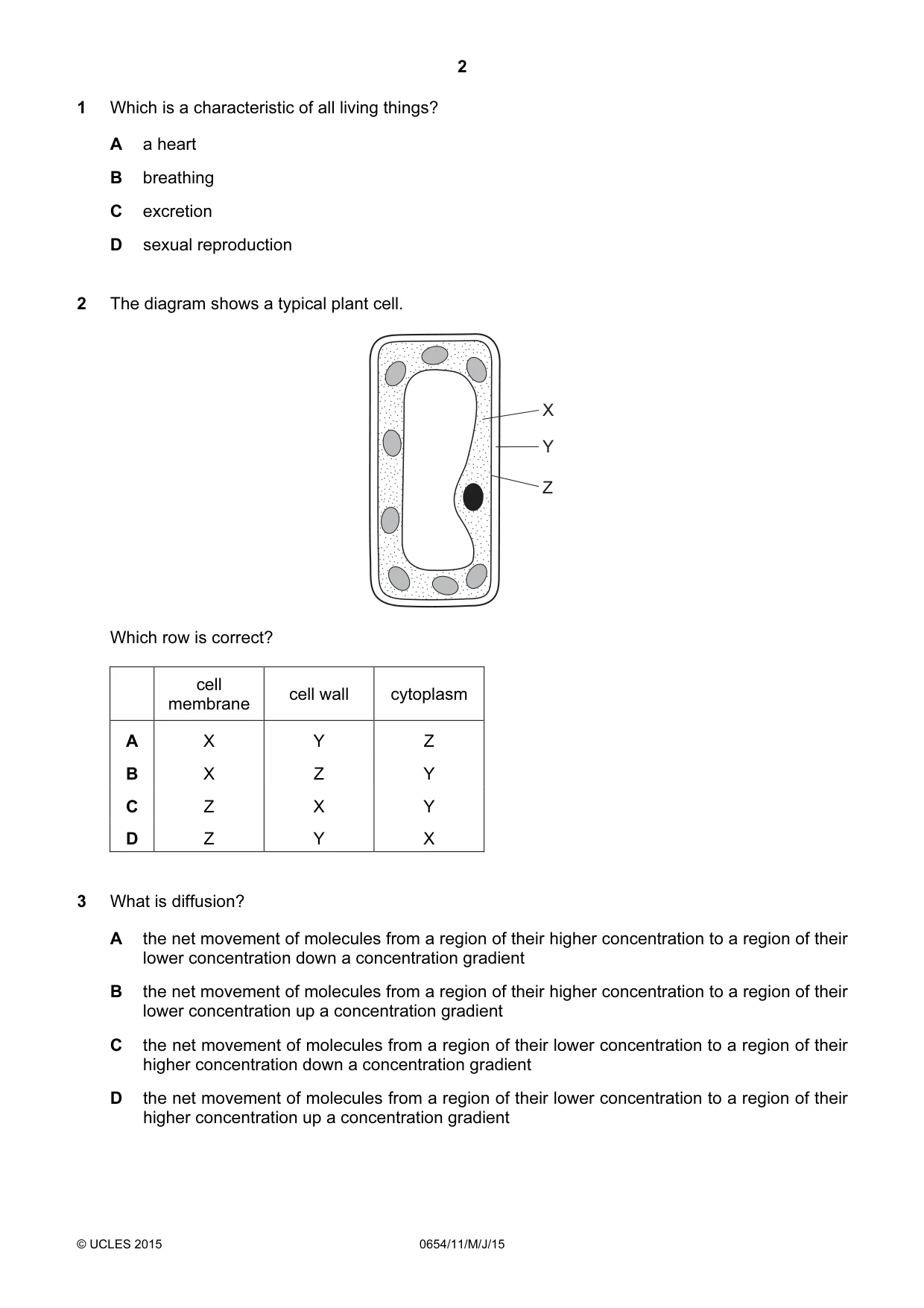
Q2 · The diagram shows a typical plant cell
2 The diagram shows a typical plant cell. X Y Z Which row is correct? cell cell wall cytoplasm membrane A X Y Z B X Z Y C Z X Y D Z Y X
Mark scheme: D
Question 3
3 What is diffusion? A the net movement of molecules from a region of their higher concentration to a region of their lower concentration down a concentration gradient B the net movement of molecules from a region of their higher concentration to a region of their lower concentration up a concentration gradient C the net movement of molecules from a region of their lower concentration to a region of their higher concentration down a concentration gradient D the net movement of molecules from a region of their lower concentration to a region of their higher concentration up a concentration gradient
Mark scheme: A
Q4 · What is an enzyme?
4 What is an enzyme? A a carbohydrate that assists in the digestion of the contents of the stomach B a chemical that absorbs light for photosynthesis C a chemical that alters the activity of a target organ D a protein that alters the rate of a chemical reaction
Mark scheme: D
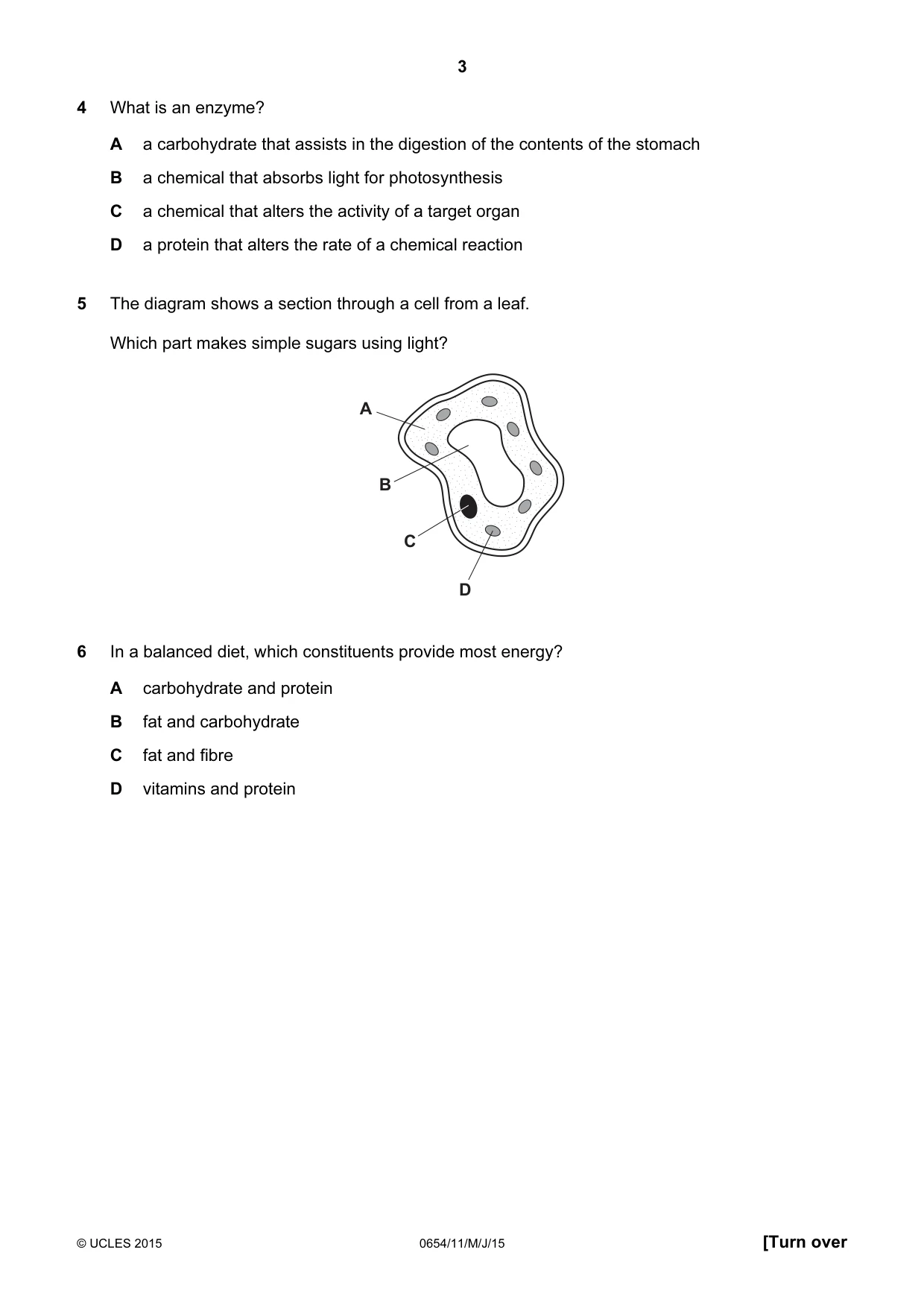
Q5 · The diagram shows a section through a cell from a leaf
5 The diagram shows a section through a cell from a leaf. Which part makes simple sugars using light? A B C D
Mark scheme: D
Q6 · In a balanced diet, which constituents provide most energy?
6 In a balanced diet, which constituents provide most energy? A carbohydrate and protein B fat and carbohydrate C fat and fibre D vitamins and protein
Mark scheme: B
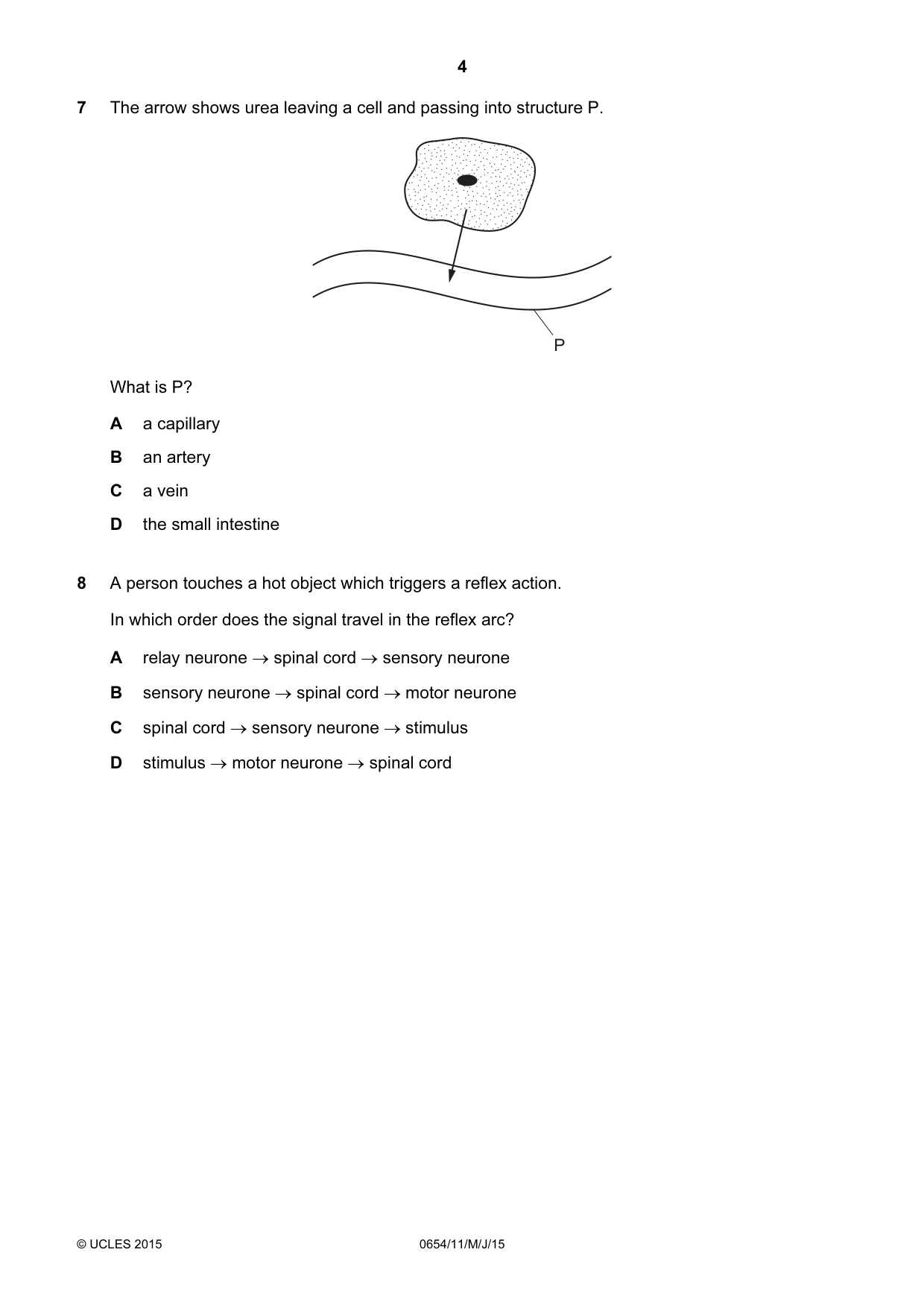
Q7 · The arrow shows urea leaving a cell and passing into structure P
7 The arrow shows urea leaving a cell and passing into structure P. P What is P? A a capillary B an artery C a vein D the small intestine
Mark scheme: A
Q8 · A person touches a hot object which triggers a reflex action
8 A person touches a hot object which triggers a reflex action. In which order does the signal travel in the reflex arc? A relay neurone → spinal cord → sensory neurone B sensory neurone → spinal cord → motor neurone C spinal cord → sensory neurone → stimulus D stimulus → motor neurone → spinal cord
Mark scheme: B
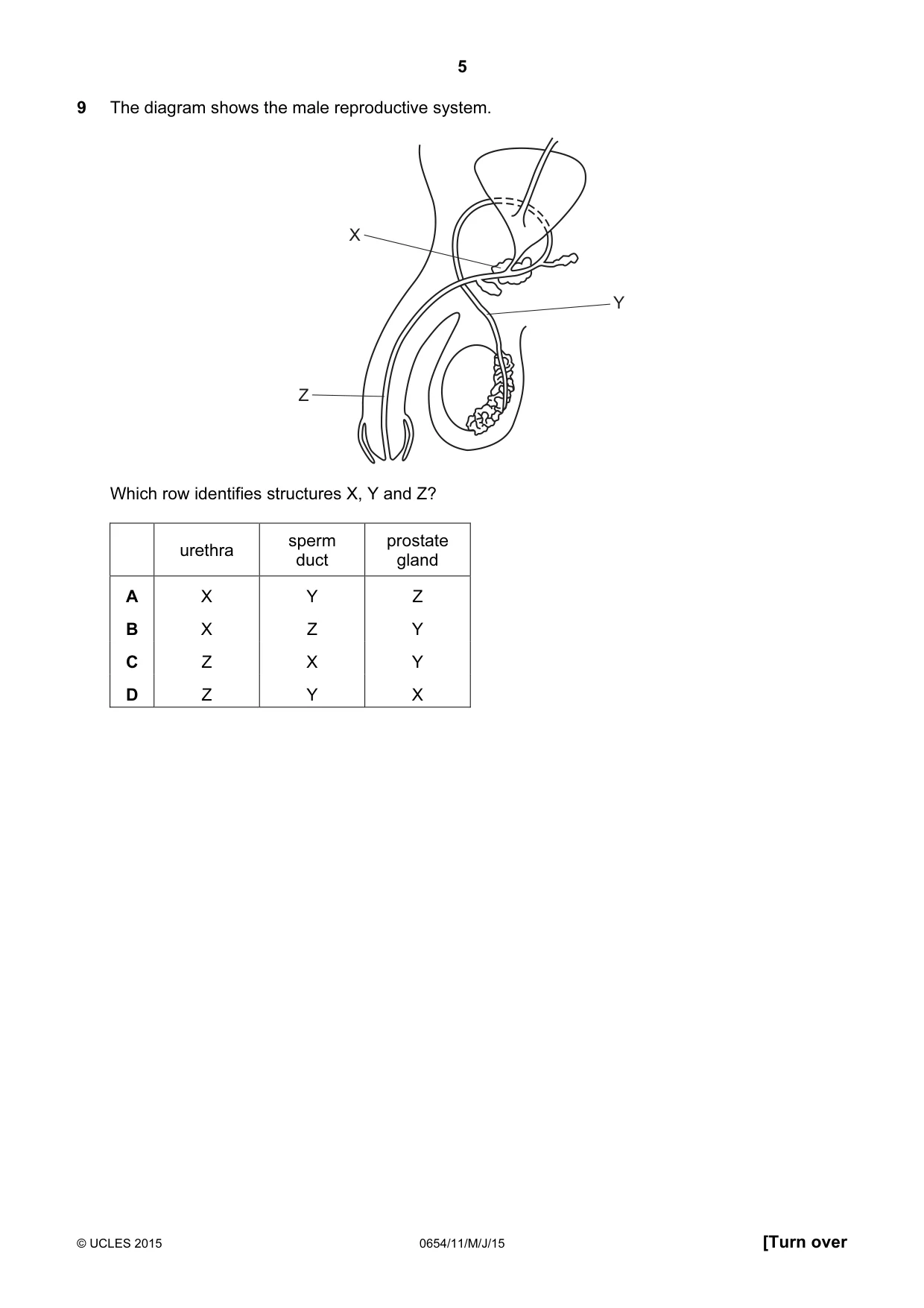
Q9 · The diagram shows the male reproductive system
9 The diagram shows the male reproductive system. X Y Z Which row identifies structures X, Y and Z? sperm prostate urethra duct gland A X Y Z B X Z Y C Z X Y D Z Y X
Mark scheme: D
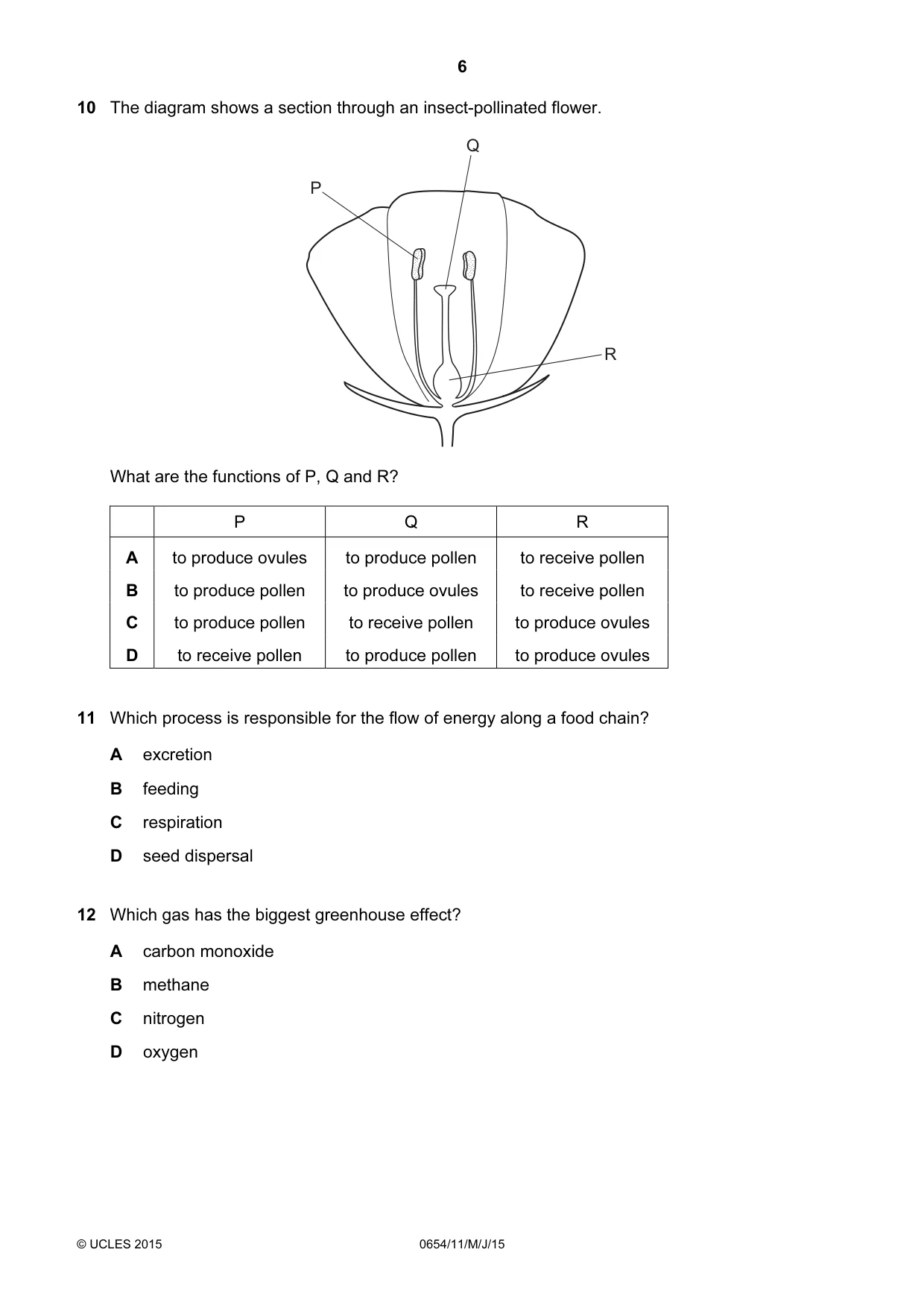
Q10 · The diagram shows a section through an insect-pollinated flower
10 The diagram shows a section through an insect-pollinated flower. Q P R What are the functions of P, Q and R? P Q R A to produce ovules to produce pollen to receive pollen B to produce pollen to produce ovules to receive pollen C to produce pollen to receive pollen to produce ovules D to receive pollen to produce pollen to produce ovules
Mark scheme: C
Q11 · Which process is responsible for the flow of energy along a food chain?
11 Which process is responsible for the flow of energy along a food chain? A excretion B feeding C respiration D seed dispersal
Mark scheme: B
Q12 · Which gas has the biggest greenhouse effect?
12 Which gas has the biggest greenhouse effect? A carbon monoxide B methane C nitrogen D oxygen
Mark scheme: B
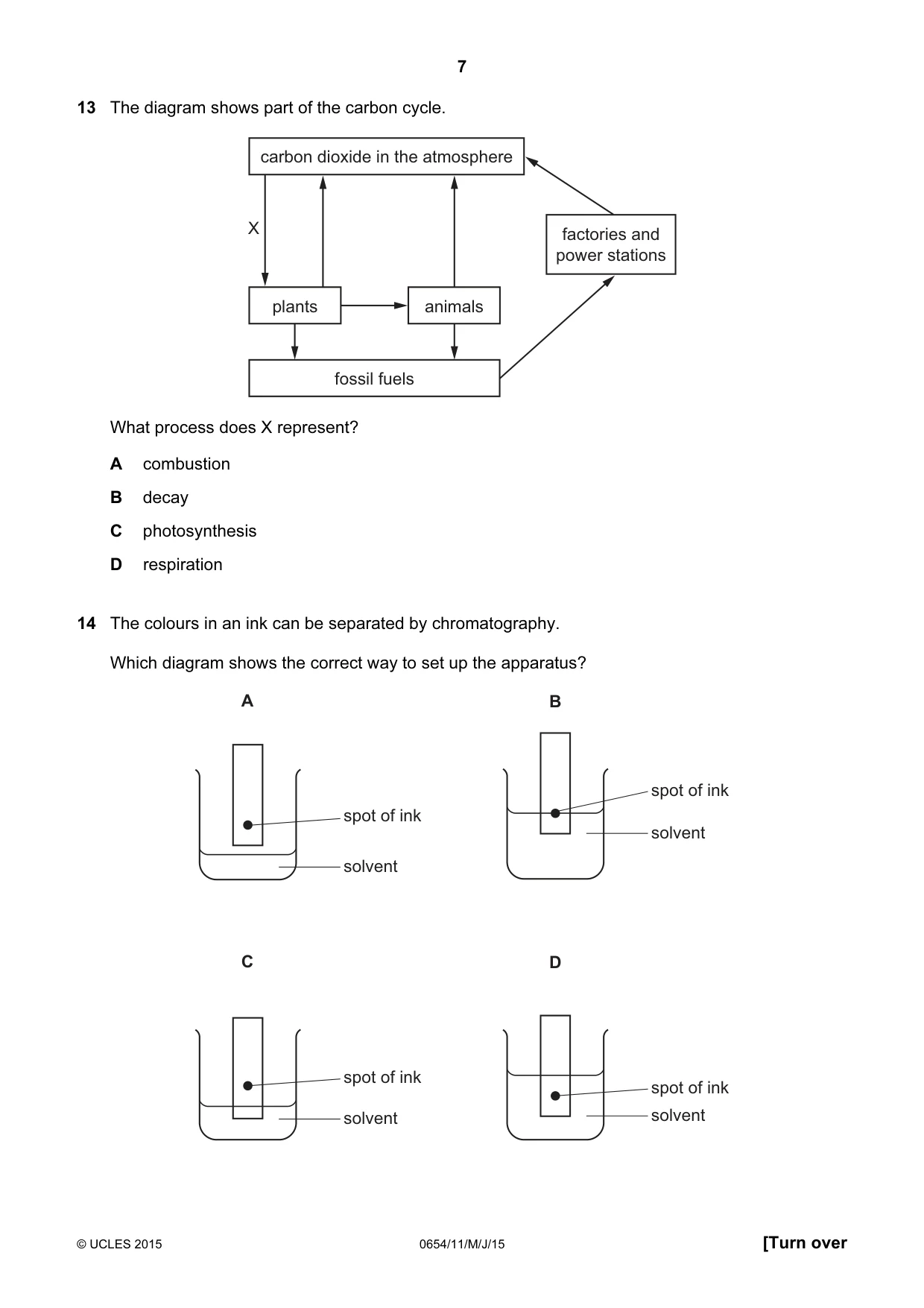
Q13 · The diagram shows part of the carbon cycle
13 The diagram shows part of the carbon cycle. carbon dioxide in the atmosphere X factories and power stations plants animals fossil fuels What process does X represent? A combustion B decay C photosynthesis D respiration
Mark scheme: C
Q14 · The colours in an ink can be separated by chromatography
14 The colours in an ink can be separated by chromatography. Which diagram shows the correct way to set up the apparatus? A B spot of ink spot of ink solvent solvent C D spot of ink spot of ink solvent solvent
Mark scheme: C
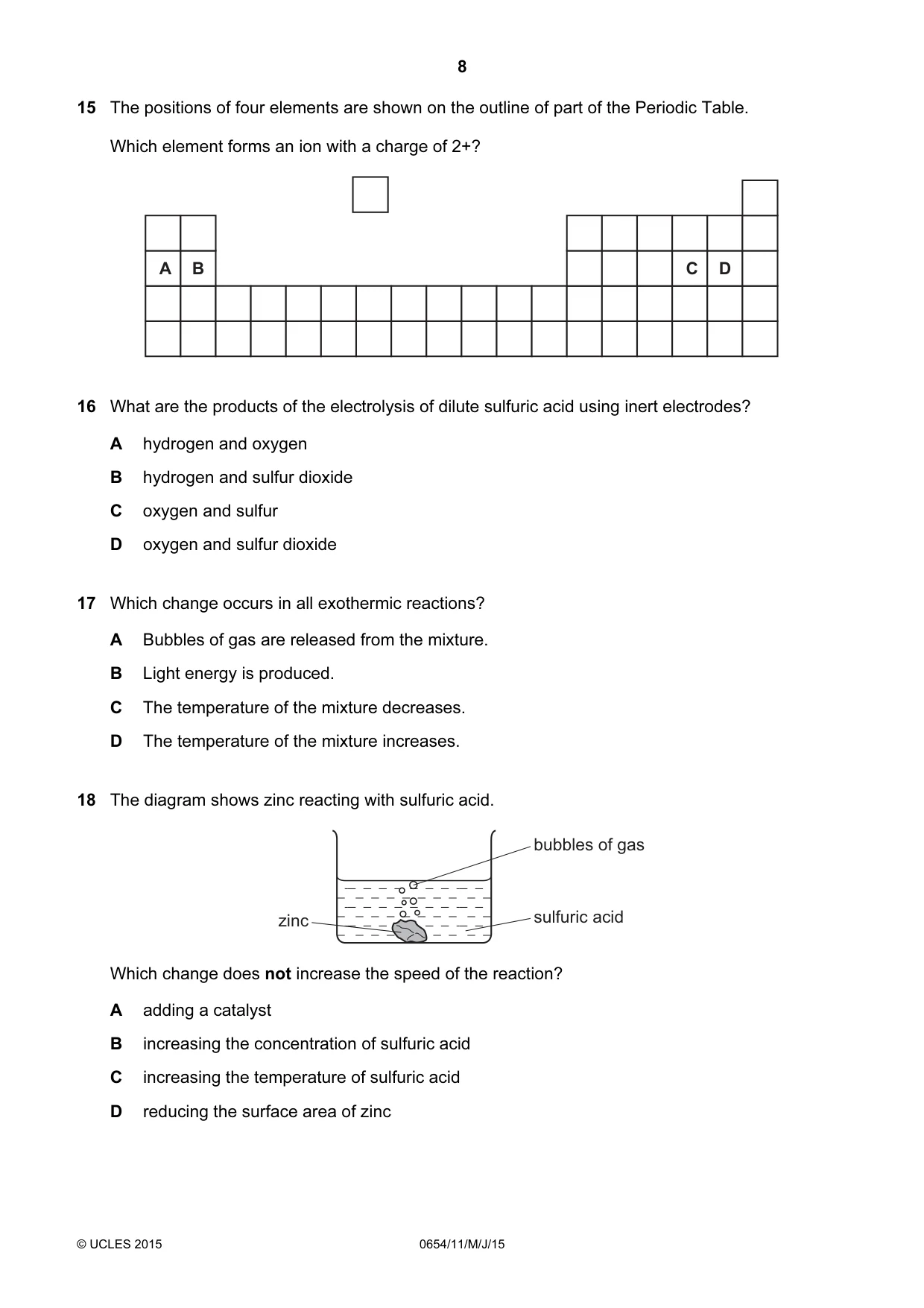
Q15 · The positions of four elements are shown on the outline of part of the Periodic Table
15 The positions of four elements are shown on the outline of part of the Periodic Table. Which element forms an ion with a charge of 2+? A B C D
Mark scheme: B
Q16 · What are the products of the electrolysis of dilute sulfuric acid using inert electrodes?
16 What are the products of the electrolysis of dilute sulfuric acid using inert electrodes? A hydrogen and oxygen B hydrogen and sulfur dioxide C oxygen and sulfur D oxygen and sulfur dioxide
Mark scheme: A
Q17 · Which change occurs in all exothermic reactions?
17 Which change occurs in all exothermic reactions? A Bubbles of gas are released from the mixture. B Light energy is produced. C The temperature of the mixture decreases. D The temperature of the mixture increases.
Mark scheme: D
Q18 · The diagram shows zinc reacting with sulfuric acid
18 The diagram shows zinc reacting with sulfuric acid. bubbles of gas zinc sulfuric acid Which change does not increase the speed of the reaction? A adding a catalyst B increasing the concentration of sulfuric acid C increasing the temperature of sulfuric acid D reducing the surface area of zinc
Mark scheme: D
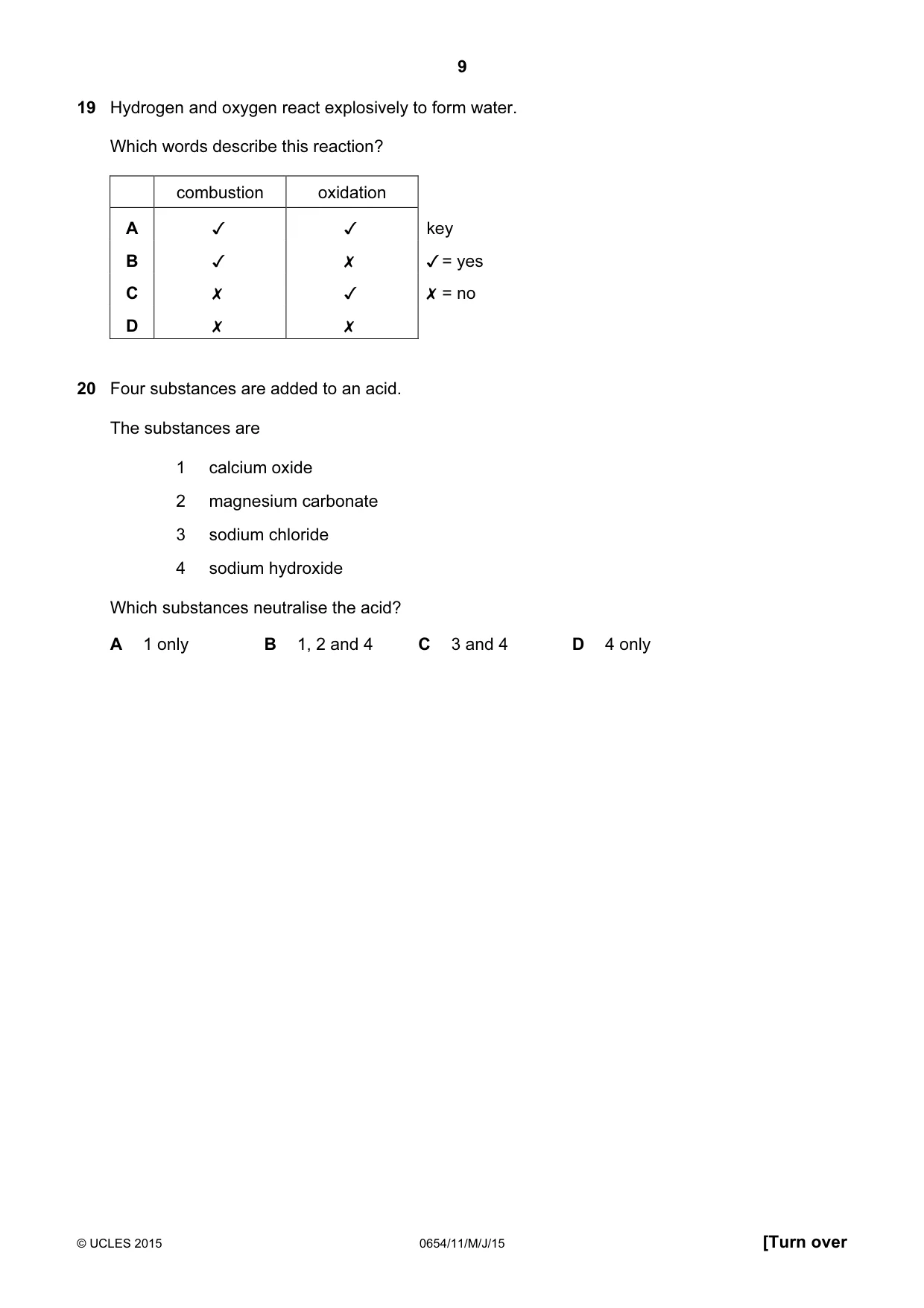
Q19 · Hydrogen and oxygen react explosively to form water
19 Hydrogen and oxygen react explosively to form water. Which words describe this reaction? combustion oxidation A v v B v x Cc x v D x x key v/=yes X =no
Mark scheme: A
Q20 · Four substances are added to an acid
20 Four substances are added to an acid. The substances are 1 calcium oxide 2 magnesium carbonate 3 sodium chloride 4 sodium hydroxide Which substances neutralise the acid? A 1 only B 1, 2 and 4 C 3 and 4 D 4 only
Mark scheme: B
More questions on The characteristic properties of acids and bases
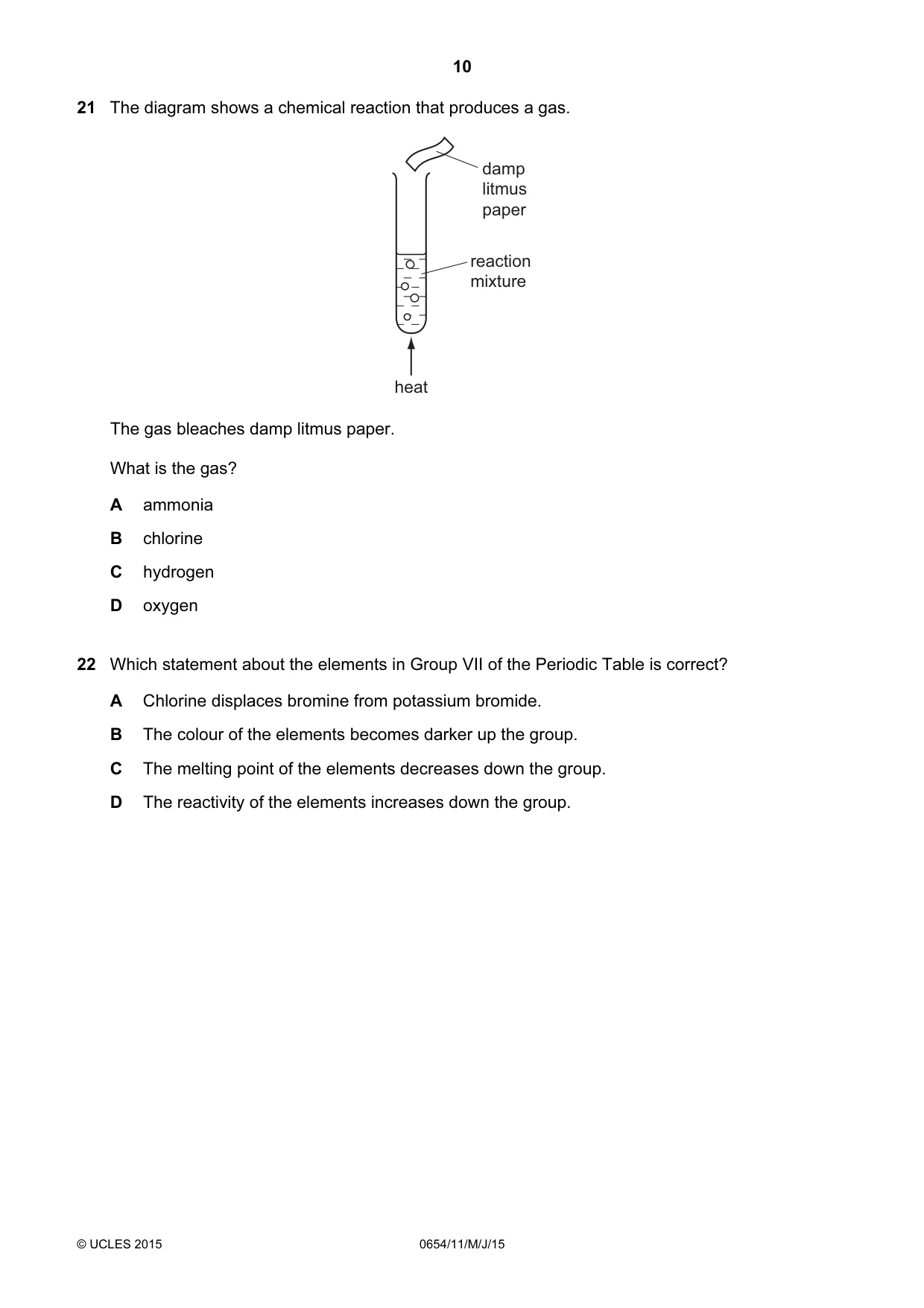
Q21 · The diagram shows a chemical reaction that produces a gas
21 The diagram shows a chemical reaction that produces a gas. damp litmus paper reaction mixture heat The gas bleaches damp litmus paper. What is the gas? A ammonia B chlorine C hydrogen D oxygen
Mark scheme: B
Q22 · Which statement about the elements in Group VII of the Periodic Table is correct?
22 Which statement about the elements in Group VII of the Periodic Table is correct? A Chlorine displaces bromine from potassium bromide. B The colour of the elements becomes darker up the group. C The melting point of the elements decreases down the group. D The reactivity of the elements increases down the group.
Mark scheme: A
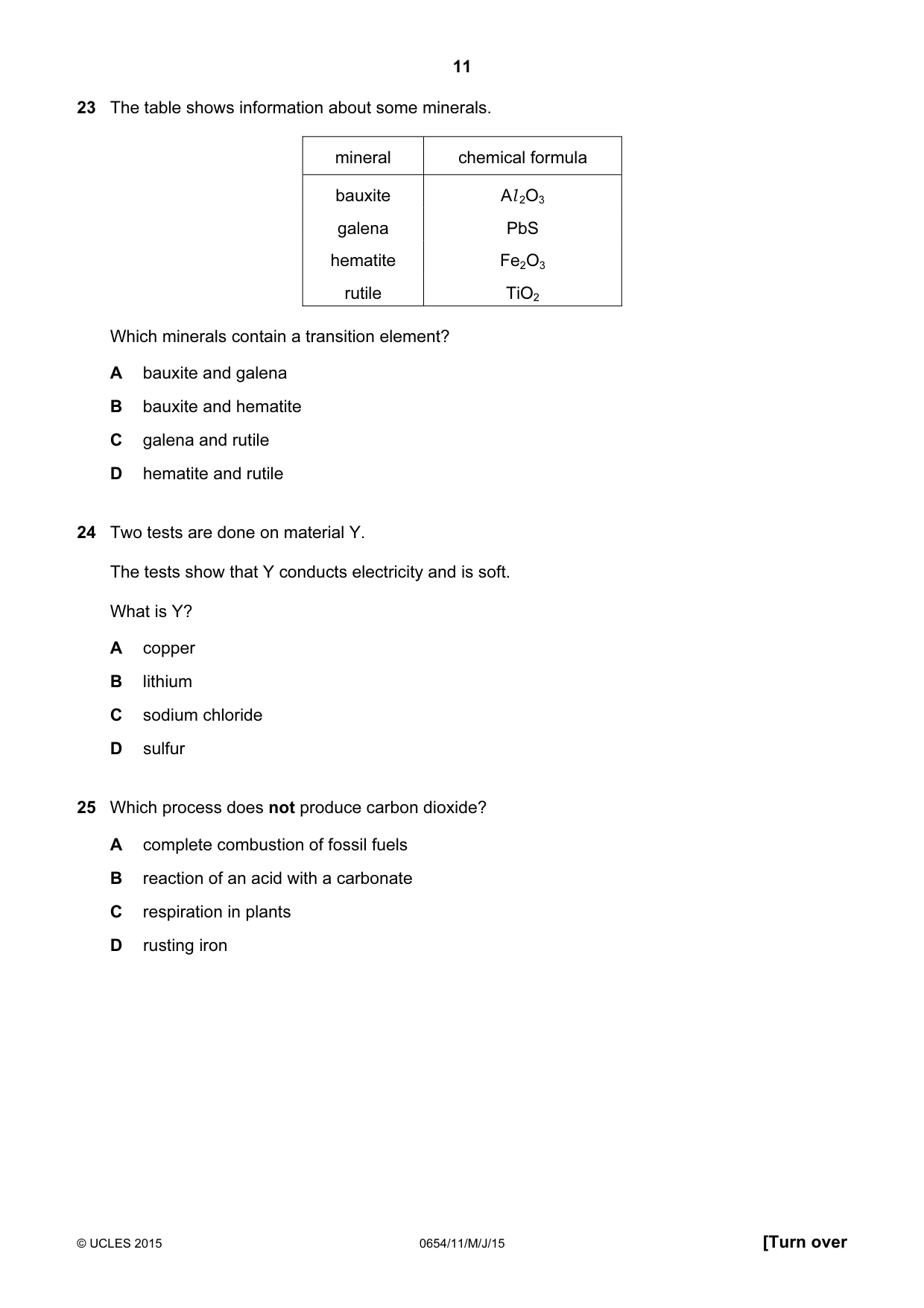
Q23 · The table shows information about some minerals
23 The table shows information about some minerals. mineral chemical formula bauxite Al 2O3 galena PbS hematite Fe2O3 rutile TiO2 Which minerals contain a transition element? A bauxite and galena B bauxite and hematite C galena and rutile D hematite and rutile
Mark scheme: D
Q24 · Two tests are done on material Y
24 Two tests are done on material Y. The tests show that Y conducts electricity and is soft. What is Y? A copper B lithium C sodium chloride D sulfur
Mark scheme: B
Q25 · Which process does not produce carbon dioxide?
25 Which process does not produce carbon dioxide? A complete combustion of fossil fuels B reaction of an acid with a carbonate C respiration in plants D rusting iron
Mark scheme: D
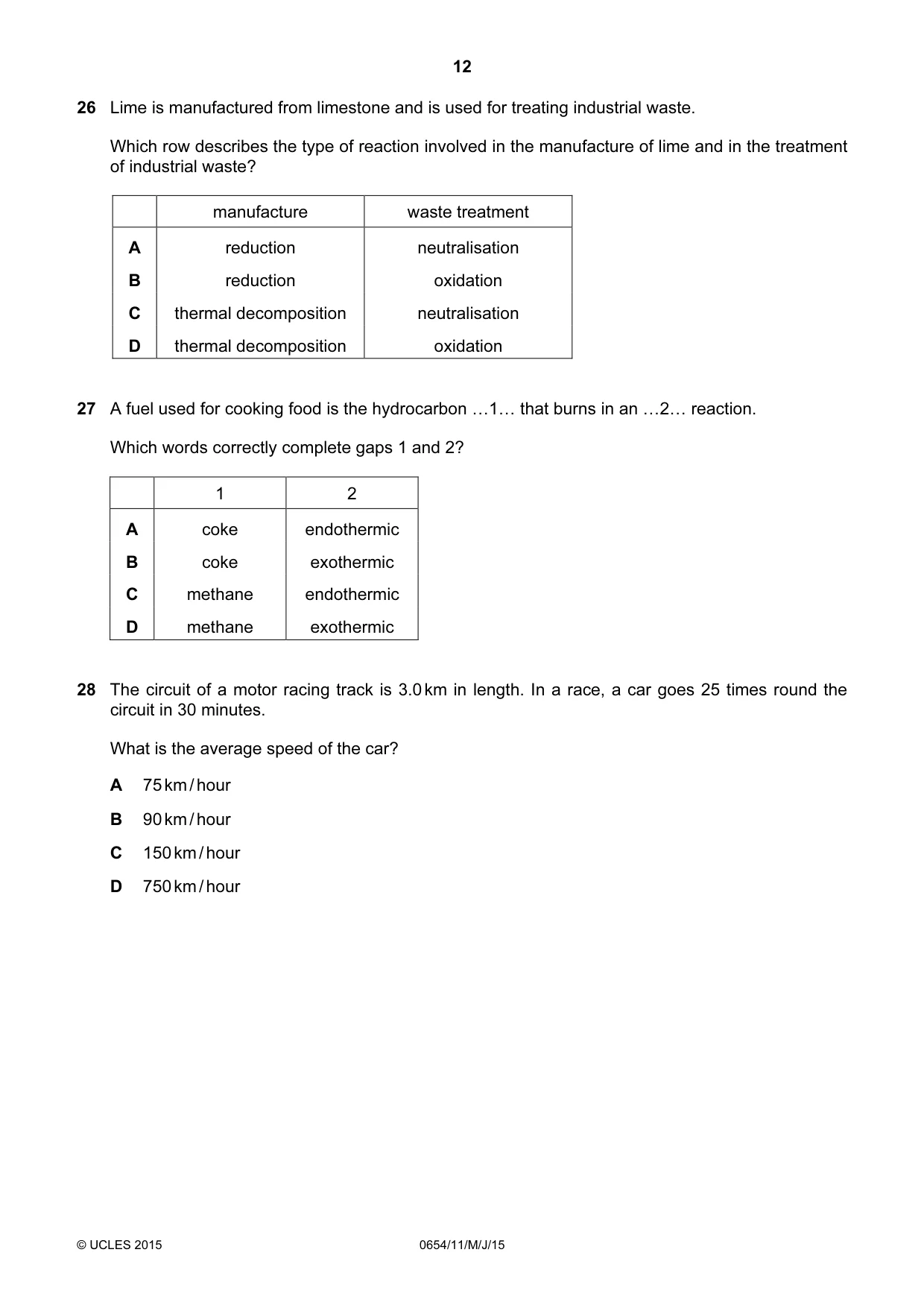
Q26 · Lime is manufactured from limestone and is used for treating industrial waste
26 Lime is manufactured from limestone and is used for treating industrial waste. Which row describes the type of reaction involved in the manufacture of lime and in the treatment of industrial waste? manufacture waste treatment A reduction neutralisation B reduction oxidation C thermal decomposition neutralisation D thermal decomposition oxidation
Mark scheme: C
Q27 · A fuel used for cooking food is the hydrocarbon …1… that burns in an …2… reaction
27 A fuel used for cooking food is the hydrocarbon …1… that burns in an …2… reaction. Which words correctly complete gaps 1 and 2? 1 2 A coke endothermic B coke exothermic C methane endothermic D methane exothermic
Mark scheme: D
Q28 · The circuit of a motor racing track is 3.0 km in length
28 The circuit of a motor racing track is 3.0 km in length. In a race, a car goes 25 times round the circuit in 30 minutes. What is the average speed of the car? A 75 km / hour B 90 km / hour C 150 km / hour D 750 km / hour
Mark scheme: C
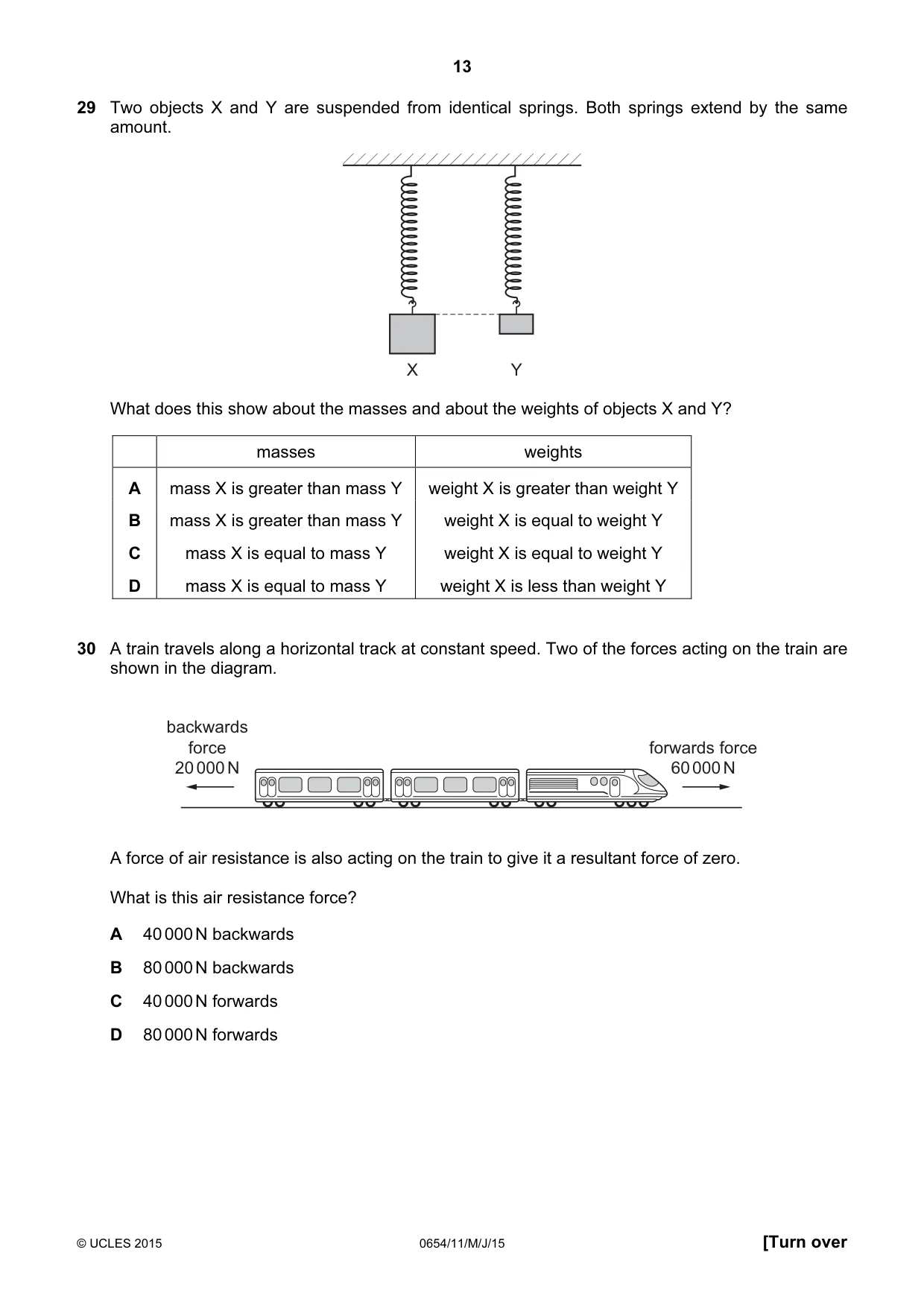
Q29 · Two objects X and Y are suspended from identical springs
29 Two objects X and Y are suspended from identical springs. Both springs extend by the same amount. X Y What does this show about the masses and about the weights of objects X and Y? masses weights A mass X is greater than mass Y weight X is greater than weight Y B mass X is greater than mass Y weight X is equal to weight Y C mass X is equal to mass Y weight X is equal to weight Y D mass X is equal to mass Y weight X is less than weight Y
Mark scheme: C
Q30 · A train travels along a horizontal track at constant speed
30 A train travels along a horizontal track at constant speed. Two of the forces acting on the train are shown in the diagram. backwards force forwards force 20 000 N 60 000 N A force of air resistance is also acting on the train to give it a resultant force of zero. What is this air resistance force? A 40 000 N backwards B 80 000 N backwards C 40 000 N forwards D 80 000 N forwards
Mark scheme: A
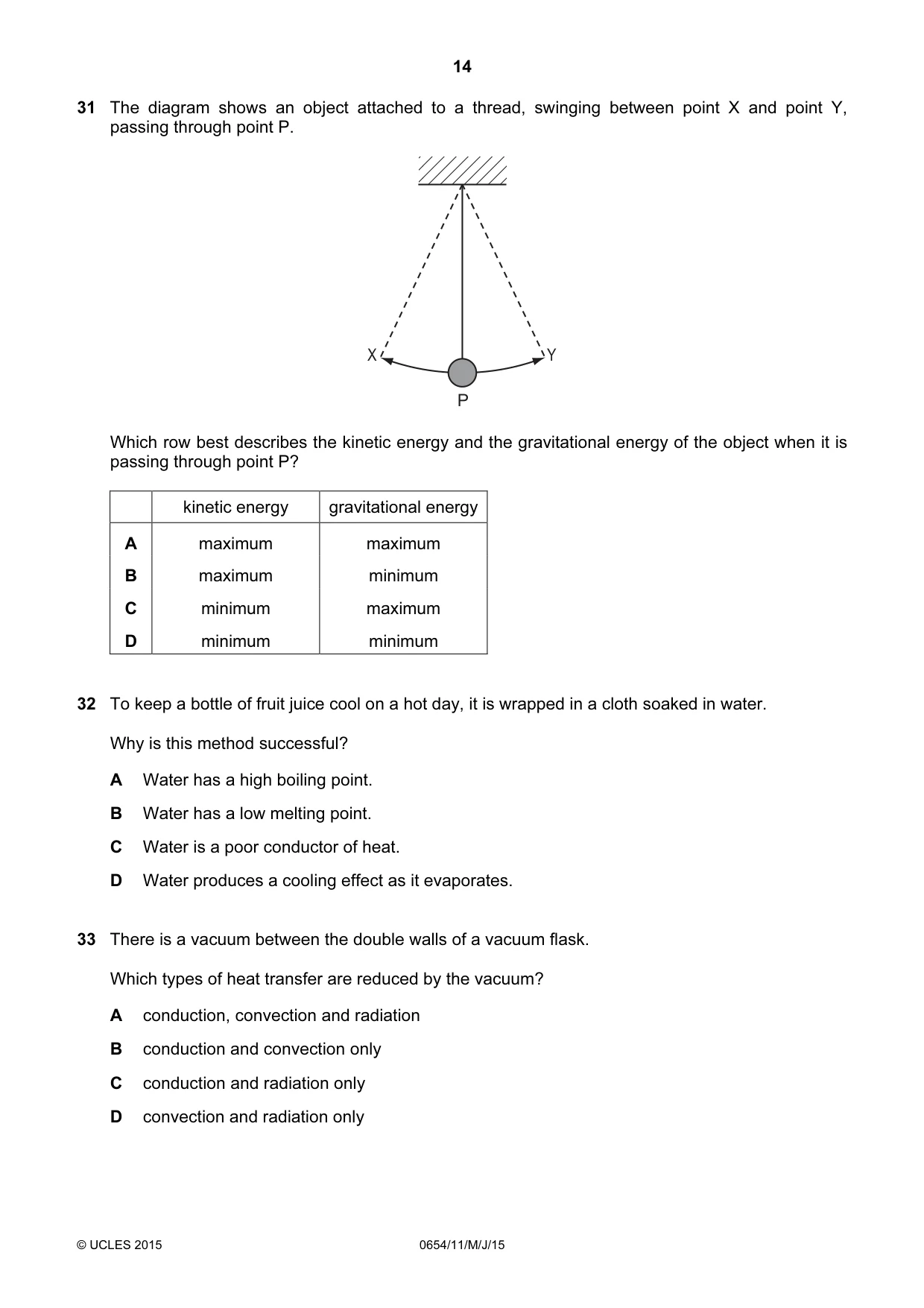
Q31 · The diagram shows an object attached to a thread, swinging between point X and point Y…
31 The diagram shows an object attached to a thread, swinging between point X and point Y, passing through point P. X Y P Which row best describes the kinetic energy and the gravitational energy of the object when it is passing through point P? kinetic energy gravitational energy A maximum maximum B maximum minimum C minimum maximum D minimum minimum
Mark scheme: B
Q32 · To keep a bottle of fruit juice cool on a hot day, it is wrapped in a cloth soaked in…
32 To keep a bottle of fruit juice cool on a hot day, it is wrapped in a cloth soaked in water. Why is this method successful? A Water has a high boiling point. B Water has a low melting point. C Water is a poor conductor of heat. D Water produces a cooling effect as it evaporates.
Mark scheme: D
Q33 · There is a vacuum between the double walls of a vacuum flask
33 There is a vacuum between the double walls of a vacuum flask. Which types of heat transfer are reduced by the vacuum? A conduction, convection and radiation B conduction and convection only C conduction and radiation only D convection and radiation only
Mark scheme: B
Q34 · Which row gives an example of a longitudinal wave and describes the direction of the…
34 Which row gives an example of a longitudinal wave and describes the direction of the vibrations? example of a vibrations longitudinal wave A light wave at right angles to the direction the wave travels B Iight wave in the same direction as the wave travels C sound wave at right angles to the direction the wave travels D sound wave in the same direction as the wave travels
Mark scheme: D
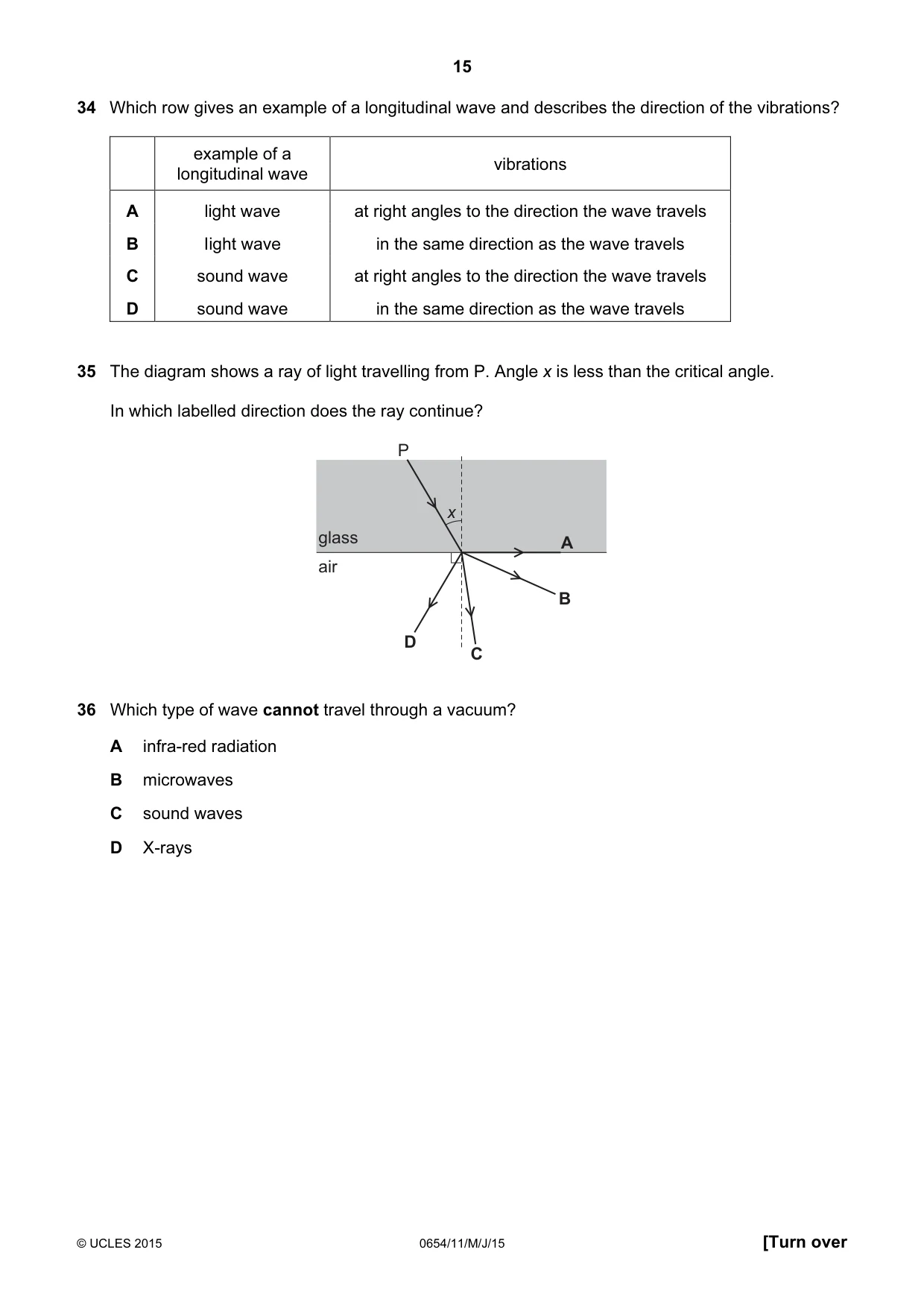
Q35 · The diagram shows a ray of light travelling from P
35 The diagram shows a ray of light travelling from P. Angle x is less than the critical angle. In which labelled direction does the ray continue? P x glass A air B D C
Mark scheme: B
Q36 · Which type of wave cannot travel through a vacuum?
36 Which type of wave cannot travel through a vacuum? A infra-red radiation B microwaves C sound waves D X-rays
Mark scheme: C
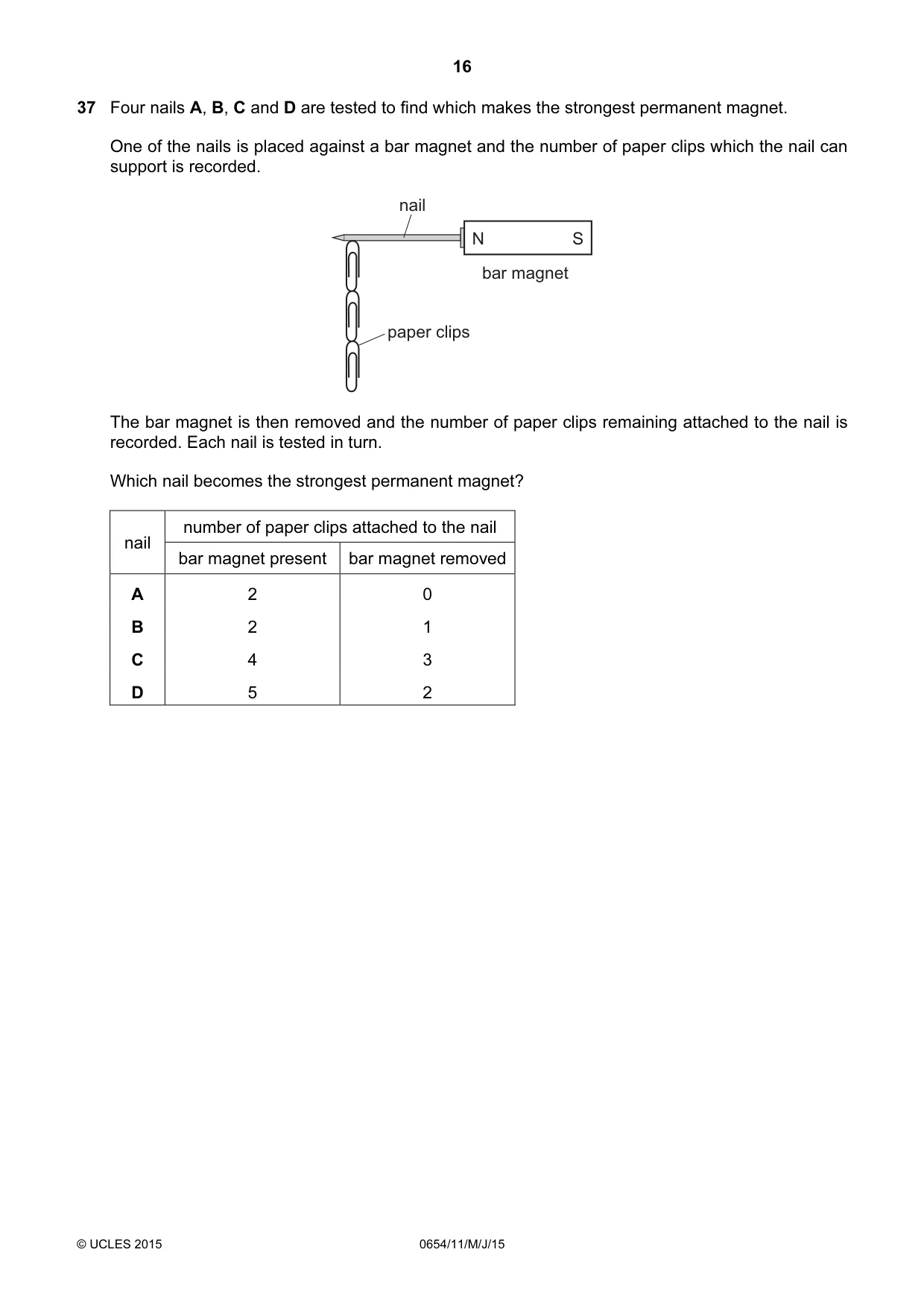
Q37 · Four nails A, B, C and D are tested to find which makes the strongest permanent magnet
37 Four nails A, B, C and D are tested to find which makes the strongest permanent magnet. One of the nails is placed against a bar magnet and the number of paper clips which the nail can support is recorded. nail N S bar magnet paper clips The bar magnet is then removed and the number of paper clips remaining attached to the nail is recorded. Each nail is tested in turn. Which nail becomes the strongest permanent magnet? number of paper clips attached to the nail nail bar magnet present bar magnet removed A 2 0 B 2 1 C 4 3 D 5 2
Mark scheme: C
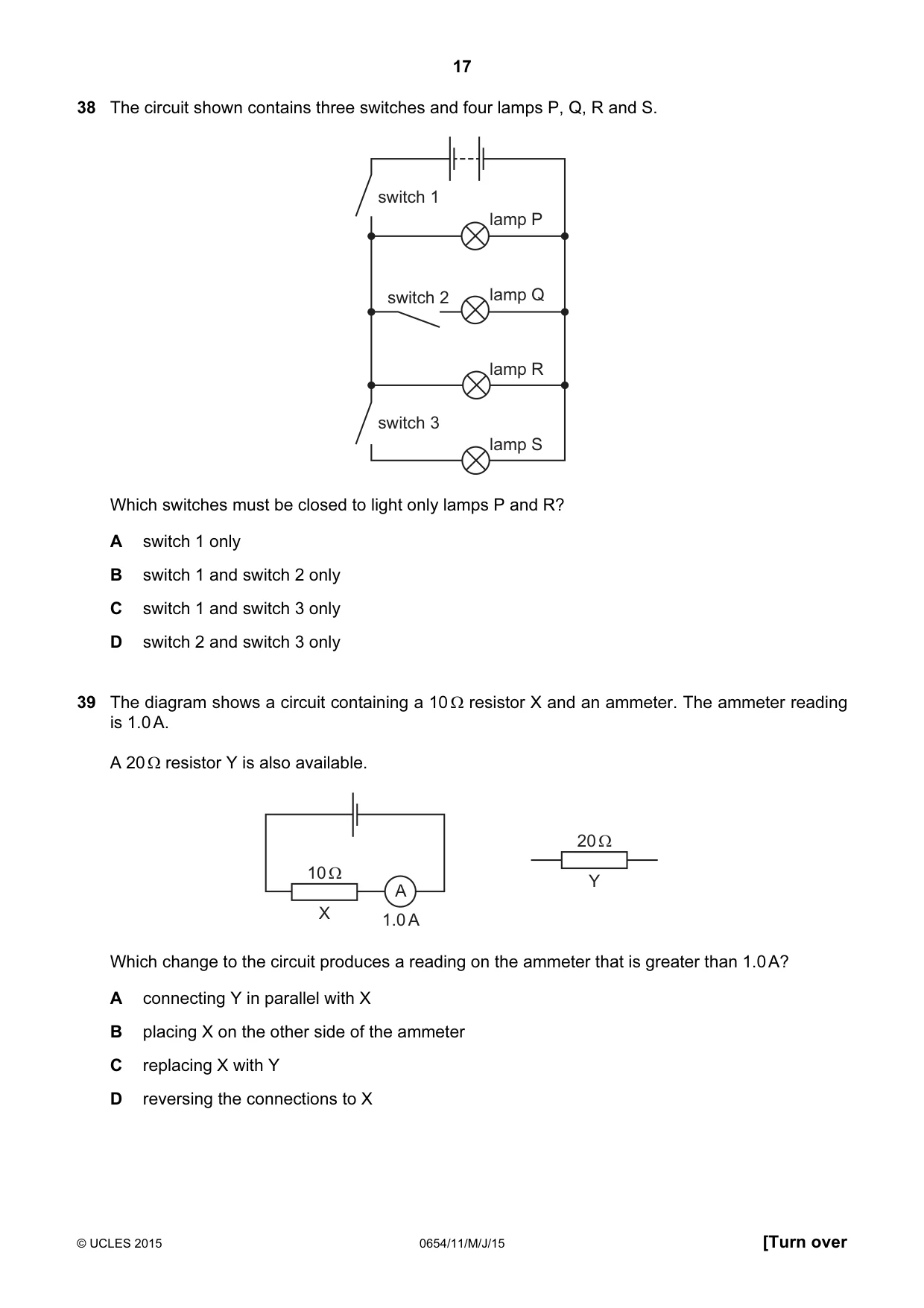
Q38 · The circuit shown contains three switches and four lamps P, Q, R and S
38 The circuit shown contains three switches and four lamps P, Q, R and S. switch 1 lamp P switch 2 lamp Q lamp R switch 3 lamp S Which switches must be closed to light only lamps P and R? A switch 1 only B switch 1 and switch 2 only C switch 1 and switch 3 only D switch 2 and switch 3 only
Mark scheme: A
Q39 · The diagram shows a circuit containing a 10 Ω resistor X and an ammeter
39 The diagram shows a circuit containing a 10 Ω resistor X and an ammeter. The ammeter reading is 1.0 A. A 20 Ω resistor Y is also available. 20 Ω 10 Ω Y A X 1.0 A Which change to the circuit produces a reading on the ammeter that is greater than 1.0 A? A connecting Y in parallel with X B placing X on the other side of the ammeter C replacing X with Y D reversing the connections to X
Mark scheme: A
Q40 · Which type of radiation has the greatest ionising effect?
40 Which type of radiation has the greatest ionising effect? A infra-red rays B α–particles C β–particles D γ–rays
Mark scheme: B
What was in this paper
The subtopics covered by these 40 questions, and how many questions each got. Open one in a new tab to see every Cambridge question on it.
2Electrical circuits2Transfer of thermal energy2Blood vessels1Carbon cycle1Cell structure1Characteristics of living organisms1Chromatography1Coordination and response1Diet1Diffusion1Electrolysis1Energy flow1Energy, work and power1Enzymes1Exothermic and endothermic reactions1Forces1Fuels1General properties of waves1Group VII properties1Identification of ions and gases1Ions and ionic bonds1Light1Mass and weight1Motion1Photosynthesis1Preparation of salts1Properties of metals1Radioactivity1Rate of reaction1Redox1Sexual reproduction in humans1Sexual reproduction in plants1Simple phenomena of magnetism1Sound1The characteristic properties of acids and bases1Transition elements1What you needed in this session
Cambridge’s own grade thresholds for 2015 May/June, Paper 1 · Variant 1. A higher threshold means an easier paper — the bar moves with how the cohort did.