Cambridge IGCSE Sciences - Co-ordinated (Double) 0654 — 2022 Feb/March Paper 1 · Variant 2
0654/12/F/M/22 · 40 questions · 40 marks · ≈45 min
The question paper and its mark scheme, free to read here and free to download. This is Cambridge’s own paper, exactly as it was sat.
Question paper20 pages



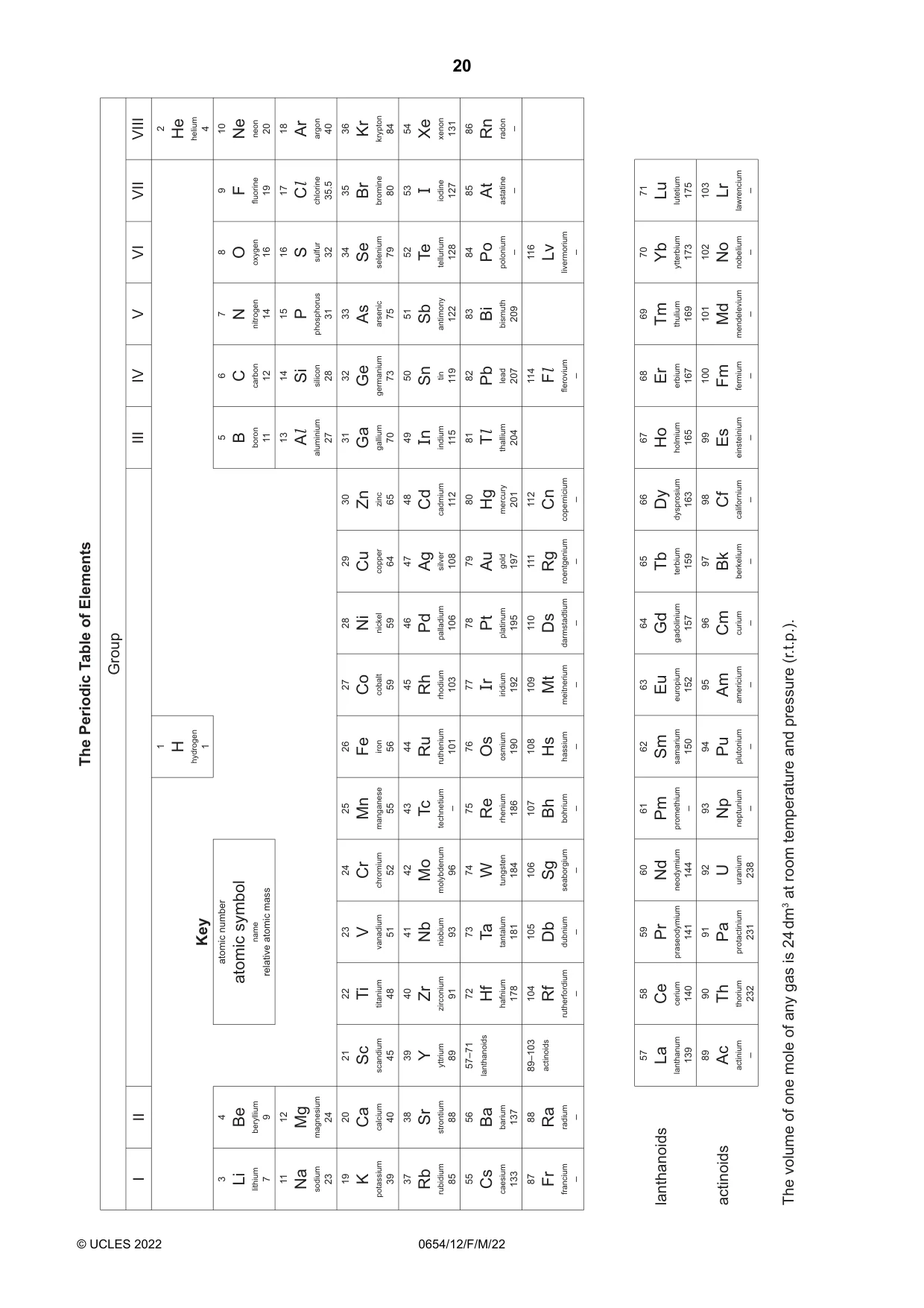
Mark scheme3 pages
Answers below. Sit the paper first if you are practising.
Questions as text
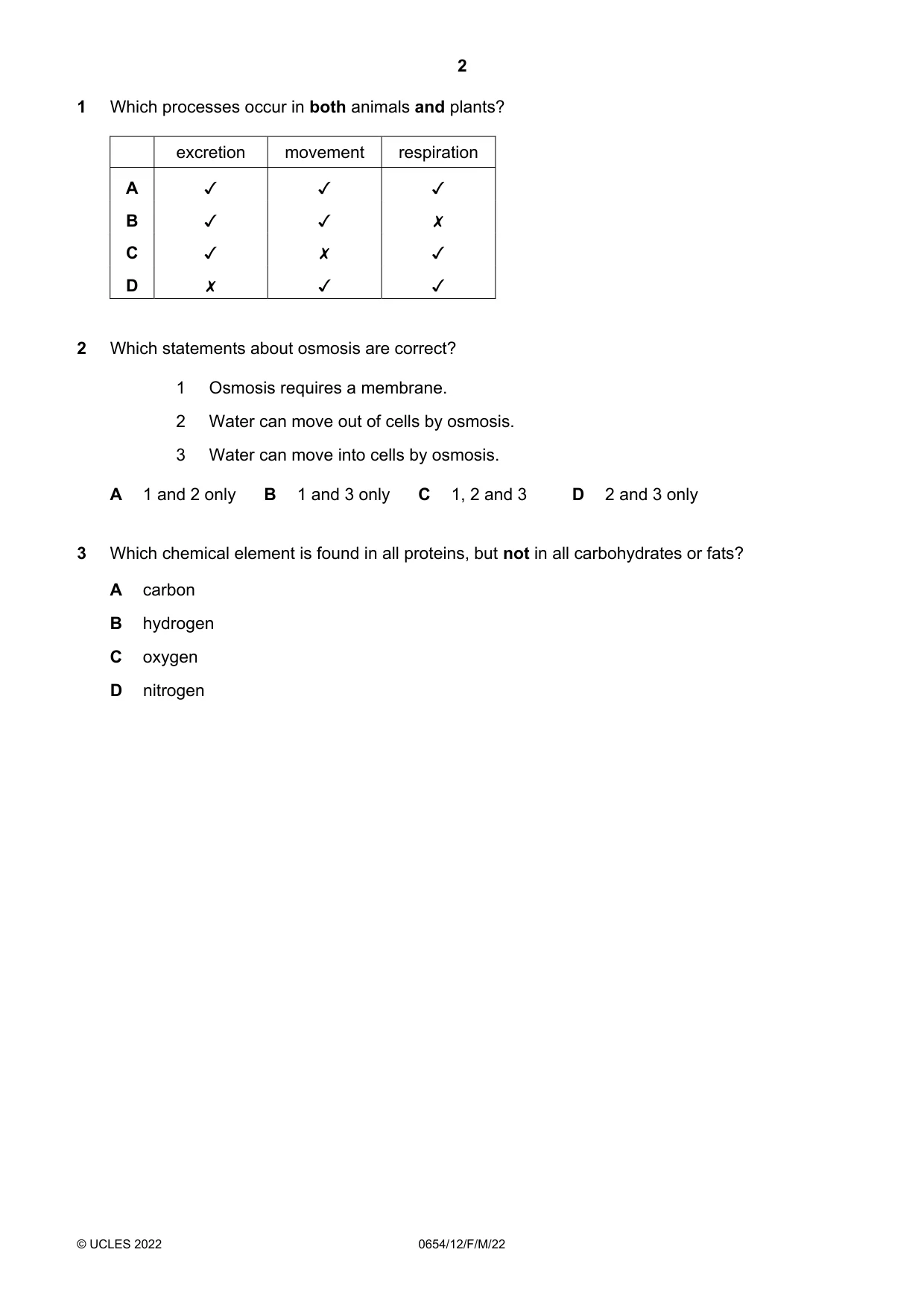
Q1 · Which processes occur in both animals and plants?
1. Which processes occur in both animals and plants? excretion movement respiration v v v 0 0O WwW > v v x v x v x v v
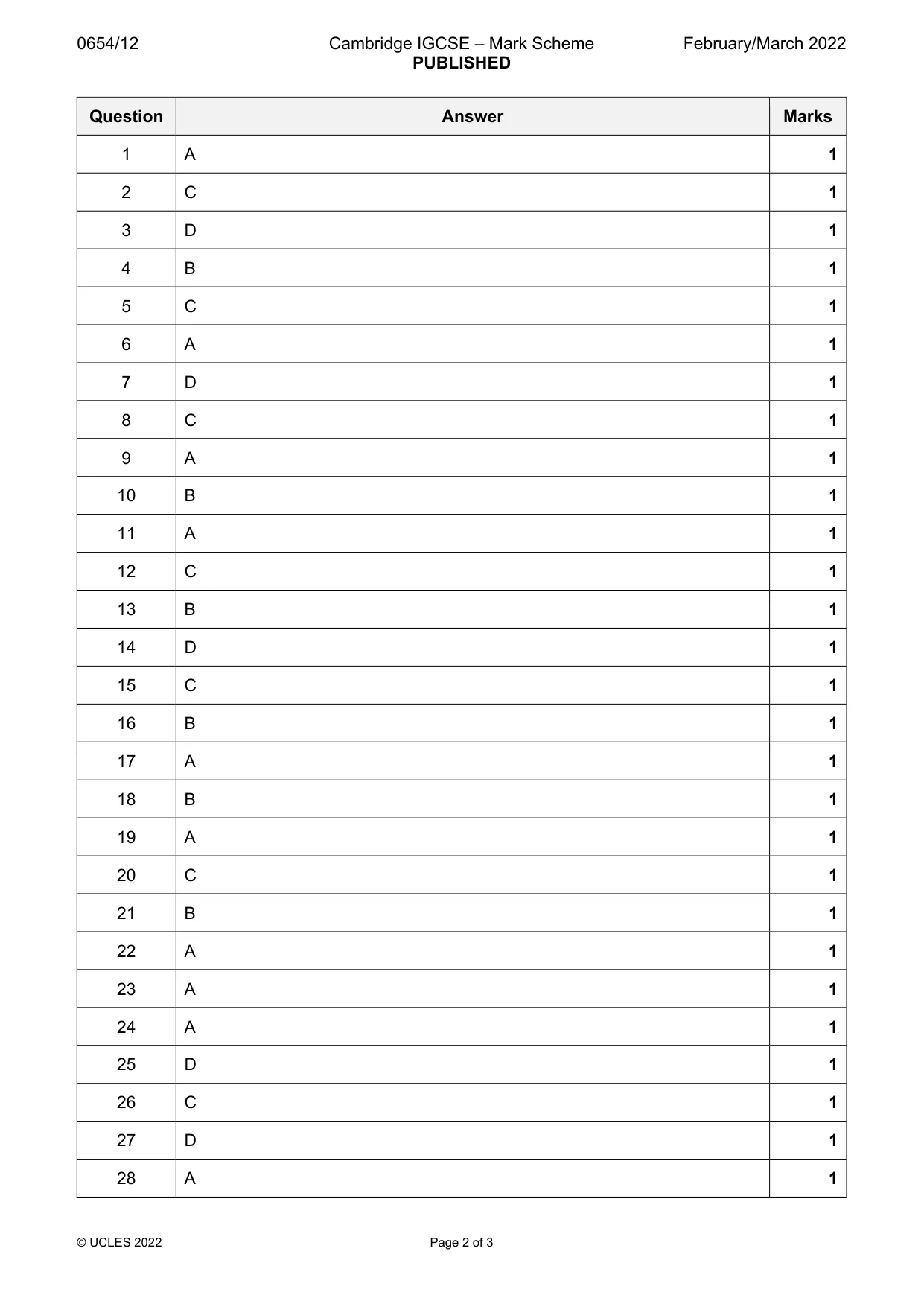
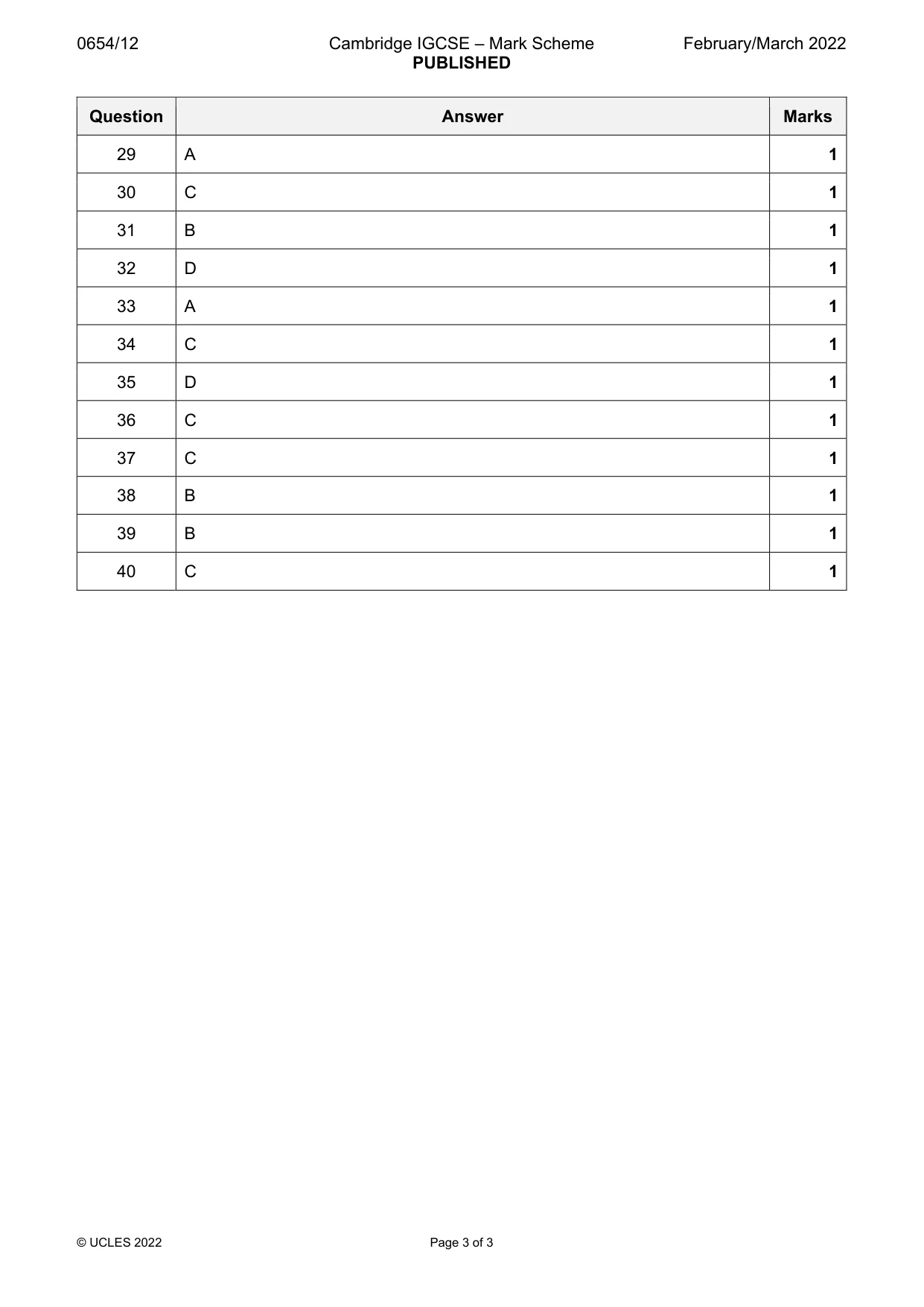
Mark scheme: A
Q2 · Which statements about osmosis are correct?
2 Which statements about osmosis are correct? 1 Osmosis requires a membrane. 2 Water can move out of cells by osmosis. 3 Water can move into cells by osmosis. A 1 and 2 only B 1 and 3 only C 1, 2 and 3 D 2 and 3 only
Mark scheme: C
Q3 · Which chemical element is found in all proteins, but not in all carbohydrates or fats?
3 Which chemical element is found in all proteins, but not in all carbohydrates or fats? A carbon B hydrogen C oxygen D nitrogen
Mark scheme: D
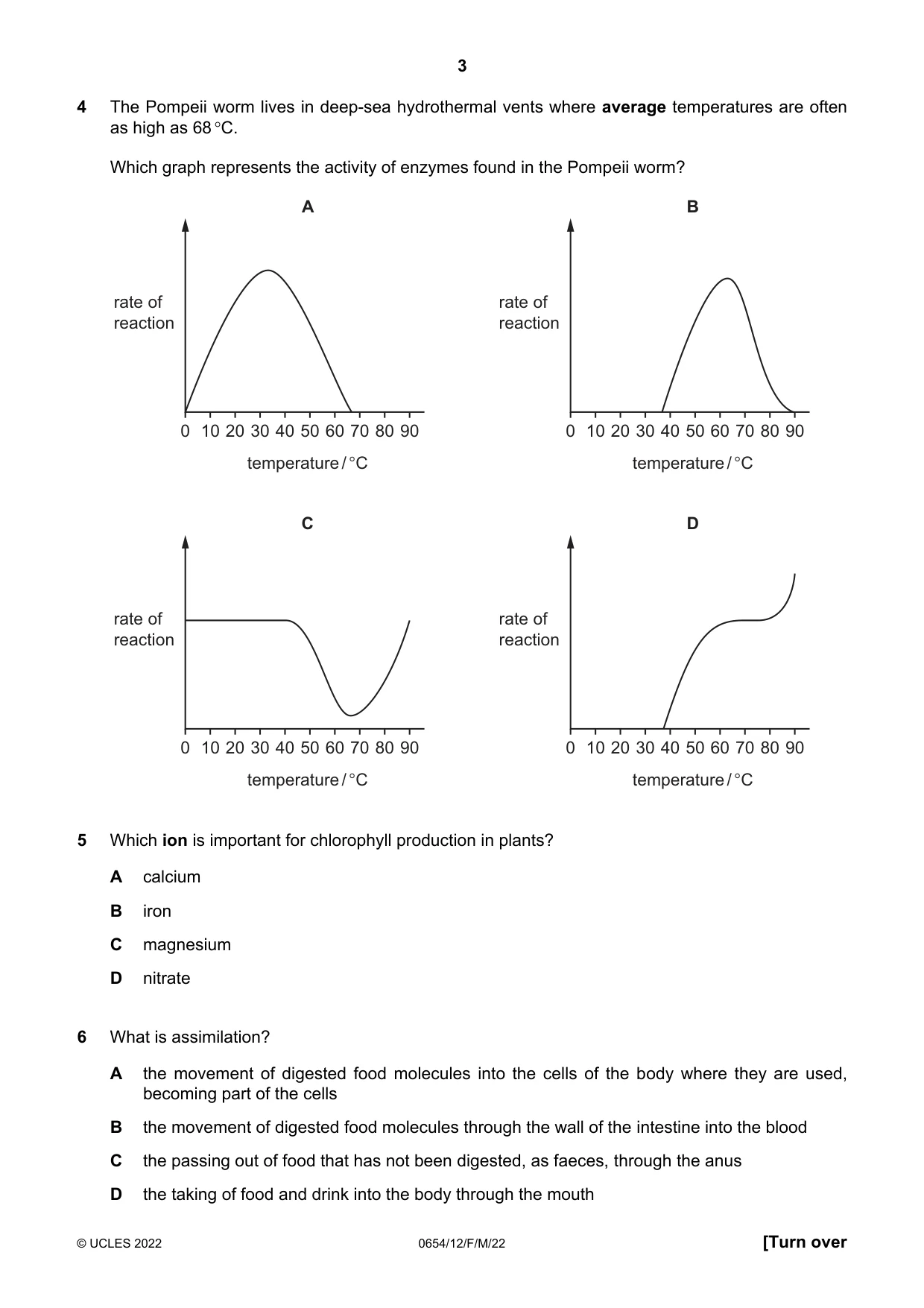
Q4 · The Pompeii worm lives in deep-sea hydrothermal vents where average temperatures are…
4 The Pompeii worm lives in deep-sea hydrothermal vents where average temperatures are often as high as 68 C. Which graph represents the activity of enzymes found in the Pompeii worm? A B rate of rate of reaction reaction 0 10 20 30 40 50 60 70 80 90 0 10 20 30 40 50 60 70 80 90 temperature / °C temperature / °C C D rate of rate of reaction reaction 0 10 20 30 40 50 60 70 80 90 0 10 20 30 40 50 60 70 80 90 temperature / °C temperature / °C
Mark scheme: B
Q5 · Which ion is important for chlorophyll production in plants?
5 Which ion is important for chlorophyll production in plants? A calcium B iron C magnesium D nitrate
Mark scheme: C
Question 6
6 What is assimilation? A the movement of digested food molecules into the cells of the body where they are used, becoming part of the cells B the movement of digested food molecules through the wall of the intestine into the blood C the passing out of food that has not been digested, as faeces, through the anus D the taking of food and drink into the body through the mouth
Mark scheme: A
Q7 · In which conditions will the rate of transpiration be greatest?
7 In which conditions will the rate of transpiration be greatest? A 10 C and high humidity B 10 C and low humidity C 30 C and high humidity D 30 C and low humidity
Mark scheme: D
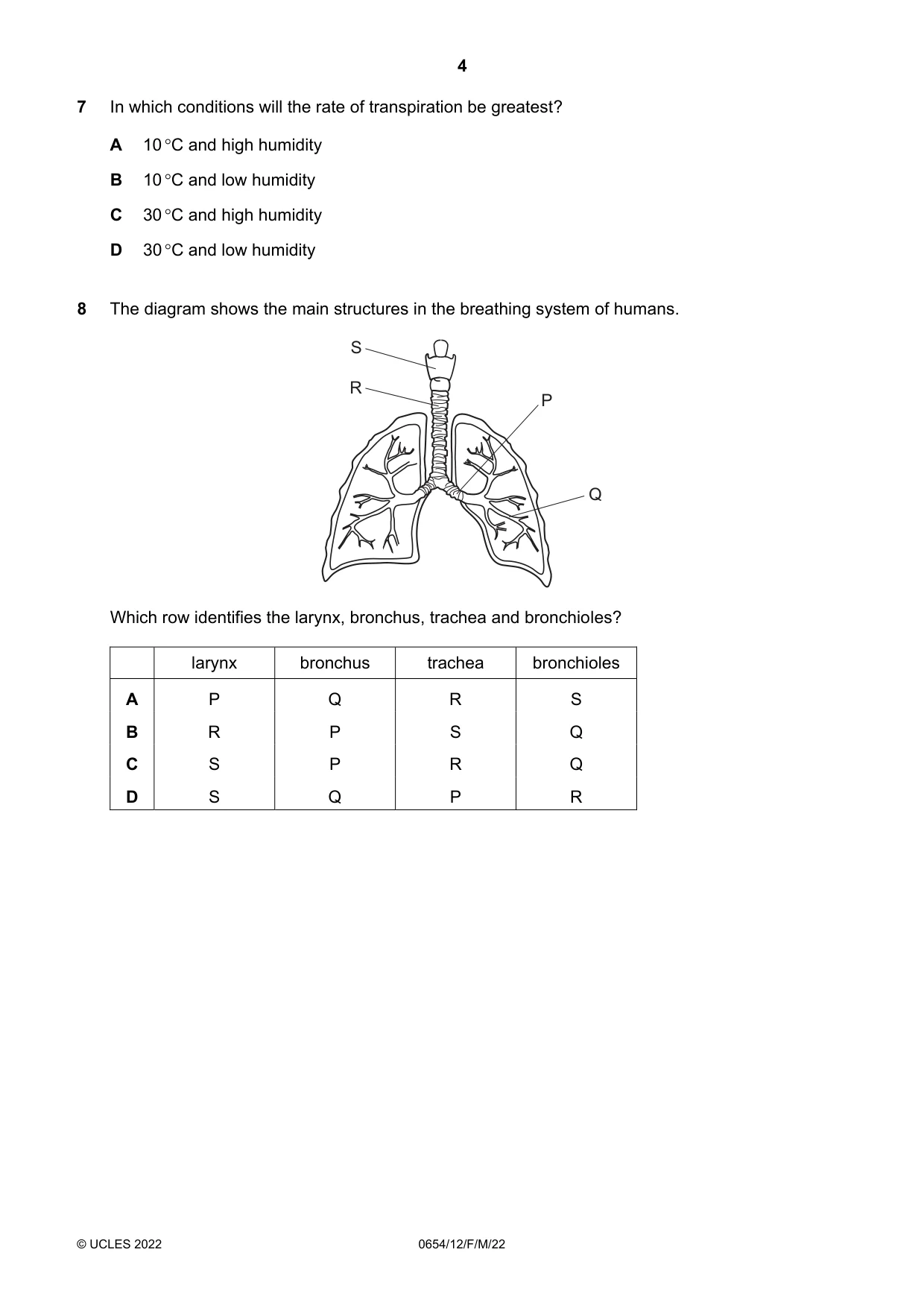
Q8 · The diagram shows the main structures in the breathing system of humans
8 The diagram shows the main structures in the breathing system of humans. S R P Q Which row identifies the larynx, bronchus, trachea and bronchioles? larynx bronchus trachea bronchioles A P Q R S B R P S Q C S P R Q D S Q P R
Mark scheme: C
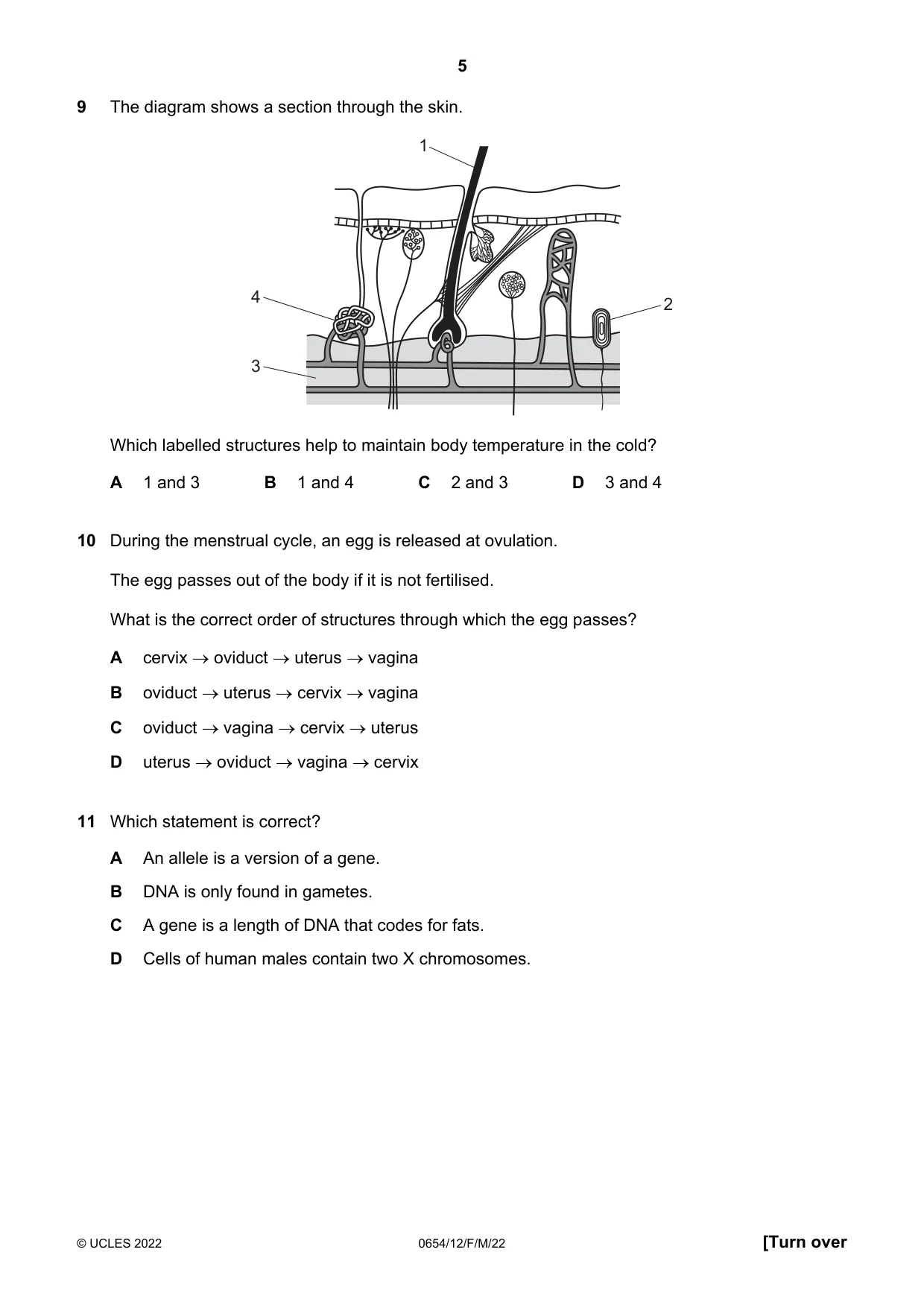
Q9 · The diagram shows a section through the skin
9 The diagram shows a section through the skin. 1 4 2 3 Which labelled structures help to maintain body temperature in the cold? A 1 and 3 B 1 and 4 C 2 and 3 D 3 and 4
Mark scheme: A
Q10 · During the menstrual cycle, an egg is released at ovulation
10 During the menstrual cycle, an egg is released at ovulation. The egg passes out of the body if it is not fertilised. What is the correct order of structures through which the egg passes? A cervix oviduct uterus vagina B oviduct uterus cervix vagina C oviduct vagina cervix uterus D uterus oviduct vagina cervix
Mark scheme: B
Q11 · Which statement is correct?
11 Which statement is correct? A An allele is a version of a gene. B DNA is only found in gametes. C A gene is a length of DNA that codes for fats. D Cells of human males contain two X chromosomes.
Mark scheme: A
Q12 · The diagram shows a food chain
12 The diagram shows a food chain. beech tree insect shrew owl Which statement is correct? A The beech tree is a consumer. B The insect is a producer. C The owl is a carnivore. D The shrew is a herbivore.
Mark scheme: C
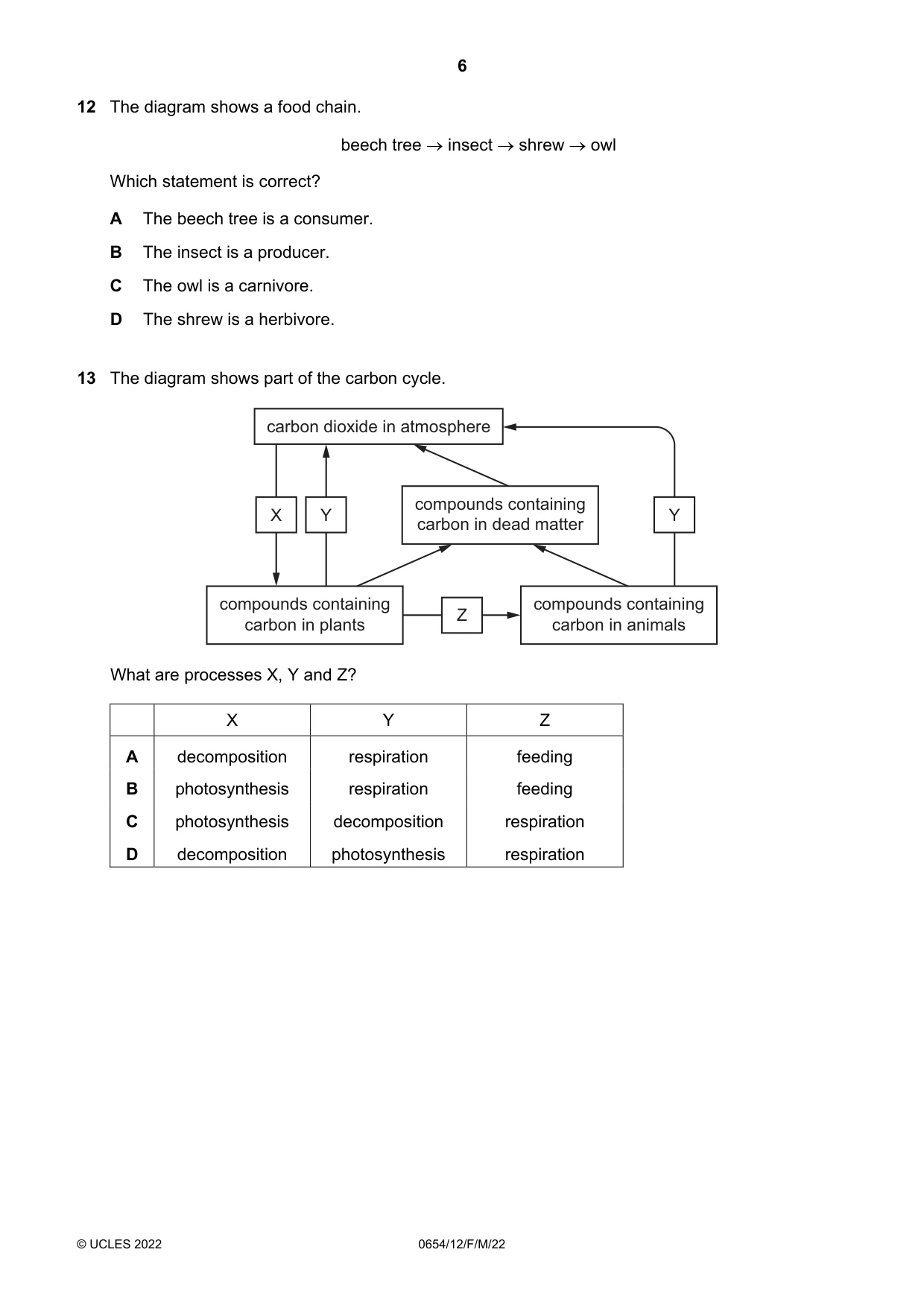
Q13 · The diagram shows part of the carbon cycle
13 The diagram shows part of the carbon cycle. carbon dioxide in atmosphere compounds containing X Y Y carbon in dead matter compounds containing compounds containing Z carbon in plants carbon in animals What are processes X, Y and Z? X Y Z A decomposition respiration feeding B photosynthesis respiration feeding C photosynthesis decomposition respiration D decomposition photosynthesis respiration
Mark scheme: B
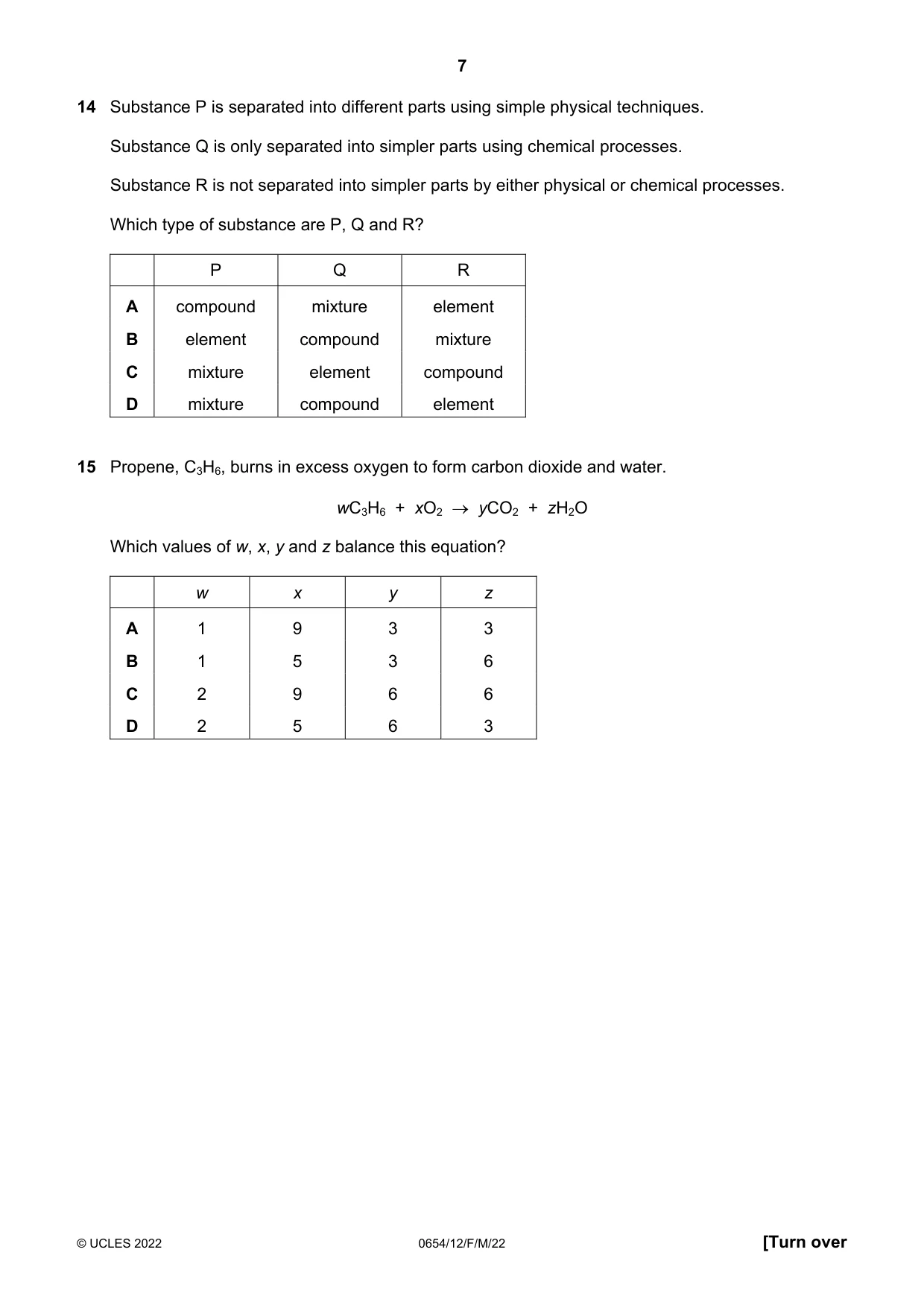
Q14 · Substance P is separated into different parts using simple physical techniques
14 Substance P is separated into different parts using simple physical techniques. Substance Q is only separated into simpler parts using chemical processes. Substance R is not separated into simpler parts by either physical or chemical processes. Which type of substance are P, Q and R? P Q R A compound mixture element B element compound mixture C mixture element compound D mixture compound element
Mark scheme: D
Q15 · Propene, C3H6, burns in excess oxygen to form carbon dioxide and water
15 Propene, C3H6, burns in excess oxygen to form carbon dioxide and water. wC3H6 + xO2 yCO2 + zH2O Which values of w, x, y and z balance this equation? w x y z A 1 9 3 3 B 1 5 3 6 C 2 9 6 6 D 2 5 6 3
Mark scheme: C
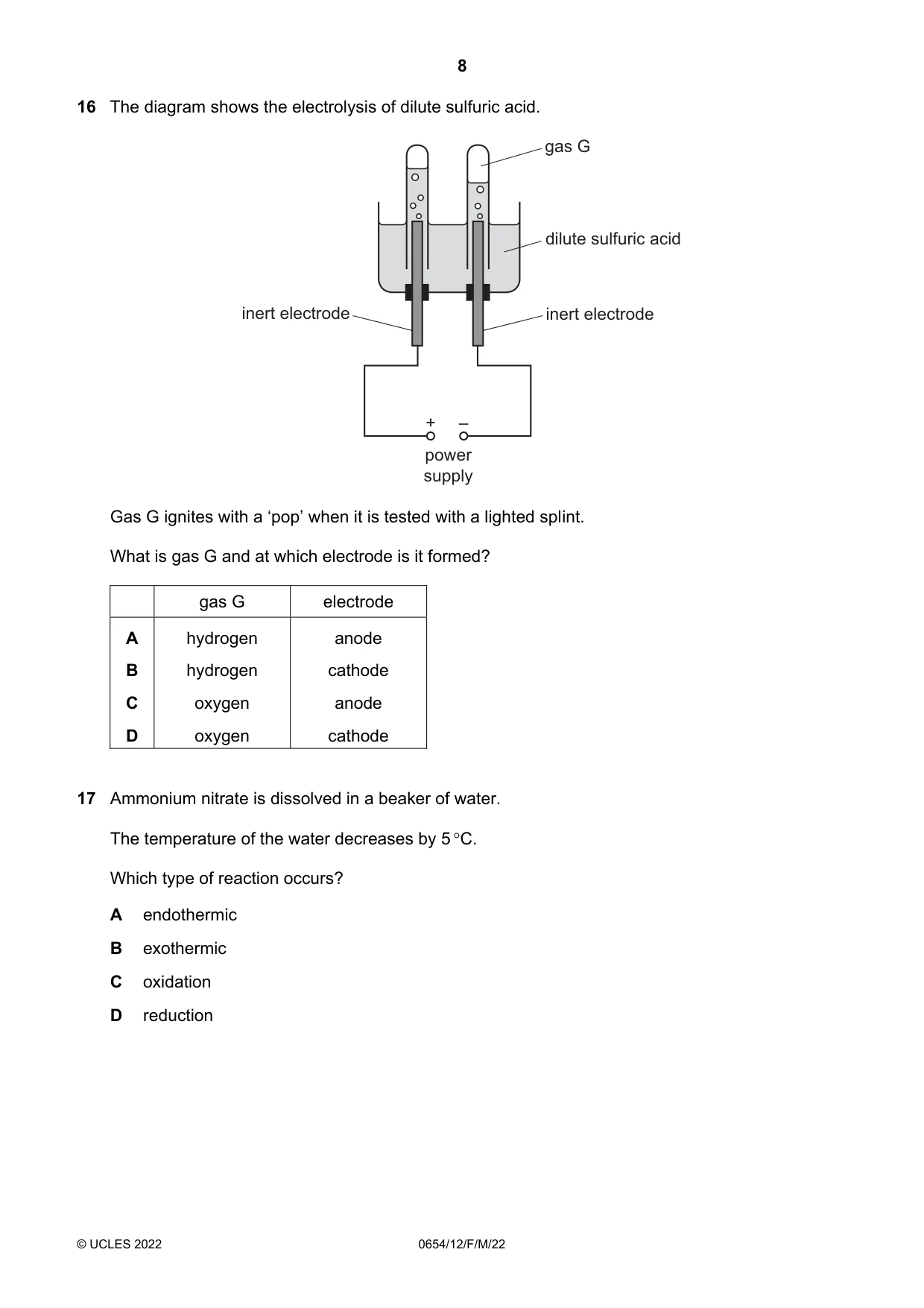
Q16 · The diagram shows the electrolysis of dilute sulfuric acid
16 The diagram shows the electrolysis of dilute sulfuric acid. gas G dilute sulfuric acid inert electrode inert electrode + – power supply Gas G ignites with a ‘pop’ when it is tested with a lighted splint. What is gas G and at which electrode is it formed? gas G electrode A hydrogen anode B hydrogen cathode C oxygen anode D oxygen cathode
Mark scheme: B
Q17 · Ammonium nitrate is dissolved in a beaker of water
17 Ammonium nitrate is dissolved in a beaker of water. The temperature of the water decreases by 5 C. Which type of reaction occurs? A endothermic B exothermic C oxidation D reduction
Mark scheme: A
Q18 · Which reaction is not a redox reaction?
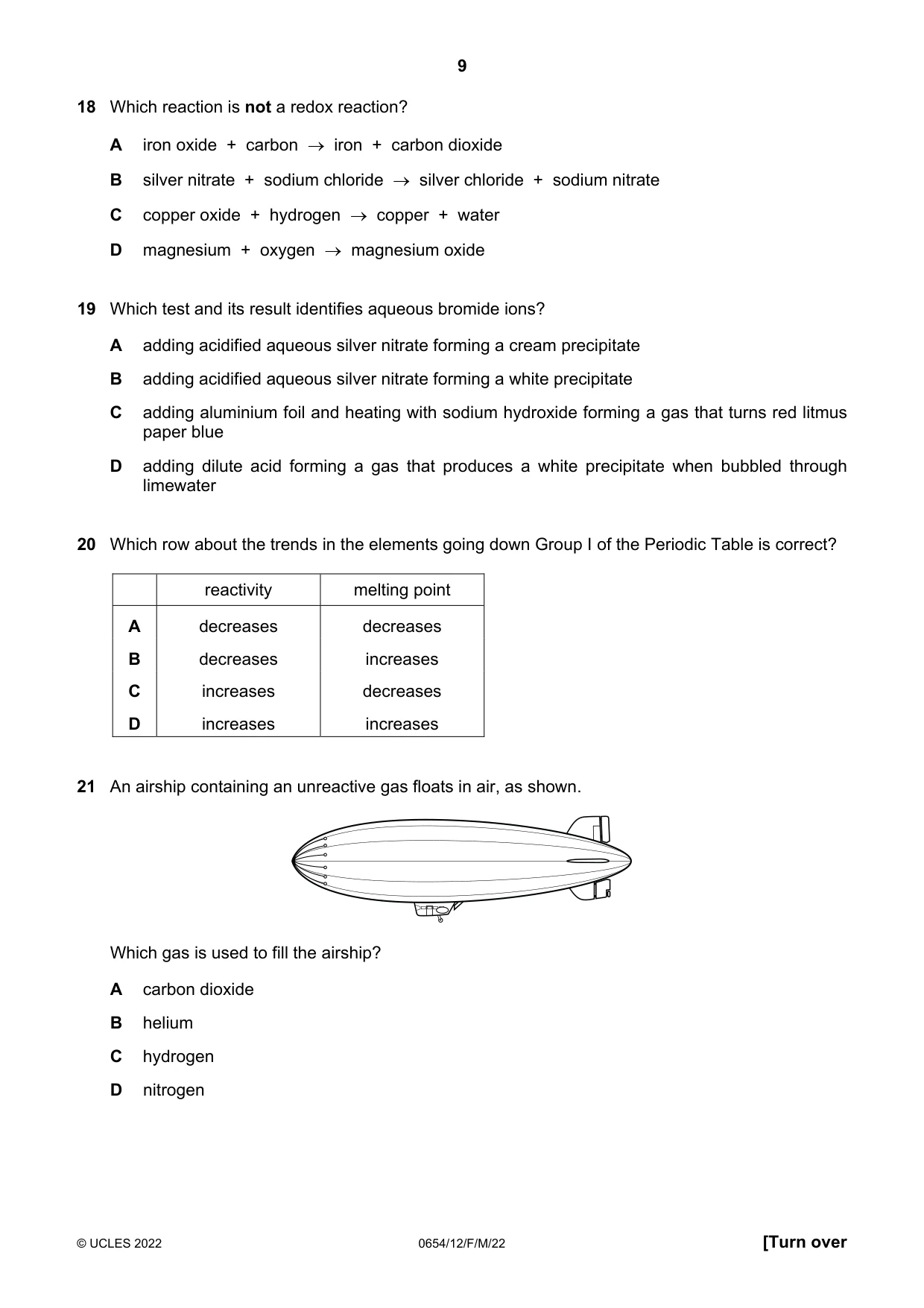
18 Which reaction is not a redox reaction? A iron oxide + carbon iron + carbon dioxide B silver nitrate + sodium chloride silver chloride + sodium nitrate C copper oxide + hydrogen copper + water D magnesium + oxygen magnesium oxide
Mark scheme: B
Q19 · Which test and its result identifies aqueous bromide ions?
19 Which test and its result identifies aqueous bromide ions? A adding acidified aqueous silver nitrate forming a cream precipitate B adding acidified aqueous silver nitrate forming a white precipitate C adding aluminium foil and heating with sodium hydroxide forming a gas that turns red litmus paper blue D adding dilute acid forming a gas that produces a white precipitate when bubbled through limewater
Mark scheme: A
Q20 · Which row about the trends in the elements going down Group I of the Periodic Table is…
20 Which row about the trends in the elements going down Group I of the Periodic Table is correct? reactivity melting point A decreases decreases B decreases increases C increases decreases D increases increases
Mark scheme: C
Q21 · An airship containing an unreactive gas floats in air, as shown
21 An airship containing an unreactive gas floats in air, as shown. Which gas is used to fill the airship? A carbon dioxide B helium C hydrogen D nitrogen
Mark scheme: B
Q22 · Duralumin and magnalium are alloys used in the manufacture of aircraft
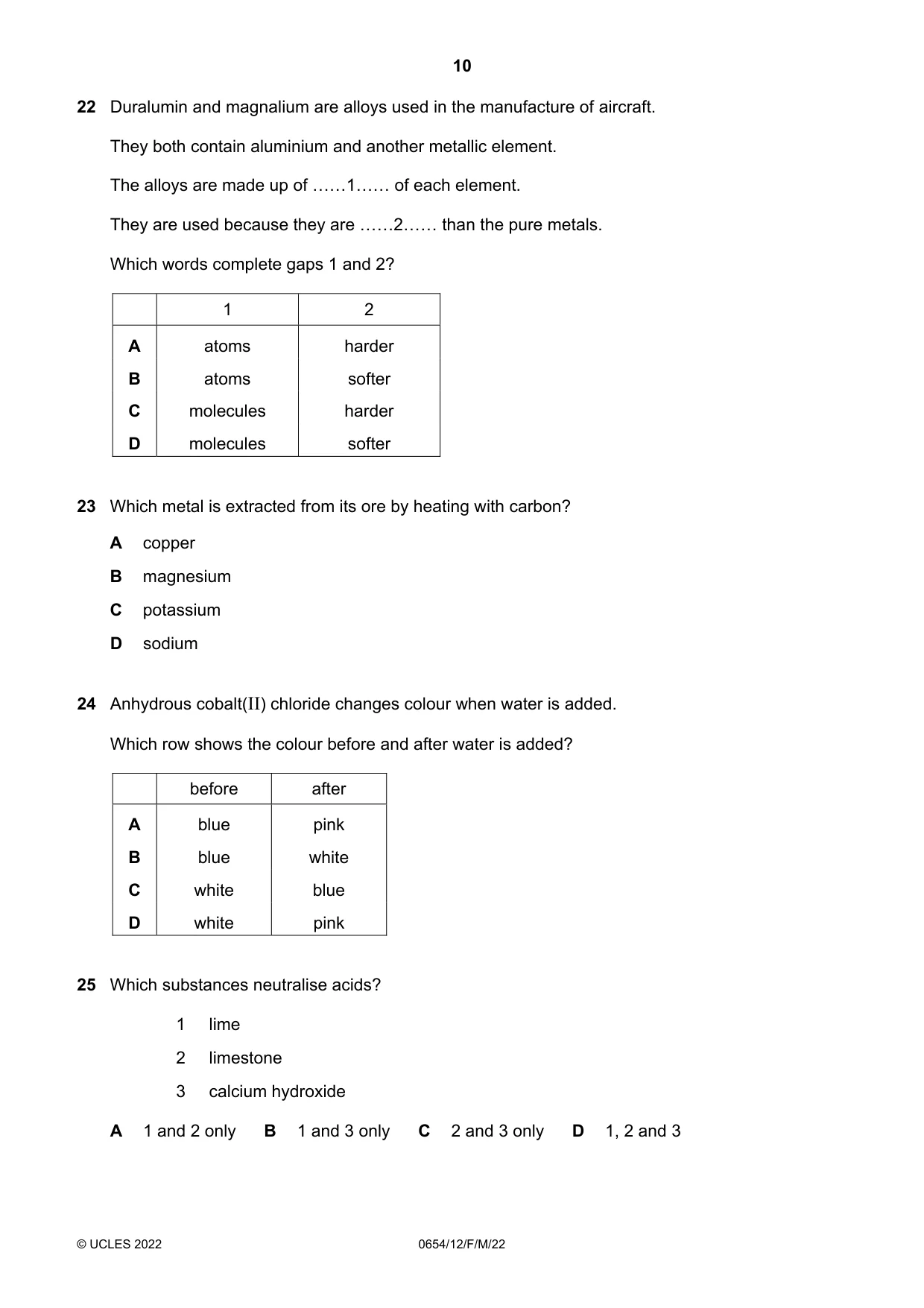
22 Duralumin and magnalium are alloys used in the manufacture of aircraft. They both contain aluminium and another metallic element. The alloys are made up of ……1…… of each element. They are used because they are ……2…… than the pure metals. Which words complete gaps 1 and 2? 1 2 A atoms harder B atoms softer C molecules harder D molecules softer
Mark scheme: A
Q23 · Which metal is extracted from its ore by heating with carbon?
23 Which metal is extracted from its ore by heating with carbon? A copper B magnesium C potassium D sodium
Mark scheme: A
Q24 · Anhydrous cobalt(II) chloride changes colour when water is added
24 Anhydrous cobalt(II) chloride changes colour when water is added. Which row shows the colour before and after water is added? before after A blue pink B blue white C white blue D white pink
Mark scheme: A
Q25 · Which substances neutralise acids?
25 Which substances neutralise acids? 1 lime 2 limestone 3 calcium hydroxide A 1 and 2 only B 1 and 3 only C 2 and 3 only D 1, 2 and 3
Mark scheme: D
More questions on The characteristic properties of acids and bases
Q26 · Butane is a hydrocarbon
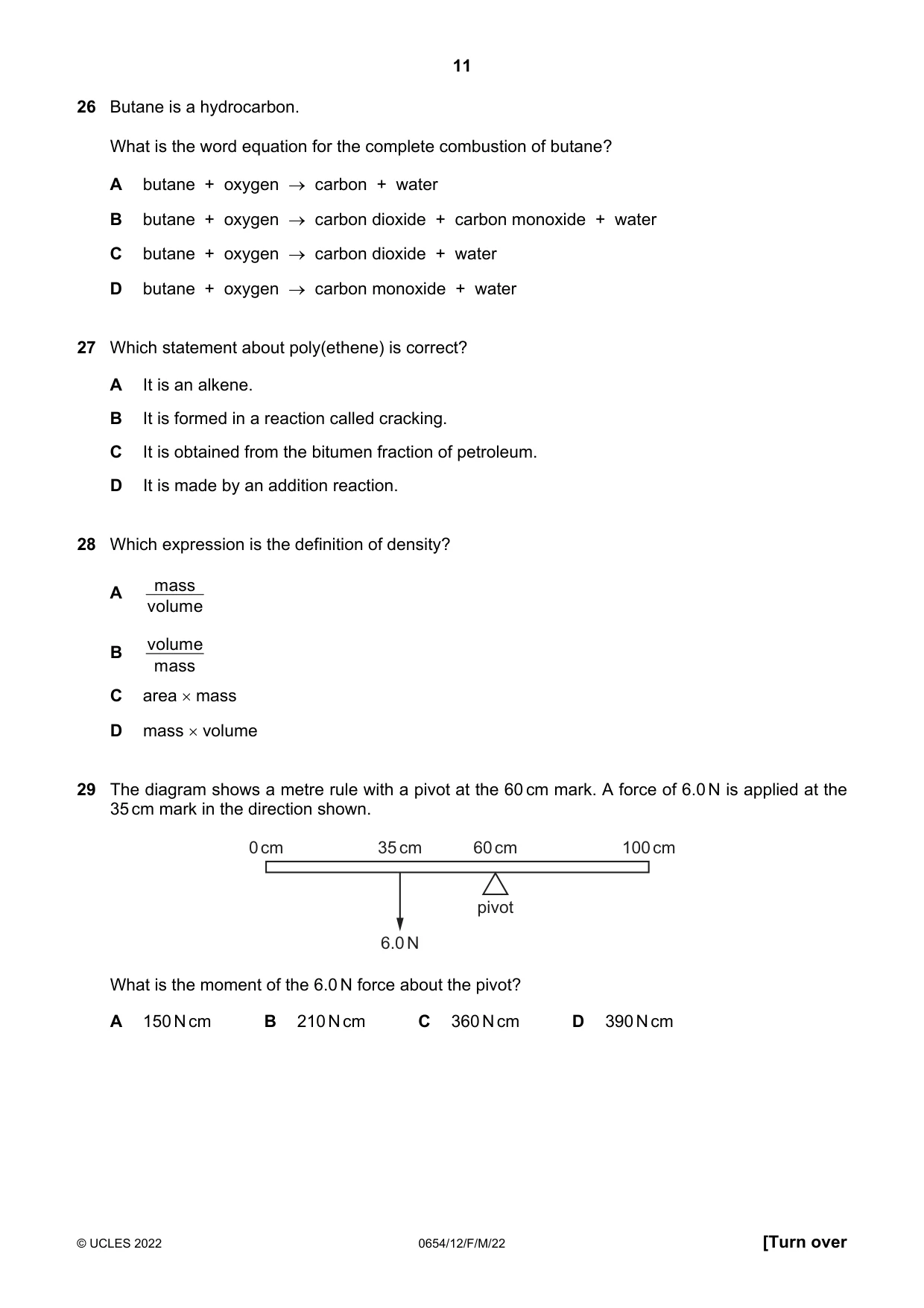
26 Butane is a hydrocarbon. What is the word equation for the complete combustion of butane? A butane + oxygen carbon + water B butane + oxygen carbon dioxide + carbon monoxide + water C butane + oxygen carbon dioxide + water D butane + oxygen carbon monoxide + water
Mark scheme: C
Q27 · Which statement about poly(ethene) is correct?
27 Which statement about poly(ethene) is correct? A It is an alkene. B It is formed in a reaction called cracking. C It is obtained from the bitumen fraction of petroleum. D It is made by an addition reaction.
Mark scheme: D
Q28 · Which expression is the definition of density?
28 Which expression is the definition of density? mass A volume volume B mass C area mass D mass volume
Mark scheme: A
Q29 · The diagram shows a metre rule with a pivot at the 60 cm mark
29 The diagram shows a metre rule with a pivot at the 60 cm mark. A force of 6.0 N is applied at the 35 cm mark in the direction shown. 0 cm 35 cm 60 cm 100 cm pivot 6.0 N What is the moment of the 6.0 N force about the pivot? A 150 N cm B 210 N cm C 360 N cm D 390 N cm
Mark scheme: A
Q30 · A crane does work on a load by lifting it vertically upwards
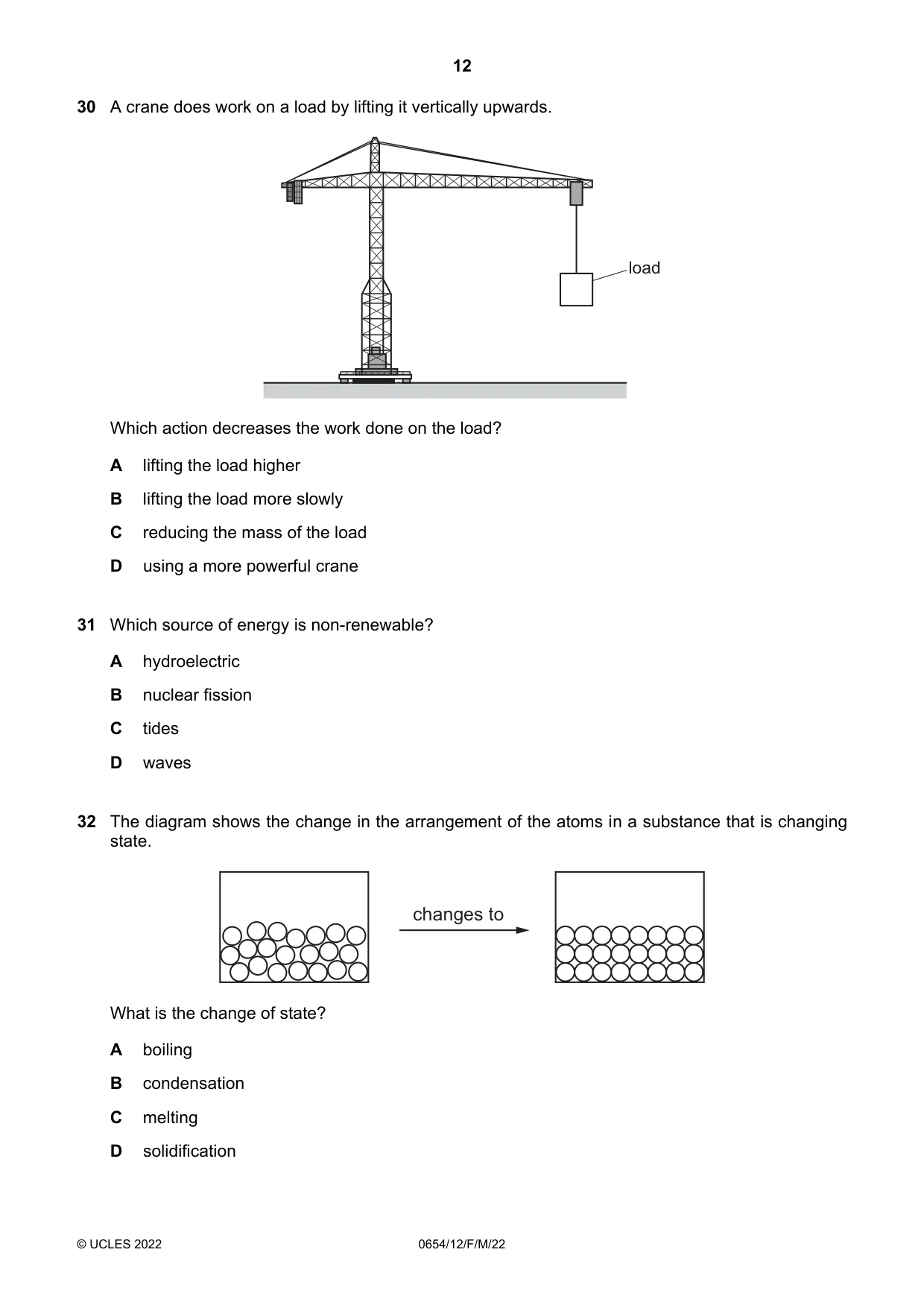
30 A crane does work on a load by lifting it vertically upwards. load Which action decreases the work done on the load? A lifting the load higher B lifting the load more slowly C reducing the mass of the load D using a more powerful crane
Mark scheme: C
Q31 · Which source of energy is non-renewable?
31 Which source of energy is non-renewable? A hydroelectric B nuclear fission C tides D waves
Mark scheme: B
Q32 · The diagram shows the change in the arrangement of the atoms in a substance that is…
32 The diagram shows the change in the arrangement of the atoms in a substance that is changing state. changes to What is the change of state? A boiling B condensation C melting D solidification
Mark scheme: D
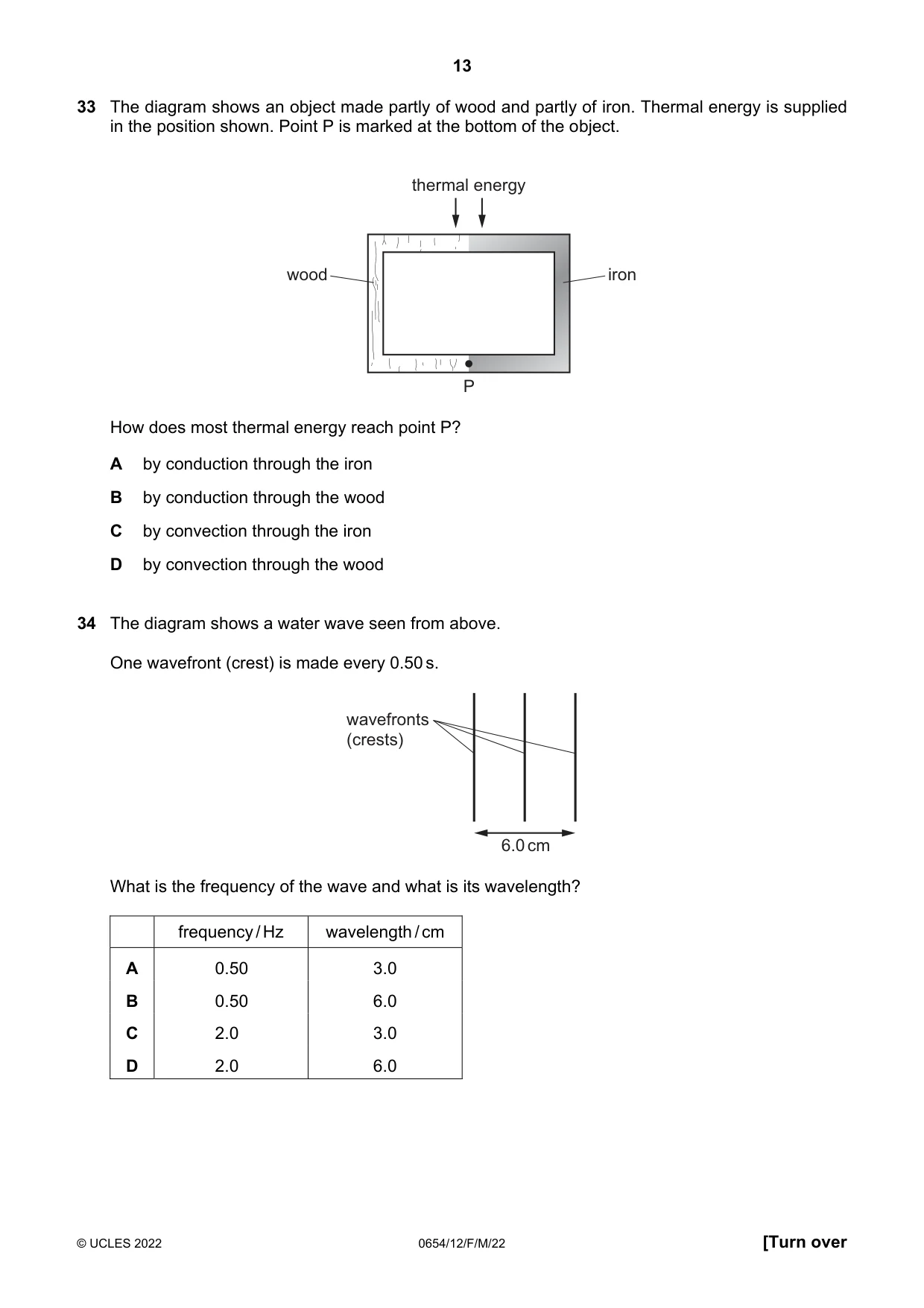
Q33 · The diagram shows an object made partly of wood and partly of iron
33 The diagram shows an object made partly of wood and partly of iron. Thermal energy is supplied in the position shown. Point P is marked at the bottom of the object. thermal energy wood iron P How does most thermal energy reach point P? A by conduction through the iron B by conduction through the wood C by convection through the iron D by convection through the wood
Mark scheme: A
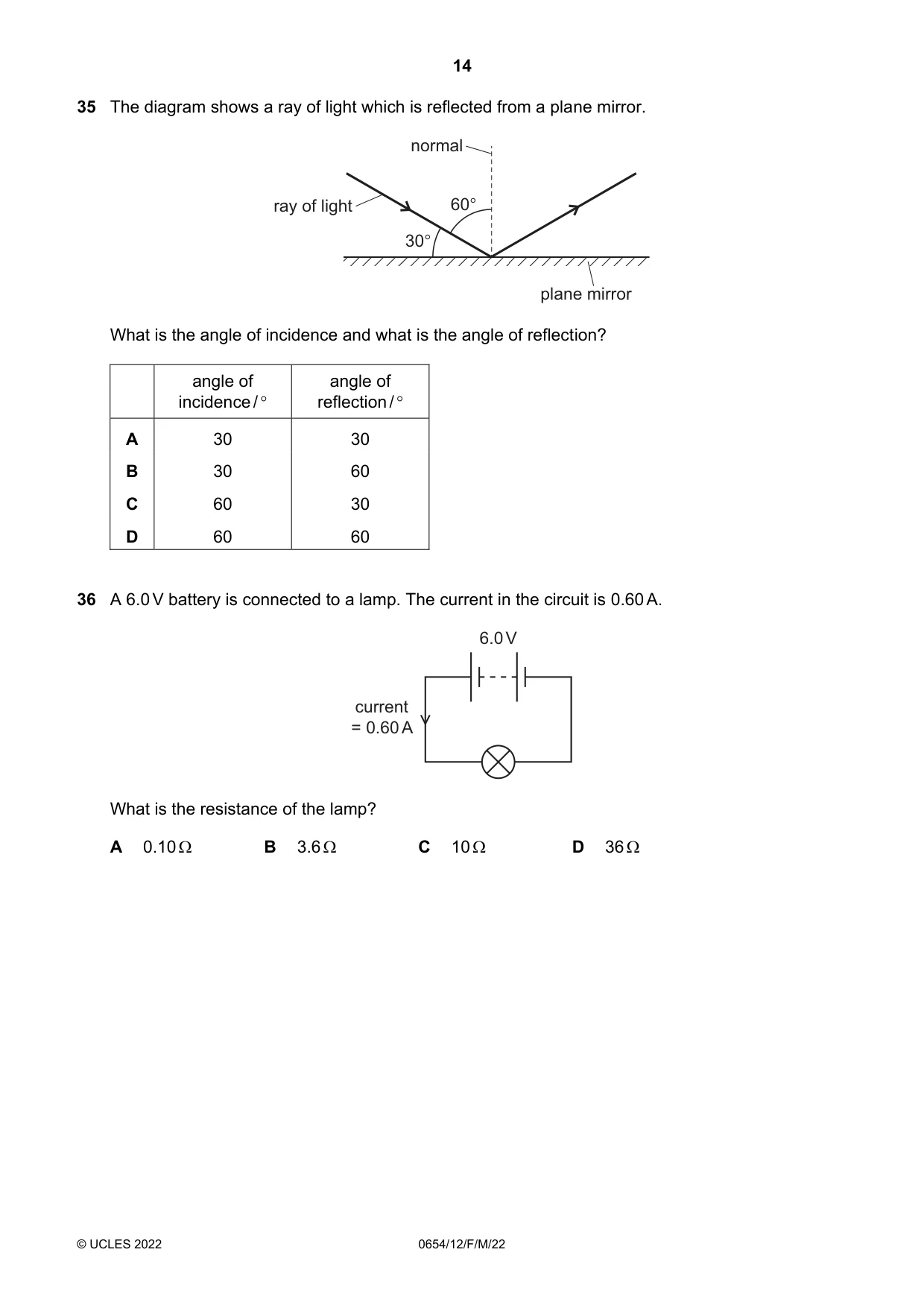
Q34 · The diagram shows a water wave seen from above
34 The diagram shows a water wave seen from above. One wavefront (crest) is made every 0.50 s. wavefronts (crests) 6.0 cm What is the frequency of the wave and what is its wavelength? frequency / Hz wavelength / cm A 0.50 3.0 B 0.50 6.0 C 2.0 3.0 D 2.0 6.0
Mark scheme: C
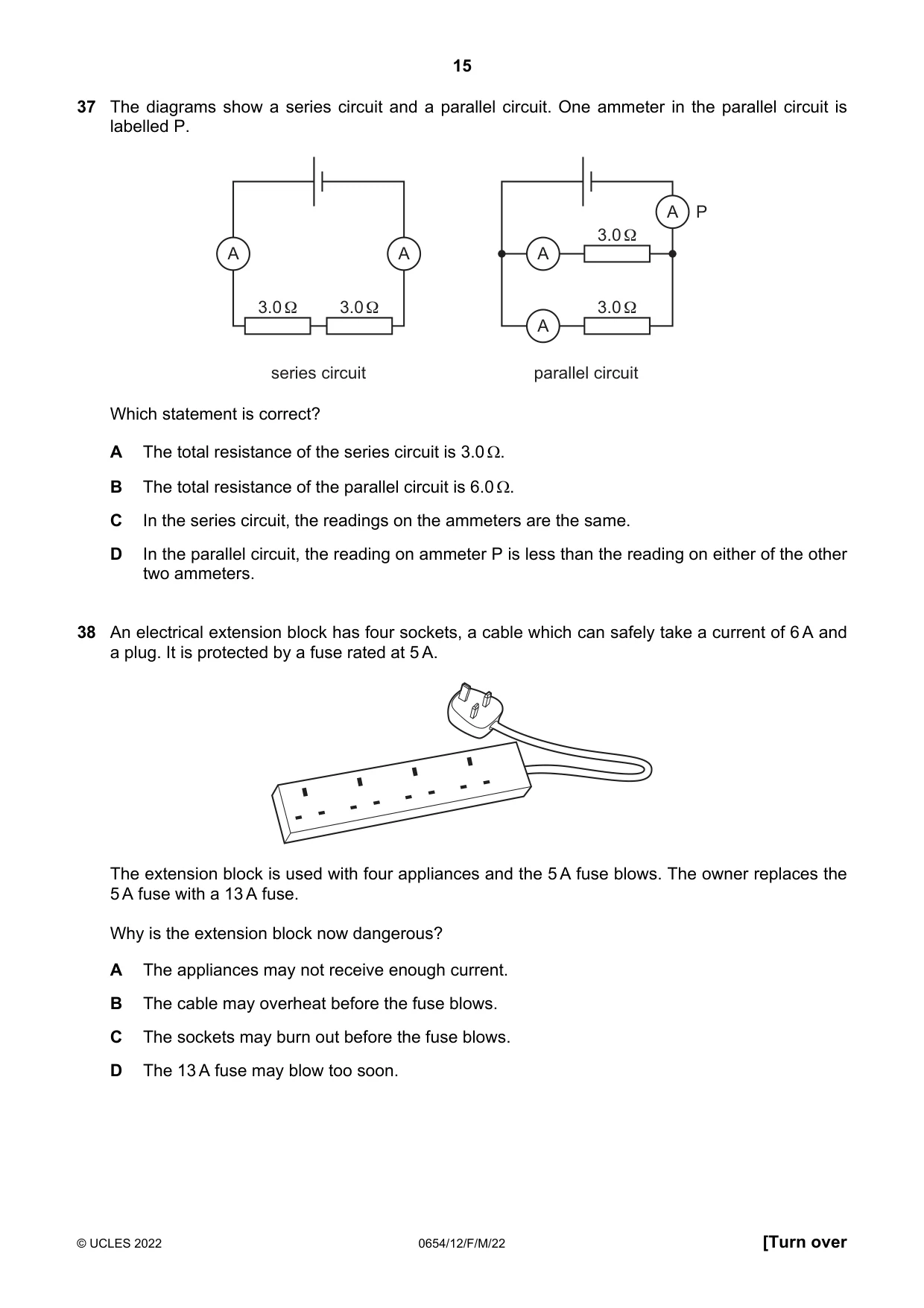
Q35 · The diagram shows a ray of light which is reflected from a plane mirror
35 The diagram shows a ray of light which is reflected from a plane mirror. normal ray of light 60° 30° plane mirror What is the angle of incidence and what is the angle of reflection? angle of angle of incidence / reflection / A 30 30 B 30 60 C 60 30 D 60 60
Mark scheme: D
Q36 · A 6.0 V battery is connected to a lamp
36 A 6.0 V battery is connected to a lamp. The current in the circuit is 0.60 A. 6.0 V current = 0.60 A What is the resistance of the lamp? A 0.10 B 3.6 C 10 D 36
Mark scheme: C
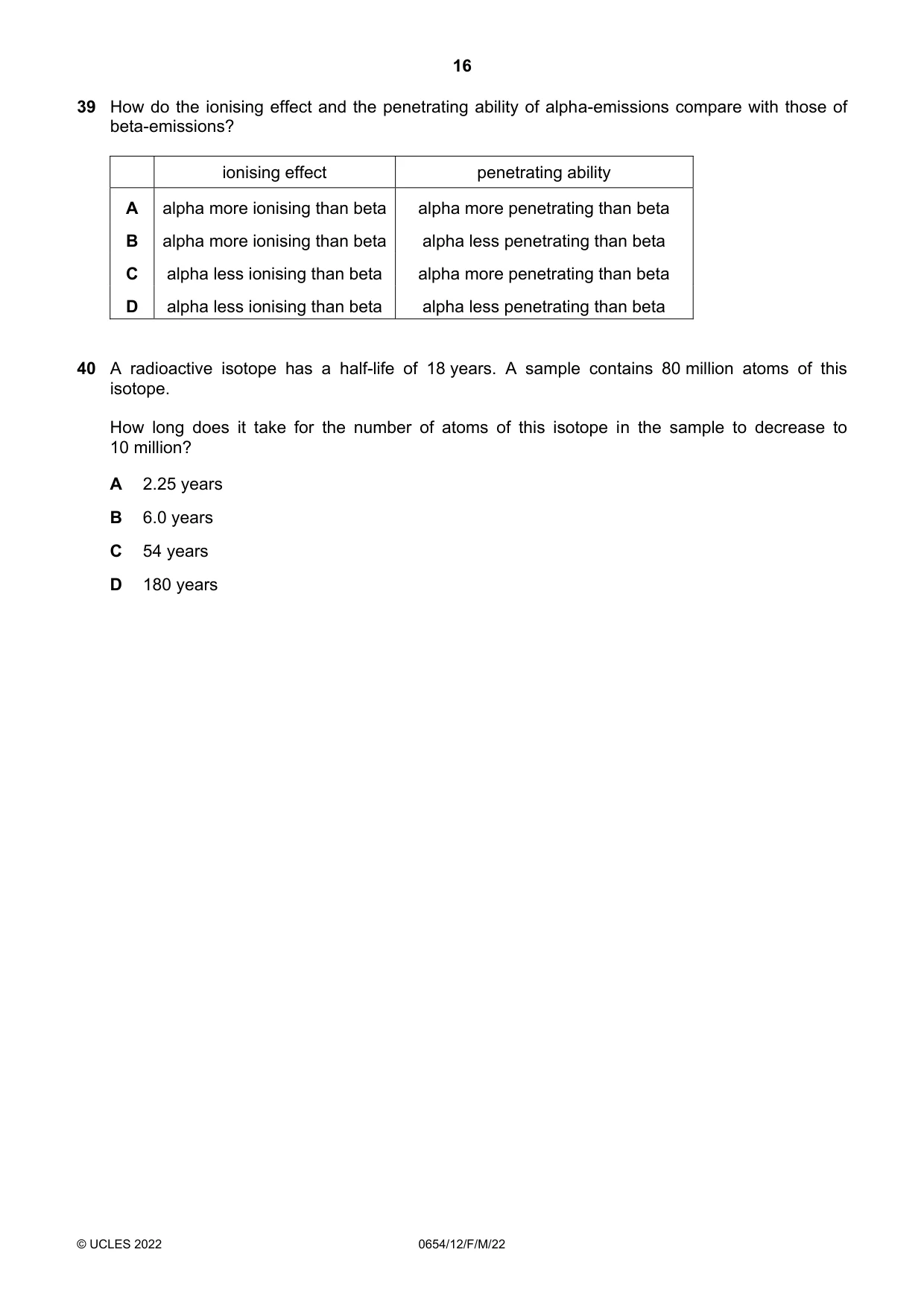
Q37 · The diagrams show a series circuit and a parallel circuit
37 The diagrams show a series circuit and a parallel circuit. One ammeter in the parallel circuit is labelled P. A P 3.0 Ω A A A 3.0 Ω 3.0 Ω 3.0 Ω A series circuit parallel circuit Which statement is correct? A The total resistance of the series circuit is 3.0 . B The total resistance of the parallel circuit is 6.0 . C In the series circuit, the readings on the ammeters are the same. D In the parallel circuit, the reading on ammeter P is less than the reading on either of the other two ammeters.
Mark scheme: C
Q38 · An electrical extension block has four sockets, a cable which can safely take a current…
38 An electrical extension block has four sockets, a cable which can safely take a current of 6 A and a plug. It is protected by a fuse rated at 5 A. The extension block is used with four appliances and the 5 A fuse blows. The owner replaces the 5 A fuse with a 13 A fuse. Why is the extension block now dangerous? A The appliances may not receive enough current. B The cable may overheat before the fuse blows. C The sockets may burn out before the fuse blows. D The 13 A fuse may blow too soon.
Mark scheme: B
Q39 · How do the ionising effect and the penetrating ability of alpha-emissions compare with…
39 How do the ionising effect and the penetrating ability of alpha-emissions compare with those of beta-emissions? ionising effect penetrating ability A alpha more ionising than beta alpha more penetrating than beta B alpha more ionising than beta alpha less penetrating than beta C alpha less ionising than beta alpha more penetrating than beta D alpha less ionising than beta alpha less penetrating than beta
Mark scheme: B
Q40 · A radioactive isotope has a half-life of 18 years
40 A radioactive isotope has a half-life of 18 years. A sample contains 80 million atoms of this isotope. How long does it take for the number of atoms of this isotope in the sample to decrease to 10 million? A 2.25 years B 6.0 years C 54 years D 180 years
Mark scheme: C
What was in this paper
The subtopics covered by these 40 questions, and how many questions each got. Open one in a new tab to see every Cambridge question on it.
2Radioactivity2Alloys and their properties1Biological molecules1Carbon cycle1Characteristics of living organisms1Chromosomes and genes1Density1Digestion1Electrical circuits1Electrical quantities1Electrical safety1Electrolysis1Elements, compounds and mixtures1Enzymes1Exothermic and endothermic reactions1Extraction of metals1Food chains and food webs1Forces1Formulas1Fuels1Gas exchange in humans1General properties of waves1Group I properties1Homeostasis1Identification of ions and gases1Kinetic particle model of matter1Light1Noble gases1Osmosis1Photosynthesis1Polymers1Redox1Sexual reproduction in humans1The characteristic properties of acids and bases1Transfer of thermal energy1Transpiration1Water1What you needed in this session
Cambridge’s own grade thresholds for 2022 Feb/March, Paper 1 · Variant 2. A higher threshold means an easier paper — the bar moves with how the cohort did.