Cambridge IGCSE Sciences - Co-ordinated (Double) 0654 — 2025 May/June Paper 1 · Variant 1
0654/11/M/J/25 · 40 questions · 40 marks · 45 min
The question paper and its mark scheme, free to read here and free to download. This is Cambridge’s own paper, exactly as it was sat.
Question paper16 pages

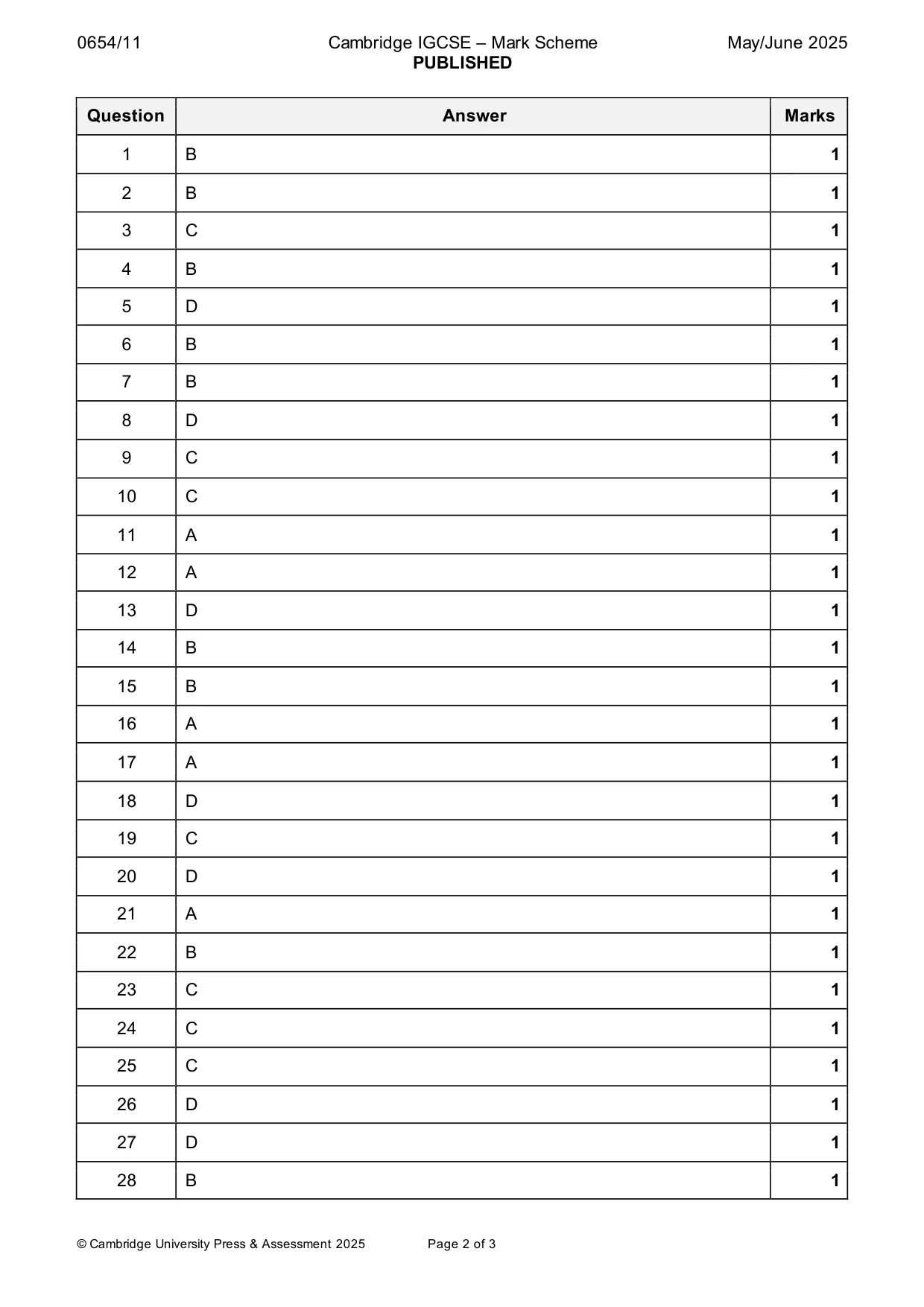
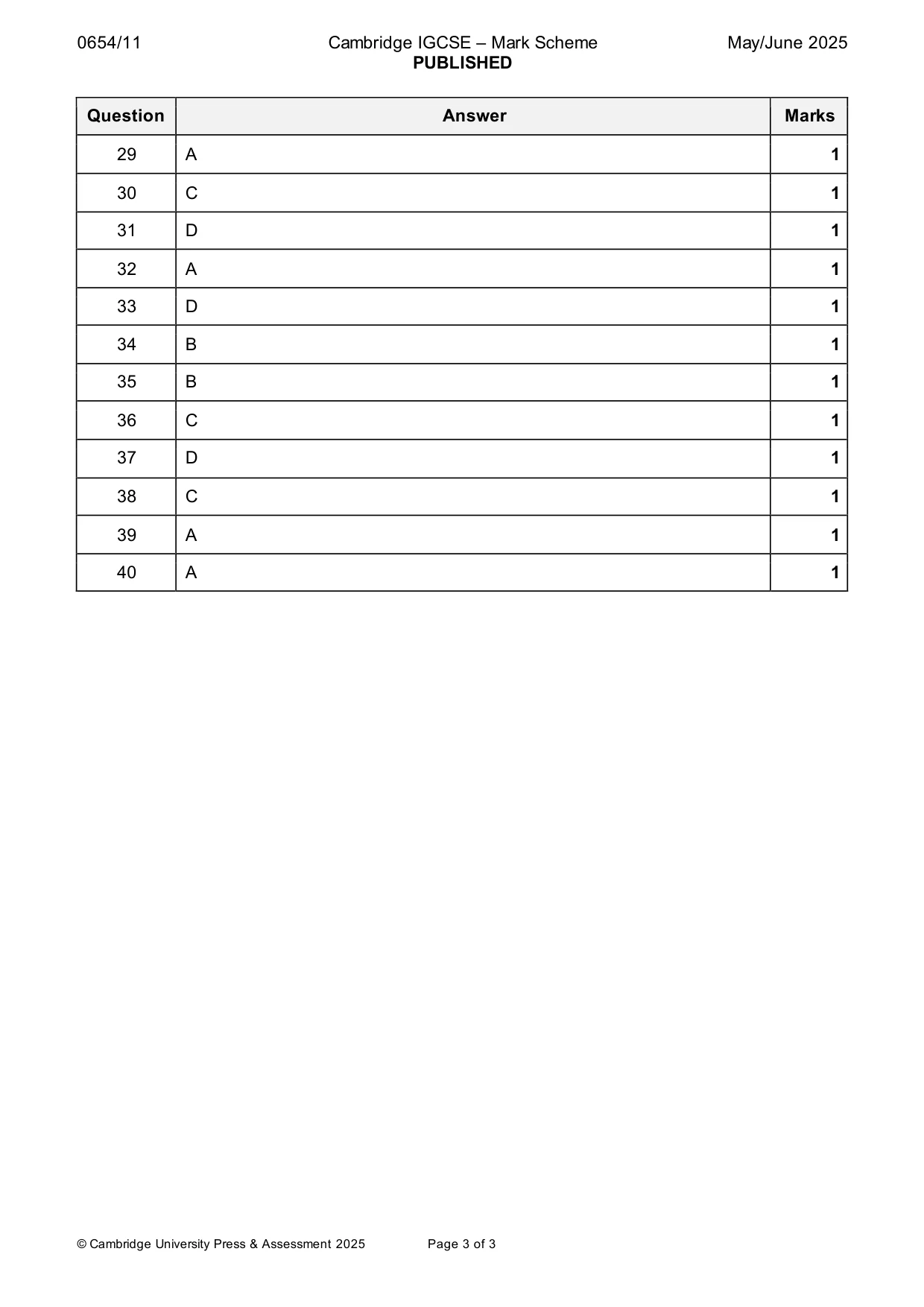
Mark scheme3 pages
Answers below. Sit the paper first if you are practising.
Questions as text
Q1 · Which characteristic of living organisms involves a permanent increase in size?
1 Which characteristic of living organisms involves a permanent increase in size? A excretion B growth C respiration D sensitivity
Mark scheme: B
Q2 · The photograph shows a caterpillar
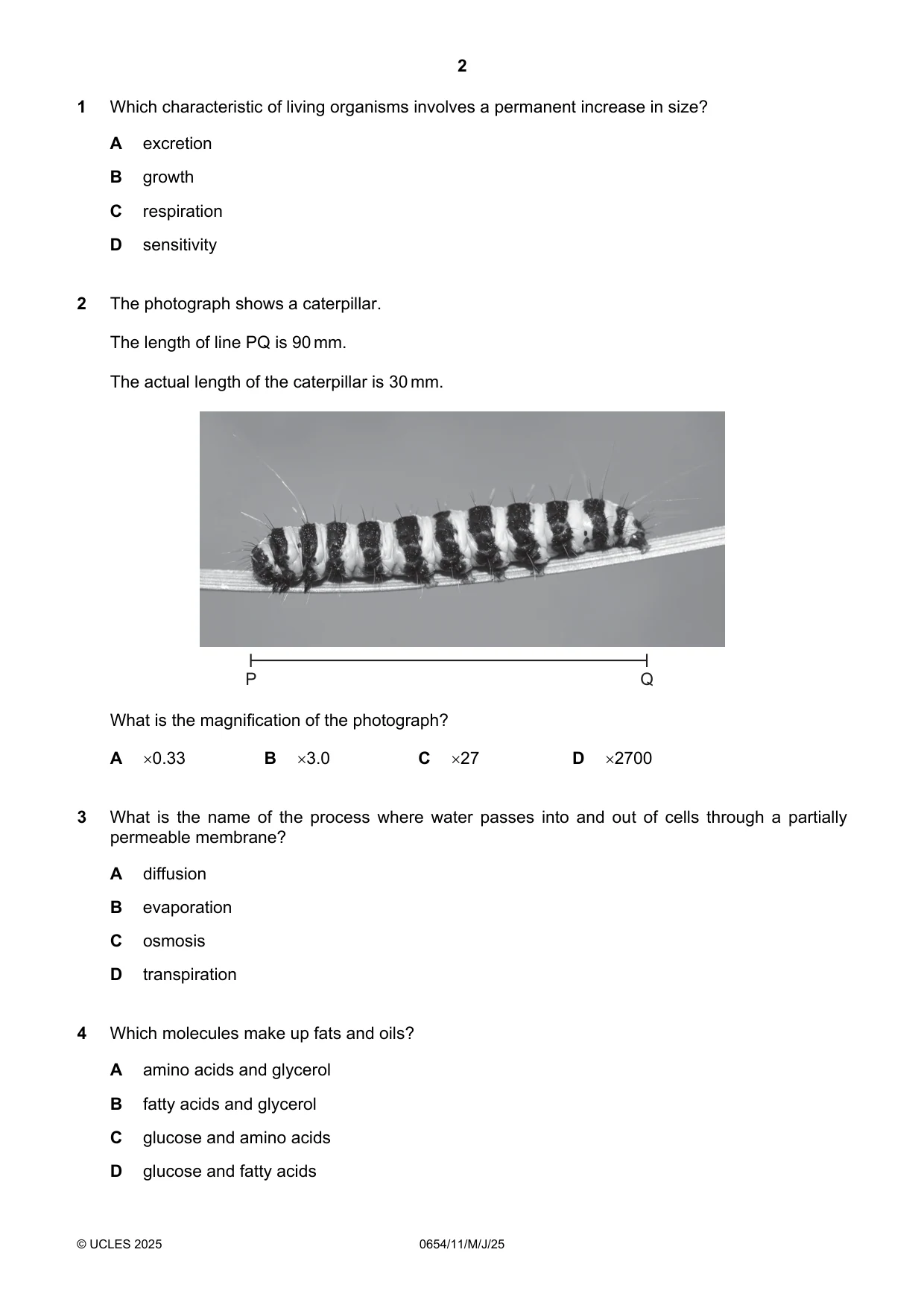
2 The photograph shows a caterpillar. The length of line PQ is 90 mm. The actual length of the caterpillar is 30 mm. P Q What is the magnification of the photograph? A 0.33 B 3.0 C 27 D 2700
Mark scheme: B
Q3 · What is the name of the process where water passes into and out of cells through a…
3 What is the name of the process where water passes into and out of cells through a partially permeable membrane? A diffusion B evaporation C osmosis D transpiration
Mark scheme: C
Q4 · Which molecules make up fats and oils?
4 Which molecules make up fats and oils? A amino acids and glycerol B fatty acids and glycerol C glucose and amino acids D glucose and fatty acids
Mark scheme: B
Q5 · Which type of molecules are enzymes?
5 Which type of molecules are enzymes? A carbohydrates B fats C hormones D proteins
Mark scheme: D
Q6 · The starch in a plant is removed
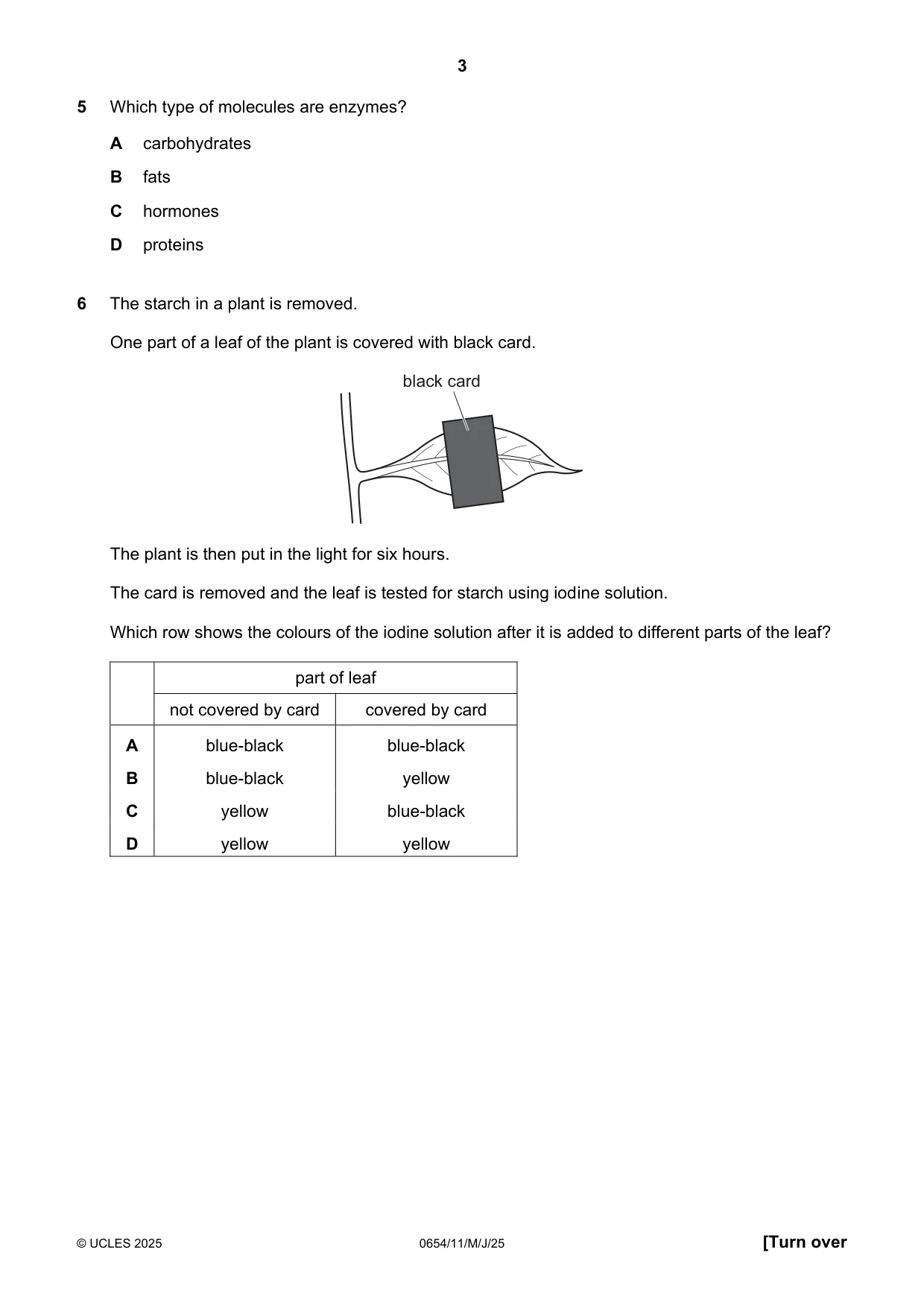
6 The starch in a plant is removed. One part of a leaf of the plant is covered with black card. black card The plant is then put in the light for six hours. The card is removed and the leaf is tested for starch using iodine solution. Which row shows the colours of the iodine solution after it is added to different parts of the leaf? part of leaf not covered by card covered by card A blue-black blue-black B blue-black yellow C yellow blue-black D yellow yellow
Mark scheme: B
Q7 · The diagram shows the human alimentary canal and other organs
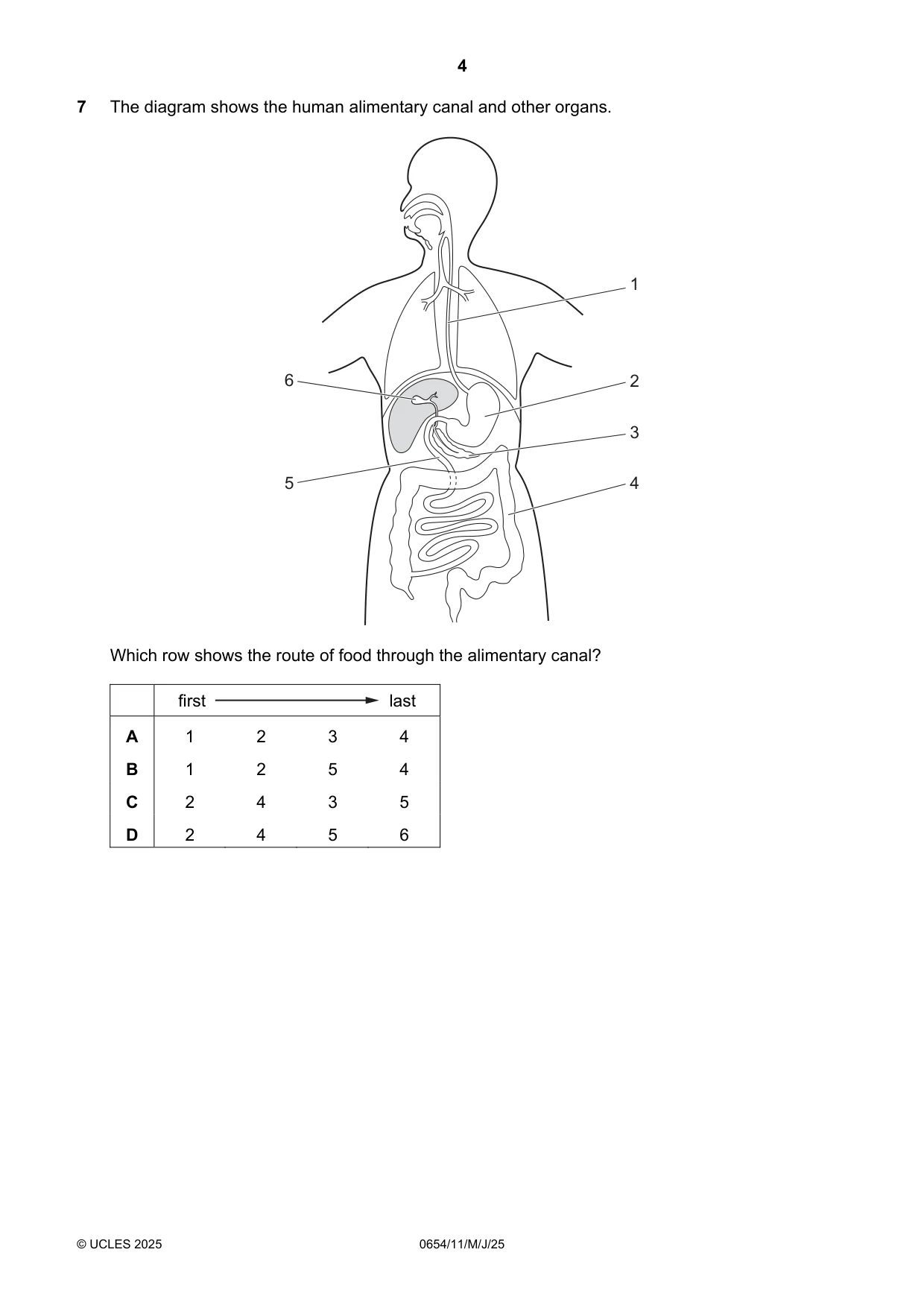
7 The diagram shows the human alimentary canal and other organs. 1 6 2 3 5 4 Which row shows the route of food through the alimentary canal? first last A 1 2 3 4 B 1 2 5 4 C 2 4 3 5 D 2 4 5 6
Mark scheme: B
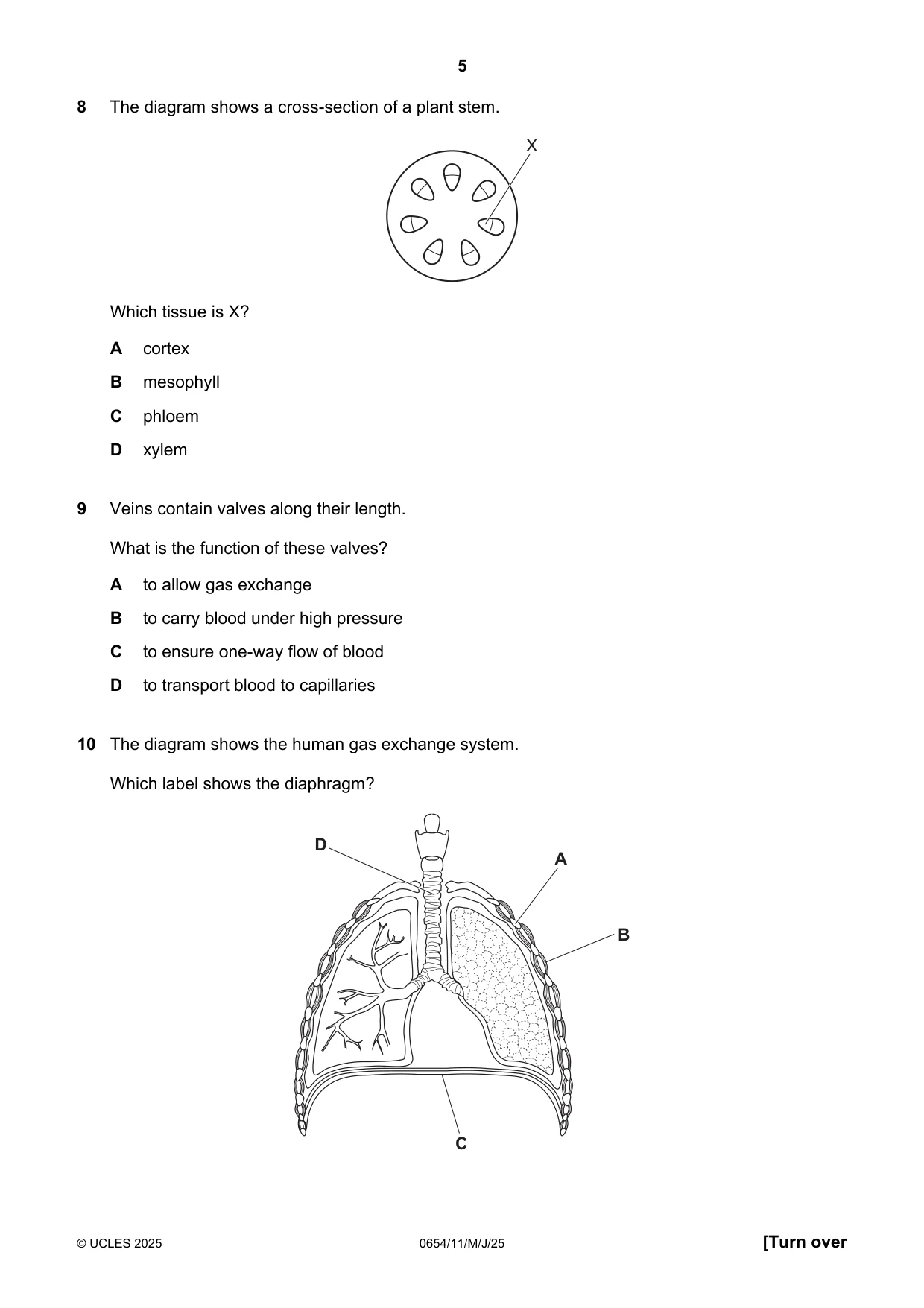
Q8 · The diagram shows a cross-section of a plant stem
8 The diagram shows a cross-section of a plant stem. X Which tissue is X? A cortex B mesophyll C phloem D xylem
Mark scheme: D
Q9 · Veins contain valves along their length
9 Veins contain valves along their length. What is the function of these valves? A to allow gas exchange B to carry blood under high pressure C to ensure one-way flow of blood D to transport blood to capillaries
Mark scheme: C
Q10 · The diagram shows the human gas exchange system
10 The diagram shows the human gas exchange system. Which label shows the diaphragm? D A B C
Mark scheme: C
Q11 · Which row shows effects of adrenaline?
11 Which row shows effects of adrenaline? heart rate pupil diameter A increases increases B increases no effect C decreases increases D no effect increases
Mark scheme: A
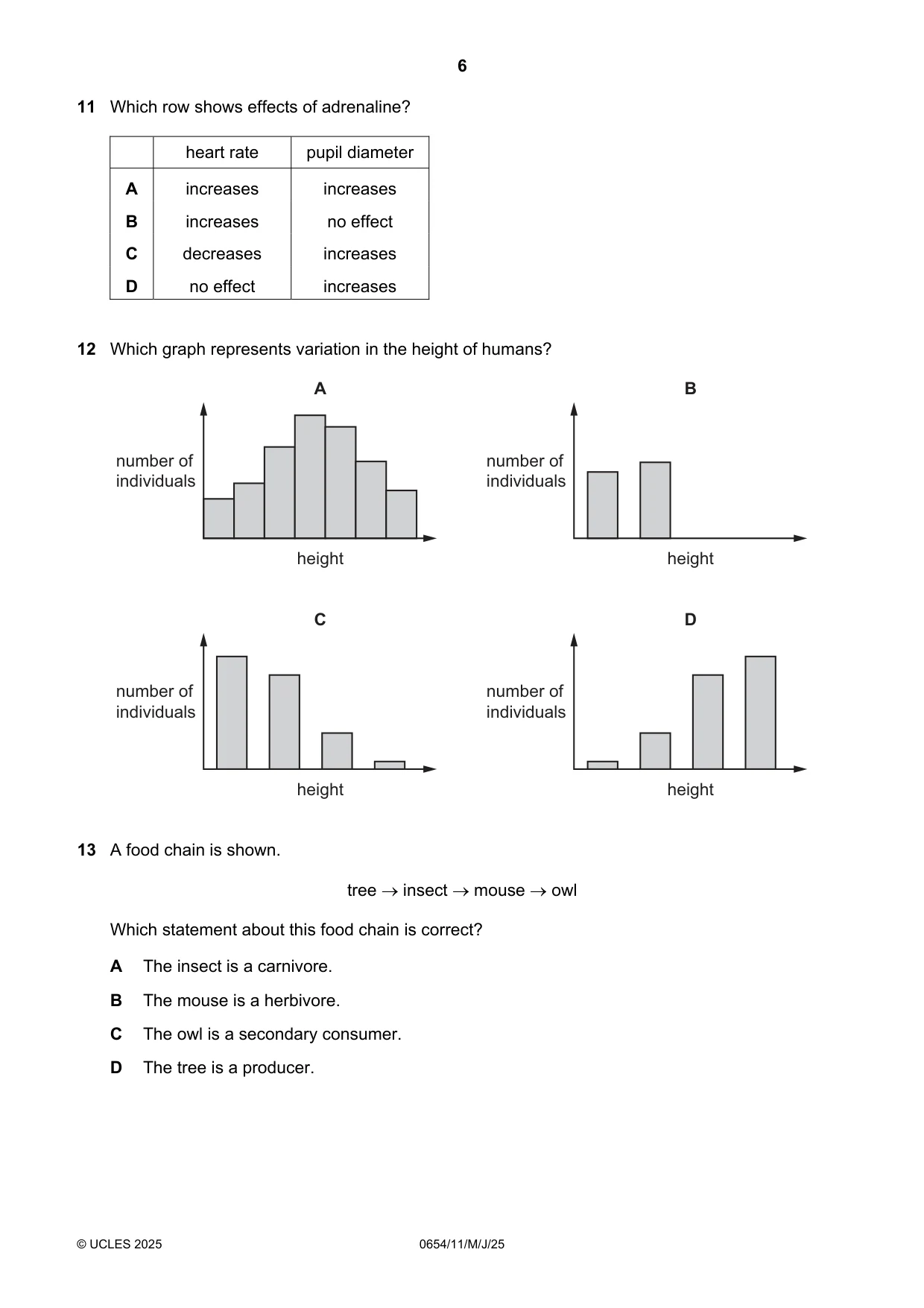
Q12 · Which graph represents variation in the height of humans?
12 Which graph represents variation in the height of humans? A B number of number of individuals individuals height height C D number of number of individuals individuals height height
Mark scheme: A
Q13 · A food chain is shown
13 A food chain is shown. tree insect mouse owl Which statement about this food chain is correct? A The insect is a carnivore. B The mouse is a herbivore. C The owl is a secondary consumer. D The tree is a producer.
Mark scheme: D
Q14 · Which change of state results in the greatest increase in the separation of particles?
14 Which change of state results in the greatest increase in the separation of particles? A gas to liquid B liquid to gas C liquid to solid D solid to liquid
Mark scheme: B
Q15 · An atom of phosphorus has a nucleon number of 31 and a proton number of 15
15 An atom of phosphorus has a nucleon number of 31 and a proton number of 15. How many neutrons are there in this atom? A 15 B 16 C 31 D 46
Mark scheme: B
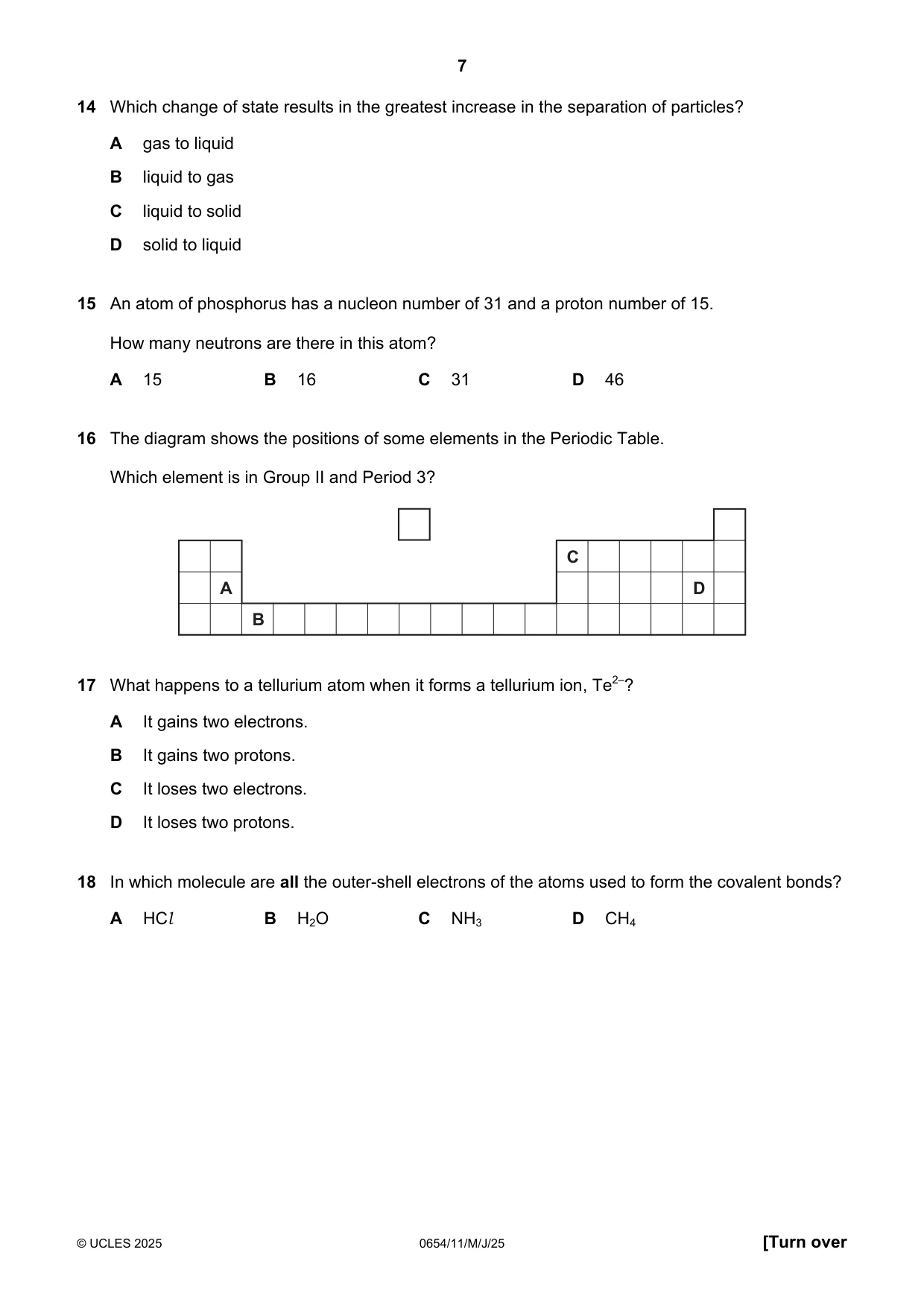
Q16 · The diagram shows the positions of some elements in the Periodic Table
16 The diagram shows the positions of some elements in the Periodic Table. Which element is in Group II and Period 3? C A D B
Mark scheme: A
Q17 · What happens to a tellurium atom when it forms a tellurium ion, Te2–?
17 What happens to a tellurium atom when it forms a tellurium ion, Te2–? A It gains two electrons. B It gains two protons. C It loses two electrons. D It loses two protons.
Mark scheme: A
Q18 · In which molecule are all the outer-shell electrons of the atoms used to form the…
18 In which molecule are all the outer-shell electrons of the atoms used to form the covalent bonds? A HCl B H2O C NH3 D CH4
Mark scheme: D
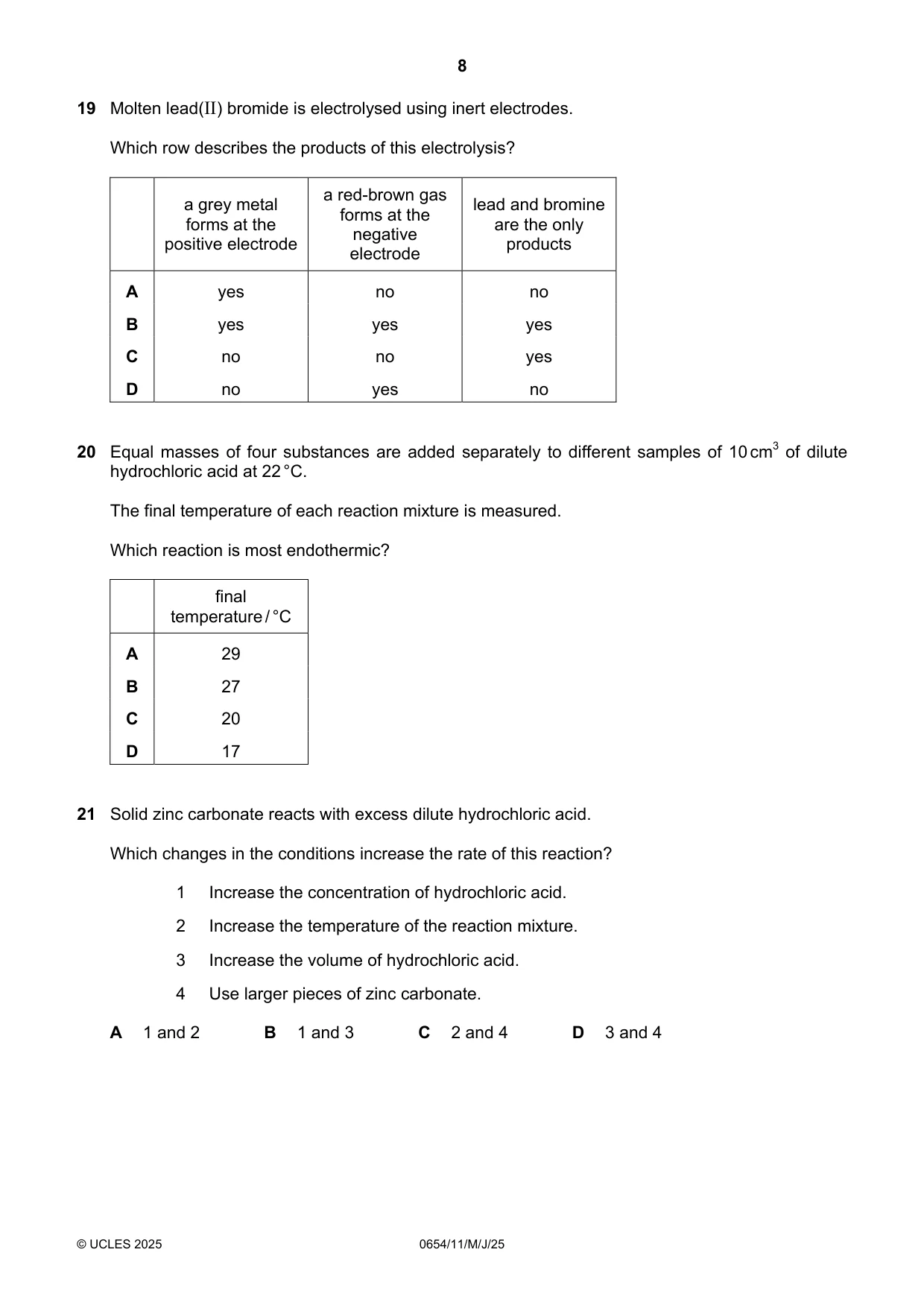
Q19 · Molten lead(II) bromide is electrolysed using inert electrodes
19 Molten lead(II) bromide is electrolysed using inert electrodes. Which row describes the products of this electrolysis? a red-brown gas a grey metal lead and bromine forms at the forms at the are the only negative positive electrode products electrode A yes no no B yes yes yes C no no yes D no yes no
Mark scheme: C
Q20 · Equal masses of four substances are added separately to different samples of 10 cm3 of…
20 Equal masses of four substances are added separately to different samples of 10 cm3 of dilute hydrochloric acid at 22 °C. The final temperature of each reaction mixture is measured. Which reaction is most endothermic? final temperature / °C A 29 B 27 C 20 D 17
Mark scheme: D
Q21 · Solid zinc carbonate reacts with excess dilute hydrochloric acid
21 Solid zinc carbonate reacts with excess dilute hydrochloric acid. Which changes in the conditions increase the rate of this reaction? 1 Increase the concentration of hydrochloric acid. 2 Increase the temperature of the reaction mixture. 3 Increase the volume of hydrochloric acid. 4 Use larger pieces of zinc carbonate. A 1 and 2 B 1 and 3 C 2 and 4 D 3 and 4
Mark scheme: A
Q22 · Which equation shows the oxidation of a metal?
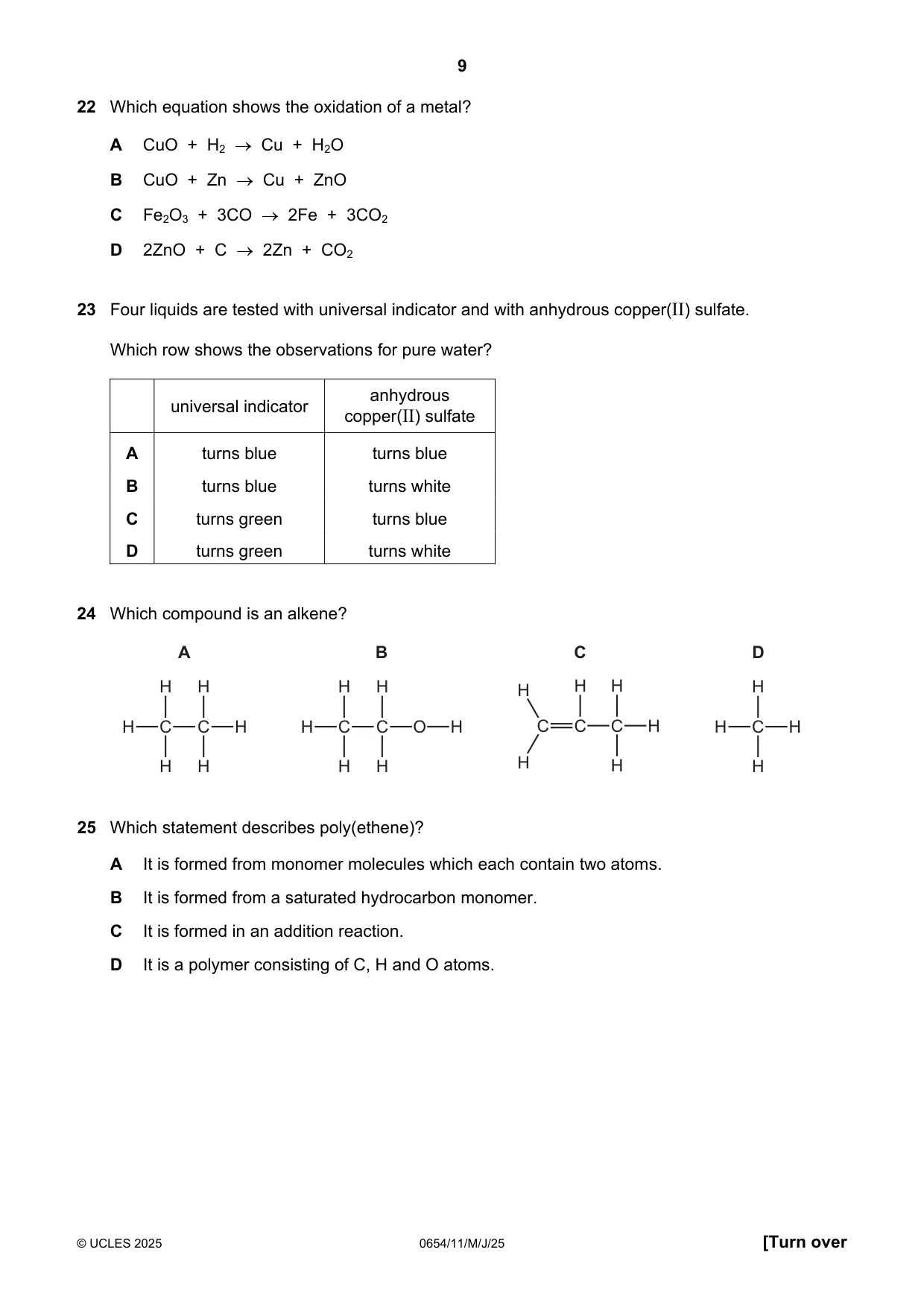
22 Which equation shows the oxidation of a metal? A CuO + H2 Cu + H2O B CuO + Zn Cu + ZnO C Fe2O3 + 3CO 2Fe + 3CO2 D 2ZnO + C 2Zn + CO2
Mark scheme: B
Q23 · Four liquids are tested with universal indicator and with anhydrous copper(II) sulfate
23 Four liquids are tested with universal indicator and with anhydrous copper(II) sulfate. Which row shows the observations for pure water? anhydrous universal indicator copper(II) sulfate A turns blue turns blue B turns blue turns white C turns green turns blue D turns green turns white
Mark scheme: C
Q24 · Which compound is an alkene?
24 Which compound is an alkene? A B C D H H H H H H H H H C C H H C C O H C C C H H C H H H H H H H H
Mark scheme: C
Q25 · Which statement describes poly(ethene)?
25 Which statement describes poly(ethene)? A It is formed from monomer molecules which each contain two atoms. B It is formed from a saturated hydrocarbon monomer. C It is formed in an addition reaction. D It is a polymer consisting of C, H and O atoms.
Mark scheme: C
Q26 · Naphtha is obtained from petroleum
26 Naphtha is obtained from petroleum. What is a use for naphtha? A cooking B heating C making roads D making chemicals
Mark scheme: D
Q27 · Aqueous ammonia is separately added dropwise and then in excess to four different aqueous…
27 Aqueous ammonia is separately added dropwise and then in excess to four different aqueous cations. Which cations give a precipitate that then dissolves? 1 Ca2+ 2 Cu2+ 3 Fe2+ 4 Zn2+ A 1 and 3 B 1 and 4 C 2 and 3 D 2 and 4
Mark scheme: D
Q28 · The total thickness of 500 sheets of paper is 4.5 cm
28 The total thickness of 500 sheets of paper is 4.5 cm. What is the thickness of 1 sheet of paper in mm? A 0.0090 mm B 0.090 mm C 0.90 mm D 9.0 mm
Mark scheme: B
More questions on Physical quantities and measurement techniques
Q29 · A metal bar has weight 50 N and length 2.0 m
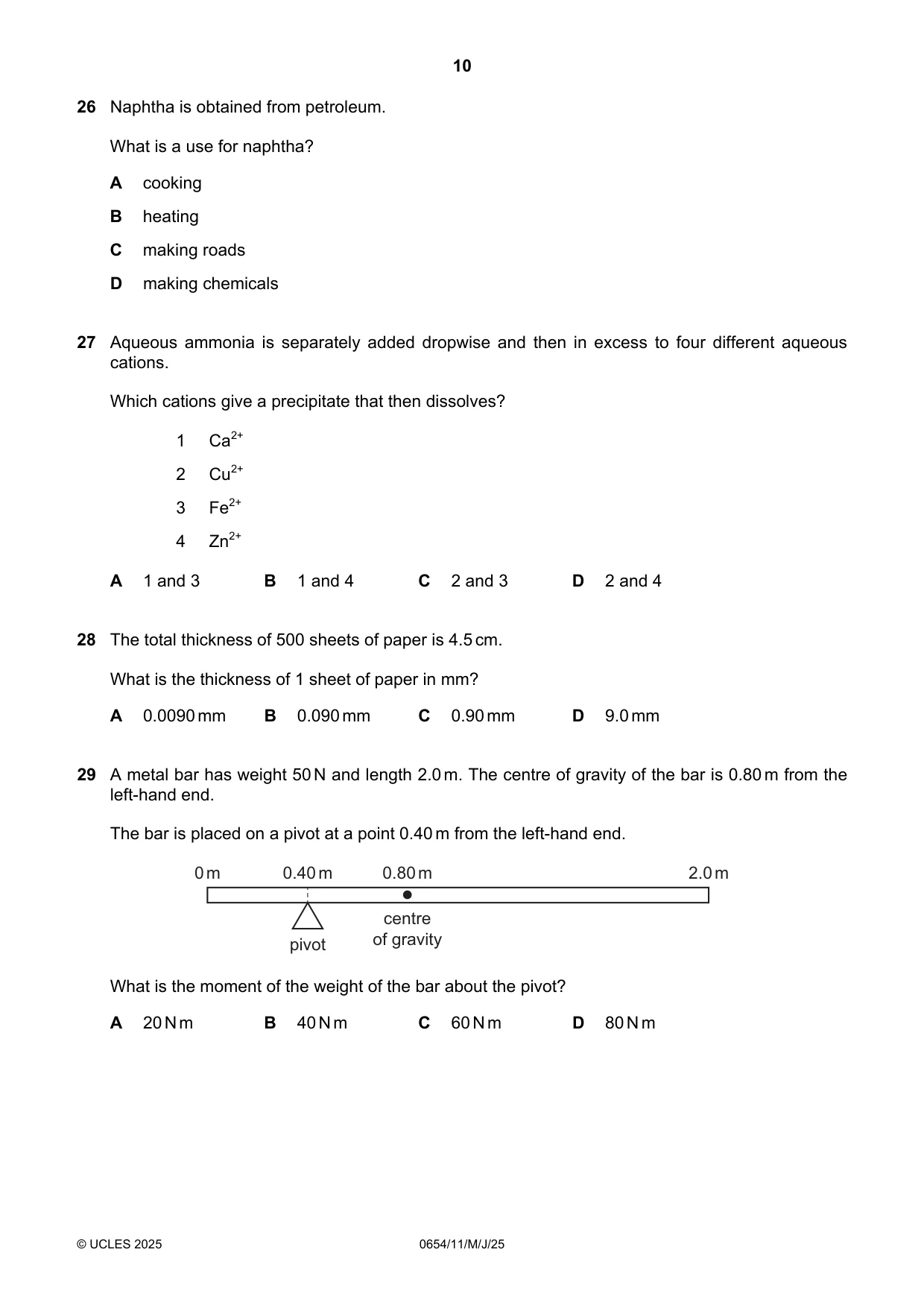
29 A metal bar has weight 50 N and length 2.0 m. The centre of gravity of the bar is 0.80 m from the left-hand end. The bar is placed on a pivot at a point 0.40 m from the left-hand end. 0 m 0.40 m 0.80 m 2.0 m centre pivot of gravity What is the moment of the weight of the bar about the pivot? A 20 N m B 40 N m C 60 N m D 80 N m
Mark scheme: A
Q30 · The diagram shows a large force of magnitude P and a small force of magnitude Q acting on…
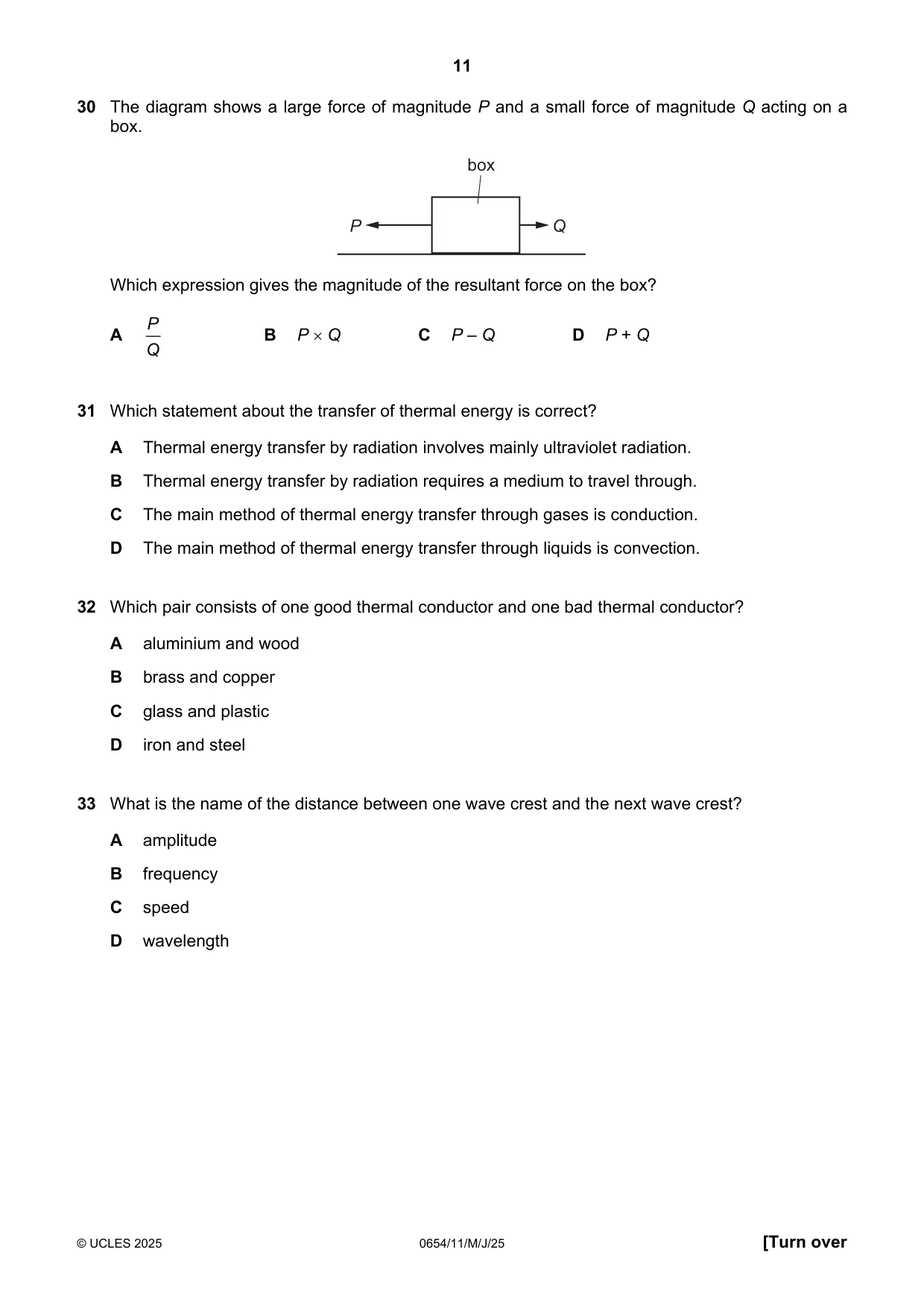
30 The diagram shows a large force of magnitude P and a small force of magnitude Q acting on a box. box P Q Which expression gives the magnitude of the resultant force on the box? P A B P Q C P – Q D P + Q Q
Mark scheme: C
Q31 · Which statement about the transfer of thermal energy is correct?
31 Which statement about the transfer of thermal energy is correct? A Thermal energy transfer by radiation involves mainly ultraviolet radiation. B Thermal energy transfer by radiation requires a medium to travel through. C The main method of thermal energy transfer through gases is conduction. D The main method of thermal energy transfer through liquids is convection.
Mark scheme: D
Q32 · Which pair consists of one good thermal conductor and one bad thermal conductor?
32 Which pair consists of one good thermal conductor and one bad thermal conductor? A aluminium and wood B brass and copper C glass and plastic D iron and steel
Mark scheme: A
Q33 · What is the name of the distance between one wave crest and the next wave crest?
33 What is the name of the distance between one wave crest and the next wave crest? A amplitude B frequency C speed D wavelength
Mark scheme: D
Q34 · The diagram shows two rays of light passing through a thin converging lens to form an…
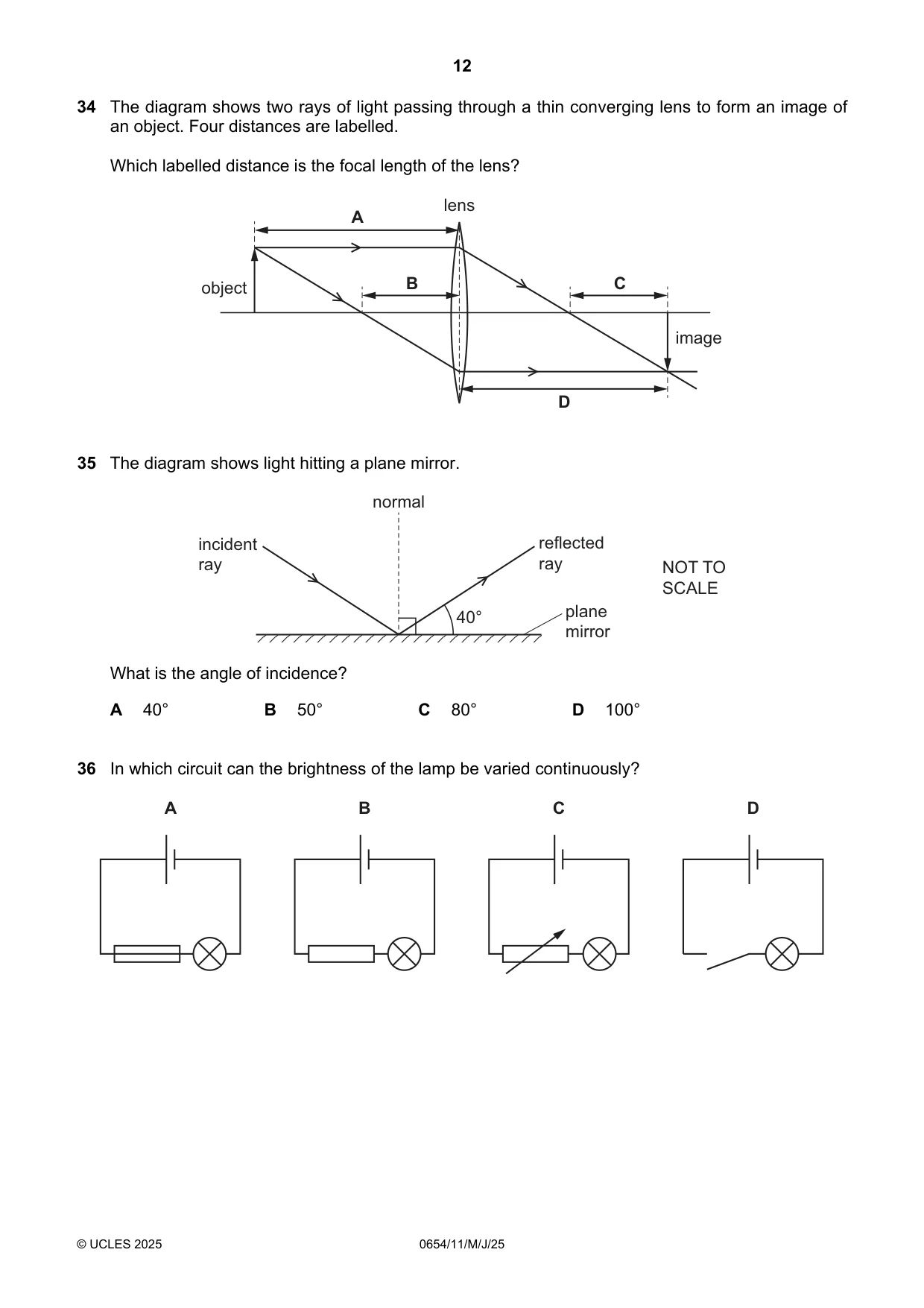
34 The diagram shows two rays of light passing through a thin converging lens to form an image of an object. Four distances are labelled. Which labelled distance is the focal length of the lens? lens A B C object image D
Mark scheme: B
Q35 · The diagram shows light hitting a plane mirror
35 The diagram shows light hitting a plane mirror. normal incident reflected ray ray NOT TO SCALE 40° plane mirror What is the angle of incidence? A 40° B 50° C 80° D 100°
Mark scheme: B
Q36 · In which circuit can the brightness of the lamp be varied continuously?
36 In which circuit can the brightness of the lamp be varied continuously? A B C D
Mark scheme: C
Q37 · A 12 resistor is connected in parallel with a 17 resistor
37 A 12 resistor is connected in parallel with a 17 resistor. Which statement about the combined resistance of the two resistors is correct? A It must be equal to 29 . B It must be greater than 12 but less than 17 . C It must be greater than 17 but less than 29 . D It must be less than 12 .
Mark scheme: D
Q38 · The voltage across an electric heater is 240 V and the current in the heater is 3.0 A
38 The voltage across an electric heater is 240 V and the current in the heater is 3.0 A. The heater is connected in a circuit with a fuse. Which fuse rating is the most suitable? A 1 A B 2 A C 5 A D 240 A
Mark scheme: C
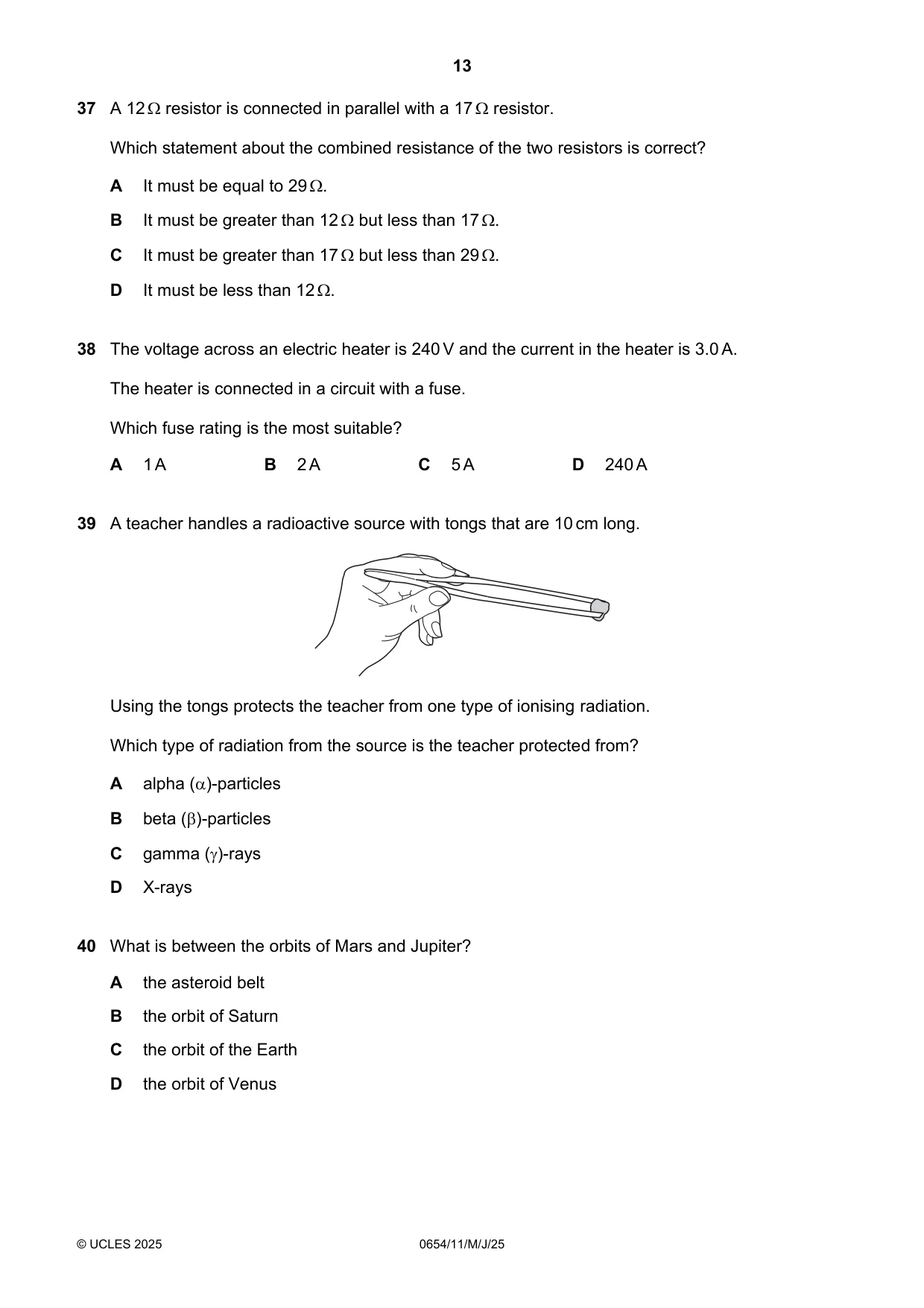
Q39 · A teacher handles a radioactive source with tongs that are 10 cm long
39 A teacher handles a radioactive source with tongs that are 10 cm long. Using the tongs protects the teacher from one type of ionising radiation. Which type of radiation from the source is the teacher protected from? A alpha ()-particles B beta ()-particles C gamma ()-rays D X-rays
Mark scheme: A
Q40 · What is between the orbits of Mars and Jupiter?
40 What is between the orbits of Mars and Jupiter? A the asteroid belt B the orbit of Saturn C the orbit of the Earth D the orbit of Venus
Mark scheme: A
What was in this paper
The subtopics covered by these 40 questions, and how many questions each got. Open one in a new tab to see every Cambridge question on it.
2Forces2Light2Transfer of thermal energy2Alkenes1Arrangement of elements1Atomic structure and the Periodic Table1Biological molecules1Blood vessels1Characteristics of living organisms1Digestive system1Electrical safety1Electrolysis1Enzymes1Exothermic and endothermic reactions1Food chains and food webs1Fuels1Gas exchange in humans1General properties of waves1Hormones1Identification of ions and gases1Ions and ionic bonds1Osmosis1Photosynthesis1Physical quantities and measurement techniques1Polymers1Radioactivity1Rate of reaction1Redox1Simple molecules and covalent bonds1Size of specimens1Solids, liquids and gases1The Solar System1Variation1Water1Xylem and phloem1What you needed in this session
Cambridge’s own grade thresholds for 2025 May/June, Paper 1 · Variant 1. A higher threshold means an easier paper — the bar moves with how the cohort did.