Cambridge IGCSE Sciences - Co-ordinated (Double) 0654 — 2019 Oct/Nov Paper 1 · Variant 1
0654/11/O/N/19 · 40 questions · 40 marks · ≈45 min
The question paper and its mark scheme, free to read here and free to download. This is Cambridge’s own paper, exactly as it was sat.
Question paper16 pages
Mark scheme3 pages
Answers below. Sit the paper first if you are practising.
Questions as text
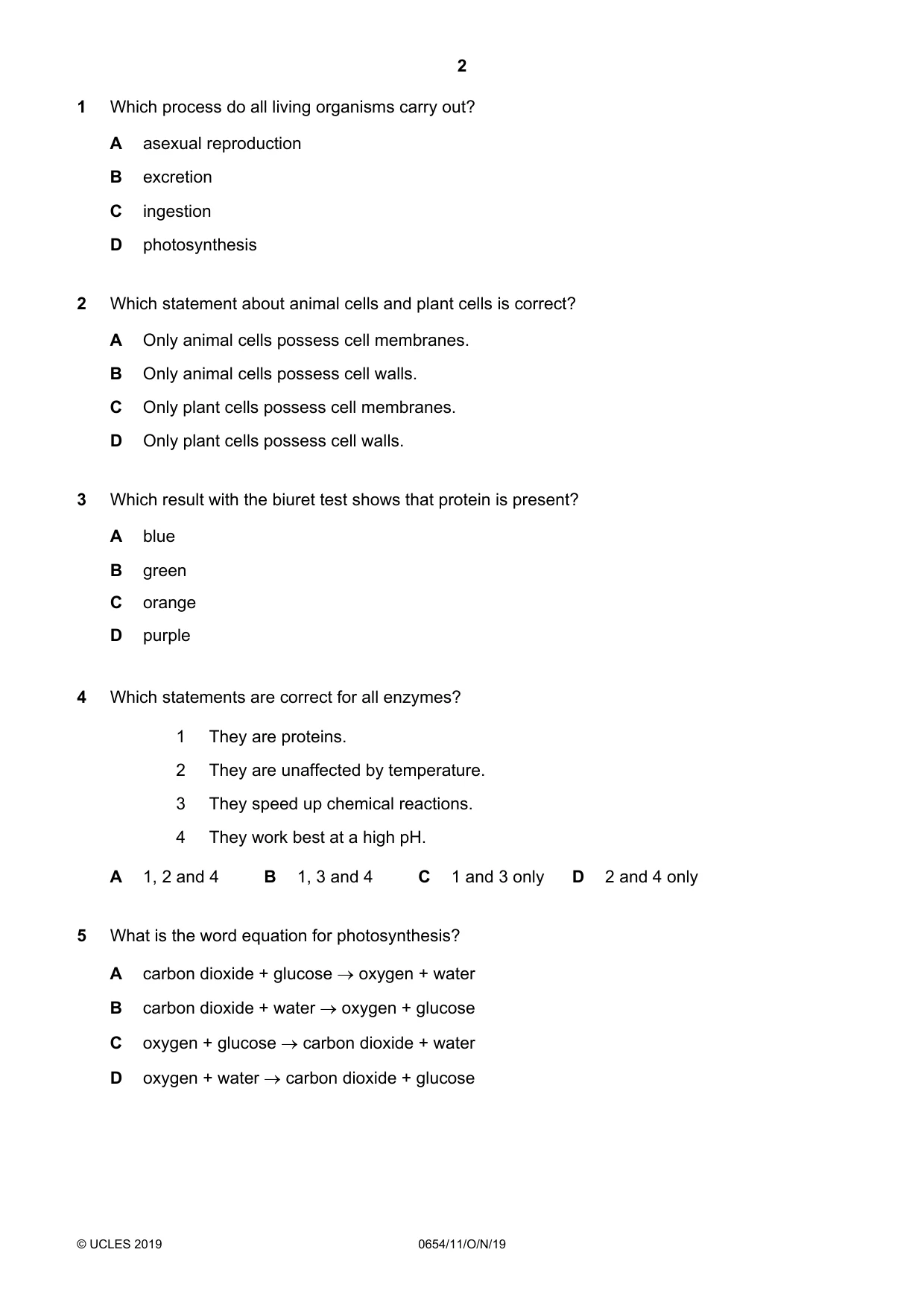
Q1 · Which process do all living organisms carry out?
1 Which process do all living organisms carry out? A asexual reproduction B excretion C ingestion D photosynthesis
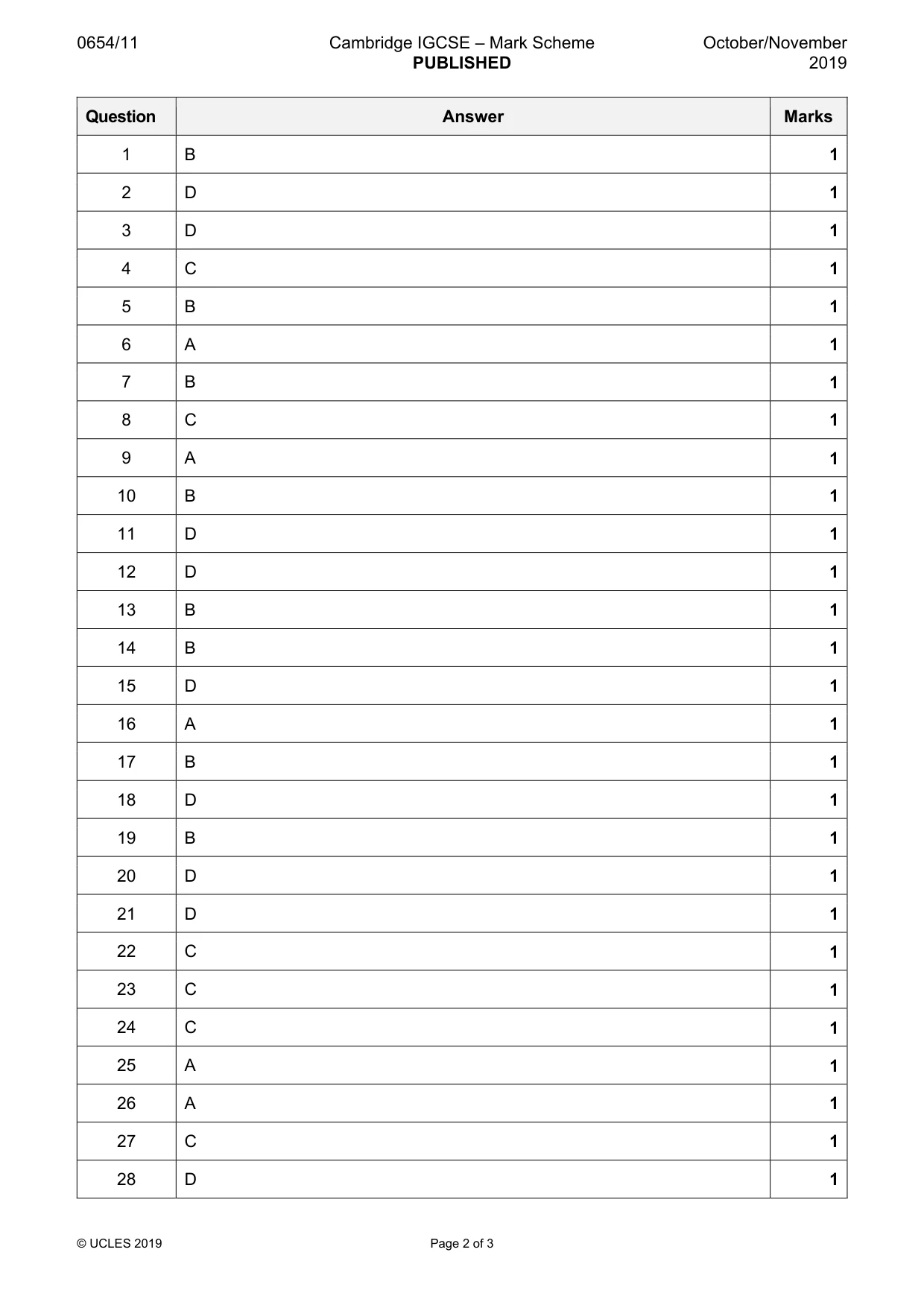
Mark scheme: B
Q2 · Which statement about animal cells and plant cells is correct?
2 Which statement about animal cells and plant cells is correct? A Only animal cells possess cell membranes. B Only animal cells possess cell walls. C Only plant cells possess cell membranes. D Only plant cells possess cell walls.
Mark scheme: D
Q3 · Which result with the biuret test shows that protein is present?
3 Which result with the biuret test shows that protein is present? A blue B green C orange D purple
Mark scheme: D
Q4 · Which statements are correct for all enzymes?
4 Which statements are correct for all enzymes? 1 They are proteins. 2 They are unaffected by temperature. 3 They speed up chemical reactions. 4 They work best at a high pH. A 1, 2 and 4 B 1, 3 and 4 C 1 and 3 only D 2 and 4 only
Mark scheme: C
Q5 · What is the word equation for photosynthesis?
5 What is the word equation for photosynthesis? A carbon dioxide + glucose → oxygen + water B carbon dioxide + water → oxygen + glucose C oxygen + glucose → carbon dioxide + water D oxygen + water → carbon dioxide + glucose
Mark scheme: B
Q6 · Which process can be defined as the movement of small, water-soluble food molecules…
6 Which process can be defined as the movement of small, water-soluble food molecules through the wall of the intestine into the blood? A absorption B assimilation C digestion D egestion
Mark scheme: A
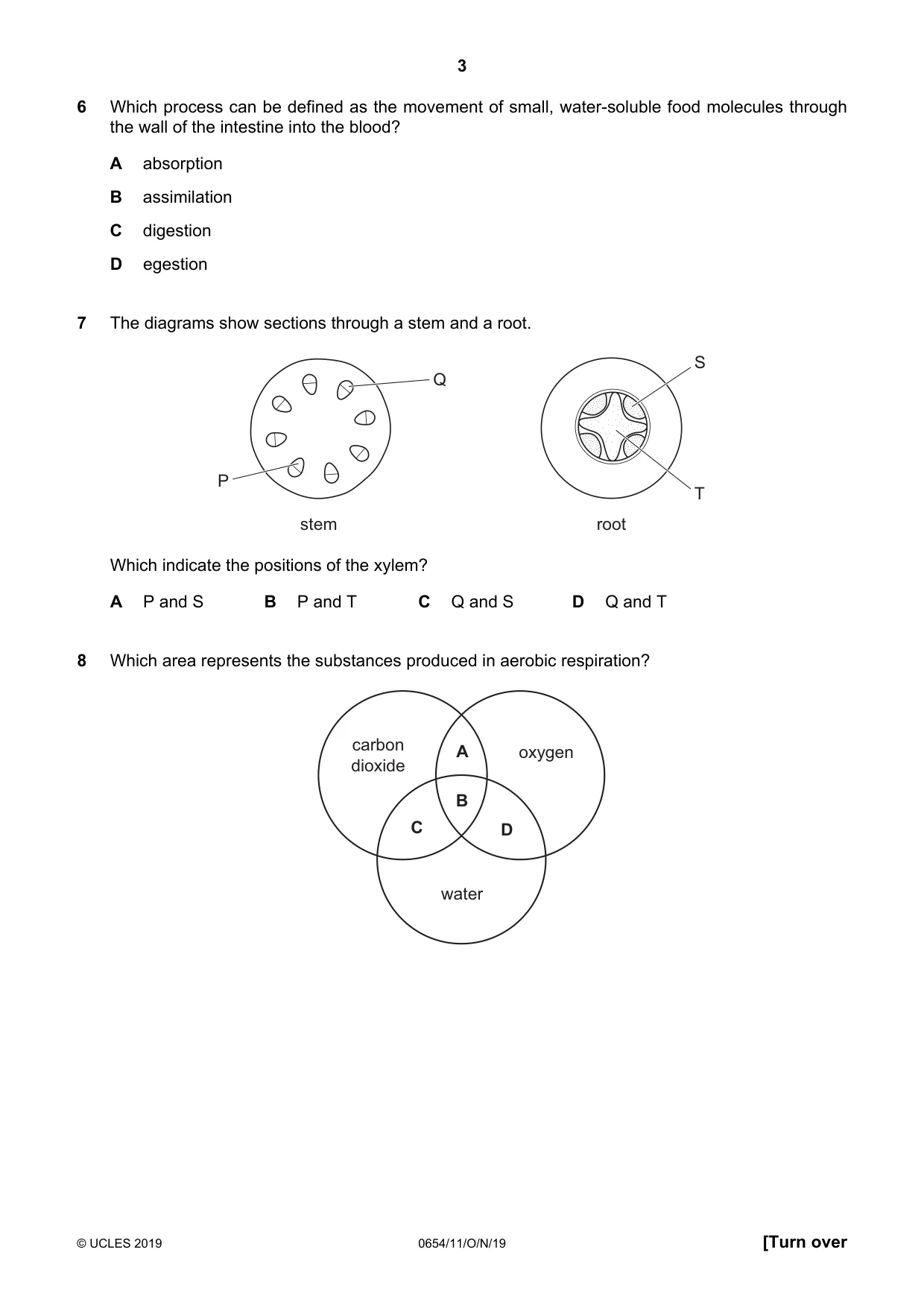
Q7 · The diagrams show sections through a stem and a root
7 The diagrams show sections through a stem and a root. S Q P T stem root Which indicate the positions of the xylem? A P and S B P and T C Q and S D Q and T
Mark scheme: B
Q8 · Which area represents the substances produced in aerobic respiration?
8 Which area represents the substances produced in aerobic respiration? carbon A oxygen dioxide B C D water
Mark scheme: C
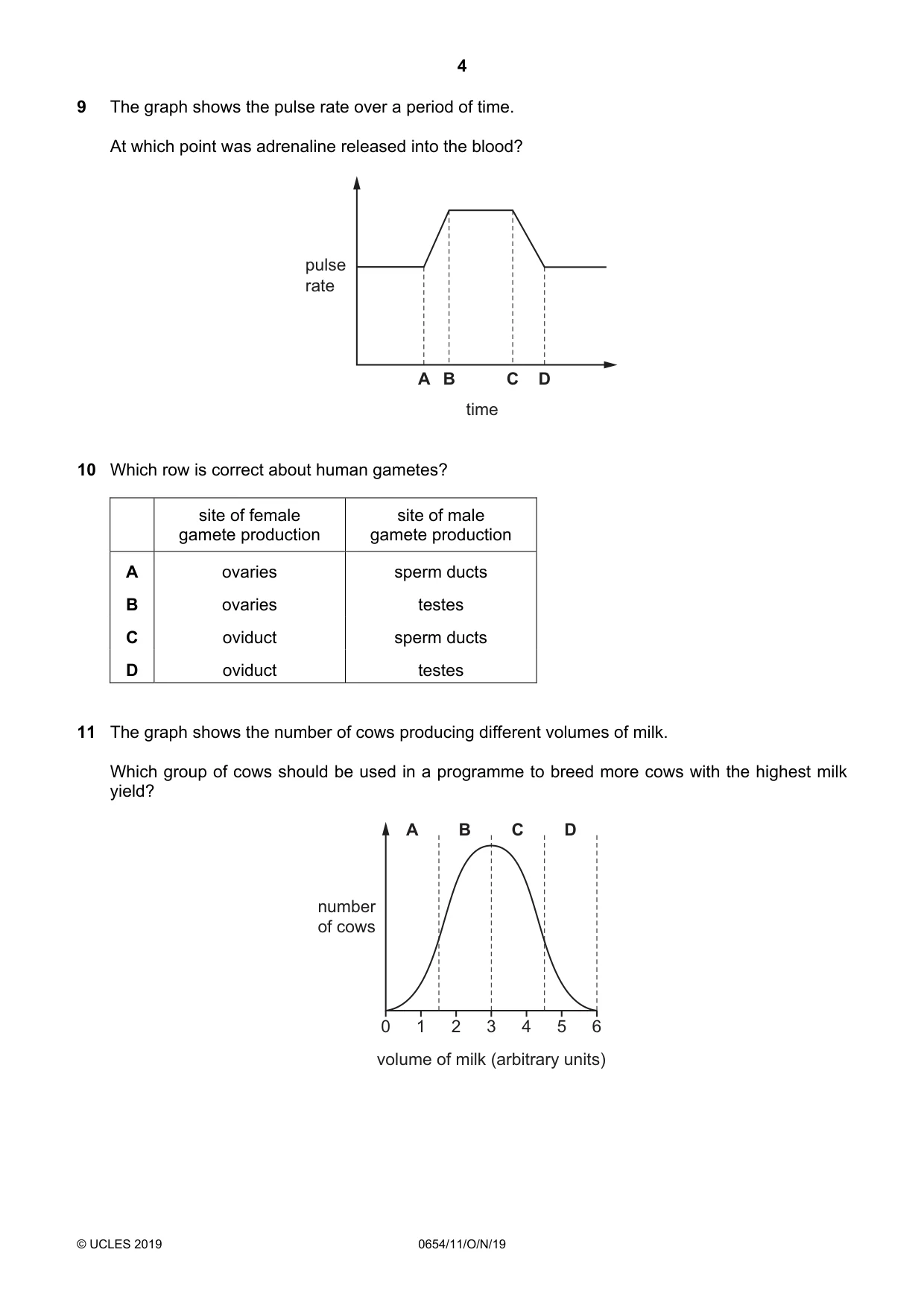
Q9 · The graph shows the pulse rate over a period of time
9 The graph shows the pulse rate over a period of time. At which point was adrenaline released into the blood? pulse rate A B C D time
Mark scheme: A
Q10 · Which row is correct about human gametes?
10 Which row is correct about human gametes? site of female site of male gamete production gamete production A ovaries sperm ducts B ovaries testes C oviduct sperm ducts D oviduct testes
Mark scheme: B
Q11 · The graph shows the number of cows producing different volumes of milk
11 The graph shows the number of cows producing different volumes of milk. Which group of cows should be used in a programme to breed more cows with the highest milk yield? A B C D number of cows 0 1 2 3 4 5 6 volume of milk (arbitrary units)
Mark scheme: D
Q12 · The diagram shows a food chain
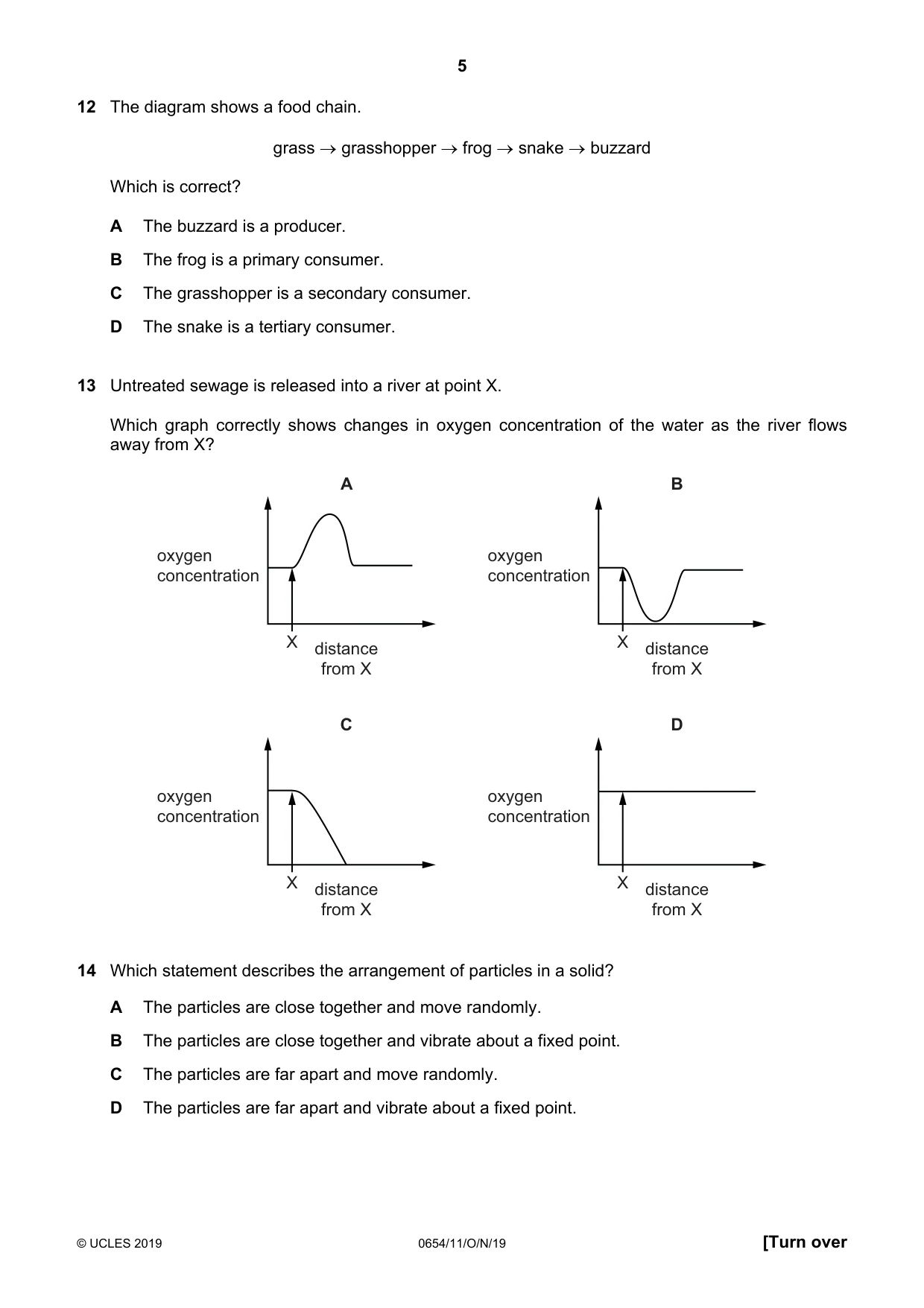
12 The diagram shows a food chain. grass → grasshopper → frog → snake → buzzard Which is correct? A The buzzard is a producer. B The frog is a primary consumer. C The grasshopper is a secondary consumer. D The snake is a tertiary consumer.
Mark scheme: D
Q13 · Untreated sewage is released into a river at point X
13 Untreated sewage is released into a river at point X. Which graph correctly shows changes in oxygen concentration of the water as the river flows away from X? A B oxygen oxygen concentration concentration X distance X distance from X from X C D oxygen oxygen concentration concentration X distance X distance from X from X
Mark scheme: B
Q14 · Which statement describes the arrangement of particles in a solid?
14 Which statement describes the arrangement of particles in a solid? A The particles are close together and move randomly. B The particles are close together and vibrate about a fixed point. C The particles are far apart and move randomly. D The particles are far apart and vibrate about a fixed point.
Mark scheme: B
Q15 · Which processes are chemical changes?
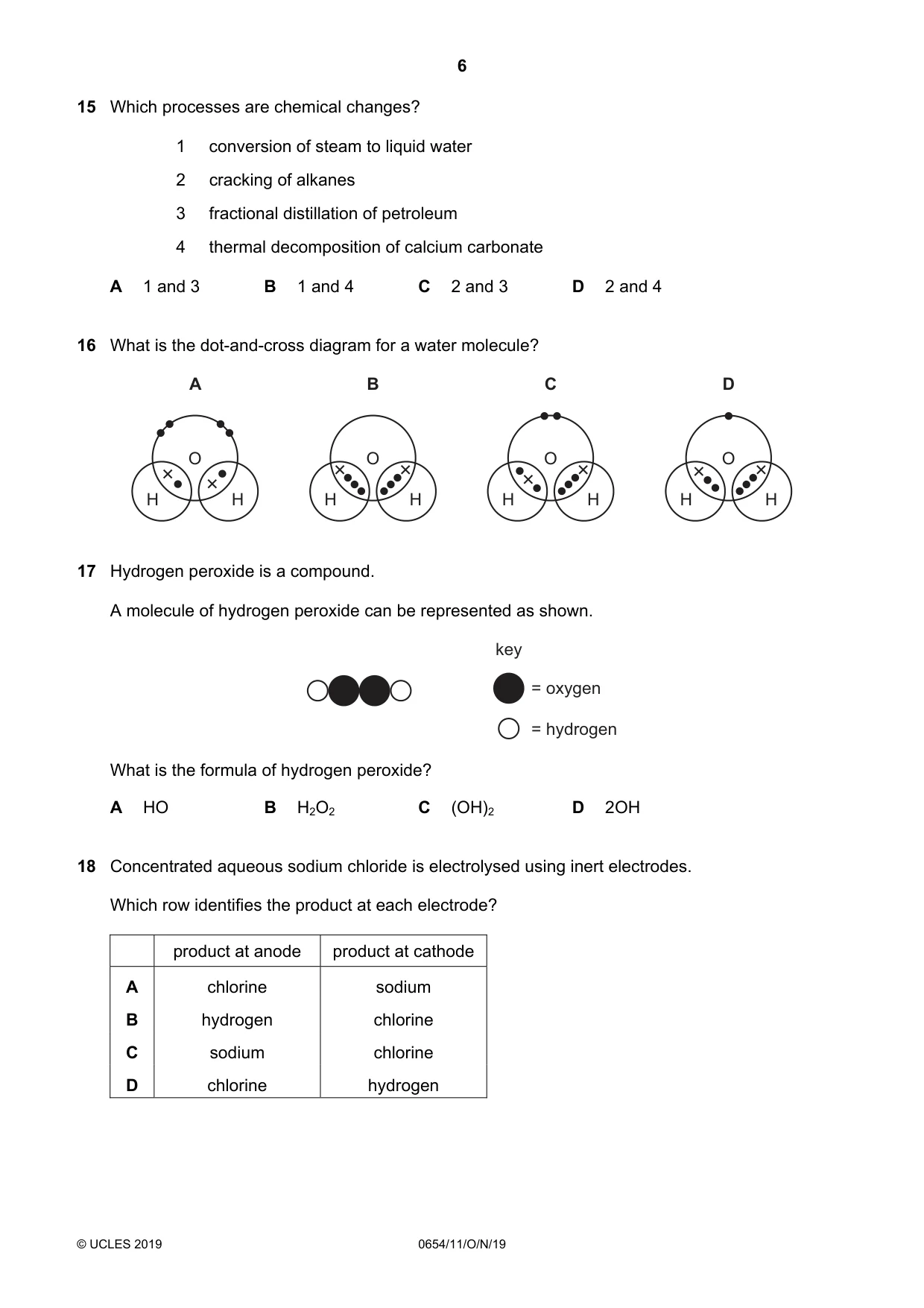
15 Which processes are chemical changes? 1 conversion of steam to liquid water 2 cracking of alkanes 3 fractional distillation of petroleum 4 thermal decomposition of calcium carbonate A 1 and 3 B 1 and 4 C 2 and 3 D 2 and 4
Mark scheme: D
Q16 · What is the dot-and-cross diagram for a water molecule?
16 What is the dot-and-cross diagram for a water molecule? A B C D O O O O H H H H H H H H
Mark scheme: A
Q17 · Hydrogen peroxide is a compound
17 Hydrogen peroxide is a compound. A molecule of hydrogen peroxide can be represented as shown. key = oxygen = hydrogen What is the formula of hydrogen peroxide? A HO B H2O2 C (OH)2 D 2OH
Mark scheme: B
Q18 · Concentrated aqueous sodium chloride is electrolysed using inert electrodes
18 Concentrated aqueous sodium chloride is electrolysed using inert electrodes. Which row identifies the product at each electrode? product at anode product at cathode A chlorine sodium B hydrogen chlorine C sodium chlorine D chlorine hydrogen
Mark scheme: D
Q19 · The table shows the temperature of some water before and after a solid is dissolved in it
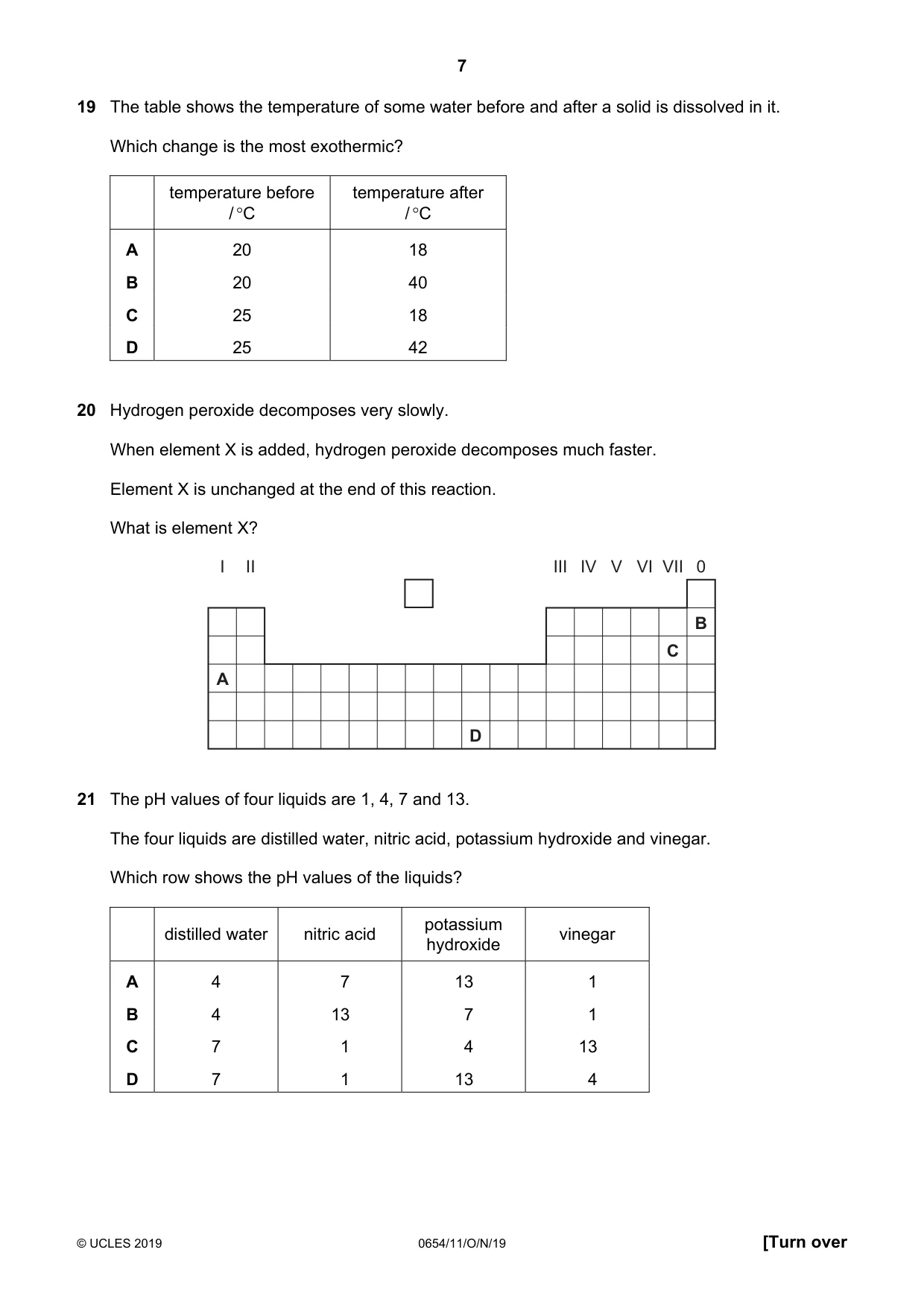
19 The table shows the temperature of some water before and after a solid is dissolved in it. Which change is the most exothermic? temperature before temperature after / °C / °C A 20 18 B 20 40 C 25 18 D 25 42
Mark scheme: B
Q20 · Hydrogen peroxide decomposes very slowly
20 Hydrogen peroxide decomposes very slowly. When element X is added, hydrogen peroxide decomposes much faster. Element X is unchanged at the end of this reaction. What is element X? I II III IV V VI VII 0 B C A D
Mark scheme: D
Q21 · The pH values of four liquids are 1, 4, 7 and 13
21 The pH values of four liquids are 1, 4, 7 and 13. The four liquids are distilled water, nitric acid, potassium hydroxide and vinegar. Which row shows the pH values of the liquids? potassium distilled water nitric acid vinegar hydroxide A 4 7 13 1 B 4 13 7 1 C 7 1 4 13 D 7 1 13 4
Mark scheme: D
More questions on The characteristic properties of acids and bases
Q22 · The colours in an ink can be separated by chromatography
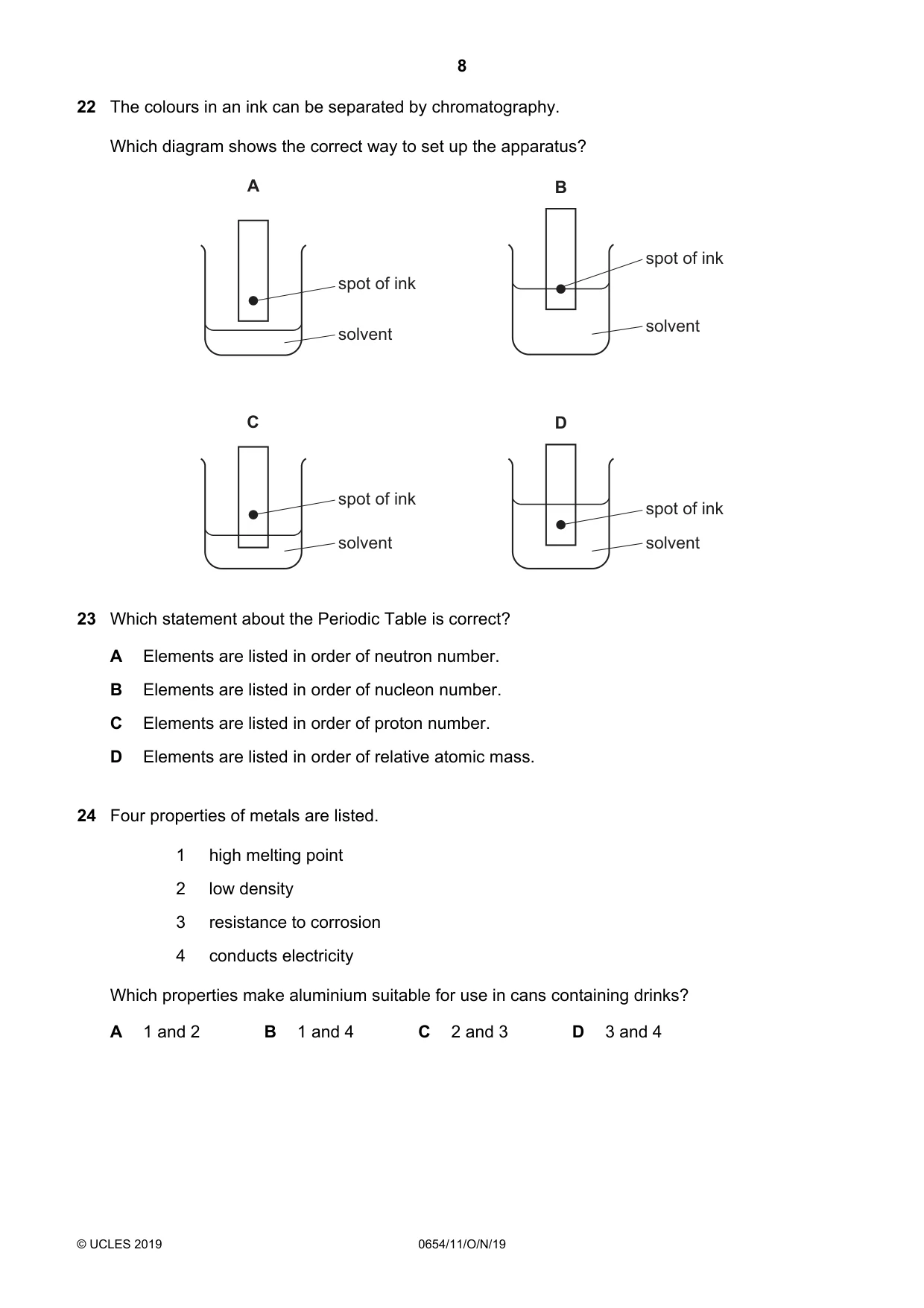
22 The colours in an ink can be separated by chromatography. Which diagram shows the correct way to set up the apparatus? A B spot of ink spot of ink solvent solvent C D spot of ink spot of ink solvent solvent
Mark scheme: C
Q23 · Which statement about the Periodic Table is correct?
23 Which statement about the Periodic Table is correct? A Elements are listed in order of neutron number. B Elements are listed in order of nucleon number. C Elements are listed in order of proton number. D Elements are listed in order of relative atomic mass.
Mark scheme: C
Q24 · Four properties of metals are listed
24 Four properties of metals are listed. 1 high melting point 2 low density 3 resistance to corrosion 4 conducts electricity Which properties make aluminium suitable for use in cans containing drinks? A 1 and 2 B 1 and 4 C 2 and 3 D 3 and 4
Mark scheme: C
Q25 · Which three elements are needed in fertilisers to help plants grow?
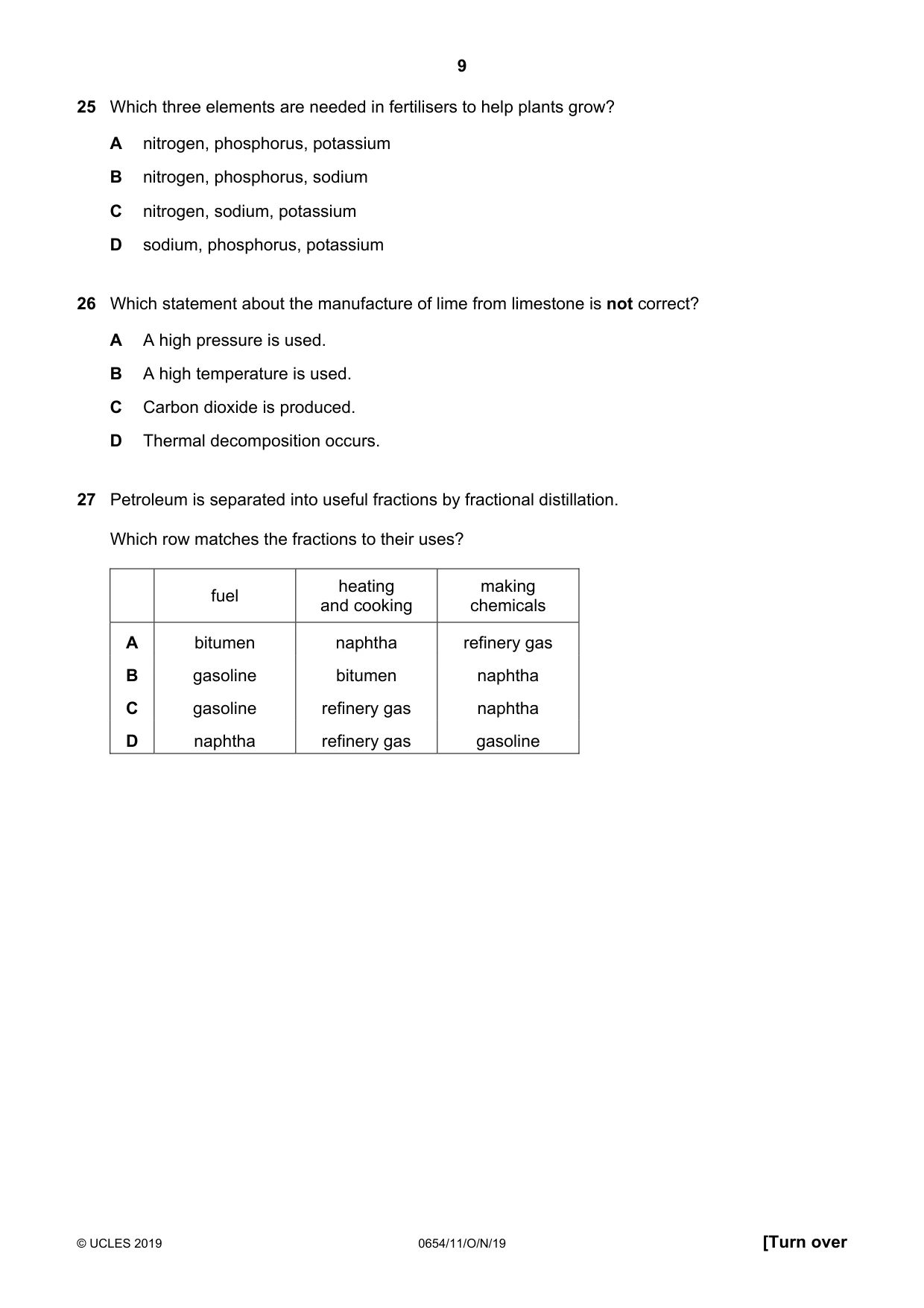
25 Which three elements are needed in fertilisers to help plants grow? A nitrogen, phosphorus, potassium B nitrogen, phosphorus, sodium C nitrogen, sodium, potassium D sodium, phosphorus, potassium
Mark scheme: A
Q26 · Which statement about the manufacture of lime from limestone is not correct?
26 Which statement about the manufacture of lime from limestone is not correct? A A high pressure is used. B A high temperature is used. C Carbon dioxide is produced. D Thermal decomposition occurs.
Mark scheme: A
Q27 · Petroleum is separated into useful fractions by fractional distillation
27 Petroleum is separated into useful fractions by fractional distillation. Which row matches the fractions to their uses? heating making fuel and cooking chemicals A bitumen naphtha refinery gas B gasoline bitumen naphtha C gasoline refinery gas naphtha D naphtha refinery gas gasoline
Mark scheme: C
Q28 · The speed-time graphs represent the motion of a car moving in a straight line
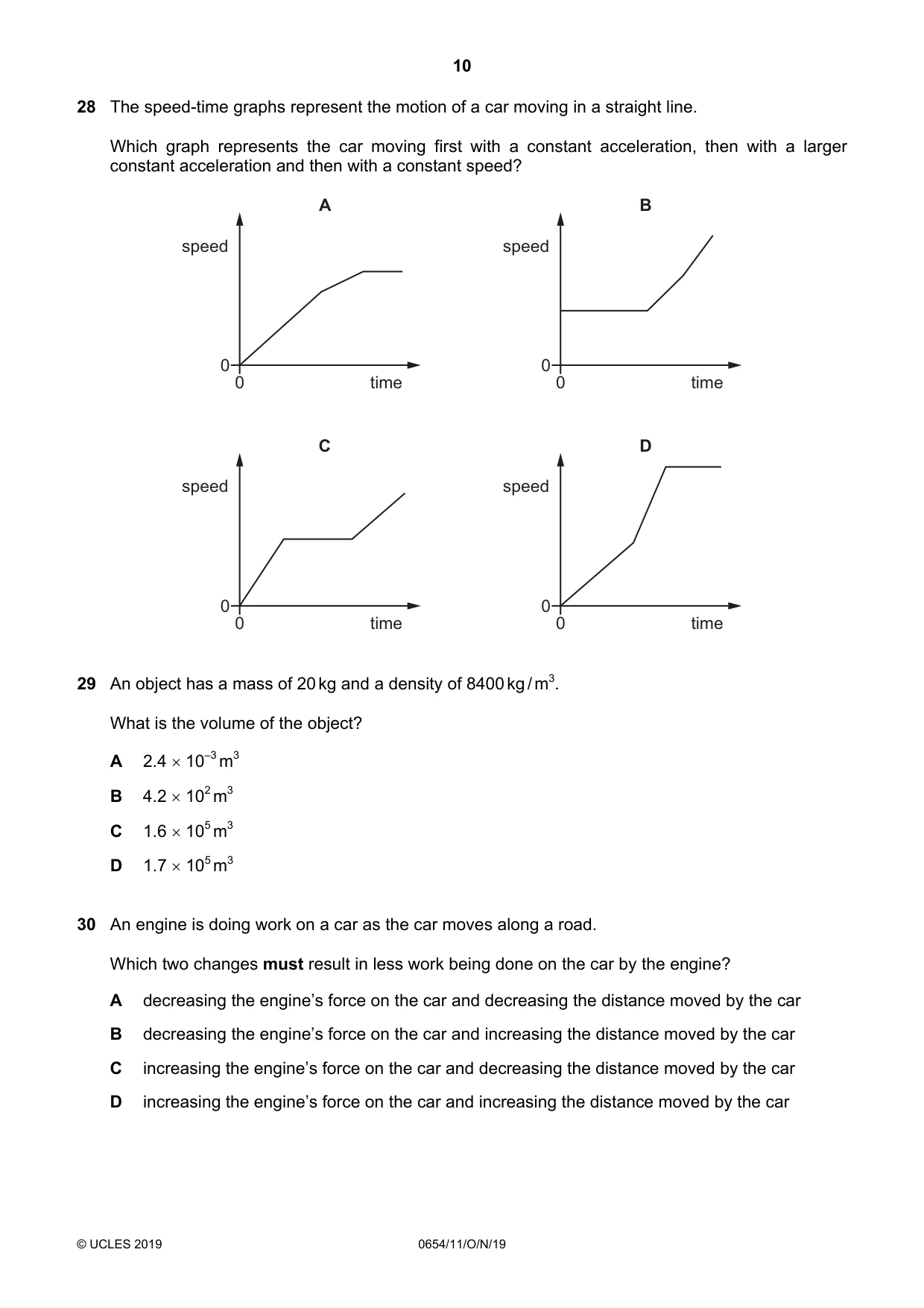
28 The speed-time graphs represent the motion of a car moving in a straight line. Which graph represents the car moving first with a constant acceleration, then with a larger constant acceleration and then with a constant speed? A B speed speed 0 0 0 time 0 time C D speed speed 0 0 0 time 0 time
Mark scheme: D
Q29 · An object has a mass of 20 kg and a density of 8400 kg / m3
29 An object has a mass of 20 kg and a density of 8400 kg / m3. What is the volume of the object? A 2.4 × 10⁻³ m3 B 4.2 × 10² m3 C 1.6 × 10⁵ m3 D 1.7 × 10⁵ m3
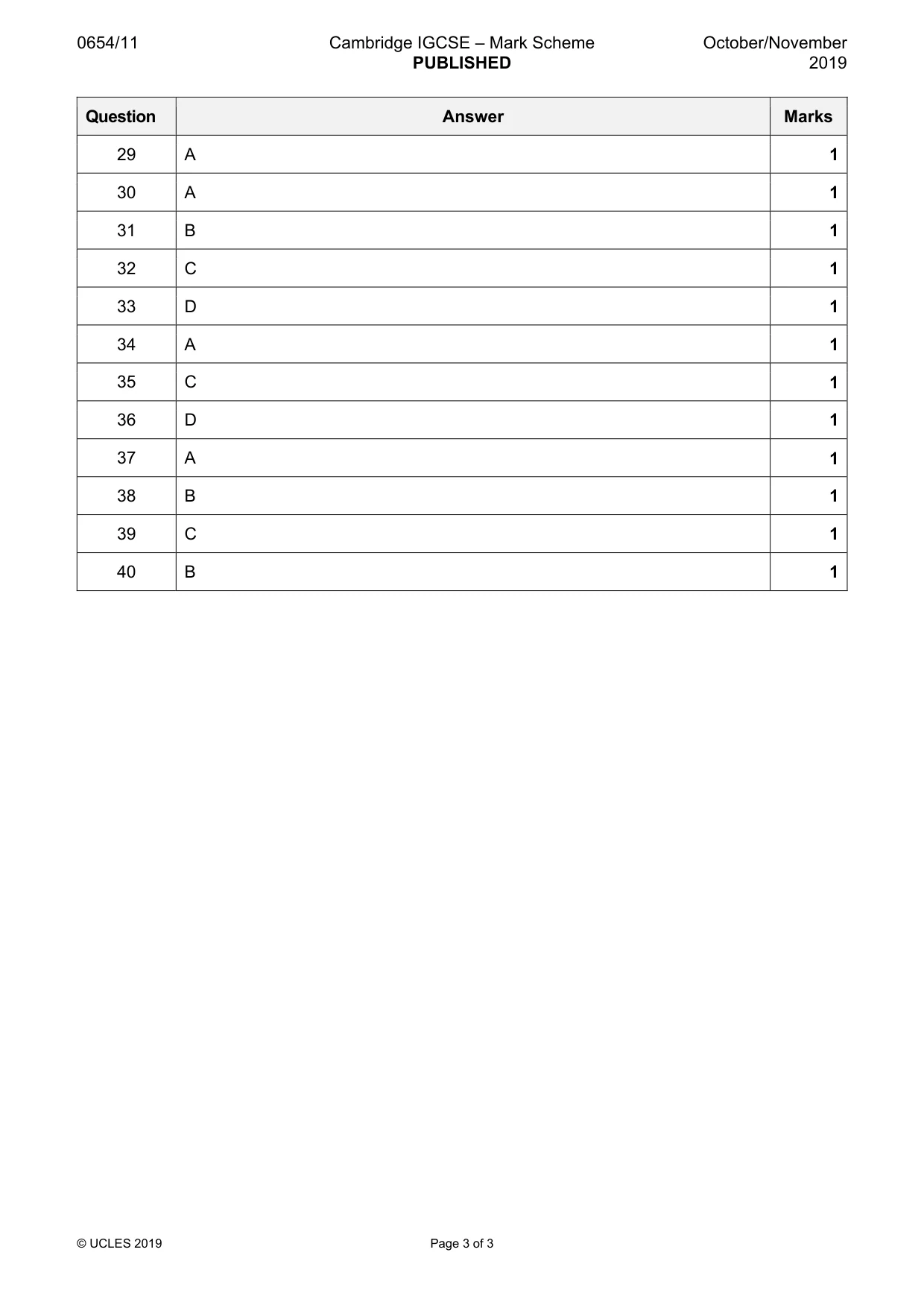
Mark scheme: A
Q30 · An engine is doing work on a car as the car moves along a road
30 An engine is doing work on a car as the car moves along a road. Which two changes must result in less work being done on the car by the engine? A decreasing the engine’s force on the car and decreasing the distance moved by the car B decreasing the engine’s force on the car and increasing the distance moved by the car C increasing the engine’s force on the car and decreasing the distance moved by the car D increasing the engine’s force on the car and increasing the distance moved by the car
Mark scheme: A
Q31 · The table shows four sources of energy used to generate electricity
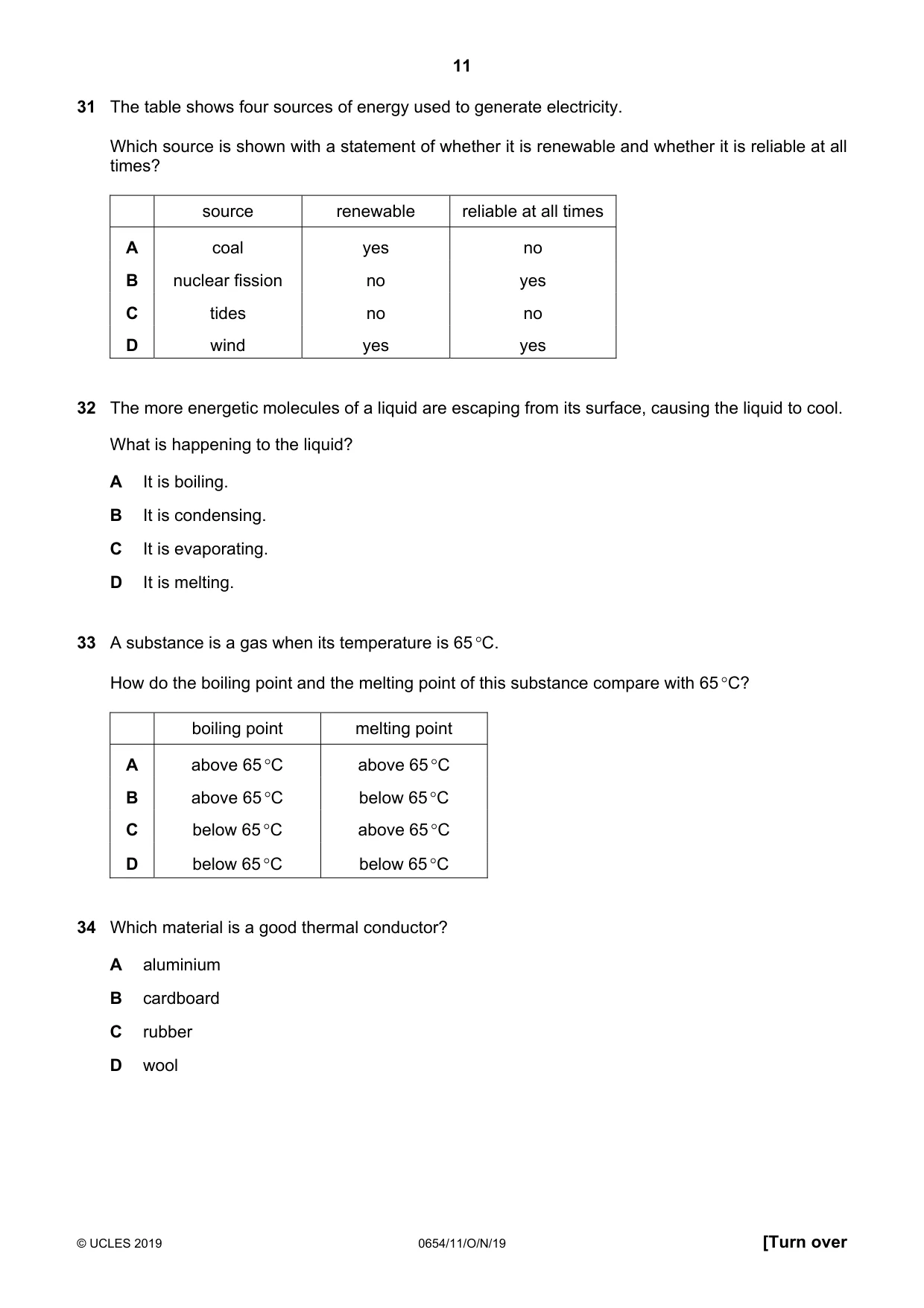
31 The table shows four sources of energy used to generate electricity. Which source is shown with a statement of whether it is renewable and whether it is reliable at all times? source renewable reliable at all times A coal yes no B nuclear fission no yes C tides no no D wind yes yes
Mark scheme: B
Q32 · The more energetic molecules of a liquid are escaping from its surface, causing the…
32 The more energetic molecules of a liquid are escaping from its surface, causing the liquid to cool. What is happening to the liquid? A It is boiling. B It is condensing. C It is evaporating. D It is melting.
Mark scheme: C
Q33 · A substance is a gas when its temperature is 65 °C
33 A substance is a gas when its temperature is 65 °C. How do the boiling point and the melting point of this substance compare with 65 °C? boiling point melting point A above 65 °C above 65 °C B above 65 °C below 65 °C C below 65 °C above 65 °C D below 65 °C below 65 °C
Mark scheme: D
Q34 · Which material is a good thermal conductor?
34 Which material is a good thermal conductor? A aluminium B cardboard C rubber D wool
Mark scheme: A
Q35 · There is a battery of e.m.f
35 There is a battery of e.m.f. V in a circuit of total resistance R. Which pair of changes must result in a larger current in the circuit? A decreasing V and decreasing R B decreasing V and increasing R C increasing V and decreasing R D increasing V and increasing R
Mark scheme: C
Q36 · Which circuit has the smallest resistance?
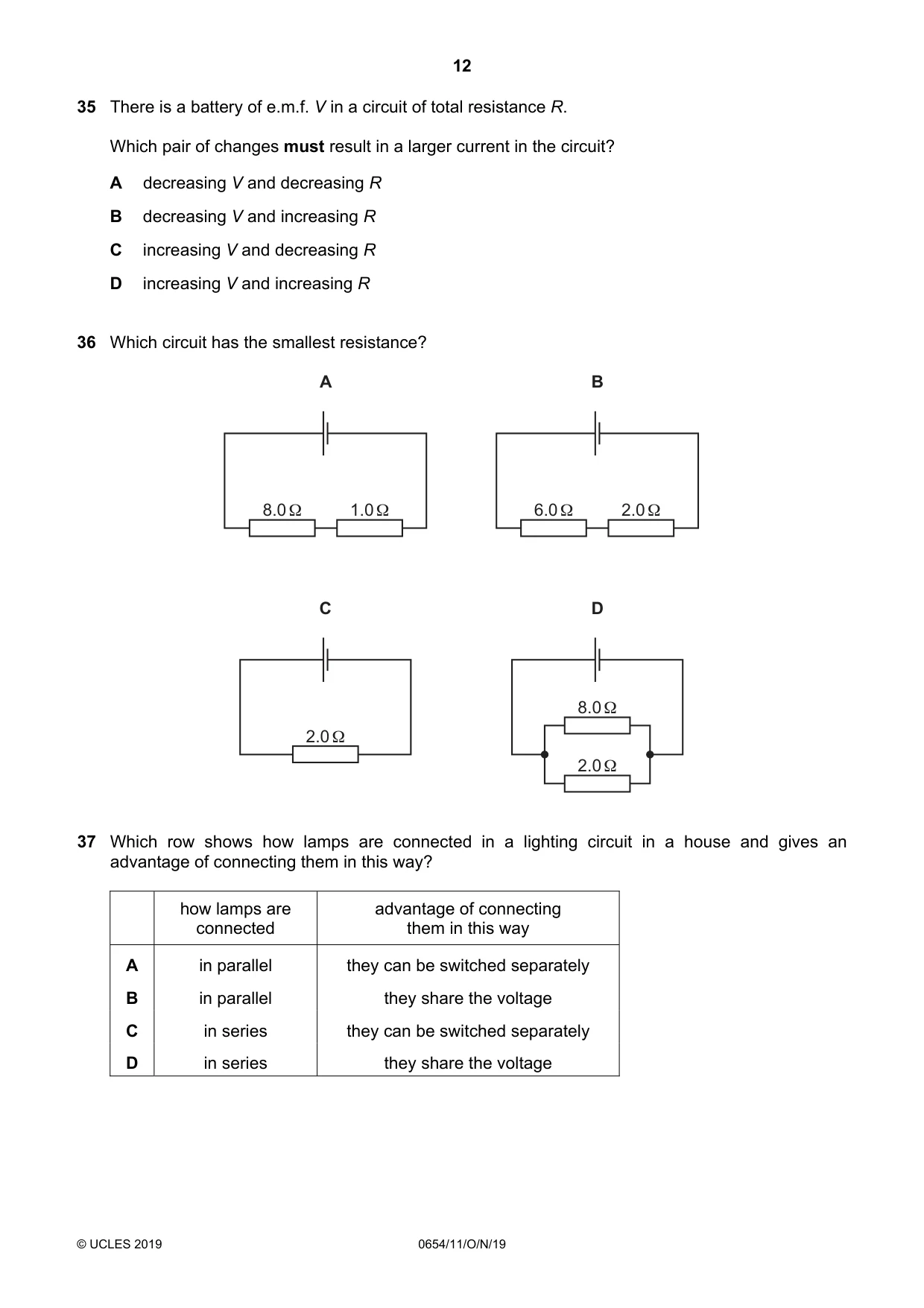
36 Which circuit has the smallest resistance? A B 8.0 Ω 1.0 Ω 6.0 Ω 2.0 Ω C D 8.0 Ω 2.0 Ω 2.0 Ω
Mark scheme: D
Q37 · Which row shows how lamps are connected in a lighting circuit in a house and gives an…
37 Which row shows how lamps are connected in a lighting circuit in a house and gives an advantage of connecting them in this way? how lamps are advantage of connecting connected them in this way A in parallel they can be switched separately B in parallel they share the voltage C in series they can be switched separately D in series they share the voltage
Mark scheme: A
Q38 · An electrical extension block has four sockets, a cable which can safely take a current…
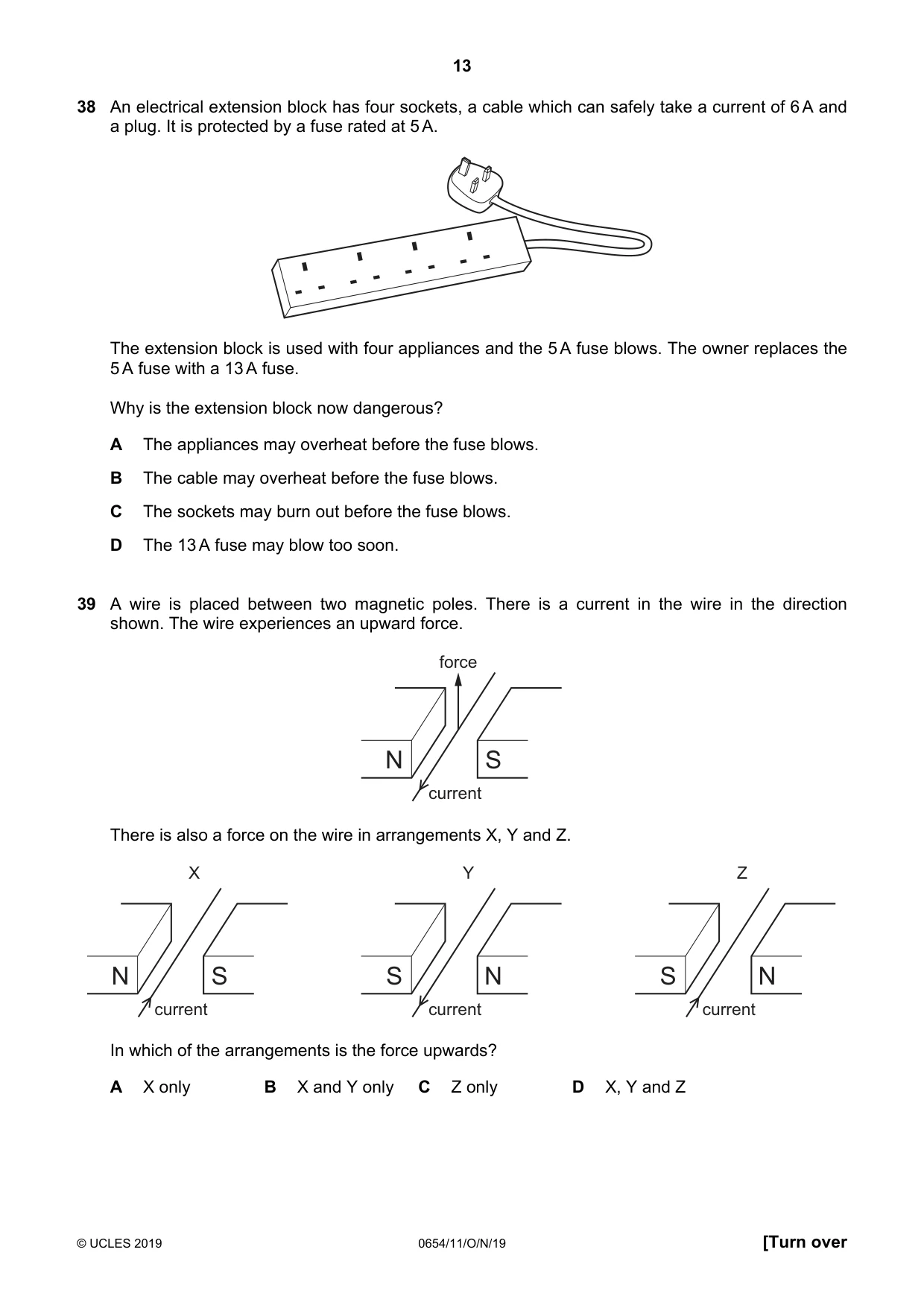
38 An electrical extension block has four sockets, a cable which can safely take a current of 6 A and a plug. It is protected by a fuse rated at 5 A. The extension block is used with four appliances and the 5 A fuse blows. The owner replaces the 5 A fuse with a 13 A fuse. Why is the extension block now dangerous? A The appliances may overheat before the fuse blows. B The cable may overheat before the fuse blows. C The sockets may burn out before the fuse blows. D The 13 A fuse may blow too soon.
Mark scheme: B
Q39 · A wire is placed between two magnetic poles
39 A wire is placed between two magnetic poles. There is a current in the wire in the direction shown. The wire experiences an upward force. force N S current There is also a force on the wire in arrangements X, Y and Z. X Y Z N S S N S N current current current In which of the arrangements is the force upwards? A X only B X and Y only C Z only D X, Y and Z
Mark scheme: C
Q40 · Which type of radiation has the greatest ionising effect, and which is the most…
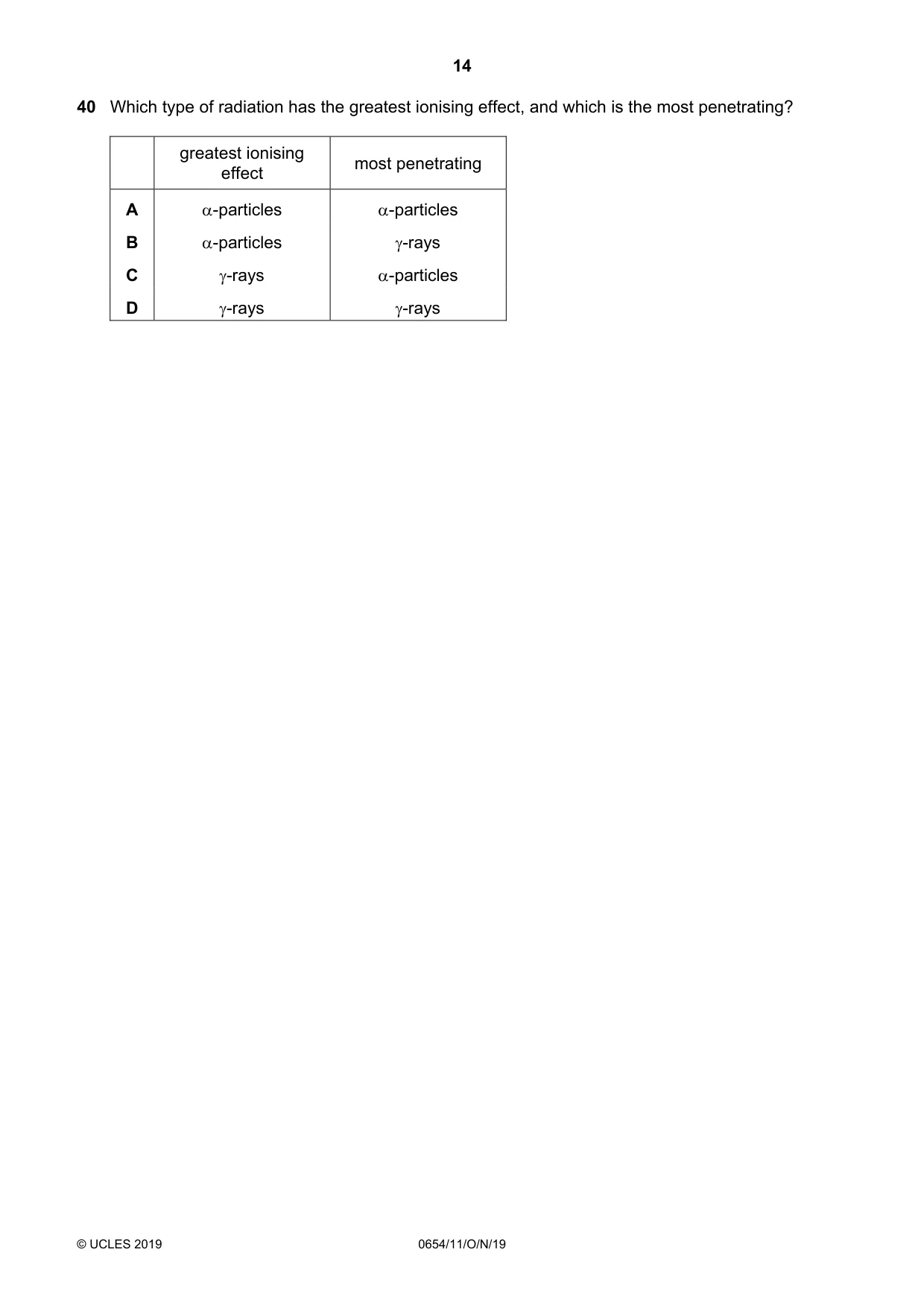
40 Which type of radiation has the greatest ionising effect, and which is the most penetrating? greatest ionising most penetrating effect A α-particles α-particles B α-particles γ-rays C γ-rays α-particles D γ-rays γ-rays
Mark scheme: B
What was in this paper
The subtopics covered by these 40 questions, and how many questions each got. Open one in a new tab to see every Cambridge question on it.
2Energy, work and power2Kinetic particle model of matter2Physical and chemical changes2Arrangement of elements1Biological molecules1Cell structure1Characteristics of living organisms1Chromatography1Density1Digestion1Electrical quantities1Electrical safety1Electrolysis1Electromagnetic effects1Enzymes1Exothermic and endothermic reactions1Food chains and food webs1Formulas1Fuels1Habitat destruction1Hormones1Motion1Photosynthesis1Radioactivity1Rate of reaction1Respiration1Selection1Sexual reproduction in humans1Simple molecules and covalent bonds1Solids, liquids and gases1The characteristic properties of acids and bases1Transfer of thermal energy1Uses of metals1Water1Xylem and phloem1What you needed in this session
Cambridge’s own grade thresholds for 2019 Oct/Nov, Paper 1 · Variant 1. A higher threshold means an easier paper — the bar moves with how the cohort did.