Cambridge IGCSE Sciences - Co-ordinated (Double) 0654 — 2021 May/June Paper 1 · Variant 1
0654/11/M/J/21 · 40 questions · 40 marks · ≈45 min
The question paper and its mark scheme, free to read here and free to download. This is Cambridge’s own paper, exactly as it was sat.
Question paper20 pages
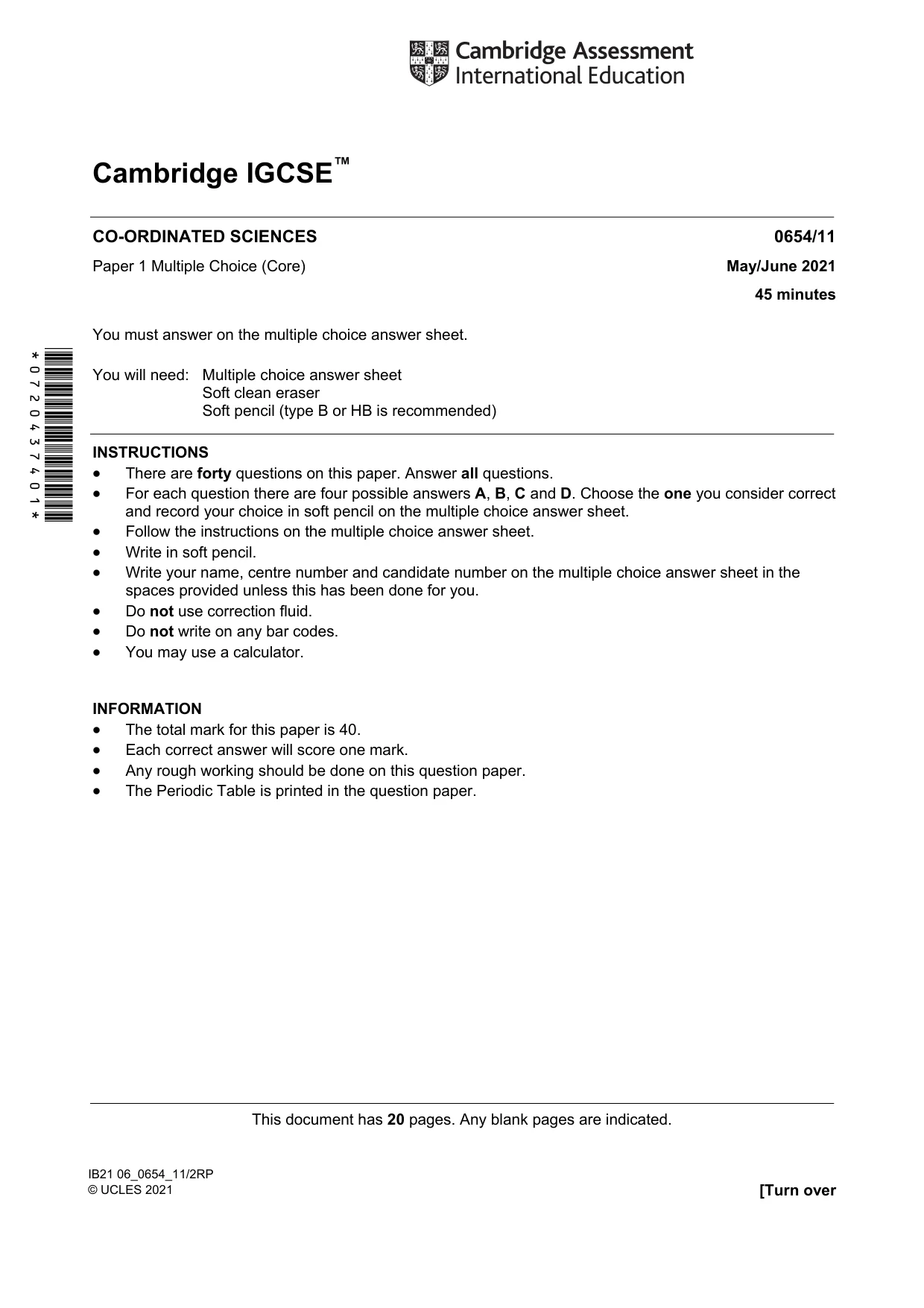



Mark scheme3 pages
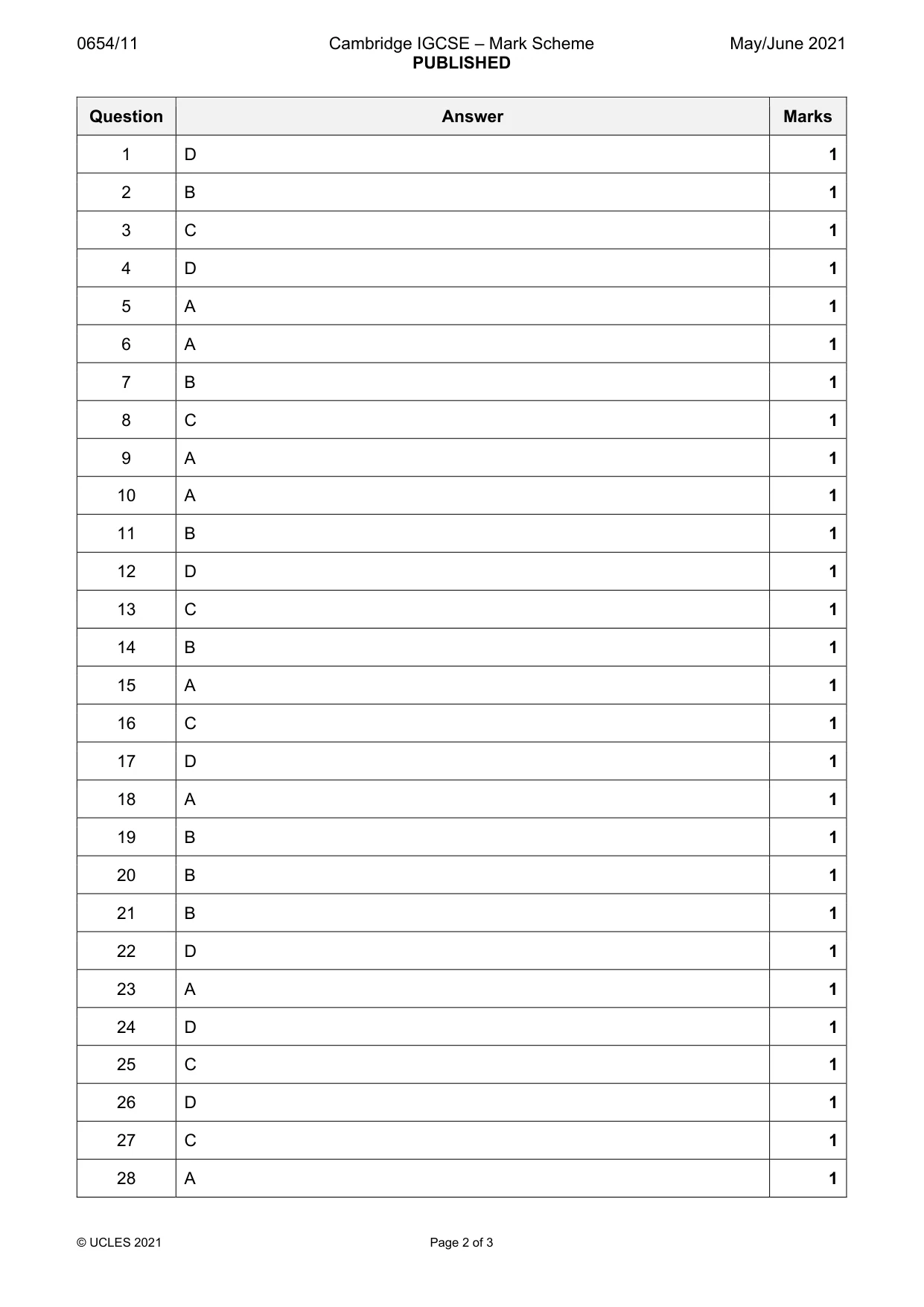
Answers below. Sit the paper first if you are practising.
Questions as text
Question 1
1 What is respiration? A breakdown of food by enzymes in the alimentary canal B breathing to supply oxygen to cells C release of carbon dioxide from the lungs D release of energy for body activities
Mark scheme: D
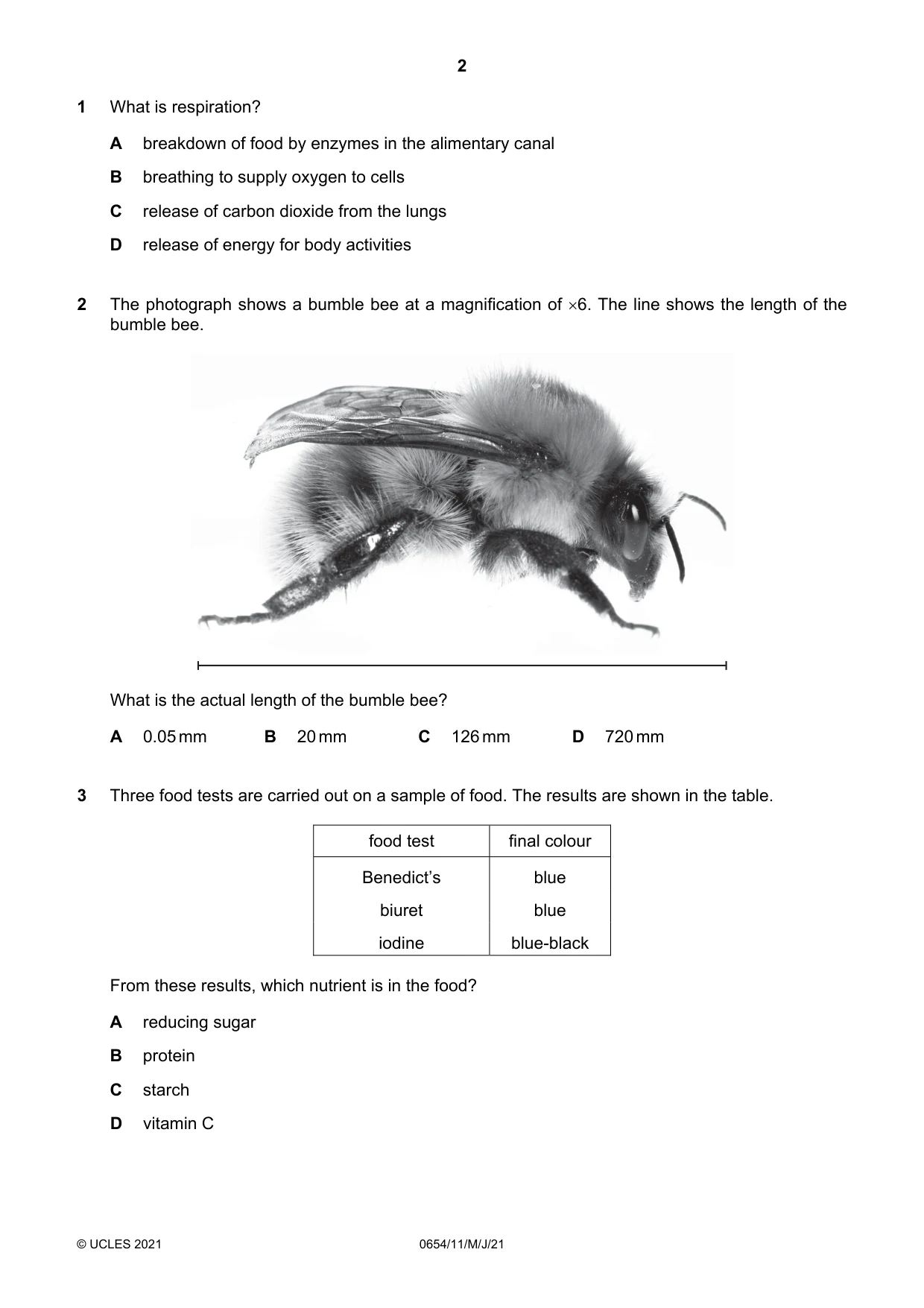
Q2 · The photograph shows a bumble bee at a magnification of 6
2 The photograph shows a bumble bee at a magnification of 6. The line shows the length of the bumble bee. What is the actual length of the bumble bee? A 0.05 mm B 20 mm C 126 mm D 720 mm
Mark scheme: B
Q3 · Three food tests are carried out on a sample of food
3 Three food tests are carried out on a sample of food. The results are shown in the table. food test final colour Benedict’s blue biuret blue iodine blue-black From these results, which nutrient is in the food? A reducing sugar B protein C starch D vitamin C
Mark scheme: C
Q4 · What is an enzyme?
4 What is an enzyme? A a carbohydrate that speeds up the rate of a reaction B a carbohydrate that alters the activity of a target organ C a protein that alters the activity of a target organ D a protein that speeds up the rate of a reaction
Mark scheme: D
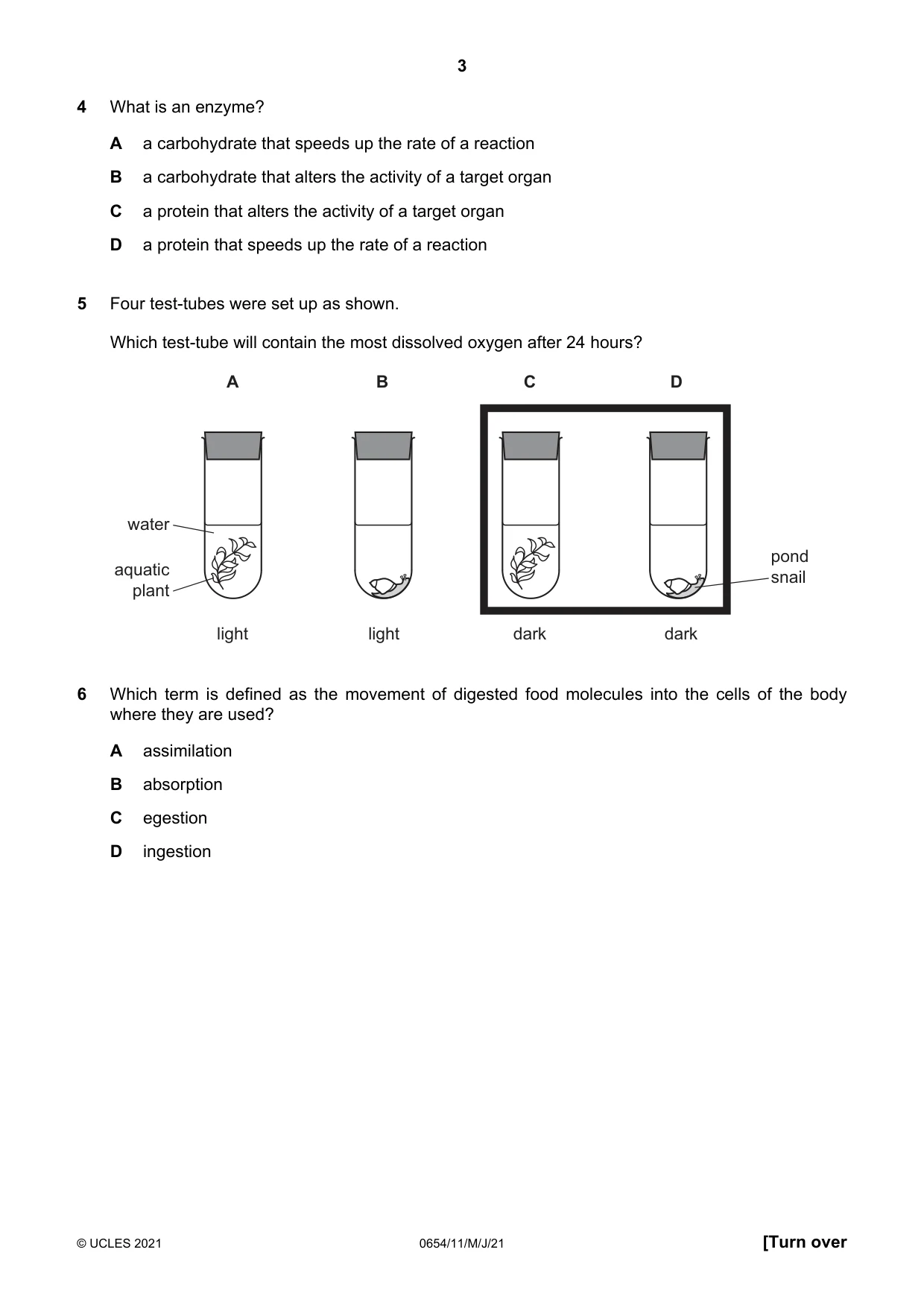
Q5 · Four test-tubes were set up as shown
5 Four test-tubes were set up as shown. Which test-tube will contain the most dissolved oxygen after 24 hours? A B C D water pond aquatic snail plant light light dark dark
Mark scheme: A
Q6 · Which term is defined as the movement of digested food molecules into the cells of the…
6 Which term is defined as the movement of digested food molecules into the cells of the body where they are used? A assimilation B absorption C egestion D ingestion
Mark scheme: A
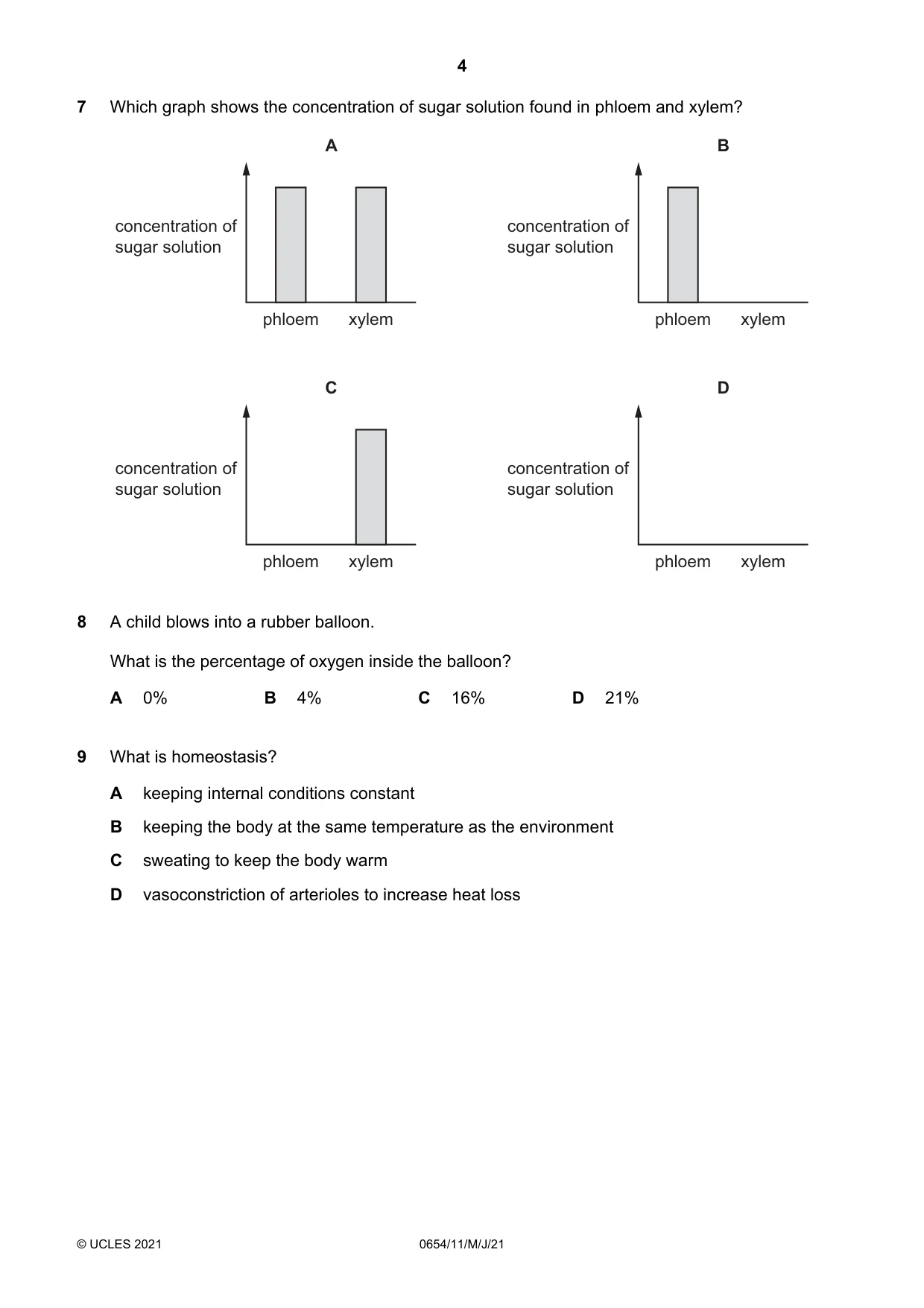
Q7 · Which graph shows the concentration of sugar solution found in phloem and xylem?
7 Which graph shows the concentration of sugar solution found in phloem and xylem? A B concentration of concentration of sugar solution sugar solution phloem xylem phloem xylem C D concentration of concentration of sugar solution sugar solution phloem xylem phloem xylem
Mark scheme: B
Q8 · A child blows into a rubber balloon
8 A child blows into a rubber balloon. What is the percentage of oxygen inside the balloon? A 0% B 4% C 16% D 21%
Mark scheme: C
Question 9
9 What is homeostasis? A keeping internal conditions constant B keeping the body at the same temperature as the environment C sweating to keep the body warm D vasoconstriction of arterioles to increase heat loss
Mark scheme: A
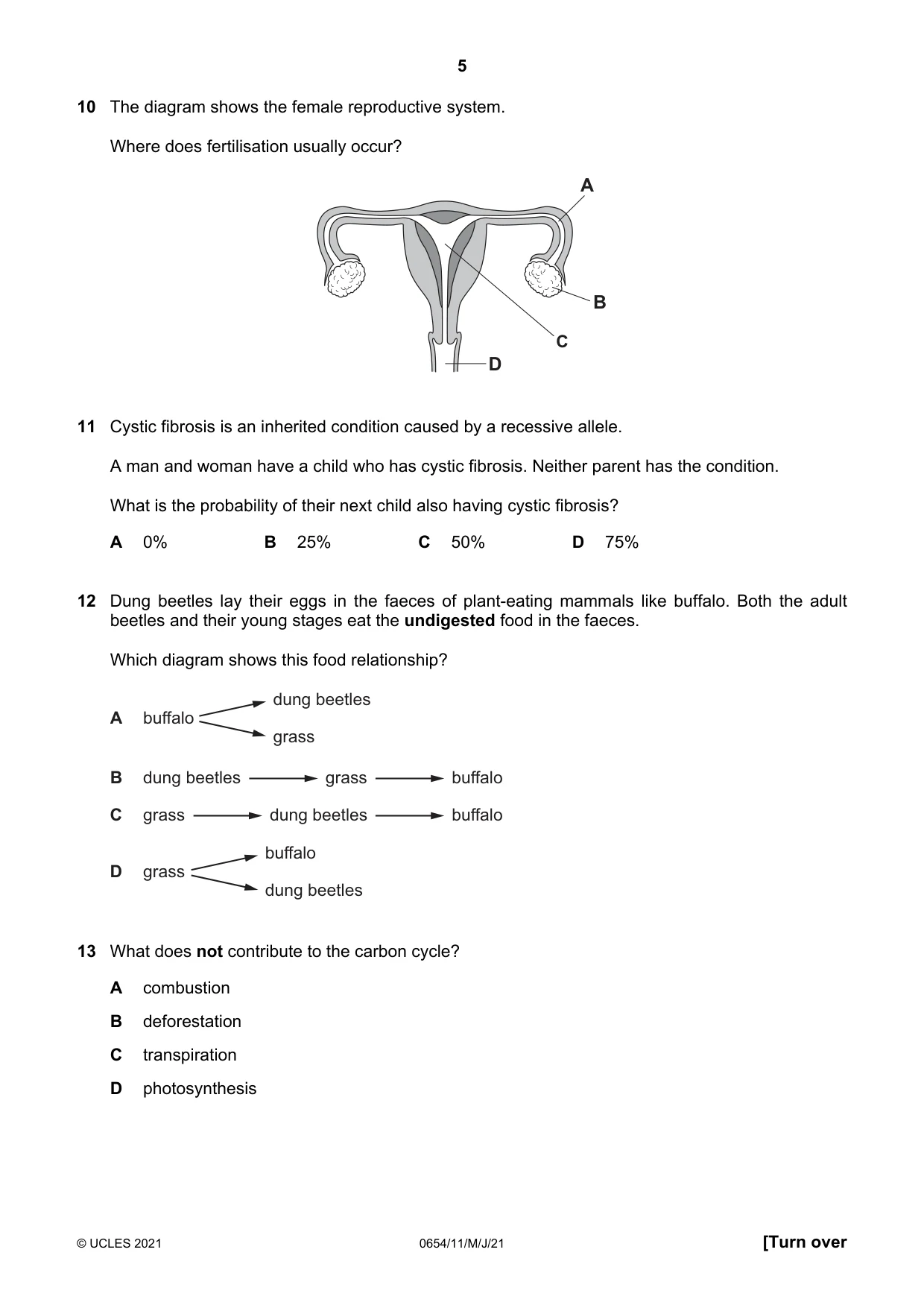
Q10 · The diagram shows the female reproductive system
10 The diagram shows the female reproductive system. Where does fertilisation usually occur? A B C D
Mark scheme: A
Q11 · Cystic fibrosis is an inherited condition caused by a recessive allele
11 Cystic fibrosis is an inherited condition caused by a recessive allele. A man and woman have a child who has cystic fibrosis. Neither parent has the condition. What is the probability of their next child also having cystic fibrosis? A 0% B 25% C 50% D 75%
Mark scheme: B
Q12 · Dung beetles lay their eggs in the faeces of plant-eating mammals like buffalo
12 Dung beetles lay their eggs in the faeces of plant-eating mammals like buffalo. Both the adult beetles and their young stages eat the undigested food in the faeces. Which diagram shows this food relationship? dung beetles A buffalo grass B dung beetles grass buffalo C grass dung beetles buffalo buffalo D grass dung beetles
Mark scheme: D
Q13 · What does not contribute to the carbon cycle?
13 What does not contribute to the carbon cycle? A combustion B deforestation C transpiration D photosynthesis
Mark scheme: C
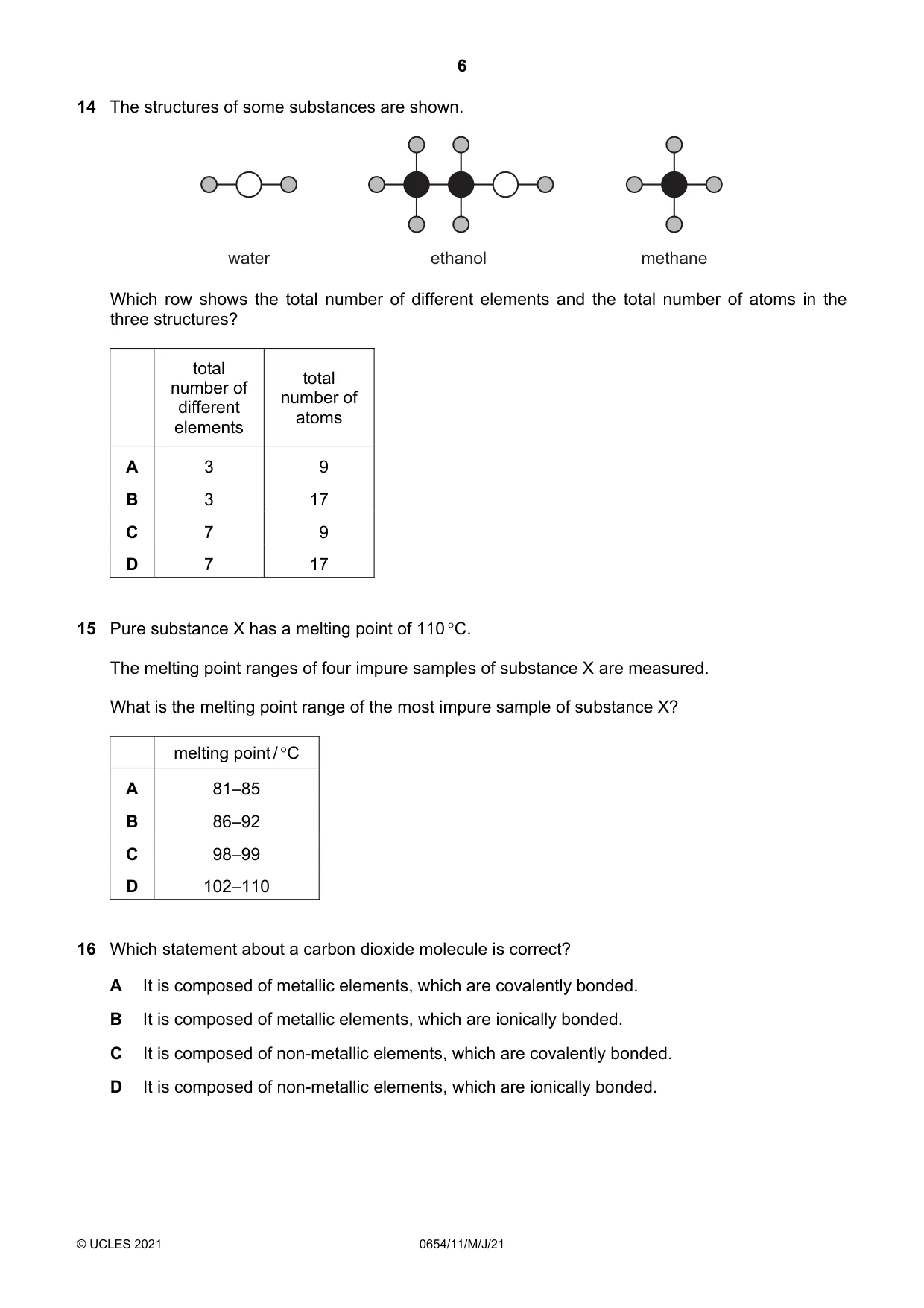
Q14 · The structures of some substances are shown
14 The structures of some substances are shown. water ethanol methane Which row shows the total number of different elements and the total number of atoms in the three structures? total total number of number of different atoms elements A 3 9 B 3 17 C 7 9 D 7 17
Mark scheme: B
Q15 · Pure substance X has a melting point of 110 C
15 Pure substance X has a melting point of 110 C. The melting point ranges of four impure samples of substance X are measured. What is the melting point range of the most impure sample of substance X? melting point / C A 81–85 B 86–92 C 98–99 D 102–110
Mark scheme: A
Q16 · Which statement about a carbon dioxide molecule is correct?
16 Which statement about a carbon dioxide molecule is correct? A It is composed of metallic elements, which are covalently bonded. B It is composed of metallic elements, which are ionically bonded. C It is composed of non-metallic elements, which are covalently bonded. D It is composed of non-metallic elements, which are ionically bonded.
Mark scheme: C
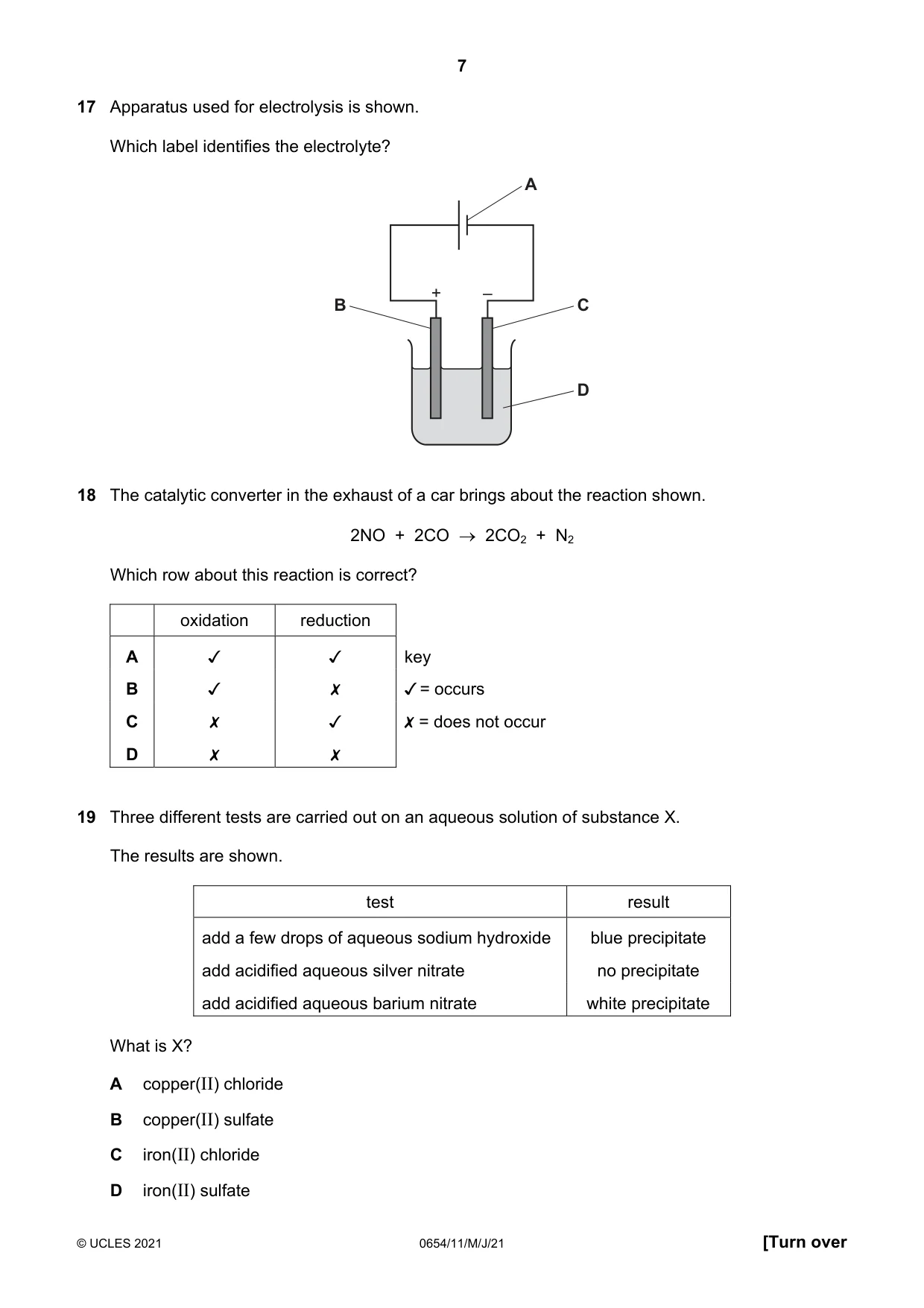
Q17 · Apparatus used for electrolysis is shown
17 Apparatus used for electrolysis is shown. Which label identifies the electrolyte? A + – B C D
Mark scheme: D
Q18 · The catalytic converter in the exhaust of a car brings about the reaction shown
18 The catalytic converter in the exhaust of a car brings about the reaction shown. 2NO + 2CO + 2CO, + No Which row about this reaction is correct? 0 0O WwW D> oxidation ~ « reduction «x \ x key J/ = occurs X = does not occur
Mark scheme: A
Q19 · Three different tests are carried out on an aqueous solution of substance X
19 Three different tests are carried out on an aqueous solution of substance X. The results are shown. test result add a few drops of aqueous sodium hydroxide blue precipitate add acidified aqueous silver nitrate no precipitate add acidified aqueous barium nitrate white precipitate What is X? A copper(II) chloride B copper(II) sulfate C iron(II) chloride D iron(II) sulfate
Mark scheme: B
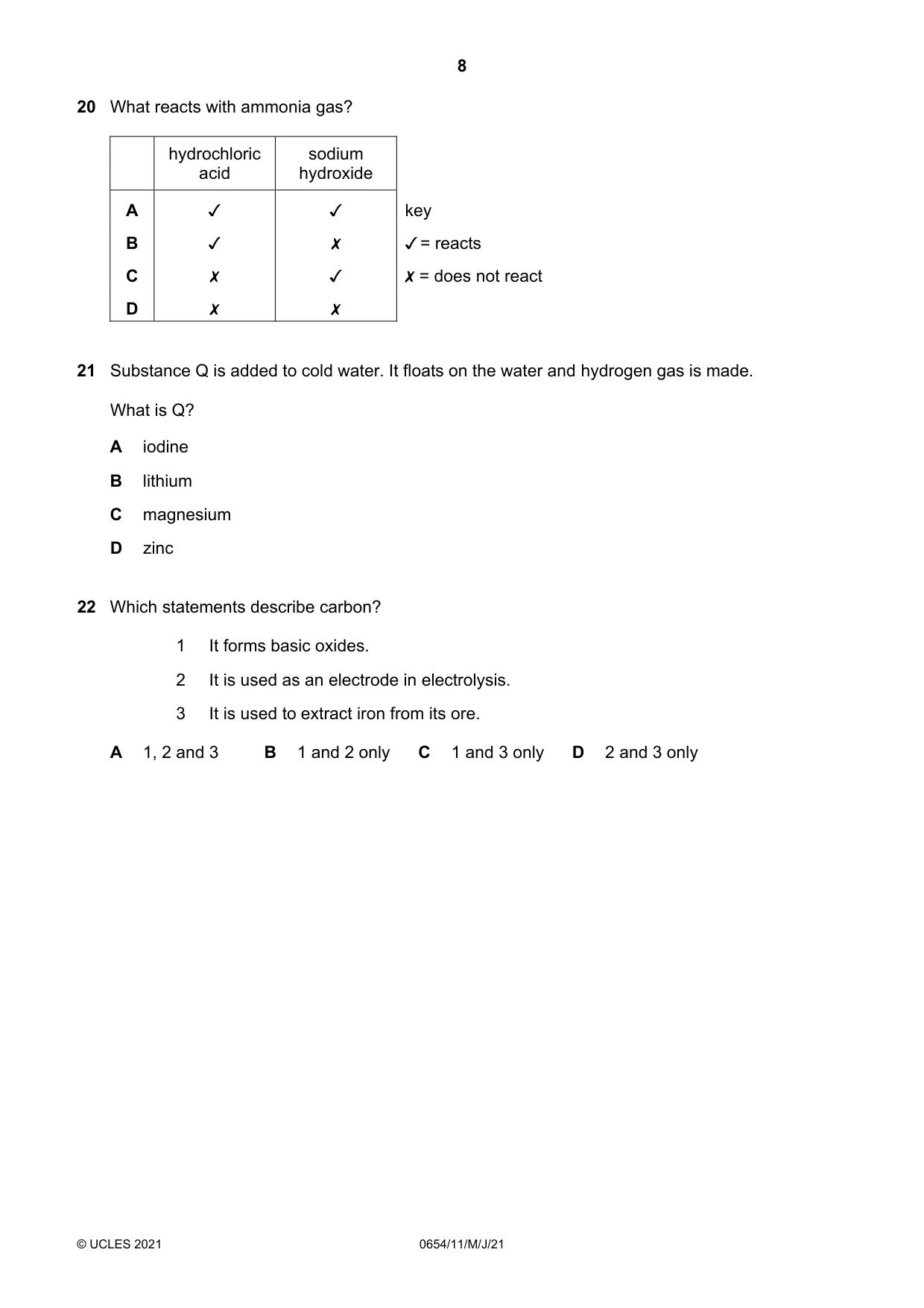
Q20 · What reacts with ammonia gas?
20 What reacts with ammonia gas? hydrochloric sodium acid hydroxide A Jv J B Jv x Cc x v D x x key Jv = reacts X = does not react
Mark scheme: B
More questions on The characteristic properties of acids and bases
Q21 · Substance Q is added to cold water
21 Substance Q is added to cold water. It floats on the water and hydrogen gas is made. What is Q? A iodine B lithium C magnesium D zinc
Mark scheme: B
Q22 · Which statements describe carbon?
22 Which statements describe carbon? 1 It forms basic oxides. 2 It is used as an electrode in electrolysis. 3 It is used to extract iron from its ore. A 1, 2 and 3 B 1 and 2 only C 1 and 3 only D 2 and 3 only
Mark scheme: D
Q23 · The apparatus used to investigate the combustion of ethanol is shown
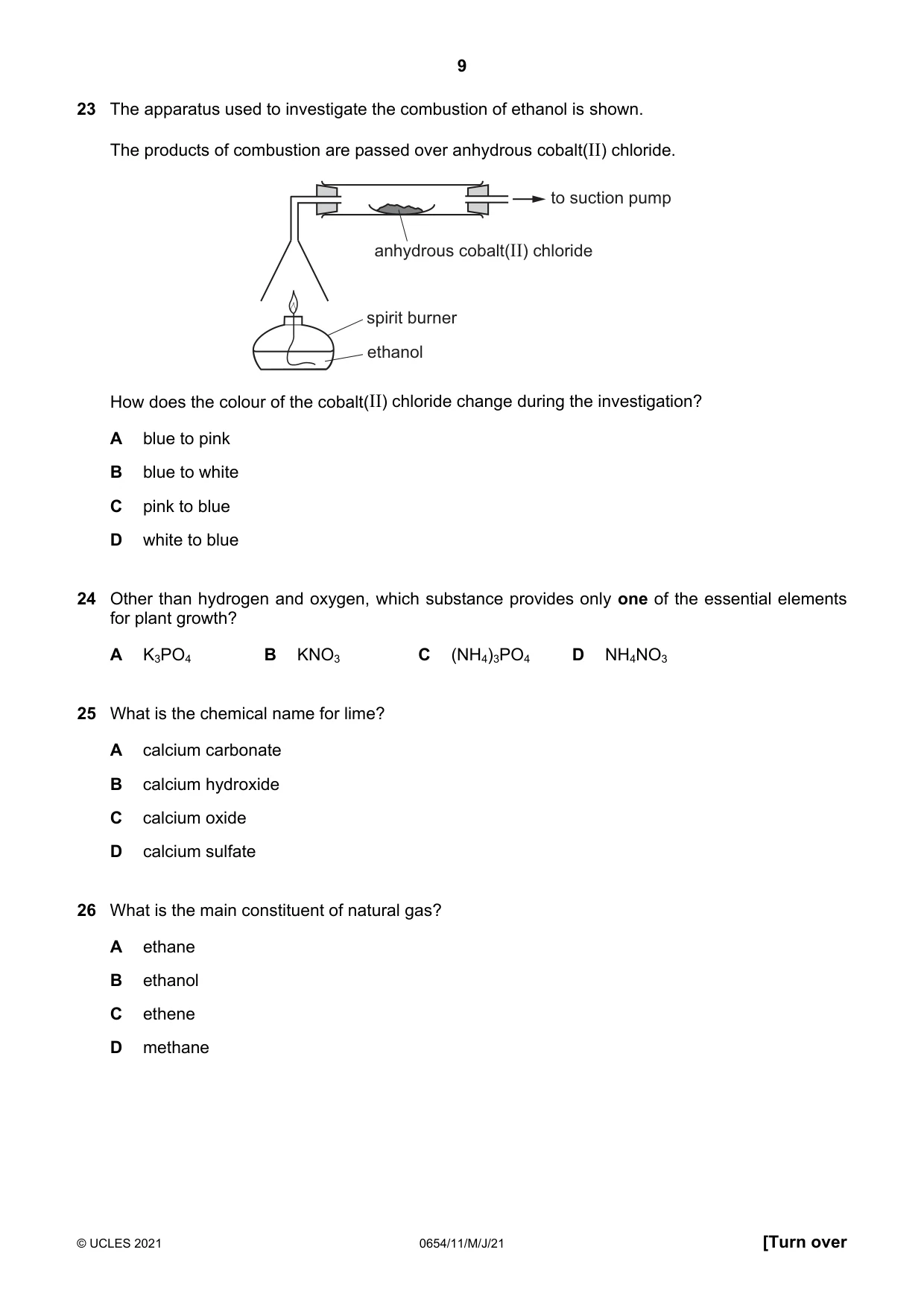
23 The apparatus used to investigate the combustion of ethanol is shown. The products of combustion are passed over anhydrous cobalt(II) chloride. to suction pump anhydrous cobalt(II) chloride spirit burner ethanol How does the colour of the cobalt(II) chloride change during the investigation? A blue to pink B blue to white C pink to blue D white to blue
Mark scheme: A
Q24 · Other than hydrogen and oxygen, which substance provides only one of the essential…
24 Other than hydrogen and oxygen, which substance provides only one of the essential elements for plant growth? A K3PO4 B KNO3 C (NH4)3PO4 D NH4NO3
Mark scheme: D
Q25 · What is the chemical name for lime?
25 What is the chemical name for lime? A calcium carbonate B calcium hydroxide C calcium oxide D calcium sulfate
Mark scheme: C
Q26 · What is the main constituent of natural gas?
26 What is the main constituent of natural gas? A ethane B ethanol C ethene D methane
Mark scheme: D
Q27 · Which row shows the structure of the monomer used to make poly(ethene) and the structure…
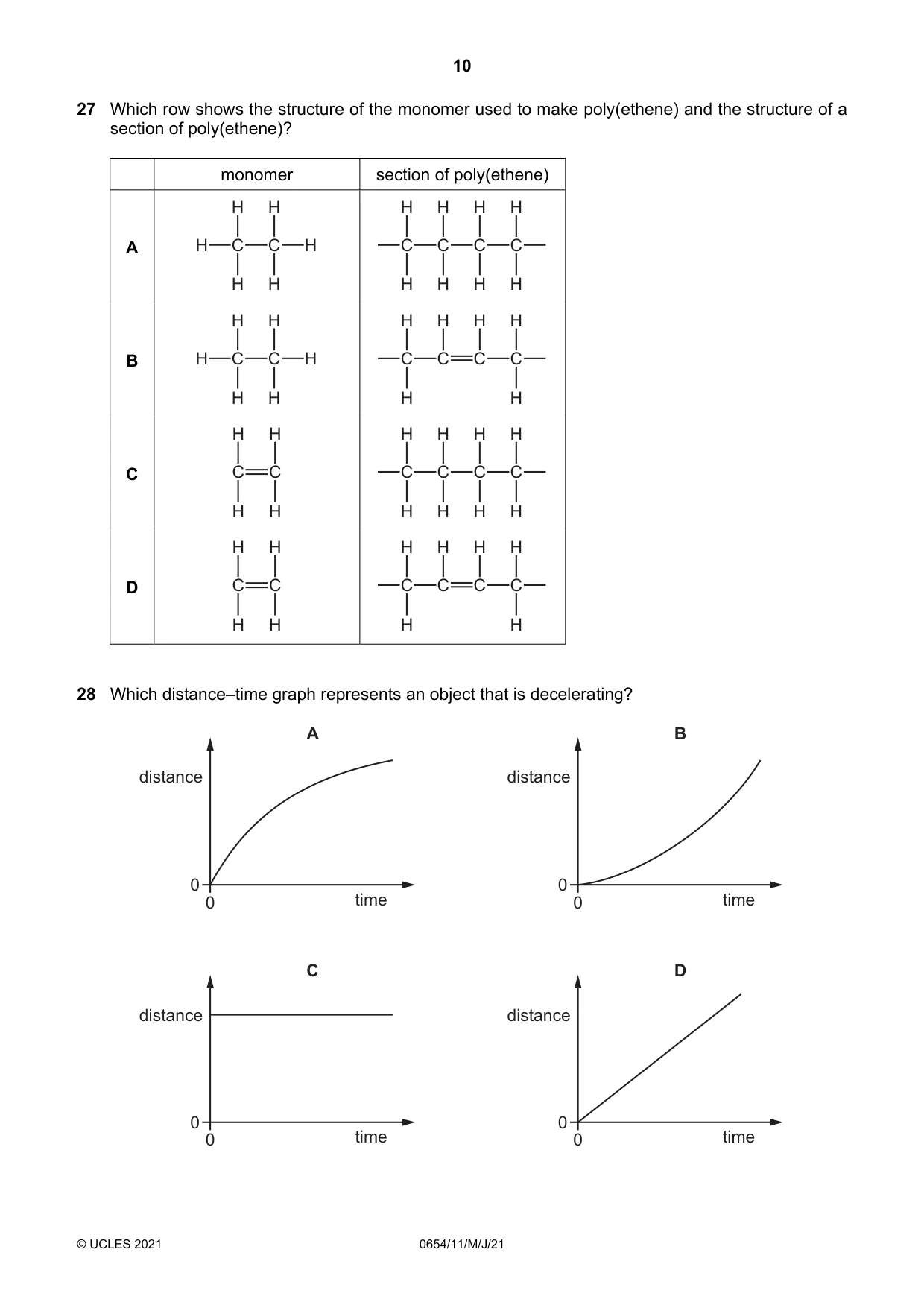
27 Which row shows the structure of the monomer used to make poly(ethene) and the structure of a section of poly(ethene)? monomer section of poly(ethene) H H H H H H A H C C H C C C C H H H H H H H H H H H H B H C C H C C C C H H H H H H H H H H C C C C C C C H H H H H H H H H H H H D C C C C C C H H H H
Mark scheme: C
Q28 · Which distance–time graph represents an object that is decelerating?
28 Which distance–time graph represents an object that is decelerating? A B distance distance 0 0 0 time 0 time C D distance distance 0 0 0 time 0 time
Mark scheme: A
Q29 · A vehicle moves a total distance of 300 m in 40 seconds
29 A vehicle moves a total distance of 300 m in 40 seconds. What is its average speed? A 0.13 m / s B 7.5 m / s C 340 m / s D 12 000 m / s
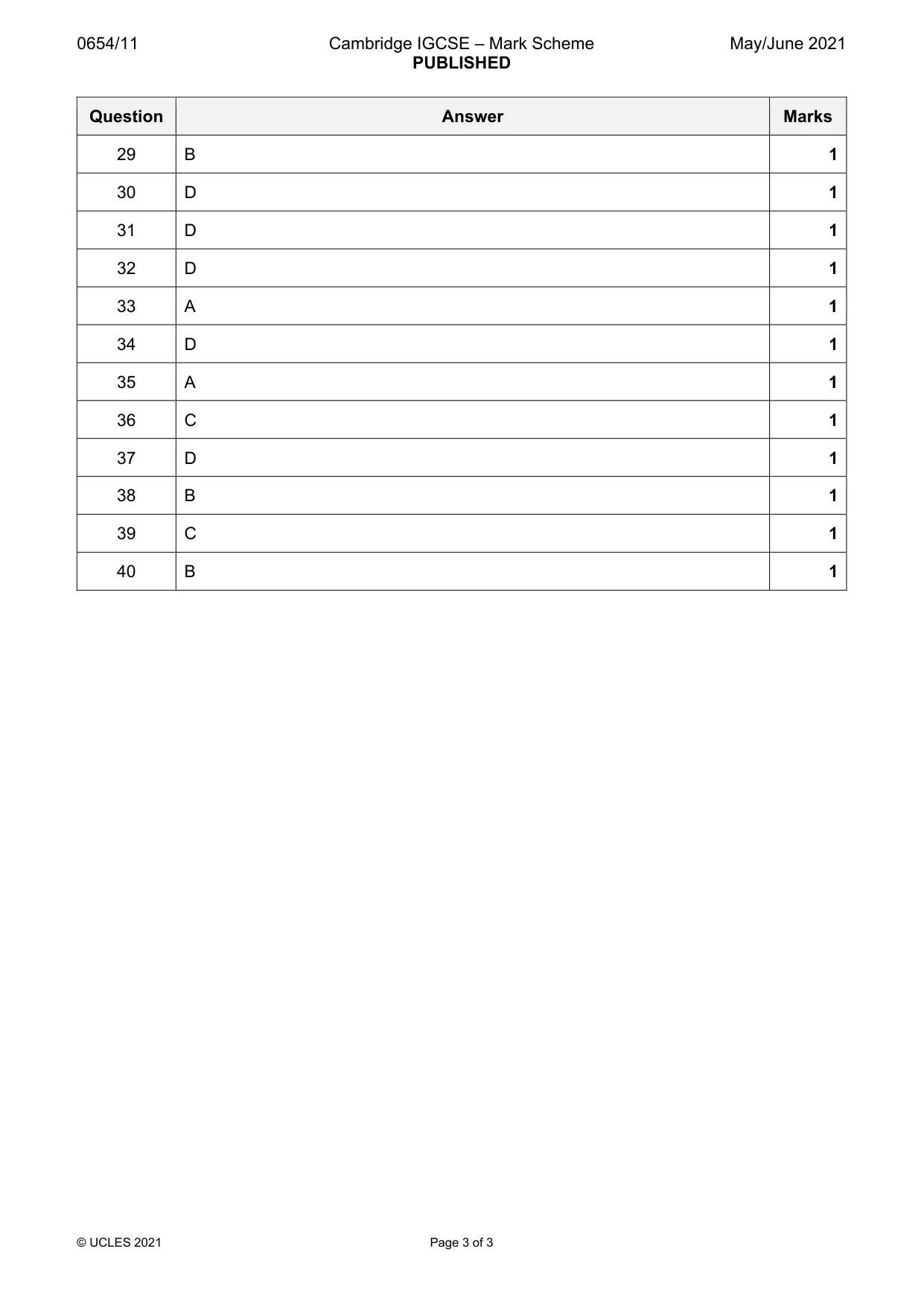
Mark scheme: B
Q30 · Which statement applies to a system in equilibrium?
30 Which statement applies to a system in equilibrium? A There is a resultant force and there is a resultant turning effect on the system. B There is a resultant force but there is no resultant turning effect on the system. C There is no resultant force but there is a resultant turning effect on the system. D There is no resultant force and there is no resultant turning effect on the system.
Mark scheme: D
Q31 · The diagram shows a man diving into water
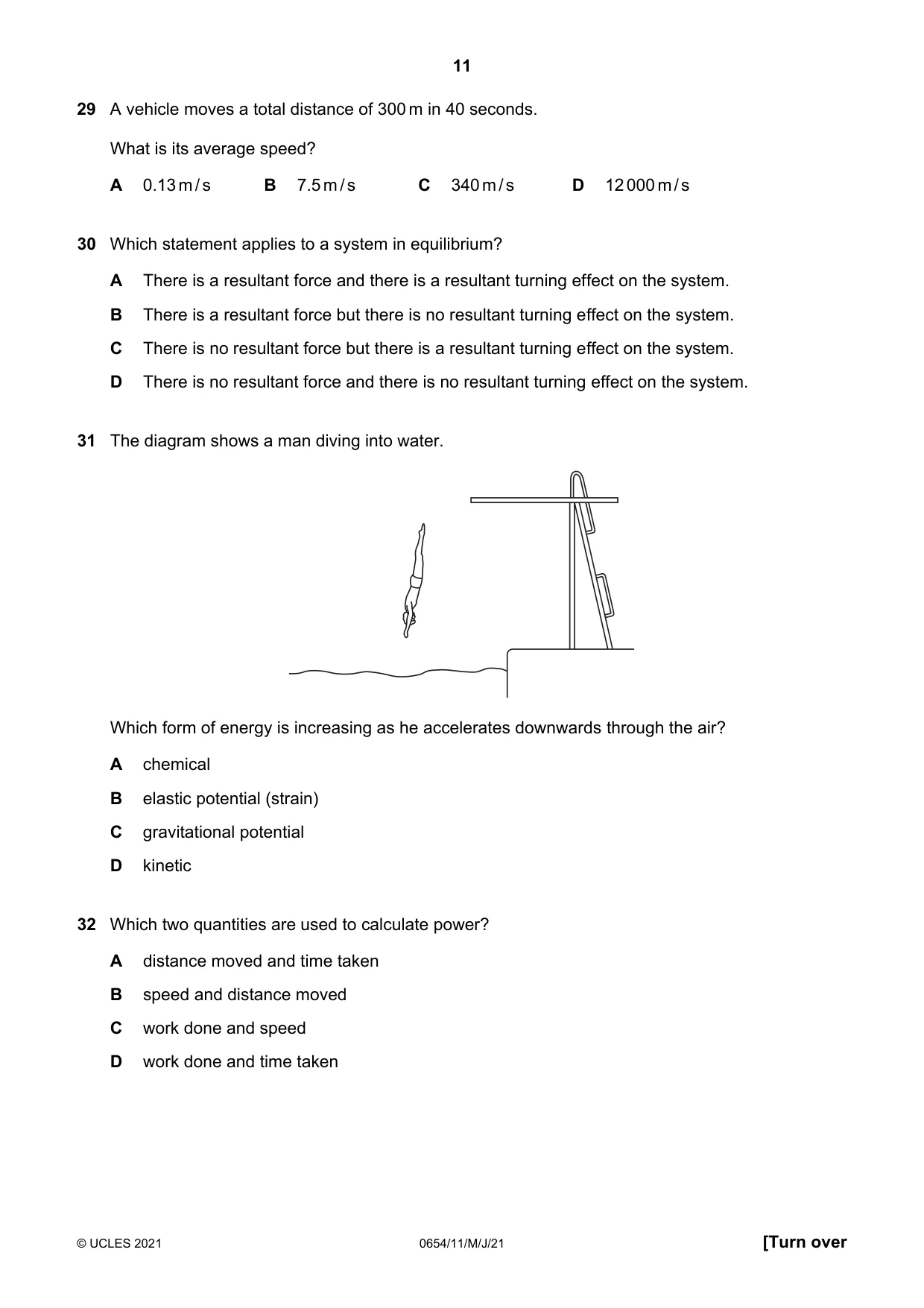
31 The diagram shows a man diving into water. Which form of energy is increasing as he accelerates downwards through the air? A chemical B elastic potential (strain) C gravitational potential D kinetic
Mark scheme: D
Q32 · Which two quantities are used to calculate power?
32 Which two quantities are used to calculate power? A distance moved and time taken B speed and distance moved C work done and speed D work done and time taken
Mark scheme: D
Q33 · Which row shows a good thermal conductor and a bad thermal conductor?
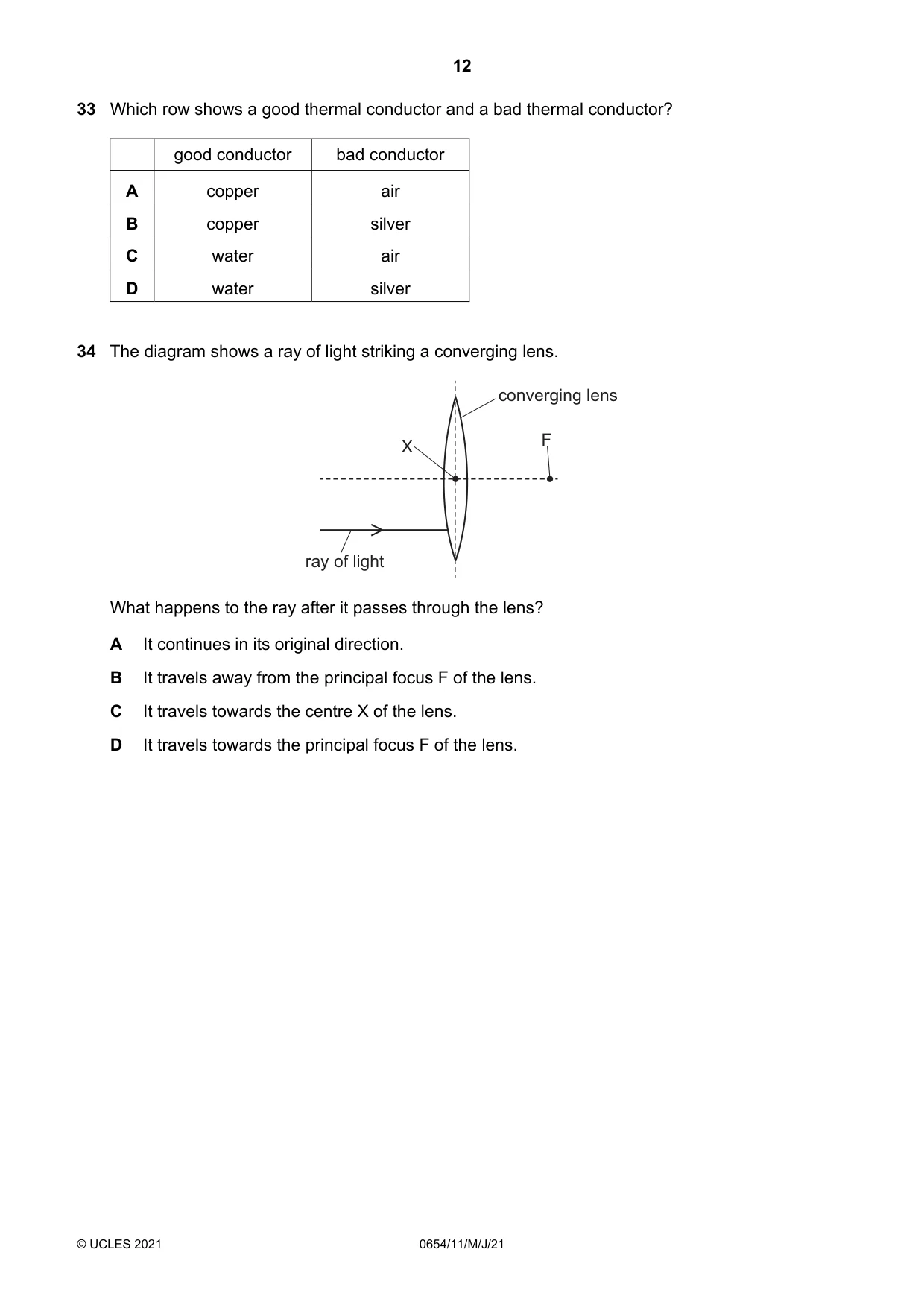
33 Which row shows a good thermal conductor and a bad thermal conductor? good conductor bad conductor A copper air B copper silver C water air D water silver
Mark scheme: A
Q34 · The diagram shows a ray of light striking a converging lens
34 The diagram shows a ray of light striking a converging lens. converging lens X F ray of light What happens to the ray after it passes through the lens? A It continues in its original direction. B It travels away from the principal focus F of the lens. C It travels towards the centre X of the lens. D It travels towards the principal focus F of the lens.
Mark scheme: D
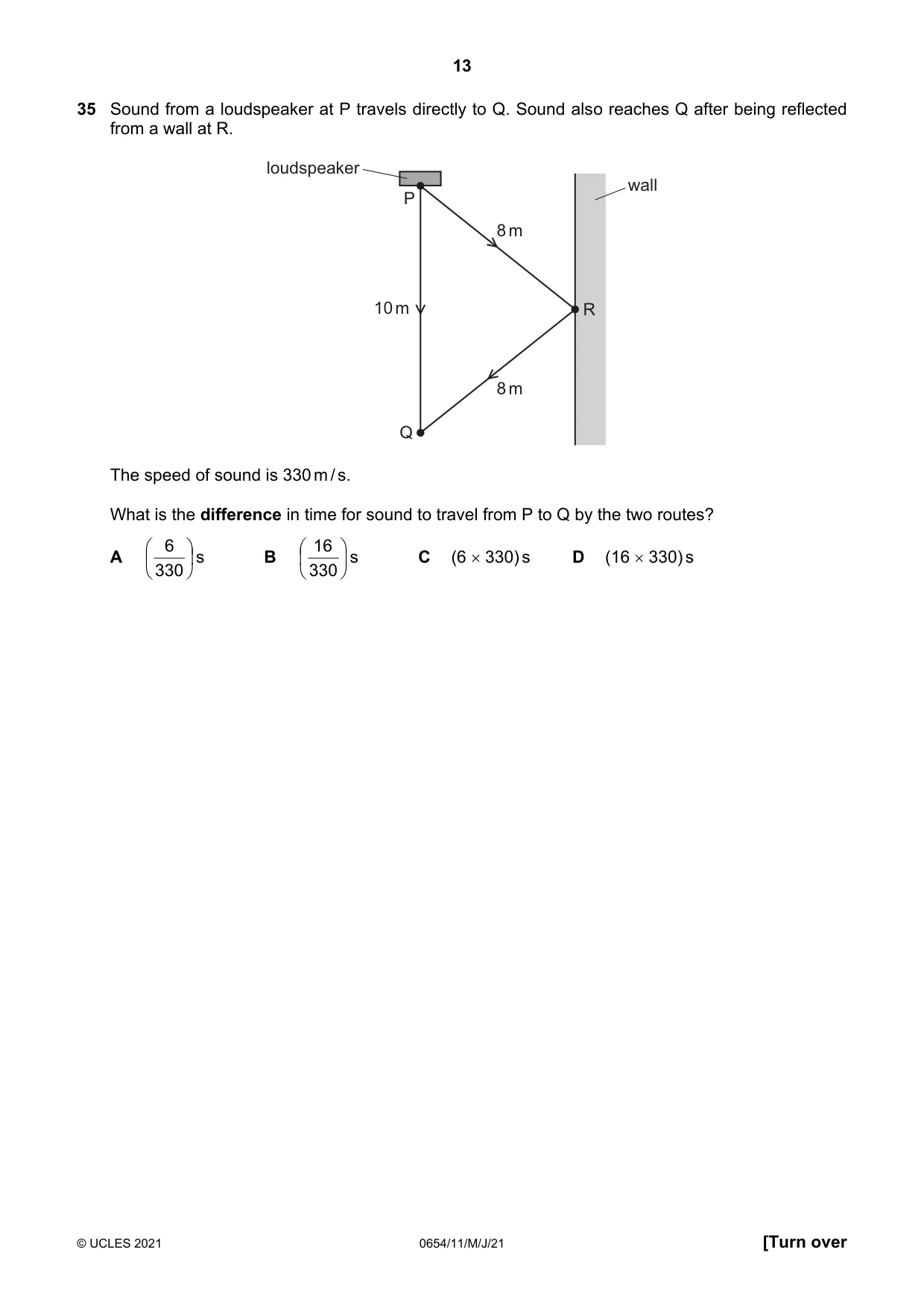
Q35 · Sound from a loudspeaker at P travels directly to Q
35 Sound from a loudspeaker at P travels directly to Q. Sound also reaches Q after being reflected from a wall at R. loudspeaker wall P 8 m 10 m R 8 m Q The speed of sound is 330 m / s. What is the difference in time for sound to travel from P to Q by the two routes? 6 16 A s B s C (6 330) s D (16 330) s 330 330
Mark scheme: A
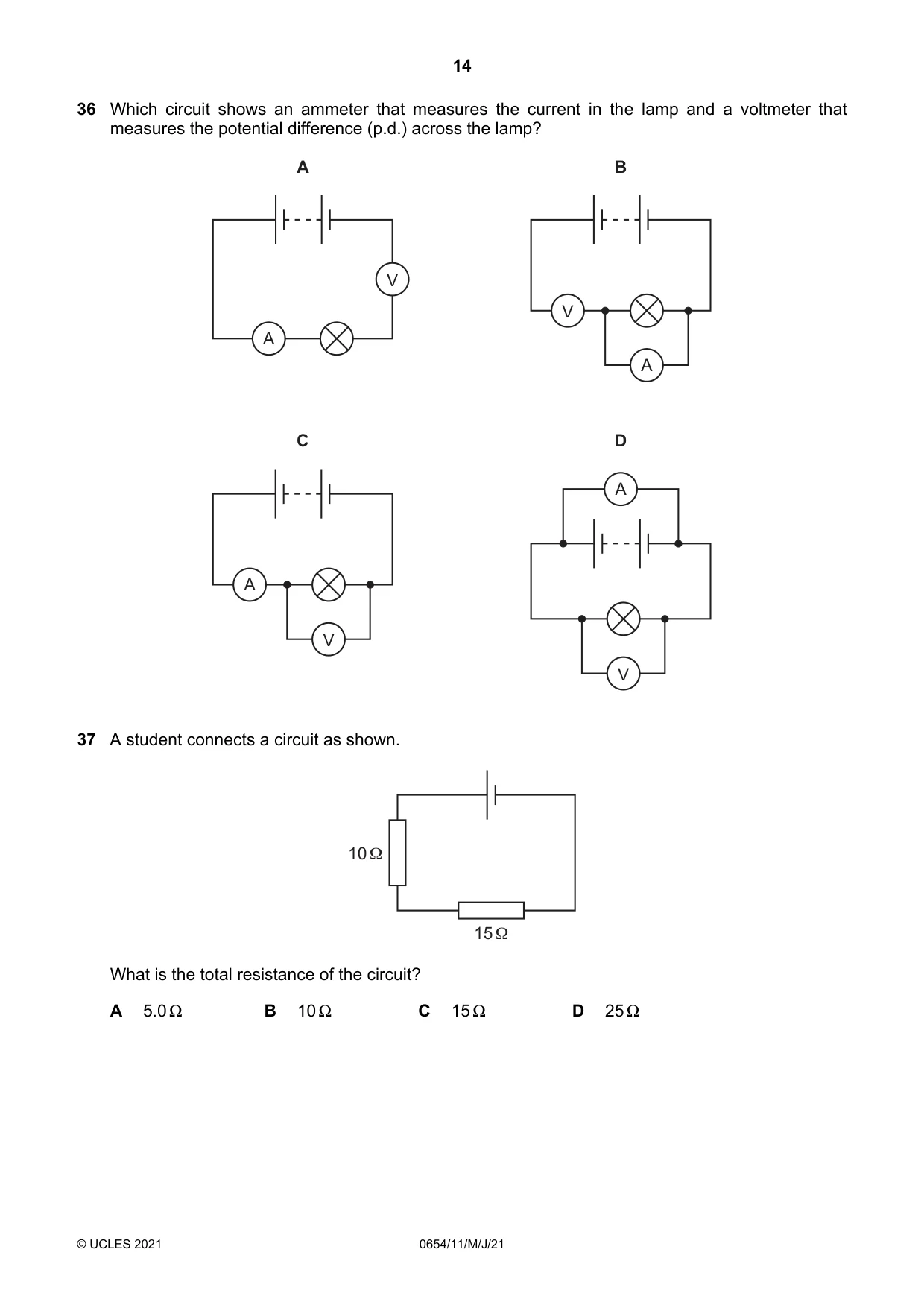
Q36 · Which circuit shows an ammeter that measures the current in the lamp and a voltmeter that…
36 Which circuit shows an ammeter that measures the current in the lamp and a voltmeter that measures the potential difference (p.d.) across the lamp? A B V V A A C D A A V V
Mark scheme: C
Q37 · A student connects a circuit as shown
37 A student connects a circuit as shown. 10 Ω 15 Ω What is the total resistance of the circuit? A 5.0 Ω B 10 Ω C 15 Ω D 25 Ω
Mark scheme: D
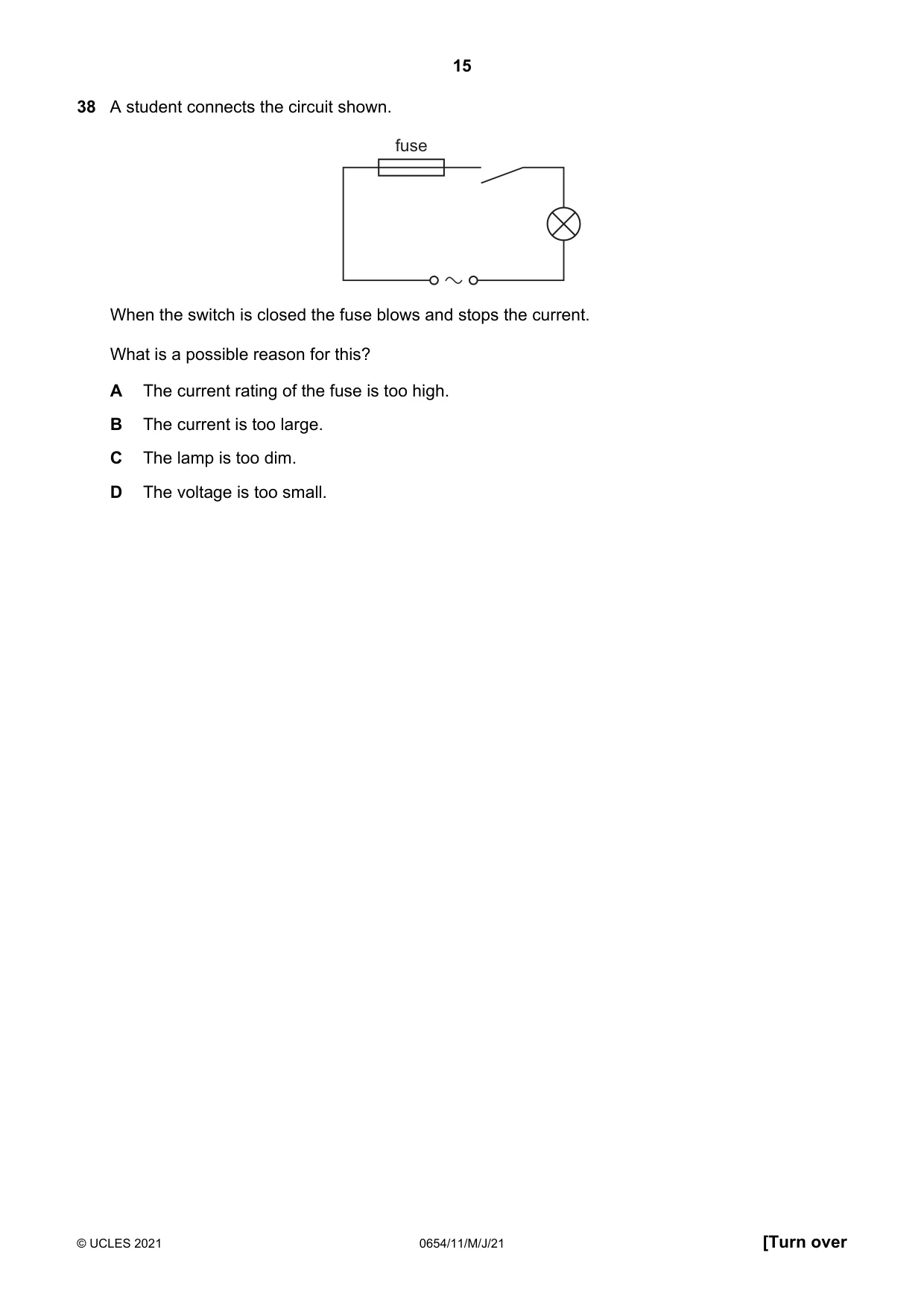
Q38 · A student connects the circuit shown
38 A student connects the circuit shown. fuse When the switch is closed the fuse blows and stops the current. What is a possible reason for this? A The current rating of the fuse is too high. B The current is too large. C The lamp is too dim. D The voltage is too small.
Mark scheme: B
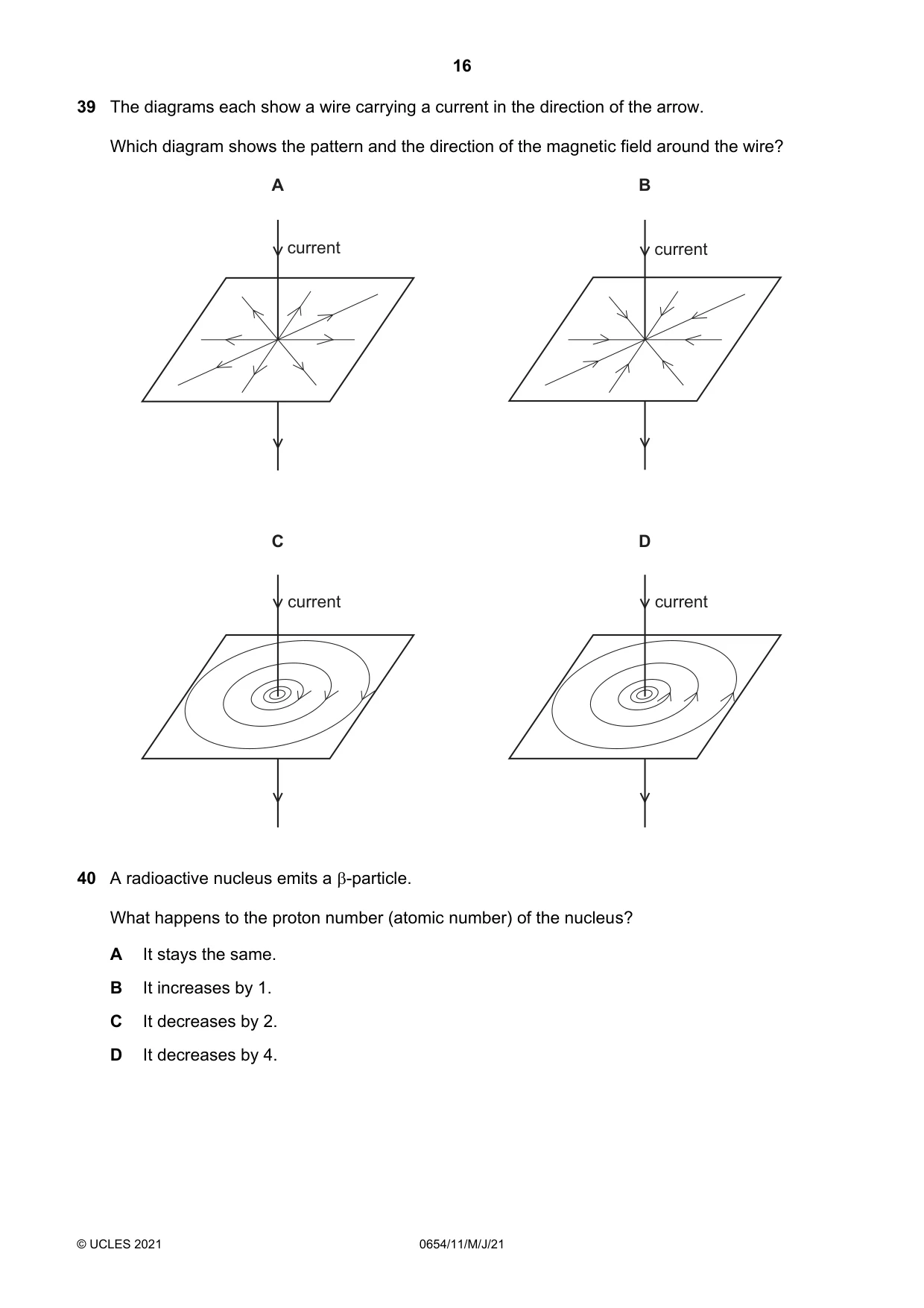
Q39 · The diagrams each show a wire carrying a current in the direction of the arrow
39 The diagrams each show a wire carrying a current in the direction of the arrow. Which diagram shows the pattern and the direction of the magnetic field around the wire? A B current current C D current current
Mark scheme: C
Q40 · A radioactive nucleus emits a -particle
40 A radioactive nucleus emits a -particle. What happens to the proton number (atomic number) of the nucleus? A It stays the same. B It increases by 1. C It decreases by 2. D It decreases by 4.
Mark scheme: B
What was in this paper
The subtopics covered by these 40 questions, and how many questions each got. Open one in a new tab to see every Cambridge question on it.
2Energy, work and power2Identification of ions and gases2Motion2Alkanes1Biological molecules1Carbon cycle1Digestion1Electrical safety1Electrolysis1Elements, compounds and mixtures1Enzymes1Extraction of metals1Food chains and food webs1Forces1Gas exchange in humans1Group I properties1Homeostasis1Light1Monohybrid inheritance1Oxides1Photosynthesis1Polymers1Radioactivity1Redox1Respiration1Separation and purification1Sexual reproduction in humans1Simple molecules and covalent bonds1Simple phenomena of magnetism1Size of specimens1Sound1The characteristic properties of acids and bases1Transfer of thermal energy1Translocation1Water1What you needed in this session
Cambridge’s own grade thresholds for 2021 May/June, Paper 1 · Variant 1. A higher threshold means an easier paper — the bar moves with how the cohort did.