Cambridge IGCSE Sciences - Co-ordinated (Double) 0654 — 2011 Oct/Nov Paper 1 · Variant 3
0654/13/O/N/11 · 40 questions · 40 marks · ≈45 min
The question paper and its mark scheme, free to read here and free to download. This is Cambridge’s own paper, exactly as it was sat.
Question paper16 pages
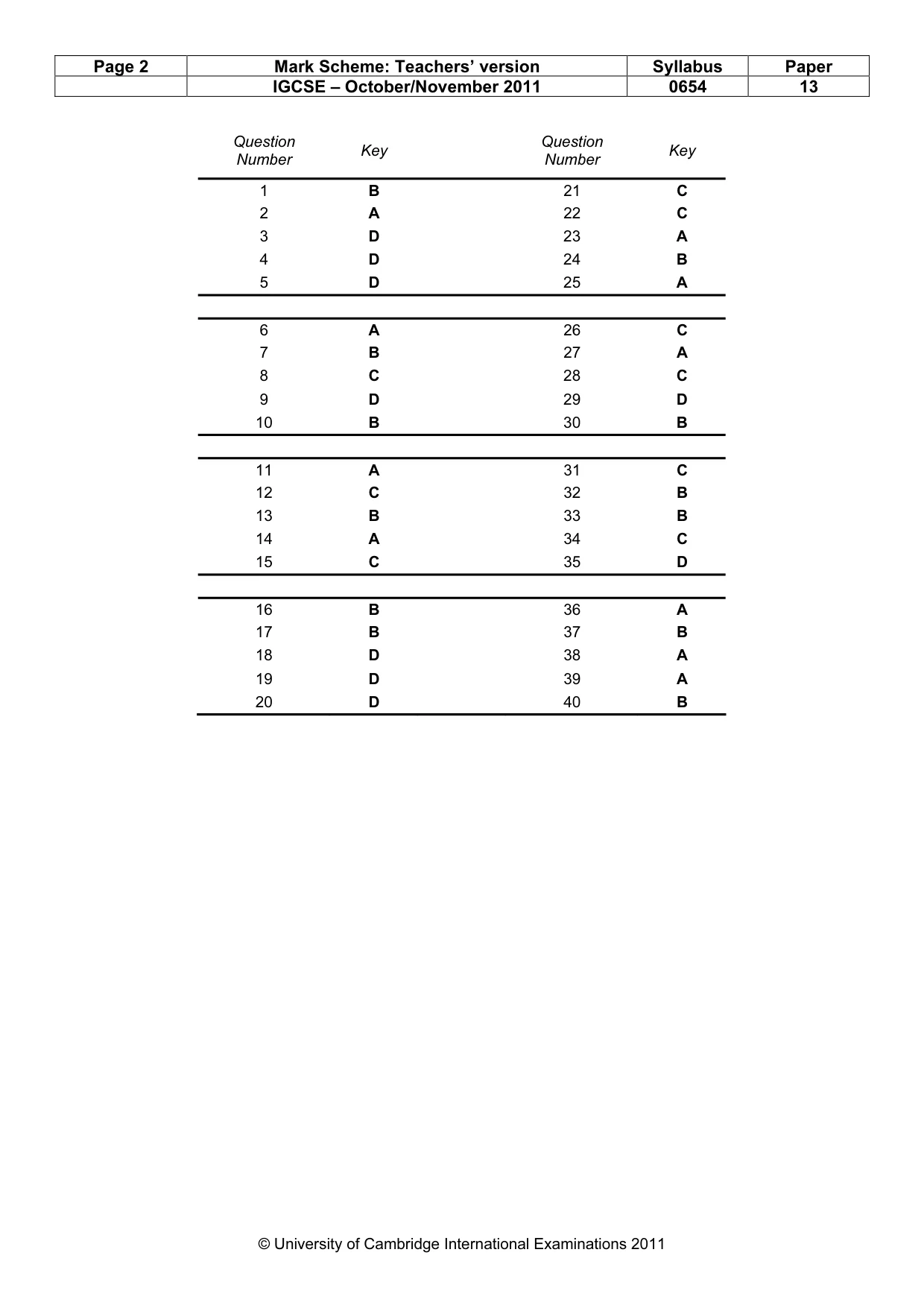
Mark scheme2 pages
Answers below. Sit the paper first if you are practising.
Questions as text
Q1 · The diagram shows a section through a leaf
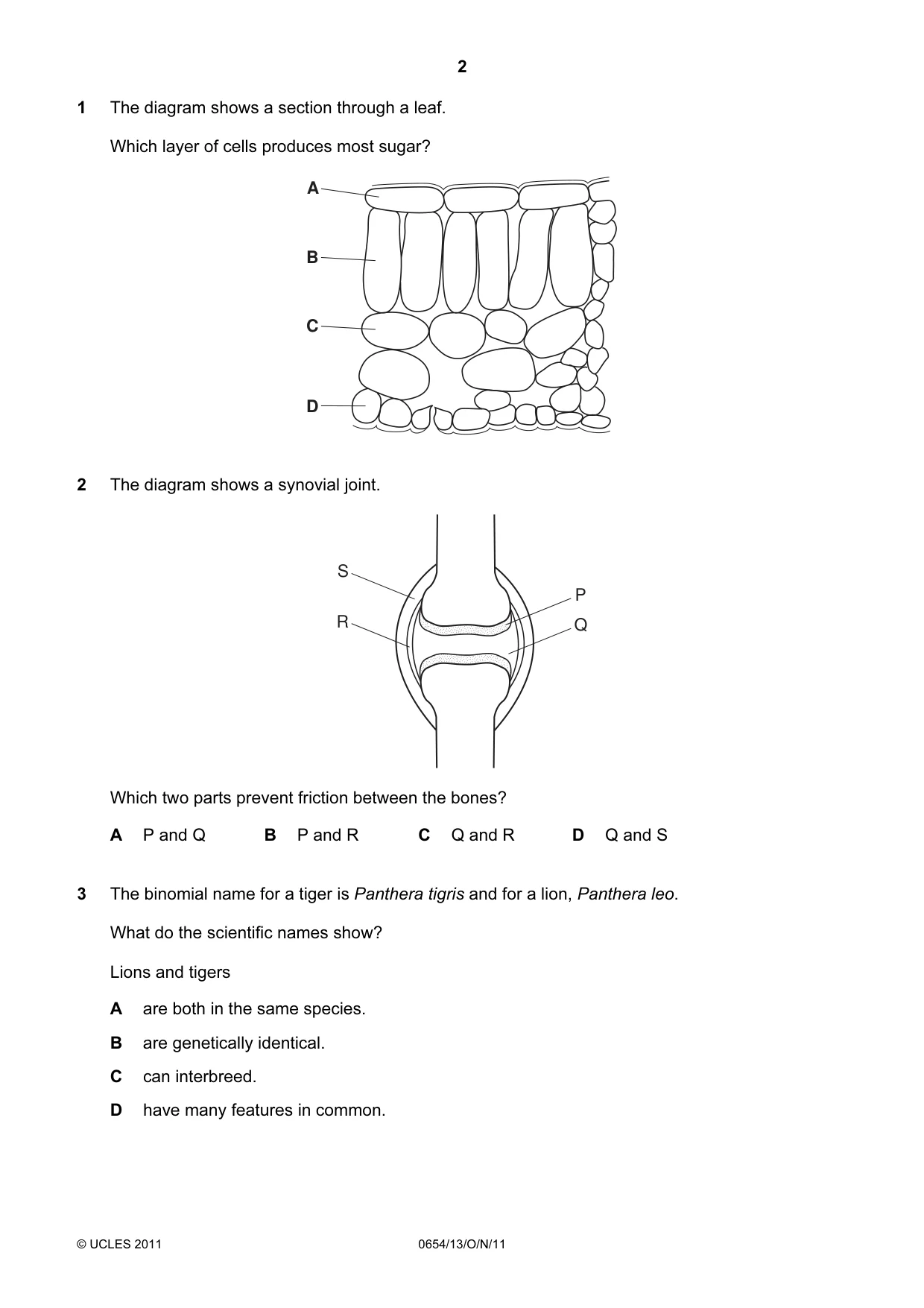
1 The diagram shows a section through a leaf. Which layer of cells produces most sugar? A B C D
Mark scheme: B
Q2 · The diagram shows a synovial joint
2 The diagram shows a synovial joint. S P R Q Which two parts prevent friction between the bones? A P and Q B P and R C Q and R D Q and S
Mark scheme: A
Q3 · The binomial name for a tiger is Panthera tigris and for a lion, Panthera leo
3 The binomial name for a tiger is Panthera tigris and for a lion, Panthera leo. What do the scientific names show? Lions and tigers A are both in the same species. B are genetically identical. C can interbreed. D have many features in common.
Mark scheme: D
Q4 · The diagram shows a shoot of a plant with a transparent stem in a solution of blue dye
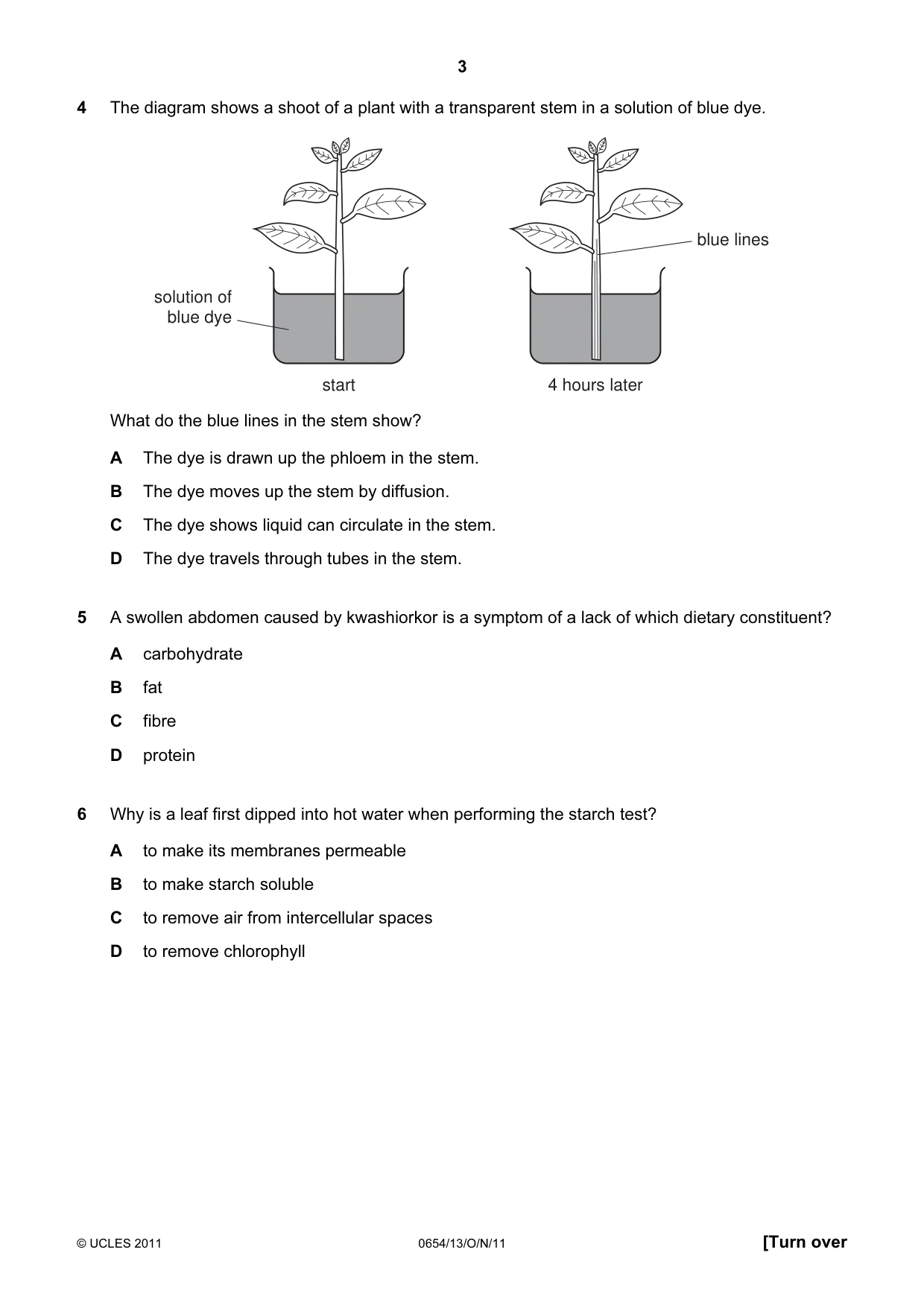
4 The diagram shows a shoot of a plant with a transparent stem in a solution of blue dye. blue lines solution of blue dye start 4 hours later What do the blue lines in the stem show? A The dye is drawn up the phloem in the stem. B The dye moves up the stem by diffusion. C The dye shows liquid can circulate in the stem. D The dye travels through tubes in the stem.
Mark scheme: D
Q5 · A swollen abdomen caused by kwashiorkor is a symptom of a lack of which dietary…
5 A swollen abdomen caused by kwashiorkor is a symptom of a lack of which dietary constituent? A carbohydrate B fat C fibre D protein
Mark scheme: D
Q6 · Why is a leaf first dipped into hot water when performing the starch test?
6 Why is a leaf first dipped into hot water when performing the starch test? A to make its membranes permeable B to make starch soluble C to remove air from intercellular spaces D to remove chlorophyll
Mark scheme: A
Q7 · The diagram shows a section through the eye
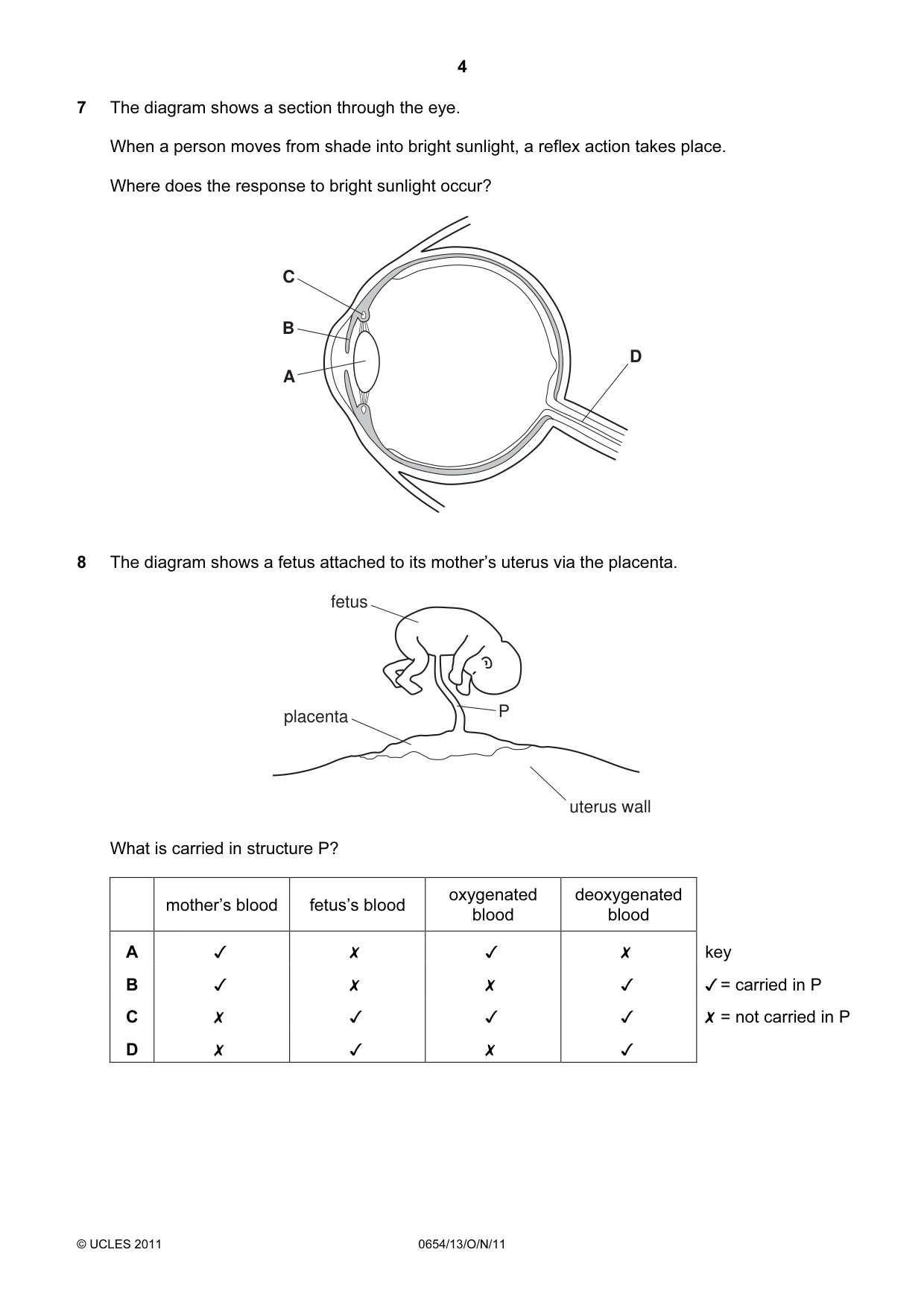
7 The diagram shows a section through the eye. When a person moves from shade into bright sunlight, a reflex action takes place. Where does the response to bright sunlight occur? C B D A
Mark scheme: B
Q8 · The diagram shows a fetus attached to its mother’s uterus via the placenta
8 The diagram shows a fetus attached to its mother’s uterus via the placenta. fetus placenta P uterus wall What is carried in structure P? mother’s blood fetus’s blood oxygenated deoxygenated blood blood A Jv x J x B Jv x x J Cc x Jv Jv Jv D x J x Jv key Y = carried in P X = not carried in P
Mark scheme: C
Q9 · The diagram shows a section through a bean seed
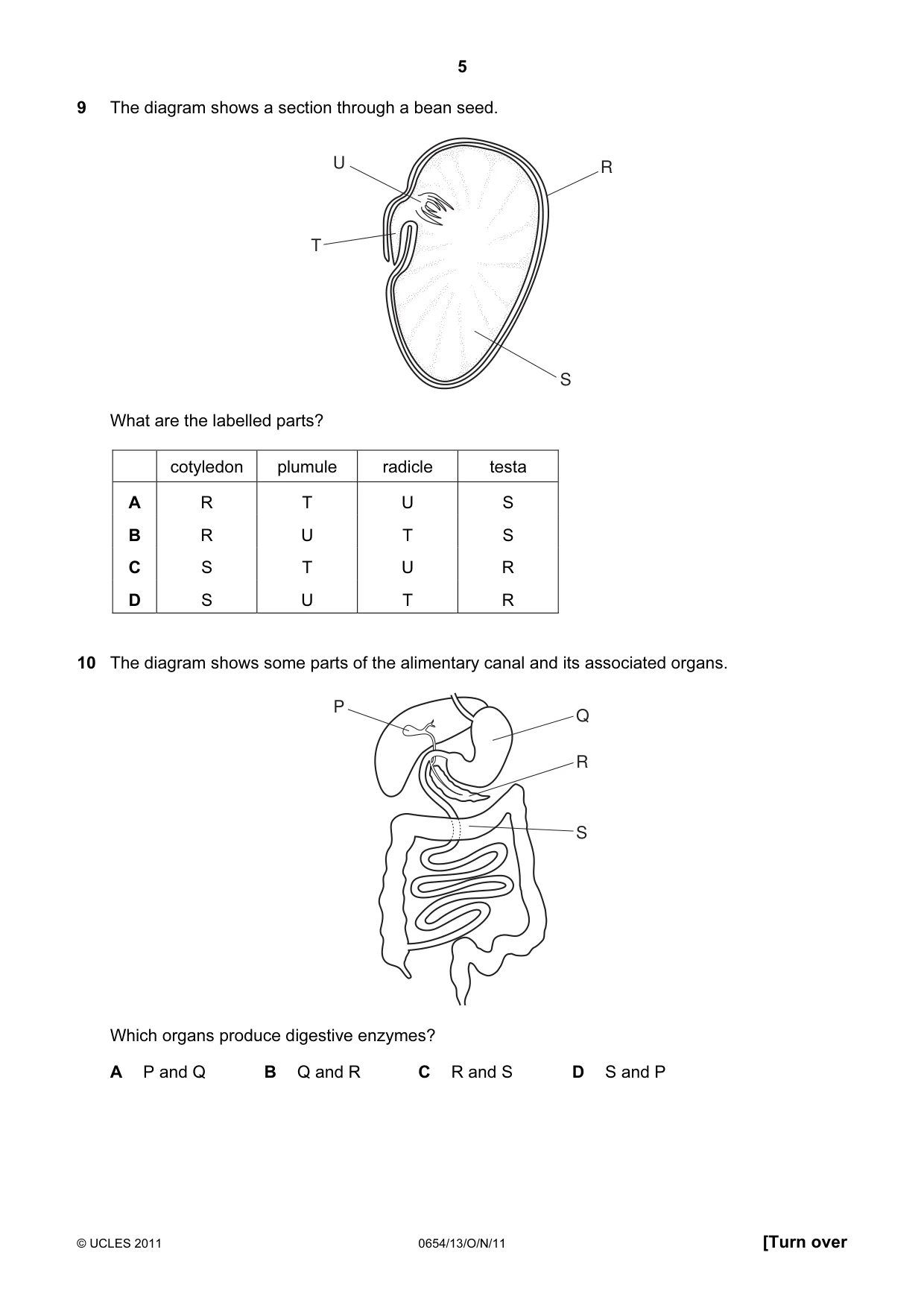
9 The diagram shows a section through a bean seed. U R T S What are the labelled parts? cotyledon plumule radicle testa A R T U S B R U T S C S T U R D S U T R
Mark scheme: D
Q10 · The diagram shows some parts of the alimentary canal and its associated organs
10 The diagram shows some parts of the alimentary canal and its associated organs. P Q R S Which organs produce digestive enzymes? A P and Q B Q and R C R and S D S and P
Mark scheme: B
Q11 · Why is energy lost along a food chain?
11 Why is energy lost along a food chain? A All plants and animals respire. B Decomposers are at one end of a food chain. C Energy enters a food chain only through plants. D Not all animals feed on plants.
Mark scheme: A
Q12 · The diagram shows a food chain
12 The diagram shows a food chain. phytoplankton → small fish → large fish → killer whale Which are consumers? A killer whales only B killer whales and large fish only C killer whales, large fish and small fish only D phytoplankton only
Mark scheme: C
Q13 · What is an allele?
13 What is an allele? A a pair of identical genes B one of the forms of a gene C the genetic make-up of a nucleus D the result of two gametes fusing
Mark scheme: B
Q14 · Which would be a liquid at 50 °C?
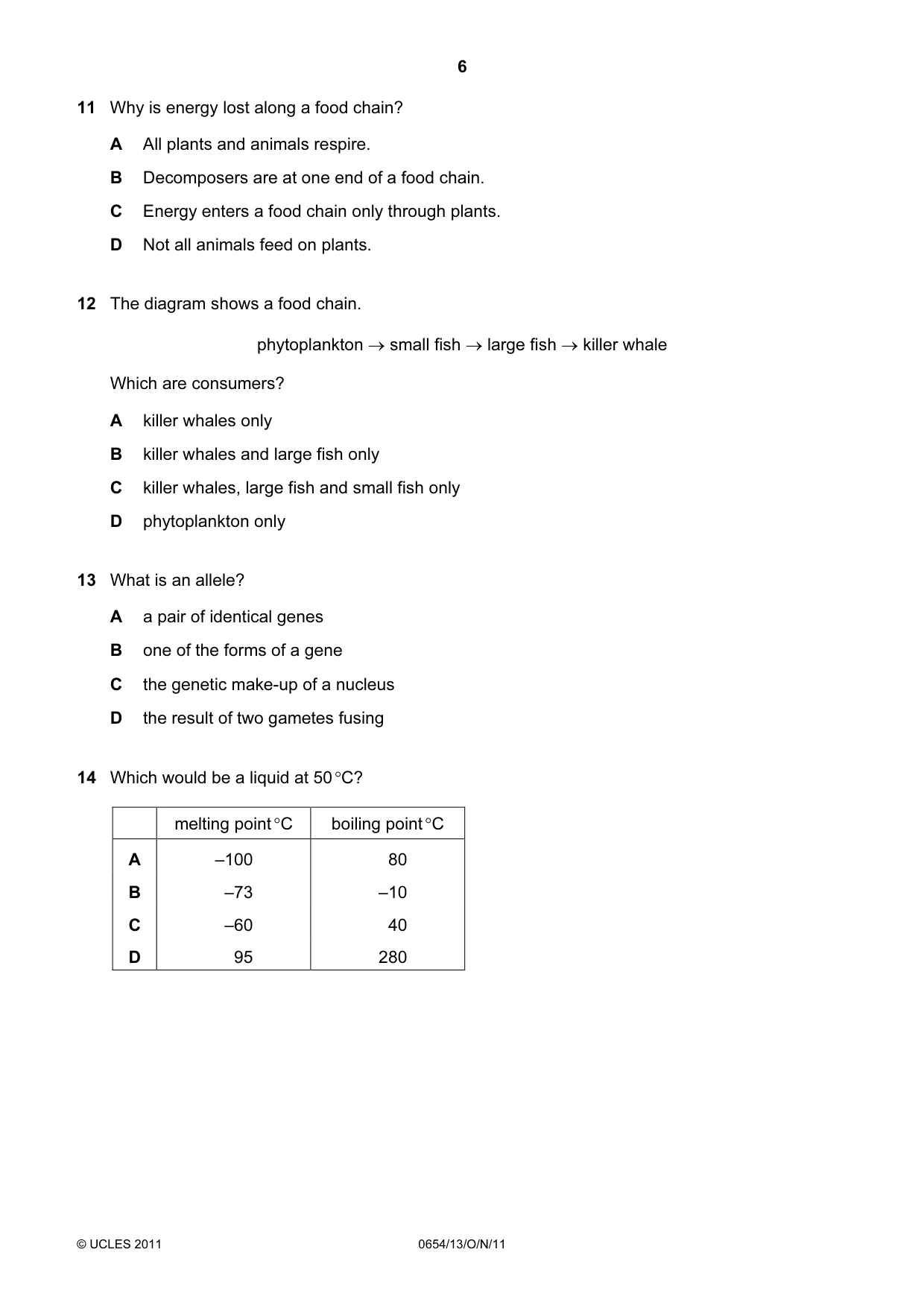
14 Which would be a liquid at 50 °C? melting point °C boiling point °C A –100 80 B –73 –10 C –60 40 D 95 280
Mark scheme: A
Q15 · The diagram shows part of the Periodic Table
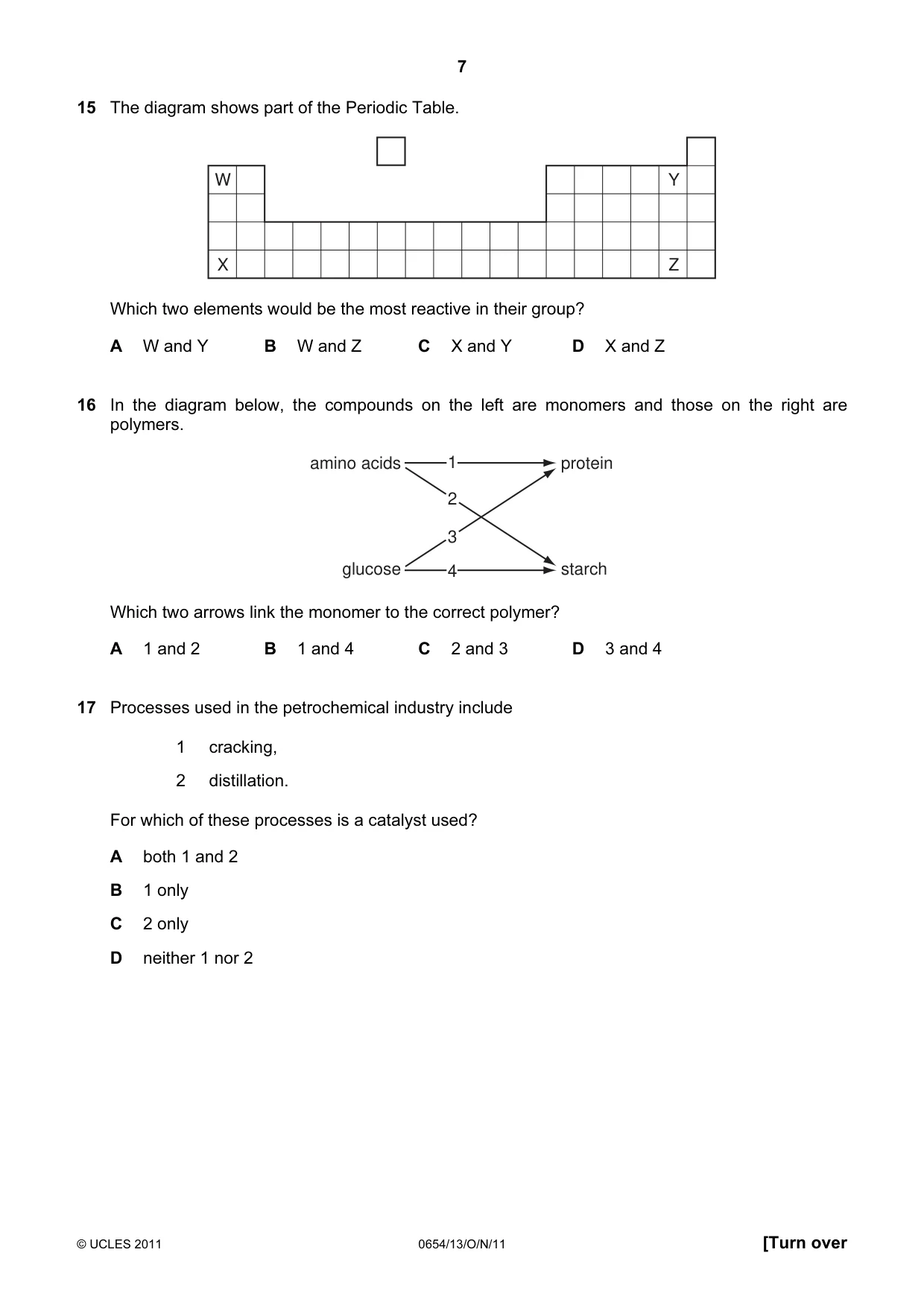
15 The diagram shows part of the Periodic Table. W Y X Z Which two elements would be the most reactive in their group? A W and Y B W and Z C X and Y D X and Z
Mark scheme: C
Q16 · In the diagram below, the compounds on the left are monomers and those on the right are…
16 In the diagram below, the compounds on the left are monomers and those on the right are polymers. amino acids 1 protein 2 3 glucose 4 starch Which two arrows link the monomer to the correct polymer? A 1 and 2 B 1 and 4 C 2 and 3 D 3 and 4
Mark scheme: B
Q17 · Processes used in the petrochemical industry include 1 cracking, 2 distillation
17 Processes used in the petrochemical industry include 1 cracking, 2 distillation. For which of these processes is a catalyst used? A both 1 and 2 B 1 only C 2 only D neither 1 nor 2
Mark scheme: B
Q18 · Using solution X, a student successfully tested for the presence of chloride ions
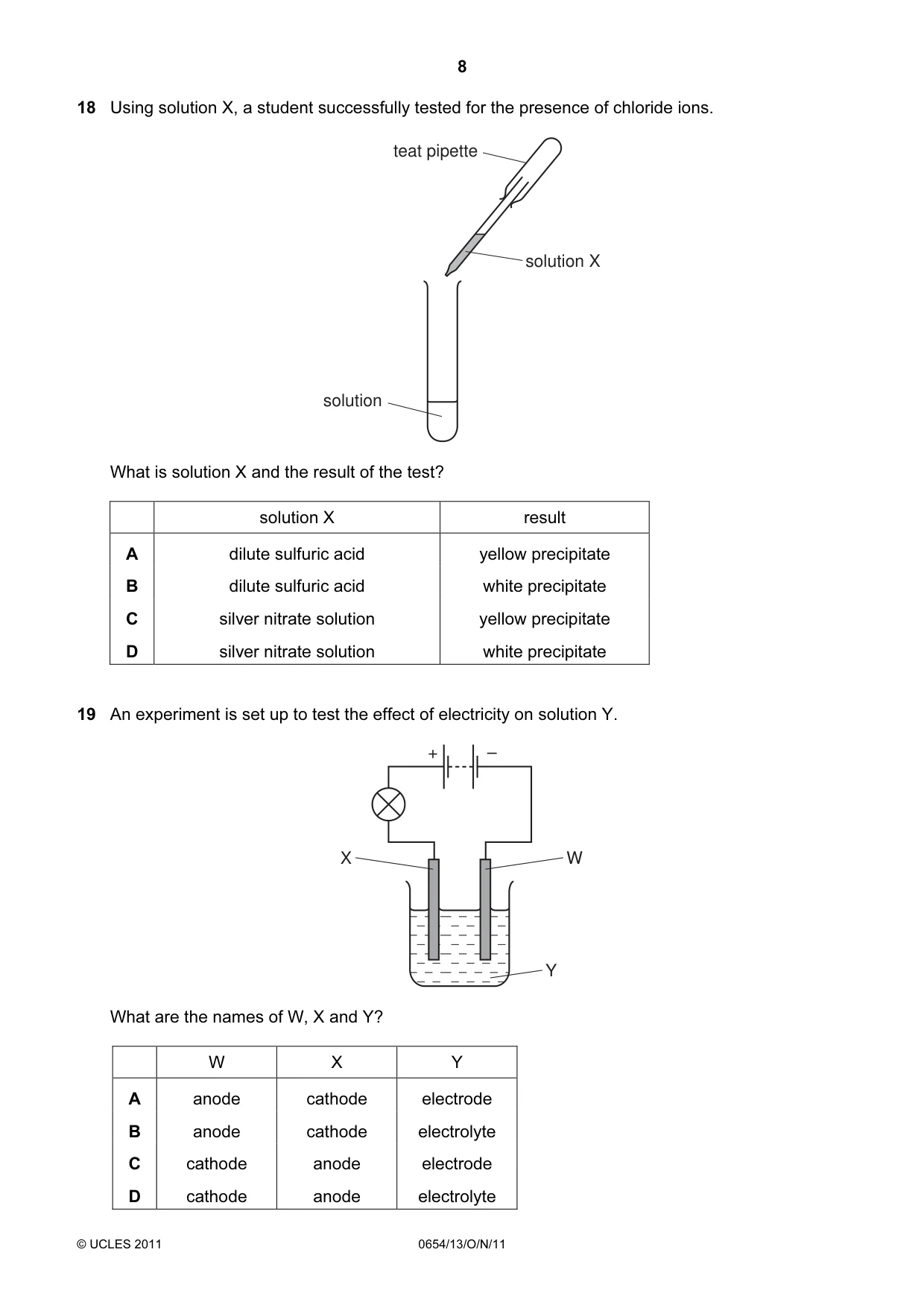
18 Using solution X, a student successfully tested for the presence of chloride ions. teat pipette solution X solution What is solution X and the result of the test? solution X result A dilute sulfuric acid yellow precipitate B dilute sulfuric acid white precipitate C silver nitrate solution yellow precipitate D silver nitrate solution white precipitate
Mark scheme: D
Q19 · An experiment is set up to test the effect of electricity on solution Y
19 An experiment is set up to test the effect of electricity on solution Y. + – X W Y What are the names of W, X and Y? W X Y A anode cathode electrode B anode cathode electrolyte C cathode anode electrode D cathode anode electrolyte
Mark scheme: D
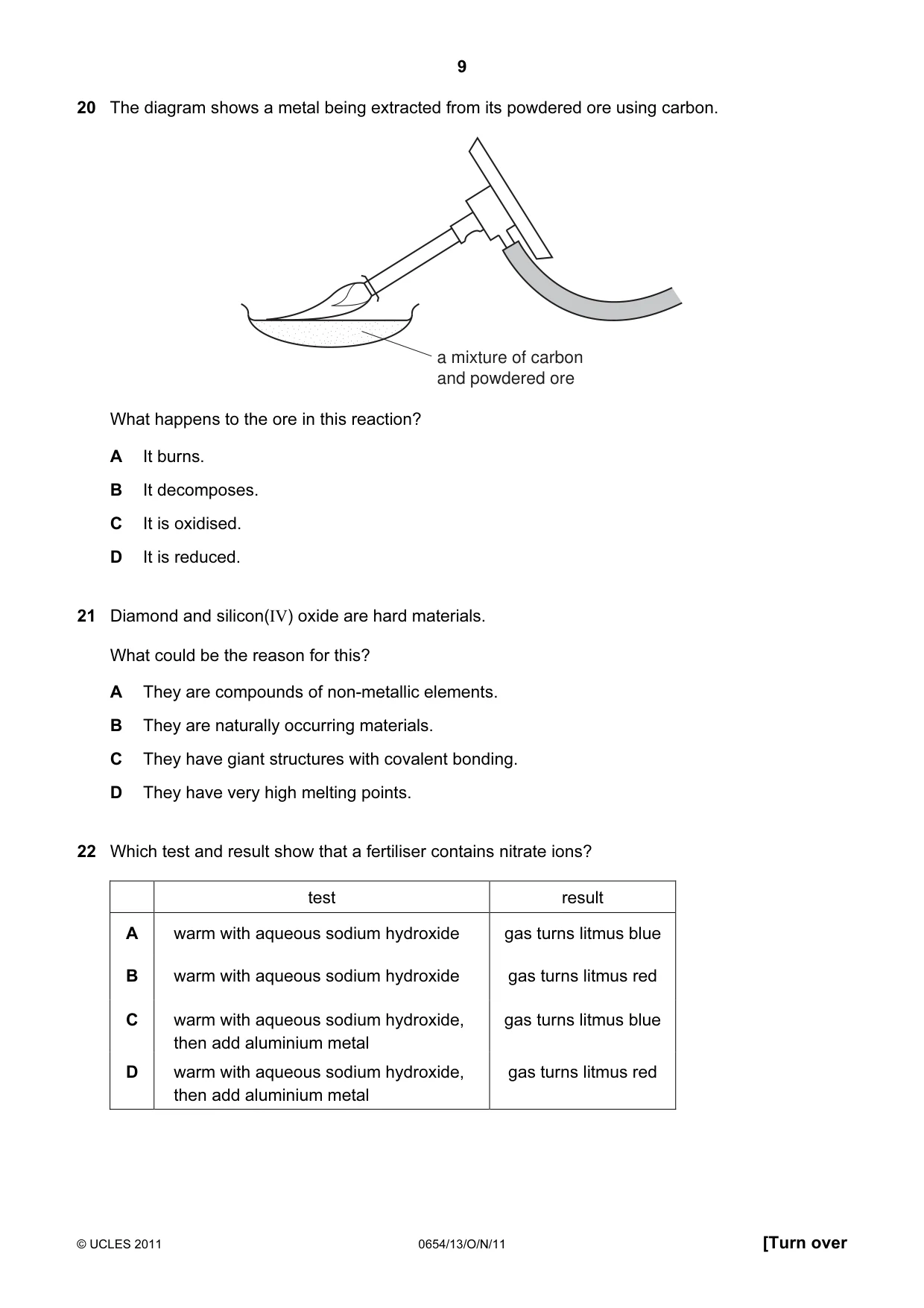
Q20 · The diagram shows a metal being extracted from its powdered ore using carbon
20 The diagram shows a metal being extracted from its powdered ore using carbon. a mixture of carbon and powdered ore What happens to the ore in this reaction? A It burns. B It decomposes. C It is oxidised. D It is reduced.
Mark scheme: D
Q21 · Diamond and silicon(IV) oxide are hard materials
21 Diamond and silicon(IV) oxide are hard materials. What could be the reason for this? A They are compounds of non-metallic elements. B They are naturally occurring materials. C They have giant structures with covalent bonding. D They have very high melting points.
Mark scheme: C
Q22 · Which test and result show that a fertiliser contains nitrate ions?
22 Which test and result show that a fertiliser contains nitrate ions? test result A warm with aqueous sodium hydroxide gas turns litmus blue B warm with aqueous sodium hydroxide gas turns litmus red C warm with aqueous sodium hydroxide, gas turns litmus blue then add aluminium metal D warm with aqueous sodium hydroxide, gas turns litmus red then add aluminium metal
Mark scheme: C
Q23 · Why is an analgesic used in medicine?
23 Why is an analgesic used in medicine? A as a painkiller B as a vitamin C to kill bacteria D to kill viruses
Mark scheme: A
Q24 · What happens when an acid reacts with an alkali?
24 What happens when an acid reacts with an alkali? A Neutralisation takes place and the temperature falls. B Neutralisation takes place and the temperature rises. C Reduction takes place and the temperature falls. D Reduction takes place and the temperature rises.
Mark scheme: B
More questions on The characteristic properties of acids and bases
Q25 · Which is a solid fossil fuel?
25 Which is a solid fossil fuel? A coal B oil C sugar D wood
Mark scheme: A
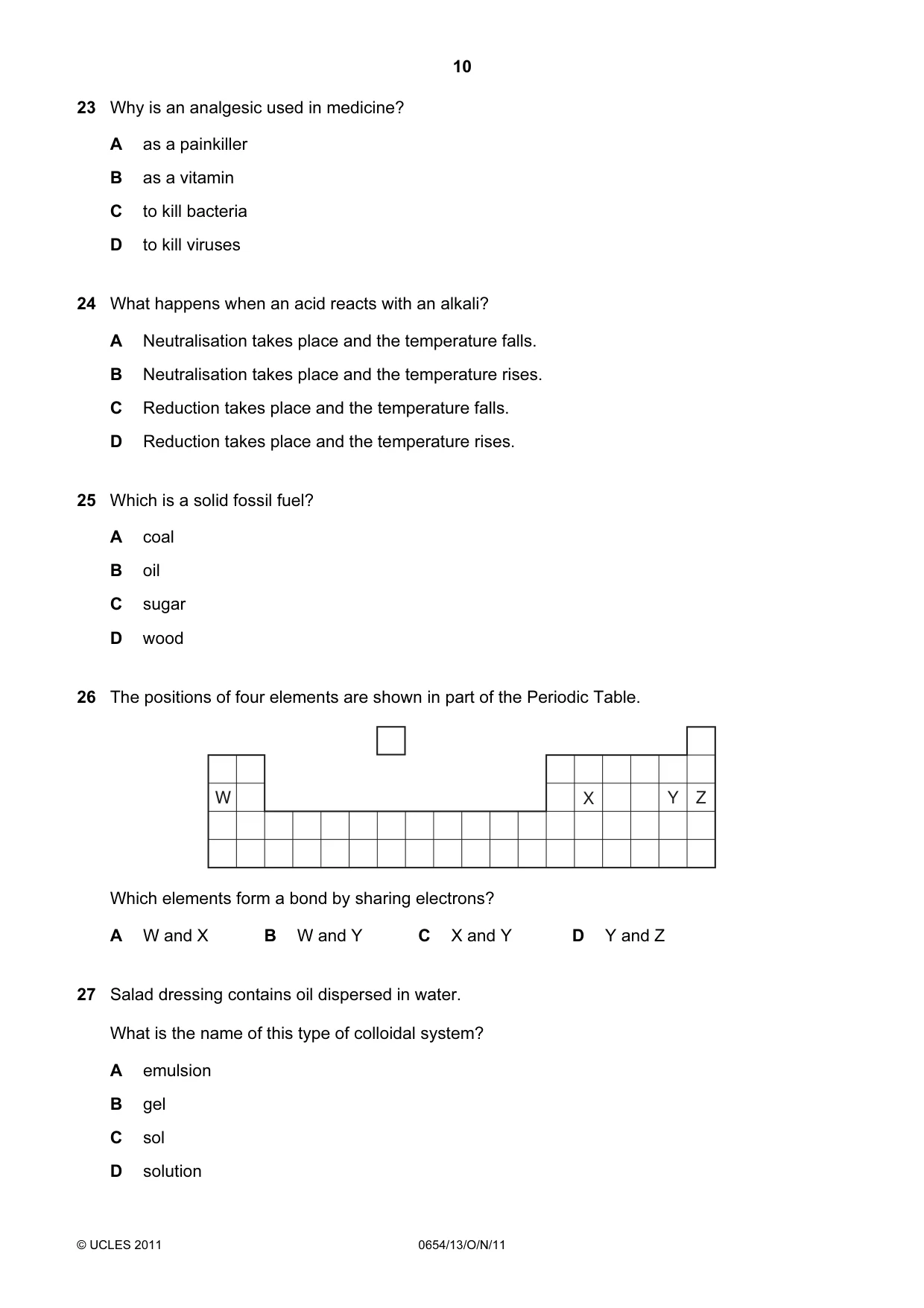
Q26 · The positions of four elements are shown in part of the Periodic Table
26 The positions of four elements are shown in part of the Periodic Table. W X Y Z Which elements form a bond by sharing electrons? A W and X B W and Y C X and Y D Y and Z
Mark scheme: C
Q27 · Salad dressing contains oil dispersed in water
27 Salad dressing contains oil dispersed in water. What is the name of this type of colloidal system? A emulsion B gel C sol D solution
Mark scheme: A
Q28 · Which of the following is a unit of density?
28 Which of the following is a unit of density? A cm3 / g B g / cm2 C g / cm3 D kg / m2
Mark scheme: C
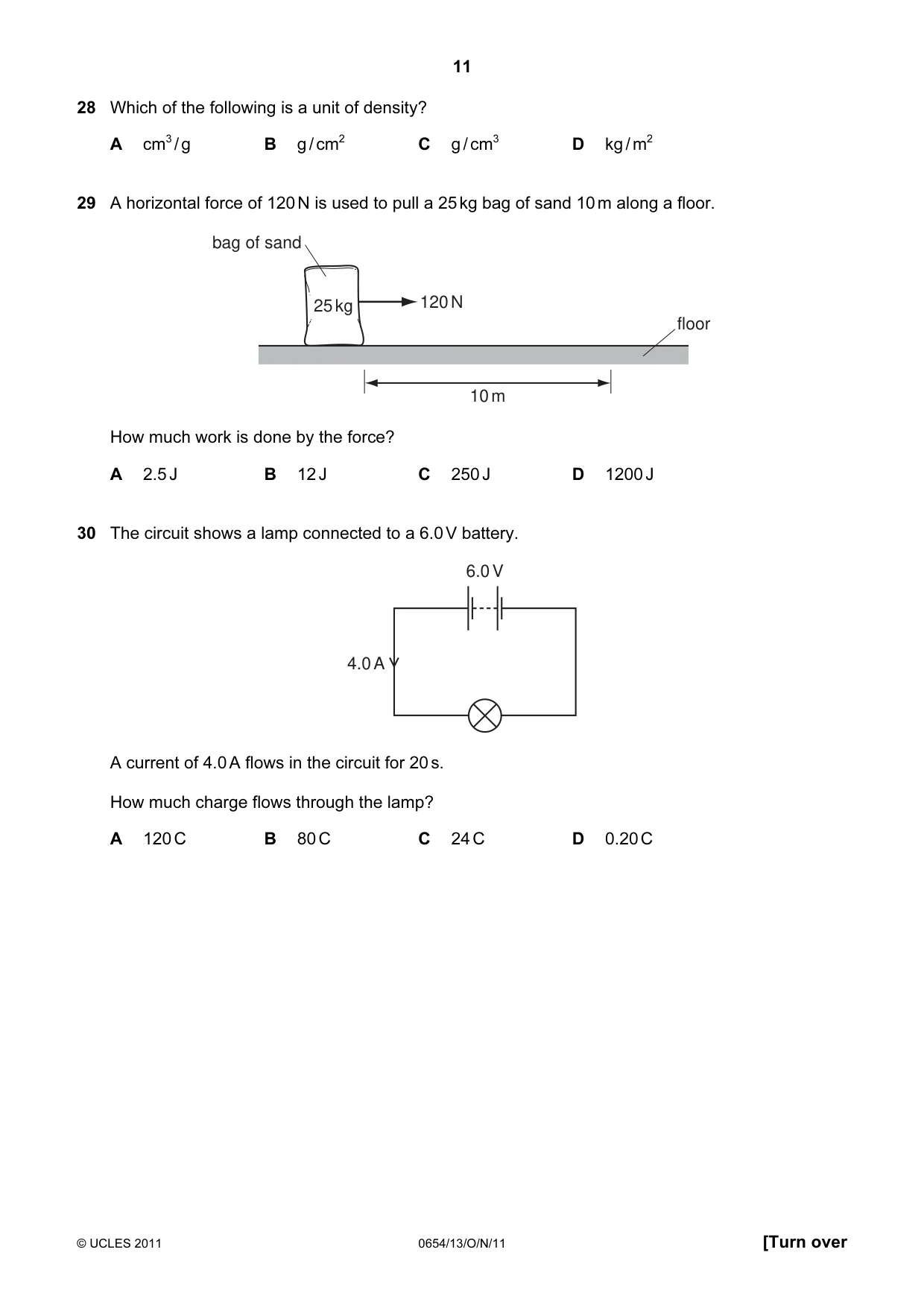
Q29 · A horizontal force of 120 N is used to pull a 25 kg bag of sand 10 m along a floor
29 A horizontal force of 120 N is used to pull a 25 kg bag of sand 10 m along a floor. bag of sand 25 kg 120 N floor 10 m How much work is done by the force? A 2.5 J B 12 J C 250 J D 1200 J
Mark scheme: D
Q30 · The circuit shows a lamp connected to a 6.0 V battery
30 The circuit shows a lamp connected to a 6.0 V battery. 6.0 V 4.0 A A current of 4.0 A flows in the circuit for 20 s. How much charge flows through the lamp? A 120 C B 80 C C 24 C D 0.20 C
Mark scheme: B
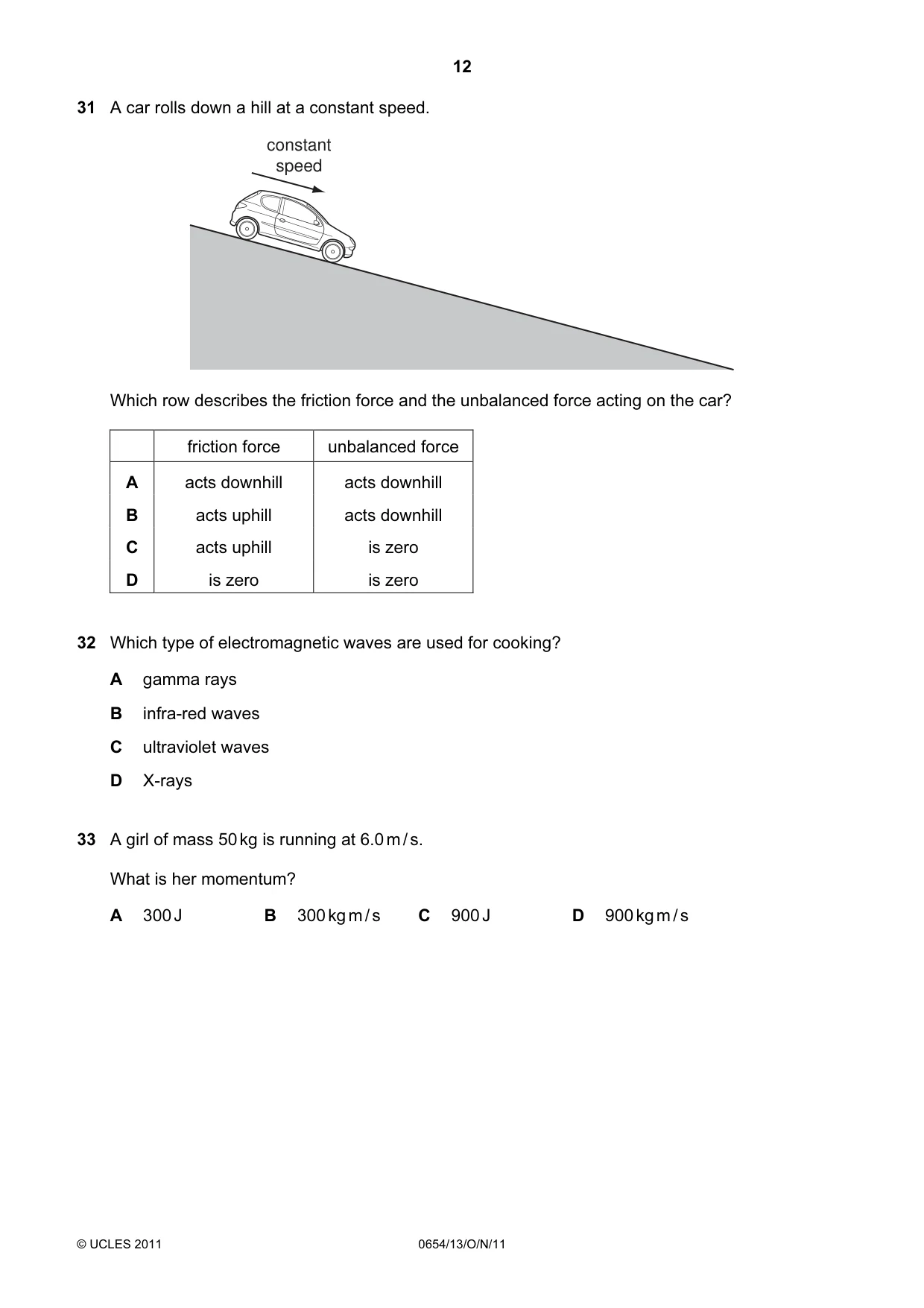
Q31 · A car rolls down a hill at a constant speed
31 A car rolls down a hill at a constant speed. constant speed Which row describes the friction force and the unbalanced force acting on the car? friction force unbalanced force A acts downhill acts downhill B acts uphill acts downhill C acts uphill is zero D is zero is zero
Mark scheme: C
Q32 · Which type of electromagnetic waves are used for cooking?
32 Which type of electromagnetic waves are used for cooking? A gamma rays B infra-red waves C ultraviolet waves D X-rays
Mark scheme: B
Q33 · A girl of mass 50 kg is running at 6.0 m / s
33 A girl of mass 50 kg is running at 6.0 m / s. What is her momentum? A 300 J B 300 kg m / s C 900 J D 900 kg m / s
Mark scheme: B
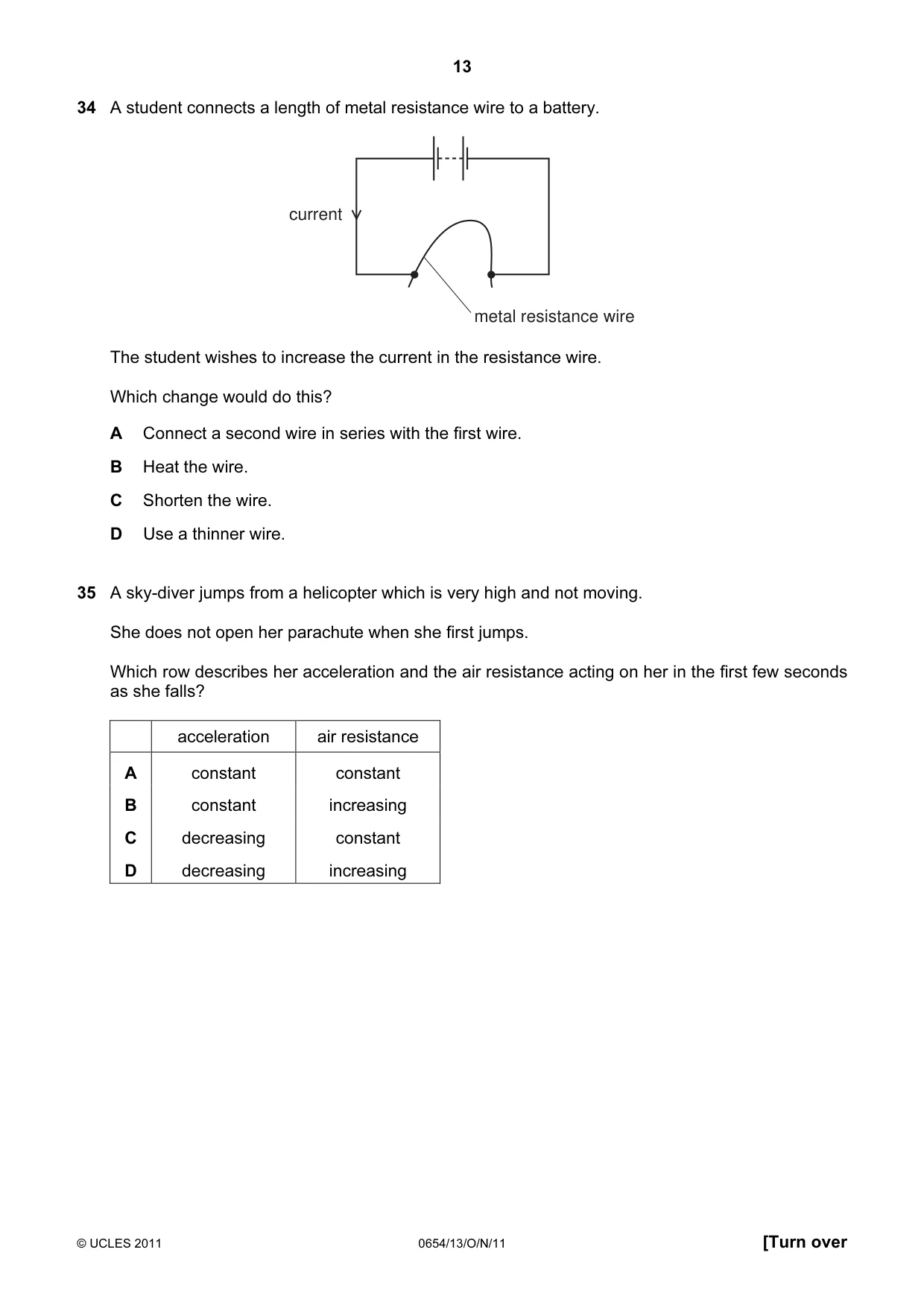
Q34 · A student connects a length of metal resistance wire to a battery
34 A student connects a length of metal resistance wire to a battery. current metal resistance wire The student wishes to increase the current in the resistance wire. Which change would do this? A Connect a second wire in series with the first wire. B Heat the wire. C Shorten the wire. D Use a thinner wire.
Mark scheme: C
Q35 · A sky-diver jumps from a helicopter which is very high and not moving
35 A sky-diver jumps from a helicopter which is very high and not moving. She does not open her parachute when she first jumps. Which row describes her acceleration and the air resistance acting on her in the first few seconds as she falls? acceleration air resistance A constant constant B constant increasing C decreasing constant D decreasing increasing
Mark scheme: D
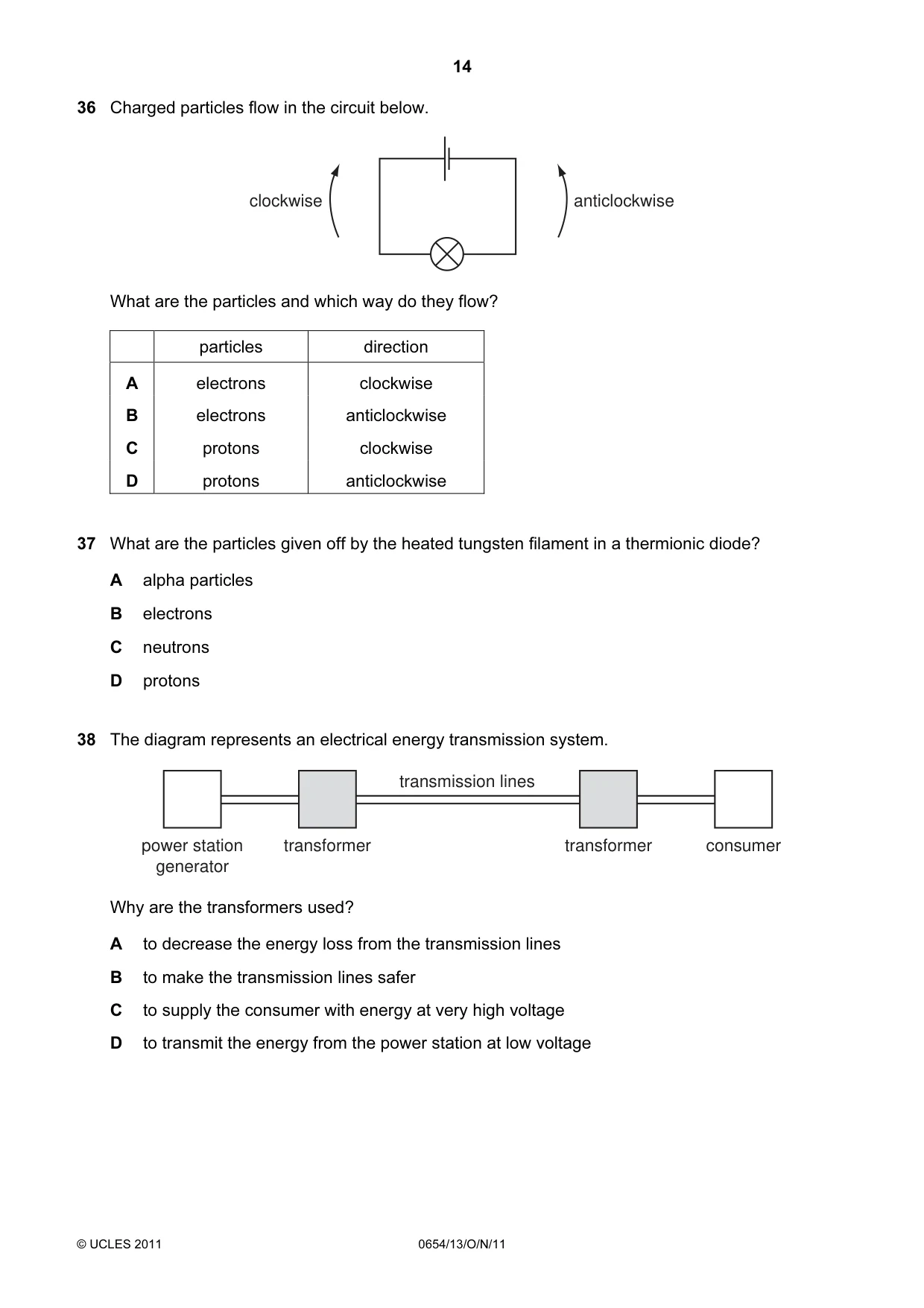
Q36 · Charged particles flow in the circuit below
36 Charged particles flow in the circuit below. clockwise anticlockwise What are the particles and which way do they flow? particles direction A electrons clockwise B electrons anticlockwise C protons clockwise D protons anticlockwise
Mark scheme: A
Q37 · What are the particles given off by the heated tungsten filament in a thermionic diode?
37 What are the particles given off by the heated tungsten filament in a thermionic diode? A alpha particles B electrons C neutrons D protons
Mark scheme: B
Q38 · The diagram represents an electrical energy transmission system
38 The diagram represents an electrical energy transmission system. transmission lines power station transformer transformer consumer generator Why are the transformers used? A to decrease the energy loss from the transmission lines B to make the transmission lines safer C to supply the consumer with energy at very high voltage D to transmit the energy from the power station at low voltage
Mark scheme: A
Q39 · A machine is claimed to be 100 % efficient
39 A machine is claimed to be 100 % efficient. For this to be true, which statement must be correct? A All the energy put into it is changed into useful energy. B It is very easy to use. C It produces more energy than is put into it. D It wastes a small amount of energy.
Mark scheme: A
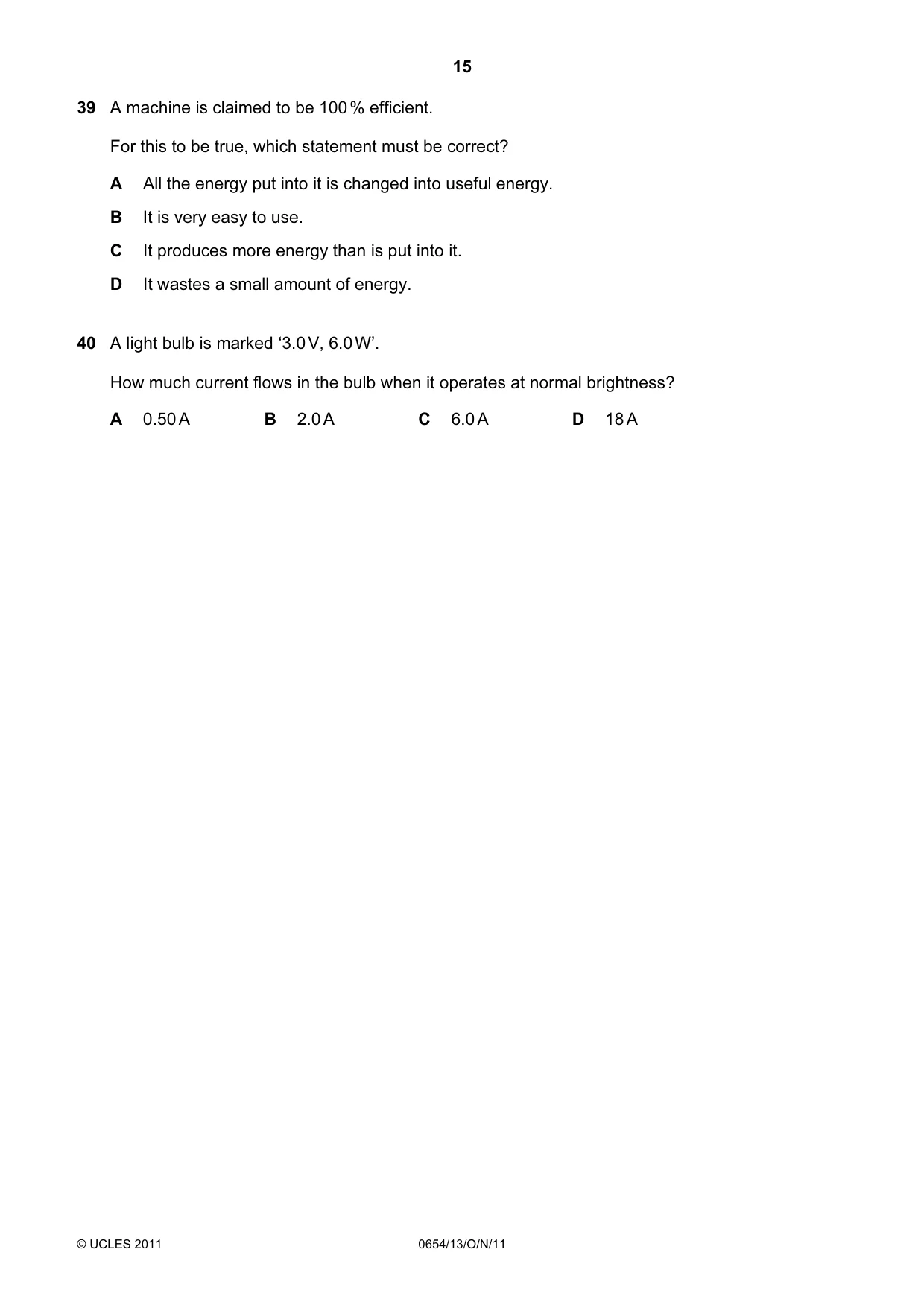
Q40 · A light bulb is marked ‘3.0 V, 6.0 W’
40 A light bulb is marked ‘3.0 V, 6.0 W’. How much current flows in the bulb when it operates at normal brightness? A 0.50 A B 2.0 A C 6.0 A D 18 A
Mark scheme: B
What was in this paper
The subtopics covered by these 40 questions, and how many questions each got. Open one in a new tab to see every Cambridge question on it.
3Coordination and response2Electrical quantities2Energy, work and power2Forces2Fuels2Identification of ions and gases2Arrangement of elements1Biological molecules1Characteristics of living organisms1Chromosomes and genes1Density1Diet1Digestive system1Drugs1Electrolysis1Electromagnetic effects1Electromagnetic spectrum1Elements, compounds and mixtures1Energy flow1Extraction of metals1Food chains and food webs1Giant covalent structures1Leaf structure1Motion1Photosynthesis1Sexual reproduction in humans1Sexual reproduction in plants1Simple molecules and covalent bonds1Solids, liquids and gases1The characteristic properties of acids and bases1Xylem and phloem1What you needed in this session
Cambridge’s own grade thresholds for 2011 Oct/Nov, Paper 1 · Variant 3. A higher threshold means an easier paper — the bar moves with how the cohort did.