Cambridge IGCSE Sciences - Co-ordinated (Double) 0654 — 2023 May/June Paper 1 · Variant 1
0654/11/M/J/23 · 40 questions · 40 marks · ≈45 min
The question paper and its mark scheme, free to read here and free to download. This is Cambridge’s own paper, exactly as it was sat.
Question paper16 pages
Mark scheme3 pages
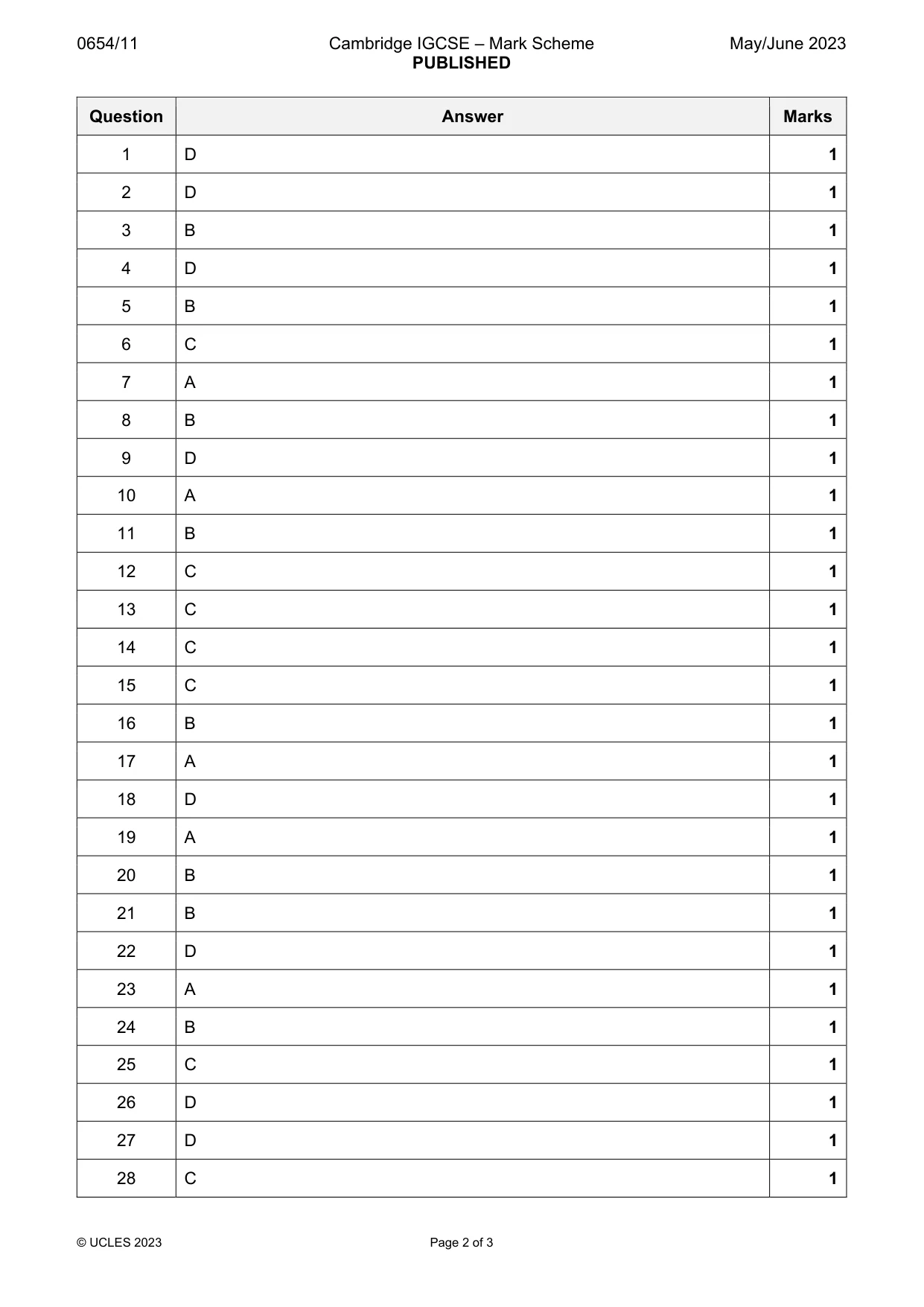
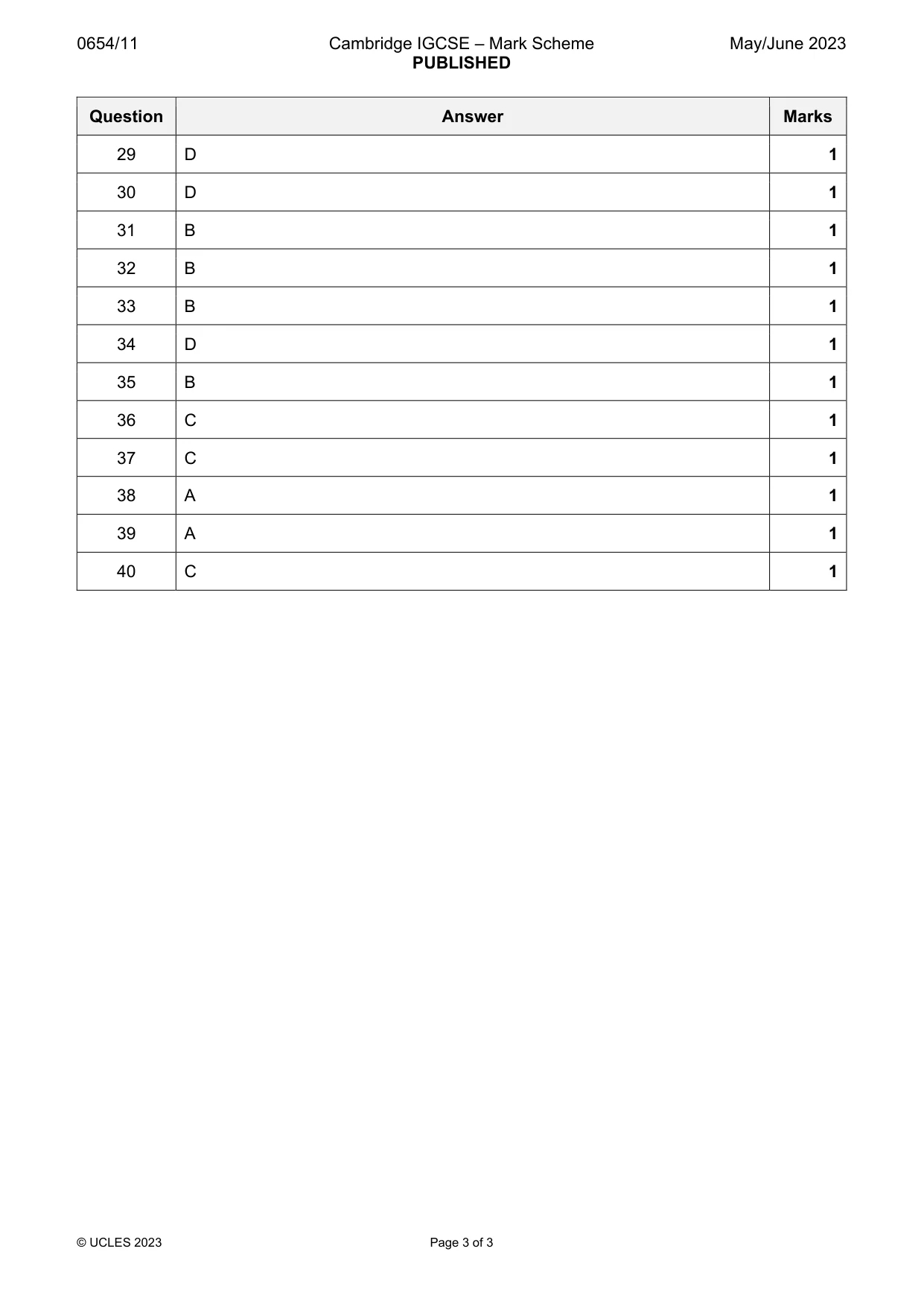
Answers below. Sit the paper first if you are practising.
Questions as text
Q1 · What is meant by respiration?
1 What is meant by respiration? A protein synthesis B sweating to lose heat C the function of lungs D the release of energy
Mark scheme: D
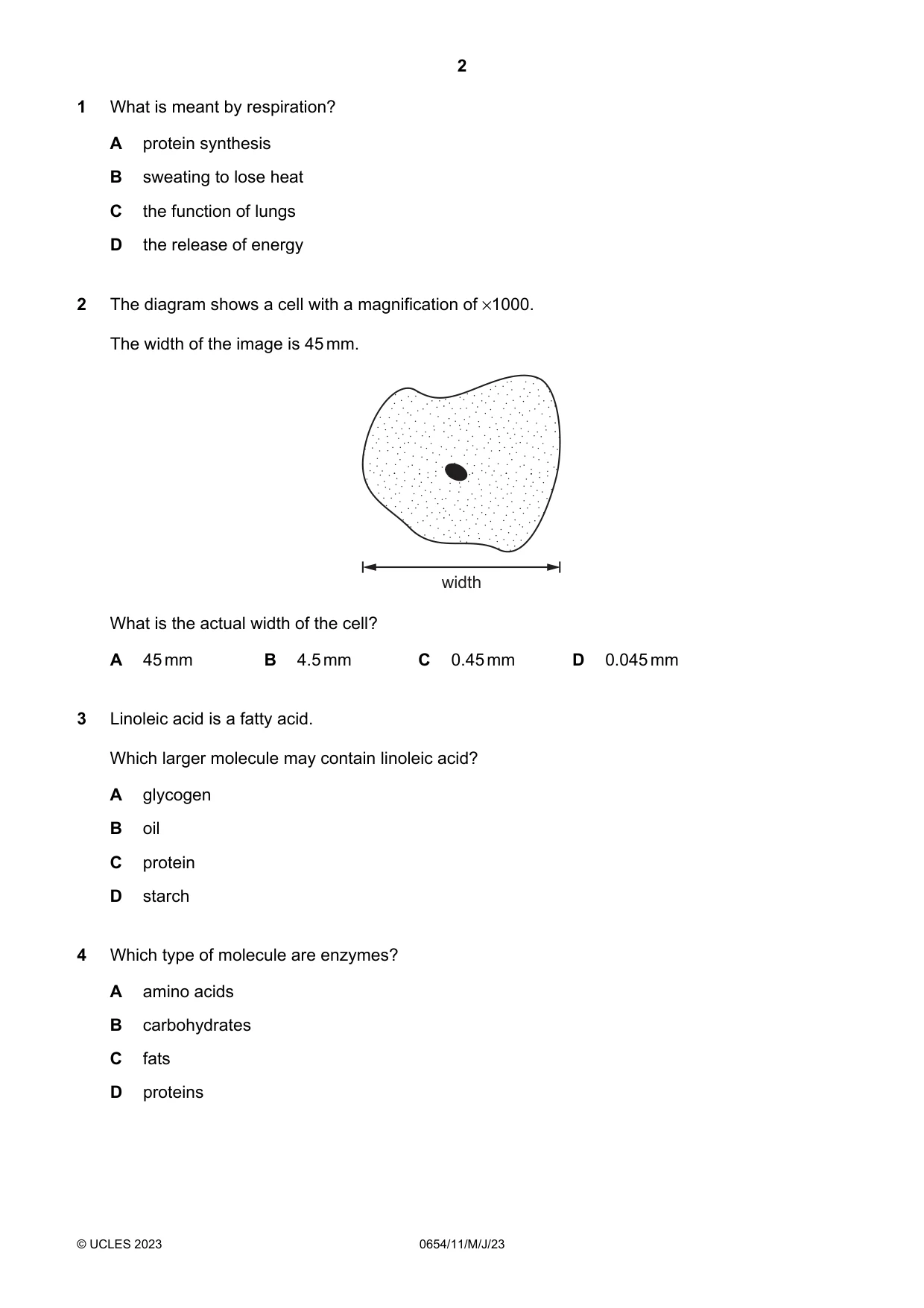
Q2 · The diagram shows a cell with a magnification of ×1000
2 The diagram shows a cell with a magnification of ×1000. The width of the image is 45 mm. width What is the actual width of the cell? A 45 mm B 4.5 mm C 0.45 mm D 0.045 mm
Mark scheme: D
Q3 · Linoleic acid is a fatty acid
3 Linoleic acid is a fatty acid. Which larger molecule may contain linoleic acid? A glycogen B oil C protein D starch
Mark scheme: B
Q4 · Which type of molecule are enzymes?
4 Which type of molecule are enzymes? A amino acids B carbohydrates C fats D proteins
Mark scheme: D
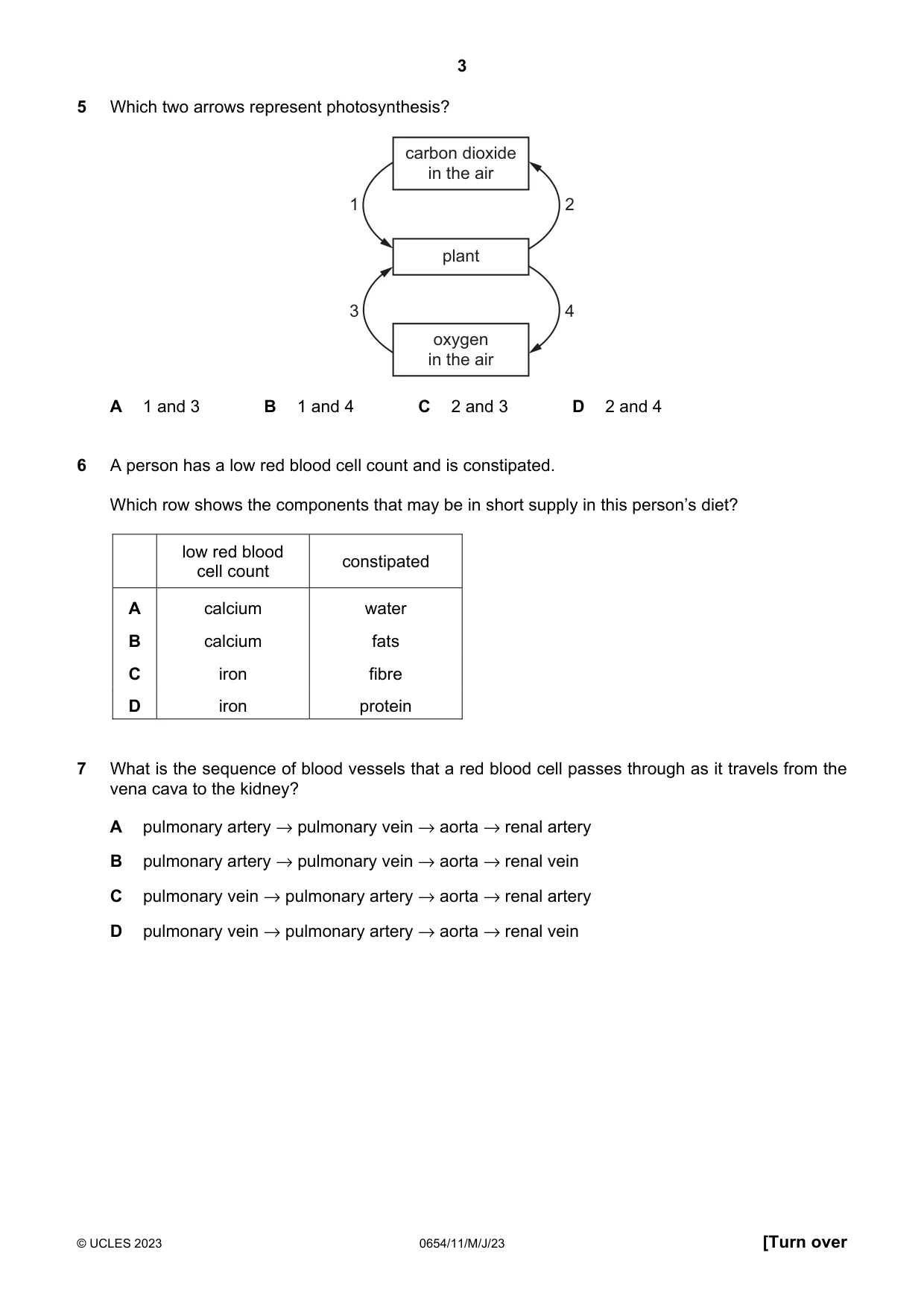
Q5 · Which two arrows represent photosynthesis?
5 Which two arrows represent photosynthesis? carbon dioxide in the air 1 2 plant 3 4 oxygen in the air A 1 and 3 B 1 and 4 C 2 and 3 D 2 and 4
Mark scheme: B
Q6 · A person has a low red blood cell count and is constipated
6 A person has a low red blood cell count and is constipated. Which row shows the components that may be in short supply in this person’s diet? low red blood constipated cell count A calcium water B calcium fats C iron fibre D iron protein
Mark scheme: C
Q7 · What is the sequence of blood vessels that a red blood cell passes through as it travels…
7 What is the sequence of blood vessels that a red blood cell passes through as it travels from the vena cava to the kidney? A pulmonary artery → pulmonary vein → aorta → renal artery B pulmonary artery → pulmonary vein → aorta → renal vein C pulmonary vein → pulmonary artery → aorta → renal artery D pulmonary vein → pulmonary artery → aorta → renal vein
Mark scheme: A
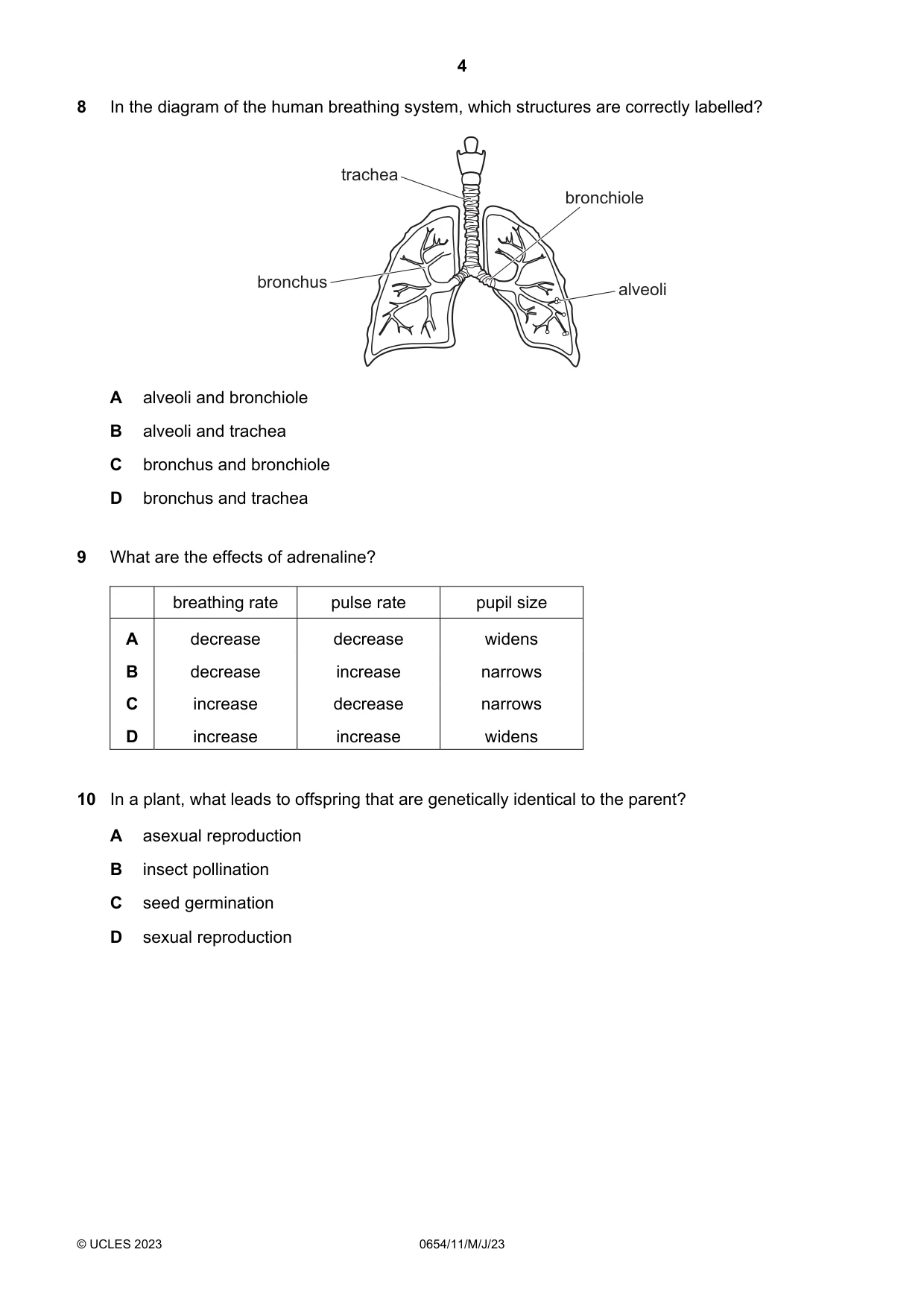
Q8 · In the diagram of the human breathing system, which structures are correctly labelled?
8 In the diagram of the human breathing system, which structures are correctly labelled? trachea bronchiole bronchus alveoli A alveoli and bronchiole B alveoli and trachea C bronchus and bronchiole D bronchus and trachea
Mark scheme: B
Q9 · What are the effects of adrenaline?
9 What are the effects of adrenaline? breathing rate pulse rate pupil size A decrease decrease widens B decrease increase narrows C increase decrease narrows D increase increase widens
Mark scheme: D
Q10 · In a plant, what leads to offspring that are genetically identical to the parent?
10 In a plant, what leads to offspring that are genetically identical to the parent? A asexual reproduction B insect pollination C seed germination D sexual reproduction
Mark scheme: A
Q11 · The diagram shows eggs and sperm containing sex chromosomes
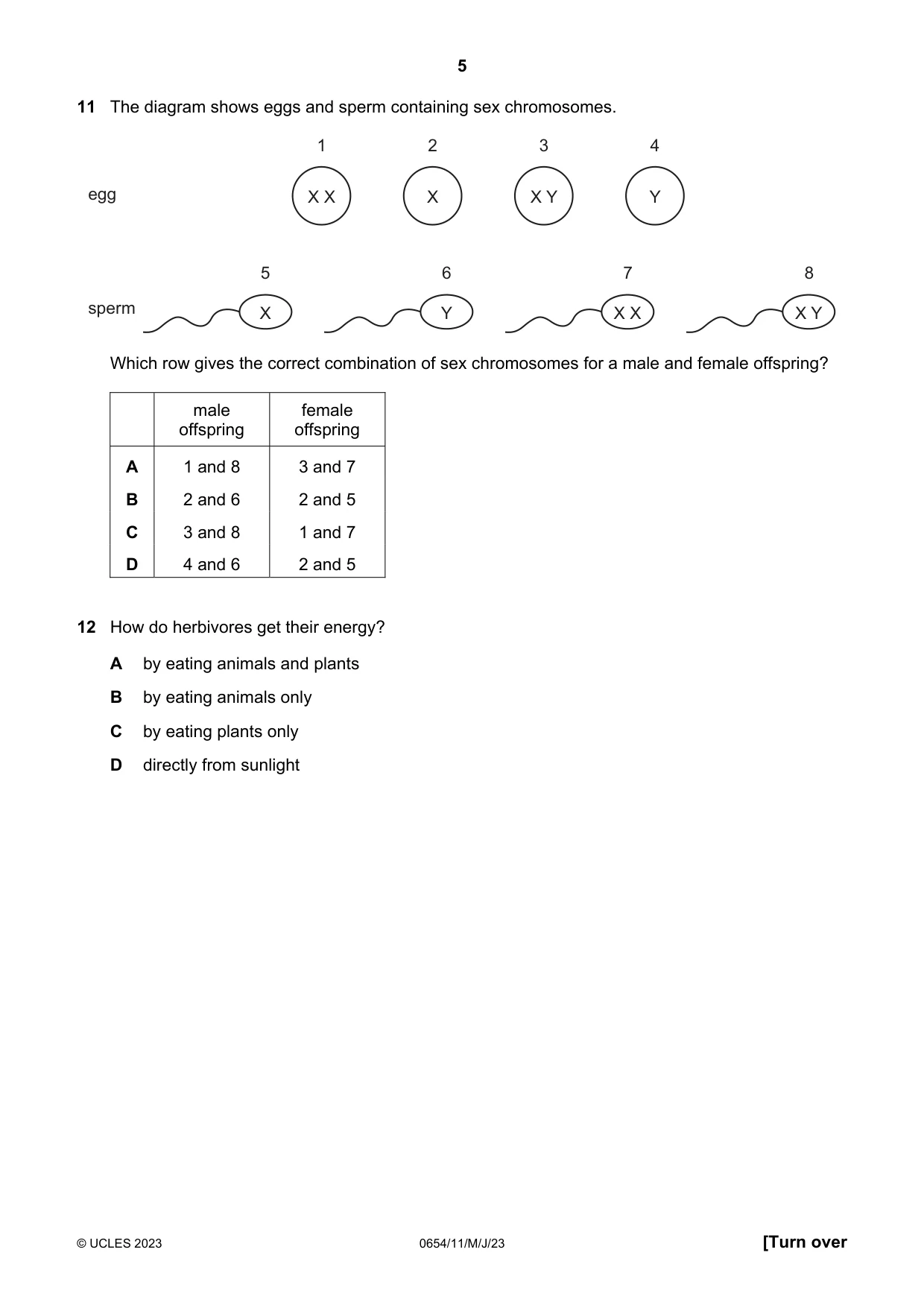
11 The diagram shows eggs and sperm containing sex chromosomes. 1 2 3 4 egg X X X X Y Y 5 6 7 8 sperm X Y X X X Y Which row gives the correct combination of sex chromosomes for a male and female offspring? male female offspring offspring A 1 and 8 3 and 7 B 2 and 6 2 and 5 C 3 and 8 1 and 7 D 4 and 6 2 and 5
Mark scheme: B
Q12 · How do herbivores get their energy?
12 How do herbivores get their energy? A by eating animals and plants B by eating animals only C by eating plants only D directly from sunlight
Mark scheme: C
Q13 · The graph shows the change in atmospheric carbon dioxide levels over time
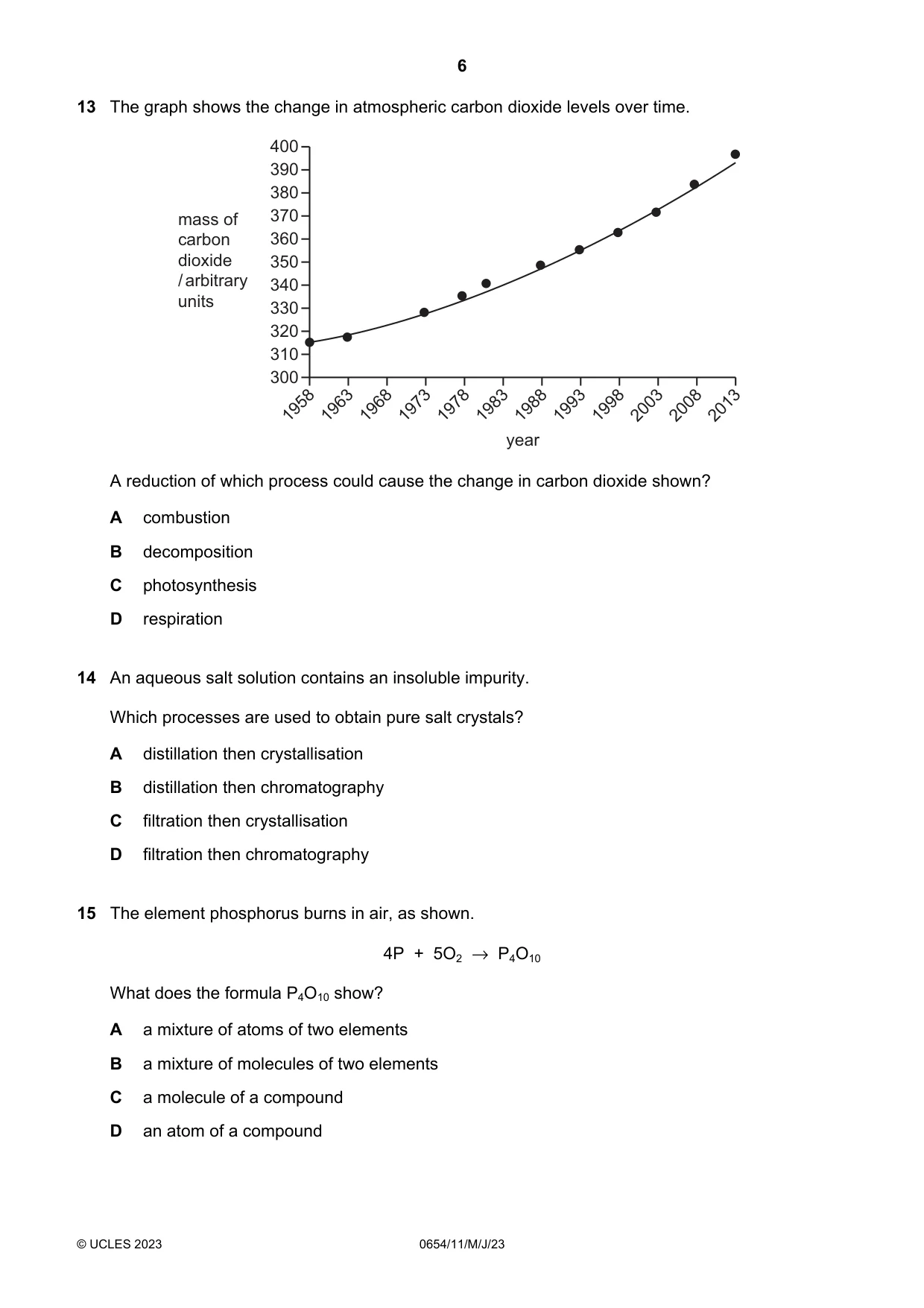
13 The graph shows the change in atmospheric carbon dioxide levels over time. 400 390 380 mass of 370 carbon 360 dioxide 350 / arbitrary 340 units 330 320 310 300 1958 1963 1968 1973 1978 1983 1988 1993 1998 2003 2008 2013 year A reduction of which process could cause the change in carbon dioxide shown? A combustion B decomposition C photosynthesis D respiration
Mark scheme: C
Q14 · An aqueous salt solution contains an insoluble impurity
14 An aqueous salt solution contains an insoluble impurity. Which processes are used to obtain pure salt crystals? A distillation then crystallisation B distillation then chromatography C filtration then crystallisation D filtration then chromatography
Mark scheme: C
Q15 · The element phosphorus burns in air, as shown
15 The element phosphorus burns in air, as shown. 4P + 5O2 → P4O10 What does the formula P4O10 show? A a mixture of atoms of two elements B a mixture of molecules of two elements C a molecule of a compound D an atom of a compound
Mark scheme: C
Q16 · Which row describes an atom that has the nucleon number 24?
16 Which row describes an atom that has the nucleon number 24? number of number of number of protons neutrons electrons A 8 8 8 B 12 12 12 C 21 24 21 D 24 28 24
Mark scheme: B
Q17 · Lithium is in Group I and bromine is in Group VII of the Periodic Table
17 Lithium is in Group I and bromine is in Group VII of the Periodic Table. What is the formula of lithium bromide? A LiBr B LiBr2 C Li2Br D Li2Br2
Mark scheme: A
Q18 · Which diagram shows equipment used to electroplate nickel with copper?
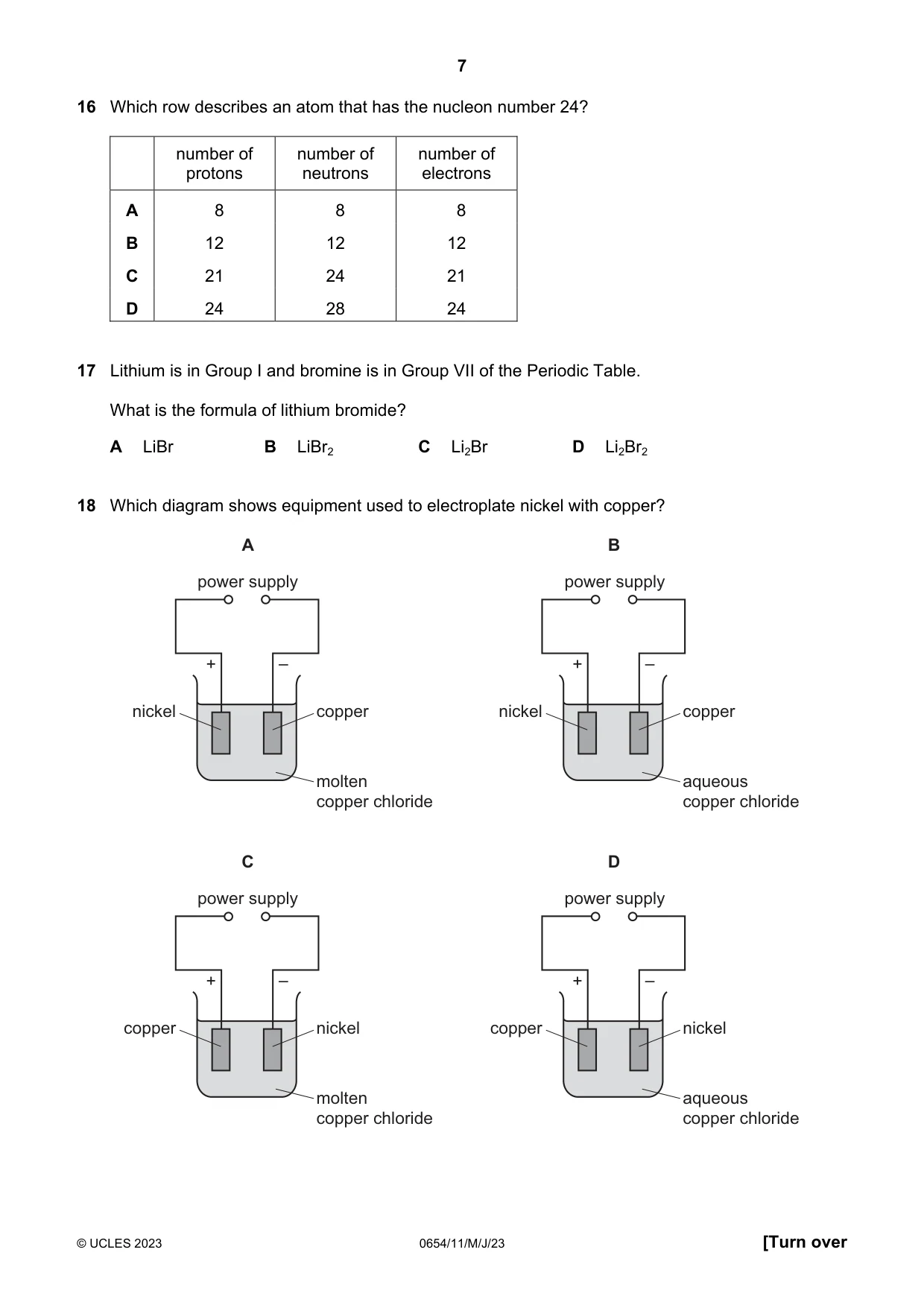
18 Which diagram shows equipment used to electroplate nickel with copper? A B power supply power supply + – + – nickel copper nickel copper molten aqueous copper chloride copper chloride C D power supply power supply + – + – copper nickel copper nickel molten aqueous copper chloride copper chloride
Mark scheme: D
Q19 · Which statement about exothermic and endothermic reactions is correct?
19 Which statement about exothermic and endothermic reactions is correct? A An endothermic reaction involves heat energy being taken in by the reactants. B An exothermic reaction involves heat energy being taken in by the products. C In an endothermic reaction, the temperature of the reaction mixture increases. D In an exothermic reaction, the temperature of the reaction mixture decreases.
Mark scheme: A
Q20 · Which statement shows that methane, CH4, is oxidised when it burns?
20 Which statement shows that methane, CH4, is oxidised when it burns? A The products of the reaction are gaseous. B The products of the reaction are water and carbon dioxide. C The reaction is exothermic. D The total number of oxygen atoms has increased during the reaction.
Mark scheme: B
Q21 · Magnesium chloride is prepared by reacting an excess of insoluble magnesium oxide with…
21 Magnesium chloride is prepared by reacting an excess of insoluble magnesium oxide with dilute hydrochloric acid. Which processes are used to obtain pure crystals of magnesium chloride from the reaction mixture? 1 distillation 2 evaporation 3 filtration A 1 followed by 2 B 3 followed by 2 C 3 followed by 1 D 1 followed by 3, followed by 2
Mark scheme: B
Q22 · The properties of some substances are listed
22 The properties of some substances are listed. 1 form acidic oxides 2 have high melting points 3 act as catalysts 4 form coloured compounds What are the properties of transition metals? A 1, 2 and 3 B 1, 2 and 4 C 1, 3 and 4 D 2, 3 and 4
Mark scheme: D
Q23 · Which statement describes a chemical test for water?
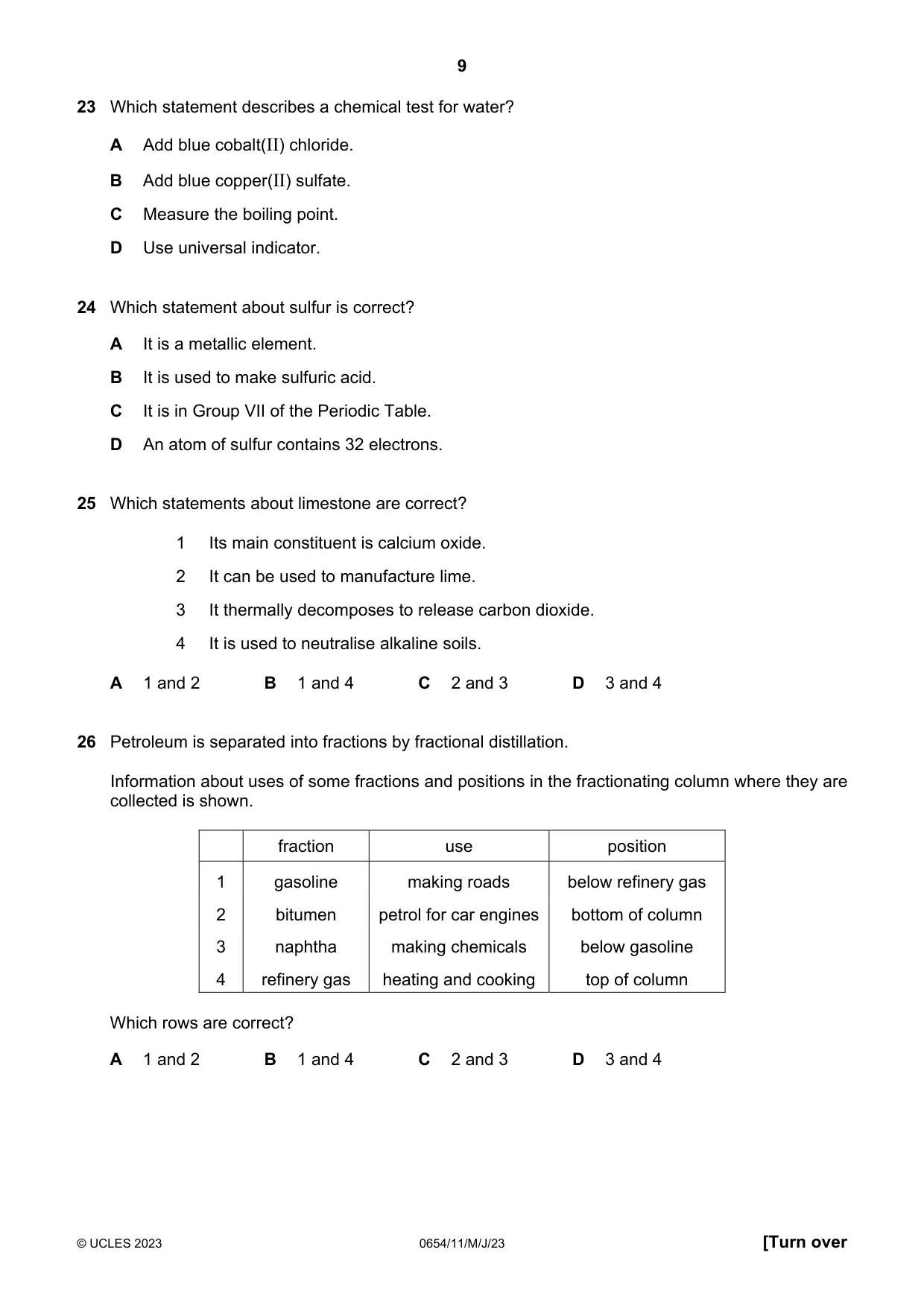
23 Which statement describes a chemical test for water? A Add blue cobalt(II) chloride. B Add blue copper(II) sulfate. C Measure the boiling point. D Use universal indicator.
Mark scheme: A
Q24 · Which statement about sulfur is correct?
24 Which statement about sulfur is correct? A It is a metallic element. B It is used to make sulfuric acid. C It is in Group VII of the Periodic Table. D An atom of sulfur contains 32 electrons.
Mark scheme: B
Q25 · Which statements about limestone are correct?
25 Which statements about limestone are correct? 1 Its main constituent is calcium oxide. 2 It can be used to manufacture lime. 3 It thermally decomposes to release carbon dioxide. 4 It is used to neutralise alkaline soils. A 1 and 2 B 1 and 4 C 2 and 3 D 3 and 4
Mark scheme: C
Q26 · Petroleum is separated into fractions by fractional distillation
26 Petroleum is separated into fractions by fractional distillation. Information about uses of some fractions and positions in the fractionating column where they are collected is shown. fraction use position 1 gasoline making roads below refinery gas 2 bitumen petrol for car engines bottom of column 3 naphtha making chemicals below gasoline 4 refinery gas heating and cooking top of column Which rows are correct? A 1 and 2 B 1 and 4 C 2 and 3 D 3 and 4
Mark scheme: D
Q27 · Which process forms ethanol?
27 Which process forms ethanol? A combustion B cracking C distillation D fermentation
Mark scheme: D
Q28 · The graph shows how the speed of an object varies with time
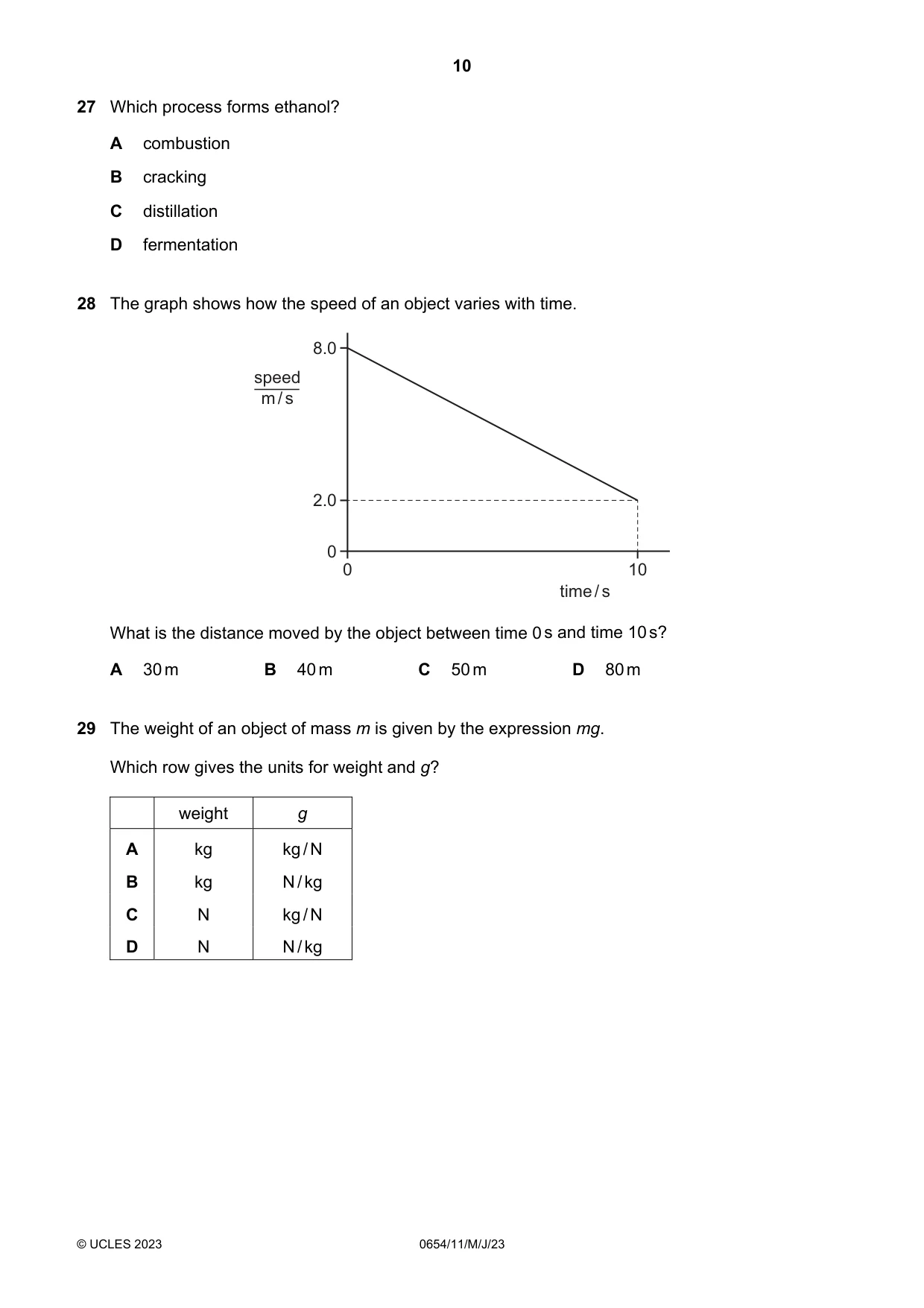
28 The graph shows how the speed of an object varies with time. 8.0 speed m / s 2.0 0 0 10 time / s What is the distance moved by the object between time 0 s and time 10 s? A 30 m B 40 m C 50 m D 80 m
Mark scheme: C
Q29 · The weight of an object of mass m is given by the expression mg
29 The weight of an object of mass m is given by the expression mg. Which row gives the units for weight and g? weight g A kg kg / N B kg N / kg C N kg / N D N N / kg
Mark scheme: D
Q30 · The diagrams show all the forces acting on each of four objects
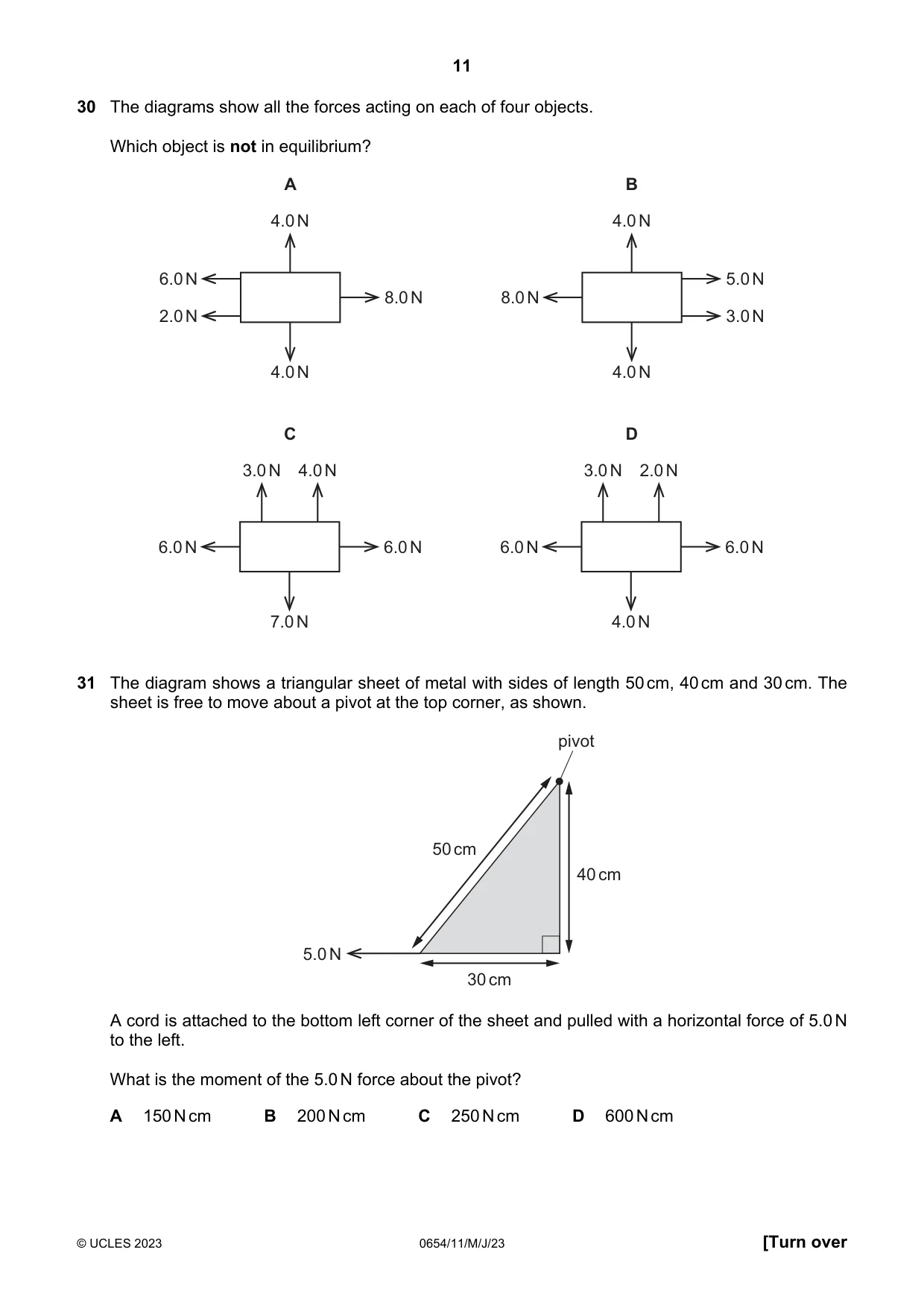
30 The diagrams show all the forces acting on each of four objects. Which object is not in equilibrium? A B 4.0 N 4.0 N 6.0 N 5.0 N 8.0 N 8.0 N 2.0 N 3.0 N 4.0 N 4.0 N C D 3.0 N 4.0 N 3.0 N 2.0 N 6.0 N 6.0 N 6.0 N 6.0 N 7.0 N 4.0 N
Mark scheme: D
Q31 · The diagram shows a triangular sheet of metal with sides of length 50 cm, 40 cm and 30 cm
31 The diagram shows a triangular sheet of metal with sides of length 50 cm, 40 cm and 30 cm. The sheet is free to move about a pivot at the top corner, as shown. pivot 50 cm 40 cm 5.0 N 30 cm A cord is attached to the bottom left corner of the sheet and pulled with a horizontal force of 5.0 N to the left. What is the moment of the 5.0 N force about the pivot? A 150 N cm B 200 N cm C 250 N cm D 600 N cm
Mark scheme: B
Q32 · A skier starts from rest at P, accelerates down a slope and then comes to rest at Q
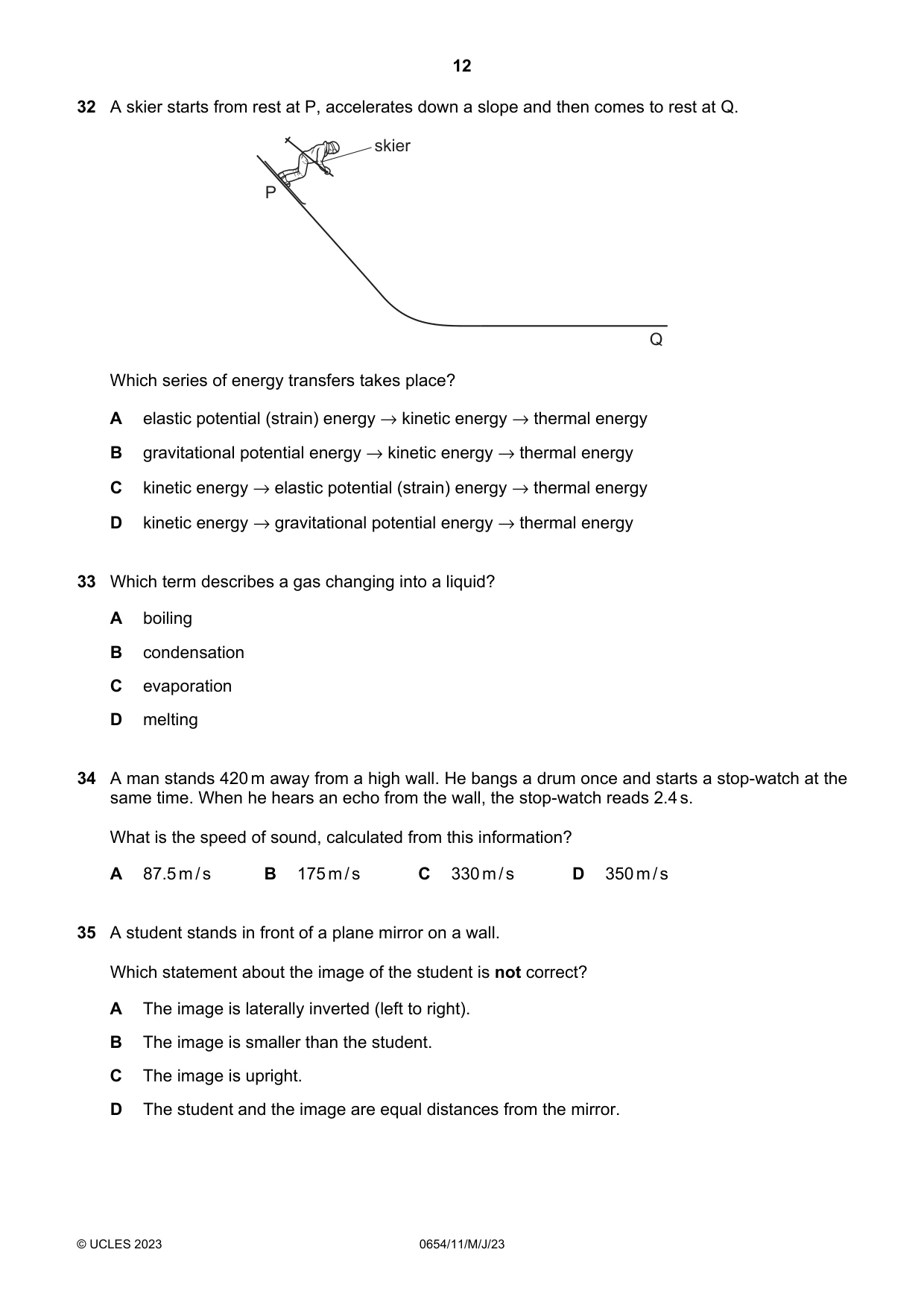
32 A skier starts from rest at P, accelerates down a slope and then comes to rest at Q. skier P Q Which series of energy transfers takes place? A elastic potential (strain) energy → kinetic energy → thermal energy B gravitational potential energy → kinetic energy → thermal energy C kinetic energy → elastic potential (strain) energy → thermal energy D kinetic energy → gravitational potential energy → thermal energy
Mark scheme: B
Q33 · Which term describes a gas changing into a liquid?
33 Which term describes a gas changing into a liquid? A boiling B condensation C evaporation D melting
Mark scheme: B
Q34 · A man stands 420 m away from a high wall
34 A man stands 420 m away from a high wall. He bangs a drum once and starts a stop-watch at the same time. When he hears an echo from the wall, the stop-watch reads 2.4 s. What is the speed of sound, calculated from this information? A 87.5 m / s B 175 m / s C 330 m / s D 350 m / s
Mark scheme: D
Q35 · A student stands in front of a plane mirror on a wall
35 A student stands in front of a plane mirror on a wall. Which statement about the image of the student is not correct? A The image is laterally inverted (left to right). B The image is smaller than the student. C The image is upright. D The student and the image are equal distances from the mirror.
Mark scheme: B
Q36 · Two insulators are charged by rubbing them with a cloth
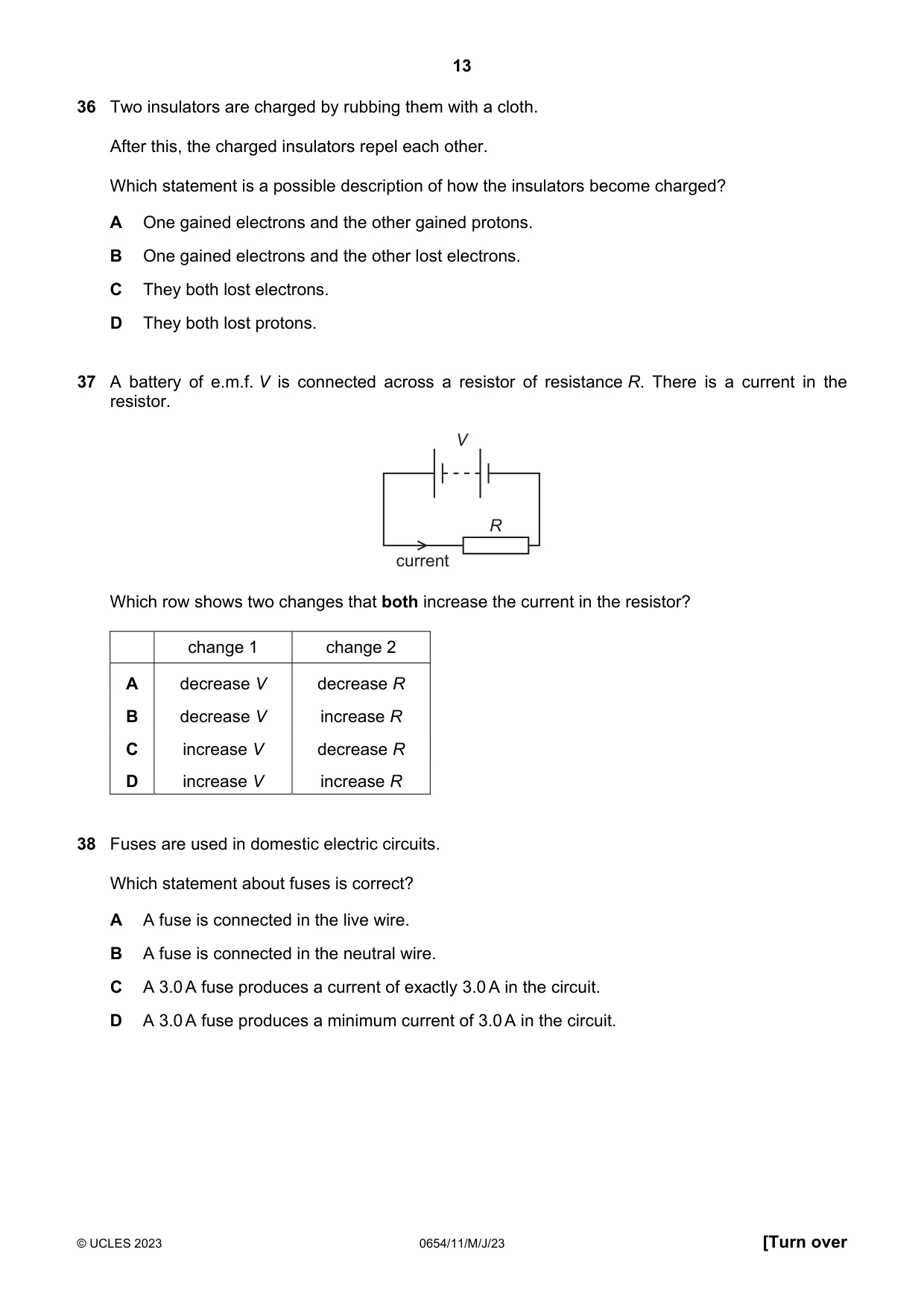
36 Two insulators are charged by rubbing them with a cloth. After this, the charged insulators repel each other. Which statement is a possible description of how the insulators become charged? A One gained electrons and the other gained protons. B One gained electrons and the other lost electrons. C They both lost electrons. D They both lost protons.
Mark scheme: C
Q37 · A battery of e.m.f
37 A battery of e.m.f. V is connected across a resistor of resistance R. There is a current in the resistor. V R current Which row shows two changes that both increase the current in the resistor? change 1 change 2 A decrease V decrease R B decrease V increase R C increase V decrease R D increase V increase R
Mark scheme: C
Q38 · Fuses are used in domestic electric circuits
38 Fuses are used in domestic electric circuits. Which statement about fuses is correct? A A fuse is connected in the live wire. B A fuse is connected in the neutral wire. C A 3.0 A fuse produces a current of exactly 3.0 A in the circuit. D A 3.0 A fuse produces a minimum current of 3.0 A in the circuit.
Mark scheme: A
Q39 · A straight wire carries a current into the page
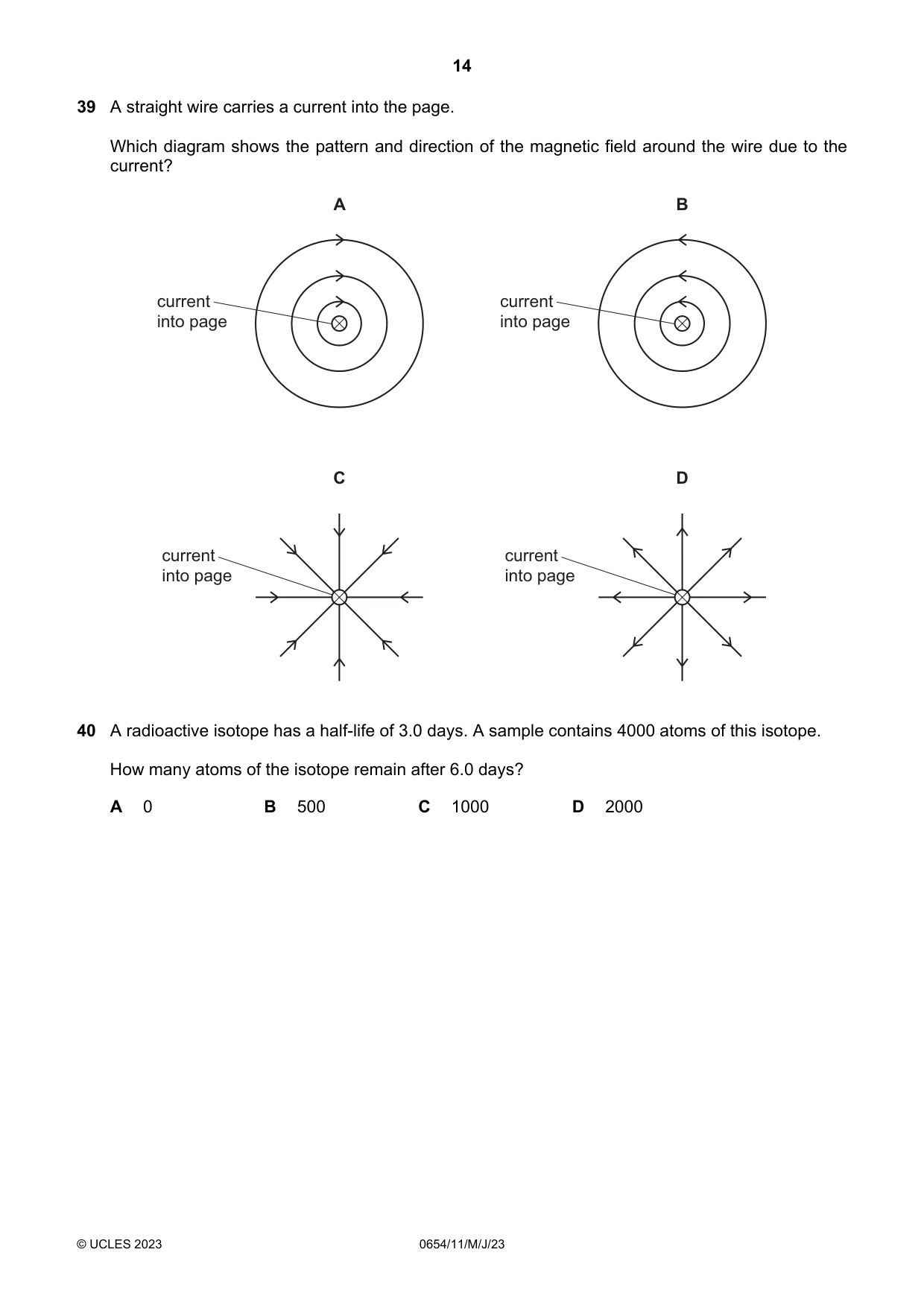
39 A straight wire carries a current into the page. Which diagram shows the pattern and direction of the magnetic field around the wire due to the current? A B current current into page into page C D current current into page into page
Mark scheme: A
Q40 · A radioactive isotope has a half-life of 3.0 days
40 A radioactive isotope has a half-life of 3.0 days. A sample contains 4000 atoms of this isotope. How many atoms of the isotope remain after 6.0 days? A 0 B 500 C 1000 D 2000
Mark scheme: C
What was in this paper
The subtopics covered by these 40 questions, and how many questions each got. Open one in a new tab to see every Cambridge question on it.
2Air quality and climate1Alcohols1Arrangement of elements1Asexual reproduction1Atomic structure and the Periodic Table1Biological molecules1Carbon cycle1Chromosomes and genes1Circulatory systems1Diet1Electrical quantities1Electrical safety1Electrolysis1Electromagnetic effects1Energy, work and power1Enzymes1Exothermic and endothermic reactions1Food chains and food webs1Fuels1Gas exchange in humans1Hormones1Ions and ionic bonds1Kinetic particle model of matter1Light1Mass and weight1Motion1Photosynthesis1Preparation of salts1Radioactivity1Redox1Respiration1Separation and purification1Simple molecules and covalent bonds1Simple phenomena of magnetism1Size of specimens1Sound1Transition elements1Water1What you needed in this session
Cambridge’s own grade thresholds for 2023 May/June, Paper 1 · Variant 1. A higher threshold means an easier paper — the bar moves with how the cohort did.