Cambridge IGCSE Sciences - Co-ordinated (Double) 0654 — 2019 May/June Paper 1 · Variant 1
0654/11/M/J/19 · 40 questions · 40 marks · ≈45 min
The question paper and its mark scheme, free to read here and free to download. This is Cambridge’s own paper, exactly as it was sat.
Question paper20 pages


Mark scheme3 pages
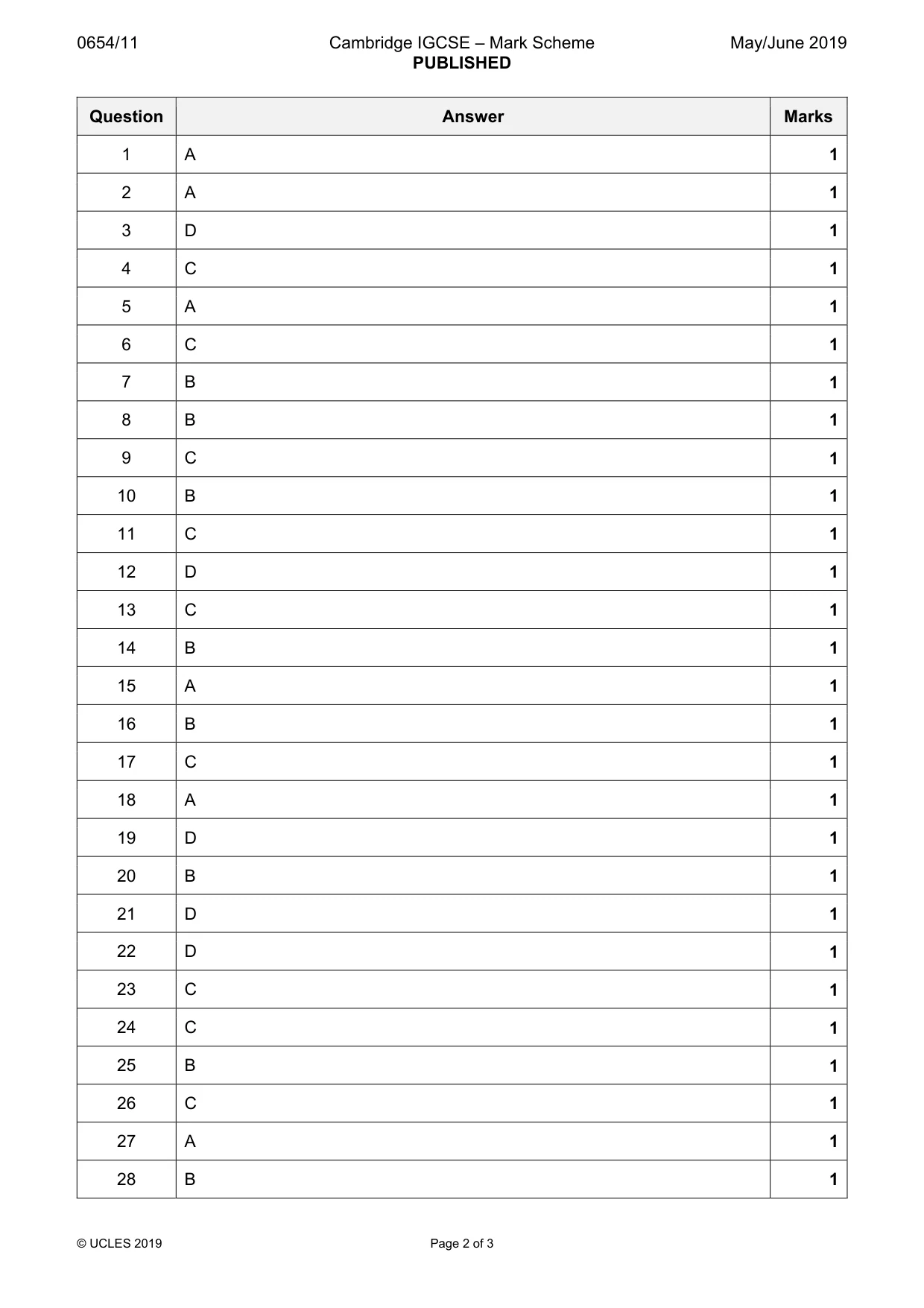
Answers below. Sit the paper first if you are practising.
Questions as text
Q1 · What is correct for all living organisms?
1 What is correct for all living organisms? A They are sensitive to changes in their environment. B They excrete solid waste from their bodies. C They feed on other living organisms. D They grow larger by increasing their cell number.
Mark scheme: A
Q2 · Which row correctly describes the diffusion of molecules from P to Q?
2 Which row correctly describes the diffusion of molecules from P to Q? P Q movement A higher concentration lower concentration down a concentration gradient B higher concentration lower concentration up a concentration gradient C lower concentration higher concentration down a concentration gradient D lower concentration higher concentration up a concentration gradient
Mark scheme: A
Q3 · Which chemical element is found in proteins, but not in carbohydrates or fats?
3 Which chemical element is found in proteins, but not in carbohydrates or fats? A carbon B hydrogen C oxygen D nitrogen
Mark scheme: D
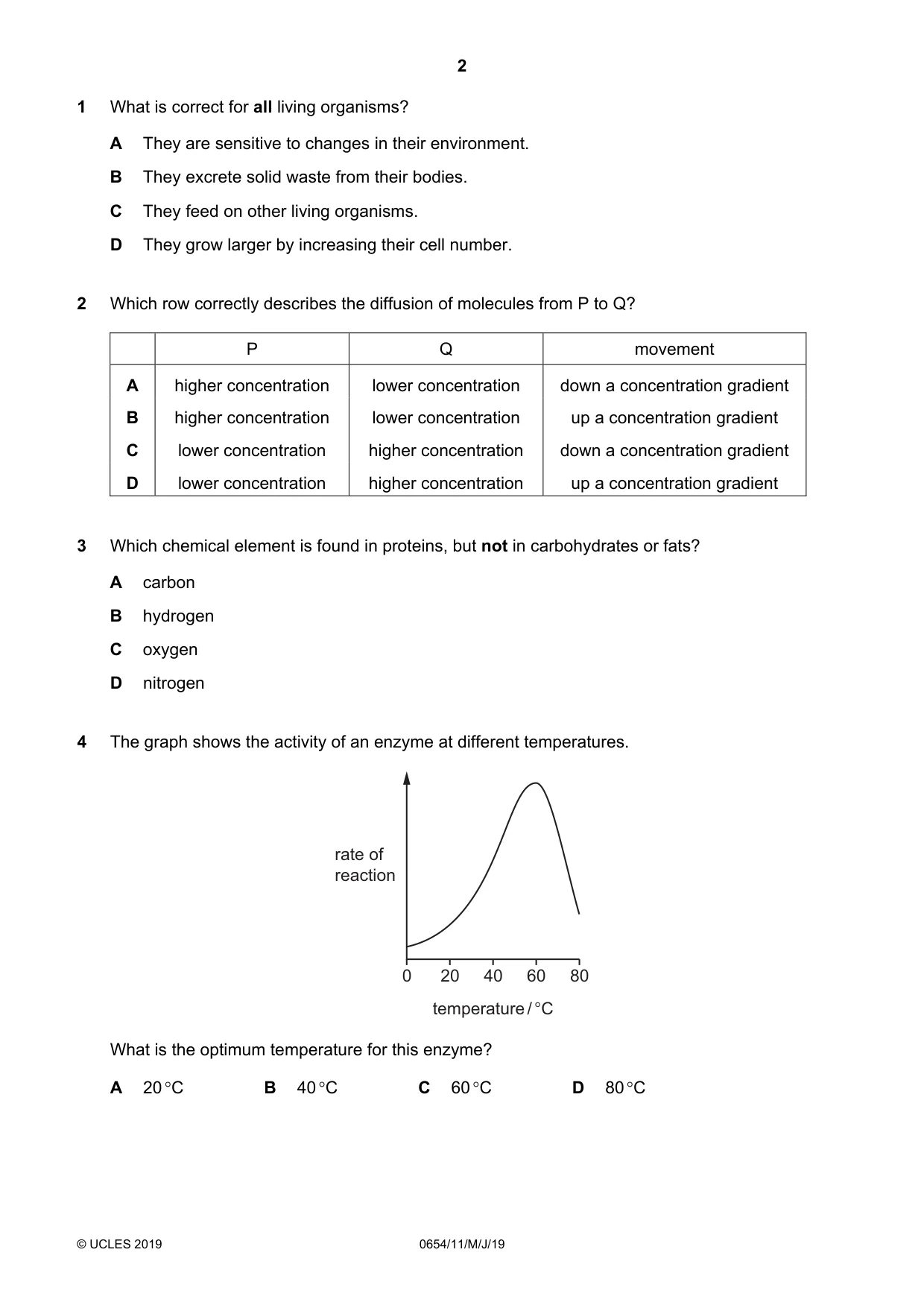
Q4 · The graph shows the activity of an enzyme at different temperatures
4 The graph shows the activity of an enzyme at different temperatures. rate of reaction 0 20 40 60 80 temperature / °C What is the optimum temperature for this enzyme? A 20 °C B 40 °C C 60 °C D 80 °C
Mark scheme: C
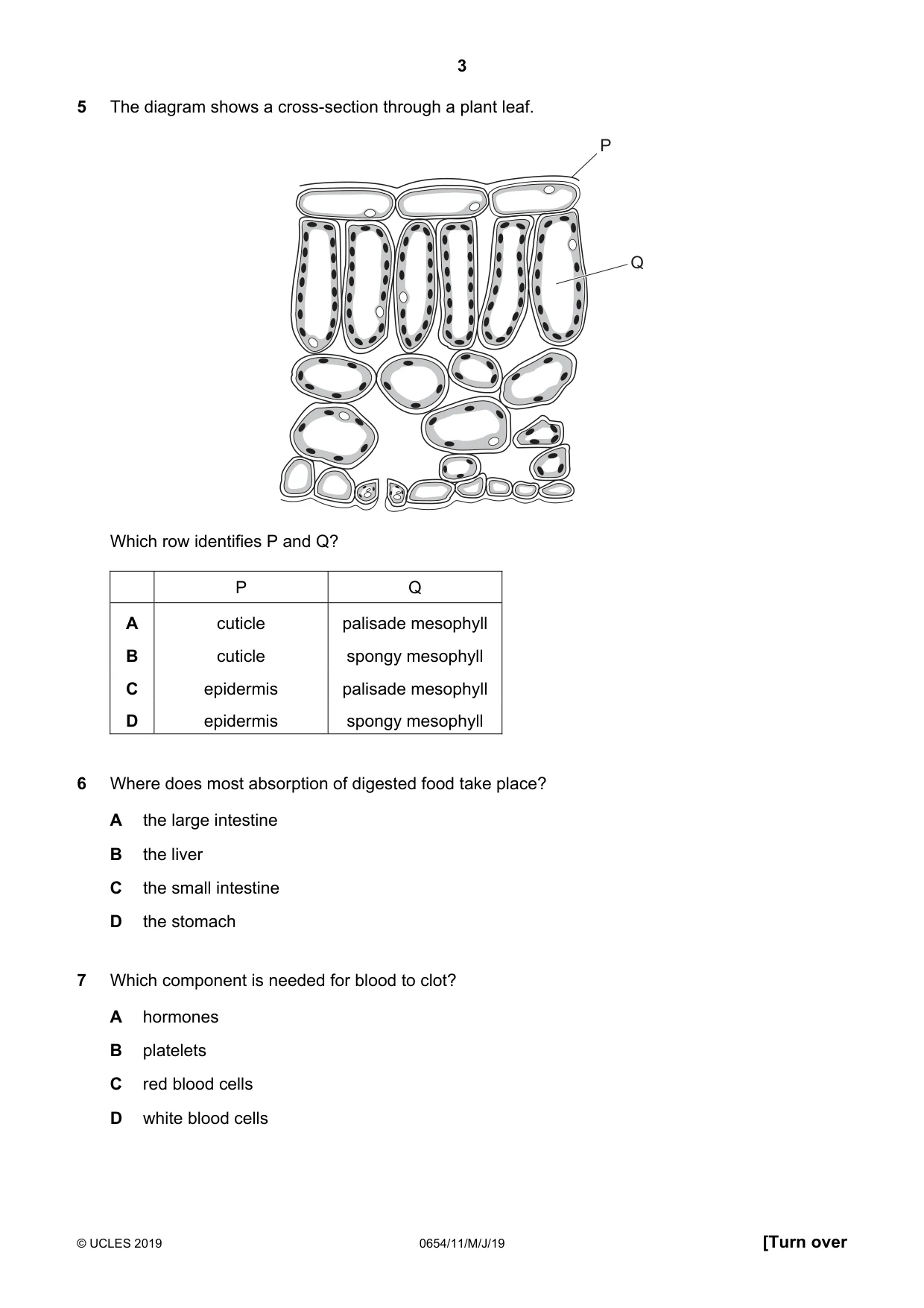
Q5 · The diagram shows a cross-section through a plant leaf
5 The diagram shows a cross-section through a plant leaf. P Q Which row identifies P and Q? P Q A cuticle palisade mesophyll B cuticle spongy mesophyll C epidermis palisade mesophyll D epidermis spongy mesophyll
Mark scheme: A
Q6 · Where does most absorption of digested food take place?
6 Where does most absorption of digested food take place? A the large intestine B the liver C the small intestine D the stomach
Mark scheme: C
Q7 · Which component is needed for blood to clot?
7 Which component is needed for blood to clot? A hormones B platelets C red blood cells D white blood cells
Mark scheme: B
Q8 · Which substances are used and produced in aerobic respiration?
8 Which substances are used and produced in aerobic respiration? carbon oxygen glucose water dioxide A produced used produced used B produced used used produced C used produced produced used D used produced used produced
Mark scheme: B
Q9 · In a reflex arc, which structure carries nerve impulses towards the central nervous…
9 In a reflex arc, which structure carries nerve impulses towards the central nervous system? A effector B motor neurone C sensory neurone D spinal cord
Mark scheme: C
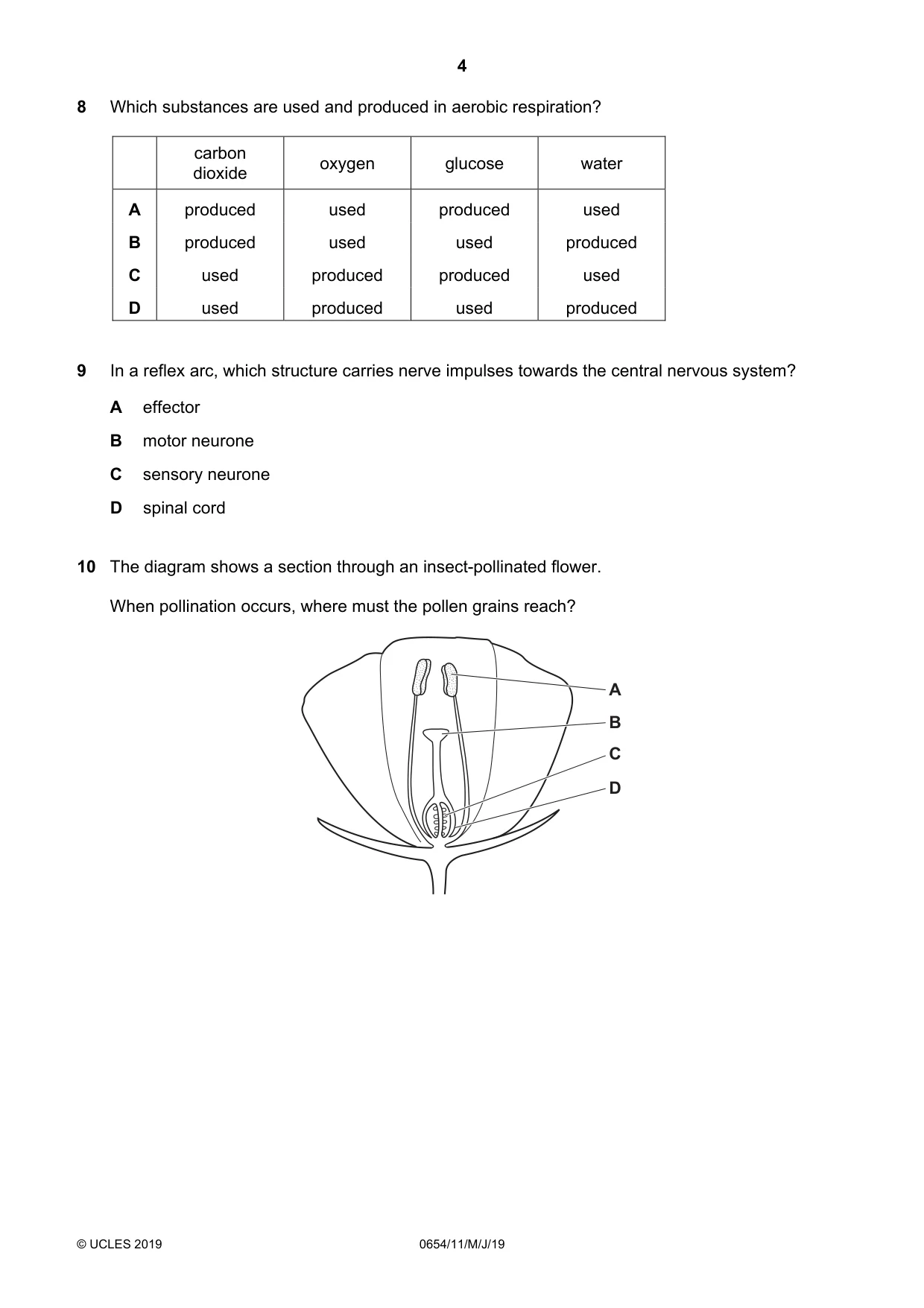
Q10 · The diagram shows a section through an insect-pollinated flower
10 The diagram shows a section through an insect-pollinated flower. When pollination occurs, where must the pollen grains reach? A B C D
Mark scheme: B
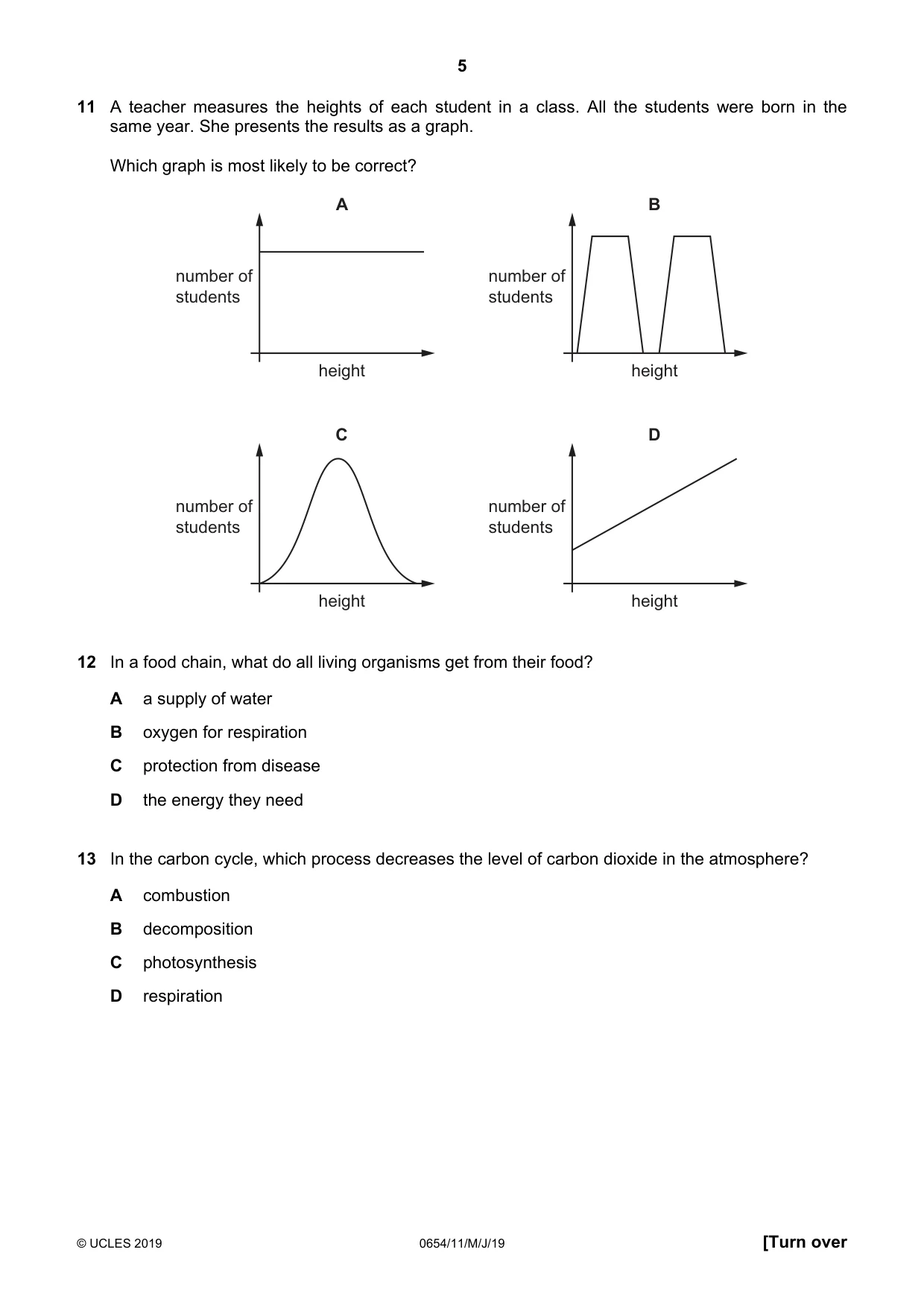
Q11 · A teacher measures the heights of each student in a class
11 A teacher measures the heights of each student in a class. All the students were born in the same year. She presents the results as a graph. Which graph is most likely to be correct? A B number of number of students students height height C D number of number of students students height height
Mark scheme: C
Q12 · In a food chain, what do all living organisms get from their food?
12 In a food chain, what do all living organisms get from their food? A a supply of water B oxygen for respiration C protection from disease D the energy they need
Mark scheme: D
Q13 · In the carbon cycle, which process decreases the level of carbon dioxide in the…
13 In the carbon cycle, which process decreases the level of carbon dioxide in the atmosphere? A combustion B decomposition C photosynthesis D respiration
Mark scheme: C
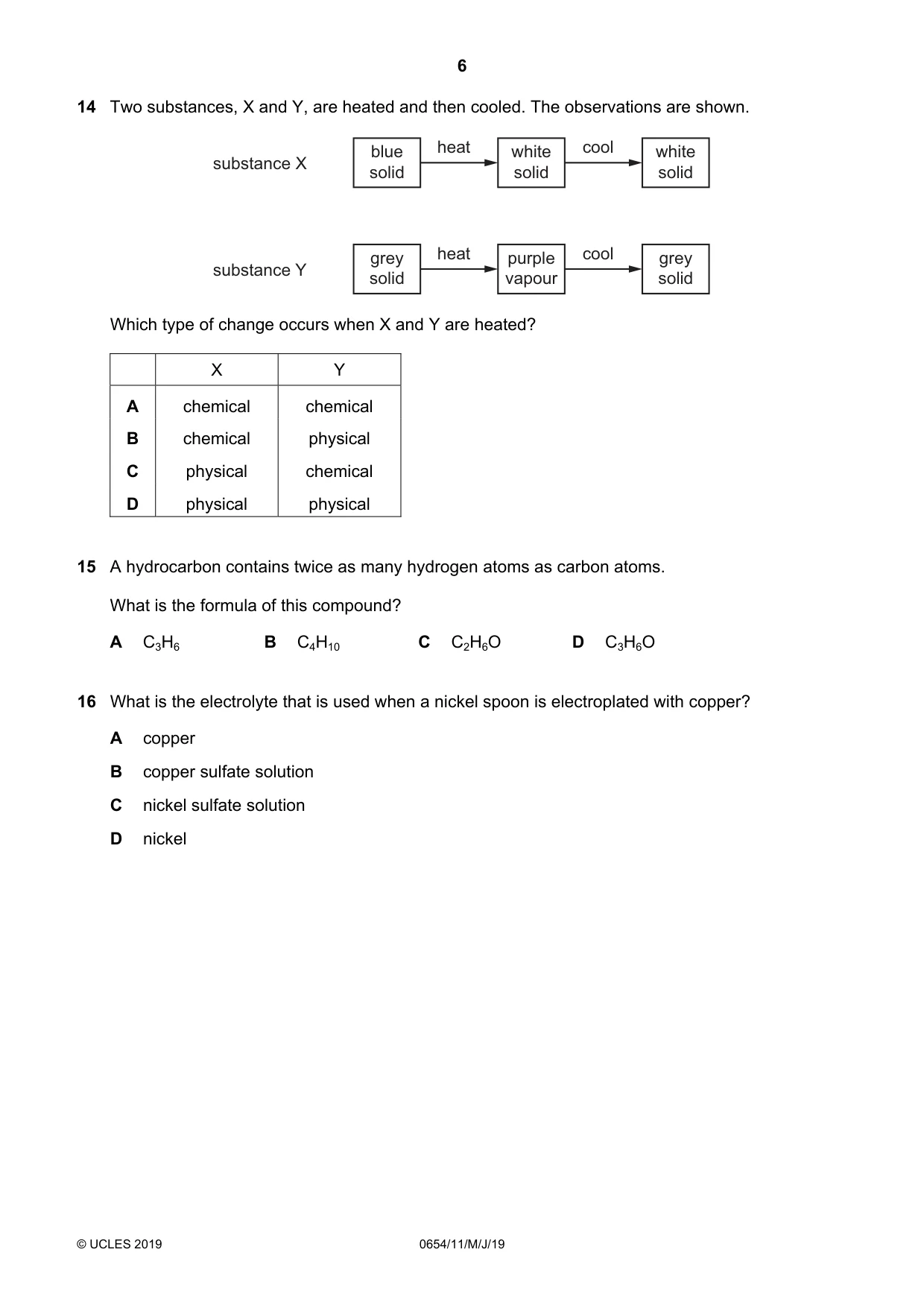
Q14 · Two substances, X and Y, are heated and then cooled
14 Two substances, X and Y, are heated and then cooled. The observations are shown. blue heat white cool white substance X solid solid solid grey heat purple cool grey substance Y solid vapour solid Which type of change occurs when X and Y are heated? X Y A chemical chemical B chemical physical C physical chemical D physical physical
Mark scheme: B
Q15 · A hydrocarbon contains twice as many hydrogen atoms as carbon atoms
15 A hydrocarbon contains twice as many hydrogen atoms as carbon atoms. What is the formula of this compound? A C3H6 B C4H10 C C2H6O D C3H6O
Mark scheme: A
Q16 · What is the electrolyte that is used when a nickel spoon is electroplated with copper?
16 What is the electrolyte that is used when a nickel spoon is electroplated with copper? A copper B copper sulfate solution C nickel sulfate solution D nickel
Mark scheme: B
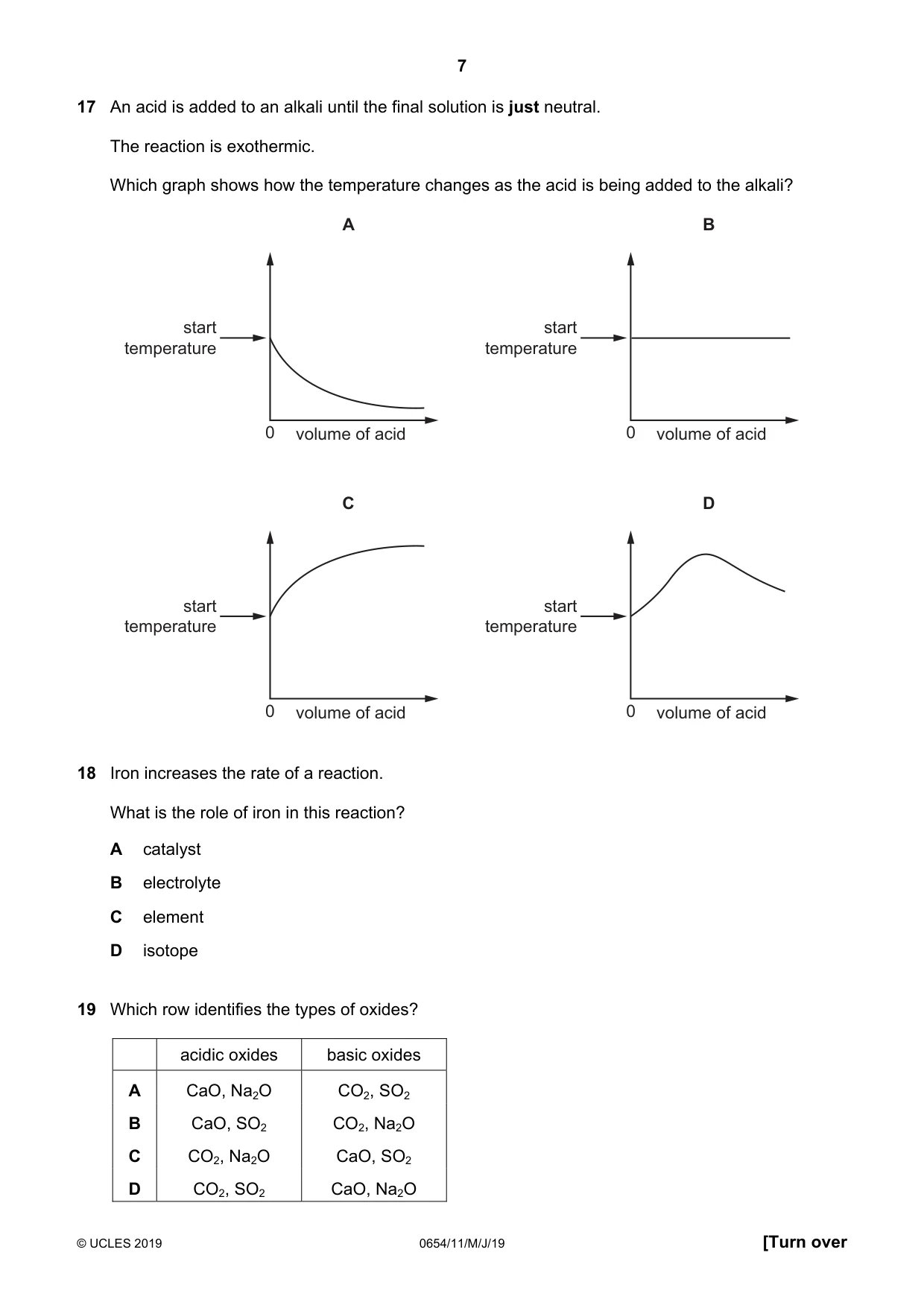
Q17 · An acid is added to an alkali until the final solution is just neutral
17 An acid is added to an alkali until the final solution is just neutral. The reaction is exothermic. Which graph shows how the temperature changes as the acid is being added to the alkali? A B start start temperature temperature 0 volume of acid 0 volume of acid C D start start temperature temperature 0 volume of acid 0 volume of acid
Mark scheme: C
Q18 · Iron increases the rate of a reaction
18 Iron increases the rate of a reaction. What is the role of iron in this reaction? A catalyst B electrolyte C element D isotope
Mark scheme: A
Q19 · Which row identifies the types of oxides?
19 Which row identifies the types of oxides? acidic oxides basic oxides A CaO, Na2O CO2, SO2 B CaO, SO2 CO2, Na2O C CO2, Na2O CaO, SO2 D CO2, SO2 CaO, Na2O
Mark scheme: D
Q20 · Hydrochloric acid and sodium hydroxide neutralise each other to form water and sodium…
20 Hydrochloric acid and sodium hydroxide neutralise each other to form water and sodium chloride. Which method is used to make the solution crystallise? A chromatography B evaporation C filtration D fractional distillation
Mark scheme: B
Q21 · Which statement about the trends in the Periodic Table is correct?
21 Which statement about the trends in the Periodic Table is correct? A Elements are arranged in order of nucleon number. B Elements on the left hand side form acidic oxides. C The melting point of the Group I elements increases down the group. D The proton number increases from left to right across the table.
Mark scheme: D
Q22 · Some properties of aluminium are listed
22 Some properties of aluminium are listed. 1 conducts electricity 2 malleable 3 resistant to corrosion Which properties make aluminium suitable for use as food containers? A 1, 2 and 3 B 1 and 2 only C 1 and 3 only D 2 and 3 only
Mark scheme: D
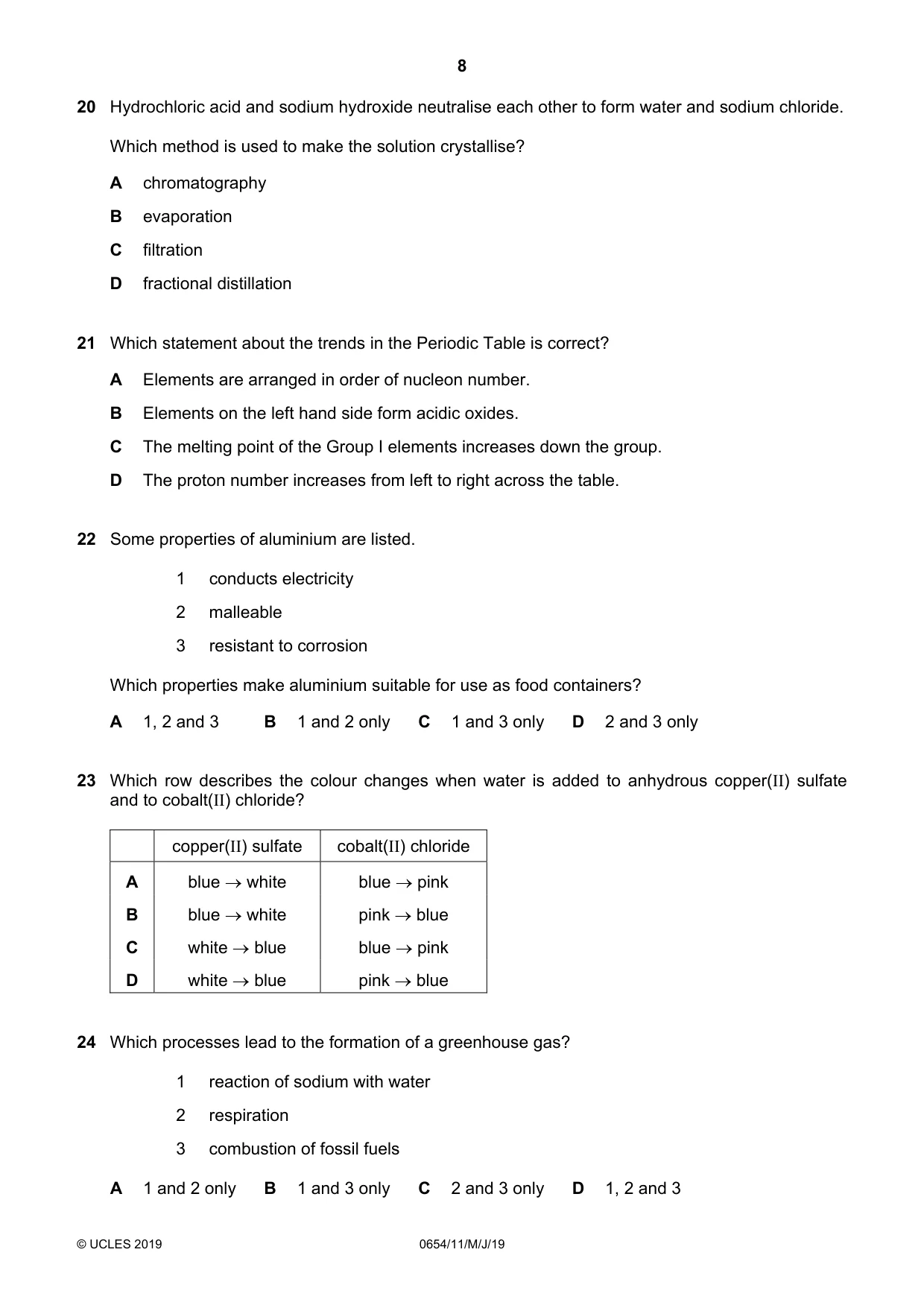
Q23 · Which row describes the colour changes when water is added to anhydrous copper(II)…
23 Which row describes the colour changes when water is added to anhydrous copper(II) sulfate and to cobalt(II) chloride? copper(II) sulfate cobalt(II) chloride A blue → white blue → pink B blue → white pink → blue C white → blue blue → pink D white → blue pink → blue
Mark scheme: C
Q24 · Which processes lead to the formation of a greenhouse gas?
24 Which processes lead to the formation of a greenhouse gas? 1 reaction of sodium with water 2 respiration 3 combustion of fossil fuels A 1 and 2 only B 1 and 3 only C 2 and 3 only D 1, 2 and 3
Mark scheme: C
Q25 · Which two statements about calcium carbonate are correct?
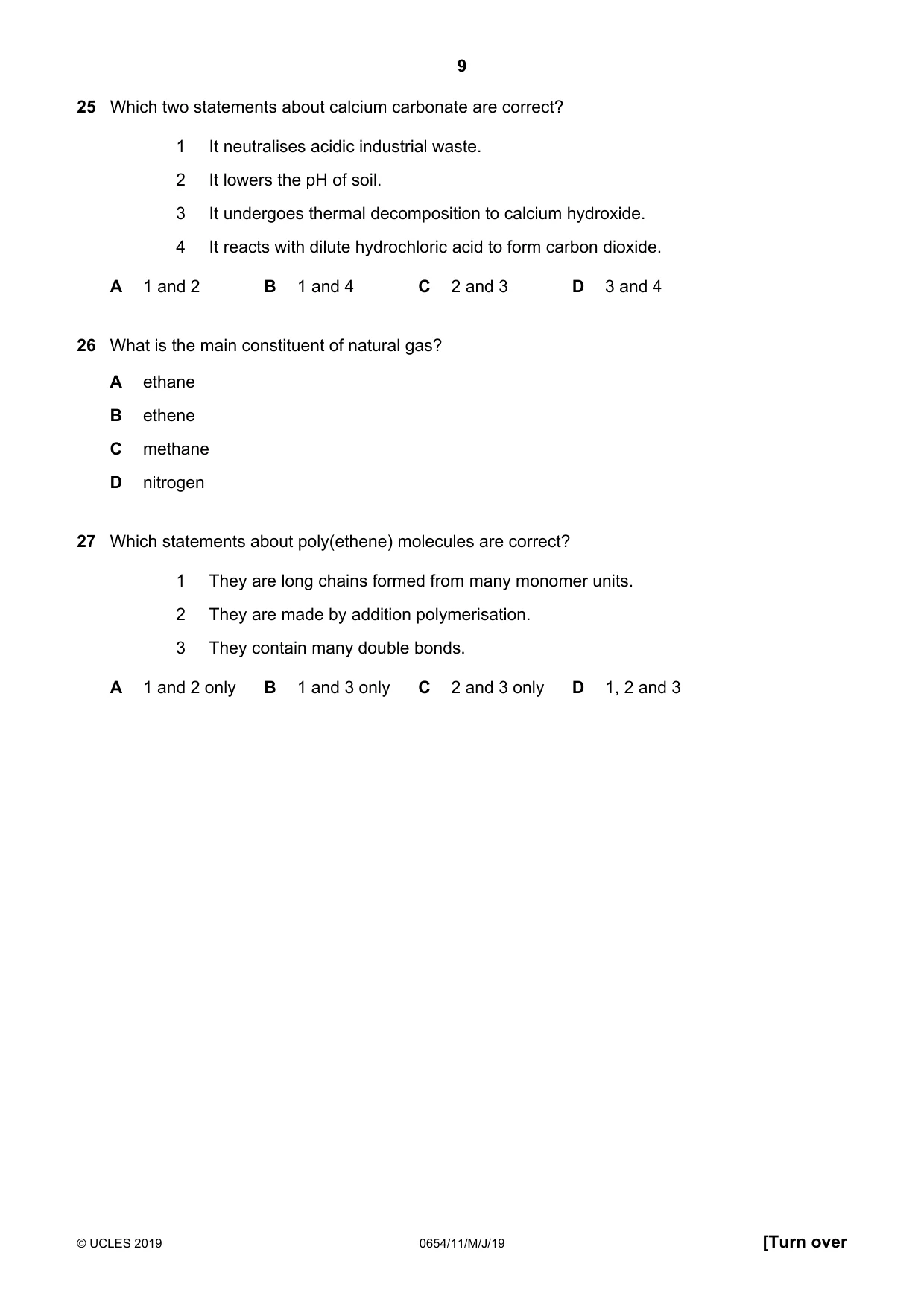
25 Which two statements about calcium carbonate are correct? 1 It neutralises acidic industrial waste. 2 It lowers the pH of soil. 3 It undergoes thermal decomposition to calcium hydroxide. 4 It reacts with dilute hydrochloric acid to form carbon dioxide. A 1 and 2 B 1 and 4 C 2 and 3 D 3 and 4
Mark scheme: B
More questions on The characteristic properties of acids and bases
Q26 · What is the main constituent of natural gas?
26 What is the main constituent of natural gas? A ethane B ethene C methane D nitrogen
Mark scheme: C
Q27 · Which statements about poly(ethene) molecules are correct?
27 Which statements about poly(ethene) molecules are correct? 1 They are long chains formed from many monomer units. 2 They are made by addition polymerisation. 3 They contain many double bonds. A 1 and 2 only B 1 and 3 only C 2 and 3 only D 1, 2 and 3
Mark scheme: A
Q28 · Which speed-time graph represents an object travelling at constant speed?
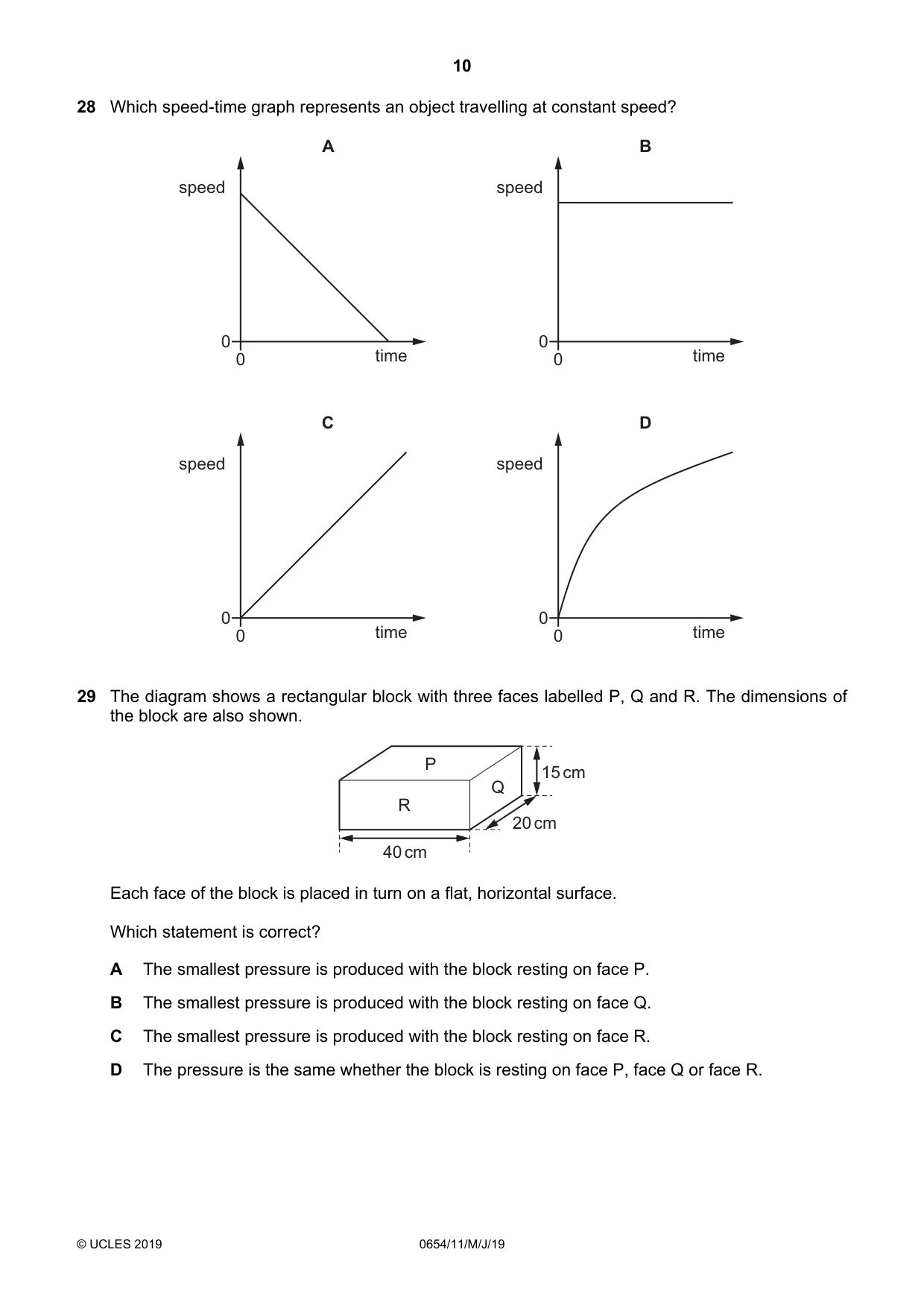
28 Which speed-time graph represents an object travelling at constant speed? A B speed speed 0 0 0 time 0 time C D speed speed 0 0 0 time 0 time
Mark scheme: B
Q29 · The diagram shows a rectangular block with three faces labelled P, Q and R
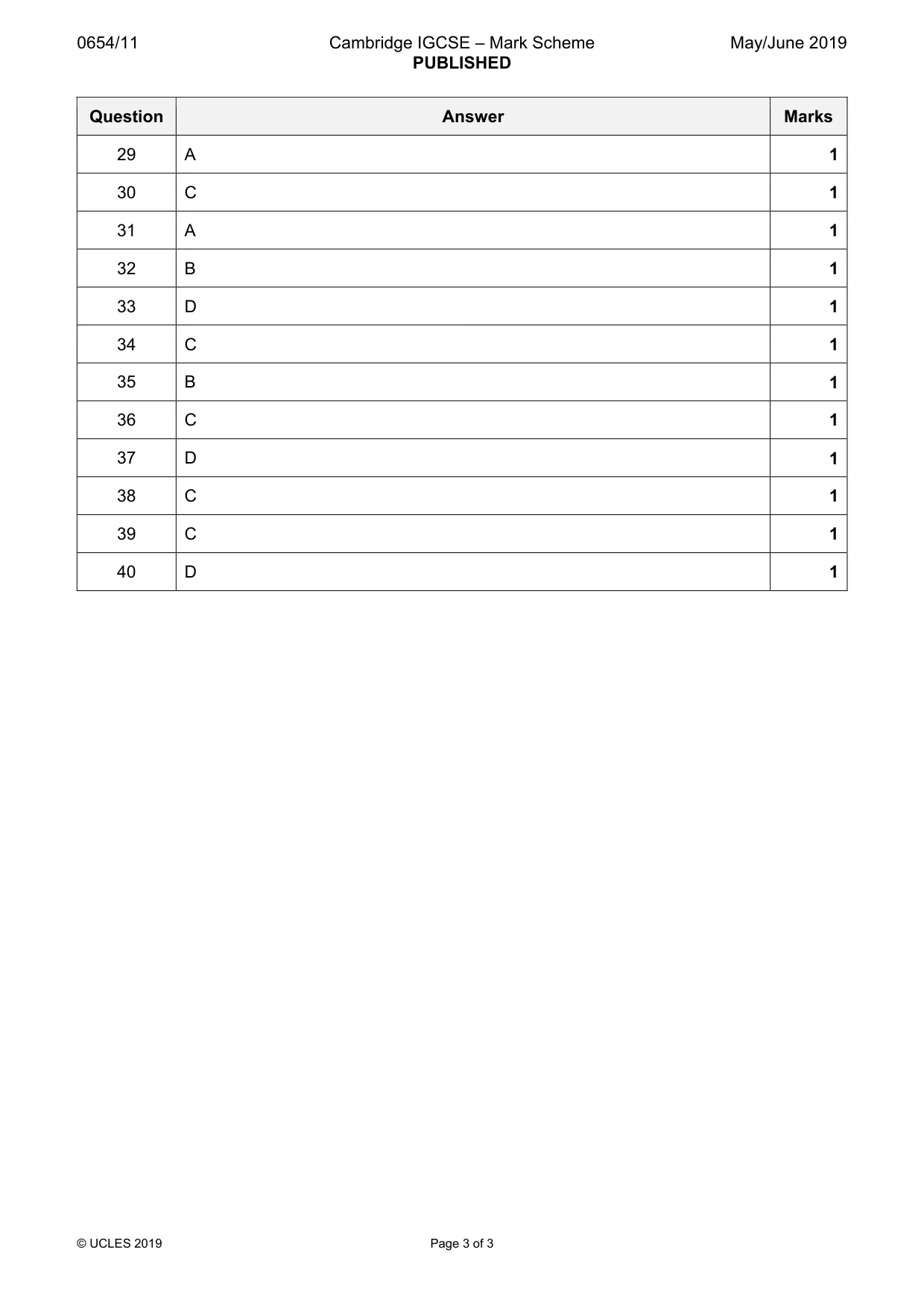
29 The diagram shows a rectangular block with three faces labelled P, Q and R. The dimensions of the block are also shown. P 15 cm Q R 20 cm 40 cm Each face of the block is placed in turn on a flat, horizontal surface. Which statement is correct? A The smallest pressure is produced with the block resting on face P. B The smallest pressure is produced with the block resting on face Q. C The smallest pressure is produced with the block resting on face R. D The pressure is the same whether the block is resting on face P, face Q or face R.
Mark scheme: A
Q30 · When evaporation occurs, molecules escape from the surface of a liquid
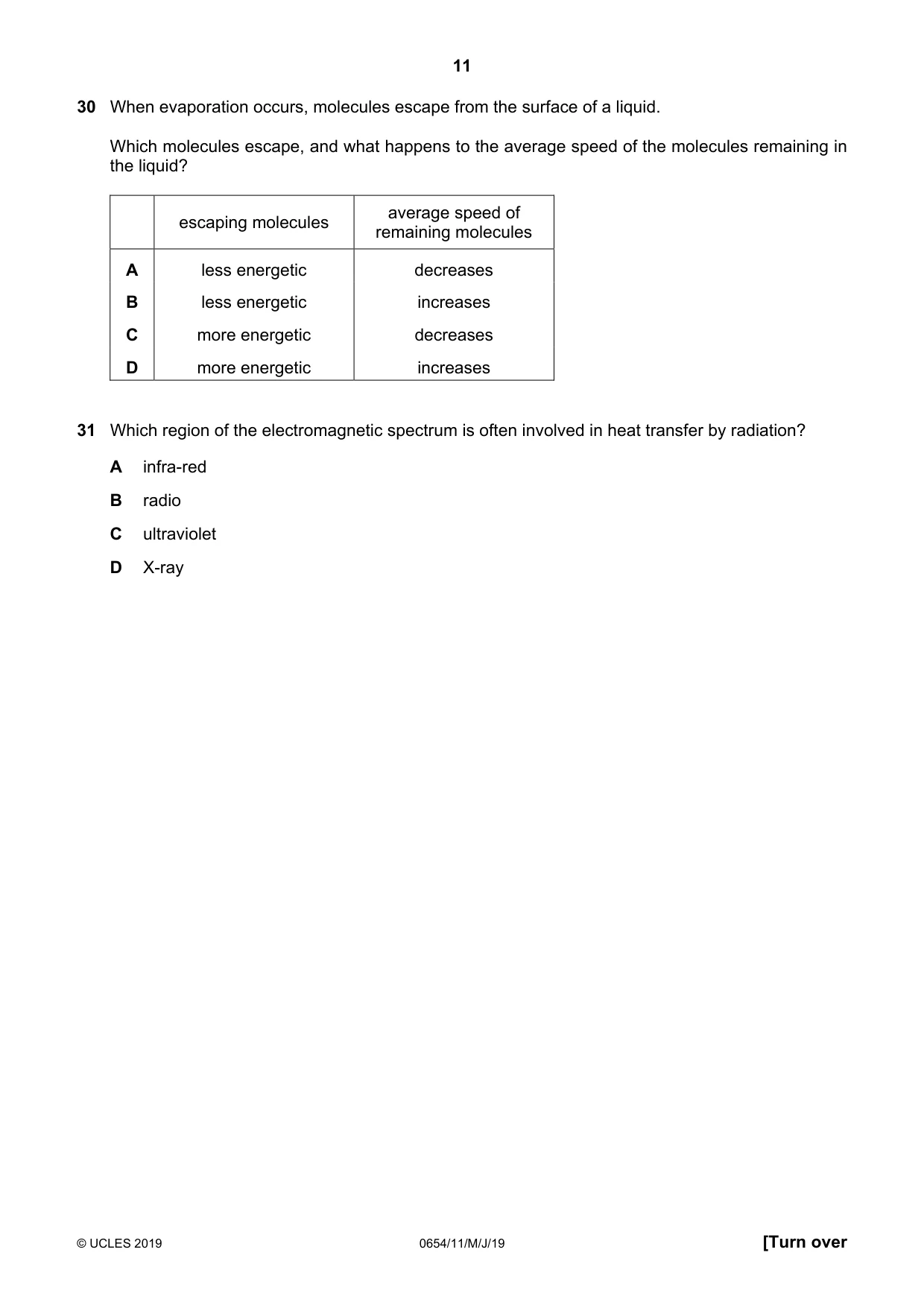
30 When evaporation occurs, molecules escape from the surface of a liquid. Which molecules escape, and what happens to the average speed of the molecules remaining in the liquid? average speed of escaping molecules remaining molecules A less energetic decreases B less energetic increases C more energetic decreases D more energetic increases
Mark scheme: C
Q31 · Which region of the electromagnetic spectrum is often involved in heat transfer by…
31 Which region of the electromagnetic spectrum is often involved in heat transfer by radiation? A infra-red B radio C ultraviolet D X-ray
Mark scheme: A
Question 32
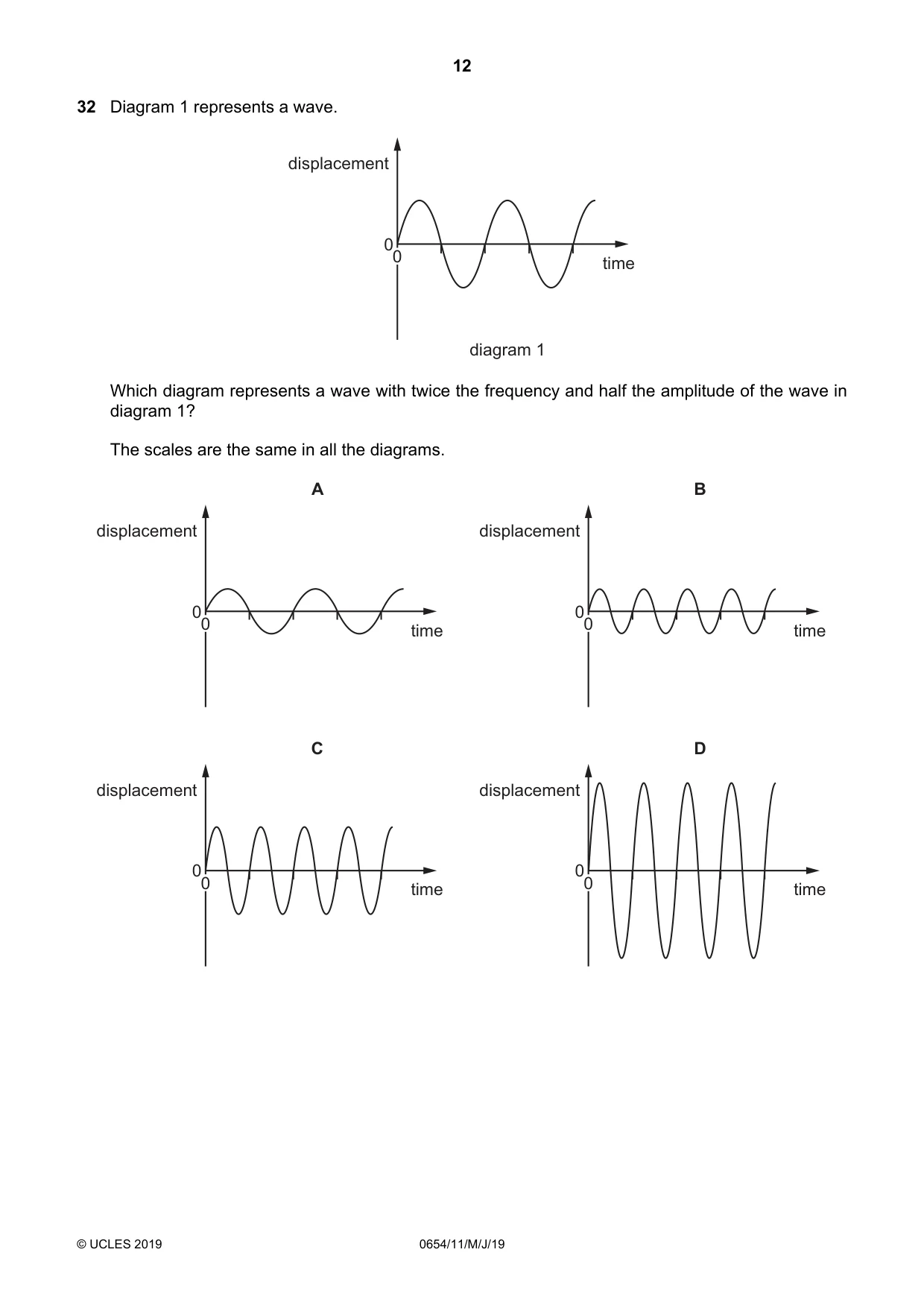
32 Diagram 1 represents a wave. displacement 00 time diagram 1 Which diagram represents a wave with twice the frequency and half the amplitude of the wave in diagram 1? The scales are the same in all the diagrams. A B displacement displacement 00 00 time time C D displacement displacement 00 00 time time
Mark scheme: B
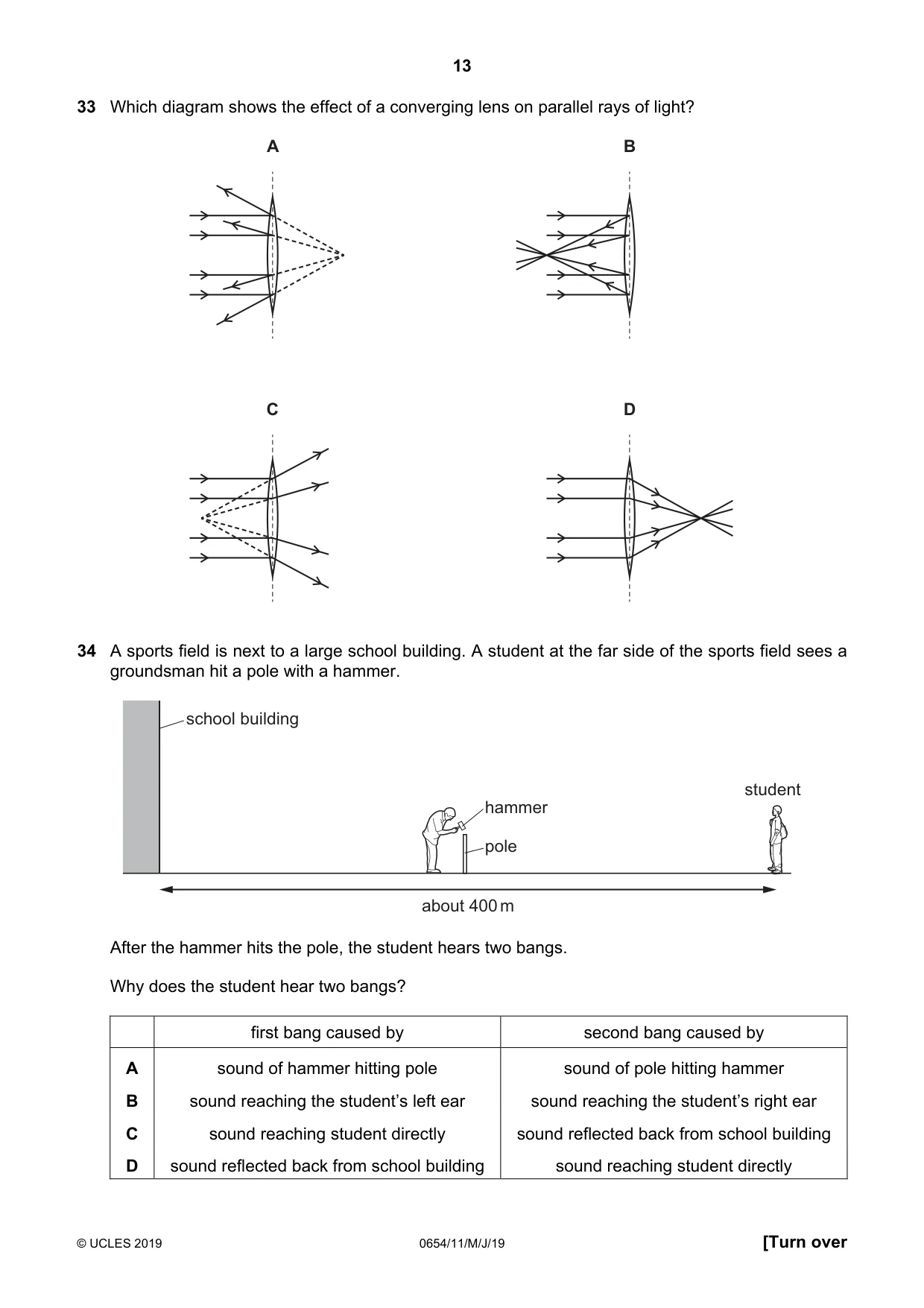
Q33 · Which diagram shows the effect of a converging lens on parallel rays of light?
33 Which diagram shows the effect of a converging lens on parallel rays of light? A B C D
Mark scheme: D
Q34 · A sports field is next to a large school building
34 A sports field is next to a large school building. A student at the far side of the sports field sees a groundsman hit a pole with a hammer. school building student hammer pole about 400 m After the hammer hits the pole, the student hears two bangs. Why does the student hear two bangs? first bang caused by second bang caused by A sound of hammer hitting pole sound of pole hitting hammer B sound reaching the student’s left ear sound reaching the student’s right ear C sound reaching student directly sound reflected back from school building D sound reflected back from school building sound reaching student directly
Mark scheme: C
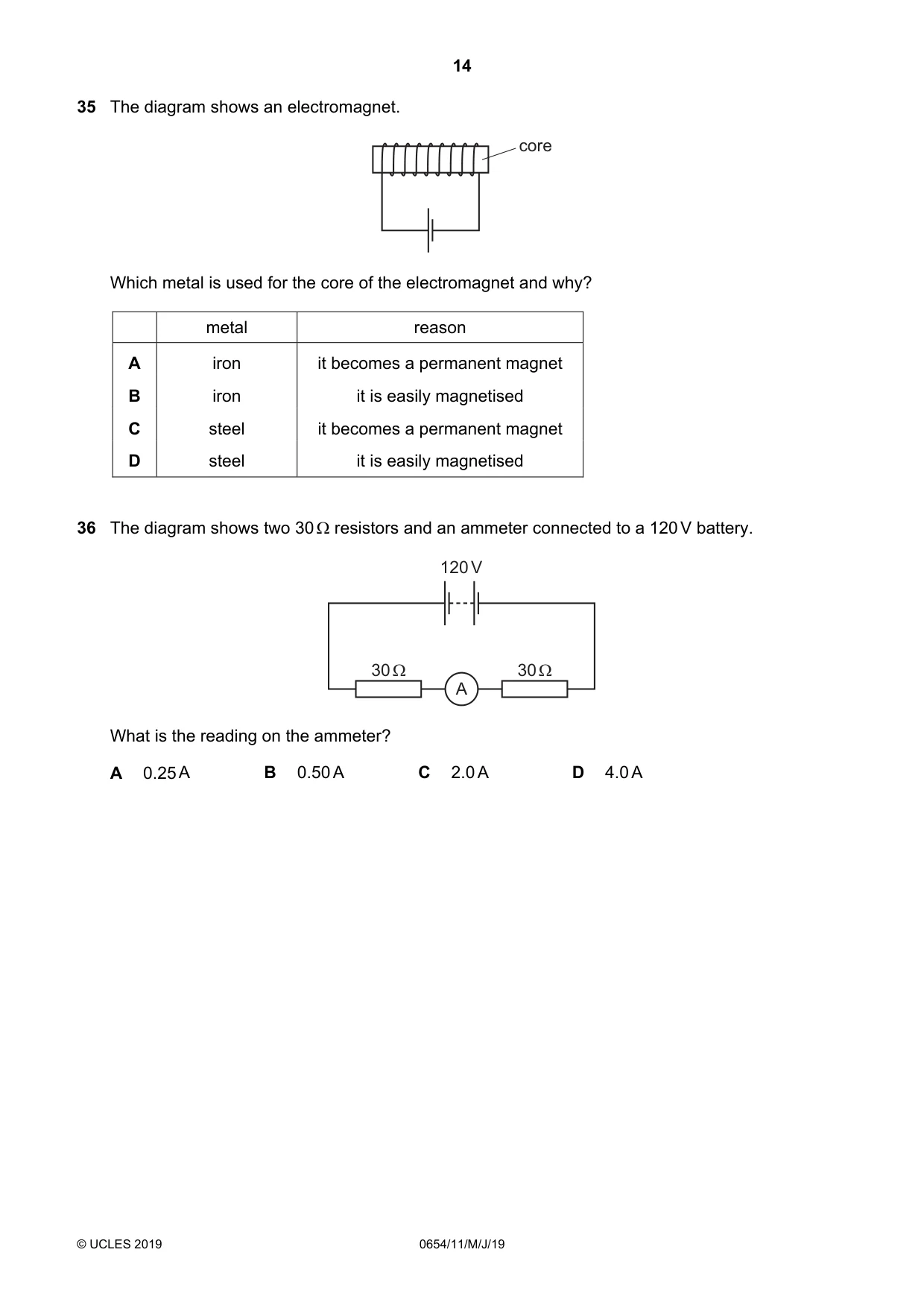
Q35 · The diagram shows an electromagnet
35 The diagram shows an electromagnet. core Which metal is used for the core of the electromagnet and why? metal reason A iron it becomes a permanent magnet B iron it is easily magnetised C steel it becomes a permanent magnet D steel it is easily magnetised
Mark scheme: B
Q36 · The diagram shows two 30 Ω resistors and an ammeter connected to a 120 V battery
36 The diagram shows two 30 Ω resistors and an ammeter connected to a 120 V battery. 120 V 30 Ω 30 Ω A What is the reading on the ammeter? A 0.25 A B 0.50 A C 2.0 A D 4.0 A
Mark scheme: C
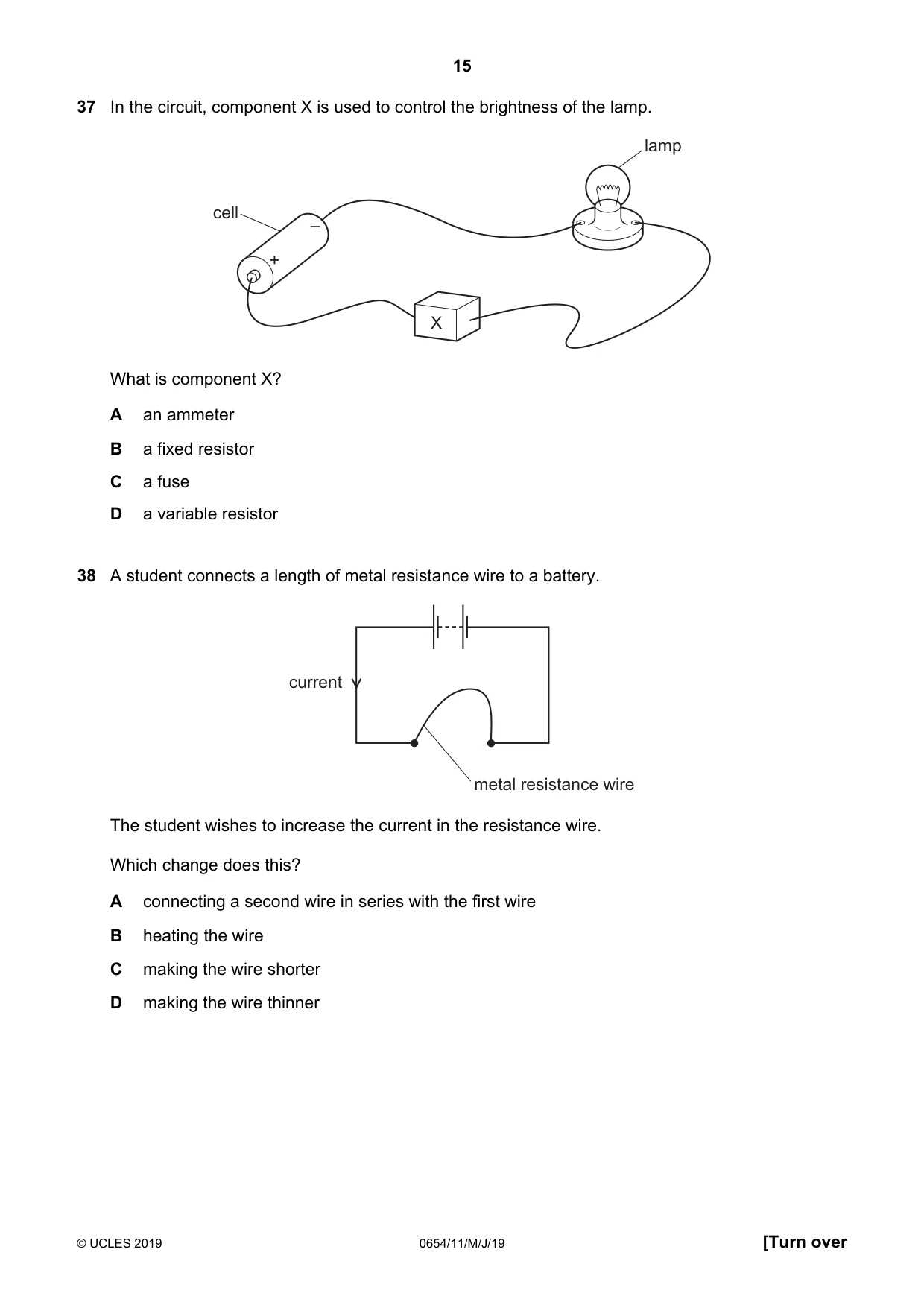
Q37 · In the circuit, component X is used to control the brightness of the lamp
37 In the circuit, component X is used to control the brightness of the lamp. lamp cell – + X What is component X? A an ammeter B a fixed resistor C a fuse D a variable resistor
Mark scheme: D
Q38 · A student connects a length of metal resistance wire to a battery
38 A student connects a length of metal resistance wire to a battery. current metal resistance wire The student wishes to increase the current in the resistance wire. Which change does this? A connecting a second wire in series with the first wire B heating the wire C making the wire shorter D making the wire thinner
Mark scheme: C
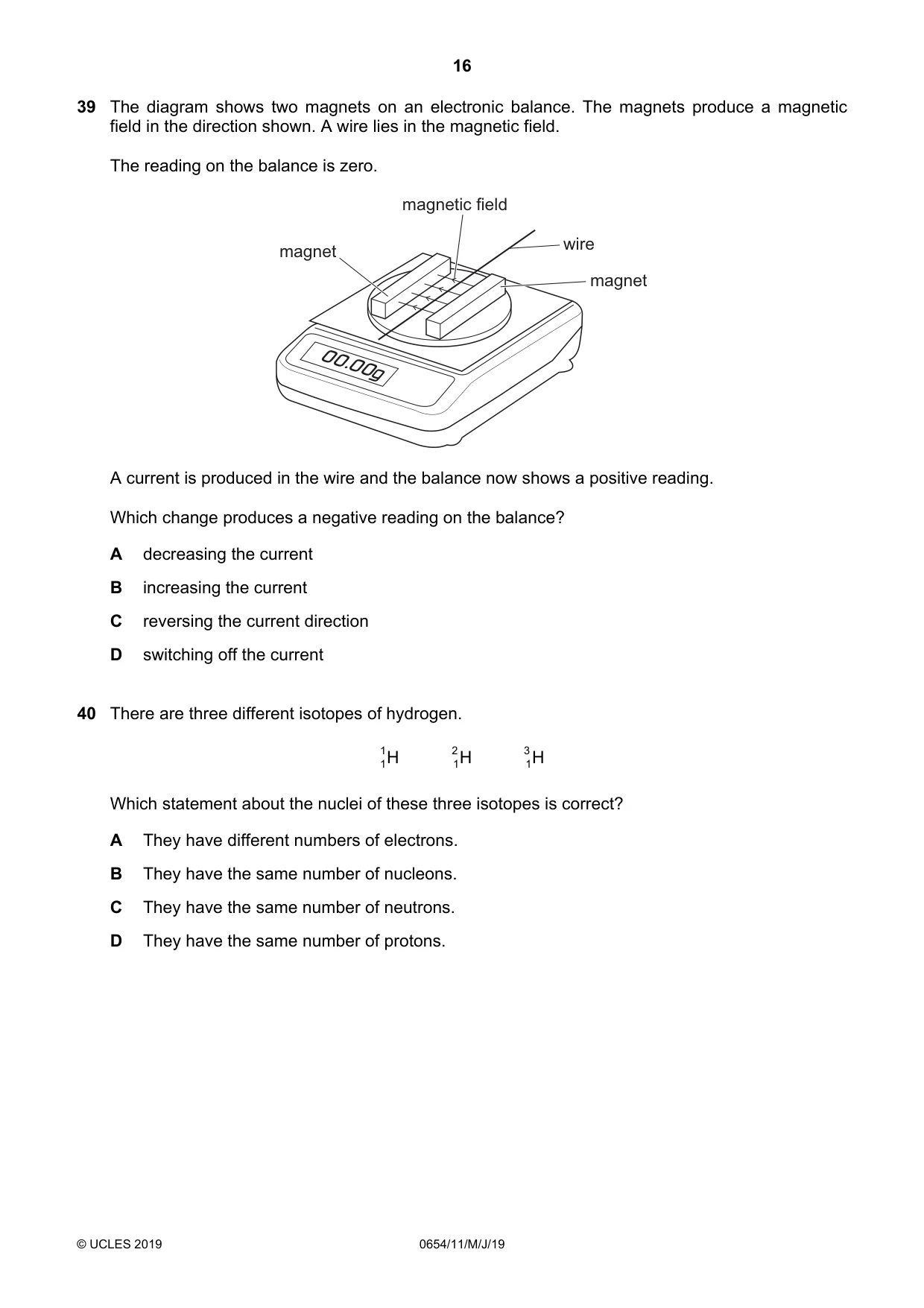
Q39 · The diagram shows two magnets on an electronic balance
39 The diagram shows two magnets on an electronic balance. The magnets produce a magnetic field in the direction shown. A wire lies in the magnetic field. The reading on the balance is zero. magnetic field magnet wire magnet A current is produced in the wire and the balance now shows a positive reading. Which change produces a negative reading on the balance? A decreasing the current B increasing the current C reversing the current direction D switching off the current
Mark scheme: C
Q40 · There are three different isotopes of hydrogen
40 There are three different isotopes of hydrogen. 1 H H 2 H 3 1 1 1 Which statement about the nuclei of these three isotopes is correct? A They have different numbers of electrons. B They have the same number of nucleons. C They have the same number of neutrons. D They have the same number of protons.
Mark scheme: D
What was in this paper
The subtopics covered by these 40 questions, and how many questions each got. Open one in a new tab to see every Cambridge question on it.
2Air quality and climate1Alkanes1Arrangement of elements1Biological molecules1Blood1Carbon cycle1Characteristics of living organisms1Coordination and response1Diffusion1Digestive system1Electrical quantities1Electrolysis1Electromagnetic effects1Electromagnetic spectrum1Energy flow1Enzymes1Exothermic and endothermic reactions1Fuels1General properties of waves1Identification of ions and gases1Kinetic particle model of matter1Leaf structure1Light1Motion1Oxides1Physical and chemical changes1Polymers1Preparation of salts1Pressure1Properties of metals1Rate of reaction1Respiration1Sexual reproduction in plants1Simple phenomena of magnetism1Sound1The characteristic properties of acids and bases1The nucleus1Variation1What you needed in this session
Cambridge’s own grade thresholds for 2019 May/June, Paper 1 · Variant 1. A higher threshold means an easier paper — the bar moves with how the cohort did.