Cambridge IGCSE Sciences - Co-ordinated (Double) 0654 — 2013 May/June Paper 1 · Variant 2
0654/12/M/J/13 · 40 questions · 40 marks · ≈45 min
The question paper and its mark scheme, free to read here and free to download. This is Cambridge’s own paper, exactly as it was sat.
Question paper20 pages
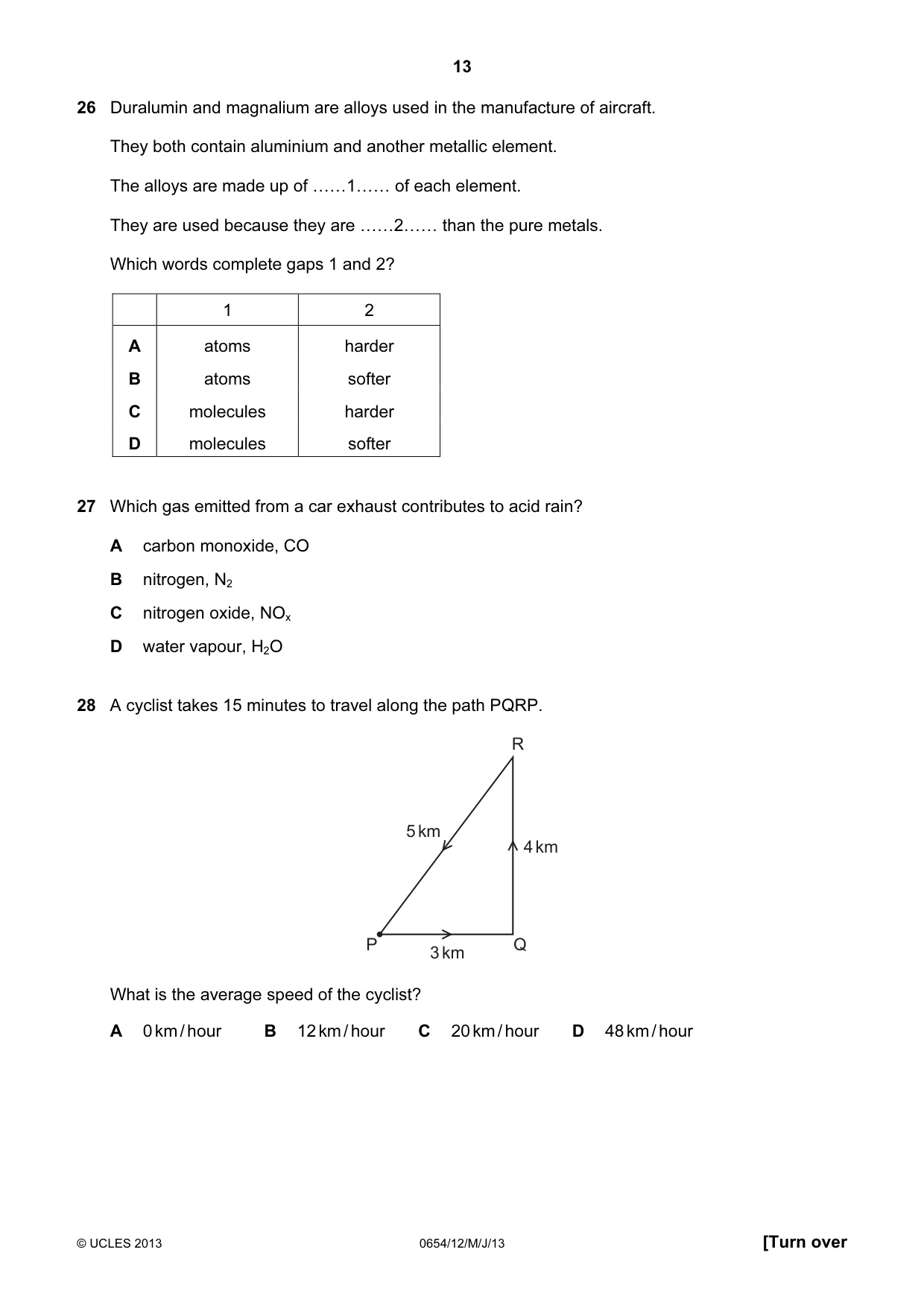
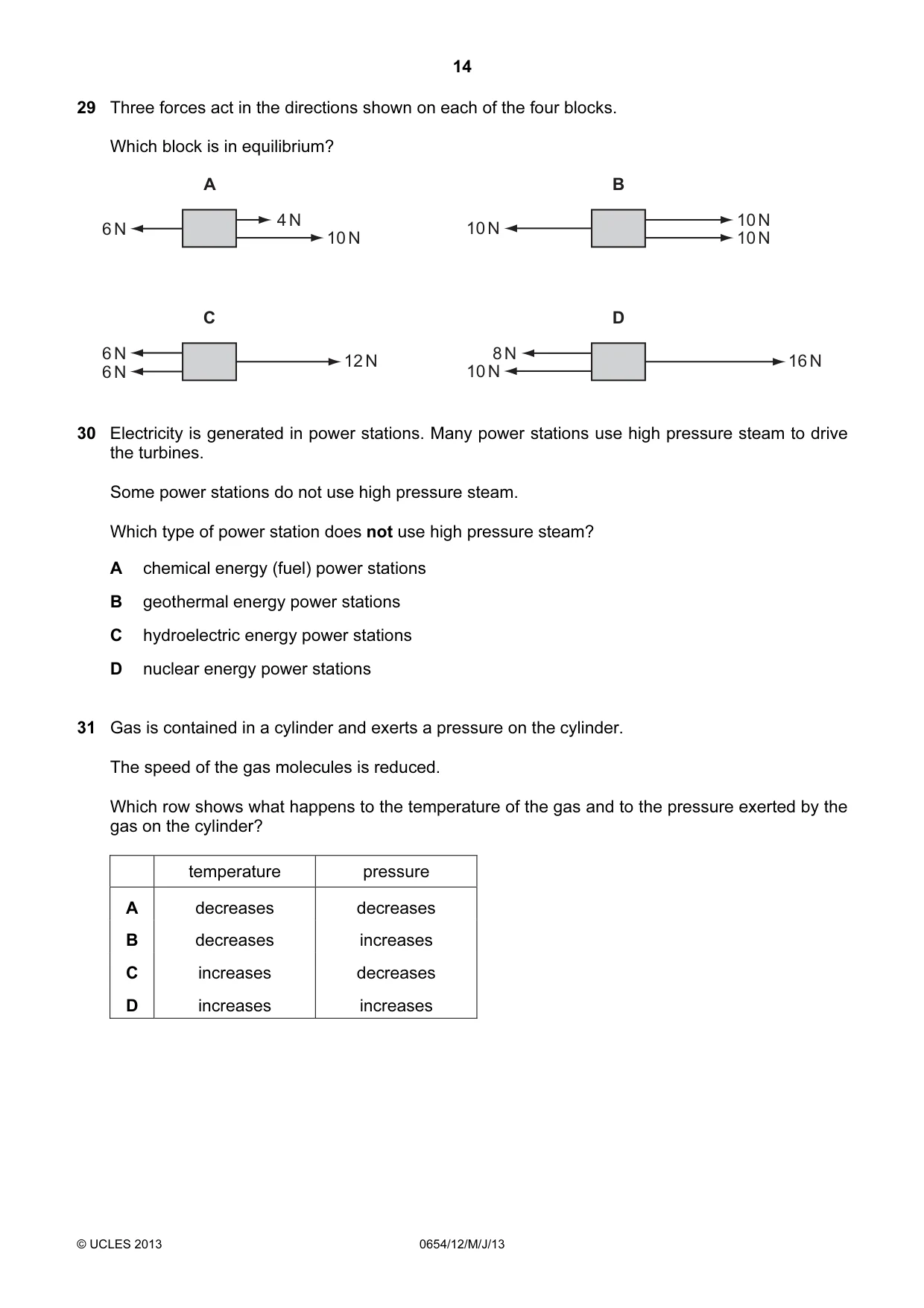
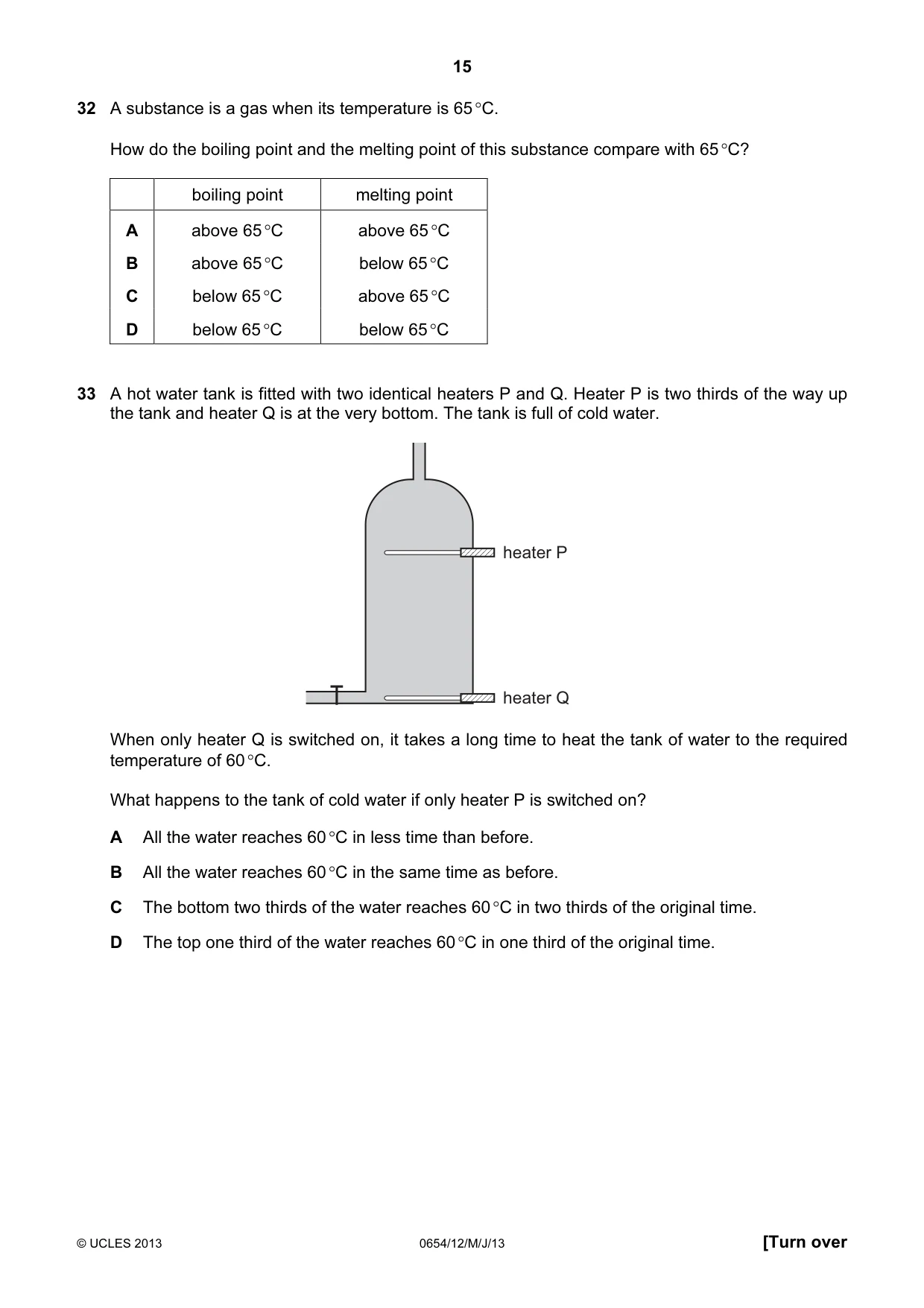
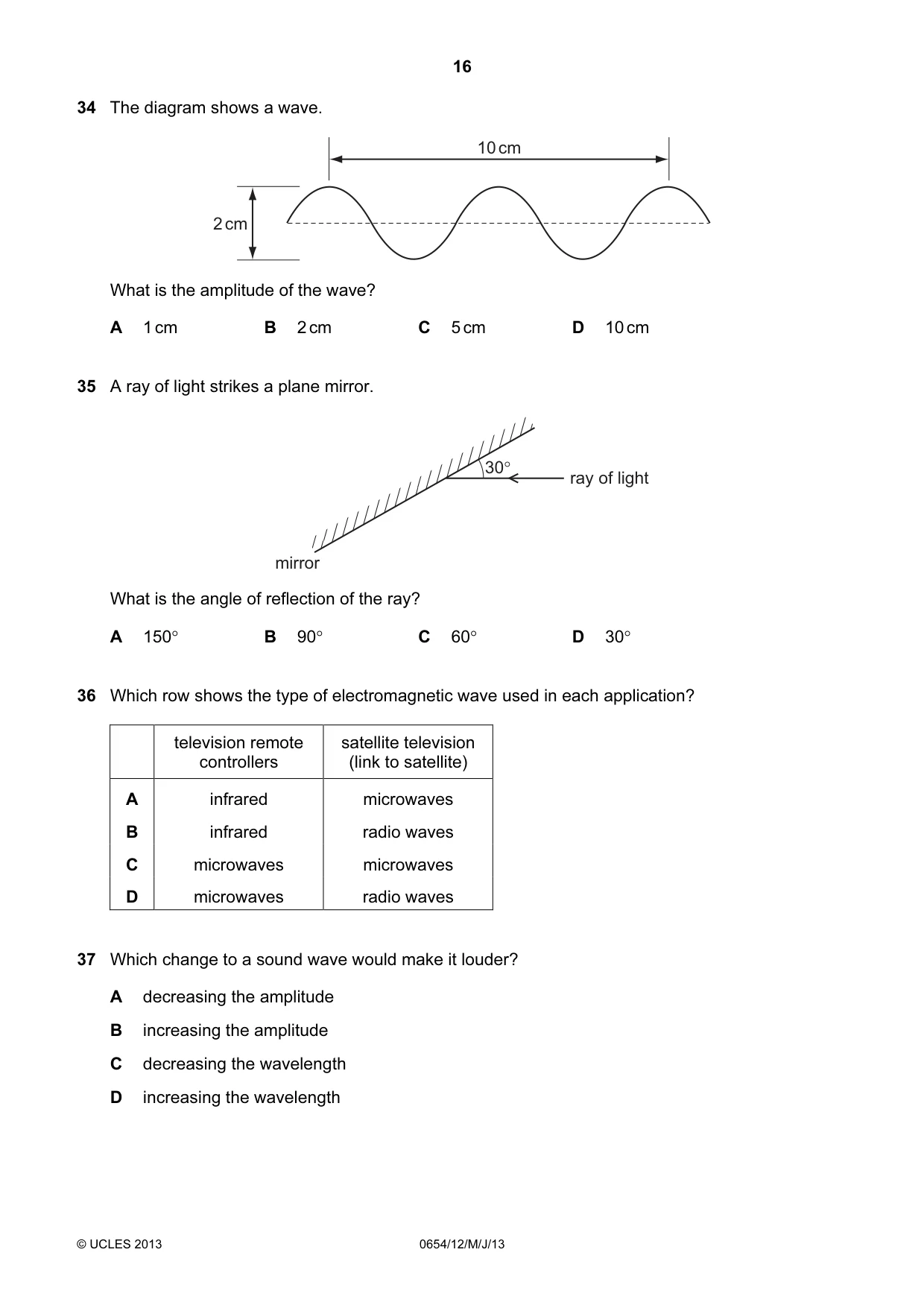

Mark scheme2 pages
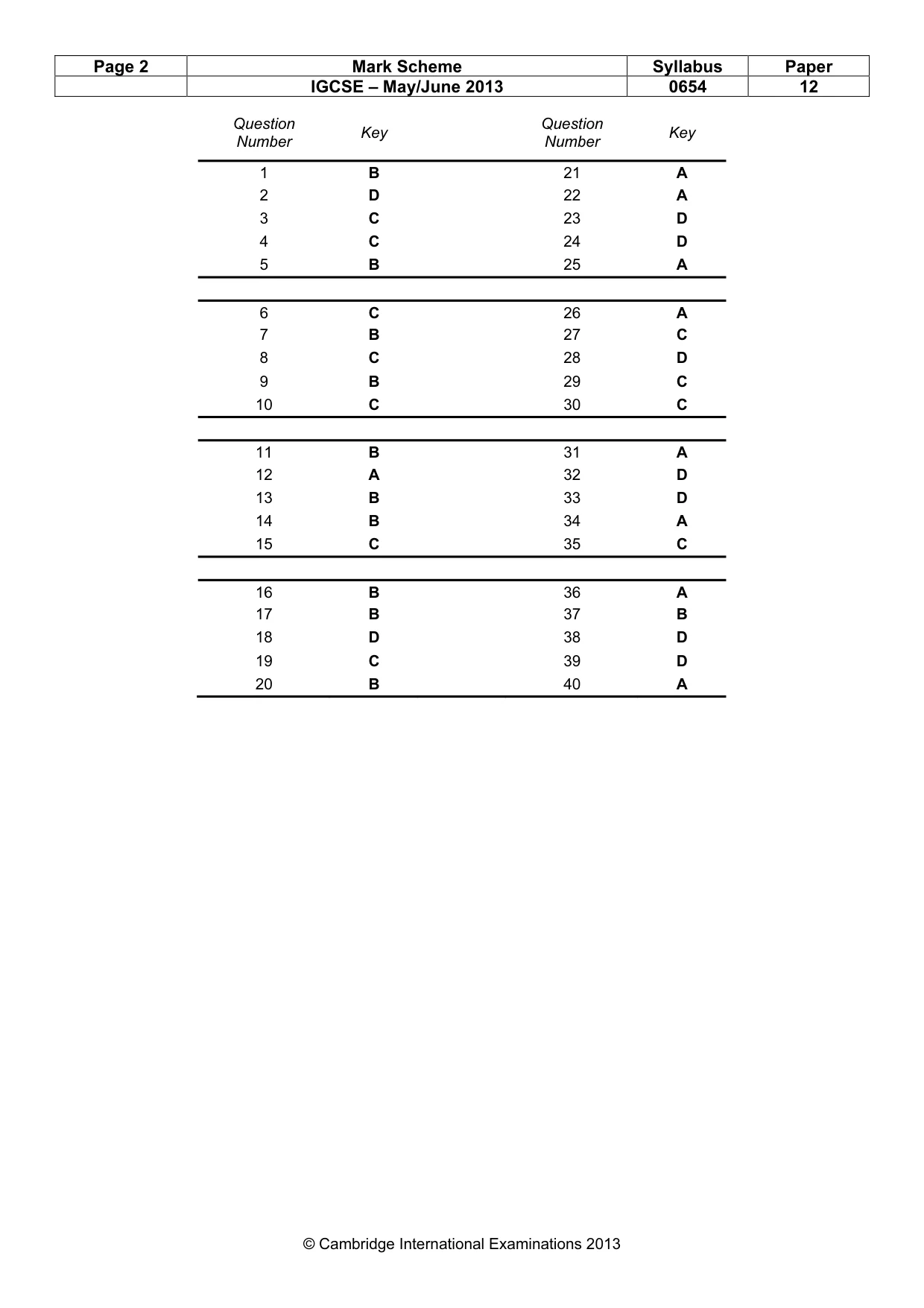
Answers below. Sit the paper first if you are practising.
Questions as text
Q1 · Which characteristic of living organisms is represented in plants by photosynthesis?
1 Which characteristic of living organisms is represented in plants by photosynthesis? A excretion B nutrition C respiration D sensitivity
Mark scheme: B
Q2 · Which structural feature is found in the centre of a typical plant cell?
2 Which structural feature is found in the centre of a typical plant cell? A cell membrane B cytoplasm C nucleus D vacuole
Mark scheme: D
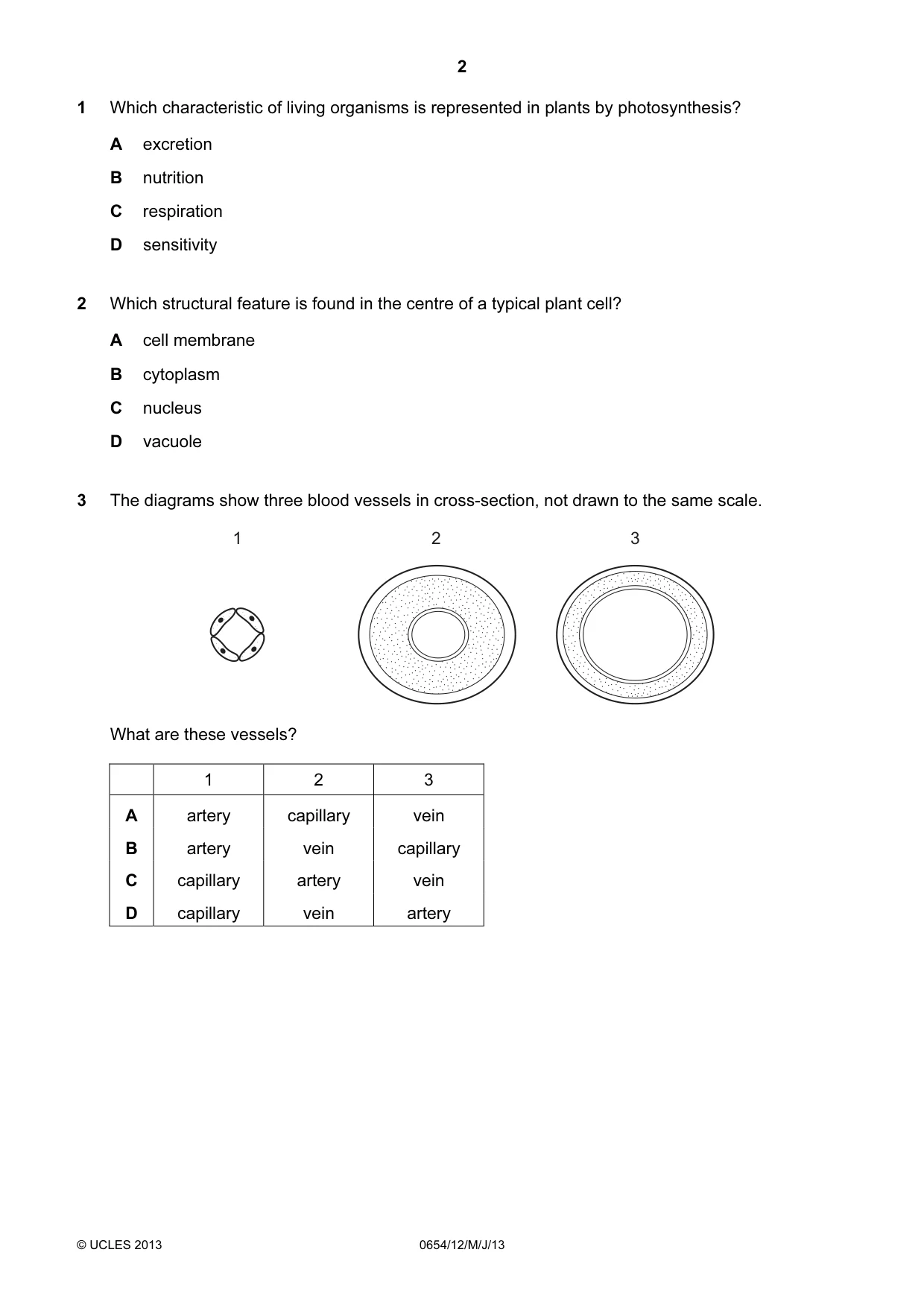
Q3 · The diagrams show three blood vessels in cross-section, not drawn to the same scale
3 The diagrams show three blood vessels in cross-section, not drawn to the same scale. 1 2 3 What are these vessels? 1 2 3 A artery capillary vein B artery vein capillary C capillary artery vein D capillary vein artery
Mark scheme: C
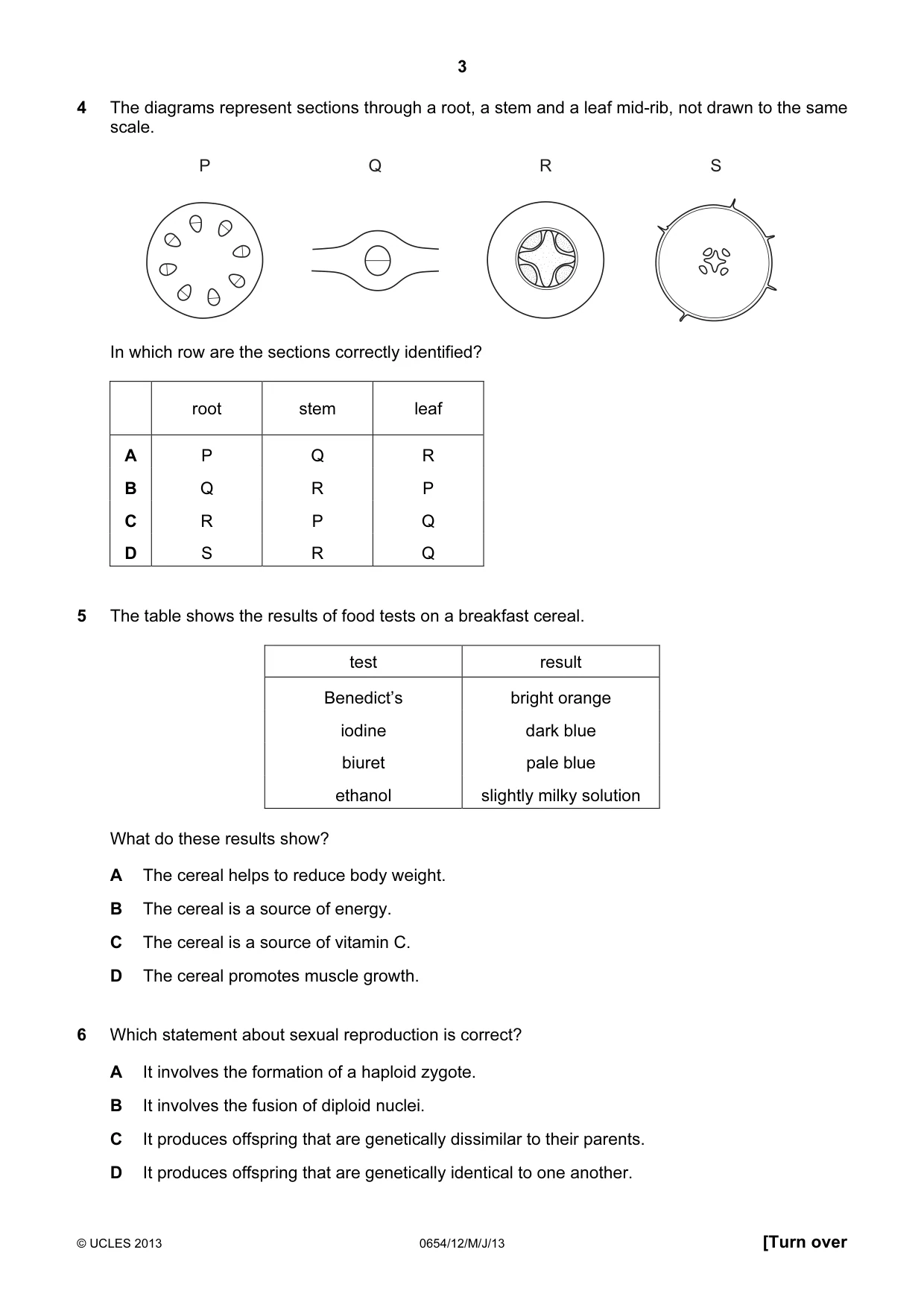
Q4 · The diagrams represent sections through a root, a stem and a leaf mid-rib, not drawn to…
4 The diagrams represent sections through a root, a stem and a leaf mid-rib, not drawn to the same scale. P Q R S In which row are the sections correctly identified? root stem leaf A P Q R B Q R P C R P Q D S R Q
Mark scheme: C
Q5 · The table shows the results of food tests on a breakfast cereal
5 The table shows the results of food tests on a breakfast cereal. test result Benedict’s bright orange iodine dark blue biuret pale blue ethanol slightly milky solution What do these results show? A The cereal helps to reduce body weight. B The cereal is a source of energy. C The cereal is a source of vitamin C. D The cereal promotes muscle growth.
Mark scheme: B
Q6 · Which statement about sexual reproduction is correct?
6 Which statement about sexual reproduction is correct? A It involves the formation of a haploid zygote. B It involves the fusion of diploid nuclei. C It produces offspring that are genetically dissimilar to their parents. D It produces offspring that are genetically identical to one another.
Mark scheme: C
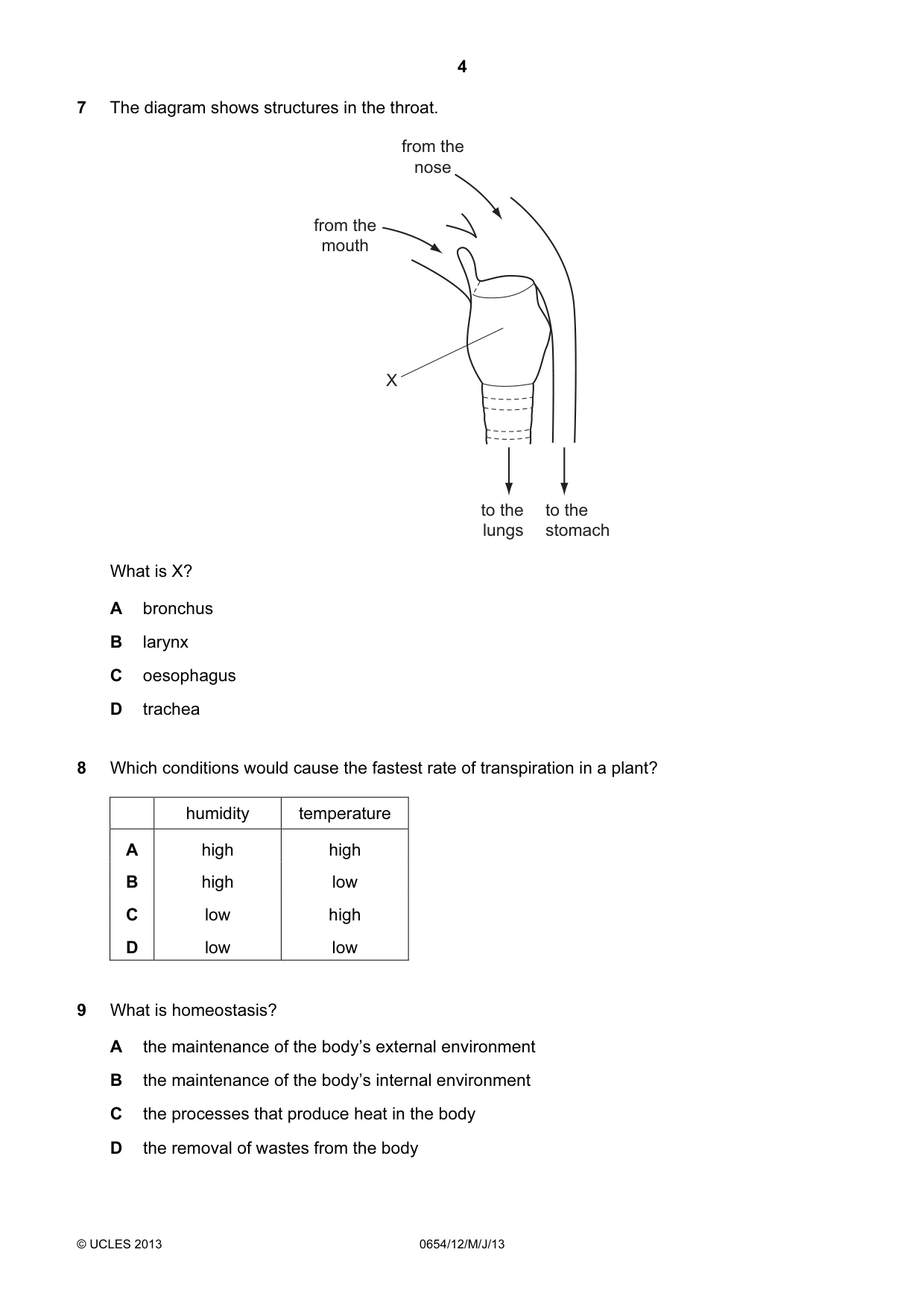
Q7 · The diagram shows structures in the throat
7 The diagram shows structures in the throat. from the nose from the mouth X to the to the lungs stomach What is X? A bronchus B larynx C oesophagus D trachea
Mark scheme: B
Q8 · Which conditions would cause the fastest rate of transpiration in a plant?
8 Which conditions would cause the fastest rate of transpiration in a plant? humidity temperature A high high B high low C low high D low low
Mark scheme: C
Question 9
9 What is homeostasis? A the maintenance of the body’s external environment B the maintenance of the body’s internal environment C the processes that produce heat in the body D the removal of wastes from the body
Mark scheme: B
Q10 · When does fertilisation occur in humans?
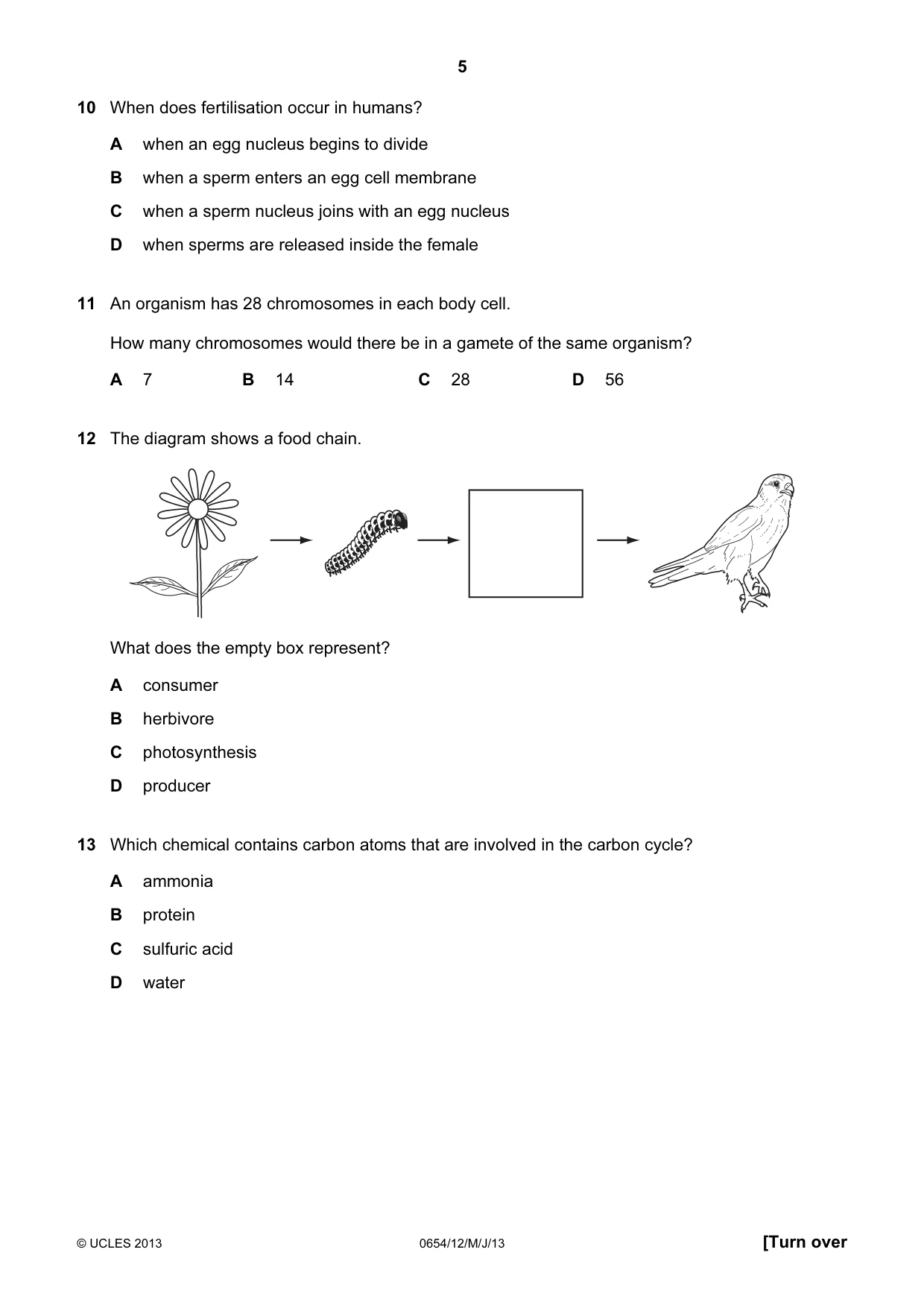
10 When does fertilisation occur in humans? A when an egg nucleus begins to divide B when a sperm enters an egg cell membrane C when a sperm nucleus joins with an egg nucleus D when sperms are released inside the female
Mark scheme: C
Q11 · An organism has 28 chromosomes in each body cell
11 An organism has 28 chromosomes in each body cell. How many chromosomes would there be in a gamete of the same organism? A 7 B 14 C 28 D 56
Mark scheme: B
Q12 · The diagram shows a food chain
12 The diagram shows a food chain. What does the empty box represent? A consumer B herbivore C photosynthesis D producer
Mark scheme: A
Q13 · Which chemical contains carbon atoms that are involved in the carbon cycle?
13 Which chemical contains carbon atoms that are involved in the carbon cycle? A ammonia B protein C sulfuric acid D water
Mark scheme: B
Q14 · Pure copper chloride can be obtained from a mixture of powdered copper and copper chloride
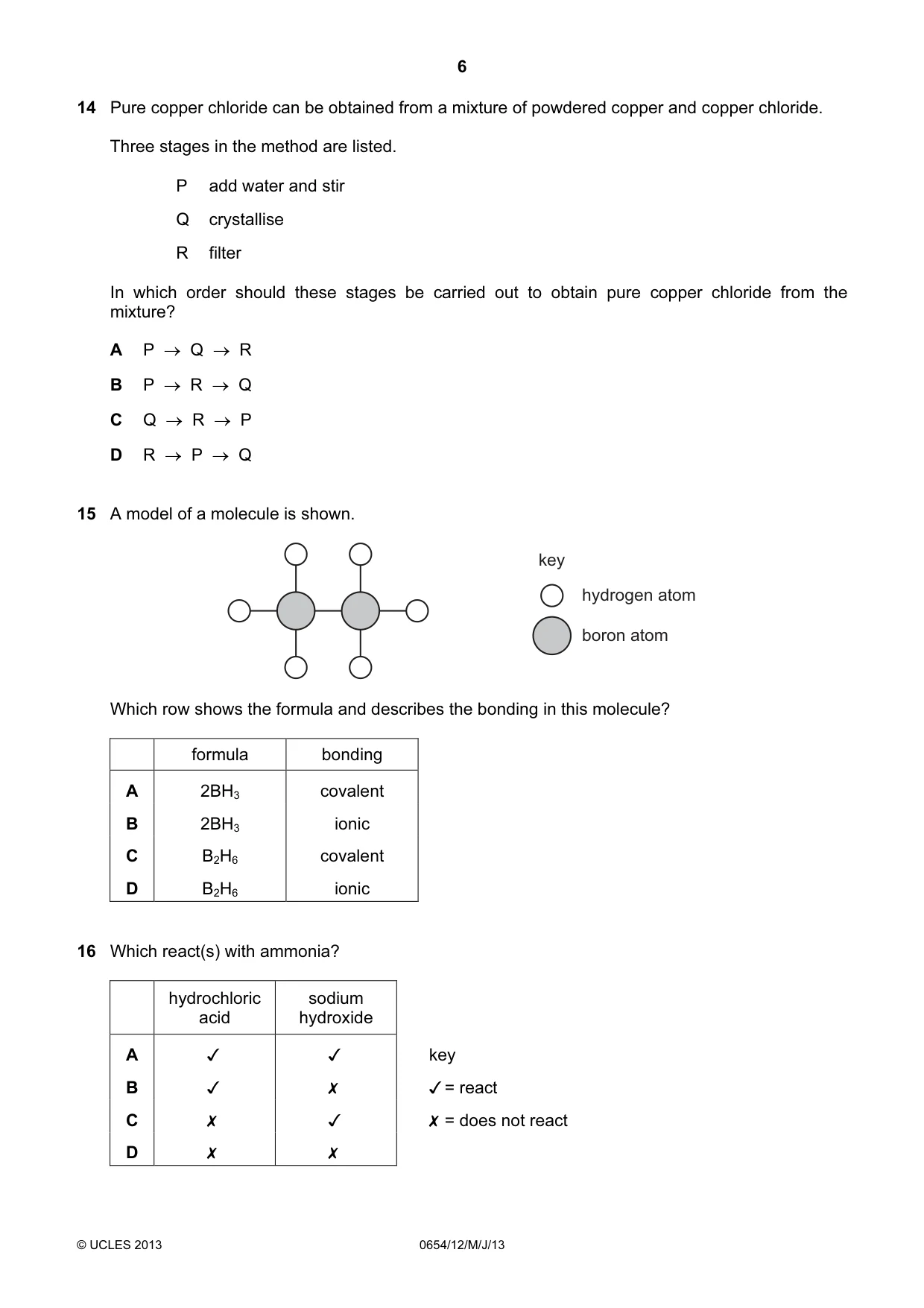
14 Pure copper chloride can be obtained from a mixture of powdered copper and copper chloride. Three stages in the method are listed. P add water and stir Q crystallise R filter In which order should these stages be carried out to obtain pure copper chloride from the mixture? A P → Q → R B P → R → Q C Q → R → P D R → P → Q
Mark scheme: B
Q15 · A model of a molecule is shown
15 A model of a molecule is shown. key hydrogen atom boron atom Which row shows the formula and describes the bonding in this molecule? formula bonding A 2BH3 covalent B 2BH3 ionic C B2H6 covalent D B2H6 ionic
Mark scheme: C
Q16 · Which react(s) with ammonia?
16 Which react(s) with ammonia? hydrochloric sodium acid hydroxide A ✓ ✓ key B ✓ ✗ ✓= react C ✗ ✓ ✗= does not react D ✗ ✗
Mark scheme: B
More questions on The characteristic properties of acids and bases
Q17 · Element X is a very dense solid with a high melting point
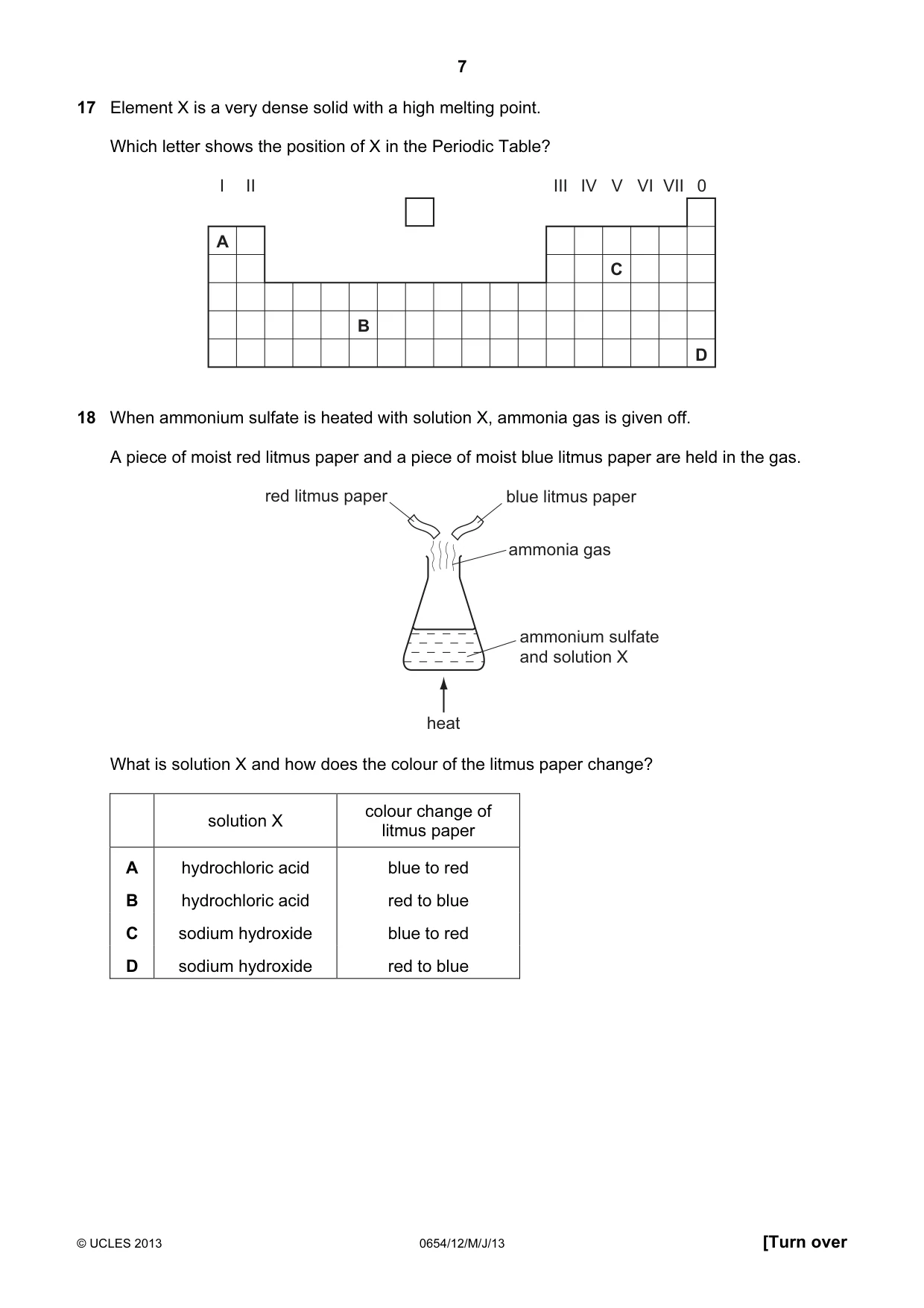
17 Element X is a very dense solid with a high melting point. Which letter shows the position of X in the Periodic Table? I II III IV V VI VII 0 A C B D
Mark scheme: B
Q18 · When ammonium sulfate is heated with solution X, ammonia gas is given off
18 When ammonium sulfate is heated with solution X, ammonia gas is given off. A piece of moist red litmus paper and a piece of moist blue litmus paper are held in the gas. red litmus paper blue litmus paper ammonia gas ammonium sulfate and solution X heat What is solution X and how does the colour of the litmus paper change? colour change of solution X litmus paper A hydrochloric acid blue to red B hydrochloric acid red to blue C sodium hydroxide blue to red D sodium hydroxide red to blue
Mark scheme: D
Q19 · Ammonia is oxidised as shown
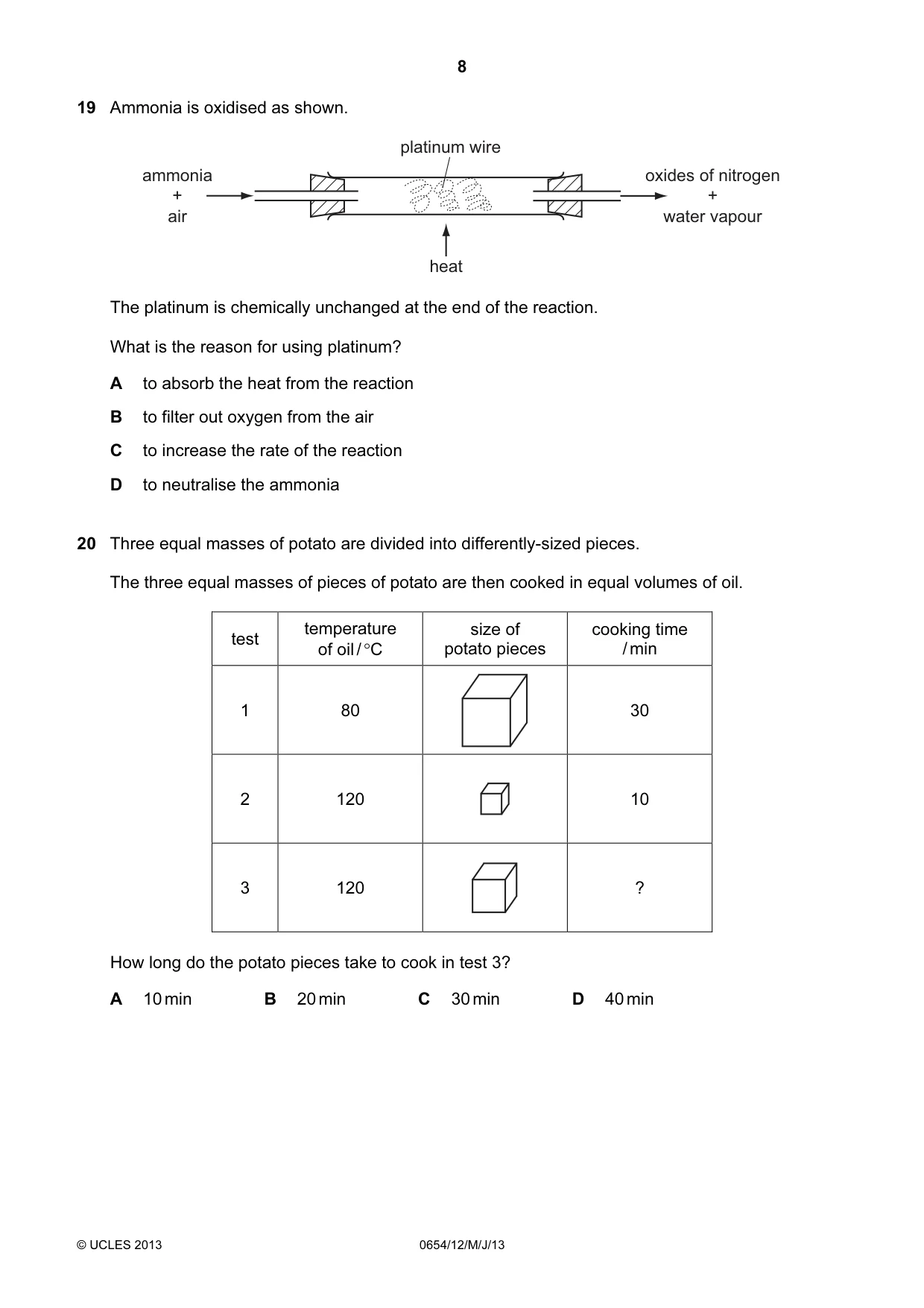
19 Ammonia is oxidised as shown. platinum wire ammonia oxides of nitrogen + + air water vapour heat The platinum is chemically unchanged at the end of the reaction. What is the reason for using platinum? A to absorb the heat from the reaction B to filter out oxygen from the air C to increase the rate of the reaction D to neutralise the ammonia
Mark scheme: C
Q20 · Three equal masses of potato are divided into differently-sized pieces
20 Three equal masses of potato are divided into differently-sized pieces. The three equal masses of pieces of potato are then cooked in equal volumes of oil. temperature size of cooking time test of oil / °C potato pieces / min 1 80 30 2 120 10 3 120 ? How long do the potato pieces take to cook in test 3? A 10 min B 20 min C 30 min D 40 min
Mark scheme: B
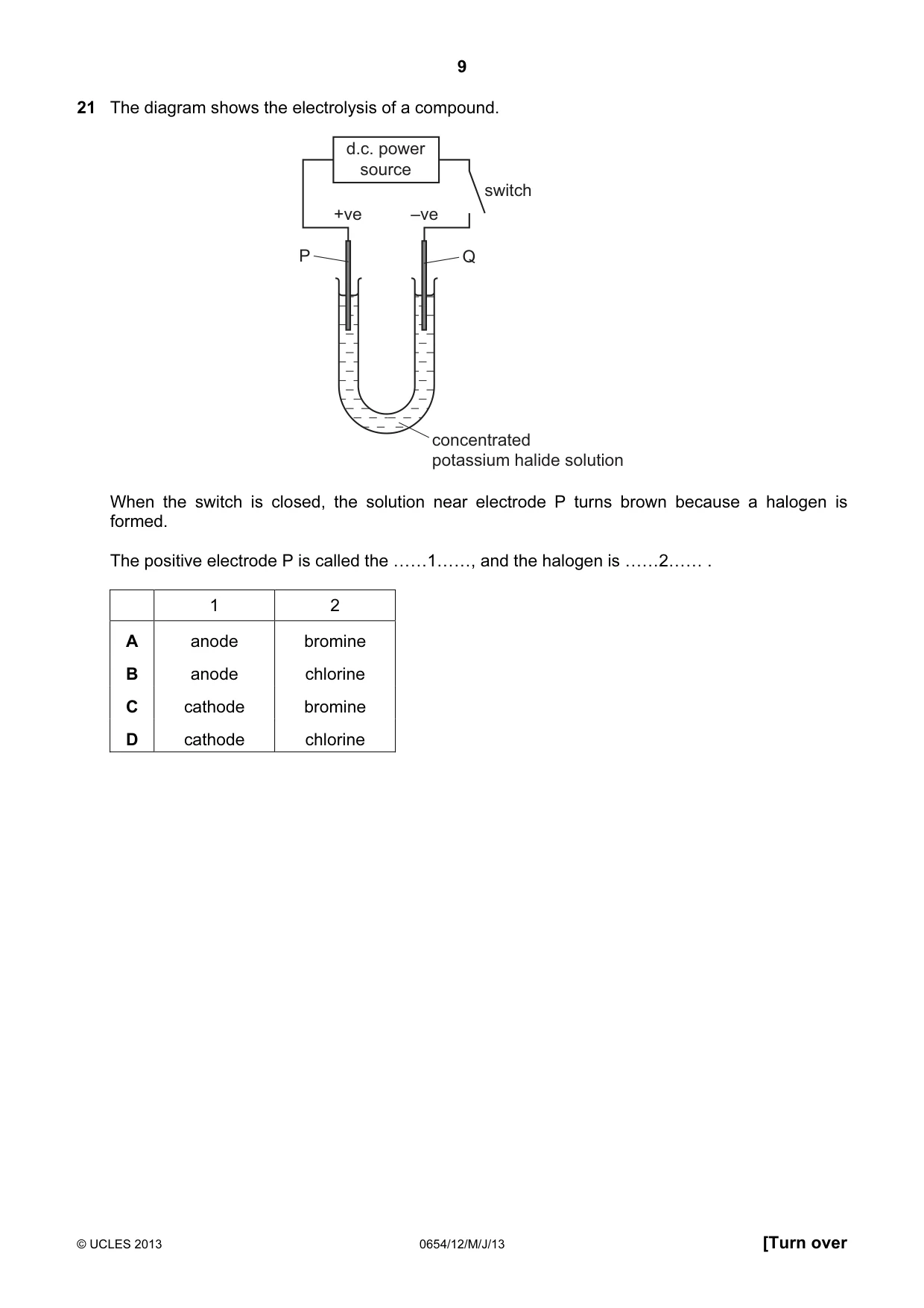
Q21 · The diagram shows the electrolysis of a compound
21 The diagram shows the electrolysis of a compound. d.c. power source switch +ve –ve P Q concentrated potassium halide solution When the switch is closed, the solution near electrode P turns brown because a halogen is formed. The positive electrode P is called the ……1……, and the halogen is ……2…… . 1 2 A anode bromine B anode chlorine C cathode bromine D cathode chlorine
Mark scheme: A
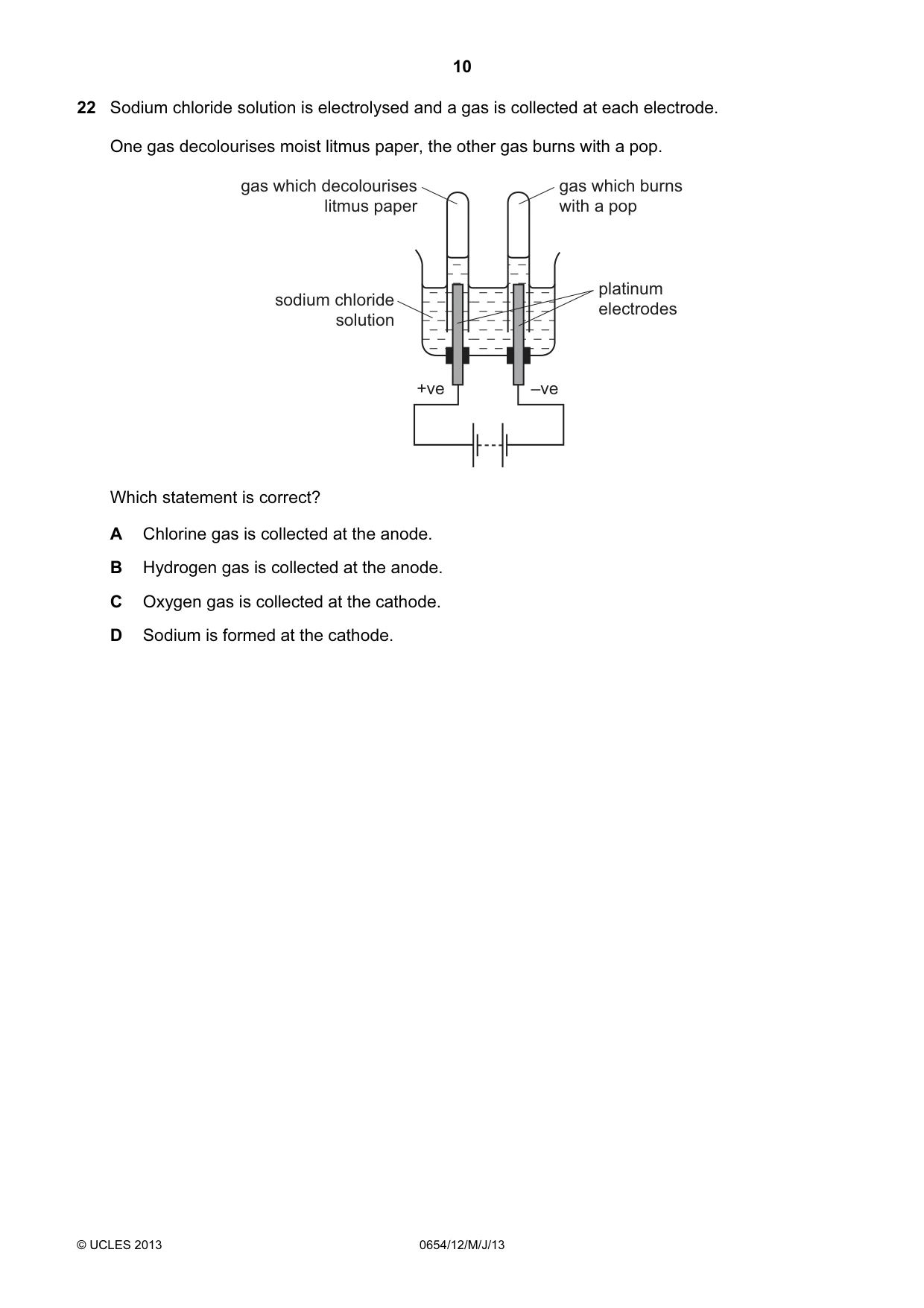
Q22 · Sodium chloride solution is electrolysed and a gas is collected at each electrode
22 Sodium chloride solution is electrolysed and a gas is collected at each electrode. One gas decolourises moist litmus paper, the other gas burns with a pop. gas which decolourises gas which burns litmus paper with a pop platinum sodium chloride electrodes solution +ve –ve Which statement is correct? A Chlorine gas is collected at the anode. B Hydrogen gas is collected at the anode. C Oxygen gas is collected at the cathode. D Sodium is formed at the cathode.
Mark scheme: A
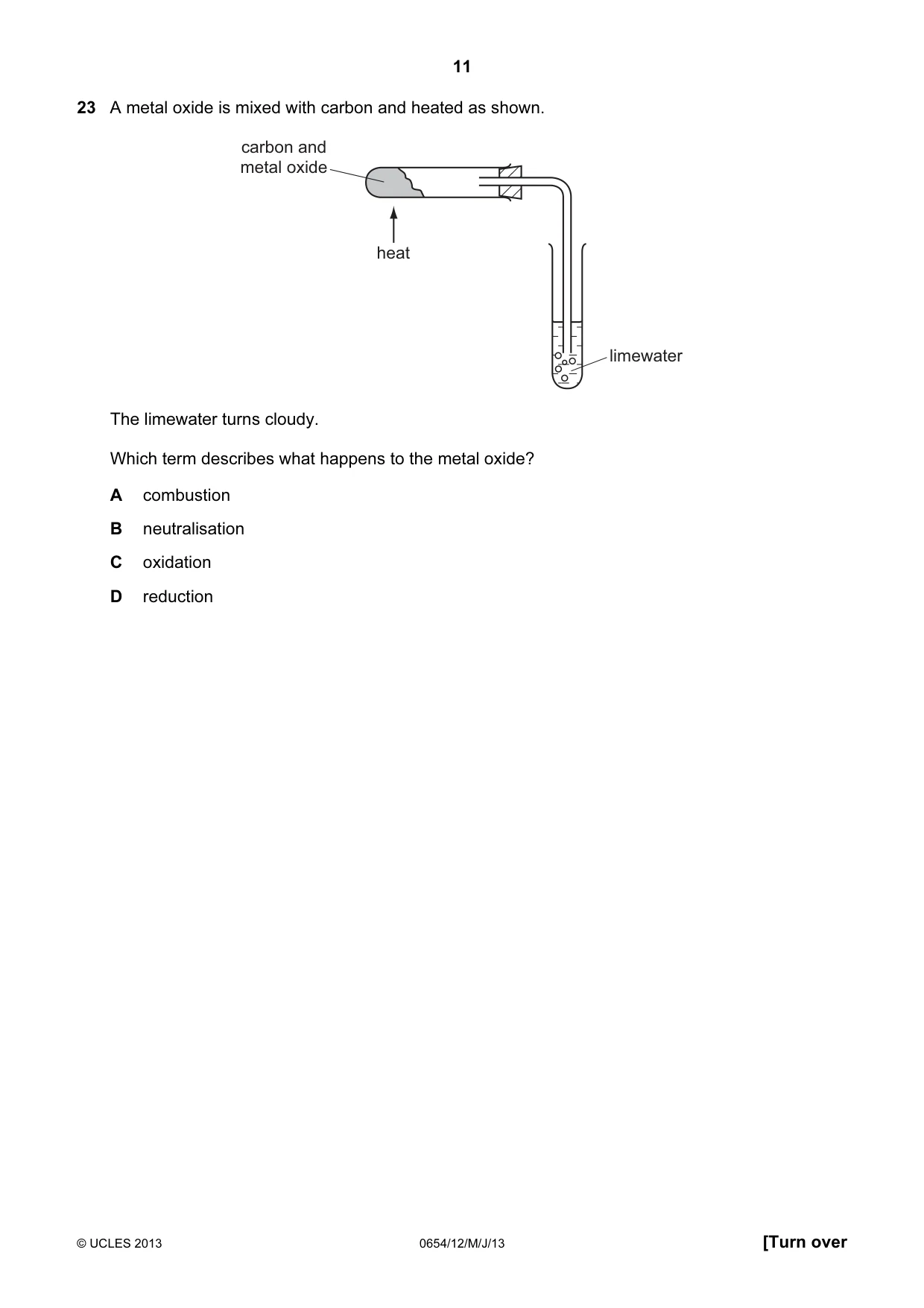
Q23 · A metal oxide is mixed with carbon and heated as shown
23 A metal oxide is mixed with carbon and heated as shown. carbon and metal oxide heat limewater The limewater turns cloudy. Which term describes what happens to the metal oxide? A combustion B neutralisation C oxidation D reduction
Mark scheme: D
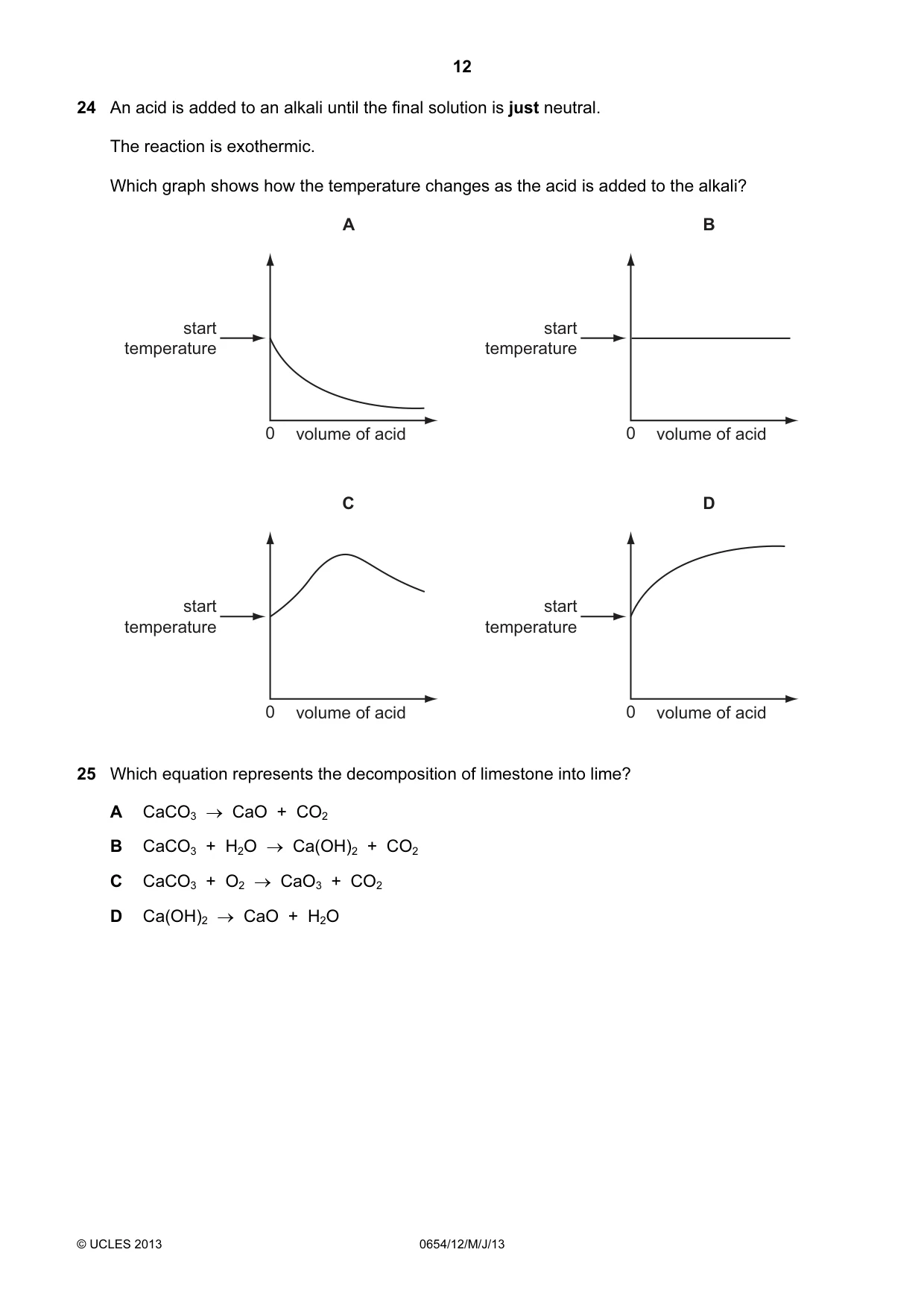
Q24 · An acid is added to an alkali until the final solution is just neutral
24 An acid is added to an alkali until the final solution is just neutral. The reaction is exothermic. Which graph shows how the temperature changes as the acid is added to the alkali? A B start start temperature temperature 0 volume of acid 0 volume of acid C D start start temperature temperature 0 volume of acid 0 volume of acid
Mark scheme: D
Q25 · Which equation represents the decomposition of limestone into lime?
25 Which equation represents the decomposition of limestone into lime? A CaCO3 → CaO + CO2 B CaCO3 + H2O → Ca(OH)2 + CO2 C CaCO3 + O2 → CaO3 + CO2 D Ca(OH)2 → CaO + H2O
Mark scheme: A
Q26 · Duralumin and magnalium are alloys used in the manufacture of aircraft
26 Duralumin and magnalium are alloys used in the manufacture of aircraft. They both contain aluminium and another metallic element. The alloys are made up of ……1…… of each element. They are used because they are ……2…… than the pure metals. Which words complete gaps 1 and 2? 1 2 A atoms harder B atoms softer C molecules harder D molecules softer
Mark scheme: A
Q27 · Which gas emitted from a car exhaust contributes to acid rain?
27 Which gas emitted from a car exhaust contributes to acid rain? A carbon monoxide, CO B nitrogen, N2 C nitrogen oxide, NOx D water vapour, H2O
Mark scheme: C
Q28 · A cyclist takes 15 minutes to travel along the path PQRP
28 A cyclist takes 15 minutes to travel along the path PQRP. R 5 km 4 km P Q 3 km What is the average speed of the cyclist? A 0 km / hour B 12 km / hour C 20 km / hour D 48 km / hour
Mark scheme: D
Q29 · Three forces act in the directions shown on each of the four blocks
29 Three forces act in the directions shown on each of the four blocks. Which block is in equilibrium? A B 4 N 10 N 6 N 10 N 10 N 10 N C D 6 N 12 N 8 N 16 N 6 N 10 N
Mark scheme: C
Q30 · Electricity is generated in power stations
30 Electricity is generated in power stations. Many power stations use high pressure steam to drive the turbines. Some power stations do not use high pressure steam. Which type of power station does not use high pressure steam? A chemical energy (fuel) power stations B geothermal energy power stations C hydroelectric energy power stations D nuclear energy power stations
Mark scheme: C
Q31 · Gas is contained in a cylinder and exerts a pressure on the cylinder
31 Gas is contained in a cylinder and exerts a pressure on the cylinder. The speed of the gas molecules is reduced. Which row shows what happens to the temperature of the gas and to the pressure exerted by the gas on the cylinder? temperature pressure A decreases decreases B decreases increases C increases decreases D increases increases
Mark scheme: A
Q32 · A substance is a gas when its temperature is 65 °C
32 A substance is a gas when its temperature is 65 °C. How do the boiling point and the melting point of this substance compare with 65 °C? boiling point melting point A above 65 °C above 65 °C B above 65 °C below 65 °C C below 65 °C above 65 °C D below 65 °C below 65 °C
Mark scheme: D
Q33 · A hot water tank is fitted with two identical heaters P and Q
33 A hot water tank is fitted with two identical heaters P and Q. Heater P is two thirds of the way up the tank and heater Q is at the very bottom. The tank is full of cold water. heater P heater Q When only heater Q is switched on, it takes a long time to heat the tank of water to the required temperature of 60 °C. What happens to the tank of cold water if only heater P is switched on? A All the water reaches 60 °C in less time than before. B All the water reaches 60 °C in the same time as before. C The bottom two thirds of the water reaches 60 °C in two thirds of the original time. D The top one third of the water reaches 60 °C in one third of the original time.
Mark scheme: D
Q34 · The diagram shows a wave
34 The diagram shows a wave. 10 cm 2 cm What is the amplitude of the wave? A 1 cm B 2 cm C 5 cm D 10 cm
Mark scheme: A
Q35 · A ray of light strikes a plane mirror
35 A ray of light strikes a plane mirror. 30° ray of light mirror What is the angle of reflection of the ray? A 150° B 90° C 60° D 30°
Mark scheme: C
Q36 · Which row shows the type of electromagnetic wave used in each application?
36 Which row shows the type of electromagnetic wave used in each application? television remote satellite television controllers (link to satellite) A infrared microwaves B infrared radio waves C microwaves microwaves D microwaves radio waves
Mark scheme: A
Q37 · Which change to a sound wave would make it louder?
37 Which change to a sound wave would make it louder? A decreasing the amplitude B increasing the amplitude C decreasing the wavelength D increasing the wavelength
Mark scheme: B
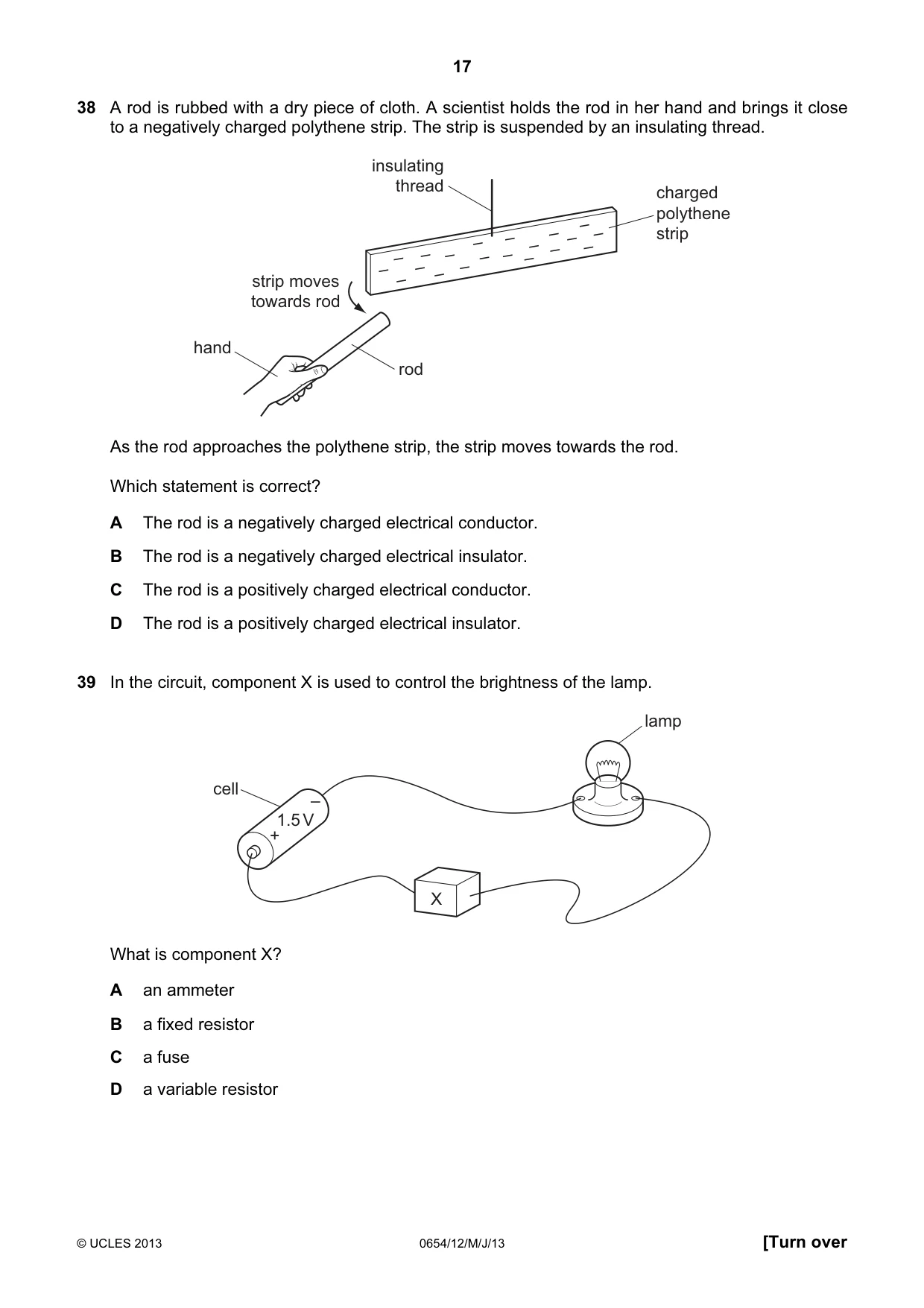
Q38 · A rod is rubbed with a dry piece of cloth
38 A rod is rubbed with a dry piece of cloth. A scientist holds the rod in her hand and brings it close to a negatively charged polythene strip. The strip is suspended by an insulating thread. insulating thread charged polythene – – – – – –– strip – – – – – – – – – – – – strip moves – towards rod hand rod As the rod approaches the polythene strip, the strip moves towards the rod. Which statement is correct? A The rod is a negatively charged electrical conductor. B The rod is a negatively charged electrical insulator. C The rod is a positively charged electrical conductor. D The rod is a positively charged electrical insulator.
Mark scheme: D
Q39 · In the circuit, component X is used to control the brightness of the lamp
39 In the circuit, component X is used to control the brightness of the lamp. lamp cell – 1.5 V + X What is component X? A an ammeter B a fixed resistor C a fuse D a variable resistor
Mark scheme: D
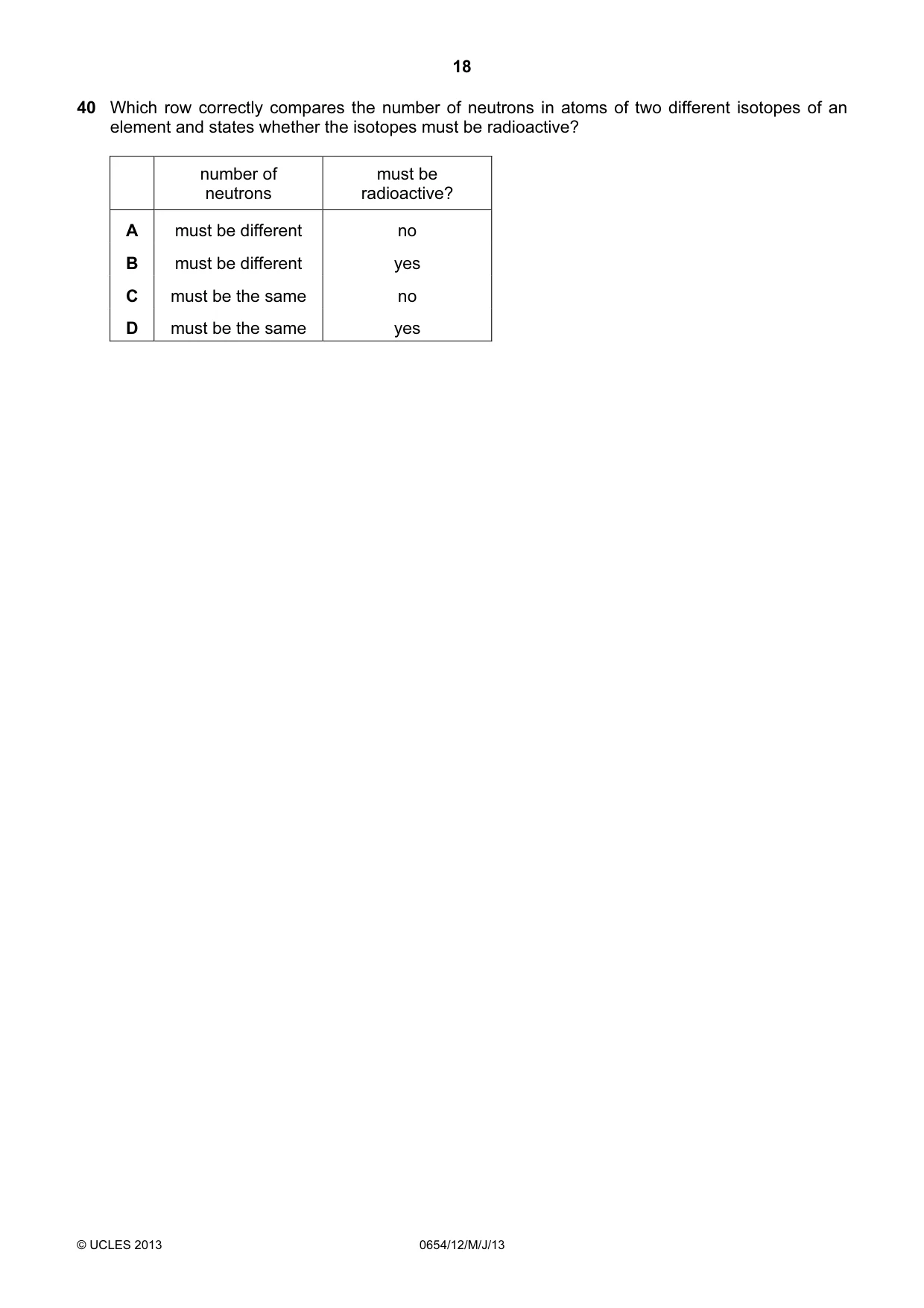
Q40 · Which row correctly compares the number of neutrons in atoms of two different isotopes of…
40 Which row correctly compares the number of neutrons in atoms of two different isotopes of an element and states whether the isotopes must be radioactive? number of must be neutrons radioactive? A must be different no B must be different yes C must be the same no D must be the same yes
Mark scheme: A
What was in this paper
The subtopics covered by these 40 questions, and how many questions each got. Open one in a new tab to see every Cambridge question on it.
2Kinetic particle model of matter2Rate of reaction2Air quality and climate1Alloys and their properties1Arrangement of elements1Biological molecules1Blood vessels1Carbon cycle1Cell division1Cell structure1Characteristics of living organisms1Electrical circuits1Electromagnetic spectrum1Energy, work and power1Exothermic and endothermic reactions1Extraction of metals1Food chains and food webs1Forces1Gas exchange in humans1General properties of waves1Homeostasis1Identification of ions and gases1Isotopes1Light1Motion1Oxides1Separation and purification1Sexual reproduction1Sexual reproduction in humans1Simple molecules and covalent bonds1Simple phenomena of magnetism1Sound1The characteristic properties of acids and bases1Transfer of thermal energy1Transpiration1Xylem and phloem1What you needed in this session
Cambridge’s own grade thresholds for 2013 May/June, Paper 1 · Variant 2. A higher threshold means an easier paper — the bar moves with how the cohort did.