Cambridge IGCSE Sciences - Co-ordinated (Double) 0654 — 2014 Oct/Nov Paper 1 · Variant 3
0654/13/O/N/14 · 40 questions · 40 marks · ≈45 min
The question paper and its mark scheme, free to read here and free to download. This is Cambridge’s own paper, exactly as it was sat.
Question paper20 pages



Mark scheme2 pages
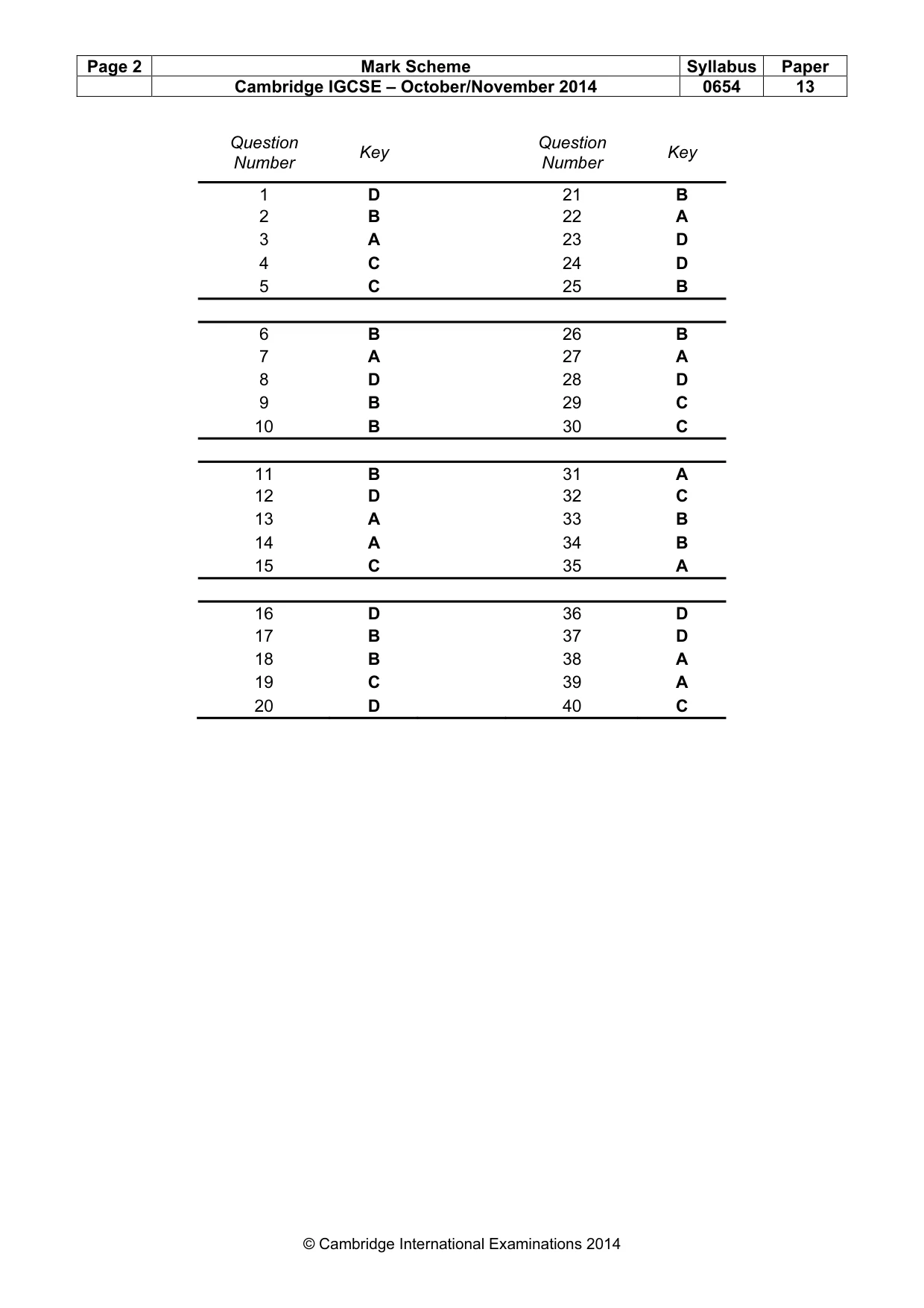
Answers below. Sit the paper first if you are practising.
Questions as text
Q1 · The diagram shows parts of a mesophyll cell
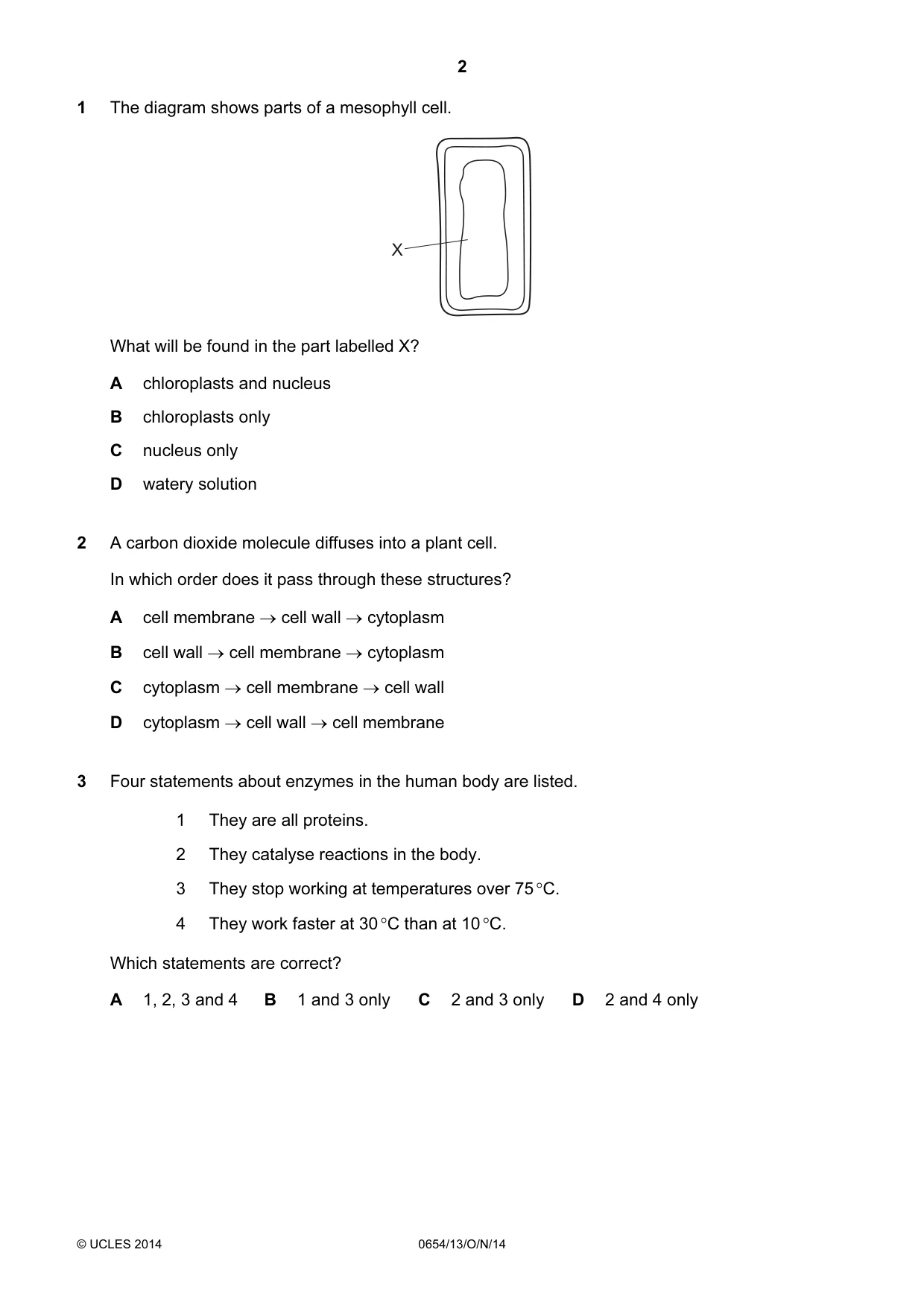
1 The diagram shows parts of a mesophyll cell. X What will be found in the part labelled X? A chloroplasts and nucleus B chloroplasts only C nucleus only D watery solution
Mark scheme: D
Q2 · A carbon dioxide molecule diffuses into a plant cell
2 A carbon dioxide molecule diffuses into a plant cell. In which order does it pass through these structures? A cell membrane → cell wall → cytoplasm B cell wall → cell membrane → cytoplasm C cytoplasm → cell membrane → cell wall D cytoplasm → cell wall → cell membrane
Mark scheme: B
Q3 · Four statements about enzymes in the human body are listed
3 Four statements about enzymes in the human body are listed. 1 They are all proteins. 2 They catalyse reactions in the body. 3 They stop working at temperatures over 75 °C. 4 They work faster at 30 °C than at 10 °C. Which statements are correct? A 1, 2, 3 and 4 B 1 and 3 only C 2 and 3 only D 2 and 4 only
Mark scheme: A
Q4 · The diagram shows three blood vessels in longitudinal section
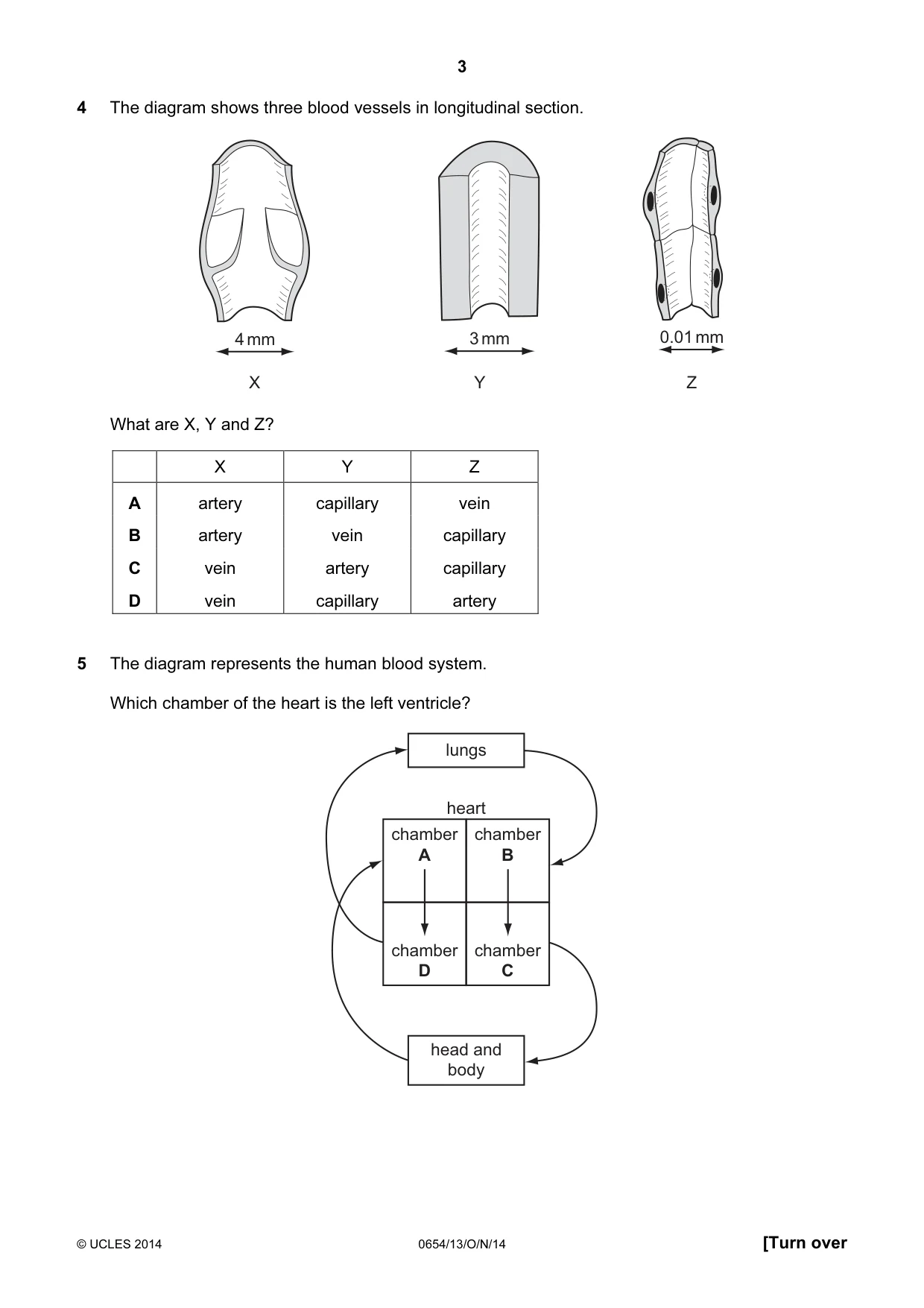
4 The diagram shows three blood vessels in longitudinal section. 4 mm 3 mm 0.01 mm X Y Z What are X, Y and Z? X Y Z A artery capillary vein B artery vein capillary C vein artery capillary D vein capillary artery
Mark scheme: C
Q5 · The diagram represents the human blood system
5 The diagram represents the human blood system. Which chamber of the heart is the left ventricle? lungs heart chamber chamber A B chamber chamber D C head and body
Mark scheme: C
Q6 · During expiration, in which order does air pass through these structures?
6 During expiration, in which order does air pass through these structures? A alveoli → bronchi → bronchiole → larynx B alveoli → bronchiole → bronchi → larynx C larynx → bronchi → bronchiole → alveoli D larynx → bronchiole → bronchi → alveoli
Mark scheme: B
Q7 · Which structure carries nerve impulses away from the central nervous system?
7 Which structure carries nerve impulses away from the central nervous system? A motor neurone B relay neurone C sensory neurone D spinal cord
Mark scheme: A
Q8 · A student observes some grass seedlings which have light coming from one side only
8 A student observes some grass seedlings which have light coming from one side only. He believes that the tips of the seedlings have a receptor for light. He removes the tips of the seedlings and waits for a day. Which change in the seedlings would show that he is right? A They grow away from the light. B They grow towards the light. C They stop growing. D They grow straight up.
Mark scheme: D
Q9 · When a woman ovulates, into which structure is the egg first released?
9 When a woman ovulates, into which structure is the egg first released? A ovary B oviduct C uterus D vagina
Mark scheme: B
Q10 · In human reproduction, which cells are haploid?
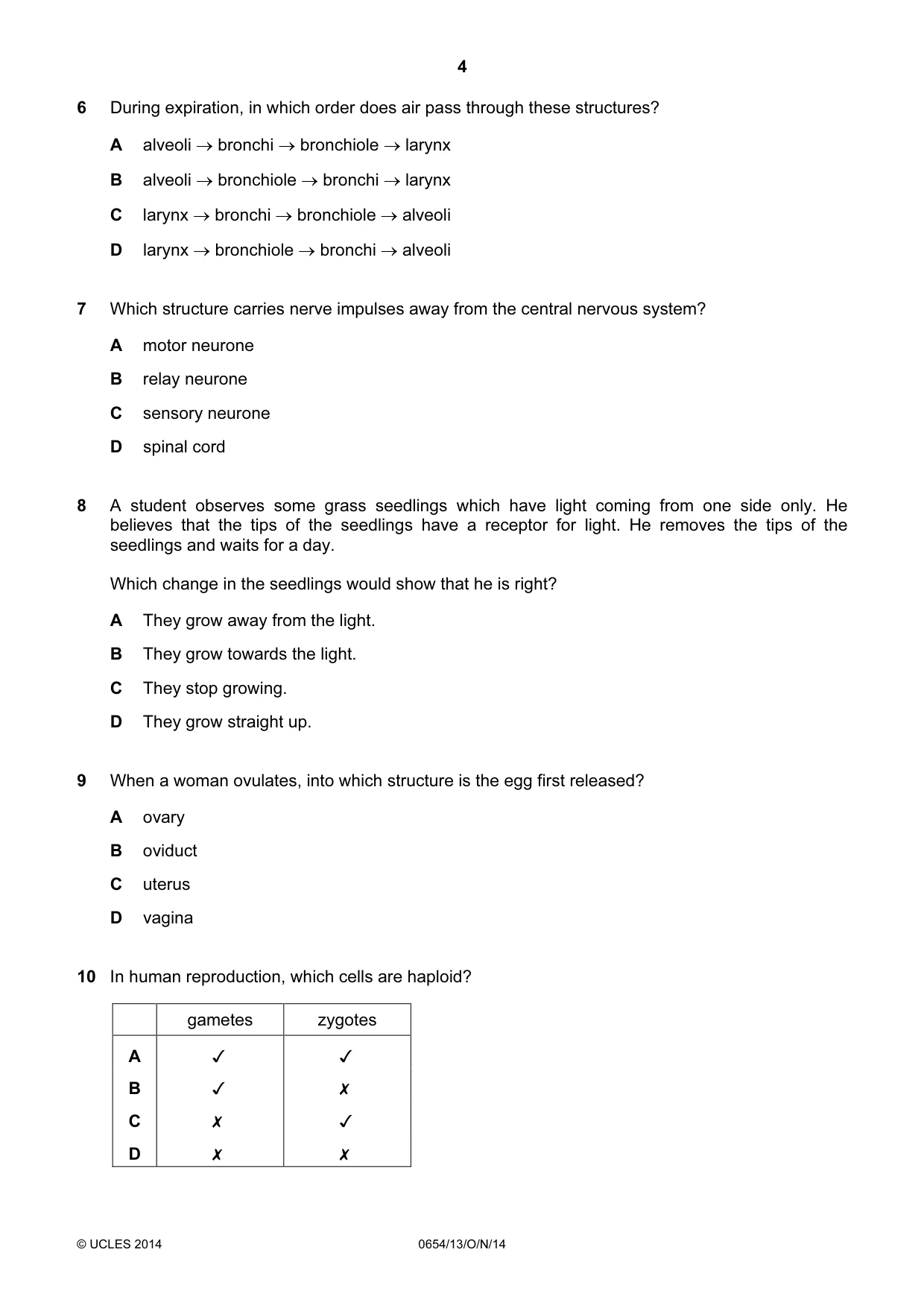
10 In human reproduction, which cells are haploid? gametes zygotes v v loom > v x x v x x
Mark scheme: B
Q11 · Which statement about human gametes is correct?
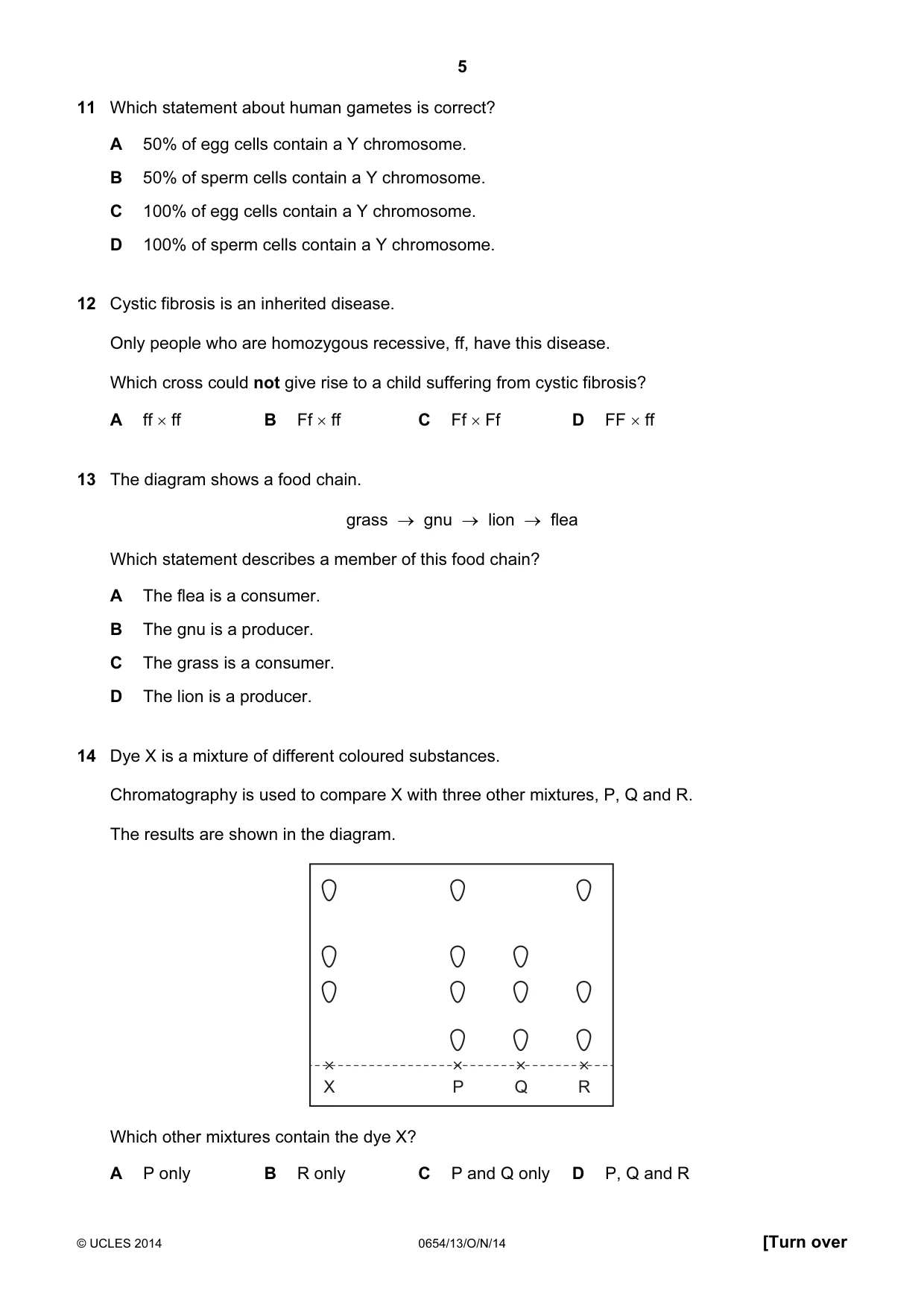
11 Which statement about human gametes is correct? A 50% of egg cells contain a Y chromosome. B 50% of sperm cells contain a Y chromosome. C 100% of egg cells contain a Y chromosome. D 100% of sperm cells contain a Y chromosome.
Mark scheme: B
Q12 · Cystic fibrosis is an inherited disease
12 Cystic fibrosis is an inherited disease. Only people who are homozygous recessive, ff, have this disease. Which cross could not give rise to a child suffering from cystic fibrosis? A ff × ff B Ff × ff C Ff × Ff D FF × ff
Mark scheme: D
Q13 · The diagram shows a food chain
13 The diagram shows a food chain. grass → gnu → lion → flea Which statement describes a member of this food chain? A The flea is a consumer. B The gnu is a producer. C The grass is a consumer. D The lion is a producer.
Mark scheme: A
Q14 · Dye X is a mixture of different coloured substances
14 Dye X is a mixture of different coloured substances. Chromatography is used to compare X with three other mixtures, P, Q and R. The results are shown in the diagram. X P Q R Which other mixtures contain the dye X? A P only B R only C P and Q only D P, Q and R
Mark scheme: A
Q15 · Which process can be used to produce sodium and chlorine from the compound sodium…
15 Which process can be used to produce sodium and chlorine from the compound sodium chloride? A cracking B distillation C electrolysis D filtration
Mark scheme: C
Q16 · The diagram shows one of the steps needed to make drinking water
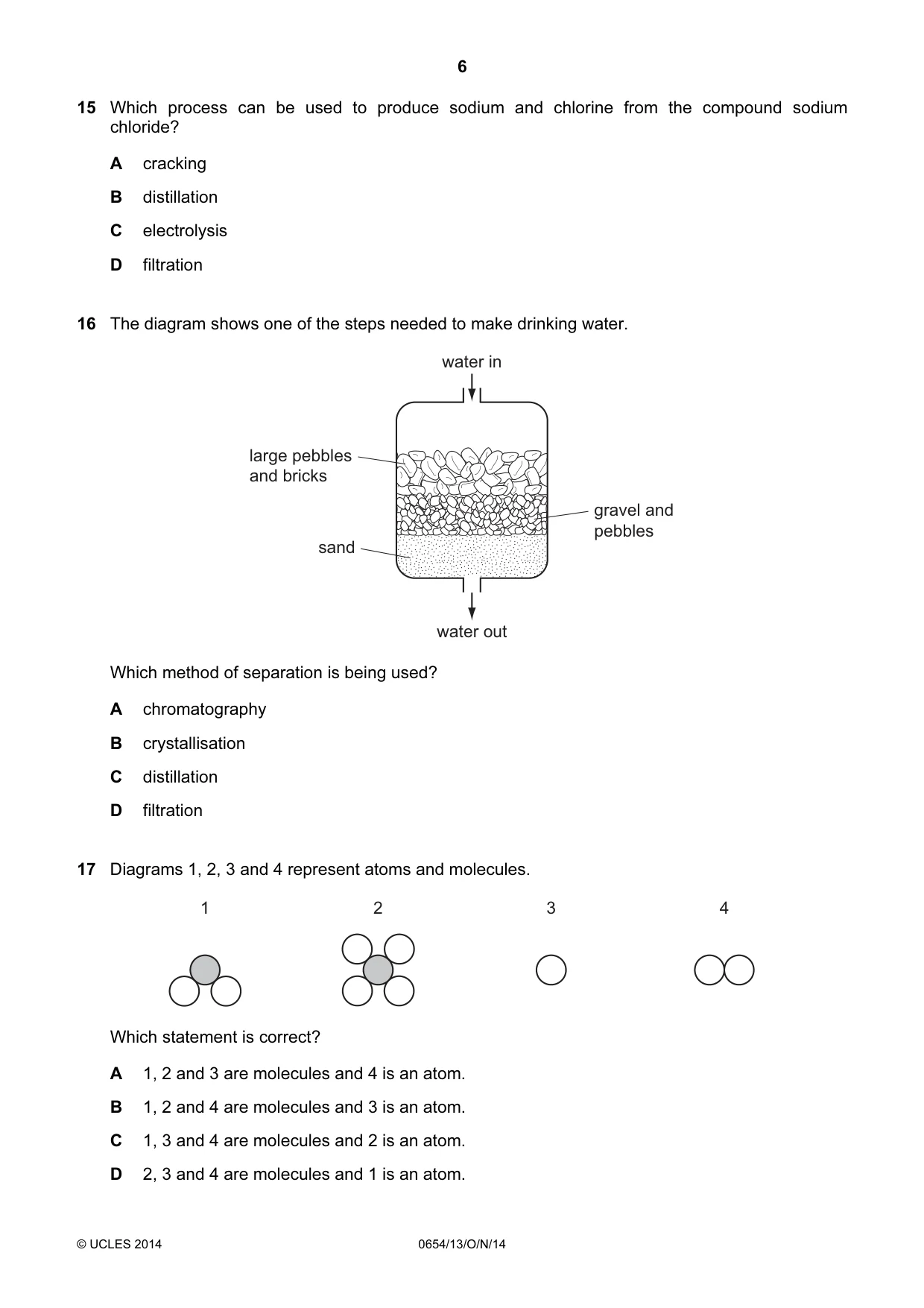
16 The diagram shows one of the steps needed to make drinking water. water in large pebbles and bricks gravel and pebbles sand water out Which method of separation is being used? A chromatography B crystallisation C distillation D filtration
Mark scheme: D
Q17 · Diagrams 1, 2, 3 and 4 represent atoms and molecules
17 Diagrams 1, 2, 3 and 4 represent atoms and molecules. 1 2 3 4 Which statement is correct? A 1, 2 and 3 are molecules and 4 is an atom. B 1, 2 and 4 are molecules and 3 is an atom. C 1, 3 and 4 are molecules and 2 is an atom. D 2, 3 and 4 are molecules and 1 is an atom.
Mark scheme: B
Q18 · Hydrogen peroxide is a compound
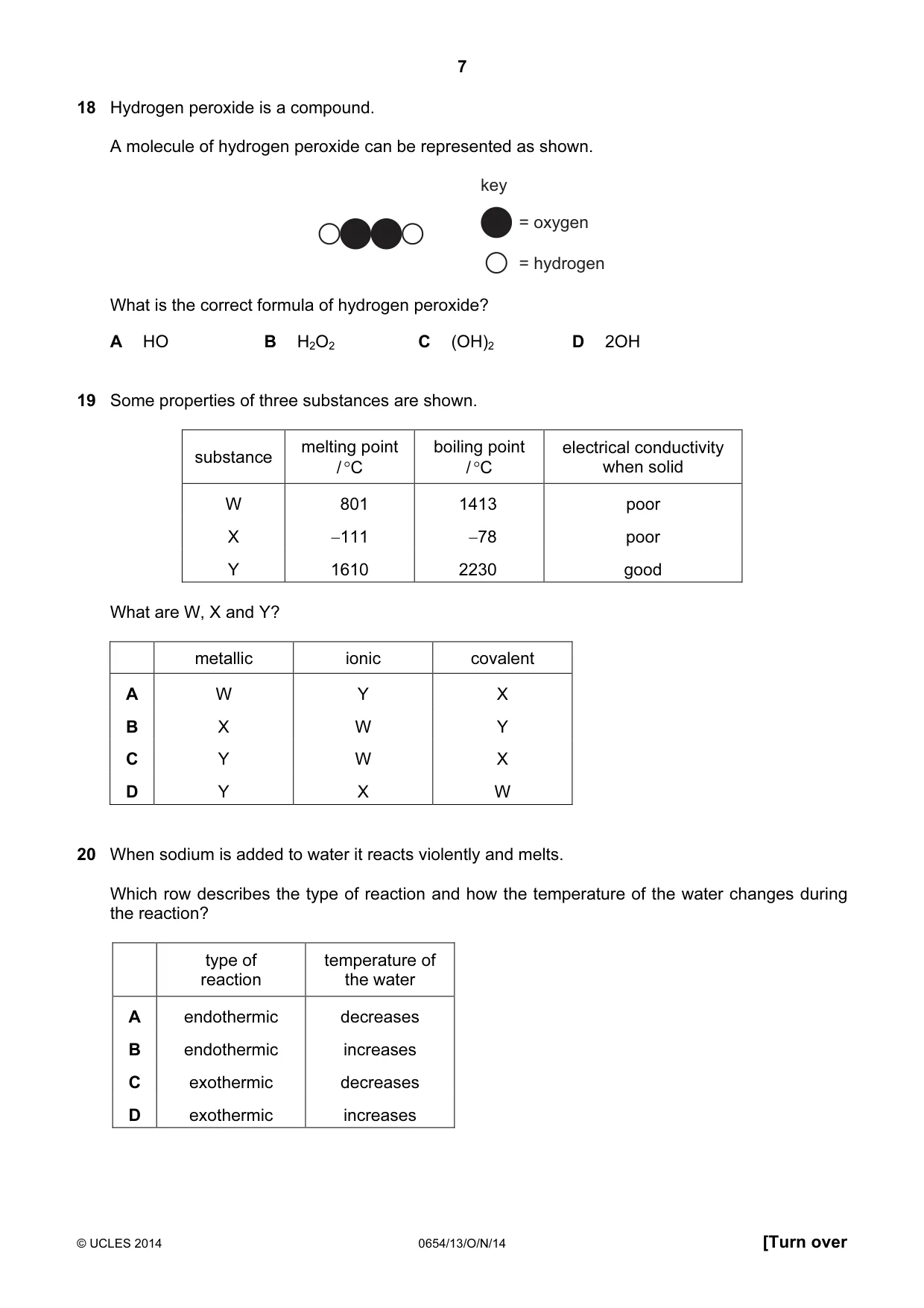
18 Hydrogen peroxide is a compound. A molecule of hydrogen peroxide can be represented as shown. key = oxygen = hydrogen What is the correct formula of hydrogen peroxide? A HO B H2O2 C (OH)2 D 2OH
Mark scheme: B
Q19 · Some properties of three substances are shown
19 Some properties of three substances are shown. melting point boiling point electrical conductivity substance / °C / °C when solid W 801 1413 poor X −111 −78 poor Y 1610 2230 good What are W, X and Y? metallic ionic covalent A W Y X B X W Y C Y W X D Y X W
Mark scheme: C
Q20 · When sodium is added to water it reacts violently and melts
20 When sodium is added to water it reacts violently and melts. Which row describes the type of reaction and how the temperature of the water changes during the reaction? type of temperature of reaction the water A endothermic decreases B endothermic increases C exothermic decreases D exothermic increases
Mark scheme: D
Q21 · Solid copper(II) carbonate reacts with dilute nitric acid producing carbon dioxide
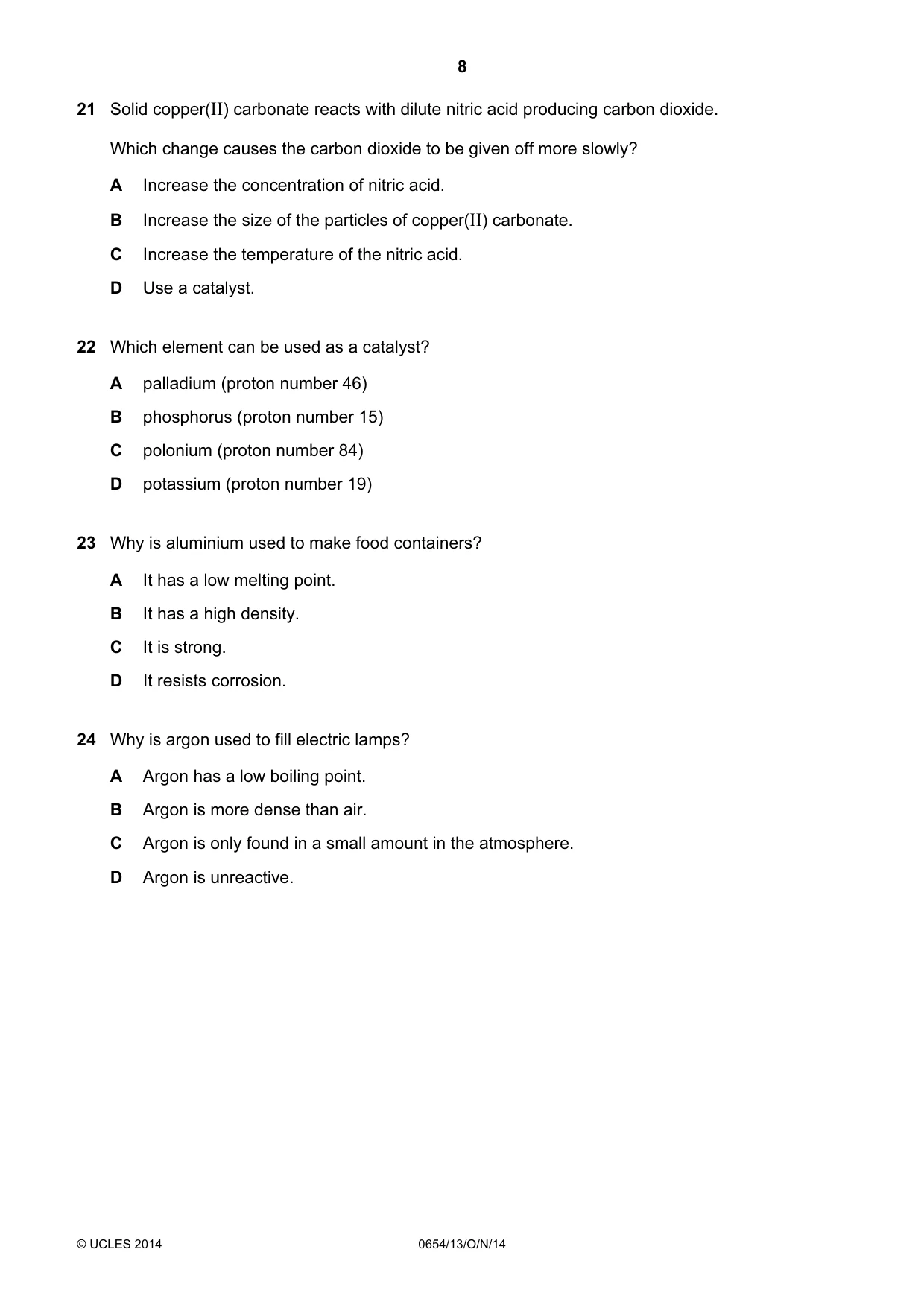
21 Solid copper(II) carbonate reacts with dilute nitric acid producing carbon dioxide. Which change causes the carbon dioxide to be given off more slowly? A Increase the concentration of nitric acid. B Increase the size of the particles of copper(II) carbonate. C Increase the temperature of the nitric acid. D Use a catalyst.
Mark scheme: B
Q22 · Which element can be used as a catalyst?
22 Which element can be used as a catalyst? A palladium (proton number 46) B phosphorus (proton number 15) C polonium (proton number 84) D potassium (proton number 19)
Mark scheme: A
Q23 · Why is aluminium used to make food containers?
23 Why is aluminium used to make food containers? A It has a low melting point. B It has a high density. C It is strong. D It resists corrosion.
Mark scheme: D
Q24 · Why is argon used to fill electric lamps?
24 Why is argon used to fill electric lamps? A Argon has a low boiling point. B Argon is more dense than air. C Argon is only found in a small amount in the atmosphere. D Argon is unreactive.
Mark scheme: D
Q25 · The diagram shows an experiment on a liquid hydrocarbon
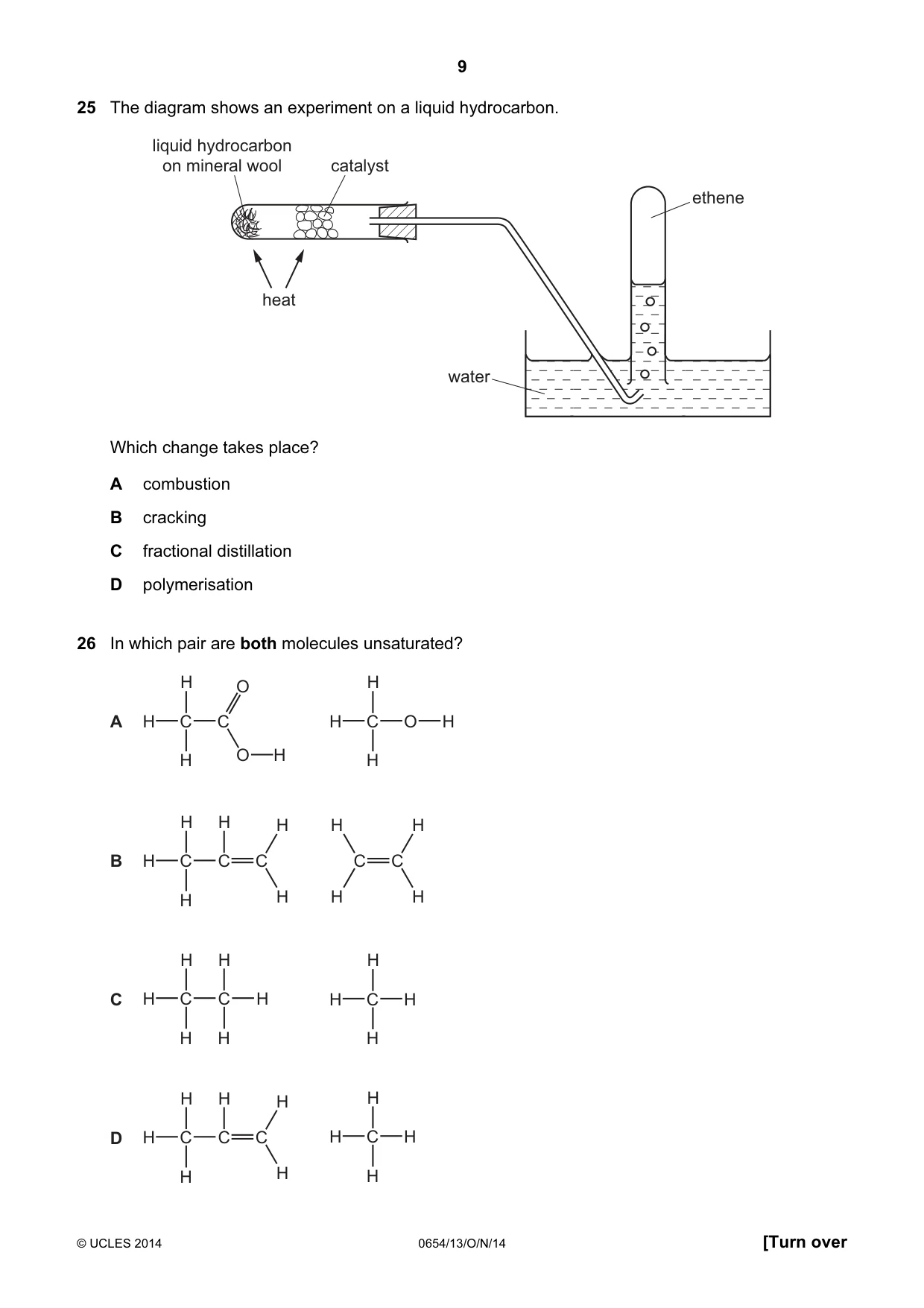
25 The diagram shows an experiment on a liquid hydrocarbon. liquid hydrocarbon on mineral wool catalyst ethene heat water Which change takes place? A combustion B cracking C fractional distillation D polymerisation
Mark scheme: B
Q26 · In which pair are both molecules unsaturated?
26 In which pair are both molecules unsaturated? H O H A H C C H C O H H O H H H H H H H B H C C C C C H H H H H H H C H C C H H C H H H H H H H H D H C C C H C H H H H
Mark scheme: B
Q27 · The diagram shows waste organic material decaying
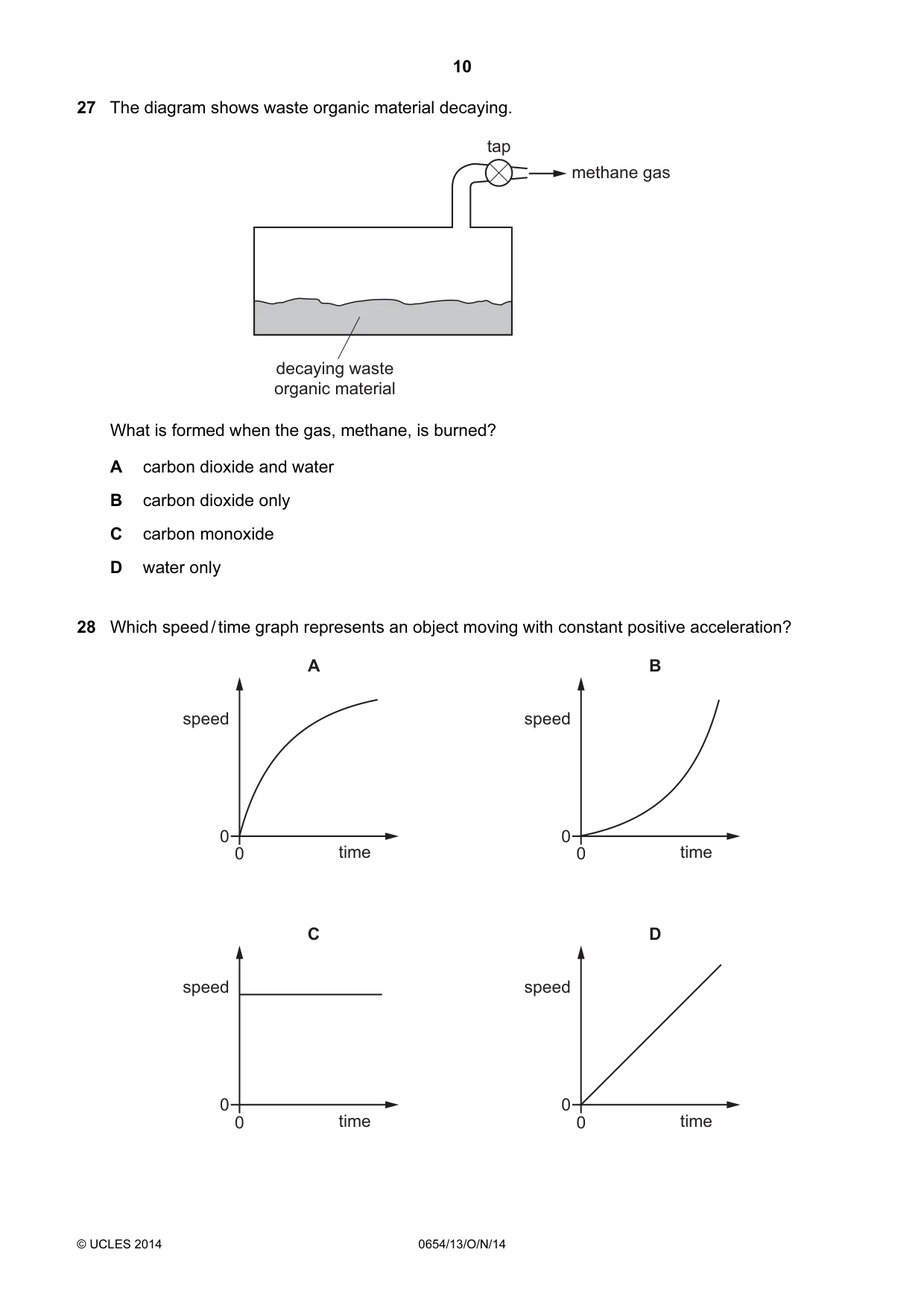
27 The diagram shows waste organic material decaying. tap methane gas decaying waste organic material What is formed when the gas, methane, is burned? A carbon dioxide and water B carbon dioxide only C carbon monoxide D water only
Mark scheme: A
Q28 · Which speed / time graph represents an object moving with constant positive acceleration?
28 Which speed / time graph represents an object moving with constant positive acceleration? A B speed speed 0 0 0 time 0 time C D speed speed 0 0 0 time 0 time
Mark scheme: D
Q29 · Which situation does not involve any work being done?
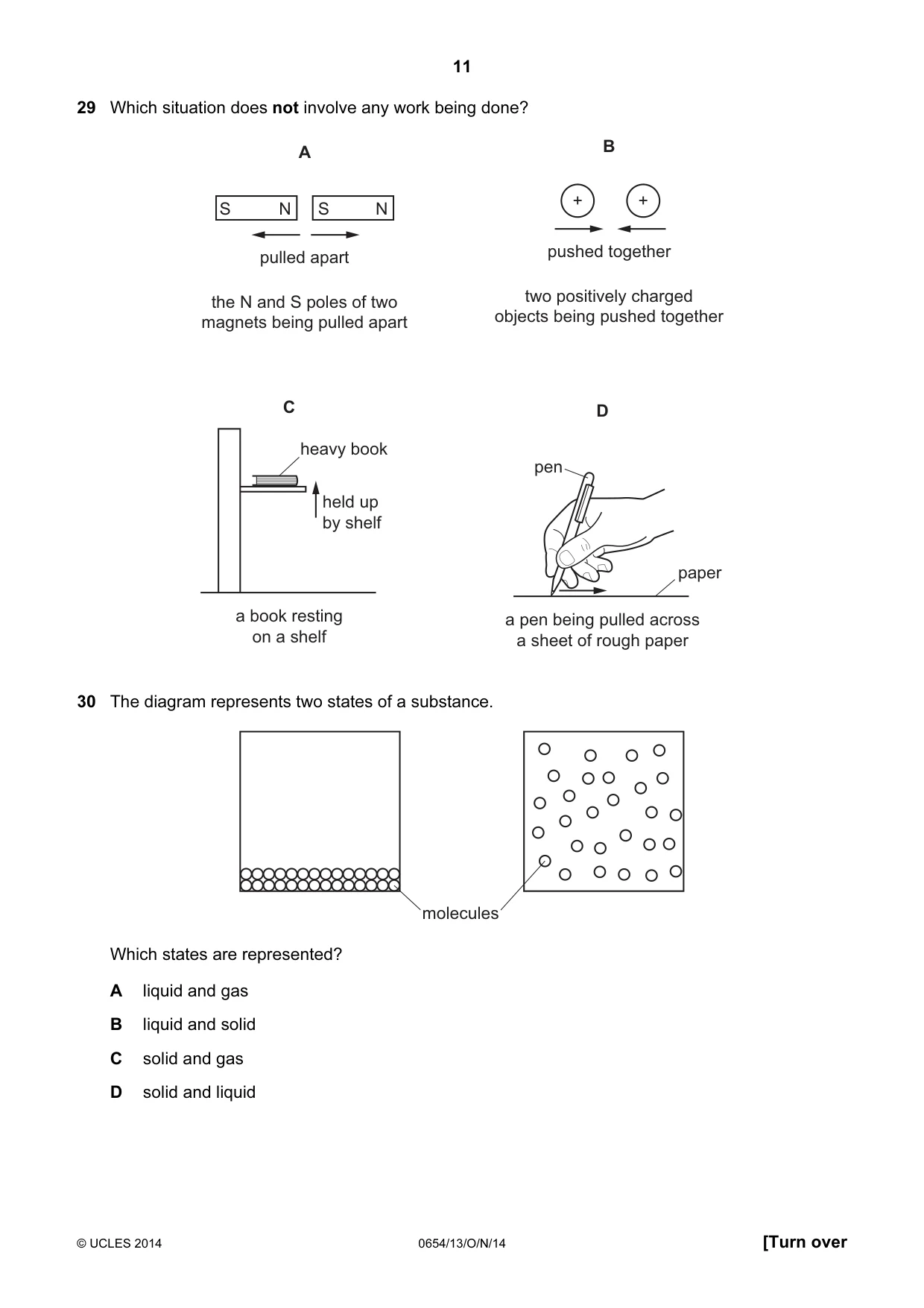
29 Which situation does not involve any work being done? A B N S N + + S pulled apart pushed together the N and S poles of two two positively charged magnets being pulled apart objects being pushed together C D heavy book pen held up by shelf paper a book resting a pen being pulled across on a shelf a sheet of rough paper
Mark scheme: C
Q30 · The diagram represents two states of a substance
30 The diagram represents two states of a substance. molecules Which states are represented? A liquid and gas B liquid and solid C solid and gas D solid and liquid
Mark scheme: C
Q31 · Four students write statements about melting and boiling
31 Four students write statements about melting and boiling. Which statement is not correct? A A liquid only evaporates when it has reached its boiling point. B Heat energy is needed to melt a solid. C When a solid is melting, its temperature does not change. D When a substance is a liquid, its temperature will not rise above its boiling point.
Mark scheme: A
Q32 · A wide container of water is heated from below
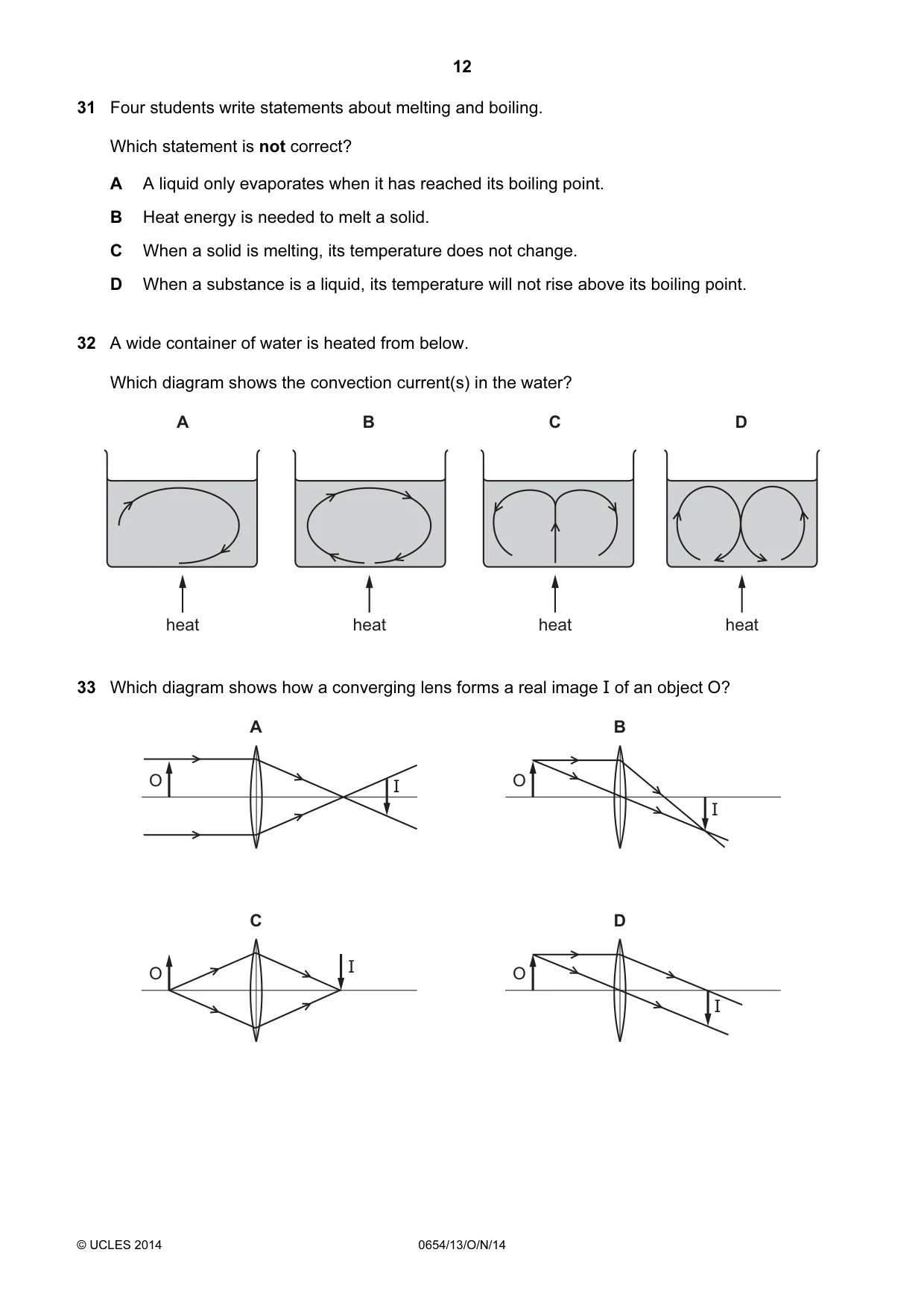
32 A wide container of water is heated from below. Which diagram shows the convection current(s) in the water? A B C D heat heat heat heat
Mark scheme: C
Q33 · Which diagram shows how a converging lens forms a real image I of an object O?
33 Which diagram shows how a converging lens forms a real image I of an object O? A B O I O I C D O I O I
Mark scheme: B
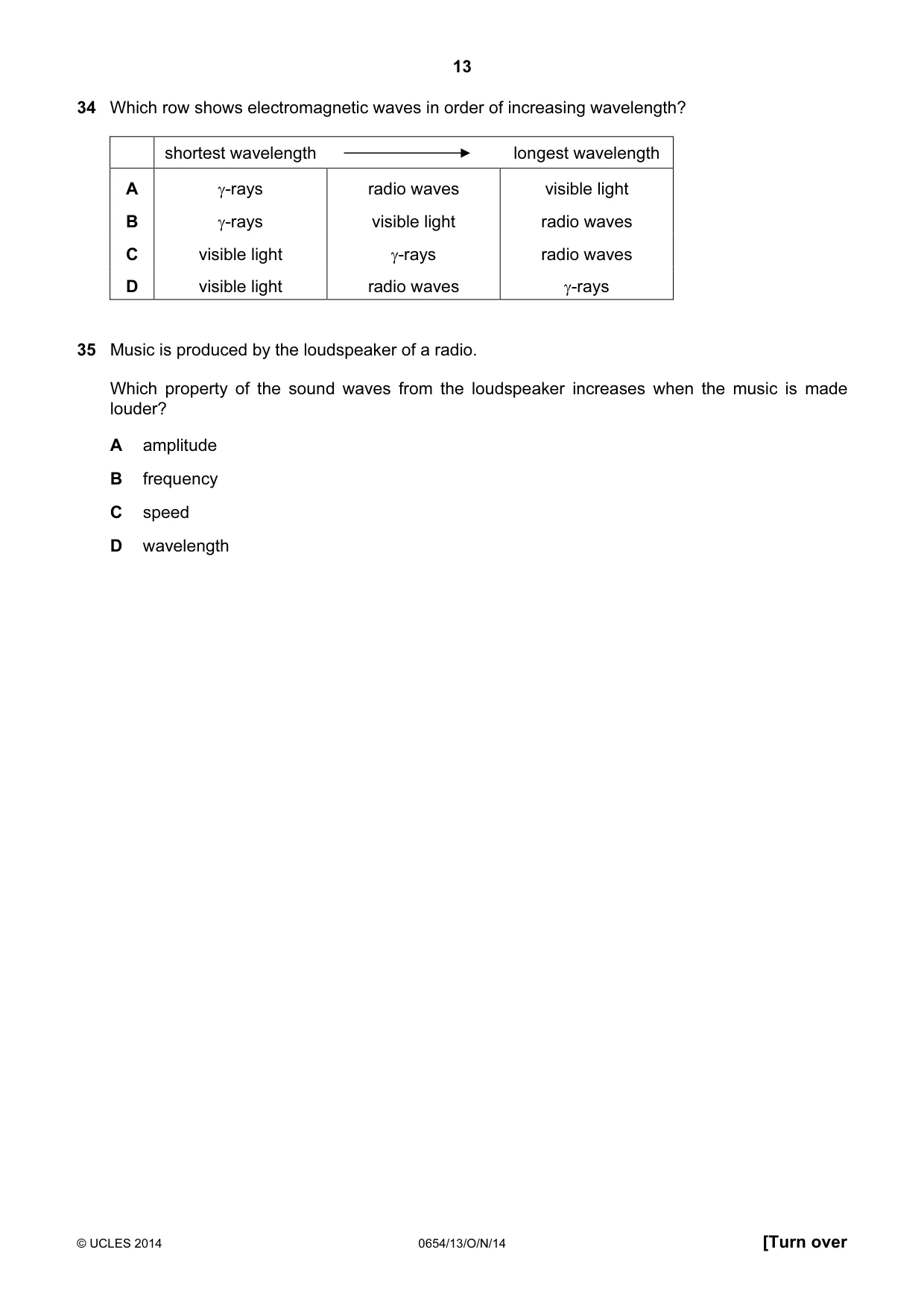
Q34 · Which row shows electromagnetic waves in order of increasing wavelength?
34 Which row shows electromagnetic waves in order of increasing wavelength? shortest wavelength longest wavelength A γ-rays radio waves visible light B γ-rays visible light radio waves C visible light γ-rays radio waves D visible light radio waves γ-rays
Mark scheme: B
Q35 · Music is produced by the loudspeaker of a radio
35 Music is produced by the loudspeaker of a radio. Which property of the sound waves from the loudspeaker increases when the music is made louder? A amplitude B frequency C speed D wavelength
Mark scheme: A
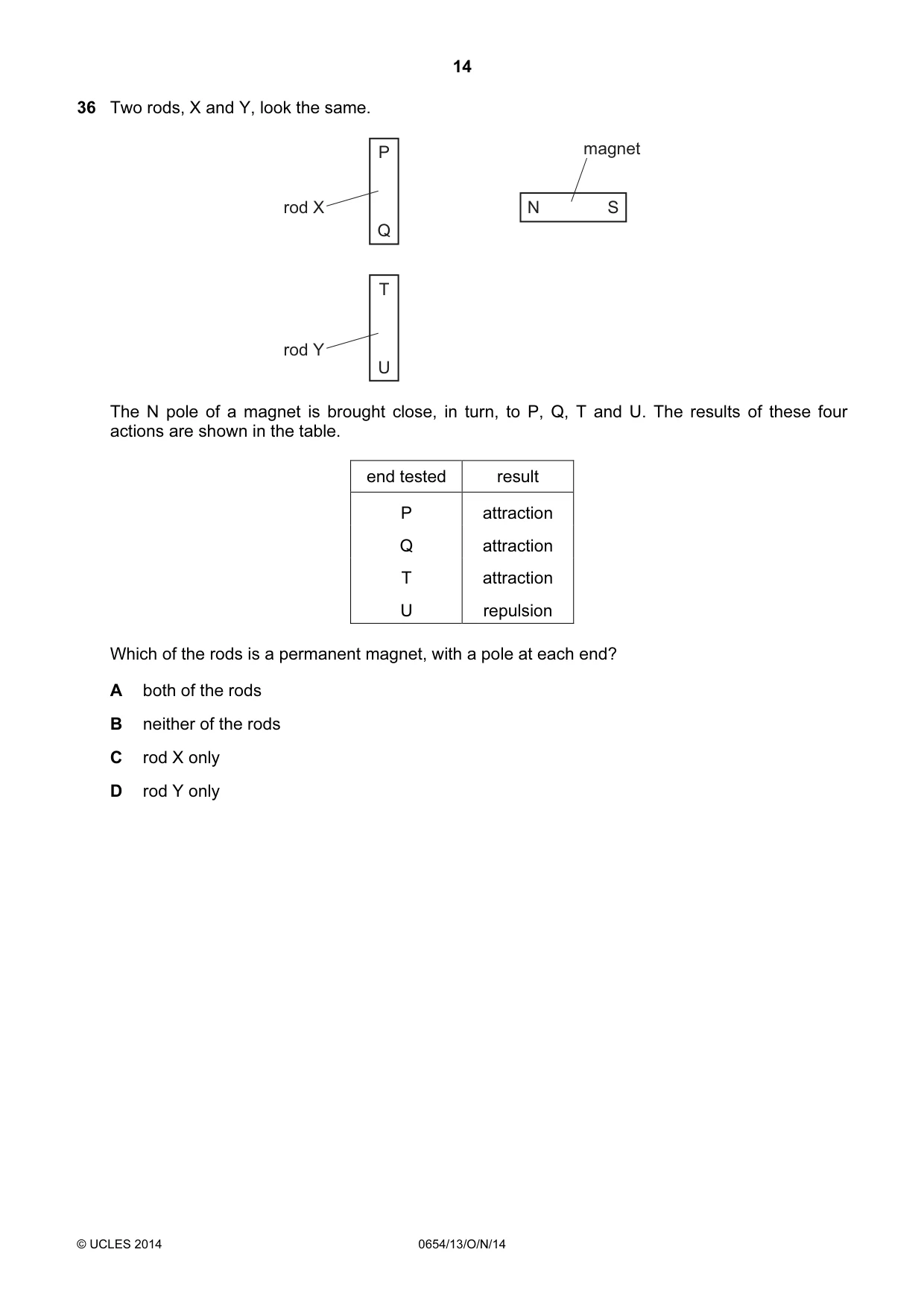
Q36 · Two rods, X and Y, look the same
36 Two rods, X and Y, look the same. P magnet rod X N S Q T rod Y U The N pole of a magnet is brought close, in turn, to P, Q, T and U. The results of these four actions are shown in the table. end tested result P attraction Q attraction T attraction U repulsion Which of the rods is a permanent magnet, with a pole at each end? A both of the rods B neither of the rods C rod X only D rod Y only
Mark scheme: D
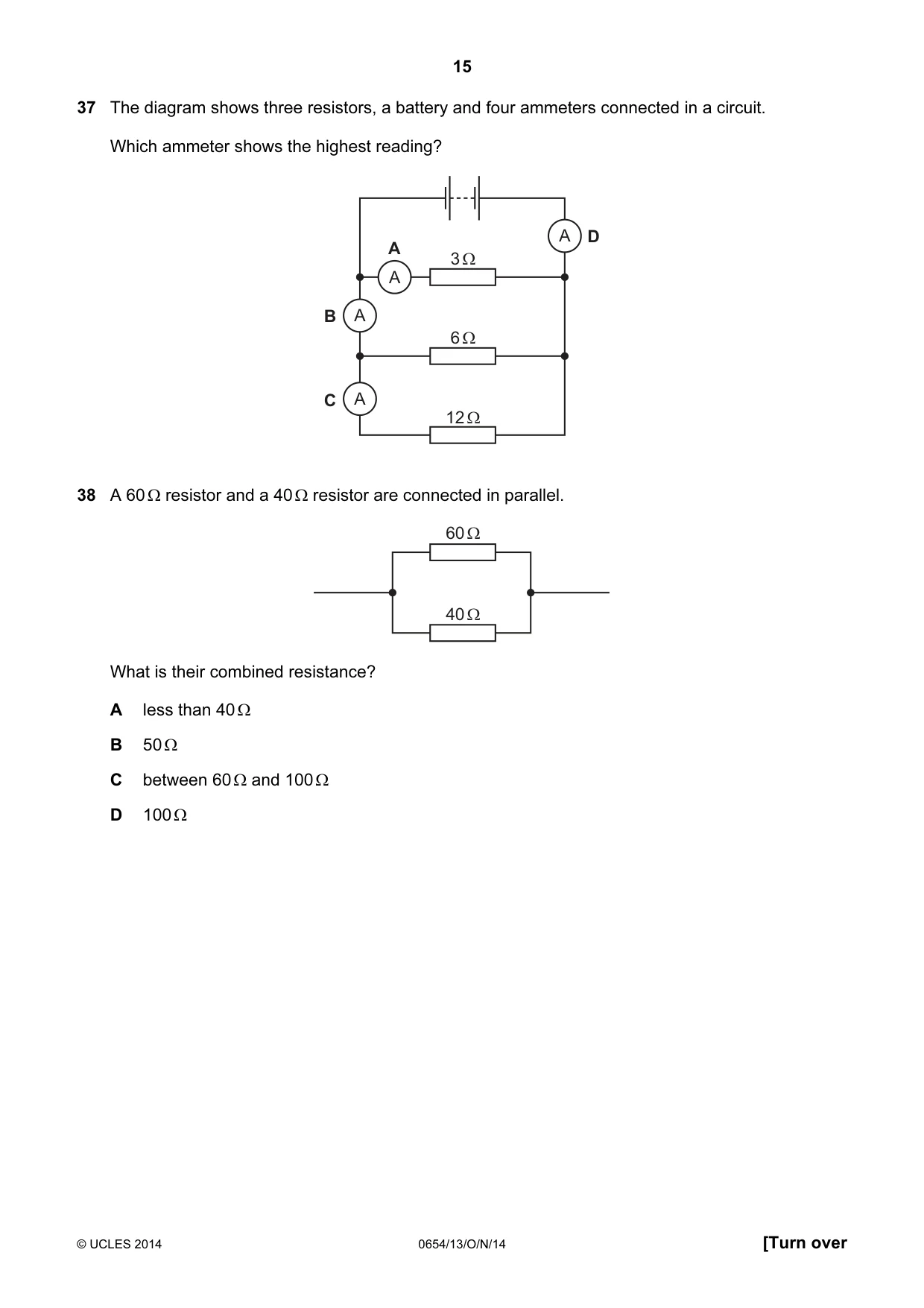
Q37 · The diagram shows three resistors, a battery and four ammeters connected in a circuit
37 The diagram shows three resistors, a battery and four ammeters connected in a circuit. Which ammeter shows the highest reading? A D A 3 Ω A B A 6 Ω C A 12 Ω
Mark scheme: D
Q38 · A 60 Ω resistor and a 40 Ω resistor are connected in parallel
38 A 60 Ω resistor and a 40 Ω resistor are connected in parallel. 60 Ω 40 Ω What is their combined resistance? A less than 40 Ω B 50 Ω C between 60 Ω and 100 Ω D 100 Ω
Mark scheme: A
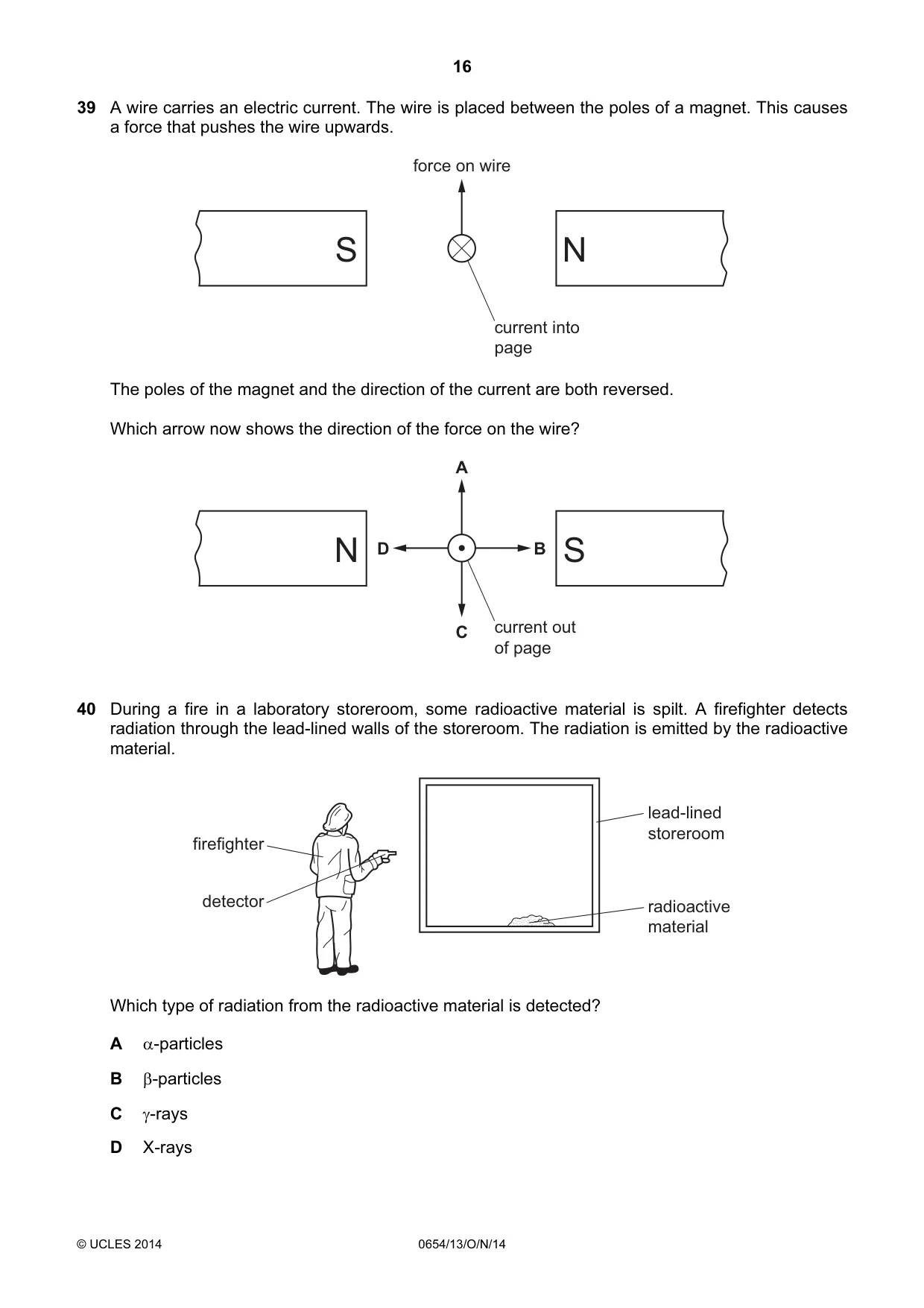
Q39 · A wire carries an electric current
39 A wire carries an electric current. The wire is placed between the poles of a magnet. This causes a force that pushes the wire upwards. force on wire S N current into page The poles of the magnet and the direction of the current are both reversed. Which arrow now shows the direction of the force on the wire? A N D B S C current out of page
Mark scheme: A
Q40 · During a fire in a laboratory storeroom, some radioactive material is spilt
40 During a fire in a laboratory storeroom, some radioactive material is spilt. A firefighter detects radiation through the lead-lined walls of the storeroom. The radiation is emitted by the radioactive material. lead-lined storeroom firefighter detector radioactive material Which type of radiation from the radioactive material is detected? A α-particles B β-particles C γ-rays D X-rays
Mark scheme: C
What was in this paper
The subtopics covered by these 40 questions, and how many questions each got. Open one in a new tab to see every Cambridge question on it.
2Coordination and response2Electrical circuits2Sexual reproduction in humans2Blood vessels1Cell division1Cell structure1Chromatography1Diffusion1Electrolysis1Electromagnetic effects1Electromagnetic spectrum1Elements, compounds and mixtures1Energy, work and power1Enzymes1Exothermic and endothermic reactions1Food chains and food webs1Formulas1Fuels1Gas exchange in humans1Heart1Ions and ionic bonds1Kinetic particle model of matter1Light1Monohybrid inheritance1Motion1Noble gases1Radioactivity1Rate of reaction1Separation and purification1Simple phenomena of magnetism1Sound1Thermal properties and temperature1Transfer of thermal energy1Transition elements1Uses of metals1What you needed in this session
Cambridge’s own grade thresholds for 2014 Oct/Nov, Paper 1 · Variant 3. A higher threshold means an easier paper — the bar moves with how the cohort did.