Cambridge IGCSE Sciences - Co-ordinated (Double) 0654 — 2017 May/June Paper 1 · Variant 3
0654/13/M/J/17 · 40 questions · 40 marks · ≈45 min
The question paper and its mark scheme, free to read here and free to download. This is Cambridge’s own paper, exactly as it was sat.
Question paper16 pages
Mark scheme3 pages
Answers below. Sit the paper first if you are practising.
Questions as text
Q1 · What is not produced by artificial selection?
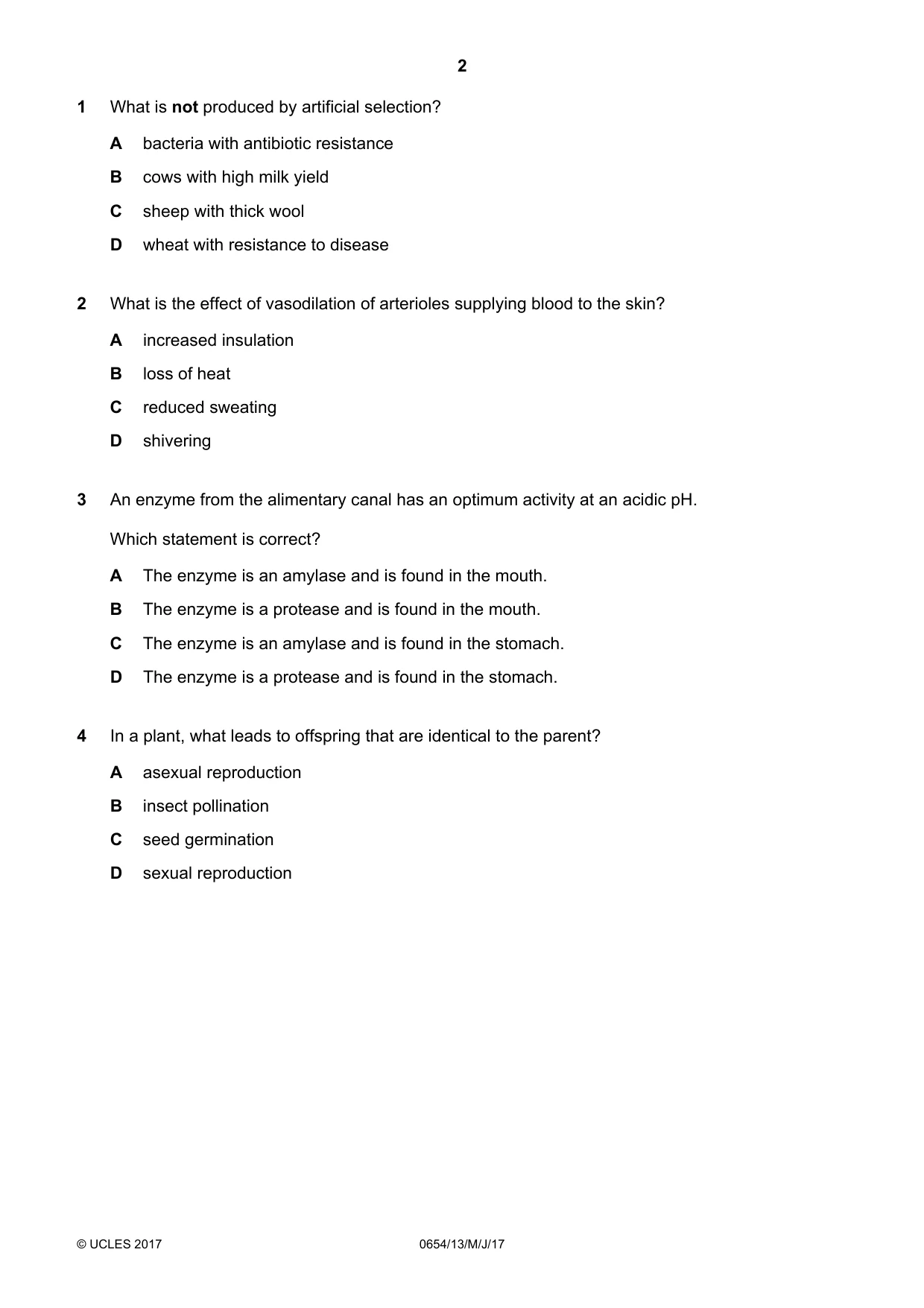
1 What is not produced by artificial selection? A bacteria with antibiotic resistance B cows with high milk yield C sheep with thick wool D wheat with resistance to disease
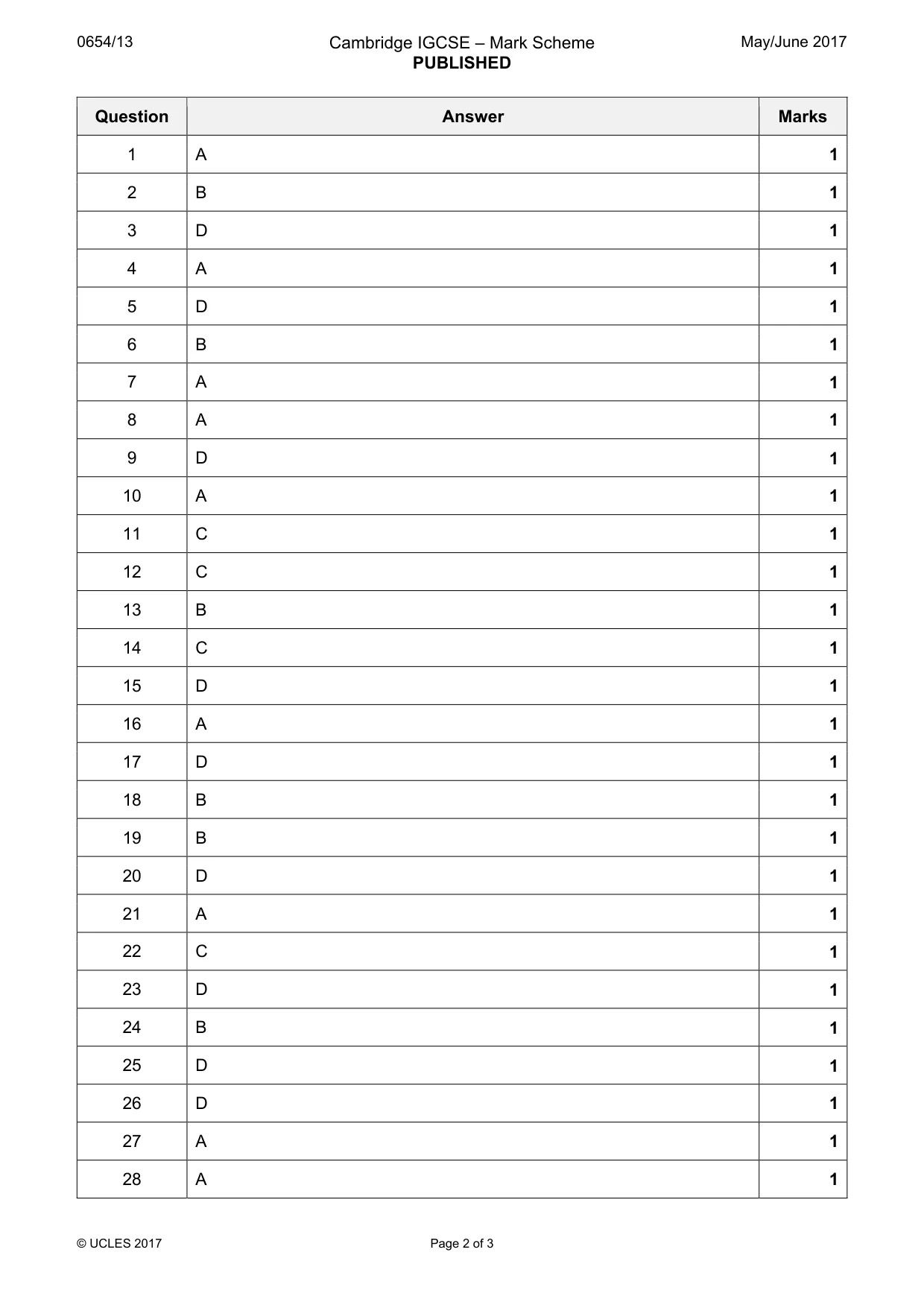
Mark scheme: A
Q2 · What is the effect of vasodilation of arterioles supplying blood to the skin?
2 What is the effect of vasodilation of arterioles supplying blood to the skin? A increased insulation B loss of heat C reduced sweating D shivering
Mark scheme: B
Q3 · An enzyme from the alimentary canal has an optimum activity at an acidic pH
3 An enzyme from the alimentary canal has an optimum activity at an acidic pH. Which statement is correct? A The enzyme is an amylase and is found in the mouth. B The enzyme is a protease and is found in the mouth. C The enzyme is an amylase and is found in the stomach. D The enzyme is a protease and is found in the stomach.
Mark scheme: D
Q4 · In a plant, what leads to offspring that are identical to the parent?
4 In a plant, what leads to offspring that are identical to the parent? A asexual reproduction B insect pollination C seed germination D sexual reproduction
Mark scheme: A
Q5 · The diagram shows a river and four farms
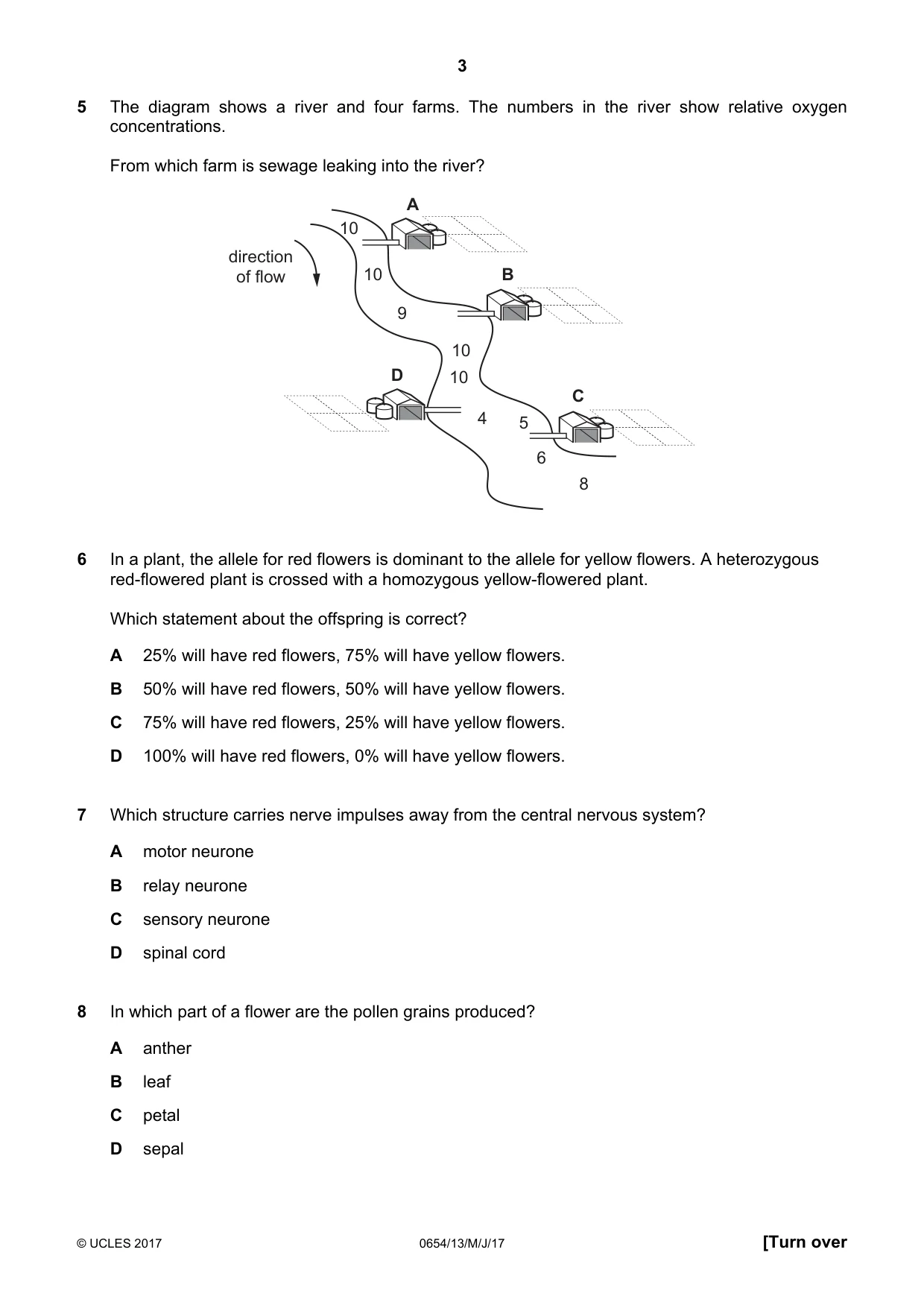
5 The diagram shows a river and four farms. The numbers in the river show relative oxygen concentrations. From which farm is sewage leaking into the river? A 10 direction of flow 10 B 9 10 D 10 C 4 5 6 8
Mark scheme: D
Q6 · In a plant, the allele for red flowers is dominant to the allele for yellow flowers
6 In a plant, the allele for red flowers is dominant to the allele for yellow flowers. A heterozygous red-flowered plant is crossed with a homozygous yellow-flowered plant. Which statement about the offspring is correct? A 25% will have red flowers, 75% will have yellow flowers. B 50% will have red flowers, 50% will have yellow flowers. C 75% will have red flowers, 25% will have yellow flowers. D 100% will have red flowers, 0% will have yellow flowers.
Mark scheme: B
Q7 · Which structure carries nerve impulses away from the central nervous system?
7 Which structure carries nerve impulses away from the central nervous system? A motor neurone B relay neurone C sensory neurone D spinal cord
Mark scheme: A
Q8 · In which part of a flower are the pollen grains produced?
8 In which part of a flower are the pollen grains produced? A anther B leaf C petal D sepal
Mark scheme: A
Q9 · A blood cell is travelling through the hepatic vein
9 A blood cell is travelling through the hepatic vein. Which blood vessel will it travel through next? A hepatic artery B pulmonary artery C pulmonary vein D vena cava
Mark scheme: D
Q10 · Which processes occur in both animals and plants?
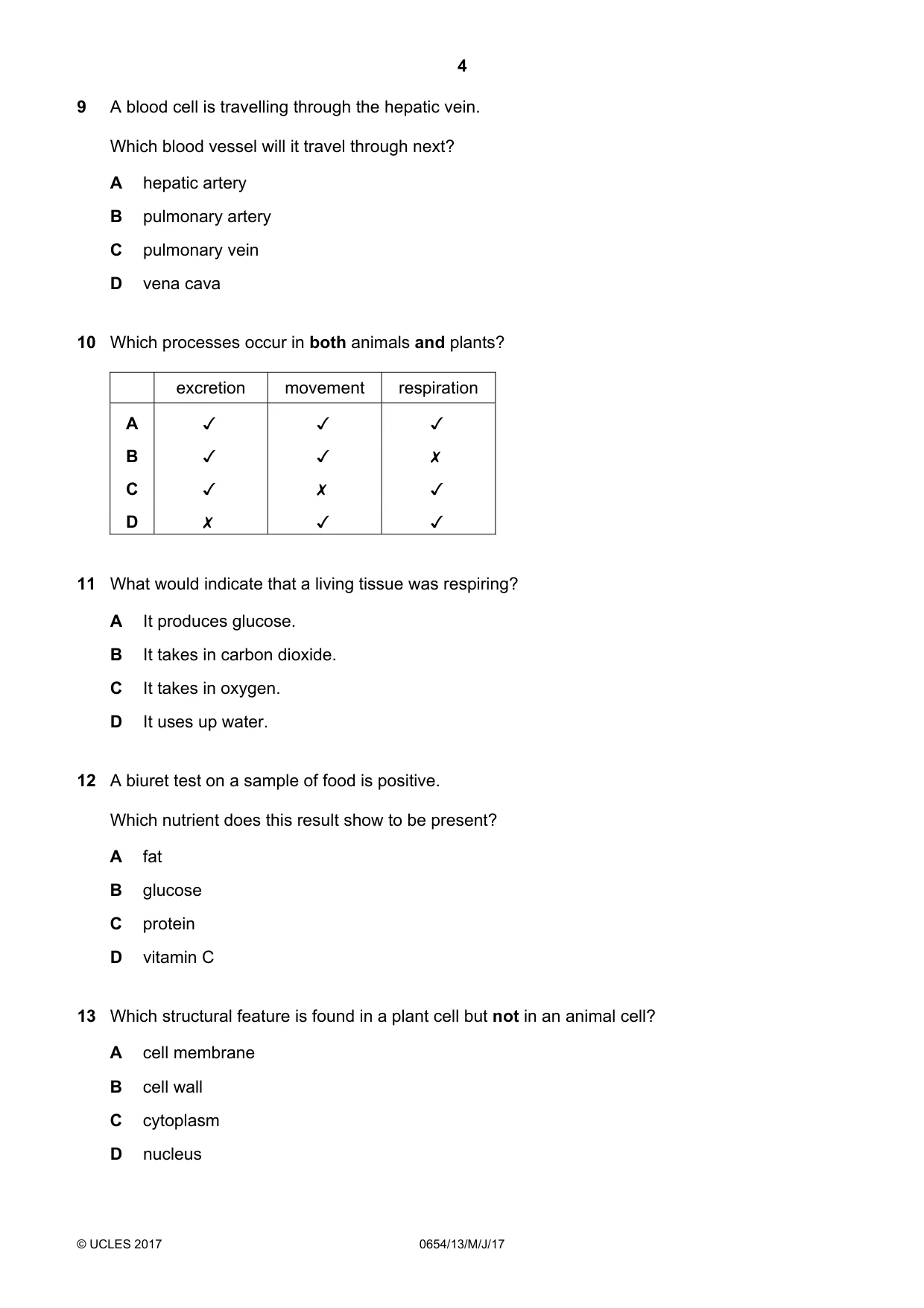
10 Which processes occur in both animals and plants? excretion movement respiration 0 0O WwW > ~ KS KK \ << x
Mark scheme: A
Q11 · What would indicate that a living tissue was respiring?
11 What would indicate that a living tissue was respiring? A It produces glucose. B It takes in carbon dioxide. C It takes in oxygen. D It uses up water.
Mark scheme: C
Q12 · A biuret test on a sample of food is positive
12 A biuret test on a sample of food is positive. Which nutrient does this result show to be present? A fat B glucose C protein D vitamin C
Mark scheme: C
Q13 · Which structural feature is found in a plant cell but not in an animal cell?
13 Which structural feature is found in a plant cell but not in an animal cell? A cell membrane B cell wall C cytoplasm D nucleus
Mark scheme: B
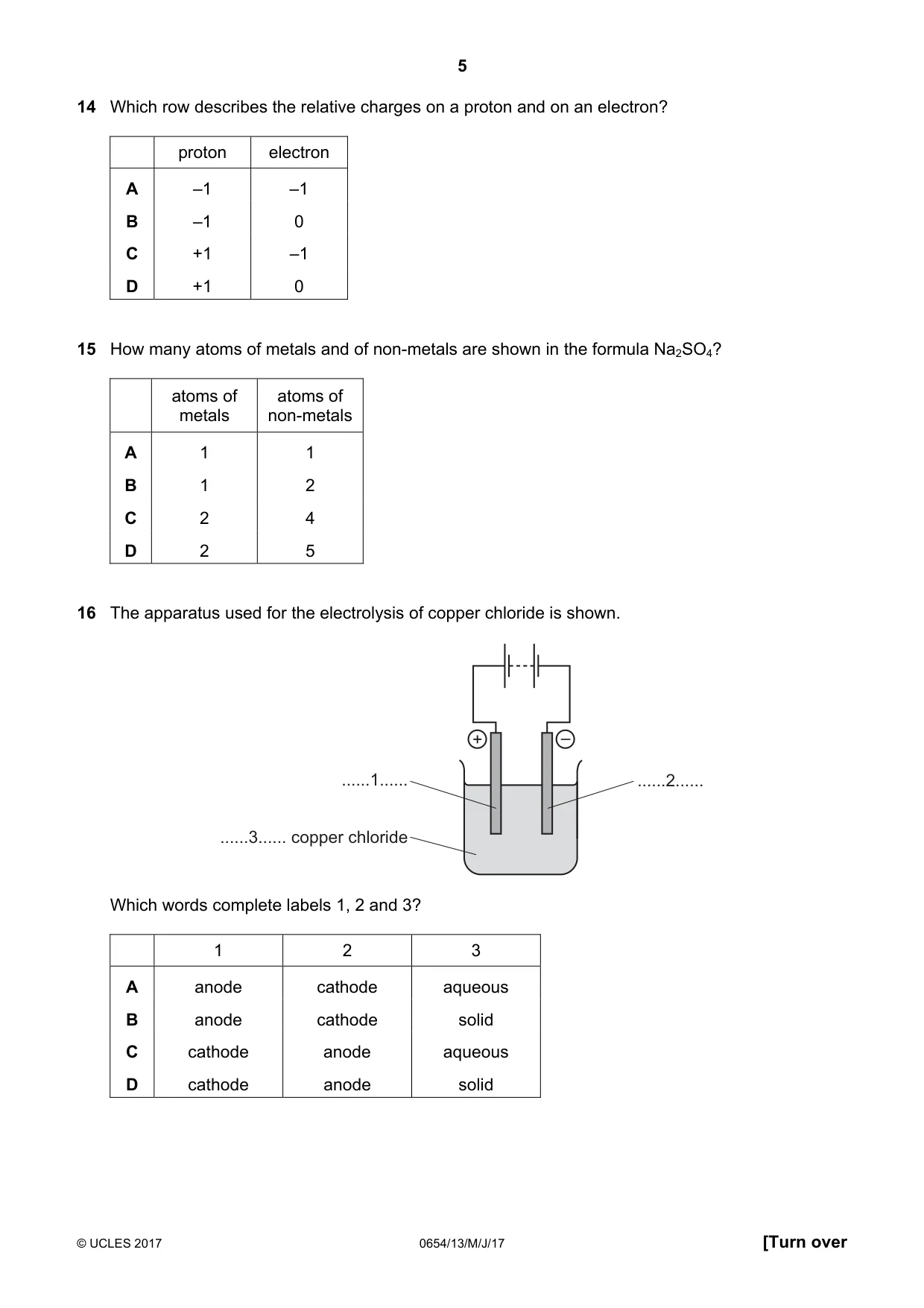
Q14 · Which row describes the relative charges on a proton and on an electron?
14 Which row describes the relative charges on a proton and on an electron? proton electron A –1 –1 B –1 0 C +1 –1 D +1 0
Mark scheme: C
Q15 · How many atoms of metals and of non-metals are shown in the formula Na2SO4?
15 How many atoms of metals and of non-metals are shown in the formula Na2SO4? atoms of atoms of metals non-metals A 1 1 B 1 2 C 2 4 D 2 5
Mark scheme: D
Q16 · The apparatus used for the electrolysis of copper chloride is shown
16 The apparatus used for the electrolysis of copper chloride is shown. + – ......1...... ......2...... ......3...... copper chloride Which words complete labels 1, 2 and 3? 1 2 3 A anode cathode aqueous B anode cathode solid C cathode anode aqueous D cathode anode solid
Mark scheme: A
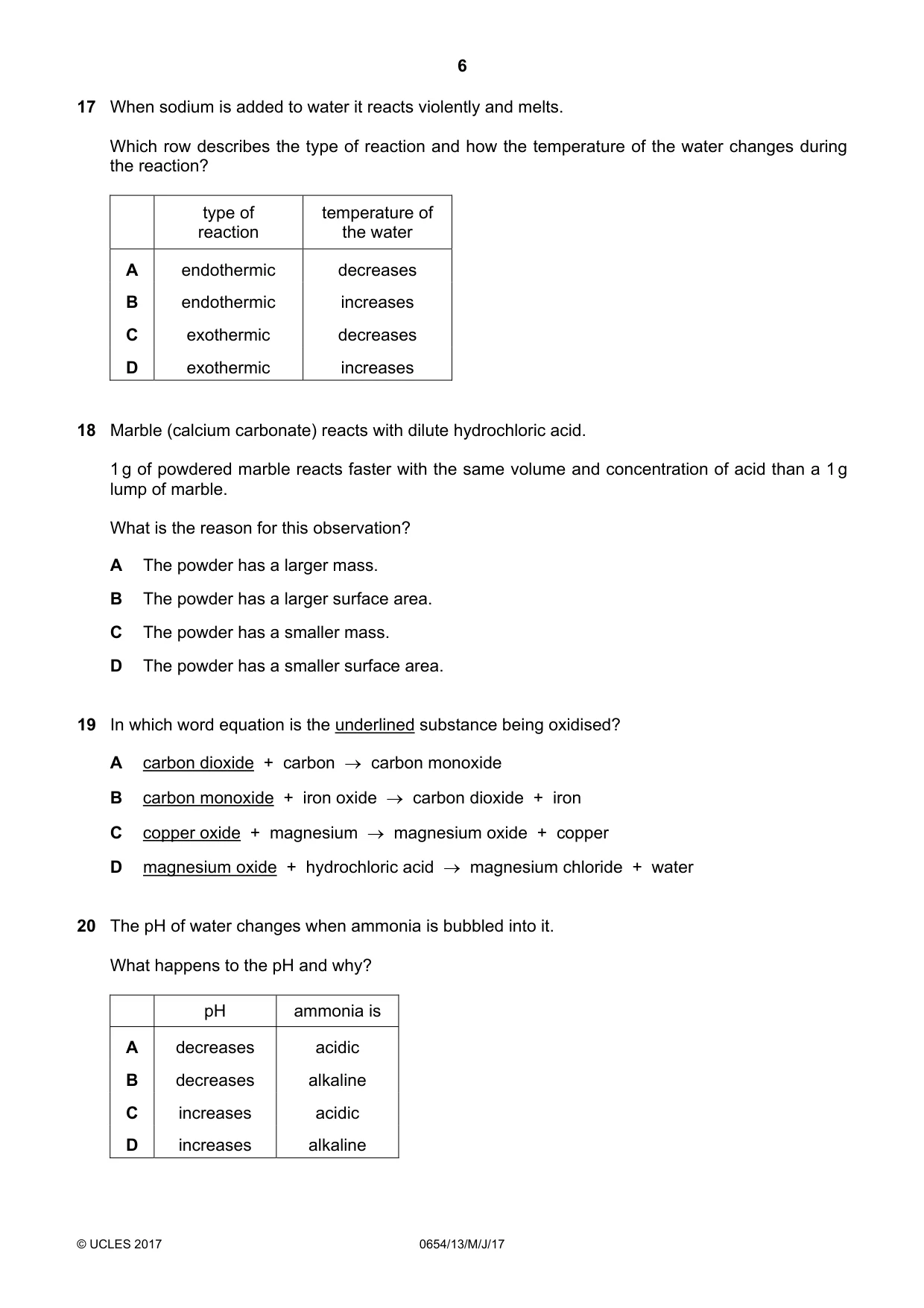
Q17 · When sodium is added to water it reacts violently and melts
17 When sodium is added to water it reacts violently and melts. Which row describes the type of reaction and how the temperature of the water changes during the reaction? type of temperature of reaction the water A endothermic decreases B endothermic increases C exothermic decreases D exothermic increases
Mark scheme: D
Q18 · Marble (calcium carbonate) reacts with dilute hydrochloric acid
18 Marble (calcium carbonate) reacts with dilute hydrochloric acid. 1 g of powdered marble reacts faster with the same volume and concentration of acid than a 1 g lump of marble. What is the reason for this observation? A The powder has a larger mass. B The powder has a larger surface area. C The powder has a smaller mass. D The powder has a smaller surface area.
Mark scheme: B
Q19 · In which word equation is the underlined substance being oxidised?
19 In which word equation is the underlined substance being oxidised? A carbon dioxide + carbon → carbon monoxide B carbon monoxide + iron oxide → carbon dioxide + iron C copper oxide + magnesium → magnesium oxide + copper D magnesium oxide + hydrochloric acid → magnesium chloride + water
Mark scheme: B
Q20 · The pH of water changes when ammonia is bubbled into it
20 The pH of water changes when ammonia is bubbled into it. What happens to the pH and why? pH ammonia is A decreases acidic B decreases alkaline C increases acidic D increases alkaline
Mark scheme: D
More questions on The characteristic properties of acids and bases
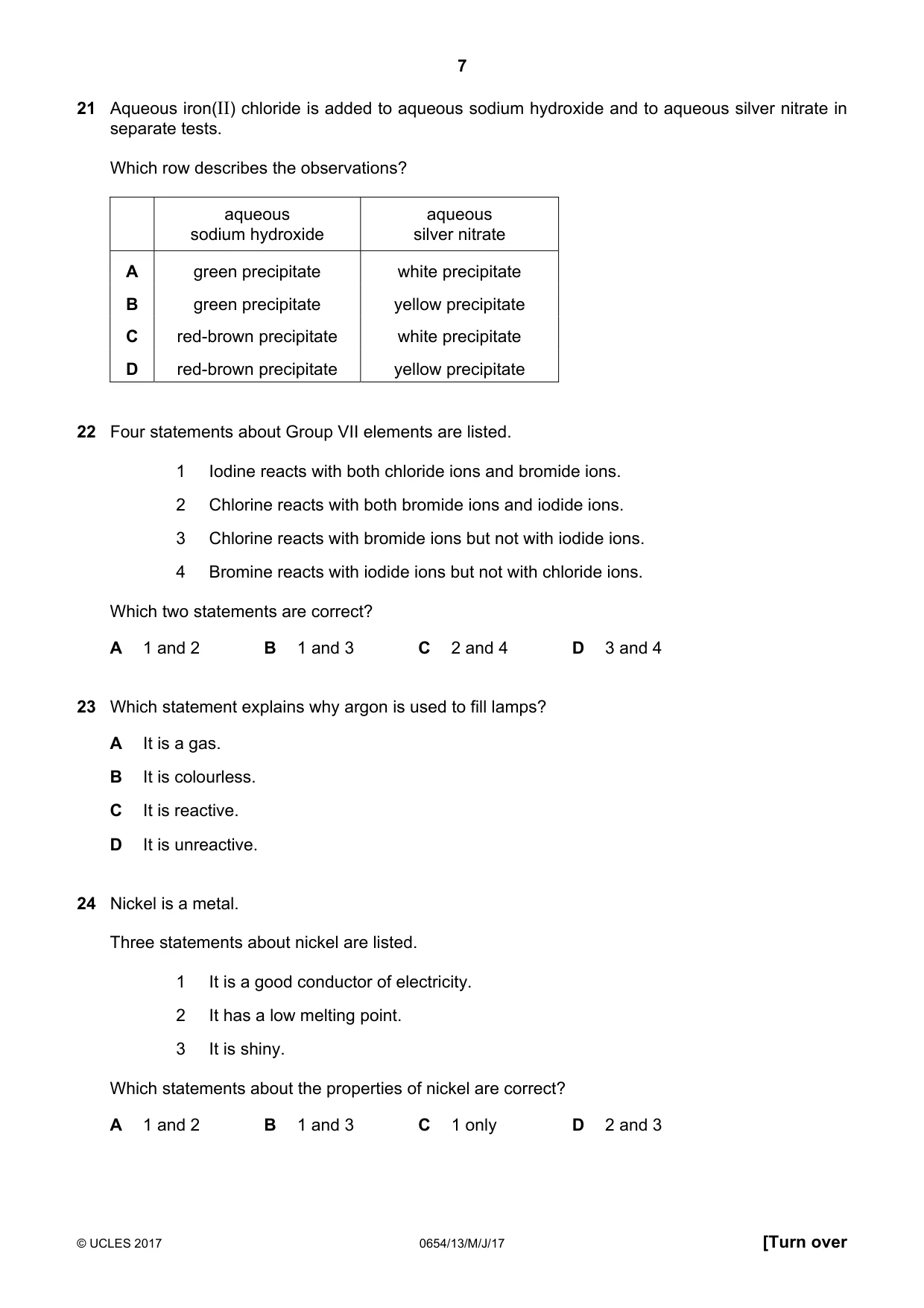
Q21 · Aqueous iron(II) chloride is added to aqueous sodium hydroxide and to aqueous silver…
21 Aqueous iron(II) chloride is added to aqueous sodium hydroxide and to aqueous silver nitrate in separate tests. Which row describes the observations? aqueous aqueous sodium hydroxide silver nitrate A green precipitate white precipitate B green precipitate yellow precipitate C red-brown precipitate white precipitate D red-brown precipitate yellow precipitate
Mark scheme: A
Q22 · Four statements about Group VII elements are listed
22 Four statements about Group VII elements are listed. 1 Iodine reacts with both chloride ions and bromide ions. 2 Chlorine reacts with both bromide ions and iodide ions. 3 Chlorine reacts with bromide ions but not with iodide ions. 4 Bromine reacts with iodide ions but not with chloride ions. Which two statements are correct? A 1 and 2 B 1 and 3 C 2 and 4 D 3 and 4
Mark scheme: C
Q23 · Which statement explains why argon is used to fill lamps?
23 Which statement explains why argon is used to fill lamps? A It is a gas. B It is colourless. C It is reactive. D It is unreactive.
Mark scheme: D
Q24 · Nickel is a metal
24 Nickel is a metal. Three statements about nickel are listed. 1 It is a good conductor of electricity. 2 It has a low melting point. 3 It is shiny. Which statements about the properties of nickel are correct? A 1 and 2 B 1 and 3 C 1 only D 2 and 3
Mark scheme: B
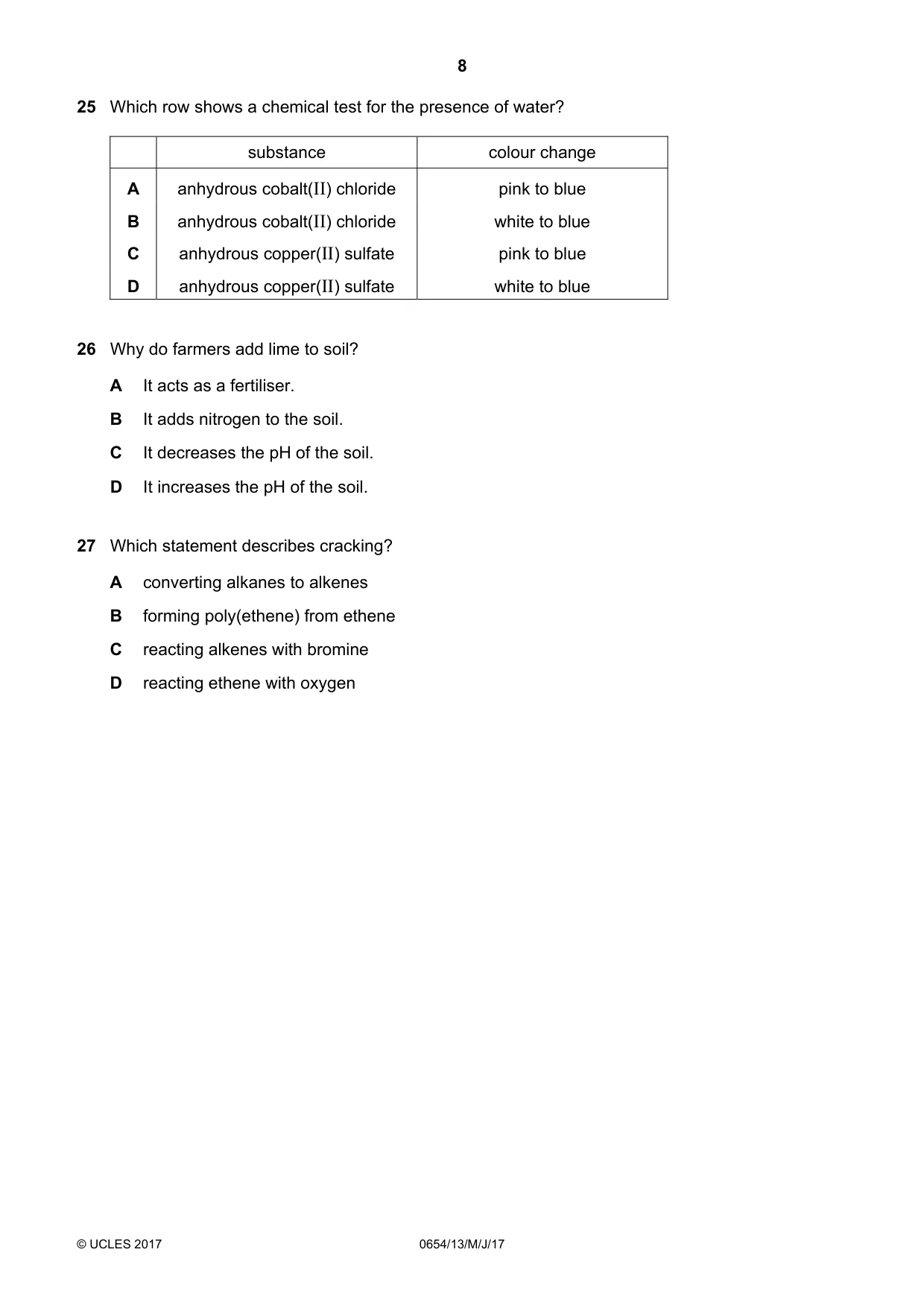
Q25 · Which row shows a chemical test for the presence of water?
25 Which row shows a chemical test for the presence of water? substance colour change A anhydrous cobalt(II) chloride pink to blue B anhydrous cobalt(II) chloride white to blue C anhydrous copper(II) sulfate pink to blue D anhydrous copper(II) sulfate white to blue
Mark scheme: D
Q26 · Why do farmers add lime to soil?
26 Why do farmers add lime to soil? A It acts as a fertiliser. B It adds nitrogen to the soil. C It decreases the pH of the soil. D It increases the pH of the soil.
Mark scheme: D
More questions on The characteristic properties of acids and bases
Q27 · Which statement describes cracking?
27 Which statement describes cracking? A converting alkanes to alkenes B forming poly(ethene) from ethene C reacting alkenes with bromine D reacting ethene with oxygen
Mark scheme: A
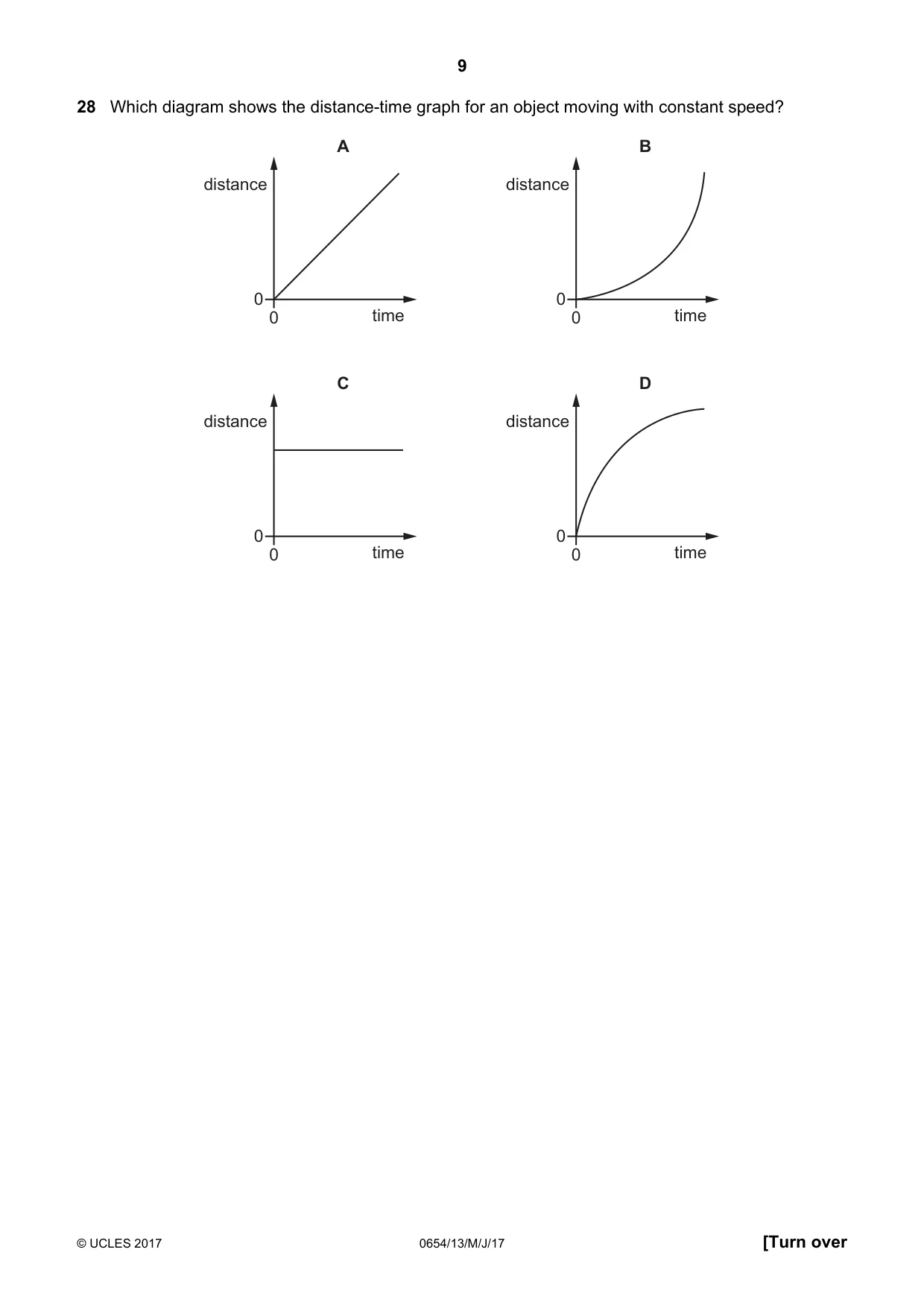
Q28 · Which diagram shows the distance-time graph for an object moving with constant speed?
28 Which diagram shows the distance-time graph for an object moving with constant speed? A B distance distance 0 0 0 time 0 time C D distance distance 0 0 0 time 0 time
Mark scheme: A
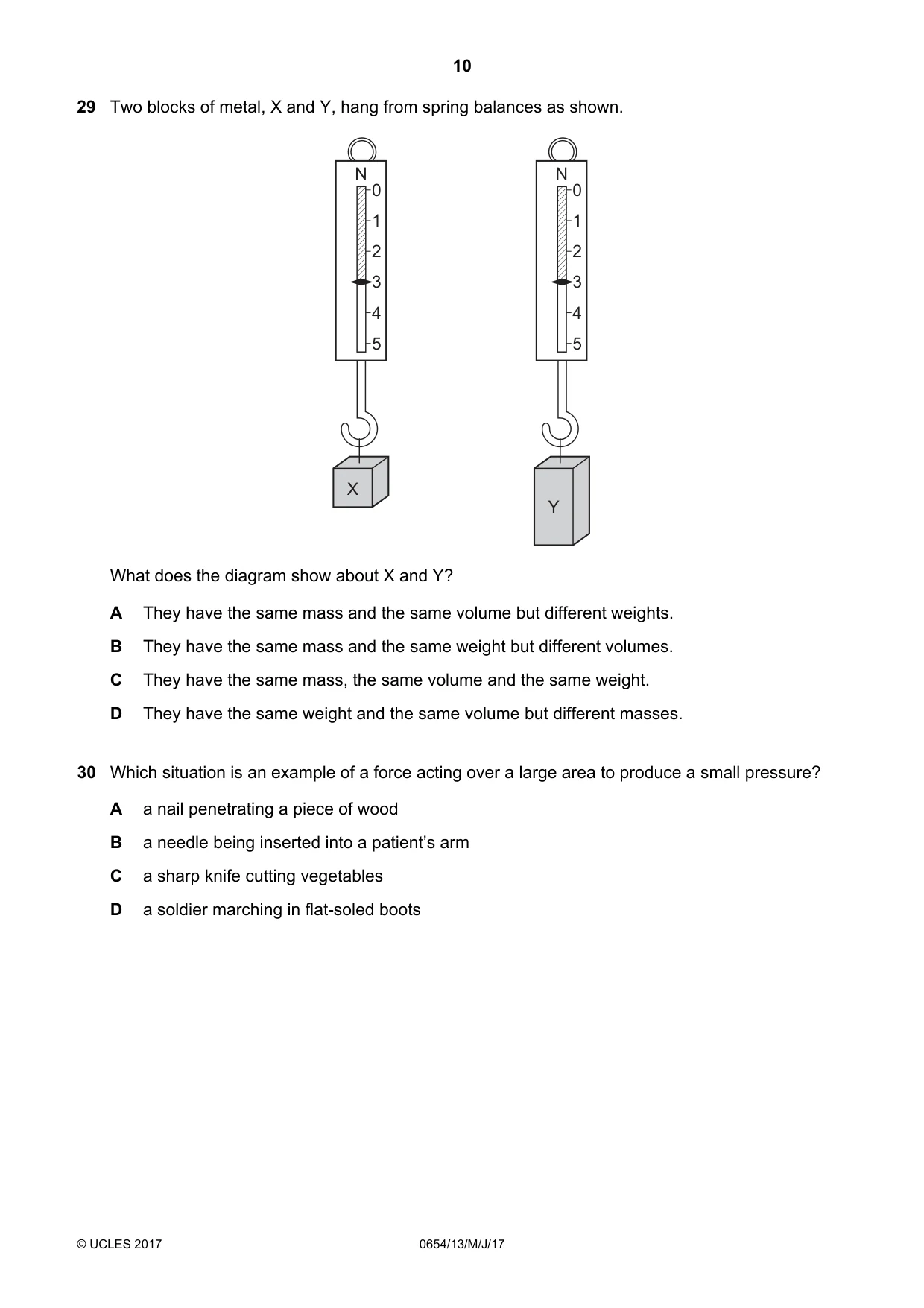
Q29 · Two blocks of metal, X and Y, hang from spring balances as shown
29 Two blocks of metal, X and Y, hang from spring balances as shown. N N 0 0 1 1 2 2 3 3 4 4 5 5 X Y What does the diagram show about X and Y? A They have the same mass and the same volume but different weights. B They have the same mass and the same weight but different volumes. C They have the same mass, the same volume and the same weight. D They have the same weight and the same volume but different masses.
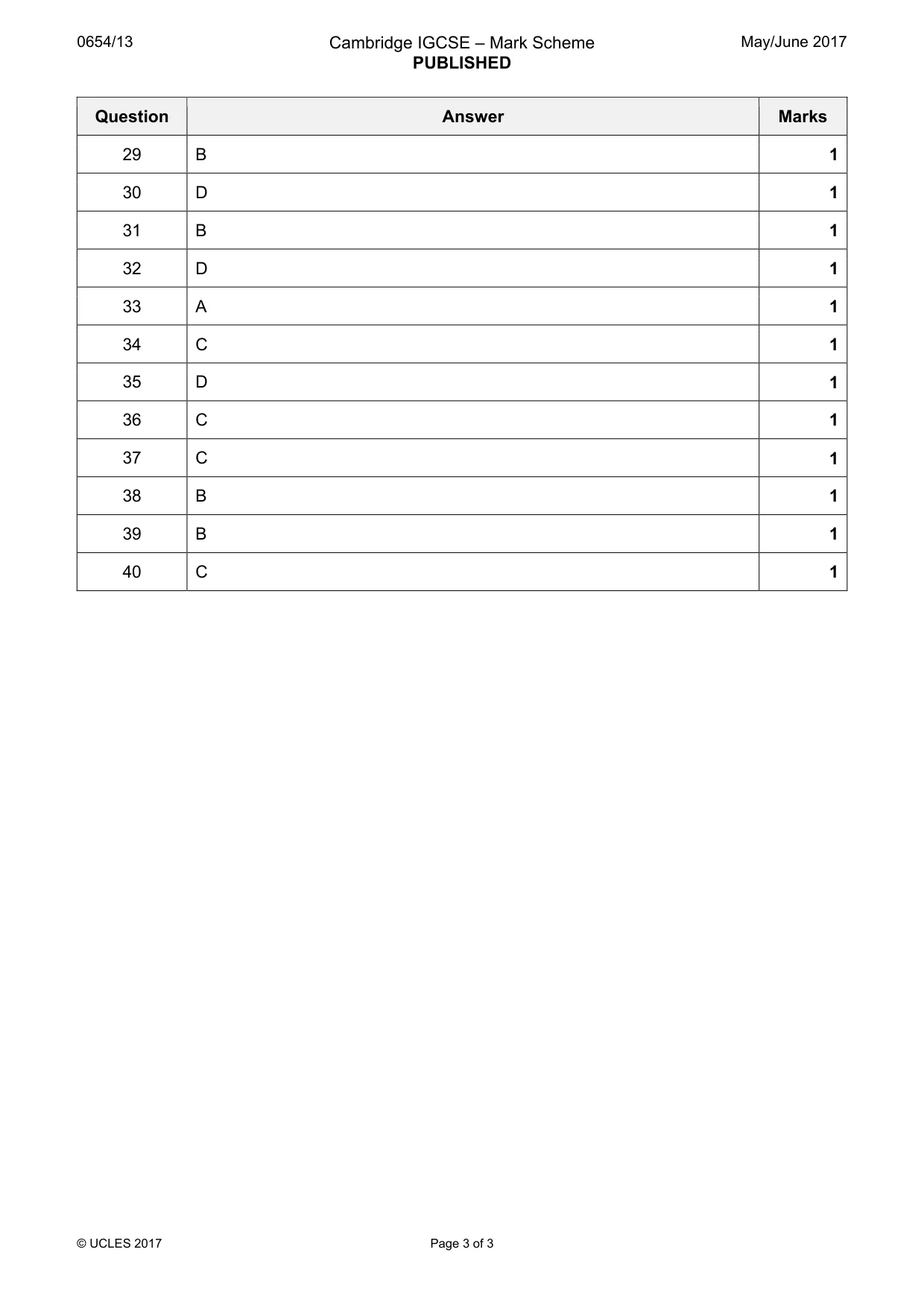
Mark scheme: B
Q30 · Which situation is an example of a force acting over a large area to produce a small…
30 Which situation is an example of a force acting over a large area to produce a small pressure? A a nail penetrating a piece of wood B a needle being inserted into a patient’s arm C a sharp knife cutting vegetables D a soldier marching in flat-soled boots
Mark scheme: D
Q31 · A solid sample of a material in a container is supplied with thermal energy at a constant…
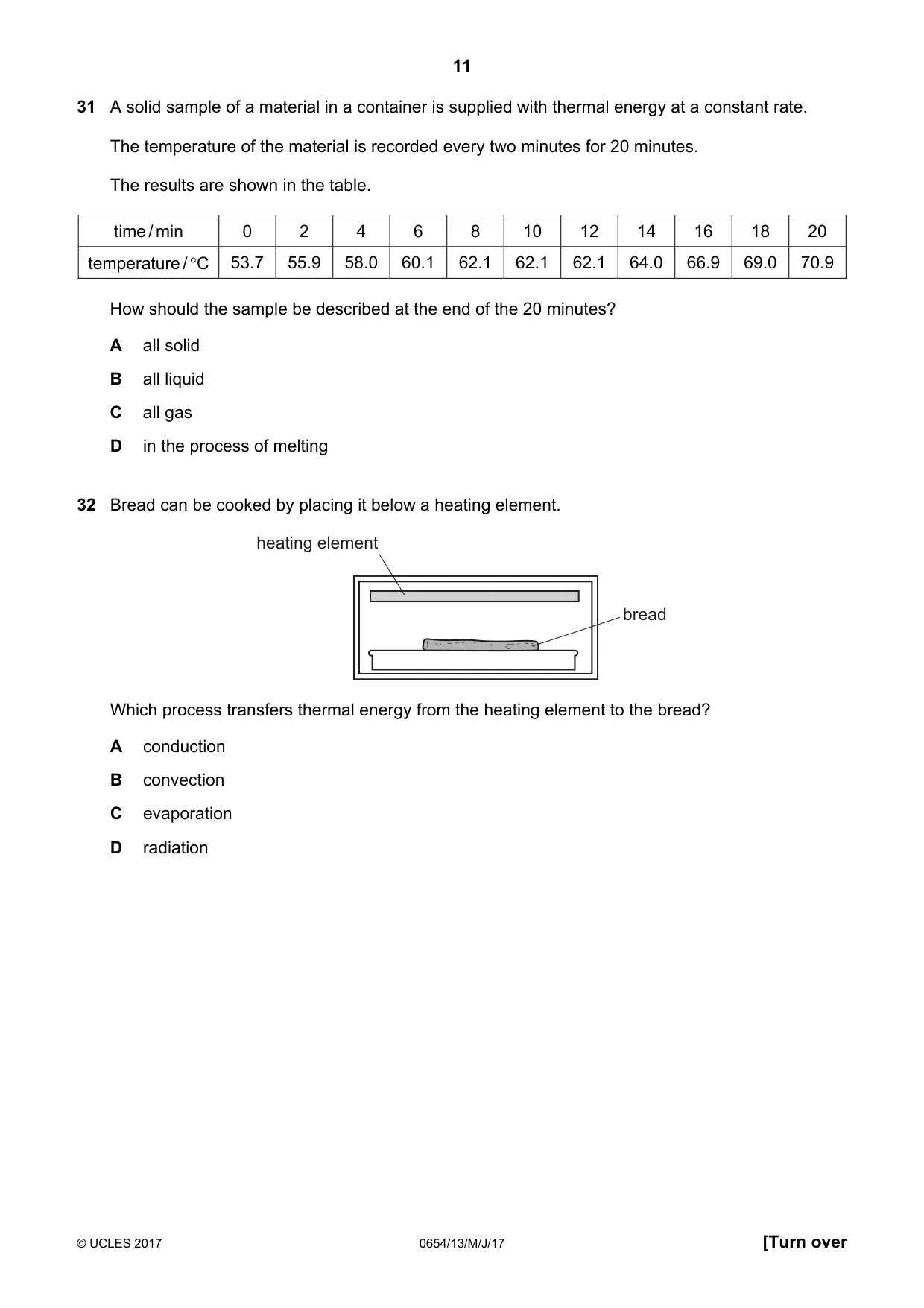
31 A solid sample of a material in a container is supplied with thermal energy at a constant rate. The temperature of the material is recorded every two minutes for 20 minutes. The results are shown in the table. time / min 0 2 4 6 8 10 12 14 16 18 20 temperature / °C 53.7 55.9 58.0 60.1 62.1 62.1 62.1 64.0 66.9 69.0 70.9 How should the sample be described at the end of the 20 minutes? A all solid B all liquid C all gas D in the process of melting
Mark scheme: B
Q32 · Bread can be cooked by placing it below a heating element
32 Bread can be cooked by placing it below a heating element. heating element bread Which process transfers thermal energy from the heating element to the bread? A conduction B convection C evaporation D radiation
Mark scheme: D
Q33 · The diagrams represent four waves
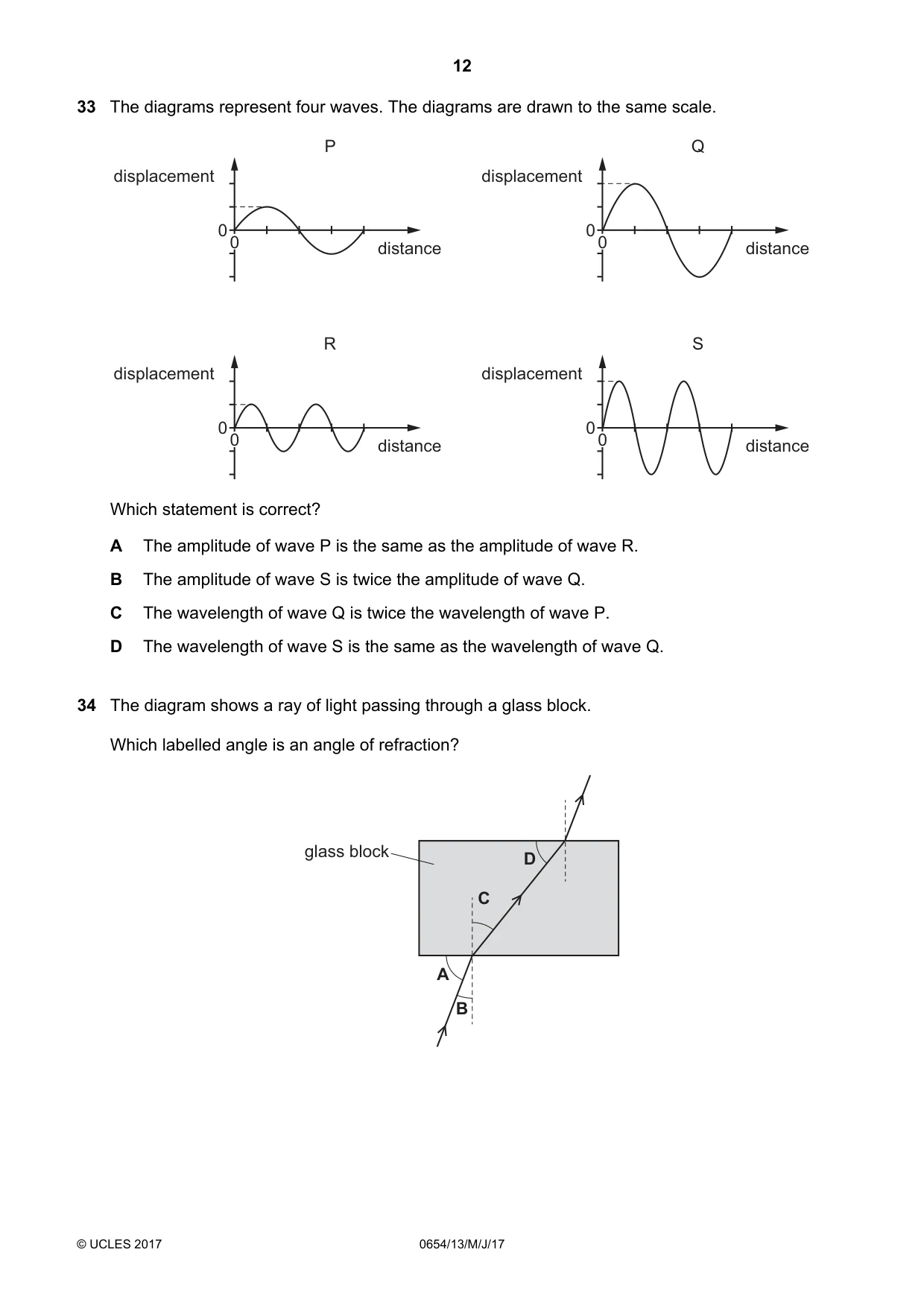
33 The diagrams represent four waves. The diagrams are drawn to the same scale. P Q displacement displacement 00 00 distance distance R S displacement displacement 00 00 distance distance Which statement is correct? A The amplitude of wave P is the same as the amplitude of wave R. B The amplitude of wave S is twice the amplitude of wave Q. C The wavelength of wave Q is twice the wavelength of wave P. D The wavelength of wave S is the same as the wavelength of wave Q.
Mark scheme: A
Q34 · The diagram shows a ray of light passing through a glass block
34 The diagram shows a ray of light passing through a glass block. Which labelled angle is an angle of refraction? glass block D C A B
Mark scheme: C
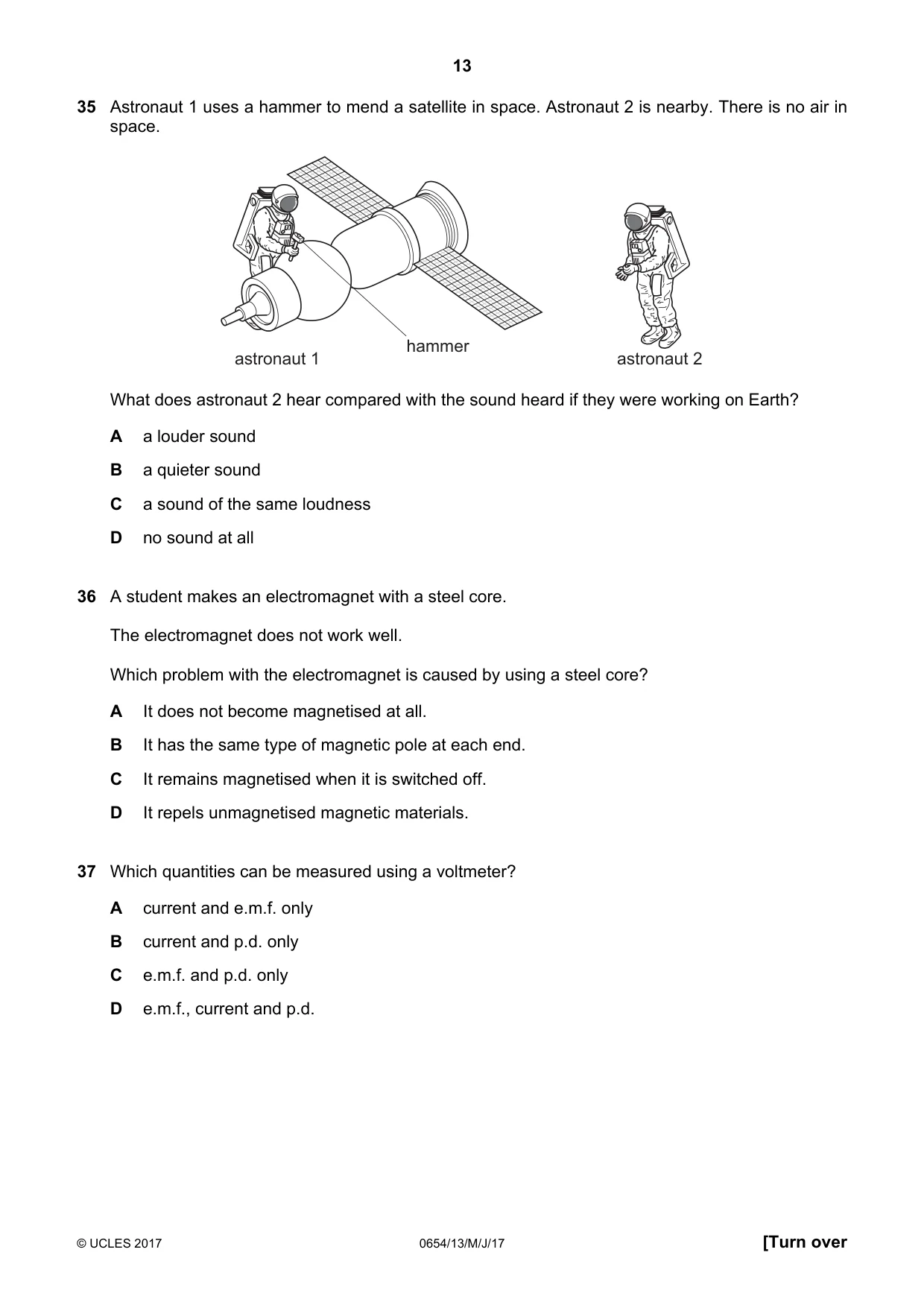
Q35 · Astronaut 1 uses a hammer to mend a satellite in space
35 Astronaut 1 uses a hammer to mend a satellite in space. Astronaut 2 is nearby. There is no air in space. hammer astronaut 1 astronaut 2 What does astronaut 2 hear compared with the sound heard if they were working on Earth? A a louder sound B a quieter sound C a sound of the same loudness D no sound at all
Mark scheme: D
Q36 · A student makes an electromagnet with a steel core
36 A student makes an electromagnet with a steel core. The electromagnet does not work well. Which problem with the electromagnet is caused by using a steel core? A It does not become magnetised at all. B It has the same type of magnetic pole at each end. C It remains magnetised when it is switched off. D It repels unmagnetised magnetic materials.
Mark scheme: C
Q37 · Which quantities can be measured using a voltmeter?
37 Which quantities can be measured using a voltmeter? A current and e.m.f. only B current and p.d. only C e.m.f. and p.d. only D e.m.f., current and p.d.
Mark scheme: C
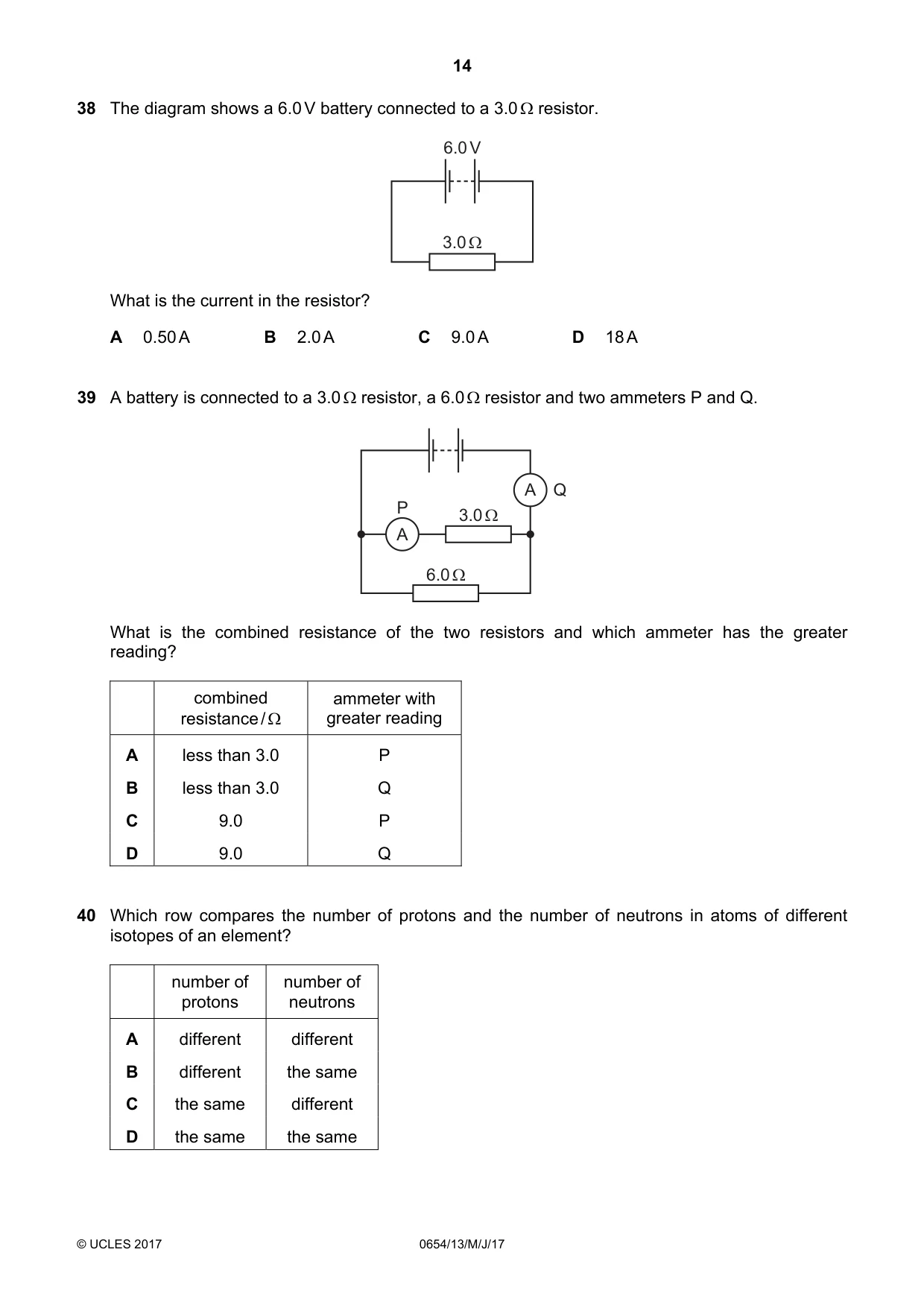
Q38 · The diagram shows a 6.0 V battery connected to a 3.0 Ω resistor
38 The diagram shows a 6.0 V battery connected to a 3.0 Ω resistor. 6.0 V 3.0 Ω What is the current in the resistor? A 0.50 A B 2.0 A C 9.0 A D 18 A
Mark scheme: B
Q39 · A battery is connected to a 3.0 Ω resistor, a 6.0 Ω resistor and two ammeters P and Q
39 A battery is connected to a 3.0 Ω resistor, a 6.0 Ω resistor and two ammeters P and Q. A Q P 3.0 Ω A 6.0 Ω What is the combined resistance of the two resistors and which ammeter has the greater reading? combined ammeter with resistance / Ω greater reading A less than 3.0 P B less than 3.0 Q C 9.0 P D 9.0 Q
Mark scheme: B
Q40 · Which row compares the number of protons and the number of neutrons in atoms of different…
40 Which row compares the number of protons and the number of neutrons in atoms of different isotopes of an element? number of number of protons neutrons A different different B different the same C the same different D the same the same
Mark scheme: C
What was in this paper
The subtopics covered by these 40 questions, and how many questions each got. Open one in a new tab to see every Cambridge question on it.
2The characteristic properties of acids and bases2Asexual reproduction1Atomic structure and the Periodic Table1Biological molecules1Cell structure1Characteristics of living organisms1Circulatory systems1Coordination and response1Digestion1Electrical quantities1Electrolysis1Exothermic and endothermic reactions1Formulas1Fuels1General properties of waves1Group VII properties1Habitat destruction1Homeostasis1Identification of ions and gases1Isotopes1Light1Mass and weight1Monohybrid inheritance1Motion1Noble gases1Pressure1Properties of metals1Rate of reaction1Redox1Respiration1Selection1Sexual reproduction in plants1Simple phenomena of magnetism1Sound1Thermal properties and temperature1Transfer of thermal energy1Water1What you needed in this session
Cambridge’s own grade thresholds for 2017 May/June, Paper 1 · Variant 3. A higher threshold means an easier paper — the bar moves with how the cohort did.