Cambridge IGCSE Sciences - Co-ordinated (Double) 0654 — 2018 Oct/Nov Paper 1 · Variant 1
0654/11/O/N/18 · 40 questions · 40 marks · ≈45 min
The question paper and its mark scheme, free to read here and free to download. This is Cambridge’s own paper, exactly as it was sat.
Question paper16 pages
Mark scheme3 pages
Answers below. Sit the paper first if you are practising.
Questions as text
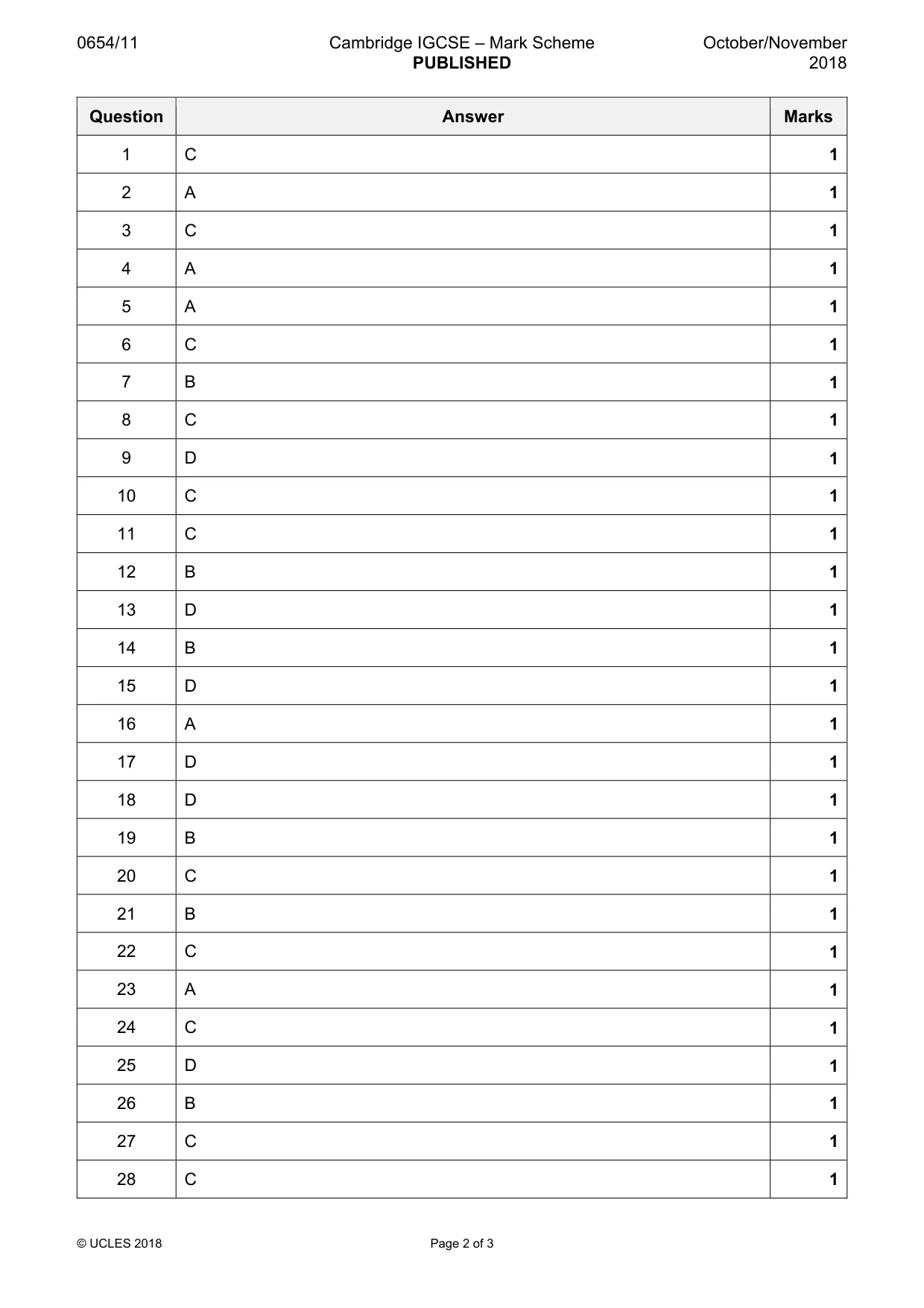
Q1 · Which is a characteristic of all living things?
1 Which is a characteristic of all living things? A a heart B breathing C excretion D sexual reproduction
Mark scheme: C
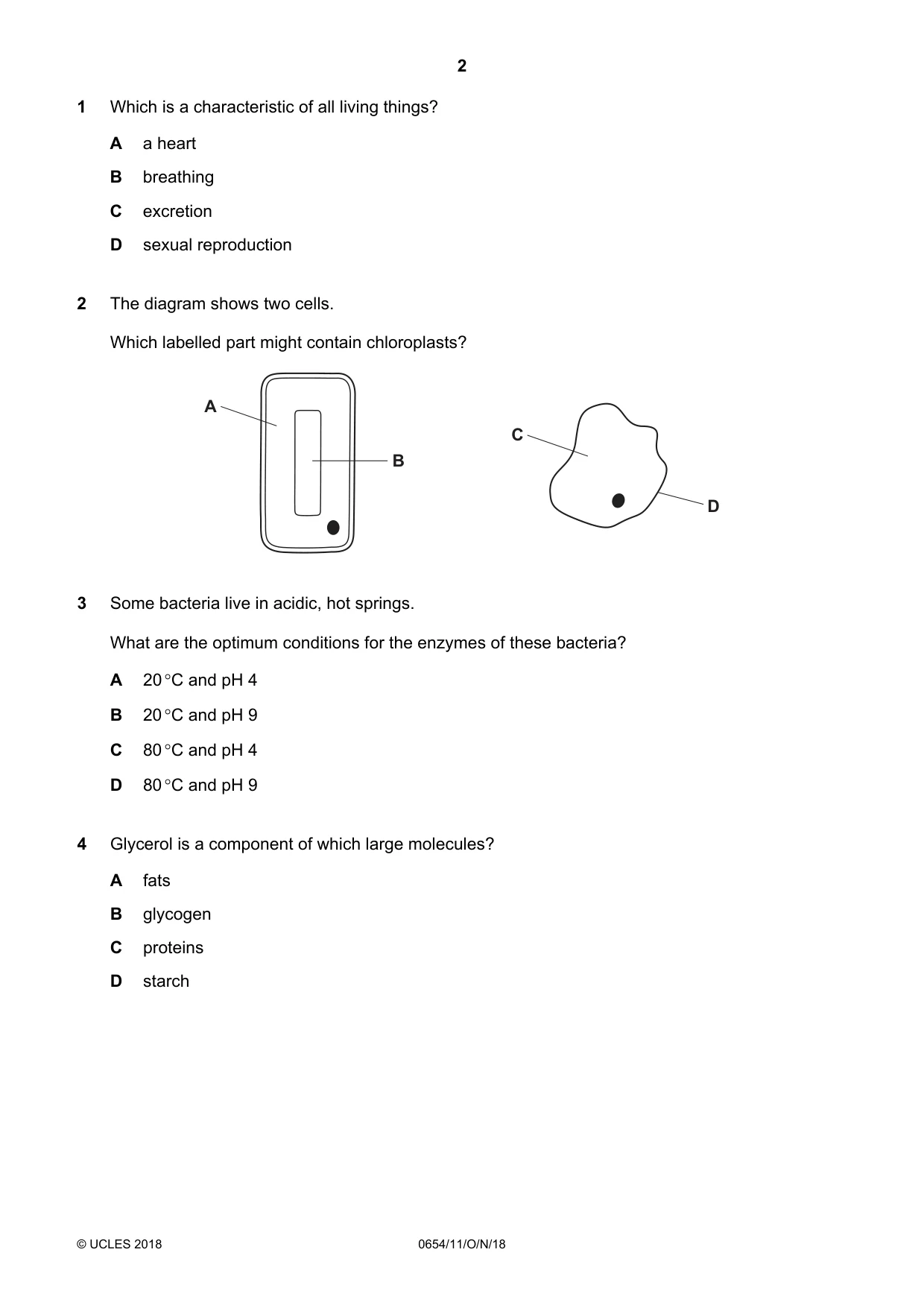
Q2 · The diagram shows two cells
2 The diagram shows two cells. Which labelled part might contain chloroplasts? A C B D
Mark scheme: A
Q3 · Some bacteria live in acidic, hot springs
3 Some bacteria live in acidic, hot springs. What are the optimum conditions for the enzymes of these bacteria? A 20 °C and pH 4 B 20 °C and pH 9 C 80 °C and pH 4 D 80 °C and pH 9
Mark scheme: C
Q4 · Glycerol is a component of which large molecules?
4 Glycerol is a component of which large molecules? A fats B glycogen C proteins D starch
Mark scheme: A
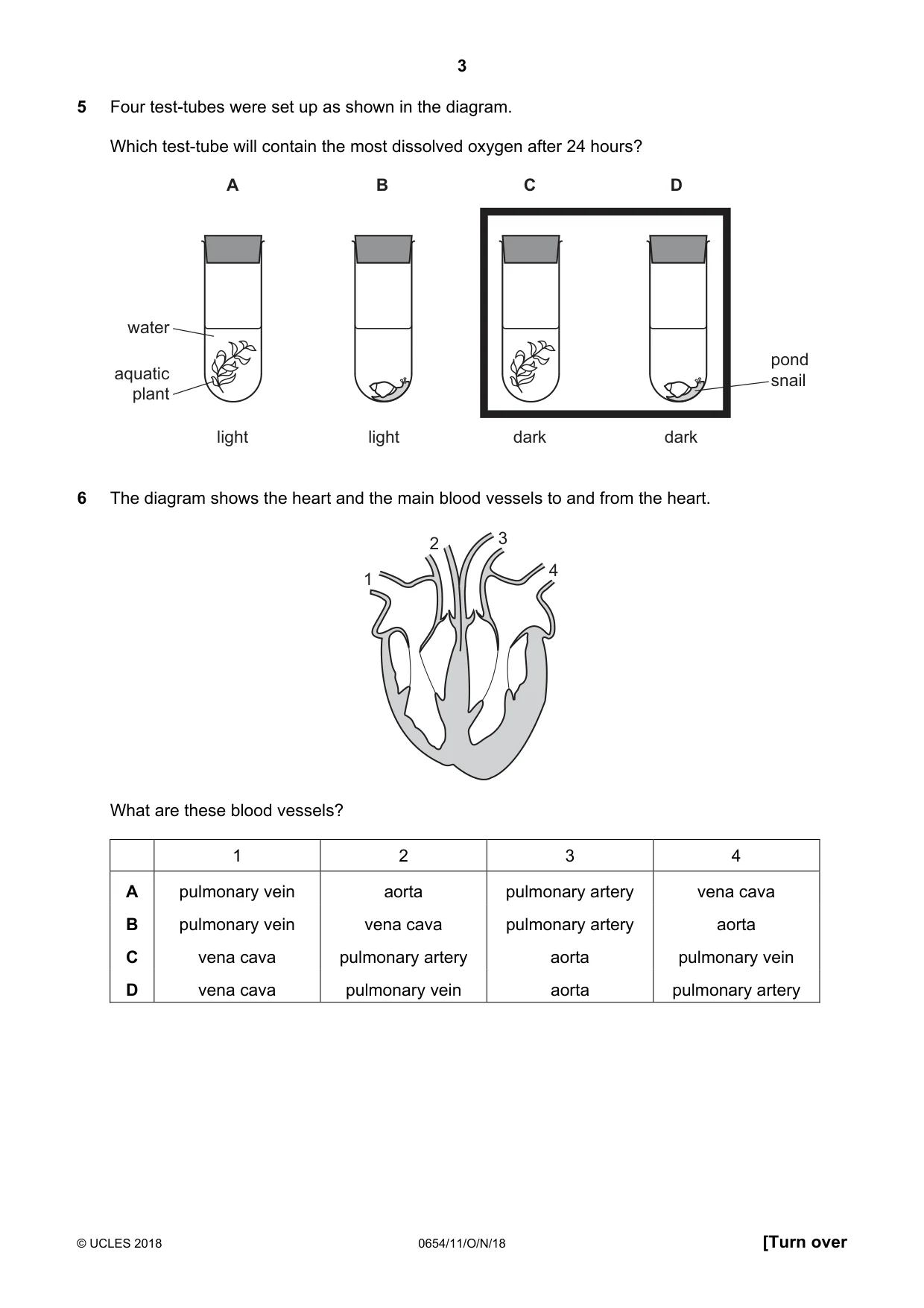
Q5 · Four test-tubes were set up as shown in the diagram
5 Four test-tubes were set up as shown in the diagram. Which test-tube will contain the most dissolved oxygen after 24 hours? A B C D water pond aquatic snail plant light light dark dark
Mark scheme: A
Q6 · The diagram shows the heart and the main blood vessels to and from the heart
6 The diagram shows the heart and the main blood vessels to and from the heart. 2 3 4 1 What are these blood vessels? 1 2 3 4 A pulmonary vein aorta pulmonary artery vena cava B pulmonary vein vena cava pulmonary artery aorta C vena cava pulmonary artery aorta pulmonary vein D vena cava pulmonary vein aorta pulmonary artery
Mark scheme: C
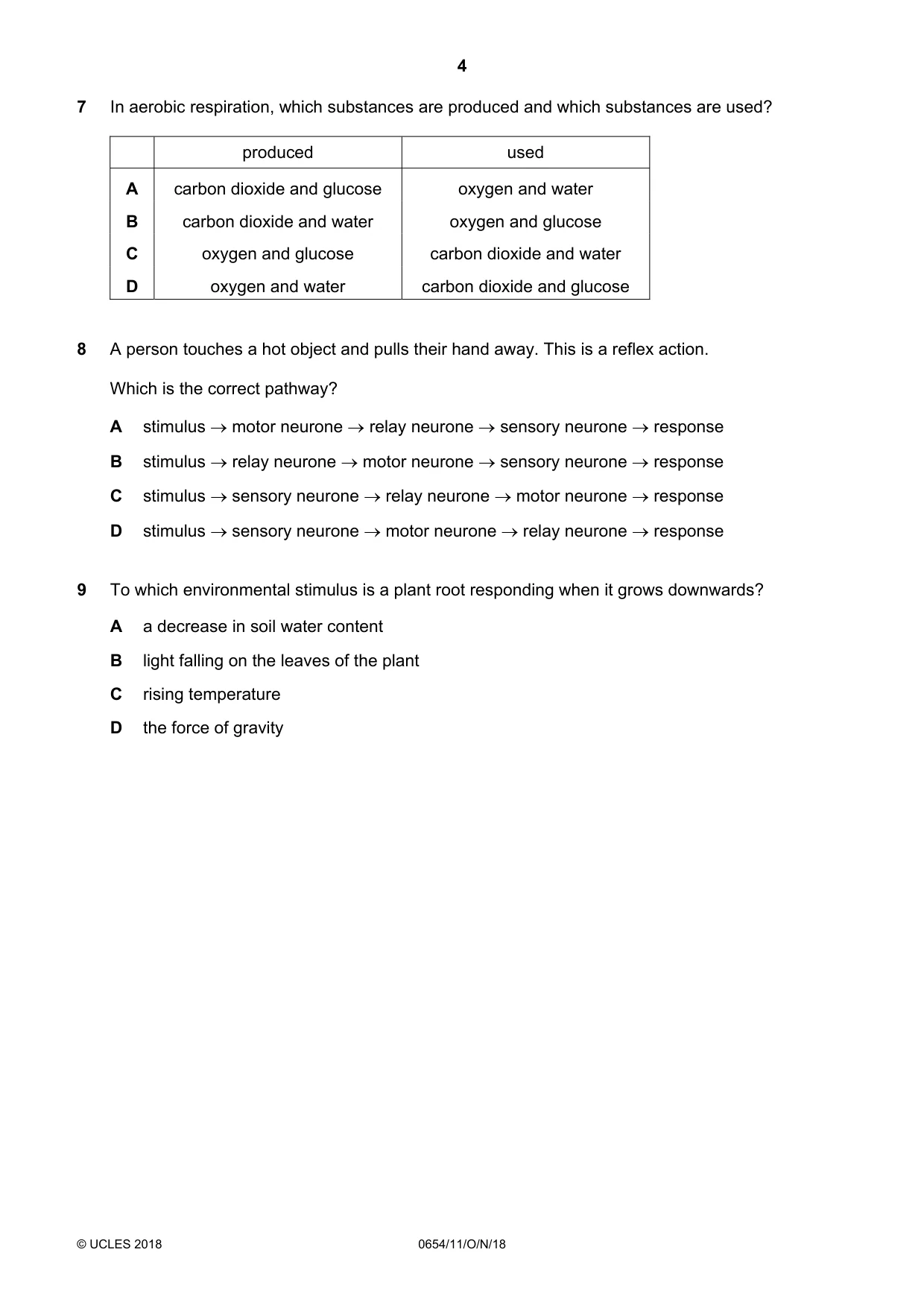
Q7 · In aerobic respiration, which substances are produced and which substances are used?
7 In aerobic respiration, which substances are produced and which substances are used? produced used A carbon dioxide and glucose oxygen and water B carbon dioxide and water oxygen and glucose C oxygen and glucose carbon dioxide and water D oxygen and water carbon dioxide and glucose
Mark scheme: B
Q8 · A person touches a hot object and pulls their hand away
8 A person touches a hot object and pulls their hand away. This is a reflex action. Which is the correct pathway? A stimulus → motor neurone → relay neurone → sensory neurone → response B stimulus → relay neurone → motor neurone → sensory neurone → response C stimulus → sensory neurone → relay neurone → motor neurone → response D stimulus → sensory neurone → motor neurone → relay neurone → response
Mark scheme: C
Q9 · To which environmental stimulus is a plant root responding when it grows downwards?
9 To which environmental stimulus is a plant root responding when it grows downwards? A a decrease in soil water content B light falling on the leaves of the plant C rising temperature D the force of gravity
Mark scheme: D
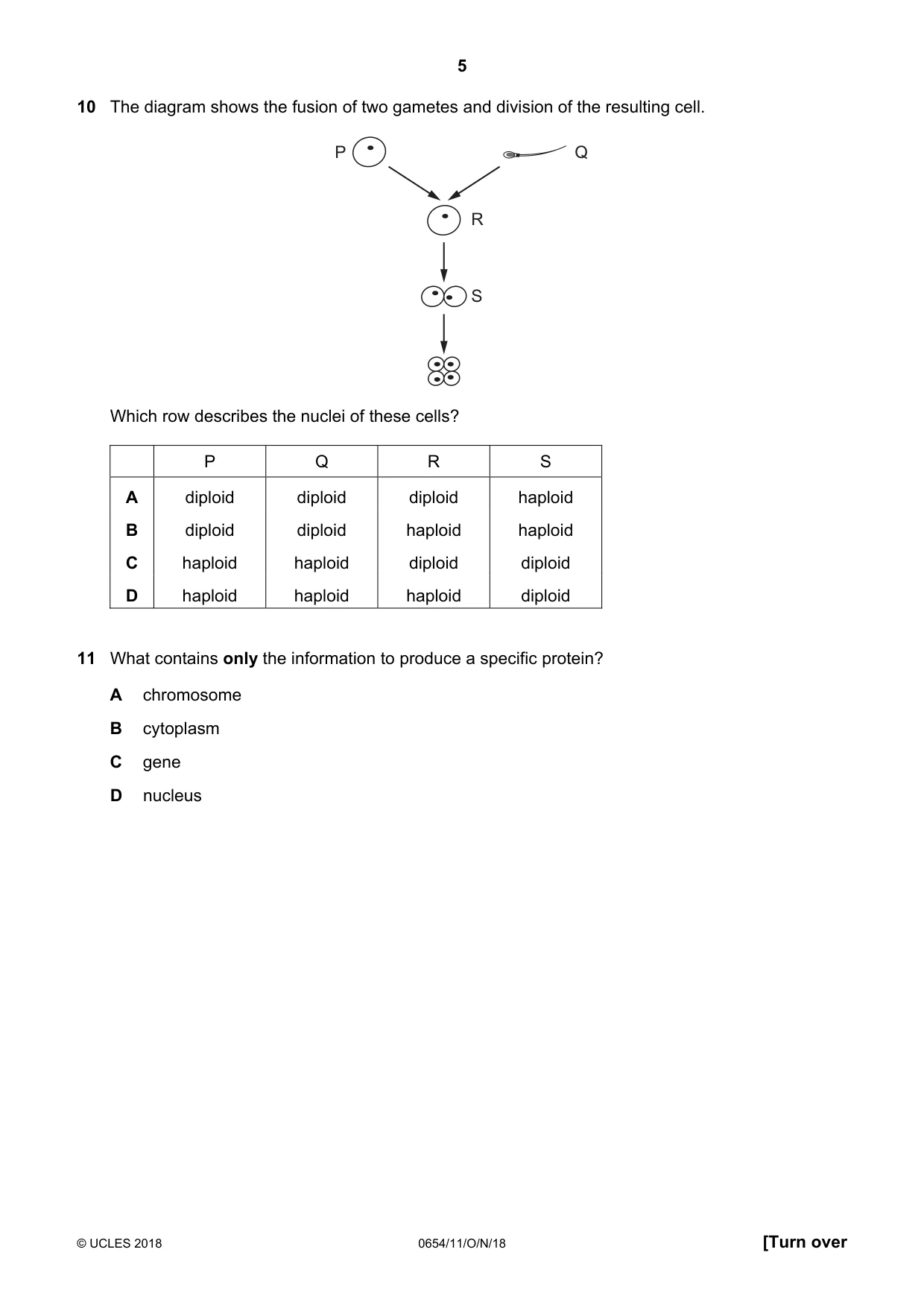
Q10 · The diagram shows the fusion of two gametes and division of the resulting cell
10 The diagram shows the fusion of two gametes and division of the resulting cell. P Q R S Which row describes the nuclei of these cells? P Q R S A diploid diploid diploid haploid B diploid diploid haploid haploid C haploid haploid diploid diploid D haploid haploid haploid diploid
Mark scheme: C
Q11 · What contains only the information to produce a specific protein?
11 What contains only the information to produce a specific protein? A chromosome B cytoplasm C gene D nucleus
Mark scheme: C
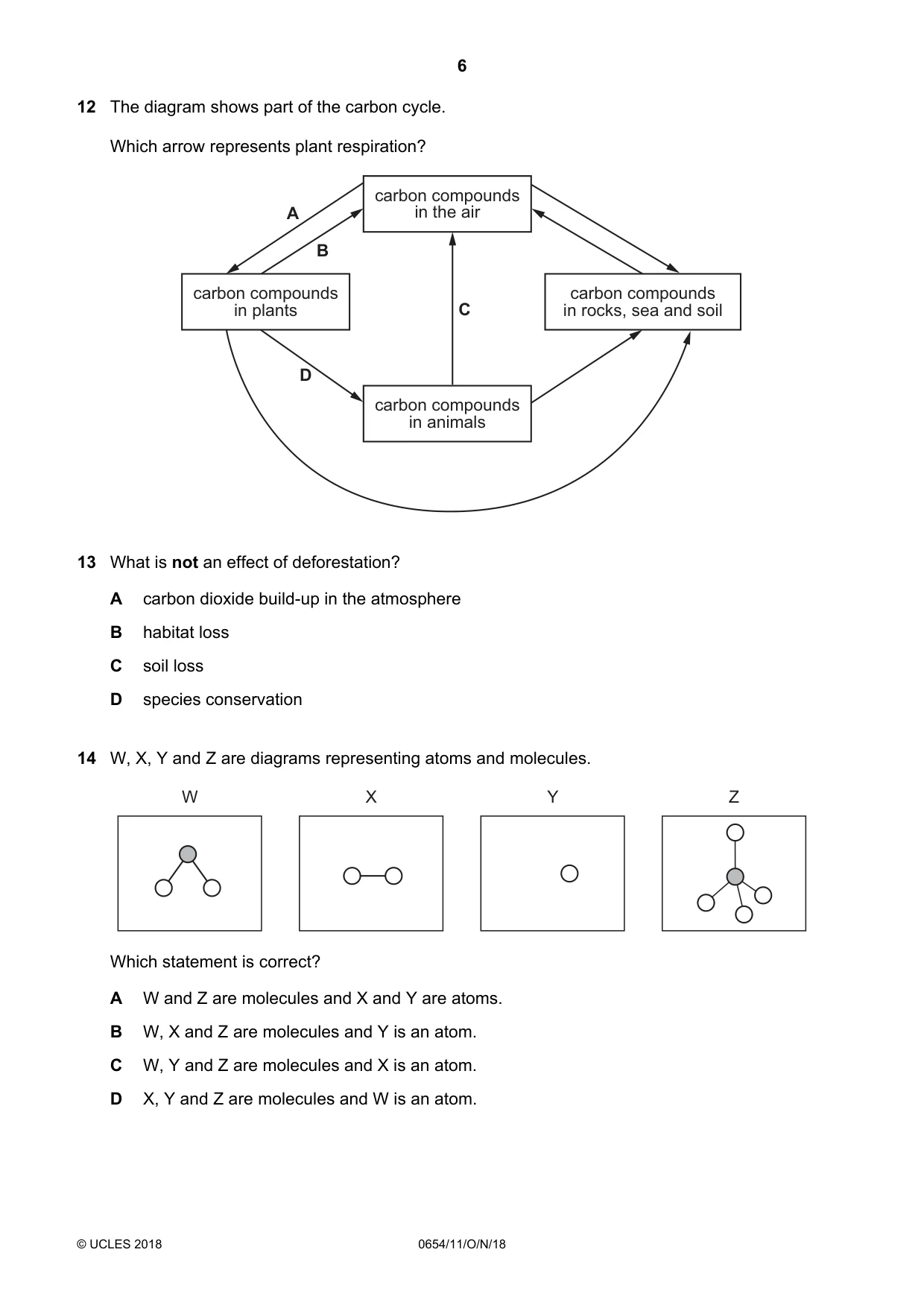
Q12 · The diagram shows part of the carbon cycle
12 The diagram shows part of the carbon cycle. Which arrow represents plant respiration? carbon compounds A in the air B carbon compounds carbon compounds in plants C in rocks, sea and soil D carbon compounds in animals
Mark scheme: B
Q13 · What is not an effect of deforestation?
13 What is not an effect of deforestation? A carbon dioxide build-up in the atmosphere B habitat loss C soil loss D species conservation
Mark scheme: D
Q14 · W, X, Y and Z are diagrams representing atoms and molecules
14 W, X, Y and Z are diagrams representing atoms and molecules. W X Y Z Which statement is correct? A W and Z are molecules and X and Y are atoms. B W, X and Z are molecules and Y is an atom. C W, Y and Z are molecules and X is an atom. D X, Y and Z are molecules and W is an atom.
Mark scheme: B
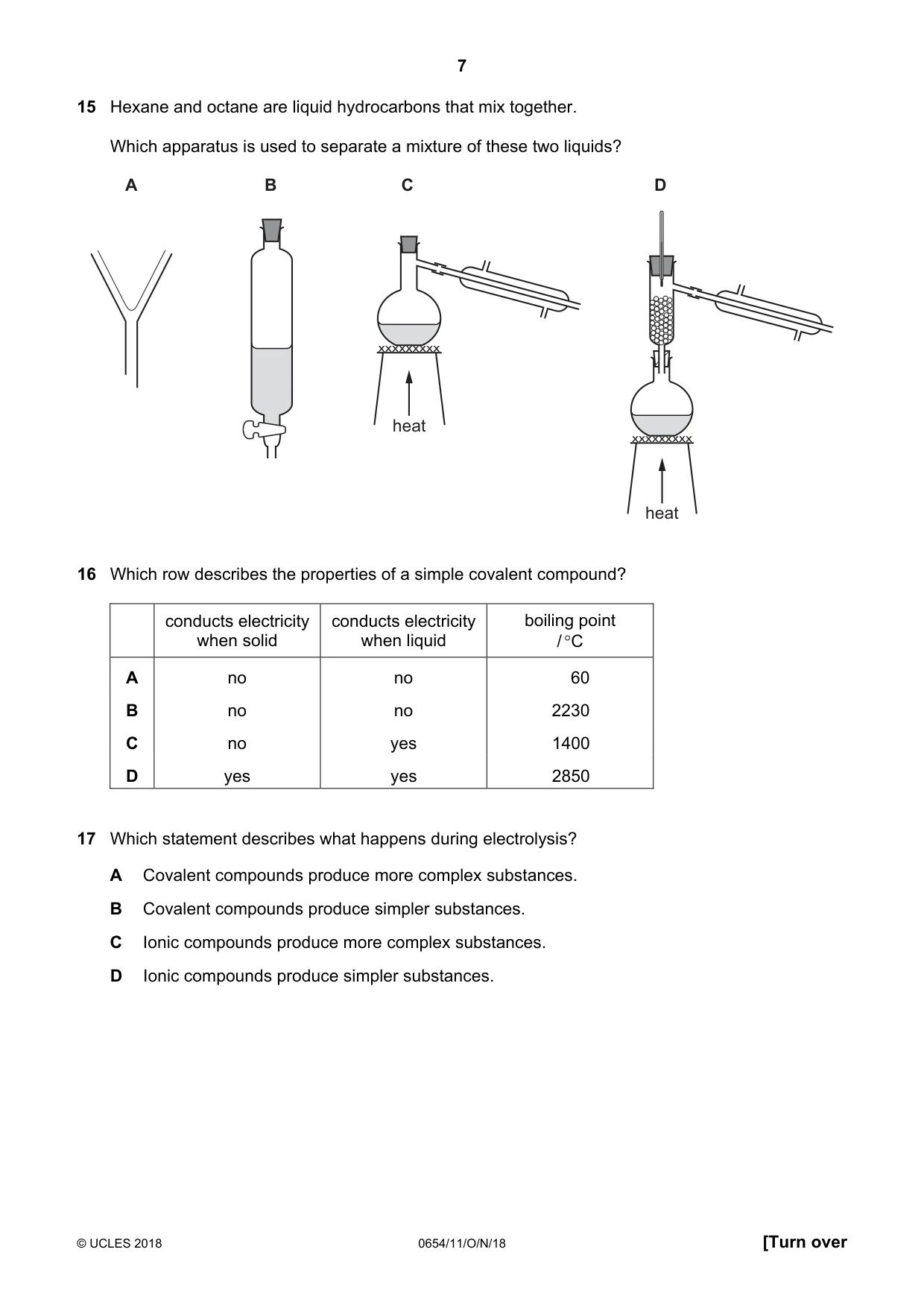
Q15 · Hexane and octane are liquid hydrocarbons that mix together
15 Hexane and octane are liquid hydrocarbons that mix together. Which apparatus is used to separate a mixture of these two liquids? A B C D xxxxxxxxx heat xxxxxxxxx heat
Mark scheme: D
Q16 · Which row describes the properties of a simple covalent compound?
16 Which row describes the properties of a simple covalent compound? conducts electricity conducts electricity boiling point when solid when liquid / °C A no no 60 B no no 2230 C no yes 1400 D yes yes 2850
Mark scheme: A
Q17 · Which statement describes what happens during electrolysis?
17 Which statement describes what happens during electrolysis? A Covalent compounds produce more complex substances. B Covalent compounds produce simpler substances. C Ionic compounds produce more complex substances. D Ionic compounds produce simpler substances.
Mark scheme: D
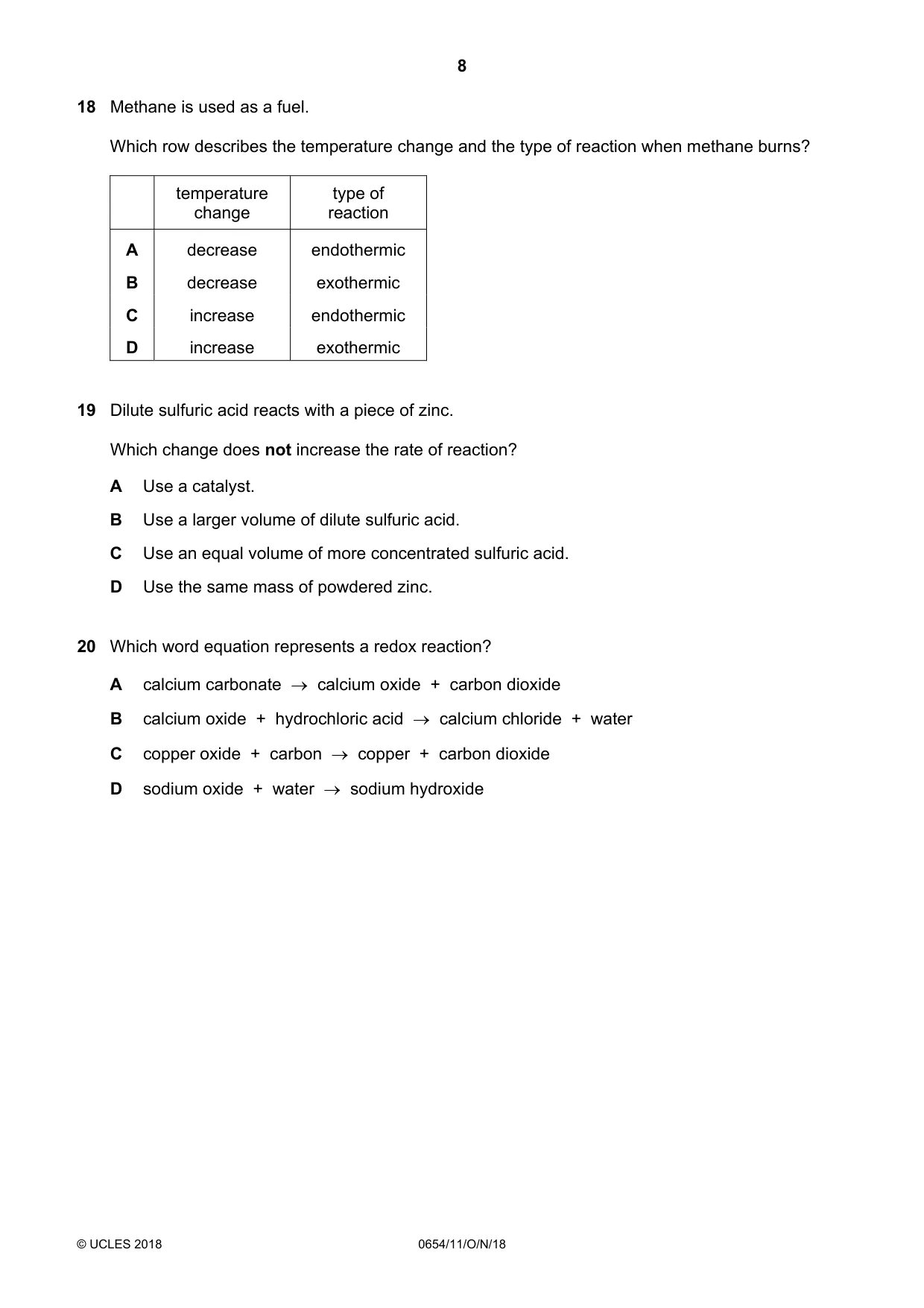
Q18 · Methane is used as a fuel
18 Methane is used as a fuel. Which row describes the temperature change and the type of reaction when methane burns? temperature type of change reaction A decrease endothermic B decrease exothermic C increase endothermic D increase exothermic
Mark scheme: D
Q19 · Dilute sulfuric acid reacts with a piece of zinc
19 Dilute sulfuric acid reacts with a piece of zinc. Which change does not increase the rate of reaction? A Use a catalyst. B Use a larger volume of dilute sulfuric acid. C Use an equal volume of more concentrated sulfuric acid. D Use the same mass of powdered zinc.
Mark scheme: B
Q20 · Which word equation represents a redox reaction?
20 Which word equation represents a redox reaction? A calcium carbonate → calcium oxide + carbon dioxide B calcium oxide + hydrochloric acid → calcium chloride + water C copper oxide + carbon → copper + carbon dioxide D sodium oxide + water → sodium hydroxide
Mark scheme: C
Q21 · A mixture of two gases is shaken with limewater
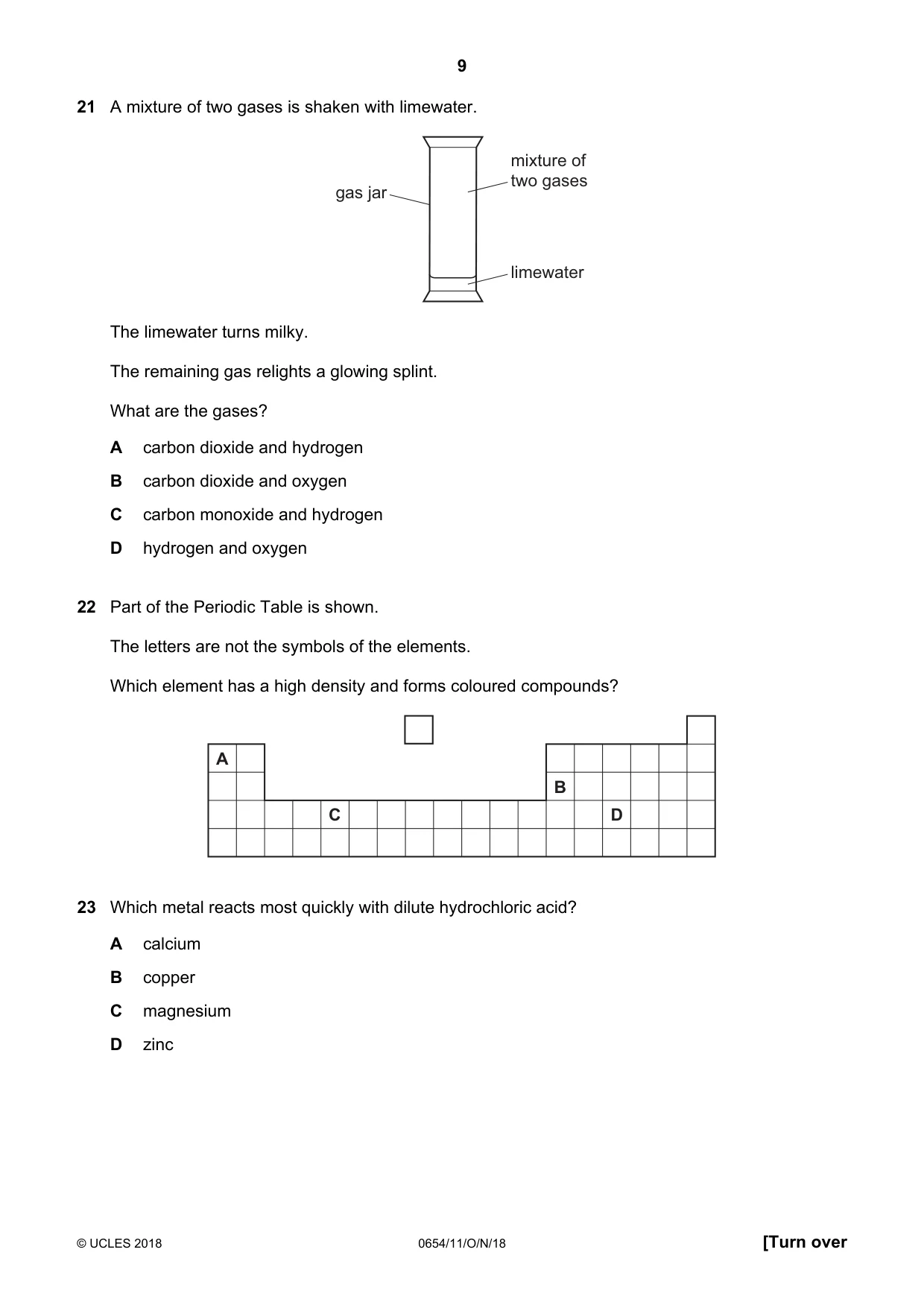
21 A mixture of two gases is shaken with limewater. mixture of two gases gas jar limewater The limewater turns milky. The remaining gas relights a glowing splint. What are the gases? A carbon dioxide and hydrogen B carbon dioxide and oxygen C carbon monoxide and hydrogen D hydrogen and oxygen
Mark scheme: B
Q22 · Part of the Periodic Table is shown
22 Part of the Periodic Table is shown. The letters are not the symbols of the elements. Which element has a high density and forms coloured compounds? A B C D
Mark scheme: C
Q23 · Which metal reacts most quickly with dilute hydrochloric acid?
23 Which metal reacts most quickly with dilute hydrochloric acid? A calcium B copper C magnesium D zinc
Mark scheme: A
Q24 · Which gas is the most abundant in clean air?
24 Which gas is the most abundant in clean air? A argon B carbon dioxide C nitrogen D oxygen
Mark scheme: C
Q25 · The diagram shows gas P being passed through liquid X and over iron filings
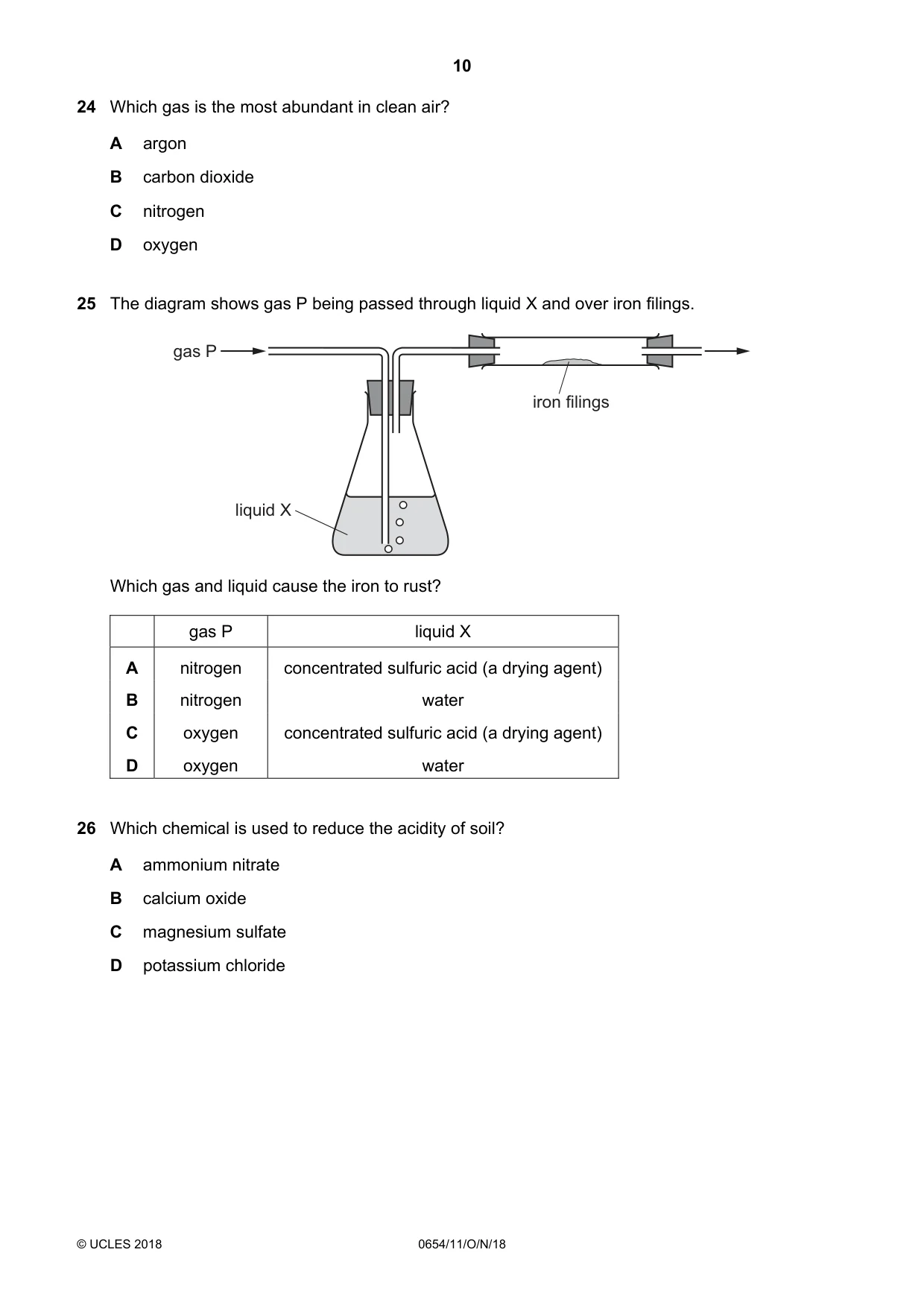
25 The diagram shows gas P being passed through liquid X and over iron filings. gas P iron filings liquid X Which gas and liquid cause the iron to rust? gas P liquid X A nitrogen concentrated sulfuric acid (a drying agent) B nitrogen water C oxygen concentrated sulfuric acid (a drying agent) D oxygen water
Mark scheme: D
Q26 · Which chemical is used to reduce the acidity of soil?
26 Which chemical is used to reduce the acidity of soil? A ammonium nitrate B calcium oxide C magnesium sulfate D potassium chloride
Mark scheme: B
More questions on The characteristic properties of acids and bases
Q27 · Ethanol is formed by the reaction of ethene with ««1««
27 Ethanol is formed by the reaction of ethene with ««1«« . Ethanol burns in excess air to produce ««2«« and water. Which words complete gaps 1 and 2? 1 2 A oxygen carbon dioxide B oxygen carbon monoxide C steam carbon dioxide D steam carbon monoxide
Mark scheme: C
Q28 · The diagram shows a distance-time graph for a journey
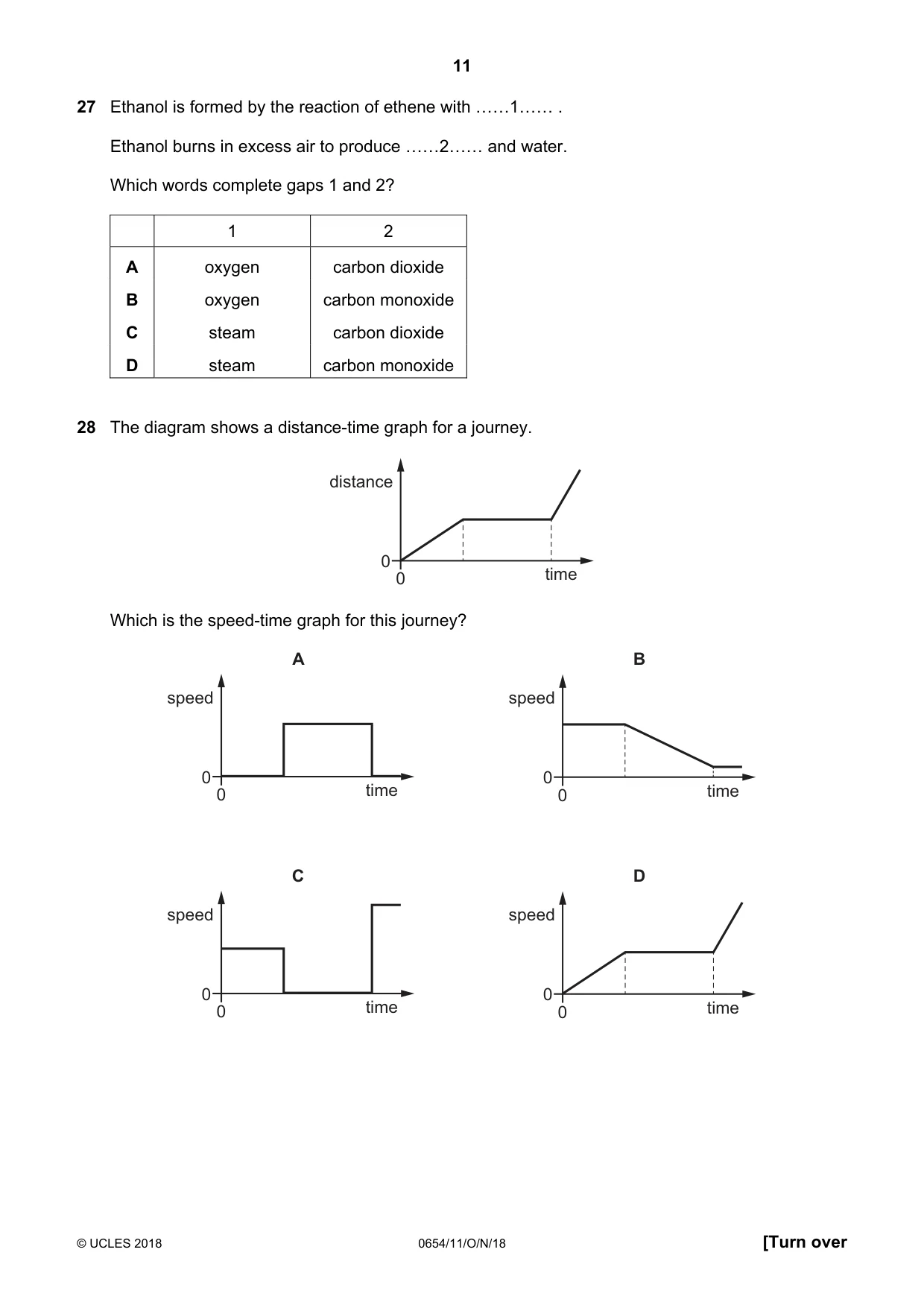
28 The diagram shows a distance-time graph for a journey. distance 0 0 time Which is the speed-time graph for this journey? A B speed speed 0 0 0 time 0 time C D speed speed 0 0 0 time 0 time
Mark scheme: C
Q29 · A student wishes to determine the density of a small solid object
29 A student wishes to determine the density of a small solid object. First she finds the mass of the object. What should she do next? A Attach the object to a spring and measure the change in length of the spring. B Heat the object until it melts completely and measure how long it takes. C Let the object fall through a distance of 1.0 m and measure how long it takes. D Put the object in water in a measuring cylinder and measure the change in reading.
Mark scheme: D
Q30 · A student has two light wooden rods with different diameters, a light metal block, a…
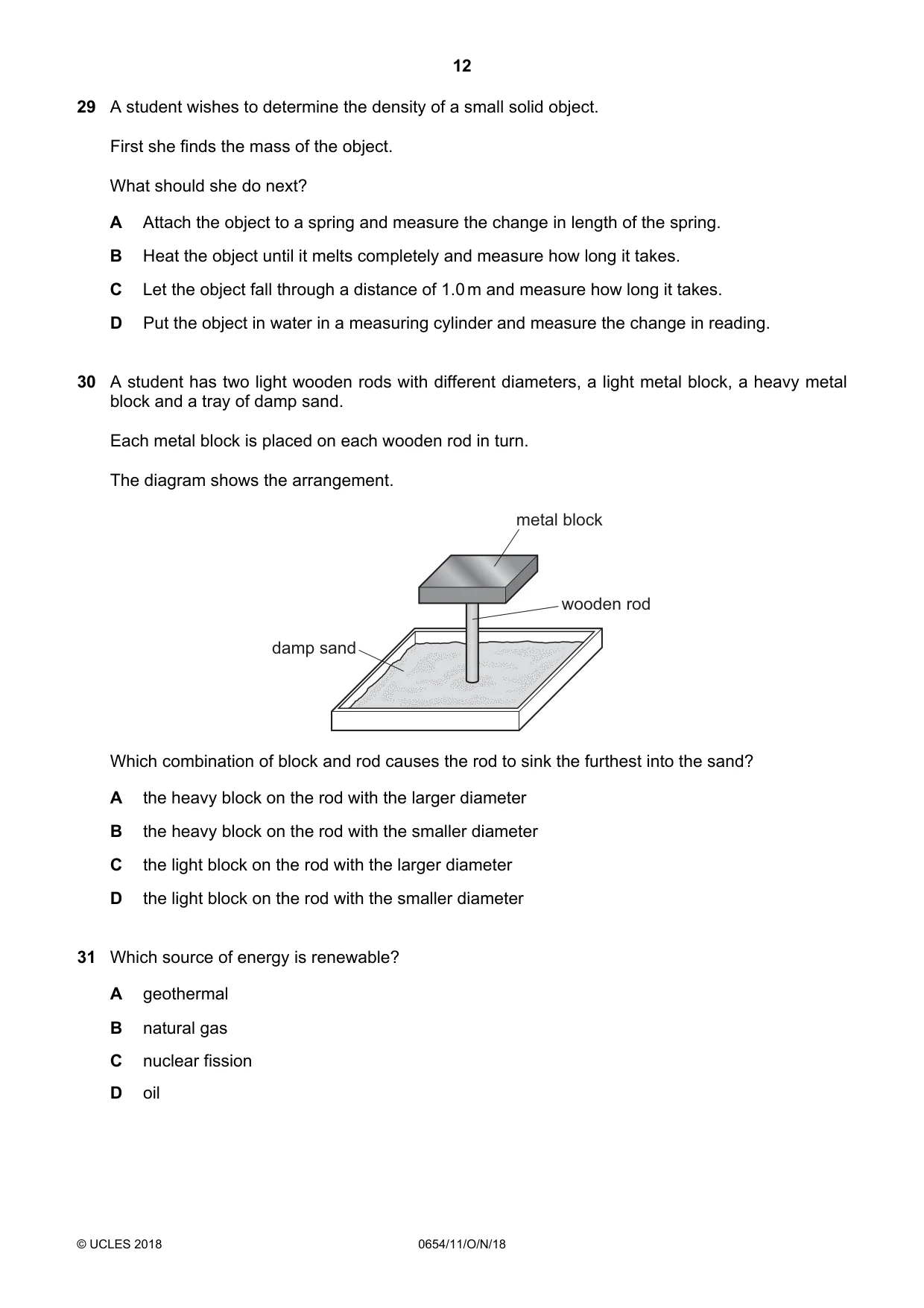
30 A student has two light wooden rods with different diameters, a light metal block, a heavy metal block and a tray of damp sand. Each metal block is placed on each wooden rod in turn. The diagram shows the arrangement. metal block wooden rod damp sand Which combination of block and rod causes the rod to sink the furthest into the sand? A the heavy block on the rod with the larger diameter B the heavy block on the rod with the smaller diameter C the light block on the rod with the larger diameter D the light block on the rod with the smaller diameter
Mark scheme: B
Q31 · Which source of energy is renewable?
31 Which source of energy is renewable? A geothermal B natural gas C nuclear fission D oil
Mark scheme: A
Q32 · Two substances X and Y are in different states
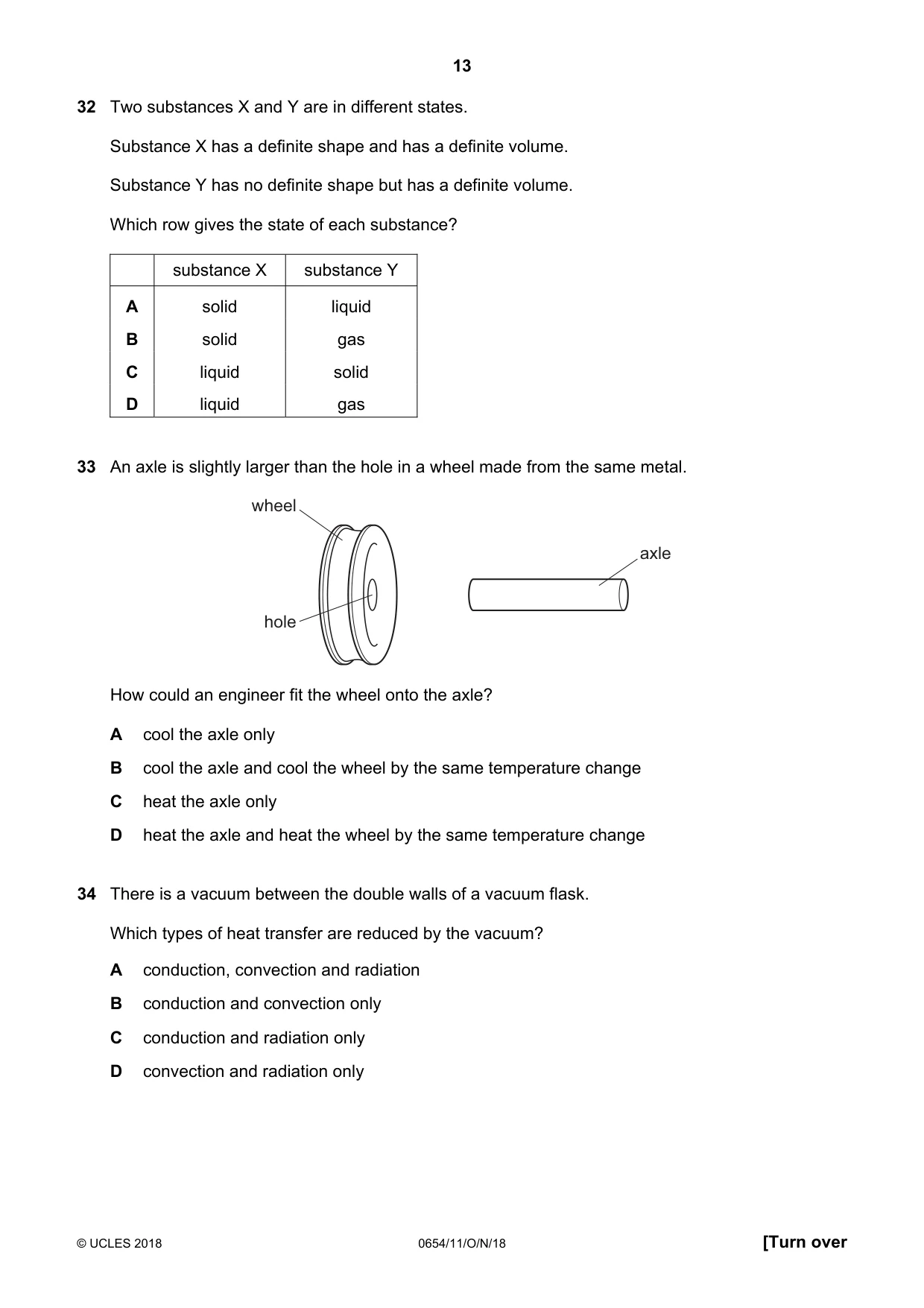
32 Two substances X and Y are in different states. Substance X has a definite shape and has a definite volume. Substance Y has no definite shape but has a definite volume. Which row gives the state of each substance? substance X substance Y A solid liquid B solid gas C liquid solid D liquid gas
Mark scheme: A
Q33 · An axle is slightly larger than the hole in a wheel made from the same metal
33 An axle is slightly larger than the hole in a wheel made from the same metal. wheel axle hole How could an engineer fit the wheel onto the axle? A cool the axle only B cool the axle and cool the wheel by the same temperature change C heat the axle only D heat the axle and heat the wheel by the same temperature change
Mark scheme: A
Q34 · There is a vacuum between the double walls of a vacuum flask
34 There is a vacuum between the double walls of a vacuum flask. Which types of heat transfer are reduced by the vacuum? A conduction, convection and radiation B conduction and convection only C conduction and radiation only D convection and radiation only
Mark scheme: B
Q35 · Which diagram shows the dispersion of white light by a glass prism?
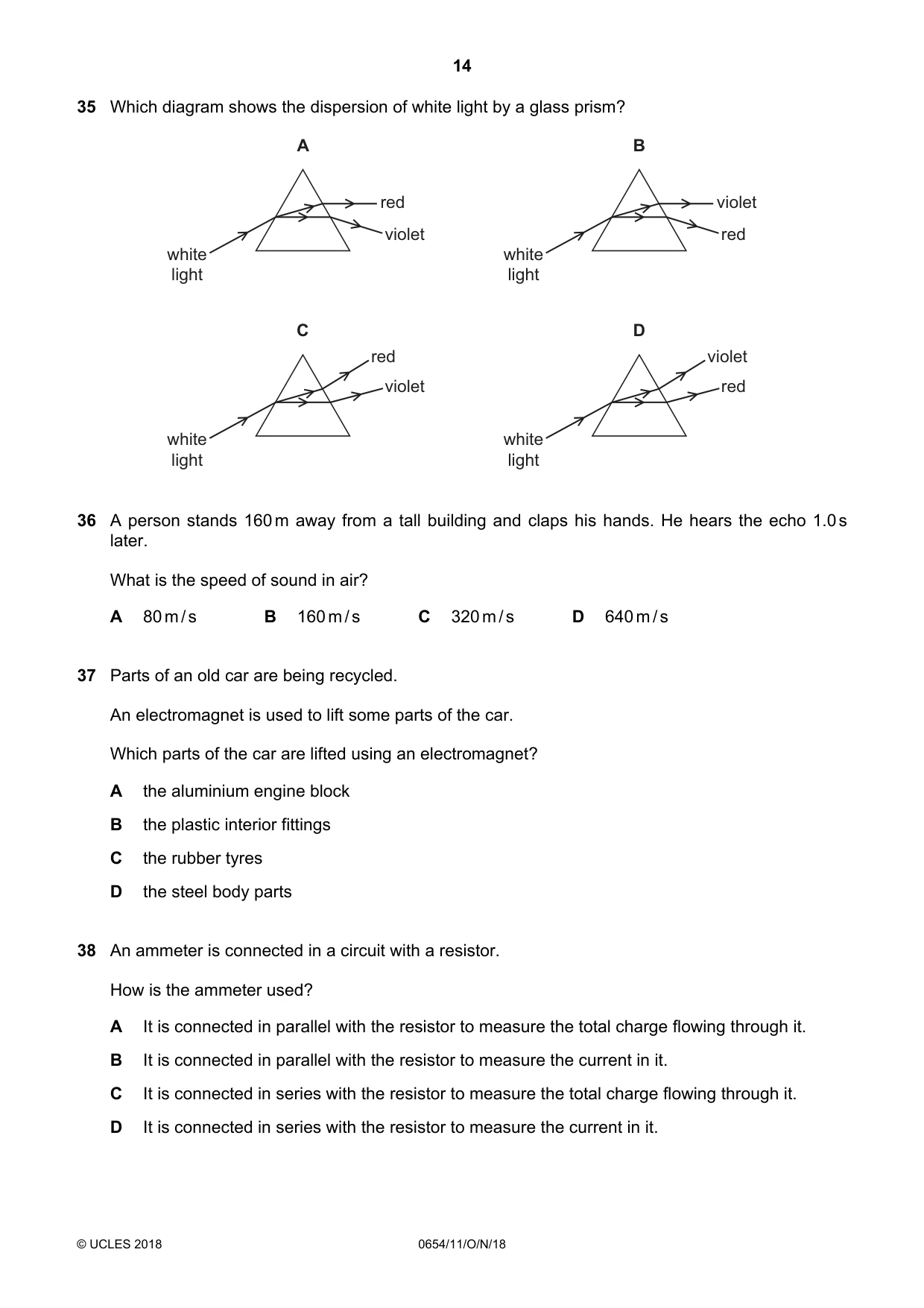
35 Which diagram shows the dispersion of white light by a glass prism? A B red violet violet red white white light light C D red violet violet red white white light light
Mark scheme: A
Q36 · A person stands 160 m away from a tall building and claps his hands
36 A person stands 160 m away from a tall building and claps his hands. He hears the echo 1.0 s later. What is the speed of sound in air? A 80 m / s B 160 m / s C 320 m / s D 640 m / s
Mark scheme: C
Q37 · Parts of an old car are being recycled
37 Parts of an old car are being recycled. An electromagnet is used to lift some parts of the car. Which parts of the car are lifted using an electromagnet? A the aluminium engine block B the plastic interior fittings C the rubber tyres D the steel body parts
Mark scheme: D
Q38 · An ammeter is connected in a circuit with a resistor
38 An ammeter is connected in a circuit with a resistor. How is the ammeter used? A It is connected in parallel with the resistor to measure the total charge flowing through it. B It is connected in parallel with the resistor to measure the current in it. C It is connected in series with the resistor to measure the total charge flowing through it. D It is connected in series with the resistor to measure the current in it.
Mark scheme: D
Q39 · A circuit contains a lamp and a fuse
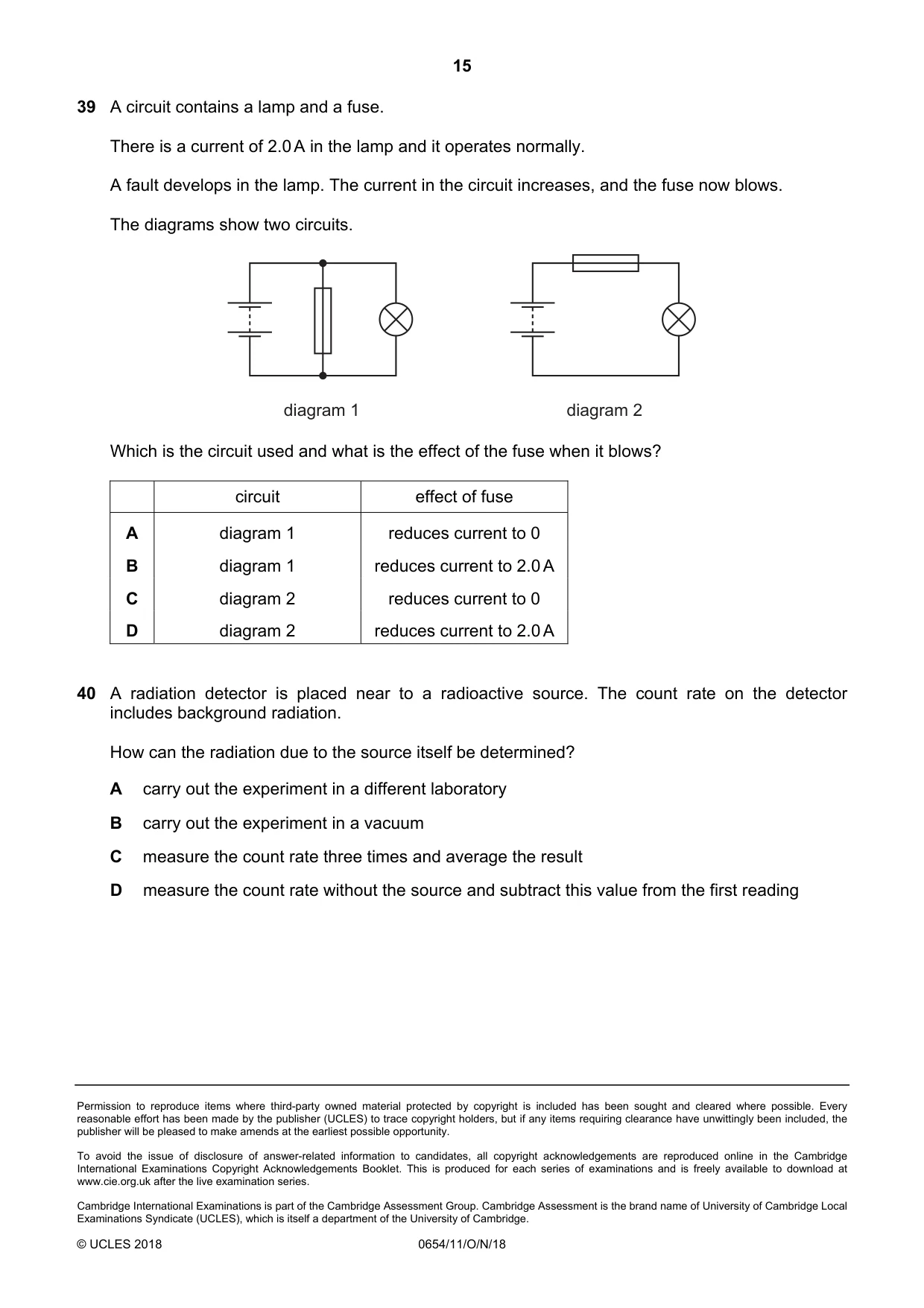
39 A circuit contains a lamp and a fuse. There is a current of 2.0 A in the lamp and it operates normally. A fault develops in the lamp. The current in the circuit increases, and the fuse now blows. The diagrams show two circuits. diagram 1 diagram 2 Which is the circuit used and what is the effect of the fuse when it blows? circuit effect of fuse A diagram 1 reduces current to 0 B diagram 1 reduces current to 2.0 A C diagram 2 reduces current to 0 D diagram 2 reduces current to 2.0 A
Mark scheme: C
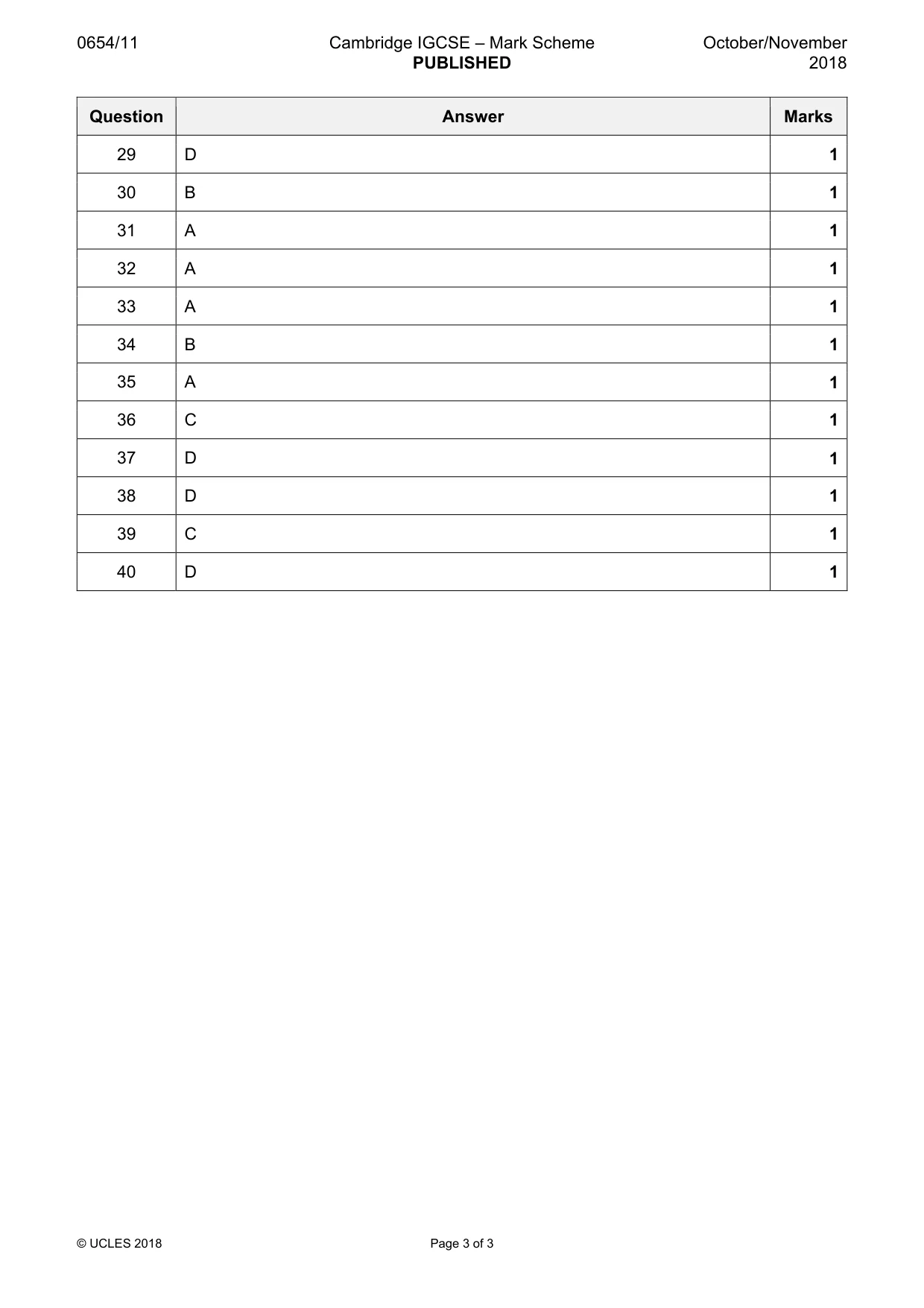
Q40 · A radiation detector is placed near to a radioactive source
40 A radiation detector is placed near to a radioactive source. The count rate on the detector includes background radiation. How can the radiation due to the source itself be determined? A carry out the experiment in a different laboratory B carry out the experiment in a vacuum C measure the count rate three times and average the result D measure the count rate without the source and subtract this value from the first reading
Mark scheme: D
What was in this paper
The subtopics covered by these 40 questions, and how many questions each got. Open one in a new tab to see every Cambridge question on it.
2Air quality and climate1Alcohols1Biological molecules1Carbon cycle1Cell division1Cell structure1Characteristics of living organisms1Chromosomes and genes1Corrosion of metals1Density1Electrical circuits1Electrical safety1Electrolysis1Elements, compounds and mixtures1Energy, work and power1Enzymes1Exothermic and endothermic reactions1Habitat destruction1Heart1Identification of ions and gases1Kinetic particle model of matter1Light1Motion1Photosynthesis1Pressure1Radioactivity1Rate of reaction1Reactivity series1Redox1Respiration1Separation and purification1Simple molecules and covalent bonds1Simple phenomena of magnetism1Sound1The characteristic properties of acids and bases1Thermal properties and temperature1Transfer of thermal energy1Transition elements1What you needed in this session
Cambridge’s own grade thresholds for 2018 Oct/Nov, Paper 1 · Variant 1. A higher threshold means an easier paper — the bar moves with how the cohort did.