Cambridge IGCSE Sciences - Co-ordinated (Double) 0654 — 2016 May/June Paper 1 · Variant 1
0654/11/M/J/16 · 40 questions · 40 marks · ≈45 min
The question paper and its mark scheme, free to read here and free to download. This is Cambridge’s own paper, exactly as it was sat.
Question paper20 pages


Mark scheme2 pages
Answers below. Sit the paper first if you are practising.
Questions as text
Q1 · An organism has the ability to break down nutrient molecules to release energy
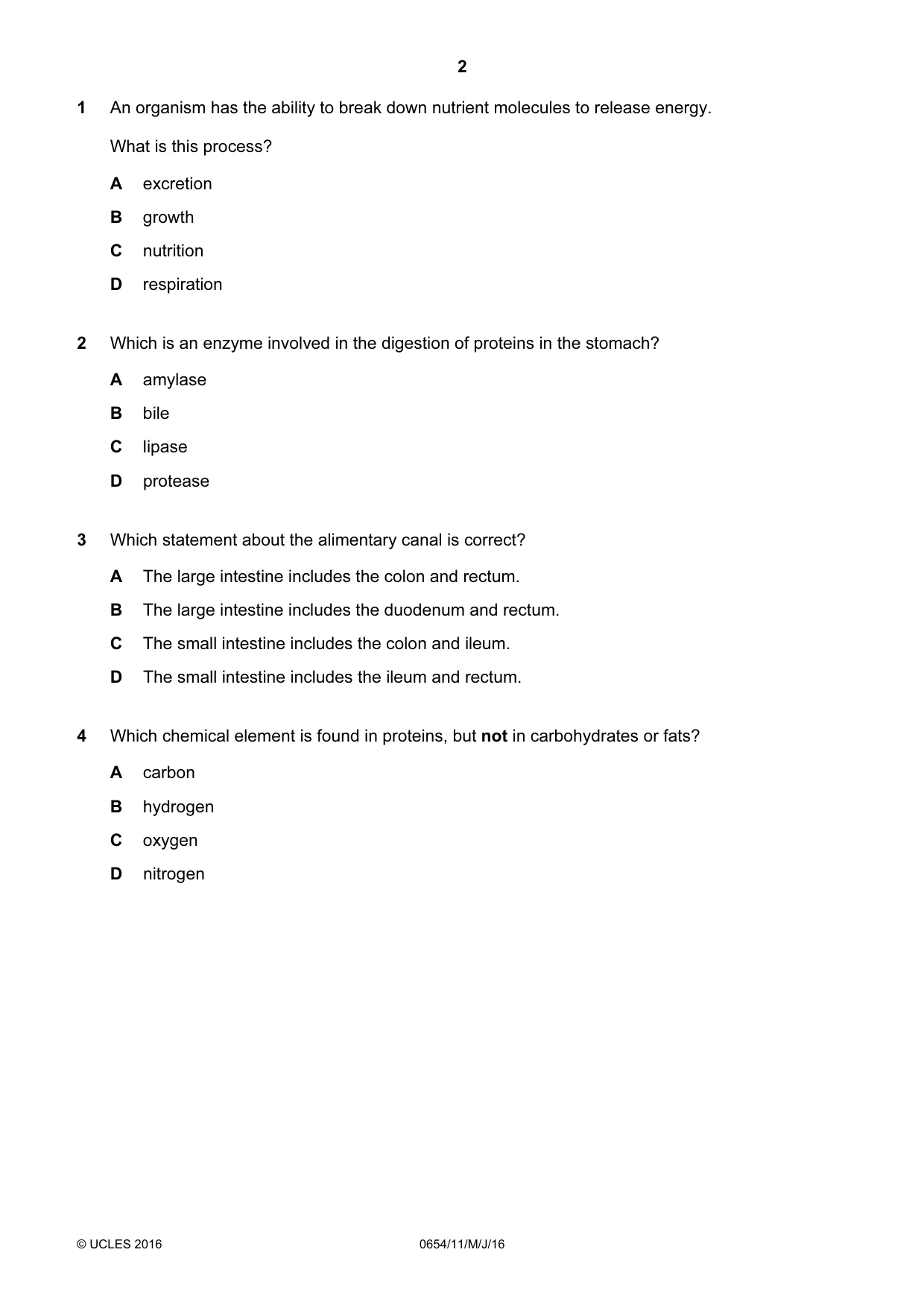
1 An organism has the ability to break down nutrient molecules to release energy. What is this process? A excretion B growth C nutrition D respiration
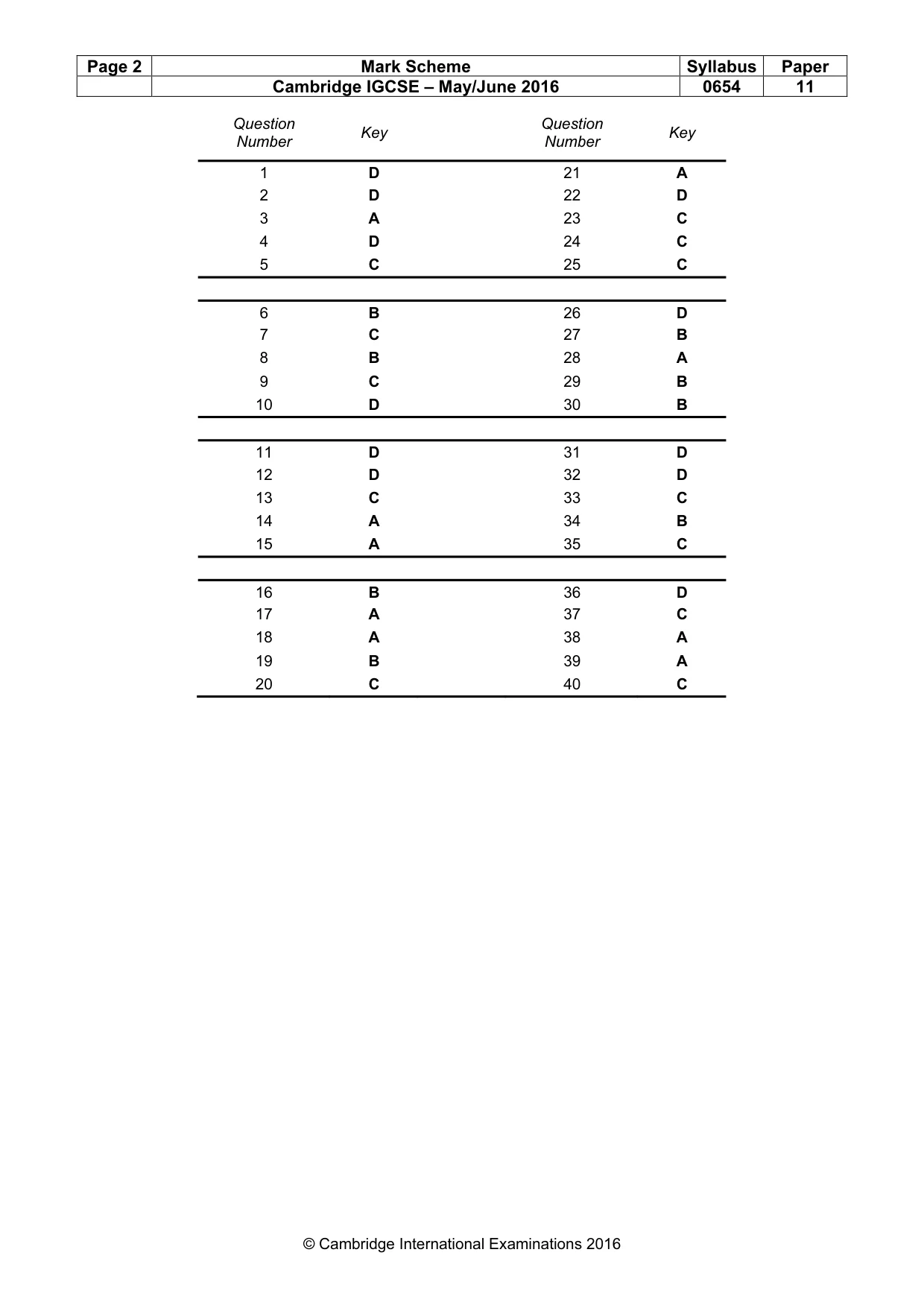
Mark scheme: D
Q2 · Which is an enzyme involved in the digestion of proteins in the stomach?
2 Which is an enzyme involved in the digestion of proteins in the stomach? A amylase B bile C lipase D protease
Mark scheme: D
Q3 · Which statement about the alimentary canal is correct?
3 Which statement about the alimentary canal is correct? A The large intestine includes the colon and rectum. B The large intestine includes the duodenum and rectum. C The small intestine includes the colon and ileum. D The small intestine includes the ileum and rectum.
Mark scheme: A
Q4 · Which chemical element is found in proteins, but not in carbohydrates or fats?
4 Which chemical element is found in proteins, but not in carbohydrates or fats? A carbon B hydrogen C oxygen D nitrogen
Mark scheme: D
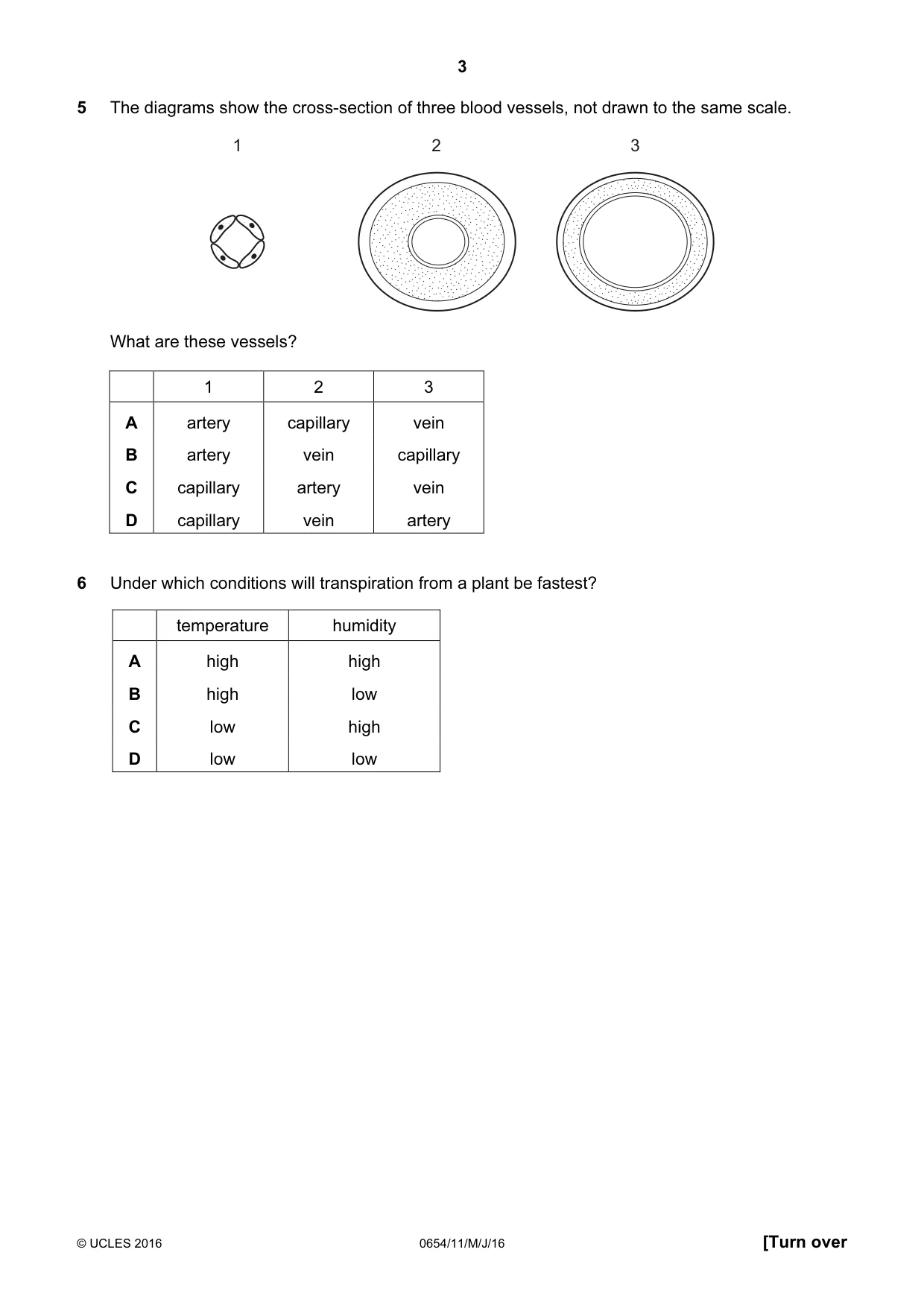
Q5 · The diagrams show the cross-section of three blood vessels, not drawn to the same scale
5 The diagrams show the cross-section of three blood vessels, not drawn to the same scale. 1 2 3 What are these vessels? 1 2 3 A artery capillary vein B artery vein capillary C capillary artery vein D capillary vein artery
Mark scheme: C
Q6 · Under which conditions will transpiration from a plant be fastest?
6 Under which conditions will transpiration from a plant be fastest? temperature humidity A high high B high low C low high D low low
Mark scheme: B
Q7 · The diagram shows what happens to glucose in the body
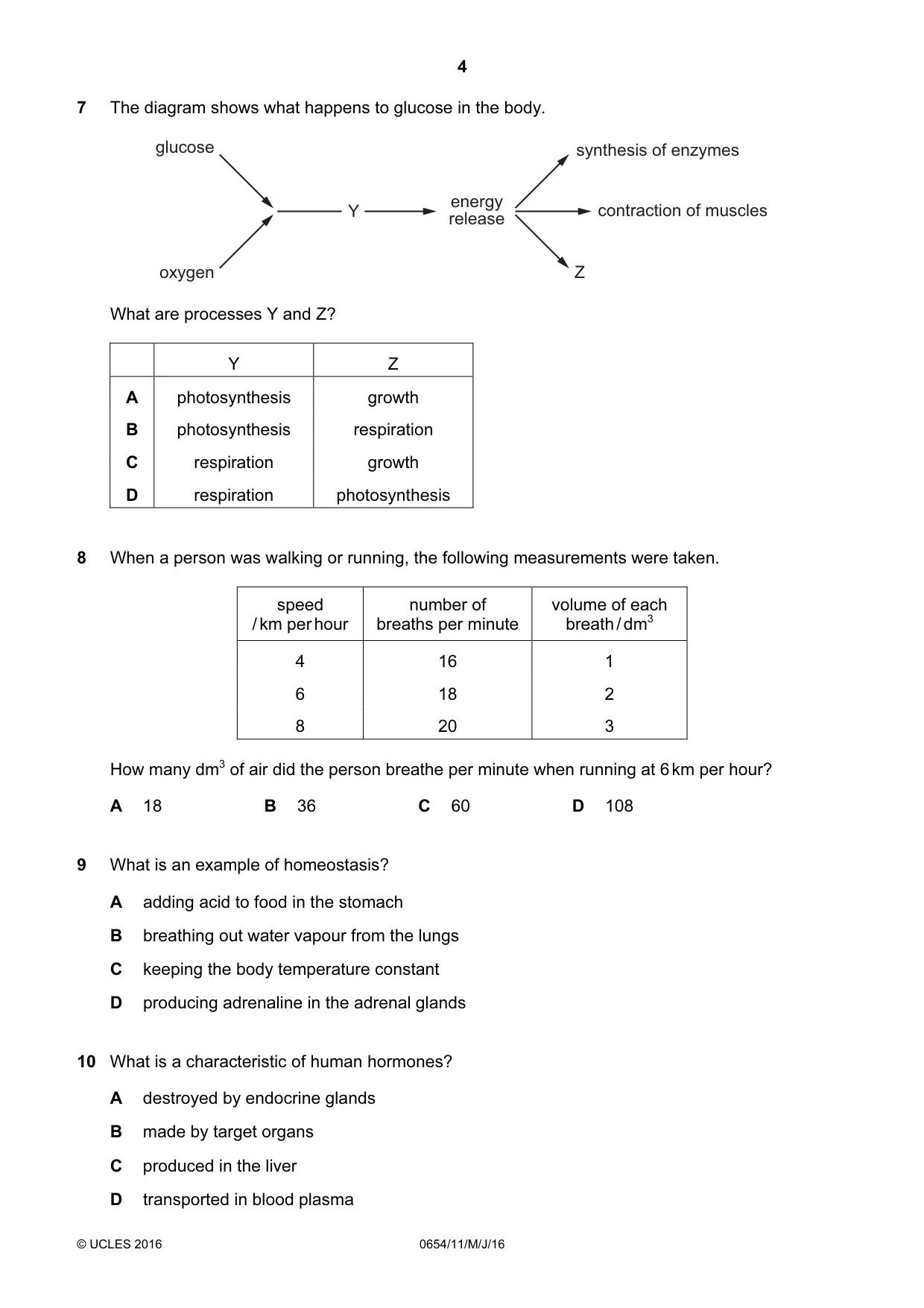
7 The diagram shows what happens to glucose in the body. glucose synthesis of enzymes energy Y contraction of muscles release oxygen Z What are processes Y and Z? Y Z A photosynthesis growth B photosynthesis respiration C respiration growth D respiration photosynthesis
Mark scheme: C
Q8 · When a person was walking or running, the following measurements were taken
8 When a person was walking or running, the following measurements were taken. speed number of volume of each / km per hour breaths per minute breath / dm3 4 16 1 6 18 2 8 20 3 How many dm3 of air did the person breathe per minute when running at 6 km per hour? A 18 B 36 C 60 D 108
Mark scheme: B
Q9 · What is an example of homeostasis?
9 What is an example of homeostasis? A adding acid to food in the stomach B breathing out water vapour from the lungs C keeping the body temperature constant D producing adrenaline in the adrenal glands
Mark scheme: C
Q10 · What is a characteristic of human hormones?
10 What is a characteristic of human hormones? A destroyed by endocrine glands B made by target organs C produced in the liver D transported in blood plasma
Mark scheme: D
Q11 · A student placed four sets of seeds in different conditions
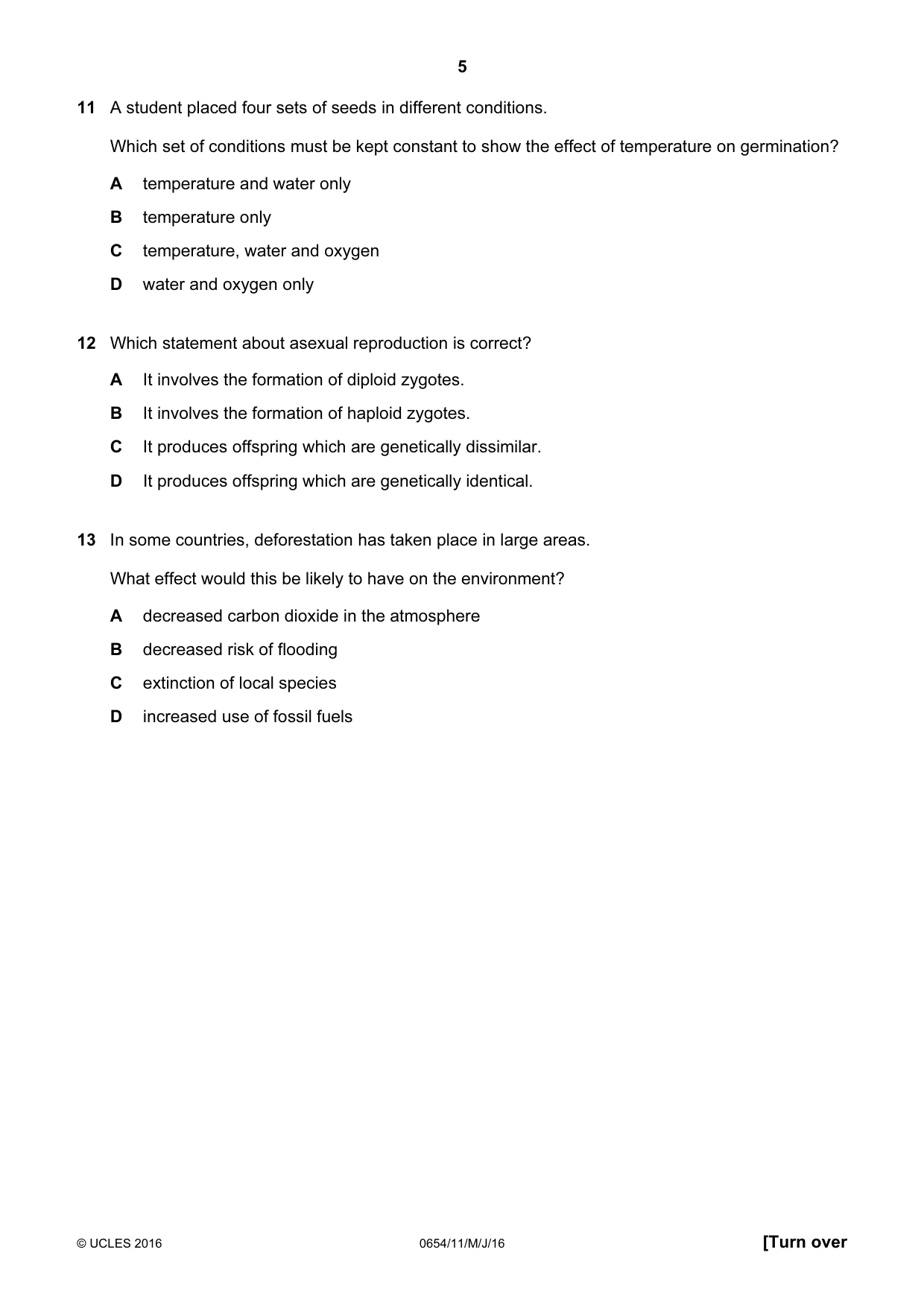
11 A student placed four sets of seeds in different conditions. Which set of conditions must be kept constant to show the effect of temperature on germination? A temperature and water only B temperature only C temperature, water and oxygen D water and oxygen only
Mark scheme: D
Q12 · Which statement about asexual reproduction is correct?
12 Which statement about asexual reproduction is correct? A It involves the formation of diploid zygotes. B It involves the formation of haploid zygotes. C It produces offspring which are genetically dissimilar. D It produces offspring which are genetically identical.
Mark scheme: D
Q13 · In some countries, deforestation has taken place in large areas
13 In some countries, deforestation has taken place in large areas. What effect would this be likely to have on the environment? A decreased carbon dioxide in the atmosphere B decreased risk of flooding C extinction of local species D increased use of fossil fuels
Mark scheme: C
Q14 · The diagram shows the readings on a thermometer before and after a reaction
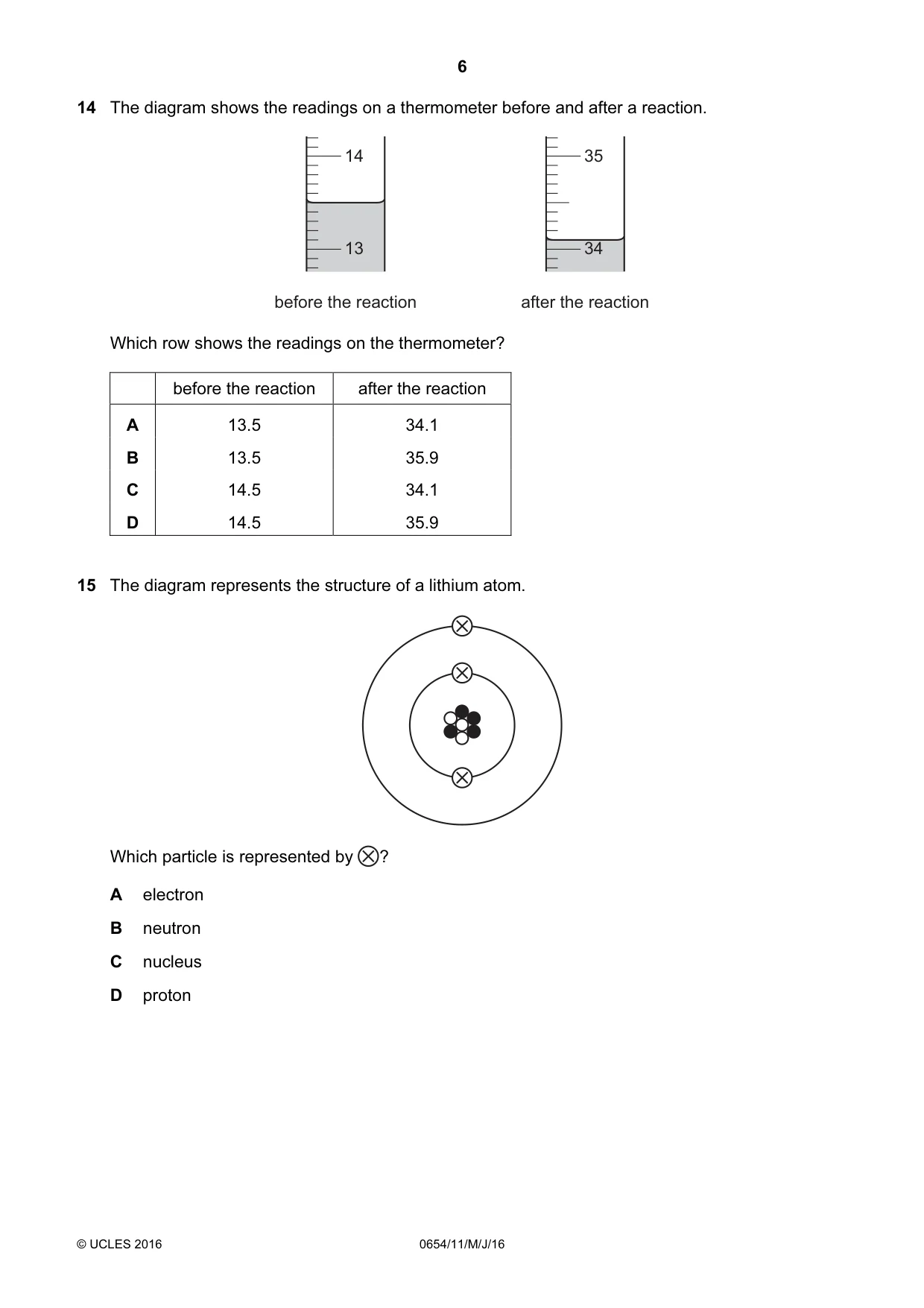
14 The diagram shows the readings on a thermometer before and after a reaction. 14 35 13 34 before the reaction after the reaction Which row shows the readings on the thermometer? before the reaction after the reaction A 13.5 34.1 B 13.5 35.9 C 14.5 34.1 D 14.5 35.9
Mark scheme: A
More questions on Physical quantities and measurement techniques
Q15 · The diagram represents the structure of a lithium atom
15 The diagram represents the structure of a lithium atom. Which particle is represented by ? A electron B neutron C nucleus D proton
Mark scheme: A
Q16 · Three minerals containing iron are listed
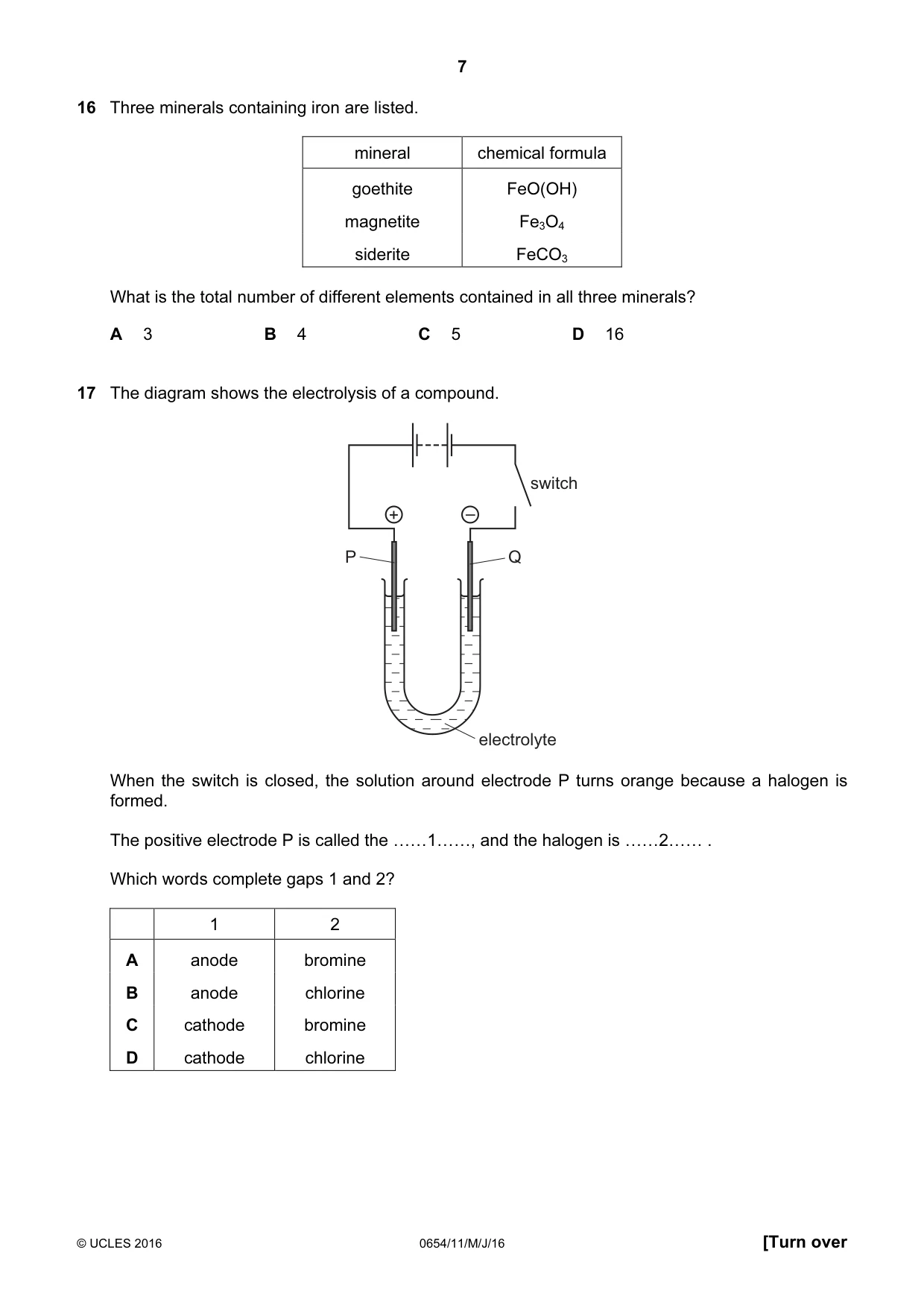
16 Three minerals containing iron are listed. mineral chemical formula goethite FeO(OH) magnetite Fe3O4 siderite FeCO3 What is the total number of different elements contained in all three minerals? A 3 B 4 C 5 D 16
Mark scheme: B
Q17 · The diagram shows the electrolysis of a compound
17 The diagram shows the electrolysis of a compound. switch + – P Q electrolyte When the switch is closed, the solution around electrode P turns orange because a halogen is formed. The positive electrode P is called the ……1……, and the halogen is ……2…… . Which words complete gaps 1 and 2? 1 2 A anode bromine B anode chlorine C cathode bromine D cathode chlorine
Mark scheme: A
Q18 · Which statement about chemical reactions is correct?
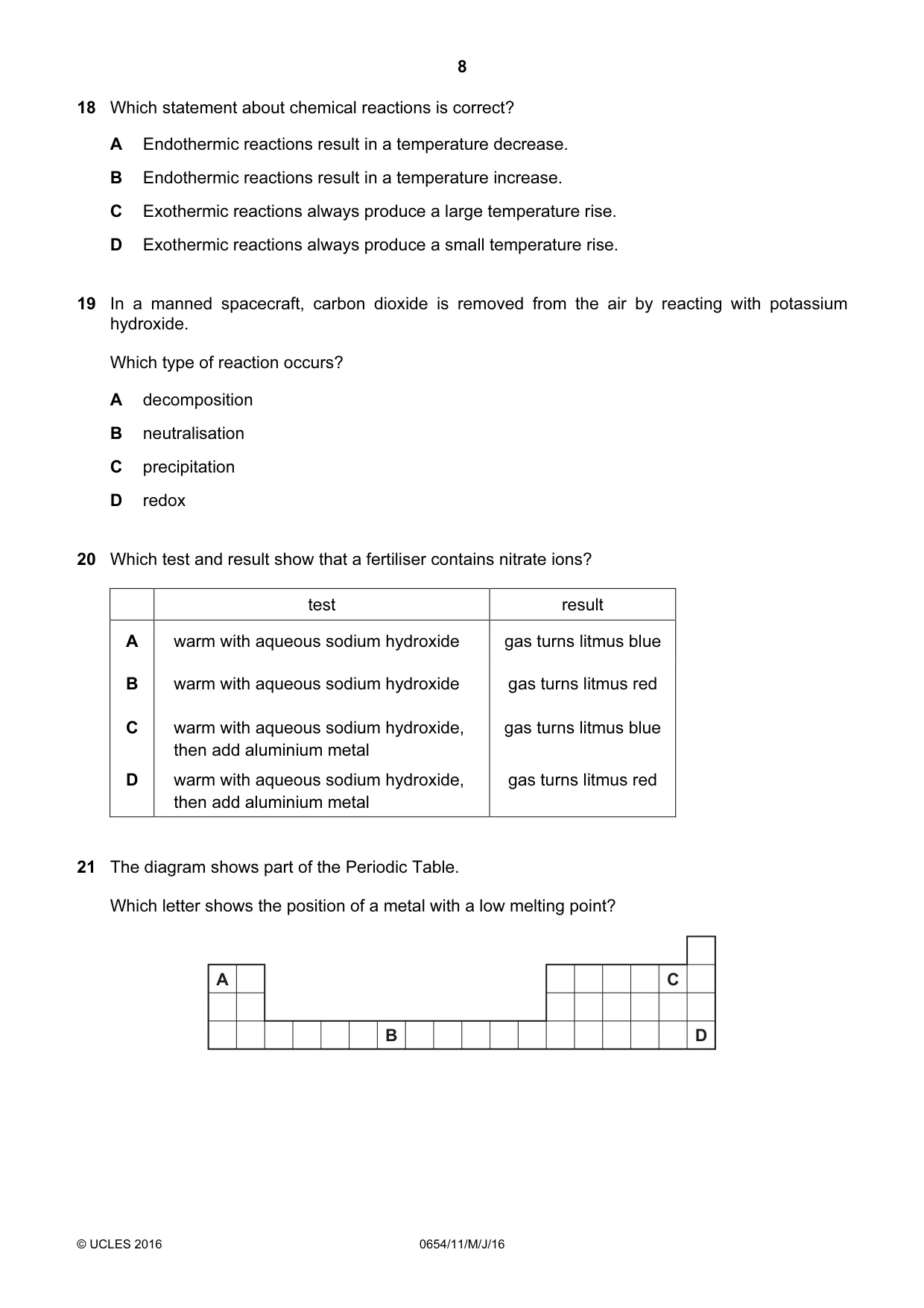
18 Which statement about chemical reactions is correct? A Endothermic reactions result in a temperature decrease. B Endothermic reactions result in a temperature increase. C Exothermic reactions always produce a large temperature rise. D Exothermic reactions always produce a small temperature rise.
Mark scheme: A
Q19 · In a manned spacecraft, carbon dioxide is removed from the air by reacting with potassium…
19 In a manned spacecraft, carbon dioxide is removed from the air by reacting with potassium hydroxide. Which type of reaction occurs? A decomposition B neutralisation C precipitation D redox
Mark scheme: B
More questions on The characteristic properties of acids and bases
Q20 · Which test and result show that a fertiliser contains nitrate ions?
20 Which test and result show that a fertiliser contains nitrate ions? test result A warm with aqueous sodium hydroxide gas turns litmus blue B warm with aqueous sodium hydroxide gas turns litmus red C warm with aqueous sodium hydroxide, gas turns litmus blue then add aluminium metal D warm with aqueous sodium hydroxide, gas turns litmus red then add aluminium metal
Mark scheme: C
Q21 · The diagram shows part of the Periodic Table
21 The diagram shows part of the Periodic Table. Which letter shows the position of a metal with a low melting point? A C B D
Mark scheme: A
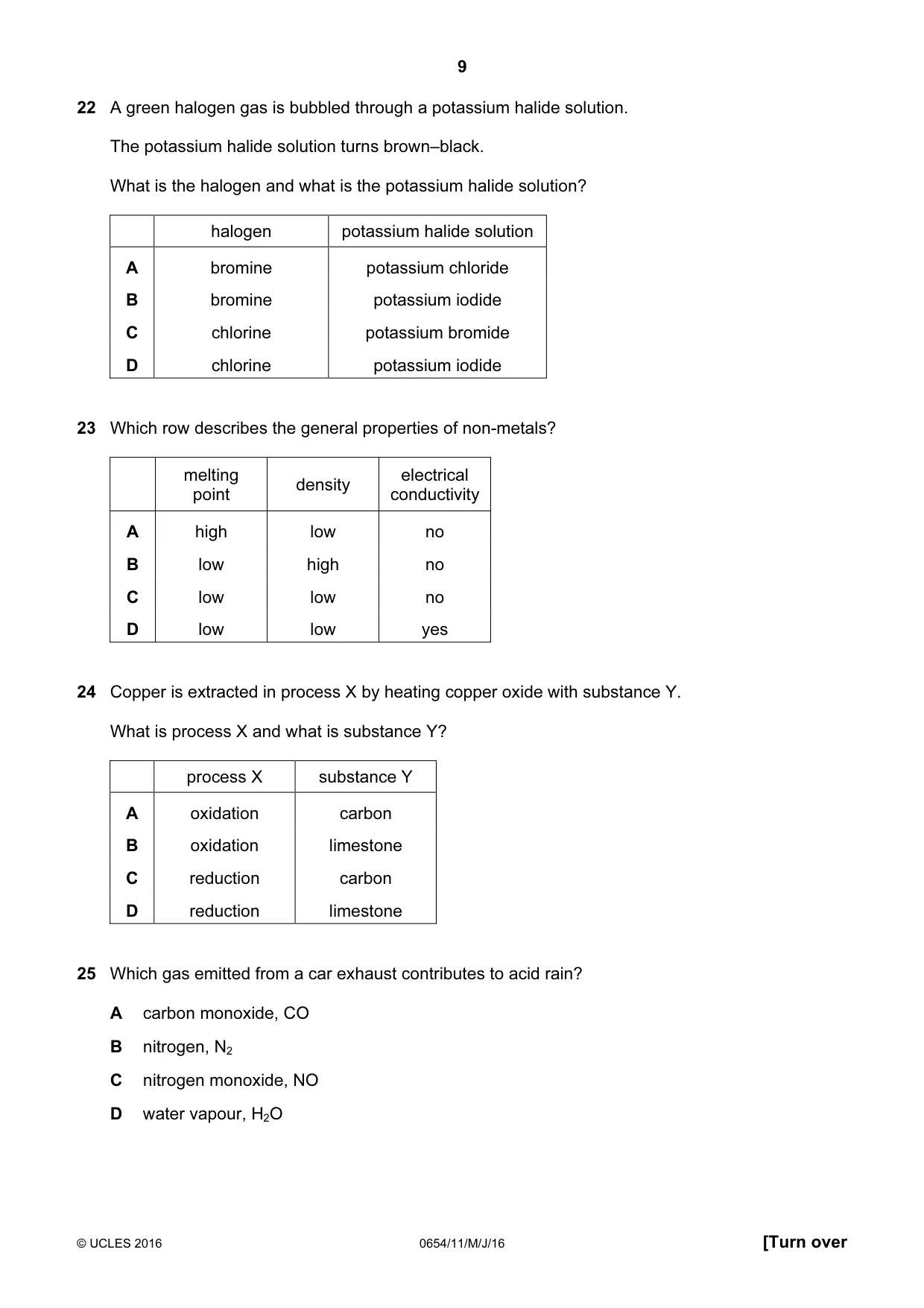
Q22 · A green halogen gas is bubbled through a potassium halide solution
22 A green halogen gas is bubbled through a potassium halide solution. The potassium halide solution turns brown–black. What is the halogen and what is the potassium halide solution? halogen potassium halide solution A bromine potassium chloride B bromine potassium iodide C chlorine potassium bromide D chlorine potassium iodide
Mark scheme: D
Q23 · Which row describes the general properties of non-metals?
23 Which row describes the general properties of non-metals? melting electrical density point conductivity A high low no B low high no C low low no D low low yes
Mark scheme: C
Q24 · Copper is extracted in process X by heating copper oxide with substance Y
24 Copper is extracted in process X by heating copper oxide with substance Y. What is process X and what is substance Y? process X substance Y A oxidation carbon B oxidation limestone C reduction carbon D reduction limestone
Mark scheme: C
Q25 · Which gas emitted from a car exhaust contributes to acid rain?
25 Which gas emitted from a car exhaust contributes to acid rain? A carbon monoxide, CO B nitrogen, N2 C nitrogen monoxide, NO D water vapour, H2O
Mark scheme: C
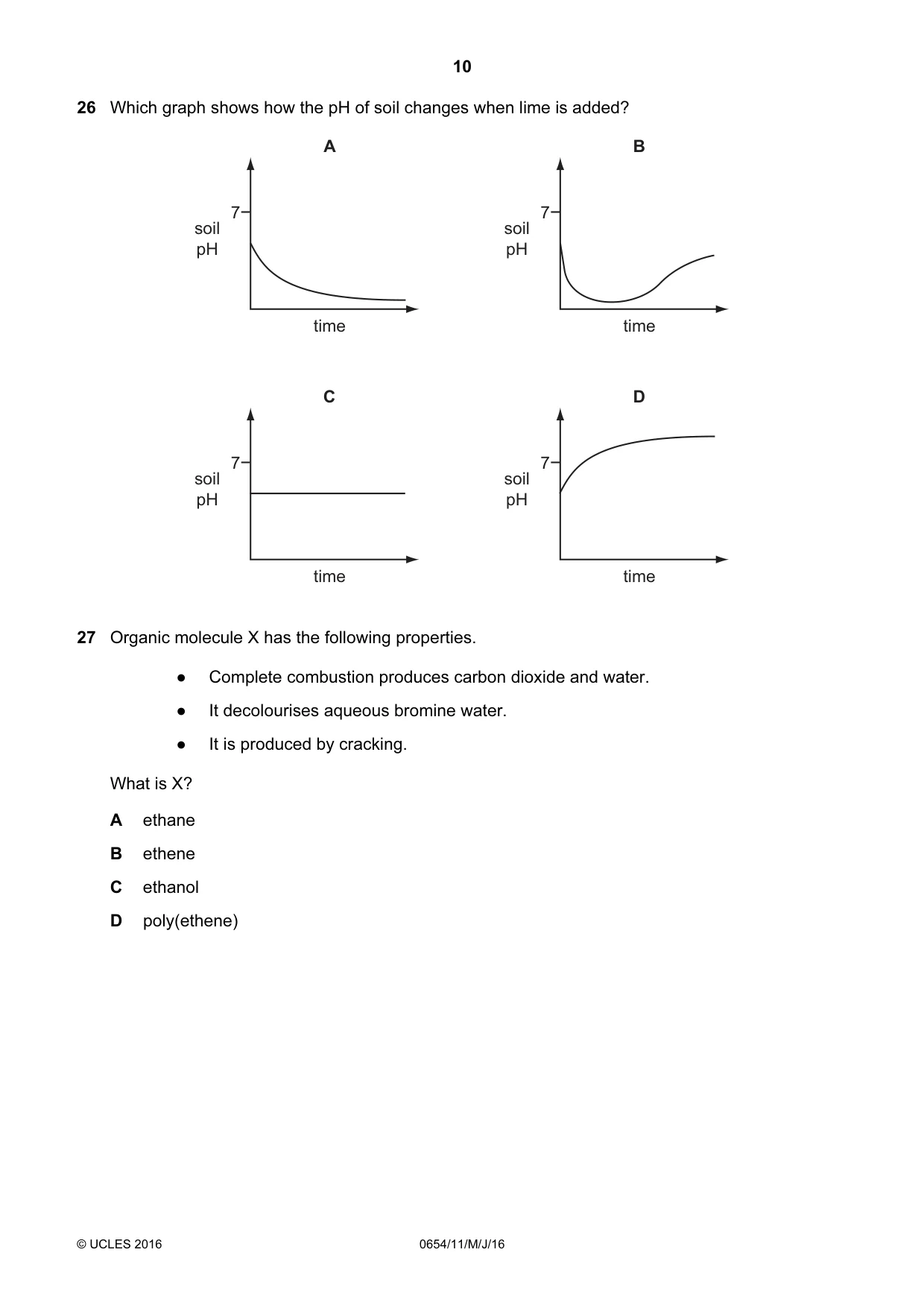
Q26 · Which graph shows how the pH of soil changes when lime is added?
26 Which graph shows how the pH of soil changes when lime is added? A B 7 7 soil soil pH pH time time C D 7 7 soil soil pH pH time time
Mark scheme: D
More questions on The characteristic properties of acids and bases
Q27 · Organic molecule X has the following properties
27 Organic molecule X has the following properties. ● Complete combustion produces carbon dioxide and water. ● It decolourises aqueous bromine water. ● It is produced by cracking. What is X? A ethane B ethene C ethanol D poly(ethene)
Mark scheme: B
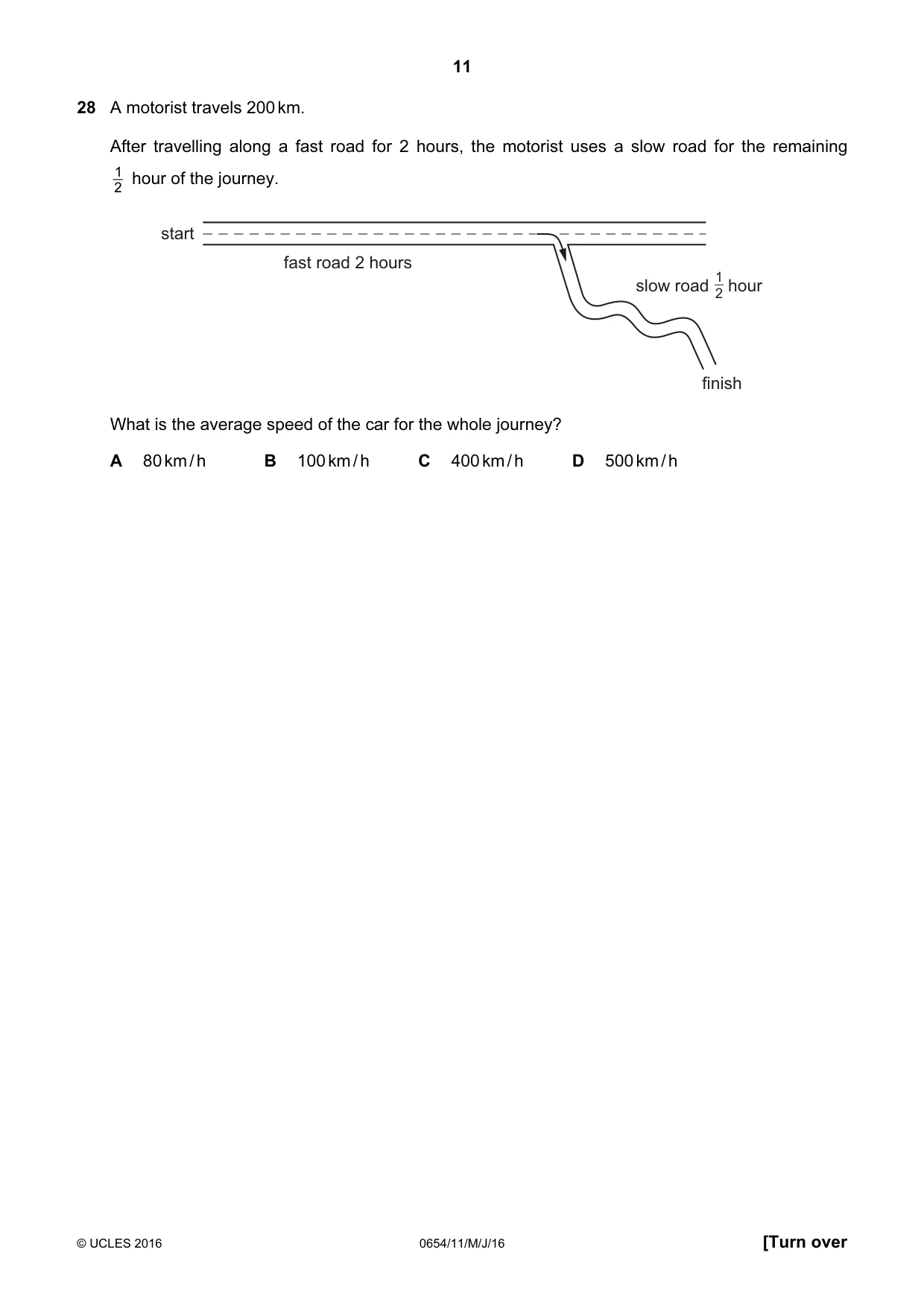
Q28 · A motorist travels 200 km
28 A motorist travels 200 km. After travelling along a fast road for 2 hours, the motorist uses a slow road for the remaining 1 hour of the journey. 2 start fast road 2 hours slow road hour 1 2 finish What is the average speed of the car for the whole journey? A 80 km / h B 100 km / h C 400 km / h D 500 km / h
Mark scheme: A
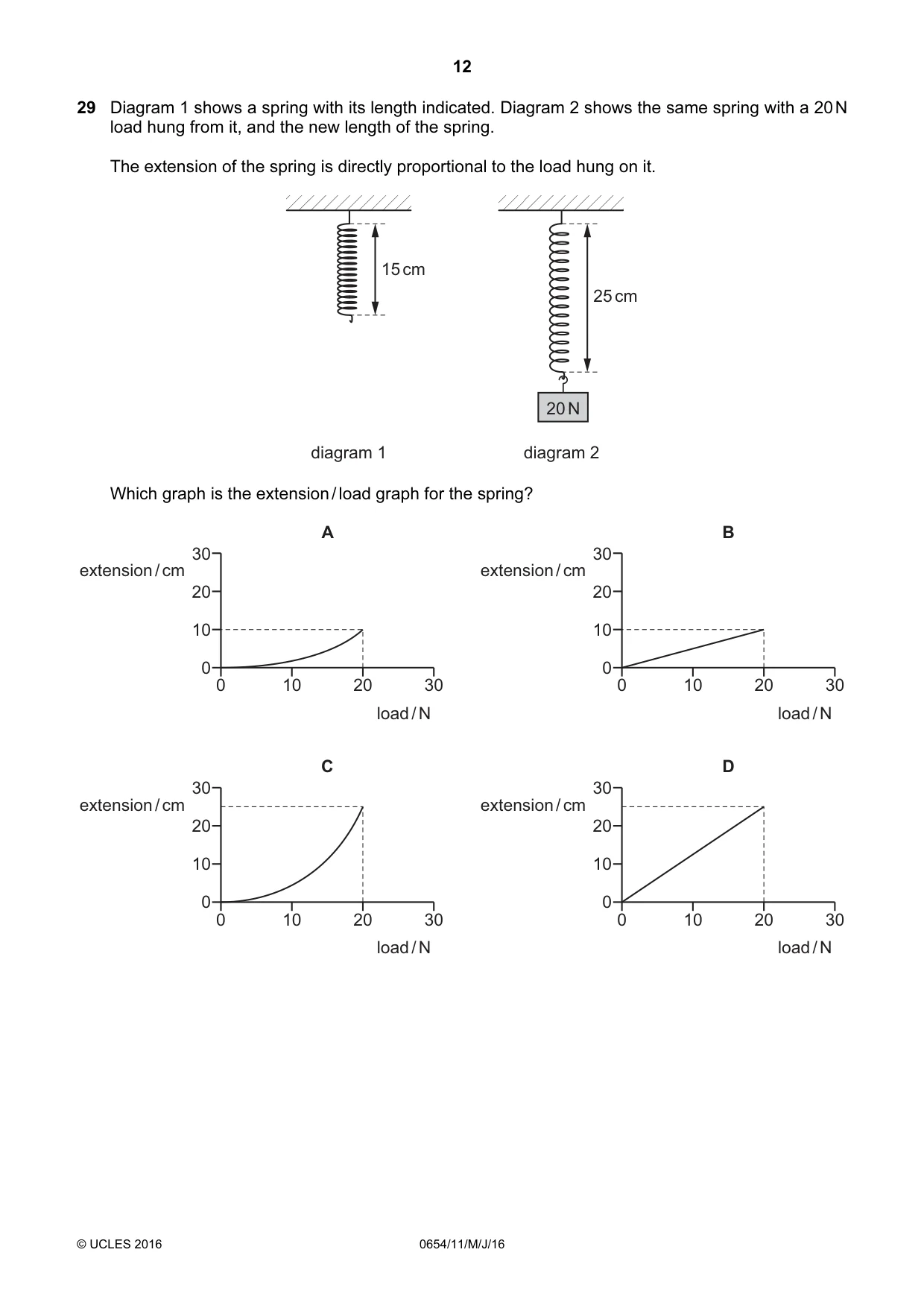
Q29 · A spring with its length indicated
29 Diagram 1 shows a spring with its length indicated. Diagram 2 shows the same spring with a 20 N load hung from it, and the new length of the spring. The extension of the spring is directly proportional to the load hung on it. 15 cm 25 cm 20 N diagram 1 diagram 2 Which graph is the extension / load graph for the spring? A B 30 30 extension / cm extension / cm 20 20 10 10 0 0 0 10 20 30 0 10 20 30 load / N load / N C D 30 30 extension / cm extension / cm 20 20 10 10 0 0 0 10 20 30 0 10 20 30 load / N load / N
Mark scheme: B
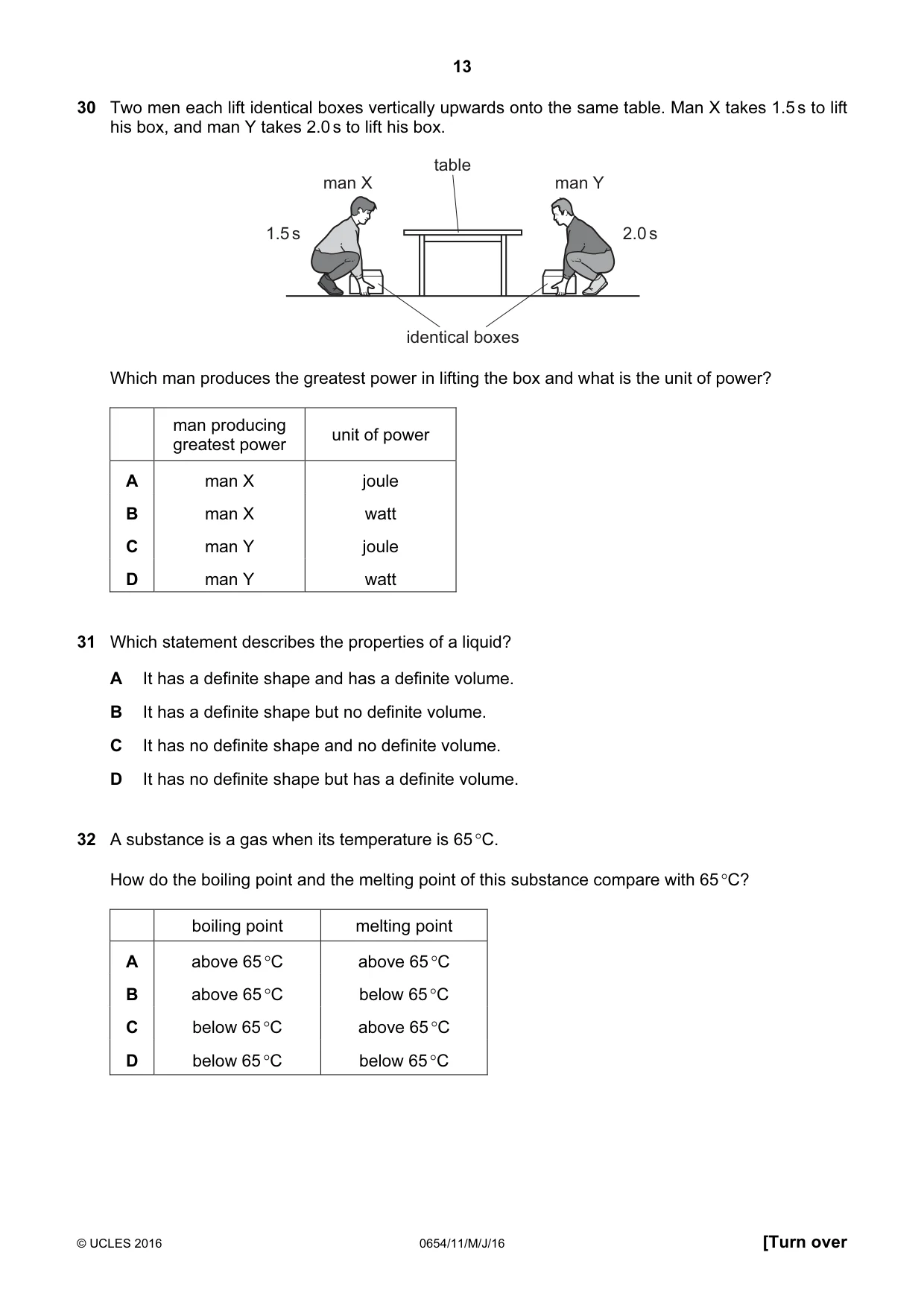
Q30 · Two men each lift identical boxes vertically upwards onto the same table
30 Two men each lift identical boxes vertically upwards onto the same table. Man X takes 1.5 s to lift his box, and man Y takes 2.0 s to lift his box. table man X man Y 1.5 s 2.0 s identical boxes Which man produces the greatest power in lifting the box and what is the unit of power? man producing unit of power greatest power A man X joule B man X watt C man Y joule D man Y watt
Mark scheme: B
Q31 · Which statement describes the properties of a liquid?
31 Which statement describes the properties of a liquid? A It has a definite shape and has a definite volume. B It has a definite shape but no definite volume. C It has no definite shape and no definite volume. D It has no definite shape but has a definite volume.
Mark scheme: D
Q32 · A substance is a gas when its temperature is 65 °C
32 A substance is a gas when its temperature is 65 °C. How do the boiling point and the melting point of this substance compare with 65 °C? boiling point melting point A above 65 °C above 65 °C B above 65 °C below 65 °C C below 65 °C above 65 °C D below 65 °C below 65 °C
Mark scheme: D
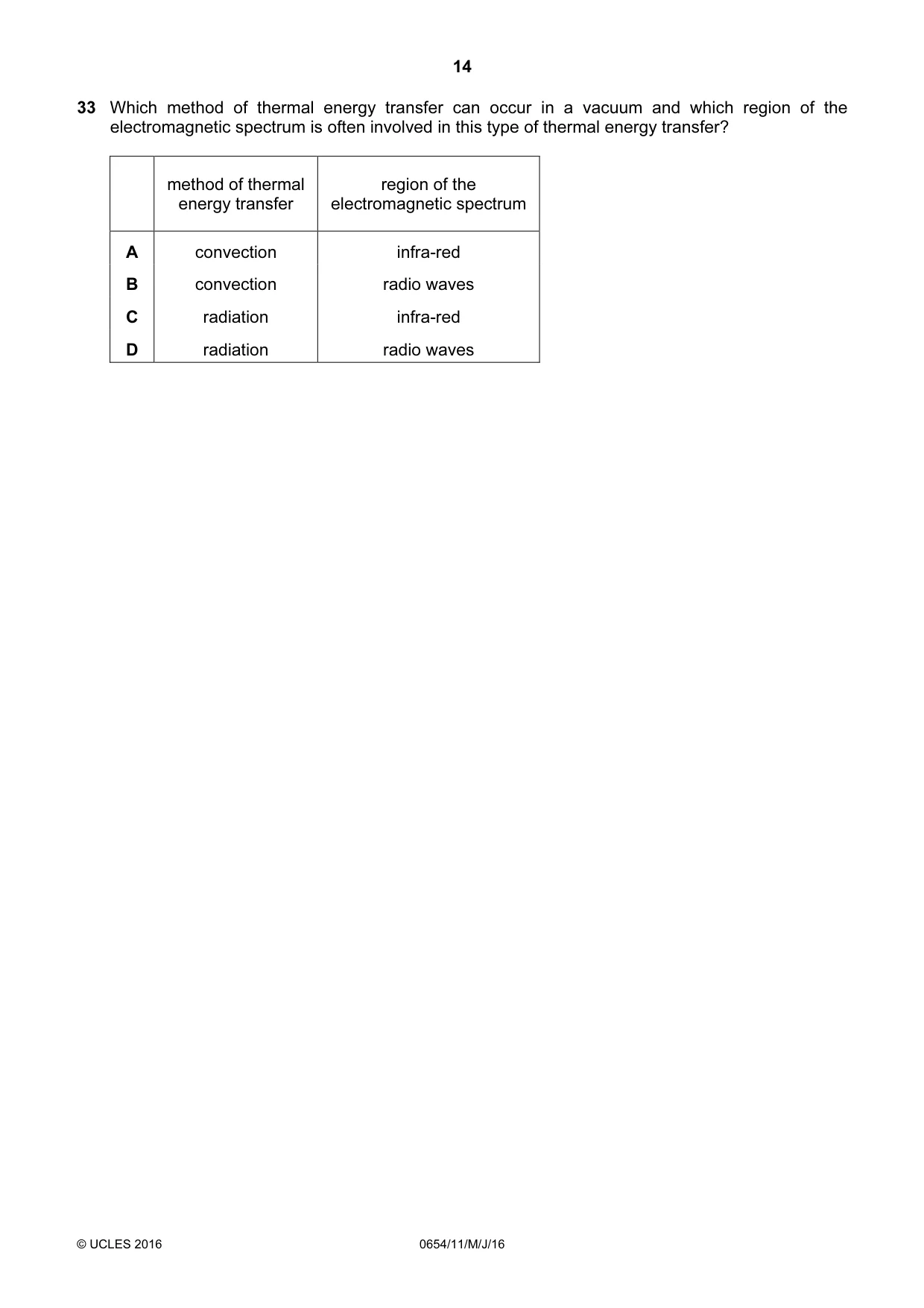
Q33 · Which method of thermal energy transfer can occur in a vacuum and which region of the…
33 Which method of thermal energy transfer can occur in a vacuum and which region of the electromagnetic spectrum is often involved in this type of thermal energy transfer? method of thermal region of the energy transfer electromagnetic spectrum A convection infra-red B convection radio waves C radiation infra-red D radiation radio waves
Mark scheme: C
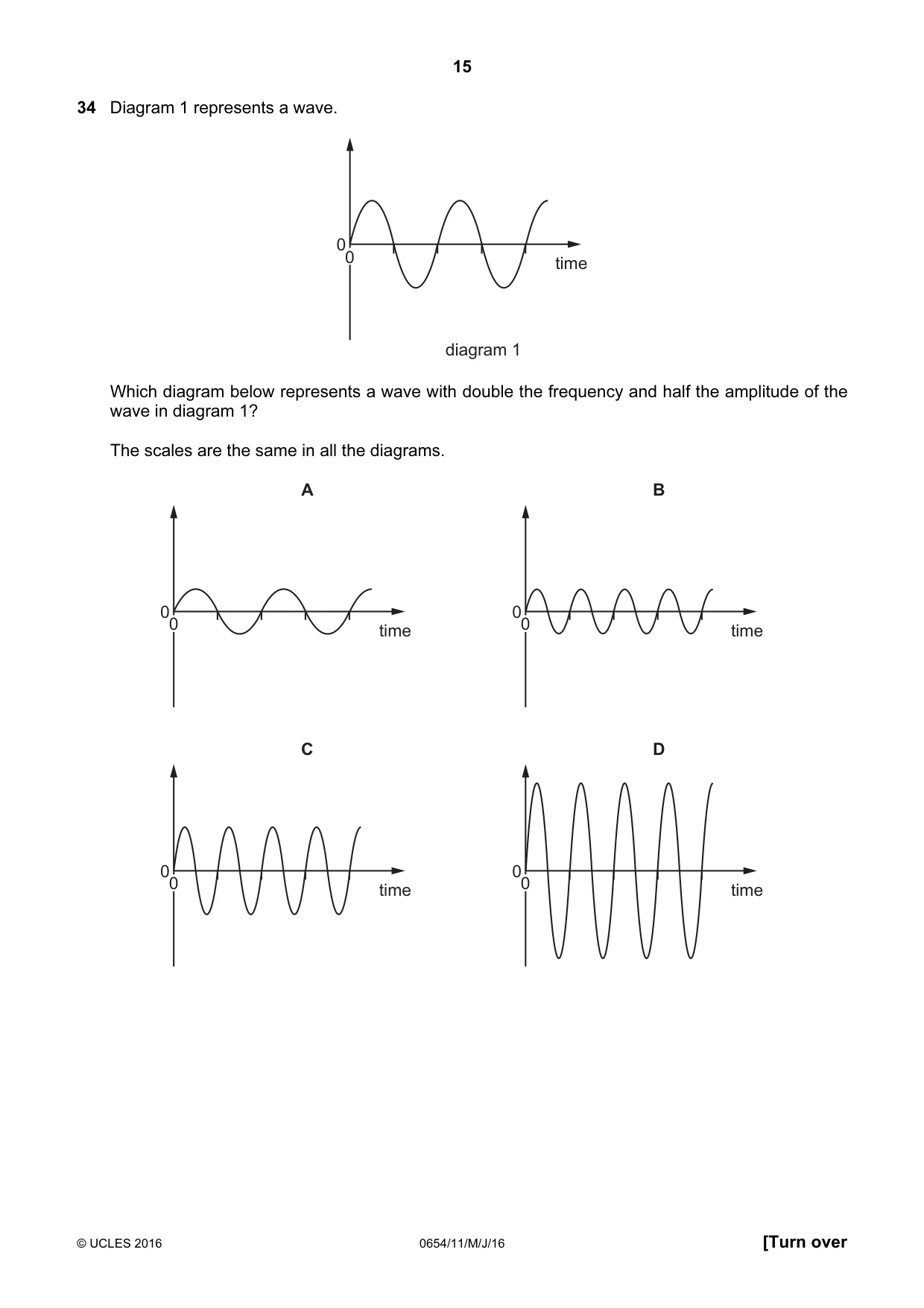
Question 34
34 Diagram 1 represents a wave. 00 time diagram 1 Which diagram below represents a wave with double the frequency and half the amplitude of the wave in diagram 1? The scales are the same in all the diagrams. A B 00 00 time time C D 00 00 time time
Mark scheme: B
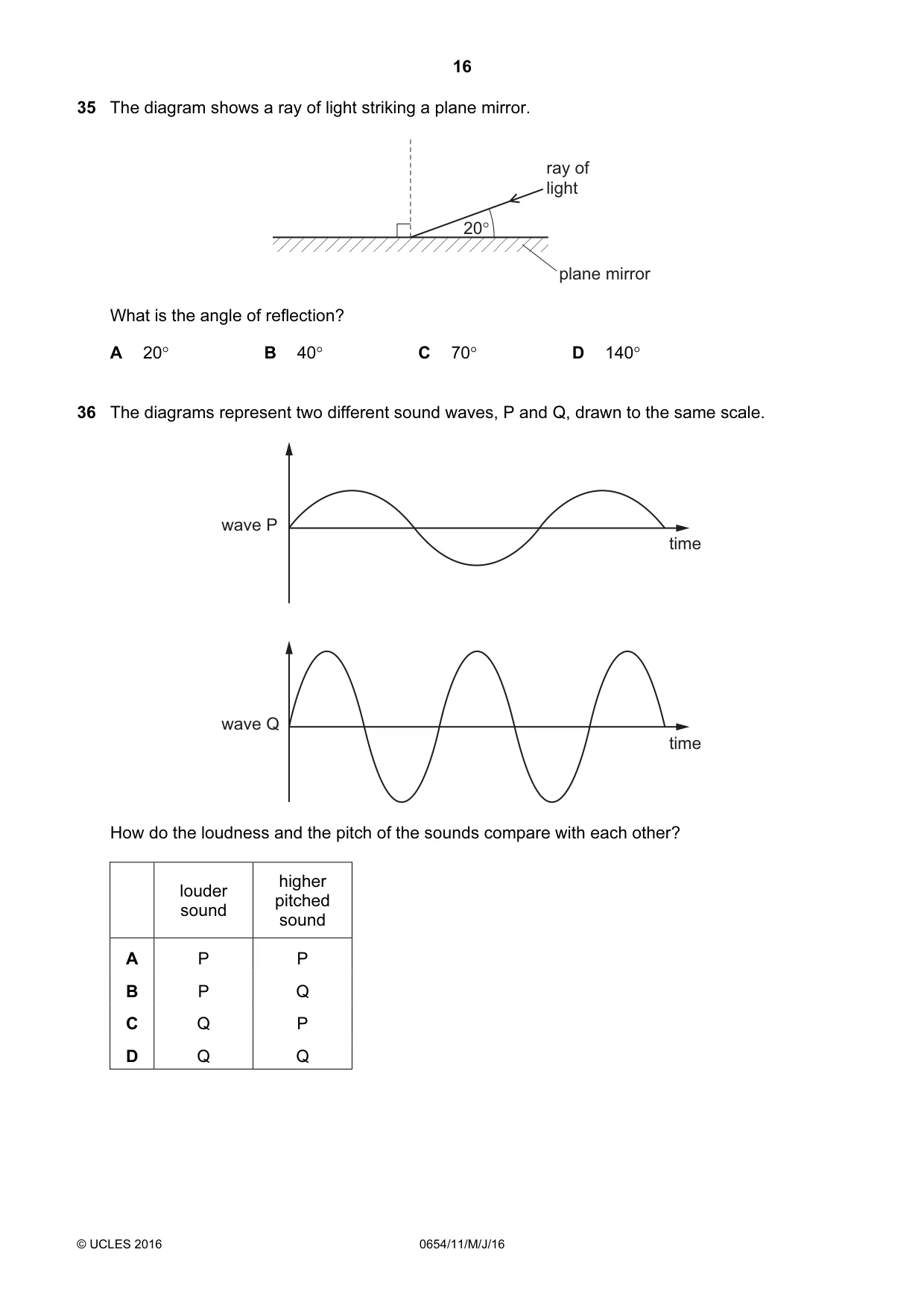
Q35 · The diagram shows a ray of light striking a plane mirror
35 The diagram shows a ray of light striking a plane mirror. ray of light 20° plane mirror What is the angle of reflection? A 20° B 40° C 70° D 140°
Mark scheme: C
Q36 · The diagrams represent two different sound waves, P and Q, drawn to the same scale
36 The diagrams represent two different sound waves, P and Q, drawn to the same scale. wave P time wave Q time How do the loudness and the pitch of the sounds compare with each other? higher louder pitched sound sound A P P B P Q C Q P D Q Q
Mark scheme: D
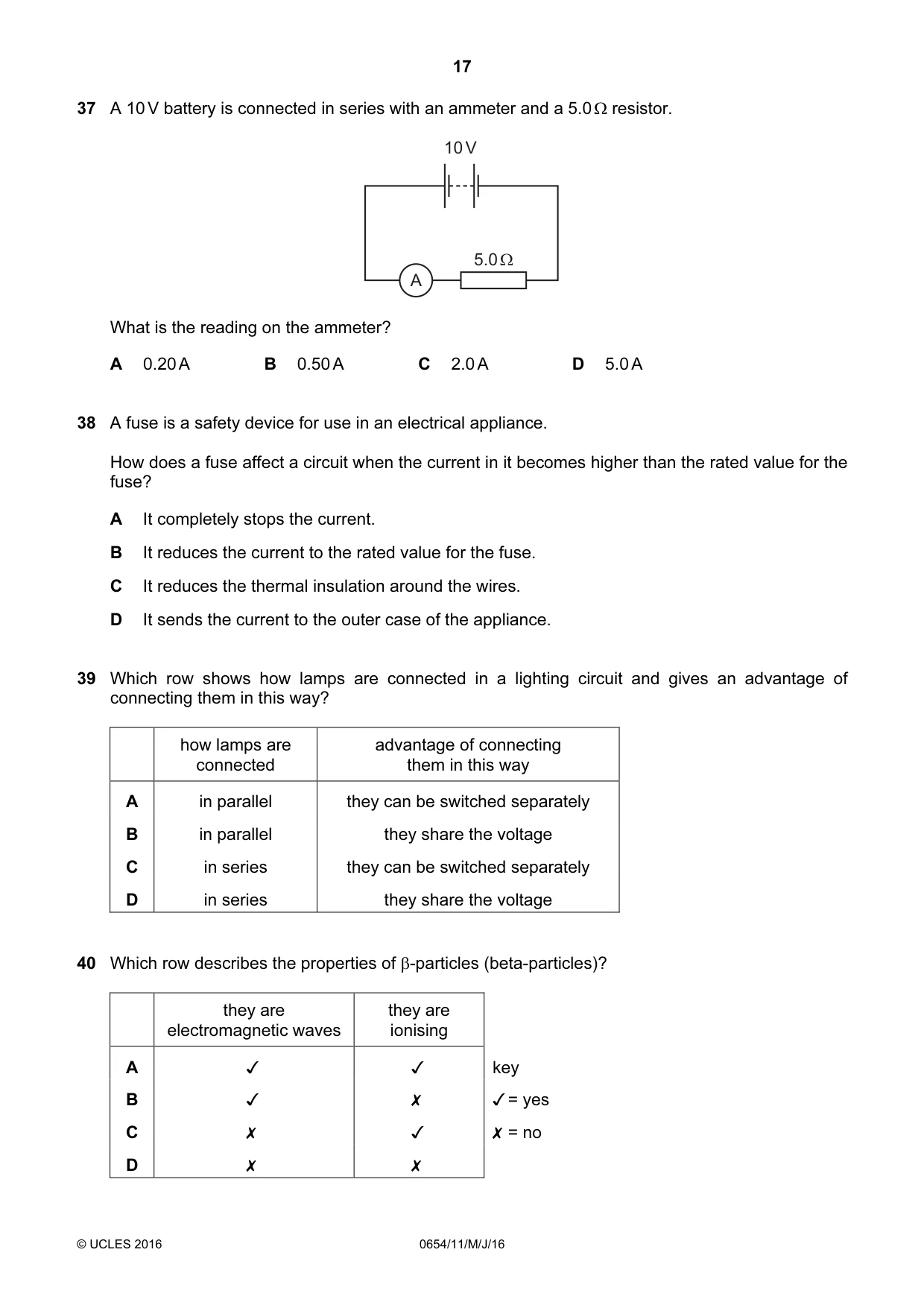
Q37 · A 10 V battery is connected in series with an ammeter and a 5.0 Ω resistor
37 A 10 V battery is connected in series with an ammeter and a 5.0 Ω resistor. 10 V 5.0 Ω A What is the reading on the ammeter? A 0.20 A B 0.50 A C 2.0 A D 5.0 A
Mark scheme: C
Q38 · A fuse is a safety device for use in an electrical appliance
38 A fuse is a safety device for use in an electrical appliance. How does a fuse affect a circuit when the current in it becomes higher than the rated value for the fuse? A It completely stops the current. B It reduces the current to the rated value for the fuse. C It reduces the thermal insulation around the wires. D It sends the current to the outer case of the appliance.
Mark scheme: A
Q39 · Which row shows how lamps are connected in a lighting circuit and gives an advantage of…
39 Which row shows how lamps are connected in a lighting circuit and gives an advantage of connecting them in this way? how lamps are advantage of connecting connected them in this way A in parallel they can be switched separately B in parallel they share the voltage C in series they can be switched separately D in series they share the voltage
Mark scheme: A
Q40 · Which row describes the properties of B-particles (beta-particles)?
40 Which row describes the properties of B-particles (beta-particles)? they are they are electromagnetic waves ionising A v v key B v x v/=yes Cc x v X =no D x x
Mark scheme: C
What was in this paper
The subtopics covered by these 40 questions, and how many questions each got. Open one in a new tab to see every Cambridge question on it.
2The characteristic properties of acids and bases2Air quality and climate1Alkenes1Arrangement of elements1Asexual reproduction1Atomic structure and the Periodic Table1Biological molecules1Blood vessels1Characteristics of living organisms1Digestion1Digestive system1Electrical circuits1Electrical quantities1Electrical safety1Electrolysis1Elements, compounds and mixtures1Energy, work and power1Exothermic and endothermic reactions1Experimental design1Extraction of metals1Forces1Gas exchange in humans1General properties of waves1Group VII properties1Habitat destruction1Homeostasis1Hormones1Identification of ions and gases1Light1Motion1Physical quantities and measurement techniques1Properties of metals1Radioactivity1Respiration1Sound1Transfer of thermal energy1Transpiration1What you needed in this session
Cambridge’s own grade thresholds for 2016 May/June, Paper 1 · Variant 1. A higher threshold means an easier paper — the bar moves with how the cohort did.