Cambridge IGCSE Sciences - Co-ordinated (Double) 0654 — 2017 Oct/Nov Paper 1 · Variant 2
0654/12/O/N/17 · 40 questions · 40 marks · ≈45 min
The question paper and its mark scheme, free to read here and free to download. This is Cambridge’s own paper, exactly as it was sat.
Question paper20 pages


Mark scheme3 pages
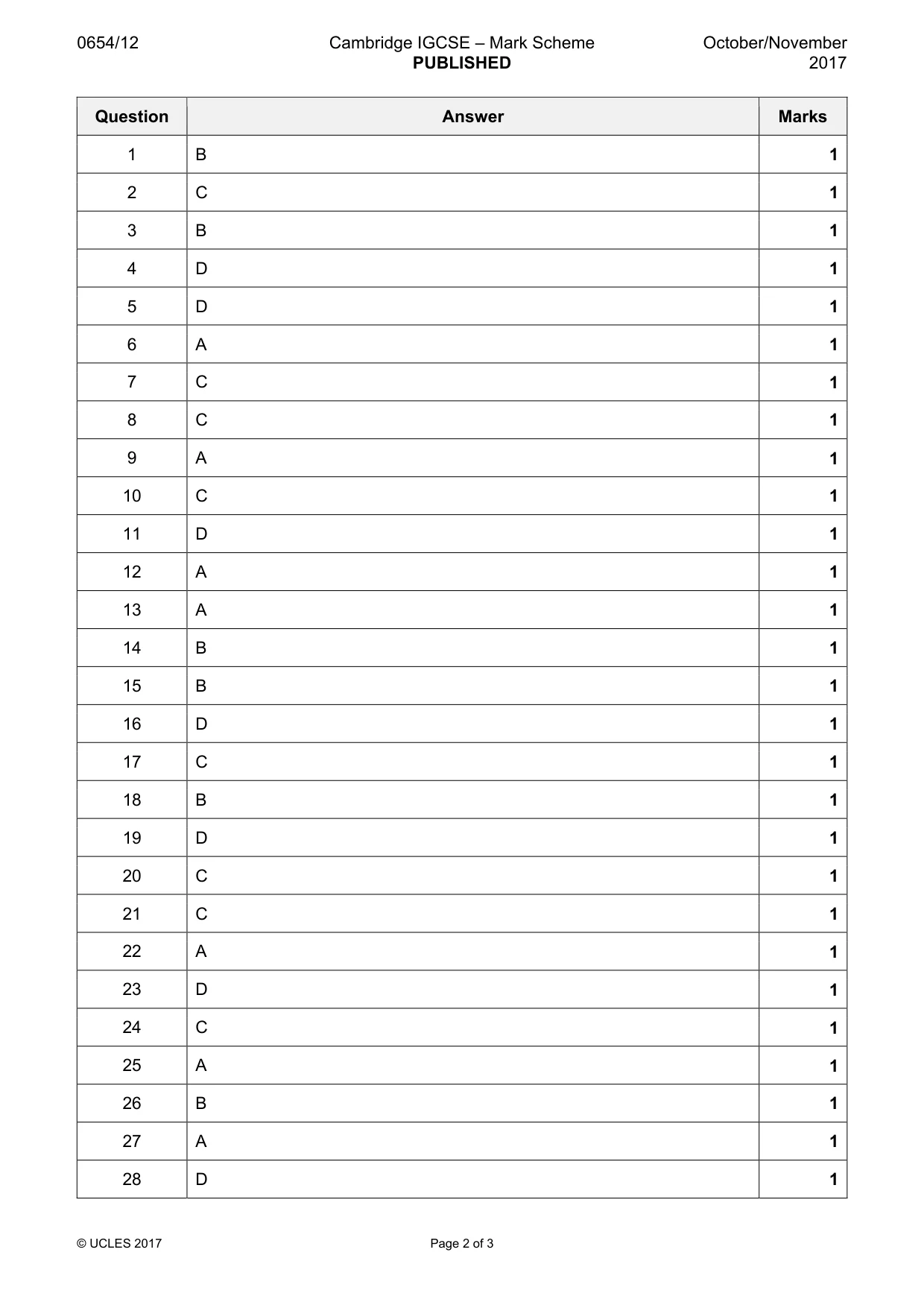
Answers below. Sit the paper first if you are practising.
Questions as text
Q1 · The bicuspid valve in the heart stops blood from flowing in which direction?
1 The bicuspid valve in the heart stops blood from flowing in which direction? A left atrium to left ventricle B left ventricle to left atrium C right atrium to right ventricle D right ventricle to right atrium
Mark scheme: B
Q2 · Four test-tubes contain the same volume of starch suspension but each test-tube is kept…
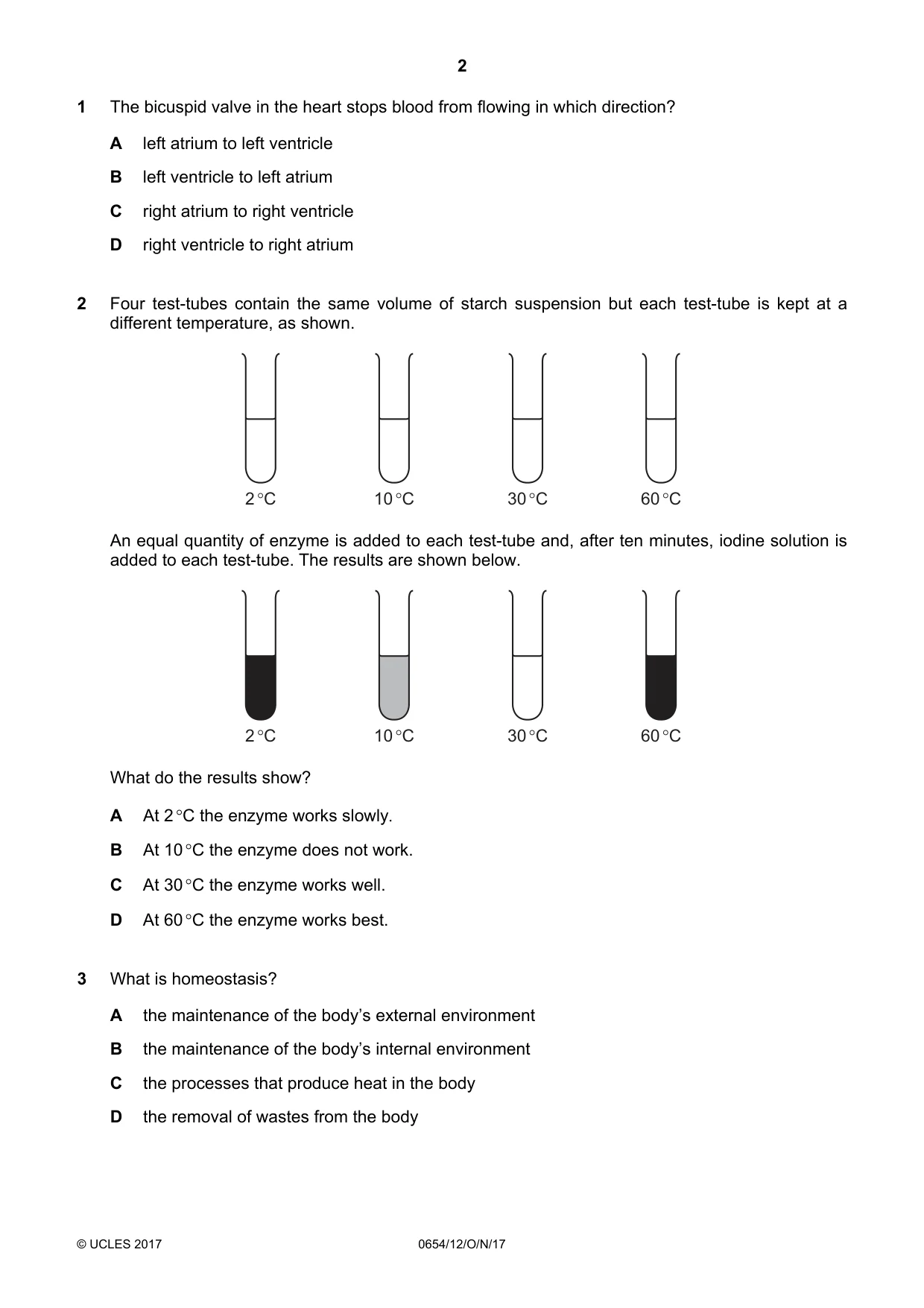
2 Four test-tubes contain the same volume of starch suspension but each test-tube is kept at a different temperature, as shown. 2 °C 10 °C 30 °C 60 °C An equal quantity of enzyme is added to each test-tube and, after ten minutes, iodine solution is added to each test-tube. The results are shown below. 2 °C 10 °C 30 °C 60 °C What do the results show? A At 2 °C the enzyme works slowly. B At 10 °C the enzyme does not work. C At 30 °C the enzyme works well. D At 60 °C the enzyme works best.
Mark scheme: C
Question 3
3 What is homeostasis? A the maintenance of the body’s external environment B the maintenance of the body’s internal environment C the processes that produce heat in the body D the removal of wastes from the body
Mark scheme: B
Q4 · The test-tube shows gelatine with a layer of black dye
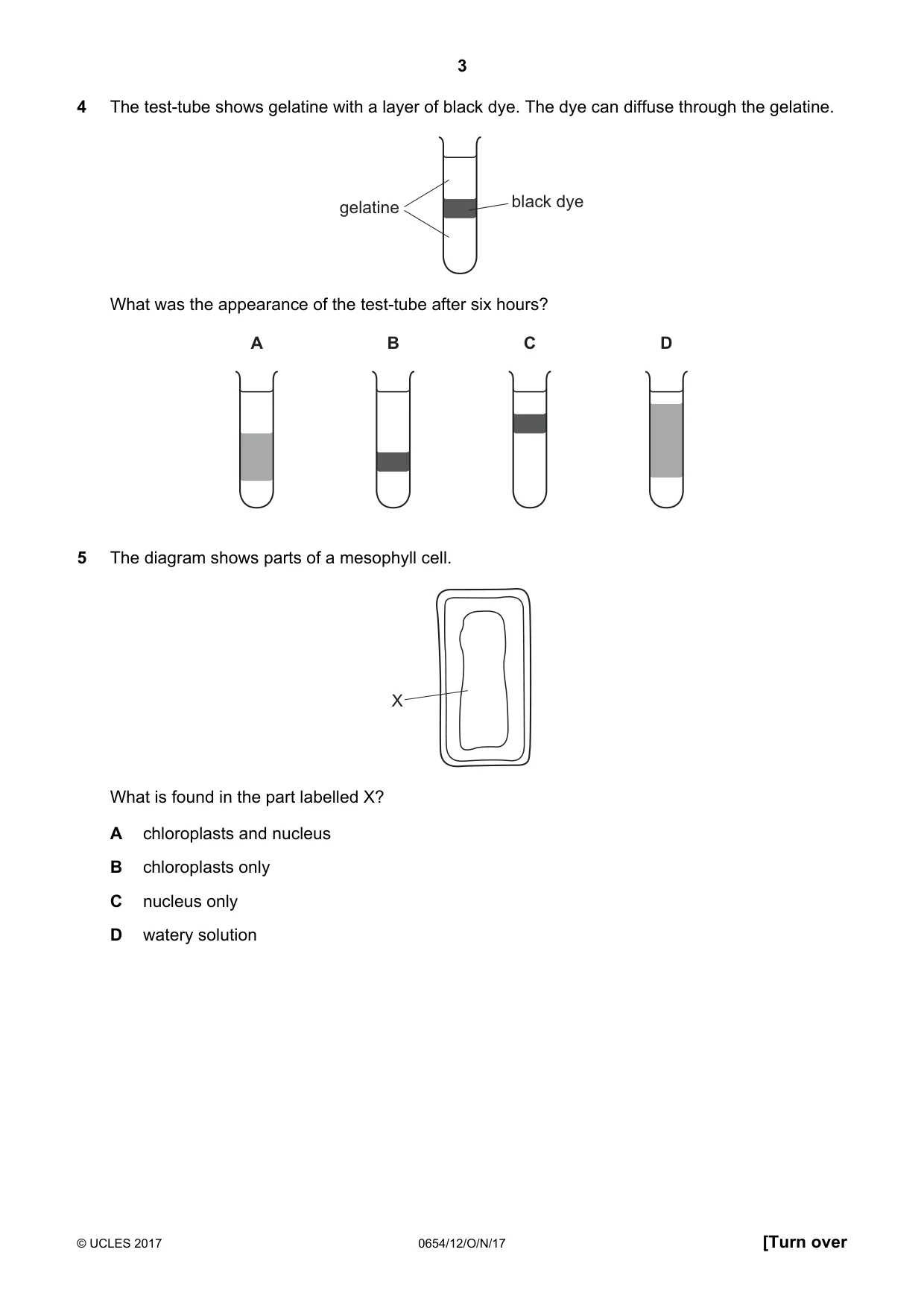
4 The test-tube shows gelatine with a layer of black dye. The dye can diffuse through the gelatine. gelatine black dye What was the appearance of the test-tube after six hours? A B C D
Mark scheme: D
Q5 · The diagram shows parts of a mesophyll cell
5 The diagram shows parts of a mesophyll cell. X What is found in the part labelled X? A chloroplasts and nucleus B chloroplasts only C nucleus only D watery solution
Mark scheme: D
Q6 · Self-pollination occurs when pollen is transferred from the male part of a flower to the…
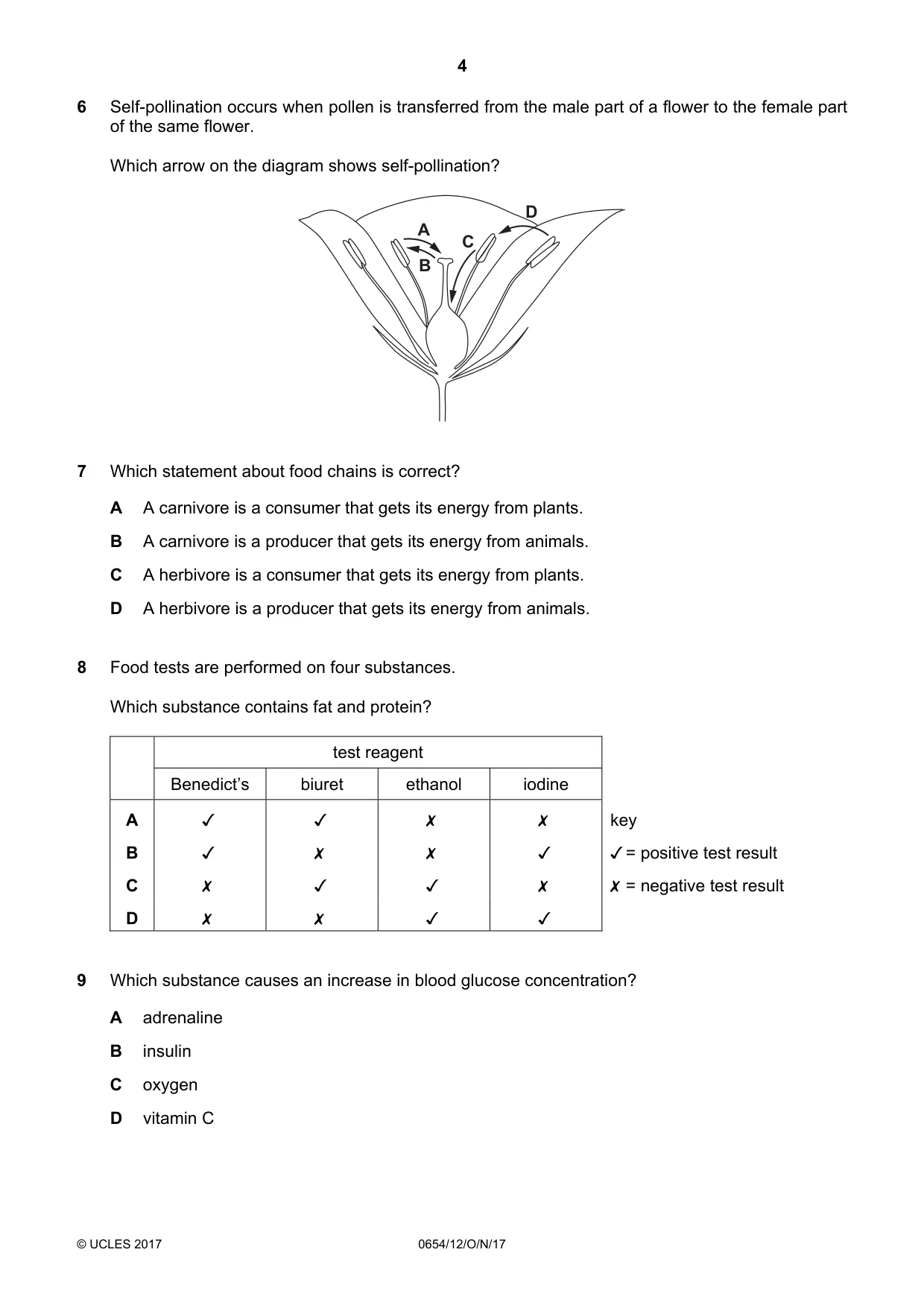
6 Self-pollination occurs when pollen is transferred from the male part of a flower to the female part of the same flower. Which arrow on the diagram shows self-pollination? D A C B
Mark scheme: A
Q7 · Which statement about food chains is correct?
7 Which statement about food chains is correct? A A carnivore is a consumer that gets its energy from plants. B A carnivore is a producer that gets its energy from animals. C A herbivore is a consumer that gets its energy from plants. D A herbivore is a producer that gets its energy from animals.
Mark scheme: C
Q8 · Food tests are performed on four substances
8 Food tests are performed on four substances. Which substance contains fat and protein? test reagent Benedict's biuret ethanol iodine A J J x x B J x x J Cc x J J x D x x Jv Jv key ¥ = positive test result X = negative test result
Mark scheme: C
Q9 · Which substance causes an increase in blood glucose concentration?
9 Which substance causes an increase in blood glucose concentration? A adrenaline B insulin C oxygen D vitamin C
Mark scheme: A
Q10 · Humans must breathe air so that respiration can take place to release energy
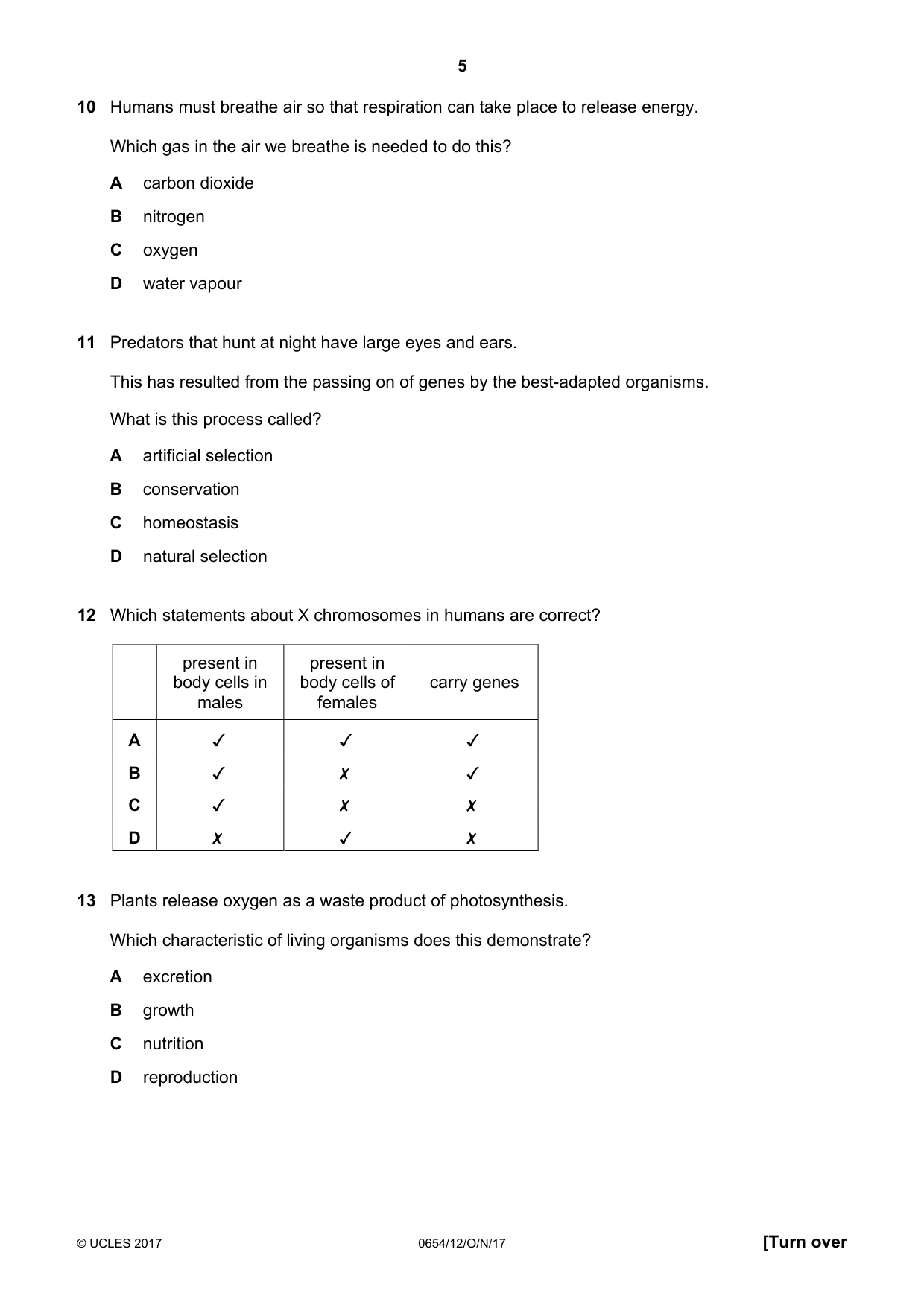
10 Humans must breathe air so that respiration can take place to release energy. Which gas in the air we breathe is needed to do this? A carbon dioxide B nitrogen C oxygen D water vapour
Mark scheme: C
Q11 · Predators that hunt at night have large eyes and ears
11 Predators that hunt at night have large eyes and ears. This has resulted from the passing on of genes by the best-adapted organisms. What is this process called? A artificial selection B conservation C homeostasis D natural selection
Mark scheme: D
Q12 · Which statements about X chromosomes in humans are correct?
12 Which statements about X chromosomes in humans are correct? present in present in body cells in body cells of carry genes males females A v v v B v x v Cc J x x D x v x
Mark scheme: A
Q13 · Plants release oxygen as a waste product of photosynthesis
13 Plants release oxygen as a waste product of photosynthesis. Which characteristic of living organisms does this demonstrate? A excretion B growth C nutrition D reproduction
Mark scheme: A
Q14 · Which statement about atoms and molecules is correct?
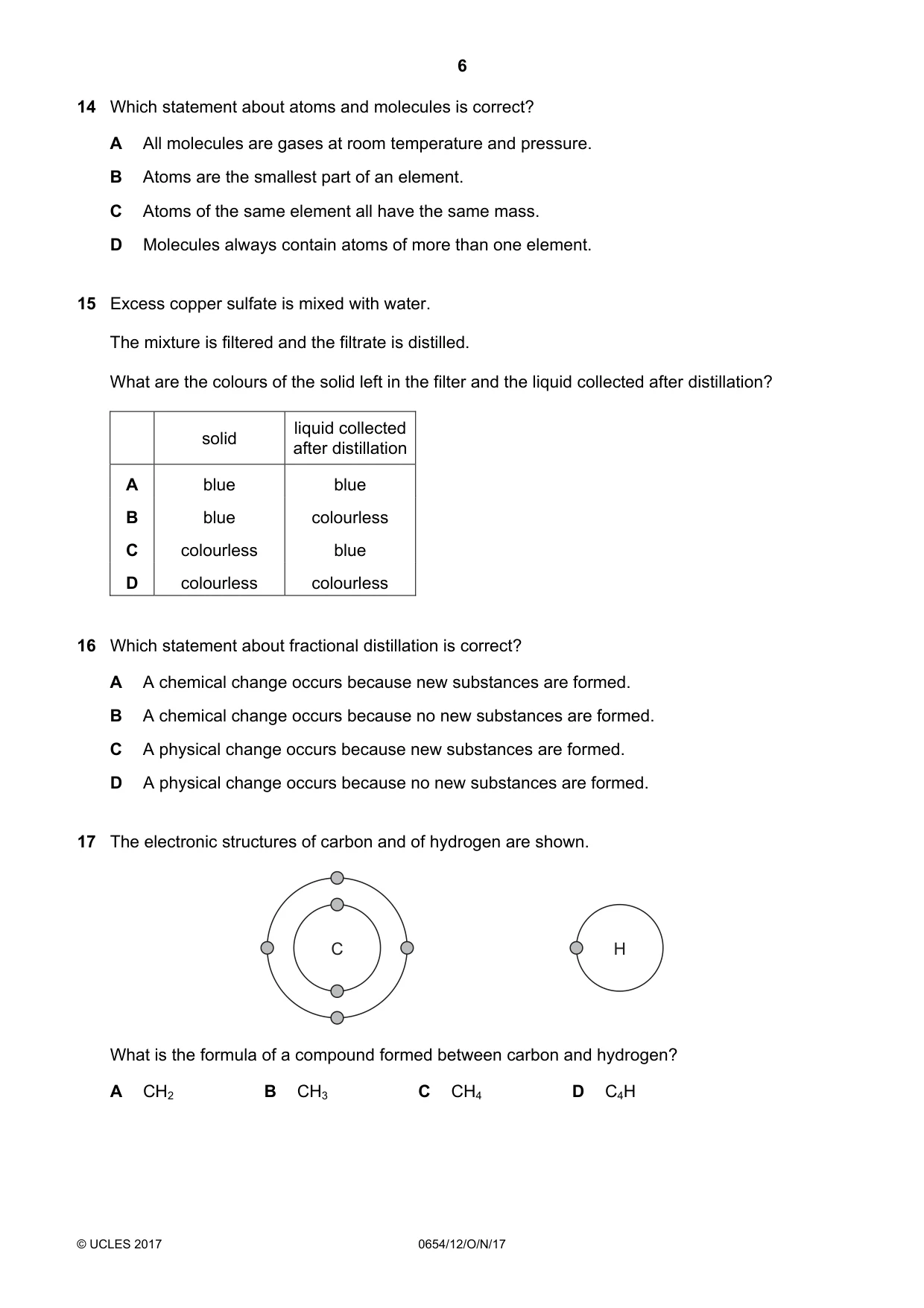
14 Which statement about atoms and molecules is correct? A All molecules are gases at room temperature and pressure. B Atoms are the smallest part of an element. C Atoms of the same element all have the same mass. D Molecules always contain atoms of more than one element.
Mark scheme: B
Q15 · Excess copper sulfate is mixed with water
15 Excess copper sulfate is mixed with water. The mixture is filtered and the filtrate is distilled. What are the colours of the solid left in the filter and the liquid collected after distillation? liquid collected solid after distillation A blue blue B blue colourless C colourless blue D colourless colourless
Mark scheme: B
Q16 · Which statement about fractional distillation is correct?
16 Which statement about fractional distillation is correct? A A chemical change occurs because new substances are formed. B A chemical change occurs because no new substances are formed. C A physical change occurs because new substances are formed. D A physical change occurs because no new substances are formed.
Mark scheme: D
Q17 · The electronic structures of carbon and of hydrogen are shown
17 The electronic structures of carbon and of hydrogen are shown. C H What is the formula of a compound formed between carbon and hydrogen? A CH2 B CH3 C CH4 D C4H
Mark scheme: C
Q18 · The electrolysis of aqueous copper chloride is shown
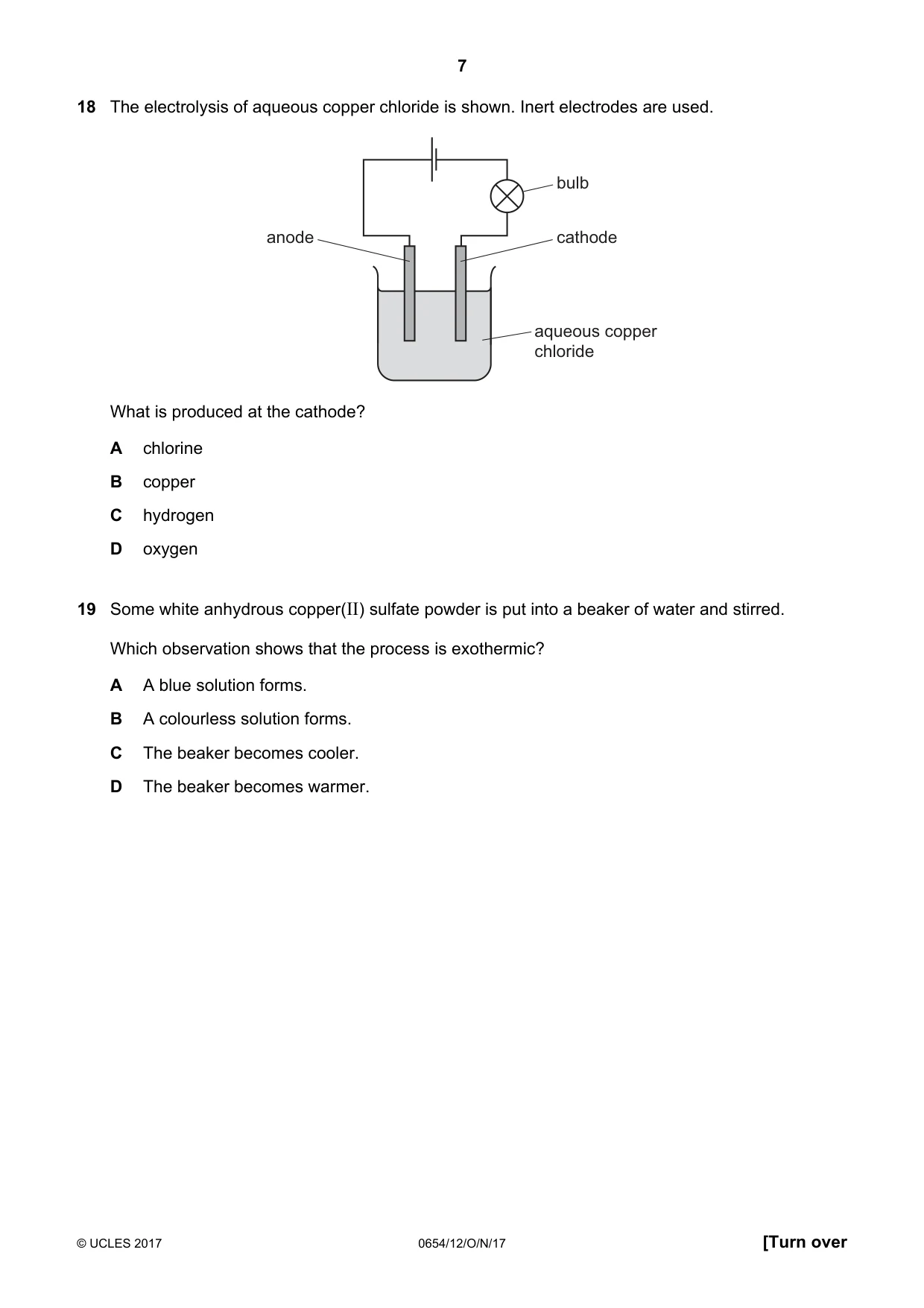
18 The electrolysis of aqueous copper chloride is shown. Inert electrodes are used. bulb anode cathode aqueous copper chloride What is produced at the cathode? A chlorine B copper C hydrogen D oxygen
Mark scheme: B
Q19 · Some white anhydrous copper(II) sulfate powder is put into a beaker of water and stirred
19 Some white anhydrous copper(II) sulfate powder is put into a beaker of water and stirred. Which observation shows that the process is exothermic? A A blue solution forms. B A colourless solution forms. C The beaker becomes cooler. D The beaker becomes warmer.
Mark scheme: D
Q20 · Ammonia is oxidised as shown
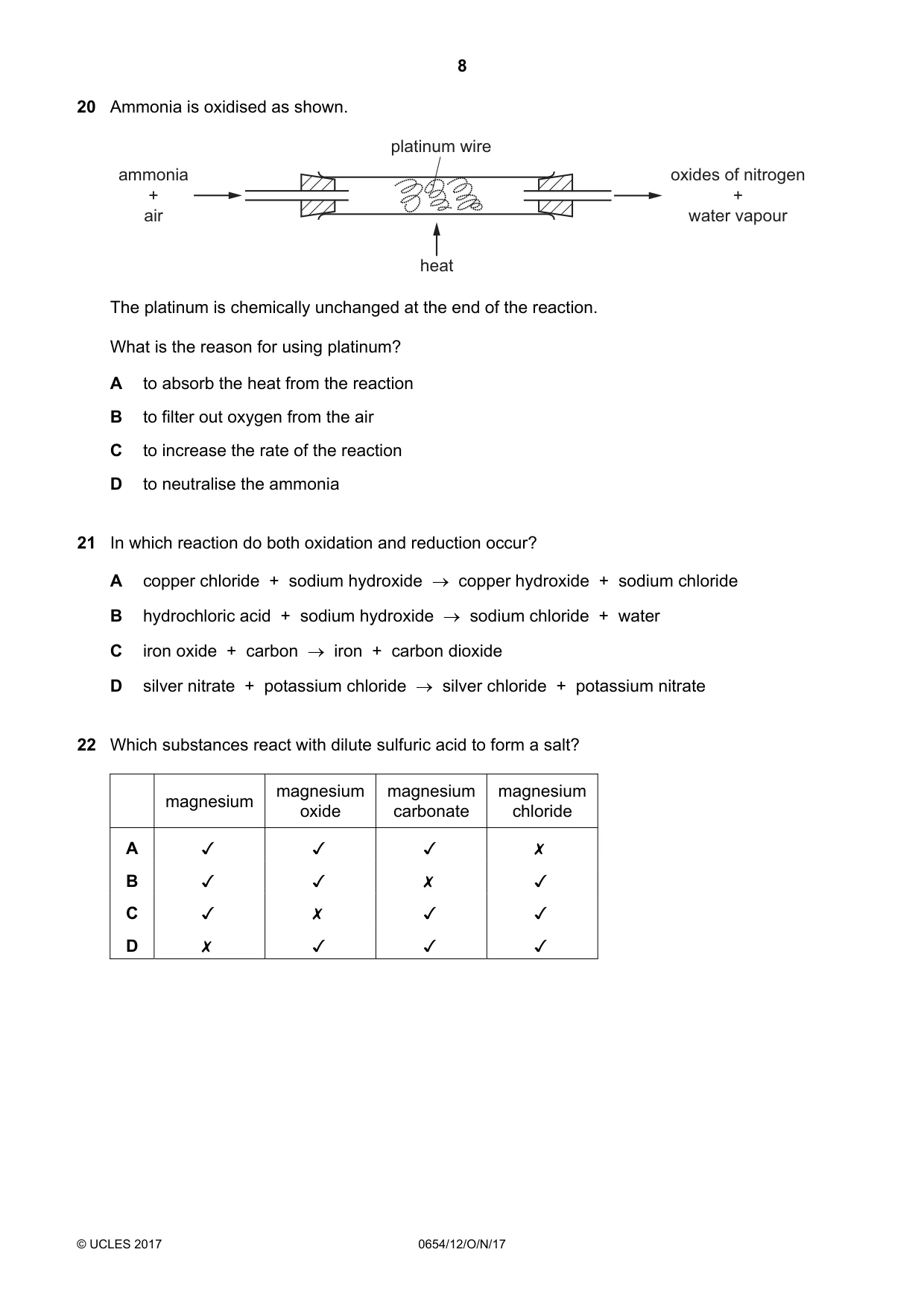
20 Ammonia is oxidised as shown. platinum wire ammonia oxides of nitrogen + + air water vapour heat The platinum is chemically unchanged at the end of the reaction. What is the reason for using platinum? A to absorb the heat from the reaction B to filter out oxygen from the air C to increase the rate of the reaction D to neutralise the ammonia
Mark scheme: C
Q21 · In which reaction do both oxidation and reduction occur?
21 In which reaction do both oxidation and reduction occur? A copper chloride + sodium hydroxide → copper hydroxide + sodium chloride B hydrochloric acid + sodium hydroxide → sodium chloride + water C iron oxide + carbon → iron + carbon dioxide D silver nitrate + potassium chloride → silver chloride + potassium nitrate
Mark scheme: C
Q22 · Which substances react with dilute sulfuric acid to form a salt?
22 Which substances react with dilute sulfuric acid to form a salt? magnesium | ™agnesium | magnesium | magnesium oxide carbonate chloride A v 4 W, x B WA V4 x y, Cc v x W, y, D x V4 W, y,
Mark scheme: A
Q23 · Substance X is tested using aqueous barium ions under acidic conditions
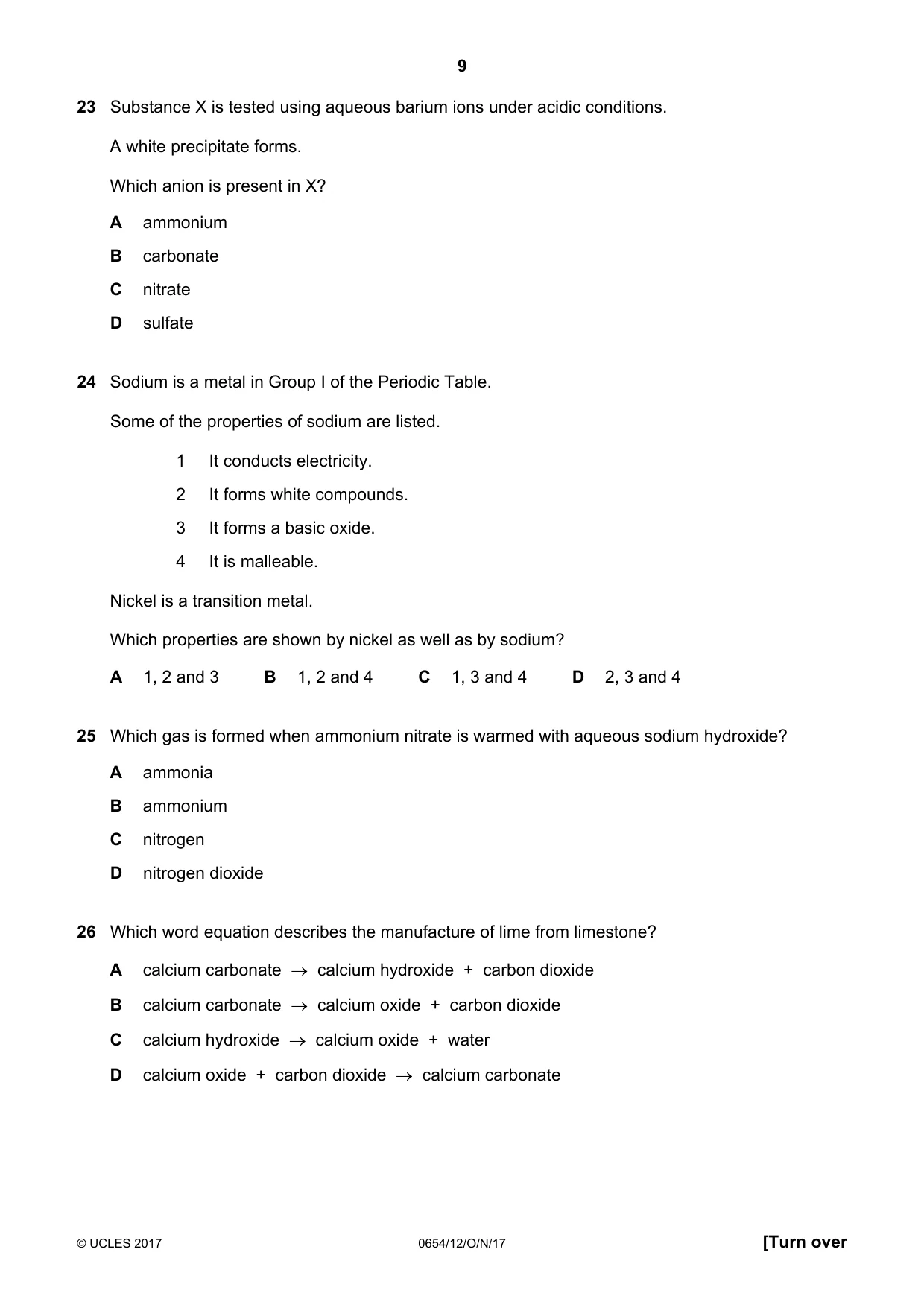
23 Substance X is tested using aqueous barium ions under acidic conditions. A white precipitate forms. Which anion is present in X? A ammonium B carbonate C nitrate D sulfate
Mark scheme: D
Q24 · Sodium is a metal in Group I of the Periodic Table
24 Sodium is a metal in Group I of the Periodic Table. Some of the properties of sodium are listed. 1 It conducts electricity. 2 It forms white compounds. 3 It forms a basic oxide. 4 It is malleable. Nickel is a transition metal. Which properties are shown by nickel as well as by sodium? A 1, 2 and 3 B 1, 2 and 4 C 1, 3 and 4 D 2, 3 and 4
Mark scheme: C
Q25 · Which gas is formed when ammonium nitrate is warmed with aqueous sodium hydroxide?
25 Which gas is formed when ammonium nitrate is warmed with aqueous sodium hydroxide? A ammonia B ammonium C nitrogen D nitrogen dioxide
Mark scheme: A
Q26 · Which word equation describes the manufacture of lime from limestone?
26 Which word equation describes the manufacture of lime from limestone? A calcium carbonate → calcium hydroxide + carbon dioxide B calcium carbonate → calcium oxide + carbon dioxide C calcium hydroxide → calcium oxide + water D calcium oxide + carbon dioxide → calcium carbonate
Mark scheme: B
Q27 · The structures of four hydrocarbons are shown
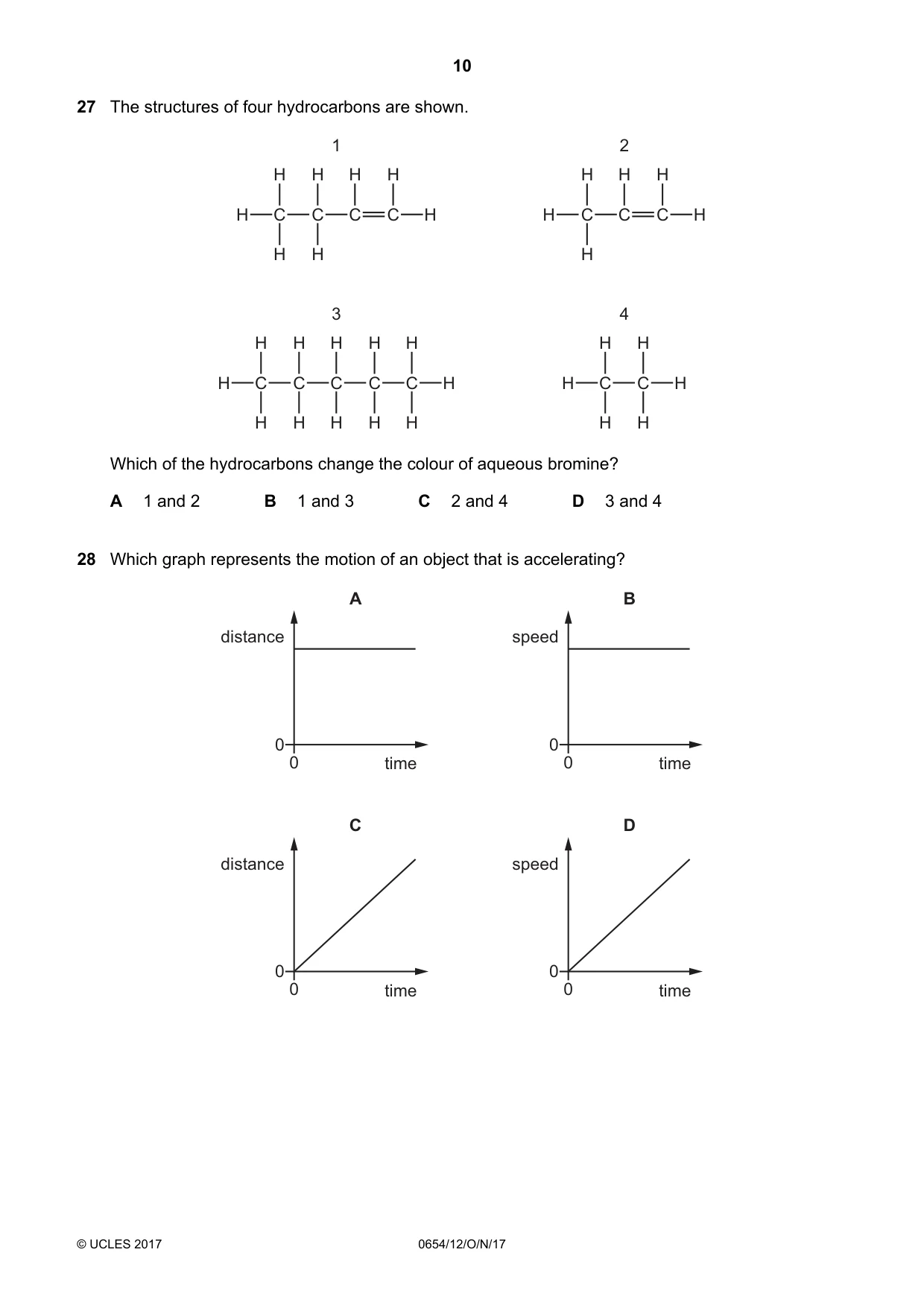
27 The structures of four hydrocarbons are shown. 1 2 H H H H H H H H C C C C H H C C C H H H H 3 4 H H H H H H H H C C C C C H H C C H H H H H H H H Which of the hydrocarbons change the colour of aqueous bromine? A 1 and 2 B 1 and 3 C 2 and 4 D 3 and 4
Mark scheme: A
Q28 · Which graph represents the motion of an object that is accelerating?
28 Which graph represents the motion of an object that is accelerating? A B distance speed 0 0 0 time 0 time C D distance speed 0 0 0 time 0 time
Mark scheme: D
Q29 · The scale diagram shows three identical solid blocks P, Q and R
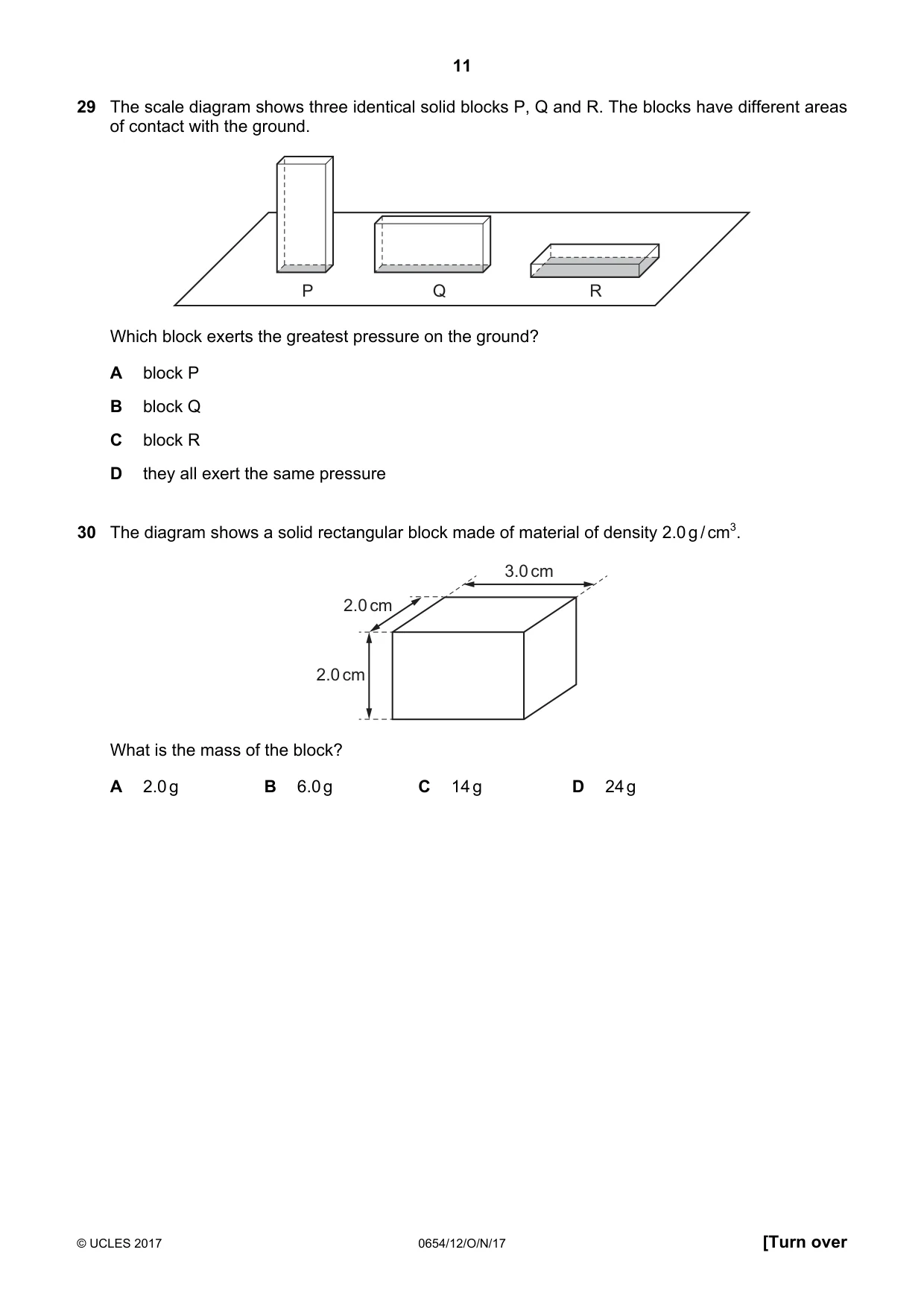
29 The scale diagram shows three identical solid blocks P, Q and R. The blocks have different areas of contact with the ground. P Q R Which block exerts the greatest pressure on the ground? A block P B block Q C block R D they all exert the same pressure
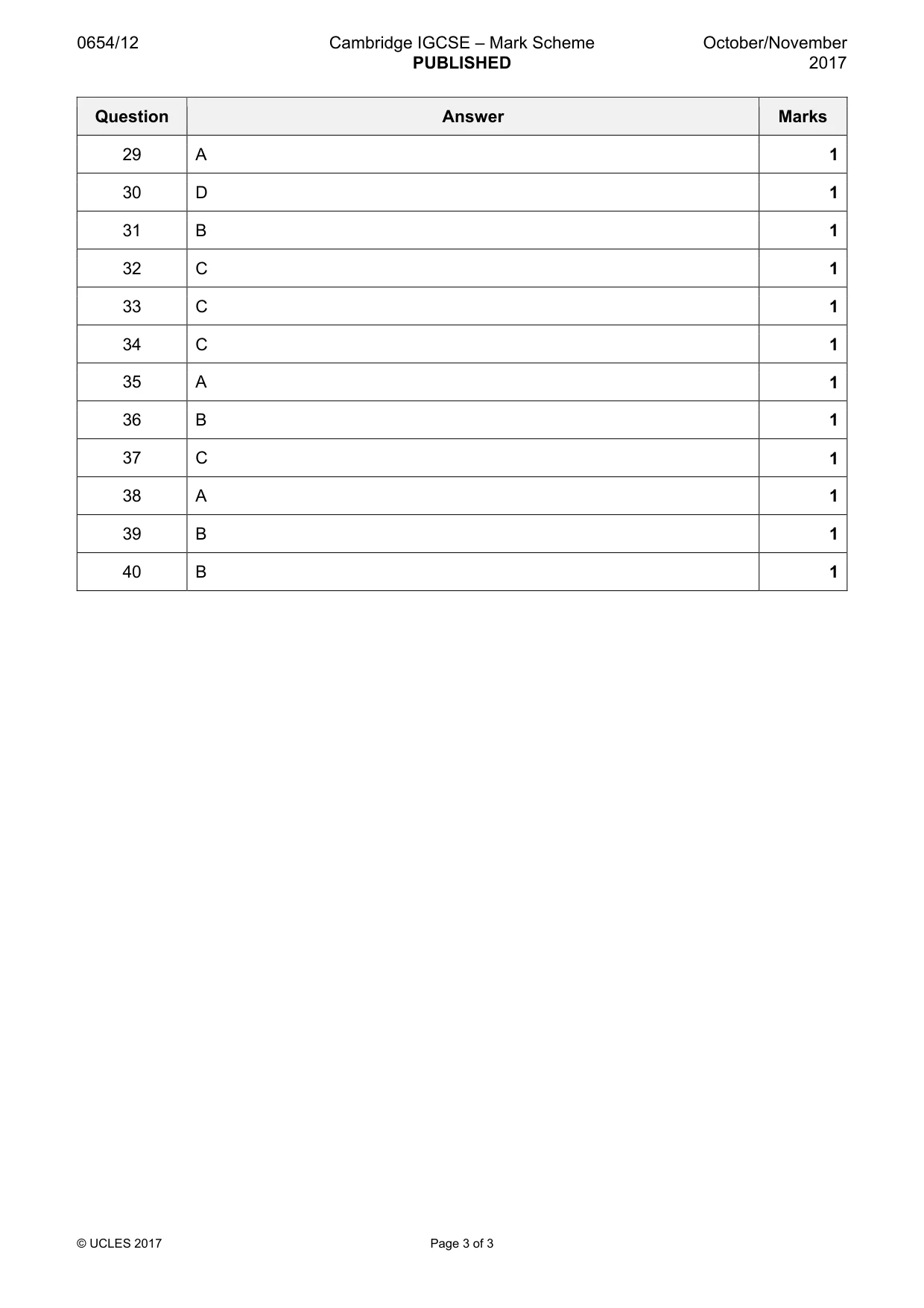
Mark scheme: A
Q30 · The diagram shows a solid rectangular block made of material of density 2.0 g / cm3
30 The diagram shows a solid rectangular block made of material of density 2.0 g / cm3. 3.0 cm 2.0 cm 2.0 cm What is the mass of the block? A 2.0 g B 6.0 g C 14 g D 24 g
Mark scheme: D
Q31 · A worker carries bricks up a ladder
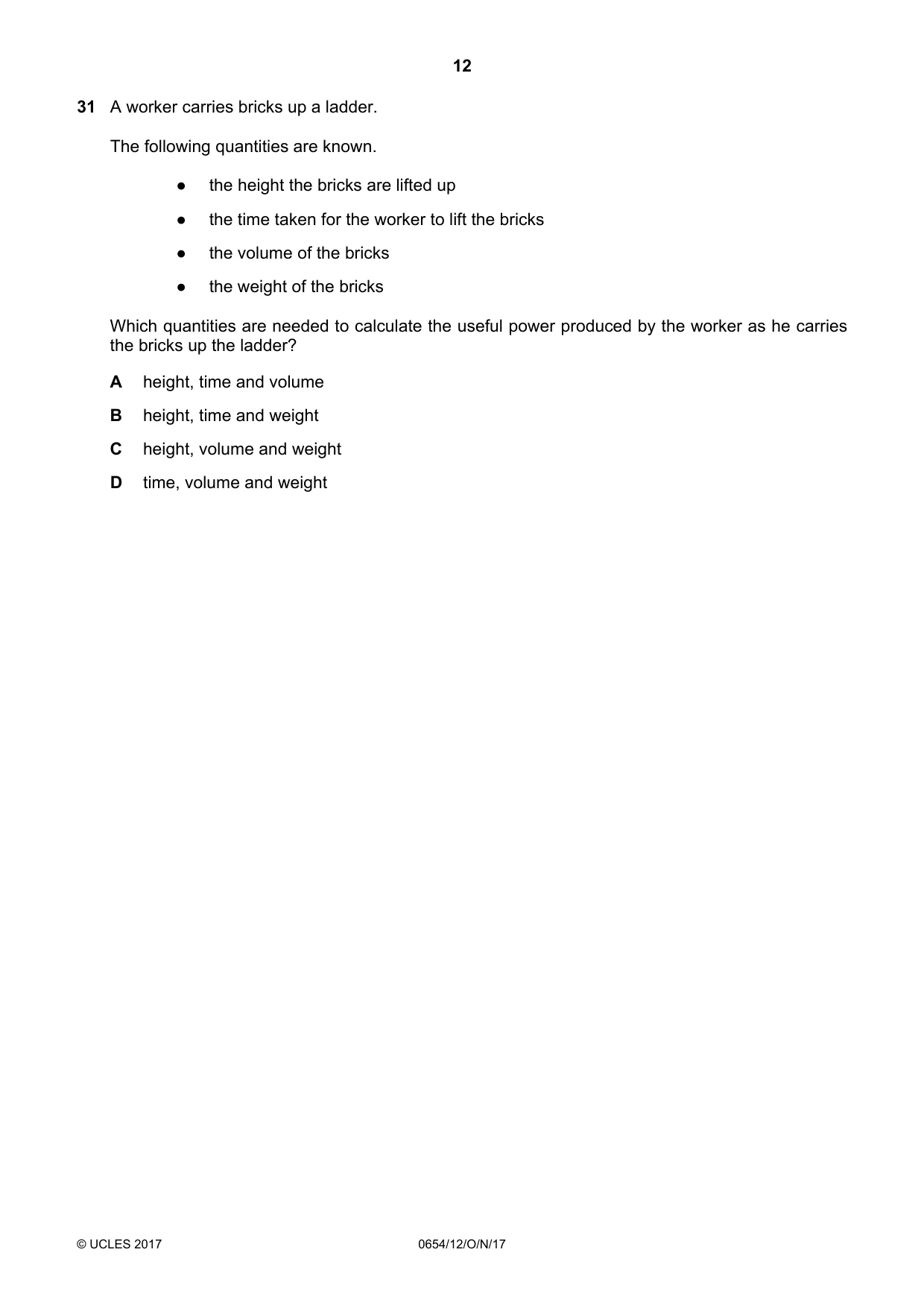
31 A worker carries bricks up a ladder. The following quantities are known. ● the height the bricks are lifted up ● the time taken for the worker to lift the bricks ● the volume of the bricks ● the weight of the bricks Which quantities are needed to calculate the useful power produced by the worker as he carries the bricks up the ladder? A height, time and volume B height, time and weight C height, volume and weight D time, volume and weight
Mark scheme: B
Q32 · A convector heater is fixed to a wall
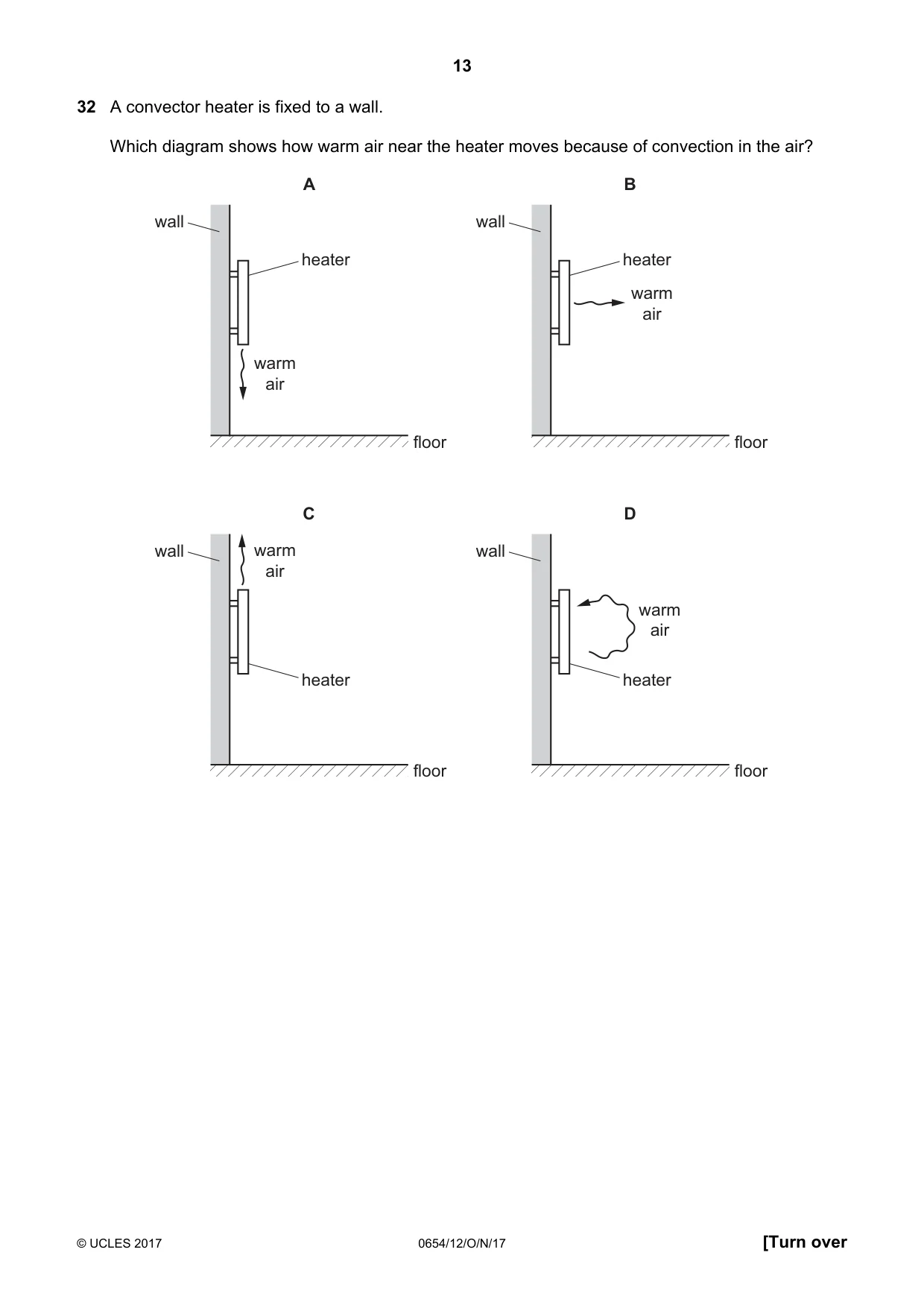
32 A convector heater is fixed to a wall. Which diagram shows how warm air near the heater moves because of convection in the air? A B wall wall heater heater warm air warm air floor floor C D wall warm wall air warm air heater heater floor floor
Mark scheme: C
Q33 · The diagram shows the direction of a wave that passes a particle
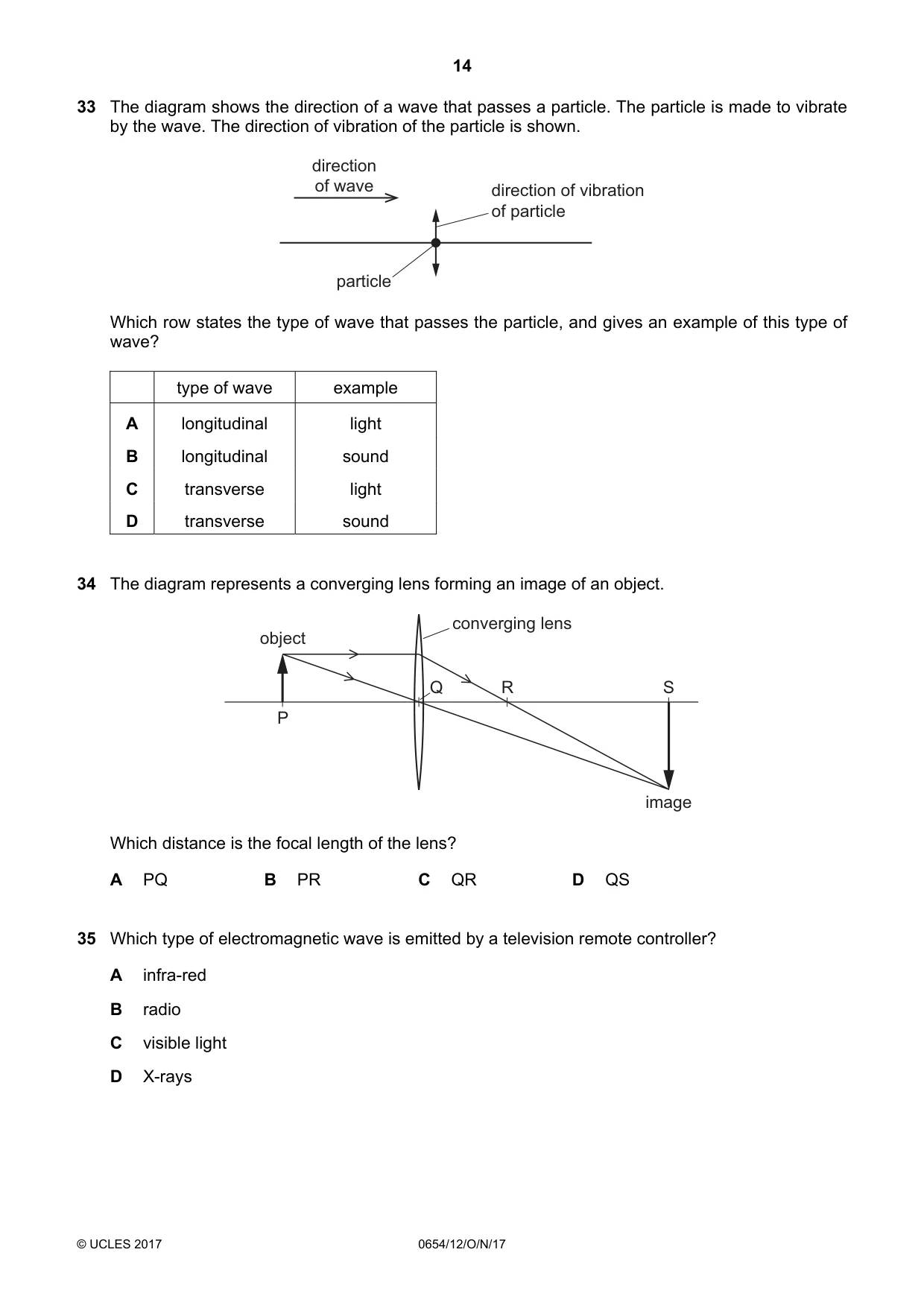
33 The diagram shows the direction of a wave that passes a particle. The particle is made to vibrate by the wave. The direction of vibration of the particle is shown. direction of wave direction of vibration of particle particle Which row states the type of wave that passes the particle, and gives an example of this type of wave? type of wave example A longitudinal light B longitudinal sound C transverse light D transverse sound
Mark scheme: C
Q34 · The diagram represents a converging lens forming an image of an object
34 The diagram represents a converging lens forming an image of an object. converging lens object Q R S P image Which distance is the focal length of the lens? A PQ B PR C QR D QS
Mark scheme: C
Q35 · Which type of electromagnetic wave is emitted by a television remote controller?
35 Which type of electromagnetic wave is emitted by a television remote controller? A infra-red B radio C visible light D X-rays
Mark scheme: A
Q36 · A student claps his hands once when standing 100 m away from a large wall
36 A student claps his hands once when standing 100 m away from a large wall. The speed of sound in air is 330 m / s. How long after clapping does the student hear an echo? A 0.30 s B 0.61 s C 1.7 s D 3.3 s
Mark scheme: B
Q37 · A battery of e.m.f
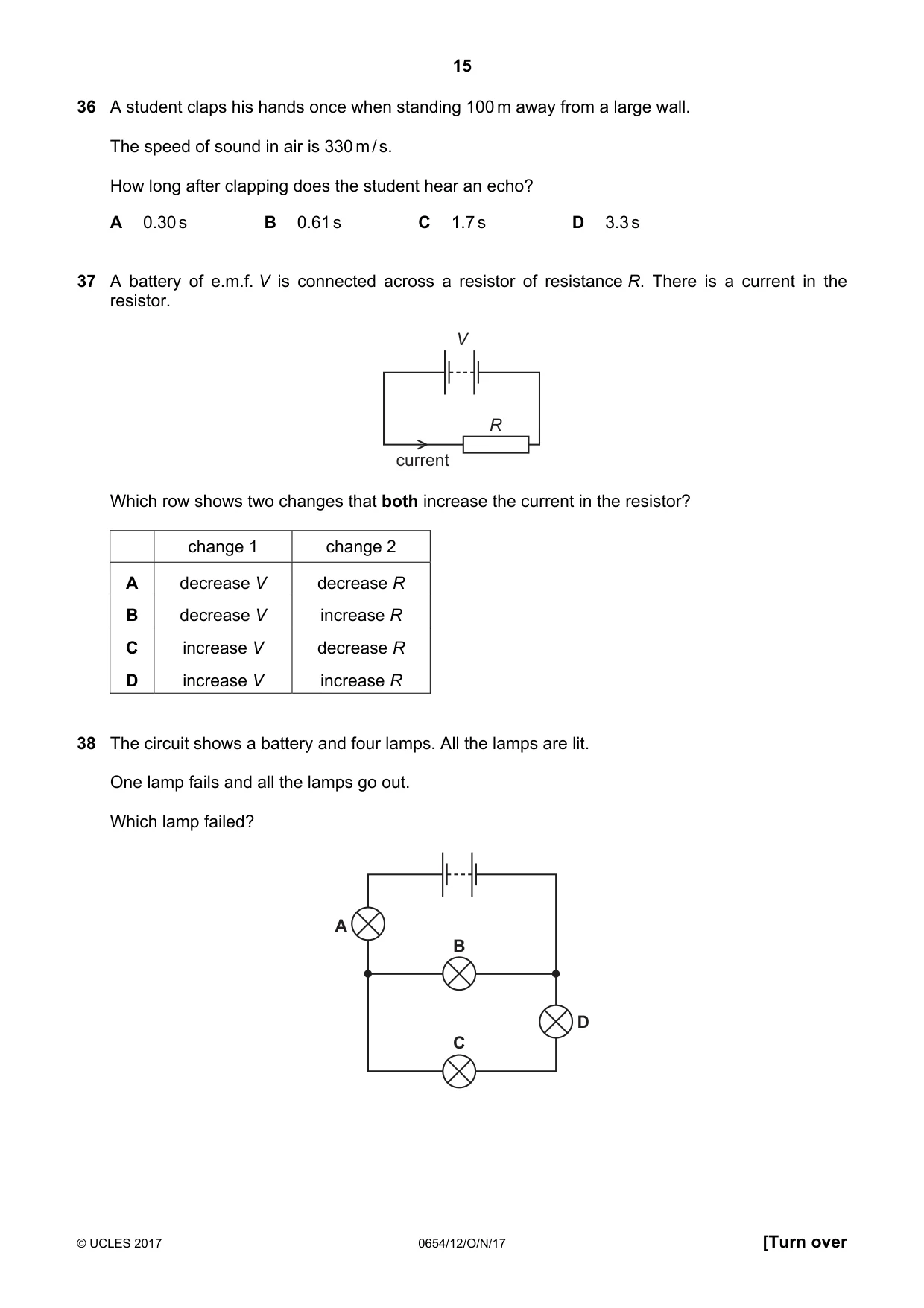
37 A battery of e.m.f. V is connected across a resistor of resistance R. There is a current in the resistor. V R current Which row shows two changes that both increase the current in the resistor? change 1 change 2 A decrease V decrease R B decrease V increase R C increase V decrease R D increase V increase R
Mark scheme: C
Q38 · The circuit shows a battery and four lamps
38 The circuit shows a battery and four lamps. All the lamps are lit. One lamp fails and all the lamps go out. Which lamp failed? A B D C
Mark scheme: A
Q39 · Three charged balls P, Q and R are suspended by insulating threads
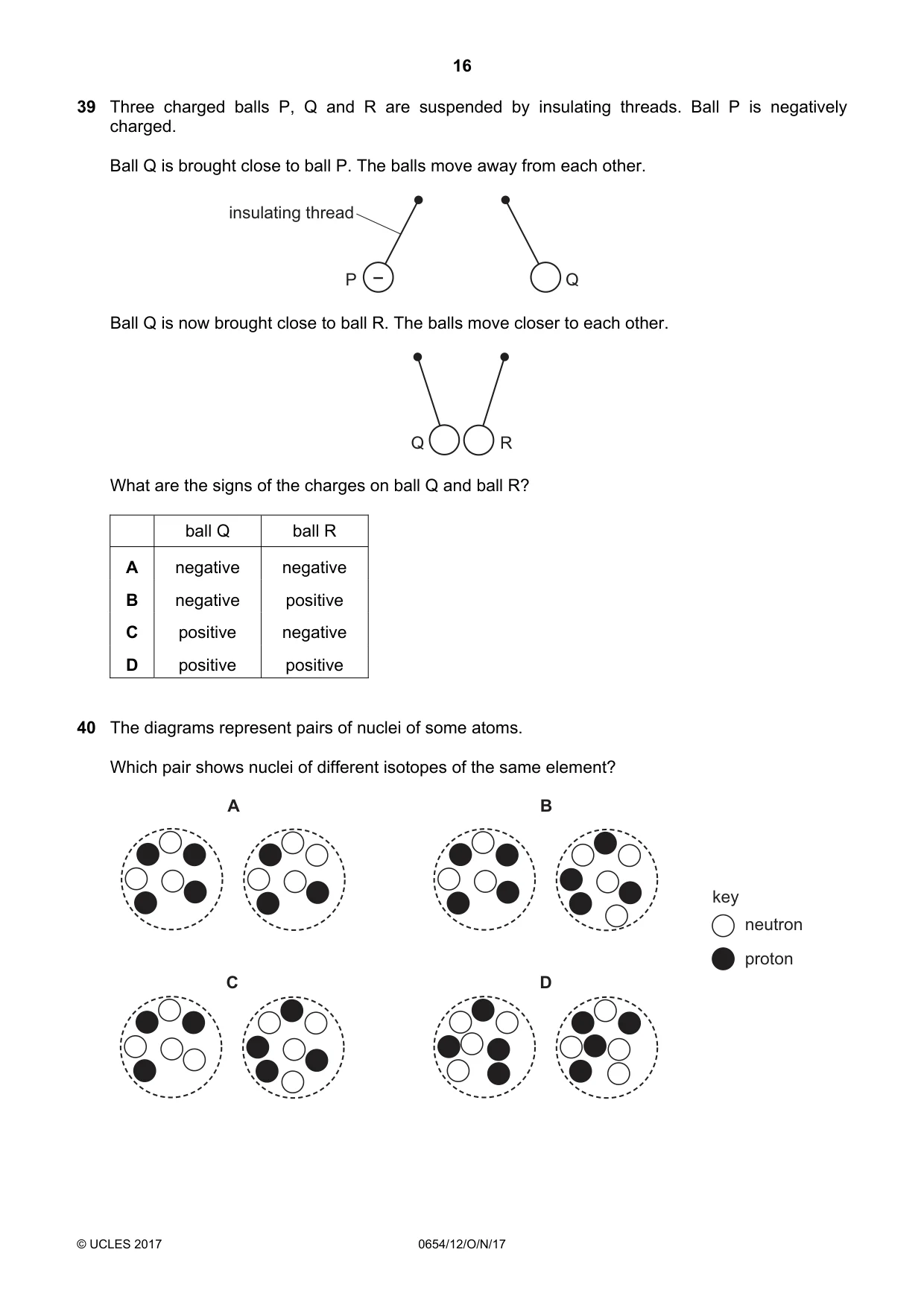
39 Three charged balls P, Q and R are suspended by insulating threads. Ball P is negatively charged. Ball Q is brought close to ball P. The balls move away from each other. insulating thread P – Q Ball Q is now brought close to ball R. The balls move closer to each other. Q R What are the signs of the charges on ball Q and ball R? ball Q ball R A negative negative B negative positive C positive negative D positive positive
Mark scheme: B
Q40 · The diagrams represent pairs of nuclei of some atoms
40 The diagrams represent pairs of nuclei of some atoms. Which pair shows nuclei of different isotopes of the same element? A B key neutron proton C D
Mark scheme: B
What was in this paper
The subtopics covered by these 40 questions, and how many questions each got. Open one in a new tab to see every Cambridge question on it.
2Alkenes1Biological molecules1Cell structure1Characteristics of living organisms1Chromosomes and genes1Density1Diffusion1Electrical circuits1Electrical quantities1Electrolysis1Electromagnetic spectrum1Elements, compounds and mixtures1Energy, work and power1Enzymes1Exothermic and endothermic reactions1Food chains and food webs1General properties of waves1Heart1Homeostasis1Hormones1Isotopes1Light1Motion1Oxides1Physical and chemical changes1Preparation of salts1Pressure1Rate of reaction1Redox1Respiration1Selection1Separation and purification1Sexual reproduction in plants1Simple molecules and covalent bonds1Simple phenomena of magnetism1Sound1Transfer of thermal energy1Transition elements1What you needed in this session
Cambridge’s own grade thresholds for 2017 Oct/Nov, Paper 1 · Variant 2. A higher threshold means an easier paper — the bar moves with how the cohort did.