Cambridge IGCSE Sciences - Co-ordinated (Double) 0654 — 2022 Oct/Nov Paper 1 · Variant 2
0654/12/O/N/22 · 40 questions · 40 marks · ≈45 min
The question paper and its mark scheme, free to read here and free to download. This is Cambridge’s own paper, exactly as it was sat.
Question paper16 pages
Mark scheme3 pages
Answers below. Sit the paper first if you are practising.
Questions as text
Q1 · Which characteristic of living organisms involves chemical reactions that break down…
1 Which characteristic of living organisms involves chemical reactions that break down nutrient molecules to release energy? A excretion B nutrition C reproduction D respiration
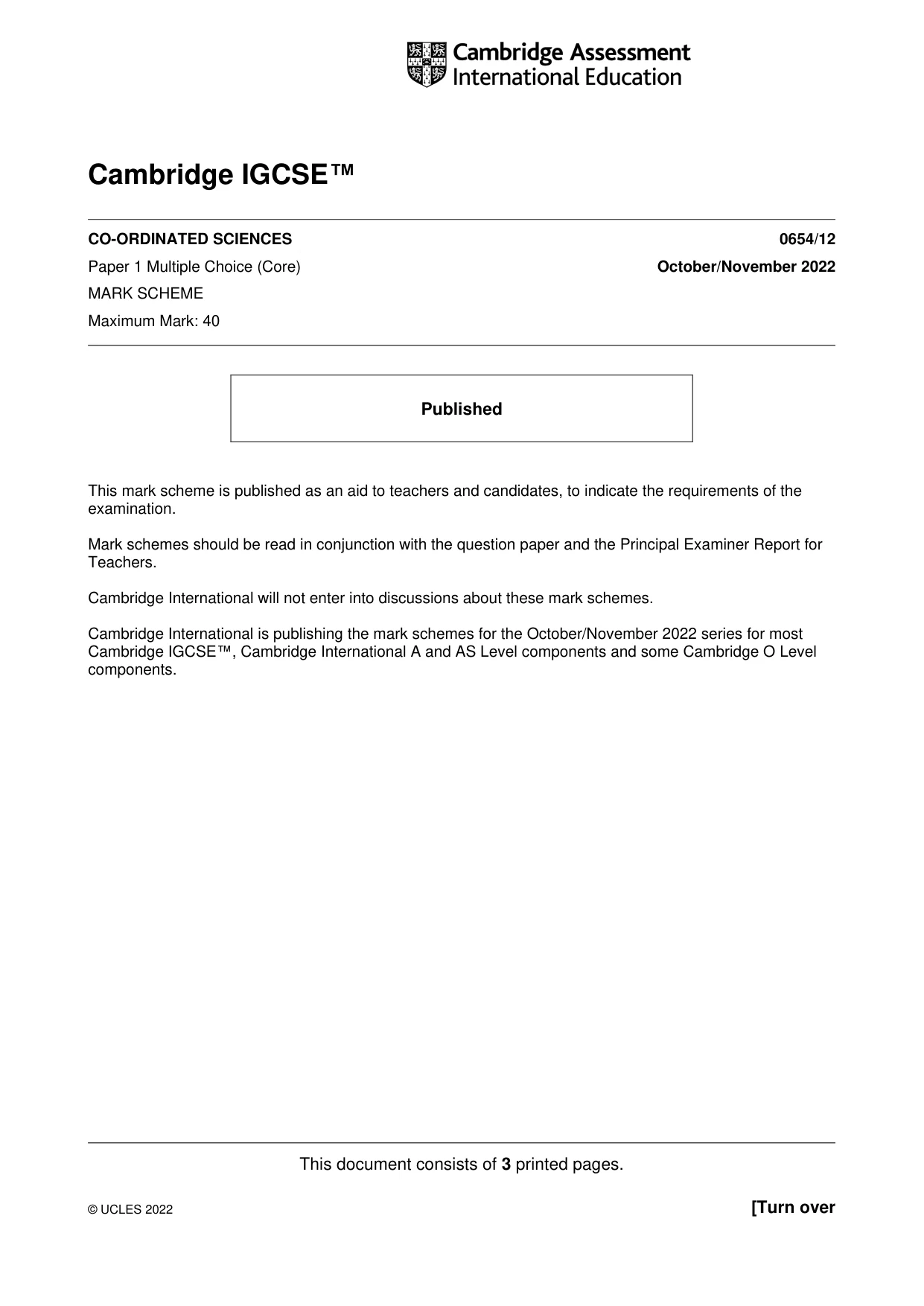
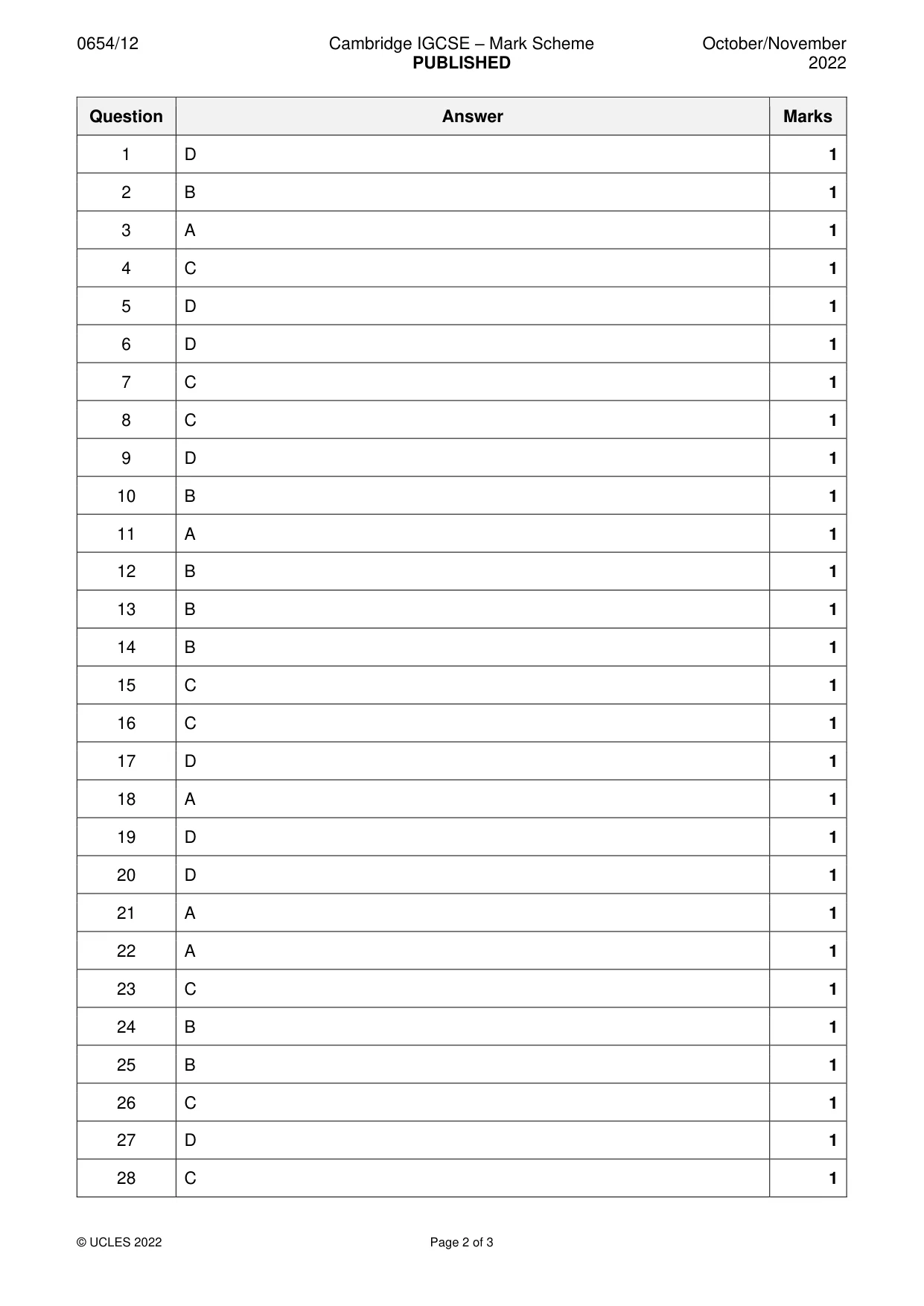
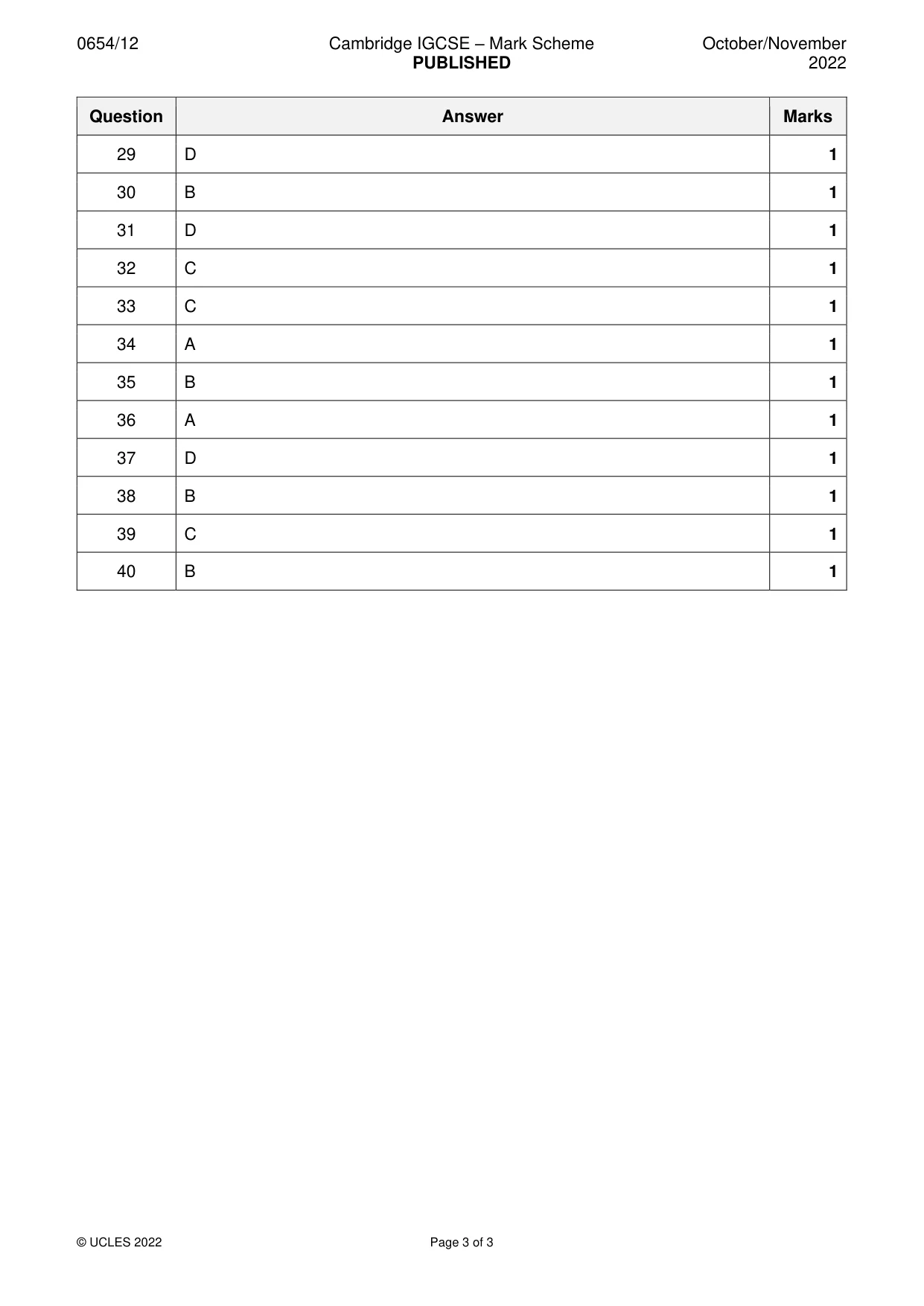
Mark scheme: D
Q2 · What is found in plant cells but not in animal cells?
2 What is found in plant cells but not in animal cells? A cell membrane B cell wall C nucleus D cytoplasm
Mark scheme: B
Q3 · Glycerol is a component of which large molecules?
3 Glycerol is a component of which large molecules? A fats B glycogen C proteins D starch
Mark scheme: A
Q4 · Which statement about enzymes is correct?
4 Which statement about enzymes is correct? A They are made from fat molecules. B They are used up in a reaction. C They speed up reactions. D They are not affected by temperature.
Mark scheme: C
Q5 · A plant with variegated leaves is destarched
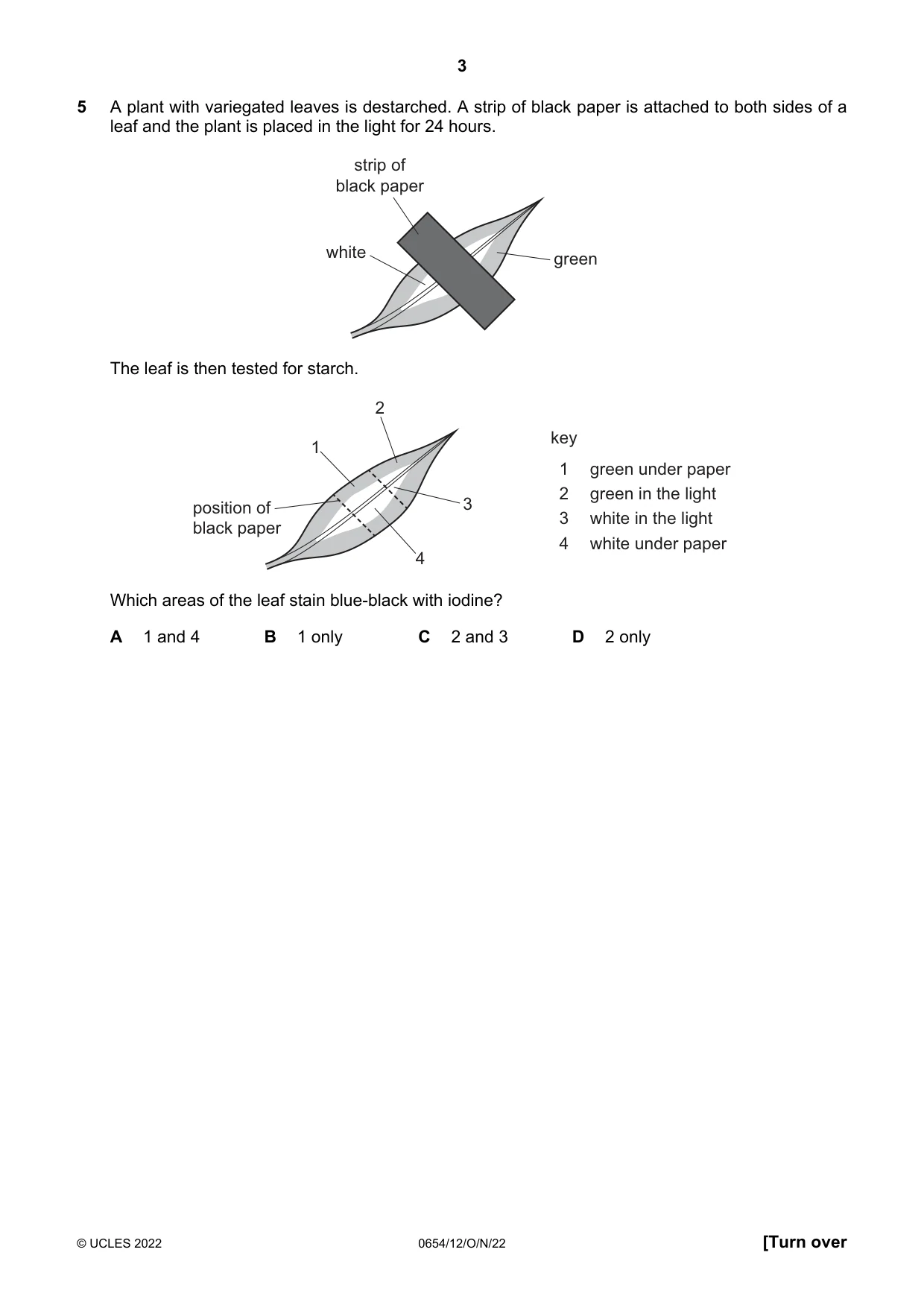
5 A plant with variegated leaves is destarched. A strip of black paper is attached to both sides of a leaf and the plant is placed in the light for 24 hours. strip of black paper white green The leaf is then tested for starch. 2 key 1 1 green under paper 2 green in the light position of 3 3 white in the light black paper 4 white under paper 4 Which areas of the leaf stain blue-black with iodine? A 1 and 4 B 1 only C 2 and 3 D 2 only
Mark scheme: D
Q6 · The diagram shows part of the human alimentary canal
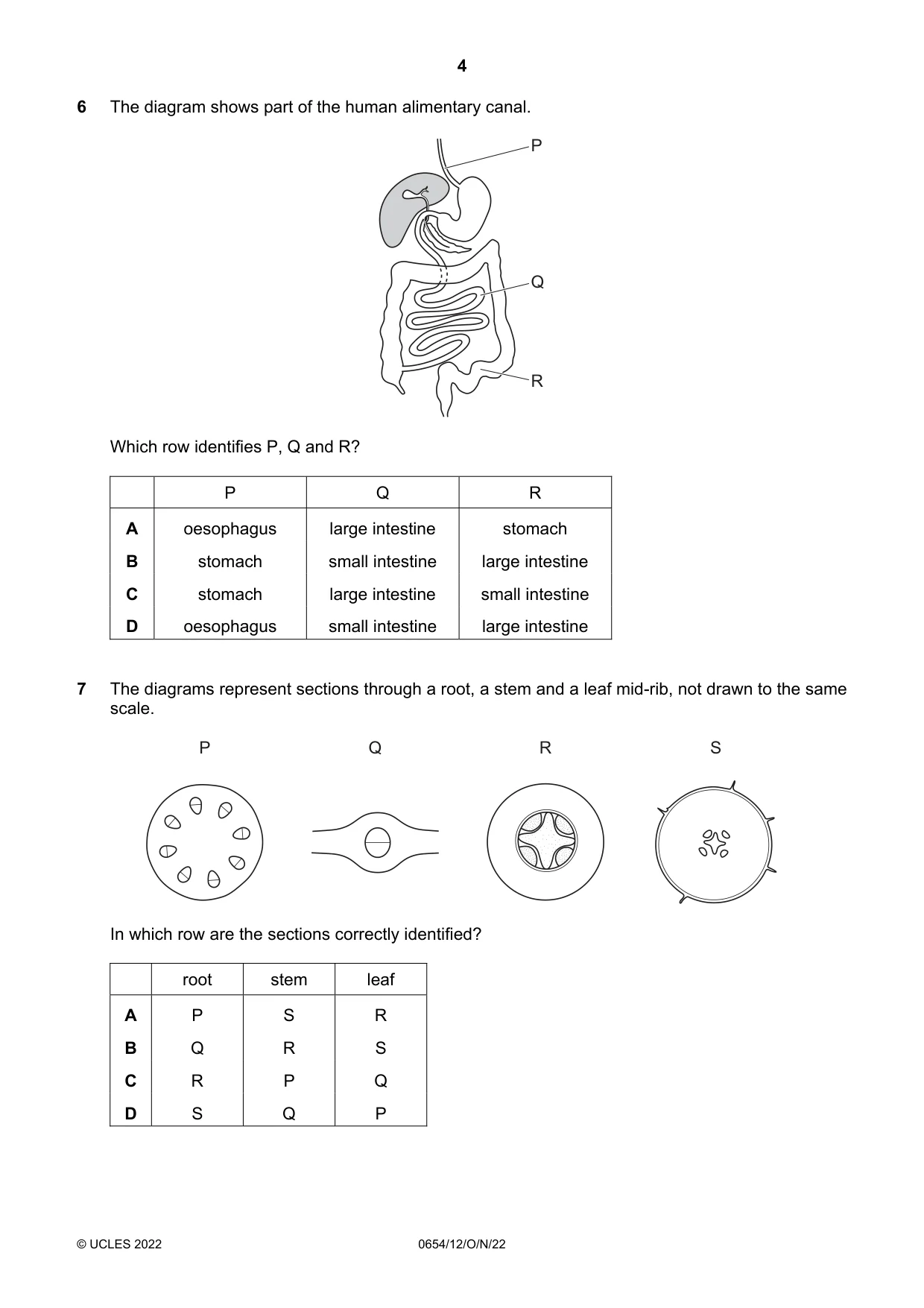
6 The diagram shows part of the human alimentary canal. P Q R Which row identifies P, Q and R? P Q R A oesophagus large intestine stomach B stomach small intestine large intestine C stomach large intestine small intestine D oesophagus small intestine large intestine
Mark scheme: D
Q7 · The diagrams represent sections through a root, a stem and a leaf mid-rib, not drawn to…
7 The diagrams represent sections through a root, a stem and a leaf mid-rib, not drawn to the same scale. P Q R S In which row are the sections correctly identified? root stem leaf A P S R B Q R S C R P Q D S Q P
Mark scheme: C
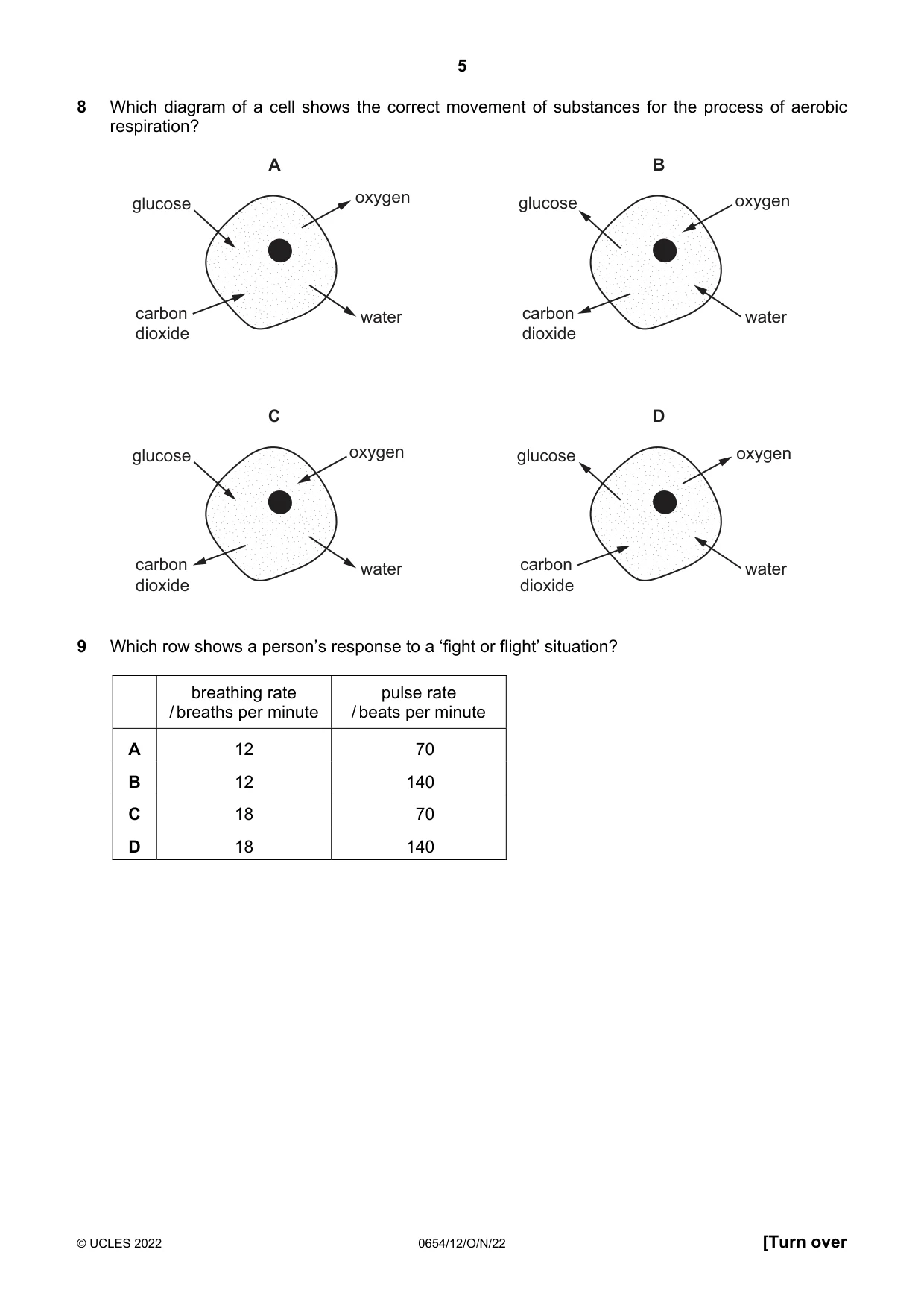
Q8 · Which diagram of a cell shows the correct movement of substances for the process of…
8 Which diagram of a cell shows the correct movement of substances for the process of aerobic respiration? A B glucose oxygen glucose oxygen carbon water carbon water dioxide dioxide C D glucose oxygen glucose oxygen carbon water carbon water dioxide dioxide
Mark scheme: C
Q9 · Which row shows a person’s response to a ‘fight or flight’ situation?
9 Which row shows a person’s response to a ‘fight or flight’ situation? breathing rate pulse rate / breaths per minute / beats per minute A 12 70 B 12 140 C 18 70 D 18 140
Mark scheme: D
Question 10
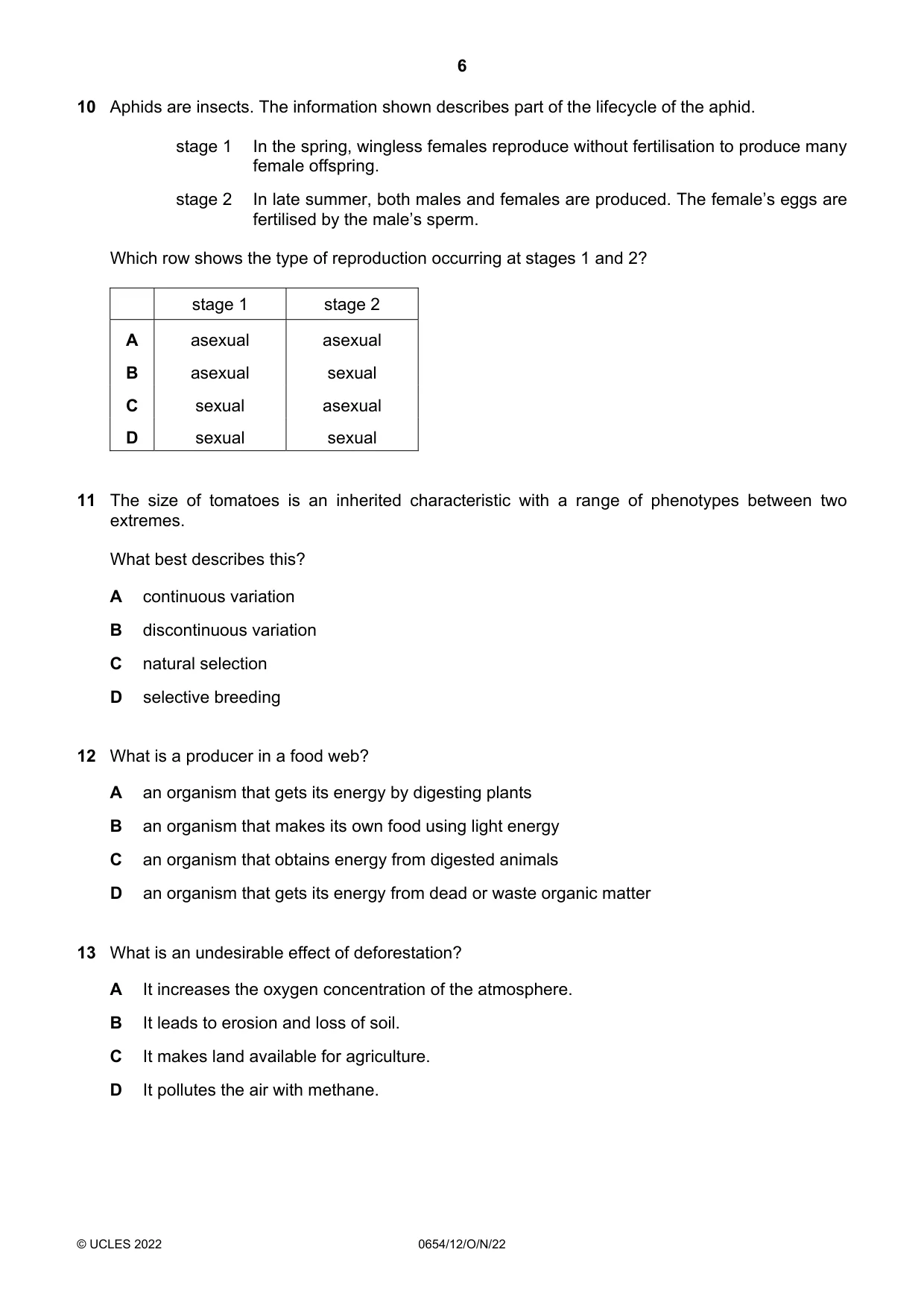
10 Aphids are insects. The information shown describes part of the lifecycle of the aphid. stage 1 In the spring, wingless females reproduce without fertilisation to produce many female offspring. stage 2 In late summer, both males and females are produced. The female’s eggs are fertilised by the male’s sperm. Which row shows the type of reproduction occurring at stages 1 and 2? stage 1 stage 2 A asexual asexual B asexual sexual C sexual asexual D sexual sexual
Mark scheme: B
Q11 · The size of tomatoes is an inherited characteristic with a range of phenotypes between…
11 The size of tomatoes is an inherited characteristic with a range of phenotypes between two extremes. What best describes this? A continuous variation B discontinuous variation C natural selection D selective breeding
Mark scheme: A
Q12 · What is a producer in a food web?
12 What is a producer in a food web? A an organism that gets its energy by digesting plants B an organism that makes its own food using light energy C an organism that obtains energy from digested animals D an organism that gets its energy from dead or waste organic matter
Mark scheme: B
Q13 · What is an undesirable effect of deforestation?
13 What is an undesirable effect of deforestation? A It increases the oxygen concentration of the atmosphere. B It leads to erosion and loss of soil. C It makes land available for agriculture. D It pollutes the air with methane.
Mark scheme: B
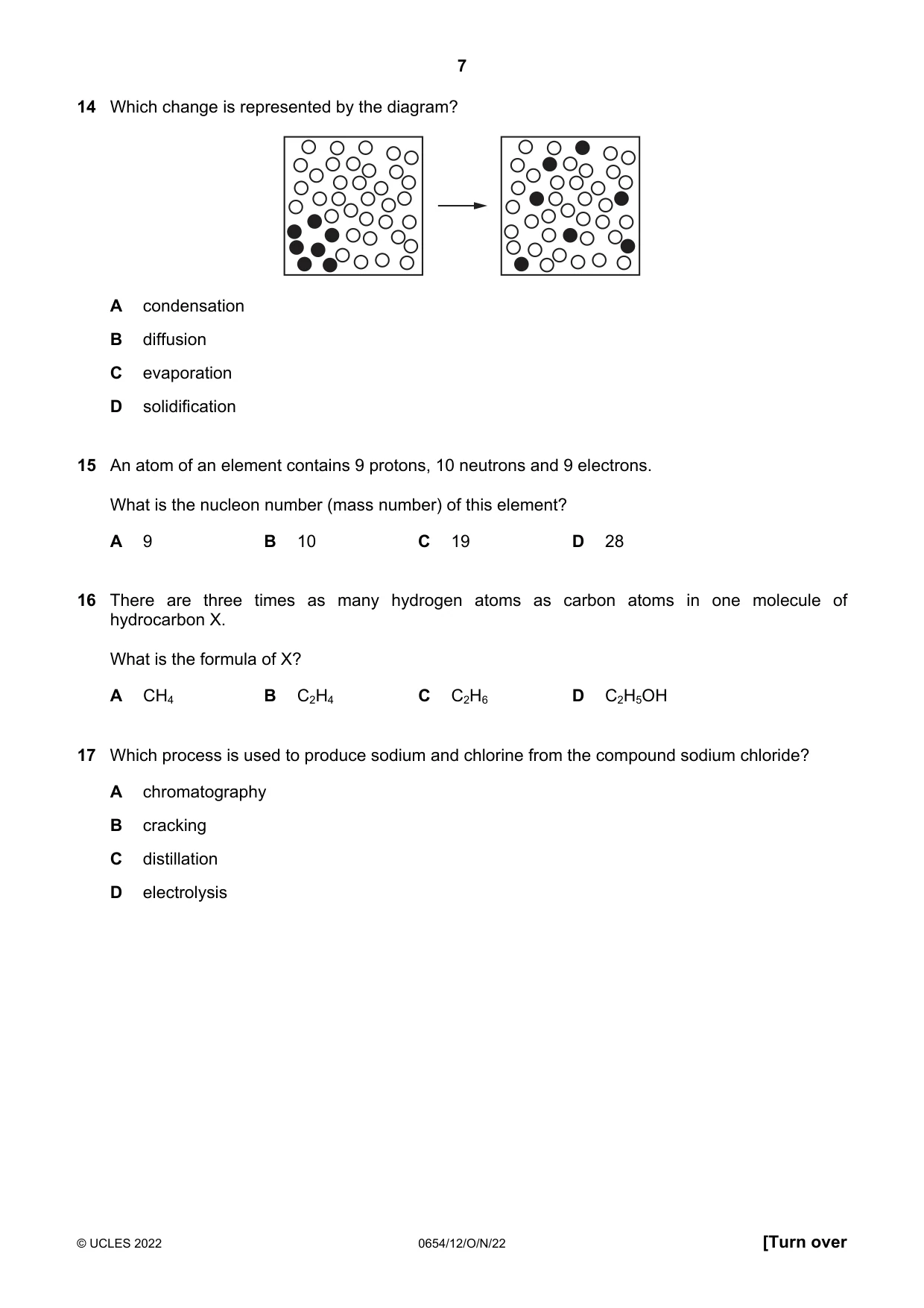
Q14 · Which change is represented by the diagram?
14 Which change is represented by the diagram? A condensation B diffusion C evaporation D solidification
Mark scheme: B
Q15 · An atom of an element contains 9 protons, 10 neutrons and 9 electrons
15 An atom of an element contains 9 protons, 10 neutrons and 9 electrons. What is the nucleon number (mass number) of this element? A 9 B 10 C 19 D 28
Mark scheme: C
Q16 · There are three times as many hydrogen atoms as carbon atoms in one molecule of…
16 There are three times as many hydrogen atoms as carbon atoms in one molecule of hydrocarbon X. What is the formula of X? A CH4 B C2H4 C C2H6 D C2H5OH
Mark scheme: C
Q17 · Which process is used to produce sodium and chlorine from the compound sodium chloride?
17 Which process is used to produce sodium and chlorine from the compound sodium chloride? A chromatography B cracking C distillation D electrolysis
Mark scheme: D
Q18 · The temperature change as the result of a chemical reaction may go up or down
18 The temperature change as the result of a chemical reaction may go up or down. temperature type of reaction 1 decreases endothermic 2 increases endothermic 3 increases exothermic 4 decreases exothermic Which rows about reactions are correct? A 1 and 3 B 1 and 4 C 2 and 3 D 2 and 4
Mark scheme: A
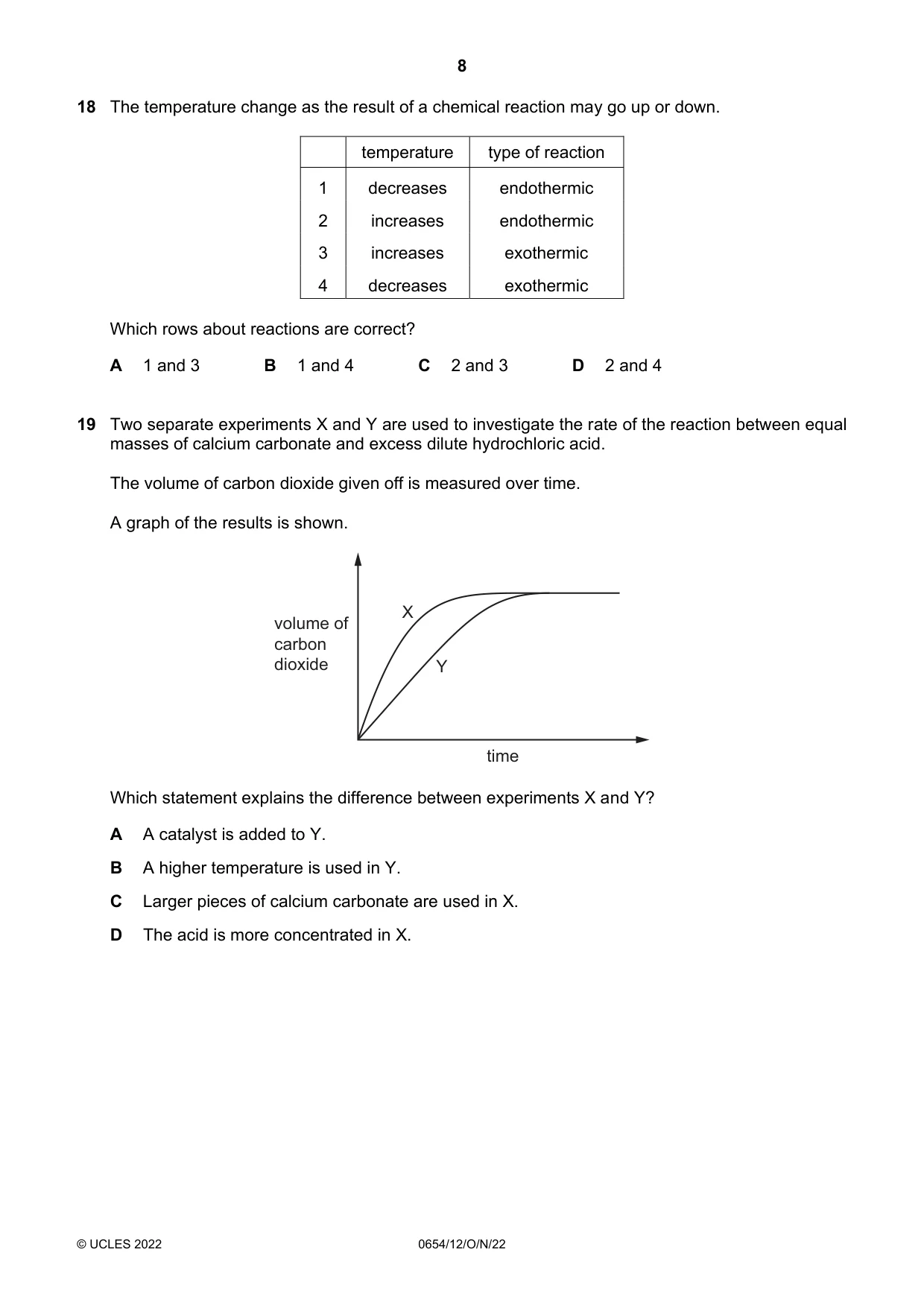
Q19 · Two separate experiments X and Y are used to investigate the rate of the reaction between…
19 Two separate experiments X and Y are used to investigate the rate of the reaction between equal masses of calcium carbonate and excess dilute hydrochloric acid. The volume of carbon dioxide given off is measured over time. A graph of the results is shown. X volume of carbon dioxide Y time Which statement explains the difference between experiments X and Y? A A catalyst is added to Y. B A higher temperature is used in Y. C Larger pieces of calcium carbonate are used in X. D The acid is more concentrated in X.
Mark scheme: D
Q20 · Indigestion is caused by excess hydrochloric acid in the stomach
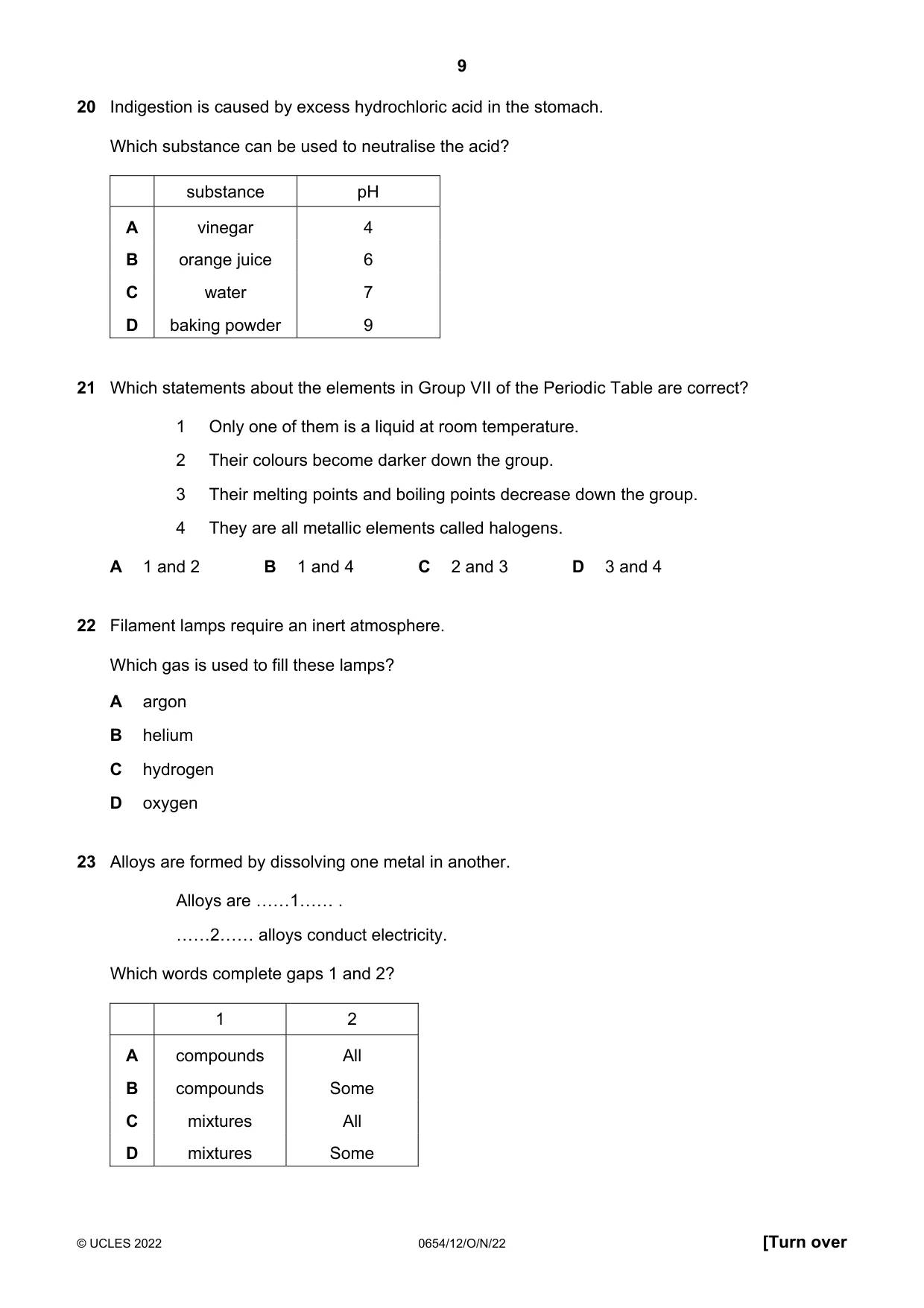
20 Indigestion is caused by excess hydrochloric acid in the stomach. Which substance can be used to neutralise the acid? substance pH A vinegar 4 B orange juice 6 C water 7 D baking powder 9
Mark scheme: D
More questions on The characteristic properties of acids and bases
Q21 · Which statements about the elements in Group VII of the Periodic Table are correct?
21 Which statements about the elements in Group VII of the Periodic Table are correct? 1 Only one of them is a liquid at room temperature. 2 Their colours become darker down the group. 3 Their melting points and boiling points decrease down the group. 4 They are all metallic elements called halogens. A 1 and 2 B 1 and 4 C 2 and 3 D 3 and 4
Mark scheme: A
Q22 · Filament lamps require an inert atmosphere
22 Filament lamps require an inert atmosphere. Which gas is used to fill these lamps? A argon B helium C hydrogen D oxygen
Mark scheme: A
Q23 · Alloys are formed by dissolving one metal in another
23 Alloys are formed by dissolving one metal in another. Alloys are ……1…… . ……2…… alloys conduct electricity. Which words complete gaps 1 and 2? 1 2 A compounds All B compounds Some C mixtures All D mixtures Some
Mark scheme: C
Q24 · Metal X is extracted from its ore by heating the ore with carbon
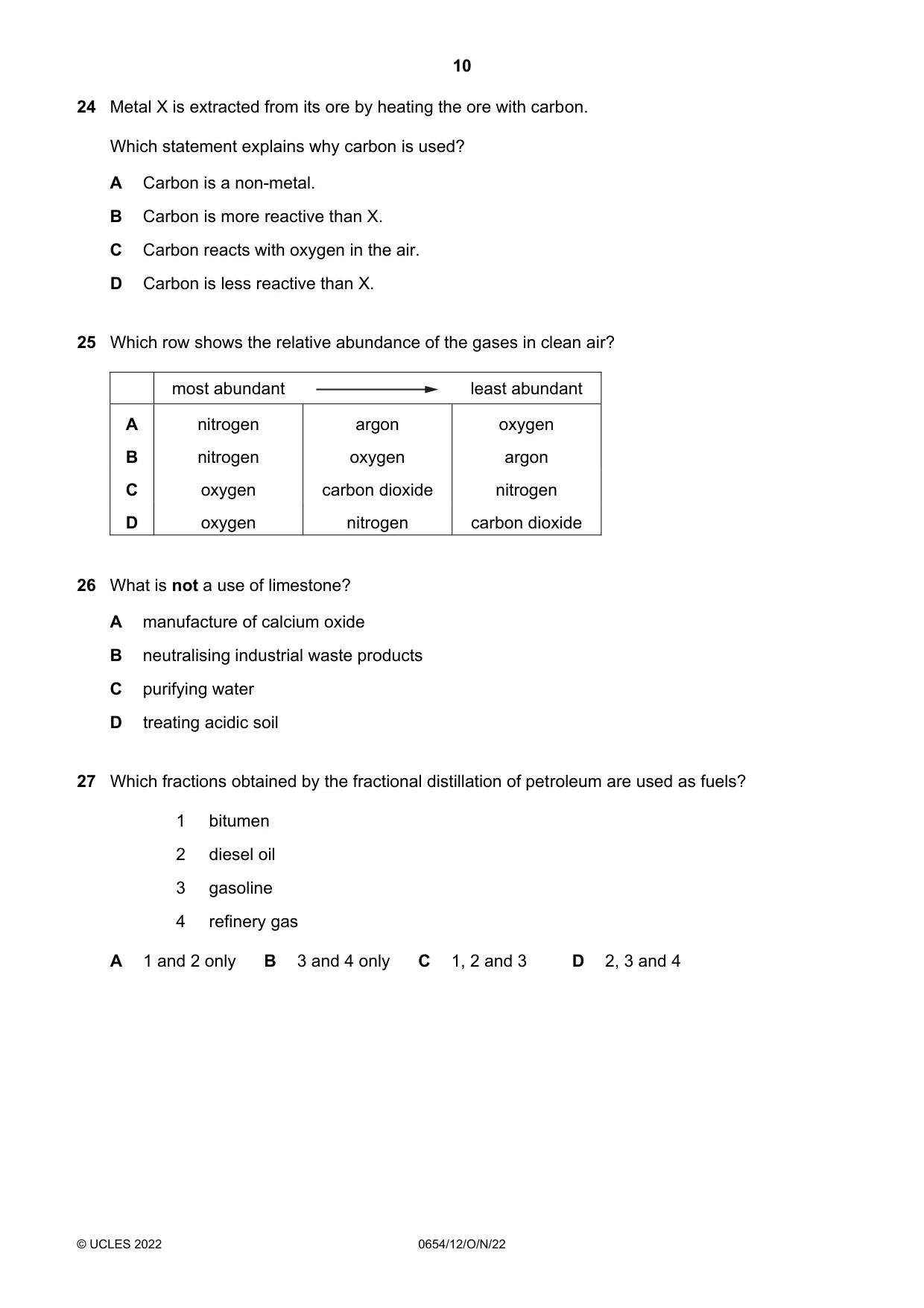
24 Metal X is extracted from its ore by heating the ore with carbon. Which statement explains why carbon is used? A Carbon is a non-metal. B Carbon is more reactive than X. C Carbon reacts with oxygen in the air. D Carbon is less reactive than X.
Mark scheme: B
Q25 · Which row shows the relative abundance of the gases in clean air?
25 Which row shows the relative abundance of the gases in clean air? most abundant least abundant A nitrogen argon oxygen B nitrogen oxygen argon C oxygen carbon dioxide nitrogen D oxygen nitrogen carbon dioxide
Mark scheme: B
Q26 · What is not a use of limestone?
26 What is not a use of limestone? A manufacture of calcium oxide B neutralising industrial waste products C purifying water D treating acidic soil
Mark scheme: C
Q27 · Which fractions obtained by the fractional distillation of petroleum are used as fuels?
27 Which fractions obtained by the fractional distillation of petroleum are used as fuels? 1 bitumen 2 diesel oil 3 gasoline 4 refinery gas A 1 and 2 only B 3 and 4 only C 1, 2 and 3 D 2, 3 and 4
Mark scheme: D
Q28 · The diagram is the speed–time graph for a moving object
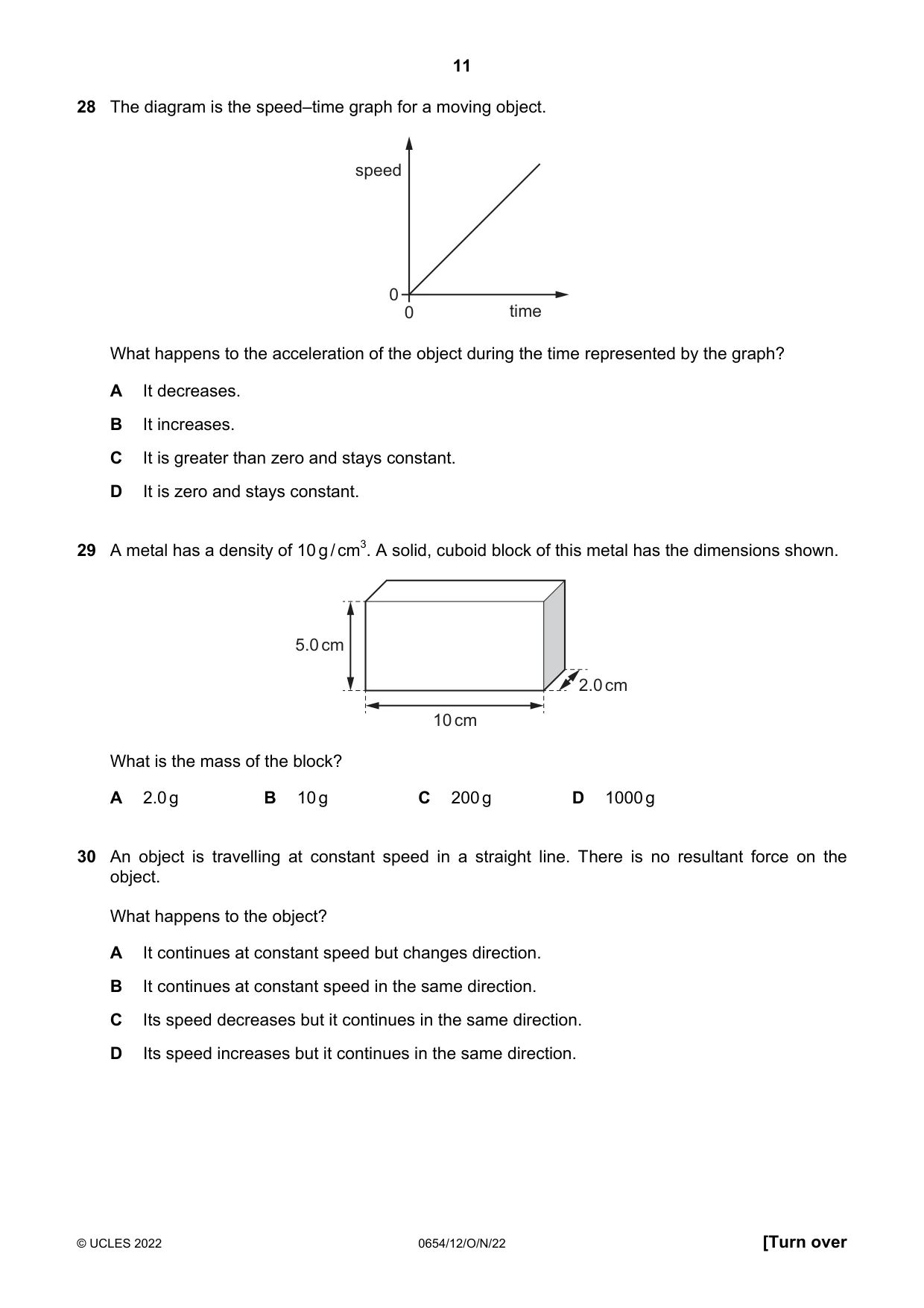
28 The diagram is the speed–time graph for a moving object. speed 0 0 time What happens to the acceleration of the object during the time represented by the graph? A It decreases. B It increases. C It is greater than zero and stays constant. D It is zero and stays constant.
Mark scheme: C
Q29 · A metal has a density of 10 g / cm3
29 A metal has a density of 10 g / cm3. A solid, cuboid block of this metal has the dimensions shown. 5.0 cm 2.0 cm 10 cm What is the mass of the block? A 2.0 g B 10 g C 200 g D 1000 g
Mark scheme: D
Q30 · An object is travelling at constant speed in a straight line
30 An object is travelling at constant speed in a straight line. There is no resultant force on the object. What happens to the object? A It continues at constant speed but changes direction. B It continues at constant speed in the same direction. C Its speed decreases but it continues in the same direction. D Its speed increases but it continues in the same direction.
Mark scheme: B
Q31 · Two forklift trucks P and Q lift identical loads through the same vertical height
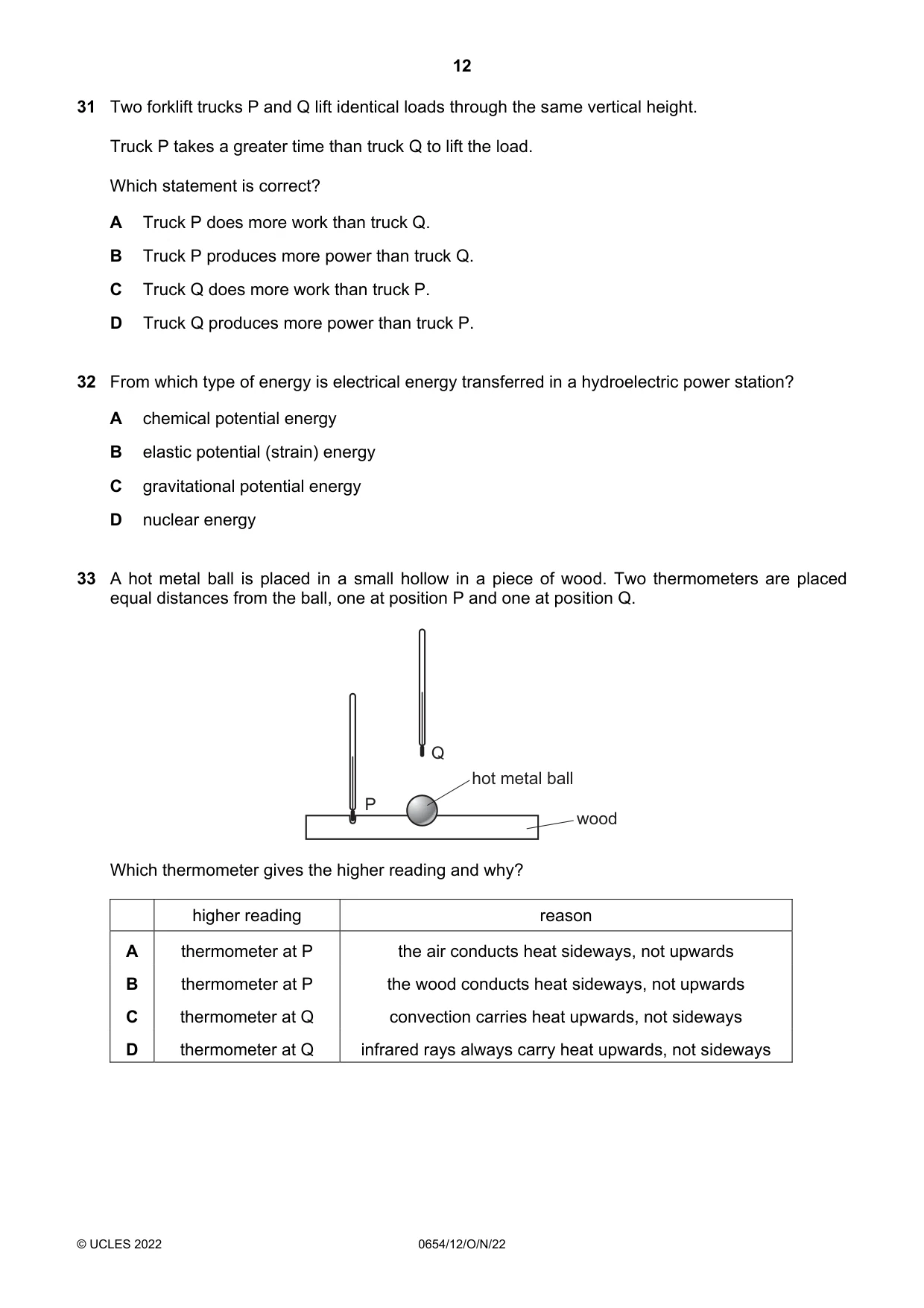
31 Two forklift trucks P and Q lift identical loads through the same vertical height. Truck P takes a greater time than truck Q to lift the load. Which statement is correct? A Truck P does more work than truck Q. B Truck P produces more power than truck Q. C Truck Q does more work than truck P. D Truck Q produces more power than truck P.
Mark scheme: D
Q32 · From which type of energy is electrical energy transferred in a hydroelectric power…
32 From which type of energy is electrical energy transferred in a hydroelectric power station? A chemical potential energy B elastic potential (strain) energy C gravitational potential energy D nuclear energy
Mark scheme: C
Q33 · A hot metal ball is placed in a small hollow in a piece of wood
33 A hot metal ball is placed in a small hollow in a piece of wood. Two thermometers are placed equal distances from the ball, one at position P and one at position Q. Q hot metal ball P wood Which thermometer gives the higher reading and why? higher reading reason A thermometer at P the air conducts heat sideways, not upwards B thermometer at P the wood conducts heat sideways, not upwards C thermometer at Q convection carries heat upwards, not sideways D thermometer at Q infrared rays always carry heat upwards, not sideways
Mark scheme: C
Q34 · An object is placed at a certain distance from a converging lens
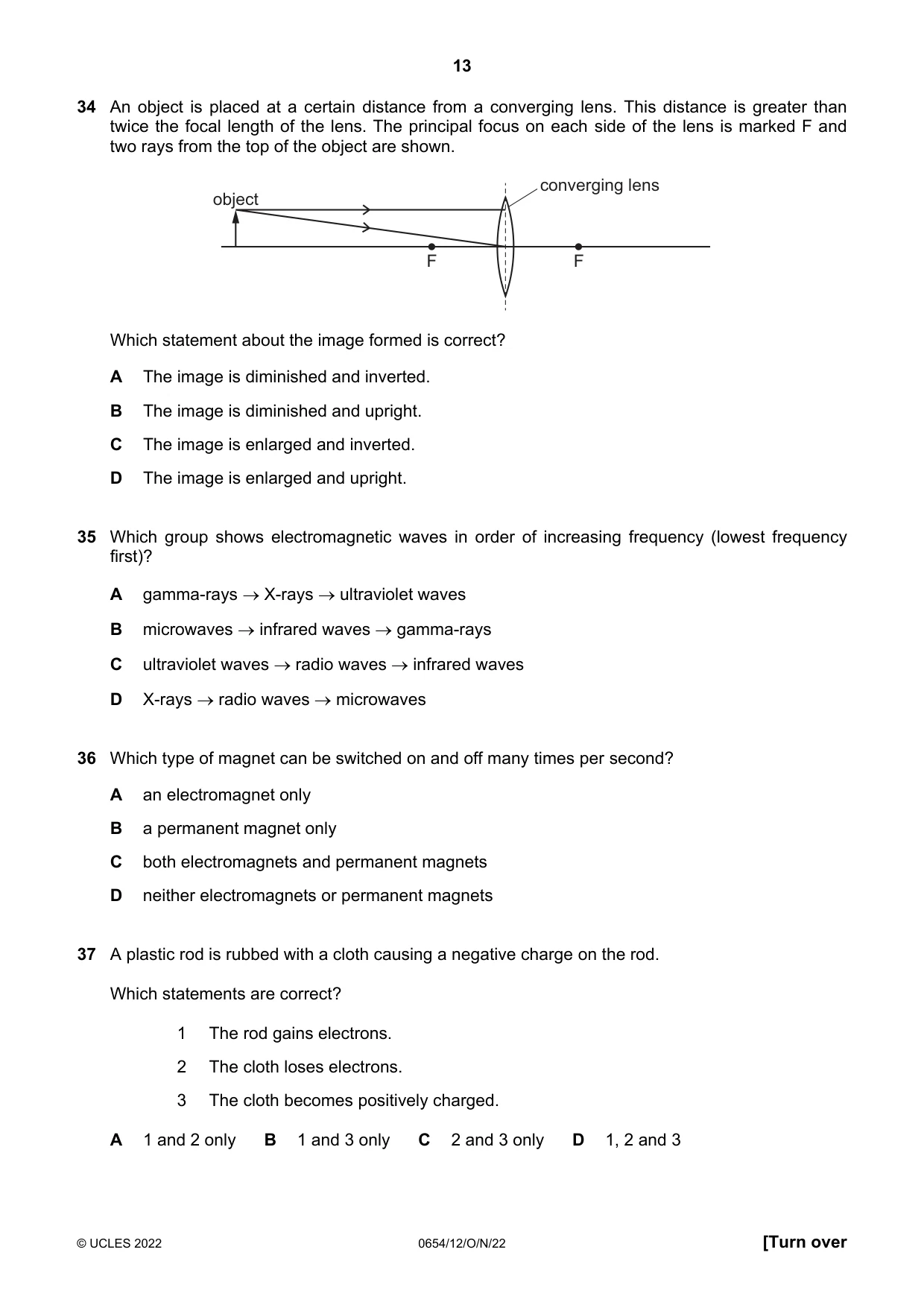
34 An object is placed at a certain distance from a converging lens. This distance is greater than twice the focal length of the lens. The principal focus on each side of the lens is marked F and two rays from the top of the object are shown. converging lens object F F Which statement about the image formed is correct? A The image is diminished and inverted. B The image is diminished and upright. C The image is enlarged and inverted. D The image is enlarged and upright.
Mark scheme: A
Q35 · Which group shows electromagnetic waves in order of increasing frequency (lowest…
35 Which group shows electromagnetic waves in order of increasing frequency (lowest frequency first)? A gamma-rays X-rays ultraviolet waves B microwaves infrared waves gamma-rays C ultraviolet waves radio waves infrared waves D X-rays radio waves microwaves
Mark scheme: B
Q36 · Which type of magnet can be switched on and off many times per second?
36 Which type of magnet can be switched on and off many times per second? A an electromagnet only B a permanent magnet only C both electromagnets and permanent magnets D neither electromagnets or permanent magnets
Mark scheme: A
Q37 · A plastic rod is rubbed with a cloth causing a negative charge on the rod
37 A plastic rod is rubbed with a cloth causing a negative charge on the rod. Which statements are correct? 1 The rod gains electrons. 2 The cloth loses electrons. 3 The cloth becomes positively charged. A 1 and 2 only B 1 and 3 only C 2 and 3 only D 1, 2 and 3
Mark scheme: D
Q38 · X, Y and Z are combinations of identical resistors
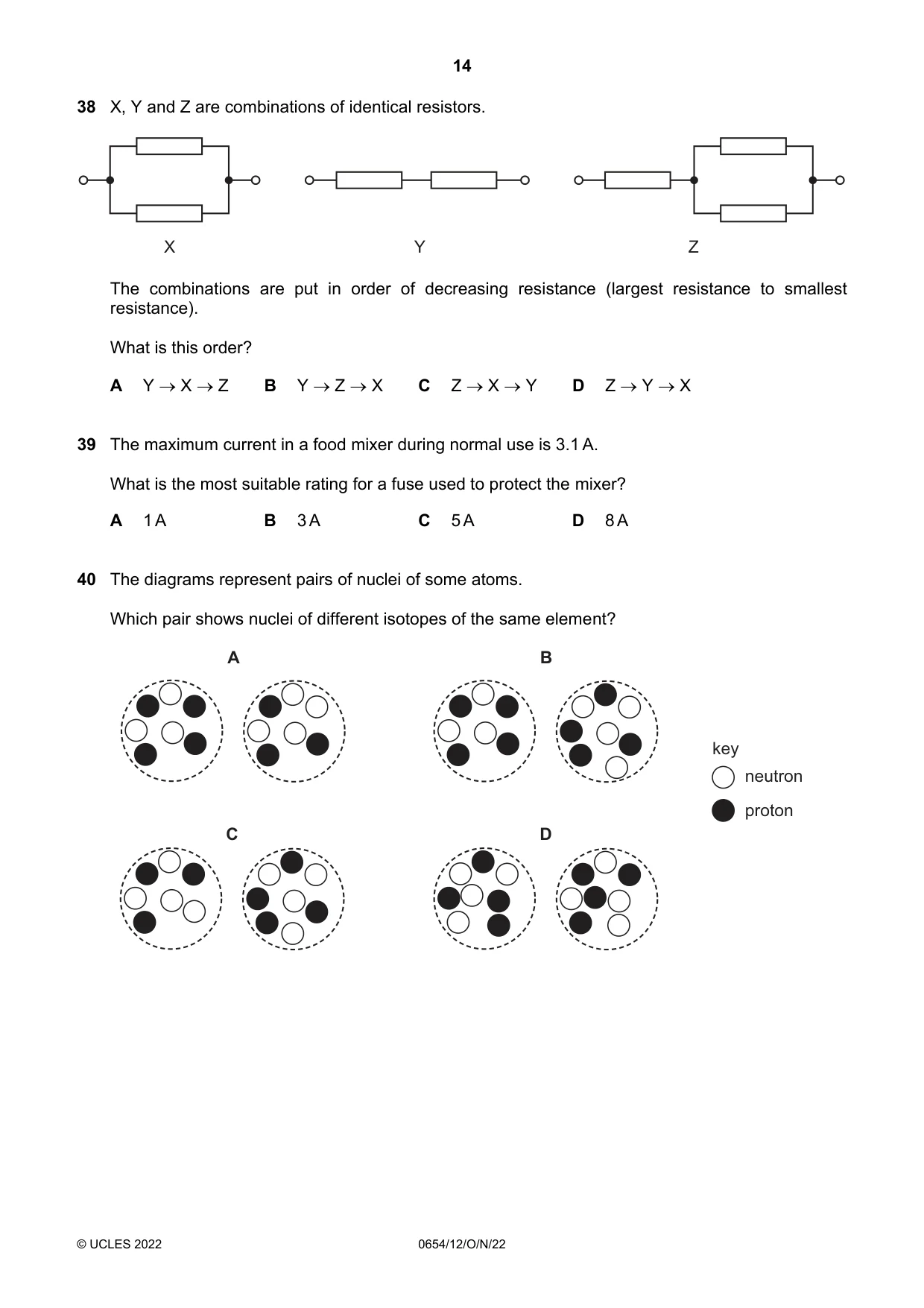
38 X, Y and Z are combinations of identical resistors. X Y Z The combinations are put in order of decreasing resistance (largest resistance to smallest resistance). What is this order? A Y X Z B Y Z X C Z X Y D Z Y X
Mark scheme: B
Q39 · The maximum current in a food mixer during normal use is 3.1 A
39 The maximum current in a food mixer during normal use is 3.1 A. What is the most suitable rating for a fuse used to protect the mixer? A 1 A B 3 A C 5 A D 8 A
Mark scheme: C
Q40 · The diagrams represent pairs of nuclei of some atoms
40 The diagrams represent pairs of nuclei of some atoms. Which pair shows nuclei of different isotopes of the same element? A B key neutron proton C D
Mark scheme: B
What was in this paper
The subtopics covered by these 40 questions, and how many questions each got. Open one in a new tab to see every Cambridge question on it.
2Simple phenomena of magnetism2Air quality and climate1Alkanes1Alloys and their properties1Asexual reproduction1Atomic structure and the Periodic Table1Biological molecules1Cell structure1Characteristics of living organisms1Coordination and response1Density1Digestive system1Electrical circuits1Electrical safety1Electrolysis1Electromagnetic spectrum1Enzymes1Exothermic and endothermic reactions1Extraction of metals1Food chains and food webs1Forces1Fuels1Group VII properties1Habitat destruction1Leaf structure1Light1Motion1Noble gases1Photosynthesis1Rate of reaction1Respiration1Solids, liquids and gases1The characteristic properties of acids and bases1The nucleus1Transfer of thermal energy1Variation1Water1What you needed in this session
Cambridge’s own grade thresholds for 2022 Oct/Nov, Paper 1 · Variant 2. A higher threshold means an easier paper — the bar moves with how the cohort did.