Cambridge IGCSE Sciences - Co-ordinated (Double) 0654 — 2024 Feb/March Paper 1 · Variant 2
0654/12/F/M/24 · 40 questions · 40 marks · ≈45 min
The question paper and its mark scheme, free to read here and free to download. This is Cambridge’s own paper, exactly as it was sat.
Question paper16 pages

Mark scheme3 pages
Answers below. Sit the paper first if you are practising.
Questions as text
Q1 · The diagram shows a germinating seed below the soil surface
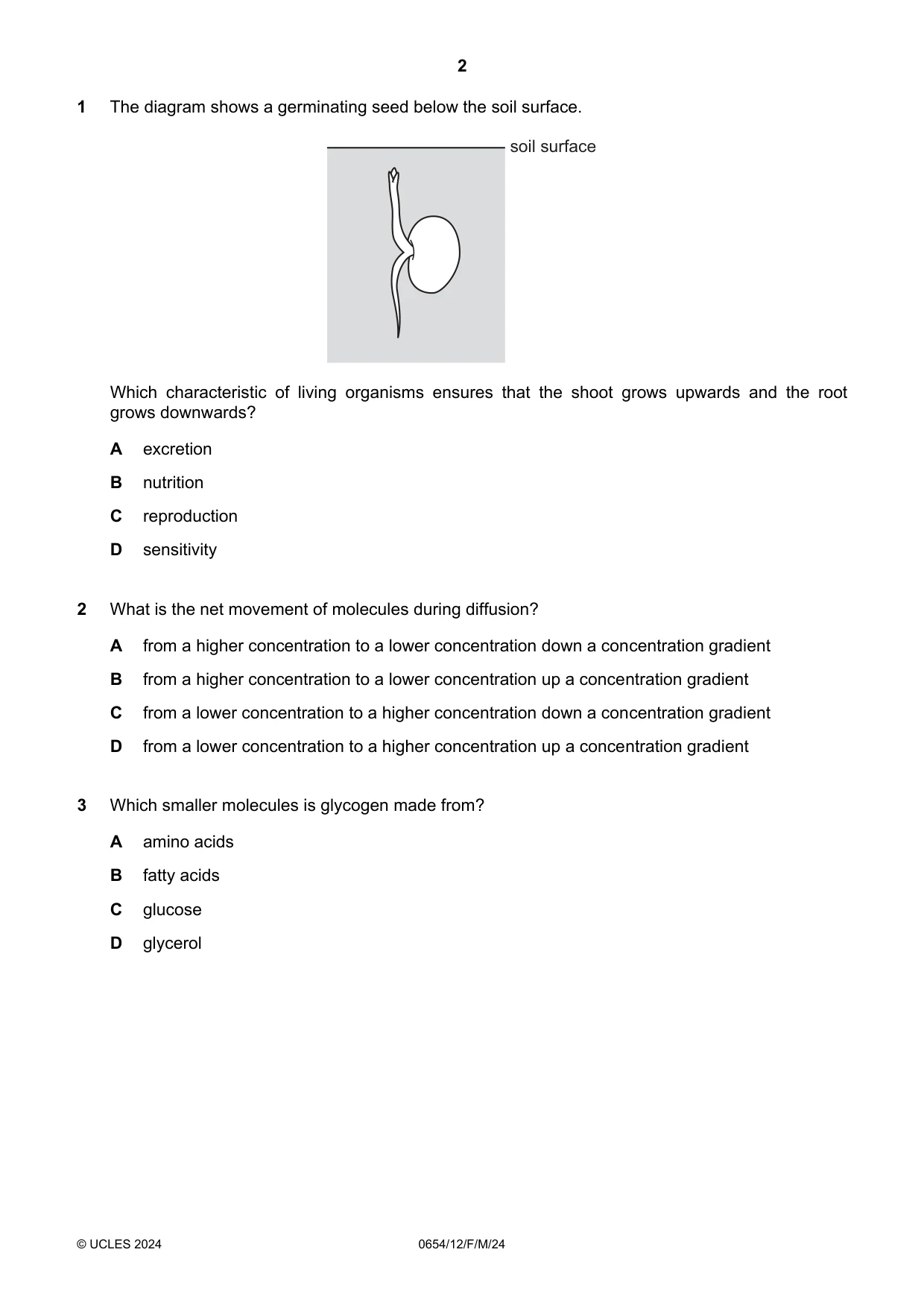
1 The diagram shows a germinating seed below the soil surface. soil surface Which characteristic of living organisms ensures that the shoot grows upwards and the root grows downwards? A excretion B nutrition C reproduction D sensitivity
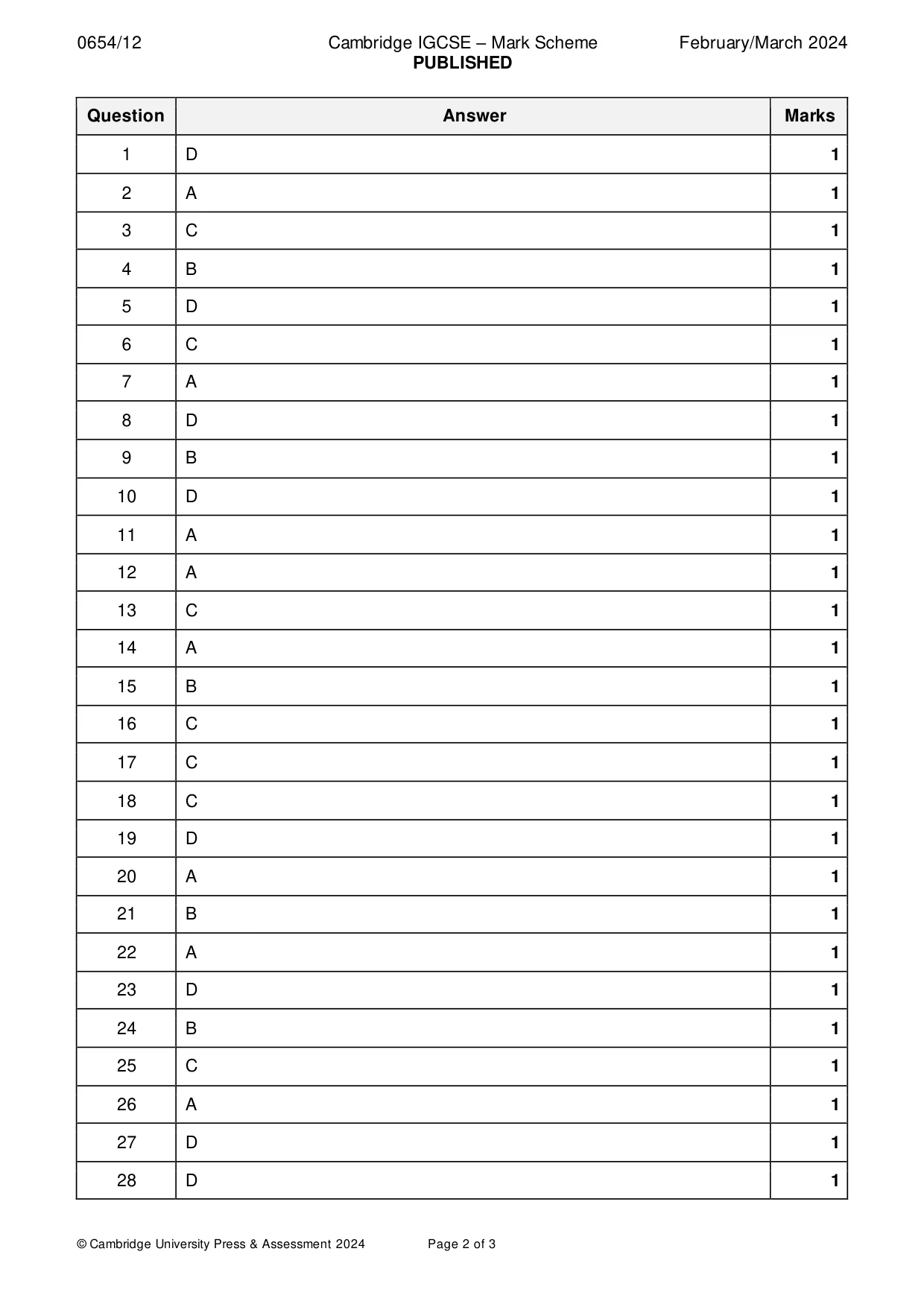
Mark scheme: D
Q2 · What is the net movement of molecules during diffusion?
2 What is the net movement of molecules during diffusion? A from a higher concentration to a lower concentration down a concentration gradient B from a higher concentration to a lower concentration up a concentration gradient C from a lower concentration to a higher concentration down a concentration gradient D from a lower concentration to a higher concentration up a concentration gradient
Mark scheme: A
Q3 · Which smaller molecules is glycogen made from?
3 Which smaller molecules is glycogen made from? A amino acids B fatty acids C glucose D glycerol
Mark scheme: C
Q4 · The graph shows the effect of pH on two different enzymes
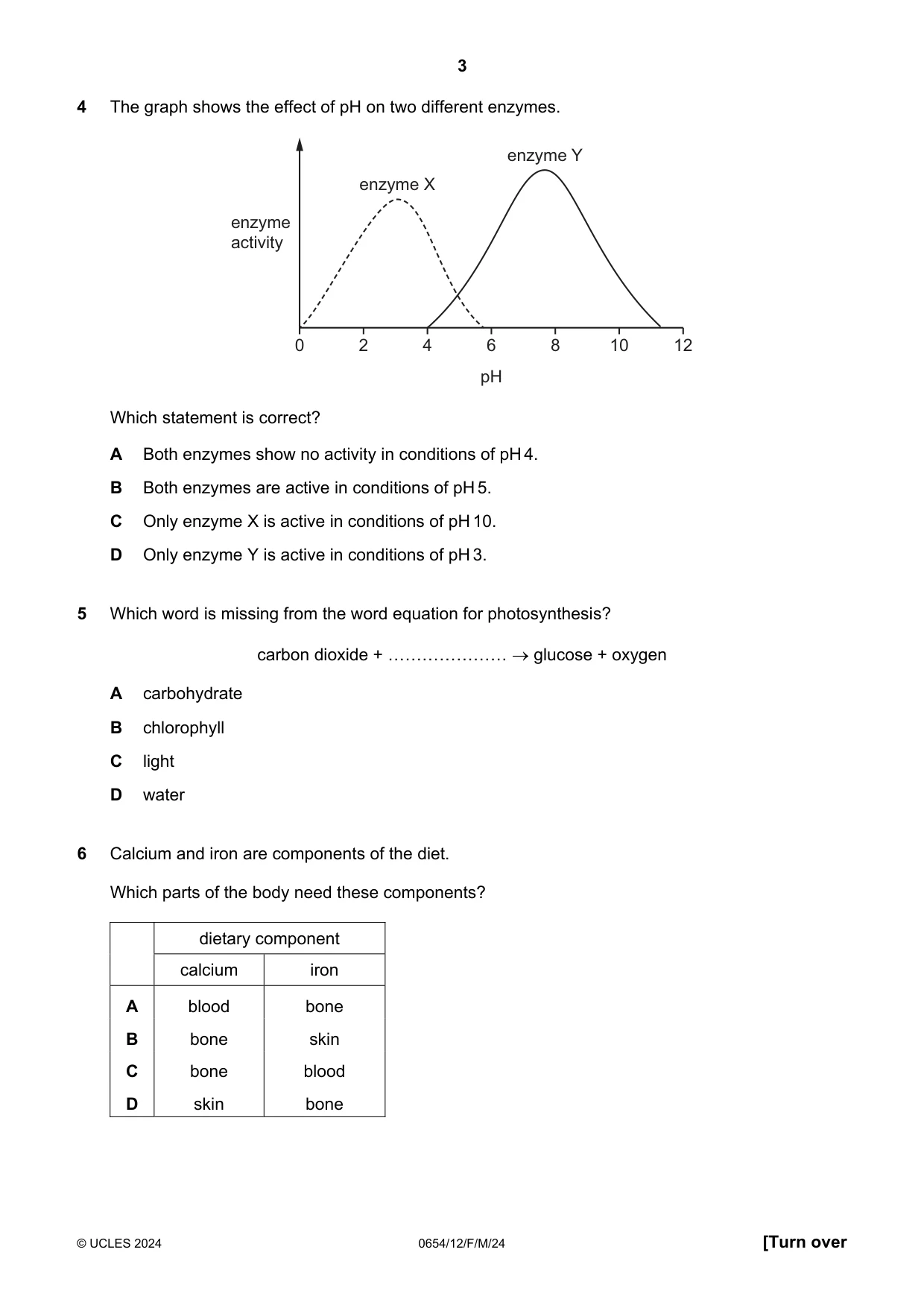
4 The graph shows the effect of pH on two different enzymes. enzyme Y enzyme X enzyme activity 0 2 4 6 8 10 12 pH Which statement is correct? A Both enzymes show no activity in conditions of pH 4. B Both enzymes are active in conditions of pH 5. C Only enzyme X is active in conditions of pH 10. D Only enzyme Y is active in conditions of pH 3.
Mark scheme: B
Q5 · Which word is missing from the word equation for photosynthesis?
5 Which word is missing from the word equation for photosynthesis? carbon dioxide + ………………… glucose + oxygen A carbohydrate B chlorophyll C light D water
Mark scheme: D
Q6 · Calcium and iron are components of the diet
6 Calcium and iron are components of the diet. Which parts of the body need these components? dietary component calcium iron A blood bone B bone skin C bone blood D skin bone
Mark scheme: C
Q7 · The diagram shows a section through the human heart and the blood vessels associated with…
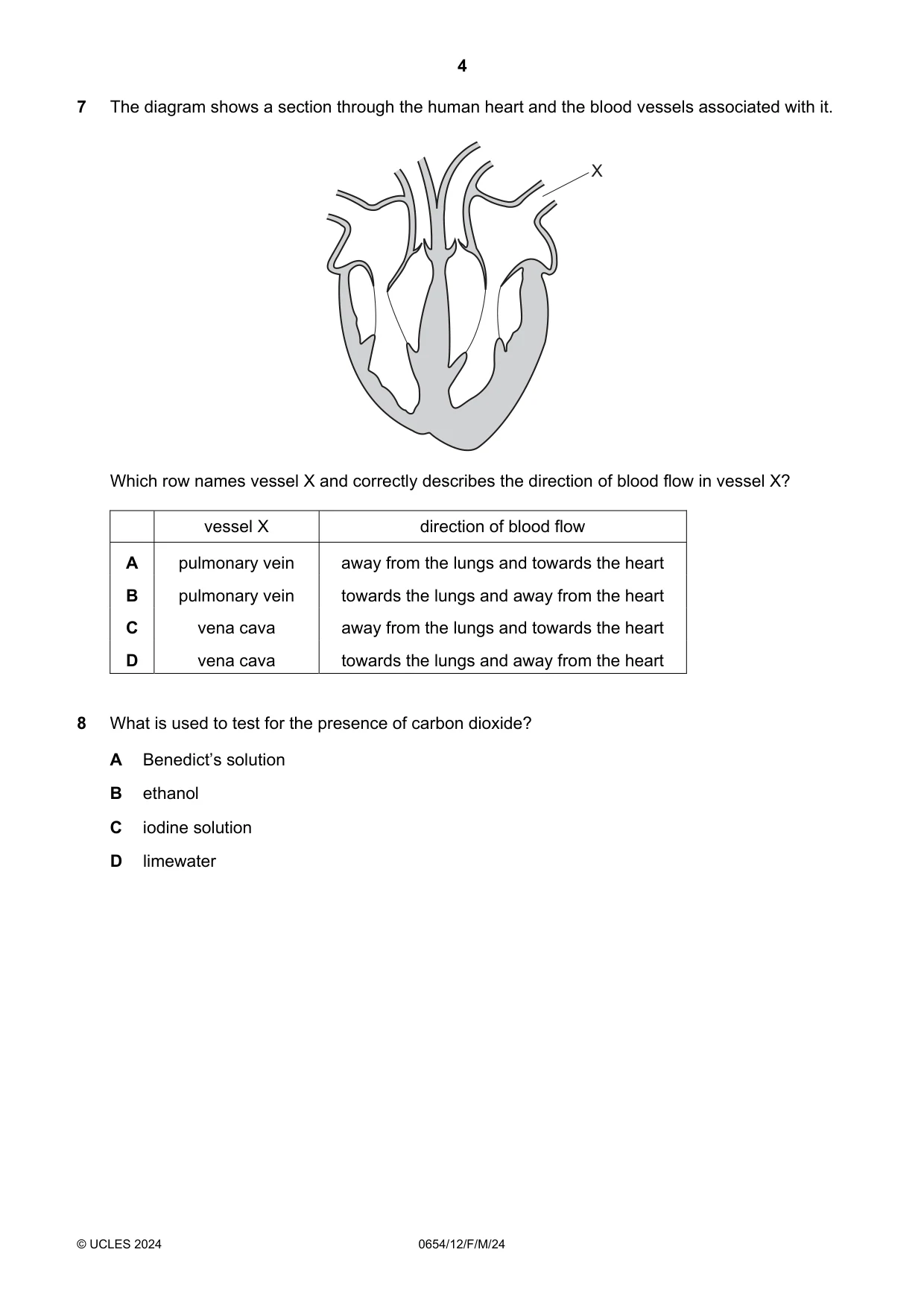
7 The diagram shows a section through the human heart and the blood vessels associated with it. X Which row names vessel X and correctly describes the direction of blood flow in vessel X? vessel X direction of blood flow A pulmonary vein away from the lungs and towards the heart B pulmonary vein towards the lungs and away from the heart C vena cava away from the lungs and towards the heart D vena cava towards the lungs and away from the heart
Mark scheme: A
Q8 · What is used to test for the presence of carbon dioxide?
8 What is used to test for the presence of carbon dioxide? A Benedict’s solution B ethanol C iodine solution D limewater
Mark scheme: D
Q9 · The diagram shows three different neurones which form the reflex arc
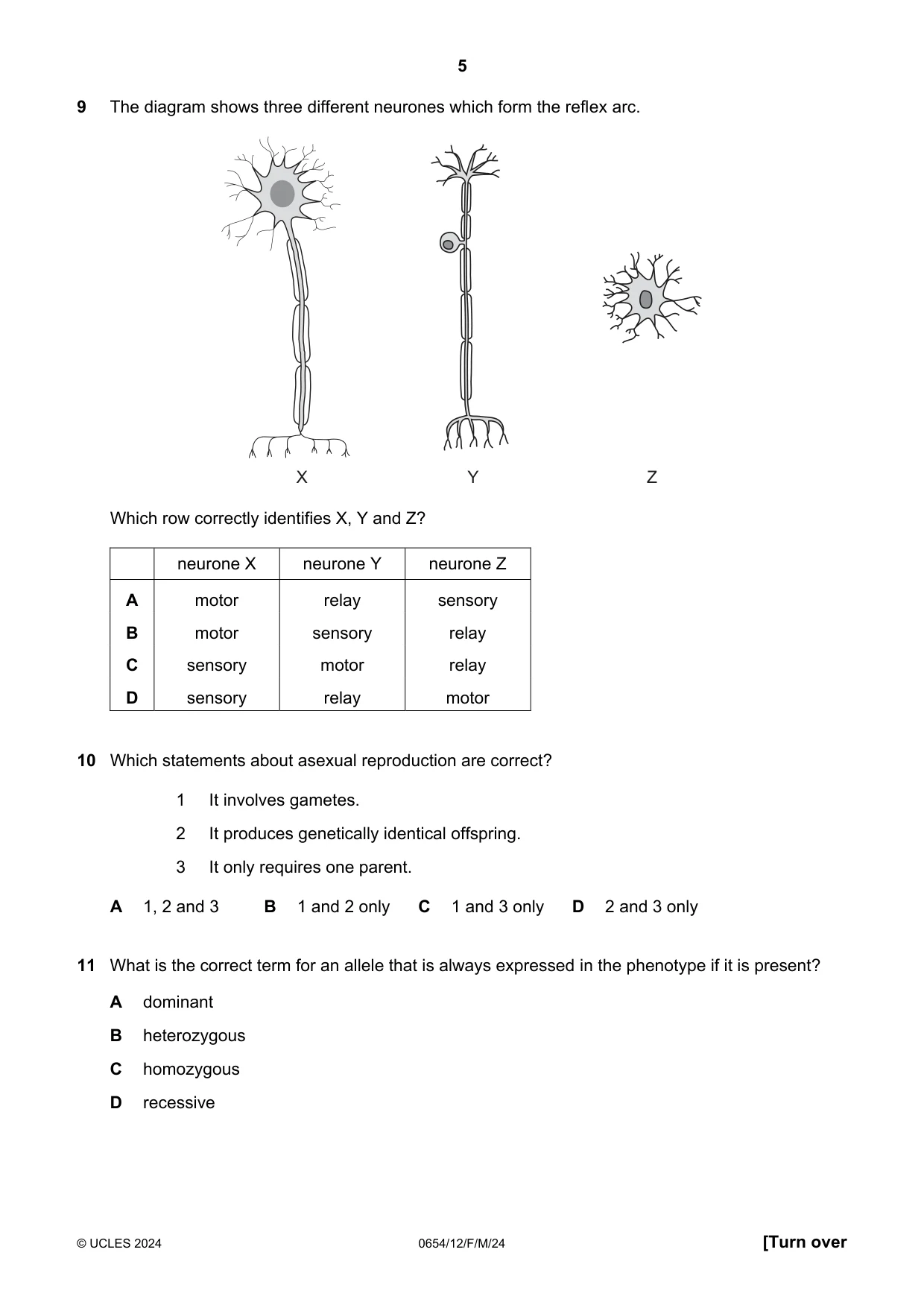
9 The diagram shows three different neurones which form the reflex arc. X Y Z Which row correctly identifies X, Y and Z? neurone X neurone Y neurone Z A motor relay sensory B motor sensory relay C sensory motor relay D sensory relay motor
Mark scheme: B
Q10 · Which statements about asexual reproduction are correct?
10 Which statements about asexual reproduction are correct? 1 It involves gametes. 2 It produces genetically identical offspring. 3 It only requires one parent. A 1, 2 and 3 B 1 and 2 only C 1 and 3 only D 2 and 3 only
Mark scheme: D
Q11 · What is the correct term for an allele that is always expressed in the phenotype if it is…
11 What is the correct term for an allele that is always expressed in the phenotype if it is present? A dominant B heterozygous C homozygous D recessive
Mark scheme: A
Q12 · The diagram shows a food web
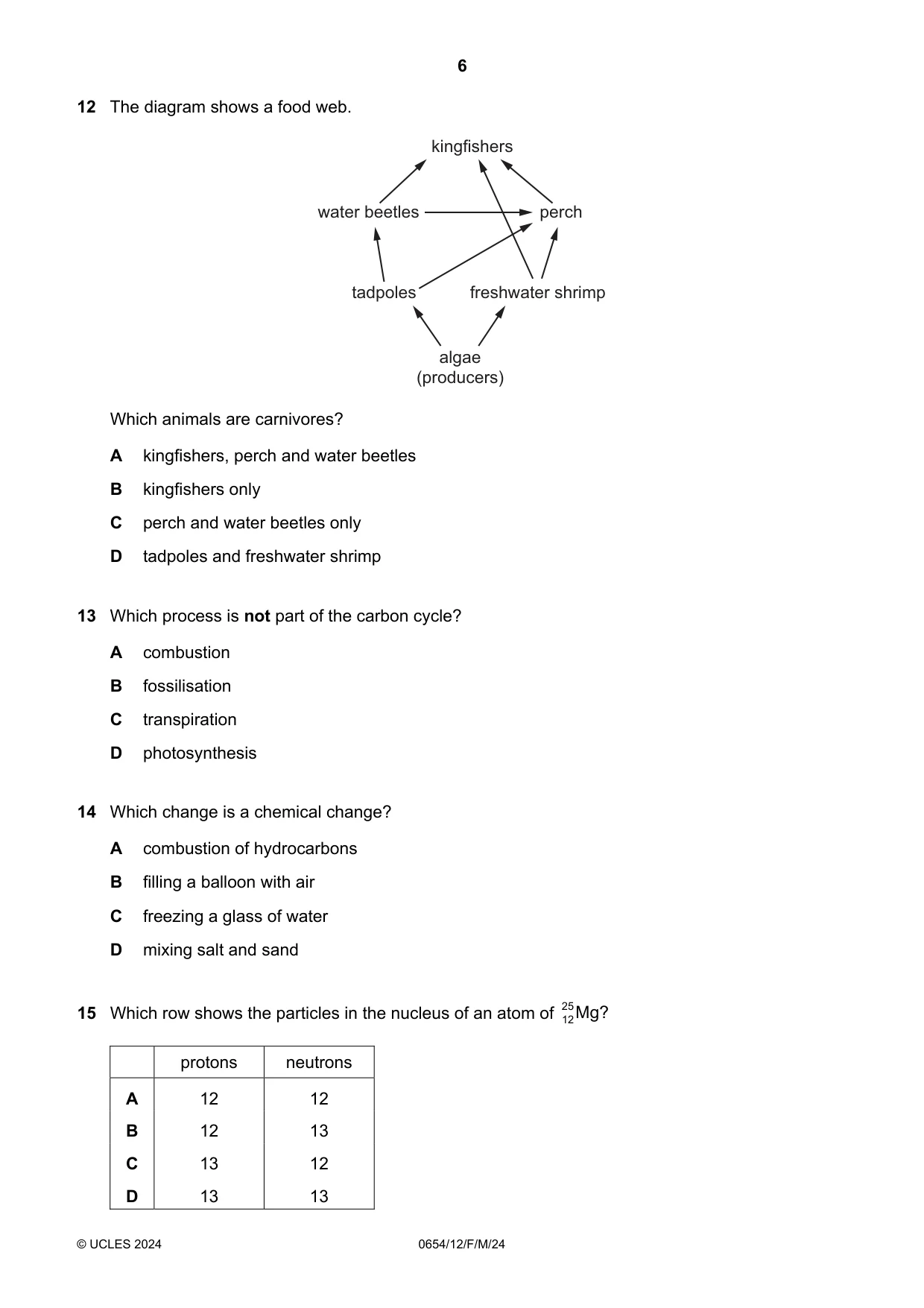
12 The diagram shows a food web. kingfishers water beetles perch tadpoles freshwater shrimp algae (producers) Which animals are carnivores? A kingfishers, perch and water beetles B kingfishers only C perch and water beetles only D tadpoles and freshwater shrimp
Mark scheme: A
Q13 · Which process is not part of the carbon cycle?
13 Which process is not part of the carbon cycle? A combustion B fossilisation C transpiration D photosynthesis
Mark scheme: C
Q14 · Which change is a chemical change?
14 Which change is a chemical change? A combustion of hydrocarbons B filling a balloon with air C freezing a glass of water D mixing salt and sand
Mark scheme: A
Q15 · Which row shows the particles in the nucleus of an atom of 25 Mg?
15 Which row shows the particles in the nucleus of an atom of 25 Mg? 12 protons neutrons A 12 12 B 12 13 C 13 12 D 13 13
Mark scheme: B
Q16 · Which dot-and-cross diagram represents a molecule of ammonia?
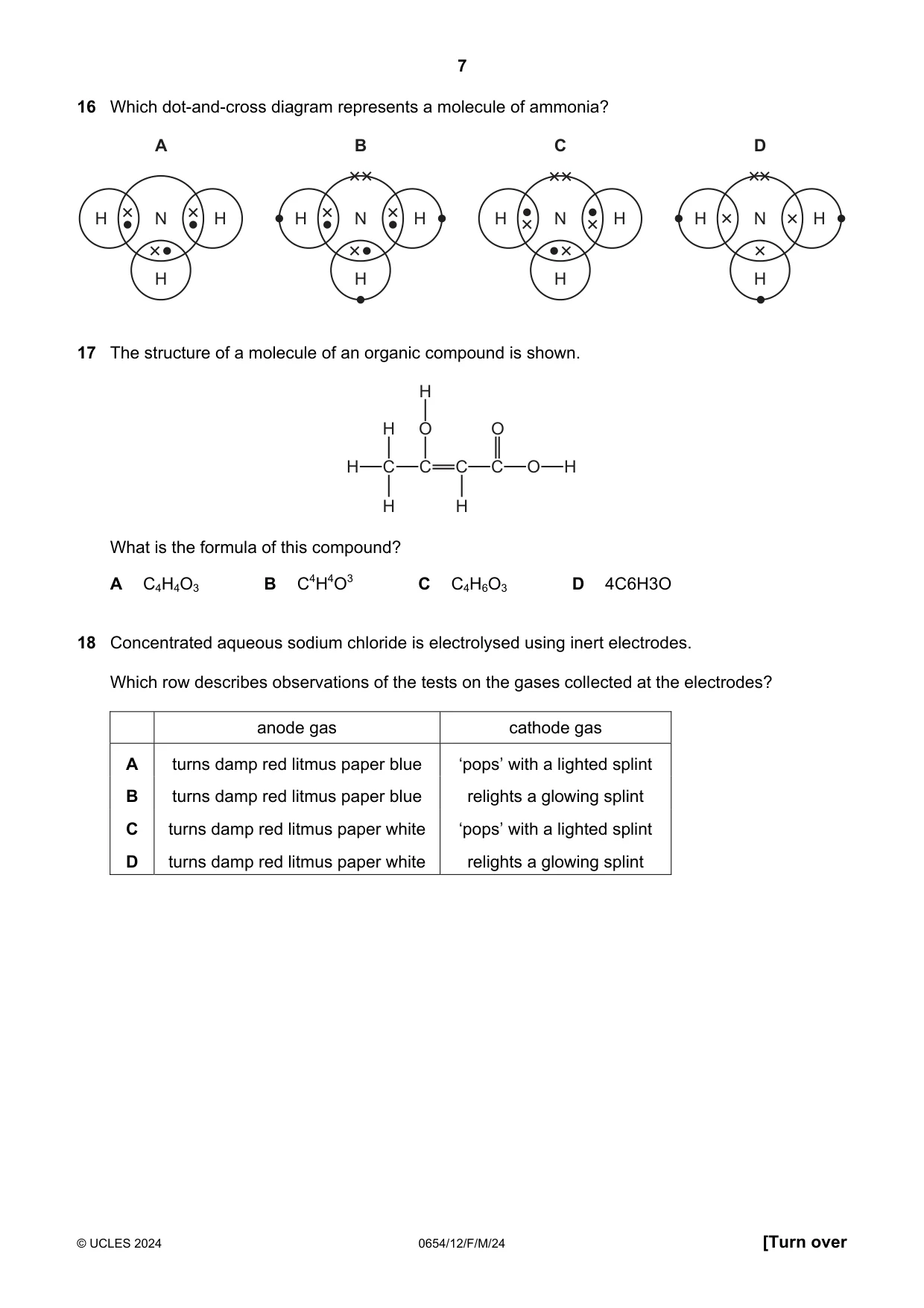
16 Which dot-and-cross diagram represents a molecule of ammonia? A B C D H N H H N H H N H H N H H H H H
Mark scheme: C
Q17 · The structure of a molecule of an organic compound is shown
17 The structure of a molecule of an organic compound is shown. H H O O H C C C C O H H H What is the formula of this compound? A C4H4O3 B C4H4O3 C C4H6O3 D 4C6H3O
Mark scheme: C
Q18 · Concentrated aqueous sodium chloride is electrolysed using inert electrodes
18 Concentrated aqueous sodium chloride is electrolysed using inert electrodes. Which row describes observations of the tests on the gases collected at the electrodes? anode gas cathode gas A turns damp red litmus paper blue ‘pops’ with a lighted splint B turns damp red litmus paper blue relights a glowing splint C turns damp red litmus paper white ‘pops’ with a lighted splint D turns damp red litmus paper white relights a glowing splint
Mark scheme: C
Q19 · In a test-tube, magnesium reacts with dilute hydrochloric acid to form a salt and hydrogen
19 In a test-tube, magnesium reacts with dilute hydrochloric acid to form a salt and hydrogen. The reaction makes the test-tube warm. Which statement about the reaction explains this observation? A It is a combustion reaction. B It is a neutralisation reaction. C It is endothermic. D It is exothermic.
Mark scheme: D
Q20 · Which statement explains why the rusting of iron is an oxidation reaction?
20 Which statement explains why the rusting of iron is an oxidation reaction? A Iron gains oxygen. B Iron is a transition element. C Iron is very reactive. D Iron loses oxygen.
Mark scheme: A
Q21 · What reacts with ammonia gas?
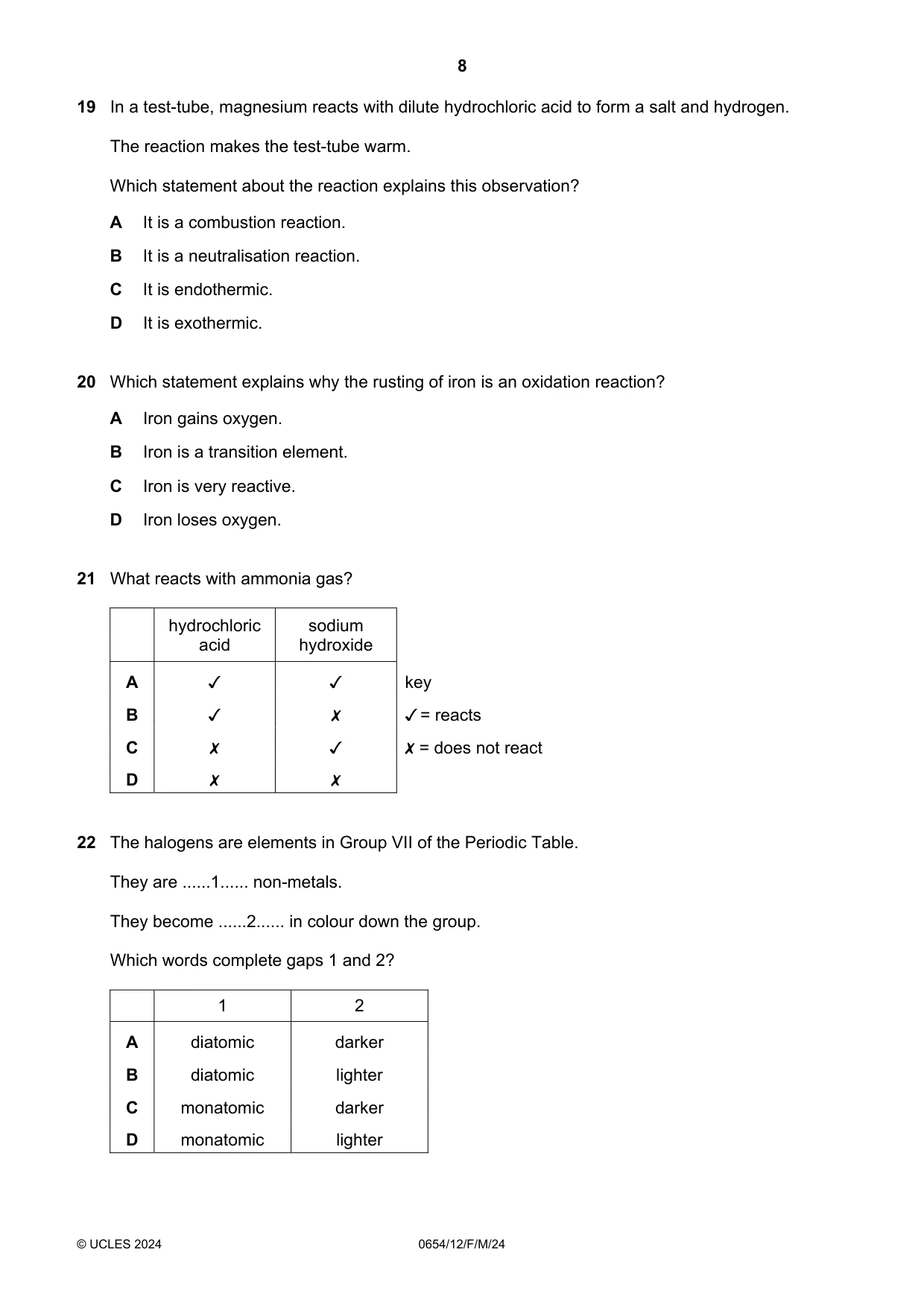
21 What reacts with ammonia gas? hydrochloric sodium acid hydroxide Jv Jv Jv x x Jv x x key Jv = reacts X = does not react
Mark scheme: B
More questions on The characteristic properties of acids and bases
Q22 · The halogens are elements in Group VII of the Periodic Table
22 The halogens are elements in Group VII of the Periodic Table. They are ......1...... non-metals. They become ......2...... in colour down the group. Which words complete gaps 1 and 2? 1 2 A diatomic darker B diatomic lighter C monatomic darker D monatomic lighter
Mark scheme: A
Q23 · Element X increases the rate of some reactions
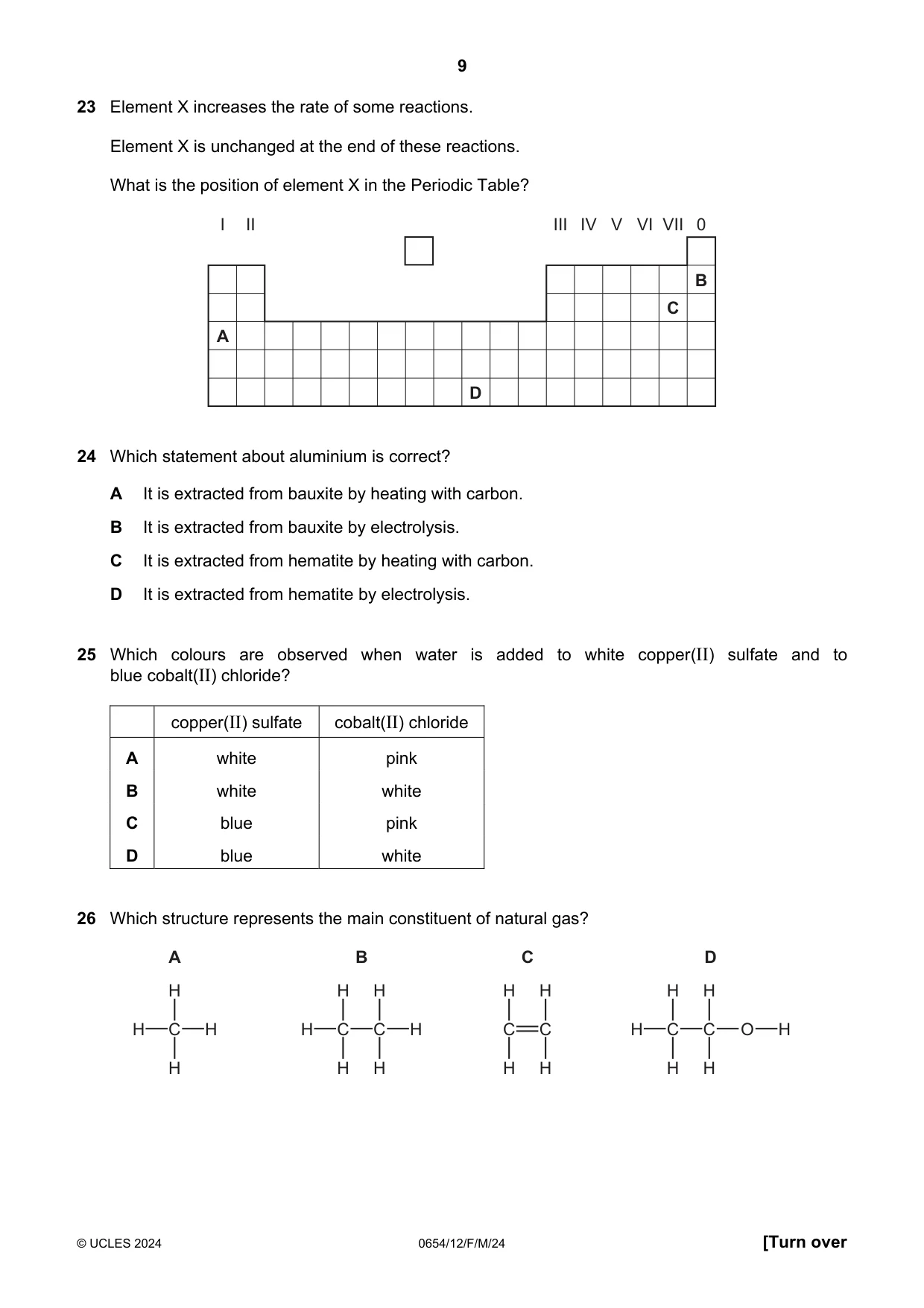
23 Element X increases the rate of some reactions. Element X is unchanged at the end of these reactions. What is the position of element X in the Periodic Table? I II III IV V VI VII 0 B C A D
Mark scheme: D
Q24 · Which statement about aluminium is correct?
24 Which statement about aluminium is correct? A It is extracted from bauxite by heating with carbon. B It is extracted from bauxite by electrolysis. C It is extracted from hematite by heating with carbon. D It is extracted from hematite by electrolysis.
Mark scheme: B
Q25 · Which colours are observed when water is added to white copper(II) sulfate and to blue…
25 Which colours are observed when water is added to white copper(II) sulfate and to blue cobalt(II) chloride? copper(II) sulfate cobalt(II) chloride A white pink B white white C blue pink D blue white
Mark scheme: C
Q26 · Which structure represents the main constituent of natural gas?
26 Which structure represents the main constituent of natural gas? A B C D H H H H H H H H C H H C C H C C H C C O H H H H H H H H
Mark scheme: A
Q27 · Which substance reacts with ethene to produce ethanol?
27 Which substance reacts with ethene to produce ethanol? A bromine B hydrogen C oxygen D steam
Mark scheme: D
Q28 · A car travels 100 m in the first 10 s of a journey and 300 m in the next 15 s
28 A car travels 100 m in the first 10 s of a journey and 300 m in the next 15 s. What is the average speed of the car for this 25 s journey? A 5.0 m / s B 8.0 m / s C 15 m / s D 16 m / s
Mark scheme: D
Q29 · A train travels along a horizontal track at constant speed
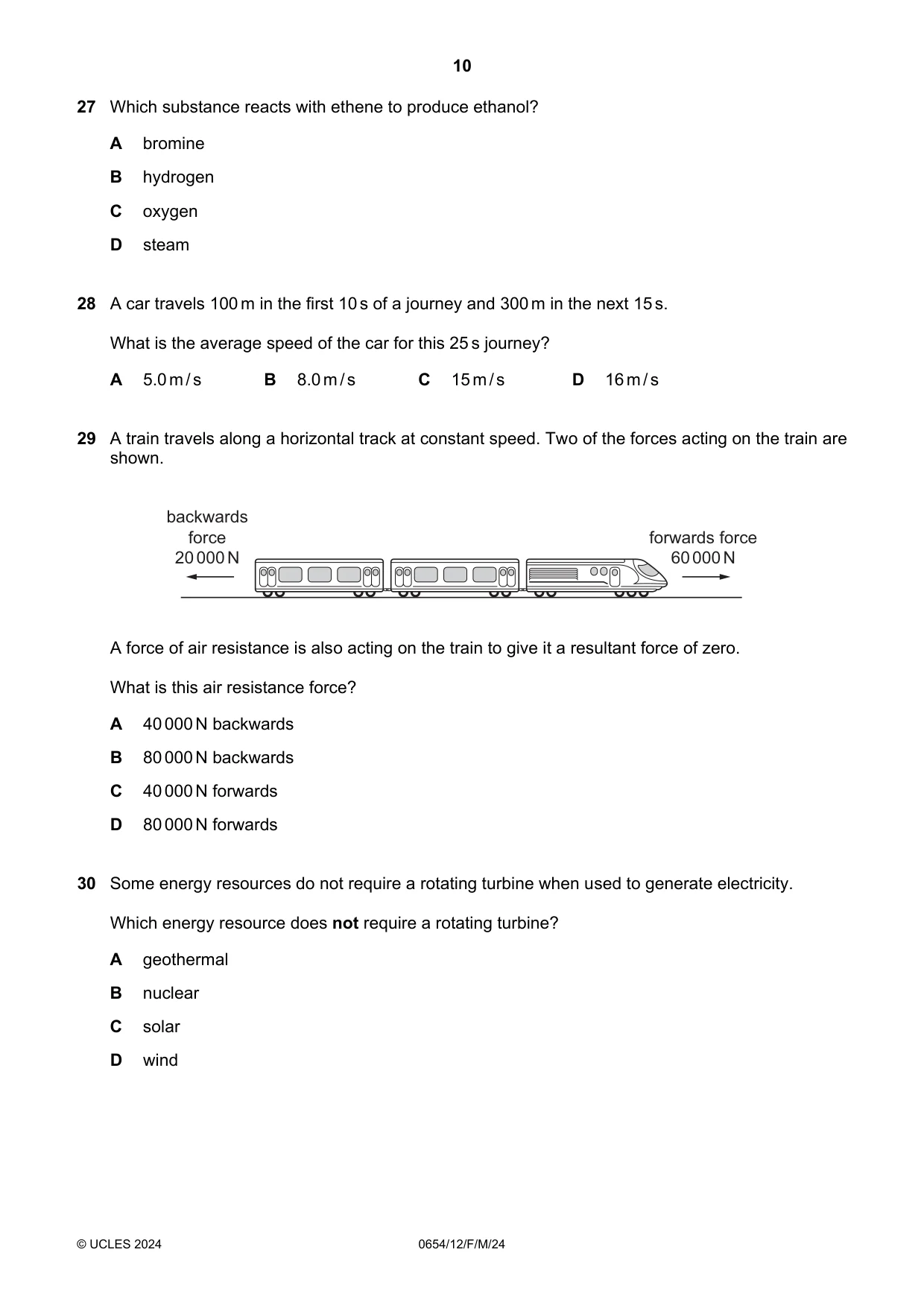
29 A train travels along a horizontal track at constant speed. Two of the forces acting on the train are shown. backwards force forwards force 20 000 N 60 000 N A force of air resistance is also acting on the train to give it a resultant force of zero. What is this air resistance force? A 40 000 N backwards B 80 000 N backwards C 40 000 N forwards D 80 000 N forwards
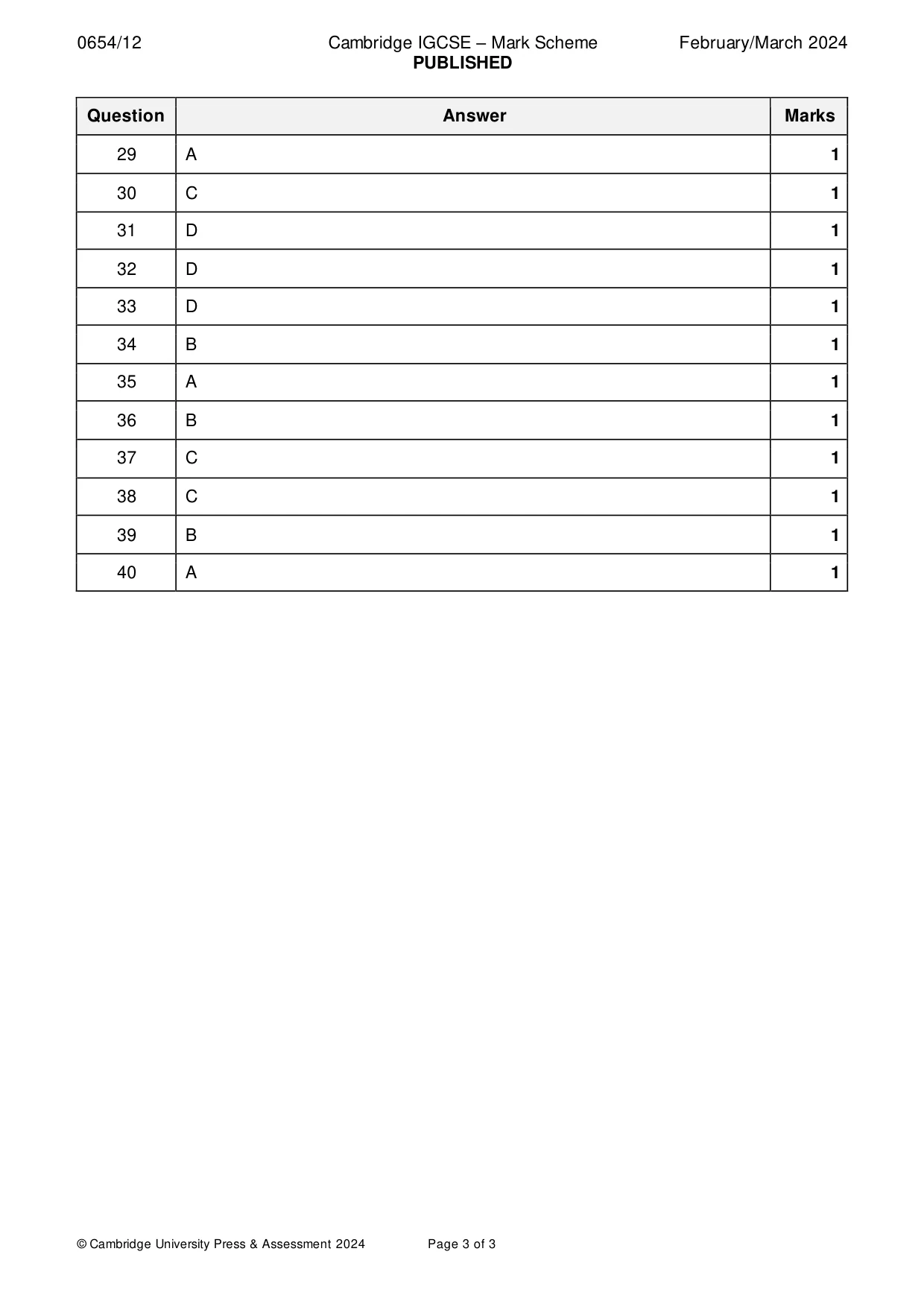
Mark scheme: A
Q30 · Some energy resources do not require a rotating turbine when used to generate electricity
30 Some energy resources do not require a rotating turbine when used to generate electricity. Which energy resource does not require a rotating turbine? A geothermal B nuclear C solar D wind
Mark scheme: C
Q31 · In a liquid-in-glass thermometer, which physical property of the liquid is used to…
31 In a liquid-in-glass thermometer, which physical property of the liquid is used to measure temperature? A colour B mass C pressure D volume
Mark scheme: D
Q32 · A boy watches a water wave passing a boat that is floating on the sea
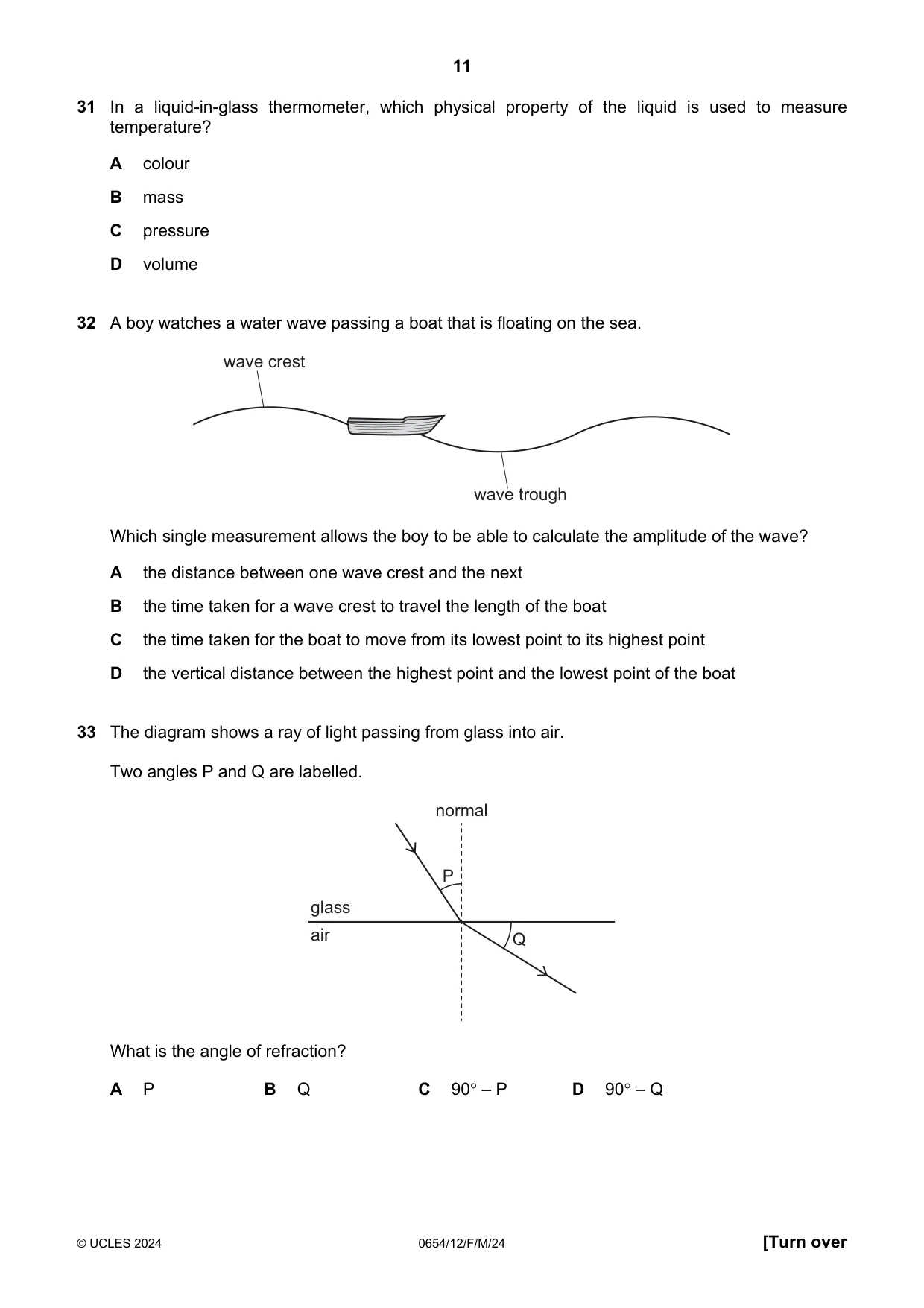
32 A boy watches a water wave passing a boat that is floating on the sea. wave crest wave trough Which single measurement allows the boy to be able to calculate the amplitude of the wave? A the distance between one wave crest and the next B the time taken for a wave crest to travel the length of the boat C the time taken for the boat to move from its lowest point to its highest point D the vertical distance between the highest point and the lowest point of the boat
Mark scheme: D
Q33 · The diagram shows a ray of light passing from glass into air
33 The diagram shows a ray of light passing from glass into air. Two angles P and Q are labelled. normal P glass air Q What is the angle of refraction? A P B Q C 90 – P D 90 – Q
Mark scheme: D
Q34 · A student claps his hands once when standing 100 m away from a large wall
34 A student claps his hands once when standing 100 m away from a large wall. The speed of sound in air is 330 m / s. How long after clapping does the student hear an echo? A 0.30 s B 0.61 s C 1.7 s D 3.3 s
Mark scheme: B
Q35 · Two charged rods X and Y repel each other
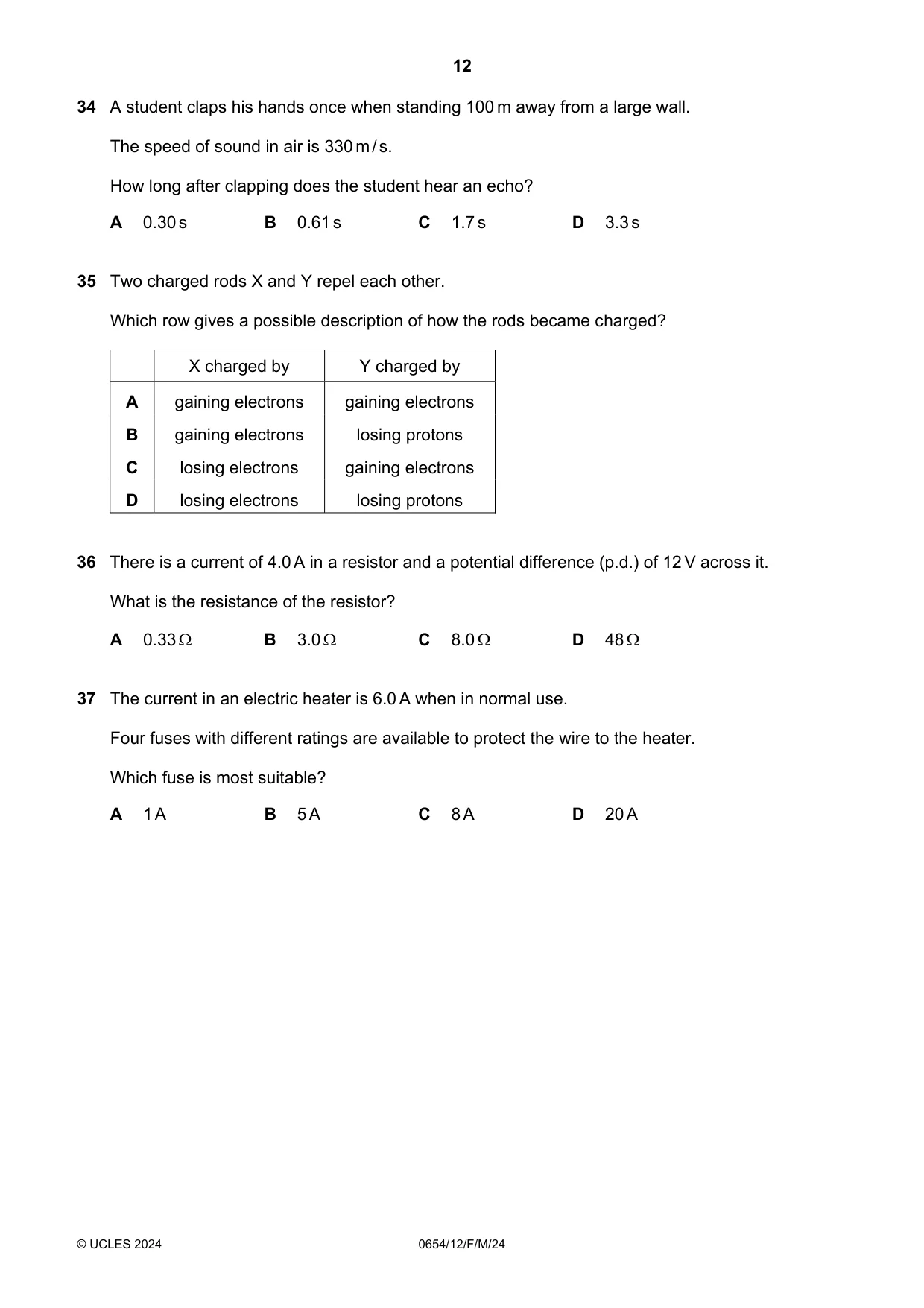
35 Two charged rods X and Y repel each other. Which row gives a possible description of how the rods became charged? X charged by Y charged by A gaining electrons gaining electrons B gaining electrons losing protons C losing electrons gaining electrons D losing electrons losing protons
Mark scheme: A
Q36 · There is a current of 4.0 A in a resistor and a potential difference (p.d.) of 12 V…
36 There is a current of 4.0 A in a resistor and a potential difference (p.d.) of 12 V across it. What is the resistance of the resistor? A 0.33 B 3.0 C 8.0 D 48
Mark scheme: B
Q37 · The current in an electric heater is 6.0 A when in normal use
37 The current in an electric heater is 6.0 A when in normal use. Four fuses with different ratings are available to protect the wire to the heater. Which fuse is most suitable? A 1 A B 5 A C 8 A D 20 A
Mark scheme: C
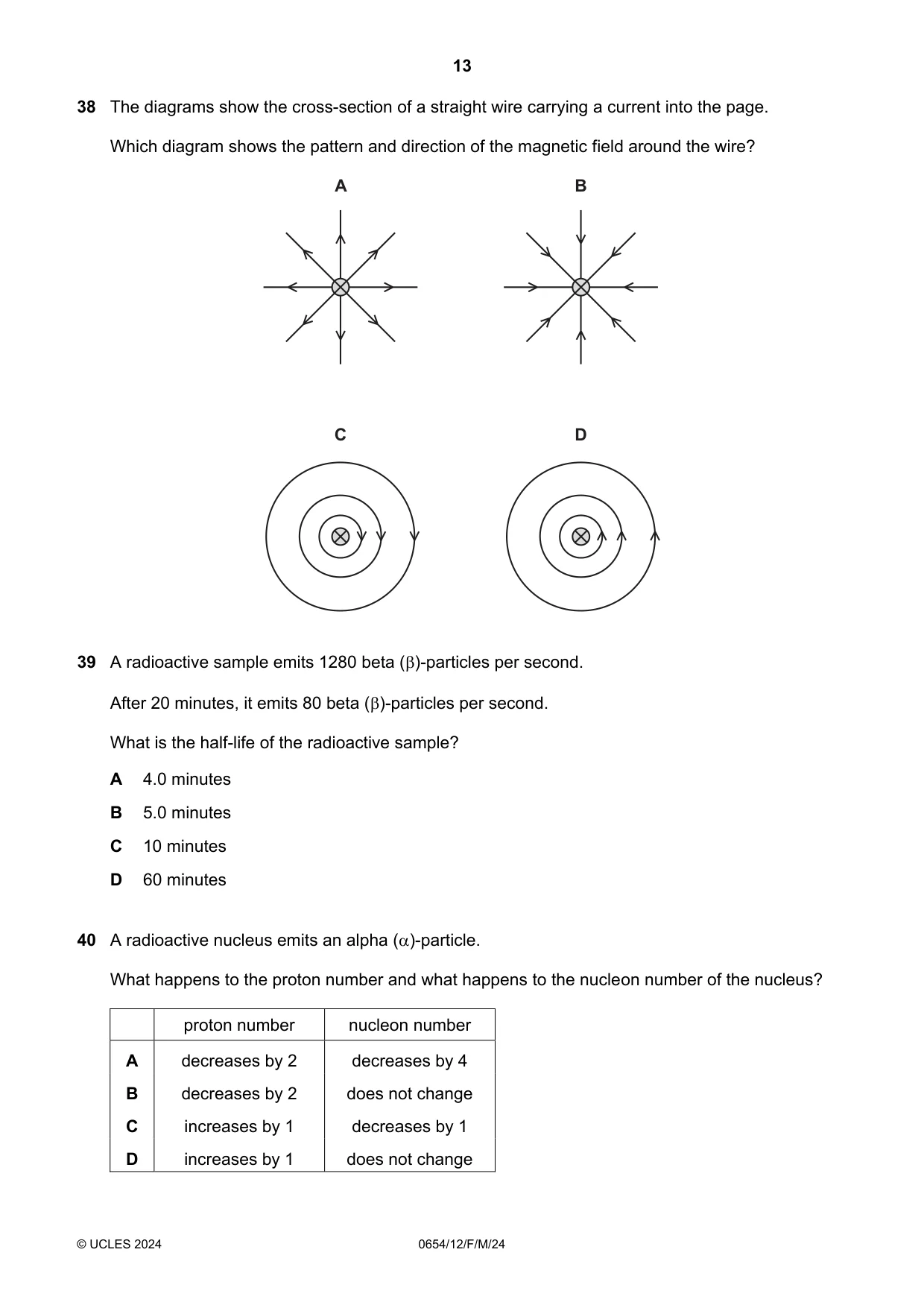
Q38 · The diagrams show the cross-section of a straight wire carrying a current into the page
38 The diagrams show the cross-section of a straight wire carrying a current into the page. Which diagram shows the pattern and direction of the magnetic field around the wire? A B C D
Mark scheme: C
Q39 · A radioactive sample emits 1280 beta ()-particles per second
39 A radioactive sample emits 1280 beta ()-particles per second. After 20 minutes, it emits 80 beta ()-particles per second. What is the half-life of the radioactive sample? A 4.0 minutes B 5.0 minutes C 10 minutes D 60 minutes
Mark scheme: B
Q40 · A radioactive nucleus emits an alpha ()-particle
40 A radioactive nucleus emits an alpha ()-particle. What happens to the proton number and what happens to the nucleon number of the nucleus? proton number nucleon number A decreases by 2 decreases by 4 B decreases by 2 does not change C increases by 1 decreases by 1 D increases by 1 does not change
Mark scheme: A
What was in this paper
The subtopics covered by these 40 questions, and how many questions each got. Open one in a new tab to see every Cambridge question on it.
1Alkanes1Asexual reproduction1Atomic structure and the Periodic Table1Biological molecules1Carbon cycle1Characteristics of living organisms1Coordination and response1Diet1Diffusion1Electrical quantities1Electrical safety1Electrolysis1Electromagnetic effects1Energy, work and power1Enzymes1Exothermic and endothermic reactions1Extraction of metals1Food chains and food webs1Forces1Formulas and terminology1General properties of waves1Group VII properties1Heart1Identification of ions and gases1Light1Monohybrid inheritance1Motion1Photosynthesis1Physical and chemical changes1Radioactivity1Redox1Simple molecules and covalent bonds1Simple phenomena of magnetism1Sound1The characteristic properties of acids and bases1The nucleus1Thermal properties and temperature1Transition elements1Water1What you needed in this session
Cambridge’s own grade thresholds for 2024 Feb/March, Paper 1 · Variant 2. A higher threshold means an easier paper — the bar moves with how the cohort did.