Cambridge IGCSE Sciences - Co-ordinated (Double) 0654 — 2018 Oct/Nov Paper 1 · Variant 2
0654/12/O/N/18 · 40 questions · 40 marks · ≈45 min
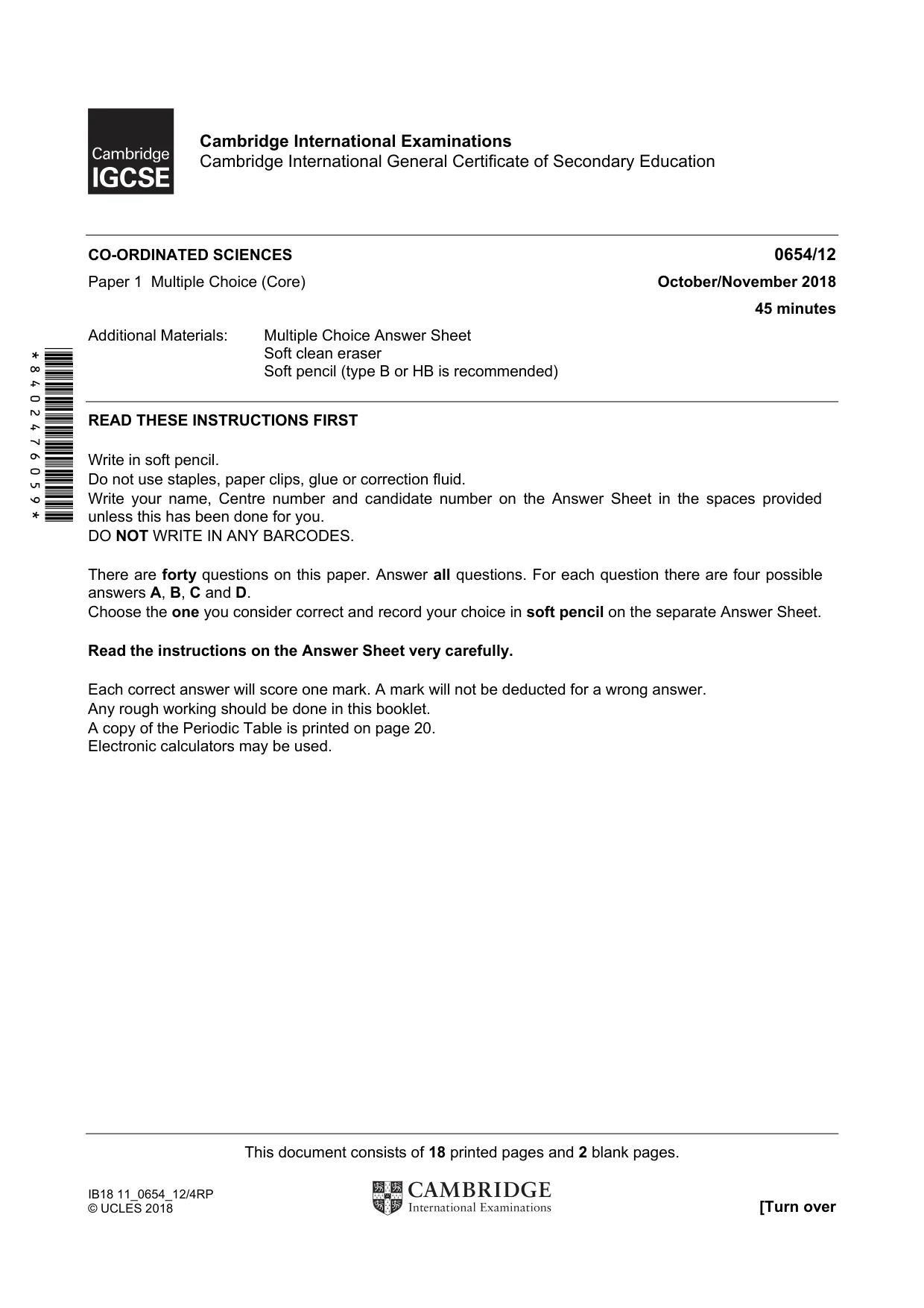
The question paper and its mark scheme, free to read here and free to download. This is Cambridge’s own paper, exactly as it was sat.
Question paper20 pages

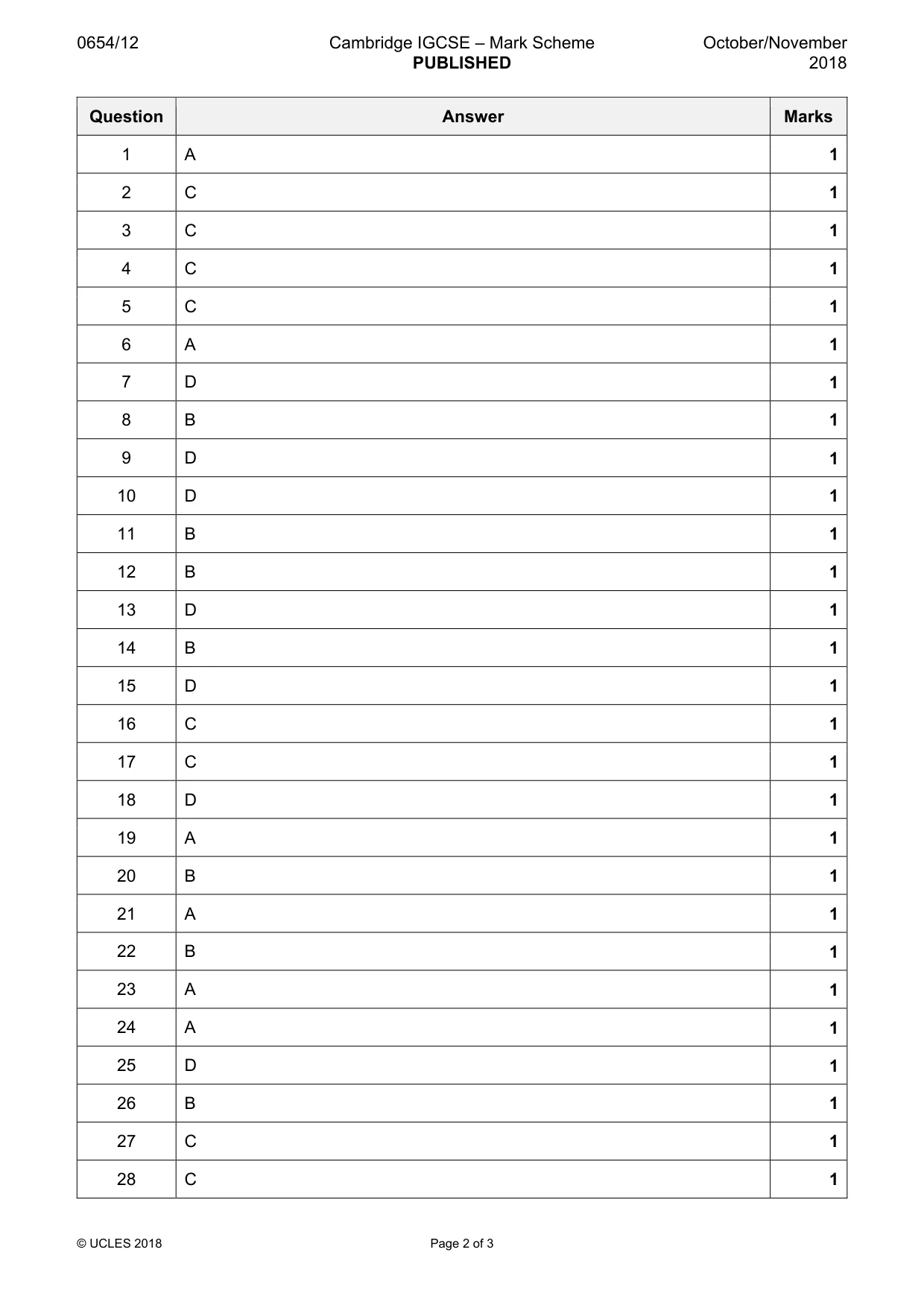
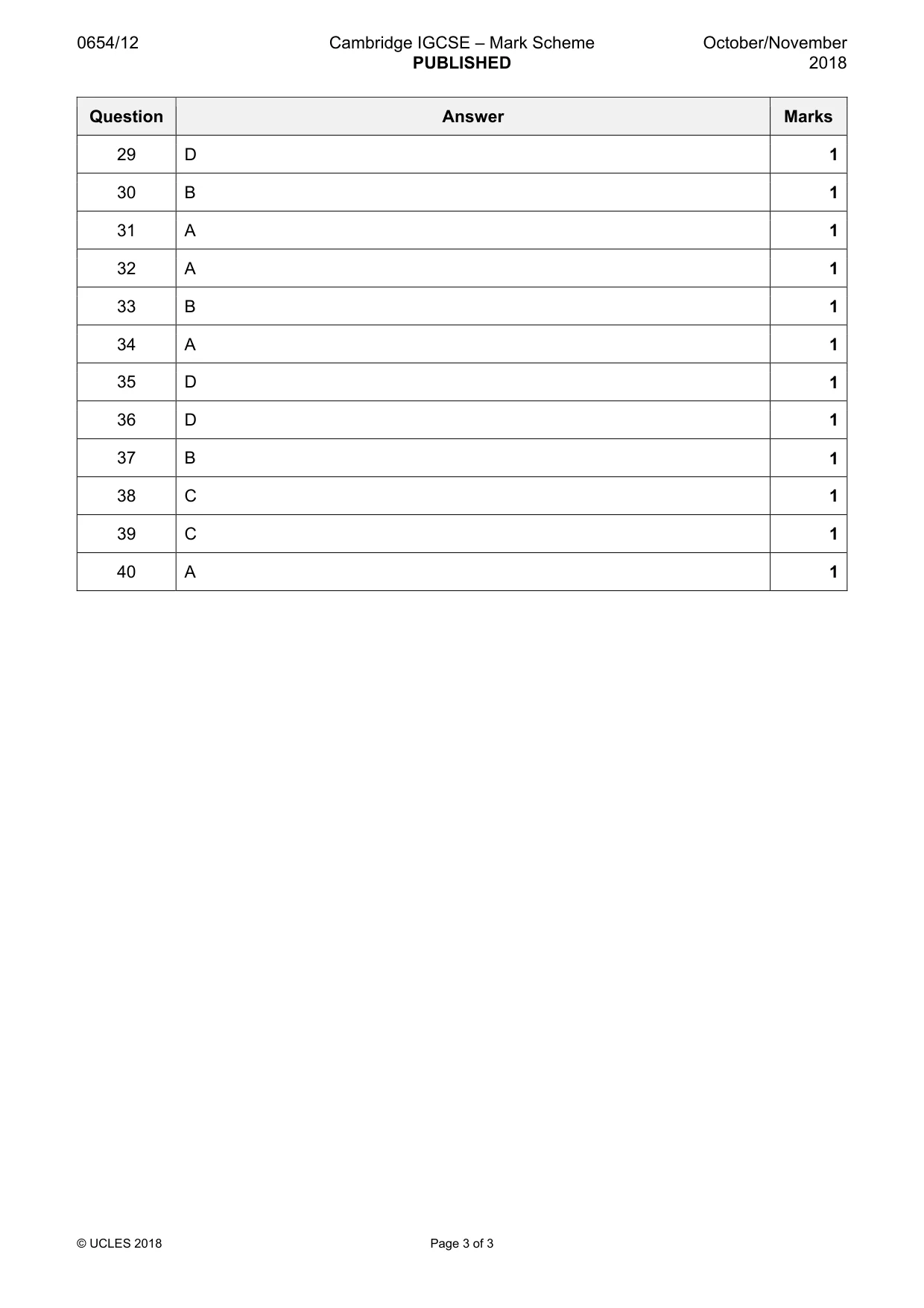
Mark scheme3 pages
Answers below. Sit the paper first if you are practising.
Questions as text
Q1 · The diagram shows two cells
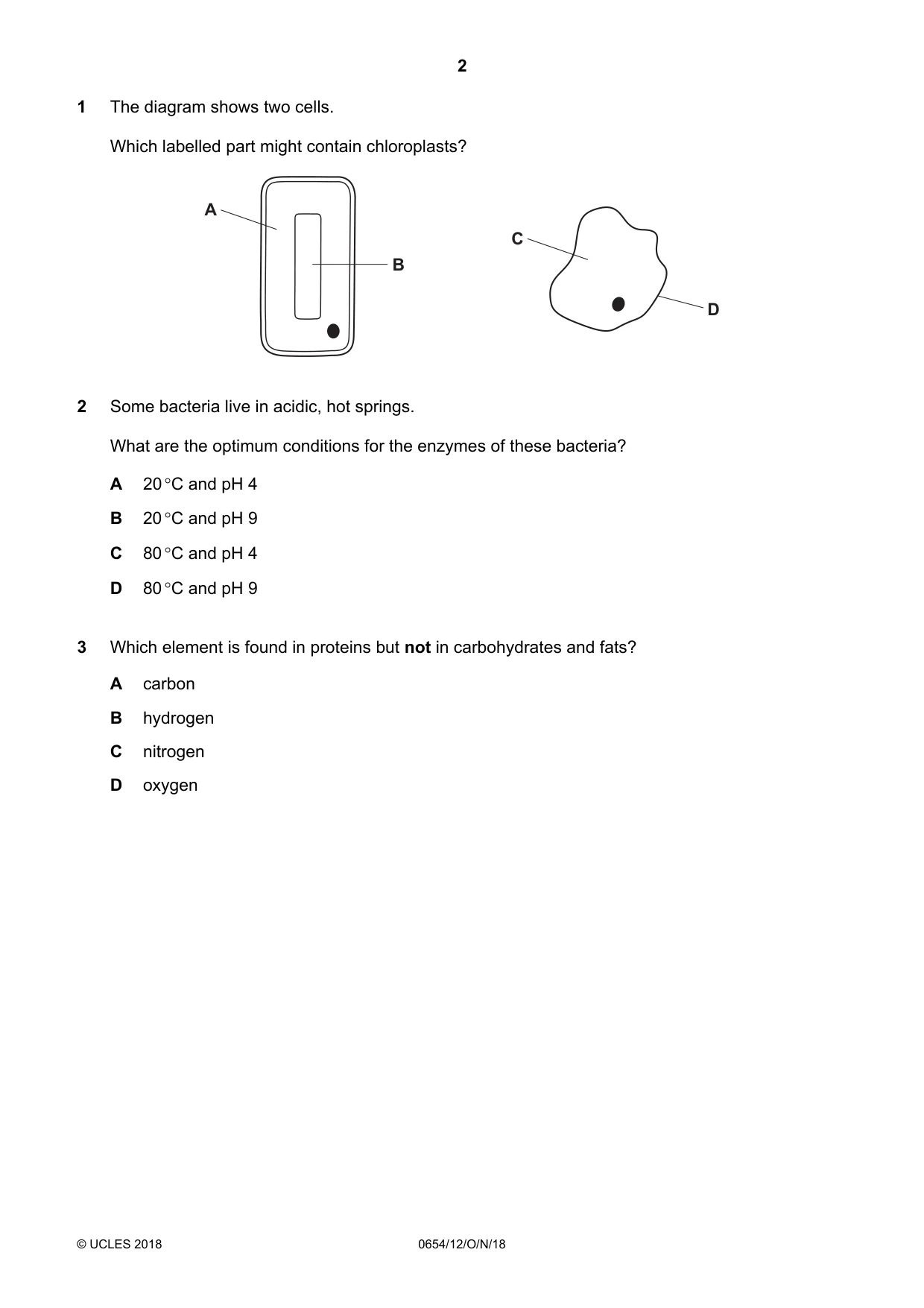
1 The diagram shows two cells. Which labelled part might contain chloroplasts? A C B D
Mark scheme: A
Q2 · Some bacteria live in acidic, hot springs
2 Some bacteria live in acidic, hot springs. What are the optimum conditions for the enzymes of these bacteria? A 20 °C and pH 4 B 20 °C and pH 9 C 80 °C and pH 4 D 80 °C and pH 9
Mark scheme: C
Q3 · Which element is found in proteins but not in carbohydrates and fats?
3 Which element is found in proteins but not in carbohydrates and fats? A carbon B hydrogen C nitrogen D oxygen
Mark scheme: C
Q4 · The diagram shows part of the digestive system
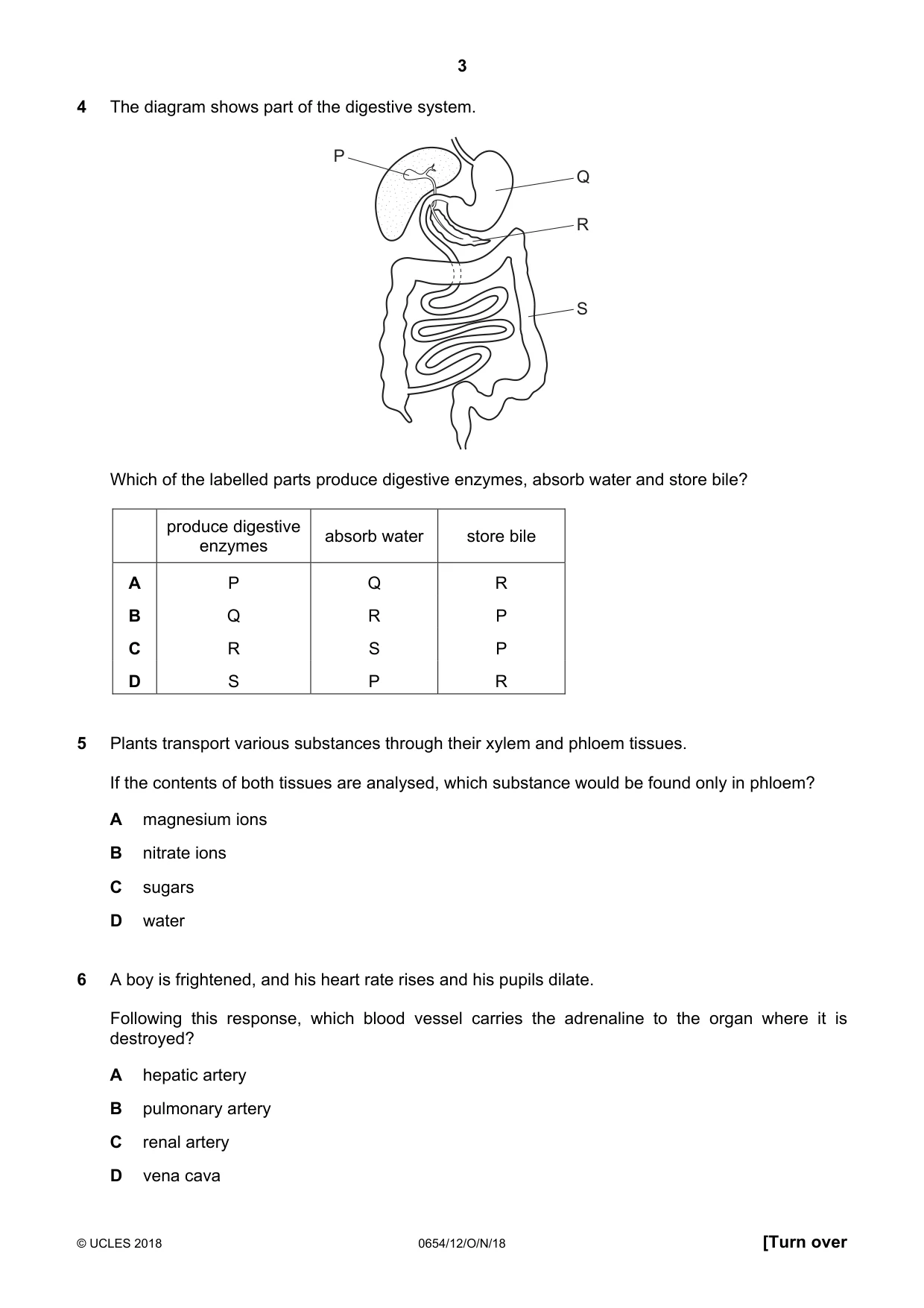
4 The diagram shows part of the digestive system. P Q R S Which of the labelled parts produce digestive enzymes, absorb water and store bile? produce digestive absorb water store bile enzymes A P Q R B Q R P C R S P D S P R
Mark scheme: C
Q5 · Plants transport various substances through their xylem and phloem tissues
5 Plants transport various substances through their xylem and phloem tissues. If the contents of both tissues are analysed, which substance would be found only in phloem? A magnesium ions B nitrate ions C sugars D water
Mark scheme: C
Q6 · A boy is frightened, and his heart rate rises and his pupils dilate
6 A boy is frightened, and his heart rate rises and his pupils dilate. Following this response, which blood vessel carries the adrenaline to the organ where it is destroyed? A hepatic artery B pulmonary artery C renal artery D vena cava
Mark scheme: A
Q7 · What is meant by respiration?
7 What is meant by respiration? A breakdown of protein B sweating to lose heat C the function of lungs D the release of energy
Mark scheme: D
Q8 · During gas exchange in human lungs, which gases show a net diffusion into or out of blood…
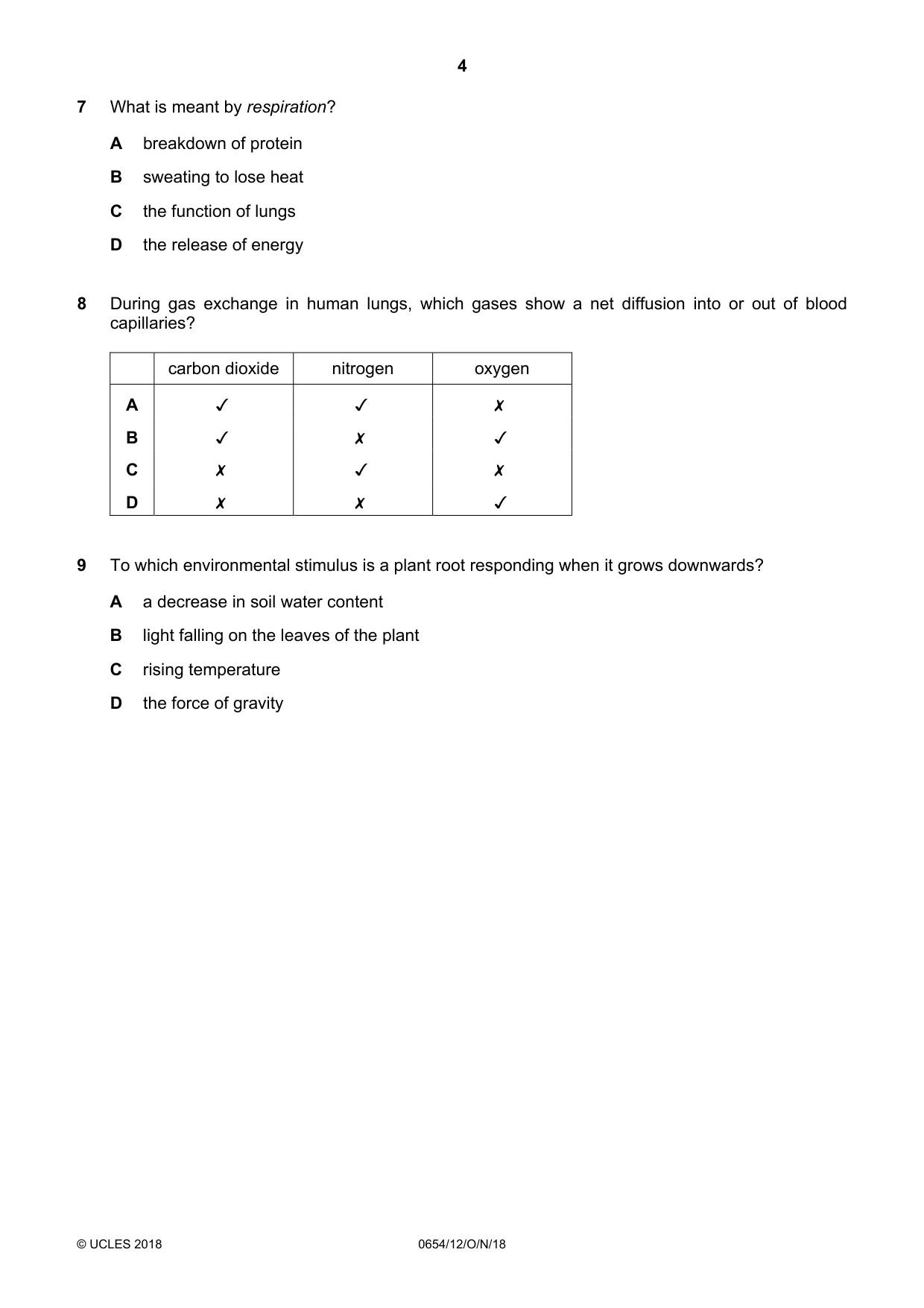
8 During gas exchange in human lungs, which gases show a net diffusion into or out of blood capillaries? carbon dioxide nitrogen oxygen A J Jv x B J x Jv Cc x Jv x D x x Jv
Mark scheme: B
Q9 · To which environmental stimulus is a plant root responding when it grows downwards?
9 To which environmental stimulus is a plant root responding when it grows downwards? A a decrease in soil water content B light falling on the leaves of the plant C rising temperature D the force of gravity
Mark scheme: D
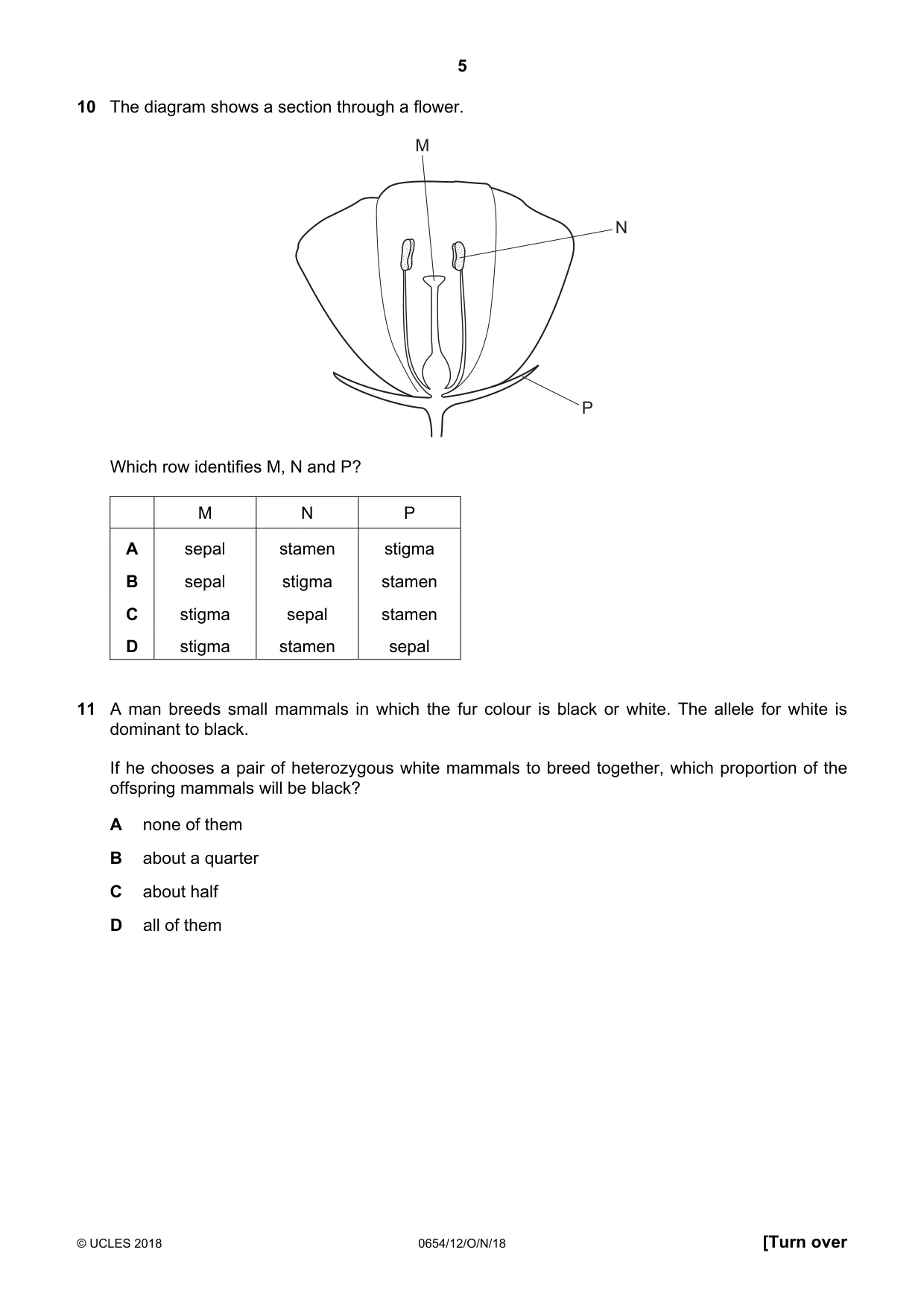
Q10 · The diagram shows a section through a flower
10 The diagram shows a section through a flower. M N P Which row identifies M, N and P? M N P A sepal stamen stigma B sepal stigma stamen C stigma sepal stamen D stigma stamen sepal
Mark scheme: D
Q11 · A man breeds small mammals in which the fur colour is black or white
11 A man breeds small mammals in which the fur colour is black or white. The allele for white is dominant to black. If he chooses a pair of heterozygous white mammals to breed together, which proportion of the offspring mammals will be black? A none of them B about a quarter C about half D all of them
Mark scheme: B
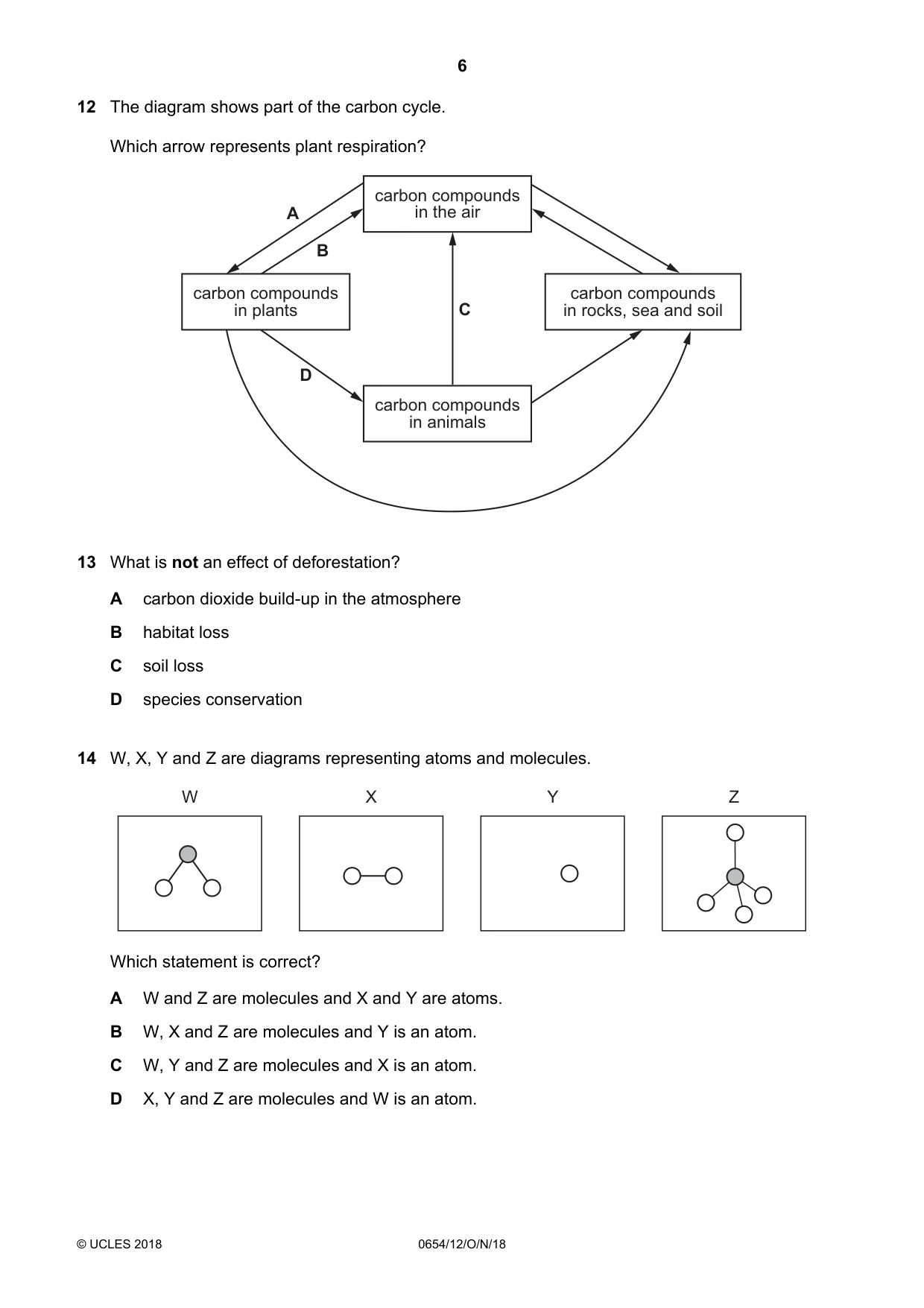
Q12 · The diagram shows part of the carbon cycle
12 The diagram shows part of the carbon cycle. Which arrow represents plant respiration? carbon compounds A in the air B carbon compounds carbon compounds in plants C in rocks, sea and soil D carbon compounds in animals
Mark scheme: B
Q13 · What is not an effect of deforestation?
13 What is not an effect of deforestation? A carbon dioxide build-up in the atmosphere B habitat loss C soil loss D species conservation
Mark scheme: D
Q14 · W, X, Y and Z are diagrams representing atoms and molecules
14 W, X, Y and Z are diagrams representing atoms and molecules. W X Y Z Which statement is correct? A W and Z are molecules and X and Y are atoms. B W, X and Z are molecules and Y is an atom. C W, Y and Z are molecules and X is an atom. D X, Y and Z are molecules and W is an atom.
Mark scheme: B
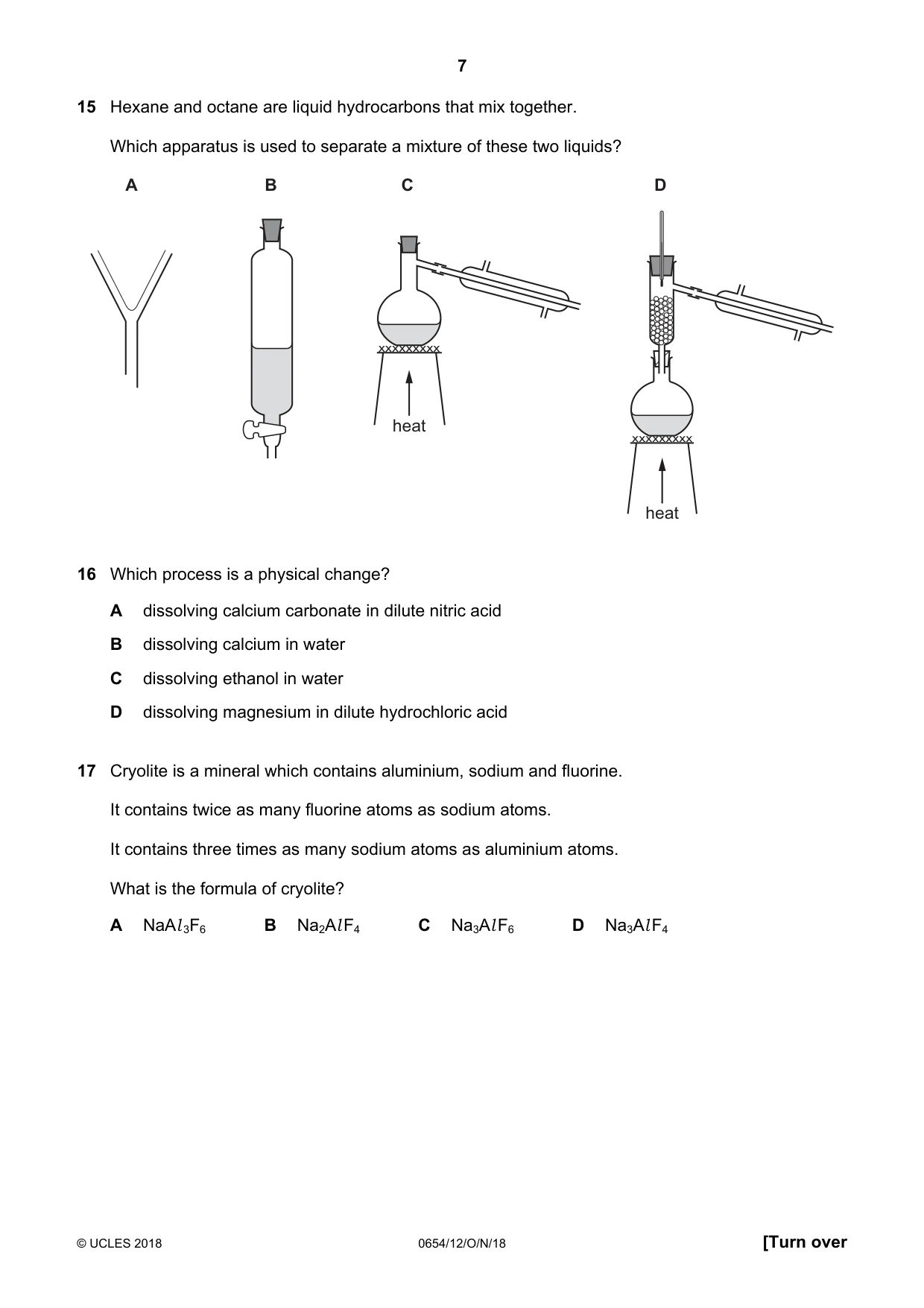
Q15 · Hexane and octane are liquid hydrocarbons that mix together
15 Hexane and octane are liquid hydrocarbons that mix together. Which apparatus is used to separate a mixture of these two liquids? A B C D xxxxxxxxx heat xxxxxxxxx heat
Mark scheme: D
Q16 · Which process is a physical change?
16 Which process is a physical change? A dissolving calcium carbonate in dilute nitric acid B dissolving calcium in water C dissolving ethanol in water D dissolving magnesium in dilute hydrochloric acid
Mark scheme: C
Q17 · Cryolite is a mineral which contains aluminium, sodium and fluorine
17 Cryolite is a mineral which contains aluminium, sodium and fluorine. It contains twice as many fluorine atoms as sodium atoms. It contains three times as many sodium atoms as aluminium atoms. What is the formula of cryolite? A NaAl 3F6 B Na2Al F4 C Na3Al F6 D Na3Al F4
Mark scheme: C
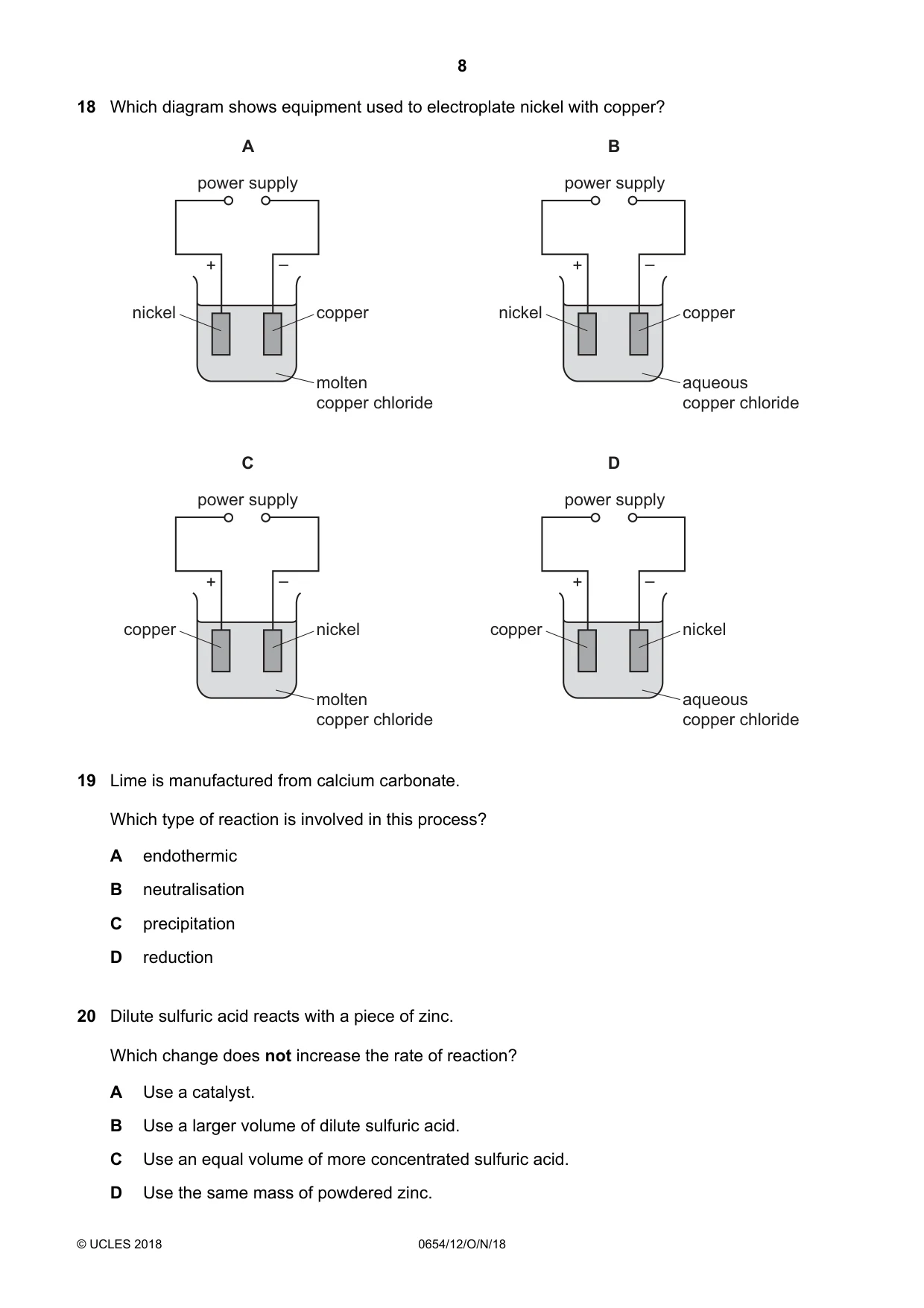
Q18 · Which diagram shows equipment used to electroplate nickel with copper?
18 Which diagram shows equipment used to electroplate nickel with copper? A B power supply power supply + – + – nickel copper nickel copper molten aqueous copper chloride copper chloride C D power supply power supply + – + – copper nickel copper nickel molten aqueous copper chloride copper chloride
Mark scheme: D
Q19 · Lime is manufactured from calcium carbonate
19 Lime is manufactured from calcium carbonate. Which type of reaction is involved in this process? A endothermic B neutralisation C precipitation D reduction
Mark scheme: A
Q20 · Dilute sulfuric acid reacts with a piece of zinc
20 Dilute sulfuric acid reacts with a piece of zinc. Which change does not increase the rate of reaction? A Use a catalyst. B Use a larger volume of dilute sulfuric acid. C Use an equal volume of more concentrated sulfuric acid. D Use the same mass of powdered zinc.
Mark scheme: B
Q21 · Lemonade turns blue litmus solution red
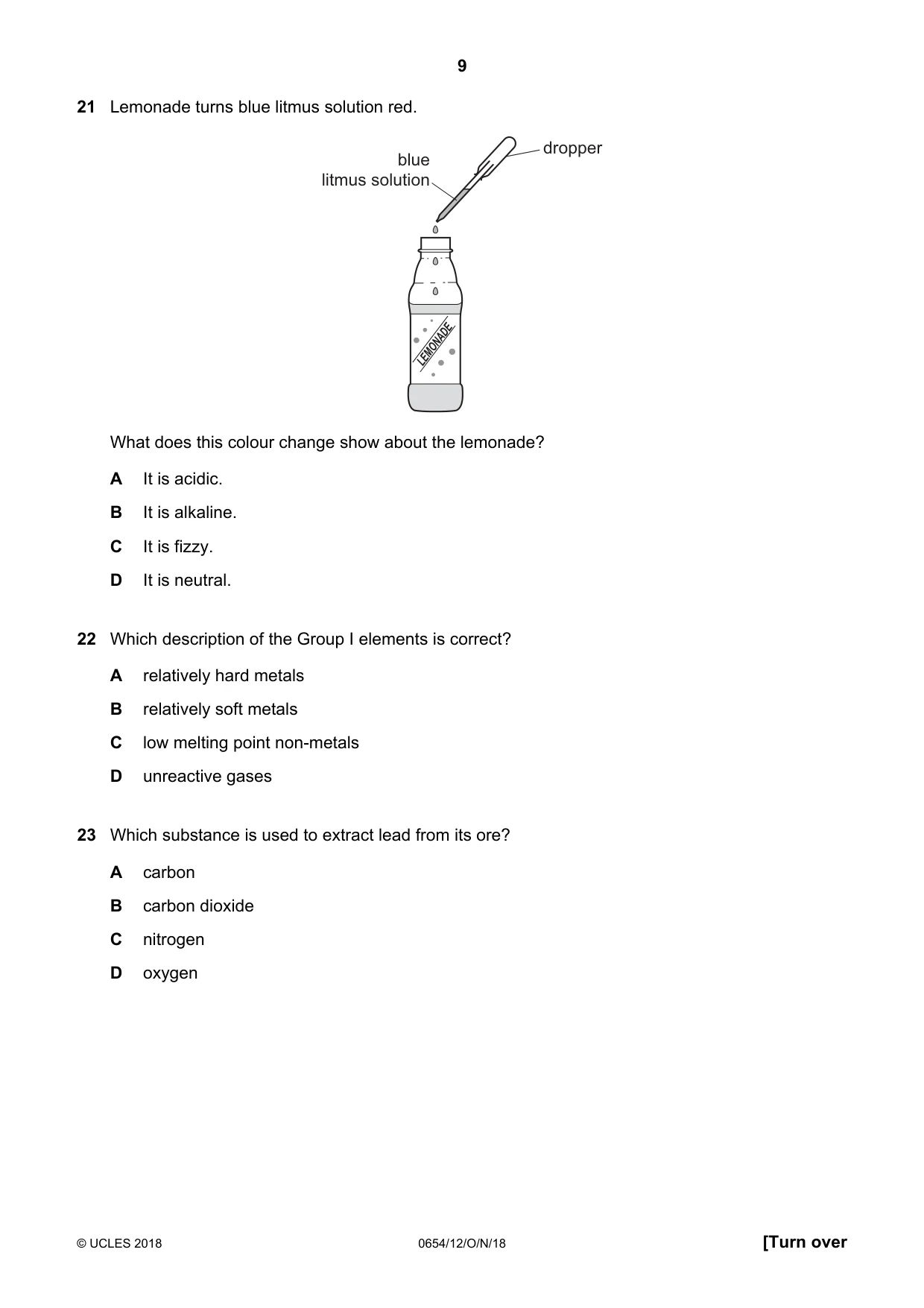
21 Lemonade turns blue litmus solution red. dropper blue litmus solution LEMONADE What does this colour change show about the lemonade? A It is acidic. B It is alkaline. C It is fizzy. D It is neutral.
Mark scheme: A
More questions on The characteristic properties of acids and bases
Q22 · Which description of the Group I elements is correct?
22 Which description of the Group I elements is correct? A relatively hard metals B relatively soft metals C low melting point non-metals D unreactive gases
Mark scheme: B
Q23 · Which substance is used to extract lead from its ore?
23 Which substance is used to extract lead from its ore? A carbon B carbon dioxide C nitrogen D oxygen
Mark scheme: A
Q24 · Water is purified by chlorination and filtration
24 Water is purified by chlorination and filtration. Which statement is correct? A Chlorination destroys microbes and filtration removes insoluble particles. B Chlorination destroys microbes and filtration removes soluble particles. C Chlorination removes insoluble particles and filtration destroys microbes. D Chlorination removes insoluble particles and filtration removes soluble particles.
Mark scheme: A
Q25 · The diagram shows gas P being passed through liquid X and over iron filings
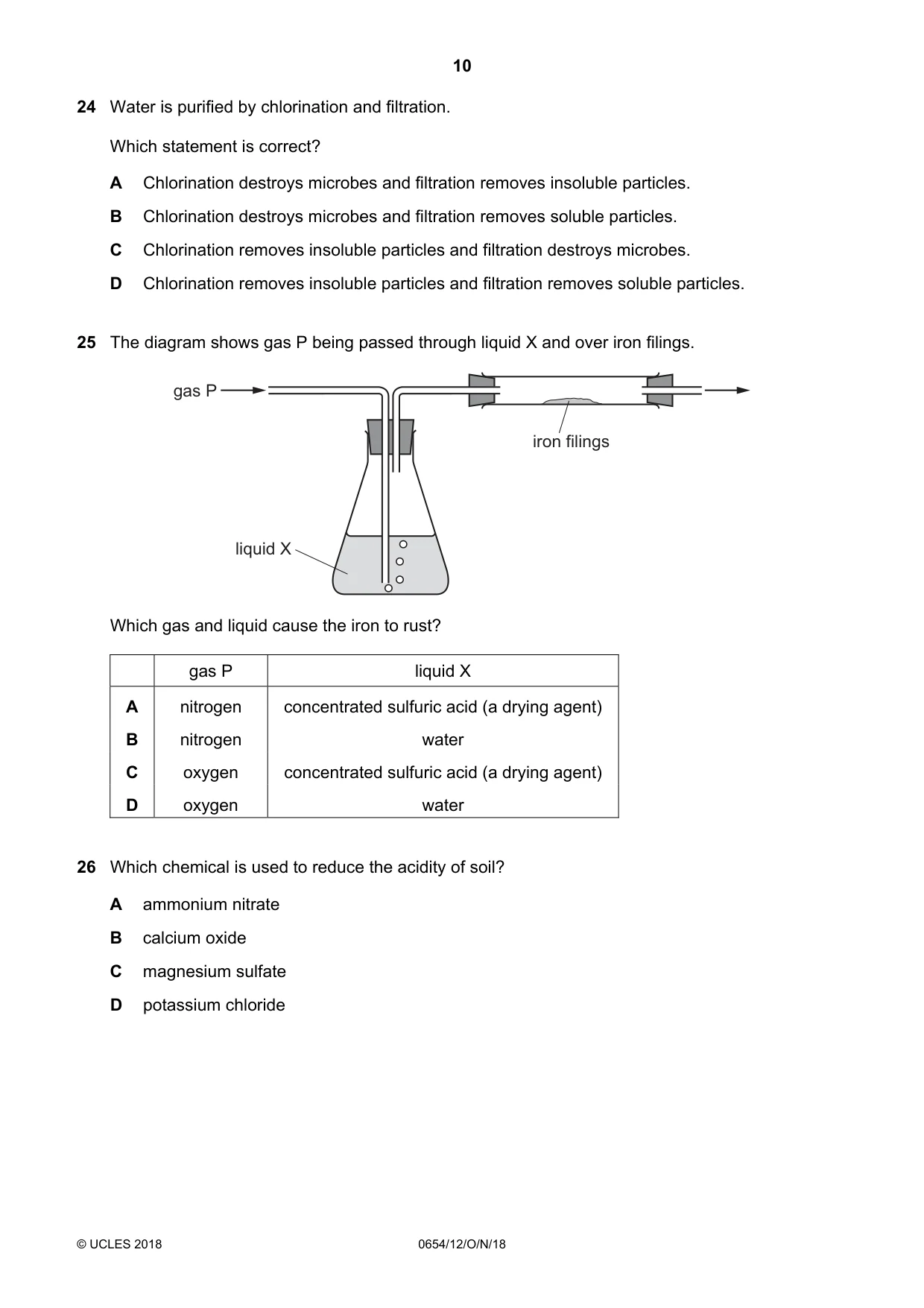
25 The diagram shows gas P being passed through liquid X and over iron filings. gas P iron filings liquid X Which gas and liquid cause the iron to rust? gas P liquid X A nitrogen concentrated sulfuric acid (a drying agent) B nitrogen water C oxygen concentrated sulfuric acid (a drying agent) D oxygen water
Mark scheme: D
Q26 · Which chemical is used to reduce the acidity of soil?
26 Which chemical is used to reduce the acidity of soil? A ammonium nitrate B calcium oxide C magnesium sulfate D potassium chloride
Mark scheme: B
More questions on The characteristic properties of acids and bases
Q27 · Poly(ethene) is made from many small molecules
27 Poly(ethene) is made from many small molecules. What are the small molecules called? A alkanes B fractions C monomers D solvents
Mark scheme: C
Q28 · The diagram shows a distance-time graph for a journey
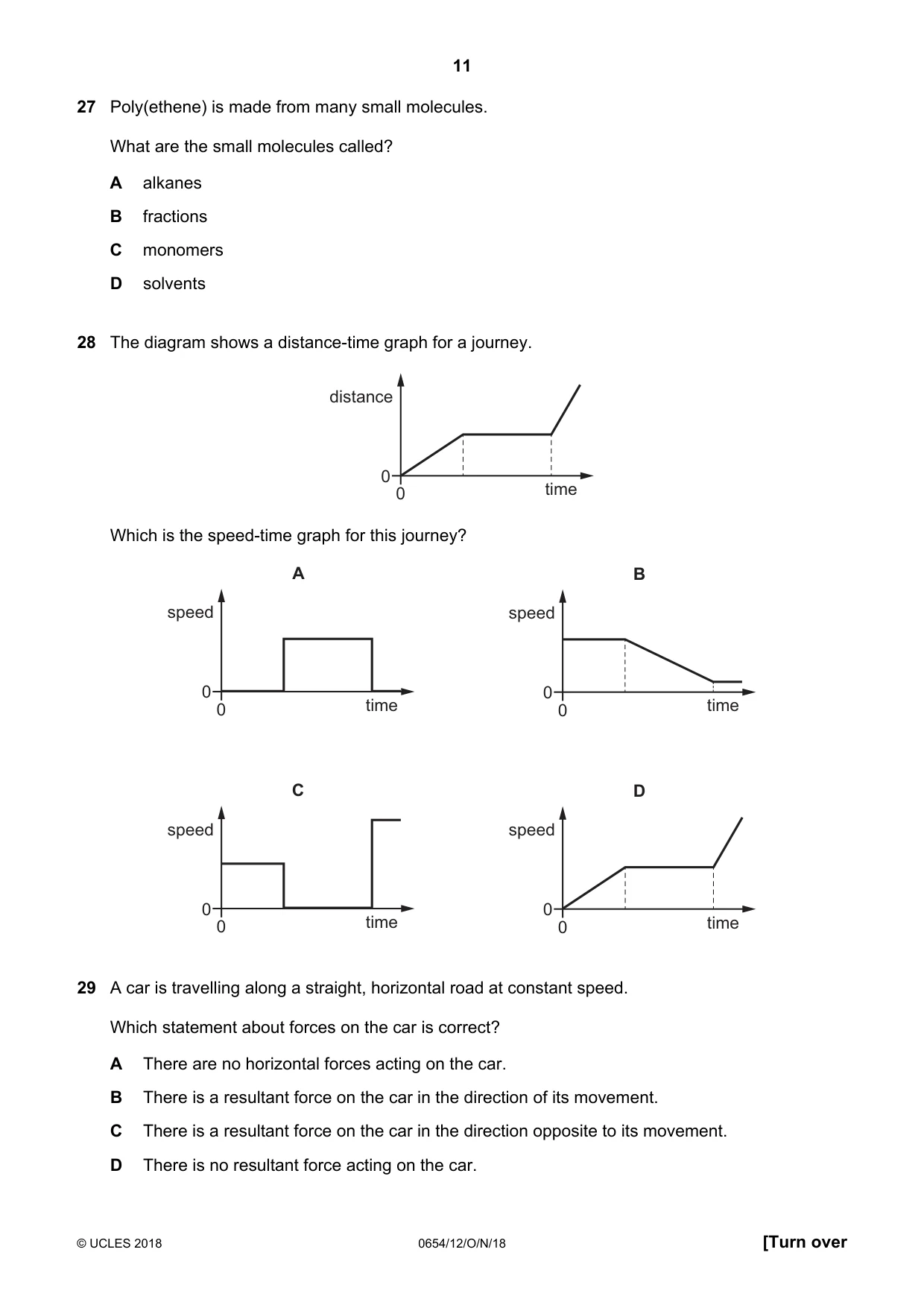
28 The diagram shows a distance-time graph for a journey. distance 0 0 time Which is the speed-time graph for this journey? A B speed speed 0 0 0 time 0 time C D speed speed 0 0 0 time 0 time
Mark scheme: C
Q29 · A car is travelling along a straight, horizontal road at constant speed
29 A car is travelling along a straight, horizontal road at constant speed. Which statement about forces on the car is correct? A There are no horizontal forces acting on the car. B There is a resultant force on the car in the direction of its movement. C There is a resultant force on the car in the direction opposite to its movement. D There is no resultant force acting on the car.
Mark scheme: D
Q30 · A ball is thrown vertically upwards
30 A ball is thrown vertically upwards. The ball rises, stops, falls back down and hits soft ground without bouncing. Which energy transfers occur, starting just after the ball is released? A kinetic to potential to kinetic to chemical B kinetic to potential to kinetic to thermal C potential to kinetic to potential to chemical D potential to kinetic to potential to thermal
Mark scheme: B
Q31 · Which statement describes molecules in a solid?
31 Which statement describes molecules in a solid? A They are close together and vibrate about fixed positions. B They do not vibrate but move at high speeds in straight lines. C They do not vibrate but can change places with each other. D They vibrate and can change places with each other.
Mark scheme: A
Q32 · An axle is slightly larger than the hole in a wheel made from the same metal
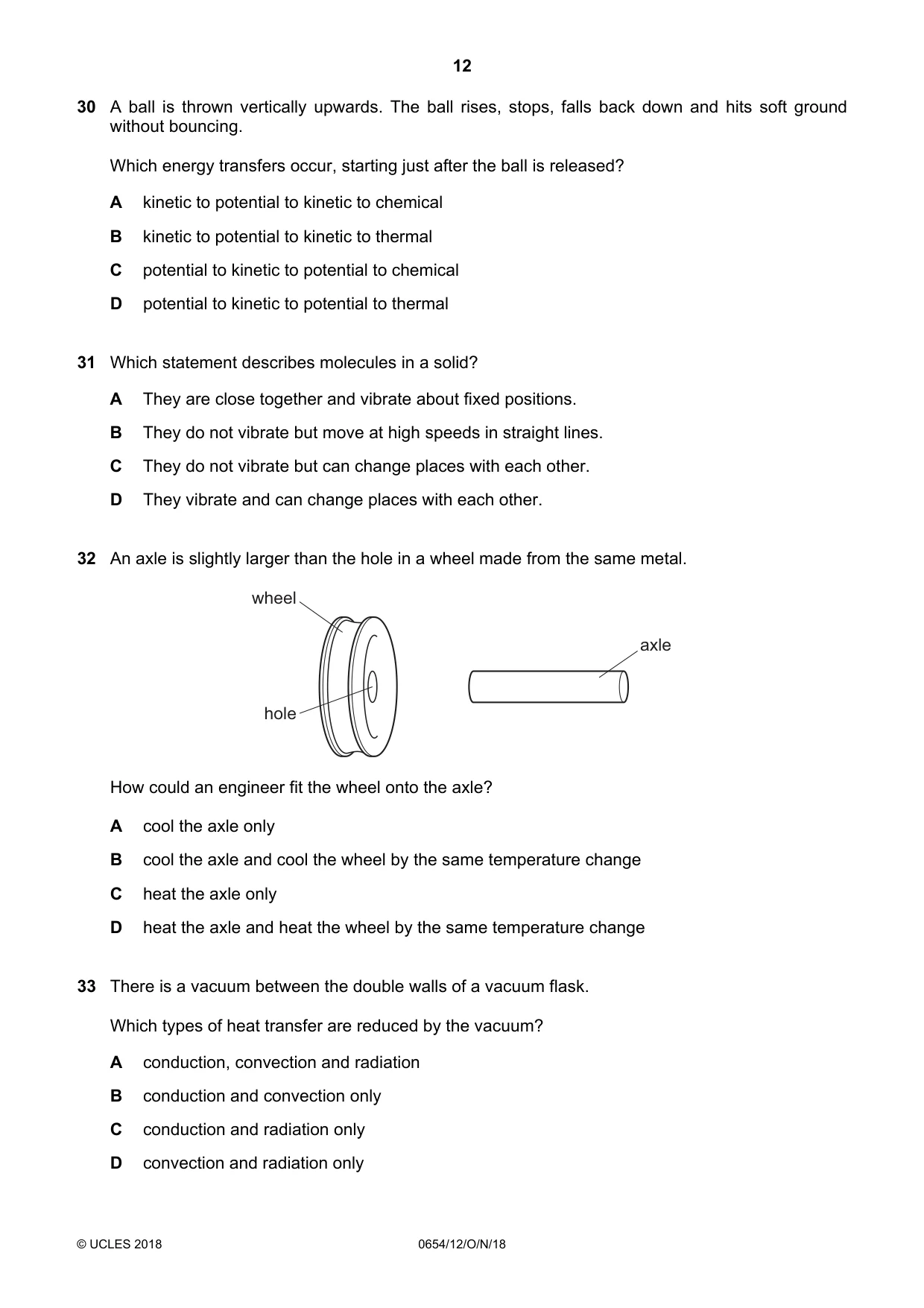
32 An axle is slightly larger than the hole in a wheel made from the same metal. wheel axle hole How could an engineer fit the wheel onto the axle? A cool the axle only B cool the axle and cool the wheel by the same temperature change C heat the axle only D heat the axle and heat the wheel by the same temperature change
Mark scheme: A
Q33 · There is a vacuum between the double walls of a vacuum flask
33 There is a vacuum between the double walls of a vacuum flask. Which types of heat transfer are reduced by the vacuum? A conduction, convection and radiation B conduction and convection only C conduction and radiation only D convection and radiation only
Mark scheme: B
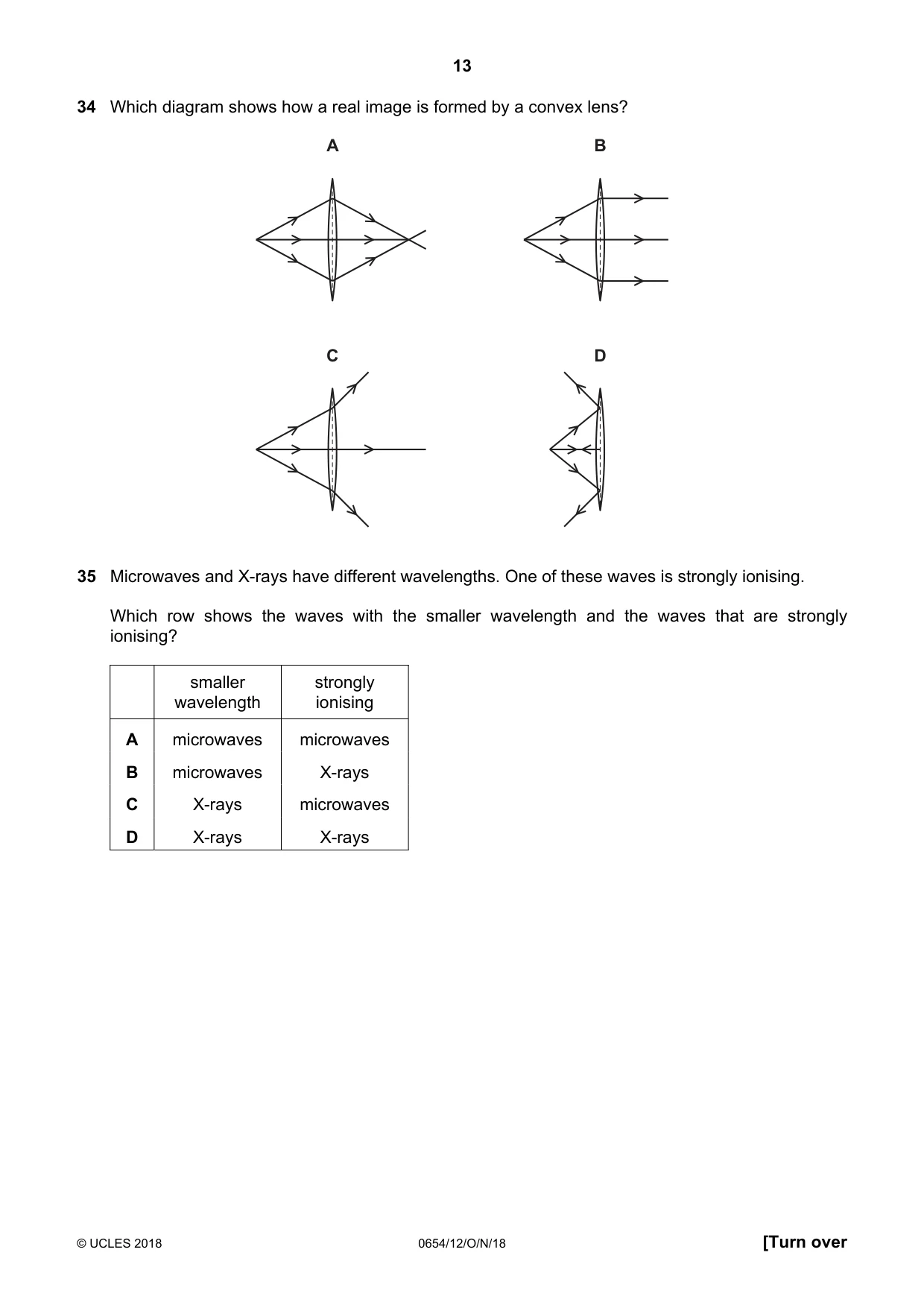
Q34 · Which diagram shows how a real image is formed by a convex lens?
34 Which diagram shows how a real image is formed by a convex lens? A B C D
Mark scheme: A
Q35 · Microwaves and X-rays have different wavelengths
35 Microwaves and X-rays have different wavelengths. One of these waves is strongly ionising. Which row shows the waves with the smaller wavelength and the waves that are strongly ionising? smaller strongly wavelength ionising A microwaves microwaves B microwaves X-rays C X-rays microwaves D X-rays X-rays
Mark scheme: D
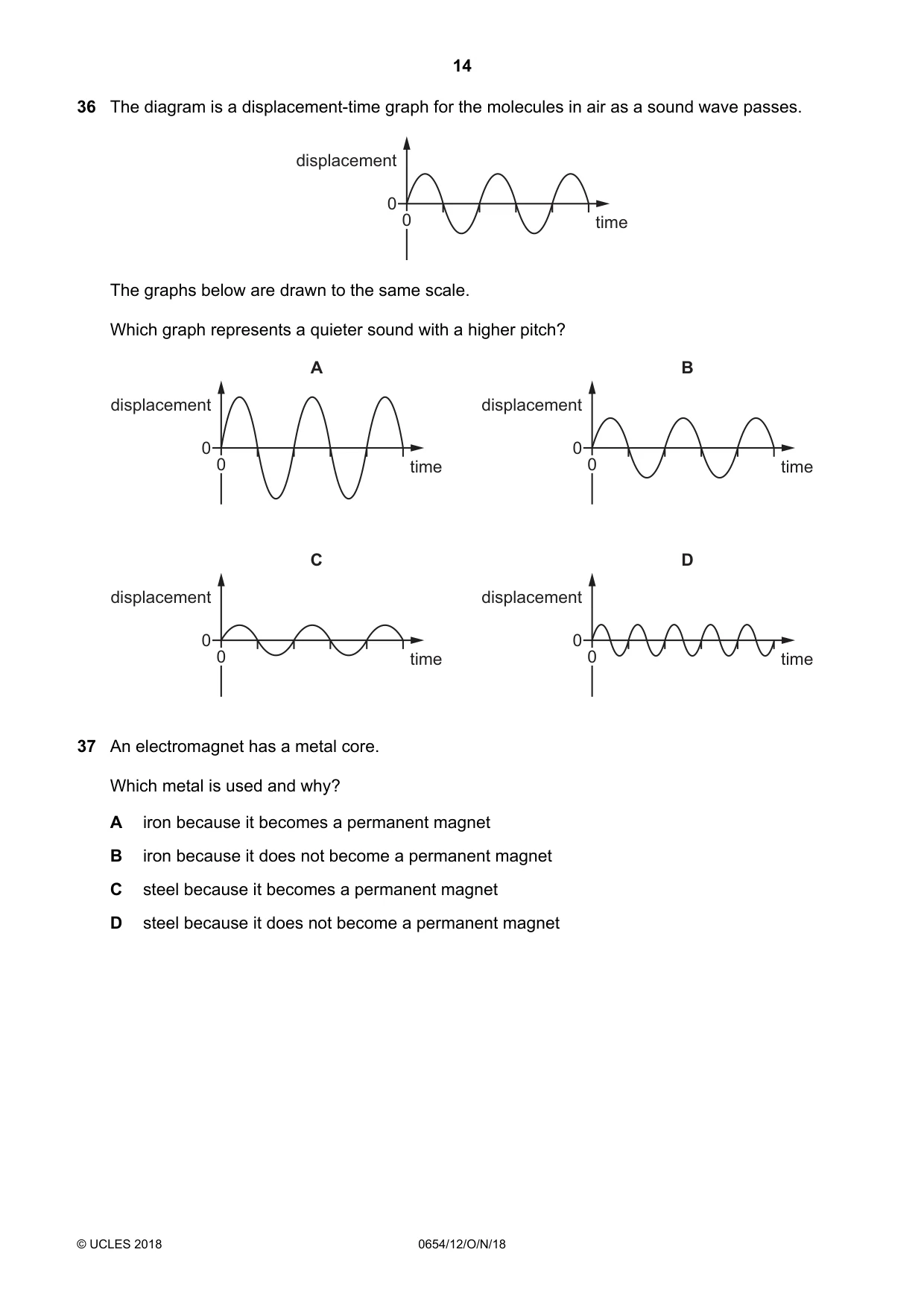
Q36 · The diagram is a displacement-time graph for the molecules in air as a sound wave passes
36 The diagram is a displacement-time graph for the molecules in air as a sound wave passes. displacement 0 0 time The graphs below are drawn to the same scale. Which graph represents a quieter sound with a higher pitch? A B displacement displacement 0 0 0 time 0 time C D displacement displacement 0 0 0 time 0 time
Mark scheme: D
Q37 · An electromagnet has a metal core
37 An electromagnet has a metal core. Which metal is used and why? A iron because it becomes a permanent magnet B iron because it does not become a permanent magnet C steel because it becomes a permanent magnet D steel because it does not become a permanent magnet
Mark scheme: B
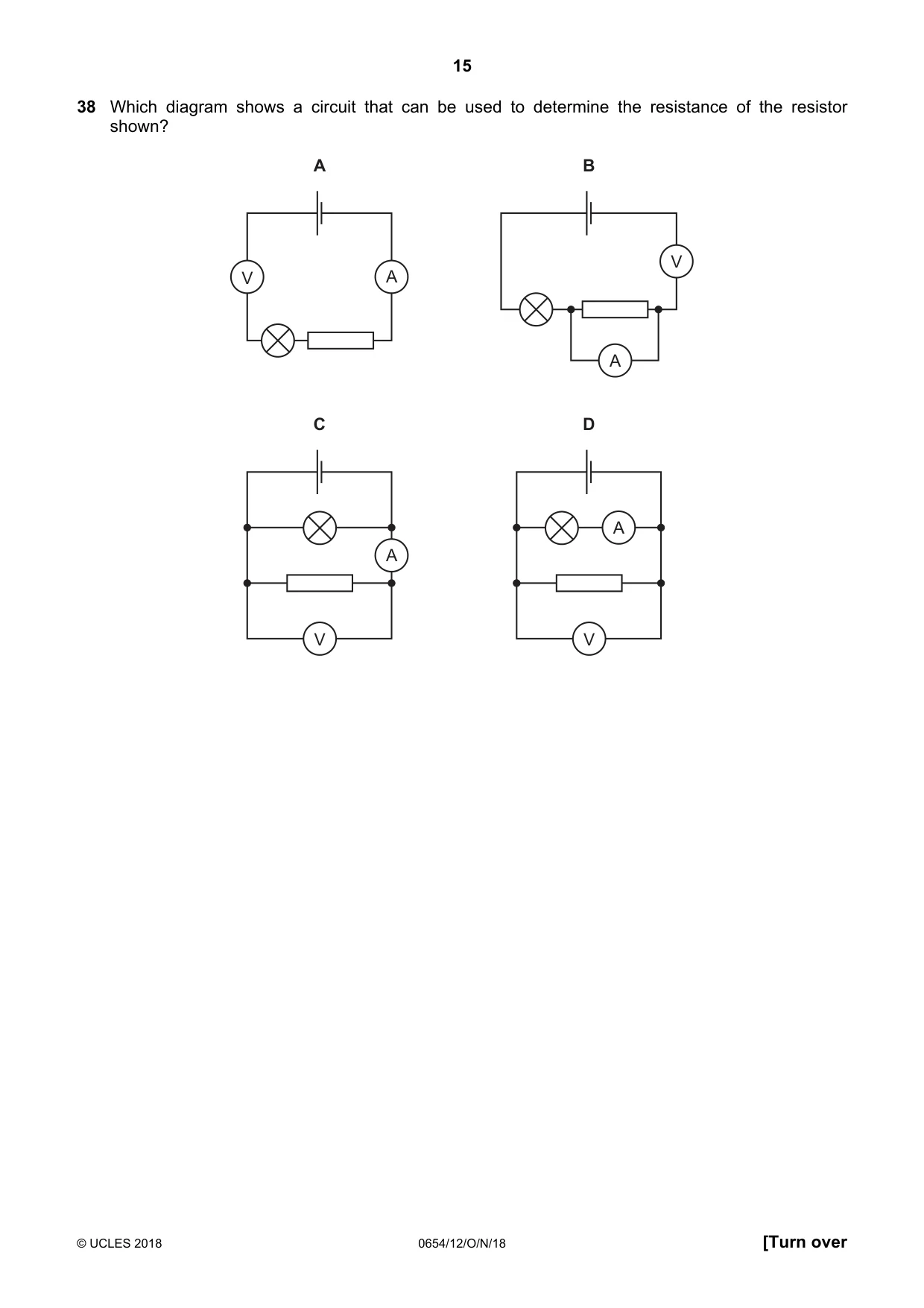
Q38 · Which diagram shows a circuit that can be used to determine the resistance of the…
38 Which diagram shows a circuit that can be used to determine the resistance of the resistor shown? A B V V A A C D A A V V
Mark scheme: C
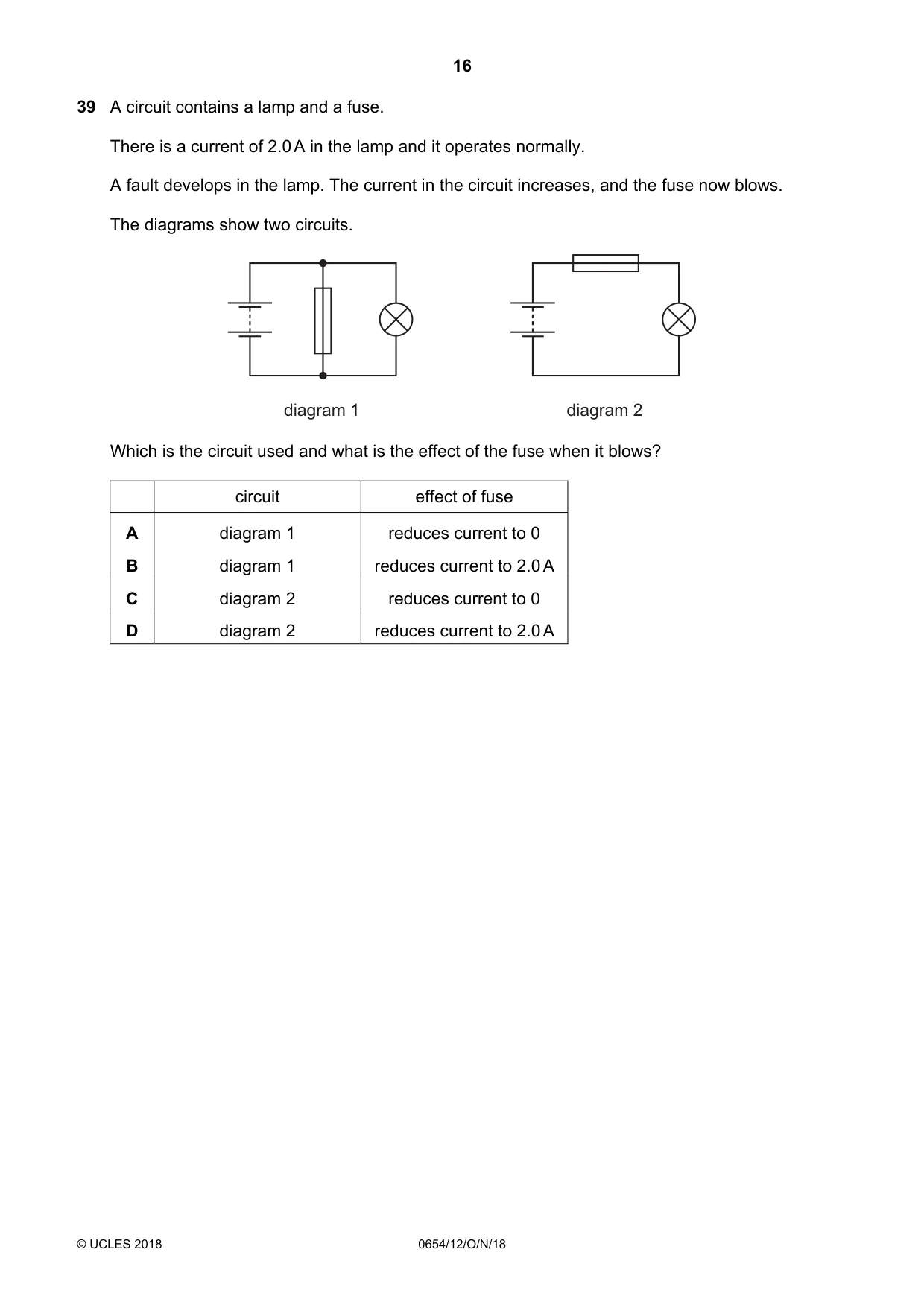
Q39 · A circuit contains a lamp and a fuse
39 A circuit contains a lamp and a fuse. There is a current of 2.0 A in the lamp and it operates normally. A fault develops in the lamp. The current in the circuit increases, and the fuse now blows. The diagrams show two circuits. diagram 1 diagram 2 Which is the circuit used and what is the effect of the fuse when it blows? circuit effect of fuse A diagram 1 reduces current to 0 B diagram 1 reduces current to 2.0 A C diagram 2 reduces current to 0 D diagram 2 reduces current to 2.0 A
Mark scheme: C
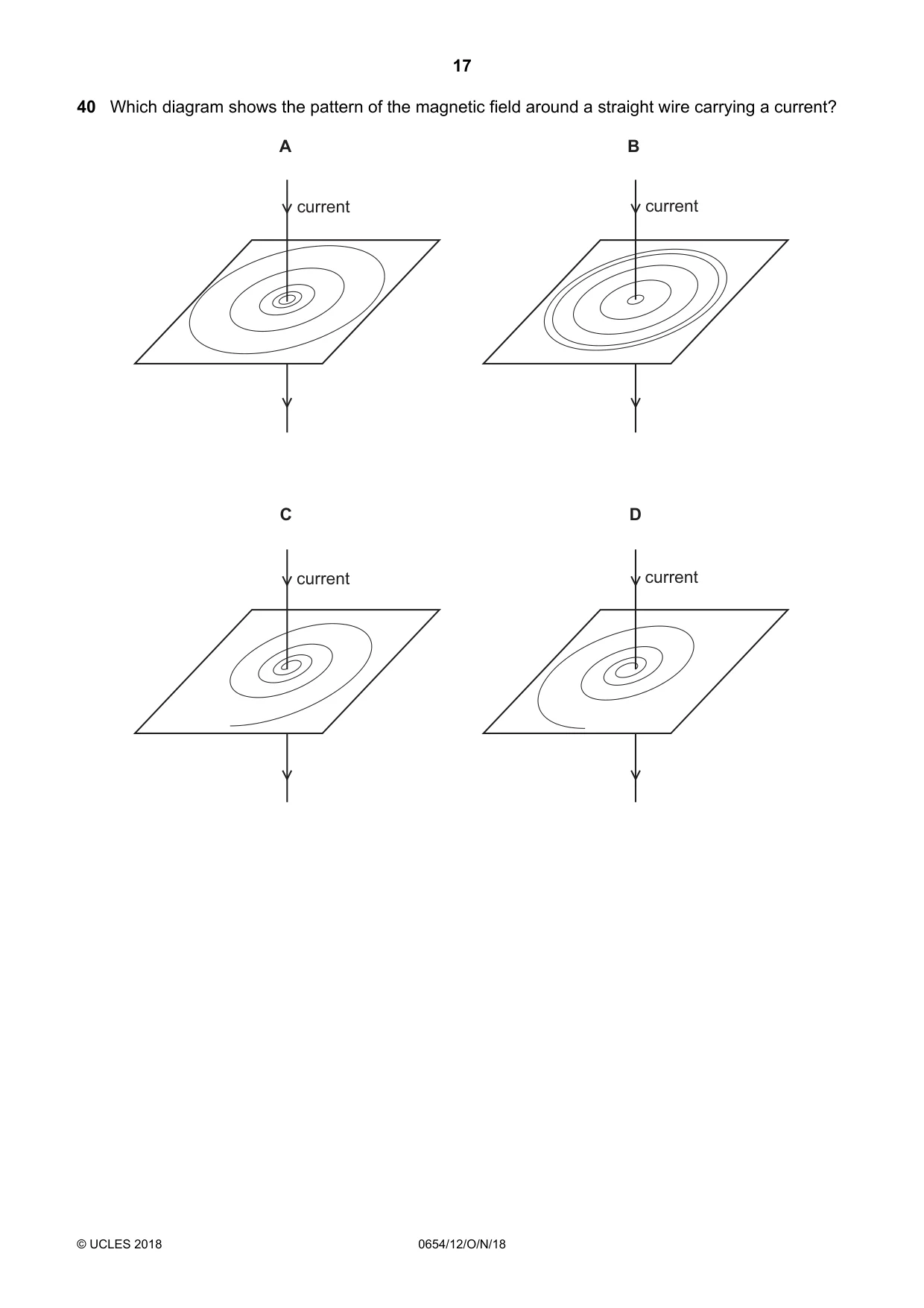
Q40 · Which diagram shows the pattern of the magnetic field around a straight wire carrying a…
40 Which diagram shows the pattern of the magnetic field around a straight wire carrying a current? A B current current C D current current
Mark scheme: A
What was in this paper
The subtopics covered by these 40 questions, and how many questions each got. Open one in a new tab to see every Cambridge question on it.
2The characteristic properties of acids and bases2Biological molecules1Carbon cycle1Cell structure1Coordination and response1Corrosion of metals1Digestive system1Electrical circuits1Electrical safety1Electrolysis1Electromagnetic spectrum1Elements, compounds and mixtures1Energy, work and power1Enzymes1Exothermic and endothermic reactions1Extraction of metals1Forces1Formulas1Gas exchange in humans1Group I properties1Habitat destruction1Hormones1Kinetic particle model of matter1Light1Monohybrid inheritance1Motion1Physical and chemical changes1Polymers1Rate of reaction1Respiration1Separation and purification1Sexual reproduction in plants1Sound1Thermal properties and temperature1Transfer of thermal energy1Translocation1Water1What you needed in this session
Cambridge’s own grade thresholds for 2018 Oct/Nov, Paper 1 · Variant 2. A higher threshold means an easier paper — the bar moves with how the cohort did.