Cambridge IGCSE Sciences - Co-ordinated (Double) 0654 — 2018 Oct/Nov Paper 1 · Variant 3
0654/13/O/N/18 · 40 questions · 40 marks · ≈45 min
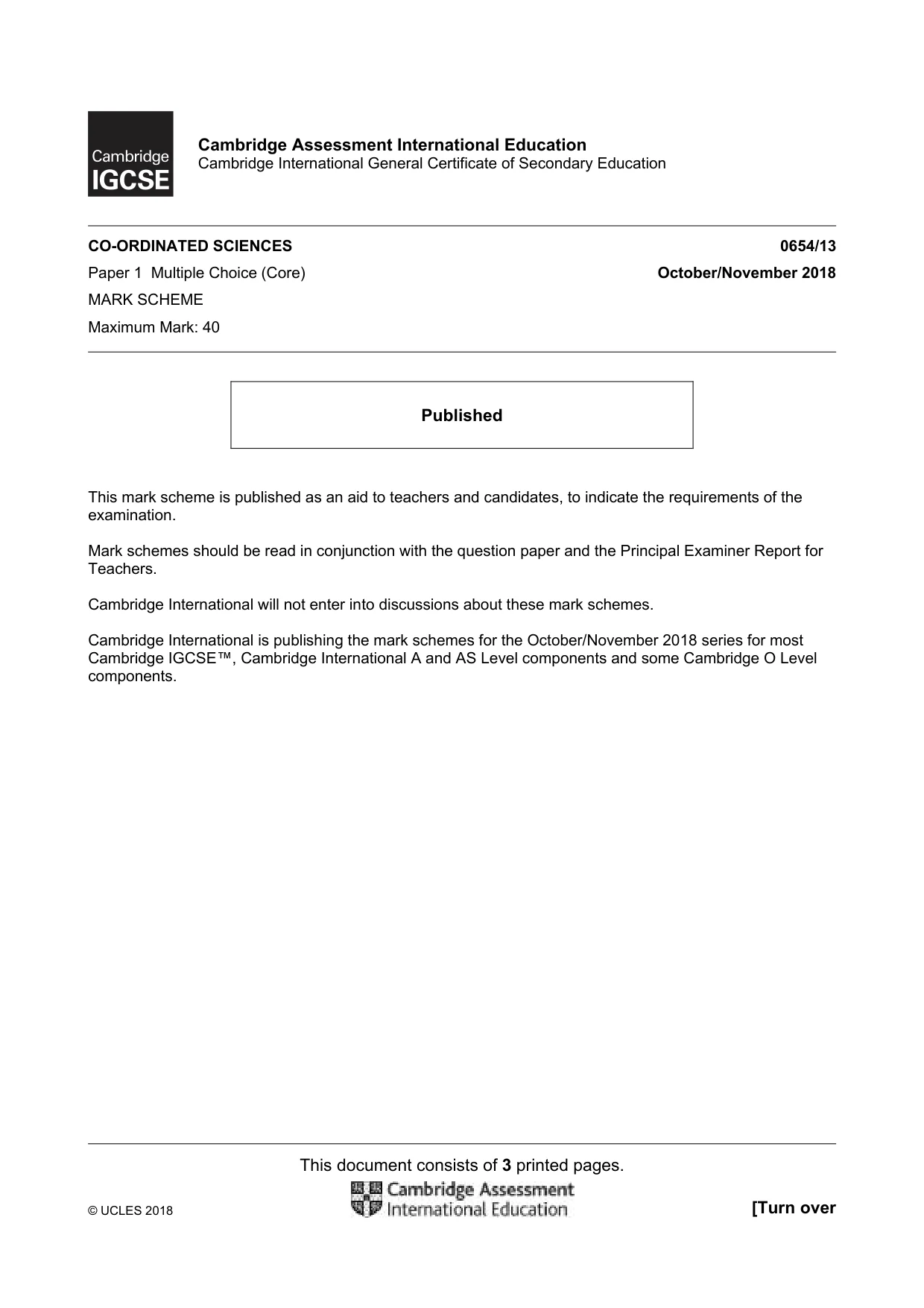
The question paper and its mark scheme, free to read here and free to download. This is Cambridge’s own paper, exactly as it was sat.
Question paper16 pages
Mark scheme3 pages
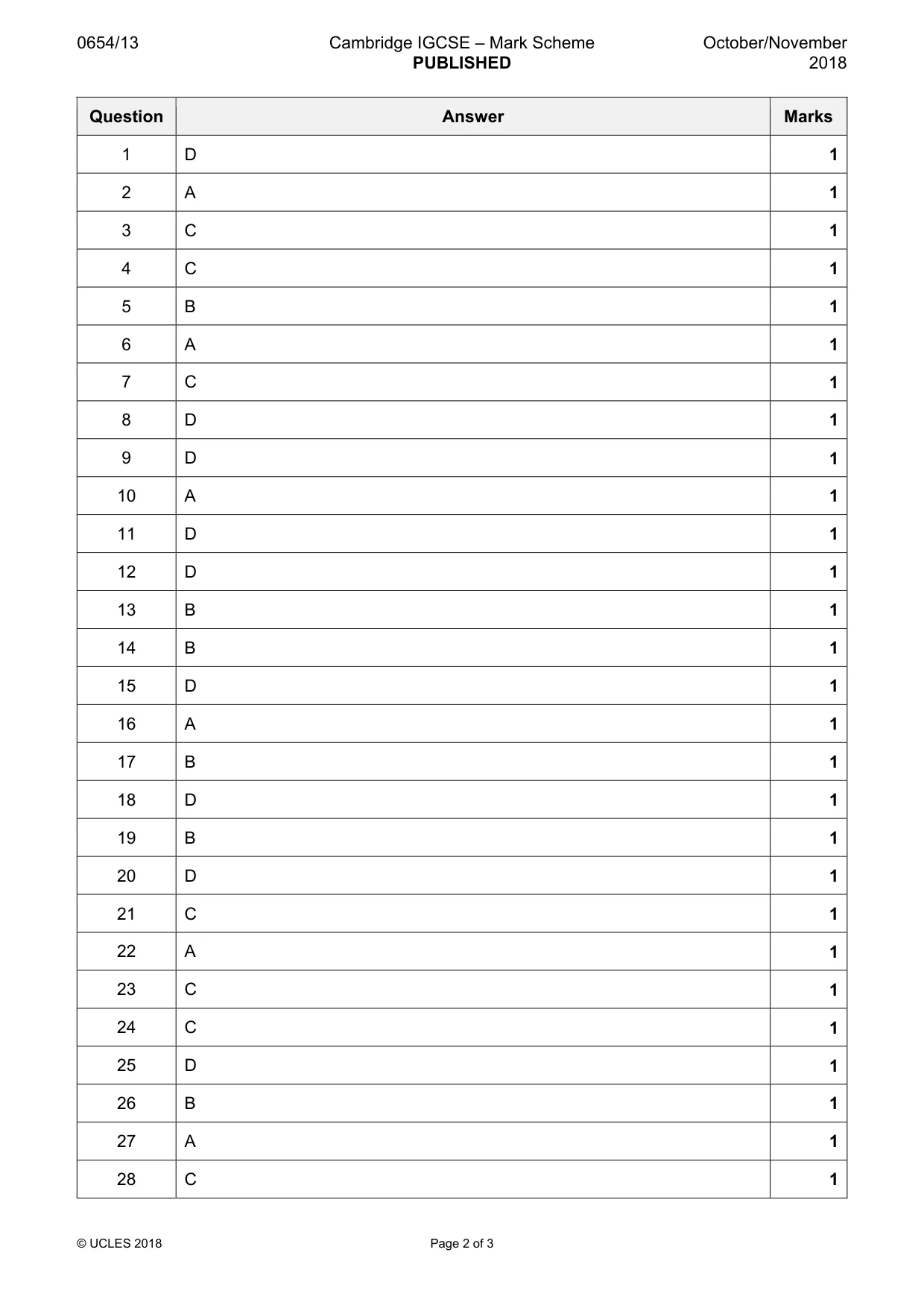
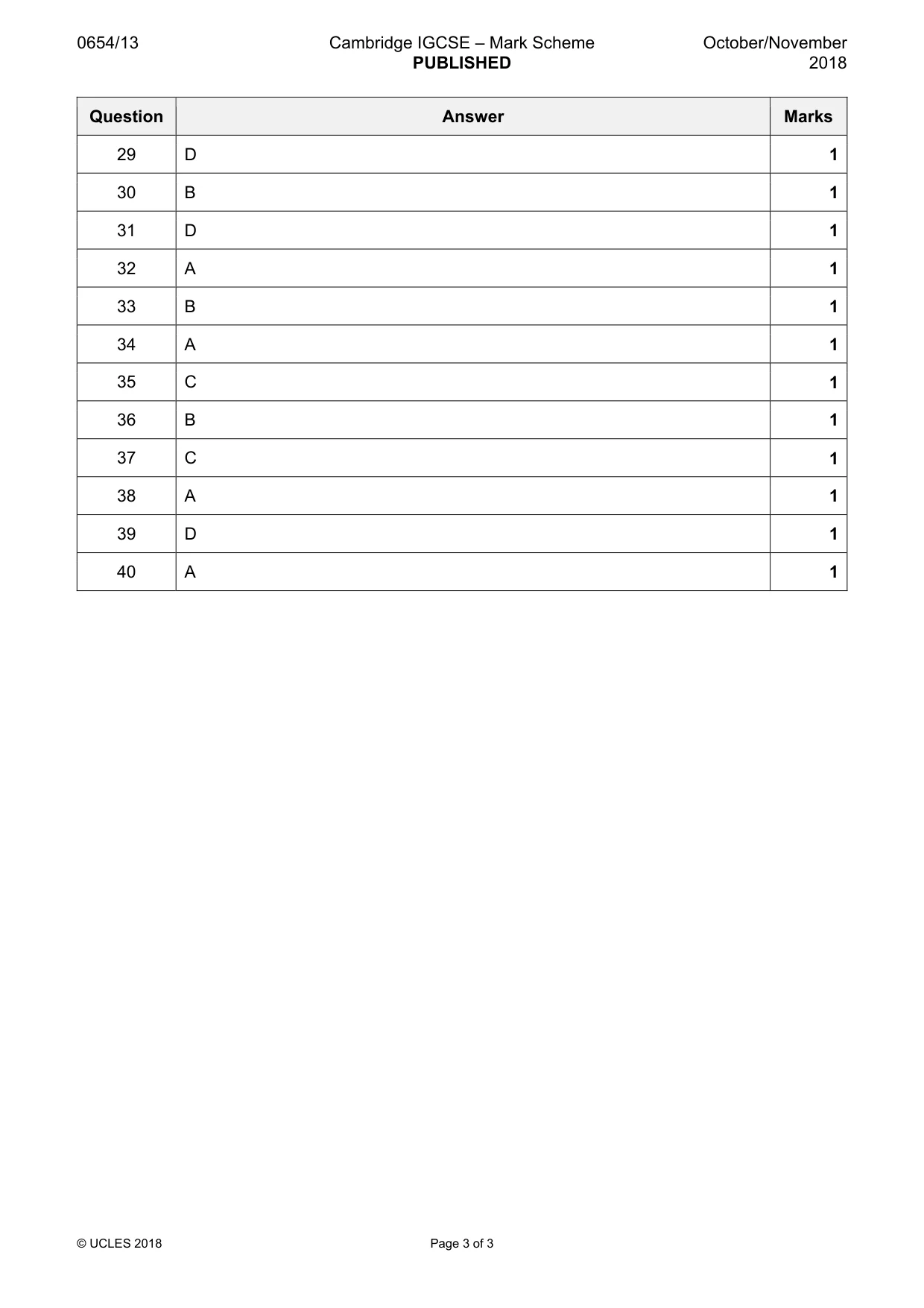
Answers below. Sit the paper first if you are practising.
Questions as text
Q1 · One way to test for microscopic life in soil is to see if carbon dioxide is released
1 One way to test for microscopic life in soil is to see if carbon dioxide is released. Which characteristic of living things is being tested? A growth B nutrition C reproduction D respiration
Mark scheme: D
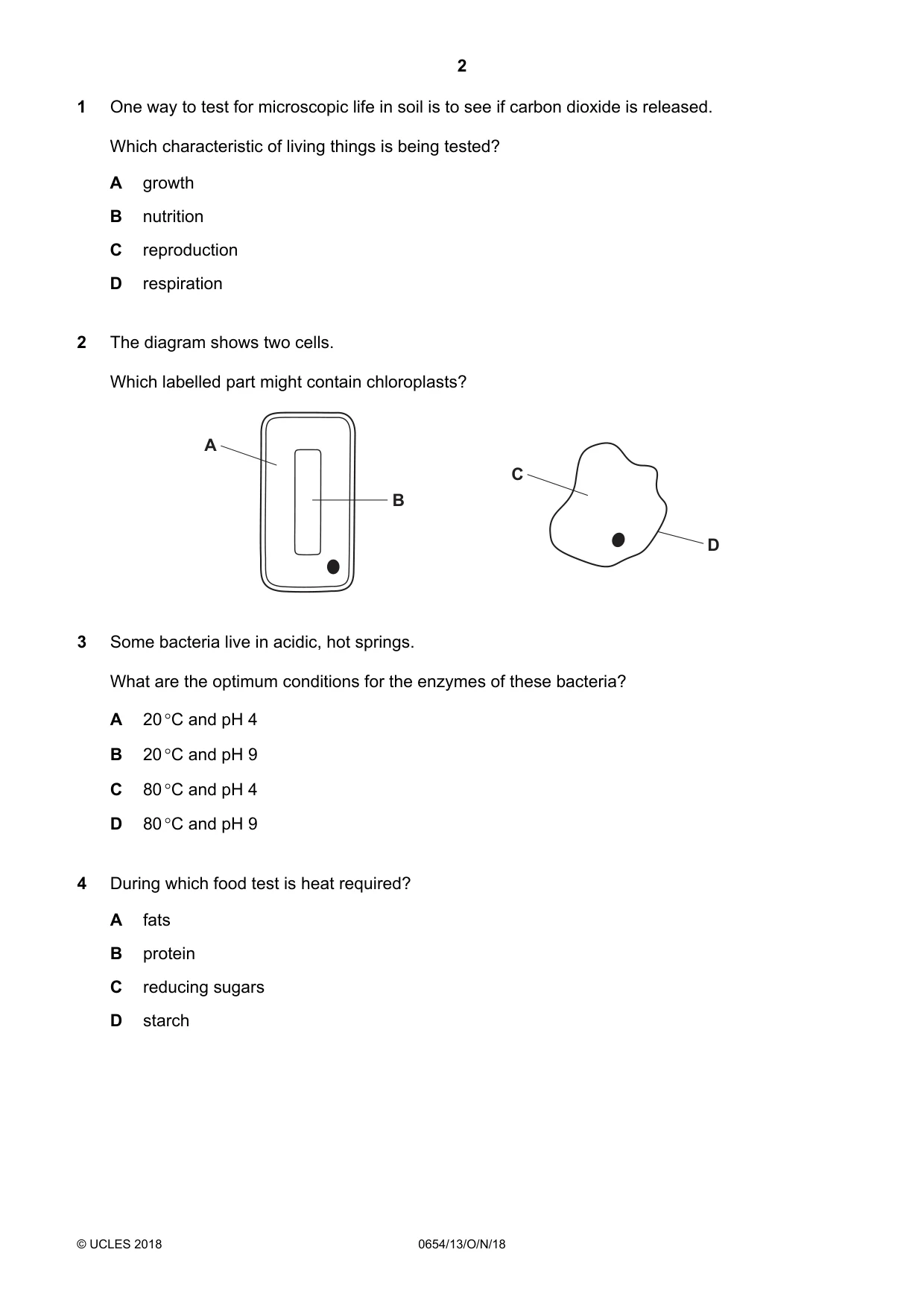
Q2 · The diagram shows two cells
2 The diagram shows two cells. Which labelled part might contain chloroplasts? A C B D
Mark scheme: A
Q3 · Some bacteria live in acidic, hot springs
3 Some bacteria live in acidic, hot springs. What are the optimum conditions for the enzymes of these bacteria? A 20 °C and pH 4 B 20 °C and pH 9 C 80 °C and pH 4 D 80 °C and pH 9
Mark scheme: C
Q4 · During which food test is heat required?
4 During which food test is heat required? A fats B protein C reducing sugars D starch
Mark scheme: C
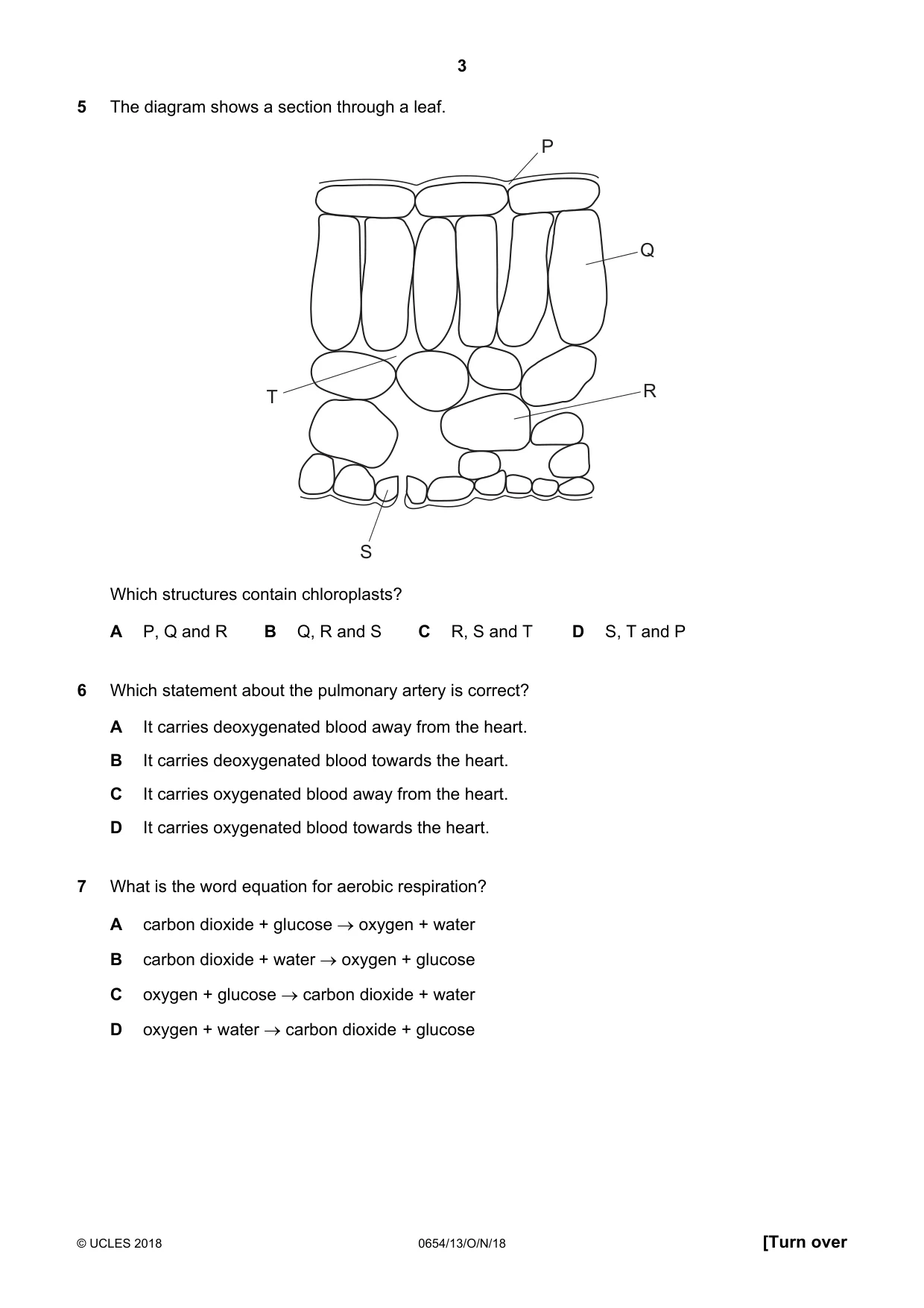
Q5 · The diagram shows a section through a leaf
5 The diagram shows a section through a leaf. P Q T R S Which structures contain chloroplasts? A P, Q and R B Q, R and S C R, S and T D S, T and P
Mark scheme: B
Q6 · Which statement about the pulmonary artery is correct?
6 Which statement about the pulmonary artery is correct? A It carries deoxygenated blood away from the heart. B It carries deoxygenated blood towards the heart. C It carries oxygenated blood away from the heart. D It carries oxygenated blood towards the heart.
Mark scheme: A
Q7 · What is the word equation for aerobic respiration?
7 What is the word equation for aerobic respiration? A carbon dioxide + glucose → oxygen + water B carbon dioxide + water → oxygen + glucose C oxygen + glucose → carbon dioxide + water D oxygen + water → carbon dioxide + glucose
Mark scheme: C
Q8 · To which environmental stimulus is a plant root responding when it grows downwards?
8 To which environmental stimulus is a plant root responding when it grows downwards? A a decrease in soil water content B light falling on the leaves of the plant C rising temperature D the force of gravity
Mark scheme: D
Q9 · Which name is given to the maintenance of a constant internal environment in the human…
9 Which name is given to the maintenance of a constant internal environment in the human body? A absorption B diffusion C egestion D homeostasis
Mark scheme: D
Q10 · Which part of a flower produces pollen grains?
10 Which part of a flower produces pollen grains? A anther B ovary C sepal D stigma
Mark scheme: A
Q11 · In pea plants, the allele for purple flowers is dominant to the allele for white flowers
11 In pea plants, the allele for purple flowers is dominant to the allele for white flowers. Two heterozygous purple-flowered plants are crossed. What will be the expected flower colour of the offspring plants? A all purple B all white C 1 purple : 1 white D 3 purple : 1 white
Mark scheme: D
Q12 · Species of frogs which live in trees have sticky pads on their feet
12 Species of frogs which live in trees have sticky pads on their feet. These are absent in frogs which live in other habitats. By which process has this come about? A artificial selection B conservation C monohybrid inheritance D natural selection
Mark scheme: D
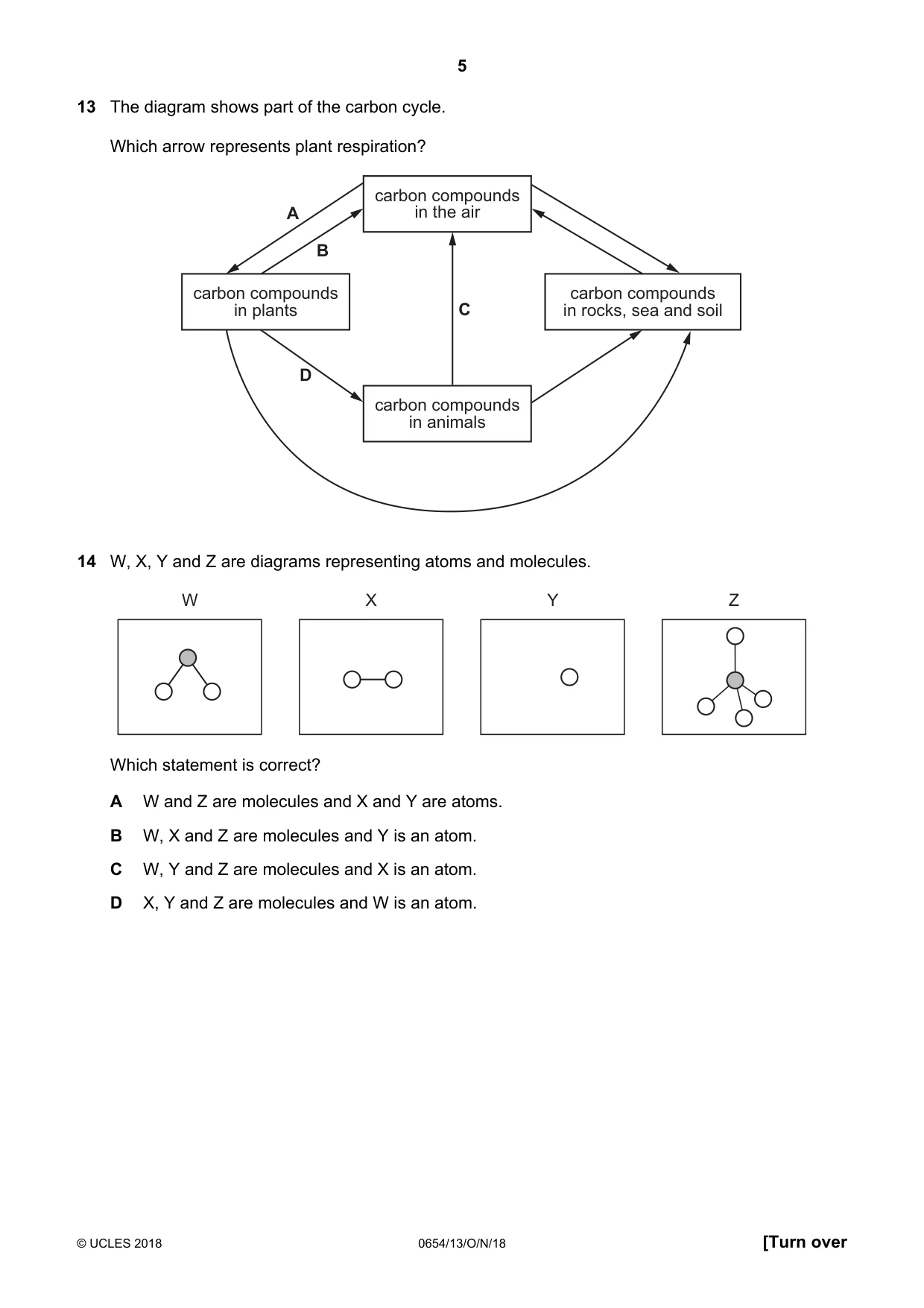
Q13 · The diagram shows part of the carbon cycle
13 The diagram shows part of the carbon cycle. Which arrow represents plant respiration? carbon compounds A in the air B carbon compounds carbon compounds in plants C in rocks, sea and soil D carbon compounds in animals
Mark scheme: B
Q14 · W, X, Y and Z are diagrams representing atoms and molecules
14 W, X, Y and Z are diagrams representing atoms and molecules. W X Y Z Which statement is correct? A W and Z are molecules and X and Y are atoms. B W, X and Z are molecules and Y is an atom. C W, Y and Z are molecules and X is an atom. D X, Y and Z are molecules and W is an atom.
Mark scheme: B
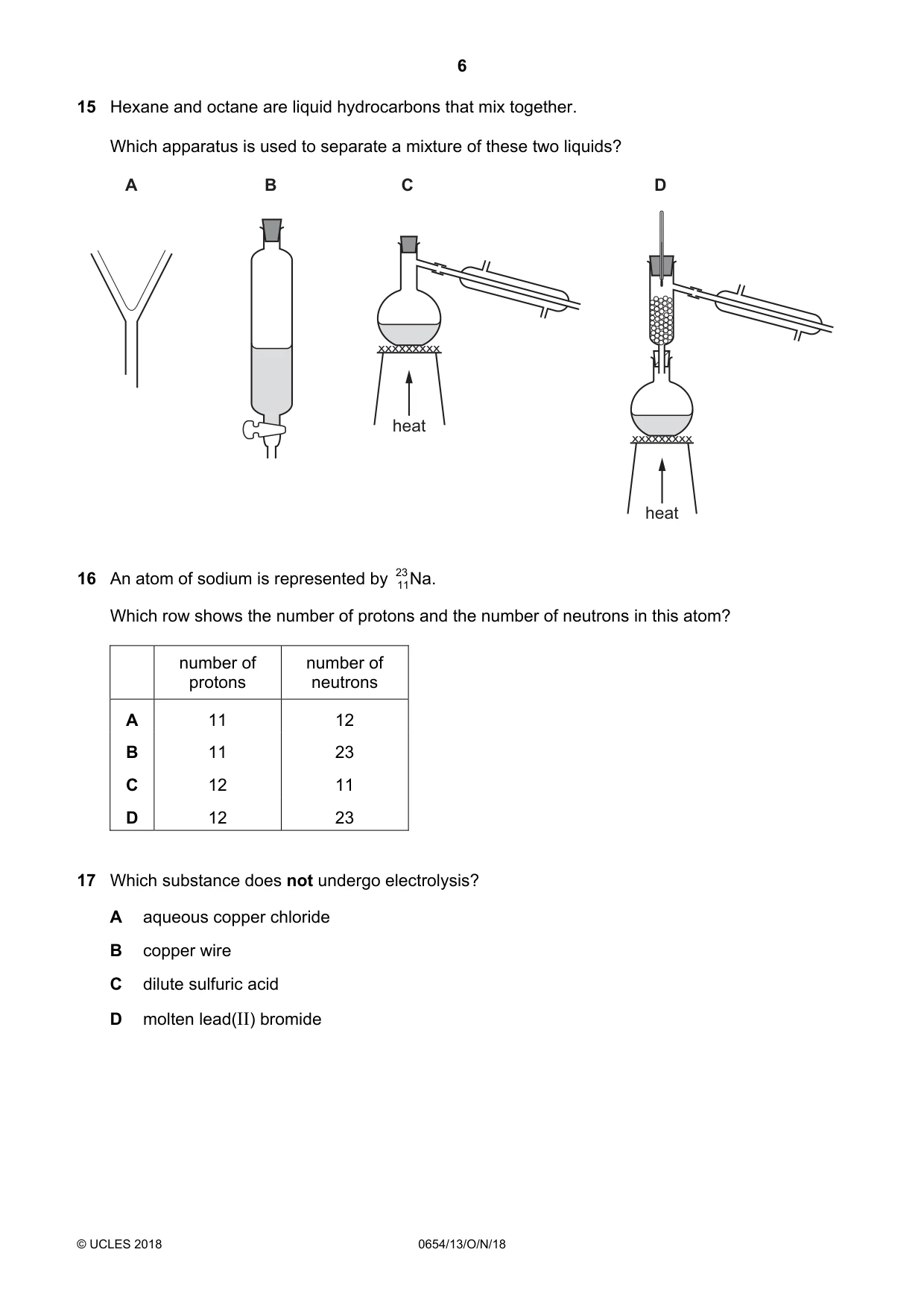
Q15 · Hexane and octane are liquid hydrocarbons that mix together
15 Hexane and octane are liquid hydrocarbons that mix together. Which apparatus is used to separate a mixture of these two liquids? A B C D xxxxxxxxx heat xxxxxxxxx heat
Mark scheme: D
Q16 · An atom of sodium is represented by 23 Na
16 An atom of sodium is represented by 23 Na. 11 Which row shows the number of protons and the number of neutrons in this atom? number of number of protons neutrons A 11 12 B 11 23 C 12 11 D 12 23
Mark scheme: A
Q17 · Which substance does not undergo electrolysis?
17 Which substance does not undergo electrolysis? A aqueous copper chloride B copper wire C dilute sulfuric acid D molten lead(II) bromide
Mark scheme: B
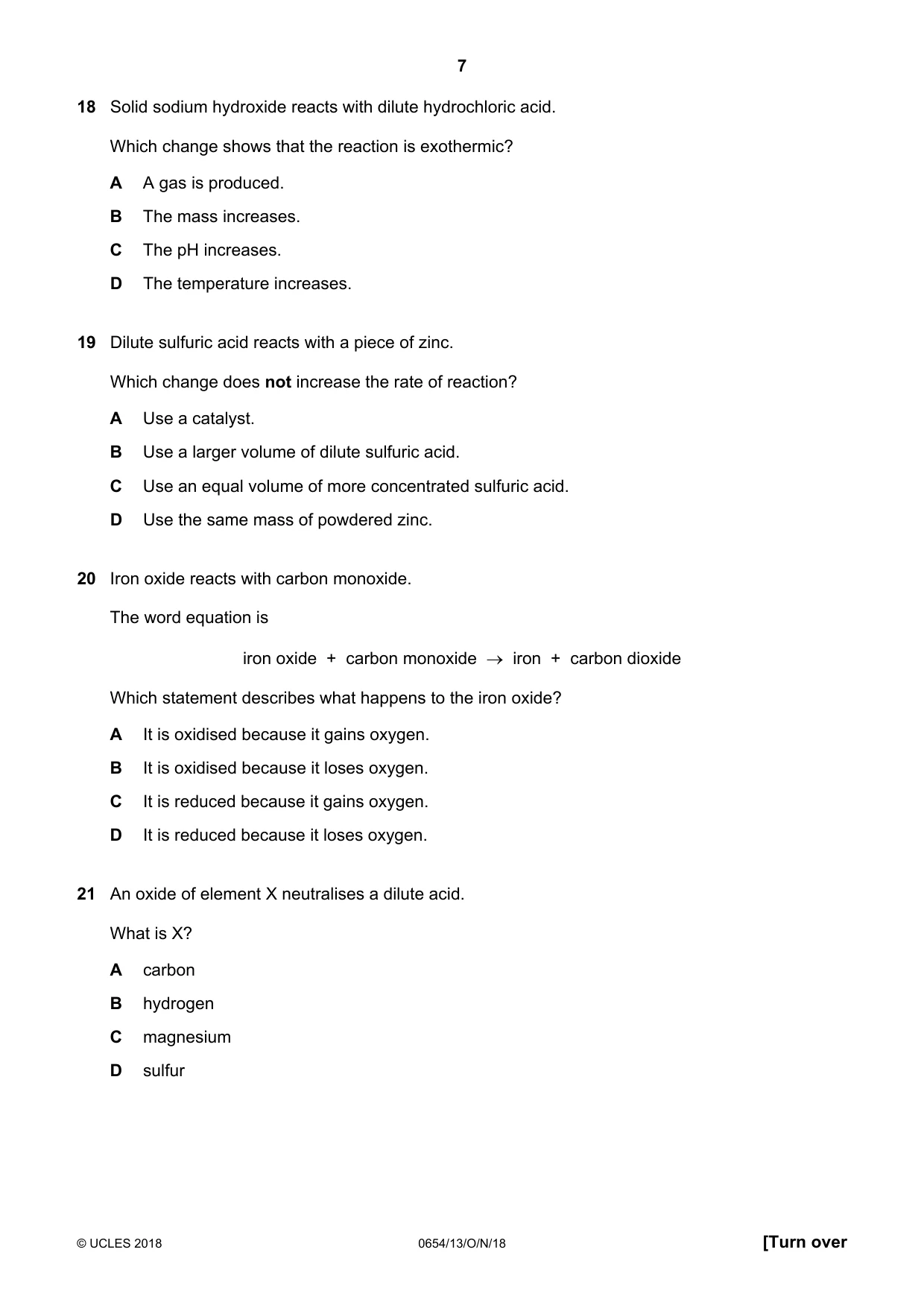
Q18 · Solid sodium hydroxide reacts with dilute hydrochloric acid
18 Solid sodium hydroxide reacts with dilute hydrochloric acid. Which change shows that the reaction is exothermic? A A gas is produced. B The mass increases. C The pH increases. D The temperature increases.
Mark scheme: D
Q19 · Dilute sulfuric acid reacts with a piece of zinc
19 Dilute sulfuric acid reacts with a piece of zinc. Which change does not increase the rate of reaction? A Use a catalyst. B Use a larger volume of dilute sulfuric acid. C Use an equal volume of more concentrated sulfuric acid. D Use the same mass of powdered zinc.
Mark scheme: B
Q20 · Iron oxide reacts with carbon monoxide
20 Iron oxide reacts with carbon monoxide. The word equation is iron oxide + carbon monoxide → iron + carbon dioxide Which statement describes what happens to the iron oxide? A It is oxidised because it gains oxygen. B It is oxidised because it loses oxygen. C It is reduced because it gains oxygen. D It is reduced because it loses oxygen.
Mark scheme: D
Q21 · An oxide of element X neutralises a dilute acid
21 An oxide of element X neutralises a dilute acid. What is X? A carbon B hydrogen C magnesium D sulfur
Mark scheme: C
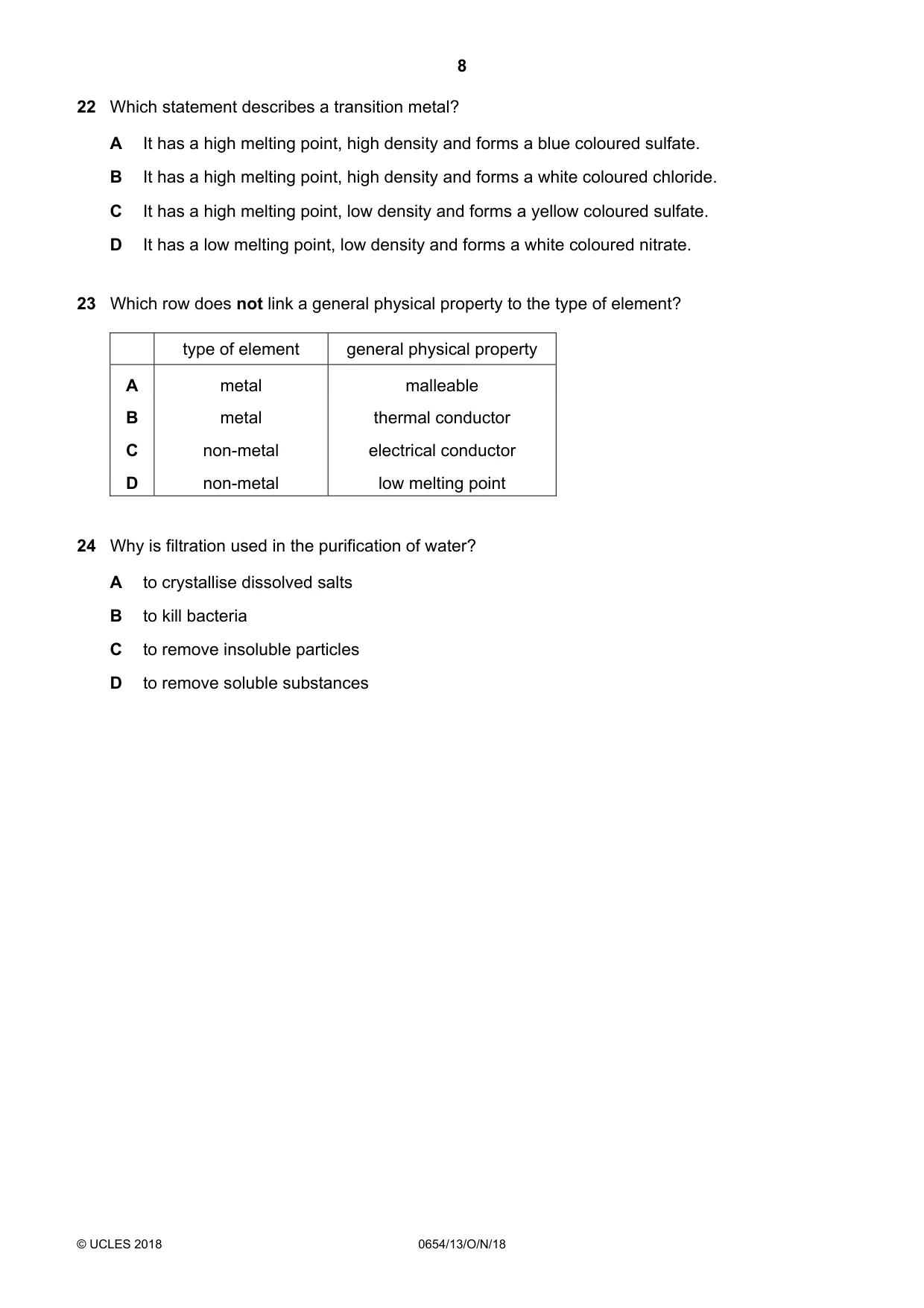
Q22 · Which statement describes a transition metal?
22 Which statement describes a transition metal? A It has a high melting point, high density and forms a blue coloured sulfate. B It has a high melting point, high density and forms a white coloured chloride. C It has a high melting point, low density and forms a yellow coloured sulfate. D It has a low melting point, low density and forms a white coloured nitrate.
Mark scheme: A
Q23 · Which row does not link a general physical property to the type of element?
23 Which row does not link a general physical property to the type of element? type of element general physical property A metal malleable B metal thermal conductor C non-metal electrical conductor D non-metal low melting point
Mark scheme: C
Q24 · Why is filtration used in the purification of water?
24 Why is filtration used in the purification of water? A to crystallise dissolved salts B to kill bacteria C to remove insoluble particles D to remove soluble substances
Mark scheme: C
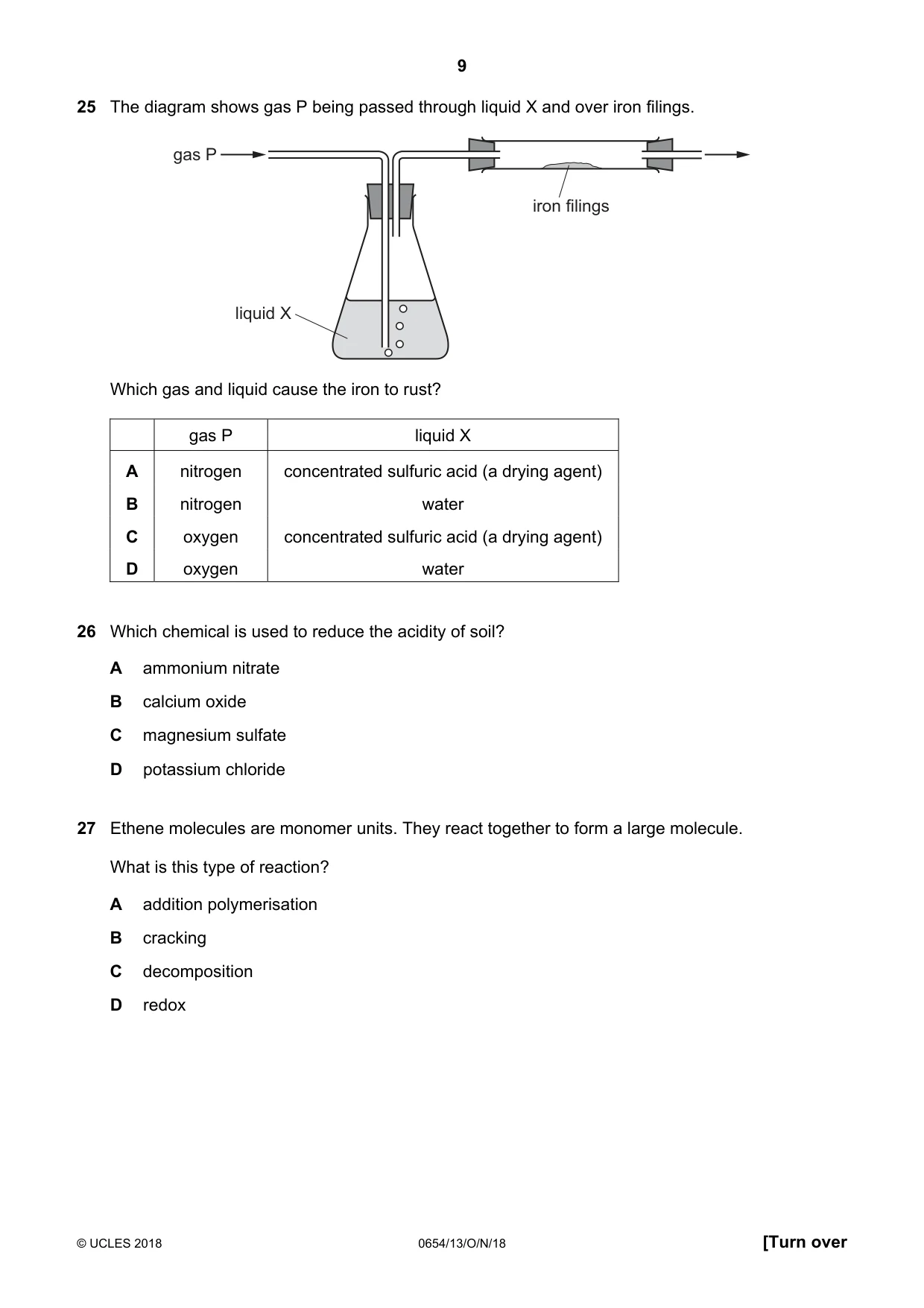
Q25 · The diagram shows gas P being passed through liquid X and over iron filings
25 The diagram shows gas P being passed through liquid X and over iron filings. gas P iron filings liquid X Which gas and liquid cause the iron to rust? gas P liquid X A nitrogen concentrated sulfuric acid (a drying agent) B nitrogen water C oxygen concentrated sulfuric acid (a drying agent) D oxygen water
Mark scheme: D
Q26 · Which chemical is used to reduce the acidity of soil?
26 Which chemical is used to reduce the acidity of soil? A ammonium nitrate B calcium oxide C magnesium sulfate D potassium chloride
Mark scheme: B
More questions on The characteristic properties of acids and bases
Q27 · Ethene molecules are monomer units
27 Ethene molecules are monomer units. They react together to form a large molecule. What is this type of reaction? A addition polymerisation B cracking C decomposition D redox
Mark scheme: A
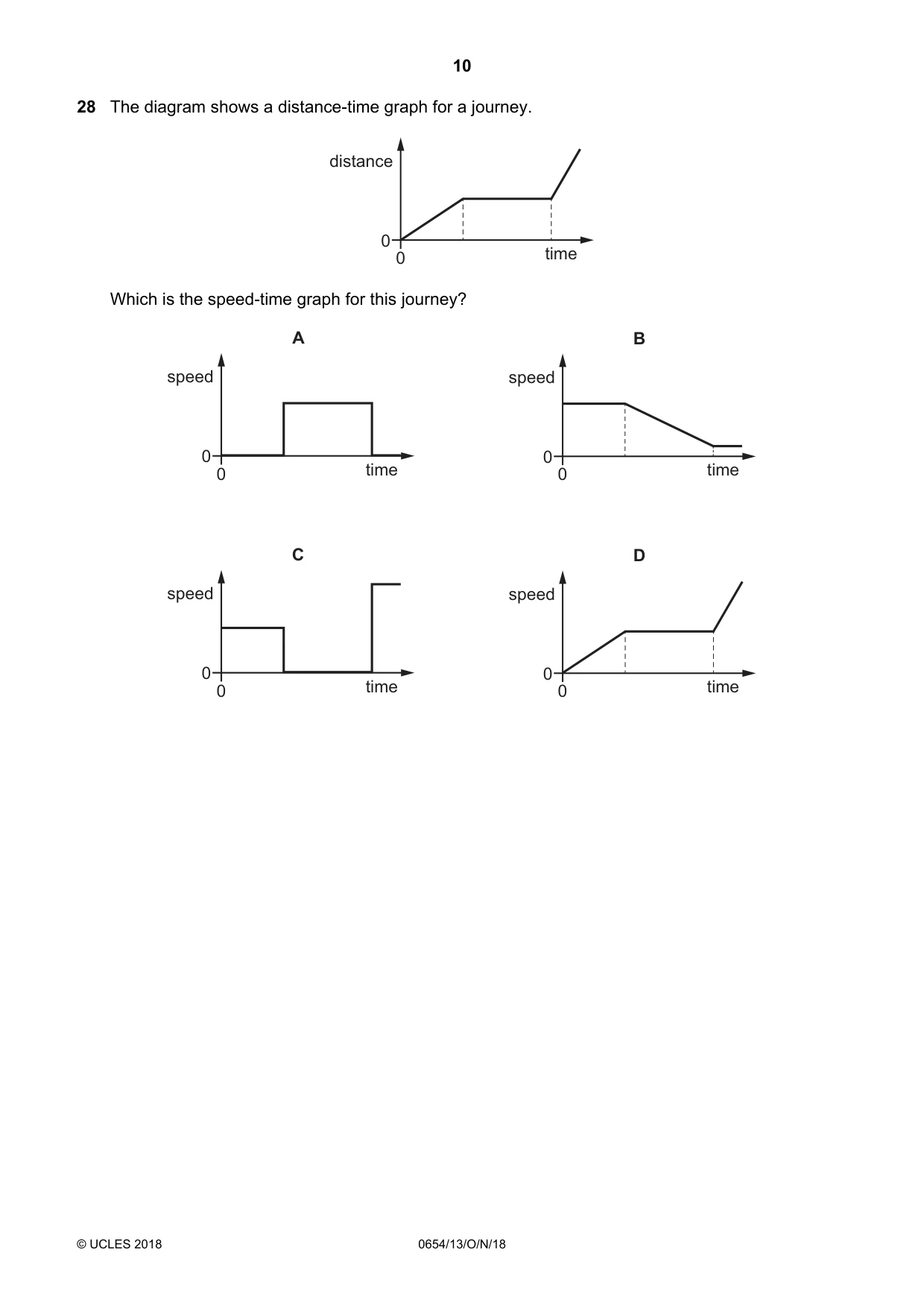
Q28 · The diagram shows a distance-time graph for a journey
28 The diagram shows a distance-time graph for a journey. distance 0 0 time Which is the speed-time graph for this journey? A B speed speed 0 0 0 time 0 time C D speed speed 0 0 0 time 0 time
Mark scheme: C
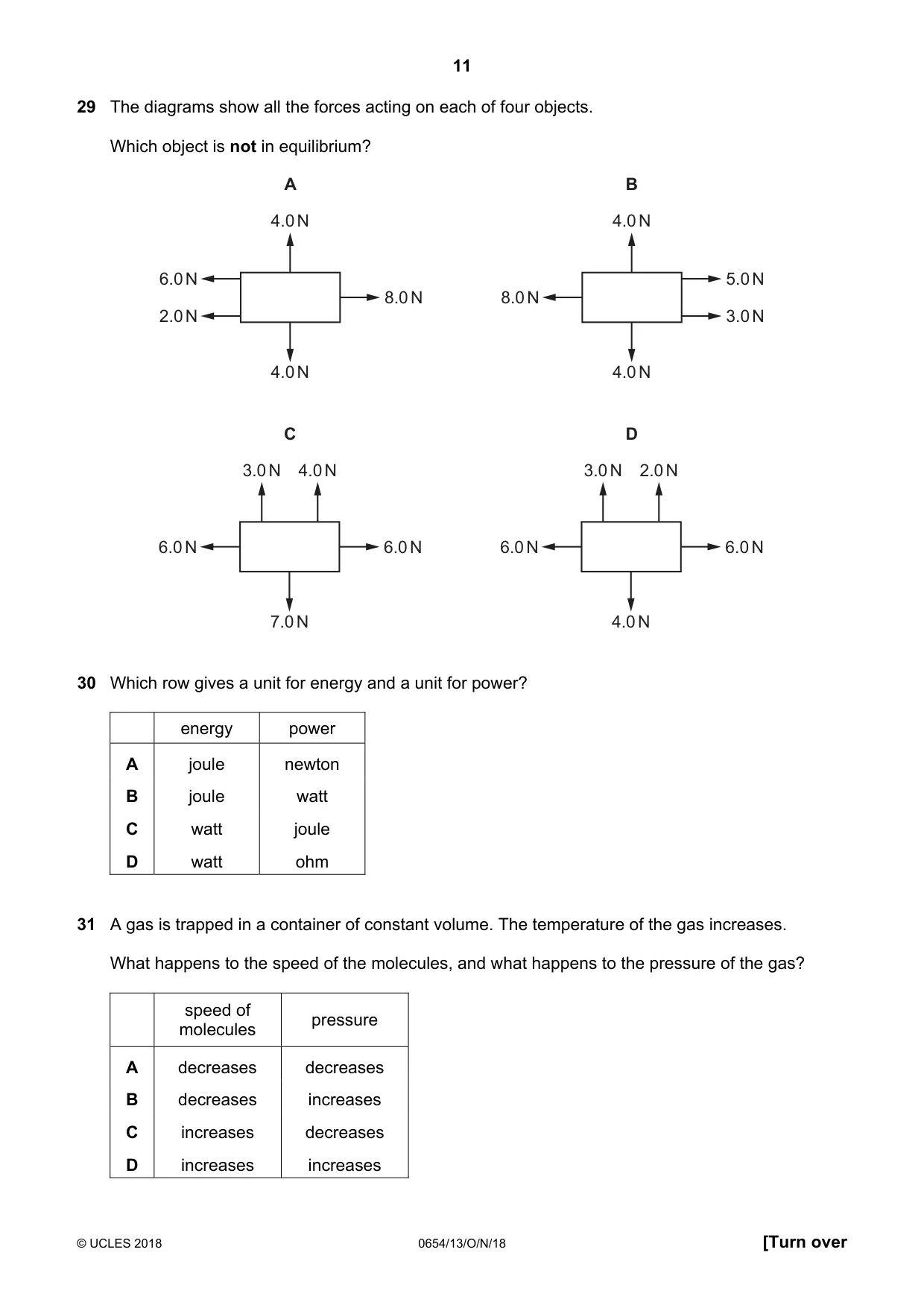
Q29 · The diagrams show all the forces acting on each of four objects
29 The diagrams show all the forces acting on each of four objects. Which object is not in equilibrium? A B 4.0 N 4.0 N 6.0 N 5.0 N 8.0 N 8.0 N 2.0 N 3.0 N 4.0 N 4.0 N C D 3.0 N 4.0 N 3.0 N 2.0 N 6.0 N 6.0 N 6.0 N 6.0 N 7.0 N 4.0 N
Mark scheme: D
Q30 · Which row gives a unit for energy and a unit for power?
30 Which row gives a unit for energy and a unit for power? energy power A joule newton B joule watt C watt joule D watt ohm
Mark scheme: B
Q31 · A gas is trapped in a container of constant volume
31 A gas is trapped in a container of constant volume. The temperature of the gas increases. What happens to the speed of the molecules, and what happens to the pressure of the gas? speed of pressure molecules A decreases decreases B decreases increases C increases decreases D increases increases
Mark scheme: D
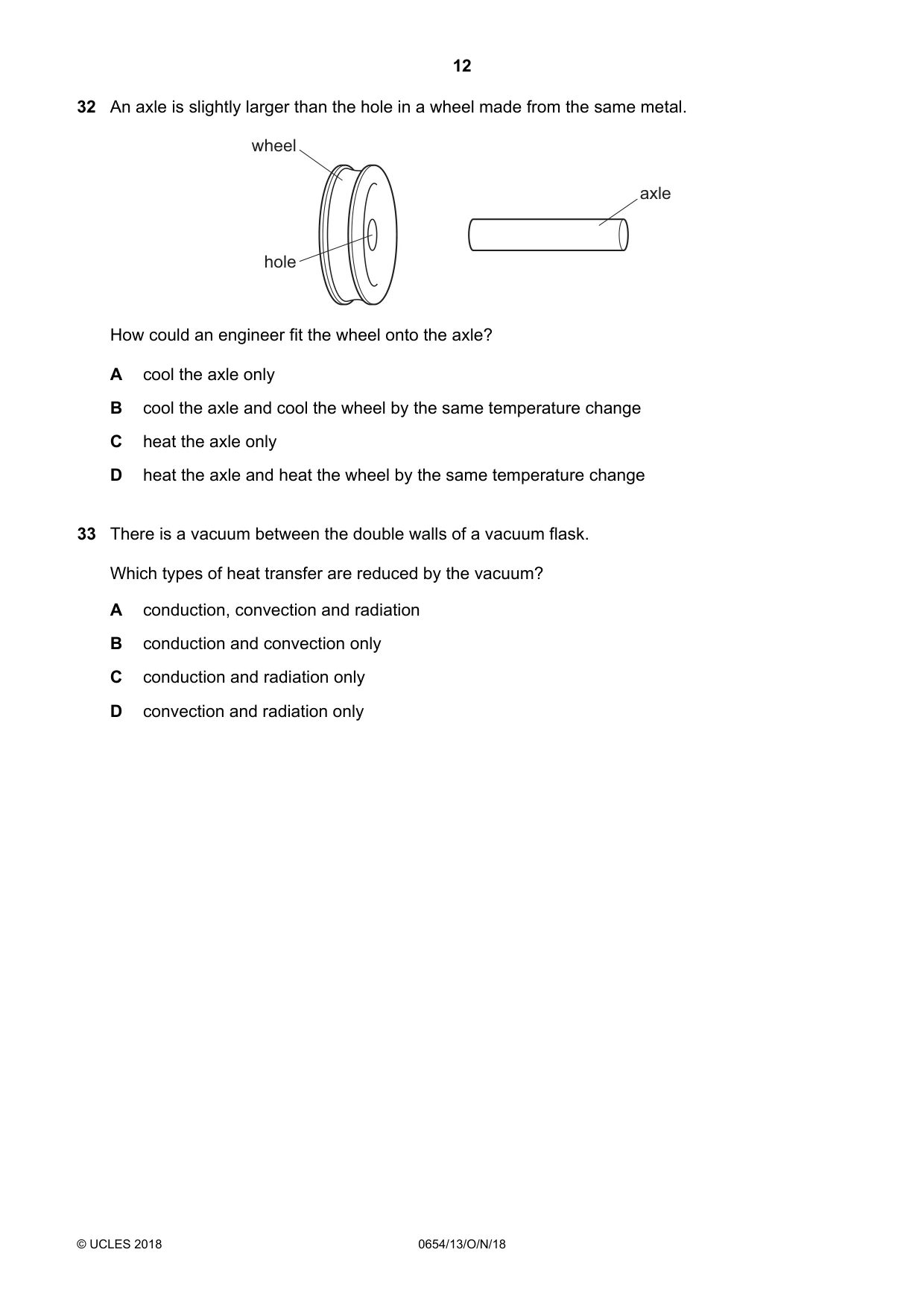
Q32 · An axle is slightly larger than the hole in a wheel made from the same metal
32 An axle is slightly larger than the hole in a wheel made from the same metal. wheel axle hole How could an engineer fit the wheel onto the axle? A cool the axle only B cool the axle and cool the wheel by the same temperature change C heat the axle only D heat the axle and heat the wheel by the same temperature change
Mark scheme: A
Q33 · There is a vacuum between the double walls of a vacuum flask
33 There is a vacuum between the double walls of a vacuum flask. Which types of heat transfer are reduced by the vacuum? A conduction, convection and radiation B conduction and convection only C conduction and radiation only D convection and radiation only
Mark scheme: B
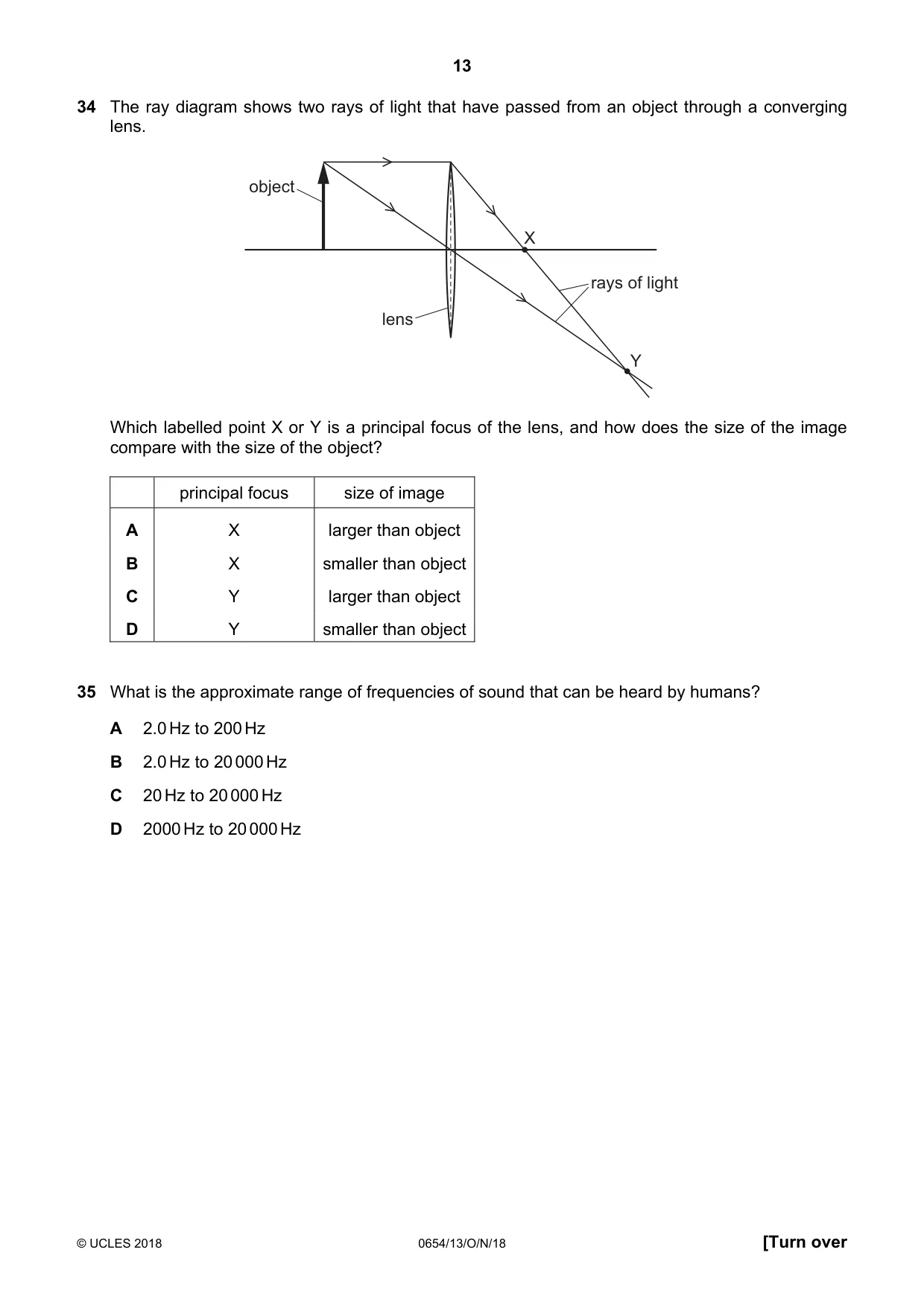
Q34 · The ray diagram shows two rays of light that have passed from an object through a…
34 The ray diagram shows two rays of light that have passed from an object through a converging lens. object X rays of light lens Y Which labelled point X or Y is a principal focus of the lens, and how does the size of the image compare with the size of the object? principal focus size of image A X larger than object B X smaller than object C Y larger than object D Y smaller than object
Mark scheme: A
Q35 · What is the approximate range of frequencies of sound that can be heard by humans?
35 What is the approximate range of frequencies of sound that can be heard by humans? A 2.0 Hz to 200 Hz B 2.0 Hz to 20 000 Hz C 20 Hz to 20 000 Hz D 2000 Hz to 20 000 Hz
Mark scheme: C
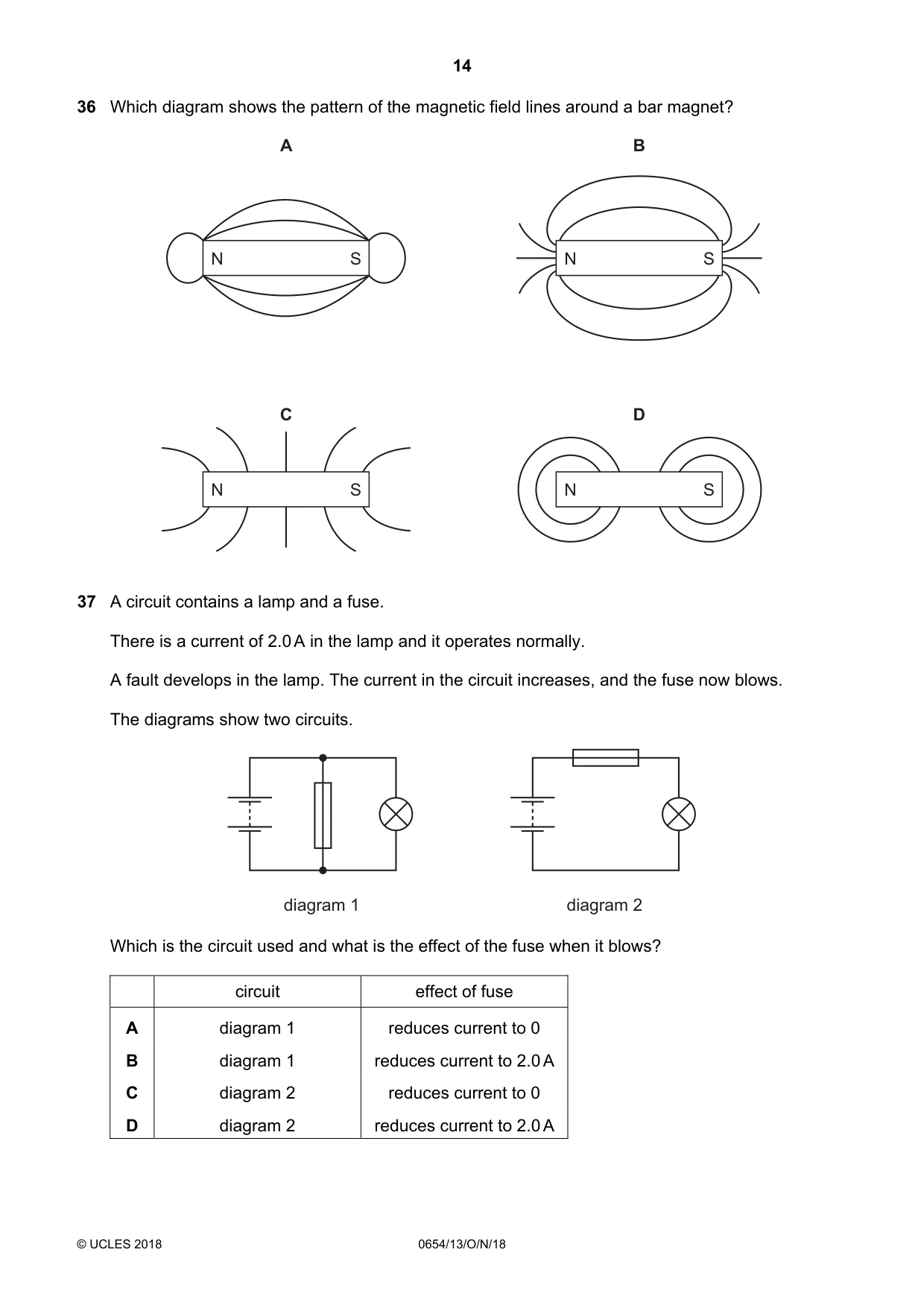
Q36 · Which diagram shows the pattern of the magnetic field lines around a bar magnet?
36 Which diagram shows the pattern of the magnetic field lines around a bar magnet? A B N S N S C D N S N S
Mark scheme: B
Q37 · A circuit contains a lamp and a fuse
37 A circuit contains a lamp and a fuse. There is a current of 2.0 A in the lamp and it operates normally. A fault develops in the lamp. The current in the circuit increases, and the fuse now blows. The diagrams show two circuits. diagram 1 diagram 2 Which is the circuit used and what is the effect of the fuse when it blows? circuit effect of fuse A diagram 1 reduces current to 0 B diagram 1 reduces current to 2.0 A C diagram 2 reduces current to 0 D diagram 2 reduces current to 2.0 A
Mark scheme: C
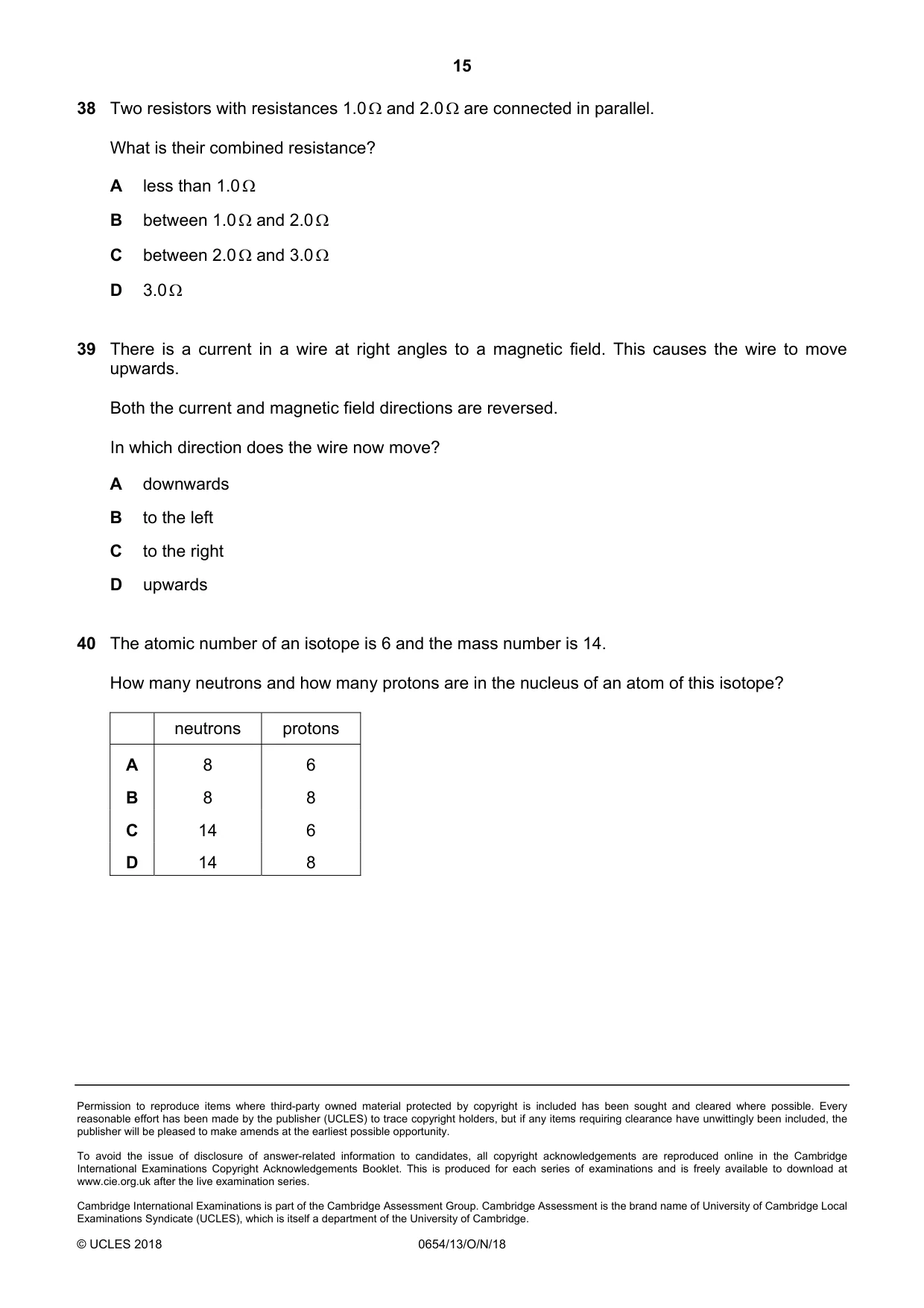
Q38 · Two resistors with resistances 1.0 Ω and 2.0 Ω are connected in parallel
38 Two resistors with resistances 1.0 Ω and 2.0 Ω are connected in parallel. What is their combined resistance? A less than 1.0 Ω B between 1.0 Ω and 2.0 Ω C between 2.0 Ω and 3.0 Ω D 3.0 Ω
Mark scheme: A
Q39 · There is a current in a wire at right angles to a magnetic field
39 There is a current in a wire at right angles to a magnetic field. This causes the wire to move upwards. Both the current and magnetic field directions are reversed. In which direction does the wire now move? A downwards B to the left C to the right D upwards
Mark scheme: D
Q40 · The atomic number of an isotope is 6 and the mass number is 14
40 The atomic number of an isotope is 6 and the mass number is 14. How many neutrons and how many protons are in the nucleus of an atom of this isotope? neutrons protons A 8 6 B 8 8 C 14 6 D 14 8
Mark scheme: A
What was in this paper
The subtopics covered by these 40 questions, and how many questions each got. Open one in a new tab to see every Cambridge question on it.
2Atomic structure and the Periodic Table1Biological molecules1Carbon cycle1Cell structure1Characteristics of living organisms1Circulatory systems1Coordination and response1Corrosion of metals1Electrical circuits1Electrical safety1Electrolysis1Electromagnetic effects1Elements, compounds and mixtures1Energy, work and power1Enzymes1Exothermic and endothermic reactions1Forces1Homeostasis1Kinetic particle model of matter1Leaf structure1Light1Monohybrid inheritance1Motion1Oxides1Polymers1Properties of metals1Rate of reaction1Redox1Respiration1Selection1Sexual reproduction in plants1Simple phenomena of magnetism1Sound1The characteristic properties of acids and bases1The nucleus1Thermal properties and temperature1Transfer of thermal energy1Transition elements1What you needed in this session
Cambridge’s own grade thresholds for 2018 Oct/Nov, Paper 1 · Variant 3. A higher threshold means an easier paper — the bar moves with how the cohort did.