Cambridge IGCSE Sciences - Co-ordinated (Double) 0654 — 2010 Oct/Nov Paper 1 · Variant 1
0654/11/O/N/10 · 40 questions · 40 marks · ≈45 min
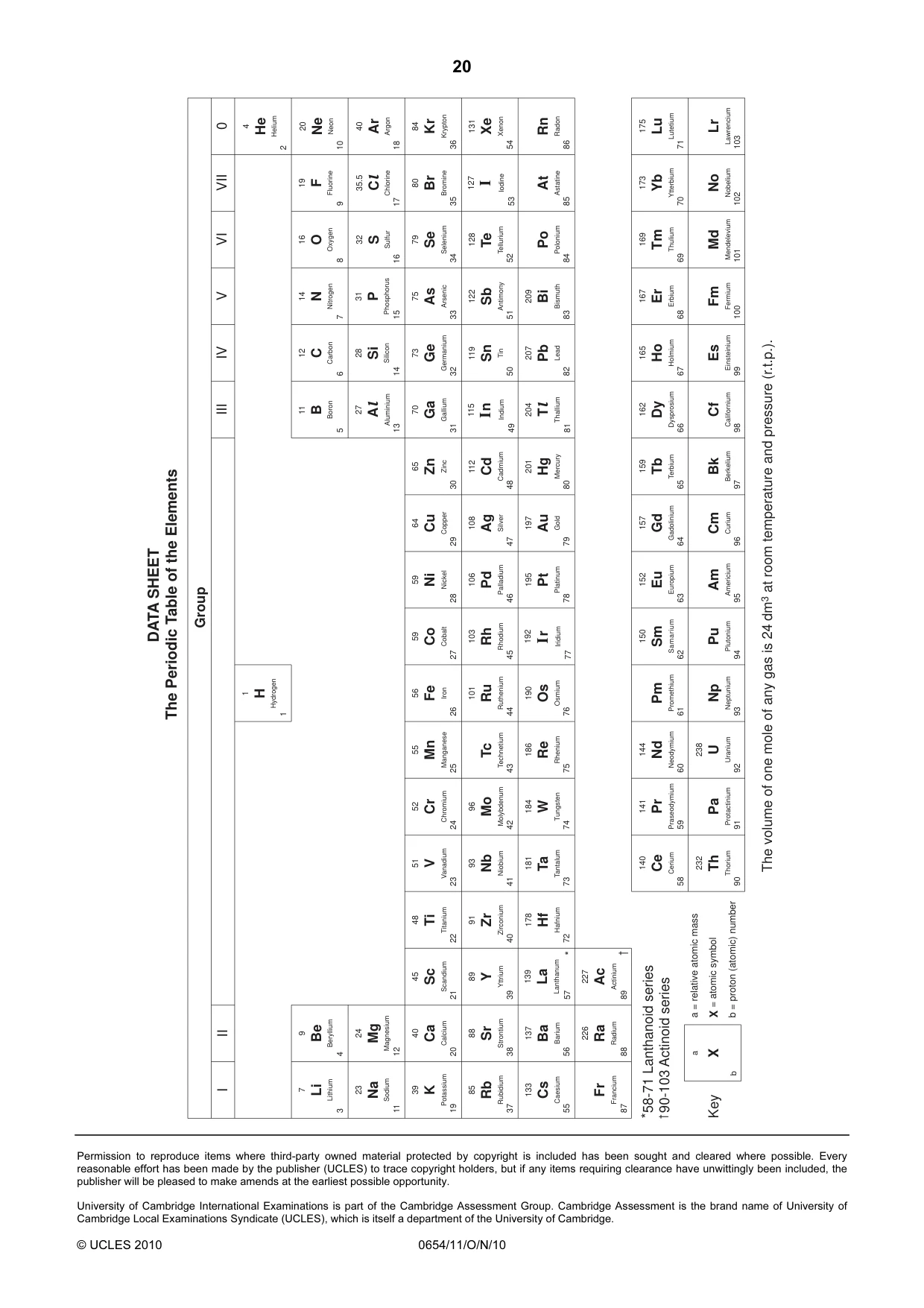
The question paper and its mark scheme, free to read here and free to download. This is Cambridge’s own paper, exactly as it was sat.
Question paper20 pages



Mark scheme2 pages
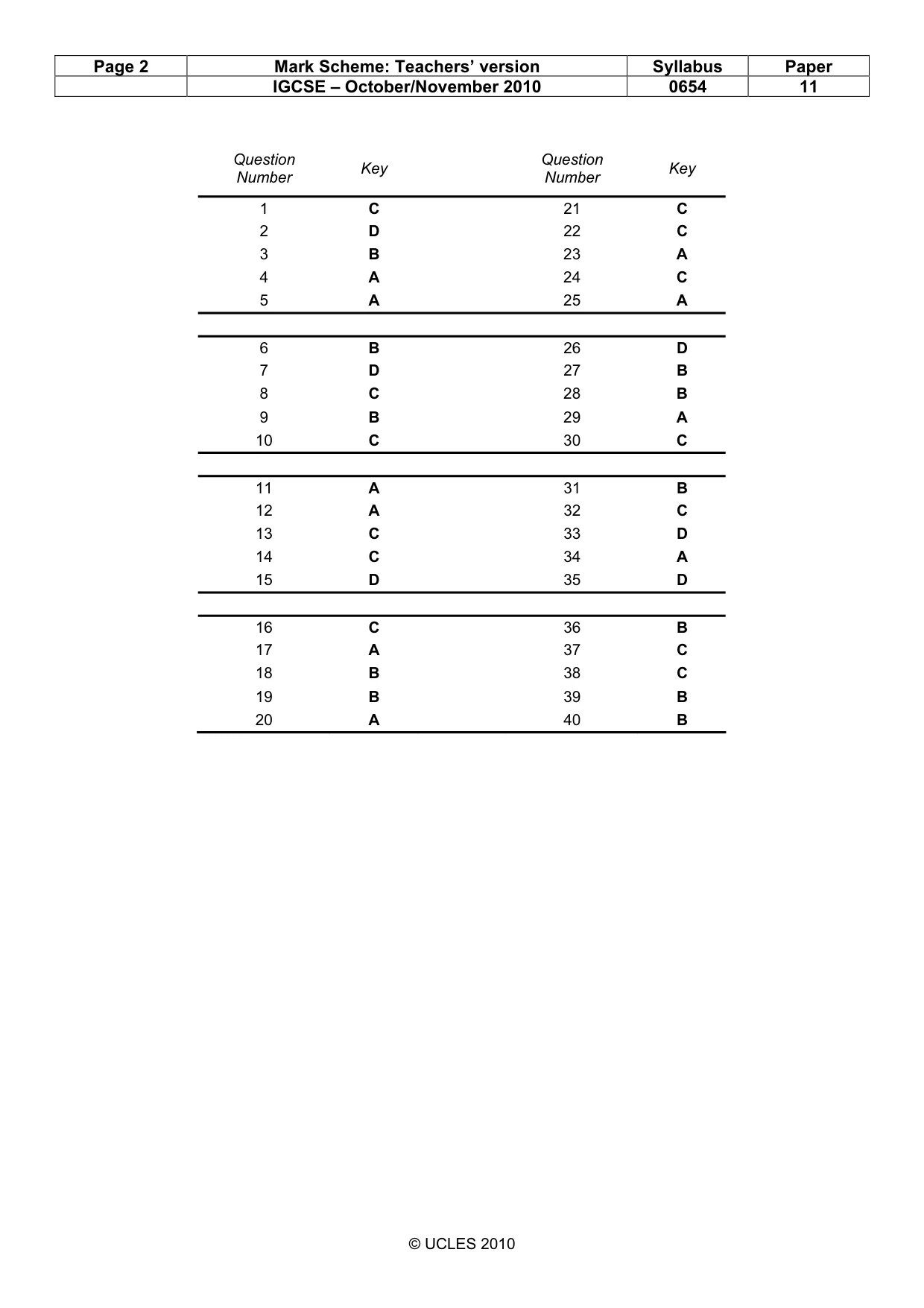
Answers below. Sit the paper first if you are practising.
Questions as text
Q1 · Which features are found in mammals but not in other vertebrates?
1 Which features are found in mammals but not in other vertebrates? A claws and hair B claws and lungs C hair and milk D lungs and milk
Mark scheme: C
Q2 · Which cells produce starch in their cytoplasm?
2 Which cells produce starch in their cytoplasm? A all animal cells B all plant cells C some animal cells D some plant cells
Mark scheme: D
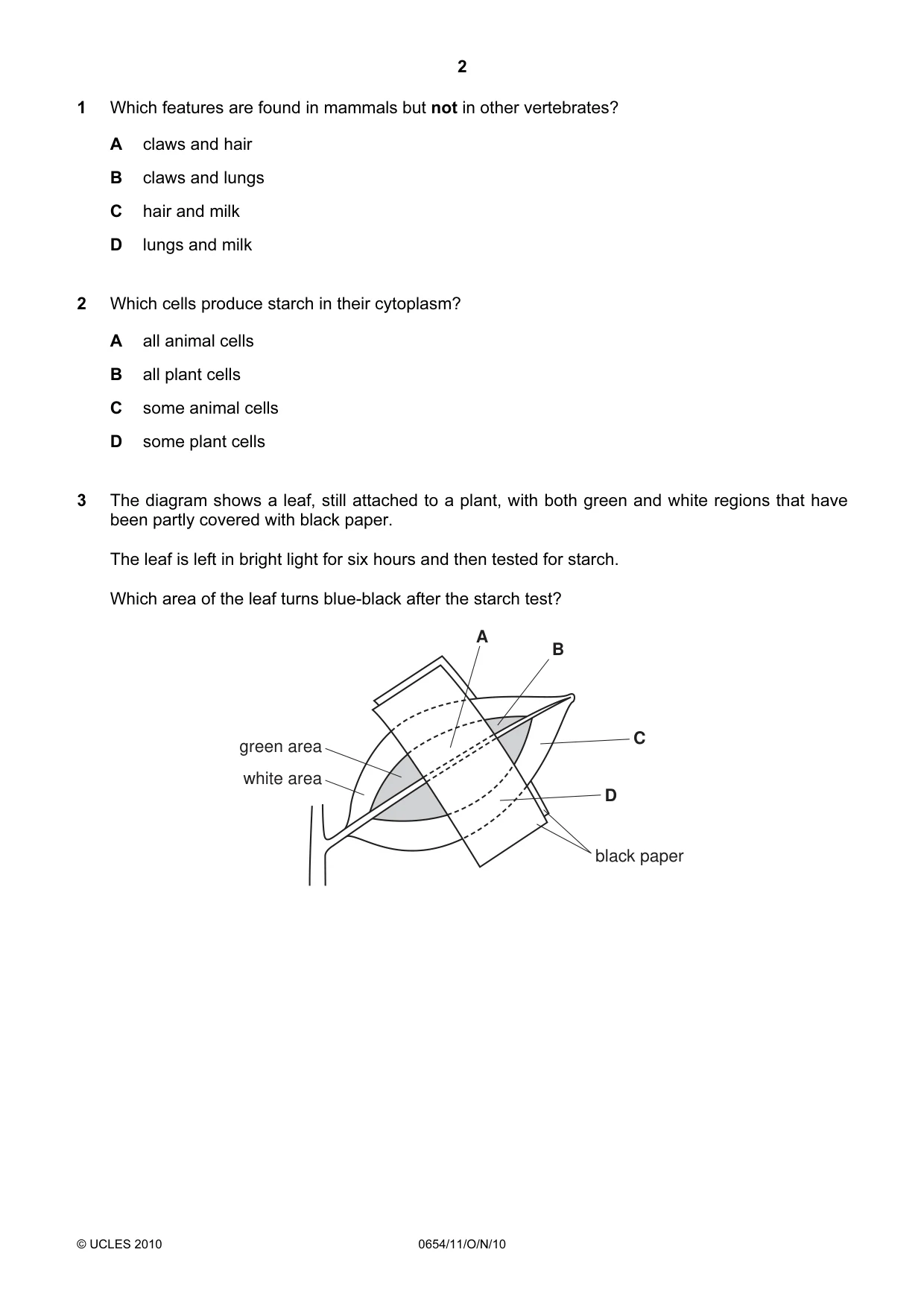
Q3 · The diagram shows a leaf, still attached to a plant, with both green and white regions…
3 The diagram shows a leaf, still attached to a plant, with both green and white regions that have been partly covered with black paper. The leaf is left in bright light for six hours and then tested for starch. Which area of the leaf turns blue-black after the starch test? A B C green area white area D black paper
Mark scheme: B
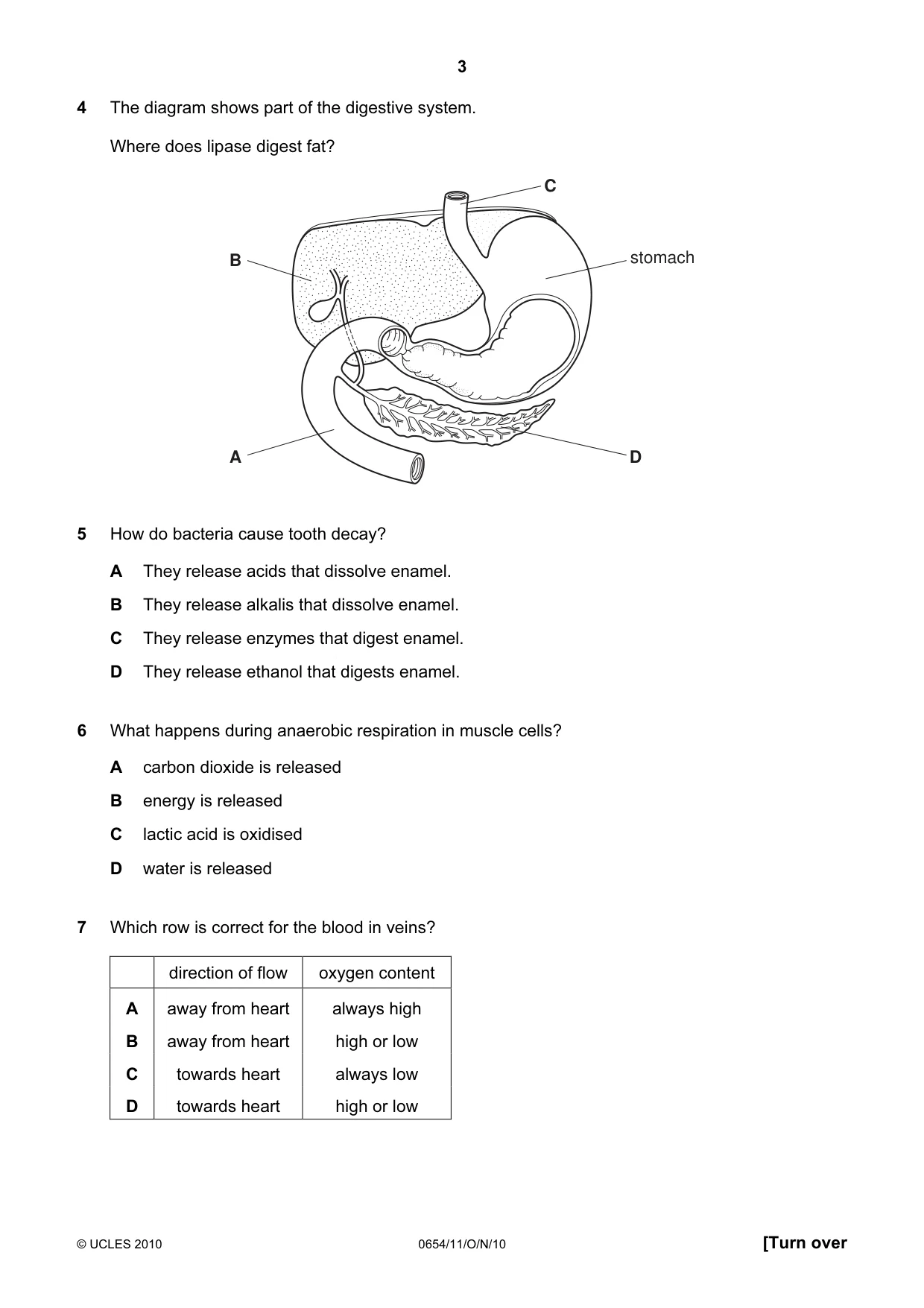
Q4 · The diagram shows part of the digestive system
4 The diagram shows part of the digestive system. Where does lipase digest fat? C B stomach A D
Mark scheme: A
Q5 · How do bacteria cause tooth decay?
5 How do bacteria cause tooth decay? A They release acids that dissolve enamel. B They release alkalis that dissolve enamel. C They release enzymes that digest enamel. D They release ethanol that digests enamel.
Mark scheme: A
Q6 · What happens during anaerobic respiration in muscle cells?
6 What happens during anaerobic respiration in muscle cells? A carbon dioxide is released B energy is released C lactic acid is oxidised D water is released
Mark scheme: B
Q7 · Which row is correct for the blood in veins?
7 Which row is correct for the blood in veins? direction of flow oxygen content A away from heart always high B away from heart high or low C towards heart always low D towards heart high or low
Mark scheme: D
Q8 · Which internal conditions in a human being are maintained at a more or less constant…
8 Which internal conditions in a human being are maintained at a more or less constant level as the result of homeostasis? blood glucose blood insulin body temperature v v v 0 0O WwW D> v v x v x v x v v
Mark scheme: C
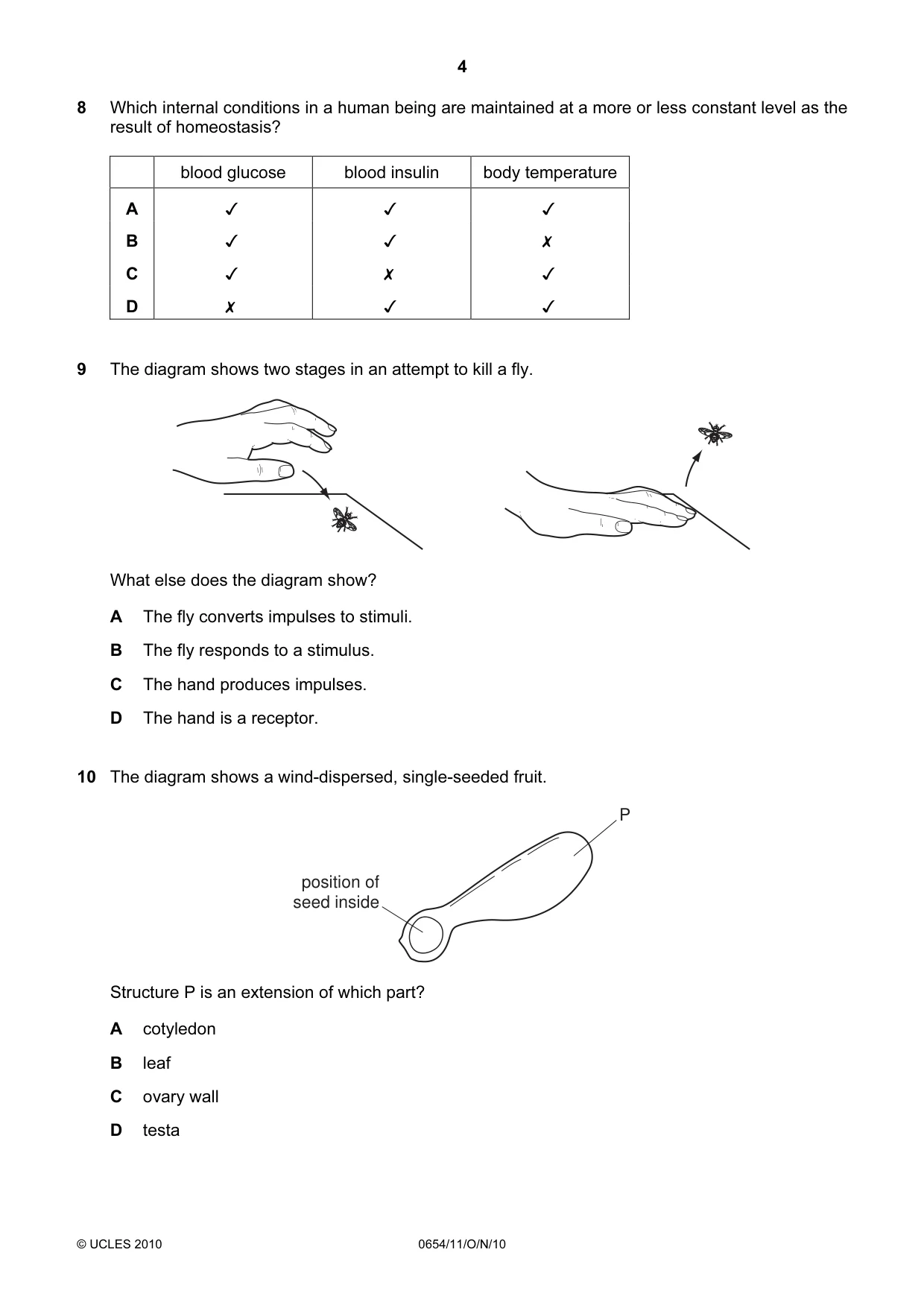
Q9 · The diagram shows two stages in an attempt to kill a fly
9 The diagram shows two stages in an attempt to kill a fly. What else does the diagram show? A The fly converts impulses to stimuli. B The fly responds to a stimulus. C The hand produces impulses. D The hand is a receptor.
Mark scheme: B
Q10 · The diagram shows a wind-dispersed, single-seeded fruit
10 The diagram shows a wind-dispersed, single-seeded fruit. P position of seed inside Structure P is an extension of which part? A cotyledon B leaf C ovary wall D testa
Mark scheme: C
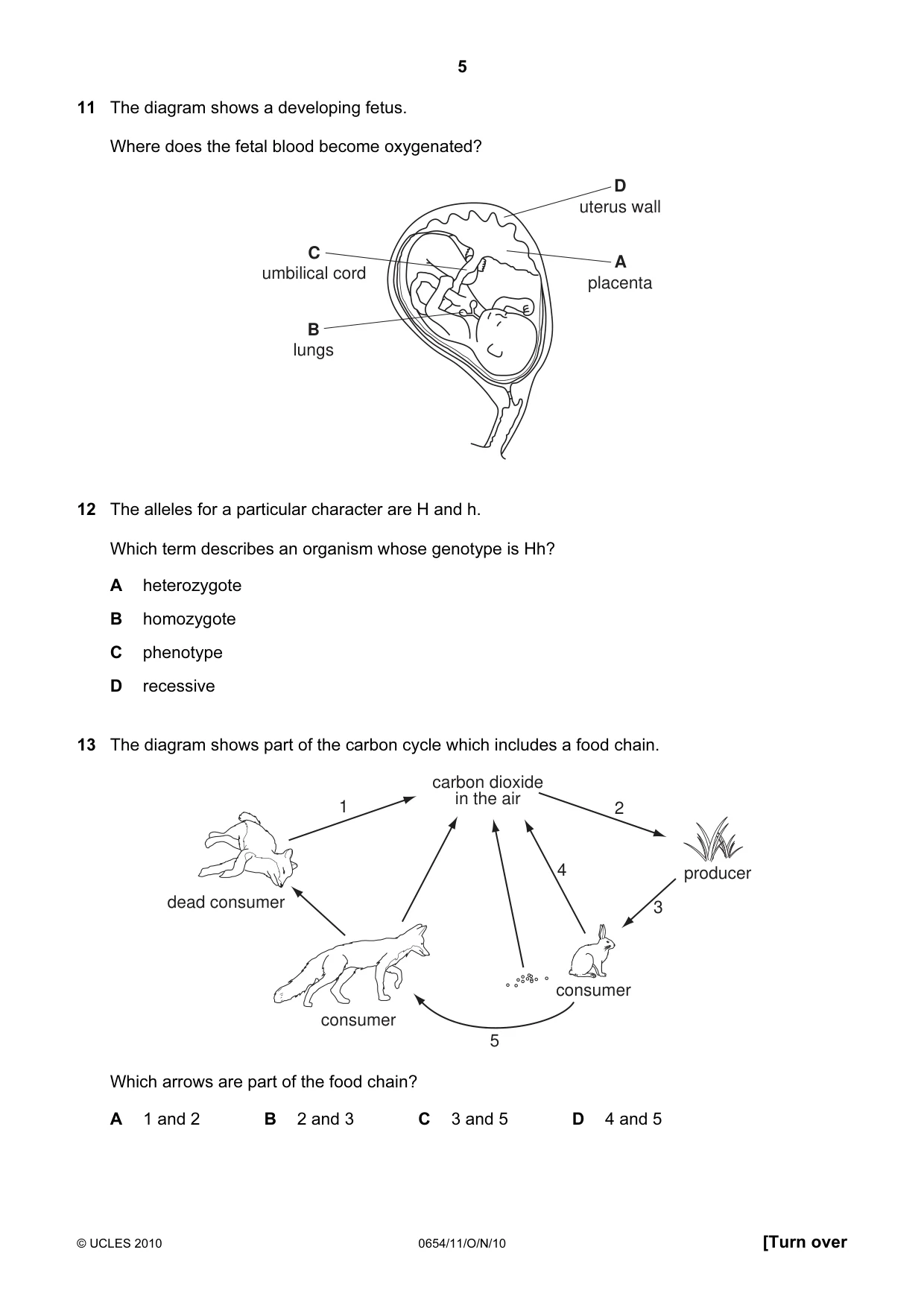
Q11 · The diagram shows a developing fetus
11 The diagram shows a developing fetus. Where does the fetal blood become oxygenated? D uterus wall C A umbilical cord placenta B lungs
Mark scheme: A
Q12 · The alleles for a particular character are H and h
12 The alleles for a particular character are H and h. Which term describes an organism whose genotype is Hh? A heterozygote B homozygote C phenotype D recessive
Mark scheme: A
Q13 · The diagram shows part of the carbon cycle which includes a food chain
13 The diagram shows part of the carbon cycle which includes a food chain. carbon dioxide in the air 1 2 4 producer dead consumer 3 consumer consumer 5 Which arrows are part of the food chain? A 1 and 2 B 2 and 3 C 3 and 5 D 4 and 5
Mark scheme: C
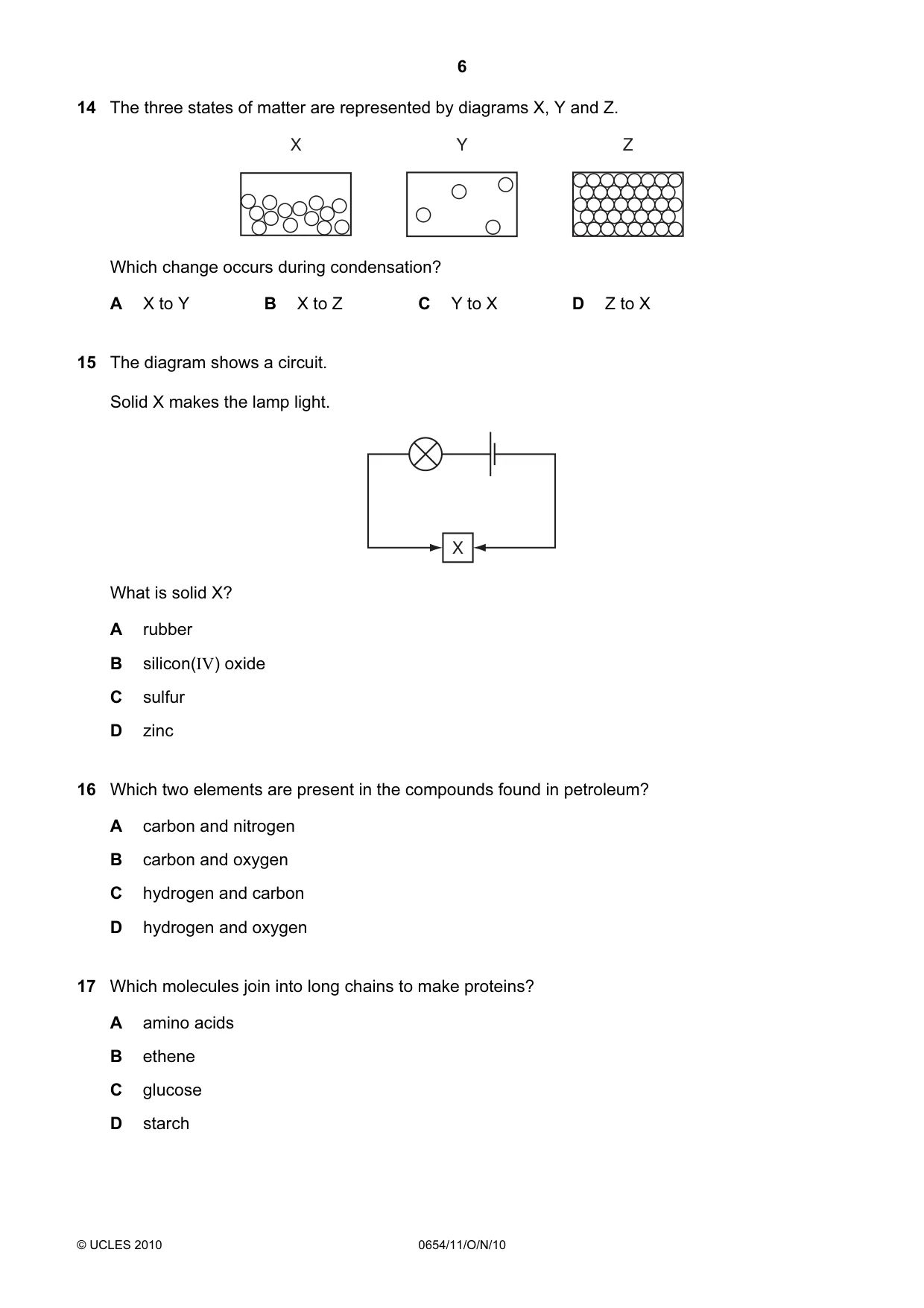
Q14 · The three states of matter are represented by diagrams X, Y and Z
14 The three states of matter are represented by diagrams X, Y and Z. X Y Z Which change occurs during condensation? A X to Y B X to Z C Y to X D Z to X
Mark scheme: C
Q15 · The diagram shows a circuit
15 The diagram shows a circuit. Solid X makes the lamp light. X What is solid X? A rubber B silicon(IV) oxide C sulfur D zinc
Mark scheme: D
Q16 · Which two elements are present in the compounds found in petroleum?
16 Which two elements are present in the compounds found in petroleum? A carbon and nitrogen B carbon and oxygen C hydrogen and carbon D hydrogen and oxygen
Mark scheme: C
Q17 · Which molecules join into long chains to make proteins?
17 Which molecules join into long chains to make proteins? A amino acids B ethene C glucose D starch
Mark scheme: A
Q18 · Which material is made from silicon(IV) oxide combined with metal oxides?
18 Which material is made from silicon(IV) oxide combined with metal oxides? A brass B glass C polythene D steel
Mark scheme: B
Q19 · Carbon is used in the extraction of some metals from their ores because 1 carbon forms…
19 Carbon is used in the extraction of some metals from their ores because 1 carbon forms strong alloys with metals, 2 carbon reacts with oxygen in the ore. Which of these statements are correct? A 1 only B 2 only C both 1 and 2 D neither 1 nor 2
Mark scheme: B
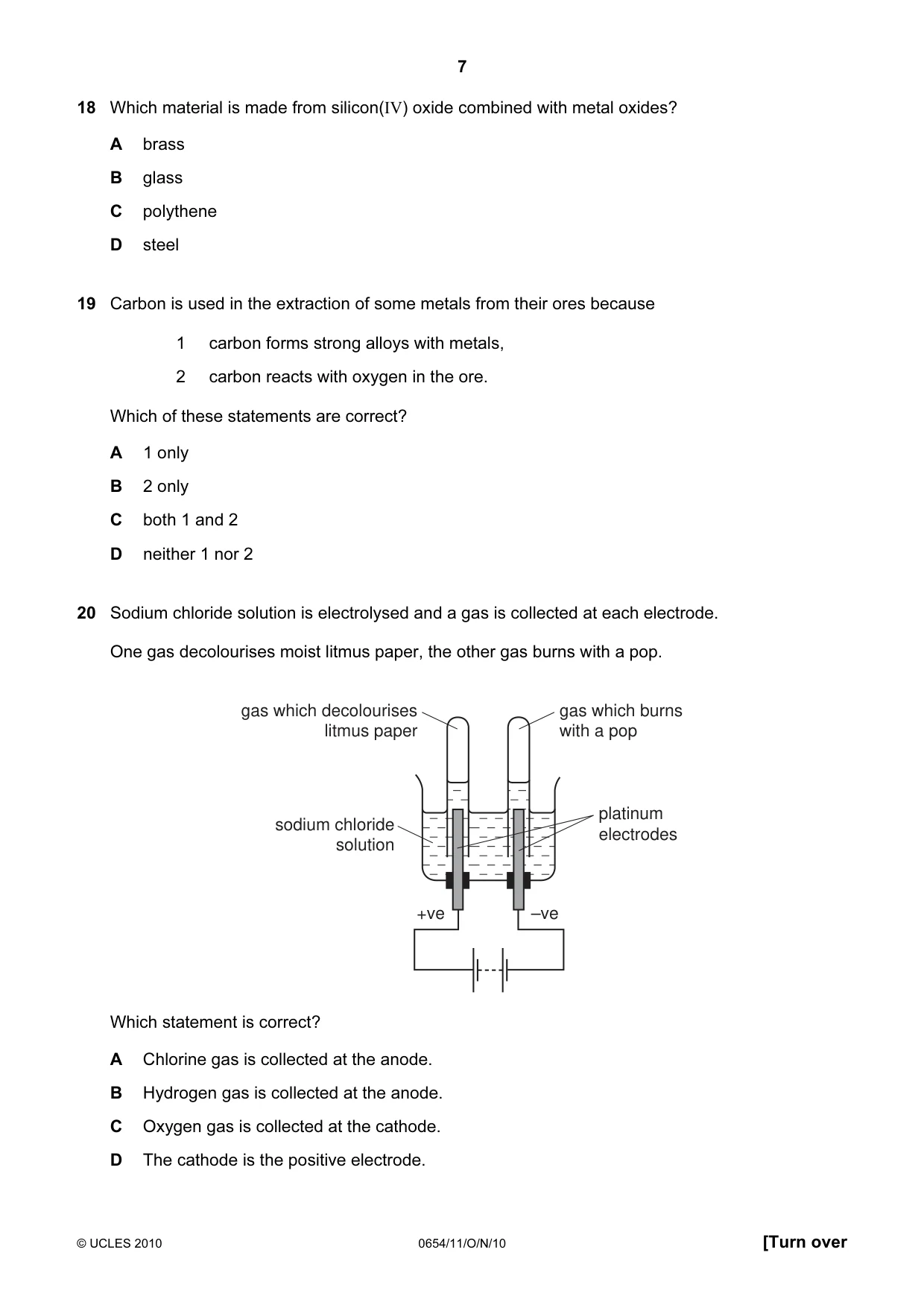
Q20 · Sodium chloride solution is electrolysed and a gas is collected at each electrode
20 Sodium chloride solution is electrolysed and a gas is collected at each electrode. One gas decolourises moist litmus paper, the other gas burns with a pop. gas which decolourises gas which burns litmus paper with a pop platinum sodium chloride electrodes solution +ve –ve Which statement is correct? A Chlorine gas is collected at the anode. B Hydrogen gas is collected at the anode. C Oxygen gas is collected at the cathode. D The cathode is the positive electrode.
Mark scheme: A
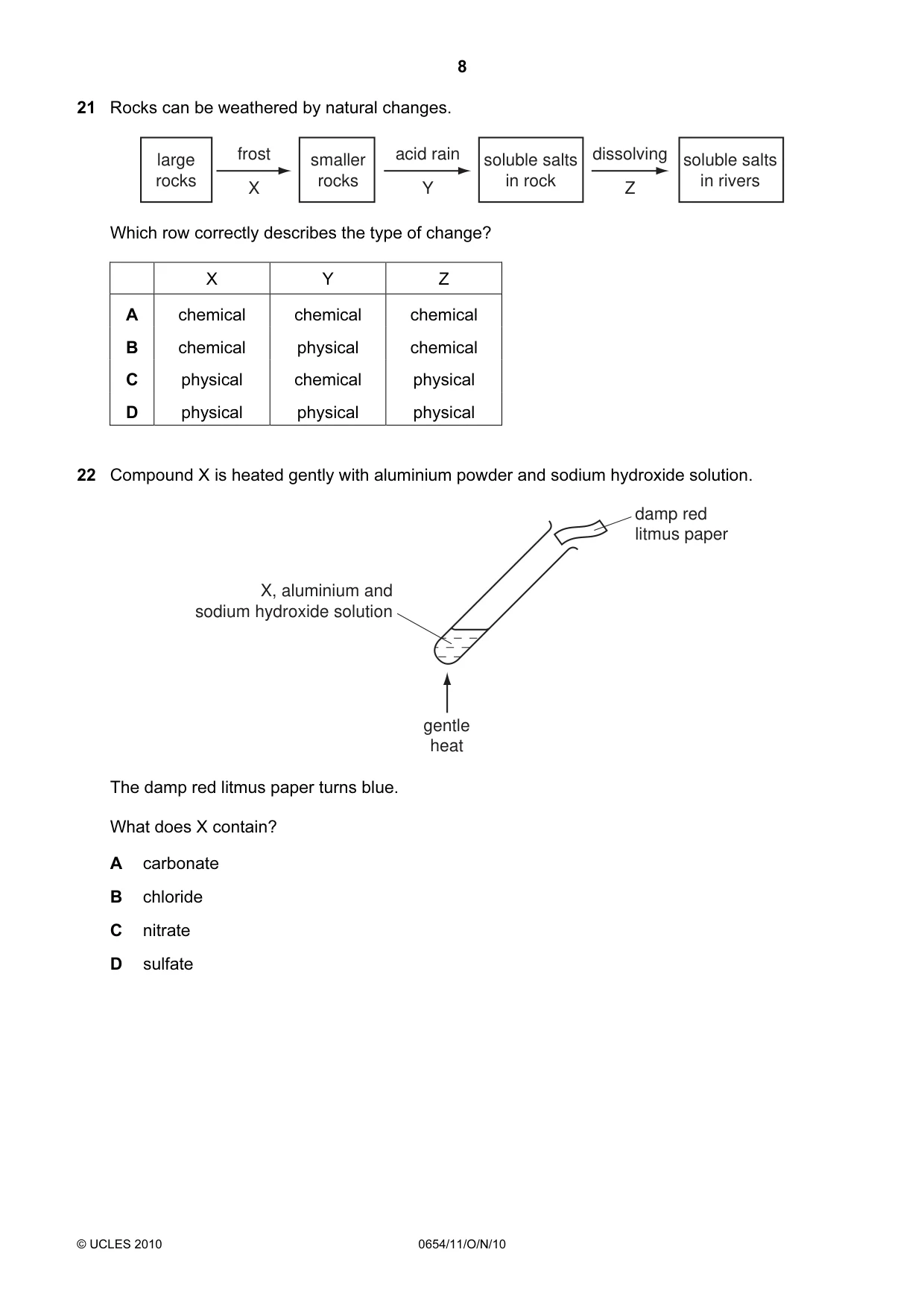
Q21 · Rocks can be weathered by natural changes
21 Rocks can be weathered by natural changes. large frost smaller acid rain soluble salts dissolving soluble salts rocks X rocks Y in rock Z in rivers Which row correctly describes the type of change? X Y Z A chemical chemical chemical B chemical physical chemical C physical chemical physical D physical physical physical
Mark scheme: C
Q22 · Compound X is heated gently with aluminium powder and sodium hydroxide solution
22 Compound X is heated gently with aluminium powder and sodium hydroxide solution. damp red litmus paper X, aluminium and sodium hydroxide solution gentle heat The damp red litmus paper turns blue. What does X contain? A carbonate B chloride C nitrate D sulfate
Mark scheme: C
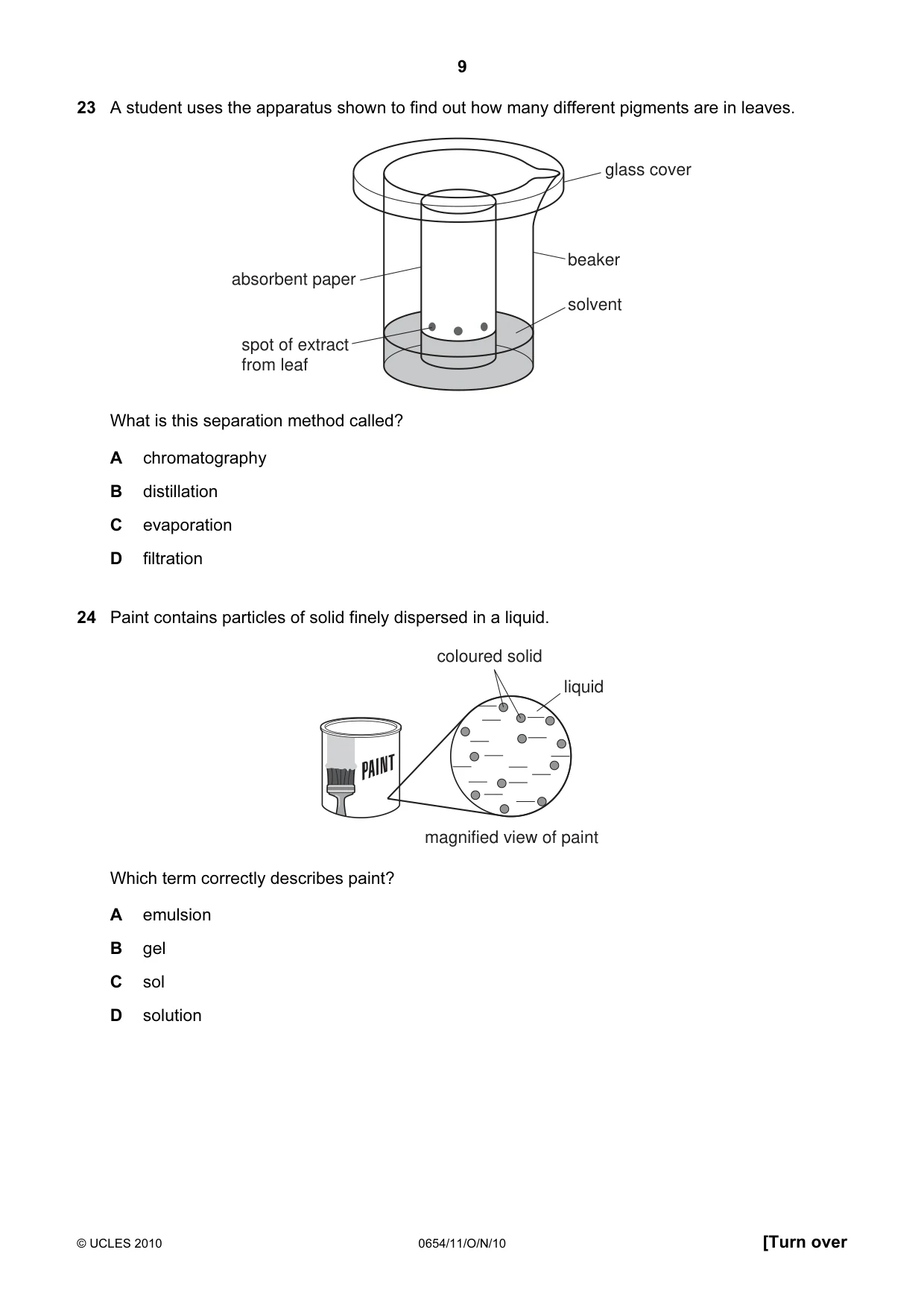
Q23 · A student uses the apparatus shown to find out how many different pigments are in leaves
23 A student uses the apparatus shown to find out how many different pigments are in leaves. glass cover beaker absorbent paper solvent spot of extract from leaf What is this separation method called? A chromatography B distillation C evaporation D filtration
Mark scheme: A
Q24 · Paint contains particles of solid finely dispersed in a liquid
24 Paint contains particles of solid finely dispersed in a liquid. coloured solid liquid magnified view of paint Which term correctly describes paint? A emulsion B gel C sol D solution
Mark scheme: C
Q25 · Waste material buried underground can decay to form gas X which can be used as a fuel
25 Waste material buried underground can decay to form gas X which can be used as a fuel. X burns to form an oxide Y and water. X + oxygen → Y + water What is Y? A carbon dioxide B nitrogen dioxide C sulfur dioxide D sulfur trioxide
Mark scheme: A
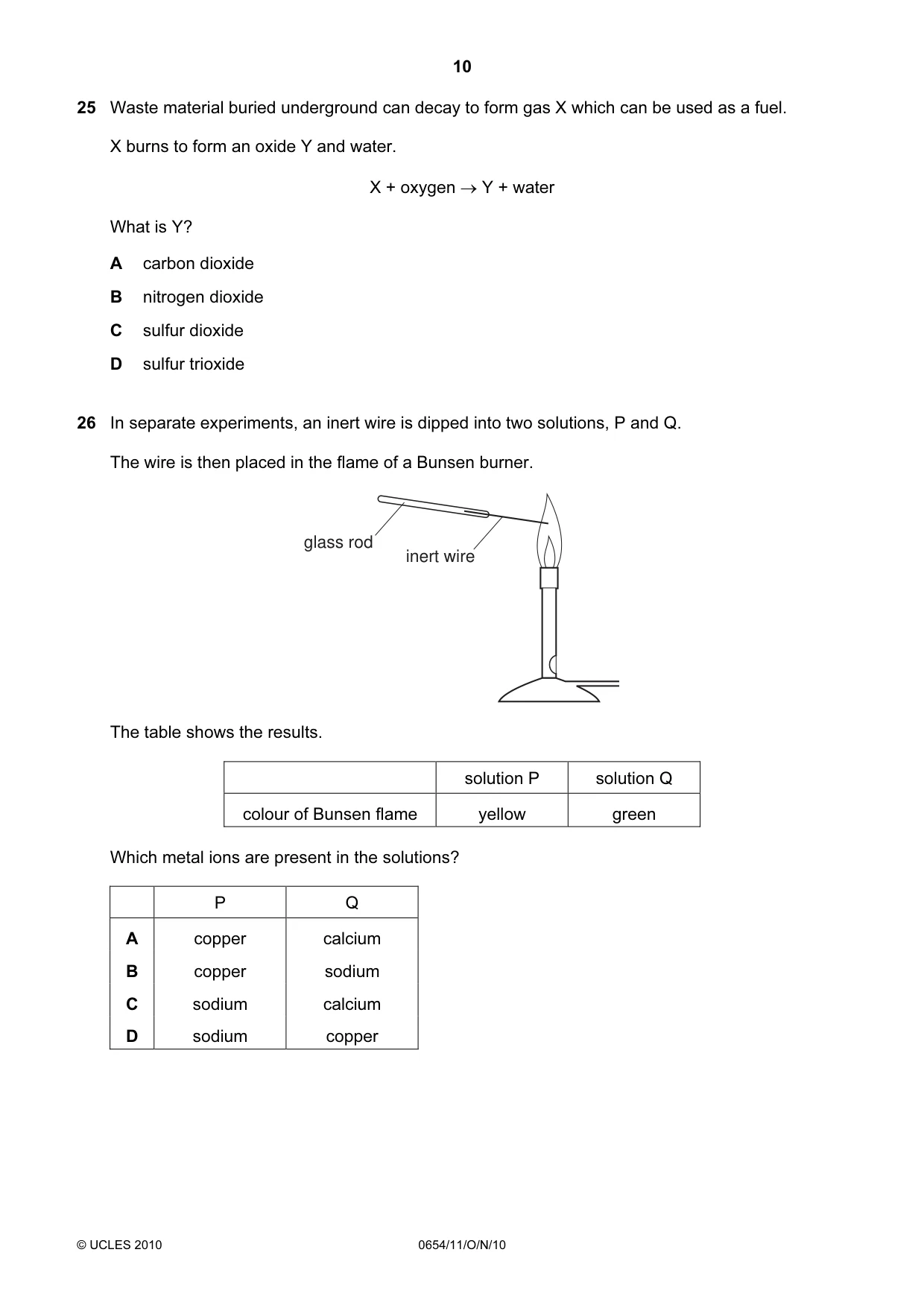
Q26 · In separate experiments, an inert wire is dipped into two solutions, P and Q
26 In separate experiments, an inert wire is dipped into two solutions, P and Q. The wire is then placed in the flame of a Bunsen burner. glass rod inert wire The table shows the results. solution P solution Q colour of Bunsen flame yellow green Which metal ions are present in the solutions? P Q A copper calcium B copper sodium C sodium calcium D sodium copper
Mark scheme: D
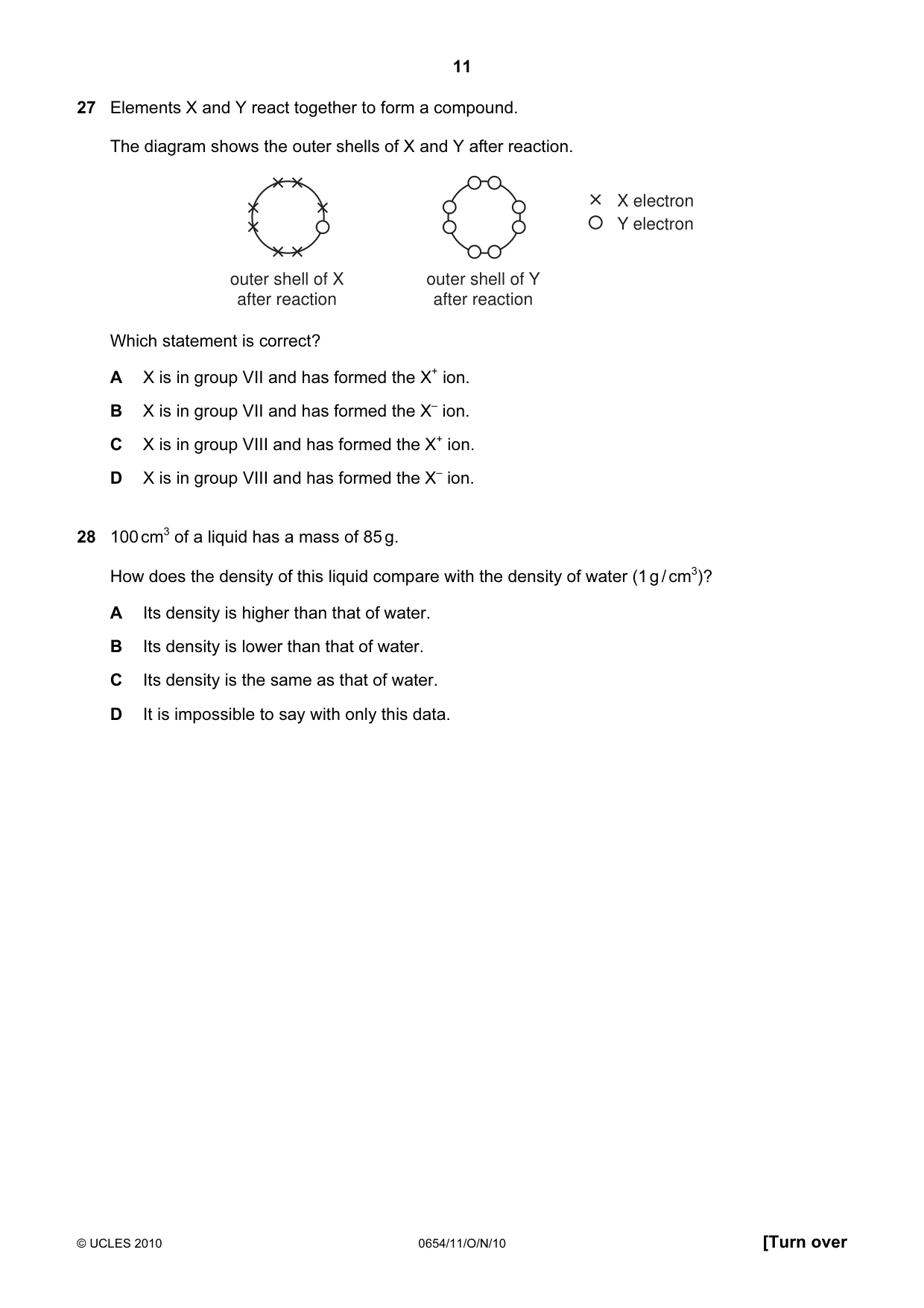
Q27 · Elements X and Y react together to form a compound
27 Elements X and Y react together to form a compound. The diagram shows the outer shells of X and Y after reaction. X electron Y electron outer shell of X outer shell of Y after reaction after reaction Which statement is correct? A X is in group VII and has formed the X+ ion. B X is in group VII and has formed the X– ion. C X is in group VIII and has formed the X+ ion. D X is in group VIII and has formed the X– ion.
Mark scheme: B
Q28 · 100 cm3 of a liquid has a mass of 85 g
28 100 cm3 of a liquid has a mass of 85 g. How does the density of this liquid compare with the density of water (1 g / cm3)? A Its density is higher than that of water. B Its density is lower than that of water. C Its density is the same as that of water. D It is impossible to say with only this data.
Mark scheme: B
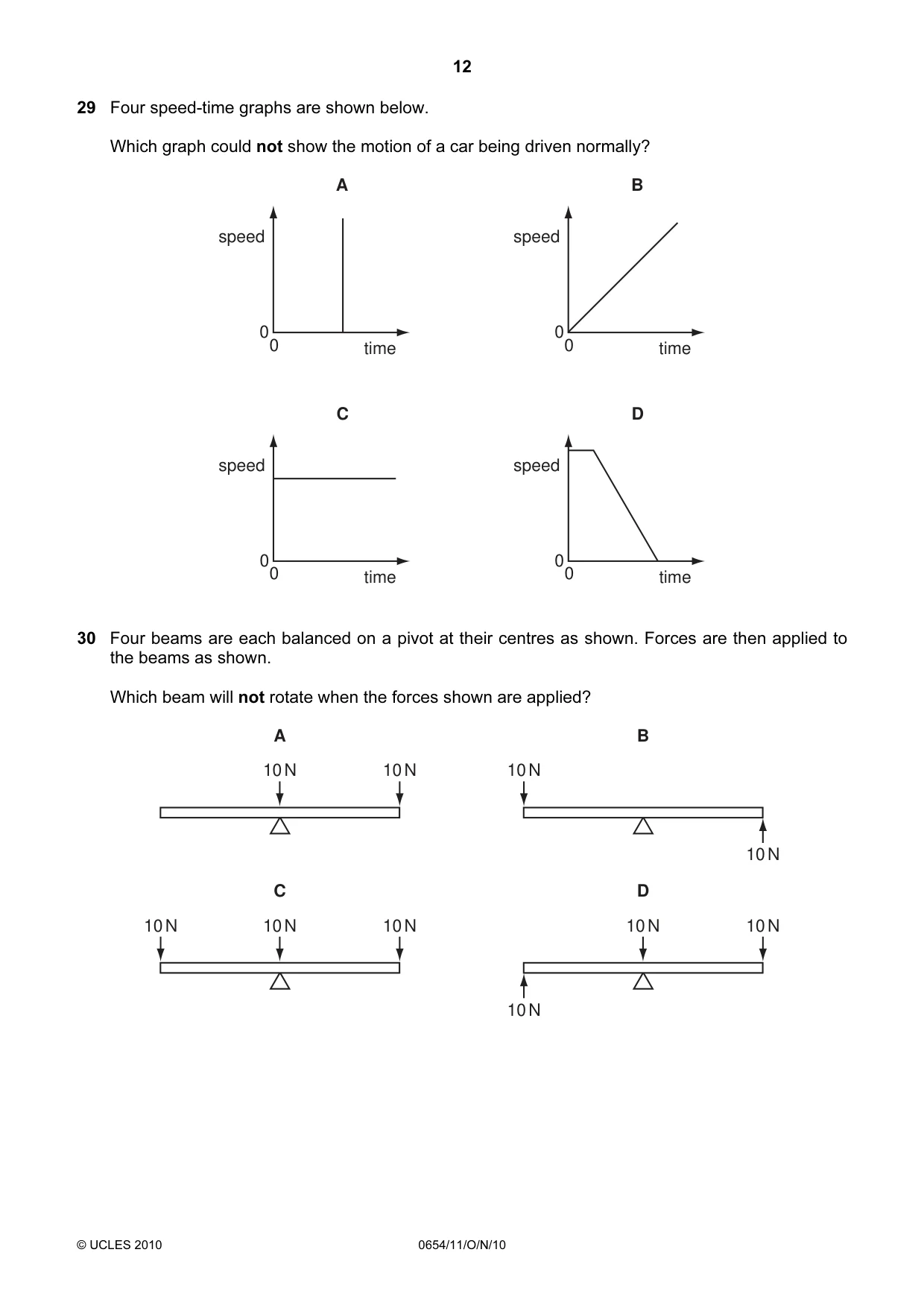
Q29 · Four speed-time graphs are shown below
29 Four speed-time graphs are shown below. Which graph could not show the motion of a car being driven normally? A B speed speed 00 00 time time C D speed speed 00 00 time time
Mark scheme: A
Q30 · Four beams are each balanced on a pivot at their centres as shown
30 Four beams are each balanced on a pivot at their centres as shown. Forces are then applied to the beams as shown. Which beam will not rotate when the forces shown are applied? A B 10 N 10 N 10 N 10 N C D 10 N 10 N 10 N 10 N 10 N 10 N
Mark scheme: C
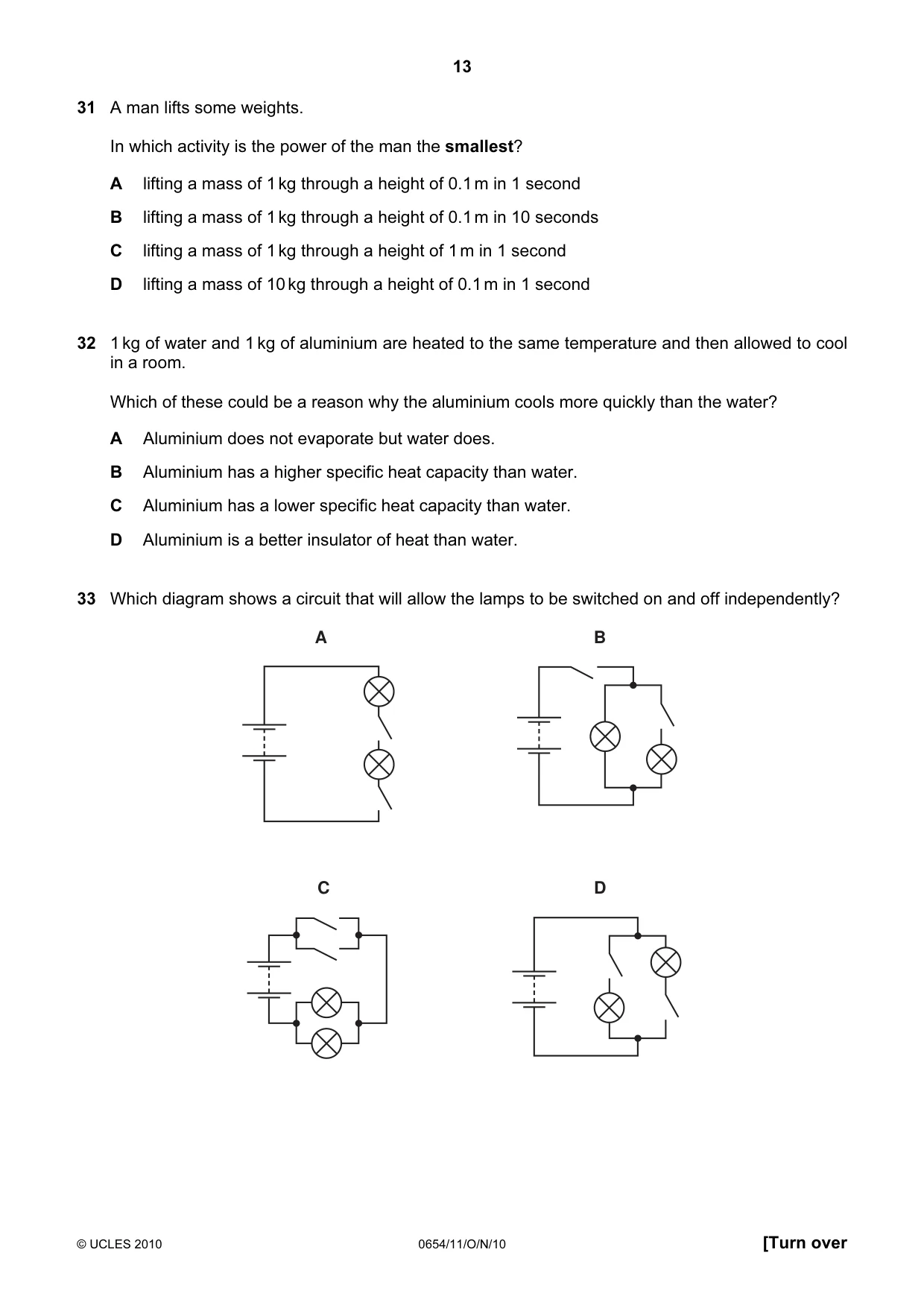
Q31 · A man lifts some weights
31 A man lifts some weights. In which activity is the power of the man the smallest? A lifting a mass of 1 kg through a height of 0.1 m in 1 second B lifting a mass of 1 kg through a height of 0.1 m in 10 seconds C lifting a mass of 1 kg through a height of 1 m in 1 second D lifting a mass of 10 kg through a height of 0.1 m in 1 second
Mark scheme: B
Q32 · 1 kg of water and 1 kg of aluminium are heated to the same temperature and then allowed…
32 1 kg of water and 1 kg of aluminium are heated to the same temperature and then allowed to cool in a room. Which of these could be a reason why the aluminium cools more quickly than the water? A Aluminium does not evaporate but water does. B Aluminium has a higher specific heat capacity than water. C Aluminium has a lower specific heat capacity than water. D Aluminium is a better insulator of heat than water.
Mark scheme: C
Q33 · Which diagram shows a circuit that will allow the lamps to be switched on and off…
33 Which diagram shows a circuit that will allow the lamps to be switched on and off independently? A B C D
Mark scheme: D
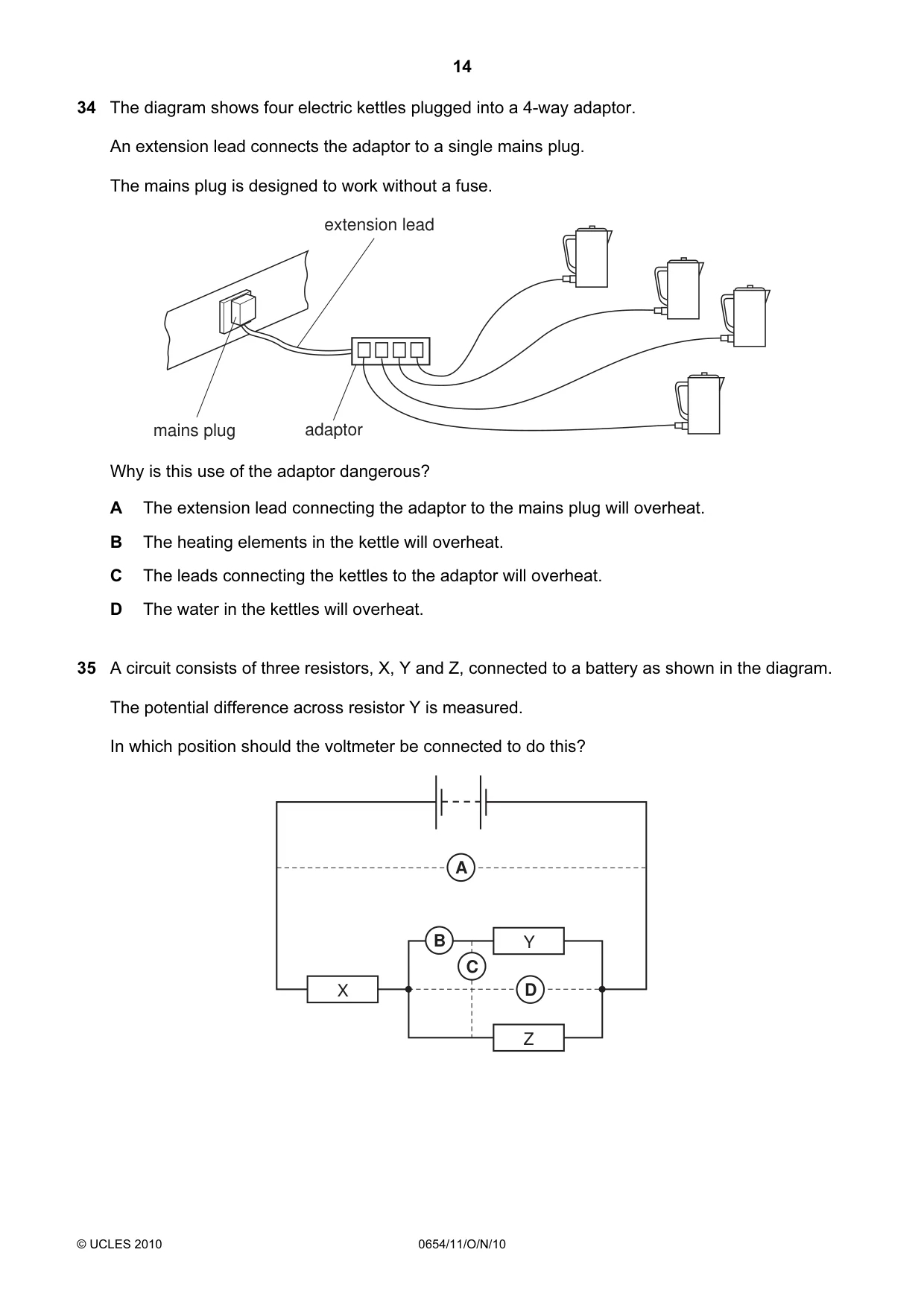
Q34 · The diagram shows four electric kettles plugged into a 4-way adaptor
34 The diagram shows four electric kettles plugged into a 4-way adaptor. An extension lead connects the adaptor to a single mains plug. The mains plug is designed to work without a fuse. extension lead mains plug adaptor Why is this use of the adaptor dangerous? A The extension lead connecting the adaptor to the mains plug will overheat. B The heating elements in the kettle will overheat. C The leads connecting the kettles to the adaptor will overheat. D The water in the kettles will overheat.
Mark scheme: A
Q35 · A circuit consists of three resistors, X, Y and Z, connected to a battery as shown in the…
35 A circuit consists of three resistors, X, Y and Z, connected to a battery as shown in the diagram. The potential difference across resistor Y is measured. In which position should the voltmeter be connected to do this? A B Y C X D Z
Mark scheme: D
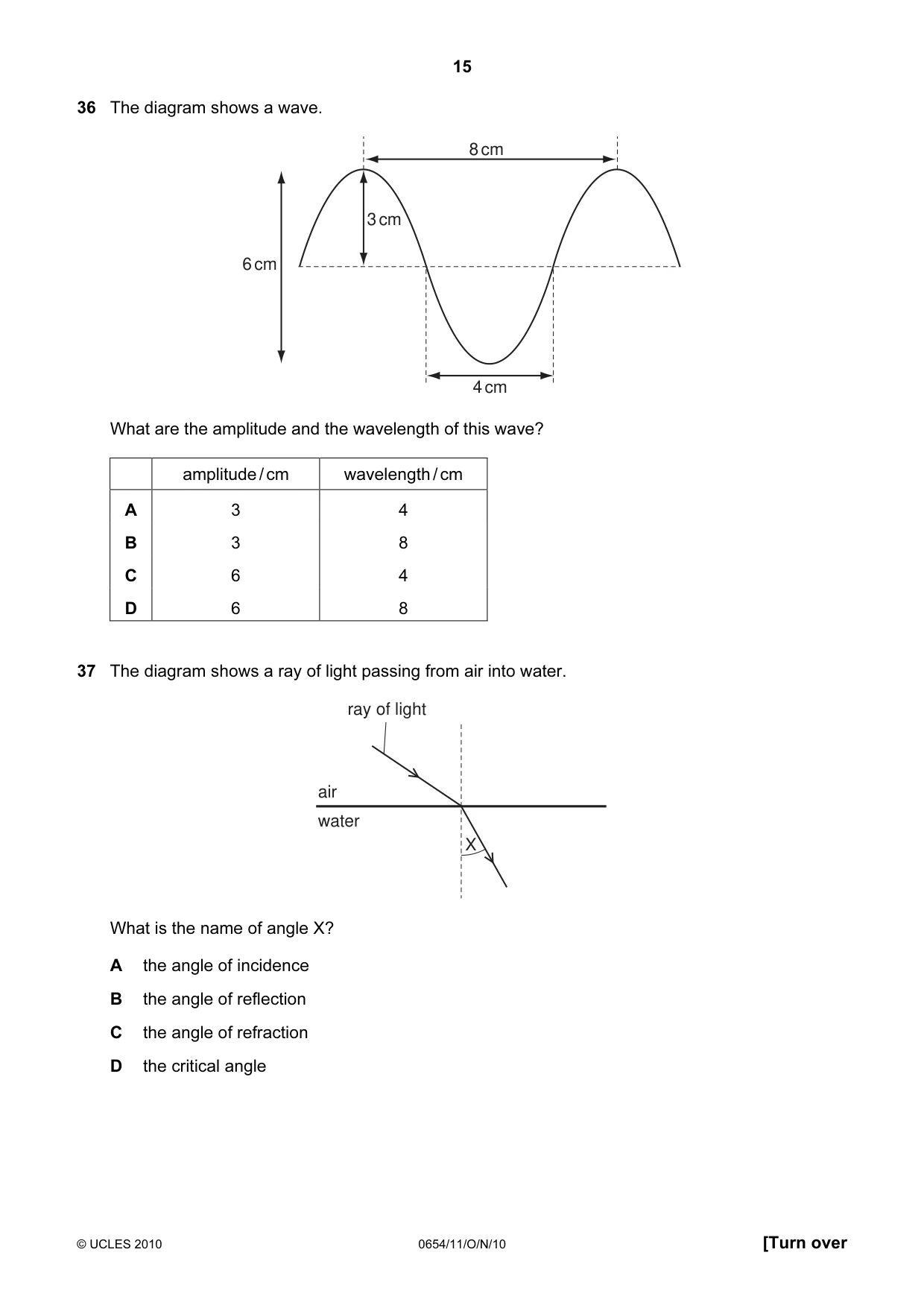
Q36 · The diagram shows a wave
36 The diagram shows a wave. 8 cm 3 cm 6 cm 4 cm What are the amplitude and the wavelength of this wave? amplitude / cm wavelength / cm A 3 4 B 3 8 C 6 4 D 6 8
Mark scheme: B
Q37 · The diagram shows a ray of light passing from air into water
37 The diagram shows a ray of light passing from air into water. ray of light air water X What is the name of angle X? A the angle of incidence B the angle of reflection C the angle of refraction D the critical angle
Mark scheme: C
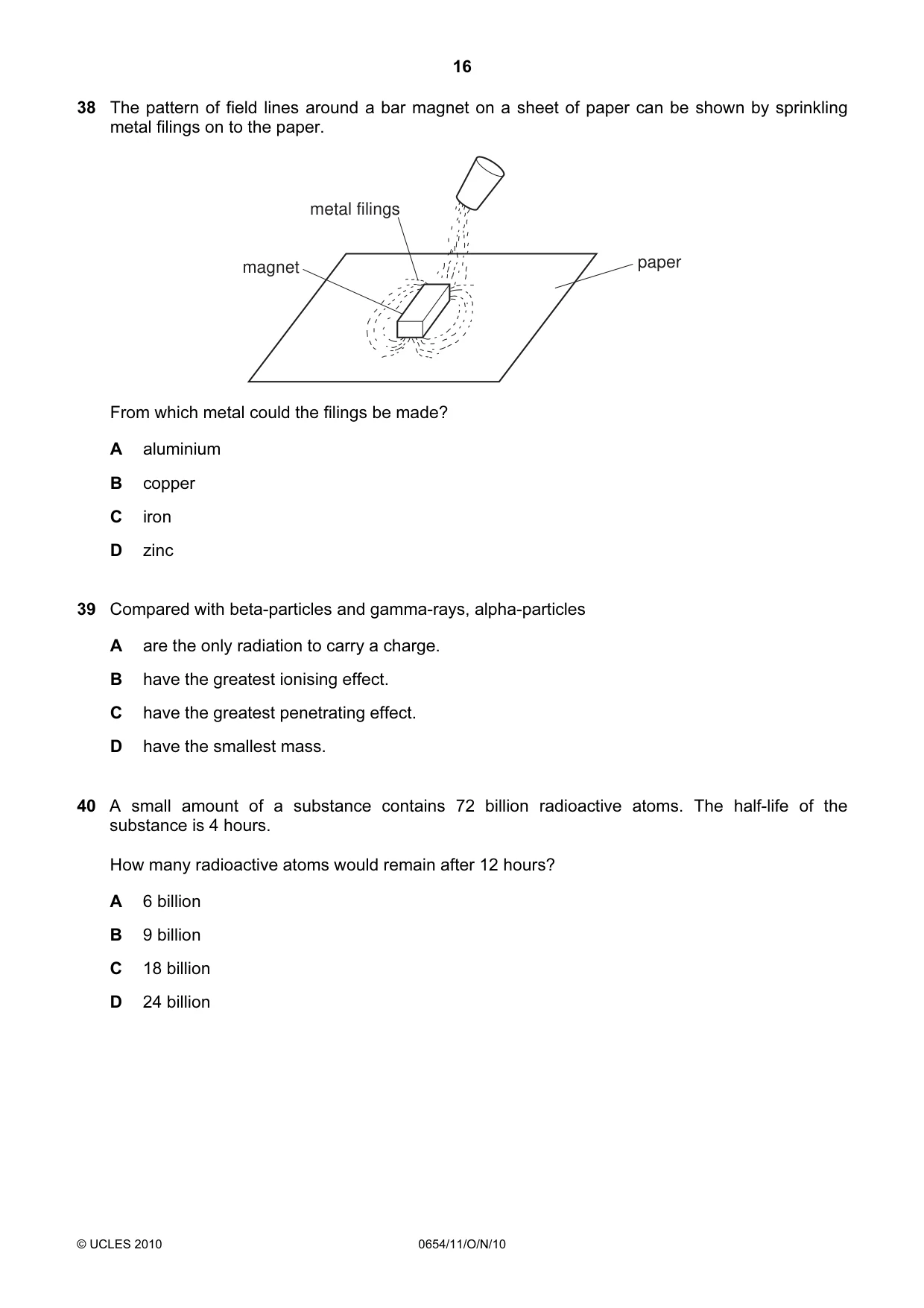
Q38 · The pattern of field lines around a bar magnet on a sheet of paper can be shown by…
38 The pattern of field lines around a bar magnet on a sheet of paper can be shown by sprinkling metal filings on to the paper. metal filings magnet paper From which metal could the filings be made? A aluminium B copper C iron D zinc
Mark scheme: C
Q39 · Compared with beta-particles and gamma-rays, alpha-particles A are the only radiation to…
39 Compared with beta-particles and gamma-rays, alpha-particles A are the only radiation to carry a charge. B have the greatest ionising effect. C have the greatest penetrating effect. D have the smallest mass.
Mark scheme: B
Q40 · A small amount of a substance contains 72 billion radioactive atoms
40 A small amount of a substance contains 72 billion radioactive atoms. The half-life of the substance is 4 hours. How many radioactive atoms would remain after 12 hours? A 6 billion B 9 billion C 18 billion D 24 billion
Mark scheme: B
What was in this paper
The subtopics covered by these 40 questions, and how many questions each got. Open one in a new tab to see every Cambridge question on it.
2Identification of ions and gases2Radioactivity2Air quality and climate1Blood vessels1Cell structure1Characteristics of living organisms1Chromatography1Coordination and response1Density1Digestion1Diseases and immunity1Electrical safety1Electrolysis1Elements, compounds and mixtures1Energy, work and power1Extraction of metals1Food chains and food webs1Forces1Fuels1General properties of waves1Giant covalent structures1Homeostasis1Ions and ionic bonds1Light1Monohybrid inheritance1Motion1Photosynthesis1Physical and chemical changes1Polymers1Respiration1Sexual reproduction in humans1Sexual reproduction in plants1Simple molecules and covalent bonds1Simple phenomena of magnetism1Solids, liquids and gases1Thermal properties and temperature1What you needed in this session
Cambridge’s own grade thresholds for 2010 Oct/Nov, Paper 1 · Variant 1. A higher threshold means an easier paper — the bar moves with how the cohort did.