Cambridge IGCSE Sciences - Co-ordinated (Double) 0654 — 2016 Oct/Nov Paper 1 · Variant 2
0654/12/O/N/16 · 40 questions · 40 marks · ≈45 min
The question paper and its mark scheme, free to read here and free to download. This is Cambridge’s own paper, exactly as it was sat.
Question paper20 pages


Mark scheme2 pages
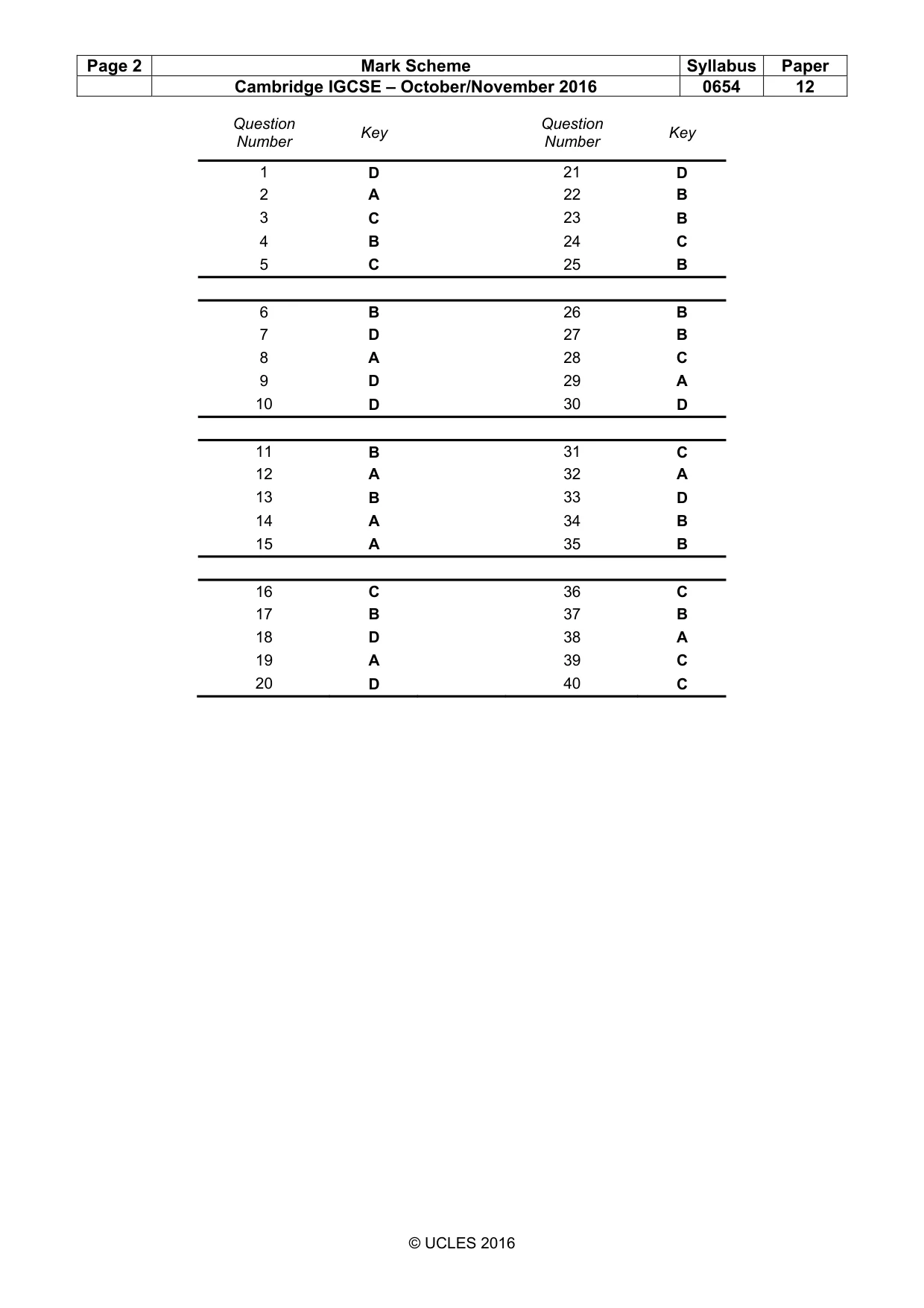
Answers below. Sit the paper first if you are practising.
Questions as text
Question 1
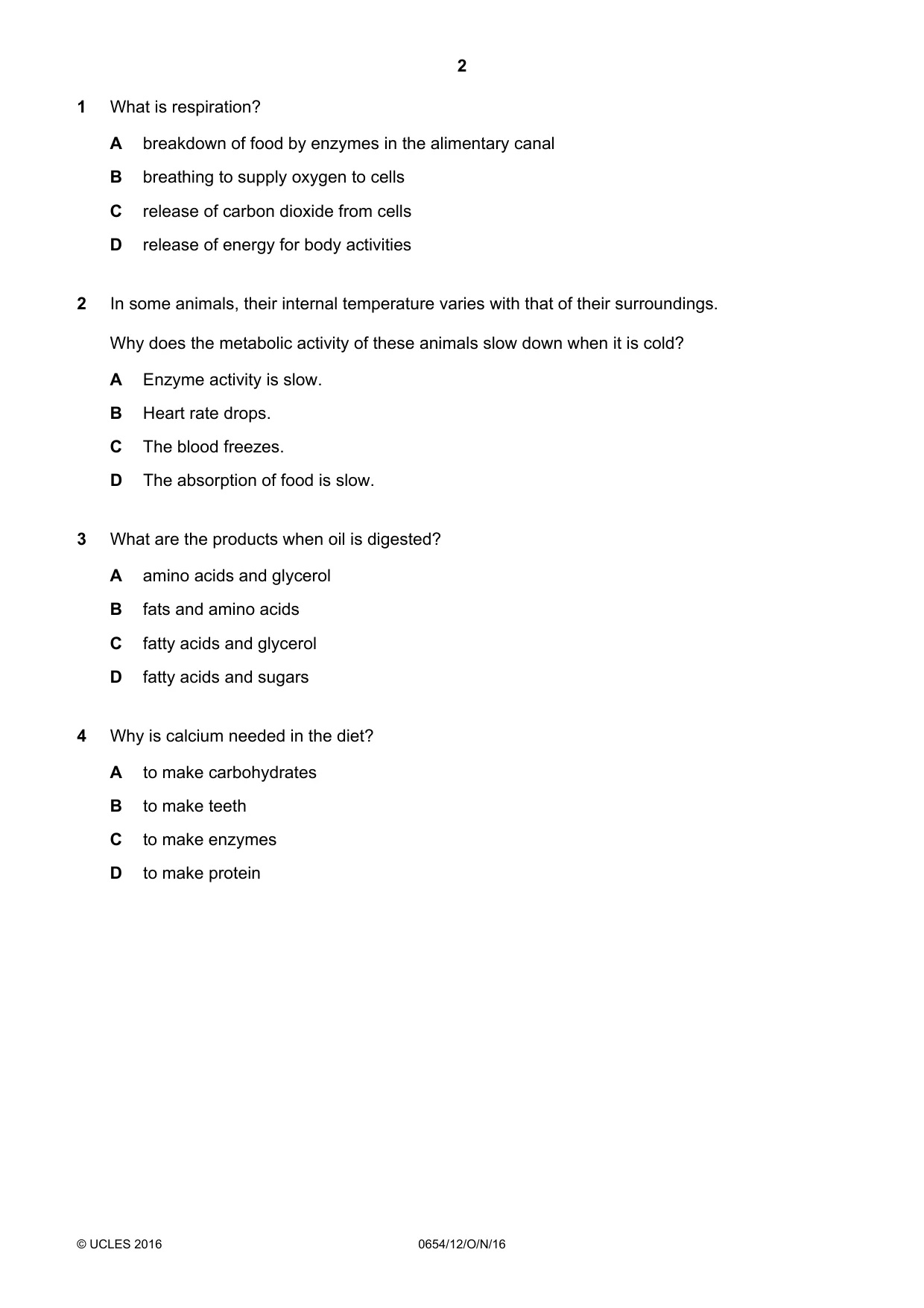
1 What is respiration? A breakdown of food by enzymes in the alimentary canal B breathing to supply oxygen to cells C release of carbon dioxide from cells D release of energy for body activities
Mark scheme: D
Q2 · In some animals, their internal temperature varies with that of their surroundings
2 In some animals, their internal temperature varies with that of their surroundings. Why does the metabolic activity of these animals slow down when it is cold? A Enzyme activity is slow. B Heart rate drops. C The blood freezes. D The absorption of food is slow.
Mark scheme: A
Q3 · What are the products when oil is digested?
3 What are the products when oil is digested? A amino acids and glycerol B fats and amino acids C fatty acids and glycerol D fatty acids and sugars
Mark scheme: C
Q4 · Why is calcium needed in the diet?
4 Why is calcium needed in the diet? A to make carbohydrates B to make teeth C to make enzymes D to make protein
Mark scheme: B
Q5 · Four leaves of similar size are taken from the same tree and weighed
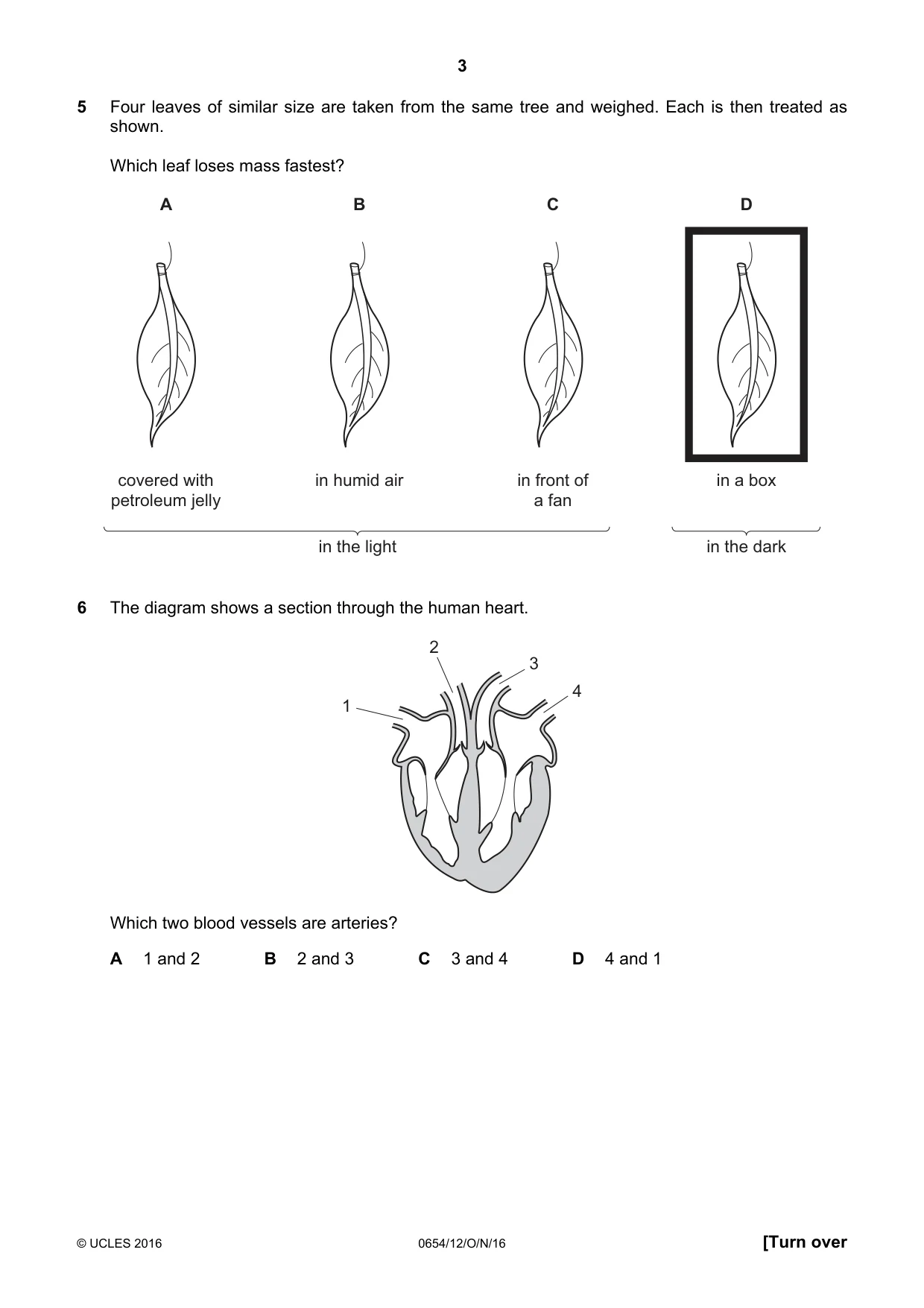
5 Four leaves of similar size are taken from the same tree and weighed. Each is then treated as shown. Which leaf loses mass fastest? A B C D covered with in humid air in front of in a box petroleum jelly a fan in the light in the dark
Mark scheme: C
Q6 · The diagram shows a section through the human heart
6 The diagram shows a section through the human heart. 2 3 4 1 Which two blood vessels are arteries? A 1 and 2 B 2 and 3 C 3 and 4 D 4 and 1
Mark scheme: B
Q7 · Two flasks are set up as shown
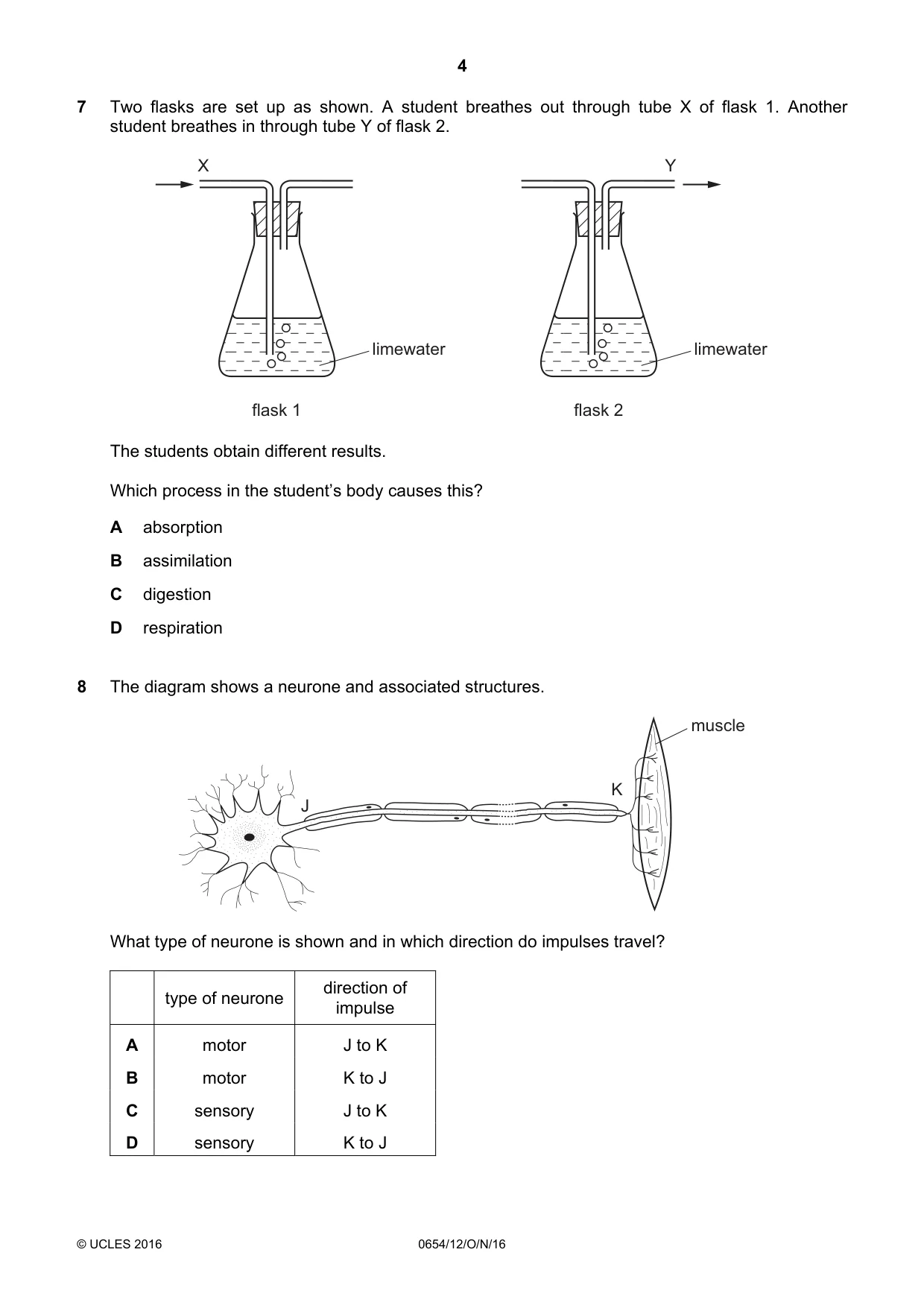
7 Two flasks are set up as shown. A student breathes out through tube X of flask 1. Another student breathes in through tube Y of flask 2. X Y limewater limewater flask 1 flask 2 The students obtain different results. Which process in the student’s body causes this? A absorption B assimilation C digestion D respiration
Mark scheme: D
Q8 · The diagram shows a neurone and associated structures
8 The diagram shows a neurone and associated structures. muscle K J What type of neurone is shown and in which direction do impulses travel? direction of type of neurone impulse A motor J to K B motor K to J C sensory J to K D sensory K to J
Mark scheme: A
Q9 · What are the effects of adrenaline?
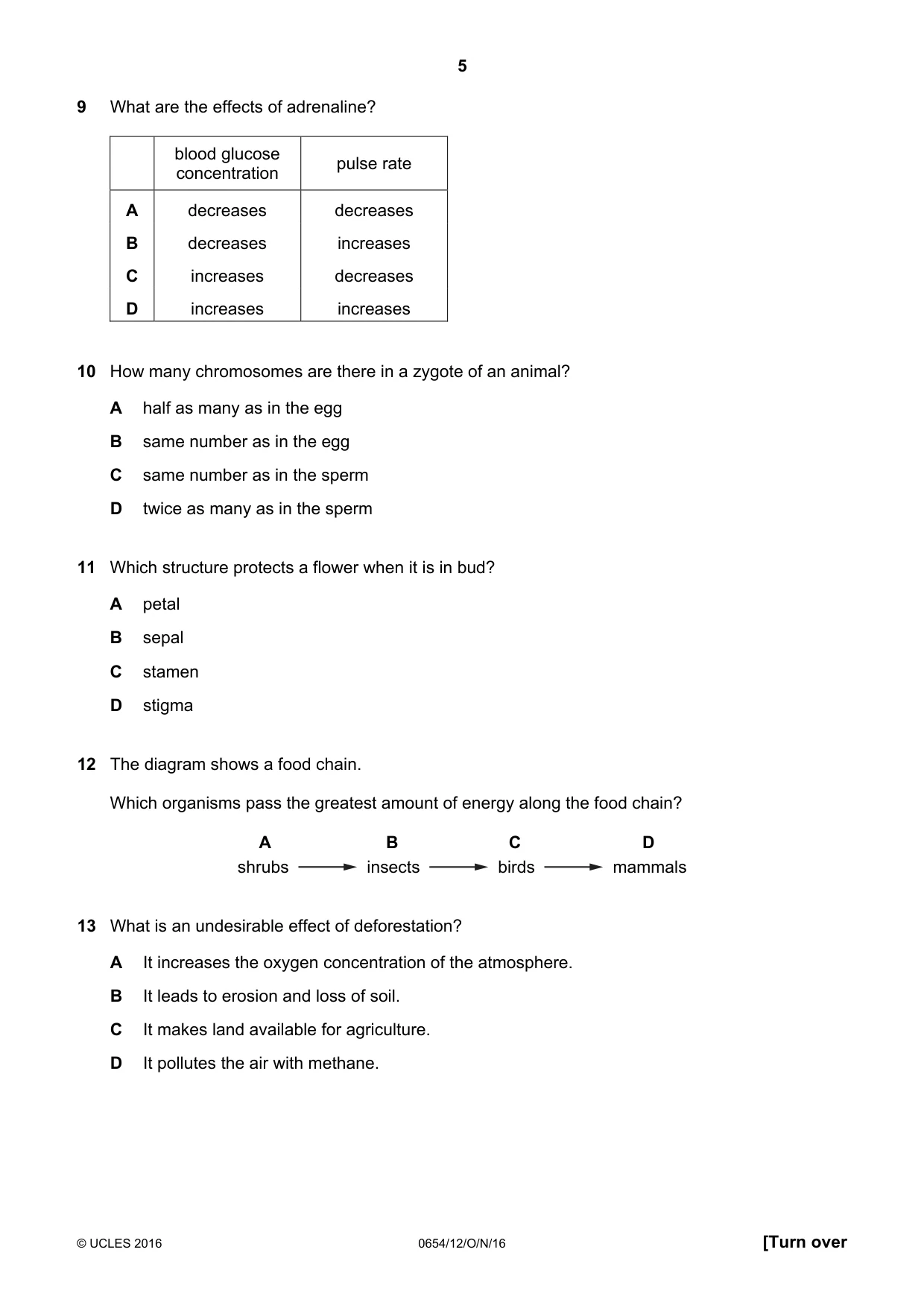
9 What are the effects of adrenaline? blood glucose pulse rate concentration A decreases decreases B decreases increases C increases decreases D increases increases
Mark scheme: D
Q10 · How many chromosomes are there in a zygote of an animal?
10 How many chromosomes are there in a zygote of an animal? A half as many as in the egg B same number as in the egg C same number as in the sperm D twice as many as in the sperm
Mark scheme: D
Q11 · Which structure protects a flower when it is in bud?
11 Which structure protects a flower when it is in bud? A petal B sepal C stamen D stigma
Mark scheme: B
Q12 · The diagram shows a food chain
12 The diagram shows a food chain. Which organisms pass the greatest amount of energy along the food chain? A B C D shrubs insects birds mammals
Mark scheme: A
Q13 · What is an undesirable effect of deforestation?
13 What is an undesirable effect of deforestation? A It increases the oxygen concentration of the atmosphere. B It leads to erosion and loss of soil. C It makes land available for agriculture. D It pollutes the air with methane.
Mark scheme: B
Q14 · Which dye, W, X, Y or Z, is a mixture of only dyes P and Q?
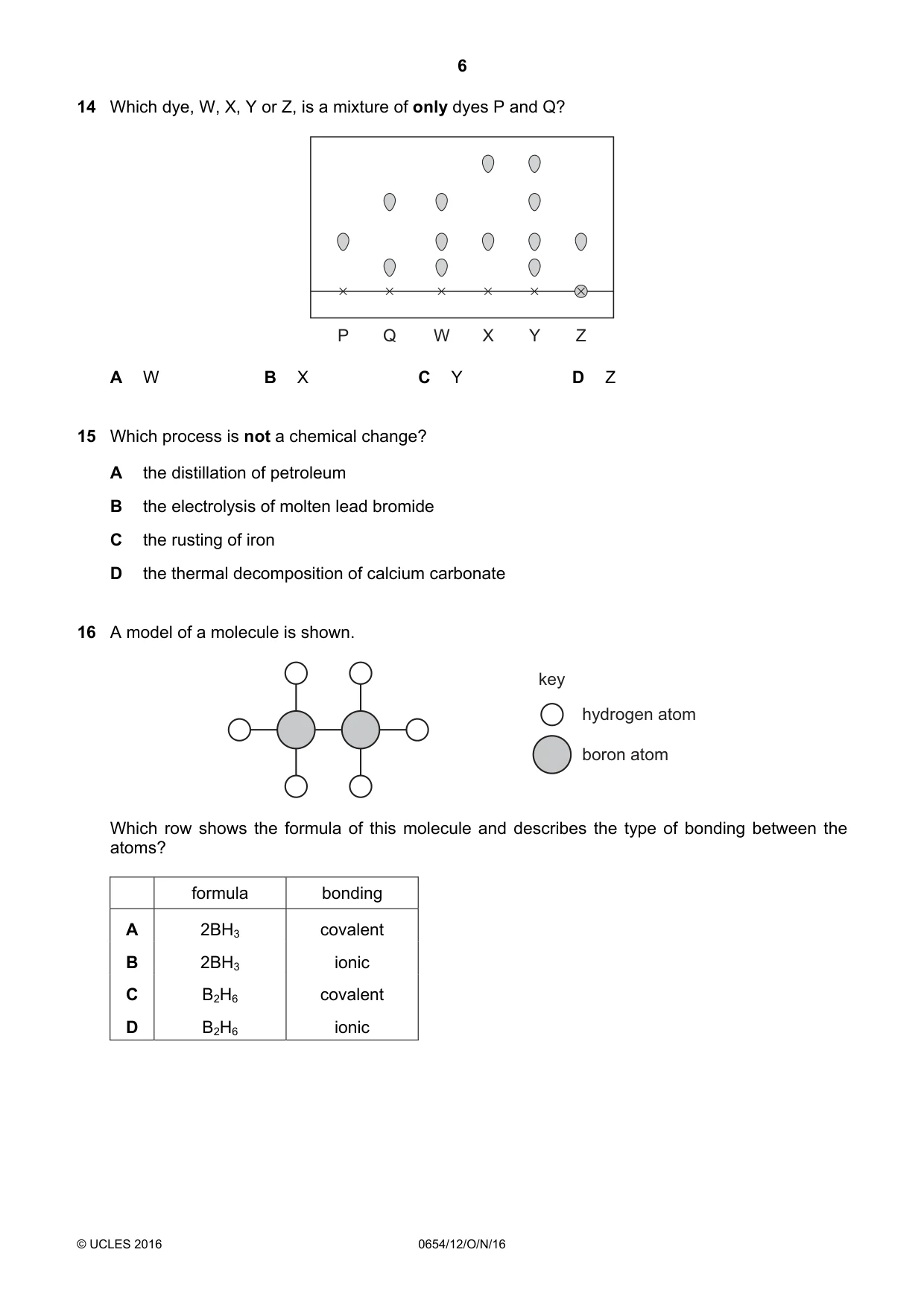
14 Which dye, W, X, Y or Z, is a mixture of only dyes P and Q? P Q W X Y Z A W B X C Y D Z
Mark scheme: A
Q15 · Which process is not a chemical change?
15 Which process is not a chemical change? A the distillation of petroleum B the electrolysis of molten lead bromide C the rusting of iron D the thermal decomposition of calcium carbonate
Mark scheme: A
Q16 · A model of a molecule is shown
16 A model of a molecule is shown. key hydrogen atom boron atom Which row shows the formula of this molecule and describes the type of bonding between the atoms? formula bonding A 2BH3 covalent B 2BH3 ionic C B2H6 covalent D B2H6 ionic
Mark scheme: C
Q17 · Which row describes the observations at the inert electrodes during the electrolysis of…
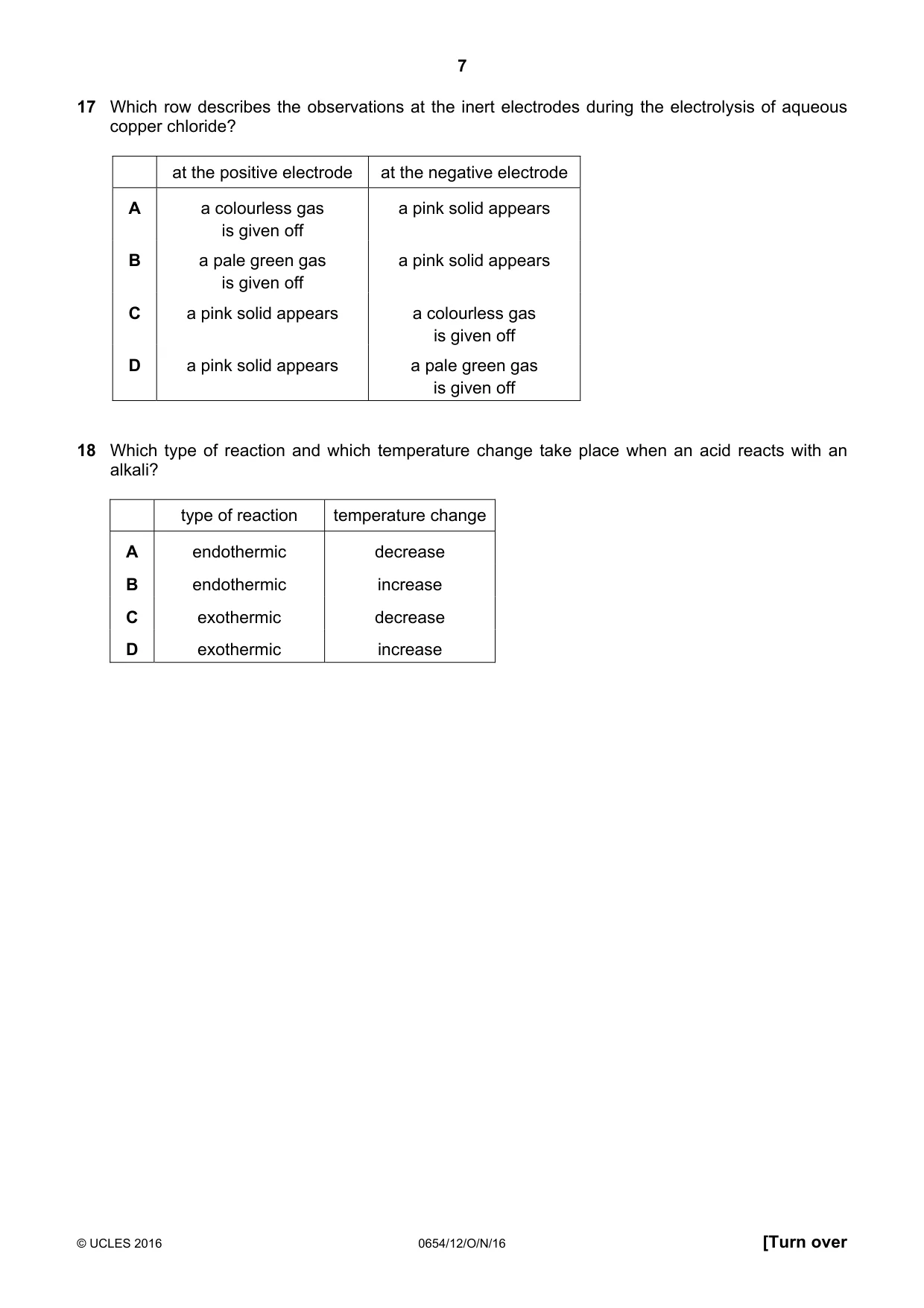
17 Which row describes the observations at the inert electrodes during the electrolysis of aqueous copper chloride? at the positive electrode at the negative electrode A a colourless gas a pink solid appears is given off B a pale green gas a pink solid appears is given off C a pink solid appears a colourless gas is given off D a pink solid appears a pale green gas is given off
Mark scheme: B
Q18 · Which type of reaction and which temperature change take place when an acid reacts with…
18 Which type of reaction and which temperature change take place when an acid reacts with an alkali? type of reaction temperature change A endothermic decrease B endothermic increase C exothermic decrease D exothermic increase
Mark scheme: D
Q19 · Solid calcium carbonate reacts with dilute hydrochloric acid to produce aqueous calcium…
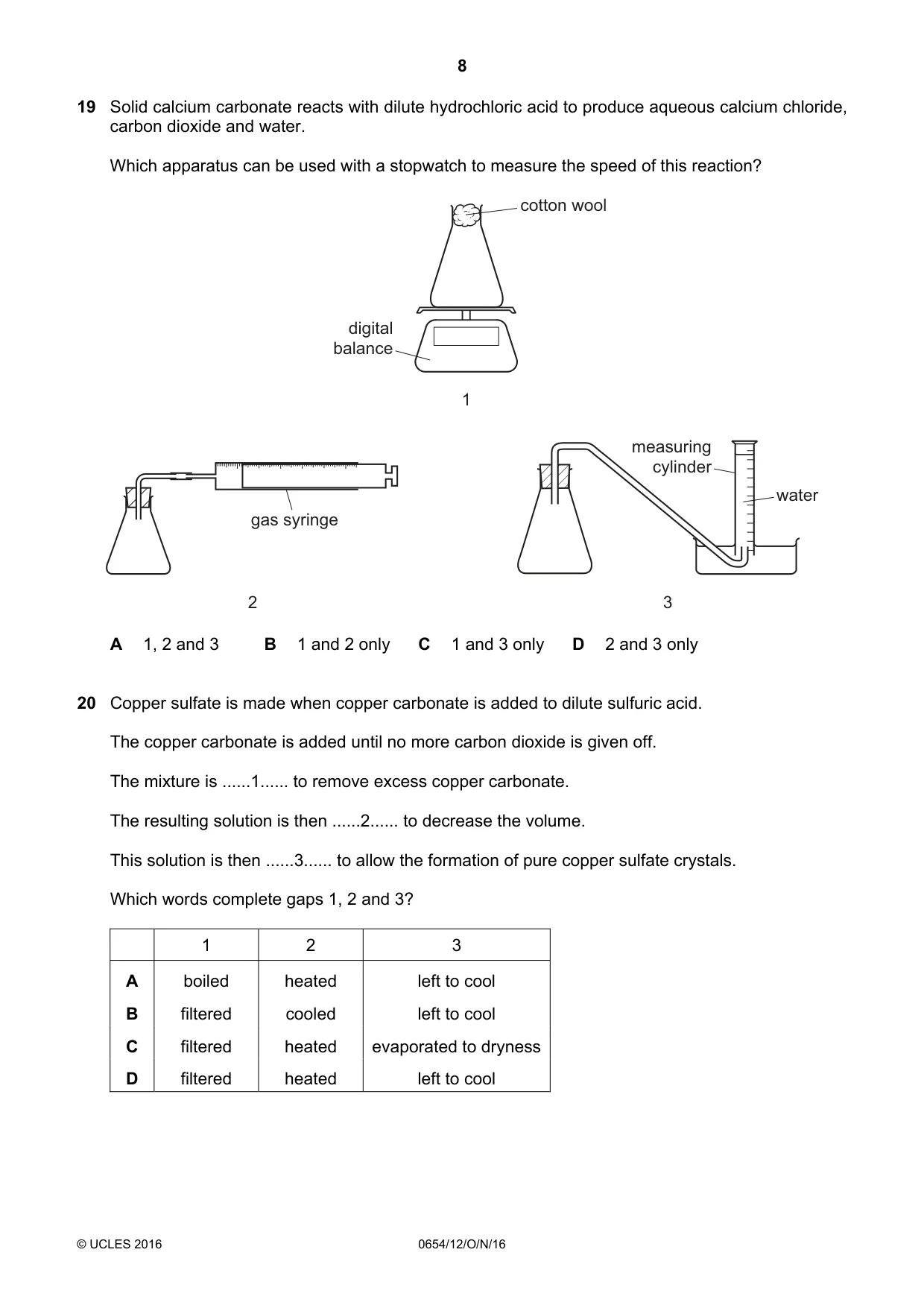
19 Solid calcium carbonate reacts with dilute hydrochloric acid to produce aqueous calcium chloride, carbon dioxide and water. Which apparatus can be used with a stopwatch to measure the speed of this reaction? cotton wool digital balance 1 measuring cylinder water gas syringe 2 3 A 1, 2 and 3 B 1 and 2 only C 1 and 3 only D 2 and 3 only
Mark scheme: A
Q20 · Copper sulfate is made when copper carbonate is added to dilute sulfuric acid
20 Copper sulfate is made when copper carbonate is added to dilute sulfuric acid. The copper carbonate is added until no more carbon dioxide is given off. The mixture is ......1...... to remove excess copper carbonate. The resulting solution is then ......2...... to decrease the volume. This solution is then ......3...... to allow the formation of pure copper sulfate crystals. Which words complete gaps 1, 2 and 3? 1 2 3 A boiled heated left to cool B filtered cooled left to cool C filtered heated evaporated to dryness D filtered heated left to cool
Mark scheme: D
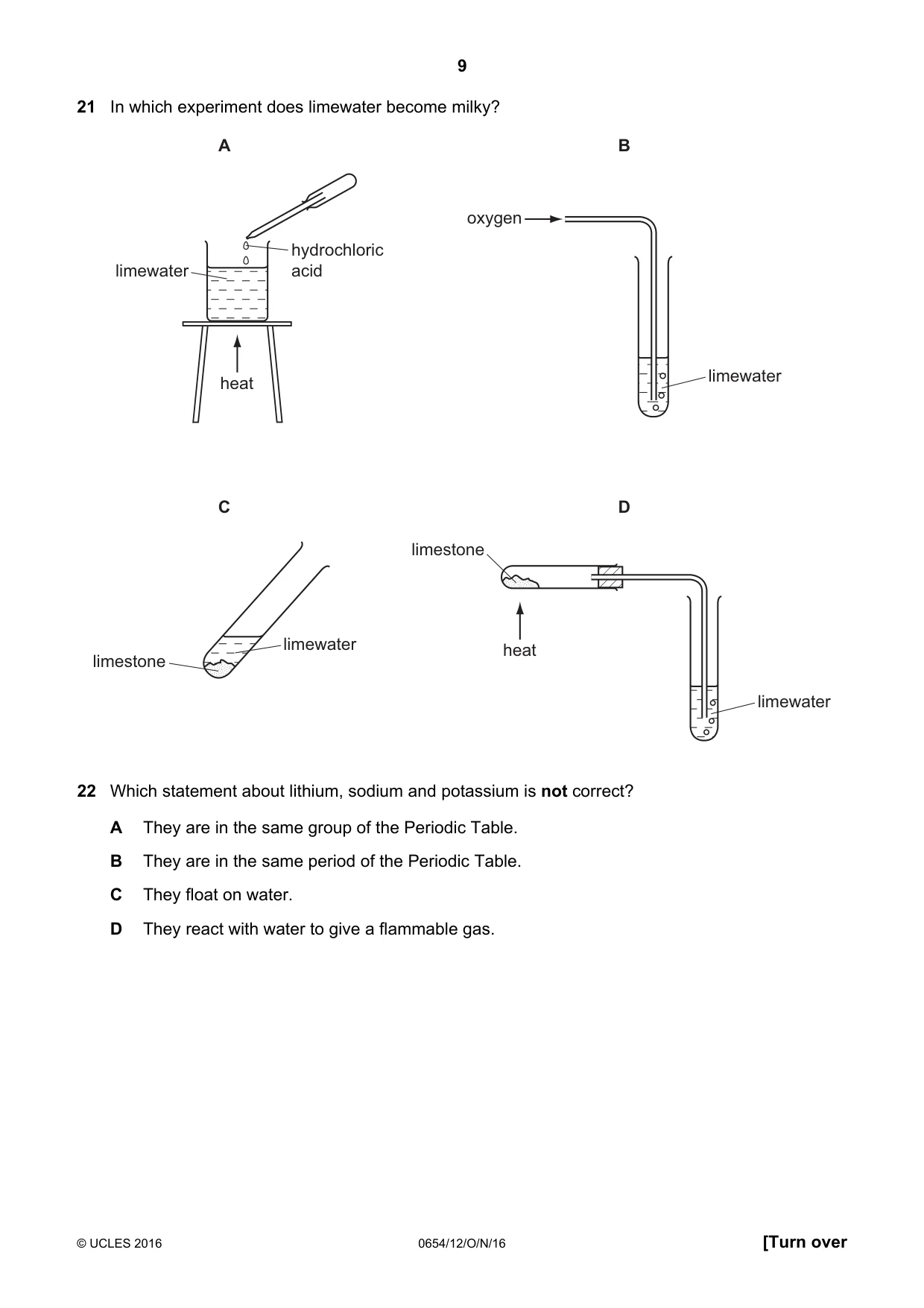
Q21 · In which experiment does limewater become milky?
21 In which experiment does limewater become milky? A B oxygen hydrochloric limewater acid heat limewater C D limestone limewater heat limestone limewater
Mark scheme: D
Q22 · Which statement about lithium, sodium and potassium is not correct?
22 Which statement about lithium, sodium and potassium is not correct? A They are in the same group of the Periodic Table. B They are in the same period of the Periodic Table. C They float on water. D They react with water to give a flammable gas.
Mark scheme: B
Q23 · The properties of some substances are listed
23 The properties of some substances are listed. 1 act as catalysts 2 have high melting points 3 form acidic oxides 4 form coloured compounds What are the properties of transition metals? A 1, 2 and 3 B 1, 2 and 4 C 1, 3 and 4 D 2, 3 and 4
Mark scheme: B
Q24 · Five metals are reacted with cold water and with dilute hydrochloric acid
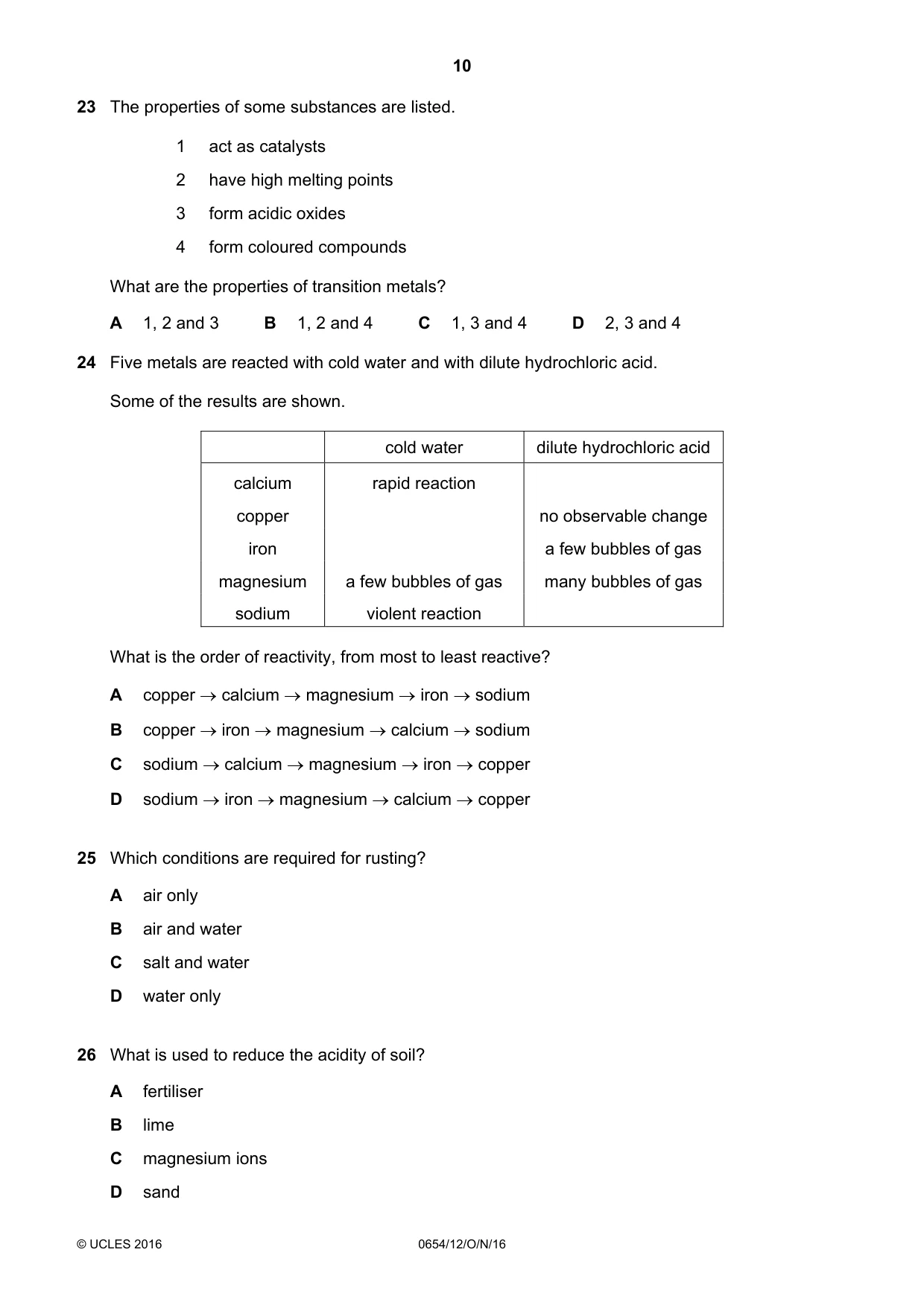
24 Five metals are reacted with cold water and with dilute hydrochloric acid. Some of the results are shown. cold water dilute hydrochloric acid calcium rapid reaction copper no observable change iron a few bubbles of gas magnesium a few bubbles of gas many bubbles of gas sodium violent reaction What is the order of reactivity, from most to least reactive? A copper → calcium → magnesium → iron → sodium B copper → iron → magnesium → calcium → sodium C sodium → calcium → magnesium → iron → copper D sodium → iron → magnesium → calcium → copper
Mark scheme: C
Q25 · Which conditions are required for rusting?
25 Which conditions are required for rusting? A air only B air and water C salt and water D water only
Mark scheme: B
Q26 · What is used to reduce the acidity of soil?
26 What is used to reduce the acidity of soil? A fertiliser B lime C magnesium ions D sand
Mark scheme: B
More questions on The characteristic properties of acids and bases
Q27 · Poly(ethene) is made from ethene by the process of addition polymerisation
27 Poly(ethene) is made from ethene by the process of addition polymerisation. Which word describes ethene in this process? A fuel B monomer C polymer D solvent
Mark scheme: B
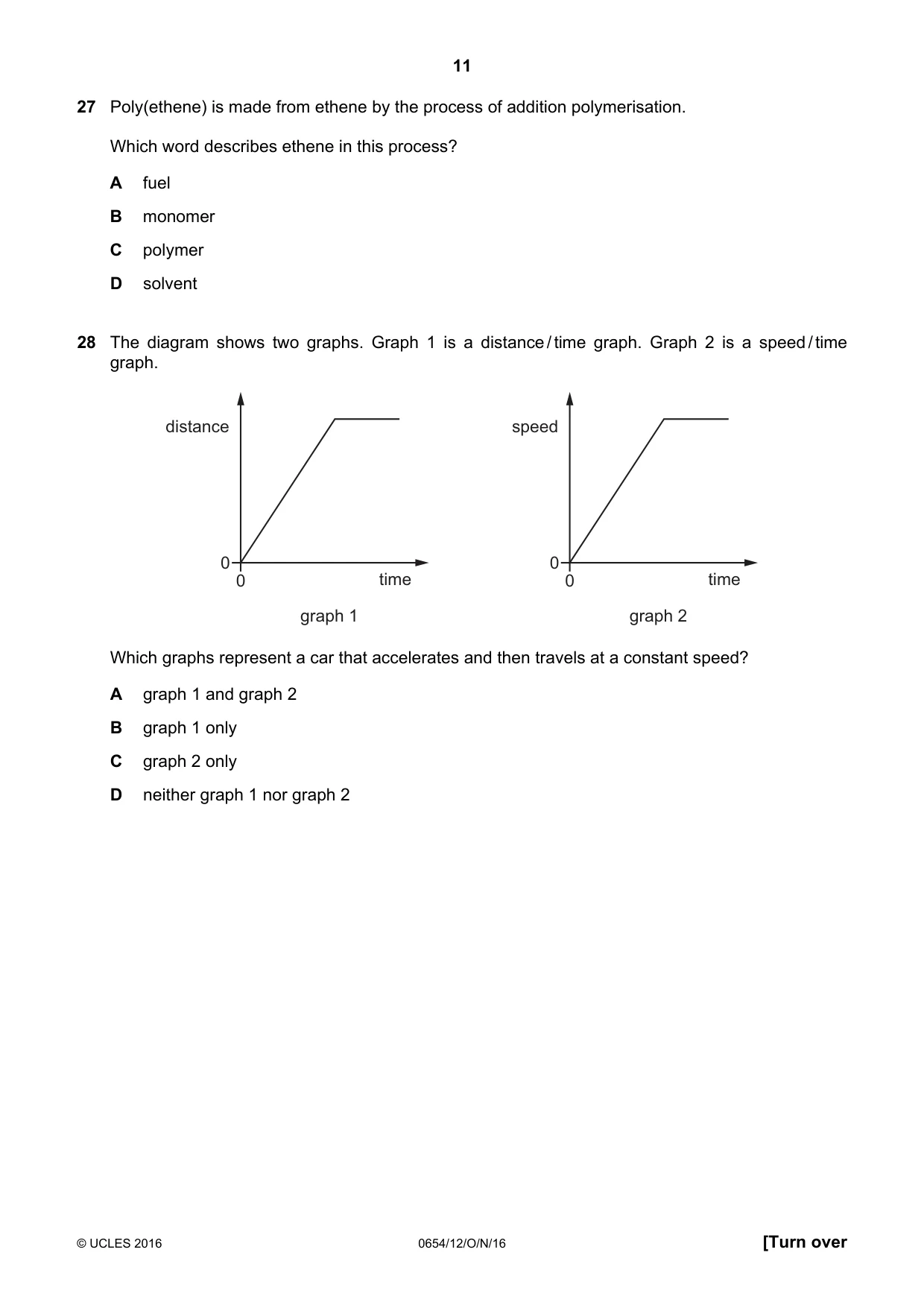
Q28 · The diagram shows two graphs
28 The diagram shows two graphs. Graph 1 is a distance / time graph. Graph 2 is a speed / time graph. distance speed 0 0 0 time 0 time graph 1 graph 2 Which graphs represent a car that accelerates and then travels at a constant speed? A graph 1 and graph 2 B graph 1 only C graph 2 only D neither graph 1 nor graph 2
Mark scheme: C
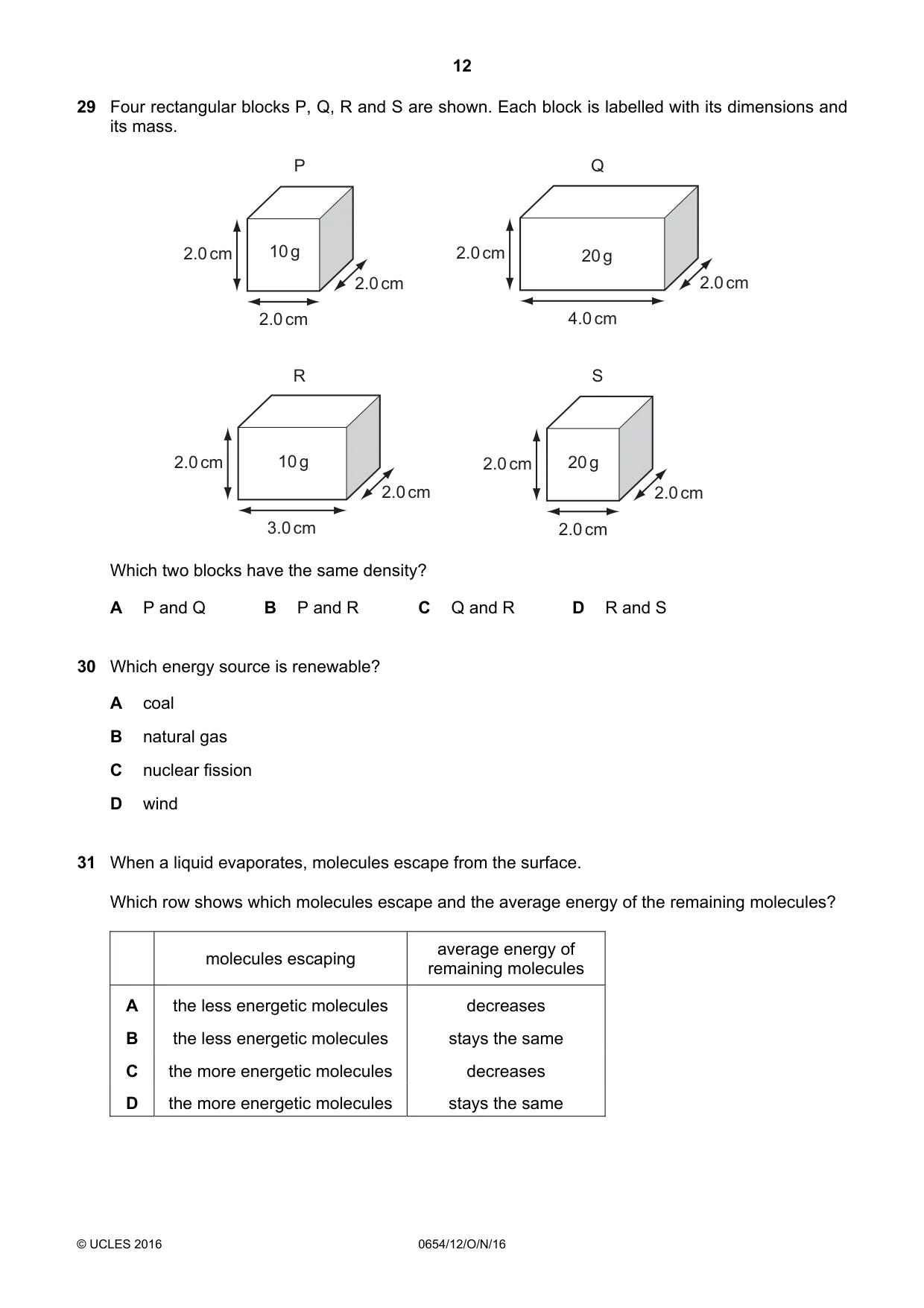
Q29 · Four rectangular blocks P, Q, R and S are shown
29 Four rectangular blocks P, Q, R and S are shown. Each block is labelled with its dimensions and its mass. P Q 2.0 cm 10 g 2.0 cm 20 g 2.0 cm 2.0 cm 2.0 cm 4.0 cm R S 2.0 cm 10 g 2.0 cm 20 g 2.0 cm 2.0 cm 3.0 cm 2.0 cm Which two blocks have the same density? A P and Q B P and R C Q and R D R and S
Mark scheme: A
Q30 · Which energy source is renewable?
30 Which energy source is renewable? A coal B natural gas C nuclear fission D wind
Mark scheme: D
Q31 · When a liquid evaporates, molecules escape from the surface
31 When a liquid evaporates, molecules escape from the surface. Which row shows which molecules escape and the average energy of the remaining molecules? average energy of molecules escaping remaining molecules A the less energetic molecules decreases B the less energetic molecules stays the same C the more energetic molecules decreases D the more energetic molecules stays the same
Mark scheme: C
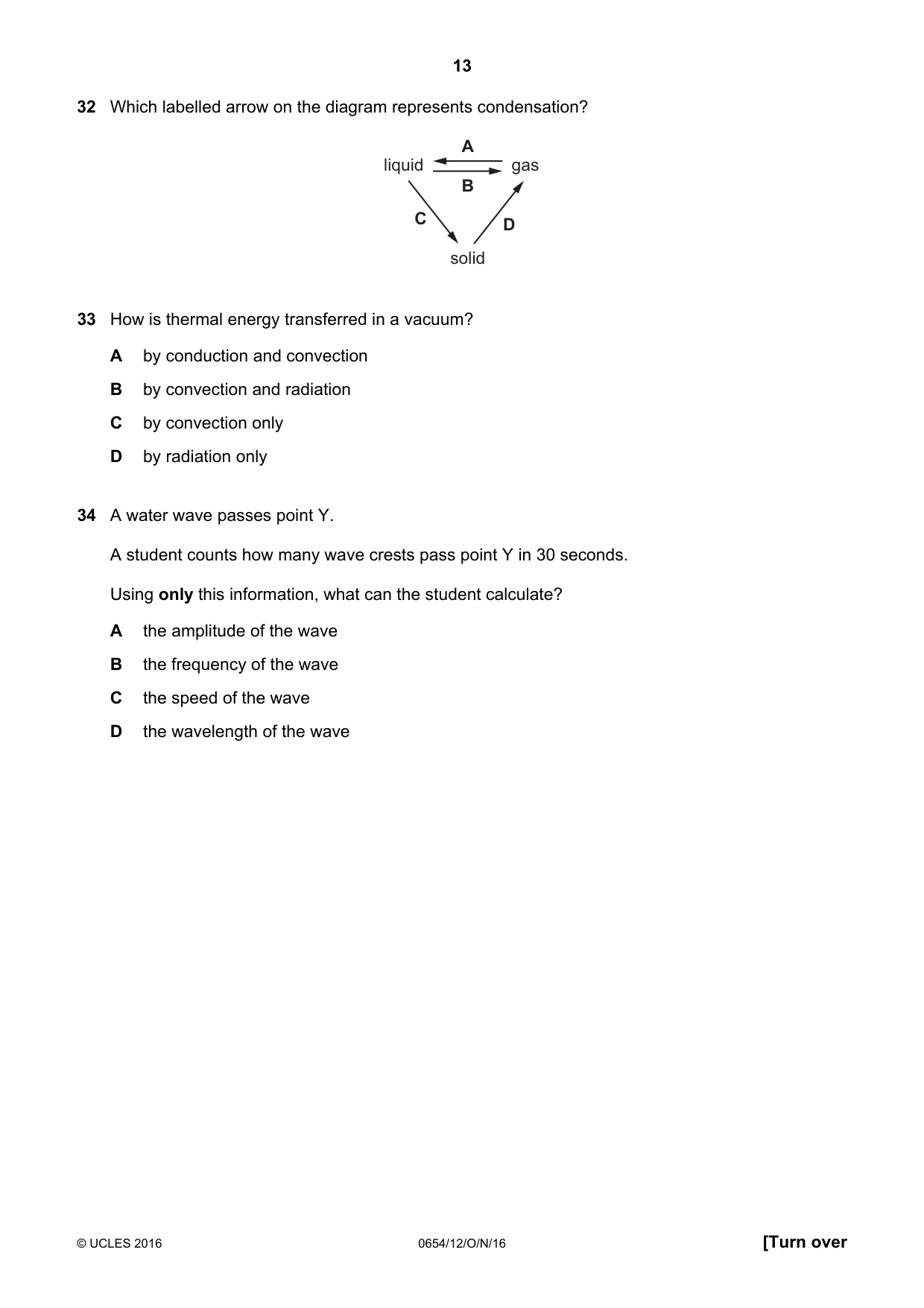
Q32 · Which labelled arrow on the diagram represents condensation?
32 Which labelled arrow on the diagram represents condensation? A liquid gas B C D solid
Mark scheme: A
Q33 · How is thermal energy transferred in a vacuum?
33 How is thermal energy transferred in a vacuum? A by conduction and convection B by convection and radiation C by convection only D by radiation only
Mark scheme: D
Q34 · A water wave passes point Y
34 A water wave passes point Y. A student counts how many wave crests pass point Y in 30 seconds. Using only this information, what can the student calculate? A the amplitude of the wave B the frequency of the wave C the speed of the wave D the wavelength of the wave
Mark scheme: B
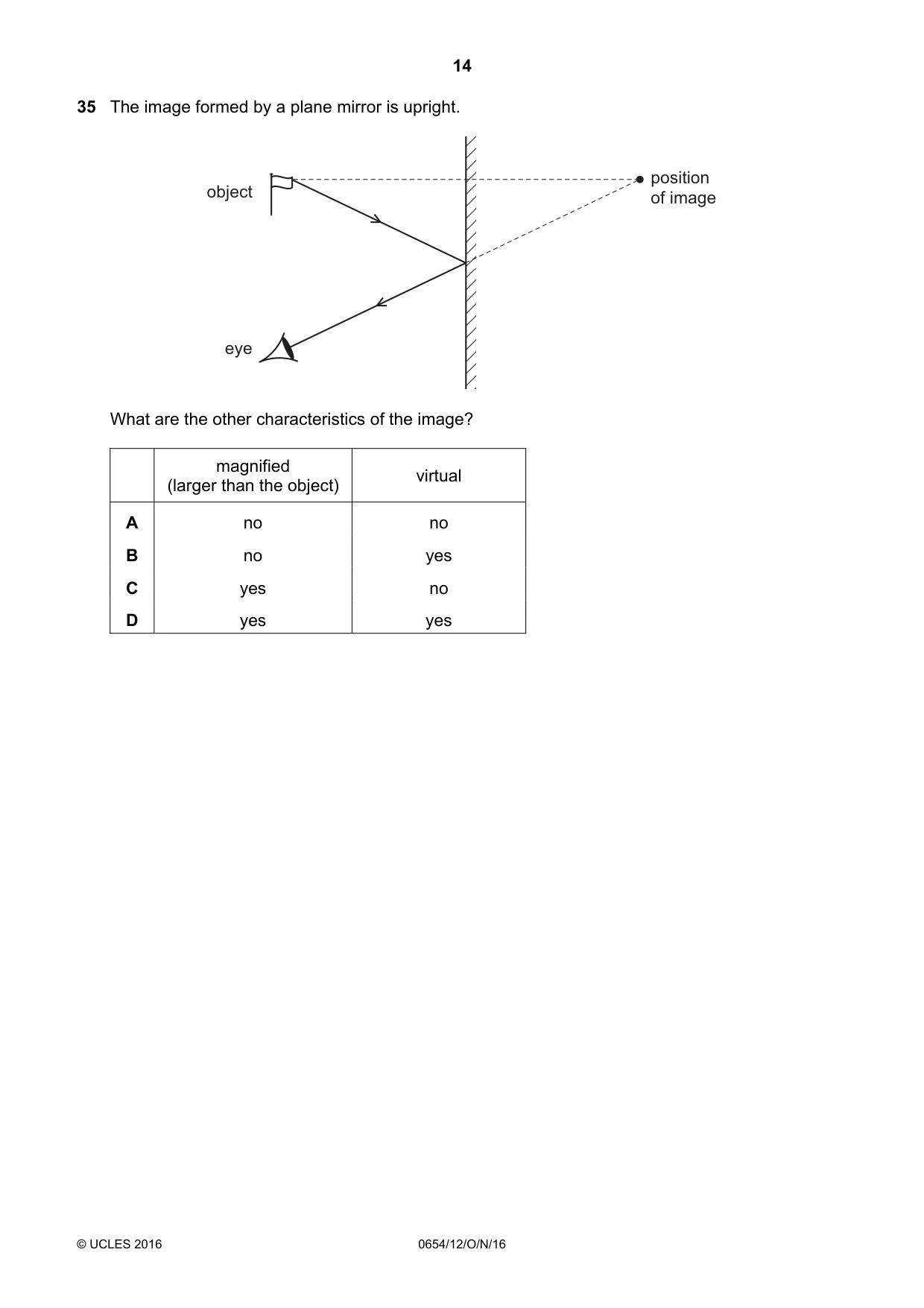
Q35 · The image formed by a plane mirror is upright
35 The image formed by a plane mirror is upright. position object of image eye What are the other characteristics of the image? magnified virtual (larger than the object) A no no B no yes C yes no D yes yes
Mark scheme: B
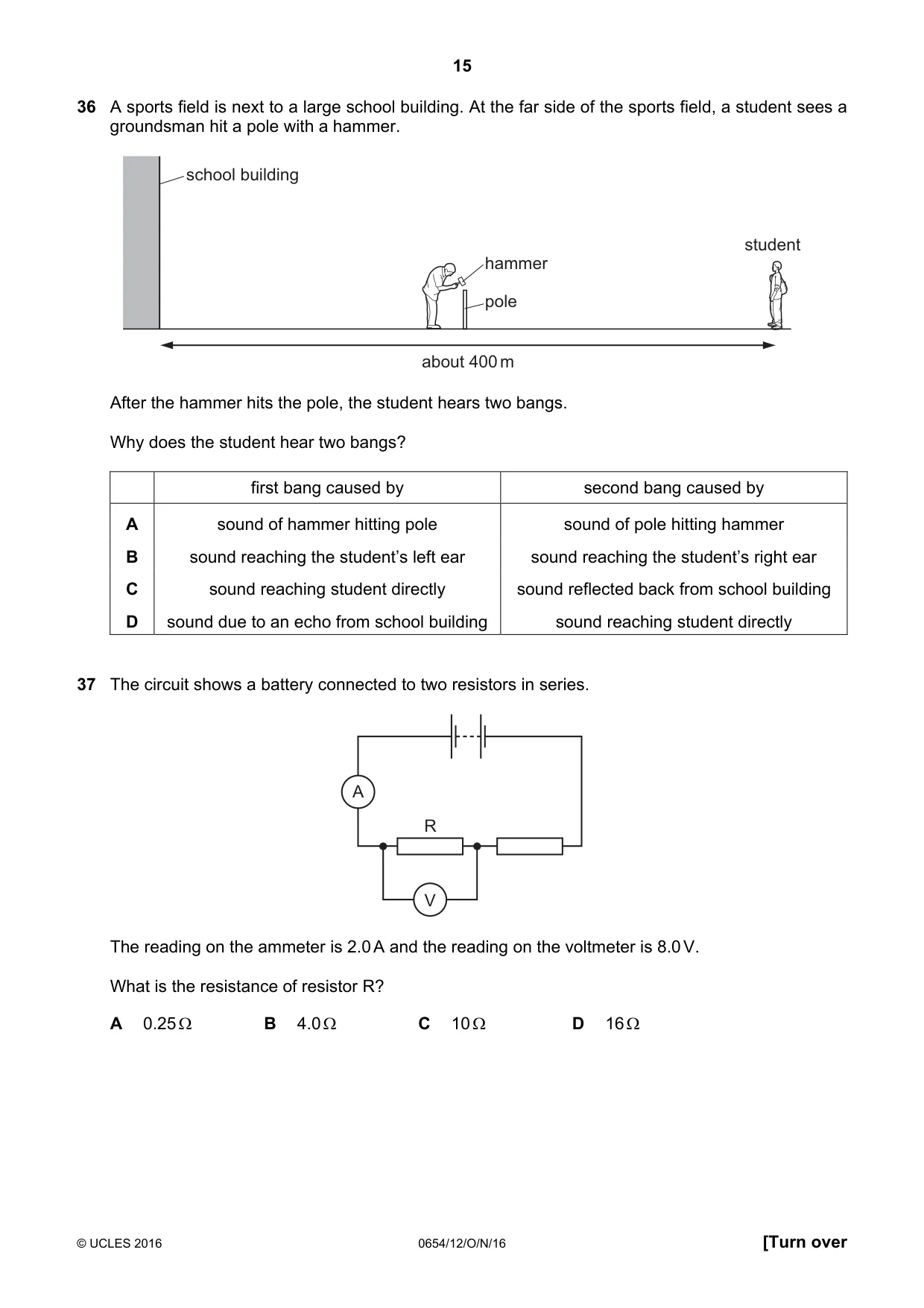
Q36 · A sports field is next to a large school building
36 A sports field is next to a large school building. At the far side of the sports field, a student sees a groundsman hit a pole with a hammer. school building student hammer pole about 400 m After the hammer hits the pole, the student hears two bangs. Why does the student hear two bangs? first bang caused by second bang caused by A sound of hammer hitting pole sound of pole hitting hammer B sound reaching the student’s left ear sound reaching the student’s right ear C sound reaching student directly sound reflected back from school building D sound due to an echo from school building sound reaching student directly
Mark scheme: C
Q37 · The circuit shows a battery connected to two resistors in series
37 The circuit shows a battery connected to two resistors in series. A R V The reading on the ammeter is 2.0 A and the reading on the voltmeter is 8.0 V. What is the resistance of resistor R? A 0.25 Ω B 4.0 Ω C 10 Ω D 16 Ω
Mark scheme: B
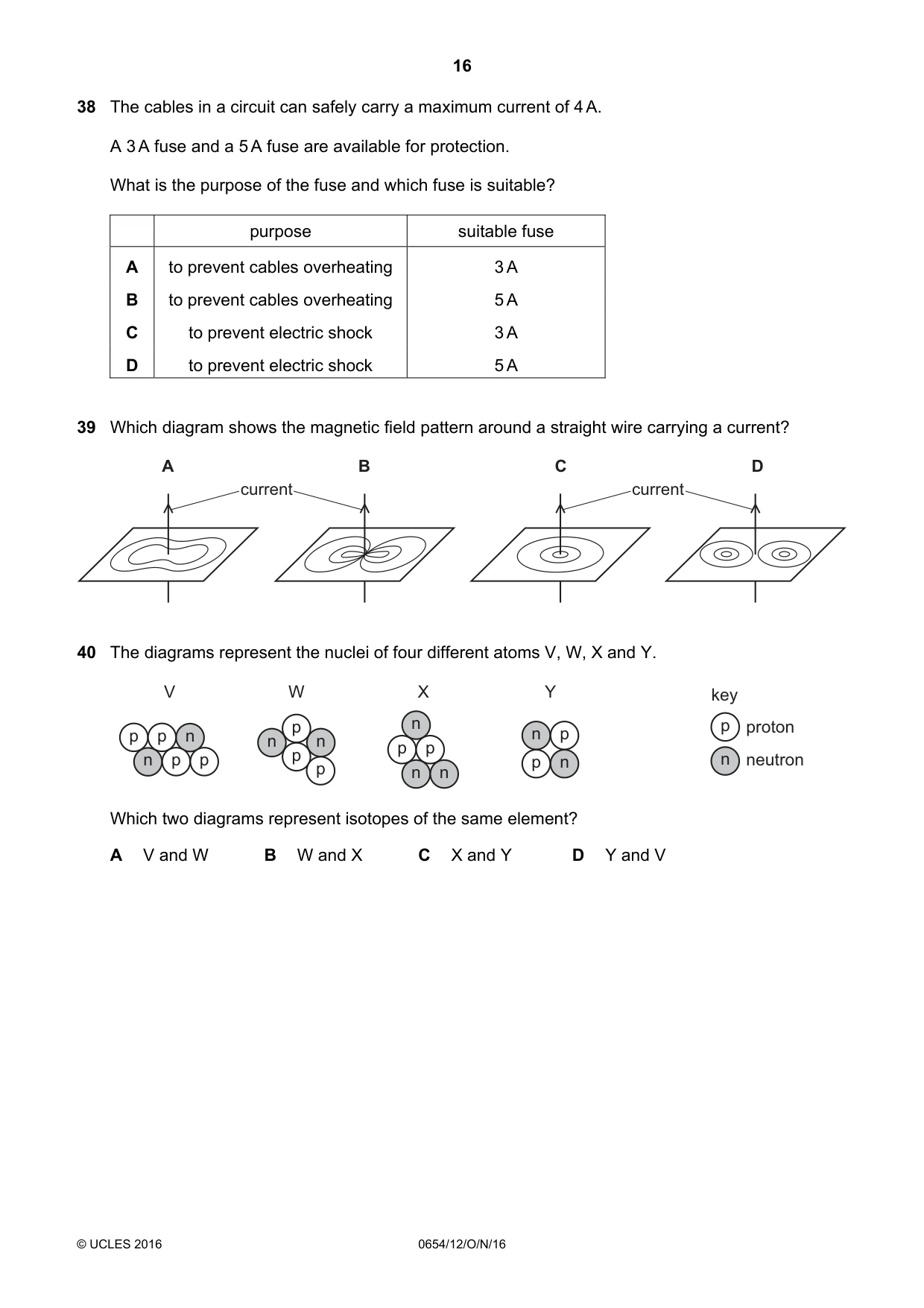
Q38 · The cables in a circuit can safely carry a maximum current of 4 A
38 The cables in a circuit can safely carry a maximum current of 4 A. A 3 A fuse and a 5 A fuse are available for protection. What is the purpose of the fuse and which fuse is suitable? purpose suitable fuse A to prevent cables overheating 3 A B to prevent cables overheating 5 A C to prevent electric shock 3 A D to prevent electric shock 5 A
Mark scheme: A
Q39 · Which diagram shows the magnetic field pattern around a straight wire carrying a current?
39 Which diagram shows the magnetic field pattern around a straight wire carrying a current? A B C D current current
Mark scheme: C
Q40 · The diagrams represent the nuclei of four different atoms V, W, X and Y
40 The diagrams represent the nuclei of four different atoms V, W, X and Y. V W X Y key p n p proton p p n n n n p p p p n p p p n n neutron p n n Which two diagrams represent isotopes of the same element? A V and W B W and X C X and Y D Y and V
Mark scheme: C
What was in this paper
The subtopics covered by these 40 questions, and how many questions each got. Open one in a new tab to see every Cambridge question on it.
2Respiration2Blood vessels1Chromatography1Coordination and response1Corrosion of metals1Density1Diet1Digestion1Electrical circuits1Electrical safety1Electrolysis1Energy flow1Energy, work and power1Enzymes1Exothermic and endothermic reactions1General properties of waves1Group I properties1Habitat destruction1Hormones1Identification of ions and gases1Isotopes1Light1Motion1Physical and chemical changes1Polymers1Preparation of salts1Rate of reaction1Reactivity series1Sexual reproduction in humans1Sexual reproduction in plants1Simple molecules and covalent bonds1Simple phenomena of magnetism1Sound1The characteristic properties of acids and bases1Transfer of thermal energy1Transition elements1Transpiration1What you needed in this session
Cambridge’s own grade thresholds for 2016 Oct/Nov, Paper 1 · Variant 2. A higher threshold means an easier paper — the bar moves with how the cohort did.