Cambridge IGCSE Sciences - Co-ordinated (Double) 0654 — 2011 May/June Paper 1 · Variant 2
0654/12/M/J/11 · 40 questions · 40 marks · ≈45 min
The question paper and its mark scheme, free to read here and free to download. This is Cambridge’s own paper, exactly as it was sat.
Question paper16 pages

Mark scheme2 pages
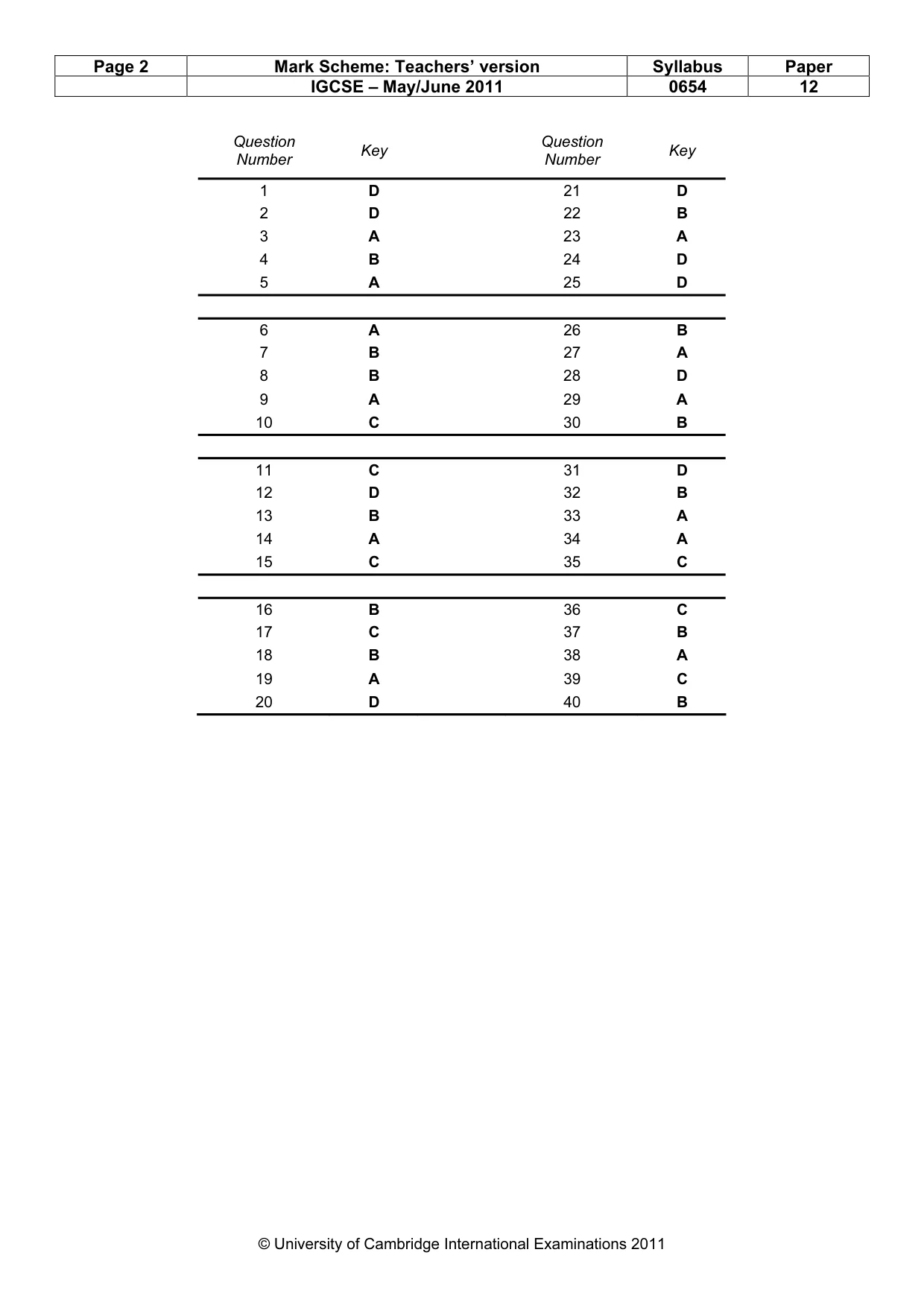
Answers below. Sit the paper first if you are practising.
Questions as text
Q1 · Which process releases energy in all living things?
1 Which process releases energy in all living things? A breathing B digestion C muscle contraction D respiration
Mark scheme: D
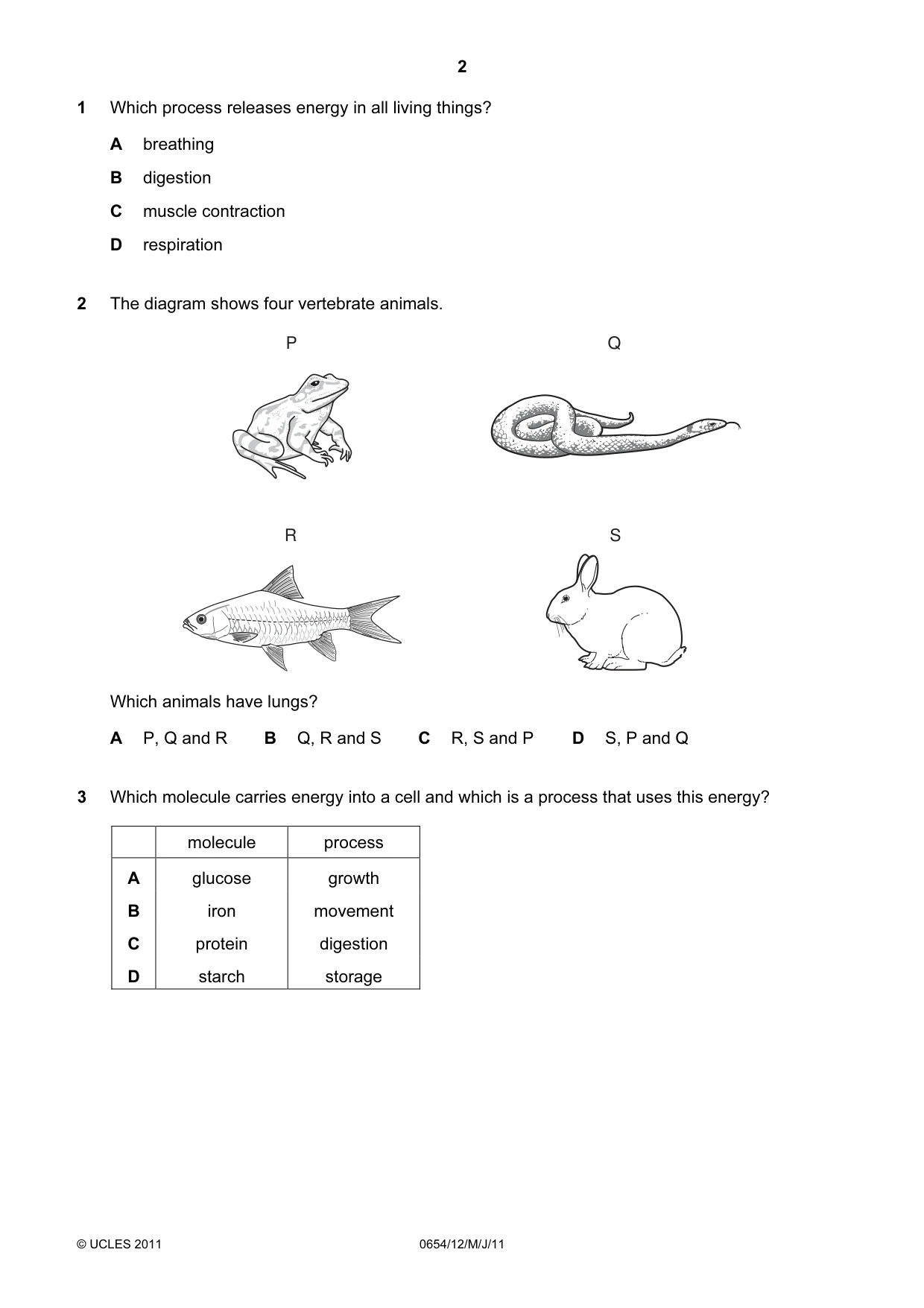
Q2 · The diagram shows four vertebrate animals
2 The diagram shows four vertebrate animals. P Q R S Which animals have lungs? A P, Q and R B Q, R and S C R, S and P D S, P and Q
Mark scheme: D
Q3 · Which molecule carries energy into a cell and which is a process that uses this energy?
3 Which molecule carries energy into a cell and which is a process that uses this energy? molecule process A glucose growth B iron movement C protein digestion D starch storage
Mark scheme: A
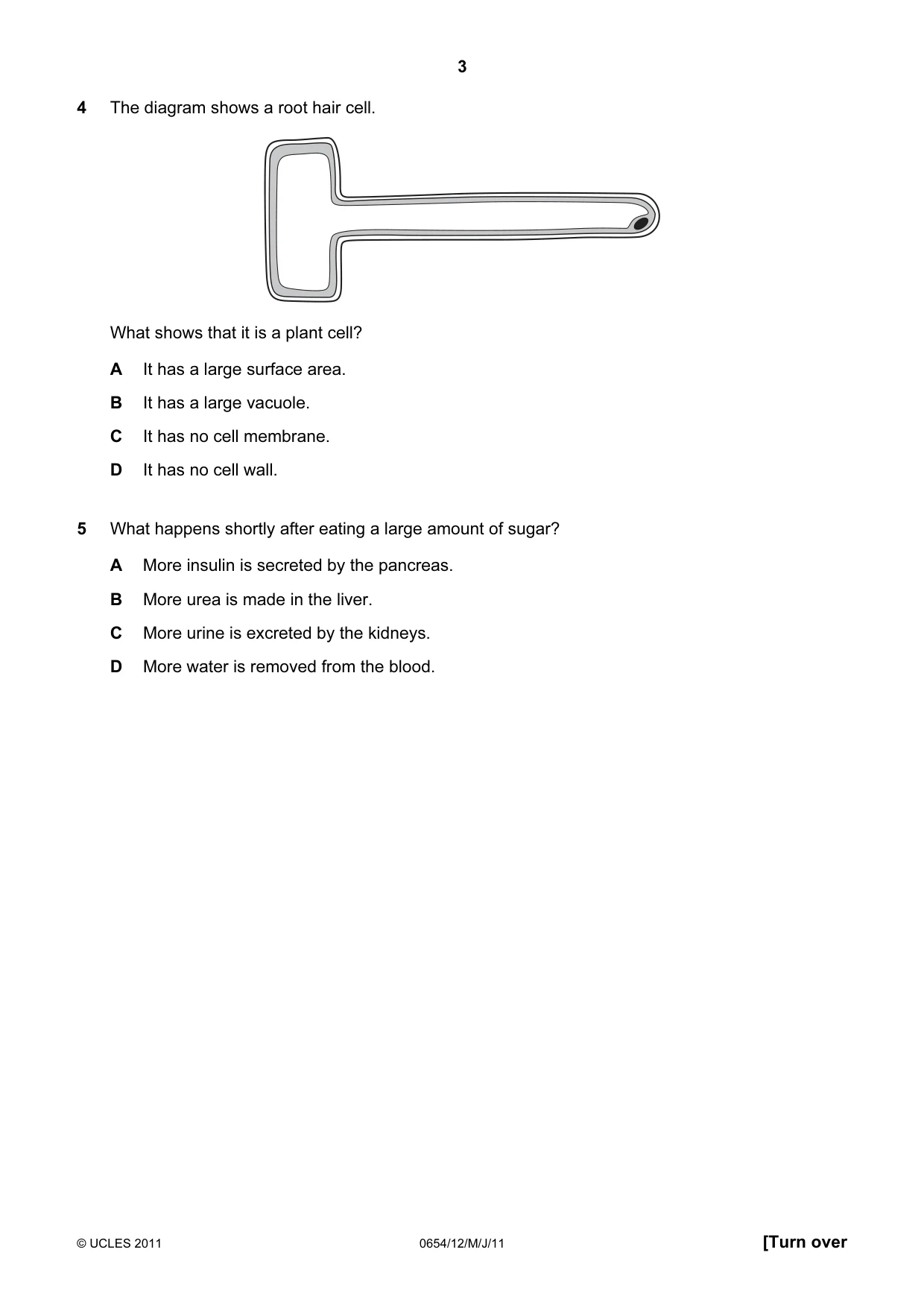
Q4 · The diagram shows a root hair cell
4 The diagram shows a root hair cell. What shows that it is a plant cell? A It has a large surface area. B It has a large vacuole. C It has no cell membrane. D It has no cell wall.
Mark scheme: B
Q5 · What happens shortly after eating a large amount of sugar?
5 What happens shortly after eating a large amount of sugar? A More insulin is secreted by the pancreas. B More urea is made in the liver. C More urine is excreted by the kidneys. D More water is removed from the blood.
Mark scheme: A
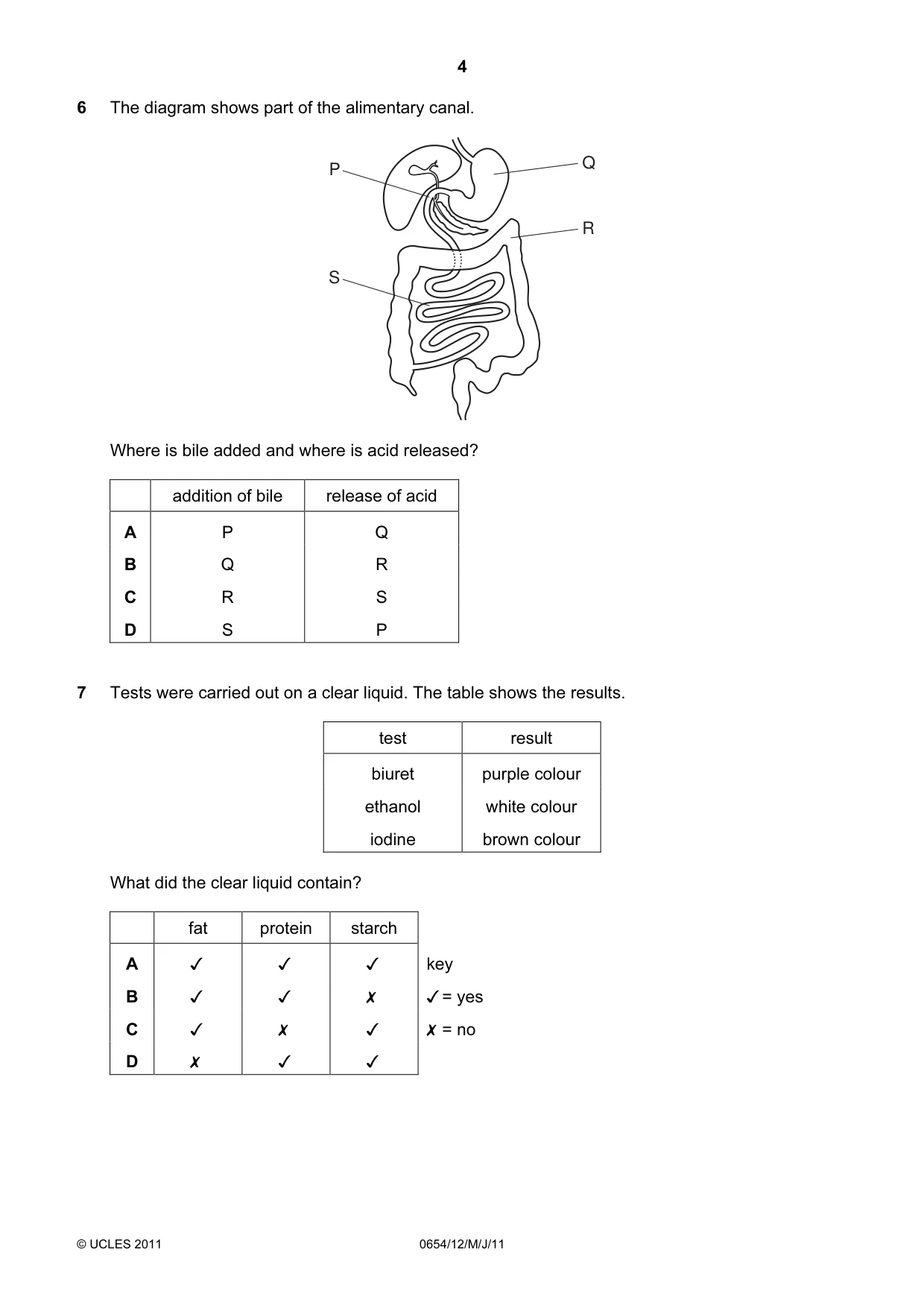
Q6 · The diagram shows part of the alimentary canal
6 The diagram shows part of the alimentary canal. P Q R S Where is bile added and where is acid released? addition of bile release of acid A P Q B Q R C R S D S P
Mark scheme: A
Q7 · Tests were carried out on a clear liquid
7 Tests were carried out on a clear liquid. The table shows the results. test result biuret purple colour ethanol white colour iodine brown colour What did the clear liquid contain? fat protein starch A v v v B v v x Cc v x v D x v v key v/=yes X =no
Mark scheme: B
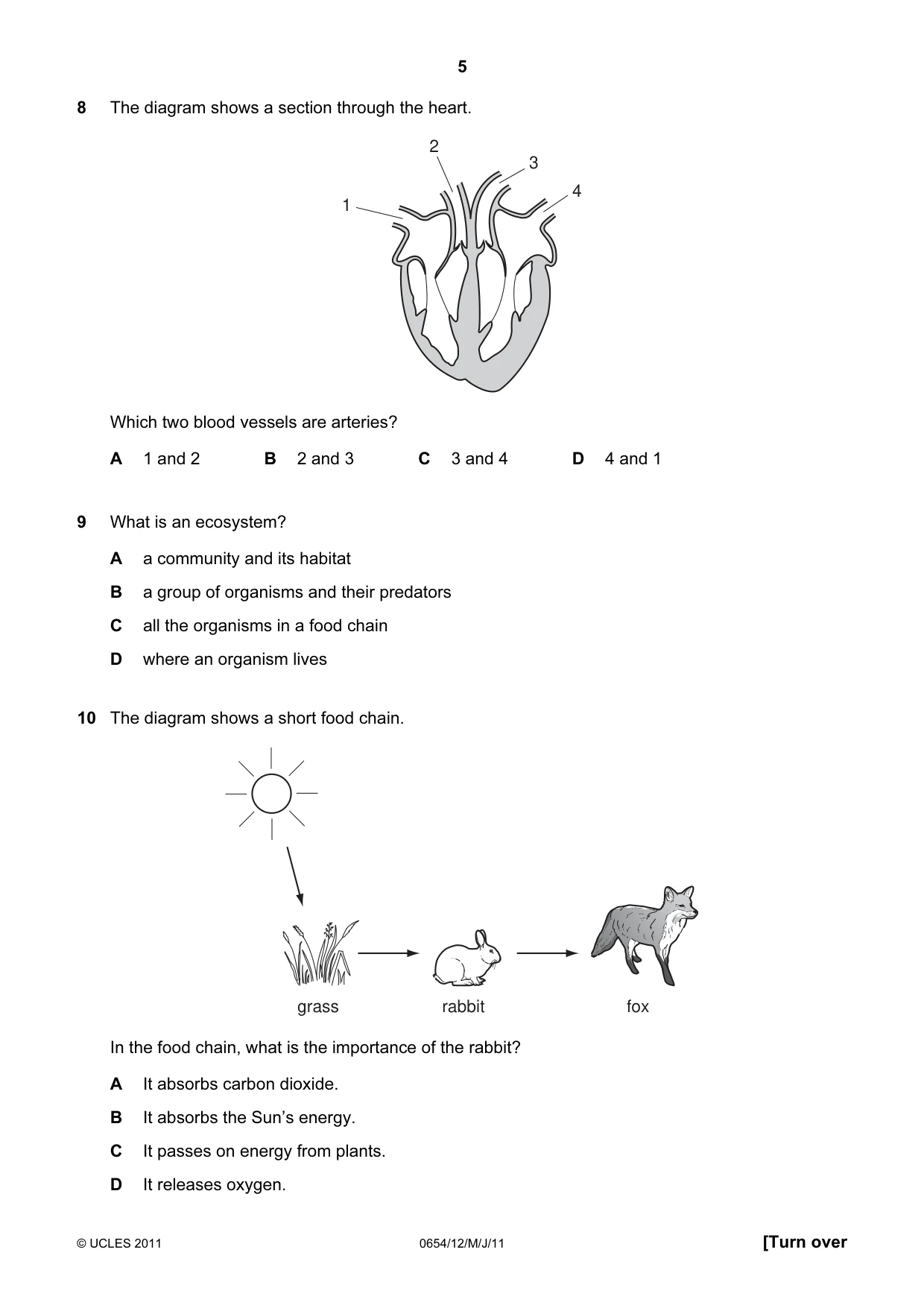
Q8 · The diagram shows a section through the heart
8 The diagram shows a section through the heart. 2 3 4 1 Which two blood vessels are arteries? A 1 and 2 B 2 and 3 C 3 and 4 D 4 and 1
Mark scheme: B
Q9 · What is an ecosystem?
9 What is an ecosystem? A a community and its habitat B a group of organisms and their predators C all the organisms in a food chain D where an organism lives
Mark scheme: A
Q10 · The diagram shows a short food chain
10 The diagram shows a short food chain. grass rabbit fox In the food chain, what is the importance of the rabbit? A It absorbs carbon dioxide. B It absorbs the Sun’s energy. C It passes on energy from plants. D It releases oxygen.
Mark scheme: C
Q11 · Which is an example of cloning?
11 Which is an example of cloning? A pollinating flowers by insects B producing offspring by sexual intercourse C producing plants by tissue culture D seeds forming in an ovary
Mark scheme: C
Q12 · Why is seed dispersal important?
12 Why is seed dispersal important? A It causes the development of a fruit. B It makes seeds more fertile. C It prevents asexual reproduction. D It reduces competition between seedlings.
Mark scheme: D
Q13 · What passes from a mother to a fetus in her uterus?
13 What passes from a mother to a fetus in her uterus? A blood platelets B mineral ions C plasma D red blood cells
Mark scheme: B
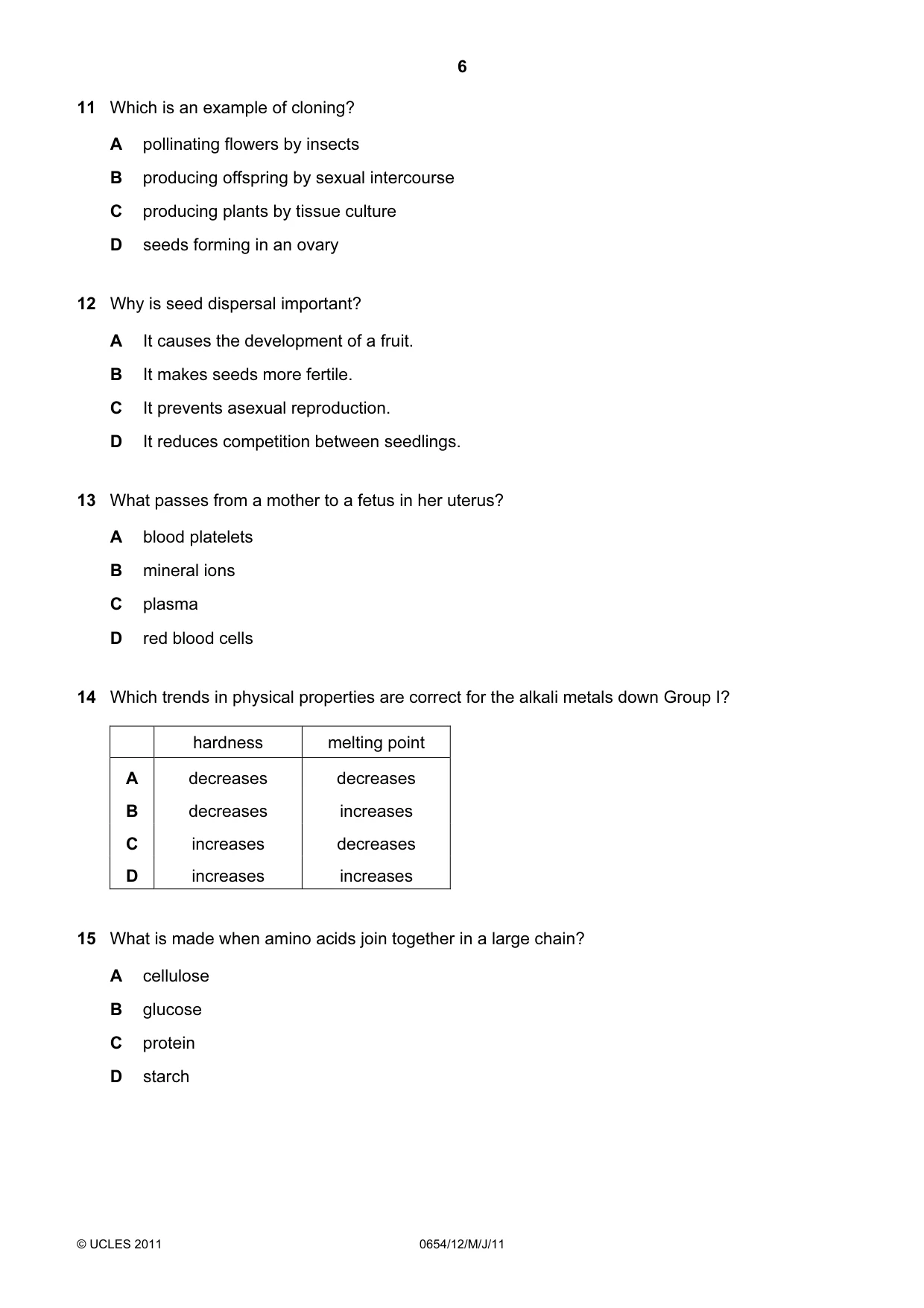
Q14 · Which trends in physical properties are correct for the alkali metals down Group I?
14 Which trends in physical properties are correct for the alkali metals down Group I? hardness melting point A decreases decreases B decreases increases C increases decreases D increases increases
Mark scheme: A
Q15 · What is made when amino acids join together in a large chain?
15 What is made when amino acids join together in a large chain? A cellulose B glucose C protein D starch
Mark scheme: C
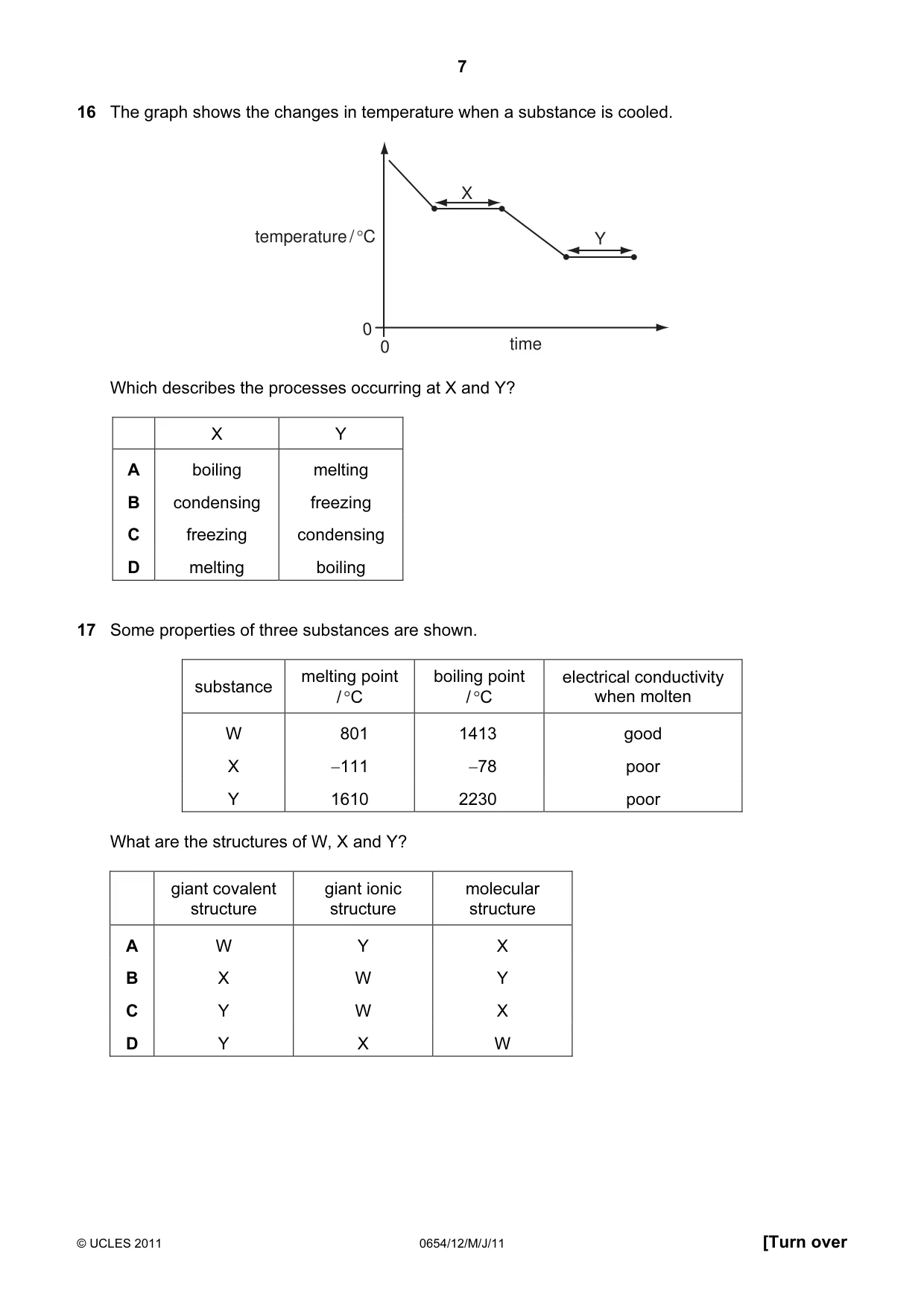
Q16 · The graph shows the changes in temperature when a substance is cooled
16 The graph shows the changes in temperature when a substance is cooled. X temperature / °C Y 0 0 time Which describes the processes occurring at X and Y? X Y A boiling melting B condensing freezing C freezing condensing D melting boiling
Mark scheme: B
Q17 · Some properties of three substances are shown
17 Some properties of three substances are shown. melting point boiling point electrical conductivity substance / °C / °C when molten W 801 1413 good X −111 −78 poor Y 1610 2230 poor What are the structures of W, X and Y? giant covalent giant ionic molecular structure structure structure A W Y X B X W Y C Y W X D Y X W
Mark scheme: C
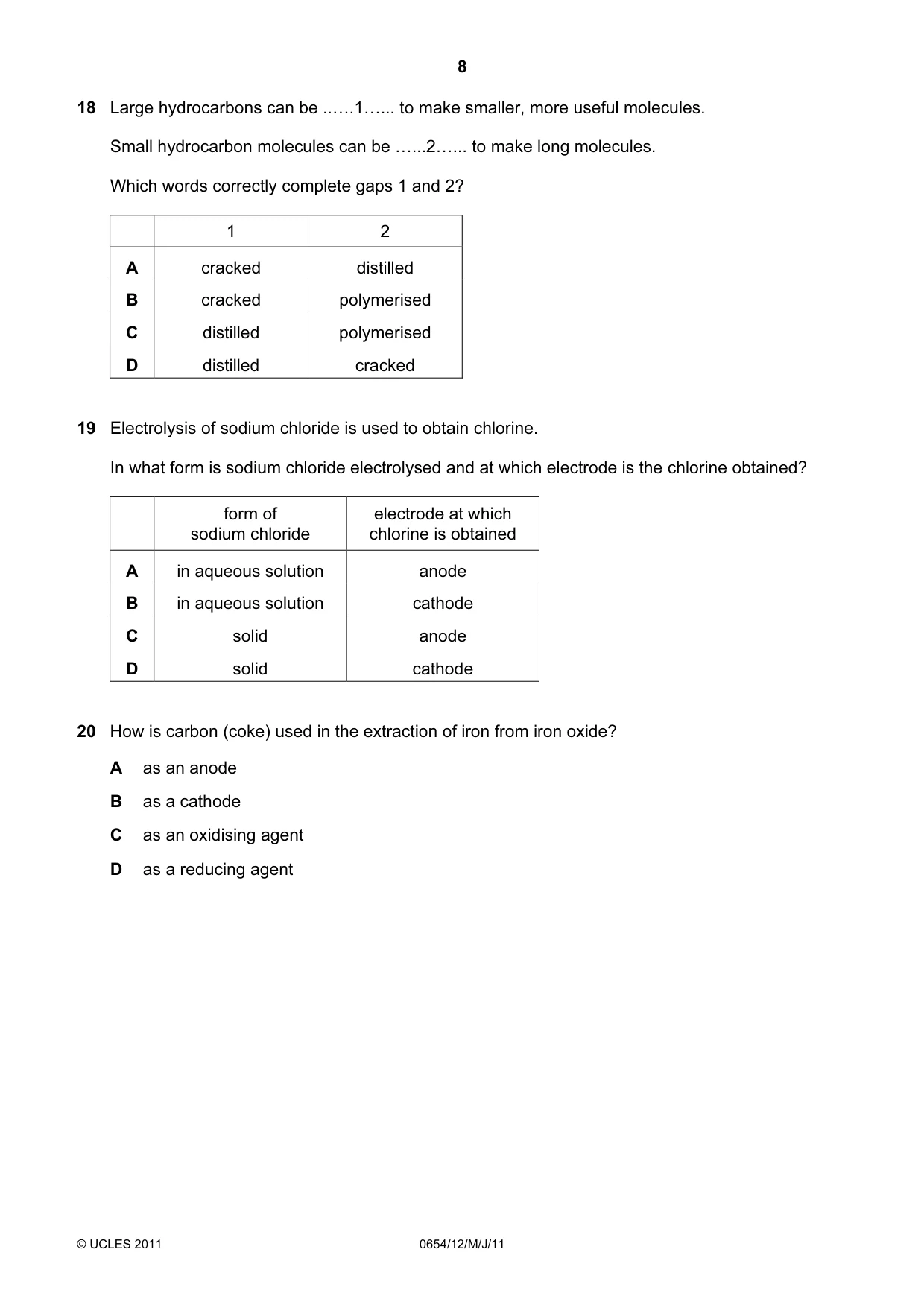
Q18 · Large hydrocarbons can be ..….1…..
18 Large hydrocarbons can be ..….1…... to make smaller, more useful molecules. Small hydrocarbon molecules can be …...2…... to make long molecules. Which words correctly complete gaps 1 and 2? 1 2 A cracked distilled B cracked polymerised C distilled polymerised D distilled cracked
Mark scheme: B
Q19 · Electrolysis of sodium chloride is used to obtain chlorine
19 Electrolysis of sodium chloride is used to obtain chlorine. In what form is sodium chloride electrolysed and at which electrode is the chlorine obtained? form of electrode at which sodium chloride chlorine is obtained A in aqueous solution anode B in aqueous solution cathode C solid anode D solid cathode
Mark scheme: A
Q20 · How is carbon (coke) used in the extraction of iron from iron oxide?
20 How is carbon (coke) used in the extraction of iron from iron oxide? A as an anode B as a cathode C as an oxidising agent D as a reducing agent
Mark scheme: D
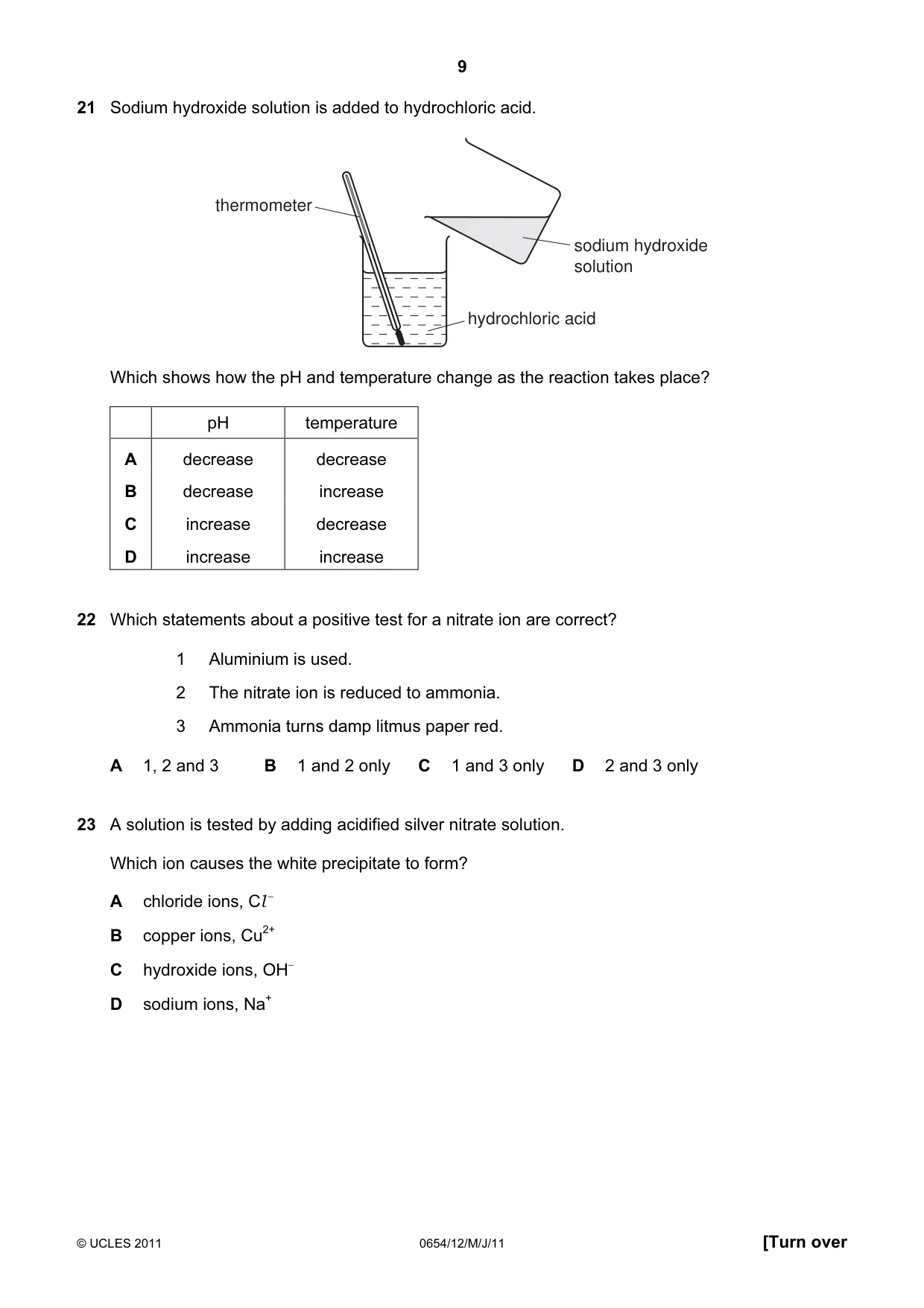
Q21 · Sodium hydroxide solution is added to hydrochloric acid
21 Sodium hydroxide solution is added to hydrochloric acid. thermometer sodium hydroxide solution hydrochloric acid Which shows how the pH and temperature change as the reaction takes place? pH temperature A decrease decrease B decrease increase C increase decrease D increase increase
Mark scheme: D
More questions on The characteristic properties of acids and bases
Q22 · Which statements about a positive test for a nitrate ion are correct?
22 Which statements about a positive test for a nitrate ion are correct? 1 Aluminium is used. 2 The nitrate ion is reduced to ammonia. 3 Ammonia turns damp litmus paper red. A 1, 2 and 3 B 1 and 2 only C 1 and 3 only D 2 and 3 only
Mark scheme: B
Q23 · A solution is tested by adding acidified silver nitrate solution
23 A solution is tested by adding acidified silver nitrate solution. Which ion causes the white precipitate to form? A chloride ions, Cl − B copper ions, Cu2+ C hydroxide ions, OH− D sodium ions, Na+
Mark scheme: A
Q24 · Which statement about methane is not correct?
24 Which statement about methane is not correct? A Methane burns in air to form carbon dioxide and water. B Methane can be obtained from the decay of waste material. C Methane is a fossil fuel. D When methane burns, an endothermic reaction takes place.
Mark scheme: D
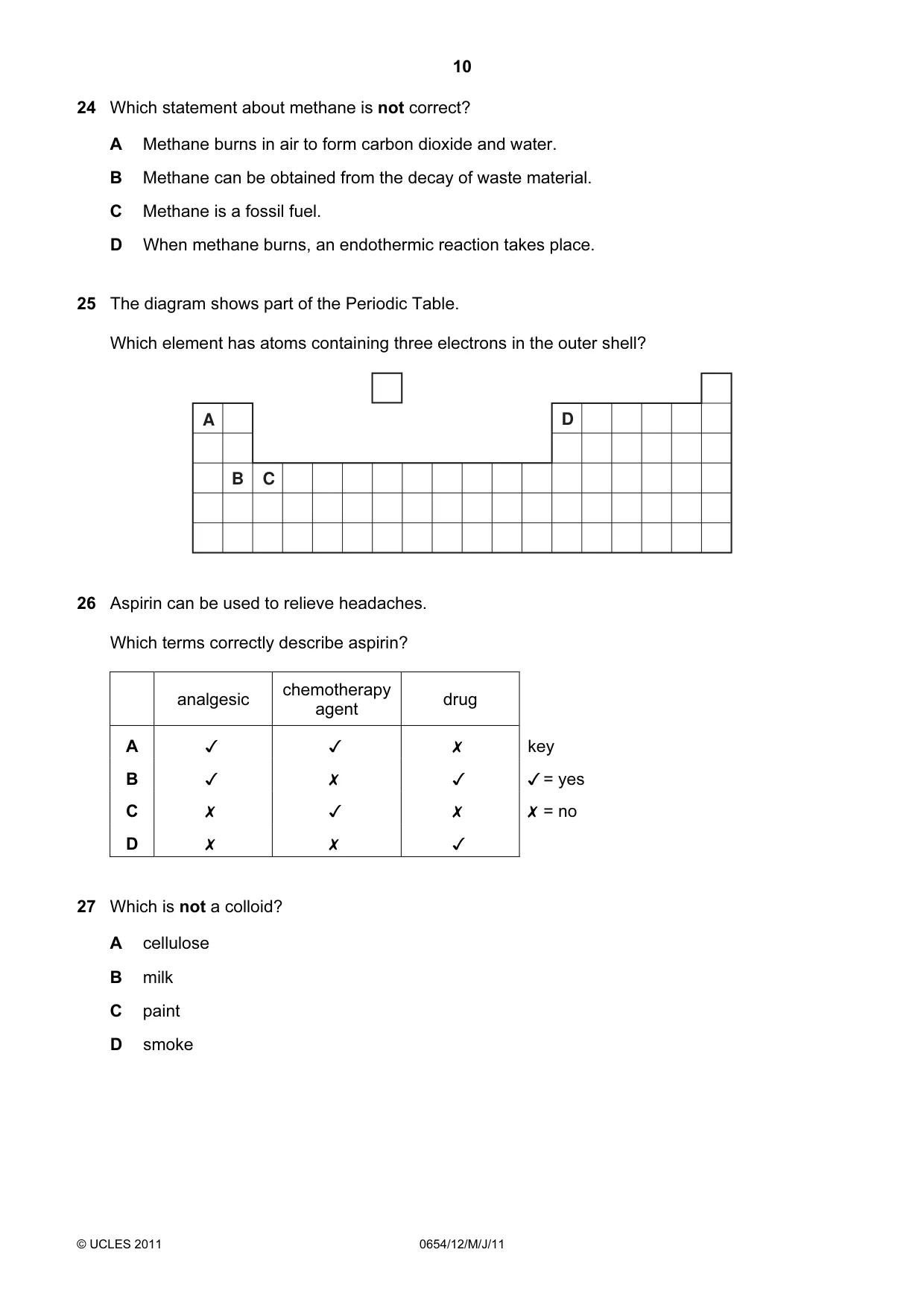
Q25 · The diagram shows part of the Periodic Table
25 The diagram shows part of the Periodic Table. Which element has atoms containing three electrons in the outer shell? A D B C
Mark scheme: D
Q26 · Aspirin can be used to relieve headaches
26 Aspirin can be used to relieve headaches. Which terms correctly describe aspirin? analgesic cogent drug A v v x key B Jv x v /= yes Cc x v x X =no D x x v
Mark scheme: B
Q27 · Which is not a colloid?
27 Which is not a colloid? A cellulose B milk C paint D smoke
Mark scheme: A
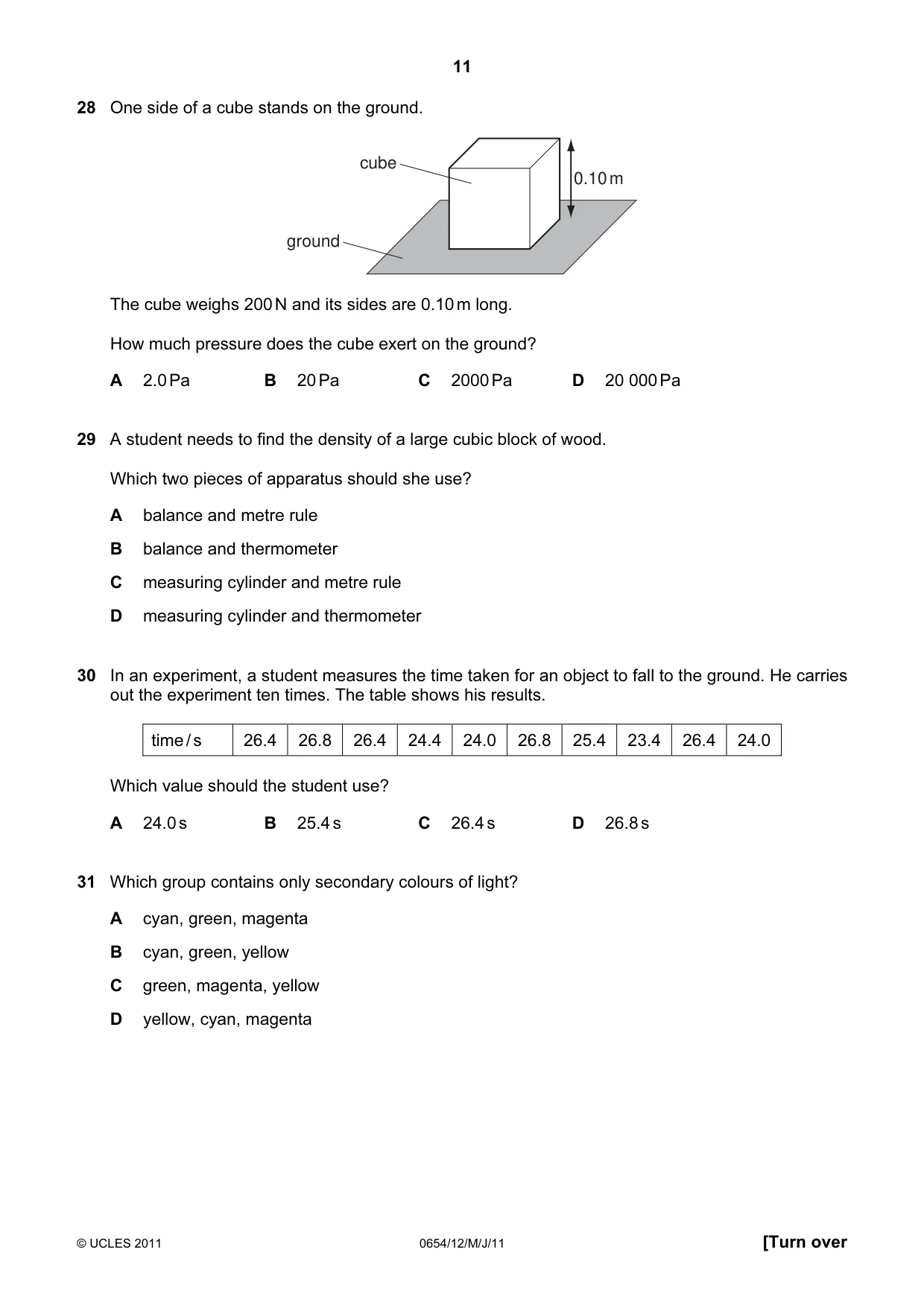
Q28 · One side of a cube stands on the ground
28 One side of a cube stands on the ground. cube 0.10 m ground The cube weighs 200 N and its sides are 0.10 m long. How much pressure does the cube exert on the ground? A 2.0 Pa B 20 Pa C 2000 Pa D 20 000 Pa
Mark scheme: D
Q29 · A student needs to find the density of a large cubic block of wood
29 A student needs to find the density of a large cubic block of wood. Which two pieces of apparatus should she use? A balance and metre rule B balance and thermometer C measuring cylinder and metre rule D measuring cylinder and thermometer
Mark scheme: A
Q30 · In an experiment, a student measures the time taken for an object to fall to the ground
30 In an experiment, a student measures the time taken for an object to fall to the ground. He carries out the experiment ten times. The table shows his results. time / s 26.4 26.8 26.4 24.4 24.0 26.8 25.4 23.4 26.4 24.0 Which value should the student use? A 24.0 s B 25.4 s C 26.4 s D 26.8 s
Mark scheme: B
More questions on Physical quantities and measurement techniques
Q31 · Which group contains only secondary colours of light?
31 Which group contains only secondary colours of light? A cyan, green, magenta B cyan, green, yellow C green, magenta, yellow D yellow, cyan, magenta
Mark scheme: D
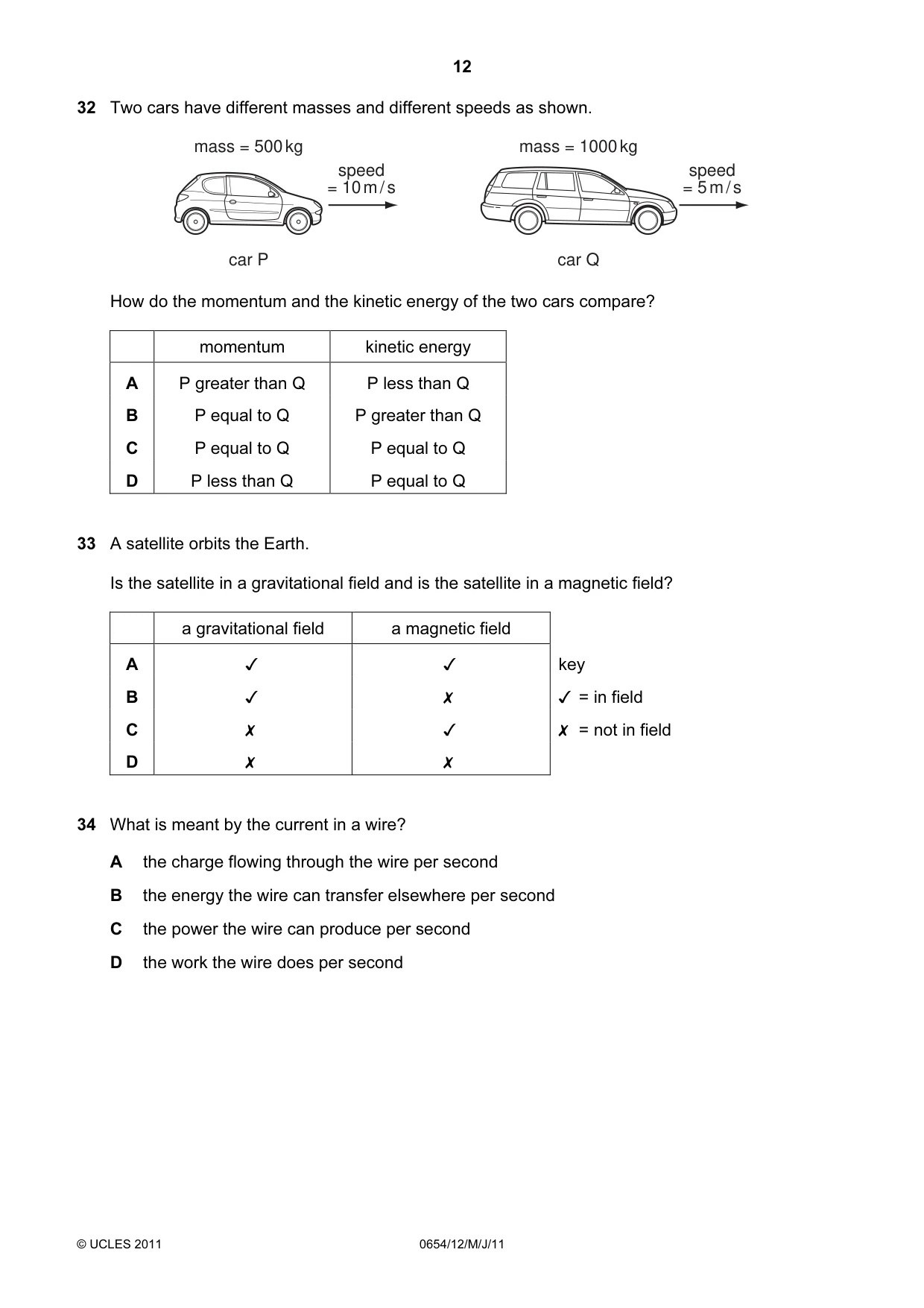
Q32 · Two cars have different masses and different speeds as shown
32 Two cars have different masses and different speeds as shown. mass = 500 kg mass = 1000 kg speed speed = 10 m / s = 5 m / s car P car Q How do the momentum and the kinetic energy of the two cars compare? momentum kinetic energy A P greater than Q P less than Q B P equal to Q P greater than Q C P equal to Q P equal to Q D P less than Q P equal to Q
Mark scheme: B
Q33 · A satellite orbits the Earth
33 A satellite orbits the Earth. Is the satellite in a gravitational field and is the satellite in a magnetic field? a gravitational field a magnetic field 0 0O WwW D> v v x x v x v x key JY =in field X =not in field
Mark scheme: A
Q34 · What is meant by the current in a wire?
34 What is meant by the current in a wire? A the charge flowing through the wire per second B the energy the wire can transfer elsewhere per second C the power the wire can produce per second D the work the wire does per second
Mark scheme: A
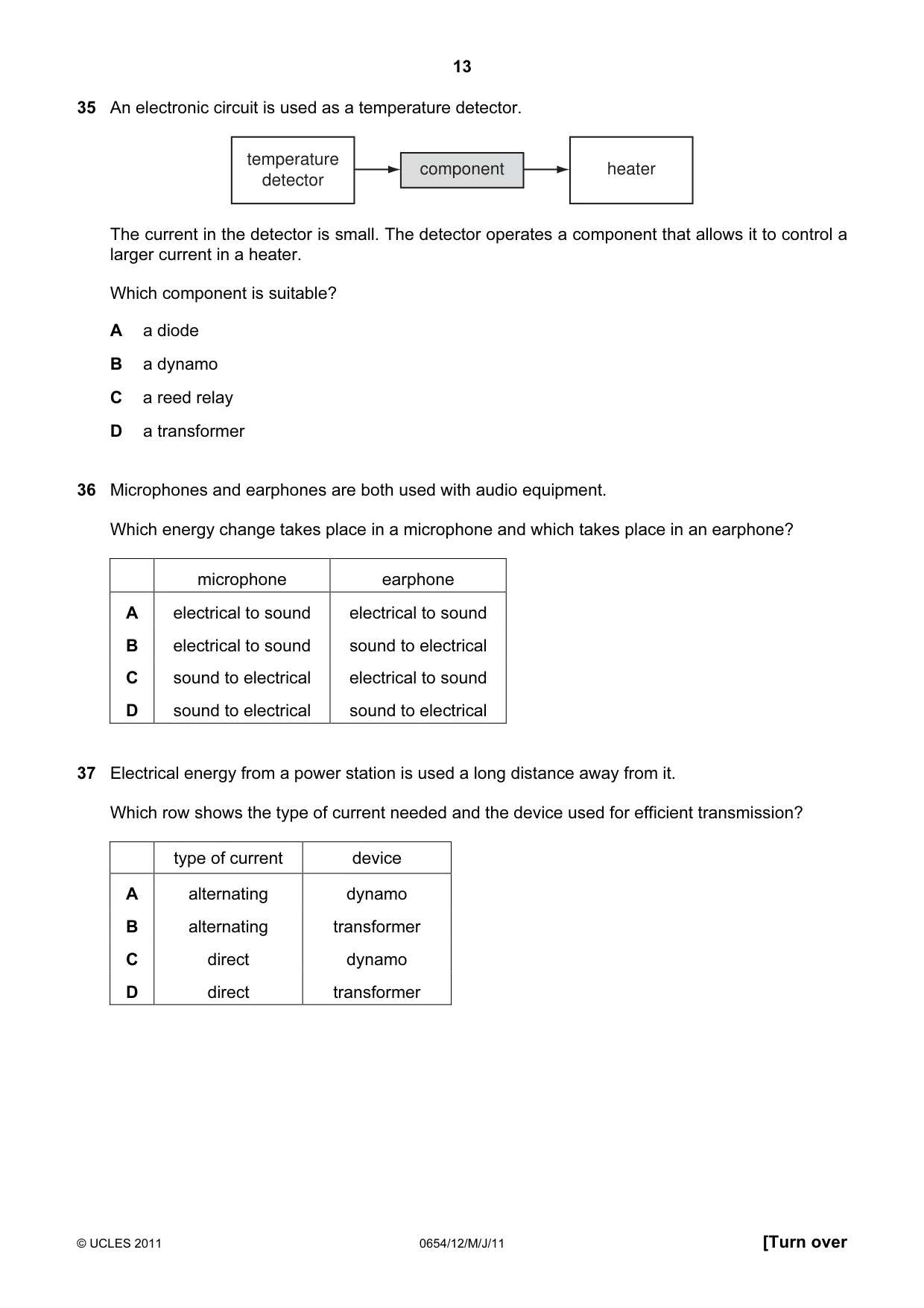
Q35 · An electronic circuit is used as a temperature detector
35 An electronic circuit is used as a temperature detector. temperature component heater detector The current in the detector is small. The detector operates a component that allows it to control a larger current in a heater. Which component is suitable? A a diode B a dynamo C a reed relay D a transformer
Mark scheme: C
Q36 · Microphones and earphones are both used with audio equipment
36 Microphones and earphones are both used with audio equipment. Which energy change takes place in a microphone and which takes place in an earphone? microphone earphone A electrical to sound electrical to sound B electrical to sound sound to electrical C sound to electrical electrical to sound D sound to electrical sound to electrical
Mark scheme: C
Q37 · Electrical energy from a power station is used a long distance away from it
37 Electrical energy from a power station is used a long distance away from it. Which row shows the type of current needed and the device used for efficient transmission? type of current device A alternating dynamo B alternating transformer C direct dynamo D direct transformer
Mark scheme: B
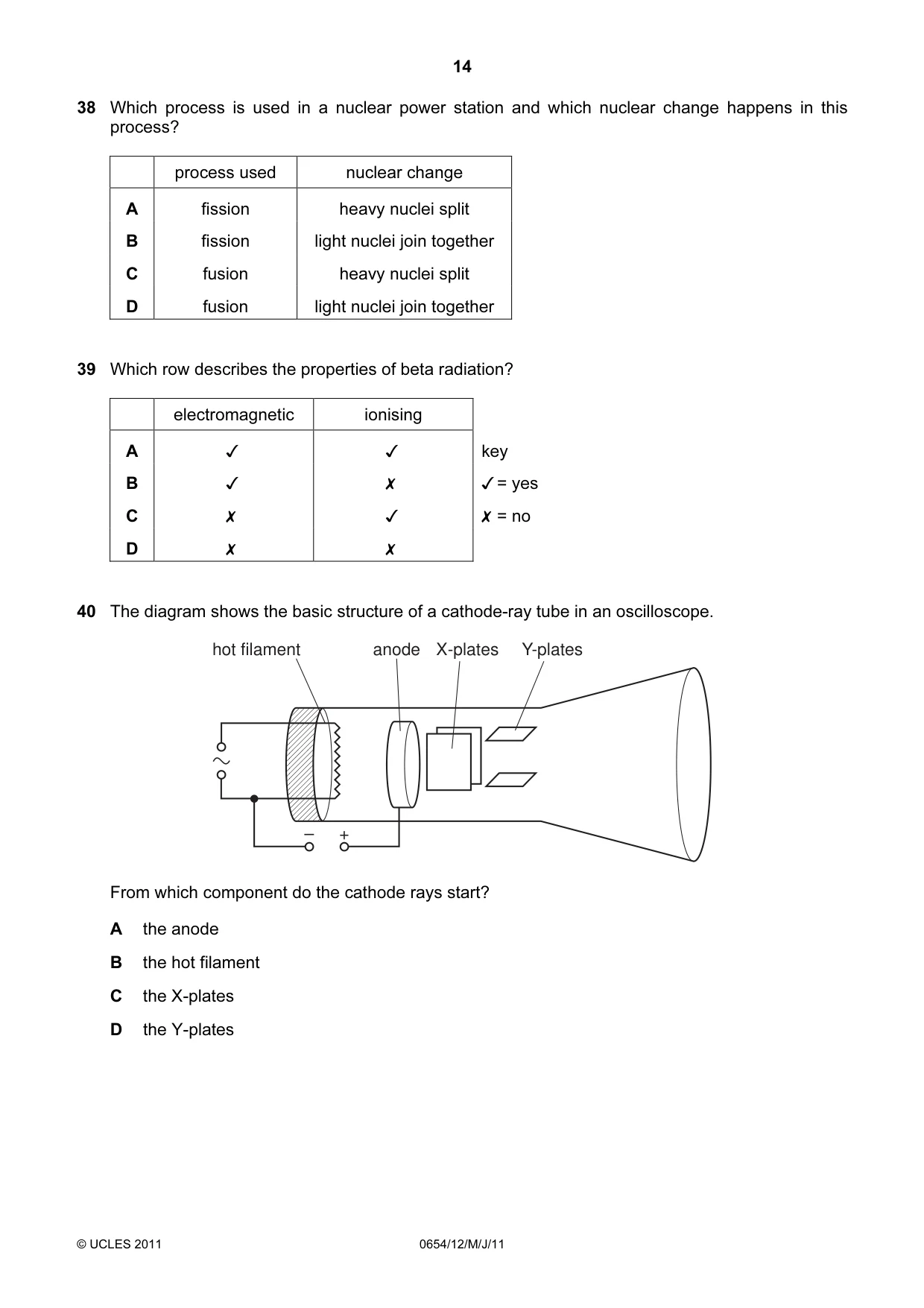
Q38 · Which process is used in a nuclear power station and which nuclear change happens in this…
38 Which process is used in a nuclear power station and which nuclear change happens in this process? process used nuclear change A fission heavy nuclei split B fission light nuclei join together C fusion heavy nuclei split D fusion light nuclei join together
Mark scheme: A
Q39 · Which row describes the properties of beta radiation?
39 Which row describes the properties of beta radiation? electromagnetic ionising A v v B v x Cc x v D x x key v/=yes X =no
Mark scheme: C
Q40 · The diagram shows the basic structure of a cathode-ray tube in an oscilloscope
40 The diagram shows the basic structure of a cathode-ray tube in an oscilloscope. hot filament anode X-plates Y-plates – + From which component do the cathode rays start? A the anode B the hot filament C the X-plates D the Y-plates
Mark scheme: B
What was in this paper
The subtopics covered by these 40 questions, and how many questions each got. Open one in a new tab to see every Cambridge question on it.
2Electrical circuits2Electromagnetic effects2Identification of ions and gases2Respiration2Alkanes1Alkenes1Asexual reproduction1Atomic structure and the Periodic Table1Cell structure1Density1Digestive system1Drugs1Electrical quantities1Electrolysis1Elements, compounds and mixtures1Energy flow1Energy, work and power1Extraction of metals1Food chains and food webs1Gas exchange in humans1Group I properties1Heart1Homeostasis1Light1Physical quantities and measurement techniques1Pressure1Radioactivity1Sexual reproduction in humans1Sexual reproduction in plants1Simple molecules and covalent bonds1Simple phenomena of magnetism1Solids, liquids and gases1The characteristic properties of acids and bases1The nucleus1What you needed in this session
Cambridge’s own grade thresholds for 2011 May/June, Paper 1 · Variant 2. A higher threshold means an easier paper — the bar moves with how the cohort did.