Cambridge IGCSE Sciences - Co-ordinated (Double) 0654 — 2022 May/June Paper 1 · Variant 1
0654/11/M/J/22 · 40 questions · 40 marks · ≈45 min
The question paper and its mark scheme, free to read here and free to download. This is Cambridge’s own paper, exactly as it was sat.
Question paper16 pages

Mark scheme3 pages
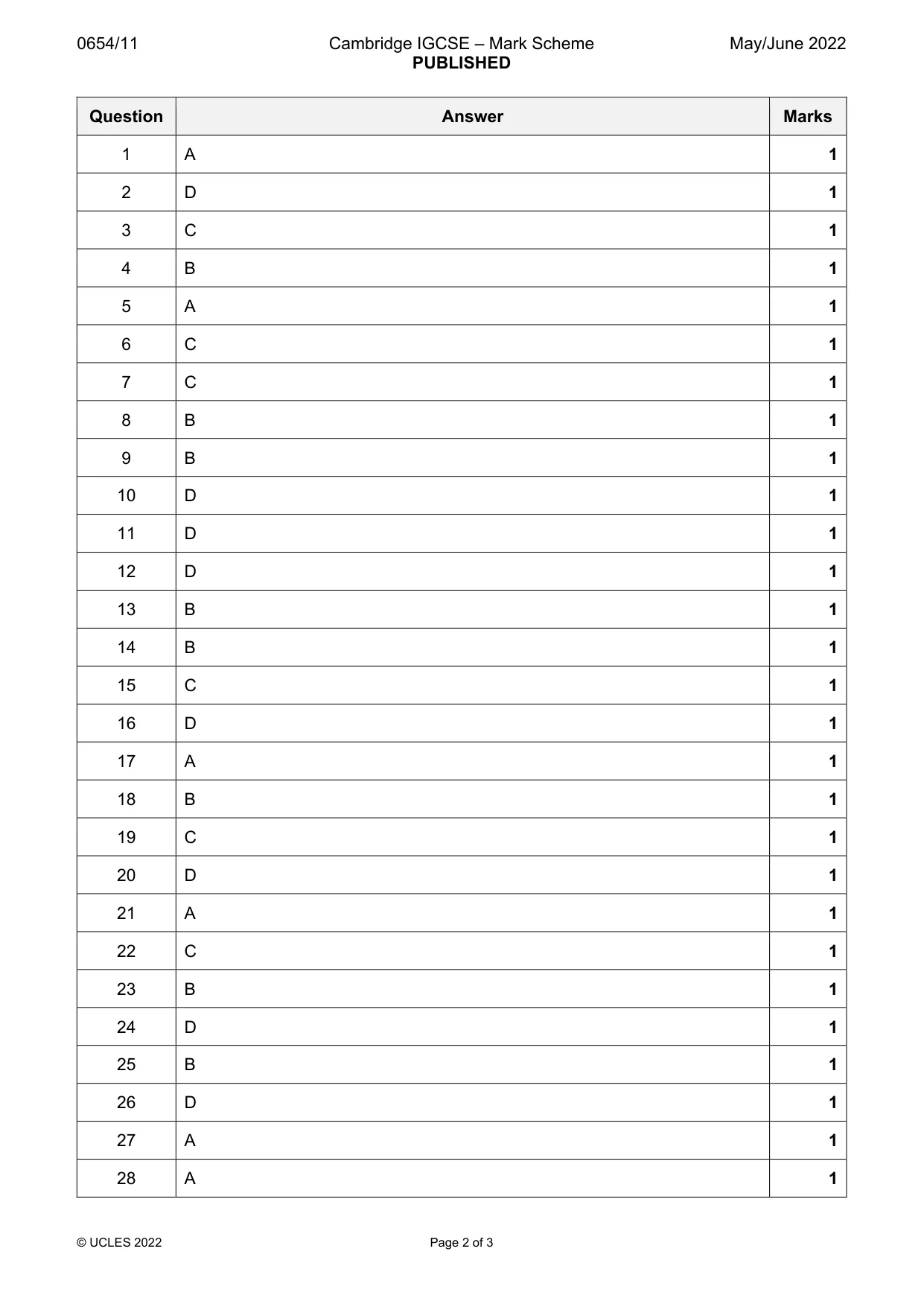
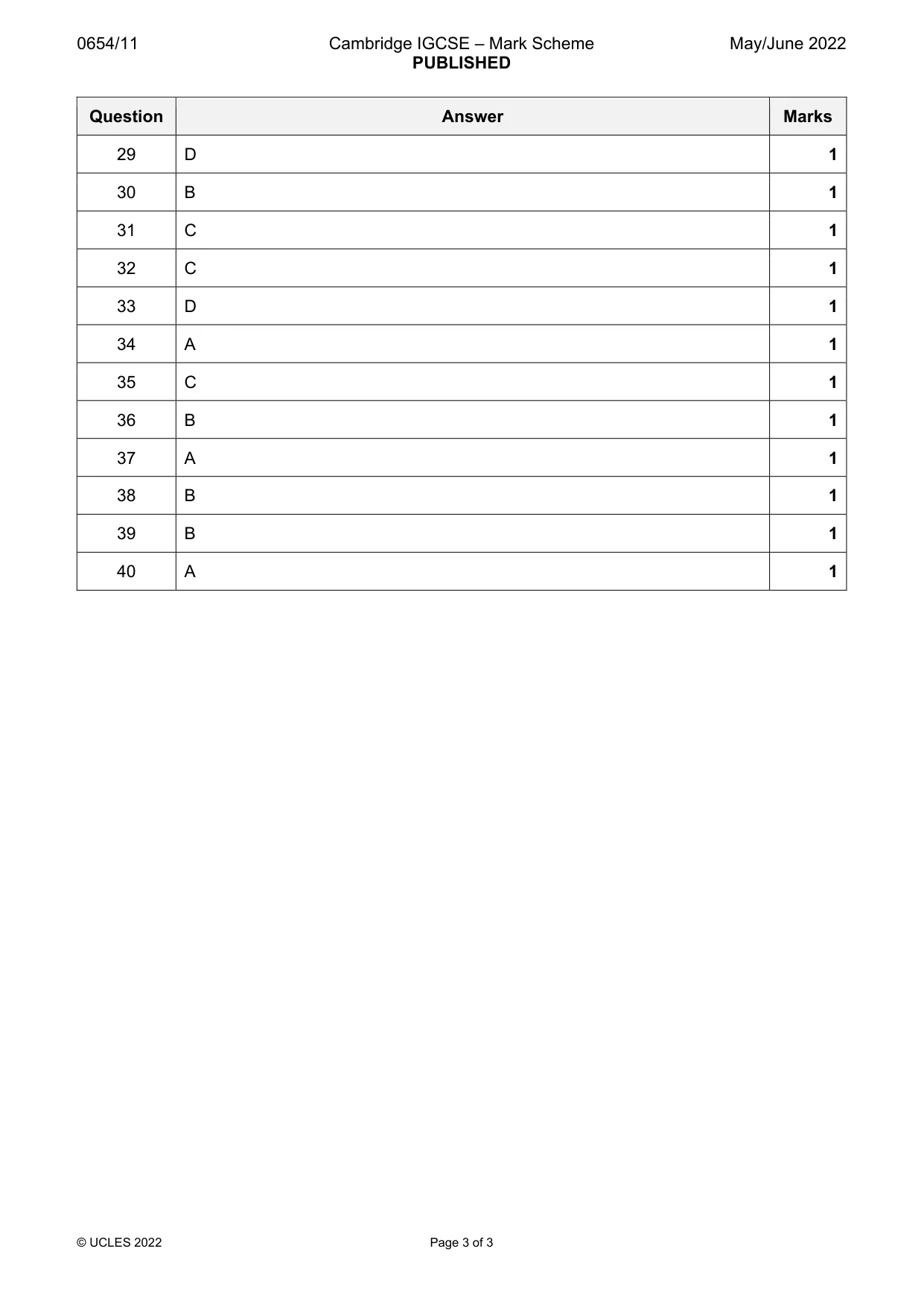
Answers below. Sit the paper first if you are practising.
Questions as text
Q1 · Which statement about one of the characteristics of living organisms is correct?
1 Which statement about one of the characteristics of living organisms is correct? A Excretion is the removal of excess substances and toxic materials. B Movement is the ability to detect and respond to changes in the environment. C Nutrition is the maintenance of a constant internal environment. D Respiration is the manufacture of nutrients from raw materials.
Mark scheme: A
Q2 · Which statement about animal cells and plant cells is correct?
2 Which statement about animal cells and plant cells is correct? A Only animal cells possess cell membranes. B Only animal cells possess cell walls. C Only plant cells possess cell membranes. D Only plant cells possess cell walls.
Mark scheme: D
Q3 · Which small molecules are joined together to make a starch molecule?
3 Which small molecules are joined together to make a starch molecule? A amino acids B fatty acids C glucose D glycerol
Mark scheme: C
Q4 · Fungus can live at the base of human hair where the activity of one of its enzymes can…
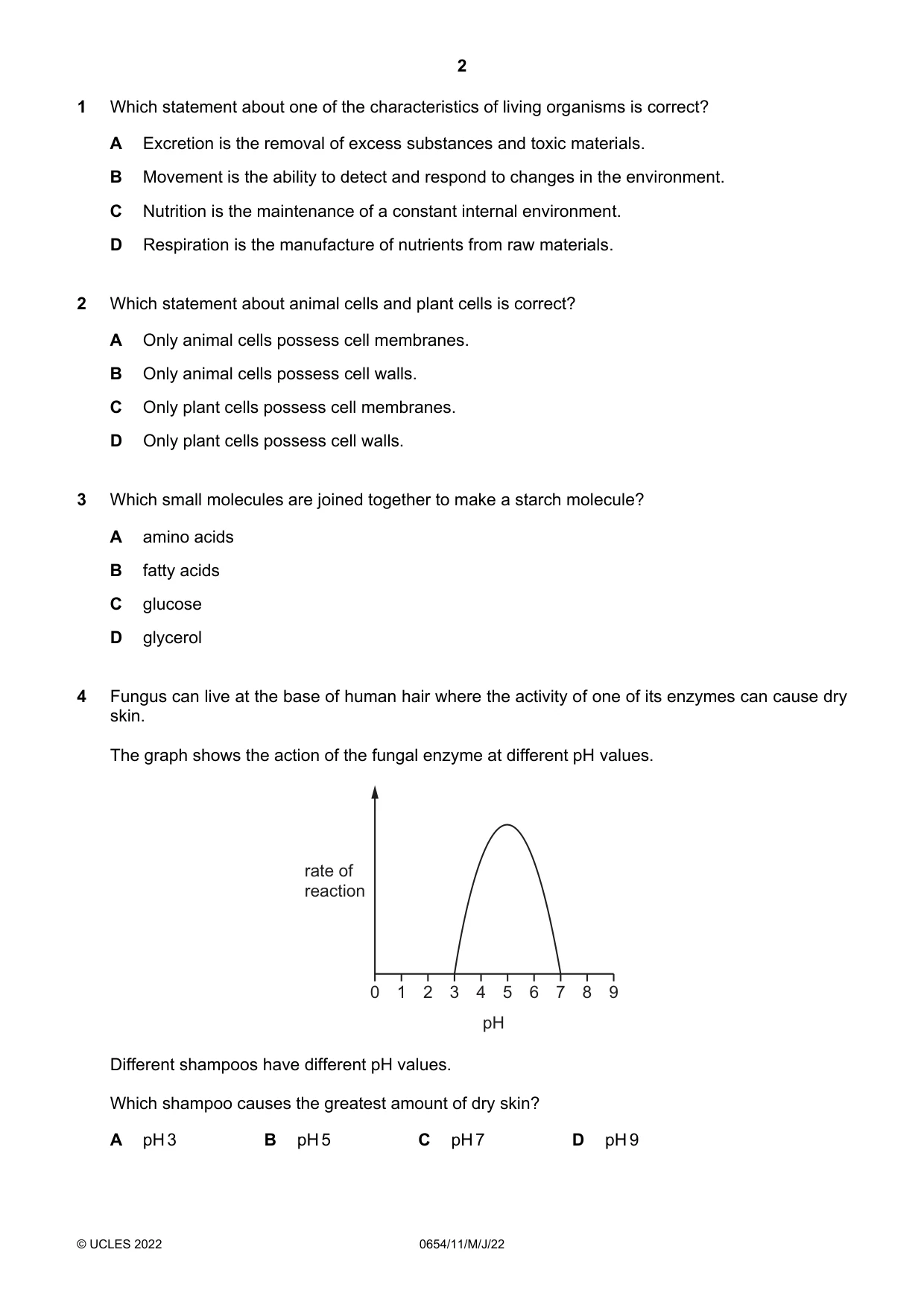
4 Fungus can live at the base of human hair where the activity of one of its enzymes can cause dry skin. The graph shows the action of the fungal enzyme at different pH values. rate of reaction 0 1 2 3 4 5 6 7 8 9 pH Different shampoos have different pH values. Which shampoo causes the greatest amount of dry skin? A pH 3 B pH 5 C pH 7 D pH 9
Mark scheme: B
Q5 · A student places a plant in the dark for 24 hours
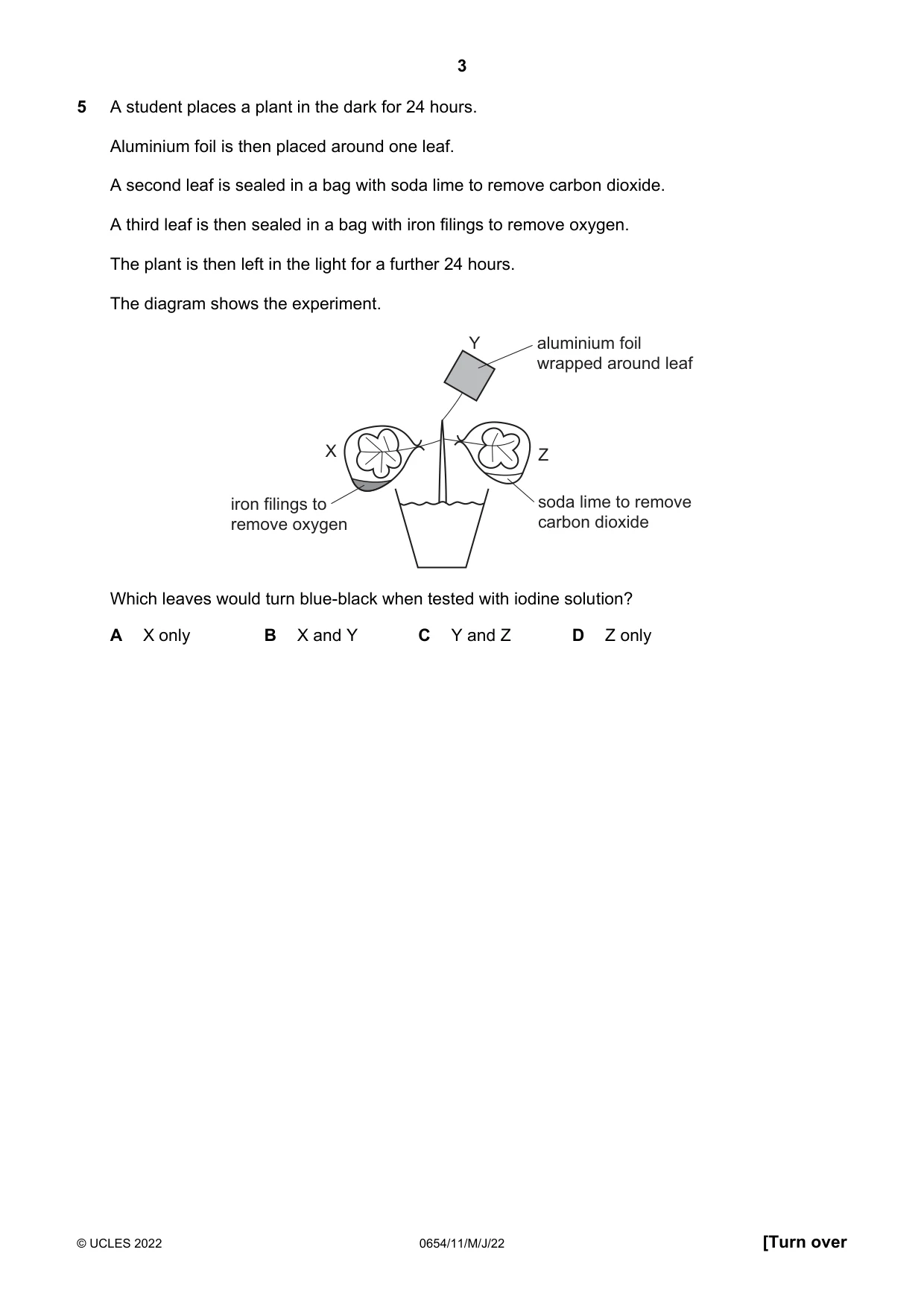
5 A student places a plant in the dark for 24 hours. Aluminium foil is then placed around one leaf. A second leaf is sealed in a bag with soda lime to remove carbon dioxide. A third leaf is then sealed in a bag with iron filings to remove oxygen. The plant is then left in the light for a further 24 hours. The diagram shows the experiment. Y aluminium foil wrapped around leaf X Z iron filings to soda lime to remove remove oxygen carbon dioxide Which leaves would turn blue-black when tested with iodine solution? A X only B X and Y C Y and Z D Z only
Mark scheme: A
Q6 · The diagram shows part of the digestive system
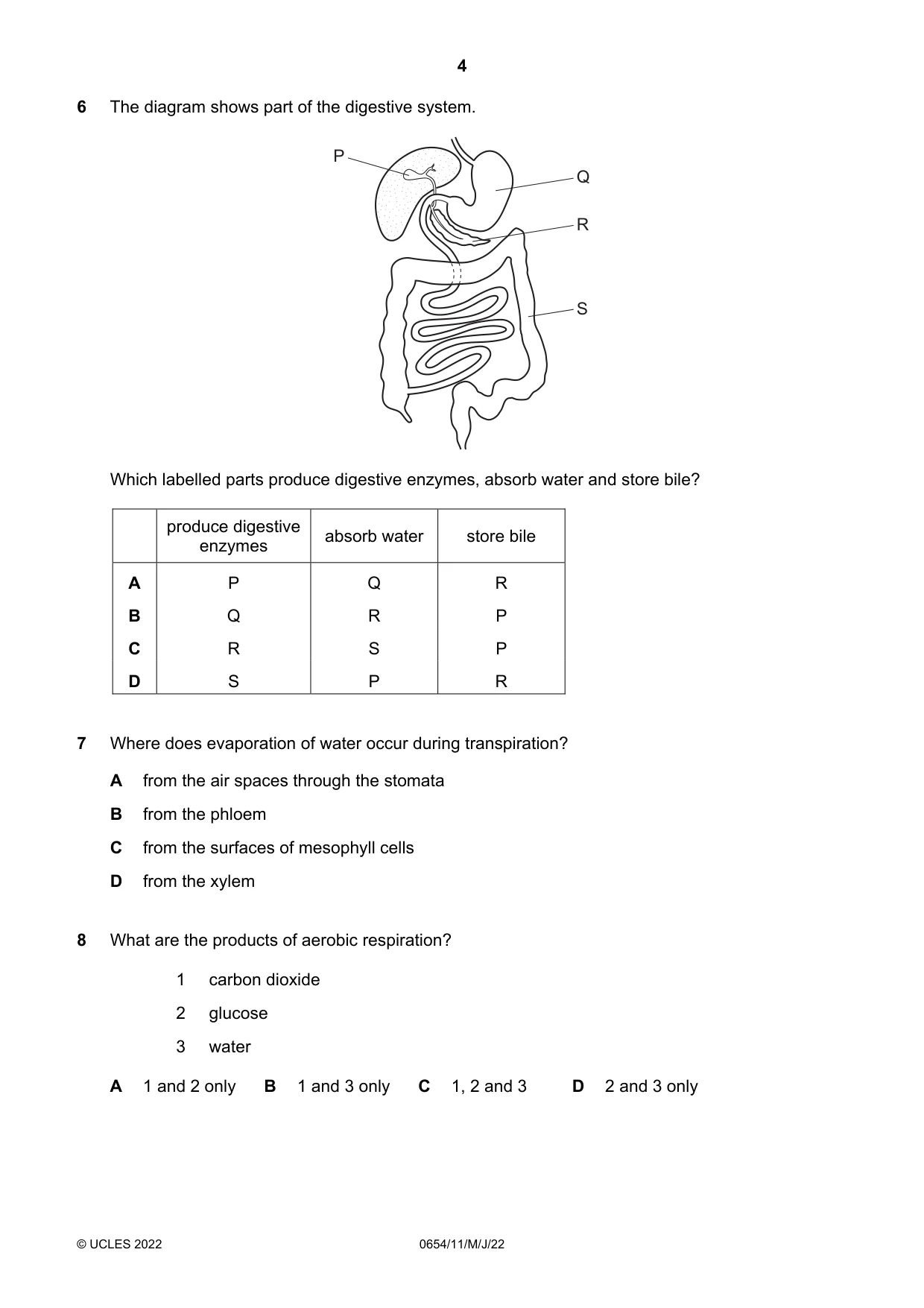
6 The diagram shows part of the digestive system. P Q R S Which labelled parts produce digestive enzymes, absorb water and store bile? produce digestive absorb water store bile enzymes A P Q R B Q R P C R S P D S P R
Mark scheme: C
Q7 · Where does evaporation of water occur during transpiration?
7 Where does evaporation of water occur during transpiration? A from the air spaces through the stomata B from the phloem C from the surfaces of mesophyll cells D from the xylem
Mark scheme: C
Q8 · What are the products of aerobic respiration?
8 What are the products of aerobic respiration? 1 carbon dioxide 2 glucose 3 water A 1 and 2 only B 1 and 3 only C 1, 2 and 3 D 2 and 3 only
Mark scheme: B
Q9 · A plant in a pot is placed on its side in a dark cupboard
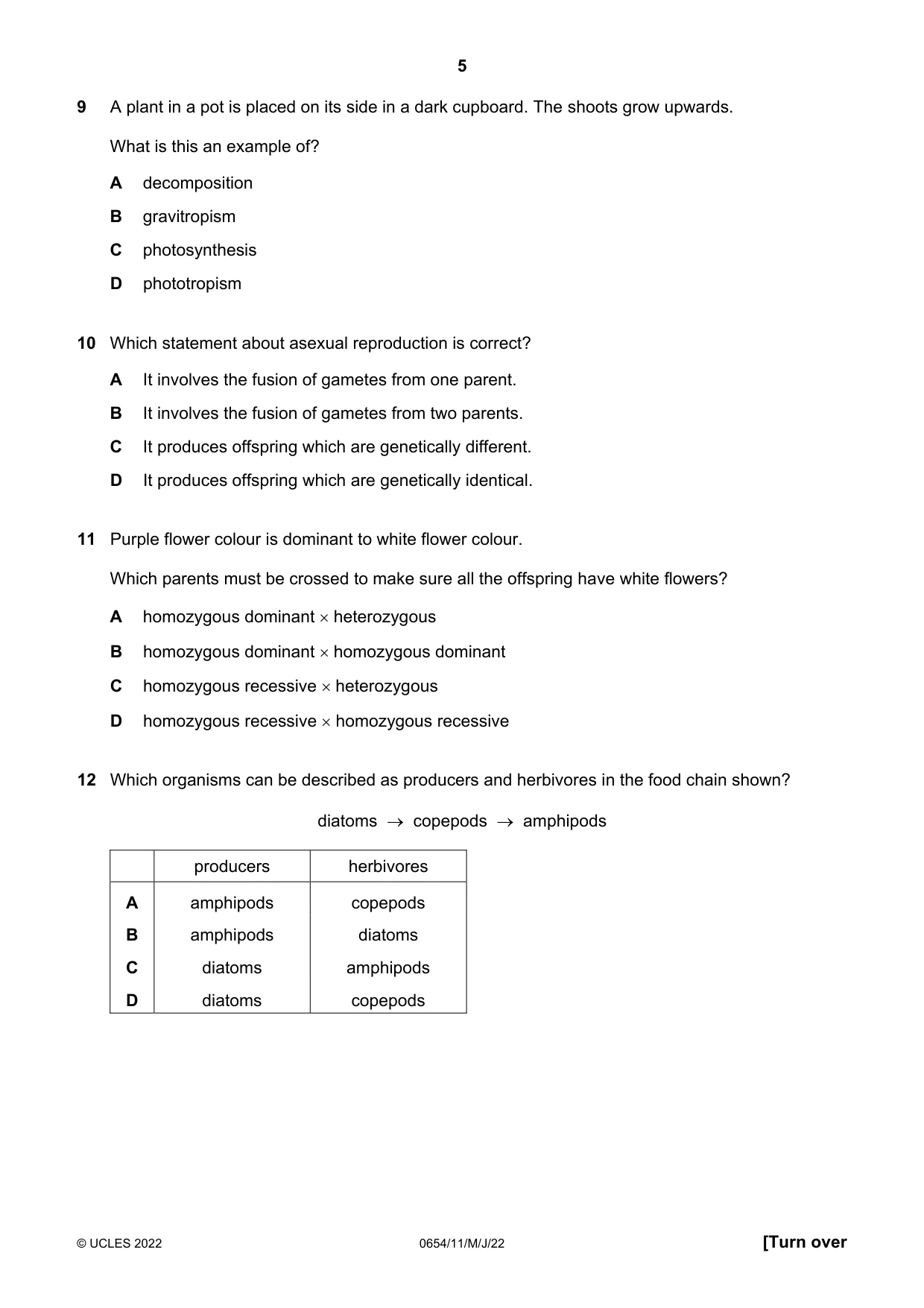
9 A plant in a pot is placed on its side in a dark cupboard. The shoots grow upwards. What is this an example of? A decomposition B gravitropism C photosynthesis D phototropism
Mark scheme: B
Q10 · Which statement about asexual reproduction is correct?
10 Which statement about asexual reproduction is correct? A It involves the fusion of gametes from one parent. B It involves the fusion of gametes from two parents. C It produces offspring which are genetically different. D It produces offspring which are genetically identical.
Mark scheme: D
Q11 · Purple flower colour is dominant to white flower colour
11 Purple flower colour is dominant to white flower colour. Which parents must be crossed to make sure all the offspring have white flowers? A homozygous dominant heterozygous B homozygous dominant homozygous dominant C homozygous recessive heterozygous D homozygous recessive homozygous recessive
Mark scheme: D
Q12 · Which organisms can be described as producers and herbivores in the food chain shown?
12 Which organisms can be described as producers and herbivores in the food chain shown? diatoms copepods amphipods producers herbivores A amphipods copepods B amphipods diatoms C diatoms amphipods D diatoms copepods
Mark scheme: D
Q13 · The diagram shows part of the carbon cycle
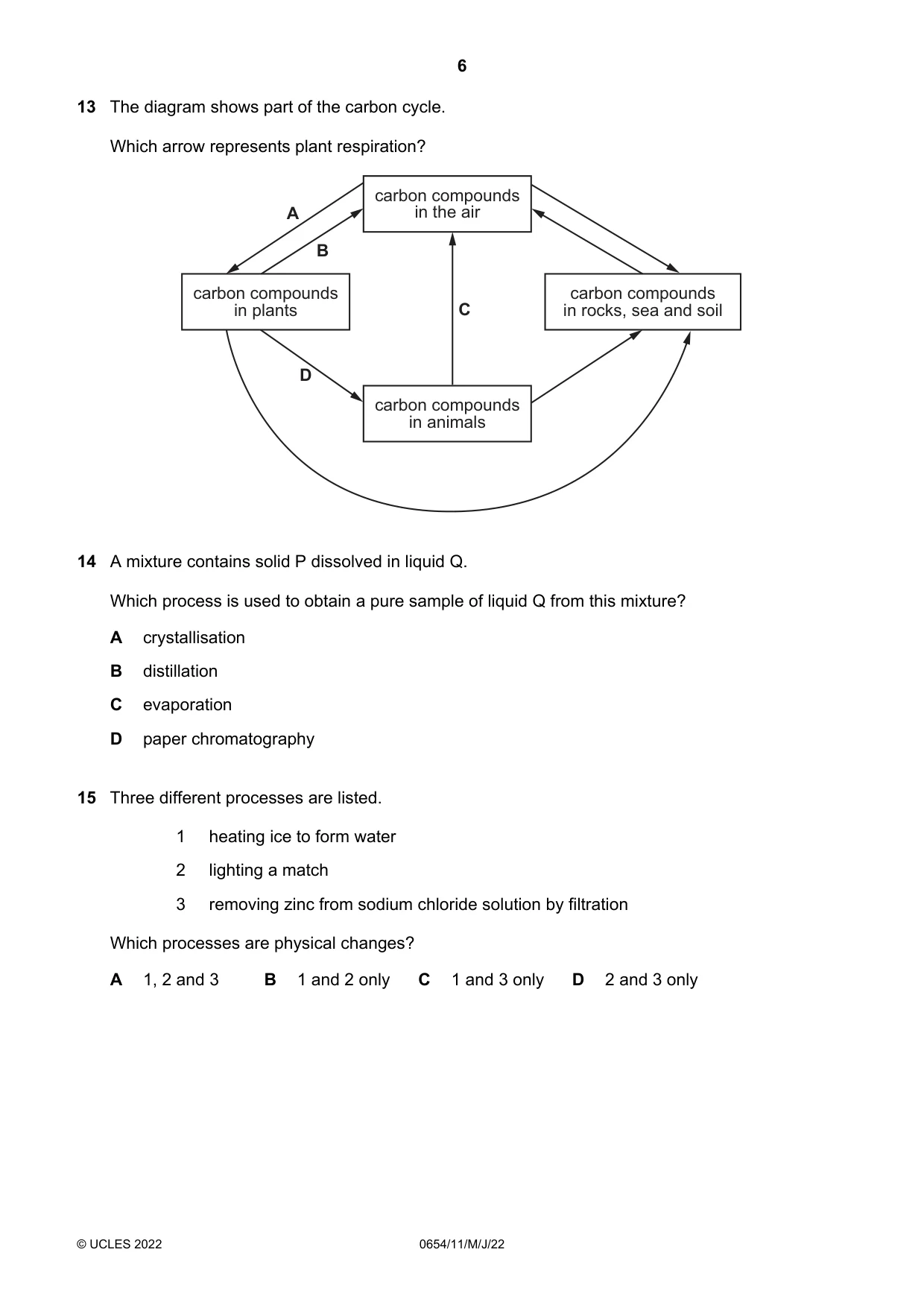
13 The diagram shows part of the carbon cycle. Which arrow represents plant respiration? carbon compounds A in the air B carbon compounds carbon compounds in plants C in rocks, sea and soil D carbon compounds in animals
Mark scheme: B
Q14 · A mixture contains solid P dissolved in liquid Q
14 A mixture contains solid P dissolved in liquid Q. Which process is used to obtain a pure sample of liquid Q from this mixture? A crystallisation B distillation C evaporation D paper chromatography
Mark scheme: B
Q15 · Three different processes are listed
15 Three different processes are listed. 1 heating ice to form water 2 lighting a match 3 removing zinc from sodium chloride solution by filtration Which processes are physical changes? A 1, 2 and 3 B 1 and 2 only C 1 and 3 only D 2 and 3 only
Mark scheme: C
Q16 · Propanol, CH3CH2CH2OH, burns in oxygen to produce carbon dioxide and water
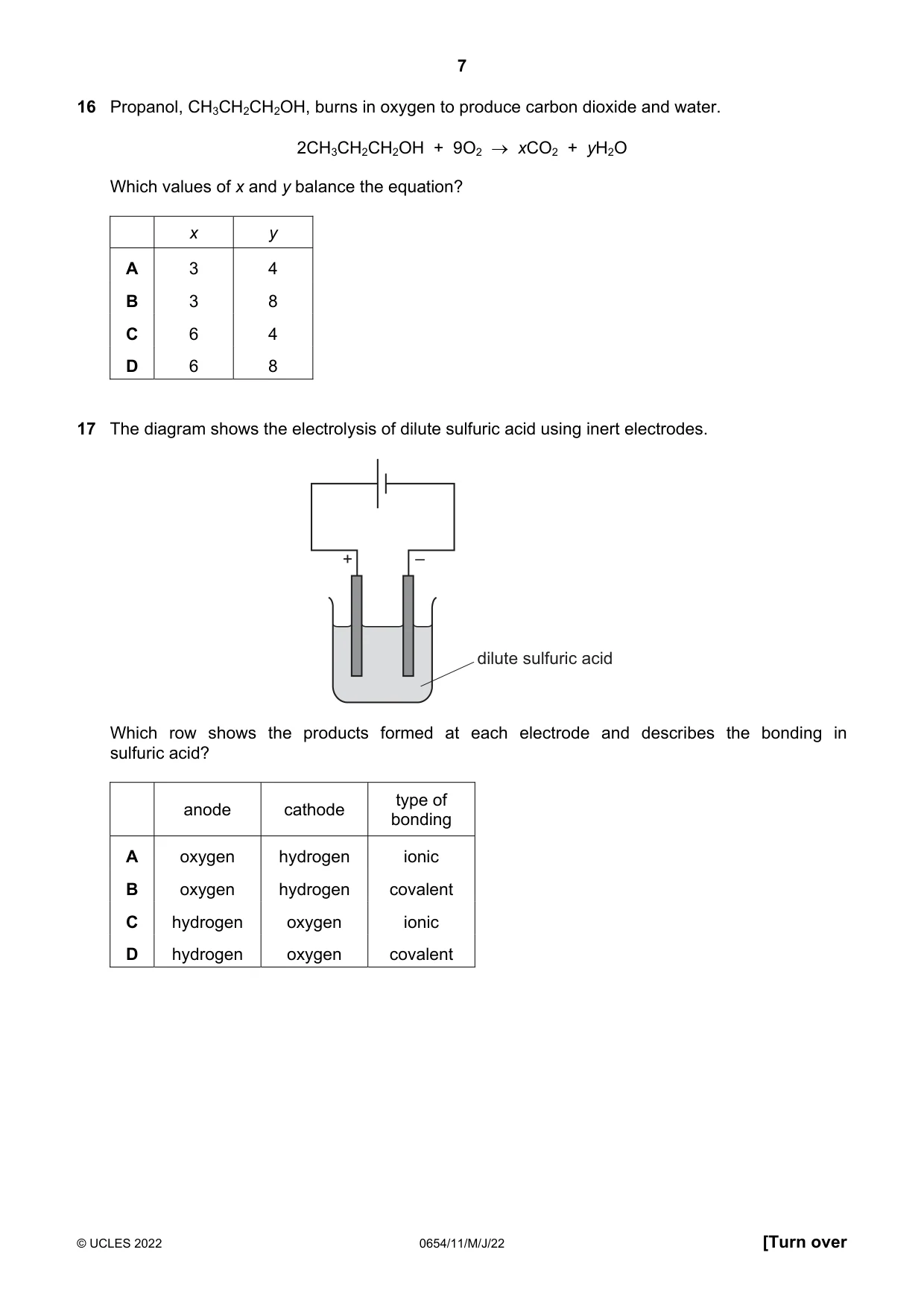
16 Propanol, CH3CH2CH2OH, burns in oxygen to produce carbon dioxide and water. 2CH3CH2CH2OH + 9O2 xCO2 + yH2O Which values of x and y balance the equation? x y A 3 4 B 3 8 C 6 4 D 6 8
Mark scheme: D
Q17 · The diagram shows the electrolysis of dilute sulfuric acid using inert electrodes
17 The diagram shows the electrolysis of dilute sulfuric acid using inert electrodes. + – dilute sulfuric acid Which row shows the products formed at each electrode and describes the bonding in sulfuric acid? type of anode cathode bonding A oxygen hydrogen ionic B oxygen hydrogen covalent C hydrogen oxygen ionic D hydrogen oxygen covalent
Mark scheme: A
Q18 · Hydrogen reacts with iodine to form hydrogen iodide
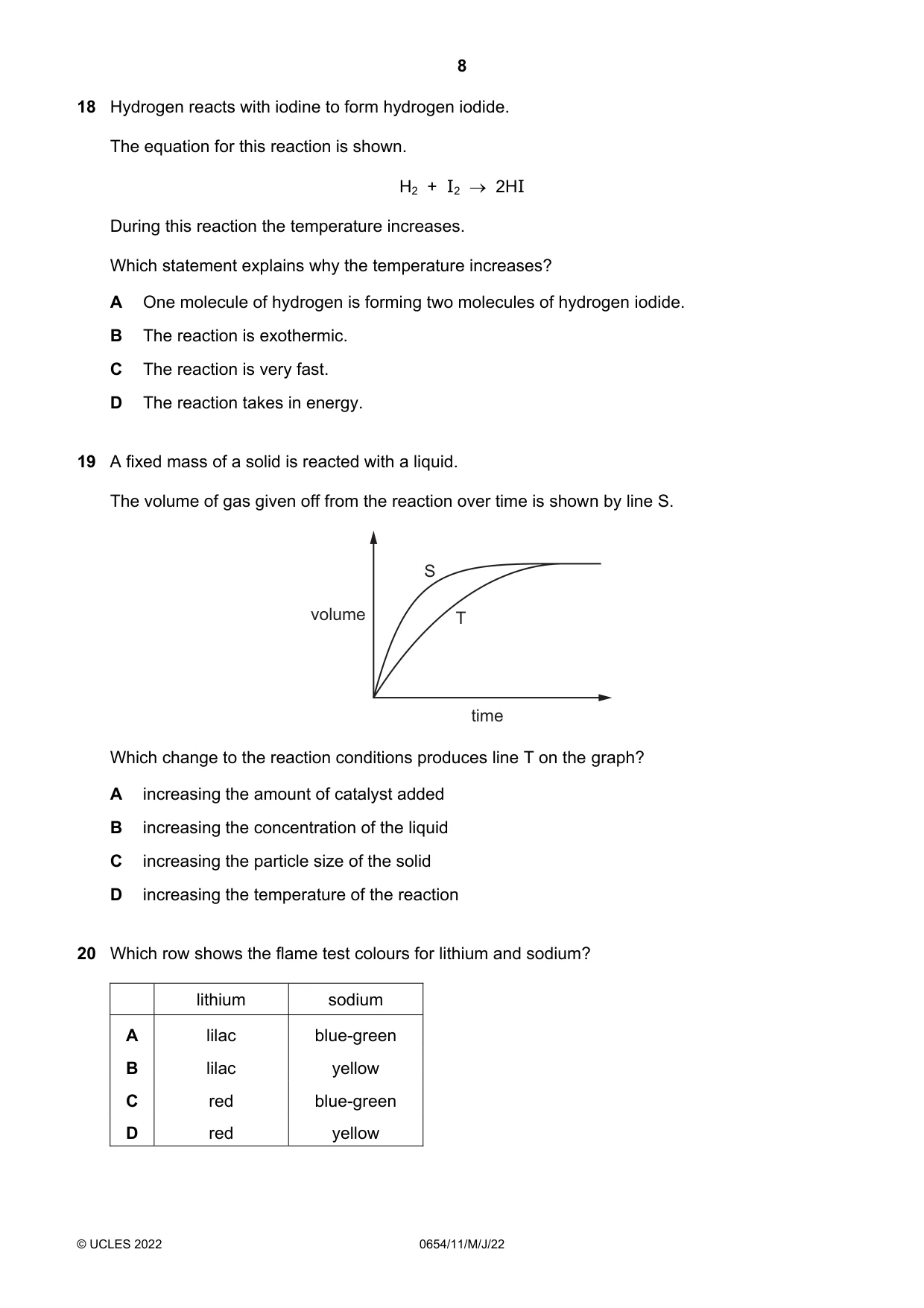
18 Hydrogen reacts with iodine to form hydrogen iodide. The equation for this reaction is shown. H2 + I2 2HI During this reaction the temperature increases. Which statement explains why the temperature increases? A One molecule of hydrogen is forming two molecules of hydrogen iodide. B The reaction is exothermic. C The reaction is very fast. D The reaction takes in energy.
Mark scheme: B
Q19 · A fixed mass of a solid is reacted with a liquid
19 A fixed mass of a solid is reacted with a liquid. The volume of gas given off from the reaction over time is shown by line S. S volume T time Which change to the reaction conditions produces line T on the graph? A increasing the amount of catalyst added B increasing the concentration of the liquid C increasing the particle size of the solid D increasing the temperature of the reaction
Mark scheme: C
Q20 · Which row shows the flame test colours for lithium and sodium?
20 Which row shows the flame test colours for lithium and sodium? lithium sodium A lilac blue-green B lilac yellow C red blue-green D red yellow
Mark scheme: D
Q21 · A gas is used in welding metals together at high temperatures
21 A gas is used in welding metals together at high temperatures. The gas is used to provide an inert atmosphere. What is the gas? A argon B carbon dioxide C fluorine D oxygen
Mark scheme: A
Q22 · Which row does not link a general physical property to the type of element?
22 Which row does not link a general physical property to the type of element? type of element general physical property A metal malleable B metal thermal conductor C non-metal electrical conductor D non-metal low melting point
Mark scheme: C
Q23 · Three metals X, Y and Z are added separately to water and to dilute hydrochloric acid
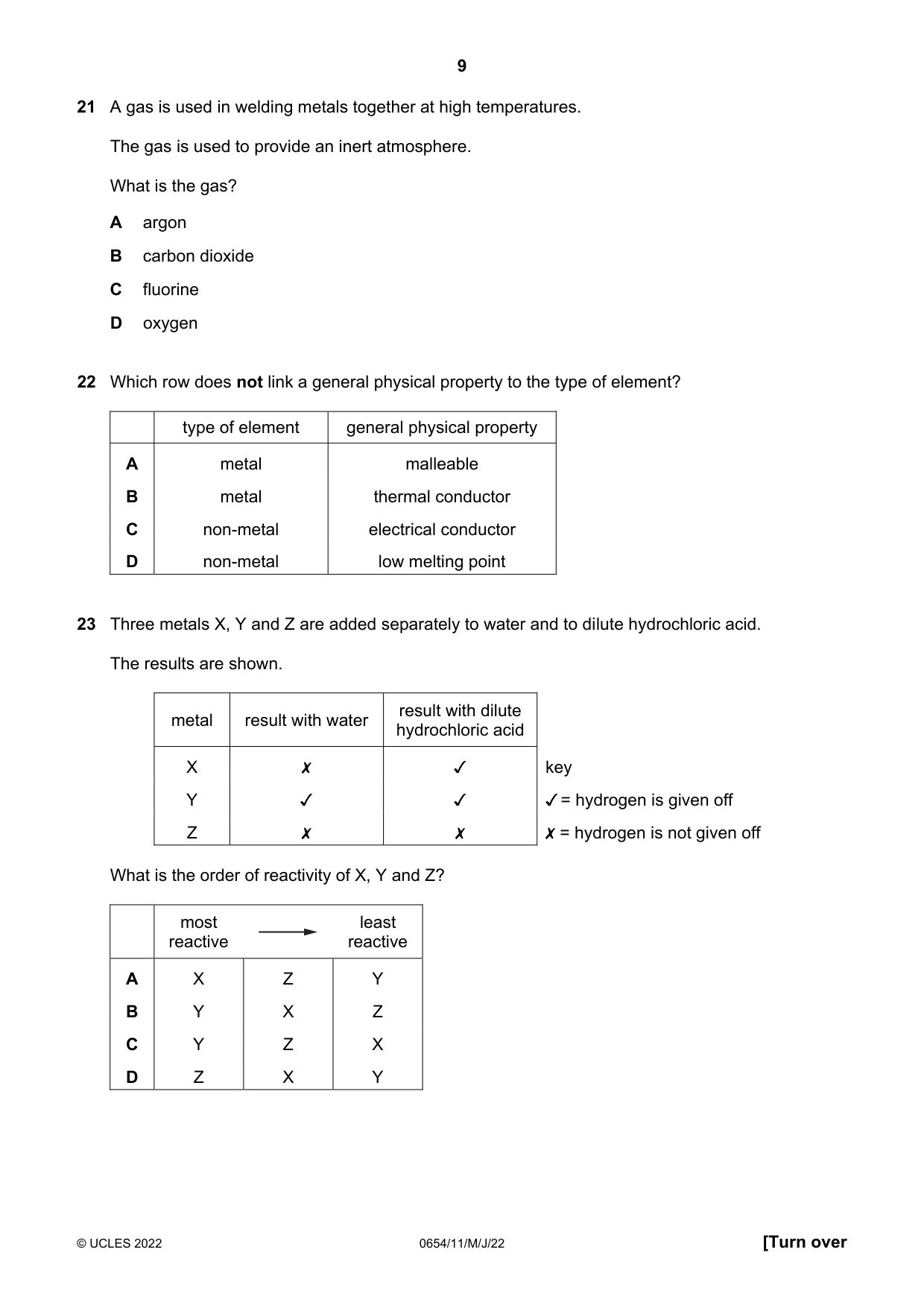
23 Three metals X, Y and Z are added separately to water and to dilute hydrochloric acid. The results are shown. result with dilute metal result with water hydrochloric acid Xx x Jv key Jv v ¥ = hydrogen is given off Z x x X = hydrogen is not given off What is the order of reactivity of X, Y and Z? most least reactive reactive A X Z B Y X Z Cc Y Z X D Z X Y
Mark scheme: B
Q24 · The diagram shows a metal being extracted from its powdered ore using carbon
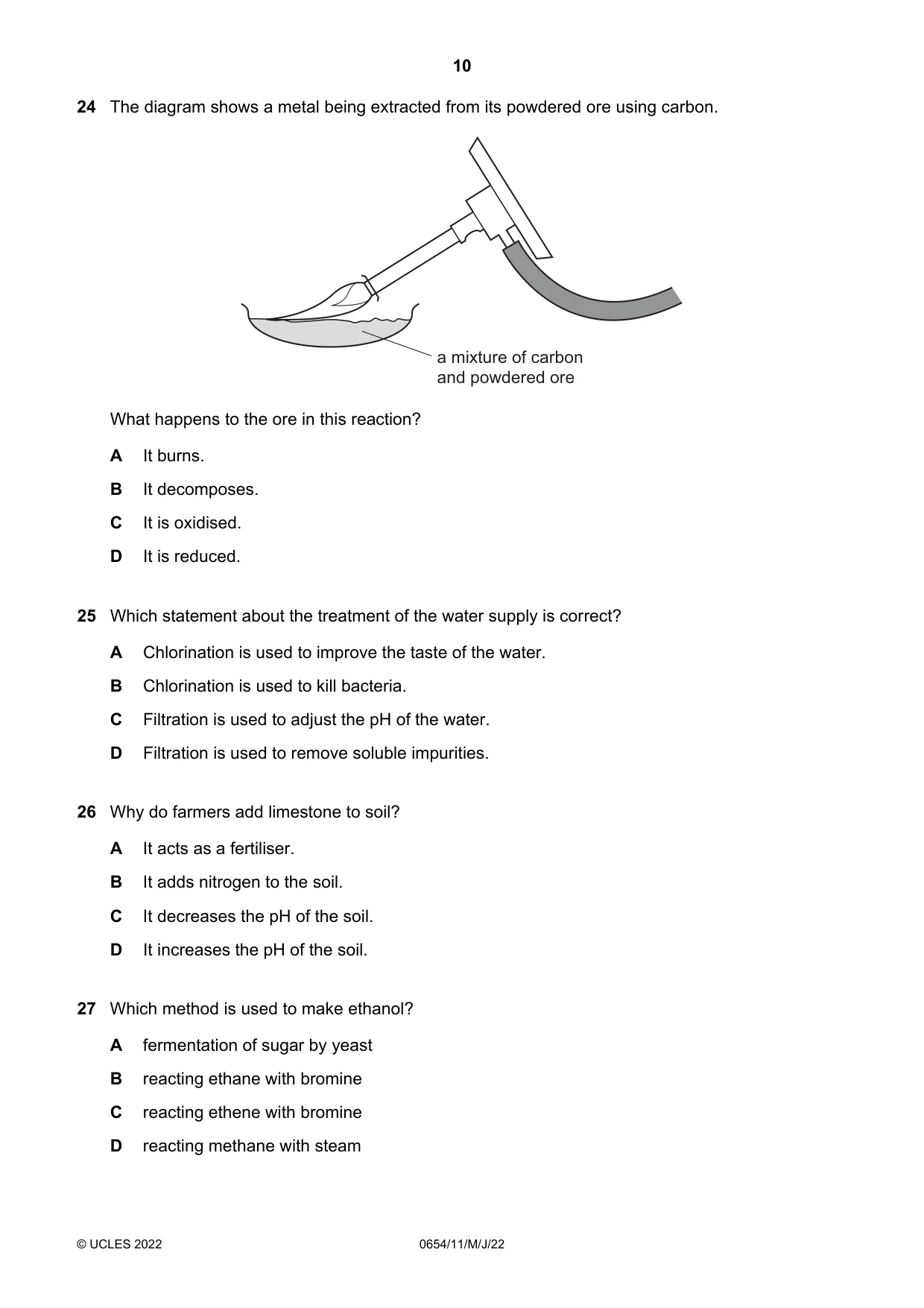
24 The diagram shows a metal being extracted from its powdered ore using carbon. a mixture of carbon and powdered ore What happens to the ore in this reaction? A It burns. B It decomposes. C It is oxidised. D It is reduced.
Mark scheme: D
Q25 · Which statement about the treatment of the water supply is correct?
25 Which statement about the treatment of the water supply is correct? A Chlorination is used to improve the taste of the water. B Chlorination is used to kill bacteria. C Filtration is used to adjust the pH of the water. D Filtration is used to remove soluble impurities.
Mark scheme: B
Q26 · Why do farmers add limestone to soil?
26 Why do farmers add limestone to soil? A It acts as a fertiliser. B It adds nitrogen to the soil. C It decreases the pH of the soil. D It increases the pH of the soil.
Mark scheme: D
More questions on The characteristic properties of acids and bases
Q27 · Which method is used to make ethanol?
27 Which method is used to make ethanol? A fermentation of sugar by yeast B reacting ethane with bromine C reacting ethene with bromine D reacting methane with steam
Mark scheme: A
Q28 · The diagram shows the level of water in a measuring cylinder
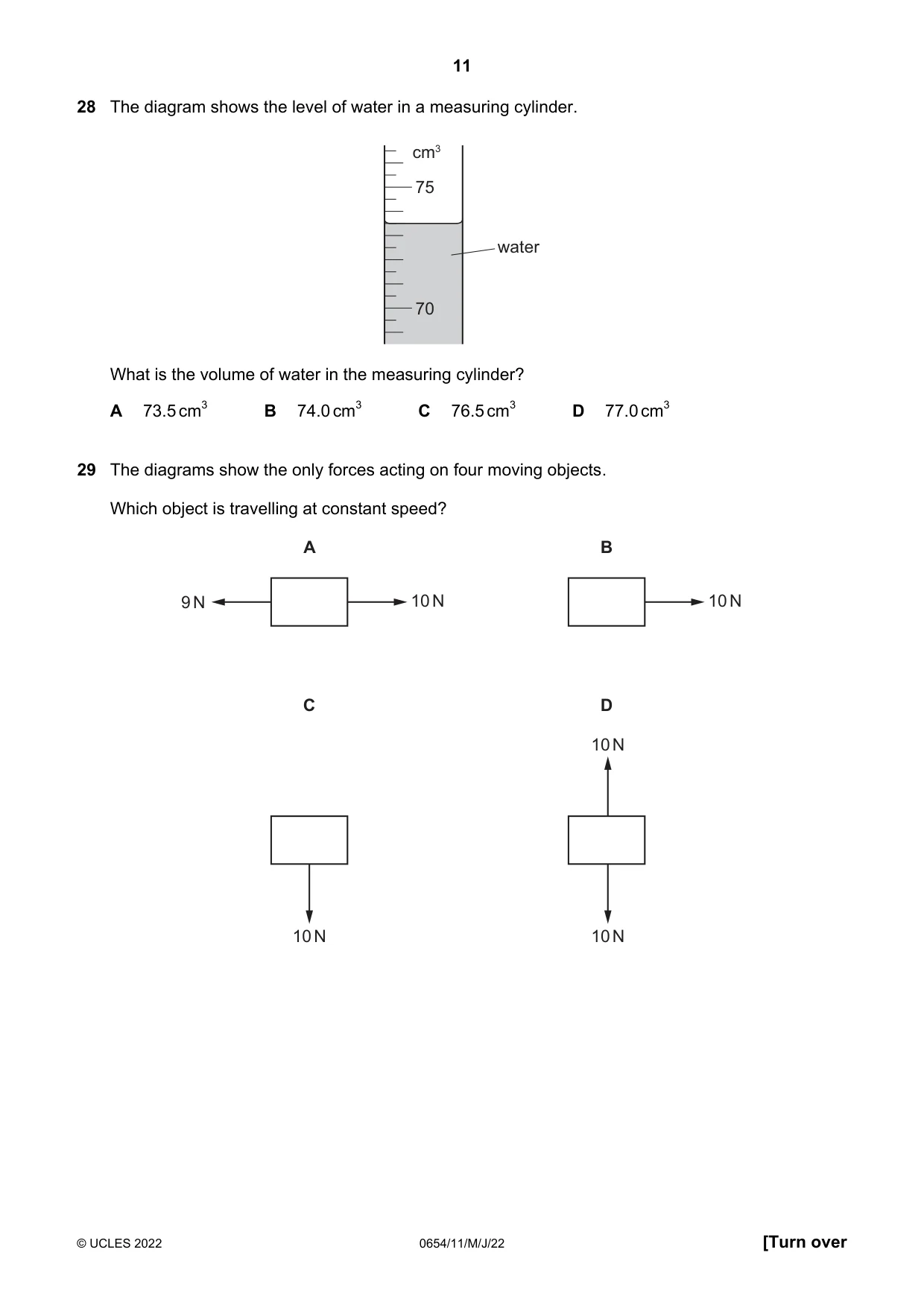
28 The diagram shows the level of water in a measuring cylinder. cm3 75 water 70 What is the volume of water in the measuring cylinder? A 73.5 cm3 B 74.0 cm3 C 76.5 cm3 D 77.0 cm3
Mark scheme: A
More questions on Physical quantities and measurement techniques
Q29 · The diagrams show the only forces acting on four moving objects
29 The diagrams show the only forces acting on four moving objects. Which object is travelling at constant speed? A B 9 N 10 N 10 N C D 10 N 10 N 10 N
Mark scheme: D
Q30 · A uniform plank is placed on a pivot, with its centre immediately above the pivot
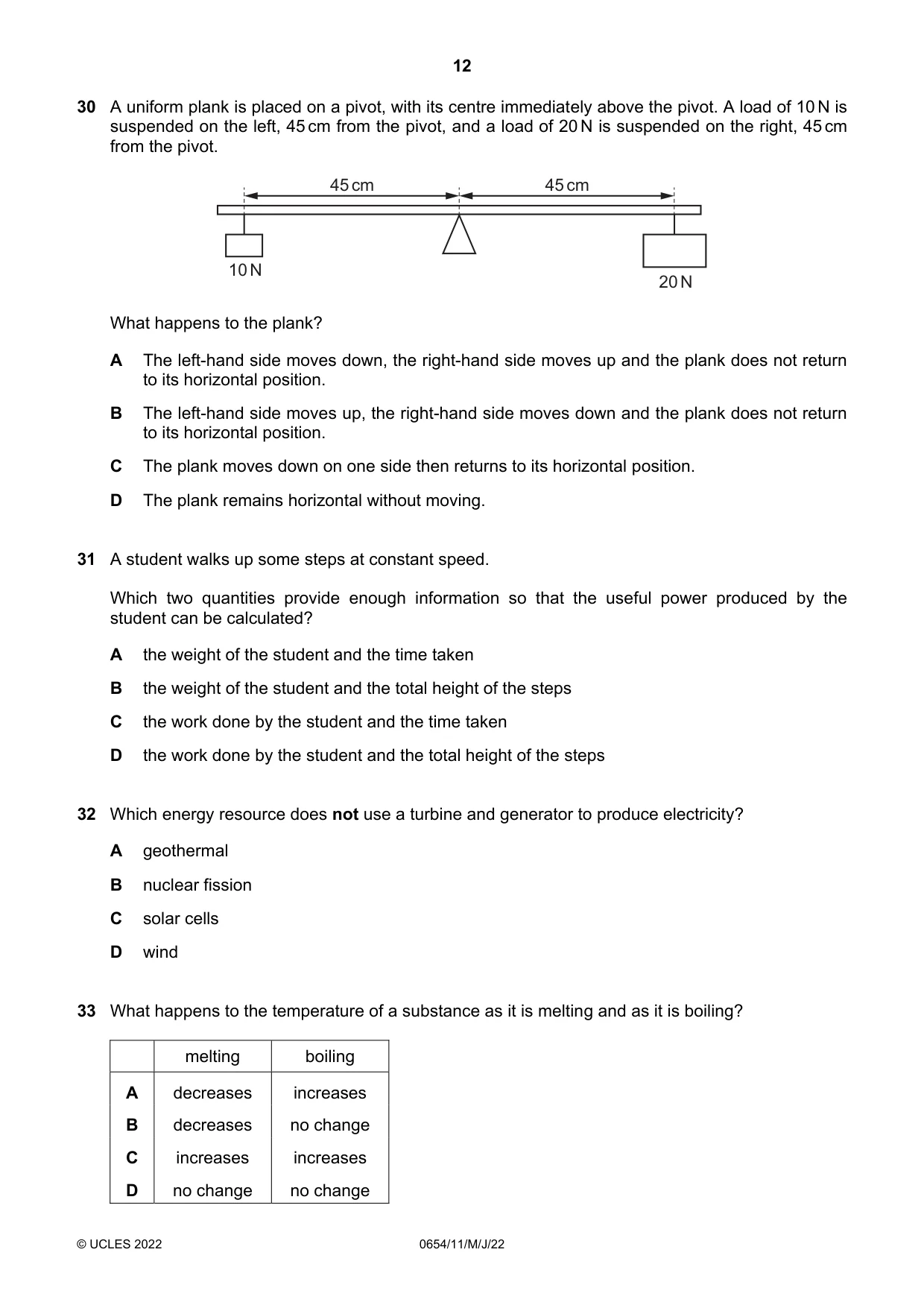
30 A uniform plank is placed on a pivot, with its centre immediately above the pivot. A load of 10 N is suspended on the left, 45 cm from the pivot, and a load of 20 N is suspended on the right, 45 cm from the pivot. 45 cm 45 cm 10 N 20 N What happens to the plank? A The left-hand side moves down, the right-hand side moves up and the plank does not return to its horizontal position. B The left-hand side moves up, the right-hand side moves down and the plank does not return to its horizontal position. C The plank moves down on one side then returns to its horizontal position. D The plank remains horizontal without moving.
Mark scheme: B
Q31 · A student walks up some steps at constant speed
31 A student walks up some steps at constant speed. Which two quantities provide enough information so that the useful power produced by the student can be calculated? A the weight of the student and the time taken B the weight of the student and the total height of the steps C the work done by the student and the time taken D the work done by the student and the total height of the steps
Mark scheme: C
Q32 · Which energy resource does not use a turbine and generator to produce electricity?
32 Which energy resource does not use a turbine and generator to produce electricity? A geothermal B nuclear fission C solar cells D wind
Mark scheme: C
Q33 · What happens to the temperature of a substance as it is melting and as it is boiling?
33 What happens to the temperature of a substance as it is melting and as it is boiling? melting boiling A decreases increases B decreases no change C increases increases D no change no change
Mark scheme: D
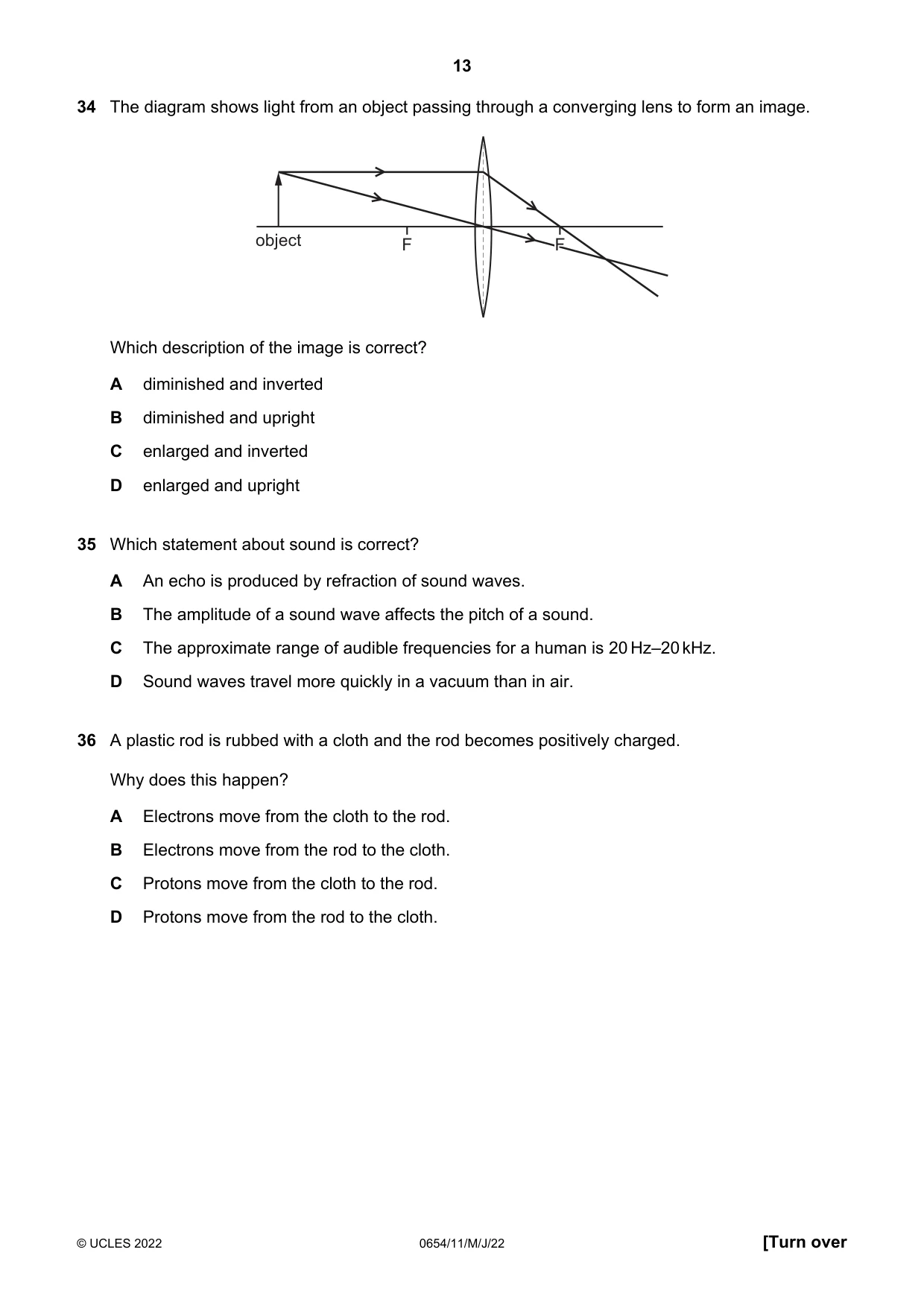
Q34 · The diagram shows light from an object passing through a converging lens to form an image
34 The diagram shows light from an object passing through a converging lens to form an image. object F F Which description of the image is correct? A diminished and inverted B diminished and upright C enlarged and inverted D enlarged and upright
Mark scheme: A
Q35 · Which statement about sound is correct?
35 Which statement about sound is correct? A An echo is produced by refraction of sound waves. B The amplitude of a sound wave affects the pitch of a sound. C The approximate range of audible frequencies for a human is 20 Hz–20 kHz. D Sound waves travel more quickly in a vacuum than in air.
Mark scheme: C
Q36 · A plastic rod is rubbed with a cloth and the rod becomes positively charged
36 A plastic rod is rubbed with a cloth and the rod becomes positively charged. Why does this happen? A Electrons move from the cloth to the rod. B Electrons move from the rod to the cloth. C Protons move from the cloth to the rod. D Protons move from the rod to the cloth.
Mark scheme: B
Q37 · Which row shows how lamps are connected in a lighting circuit in a house and gives an…
37 Which row shows how lamps are connected in a lighting circuit in a house and gives an advantage of connecting them in this way? how lamps are advantage of connecting connected them in this way A in parallel they can be switched separately B in parallel they share the voltage C in series they can be switched separately D in series they share the voltage
Mark scheme: A
Q38 · A 240 V mains lamp operating normally has a working resistance of 480
38 A 240 V mains lamp operating normally has a working resistance of 480 . Which rating of fuse is most suitable to use with this lamp? A 0.4 A B 1 A C 2 A D 4 A
Mark scheme: B
Q39 · An atom of beryllium is represented by Be
39 An atom of beryllium is represented by Be. 9 4 How many neutrons are in the nucleus of this type of beryllium atom? A 4 B 5 C 9 D 13
Mark scheme: B
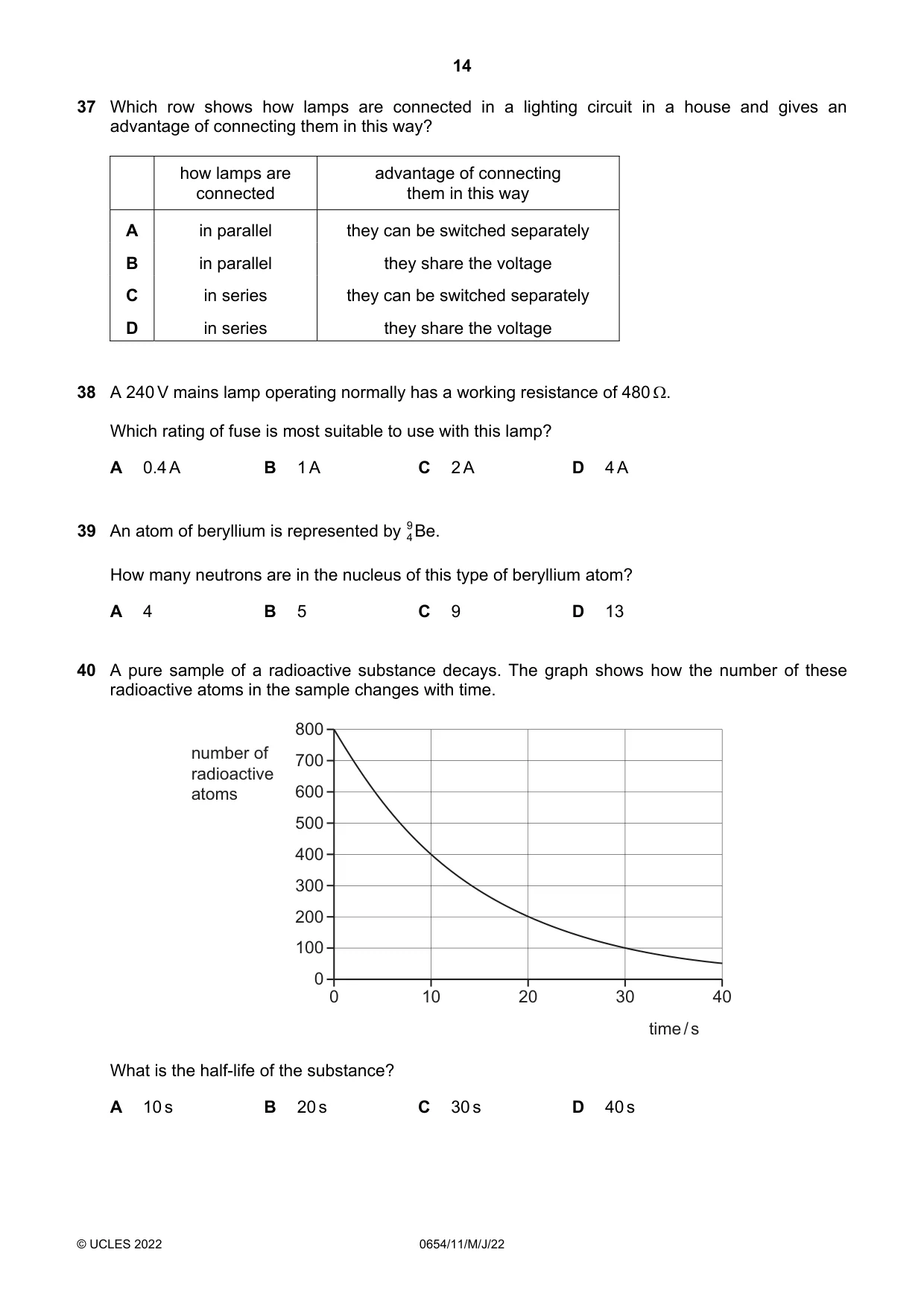
Q40 · A pure sample of a radioactive substance decays
40 A pure sample of a radioactive substance decays. The graph shows how the number of these radioactive atoms in the sample changes with time. 800 number of 700 radioactive atoms 600 500 400 300 200 100 0 0 10 20 30 40 time / s What is the half-life of the substance? A 10 s B 20 s C 30 s D 40 s
Mark scheme: A
What was in this paper
The subtopics covered by these 40 questions, and how many questions each got. Open one in a new tab to see every Cambridge question on it.
2Forces2Alcohols1Asexual reproduction1Biological molecules1Carbon cycle1Cell structure1Characteristics of living organisms1Coordination and response1Digestive system1Electrical circuits1Electrical safety1Electrolysis1Enzymes1Exothermic and endothermic reactions1Extraction of metals1Food chains and food webs1Formulas1Identification of ions and gases1Light1Monohybrid inheritance1Noble gases1Photosynthesis1Physical and chemical changes1Physical quantities and measurement techniques1Properties of metals1Radioactivity1Rate of reaction1Reactivity series1Respiration1Separation and purification1Simple phenomena of magnetism1Sound1The characteristic properties of acids and bases1The nucleus1Thermal properties and temperature1Transpiration1Water1What you needed in this session
Cambridge’s own grade thresholds for 2022 May/June, Paper 1 · Variant 1. A higher threshold means an easier paper — the bar moves with how the cohort did.