Cambridge IGCSE Sciences - Co-ordinated (Double) 0654 — 2019 May/June Paper 1 · Variant 3
0654/13/M/J/19 · 40 questions · 40 marks · ≈45 min
The question paper and its mark scheme, free to read here and free to download. This is Cambridge’s own paper, exactly as it was sat.
Question paper16 pages
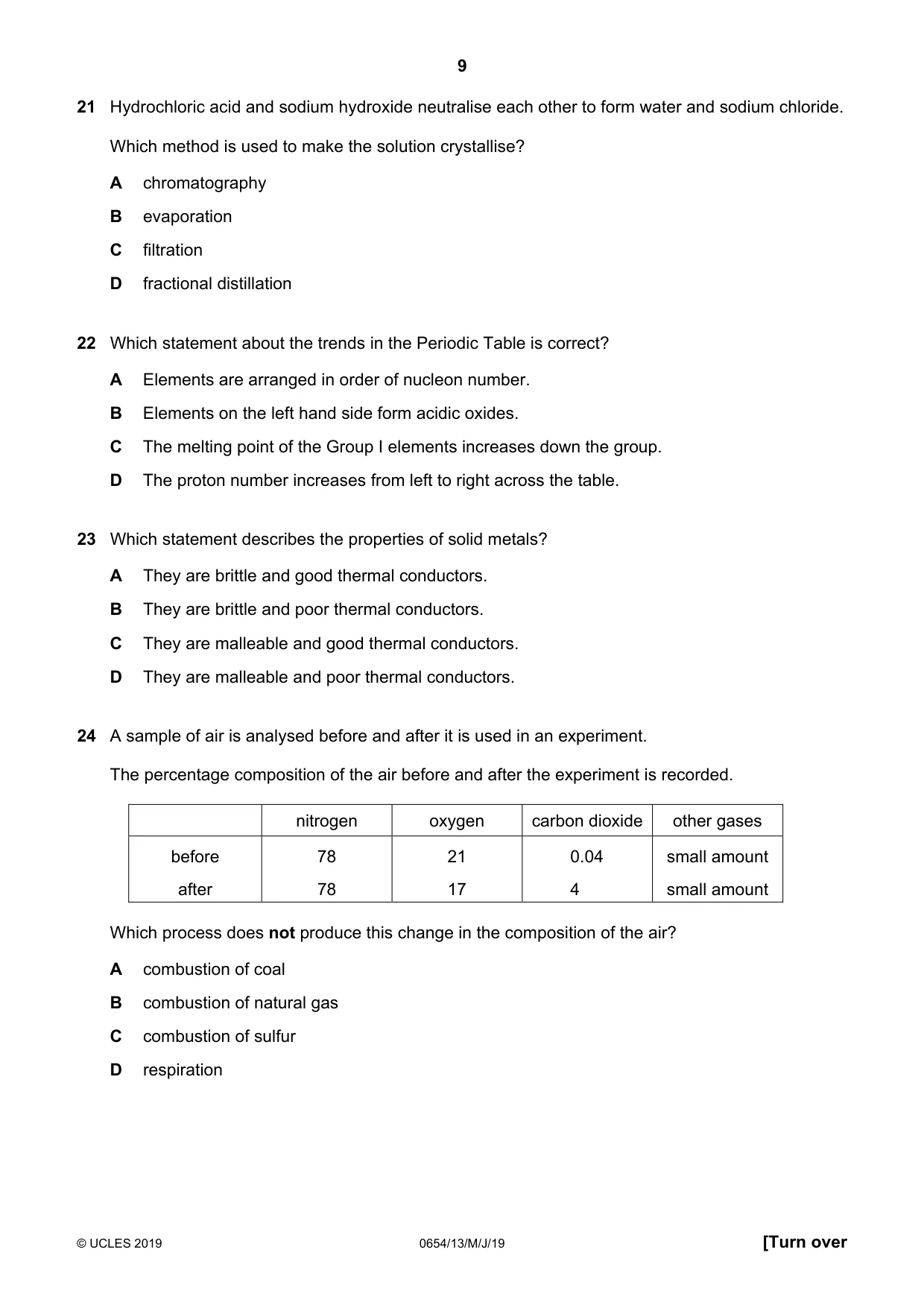
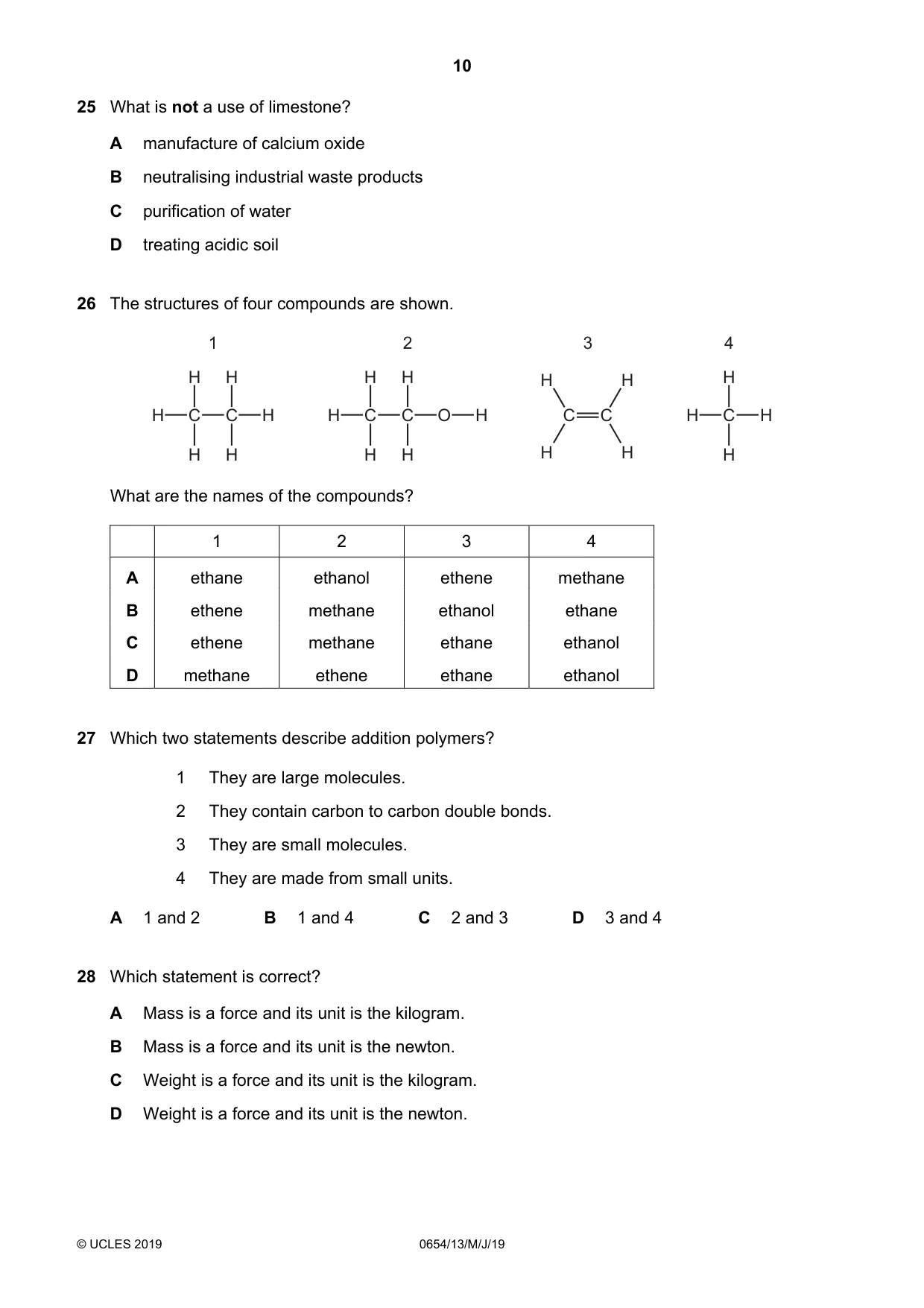
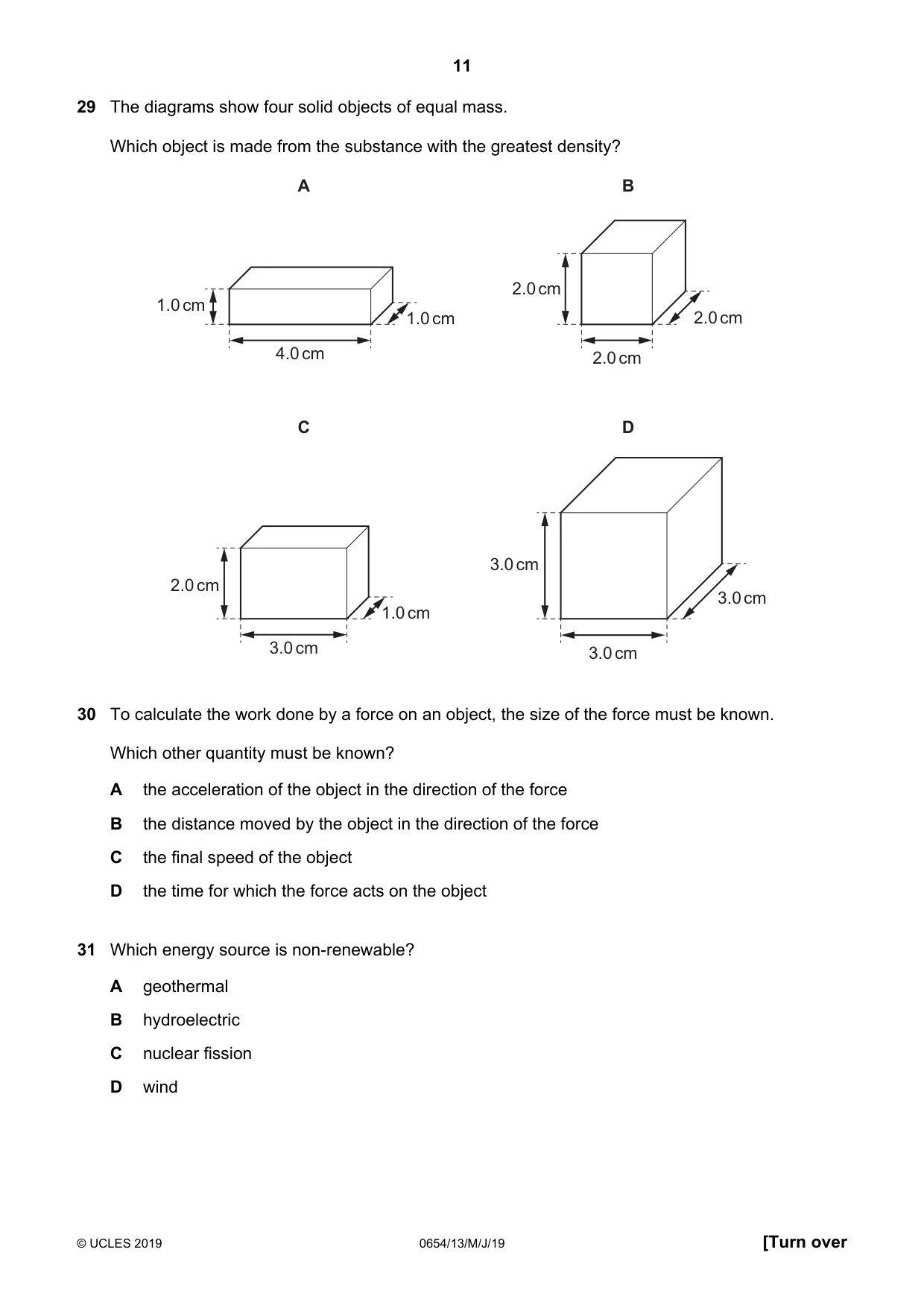
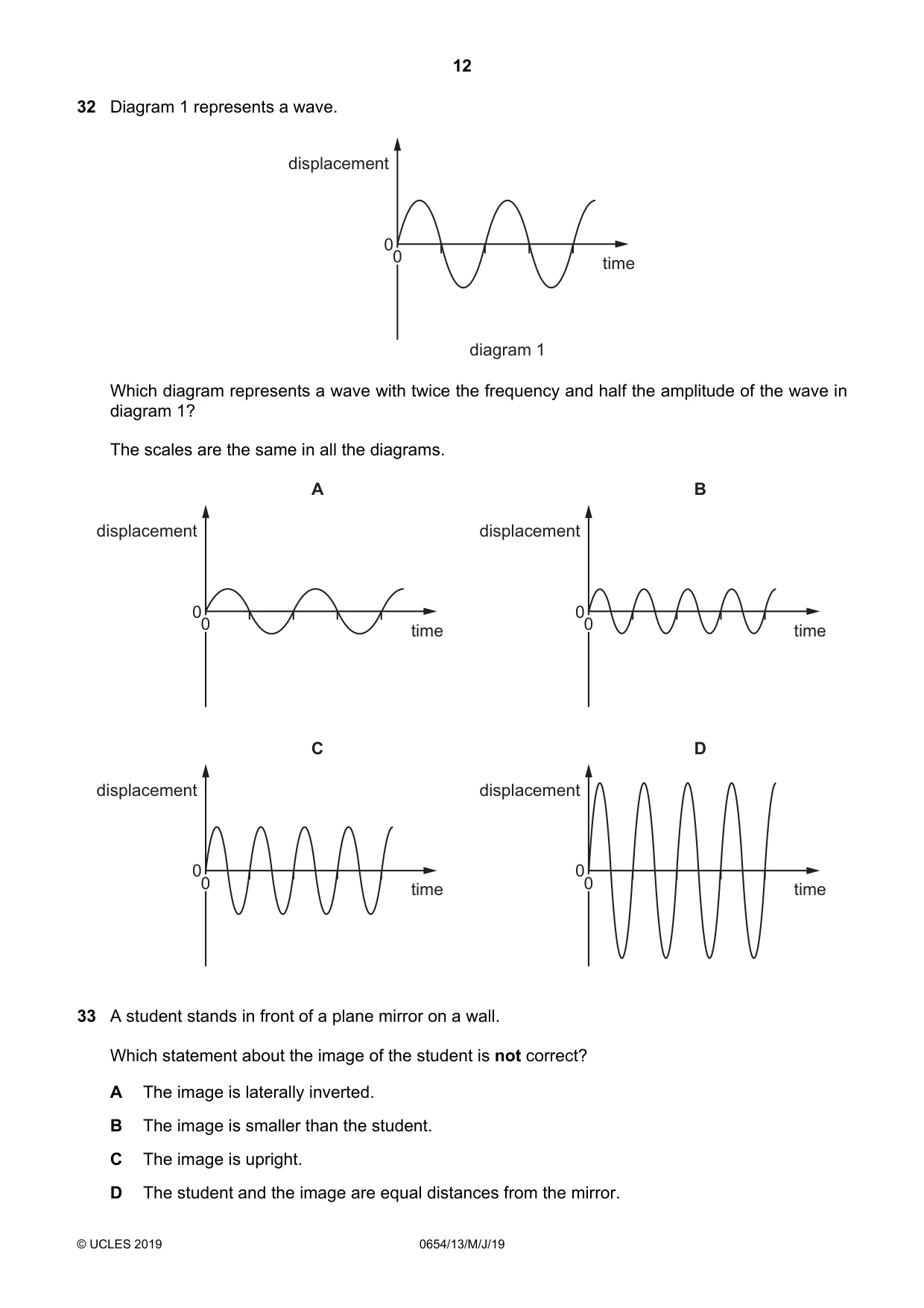
Mark scheme3 pages
Answers below. Sit the paper first if you are practising.
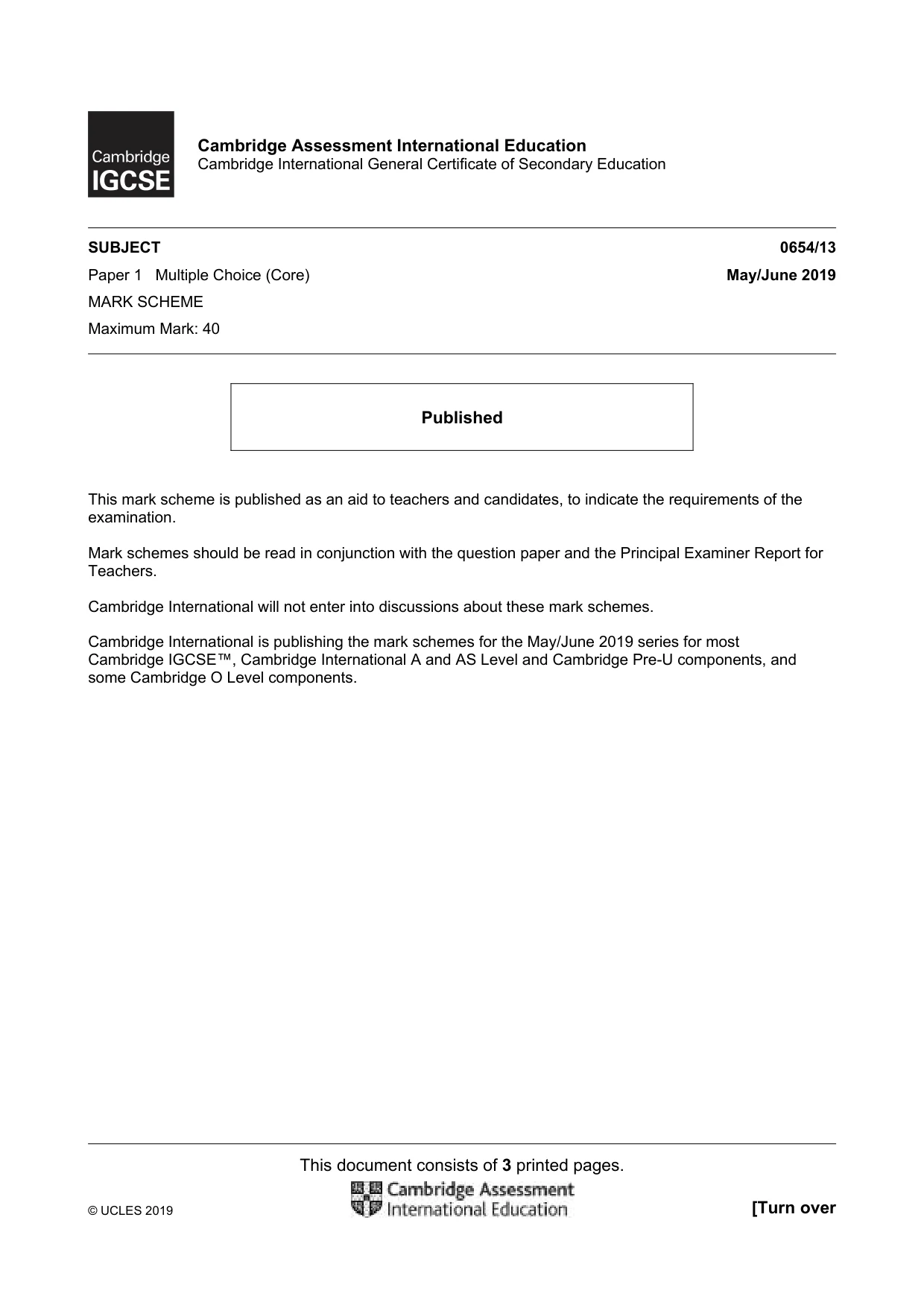
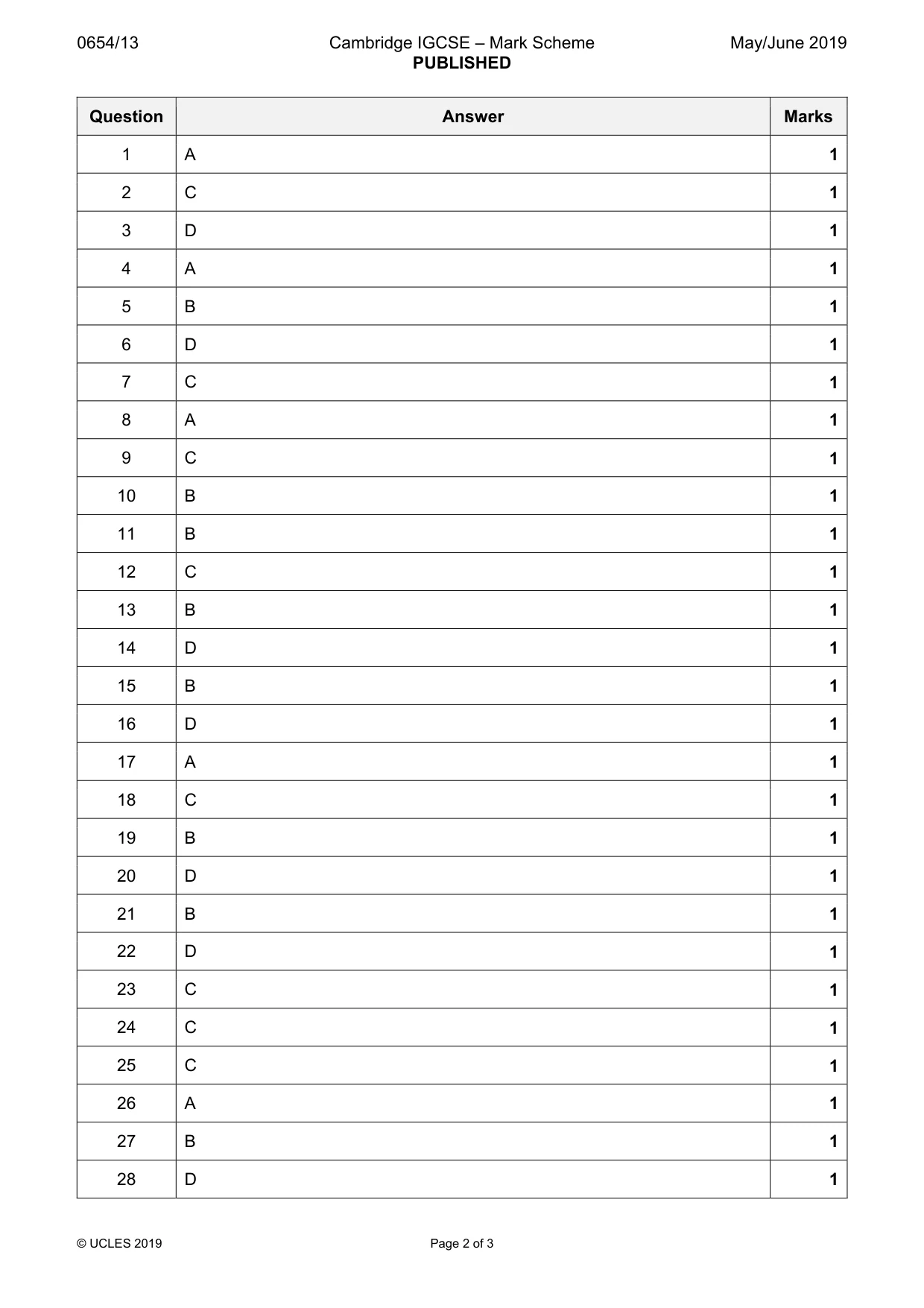
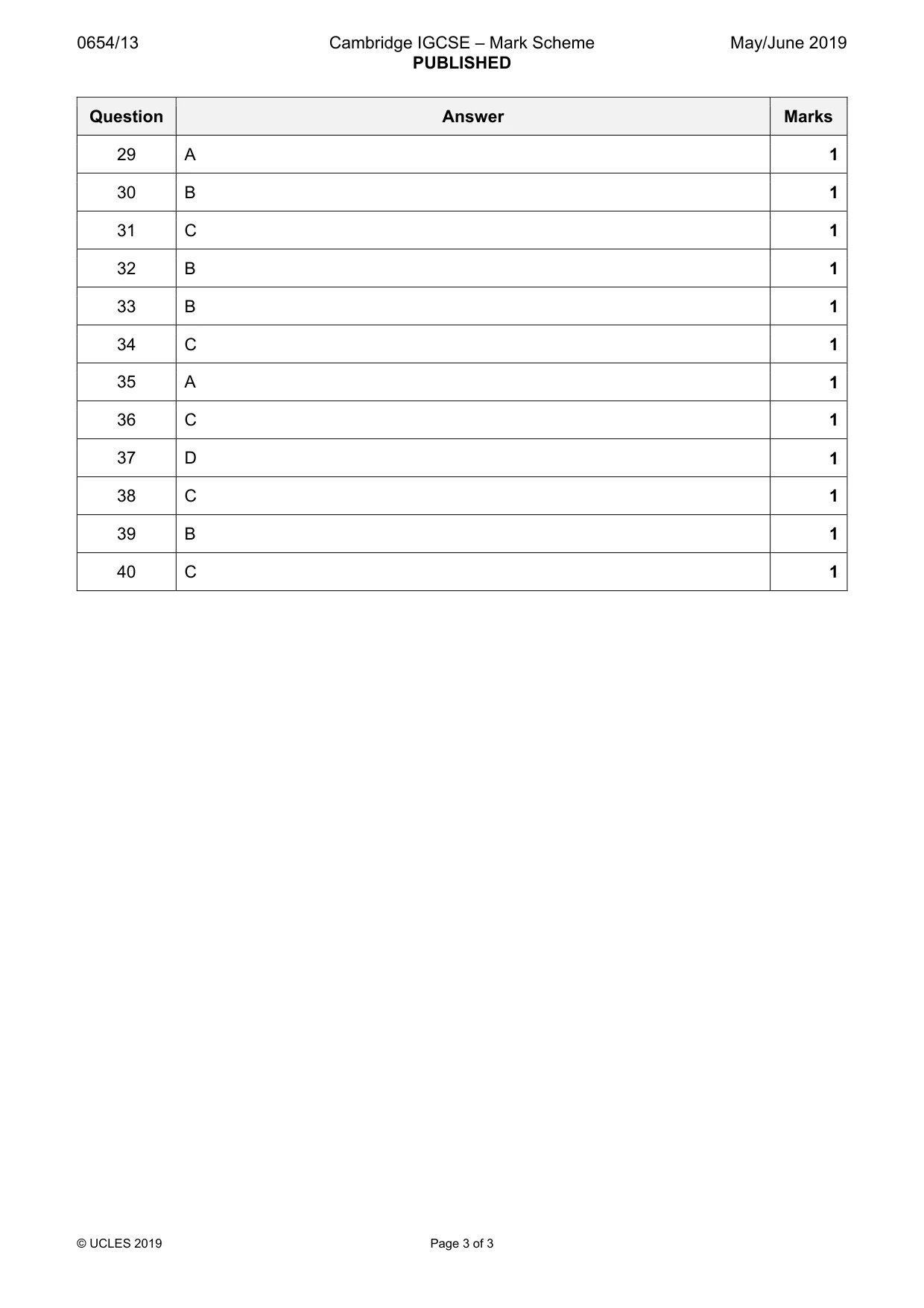
Questions as text
Q1 · What is correct for all living organisms?
1 What is correct for all living organisms? A They are sensitive to changes in their environment. B They excrete solid waste from their bodies. C They feed on other living organisms. D They grow larger by increasing their cell number.
Mark scheme: A
Q2 · The diagram shows a body cell and a blood capillary
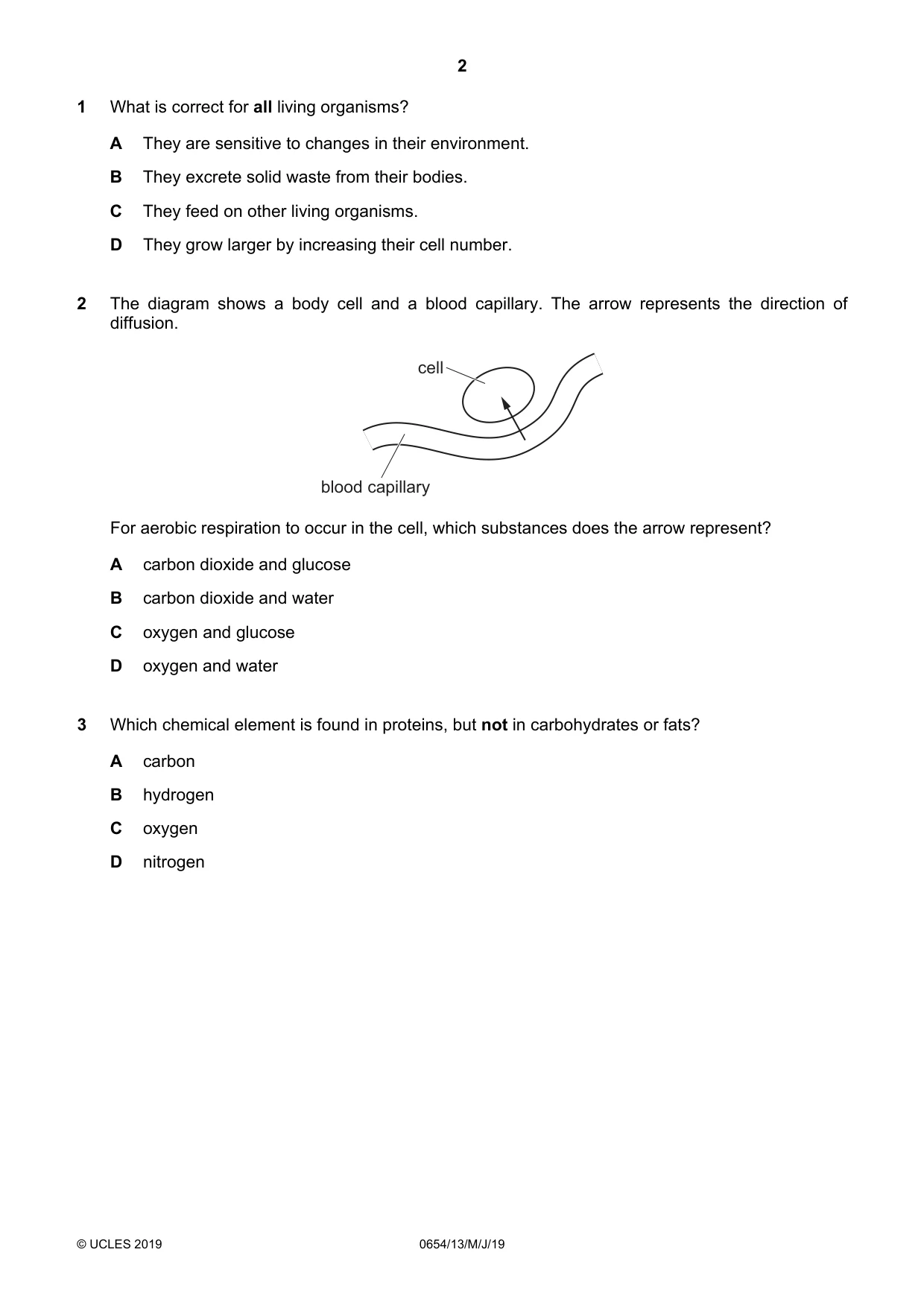
2 The diagram shows a body cell and a blood capillary. The arrow represents the direction of diffusion. cell blood capillary For aerobic respiration to occur in the cell, which substances does the arrow represent? A carbon dioxide and glucose B carbon dioxide and water C oxygen and glucose D oxygen and water
Mark scheme: C
Q3 · Which chemical element is found in proteins, but not in carbohydrates or fats?
3 Which chemical element is found in proteins, but not in carbohydrates or fats? A carbon B hydrogen C oxygen D nitrogen
Mark scheme: D
Q4 · The graphs show the possible effects of temperature on the rate of reaction of an enzyme
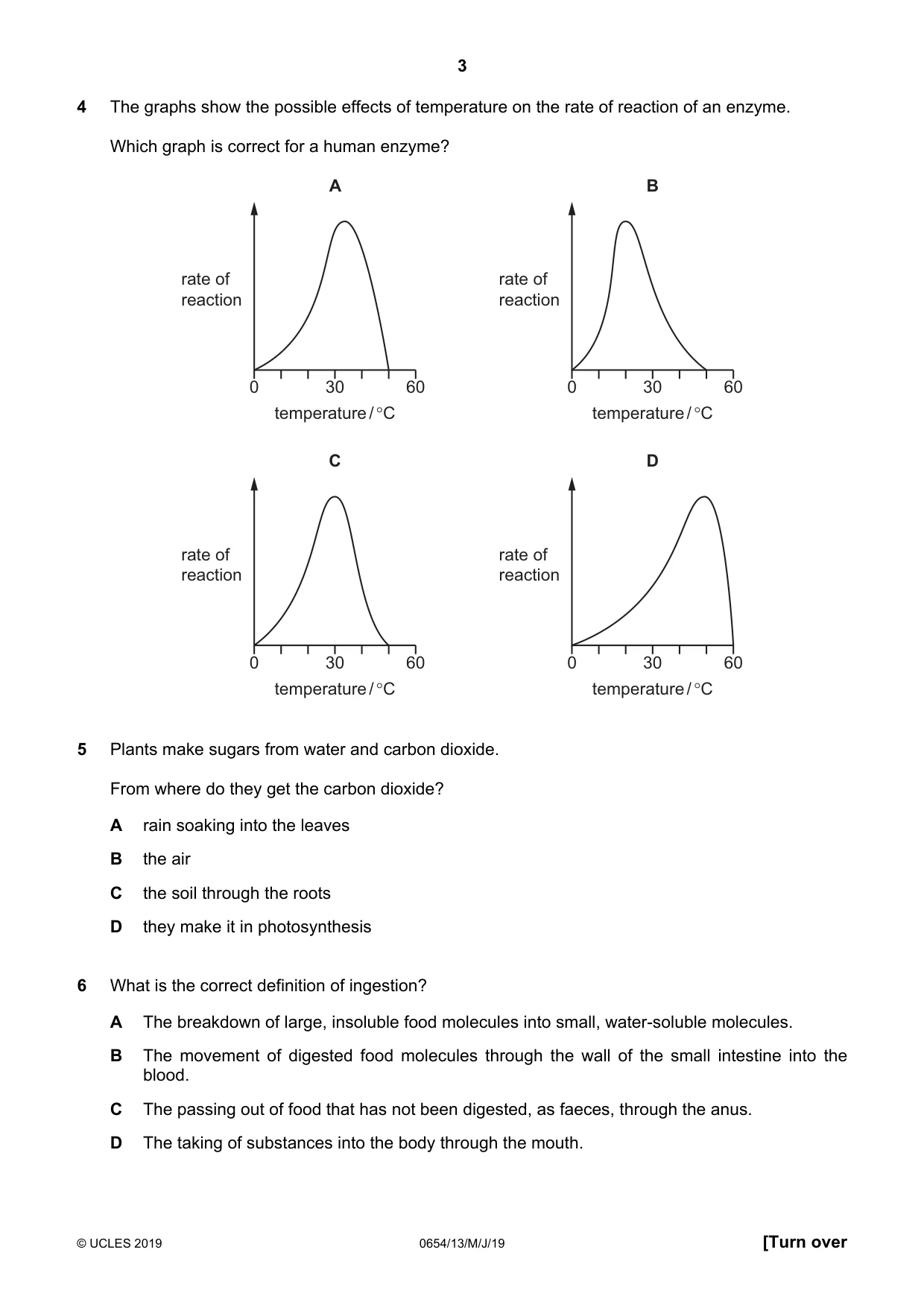
4 The graphs show the possible effects of temperature on the rate of reaction of an enzyme. Which graph is correct for a human enzyme? A B rate of rate of reaction reaction 0 30 60 0 30 60 temperature / °C temperature / °C C D rate of rate of reaction reaction 0 30 60 0 30 60 temperature / °C temperature / °C
Mark scheme: A
Q5 · Plants make sugars from water and carbon dioxide
5 Plants make sugars from water and carbon dioxide. From where do they get the carbon dioxide? A rain soaking into the leaves B the air C the soil through the roots D they make it in photosynthesis
Mark scheme: B
Q6 · What is the correct definition of ingestion?
6 What is the correct definition of ingestion? A The breakdown of large, insoluble food molecules into small, water-soluble molecules. B The movement of digested food molecules through the wall of the small intestine into the blood. C The passing out of food that has not been digested, as faeces, through the anus. D The taking of substances into the body through the mouth.
Mark scheme: D
Q7 · Which statement about the valves found in the human transport system is correct?
7 Which statement about the valves found in the human transport system is correct? A They are absent in veins. B They are present in arteries. C They ensure one-way flow of blood. D They pump blood from atria to ventricles.
Mark scheme: C
Q8 · Limewater can be used to test for differences in composition between inspired and expired…
8 Limewater can be used to test for differences in composition between inspired and expired air. Which row is correct? appearance type of air conclusion of limewater A expired clear to milky more carbon dioxide present B expired milky to clear more carbon dioxide present C inspired clear to milky more oxygen present D inspired milky to clear more oxygen present
Mark scheme: A
Q9 · In a reflex arc, which structure carries nerve impulses towards the central nervous…
9 In a reflex arc, which structure carries nerve impulses towards the central nervous system? A effector B motor neurone C sensory neurone D spinal cord
Mark scheme: C
Q10 · The diagram shows a section through an insect-pollinated flower
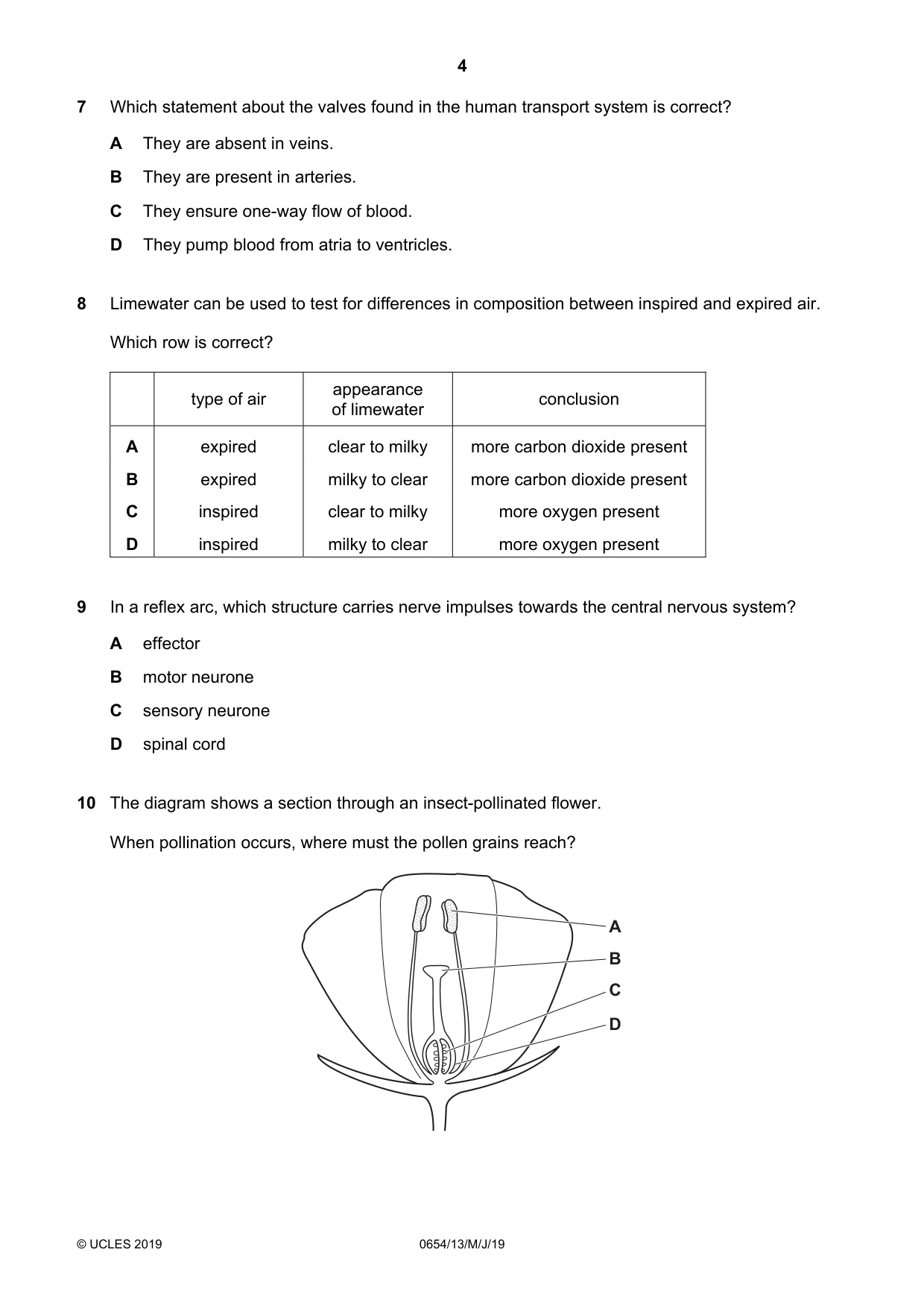
10 The diagram shows a section through an insect-pollinated flower. When pollination occurs, where must the pollen grains reach? A B C D
Mark scheme: B
Q11 · Which sex chromosomes need to be present in a sperm cell to produce a male zygote?
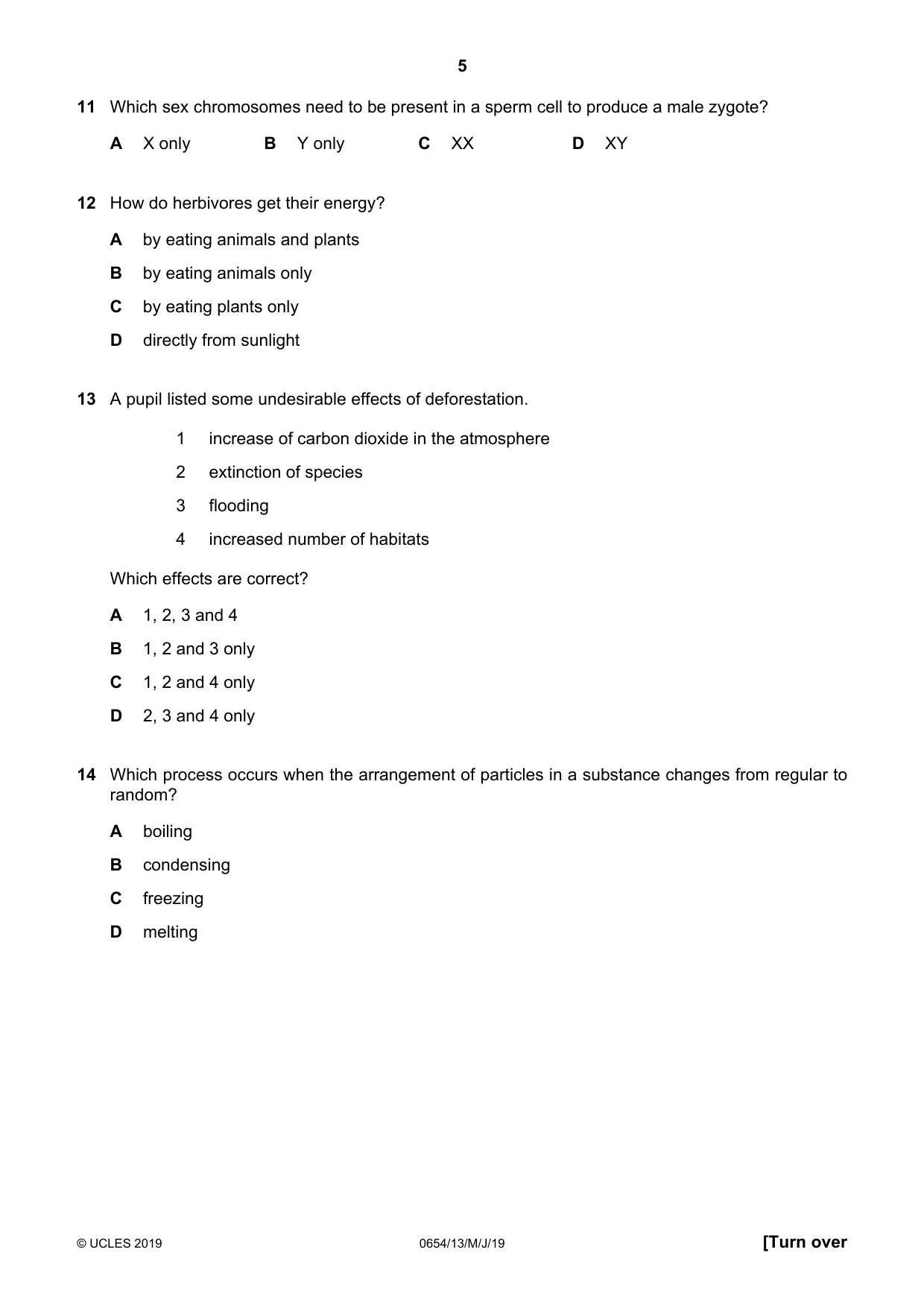
11 Which sex chromosomes need to be present in a sperm cell to produce a male zygote? A X only B Y only C XX D XY
Mark scheme: B
Q12 · How do herbivores get their energy?
12 How do herbivores get their energy? A by eating animals and plants B by eating animals only C by eating plants only D directly from sunlight
Mark scheme: C
Q13 · A pupil listed some undesirable effects of deforestation
13 A pupil listed some undesirable effects of deforestation. 1 increase of carbon dioxide in the atmosphere 2 extinction of species 3 flooding 4 increased number of habitats Which effects are correct? A 1, 2, 3 and 4 B 1, 2 and 3 only C 1, 2 and 4 only D 2, 3 and 4 only
Mark scheme: B
Q14 · Which process occurs when the arrangement of particles in a substance changes from…
14 Which process occurs when the arrangement of particles in a substance changes from regular to random? A boiling B condensing C freezing D melting
Mark scheme: D
Q15 · Two substances, X and Y, are heated and then cooled
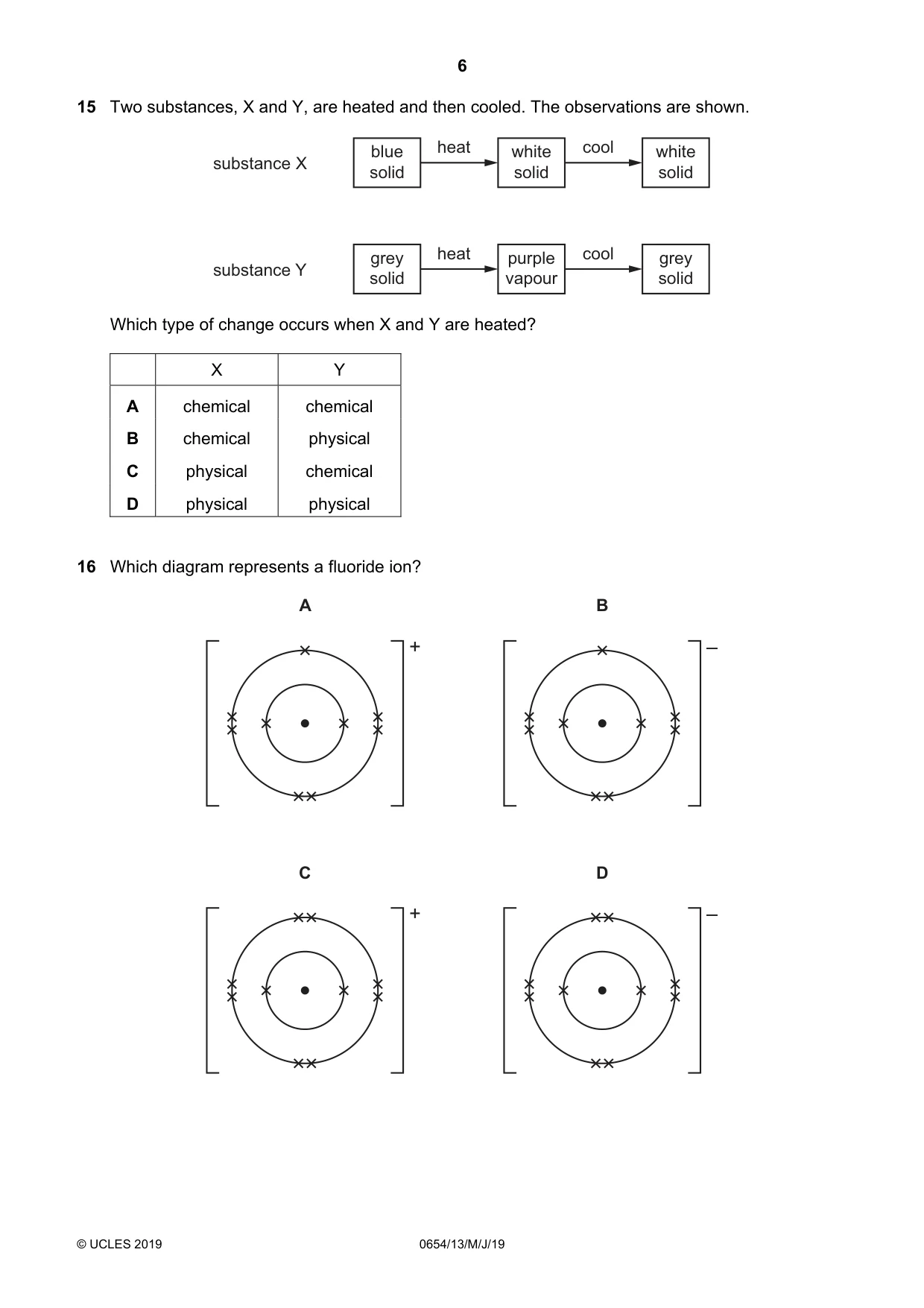
15 Two substances, X and Y, are heated and then cooled. The observations are shown. blue heat white cool white substance X solid solid solid grey heat purple cool grey substance Y solid vapour solid Which type of change occurs when X and Y are heated? X Y A chemical chemical B chemical physical C physical chemical D physical physical
Mark scheme: B
Q16 · Which diagram represents a fluoride ion?
16 Which diagram represents a fluoride ion? A B + – C D + –
Mark scheme: D
Q17 · The electrolysis of concentrated aqueous sodium chloride is shown
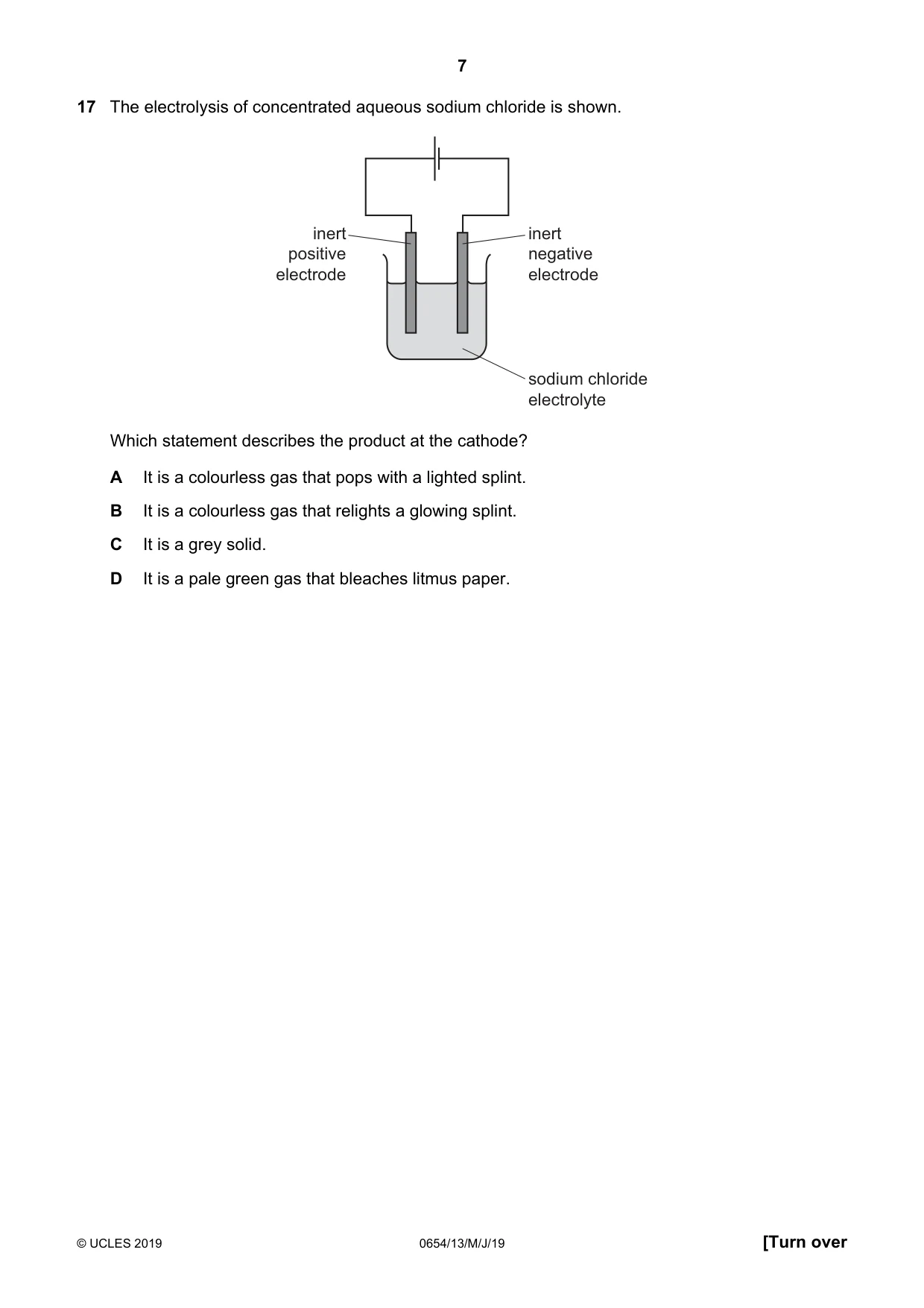
17 The electrolysis of concentrated aqueous sodium chloride is shown. inert inert positive negative electrode electrode sodium chloride electrolyte Which statement describes the product at the cathode? A It is a colourless gas that pops with a lighted splint. B It is a colourless gas that relights a glowing splint. C It is a grey solid. D It is a pale green gas that bleaches litmus paper.
Mark scheme: A
Q18 · An acid is added to an alkali until the final solution is just neutral
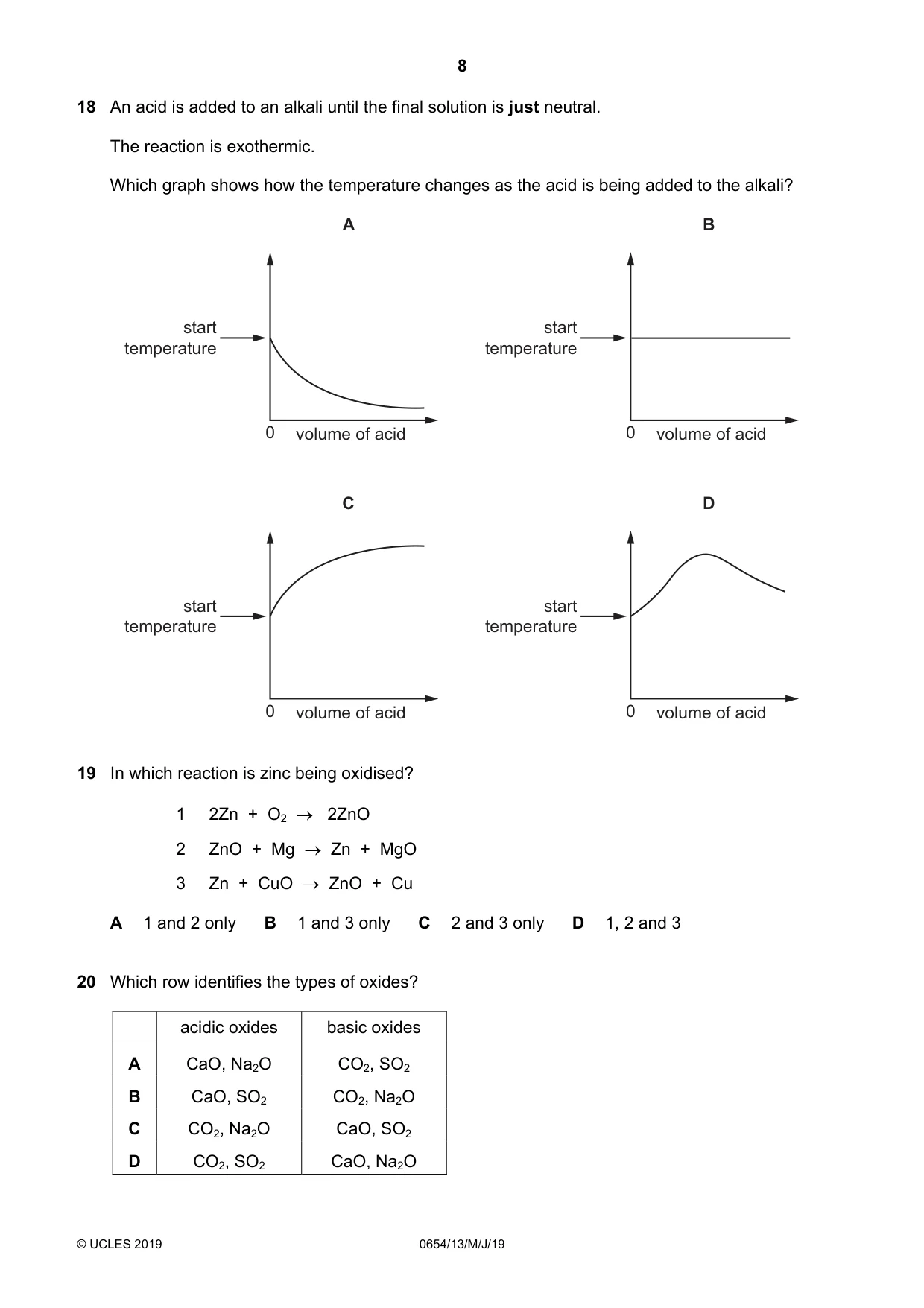
18 An acid is added to an alkali until the final solution is just neutral. The reaction is exothermic. Which graph shows how the temperature changes as the acid is being added to the alkali? A B start start temperature temperature 0 volume of acid 0 volume of acid C D start start temperature temperature 0 volume of acid 0 volume of acid
Mark scheme: C
Q19 · In which reaction is zinc being oxidised?
19 In which reaction is zinc being oxidised? 1 2Zn + O2 → 2ZnO 2 ZnO + Mg → Zn + MgO 3 Zn + CuO → ZnO + Cu A 1 and 2 only B 1 and 3 only C 2 and 3 only D 1, 2 and 3
Mark scheme: B
Q20 · Which row identifies the types of oxides?
20 Which row identifies the types of oxides? acidic oxides basic oxides A CaO, Na2O CO2, SO2 B CaO, SO2 CO2, Na2O C CO2, Na2O CaO, SO2 D CO2, SO2 CaO, Na2O
Mark scheme: D
Q21 · Hydrochloric acid and sodium hydroxide neutralise each other to form water and sodium…
21 Hydrochloric acid and sodium hydroxide neutralise each other to form water and sodium chloride. Which method is used to make the solution crystallise? A chromatography B evaporation C filtration D fractional distillation
Mark scheme: B
Q22 · Which statement about the trends in the Periodic Table is correct?
22 Which statement about the trends in the Periodic Table is correct? A Elements are arranged in order of nucleon number. B Elements on the left hand side form acidic oxides. C The melting point of the Group I elements increases down the group. D The proton number increases from left to right across the table.
Mark scheme: D
Q23 · Which statement describes the properties of solid metals?
23 Which statement describes the properties of solid metals? A They are brittle and good thermal conductors. B They are brittle and poor thermal conductors. C They are malleable and good thermal conductors. D They are malleable and poor thermal conductors.
Mark scheme: C
Q24 · A sample of air is analysed before and after it is used in an experiment
24 A sample of air is analysed before and after it is used in an experiment. The percentage composition of the air before and after the experiment is recorded. nitrogen oxygen carbon dioxide other gases before 78 21 0.04 small amount after 78 17 4 small amount Which process does not produce this change in the composition of the air? A combustion of coal B combustion of natural gas C combustion of sulfur D respiration
Mark scheme: C
Q25 · What is not a use of limestone?
25 What is not a use of limestone? A manufacture of calcium oxide B neutralising industrial waste products C purification of water D treating acidic soil
Mark scheme: C
Q26 · The structures of four compounds are shown
26 The structures of four compounds are shown. 1 2 3 4 H H H H H H H H C C H H C C O H C C H C H H H H H H H H What are the names of the compounds? 1 2 3 4 A ethane ethanol ethene methane B ethene methane ethanol ethane C ethene methane ethane ethanol D methane ethene ethane ethanol
Mark scheme: A
Q27 · Which two statements describe addition polymers?
27 Which two statements describe addition polymers? 1 They are large molecules. 2 They contain carbon to carbon double bonds. 3 They are small molecules. 4 They are made from small units. A 1 and 2 B 1 and 4 C 2 and 3 D 3 and 4
Mark scheme: B
Q28 · Which statement is correct?
28 Which statement is correct? A Mass is a force and its unit is the kilogram. B Mass is a force and its unit is the newton. C Weight is a force and its unit is the kilogram. D Weight is a force and its unit is the newton.
Mark scheme: D
Q29 · The diagrams show four solid objects of equal mass
29 The diagrams show four solid objects of equal mass. Which object is made from the substance with the greatest density? A B 2.0 cm 1.0 cm 1.0 cm 2.0 cm 4.0 cm 2.0 cm C D 3.0 cm 2.0 cm 3.0 cm 1.0 cm 3.0 cm 3.0 cm
Mark scheme: A
Q30 · To calculate the work done by a force on an object, the size of the force must be known
30 To calculate the work done by a force on an object, the size of the force must be known. Which other quantity must be known? A the acceleration of the object in the direction of the force B the distance moved by the object in the direction of the force C the final speed of the object D the time for which the force acts on the object
Mark scheme: B
Q31 · Which energy source is non-renewable?
31 Which energy source is non-renewable? A geothermal B hydroelectric C nuclear fission D wind
Mark scheme: C
Question 32
32 Diagram 1 represents a wave. displacement 00 time diagram 1 Which diagram represents a wave with twice the frequency and half the amplitude of the wave in diagram 1? The scales are the same in all the diagrams. A B displacement displacement 00 00 time time C D displacement displacement 00 00 time time
Mark scheme: B
Q33 · A student stands in front of a plane mirror on a wall
33 A student stands in front of a plane mirror on a wall. Which statement about the image of the student is not correct? A The image is laterally inverted. B The image is smaller than the student. C The image is upright. D The student and the image are equal distances from the mirror.
Mark scheme: B
Q34 · A sports field is next to a large school building
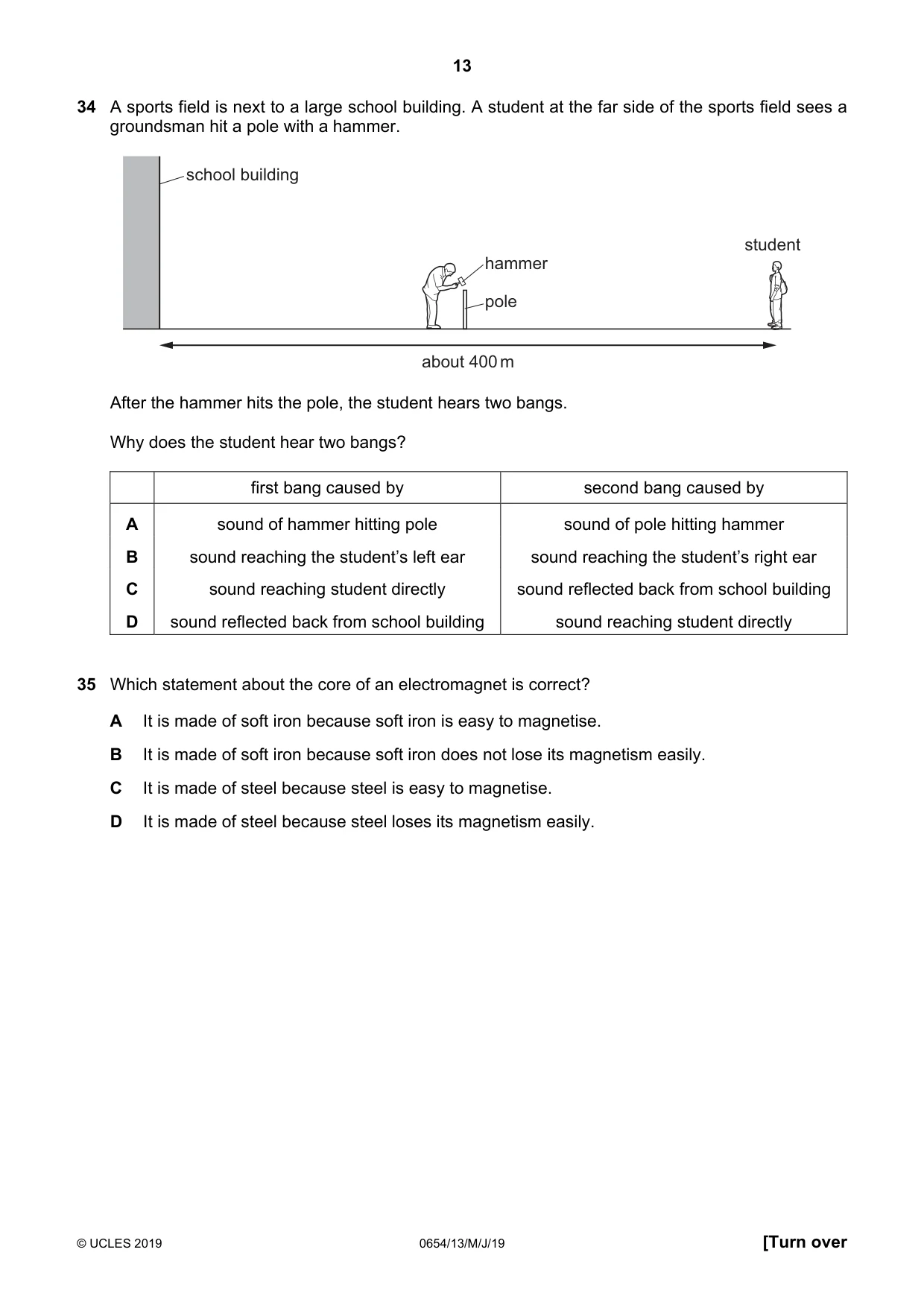
34 A sports field is next to a large school building. A student at the far side of the sports field sees a groundsman hit a pole with a hammer. school building student hammer pole about 400 m After the hammer hits the pole, the student hears two bangs. Why does the student hear two bangs? first bang caused by second bang caused by A sound of hammer hitting pole sound of pole hitting hammer B sound reaching the student’s left ear sound reaching the student’s right ear C sound reaching student directly sound reflected back from school building D sound reflected back from school building sound reaching student directly
Mark scheme: C
Q35 · Which statement about the core of an electromagnet is correct?
35 Which statement about the core of an electromagnet is correct? A It is made of soft iron because soft iron is easy to magnetise. B It is made of soft iron because soft iron does not lose its magnetism easily. C It is made of steel because steel is easy to magnetise. D It is made of steel because steel loses its magnetism easily.
Mark scheme: A
Q36 · The diagram shows the connections to an electric heater
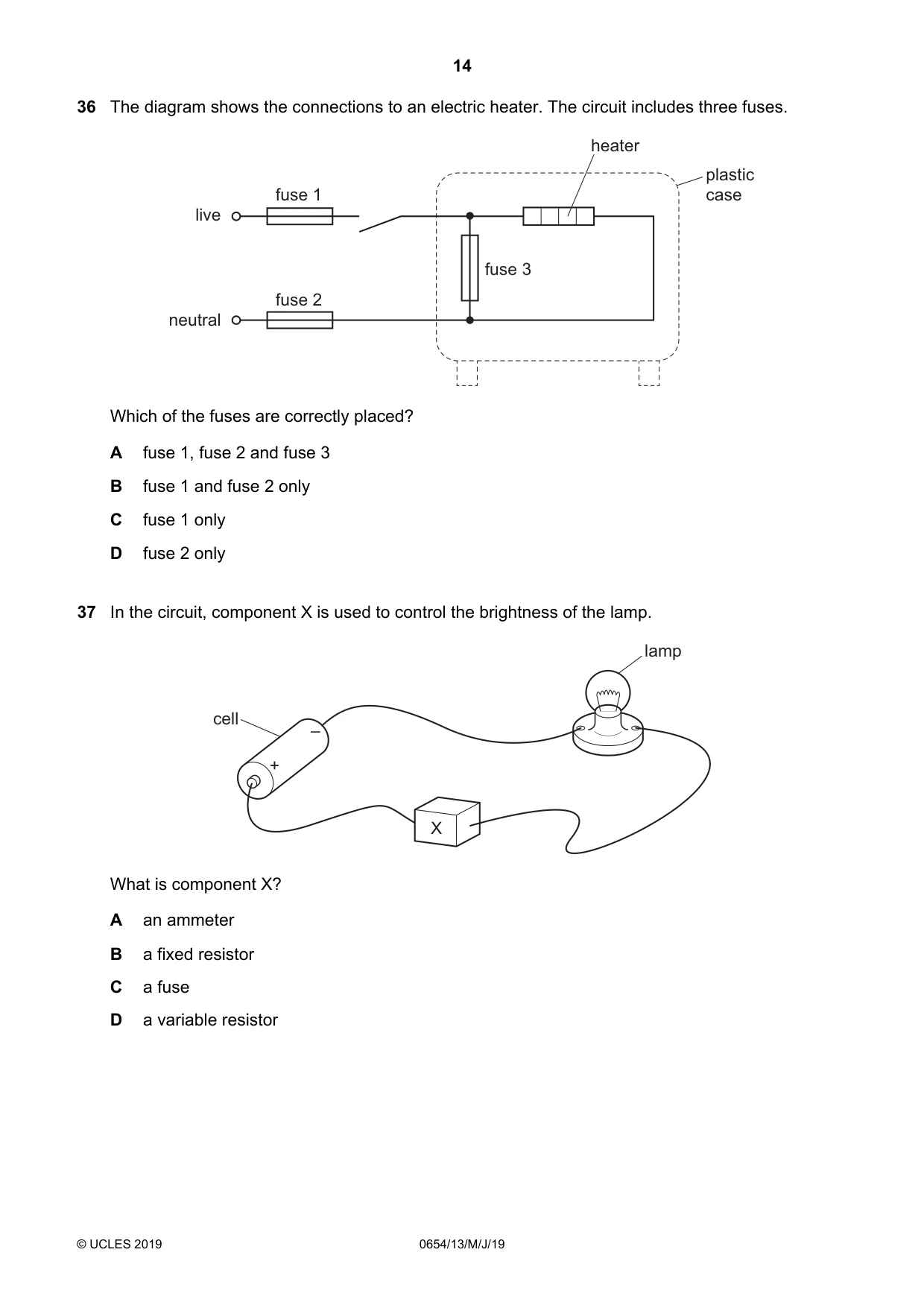
36 The diagram shows the connections to an electric heater. The circuit includes three fuses. heater plastic fuse 1 case live fuse 3 fuse 2 neutral Which of the fuses are correctly placed? A fuse 1, fuse 2 and fuse 3 B fuse 1 and fuse 2 only C fuse 1 only D fuse 2 only
Mark scheme: C
Q37 · In the circuit, component X is used to control the brightness of the lamp
37 In the circuit, component X is used to control the brightness of the lamp. lamp cell – + X What is component X? A an ammeter B a fixed resistor C a fuse D a variable resistor
Mark scheme: D
Q38 · A student connects a length of metal resistance wire to a battery
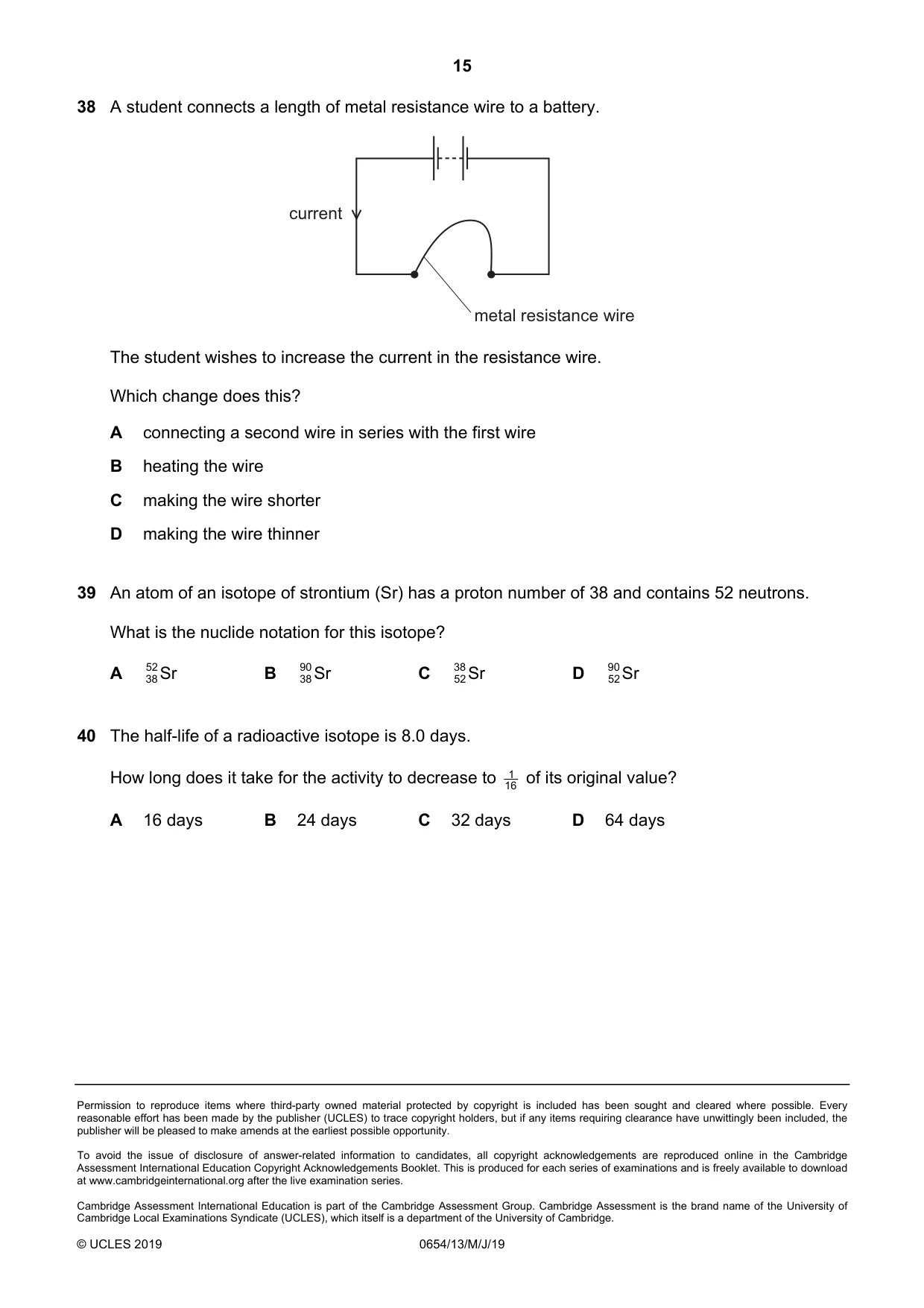
38 A student connects a length of metal resistance wire to a battery. current metal resistance wire The student wishes to increase the current in the resistance wire. Which change does this? A connecting a second wire in series with the first wire B heating the wire C making the wire shorter D making the wire thinner
Mark scheme: C
Q39 · An atom of an isotope of strontium (Sr) has a proton number of 38 and contains 52 neutrons
39 An atom of an isotope of strontium (Sr) has a proton number of 38 and contains 52 neutrons. What is the nuclide notation for this isotope? A 52 Sr B 90 Sr C 38 Sr D 90 Sr 38 38 52 52
Mark scheme: B
Q40 · The half-life of a radioactive isotope is 8.0 days
40 The half-life of a radioactive isotope is 8.0 days. How long does it take for the activity to decrease to 16 1 of its original value? A 16 days B 24 days C 32 days D 64 days
Mark scheme: C
What was in this paper
The subtopics covered by these 40 questions, and how many questions each got. Open one in a new tab to see every Cambridge question on it.
2Air quality and climate1Arrangement of elements1Biological molecules1Blood vessels1Characteristics of living organisms1Chromosomes and genes1Coordination and response1Density1Digestion1Electrical circuits1Electrical quantities1Electrical safety1Electrolysis1Energy flow1Enzymes1Exothermic and endothermic reactions1Gas exchange in humans1General properties of waves1Habitat destruction1Ions and ionic bonds1Light1Mass and weight1Naming organic compounds1Oxides1Photosynthesis1Physical and chemical changes1Polymers1Properties of metals1Radioactivity1Redox1Respiration1Separation and purification1Sexual reproduction in plants1Simple phenomena of magnetism1Solids, liquids and gases1Sound1The nucleus1Water1What you needed in this session
Cambridge’s own grade thresholds for 2019 May/June, Paper 1 · Variant 3. A higher threshold means an easier paper — the bar moves with how the cohort did.