Cambridge IGCSE Sciences - Co-ordinated (Double) 0654 — 2020 May/June Paper 1 · Variant 1
0654/11/M/J/20 · 40 questions · 40 marks · ≈45 min
The question paper and its mark scheme, free to read here and free to download. This is Cambridge’s own paper, exactly as it was sat.
Question paper16 pages
Mark scheme3 pages
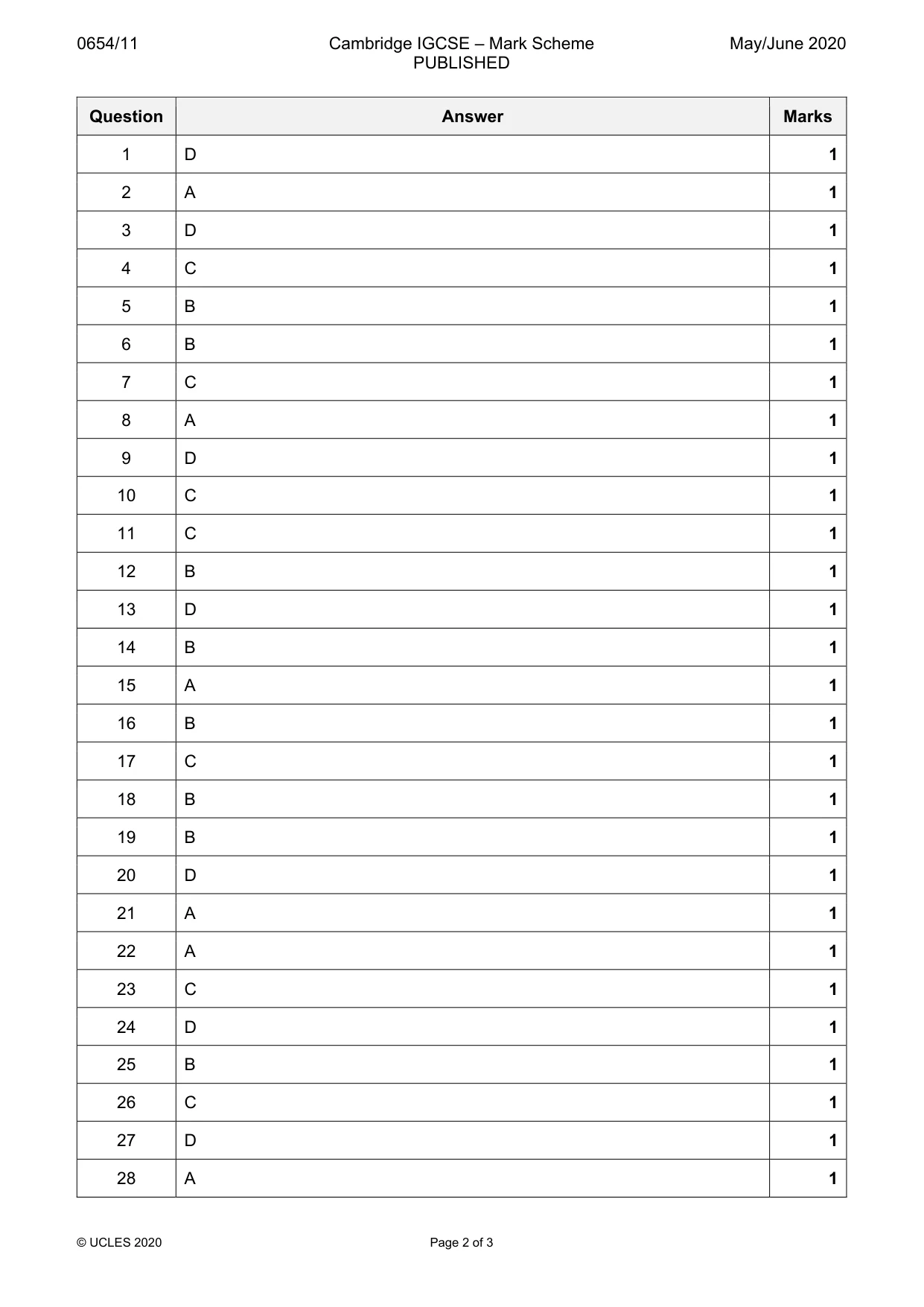
Answers below. Sit the paper first if you are practising.
Questions as text
Q1 · Which characteristic of living organisms is described as the chemical reactions in cells…
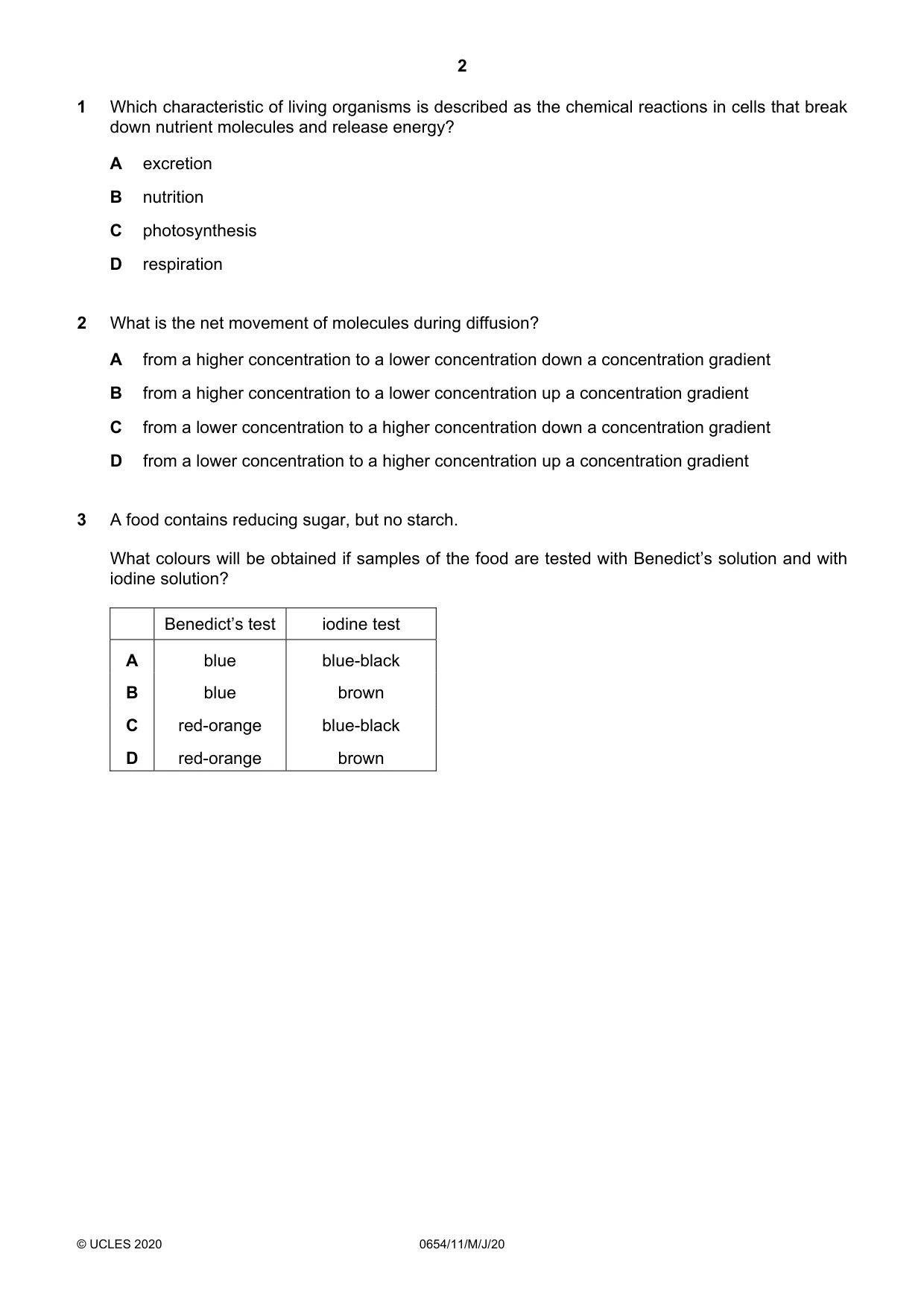
1 Which characteristic of living organisms is described as the chemical reactions in cells that break down nutrient molecules and release energy? A excretion B nutrition C photosynthesis D respiration
Mark scheme: D
Q2 · What is the net movement of molecules during diffusion?
2 What is the net movement of molecules during diffusion? A from a higher concentration to a lower concentration down a concentration gradient B from a higher concentration to a lower concentration up a concentration gradient C from a lower concentration to a higher concentration down a concentration gradient D from a lower concentration to a higher concentration up a concentration gradient
Mark scheme: A
Q3 · A food contains reducing sugar, but no starch
3 A food contains reducing sugar, but no starch. What colours will be obtained if samples of the food are tested with Benedict’s solution and with iodine solution? Benedict’s test iodine test A blue blue-black B blue brown C red-orange blue-black D red-orange brown
Mark scheme: D
Q4 · Which graph shows the effect of temperature on the activity of a mammalian enzyme?
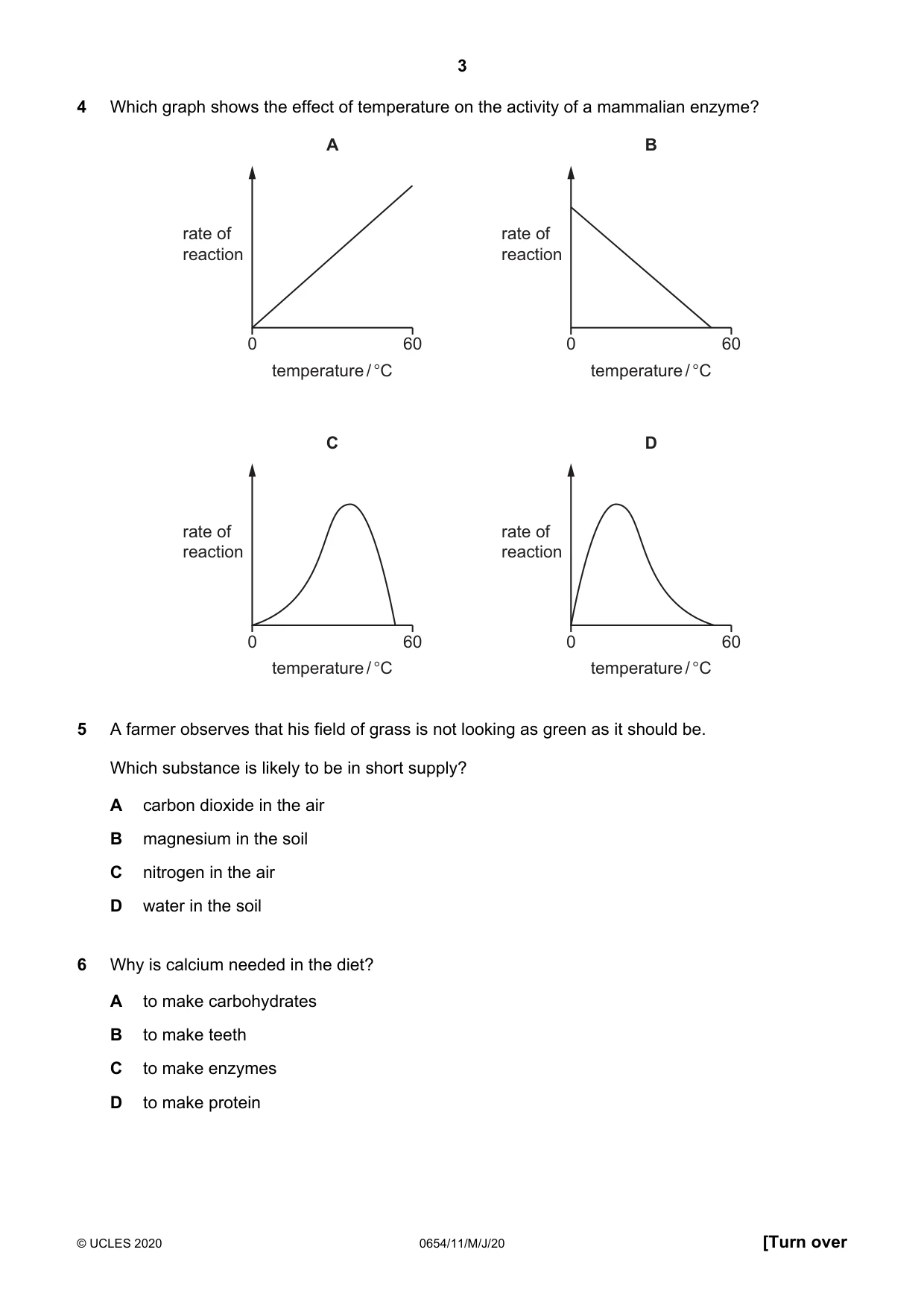
4 Which graph shows the effect of temperature on the activity of a mammalian enzyme? A B rate of rate of reaction reaction 0 60 0 60 temperature / °C temperature / °C C D rate of rate of reaction reaction 0 60 0 60 temperature / °C temperature / °C
Mark scheme: C
Q5 · A farmer observes that his field of grass is not looking as green as it should be
5 A farmer observes that his field of grass is not looking as green as it should be. Which substance is likely to be in short supply? A carbon dioxide in the air B magnesium in the soil C nitrogen in the air D water in the soil
Mark scheme: B
Q6 · Why is calcium needed in the diet?
6 Why is calcium needed in the diet? A to make carbohydrates B to make teeth C to make enzymes D to make protein
Mark scheme: B
Q7 · What is transported by red blood cells?
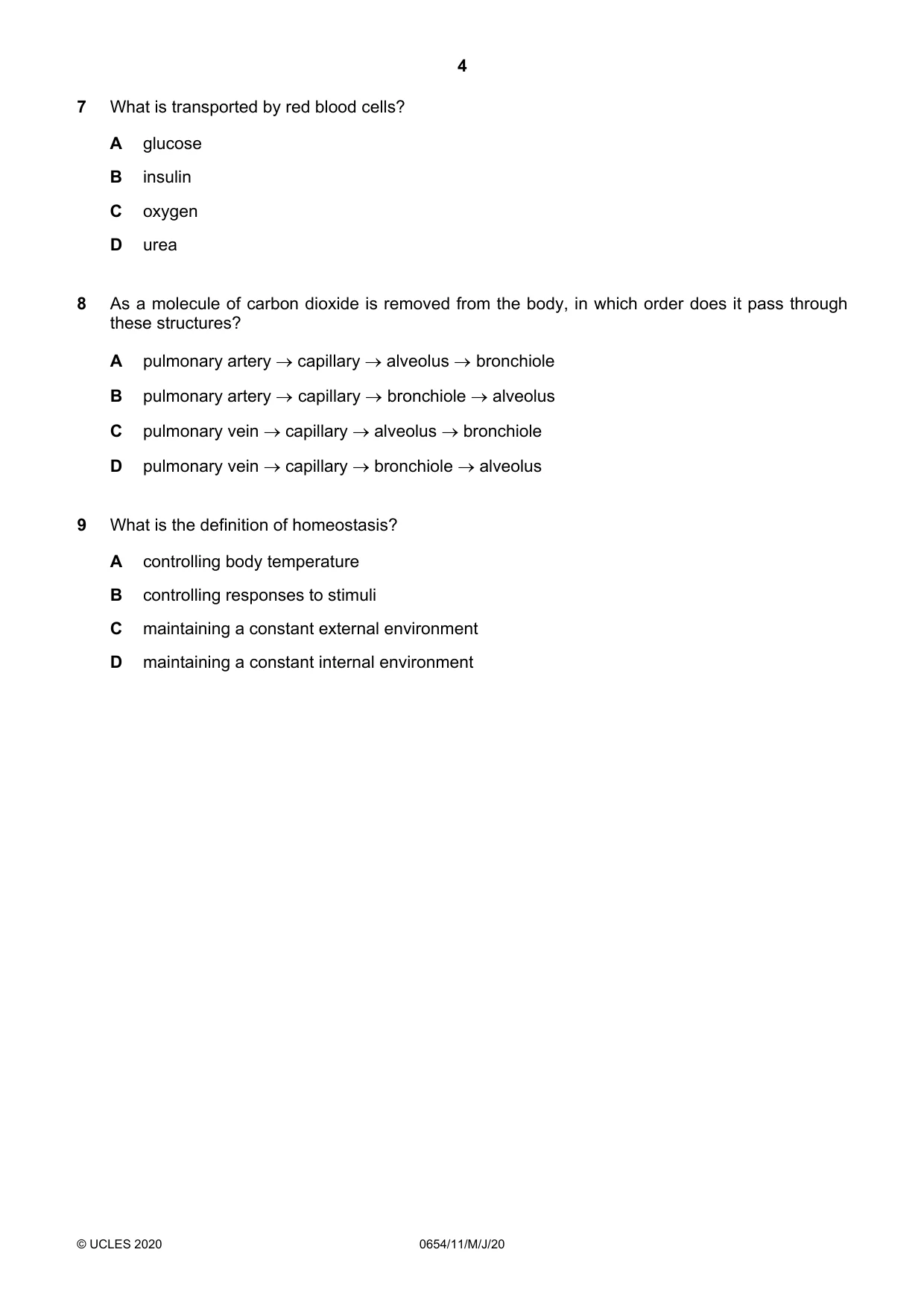
7 What is transported by red blood cells? A glucose B insulin C oxygen D urea
Mark scheme: C
Q8 · As a molecule of carbon dioxide is removed from the body, in which order does it pass…
8 As a molecule of carbon dioxide is removed from the body, in which order does it pass through these structures? A pulmonary artery → capillary → alveolus → bronchiole B pulmonary artery → capillary → bronchiole → alveolus C pulmonary vein → capillary → alveolus → bronchiole D pulmonary vein → capillary → bronchiole → alveolus
Mark scheme: A
Q9 · What is the definition of homeostasis?
9 What is the definition of homeostasis? A controlling body temperature B controlling responses to stimuli C maintaining a constant external environment D maintaining a constant internal environment
Mark scheme: D
Q10 · An experiment using germinating seeds is set up as shown, and left at room temperature…
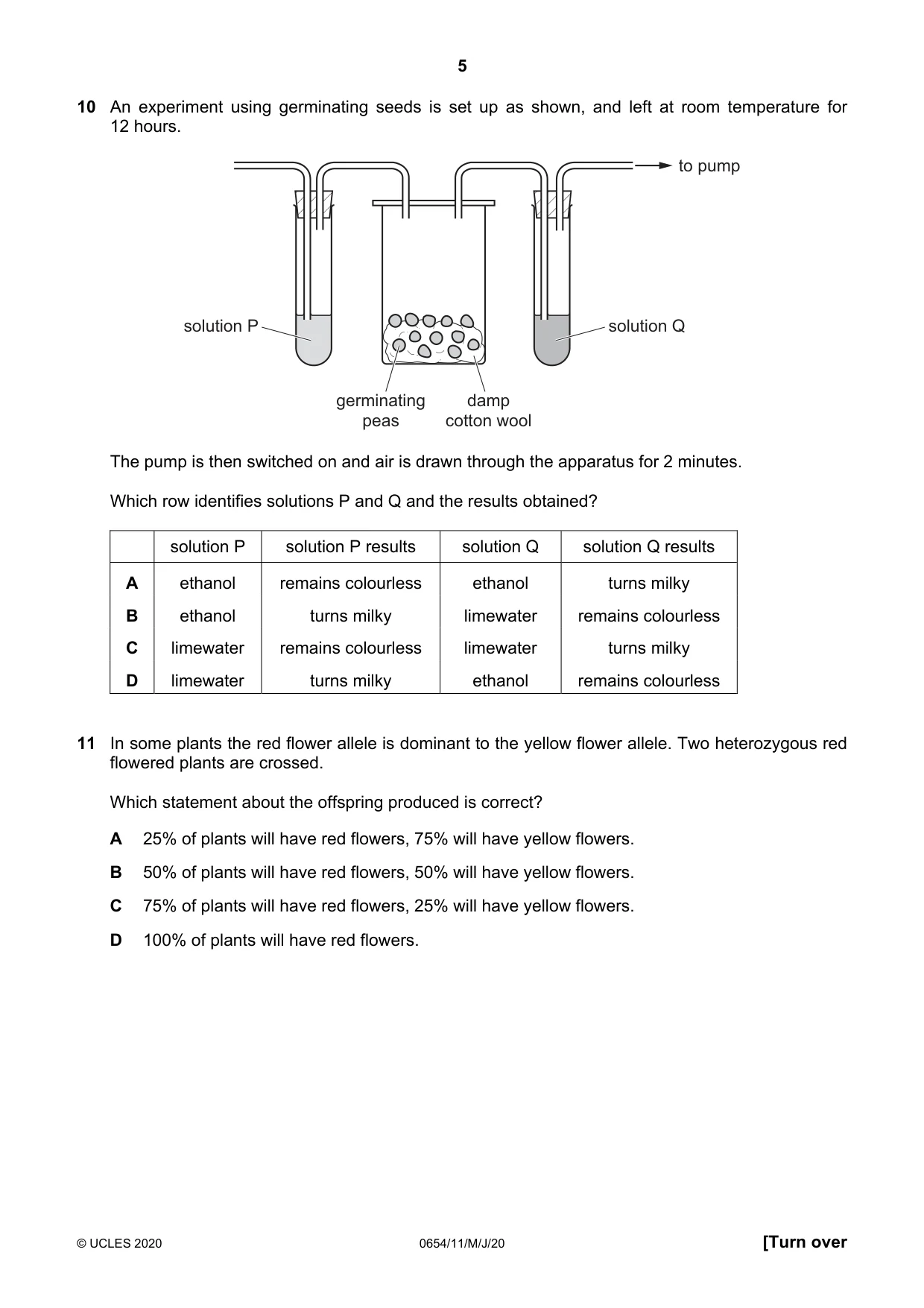
10 An experiment using germinating seeds is set up as shown, and left at room temperature for 12 hours. to pump solution P solution Q germinating damp peas cotton wool The pump is then switched on and air is drawn through the apparatus for 2 minutes. Which row identifies solutions P and Q and the results obtained? solution P solution P results solution Q solution Q results A ethanol remains colourless ethanol turns milky B ethanol turns milky limewater remains colourless C limewater remains colourless limewater turns milky D limewater turns milky ethanol remains colourless
Mark scheme: C
Q11 · In some plants the red flower allele is dominant to the yellow flower allele
11 In some plants the red flower allele is dominant to the yellow flower allele. Two heterozygous red flowered plants are crossed. Which statement about the offspring produced is correct? A 25% of plants will have red flowers, 75% will have yellow flowers. B 50% of plants will have red flowers, 50% will have yellow flowers. C 75% of plants will have red flowers, 25% will have yellow flowers. D 100% of plants will have red flowers.
Mark scheme: C
Q12 · The flow chart shows part of a food chain
12 The flow chart shows part of a food chain. grass → rabbit → fox What describes the rabbit? A consumer and carnivore B consumer and herbivore C producer and carnivore D producer and herbivore
Mark scheme: B
Q13 · What could deforestation cause?
13 What could deforestation cause? A a decrease in carbon dioxide levels and a decrease in flooding B a decrease in carbon dioxide levels and an increase in flooding C an increase in carbon dioxide levels and a decrease in flooding D an increase in carbon dioxide levels and an increase in flooding
Mark scheme: D
Q14 · Which statement about atoms and molecules is correct?
14 Which statement about atoms and molecules is correct? A All molecules are gases at room temperature and pressure. B An atom is the smallest part of an element. C Atoms of the same element all have the same mass. D Molecules always contain atoms of more than one element.
Mark scheme: B
Q15 · One atom of an isotope of fluorine is represented by 15 F
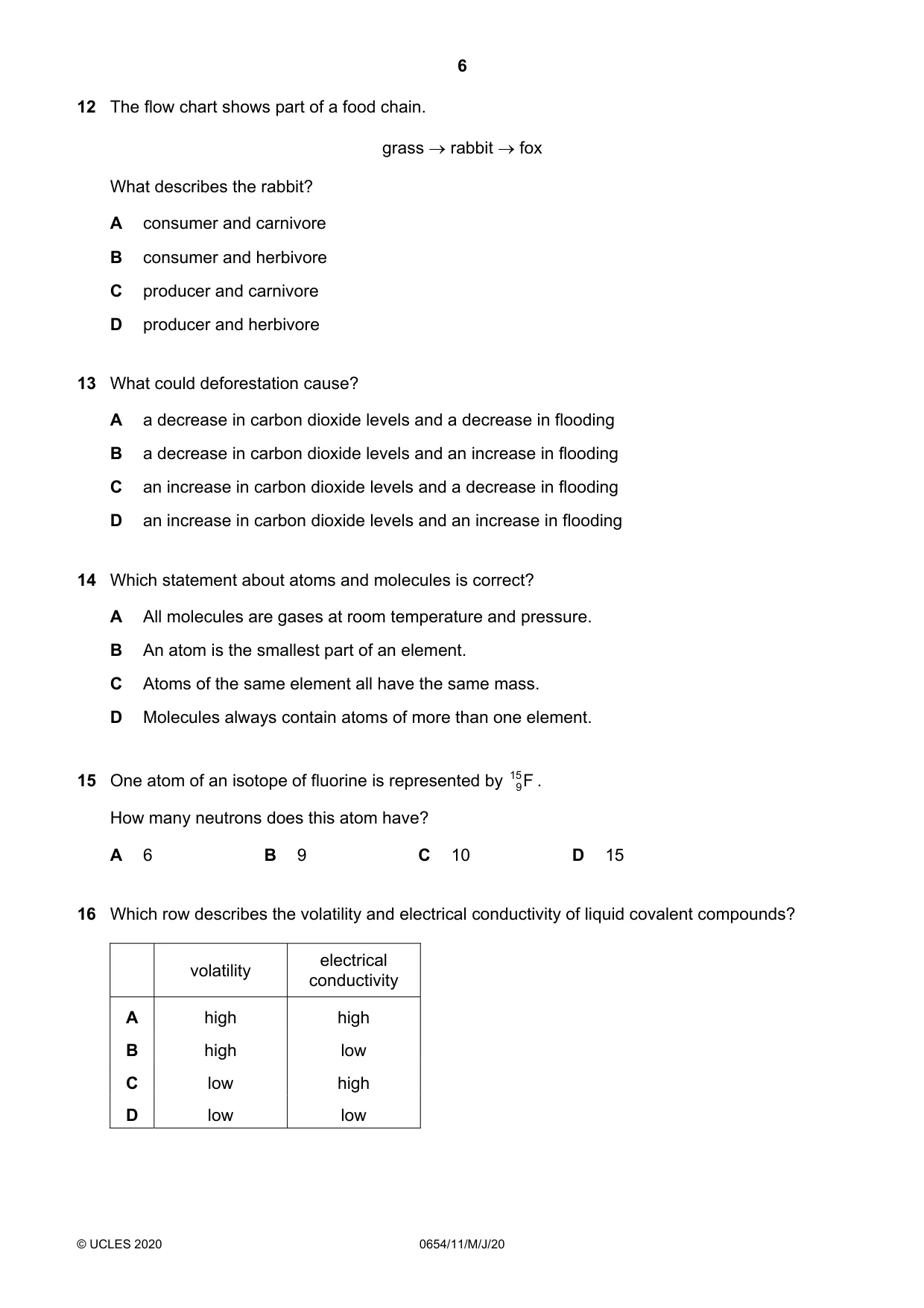
15 One atom of an isotope of fluorine is represented by 15 F . 9 How many neutrons does this atom have? A 6 B 9 C 10 D 15
Mark scheme: A
Q16 · Which row describes the volatility and electrical conductivity of liquid covalent…
16 Which row describes the volatility and electrical conductivity of liquid covalent compounds? electrical volatility conductivity A high high B high low C low high D low low
Mark scheme: B
Q17 · The diagram shows the electrolysis of lead(II) bromide using inert electrodes
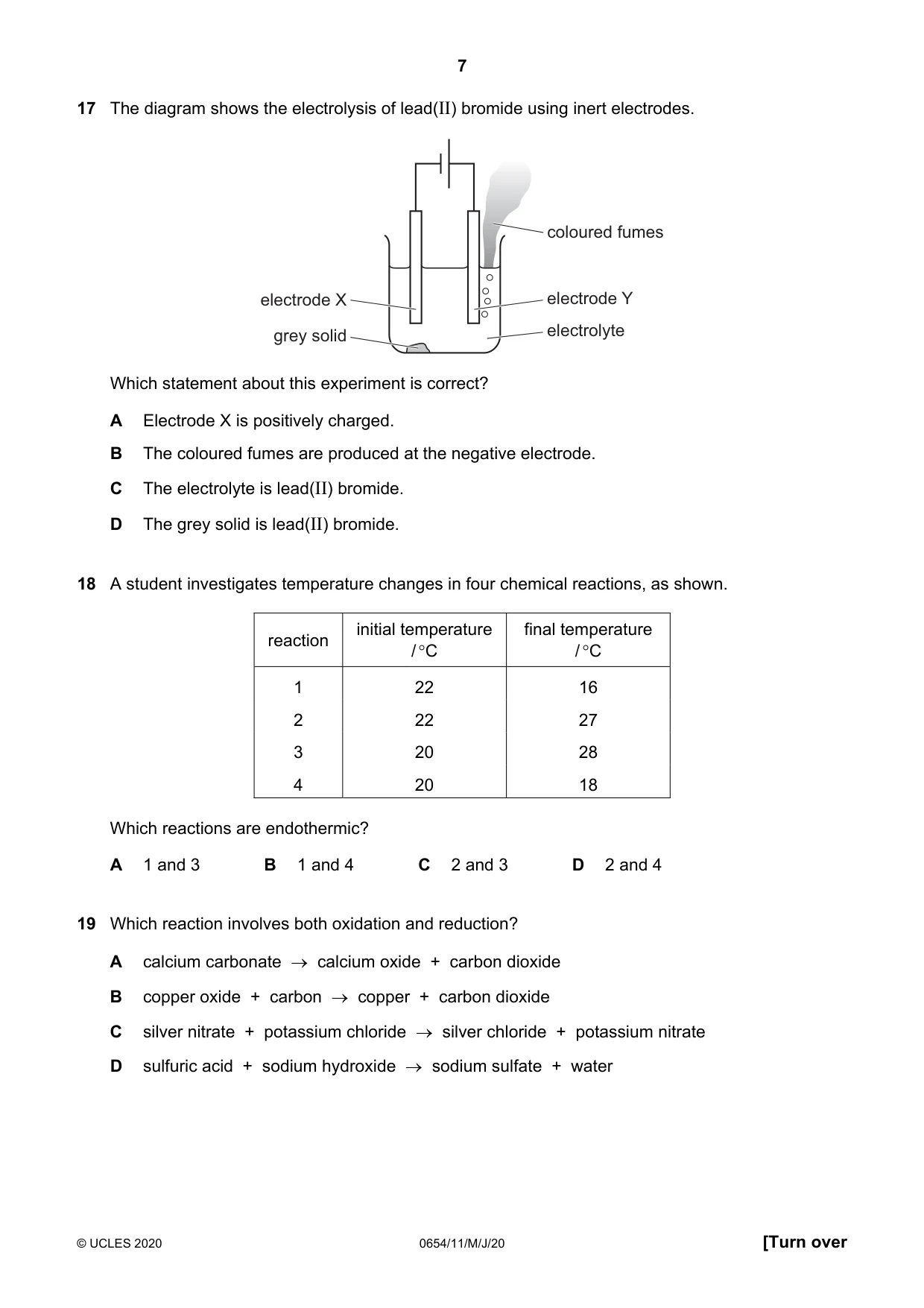
17 The diagram shows the electrolysis of lead(II) bromide using inert electrodes. coloured fumes electrode X electrode Y grey solid electrolyte Which statement about this experiment is correct? A Electrode X is positively charged. B The coloured fumes are produced at the negative electrode. C The electrolyte is lead(II) bromide. D The grey solid is lead(II) bromide.
Mark scheme: C
Q18 · A student investigates temperature changes in four chemical reactions, as shown
18 A student investigates temperature changes in four chemical reactions, as shown. initial temperature final temperature reaction / °C / °C 1 22 16 2 22 27 3 20 28 4 20 18 Which reactions are endothermic? A 1 and 3 B 1 and 4 C 2 and 3 D 2 and 4
Mark scheme: B
Q19 · Which reaction involves both oxidation and reduction?
19 Which reaction involves both oxidation and reduction? A calcium carbonate → calcium oxide + carbon dioxide B copper oxide + carbon → copper + carbon dioxide C silver nitrate + potassium chloride → silver chloride + potassium nitrate D sulfuric acid + sodium hydroxide → sodium sulfate + water
Mark scheme: B
Q20 · Copper sulfate is made by adding an excess of copper carbonate to dilute sulfuric acid…
20 Copper sulfate is made by adding an excess of copper carbonate to dilute sulfuric acid and stirring. The excess solid is removed. Most of the water is then removed. The solution is left for solid copper sulfate to form. In which order is apparatus used? A Bunsen burner, tripod and flask → filter funnel → crystallising dish B Bunsen burner, tripod and flask → crystallising dish → filter funnel C filter funnel → crystallising dish → Bunsen burner, tripod and flask D filter funnel → Bunsen burner, tripod and flask → crystallising dish
Mark scheme: D
Q21 · Which gas turns damp red litmus paper blue?
21 Which gas turns damp red litmus paper blue? A ammonia B carbon dioxide C chlorine D hydrogen
Mark scheme: A
Q22 · What is a property of transition elements?
22 What is a property of transition elements? A They form coloured compounds. B They form diatomic molecules. C They have low densities. D They have low melting points.
Mark scheme: A
Q23 · Which statement is not a reason why aluminium is used in aircraft manufacture?
23 Which statement is not a reason why aluminium is used in aircraft manufacture? A It forms low density alloys. B It is malleable. C It is more reactive than iron. D It is resistant to corrosion.
Mark scheme: C
Q24 · Why do farmers treat their fields with fertilisers?
24 Why do farmers treat their fields with fertilisers? A to decrease the acidity of the soil B to increase the oxygen content of the soil C to increase the water content of the soil D to increase the yield of crops
Mark scheme: D
Q25 · Limestone is converted to lime in process 1
25 Limestone is converted to lime in process 1. Limestone is used to treat industrial waste in process 2. What are processes 1 and 2? process 1 process 2 A decomposition dissolving B decomposition neutralisation C oxidation dissolving D oxidation neutralisation
Mark scheme: B
More questions on The characteristic properties of acids and bases
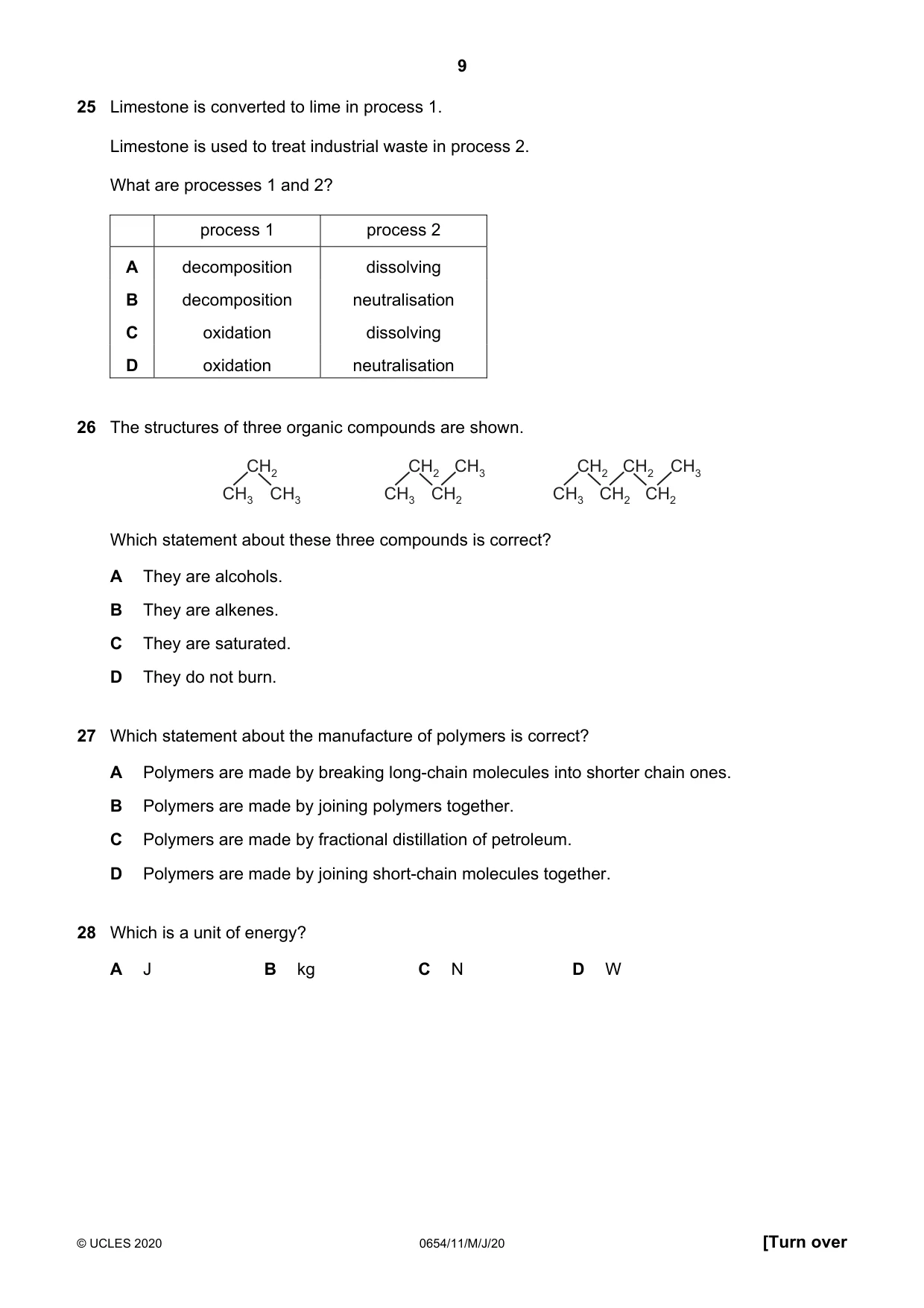
Q26 · The structures of three organic compounds are shown
26 The structures of three organic compounds are shown. CH2 CH2 CH3 CH2 CH2 CH3 CH3 CH3 CH3 CH2 CH3 CH2 CH2 Which statement about these three compounds is correct? A They are alcohols. B They are alkenes. C They are saturated. D They do not burn.
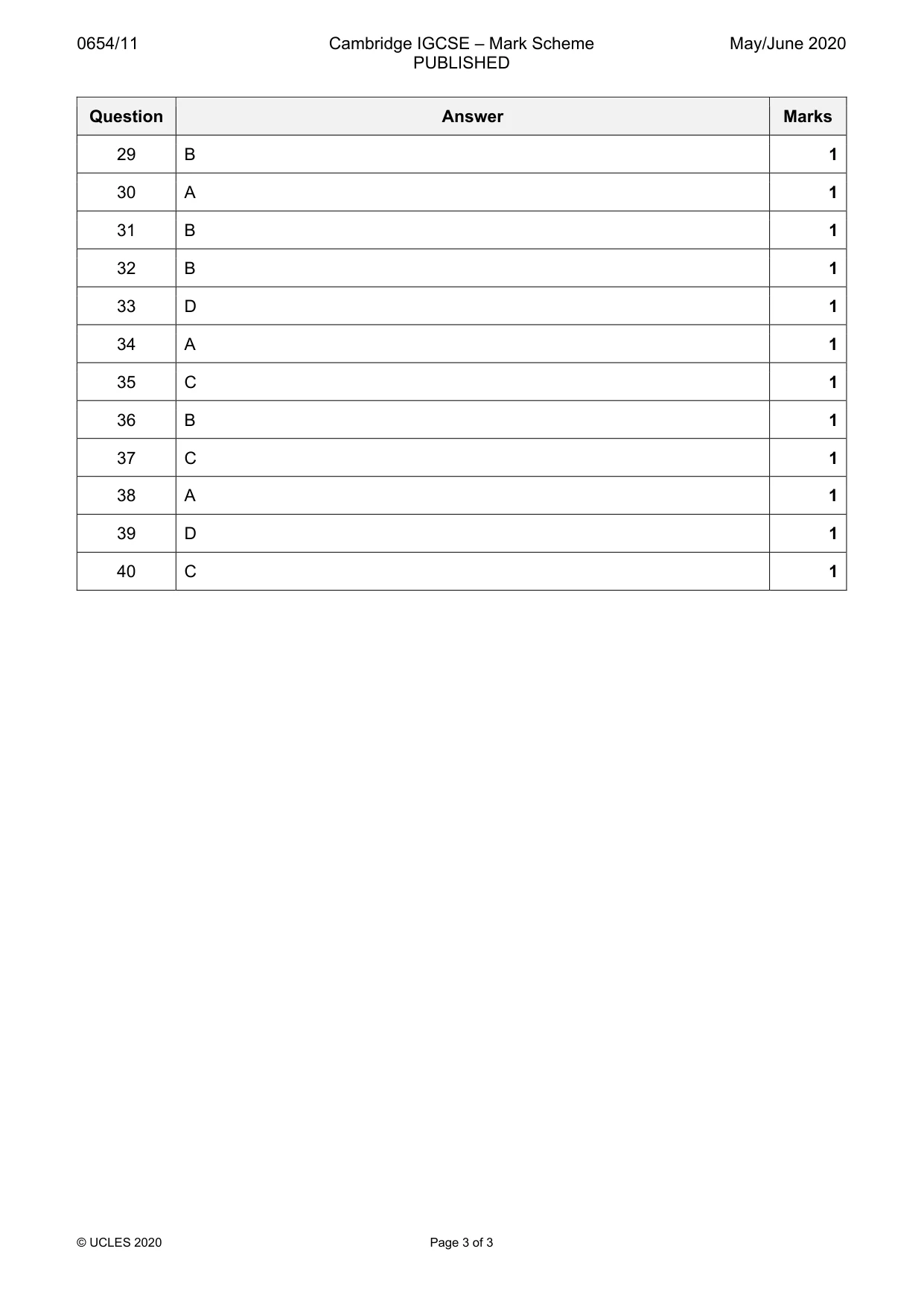
Mark scheme: C
Q27 · Which statement about the manufacture of polymers is correct?
27 Which statement about the manufacture of polymers is correct? A Polymers are made by breaking long-chain molecules into shorter chain ones. B Polymers are made by joining polymers together. C Polymers are made by fractional distillation of petroleum. D Polymers are made by joining short-chain molecules together.
Mark scheme: D
Q28 · Which is a unit of energy?
28 Which is a unit of energy? A J B kg C N D W
Mark scheme: A
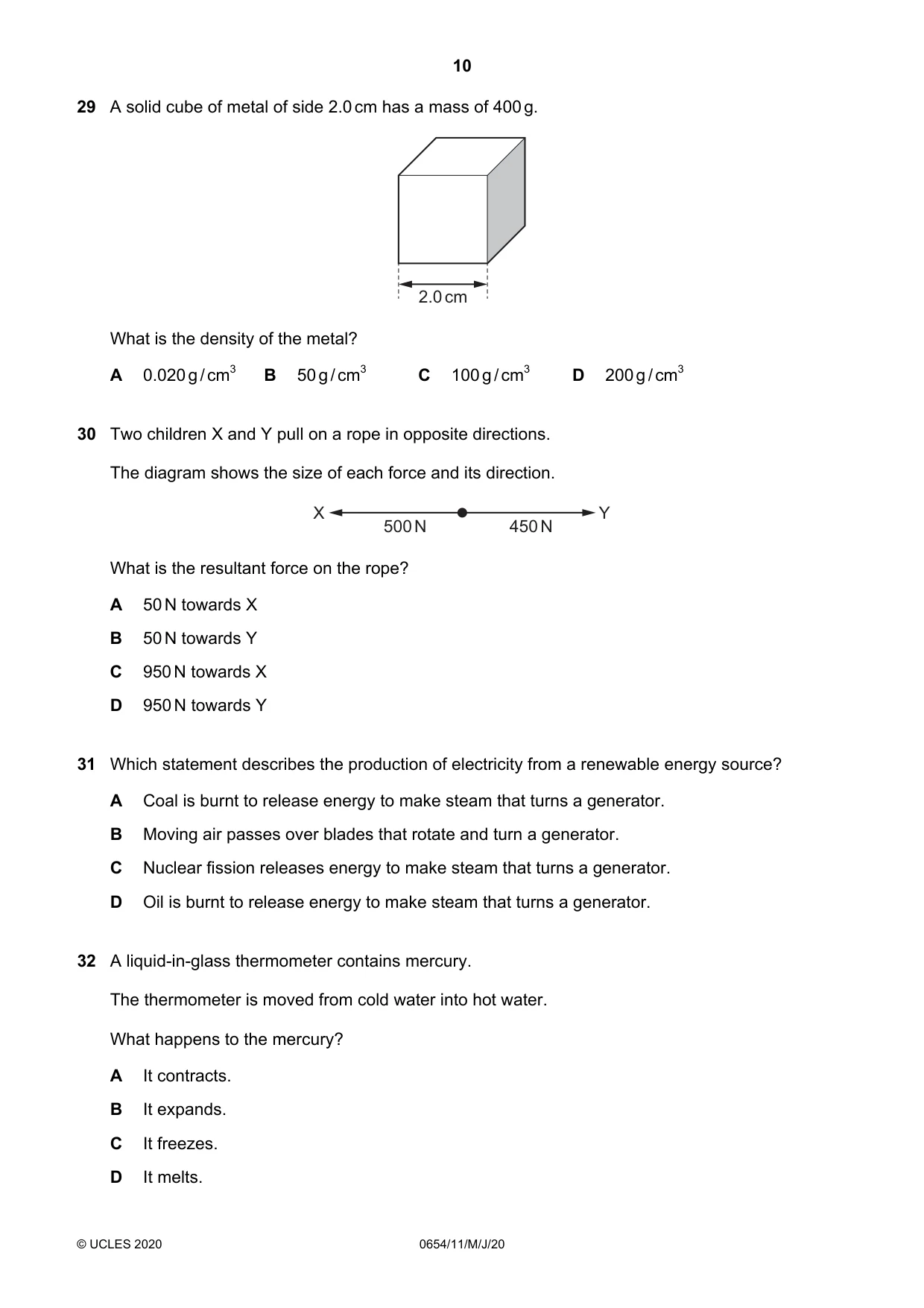
Q29 · A solid cube of metal of side 2.0 cm has a mass of 400 g
29 A solid cube of metal of side 2.0 cm has a mass of 400 g. 2.0 cm What is the density of the metal? A 0.020 g / cm3 B 50 g / cm3 C 100 g / cm3 D 200 g / cm3
Mark scheme: B
Q30 · Two children X and Y pull on a rope in opposite directions
30 Two children X and Y pull on a rope in opposite directions. The diagram shows the size of each force and its direction. X Y 500 N 450 N What is the resultant force on the rope? A 50 N towards X B 50 N towards Y C 950 N towards X D 950 N towards Y
Mark scheme: A
Q31 · Which statement describes the production of electricity from a renewable energy source?
31 Which statement describes the production of electricity from a renewable energy source? A Coal is burnt to release energy to make steam that turns a generator. B Moving air passes over blades that rotate and turn a generator. C Nuclear fission releases energy to make steam that turns a generator. D Oil is burnt to release energy to make steam that turns a generator.
Mark scheme: B
Q32 · A liquid-in-glass thermometer contains mercury
32 A liquid-in-glass thermometer contains mercury. The thermometer is moved from cold water into hot water. What happens to the mercury? A It contracts. B It expands. C It freezes. D It melts.
Mark scheme: B
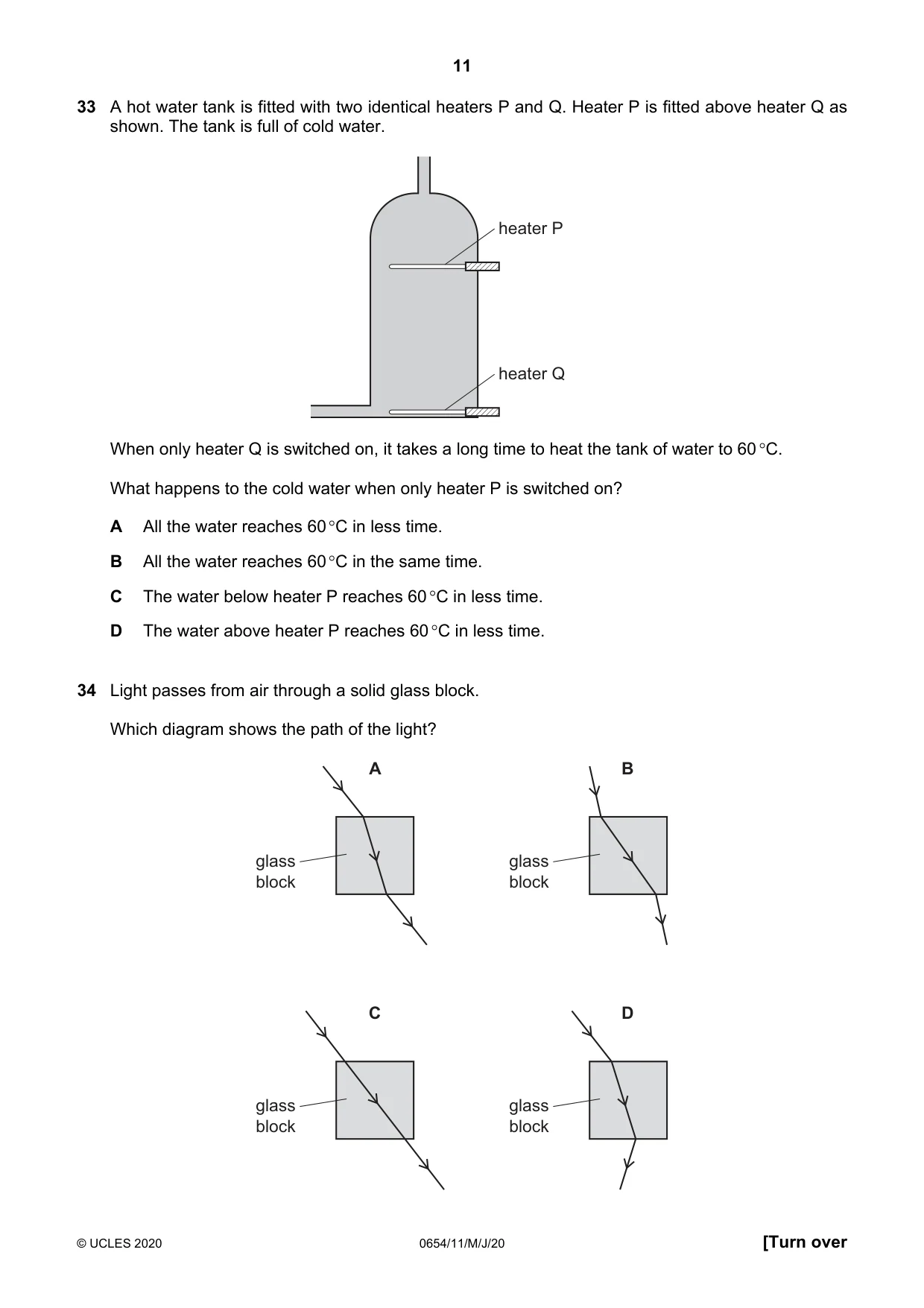
Q33 · A hot water tank is fitted with two identical heaters P and Q
33 A hot water tank is fitted with two identical heaters P and Q. Heater P is fitted above heater Q as shown. The tank is full of cold water. heater P heater Q When only heater Q is switched on, it takes a long time to heat the tank of water to 60 °C. What happens to the cold water when only heater P is switched on? A All the water reaches 60 °C in less time. B All the water reaches 60 °C in the same time. C The water below heater P reaches 60 °C in less time. D The water above heater P reaches 60 °C in less time.
Mark scheme: D
Q34 · Light passes from air through a solid glass block
34 Light passes from air through a solid glass block. Which diagram shows the path of the light? A B glass glass block block C D glass glass block block
Mark scheme: A
Q35 · A person stands 80 m from a high wall and claps his hands
35 A person stands 80 m from a high wall and claps his hands. He hears an echo 0.50 s later. Using this information, how is the speed of sound in air calculated? ( 0.50 × 2 ) A m / s 80 B 0.50 m / s ( 80 × 2 ) ( 80 × 2 ) C m / s 0.50 80 D m / s 0.50
Mark scheme: C
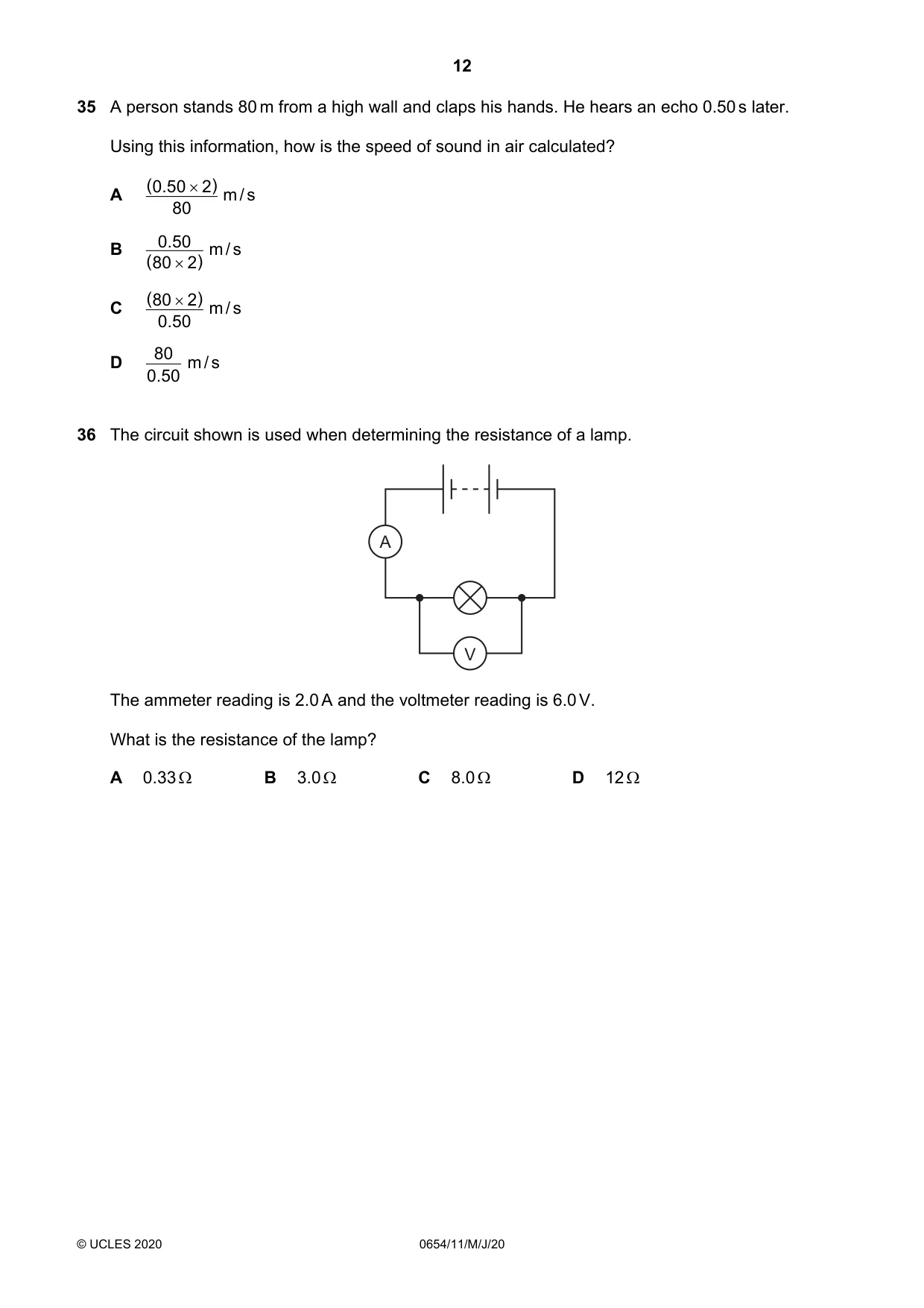
Q36 · The circuit shown is used when determining the resistance of a lamp
36 The circuit shown is used when determining the resistance of a lamp. A V The ammeter reading is 2.0 A and the voltmeter reading is 6.0 V. What is the resistance of the lamp? A 0.33 Ω B 3.0 Ω C 8.0 Ω D 12 Ω
Mark scheme: B
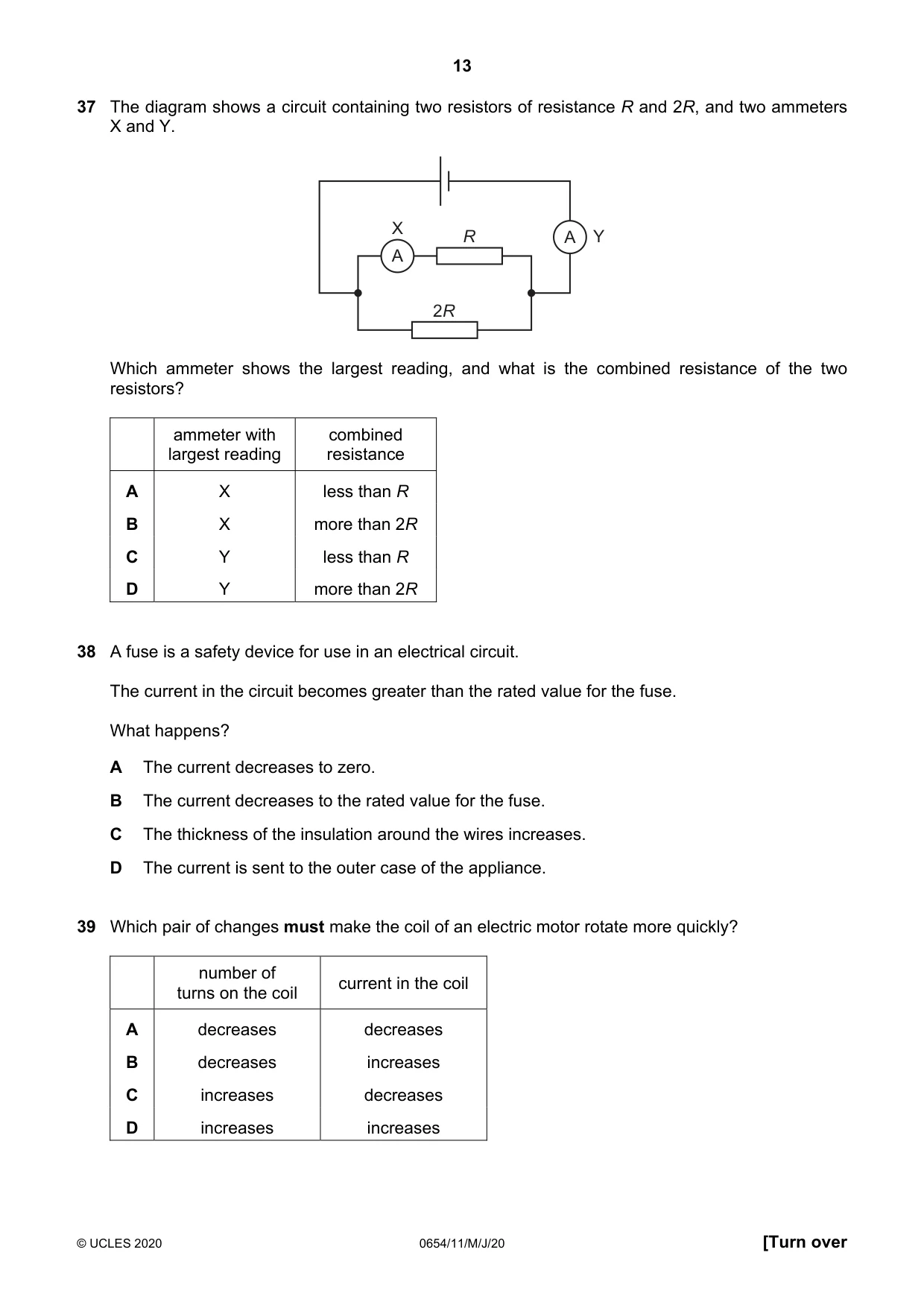
Q37 · The diagram shows a circuit containing two resistors of resistance R and 2R, and two…
37 The diagram shows a circuit containing two resistors of resistance R and 2R, and two ammeters X and Y. X R A Y A 2R Which ammeter shows the largest reading, and what is the combined resistance of the two resistors? ammeter with combined largest reading resistance A X less than R B X more than 2R C Y less than R D Y more than 2R
Mark scheme: C
Q38 · A fuse is a safety device for use in an electrical circuit
38 A fuse is a safety device for use in an electrical circuit. The current in the circuit becomes greater than the rated value for the fuse. What happens? A The current decreases to zero. B The current decreases to the rated value for the fuse. C The thickness of the insulation around the wires increases. D The current is sent to the outer case of the appliance.
Mark scheme: A
Q39 · Which pair of changes must make the coil of an electric motor rotate more quickly?
39 Which pair of changes must make the coil of an electric motor rotate more quickly? number of current in the coil turns on the coil A decreases decreases B decreases increases C increases decreases D increases increases
Mark scheme: D
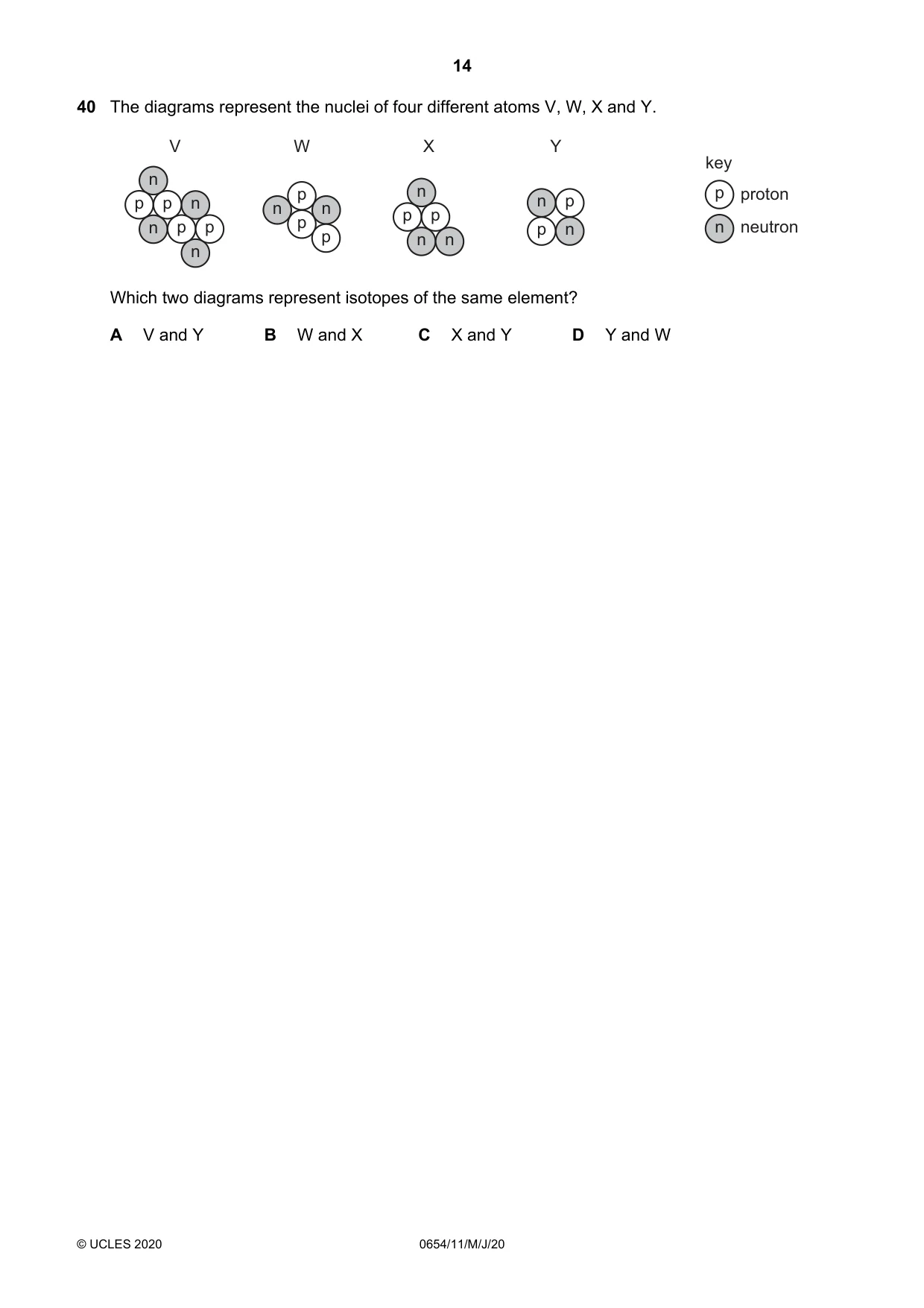
Q40 · The diagrams represent the nuclei of four different atoms V, W, X and Y
40 The diagrams represent the nuclei of four different atoms V, W, X and Y. V W X Y key n p n p proton p p n n n n p p p p n p p p n n neutron p n n n Which two diagrams represent isotopes of the same element? A V and Y B W and X C X and Y D Y and W
Mark scheme: C
What was in this paper
The subtopics covered by these 40 questions, and how many questions each got. Open one in a new tab to see every Cambridge question on it.
2Alkanes1Biological molecules1Blood1Characteristics of living organisms1Density1Diet1Diffusion1Electrical circuits1Electrical quantities1Electrical safety1Electrolysis1Electromagnetic effects1Elements, compounds and mixtures1Enzymes1Exothermic and endothermic reactions1Food chains and food webs1Forces1Gas exchange in humans1Habitat destruction1Homeostasis1Identification of ions and gases1Isotopes1Light1Monohybrid inheritance1Photosynthesis1Polymers1Properties of metals1Redox1Respiration1Separation and purification1Simple molecules and covalent bonds1Sound1The characteristic properties of acids and bases1The nucleus1Thermal properties and temperature1Transfer of thermal energy1Transition elements1Water1