Cambridge IGCSE Sciences - Co-ordinated (Double) 0654 — 2020 Oct/Nov Paper 1 · Variant 3
0654/13/O/N/20 · 40 questions · 40 marks · ≈45 min
The question paper and its mark scheme, free to read here and free to download. This is Cambridge’s own paper, exactly as it was sat.
Question paper16 pages
Mark scheme3 pages
Answers below. Sit the paper first if you are practising.
Questions as text
Q1 · What is not a characteristic of all living organisms?
1 What is not a characteristic of all living organisms? A excretion B growth C photosynthesis D sensitivity
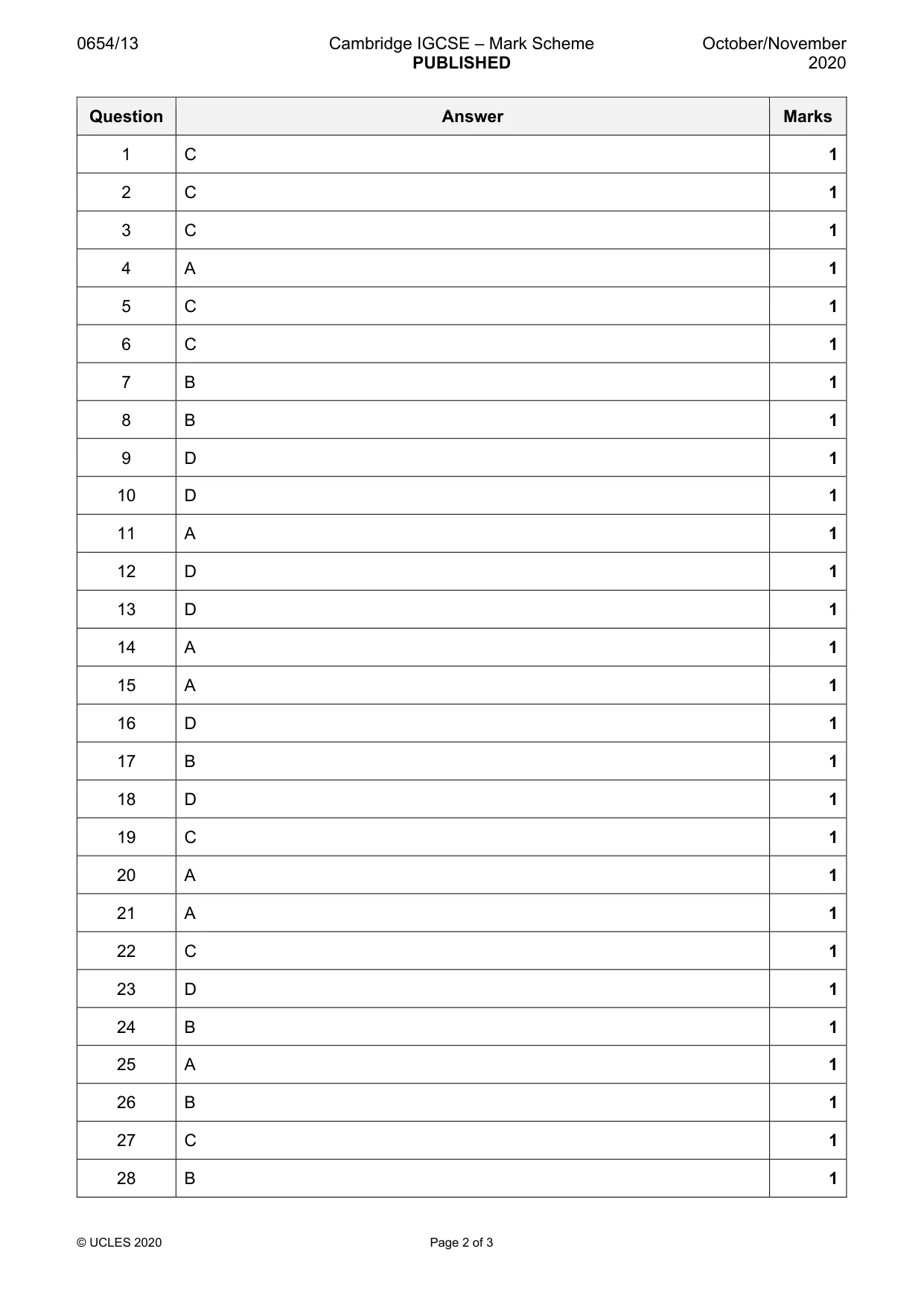
Mark scheme: C
Q2 · What is an example of diffusion?
2 What is an example of diffusion? A movement of blood through the capillaries B movement of food from the mouth to the stomach C movement of oxygen from alveoli to the blood D movement of urine along the urethra
Mark scheme: C
Q3 · What colour does Benedict’s solution change to when heated with a reducing sugar?
3 What colour does Benedict’s solution change to when heated with a reducing sugar? A blue B blue-black C orange D purple
Mark scheme: C
Q4 · A mixture of starch and saliva was set up at four different temperatures
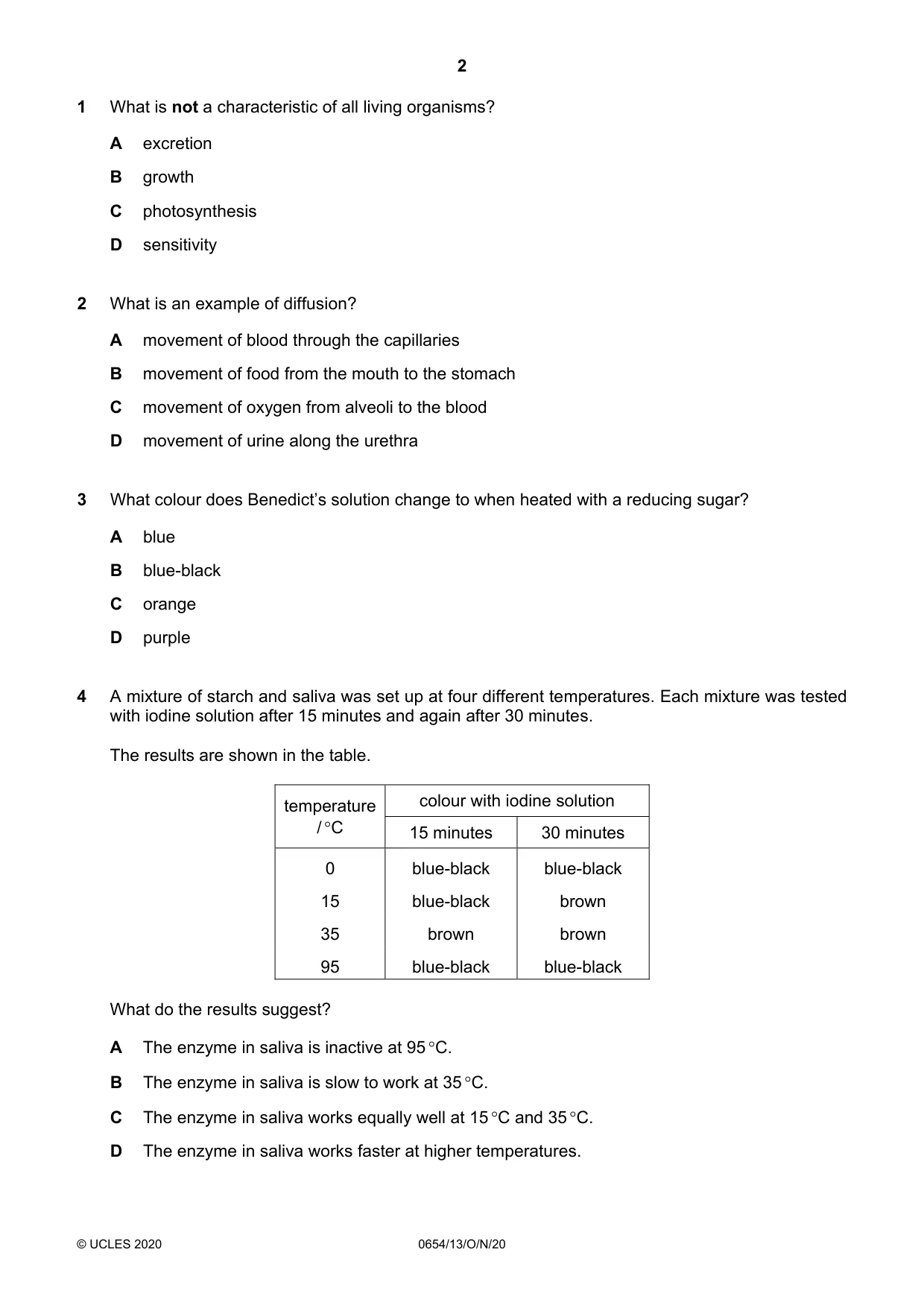
4 A mixture of starch and saliva was set up at four different temperatures. Each mixture was tested with iodine solution after 15 minutes and again after 30 minutes. The results are shown in the table. temperature colour with iodine solution / C 15 minutes 30 minutes 0 blue-black blue-black 15 blue-black brown 35 brown brown 95 blue-black blue-black What do the results suggest? A The enzyme in saliva is inactive at 95 C. B The enzyme in saliva is slow to work at 35 C. C The enzyme in saliva works equally well at 15 C and 35 C. D The enzyme in saliva works faster at higher temperatures.
Mark scheme: A
Q5 · Which chemical element is present in chlorophyll?
5 Which chemical element is present in chlorophyll? A calcium B iron C magnesium D sodium
Mark scheme: C
Q6 · The diagram shows the human alimentary canal
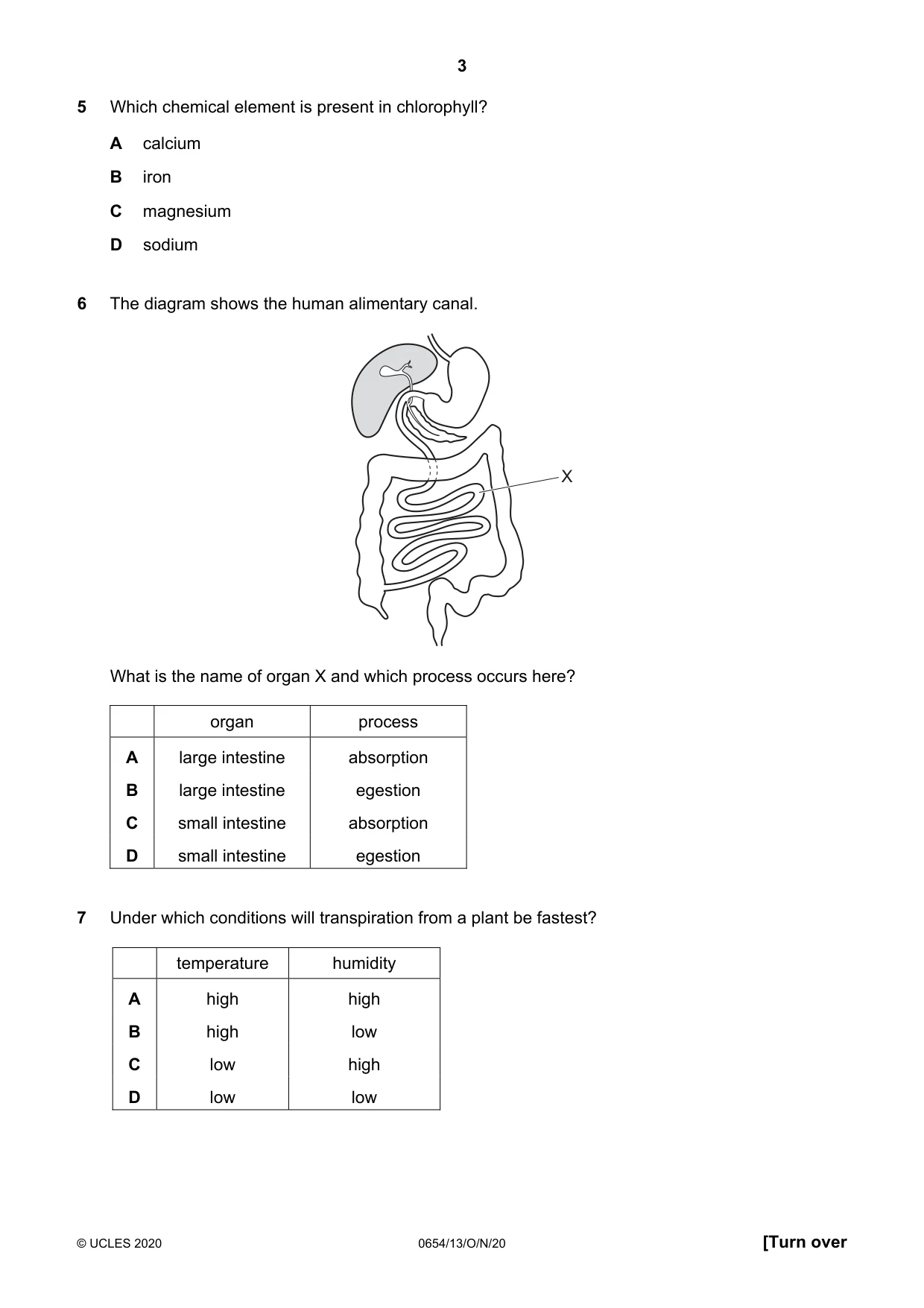
6 The diagram shows the human alimentary canal. X What is the name of organ X and which process occurs here? organ process A large intestine absorption B large intestine egestion C small intestine absorption D small intestine egestion
Mark scheme: C
Q7 · Under which conditions will transpiration from a plant be fastest?
7 Under which conditions will transpiration from a plant be fastest? temperature humidity A high high B high low C low high D low low
Mark scheme: B
Q8 · A student breathed gently in and out of the mouth piece of the apparatus shown
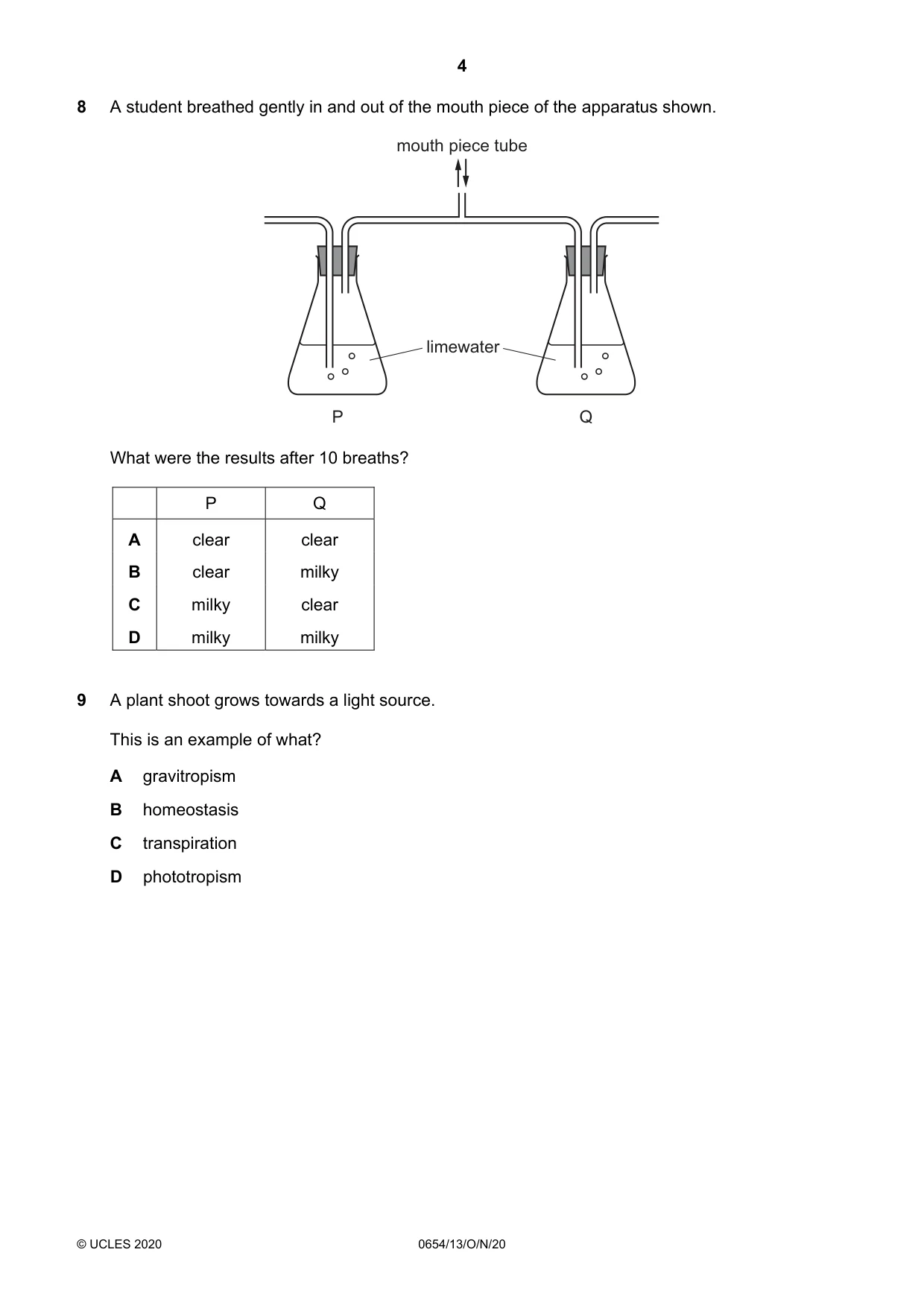
8 A student breathed gently in and out of the mouth piece of the apparatus shown. mouth piece tube limewater P Q What were the results after 10 breaths? P Q A clear clear B clear milky C milky clear D milky milky
Mark scheme: B
Q9 · A plant shoot grows towards a light source
9 A plant shoot grows towards a light source. This is an example of what? A gravitropism B homeostasis C transpiration D phototropism
Mark scheme: D
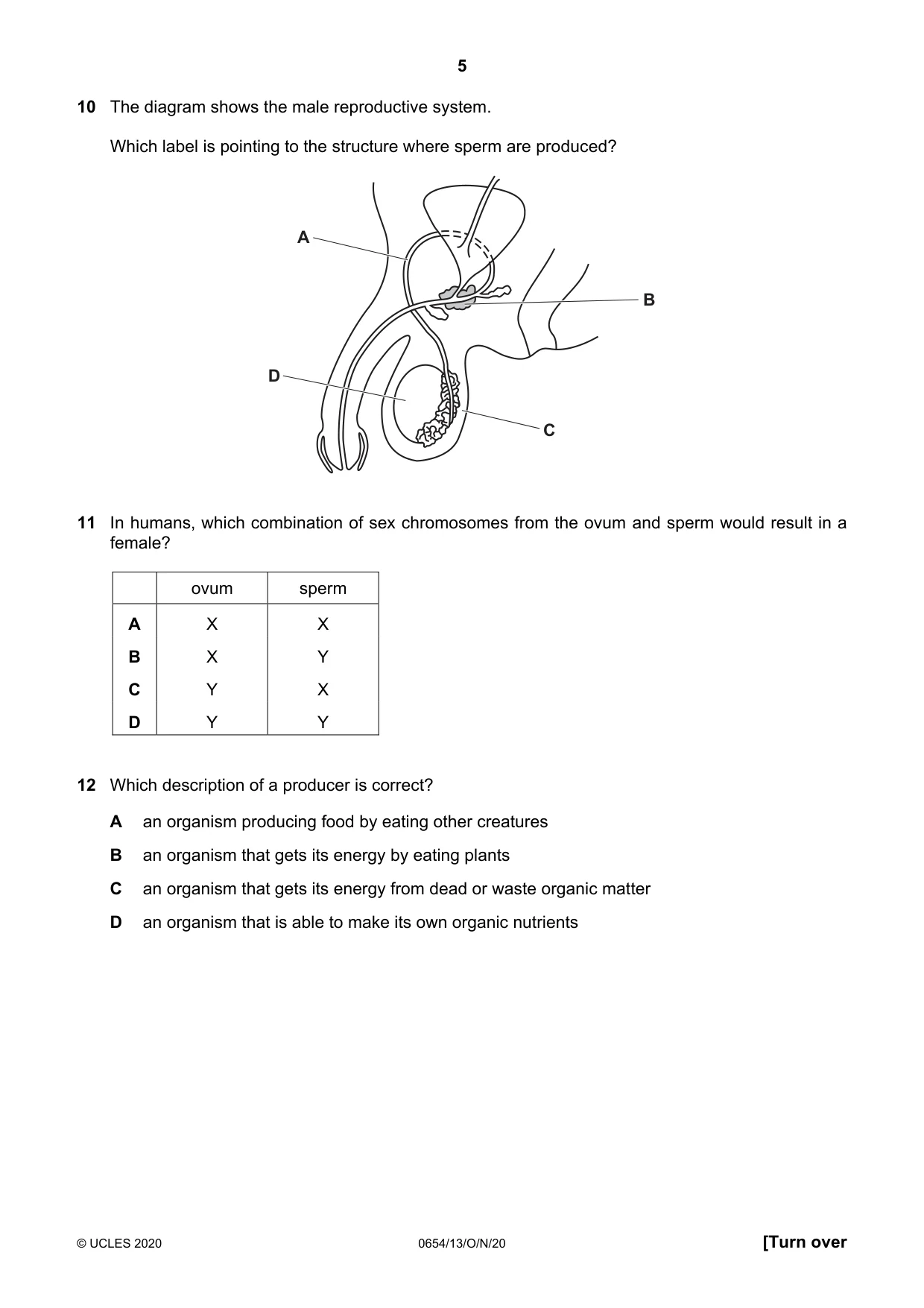
Q10 · The diagram shows the male reproductive system
10 The diagram shows the male reproductive system. Which label is pointing to the structure where sperm are produced? A B D C
Mark scheme: D
Q11 · In humans, which combination of sex chromosomes from the ovum and sperm would result in a…
11 In humans, which combination of sex chromosomes from the ovum and sperm would result in a female? ovum sperm A X X B X Y C Y X D Y Y
Mark scheme: A
Q12 · Which description of a producer is correct?
12 Which description of a producer is correct? A an organism producing food by eating other creatures B an organism that gets its energy by eating plants C an organism that gets its energy from dead or waste organic matter D an organism that is able to make its own organic nutrients
Mark scheme: D
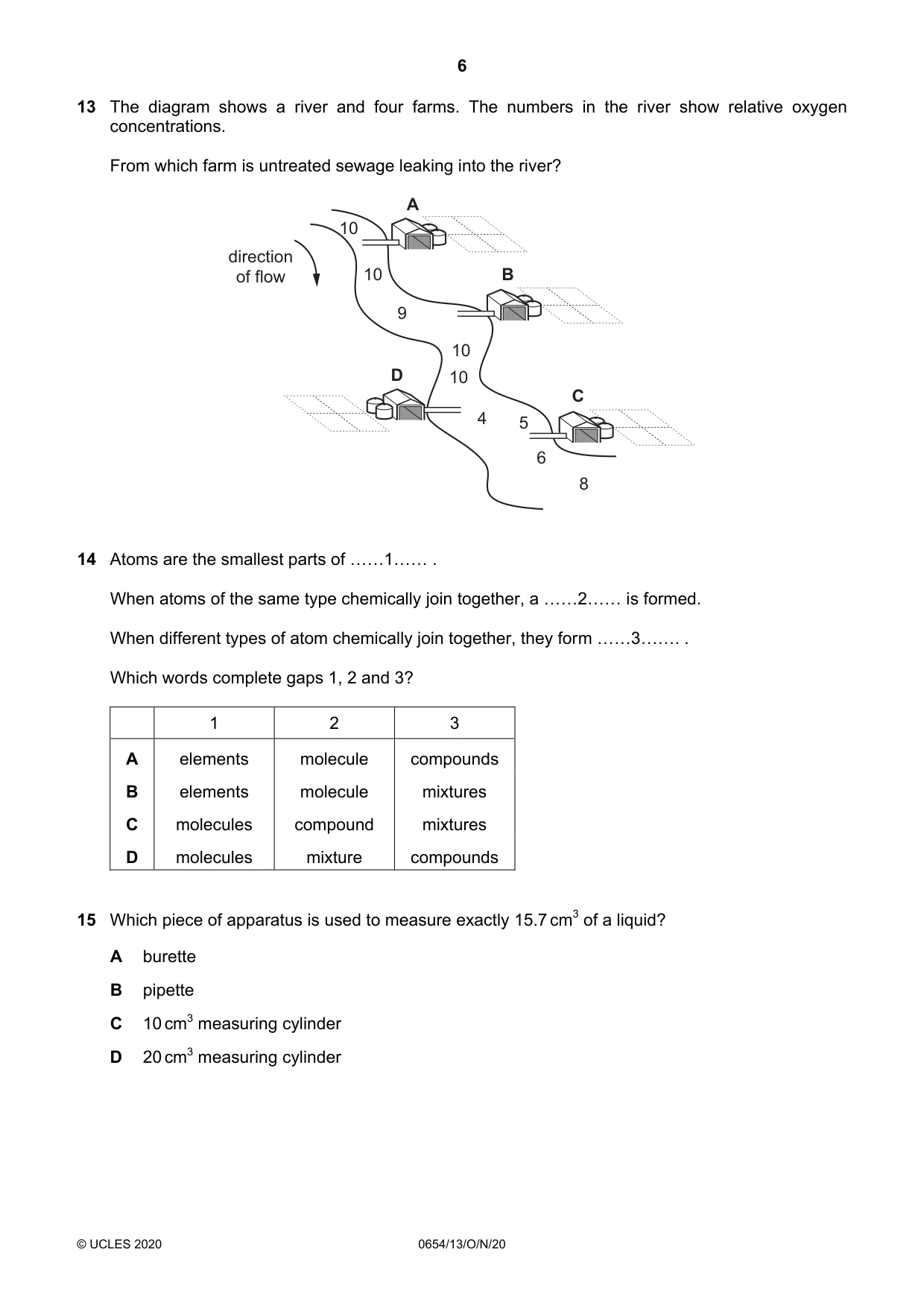
Q13 · The diagram shows a river and four farms
13 The diagram shows a river and four farms. The numbers in the river show relative oxygen concentrations. From which farm is untreated sewage leaking into the river? A 10 direction of flow 10 B 9 10 D 10 C 4 5 6 8
Mark scheme: D
Q14 · Atoms are the smallest parts of ……1……
14 Atoms are the smallest parts of ……1…… . When atoms of the same type chemically join together, a ……2…… is formed. When different types of atom chemically join together, they form ……3……. . Which words complete gaps 1, 2 and 3? 1 2 3 A elements molecule compounds B elements molecule mixtures C molecules compound mixtures D molecules mixture compounds
Mark scheme: A
Q15 · Which piece of apparatus is used to measure exactly 15.7 cm3 of a liquid?
15 Which piece of apparatus is used to measure exactly 15.7 cm3 of a liquid? A burette B pipette C 10 cm3 measuring cylinder D 20 cm3 measuring cylinder
Mark scheme: A
Q16 · A mixture of solid sulfur and solid sodium chloride is added to water and stirred
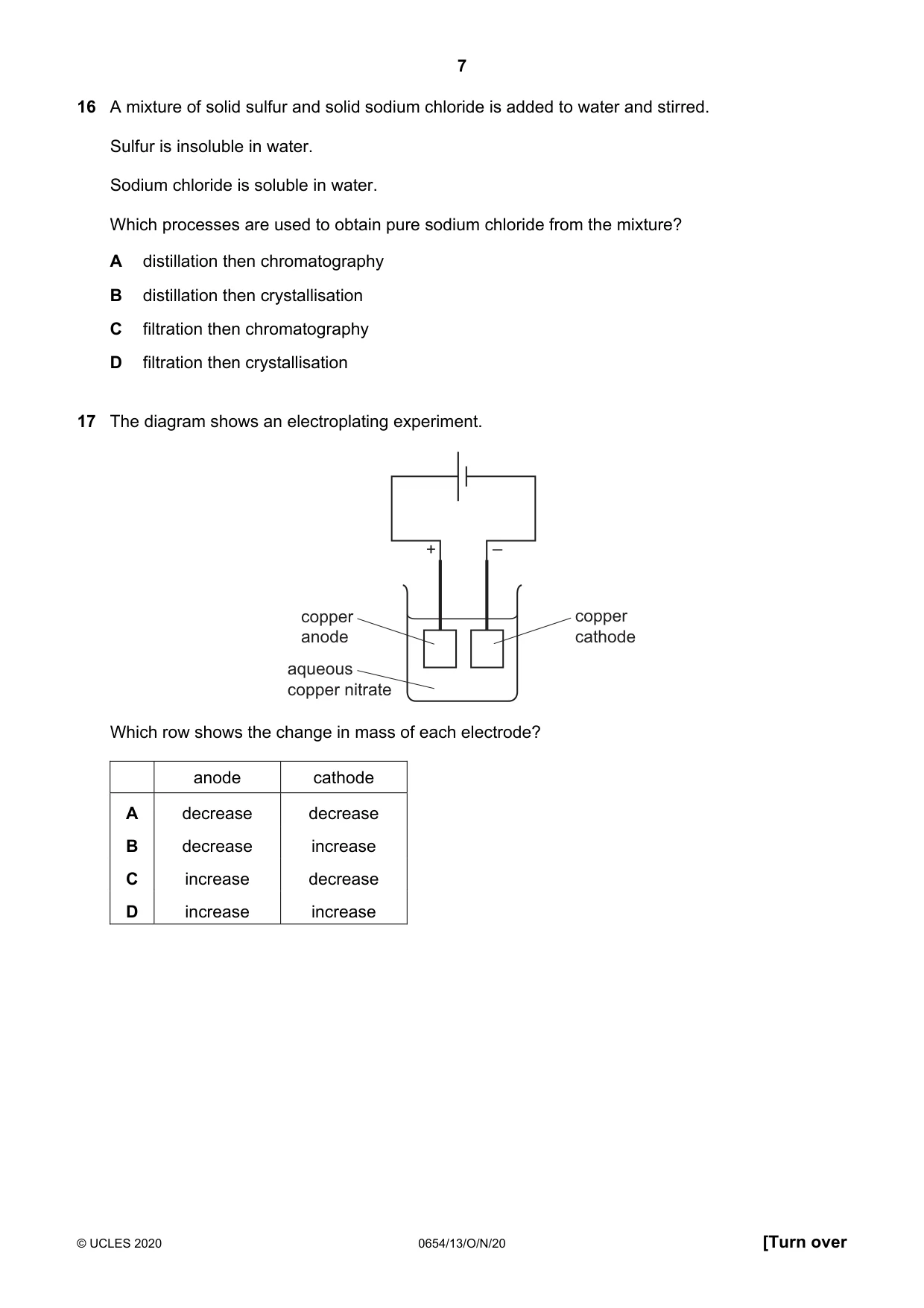
16 A mixture of solid sulfur and solid sodium chloride is added to water and stirred. Sulfur is insoluble in water. Sodium chloride is soluble in water. Which processes are used to obtain pure sodium chloride from the mixture? A distillation then chromatography B distillation then crystallisation C filtration then chromatography D filtration then crystallisation
Mark scheme: D
Q17 · The diagram shows an electroplating experiment
17 The diagram shows an electroplating experiment. + _ copper copper anode cathode aqueous copper nitrate Which row shows the change in mass of each electrode? anode cathode A decrease decrease B decrease increase C increase decrease D increase increase
Mark scheme: B
Q18 · The initial and final temperatures of four different experiments are measured
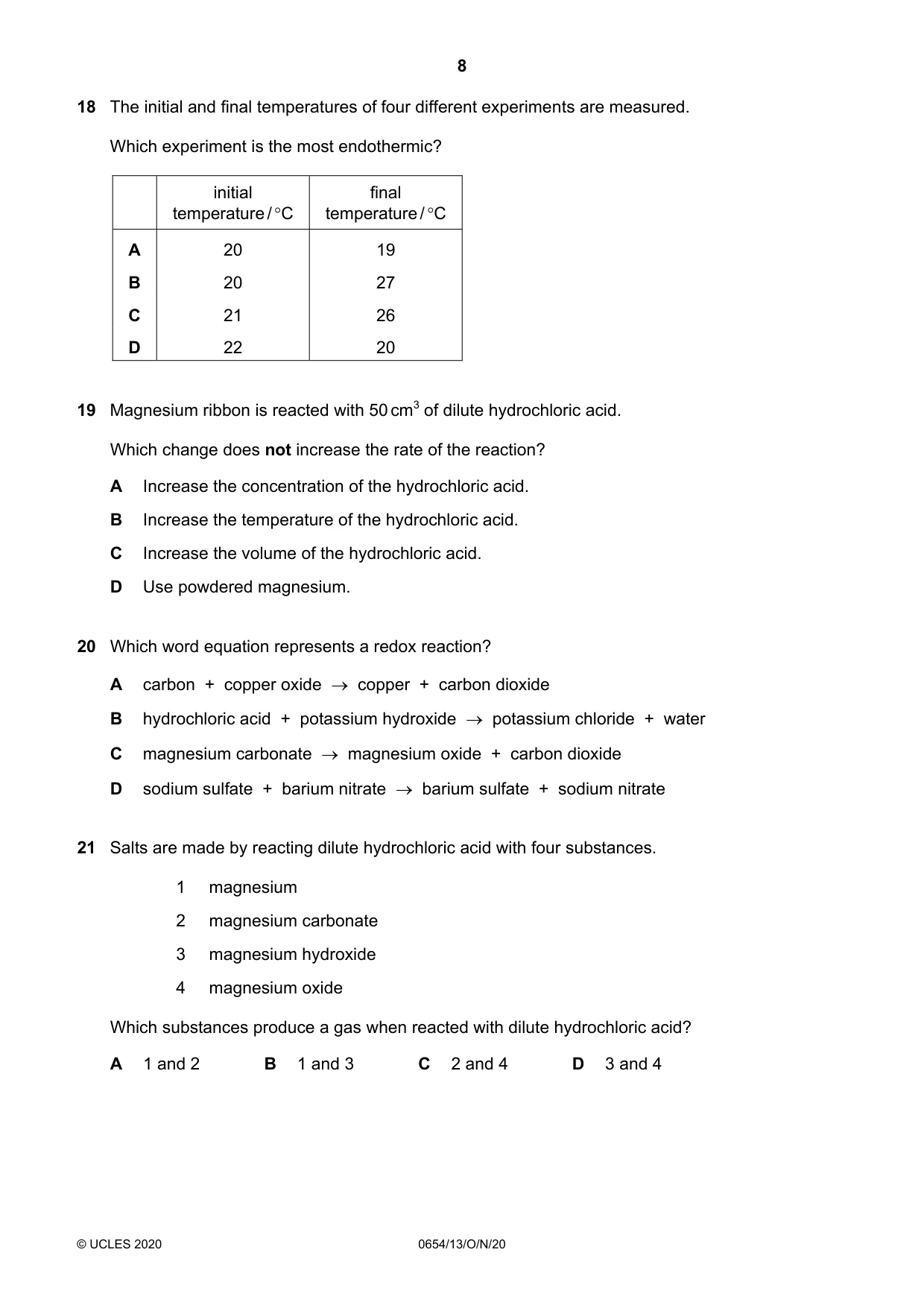
18 The initial and final temperatures of four different experiments are measured. Which experiment is the most endothermic? initial final temperature / C temperature / C A 20 19 B 20 27 C 21 26 D 22 20
Mark scheme: D
Q19 · Magnesium ribbon is reacted with 50 cm3 of dilute hydrochloric acid
19 Magnesium ribbon is reacted with 50 cm3 of dilute hydrochloric acid. Which change does not increase the rate of the reaction? A Increase the concentration of the hydrochloric acid. B Increase the temperature of the hydrochloric acid. C Increase the volume of the hydrochloric acid. D Use powdered magnesium.
Mark scheme: C
Q20 · Which word equation represents a redox reaction?
20 Which word equation represents a redox reaction? A carbon + copper oxide copper + carbon dioxide B hydrochloric acid + potassium hydroxide potassium chloride + water C magnesium carbonate magnesium oxide + carbon dioxide D sodium sulfate + barium nitrate barium sulfate + sodium nitrate
Mark scheme: A
Q21 · Salts are made by reacting dilute hydrochloric acid with four substances
21 Salts are made by reacting dilute hydrochloric acid with four substances. 1 magnesium 2 magnesium carbonate 3 magnesium hydroxide 4 magnesium oxide Which substances produce a gas when reacted with dilute hydrochloric acid? A 1 and 2 B 1 and 3 C 2 and 4 D 3 and 4
Mark scheme: A
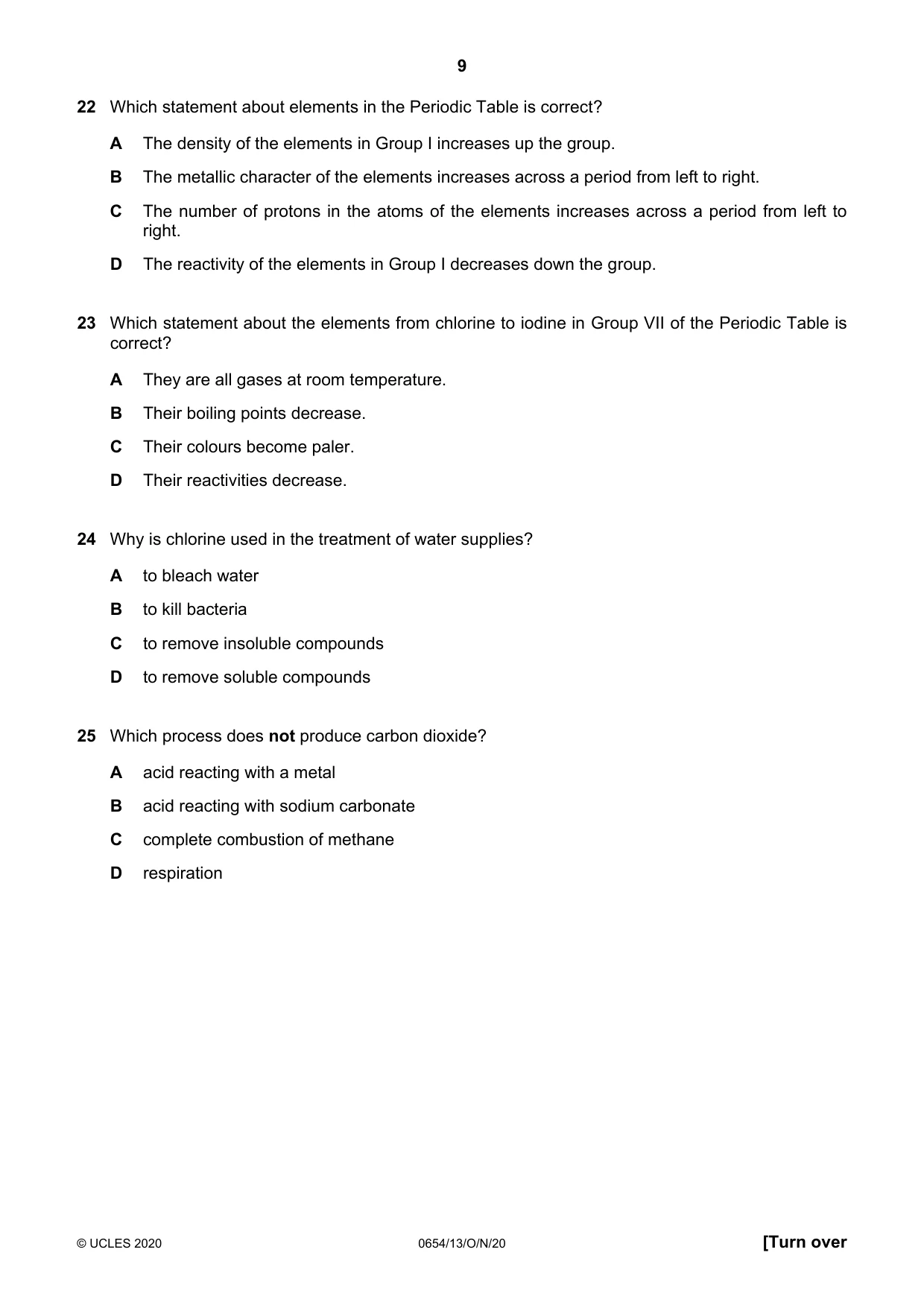
Q22 · Which statement about elements in the Periodic Table is correct?
22 Which statement about elements in the Periodic Table is correct? A The density of the elements in Group I increases up the group. B The metallic character of the elements increases across a period from left to right. C The number of protons in the atoms of the elements increases across a period from left to right. D The reactivity of the elements in Group I decreases down the group.
Mark scheme: C
Q23 · Which statement about the elements from chlorine to iodine in Group VII of the Periodic…
23 Which statement about the elements from chlorine to iodine in Group VII of the Periodic Table is correct? A They are all gases at room temperature. B Their boiling points decrease. C Their colours become paler. D Their reactivities decrease.
Mark scheme: D
Q24 · Why is chlorine used in the treatment of water supplies?
24 Why is chlorine used in the treatment of water supplies? A to bleach water B to kill bacteria C to remove insoluble compounds D to remove soluble compounds
Mark scheme: B
Q25 · Which process does not produce carbon dioxide?
25 Which process does not produce carbon dioxide? A acid reacting with a metal B acid reacting with sodium carbonate C complete combustion of methane D respiration
Mark scheme: A
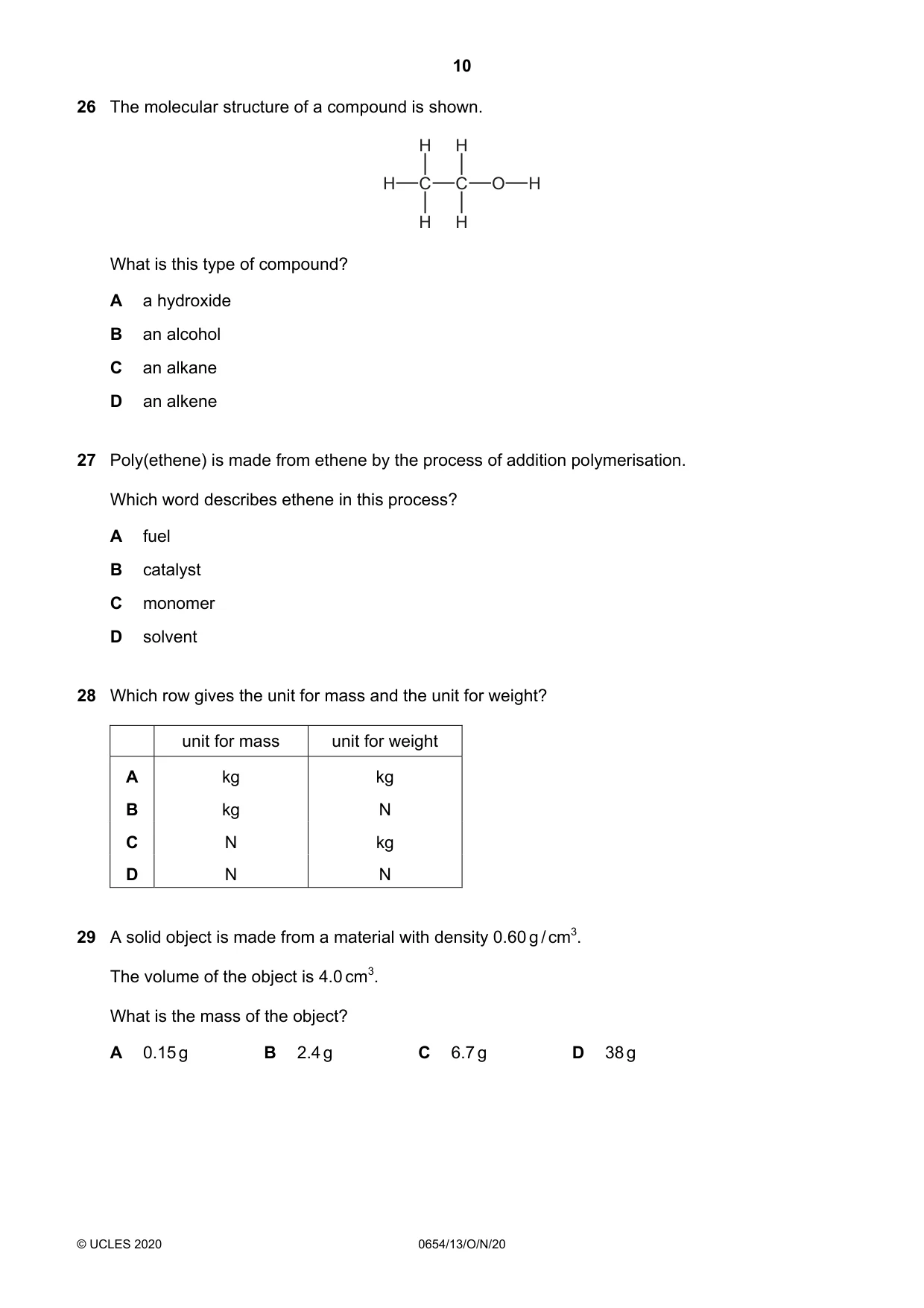
Q26 · The molecular structure of a compound is shown
26 The molecular structure of a compound is shown. H H H C C O H H H What is this type of compound? A a hydroxide B an alcohol C an alkane D an alkene
Mark scheme: B
Q27 · Poly(ethene) is made from ethene by the process of addition polymerisation
27 Poly(ethene) is made from ethene by the process of addition polymerisation. Which word describes ethene in this process? A fuel B catalyst C monomer D solvent
Mark scheme: C
Q28 · Which row gives the unit for mass and the unit for weight?
28 Which row gives the unit for mass and the unit for weight? unit for mass unit for weight A kg kg B kg N C N kg D N N
Mark scheme: B
Q29 · A solid object is made from a material with density 0.60 g / cm3
29 A solid object is made from a material with density 0.60 g / cm3. The volume of the object is 4.0 cm3. What is the mass of the object? A 0.15 g B 2.4 g C 6.7 g D 38 g
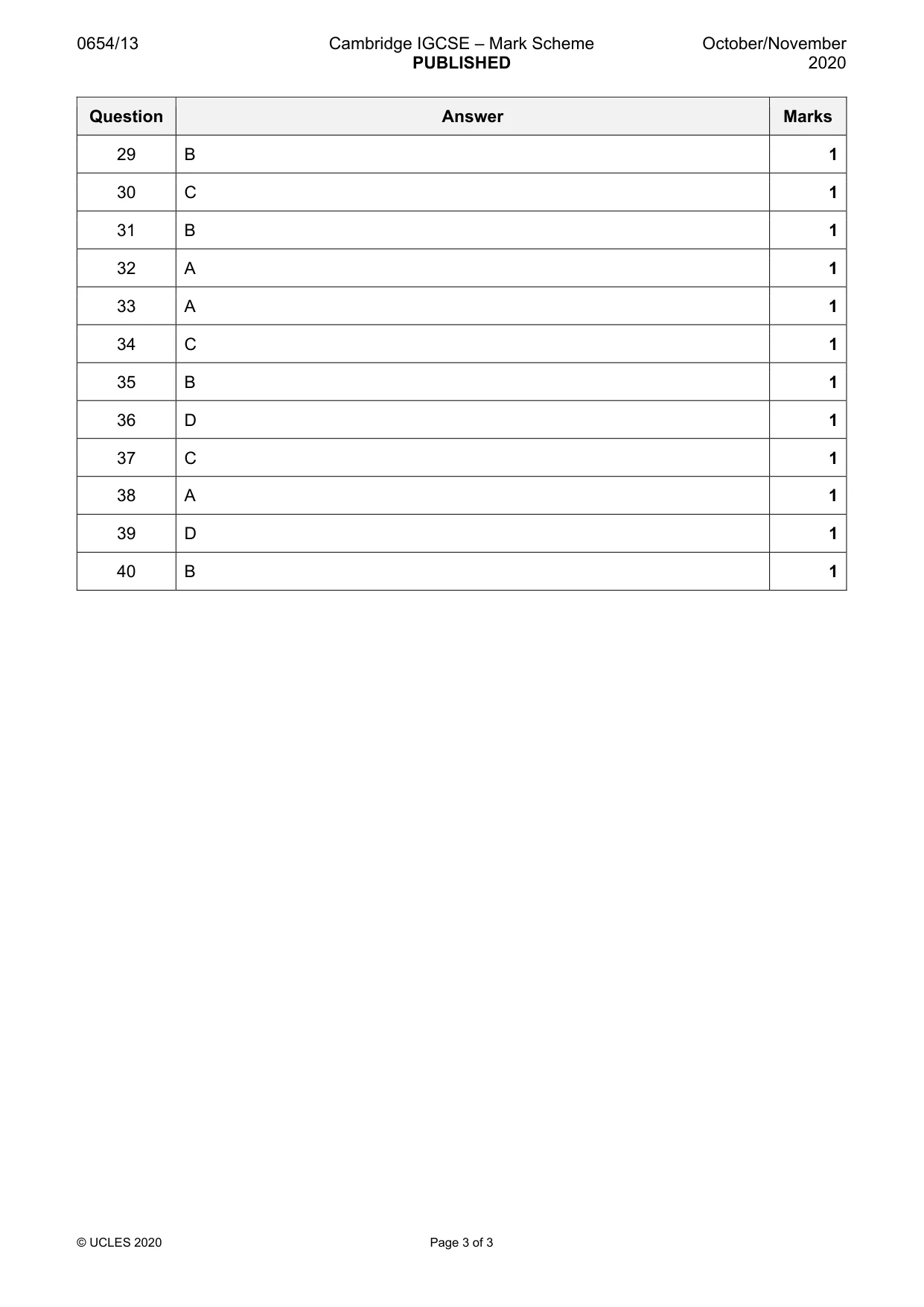
Mark scheme: B
Q30 · Electricity is generated in power stations
30 Electricity is generated in power stations. Many power stations use steam to drive turbines. Which type of power station does not use steam? A chemical energy (fuel) power stations B geothermal energy power stations C hydroelectric energy power stations D nuclear energy power stations
Mark scheme: C
Q31 · Ice is taken from a freezer
31 Ice is taken from a freezer. After some time the ice starts to melt. What is the temperature of the ice as it melts? A –10 C B 0 C C 20 C D 100 C
Mark scheme: B
Q32 · Which part of the electromagnetic spectrum is involved in thermal energy transfer by…
32 Which part of the electromagnetic spectrum is involved in thermal energy transfer by radiation? A infrared B radio C ultraviolet D X-rays
Mark scheme: A
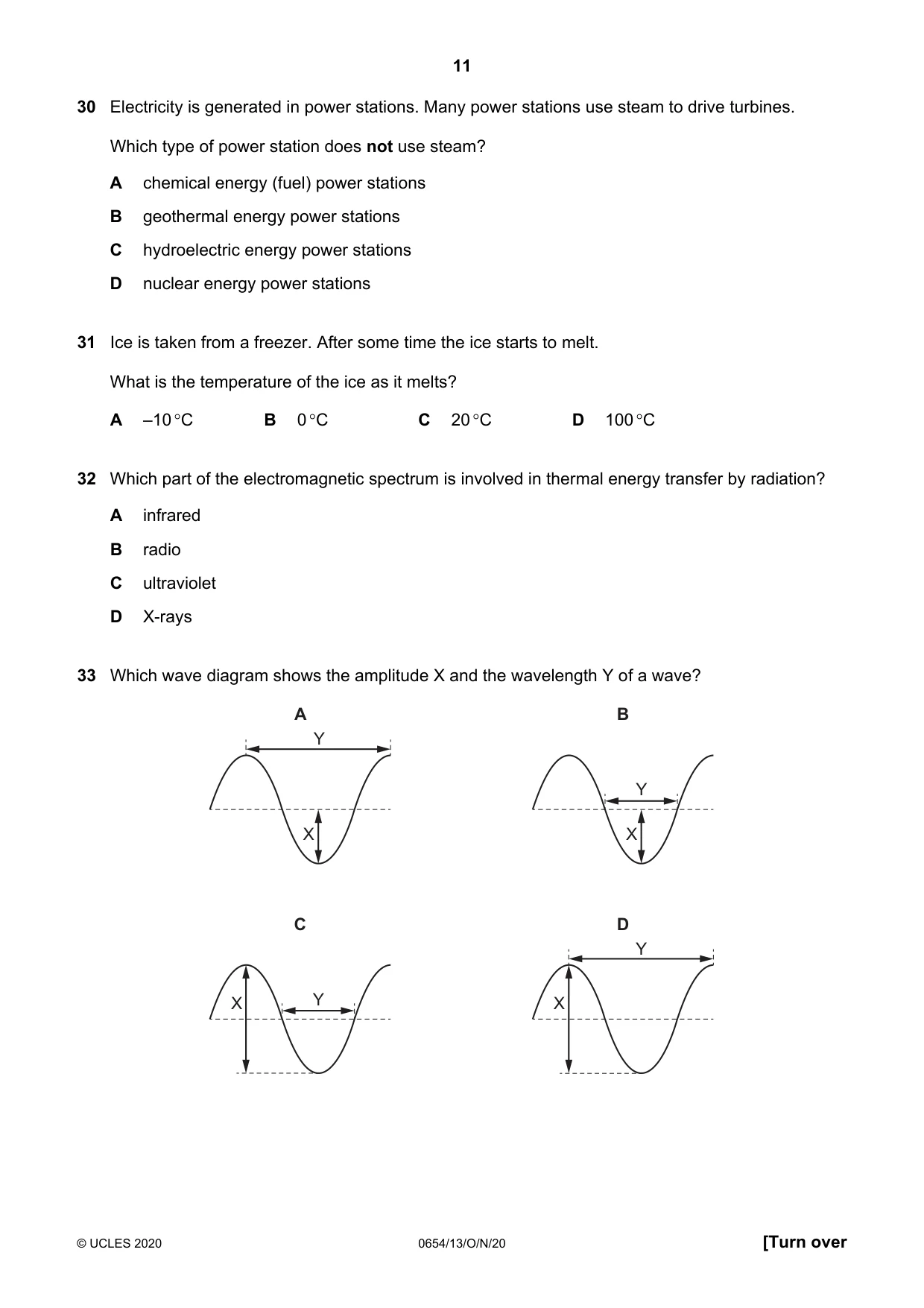
Q33 · Which wave diagram shows the amplitude X and the wavelength Y of a wave?
33 Which wave diagram shows the amplitude X and the wavelength Y of a wave? A B Y Y X X C D Y X Y X
Mark scheme: A
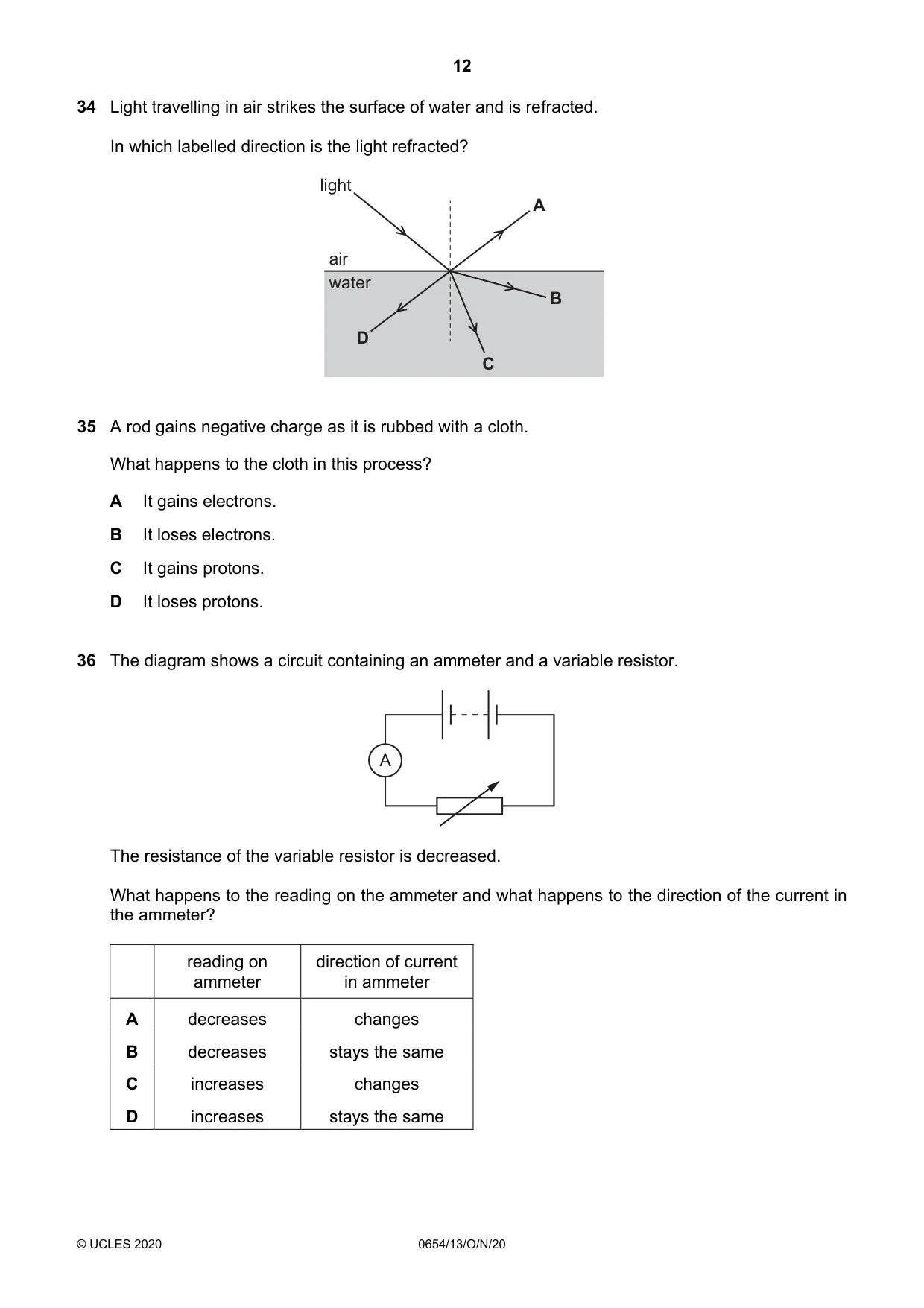
Q34 · Light travelling in air strikes the surface of water and is refracted
34 Light travelling in air strikes the surface of water and is refracted. In which labelled direction is the light refracted? light A air water B D C
Mark scheme: C
Q35 · A rod gains negative charge as it is rubbed with a cloth
35 A rod gains negative charge as it is rubbed with a cloth. What happens to the cloth in this process? A It gains electrons. B It loses electrons. C It gains protons. D It loses protons.
Mark scheme: B
Q36 · The diagram shows a circuit containing an ammeter and a variable resistor
36 The diagram shows a circuit containing an ammeter and a variable resistor. A The resistance of the variable resistor is decreased. What happens to the reading on the ammeter and what happens to the direction of the current in the ammeter? reading on direction of current ammeter in ammeter A decreases changes B decreases stays the same C increases changes D increases stays the same
Mark scheme: D
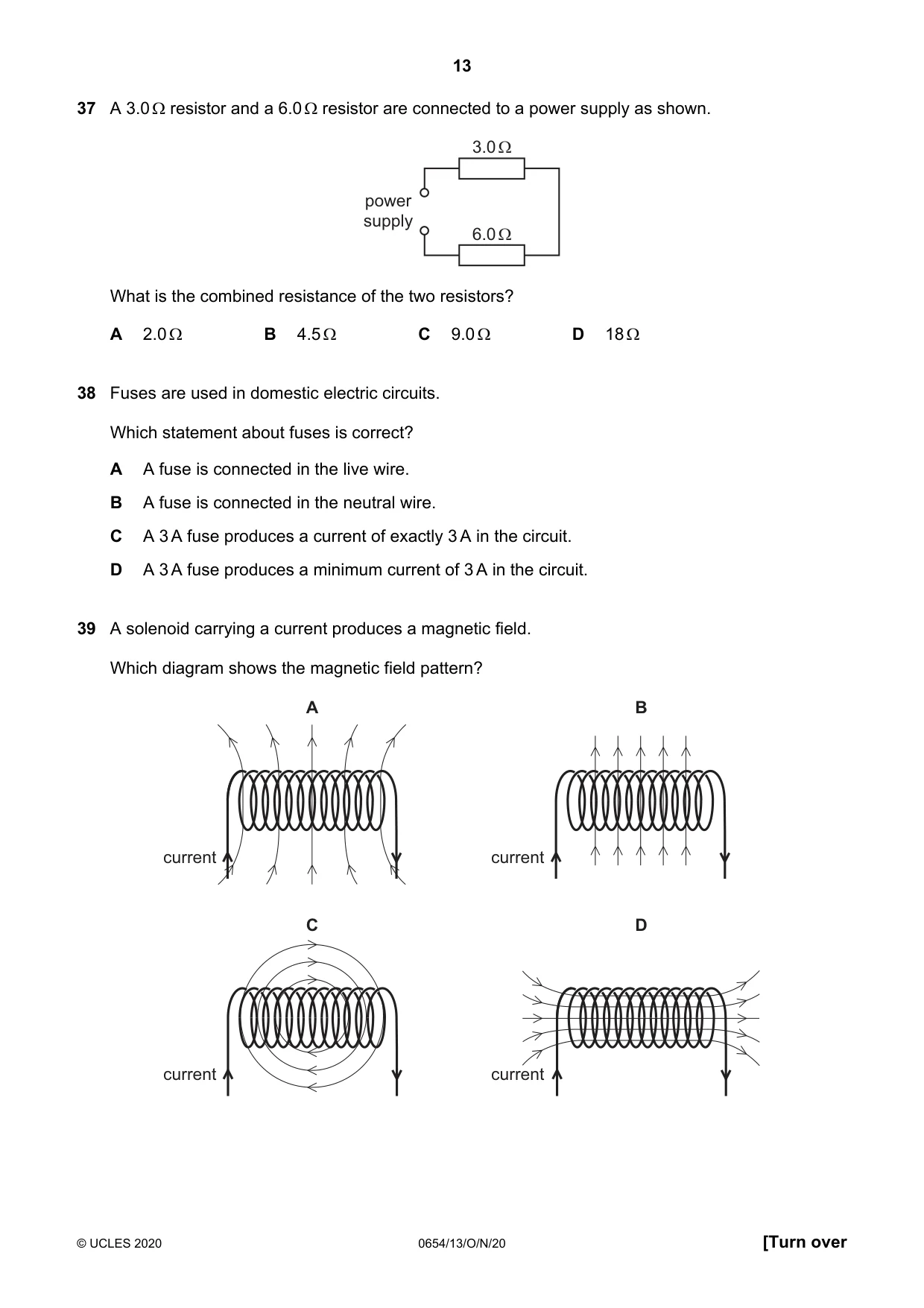
Q37 · A 3.0 resistor and a 6.0 resistor are connected to a power supply as shown
37 A 3.0 resistor and a 6.0 resistor are connected to a power supply as shown. 3.0 Ω power supply 6.0 Ω What is the combined resistance of the two resistors? A 2.0 B 4.5 C 9.0 D 18
Mark scheme: C
Q38 · Fuses are used in domestic electric circuits
38 Fuses are used in domestic electric circuits. Which statement about fuses is correct? A A fuse is connected in the live wire. B A fuse is connected in the neutral wire. C A 3 A fuse produces a current of exactly 3 A in the circuit. D A 3 A fuse produces a minimum current of 3 A in the circuit.
Mark scheme: A
Q39 · A solenoid carrying a current produces a magnetic field
39 A solenoid carrying a current produces a magnetic field. Which diagram shows the magnetic field pattern? A B current current C D current current
Mark scheme: D
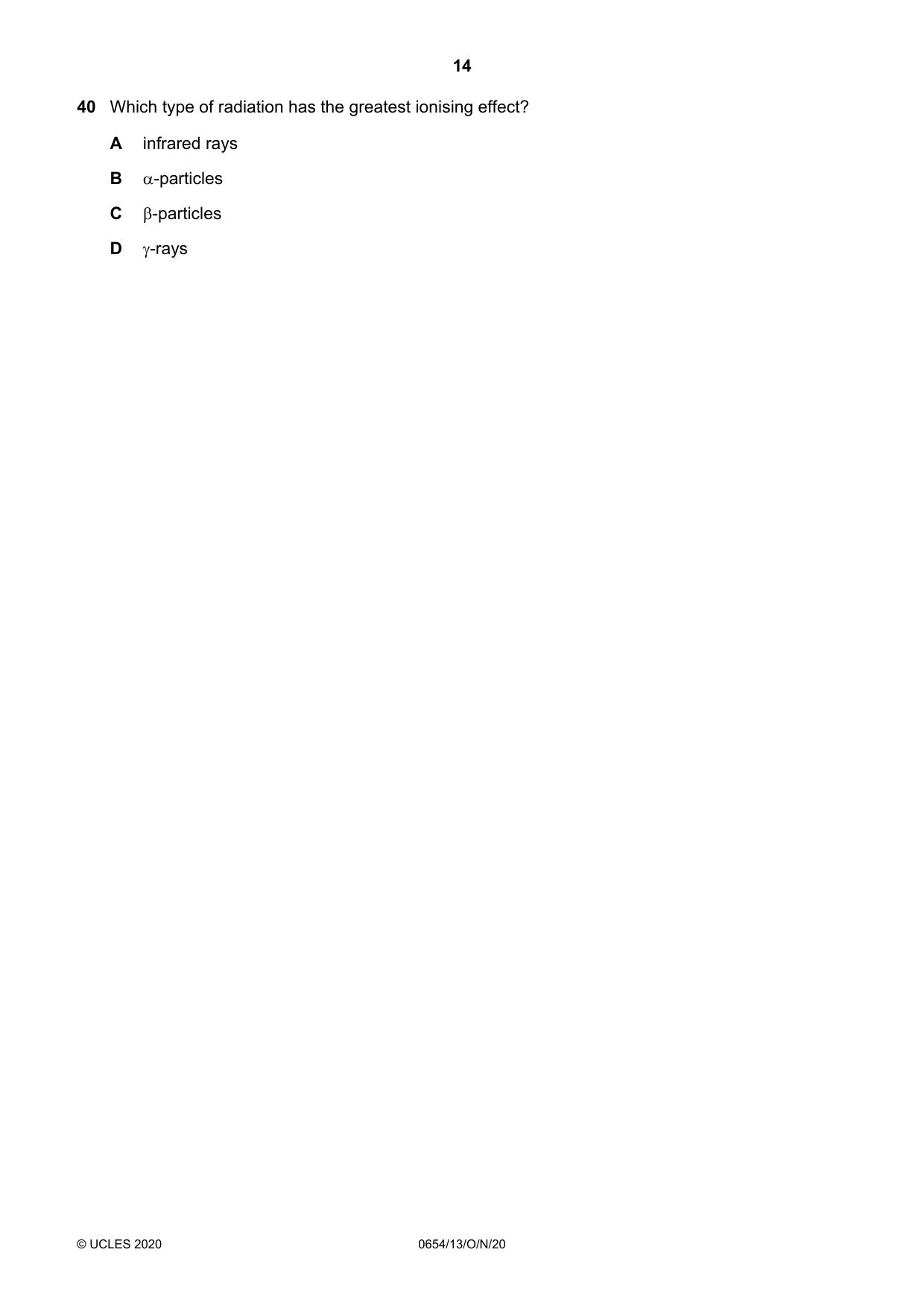
Q40 · Which type of radiation has the greatest ionising effect?
40 Which type of radiation has the greatest ionising effect? A infrared rays B -particles C -particles D -rays
Mark scheme: B
What was in this paper
The subtopics covered by these 40 questions, and how many questions each got. Open one in a new tab to see every Cambridge question on it.
2Alcohols1Arrangement of elements1Biological molecules1Characteristics of living organisms1Chromosomes and genes1Coordination and response1Density1Diffusion1Digestive system1Electrical safety1Electrolysis1Electromagnetic effects1Elements, compounds and mixtures1Energy, work and power1Enzymes1Exothermic and endothermic reactions1Experimental design1Food chains and food webs1Gas exchange in humans1General properties of waves1Group VII properties1Habitat destruction1Light1Mass and weight1Photosynthesis1Physical and chemical changes1Polymers1Preparation of salts1Radioactivity1Rate of reaction1Redox1Separation and purification1Sexual reproduction in humans1Simple phenomena of magnetism1Thermal properties and temperature1Transfer of thermal energy1Transpiration1Water1What you needed in this session
Cambridge’s own grade thresholds for 2020 Oct/Nov, Paper 1 · Variant 3. A higher threshold means an easier paper — the bar moves with how the cohort did.