Cambridge IGCSE Sciences - Co-ordinated (Double) 0654 — 2023 Oct/Nov Paper 1 · Variant 3
0654/13/O/N/23 · 40 questions · 40 marks · ≈45 min
The question paper and its mark scheme, free to read here and free to download. This is Cambridge’s own paper, exactly as it was sat.
Question paper16 pages
Mark scheme3 pages
Answers below. Sit the paper first if you are practising.
Questions as text
Q1 · A person throws a ball which their dog runs after and brings back to them
1 A person throws a ball which their dog runs after and brings back to them. Which characteristics of living things is the dog showing by this action? A growth and nutrition B movement and nutrition C movement and sensitivity D sensitivity and growth
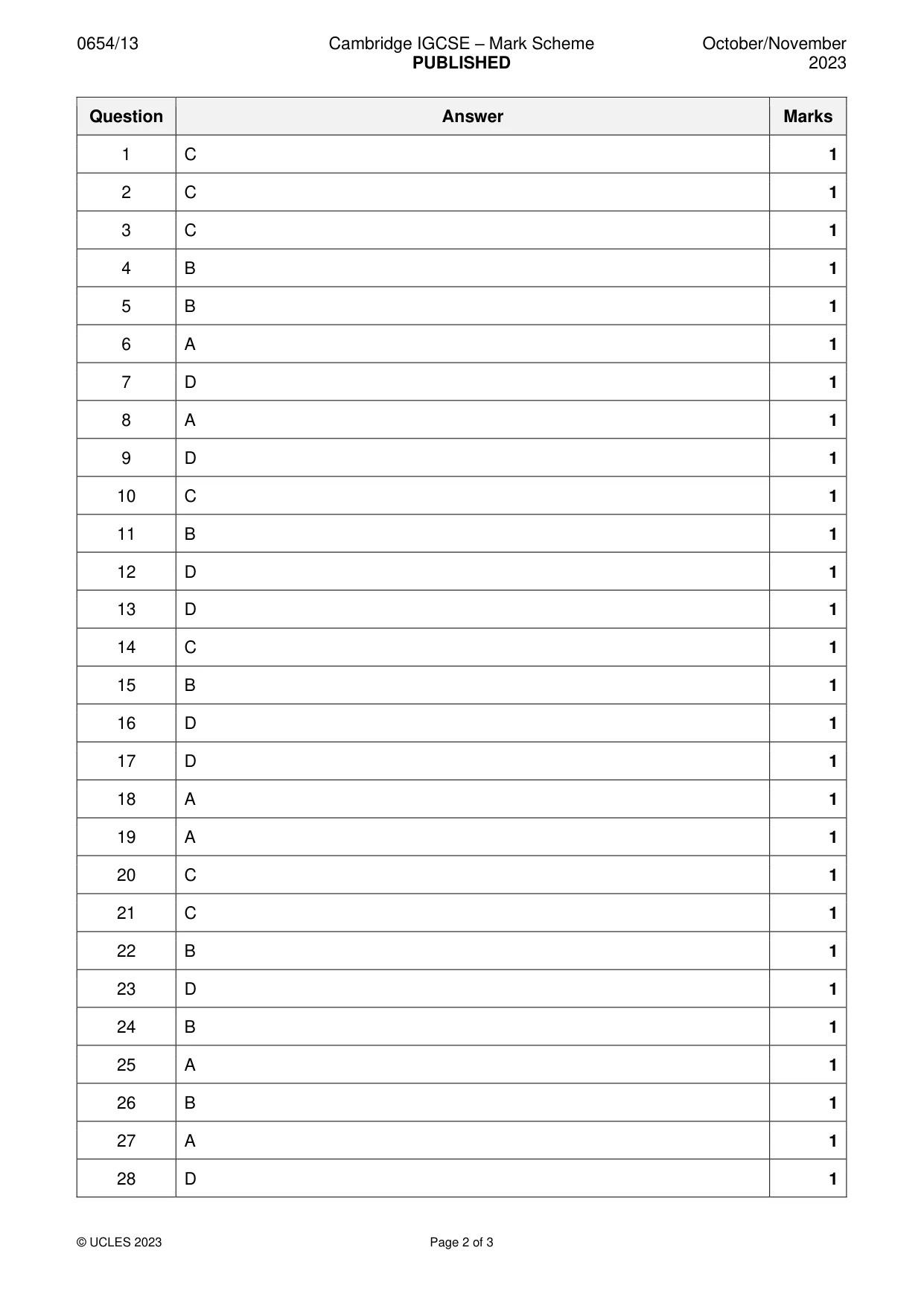
Mark scheme: C
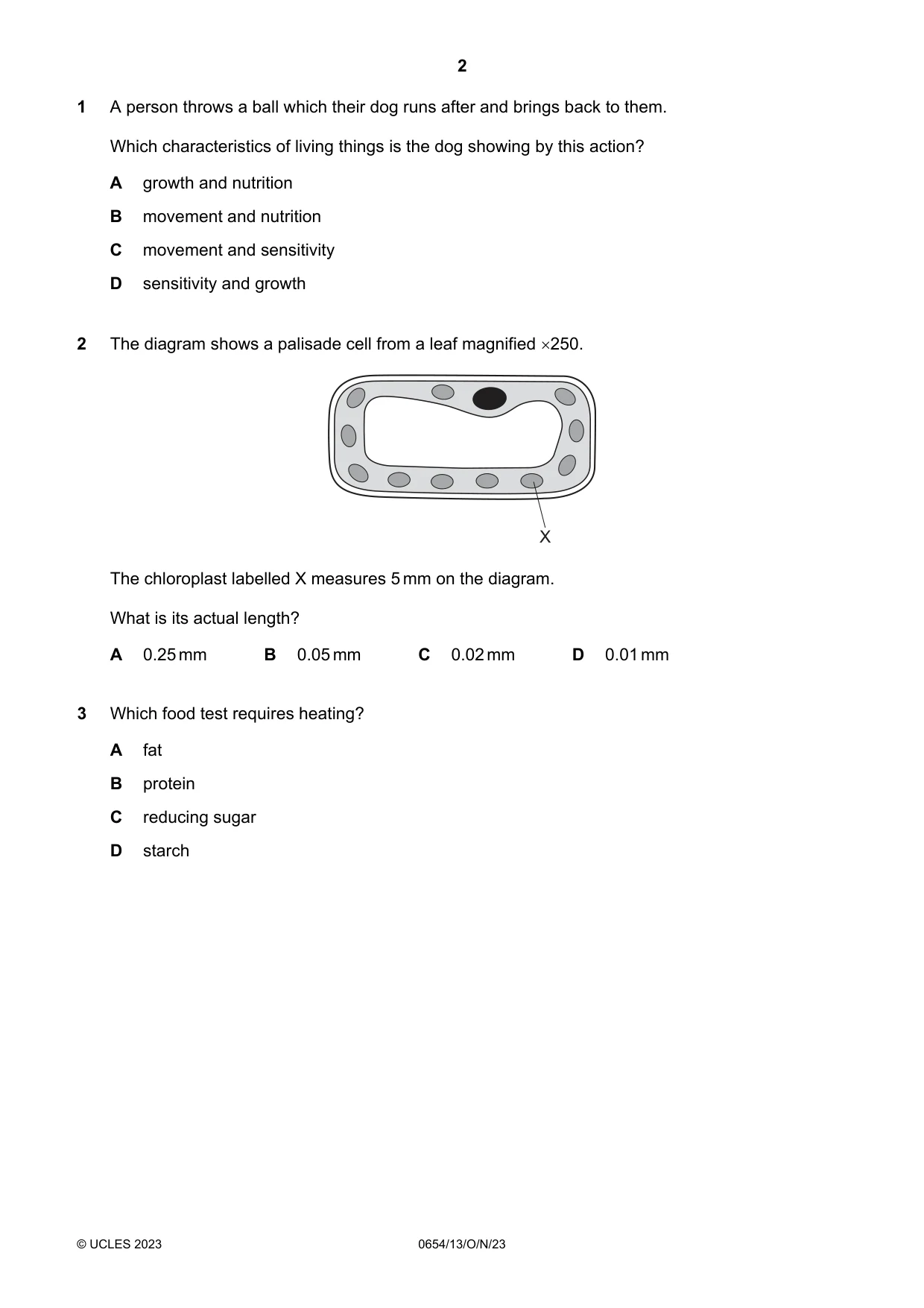
Q2 · The diagram shows a palisade cell from a leaf magnified 250
2 The diagram shows a palisade cell from a leaf magnified 250. X The chloroplast labelled X measures 5 mm on the diagram. What is its actual length? A 0.25 mm B 0.05 mm C 0.02 mm D 0.01 mm
Mark scheme: C
Q3 · Which food test requires heating?
3 Which food test requires heating? A fat B protein C reducing sugar D starch
Mark scheme: C
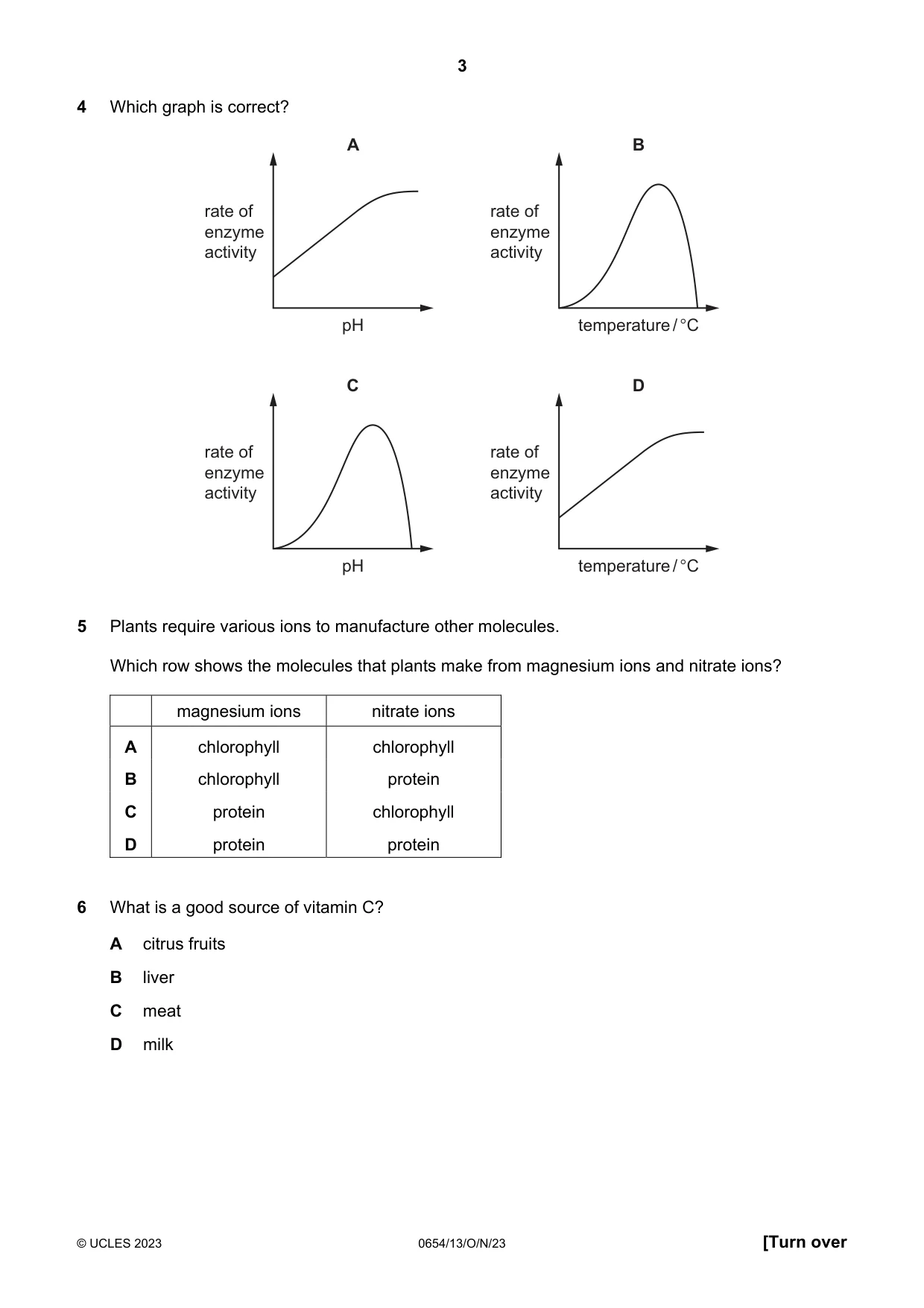
Q4 · Which graph is correct?
4 Which graph is correct? A B rate of rate of enzyme enzyme activity activity pH temperature / °C C D rate of rate of enzyme enzyme activity activity pH temperature / °C
Mark scheme: B
Q5 · Plants require various ions to manufacture other molecules
5 Plants require various ions to manufacture other molecules. Which row shows the molecules that plants make from magnesium ions and nitrate ions? magnesium ions nitrate ions A chlorophyll chlorophyll B chlorophyll protein C protein chlorophyll D protein protein
Mark scheme: B
Q6 · What is a good source of vitamin C?
6 What is a good source of vitamin C? A citrus fruits B liver C meat D milk
Mark scheme: A
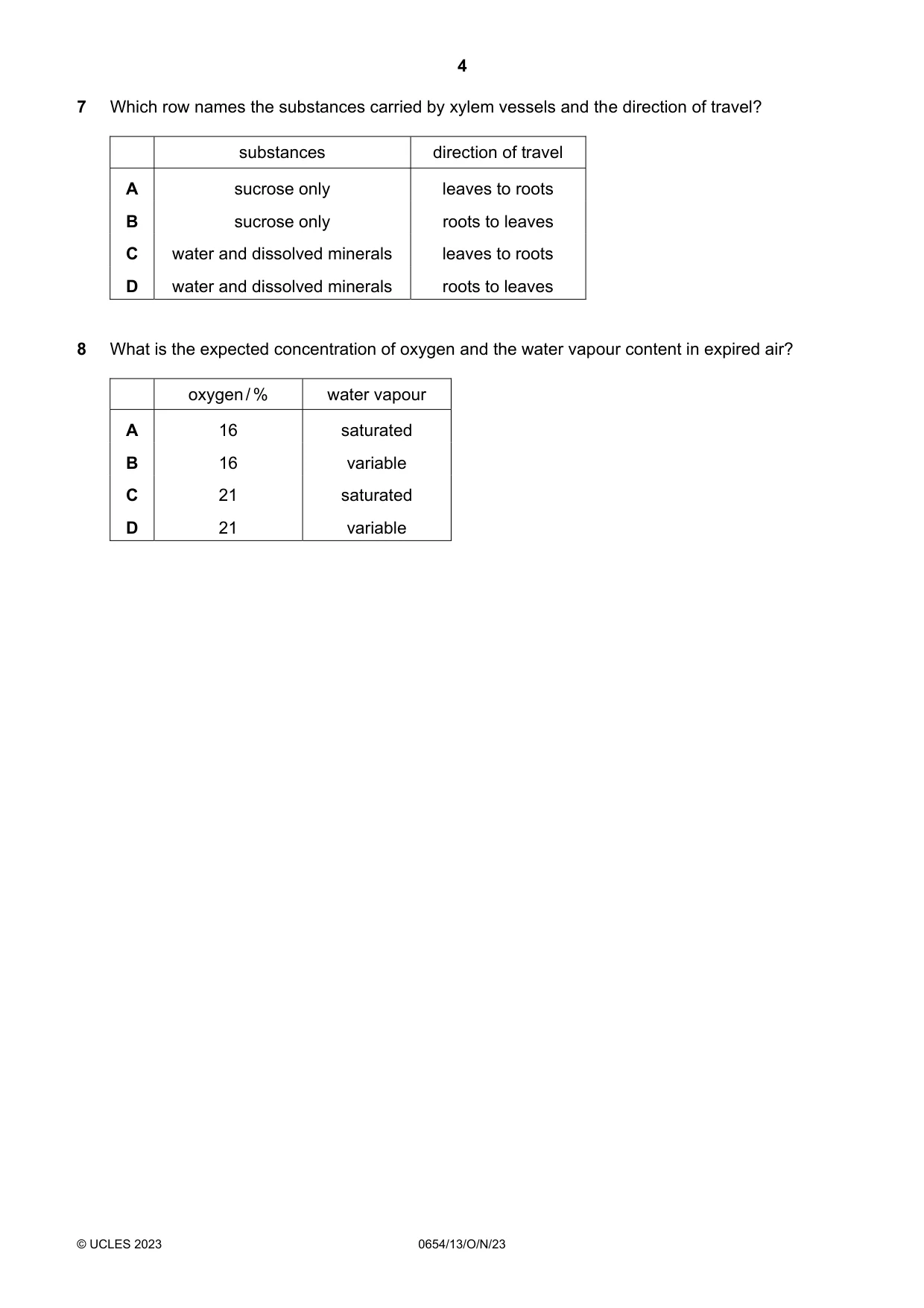
Q7 · Which row names the substances carried by xylem vessels and the direction of travel?
7 Which row names the substances carried by xylem vessels and the direction of travel? substances direction of travel A sucrose only leaves to roots B sucrose only roots to leaves C water and dissolved minerals leaves to roots D water and dissolved minerals roots to leaves
Mark scheme: D
Q8 · What is the expected concentration of oxygen and the water vapour content in expired air?
8 What is the expected concentration of oxygen and the water vapour content in expired air? oxygen / % water vapour A 16 saturated B 16 variable C 21 saturated D 21 variable
Mark scheme: A
Q9 · The graphs show the pupil diameter and heart rate of a person over a period of 30 minutes
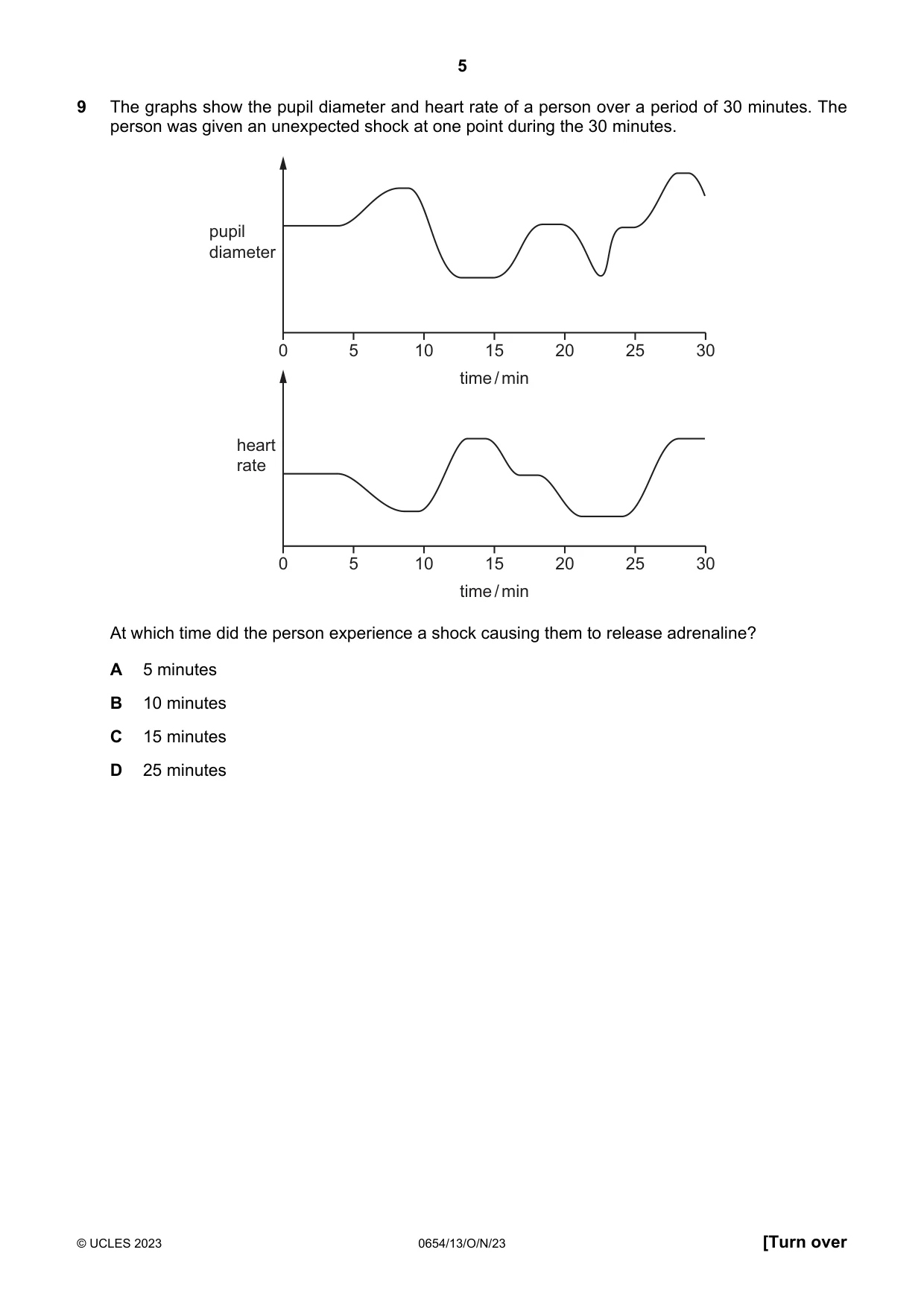
9 The graphs show the pupil diameter and heart rate of a person over a period of 30 minutes. The person was given an unexpected shock at one point during the 30 minutes. pupil diameter 0 5 10 15 20 25 30 time / min heart rate 0 5 10 15 20 25 30 time / min At which time did the person experience a shock causing them to release adrenaline? A 5 minutes B 10 minutes C 15 minutes D 25 minutes
Mark scheme: D
Q10 · There are different conditions which may prevent a successful pregnancy
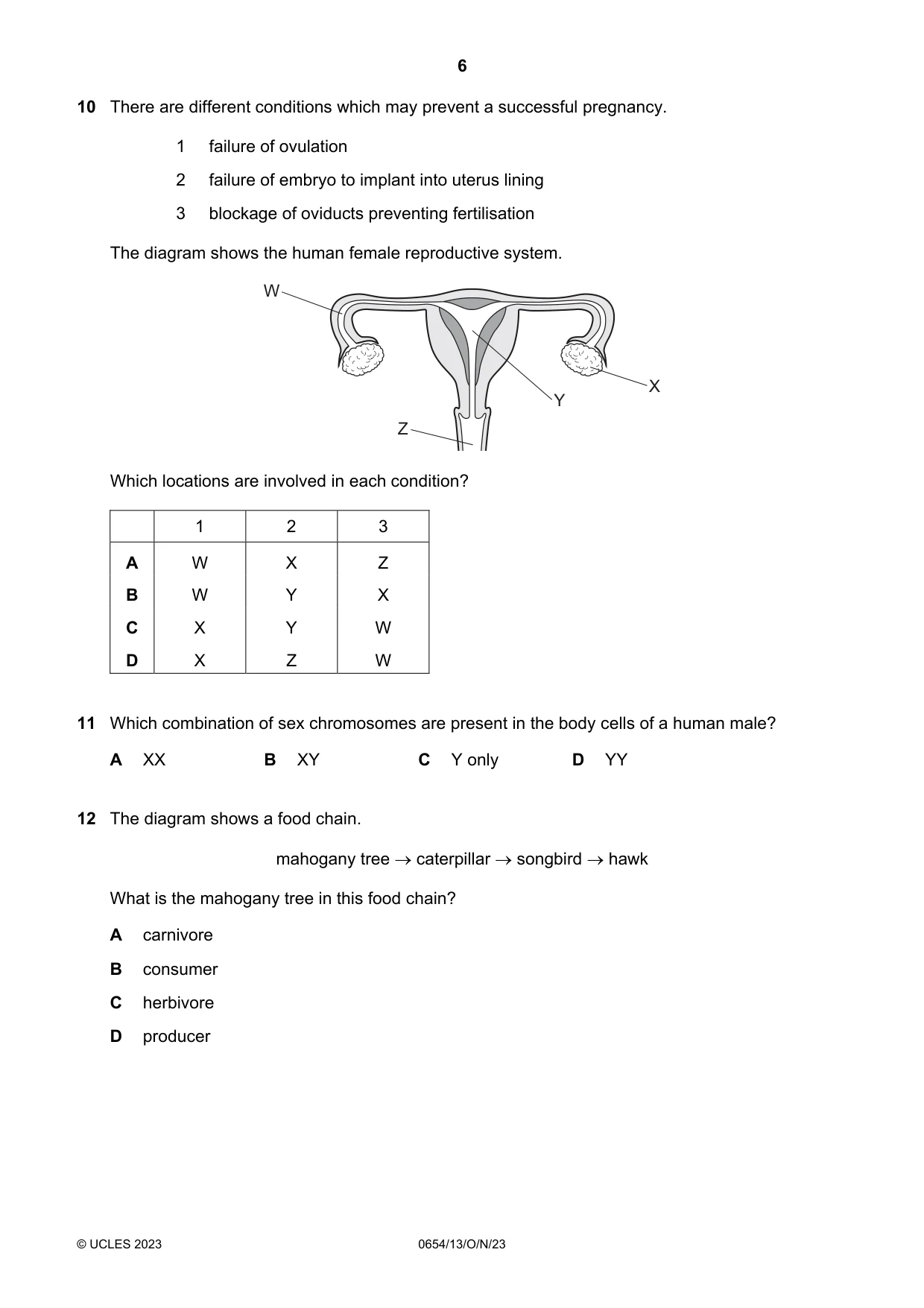
10 There are different conditions which may prevent a successful pregnancy. 1 failure of ovulation 2 failure of embryo to implant into uterus lining 3 blockage of oviducts preventing fertilisation The diagram shows the human female reproductive system. W X Y Z Which locations are involved in each condition? 1 2 3 A W X Z B W Y X C X Y W D X Z W
Mark scheme: C
Q11 · Which combination of sex chromosomes are present in the body cells of a human male?
11 Which combination of sex chromosomes are present in the body cells of a human male? A XX B XY C Y only D YY
Mark scheme: B
Q12 · The diagram shows a food chain
12 The diagram shows a food chain. mahogany tree caterpillar songbird hawk What is the mahogany tree in this food chain? A carnivore B consumer C herbivore D producer
Mark scheme: D
Q13 · Which row describes the effects of deforestation?
13 Which row describes the effects of deforestation? level of risk of carbon dioxide flooding in the air A decreases decreases B decreases increases C increases decreases D increases increases
Mark scheme: D
Q14 · The colours in an ink are separated by chromatography
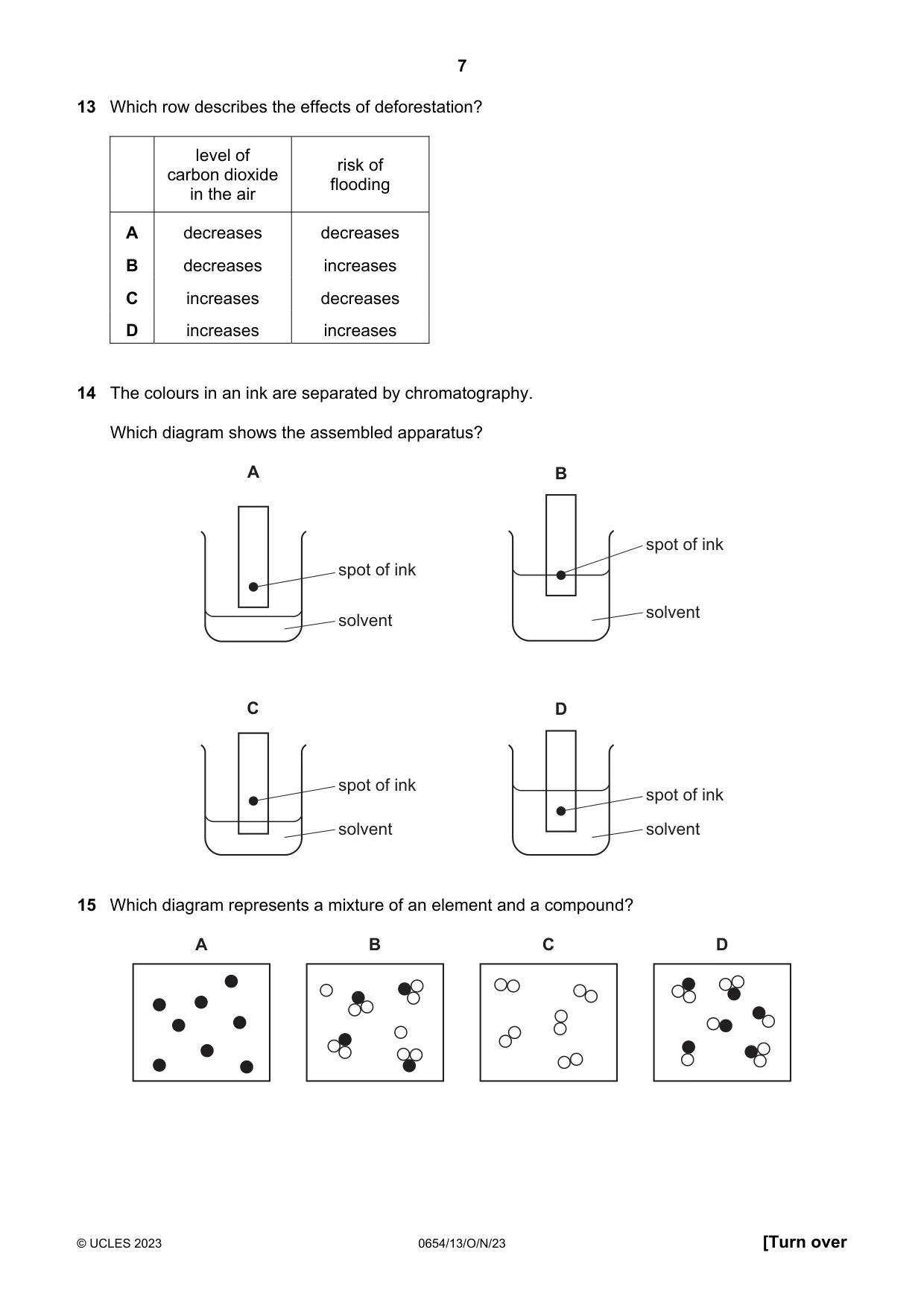
14 The colours in an ink are separated by chromatography. Which diagram shows the assembled apparatus? A B spot of ink spot of ink solvent solvent C D spot of ink spot of ink solvent solvent
Mark scheme: C
Q15 · Which diagram represents a mixture of an element and a compound?
15 Which diagram represents a mixture of an element and a compound? A B C D
Mark scheme: B
Q16 · X and Y are isotopes of the same element
16 X and Y are isotopes of the same element. Which statement about X and Y is correct? A They have the same nucleon number but different numbers of protons. B They have the same number of neutrons but different numbers of electrons. C They have the same atomic number but different numbers of electrons. D They have the same number of protons but different numbers of neutrons.
Mark scheme: D
Q17 · Dilute hydrochloric acid reacts with sodium carbonate to form sodium chloride, carbon…
17 Dilute hydrochloric acid reacts with sodium carbonate to form sodium chloride, carbon dioxide and water. The equation for the reaction is shown. w HCl + Na2CO3 x NaCl + y CO2 + z H2O What are the values of w, x, y and z? w x y z A 1 1 3 1 B 2 1 1 1 C 2 2 3 2 D 2 2 1 1
Mark scheme: D
Q18 · The apparatus used for the electrolysis of copper chloride is shown
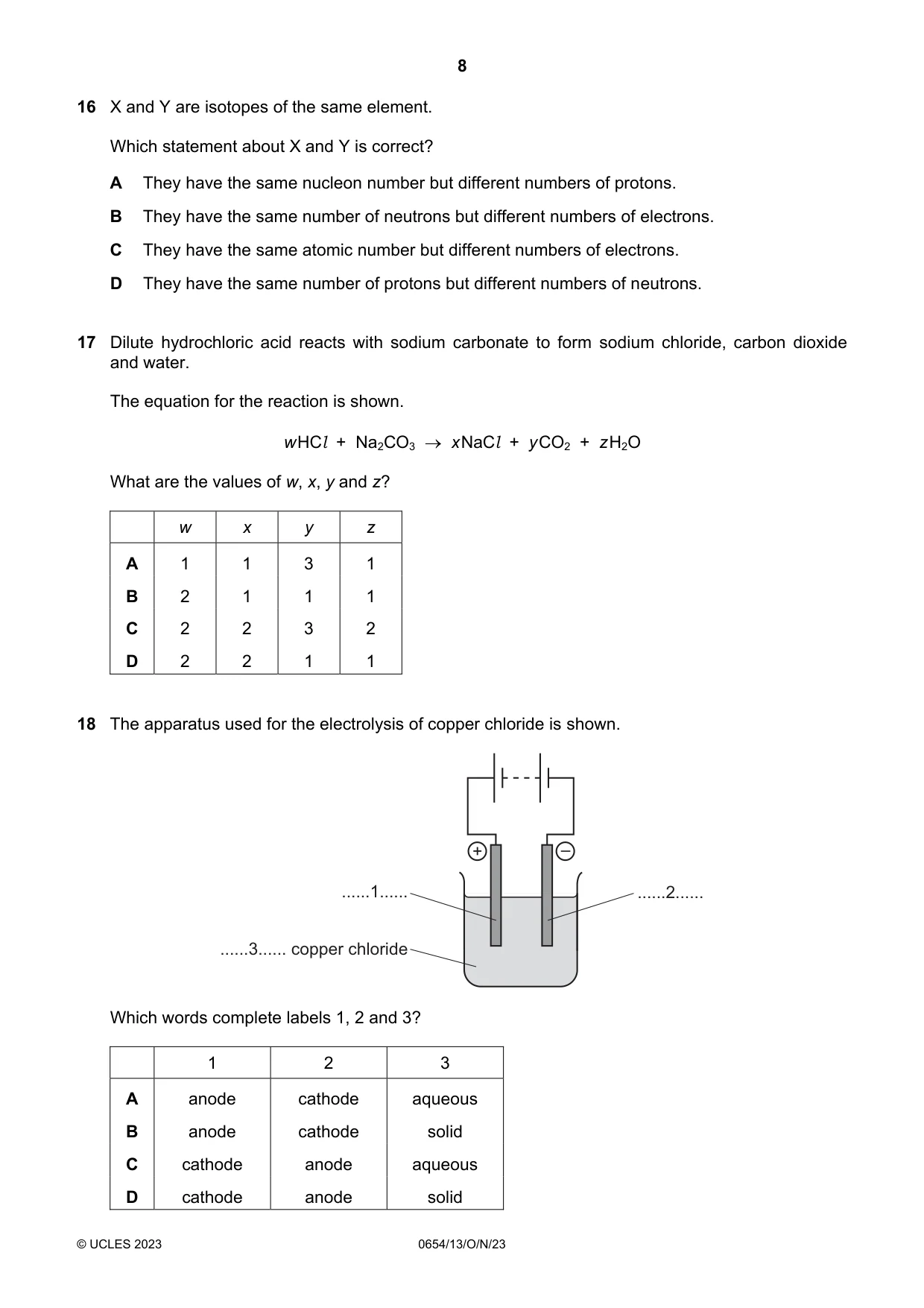
18 The apparatus used for the electrolysis of copper chloride is shown. + – ......1...... ......2...... ......3...... copper chloride Which words complete labels 1, 2 and 3? 1 2 3 A anode cathode aqueous B anode cathode solid C cathode anode aqueous D cathode anode solid
Mark scheme: A
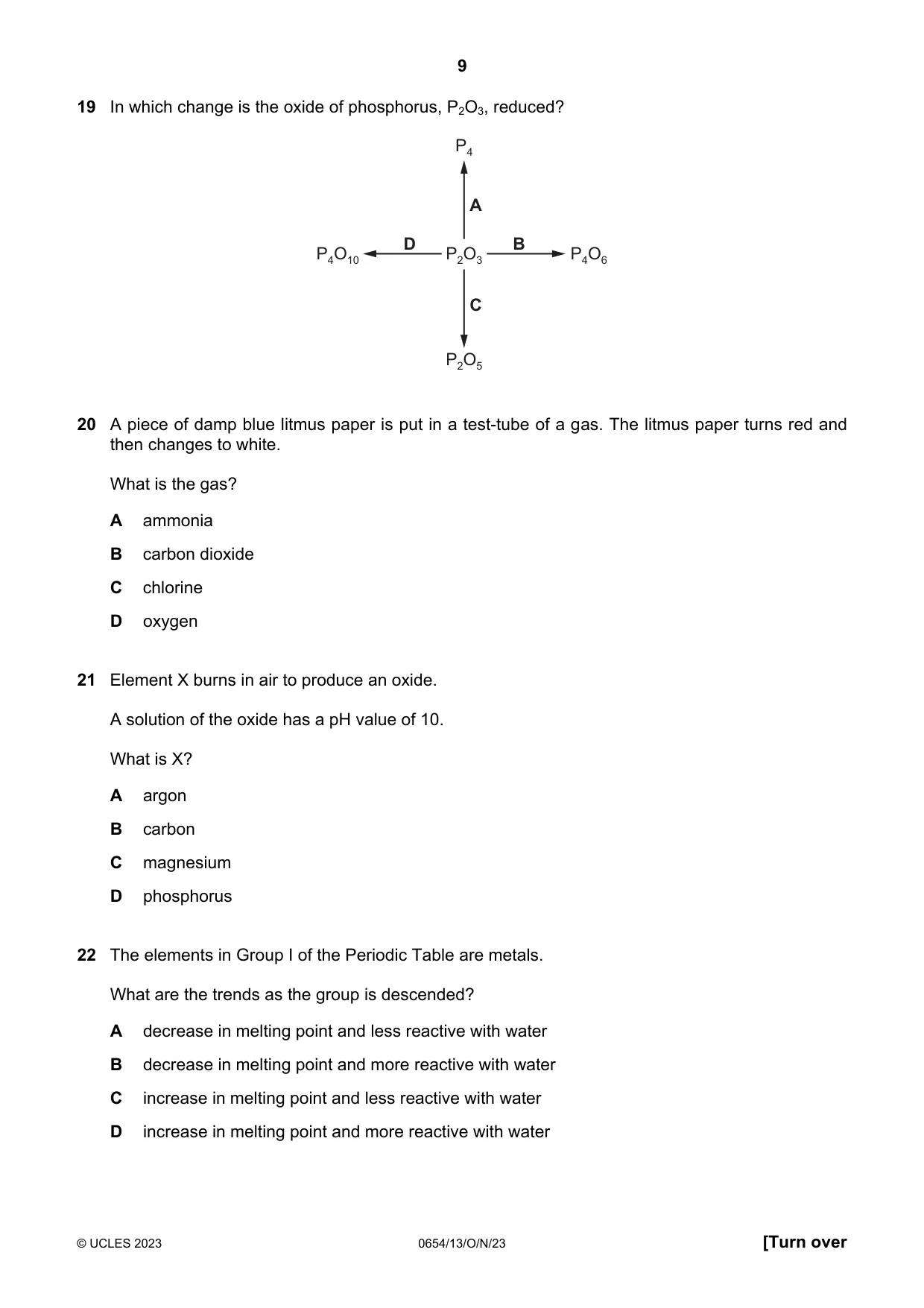
Q19 · In which change is the oxide of phosphorus, P2O3, reduced?
19 In which change is the oxide of phosphorus, P2O3, reduced? P4 A D B P4O10 P2O3 P4O6 C P2O5
Mark scheme: A
Q20 · A piece of damp blue litmus paper is put in a test-tube of a gas
20 A piece of damp blue litmus paper is put in a test-tube of a gas. The litmus paper turns red and then changes to white. What is the gas? A ammonia B carbon dioxide C chlorine D oxygen
Mark scheme: C
Q21 · Element X burns in air to produce an oxide
21 Element X burns in air to produce an oxide. A solution of the oxide has a pH value of 10. What is X? A argon B carbon C magnesium D phosphorus
Mark scheme: C
Q22 · The elements in Group I of the Periodic Table are metals
22 The elements in Group I of the Periodic Table are metals. What are the trends as the group is descended? A decrease in melting point and less reactive with water B decrease in melting point and more reactive with water C increase in melting point and less reactive with water D increase in melting point and more reactive with water
Mark scheme: B
Q23 · Why is argon used in lamps?
23 Why is argon used in lamps? A It is heavier than air. B It is lighter than air. C It is reactive. D It is unreactive.
Mark scheme: D
Q24 · Which statement explains why carbon is used in the extraction of copper from its ore?
24 Which statement explains why carbon is used in the extraction of copper from its ore? A It is in Group IV of the Periodic Table. B It is more reactive than copper. C It is a non-metal. D It forms a giant covalent molecule.
Mark scheme: B
Q25 · Which substances are needed for iron to rust?
25 Which substances are needed for iron to rust? A oxygen and water B nitrogen and water C oxygen only D water only
Mark scheme: A
Q26 · Which energy source is an example of a fossil fuel?
26 Which energy source is an example of a fossil fuel? A hydrogen B methane C the Sun D wood
Mark scheme: B
Q27 · Molecules of ethene react together to form long chain molecules
27 Molecules of ethene react together to form long chain molecules. What is the name of this type of reaction? A addition polymerisation B cracking C fermentation D thermal decomposition
Mark scheme: A
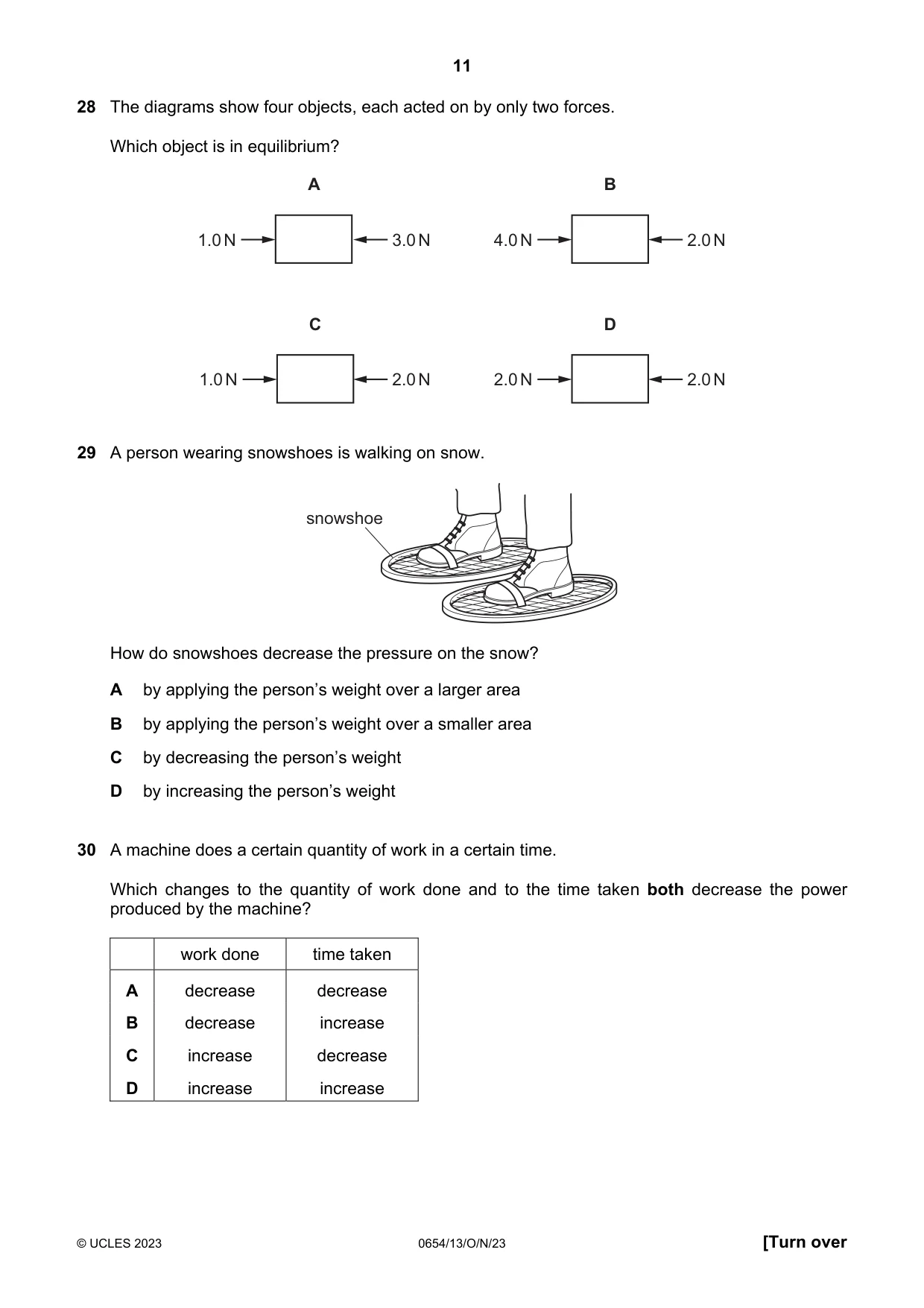
Q28 · The diagrams show four objects, each acted on by only two forces
28 The diagrams show four objects, each acted on by only two forces. Which object is in equilibrium? A B 1.0 N 3.0 N 4.0 N 2.0 N C D 1.0 N 2.0 N 2.0 N 2.0 N
Mark scheme: D
Q29 · A person wearing snowshoes is walking on snow
29 A person wearing snowshoes is walking on snow. snowshoe How do snowshoes decrease the pressure on the snow? A by applying the person’s weight over a larger area B by applying the person’s weight over a smaller area C by decreasing the person’s weight D by increasing the person’s weight
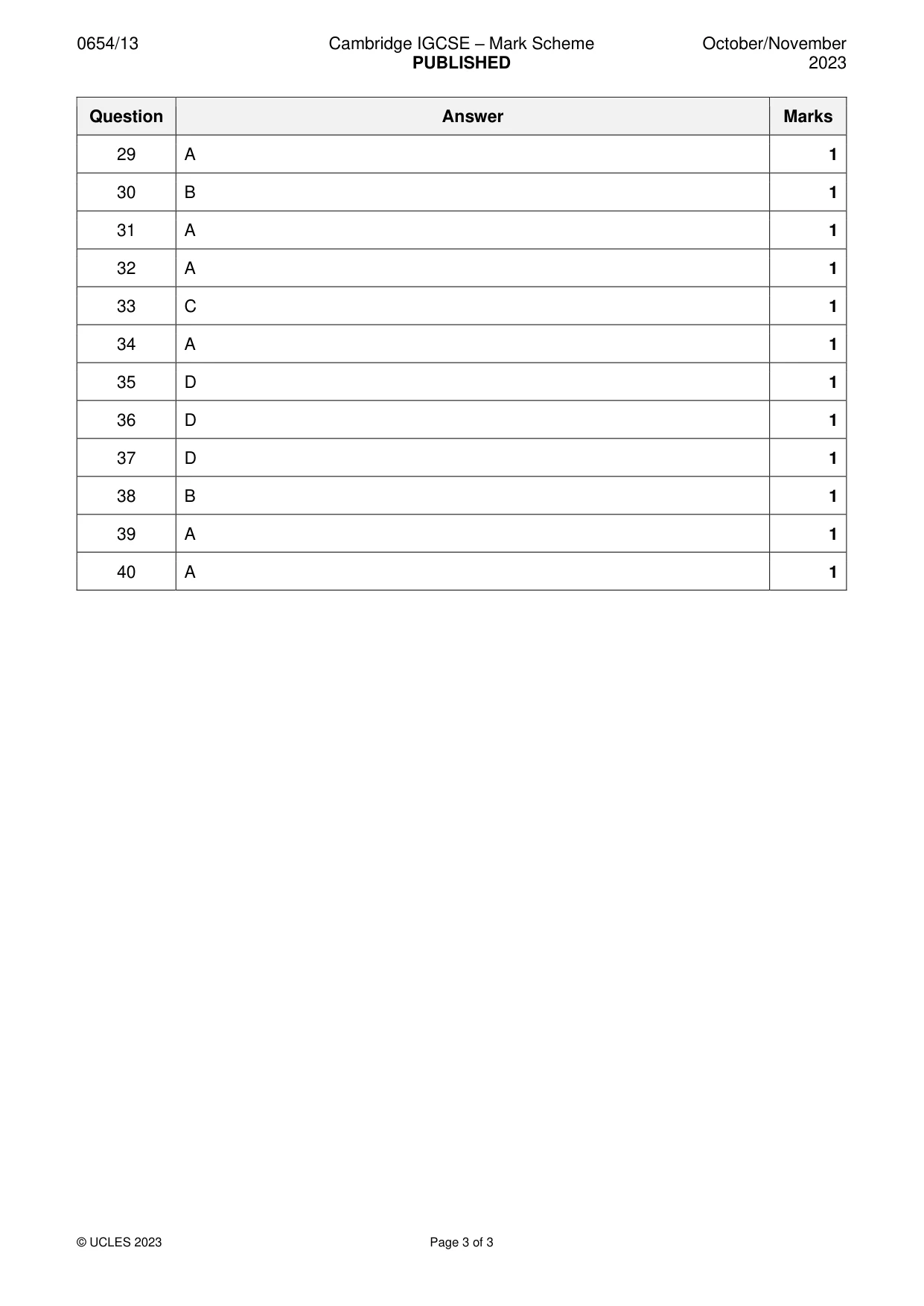
Mark scheme: A
Q30 · A machine does a certain quantity of work in a certain time
30 A machine does a certain quantity of work in a certain time. Which changes to the quantity of work done and to the time taken both decrease the power produced by the machine? work done time taken A decrease decrease B decrease increase C increase decrease D increase increase
Mark scheme: B
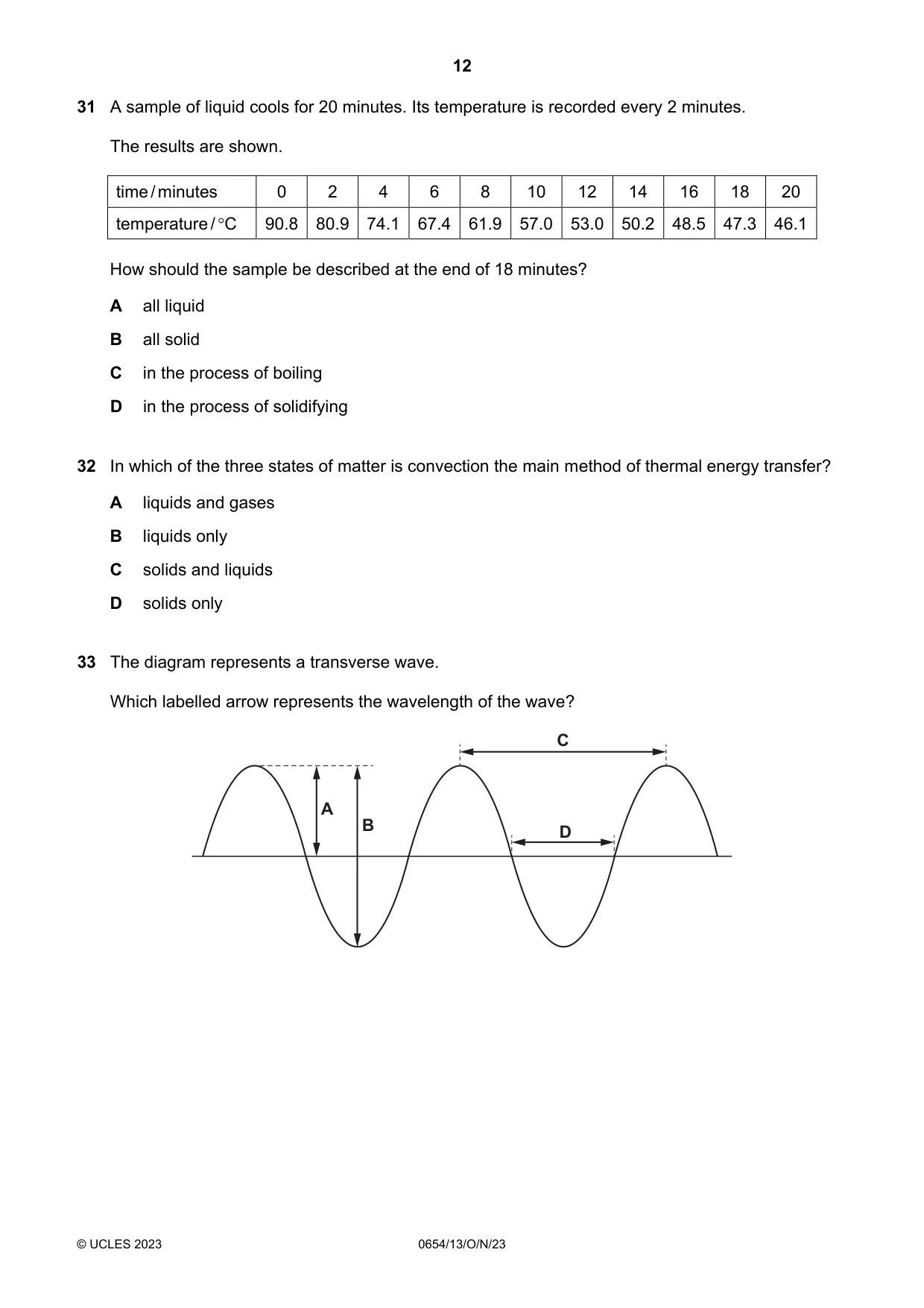
Q31 · A sample of liquid cools for 20 minutes
31 A sample of liquid cools for 20 minutes. Its temperature is recorded every 2 minutes. The results are shown. time / minutes 0 2 4 6 8 10 12 14 16 18 20 temperature / C 90.8 80.9 74.1 67.4 61.9 57.0 53.0 50.2 48.5 47.3 46.1 How should the sample be described at the end of 18 minutes? A all liquid B all solid C in the process of boiling D in the process of solidifying
Mark scheme: A
Q32 · In which of the three states of matter is convection the main method of thermal energy…
32 In which of the three states of matter is convection the main method of thermal energy transfer? A liquids and gases B liquids only C solids and liquids D solids only
Mark scheme: A
Q33 · The diagram represents a transverse wave
33 The diagram represents a transverse wave. Which labelled arrow represents the wavelength of the wave? C A B D
Mark scheme: C
Q34 · The sound heard from the siren of a police car becomes quieter and lower pitched as the…
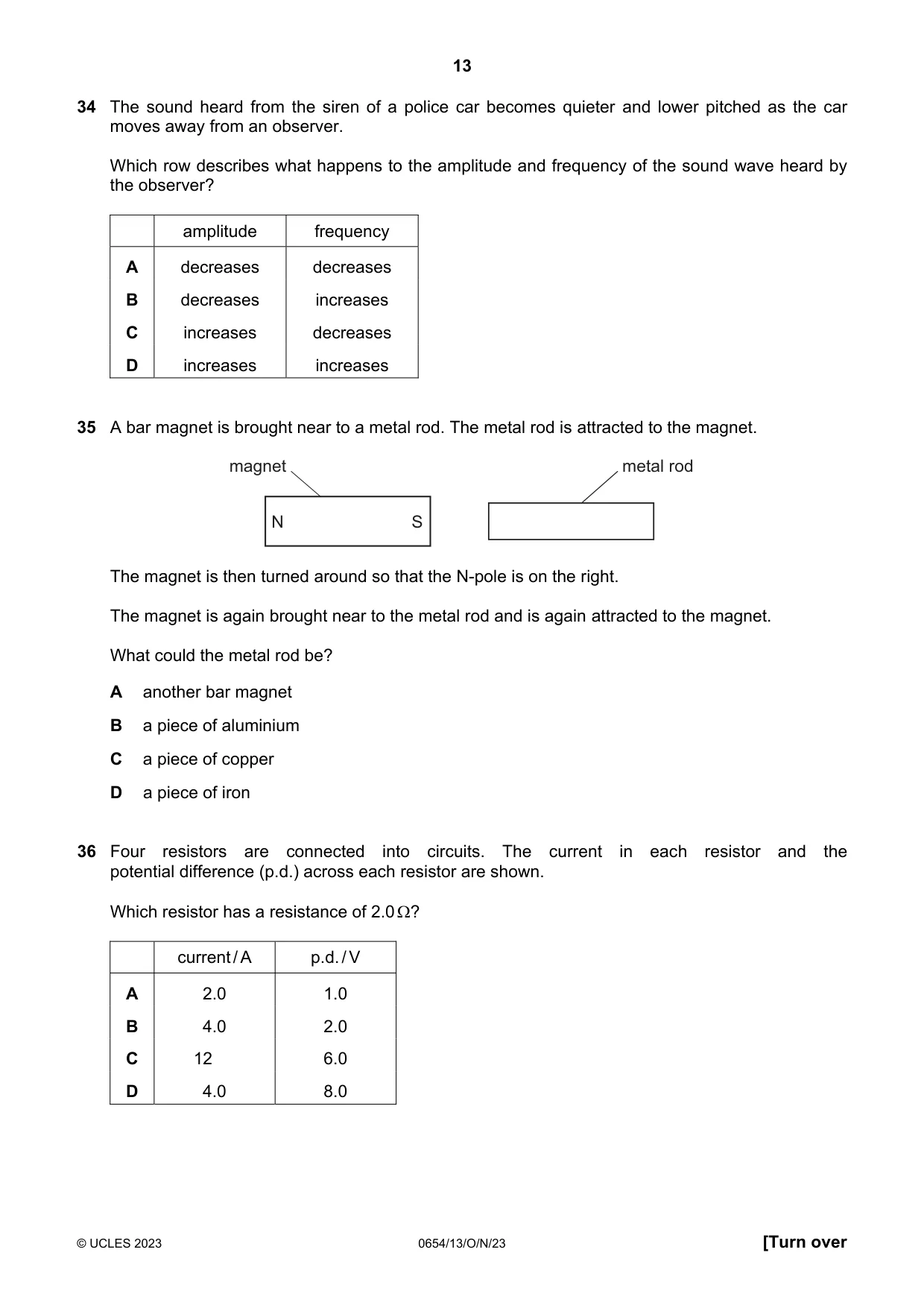
34 The sound heard from the siren of a police car becomes quieter and lower pitched as the car moves away from an observer. Which row describes what happens to the amplitude and frequency of the sound wave heard by the observer? amplitude frequency A decreases decreases B decreases increases C increases decreases D increases increases
Mark scheme: A
Q35 · A bar magnet is brought near to a metal rod
35 A bar magnet is brought near to a metal rod. The metal rod is attracted to the magnet. magnet metal rod N S The magnet is then turned around so that the N-pole is on the right. The magnet is again brought near to the metal rod and is again attracted to the magnet. What could the metal rod be? A another bar magnet B a piece of aluminium C a piece of copper D a piece of iron
Mark scheme: D
Q36 · Four resistors are connected into circuits
36 Four resistors are connected into circuits. The current in each resistor and the potential difference (p.d.) across each resistor are shown. Which resistor has a resistance of 2.0 ? current / A p.d. / V A 2.0 1.0 B 4.0 2.0 C 12 6.0 D 4.0 8.0
Mark scheme: D
Q37 · Two lamps can be connected to a battery either in series or in parallel
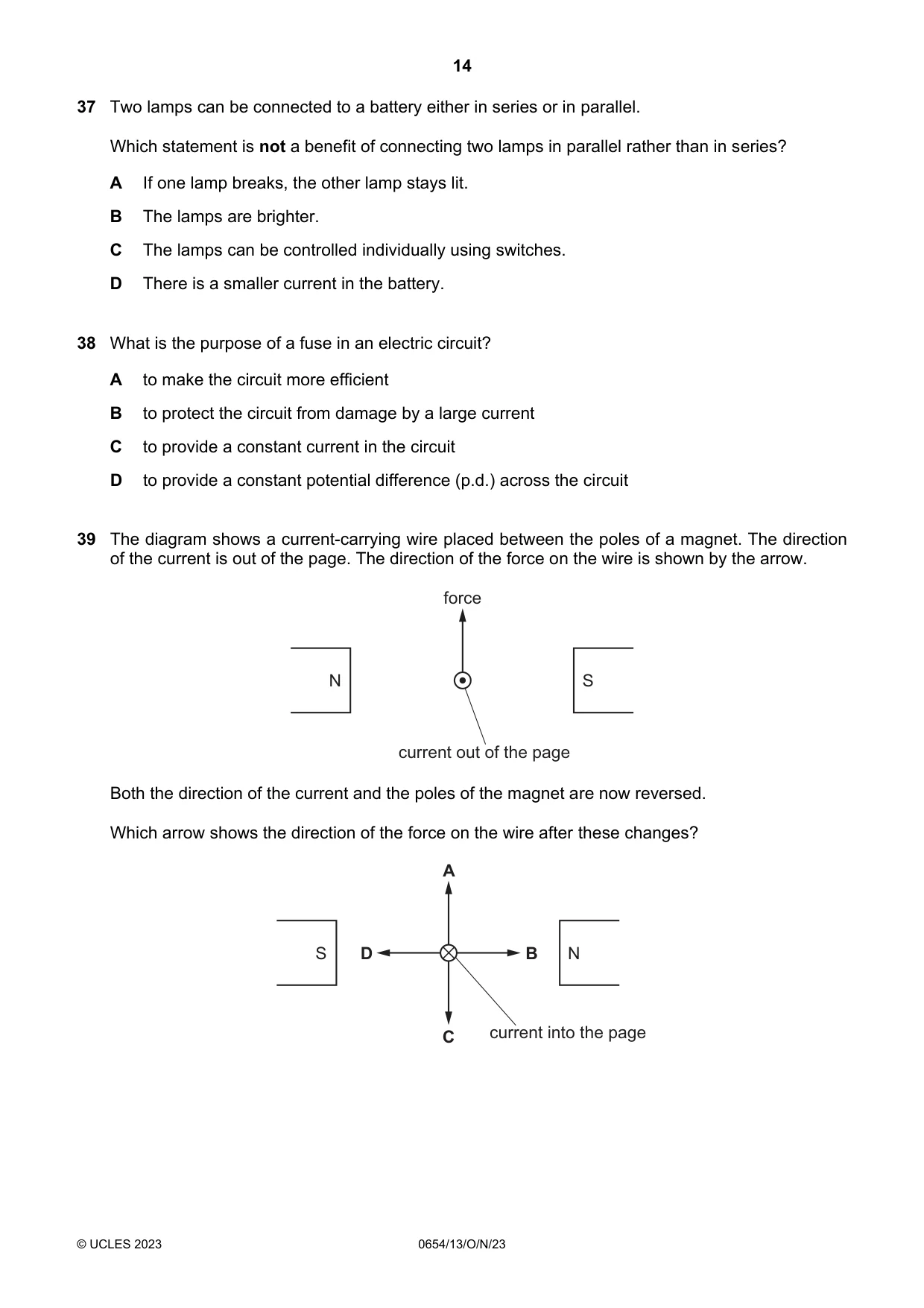
37 Two lamps can be connected to a battery either in series or in parallel. Which statement is not a benefit of connecting two lamps in parallel rather than in series? A If one lamp breaks, the other lamp stays lit. B The lamps are brighter. C The lamps can be controlled individually using switches. D There is a smaller current in the battery.
Mark scheme: D
Q38 · What is the purpose of a fuse in an electric circuit?
38 What is the purpose of a fuse in an electric circuit? A to make the circuit more efficient B to protect the circuit from damage by a large current C to provide a constant current in the circuit D to provide a constant potential difference (p.d.) across the circuit
Mark scheme: B
Q39 · The diagram shows a current-carrying wire placed between the poles of a magnet
39 The diagram shows a current-carrying wire placed between the poles of a magnet. The direction of the current is out of the page. The direction of the force on the wire is shown by the arrow. force N S current out of the page Both the direction of the current and the poles of the magnet are now reversed. Which arrow shows the direction of the force on the wire after these changes? A S D B N C current into the page
Mark scheme: A
Q40 · The nucleus of an atom emits an -particle
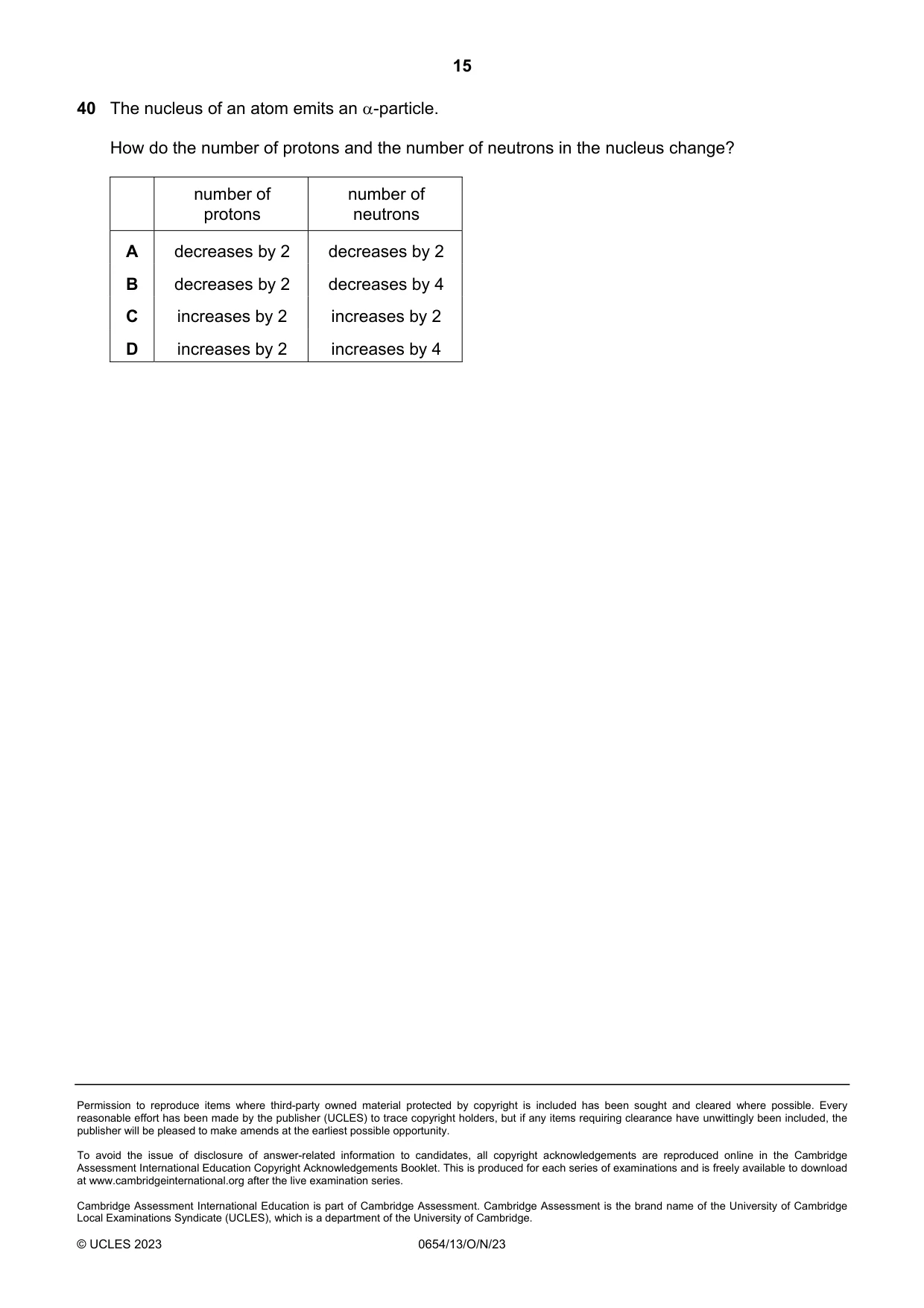
40 The nucleus of an atom emits an -particle. How do the number of protons and the number of neutrons in the nucleus change? number of number of protons neutrons A decreases by 2 decreases by 2 B decreases by 2 decreases by 4 C increases by 2 increases by 2 D increases by 2 increases by 4
Mark scheme: A
What was in this paper
The subtopics covered by these 40 questions, and how many questions each got. Open one in a new tab to see every Cambridge question on it.
1Characteristics of living organisms1Chromatography1Chromosomes and genes1Coordination and response1Corrosion of metals1Diet1Electrical circuits1Electrical quantities1Electrical safety1Electrolysis1Electromagnetic effects1Elements, compounds and mixtures1Energy, work and power1Enzymes1Extraction of metals1Food chains and food webs1Forces1Formulas1Fuels1Gas exchange in humans1General properties of waves1Group I properties1Habitat destruction1Identification of ions and gases1Isotopes1Kinetic particle model of matter1Noble gases1Oxides1Photosynthesis1Polymers1Pressure1Radioactivity1Redox1Sexual reproduction in humans1Simple phenomena of magnetism1Size of specimens1Sound1Transfer of thermal energy1Xylem and phloem1What you needed in this session
Cambridge’s own grade thresholds for 2023 Oct/Nov, Paper 1 · Variant 3. A higher threshold means an easier paper — the bar moves with how the cohort did.