Questions as text
Q1 · Sodium reacting with chlorine gas 0654/41 May/June 2017
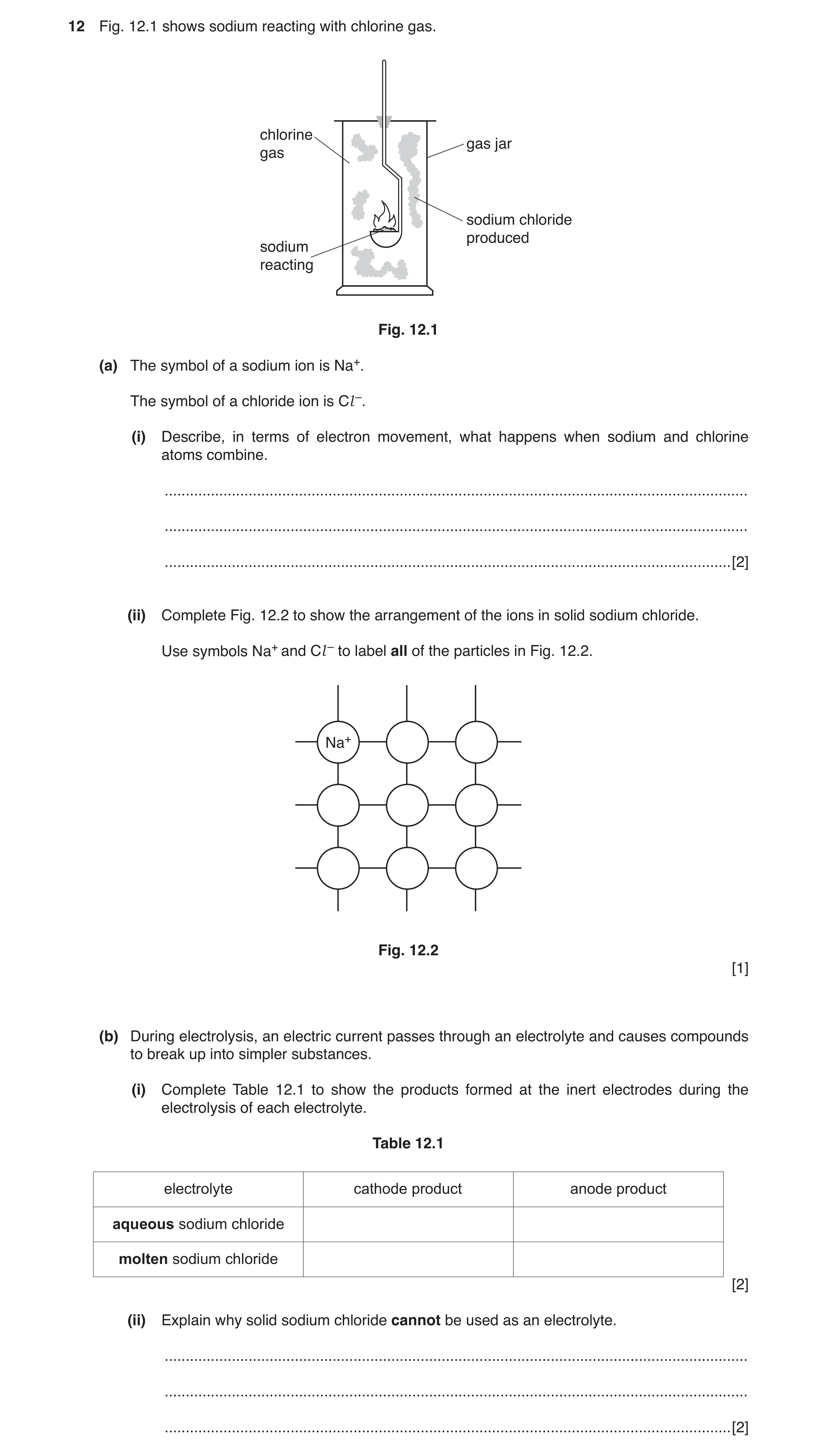
12 Fig. 12.1 shows sodium reacting with chlorine gas. chlorine gas jar gas sodium chloride produced sodium reacting Fig. 12.1 (a) The symbol of a sodium ion is Na+. The symbol of a chloride ion is Cl –. (i) Describe, in terms of electron movement, what happens when sodium and chlorine atoms combine. … … … [2] (ii) Complete Fig. 12.2 to show the arrangement of the ions in solid sodium chloride. Use symbols Na+ and Cl – to label all of the particles in Fig. 12.2. Na+ Fig. 12.2 [1] (b) During electrolysis, an electric current passes through an electrolyte and causes compounds to break up into simpler substances. (i) Complete Table 12.1 to show the products formed at the inert electrodes during the electrolysis of each electrolyte. Table 12.1 electrolyte cathode product anode product aqueous sodium chloride molten sodium chloride [2] (ii) Explain why solid sodium chloride cannot be used as an electrolyte. … … … [2]
7 marks
Mark scheme: 12(a)(i) sodium atoms lose one electron / change from 2,8,1 to 2,8 ; chlorine atoms gain one electron / change from 2,8,7 to 2,8,8 ; 2 12(a)(ii) alternating sodium and chloride ions in two directions ; 1 12(b)(i) (aqueous NaCl ) hydrogen chlorine ; (molten NaCl ) sodium chlorine ; 2 12(b)(ii) mobile ions carry charge / produce current / allow electricity to flow ; ions are not mobile / fixed in a solid ; 2
This question in 0654/41 May/June 2017
Q2 · Electrolysis occurs when an electric current passes through an electrolyte 0654/42 May/June 2017
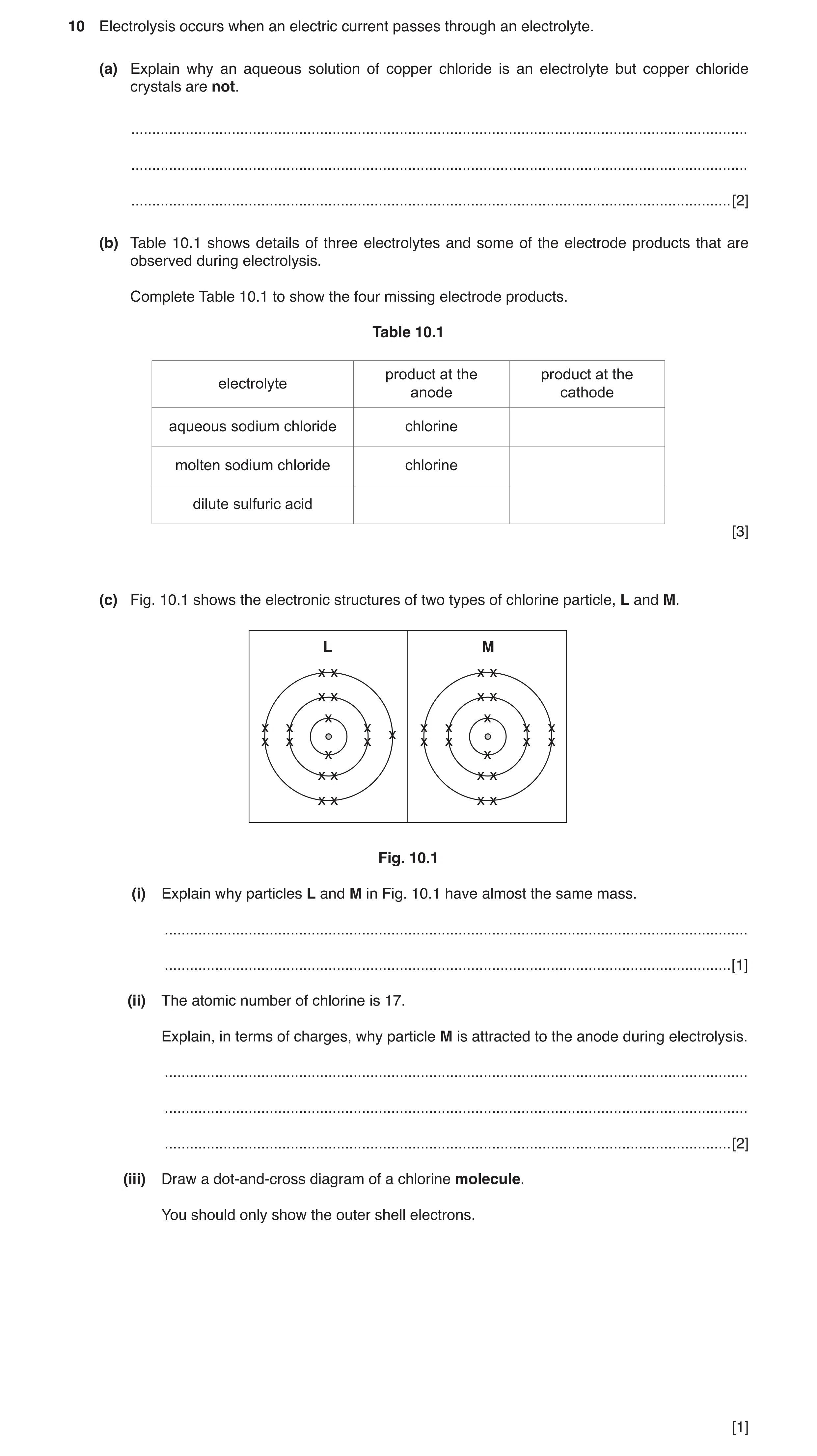
10 Electrolysis occurs when an electric current passes through an electrolyte. (a) Explain why an aqueous solution of copper chloride is an electrolyte but copper chloride crystals are not. … … … [2] (b) Table 10.1 shows details of three electrolytes and some of the electrode products that are observed during electrolysis. Complete Table 10.1 to show the four missing electrode products. Table 10.1 product at the product at the electrolyte anode cathode aqueous sodium chloride chlorine molten sodium chloride chlorine dilute sulfuric acid [3] (c) Fig. 10.1 shows the electronic structures of two types of chlorine particle, L and M. L M x x x x x x x x x x x x x x x x x x x x x x x x x x x x x x x x x x x Fig. 10.1 (i) Explain why particles L and M in Fig. 10.1 have almost the same mass. … … [1] (ii) The atomic number of chlorine is 17. Explain, in terms of charges, why particle M is attracted to the anode during electrolysis. … … … [2] (iii) Draw a dot-and-cross diagram of a chlorine molecule. You should only show the outer shell electrons. [1]
9 marks
Mark scheme: 10(a) mobile ions, carry charge / produce a current ; ions, are fixed / aren’t mobile, in a crystal ; 2 10(b) anode product cathode product sodium chloride aqueous chlorine hydrogen ; sodium chloride molten chlorine sodium ; sulfuric acid aqueous oxygen hydrogen ; 3 10(c)(i) idea that there is only an electron difference / electrons have, no / negligible, mass ; 1 10(c)(ii) chloride / particle M, has a negative charge / more electrons than protons ; so is attracted to the positive anode / idea that opposite charges attract ; 2 10(c)(iii) one shared pair and all non-bonding electrons shown ; 1
This question in 0654/42 May/June 2017
Q3 · A student reacts iron with dilute sulfuric acid as shown in Fig 0654/42 Oct/Nov 2018
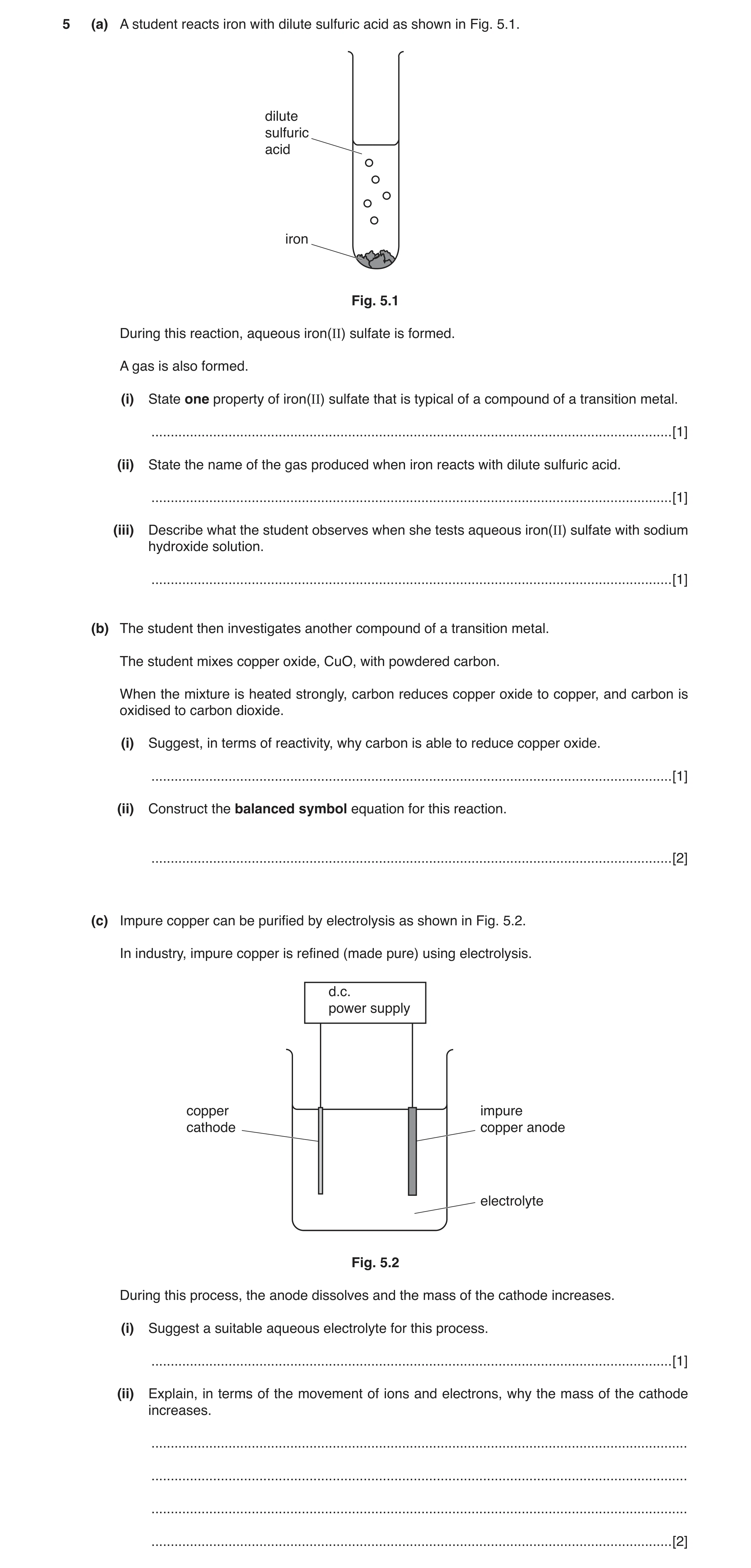
5 (a) A student reacts iron with dilute sulfuric acid as shown in Fig. 5.1. dilute sulfuric acid iron Fig. 5.1 During this reaction, aqueous iron(II) sulfate is formed. A gas is also formed. (i) State one property of iron(II) sulfate that is typical of a compound of a transition metal. … [1] (ii) State the name of the gas produced when iron reacts with dilute sulfuric acid. … [1] (iii) Describe what the student observes when she tests aqueous iron(II) sulfate with sodium hydroxide solution. … [1] (b) The student then investigates another compound of a transition metal. The student mixes copper oxide, CuO, with powdered carbon. When the mixture is heated strongly, carbon reduces copper oxide to copper, and carbon is oxidised to carbon dioxide. (i) Suggest, in terms of reactivity, why carbon is able to reduce copper oxide. … [1] (ii) Construct the balanced symbol equation for this reaction. … [2] (c) Impure copper can be purified by electrolysis as shown in Fig. 5.2. In industry, impure copper is refined (made pure) using electrolysis. d.c. power supply copper impure cathode copper anode electrolyte Fig. 5.2 During this process, the anode dissolves and the mass of the cathode increases. (i) Suggest a suitable aqueous electrolyte for this process. … [1] (ii) Explain, in terms of the movement of ions and electrons, why the mass of the cathode increases. … … … … [2]
9 marks
Mark scheme: 5(a)(i) coloured (compounds) ; 1 5(a)(ii) hydrogen ; 1 5(a)(iii) green precipitate / solid / owtte ; 1 5(b)(i) carbon is more reactive than copper ; 1 5(b)(ii) 2CuO + C → CO2 + 2Cu formulae ; balancing ; 2 5(c)(i) copper sulfate ; 1 5(c)(ii) copper ions, attracted / move to / are discharged at the cathode ; copper ions, gain two electrons from the cathode ; 2
This question in 0654/42 Oct/Nov 2018
Q4 · A student tries to draw the lattice structure of a crystal of sodium chloride 0654/42 Oct/Nov 2019
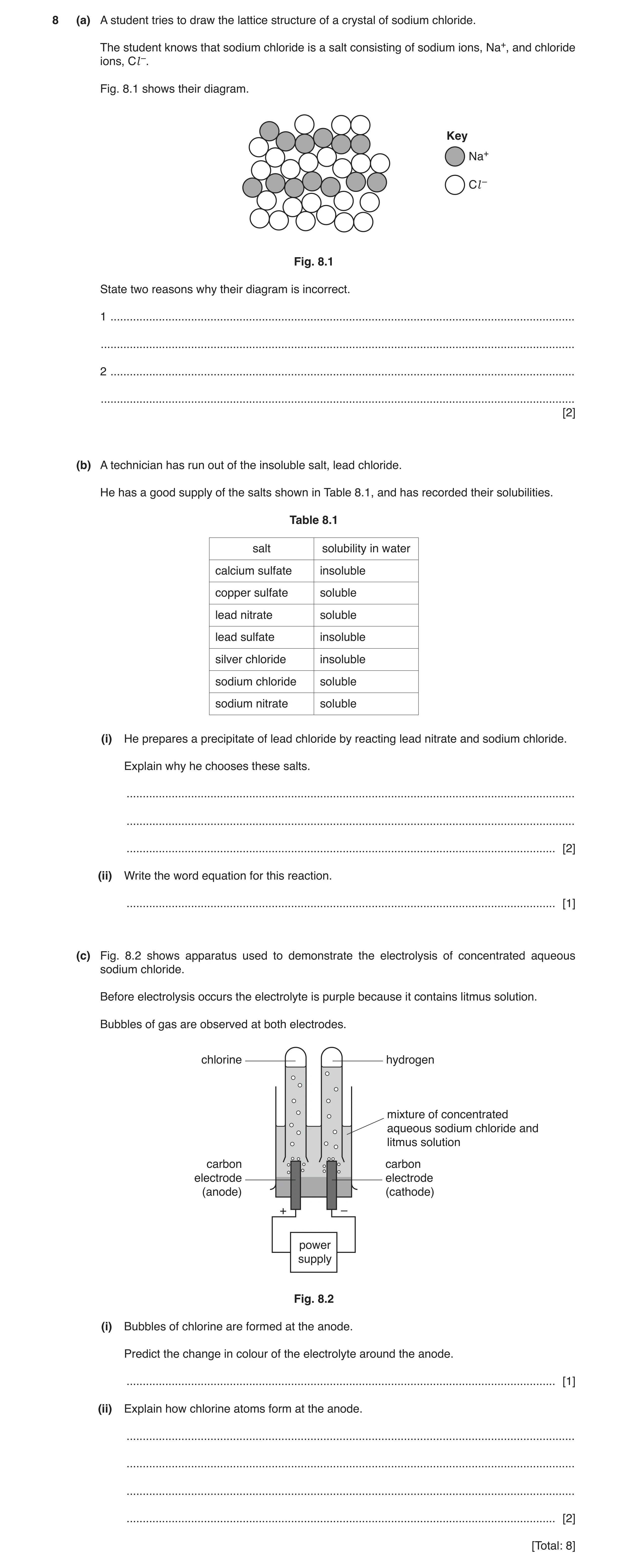
8 (a) A student tries to draw the lattice structure of a crystal of sodium chloride. The student knows that sodium chloride is a salt consisting of sodium ions, Na+, and chloride ions, Cl –. Fig. 8.1 shows their diagram. Key Na+ Cl – Fig. 8.1 State two reasons why their diagram is incorrect. 1 … … 2 … … [2] (b) A technician has run out of the insoluble salt, lead chloride. He has a good supply of the salts shown in Table 8.1, and has recorded their solubilities. Table 8.1 salt solubility in water calcium sulfate insoluble copper sulfate soluble lead nitrate soluble lead sulfate insoluble silver chloride insoluble sodium chloride soluble sodium nitrate soluble (i) He prepares a precipitate of lead chloride by reacting lead nitrate and sodium chloride. Explain why he chooses these salts. … … … [2] (ii) Write the word equation for this reaction. … [1] (c) Fig. 8.2 shows apparatus used to demonstrate the electrolysis of concentrated aqueous sodium chloride. Before electrolysis occurs the electrolyte is purple because it contains litmus solution. Bubbles of gas are observed at both electrodes. chlorine hydrogen mixture of concentrated aqueous sodium chloride and litmus solution carbon carbon electrode electrode (anode) (cathode) + – power supply Fig. 8.2 (i) Bubbles of chlorine are formed at the anode. Predict the change in colour of the electrolyte around the anode. … [1] (ii) Explain how chlorine atoms form at the anode. … … … … [2] [Total: 8]
8 marks
Mark scheme: 8(a) diagram, does not have / should have, a regular arrangement ; diagram, does not have / should have, alternating ions ; diagram, does not have / should have, equal number of Na+ and Cl – ; max 2 2 8(b)(i) reactant salts must be soluble ; to provide lead ions and chloride ions ; 2 8(b)(ii) lead nitrate + sodium chloride → sodium nitrate + lead chloride ; 1 8(c)(i) bleached / turns colourless ; 1 8(c)(ii) Cl – / chloride ions ; lose electrons / are oxidised ; 2
This question in 0654/42 Oct/Nov 2019
Q5 · The electrolysis of dilute sulfuric acid 0654/41 May/June 2020
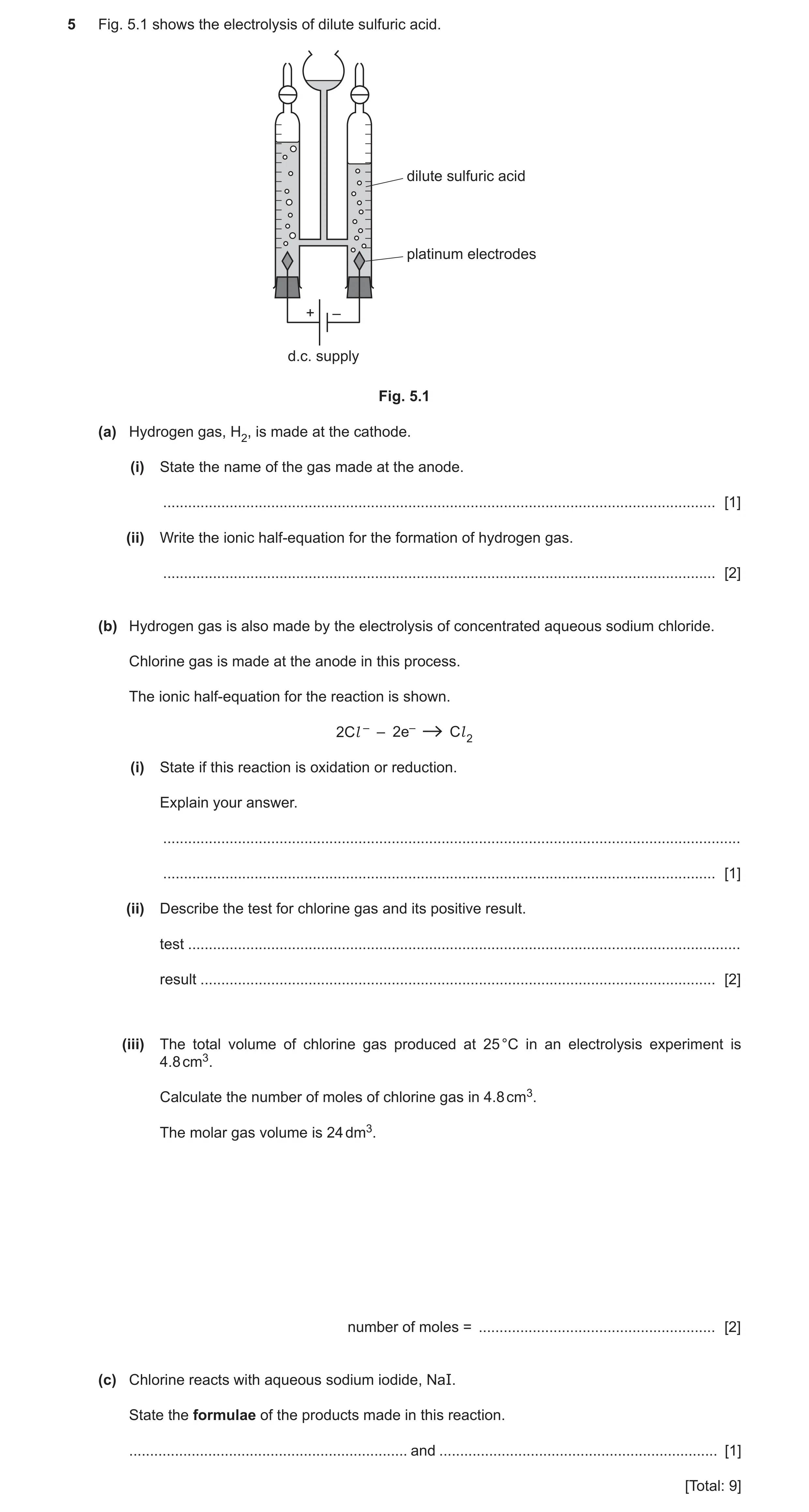
5 Fig. 5.1 shows the electrolysis of dilute sulfuric acid. dilute sulfuric acid platinum electrodes + – d.c. supply Fig. 5.1 (a) Hydrogen gas, H2, is made at the cathode. (i) State the name of the gas made at the anode. … [1] (ii) Write the ionic half-equation for the formation of hydrogen gas. … [2] (b) Hydrogen gas is also made by the electrolysis of concentrated aqueous sodium chloride. Chlorine gas is made at the anode in this process. The ionic half-equation for the reaction is shown. 2Cl – – 2e– Cl 2 (i) State if this reaction is oxidation or reduction. Explain your answer. … … [1] (ii) Describe the test for chlorine gas and its positive result. test … result … [2] (iii) The total volume of chlorine gas produced at 25 °C in an electrolysis experiment is 4.8 cm3. Calculate the number of moles of chlorine gas in 4.8 cm3. The molar gas volume is 24 dm3. number of moles = … [2] (c) Chlorine reacts with aqueous sodium iodide, NaI. State the formulae of the products made in this reaction. … and … [1] [Total: 9]
9 marks
Mark scheme: 5(a)(i) oxygen; 1 5(a)(ii) 2H+ + 2e– → H2 correct formulae; correctly balanced; 2 5(b)(i) (oxidation because) electrons are lost (from chloride ions); 1 5(b)(ii) damp litmus paper ; (is) bleached ; 2 5(b)(iii) 4.8 ÷ (24 × 1000) ; 2.0 × 10⁻⁴ or 0.0002 ; or volume of chlorine = 0.0048 dm3 ; (0.0048 ÷ 24 =) 2.0 × 10⁻⁴ or 0.0002 ; 2 5(c) NaCl and I2 1
This question in 0654/41 May/June 2020
Q6 · Concentrated aqueous sodium chloride can be electrolysed using inert electrodes 0654/41 Oct/Nov 2020
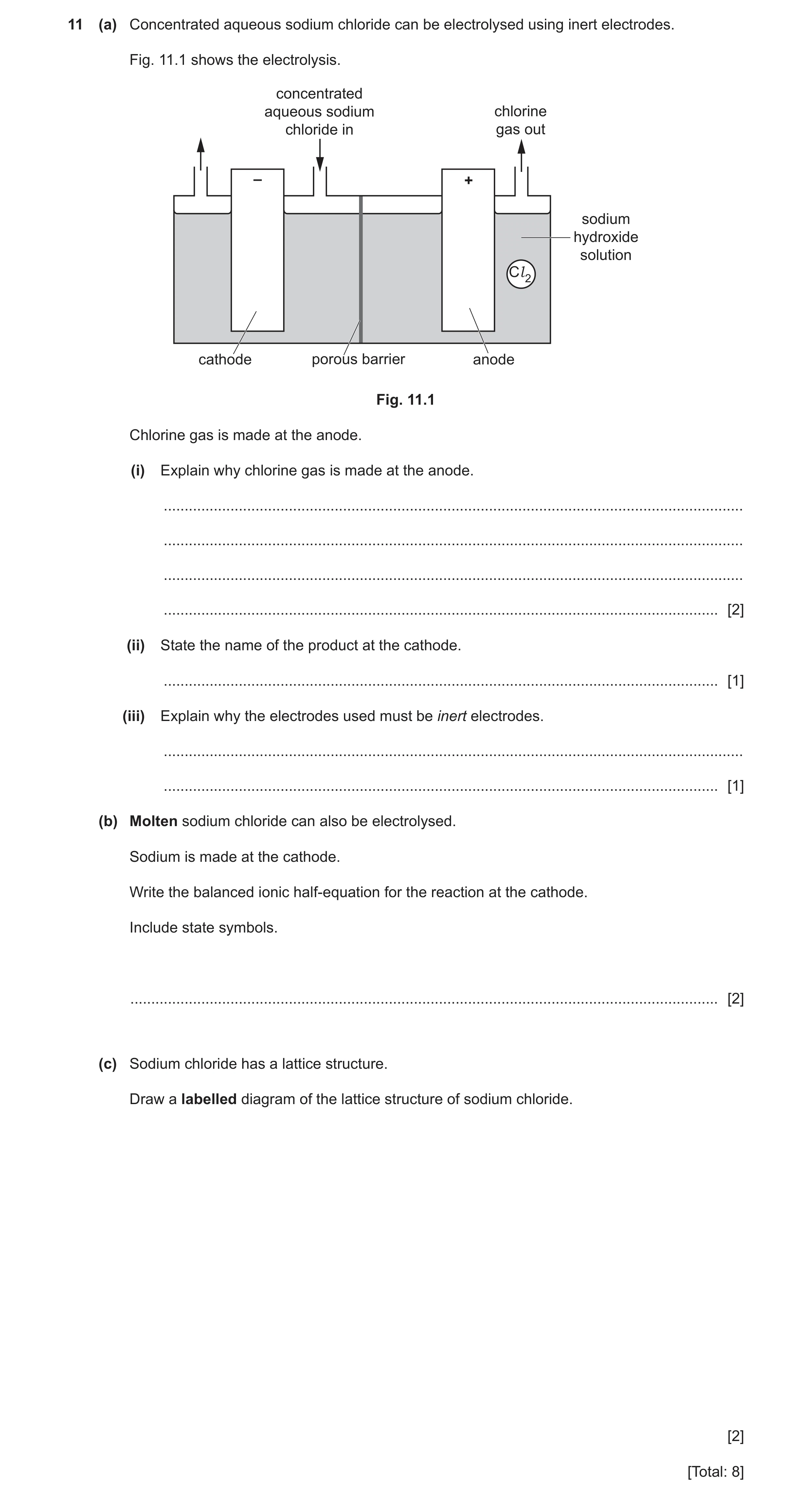
11 (a) Concentrated aqueous sodium chloride can be electrolysed using inert electrodes. Fig. 11.1 shows the electrolysis. concentrated aqueous sodium chlorine chloride in gas out – + sodium hydroxide solution Cl 2 cathode porous barrier anode Fig. 11.1 Chlorine gas is made at the anode. (i) Explain why chlorine gas is made at the anode. … … … … [2] (ii) State the name of the product at the cathode. … [1] (iii) Explain why the electrodes used must be inert electrodes. … … [1] (b) Molten sodium chloride can also be electrolysed. Sodium is made at the cathode. Write the balanced ionic half‑equation for the reaction at the cathode. Include state symbols. … [2] (c) Sodium chloride has a lattice structure. Draw a labelled diagram of the lattice structure of sodium chloride. [2] [Total: 8]
8 marks
Mark scheme: 11(a)(i) any two from: chloride ions are attracted to the (oppositely charged) anode / chloride ions are negative (so attracted to the anode) ; electron loss occurs at the anode / oxidation occurs at the anode ; chlorine atoms combine to form chlorine molecules ; max 2 11(a)(ii) hydrogen ; 1 11(a)(iii) so electrodes do not react with the products / named substance present ; 1 11(b) Na+(l) + e– → Na(l) half-equation ; state symbols ; 2 Question Answer Marks 11(c) labelled Na+ and Cl – ions ; alternating positive and negative / Na and Cl ; e.g. 2 Na+ Cl –
This question in 0654/41 Oct/Nov 2020
Q7 · Electrolysis is used to break down ionic compounds using electricity 0654/41 May/June 2021
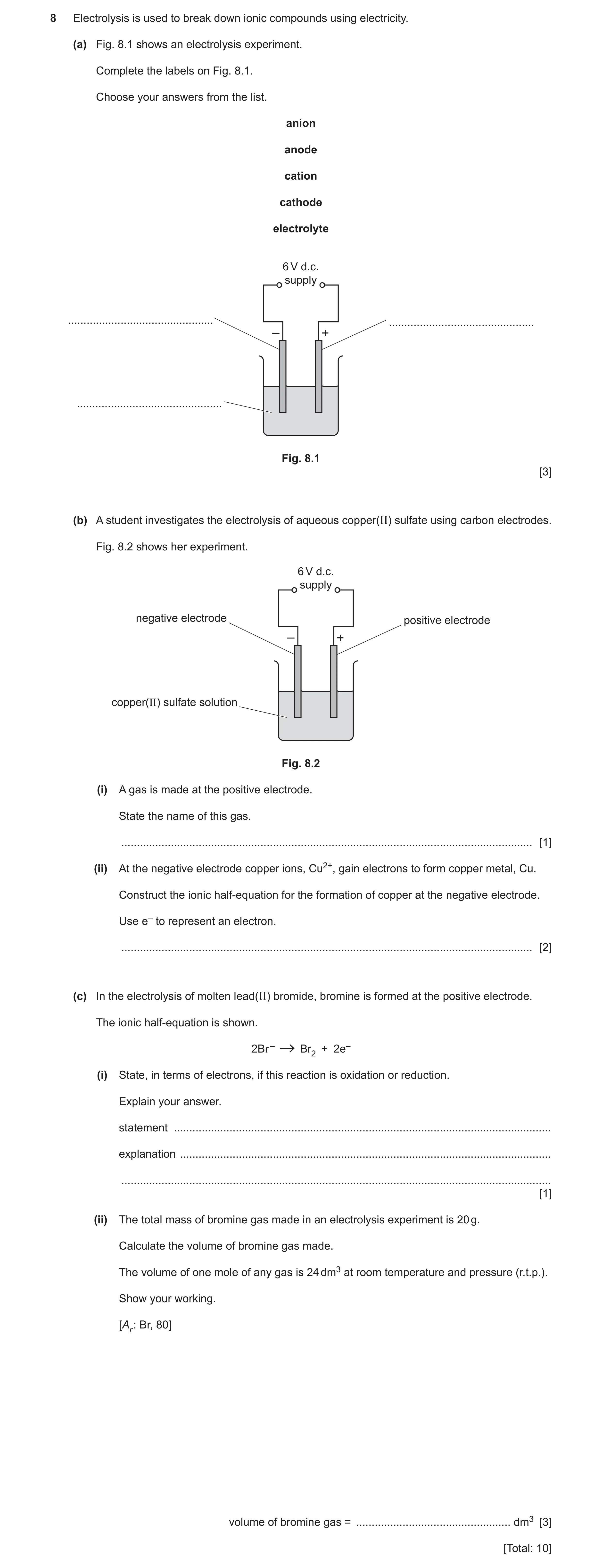
8 Electrolysis is used to break down ionic compounds using electricity. (a) Fig. 8.1 shows an electrolysis experiment. Complete the labels on Fig. 8.1. Choose your answers from the list. anion anode cation cathode electrolyte 6 V d.c. supply … … – + … Fig. 8.1 [3] (b) A student investigates the electrolysis of aqueous copper(II) sulfate using carbon electrodes. Fig. 8.2 shows her experiment. 6 V d.c. supply negative electrode positive electrode – + copper(II) sulfate solution Fig. 8.2 (i) A gas is made at the positive electrode. State the name of this gas. … [1] (ii) At the negative electrode copper ions, Cu2+, gain electrons to form copper metal, Cu. Construct the ionic half‑equation for the formation of copper at the negative electrode. Use e– to represent an electron. … [2] (c) In the electrolysis of molten lead(II) bromide, bromine is formed at the positive electrode. The ionic half‑equation is shown. 2Br – Br2 + 2e– (i) State, in terms of electrons, if this reaction is oxidation or reduction. Explain your answer. statement … explanation … … [1] (ii) The total mass of bromine gas made in an electrolysis experiment is 20 g. Calculate the volume of bromine gas made. The volume of one mole of any gas is 24 dm3 at room temperature and pressure (r.t.p.). Show your working. [Ar : Br, 80] volume of bromine gas = … dm3 [3] [Total: 10]
10 marks
Mark scheme: 8(a) 3 8(b)(i) oxygen ; 1 8(b)(ii) Cu2+ + 2e– → Cu LHS ; RHS ; 2 8(c)(i) oxidation because electrons are lost (from bromide ions) ; 1 8(c)(ii) Mr of Br2 = 160 ; (moles of Br2 =) mass ÷ molar mass or 20 ÷ 160 or 0.125 ; (volume of Br2 = 0.125 × 24 =) 3 (dm³) ; 3 cathode electrolyte anode
This question in 0654/41 May/June 2021
Q8 · The electrolysis of concentrated aqueous sodium chloride, NaCl, produces two useful gases 0654/42 May/June 2021
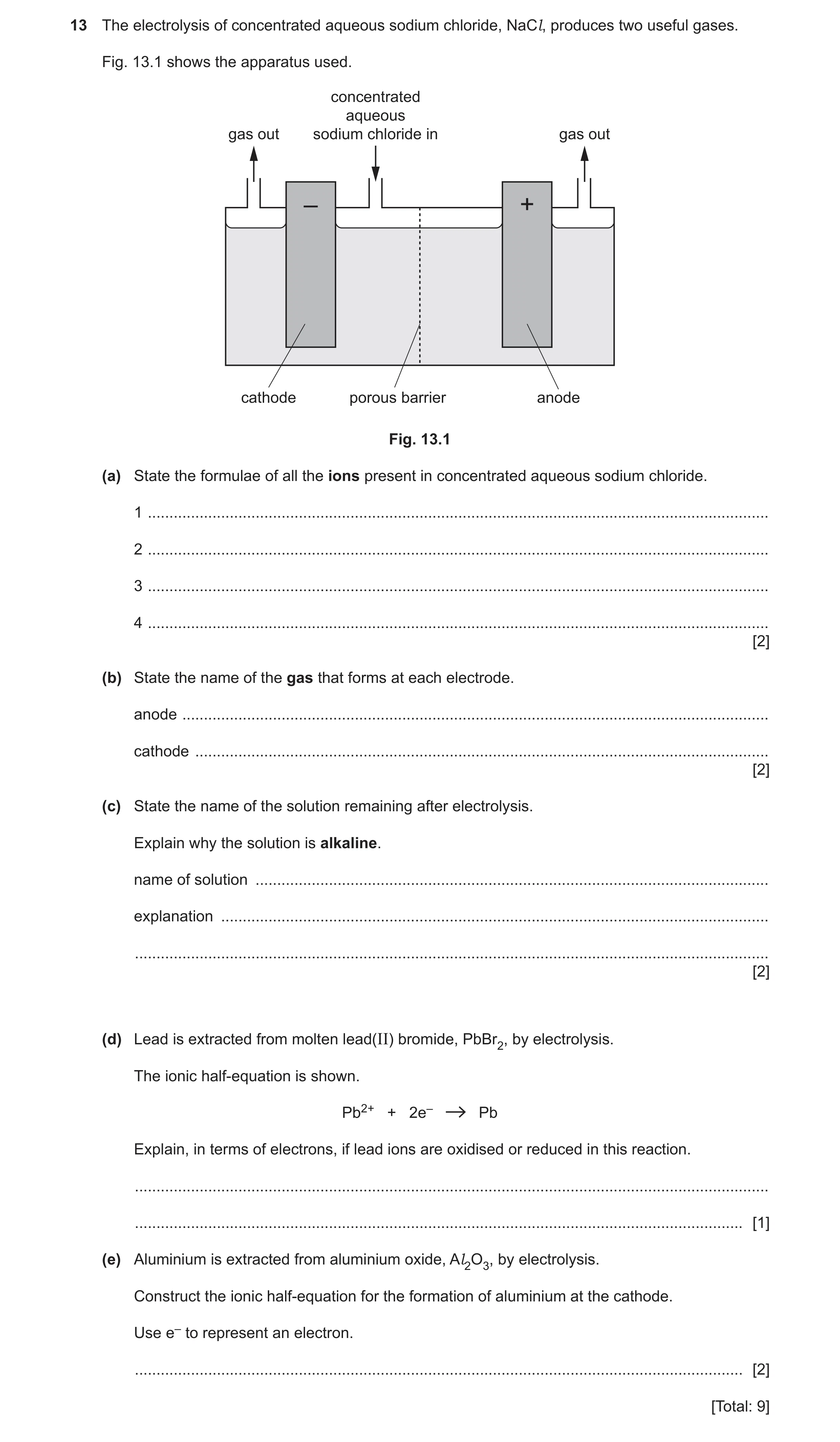
13 The electrolysis of concentrated aqueous sodium chloride, NaCl, produces two useful gases. Fig. 13.1 shows the apparatus used. concentrated aqueous gas out sodium chloride in gas out – + cathode porous barrier anode Fig. 13.1 (a) State the formulae of all the ions present in concentrated aqueous sodium chloride. 1 … 2 … 3 … 4 … [2] (b) State the name of the gas that forms at each electrode. anode … cathode … [2] (c) State the name of the solution remaining after electrolysis. Explain why the solution is alkaline. name of solution … explanation … … [2] (d) Lead is extracted from molten lead(II) bromide, PbBr2, by electrolysis. The ionic half-equation is shown. Pb2+ + 2e– Pb Explain, in terms of electrons, if lead ions are oxidised or reduced in this reaction. … … [1] (e) Aluminium is extracted from aluminium oxide, Al2O3, by electrolysis. Construct the ionic half-equation for the formation of aluminium at the cathode. Use e– to represent an electron. … [2] [Total: 9]
9 marks
Mark scheme: 13(a) 13(b) anode – chlorine ; cathode – hydrogen ; 2 13(c) sodium hydroxide ; hydroxide ions or OH- remain in solution ; 2 13(d) reduced because (two) electrons are gained ; 1 13(e) Al3+ + 3e- → Al ;; 2
This question in 0654/42 May/June 2021
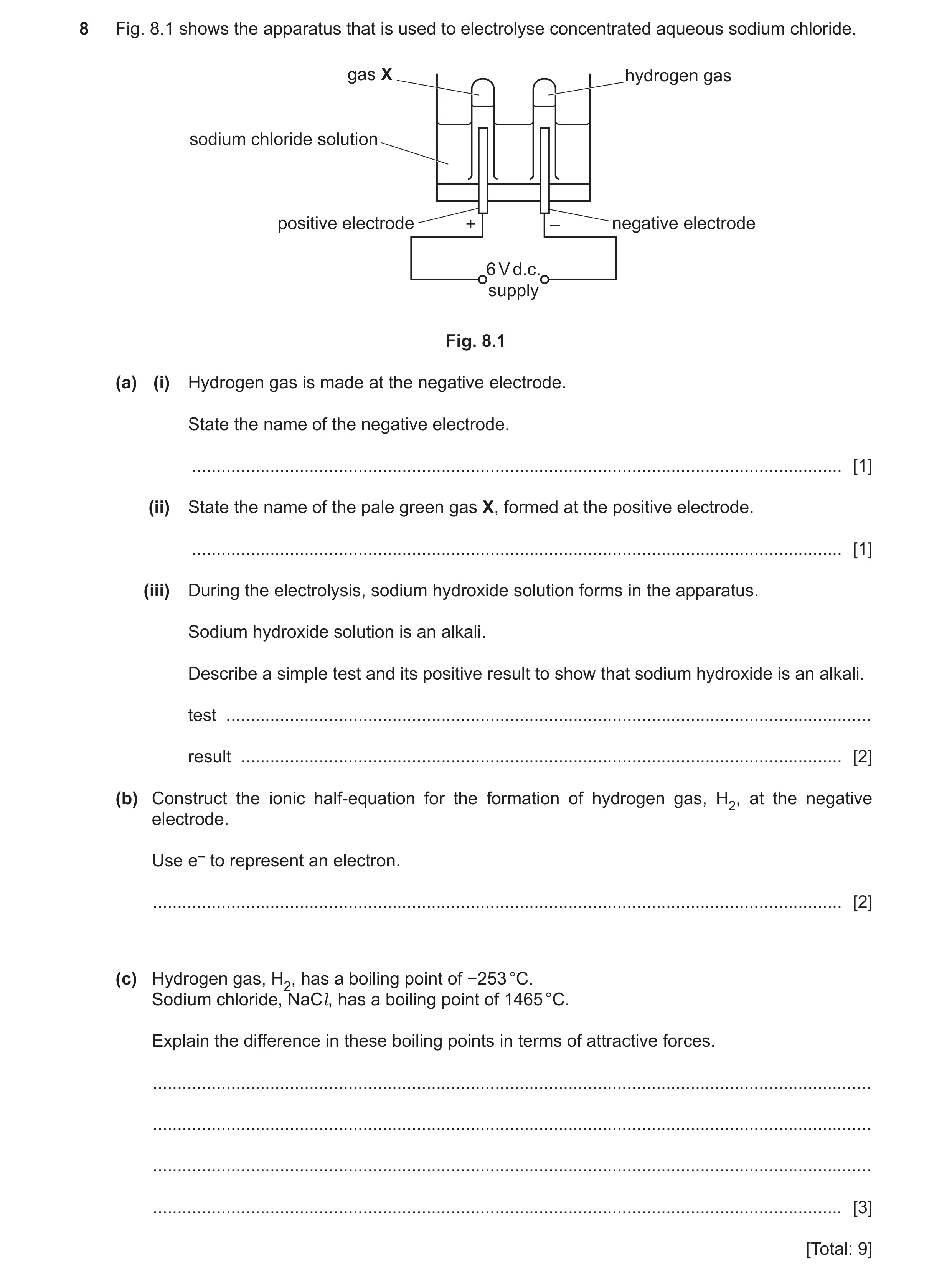
Q9 · The apparatus that is used to electrolyse concentrated aqueous sodium chloride 0654/41 Oct/Nov 2021
8 Fig. 8.1 shows the apparatus that is used to electrolyse concentrated aqueous sodium chloride. gas X hydrogen gas sodium chloride solution positive electrode + – negative electrode 6 V d.c. supply Fig. 8.1 (a) (i) Hydrogen gas is made at the negative electrode. State the name of the negative electrode. … [1] (ii) State the name of the pale green gas X, formed at the positive electrode. … [1] (iii) During the electrolysis, sodium hydroxide solution forms in the apparatus. Sodium hydroxide solution is an alkali. Describe a simple test and its positive result to show that sodium hydroxide is an alkali. test … result … [2] (b) Construct the ionic half-equation for the formation of hydrogen gas, H2, at the negative electrode. Use e– to represent an electron. … [2] (c) Hydrogen gas, H2, has a boiling point of −253 °C. Sodium chloride, NaCl, has a boiling point of 1465 °C. Explain the difference in these boiling points in terms of attractive forces. … … … … [3] [Total: 9]
9 marks
Mark scheme: 8(a)(i) cathode ; 1 8(a)(ii) chlorine ; 1 8(a)(iii) test: universal indicator / (red) litmus / pH meter ; result: universal indicator would turn blue or purple / pH greater than 7 / red litmus turns blue / pH meter or pH probe gives pH greater than 7 ; 2 8(b) 2H+ + 2e– → H2 correct formulae ; correct balancing ; 2 8(c) sodium chloride has strong (attractive) forces between (oppositely charged sodium ions and chloride) ions ; hydrogen has weak intermolecular forces / weak (attractive) forces between molecules ; strong (electrostatic) attractive forces take more energy to overcome than weak (intermolecular) forces / ORA ; 3
This question in 0654/41 Oct/Nov 2021
Q10 · A scientist investigates the electrolysis of lead(II) bromide 0654/42 Oct/Nov 2021
8 A scientist investigates the electrolysis of lead(II) bromide. Fig. 8.1 shows the apparatus the scientist uses. cathode (–) (+) anode graphite electrodes solid lead (II) bromide Fig. 8.1 (a) Explain why electrolysis will not take place using the apparatus shown in Fig. 8.1. … … … [2] (b) The electrodes are made of graphite. Explain why graphite conducts electricity. Use ideas about the structure and bonding in graphite. … … … [2] (c) Another scientist investigates the electrolysis of concentrated aqueous sodium chloride. Fig. 8.2 shows the apparatus the scientist uses. hydrogen chlorine concentrated aqueous sodium graphite electrode chloride (anode) carbon – + electrode (cathode) Fig. 8.2 (i) Describe the test for chlorine gas and its positive result. test … result … [2] (ii) The scientist collects 3.3 cm3 of chlorine gas, Cl2, in the electrolysis experiment. Calculate the mass of chlorine gas collected. The molar gas volume at 25 °C is 24 dm3. Show your working. [Ar: Cl, 35.5] mass of chlorine gas = … [4] [Total: 10]
10 marks
Mark scheme: 8(a) lead(II) bromide is solid / needs to be in solution or molten ; because ions cannot move in the solid / because ions can only move in liquid or in solution ; 2 8(b) graphite’s structure contains layers of carbon atoms / is giant / is (giant) covalent / is a macromolecule ; graphite contains delocalised electrons / description of delocalised electrons / electrons that are free to move ; 2 8(c)(i) damp litmus paper ; (is) bleached ; 2 8(c)(ii) conversion of 3.3 cm³ to 0.0033 dm³ or use of 24 000 dm³ ; moles of Cl2 = 3.3 ÷ 24 000 or 0.0033 ÷ 24 = 0.0001375 ; Mr Cl2 = 71 ; mass of Cl2 = 0.0001375 × 71 = 0.01 ; 4
This question in 0654/42 Oct/Nov 2021
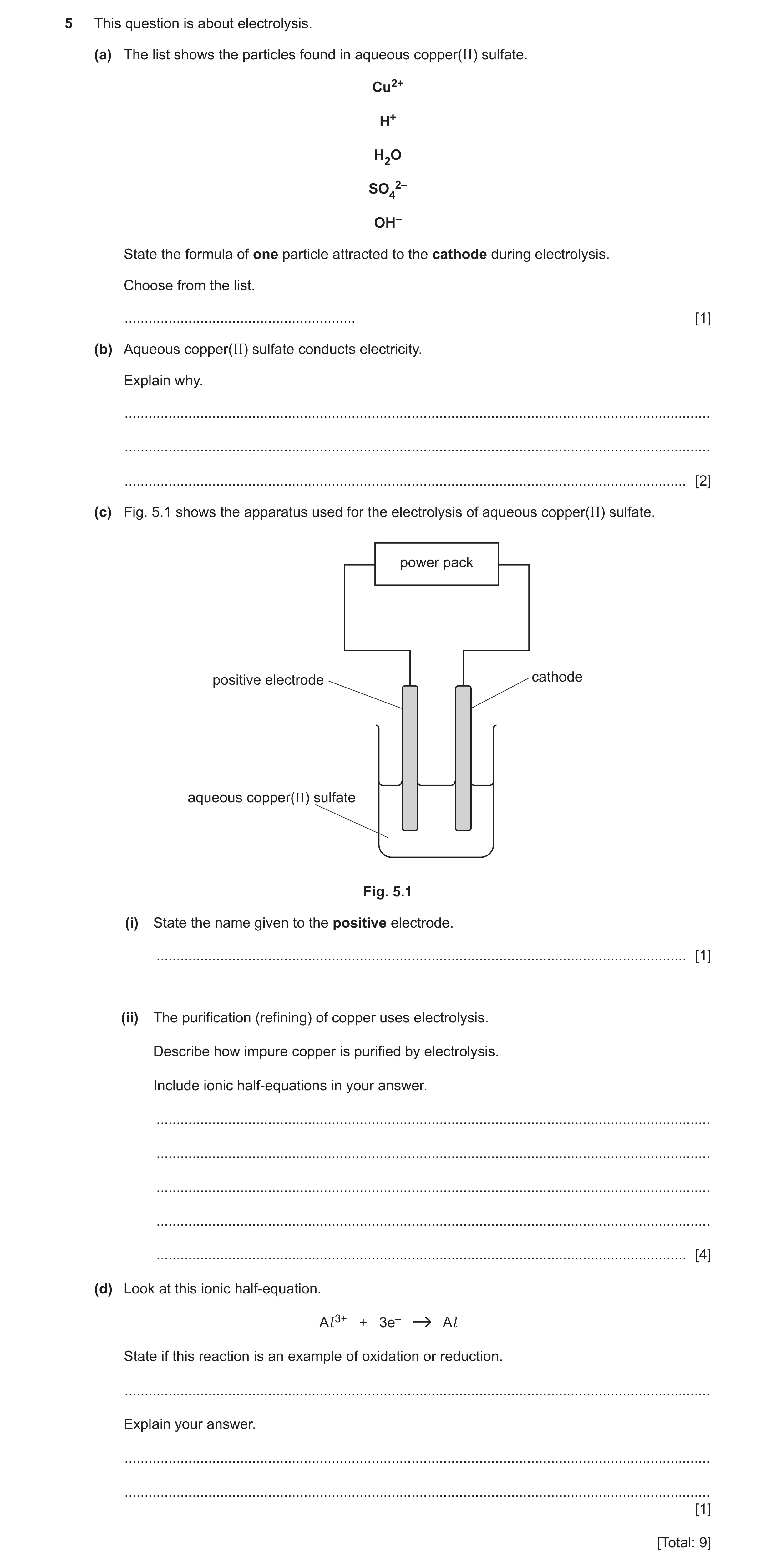
Q11 · This question is about electrolysis 0654/43 May/June 2022
5 This question is about electrolysis. (a) The list shows the particles found in aqueous copper(II) sulfate. Cu2+ H+ H2O SO42– OH– State the formula of one particle attracted to the cathode during electrolysis. Choose from the list. … [1] (b) Aqueous copper(II) sulfate conducts electricity. Explain why. … … … [2] (c) Fig. 5.1 shows the apparatus used for the electrolysis of aqueous copper(II) sulfate. power pack positive electrode cathode aqueous copper(II) sulfate Fig. 5.1 (i) State the name given to the positive electrode. … [1] (ii) The purification (refining) of copper uses electrolysis. Describe how impure copper is purified by electrolysis. Include ionic half-equations in your answer. … … … … … [4] (d) Look at this ionic half-equation. Al 3+ + 3e– Al State if this reaction is an example of oxidation or reduction. … Explain your answer. … … [1] [Total: 9]
9 marks
Mark scheme: 5(a) 1 5(b) (copper(II) sulfate solution) contains ions ; (ions) that can move ; 2 5(c)(i) anode ; 1 5(c)(ii) Any three from: copper(II) sulfate or any soluble copper salt as electrolyte ; impure copper as anode ; pure copper as cathode ; copper deposited at the cathode ; copper anode dissolves ; AND Any one from: Cu2+ + 2e– Cu ; Cu Cu2+ + 2e– ; max 4 4 5(d) reduction because reduction is the gain of electrons ; 1
This question in 0654/43 May/June 2022
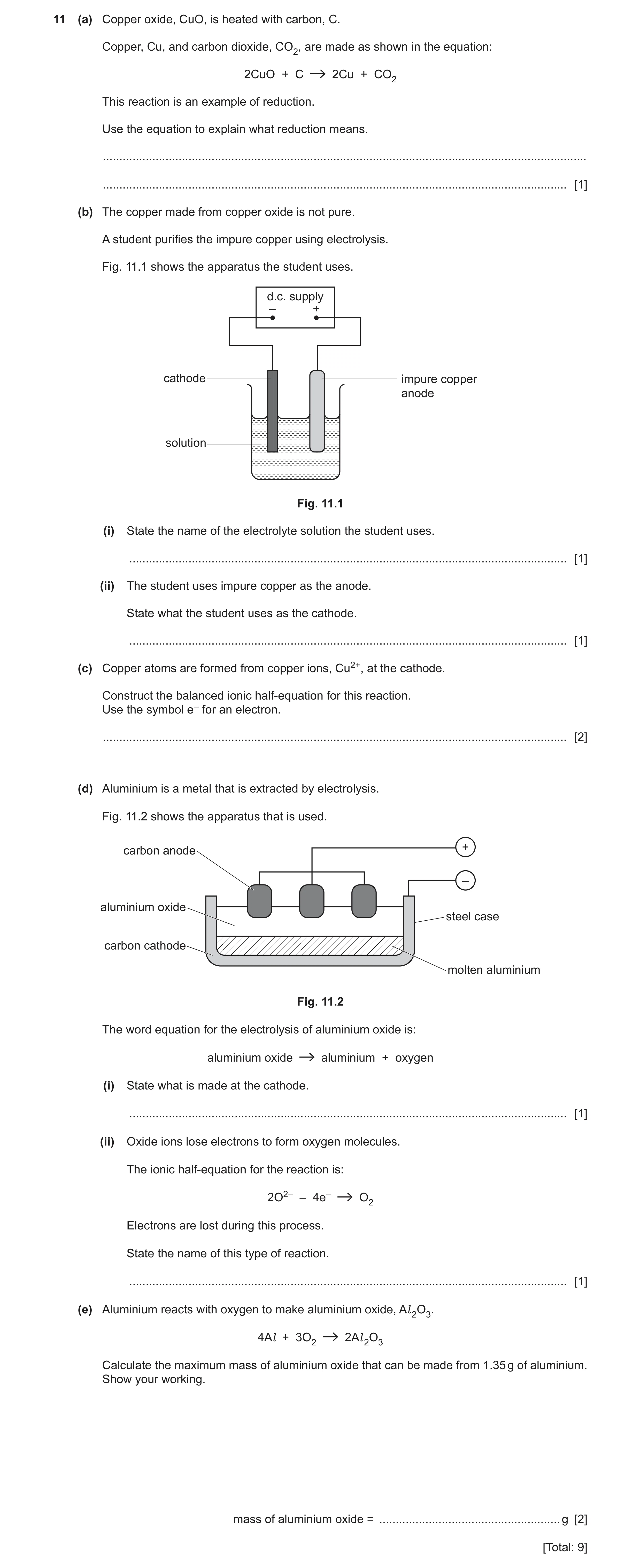
Q12 · Copper oxide, CuO, is heated with carbon, C 0654/41 Oct/Nov 2022
11 (a) Copper oxide, CuO, is heated with carbon, C. Copper, Cu, and carbon dioxide, CO2, are made as shown in the equation: 2CuO + C 2Cu + CO2 This reaction is an example of reduction. Use the equation to explain what reduction means. … … [1] (b) The copper made from copper oxide is not pure. A student purifies the impure copper using electrolysis. Fig. 11.1 shows the apparatus the student uses. d.c. supply – + cathode impure copper anode solution Fig. 11.1 (i) State the name of the electrolyte solution the student uses. … [1] (ii) The student uses impure copper as the anode. State what the student uses as the cathode. … [1] (c) Copper atoms are formed from copper ions, Cu2+, at the cathode. Construct the balanced ionic half-equation for this reaction. Use the symbol e– for an electron. … [2] (d) Aluminium is a metal that is extracted by electrolysis. Fig. 11.2 shows the apparatus that is used. + carbon anode – aluminium oxide steel case carbon cathode molten aluminium Fig. 11.2 The word equation for the electrolysis of aluminium oxide is: aluminium oxide aluminium + oxygen (i) State what is made at the cathode. … [1] (ii) Oxide ions lose electrons to form oxygen molecules. The ionic half-equation for the reaction is: 2O2– – 4e– O2 Electrons are lost during this process. State the name of this type of reaction. … [1] (e) Aluminium reacts with oxygen to make aluminium oxide, Al 2O3. 4Al + 3O2 2Al 2O3 Calculate the maximum mass of aluminium oxide that can be made from 1.35 g of aluminium. Show your working. mass of aluminium oxide = … g [2] [Total: 9]
9 marks
Mark scheme: 11(a) oxygen is removed/lost (from copper oxide) ; 1 11(b)(i) copper sulfate ; 1 11(b)(ii) (pure) copper ; 1 11(c) Cu2+ + 2e– → Cu 2 correct formulae ; correct balancing ; 11(d)(i) aluminium ; 1 11(d)(ii) oxidation ; 1 11(e) relative formular mass of Al2O3 =102 ; 2 (204 x 1.35 OR 102 x 1.35 = ) 2.55 (g) ; 108 54
This question in 0654/41 Oct/Nov 2022
Q13 · Electrolysis is the breakdown of an ionic compound, when molten or in aqueous solution… 0654/42 May/June 2023
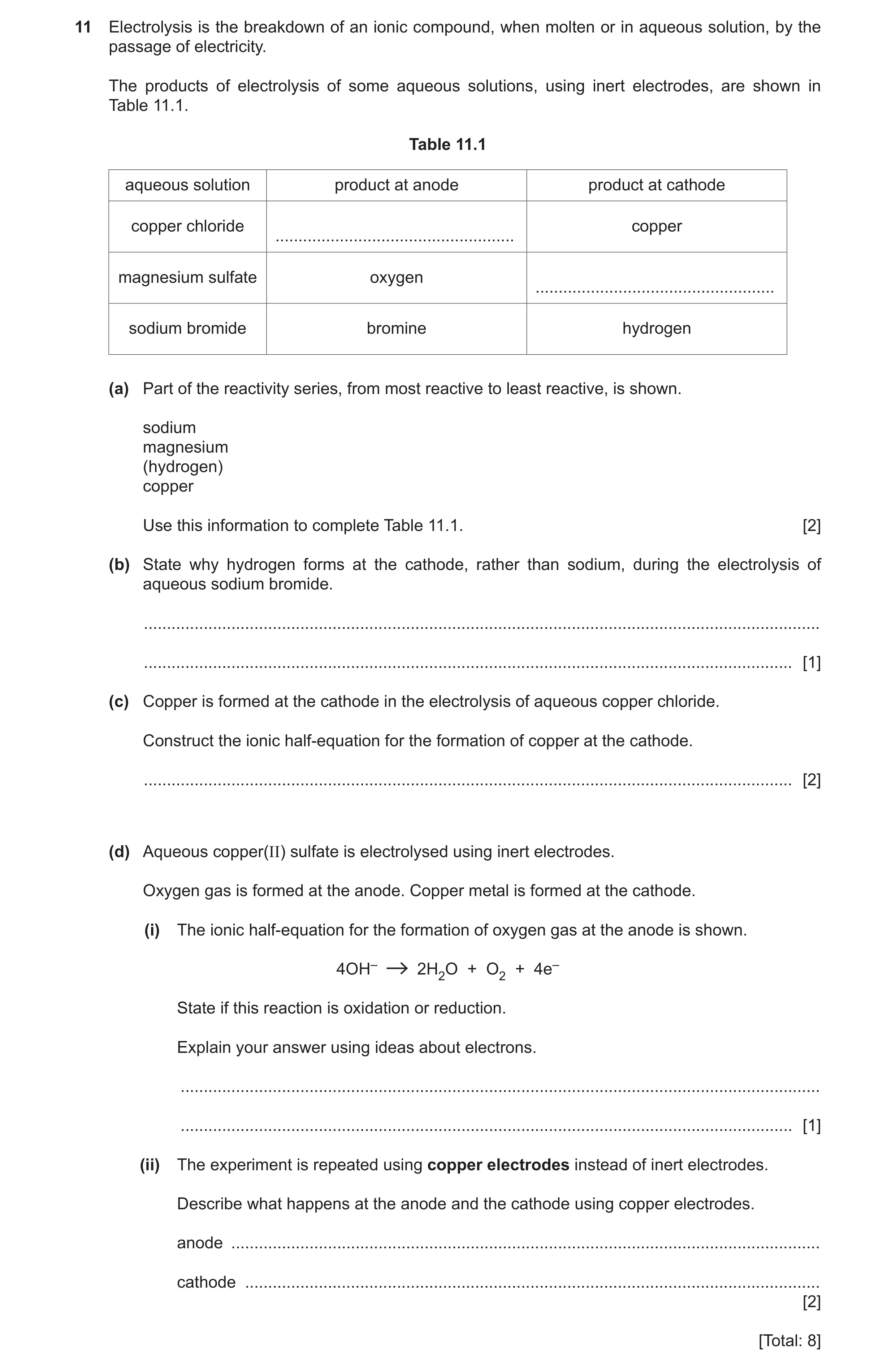
11 Electrolysis is the breakdown of an ionic compound, when molten or in aqueous solution, by the passage of electricity. The products of electrolysis of some aqueous solutions, using inert electrodes, are shown in Table 11.1. Table 11.1 aqueous solution product at anode product at cathode copper chloride copper … magnesium sulfate oxygen … sodium bromide bromine hydrogen (a) Part of the reactivity series, from most reactive to least reactive, is shown. sodium magnesium (hydrogen) copper Use this information to complete Table 11.1. [2] (b) State why hydrogen forms at the cathode, rather than sodium, during the electrolysis of aqueous sodium bromide. … … [1] (c) Copper is formed at the cathode in the electrolysis of aqueous copper chloride. Construct the ionic half‑equation for the formation of copper at the cathode. … [2] (d) Aqueous copper(II) sulfate is electrolysed using inert electrodes. Oxygen gas is formed at the anode. Copper metal is formed at the cathode. (i) The ionic half‑equation for the formation of oxygen gas at the anode is shown. 4OH– 2H2O + O2 + 4e– State if this reaction is oxidation or reduction. Explain your answer using ideas about electrons. … … [1] (ii) The experiment is repeated using copper electrodes instead of inert electrodes. Describe what happens at the anode and the cathode using copper electrodes. anode … cathode … [2] [Total: 8]
8 marks
Mark scheme: 11(a) aqueous solution product at anode product at cathode copper chloride chlorine ; copper magnesium sulfate oxygen hydrogen ; sodium bromide bromine hydrogen 2 11(b) hydrogen is less reactive than sodium / ORA ; 1 11(c) Cu2+ + 2e– Cu ;; 2 11(d)(i) oxidation and ref to loss of electrons ; 1 11(d)(ii) anode – copper dissolves / copper ions form ; cathode – copper forms / copper deposited ; 2
This question in 0654/42 May/June 2023
Q14 · Molten lead(II) bromide conducts electricity 0654/41 Oct/Nov 2023
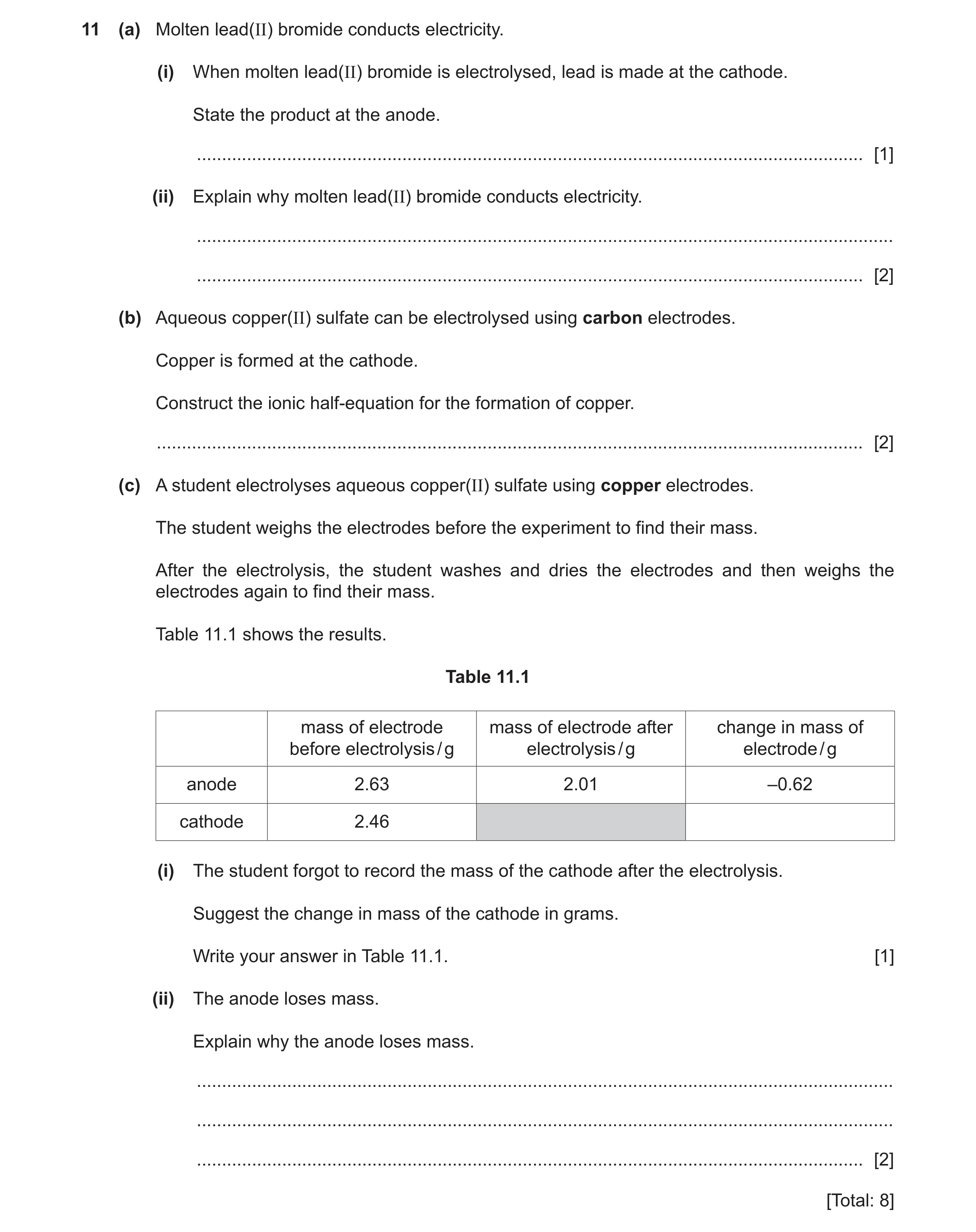
11 (a) Molten lead(II) bromide conducts electricity. (i) When molten lead(II) bromide is electrolysed, lead is made at the cathode. State the product at the anode. … [1] (ii) Explain why molten lead(II) bromide conducts electricity. … … [2] (b) Aqueous copper(II) sulfate can be electrolysed using carbon electrodes. Copper is formed at the cathode. Construct the ionic half-equation for the formation of copper. … [2] (c) A student electrolyses aqueous copper(II) sulfate using copper electrodes. The student weighs the electrodes before the experiment to find their mass. After the electrolysis, the student washes and dries the electrodes and then weighs the electrodes again to find their mass. Table 11.1 shows the results. Table 11.1 mass of electrode mass of electrode after change in mass of before electrolysis / g electrolysis / g electrode / g anode 2.63 2.01 –0.62 cathode 2.46 (i) The student forgot to record the mass of the cathode after the electrolysis. Suggest the change in mass of the cathode in grams. Write your answer in Table 11.1. [1] (ii) The anode loses mass. Explain why the anode loses mass. … … … [2] [Total: 8]
8 marks
Mark scheme: 11(a)(i) bromine / Br2 ; 1 11(a)(ii) (lead (II) bromide) contains ions ; 2 (idea that the ions) can move ; 11(b) Cu2+ + 2e– → Cu 2 formulae ; balancing ; 11(c)(i) + 0.62 ; 1 11(c)(ii) any two from: 2 copper dissolves at the anode / anode dissolves ; copper atoms become copper ions ; copper ions move into solution ;
This question in 0654/41 Oct/Nov 2023
Q15 · Electrolysis is used to break down ionic compounds 0654/43 Oct/Nov 2023
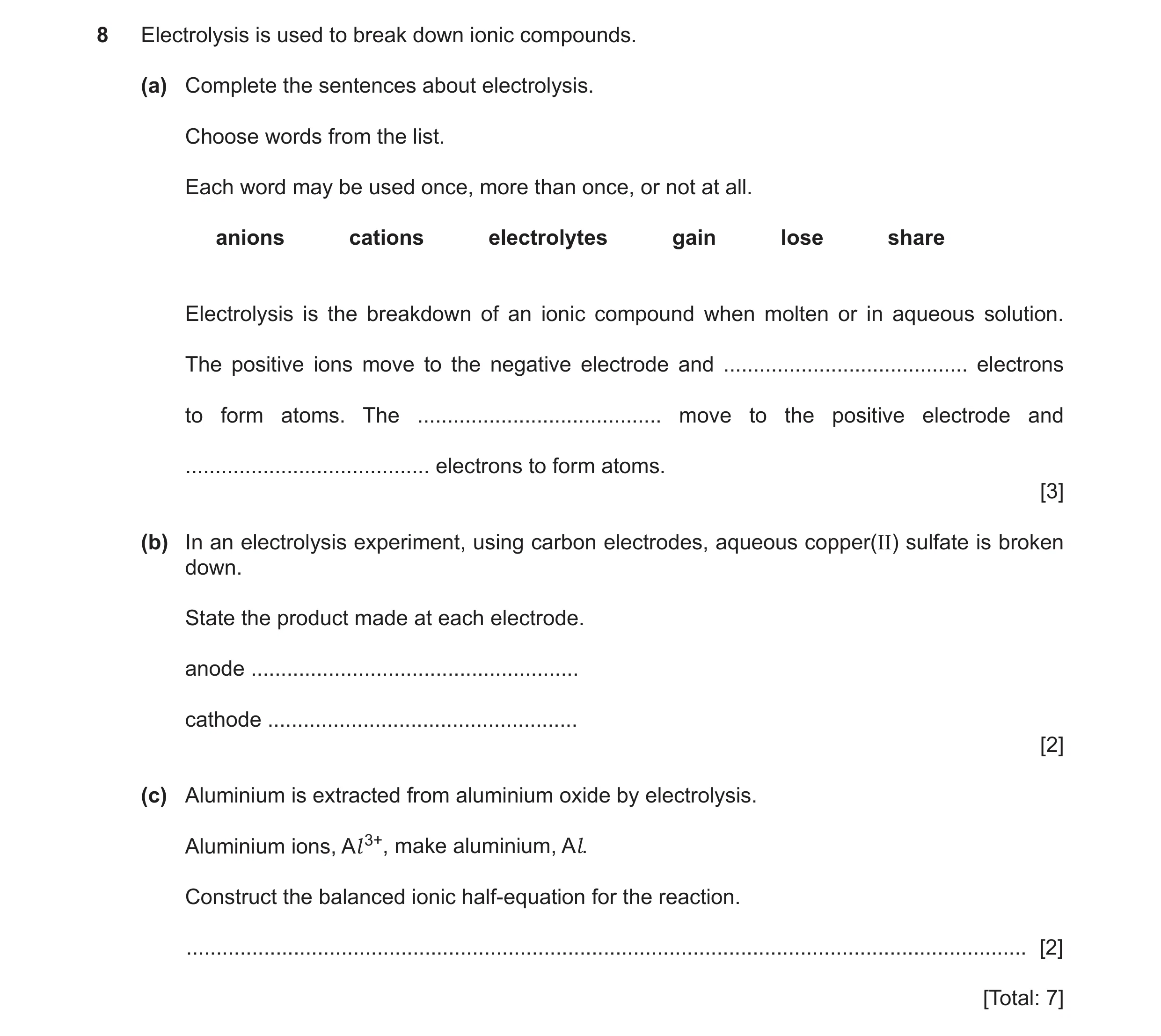
8 Electrolysis is used to break down ionic compounds. (a) Complete the sentences about electrolysis. Choose words from the list. Each word may be used once, more than once, or not at all. anions cations electrolytes gain lose share Electrolysis is the breakdown of an ionic compound when molten or in aqueous solution. The positive ions move to the negative electrode and … electrons to form atoms. The … move to the positive electrode and … electrons to form atoms. [3] (b) In an electrolysis experiment, using carbon electrodes, aqueous copper(II) sulfate is broken down. State the product made at each electrode. anode … cathode … [2] (c) Aluminium is extracted from aluminium oxide by electrolysis. Aluminium ions, Al 3+, make aluminium, Al. Construct the balanced ionic half-equation for the reaction. … [2] [Total: 7]
7 marks
Mark scheme: 8(a) gain ; 3 anions ; lose ; 8(b) anode – oxygen / O2 ; 2 cathode – copper / Cu ; 8(c) Al 3+ + 3e– → Al ; 2
This question in 0654/43 Oct/Nov 2023
Q16 · Electrolysis can be used to break down a substance into useful products 0654/42 Feb/March 2024
5 Electrolysis can be used to break down a substance into useful products. Fig. 5.1 shows the electrolysis of dilute sulfuric acid. hydrogen gas gas X test tube glass container … … dilute sulfuric acid + – Fig. 5.1 (a) (i) Complete the labels on Fig. 5.1. Choose words from the list. anode anion cathode cation electrolyte [2] (ii) State the name of gas X in Fig. 5.1. … [1] (iii) Hydrogen gas, H2, is made at the negative electrode. Complete and balance the ionic half-equation for this reaction. … + … e – H2 [2] (iv) State if the reaction in part (iii) is oxidation or reduction. Explain your answer using ideas about electrons. … … [1] (v) Describe the test for hydrogen and the observation for a positive result. test … result … [2] (b) In an experiment a student passes electricity through dilute sulfuric acid and collects 6 dm3 of hydrogen gas. Calculate the mass of 6 dm3 of hydrogen gas. The volume of one mole of any gas is 24 dm3 at room temperature and pressure (r.t.p.). mass of hydrogen gas = … g [3] [Total: 11]
11 marks
Mark scheme: 5(a)(i) LHS – anode ; 2 RHS – cathode ; 5(a)(ii) oxygen ; 1 5(a)(iii) 2H+ + 2e– → H2 ;; 2 5(a)(iv) (reduction) 1 gain of electrons ; 5(a)(v) test – lighted splint ; 2 result – (squeaky) pop ; 5(b) Mr of H2 = 2 ; 3 moles of H2 = 6 ÷ 24 = 0.25 ; mass of H2 = 0.25 2 = 0.5g ;
This question in 0654/42 Feb/March 2024
Q17 · A student heats three substances X, Y and Z in a water‑bath 0654/42 May/June 2024
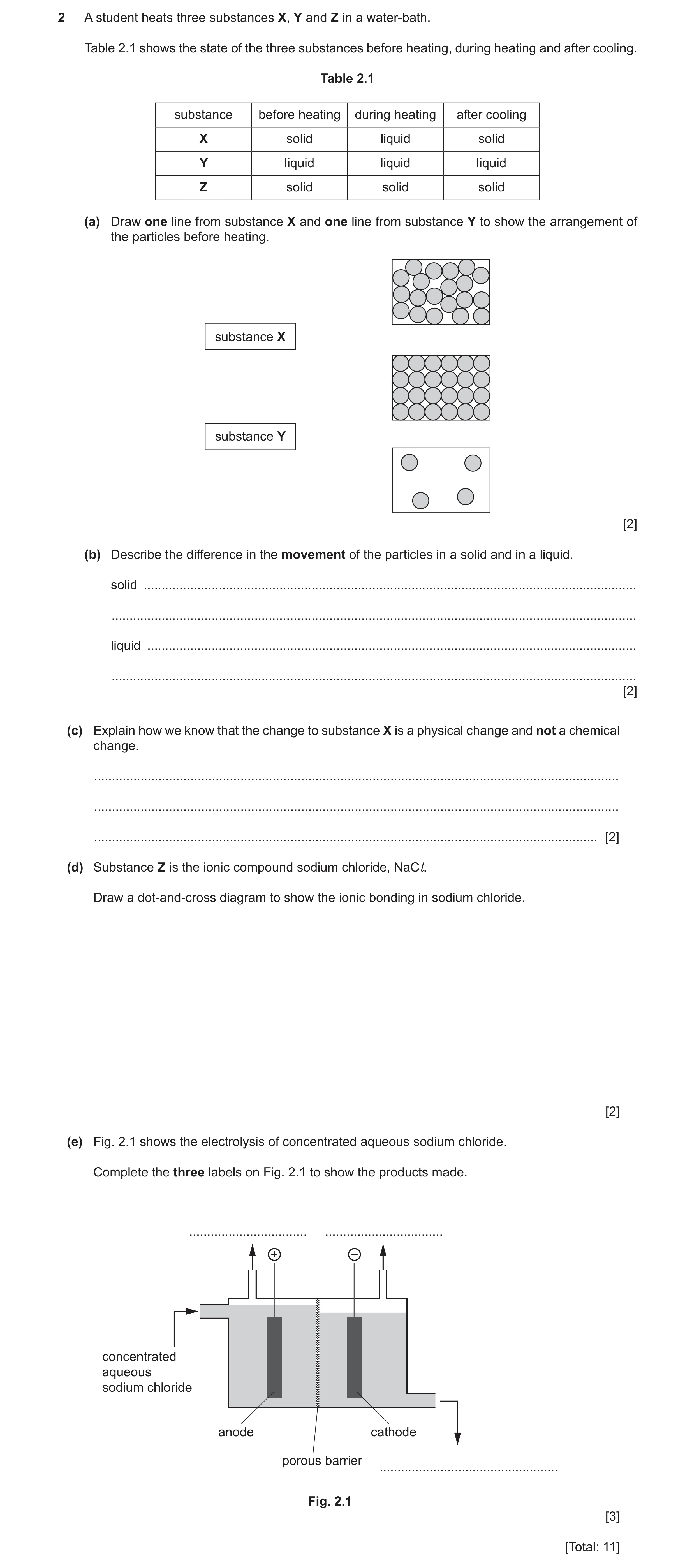
2 A student heats three substances X, Y and Z in a water‑bath. Table 2.1 shows the state of the three substances before heating, during heating and after cooling. Table 2.1 substance before heating during heating after cooling X solid liquid solid Y liquid liquid liquid Z solid solid solid (a) Draw one line from substance X and one line from substance Y to show the arrangement of the particles before heating. substance X substance Y [2] (b) Describe the difference in the movement of the particles in a solid and in a liquid. solid … … liquid … … [2] (c) Explain how we know that the change to substance X is a physical change and not a chemical change. … … … [2] (d) Substance Z is the ionic compound sodium chloride, NaCl. Draw a dot‑and‑cross diagram to show the ionic bonding in sodium chloride. [2] (e) Fig. 2.1 shows the electrolysis of concentrated aqueous sodium chloride. Complete the three labels on Fig. 2.1 to show the products made. … … + – concentrated aqueous sodium chloride anode cathode porous barrier … Fig. 2.1 [3] [Total: 11]
11 marks
Mark scheme: 2(a) ; ; 2(b) (solid) idea that particles are vibrating about fixed positions ; (liquid) particles, move around / slide over, each other ; 2 2(c) it is reversible / a chemical change is irreversible ; no new substance is formed / a chemical change produces a new substance ; 2 2(d) ;; 2 Question Answer Marks 2(e) 3
This question in 0654/42 May/June 2024
Q18 · A toy car that is powered by hydrogen gas 0654/43 May/June 2024
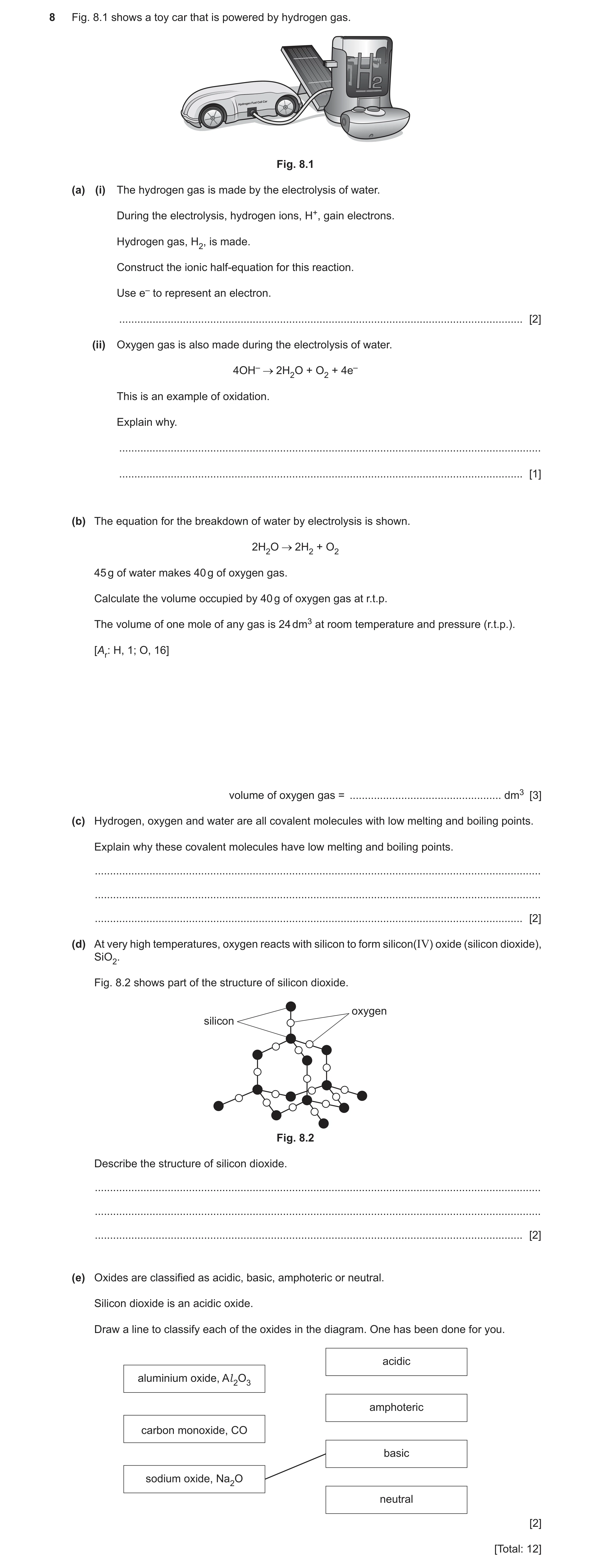
8 Fig. 8.1 shows a toy car that is powered by hydrogen gas. Fig. 8.1 (a) (i) The hydrogen gas is made by the electrolysis of water. During the electrolysis, hydrogen ions, H+, gain electrons. Hydrogen gas, H2, is made. Construct the ionic half-equation for this reaction. Use e– to represent an electron. … [2] (ii) Oxygen gas is also made during the electrolysis of water. 4OH– 2H2O + O2 + 4e– This is an example of oxidation. Explain why. … … [1] (b) The equation for the breakdown of water by electrolysis is shown. 2H2O 2H2 + O2 45 g of water makes 40 g of oxygen gas. Calculate the volume occupied by 40 g of oxygen gas at r.t.p. The volume of one mole of any gas is 24 dm3 at room temperature and pressure (r.t.p.). [Ar: H, 1; O, 16] volume of oxygen gas = … dm3 [3] (c) Hydrogen, oxygen and water are all covalent molecules with low melting and boiling points. Explain why these covalent molecules have low melting and boiling points. … … … [2] (d) At very high temperatures, oxygen reacts with silicon to form silicon(IV) oxide (silicon dioxide), SiO2. Fig. 8.2 shows part of the structure of silicon dioxide. oxygen silicon Fig. 8.2 Describe the structure of silicon dioxide. … … … [2] (e) Oxides are classified as acidic, basic, amphoteric or neutral. Silicon dioxide is an acidic oxide. Draw a line to classify each of the oxides in the diagram. One has been done for you. acidic aluminium oxide, Al 2O3 amphoteric carbon monoxide, CO basic sodium oxide, Na2O neutral [2] [Total: 12]
12 marks
Mark scheme: 8(a)(i) 2 8(a)(ii) loss of electrons / AW ; 1 8(b) Mr of O2 = 32 ; moles of O2 = 40 ÷ 32 = 1.25 ; volume of O2 = 1.25 24 = 30 dm³ ; 3 8(c) weak intermolecular forces / weak forces between molecules ; (weak forces) which require little energy to break ; 2 8(d) giant covalent OR covalent lattice ; each oxygen atom forms bonds with 2 silicon atoms / each silicon atoms forms bonds with 4 oxygen atoms ; 2 8(e) ;; 2
This question in 0654/43 May/June 2024
Q19 · Aluminium is extracted by electrolysis from the ore bauxite that contains aluminium… 0654/41 Oct/Nov 2024
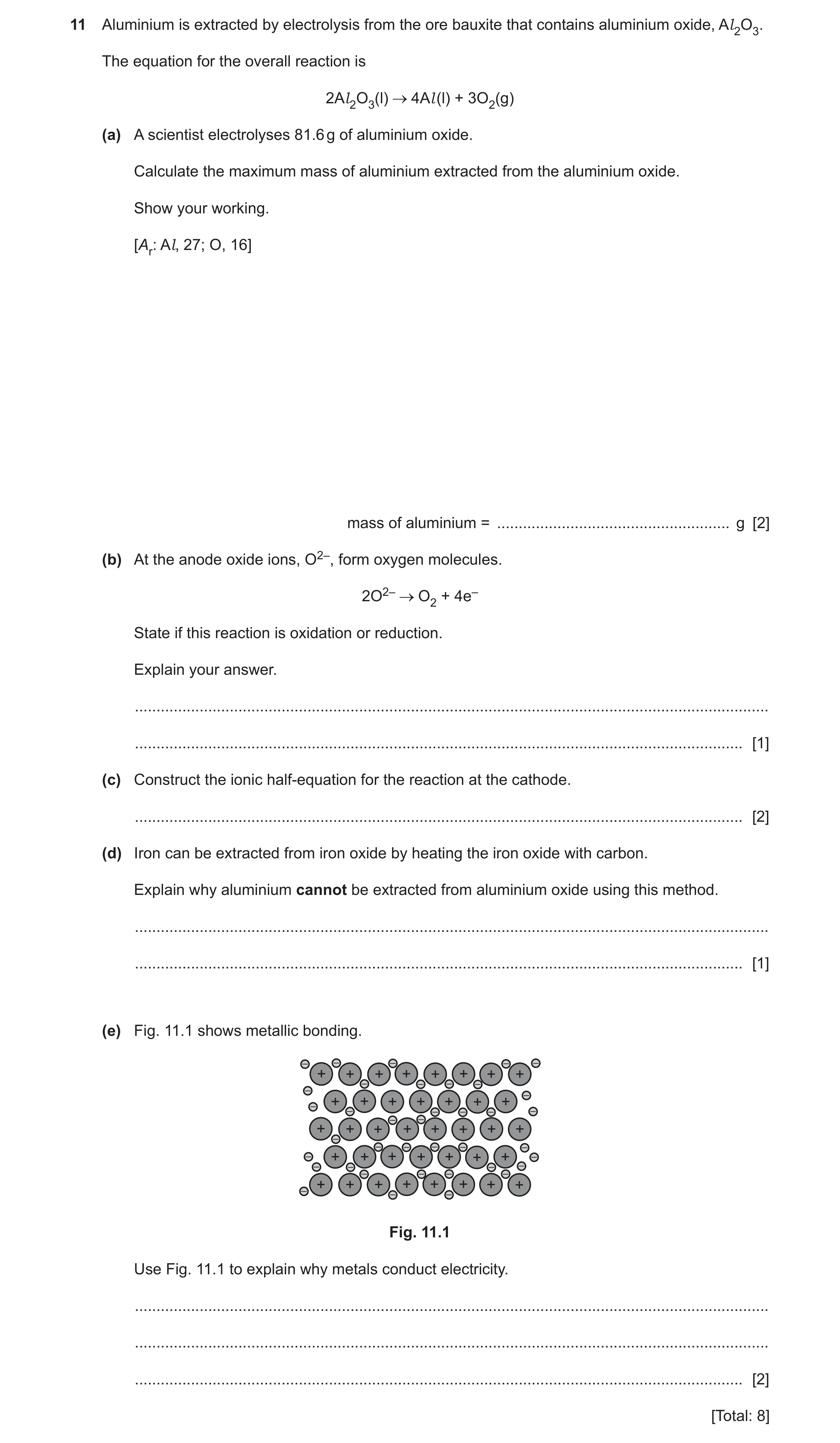
11 Aluminium is extracted by electrolysis from the ore bauxite that contains aluminium oxide, Al 2O3. The equation for the overall reaction is 2Al 2O3(l) 4Al (l) + 3O2(g) (a) A scientist electrolyses 81.6 g of aluminium oxide. Calculate the maximum mass of aluminium extracted from the aluminium oxide. Show your working. [Ar: Al, 27; O, 16] mass of aluminium = … g [2] (b) At the anode oxide ions, O2–, form oxygen molecules. 2O2– O2 + 4e– State if this reaction is oxidation or reduction. Explain your answer. … … [1] (c) Construct the ionic half‑equation for the reaction at the cathode. … [2] (d) Iron can be extracted from iron oxide by heating the iron oxide with carbon. Explain why aluminium cannot be extracted from aluminium oxide using this method. … … [1] (e) Fig. 11.1 shows metallic bonding. – – – – – + + + + + + + + – – – – – – + + + + + + + – – – – – – – – + + + + + + + + – – – – – – – – + + + + + + + – – – – – – – – – + + + – + + – + + + Fig. 11.1 Use Fig. 11.1 to explain why metals conduct electricity. … … … [2] [Total: 8]
8 marks
Mark scheme: 11(a) relative molecular mass of Al2O3 = 102 ; 2 (54 81.6 g ) ; = 43.2 ( 102 11(b) oxidation 1 and electrons are lost ; 11(c) Al3+ + 3e– → Al 2 1 mark for correct symbols ; 1 mark for correctly balanced electrons ; 11(d) idea that aluminium is more reactive than carbon / ORA ; 1 11(e) has free electrons ; 2 which can move throughout/in (the metal) ;
This question in 0654/41 Oct/Nov 2024
Q20 · Complete the sentence about electrolysis 0654/42 Oct/Nov 2024
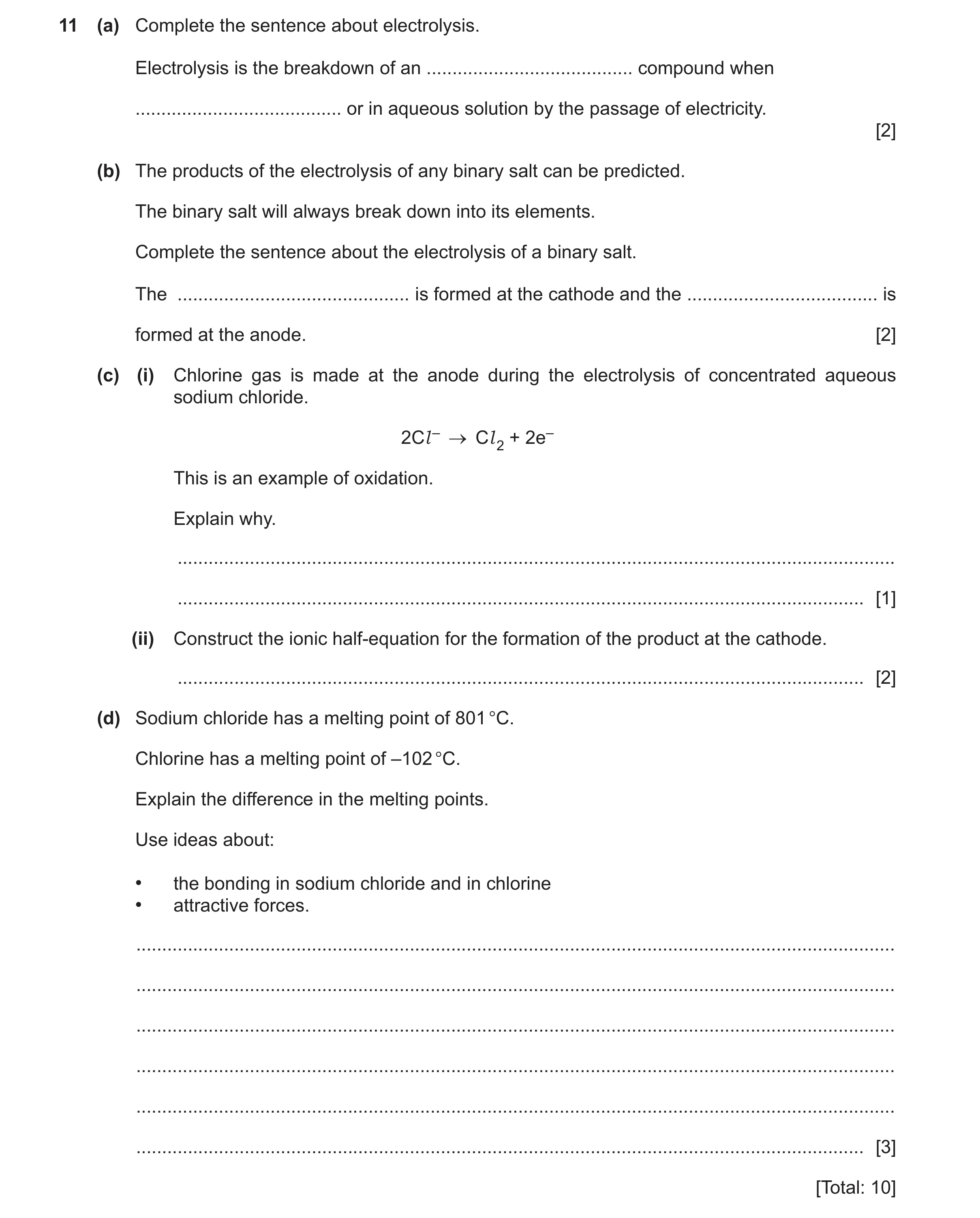
11 (a) Complete the sentence about electrolysis. Electrolysis is the breakdown of an … compound when … or in aqueous solution by the passage of electricity. [2] (b) The products of the electrolysis of any binary salt can be predicted. The binary salt will always break down into its elements. Complete the sentence about the electrolysis of a binary salt. The … is formed at the cathode and the … is formed at the anode. [2] (c) (i) Chlorine gas is made at the anode during the electrolysis of concentrated aqueous sodium chloride. 2Cl – Cl + 2e– 2 This is an example of oxidation. Explain why. … … [1] (ii) Construct the ionic half-equation for the formation of the product at the cathode. … [2] (d) Sodium chloride has a melting point of 801 °C. Chlorine has a melting point of –102 °C. Explain the difference in the melting points. Use ideas about: • the bonding in sodium chloride and in chlorine • attractive forces. … … … … … … [3] [Total: 10]
10 marks
Mark scheme: 11(a) ionic ; 2 molten ; 11(b) metal ; 2 non-metal ; 11(c)(i) loss of electrons ; 1 11(c)(ii) 2H+ + 2e– → H2 2 1 mark for correct symbols ; 1 mark for correctly balanced electrons ; 11(d) sodium chloride is ionic ; 3 chlorine is covalent ; chlorine has weak intermolecular forces / sodium chloride has strong (electrostatic) forces between oppositely charged ions ;
This question in 0654/42 Oct/Nov 2024
Q21 · The electrolysis of aqueous copper sulfate using graphite electrodes 0654/42 Feb/March 2025
8 Fig. 8.1 shows the electrolysis of aqueous copper sulfate using graphite electrodes. 6 V d.c. supply + – Cu2+ anode cathode SO42– Fig. 8.1 (a) Draw arrows on Fig. 8.1 to show the direction of movement of the ions. [1] (b) Aqueous copper sulfate also contains hydrogen ions, H+, and hydroxide ions, OH–. (i) State the name of the product formed at the anode. … [1] (ii) Describe what would be observed at the anode. … [1] (c) Write the ionic half-equation for the reaction of copper ions, Cu2+, to form copper, Cu. … [2] (d) The electrodes in the experiment are made of graphite. State two reasons why graphite is used for the electrodes. Explain your answer using ideas about structure and bonding. 1 … 2 … explanation … … [3] (e) Graphite is a form of the element carbon. Carbon reacts with oxygen to form carbon dioxide, CO2. Complete the dot-and-cross diagram in Fig. 8.2 to show the bonding in carbon dioxide. Only show the outer-shell electrons. O C O Fig. 8.2 [2] (f) Methane is another gas that contains the element carbon. Methane has a low boiling point. Explain why. … … [1] [Total: 11]
11 marks
Mark scheme: 8(a) arrow from Cu2+ to cathode and arrow from SO42– to anode ; 1 8(b)(i) oxygen ; 1 8(b)(ii) fizzing / bubbling / effervescence ; 1 8(c) Cu2+ + 2e– → Cu ; ; 2 8(d) 1: (graphite) conducts electricity ; 3 2: (graphite) is inert ; (graphite has) delocalised electrons OR because outer shell electrons are used in bonding ; 8(e) 2 ; ; 8(f) (methane has) weak intermolecular forces ; 1
This question in 0654/42 Feb/March 2025
 13 / 32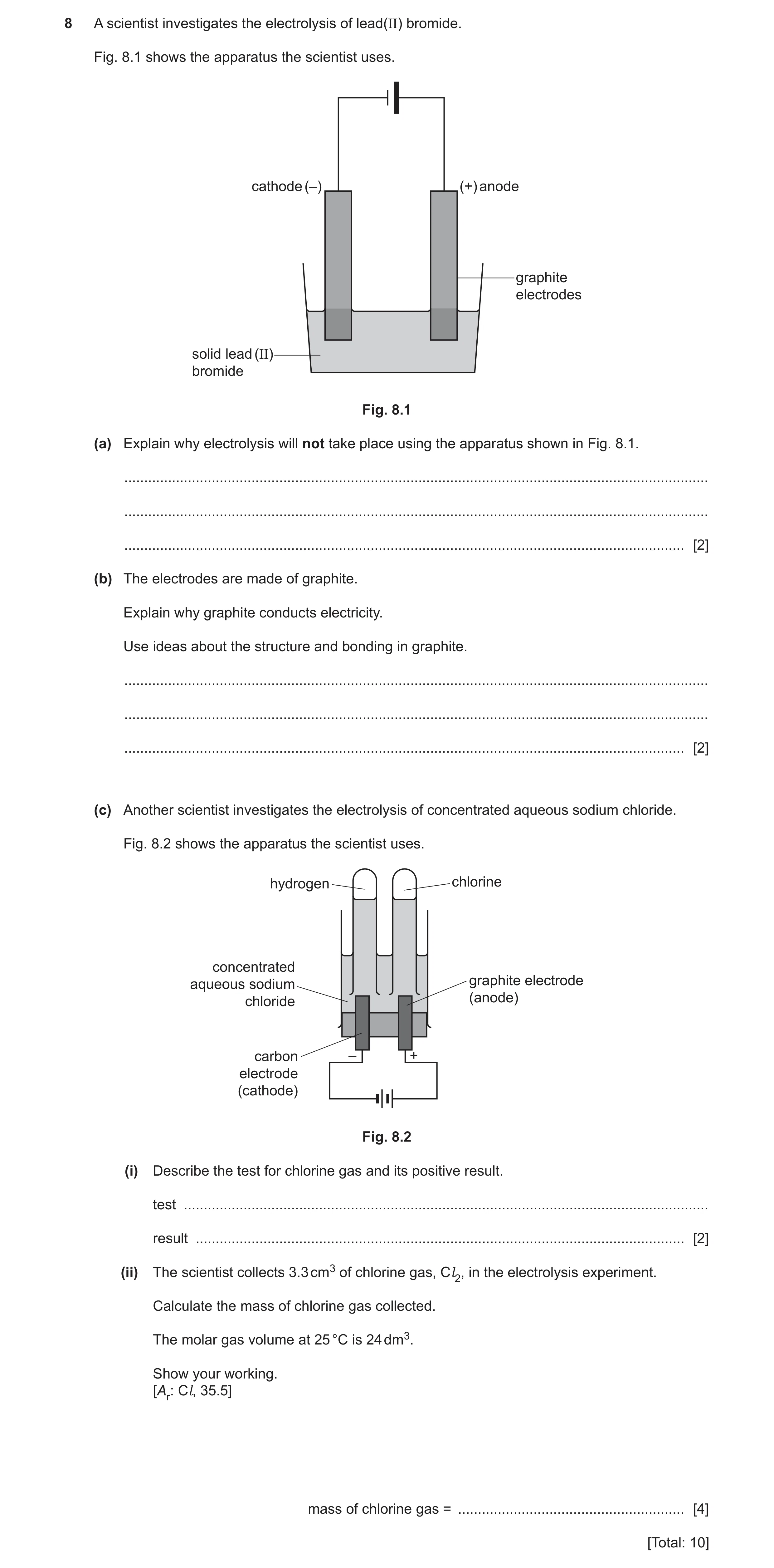
 21 / 32
 22 / 32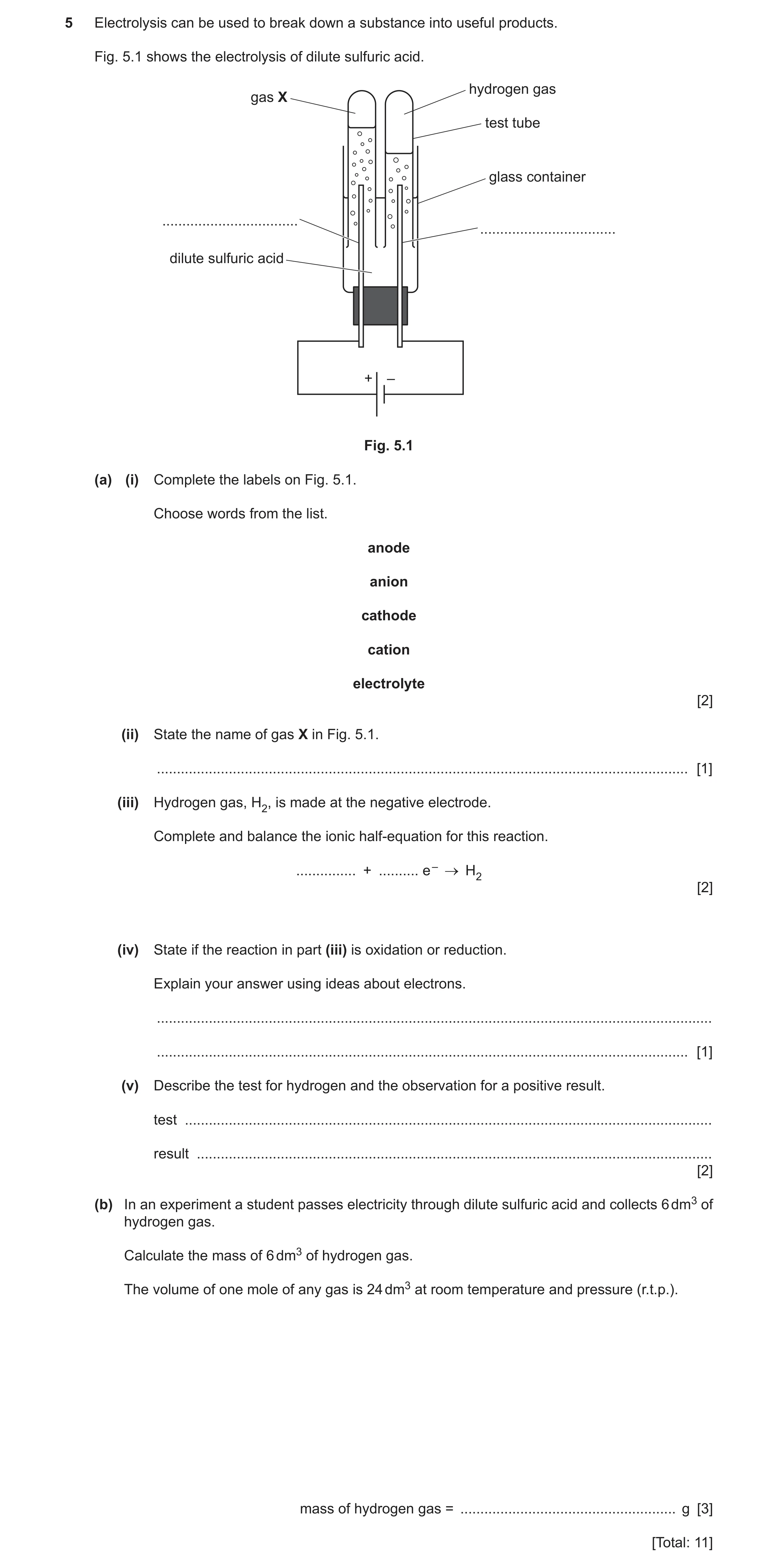
 30 / 32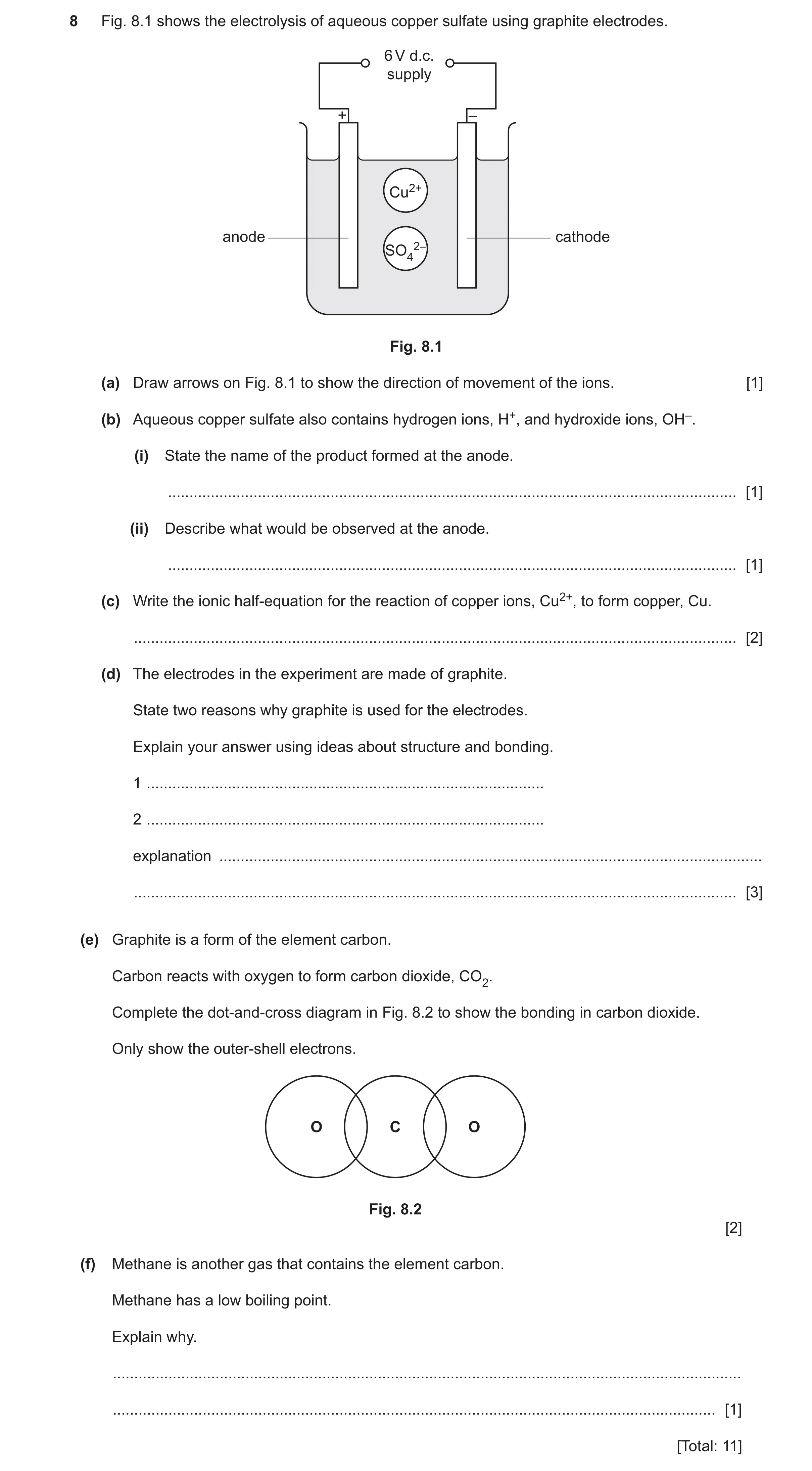
 7
7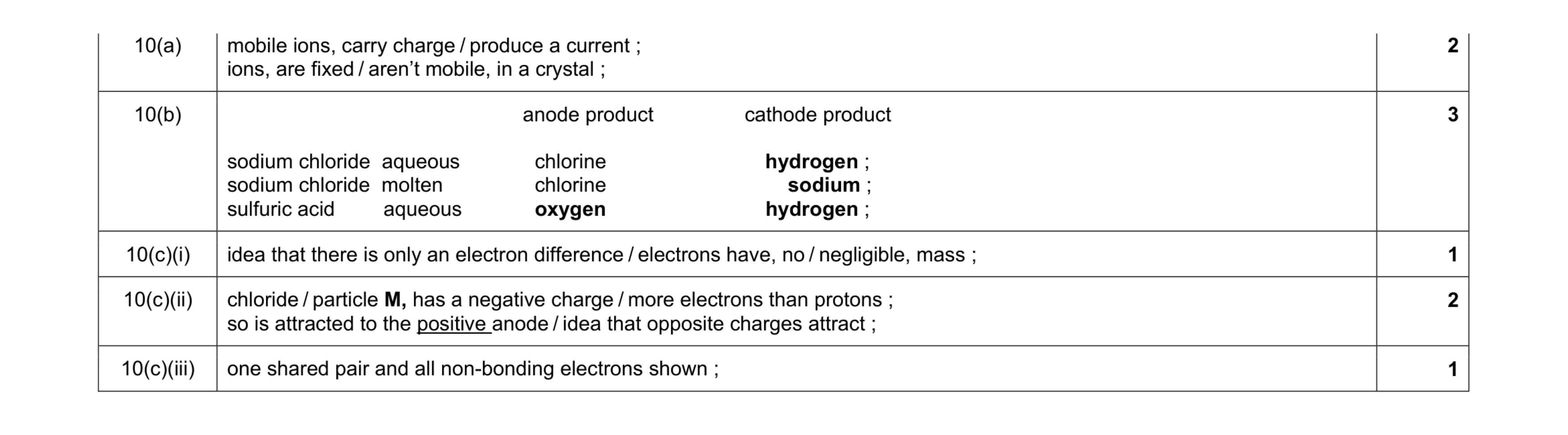 9
9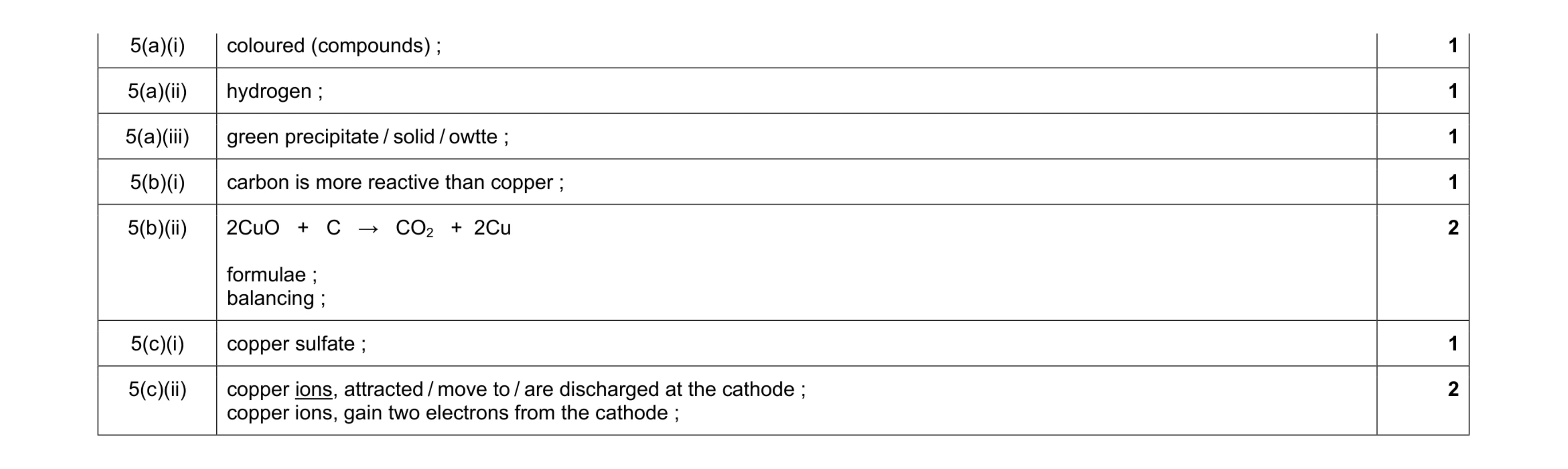 9
9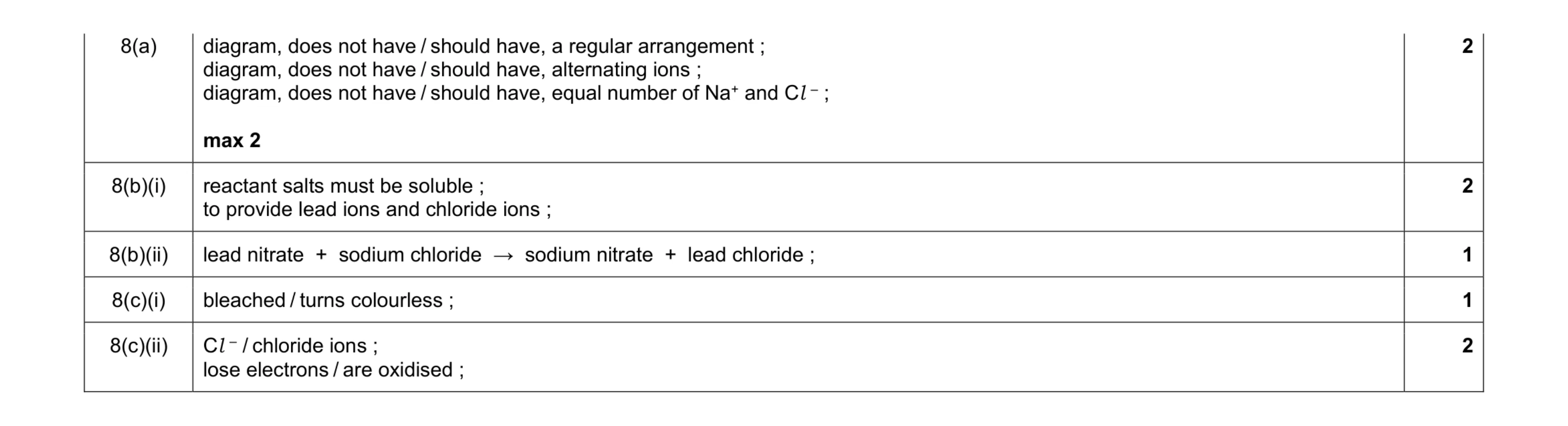 8
8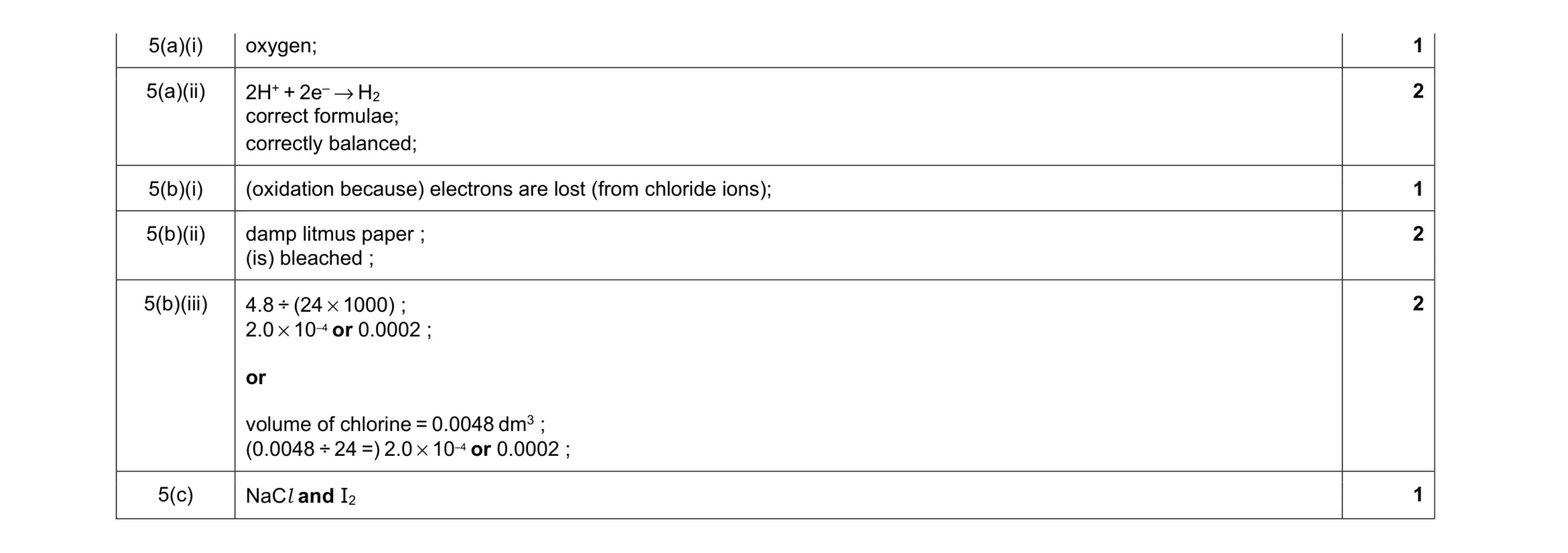 9
9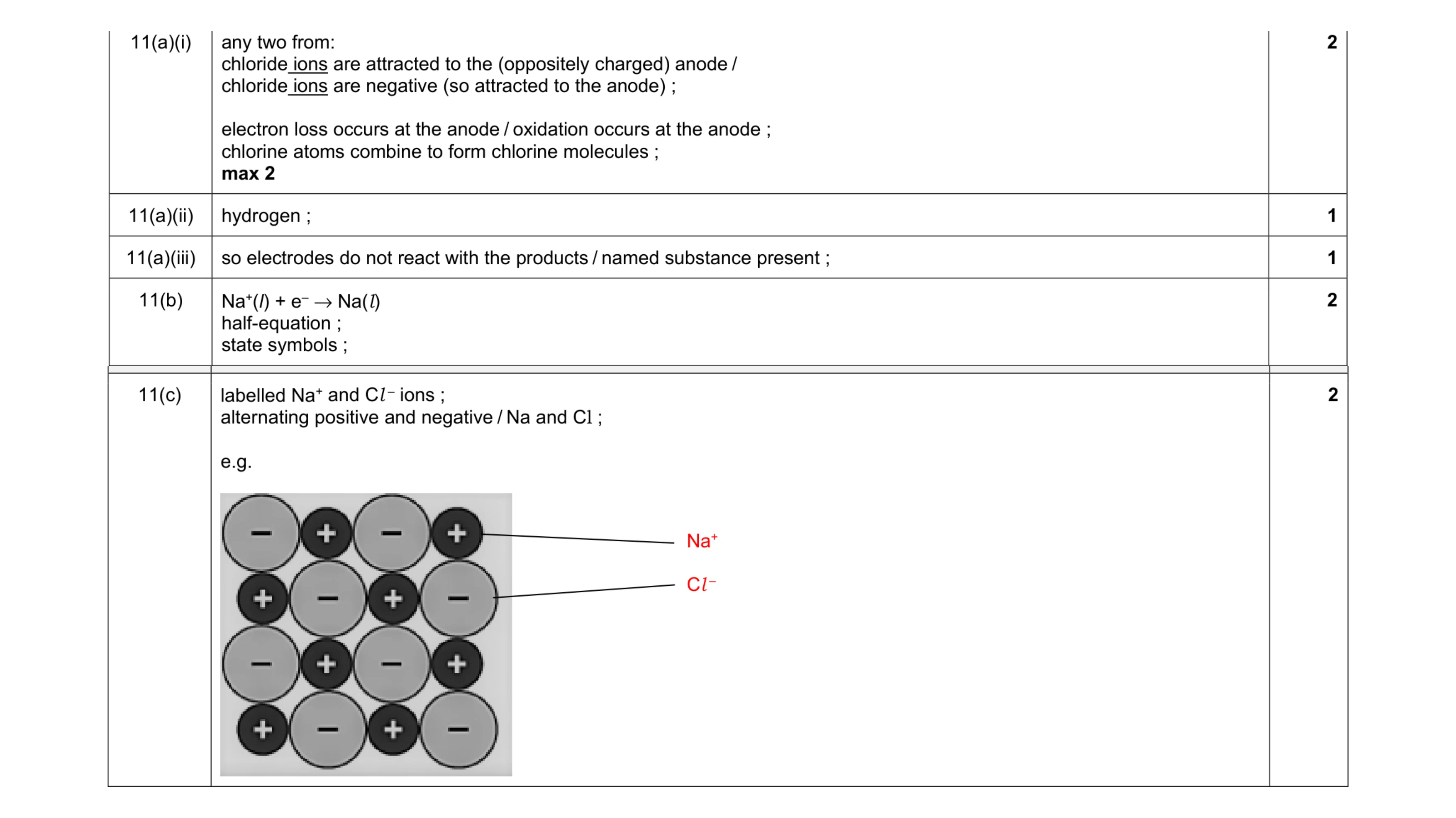 8
8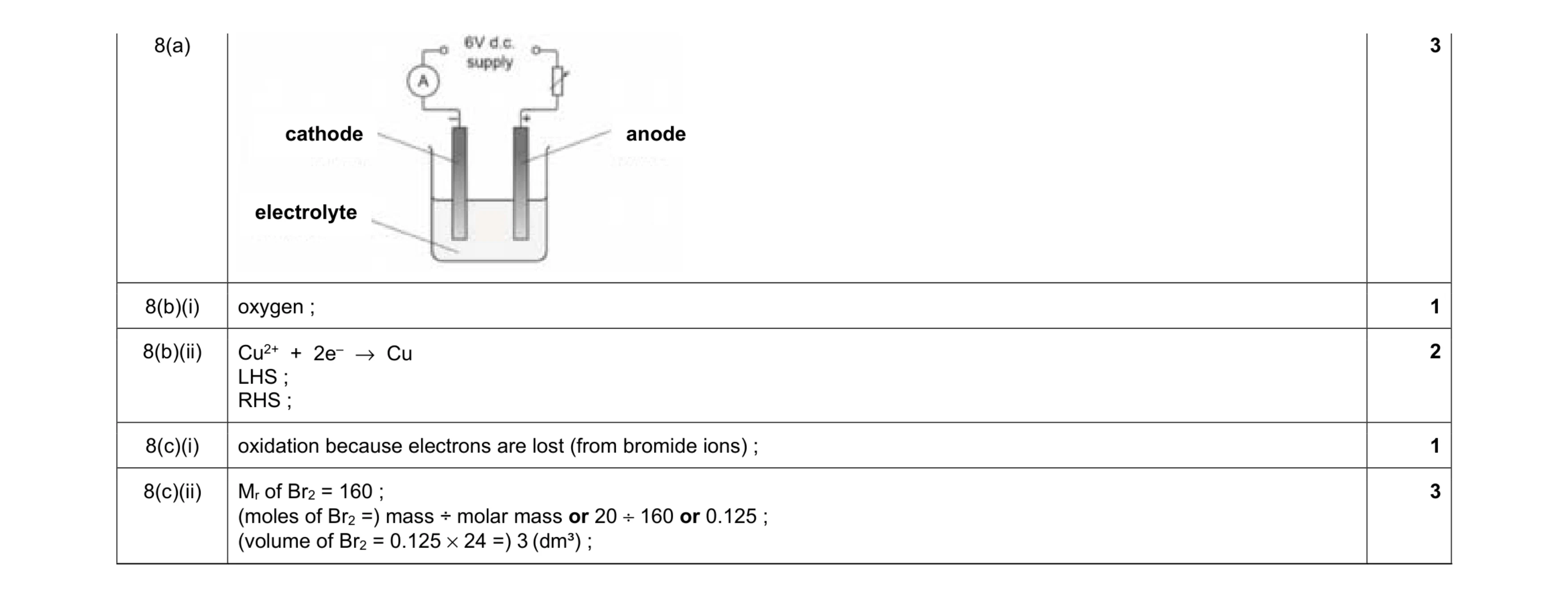 10
10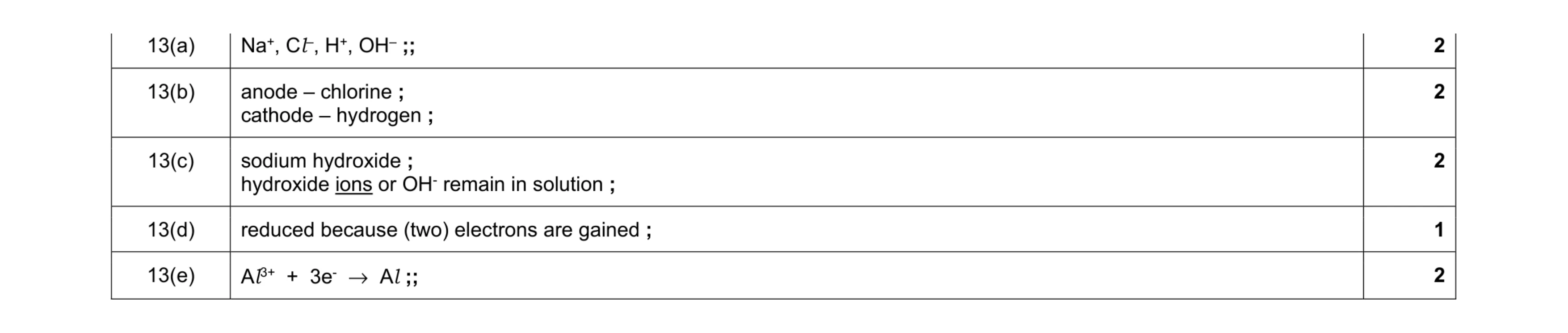 9
9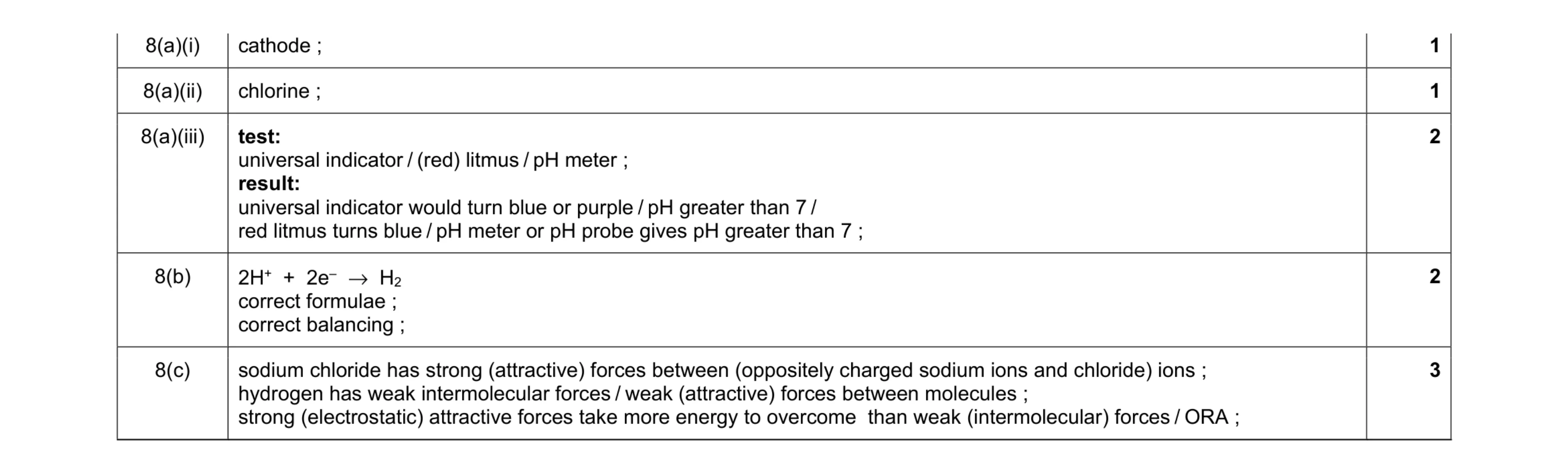 9
9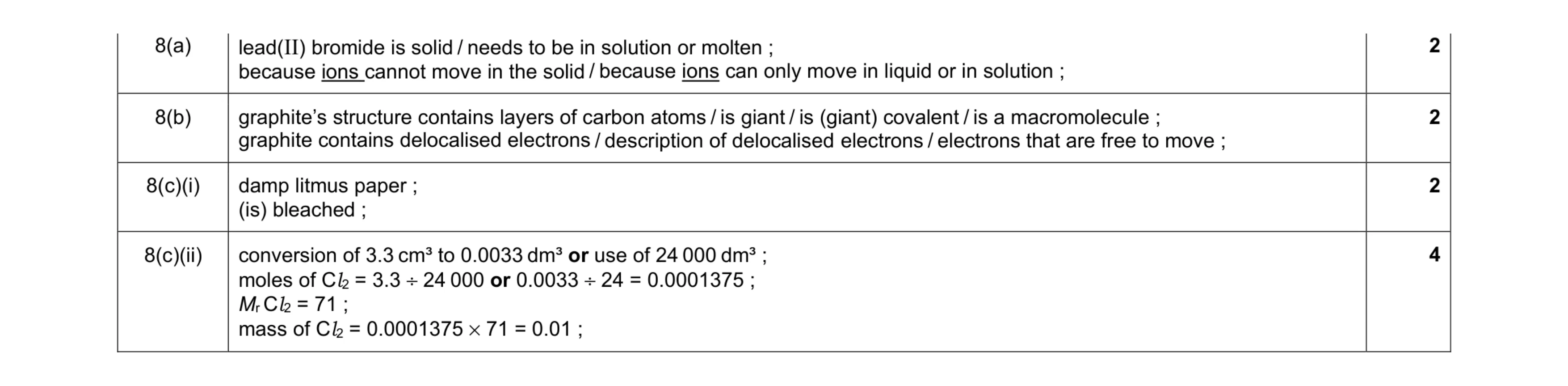 10
10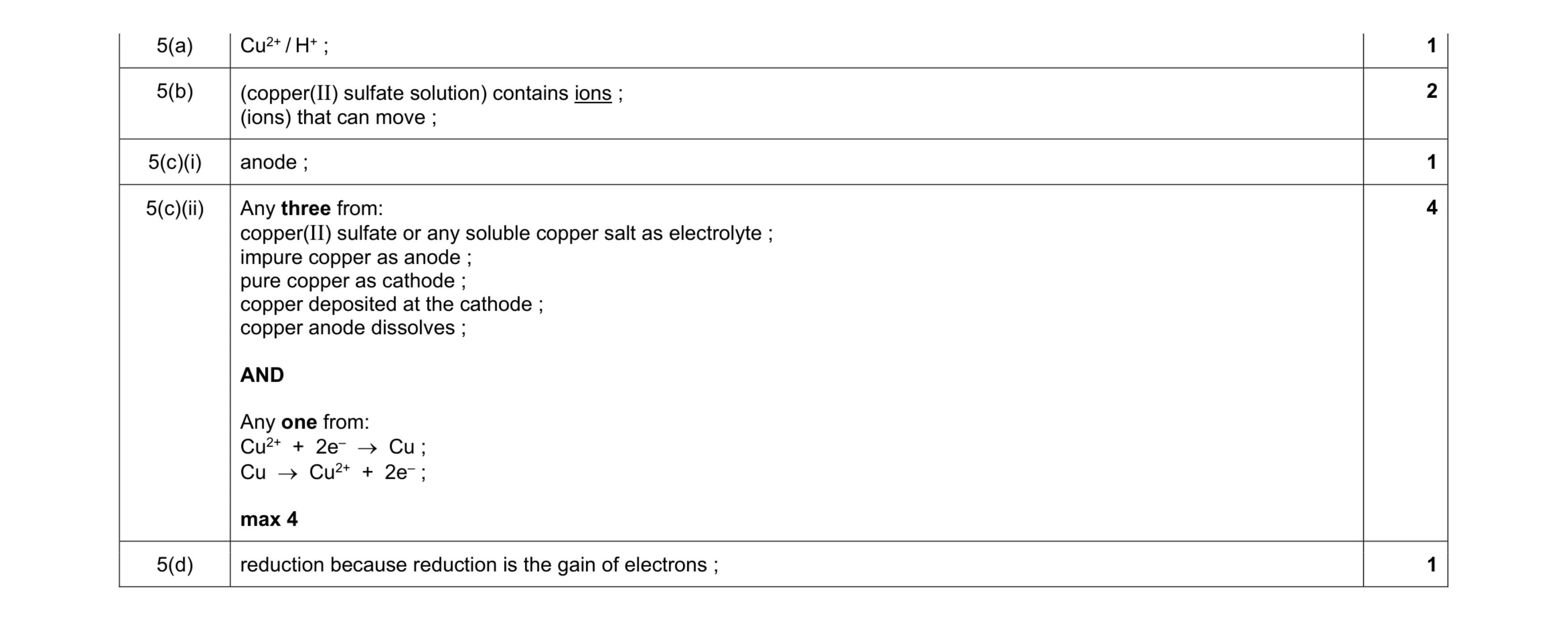 9
9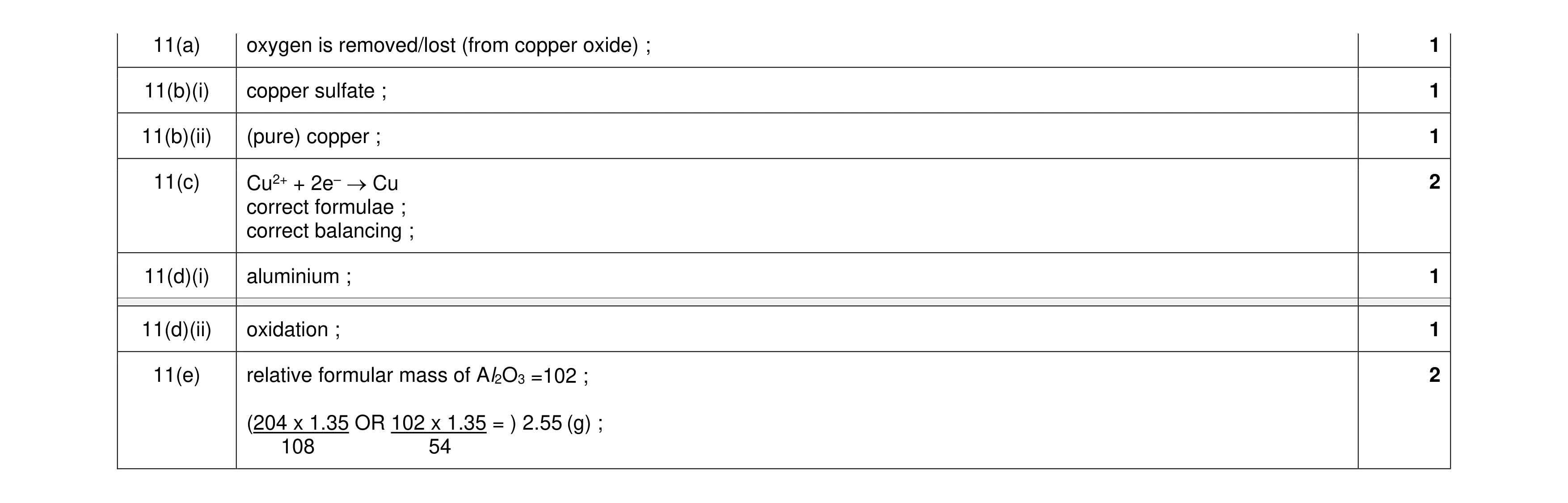 9
9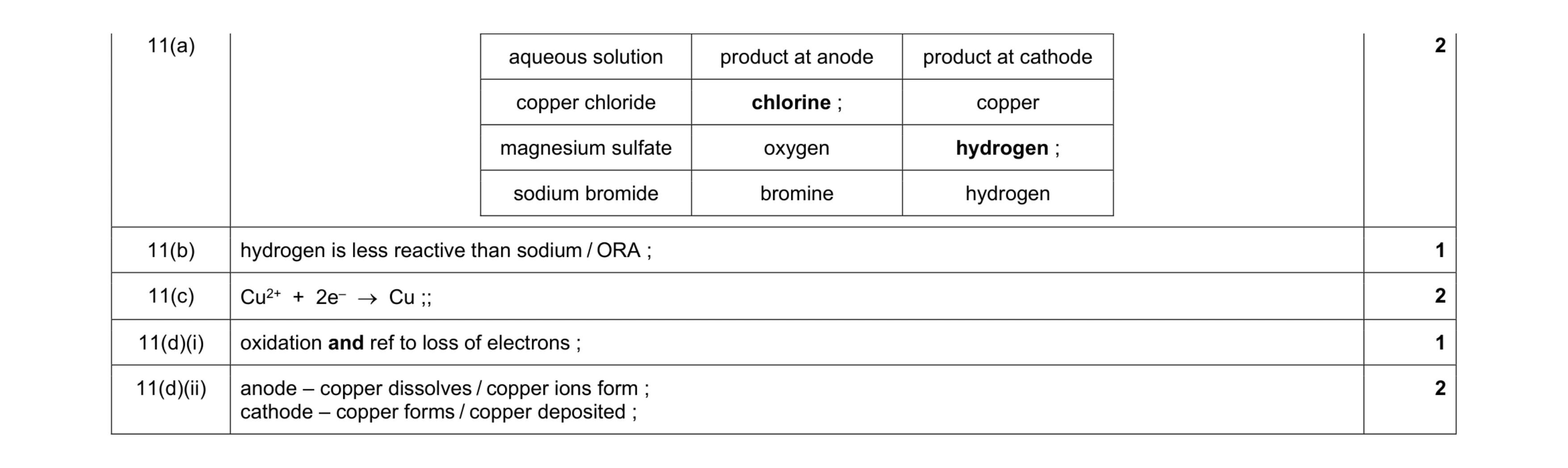 8
8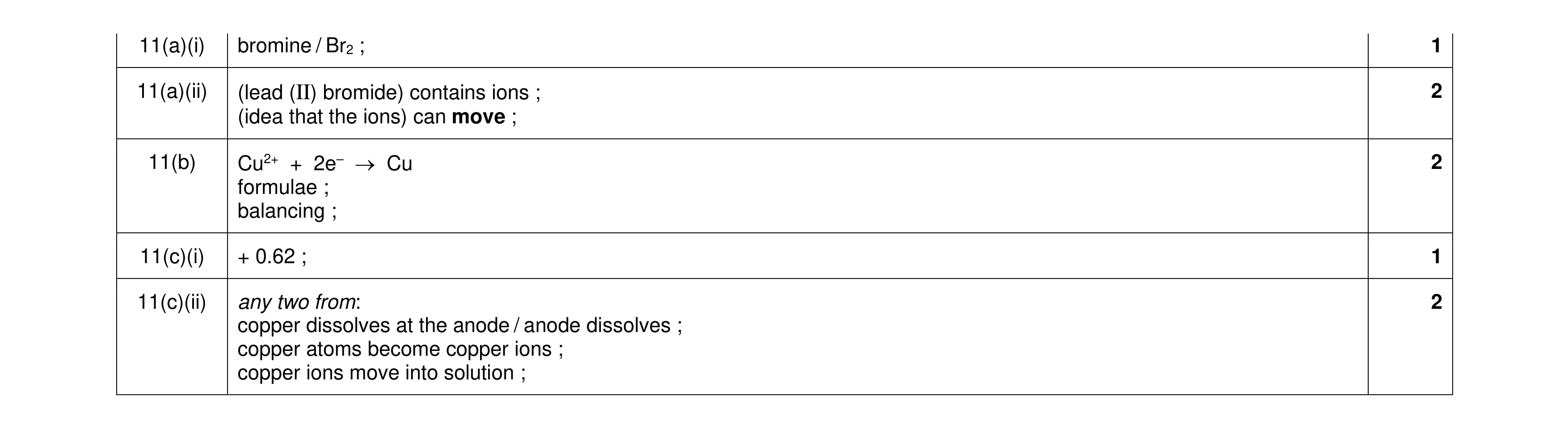 8
8 7
7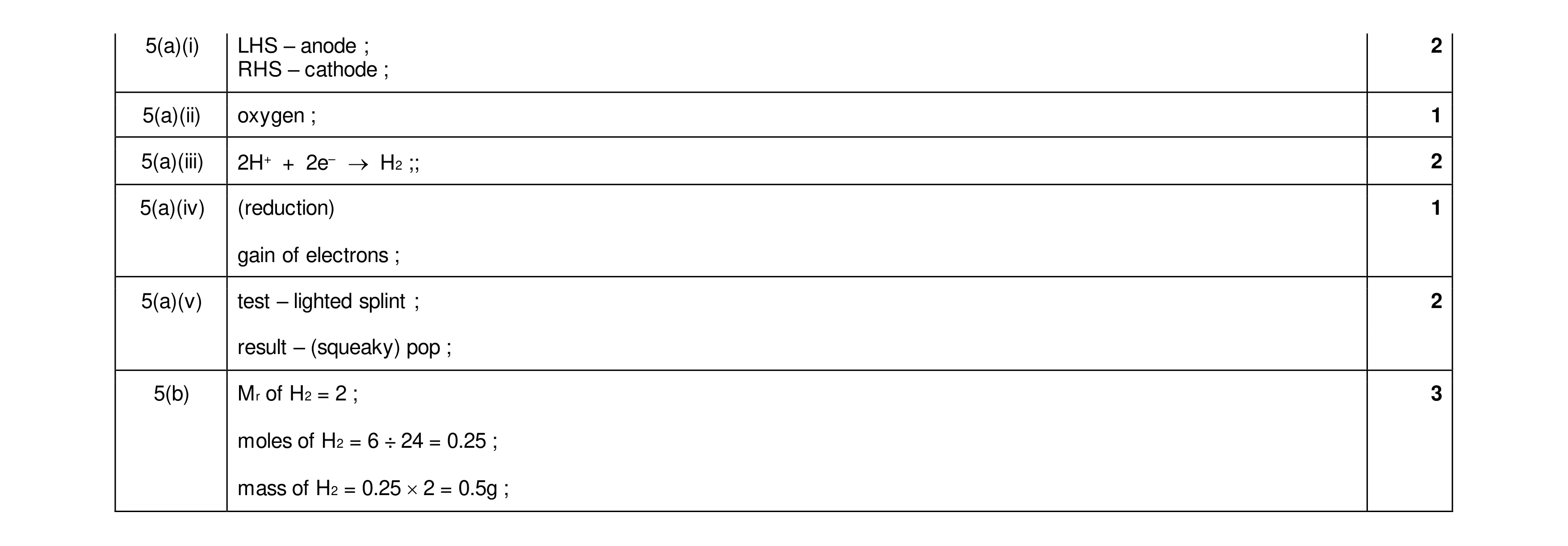 11
11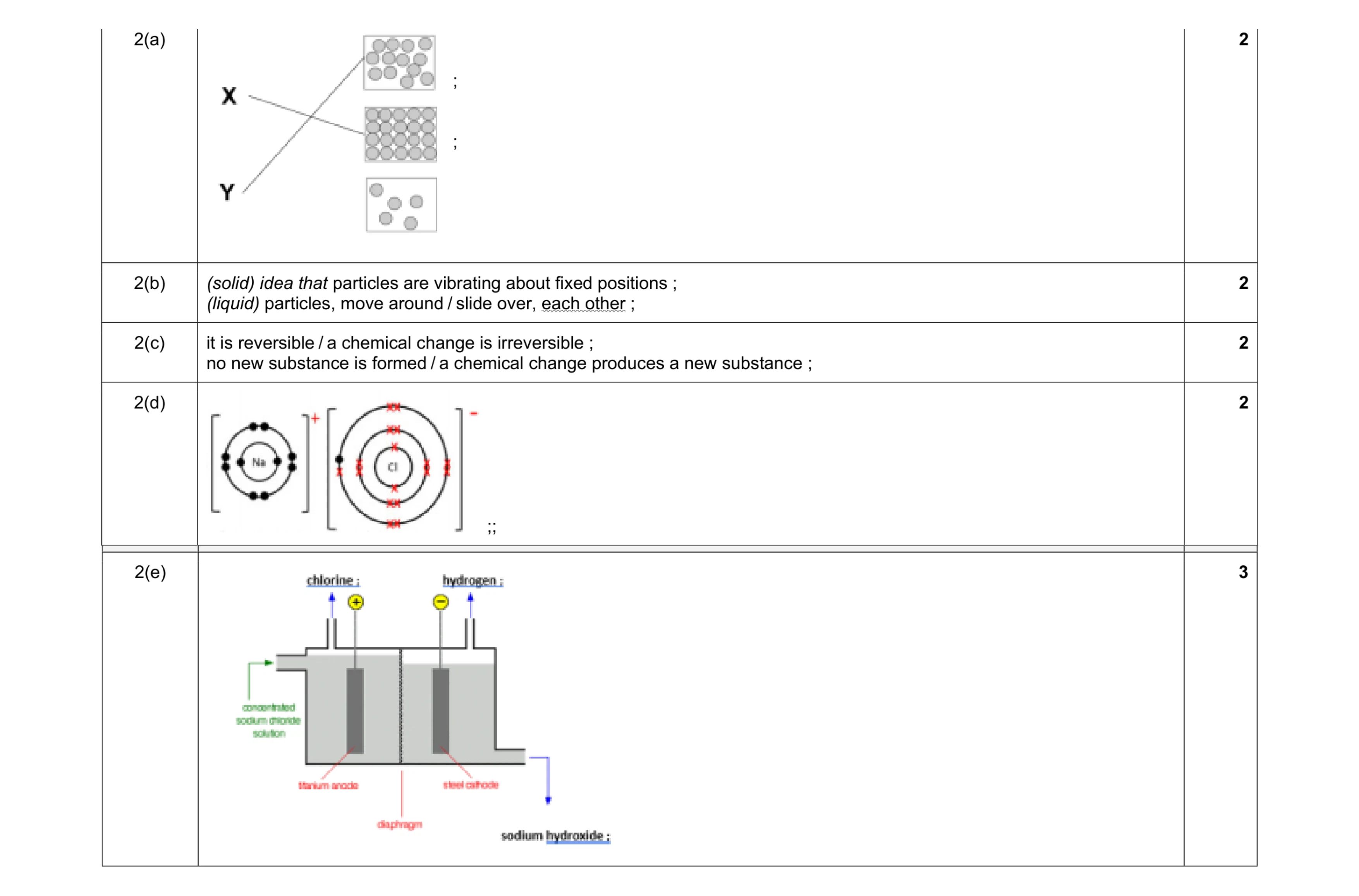 11
11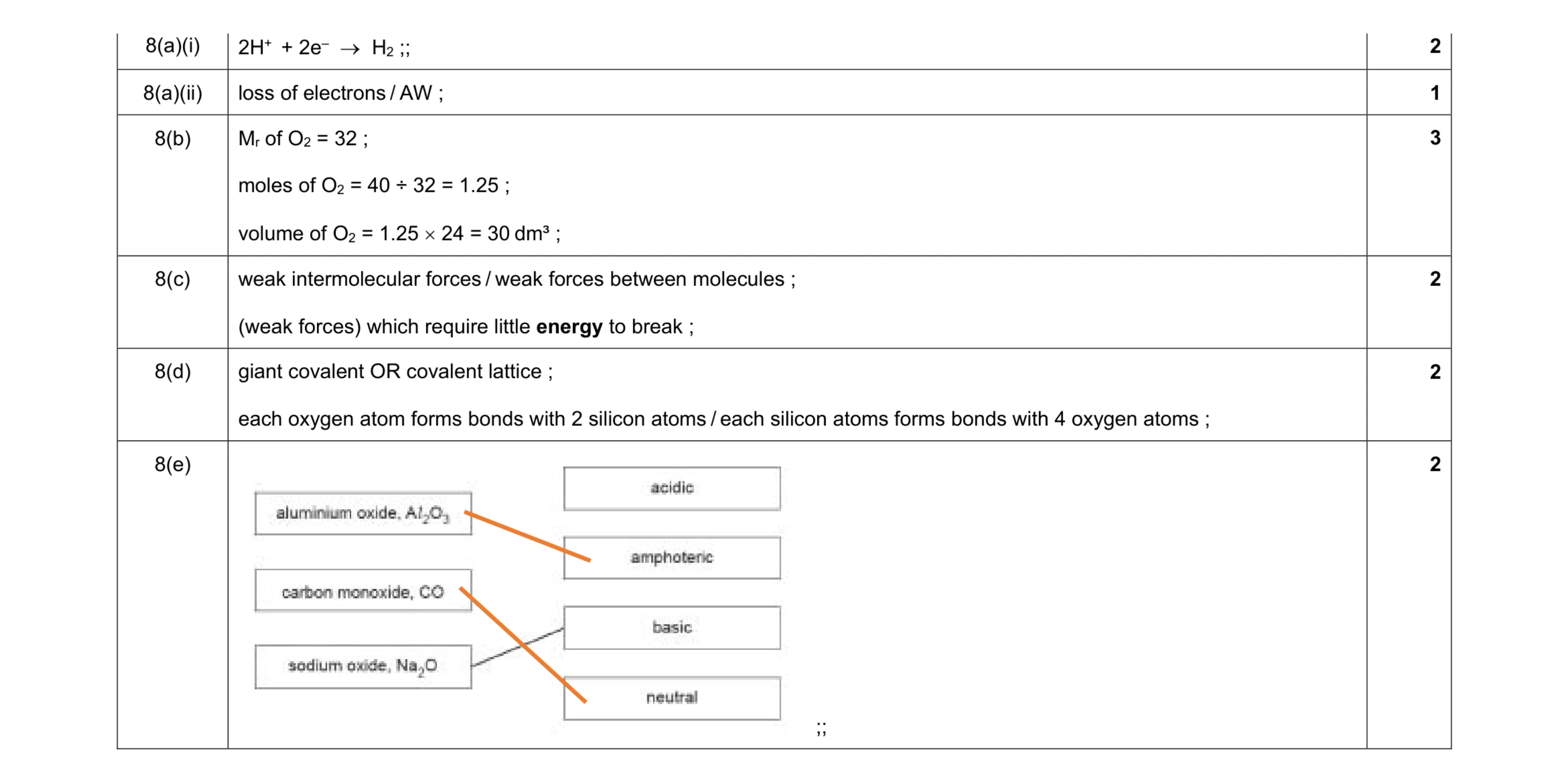 12
12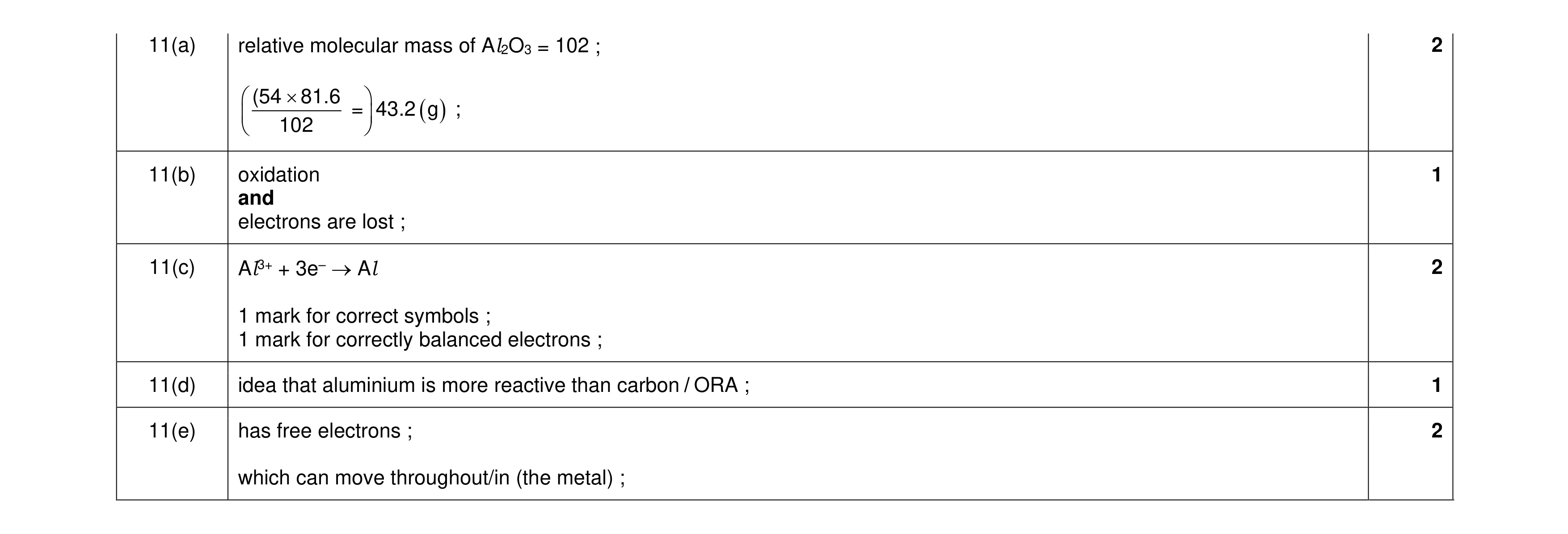 8
8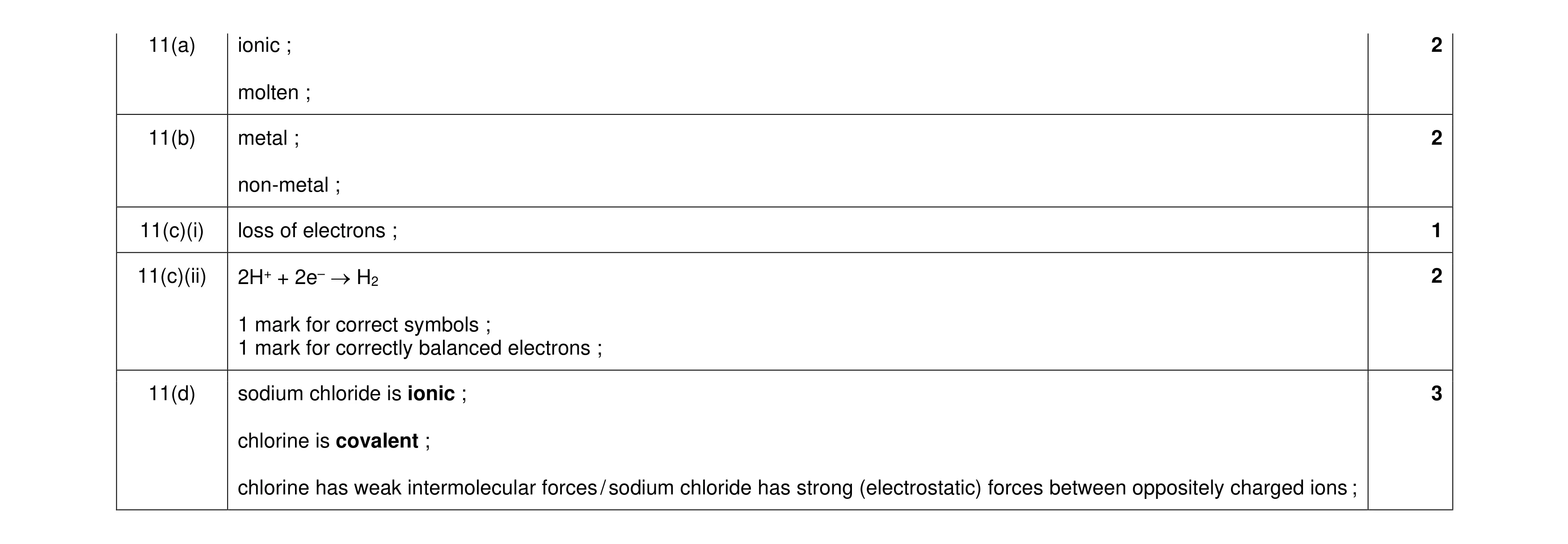 10
10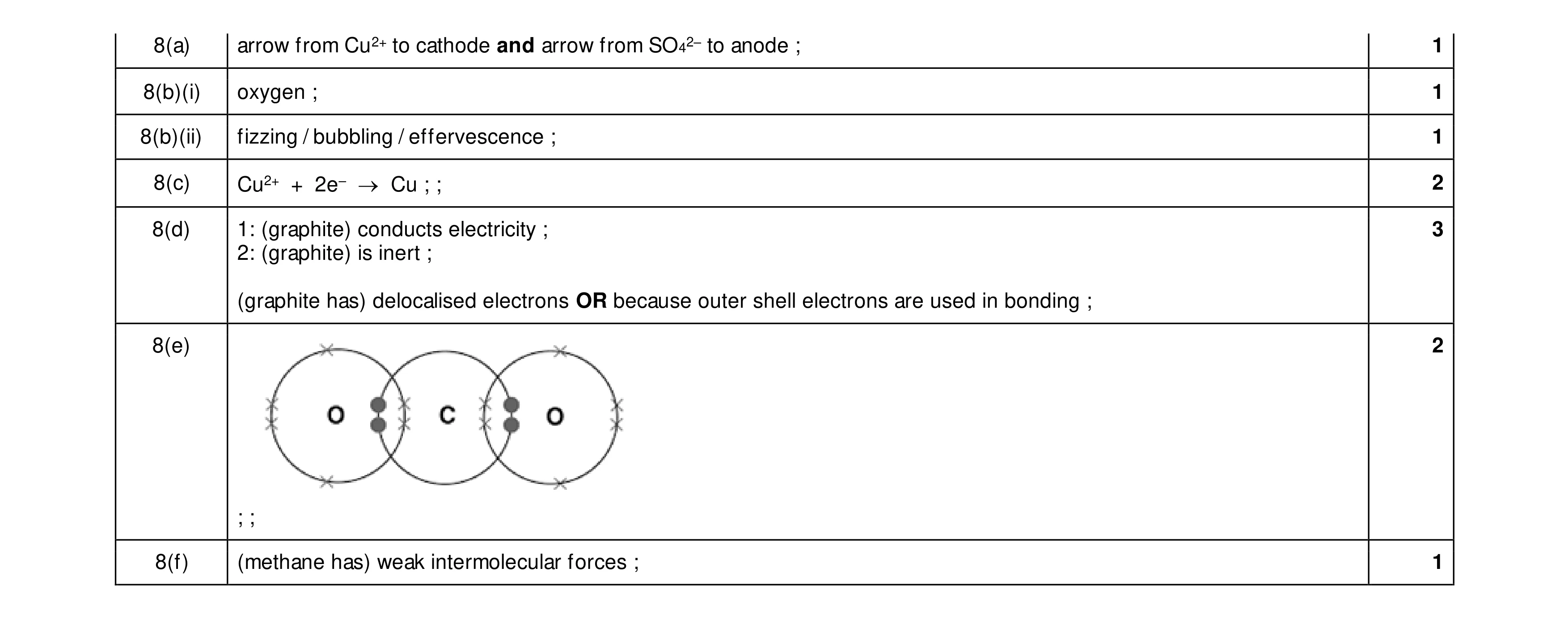 11
11