Cambridge IGCSE Sciences - Co-ordinated (Double) 0654 — 2022 Oct/Nov Paper 1 · Variant 3
0654/13/O/N/22 · 40 questions · 40 marks · ≈45 min
The question paper and its mark scheme, free to read here and free to download. This is Cambridge’s own paper, exactly as it was sat.
Question paper16 pages
Mark scheme3 pages
Answers below. Sit the paper first if you are practising.
Questions as text
Q1 · Which characteristic of living organisms involves chemical reactions that break down…
1 Which characteristic of living organisms involves chemical reactions that break down nutrient molecules to release energy? A excretion B nutrition C reproduction D respiration
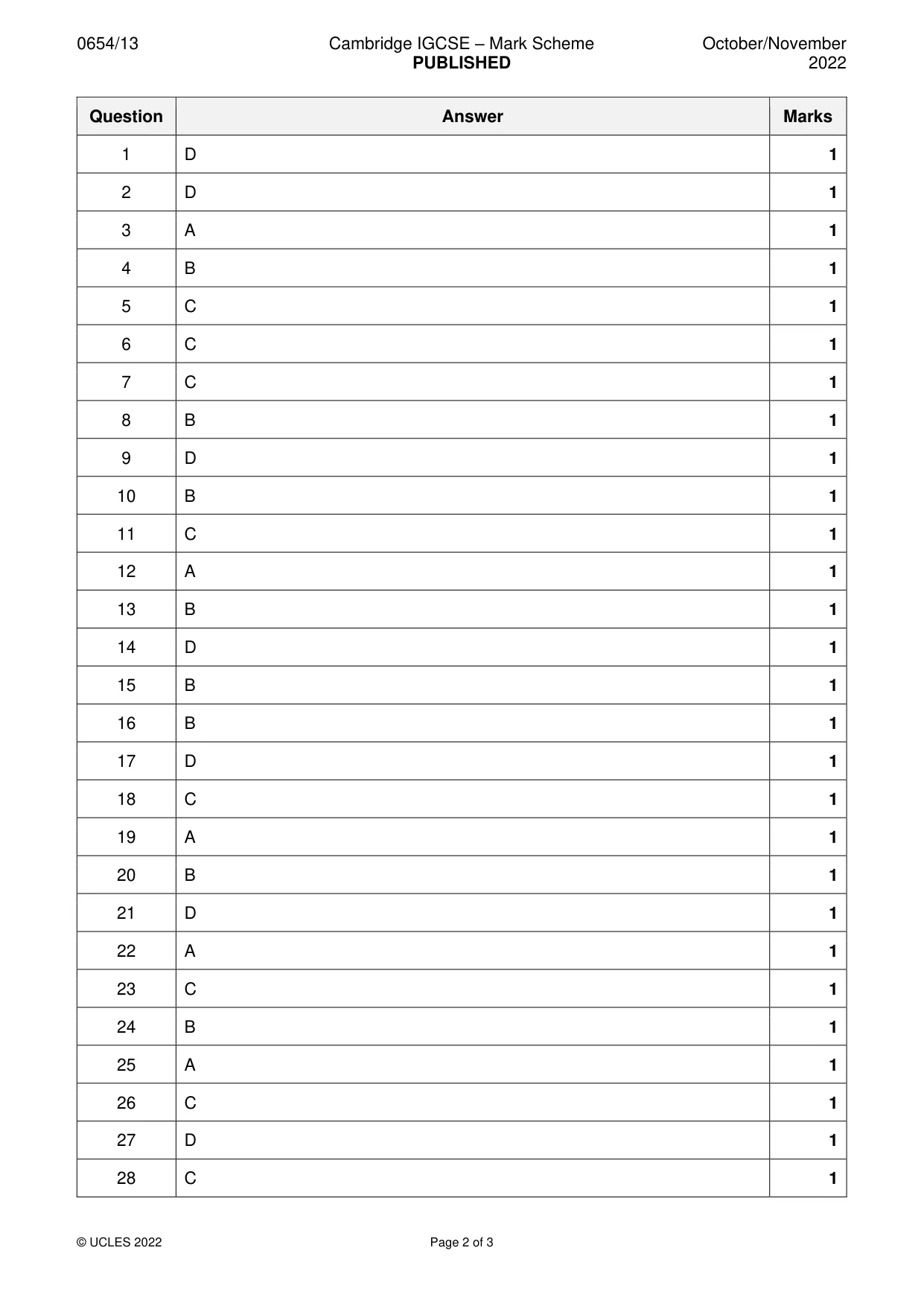
Mark scheme: D
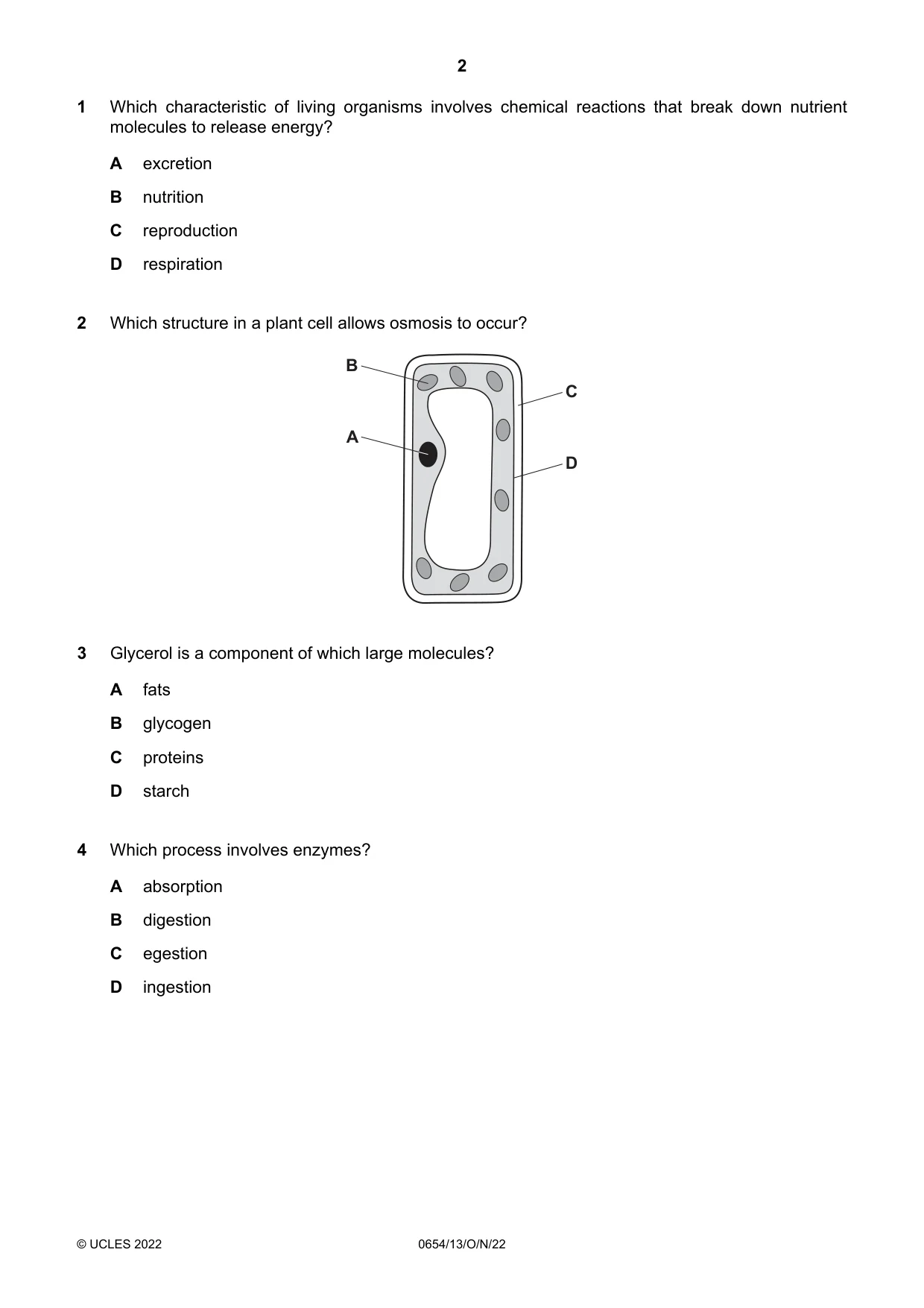
Q2 · Which structure in a plant cell allows osmosis to occur?
2 Which structure in a plant cell allows osmosis to occur? B C A D
Mark scheme: D
Q3 · Glycerol is a component of which large molecules?
3 Glycerol is a component of which large molecules? A fats B glycogen C proteins D starch
Mark scheme: A
Q4 · Which process involves enzymes?
4 Which process involves enzymes? A absorption B digestion C egestion D ingestion
Mark scheme: B
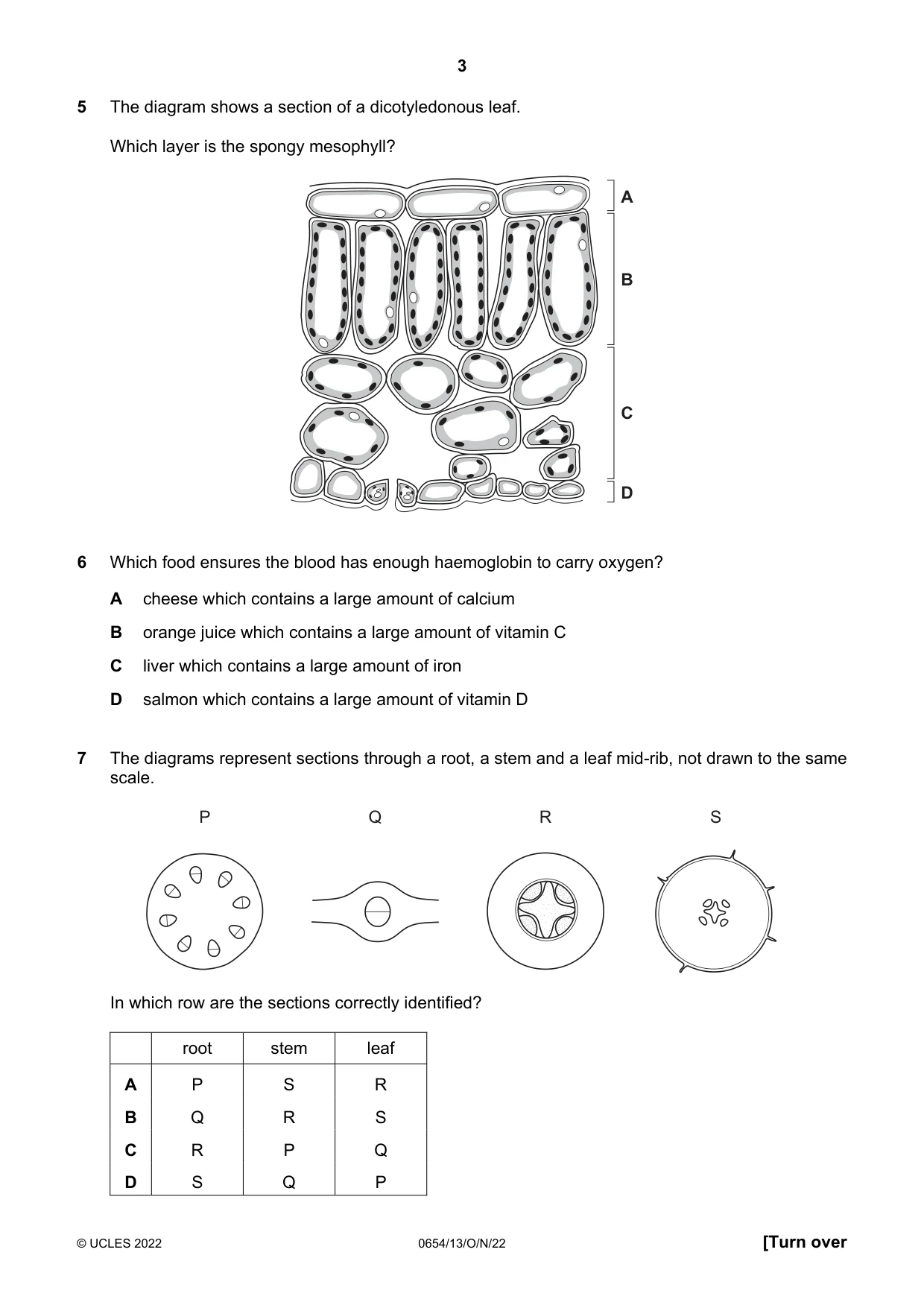
Q5 · The diagram shows a section of a dicotyledonous leaf
5 The diagram shows a section of a dicotyledonous leaf. Which layer is the spongy mesophyll? A B C D
Mark scheme: C
Q6 · Which food ensures the blood has enough haemoglobin to carry oxygen?
6 Which food ensures the blood has enough haemoglobin to carry oxygen? A cheese which contains a large amount of calcium B orange juice which contains a large amount of vitamin C C liver which contains a large amount of iron D salmon which contains a large amount of vitamin D
Mark scheme: C
Q7 · The diagrams represent sections through a root, a stem and a leaf mid-rib, not drawn to…
7 The diagrams represent sections through a root, a stem and a leaf mid-rib, not drawn to the same scale. P Q R S In which row are the sections correctly identified? root stem leaf A P S R B Q R S C R P Q D S Q P
Mark scheme: C
Q8 · A student places an insect in a sealed test-tube and measures the concentration of oxygen…
8 A student places an insect in a sealed test-tube and measures the concentration of oxygen and carbon dioxide in the test-tube. The insect is left for 30 minutes. The concentration of oxygen and carbon dioxide are then measured again. The results are shown in the table. Which row shows how these concentrations change during the experiment? oxygen carbon dioxide concentration concentration A decreases decreases B decreases increases C increases decreases D increases increases
Mark scheme: B
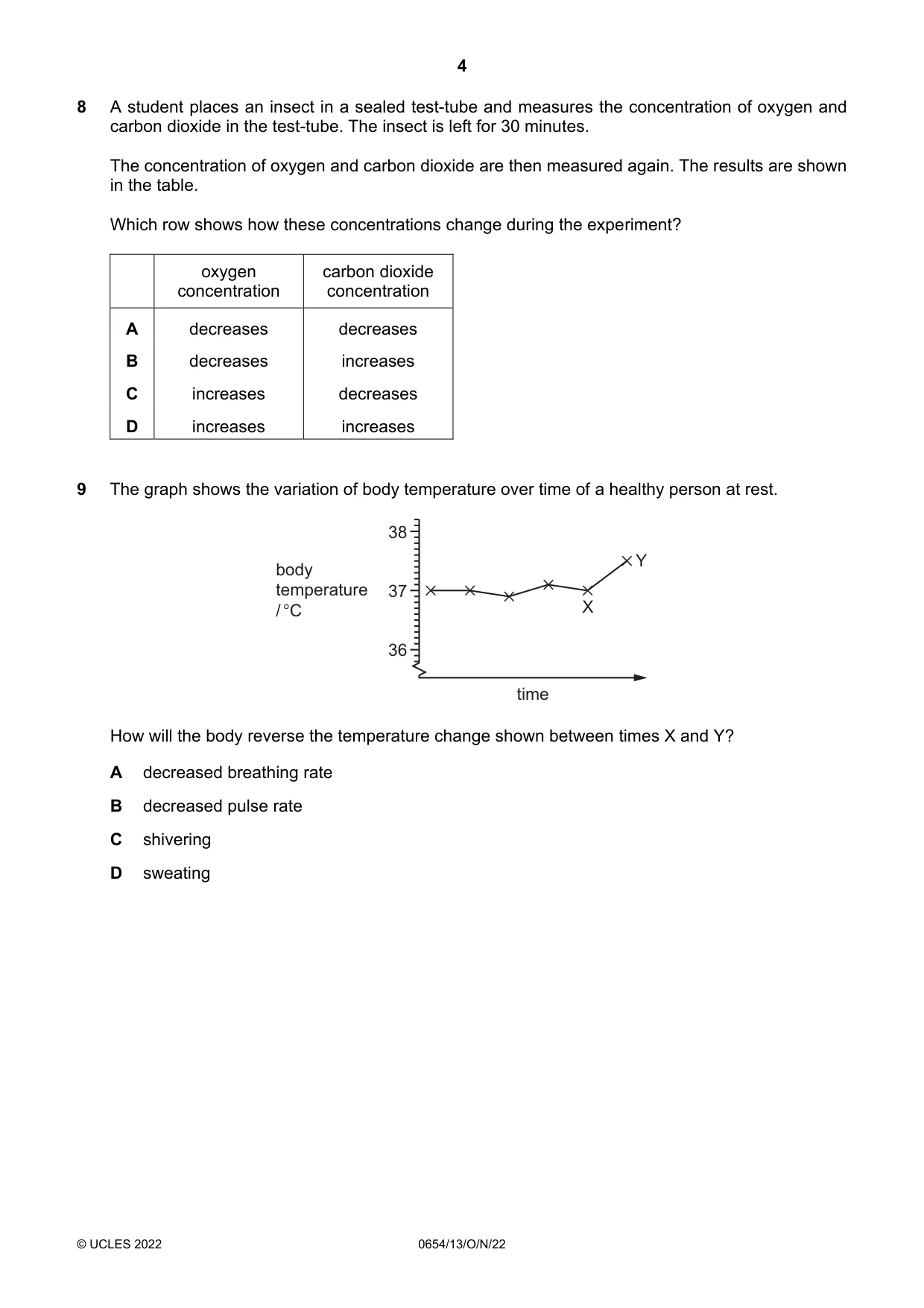
Q9 · The graph shows the variation of body temperature over time of a healthy person at rest
9 The graph shows the variation of body temperature over time of a healthy person at rest. 38 Y body temperature 37 / °C X 36 time How will the body reverse the temperature change shown between times X and Y? A decreased breathing rate B decreased pulse rate C shivering D sweating
Mark scheme: D
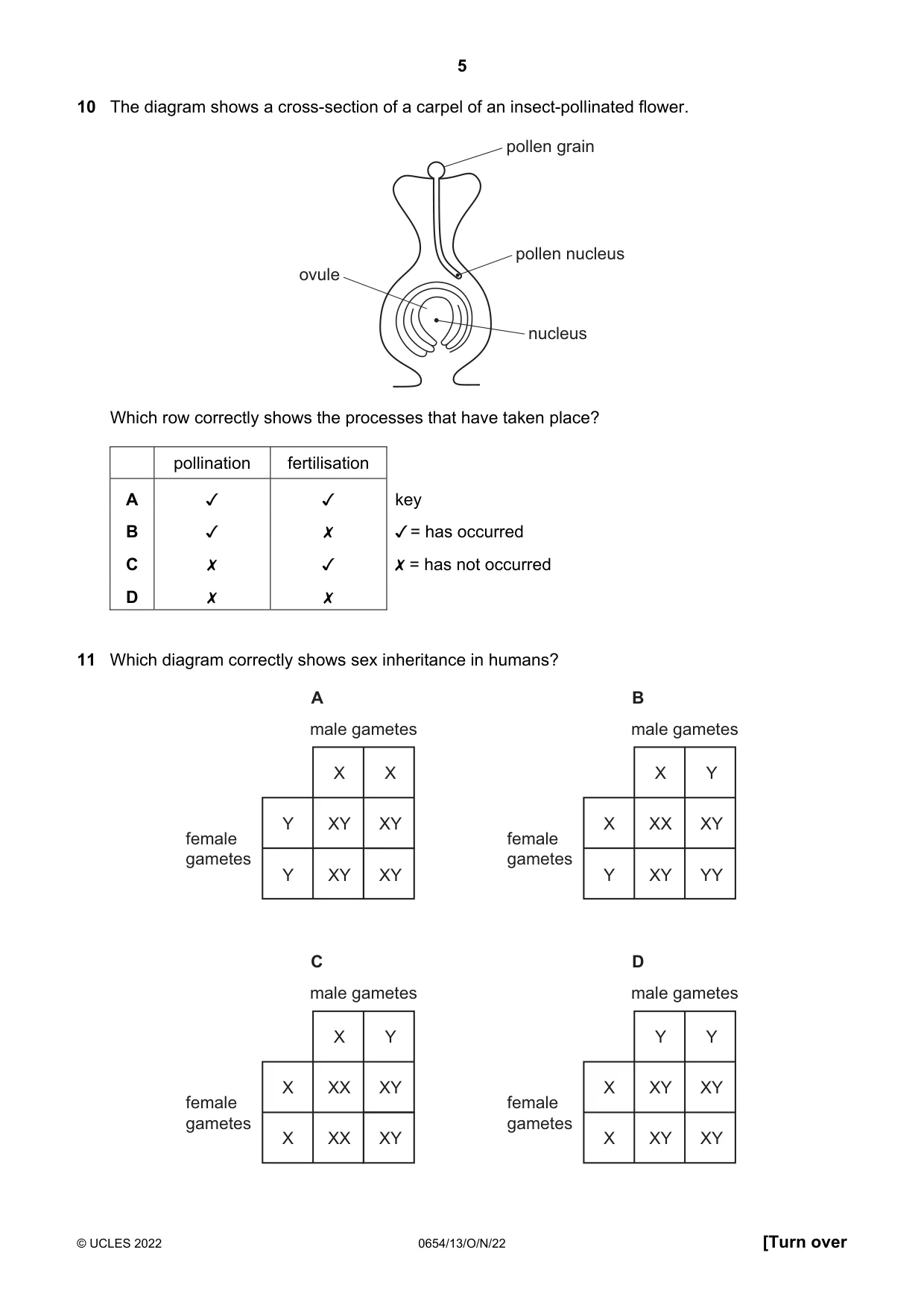
Q10 · The diagram shows a cross-section of a carpel of an insect-pollinated flower
10 The diagram shows a cross-section of a carpel of an insect-pollinated flower. ovule pollen grain pollen nucleus nucleus Which row correctly shows the processes that have taken place? pollination fertilisation A v v B v x Cc x v D x x key JY = has occurred X = has not occurred
Mark scheme: B
Q11 · Which diagram correctly shows sex inheritance in humans?
11 Which diagram correctly shows sex inheritance in humans? A B male gametes male gametes X X X Y Y XY XY X XX XY female female gametes gametes Y XY XY Y XY YY C D male gametes male gametes X Y Y Y X XX XY X XY XY female female gametes gametes X XX XY X XY XY
Mark scheme: C
Q12 · What is a carnivore?
12 What is a carnivore? A an organism that gets its energy by eating animals B an organism that gets its energy by eating plants C an organism that gets its energy from dead matter D an organism that makes its own organic matter
Mark scheme: A
Q13 · What is an undesirable effect of deforestation?
13 What is an undesirable effect of deforestation? A It increases the oxygen concentration of the atmosphere. B It leads to erosion and loss of soil. C It makes land available for agriculture. D It pollutes the air with methane.
Mark scheme: B
Q14 · In which substance are the particles closest together at room temperature?
14 In which substance are the particles closest together at room temperature? A CO2 B Ne C N2 D Zn
Mark scheme: D
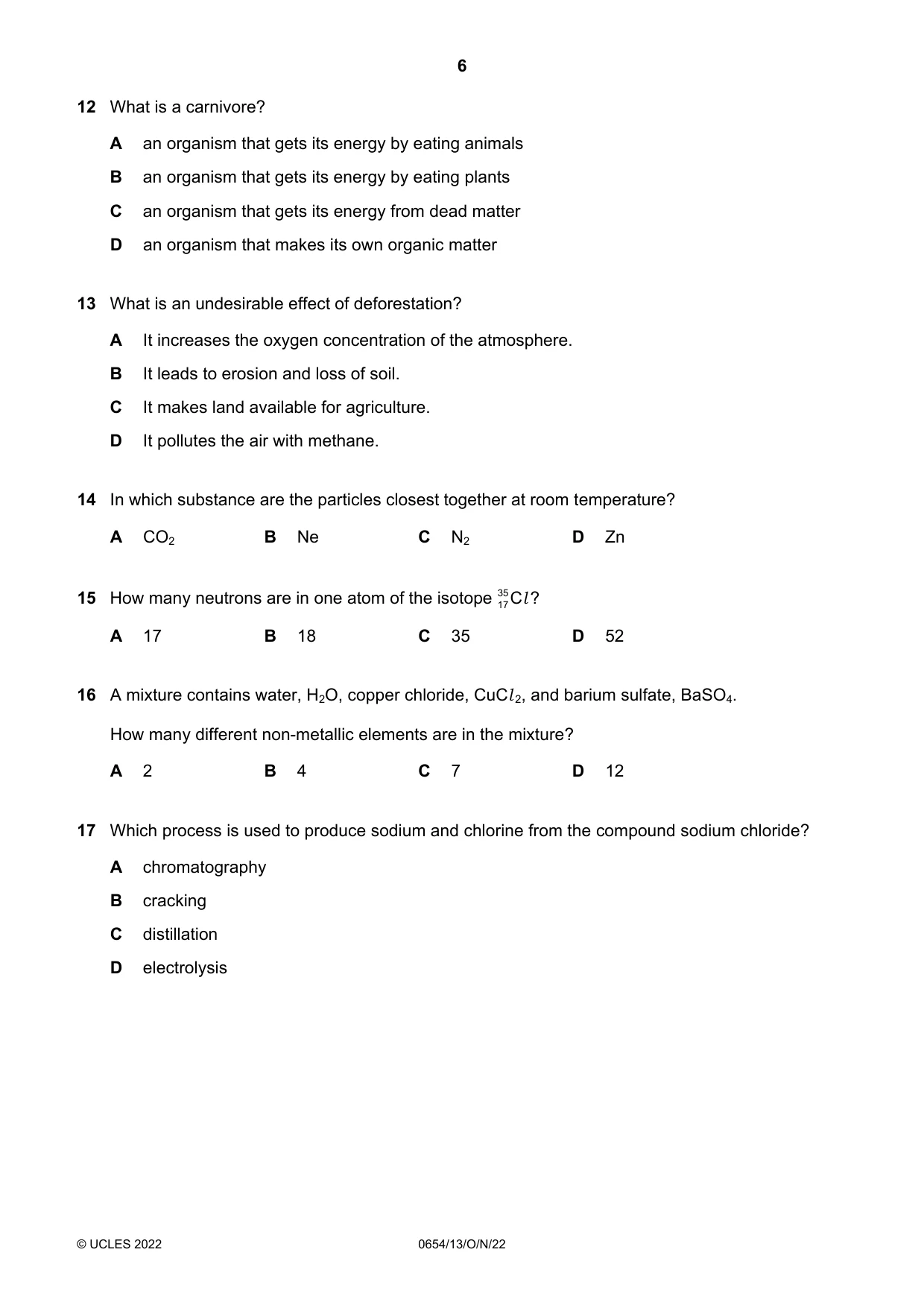
Q15 · How many neutrons are in one atom of the isotope 35 17C ?
15 How many neutrons are in one atom of the isotope 35 17C ? l A 17 B 18 C 35 D 52
Mark scheme: B
Q16 · A mixture contains water, H2O, copper chloride, CuCl 2, and barium sulfate, BaSO4
16 A mixture contains water, H2O, copper chloride, CuCl 2, and barium sulfate, BaSO4. How many different non-metallic elements are in the mixture? A 2 B 4 C 7 D 12
Mark scheme: B
Q17 · Which process is used to produce sodium and chlorine from the compound sodium chloride?
17 Which process is used to produce sodium and chlorine from the compound sodium chloride? A chromatography B cracking C distillation D electrolysis
Mark scheme: D
Q18 · A metal oxide powder is added to a dilute acid
18 A metal oxide powder is added to a dilute acid. The initial temperature of the acid is 21 C. The pH of the acid is 2. When all the acid has reacted, the temperature of the reaction mixture is 23 C and the pH is 7. Which statement describes this reaction? A It is endothermic and neutralisation. B It is endothermic and oxidation. C It is exothermic and neutralisation D It is exothermic and oxidation.
Mark scheme: C
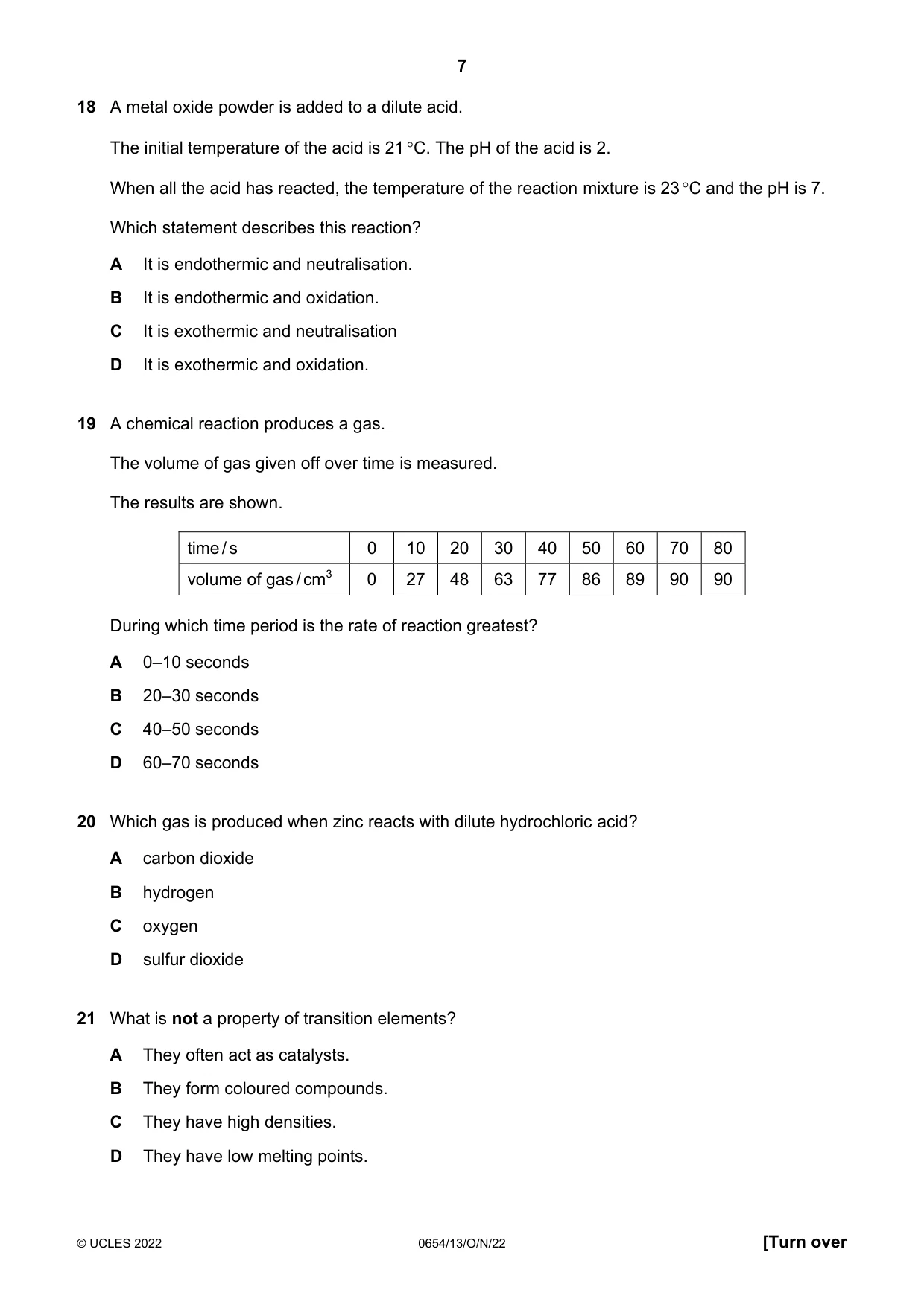
Q19 · A chemical reaction produces a gas
19 A chemical reaction produces a gas. The volume of gas given off over time is measured. The results are shown. time / s 0 10 20 30 40 50 60 70 80 volume of gas / cm3 0 27 48 63 77 86 89 90 90 During which time period is the rate of reaction greatest? A 0–10 seconds B 20–30 seconds C 40–50 seconds D 60–70 seconds
Mark scheme: A
Q20 · Which gas is produced when zinc reacts with dilute hydrochloric acid?
20 Which gas is produced when zinc reacts with dilute hydrochloric acid? A carbon dioxide B hydrogen C oxygen D sulfur dioxide
Mark scheme: B
Q21 · What is not a property of transition elements?
21 What is not a property of transition elements? A They often act as catalysts. B They form coloured compounds. C They have high densities. D They have low melting points.
Mark scheme: D
Q22 · Filament lamps require an inert atmosphere
22 Filament lamps require an inert atmosphere. Which gas is used to fill these lamps? A argon B helium C hydrogen D oxygen
Mark scheme: A
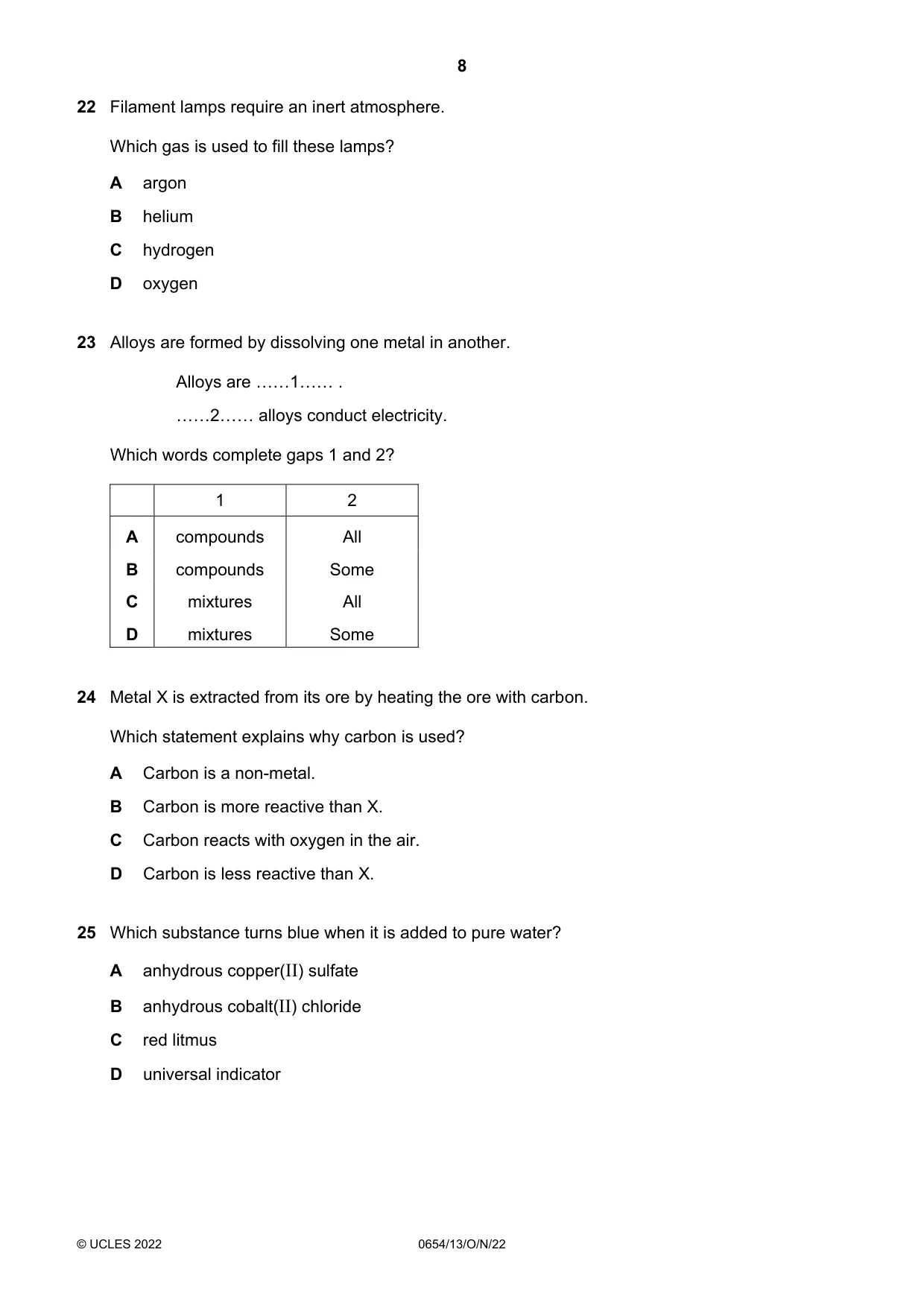
Q23 · Alloys are formed by dissolving one metal in another
23 Alloys are formed by dissolving one metal in another. Alloys are ……1…… . ……2…… alloys conduct electricity. Which words complete gaps 1 and 2? 1 2 A compounds All B compounds Some C mixtures All D mixtures Some
Mark scheme: C
Q24 · Metal X is extracted from its ore by heating the ore with carbon
24 Metal X is extracted from its ore by heating the ore with carbon. Which statement explains why carbon is used? A Carbon is a non-metal. B Carbon is more reactive than X. C Carbon reacts with oxygen in the air. D Carbon is less reactive than X.
Mark scheme: B
Q25 · Which substance turns blue when it is added to pure water?
25 Which substance turns blue when it is added to pure water? A anhydrous copper(II) sulfate B anhydrous cobalt(II) chloride C red litmus D universal indicator
Mark scheme: A
Q26 · What is not a use of limestone?
26 What is not a use of limestone? A manufacture of calcium oxide B neutralising industrial waste products C purifying water D treating acidic soil
Mark scheme: C
Q27 · Which statement about alkanes is correct?
27 Which statement about alkanes is correct? A They rapidly decolourise aqueous bromine. B They are unsaturated hydrocarbons. C They are used to make polymers. D They can be used as fuels.
Mark scheme: D
Q28 · Which quantity can be measured using only a measuring cylinder?
28 Which quantity can be measured using only a measuring cylinder? A the density of a liquid B the mass of a liquid C the volume of a liquid D the weight of a liquid
Mark scheme: C
More questions on Physical quantities and measurement techniques
Q29 · The graph shows how the speed of an object varies with time
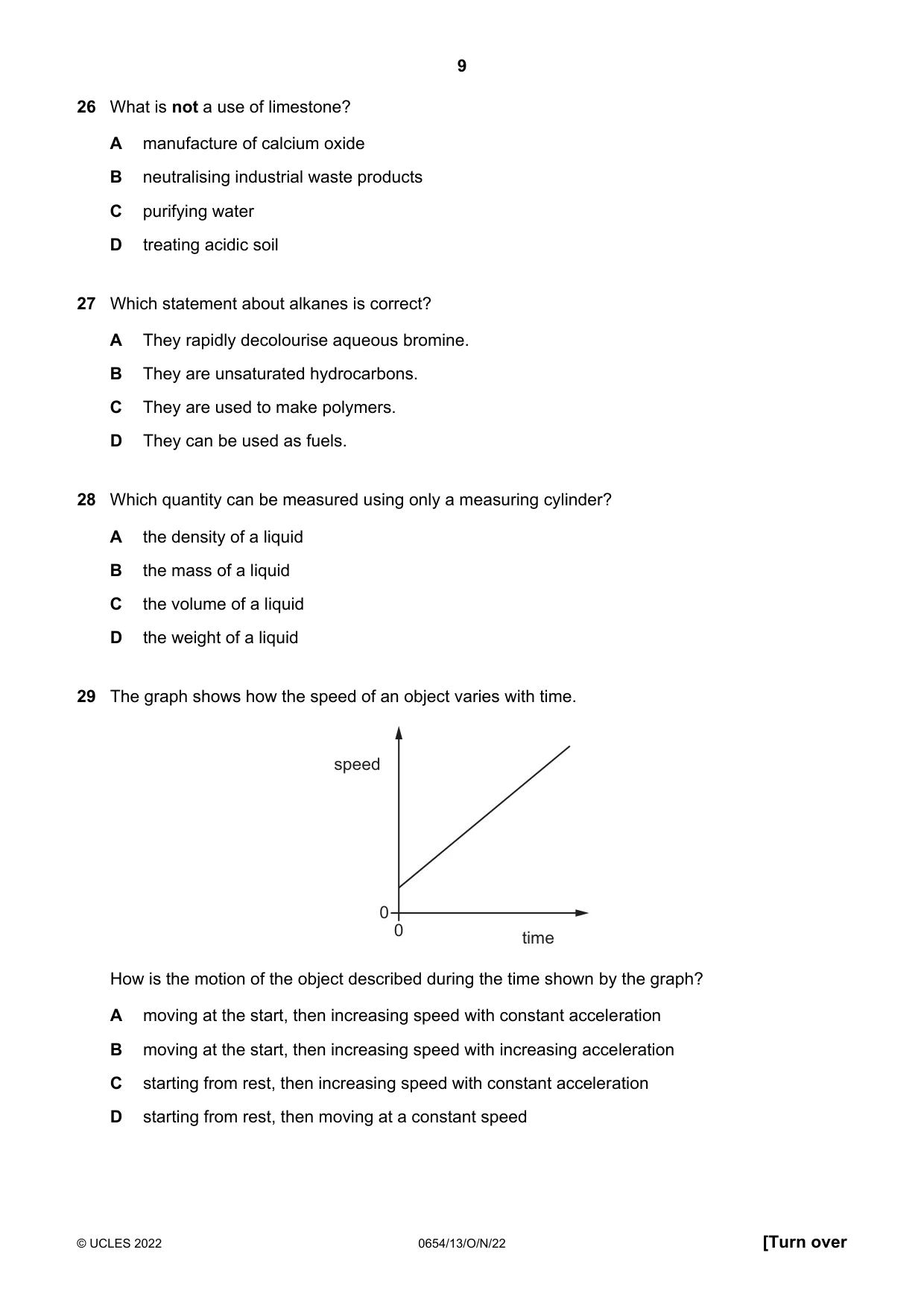
29 The graph shows how the speed of an object varies with time. speed 0 0 time How is the motion of the object described during the time shown by the graph? A moving at the start, then increasing speed with constant acceleration B moving at the start, then increasing speed with increasing acceleration C starting from rest, then increasing speed with constant acceleration D starting from rest, then moving at a constant speed
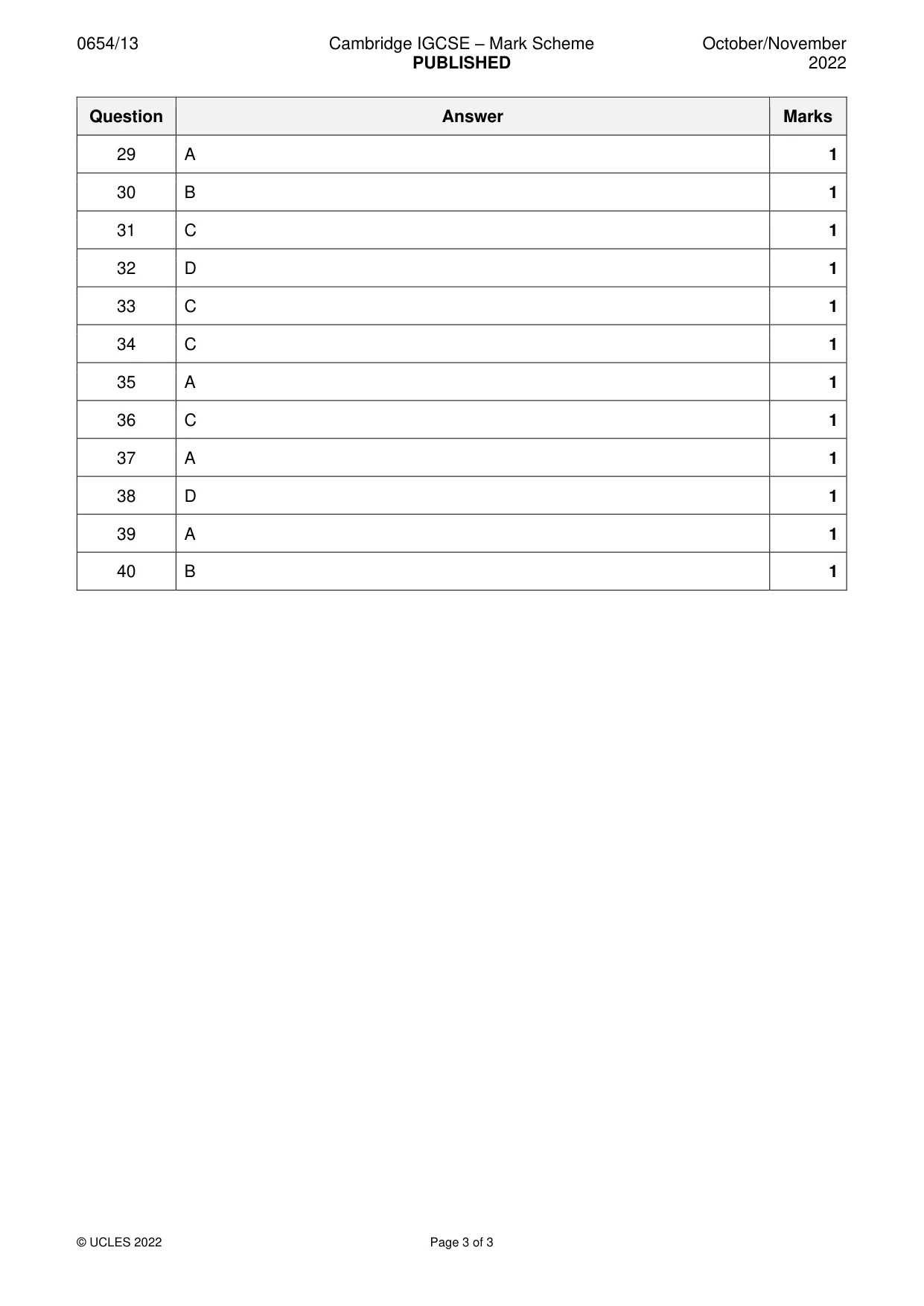
Mark scheme: A
Q30 · The density of gold is 19 g / cm3
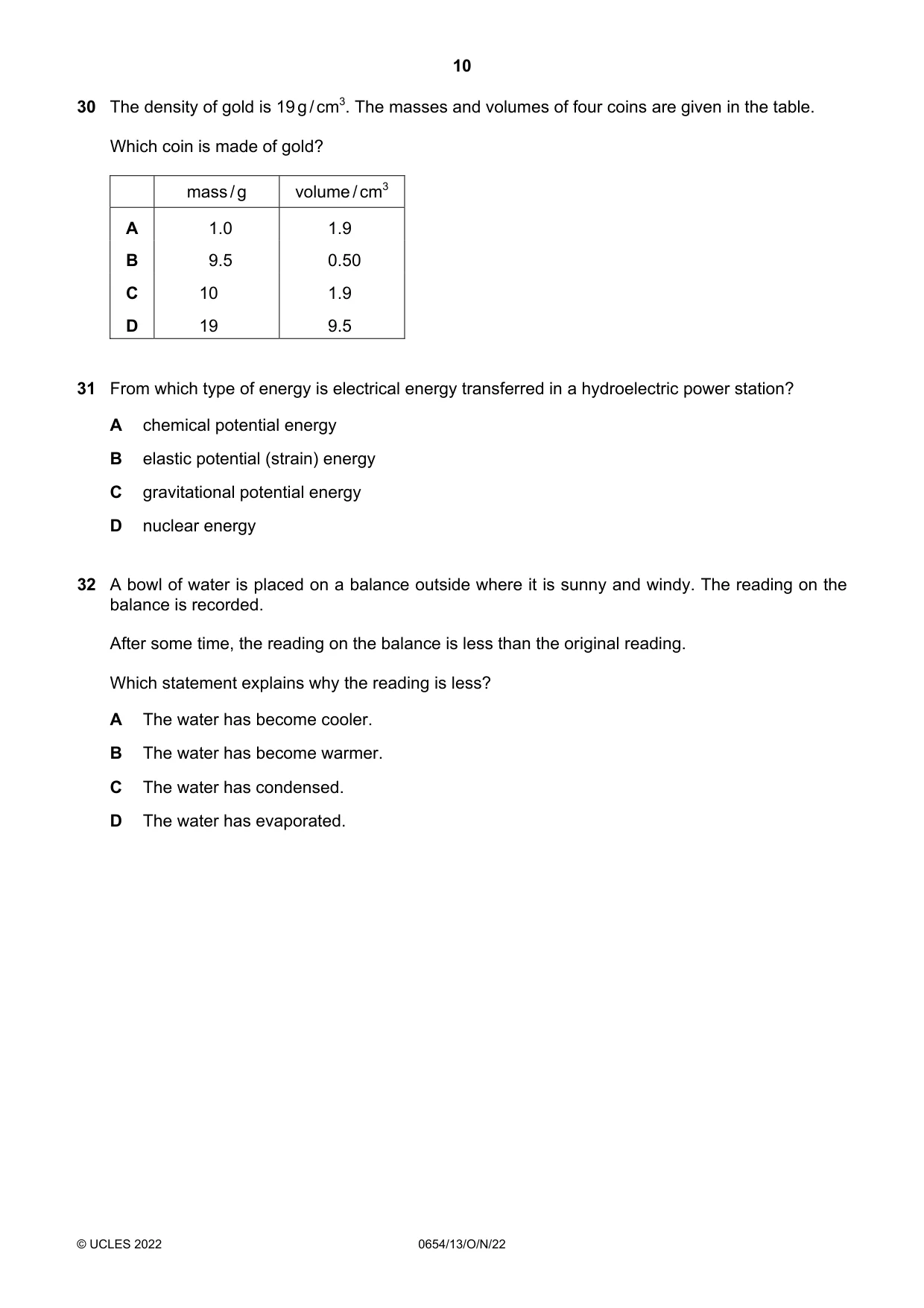
30 The density of gold is 19 g / cm3. The masses and volumes of four coins are given in the table. Which coin is made of gold? mass / g volume / cm3 A 1.0 1.9 B 9.5 0.50 C 10 1.9 D 19 9.5
Mark scheme: B
Q31 · From which type of energy is electrical energy transferred in a hydroelectric power…
31 From which type of energy is electrical energy transferred in a hydroelectric power station? A chemical potential energy B elastic potential (strain) energy C gravitational potential energy D nuclear energy
Mark scheme: C
Q32 · A bowl of water is placed on a balance outside where it is sunny and windy
32 A bowl of water is placed on a balance outside where it is sunny and windy. The reading on the balance is recorded. After some time, the reading on the balance is less than the original reading. Which statement explains why the reading is less? A The water has become cooler. B The water has become warmer. C The water has condensed. D The water has evaporated.
Mark scheme: D
Q33 · A hot metal ball is placed in a small hollow in a piece of wood
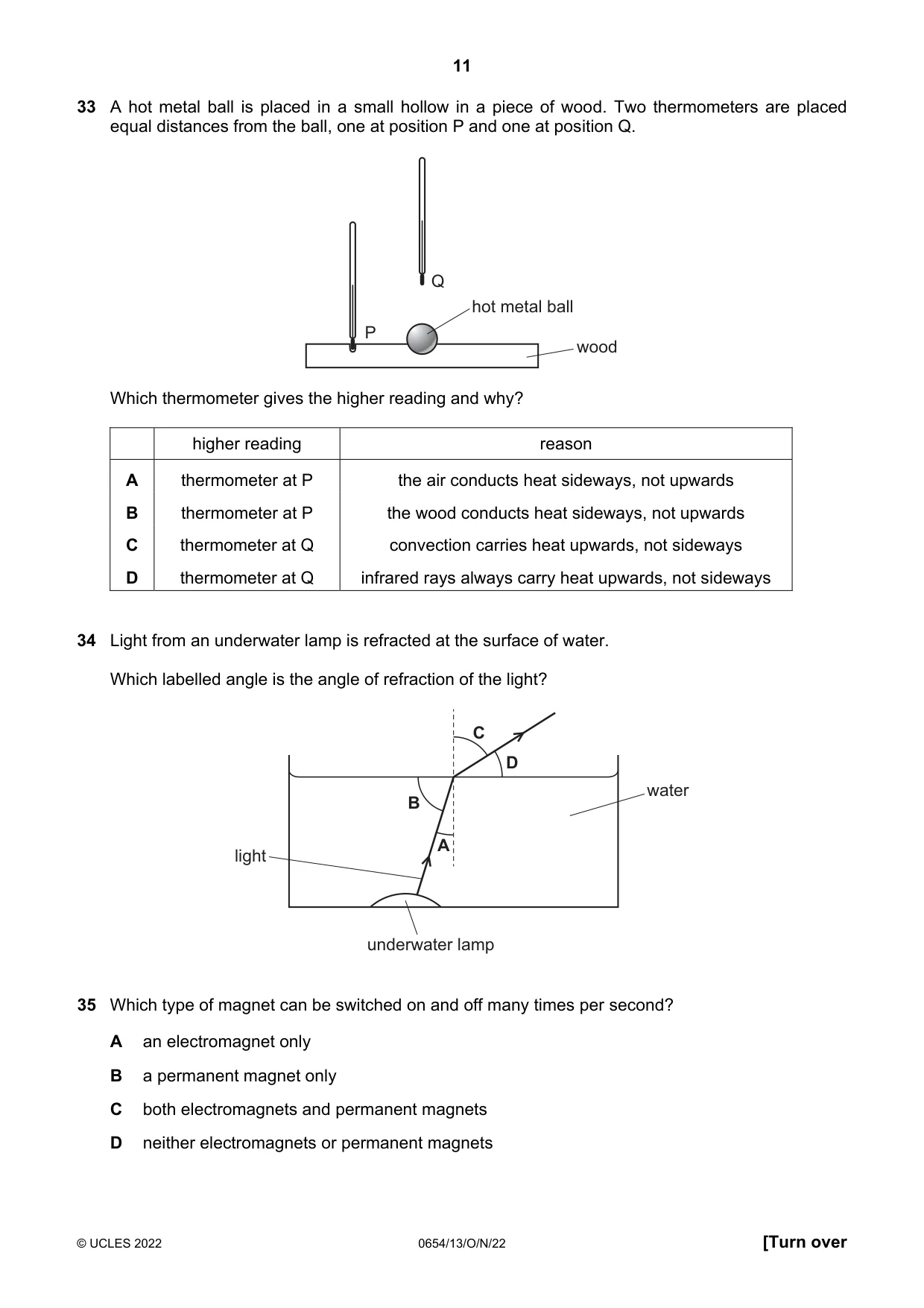
33 A hot metal ball is placed in a small hollow in a piece of wood. Two thermometers are placed equal distances from the ball, one at position P and one at position Q. Q hot metal ball P wood Which thermometer gives the higher reading and why? higher reading reason A thermometer at P the air conducts heat sideways, not upwards B thermometer at P the wood conducts heat sideways, not upwards C thermometer at Q convection carries heat upwards, not sideways D thermometer at Q infrared rays always carry heat upwards, not sideways
Mark scheme: C
Q34 · Light from an underwater lamp is refracted at the surface of water
34 Light from an underwater lamp is refracted at the surface of water. Which labelled angle is the angle of refraction of the light? C D water B A light underwater lamp
Mark scheme: C
Q35 · Which type of magnet can be switched on and off many times per second?
35 Which type of magnet can be switched on and off many times per second? A an electromagnet only B a permanent magnet only C both electromagnets and permanent magnets D neither electromagnets or permanent magnets
Mark scheme: A
Q36 · The diagram shows a 12 V battery connected to two 6.0 resistors and a switch
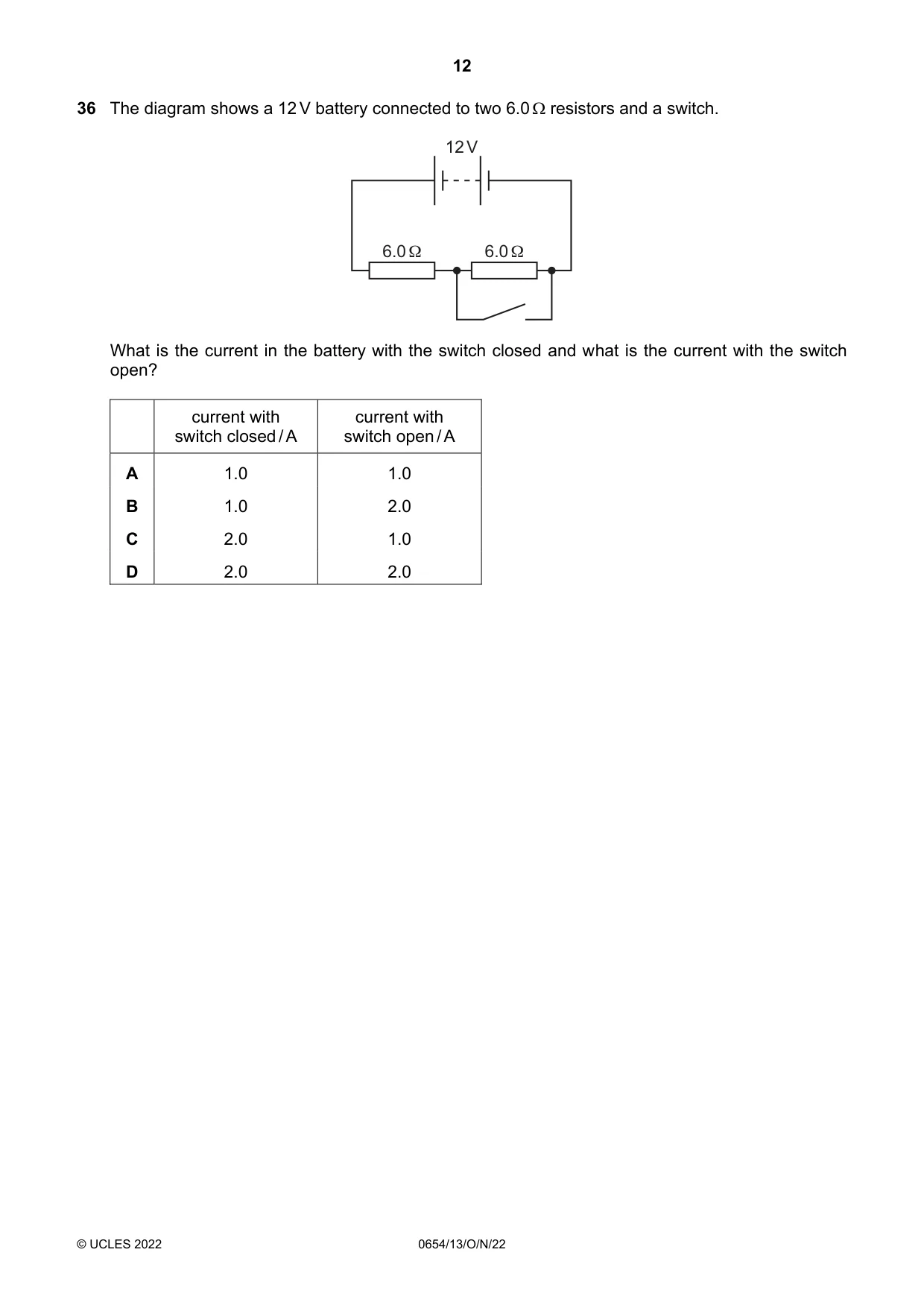
36 The diagram shows a 12 V battery connected to two 6.0 resistors and a switch. 12 V 6.0 Ω 6.0 Ω What is the current in the battery with the switch closed and what is the current with the switch open? current with current with switch closed / A switch open / A A 1.0 1.0 B 1.0 2.0 C 2.0 1.0 D 2.0 2.0
Mark scheme: C
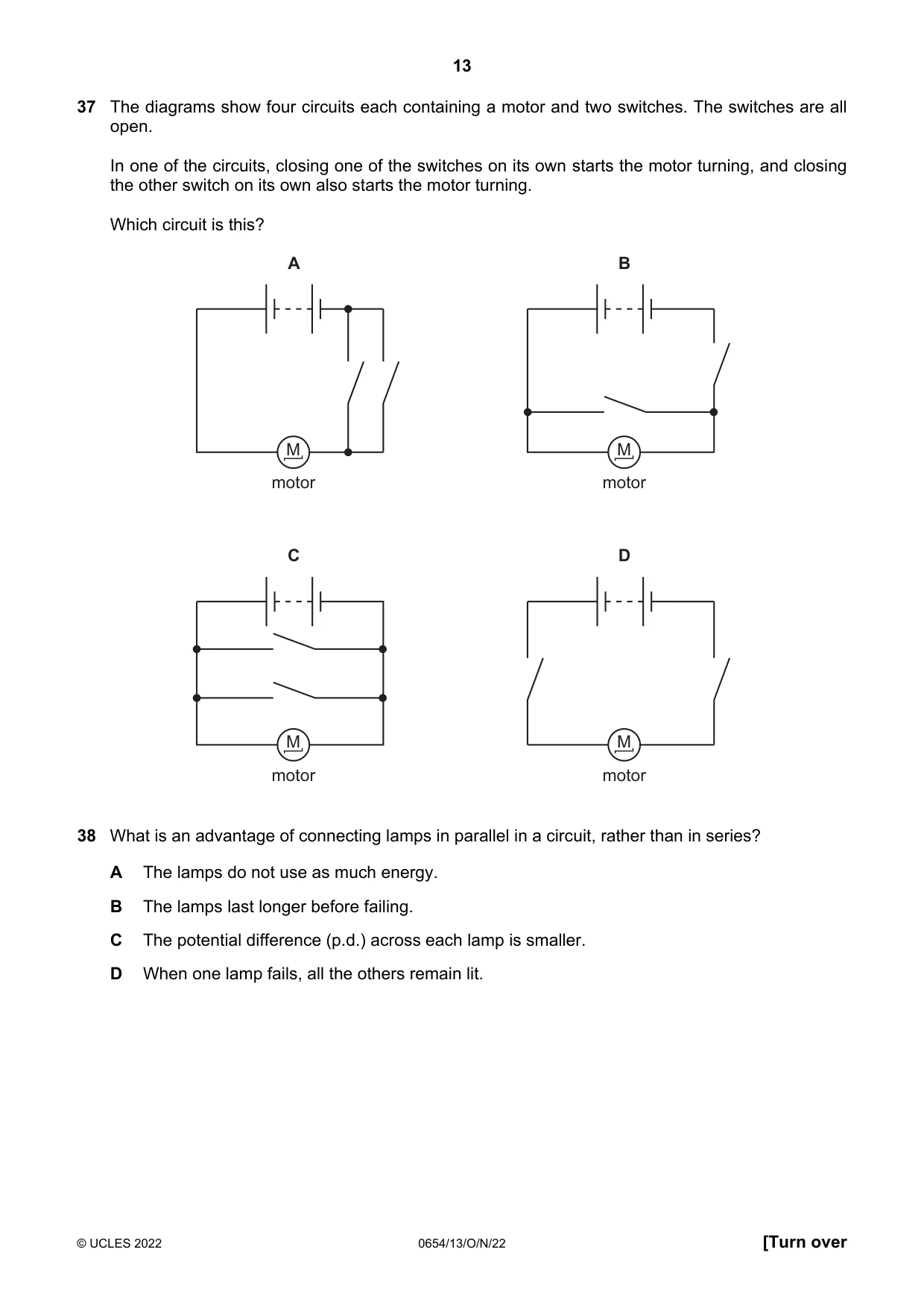
Q37 · The diagrams show four circuits each containing a motor and two switches
37 The diagrams show four circuits each containing a motor and two switches. The switches are all open. In one of the circuits, closing one of the switches on its own starts the motor turning, and closing the other switch on its own also starts the motor turning. Which circuit is this? A B M M motor motor C D M M motor motor
Mark scheme: A
Q38 · What is an advantage of connecting lamps in parallel in a circuit, rather than in series?
38 What is an advantage of connecting lamps in parallel in a circuit, rather than in series? A The lamps do not use as much energy. B The lamps last longer before failing. C The potential difference (p.d.) across each lamp is smaller. D When one lamp fails, all the others remain lit.
Mark scheme: D
Q39 · A device that is designed to protect a circuit contains a thin wire
39 A device that is designed to protect a circuit contains a thin wire. When there is a large current in the circuit, the thin wire melts and cuts off the supply. What is the device? A fuse B lamp C resistor D thermistor
Mark scheme: A
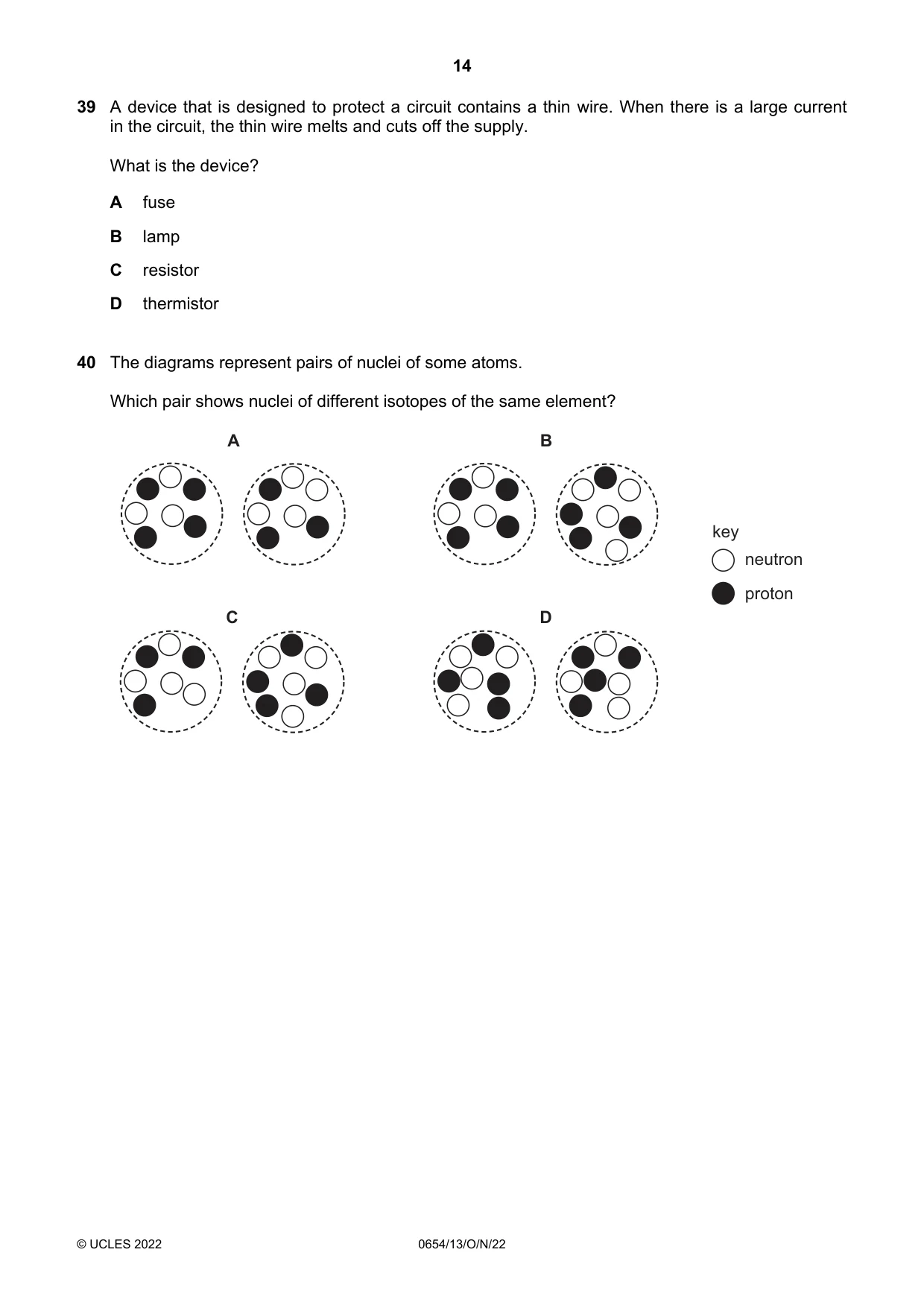
Q40 · The diagrams represent pairs of nuclei of some atoms
40 The diagrams represent pairs of nuclei of some atoms. Which pair shows nuclei of different isotopes of the same element? A B key neutron proton C D
Mark scheme: B
What was in this paper
The subtopics covered by these 40 questions, and how many questions each got. Open one in a new tab to see every Cambridge question on it.
3Alkanes1Alloys and their properties1Biological molecules1Characteristics of living organisms1Density1Diet1Electrical safety1Electrolysis1Elements, compounds and mixtures1Energy, work and power1Enzymes1Exothermic and endothermic reactions1Extraction of metals1Food chains and food webs1Gas exchange in humans1Habitat destruction1Homeostasis1Identification of ions and gases1Isotopes1Kinetic particle model of matter1Leaf structure1Light1Monohybrid inheritance1Motion1Noble gases1Osmosis1Physical quantities and measurement techniques1Rate of reaction1Reactivity series1Sexual reproduction in plants1Simple phenomena of magnetism1Solids, liquids and gases1The nucleus1Transfer of thermal energy1Transition elements1Water1Xylem and phloem1What you needed in this session
Cambridge’s own grade thresholds for 2022 Oct/Nov, Paper 1 · Variant 3. A higher threshold means an easier paper — the bar moves with how the cohort did.