Cambridge IGCSE Sciences - Co-ordinated (Double) 0654 — 2025 Oct/Nov Paper 1 · Variant 1
0654/11/O/N/25 · 40 questions · 40 marks · 45 min
The question paper and its mark scheme, free to read here and free to download. This is Cambridge’s own paper, exactly as it was sat.
Question paper16 pages


Mark scheme3 pages
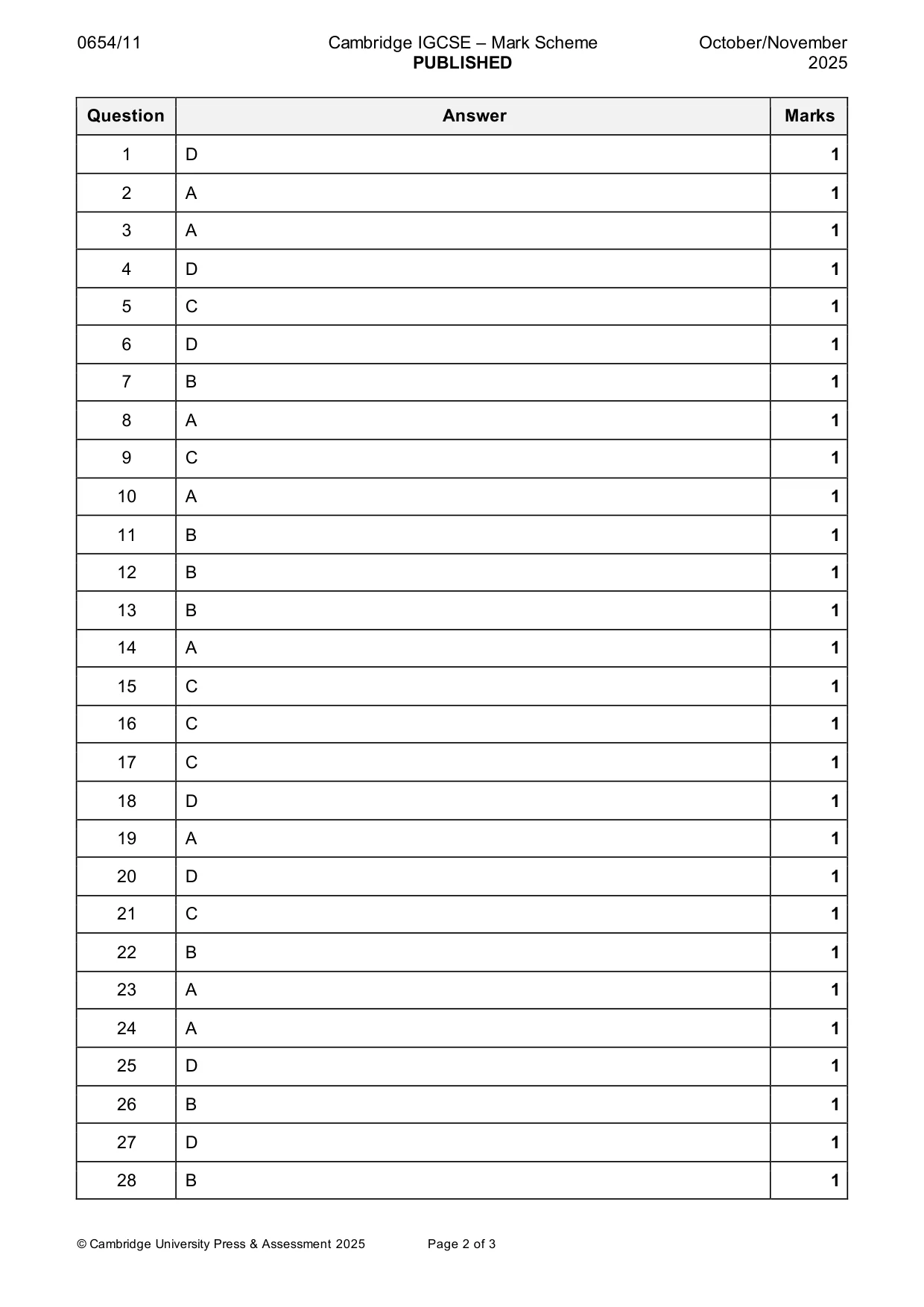
Answers below. Sit the paper first if you are practising.
Questions as text
Q1 · Which characteristic of living organisms is described as the chemical reactions in cells…
1 Which characteristic of living organisms is described as the chemical reactions in cells that break down nutrient molecules and release energy? A excretion B nutrition C photosynthesis D respiration
Mark scheme: D
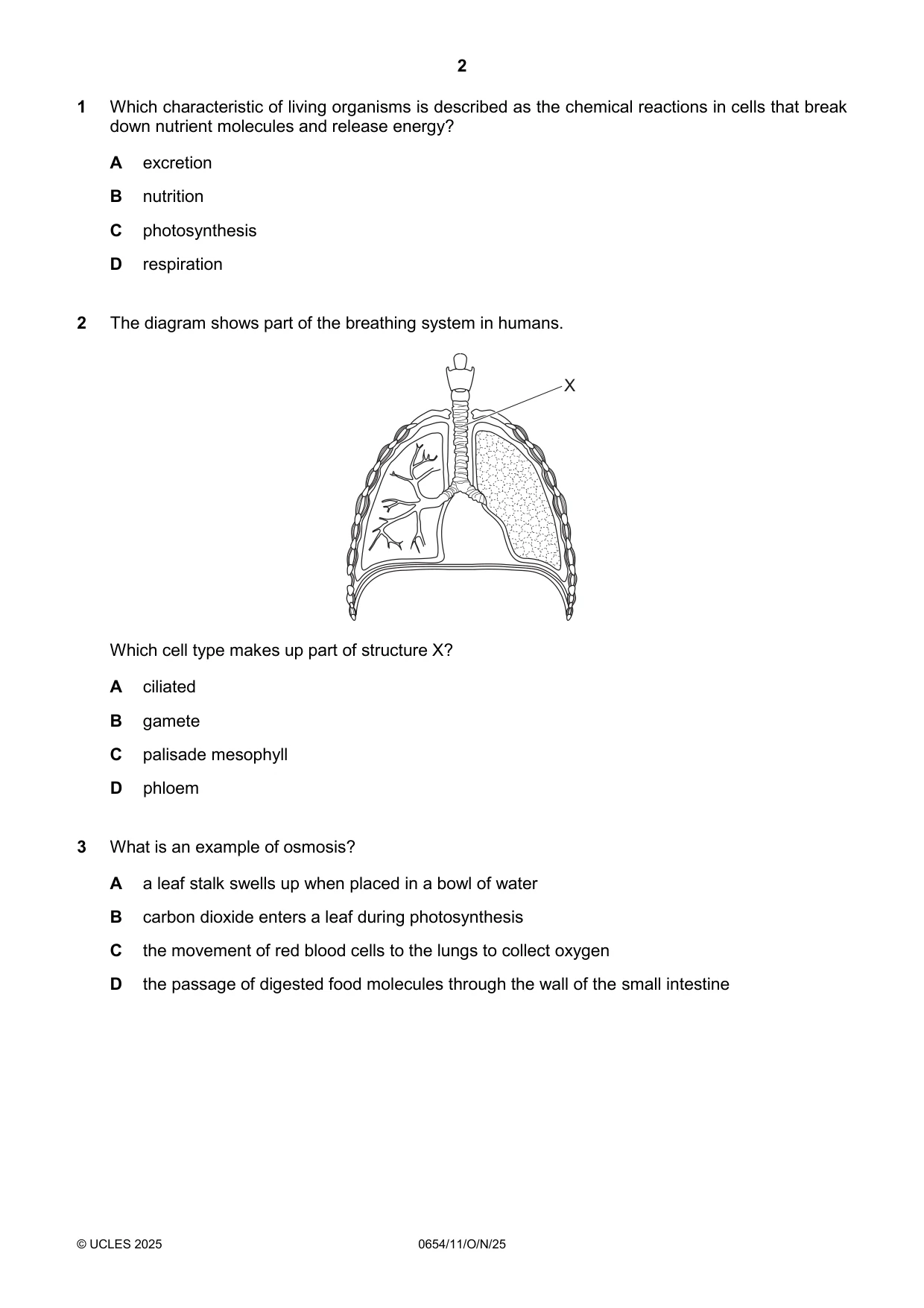
Q2 · The diagram shows part of the breathing system in humans
2 The diagram shows part of the breathing system in humans. X Which cell type makes up part of structure X? A ciliated B gamete C palisade mesophyll D phloem
Mark scheme: A
Q3 · What is an example of osmosis?
3 What is an example of osmosis? A a leaf stalk swells up when placed in a bowl of water B carbon dioxide enters a leaf during photosynthesis C the movement of red blood cells to the lungs to collect oxygen D the passage of digested food molecules through the wall of the small intestine
Mark scheme: A
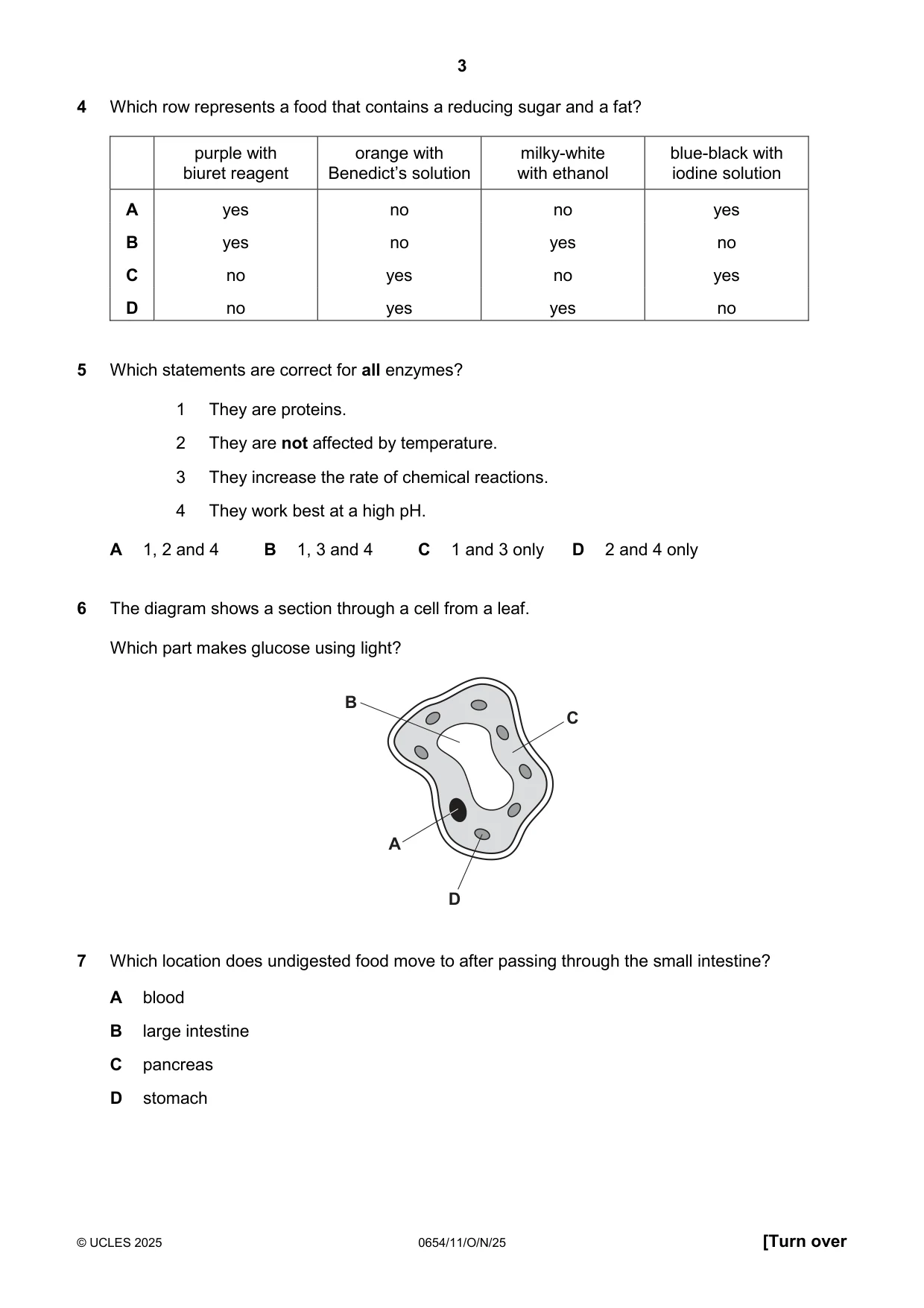
Q4 · Which row represents a food that contains a reducing sugar and a fat?
4 Which row represents a food that contains a reducing sugar and a fat? purple with orange with milky-white blue-black with biuret reagent Benedict’s solution with ethanol iodine solution A yes no no yes B yes no yes no C no yes no yes D no yes yes no
Mark scheme: D
Q5 · Which statements are correct for all enzymes?
5 Which statements are correct for all enzymes? 1 They are proteins. 2 They are not affected by temperature. 3 They increase the rate of chemical reactions. 4 They work best at a high pH. A 1, 2 and 4 B 1, 3 and 4 C 1 and 3 only D 2 and 4 only
Mark scheme: C
Q6 · The diagram shows a section through a cell from a leaf
6 The diagram shows a section through a cell from a leaf. Which part makes glucose using light? B C A D
Mark scheme: D
Q7 · Which location does undigested food move to after passing through the small intestine?
7 Which location does undigested food move to after passing through the small intestine? A blood B large intestine C pancreas D stomach
Mark scheme: B
Q8 · What is a main function of root hairs?
8 What is a main function of root hairs? A absorb mineral ions B photosynthesis C support the stem D transport water to the leaves
Mark scheme: A
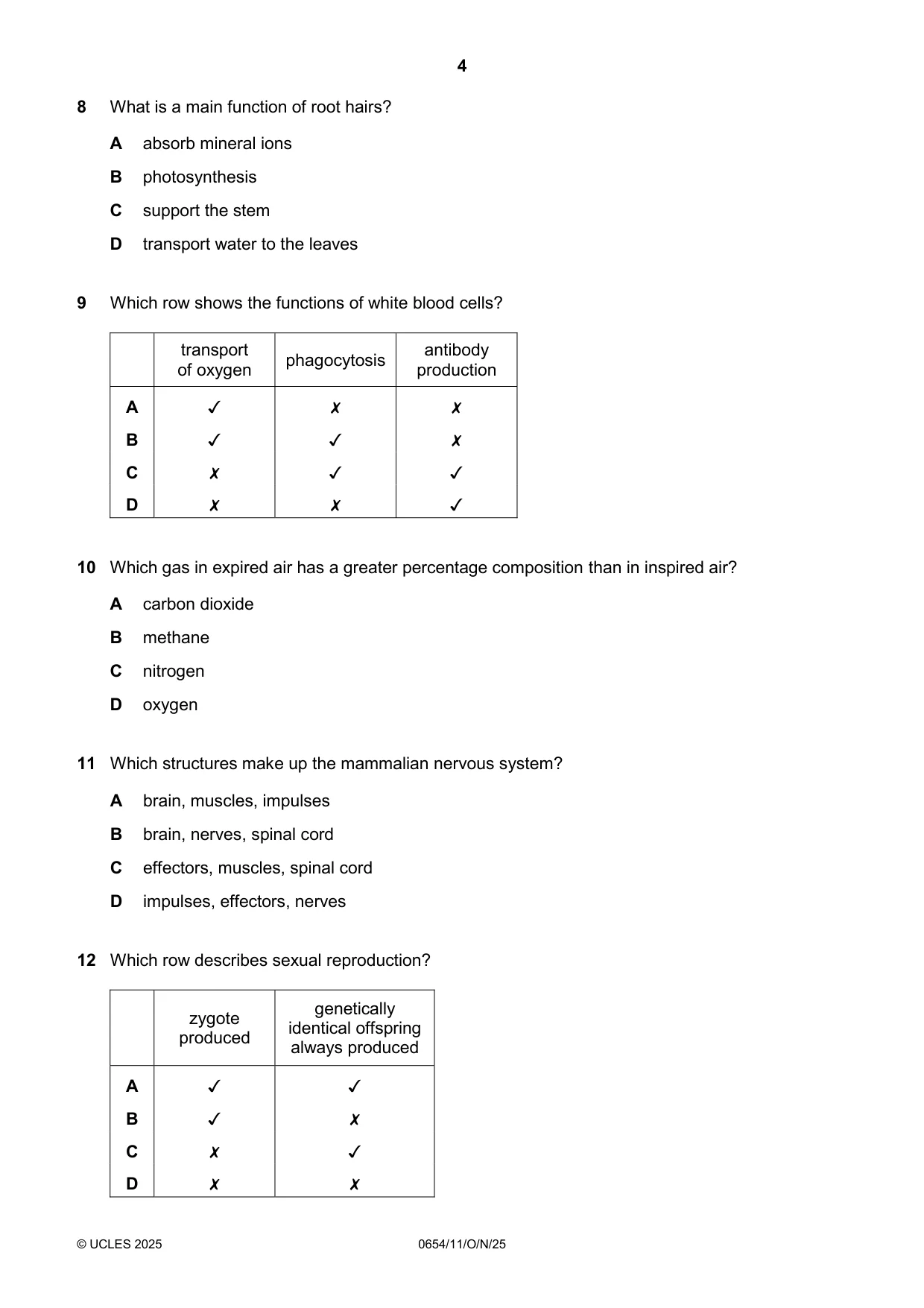
Q9 · Which row shows the functions of white blood cells?
9 Which row shows the functions of white blood cells? transport . antibody of oxygen phagocytosis production v x x v v x x v v x x Jv
Mark scheme: C
Q10 · Which gas in expired air has a greater percentage composition than in inspired air?
10 Which gas in expired air has a greater percentage composition than in inspired air? A carbon dioxide B methane C nitrogen D oxygen
Mark scheme: A
Q11 · Which structures make up the mammalian nervous system?
11 Which structures make up the mammalian nervous system? A brain, muscles, impulses B brain, nerves, spinal cord C effectors, muscles, spinal cord D impulses, effectors, nerves
Mark scheme: B
Q12 · Which row describes sexual reproduction?
12 Which row describes sexual reproduction? zvaote genetically oy euce d identical offspring p always produced A Jv J B Jv x Cc x J D x x
Mark scheme: B
Q13 · A list of the stages of a process is shown
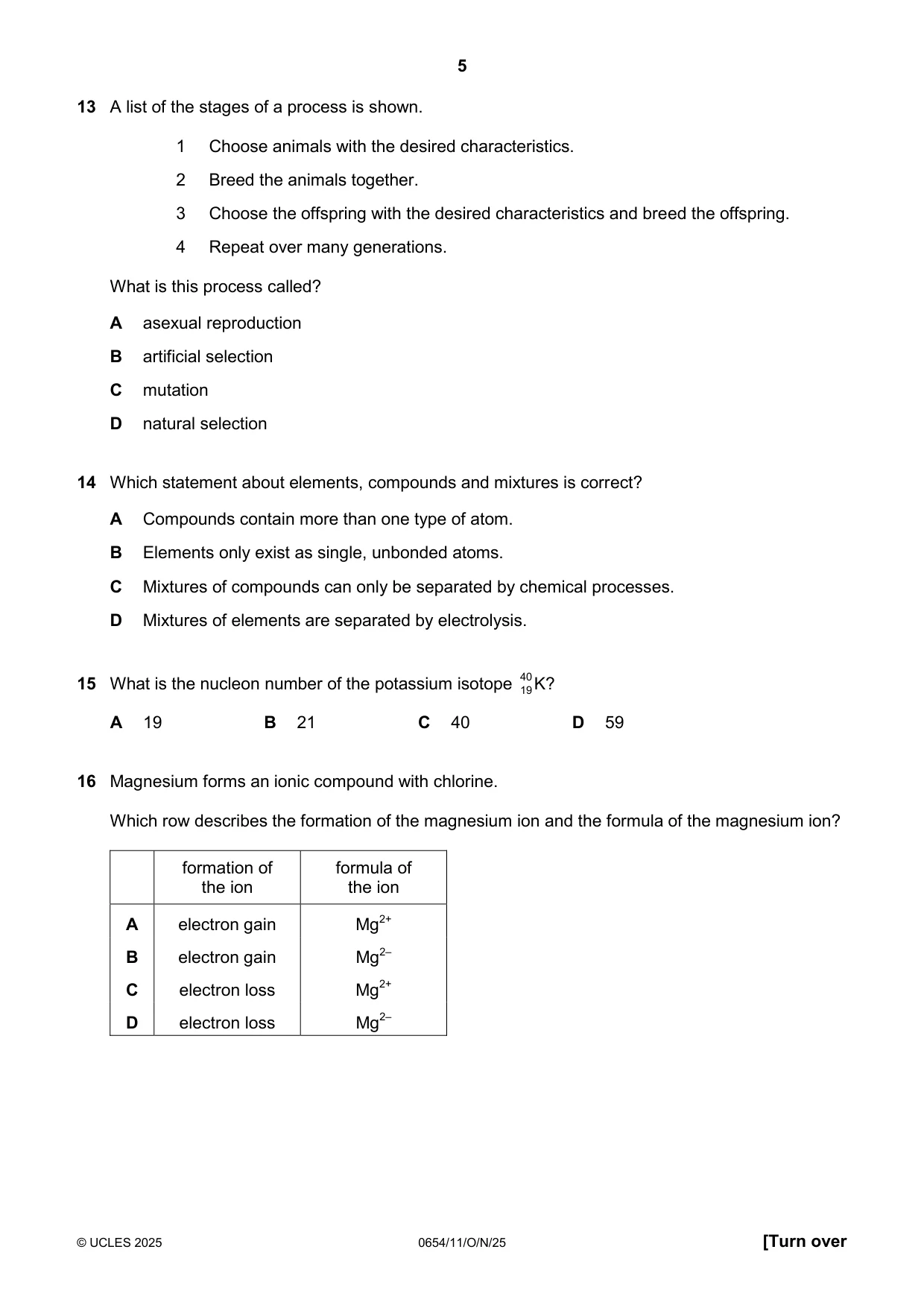
13 A list of the stages of a process is shown. 1 Choose animals with the desired characteristics. 2 Breed the animals together. 3 Choose the offspring with the desired characteristics and breed the offspring. 4 Repeat over many generations. What is this process called? A asexual reproduction B artificial selection C mutation D natural selection
Mark scheme: B
Q14 · Which statement about elements, compounds and mixtures is correct?
14 Which statement about elements, compounds and mixtures is correct? A Compounds contain more than one type of atom. B Elements only exist as single, unbonded atoms. C Mixtures of compounds can only be separated by chemical processes. D Mixtures of elements are separated by electrolysis.
Mark scheme: A
Q15 · What is the nucleon number of the potassium isotope 40 K?
15 What is the nucleon number of the potassium isotope 40 K? 19 A 19 B 21 C 40 D 59
Mark scheme: C
Q16 · Magnesium forms an ionic compound with chlorine
16 Magnesium forms an ionic compound with chlorine. Which row describes the formation of the magnesium ion and the formula of the magnesium ion? formation of formula of the ion the ion A electron gain Mg2+ B electron gain Mg2– C electron loss Mg2+ D electron loss Mg2–
Mark scheme: C
Q17 · Part of the Periodic Table is shown
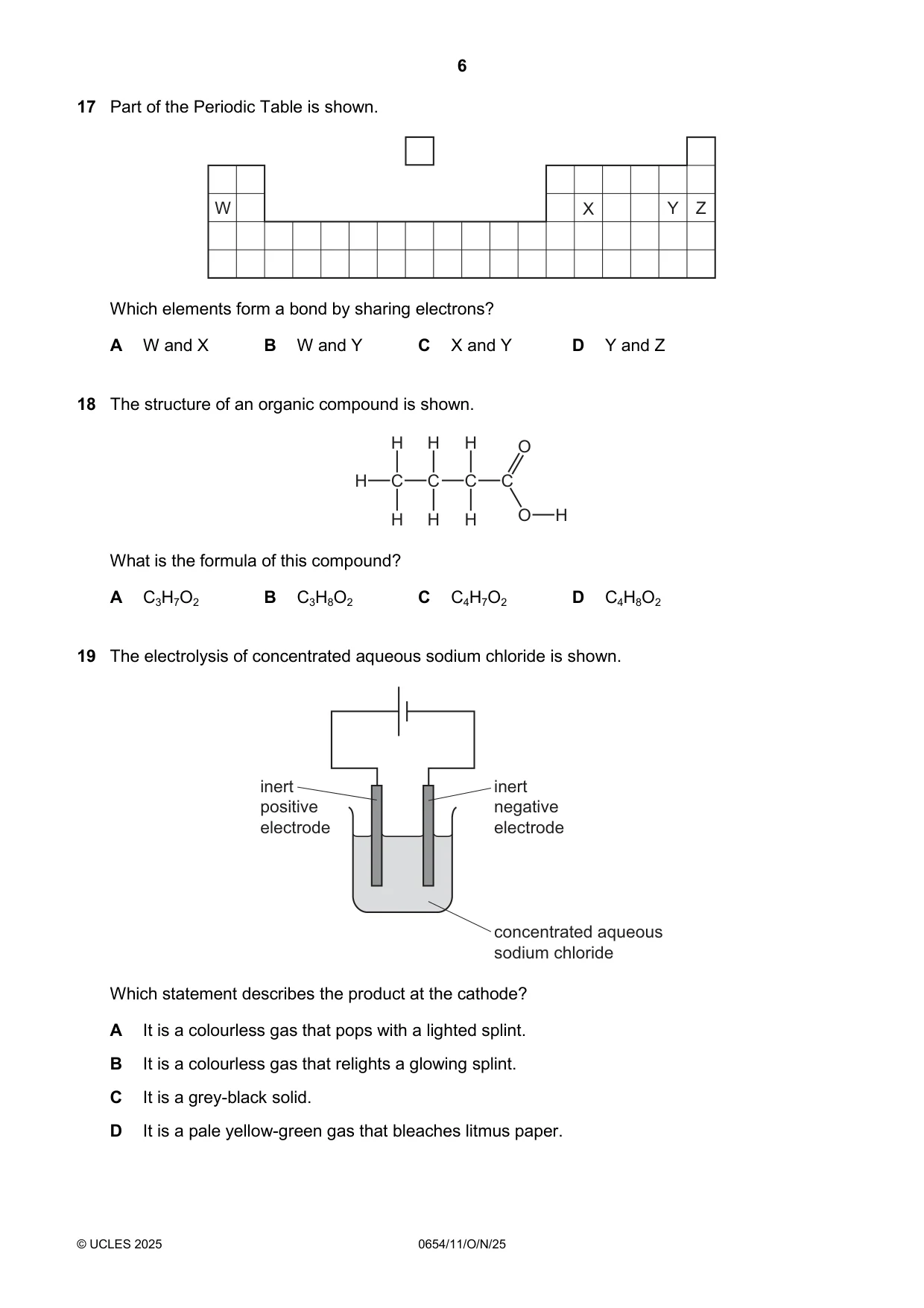
17 Part of the Periodic Table is shown. W X Y Z Which elements form a bond by sharing electrons? A W and X B W and Y C X and Y D Y and Z
Mark scheme: C
Q18 · The structure of an organic compound is shown
18 The structure of an organic compound is shown. H H H O H C C C C H H H O H What is the formula of this compound? A C3H7O2 B C3H8O2 C C4H7O2 D C4H8O2
Mark scheme: D
Q19 · The electrolysis of concentrated aqueous sodium chloride is shown
19 The electrolysis of concentrated aqueous sodium chloride is shown. inert inert positive negative electrode electrode concentrated aqueous sodium chloride Which statement describes the product at the cathode? A It is a colourless gas that pops with a lighted splint. B It is a colourless gas that relights a glowing splint. C It is a grey-black solid. D It is a pale yellow-green gas that bleaches litmus paper.
Mark scheme: A
Q20 · Magnesium ribbon is added to dilute hydrochloric acid
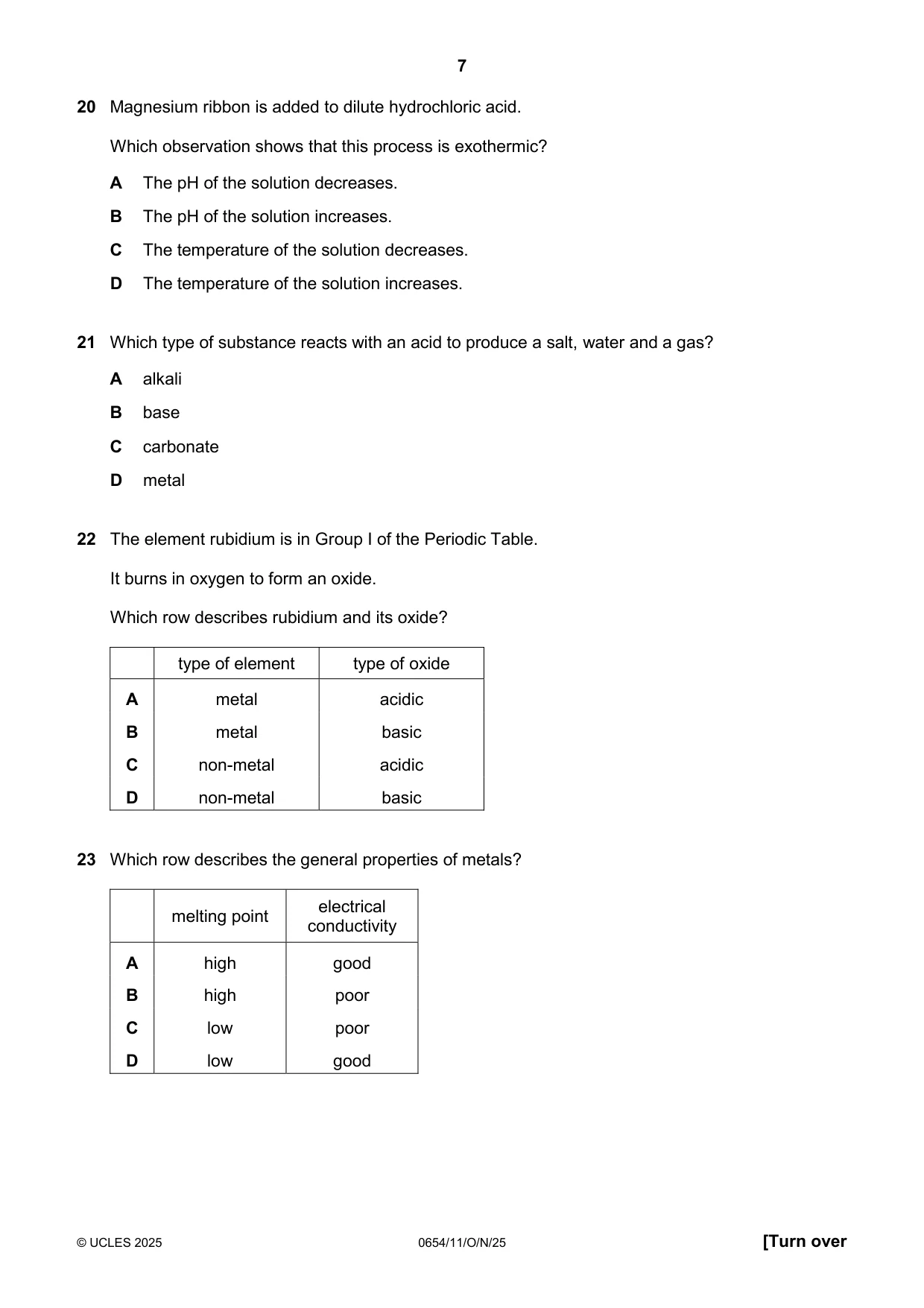
20 Magnesium ribbon is added to dilute hydrochloric acid. Which observation shows that this process is exothermic? A The pH of the solution decreases. B The pH of the solution increases. C The temperature of the solution decreases. D The temperature of the solution increases.
Mark scheme: D
Q21 · Which type of substance reacts with an acid to produce a salt, water and a gas?
21 Which type of substance reacts with an acid to produce a salt, water and a gas? A alkali B base C carbonate D metal
Mark scheme: C
Q22 · The element rubidium is in Group I of the Periodic Table
22 The element rubidium is in Group I of the Periodic Table. It burns in oxygen to form an oxide. Which row describes rubidium and its oxide? type of element type of oxide A metal acidic B metal basic C non-metal acidic D non-metal basic
Mark scheme: B
Q23 · Which row describes the general properties of metals?
23 Which row describes the general properties of metals? electrical melting point conductivity A high good B high poor C low poor D low good
Mark scheme: A
Q24 · Which air pollutants are produced by the combustion of fossil fuels in car engines?
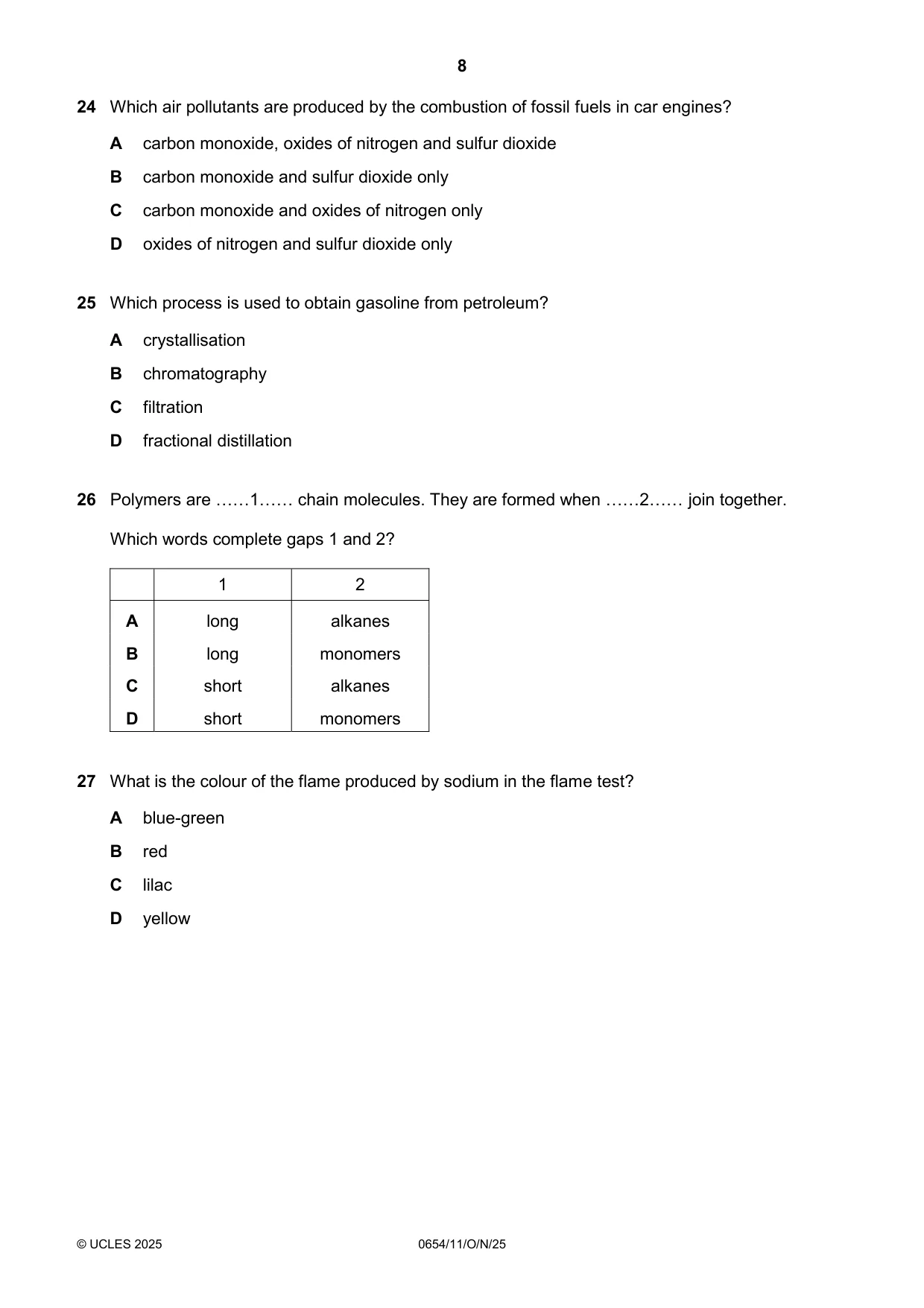
24 Which air pollutants are produced by the combustion of fossil fuels in car engines? A carbon monoxide, oxides of nitrogen and sulfur dioxide B carbon monoxide and sulfur dioxide only C carbon monoxide and oxides of nitrogen only D oxides of nitrogen and sulfur dioxide only
Mark scheme: A
Q25 · Which process is used to obtain gasoline from petroleum?
25 Which process is used to obtain gasoline from petroleum? A crystallisation B chromatography C filtration D fractional distillation
Mark scheme: D
Q26 · Polymers are ……1…… chain molecules
26 Polymers are ……1…… chain molecules. They are formed when ……2…… join together. Which words complete gaps 1 and 2? 1 2 A long alkanes B long monomers C short alkanes D short monomers
Mark scheme: B
Q27 · What is the colour of the flame produced by sodium in the flame test?
27 What is the colour of the flame produced by sodium in the flame test? A blue-green B red C lilac D yellow
Mark scheme: D
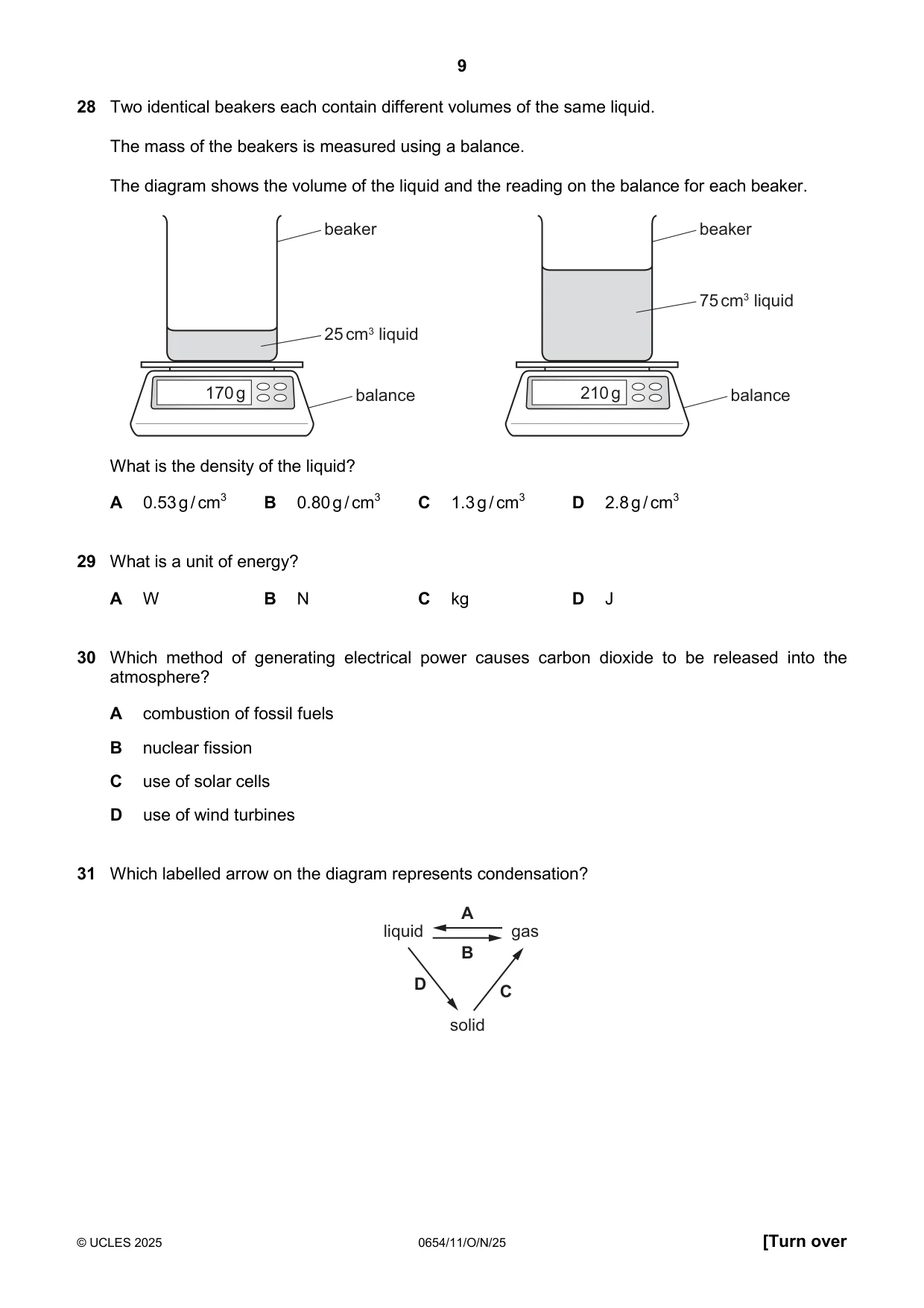
Q28 · Two identical beakers each contain different volumes of the same liquid
28 Two identical beakers each contain different volumes of the same liquid. The mass of the beakers is measured using a balance. The diagram shows the volume of the liquid and the reading on the balance for each beaker. beaker beaker 75 cm3 liquid 25 cm3 liquid 170 g balance 210 g balance What is the density of the liquid? A 0.53 g / cm3 B 0.80 g / cm3 C 1.3 g / cm3 D 2.8 g / cm3
Mark scheme: B
Q29 · What is a unit of energy?
29 What is a unit of energy? A W B N C kg D J
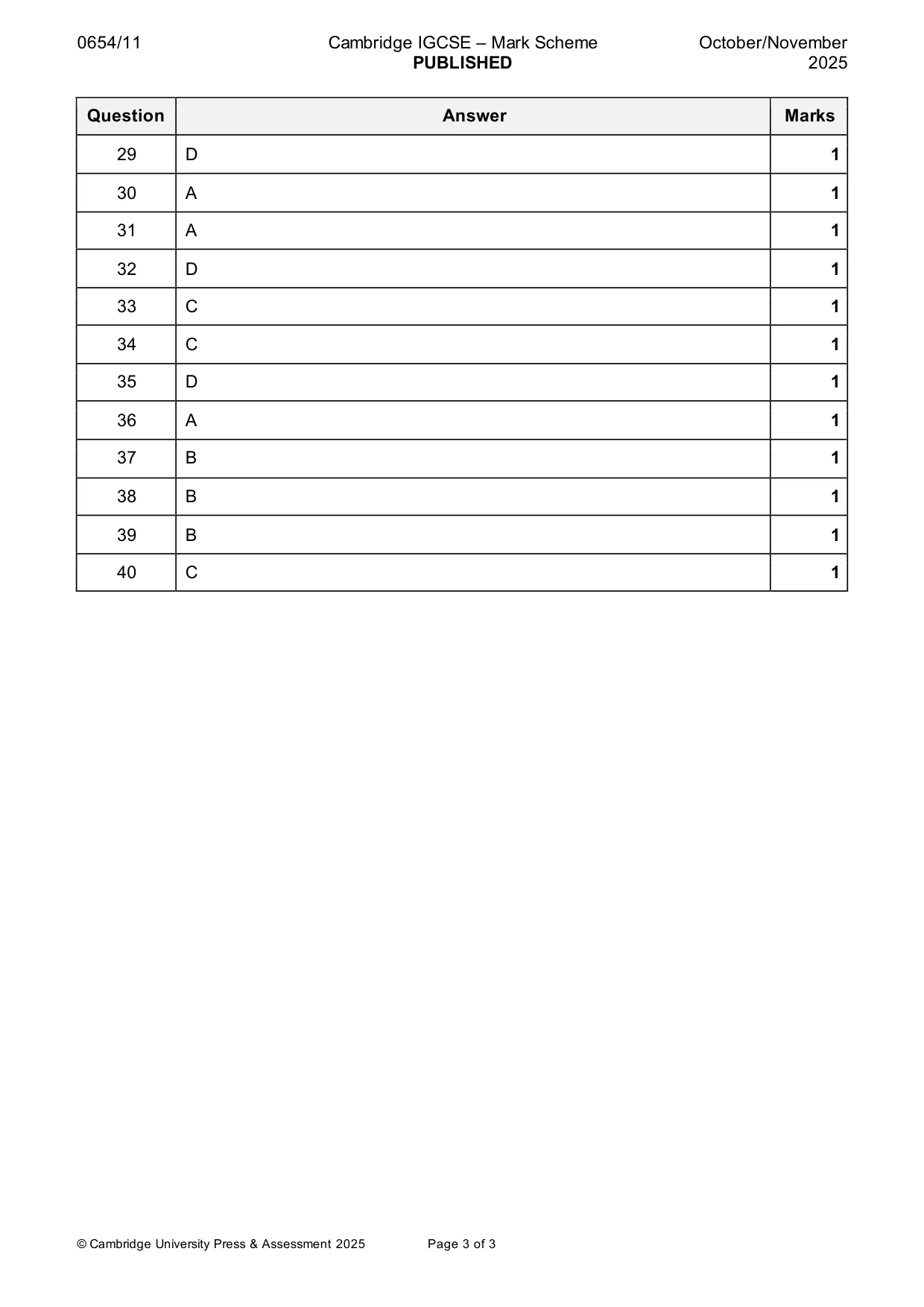
Mark scheme: D
Q30 · Which method of generating electrical power causes carbon dioxide to be released into the…
30 Which method of generating electrical power causes carbon dioxide to be released into the atmosphere? A combustion of fossil fuels B nuclear fission C use of solar cells D use of wind turbines
Mark scheme: A
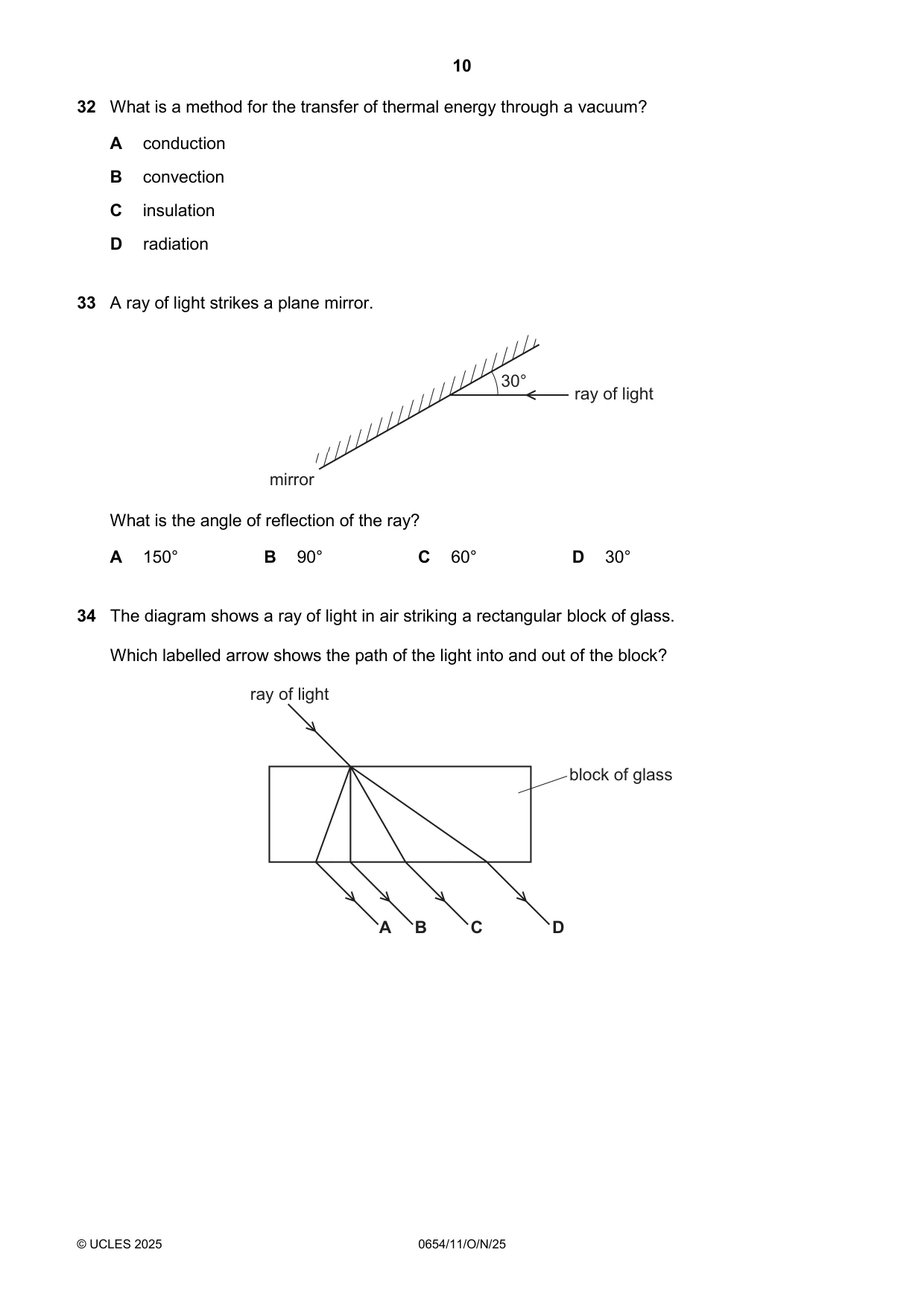
Q31 · Which labelled arrow on the diagram represents condensation?
31 Which labelled arrow on the diagram represents condensation? A liquid gas B D C solid
Mark scheme: A
Q32 · What is a method for the transfer of thermal energy through a vacuum?
32 What is a method for the transfer of thermal energy through a vacuum? A conduction B convection C insulation D radiation
Mark scheme: D
Q33 · A ray of light strikes a plane mirror
33 A ray of light strikes a plane mirror. 30° ray of light mirror What is the angle of reflection of the ray? A 150° B 90° C 60° D 30°
Mark scheme: C
Q34 · The diagram shows a ray of light in air striking a rectangular block of glass
34 The diagram shows a ray of light in air striking a rectangular block of glass. Which labelled arrow shows the path of the light into and out of the block? ray of light block of glass A B C D
Mark scheme: C
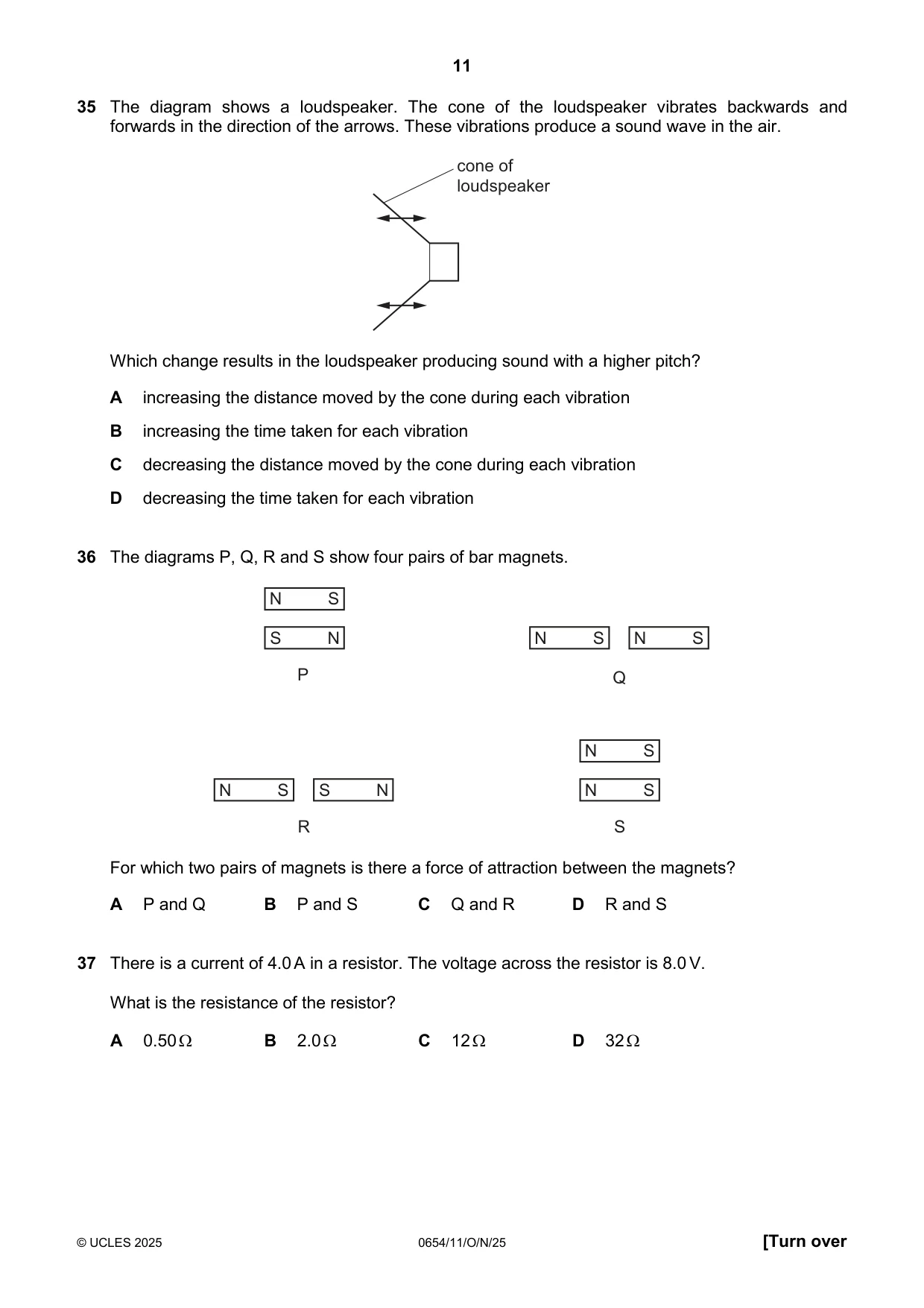
Q35 · The diagram shows a loudspeaker
35 The diagram shows a loudspeaker. The cone of the loudspeaker vibrates backwards and forwards in the direction of the arrows. These vibrations produce a sound wave in the air. cone of loudspeaker Which change results in the loudspeaker producing sound with a higher pitch? A increasing the distance moved by the cone during each vibration B increasing the time taken for each vibration C decreasing the distance moved by the cone during each vibration D decreasing the time taken for each vibration
Mark scheme: D
Q36 · The diagrams P, Q, R and S show four pairs of bar magnets
36 The diagrams P, Q, R and S show four pairs of bar magnets. N S S N N S N S P Q N S N S S N N S R S For which two pairs of magnets is there a force of attraction between the magnets? A P and Q B P and S C Q and R D R and S
Mark scheme: A
Q37 · There is a current of 4.0 A in a resistor
37 There is a current of 4.0 A in a resistor. The voltage across the resistor is 8.0 V. What is the resistance of the resistor? A 0.50 B 2.0 C 12 D 32
Mark scheme: B
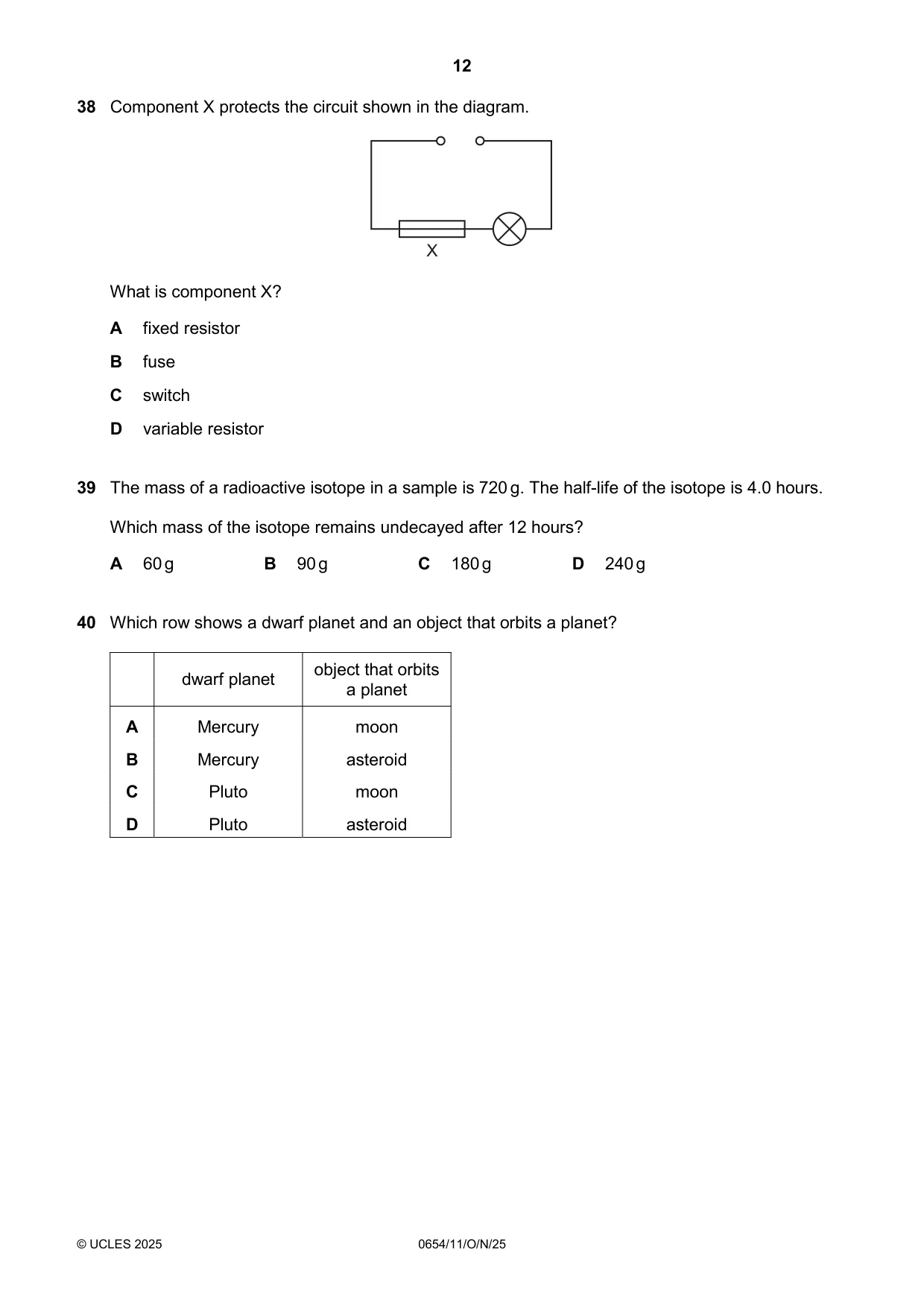
Q38 · Component X protects the circuit shown in the diagram
38 Component X protects the circuit shown in the diagram. X What is component X? A fixed resistor B fuse C switch D variable resistor
Mark scheme: B
Q39 · The mass of a radioactive isotope in a sample is 720 g
39 The mass of a radioactive isotope in a sample is 720 g. The half-life of the isotope is 4.0 hours. Which mass of the isotope remains undecayed after 12 hours? A 60 g B 90 g C 180 g D 240 g
Mark scheme: B
Q40 · Which row shows a dwarf planet and an object that orbits a planet?
40 Which row shows a dwarf planet and an object that orbits a planet? object that orbits dwarf planet a planet A Mercury moon B Mercury asteroid C Pluto moon D Pluto asteroid
Mark scheme: C
What was in this paper
The subtopics covered by these 40 questions, and how many questions each got. Open one in a new tab to see every Cambridge question on it.
2Gas exchange in humans2Light2Air quality and climate1Biological molecules1Blood1Characteristics of living organisms1Coordination and response1Density1Digestive system1Electrical quantities1Electrical safety1Electrolysis1Elements, compounds and mixtures1Enzymes1Exothermic and endothermic reactions1Formulas and terminology1Group I properties1Identification of ions and gases1Ions and ionic bonds1Isotopes1Kinetic particle model of matter1Osmosis1Photosynthesis1Polymers1Preparation of salts1Properties of metals1Radioactivity1Selection1Separation and purification1Sexual reproduction1Simple molecules and covalent bonds1Simple phenomena of magnetism1Sound1The Solar System1Transfer of thermal energy1Water uptake1What you needed in this session
Cambridge’s own grade thresholds for 2025 Oct/Nov, Paper 1 · Variant 1. A higher threshold means an easier paper — the bar moves with how the cohort did.