Cambridge IGCSE Sciences - Co-ordinated (Double) 0654 — 2024 May/June Paper 1 · Variant 1
0654/11/M/J/24 · 40 questions · 40 marks · ≈45 min
The question paper and its mark scheme, free to read here and free to download. This is Cambridge’s own paper, exactly as it was sat.
Question paper20 pages


Mark scheme3 pages
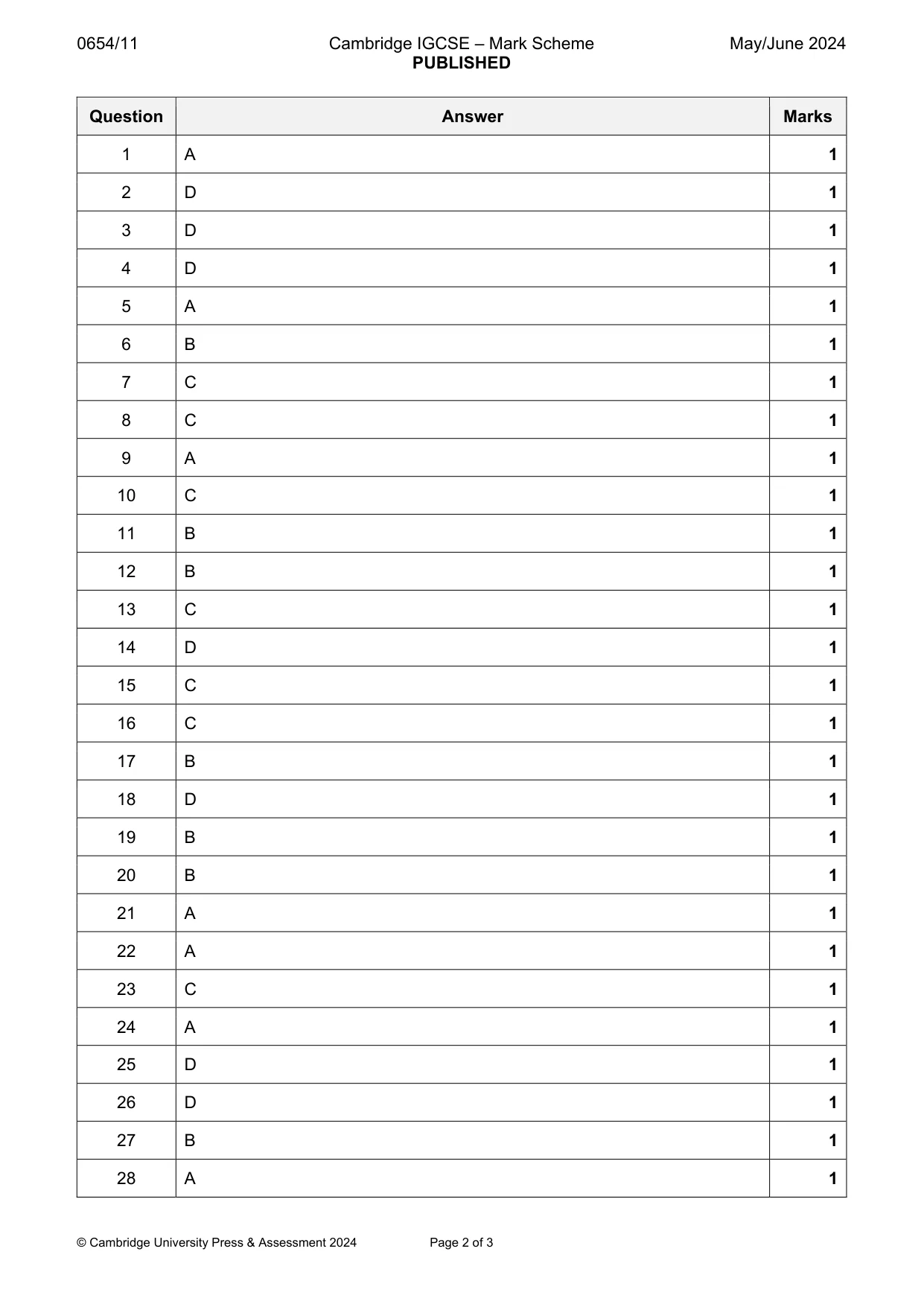
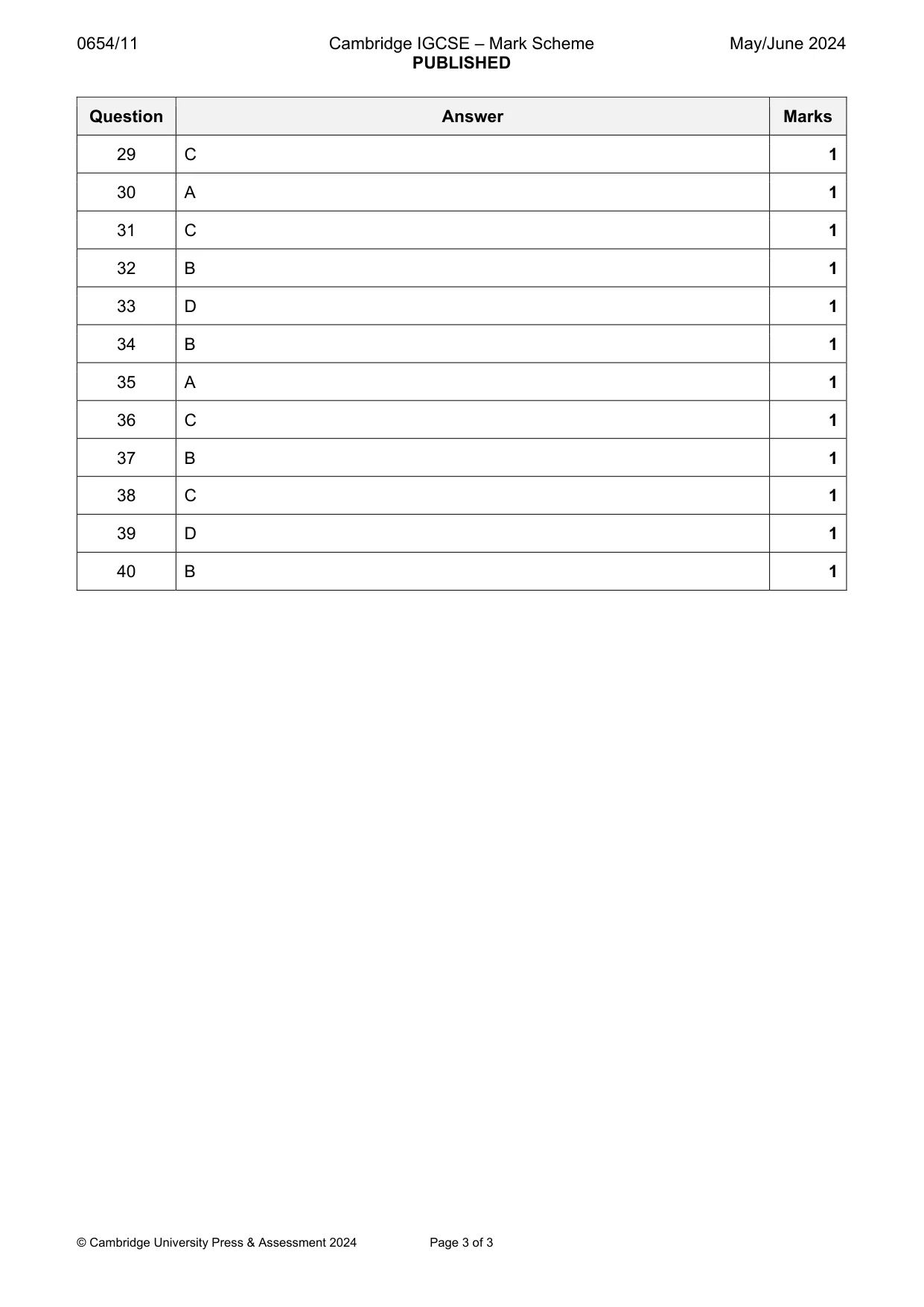
Answers below. Sit the paper first if you are practising.
Questions as text
Q1 · What is a characteristic of all living organisms?
1 What is a characteristic of all living organisms? A excretion B digestion C photosynthesis D sexual reproduction
Mark scheme: A
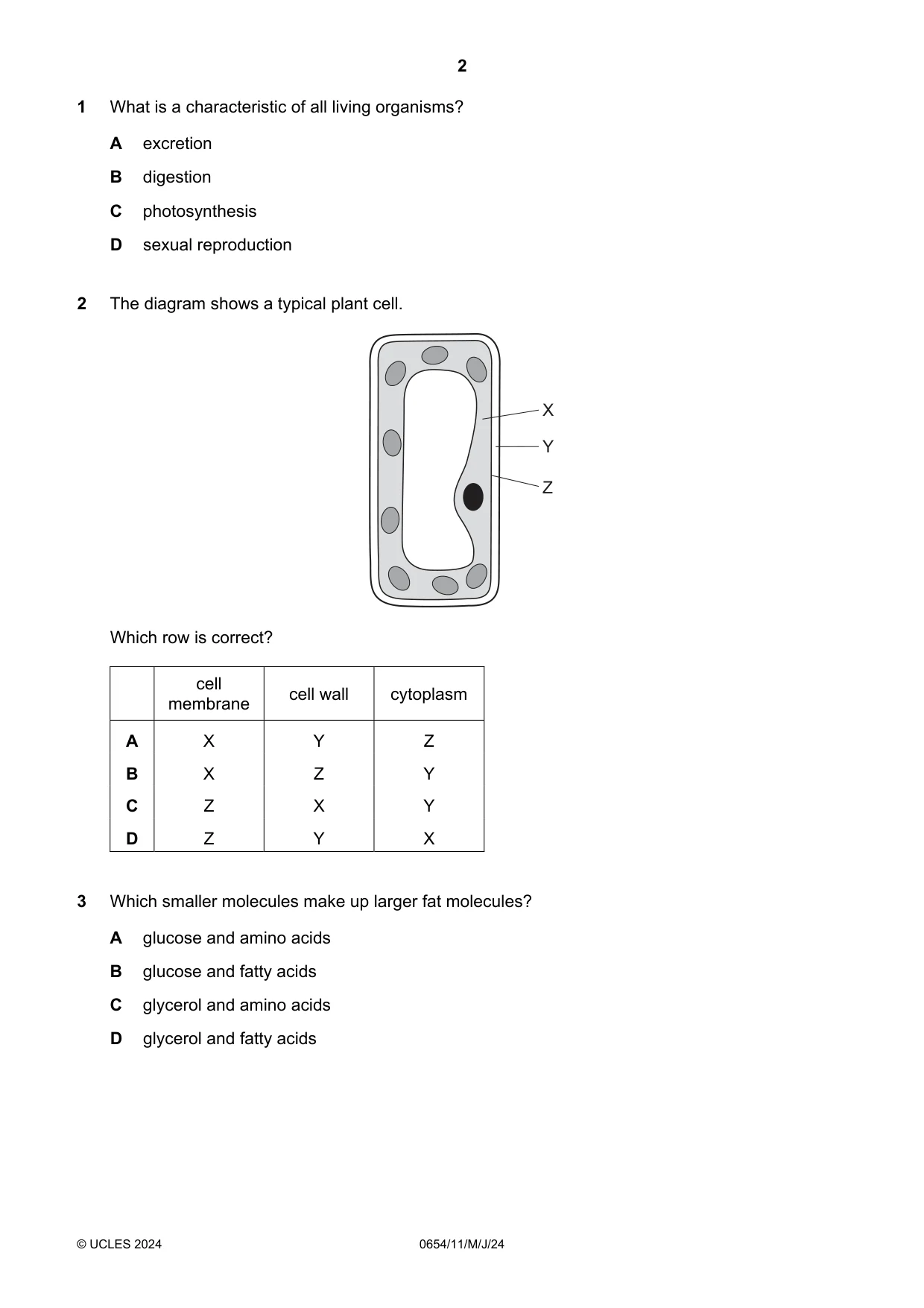
Q2 · The diagram shows a typical plant cell
2 The diagram shows a typical plant cell. X Y Z Which row is correct? cell cell wall cytoplasm membrane A X Y Z B X Z Y C Z X Y D Z Y X
Mark scheme: D
Q3 · Which smaller molecules make up larger fat molecules?
3 Which smaller molecules make up larger fat molecules? A glucose and amino acids B glucose and fatty acids C glycerol and amino acids D glycerol and fatty acids
Mark scheme: D
Q4 · Which type of molecules are enzymes?
4 Which type of molecules are enzymes? A carbohydrates B fats C oils D proteins
Mark scheme: D
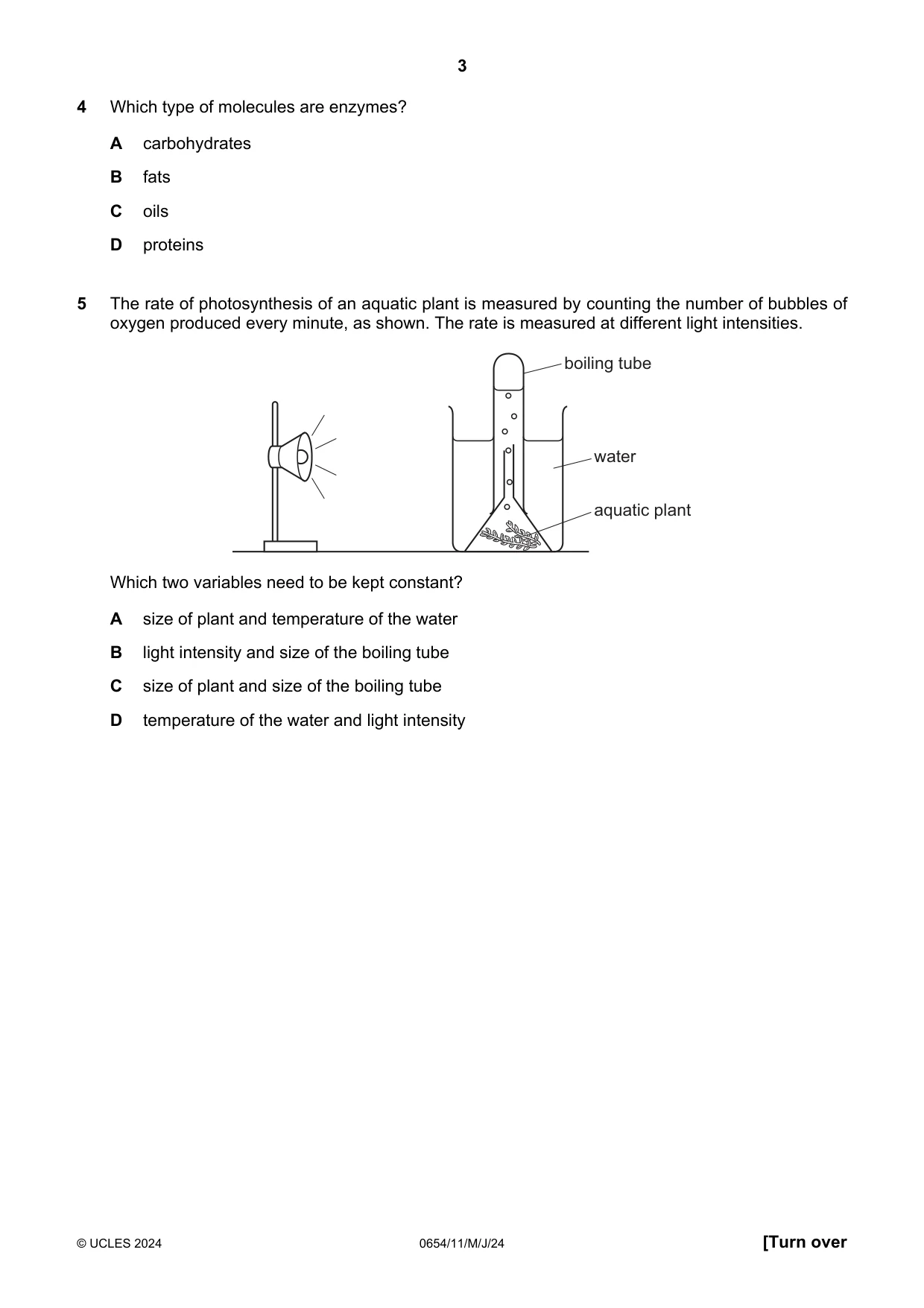
Q5 · The rate of photosynthesis of an aquatic plant is measured by counting the number of…
5 The rate of photosynthesis of an aquatic plant is measured by counting the number of bubbles of oxygen produced every minute, as shown. The rate is measured at different light intensities. boiling tube water aquatic plant Which two variables need to be kept constant? A size of plant and temperature of the water B light intensity and size of the boiling tube C size of plant and size of the boiling tube D temperature of the water and light intensity
Mark scheme: A
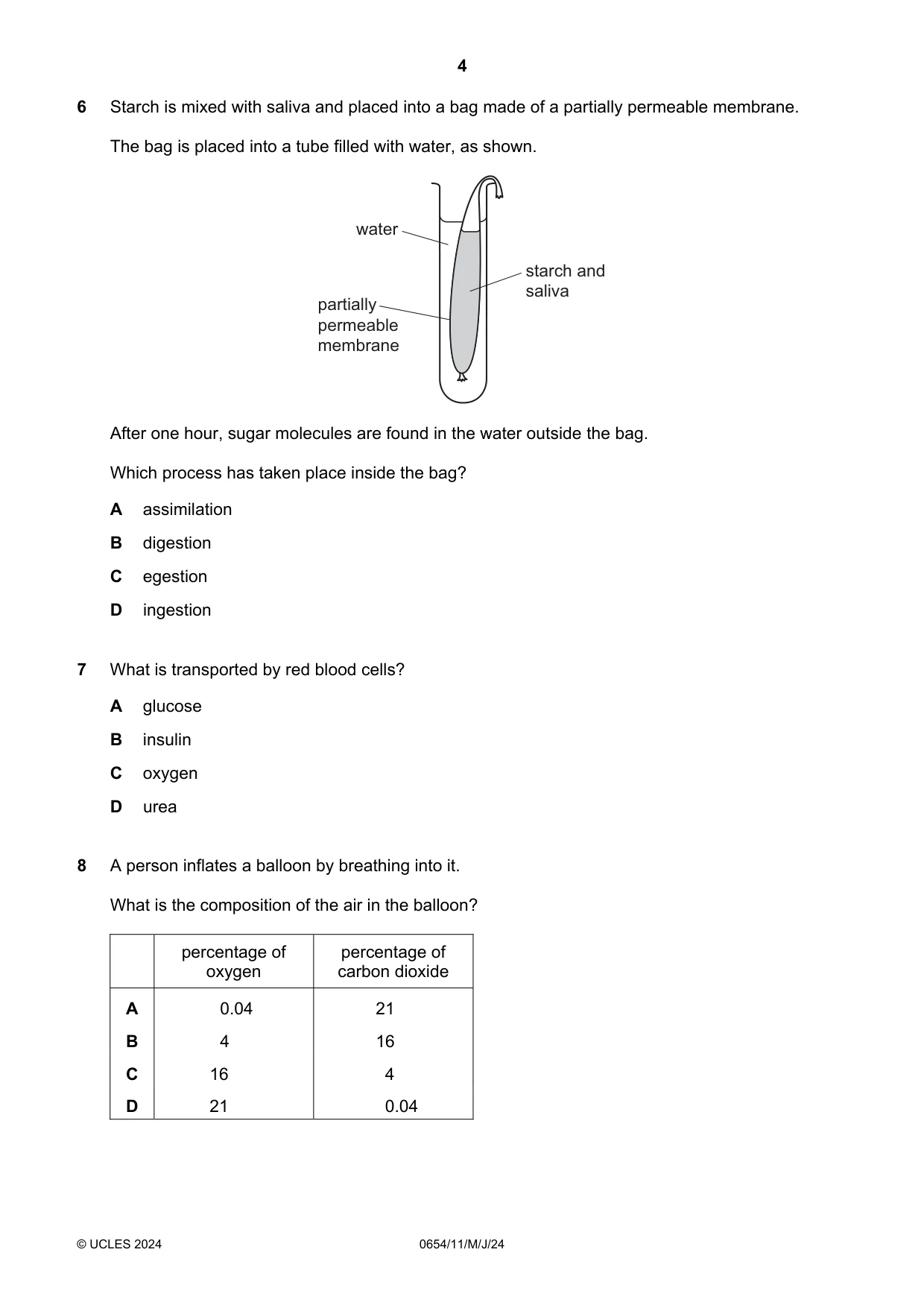
Q6 · Starch is mixed with saliva and placed into a bag made of a partially permeable membrane
6 Starch is mixed with saliva and placed into a bag made of a partially permeable membrane. The bag is placed into a tube filled with water, as shown. water starch and saliva partially permeable membrane After one hour, sugar molecules are found in the water outside the bag. Which process has taken place inside the bag? A assimilation B digestion C egestion D ingestion
Mark scheme: B
Q7 · What is transported by red blood cells?
7 What is transported by red blood cells? A glucose B insulin C oxygen D urea
Mark scheme: C
Q8 · A person inflates a balloon by breathing into it
8 A person inflates a balloon by breathing into it. What is the composition of the air in the balloon? percentage of percentage of oxygen carbon dioxide A 0.04 21 B 4 16 C 16 4 D 21 0.04
Mark scheme: C
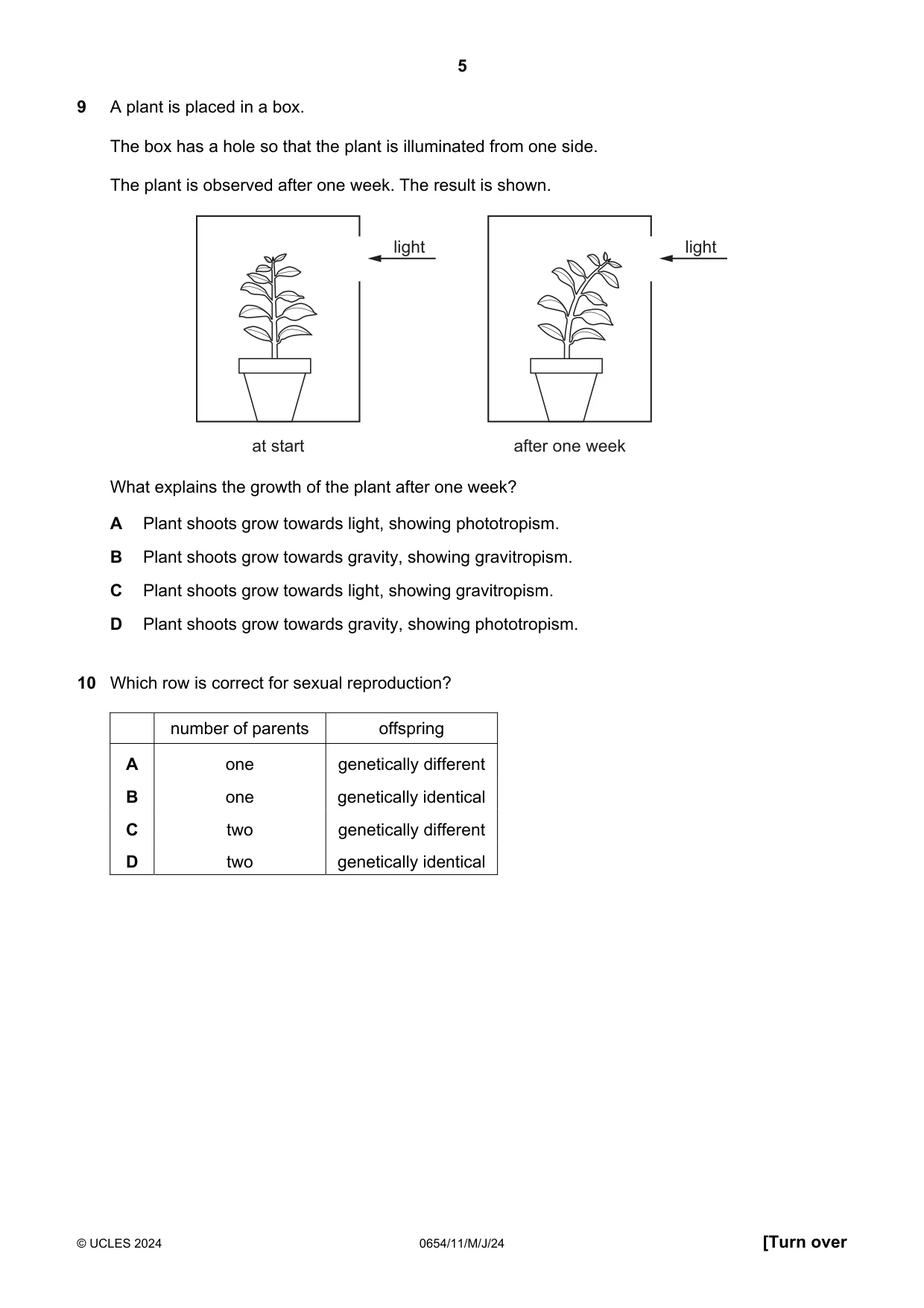
Q9 · A plant is placed in a box
9 A plant is placed in a box. The box has a hole so that the plant is illuminated from one side. The plant is observed after one week. The result is shown. light light at start after one week What explains the growth of the plant after one week? A Plant shoots grow towards light, showing phototropism. B Plant shoots grow towards gravity, showing gravitropism. C Plant shoots grow towards light, showing gravitropism. D Plant shoots grow towards gravity, showing phototropism.
Mark scheme: A
Q10 · Which row is correct for sexual reproduction?
10 Which row is correct for sexual reproduction? number of parents offspring A one genetically different B one genetically identical C two genetically different D two genetically identical
Mark scheme: C
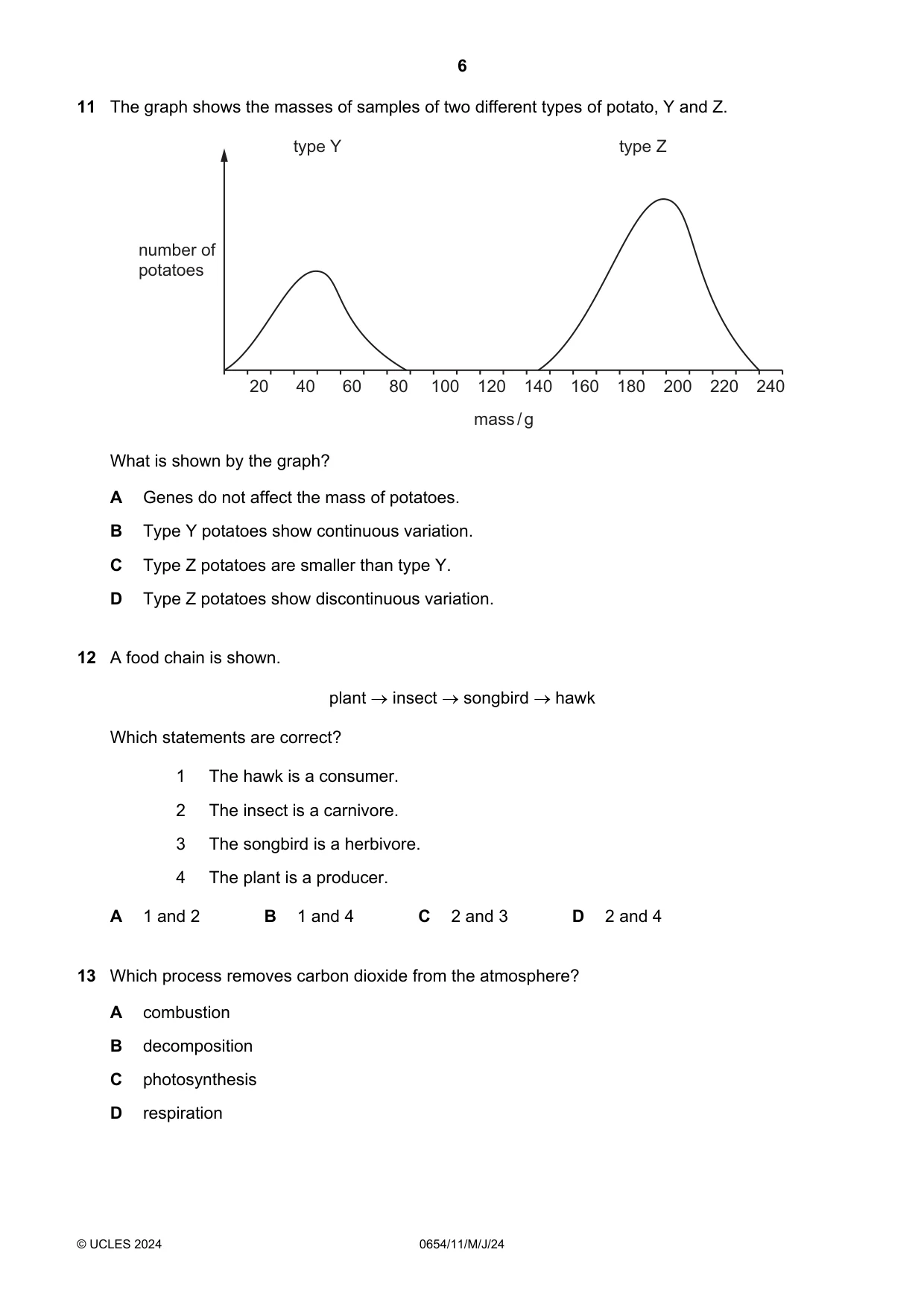
Q11 · The graph shows the masses of samples of two different types of potato, Y and Z
11 The graph shows the masses of samples of two different types of potato, Y and Z. type Y type Z number of potatoes 20 40 60 80 100 120 140 160 180 200 220 240 mass / g What is shown by the graph? A Genes do not affect the mass of potatoes. B Type Y potatoes show continuous variation. C Type Z potatoes are smaller than type Y. D Type Z potatoes show discontinuous variation.
Mark scheme: B
Q12 · A food chain is shown
12 A food chain is shown. plant insect songbird hawk Which statements are correct? 1 The hawk is a consumer. 2 The insect is a carnivore. 3 The songbird is a herbivore. 4 The plant is a producer. A 1 and 2 B 1 and 4 C 2 and 3 D 2 and 4
Mark scheme: B
Q13 · Which process removes carbon dioxide from the atmosphere?
13 Which process removes carbon dioxide from the atmosphere? A combustion B decomposition C photosynthesis D respiration
Mark scheme: C
Q14 · Cyclopentane is a hydrocarbon
14 Cyclopentane is a hydrocarbon. The melting point of cyclopentane is –94 C and its boiling point is 49 C. In process 1, the temperature of cyclopentane changes from 55 C to 45 C. In process 2, the temperature of cyclopentane changes from –100 C to –90 C. Which row identifies the changes in processes 1 and 2? 1 2 A boiling freezing B boiling melting C condensation freezing D condensation melting
Mark scheme: D
Q15 · Which statements about chemical changes are correct?
15 Which statements about chemical changes are correct? 1 The separation of petroleum into gasoline, naphtha and diesel is a chemical change. 2 The separation of water into hydrogen and oxygen is a chemical change. 3 In a chemical change, a new substance is always formed. 4 In a chemical change, heat is always released. A 1 and 2 B 1 and 4 C 2 and 3 D 3 and 4
Mark scheme: C
Q16 · Which elements react together to form an ionic compound?
16 Which elements react together to form an ionic compound? A carbon and oxygen B nitrogen and hydrogen C potassium and bromine D sodium and lithium
Mark scheme: C
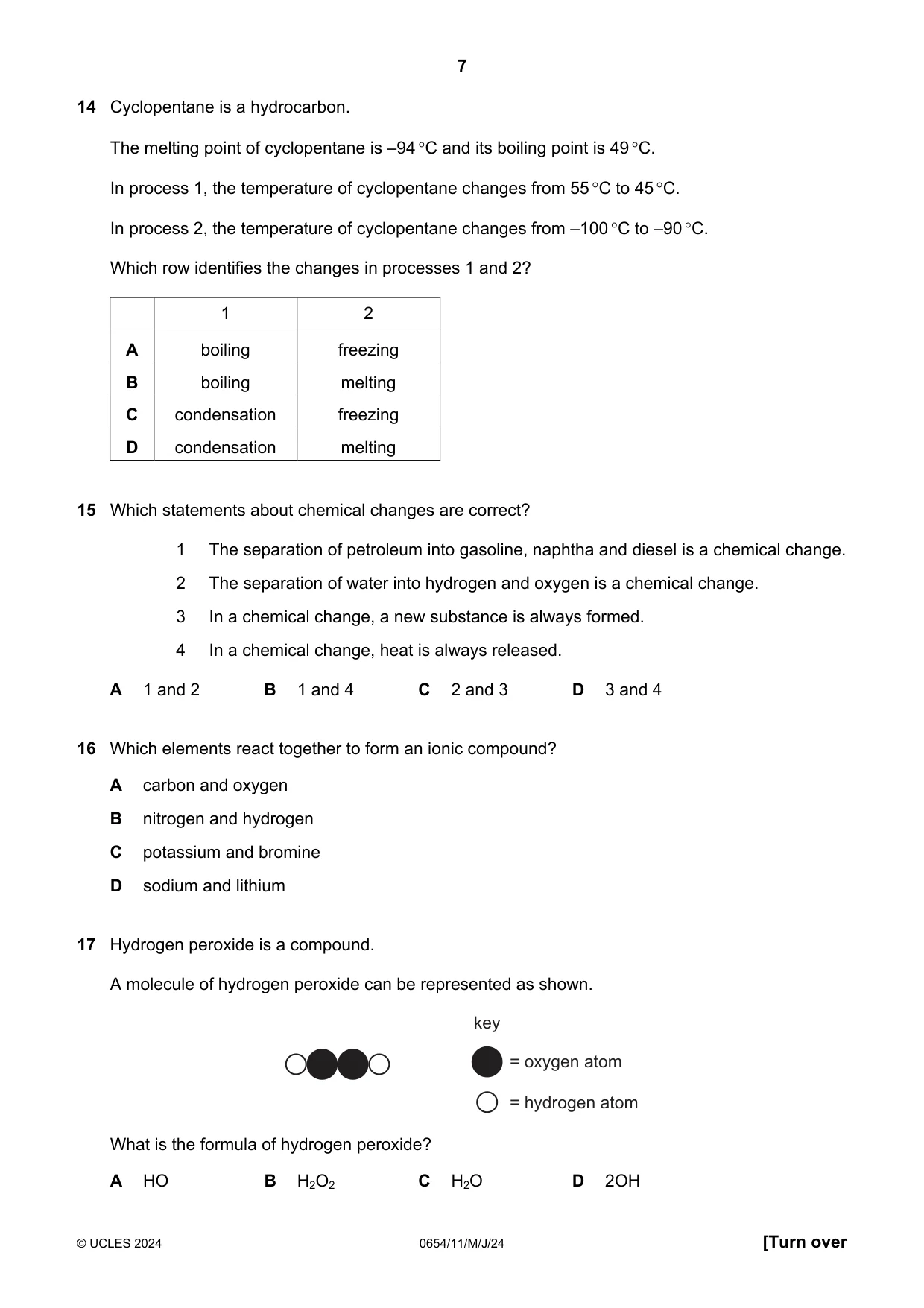
Q17 · Hydrogen peroxide is a compound
17 Hydrogen peroxide is a compound. A molecule of hydrogen peroxide can be represented as shown. key = oxygen atom = hydrogen atom What is the formula of hydrogen peroxide? A HO B H2O2 C H2O D 2OH
Mark scheme: B
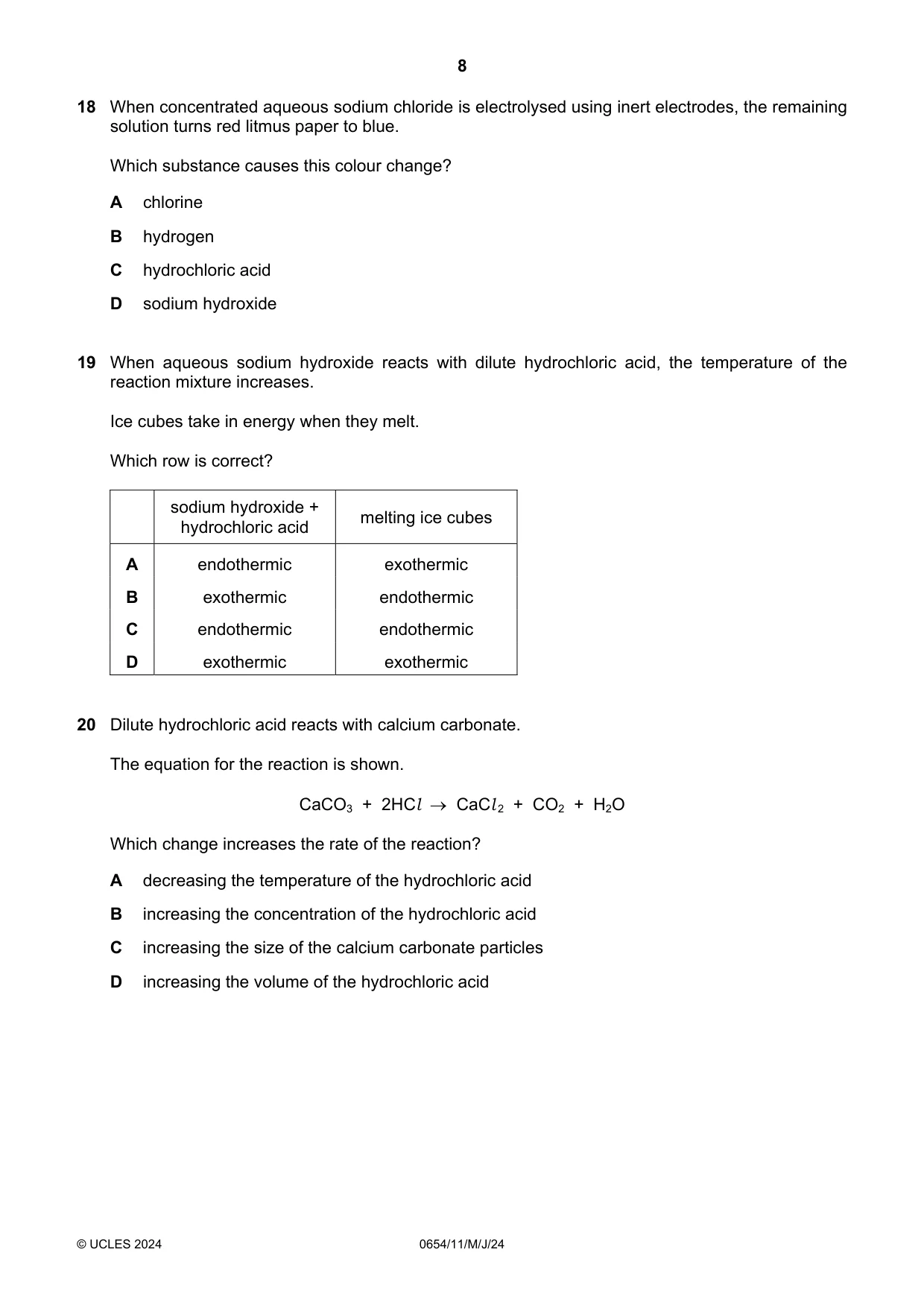
Q18 · When concentrated aqueous sodium chloride is electrolysed using inert electrodes, the…
18 When concentrated aqueous sodium chloride is electrolysed using inert electrodes, the remaining solution turns red litmus paper to blue. Which substance causes this colour change? A chlorine B hydrogen C hydrochloric acid D sodium hydroxide
Mark scheme: D
Q19 · When aqueous sodium hydroxide reacts with dilute hydrochloric acid, the temperature of…
19 When aqueous sodium hydroxide reacts with dilute hydrochloric acid, the temperature of the reaction mixture increases. Ice cubes take in energy when they melt. Which row is correct? sodium hydroxide + melting ice cubes hydrochloric acid A endothermic exothermic B exothermic endothermic C endothermic endothermic D exothermic exothermic
Mark scheme: B
Q20 · Dilute hydrochloric acid reacts with calcium carbonate
20 Dilute hydrochloric acid reacts with calcium carbonate. The equation for the reaction is shown. CaCO3 + 2HCl CaCl 2 + CO2 + H2O Which change increases the rate of the reaction? A decreasing the temperature of the hydrochloric acid B increasing the concentration of the hydrochloric acid C increasing the size of the calcium carbonate particles D increasing the volume of the hydrochloric acid
Mark scheme: B
Q21 · Which reactions involve oxidation?
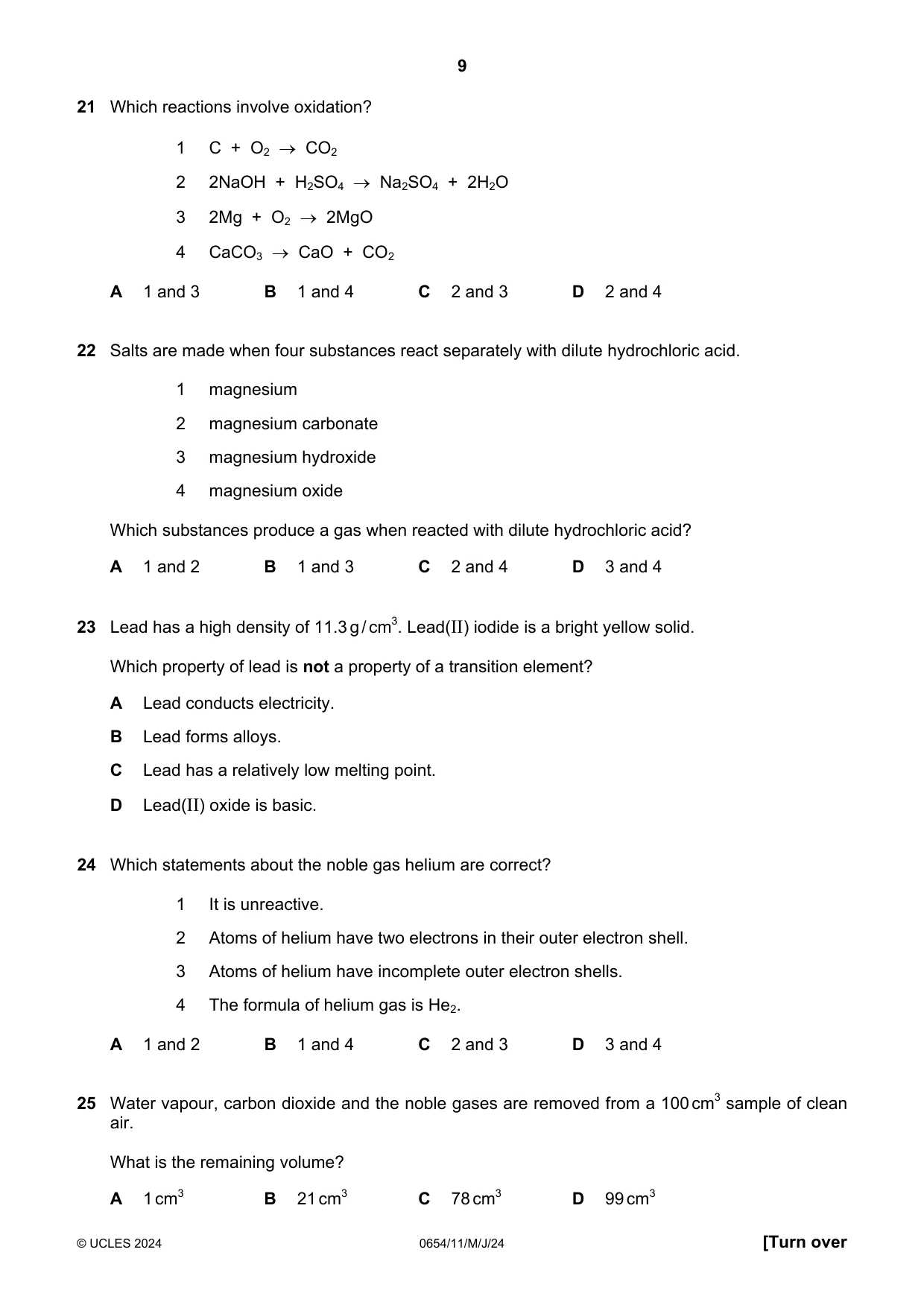
21 Which reactions involve oxidation? 1 C + O2 CO2 2 2NaOH + H2SO4 Na2SO4 + 2H2O 3 2Mg + O2 2MgO 4 CaCO3 CaO + CO2 A 1 and 3 B 1 and 4 C 2 and 3 D 2 and 4
Mark scheme: A
Q22 · Salts are made when four substances react separately with dilute hydrochloric acid
22 Salts are made when four substances react separately with dilute hydrochloric acid. 1 magnesium 2 magnesium carbonate 3 magnesium hydroxide 4 magnesium oxide Which substances produce a gas when reacted with dilute hydrochloric acid? A 1 and 2 B 1 and 3 C 2 and 4 D 3 and 4
Mark scheme: A
Q23 · Lead has a high density of 11.3 g / cm3
23 Lead has a high density of 11.3 g / cm3. Lead(II) iodide is a bright yellow solid. Which property of lead is not a property of a transition element? A Lead conducts electricity. B Lead forms alloys. C Lead has a relatively low melting point. D Lead(II) oxide is basic.
Mark scheme: C
Q24 · Which statements about the noble gas helium are correct?
24 Which statements about the noble gas helium are correct? 1 It is unreactive. 2 Atoms of helium have two electrons in their outer electron shell. 3 Atoms of helium have incomplete outer electron shells. 4 The formula of helium gas is He2. A 1 and 2 B 1 and 4 C 2 and 3 D 3 and 4
Mark scheme: A
Q25 · Water vapour, carbon dioxide and the noble gases are removed from a 100 cm3 sample of…
25 Water vapour, carbon dioxide and the noble gases are removed from a 100 cm3 sample of clean air. What is the remaining volume? A 1 cm3 B 21 cm3 C 78 cm3 D 99 cm3
Mark scheme: D
Q26 · Which statement about manufacturing processes is correct?
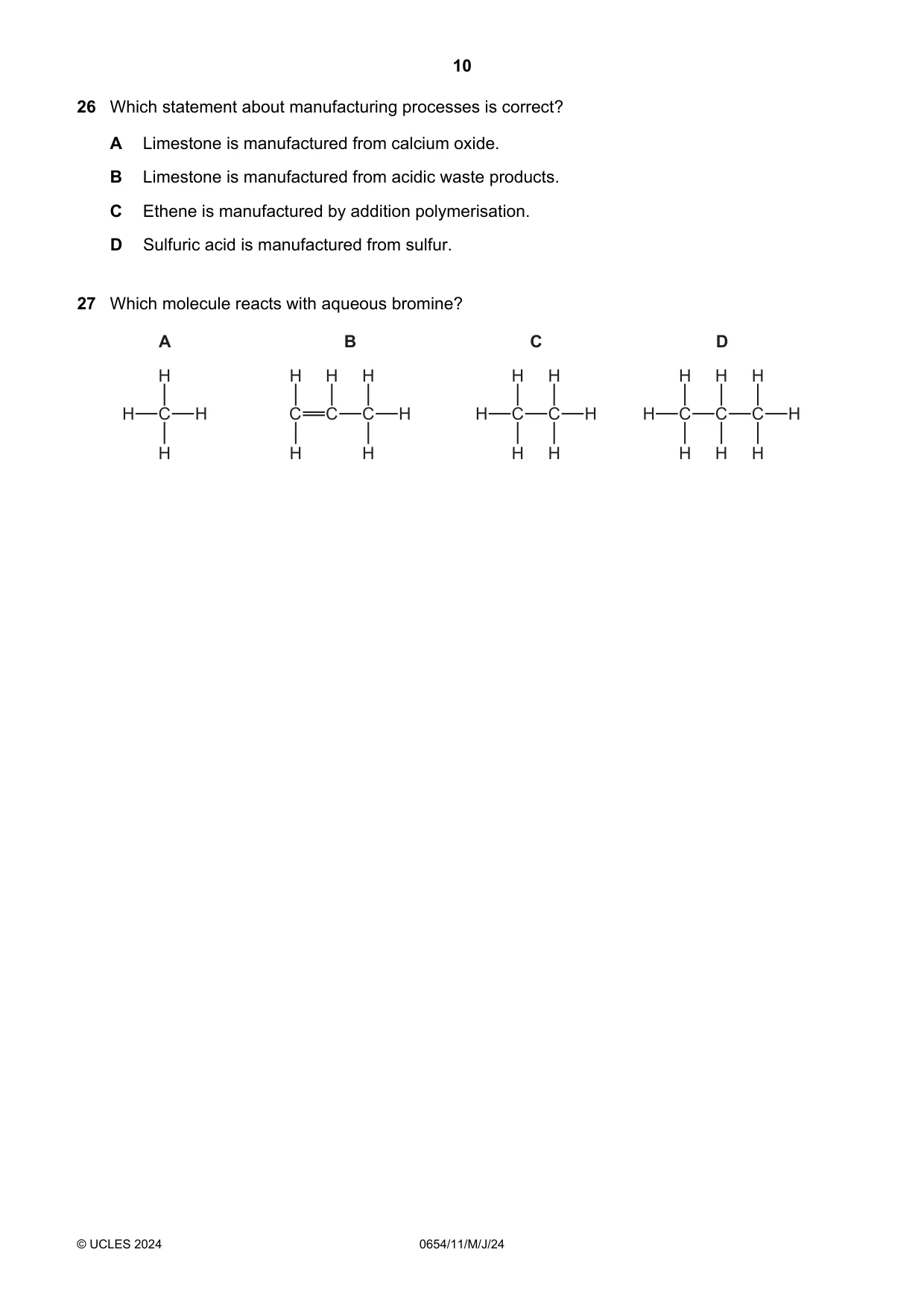
26 Which statement about manufacturing processes is correct? A Limestone is manufactured from calcium oxide. B Limestone is manufactured from acidic waste products. C Ethene is manufactured by addition polymerisation. D Sulfuric acid is manufactured from sulfur.
Mark scheme: D
Q27 · Which molecule reacts with aqueous bromine?
27 Which molecule reacts with aqueous bromine? A B C D H H H H H H H H H H C H C C C H H C C H H C C C H H H H H H H H H
Mark scheme: B
Q28 · A car travels at constant speed
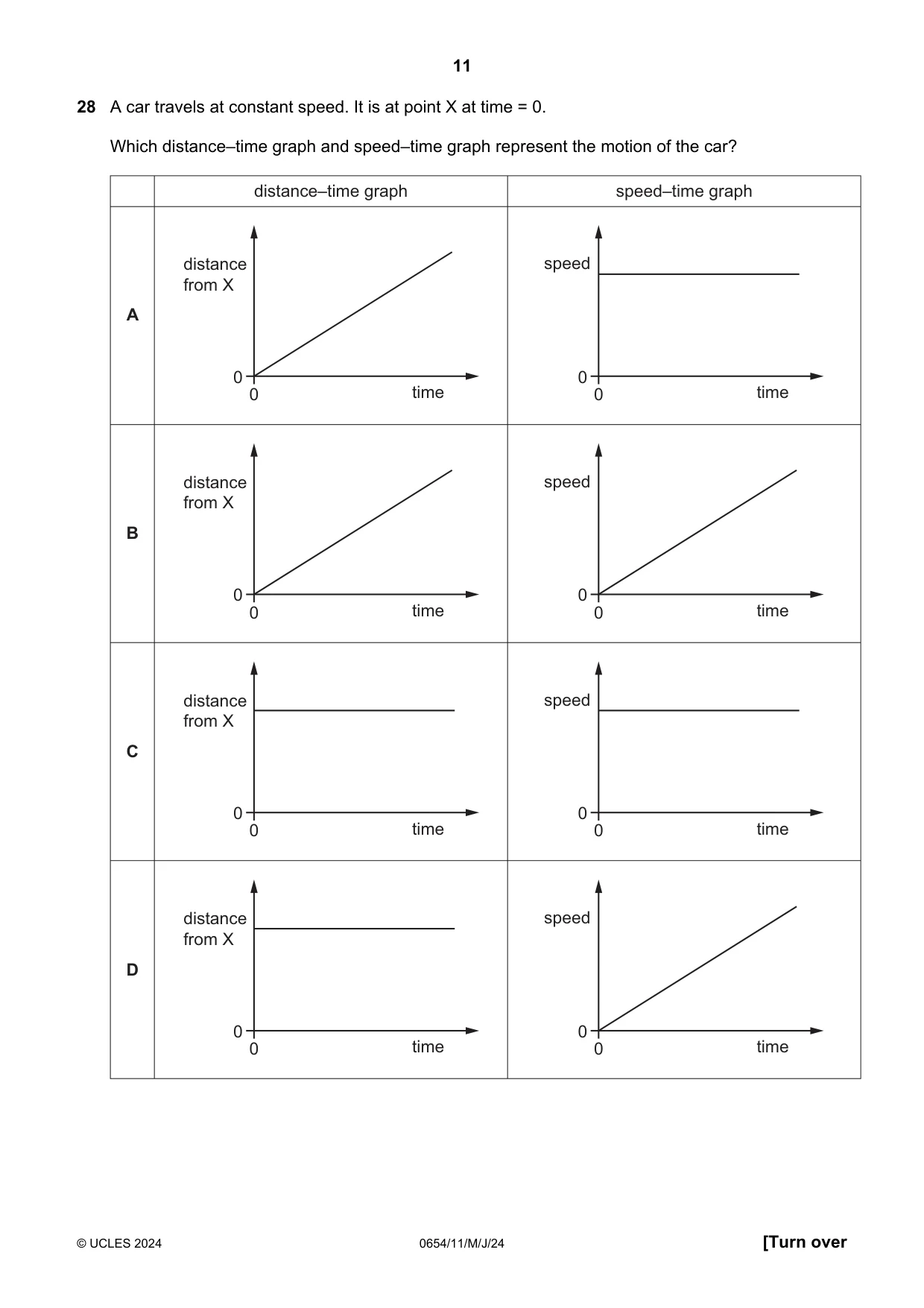
28 A car travels at constant speed. It is at point X at time = 0. Which distance–time graph and speed–time graph represent the motion of the car? distance–time graph speed–time graph distance speed from X A 0 0 0 time 0 time distance speed from X B 0 0 0 time 0 time distance speed from X C 0 0 0 time 0 time distance speed from X D 0 0 0 time 0 time
Mark scheme: A
Q29 · The diagrams show all the forces acting on three objects, X, Y and Z
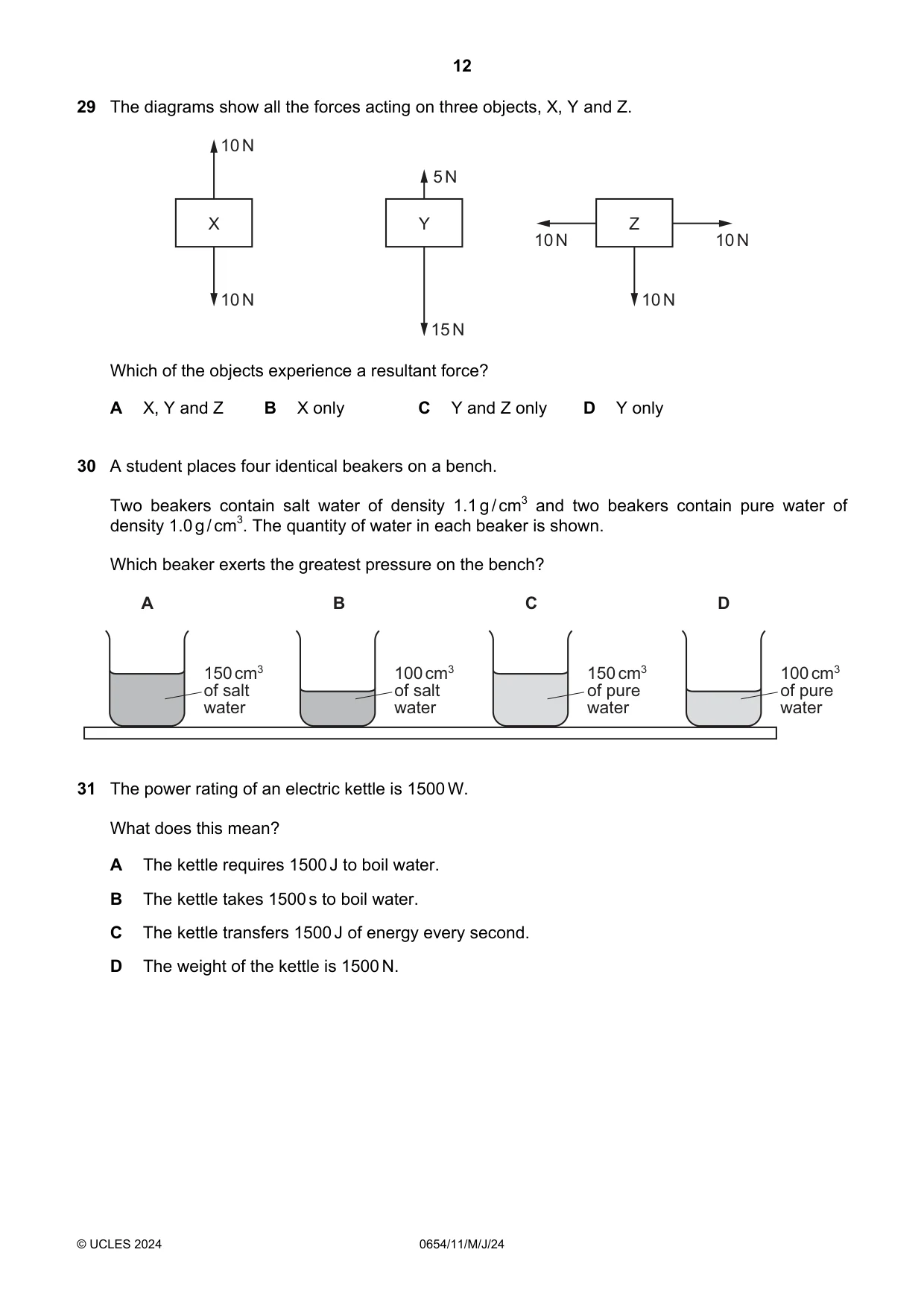
29 The diagrams show all the forces acting on three objects, X, Y and Z. 10 N 5 N X Y Z 10 N 10 N 10 N 10 N 15 N Which of the objects experience a resultant force? A X, Y and Z B X only C Y and Z only D Y only
Mark scheme: C
Q30 · A student places four identical beakers on a bench
30 A student places four identical beakers on a bench. Two beakers contain salt water of density 1.1 g / cm3 and two beakers contain pure water of density 1.0 g / cm3. The quantity of water in each beaker is shown. Which beaker exerts the greatest pressure on the bench? A B C D 150 cm3 100 cm3 150 cm3 100 cm3 of salt of salt of pure of pure water water water water
Mark scheme: A
Q31 · The power rating of an electric kettle is 1500 W
31 The power rating of an electric kettle is 1500 W. What does this mean? A The kettle requires 1500 J to boil water. B The kettle takes 1500 s to boil water. C The kettle transfers 1500 J of energy every second. D The weight of the kettle is 1500 N.
Mark scheme: C
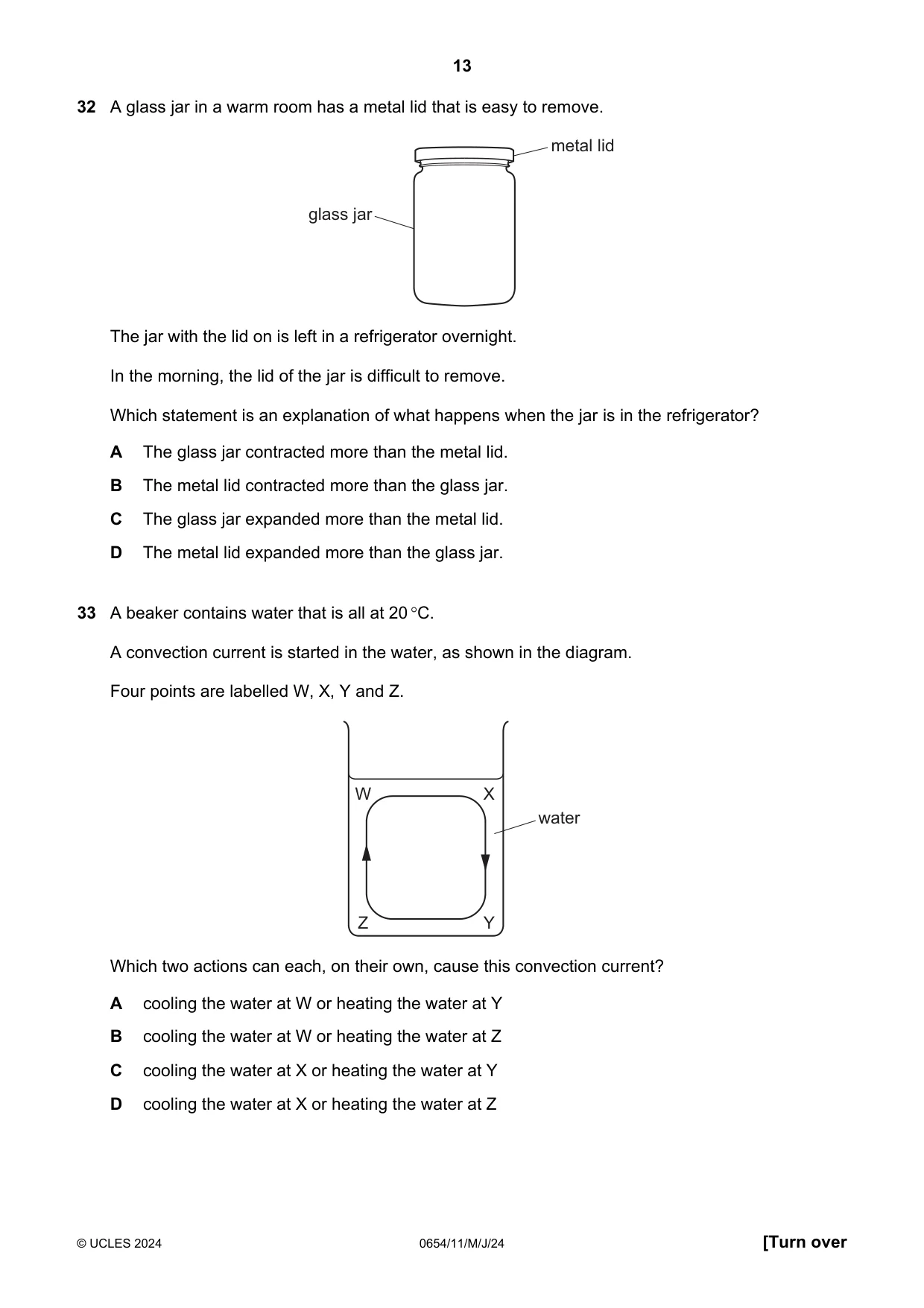
Q32 · A glass jar in a warm room has a metal lid that is easy to remove
32 A glass jar in a warm room has a metal lid that is easy to remove. metal lid glass jar The jar with the lid on is left in a refrigerator overnight. In the morning, the lid of the jar is difficult to remove. Which statement is an explanation of what happens when the jar is in the refrigerator? A The glass jar contracted more than the metal lid. B The metal lid contracted more than the glass jar. C The glass jar expanded more than the metal lid. D The metal lid expanded more than the glass jar.
Mark scheme: B
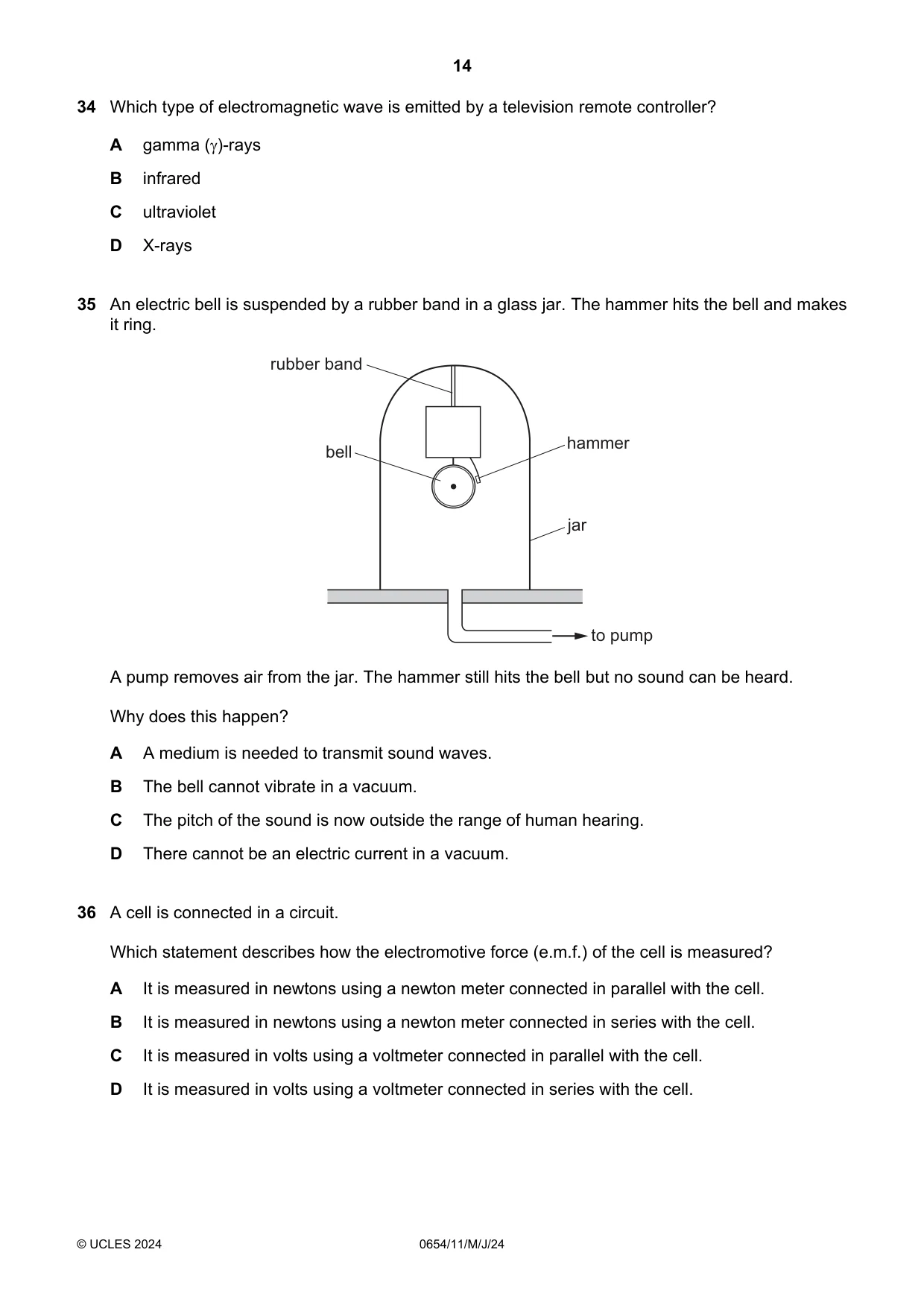
Q33 · A beaker contains water that is all at 20 C
33 A beaker contains water that is all at 20 C. A convection current is started in the water, as shown in the diagram. Four points are labelled W, X, Y and Z. W X water Z Y Which two actions can each, on their own, cause this convection current? A cooling the water at W or heating the water at Y B cooling the water at W or heating the water at Z C cooling the water at X or heating the water at Y D cooling the water at X or heating the water at Z
Mark scheme: D
Q34 · Which type of electromagnetic wave is emitted by a television remote controller?
34 Which type of electromagnetic wave is emitted by a television remote controller? A gamma ()-rays B infrared C ultraviolet D X-rays
Mark scheme: B
Q35 · An electric bell is suspended by a rubber band in a glass jar
35 An electric bell is suspended by a rubber band in a glass jar. The hammer hits the bell and makes it ring. rubber band hammer bell jar to pump A pump removes air from the jar. The hammer still hits the bell but no sound can be heard. Why does this happen? A A medium is needed to transmit sound waves. B The bell cannot vibrate in a vacuum. C The pitch of the sound is now outside the range of human hearing. D There cannot be an electric current in a vacuum.
Mark scheme: A
Q36 · A cell is connected in a circuit
36 A cell is connected in a circuit. Which statement describes how the electromotive force (e.m.f.) of the cell is measured? A It is measured in newtons using a newton meter connected in parallel with the cell. B It is measured in newtons using a newton meter connected in series with the cell. C It is measured in volts using a voltmeter connected in parallel with the cell. D It is measured in volts using a voltmeter connected in series with the cell.
Mark scheme: C
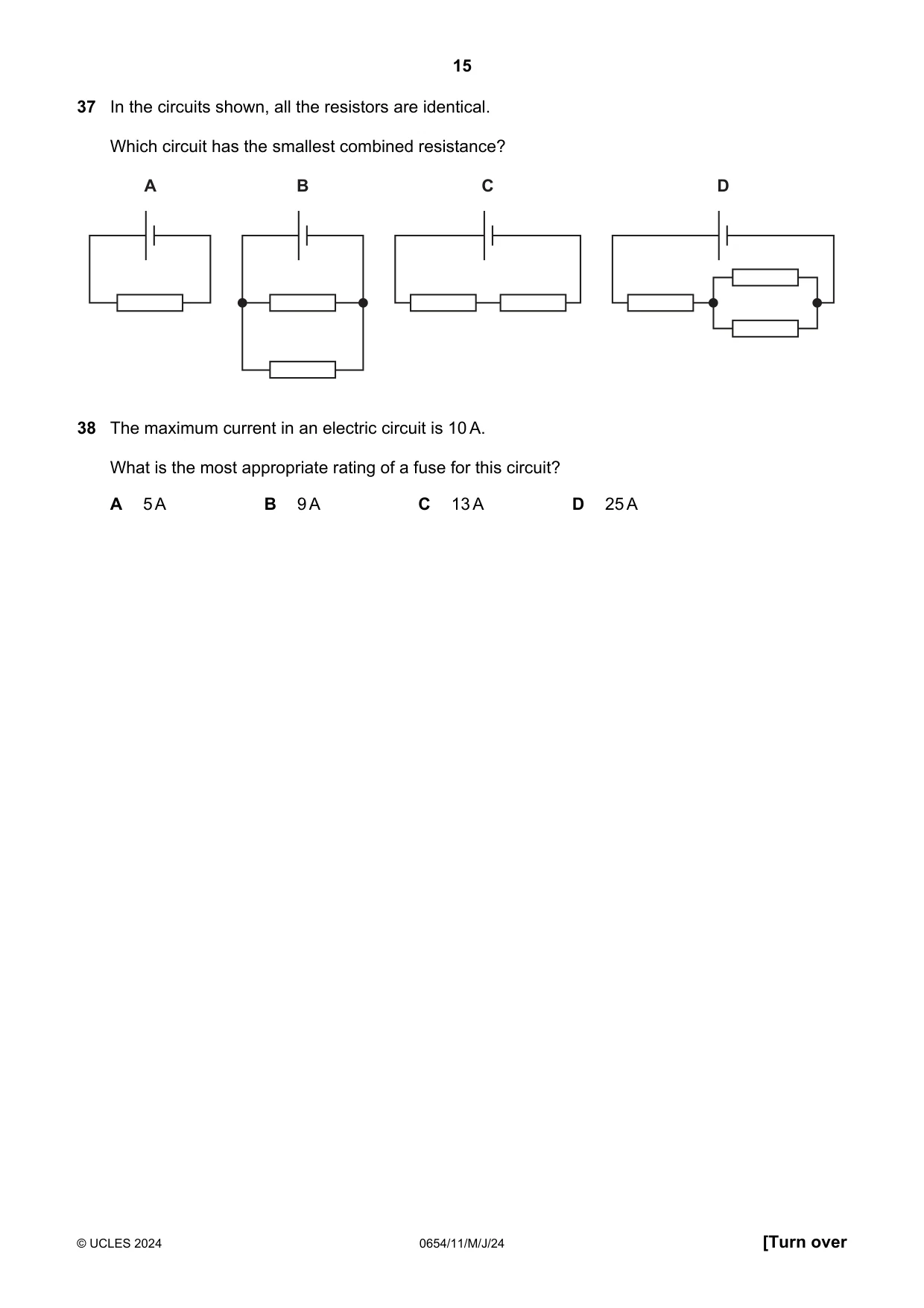
Q37 · In the circuits shown, all the resistors are identical
37 In the circuits shown, all the resistors are identical. Which circuit has the smallest combined resistance? A B C D
Mark scheme: B
Q38 · The maximum current in an electric circuit is 10 A
38 The maximum current in an electric circuit is 10 A. What is the most appropriate rating of a fuse for this circuit? A 5 A B 9 A C 13 A D 25 A
Mark scheme: C
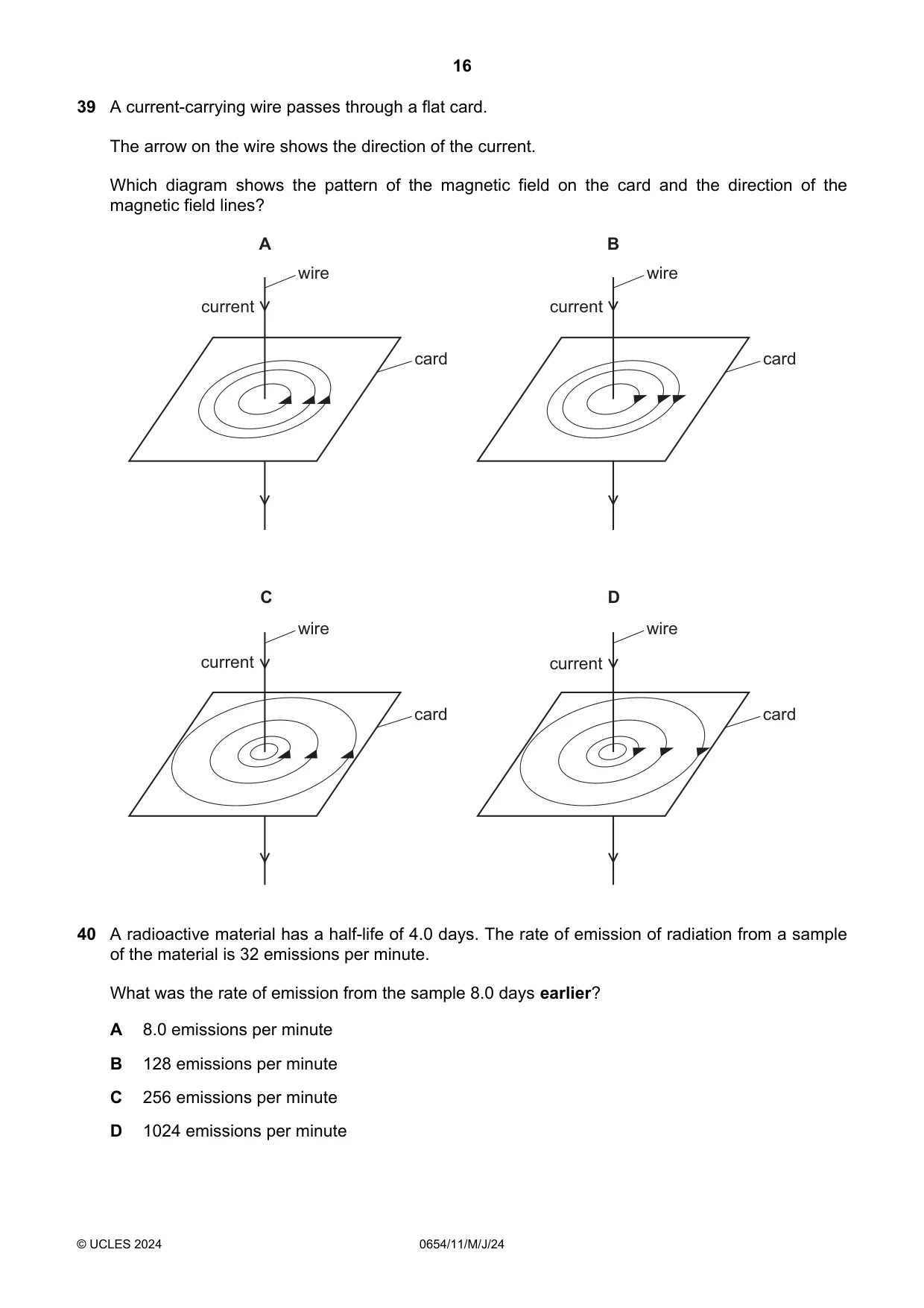
Q39 · A current-carrying wire passes through a flat card
39 A current-carrying wire passes through a flat card. The arrow on the wire shows the direction of the current. Which diagram shows the pattern of the magnetic field on the card and the direction of the magnetic field lines? A B wire wire current current card card C D wire wire current current card card
Mark scheme: D
Q40 · A radioactive material has a half-life of 4.0 days
40 A radioactive material has a half-life of 4.0 days. The rate of emission of radiation from a sample of the material is 32 emissions per minute. What was the rate of emission from the sample 8.0 days earlier? A 8.0 emissions per minute B 128 emissions per minute C 256 emissions per minute D 1024 emissions per minute
Mark scheme: B
What was in this paper
The subtopics covered by these 40 questions, and how many questions each got. Open one in a new tab to see every Cambridge question on it.
1Alkenes1Biological molecules1Blood1Carbon cycle1Cell structure1Characteristics of living organisms1Coordination and response1Diffusion1Electrical circuits1Electrical quantities1Electrical safety1Electrolysis1Electromagnetic effects1Electromagnetic spectrum1Energy, work and power1Enzymes1Exothermic and endothermic reactions1Food chains and food webs1Forces1Formulas1Fuels1Gas exchange in humans1Ions and ionic bonds1Motion1Noble gases1Photosynthesis1Physical and chemical changes1Preparation of salts1Pressure1Radioactivity1Rate of reaction1Redox1Sexual reproduction1Solids, liquids and gases1Sound1Thermal properties and temperature1Transfer of thermal energy1Transition elements1Variation1What you needed in this session
Cambridge’s own grade thresholds for 2024 May/June, Paper 1 · Variant 1. A higher threshold means an easier paper — the bar moves with how the cohort did.