Cambridge IGCSE Sciences - Co-ordinated (Double) 0654 — 2013 Oct/Nov Paper 1 · Variant 3
0654/13/O/N/13 · 40 questions · 40 marks · ≈45 min
The question paper and its mark scheme, free to read here and free to download. This is Cambridge’s own paper, exactly as it was sat.
Question paper20 pages

Mark scheme2 pages
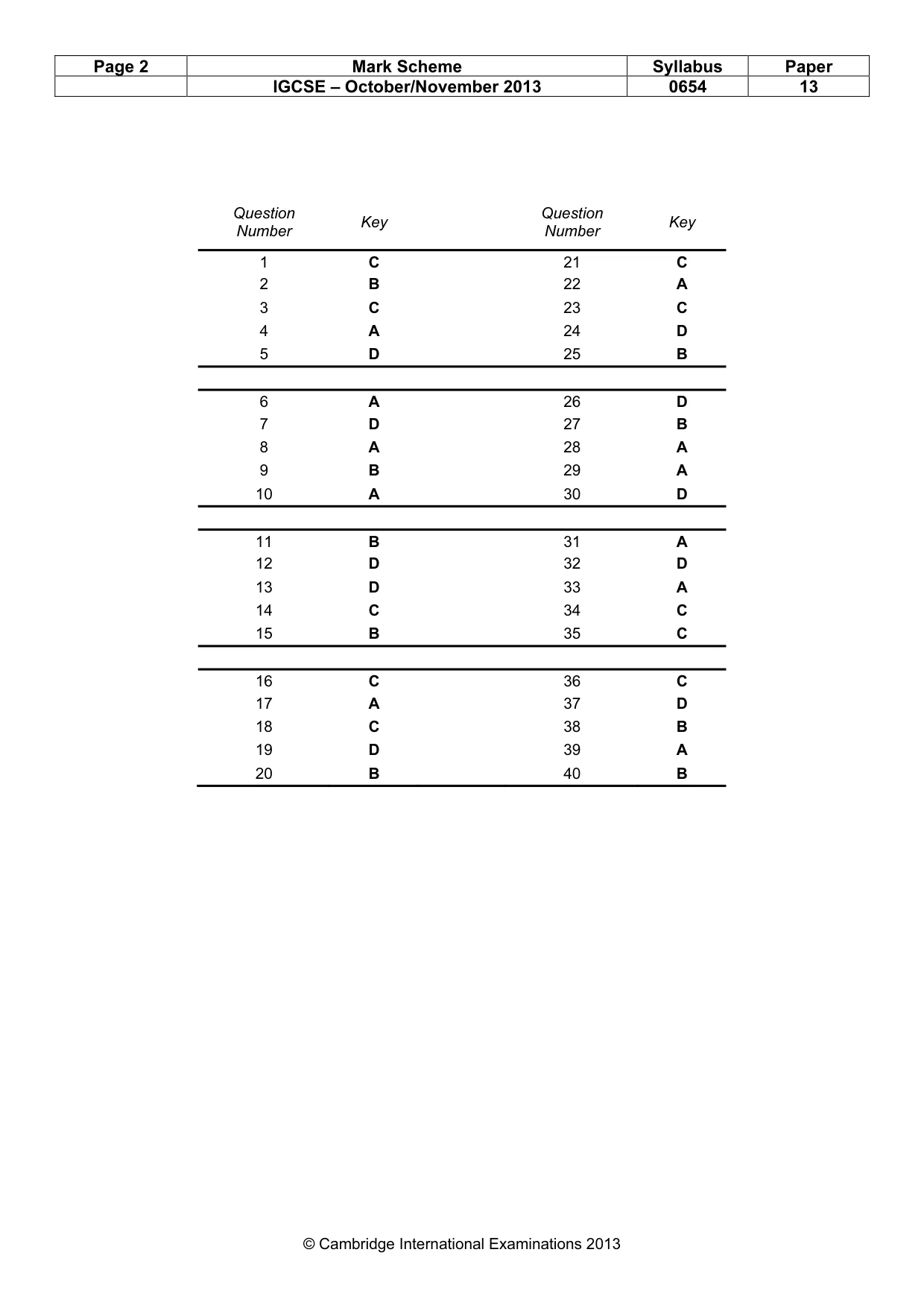
Answers below. Sit the paper first if you are practising.
Questions as text
Q1 · A student was walking through some grass when he saw an object with a hole in its outer…
1 A student was walking through some grass when he saw an object with a hole in its outer covering. When touched, a jet of fluid came out of the hole and the object moved away. Which characteristics of living organisms has the object shown? A excretion, nutrition B movement, respiration C movement, sensitivity D nutrition, sensitivity
Mark scheme: C
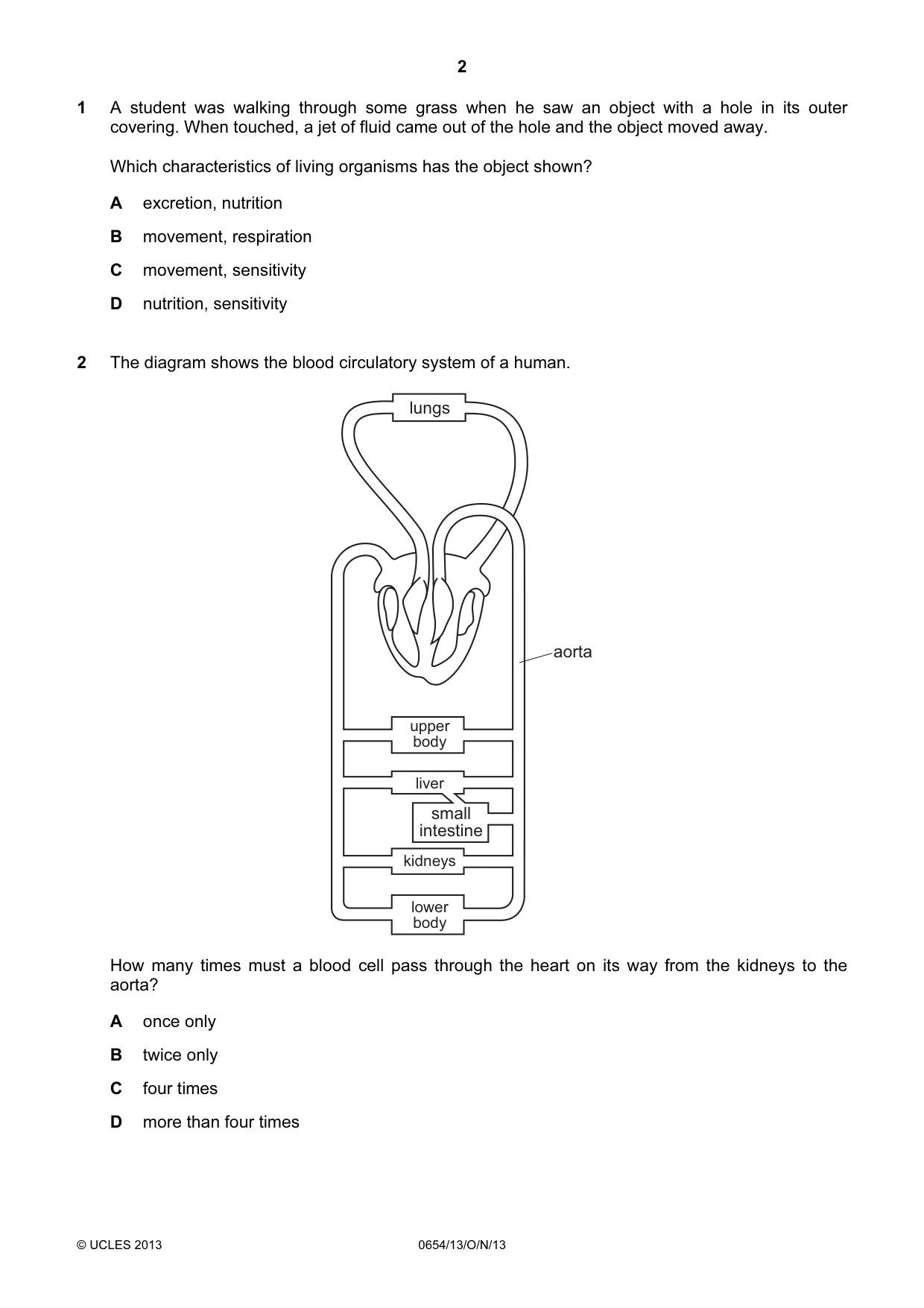
Q2 · The diagram shows the blood circulatory system of a human
2 The diagram shows the blood circulatory system of a human. lungs aorta upper body liver small intestine kidneys lower body How many times must a blood cell pass through the heart on its way from the kidneys to the aorta? A once only B twice only C four times D more than four times
Mark scheme: B
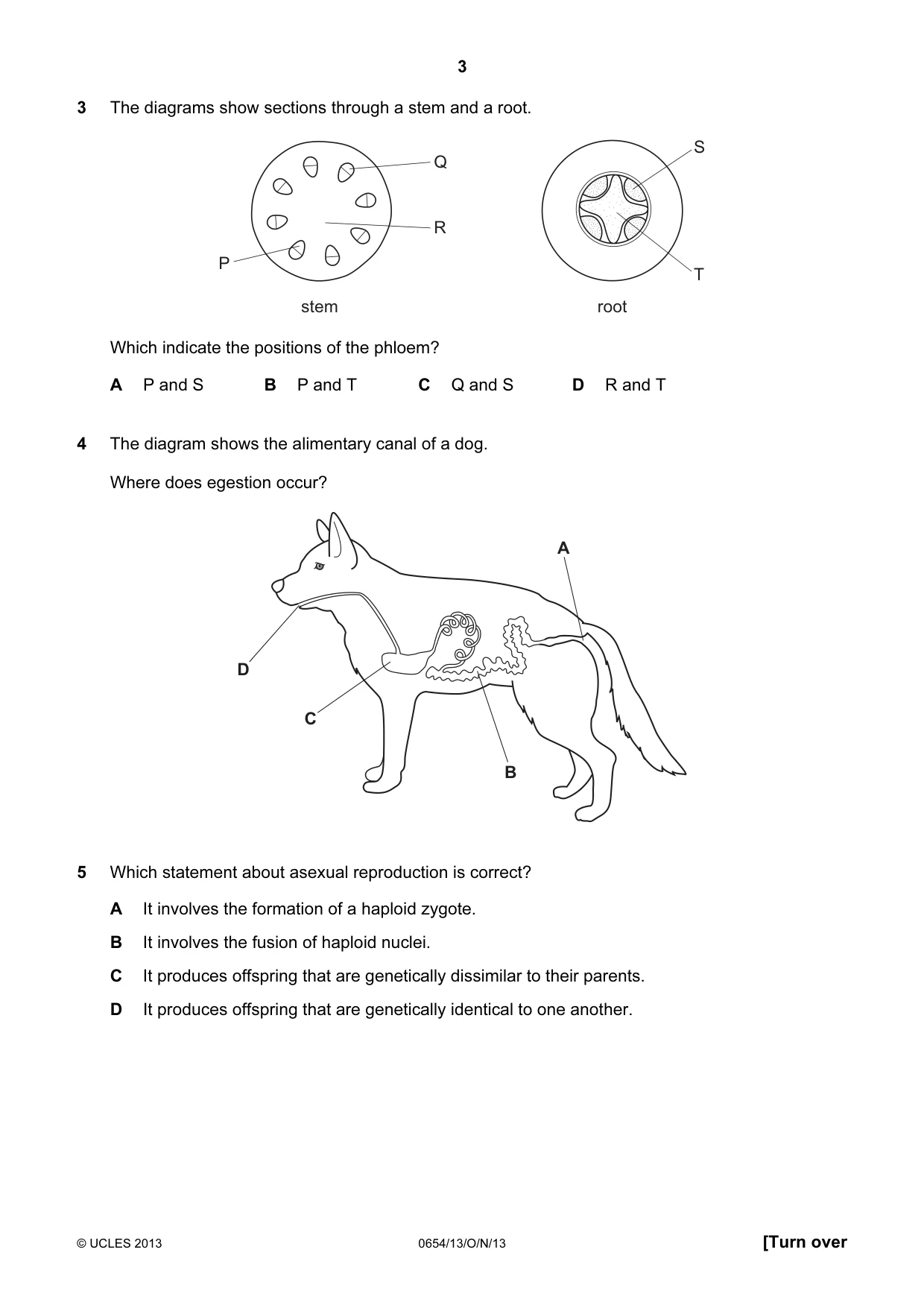
Q3 · The diagrams show sections through a stem and a root
3 The diagrams show sections through a stem and a root. S Q R P T stem root Which indicate the positions of the phloem? A P and S B P and T C Q and S D R and T
Mark scheme: C
Q4 · The diagram shows the alimentary canal of a dog
4 The diagram shows the alimentary canal of a dog. Where does egestion occur? A D C B
Mark scheme: A
Q5 · Which statement about asexual reproduction is correct?
5 Which statement about asexual reproduction is correct? A It involves the formation of a haploid zygote. B It involves the fusion of haploid nuclei. C It produces offspring that are genetically dissimilar to their parents. D It produces offspring that are genetically identical to one another.
Mark scheme: D
Q6 · Which structures make up the nervous system?
6 Which structures make up the nervous system? A brain, nerves, spinal cord B effectors, impulses, spinal cord C impulses, muscles, nerves D effectors, receptors, stimuli
Mark scheme: A
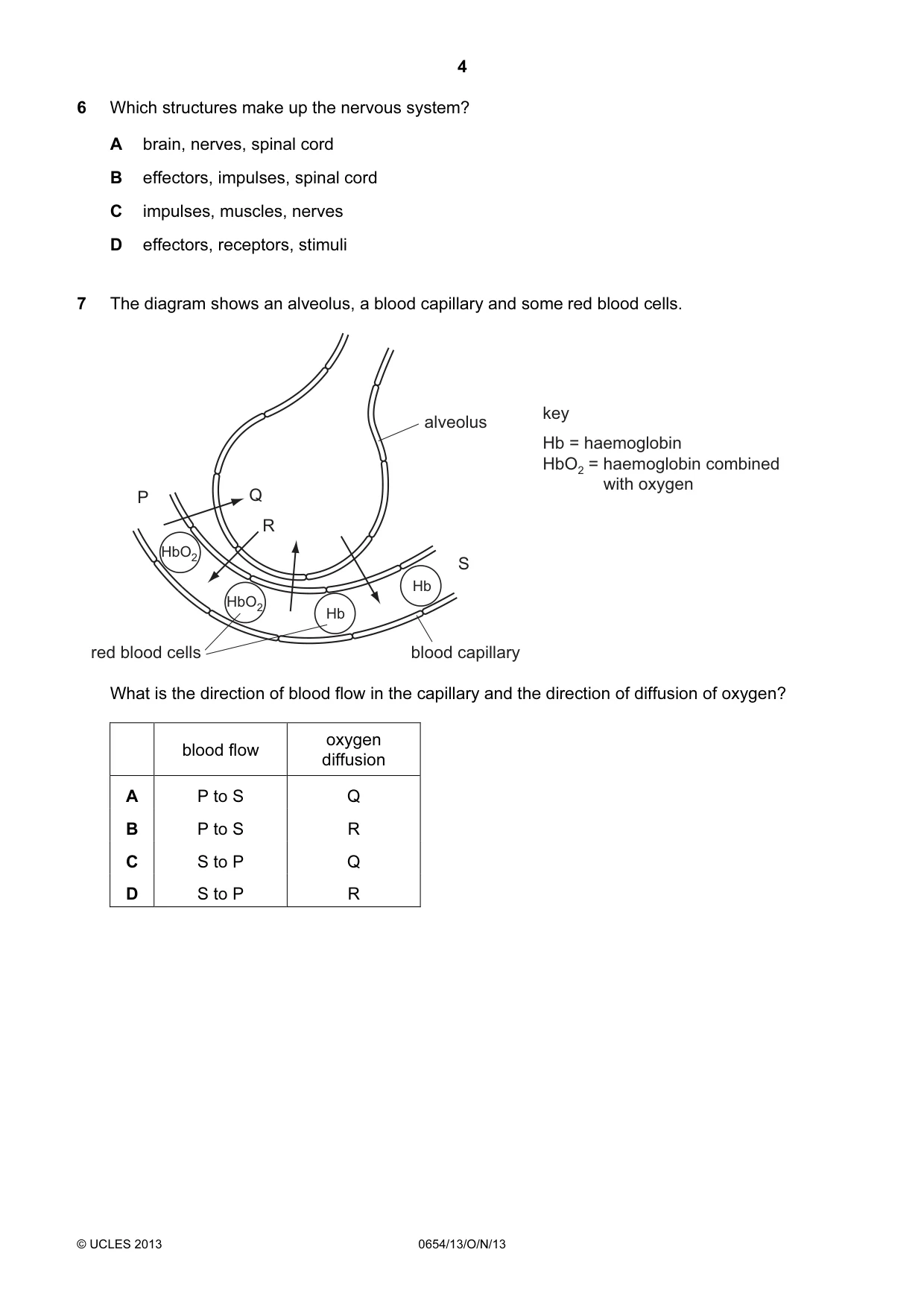
Q7 · The diagram shows an alveolus, a blood capillary and some red blood cells
7 The diagram shows an alveolus, a blood capillary and some red blood cells. key alveolus Hb = haemoglobin HbO2 = haemoglobin combined with oxygen P Q R HbO2 S Hb HbO2 Hb red blood cells blood capillary What is the direction of blood flow in the capillary and the direction of diffusion of oxygen? oxygen blood flow diffusion A P to S Q B P to S R C S to P Q D S to P R
Mark scheme: D
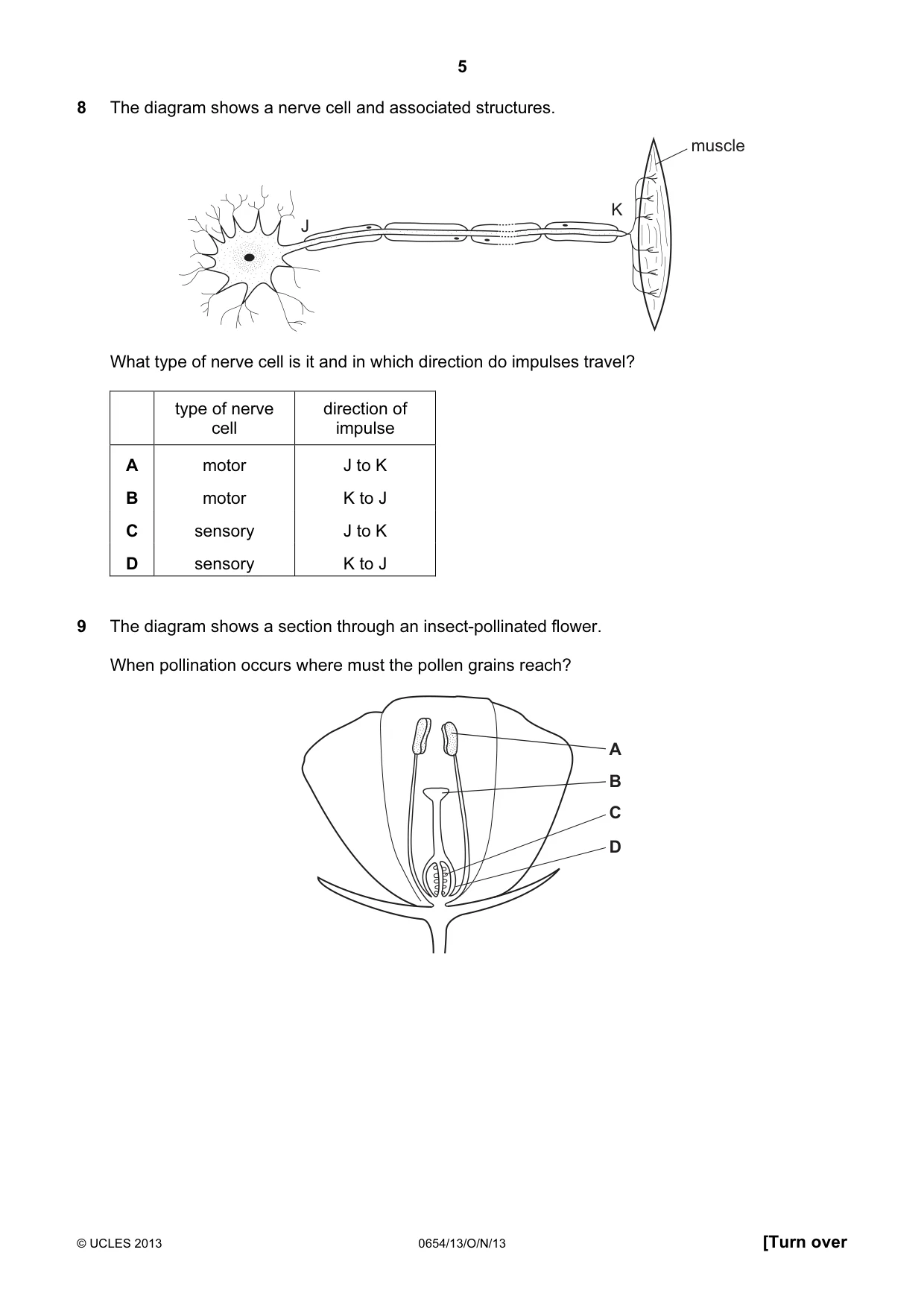
Q8 · The diagram shows a nerve cell and associated structures
8 The diagram shows a nerve cell and associated structures. muscle K J What type of nerve cell is it and in which direction do impulses travel? type of nerve direction of cell impulse A motor J to K B motor K to J C sensory J to K D sensory K to J
Mark scheme: A
Q9 · The diagram shows a section through an insect-pollinated flower
9 The diagram shows a section through an insect-pollinated flower. When pollination occurs where must the pollen grains reach? A B C D
Mark scheme: B
Q10 · Seeds were placed on cotton wool in each of the tubes shown in the diagrams
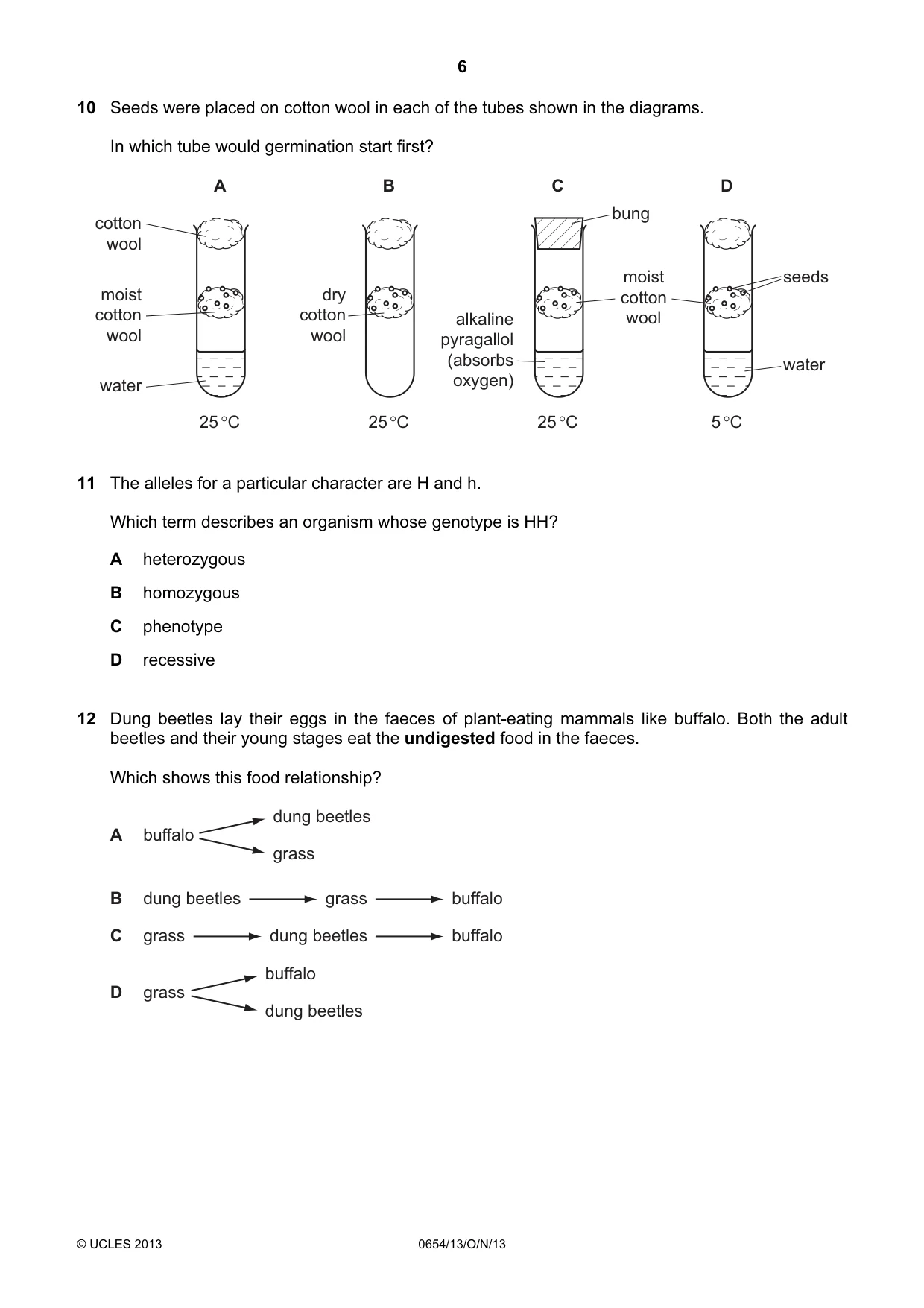
10 Seeds were placed on cotton wool in each of the tubes shown in the diagrams. In which tube would germination start first? A B C D bung cotton wool moist seeds moist dry cotton cotton cotton alkaline wool wool wool pyragallol (absorbs water water oxygen) 25 °C 25 °C 25 °C 5 °C
Mark scheme: A
Q11 · The alleles for a particular character are H and h
11 The alleles for a particular character are H and h. Which term describes an organism whose genotype is HH? A heterozygous B homozygous C phenotype D recessive
Mark scheme: B
Q12 · Dung beetles lay their eggs in the faeces of plant-eating mammals like buffalo
12 Dung beetles lay their eggs in the faeces of plant-eating mammals like buffalo. Both the adult beetles and their young stages eat the undigested food in the faeces. Which shows this food relationship? dung beetles A buffalo grass B dung beetles grass buffalo C grass dung beetles buffalo buffalo D grass dung beetles
Mark scheme: D
Q13 · The diagram shows part of the carbon cycle in a forest
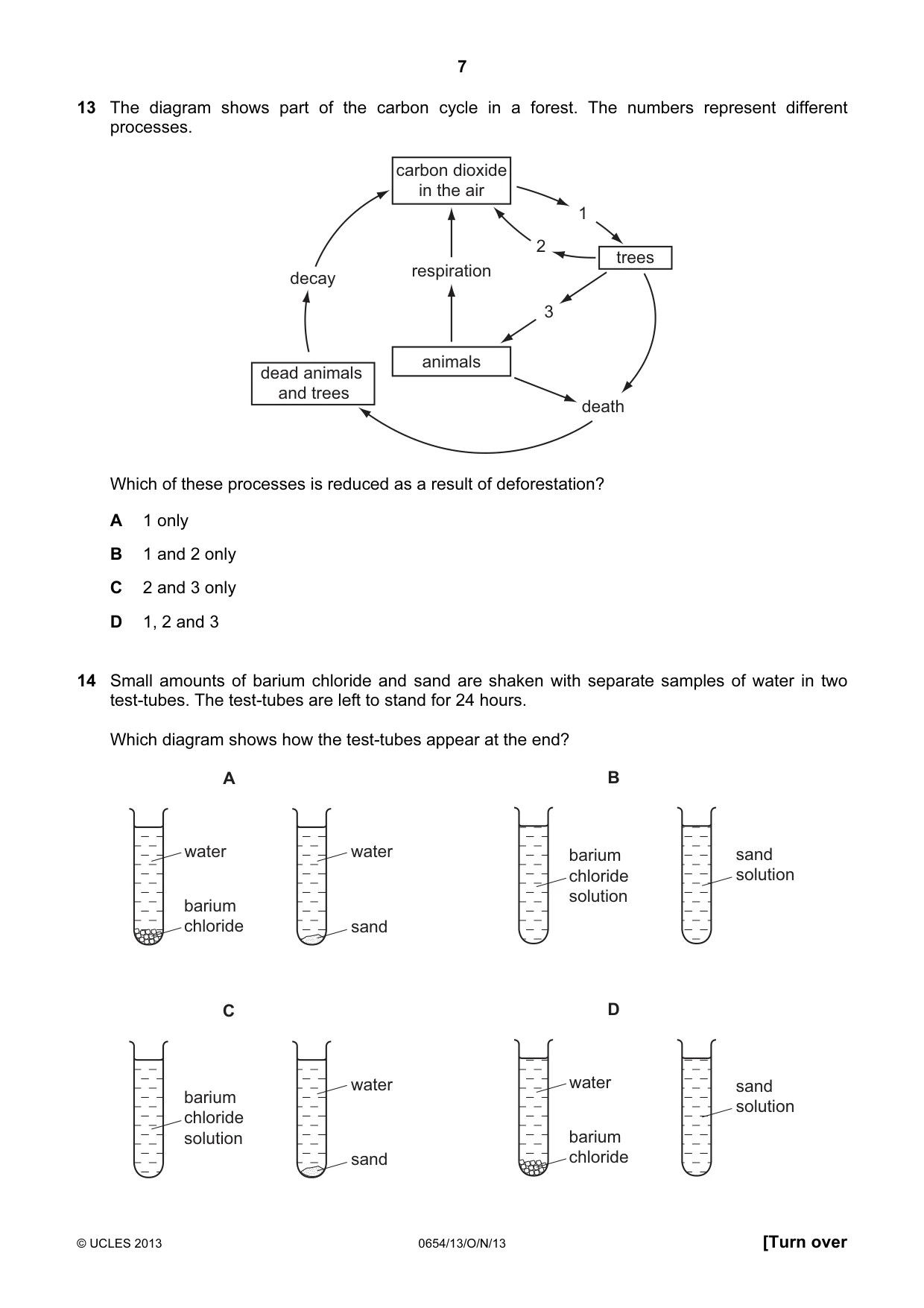
13 The diagram shows part of the carbon cycle in a forest. The numbers represent different processes. carbon dioxide in the air 1 2 trees decay respiration 3 animals dead animals and trees death Which of these processes is reduced as a result of deforestation? A 1 only B 1 and 2 only C 2 and 3 only D 1, 2 and 3
Mark scheme: D
Q14 · Small amounts of barium chloride and sand are shaken with separate samples of water in…
14 Small amounts of barium chloride and sand are shaken with separate samples of water in two test-tubes. The test-tubes are left to stand for 24 hours. Which diagram shows how the test-tubes appear at the end? A B water water barium sand chloride solution solution barium chloride sand C D water water sand barium solution chloride solution barium sand chloride
Mark scheme: C
Q15 · Which of the substances can conduct electricity?
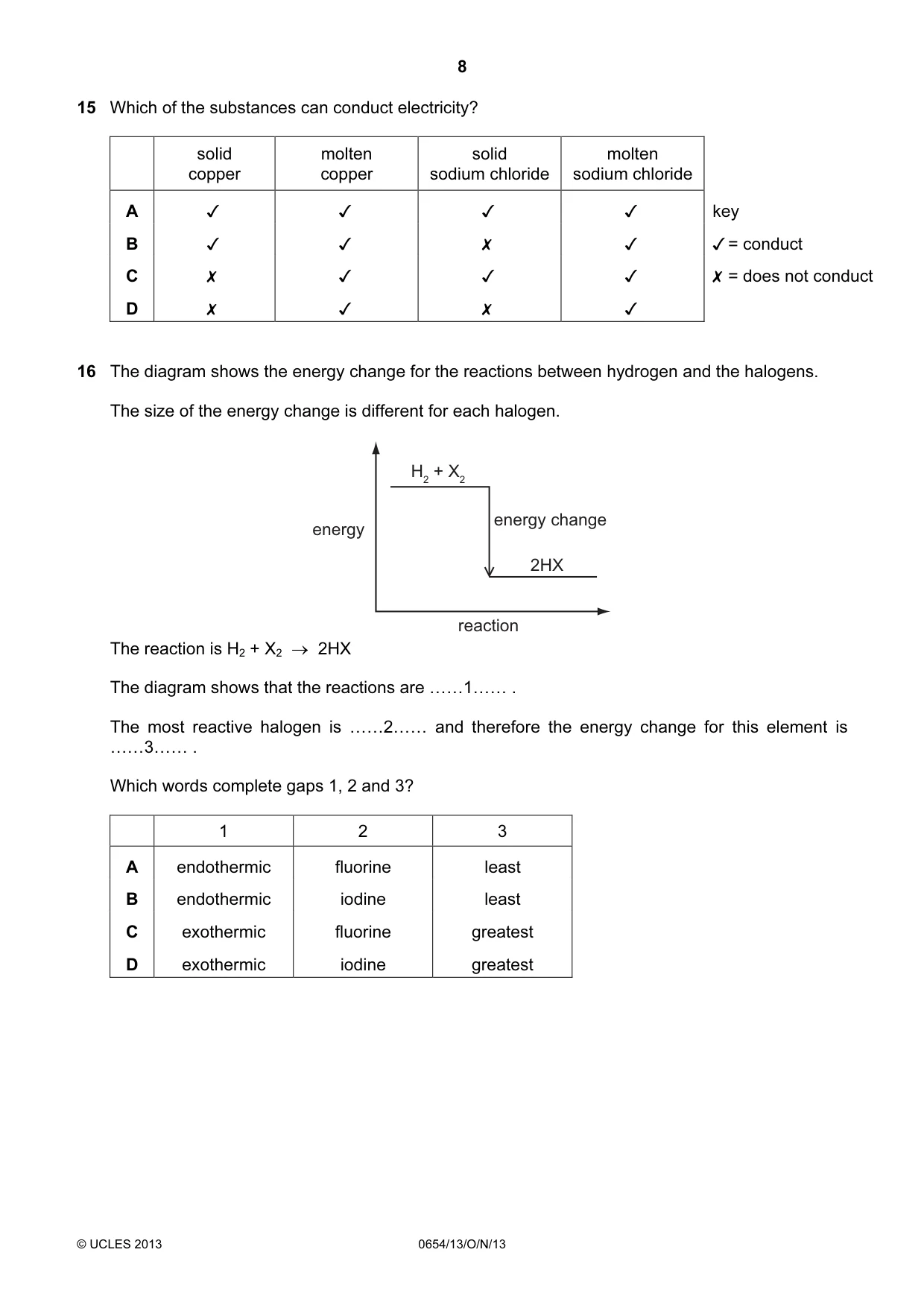
15 Which of the substances can conduct electricity? solid molten solid molten copper copper sodium chloride sodium chloride A ✓ ✓ ✓ ✓ key B ✓ ✓ ✗ ✓ ✓= conduct C ✗ ✓ ✓ ✓ ✗= does not conduct D ✗ ✓ ✗ ✓
Mark scheme: B
Q16 · The diagram shows the energy change for the reactions between hydrogen and the halogens
16 The diagram shows the energy change for the reactions between hydrogen and the halogens. The size of the energy change is different for each halogen. H2 + X2 energy change energy 2HX reaction The reaction is H2 + X2 → 2HX The diagram shows that the reactions are ……1…… . The most reactive halogen is ……2…… and therefore the energy change for this element is ……3…… . Which words complete gaps 1, 2 and 3? 1 2 3 A endothermic fluorine least B endothermic iodine least C exothermic fluorine greatest D exothermic iodine greatest
Mark scheme: C
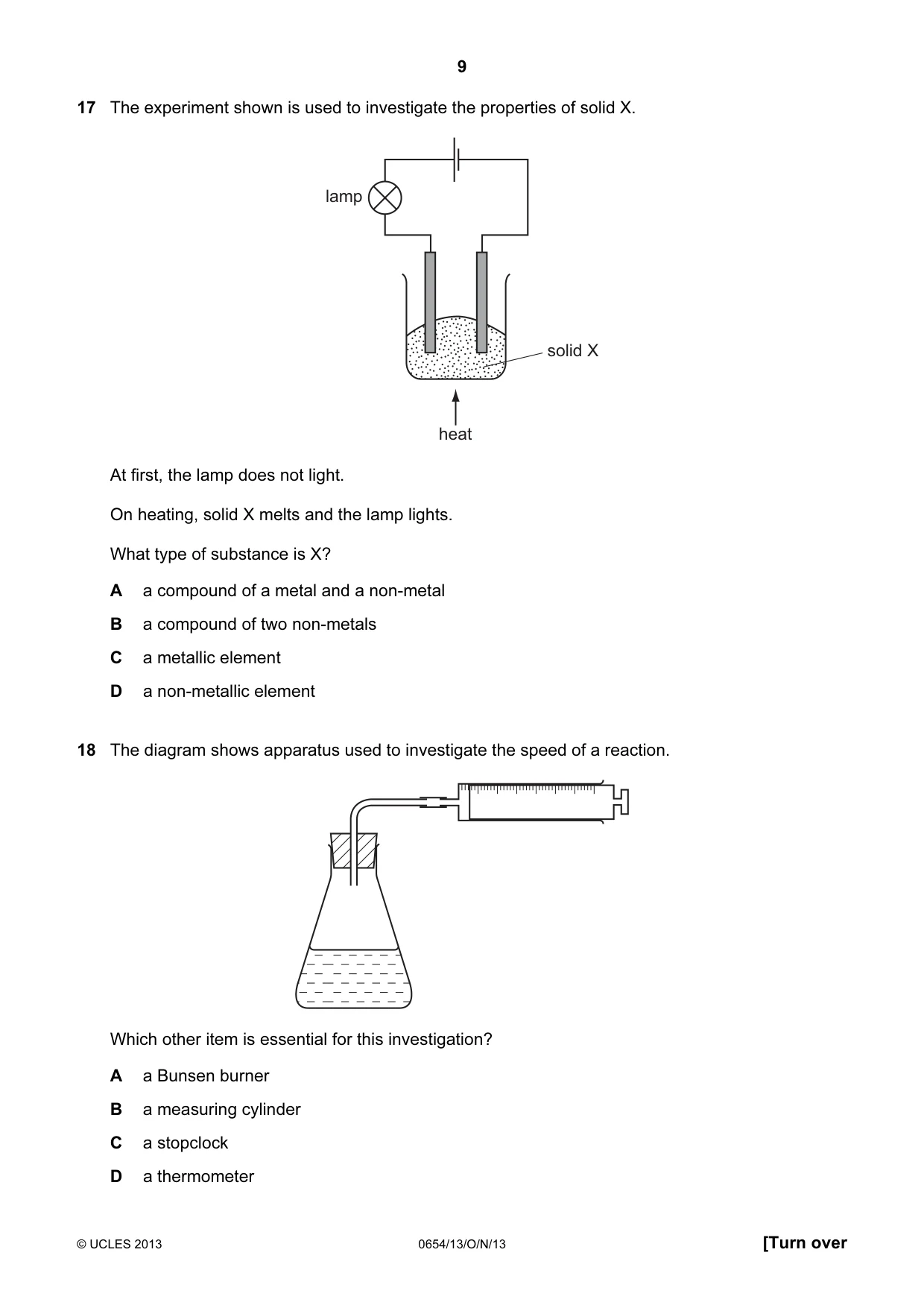
Q17 · The experiment shown is used to investigate the properties of solid X
17 The experiment shown is used to investigate the properties of solid X. lamp solid X heat At first, the lamp does not light. On heating, solid X melts and the lamp lights. What type of substance is X? A a compound of a metal and a non-metal B a compound of two non-metals C a metallic element D a non-metallic element
Mark scheme: A
Q18 · The diagram shows apparatus used to investigate the speed of a reaction
18 The diagram shows apparatus used to investigate the speed of a reaction. Which other item is essential for this investigation? A a Bunsen burner B a measuring cylinder C a stopclock D a thermometer
Mark scheme: C
Q19 · Brine is a mixture of salt (sodium chloride) and water
19 Brine is a mixture of salt (sodium chloride) and water. Which row describes these substances? solute solvent solution A brine salt water B brine water salt C salt brine water D salt water brine
Mark scheme: D
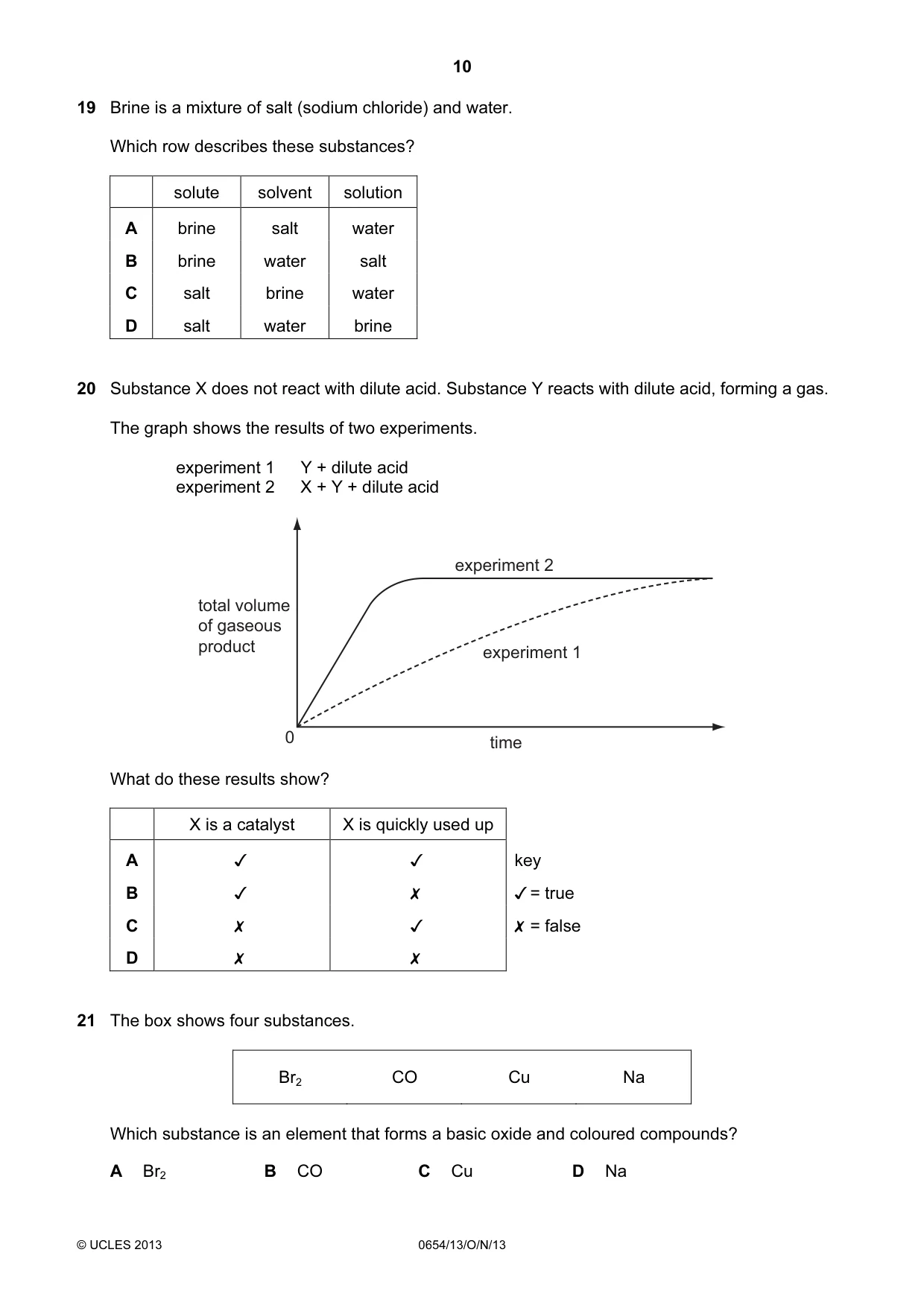
Q20 · Substance X does not react with dilute acid
20 Substance X does not react with dilute acid. Substance Y reacts with dilute acid, forming a gas. The graph shows the results of two experiments. experiment 1 Y + dilute acid experiment 2 X + Y + dilute acid experiment 2 total volume of gaseous product experiment 1 0 time What do these results show? X is a catalyst X is quickly used up A ✓ ✓ key B ✓ ✗ ✓= true C ✗ ✓ ✗= false D ✗ ✗
Mark scheme: B
Q21 · The box shows four substances
21 The box shows four substances. Br2 CO Cu Na Which substance is an element that forms a basic oxide and coloured compounds? A Br2 B CO C Cu D Na
Mark scheme: C
Q22 · A cup is made of copper
22 A cup is made of copper. Why is the cup not used for hot drinks? A Copper is a good conductor of heat. B Copper is a good electrical conductor. C Copper is brightly coloured. D Copper reacts with saliva.
Mark scheme: A
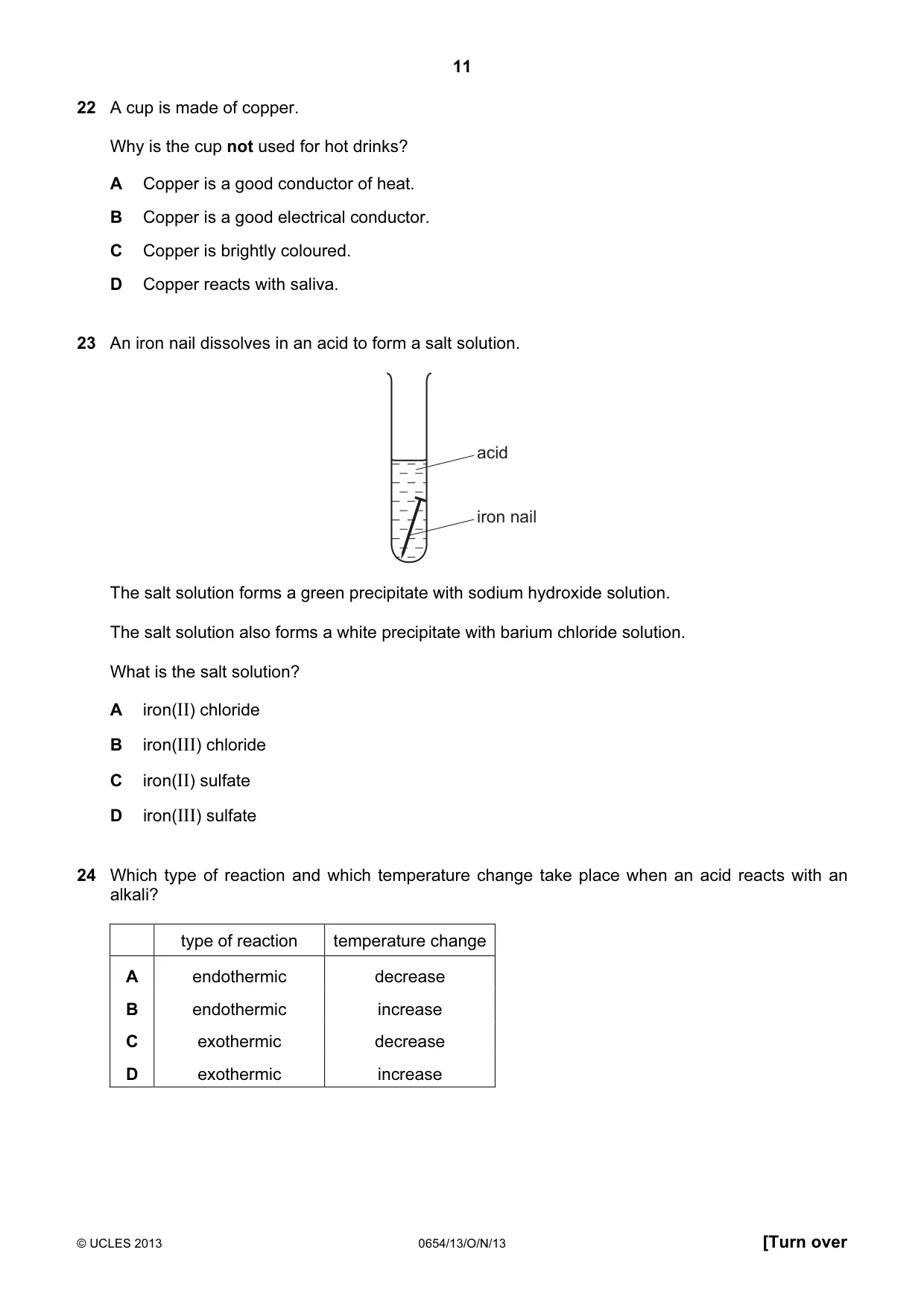
Q23 · An iron nail dissolves in an acid to form a salt solution
23 An iron nail dissolves in an acid to form a salt solution. acid iron nail The salt solution forms a green precipitate with sodium hydroxide solution. The salt solution also forms a white precipitate with barium chloride solution. What is the salt solution? A iron(II) chloride B iron(III) chloride C iron(II) sulfate D iron(III) sulfate
Mark scheme: C
Q24 · Which type of reaction and which temperature change take place when an acid reacts with…
24 Which type of reaction and which temperature change take place when an acid reacts with an alkali? type of reaction temperature change A endothermic decrease B endothermic increase C exothermic decrease D exothermic increase
Mark scheme: D
More questions on The characteristic properties of acids and bases
Q25 · The elements in a Group of the Periodic Table are solid at 20 °C
25 The elements in a Group of the Periodic Table are solid at 20 °C. The reactivity of the elements increases down the group. Which statements about this group of elements and their oxides are correct? the elements are in their oxides are A Group I acidic B Group I basic C Group VII acidic D Group VII basic
Mark scheme: B
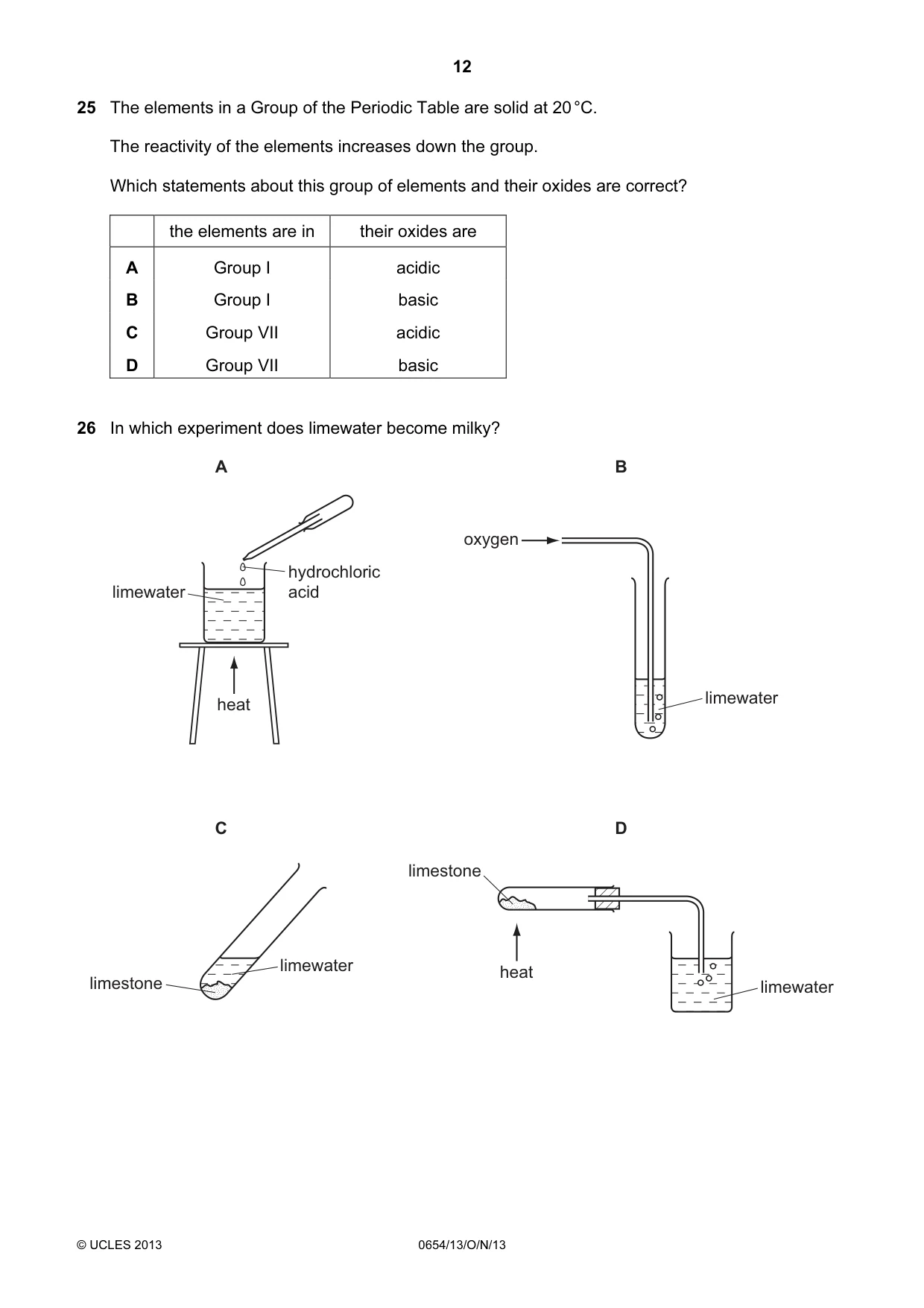
Q26 · In which experiment does limewater become milky?
26 In which experiment does limewater become milky? A B oxygen hydrochloric limewater acid heat limewater C D limestone limewater heat limestone limewater
Mark scheme: D
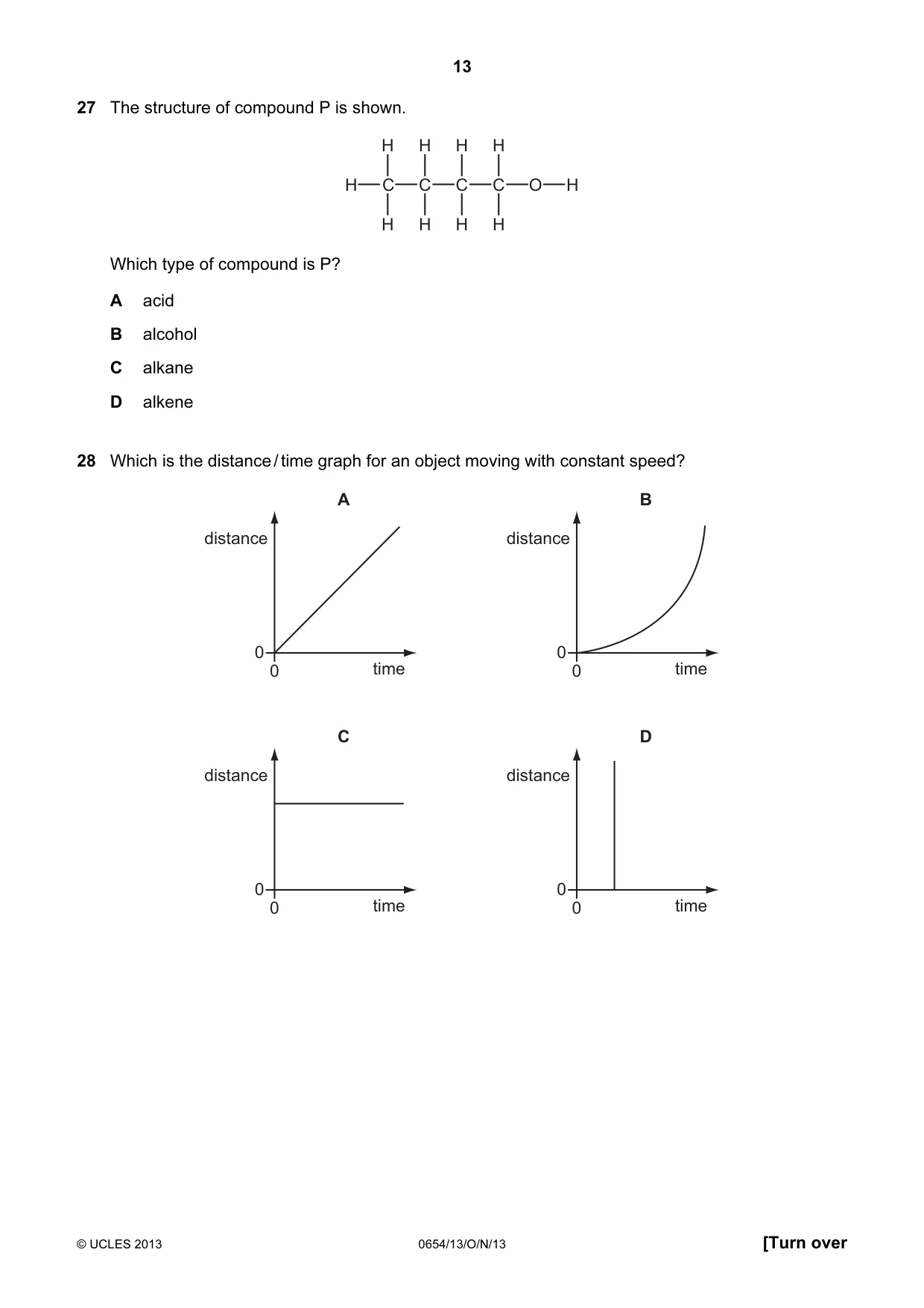
Q27 · The structure of compound P is shown
27 The structure of compound P is shown. H H H H H C C C C O H H H H H Which type of compound is P? A acid B alcohol C alkane D alkene
Mark scheme: B
Q28 · Which is the distance / time graph for an object moving with constant speed?
28 Which is the distance / time graph for an object moving with constant speed? A B distance distance 0 0 0 time 0 time C D distance distance 0 0 0 time 0 time
Mark scheme: A
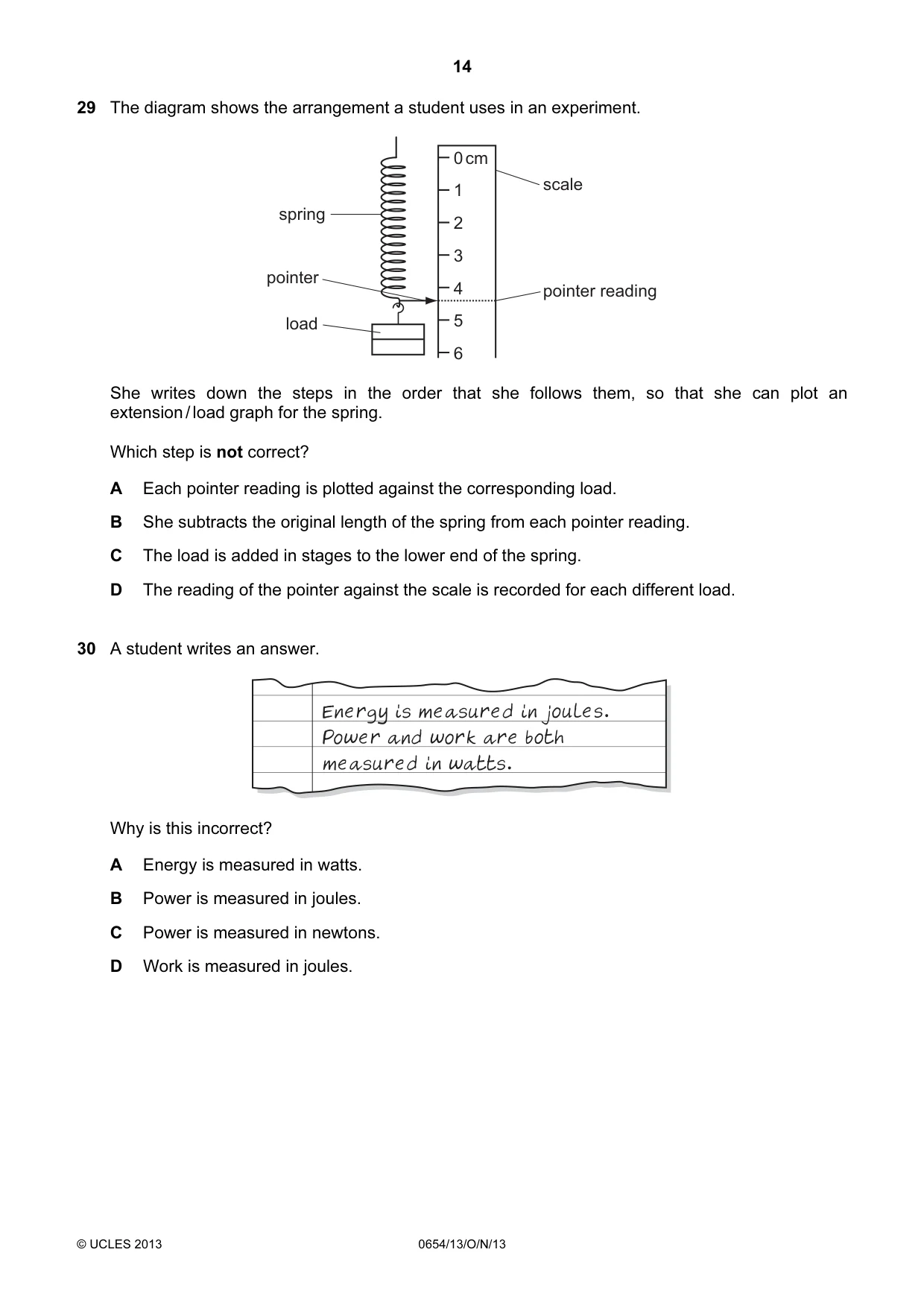
Q29 · The diagram shows the arrangement a student uses in an experiment
29 The diagram shows the arrangement a student uses in an experiment. 0 cm 1 scale spring 2 3 pointer 4 pointer reading load 5 6 She writes down the steps in the order that she follows them, so that she can plot an extension / load graph for the spring. Which step is not correct? A Each pointer reading is plotted against the corresponding load. B She subtracts the original length of the spring from each pointer reading. C The load is added in stages to the lower end of the spring. D The reading of the pointer against the scale is recorded for each different load.
Mark scheme: A
More questions on Physical quantities and measurement techniques
Q30 · A student writes an answer
30 A student writes an answer. Why is this incorrect? A Energy is measured in watts. B Power is measured in joules. C Power is measured in newtons. D Work is measured in joules.
Mark scheme: D
Q31 · Liquid in a beaker evaporates quickly
31 Liquid in a beaker evaporates quickly. Which row shows what happens to the mass and to the temperature of the liquid in the beaker? mass temperature A decreases decreases B decreases increases C increases decreases D increases increases
Mark scheme: A
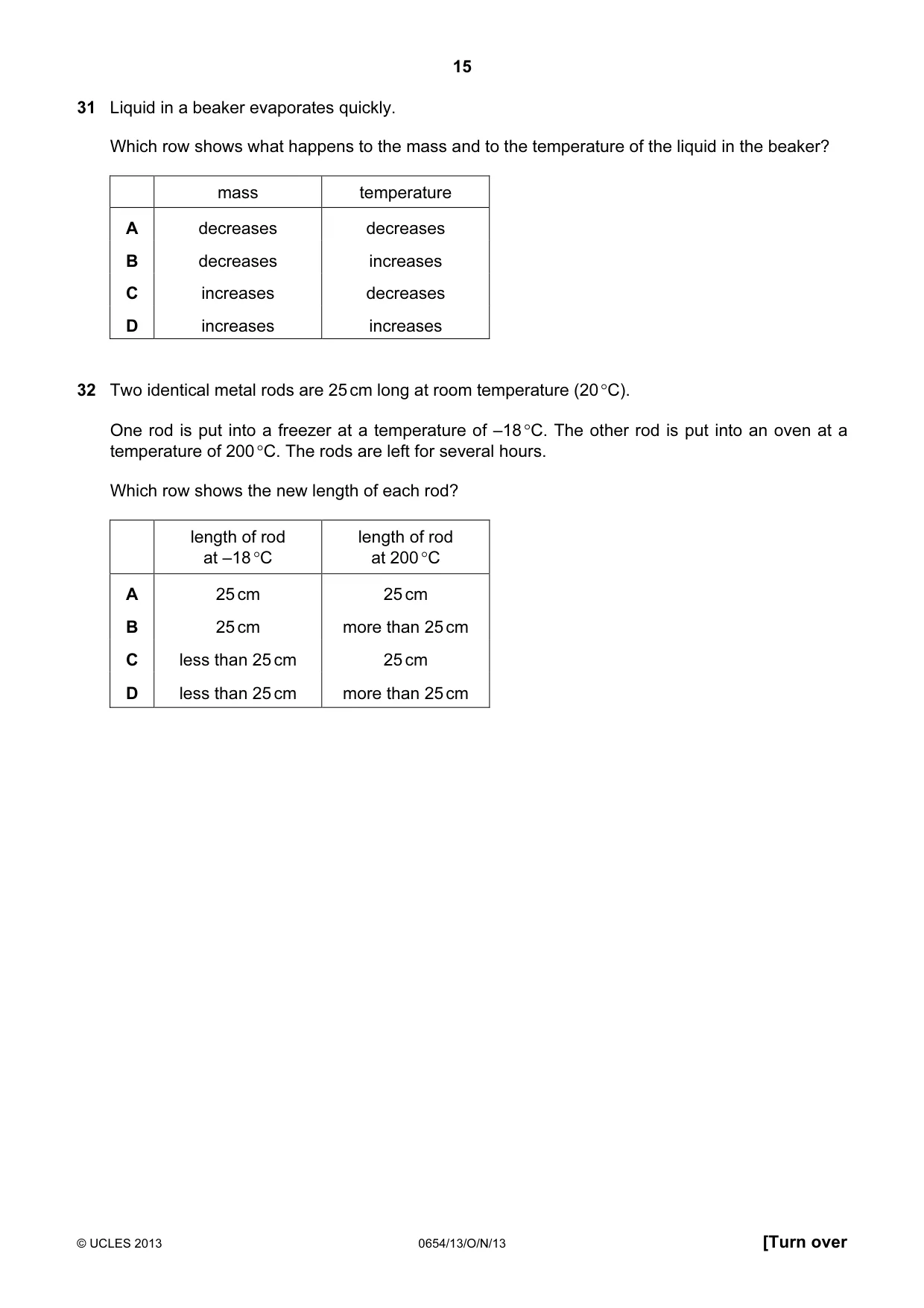
Q32 · Two identical metal rods are 25 cm long at room temperature (20 °C)
32 Two identical metal rods are 25 cm long at room temperature (20 °C). One rod is put into a freezer at a temperature of –18 °C. The other rod is put into an oven at a temperature of 200 °C. The rods are left for several hours. Which row shows the new length of each rod? length of rod length of rod at –18 °C at 200 °C A 25 cm 25 cm B 25 cm more than 25 cm C less than 25 cm 25 cm D less than 25 cm more than 25 cm
Mark scheme: D
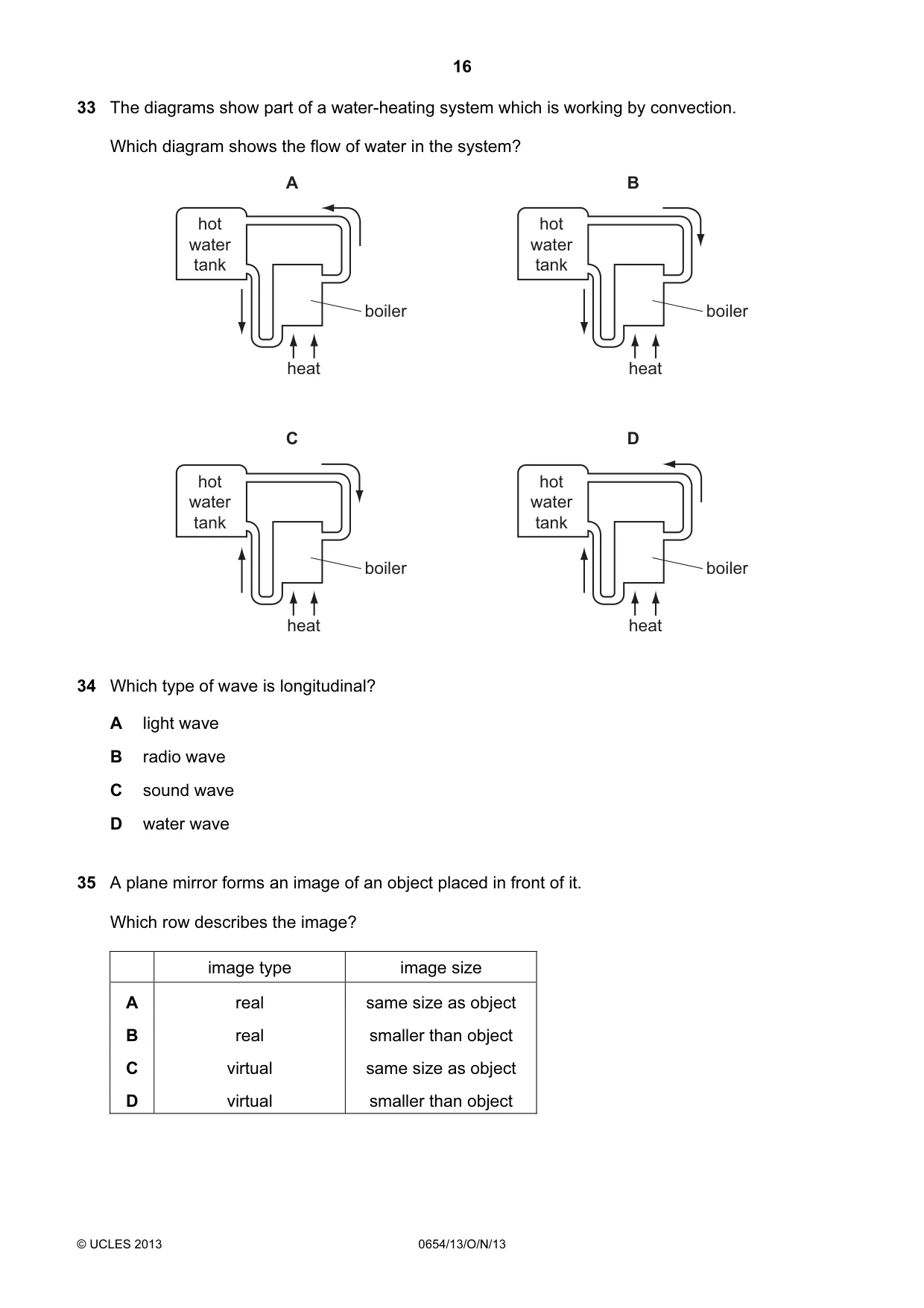
Q33 · The diagrams show part of a water-heating system which is working by convection
33 The diagrams show part of a water-heating system which is working by convection. Which diagram shows the flow of water in the system? A B hot hot water water tank tank boiler boiler heat heat C D hot hot water water tank tank boiler boiler heat heat
Mark scheme: A
Q34 · Which type of wave is longitudinal?
34 Which type of wave is longitudinal? A light wave B radio wave C sound wave D water wave
Mark scheme: C
Q35 · A plane mirror forms an image of an object placed in front of it
35 A plane mirror forms an image of an object placed in front of it. Which row describes the image? image type image size A real same size as object B real smaller than object C virtual same size as object D virtual smaller than object
Mark scheme: C
Q36 · Red light and violet light have different frequencies and different wavelengths
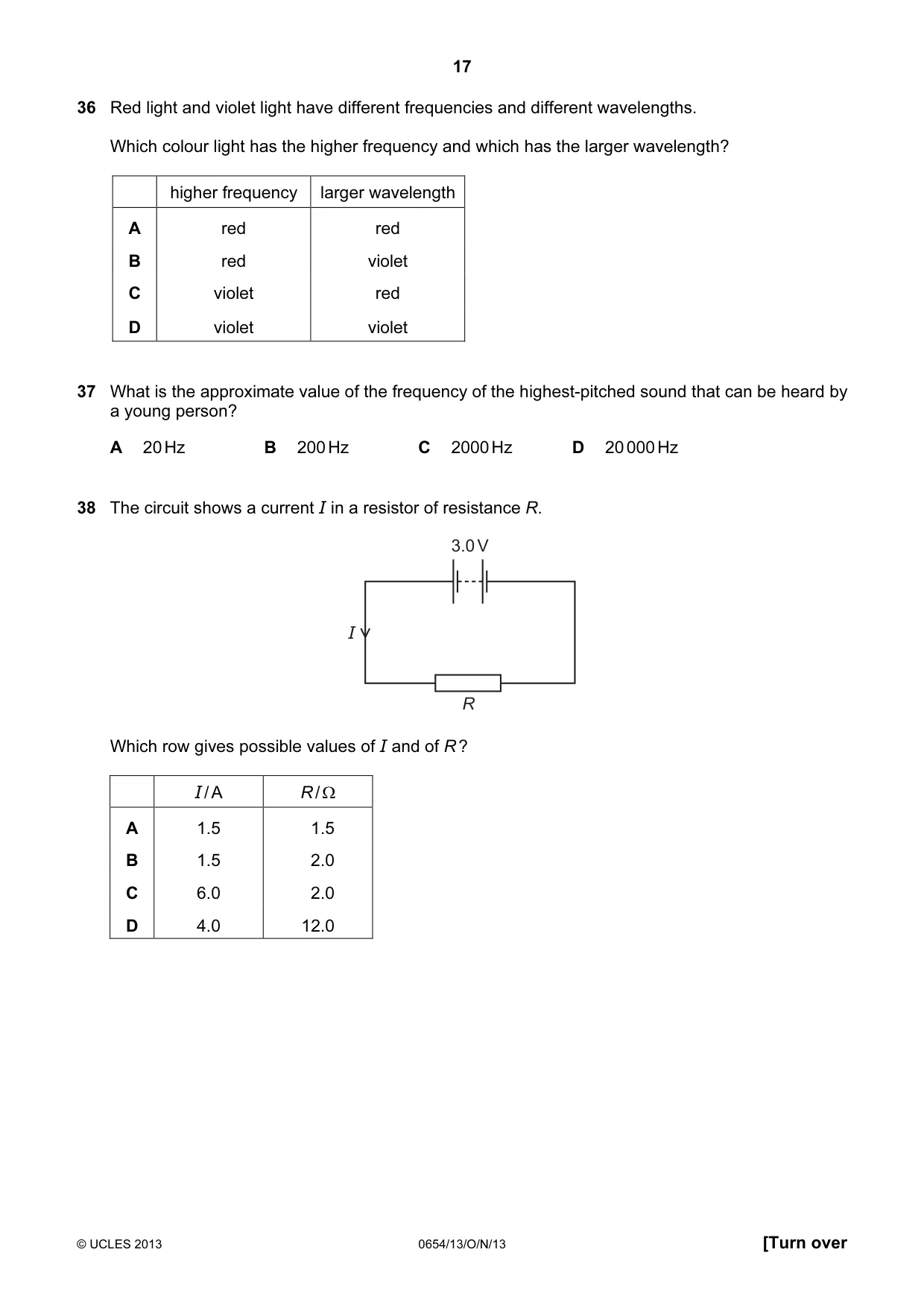
36 Red light and violet light have different frequencies and different wavelengths. Which colour light has the higher frequency and which has the larger wavelength? higher frequency larger wavelength A red red B red violet C violet red D violet violet
Mark scheme: C
Q37 · What is the approximate value of the frequency of the highest-pitched sound that can be…
37 What is the approximate value of the frequency of the highest-pitched sound that can be heard by a young person? A 20 Hz B 200 Hz C 2000 Hz D 20 000 Hz
Mark scheme: D
Q38 · The circuit shows a current I in a resistor of resistance R
38 The circuit shows a current I in a resistor of resistance R. 3.0 V I R Which row gives possible values of I and of R ? I / A R / Ω A 1.5 1.5 B 1.5 2.0 C 6.0 2.0 D 4.0 12.0
Mark scheme: B
Q39 · Which row shows how lamps are connected in a domestic lighting circuit, and gives an…
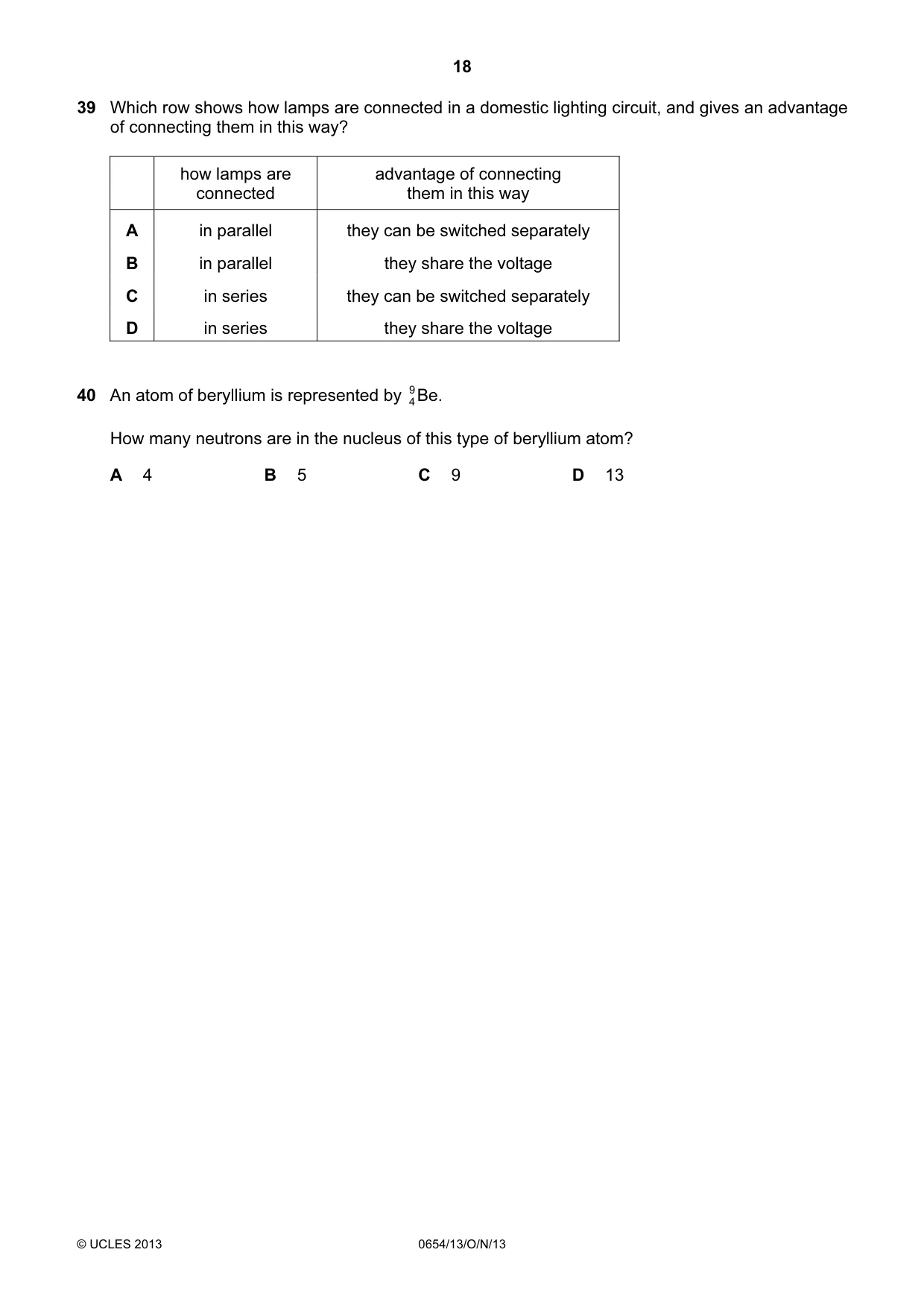
39 Which row shows how lamps are connected in a domestic lighting circuit, and gives an advantage of connecting them in this way? how lamps are advantage of connecting connected them in this way A in parallel they can be switched separately B in parallel they share the voltage C in series they can be switched separately D in series they share the voltage
Mark scheme: A
Q40 · An atom of beryllium is represented by Be
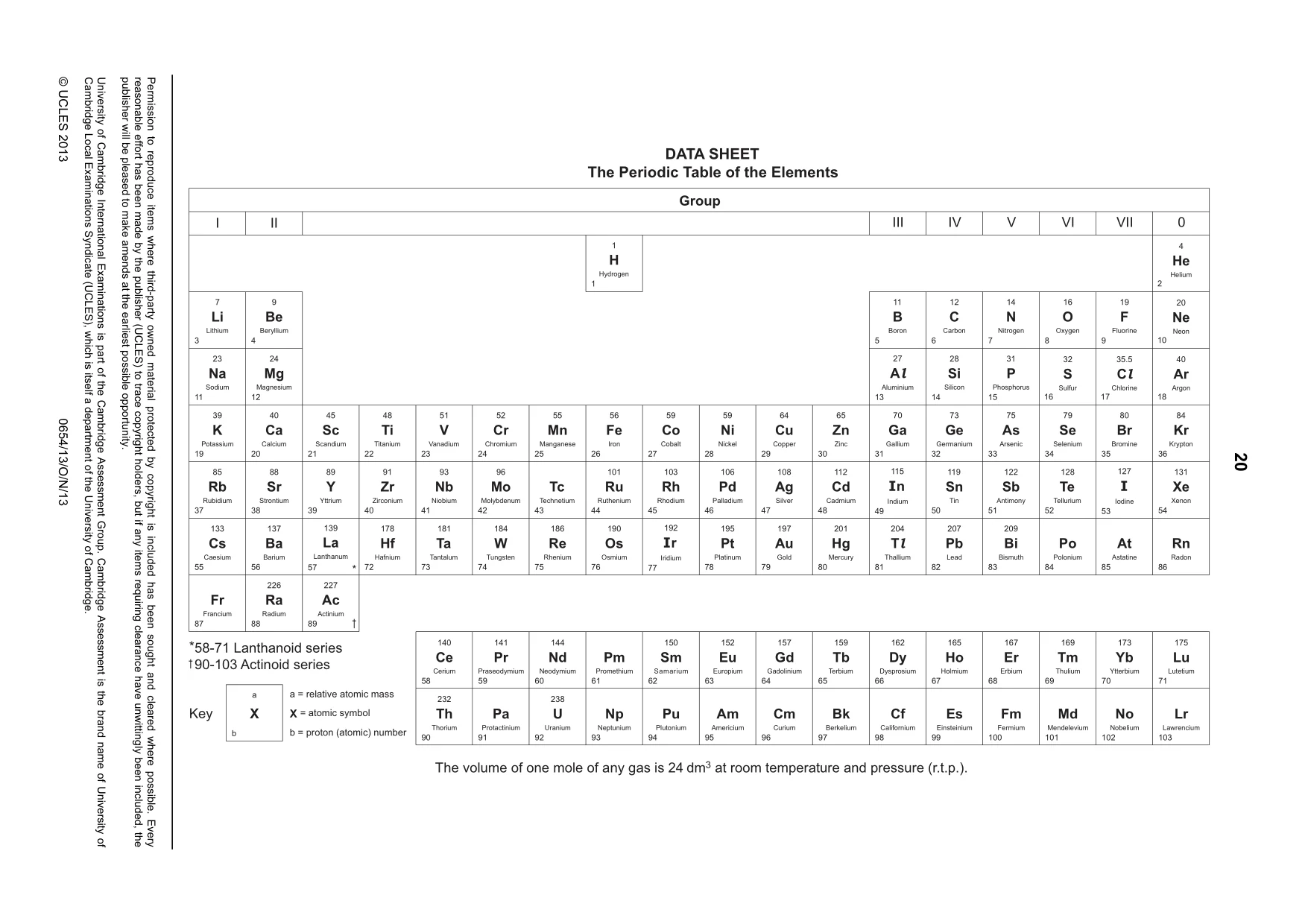
40 An atom of beryllium is represented by Be. 9 4 How many neutrons are in the nucleus of this type of beryllium atom? A 4 B 5 C 9 D 13
Mark scheme: B
What was in this paper
The subtopics covered by these 40 questions, and how many questions each got. Open one in a new tab to see every Cambridge question on it.
2Coordination and response2Identification of ions and gases2Rate of reaction2Transfer of thermal energy2Alcohols1Asexual reproduction1Carbon cycle1Chromosomes and genes1Circulatory systems1Digestive system1Electrical circuits1Electrical quantities1Electrolysis1Electromagnetic spectrum1Elements, compounds and mixtures1Energy, work and power1Exothermic and endothermic reactions1Food chains and food webs1Gas exchange in humans1General properties of waves1Group I properties1Ions and ionic bonds1Kinetic particle model of matter1Light1Motion1Physical quantities and measurement techniques1Separation and purification1Sexual reproduction in plants1Sound1The characteristic properties of acids and bases1The nucleus1Thermal properties and temperature1Transition elements1Xylem and phloem1What you needed in this session
Cambridge’s own grade thresholds for 2013 Oct/Nov, Paper 1 · Variant 3. A higher threshold means an easier paper — the bar moves with how the cohort did.