Cambridge IGCSE Sciences - Co-ordinated (Double) 0654 — 2021 May/June Paper 1 · Variant 2
0654/12/M/J/21 · 40 questions · 40 marks · ≈45 min
The question paper and its mark scheme, free to read here and free to download. This is Cambridge’s own paper, exactly as it was sat.
Question paper16 pages
Mark scheme3 pages
Answers below. Sit the paper first if you are practising.
Questions as text
Question 1
1 What is respiration? A breakdown of food by enzymes in the alimentary canal B breathing to supply oxygen to cells C release of carbon dioxide from the lungs D release of energy for body activities
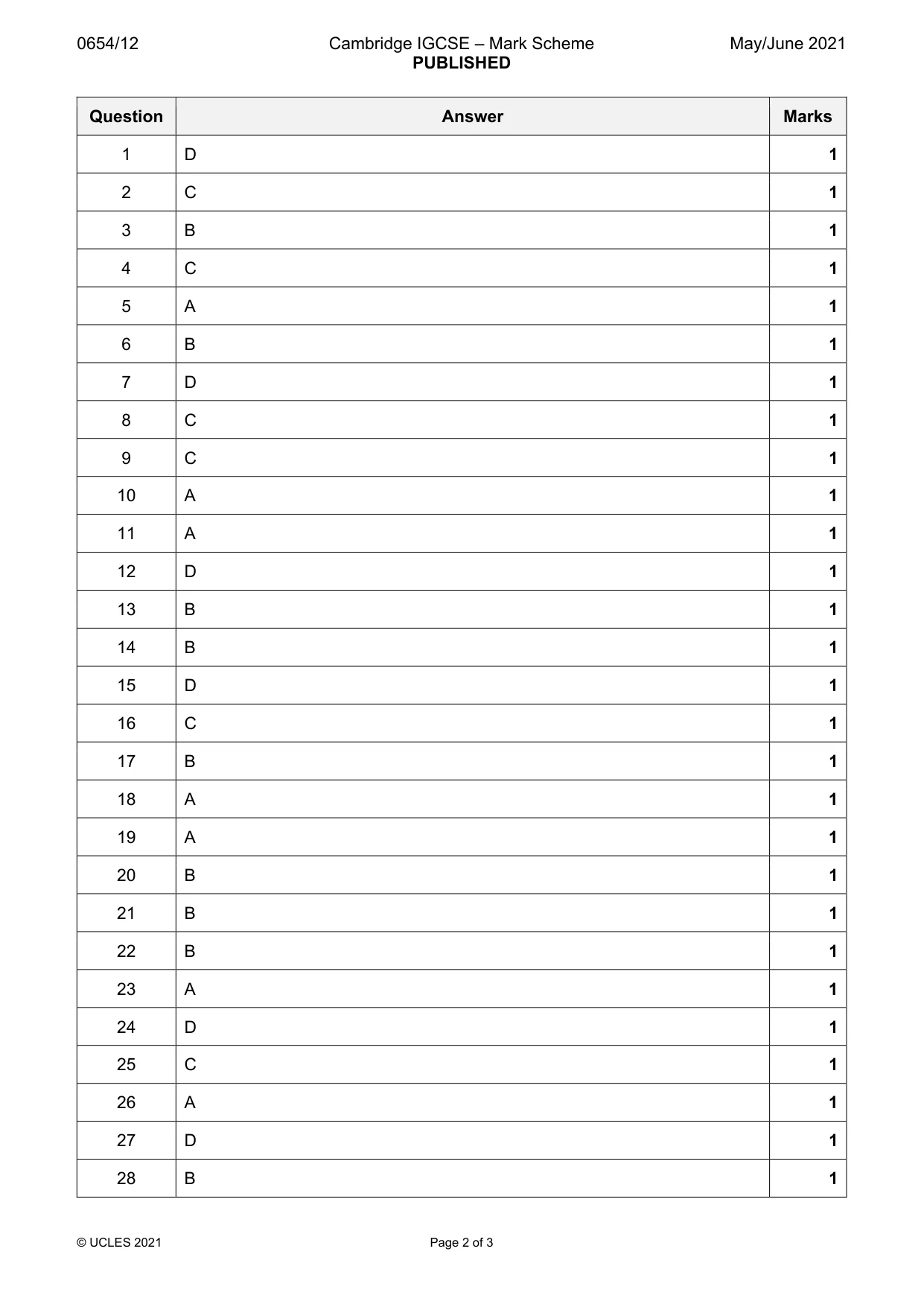
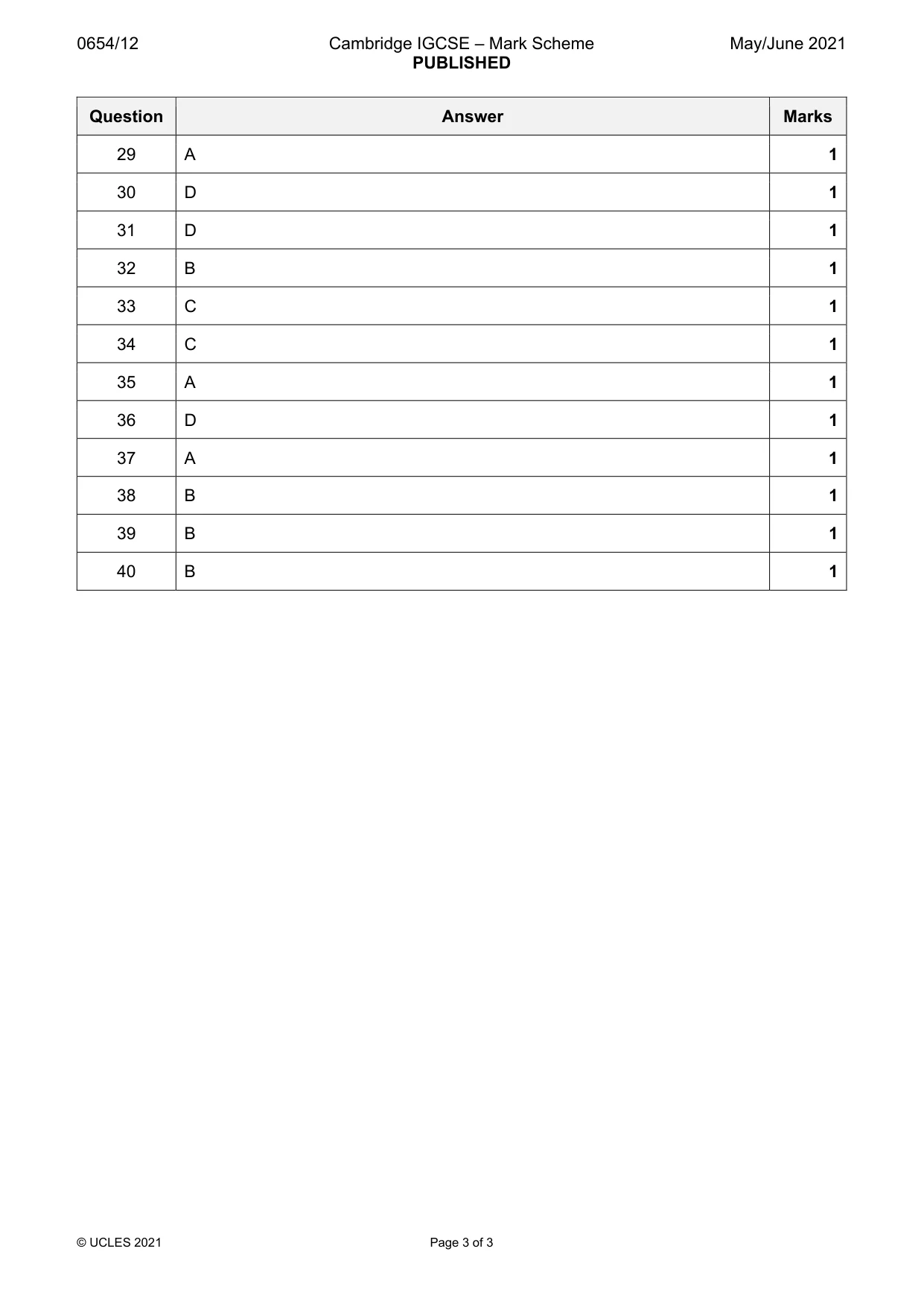
Mark scheme: D
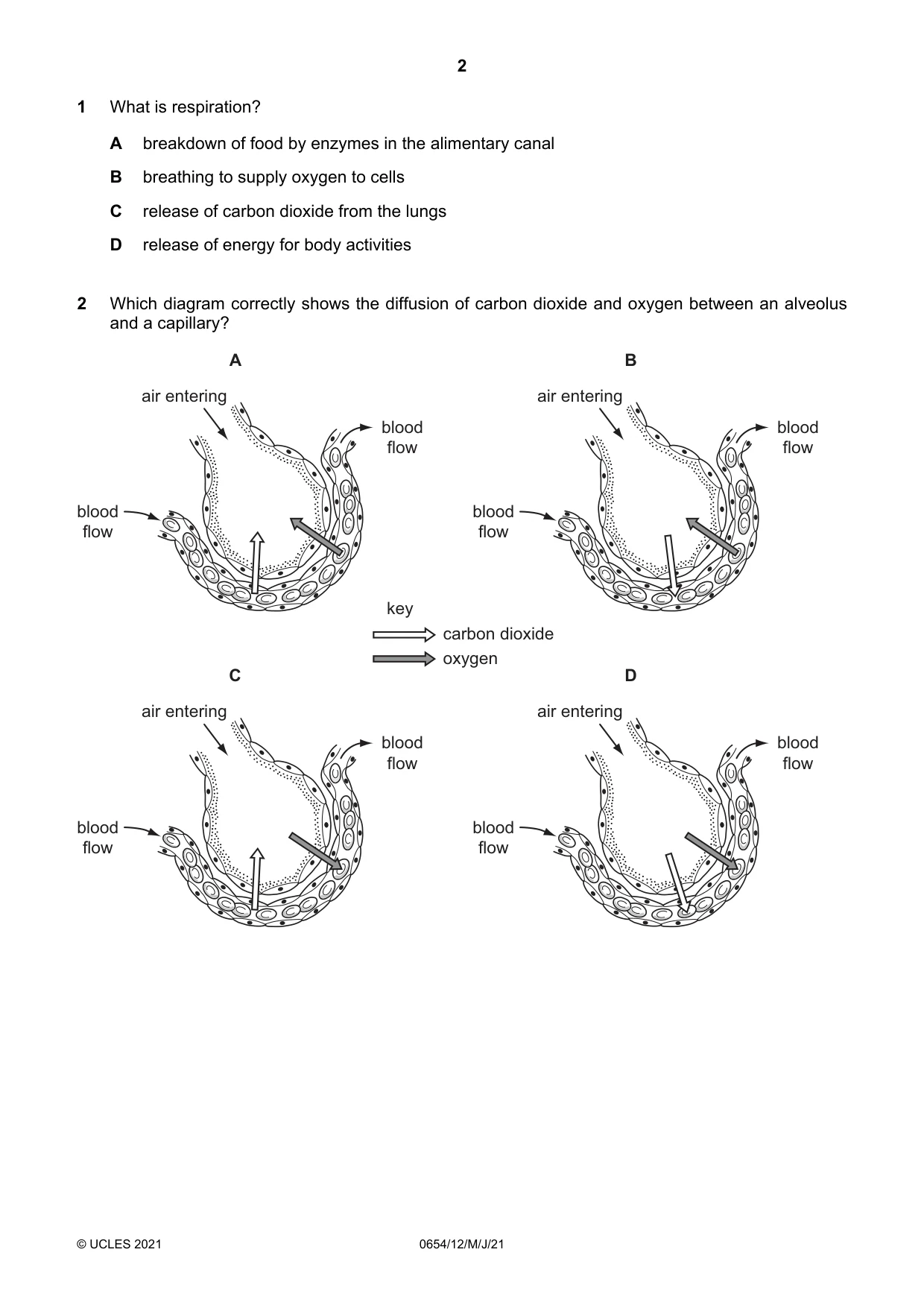
Q2 · Which diagram correctly shows the diffusion of carbon dioxide and oxygen between an…
2 Which diagram correctly shows the diffusion of carbon dioxide and oxygen between an alveolus and a capillary? A B air entering air entering blood blood flow flow blood blood flow flow key carbon dioxide oxygen C D air entering air entering blood blood flow flow blood blood flow flow
Mark scheme: C
Q3 · Which row matches the nutrient to the chemical elements that it contains?
3 Which row matches the nutrient to the chemical elements that it contains? nutrient carbon hydrogen oxygen nitrogen A fat v v x x B protein Jv J Jv Jv Cc starch v x v v D sugar x v v v key / = contains element X = does not contain element
Mark scheme: B
Q4 · Which type of molecule are enzymes?
4 Which type of molecule are enzymes? A fat B carbohydrate C protein D DNA
Mark scheme: C
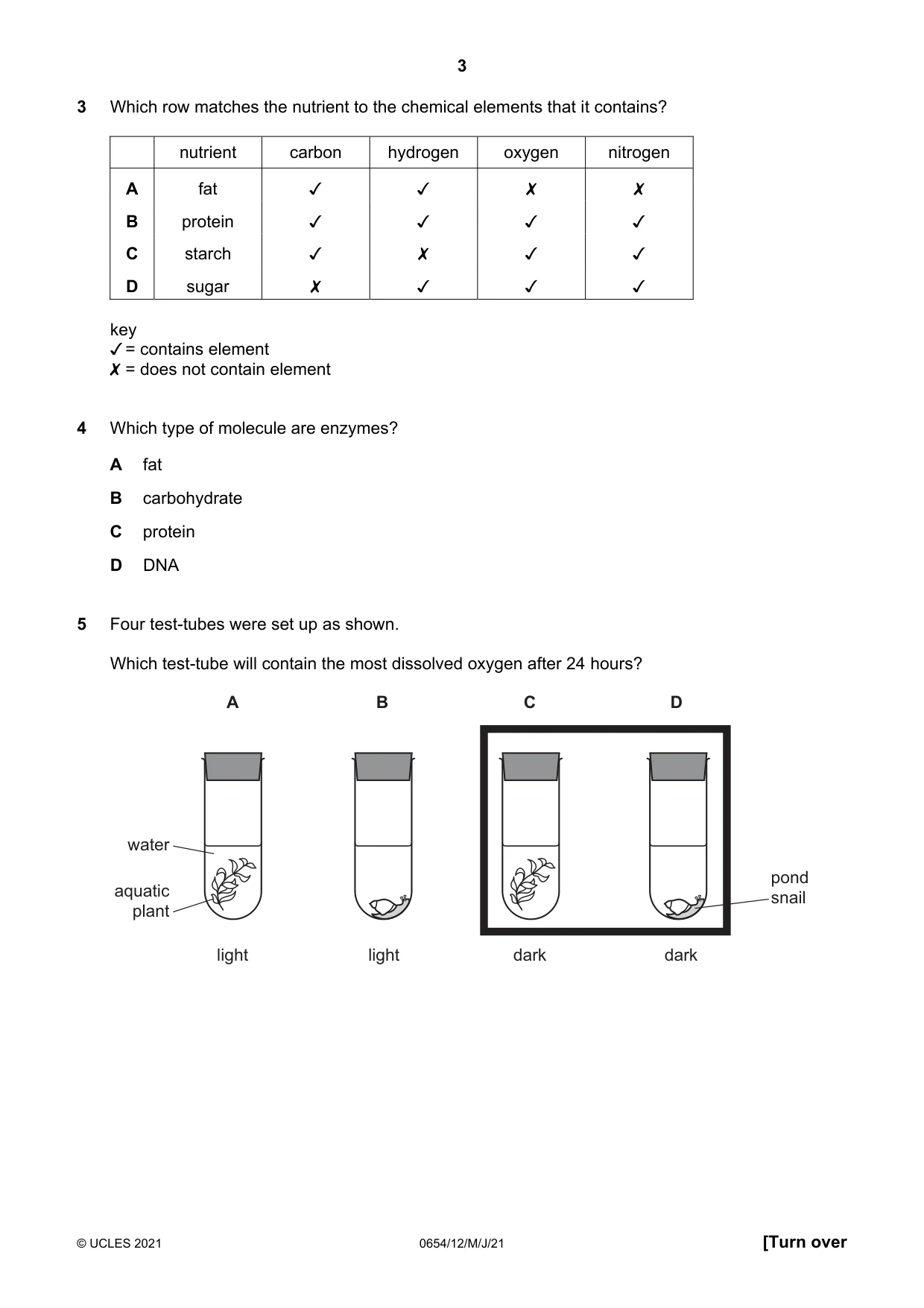
Q5 · Four test-tubes were set up as shown
5 Four test-tubes were set up as shown. Which test-tube will contain the most dissolved oxygen after 24 hours? A B C D water pond aquatic snail plant light light dark dark
Mark scheme: A
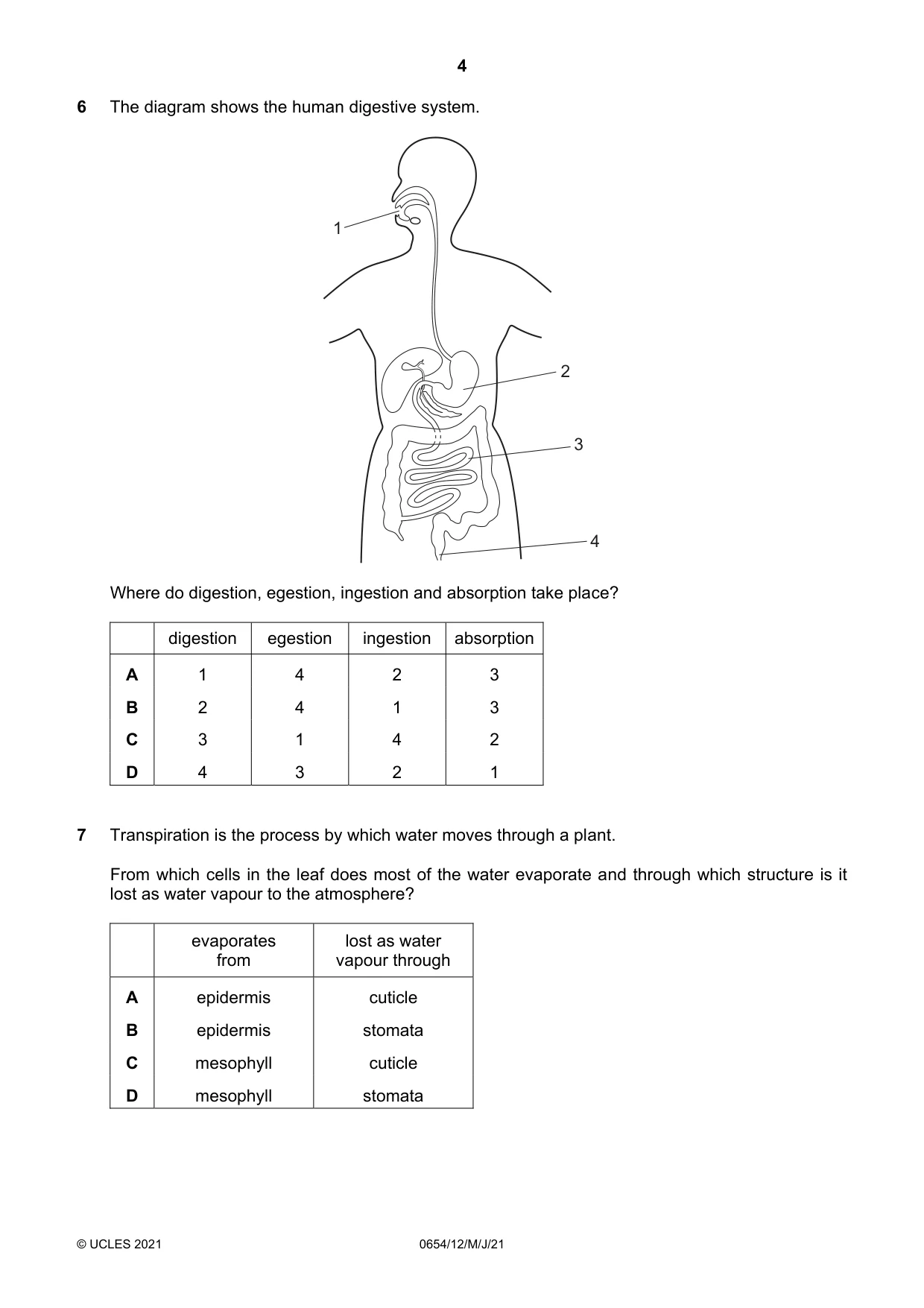
Q6 · The diagram shows the human digestive system
6 The diagram shows the human digestive system. 1 2 3 4 Where do digestion, egestion, ingestion and absorption take place? digestion egestion ingestion absorption A 1 4 2 3 B 2 4 1 3 C 3 1 4 2 D 4 3 2 1
Mark scheme: B
Q7 · Transpiration is the process by which water moves through a plant
7 Transpiration is the process by which water moves through a plant. From which cells in the leaf does most of the water evaporate and through which structure is it lost as water vapour to the atmosphere? evaporates lost as water from vapour through A epidermis cuticle B epidermis stomata C mesophyll cuticle D mesophyll stomata
Mark scheme: D
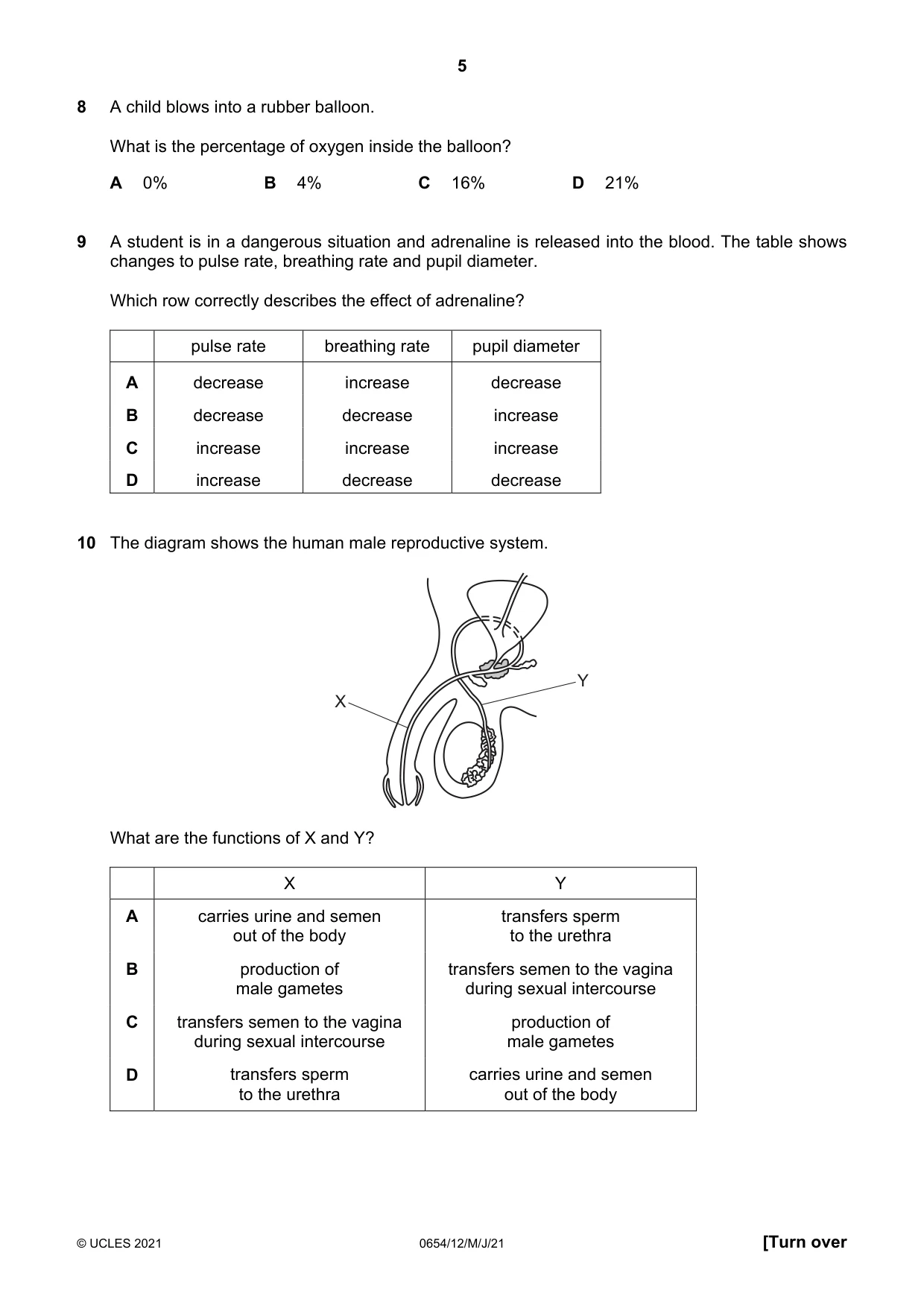
Q8 · A child blows into a rubber balloon
8 A child blows into a rubber balloon. What is the percentage of oxygen inside the balloon? A 0% B 4% C 16% D 21%
Mark scheme: C
Q9 · A student is in a dangerous situation and adrenaline is released into the blood
9 A student is in a dangerous situation and adrenaline is released into the blood. The table shows changes to pulse rate, breathing rate and pupil diameter. Which row correctly describes the effect of adrenaline? pulse rate breathing rate pupil diameter A decrease increase decrease B decrease decrease increase C increase increase increase D increase decrease decrease
Mark scheme: C
Q10 · The diagram shows the human male reproductive system
10 The diagram shows the human male reproductive system. Y X What are the functions of X and Y? X Y A carries urine and semen transfers sperm out of the body to the urethra B production of transfers semen to the vagina male gametes during sexual intercourse C transfers semen to the vagina production of during sexual intercourse male gametes D transfers sperm carries urine and semen to the urethra out of the body
Mark scheme: A
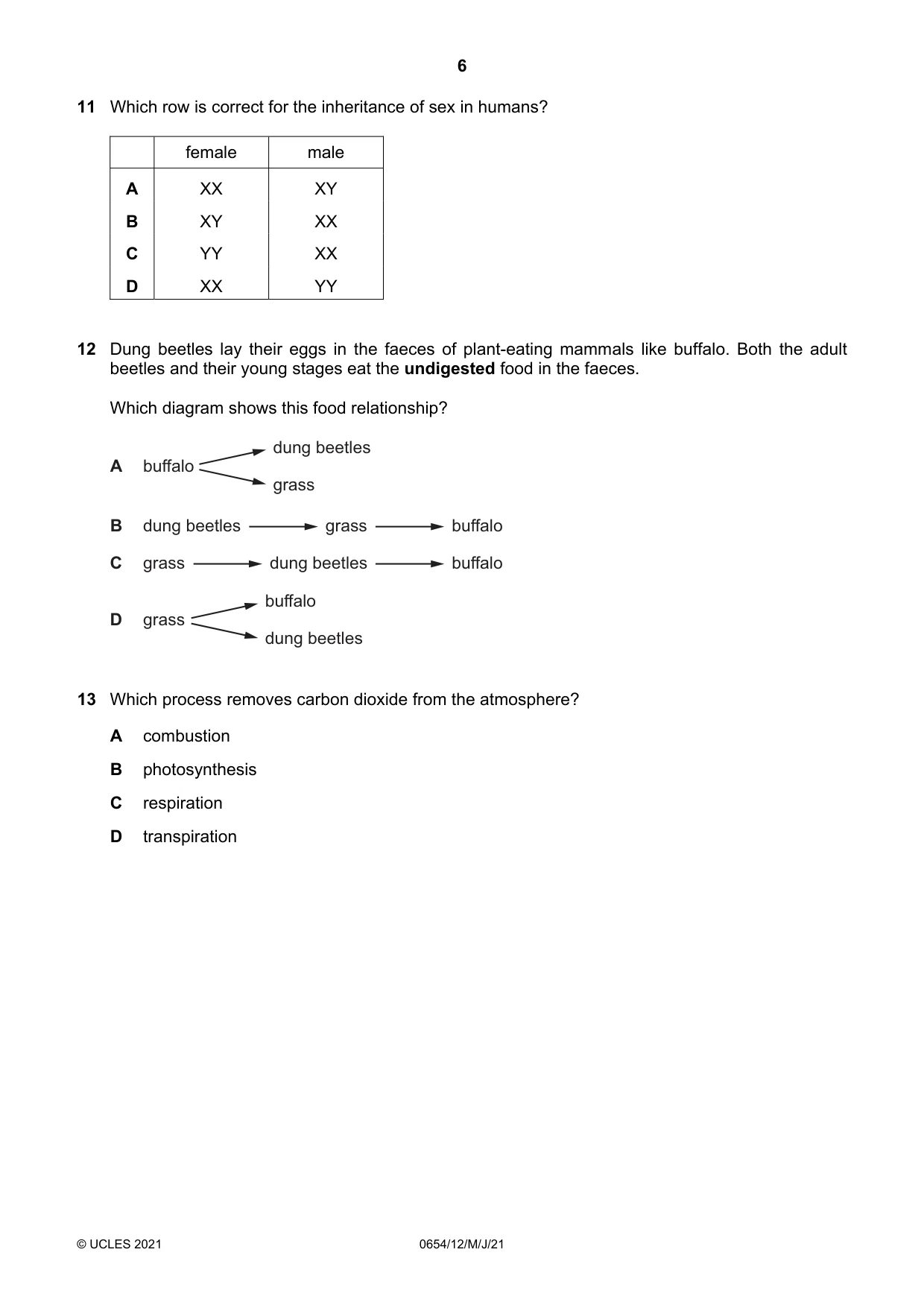
Q11 · Which row is correct for the inheritance of sex in humans?
11 Which row is correct for the inheritance of sex in humans? female male A XX XY B XY XX C YY XX D XX YY
Mark scheme: A
Q12 · Dung beetles lay their eggs in the faeces of plant-eating mammals like buffalo
12 Dung beetles lay their eggs in the faeces of plant-eating mammals like buffalo. Both the adult beetles and their young stages eat the undigested food in the faeces. Which diagram shows this food relationship? dung beetles A buffalo grass B dung beetles grass buffalo C grass dung beetles buffalo buffalo D grass dung beetles
Mark scheme: D
Q13 · Which process removes carbon dioxide from the atmosphere?
13 Which process removes carbon dioxide from the atmosphere? A combustion B photosynthesis C respiration D transpiration
Mark scheme: B
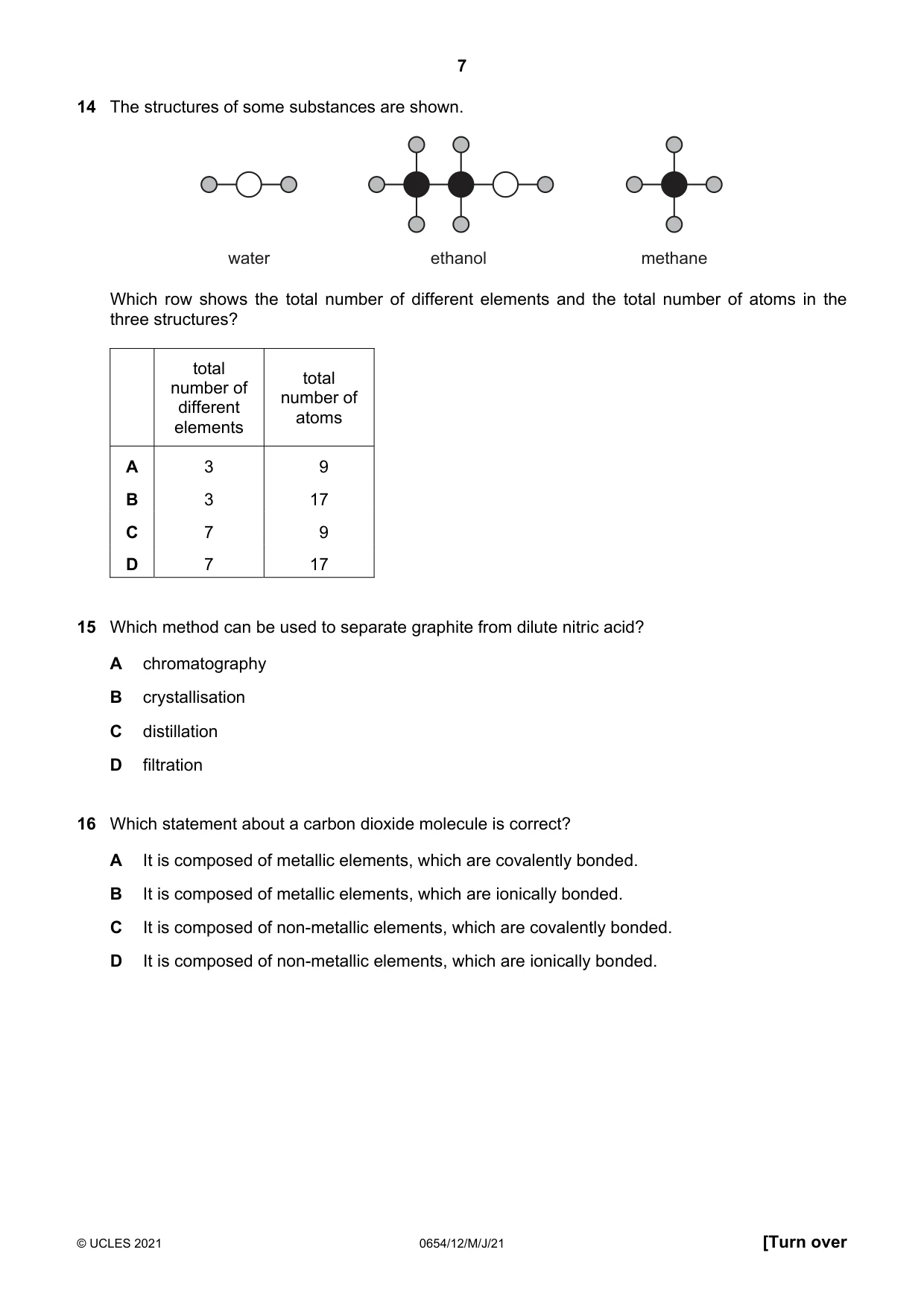
Q14 · The structures of some substances are shown
14 The structures of some substances are shown. water ethanol methane Which row shows the total number of different elements and the total number of atoms in the three structures? total total number of number of different atoms elements A 3 9 B 3 17 C 7 9 D 7 17
Mark scheme: B
Q15 · Which method can be used to separate graphite from dilute nitric acid?
15 Which method can be used to separate graphite from dilute nitric acid? A chromatography B crystallisation C distillation D filtration
Mark scheme: D
Q16 · Which statement about a carbon dioxide molecule is correct?
16 Which statement about a carbon dioxide molecule is correct? A It is composed of metallic elements, which are covalently bonded. B It is composed of metallic elements, which are ionically bonded. C It is composed of non-metallic elements, which are covalently bonded. D It is composed of non-metallic elements, which are ionically bonded.
Mark scheme: C
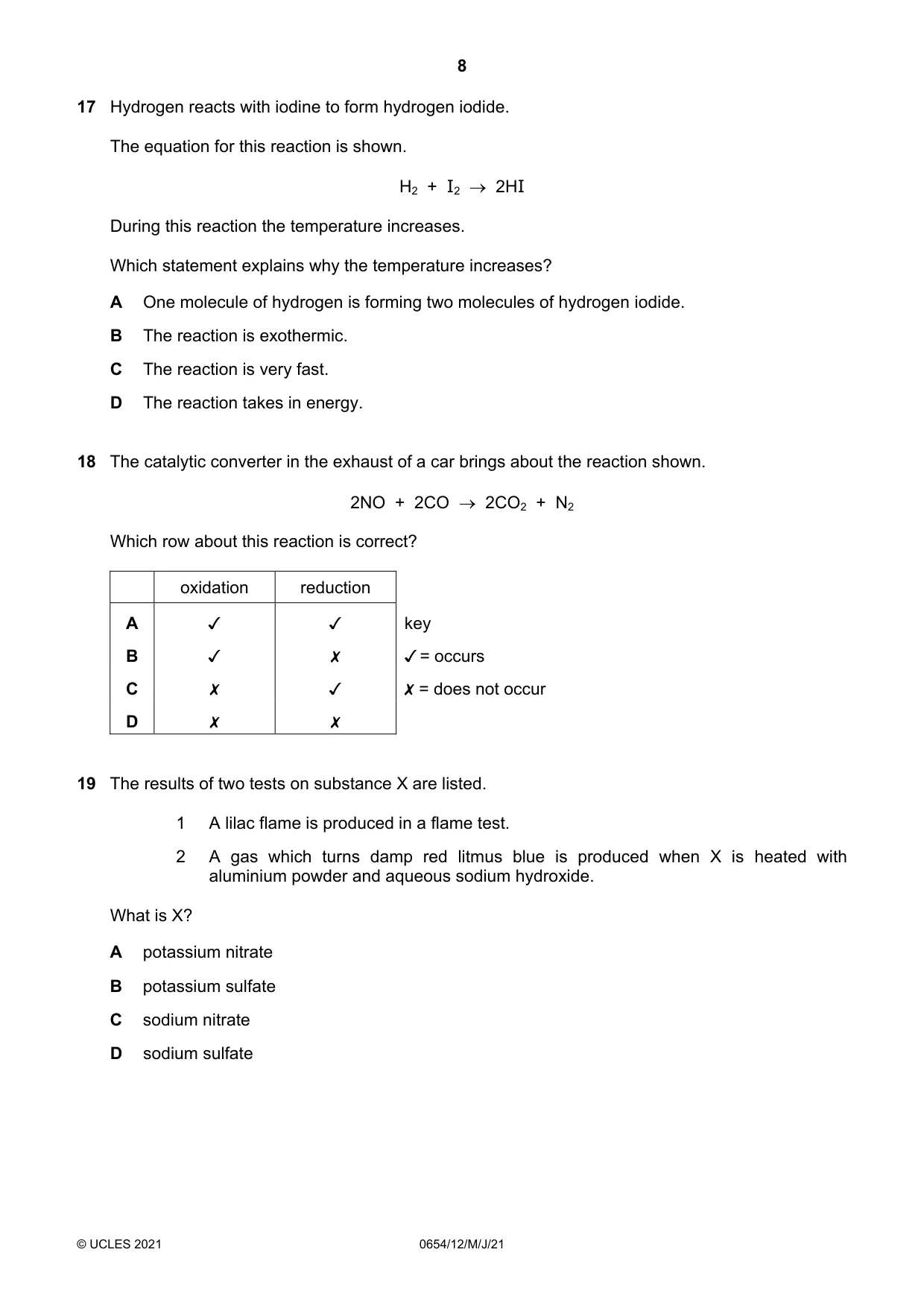
Q17 · Hydrogen reacts with iodine to form hydrogen iodide
17 Hydrogen reacts with iodine to form hydrogen iodide. The equation for this reaction is shown. H2 + I2 2HI During this reaction the temperature increases. Which statement explains why the temperature increases? A One molecule of hydrogen is forming two molecules of hydrogen iodide. B The reaction is exothermic. C The reaction is very fast. D The reaction takes in energy.
Mark scheme: B
Q18 · The catalytic converter in the exhaust of a car brings about the reaction shown
18 The catalytic converter in the exhaust of a car brings about the reaction shown. 2NO + 2CO + 2CO, + No Which row about this reaction is correct? 0 0O WwW > oxidation ~ «4 reduction <x \ x key J/ = occurs X = does not occur
Mark scheme: A
Q19 · The results of two tests on substance X are listed
19 The results of two tests on substance X are listed. 1 A lilac flame is produced in a flame test. 2 A gas which turns damp red litmus blue is produced when X is heated with aluminium powder and aqueous sodium hydroxide. What is X? A potassium nitrate B potassium sulfate C sodium nitrate D sodium sulfate
Mark scheme: A
Q20 · What reacts with ammonia gas?
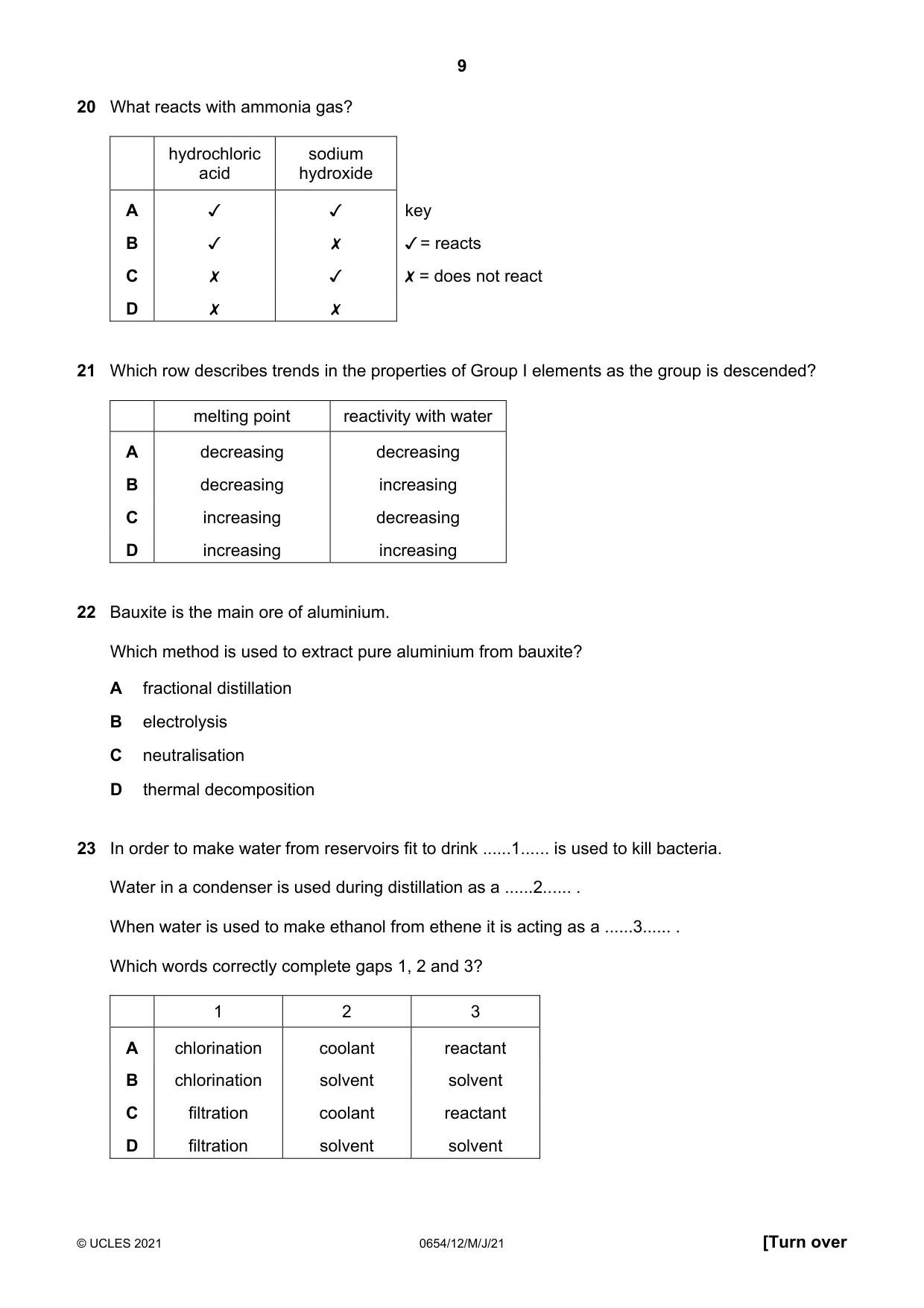
20 What reacts with ammonia gas? hydrochloric sodium acid hydroxide A Jv J B Jv x Cc x v D x x key Jv = reacts X = does not react
Mark scheme: B
More questions on The characteristic properties of acids and bases
Q21 · Which row describes trends in the properties of Group I elements as the group is…
21 Which row describes trends in the properties of Group I elements as the group is descended? melting point reactivity with water A decreasing decreasing B decreasing increasing C increasing decreasing D increasing increasing
Mark scheme: B
Q22 · Bauxite is the main ore of aluminium
22 Bauxite is the main ore of aluminium. Which method is used to extract pure aluminium from bauxite? A fractional distillation B electrolysis C neutralisation D thermal decomposition
Mark scheme: B
Q23 · In order to make water from reservoirs fit to drink ......1.....
23 In order to make water from reservoirs fit to drink ......1...... is used to kill bacteria. Water in a condenser is used during distillation as a ......2...... . When water is used to make ethanol from ethene it is acting as a ......3...... . Which words correctly complete gaps 1, 2 and 3? 1 2 3 A chlorination coolant reactant B chlorination solvent solvent C filtration coolant reactant D filtration solvent solvent
Mark scheme: A
Q24 · Other than hydrogen and oxygen, which substance provides only one of the essential…
24 Other than hydrogen and oxygen, which substance provides only one of the essential elements for plant growth? A K3PO4 B KNO3 C (NH4)3PO4 D NH4NO3
Mark scheme: D
Q25 · What are the products of the thermal decomposition of calcium carbonate, CaCO3?
25 What are the products of the thermal decomposition of calcium carbonate, CaCO3? A calcium and carbon dioxide B calcium, carbon and oxygen C calcium oxide and carbon dioxide D calcium oxide and carbon monoxide
Mark scheme: C
Q26 · Which property allows petroleum to be separated by fractional distillation?
26 Which property allows petroleum to be separated by fractional distillation? A boiling point B colour C density D melting point
Mark scheme: A
Q27 · Poly(ethene) is a saturated hydrocarbon
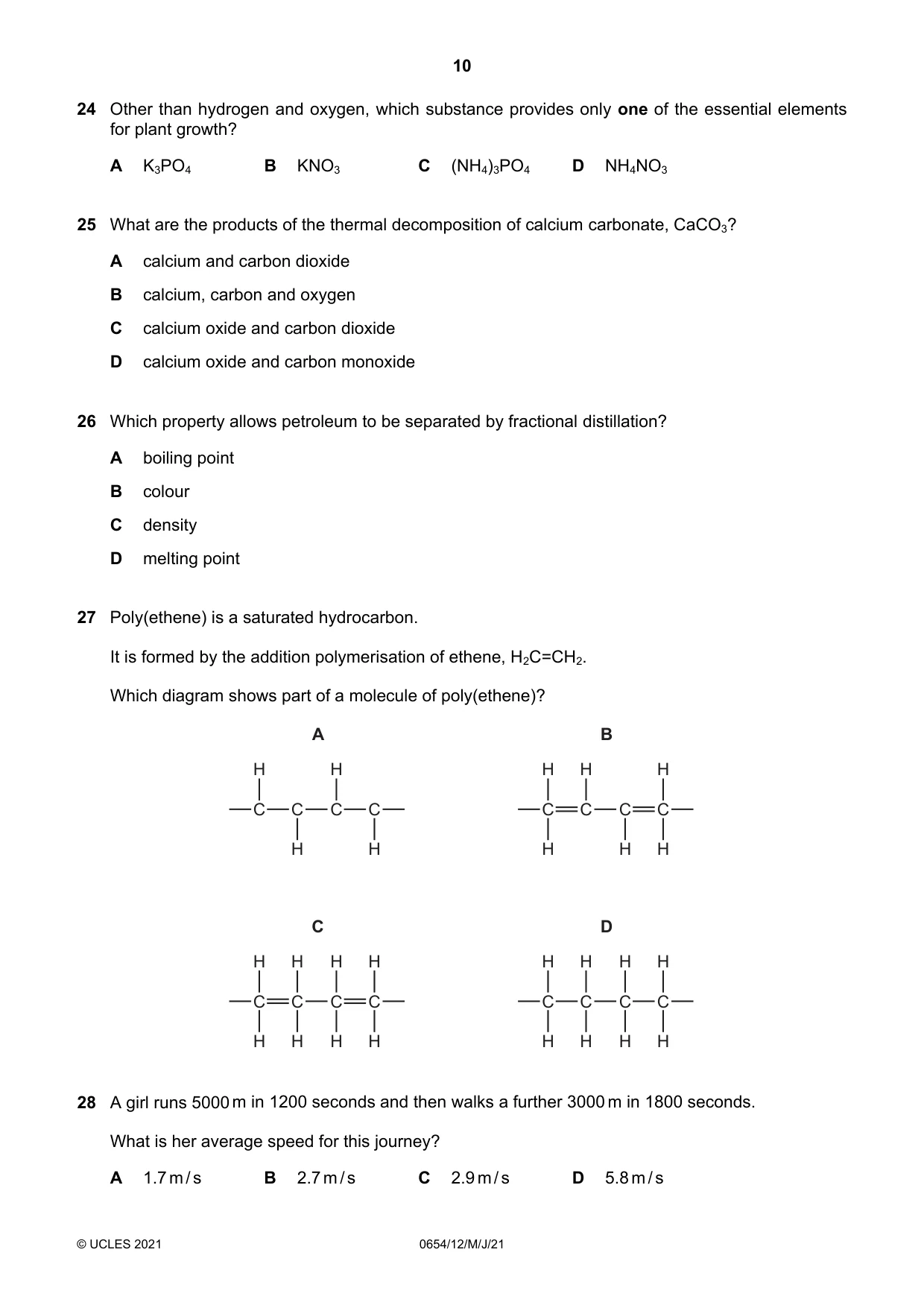
27 Poly(ethene) is a saturated hydrocarbon. It is formed by the addition polymerisation of ethene, H2C=CH2. Which diagram shows part of a molecule of poly(ethene)? A B H H H H H C C C C C C C C H H H H H C D H H H H H H H H C C C C C C C C H H H H H H H H
Mark scheme: D
Q28 · A girl runs 5000 m in 1200 seconds and then walks a further 3000 m in 1800 seconds
28 A girl runs 5000 m in 1200 seconds and then walks a further 3000 m in 1800 seconds. What is her average speed for this journey? A 1.7 m / s B 2.7 m / s C 2.9 m / s D 5.8 m / s
Mark scheme: B
Q29 · An object is falling freely near the Earth without air resistance
29 An object is falling freely near the Earth without air resistance. Which statement about the acceleration of the object is correct? A It is constant, but not zero. B It is decreasing. C It is increasing. D It is zero.
Mark scheme: A
Q30 · Three objects X, Y and Z are at rest on a table
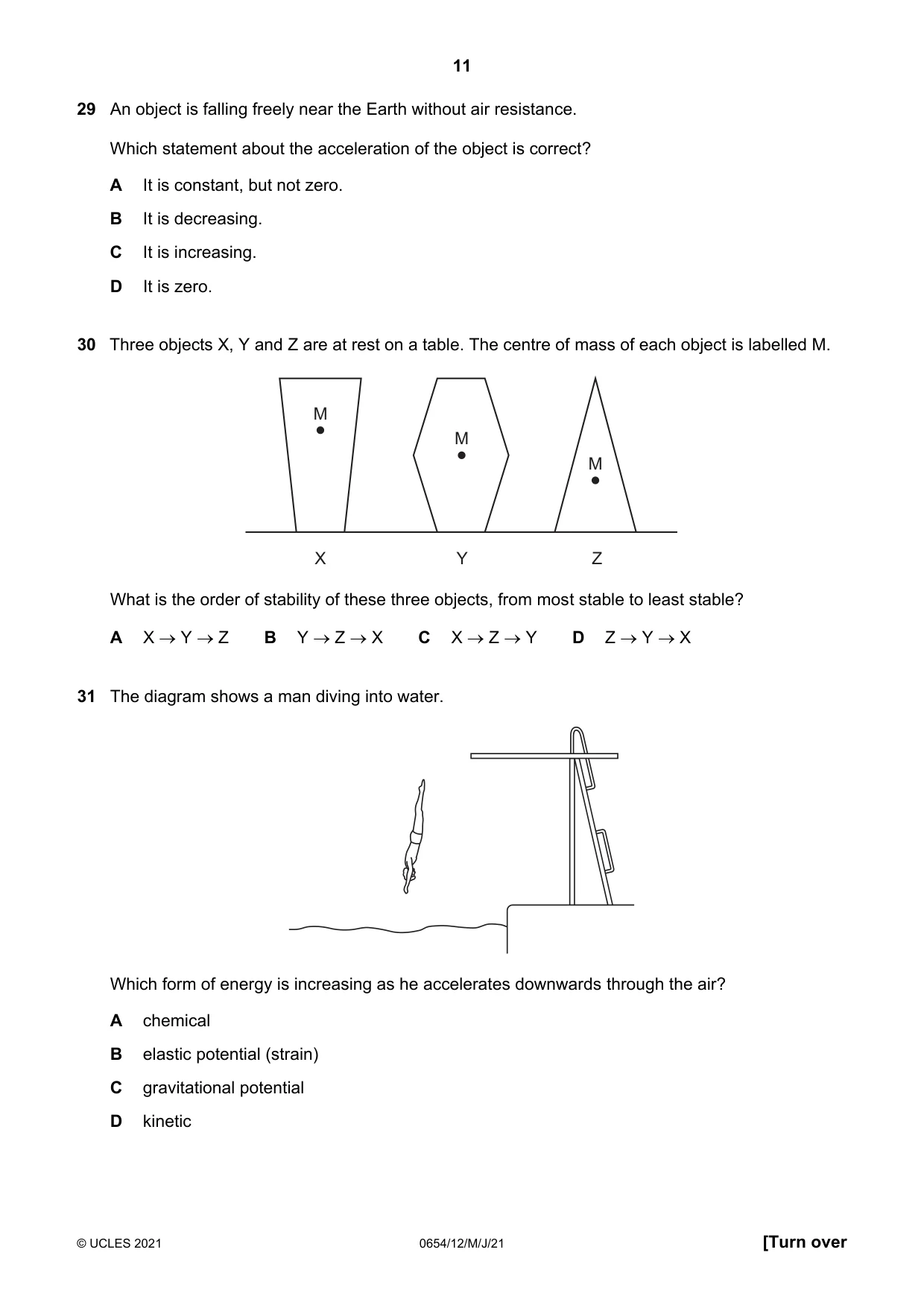
30 Three objects X, Y and Z are at rest on a table. The centre of mass of each object is labelled M. M M M X Y Z What is the order of stability of these three objects, from most stable to least stable? A X Y Z B Y Z X C X Z Y D Z Y X
Mark scheme: D
Q31 · The diagram shows a man diving into water
31 The diagram shows a man diving into water. Which form of energy is increasing as he accelerates downwards through the air? A chemical B elastic potential (strain) C gravitational potential D kinetic
Mark scheme: D
Q32 · There is a vacuum between the double walls of a vacuum flask
32 There is a vacuum between the double walls of a vacuum flask. Which of the methods of thermal energy transfer are prevented by the vacuum? A conduction only B conduction and convection C convection only D radiation only
Mark scheme: B
Q33 · A boy looks into a plane mirror that is 50 cm in front of his face
33 A boy looks into a plane mirror that is 50 cm in front of his face. How far from the boy’s face is the image of his face? A 25 cm B 50 cm C 100 cm D 150 cm
Mark scheme: C
Q34 · The diagram shows the image of an object produced by a thin converging lens
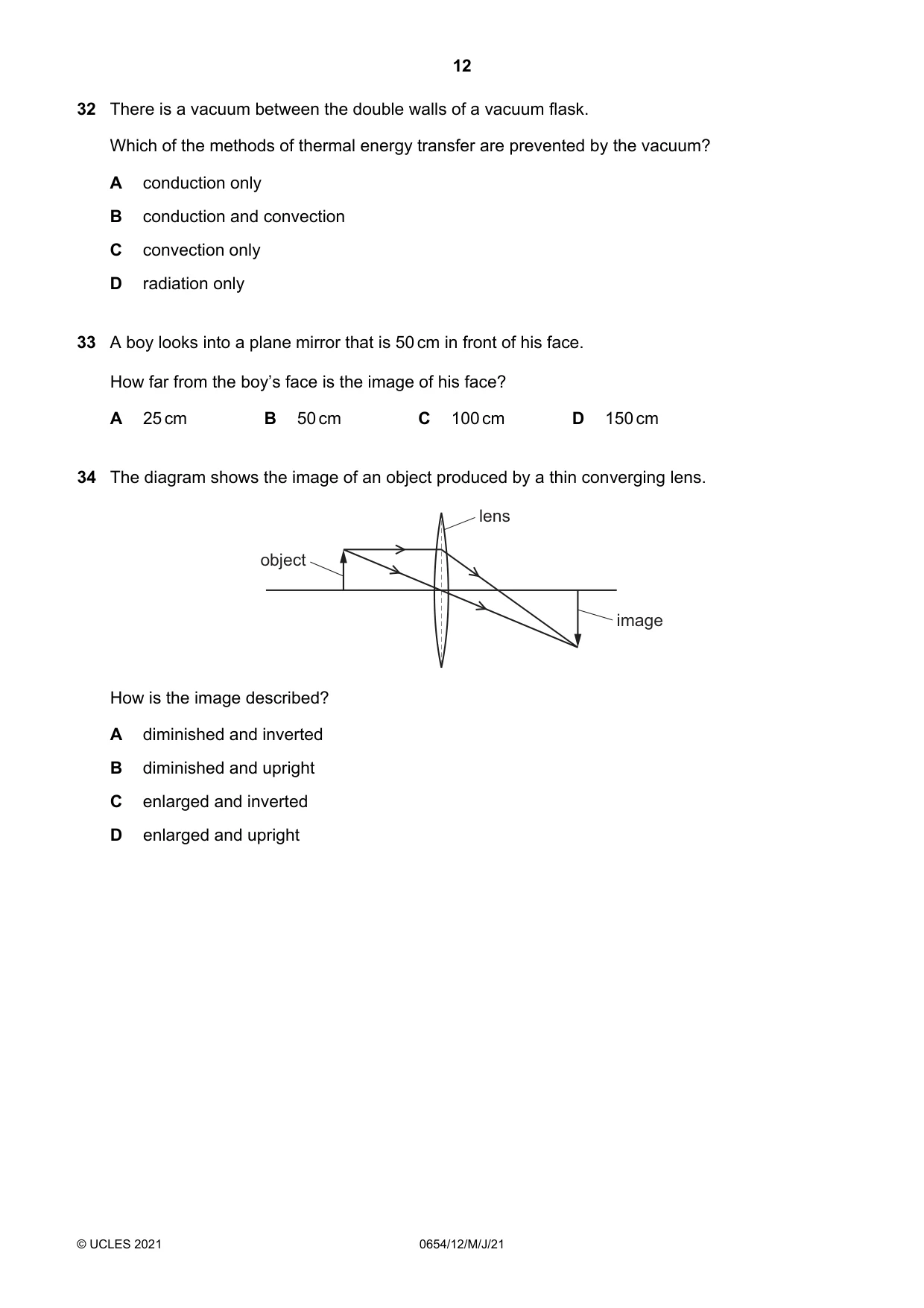
34 The diagram shows the image of an object produced by a thin converging lens. lens object image How is the image described? A diminished and inverted B diminished and upright C enlarged and inverted D enlarged and upright
Mark scheme: C
Q35 · Sound from a loudspeaker at P travels directly to Q
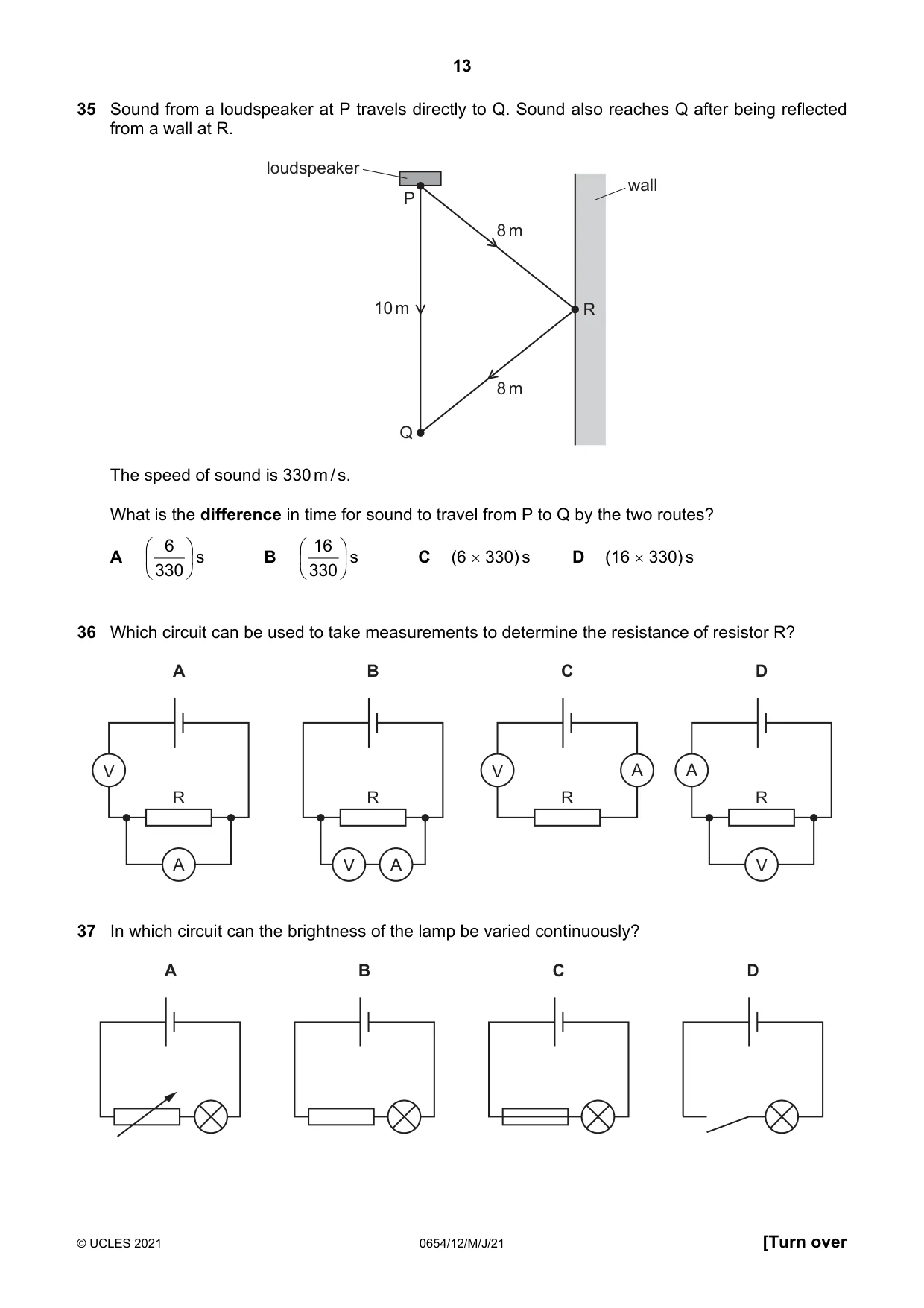
35 Sound from a loudspeaker at P travels directly to Q. Sound also reaches Q after being reflected from a wall at R. loudspeaker wall P 8 m 10 m R 8 m Q The speed of sound is 330 m / s. What is the difference in time for sound to travel from P to Q by the two routes? 6 16 A s B s C (6 330) s D (16 330) s 330 330
Mark scheme: A
Q36 · Which circuit can be used to take measurements to determine the resistance of resistor R?
36 Which circuit can be used to take measurements to determine the resistance of resistor R? A B C D V V A A R R R R A V A V
Mark scheme: D
Q37 · In which circuit can the brightness of the lamp be varied continuously?
37 In which circuit can the brightness of the lamp be varied continuously? A B C D
Mark scheme: A
Q38 · A student connects the circuit shown
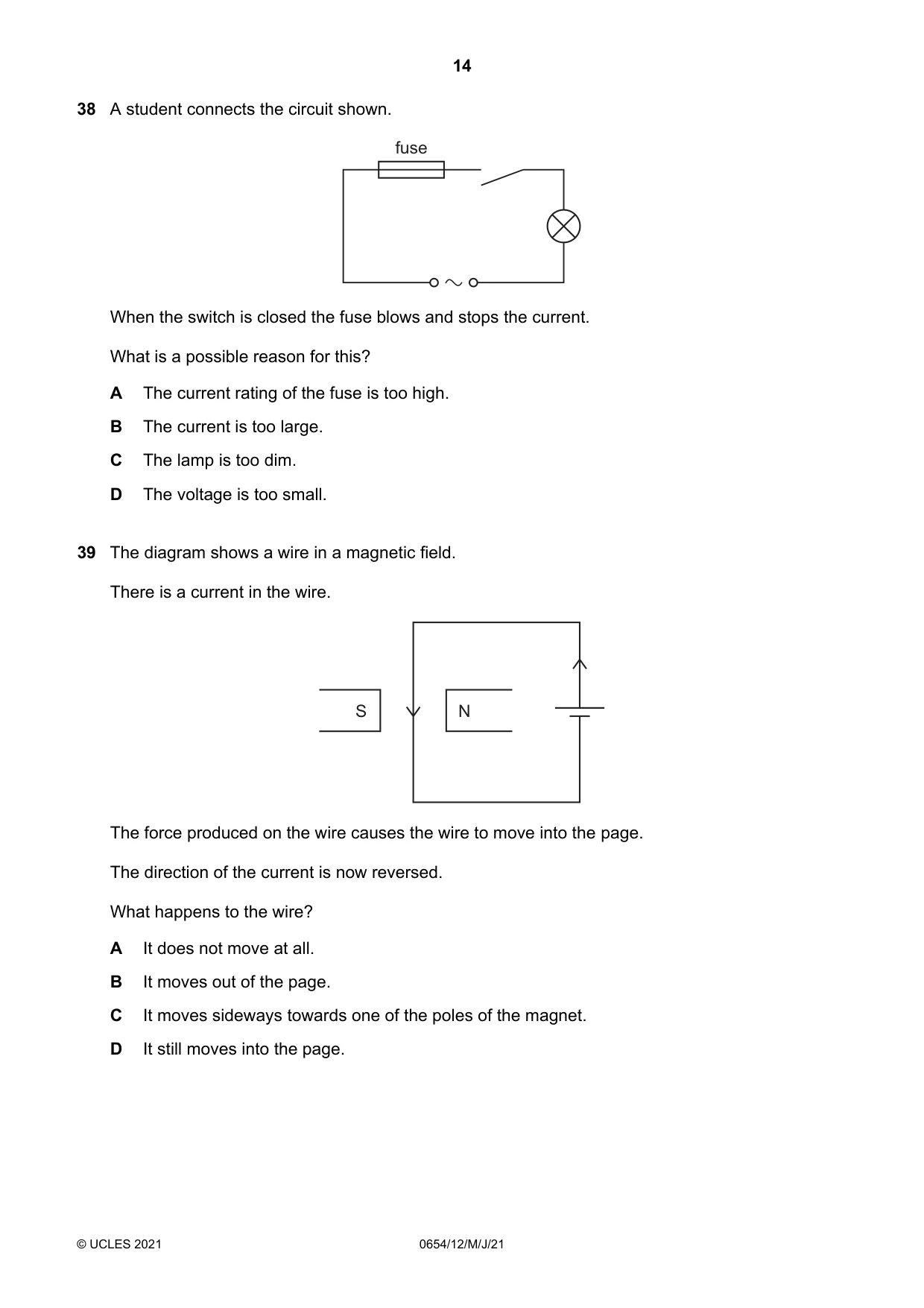
38 A student connects the circuit shown. fuse When the switch is closed the fuse blows and stops the current. What is a possible reason for this? A The current rating of the fuse is too high. B The current is too large. C The lamp is too dim. D The voltage is too small.
Mark scheme: B
Q39 · The diagram shows a wire in a magnetic field
39 The diagram shows a wire in a magnetic field. There is a current in the wire. S N The force produced on the wire causes the wire to move into the page. The direction of the current is now reversed. What happens to the wire? A It does not move at all. B It moves out of the page. C It moves sideways towards one of the poles of the magnet. D It still moves into the page.
Mark scheme: B
Q40 · A radioactive nucleus emits a -particle
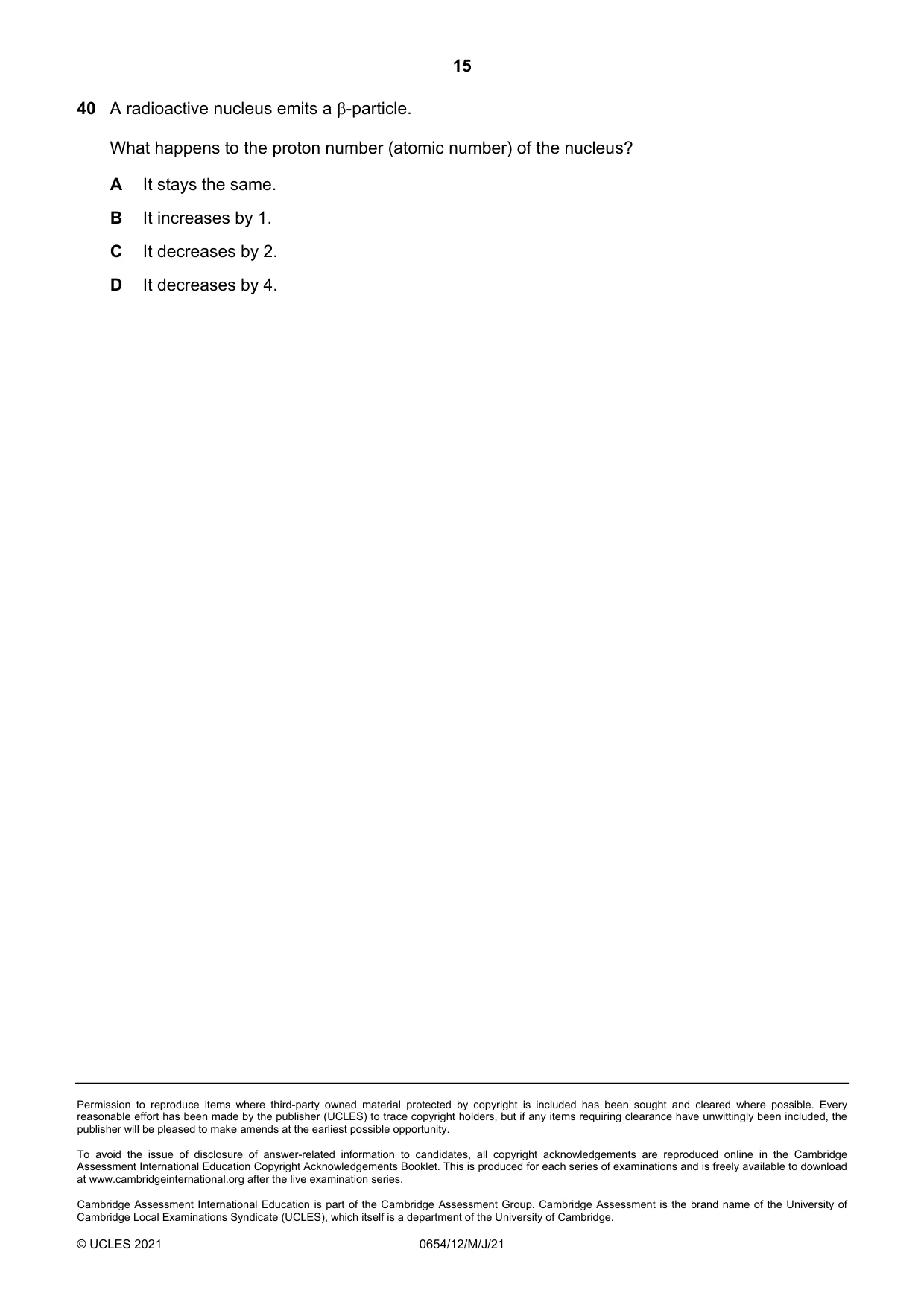
40 A radioactive nucleus emits a -particle. What happens to the proton number (atomic number) of the nucleus? A It stays the same. B It increases by 1. C It decreases by 2. D It decreases by 4.
Mark scheme: B
What was in this paper
The subtopics covered by these 40 questions, and how many questions each got. Open one in a new tab to see every Cambridge question on it.
2Gas exchange in humans2Light2Motion2Separation and purification2Water2Biological molecules1Carbon cycle1Chromosomes and genes1Coordination and response1Digestive system1Electrical safety1Electromagnetic effects1Elements, compounds and mixtures1Energy, work and power1Enzymes1Exothermic and endothermic reactions1Extraction of metals1Food chains and food webs1Forces1Group I properties1Identification of ions and gases1Oxides1Photosynthesis1Polymers1Radioactivity1Redox1Respiration1Sexual reproduction in humans1Simple molecules and covalent bonds1Sound1The characteristic properties of acids and bases1Transfer of thermal energy1Transpiration1What you needed in this session
Cambridge’s own grade thresholds for 2021 May/June, Paper 1 · Variant 2. A higher threshold means an easier paper — the bar moves with how the cohort did.