Cambridge IGCSE Sciences - Co-ordinated (Double) 0654 — 2015 Oct/Nov Paper 1 · Variant 3
0654/13/O/N/15 · 40 questions · 40 marks · ≈45 min
The question paper and its mark scheme, free to read here and free to download. This is Cambridge’s own paper, exactly as it was sat.
Question paper20 pages


Mark scheme2 pages
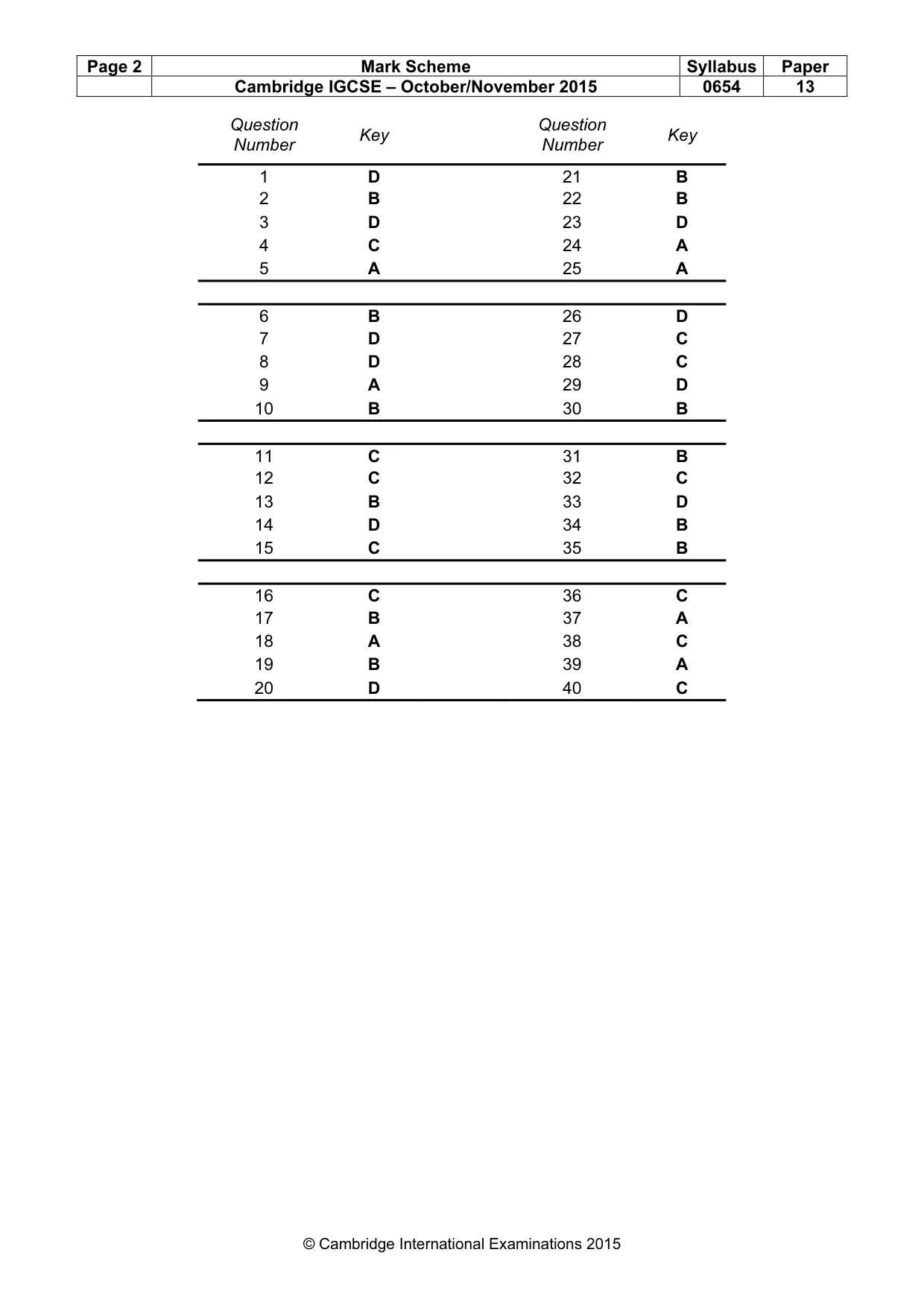
Answers below. Sit the paper first if you are practising.
Questions as text
Q1 · Which chemical is found in a plant cell but not in an animal cell?
1 Which chemical is found in a plant cell but not in an animal cell? A glucose B glycogen C protein D starch
Mark scheme: D
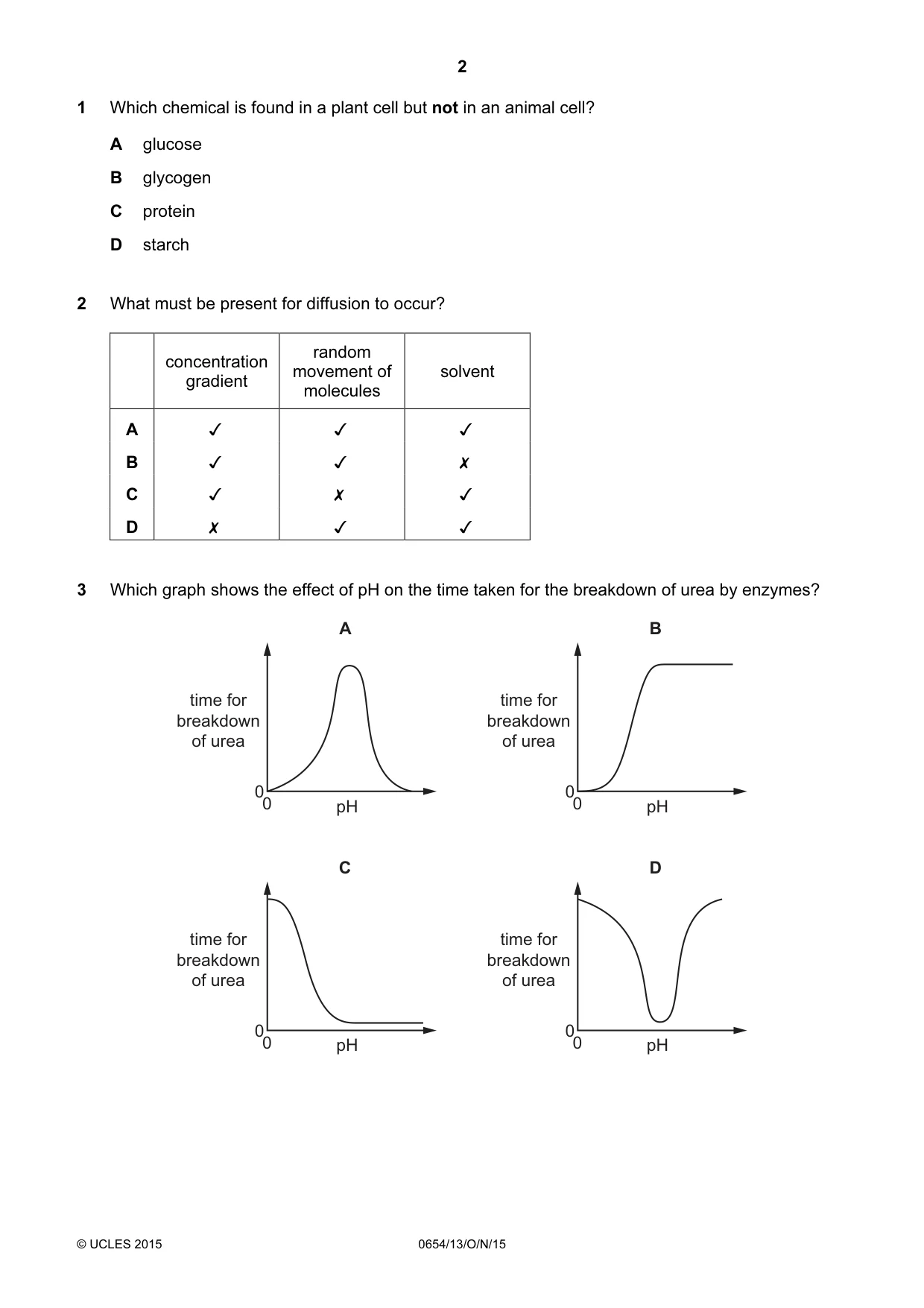
Q2 · What must be present for diffusion to occur?
2 What must be present for diffusion to occur? . random concentration . movement of solvent gradient molecules A Jv Jv Jv B Jv Jv x Cc Jv x Jv D x Jv Jv
Mark scheme: B
Q3 · Which graph shows the effect of pH on the time taken for the breakdown of urea by enzymes?
3 Which graph shows the effect of pH on the time taken for the breakdown of urea by enzymes? A B time for time for breakdown breakdown of urea of urea 00 00 pH pH C D time for time for breakdown breakdown of urea of urea 00 00 pH pH
Mark scheme: D
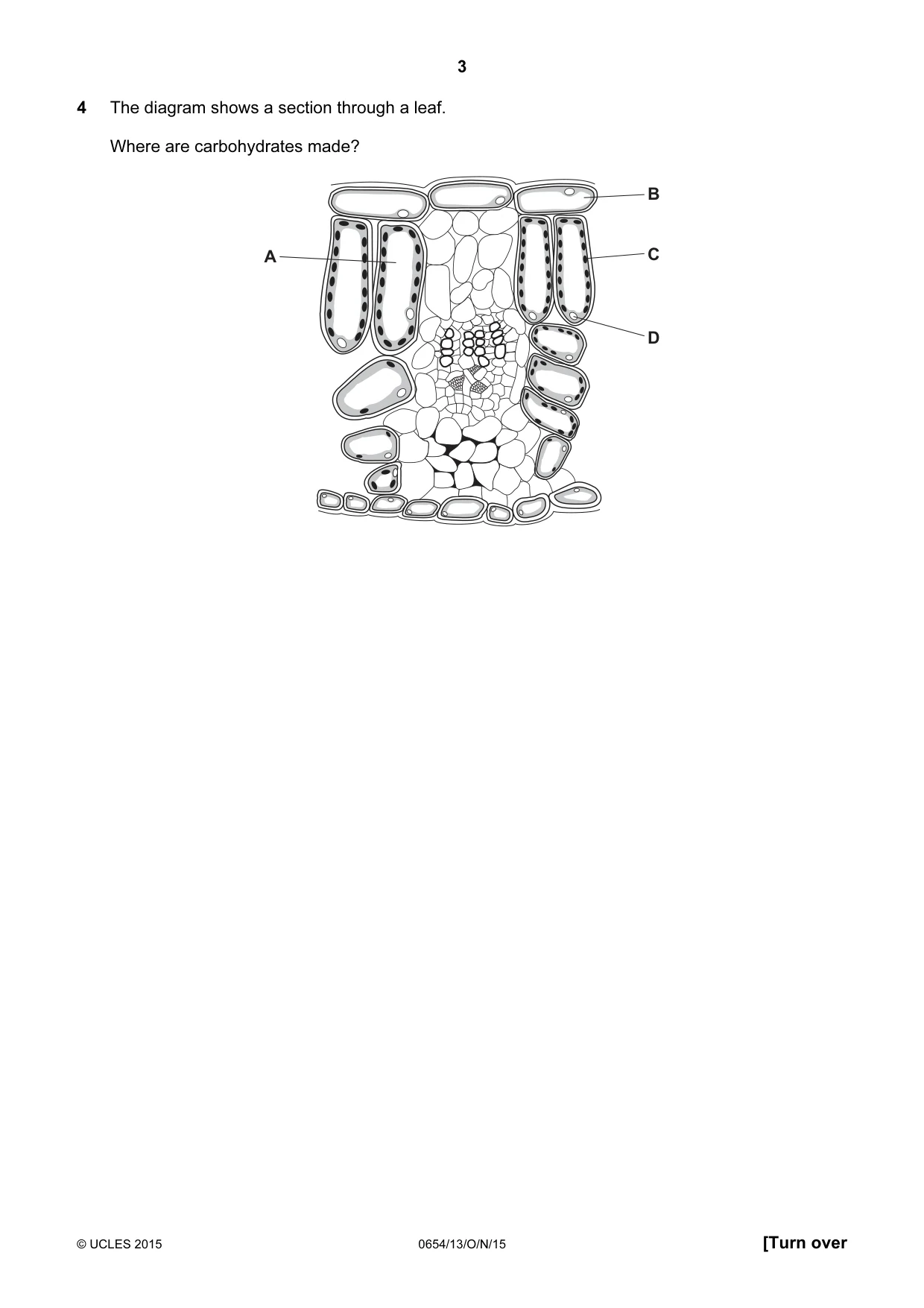
Q4 · The diagram shows a section through a leaf
4 The diagram shows a section through a leaf. Where are carbohydrates made? B A C D
Mark scheme: C
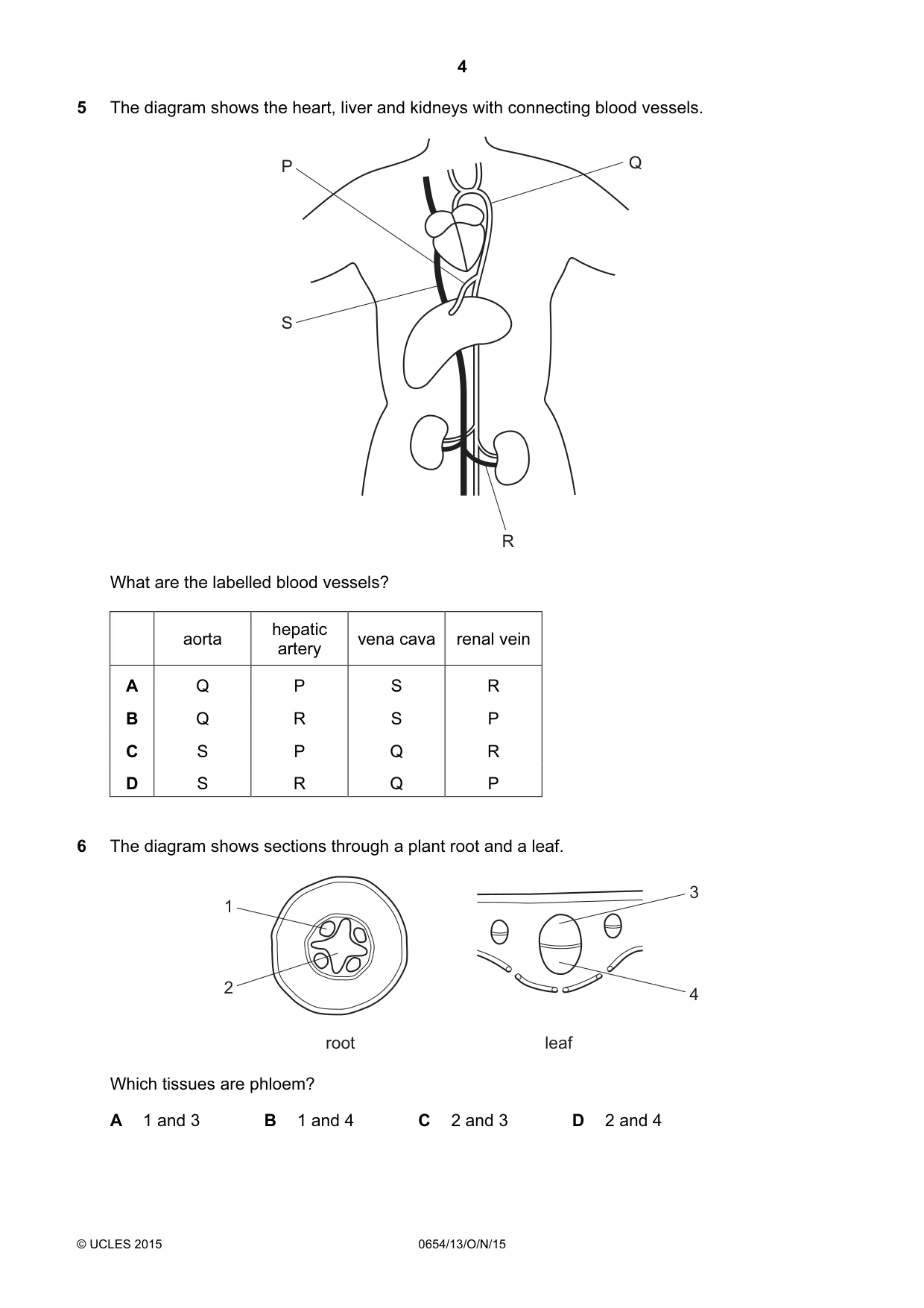
Q5 · The diagram shows the heart, liver and kidneys with connecting blood vessels
5 The diagram shows the heart, liver and kidneys with connecting blood vessels. P Q S R What are the labelled blood vessels? hepatic aorta vena cava renal vein artery A Q P S R B Q R S P C S P Q R D S R Q P
Mark scheme: A
Q6 · The diagram shows sections through a plant root and a leaf
6 The diagram shows sections through a plant root and a leaf. 3 1 2 4 root leaf Which tissues are phloem? A 1 and 3 B 1 and 4 C 2 and 3 D 2 and 4
Mark scheme: B
Q7 · Which part of the alimentary canal is in the form of a coiled tube?
7 Which part of the alimentary canal is in the form of a coiled tube? A oesophagus B pancreas C rectum D small intestine
Mark scheme: D
Q8 · What is the definition of homeostasis?
8 What is the definition of homeostasis? A controlling body temperature B controlling responses to stimuli C maintaining a constant external environment D maintaining a constant internal environment
Mark scheme: D
Q9 · What happens when the body temperature falls below normal?
9 What happens when the body temperature falls below normal? A Arterioles (small arteries) supplying the skin constrict (become narrower). B Arterioles (small arteries) supplying the skin dilate (become wider). C Capillaries move towards the skin surface. D Capillaries move away from the skin surface.
Mark scheme: A
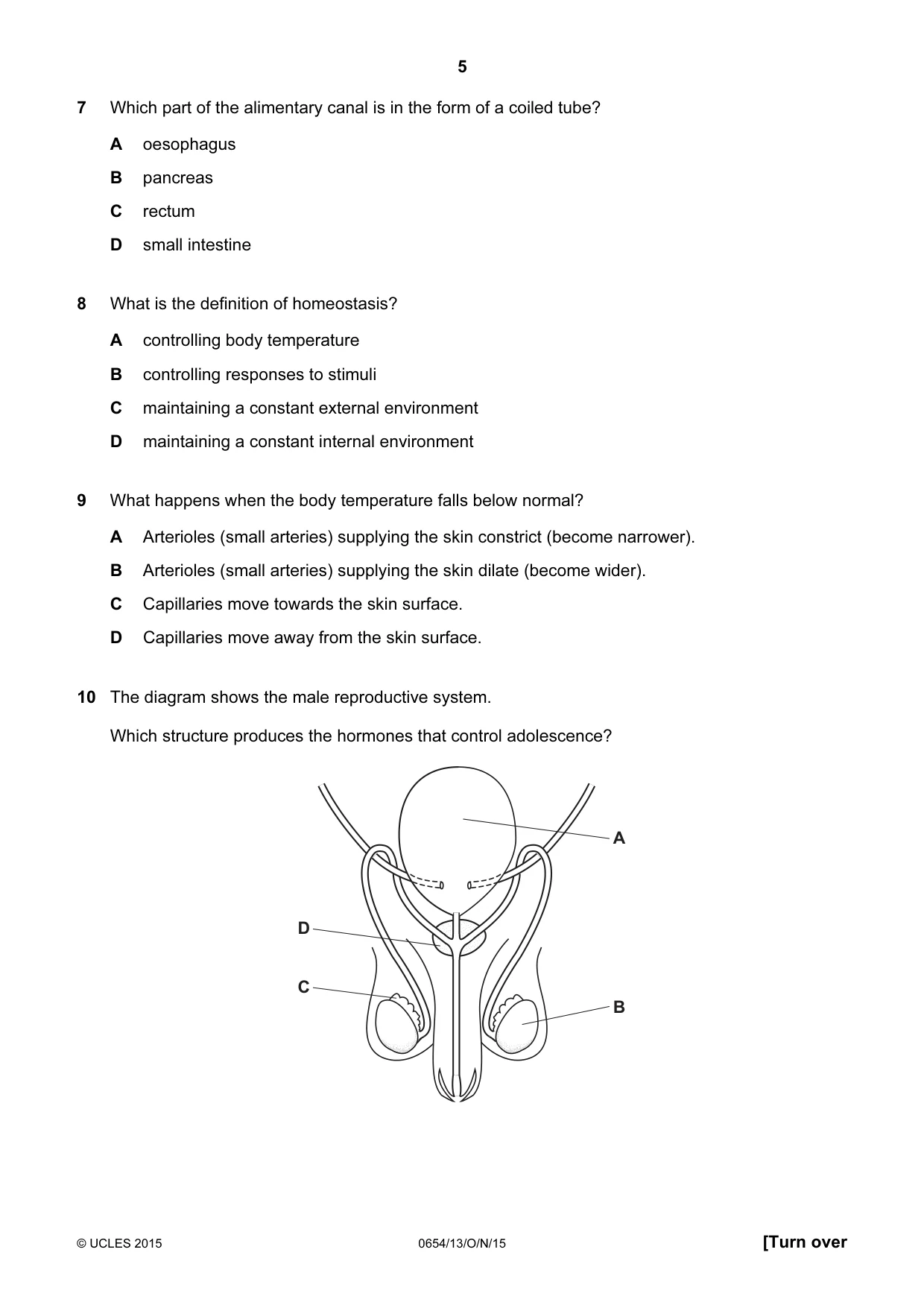
Q10 · The diagram shows the male reproductive system
10 The diagram shows the male reproductive system. Which structure produces the hormones that control adolescence? A D C B
Mark scheme: B
Q11 · Which statement about flowers is correct?
11 Which statement about flowers is correct? A The anther and stigma are parts of the carpel. B The anther and stigma are parts of the stamen. C The ovary and stigma are parts of the carpel. D The ovary and stigma are parts of the stamen.
Mark scheme: C
Q12 · The diagram shows a food chain
12 The diagram shows a food chain. beech tree → insect → shrew → owl Which statement is correct? A The beech tree is a consumer. B The insect is a producer. C The owl is a carnivore. D The shrew is a herbivore.
Mark scheme: C
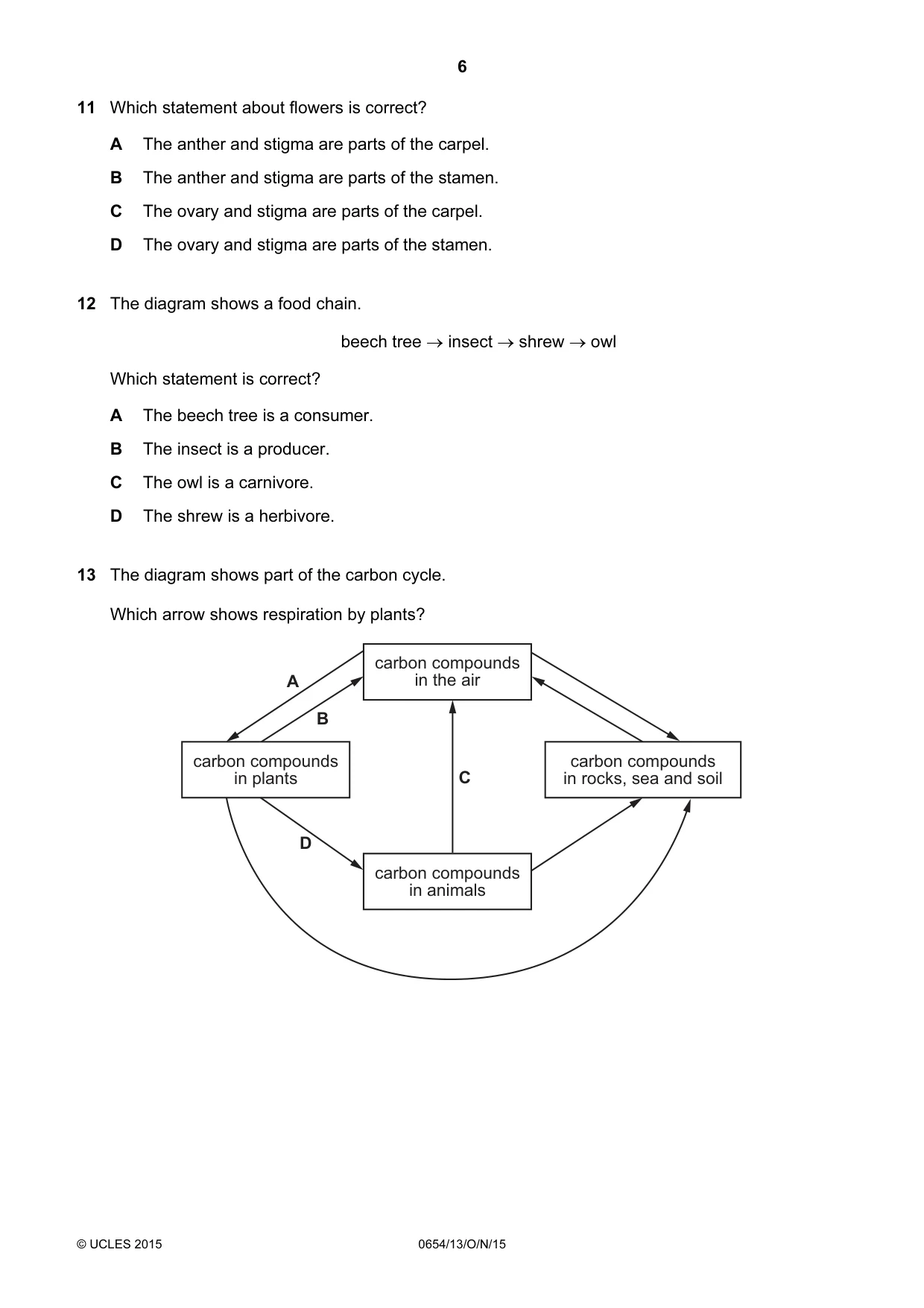
Q13 · The diagram shows part of the carbon cycle
13 The diagram shows part of the carbon cycle. Which arrow shows respiration by plants? carbon compounds A in the air B carbon compounds carbon compounds in plants C in rocks, sea and soil D carbon compounds in animals
Mark scheme: B
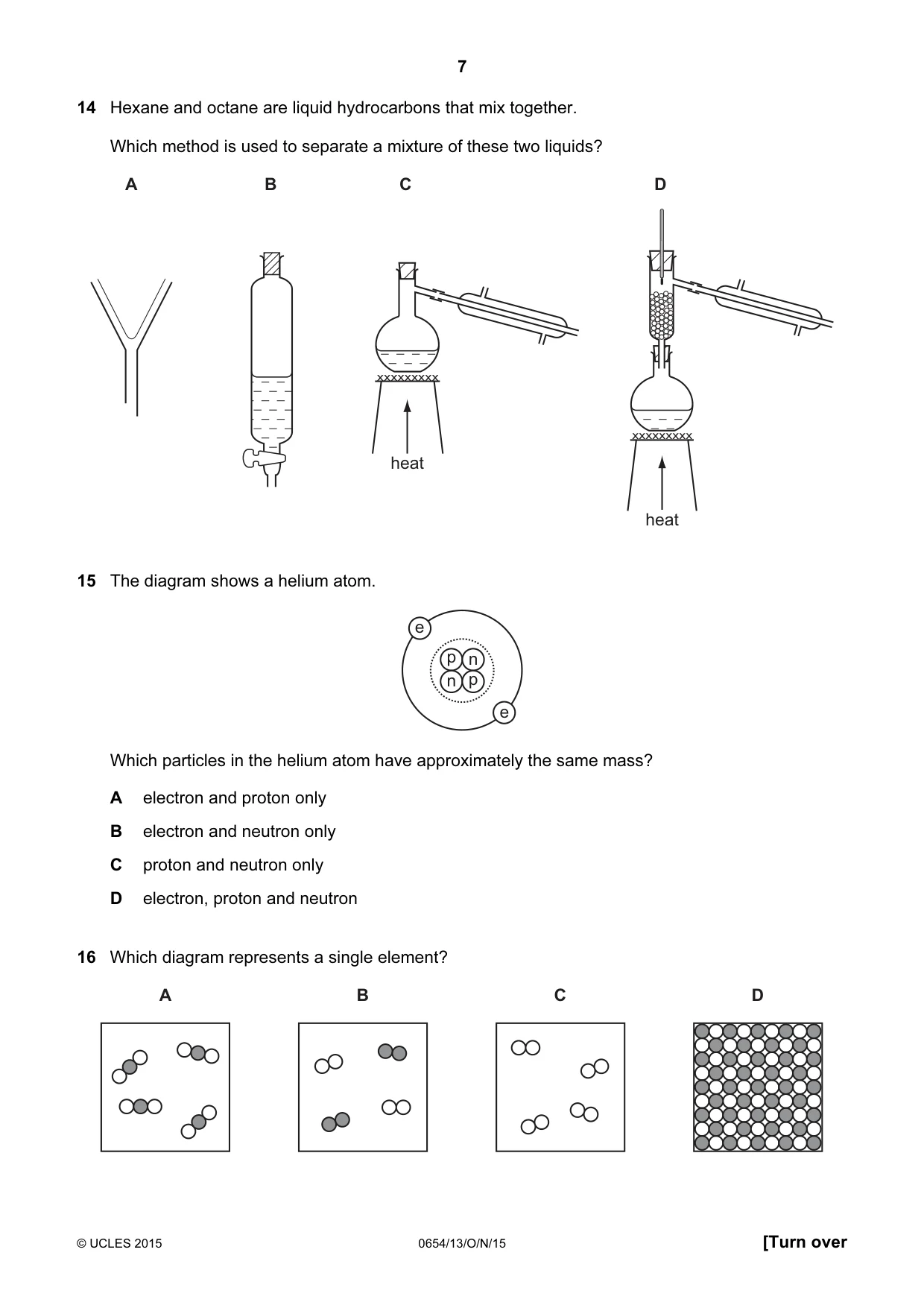
Q14 · Hexane and octane are liquid hydrocarbons that mix together
14 Hexane and octane are liquid hydrocarbons that mix together. Which method is used to separate a mixture of these two liquids? A B C D xxxxxxxxx xxxxxxxxx heat heat
Mark scheme: D
Q15 · The diagram shows a helium atom
15 The diagram shows a helium atom. e p n n p e Which particles in the helium atom have approximately the same mass? A electron and proton only B electron and neutron only C proton and neutron only D electron, proton and neutron
Mark scheme: C
Q16 · Which diagram represents a single element?
16 Which diagram represents a single element? A B C D
Mark scheme: C
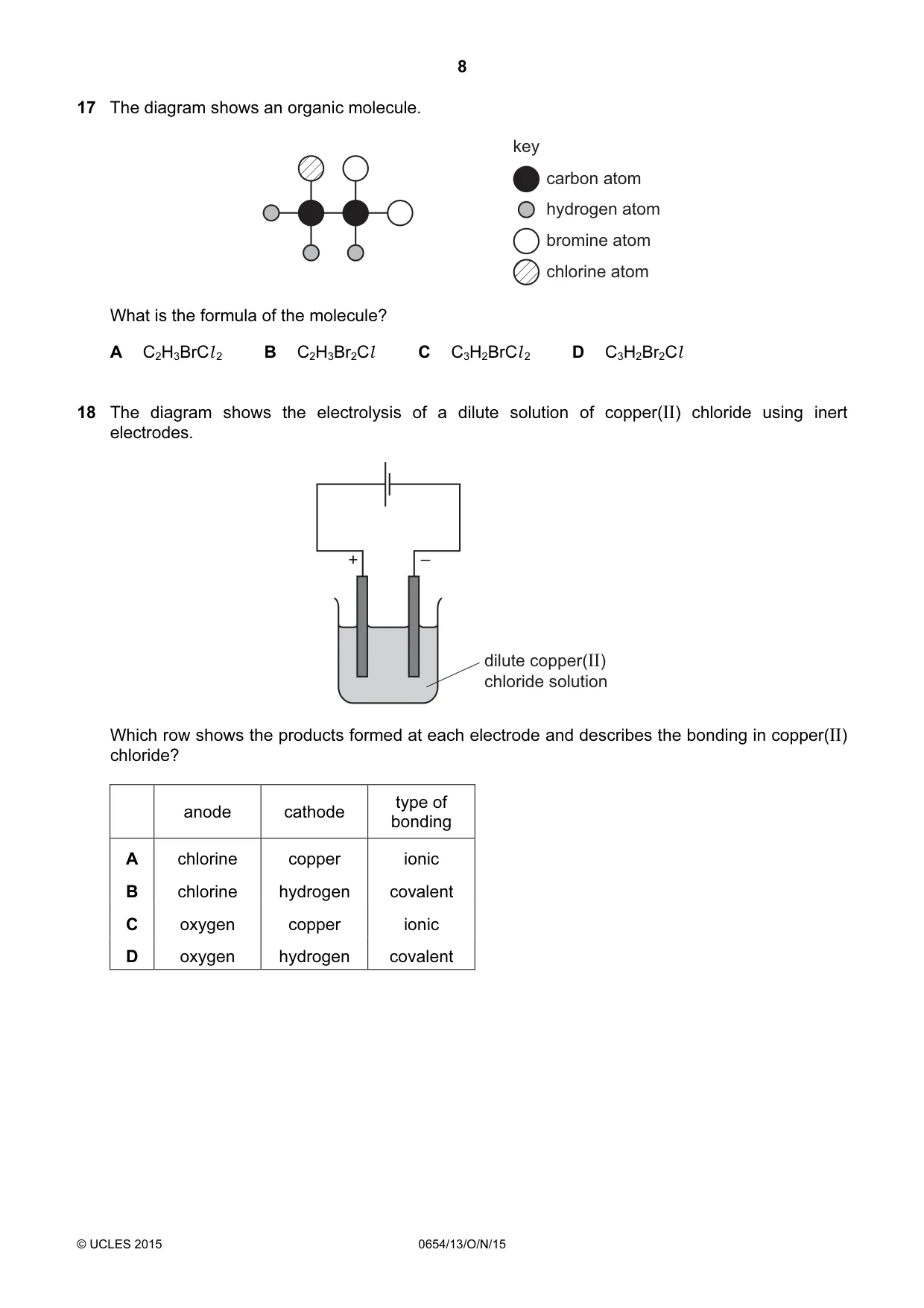
Q17 · The diagram shows an organic molecule
17 The diagram shows an organic molecule. key carbon atom hydrogen atom bromine atom chlorine atom What is the formula of the molecule? A C2H3BrCl 2 B C2H3Br2Cl C C3H2BrCl 2 D C3H2Br2Cl
Mark scheme: B
Q18 · The diagram shows the electrolysis of a dilute solution of copper(II) chloride using…
18 The diagram shows the electrolysis of a dilute solution of copper(II) chloride using inert electrodes. + – dilute copper(II) chloride solution Which row shows the products formed at each electrode and describes the bonding in copper(II) chloride? type of anode cathode bonding A chlorine copper ionic B chlorine hydrogen covalent C oxygen copper ionic D oxygen hydrogen covalent
Mark scheme: A
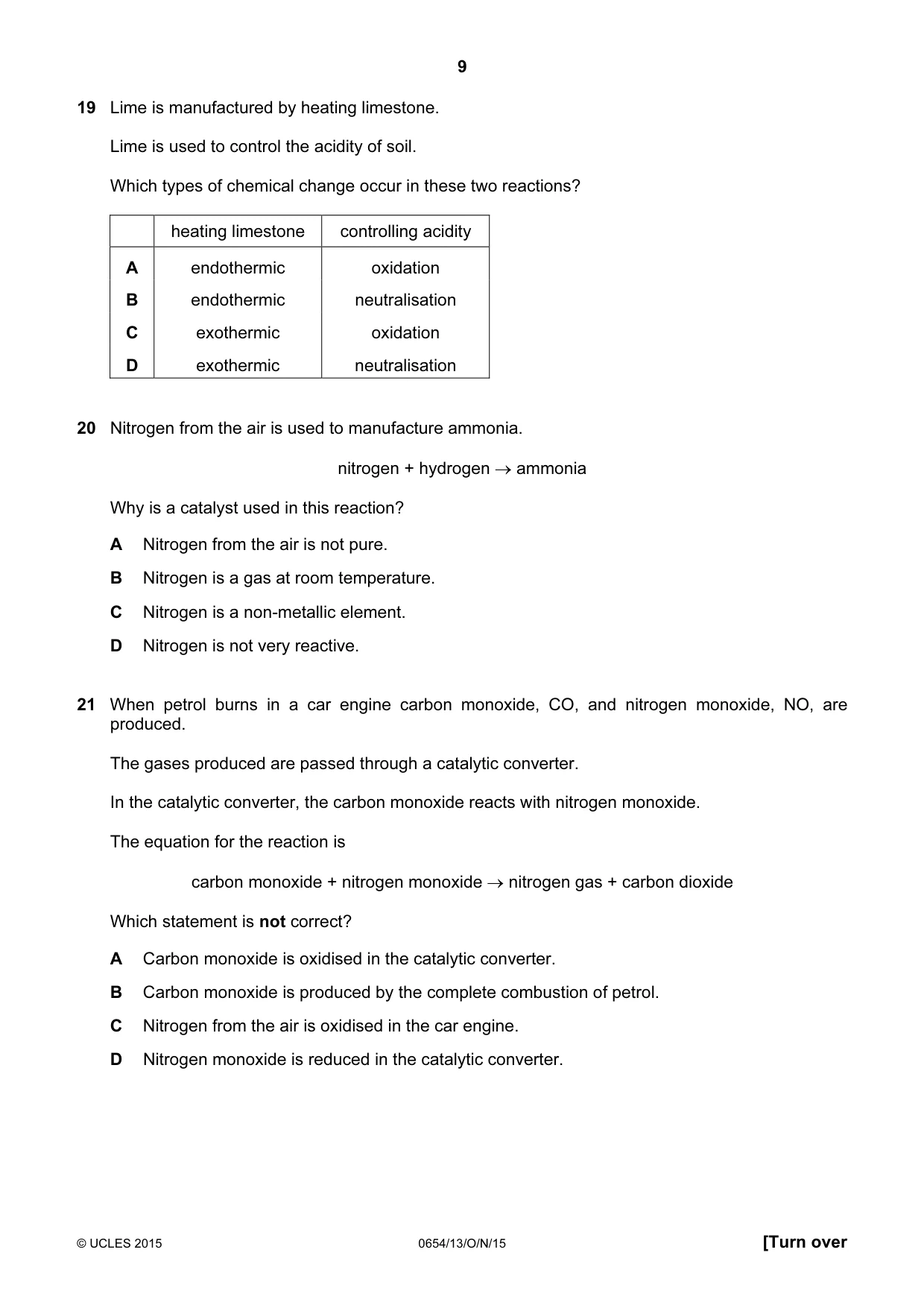
Q19 · Lime is manufactured by heating limestone
19 Lime is manufactured by heating limestone. Lime is used to control the acidity of soil. Which types of chemical change occur in these two reactions? heating limestone controlling acidity A endothermic oxidation B endothermic neutralisation C exothermic oxidation D exothermic neutralisation
Mark scheme: B
Q20 · Nitrogen from the air is used to manufacture ammonia
20 Nitrogen from the air is used to manufacture ammonia. nitrogen + hydrogen → ammonia Why is a catalyst used in this reaction? A Nitrogen from the air is not pure. B Nitrogen is a gas at room temperature. C Nitrogen is a non-metallic element. D Nitrogen is not very reactive.
Mark scheme: D
Q21 · When petrol burns in a car engine carbon monoxide, CO, and nitrogen monoxide, NO, are…
21 When petrol burns in a car engine carbon monoxide, CO, and nitrogen monoxide, NO, are produced. The gases produced are passed through a catalytic converter. In the catalytic converter, the carbon monoxide reacts with nitrogen monoxide. The equation for the reaction is carbon monoxide + nitrogen monoxide → nitrogen gas + carbon dioxide Which statement is not correct? A Carbon monoxide is oxidised in the catalytic converter. B Carbon monoxide is produced by the complete combustion of petrol. C Nitrogen from the air is oxidised in the car engine. D Nitrogen monoxide is reduced in the catalytic converter.
Mark scheme: B
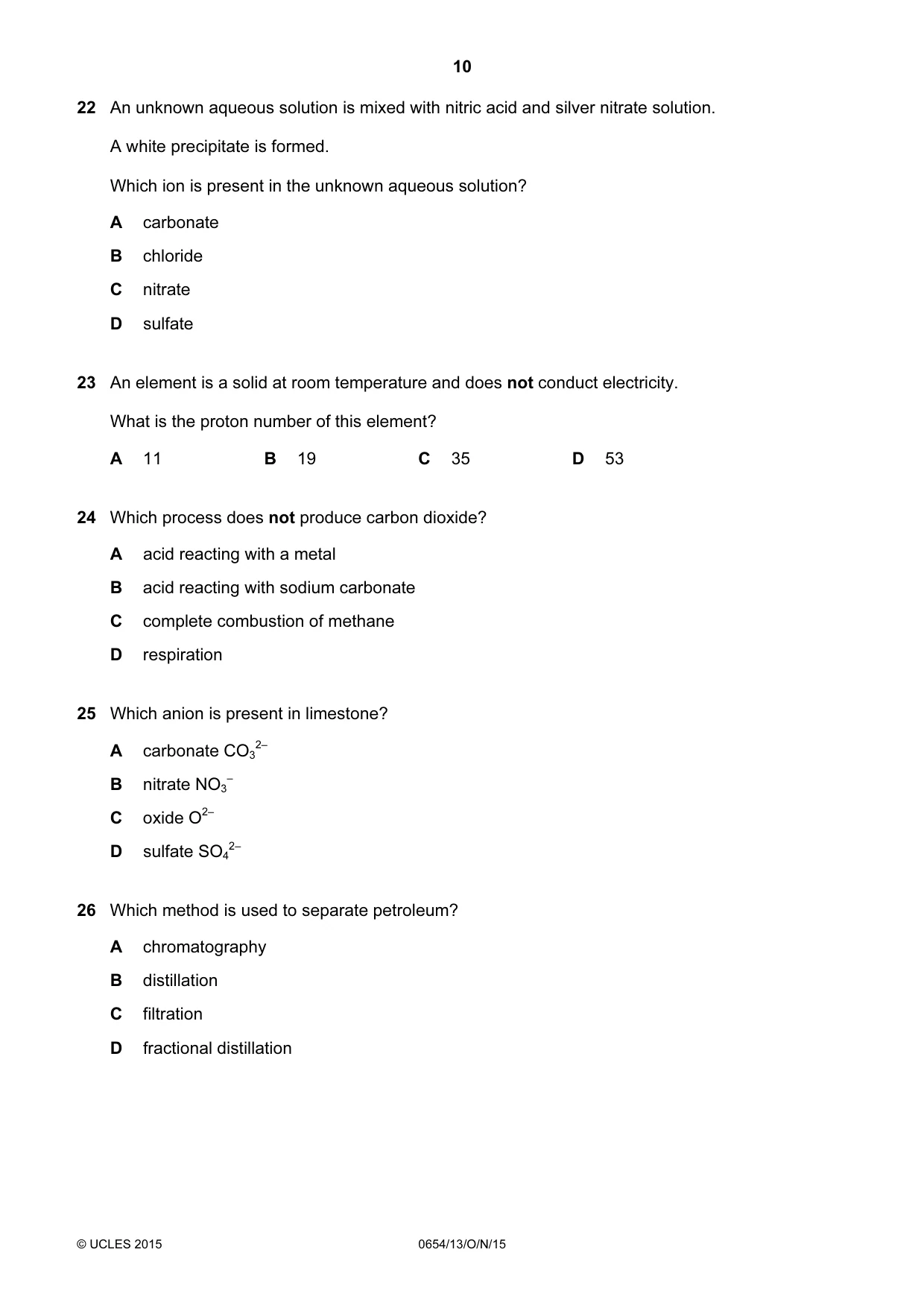
Q22 · An unknown aqueous solution is mixed with nitric acid and silver nitrate solution
22 An unknown aqueous solution is mixed with nitric acid and silver nitrate solution. A white precipitate is formed. Which ion is present in the unknown aqueous solution? A carbonate B chloride C nitrate D sulfate
Mark scheme: B
Q23 · An element is a solid at room temperature and does not conduct electricity
23 An element is a solid at room temperature and does not conduct electricity. What is the proton number of this element? A 11 B 19 C 35 D 53
Mark scheme: D
Q24 · Which process does not produce carbon dioxide?
24 Which process does not produce carbon dioxide? A acid reacting with a metal B acid reacting with sodium carbonate C complete combustion of methane D respiration
Mark scheme: A
Q25 · Which anion is present in limestone?
25 Which anion is present in limestone? A carbonate CO3 2– B nitrate NO3 – C oxide O2– D sulfate SO4 2–
Mark scheme: A
Q26 · Which method is used to separate petroleum?
26 Which method is used to separate petroleum? A chromatography B distillation C filtration D fractional distillation
Mark scheme: D
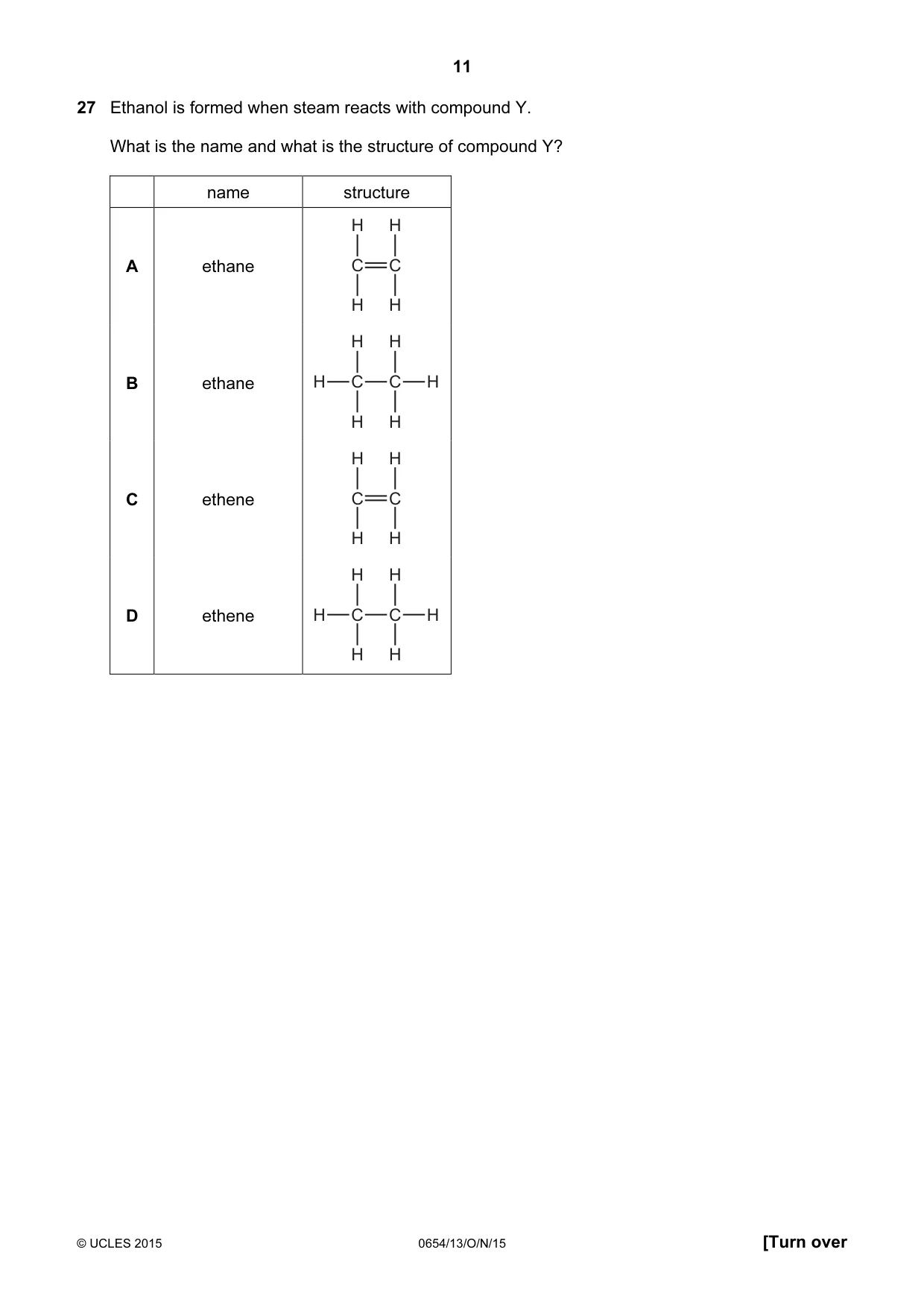
Q27 · Ethanol is formed when steam reacts with compound Y
27 Ethanol is formed when steam reacts with compound Y. What is the name and what is the structure of compound Y? name structure H H A ethane C C H H H H B ethane H C C H H H H H C ethene C C H H H H D ethene H C C H H H
Mark scheme: C
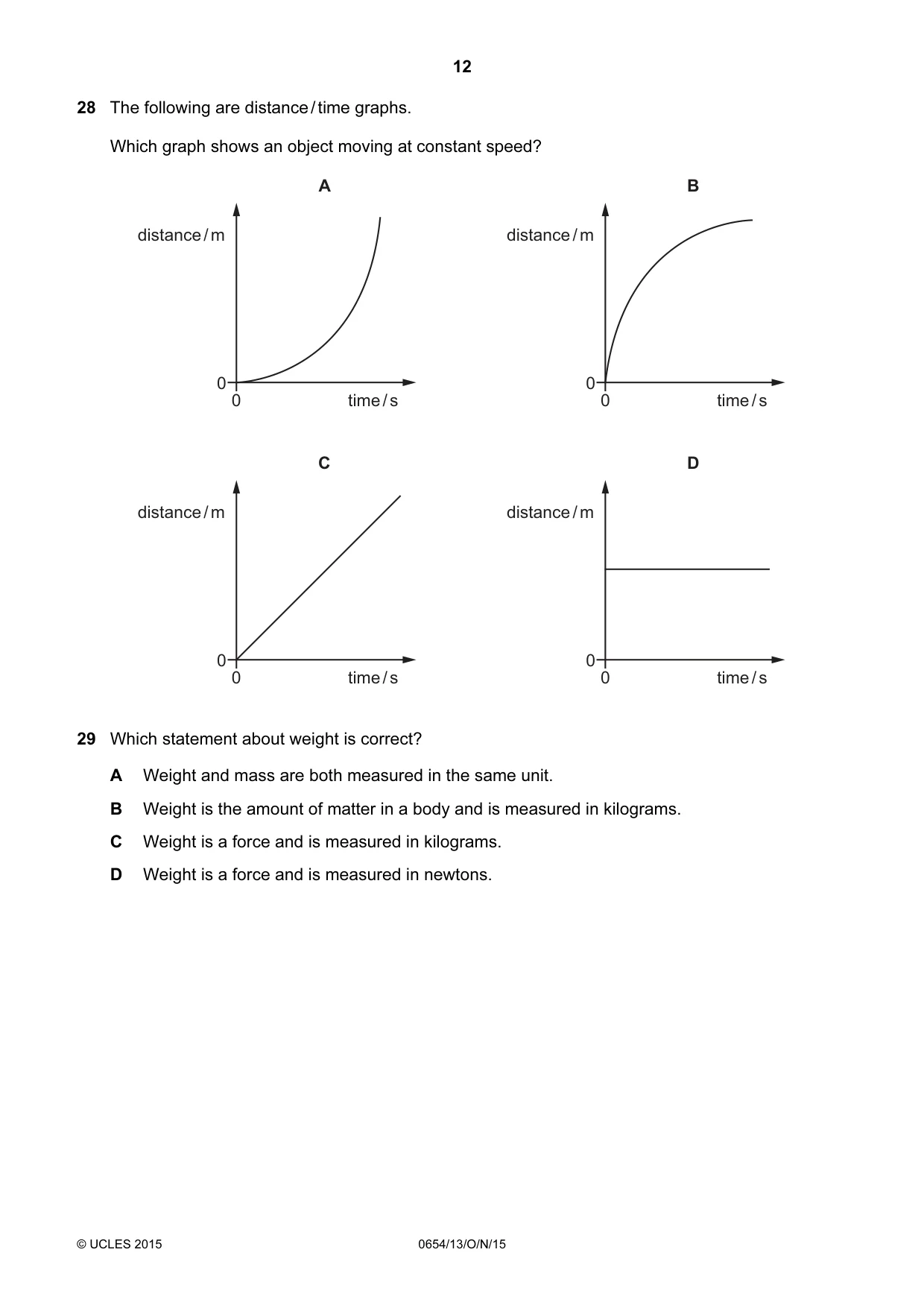
Q28 · The following are distance / time graphs
28 The following are distance / time graphs. Which graph shows an object moving at constant speed? A B distance / m distance / m 0 0 0 time / s 0 time / s C D distance / m distance / m 0 0 0 time / s 0 time / s
Mark scheme: C
Q29 · Which statement about weight is correct?
29 Which statement about weight is correct? A Weight and mass are both measured in the same unit. B Weight is the amount of matter in a body and is measured in kilograms. C Weight is a force and is measured in kilograms. D Weight is a force and is measured in newtons.
Mark scheme: D
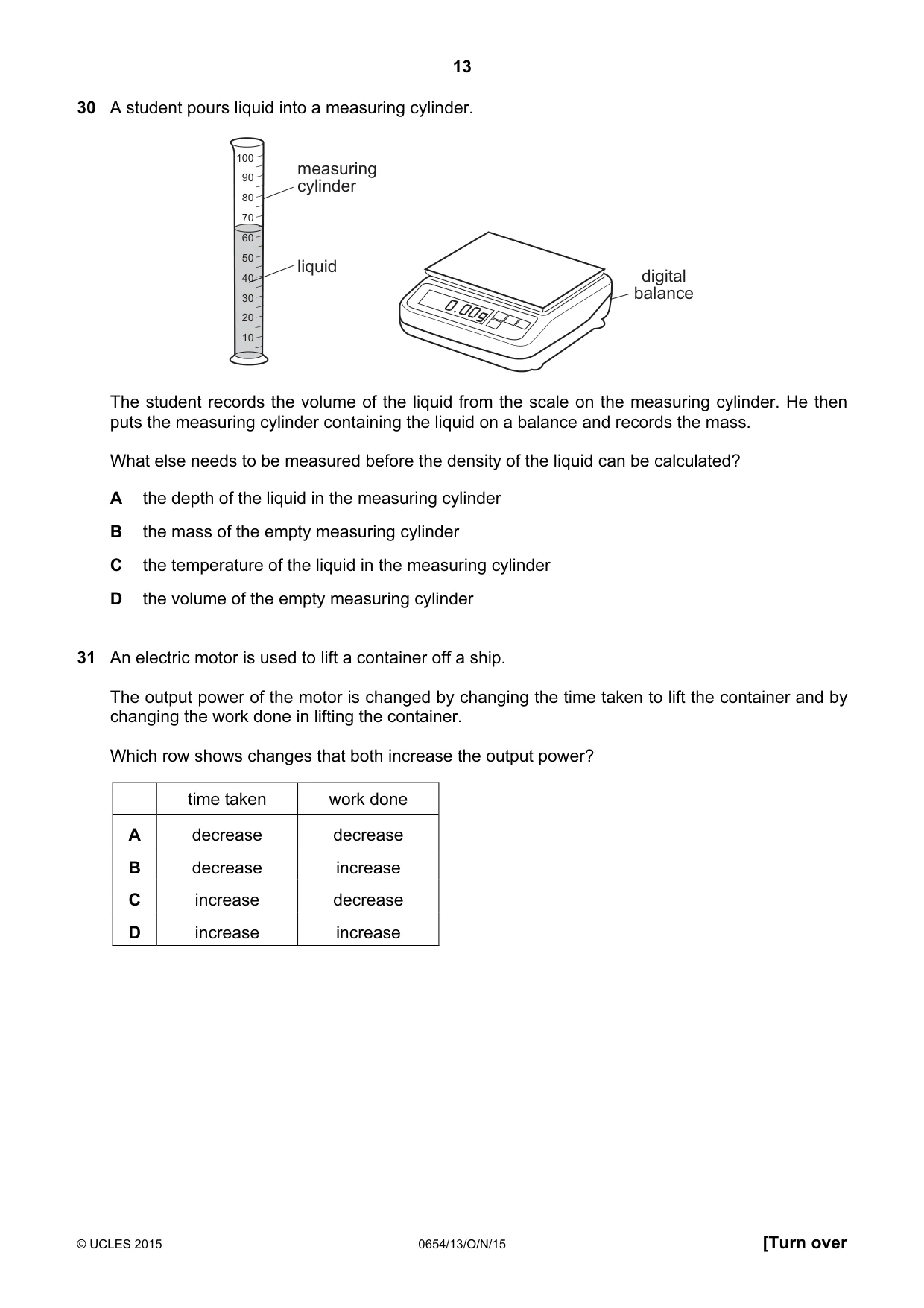
Q30 · A student pours liquid into a measuring cylinder
30 A student pours liquid into a measuring cylinder. 100 measuring 90 cylinder 80 70 60 50 liquid 40 digital balance 30 20 10 The student records the volume of the liquid from the scale on the measuring cylinder. He then puts the measuring cylinder containing the liquid on a balance and records the mass. What else needs to be measured before the density of the liquid can be calculated? A the depth of the liquid in the measuring cylinder B the mass of the empty measuring cylinder C the temperature of the liquid in the measuring cylinder D the volume of the empty measuring cylinder
Mark scheme: B
Q31 · An electric motor is used to lift a container off a ship
31 An electric motor is used to lift a container off a ship. The output power of the motor is changed by changing the time taken to lift the container and by changing the work done in lifting the container. Which row shows changes that both increase the output power? time taken work done A decrease decrease B decrease increase C increase decrease D increase increase
Mark scheme: B
Q32 · On a warm day, a swimmer climbs out of a swimming pool into the open air and water…
32 On a warm day, a swimmer climbs out of a swimming pool into the open air and water evaporates from his skin. As the water evaporates, which molecules escape into the air first and what happens to the average speed of the remaining water molecules? first molecules average speed of the to escape remaining molecules A least energetic decreases B least energetic increases C most energetic decreases D most energetic increases
Mark scheme: C
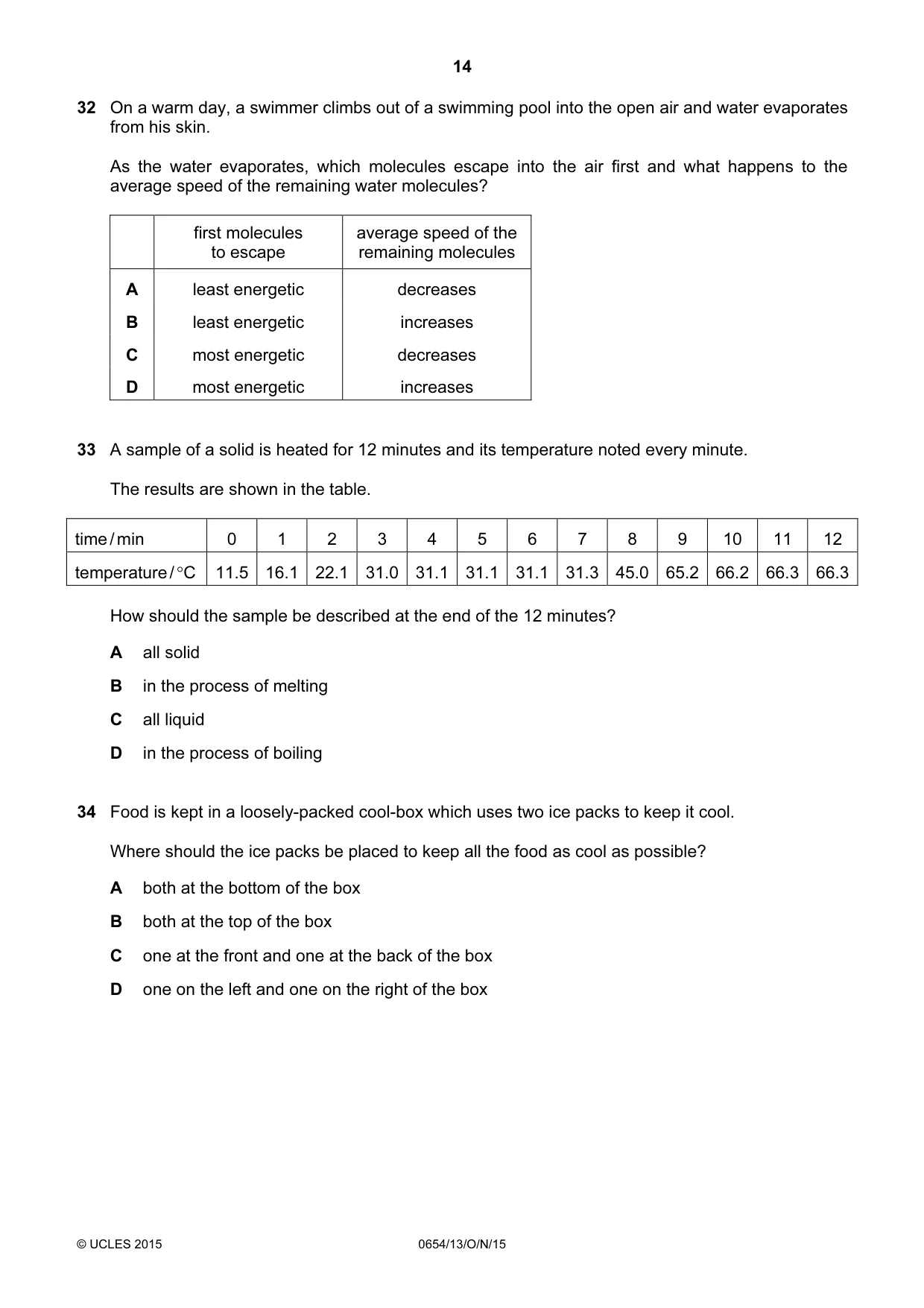
Q33 · A sample of a solid is heated for 12 minutes and its temperature noted every minute
33 A sample of a solid is heated for 12 minutes and its temperature noted every minute. The results are shown in the table. time / min 0 1 2 3 4 5 6 7 8 9 10 11 12 temperature / °C 11.5 16.1 22.1 31.0 31.1 31.1 31.1 31.3 45.0 65.2 66.2 66.3 66.3 How should the sample be described at the end of the 12 minutes? A all solid B in the process of melting C all liquid D in the process of boiling
Mark scheme: D
Q34 · Food is kept in a loosely-packed cool-box which uses two ice packs to keep it cool
34 Food is kept in a loosely-packed cool-box which uses two ice packs to keep it cool. Where should the ice packs be placed to keep all the food as cool as possible? A both at the bottom of the box B both at the top of the box C one at the front and one at the back of the box D one on the left and one on the right of the box
Mark scheme: B
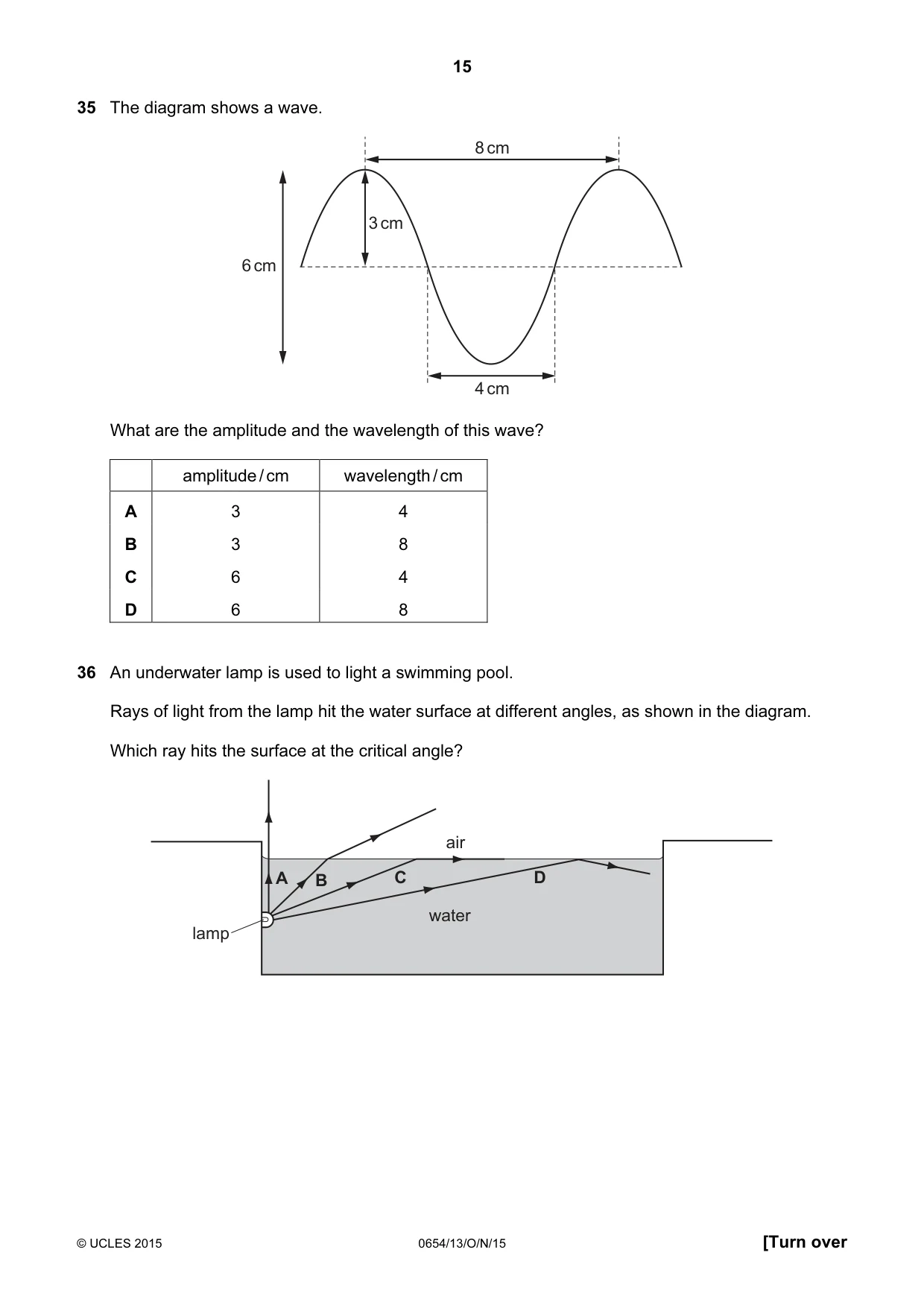
Q35 · The diagram shows a wave
35 The diagram shows a wave. 8 cm 3 cm 6 cm 4 cm What are the amplitude and the wavelength of this wave? amplitude / cm wavelength / cm A 3 4 B 3 8 C 6 4 D 6 8
Mark scheme: B
Q36 · An underwater lamp is used to light a swimming pool
36 An underwater lamp is used to light a swimming pool. Rays of light from the lamp hit the water surface at different angles, as shown in the diagram. Which ray hits the surface at the critical angle? air A B C D water lamp
Mark scheme: C
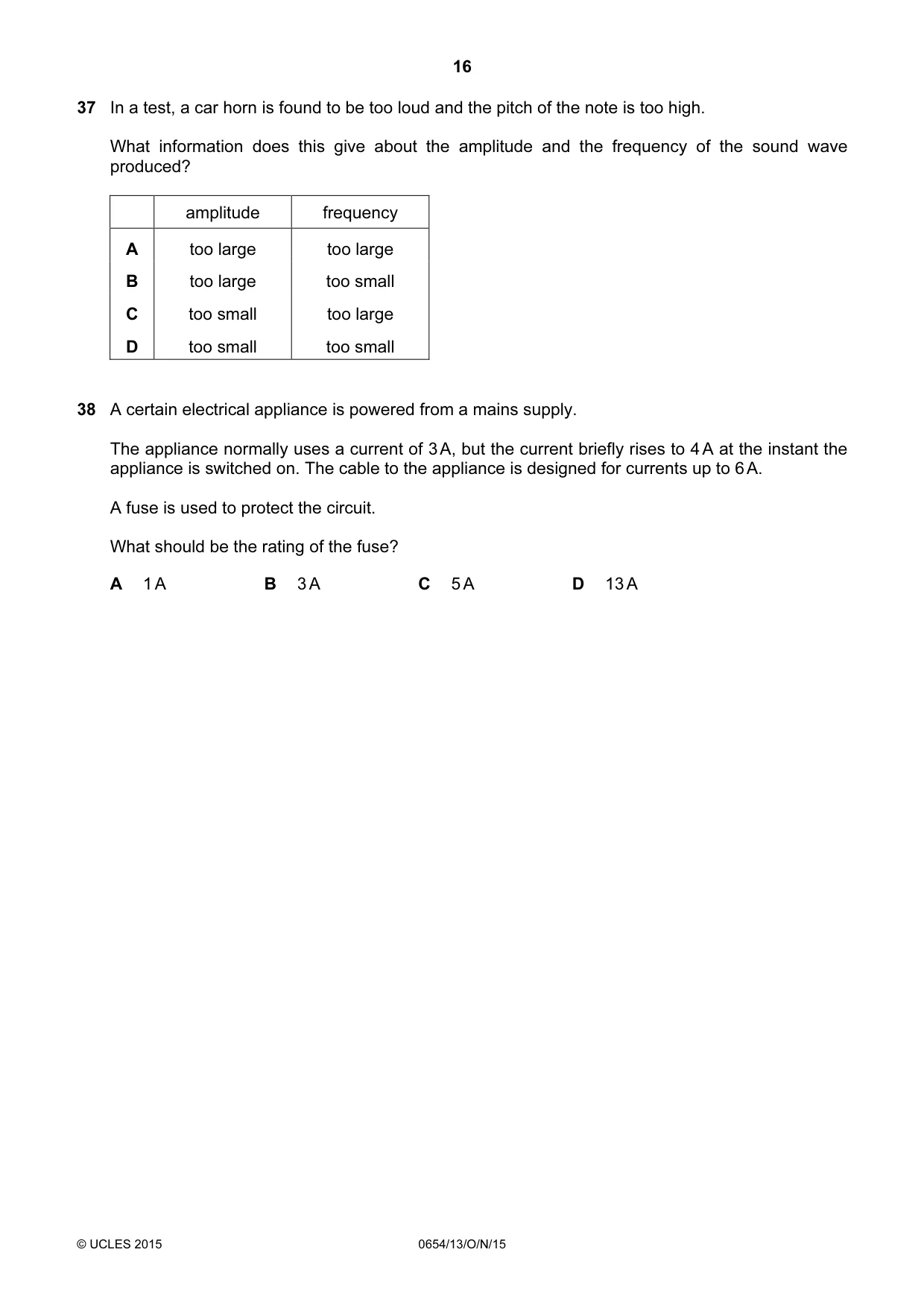
Q37 · In a test, a car horn is found to be too loud and the pitch of the note is too high
37 In a test, a car horn is found to be too loud and the pitch of the note is too high. What information does this give about the amplitude and the frequency of the sound wave produced? amplitude frequency A too large too large B too large too small C too small too large D too small too small
Mark scheme: A
Q38 · A certain electrical appliance is powered from a mains supply
38 A certain electrical appliance is powered from a mains supply. The appliance normally uses a current of 3 A, but the current briefly rises to 4 A at the instant the appliance is switched on. The cable to the appliance is designed for currents up to 6 A. A fuse is used to protect the circuit. What should be the rating of the fuse? A 1 A B 3 A C 5 A D 13 A
Mark scheme: C
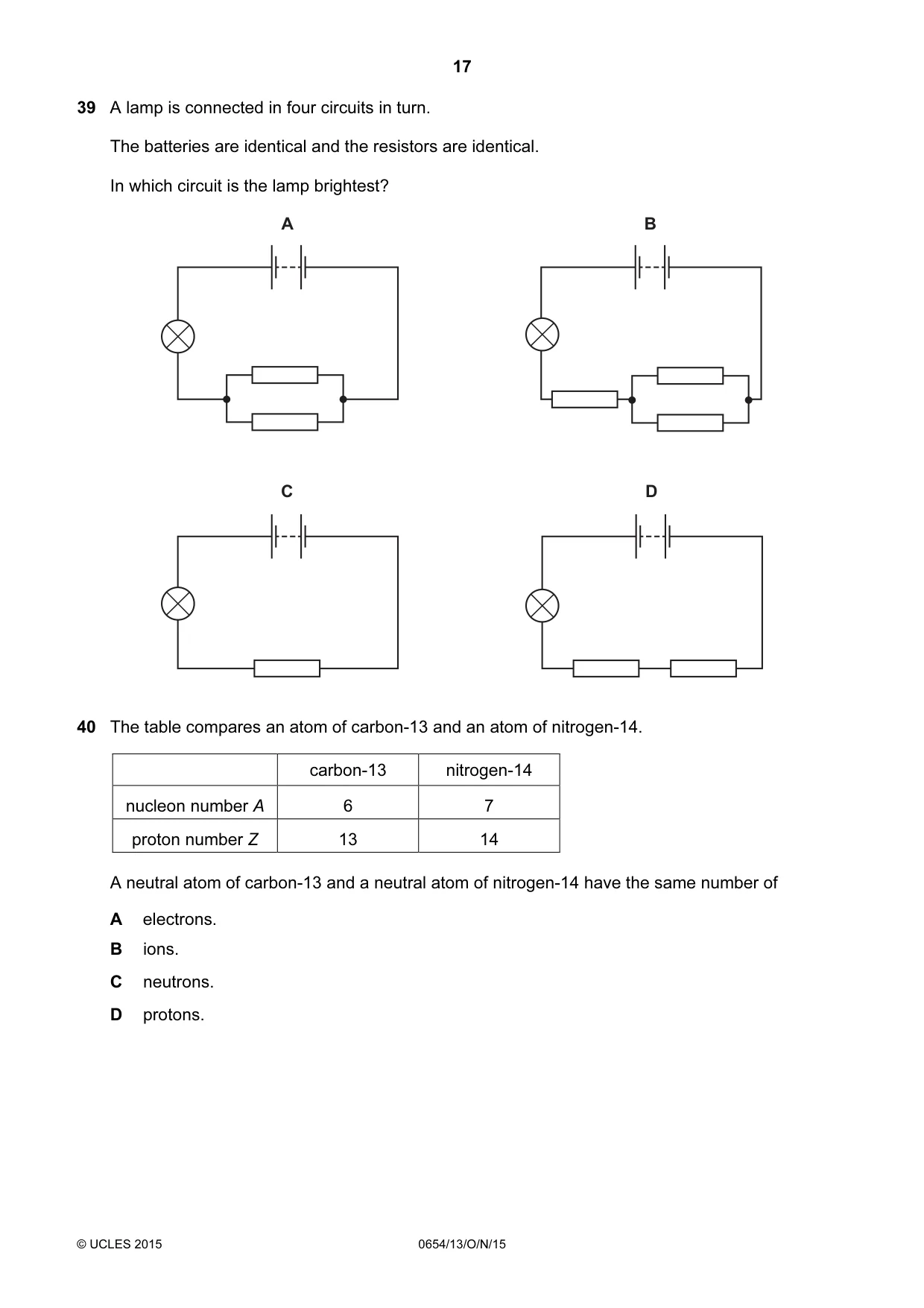
Q39 · A lamp is connected in four circuits in turn
39 A lamp is connected in four circuits in turn. The batteries are identical and the resistors are identical. In which circuit is the lamp brightest? A B C D
Mark scheme: A
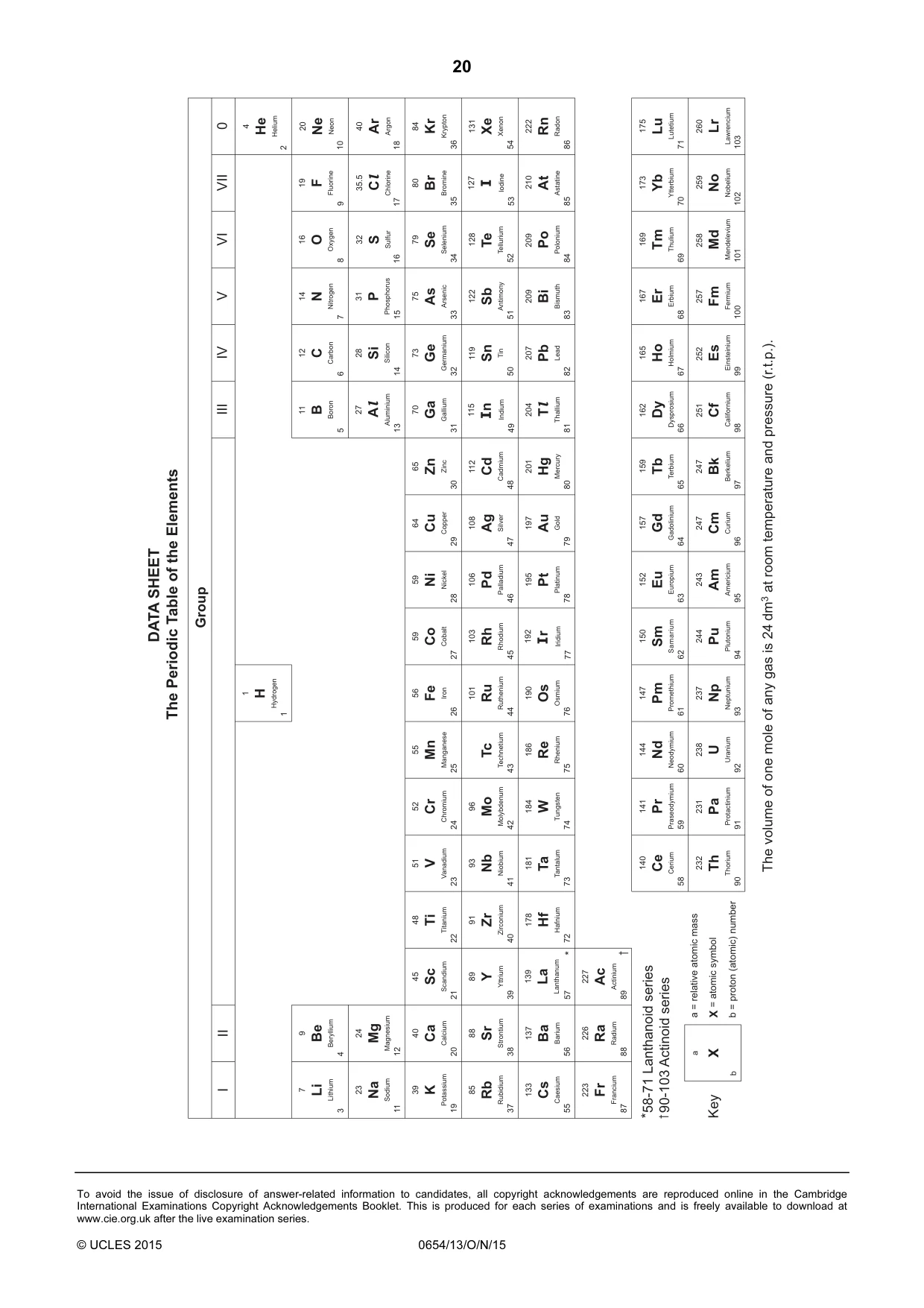
Q40 · The table compares an atom of carbon-13 and an atom of nitrogen-14
40 The table compares an atom of carbon-13 and an atom of nitrogen-14. carbon-13 nitrogen-14 nucleon number A 6 7 proton number Z 13 14 A neutral atom of carbon-13 and a neutral atom of nitrogen-14 have the same number of A electrons. B ions. C neutrons. D protons.
Mark scheme: C
What was in this paper
The subtopics covered by these 40 questions, and how many questions each got. Open one in a new tab to see every Cambridge question on it.
2Separation and purification2Air quality and climate1Alkenes1Arrangement of elements1Atomic structure and the Periodic Table1Carbon cycle1Cell structure1Circulatory systems1Density1Diffusion1Digestive system1Electrical circuits1Electrical safety1Electrolysis1Elements, compounds and mixtures1Energy, work and power1Enzymes1Exothermic and endothermic reactions1Food chains and food webs1Formulas and terminology1General properties of waves1Identification of ions and gases1Kinetic particle model of matter1Light1Mass and weight1Motion1Photosynthesis1Preparation of salts1Rate of reaction1Redox1Sexual reproduction in humans1Sexual reproduction in plants1Sound1The nucleus1Thermal properties and temperature1Transfer of thermal energy1Xylem and phloem1What you needed in this session
Cambridge’s own grade thresholds for 2015 Oct/Nov, Paper 1 · Variant 3. A higher threshold means an easier paper — the bar moves with how the cohort did.