Cambridge IGCSE Sciences - Co-ordinated (Double) 0654 — 2016 May/June Paper 1 · Variant 3
0654/13/M/J/16 · 40 questions · 40 marks · ≈45 min
The question paper and its mark scheme, free to read here and free to download. This is Cambridge’s own paper, exactly as it was sat.
Question paper20 pages


Mark scheme2 pages
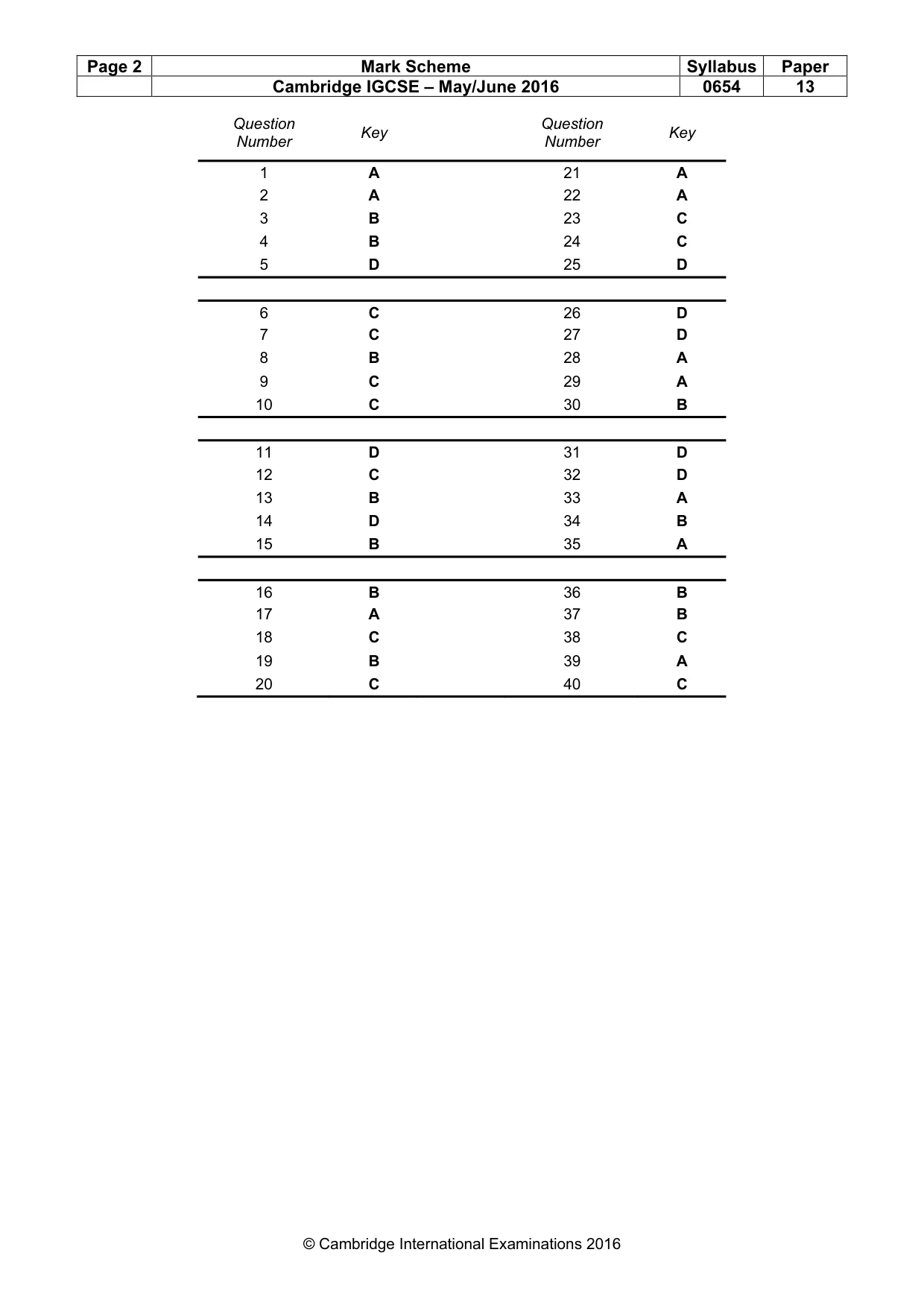
Answers below. Sit the paper first if you are practising.
Questions as text
Q1 · What is not a characteristic of all living organisms?
1 What is not a characteristic of all living organisms? A breathing B excretion C movement D reproduction
Mark scheme: A
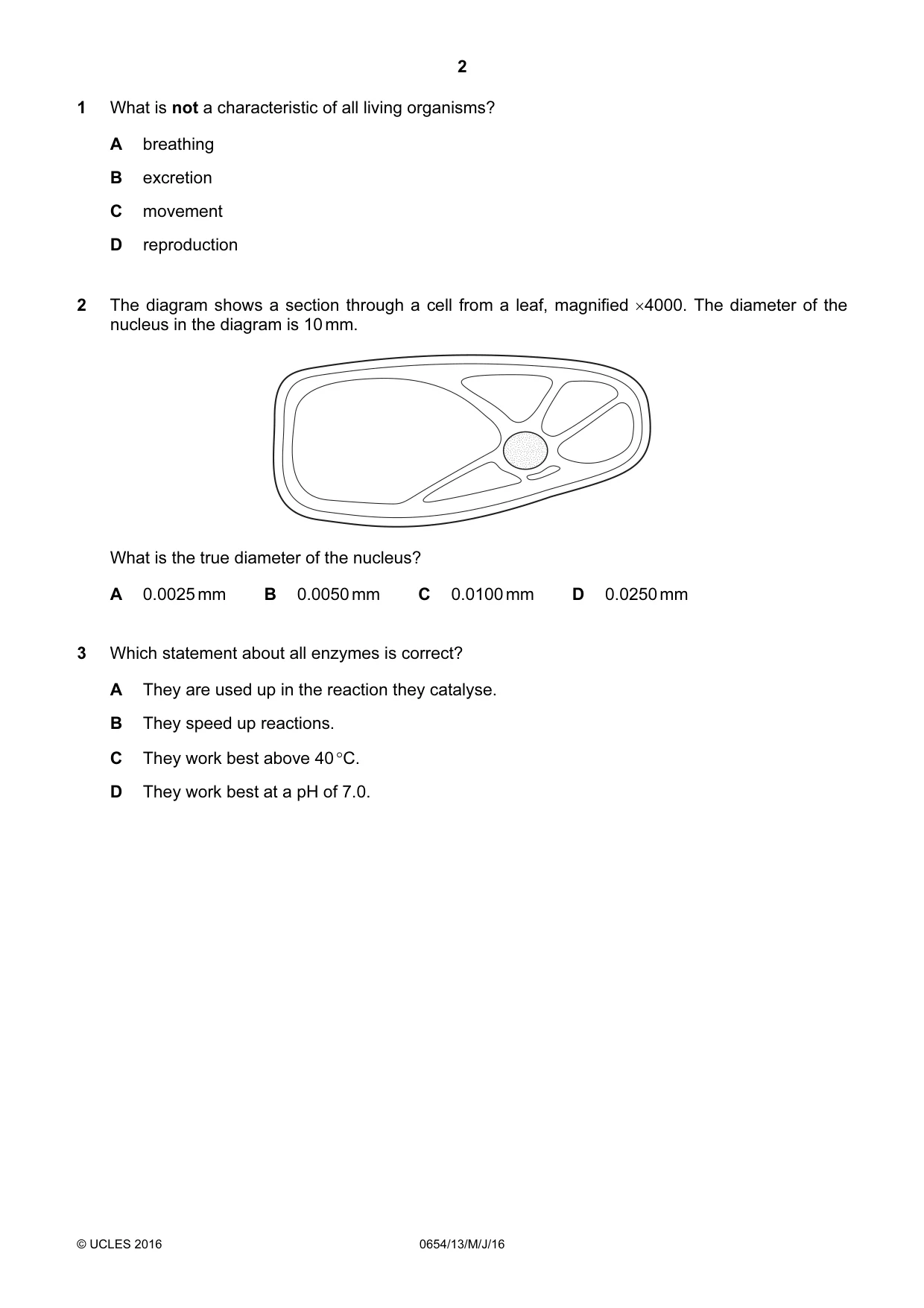
Q2 · The diagram shows a section through a cell from a leaf, magnified ×4000
2 The diagram shows a section through a cell from a leaf, magnified ×4000. The diameter of the nucleus in the diagram is 10 mm. What is the true diameter of the nucleus? A 0.0025 mm B 0.0050 mm C 0.0100 mm D 0.0250 mm
Mark scheme: A
Q3 · Which statement about all enzymes is correct?
3 Which statement about all enzymes is correct? A They are used up in the reaction they catalyse. B They speed up reactions. C They work best above 40 °C. D They work best at a pH of 7.0.
Mark scheme: B
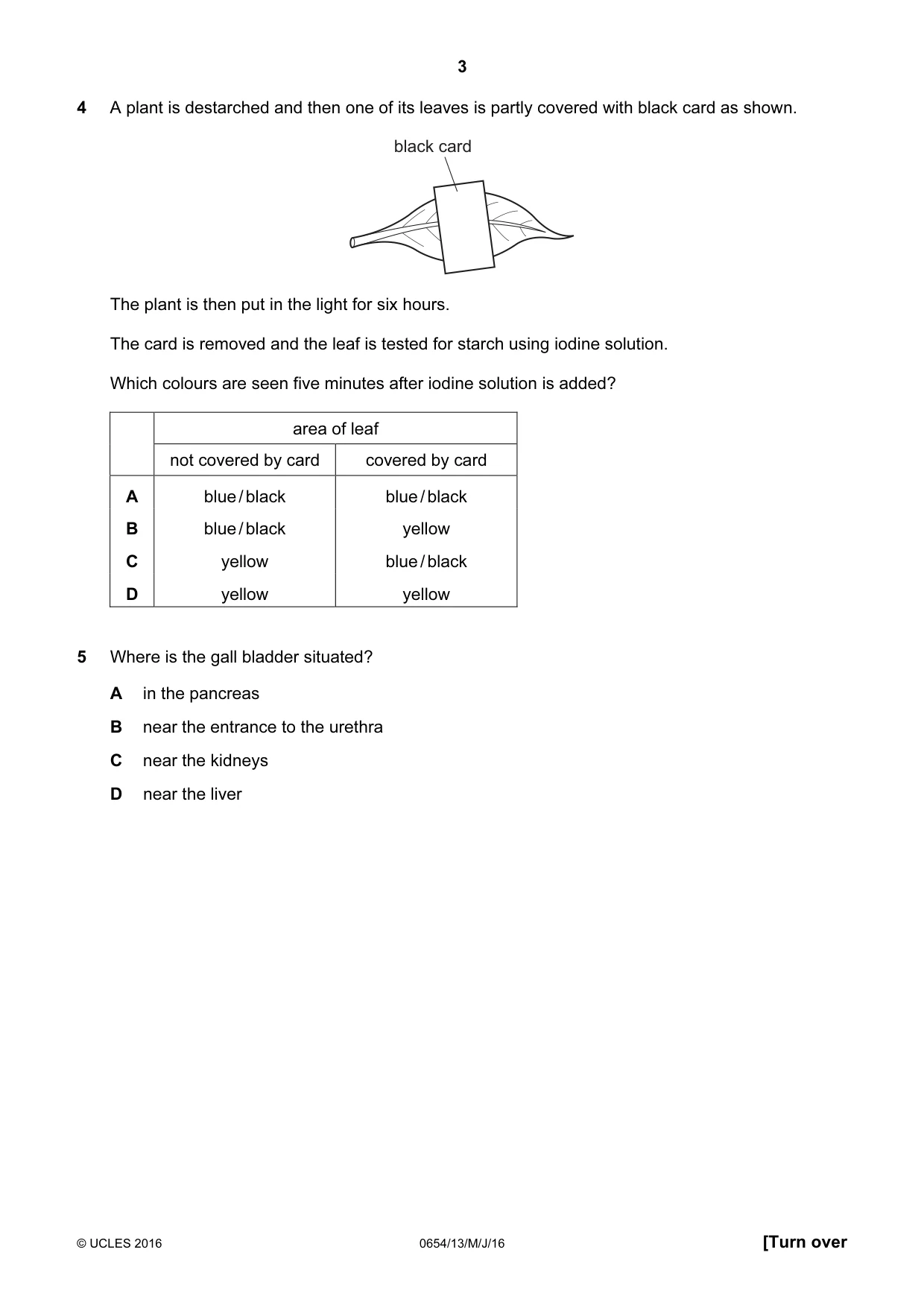
Q4 · A plant is destarched and then one of its leaves is partly covered with black card as…
4 A plant is destarched and then one of its leaves is partly covered with black card as shown. black card The plant is then put in the light for six hours. The card is removed and the leaf is tested for starch using iodine solution. Which colours are seen five minutes after iodine solution is added? area of leaf not covered by card covered by card A blue / black blue / black B blue / black yellow C yellow blue / black D yellow yellow
Mark scheme: B
Q5 · Where is the gall bladder situated?
5 Where is the gall bladder situated? A in the pancreas B near the entrance to the urethra C near the kidneys D near the liver
Mark scheme: D
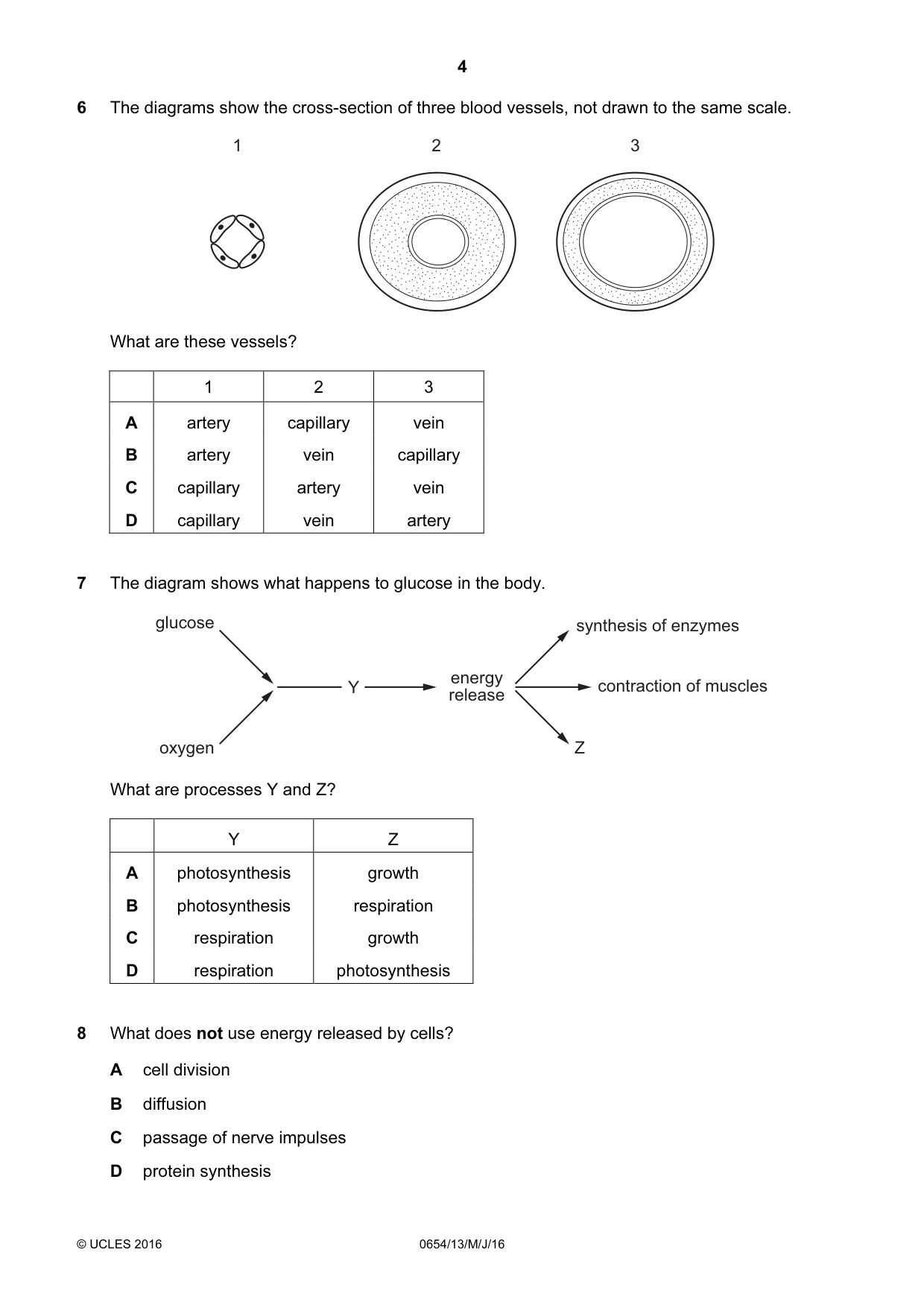
Q6 · The diagrams show the cross-section of three blood vessels, not drawn to the same scale
6 The diagrams show the cross-section of three blood vessels, not drawn to the same scale. 1 2 3 What are these vessels? 1 2 3 A artery capillary vein B artery vein capillary C capillary artery vein D capillary vein artery
Mark scheme: C
Q7 · The diagram shows what happens to glucose in the body
7 The diagram shows what happens to glucose in the body. glucose synthesis of enzymes energy Y contraction of muscles release oxygen Z What are processes Y and Z? Y Z A photosynthesis growth B photosynthesis respiration C respiration growth D respiration photosynthesis
Mark scheme: C
Q8 · What does not use energy released by cells?
8 What does not use energy released by cells? A cell division B diffusion C passage of nerve impulses D protein synthesis
Mark scheme: B
Q9 · What is an example of homeostasis?
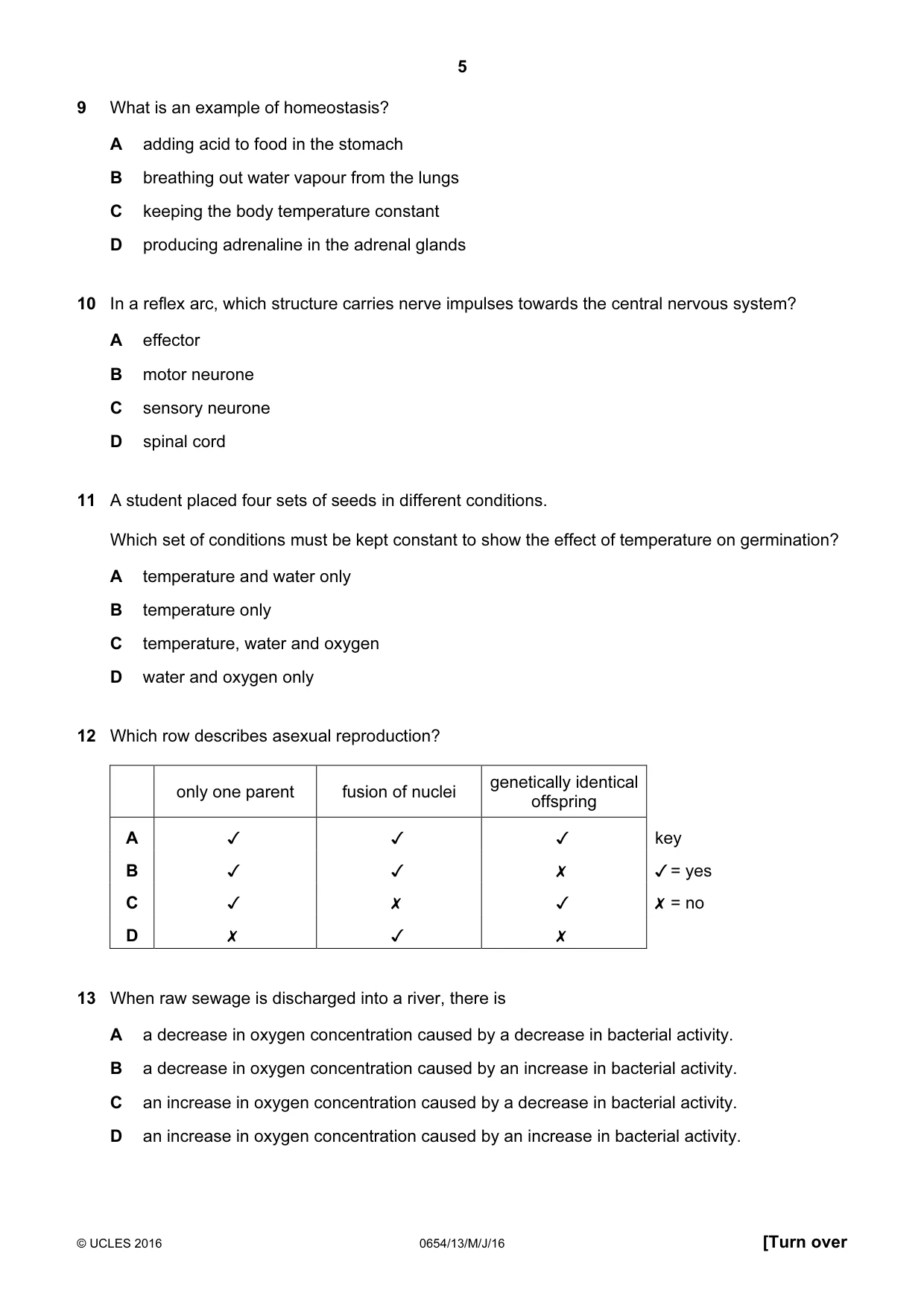
9 What is an example of homeostasis? A adding acid to food in the stomach B breathing out water vapour from the lungs C keeping the body temperature constant D producing adrenaline in the adrenal glands
Mark scheme: C
Q10 · In a reflex arc, which structure carries nerve impulses towards the central nervous…
10 In a reflex arc, which structure carries nerve impulses towards the central nervous system? A effector B motor neurone C sensory neurone D spinal cord
Mark scheme: C
Q11 · A student placed four sets of seeds in different conditions
11 A student placed four sets of seeds in different conditions. Which set of conditions must be kept constant to show the effect of temperature on germination? A temperature and water only B temperature only C temperature, water and oxygen D water and oxygen only
Mark scheme: D
Q12 · Which row describes asexual reproduction?
12 Which row describes asexual reproduction? only one parent fusion of nuclei ane teeing A Jv v v key B J v x Jv = yes Cc v x v X =no D x v x
Mark scheme: C
Q13 · When raw sewage is discharged into a river, there is A a decrease in oxygen concentration…
13 When raw sewage is discharged into a river, there is A a decrease in oxygen concentration caused by a decrease in bacterial activity. B a decrease in oxygen concentration caused by an increase in bacterial activity. C an increase in oxygen concentration caused by a decrease in bacterial activity. D an increase in oxygen concentration caused by an increase in bacterial activity.
Mark scheme: B
Q14 · A student adds excess copper oxide powder to warm dilute sulfuric acid
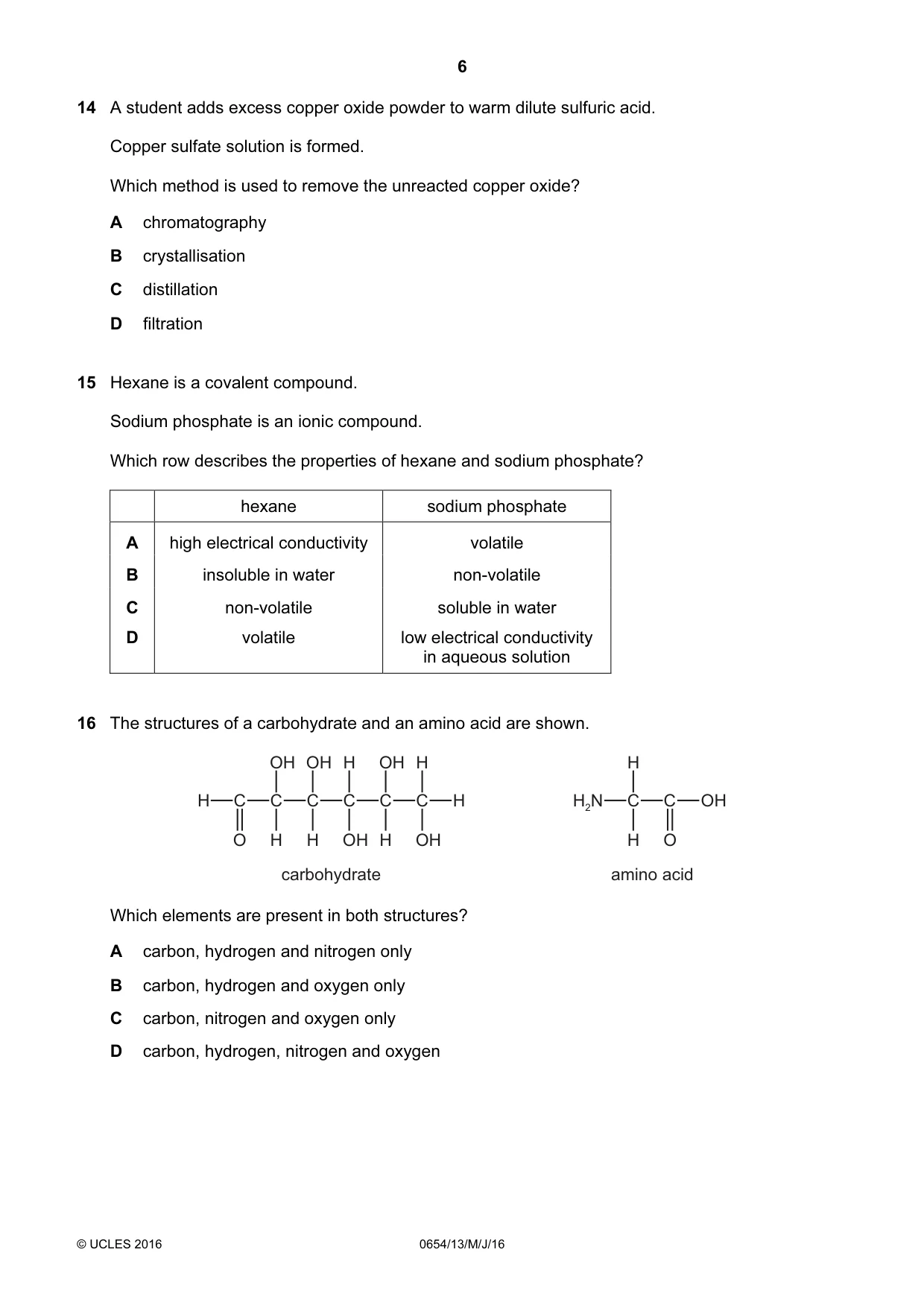
14 A student adds excess copper oxide powder to warm dilute sulfuric acid. Copper sulfate solution is formed. Which method is used to remove the unreacted copper oxide? A chromatography B crystallisation C distillation D filtration
Mark scheme: D
Q15 · Hexane is a covalent compound
15 Hexane is a covalent compound. Sodium phosphate is an ionic compound. Which row describes the properties of hexane and sodium phosphate? hexane sodium phosphate A high electrical conductivity volatile B insoluble in water non-volatile C non-volatile soluble in water D volatile low electrical conductivity in aqueous solution
Mark scheme: B
Q16 · The structures of a carbohydrate and an amino acid are shown
16 The structures of a carbohydrate and an amino acid are shown. OH OH H OH H H H C C C C C C H H2N C C OH O H H OH H OH H O carbohydrate amino acid Which elements are present in both structures? A carbon, hydrogen and nitrogen only B carbon, hydrogen and oxygen only C carbon, nitrogen and oxygen only D carbon, hydrogen, nitrogen and oxygen
Mark scheme: B
Q17 · The diagram shows the electrolysis of a compound
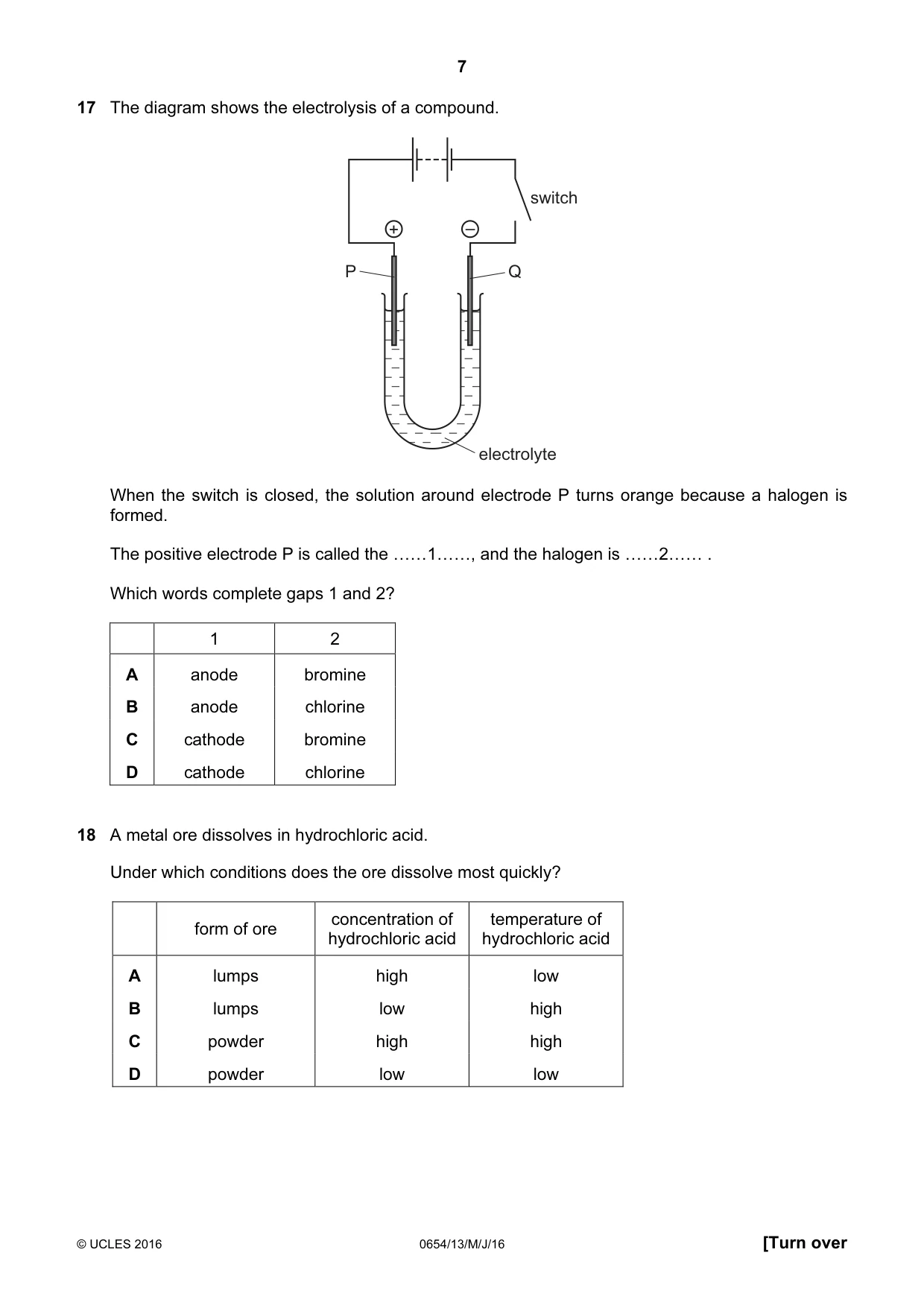
17 The diagram shows the electrolysis of a compound. switch + – P Q electrolyte When the switch is closed, the solution around electrode P turns orange because a halogen is formed. The positive electrode P is called the ……1……, and the halogen is ……2…… . Which words complete gaps 1 and 2? 1 2 A anode bromine B anode chlorine C cathode bromine D cathode chlorine
Mark scheme: A
Q18 · A metal ore dissolves in hydrochloric acid
18 A metal ore dissolves in hydrochloric acid. Under which conditions does the ore dissolve most quickly? concentration of temperature of form of ore hydrochloric acid hydrochloric acid A lumps high low B lumps low high C powder high high D powder low low
Mark scheme: C
Q19 · Hydrochloric acid and sodium hydroxide neutralise each other to form water and sodium…
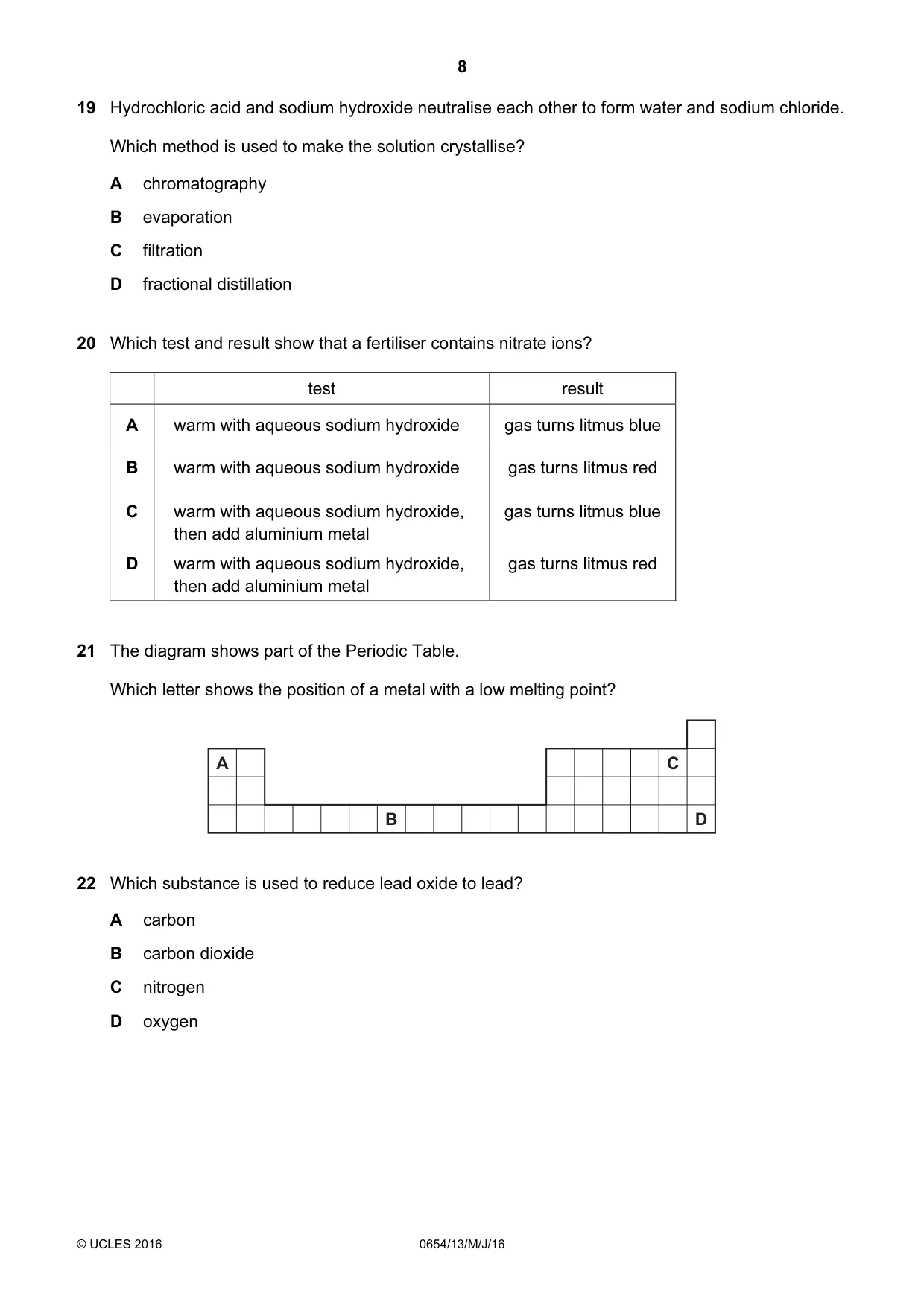
19 Hydrochloric acid and sodium hydroxide neutralise each other to form water and sodium chloride. Which method is used to make the solution crystallise? A chromatography B evaporation C filtration D fractional distillation
Mark scheme: B
Q20 · Which test and result show that a fertiliser contains nitrate ions?
20 Which test and result show that a fertiliser contains nitrate ions? test result A warm with aqueous sodium hydroxide gas turns litmus blue B warm with aqueous sodium hydroxide gas turns litmus red C warm with aqueous sodium hydroxide, gas turns litmus blue then add aluminium metal D warm with aqueous sodium hydroxide, gas turns litmus red then add aluminium metal
Mark scheme: C
Q21 · The diagram shows part of the Periodic Table
21 The diagram shows part of the Periodic Table. Which letter shows the position of a metal with a low melting point? A C B D
Mark scheme: A
Q22 · Which substance is used to reduce lead oxide to lead?
22 Which substance is used to reduce lead oxide to lead? A carbon B carbon dioxide C nitrogen D oxygen
Mark scheme: A
Q23 · Which statement is not a reason why aluminium is used in aircraft manufacture?
23 Which statement is not a reason why aluminium is used in aircraft manufacture? A It forms low density alloys. B It is malleable. C It is more reactive than iron. D It is resistant to corrosion.
Mark scheme: C
Q24 · Which gas emitted from a car exhaust contributes to acid rain?
24 Which gas emitted from a car exhaust contributes to acid rain? A carbon monoxide, CO B nitrogen, N2 C nitrogen monoxide, NO D water vapour, H2O
Mark scheme: C
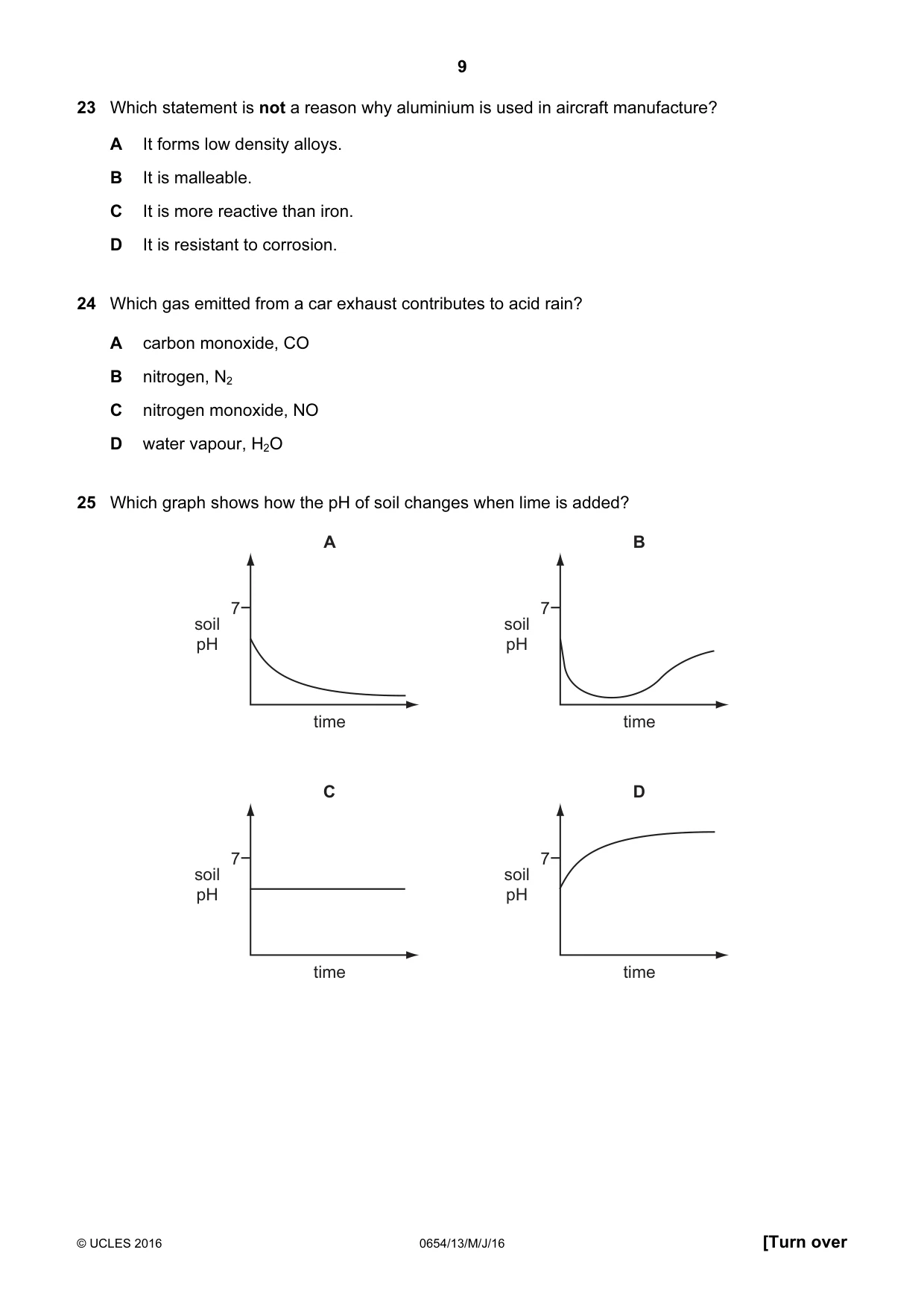
Q25 · Which graph shows how the pH of soil changes when lime is added?
25 Which graph shows how the pH of soil changes when lime is added? A B 7 7 soil soil pH pH time time C D 7 7 soil soil pH pH time time
Mark scheme: D
More questions on The characteristic properties of acids and bases
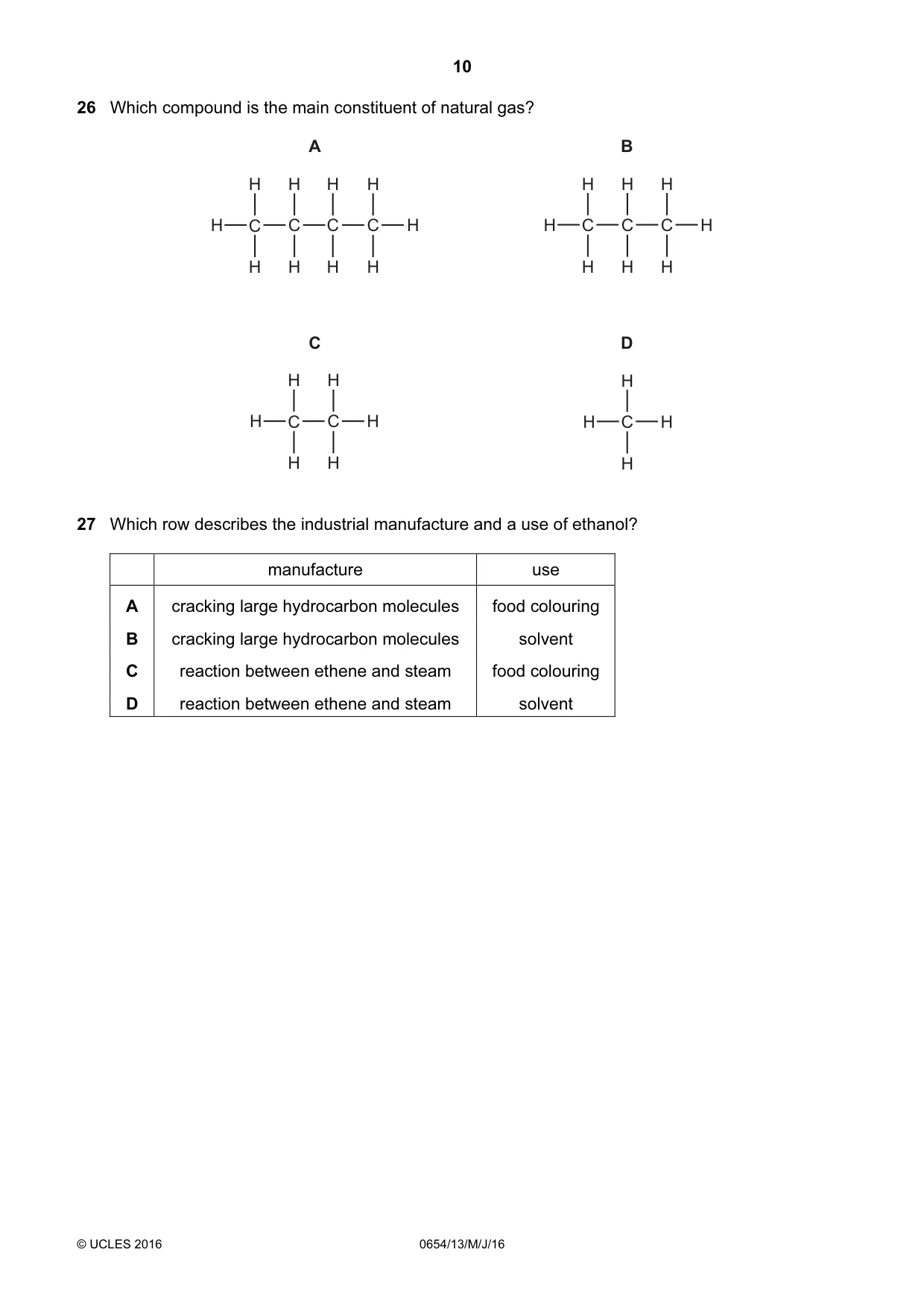
Q26 · Which compound is the main constituent of natural gas?
26 Which compound is the main constituent of natural gas? A B H H H H H H H H C C C C H H C C C H H H H H H H H C D H H H H C C H H C H H H H
Mark scheme: D
Q27 · Which row describes the industrial manufacture and a use of ethanol?
27 Which row describes the industrial manufacture and a use of ethanol? manufacture use A cracking large hydrocarbon molecules food colouring B cracking large hydrocarbon molecules solvent C reaction between ethene and steam food colouring D reaction between ethene and steam solvent
Mark scheme: D
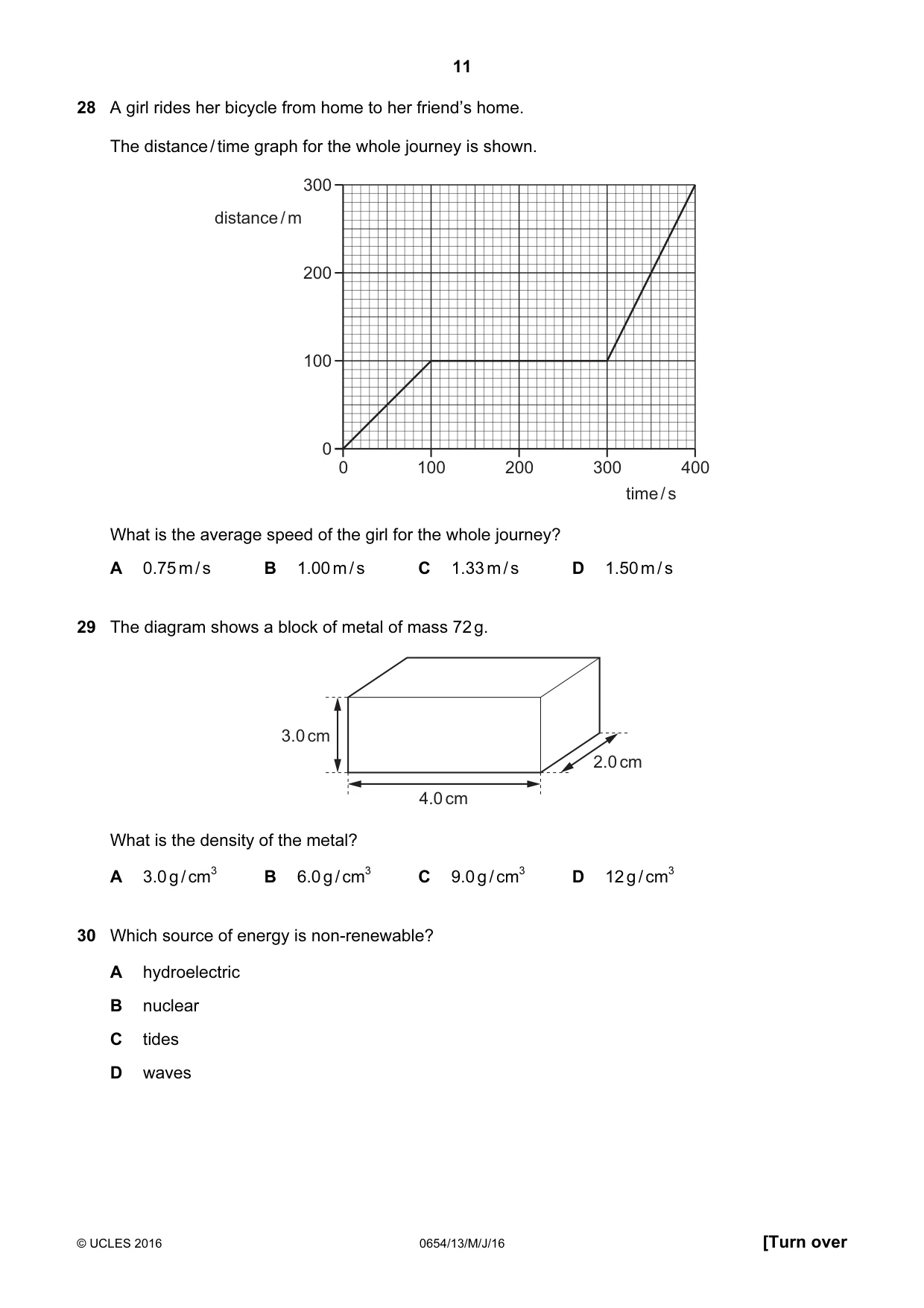
Q28 · A girl rides her bicycle from home to her friend’s home
28 A girl rides her bicycle from home to her friend’s home. The distance / time graph for the whole journey is shown. 300 distance / m 200 100 0 0 100 200 300 400 time / s What is the average speed of the girl for the whole journey? A 0.75 m / s B 1.00 m / s C 1.33 m / s D 1.50 m / s
Mark scheme: A
Q29 · The diagram shows a block of metal of mass 72 g
29 The diagram shows a block of metal of mass 72 g. 3.0 cm 2.0 cm 4.0 cm What is the density of the metal? A 3.0 g / cm3 B 6.0 g / cm3 C 9.0 g / cm3 D 12 g / cm3
Mark scheme: A
Q30 · Which source of energy is non-renewable?
30 Which source of energy is non-renewable? A hydroelectric B nuclear C tides D waves
Mark scheme: B
Q31 · A gas is trapped in a metal cylinder of constant volume
31 A gas is trapped in a metal cylinder of constant volume. The gas is heated. Which row describes the changes produced? average pressure speed of gas of gas molecules A decreases decreases B decreases increases C increases decreases D increases increases
Mark scheme: D
Q32 · A substance is a gas when its temperature is 65 °C
32 A substance is a gas when its temperature is 65 °C. How do the boiling point and the melting point of this substance compare with 65 °C? boiling point melting point A above 65 °C above 65 °C B above 65 °C below 65 °C C below 65 °C above 65 °C D below 65 °C below 65 °C
Mark scheme: D
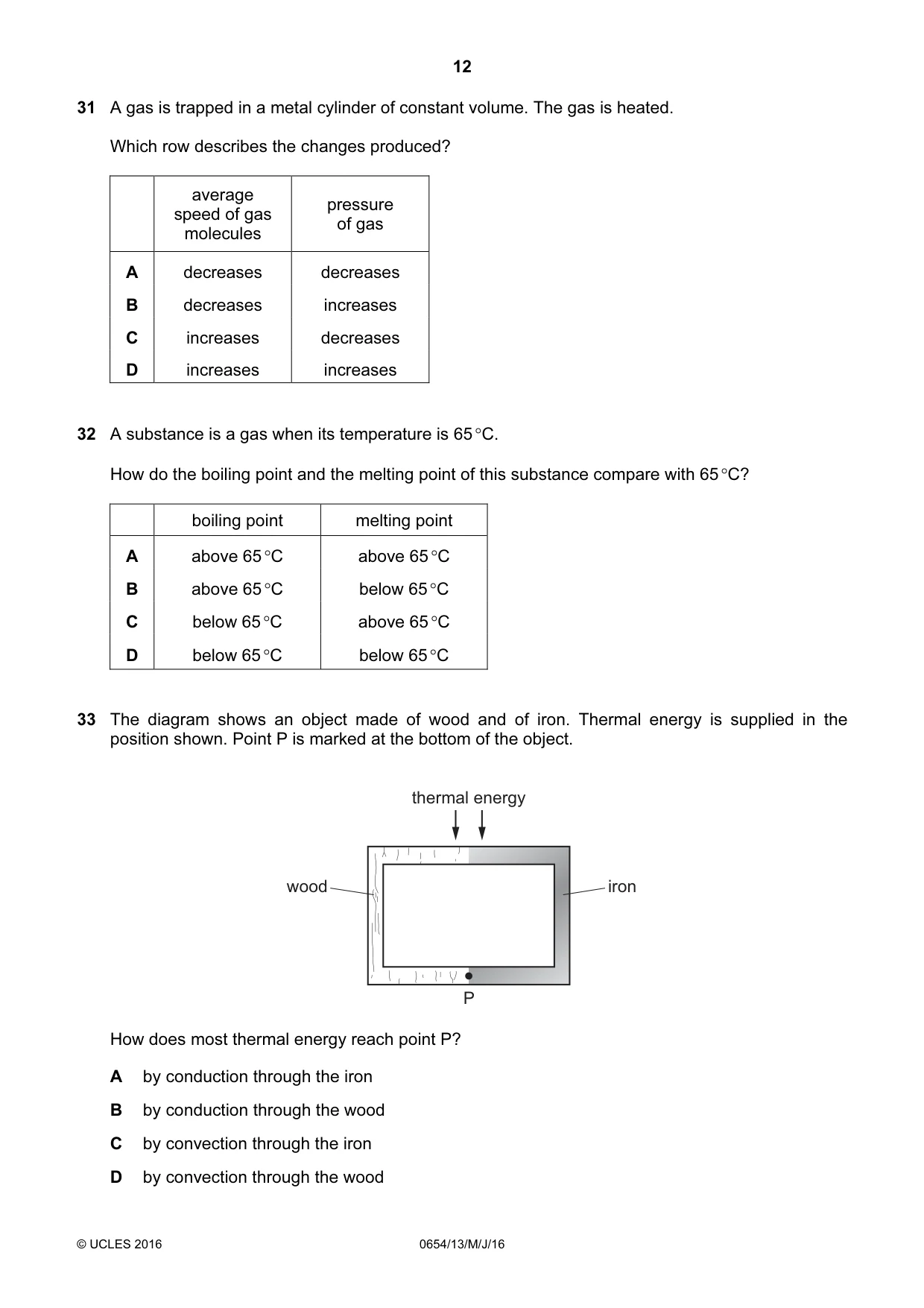
Q33 · The diagram shows an object made of wood and of iron
33 The diagram shows an object made of wood and of iron. Thermal energy is supplied in the position shown. Point P is marked at the bottom of the object. thermal energy wood iron P How does most thermal energy reach point P? A by conduction through the iron B by conduction through the wood C by convection through the iron D by convection through the wood
Mark scheme: A
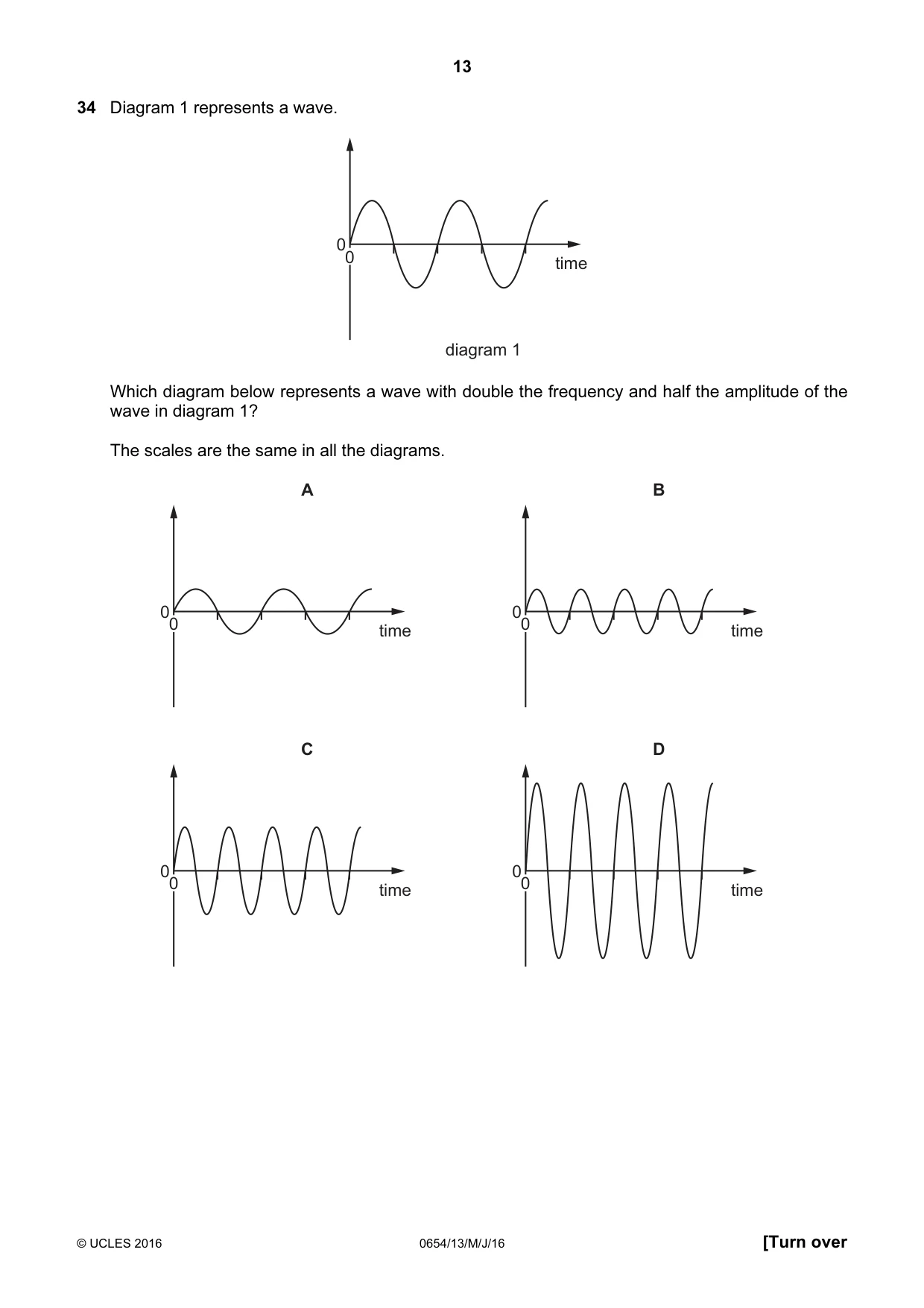
Question 34
34 Diagram 1 represents a wave. 00 time diagram 1 Which diagram below represents a wave with double the frequency and half the amplitude of the wave in diagram 1? The scales are the same in all the diagrams. A B 00 00 time time C D 00 00 time time
Mark scheme: B
Q35 · A boy stands at point P in front of a plane mirror
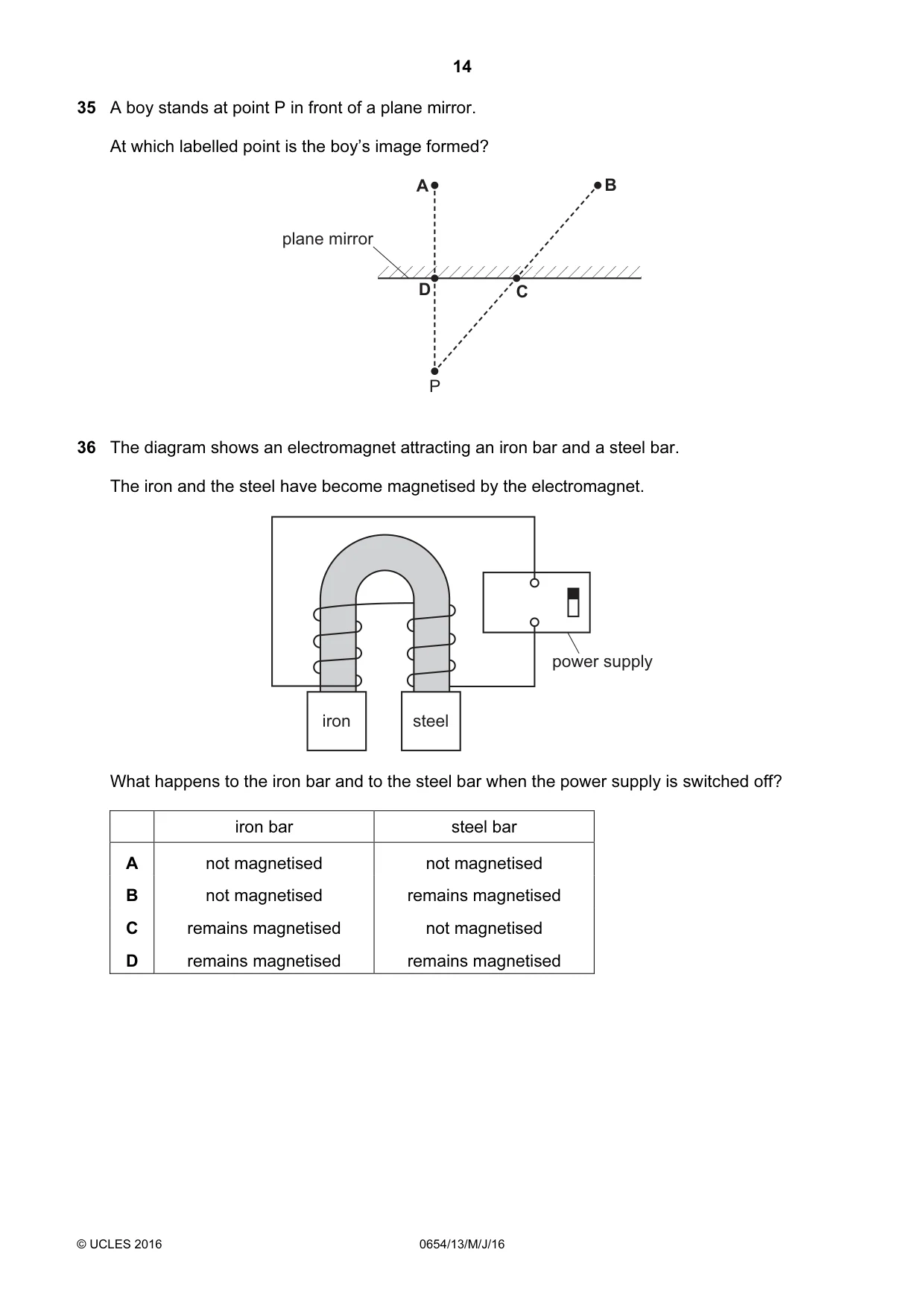
35 A boy stands at point P in front of a plane mirror. At which labelled point is the boy’s image formed? A B plane mirror D C P
Mark scheme: A
Q36 · The diagram shows an electromagnet attracting an iron bar and a steel bar
36 The diagram shows an electromagnet attracting an iron bar and a steel bar. The iron and the steel have become magnetised by the electromagnet. power supply iron steel What happens to the iron bar and to the steel bar when the power supply is switched off? iron bar steel bar A not magnetised not magnetised B not magnetised remains magnetised C remains magnetised not magnetised D remains magnetised remains magnetised
Mark scheme: B
Q37 · The diagram shows a 12 V battery connected to a resistor and an ammeter
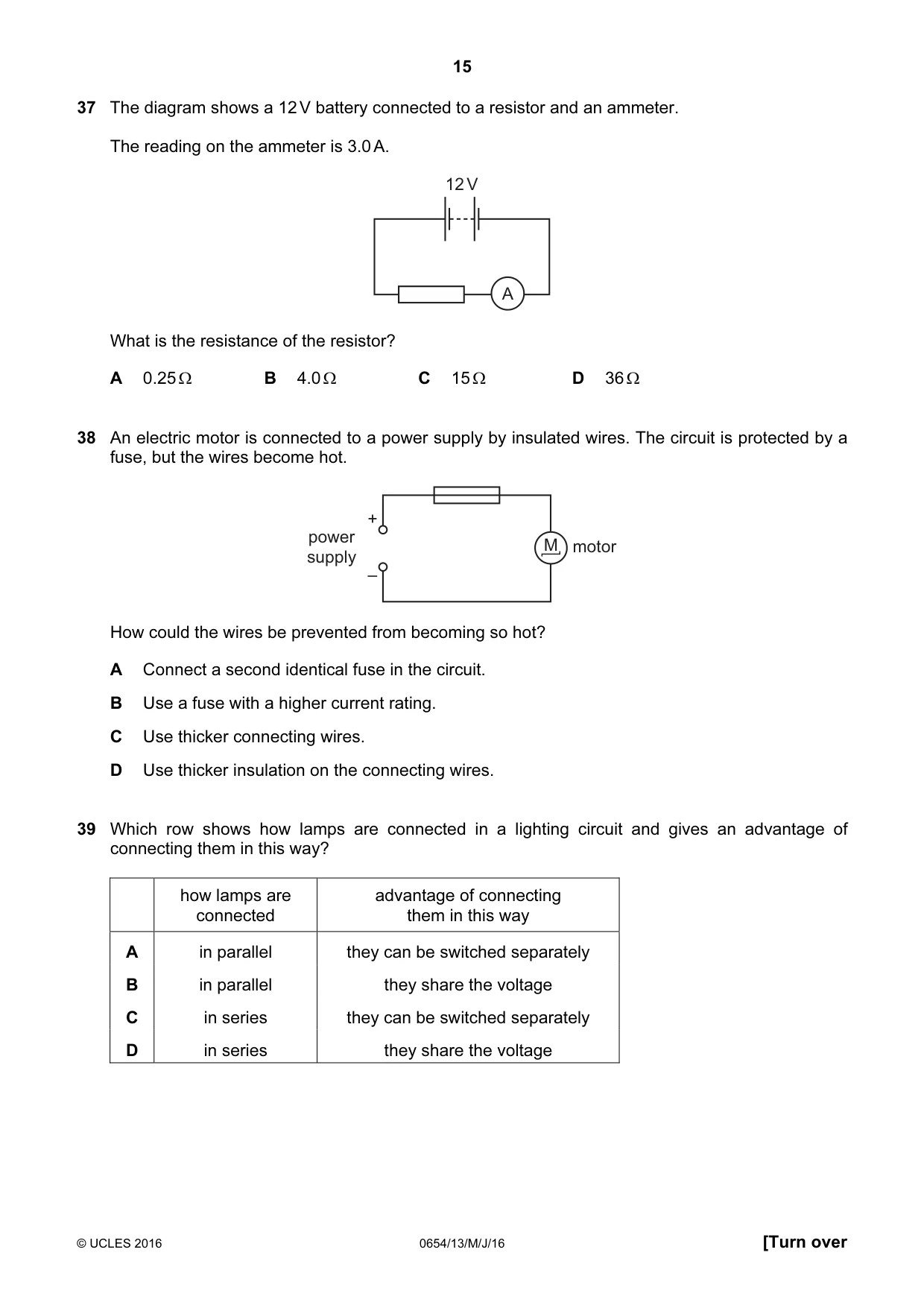
37 The diagram shows a 12 V battery connected to a resistor and an ammeter. The reading on the ammeter is 3.0 A. 12 V A What is the resistance of the resistor? A 0.25 Ω B 4.0 Ω C 15 Ω D 36 Ω
Mark scheme: B
Q38 · An electric motor is connected to a power supply by insulated wires
38 An electric motor is connected to a power supply by insulated wires. The circuit is protected by a fuse, but the wires become hot. + power M motor supply – How could the wires be prevented from becoming so hot? A Connect a second identical fuse in the circuit. B Use a fuse with a higher current rating. C Use thicker connecting wires. D Use thicker insulation on the connecting wires.
Mark scheme: C
Q39 · Which row shows how lamps are connected in a lighting circuit and gives an advantage of…
39 Which row shows how lamps are connected in a lighting circuit and gives an advantage of connecting them in this way? how lamps are advantage of connecting connected them in this way A in parallel they can be switched separately B in parallel they share the voltage C in series they can be switched separately D in series they share the voltage
Mark scheme: A
Q40 · Which row describes the properties of B-particles (beta-particles)?
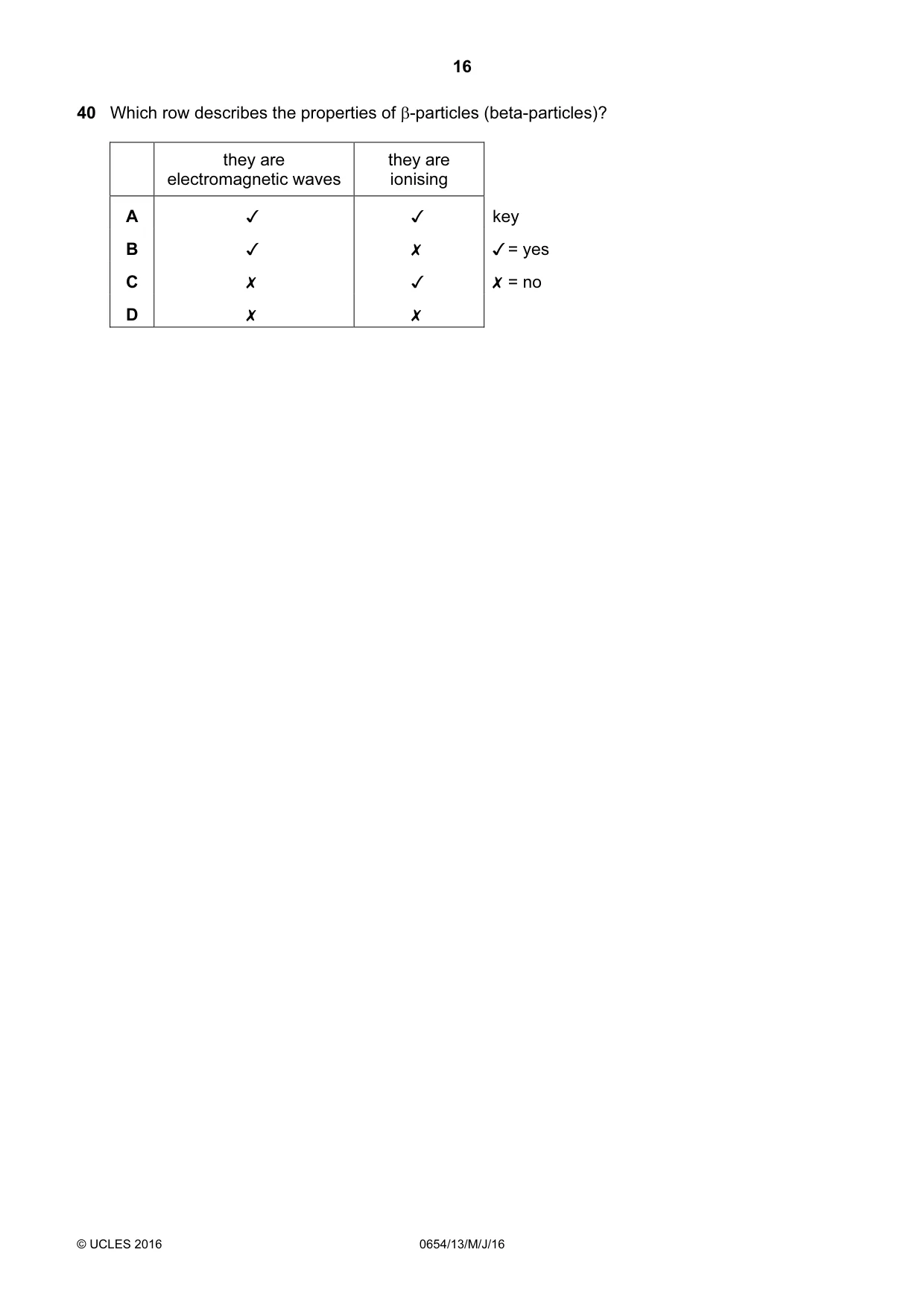
40 Which row describes the properties of B-particles (beta-particles)? they are they are electromagnetic waves ionising A v v key B v x v/=yes Cc x v X =no D x x
Mark scheme: C
What was in this paper
The subtopics covered by these 40 questions, and how many questions each got. Open one in a new tab to see every Cambridge question on it.
2Respiration2Separation and purification2Air quality and climate1Alcohols1Alkanes1Arrangement of elements1Asexual reproduction1Biological molecules1Blood vessels1Characteristics of living organisms1Coordination and response1Density1Digestive system1Electrical safety1Electrolysis1Energy, work and power1Enzymes1Experimental design1Extraction of metals1General properties of waves1Habitat destruction1Homeostasis1Identification of ions and gases1Ions and ionic bonds1Kinetic particle model of matter1Light1Motion1Photosynthesis1Radioactivity1Rate of reaction1Simple phenomena of magnetism1Size of specimens1The characteristic properties of acids and bases1Thermal properties and temperature1Transfer of thermal energy1Uses of metals1What you needed in this session
Cambridge’s own grade thresholds for 2016 May/June, Paper 1 · Variant 3. A higher threshold means an easier paper — the bar moves with how the cohort did.