Cambridge IGCSE Sciences - Co-ordinated (Double) 0654 — 2013 Oct/Nov Paper 1 · Variant 2
0654/12/O/N/13 · 40 questions · 40 marks · ≈45 min
The question paper and its mark scheme, free to read here and free to download. This is Cambridge’s own paper, exactly as it was sat.
Question paper20 pages


Mark scheme2 pages
Answers below. Sit the paper first if you are practising.
Questions as text
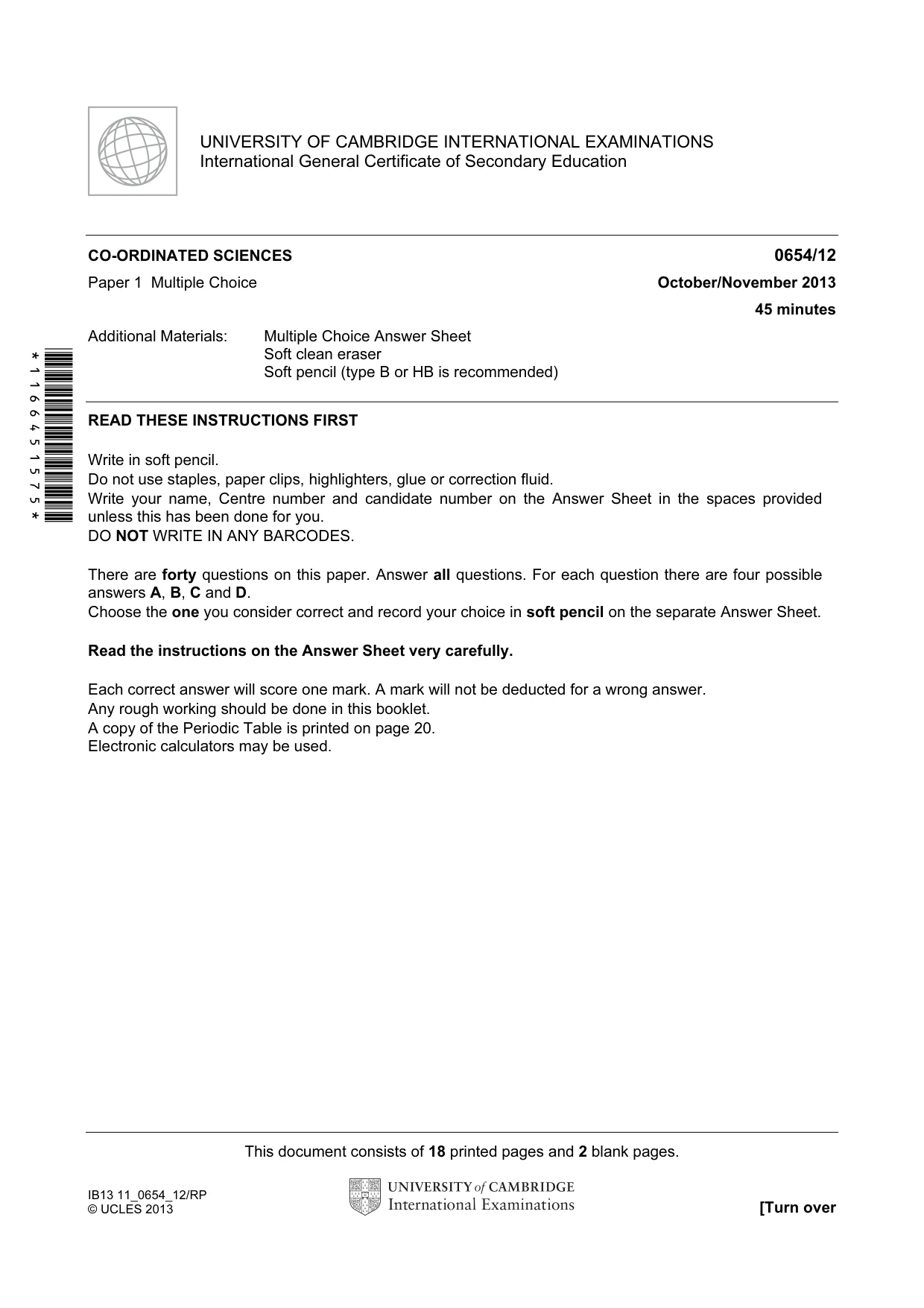
Q1 · The diagram shows part of an organism that lives in water, magnified by a microscope
1 The diagram shows part of an organism that lives in water, magnified by a microscope. Which part shows that the organism must be a plant? A B C D
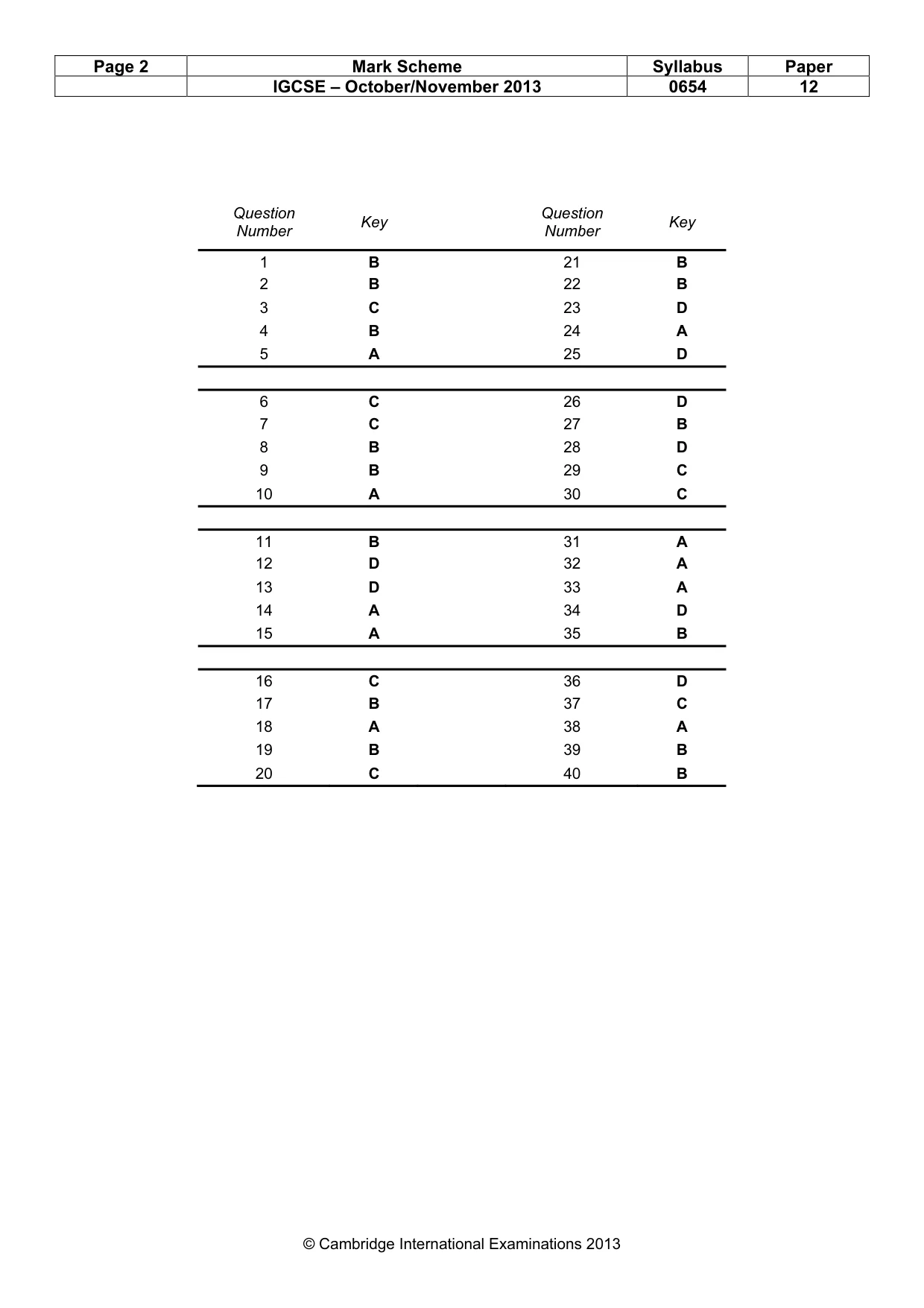
Mark scheme: B
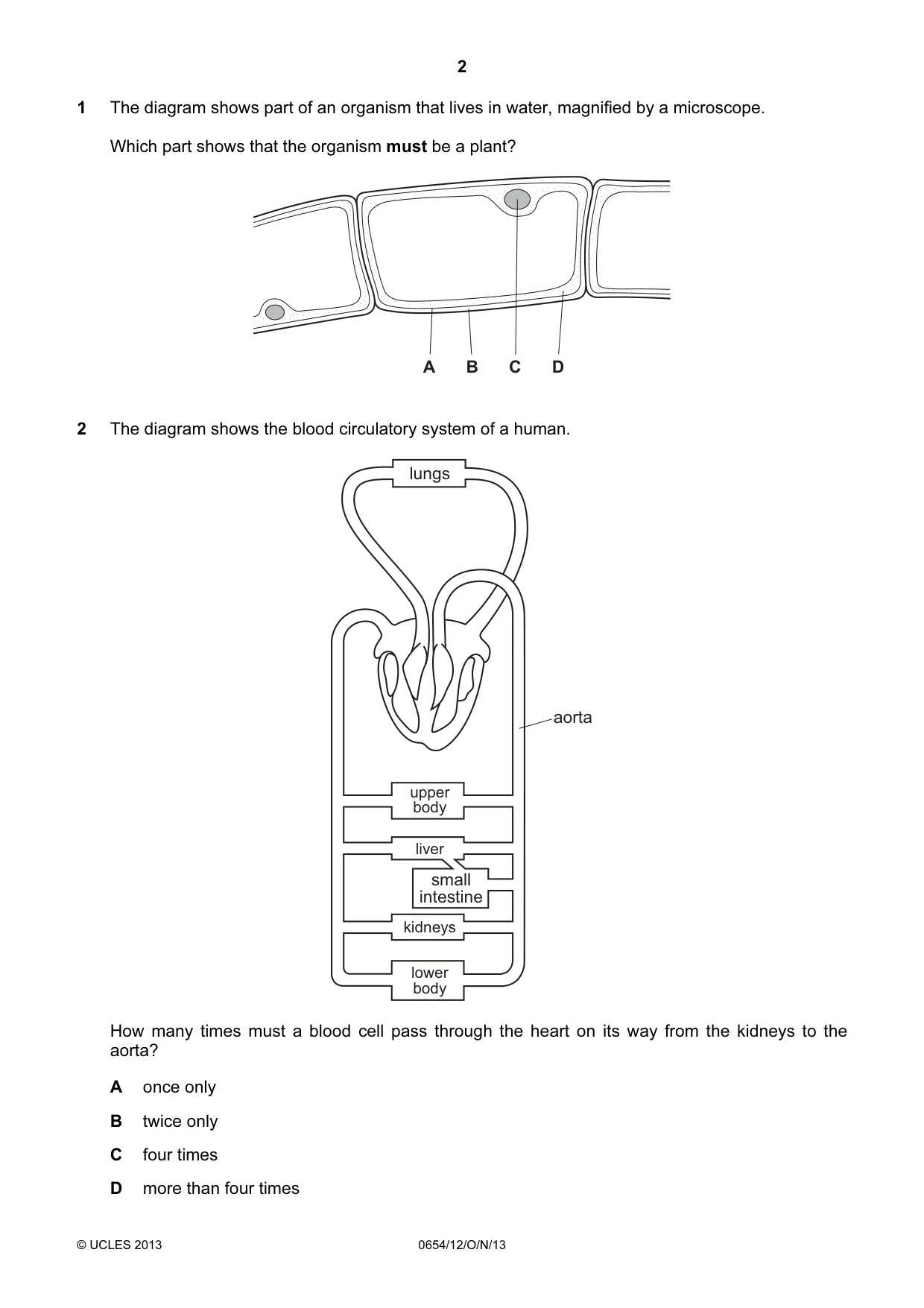
Q2 · The diagram shows the blood circulatory system of a human
2 The diagram shows the blood circulatory system of a human. lungs aorta upper body liver small intestine kidneys lower body How many times must a blood cell pass through the heart on its way from the kidneys to the aorta? A once only B twice only C four times D more than four times
Mark scheme: B
Q3 · Which statement about blood components is correct?
3 Which statement about blood components is correct? A Platelets make antibodies. B Platelets transport oxygen. C White blood cells carry out phagocytosis. D White blood cells transport carbon dioxide.
Mark scheme: C
Q4 · Which row shows a chemical molecule and the basic unit from which it is made?
4 Which row shows a chemical molecule and the basic unit from which it is made? chemical molecule basic unit A glycogen amino acid B glycogen simple sugar C oil amino acid D oil simple sugar
Mark scheme: B
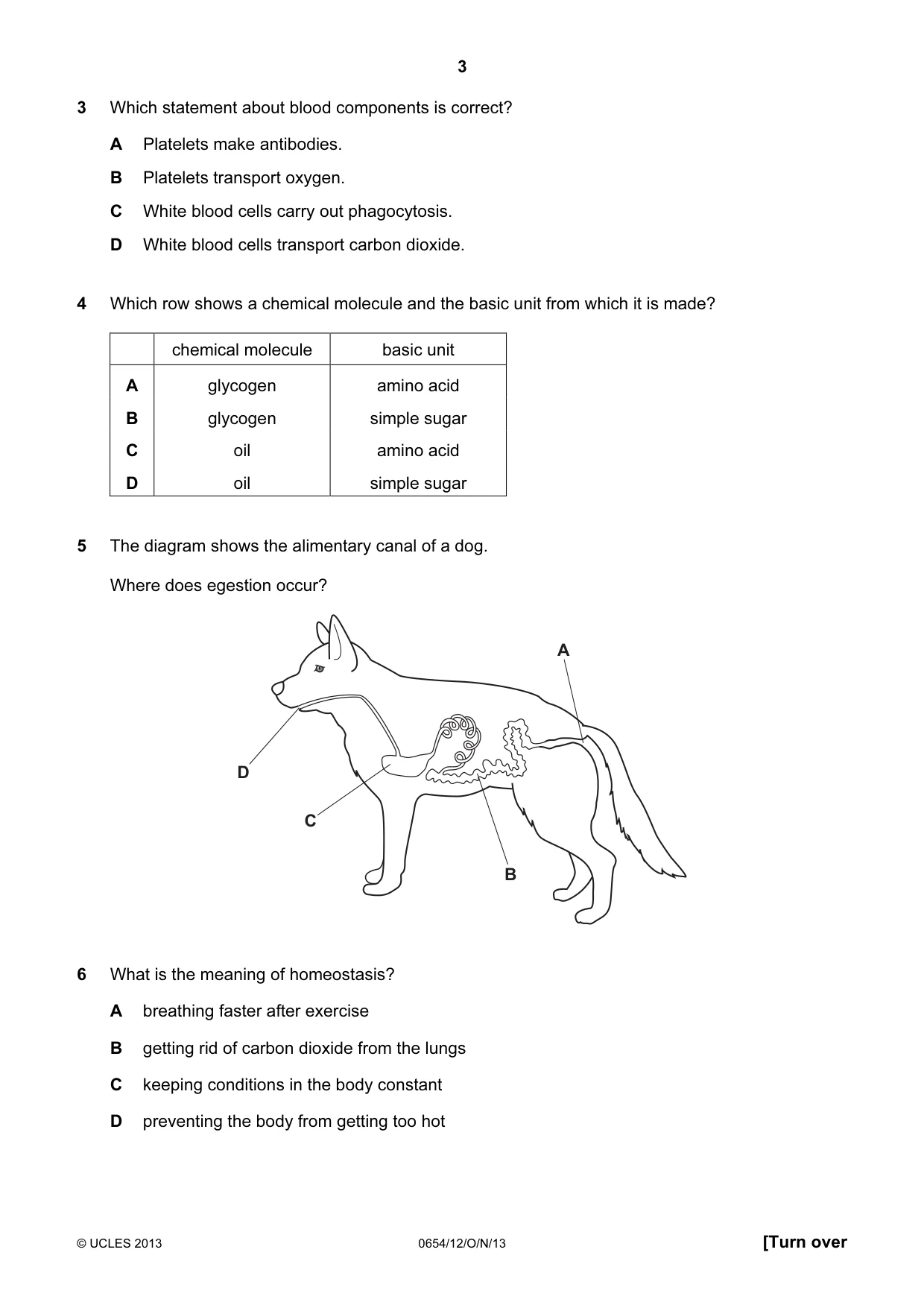
Q5 · The diagram shows the alimentary canal of a dog
5 The diagram shows the alimentary canal of a dog. Where does egestion occur? A D C B
Mark scheme: A
Q6 · What is the meaning of homeostasis?
6 What is the meaning of homeostasis? A breathing faster after exercise B getting rid of carbon dioxide from the lungs C keeping conditions in the body constant D preventing the body from getting too hot
Mark scheme: C
Q7 · Which is not a way that liver cells use energy?
7 Which is not a way that liver cells use energy? A cell division B heat production C movement D protein synthesis
Mark scheme: C
Q8 · What does the central nervous system consist of?
8 What does the central nervous system consist of? A brain and peripheral nerves B brain and spinal cord C brain only D spinal cord only
Mark scheme: B
Q9 · In mice, the allele for black fur is dominant to the allele for white fur
9 In mice, the allele for black fur is dominant to the allele for white fur. Two heterozygous mice mate. What colour are the offspring likely to be? A all black B some black and some white C all grey D all white
Mark scheme: B
Q10 · In a plant, what leads to offspring that are identical to the parent?
10 In a plant, what leads to offspring that are identical to the parent? A asexual reproduction B insect-pollination C seed germination D sexual reproduction
Mark scheme: A
Q11 · Pollination is the transfer of pollen A from anther to sepal
11 Pollination is the transfer of pollen A from anther to sepal. B from anther to stigma. C from sepal to anther. D from stigma to anther.
Mark scheme: B
Q12 · The diagram shows part of the carbon cycle in a forest
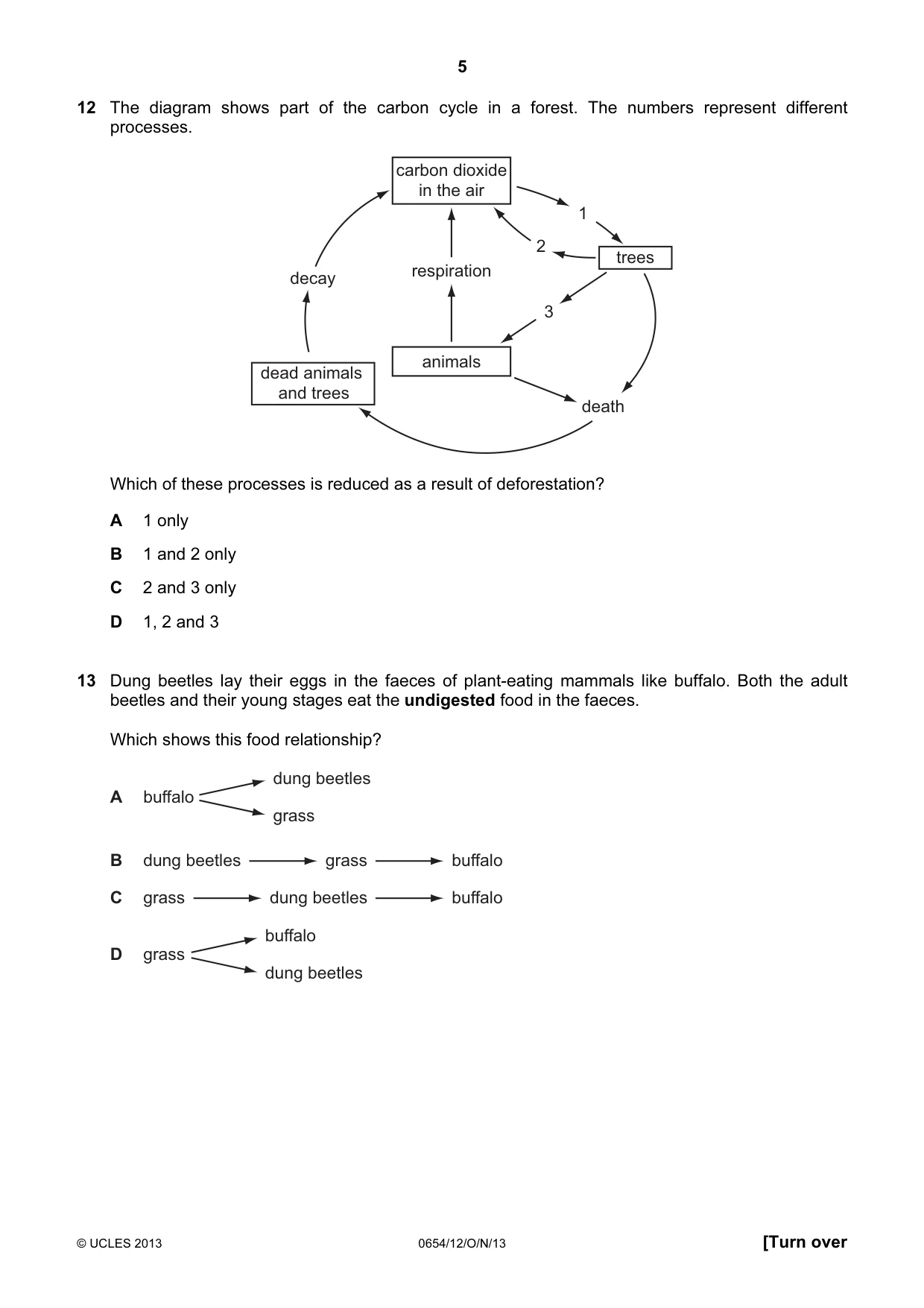
12 The diagram shows part of the carbon cycle in a forest. The numbers represent different processes. carbon dioxide in the air 1 2 trees decay respiration 3 animals dead animals and trees death Which of these processes is reduced as a result of deforestation? A 1 only B 1 and 2 only C 2 and 3 only D 1, 2 and 3
Mark scheme: D
Q13 · Dung beetles lay their eggs in the faeces of plant-eating mammals like buffalo
13 Dung beetles lay their eggs in the faeces of plant-eating mammals like buffalo. Both the adult beetles and their young stages eat the undigested food in the faeces. Which shows this food relationship? dung beetles A buffalo grass B dung beetles grass buffalo C grass dung beetles buffalo buffalo D grass dung beetles
Mark scheme: D
Q14 · Substance Q is used to make a cooking pan
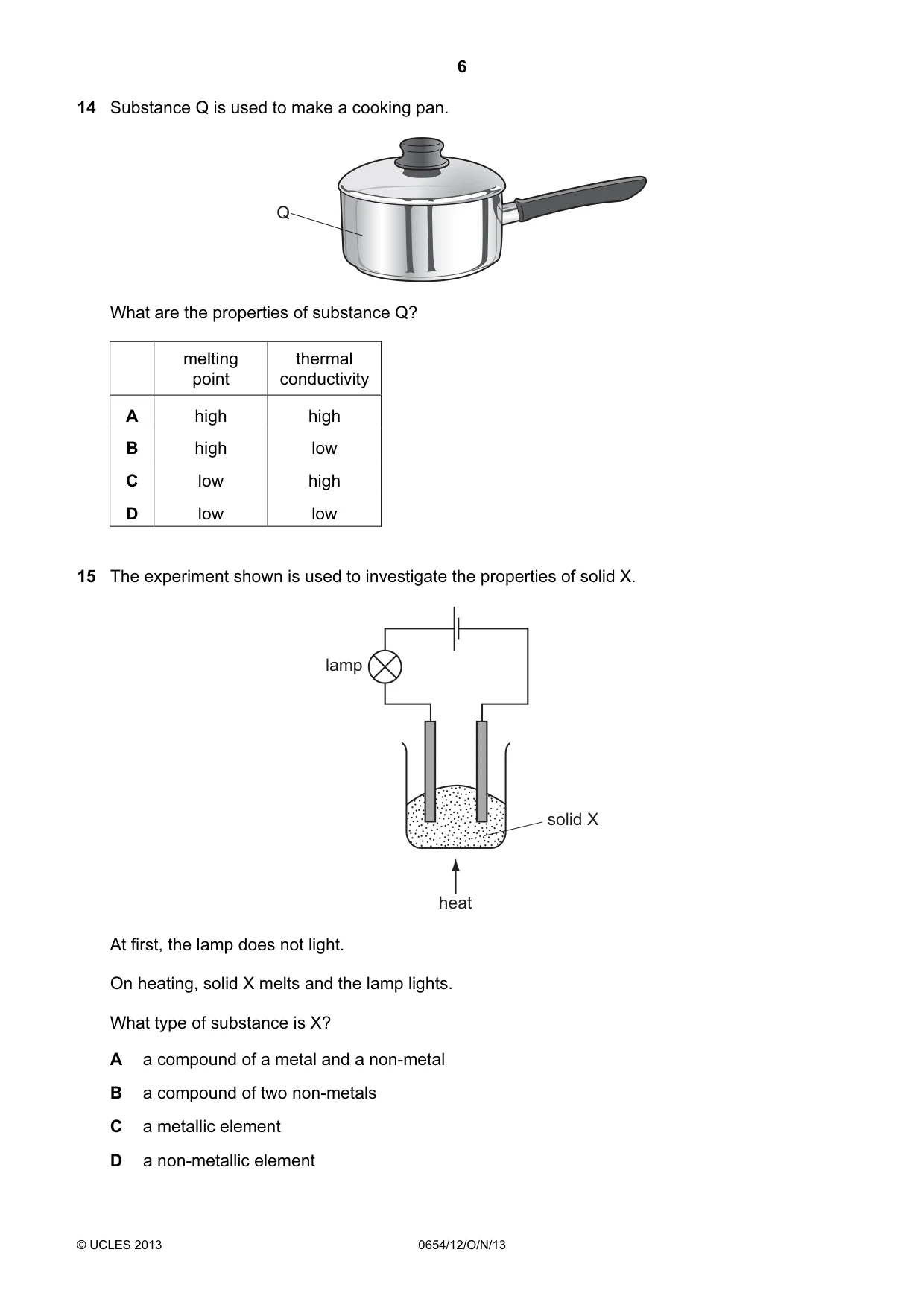
14 Substance Q is used to make a cooking pan. Q What are the properties of substance Q? melting thermal point conductivity A high high B high low C low high D low low
Mark scheme: A
Q15 · The experiment shown is used to investigate the properties of solid X
15 The experiment shown is used to investigate the properties of solid X. lamp solid X heat At first, the lamp does not light. On heating, solid X melts and the lamp lights. What type of substance is X? A a compound of a metal and a non-metal B a compound of two non-metals C a metallic element D a non-metallic element
Mark scheme: A
Q16 · Small amounts of barium chloride and sand are shaken with separate samples of water in…
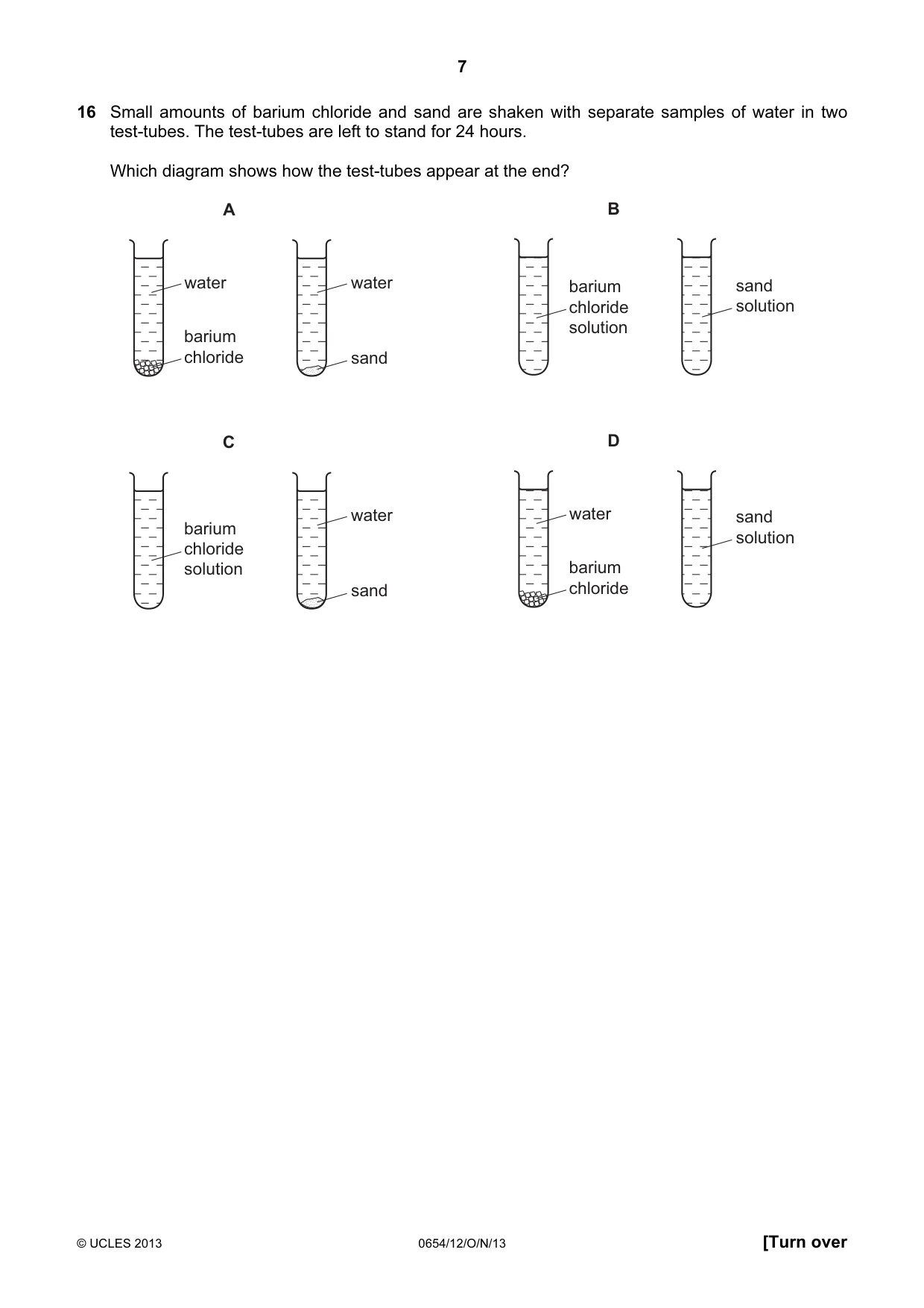
16 Small amounts of barium chloride and sand are shaken with separate samples of water in two test-tubes. The test-tubes are left to stand for 24 hours. Which diagram shows how the test-tubes appear at the end? A B water water barium sand chloride solution solution barium chloride sand C D water water sand barium solution chloride solution barium sand chloride
Mark scheme: C
Q17 · The diagram shows the circuit for electrolysing concentrated aqueous copper(II) bromide
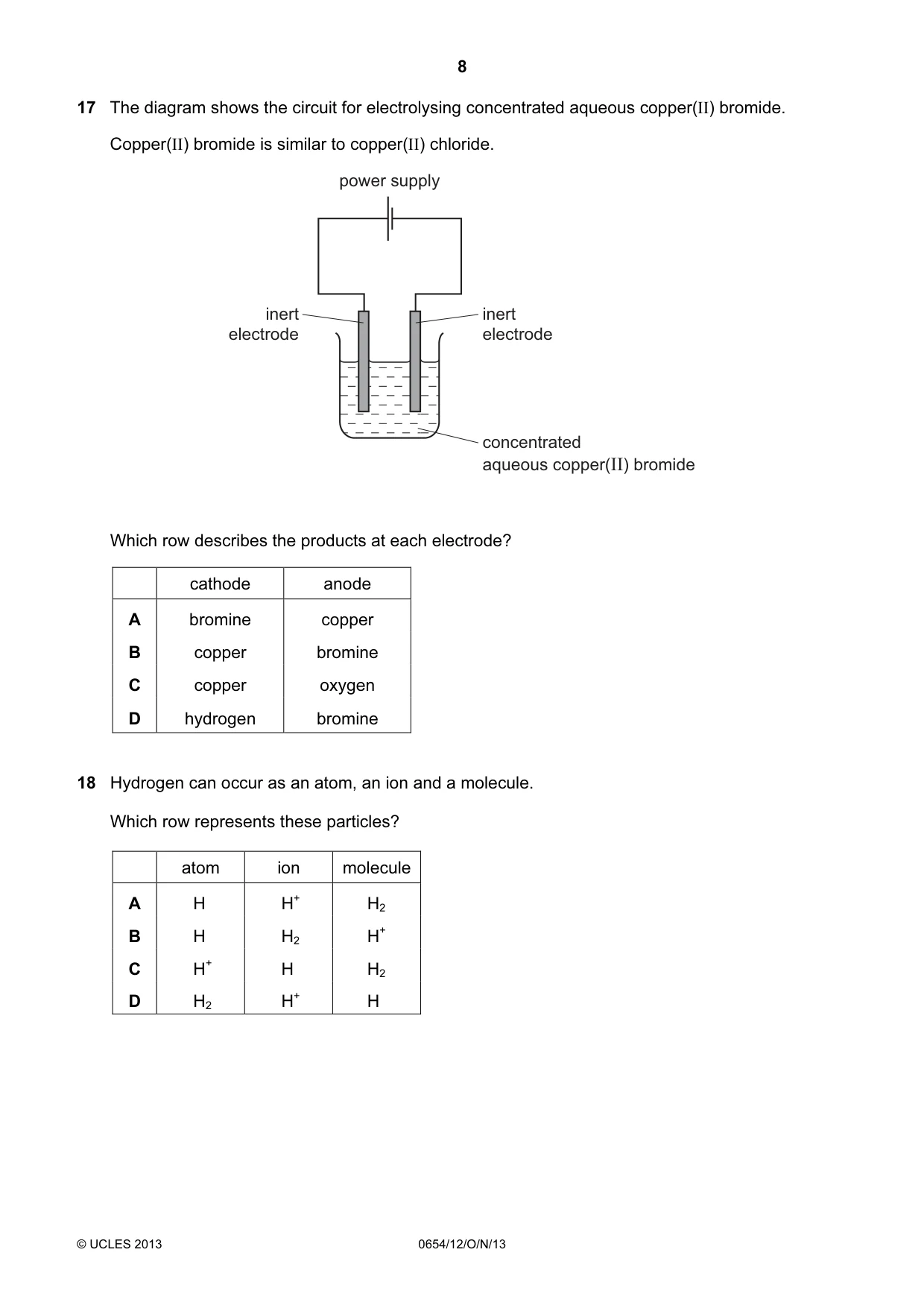
17 The diagram shows the circuit for electrolysing concentrated aqueous copper(II) bromide. Copper(II) bromide is similar to copper(II) chloride. power supply inert inert electrode electrode concentrated aqueous copper(II) bromide Which row describes the products at each electrode? cathode anode A bromine copper B copper bromine C copper oxygen D hydrogen bromine
Mark scheme: B
Q18 · Hydrogen can occur as an atom, an ion and a molecule
18 Hydrogen can occur as an atom, an ion and a molecule. Which row represents these particles? atom ion molecule A H H+ H2 B H H2 H+ C H+ H H2 D H2 H+ H
Mark scheme: A
Q19 · The table shows the temperature of some water before and after a solid is dissolved in it
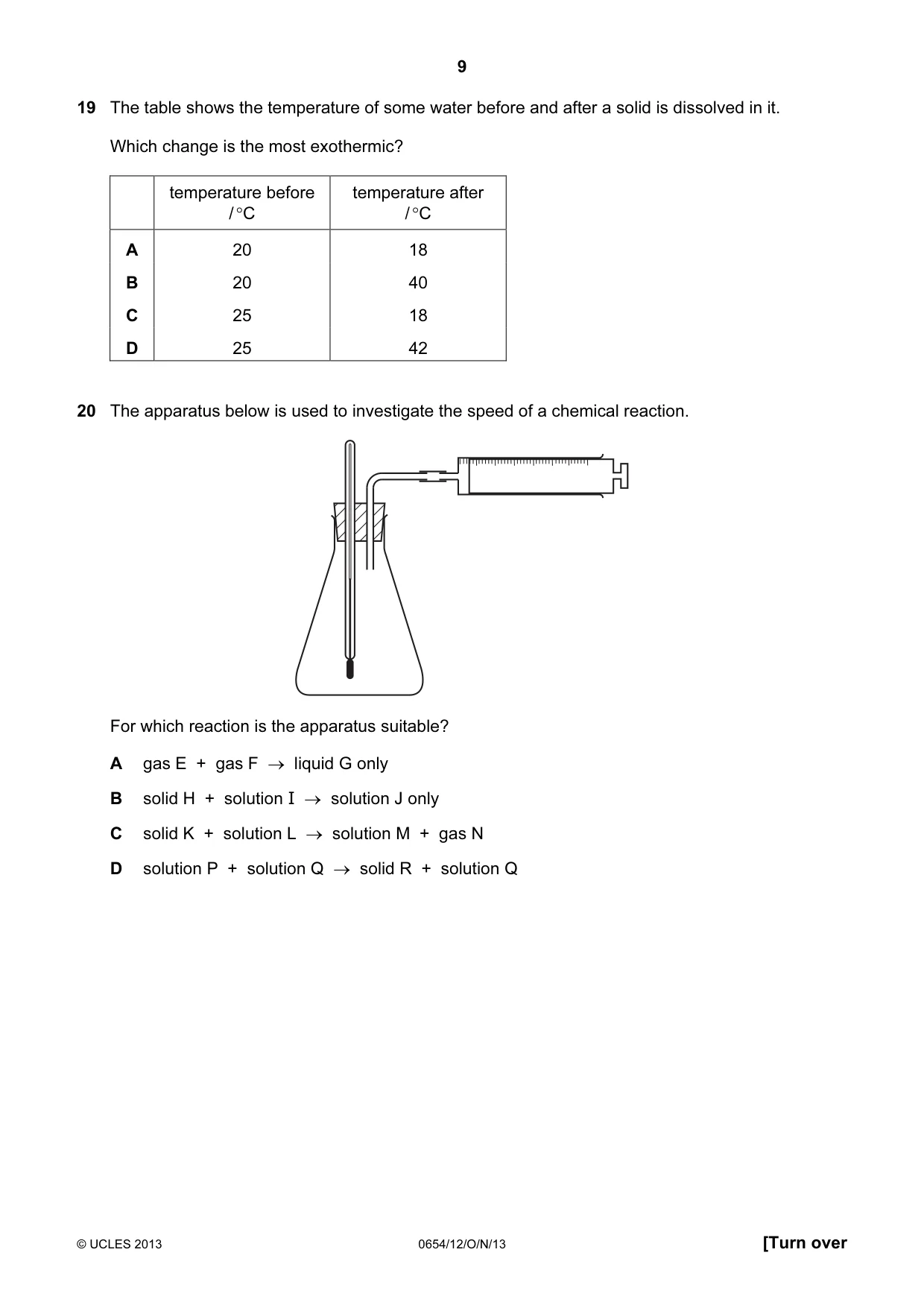
19 The table shows the temperature of some water before and after a solid is dissolved in it. Which change is the most exothermic? temperature before temperature after / °C / °C A 20 18 B 20 40 C 25 18 D 25 42
Mark scheme: B
Q20 · The apparatus below is used to investigate the speed of a chemical reaction
20 The apparatus below is used to investigate the speed of a chemical reaction. For which reaction is the apparatus suitable? A gas E + gas F → liquid G only B solid H + solution I → solution J only C solid K + solution L → solution M + gas N D solution P + solution Q → solid R + solution Q
Mark scheme: C
Q21 · Substance X does not react with dilute acid
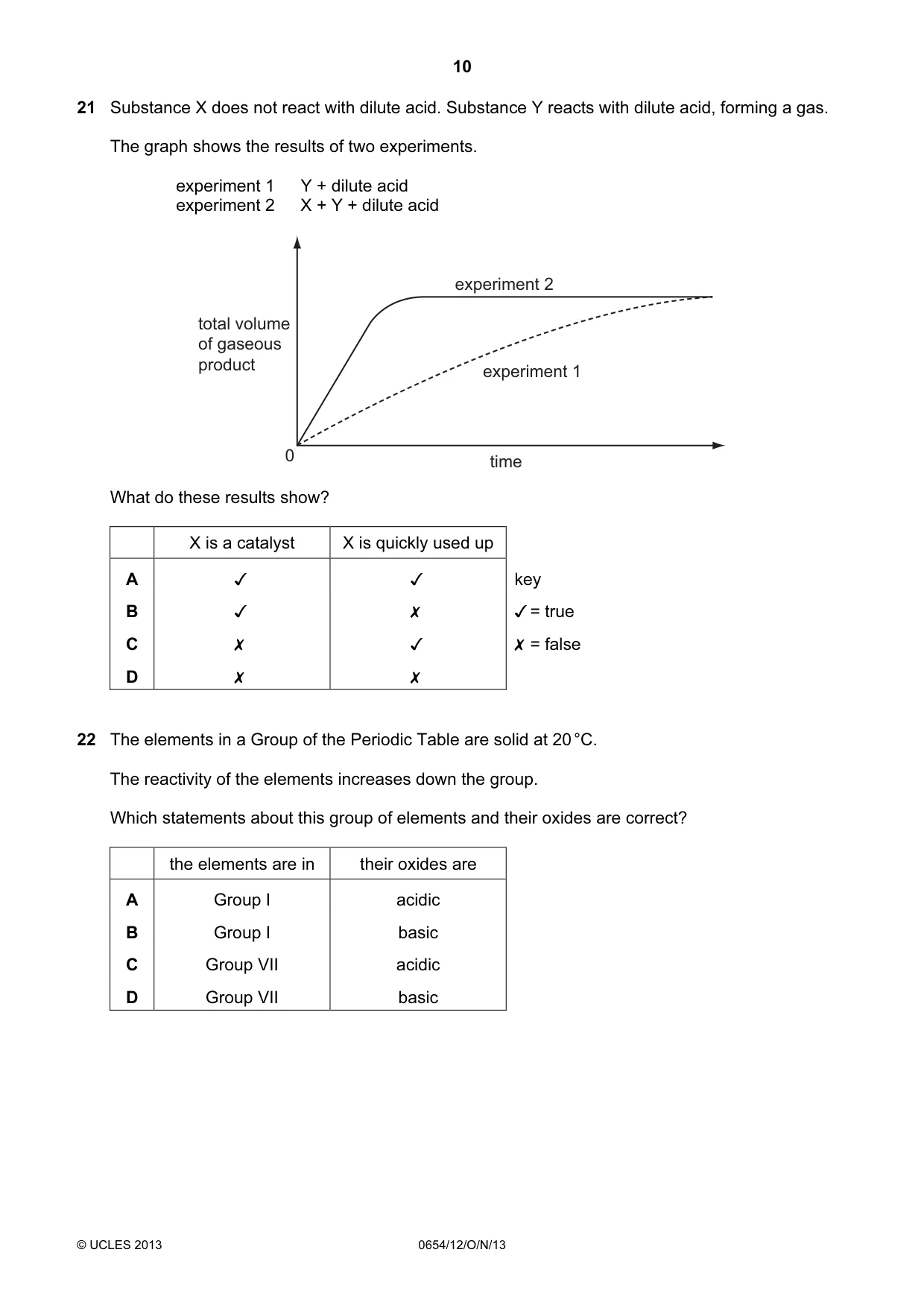
21 Substance X does not react with dilute acid. Substance Y reacts with dilute acid, forming a gas. The graph shows the results of two experiments. experiment 1 Y + dilute acid experiment 2 X + Y + dilute acid experiment 2 total volume of gaseous product experiment 1 0 time What do these results show? X is a catalyst X is quickly used up A ✓ ✓ key B ✓ ✗ ✓= true C ✗ ✓ ✗= false D ✗ ✗
Mark scheme: B
Q22 · The elements in a Group of the Periodic Table are solid at 20 °C
22 The elements in a Group of the Periodic Table are solid at 20 °C. The reactivity of the elements increases down the group. Which statements about this group of elements and their oxides are correct? the elements are in their oxides are A Group I acidic B Group I basic C Group VII acidic D Group VII basic
Mark scheme: B
Q23 · A label from a packet of indigestion tablets is shown
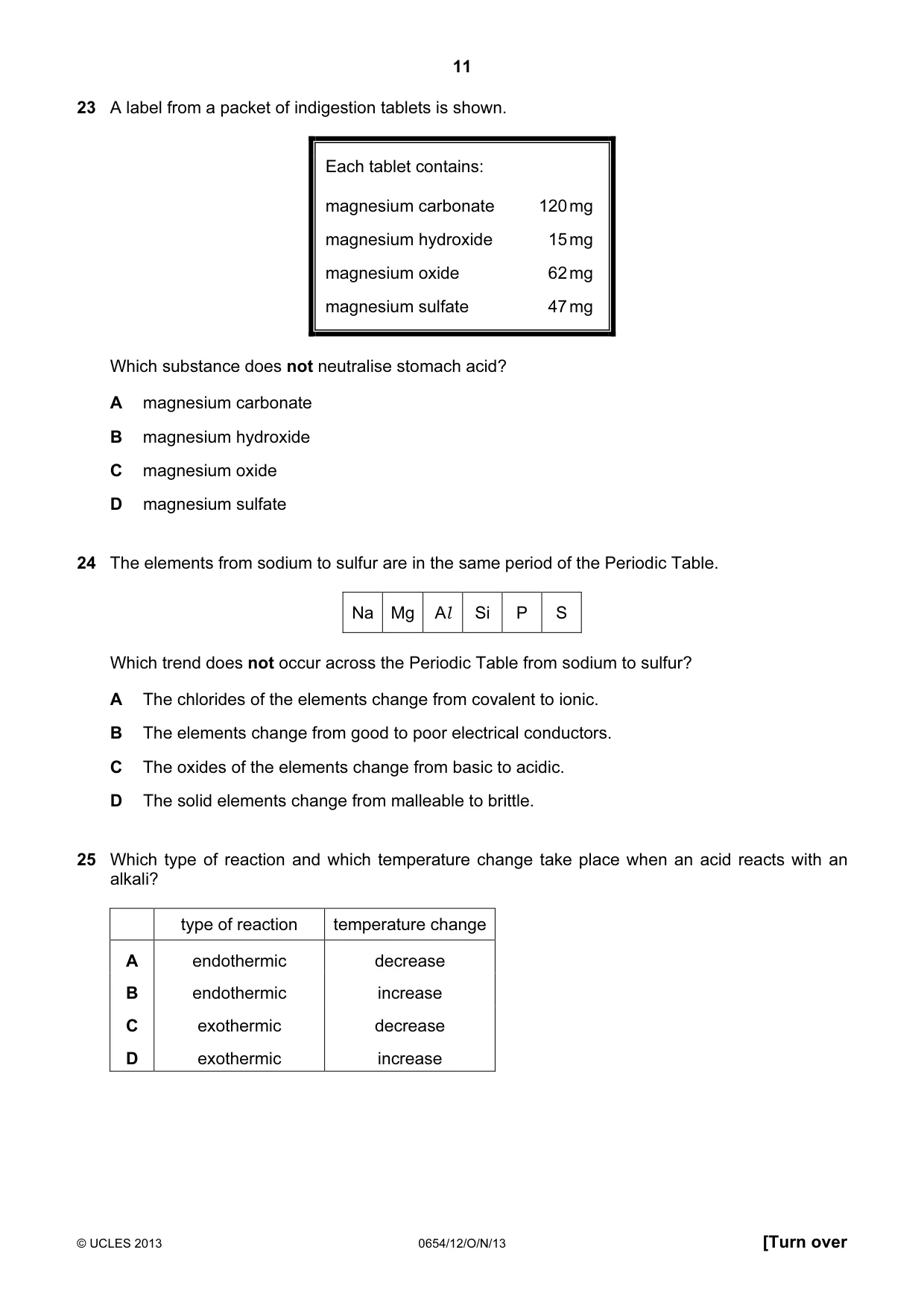
23 A label from a packet of indigestion tablets is shown. Each tablet contains: magnesium carbonate 120 mg magnesium hydroxide 15 mg magnesium oxide 62 mg magnesium sulfate 47 mg Which substance does not neutralise stomach acid? A magnesium carbonate B magnesium hydroxide C magnesium oxide D magnesium sulfate
Mark scheme: D
More questions on The characteristic properties of acids and bases
Q24 · The elements from sodium to sulfur are in the same period of the Periodic Table
24 The elements from sodium to sulfur are in the same period of the Periodic Table. Na Mg Al Si P S Which trend does not occur across the Periodic Table from sodium to sulfur? A The chlorides of the elements change from covalent to ionic. B The elements change from good to poor electrical conductors. C The oxides of the elements change from basic to acidic. D The solid elements change from malleable to brittle.
Mark scheme: A
Q25 · Which type of reaction and which temperature change take place when an acid reacts with…
25 Which type of reaction and which temperature change take place when an acid reacts with an alkali? type of reaction temperature change A endothermic decrease B endothermic increase C exothermic decrease D exothermic increase
Mark scheme: D
Q26 · Which graph shows how the pH of the soil changes when lime is added?
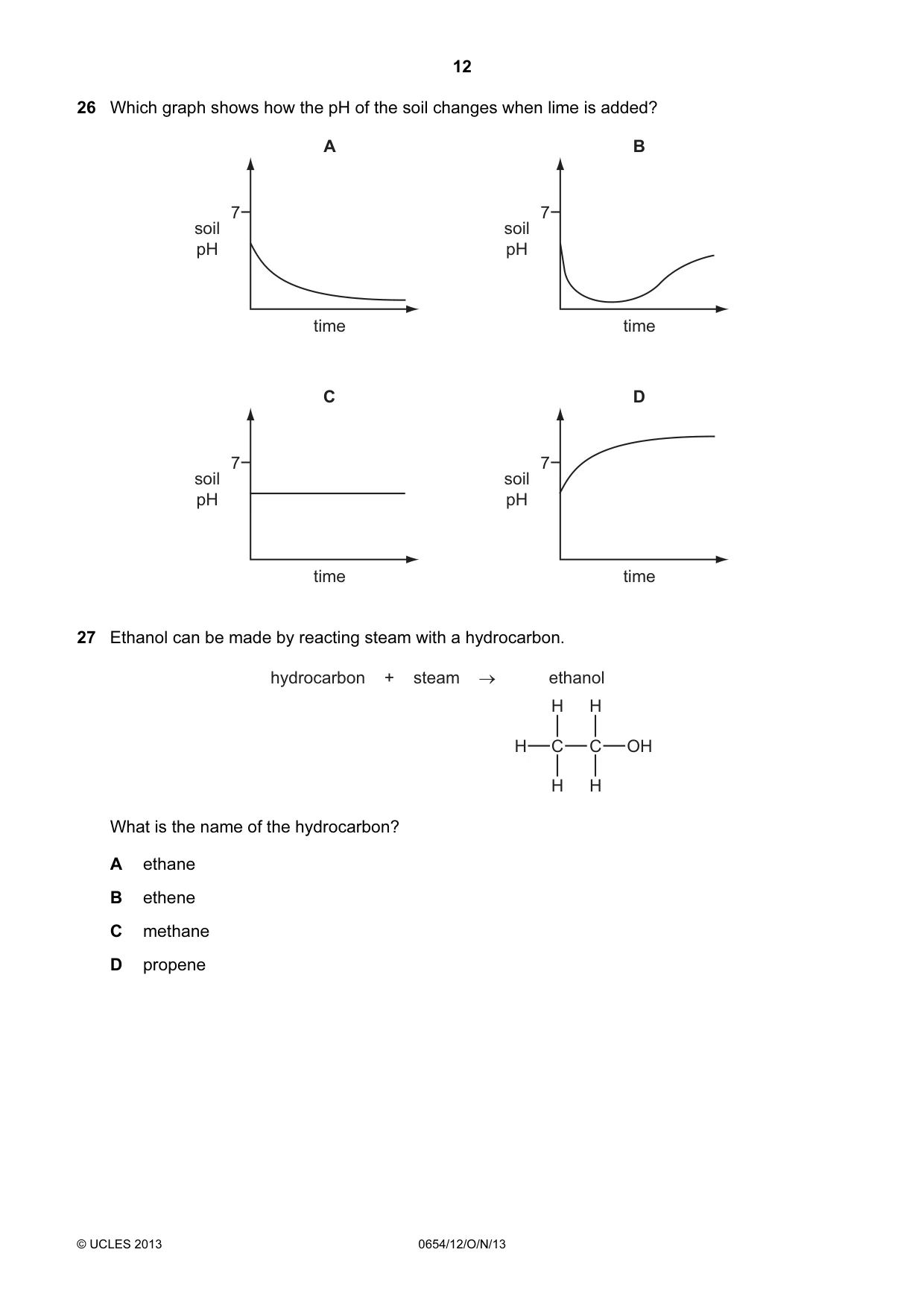
26 Which graph shows how the pH of the soil changes when lime is added? A B 7 7 soil soil pH pH time time C D 7 7 soil soil pH pH time time
Mark scheme: D
More questions on The characteristic properties of acids and bases
Q27 · Ethanol can be made by reacting steam with a hydrocarbon
27 Ethanol can be made by reacting steam with a hydrocarbon. hydrocarbon + steam → ethanol H H H C C OH H H What is the name of the hydrocarbon? A ethane B ethene C methane D propene
Mark scheme: B
Q28 · The diagram shows a graph with values of mass against volume for four different objects…
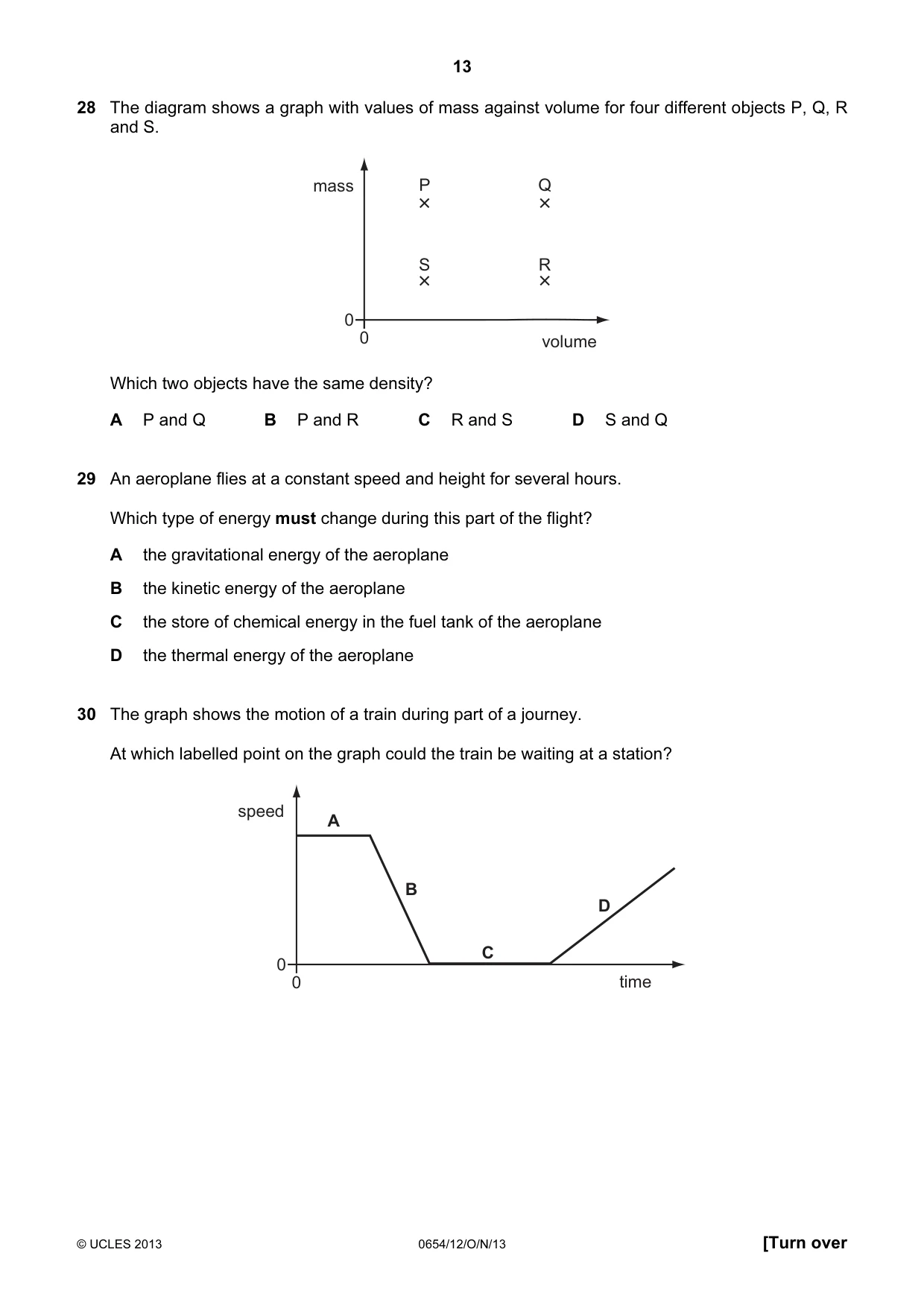
28 The diagram shows a graph with values of mass against volume for four different objects P, Q, R and S. mass P Q S R 0 0 volume Which two objects have the same density? A P and Q B P and R C R and S D S and Q
Mark scheme: D
Q29 · An aeroplane flies at a constant speed and height for several hours
29 An aeroplane flies at a constant speed and height for several hours. Which type of energy must change during this part of the flight? A the gravitational energy of the aeroplane B the kinetic energy of the aeroplane C the store of chemical energy in the fuel tank of the aeroplane D the thermal energy of the aeroplane
Mark scheme: C
Q30 · The graph shows the motion of a train during part of a journey
30 The graph shows the motion of a train during part of a journey. At which labelled point on the graph could the train be waiting at a station? speed A B D C 0 0 time
Mark scheme: C
Q31 · A sample of liquid is allowed to cool for 20 minutes
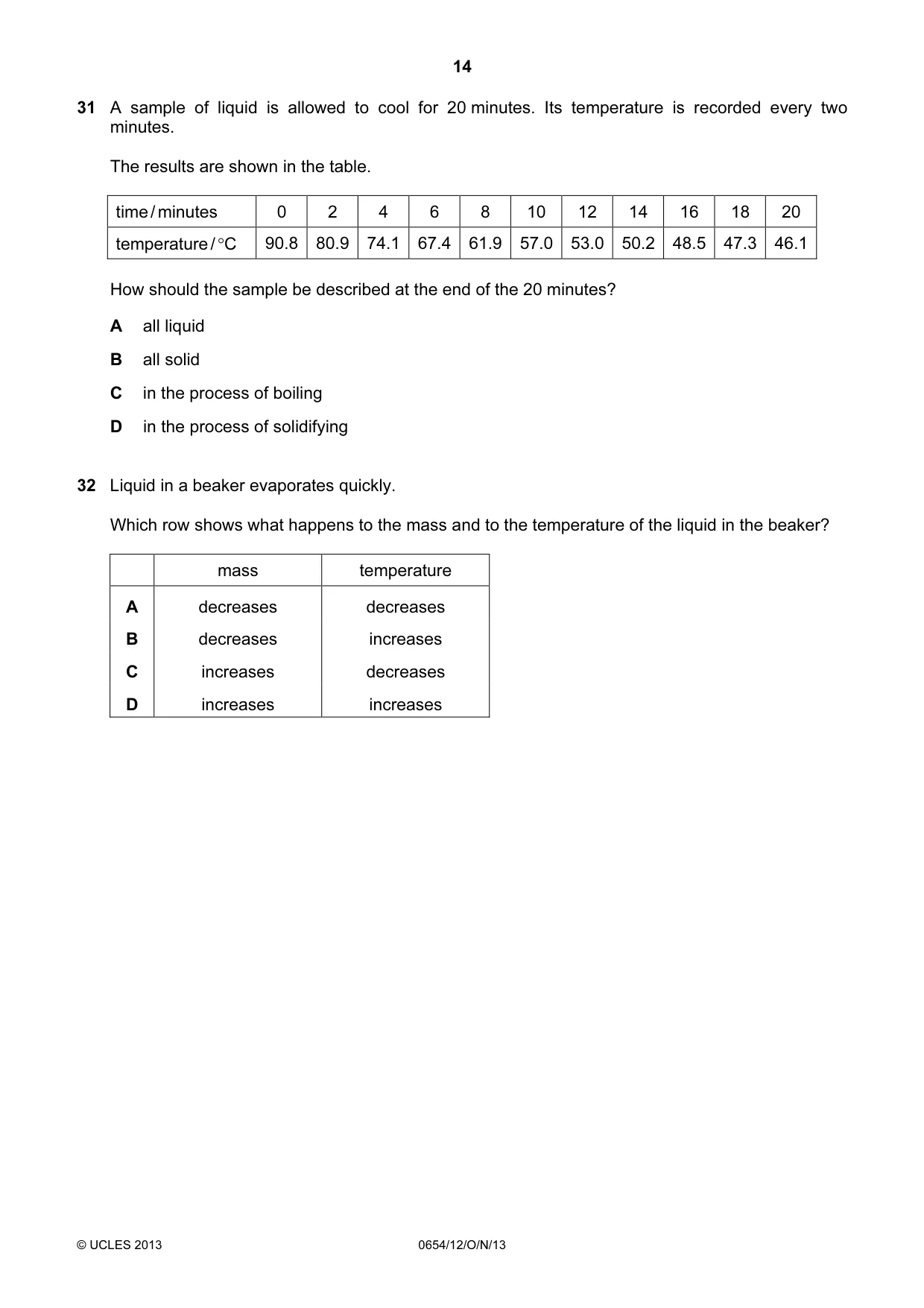
31 A sample of liquid is allowed to cool for 20 minutes. Its temperature is recorded every two minutes. The results are shown in the table. time / minutes 0 2 4 6 8 10 12 14 16 18 20 temperature / °C 90.8 80.9 74.1 67.4 61.9 57.0 53.0 50.2 48.5 47.3 46.1 How should the sample be described at the end of the 20 minutes? A all liquid B all solid C in the process of boiling D in the process of solidifying
Mark scheme: A
Q32 · Liquid in a beaker evaporates quickly
32 Liquid in a beaker evaporates quickly. Which row shows what happens to the mass and to the temperature of the liquid in the beaker? mass temperature A decreases decreases B decreases increases C increases decreases D increases increases
Mark scheme: A
Q33 · The diagrams show part of a water-heating system which is working by convection
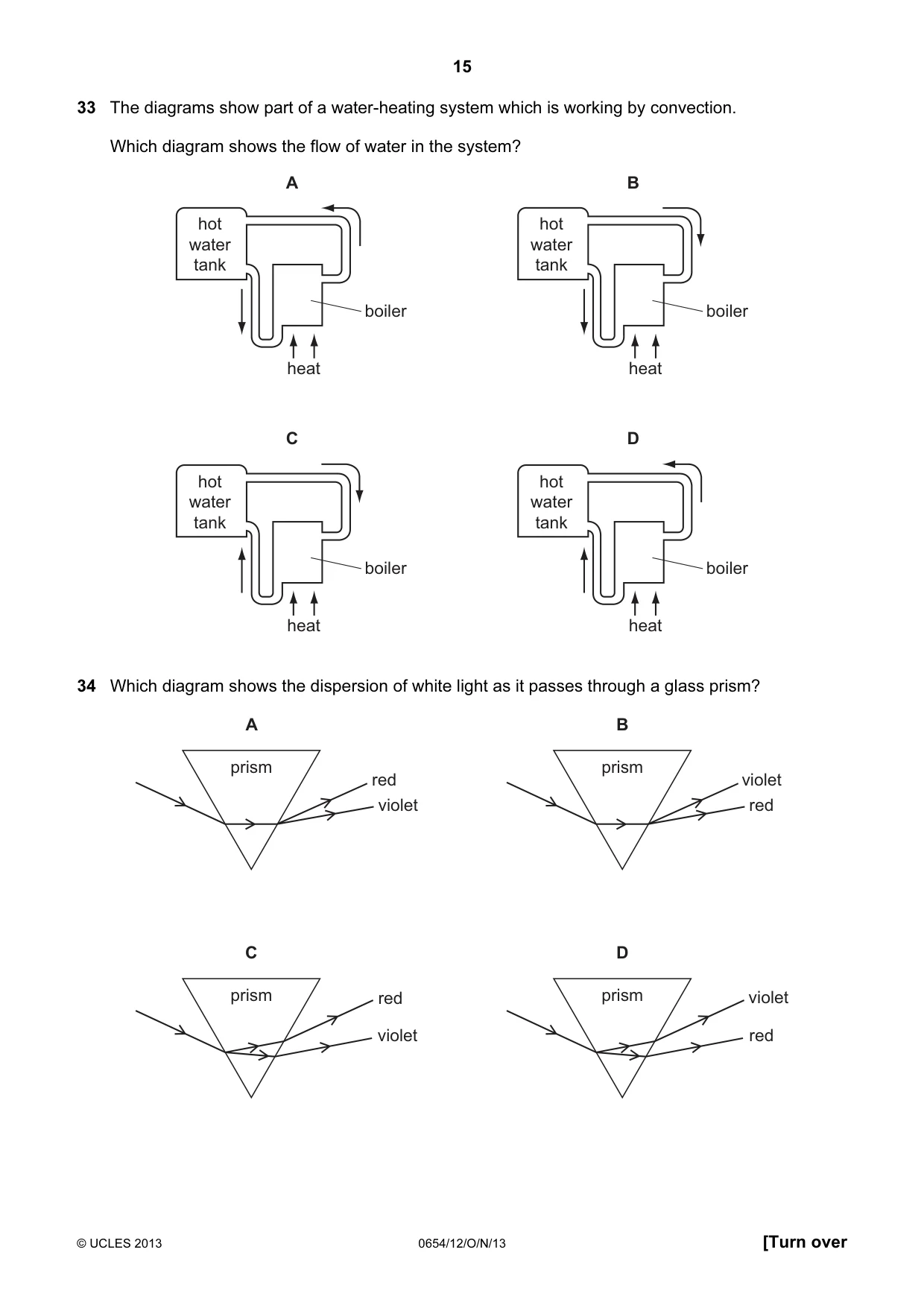
33 The diagrams show part of a water-heating system which is working by convection. Which diagram shows the flow of water in the system? A B hot hot water water tank tank boiler boiler heat heat C D hot hot water water tank tank boiler boiler heat heat
Mark scheme: A
Q34 · Which diagram shows the dispersion of white light as it passes through a glass prism?
34 Which diagram shows the dispersion of white light as it passes through a glass prism? A B prism prism red violet violet red C D prism red prism violet violet red
Mark scheme: D
Q35 · A student counts how many waves pass point P in 30 seconds
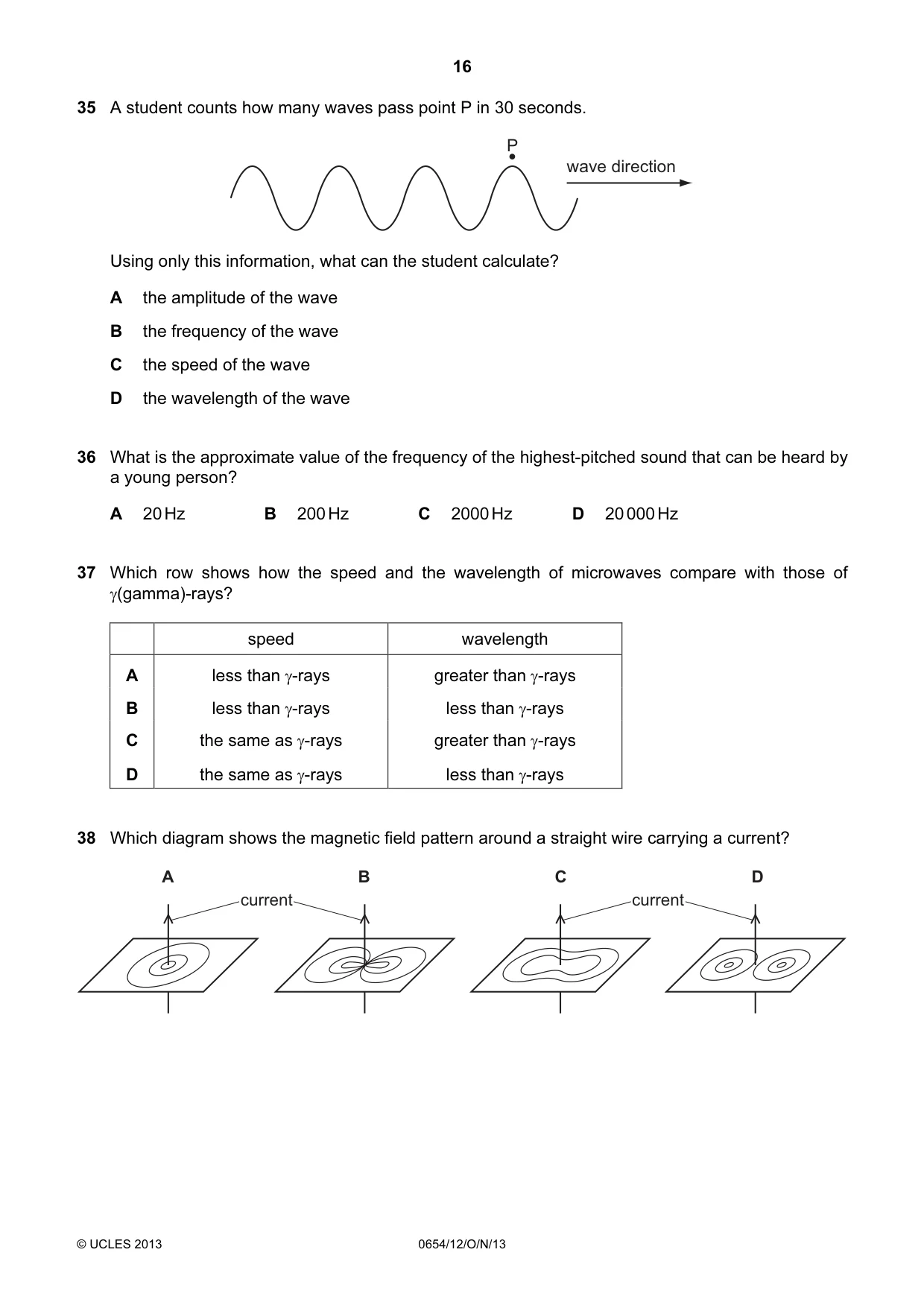
35 A student counts how many waves pass point P in 30 seconds. P wave direction Using only this information, what can the student calculate? A the amplitude of the wave B the frequency of the wave C the speed of the wave D the wavelength of the wave
Mark scheme: B
Q36 · What is the approximate value of the frequency of the highest-pitched sound that can be…
36 What is the approximate value of the frequency of the highest-pitched sound that can be heard by a young person? A 20 Hz B 200 Hz C 2000 Hz D 20 000 Hz
Mark scheme: D
Q37 · Which row shows how the speed and the wavelength of microwaves compare with those of…
37 Which row shows how the speed and the wavelength of microwaves compare with those of γ(gamma)-rays? speed wavelength A less than γ-rays greater than γ-rays B less than γ-rays less than γ-rays C the same as γ-rays greater than γ-rays D the same as γ-rays less than γ-rays
Mark scheme: C
Q38 · Which diagram shows the magnetic field pattern around a straight wire carrying a current?
38 Which diagram shows the magnetic field pattern around a straight wire carrying a current? A B C D current current
Mark scheme: A
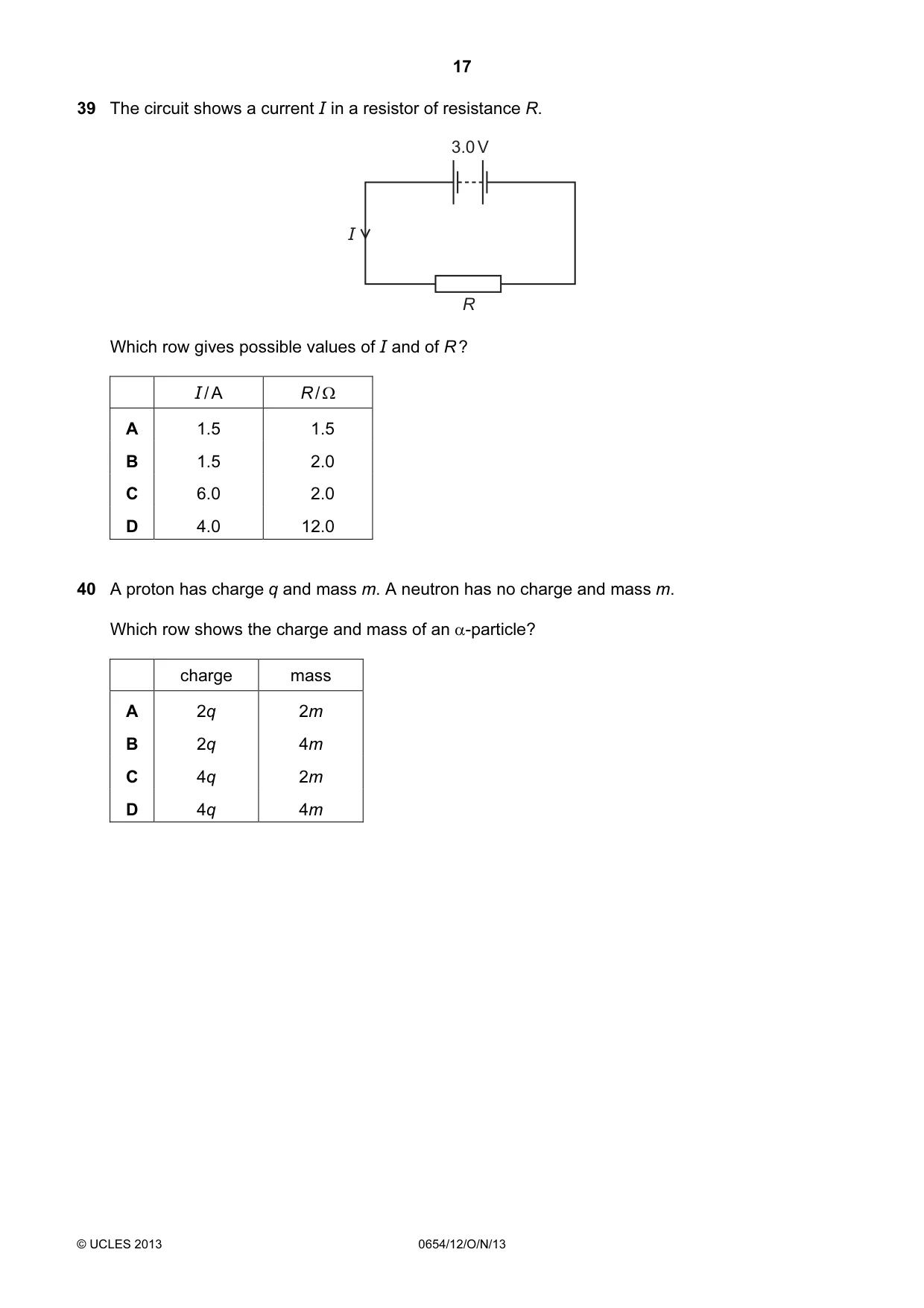
Q39 · The circuit shows a current I in a resistor of resistance R
39 The circuit shows a current I in a resistor of resistance R. 3.0 V I R Which row gives possible values of I and of R ? I / A R / Ω A 1.5 1.5 B 1.5 2.0 C 6.0 2.0 D 4.0 12.0
Mark scheme: B
Q40 · A proton has charge q and mass m
40 A proton has charge q and mass m. A neutron has no charge and mass m. Which row shows the charge and mass of an α-particle? charge mass A 2q 2m B 2q 4m C 4q 2m D 4q 4m
Mark scheme: B
What was in this paper
The subtopics covered by these 40 questions, and how many questions each got. Open one in a new tab to see every Cambridge question on it.
2Ions and ionic bonds2Kinetic particle model of matter2Rate of reaction2The characteristic properties of acids and bases2Alkenes1Arrangement of elements1Asexual reproduction1Biological molecules1Blood1Carbon cycle1Cell structure1Circulatory systems1Coordination and response1Density1Digestive system1Electrical quantities1Electrolysis1Electromagnetic spectrum1Elements, compounds and mixtures1Energy, work and power1Food chains and food webs1General properties of waves1Group I properties1Homeostasis1Light1Monohybrid inheritance1Motion1Properties of metals1Respiration1Sexual reproduction in plants1Simple phenomena of magnetism1Sound1The nucleus1Transfer of thermal energy1What you needed in this session
Cambridge’s own grade thresholds for 2013 Oct/Nov, Paper 1 · Variant 2. A higher threshold means an easier paper — the bar moves with how the cohort did.