Cambridge IGCSE Sciences - Co-ordinated (Double) 0654 — 2025 Oct/Nov Paper 1 · Variant 2
0654/12/O/N/25 · 40 questions · 40 marks · 45 min
The question paper and its mark scheme, free to read here and free to download. This is Cambridge’s own paper, exactly as it was sat.
Question paper16 pages

Mark scheme3 pages
Answers below. Sit the paper first if you are practising.
Questions as text
Q1 · Which part of a plant cell allows the movement of substances into and out of the cell?
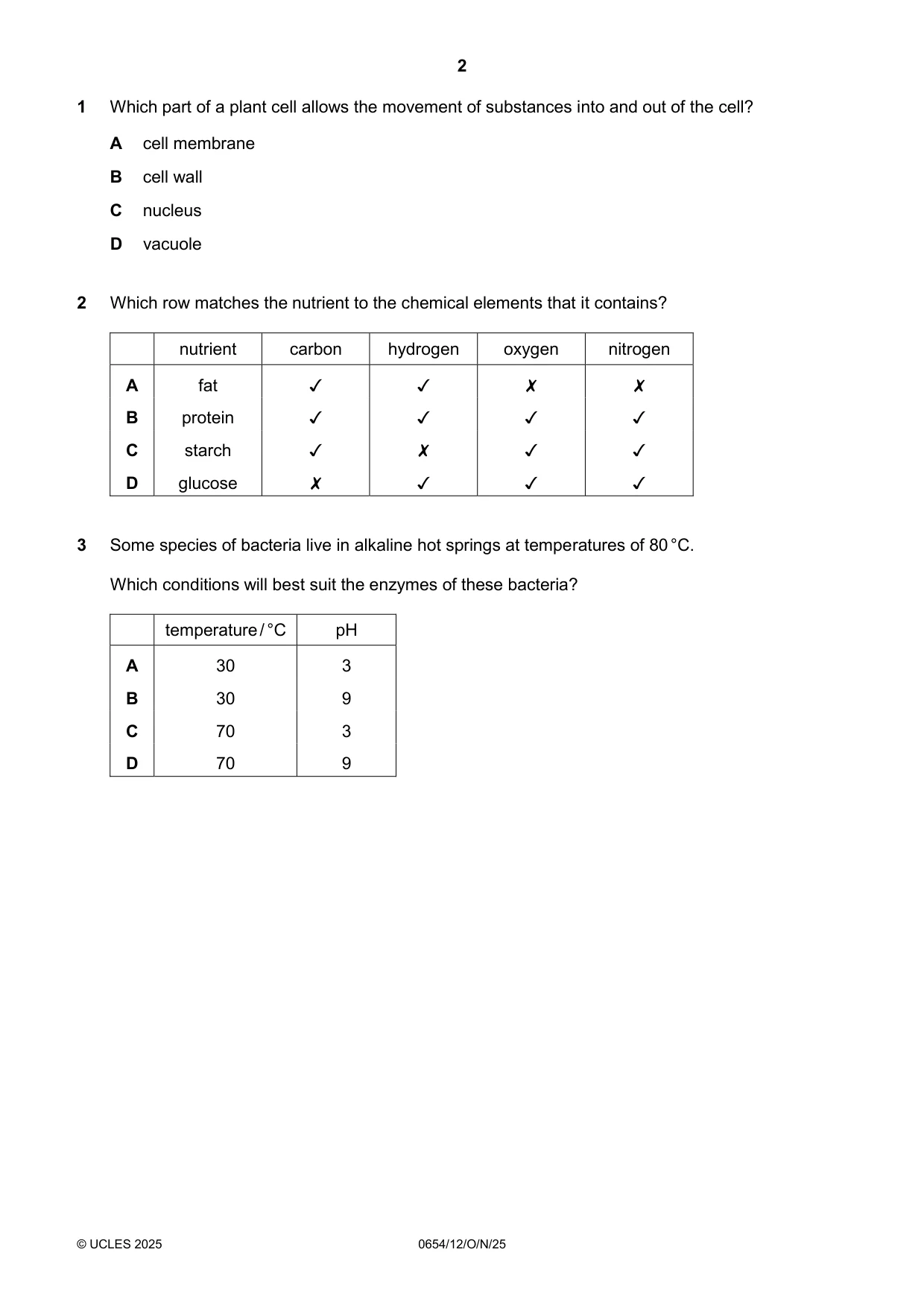
1 Which part of a plant cell allows the movement of substances into and out of the cell? A cell membrane B cell wall C nucleus D vacuole
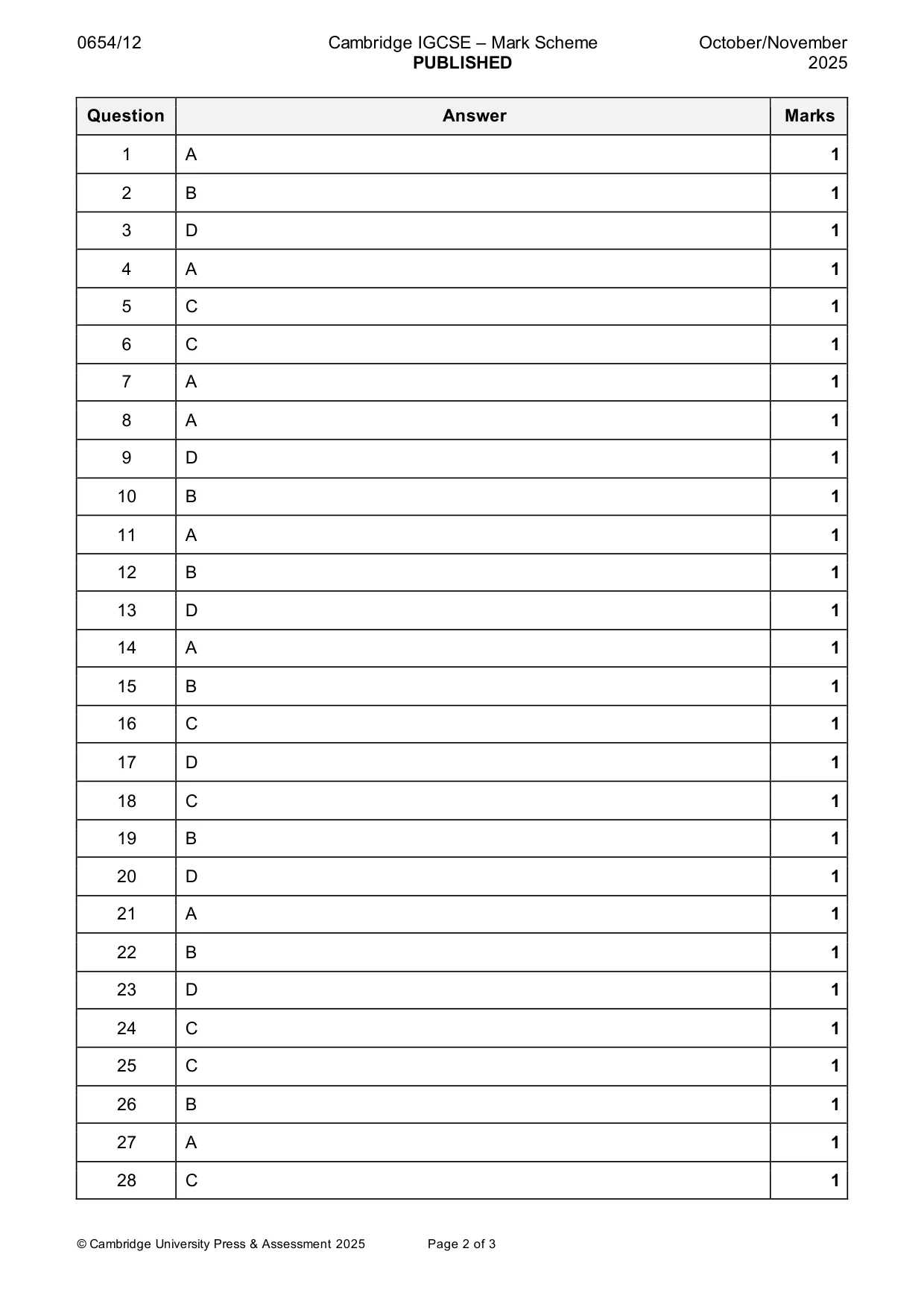
Mark scheme: A
Q2 · Which row matches the nutrient to the chemical elements that it contains?
2 Which row matches the nutrient to the chemical elements that it contains? | nutrient fat protein starch glucose carbon hydrogen oxygen nitrogen
Mark scheme: B
Q3 · Some species of bacteria live in alkaline hot springs at temperatures of 80 °C
3 Some species of bacteria live in alkaline hot springs at temperatures of 80 °C. Which conditions will best suit the enzymes of these bacteria? temperature / °C pH A 30 3 B 30 9 C 70 3 D 70 9
Mark scheme: D
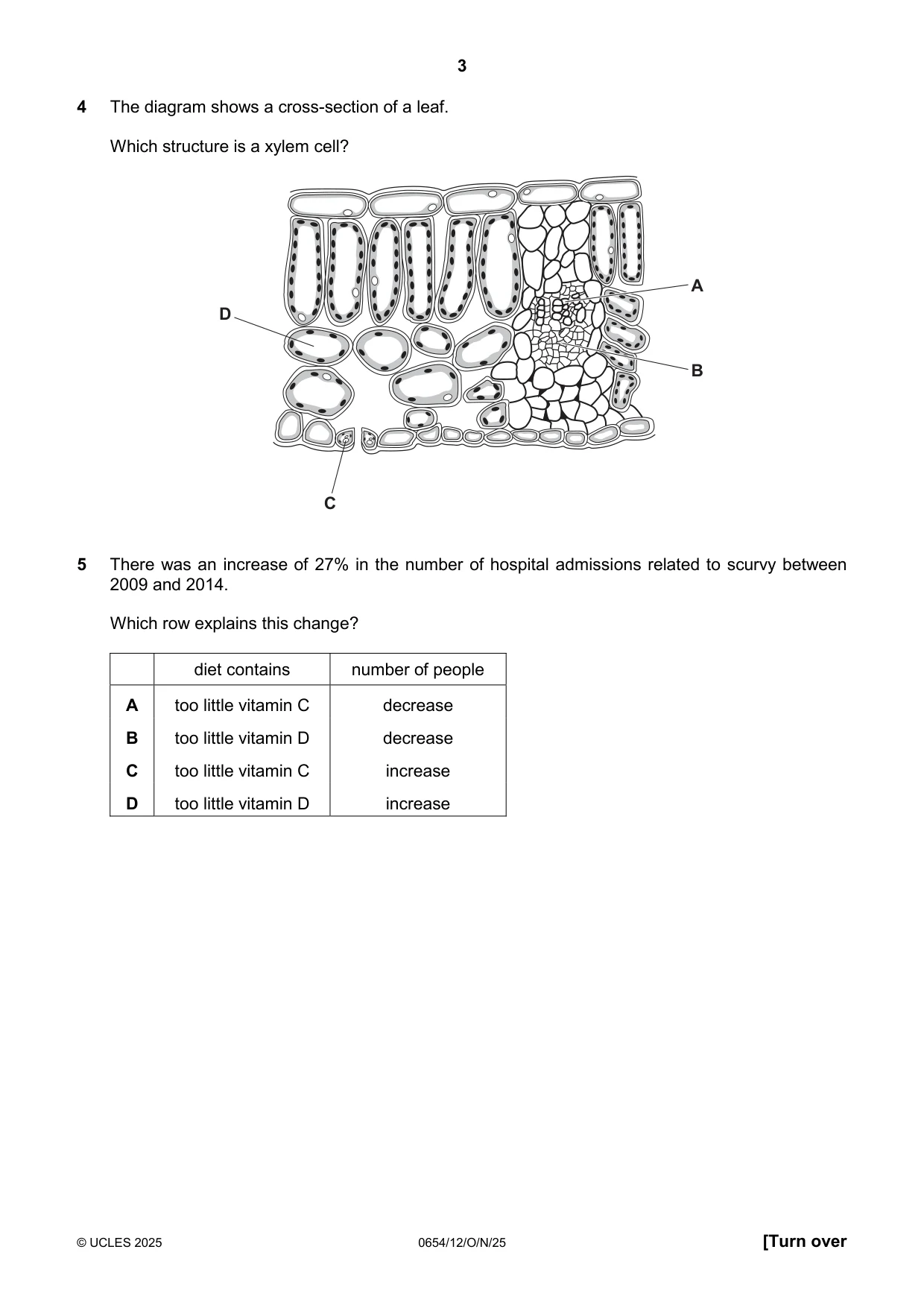
Q4 · The diagram shows a cross-section of a leaf
4 The diagram shows a cross-section of a leaf. Which structure is a xylem cell? A D B C
Mark scheme: A
Q5 · There was an increase of 27% in the number of hospital admissions related to scurvy…
5 There was an increase of 27% in the number of hospital admissions related to scurvy between 2009 and 2014. Which row explains this change? diet contains number of people A too little vitamin C decrease B too little vitamin D decrease C too little vitamin C increase D too little vitamin D increase
Mark scheme: C
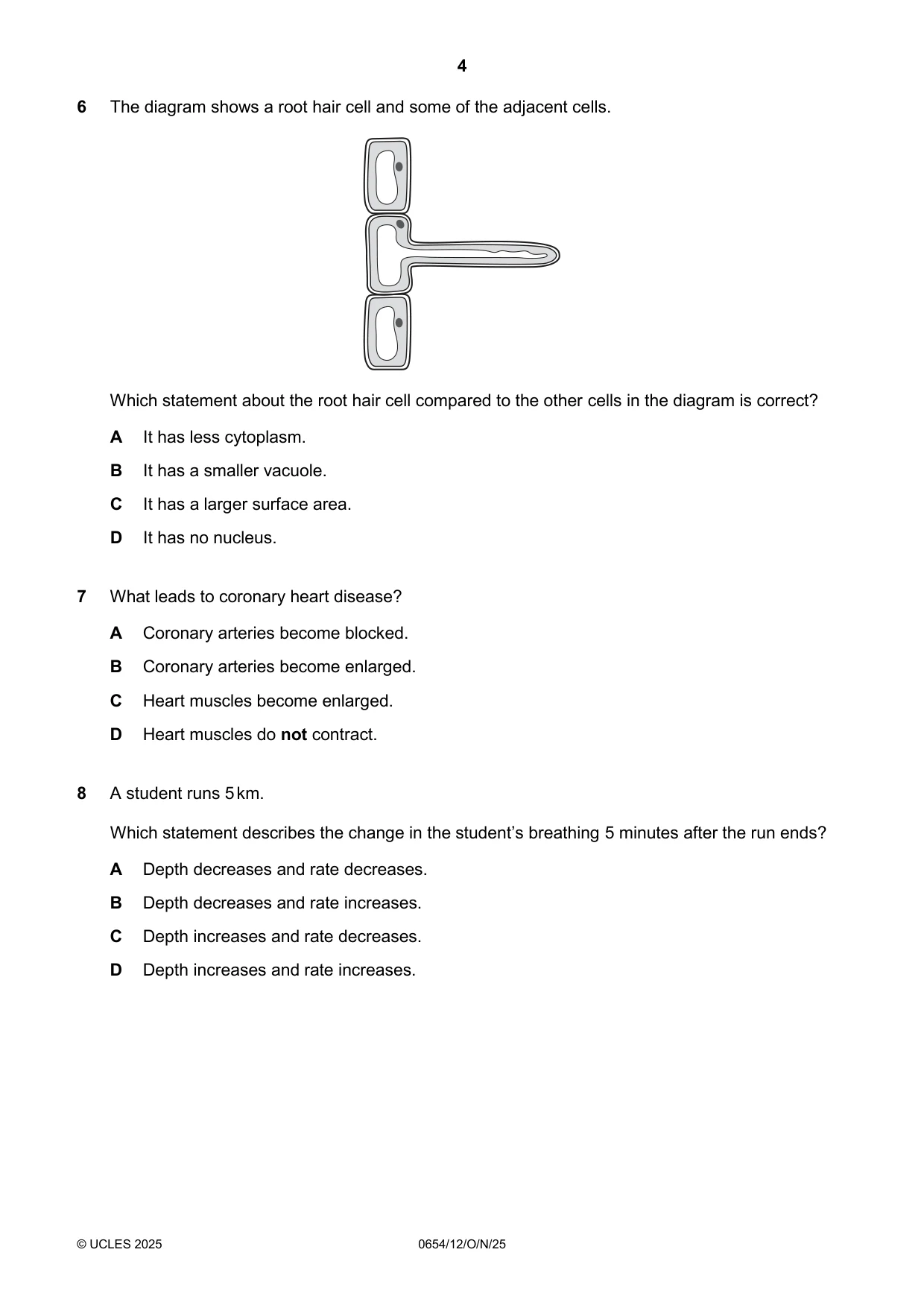
Q6 · The diagram shows a root hair cell and some of the adjacent cells
6 The diagram shows a root hair cell and some of the adjacent cells. Which statement about the root hair cell compared to the other cells in the diagram is correct? A It has less cytoplasm. B It has a smaller vacuole. C It has a larger surface area. D It has no nucleus.
Mark scheme: C
Q7 · What leads to coronary heart disease?
7 What leads to coronary heart disease? A Coronary arteries become blocked. B Coronary arteries become enlarged. C Heart muscles become enlarged. D Heart muscles do not contract.
Mark scheme: A
Q8 · A student runs 5 km
8 A student runs 5 km. Which statement describes the change in the student’s breathing 5 minutes after the run ends? A Depth decreases and rate decreases. B Depth decreases and rate increases. C Depth increases and rate decreases. D Depth increases and rate increases.
Mark scheme: A
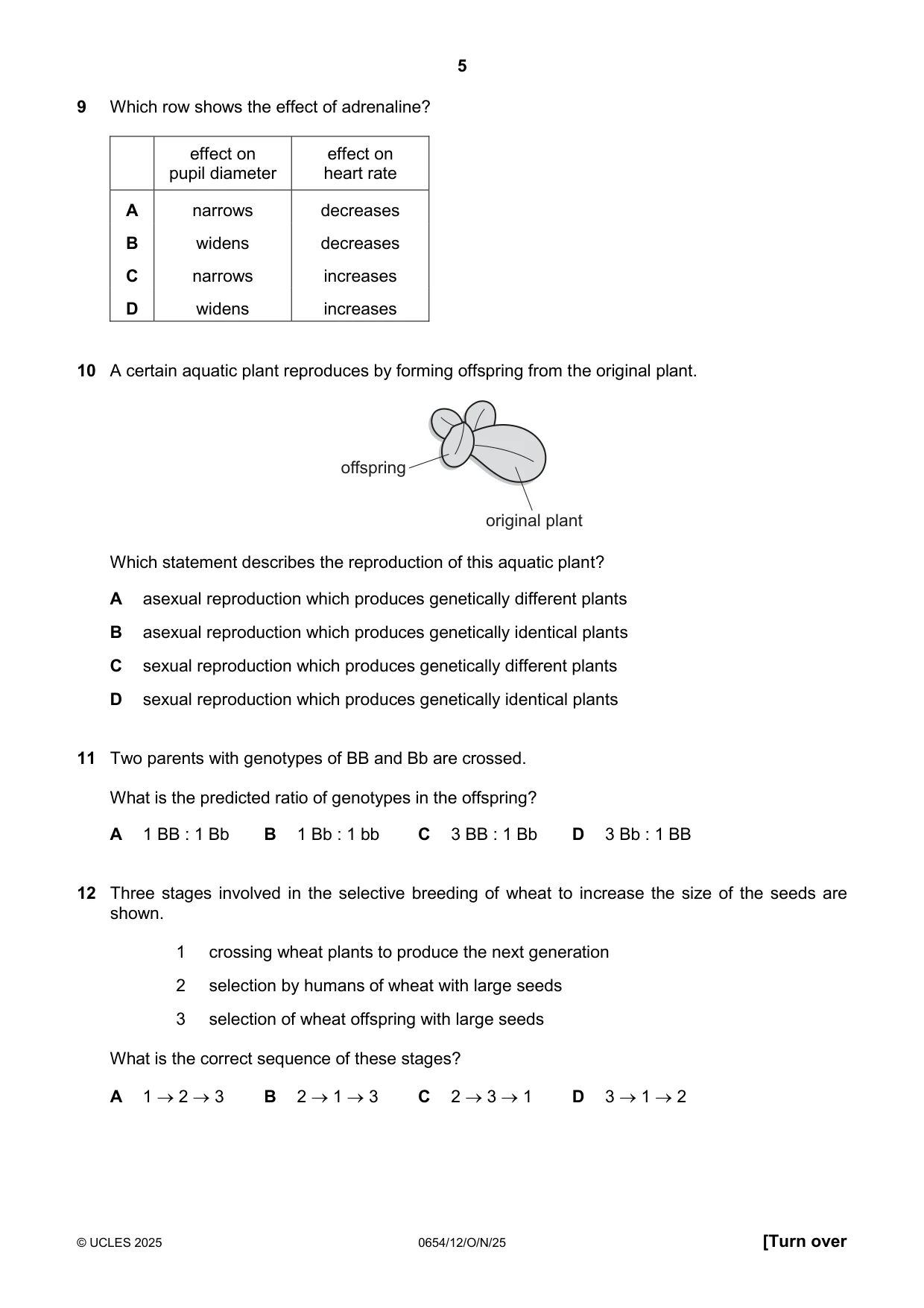
Q9 · Which row shows the effect of adrenaline?
9 Which row shows the effect of adrenaline? effect on effect on pupil diameter heart rate A narrows decreases B widens decreases C narrows increases D widens increases
Mark scheme: D
Q10 · A certain aquatic plant reproduces by forming offspring from the original plant
10 A certain aquatic plant reproduces by forming offspring from the original plant. offspring original plant Which statement describes the reproduction of this aquatic plant? A asexual reproduction which produces genetically different plants B asexual reproduction which produces genetically identical plants C sexual reproduction which produces genetically different plants D sexual reproduction which produces genetically identical plants
Mark scheme: B
Q11 · Two parents with genotypes of BB and Bb are crossed
11 Two parents with genotypes of BB and Bb are crossed. What is the predicted ratio of genotypes in the offspring? A 1 BB : 1 Bb B 1 Bb : 1 bb C 3 BB : 1 Bb D 3 Bb : 1 BB
Mark scheme: A
Q12 · Three stages involved in the selective breeding of wheat to increase the size of the…
12 Three stages involved in the selective breeding of wheat to increase the size of the seeds are shown. 1 crossing wheat plants to produce the next generation 2 selection by humans of wheat with large seeds 3 selection of wheat offspring with large seeds What is the correct sequence of these stages? A 1 2 3 B 2 1 3 C 2 3 1 D 3 1 2
Mark scheme: B
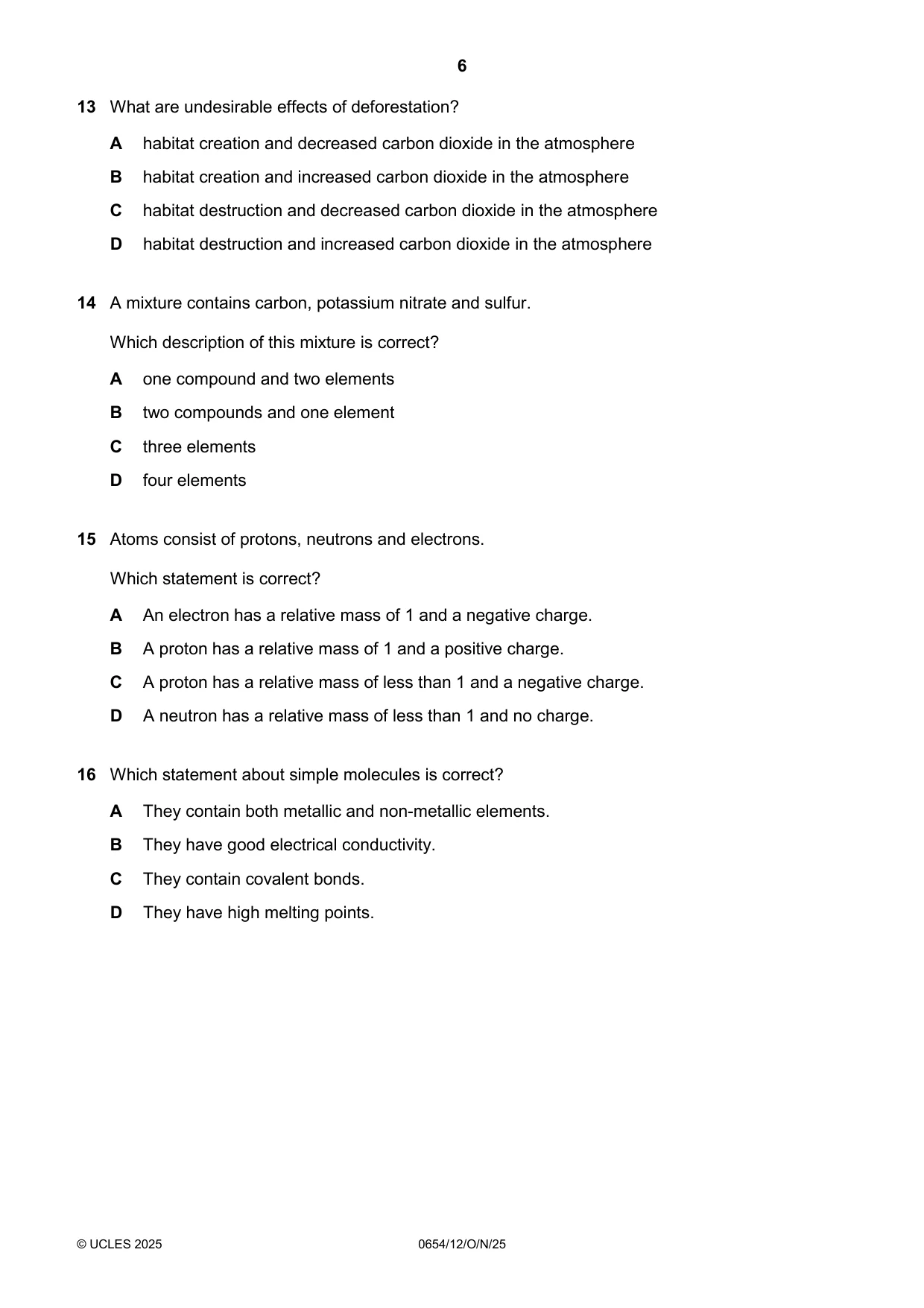
Q13 · What are undesirable effects of deforestation?
13 What are undesirable effects of deforestation? A habitat creation and decreased carbon dioxide in the atmosphere B habitat creation and increased carbon dioxide in the atmosphere C habitat destruction and decreased carbon dioxide in the atmosphere D habitat destruction and increased carbon dioxide in the atmosphere
Mark scheme: D
Q14 · A mixture contains carbon, potassium nitrate and sulfur
14 A mixture contains carbon, potassium nitrate and sulfur. Which description of this mixture is correct? A one compound and two elements B two compounds and one element C three elements D four elements
Mark scheme: A
Q15 · Atoms consist of protons, neutrons and electrons
15 Atoms consist of protons, neutrons and electrons. Which statement is correct? A An electron has a relative mass of 1 and a negative charge. B A proton has a relative mass of 1 and a positive charge. C A proton has a relative mass of less than 1 and a negative charge. D A neutron has a relative mass of less than 1 and no charge.
Mark scheme: B
Q16 · Which statement about simple molecules is correct?
16 Which statement about simple molecules is correct? A They contain both metallic and non-metallic elements. B They have good electrical conductivity. C They contain covalent bonds. D They have high melting points.
Mark scheme: C
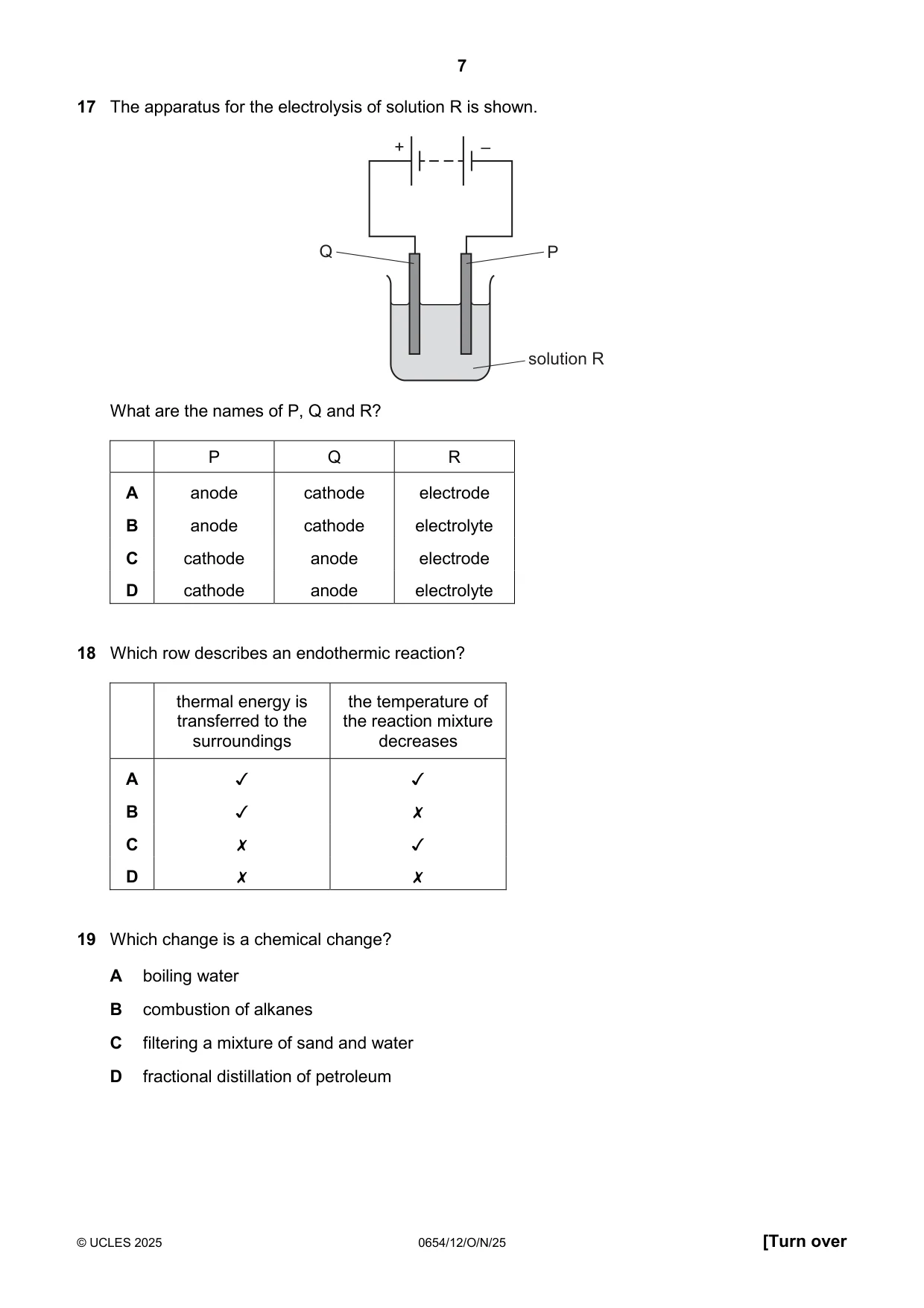
Q17 · The apparatus for the electrolysis of solution R is shown
17 The apparatus for the electrolysis of solution R is shown. + – Q P solution R What are the names of P, Q and R? P Q R A anode cathode electrode B anode cathode electrolyte C cathode anode electrode D cathode anode electrolyte
Mark scheme: D
Q18 · Which row describes an endothermic reaction?
18 Which row describes an endothermic reaction? thermal energy is the temperature of transferred to the the reaction mixture surroundings decreases
Mark scheme: C
Q19 · Which change is a chemical change?
19 Which change is a chemical change? A boiling water B combustion of alkanes C filtering a mixture of sand and water D fractional distillation of petroleum
Mark scheme: B
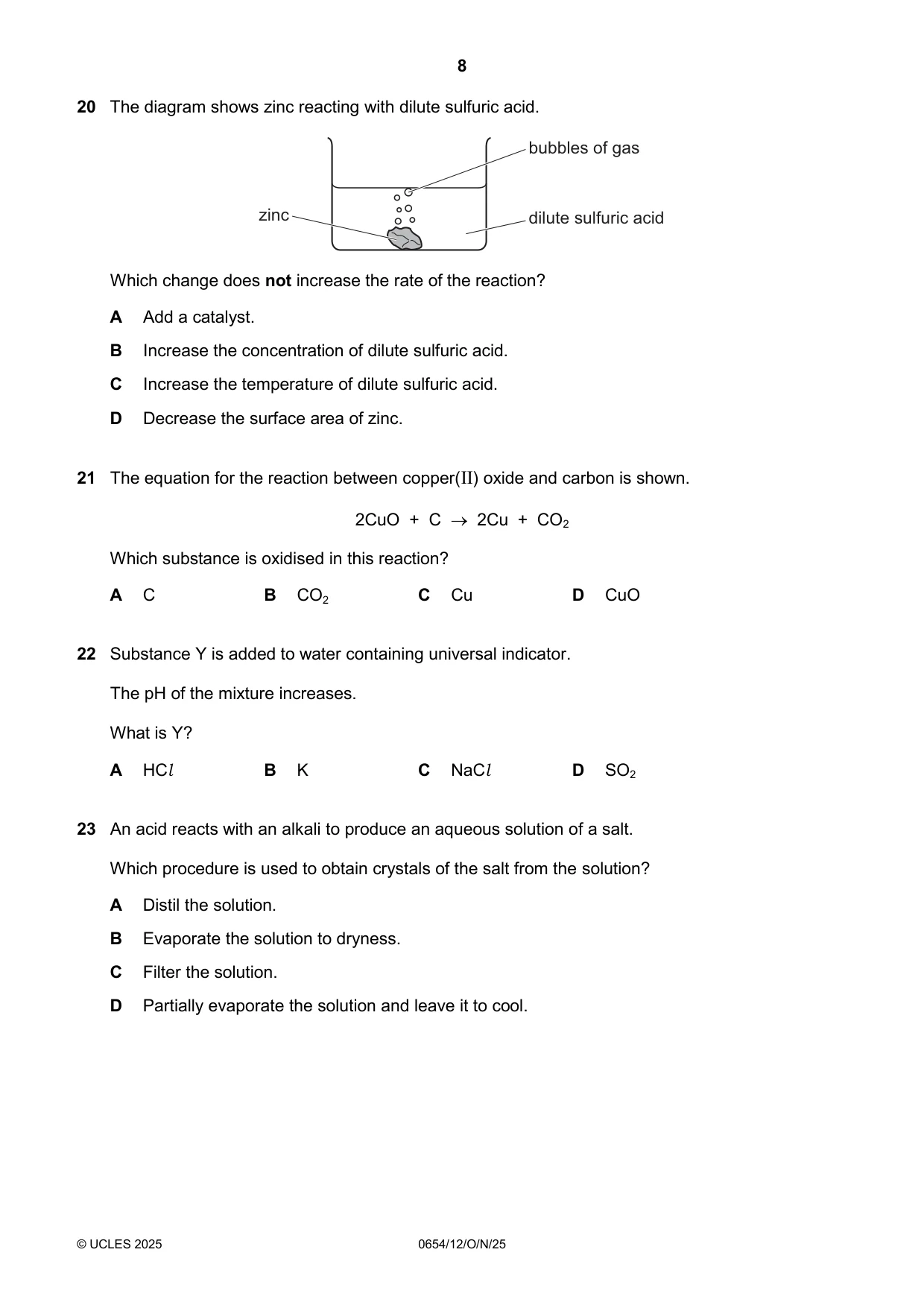
Q20 · The diagram shows zinc reacting with dilute sulfuric acid
20 The diagram shows zinc reacting with dilute sulfuric acid. bubbles of gas zinc dilute sulfuric acid Which change does not increase the rate of the reaction? A Add a catalyst. B Increase the concentration of dilute sulfuric acid. C Increase the temperature of dilute sulfuric acid. D Decrease the surface area of zinc.
Mark scheme: D
Q21 · The equation for the reaction between copper(II) oxide and carbon is shown
21 The equation for the reaction between copper(II) oxide and carbon is shown. 2CuO + C 2Cu + CO2 Which substance is oxidised in this reaction? A C B CO2 C Cu D CuO
Mark scheme: A
Q22 · Substance Y is added to water containing universal indicator
22 Substance Y is added to water containing universal indicator. The pH of the mixture increases. What is Y? A HCl B K C NaCl D SO2
Mark scheme: B
More questions on The characteristic properties of acids and bases
Q23 · An acid reacts with an alkali to produce an aqueous solution of a salt
23 An acid reacts with an alkali to produce an aqueous solution of a salt. Which procedure is used to obtain crystals of the salt from the solution? A Distil the solution. B Evaporate the solution to dryness. C Filter the solution. D Partially evaporate the solution and leave it to cool.
Mark scheme: D
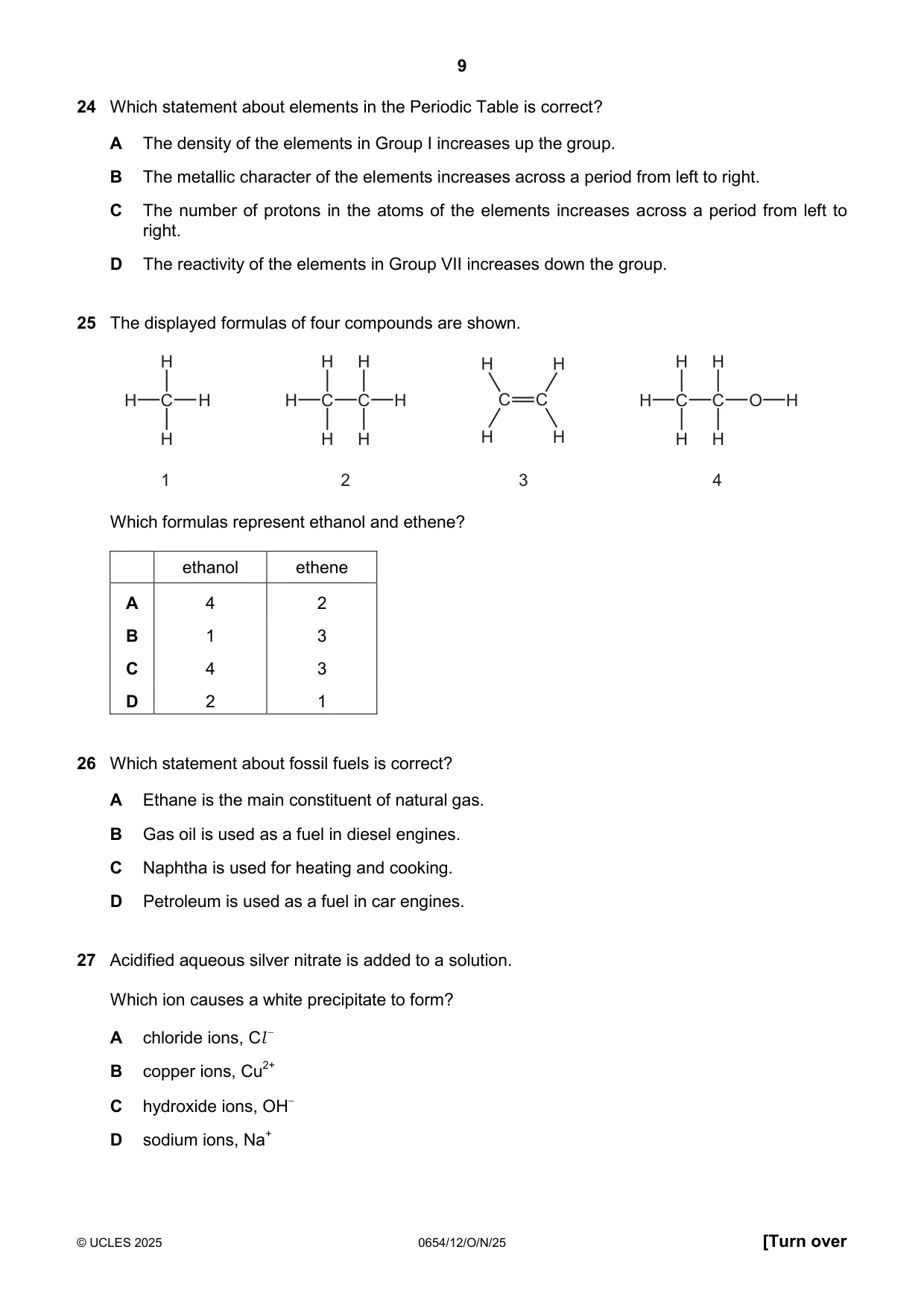
Q24 · Which statement about elements in the Periodic Table is correct?
24 Which statement about elements in the Periodic Table is correct? A The density of the elements in Group I increases up the group. B The metallic character of the elements increases across a period from left to right. C The number of protons in the atoms of the elements increases across a period from left to right. D The reactivity of the elements in Group VII increases down the group.
Mark scheme: C
Q25 · The displayed formulas of four compounds are shown
25 The displayed formulas of four compounds are shown. H H H H H H H H C H H C C H C C H C C O H H H H H H H H 1 2 3 4 Which formulas represent ethanol and ethene? ethanol ethene A 4 2 B 1 3 C 4 3 D 2 1
Mark scheme: C
Q26 · Which statement about fossil fuels is correct?
26 Which statement about fossil fuels is correct? A Ethane is the main constituent of natural gas. B Gas oil is used as a fuel in diesel engines. C Naphtha is used for heating and cooking. D Petroleum is used as a fuel in car engines.
Mark scheme: B
Q27 · Acidified aqueous silver nitrate is added to a solution
27 Acidified aqueous silver nitrate is added to a solution. Which ion causes a white precipitate to form? A chloride ions, Cl B copper ions, Cu2+ C hydroxide ions, OH D sodium ions, Na+
Mark scheme: A
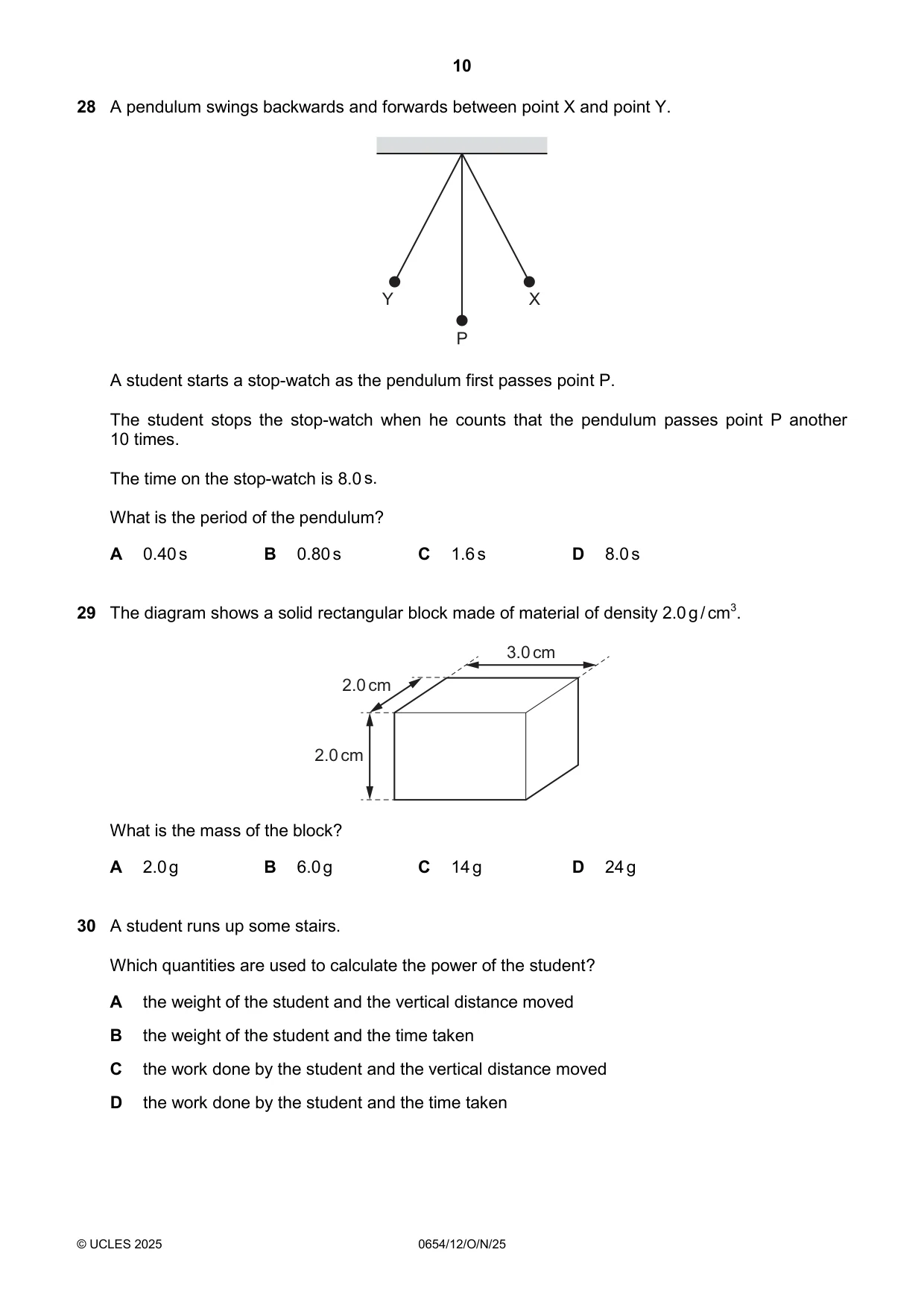
Q28 · A pendulum swings backwards and forwards between point X and point Y
28 A pendulum swings backwards and forwards between point X and point Y. Y X P A student starts a stop-watch as the pendulum first passes point P. The student stops the stop-watch when he counts that the pendulum passes point P another 10 times. The time on the stop-watch is 8.0 s. What is the period of the pendulum? A 0.40 s B 0.80 s C 1.6 s D 8.0 s
Mark scheme: C
More questions on Physical quantities and measurement techniques
Q29 · The diagram shows a solid rectangular block made of material of density 2.0 g / cm3
29 The diagram shows a solid rectangular block made of material of density 2.0 g / cm3. 3.0 cm 2.0 cm 2.0 cm What is the mass of the block? A 2.0 g B 6.0 g C 14 g D 24 g
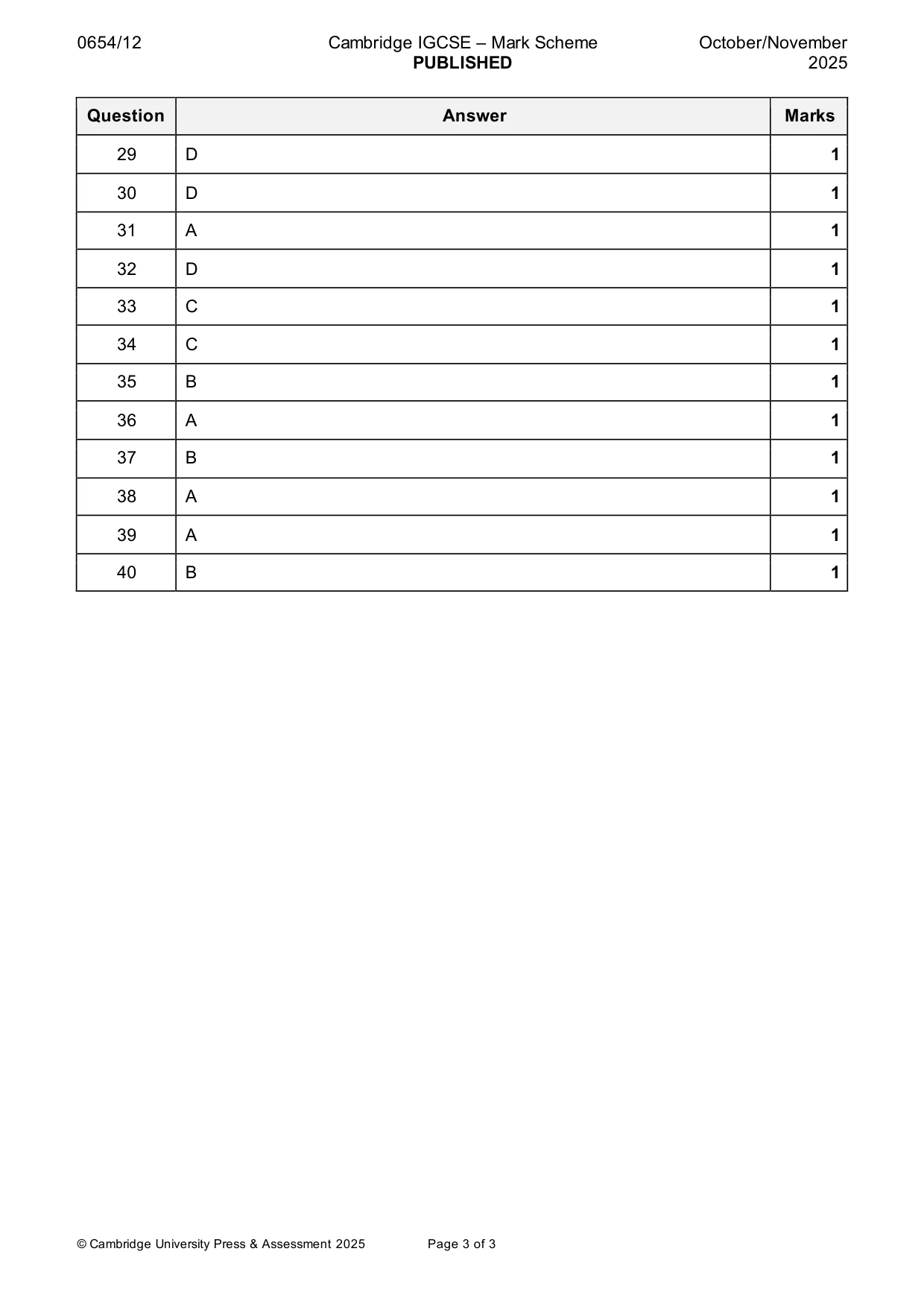
Mark scheme: D
Q30 · A student runs up some stairs
30 A student runs up some stairs. Which quantities are used to calculate the power of the student? A the weight of the student and the vertical distance moved B the weight of the student and the time taken C the work done by the student and the vertical distance moved D the work done by the student and the time taken
Mark scheme: D
Q31 · Which statement describes the behaviour of particles during the evaporation of a liquid?
31 Which statement describes the behaviour of particles during the evaporation of a liquid? A Only the more energetic particles escape. B Particles bond together. C Particles move closer together. D The least energetic particles escape first.
Mark scheme: A
Q32 · What is the method of thermal energy transfer from the Sun to the Earth through the…
32 What is the method of thermal energy transfer from the Sun to the Earth through the vacuum of space? A conduction B convection C evaporation D radiation
Mark scheme: D
Q33 · Which statement about waves is correct?
33 Which statement about waves is correct? A They do not transfer energy or matter. B They transfer energy and matter. C They transfer energy but not matter. D They transfer matter but not energy.
Mark scheme: C
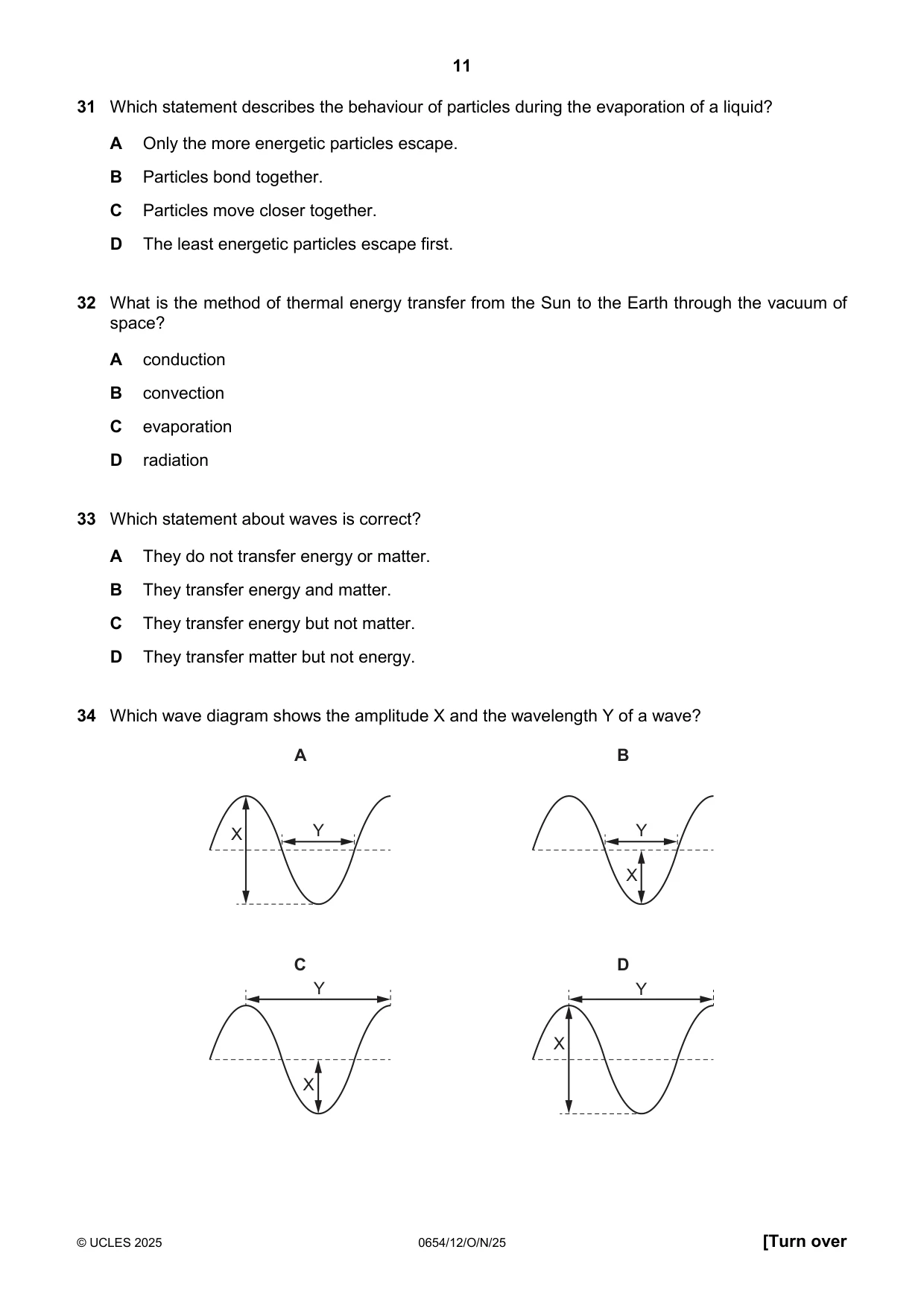
Q34 · Which wave diagram shows the amplitude X and the wavelength Y of a wave?
34 Which wave diagram shows the amplitude X and the wavelength Y of a wave? A B X Y Y X C D Y Y X X
Mark scheme: C
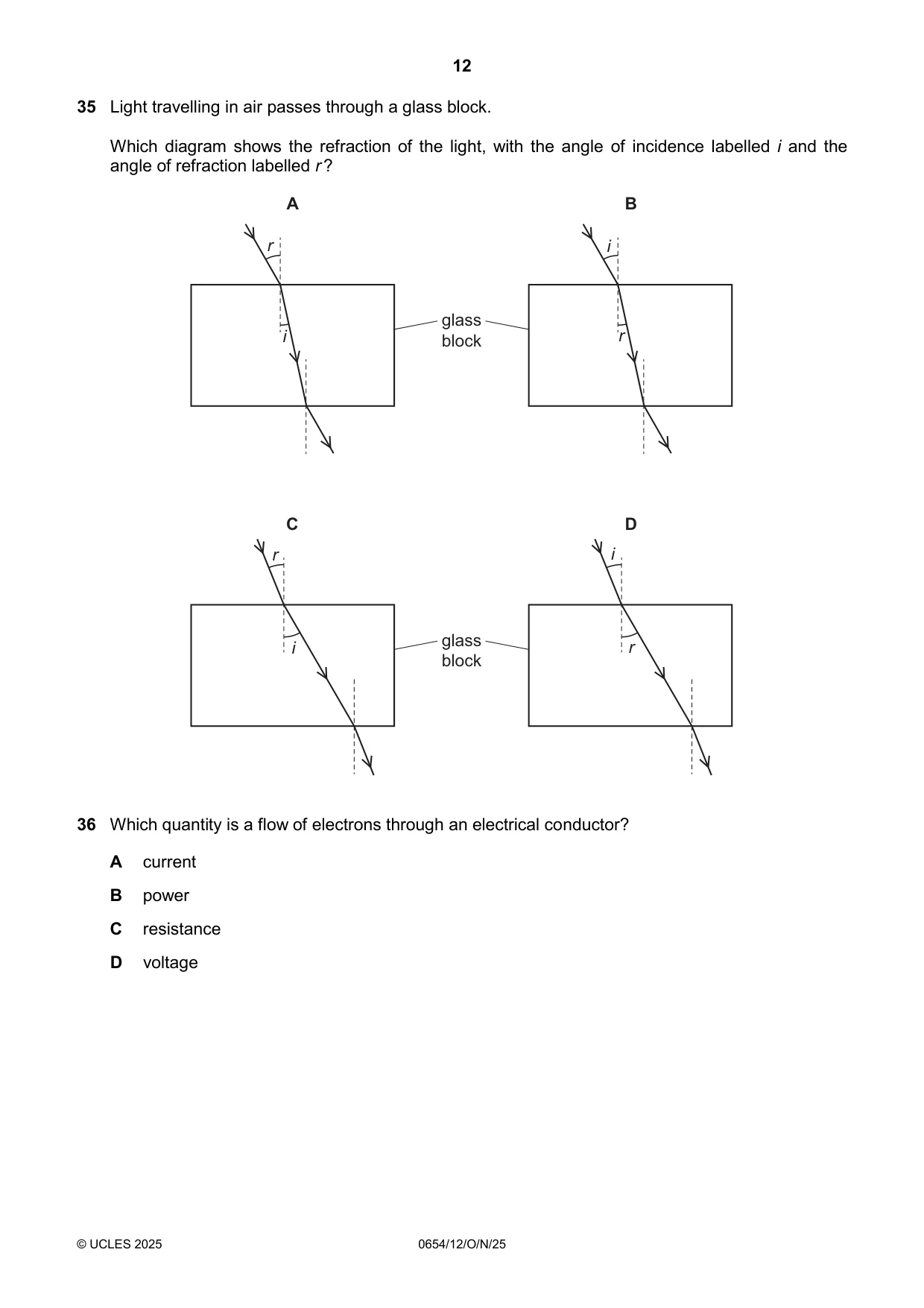
Q35 · Light travelling in air passes through a glass block
35 Light travelling in air passes through a glass block. Which diagram shows the refraction of the light, with the angle of incidence labelled i and the angle of refraction labelled r ? A B r i glass i block r C D r i i glass r block
Mark scheme: B
Q36 · Which quantity is a flow of electrons through an electrical conductor?
36 Which quantity is a flow of electrons through an electrical conductor? A current B power C resistance D voltage
Mark scheme: A
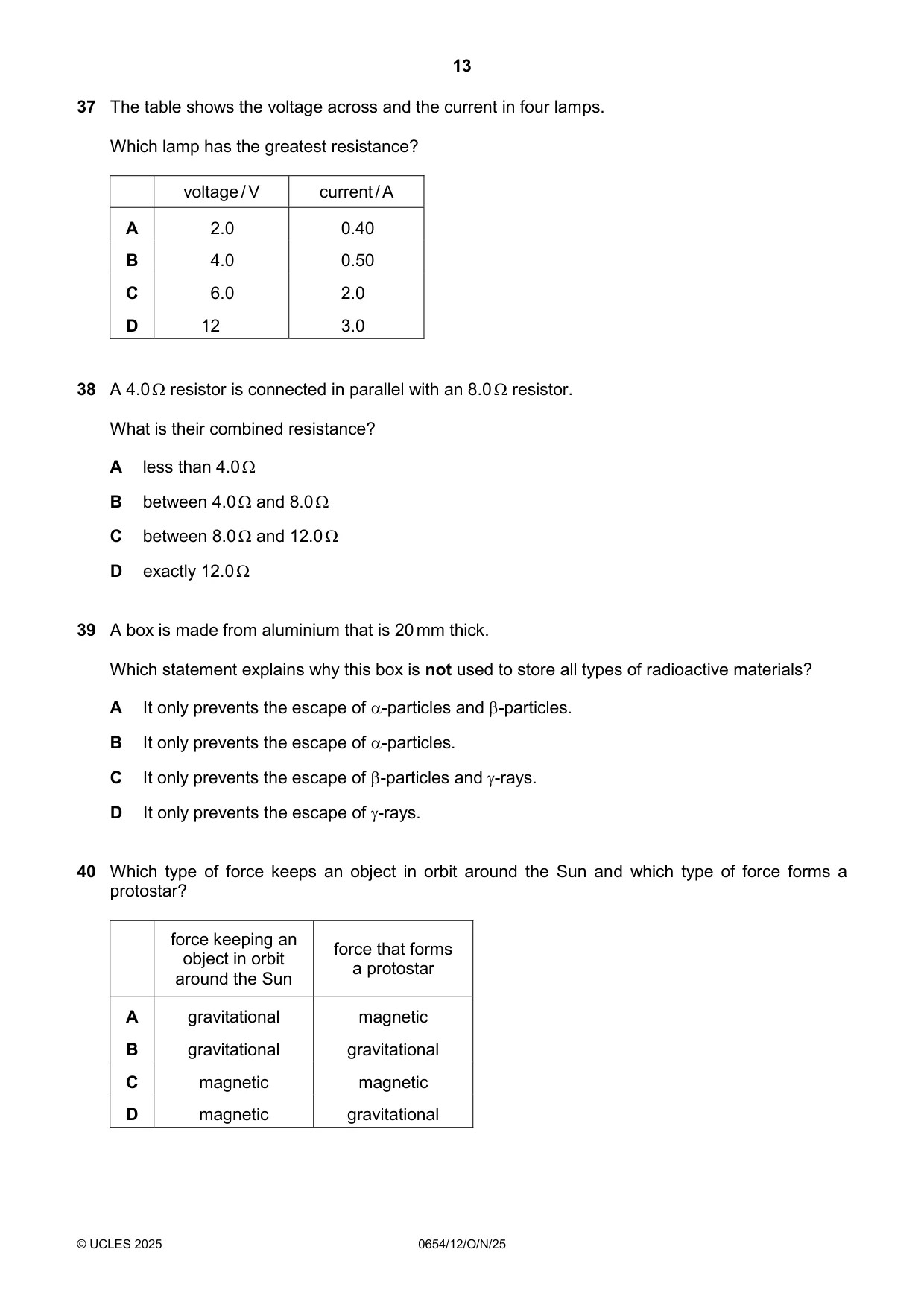
Q37 · The table shows the voltage across and the current in four lamps
37 The table shows the voltage across and the current in four lamps. Which lamp has the greatest resistance? voltage / V current / A A 2.0 0.40 B 4.0 0.50 C 6.0 2.0 D 12 3.0
Mark scheme: B
Q38 · A 4.0 resistor is connected in parallel with an 8.0 resistor
38 A 4.0 resistor is connected in parallel with an 8.0 resistor. What is their combined resistance? A less than 4.0 B between 4.0 and 8.0 C between 8.0 and 12.0 D exactly 12.0
Mark scheme: A
Q39 · A box is made from aluminium that is 20 mm thick
39 A box is made from aluminium that is 20 mm thick. Which statement explains why this box is not used to store all types of radioactive materials? A It only prevents the escape of -particles and -particles. B It only prevents the escape of -particles. C It only prevents the escape of -particles and -rays. D It only prevents the escape of -rays.
Mark scheme: A
Q40 · Which type of force keeps an object in orbit around the Sun and which type of force forms…
40 Which type of force keeps an object in orbit around the Sun and which type of force forms a protostar? force keeping an force that forms object in orbit a protostar around the Sun A gravitational magnetic B gravitational gravitational C magnetic magnetic D magnetic gravitational
Mark scheme: B
What was in this paper
The subtopics covered by these 40 questions, and how many questions each got. Open one in a new tab to see every Cambridge question on it.
2Electrical quantities2General properties of waves2Alcohols1Arrangement of elements1Asexual reproduction1Atomic structure and the Periodic Table1Biological molecules1Density1Diet1Electrical circuits1Electrolysis1Elements, compounds and mixtures1Energy, work and power1Enzymes1Exothermic and endothermic reactions1Fuels1Gas exchange in humans1Habitat destruction1Heart1Hormones1Identification of ions and gases1Kinetic particle model of matter1Light1Monohybrid inheritance1Physical and chemical changes1Physical quantities and measurement techniques1Preparation of salts1Radioactivity1Rate of reaction1Redox1Selection1Simple molecules and covalent bonds1The characteristic properties of acids and bases1The Solar System1Transfer of thermal energy1Xylem and phloem1What you needed in this session
Cambridge’s own grade thresholds for 2025 Oct/Nov, Paper 1 · Variant 2. A higher threshold means an easier paper — the bar moves with how the cohort did.