Cambridge IGCSE Sciences - Co-ordinated (Double) 0654 — 2014 May/June Paper 1 · Variant 2
0654/12/M/J/14 · 40 questions · 40 marks · ≈45 min
The question paper and its mark scheme, free to read here and free to download. This is Cambridge’s own paper, exactly as it was sat.
Question paper20 pages



Mark scheme2 pages
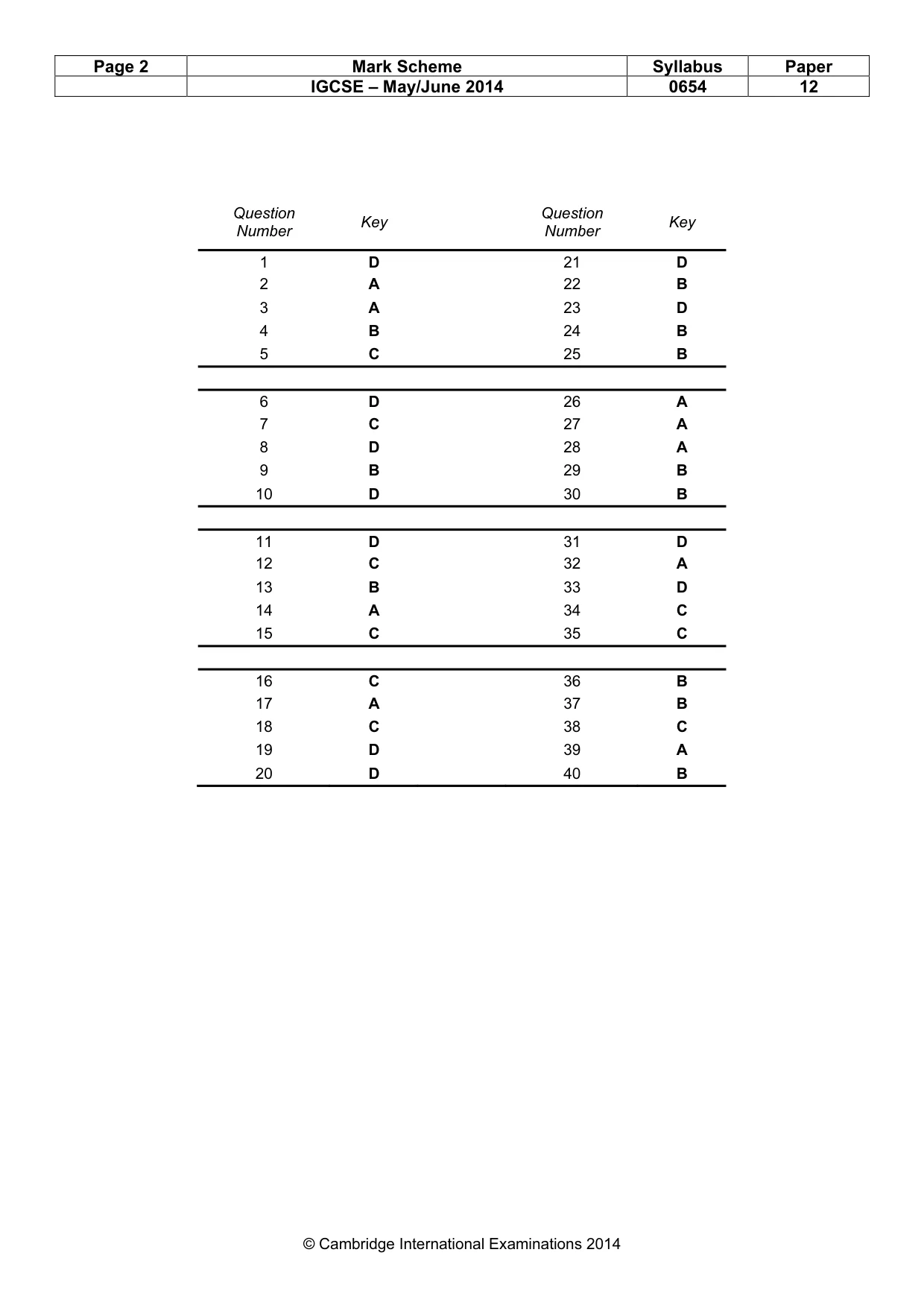
Answers below. Sit the paper first if you are practising.
Questions as text
Q1 · The Venus fly trap is a plant that catches insects
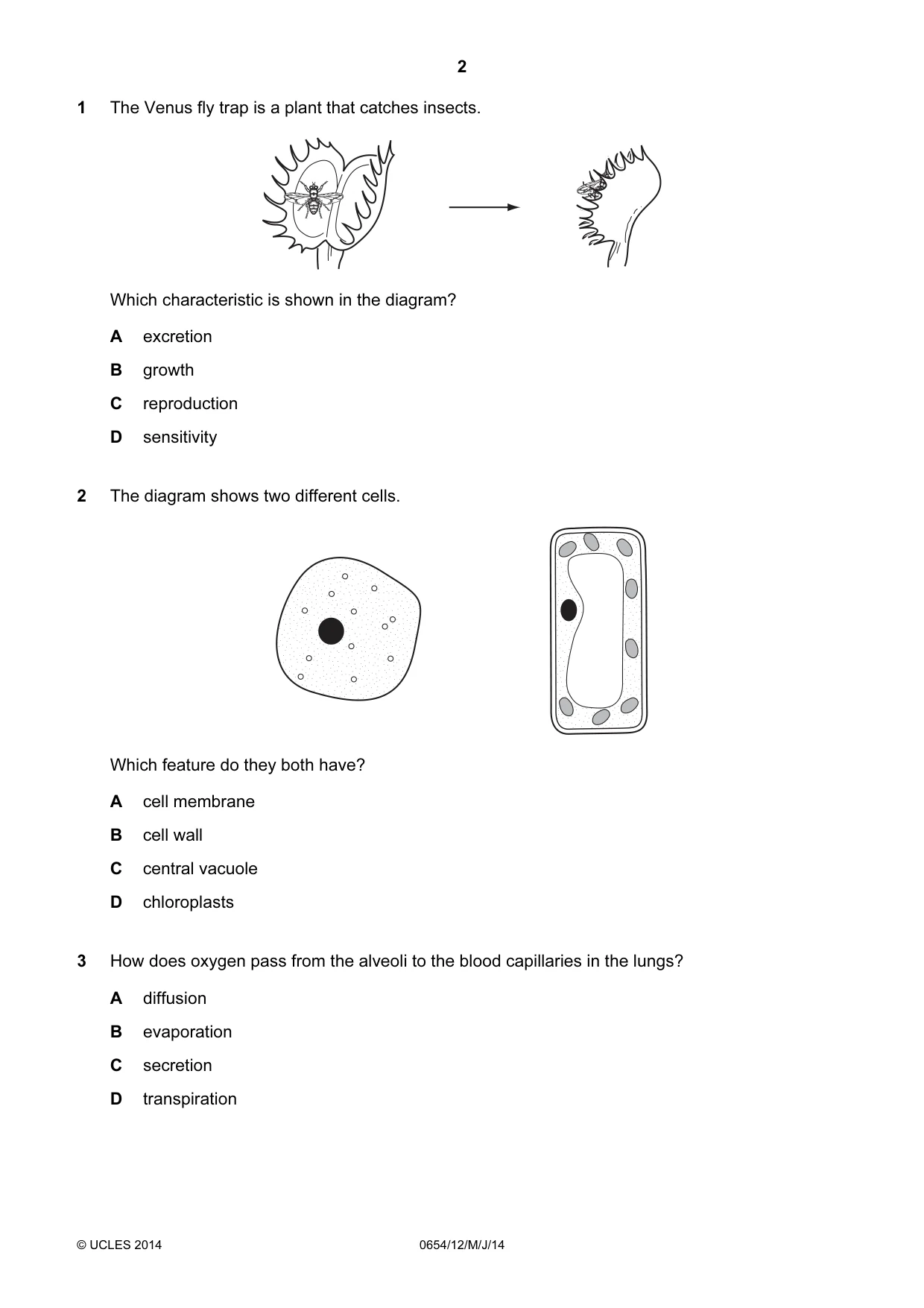
1 The Venus fly trap is a plant that catches insects. Which characteristic is shown in the diagram? A excretion B growth C reproduction D sensitivity
Mark scheme: D
Q2 · The diagram shows two different cells
2 The diagram shows two different cells. Which feature do they both have? A cell membrane B cell wall C central vacuole D chloroplasts
Mark scheme: A
Q3 · How does oxygen pass from the alveoli to the blood capillaries in the lungs?
3 How does oxygen pass from the alveoli to the blood capillaries in the lungs? A diffusion B evaporation C secretion D transpiration
Mark scheme: A
Q4 · A test-tube containing a starch-amylase mixture is incubated at 35 °C
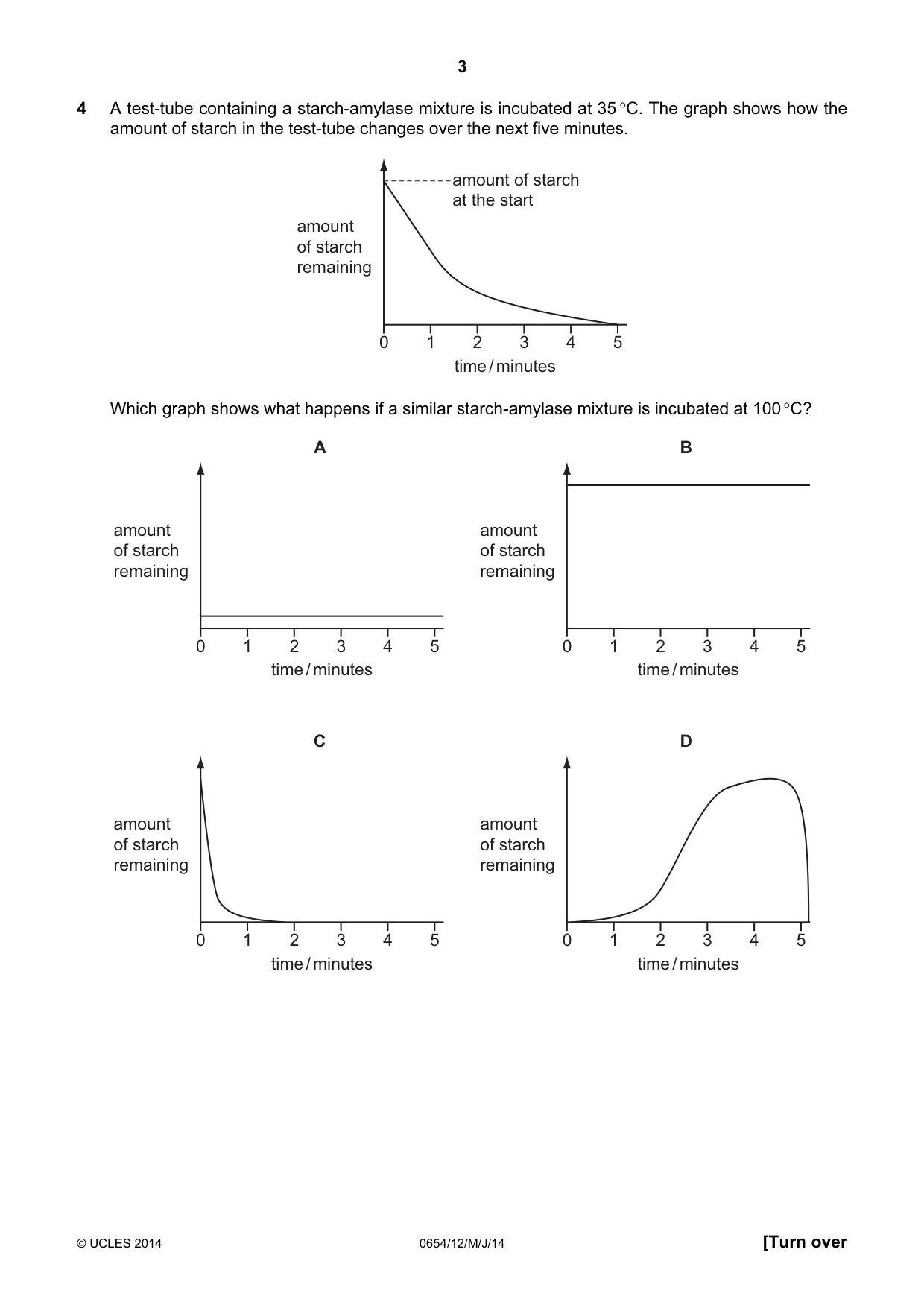
4 A test-tube containing a starch-amylase mixture is incubated at 35 °C. The graph shows how the amount of starch in the test-tube changes over the next five minutes. amount of starch at the start amount of starch remaining 0 1 2 3 4 5 time / minutes Which graph shows what happens if a similar starch-amylase mixture is incubated at 100 °C? A B amount amount of starch of starch remaining remaining 0 1 2 3 4 5 0 1 2 3 4 5 time / minutes time / minutes C D amount amount of starch of starch remaining remaining 0 1 2 3 4 5 0 1 2 3 4 5 time / minutes time / minutes
Mark scheme: B
Q5 · Which row states the basic units from which the large molecules are made?
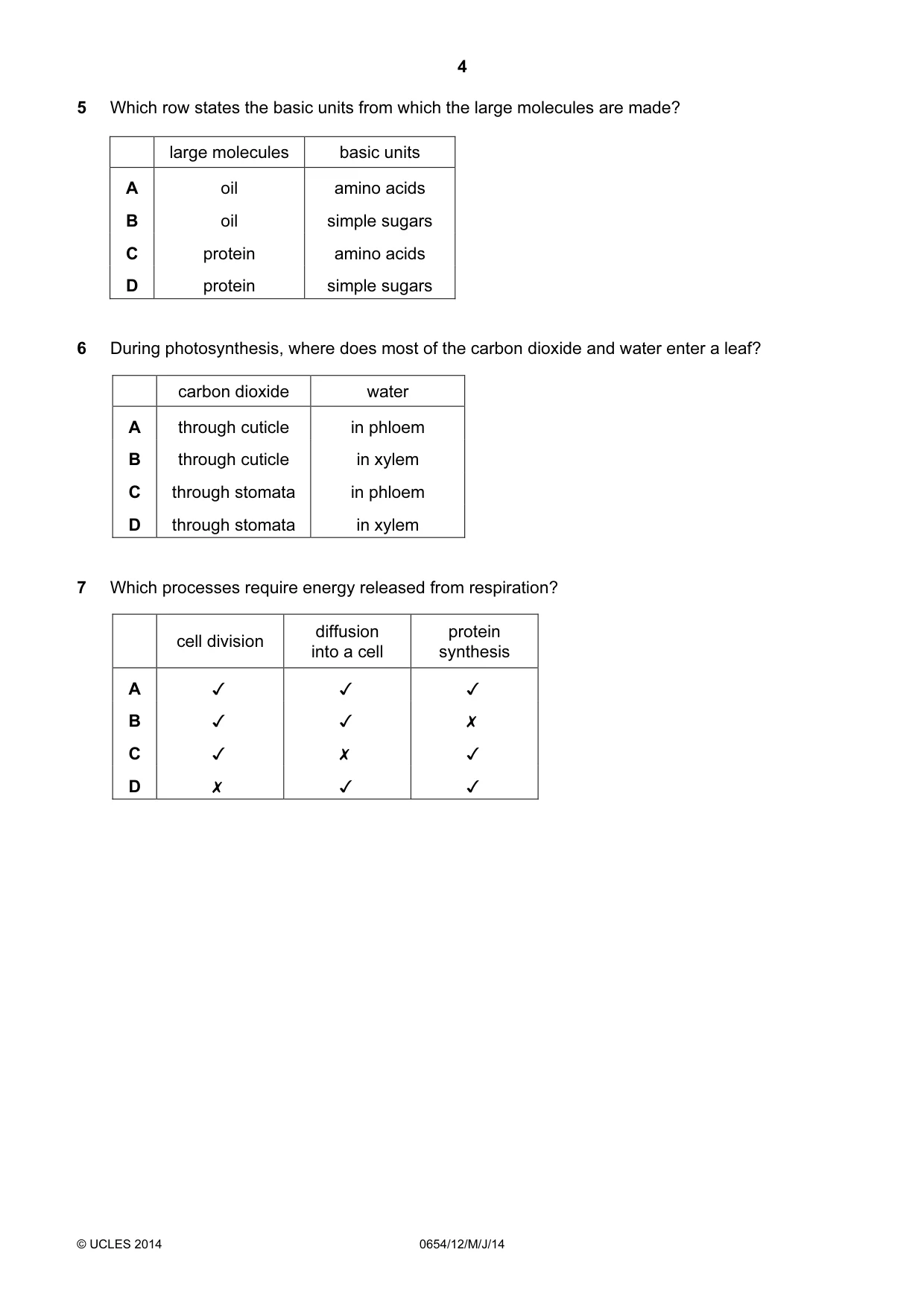
5 Which row states the basic units from which the large molecules are made? large molecules basic units A oil amino acids B oil simple sugars C protein amino acids D protein simple sugars
Mark scheme: C
Q6 · During photosynthesis, where does most of the carbon dioxide and water enter a leaf?
6 During photosynthesis, where does most of the carbon dioxide and water enter a leaf? carbon dioxide water A through cuticle in phloem B through cuticle in xylem C through stomata in phloem D through stomata in xylem
Mark scheme: D
Q7 · Which processes require energy released from respiration?
7 Which processes require energy released from respiration? oa diffusion protein cell division . . into a cell synthesis A Jv Jv Jv B Jv Jv x Cc Jv x J D x Jv Jv
Mark scheme: C
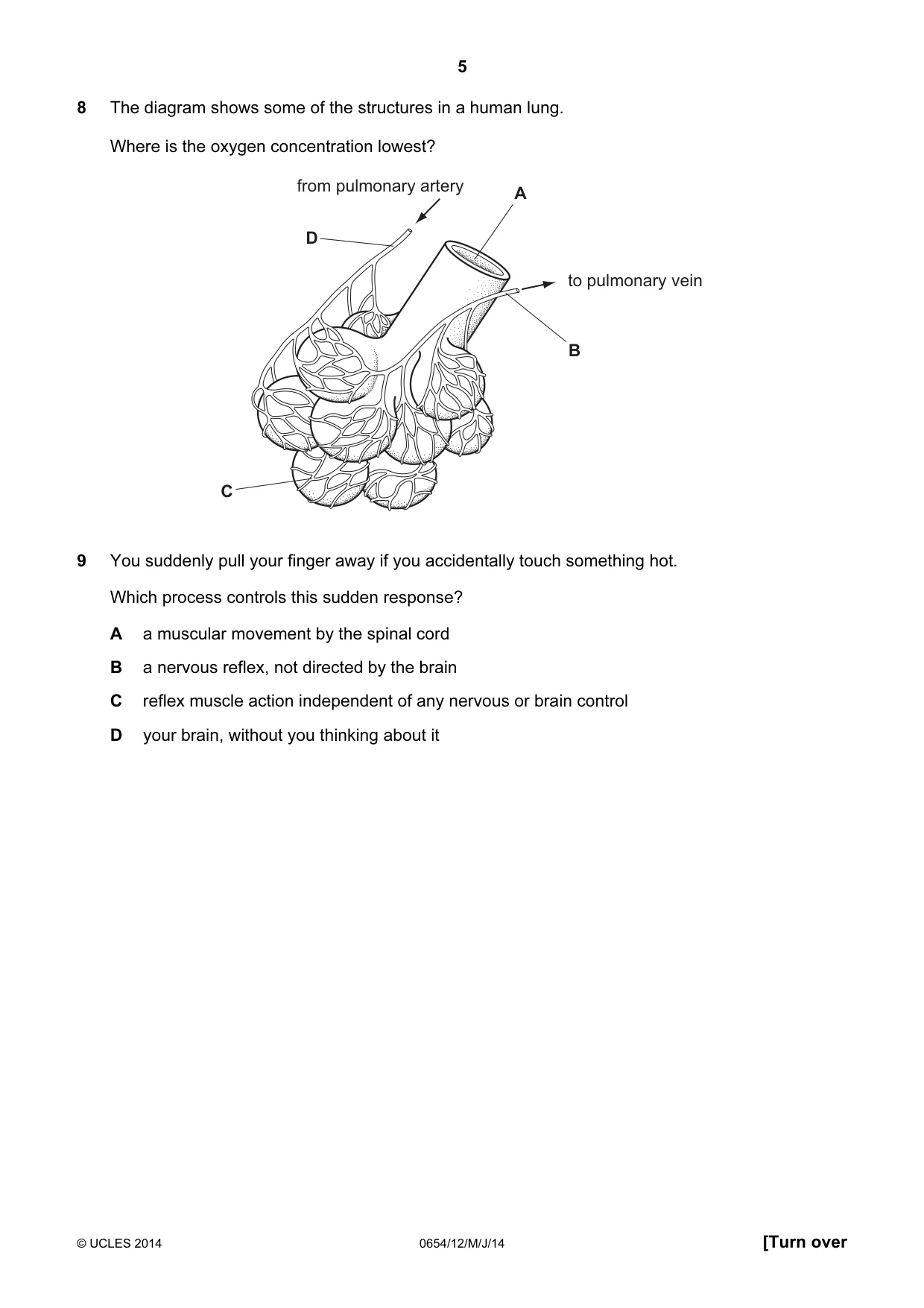
Q8 · The diagram shows some of the structures in a human lung
8 The diagram shows some of the structures in a human lung. Where is the oxygen concentration lowest? from pulmonary artery A D to pulmonary vein B C
Mark scheme: D
Q9 · You suddenly pull your finger away if you accidentally touch something hot
9 You suddenly pull your finger away if you accidentally touch something hot. Which process controls this sudden response? A a muscular movement by the spinal cord B a nervous reflex, not directed by the brain C reflex muscle action independent of any nervous or brain control D your brain, without you thinking about it
Mark scheme: B
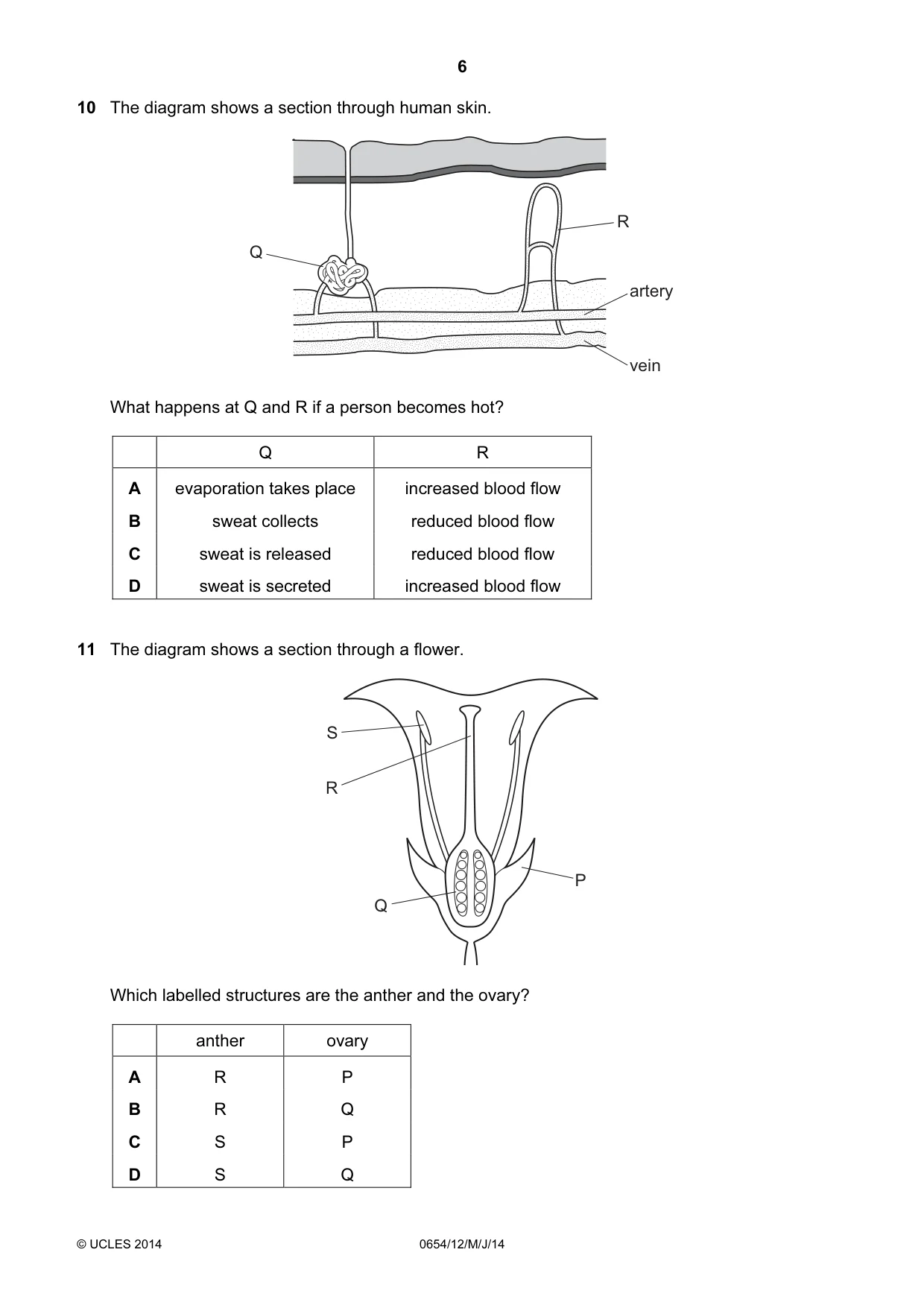
Q10 · The diagram shows a section through human skin
10 The diagram shows a section through human skin. R Q artery vein What happens at Q and R if a person becomes hot? Q R A evaporation takes place increased blood flow B sweat collects reduced blood flow C sweat is released reduced blood flow D sweat is secreted increased blood flow
Mark scheme: D
Q11 · The diagram shows a section through a flower
11 The diagram shows a section through a flower. S R P Q Which labelled structures are the anther and the ovary? anther ovary A R P B R Q C S P D S Q
Mark scheme: D
Q12 · What does a human male inherit from his father?
12 What does a human male inherit from his father? A an X allele B an X sperm C a Y chromosome D a Y gene
Mark scheme: C
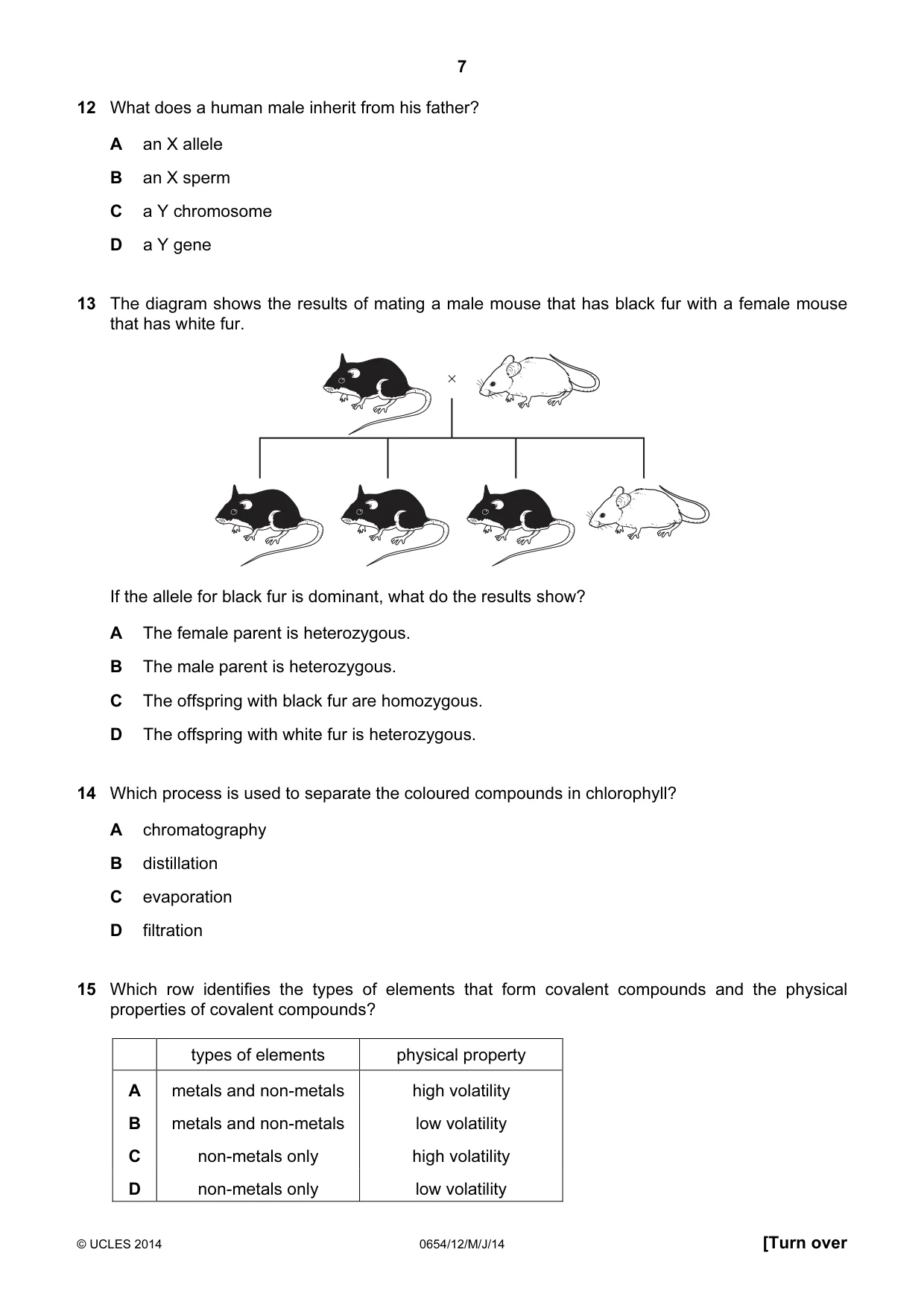
Q13 · The diagram shows the results of mating a male mouse that has black fur with a female…
13 The diagram shows the results of mating a male mouse that has black fur with a female mouse that has white fur. × If the allele for black fur is dominant, what do the results show? A The female parent is heterozygous. B The male parent is heterozygous. C The offspring with black fur are homozygous. D The offspring with white fur is heterozygous.
Mark scheme: B
Q14 · Which process is used to separate the coloured compounds in chlorophyll?
14 Which process is used to separate the coloured compounds in chlorophyll? A chromatography B distillation C evaporation D filtration
Mark scheme: A
Q15 · Which row identifies the types of elements that form covalent compounds and the physical…
15 Which row identifies the types of elements that form covalent compounds and the physical properties of covalent compounds? types of elements physical property A metals and non-metals high volatility B metals and non-metals low volatility C non-metals only high volatility D non-metals only low volatility
Mark scheme: C
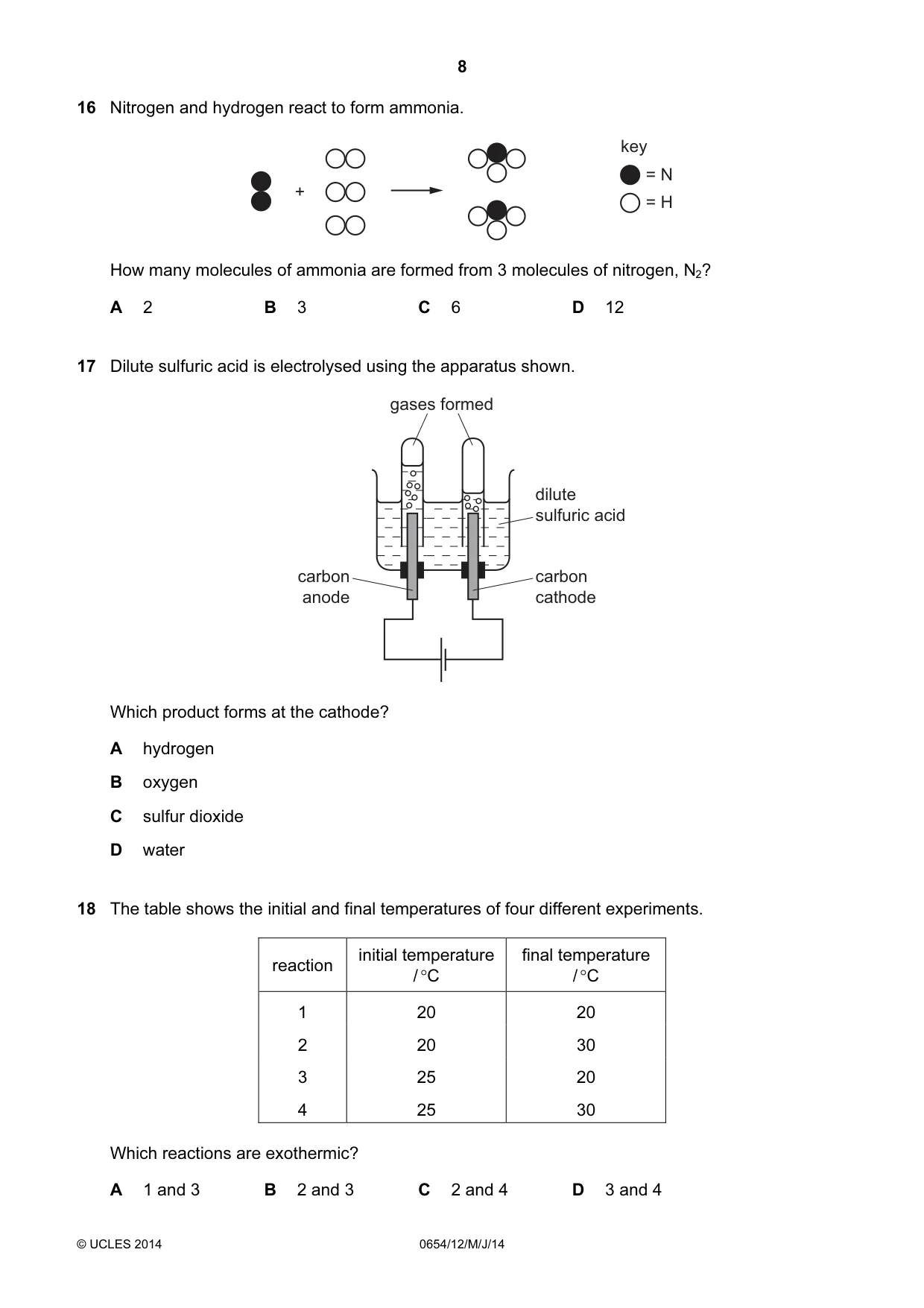
Q16 · Nitrogen and hydrogen react to form ammonia
16 Nitrogen and hydrogen react to form ammonia. key = N + = H How many molecules of ammonia are formed from 3 molecules of nitrogen, N2? A 2 B 3 C 6 D 12
Mark scheme: C
Q17 · Dilute sulfuric acid is electrolysed using the apparatus shown
17 Dilute sulfuric acid is electrolysed using the apparatus shown. gases formed dilute sulfuric acid carbon carbon anode cathode Which product forms at the cathode? A hydrogen B oxygen C sulfur dioxide D water
Mark scheme: A
Q18 · The table shows the initial and final temperatures of four different experiments
18 The table shows the initial and final temperatures of four different experiments. initial temperature final temperature reaction / °C / °C 1 20 20 2 20 30 3 25 20 4 25 30 Which reactions are exothermic? A 1 and 3 B 2 and 3 C 2 and 4 D 3 and 4
Mark scheme: C
Q19 · Some white anhydrous copper(II) sulfate powder is put into a beaker of water and stirred
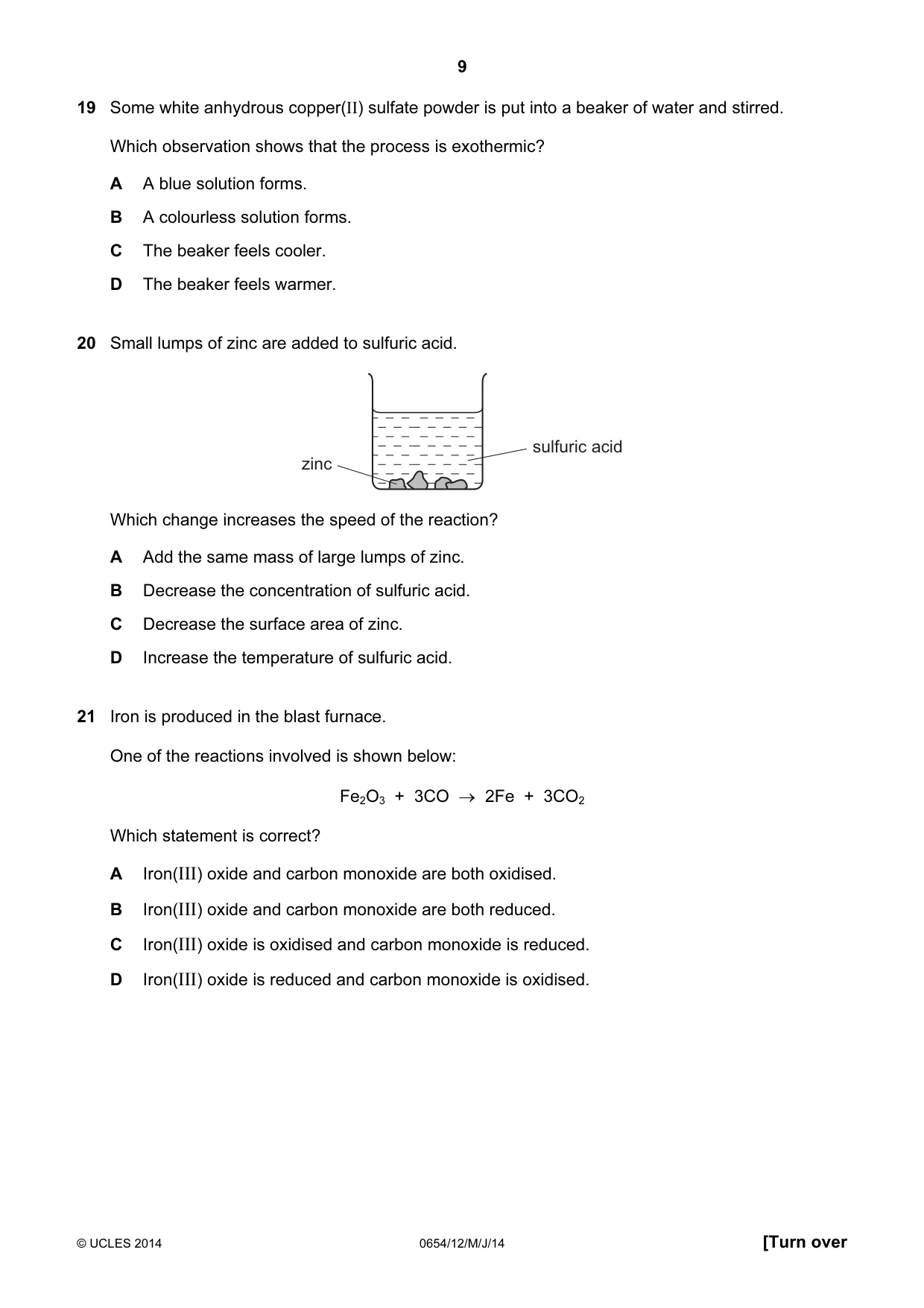
19 Some white anhydrous copper(II) sulfate powder is put into a beaker of water and stirred. Which observation shows that the process is exothermic? A A blue solution forms. B A colourless solution forms. C The beaker feels cooler. D The beaker feels warmer.
Mark scheme: D
Q20 · Small lumps of zinc are added to sulfuric acid
20 Small lumps of zinc are added to sulfuric acid. sulfuric acid zinc Which change increases the speed of the reaction? A Add the same mass of large lumps of zinc. B Decrease the concentration of sulfuric acid. C Decrease the surface area of zinc. D Increase the temperature of sulfuric acid.
Mark scheme: D
Q21 · Iron is produced in the blast furnace
21 Iron is produced in the blast furnace. One of the reactions involved is shown below: Fe2O3 + 3CO → 2Fe + 3CO2 Which statement is correct? A Iron(III) oxide and carbon monoxide are both oxidised. B Iron(III) oxide and carbon monoxide are both reduced. C Iron(III) oxide is oxidised and carbon monoxide is reduced. D Iron(III) oxide is reduced and carbon monoxide is oxidised.
Mark scheme: D
Q22 · A student tests an aqueous solution for the presence of sulfate ions
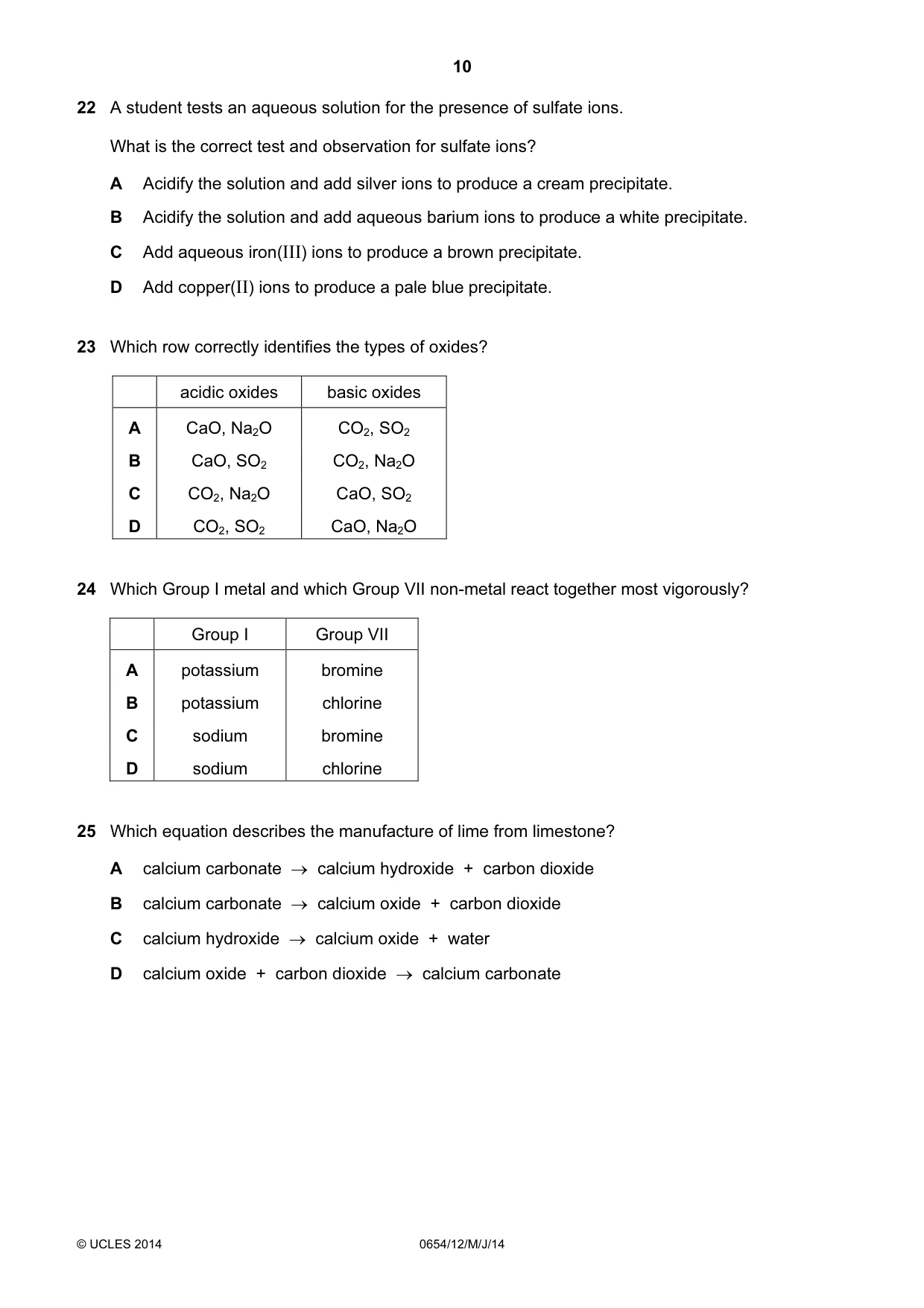
22 A student tests an aqueous solution for the presence of sulfate ions. What is the correct test and observation for sulfate ions? A Acidify the solution and add silver ions to produce a cream precipitate. B Acidify the solution and add aqueous barium ions to produce a white precipitate. C Add aqueous iron(III) ions to produce a brown precipitate. D Add copper(II) ions to produce a pale blue precipitate.
Mark scheme: B
Q23 · Which row correctly identifies the types of oxides?
23 Which row correctly identifies the types of oxides? acidic oxides basic oxides A CaO, Na2O CO2, SO2 B CaO, SO2 CO2, Na2O C CO2, Na2O CaO, SO2 D CO2, SO2 CaO, Na2O
Mark scheme: D
Q24 · Which Group I metal and which Group VII non-metal react together most vigorously?
24 Which Group I metal and which Group VII non-metal react together most vigorously? Group I Group VII A potassium bromine B potassium chlorine C sodium bromine D sodium chlorine
Mark scheme: B
Q25 · Which equation describes the manufacture of lime from limestone?
25 Which equation describes the manufacture of lime from limestone? A calcium carbonate → calcium hydroxide + carbon dioxide B calcium carbonate → calcium oxide + carbon dioxide C calcium hydroxide → calcium oxide + water D calcium oxide + carbon dioxide → calcium carbonate
Mark scheme: B
Q26 · An alkane molecule undergoes the chemical change shown: H H H H H H H H H H H C C C C C H…
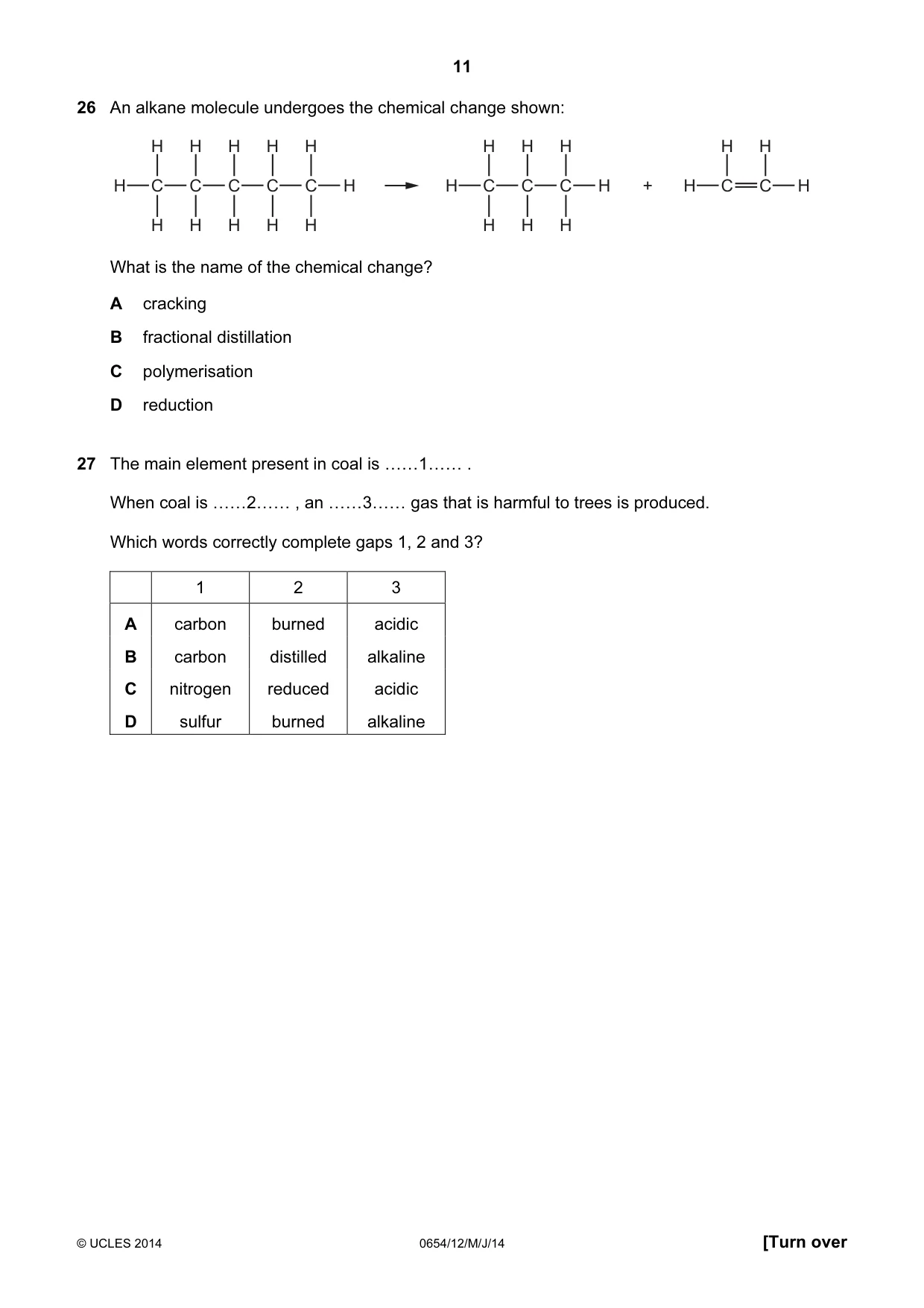
26 An alkane molecule undergoes the chemical change shown: H H H H H H H H H H H C C C C C H H C C C H + H C C H H H H H H H H H What is the name of the chemical change? A cracking B fractional distillation C polymerisation D reduction
Mark scheme: A
Q27 · The main element present in coal is ……1……
27 The main element present in coal is ……1…… . When coal is ……2…… , an ……3…… gas that is harmful to trees is produced. Which words correctly complete gaps 1, 2 and 3? 1 2 3 A carbon burned acidic B carbon distilled alkaline C nitrogen reduced acidic D sulfur burned alkaline
Mark scheme: A
Q28 · The diagram shows forces of equal size acting on a moving car
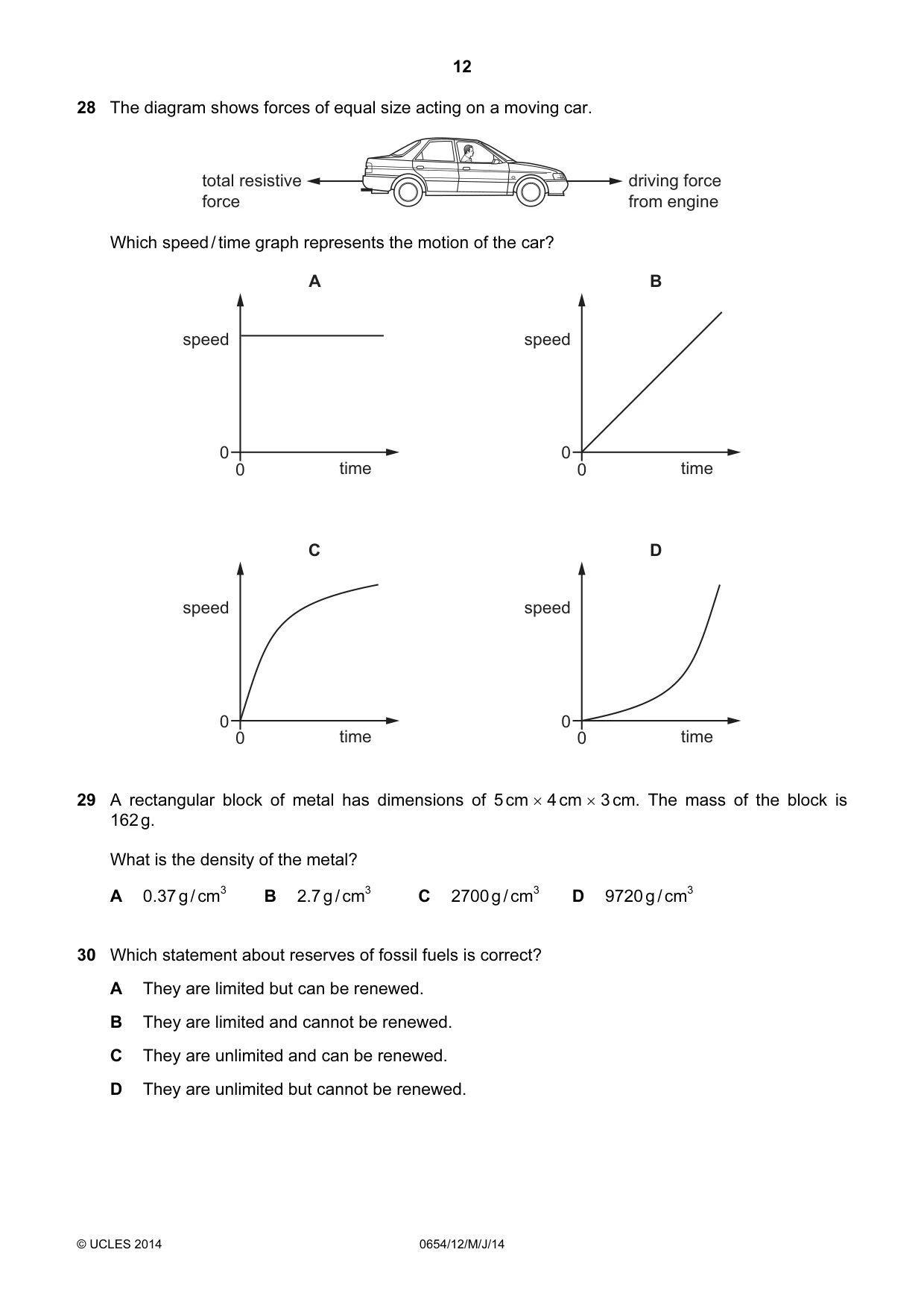
28 The diagram shows forces of equal size acting on a moving car. total resistive driving force force from engine Which speed / time graph represents the motion of the car? A B speed speed 0 0 0 time 0 time C D speed speed 0 0 0 time 0 time
Mark scheme: A
Q29 · A rectangular block of metal has dimensions of 5 cm × 4 cm × 3 cm
29 A rectangular block of metal has dimensions of 5 cm × 4 cm × 3 cm. The mass of the block is 162 g. What is the density of the metal? A 0.37 g / cm3 B 2.7 g / cm3 C 2700 g / cm3 D 9720 g / cm3
Mark scheme: B
Q30 · Which statement about reserves of fossil fuels is correct?
30 Which statement about reserves of fossil fuels is correct? A They are limited but can be renewed. B They are limited and cannot be renewed. C They are unlimited and can be renewed. D They are unlimited but cannot be renewed.
Mark scheme: B
Q31 · A motorist inflates a tyre with an air pump
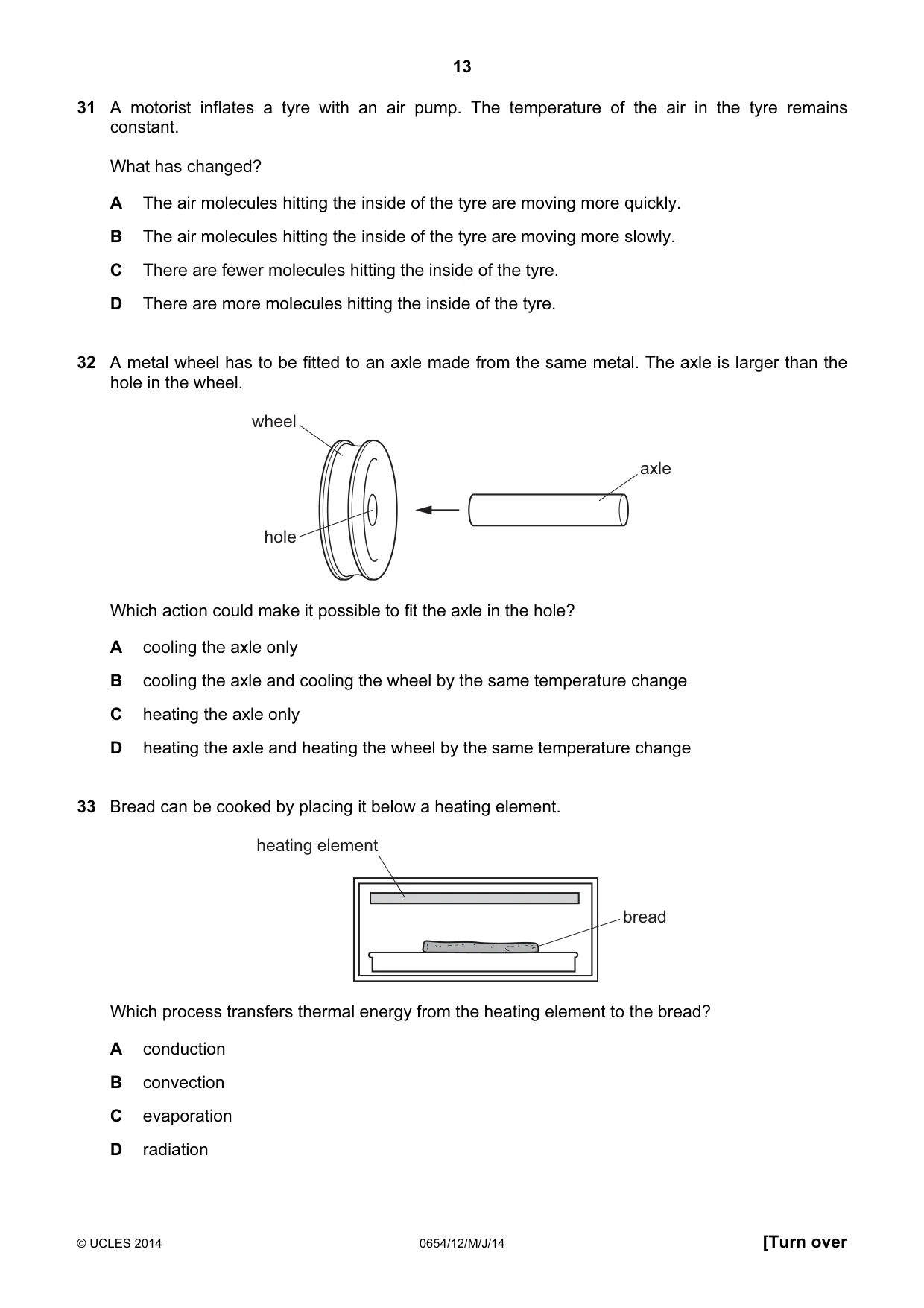
31 A motorist inflates a tyre with an air pump. The temperature of the air in the tyre remains constant. What has changed? A The air molecules hitting the inside of the tyre are moving more quickly. B The air molecules hitting the inside of the tyre are moving more slowly. C There are fewer molecules hitting the inside of the tyre. D There are more molecules hitting the inside of the tyre.
Mark scheme: D
Q32 · A metal wheel has to be fitted to an axle made from the same metal
32 A metal wheel has to be fitted to an axle made from the same metal. The axle is larger than the hole in the wheel. wheel axle hole Which action could make it possible to fit the axle in the hole? A cooling the axle only B cooling the axle and cooling the wheel by the same temperature change C heating the axle only D heating the axle and heating the wheel by the same temperature change
Mark scheme: A
Q33 · Bread can be cooked by placing it below a heating element
33 Bread can be cooked by placing it below a heating element. heating element bread Which process transfers thermal energy from the heating element to the bread? A conduction B convection C evaporation D radiation
Mark scheme: D
Q34 · Which distance on the diagram represents the amplitude of the wave?
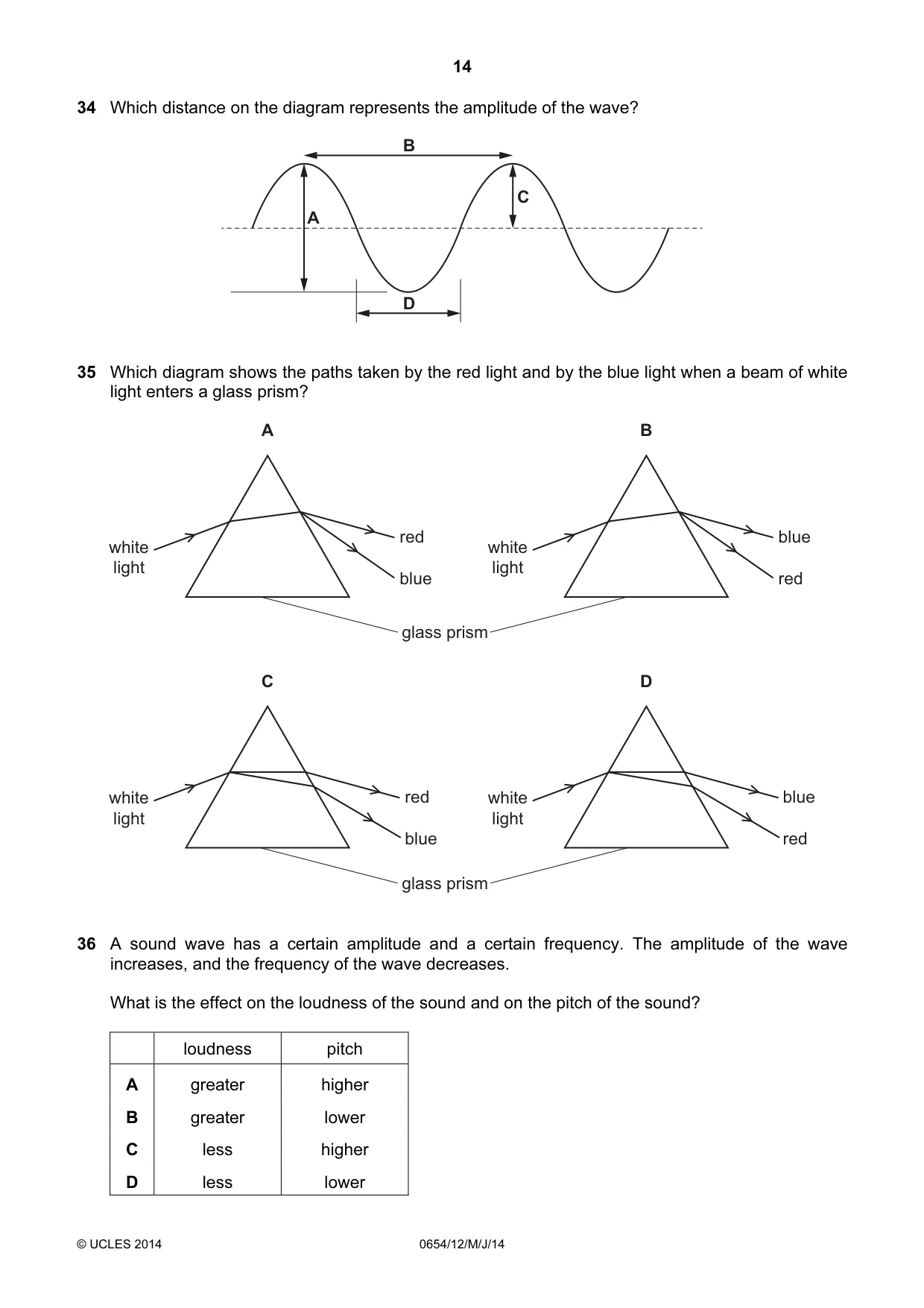
34 Which distance on the diagram represents the amplitude of the wave? B C A D
Mark scheme: C
Q35 · Which diagram shows the paths taken by the red light and by the blue light when a beam of…
35 Which diagram shows the paths taken by the red light and by the blue light when a beam of white light enters a glass prism? A B red blue white white light light blue red glass prism C D white red white blue light light blue red glass prism
Mark scheme: C
Q36 · A sound wave has a certain amplitude and a certain frequency
36 A sound wave has a certain amplitude and a certain frequency. The amplitude of the wave increases, and the frequency of the wave decreases. What is the effect on the loudness of the sound and on the pitch of the sound? loudness pitch A greater higher B greater lower C less higher D less lower
Mark scheme: B
Q37 · An electrical extension block has four sockets, a cable which can safely take a current…
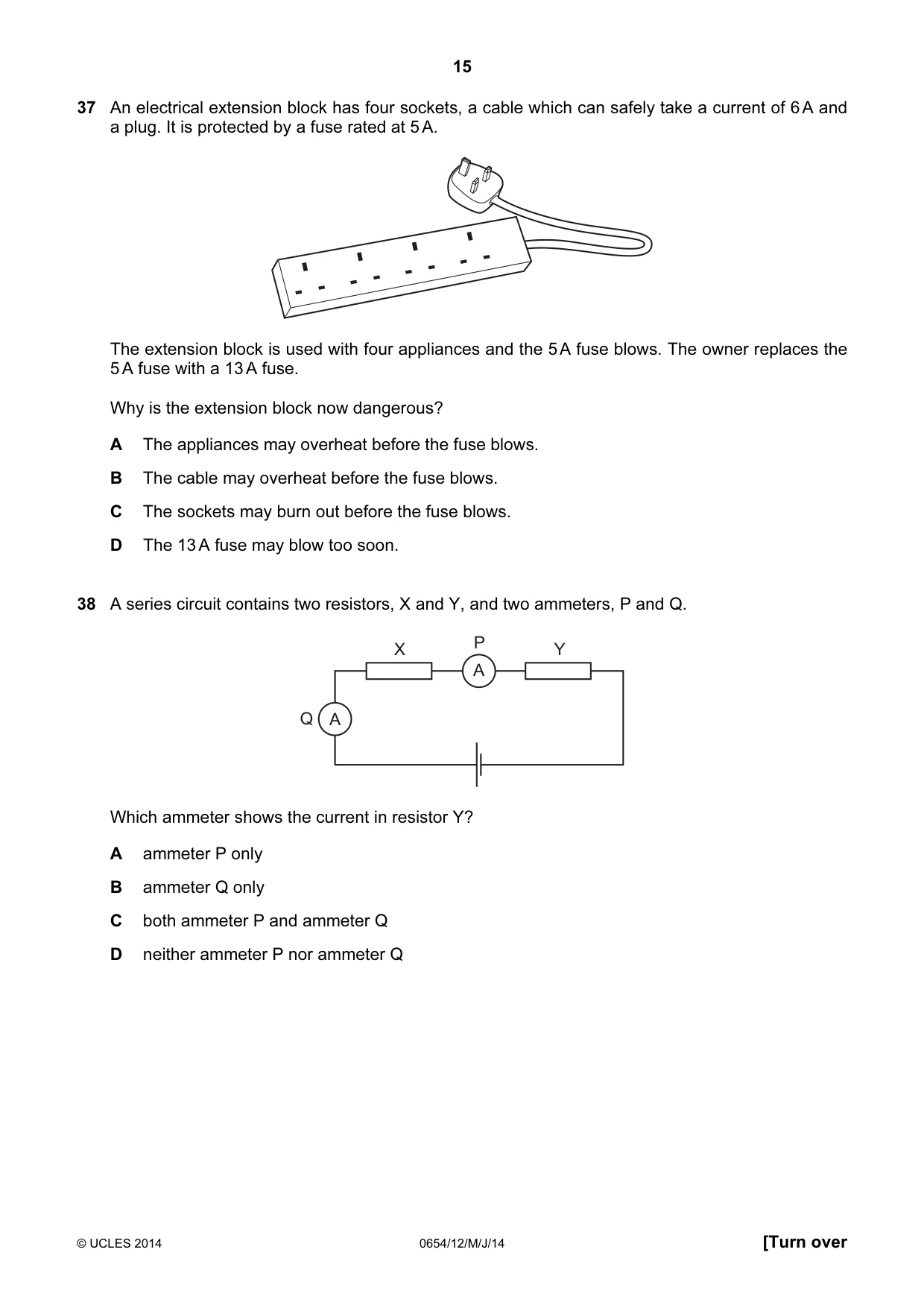
37 An electrical extension block has four sockets, a cable which can safely take a current of 6 A and a plug. It is protected by a fuse rated at 5 A. The extension block is used with four appliances and the 5 A fuse blows. The owner replaces the 5 A fuse with a 13 A fuse. Why is the extension block now dangerous? A The appliances may overheat before the fuse blows. B The cable may overheat before the fuse blows. C The sockets may burn out before the fuse blows. D The 13 A fuse may blow too soon.
Mark scheme: B
Q38 · A series circuit contains two resistors, X and Y, and two ammeters, P and Q
38 A series circuit contains two resistors, X and Y, and two ammeters, P and Q. X P Y A Q A Which ammeter shows the current in resistor Y? A ammeter P only B ammeter Q only C both ammeter P and ammeter Q D neither ammeter P nor ammeter Q
Mark scheme: C
Q39 · Which diagram shows the pattern of the magnetic field due to a current in a straight wire?
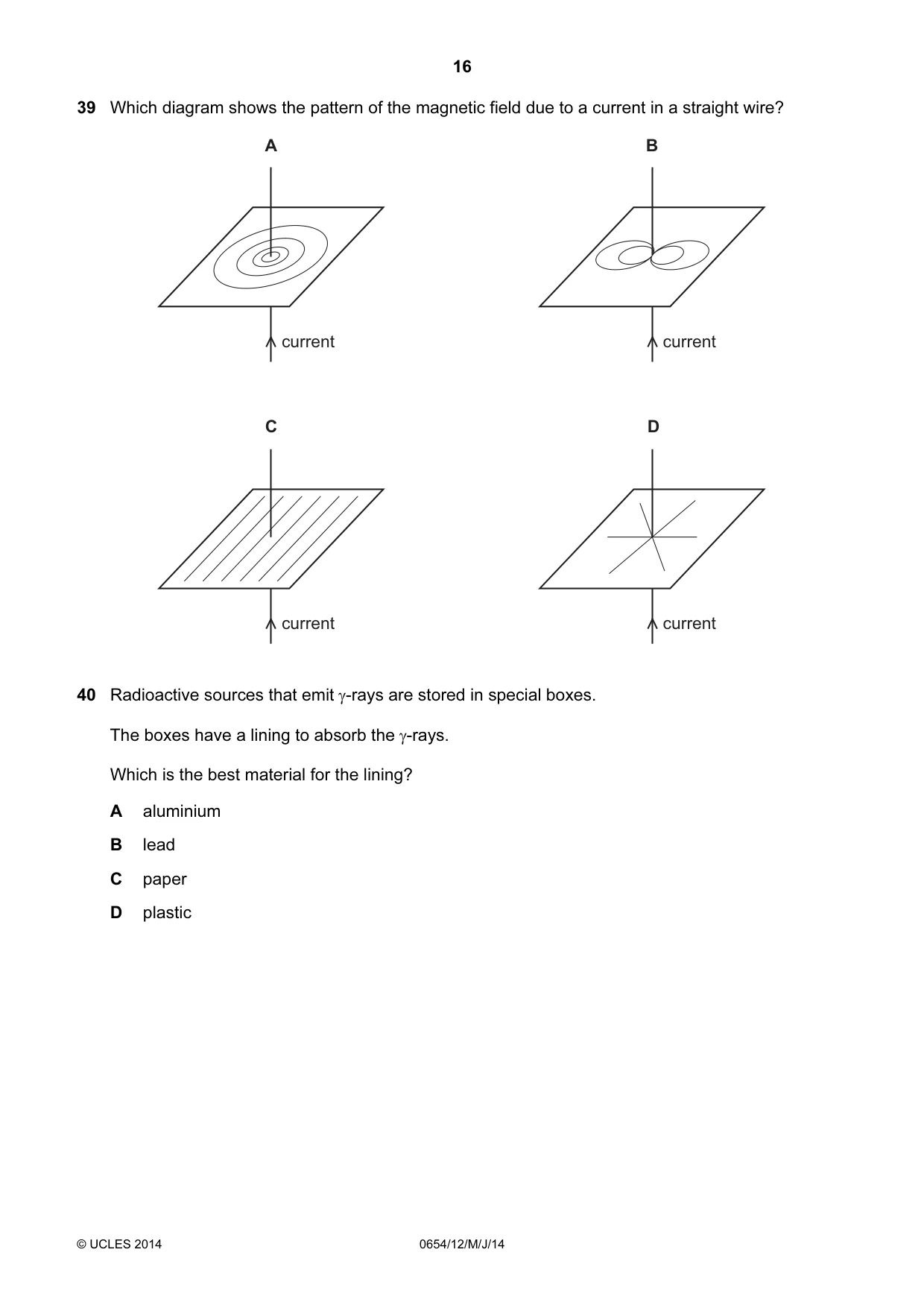
39 Which diagram shows the pattern of the magnetic field due to a current in a straight wire? A B current current C D current current
Mark scheme: A
Q40 · Radioactive sources that emit γ-rays are stored in special boxes
40 Radioactive sources that emit γ-rays are stored in special boxes. The boxes have a lining to absorb the γ-rays. Which is the best material for the lining? A aluminium B lead C paper D plastic
Mark scheme: B
What was in this paper
The subtopics covered by these 40 questions, and how many questions each got. Open one in a new tab to see every Cambridge question on it.
2Oxides2Air quality and climate1Biological molecules1Cell structure1Characteristics of living organisms1Chromatography1Chromosomes and genes1Conservation1Coordination and response1Density1Diffusion1Electrical circuits1Electrical safety1Electrolysis1Enzymes1Formulas1Fuels1Gas exchange in humans1General properties of waves1Group I properties1Homeostasis1Identification of ions and gases1Kinetic particle model of matter1Light1Monohybrid inheritance1Motion1Photosynthesis1Radioactivity1Rate of reaction1Redox1Respiration1Sexual reproduction in plants1Simple molecules and covalent bonds1Simple phenomena of magnetism1Sound1Thermal properties and temperature1Transfer of thermal energy1What you needed in this session
Cambridge’s own grade thresholds for 2014 May/June, Paper 1 · Variant 2. A higher threshold means an easier paper — the bar moves with how the cohort did.