Cambridge IGCSE Physics 0625 — 2009 May/June Paper 3 · Variant 1
0625/31/M/J/09 · 10 questions · 75 marks · ≈84 min
The question paper and its mark scheme, free to read here and free to download. This is Cambridge’s own paper, exactly as it was sat.
Question paper41 pages
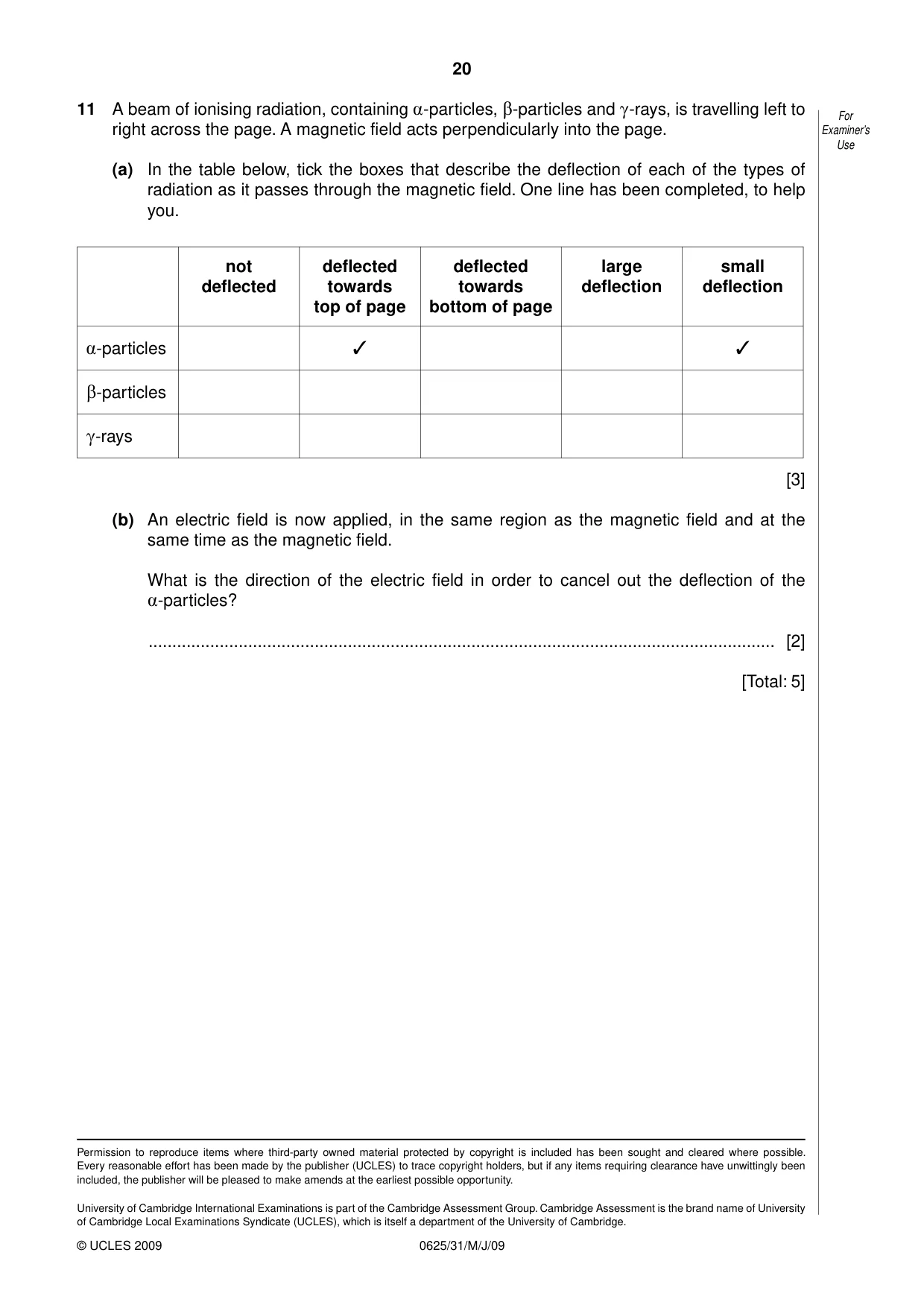
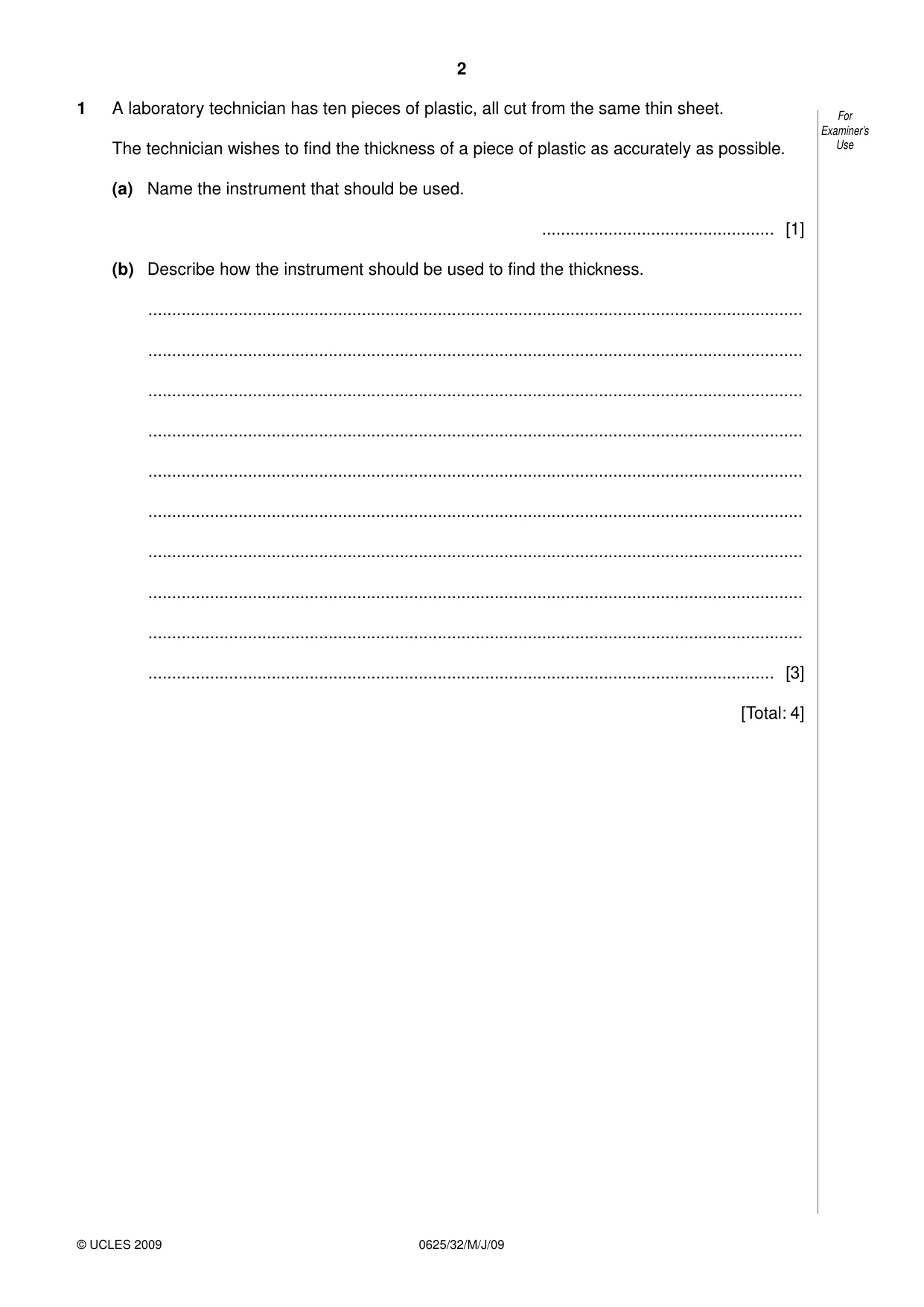
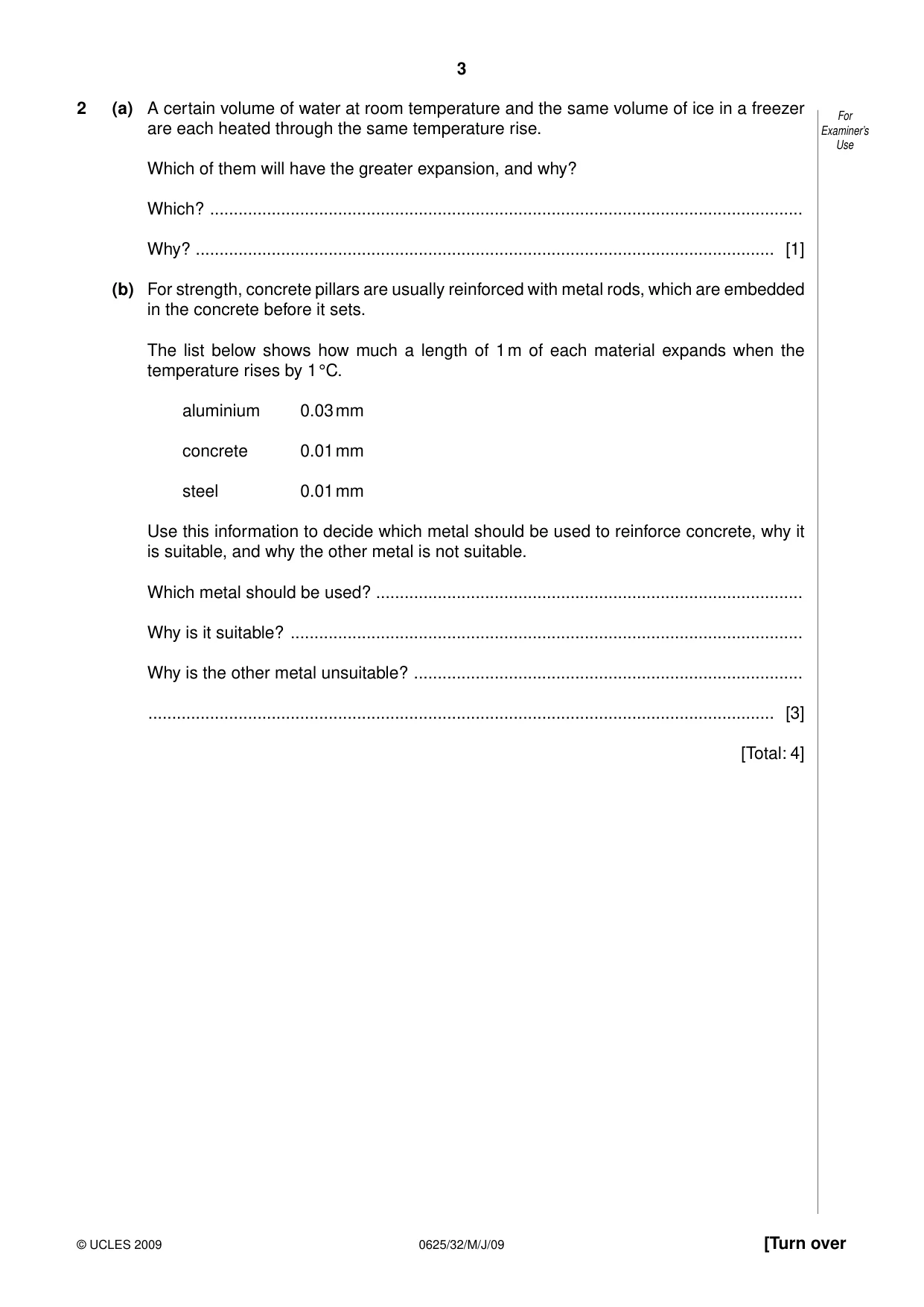
Mark scheme13 pages
Answers below. Sit the paper first if you are practising.
Questions as text
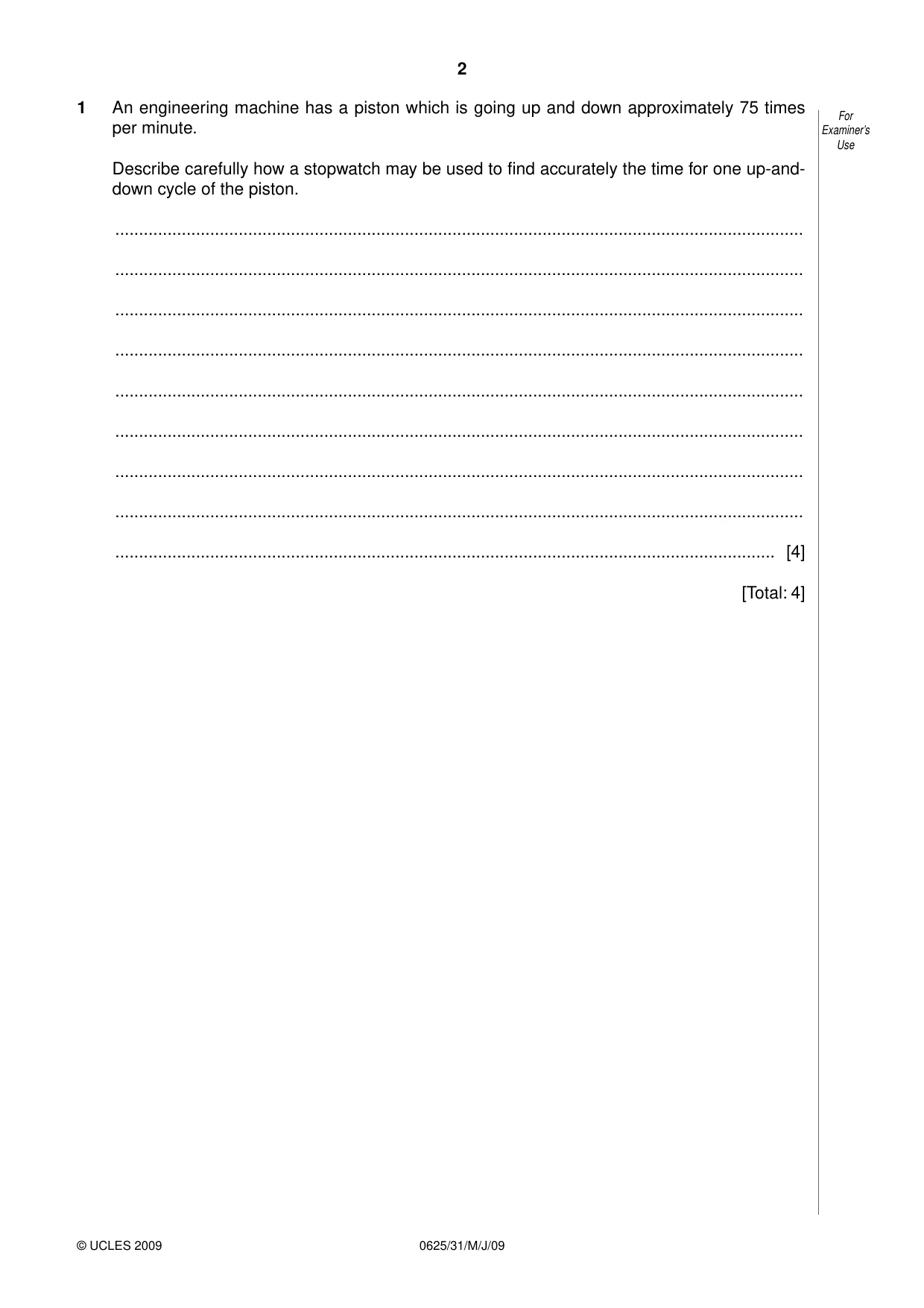
Q1 · An engineering machine has a piston which is going up and down approximately 75 times For…
1 An engineering machine has a piston which is going up and down approximately 75 times For per minute. Examiner’s Use Describe carefully how a stopwatch may be used to find accurately the time for one up-and- down cycle of the piston. ................................................................................................................................................. ................................................................................................................................................. ................................................................................................................................................. ................................................................................................................................................. ................................................................................................................................................. ................................................................................................................................................. ................................................................................................................................................. ................................................................................................................................................. ........................................................................................................................................... [4] [Total: 4]
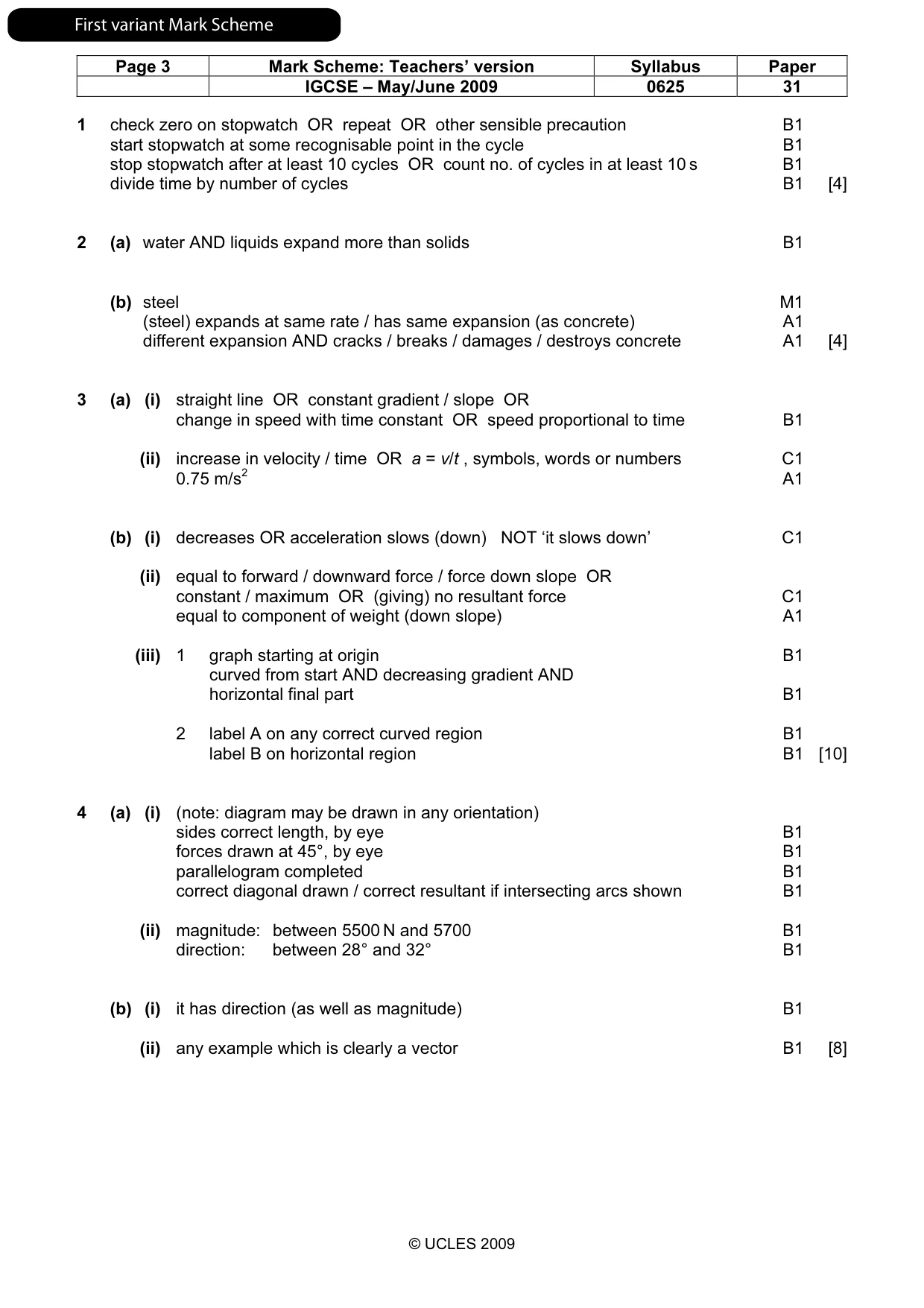
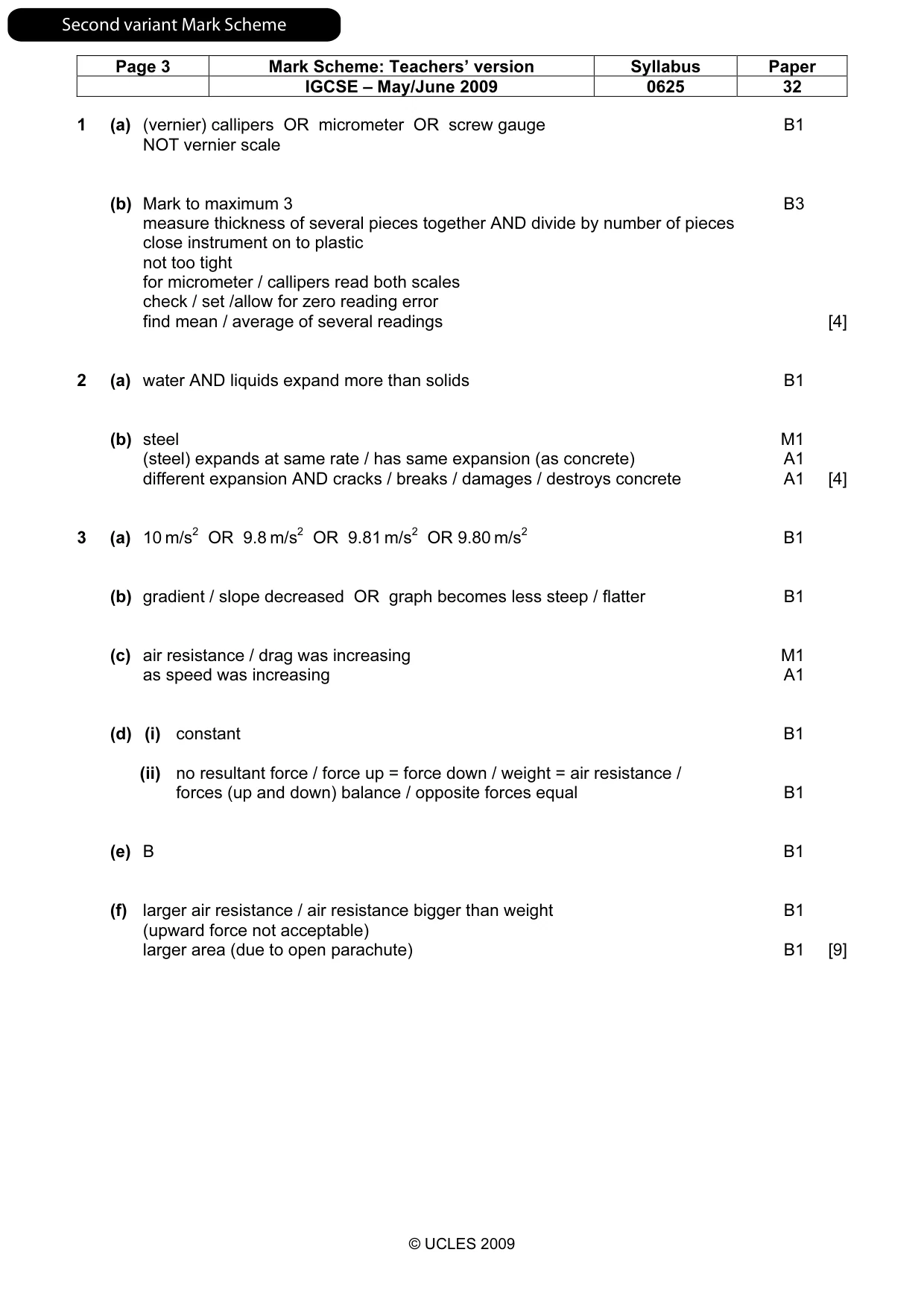
Mark scheme: 1 check zero on stopwatch OR repeat OR other sensible precaution B1 start stopwatch at some recognisable point in the cycle B1 stop stopwatch after at least 10 cycles OR count no. of cycles in at least 10 s B1 divide time by number of cycles B1 [4]
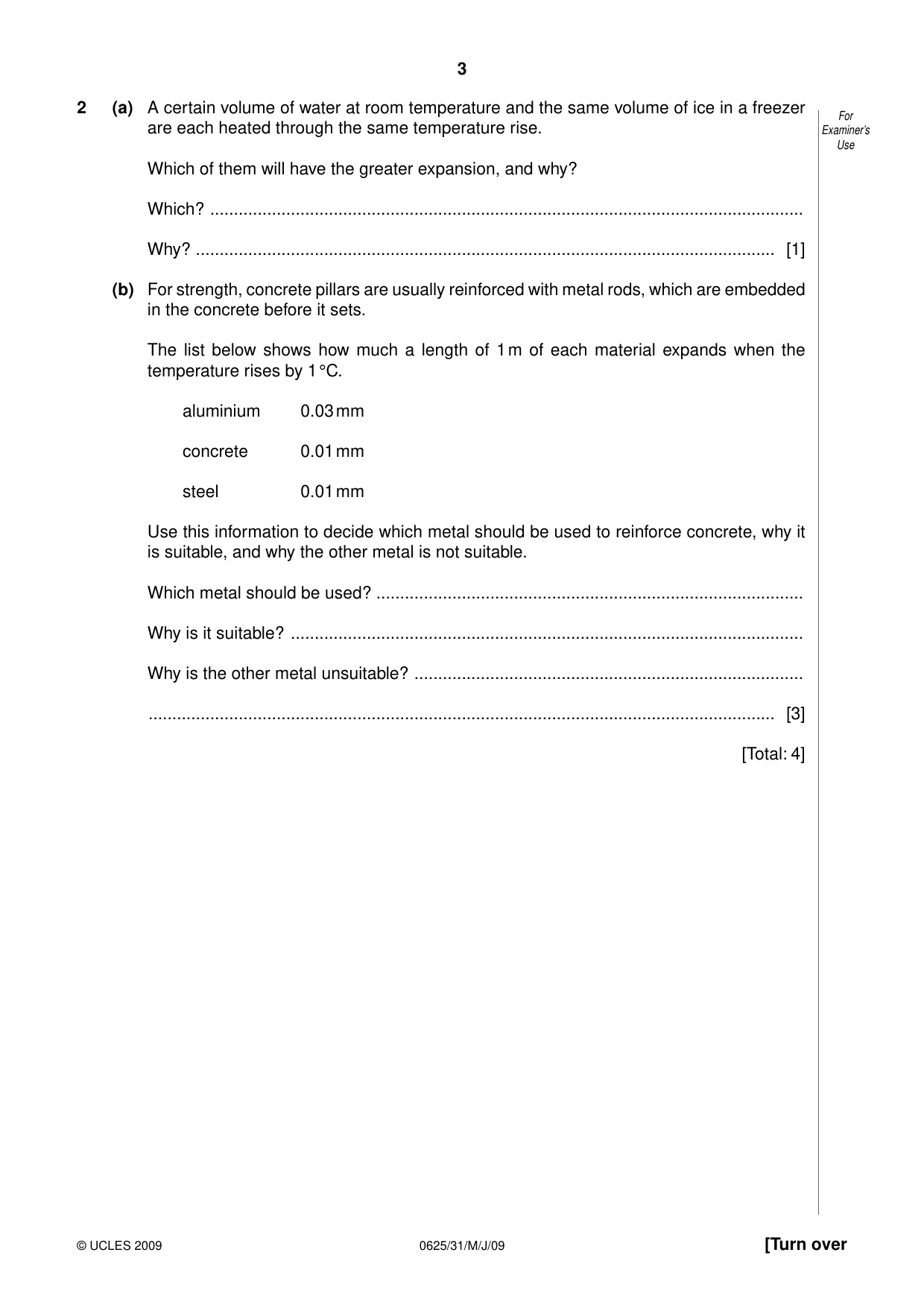
Q2 · A certain volume of water at room temperature and the same volume of ice in a freezer For…
2 (a) A certain volume of water at room temperature and the same volume of ice in a freezer For are each heated through the same temperature rise. Examiner’s Use Which of them will have the greater expansion, and why? Which? ............................................................................................................................. Why? .......................................................................................................................... [1] (b) For strength, concrete pillars are usually reinforced with metal rods, which are embedded in the concrete before it sets. The list below shows how much a length of 1 m of each material expands when the temperature rises by 1 °C. aluminium 0.03 mm concrete 0.01 mm steel 0.01 mm Use this information to decide which metal should be used to reinforce concrete, why it is suitable, and why the other metal is not suitable. Which metal should be used? .......................................................................................... Why is it suitable? ............................................................................................................ Why is the other metal unsuitable? .................................................................................. .................................................................................................................................... [3] [Total: 4]
Mark scheme: 2 (a) water AND liquids expand more than solids B1 (b) steel M1 (steel) expands at same rate / has same expansion (as concrete) A1 different expansion AND cracks / breaks / damages / destroys concrete A1 [4]
Q3 · A skier descending a hillside
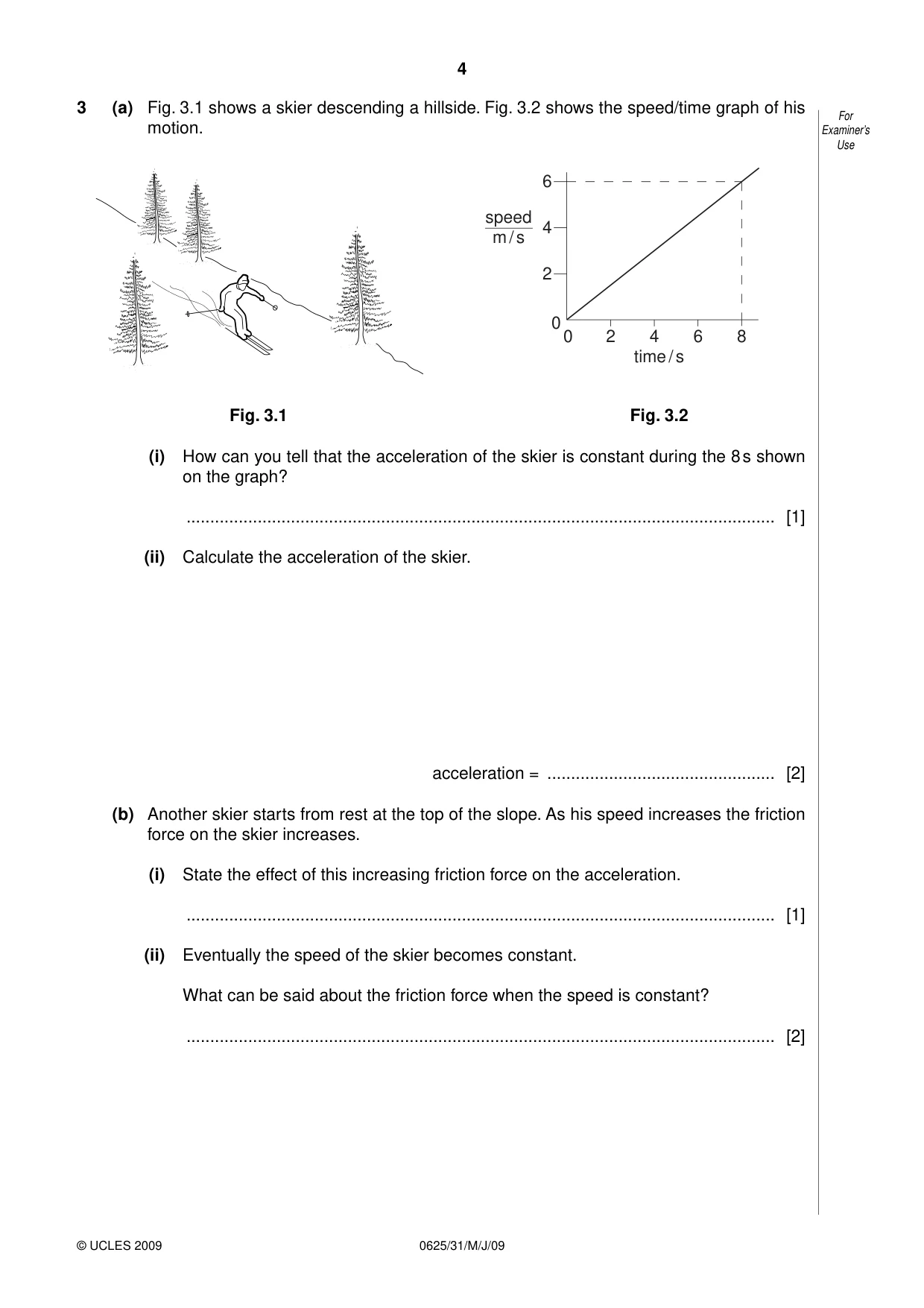
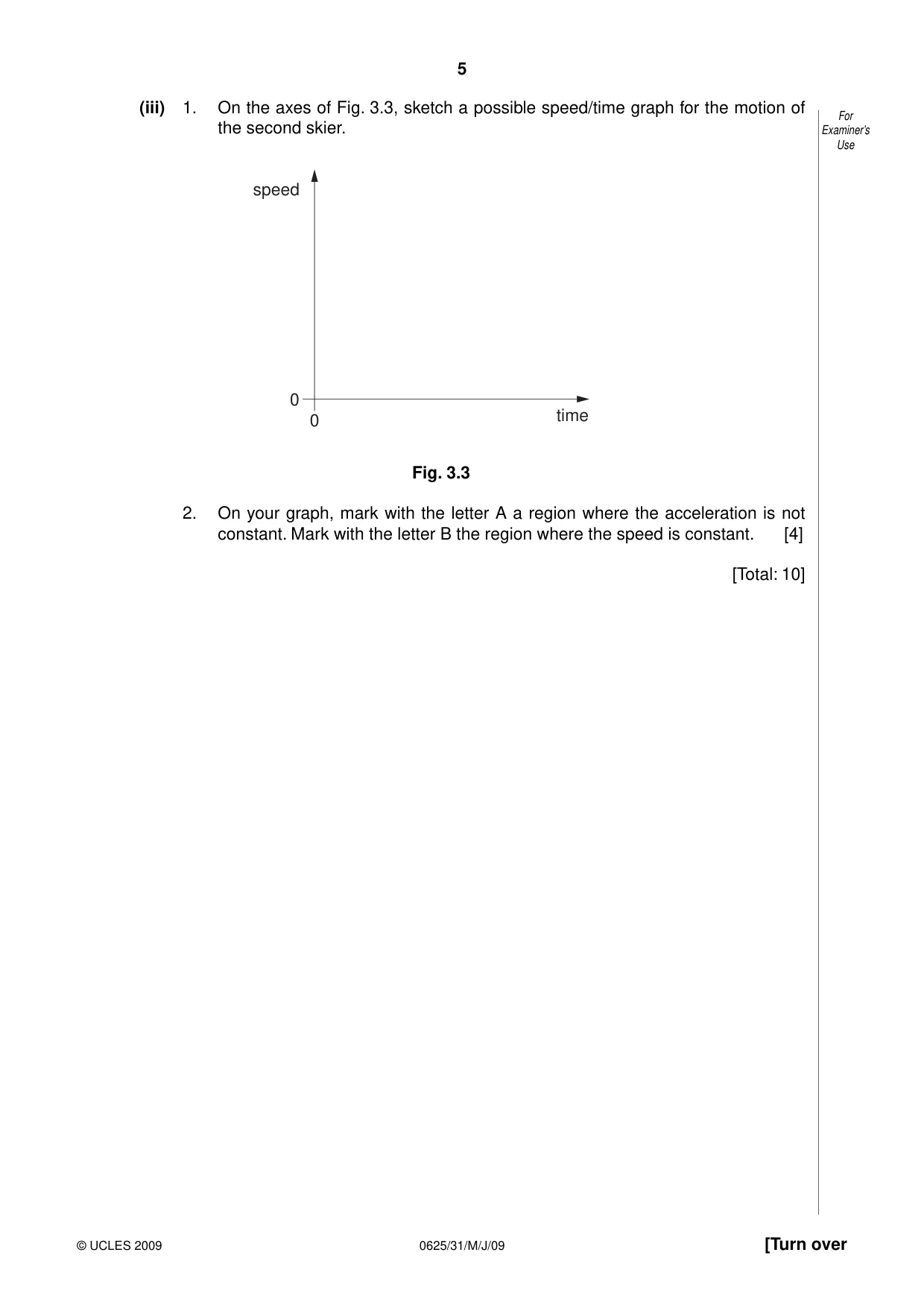
3 (a) Fig. 3.1 shows a skier descending a hillside. Fig. 3.2 shows the speed/time graph of his For motion. Examiner’s Use 6 speed 4 m / s 2 0 0 2 4 6 8 time / s Fig. 3.1 Fig. 3.2 (i) How can you tell that the acceleration of the skier is constant during the 8 s shown on the graph? ............................................................................................................................ [1] (ii) Calculate the acceleration of the skier. acceleration = ................................................ [2] (b) Another skier starts from rest at the top of the slope. As his speed increases the friction force on the skier increases. (i) State the effect of this increasing friction force on the acceleration. ............................................................................................................................ [1] (ii) Eventually the speed of the skier becomes constant. What can be said about the friction force when the speed is constant? ............................................................................................................................ [2] (iii) 1. On the axes of Fig. 3.3, sketch a possible speed/time graph for the motion of For the second skier. Examiner’s Use speed 0 time 0 Fig. 3.3 2. On your graph, mark with the letter A a region where the acceleration is not constant. Mark with the letter B the region where the speed is constant. [4] [Total: 10]
Mark scheme: 3 (a) (i) straight line OR constant gradient / slope OR change in speed with time constant OR speed proportional to time B1 (ii) increase in velocity / time OR a = v/t , symbols, words or numbers C1 0.75 m/s2 A1 (b) (i) decreases OR acceleration slows (down) NOT ‘it slows down’ C1 (ii) equal to forward / downward force / force down slope OR constant / maximum OR (giving) no resultant force C1 equal to component of weight (down slope) A1 (iii) 1 graph starting at origin B1 curved from start AND decreasing gradient AND horizontal final part B1 2 label A on any correct curved region B1 label B on horizontal region B1 [10]
Q4 · In an accident, a truck goes off the road and into a ditch
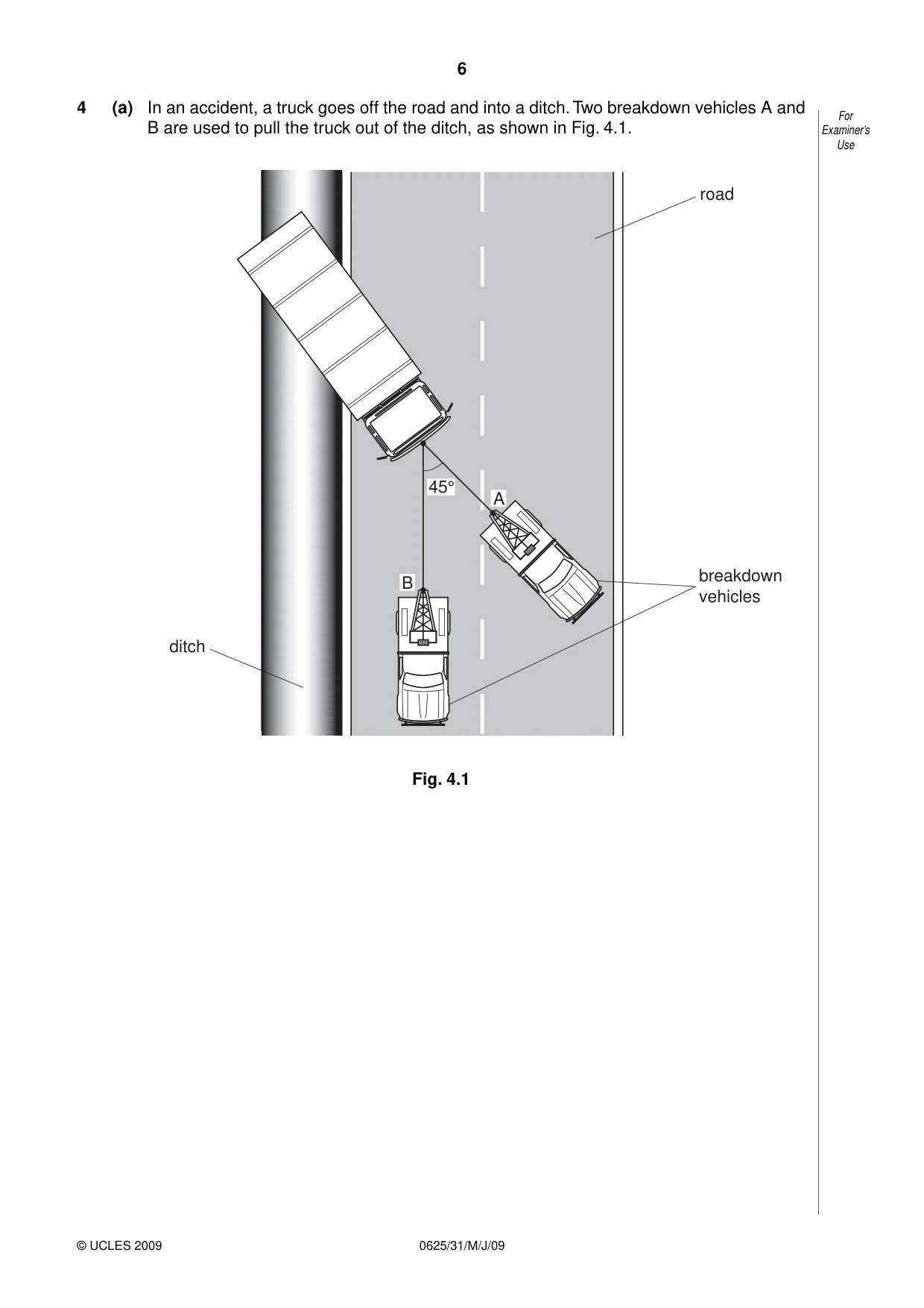
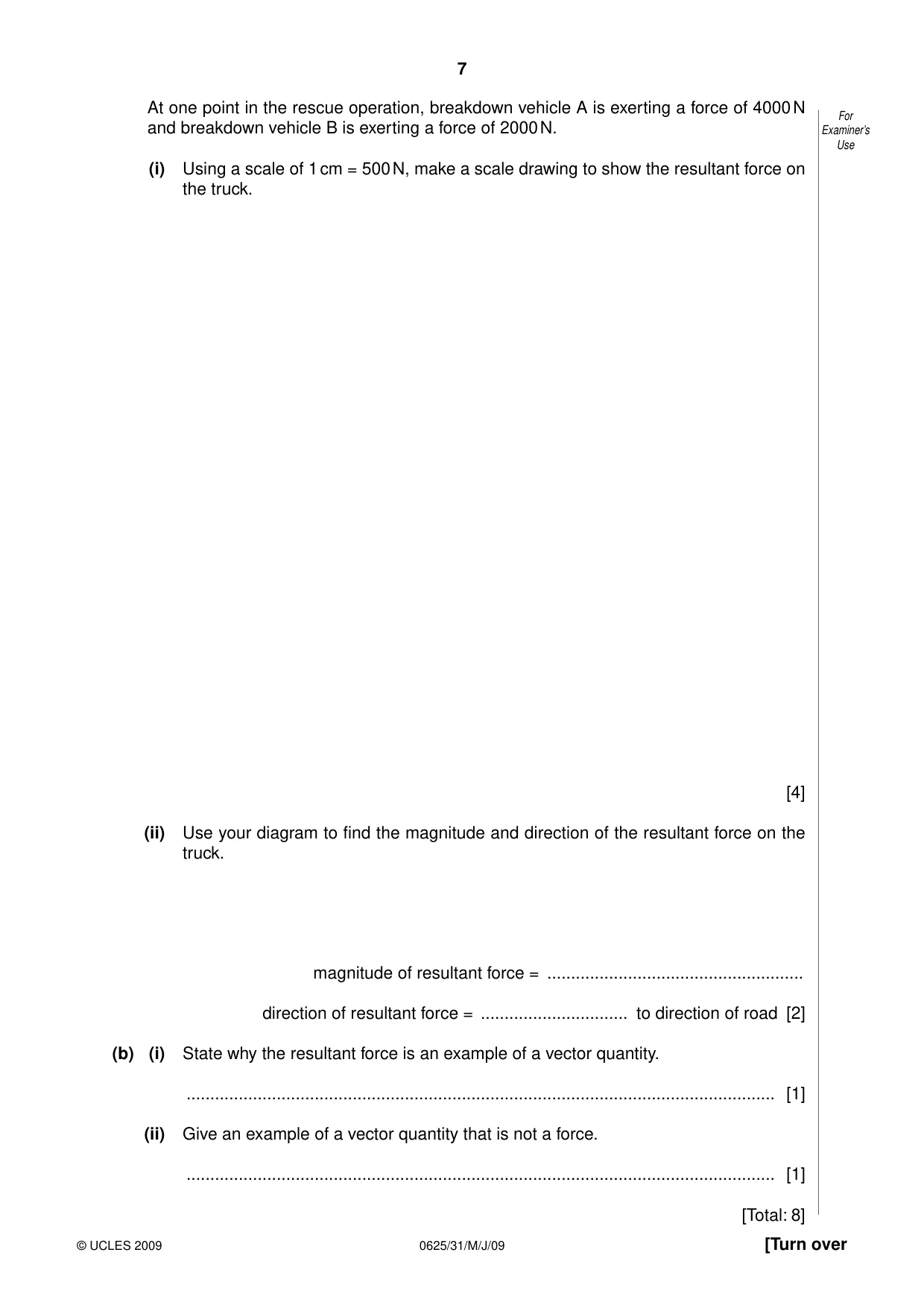
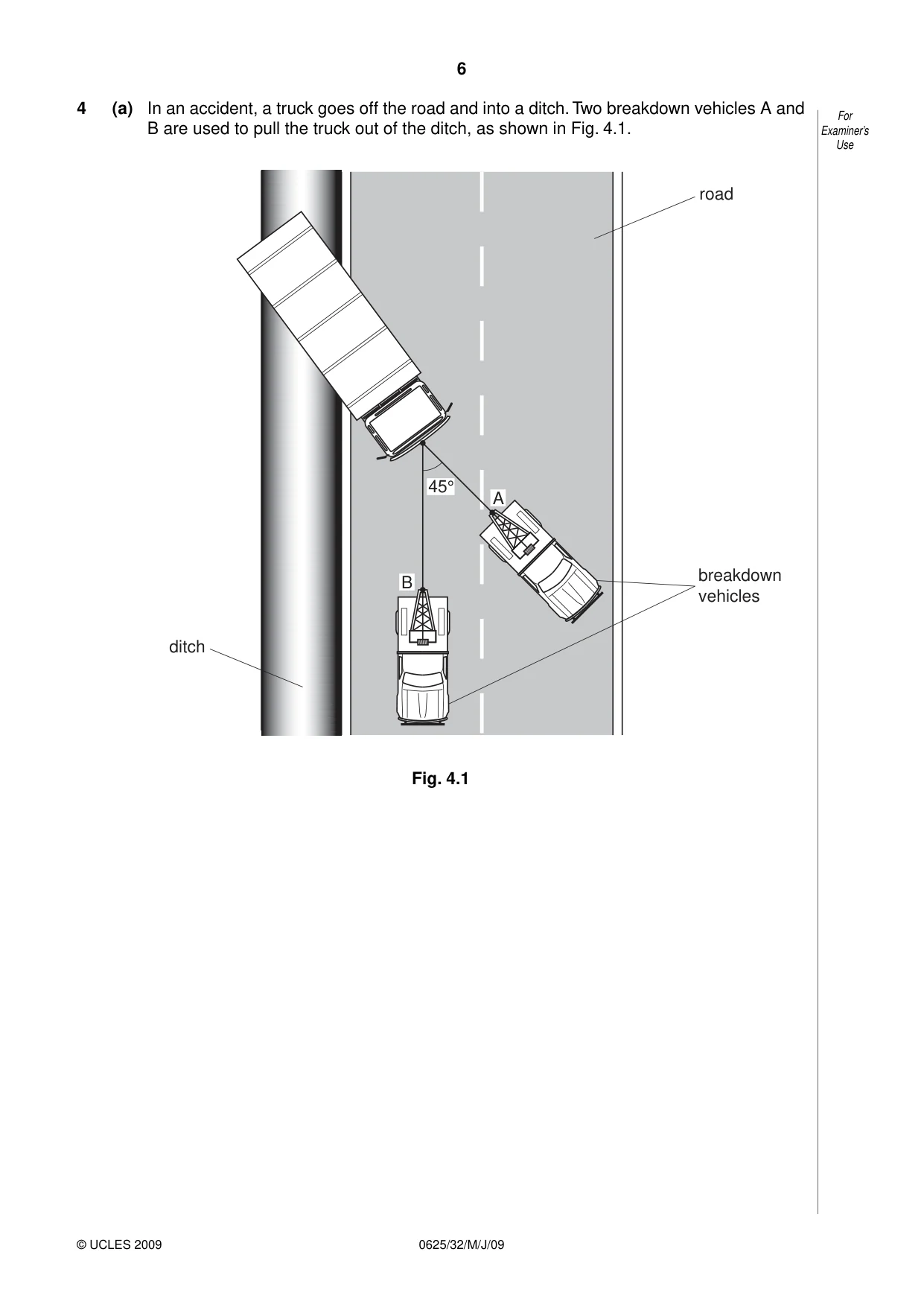
4 (a) In an accident, a truck goes off the road and into a ditch. Two breakdown vehicles A and For B are used to pull the truck out of the ditch, as shown in Fig. 4.1. Examiner’s Use road 45° A breakdown B vehicles ditch Fig. 4.1 At one point in the rescue operation, breakdown vehicle A is exerting a force of 4000 N For and breakdown vehicle B is exerting a force of 2000 N. Examiner’s Use (i) Using a scale of 1 cm = 500 N, make a scale drawing to show the resultant force on the truck. [4] (ii) Use your diagram to find the magnitude and direction of the resultant force on the truck. magnitude of resultant force = ...................................................... direction of resultant force = ............................... to direction of road [2] (b) (i) State why the resultant force is an example of a vector quantity. ............................................................................................................................ [1] (ii) Give an example of a vector quantity that is not a force. ............................................................................................................................ [1] [Total: 8]
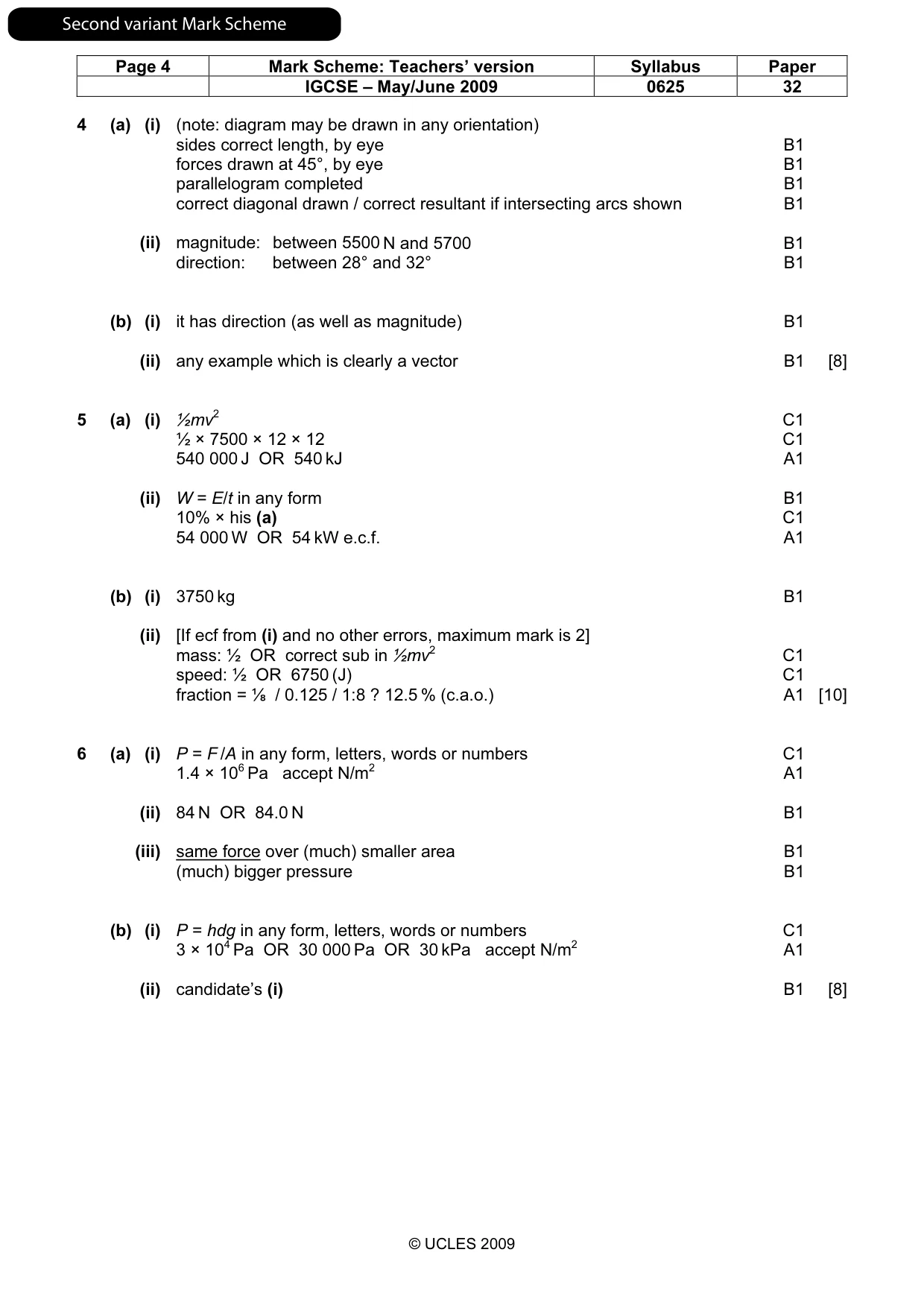
Mark scheme: 4 (a) (i) (note: diagram may be drawn in any orientation) sides correct length, by eye B1 forces drawn at 45°, by eye B1 parallelogram completed B1 correct diagonal drawn / correct resultant if intersecting arcs shown B1 (ii) magnitude: between 5500 N and 5700 B1 direction: between 28° and 32° B1 (b) (i) it has direction (as well as magnitude) B1 (ii) any example which is clearly a vector B1 [8] IGCSE – May/June 2009 0625 31 2
Q5 · A wind turbine has blades, which sweep out an area of diameter 25 m
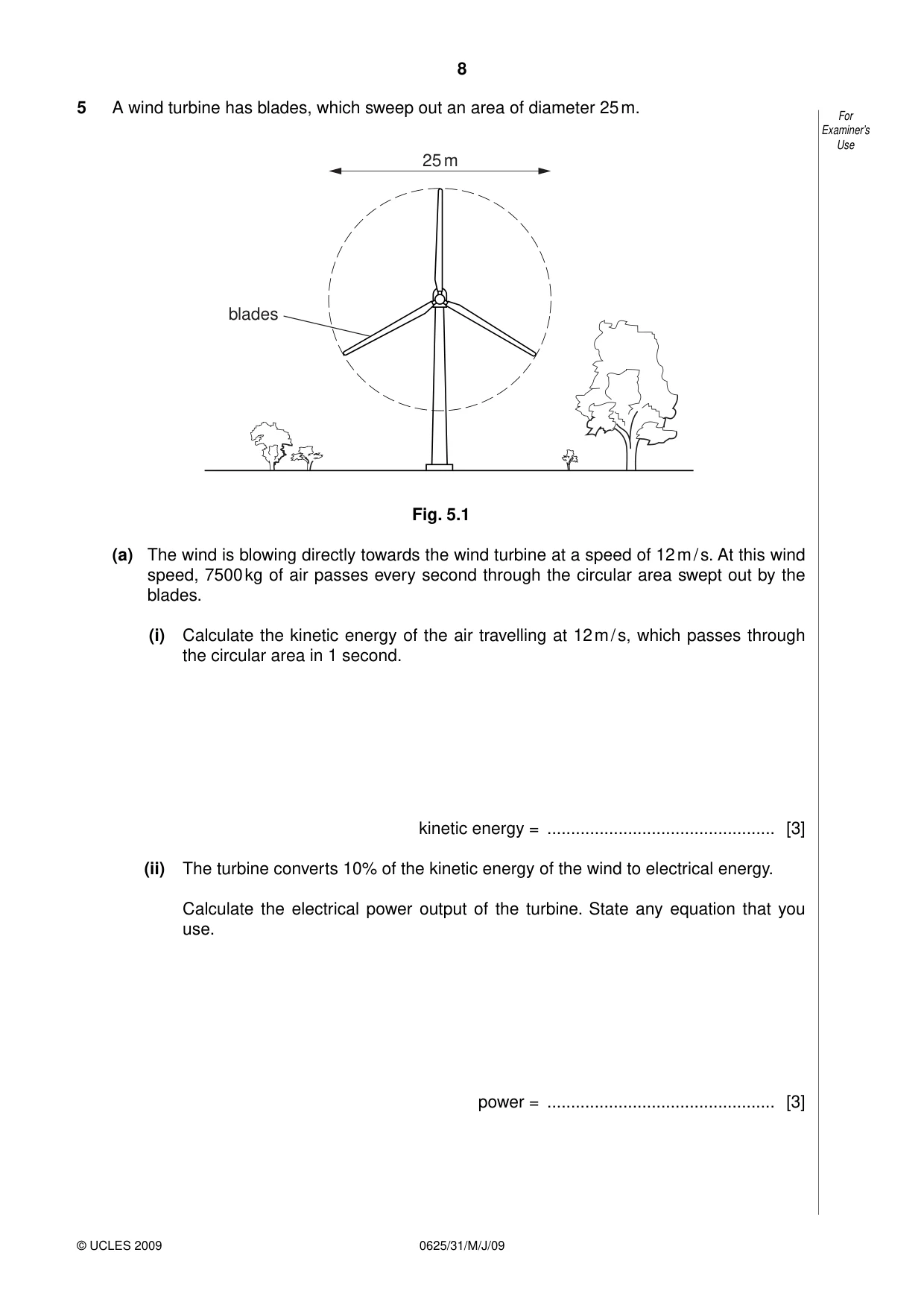
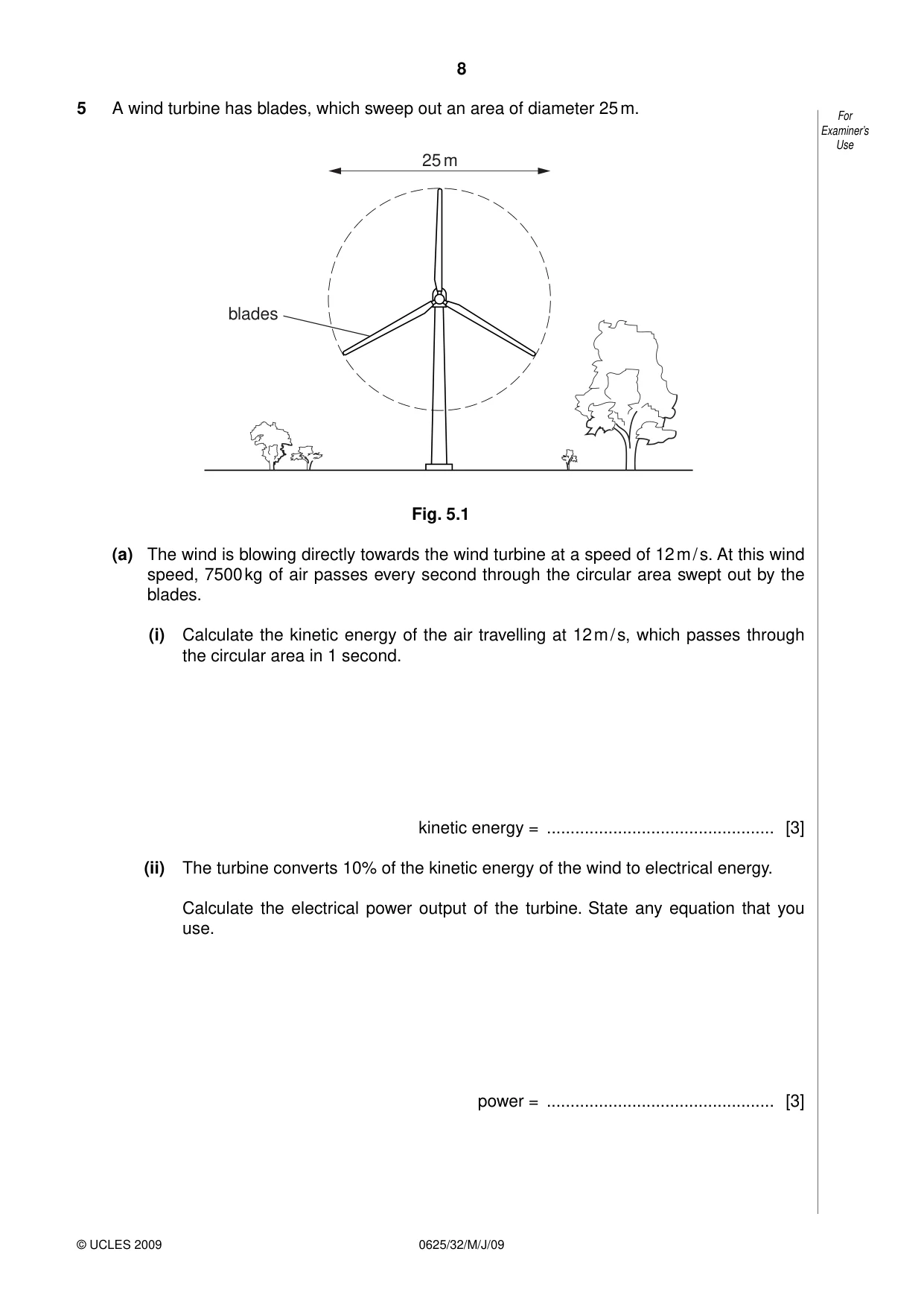
5 A wind turbine has blades, which sweep out an area of diameter 25 m. For Examiner’s Use 25 m blades Fig. 5.1 (a) The wind is blowing directly towards the wind turbine at a speed of 12 m / s. At this wind speed, 7500 kg of air passes every second through the circular area swept out by the blades. (i) Calculate the kinetic energy of the air travelling at 12 m / s, which passes through the circular area in 1 second. kinetic energy = ................................................ [3] (ii) The turbine converts 10% of the kinetic energy of the wind to electrical energy. Calculate the electrical power output of the turbine. State any equation that you use. power = ................................................ [3] (b) On another day, the wind speed is half that in (a). For Examiner’s (i) Calculate the mass of air passing through the circular area per second on this day. Use mass = ................................................ [1] (ii) Calculate the power output of the wind turbine on the second day as a fraction of that on the first day. fraction = ................................................ [3] [Total: 10]
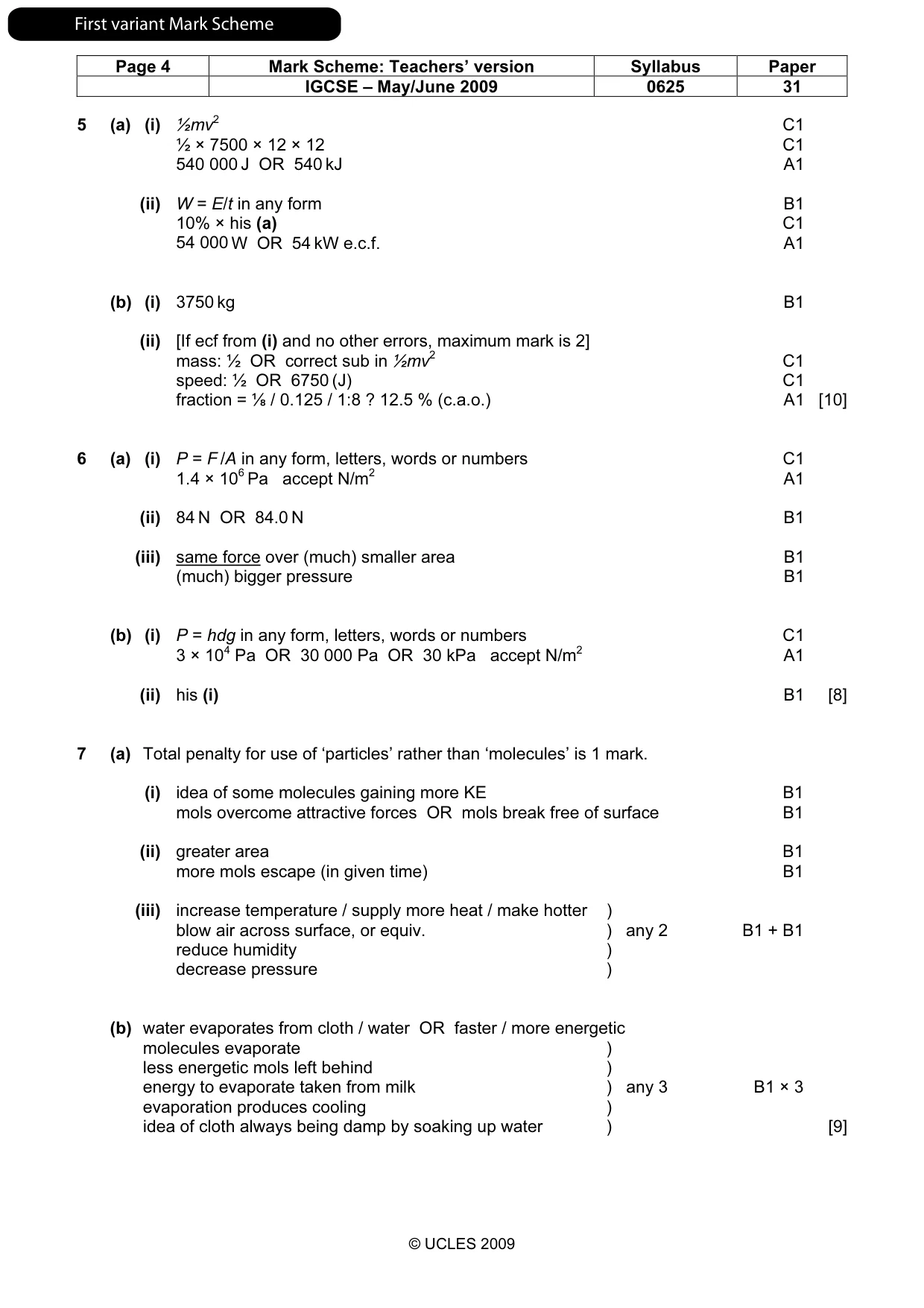
Mark scheme: 5 (a) (i) ½mv2 C1 ½ × 7500 × 12 × 12 C1 540 000 J OR 540 kJ A1 (ii) W = E/t in any form B1 10% × his (a) C1 54 000 W OR 54 kW e.c.f. A1 (b) (i) 3750 kg B1 (ii) [If ecf from (i) and no other errors, maximum mark is 2] mass: ½ OR correct sub in ½mv2 C1 speed: ½ OR 6750 (J) C1 fraction = ⅛ / 0.125 / 1:8 ? 12.5 % (c.a.o.) A1 [10]
Q6 · A man squeezes a pin between his thumb and finger, as shown in Fig
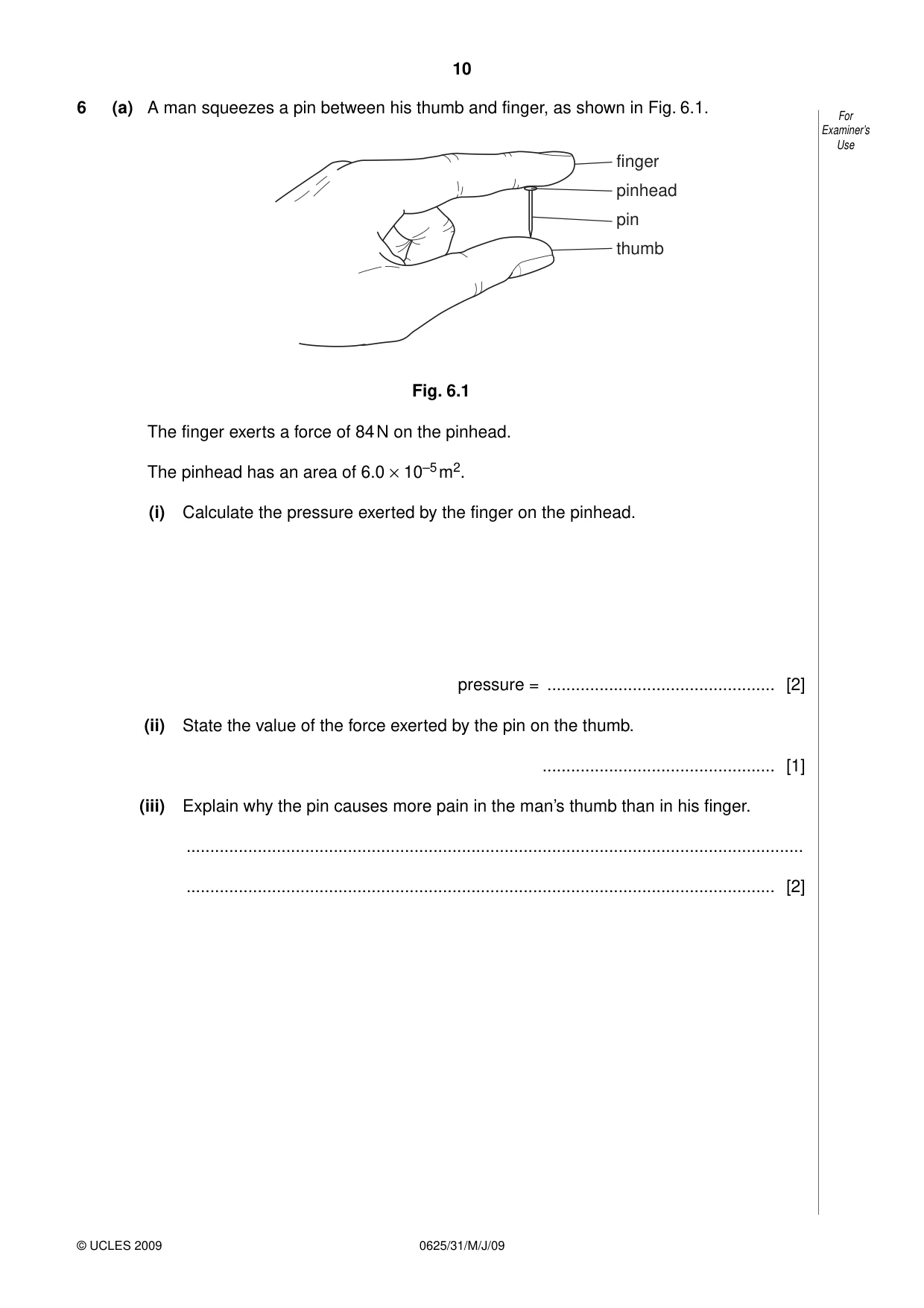
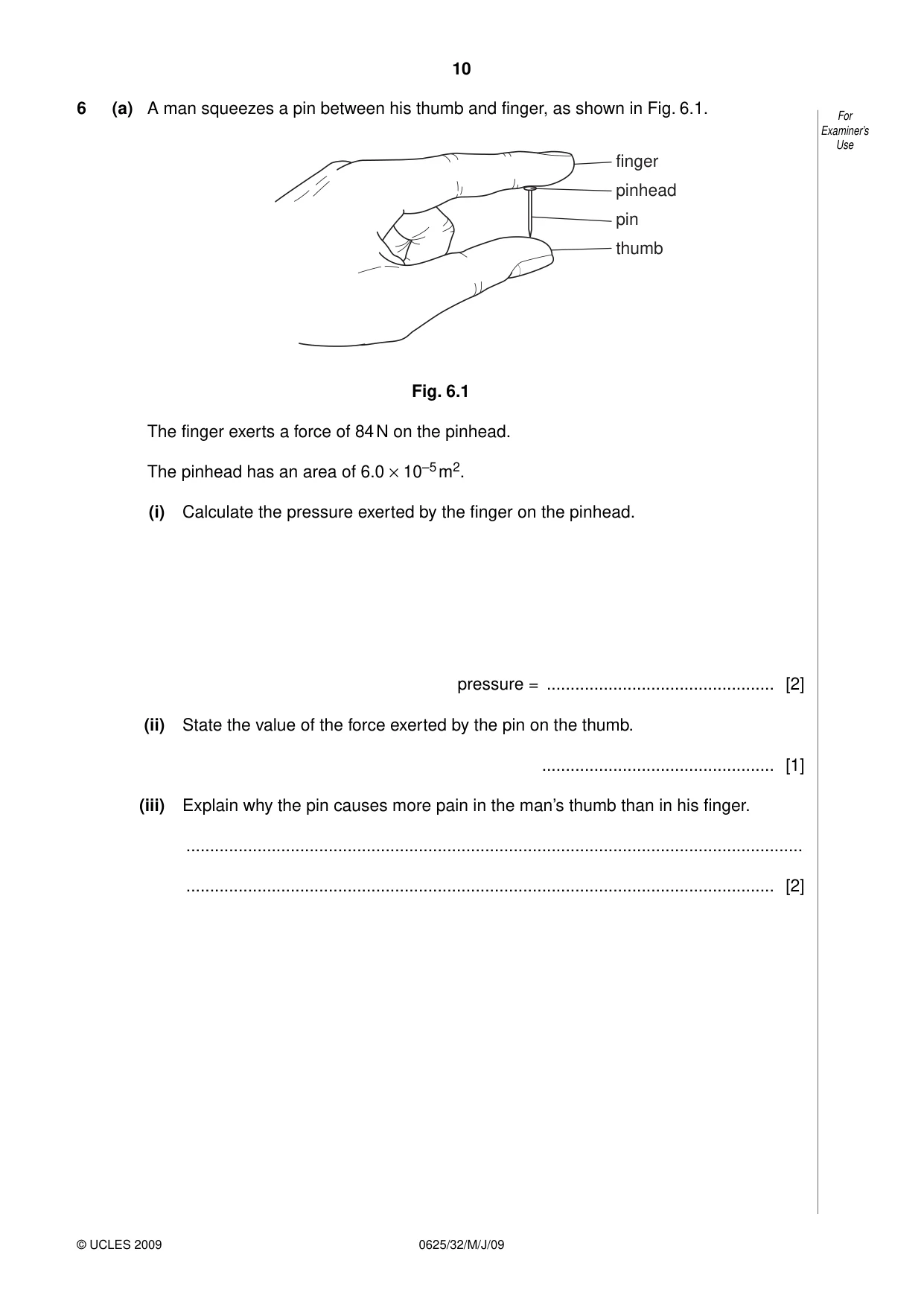
6 (a) A man squeezes a pin between his thumb and finger, as shown in Fig. 6.1. For Examiner’s Use finger pinhead pin thumb Fig. 6.1 The finger exerts a force of 84 N on the pinhead. The pinhead has an area of 6.0 × 10⁻⁵ m2. (i) Calculate the pressure exerted by the finger on the pinhead. pressure = ................................................ [2] (ii) State the value of the force exerted by the pin on the thumb. ................................................. [1] (iii) Explain why the pin causes more pain in the man’s thumb than in his finger. .................................................................................................................................. ............................................................................................................................ [2] (b) The density of the water in a swimming pool is 1000 kg / m3. The pool is 3 m deep. For Examiner’s (i) Calculate the pressure of the water at the bottom of the pool. Use pressure = ................................................ [2] (ii) Another pool has the same depth of water, but has twice the area. State the pressure of the water at the bottom of this pool. pressure = ................................................ [1] [Total: 8]
Mark scheme: 6 (a) (i) P = F /A in any form, letters, words or numbers C1 1.4 × 10⁶ Pa accept N/m2 A1 (ii) 84 N OR 84.0 N B1 (iii) same force over (much) smaller area B1 (much) bigger pressure B1 (b) (i) P = hdg in any form, letters, words or numbers C1 3 × 10⁴ Pa OR 30 000 Pa OR 30 kPa accept N/m2 A1 (ii) his (i) B1 [8]
Q7 · Some water is poured onto a plastic table-top, forming a puddle
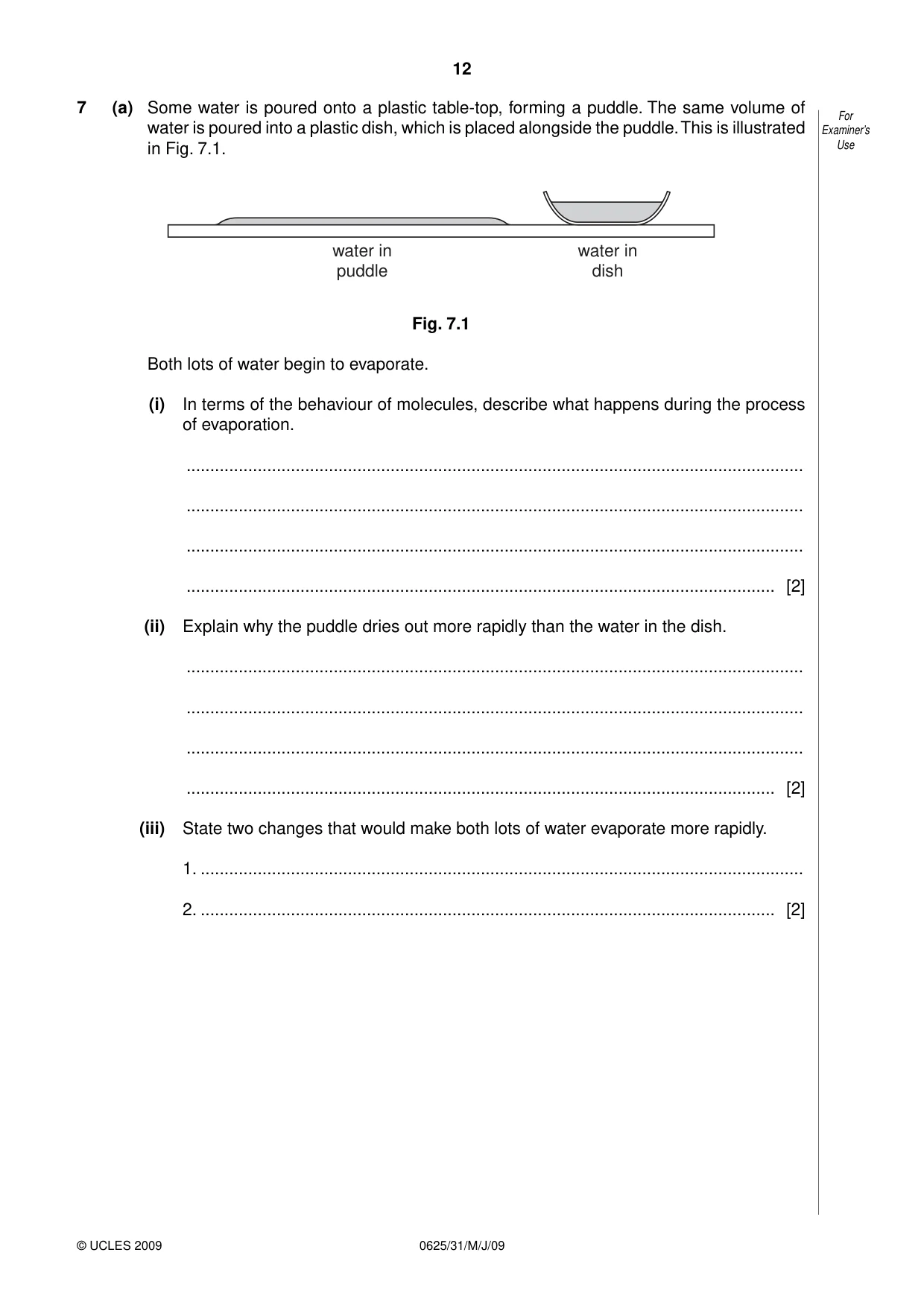
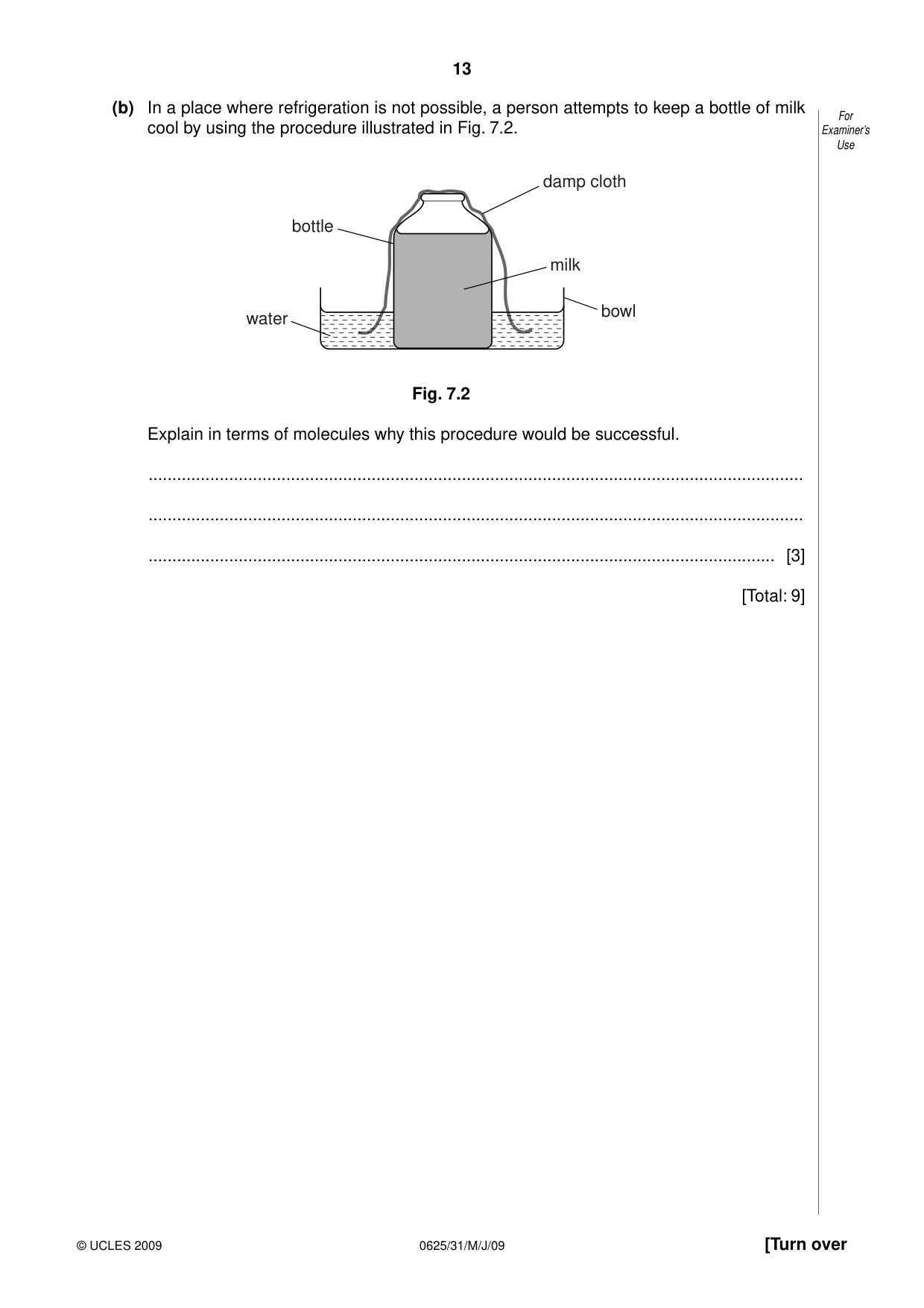
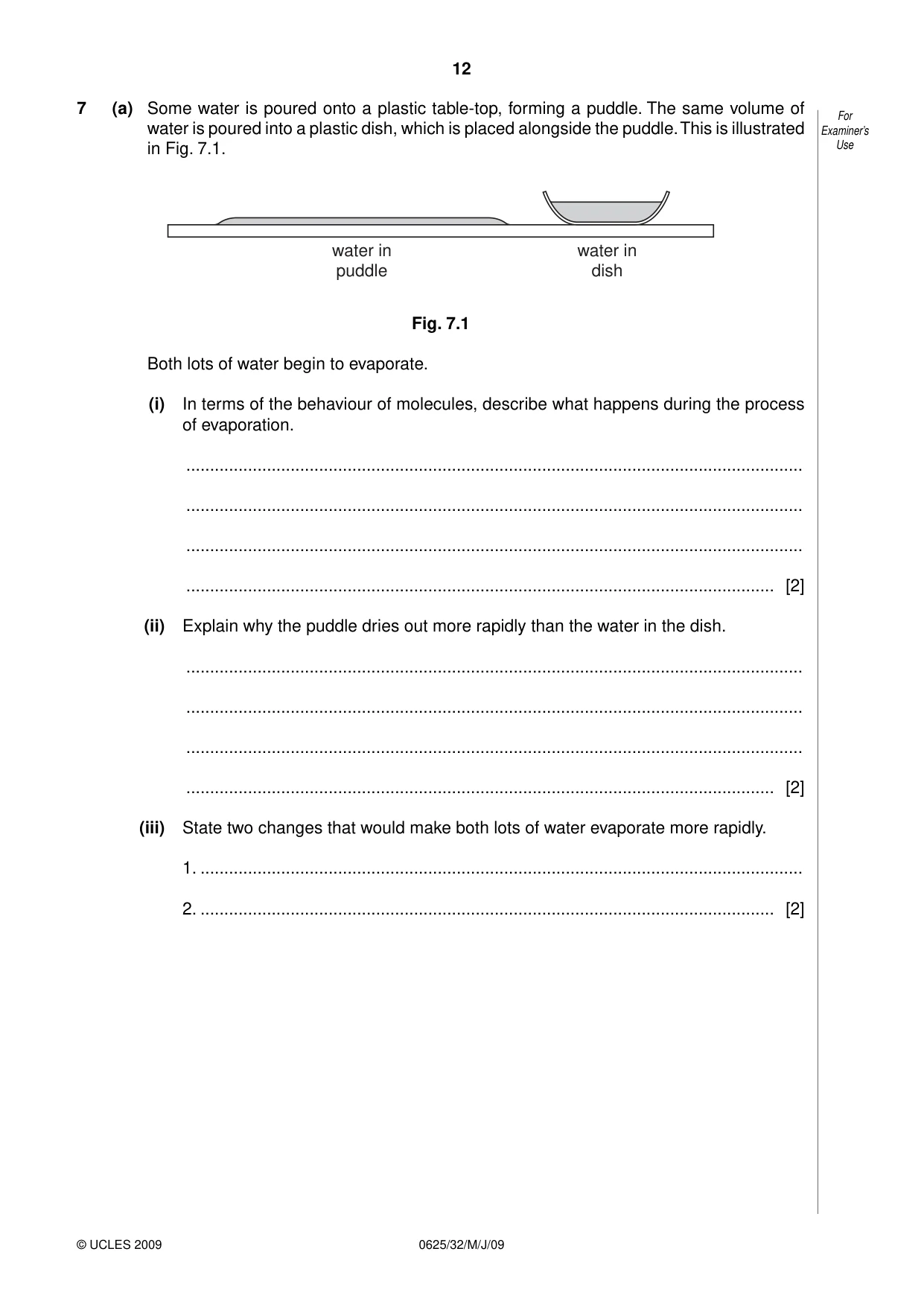
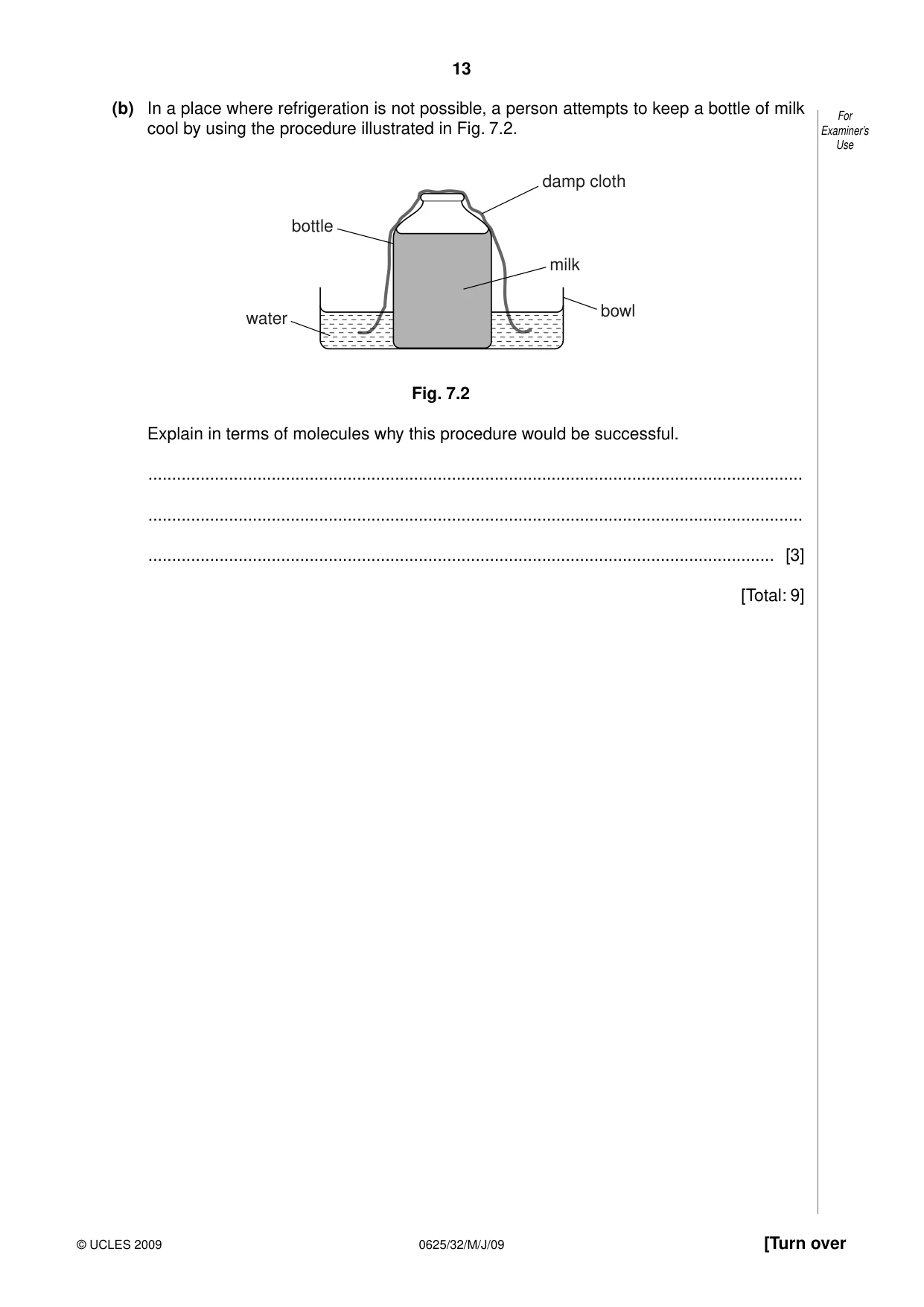
7 (a) Some water is poured onto a plastic table-top, forming a puddle. The same volume of For water is poured into a plastic dish, which is placed alongside the puddle. This is illustrated Examiner’s in Fig. 7.1. Use water in water in puddle dish Fig. 7.1 Both lots of water begin to evaporate. (i) In terms of the behaviour of molecules, describe what happens during the process of evaporation. .................................................................................................................................. .................................................................................................................................. .................................................................................................................................. ............................................................................................................................ [2] (ii) Explain why the puddle dries out more rapidly than the water in the dish. .................................................................................................................................. .................................................................................................................................. .................................................................................................................................. ............................................................................................................................ [2] (iii) State two changes that would make both lots of water evaporate more rapidly. 1. ............................................................................................................................... 2. ......................................................................................................................... [2] (b) In a place where refrigeration is not possible, a person attempts to keep a bottle of milk For cool by using the procedure illustrated in Fig. 7.2. Examiner’s Use damp cloth bottle milk bowl water Fig. 7.2 Explain in terms of molecules why this procedure would be successful. .......................................................................................................................................... .......................................................................................................................................... .................................................................................................................................... [3] [Total: 9]
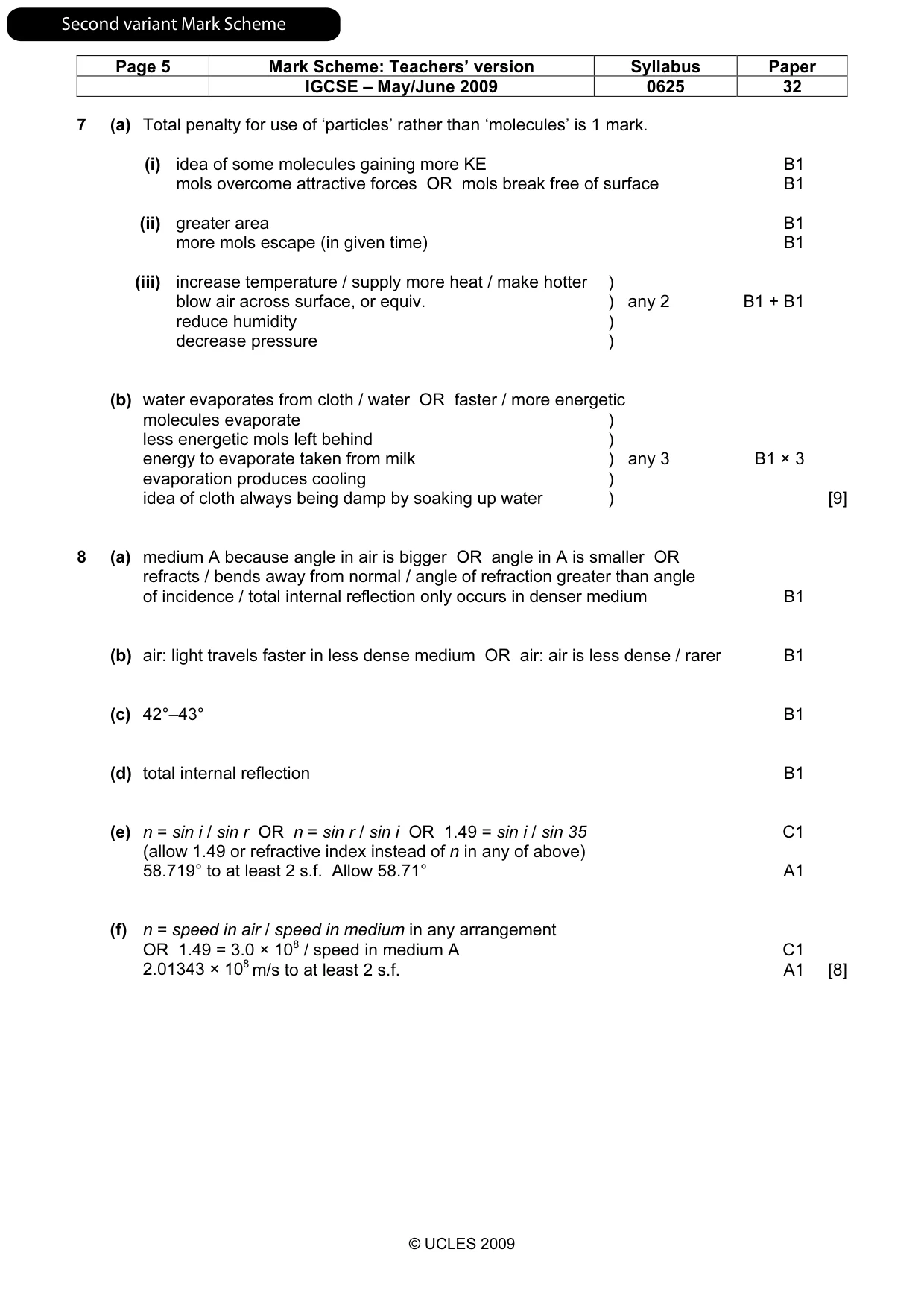
Mark scheme: 7 (a) Total penalty for use of ‘particles’ rather than ‘molecules’ is 1 mark. (i) idea of some molecules gaining more KE B1 mols overcome attractive forces OR mols break free of surface B1 (ii) greater area B1 more mols escape (in given time) B1 (iii) increase temperature / supply more heat / make hotter ) blow air across surface, or equiv. ) any 2 B1 + B1 reduce humidity ) decrease pressure ) (b) water evaporates from cloth / water OR faster / more energetic molecules evaporate ) less energetic mols left behind ) energy to evaporate taken from milk ) any 3 B1 × 3 evaporation produces cooling ) idea of cloth always being damp by soaking up water ) [9] IGCSE – May/June 2009 0625 31
Q8 · In an optics lesson, a Physics student traces the paths of three rays of light near the…
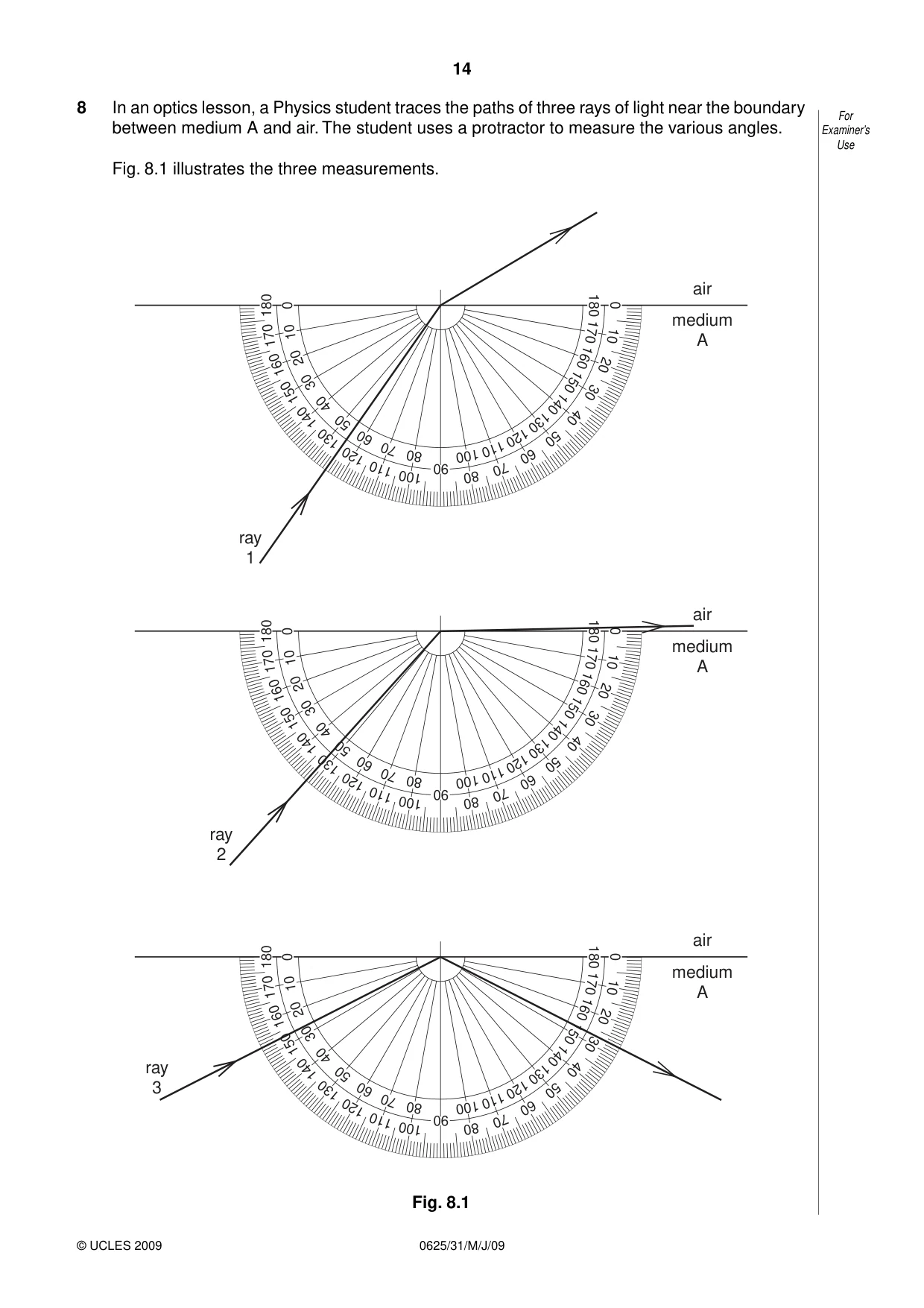
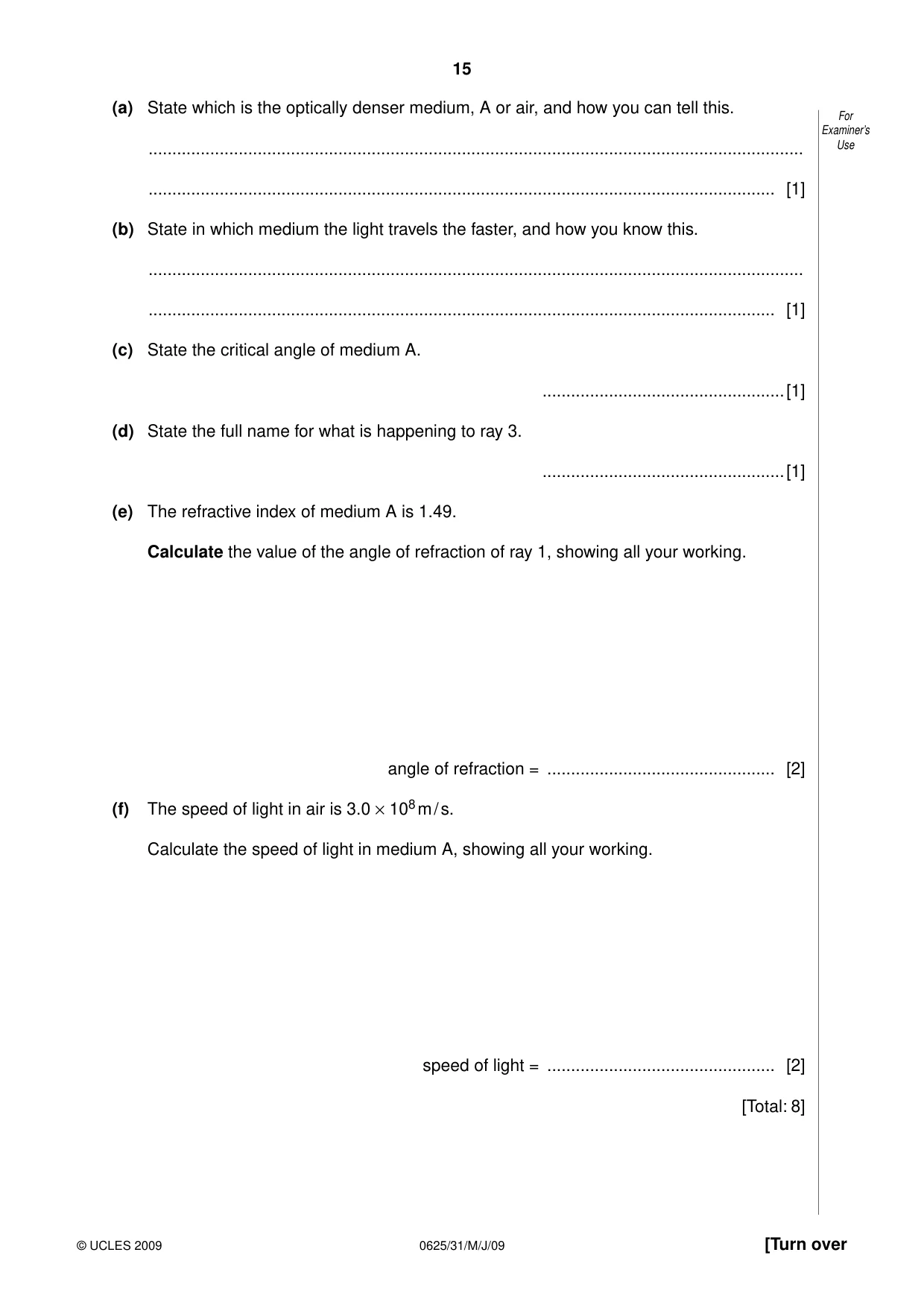
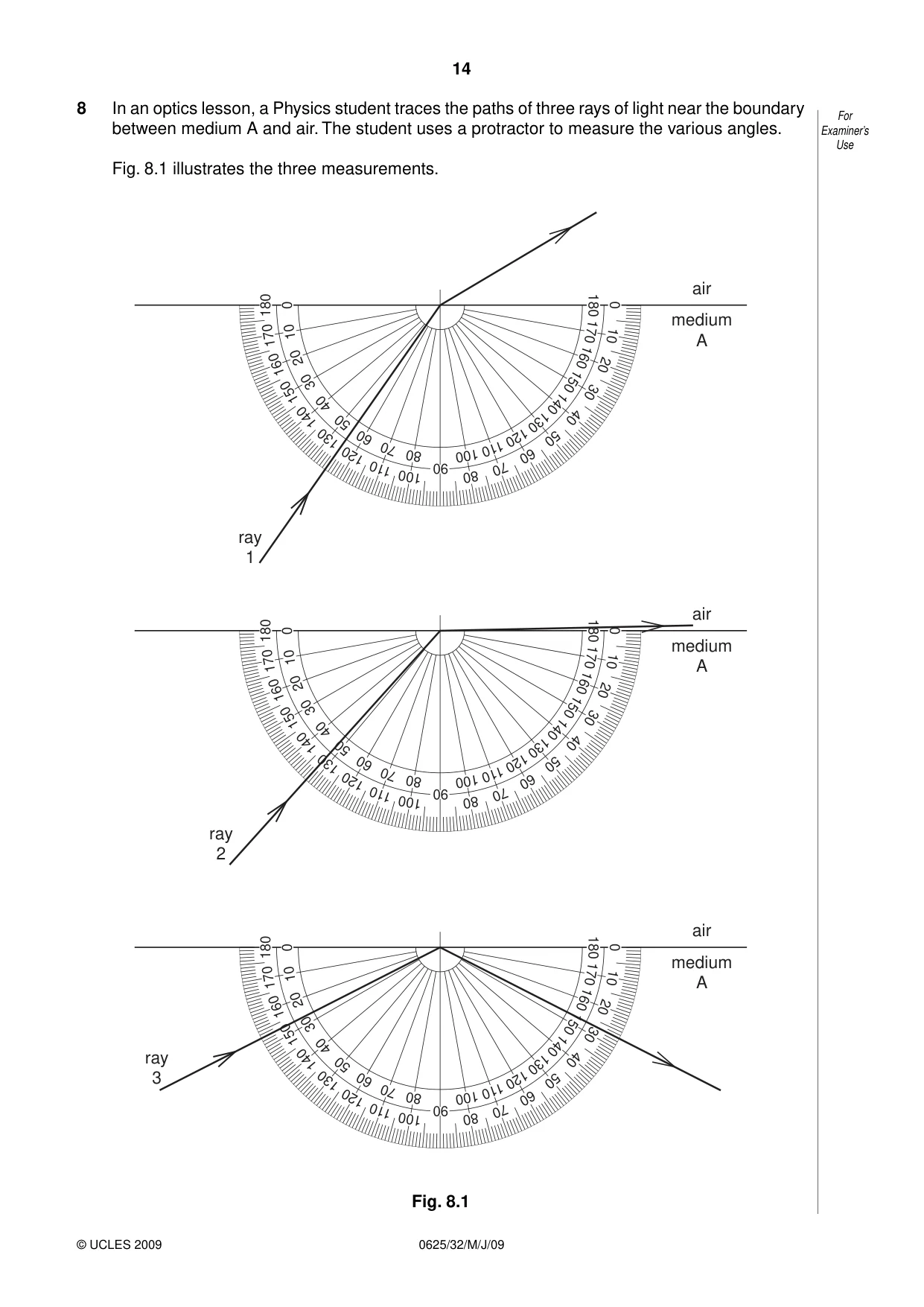
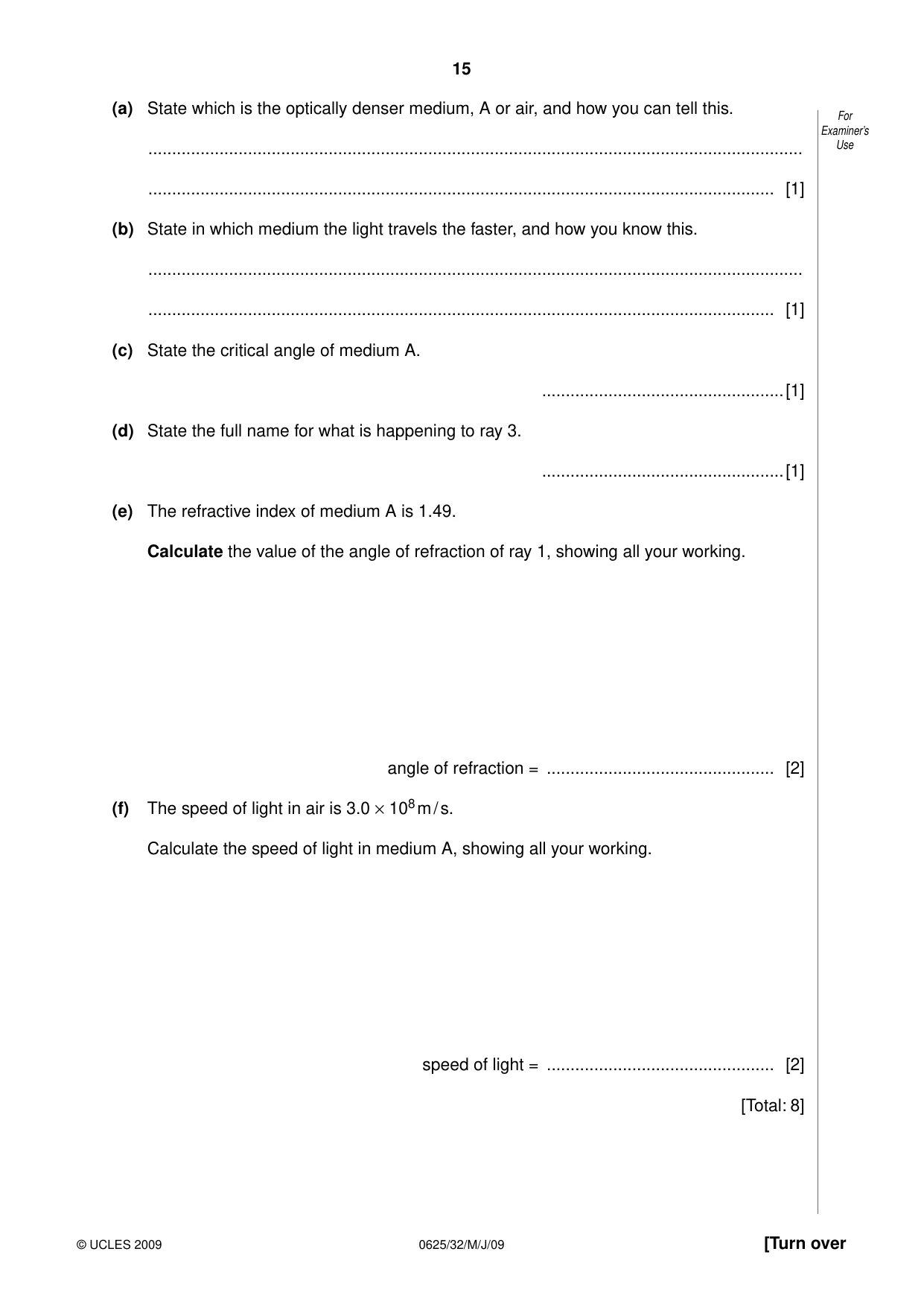
8 In an optics lesson, a Physics student traces the paths of three rays of light near the boundary For between medium A and air. The student uses a protractor to measure the various angles. Examiner’s Use Fig. 8.1 illustrates the three measurements. air 0 0 180 180 medium 170 10 170 10 A 160 20 160 20 30 150 150 30 40 140 140 50 130 40 130 60 120 50 120 70 80 100110 60 110 90 70 100 80 ray 1 air 0 0 180 180 medium 170 10 170 10 A 160 20 160 20 30 150 150 30 40 140 140 50 130 40 130 60 120 50 120 70 80 100110 60 110 90 70 100 80 ray 2 air 0 0 180 180 medium 170 10 170 10 A 160 20 160 20 30 150 150 30 40 140 ray 140 50 130 40 3 130 60 120 50 120 70 80 100110 60 110 90 70 100 80 Fig. 8.1 (a) State which is the optically denser medium, A or air, and how you can tell this. For Examiner’s .......................................................................................................................................... Use .................................................................................................................................... [1] (b) State in which medium the light travels the faster, and how you know this. .......................................................................................................................................... .................................................................................................................................... [1] (c) State the critical angle of medium A. ...................................................[1] (d) State the full name for what is happening to ray 3. ...................................................[1] (e) The refractive index of medium A is 1.49. Calculate the value of the angle of refraction of ray 1, showing all your working. angle of refraction = ................................................ [2] (f) The speed of light in air is 3.0 × 10⁸ m / s. Calculate the speed of light in medium A, showing all your working. speed of light = ................................................ [2] [Total: 8]
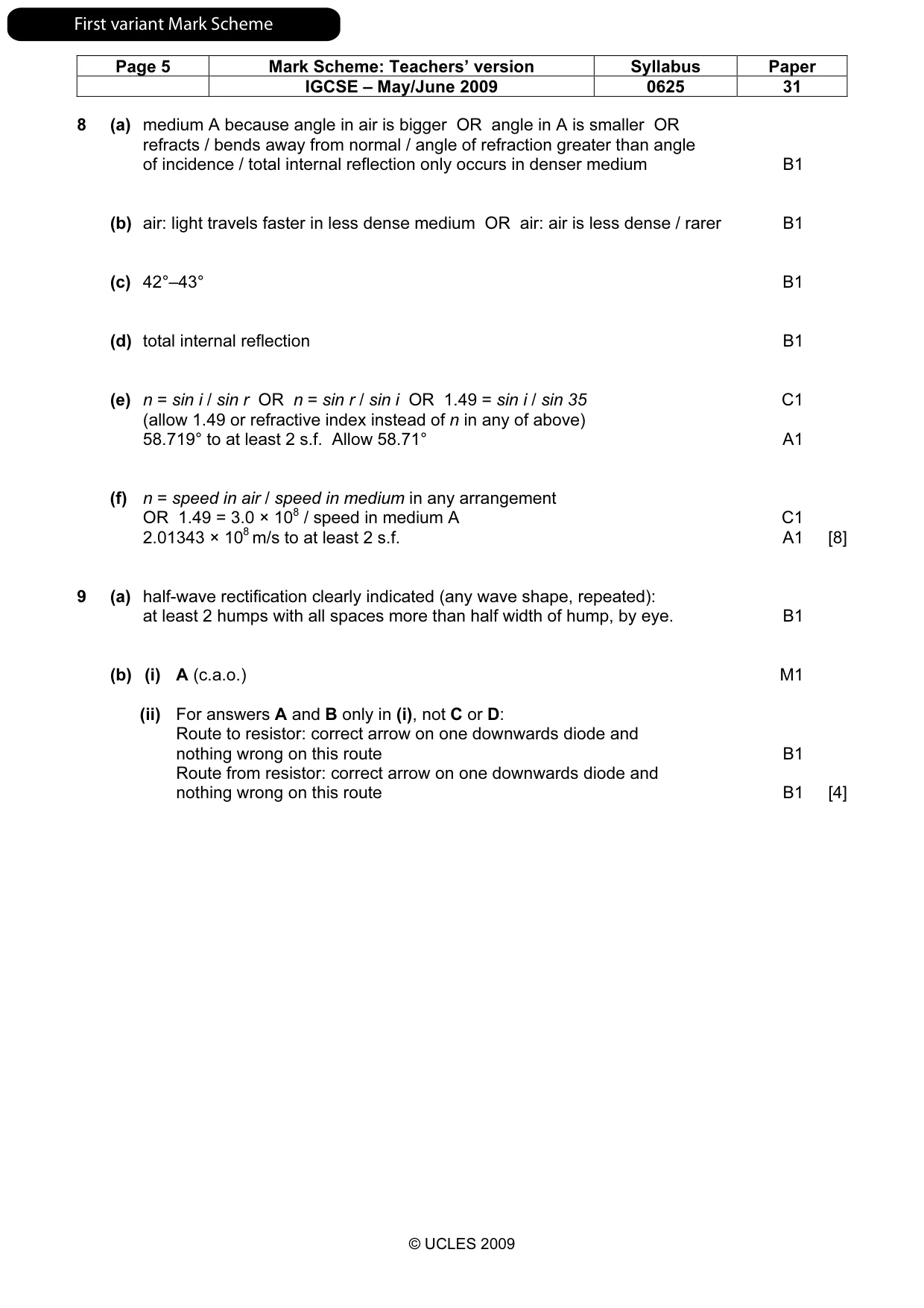
Mark scheme: 8 (a) medium A because angle in air is bigger OR angle in A is smaller OR refracts / bends away from normal / angle of refraction greater than angle of incidence / total internal reflection only occurs in denser medium B1 (b) air: light travels faster in less dense medium OR air: air is less dense / rarer B1 (c) 42°–43° B1 (d) total internal reflection B1 (e) n = sin i / sin r OR n = sin r / sin i OR 1.49 = sin i / sin 35 C1 (allow 1.49 or refractive index instead of n in any of above) 58.719° to at least 2 s.f. Allow 58.71° A1 (f) n = speed in air / speed in medium in any arrangement OR 1.49 = 3.0 × 10⁸ / speed in medium A C1 2.01343 × 10⁸ m/s to at least 2 s.f. A1 [8]
Question 9
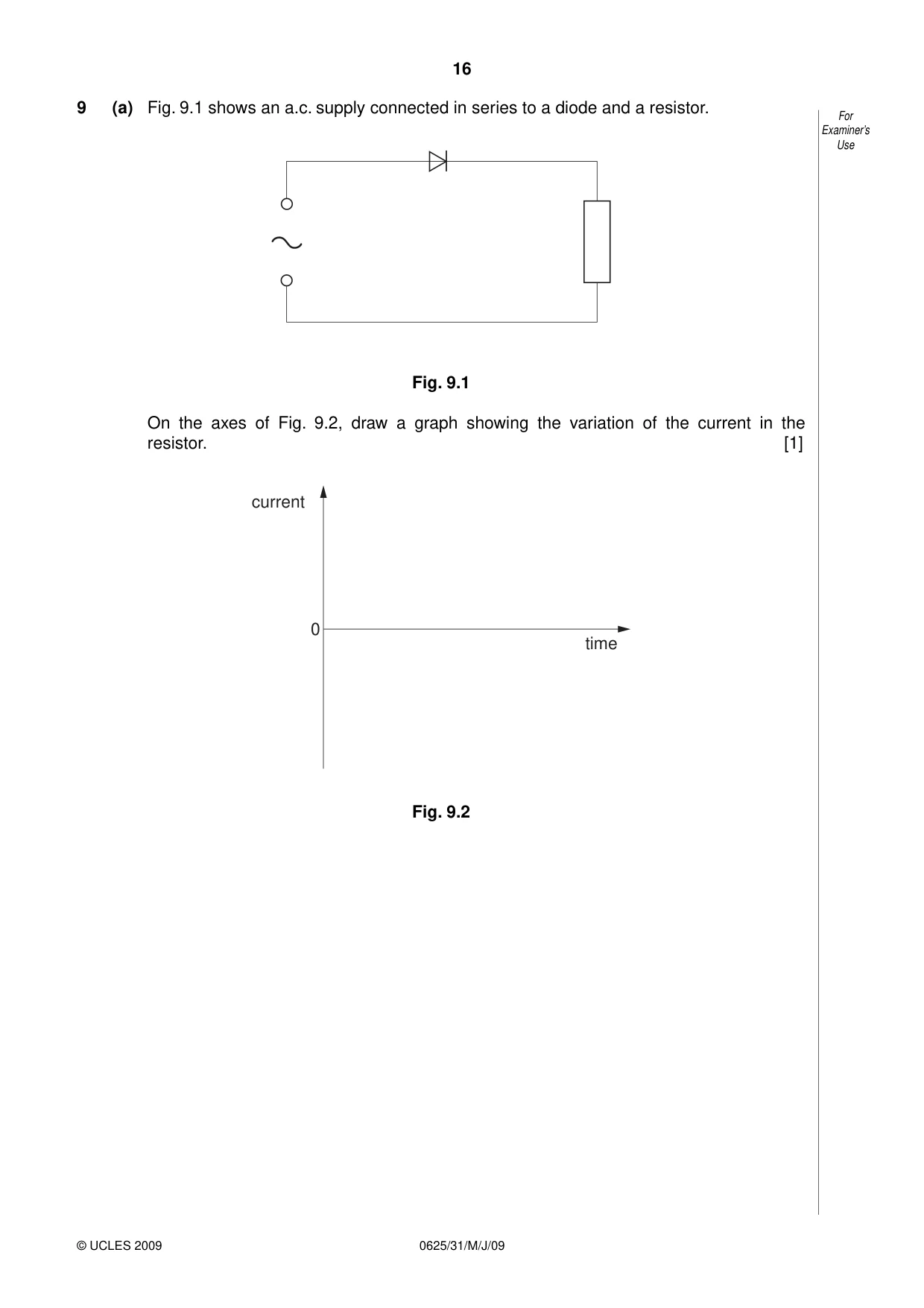
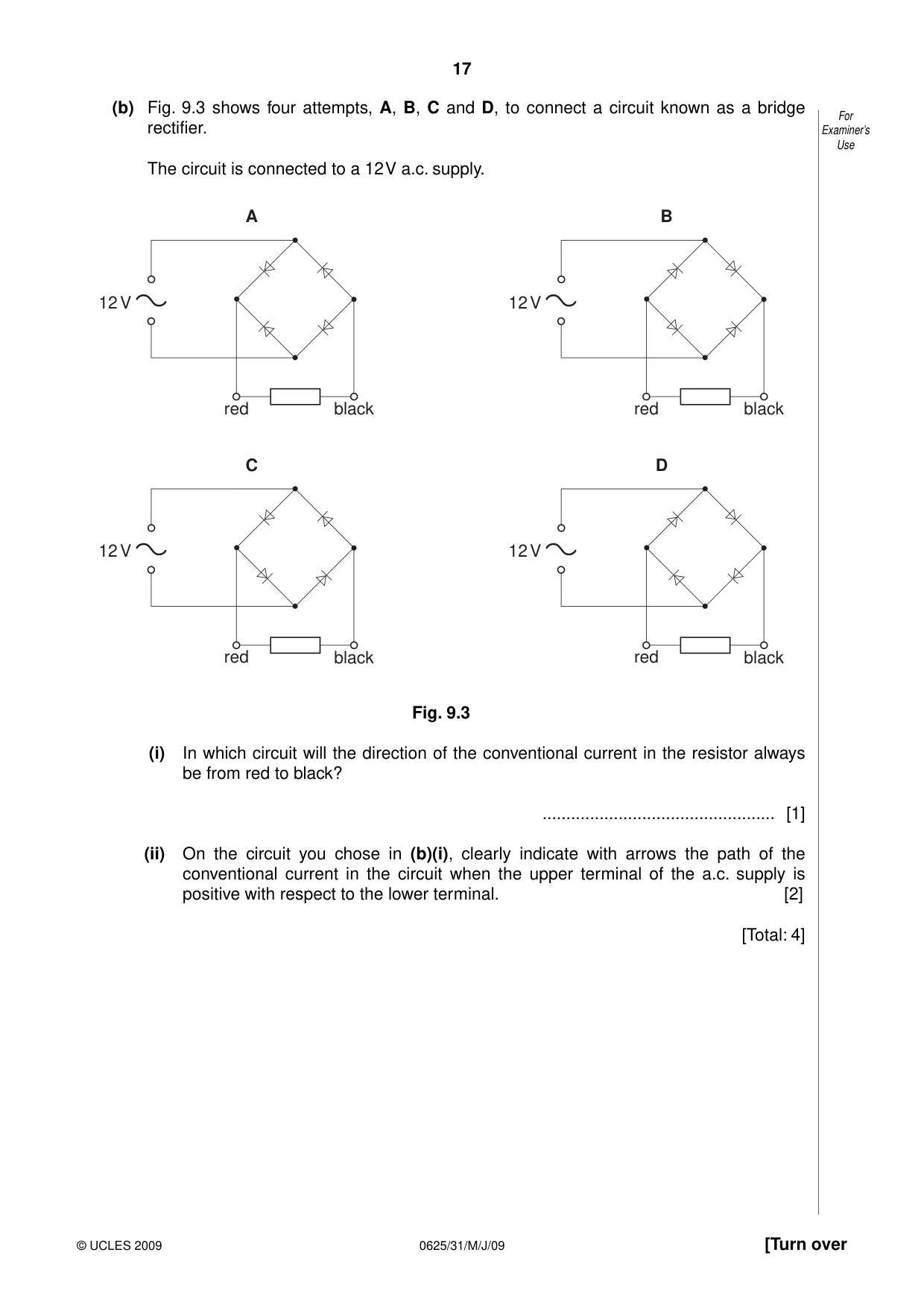
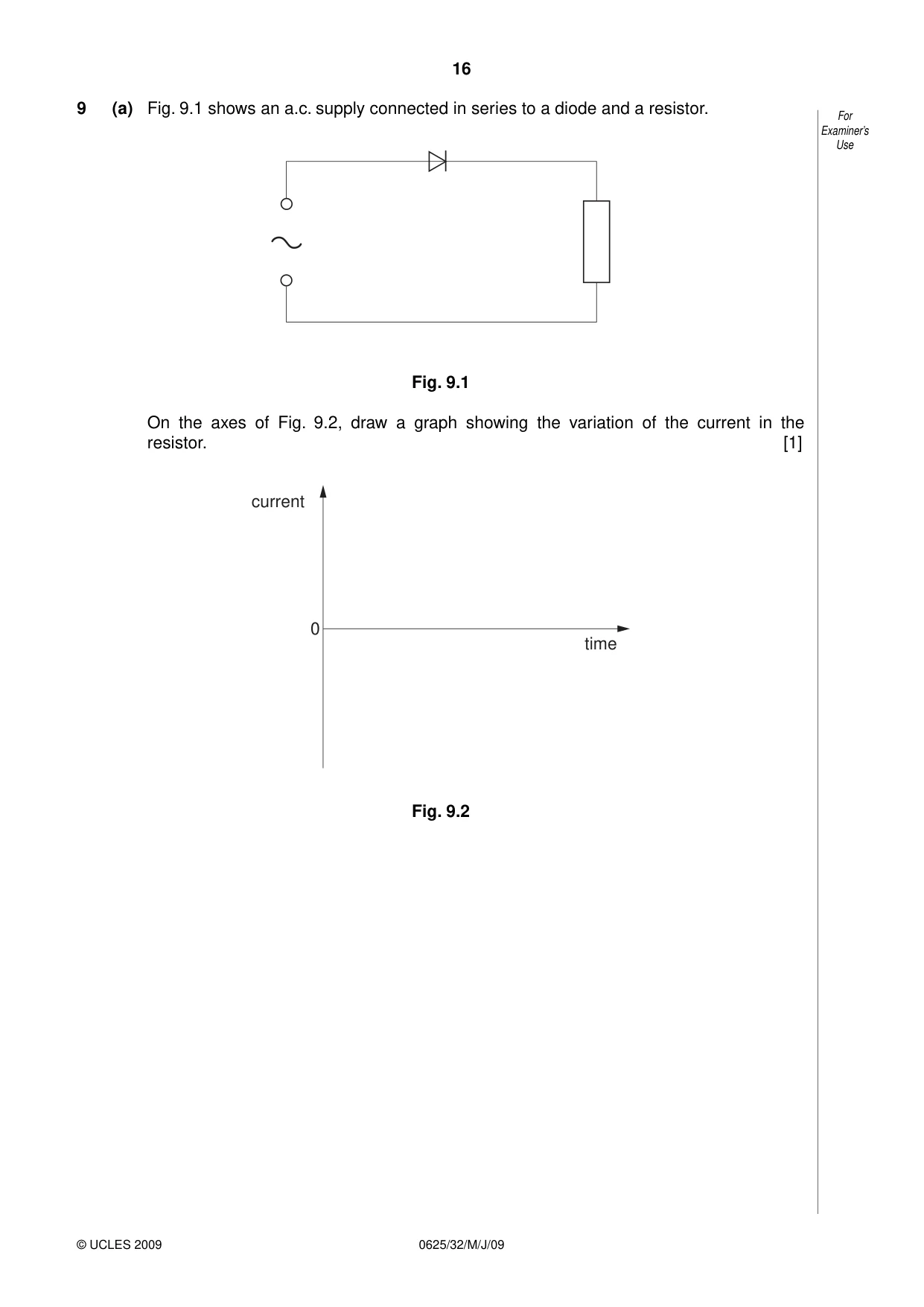
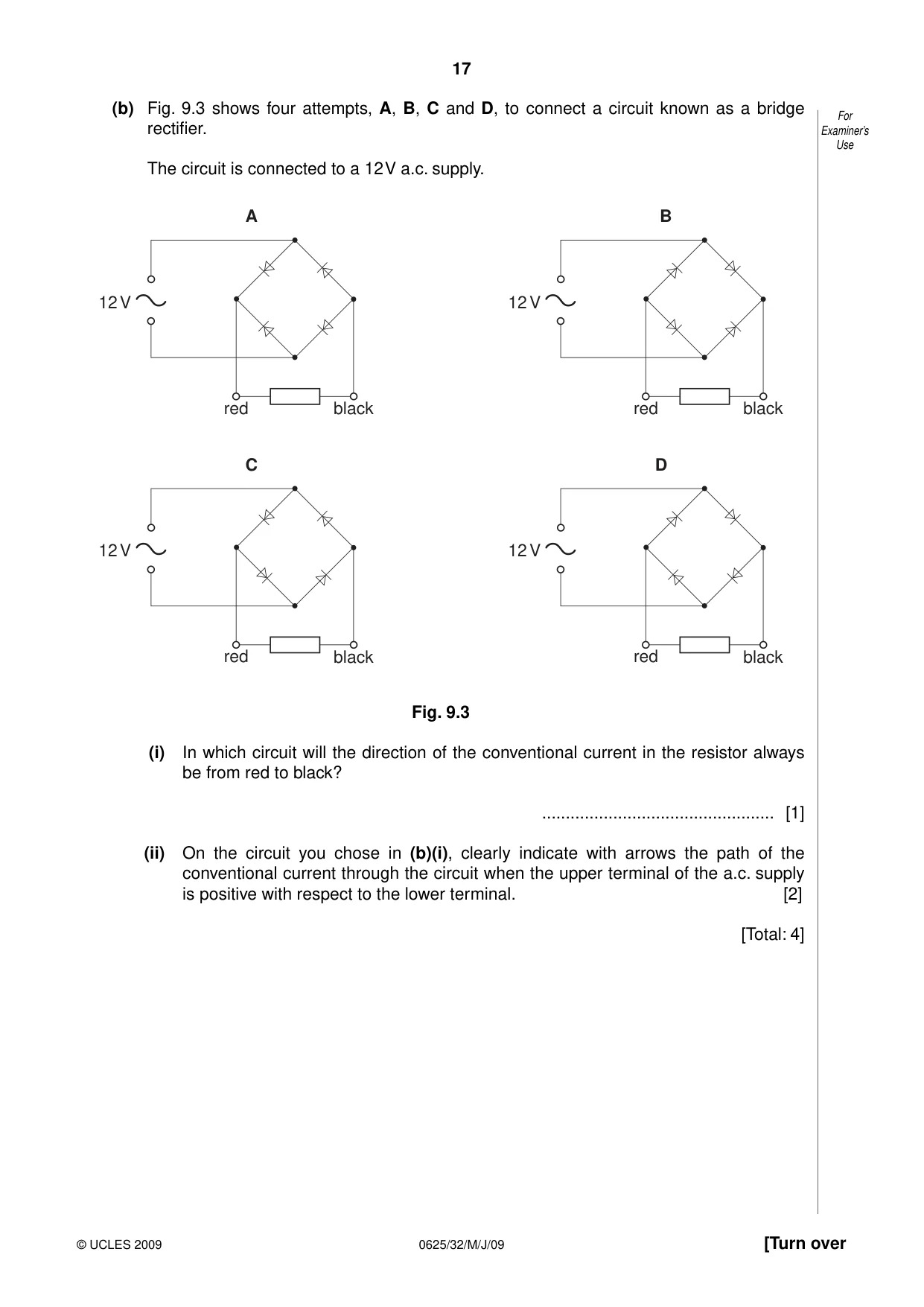
9 (a) Fig. 9.1 shows an a.c. supply connected in series to a diode and a resistor. For Examiner’s Use Fig. 9.1 On the axes of Fig. 9.2, draw a graph showing the variation of the current in the resistor. [1] current 0 time Fig. 9.2 (b) Fig. 9.3 shows four attempts, A, B, C and D, to connect a circuit known as a bridge For rectifier. Examiner’s Use The circuit is connected to a 12 V a.c. supply. A B 12 V 12 V red black red black C D 12 V 12 V red black red black Fig. 9.3 (i) In which circuit will the direction of the conventional current in the resistor always be from red to black? ................................................. [1] (ii) On the circuit you chose in (b)(i), clearly indicate with arrows the path of the conventional current in the circuit when the upper terminal of the a.c. supply is positive with respect to the lower terminal. [2] [Total: 4]
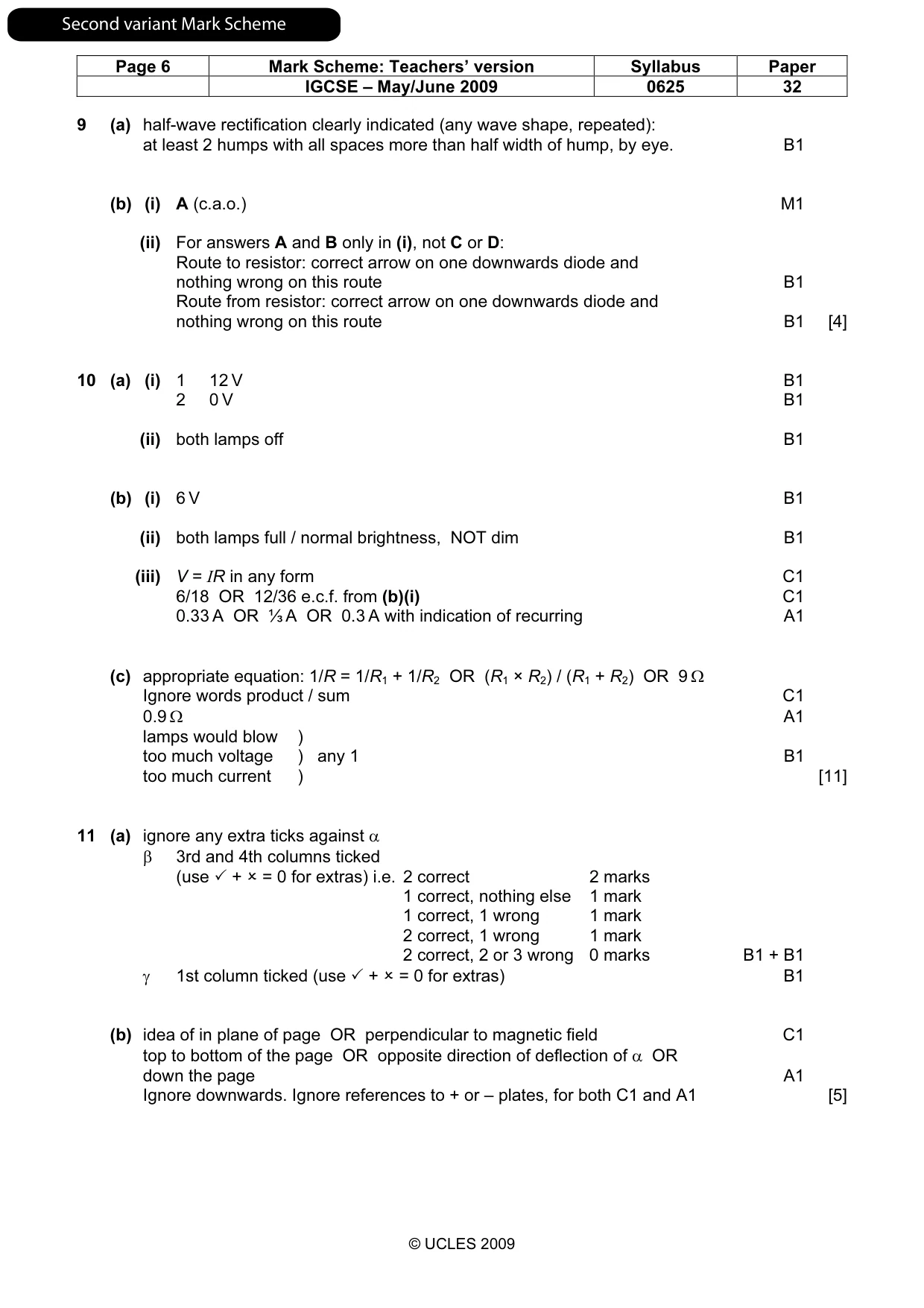
Mark scheme: 9 (a) half-wave rectification clearly indicated (any wave shape, repeated): at least 2 humps with all spaces more than half width of hump, by eye. B1 (b) (i) A (c.a.o.) M1 (ii) For answers A and B only in (i), not C or D: Route to resistor: correct arrow on one downwards diode and nothing wrong on this route B1 Route from resistor: correct arrow on one downwards diode and nothing wrong on this route B1 [4] IGCSE – May/June 2009 0625 31
Q10 · The circuit shown in Fig
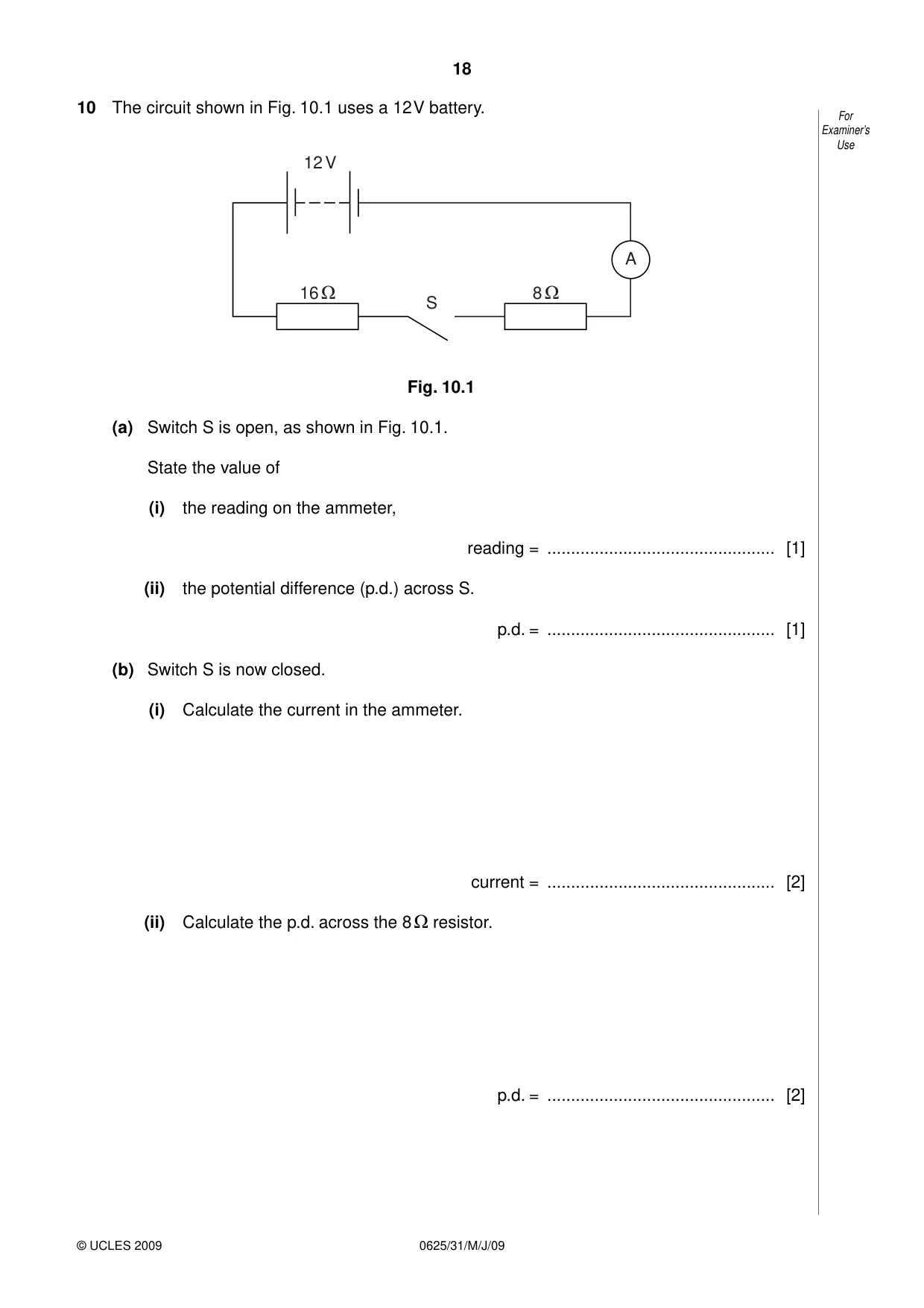
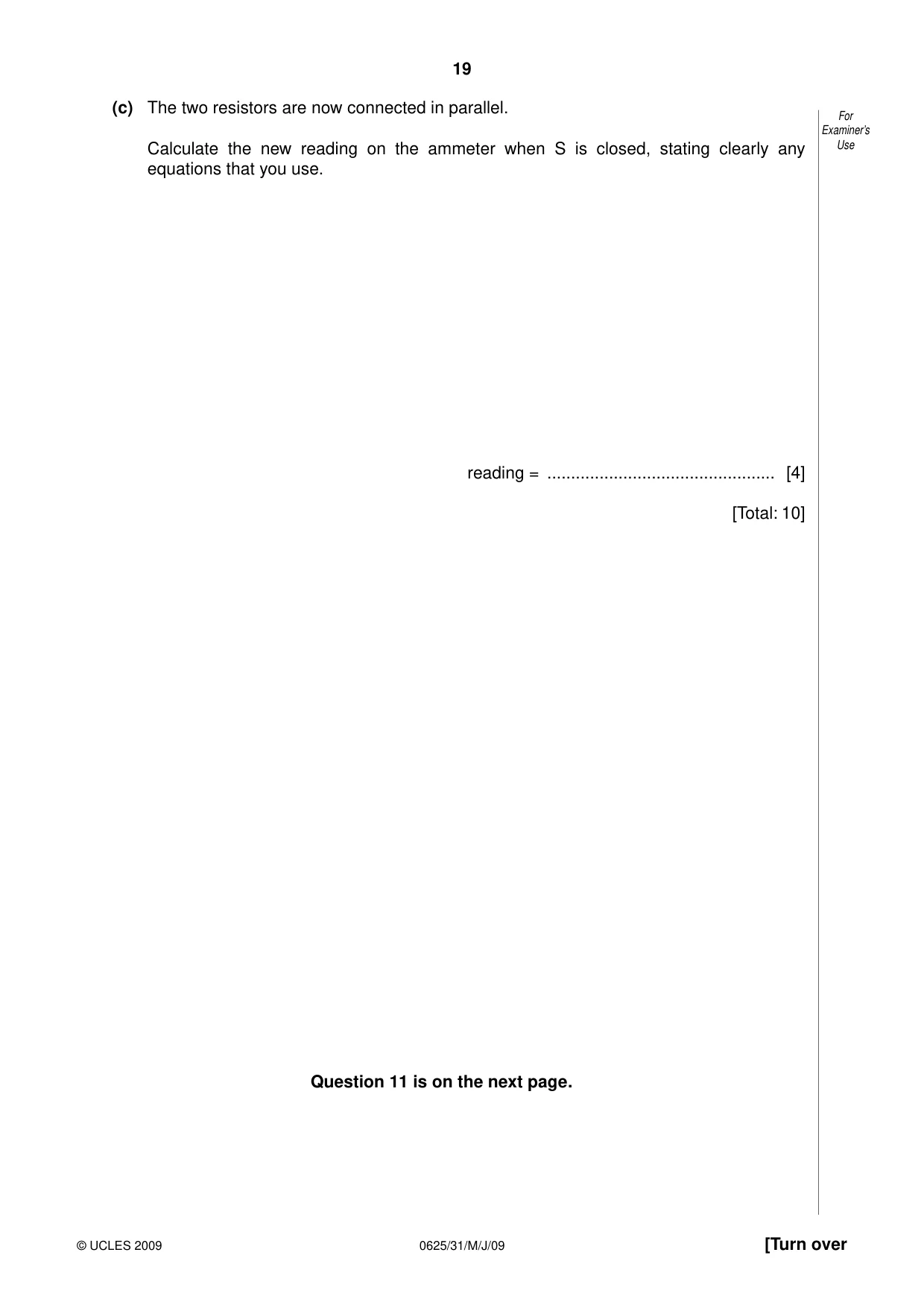
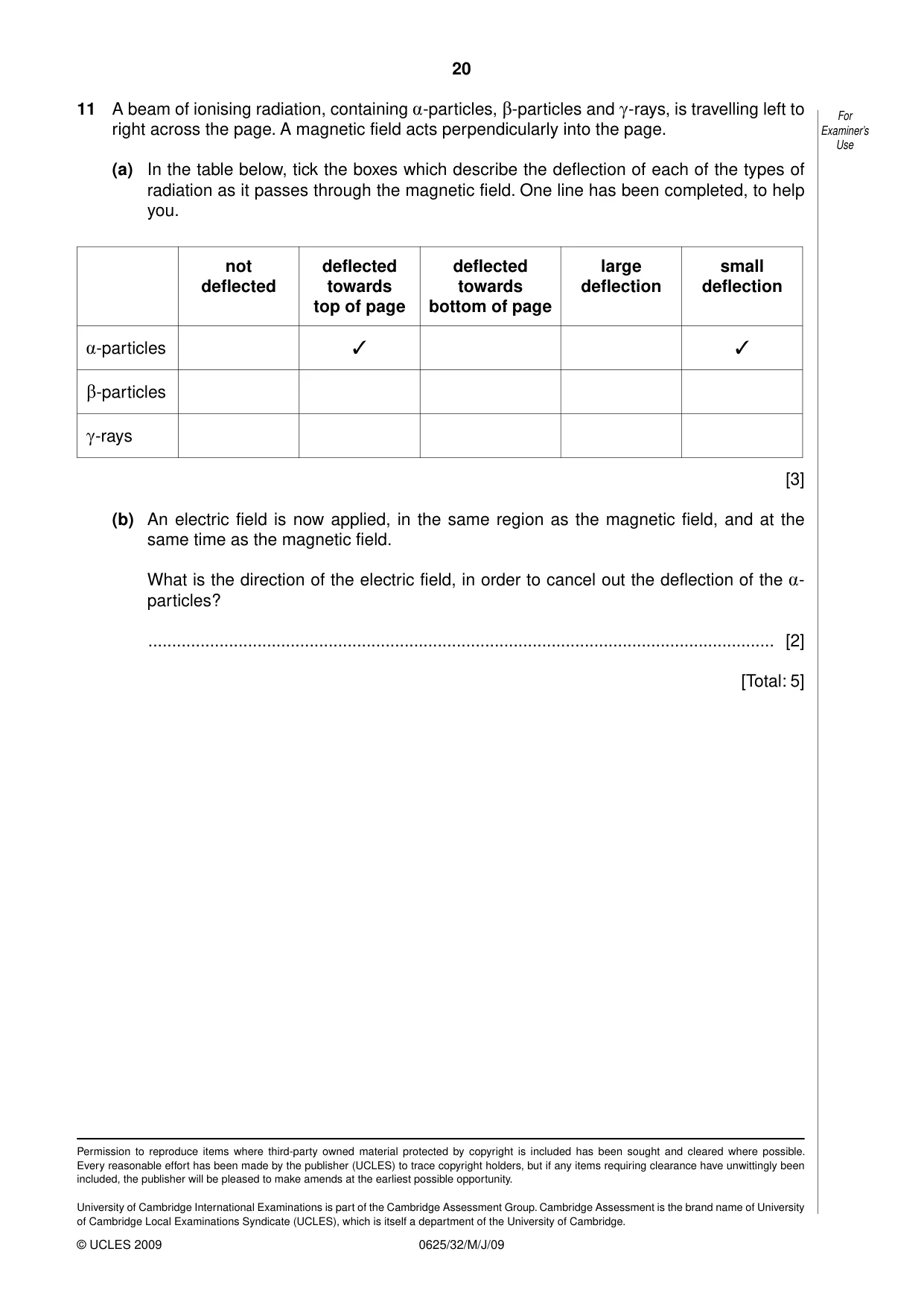
10 The circuit shown in Fig. 10.1 uses a 12 V battery. For Examiner’s Use 12 V A 16 8 S Fig. 10.1 (a) Switch S is open, as shown in Fig. 10.1. State the value of (i) the reading on the ammeter, reading = ................................................ [1] (ii) the potential difference (p.d.) across S. p.d. = ................................................ [1] (b) Switch S is now closed. (i) Calculate the current in the ammeter. current = ................................................ [2] (ii) Calculate the p.d. across the 8 resistor. p.d. = ................................................ [2] (c) The two resistors are now connected in parallel. For Examiner’s Calculate the new reading on the ammeter when S is closed, stating clearly any Use equations that you use. reading = ................................................ [4] [Total: 10] Question 11 is on the next page.
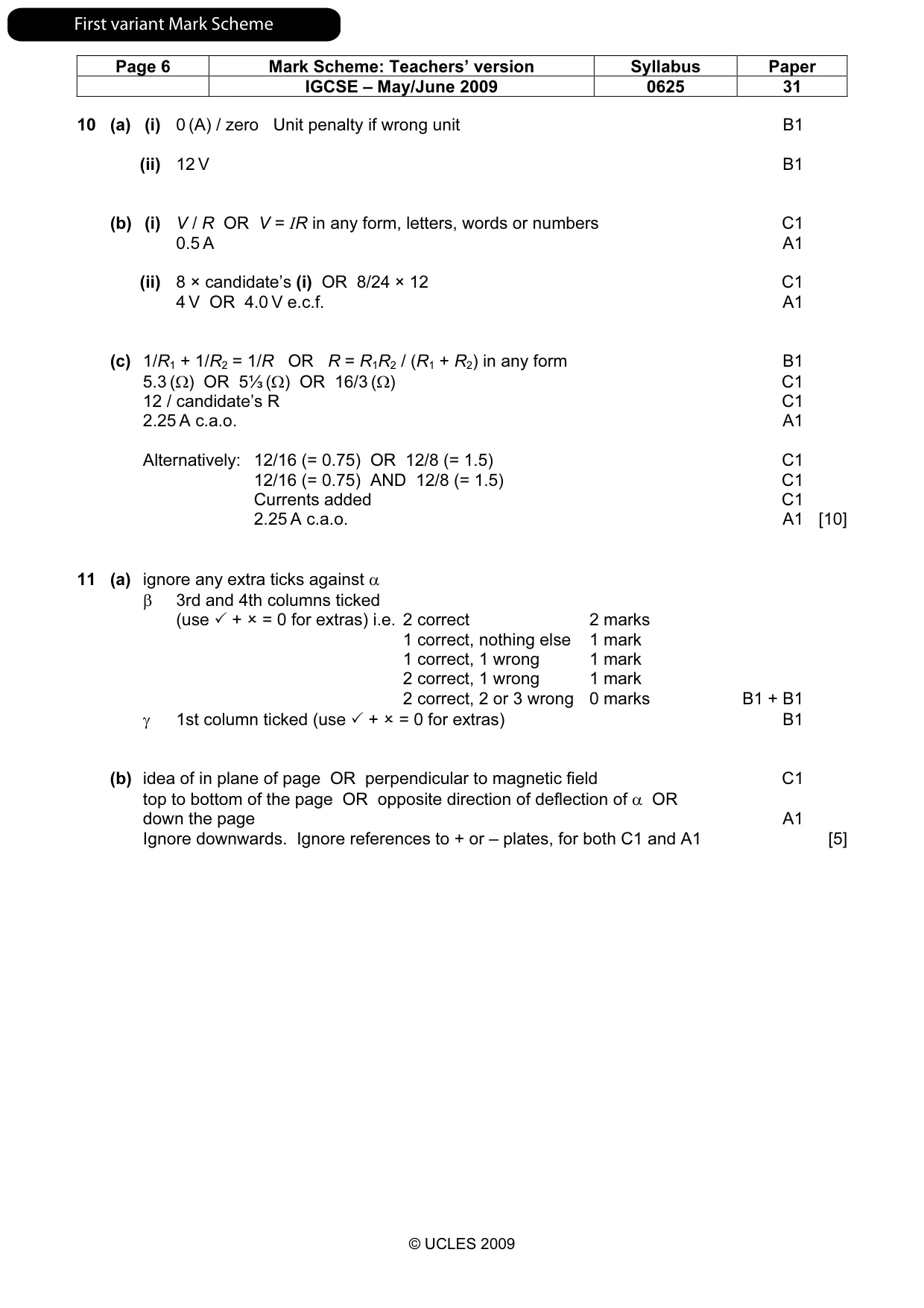
Mark scheme: 10 (a) (i) 0 (A) / zero Unit penalty if wrong unit B1 (ii) 12 V B1 (b) (i) V / R OR V = IR in any form, letters, words or numbers C1 0.5 A A1 (ii) 8 × candidate’s (i) OR 8/24 × 12 C1 4 V OR 4.0 V e.c.f. A1 (c) 1/R1 + 1/R2 = 1/R OR R = R1R2 / (R1 + R2) in any form B1 5.3 (Ω) OR 5⅓ (Ω) OR 16/3 (Ω) C1 12 / candidate’s R C1 2.25 A c.a.o. A1 Alternatively: 12/16 (= 0.75) OR 12/8 (= 1.5) C1 12/16 (= 0.75) AND 12/8 (= 1.5) C1 Currents added C1 2.25 A c.a.o. A1 [10]
What was in this paper
The subtopics covered by these 10 questions, and how many questions each got. Open one in a new tab to see every Cambridge question on it.