Cambridge IGCSE Physics 0625 — 2013 Oct/Nov Paper 3 · Variant 1
0625/31/O/N/13 · 11 questions · 80 marks · ≈90 min
The question paper and its mark scheme, free to read here and free to download. This is Cambridge’s own paper, exactly as it was sat.
Question paper20 pages
Mark scheme7 pages
Answers below. Sit the paper first if you are practising.
Questions as text
Question 1
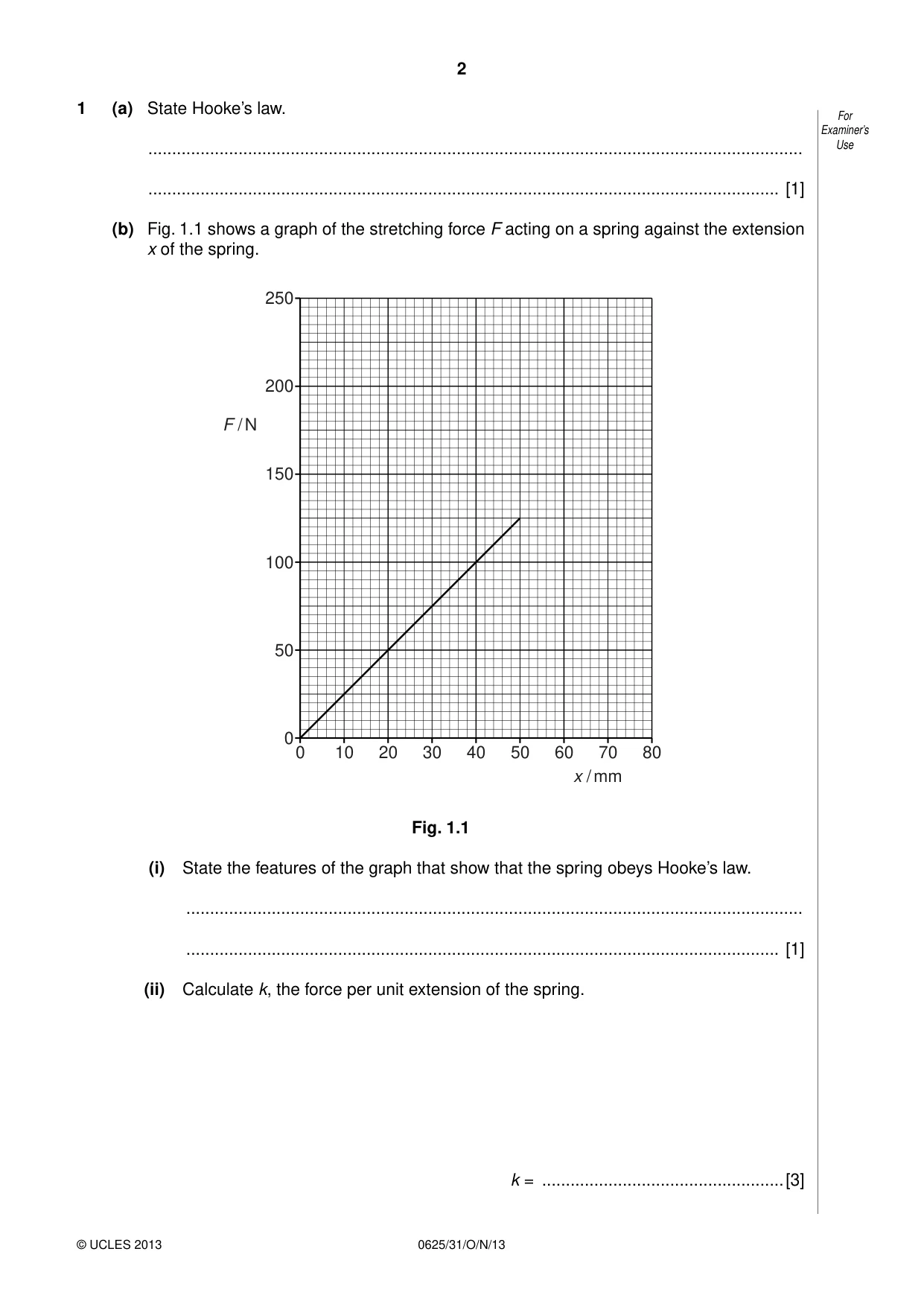
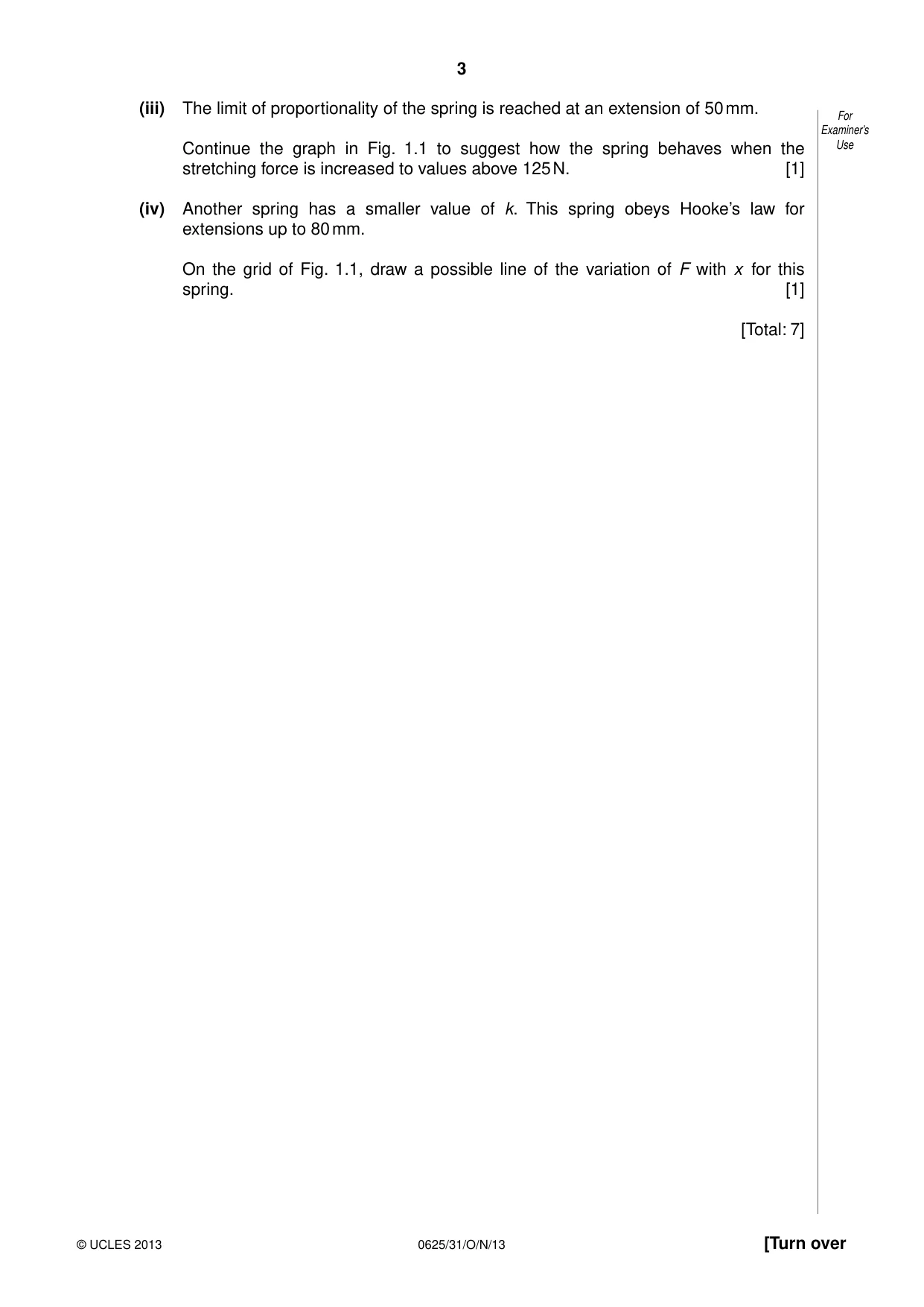
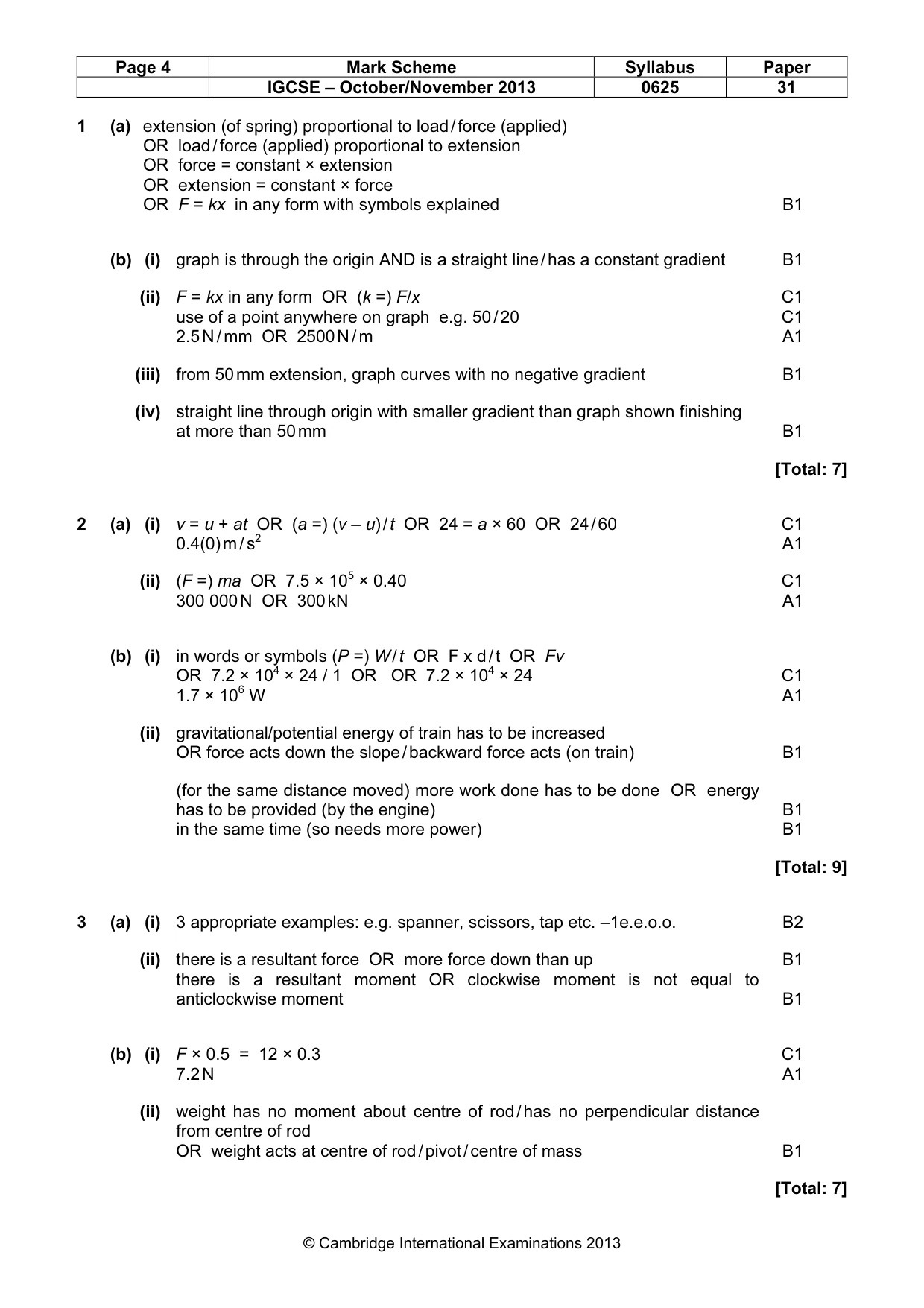
1 (a) State Hooke’s law. For Examiner’s .......................................................................................................................................... Use ..................................................................................................................................... [1] (b) Fig. 1.1 shows a graph of the stretching force F acting on a spring against the extension x of the spring. 250 200 F / N 150 100 50 0 0 10 20 30 40 50 60 70 80 x / mm Fig. 1.1 (i) State the features of the graph that show that the spring obeys Hooke’s law. .................................................................................................................................. ............................................................................................................................. [1] (ii) Calculate k, the force per unit extension of the spring. k = ...................................................[3] (iii) The limit of proportionality of the spring is reached at an extension of 50 mm. For Examiner’s Continue the graph in Fig. 1.1 to suggest how the spring behaves when the Use stretching force is increased to values above 125 N. [1] (iv) Another spring has a smaller value of k. This spring obeys Hooke’s law for extensions up to 80 mm. On the grid of Fig. 1.1, draw a possible line of the variation of F with x for this spring. [1] [Total: 7]
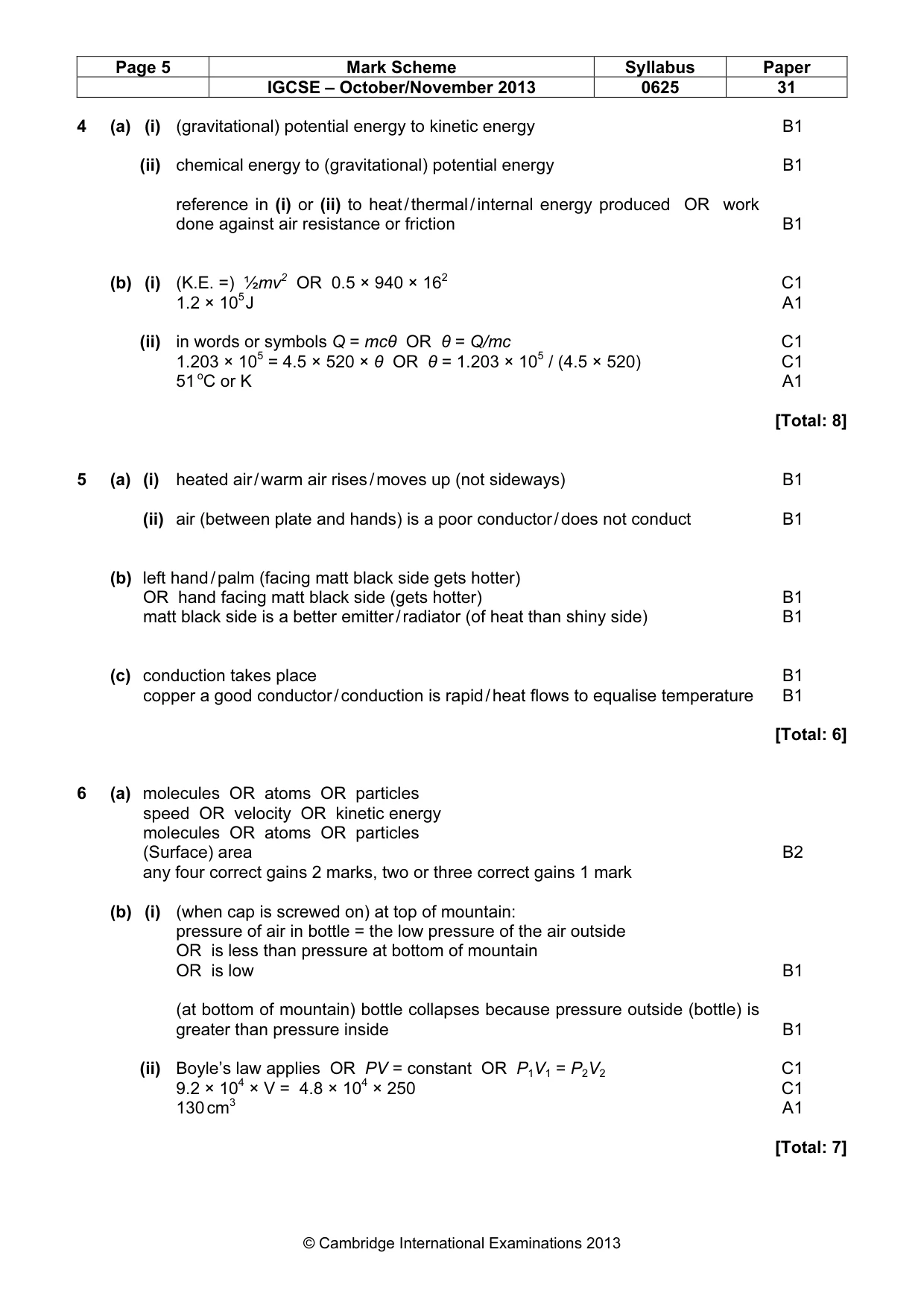
Mark scheme: 1 (a) extension (of spring) proportional to load / force (applied) OR load / force (applied) proportional to extension OR force = constant × extension OR extension = constant × force OR F = kx in any form with symbols explained B1 (b) (i) graph is through the origin AND is a straight line / has a constant gradient B1 (ii) F = kx in any form OR (k =) F/x C1 use of a point anywhere on graph e.g. 50 / 20 C1 2.5 N / mm OR 2500 N / m A1 (iii) from 50 mm extension, graph curves with no negative gradient B1 (iv) straight line through origin with smaller gradient than graph shown finishing at more than 50 mm B1 [Total: 7]
Q2 · A train has a total mass of 7.5 × 10⁵ kg
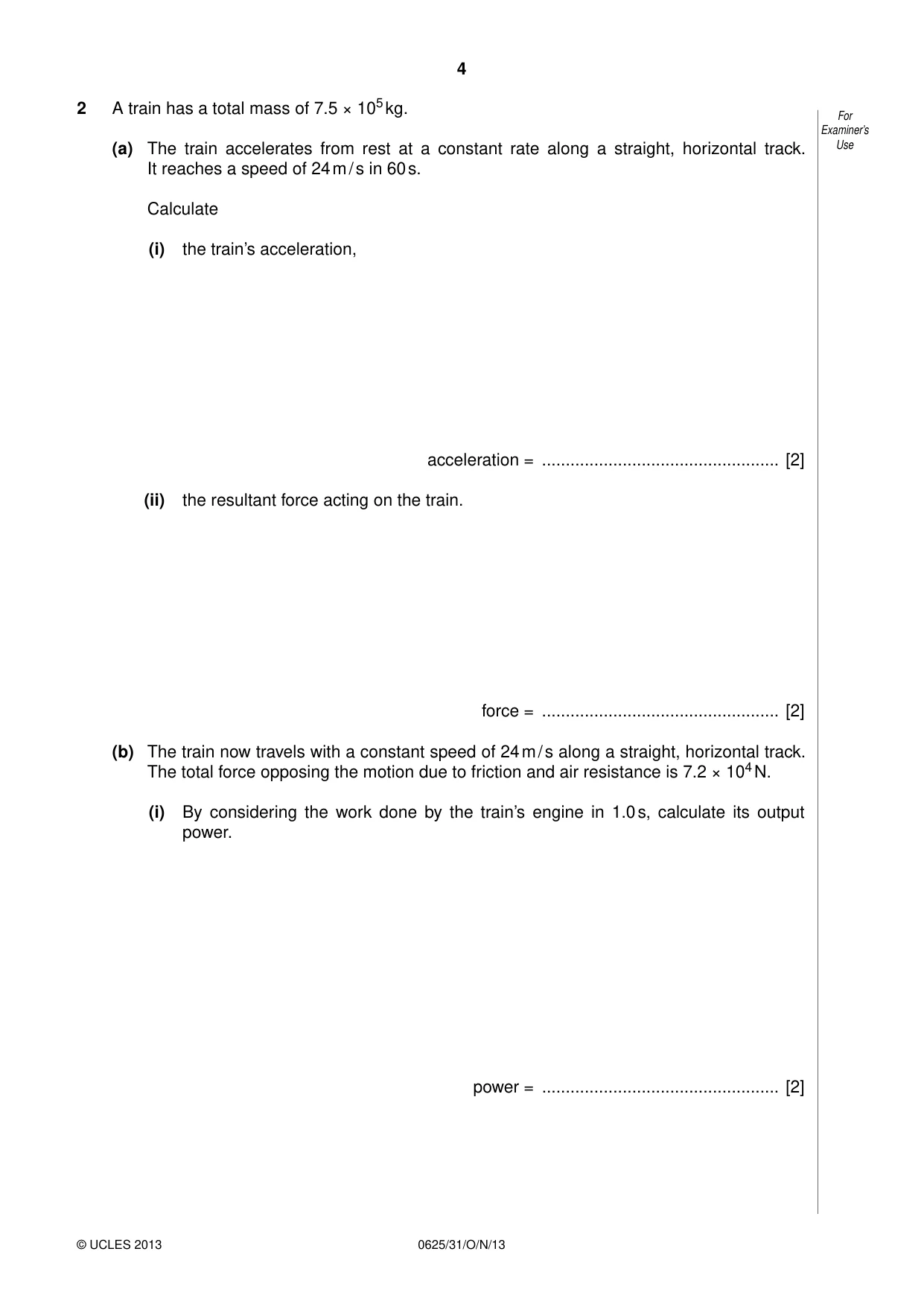
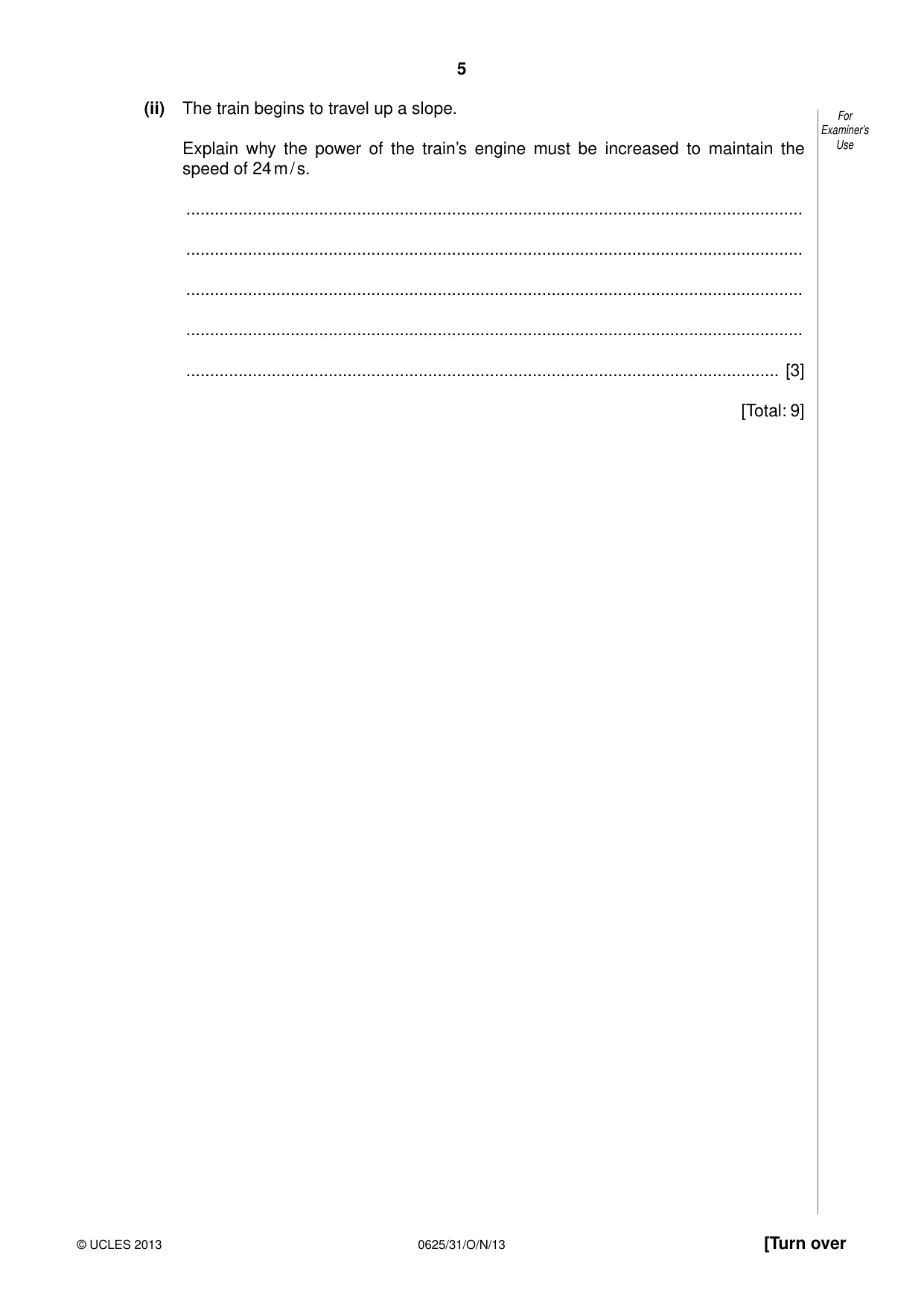
2 A train has a total mass of 7.5 × 10⁵ kg. For Examiner’s (a) The train accelerates from rest at a constant rate along a straight, horizontal track. Use It reaches a speed of 24 m / s in 60 s. Calculate (i) the train’s acceleration, acceleration = .................................................. [2] (ii) the resultant force acting on the train. force = .................................................. [2] (b) The train now travels with a constant speed of 24 m / s along a straight, horizontal track. The total force opposing the motion due to friction and air resistance is 7.2 × 10⁴ N. (i) By considering the work done by the train’s engine in 1.0 s, calculate its output power. power = .................................................. [2] (ii) The train begins to travel up a slope. For Examiner’s Explain why the power of the train’s engine must be increased to maintain the Use speed of 24 m / s. .................................................................................................................................. .................................................................................................................................. .................................................................................................................................. .................................................................................................................................. ............................................................................................................................. [3] [Total: 9]
Mark scheme: 2 (a) (i) v = u + at OR (a =) (v – u) / t OR 24 = a × 60 OR 24 / 60 C1 0.4(0) m / s2 A1 (ii) (F =) ma OR 7.5 × 105 × 0.40 C1 300 000 N OR 300 kN A1 (b) (i) in words or symbols (P =) W / t OR F x d / t OR Fv OR 7.2 × 104 × 24 / 1 OR OR 7.2 × 104 × 24 C1 1.7 × 10⁶ W A1 (ii) gravitational/potential energy of train has to be increased OR force acts down the slope / backward force acts (on train) B1 (for the same distance moved) more work done has to be done OR energy has to be provided (by the engine) B1 in the same time (so needs more power) B1 [Total: 9]
Q3 · Write down the names of three man-made devices in everyday use that depend, For for their…
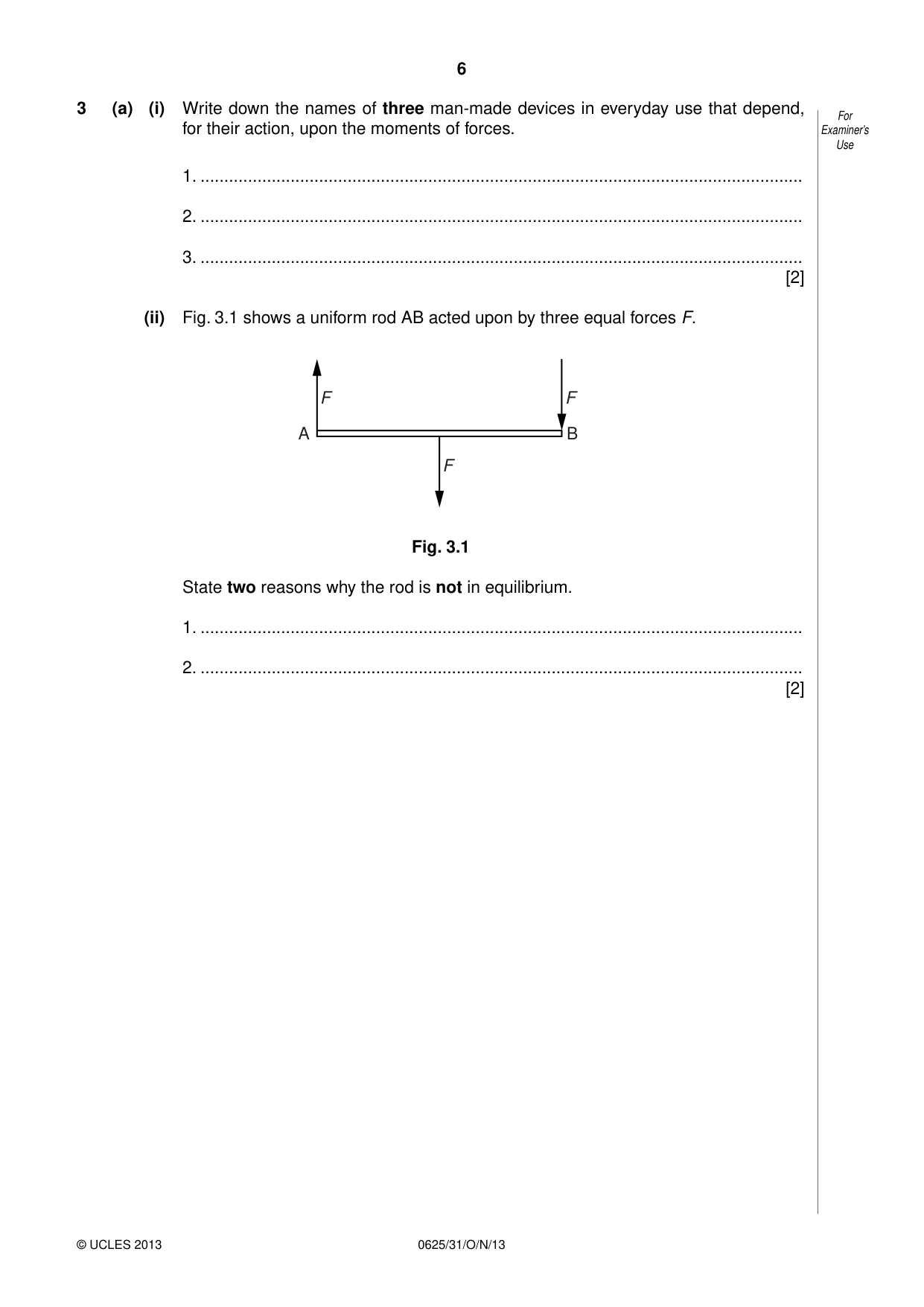
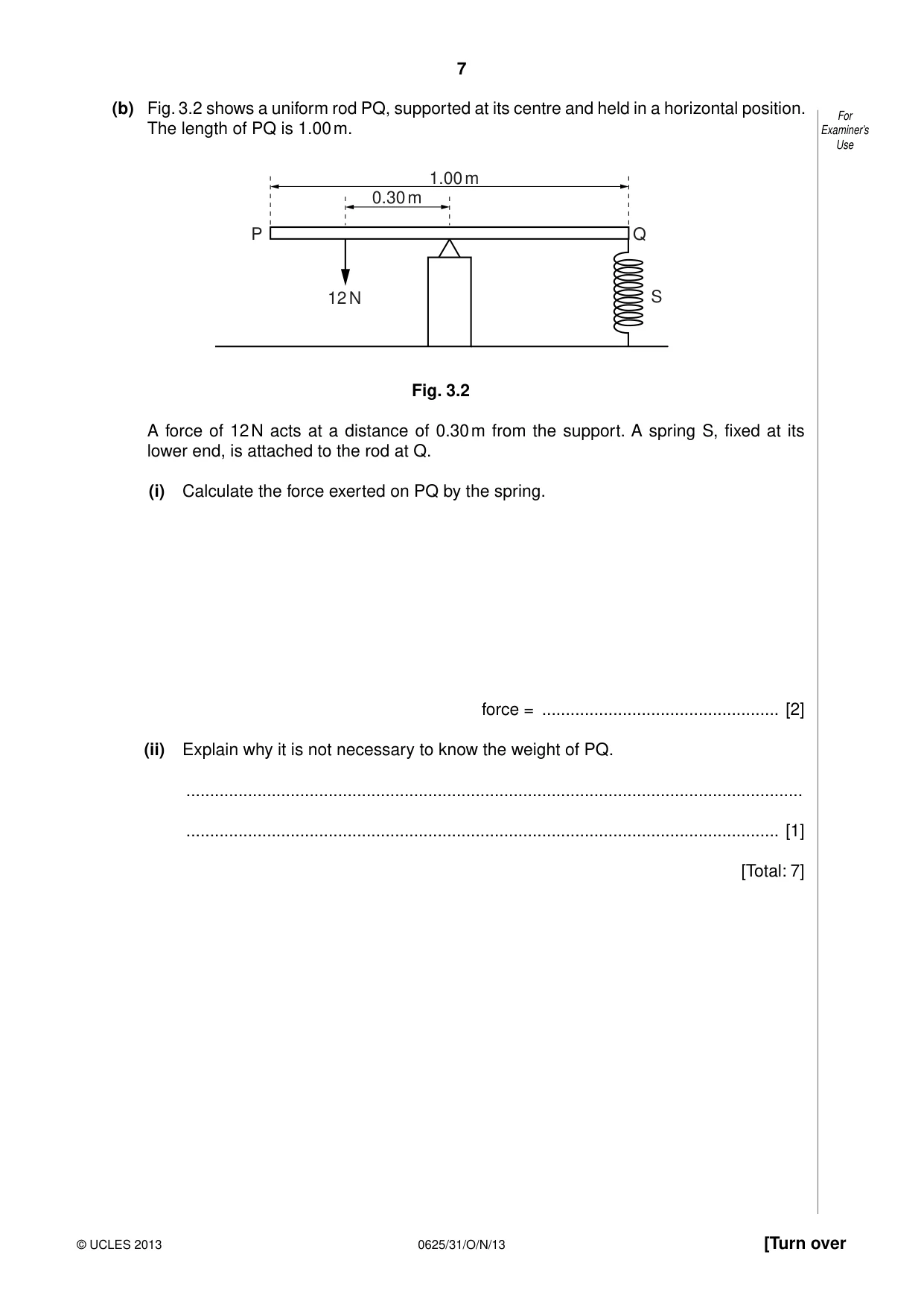
3 (a) (i) Write down the names of three man-made devices in everyday use that depend, For for their action, upon the moments of forces. Examiner’s Use 1. ............................................................................................................................... 2. ............................................................................................................................... 3. ............................................................................................................................... [2] (ii) Fig. 3.1 shows a uniform rod AB acted upon by three equal forces F. F F A B F Fig. 3.1 State two reasons why the rod is not in equilibrium. 1. ............................................................................................................................... 2. ............................................................................................................................... [2] (b) Fig. 3.2 shows a uniform rod PQ, supported at its centre and held in a horizontal position. For The length of PQ is 1.00 m. Examiner’s Use 1.00 m 0.30 m P Q 12 N S Fig. 3.2 A force of 12 N acts at a distance of 0.30 m from the support. A spring S, fixed at its lower end, is attached to the rod at Q. (i) Calculate the force exerted on PQ by the spring. force = .................................................. [2] (ii) Explain why it is not necessary to know the weight of PQ. .................................................................................................................................. ............................................................................................................................. [1] [Total: 7]
Mark scheme: 3 (a) (i) 3 appropriate examples: e.g. spanner, scissors, tap etc. –1e.e.o.o. B2 (ii) there is a resultant force OR more force down than up B1 there is a resultant moment OR clockwise moment is not equal to anticlockwise moment B1 (b) (i) F × 0.5 = 12 × 0.3 C1 7.2 N A1 (ii) weight has no moment about centre of rod / has no perpendicular distance from centre of rod OR weight acts at centre of rod / pivot / centre of mass B1 [Total: 7] IGCSE – October/November 2013 0625 31
Q4 · State the energy changes that take place when For Examiner’s (i) a cyclist rides down a…
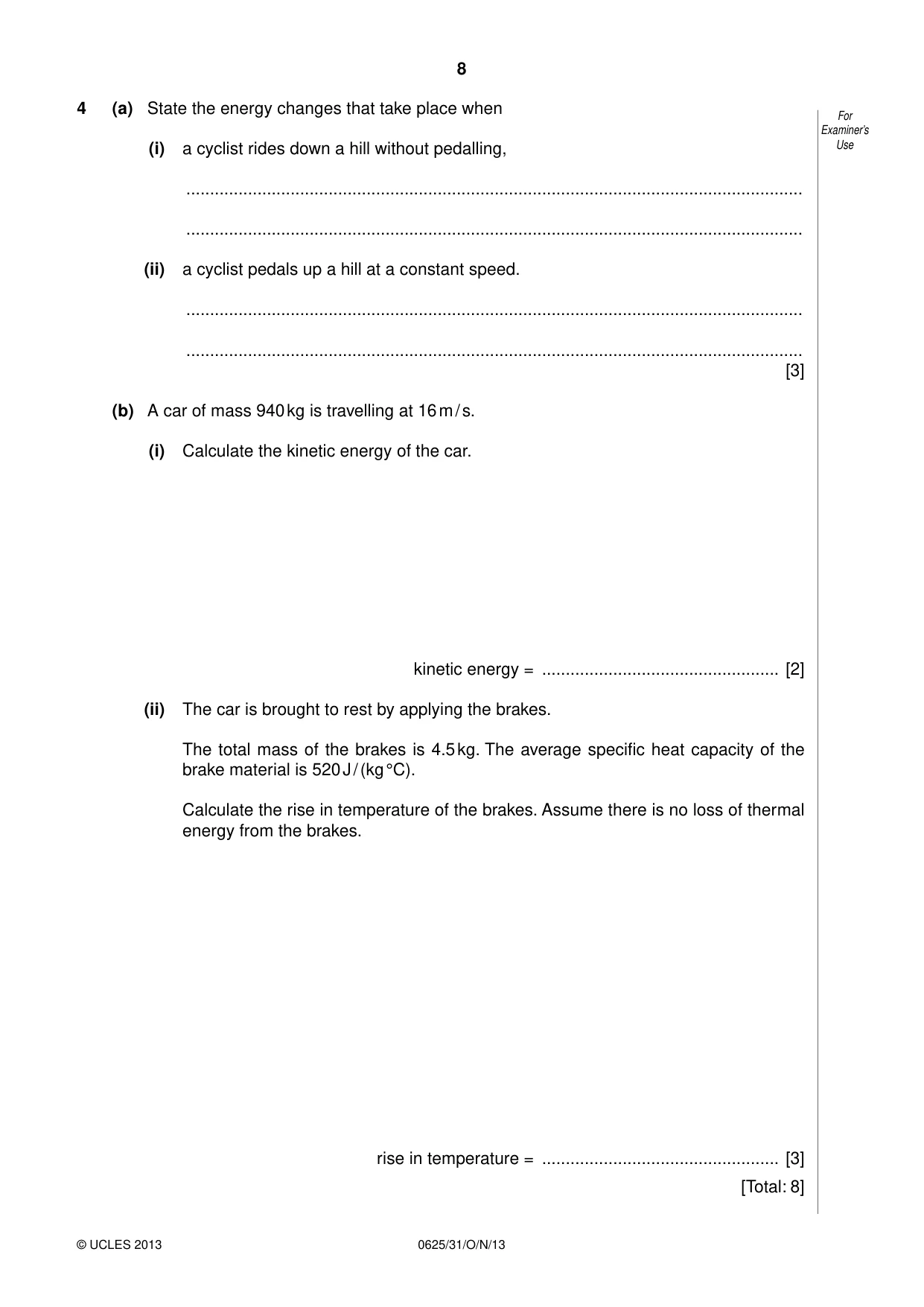
4 (a) State the energy changes that take place when For Examiner’s (i) a cyclist rides down a hill without pedalling, Use .................................................................................................................................. .................................................................................................................................. (ii) a cyclist pedals up a hill at a constant speed. .................................................................................................................................. .................................................................................................................................. [3] (b) A car of mass 940 kg is travelling at 16 m / s. (i) Calculate the kinetic energy of the car. kinetic energy = .................................................. [2] (ii) The car is brought to rest by applying the brakes. The total mass of the brakes is 4.5 kg. The average specific heat capacity of the brake material is 520 J / (kg °C). Calculate the rise in temperature of the brakes. Assume there is no loss of thermal energy from the brakes. rise in temperature = .................................................. [3] [Total: 8]
Mark scheme: 4 (a) (i) (gravitational) potential energy to kinetic energy B1 (ii) chemical energy to (gravitational) potential energy B1 reference in (i) or (ii) to heat / thermal / internal energy produced OR work done against air resistance or friction B1 (b) (i) (K.E. =) ½mv2 OR 0.5 × 940 × 162 C1 1.2 × 10⁵ J A1 (ii) in words or symbols Q = mcθ OR θ = Q/mc C1 1.203 × 105 = 4.5 × 520 × θ OR θ = 1.203 × 10⁵ / (4.5 × 520) C1 51 oC or K A1 [Total: 8]
Q5 · One side of a copper sheet is highly polished and the other side is painted matt black
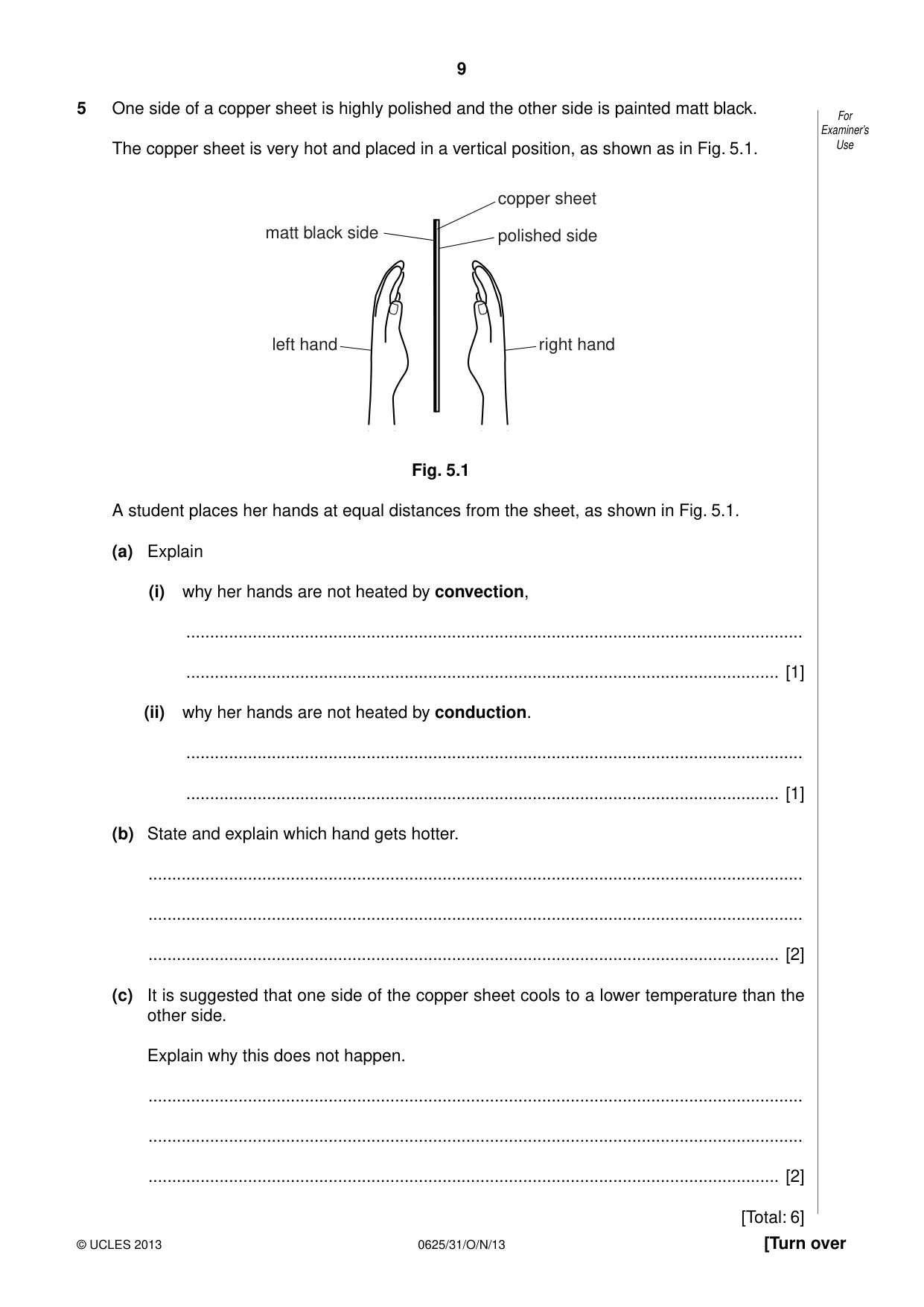
5 One side of a copper sheet is highly polished and the other side is painted matt black. For Examiner’s The copper sheet is very hot and placed in a vertical position, as shown as in Fig. 5.1. Use copper sheet matt black side polished side left hand right hand Fig. 5.1 A student places her hands at equal distances from the sheet, as shown in Fig. 5.1. (a) Explain (i) why her hands are not heated by convection, .................................................................................................................................. ............................................................................................................................. [1] (ii) why her hands are not heated by conduction. .................................................................................................................................. ............................................................................................................................. [1] (b) State and explain which hand gets hotter. .......................................................................................................................................... .......................................................................................................................................... ..................................................................................................................................... [2] (c) It is suggested that one side of the copper sheet cools to a lower temperature than the other side. Explain why this does not happen. .......................................................................................................................................... .......................................................................................................................................... ..................................................................................................................................... [2] [Total: 6]
Mark scheme: 5 (a) (i) heated air / warm air rises / moves up (not sideways) B1 (ii) air (between plate and hands) is a poor conductor / does not conduct B1 (b) left hand / palm (facing matt black side gets hotter) OR hand facing matt black side (gets hotter) B1 matt black side is a better emitter / radiator (of heat than shiny side) B1 (c) conduction takes place B1 copper a good conductor / conduction is rapid / heat flows to equalise temperature B1 [Total: 6]
Q6 · Complete the following statements by writing appropriate words in the spaces
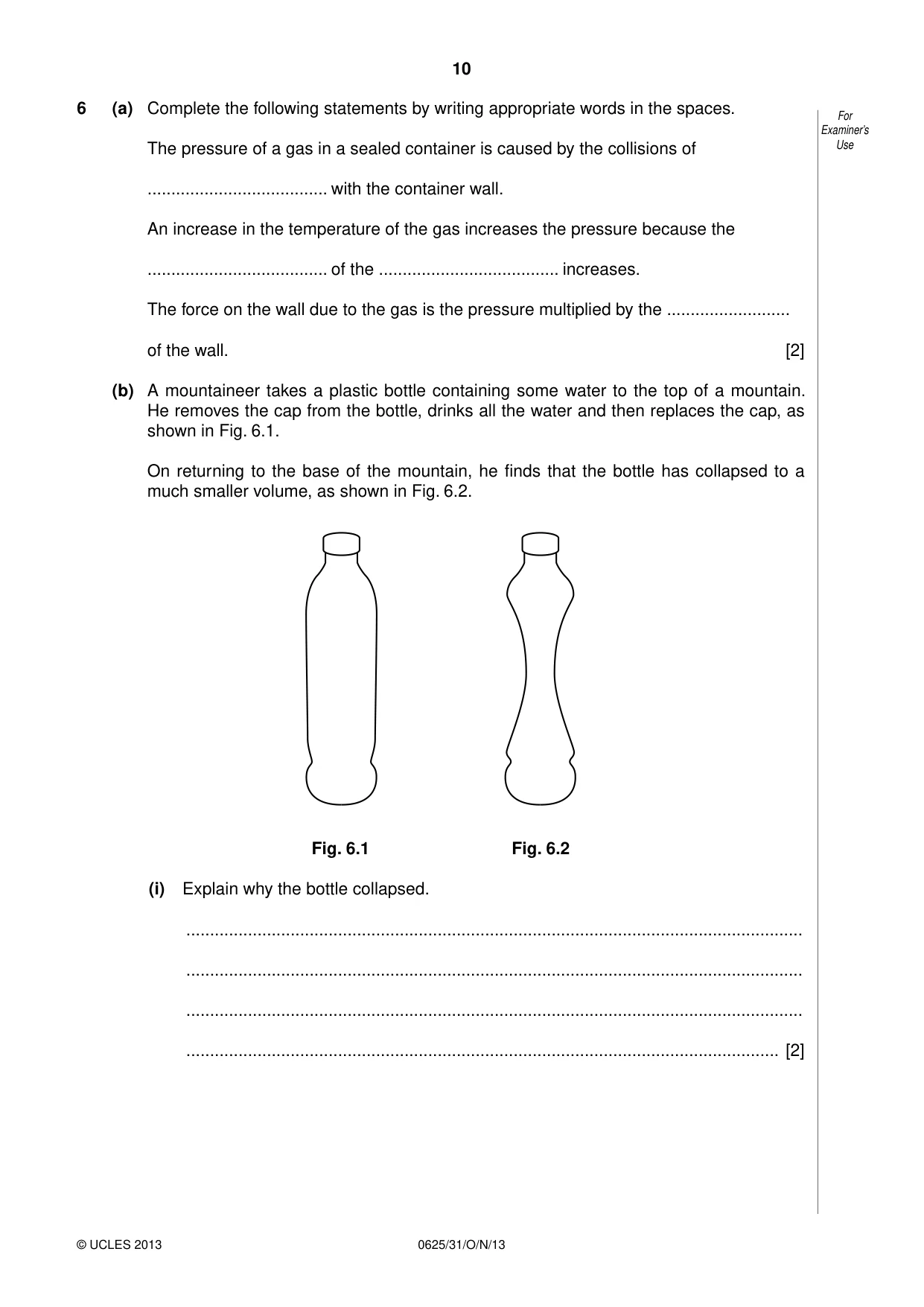
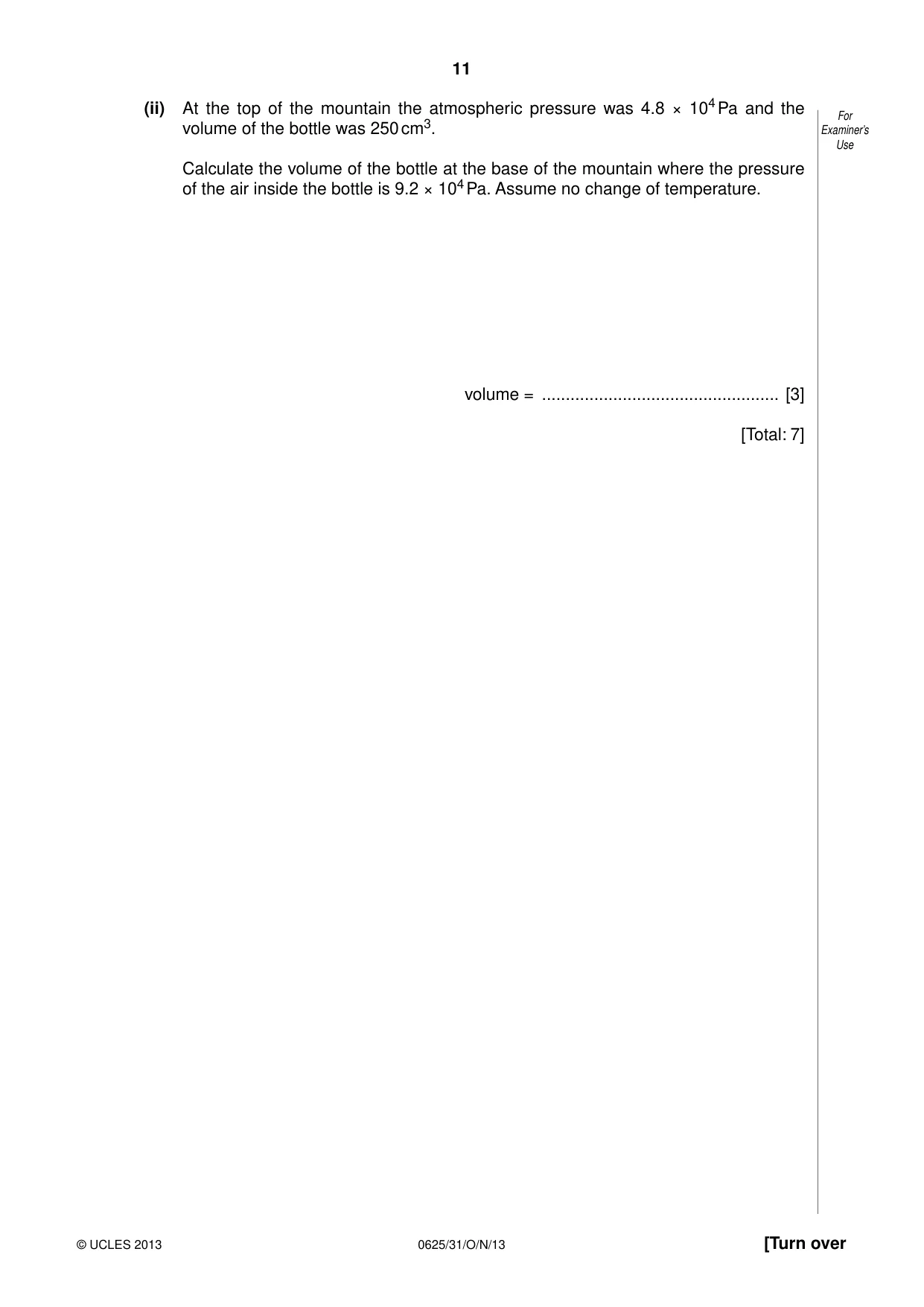
6 (a) Complete the following statements by writing appropriate words in the spaces. For Examiner’s The pressure of a gas in a sealed container is caused by the collisions of Use ...................................... with the container wall. An increase in the temperature of the gas increases the pressure because the ...................................... of the ...................................... increases. The force on the wall due to the gas is the pressure multiplied by the .......................... of the wall. [2] (b) A mountaineer takes a plastic bottle containing some water to the top of a mountain. He removes the cap from the bottle, drinks all the water and then replaces the cap, as shown in Fig. 6.1. On returning to the base of the mountain, he finds that the bottle has collapsed to a much smaller volume, as shown in Fig. 6.2. Fig. 6.1 Fig. 6.2 (i) Explain why the bottle collapsed. .................................................................................................................................. .................................................................................................................................. .................................................................................................................................. ............................................................................................................................. [2] (ii) At the top of the mountain the atmospheric pressure was 4.8 × 10⁴ Pa and the For volume of the bottle was 250 cm3. Examiner’s Use Calculate the volume of the bottle at the base of the mountain where the pressure of the air inside the bottle is 9.2 × 10⁴ Pa. Assume no change of temperature. volume = .................................................. [3] [Total: 7]
Mark scheme: 6 (a) molecules OR atoms OR particles speed OR velocity OR kinetic energy molecules OR atoms OR particles (Surface) area B2 any four correct gains 2 marks, two or three correct gains 1 mark (b) (i) (when cap is screwed on) at top of mountain: pressure of air in bottle = the low pressure of the air outside OR is less than pressure at bottom of mountain OR is low B1 (at bottom of mountain) bottle collapses because pressure outside (bottle) is greater than pressure inside B1 (ii) Boyle’s law applies OR PV = constant OR P1V1 = P2V2 C1 9.2 × 10⁴ × V = 4.8 × 104 × 250 C1 130 cm3 A1 [Total: 7] IGCSE – October/November 2013 0625 31
Q7 · The surface of water in a tank
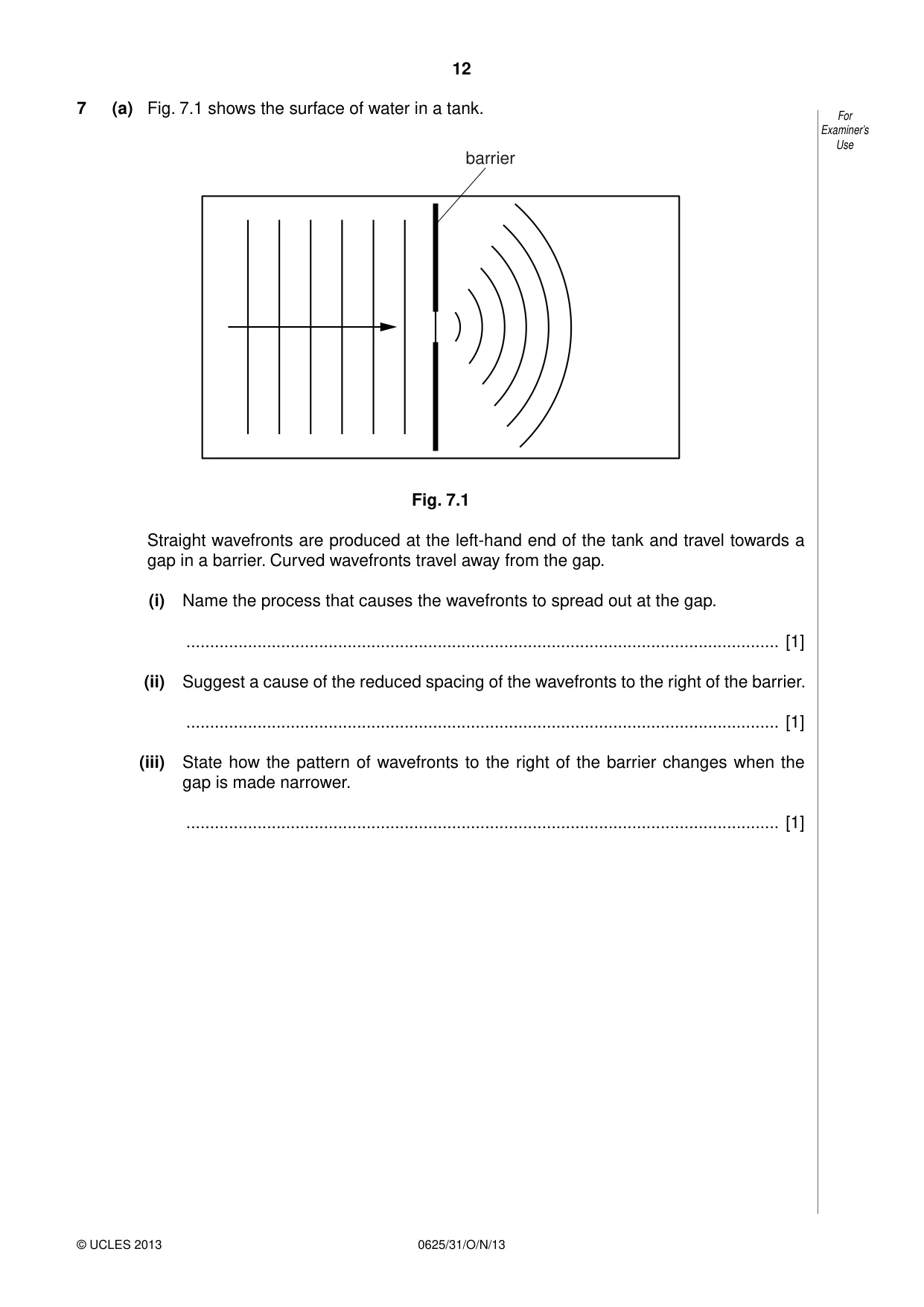
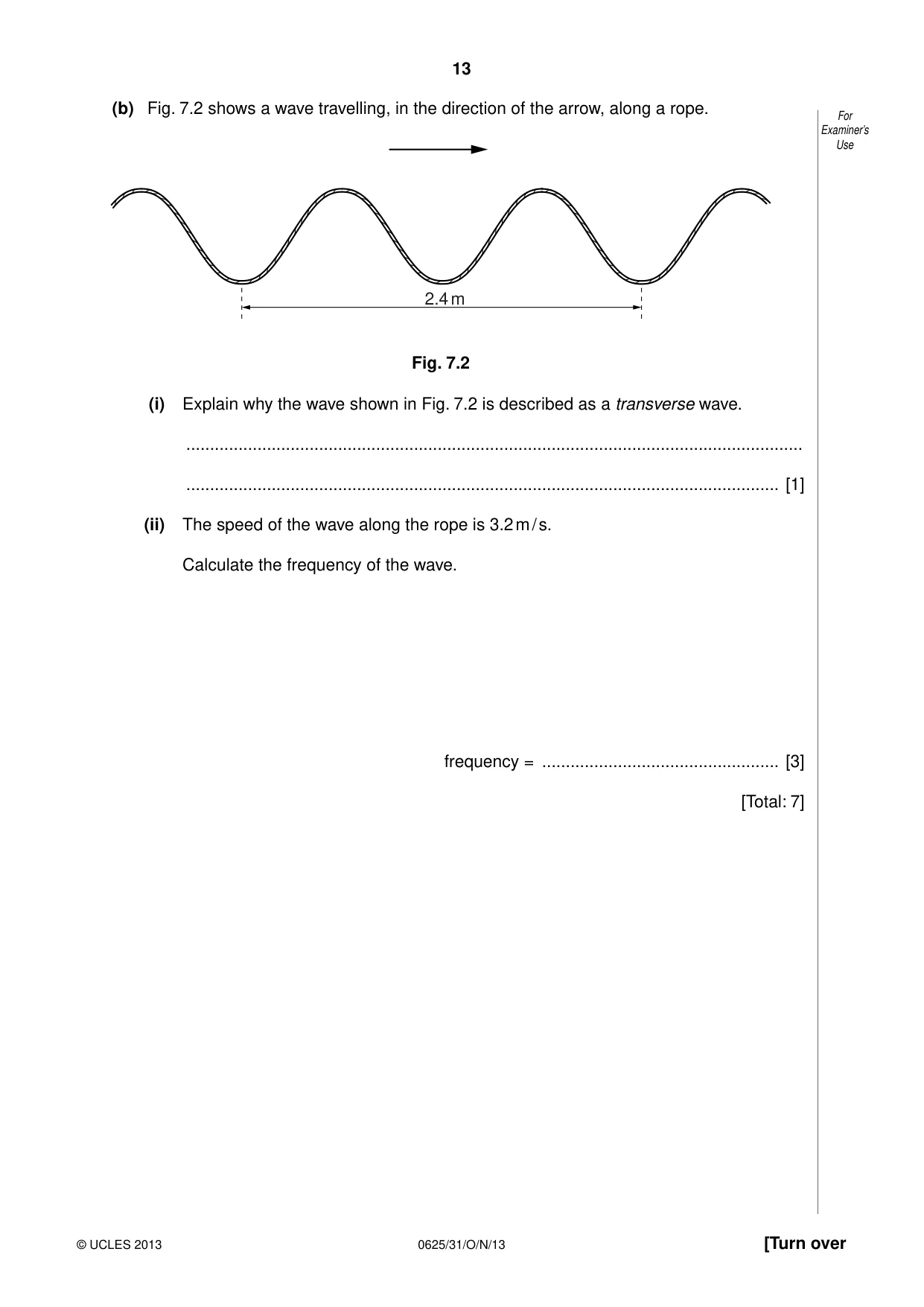
7 (a) Fig. 7.1 shows the surface of water in a tank. For Examiner’s Use barrier Fig. 7.1 Straight wavefronts are produced at the left-hand end of the tank and travel towards a gap in a barrier. Curved wavefronts travel away from the gap. (i) Name the process that causes the wavefronts to spread out at the gap. ............................................................................................................................. [1] (ii) Suggest a cause of the reduced spacing of the wavefronts to the right of the barrier. ............................................................................................................................. [1] (iii) State how the pattern of wavefronts to the right of the barrier changes when the gap is made narrower. ............................................................................................................................. [1] (b) Fig. 7.2 shows a wave travelling, in the direction of the arrow, along a rope. For Examiner’s Use 2.4 m Fig. 7.2 (i) Explain why the wave shown in Fig. 7.2 is described as a transverse wave. .................................................................................................................................. ............................................................................................................................. [1] (ii) The speed of the wave along the rope is 3.2 m / s. Calculate the frequency of the wave. frequency = .................................................. [3] [Total: 7]
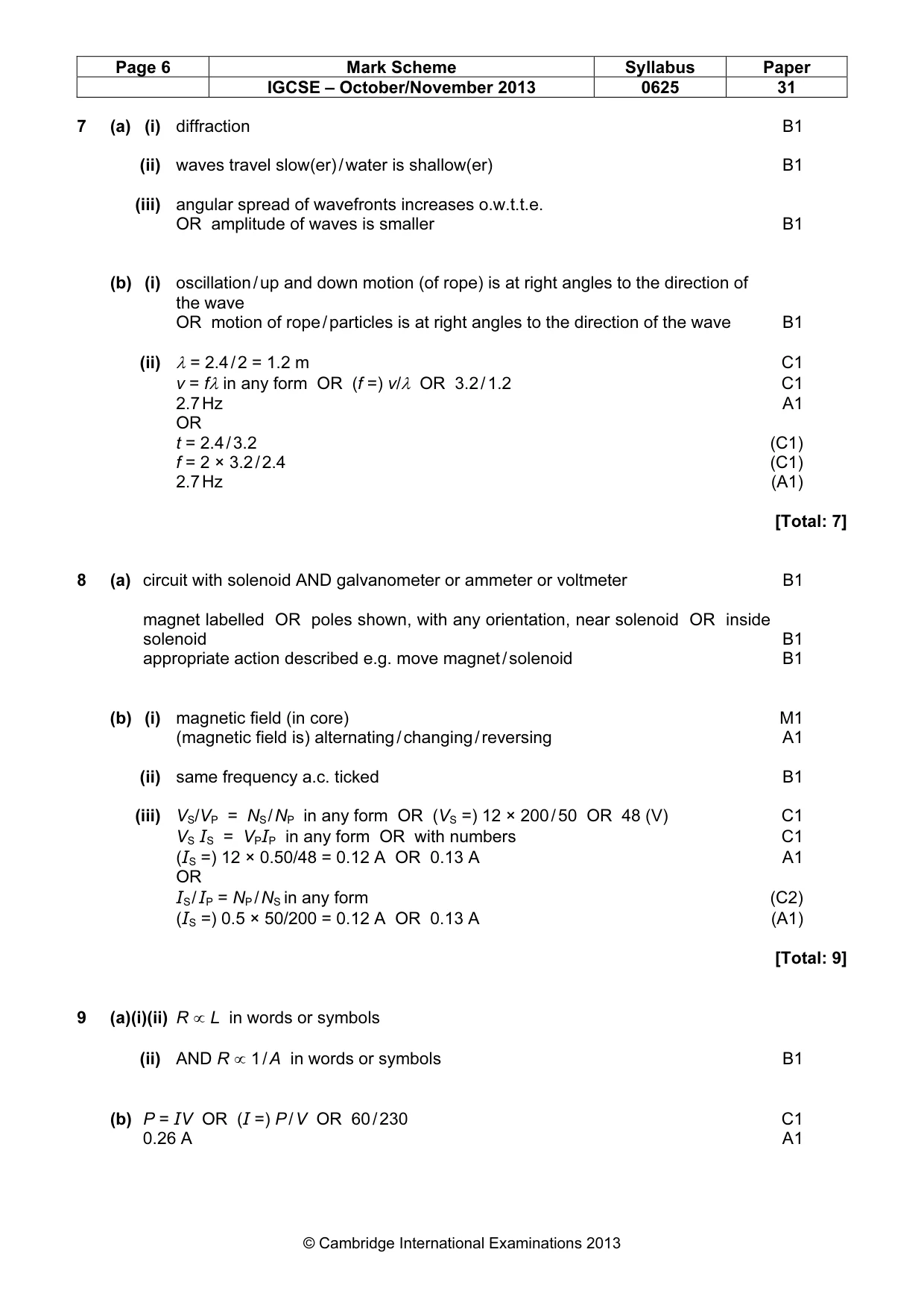
Mark scheme: 7 (a) (i) diffraction B1 (ii) waves travel slow(er) / water is shallow(er) B1 (iii) angular spread of wavefronts increases o.w.t.t.e. OR amplitude of waves is smaller B1 (b) (i) oscillation / up and down motion (of rope) is at right angles to the direction of the wave OR motion of rope / particles is at right angles to the direction of the wave B1 (ii) λ = 2.4 / 2 = 1.2 m C1 v = fλ in any form OR (f =) v/λ OR 3.2 / 1.2 C1 2.7 Hz A1 OR t = 2.4 / 3.2 (C1) f = 2 × 3.2 / 2.4 (C1) 2.7 Hz (A1) [Total: 7]
Q8 · Describe an experiment that shows how a magnet can be used to produce a current in For a…
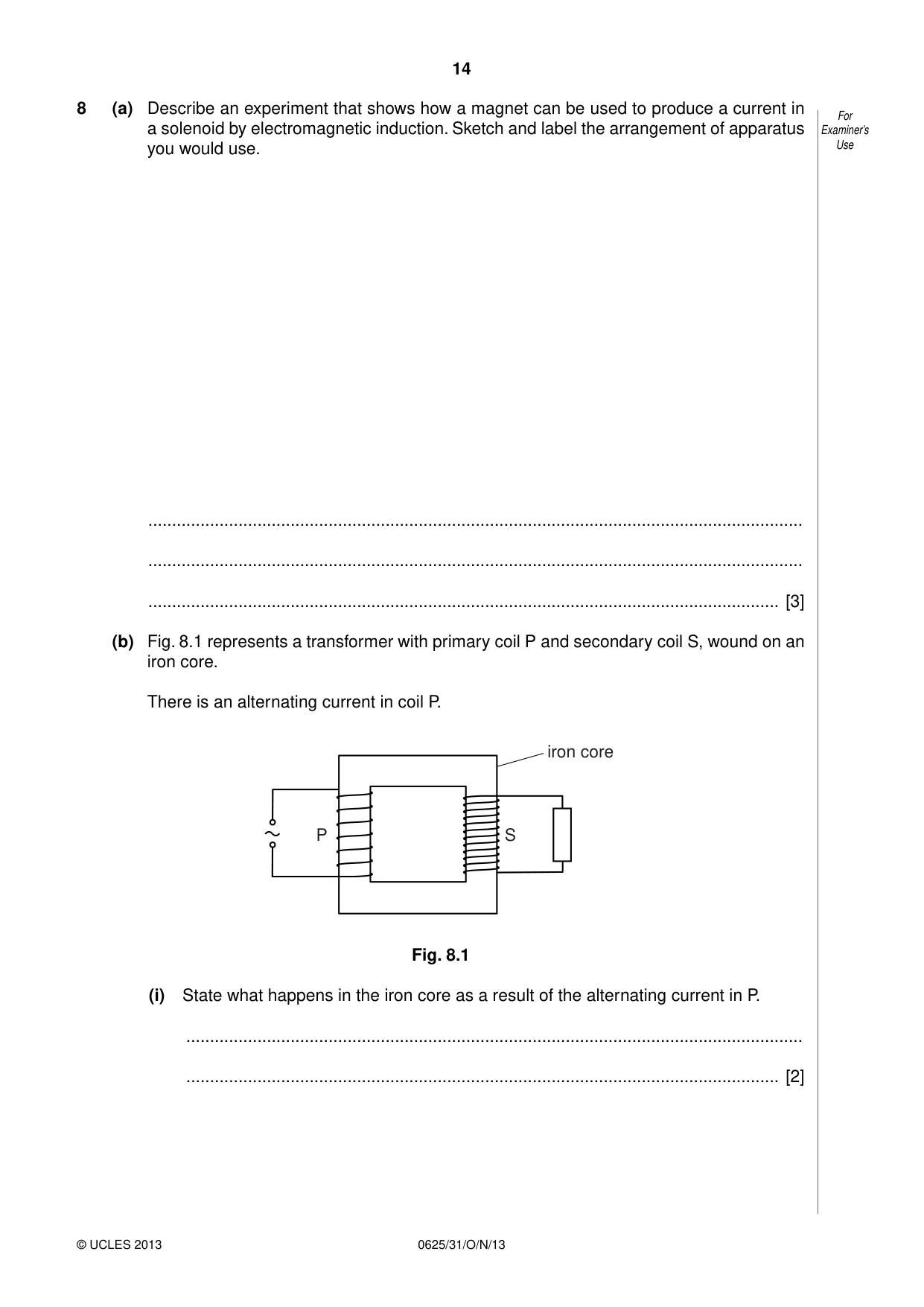
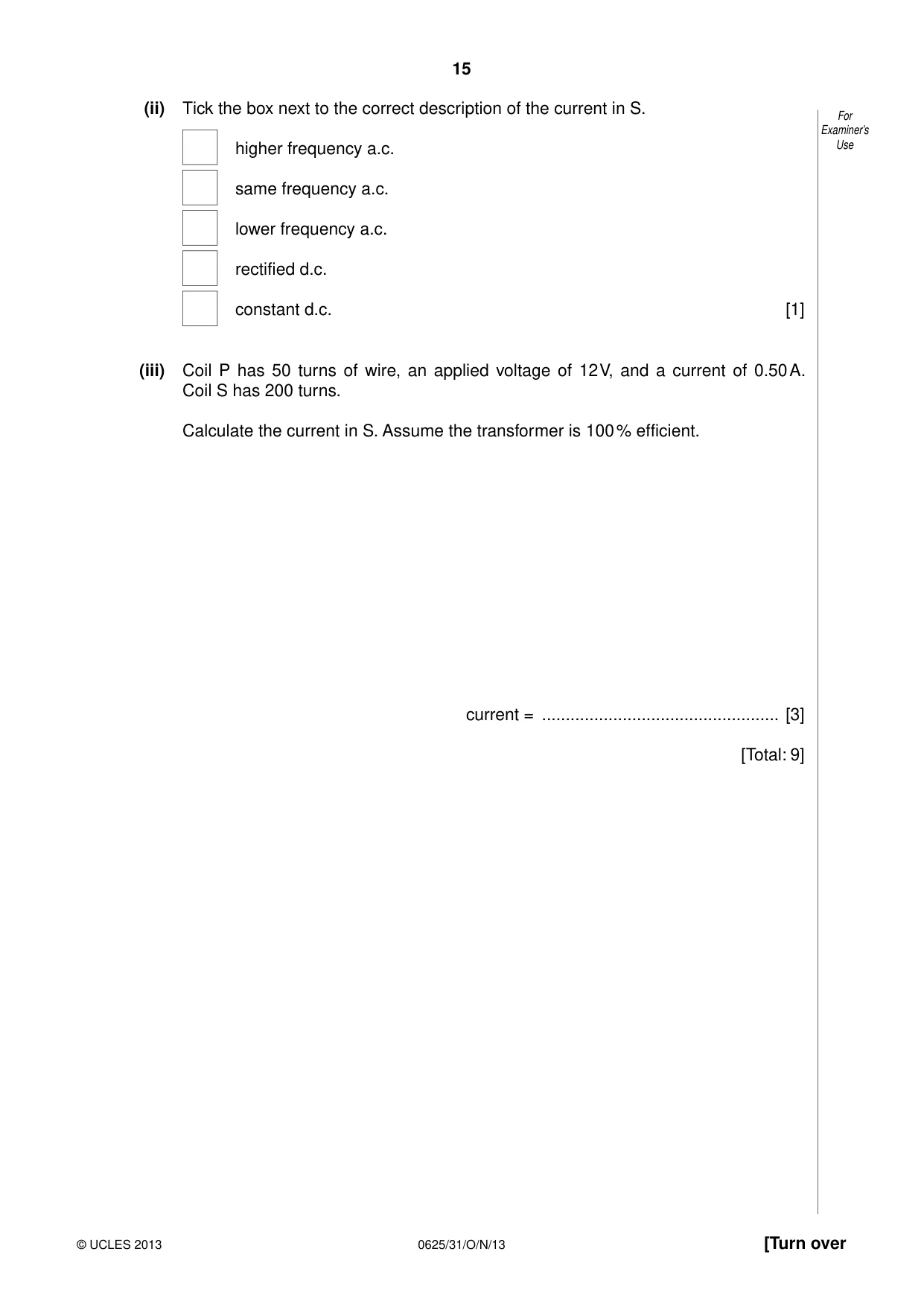
8 (a) Describe an experiment that shows how a magnet can be used to produce a current in For a solenoid by electromagnetic induction. Sketch and label the arrangement of apparatus Examiner’s you would use. Use .......................................................................................................................................... .......................................................................................................................................... ..................................................................................................................................... [3] (b) Fig. 8.1 represents a transformer with primary coil P and secondary coil S, wound on an iron core. There is an alternating current in coil P. iron core P S Fig. 8.1 (i) State what happens in the iron core as a result of the alternating current in P. .................................................................................................................................. ............................................................................................................................. [2] (ii) Tick the box next to the correct description of the current in S. For Examiner’s higher frequency a.c. Use same frequency a.c. lower frequency a.c. rectified d.c. constant d.c. [1] (iii) Coil P has 50 turns of wire, an applied voltage of 12 V, and a current of 0.50 A. Coil S has 200 turns. Calculate the current in S. Assume the transformer is 100 % efficient. current = .................................................. [3] [Total: 9]
Mark scheme: 8 (a) circuit with solenoid AND galvanometer or ammeter or voltmeter B1 magnet labelled OR poles shown, with any orientation, near solenoid OR inside solenoid B1 appropriate action described e.g. move magnet / solenoid B1 (b) (i) magnetic field (in core) M1 (magnetic field is) alternating / changing / reversing A1 (ii) same frequency a.c. ticked B1 (iii) VS/VP = NS / NP in any form OR (VS =) 12 × 200 / 50 OR 48 (V) C1 VS IS = VPIP in any form OR with numbers C1 (IS =) 12 × 0.50/48 = 0.12 A OR 0.13 A A1 OR IS / IP = NP / NS in any form (C2) (IS =) 0.5 × 50/200 = 0.12 A OR 0.13 A (A1) [Total: 9]
Q9 · State the relationship between For Examiner’s (i) the resistance R and the length L of a…
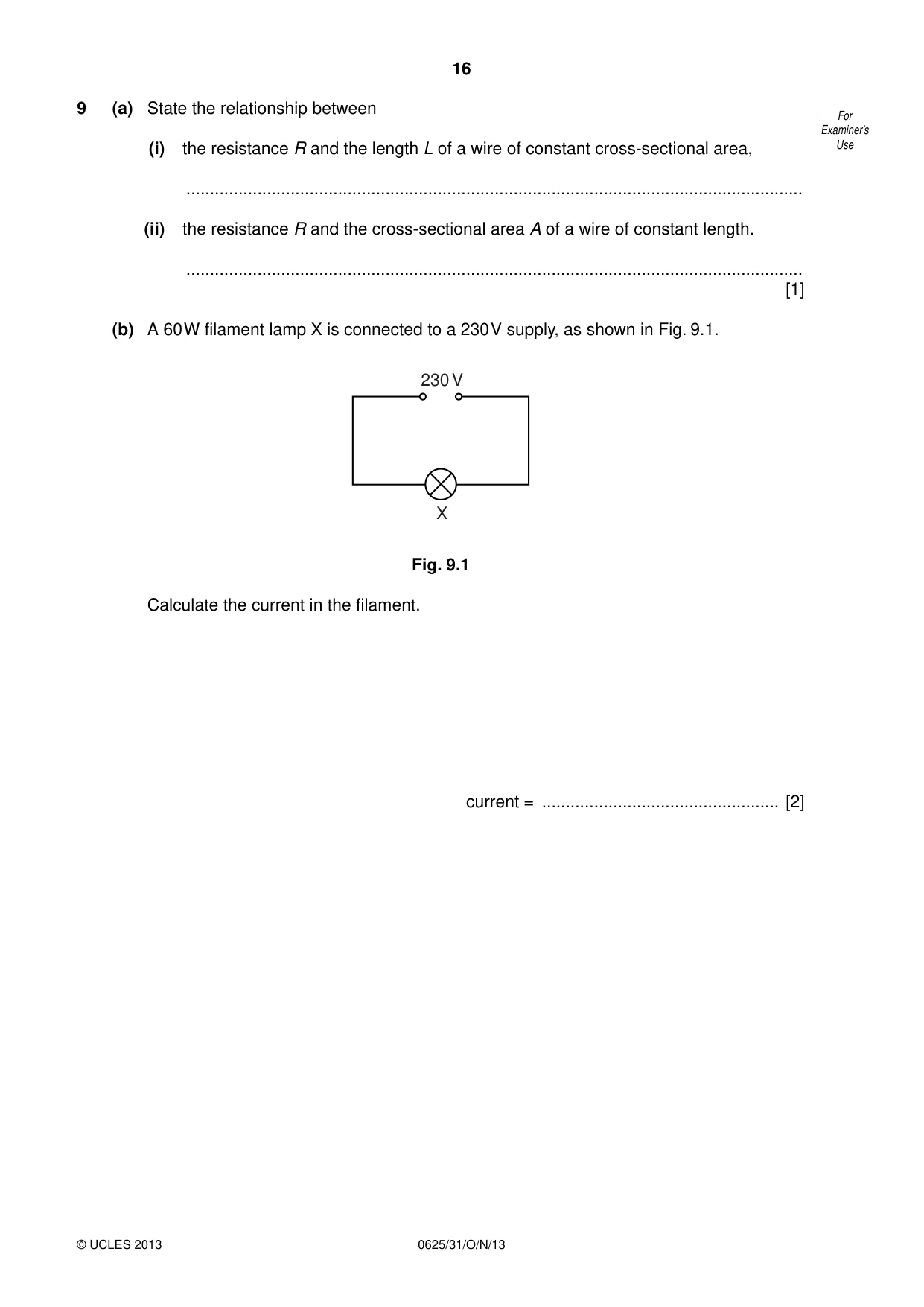
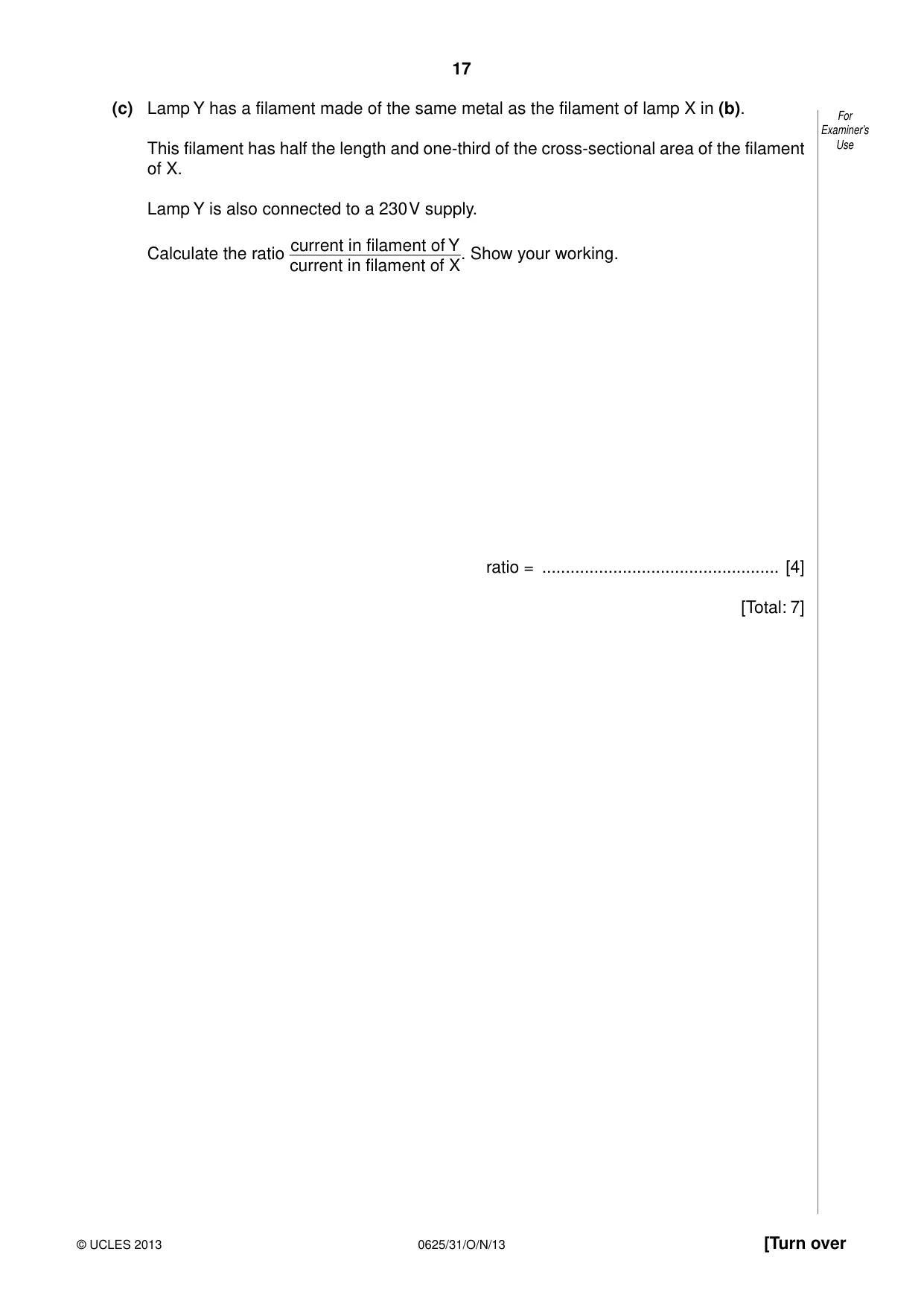
9 (a) State the relationship between For Examiner’s (i) the resistance R and the length L of a wire of constant cross-sectional area, Use .................................................................................................................................. (ii) the resistance R and the cross-sectional area A of a wire of constant length. .................................................................................................................................. [1] (b) A 60 W filament lamp X is connected to a 230 V supply, as shown in Fig. 9.1. 230 V X Fig. 9.1 Calculate the current in the filament. current = .................................................. [2] (c) Lamp Y has a filament made of the same metal as the filament of lamp X in (b). For Examiner’s This filament has half the length and one-third of the cross-sectional area of the filament Use of X. Lamp Y is also connected to a 230 V supply. current in filament of Y Calculate the ratio Show your working. current in filament of X. ratio = .................................................. [4] [Total: 7]
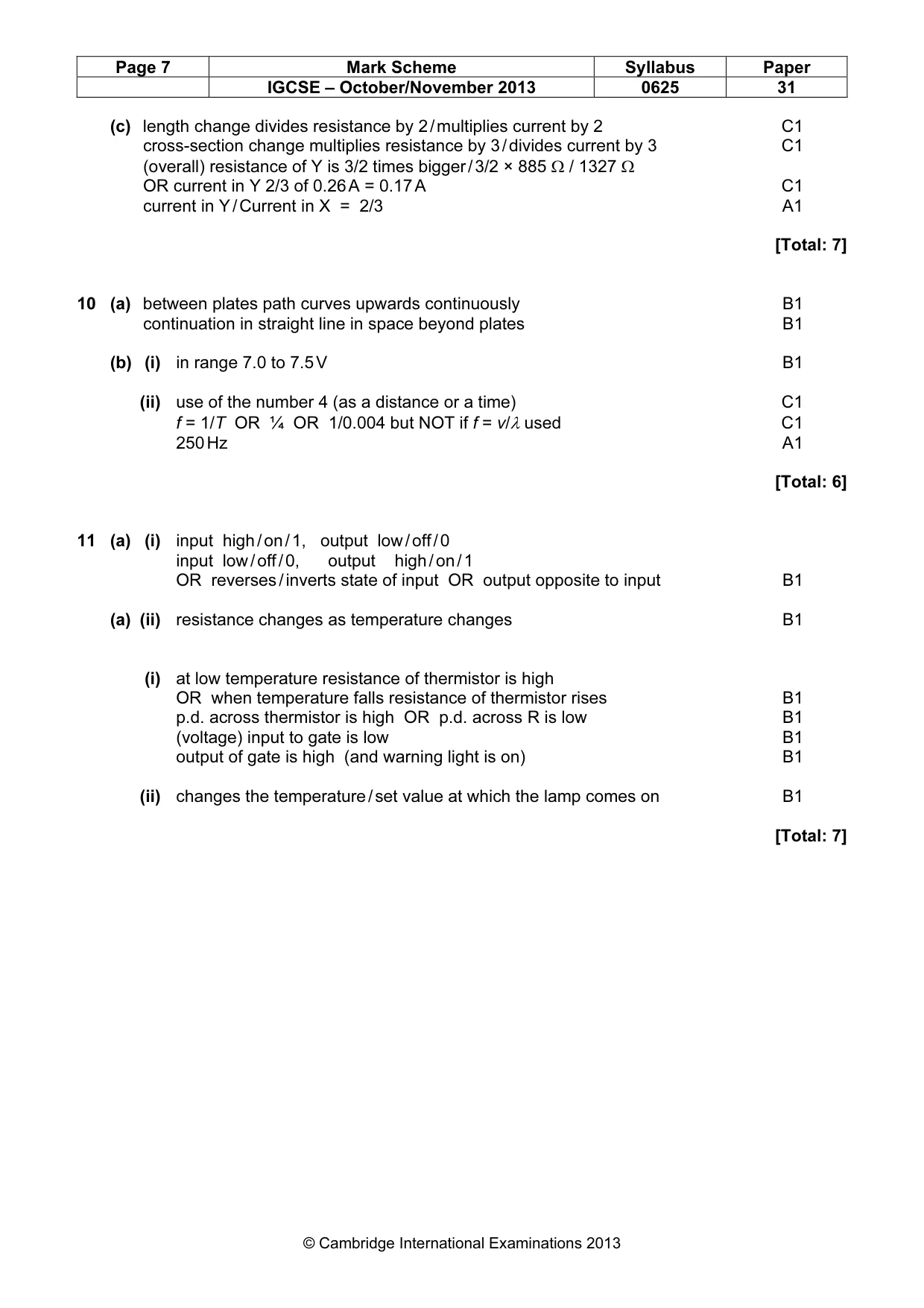
Mark scheme: 9 (a)(i)(ii) R ∝ L in words or symbols (ii) AND R ∝ 1 / A in words or symbols B1 (b) P = IV OR (I =) P / V OR 60 / 230 C1 0.26 A A1 IGCSE – October/November 2013 0625 31 (c) length change divides resistance by 2 / multiplies current by 2 C1 cross-section change multiplies resistance by 3 / divides current by 3 C1 (overall) resistance of Y is 3/2 times bigger / 3/2 × 885 Ω / 1327 Ω OR current in Y 2/3 of 0.26 A = 0.17 A C1 current in Y / Current in X = 2/3 A1 [Total: 7]
Q10 · An electron beam travelling, in a vacuum, towards the space between a For pair of…
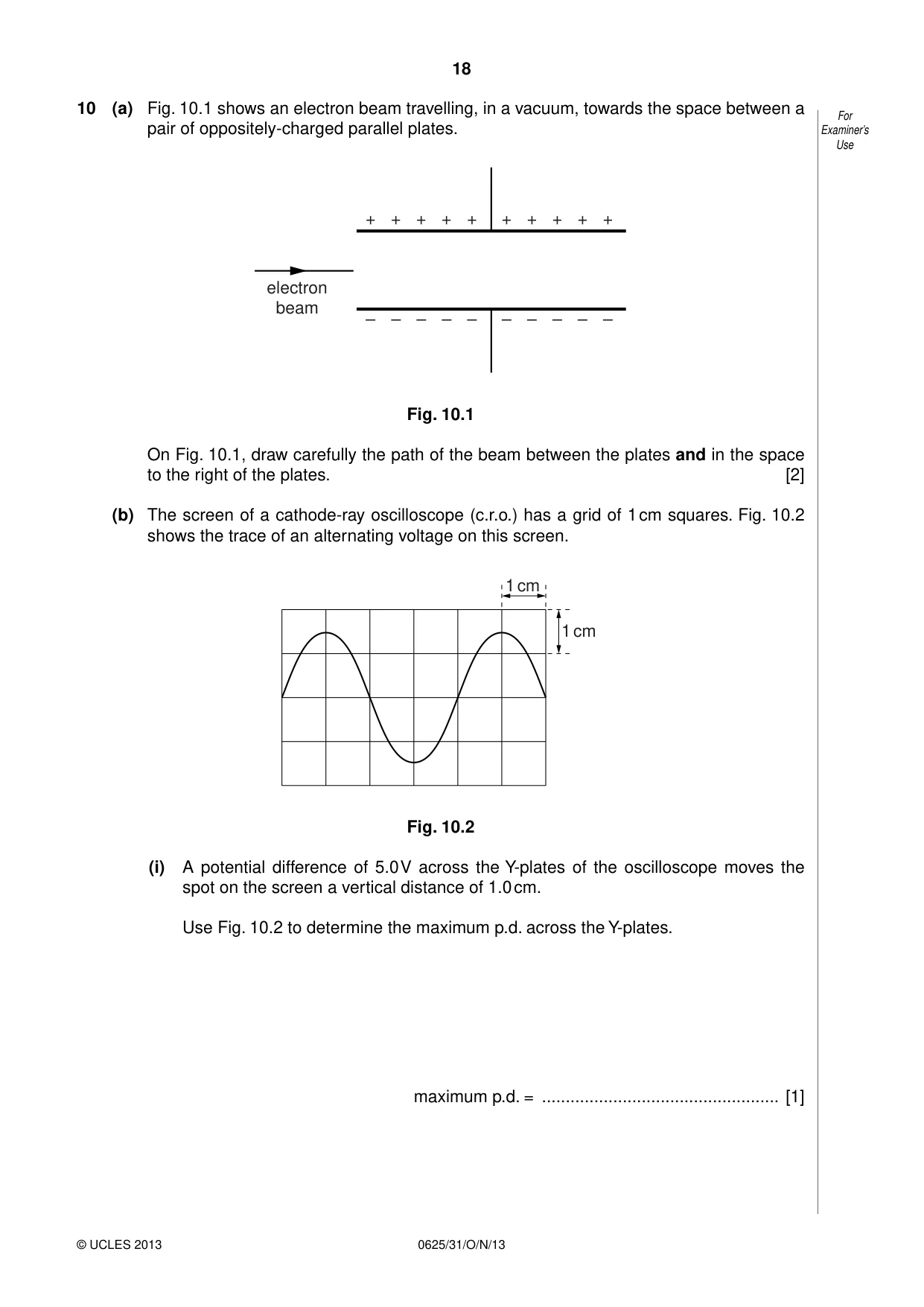
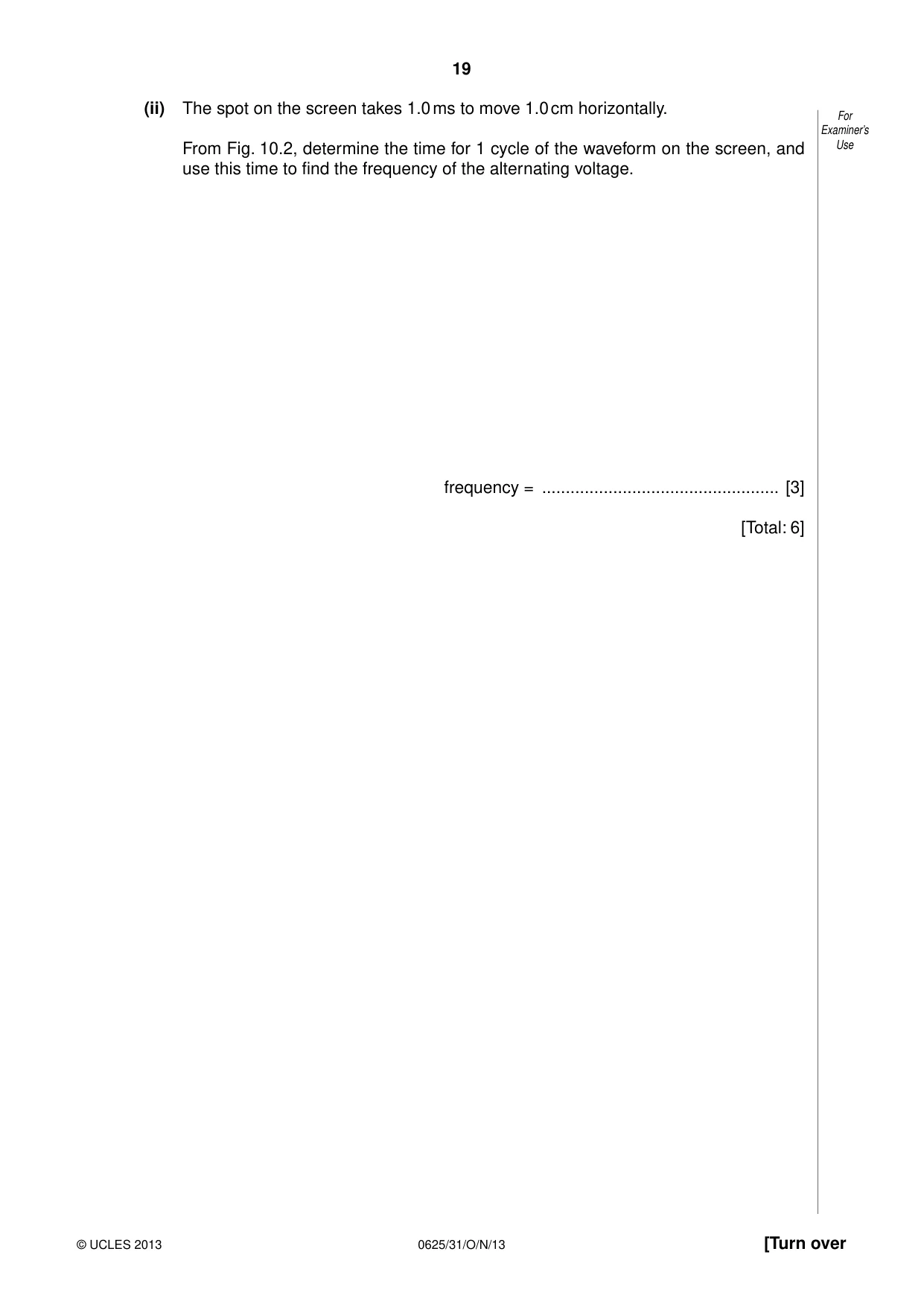
10 (a) Fig. 10.1 shows an electron beam travelling, in a vacuum, towards the space between a For pair of oppositely-charged parallel plates. Examiner’s Use + + + + + + + + + + electron beam – – – – – – – – – – Fig. 10.1 On Fig. 10.1, draw carefully the path of the beam between the plates and in the space to the right of the plates. [2] (b) The screen of a cathode-ray oscilloscope (c.r.o.) has a grid of 1 cm squares. Fig. 10.2 shows the trace of an alternating voltage on this screen. 1 cm 1 cm Fig. 10.2 (i) A potential difference of 5.0 V across the Y-plates of the oscilloscope moves the spot on the screen a vertical distance of 1.0 cm. Use Fig. 10.2 to determine the maximum p.d. across the Y-plates. maximum p.d. = .................................................. [1] (ii) The spot on the screen takes 1.0 ms to move 1.0 cm horizontally. For Examiner’s From Fig. 10.2, determine the time for 1 cycle of the waveform on the screen, and Use use this time to find the frequency of the alternating voltage. frequency = .................................................. [3] [Total: 6]
Mark scheme: 10 (a) between plates path curves upwards continuously B1 continuation in straight line in space beyond plates B1 (b) (i) in range 7.0 to 7.5 V B1 (ii) use of the number 4 (as a distance or a time) C1 f = 1/T OR ¼ OR 1/0.004 but NOT if f = v/λ used C1 250 Hz A1 [Total: 6]
Q11 · Describe the action of For Examiner’s (i) a NOT gate, Use…
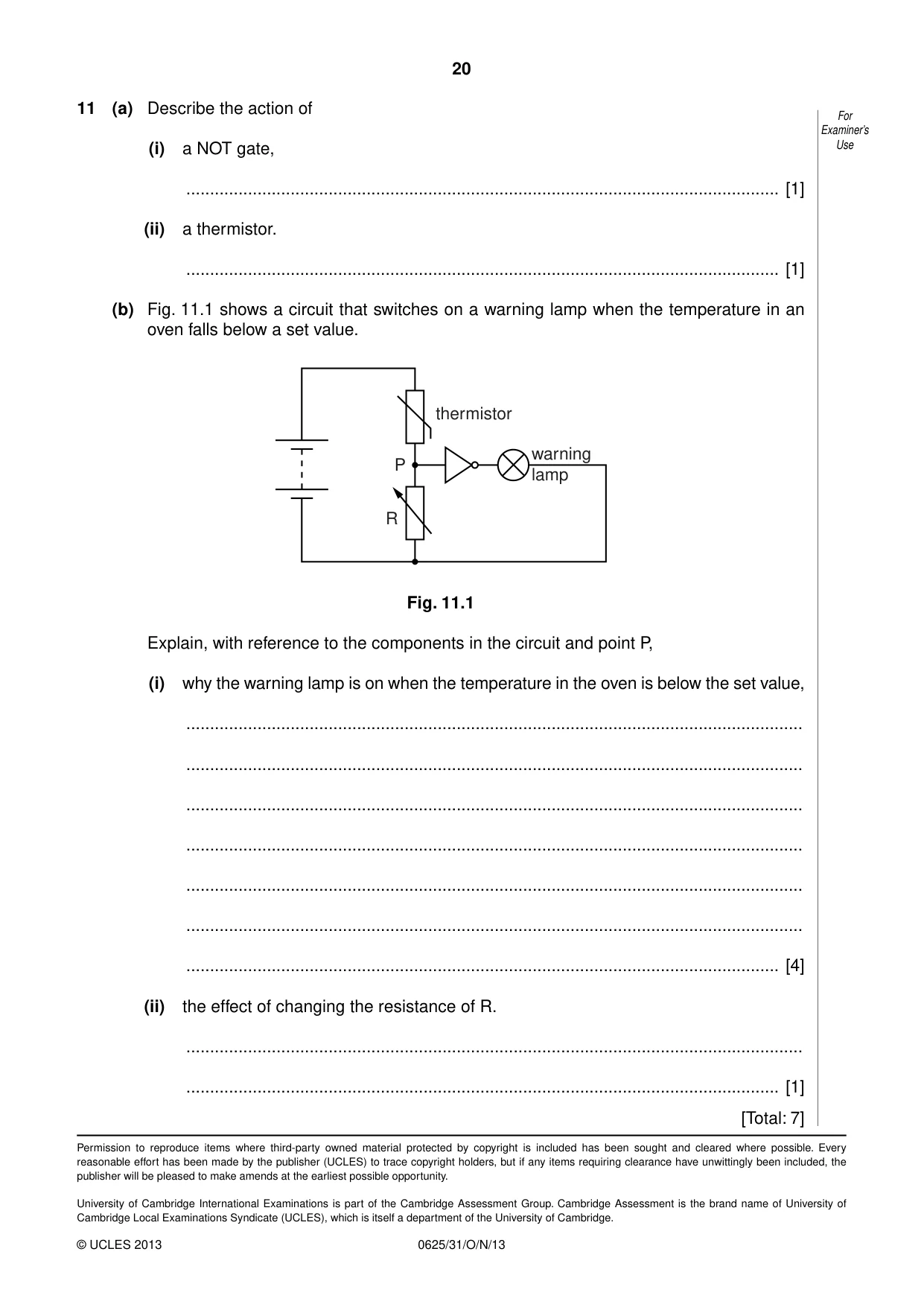
11 (a) Describe the action of For Examiner’s (i) a NOT gate, Use ............................................................................................................................. [1] (ii) a thermistor. ............................................................................................................................. [1] (b) Fig. 11.1 shows a circuit that switches on a warning lamp when the temperature in an oven falls below a set value. thermistor warning P lamp R Fig. 11.1 Explain, with reference to the components in the circuit and point P, (i) why the warning lamp is on when the temperature in the oven is below the set value, .................................................................................................................................. .................................................................................................................................. .................................................................................................................................. .................................................................................................................................. .................................................................................................................................. .................................................................................................................................. ............................................................................................................................. [4] (ii) the effect of changing the resistance of R. .................................................................................................................................. ............................................................................................................................. [1] [Total: 7]
Mark scheme: 11 (a) (i) input high / on / 1, output low / off / 0 input low / off / 0, output high / on / 1 OR reverses / inverts state of input OR output opposite to input B1 (a) (ii) resistance changes as temperature changes B1 (i) at low temperature resistance of thermistor is high OR when temperature falls resistance of thermistor rises B1 p.d. across thermistor is high OR p.d. across R is low B1 (voltage) input to gate is low B1 output of gate is high (and warning light is on) B1 (ii) changes the temperature / set value at which the lamp comes on B1 [Total: 7]
What was in this paper
The subtopics covered by these 11 questions, and how many questions each got. Open one in a new tab to see every Cambridge question on it.