Cambridge IGCSE Physics 0625 — 2013 May/June Paper 3 · Variant 3
0625/33/M/J/13 · 11 questions · 80 marks · ≈90 min
The question paper and its mark scheme, free to read here and free to download. This is Cambridge’s own paper, exactly as it was sat.
Question paper16 pages
Mark scheme7 pages
Answers below. Sit the paper first if you are practising.
Questions as text
Q1 · A train is at rest in a railway station
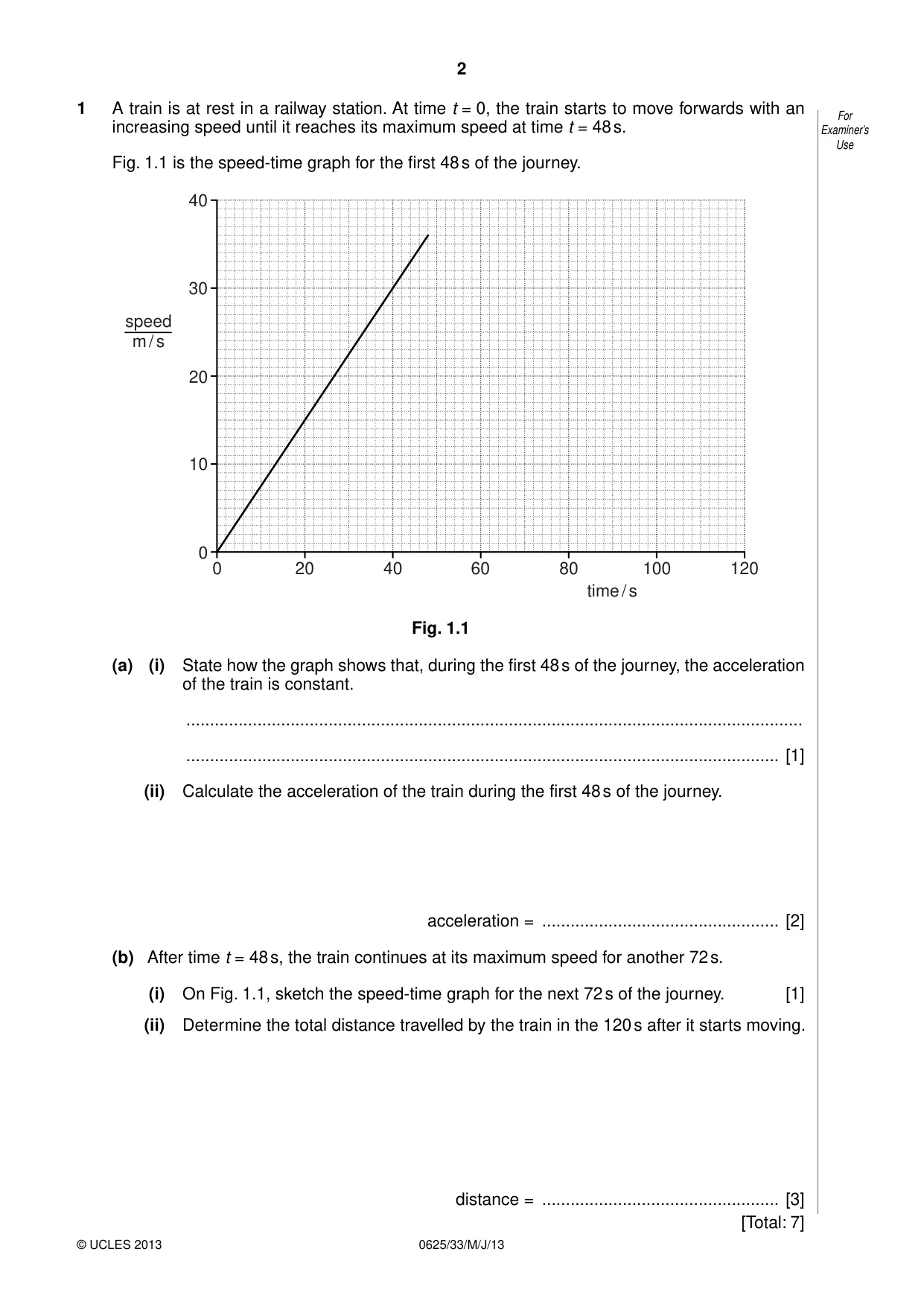
1 A train is at rest in a railway station. At time t = 0, the train starts to move forwards with an For increasing speed until it reaches its maximum speed at time t = 48 s. Examiner’s Use Fig. 1.1 is the speed-time graph for the first 48 s of the journey. 40 30 speed m / s 20 10 0 0 20 40 60 80 100 120 time / s Fig. 1.1 (a) (i) State how the graph shows that, during the first 48 s of the journey, the acceleration of the train is constant. .................................................................................................................................. ............................................................................................................................. [1] (ii) Calculate the acceleration of the train during the first 48 s of the journey. acceleration = .................................................. [2] (b) After time t = 48 s, the train continues at its maximum speed for another 72 s. (i) On Fig. 1.1, sketch the speed-time graph for the next 72 s of the journey. [1] (ii) Determine the total distance travelled by the train in the 120 s after it starts moving. distance = .................................................. [3] [Total: 7]
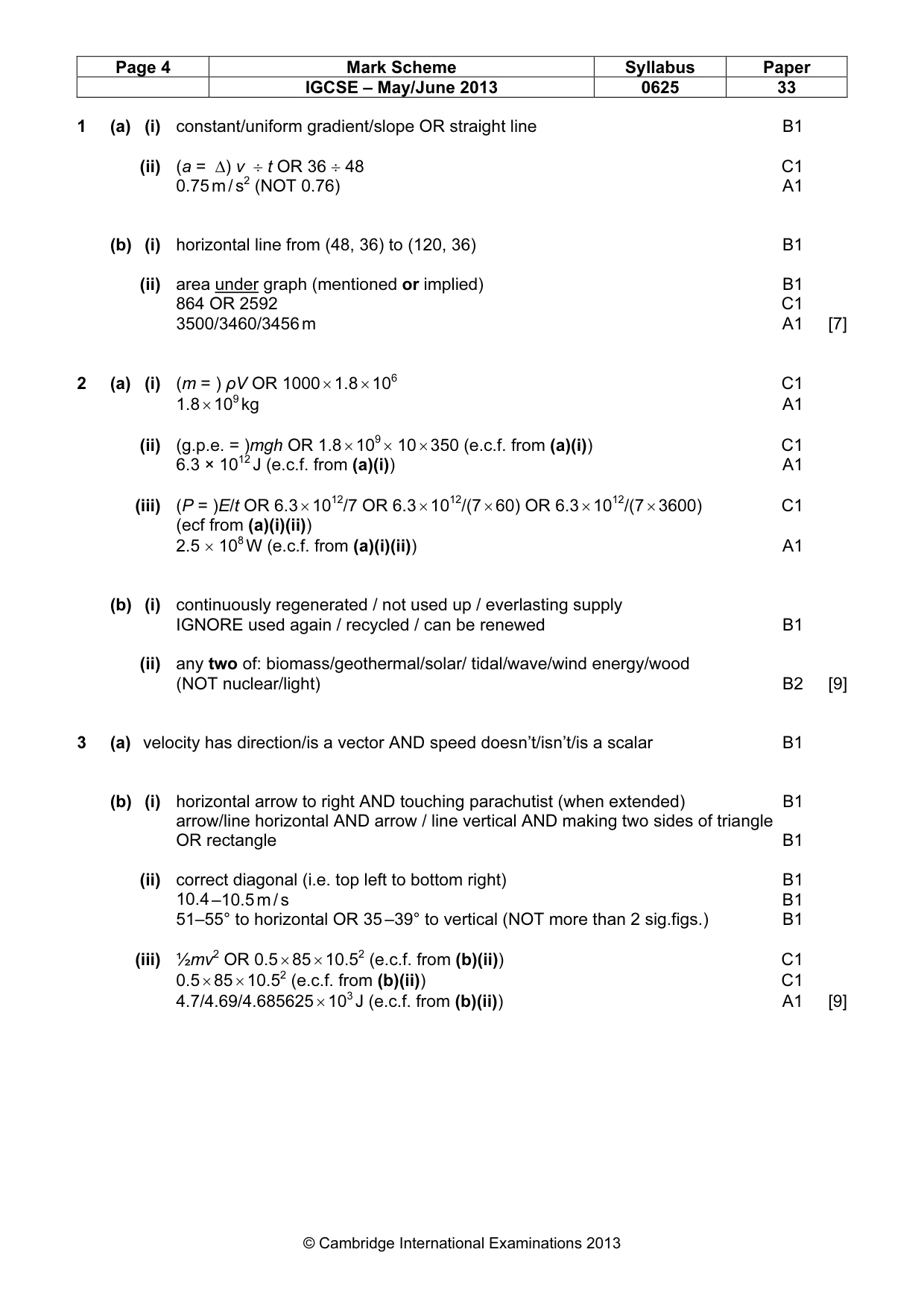
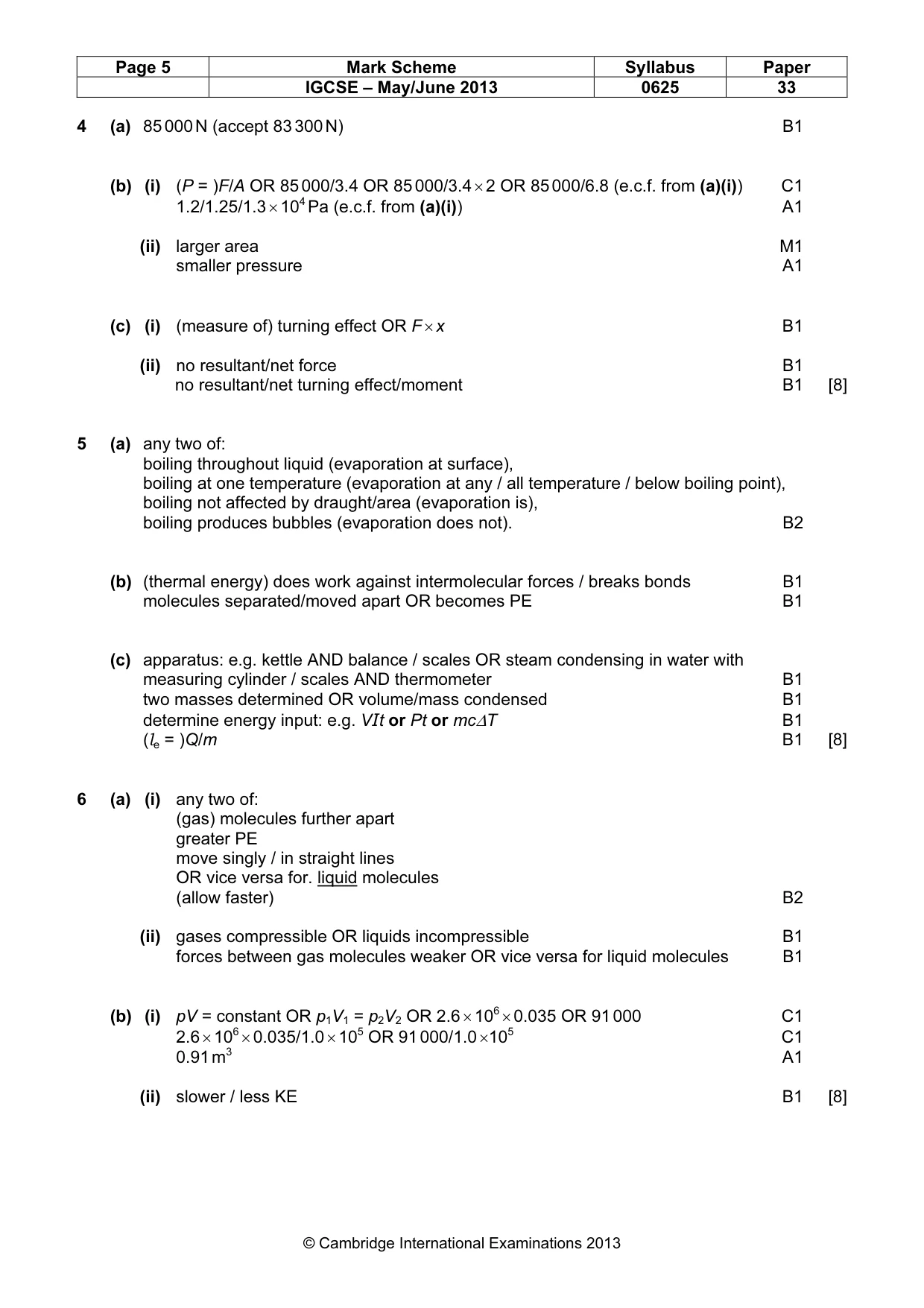
Mark scheme: 1 (a) (i) constant/uniform gradient/slope OR straight line B1 (ii) (a = ∆) v ÷ t OR 36 ÷ 48 C1 0.75 m / s2 (NOT 0.76) A1 (b) (i) horizontal line from (48, 36) to (120, 36) B1 (ii) area under graph (mentioned or implied) B1 864 OR 2592 C1 3500/3460/3456 m A1 [7] 6
Q2 · Water is stored in a reservoir at an average vertical height of 350 m above the turbines…
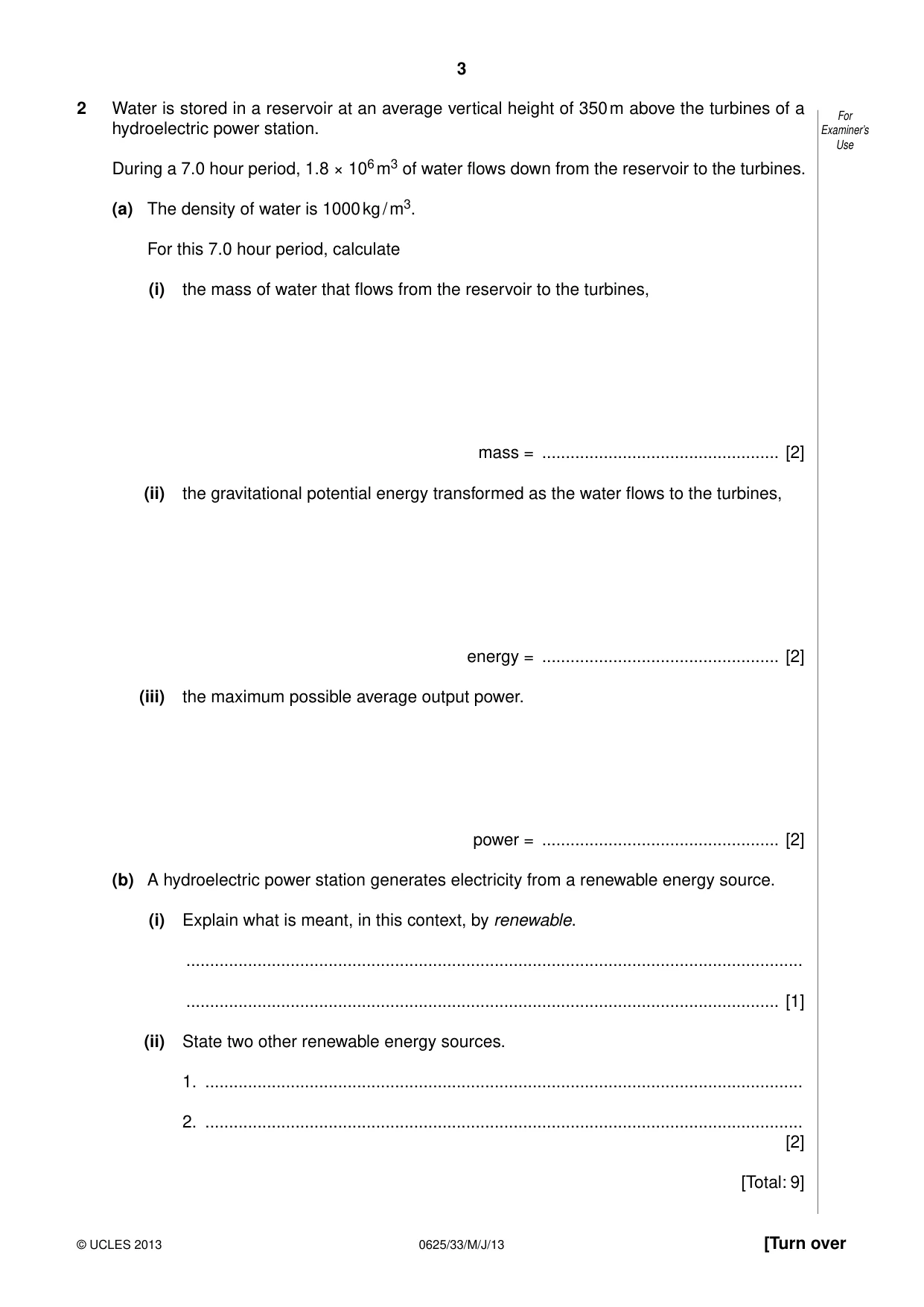
2 Water is stored in a reservoir at an average vertical height of 350 m above the turbines of a For hydroelectric power station. Examiner’s Use During a 7.0 hour period, 1.8 × 10⁶ m3 of water flows down from the reservoir to the turbines. (a) The density of water is 1000 kg / m3. For this 7.0 hour period, calculate (i) the mass of water that flows from the reservoir to the turbines, mass = .................................................. [2] (ii) the gravitational potential energy transformed as the water flows to the turbines, energy = .................................................. [2] (iii) the maximum possible average output power. power = .................................................. [2] (b) A hydroelectric power station generates electricity from a renewable energy source. (i) Explain what is meant, in this context, by renewable. .................................................................................................................................. ............................................................................................................................. [1] (ii) State two other renewable energy sources. 1. .............................................................................................................................. 2. .............................................................................................................................. [2] [Total: 9]
Mark scheme: 2 (a) (i) (m = ) ρV OR 1000 × 1.8 × 106 C1 1.8 × 10⁹ kg A1 (ii) (g.p.e. = )mgh OR 1.8 × 109 × 10 × 350 (e.c.f. from (a)(i)) C1 6.3 × 10¹² J (e.c.f. from (a)(i)) A1 (iii) (P = )E/t OR 6.3 × 10¹²/7 OR 6.3 × 10¹²/(7 × 60) OR 6.3 × 10¹²/(7 × 3600) C1 (ecf from (a)(i)(ii)) 2.5 × 10⁸ W (e.c.f. from (a)(i)(ii)) A1 (b) (i) continuously regenerated / not used up / everlasting supply IGNORE used again / recycled / can be renewed B1 (ii) any two of: biomass/geothermal/solar/ tidal/wave/wind energy/wood (NOT nuclear/light) B2 [9]
Q3 · On a windy day, a parachutist of mass 85 kg jumps from an aeroplane
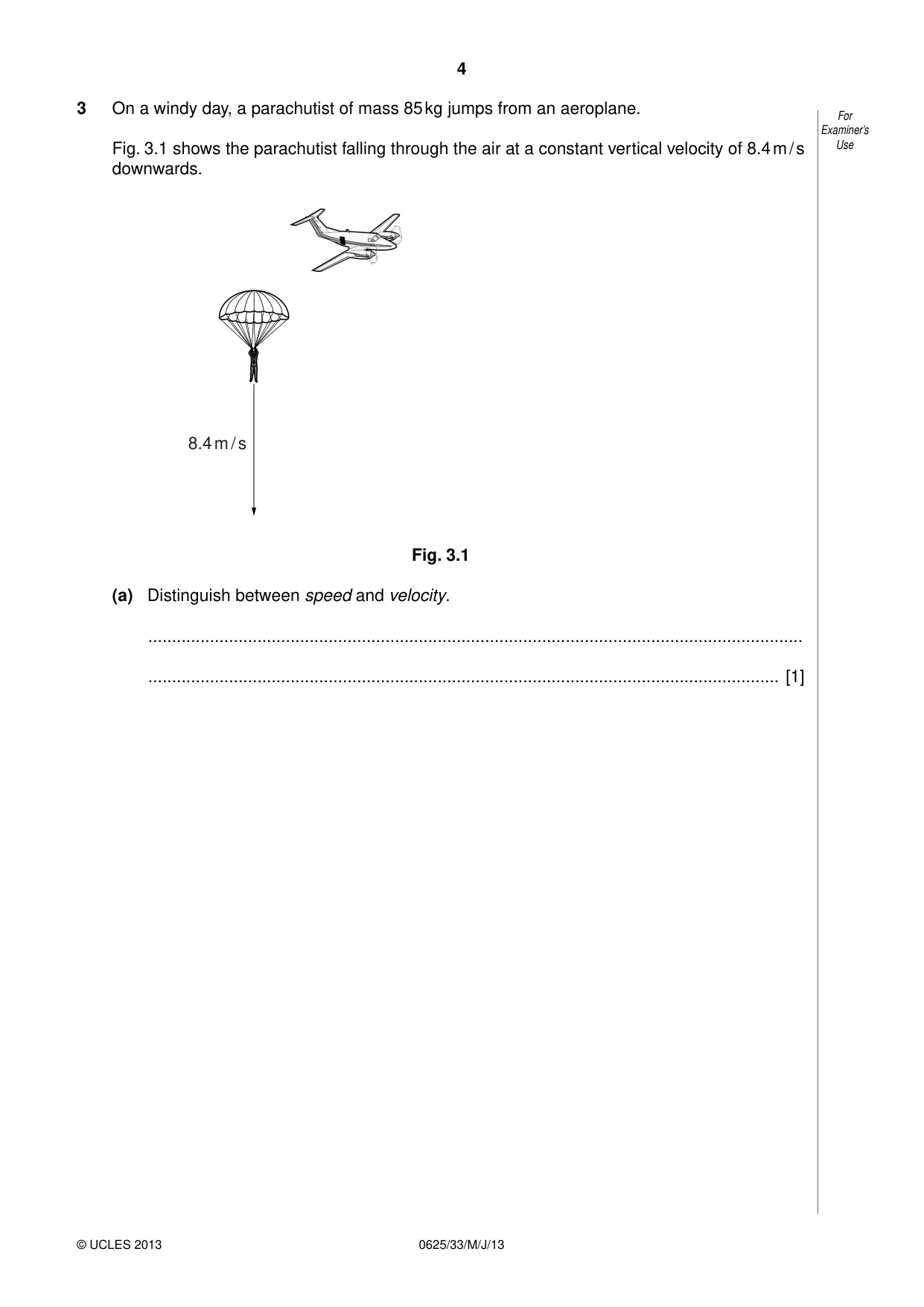
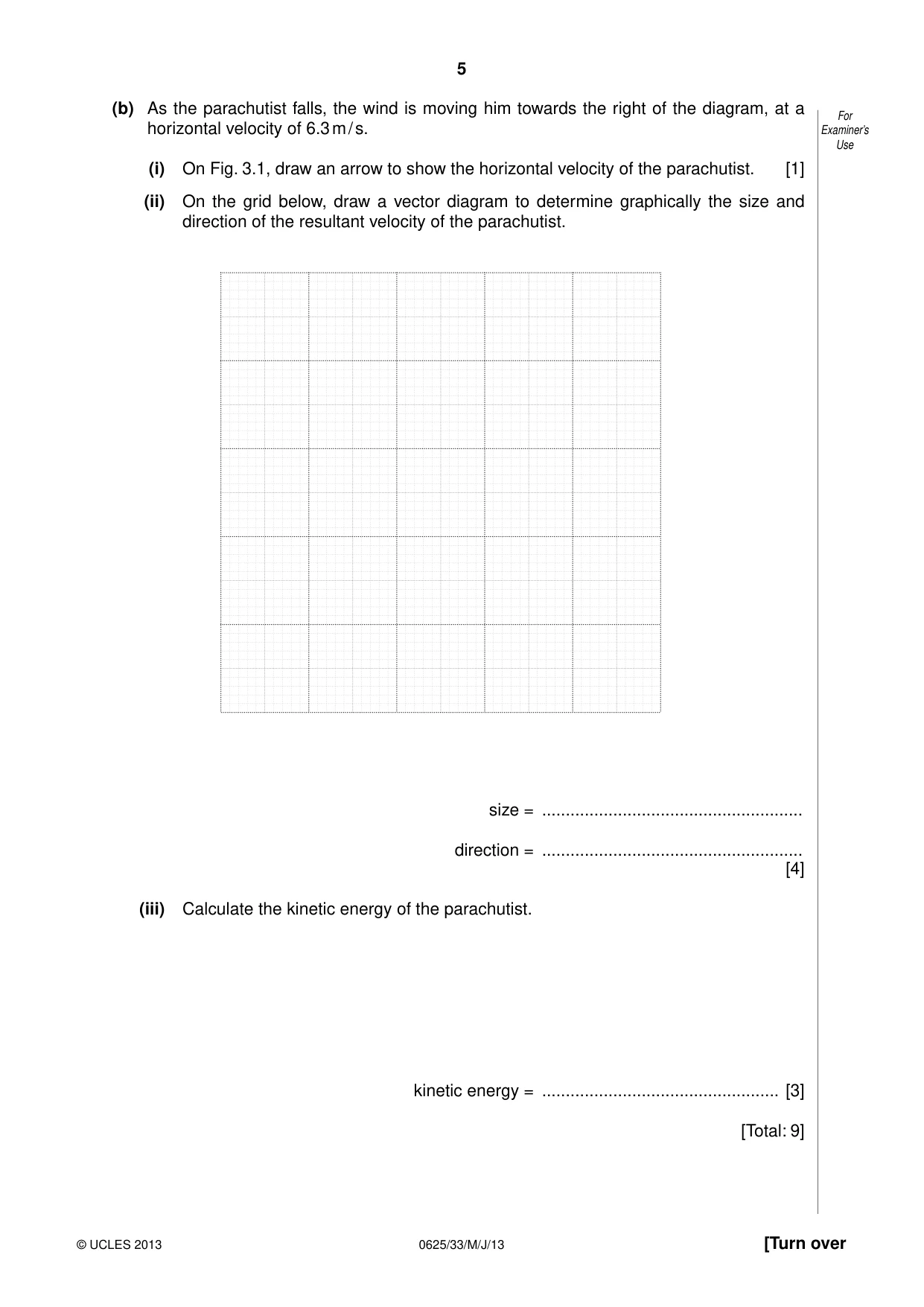
3 On a windy day, a parachutist of mass 85 kg jumps from an aeroplane. For Examiner’s Fig. 3.1 shows the parachutist falling through the air at a constant vertical velocity of 8.4 m / s Use downwards. 8.4 m / s Fig. 3.1 (a) Distinguish between speed and velocity. .......................................................................................................................................... ..................................................................................................................................... [1] (b) As the parachutist falls, the wind is moving him towards the right of the diagram, at a For horizontal velocity of 6.3 m / s. Examiner’s Use (i) On Fig. 3.1, draw an arrow to show the horizontal velocity of the parachutist. [1] (ii) On the grid below, draw a vector diagram to determine graphically the size and direction of the resultant velocity of the parachutist. size = ....................................................... direction = ....................................................... [4] (iii) Calculate the kinetic energy of the parachutist. kinetic energy = .................................................. [3] [Total: 9]
Mark scheme: 3 (a) velocity has direction/is a vector AND speed doesn’t/isn’t/is a scalar B1 (b) (i) horizontal arrow to right AND touching parachutist (when extended) B1 arrow/line horizontal AND arrow / line vertical AND making two sides of triangle OR rectangle B1 (ii) correct diagonal (i.e. top left to bottom right) B1 10.4 –10.5 m / s B1 51–55° to horizontal OR 35 –39° to vertical (NOT more than 2 sig.figs.) B1 (iii) ½mv2 OR 0.5 × 85 × 10.52 (e.c.f. from (b)(ii)) C1 0.5 × 85 × 10.52 (e.c.f. from (b)(ii)) C1 4.7/4.69/4.685625 × 103 J (e.c.f. from (b)(ii)) A1 [9] IGCSE – May/June 2013 0625 33
Q4 · A large crane has a mass of 8500 kg
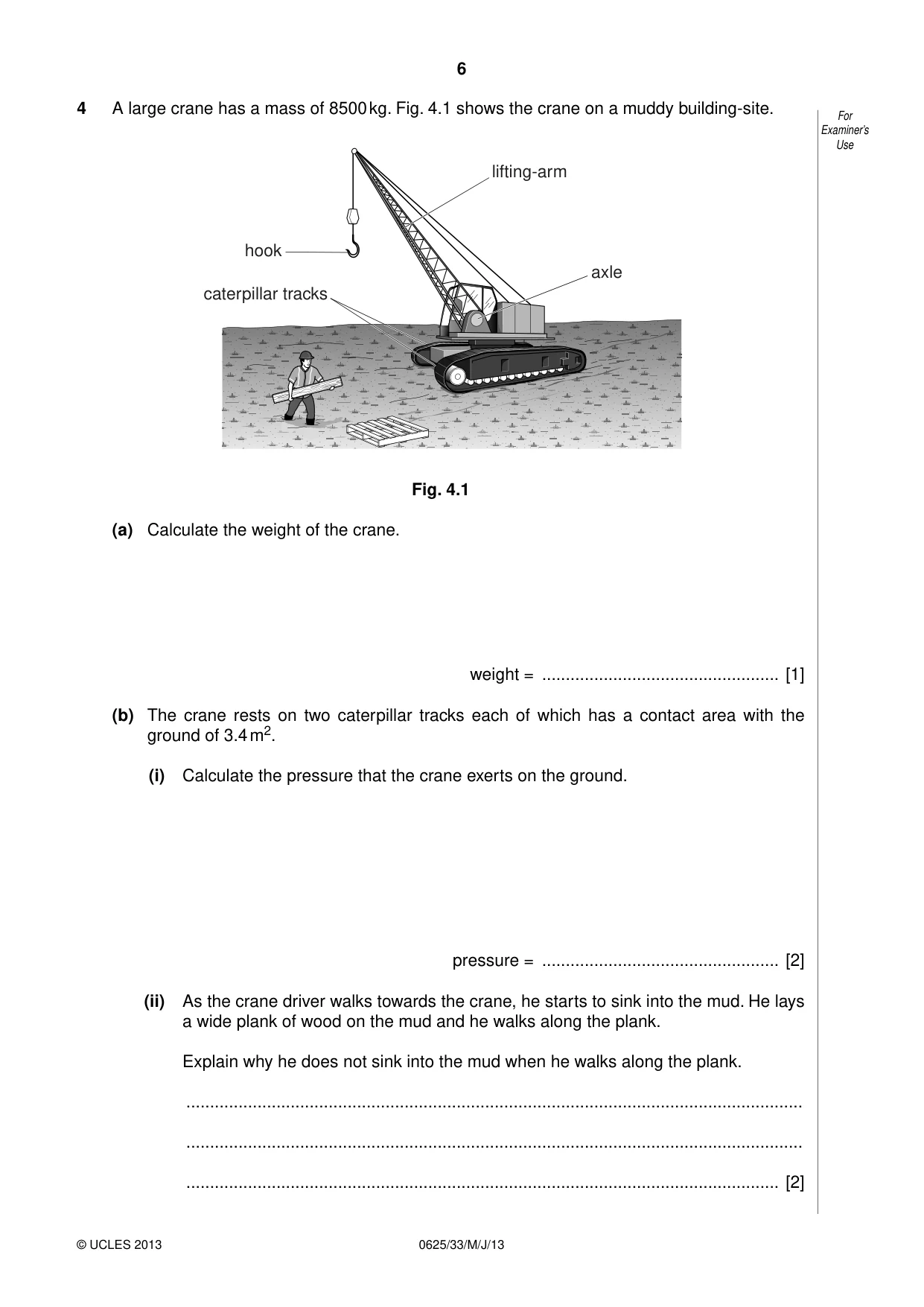
4 A large crane has a mass of 8500 kg. Fig. 4.1 shows the crane on a muddy building-site. For Examiner’s Use lifting-arm hook axle caterpillar tracks Fig. 4.1 (a) Calculate the weight of the crane. weight = .................................................. [1] (b) The crane rests on two caterpillar tracks each of which has a contact area with the ground of 3.4 m2. (i) Calculate the pressure that the crane exerts on the ground. pressure = .................................................. [2] (ii) As the crane driver walks towards the crane, he starts to sink into the mud. He lays a wide plank of wood on the mud and he walks along the plank. Explain why he does not sink into the mud when he walks along the plank. .................................................................................................................................. .................................................................................................................................. ............................................................................................................................. [2] (c) When the crane lifts a heavy load with its hook, the load exerts a moment on the For lifting-arm about the axle. Examiner’s Use (i) Explain what is meant by moment of a force. .................................................................................................................................. ............................................................................................................................. [1] (ii) Despite the moment exerted on the lifting-arm, the crane remains in equilibrium. State the two conditions required for any object to be in equilibrium. 1. .............................................................................................................................. 2. .............................................................................................................................. [2] [Total: 8]
Mark scheme: 4 (a) 85 000 N (accept 83 300 N) B1 (b) (i) (P = )F/A OR 85 000/3.4 OR 85 000/3.4 × 2 OR 85 000/6.8 (e.c.f. from (a)(i)) C1 1.2/1.25/1.3 × 104 Pa (e.c.f. from (a)(i)) A1 (ii) larger area M1 smaller pressure A1 (c) (i) (measure of) turning effect OR F × x B1 (ii) no resultant/net force B1 no resultant/net turning effect/moment B1 [8]
Q5 · A saucepan of boiling water on an electric hotplate
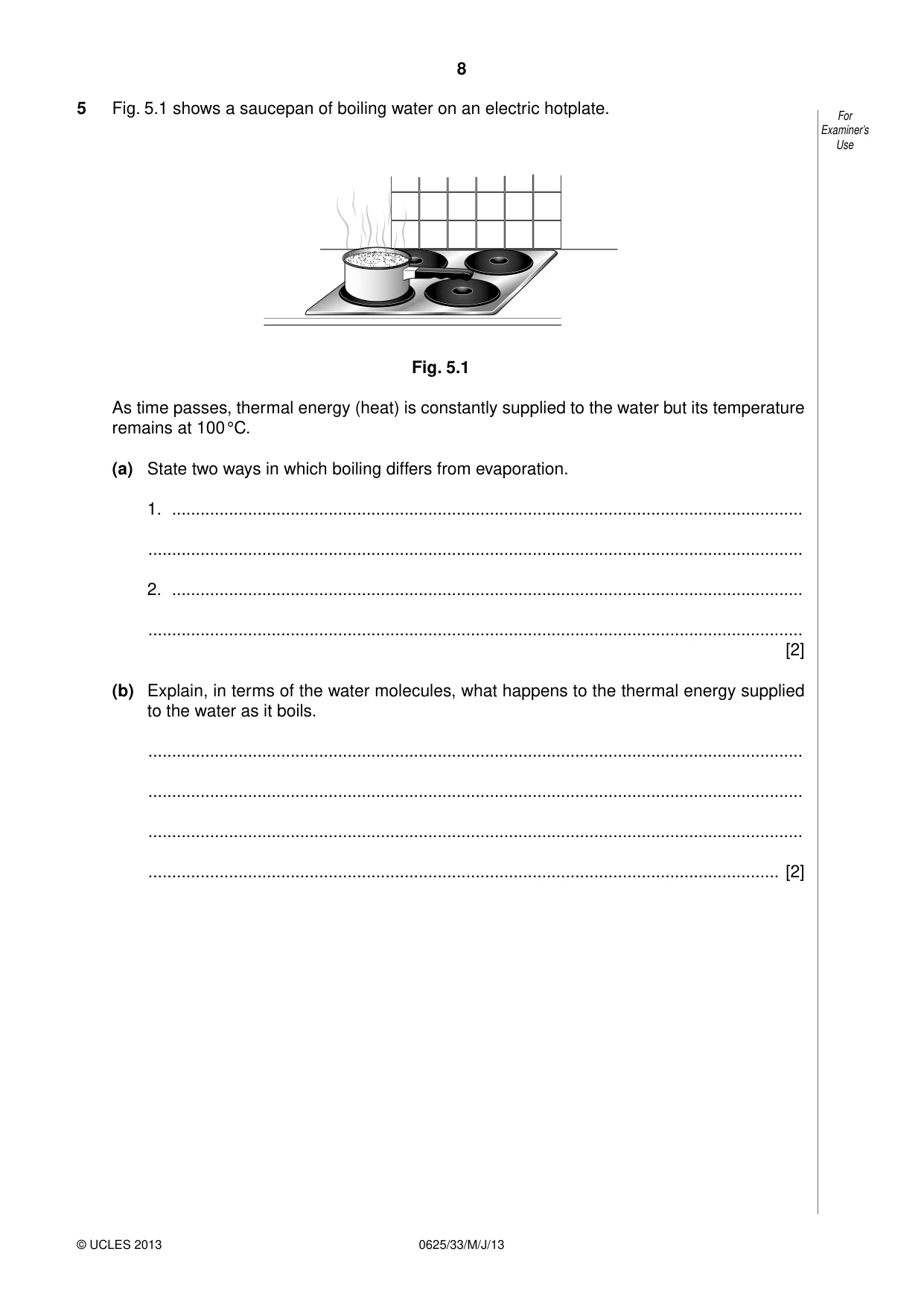
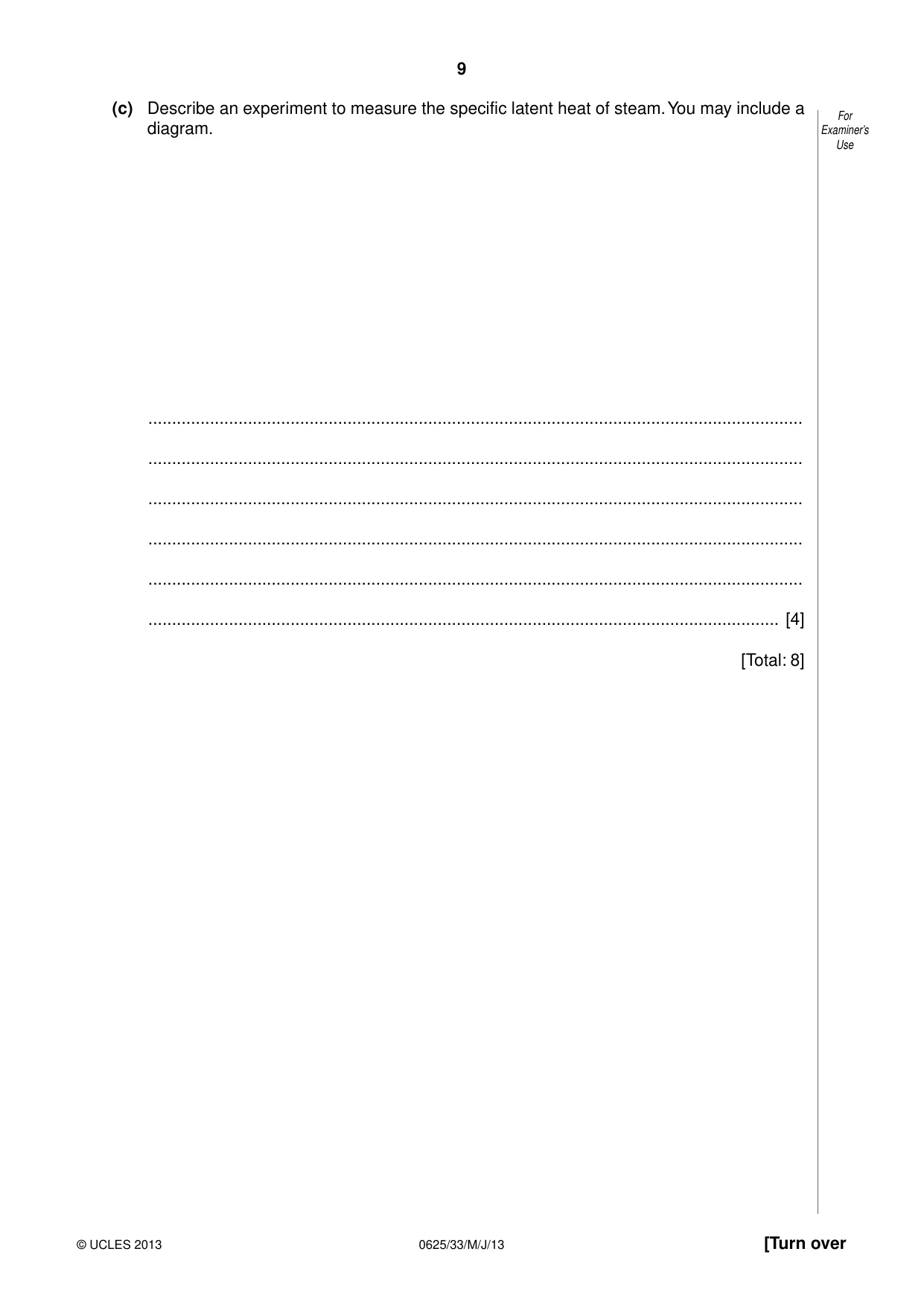
5 Fig. 5.1 shows a saucepan of boiling water on an electric hotplate. For Examiner’s Use Fig. 5.1 As time passes, thermal energy (heat) is constantly supplied to the water but its temperature remains at 100 °C. (a) State two ways in which boiling differs from evaporation. 1. ..................................................................................................................................... .......................................................................................................................................... 2. ..................................................................................................................................... .......................................................................................................................................... [2] (b) Explain, in terms of the water molecules, what happens to the thermal energy supplied to the water as it boils. .......................................................................................................................................... .......................................................................................................................................... .......................................................................................................................................... ..................................................................................................................................... [2] (c) Describe an experiment to measure the specific latent heat of steam. You may include a For diagram. Examiner’s Use .......................................................................................................................................... .......................................................................................................................................... .......................................................................................................................................... .......................................................................................................................................... .......................................................................................................................................... ..................................................................................................................................... [4] [Total: 8]
Mark scheme: 5 (a) any two of: boiling throughout liquid (evaporation at surface), boiling at one temperature (evaporation at any / all temperature / below boiling point), boiling not affected by draught/area (evaporation is), boiling produces bubbles (evaporation does not). B2 (b) (thermal energy) does work against intermolecular forces / breaks bonds B1 molecules separated/moved apart OR becomes PE B1 (c) apparatus: e.g. kettle AND balance / scales OR steam condensing in water with measuring cylinder / scales AND thermometer B1 two masses determined OR volume/mass condensed B1 determine energy input: e.g. VIt or Pt or mc∆T B1 (le = )Q/m B1 [8]
Q6 · State two ways in which the molecular structure of a gas differs from the molecular For…
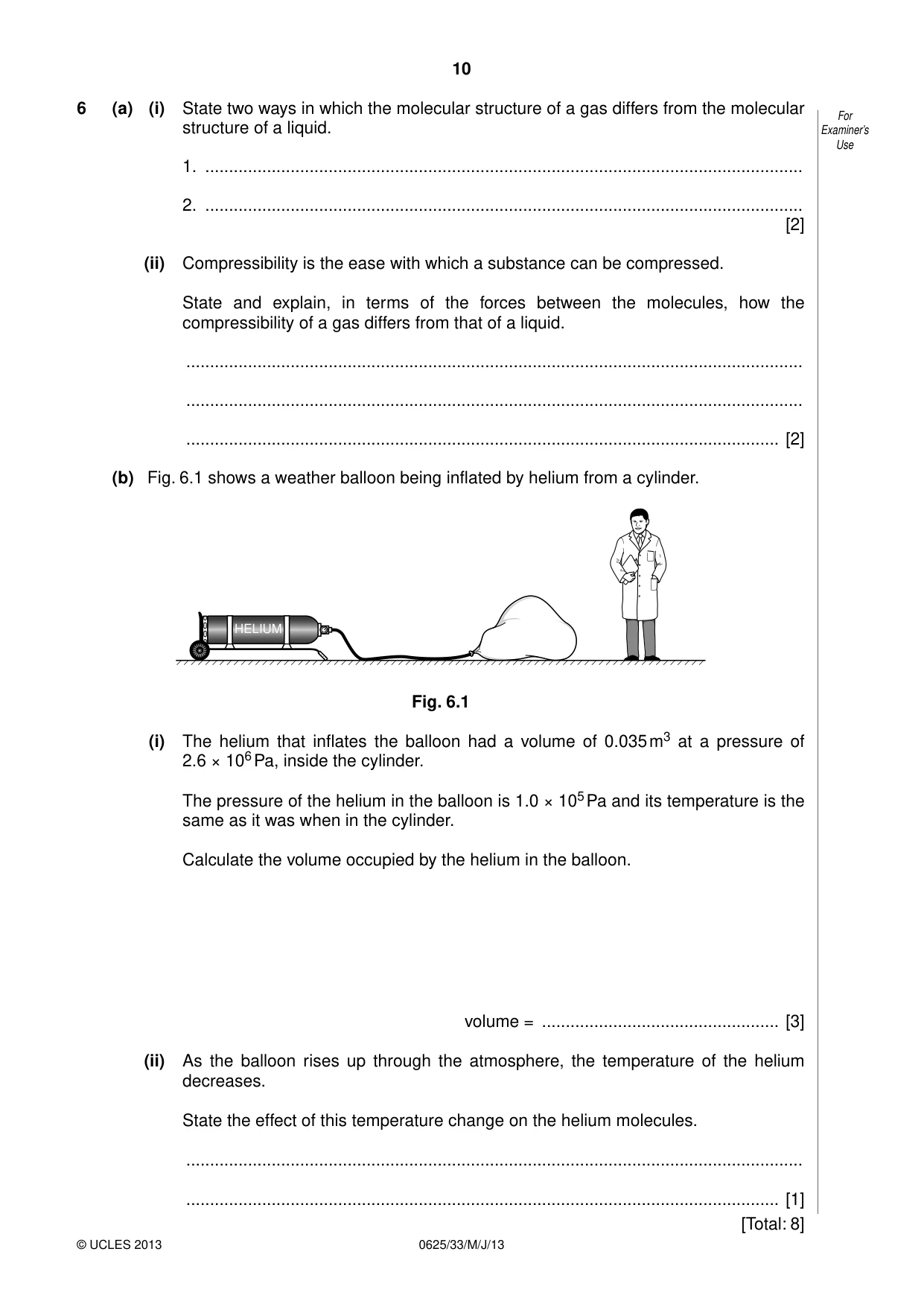
6 (a) (i) State two ways in which the molecular structure of a gas differs from the molecular For structure of a liquid. Examiner’s Use 1. .............................................................................................................................. 2. .............................................................................................................................. [2] (ii) Compressibility is the ease with which a substance can be compressed. State and explain, in terms of the forces between the molecules, how the compressibility of a gas differs from that of a liquid. .................................................................................................................................. .................................................................................................................................. ............................................................................................................................. [2] (b) Fig. 6.1 shows a weather balloon being inflated by helium from a cylinder. HELIUM Fig. 6.1 (i) The helium that inflates the balloon had a volume of 0.035 m3 at a pressure of 2.6 × 10⁶ Pa, inside the cylinder. The pressure of the helium in the balloon is 1.0 × 10⁵ Pa and its temperature is the same as it was when in the cylinder. Calculate the volume occupied by the helium in the balloon. volume = .................................................. [3] (ii) As the balloon rises up through the atmosphere, the temperature of the helium decreases. State the effect of this temperature change on the helium molecules. .................................................................................................................................. ............................................................................................................................. [1] [Total: 8]
Mark scheme: 6 (a) (i) any two of: (gas) molecules further apart greater PE move singly / in straight lines OR vice versa for. liquid molecules (allow faster) B2 (ii) gases compressible OR liquids incompressible B1 forces between gas molecules weaker OR vice versa for liquid molecules B1 (b) (i) pV = constant OR p1V1 = p2V2 OR 2.6 × 106 × 0.035 OR 91 000 C1 2.6 × 106 × 0.035/1.0 × 105 OR 91 000/1.0 ×105 C1 0.91 m3 A1 (ii) slower / less KE B1 [8] IGCSE – May/June 2013 0625 33
Q7 · The frequency of the monochromatic light produced by a laser is 4.7 × 10¹⁴ Hz
7 The frequency of the monochromatic light produced by a laser is 4.7 × 10¹⁴ Hz. For Examiner’s A ray of light from the laser passes from a vacuum, where the speed of light is 3.0 × 10⁸ m / s, Use into a fibre-optic cable. (a) State (i) what is meant by monochromatic, .................................................................................................................................. ............................................................................................................................. [1] (ii) the frequency of light from the laser in the fibre-optic cable. ............................................................................................................................. [1] (b) The speed of light in the fibre-optic cable is 2.0 × 10⁸ m / s. Calculate (i) the refractive index of the material from which fibre-optic cable is made, refractive index = .................................................. [2] (ii) the wavelength of light from the laser in the fibre-optic cable. wavelength = .................................................. [2] [Total: 6]
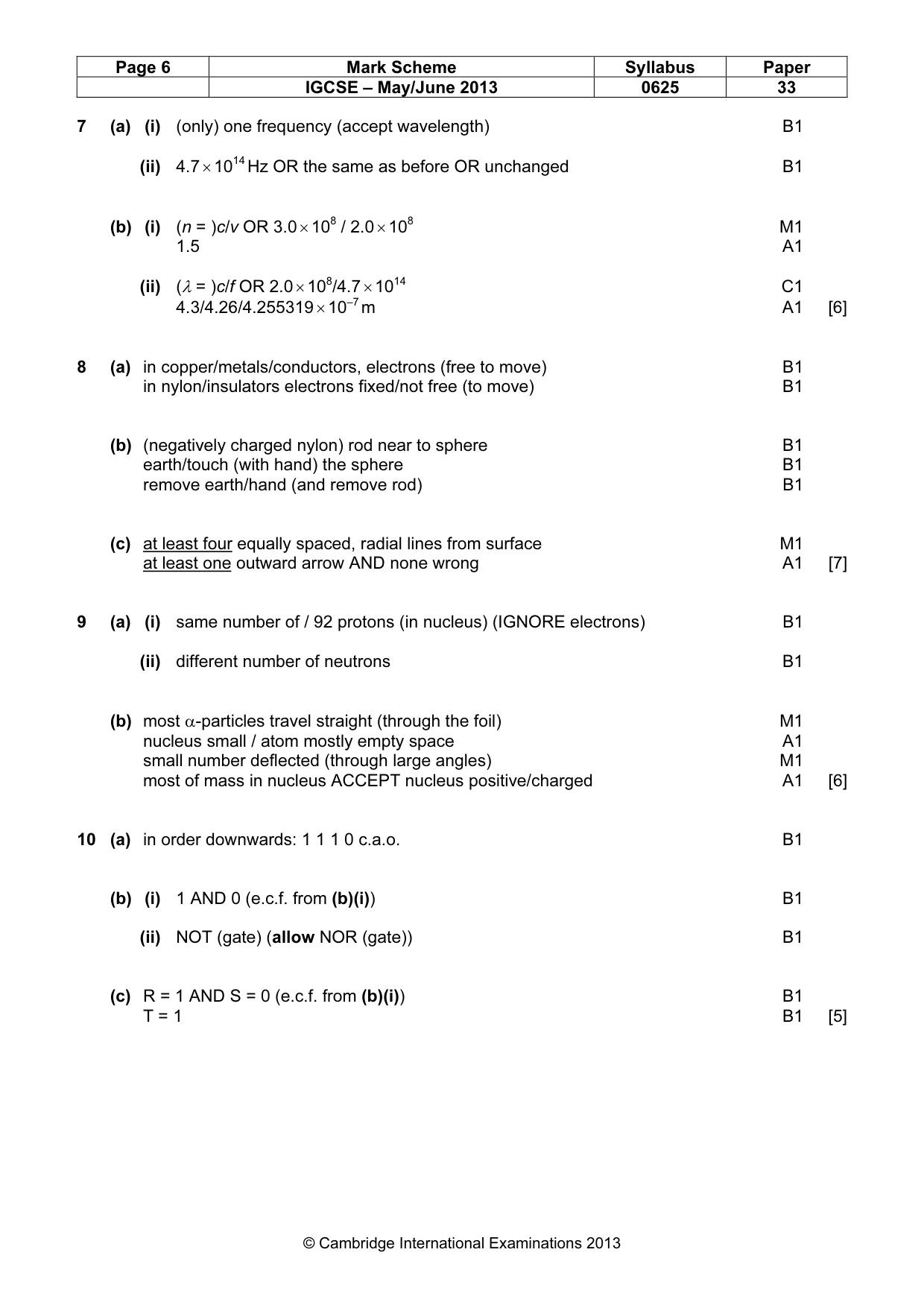
Mark scheme: 7 (a) (i) (only) one frequency (accept wavelength) B1 (ii) 4.7 × 10¹⁴ Hz OR the same as before OR unchanged B1 (b) (i) (n = )c/v OR 3.0 × 10⁸ / 2.0 × 10⁸ M1 1.5 A1 (ii) (λ = )c/f OR 2.0 × 10⁸/4.7 × 1014 C1 4.3/4.26/4.255319 × 10–7 m A1 [6]
Q8 · A small, uncharged copper sphere suspended from a nylon thread, and a For plastic rod…
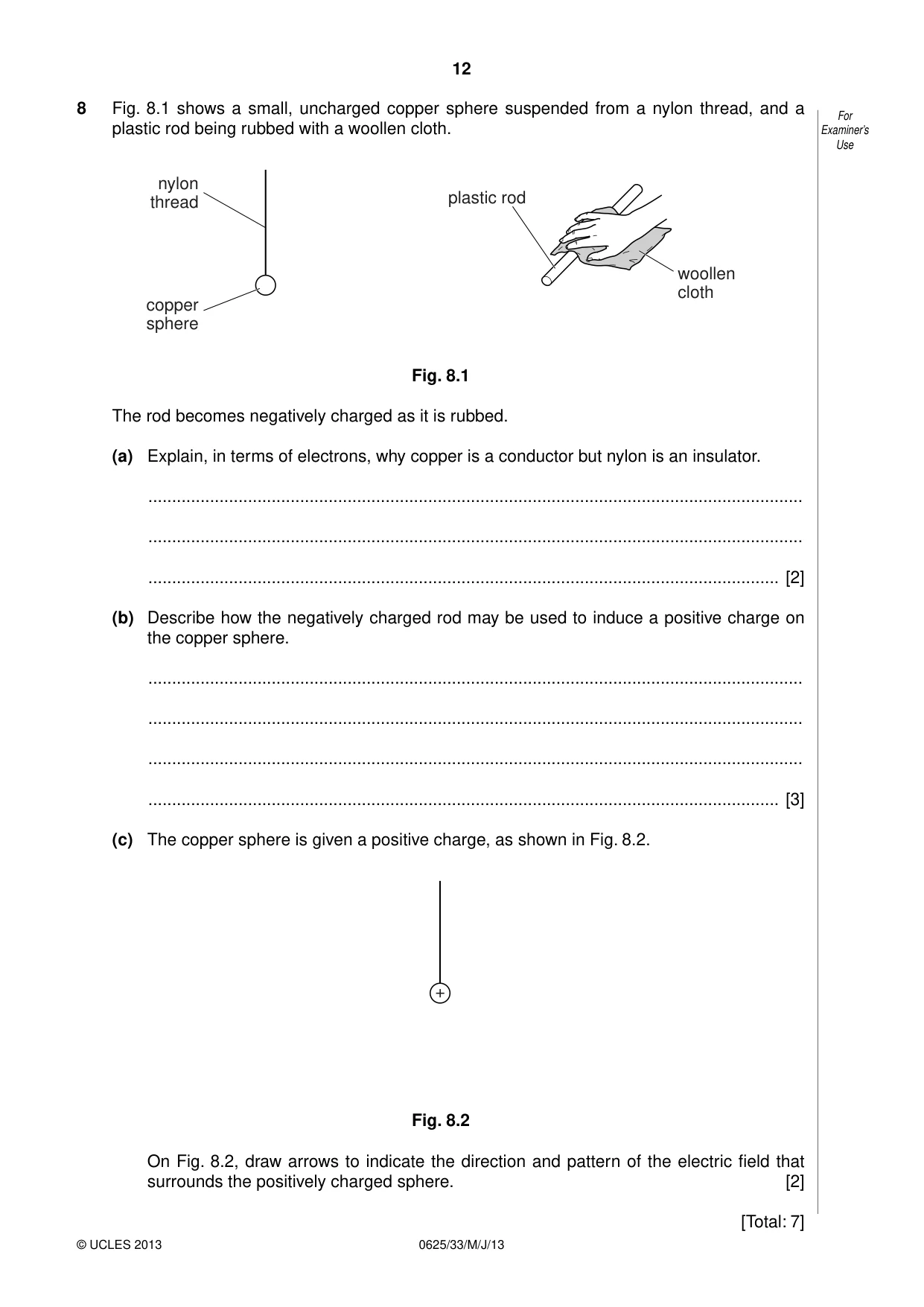
8 Fig. 8.1 shows a small, uncharged copper sphere suspended from a nylon thread, and a For plastic rod being rubbed with a woollen cloth. Examiner’s Use nylon plastic rod thread woollen cloth copper sphere Fig. 8.1 The rod becomes negatively charged as it is rubbed. (a) Explain, in terms of electrons, why copper is a conductor but nylon is an insulator. .......................................................................................................................................... .......................................................................................................................................... ..................................................................................................................................... [2] (b) Describe how the negatively charged rod may be used to induce a positive charge on the copper sphere. .......................................................................................................................................... .......................................................................................................................................... .......................................................................................................................................... ..................................................................................................................................... [3] (c) The copper sphere is given a positive charge, as shown in Fig. 8.2. + Fig. 8.2 On Fig. 8.2, draw arrows to indicate the direction and pattern of the electric field that surrounds the positively charged sphere. [2] [Total: 7]
Mark scheme: 8 (a) in copper/metals/conductors, electrons (free to move) B1 in nylon/insulators electrons fixed/not free (to move) B1 (b) (negatively charged nylon) rod near to sphere B1 earth/touch (with hand) the sphere B1 remove earth/hand (and remove rod) B1 (c) at least four equally spaced, radial lines from surface M1 at least one outward arrow AND none wrong A1 [7]
Q9 · In a laboratory experiment, the isotope uranium-238 is used as a source of α-particles
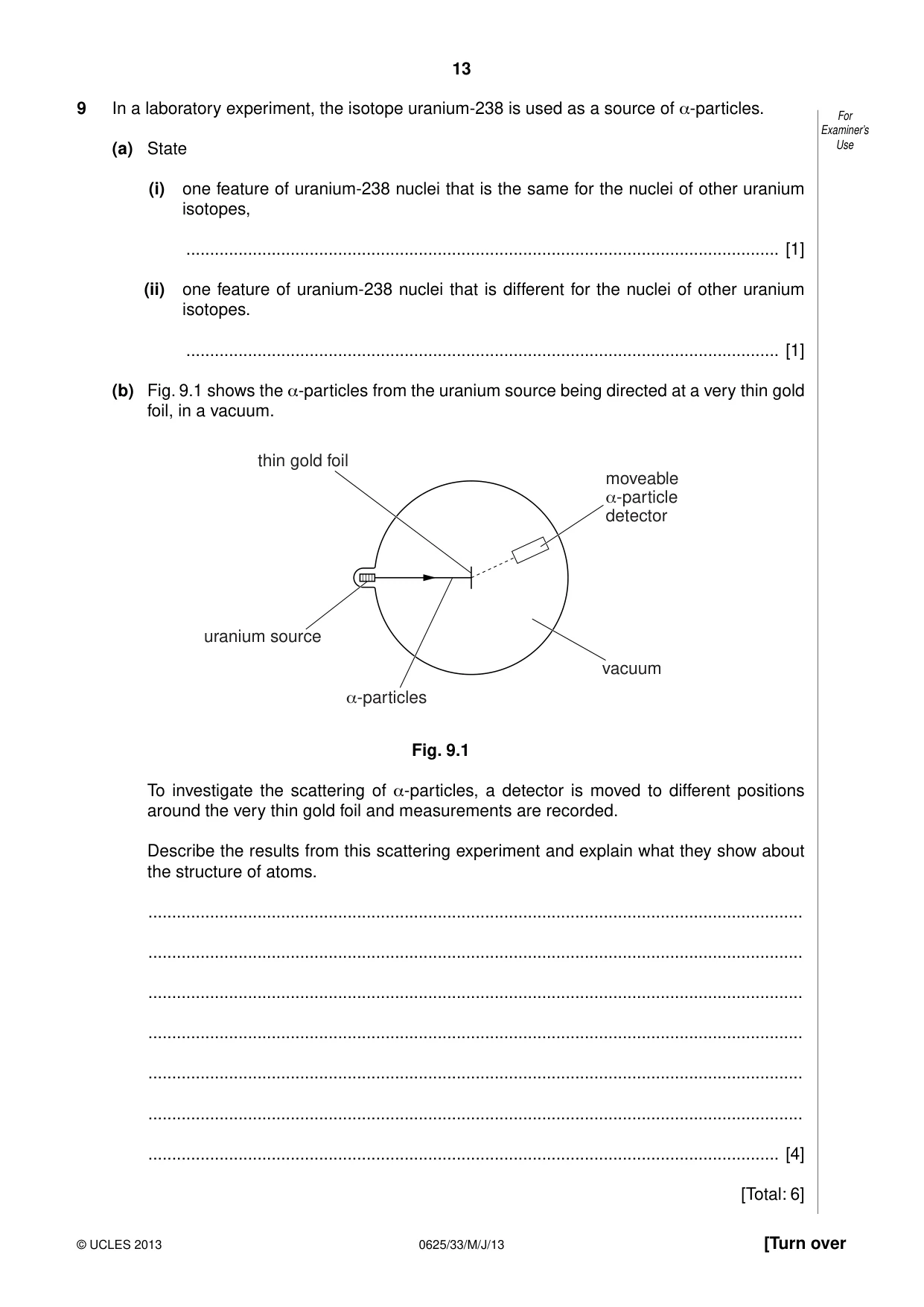
9 In a laboratory experiment, the isotope uranium-238 is used as a source of α-particles. For Examiner’s (a) State Use (i) one feature of uranium-238 nuclei that is the same for the nuclei of other uranium isotopes, ............................................................................................................................. [1] (ii) one feature of uranium-238 nuclei that is different for the nuclei of other uranium isotopes. ............................................................................................................................. [1] (b) Fig. 9.1 shows the α-particles from the uranium source being directed at a very thin gold foil, in a vacuum. thin gold foil moveable _-particle detector uranium source vacuum _-particles Fig. 9.1 To investigate the scattering of α-particles, a detector is moved to different positions around the very thin gold foil and measurements are recorded. Describe the results from this scattering experiment and explain what they show about the structure of atoms. .......................................................................................................................................... .......................................................................................................................................... .......................................................................................................................................... .......................................................................................................................................... .......................................................................................................................................... .......................................................................................................................................... ..................................................................................................................................... [4] [Total: 6]
Mark scheme: 9 (a) (i) same number of / 92 protons (in nucleus) (IGNORE electrons) B1 (ii) different number of neutrons B1 (b) most α-particles travel straight (through the foil) M1 nucleus small / atom mostly empty space A1 small number deflected (through large angles) M1 most of mass in nucleus ACCEPT nucleus positive/charged A1 [6]
Q10 · The symbol for a NAND gate with inputs A and B
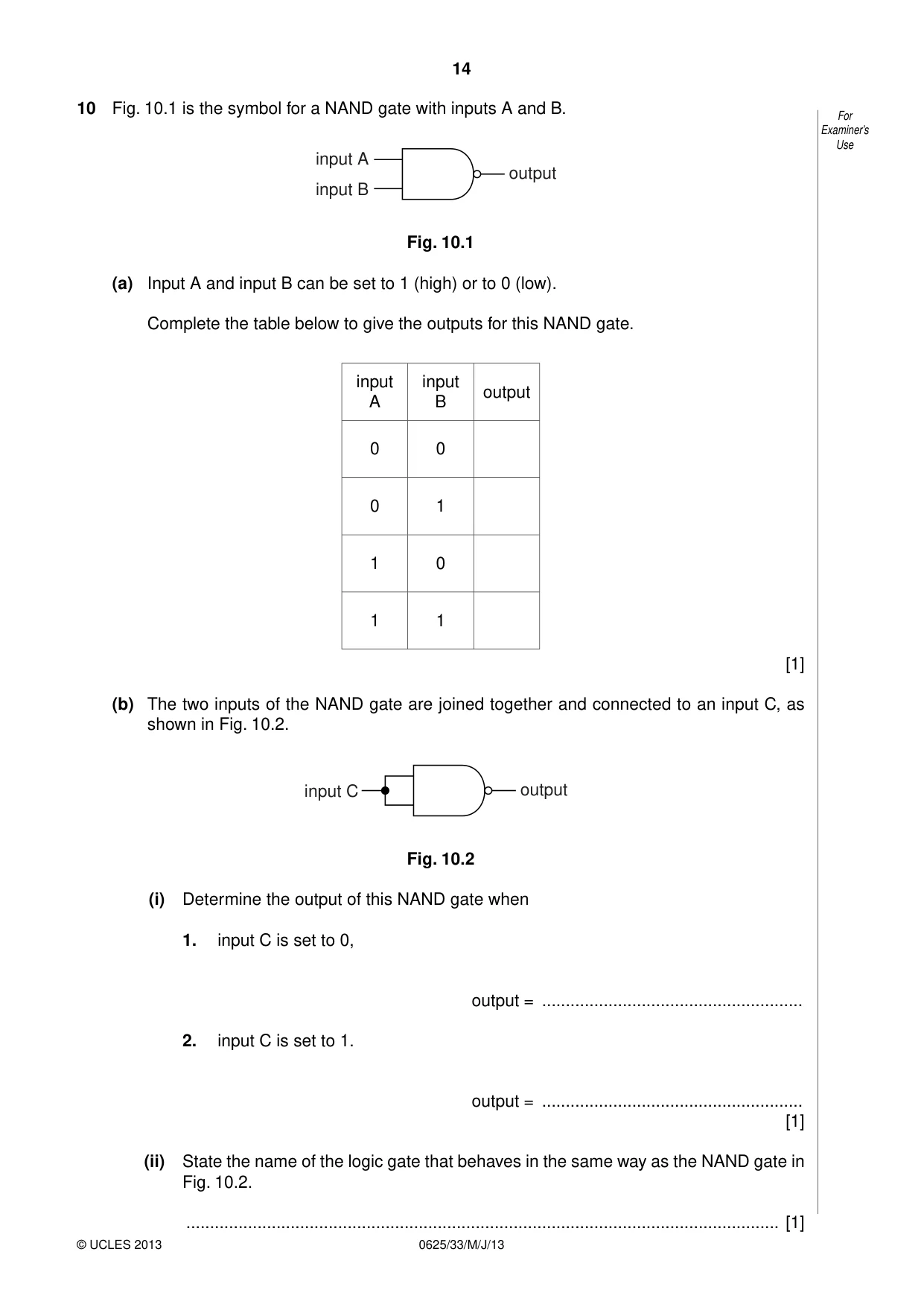
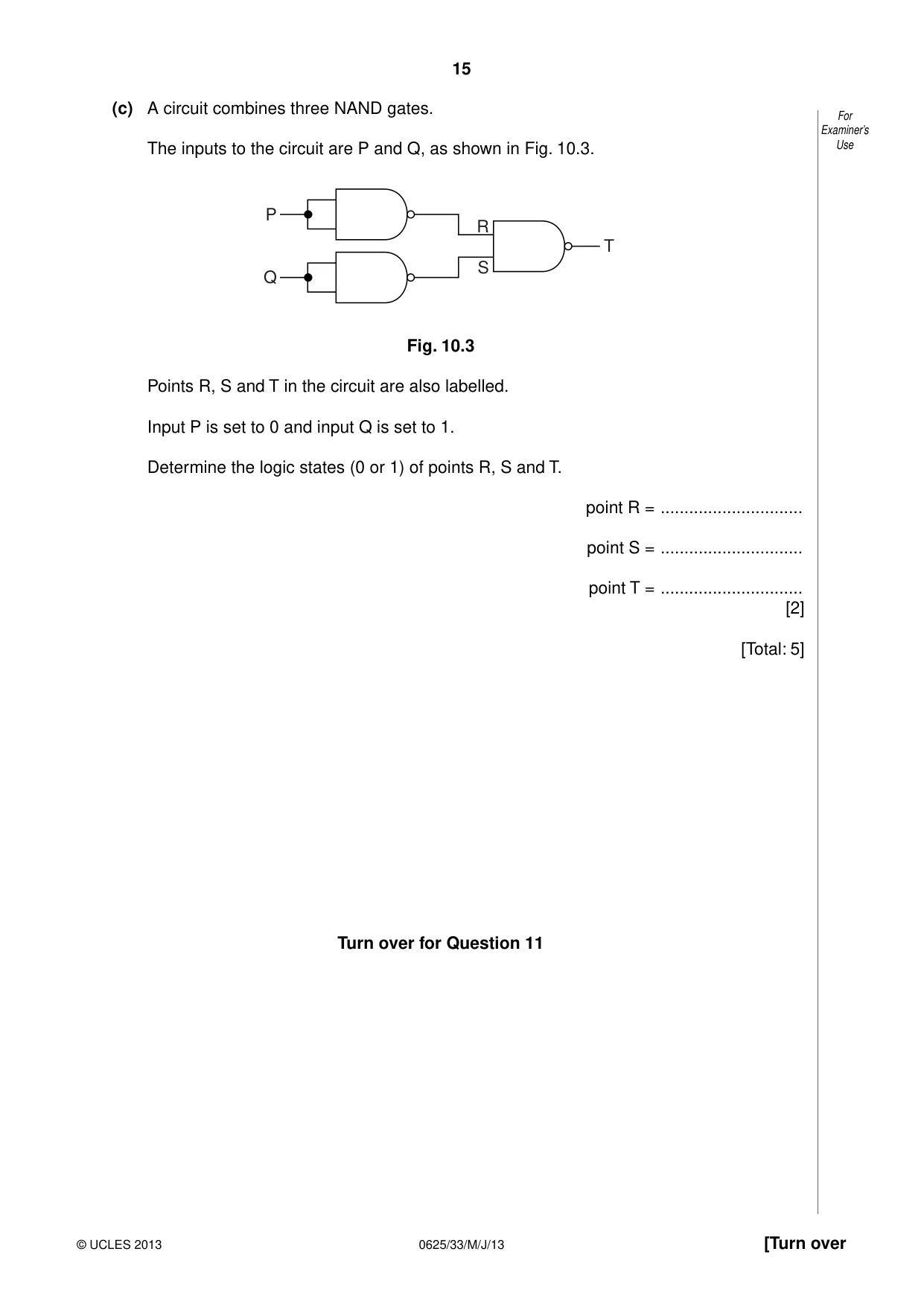
10 Fig. 10.1 is the symbol for a NAND gate with inputs A and B. For Examiner’s Use input A output input B Fig. 10.1 (a) Input A and input B can be set to 1 (high) or to 0 (low). Complete the table below to give the outputs for this NAND gate. input input output A B 0 0 0 1 1 0 1 1 [1] (b) The two inputs of the NAND gate are joined together and connected to an input C, as shown in Fig. 10.2. input C output Fig. 10.2 (i) Determine the output of this NAND gate when 1. input C is set to 0, output = ....................................................... 2. input C is set to 1. output = ....................................................... [1] (ii) State the name of the logic gate that behaves in the same way as the NAND gate in Fig. 10.2. ............................................................................................................................. [1] (c) A circuit combines three NAND gates. For Examiner’s The inputs to the circuit are P and Q, as shown in Fig. 10.3. Use P R T S Q Fig. 10.3 Points R, S and T in the circuit are also labelled. Input P is set to 0 and input Q is set to 1. Determine the logic states (0 or 1) of points R, S and T. point R = .............................. point S = .............................. point T = .............................. [2] [Total: 5] Turn over for Question 11
Mark scheme: 10 (a) in order downwards: 1 1 1 0 c.a.o. B1 (b) (i) 1 AND 0 (e.c.f. from (b)(i)) B1 (ii) NOT (gate) (allow NOR (gate)) B1 (c) R = 1 AND S = 0 (e.c.f. from (b)(i)) B1 T = 1 B1 [5] IGCSE – May/June 2013 0625 33
Q11 · A remote ski lodge receives 18 kW of electric power from a 120 V supply
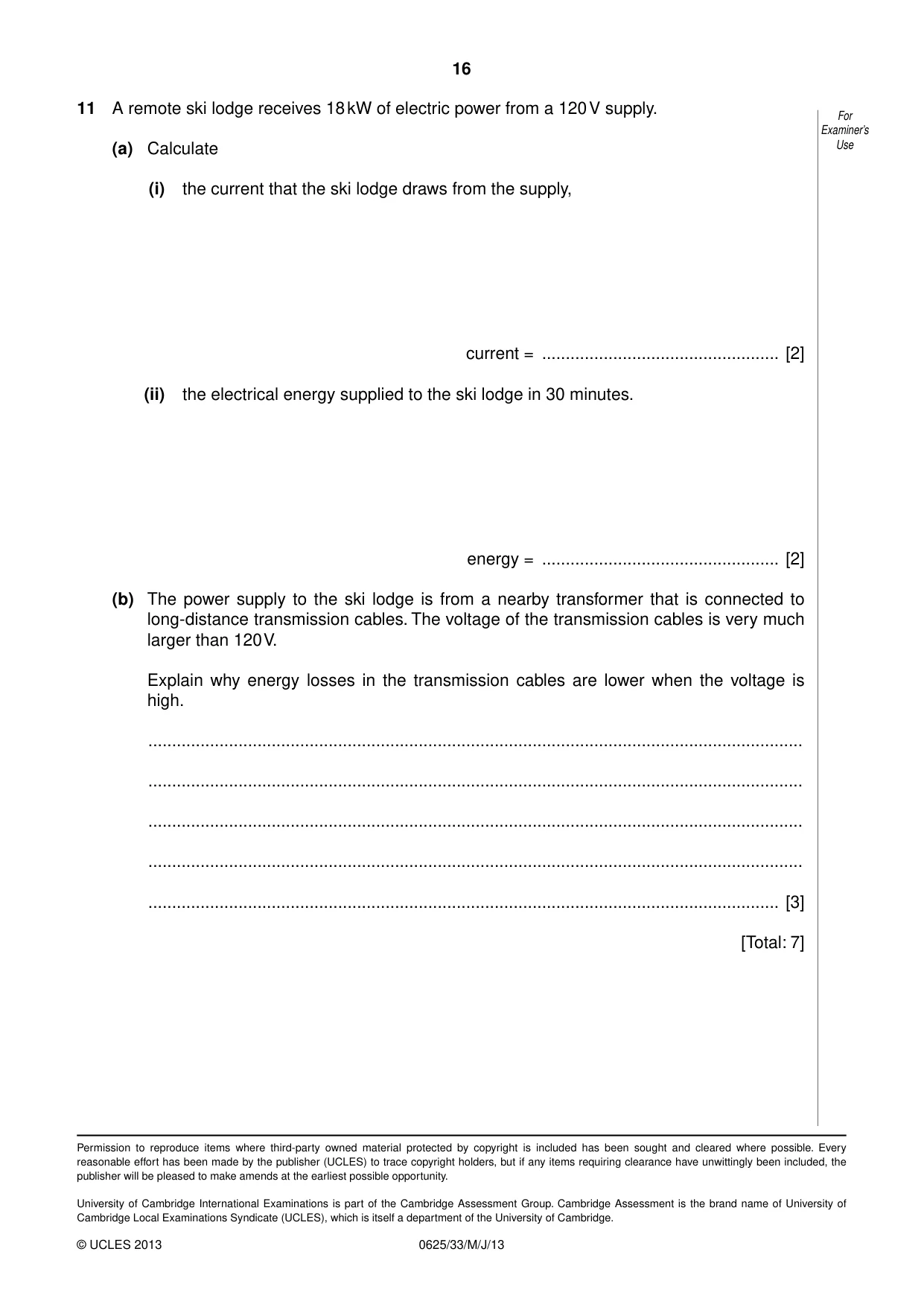
11 A remote ski lodge receives 18 kW of electric power from a 120 V supply. For Examiner’s (a) Calculate Use (i) the current that the ski lodge draws from the supply, current = .................................................. [2] (ii) the electrical energy supplied to the ski lodge in 30 minutes. energy = .................................................. [2] (b) The power supply to the ski lodge is from a nearby transformer that is connected to long-distance transmission cables. The voltage of the transmission cables is very much larger than 120 V. Explain why energy losses in the transmission cables are lower when the voltage is high. .......................................................................................................................................... .......................................................................................................................................... .......................................................................................................................................... .......................................................................................................................................... ..................................................................................................................................... [3] [Total: 7]
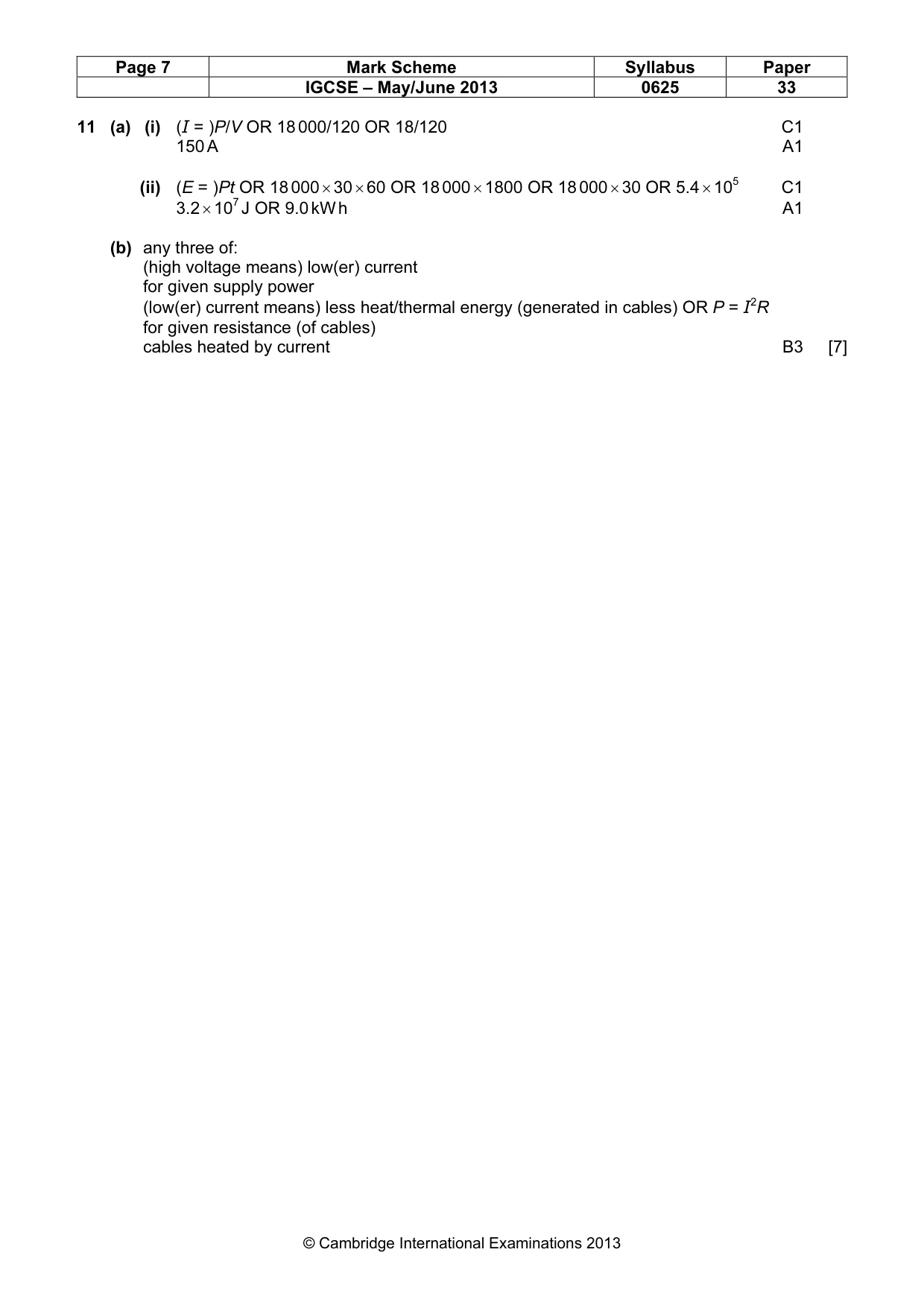
Mark scheme: 11 (a) (i) (I = )P/V OR 18 000/120 OR 18/120 C1 150 A A1 (ii) (E = )Pt OR 18 000 × 30 × 60 OR 18 000 × 1800 OR 18 000 × 30 OR 5.4 × 10⁵ C1 3.2 × 10⁷ J OR 9.0 kW h A1 (b) any three of: (high voltage means) low(er) current for given supply power (low(er) current means) less heat/thermal energy (generated in cables) OR P = I2R for given resistance (of cables) cables heated by current B3 [7]
What was in this paper
The subtopics covered by these 11 questions, and how many questions each got. Open one in a new tab to see every Cambridge question on it.
What you needed in this session
Cambridge’s own grade thresholds for 2013 May/June, Paper 3 · Variant 3. A higher threshold means an easier paper — the bar moves with how the cohort did.