Cambridge IGCSE Physics 0625 — 2014 May/June Paper 3 · Variant 3
0625/33/M/J/14 · 12 questions · 80 marks · ≈90 min
The question paper and its mark scheme, free to read here and free to download. This is Cambridge’s own paper, exactly as it was sat.
Question paper20 pages

Mark scheme8 pages
Answers below. Sit the paper first if you are practising.
Questions as text
Q1 · Parachutes are used to slow down a certain racing car
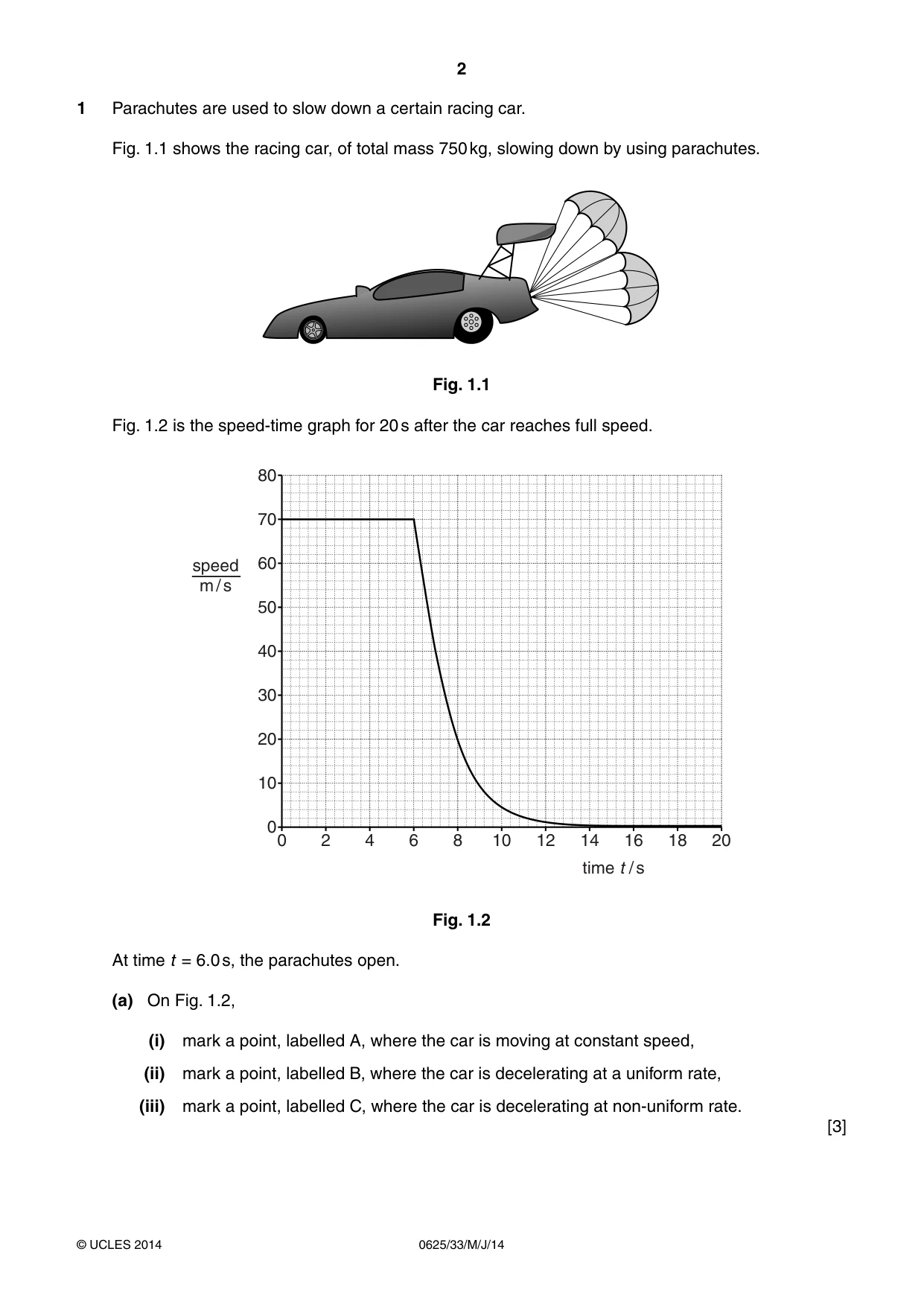
1 Parachutes are used to slow down a certain racing car. Fig. 1.1 shows the racing car, of total mass 750 kg, slowing down by using parachutes. Fig. 1.1 Fig. 1.2 is the speed-time graph for 20 s after the car reaches full speed. 80 70 speed 60 m / s 50 40 30 20 10 0 0 2 4 6 8 10 12 14 16 18 20 time t / s Fig. 1.2 At time t = 6.0 s, the parachutes open. (a) On Fig. 1.2, (i) mark a point, labelled A, where the car is moving at constant speed, (ii) mark a point, labelled B, where the car is decelerating at a uniform rate, (iii) mark a point, labelled C, where the car is decelerating at non-uniform rate. [3] (b) Calculate (i) the deceleration of the car at time t = 6.5 s, deceleration = ............................................... [2] (ii) the resultant force acting on the car at this time. resultant force = ............................................... [2] (c) Explain why there is no resultant force acting on the car at time t = 4.0 s. ................................................................................................................................................... .............................................................................................................................................. [1] [Total: 8]
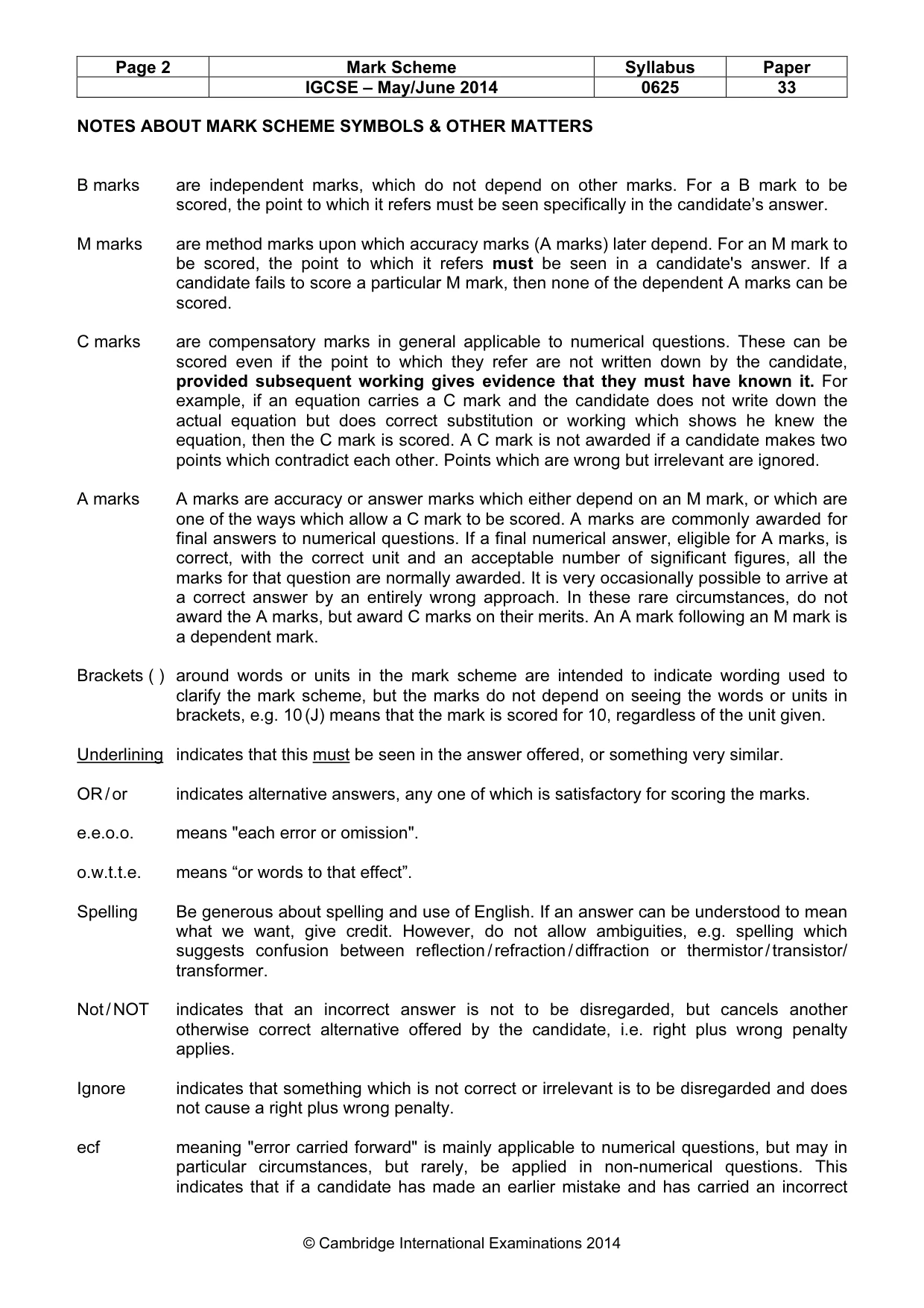
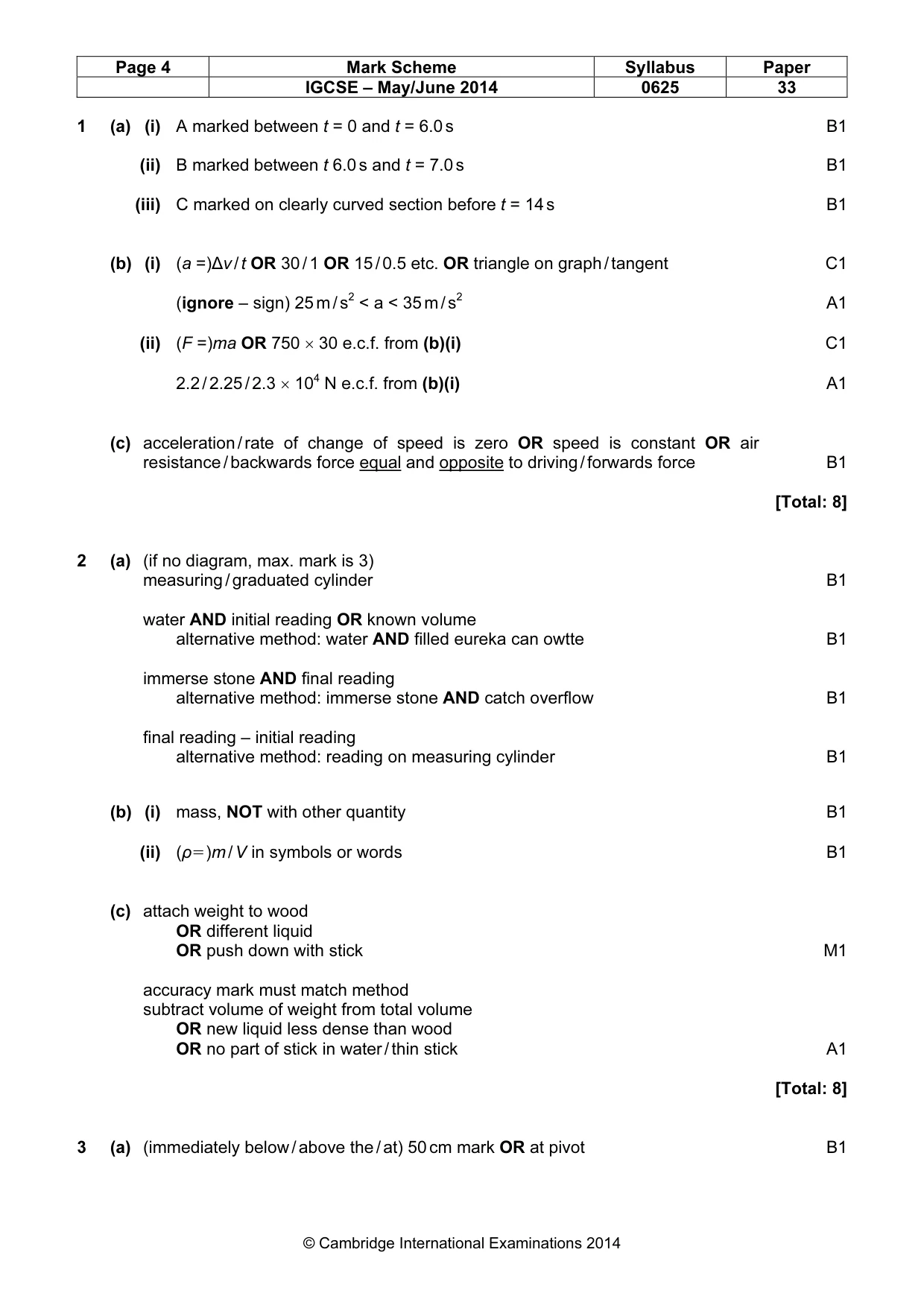
Mark scheme: 1 (a) (i) A marked between t = 0 and t = 6.0 s B1 (ii) B marked between t 6.0 s and t = 7.0 s B1 (iii) C marked on clearly curved section before t = 14 s B1 (b) (i) (a =)∆v / t OR 30 / 1 OR 15 / 0.5 etc. OR triangle on graph / tangent C1 (ignore – sign) 25 m / s2 < a < 35 m / s2 A1 (ii) (F =)ma OR 750 × 30 e.c.f. from (b)(i) C1 2.2 / 2.25 / 2.3 × 10⁴ N e.c.f. from (b)(i) A1 (c) acceleration / rate of change of speed is zero OR speed is constant OR air resistance / backwards force equal and opposite to driving / forwards force B1 [Total: 8]
Q2 · A student wishes to determine the density of a small, irregularly shaped stone
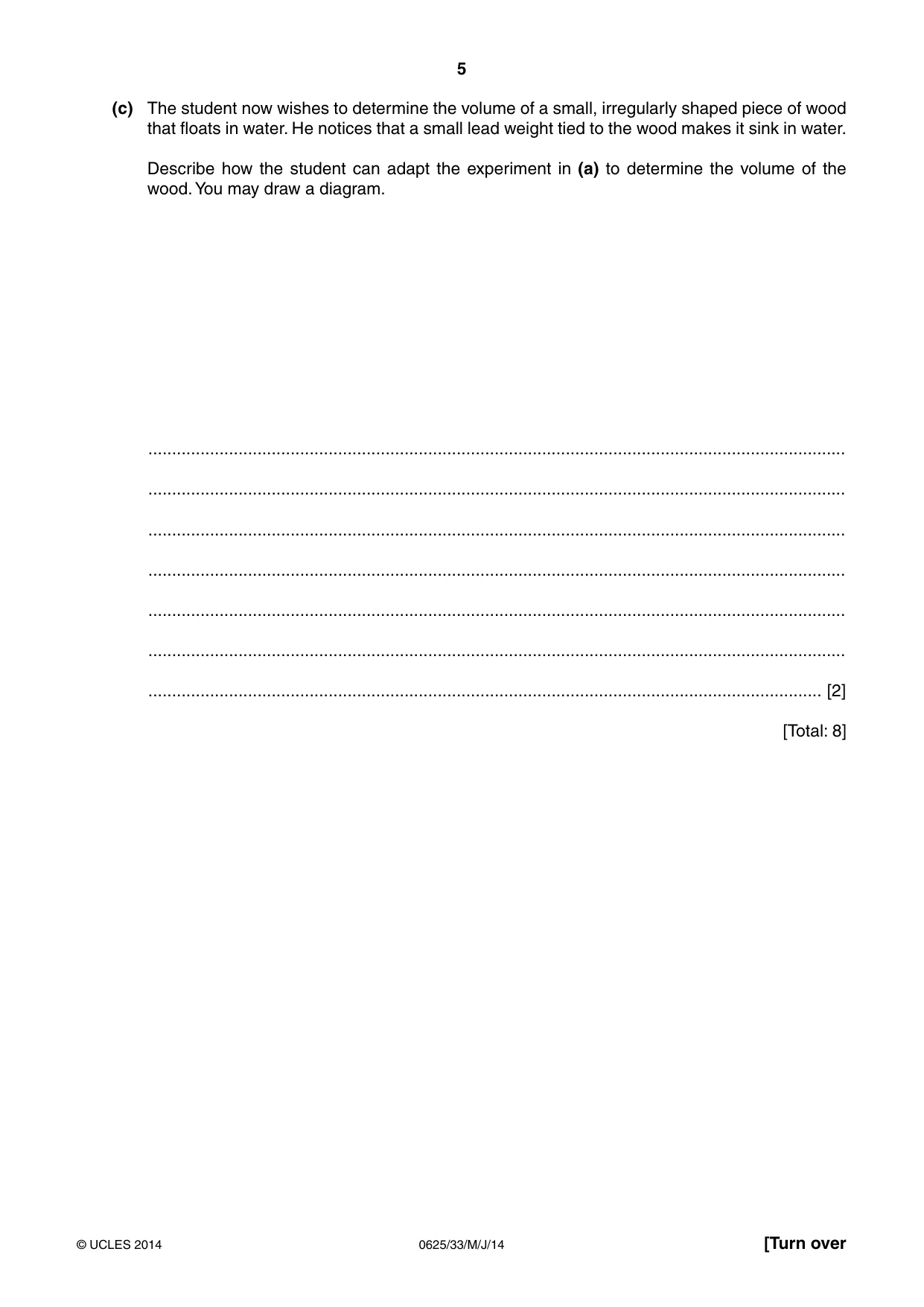
2 A student wishes to determine the density of a small, irregularly shaped stone. (a) With the aid of a labelled diagram, describe an experiment to determine the volume of the stone. ................................................................................................................................................... ................................................................................................................................................... ................................................................................................................................................... ................................................................................................................................................... .............................................................................................................................................. [4] (b) (i) State the other quantity, apart from the volume, that must be measured in order to determine the density. ...................................................................................................................................... [1] (ii) State the formula that is used to calculate the density. ........................................................................................................................................... ...................................................................................................................................... [1] (c) The student now wishes to determine the volume of a small, irregularly shaped piece of wood that floats in water. He notices that a small lead weight tied to the wood makes it sink in water. Describe how the student can adapt the experiment in (a) to determine the volume of the wood. You may draw a diagram. ................................................................................................................................................... ................................................................................................................................................... ................................................................................................................................................... ................................................................................................................................................... ................................................................................................................................................... ................................................................................................................................................... .............................................................................................................................................. [2] [Total: 8]
Mark scheme: 2 (a) (if no diagram, max. mark is 3) measuring / graduated cylinder B1 water AND initial reading OR known volume alternative method: water AND filled eureka can owtte B1 immerse stone AND final reading alternative method: immerse stone AND catch overflow B1 final reading – initial reading alternative method: reading on measuring cylinder B1 (b) (i) mass, NOT with other quantity B1 (ii) (ρR)m / V in symbols or words B1 (c) attach weight to wood OR different liquid OR push down with stick M1 accuracy mark must match method subtract volume of weight from total volume OR new liquid less dense than wood OR no part of stick in water / thin stick A1 [Total: 8]
Q3 · A metre rule balances when the 50 cm mark is directly above a pivot
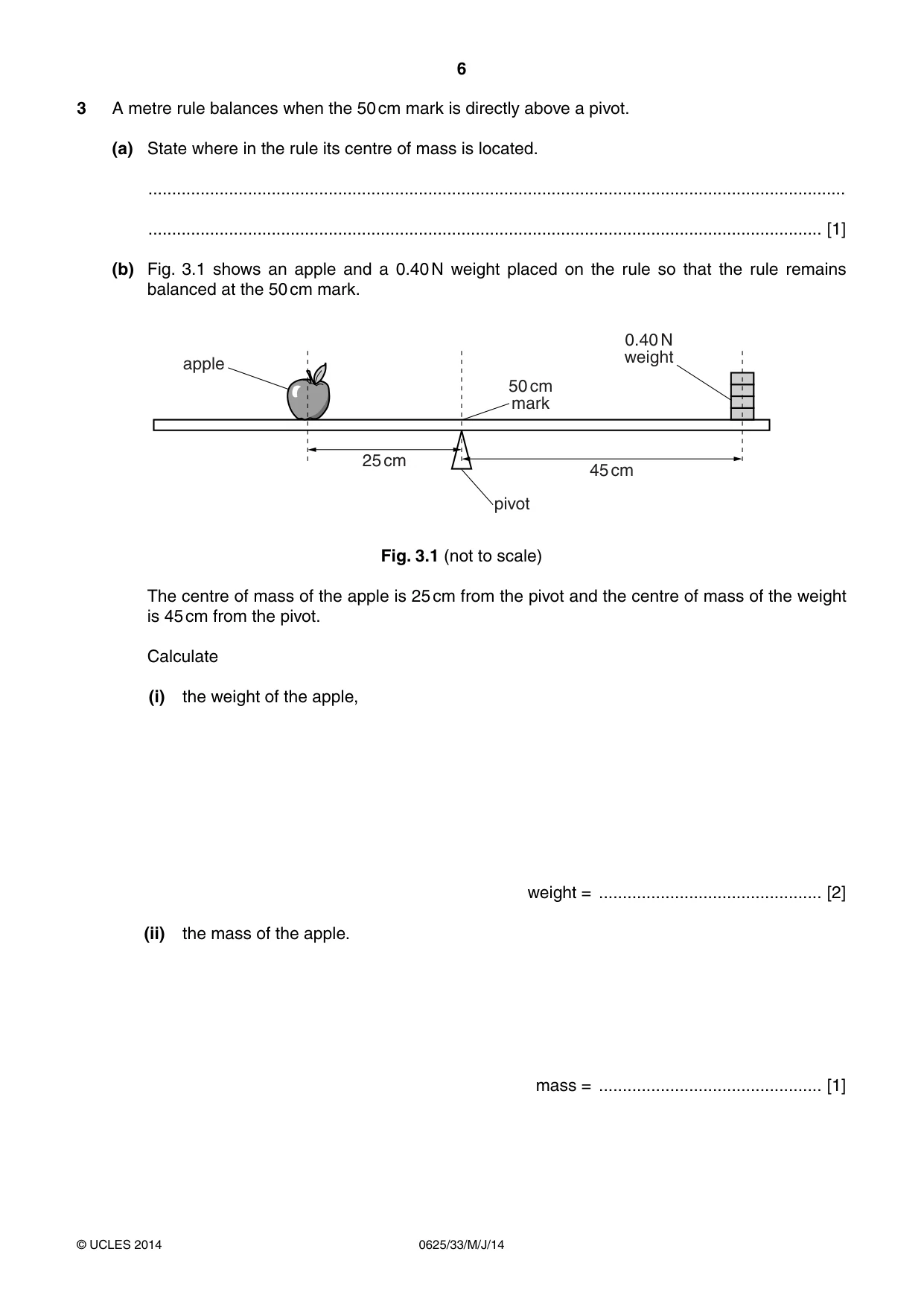
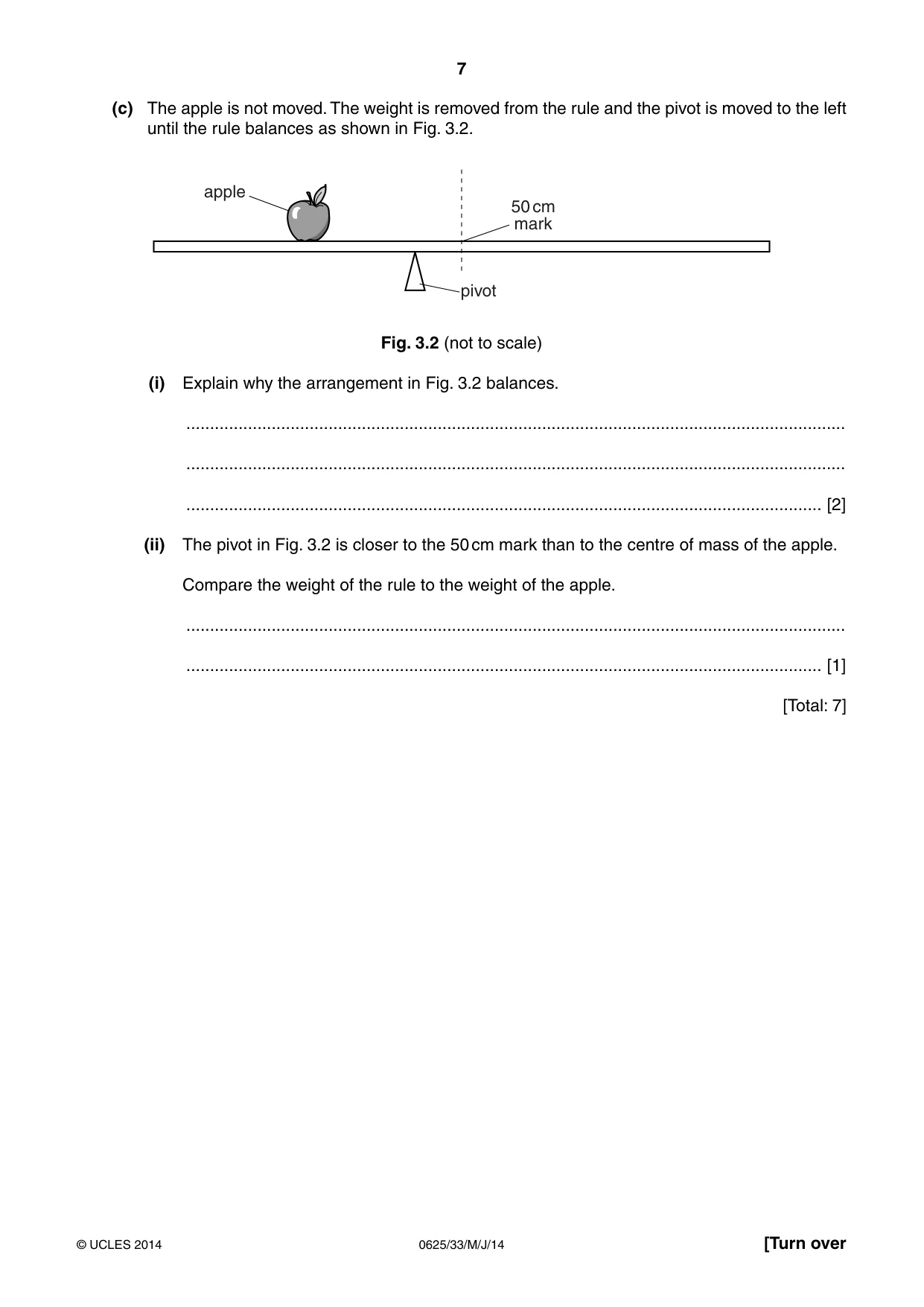
3 A metre rule balances when the 50 cm mark is directly above a pivot. (a) State where in the rule its centre of mass is located. ................................................................................................................................................... .............................................................................................................................................. [1] (b) Fig. 3.1 shows an apple and a 0.40 N weight placed on the rule so that the rule remains balanced at the 50 cm mark. 0.40 N weight apple 50 cm mark 25 cm 45 cm pivot Fig. 3.1 (not to scale) The centre of mass of the apple is 25 cm from the pivot and the centre of mass of the weight is 45 cm from the pivot. Calculate (i) the weight of the apple, weight = ............................................... [2] (ii) the mass of the apple. mass = ............................................... [1] (c) The apple is not moved. The weight is removed from the rule and the pivot is moved to the left until the rule balances as shown in Fig. 3.2. apple 50 cm mark pivot Fig. 3.2 (not to scale) (i) Explain why the arrangement in Fig. 3.2 balances. ........................................................................................................................................... ........................................................................................................................................... ...................................................................................................................................... [2] (ii) The pivot in Fig. 3.2 is closer to the 50 cm mark than to the centre of mass of the apple. Compare the weight of the rule to the weight of the apple. ........................................................................................................................................... ...................................................................................................................................... [1] [Total: 7]
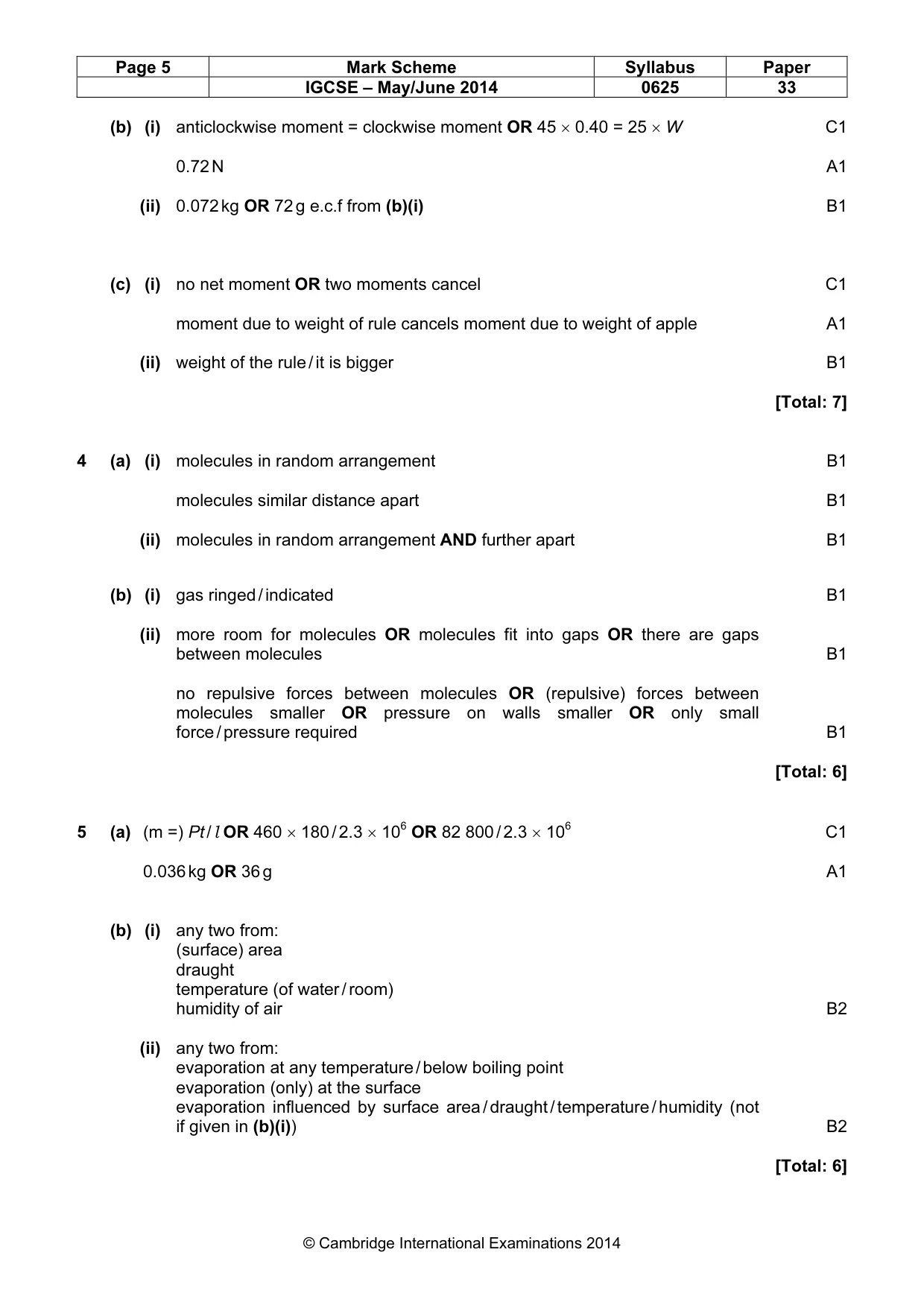
Mark scheme: 3 (a) (immediately below / above the / at) 50 cm mark OR at pivot B1 IGCSE – May/June 2014 0625 33 (b) (i) anticlockwise moment = clockwise moment OR 45 × 0.40 = 25 × W C1 0.72 N A1 (ii) 0.072 kg OR 72 g e.c.f from (b)(i) B1 (c) (i) no net moment OR two moments cancel C1 moment due to weight of rule cancels moment due to weight of apple A1 (ii) weight of the rule / it is bigger B1 [Total: 7]
Q4 · A teacher shows a class examples of three states of matter
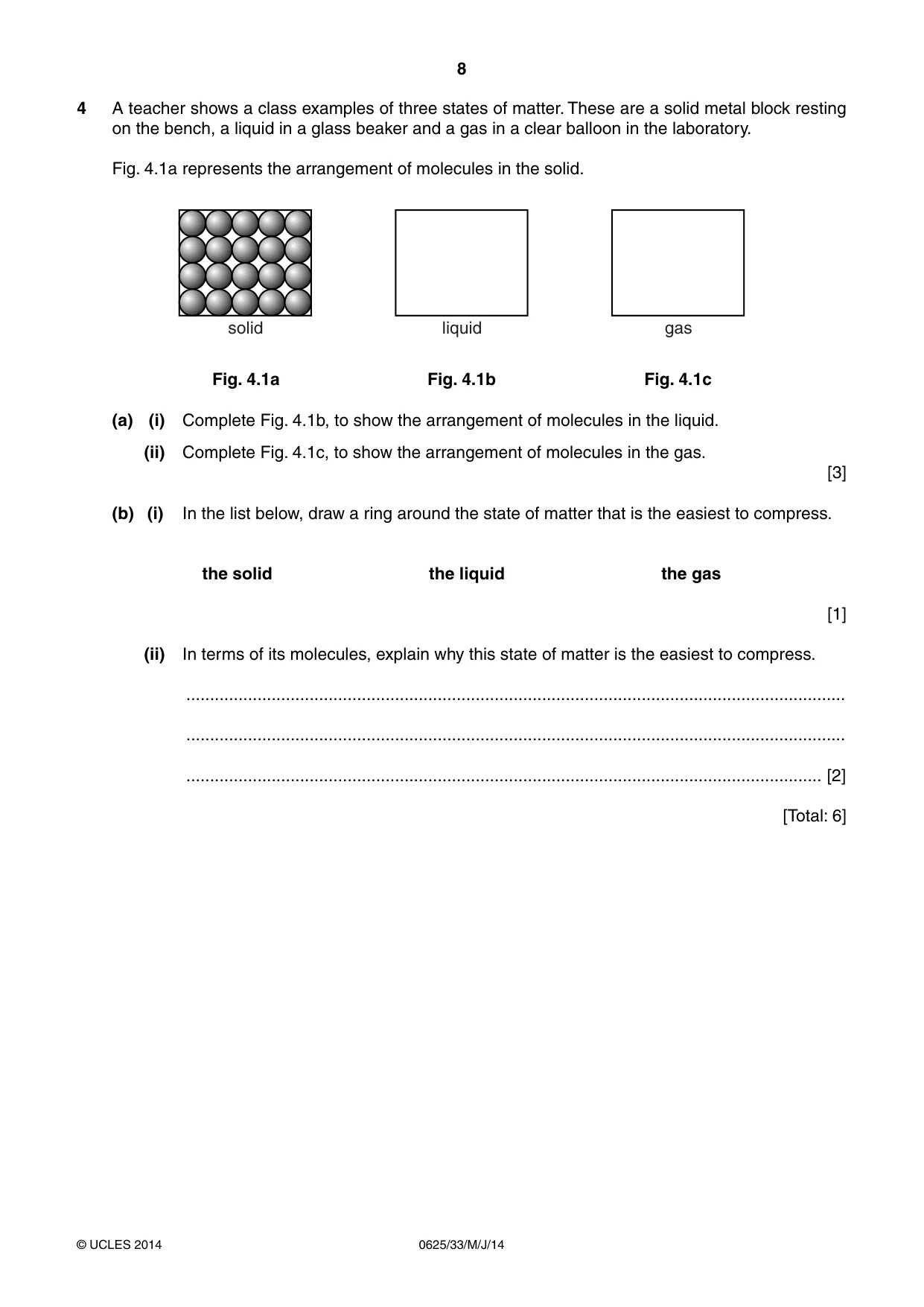
4 A teacher shows a class examples of three states of matter. These are a solid metal block resting on the bench, a liquid in a glass beaker and a gas in a clear balloon in the laboratory. Fig. 4.1a represents the arrangement of molecules in the solid. solid liquid gas Fig. 4.1a Fig. 4.1b Fig. 4.1c (a) (i) Complete Fig. 4.1b, to show the arrangement of molecules in the liquid. (ii) Complete Fig. 4.1c, to show the arrangement of molecules in the gas. [3] (b) (i) In the list below, draw a ring around the state of matter that is the easiest to compress. the solid the liquid the gas [1] (ii) In terms of its molecules, explain why this state of matter is the easiest to compress. ........................................................................................................................................... ........................................................................................................................................... ...................................................................................................................................... [2] [Total: 6]
Mark scheme: 4 (a) (i) molecules in random arrangement B1 molecules similar distance apart B1 (ii) molecules in random arrangement AND further apart B1 (b) (i) gas ringed / indicated B1 (ii) more room for molecules OR molecules fit into gaps OR there are gaps between molecules B1 no repulsive forces between molecules OR (repulsive) forces between molecules smaller OR pressure on walls smaller OR only small force / pressure required B1 [Total: 6] 6 6
Q5 · During both boiling and evaporation, liquid water is converted into water vapour
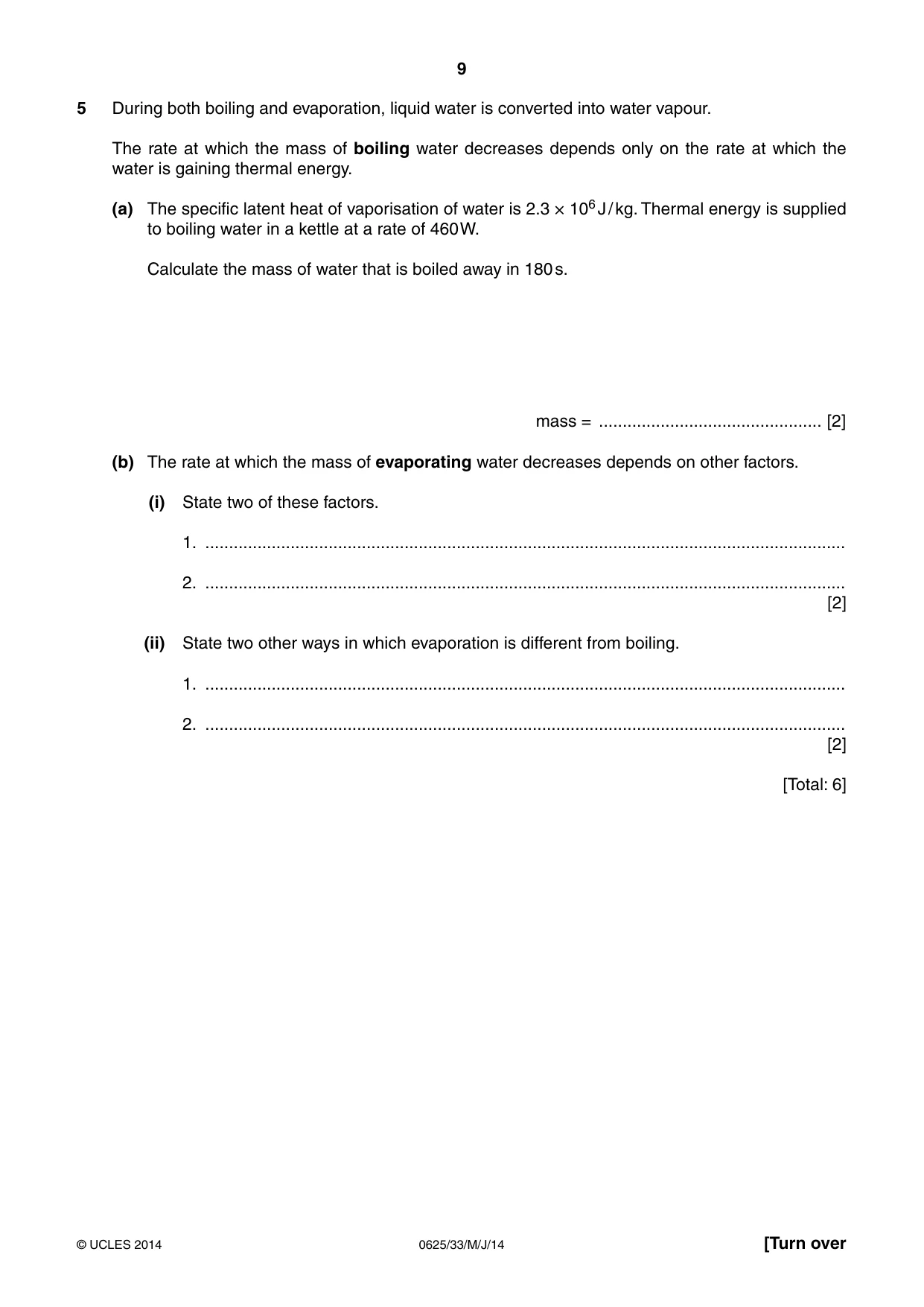
5 During both boiling and evaporation, liquid water is converted into water vapour. The rate at which the mass of boiling water decreases depends only on the rate at which the water is gaining thermal energy. (a) The specific latent heat of vaporisation of water is 2.3 × 10⁶ J / kg. Thermal energy is supplied to boiling water in a kettle at a rate of 460 W. Calculate the mass of water that is boiled away in 180 s. mass = ............................................... [2] (b) The rate at which the mass of evaporating water decreases depends on other factors. (i) State two of these factors. 1. ....................................................................................................................................... 2. ....................................................................................................................................... [2] (ii) State two other ways in which evaporation is different from boiling. 1. ....................................................................................................................................... 2. ....................................................................................................................................... [2] [Total: 6]
Mark scheme: 5 (a) (m =) Pt / l OR 460 × 180 / 2.3 × 10⁶ OR 82 800 / 2.3 × 10⁶ C1 0.036 kg OR 36 g A1 (b) (i) any two from: (surface) area draught temperature (of water / room) humidity of air B2 (ii) any two from: evaporation at any temperature / below boiling point evaporation (only) at the surface evaporation influenced by surface area / draught / temperature / humidity (not if given in (b)(i)) B2 [Total: 6] IGCSE – May/June 2014 0625 33
Q6 · The liquids in five liquid-in-glass thermometers A, B, C, D and E expand linearly with…
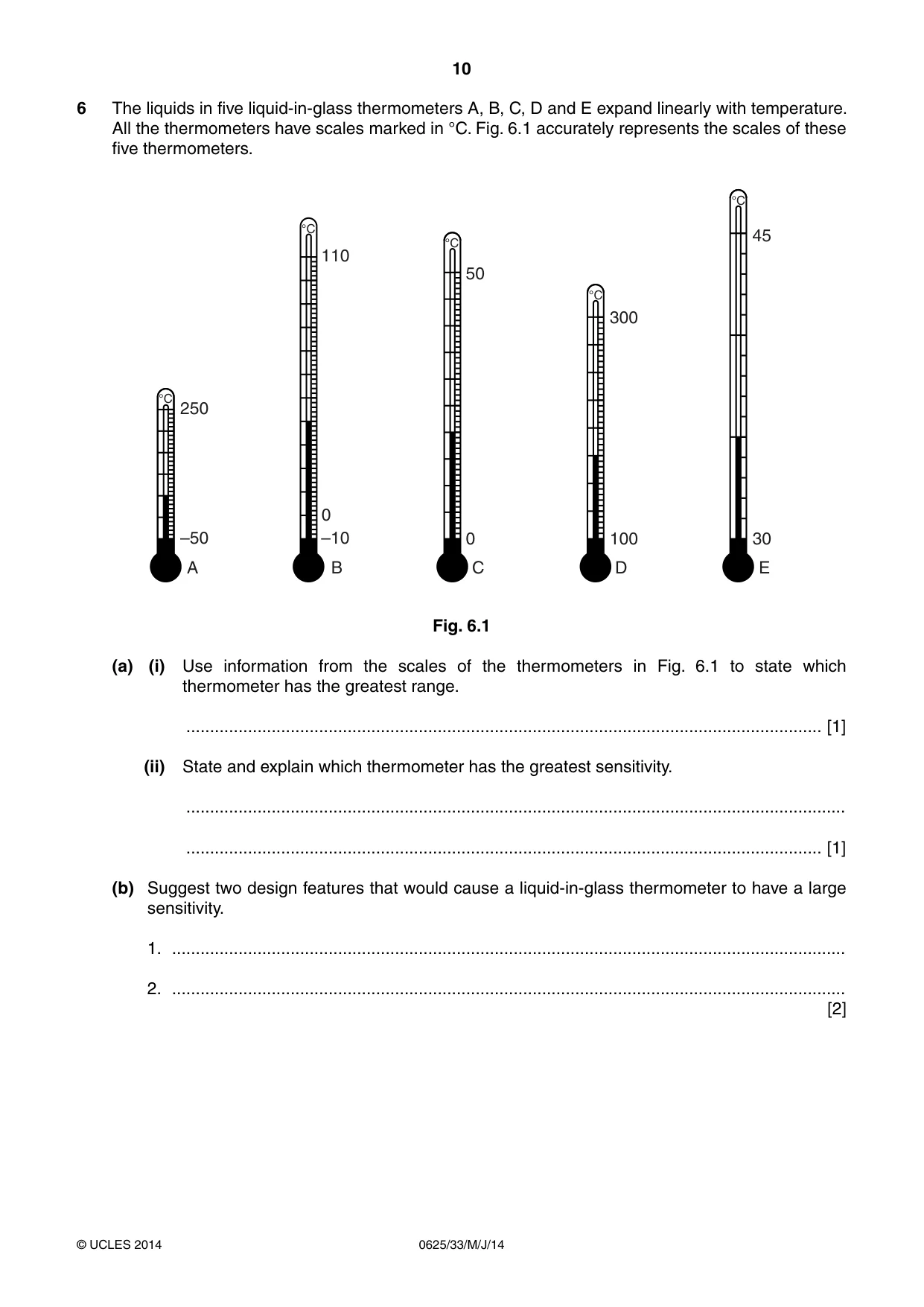
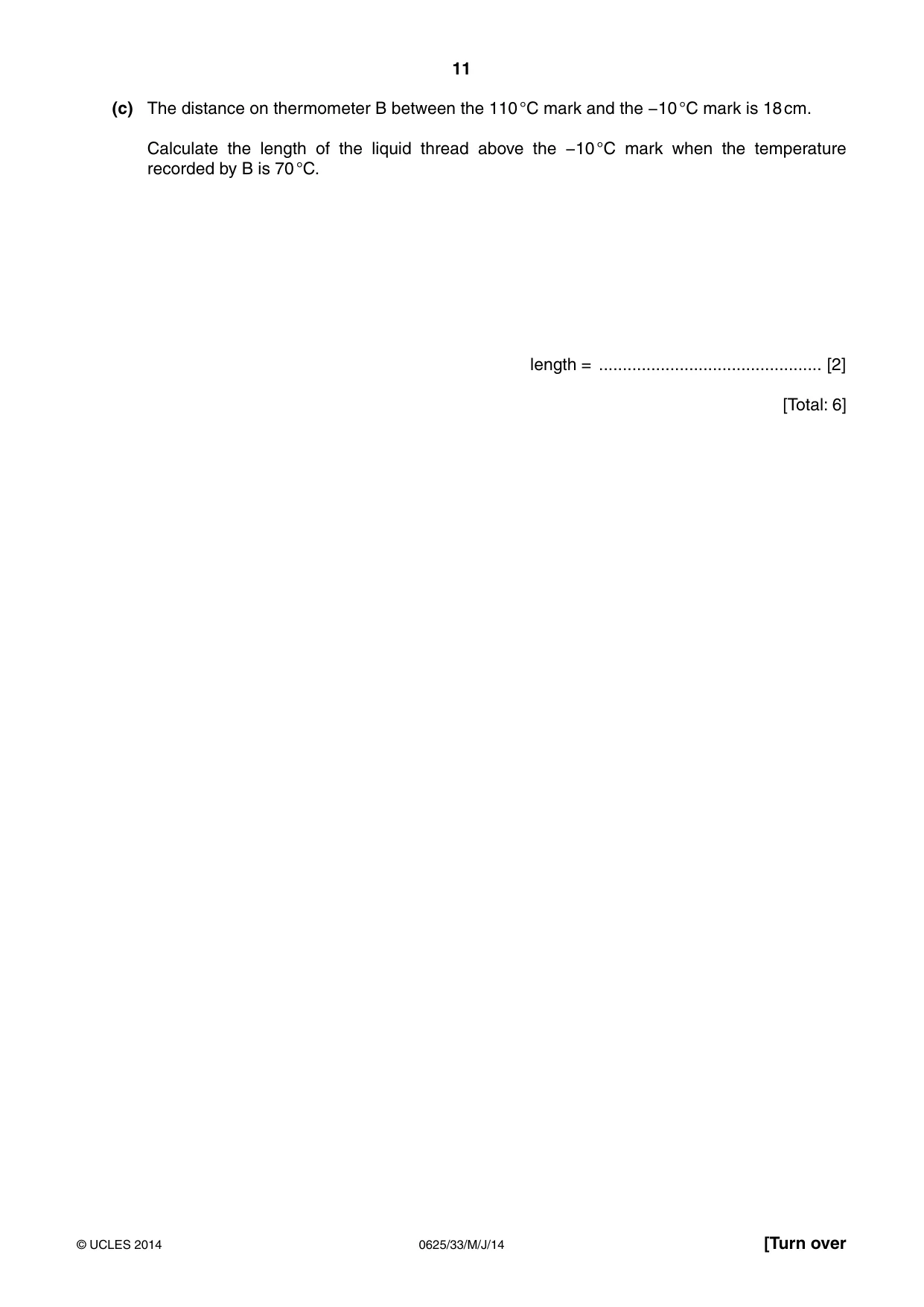
6 The liquids in five liquid-in-glass thermometers A, B, C, D and E expand linearly with temperature. All the thermometers have scales marked in °C. Fig. 6.1 accurately represents the scales of these five thermometers. °C °C °C 45 110 50 °C 300 °C 250 0 –50 –10 0 100 30 A B C D E Fig. 6.1 (a) (i) Use information from the scales of the thermometers in Fig. 6.1 to state which thermometer has the greatest range. ...................................................................................................................................... [1] (ii) State and explain which thermometer has the greatest sensitivity. ........................................................................................................................................... ...................................................................................................................................... [1] (b) Suggest two design features that would cause a liquid-in-glass thermometer to have a large sensitivity. 1. .............................................................................................................................................. 2. .............................................................................................................................................. [2] (c) The distance on thermometer B between the 110 °C mark and the −10 °C mark is 18 cm. Calculate the length of the liquid thread above the −10 °C mark when the temperature recorded by B is 70 °C. length = ............................................... [2] [Total: 6]
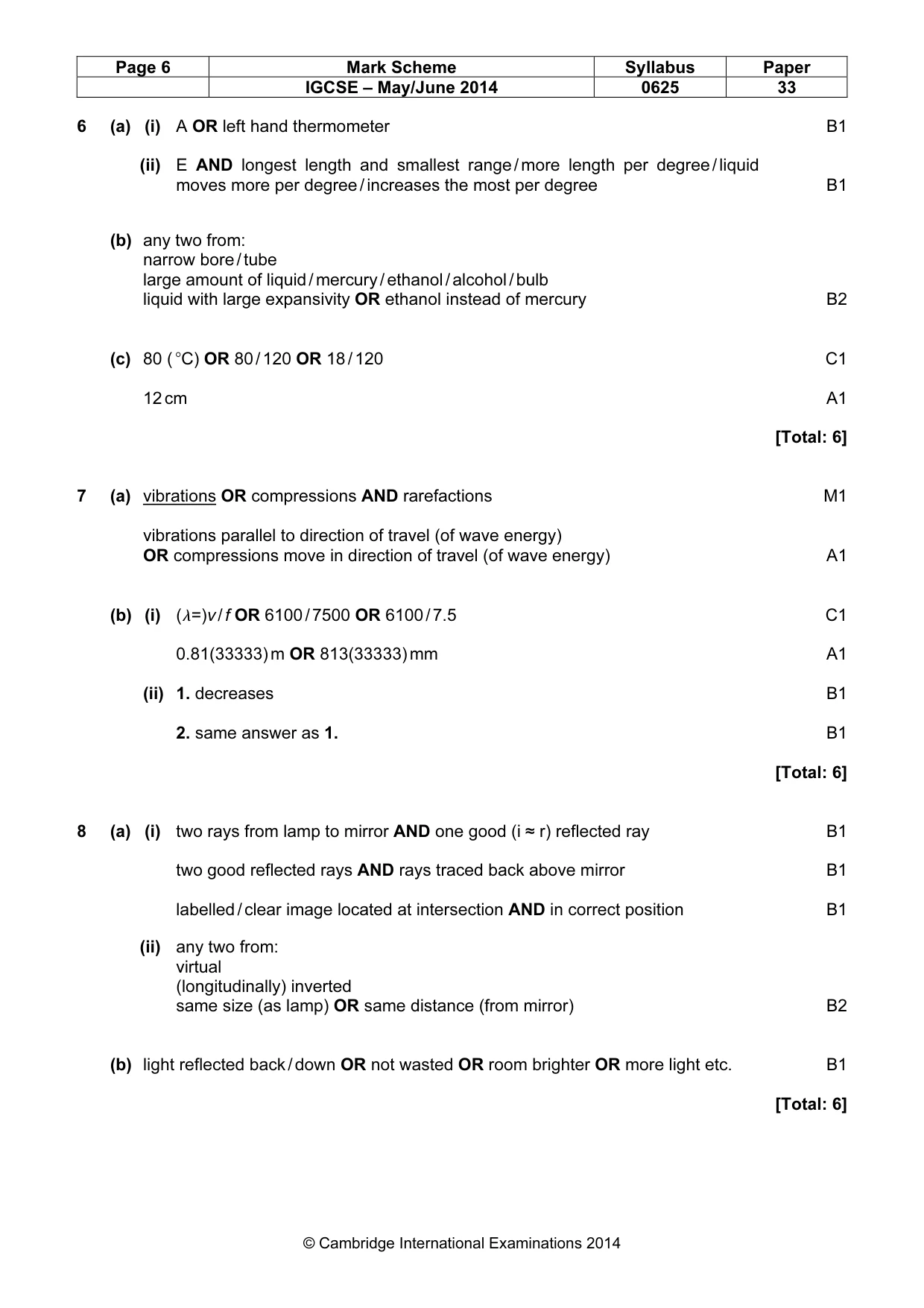
Mark scheme: 6 (a) (i) A OR left hand thermometer B1 (ii) E AND longest length and smallest range / more length per degree / liquid moves more per degree / increases the most per degree B1 (b) any two from: narrow bore / tube large amount of liquid / mercury / ethanol / alcohol / bulb liquid with large expansivity OR ethanol instead of mercury B2 (c) 80 ( UC) OR 80 / 120 OR 18 / 120 C1 12 cm A1 [Total: 6]
More questions on Physical quantities and measurement techniques
Q7 · State how a longitudinal wave differs from a transverse wave
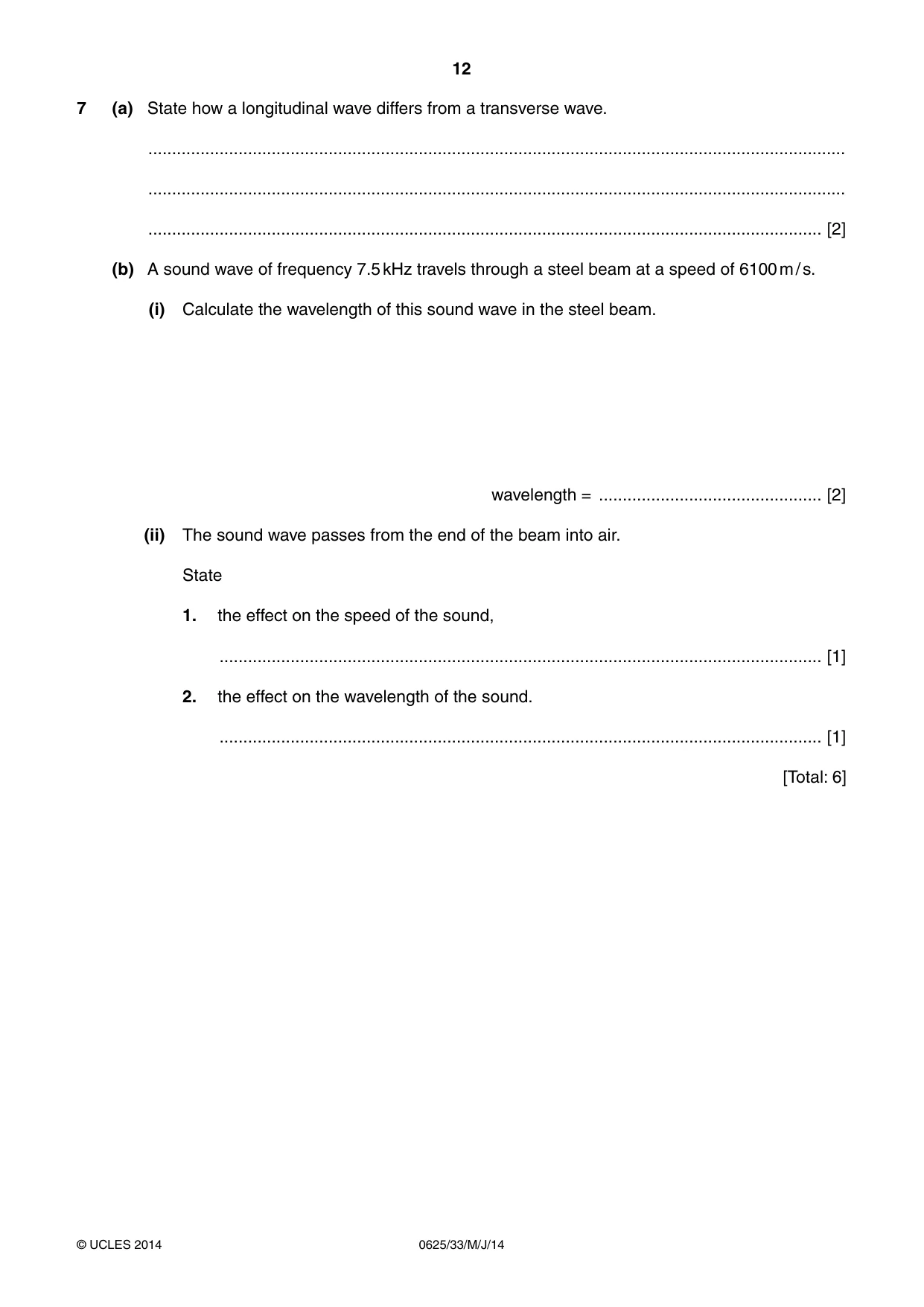
7 (a) State how a longitudinal wave differs from a transverse wave. ................................................................................................................................................... ................................................................................................................................................... .............................................................................................................................................. [2] (b) A sound wave of frequency 7.5 kHz travels through a steel beam at a speed of 6100 m / s. (i) Calculate the wavelength of this sound wave in the steel beam. wavelength = ............................................... [2] (ii) The sound wave passes from the end of the beam into air. State 1. the effect on the speed of the sound, ............................................................................................................................... [1] 2. the effect on the wavelength of the sound. ............................................................................................................................... [1] [Total: 6]
Mark scheme: 7 (a) vibrations OR compressions AND rarefactions M1 vibrations parallel to direction of travel (of wave energy) OR compressions move in direction of travel (of wave energy) A1 (b) (i) (ä=)v / f OR 6100 / 7500 OR 6100 / 7.5 C1 0.81(33333) m OR 813(33333) mm A1 (ii) 1. decreases B1 2. same answer as 1. B1 [Total: 6]
Q8 · A lamp in a large room is suspended below a horizontal mirror that is fixed to the ceiling
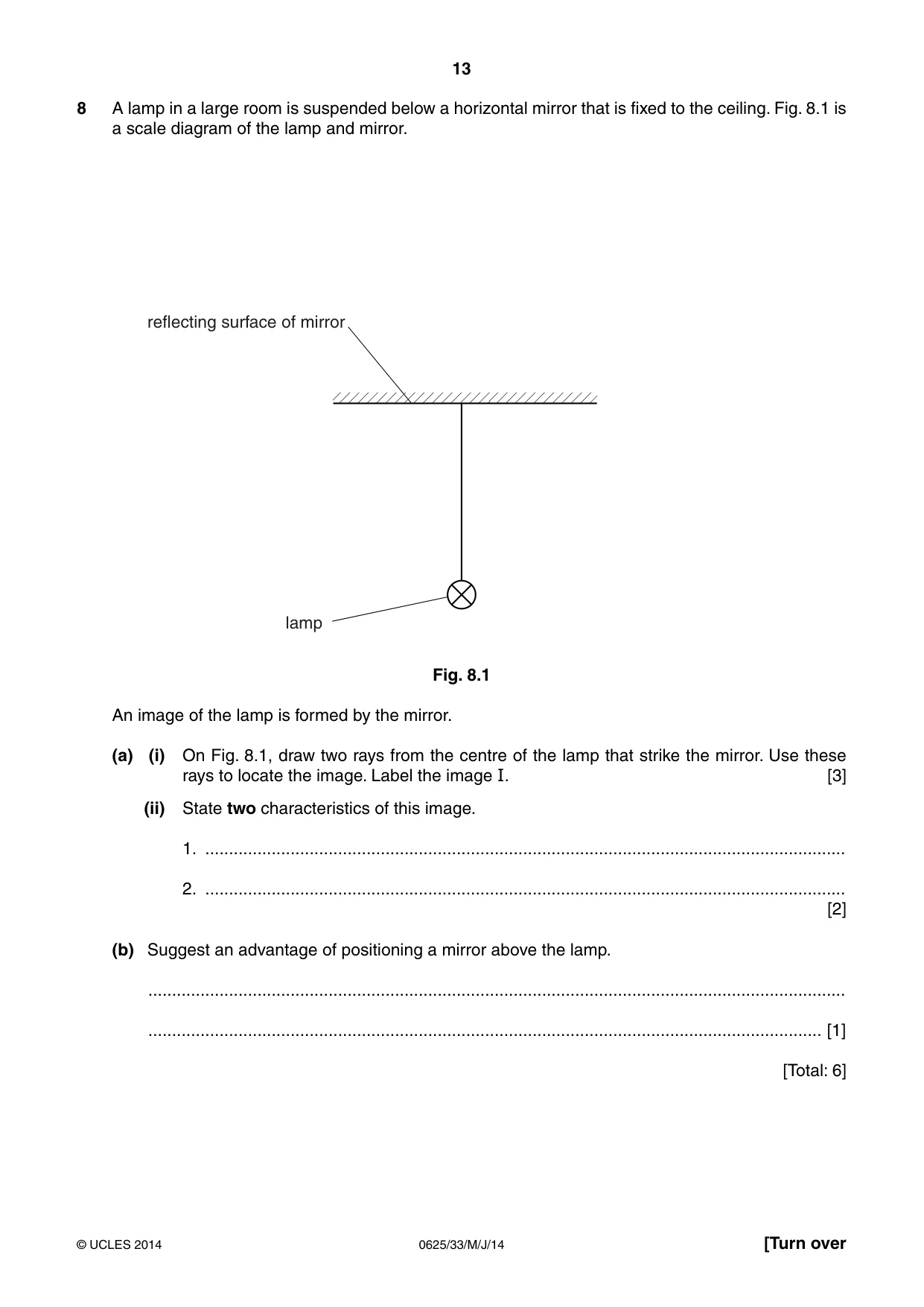
8 A lamp in a large room is suspended below a horizontal mirror that is fixed to the ceiling. Fig. 8.1 is a scale diagram of the lamp and mirror. reflecting surface of mirror lamp Fig. 8.1 An image of the lamp is formed by the mirror. (a) (i) On Fig. 8.1, draw two rays from the centre of the lamp that strike the mirror. Use these rays to locate the image. Label the image I. [3] (ii) State two characteristics of this image. 1. ....................................................................................................................................... 2. ....................................................................................................................................... [2] (b) Suggest an advantage of positioning a mirror above the lamp. ................................................................................................................................................... .............................................................................................................................................. [1] [Total: 6]
Mark scheme: 8 (a) (i) two rays from lamp to mirror AND one good (i ≈ r) reflected ray B1 two good reflected rays AND rays traced back above mirror B1 labelled / clear image located at intersection AND in correct position B1 (ii) any two from: virtual (longitudinally) inverted same size (as lamp) OR same distance (from mirror) B2 (b) light reflected back / down OR not wasted OR room brighter OR more light etc. B1 [Total: 6] IGCSE – May/June 2014 0625 33
Q9 · Two identical metal plates, positioned horizontally, one above the other in a vacuum
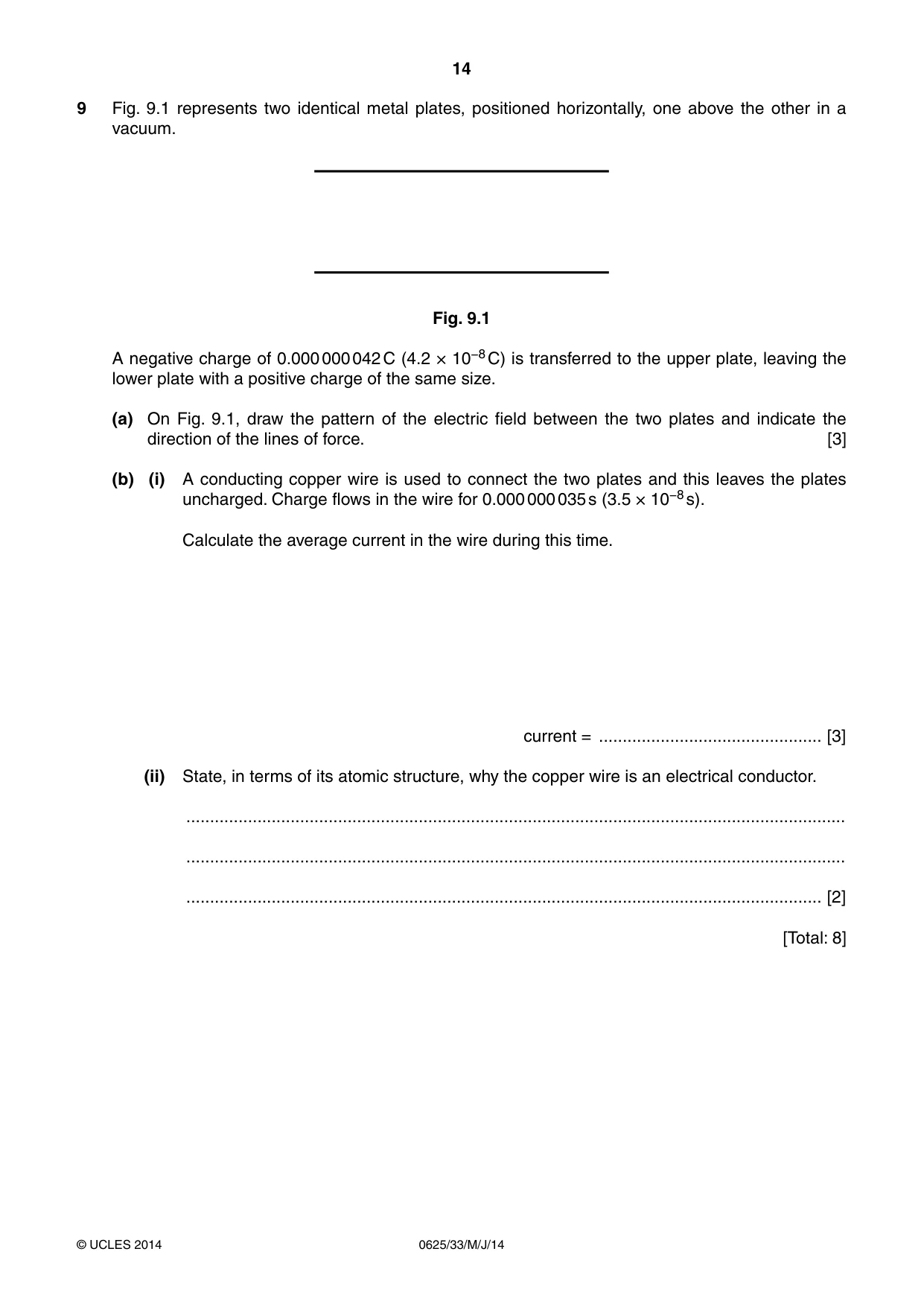
9 Fig. 9.1 represents two identical metal plates, positioned horizontally, one above the other in a vacuum. Fig. 9.1 A negative charge of 0.000 000 042 C (4.2 × 10⁻⁸ C) is transferred to the upper plate, leaving the lower plate with a positive charge of the same size. (a) On Fig. 9.1, draw the pattern of the electric field between the two plates and indicate the direction of the lines of force. [3] (b) (i) A conducting copper wire is used to connect the two plates and this leaves the plates uncharged. Charge flows in the wire for 0.000 000 035 s (3.5 × 10⁻⁸ s). Calculate the average current in the wire during this time. current = ............................................... [3] (ii) State, in terms of its atomic structure, why the copper wire is an electrical conductor. ........................................................................................................................................... ........................................................................................................................................... ...................................................................................................................................... [2] [Total: 8]
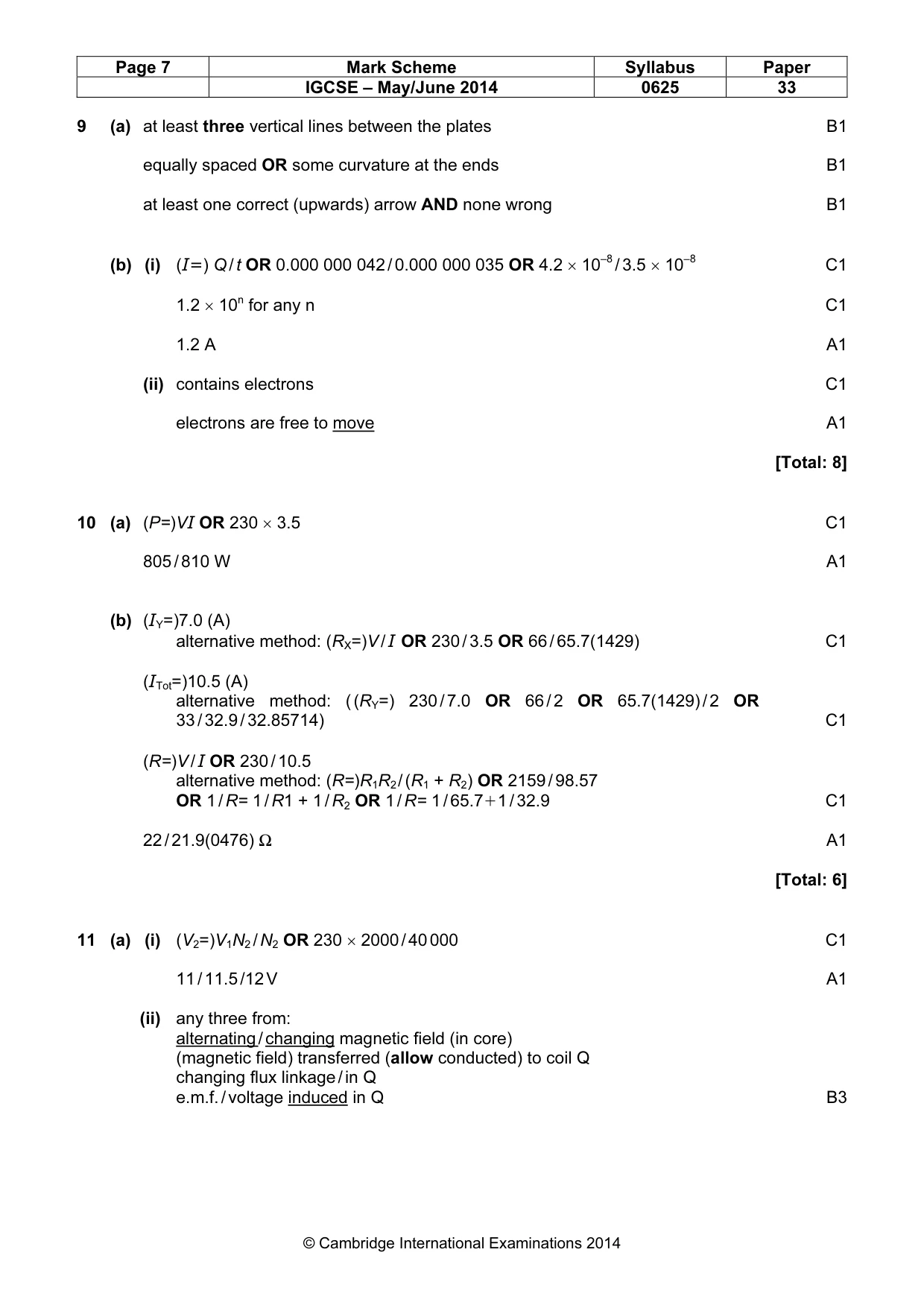
Mark scheme: 9 (a) at least three vertical lines between the plates B1 equally spaced OR some curvature at the ends B1 at least one correct (upwards) arrow AND none wrong B1 (b) (i) (I=) Q / t OR 0.000 000 042 / 0.000 000 035 OR 4.2 × 10⁻⁸ / 3.5 × 10⁻⁸ C1 1.2 × 10n for any n C1 1.2 A A1 (ii) contains electrons C1 electrons are free to move A1 [Total: 8]
Q10 · The electric circuit in a clothes dryer contains two heaters X and Y in parallel
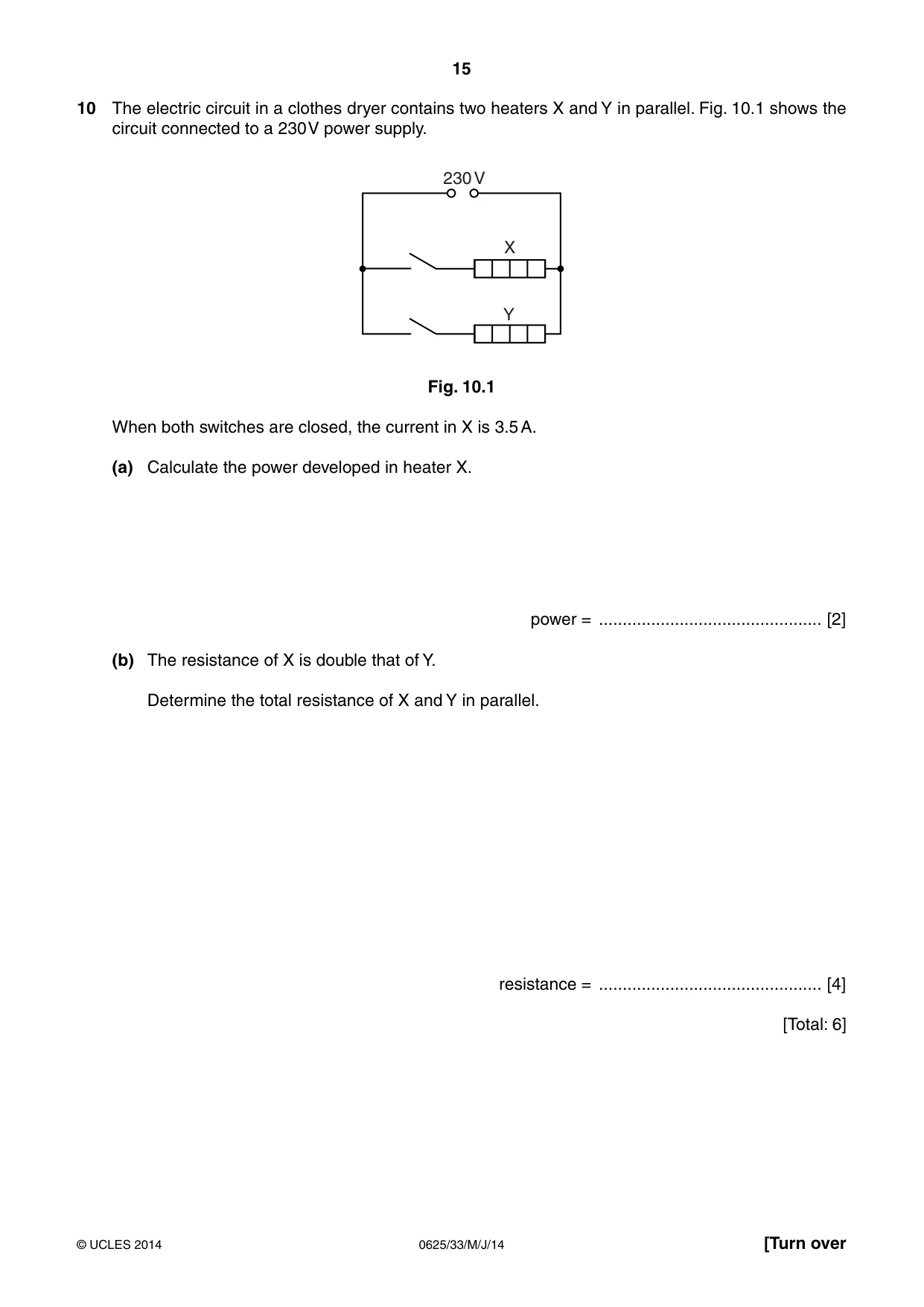
10 The electric circuit in a clothes dryer contains two heaters X and Y in parallel. Fig. 10.1 shows the circuit connected to a 230 V power supply. 230 V X Y Fig. 10.1 When both switches are closed, the current in X is 3.5 A. (a) Calculate the power developed in heater X. power = ............................................... [2] (b) The resistance of X is double that of Y. Determine the total resistance of X and Y in parallel. resistance = ............................................... [4] [Total: 6]
Mark scheme: 10 (a) (P=)VI OR 230 × 3.5 C1 805 / 810 W A1 (b) (IY=)7.0 (A) alternative method: (RX=)V / I OR 230 / 3.5 OR 66 / 65.7(1429) C1 (ITot=)10.5 (A) alternative method: ( (RY=) 230 / 7.0 OR 66 / 2 OR 65.7(1429) / 2 OR 33 / 32.9 / 32.85714) C1 (R=)V / I OR 230 / 10.5 alternative method: (R=)R1R2 / (R1 + R2) OR 2159 / 98.57 OR 1 / R= 1 / R1 + 1 / R2 OR 1 / R= 1 / 65.7N1 / 32.9 C1 22 / 21.9(0476) Ω A1 [Total: 6]
Q11 · A battery charger includes a transformer and a rectifier
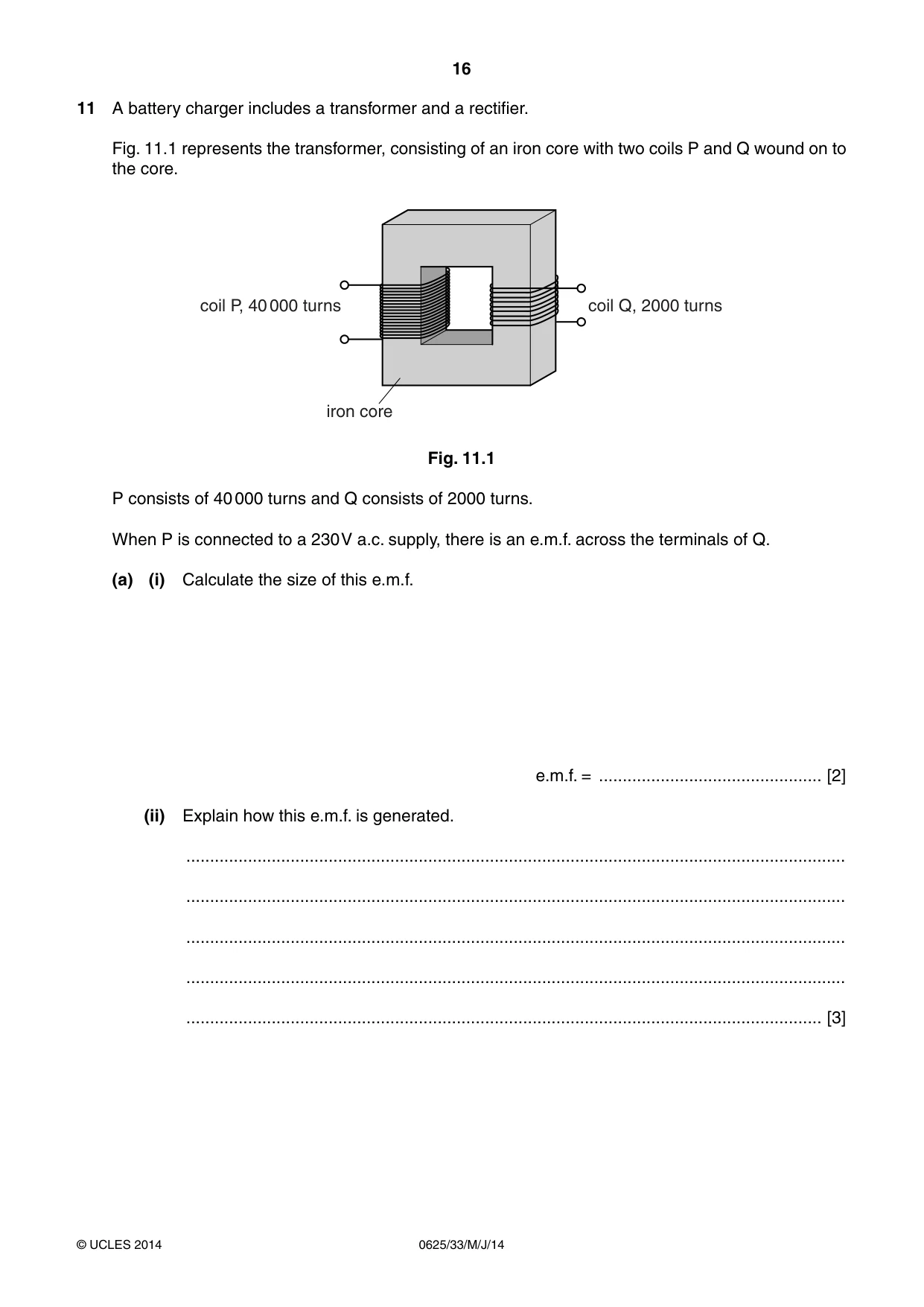
11 A battery charger includes a transformer and a rectifier. Fig. 11.1 represents the transformer, consisting of an iron core with two coils P and Q wound on to the core. coil P, 40 000 turns coil Q, 2000 turns iron core Fig. 11.1 P consists of 40 000 turns and Q consists of 2000 turns. When P is connected to a 230 V a.c. supply, there is an e.m.f. across the terminals of Q. (a) (i) Calculate the size of this e.m.f. e.m.f. = ............................................... [2] (ii) Explain how this e.m.f. is generated. ........................................................................................................................................... ........................................................................................................................................... ........................................................................................................................................... ........................................................................................................................................... ...................................................................................................................................... [3] (b) The output of Q is connected to the rectifier circuit. State (i) the name of the circuit component that is used in a rectifier circuit to rectify the a.c. (alternating current), ...................................................................................................................................... [1] (ii) the property of this component that is used to rectify the current. ...................................................................................................................................... [1] [Total: 7]
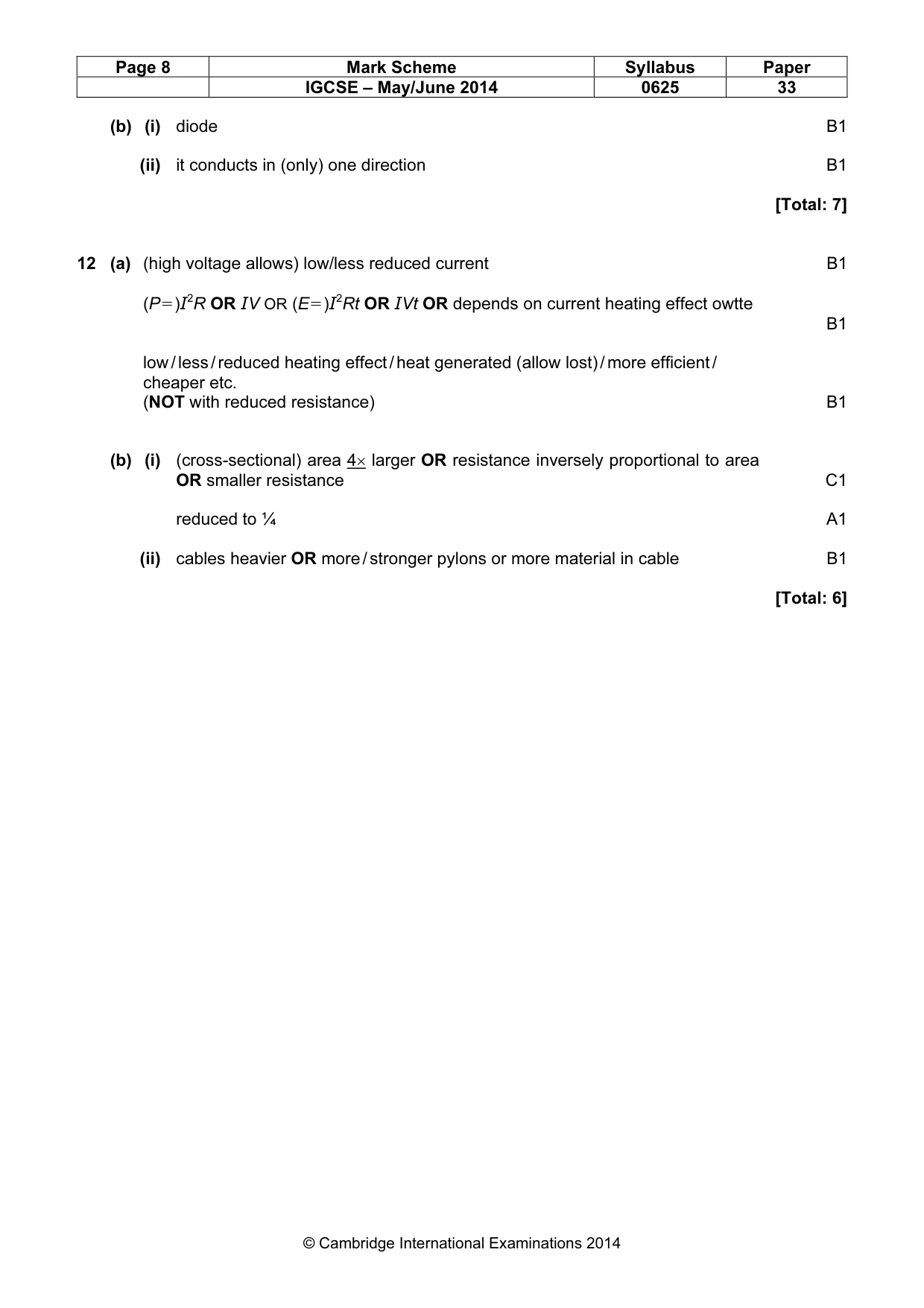
Mark scheme: 11 (a) (i) (V2=)V1N2 / N2 OR 230 × 2000 / 40 000 C1 11 / 11.5 /12 V A1 (ii) any three from: alternating / changing magnetic field (in core) (magnetic field) transferred (allow conducted) to coil Q changing flux linkage / in Q e.m.f. / voltage induced in Q B3 IGCSE – May/June 2014 0625 33 (b) (i) diode B1 (ii) it conducts in (only) one direction B1 [Total: 7]
Q12 · Overhead power cables supply electrical power to a town that is a considerable distance…
12 Overhead power cables supply electrical power to a town that is a considerable distance from the power station. The voltage at which the power is transmitted in the cables is very much greater than the voltage at the power station and the voltage of the mains supply in the town. (a) Explain the advantage of transmitting electrical power at a very high voltage. ................................................................................................................................................... ................................................................................................................................................... ................................................................................................................................................... ................................................................................................................................................... .............................................................................................................................................. [3] (b) It is suggested that the resistance of the cables can be changed by doubling their diameter. (i) Explain the effect of this change on the resistance of the cables. ........................................................................................................................................... ........................................................................................................................................... ...................................................................................................................................... [2] (ii) Suggest one disadvantage of doubling the diameter of the cables. ........................................................................................................................................... ...................................................................................................................................... [1] [Total: 6]
Mark scheme: 12 (a) (high voltage allows) low/less reduced current B1 (PR)I2R OR IV OR (ER)I2Rt OR IVt OR depends on current heating effect owtte B1 low / less / reduced heating effect / heat generated (allow lost) / more efficient / cheaper etc. (NOT with reduced resistance) B1 (b) (i) (cross-sectional) area 4× larger OR resistance inversely proportional to area OR smaller resistance C1 reduced to ¼ A1 (ii) cables heavier OR more / stronger pylons or more material in cable B1 [Total: 6]
What was in this paper
The subtopics covered by these 12 questions, and how many questions each got. Open one in a new tab to see every Cambridge question on it.
What you needed in this session
Cambridge’s own grade thresholds for 2014 May/June, Paper 3 · Variant 3. A higher threshold means an easier paper — the bar moves with how the cohort did.