Cambridge IGCSE Physics 0625 — 2024 Oct/Nov Paper 3 · Variant 1
0625/31/O/N/24 · 11 questions · 80 marks · ≈90 min
The question paper and its mark scheme, free to read here and free to download. This is Cambridge’s own paper, exactly as it was sat.
Question paper16 pages

Mark scheme18 pages
Answers below. Sit the paper first if you are practising.
Questions as text
Q1 · The speed–time graph for a cyclist riding a bicycle
1 Fig. 1.1 shows the speed–time graph for a cyclist riding a bicycle. 8 speed 6 m / s 4 2 0 0 5 10 15 20 25 30 time / s Fig. 1.1 (a) State the speed of the cyclist at time = 15 s. speed of cyclist = ................................................. m / s [1] (b) Describe the motion of the cyclist 1. from time = 0 to time = 5 s .................................................................................................... 2. from time = 10 s to time = 20 s .............................................................................................. 3. from time = 20 s to time = 30 s .............................................................................................. [3] (c) Calculate the distance travelled by the cyclist from time = 20 s to time = 30 s. distance = ......................................................m [3] [Total: 7]
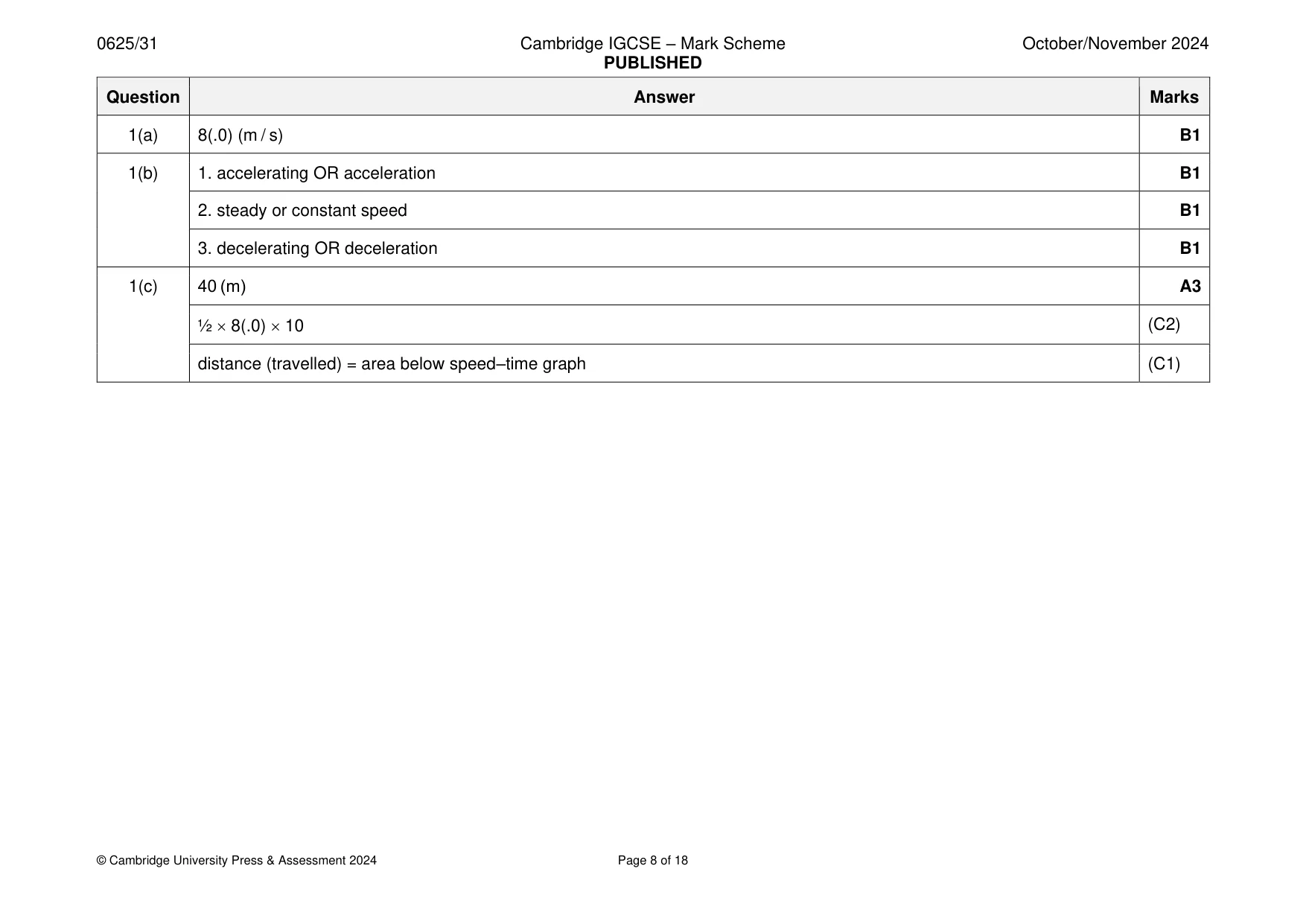
Mark scheme: Question Answer Marks 1(a) 8(.0) (m / s) B1 1(b) 1. accelerating OR acceleration B1 2. steady or constant speed B1 3. decelerating OR deceleration B1 1(c) 40 (m) A3 ½ 8(.0) 10 (C2) distance (travelled) = area below speed–time graph (C1)
Q2 · A person pushes a pushchair
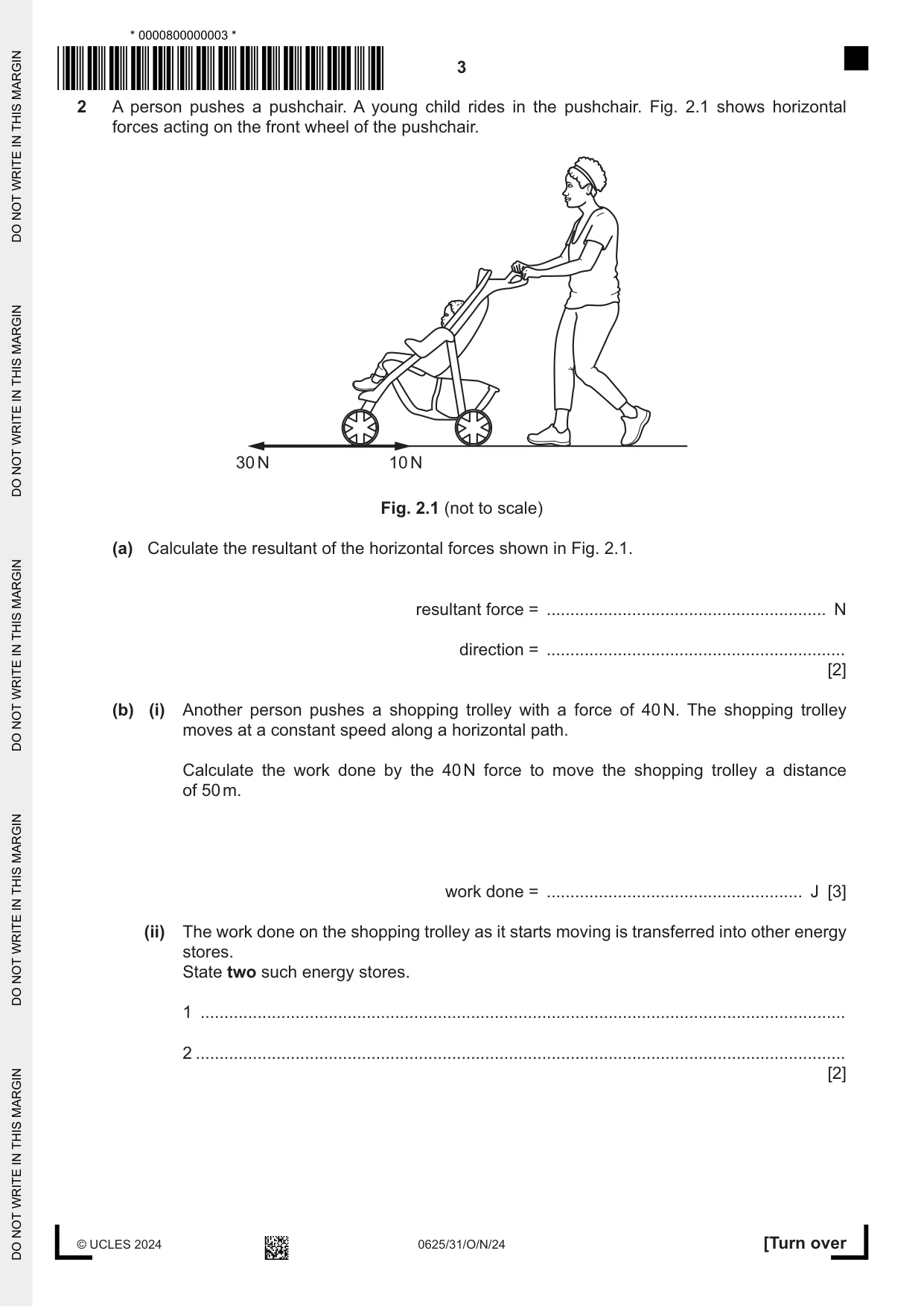
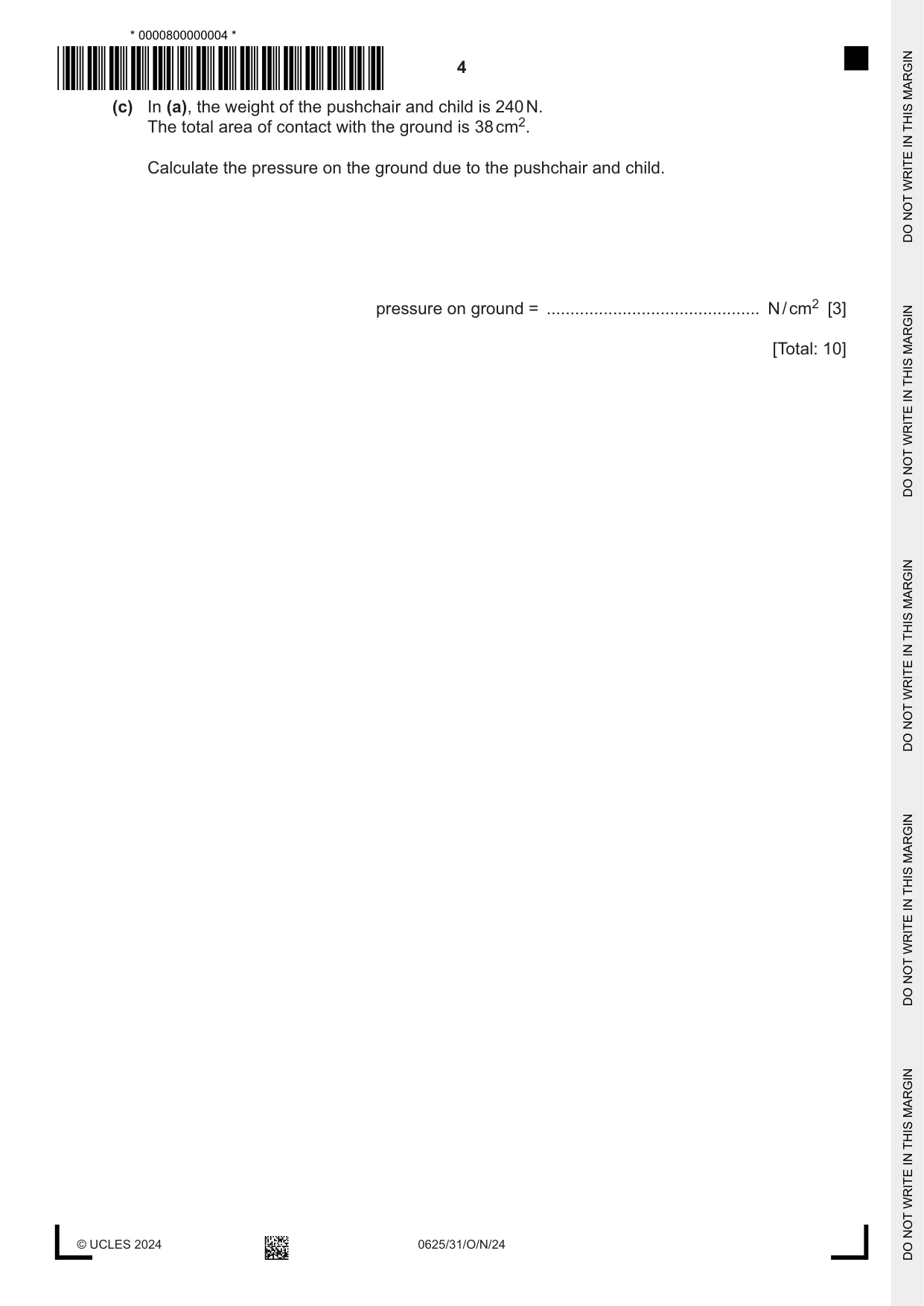
2 A person pushes a pushchair. A young child rides in the pushchair. Fig. 2.1 shows horizontal forces acting on the front wheel of the pushchair. 30 N 10 N Fig. 2.1 (not to scale) (a) Calculate the resultant of the horizontal forces shown in Fig. 2.1. resultant force = ........................................................... N direction = ............................................................... [2] (b) (i) Another person pushes a shopping trolley with a force of 40 N. The shopping trolley moves at a constant speed along a horizontal path. Calculate the work done by the 40 N force to move the shopping trolley a distance of 50 m. work done = ...................................................... J [3] (ii) The work done on the shopping trolley as it starts moving is transferred into other energy stores. State two such energy stores. 1 ........................................................................................................................................ 2 ......................................................................................................................................... [2] (c) In (a), the weight of the pushchair and child is 240 N. The total area of contact with the ground is 38 cm2. Calculate the pressure on the ground due to the pushchair and child. pressure on ground = ............................................. N / cm2 [3] [Total: 10]
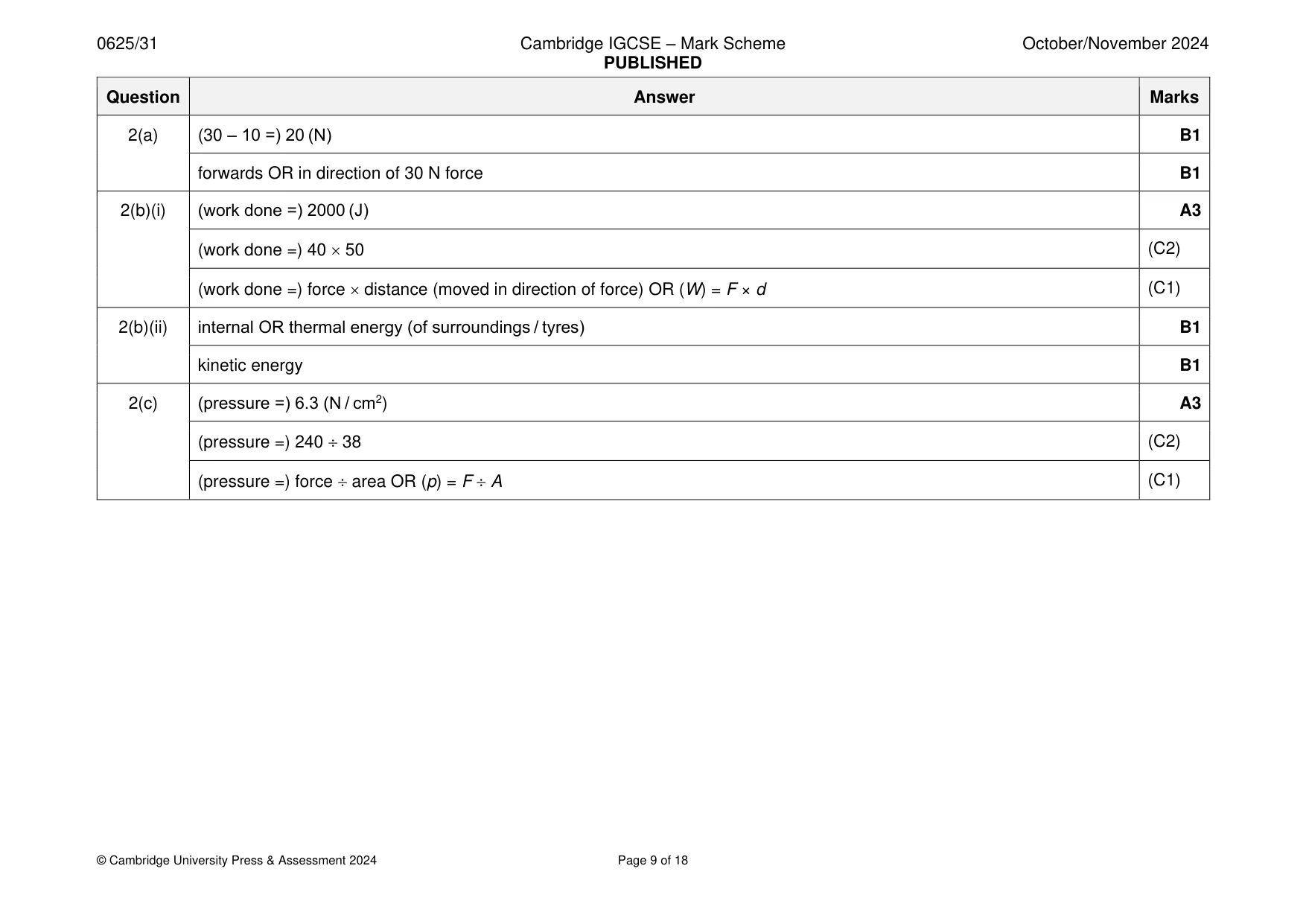
Mark scheme: 2(a) (30 – 10 =) 20 (N) B1 forwards OR in direction of 30 N force B1 2(b)(i) (work done =) 2000 (J) A3 (work done =) 40 50 (C2) (work done =) force distance (moved in direction of force) OR (W) = F × d (C1) 2(b)(ii) internal OR thermal energy (of surroundings / tyres) B1 kinetic energy B1 2(c) (pressure =) 6.3 (N / cm2) A3 (pressure =) 240 38 (C2) (pressure =) force area OR (p) = F A (C1)
Q3 · A student determines the density of a metal
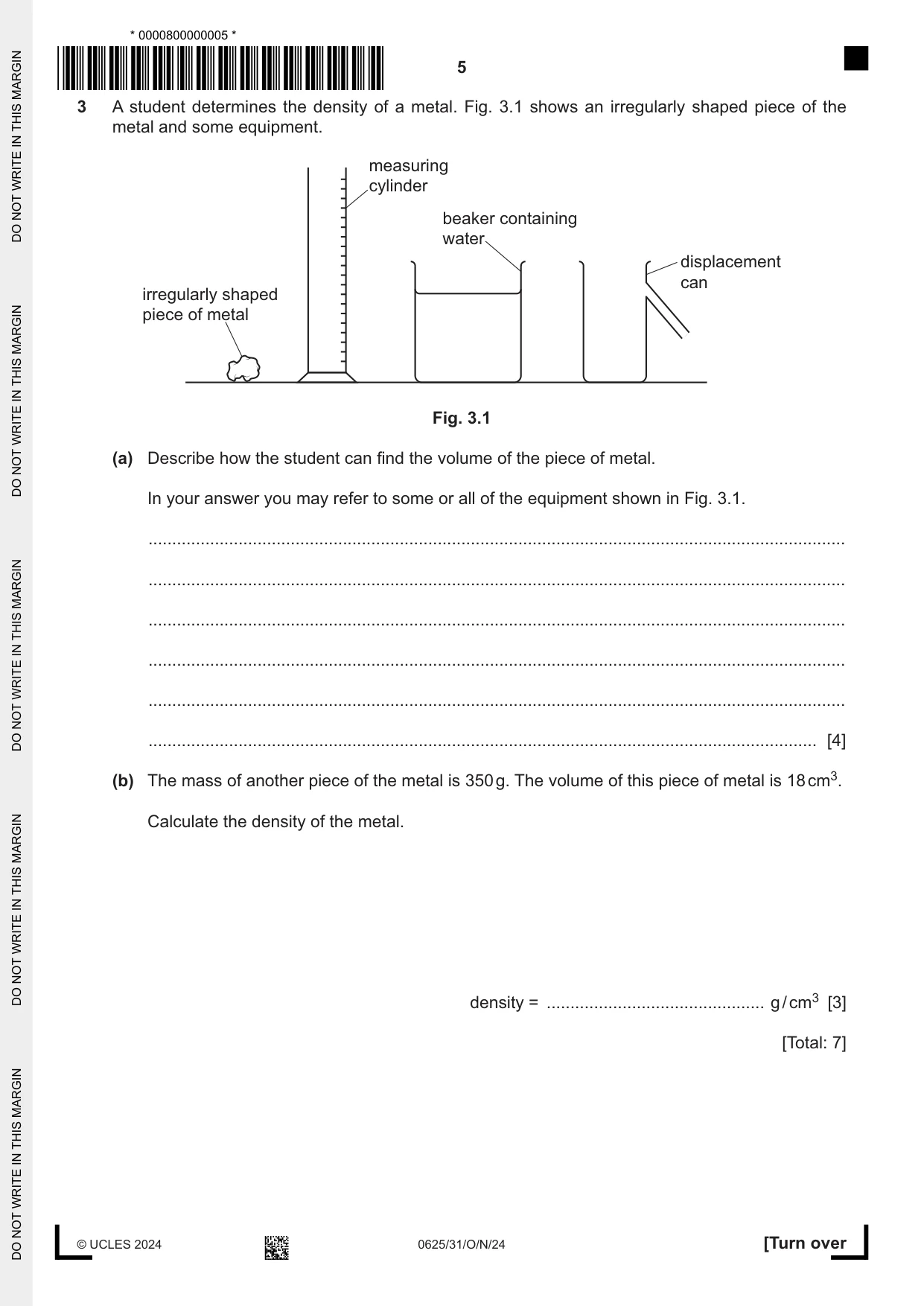
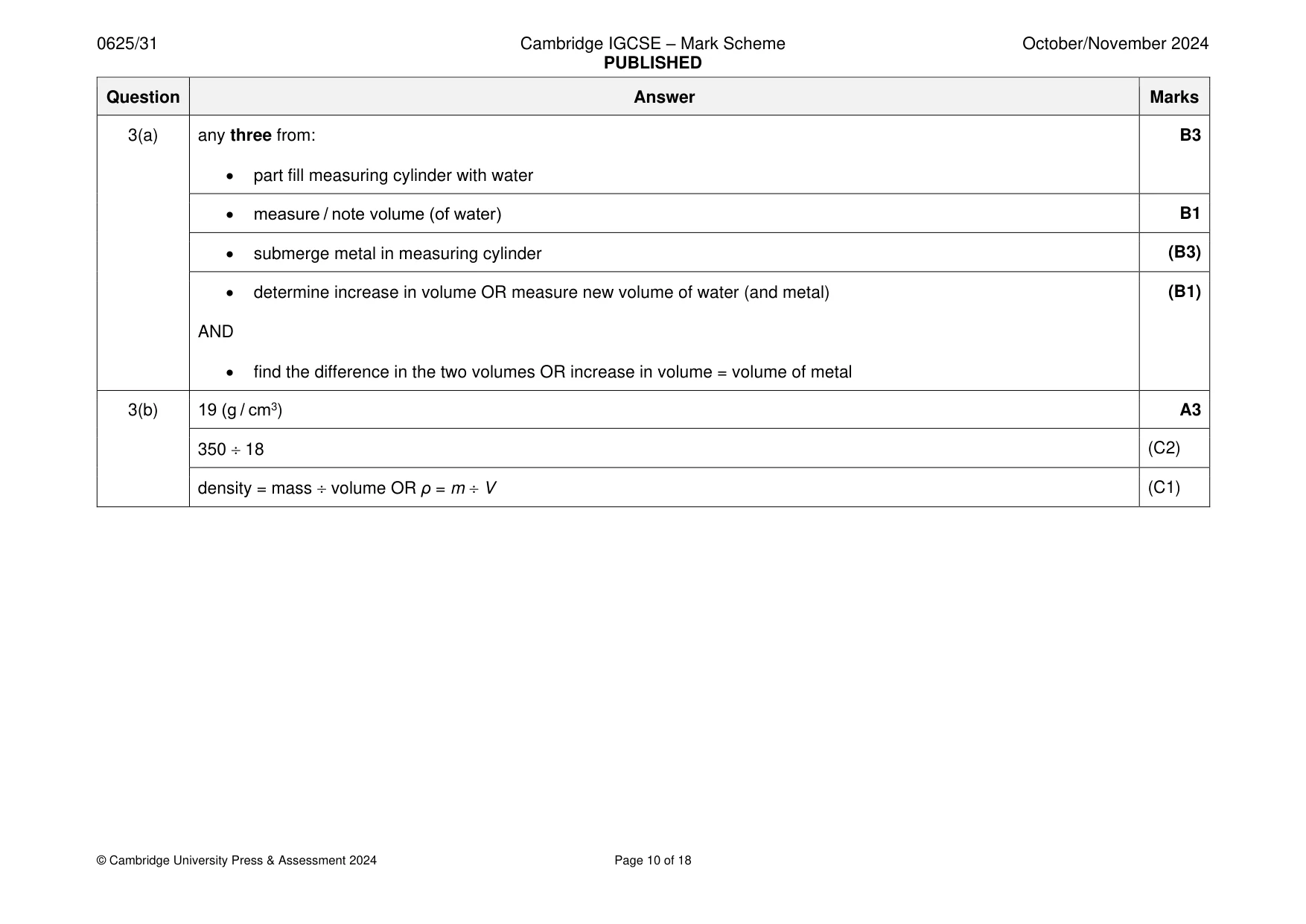
3 A student determines the density of a metal. Fig. 3.1 shows an irregularly shaped piece of the metal and some equipment. measuring cylinder beaker containing water displacement can irregularly shaped piece of metal Fig. 3.1 (a) Describe how the student can find the volume of the piece of metal. In your answer you may refer to some or all of the equipment shown in Fig. 3.1. ................................................................................................................................................... ................................................................................................................................................... ................................................................................................................................................... ................................................................................................................................................... ................................................................................................................................................... ............................................................................................................................................. [4] (b) The mass of another piece of the metal is 350 g. The volume of this piece of metal is 18 cm3. Calculate the density of the metal. density = .............................................. g / cm3 [3] [Total: 7]
Mark scheme: 3(a) any three from: B3 • part fill measuring cylinder with water • measure / note volume (of water) B1 • submerge metal in measuring cylinder (B3) • determine increase in volume OR measure new volume of water (and metal) (B1) AND • find the difference in the two volumes OR increase in volume = volume of metal 3(b) 19 (g / cm3) A3 350 18 (C2) density = mass volume OR ρ = m V (C1)
Q4 · The energy transfers in a lamp
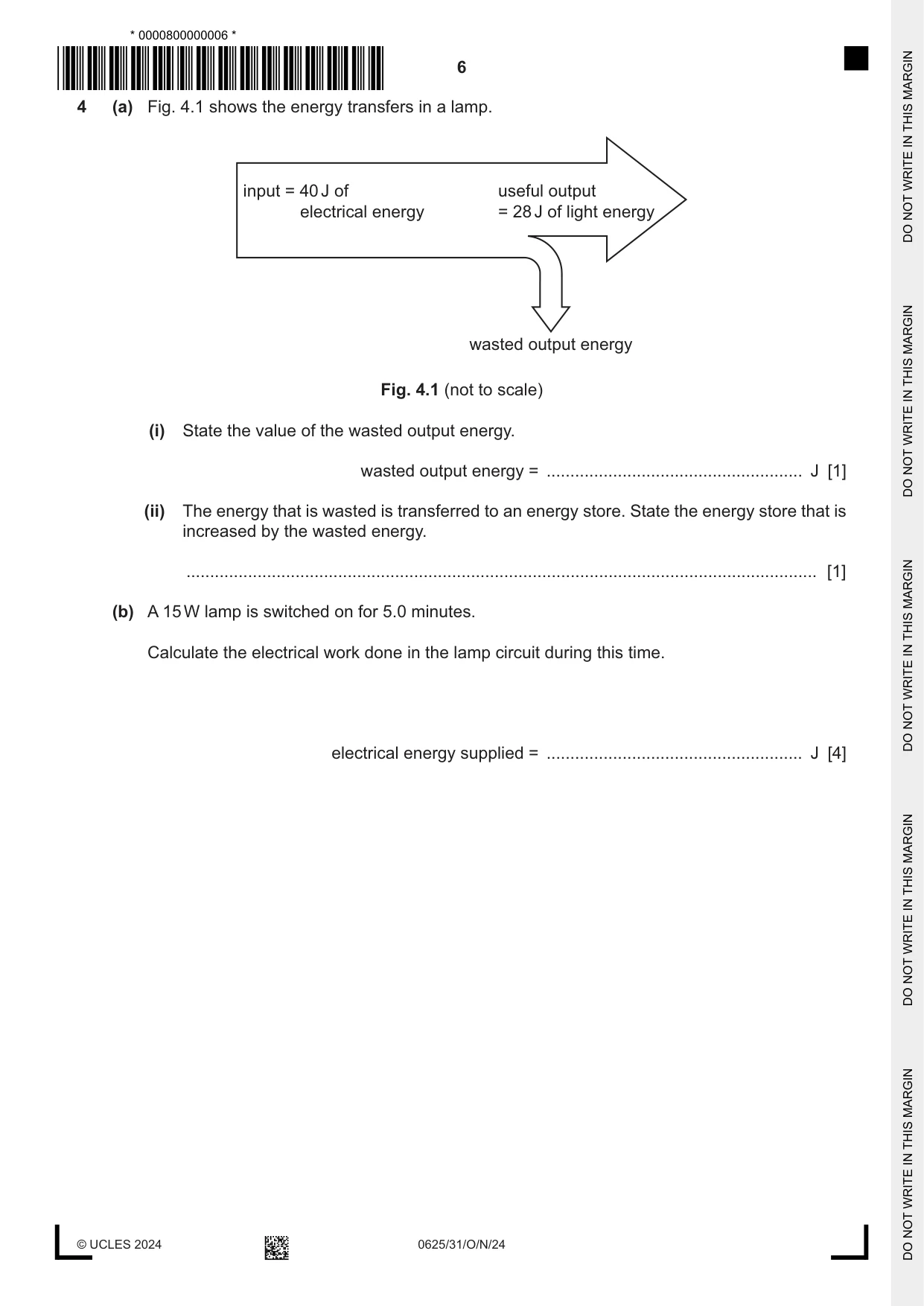
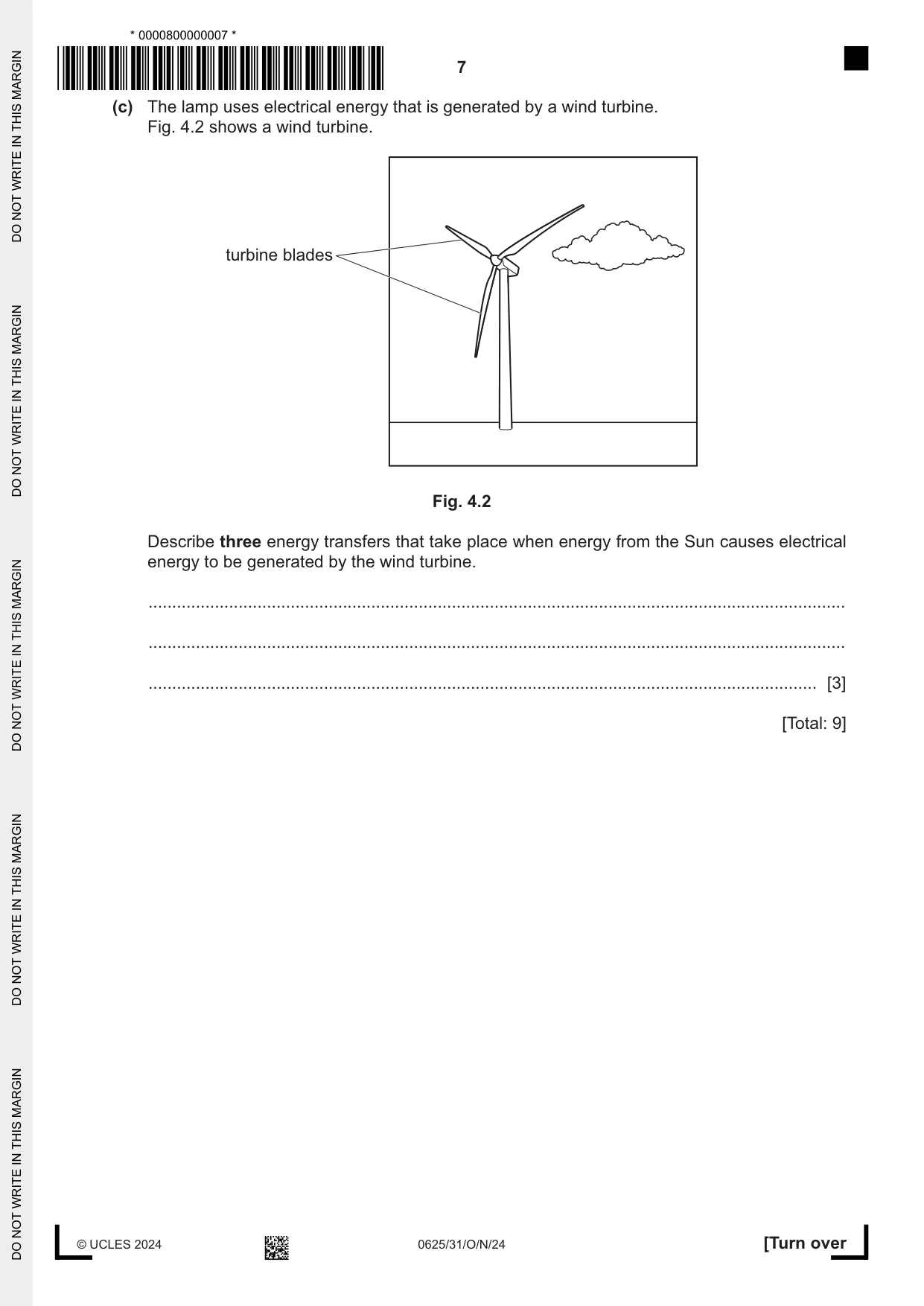
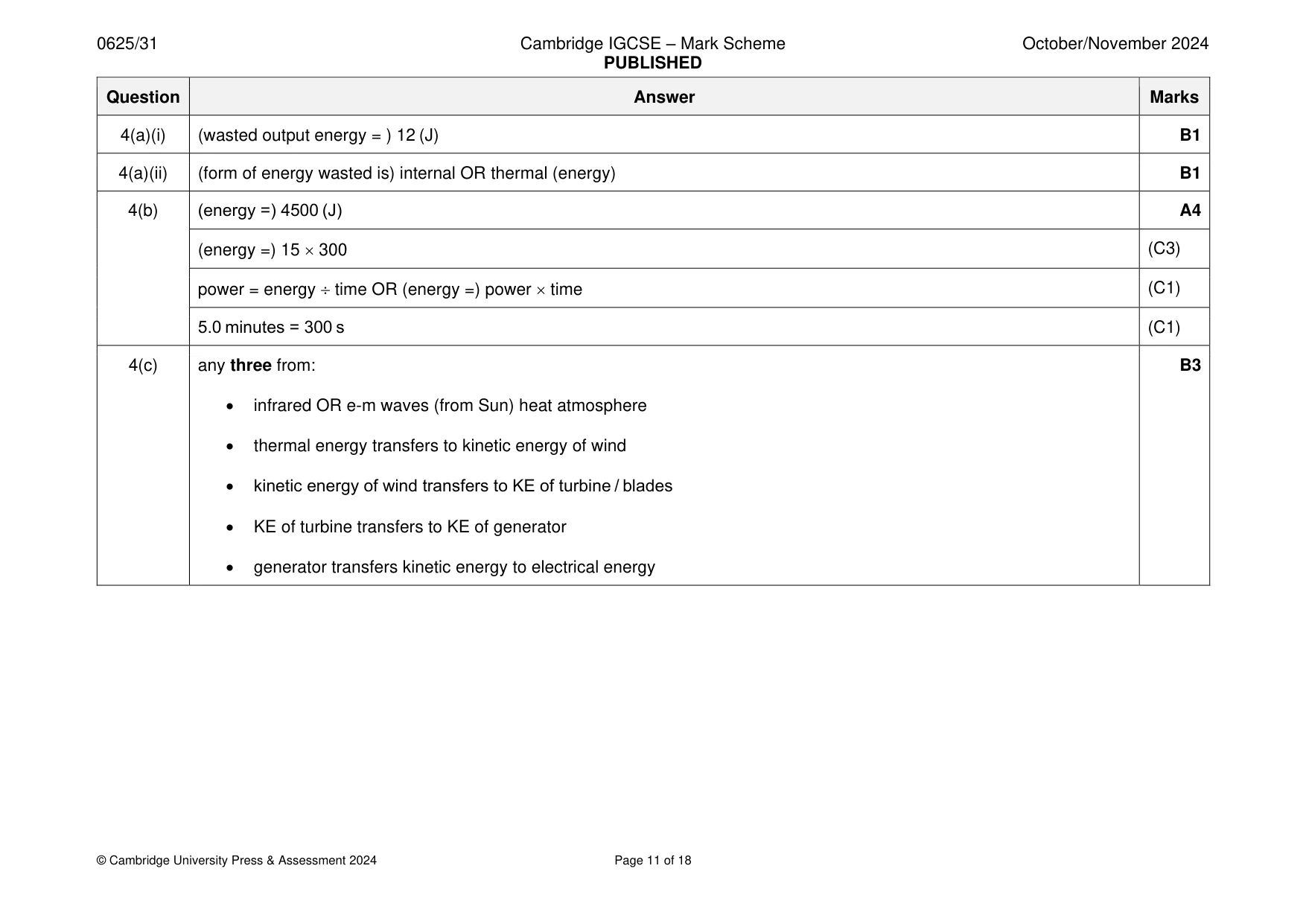
4 (a) Fig. 4.1 shows the energy transfers in a lamp. input = 40 J of useful output electrical energy = 28 J of light energy wasted output energy Fig. 4.1 (not to scale) (i) State the value of the wasted output energy. wasted output energy = ...................................................... J [1] (ii) The energy that is wasted is transferred to an energy store. State the energy store that is increased by the wasted energy. ..................................................................................................................................... [1] (b) A 15 W lamp is switched on for 5.0 minutes. Calculate the electrical work done in the lamp circuit during this time. electrical energy supplied = ...................................................... J [4] (c) The lamp uses electrical energy that is generated by a wind turbine. Fig. 4.2 shows a wind turbine. turbine blades Fig. 4.2 Describe three energy transfers that take place when energy from the Sun causes electrical energy to be generated by the wind turbine. ................................................................................................................................................... ................................................................................................................................................... ............................................................................................................................................. [3] [Total: 9]
Mark scheme: 4(a)(i) (wasted output energy = ) 12 (J) B1 4(a)(ii) (form of energy wasted is) internal OR thermal (energy) B1 4(b) (energy =) 4500 (J) A4 (energy =) 15 300 (C3) power = energy time OR (energy =) power time (C1) 5.0 minutes = 300 s (C1) 4(c) any three from: B3 • infrared OR e-m waves (from Sun) heat atmosphere • thermal energy transfers to kinetic energy of wind • kinetic energy of wind transfers to KE of turbine / blades • KE of turbine transfers to KE of generator • generator transfers kinetic energy to electrical energy
Question 5
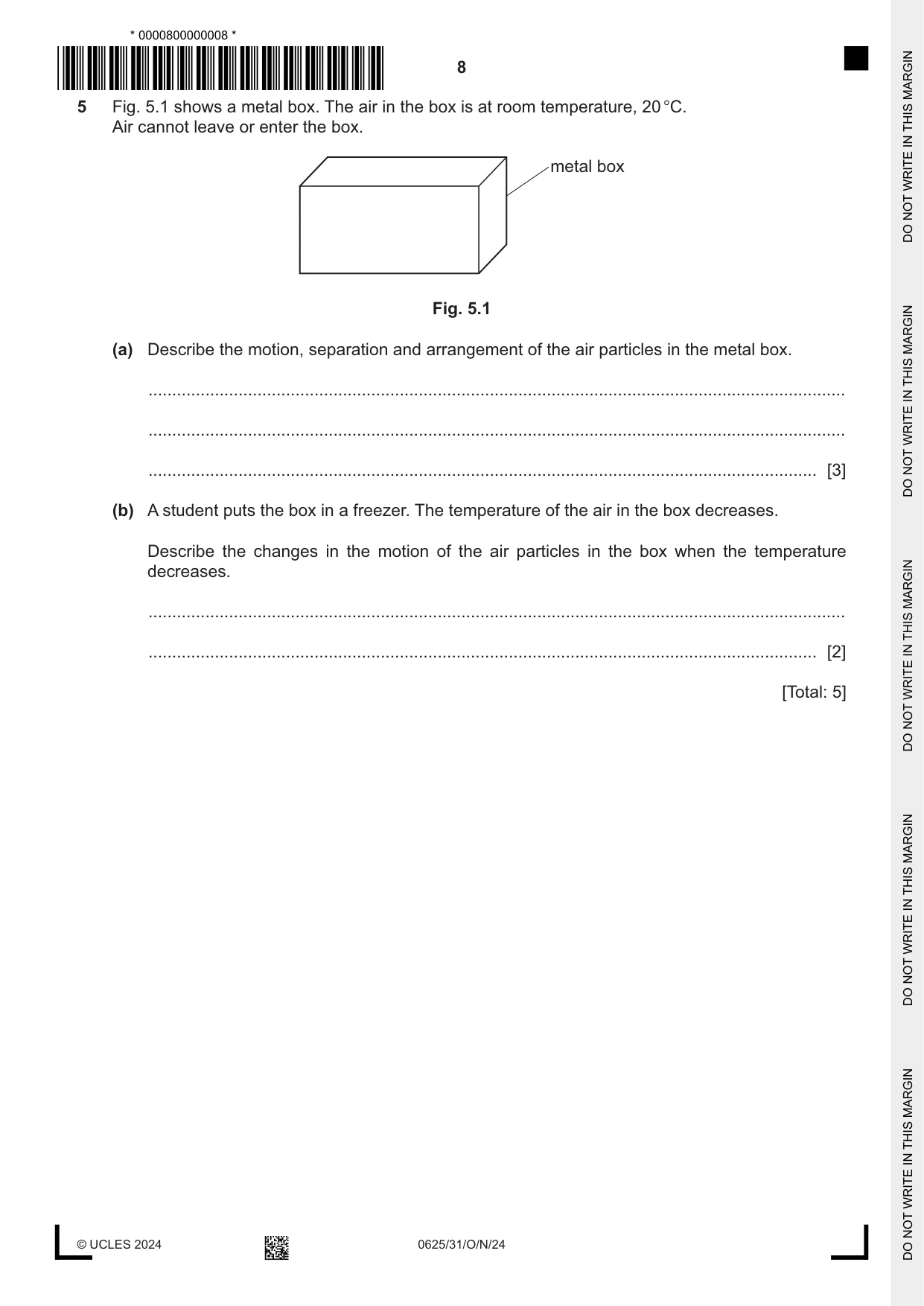
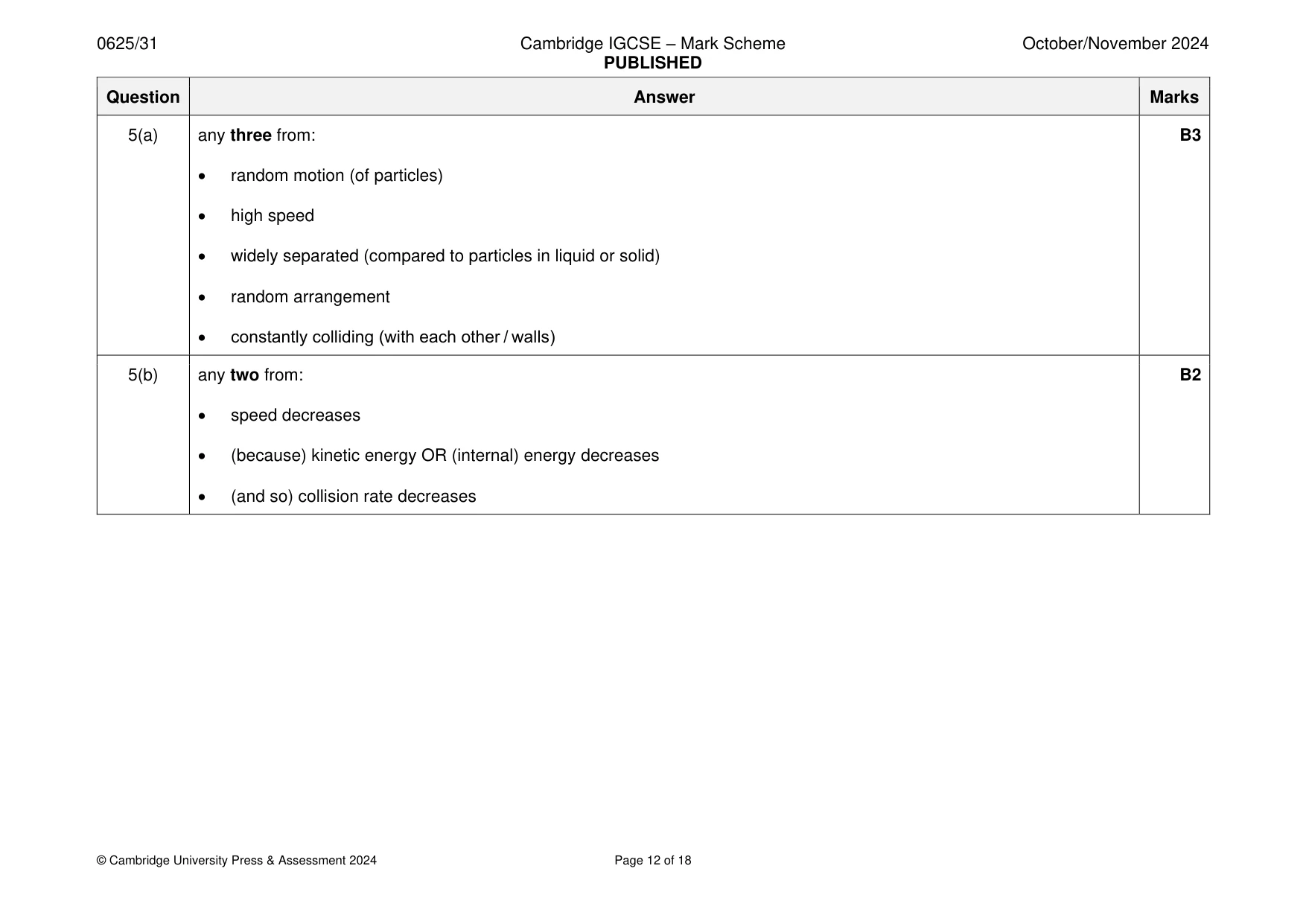
5 Fig. 5.1 shows a metal box. The air in the box is at room temperature, 20 °C. Air cannot leave or enter the box. metal box Fig. 5.1 (a) Describe the motion, separation and arrangement of the air particles in the metal box. ................................................................................................................................................... ................................................................................................................................................... ............................................................................................................................................. [3] (b) A student puts the box in a freezer. The temperature of the air in the box decreases. Describe the changes in the motion of the air particles in the box when the temperature decreases. ................................................................................................................................................... ............................................................................................................................................. [2] [Total: 5]
Mark scheme: 5(a) any three from: B3 • random motion (of particles) • high speed • widely separated (compared to particles in liquid or solid) • random arrangement • constantly colliding (with each other / walls) 5(b) any two from: B2 • speed decreases • (because) kinetic energy OR (internal) energy decreases • (and so) collision rate decreases
Q6 · Some students near some rocky cliffs looking at a boat at sea
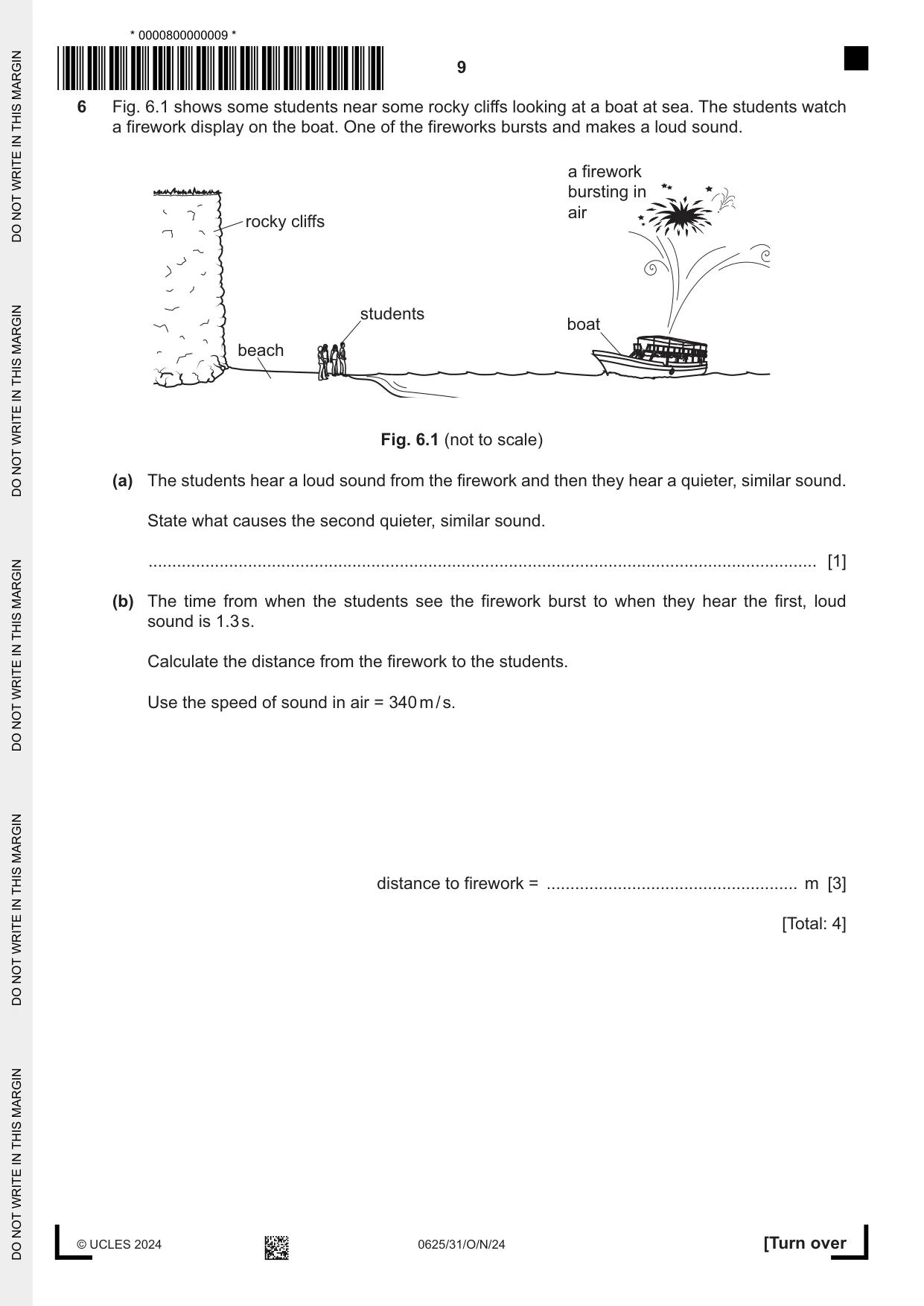
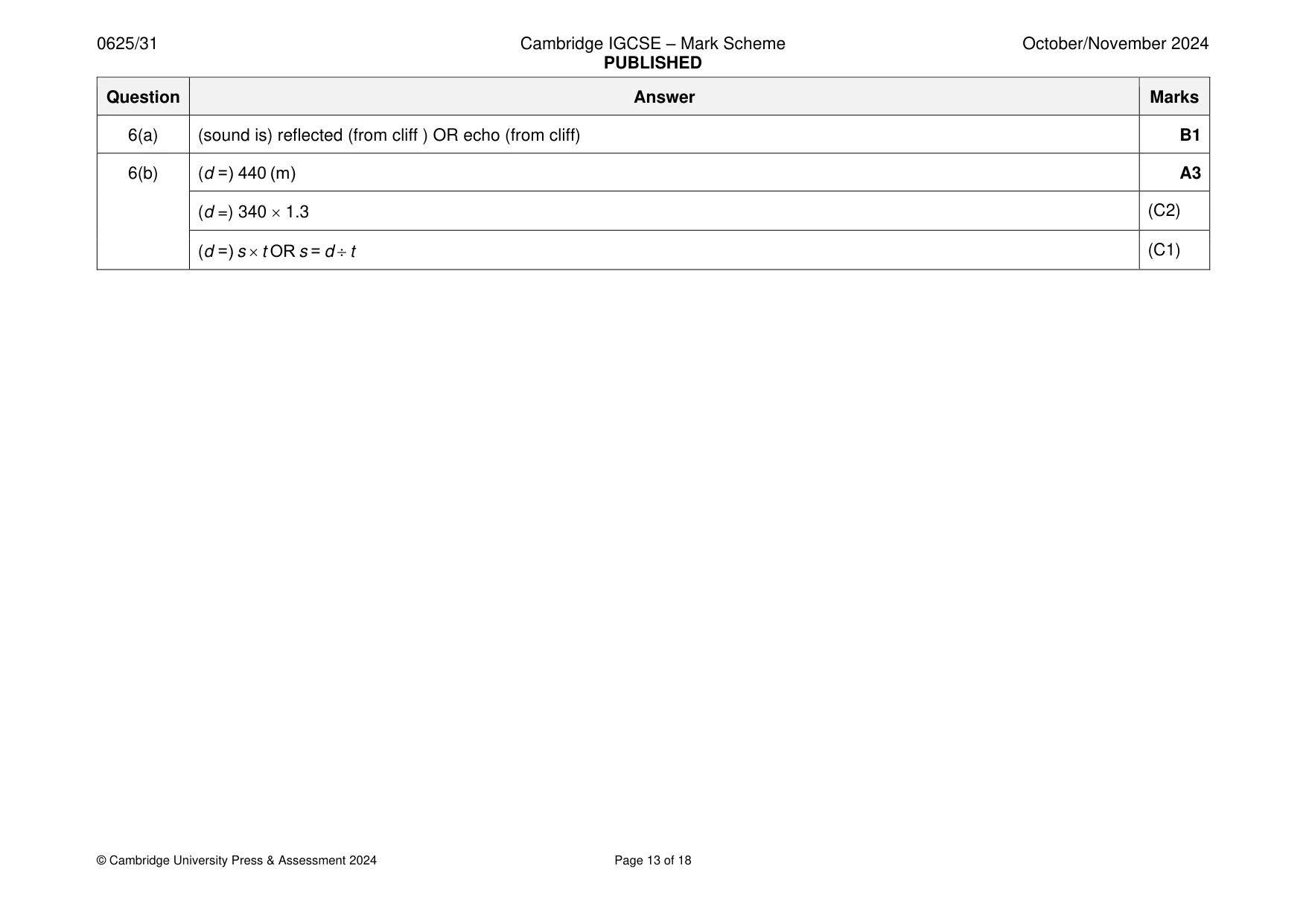
6 Fig. 6.1 shows some students near some rocky cliffs looking at a boat at sea. The students watch a firework display on the boat. One of the fireworks bursts and makes a loud sound. a firework bursting in air rocky cliffs students boat beach Fig. 6.1 (not to scale) (a) The students hear a loud sound from the firework and then they hear a quieter, similar sound. State what causes the second quieter, similar sound. ............................................................................................................................................. [1] (b) The time from when the students see the firework burst to when they hear the first, loud sound is 1.3 s. Calculate the distance from the firework to the students. Use the speed of sound in air = 340 m / s. distance to firework = ..................................................... m [3] [Total: 4]
Mark scheme: 6(a) (sound is) reflected (from cliff ) OR echo (from cliff) B1 6(b) (d =) 440 (m) A3 (d =) 340 1.3 (C2) (d =) s t OR s = d t (C1)
Q7 · A student demonstrates three different processes that change the direction of water waves…
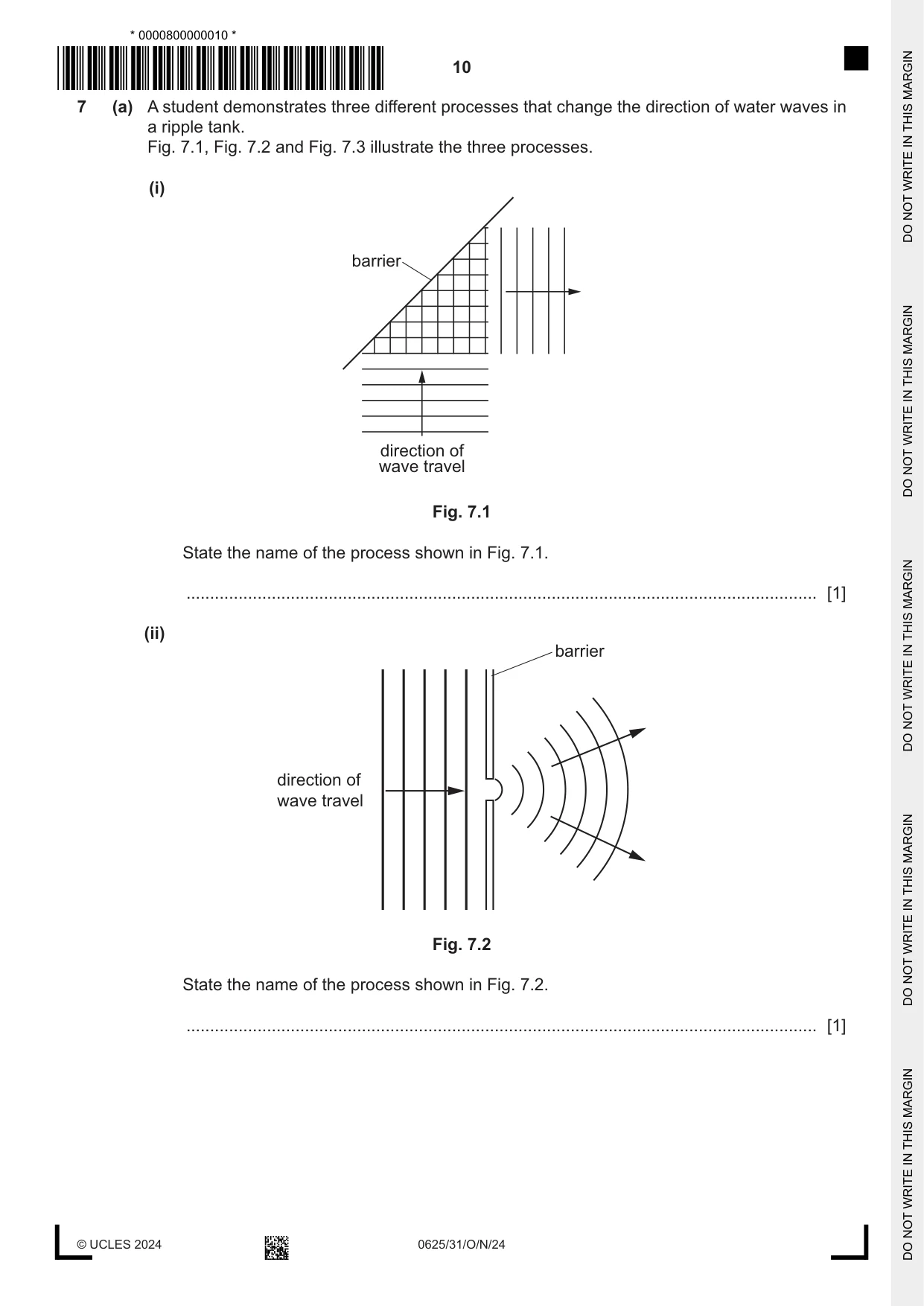
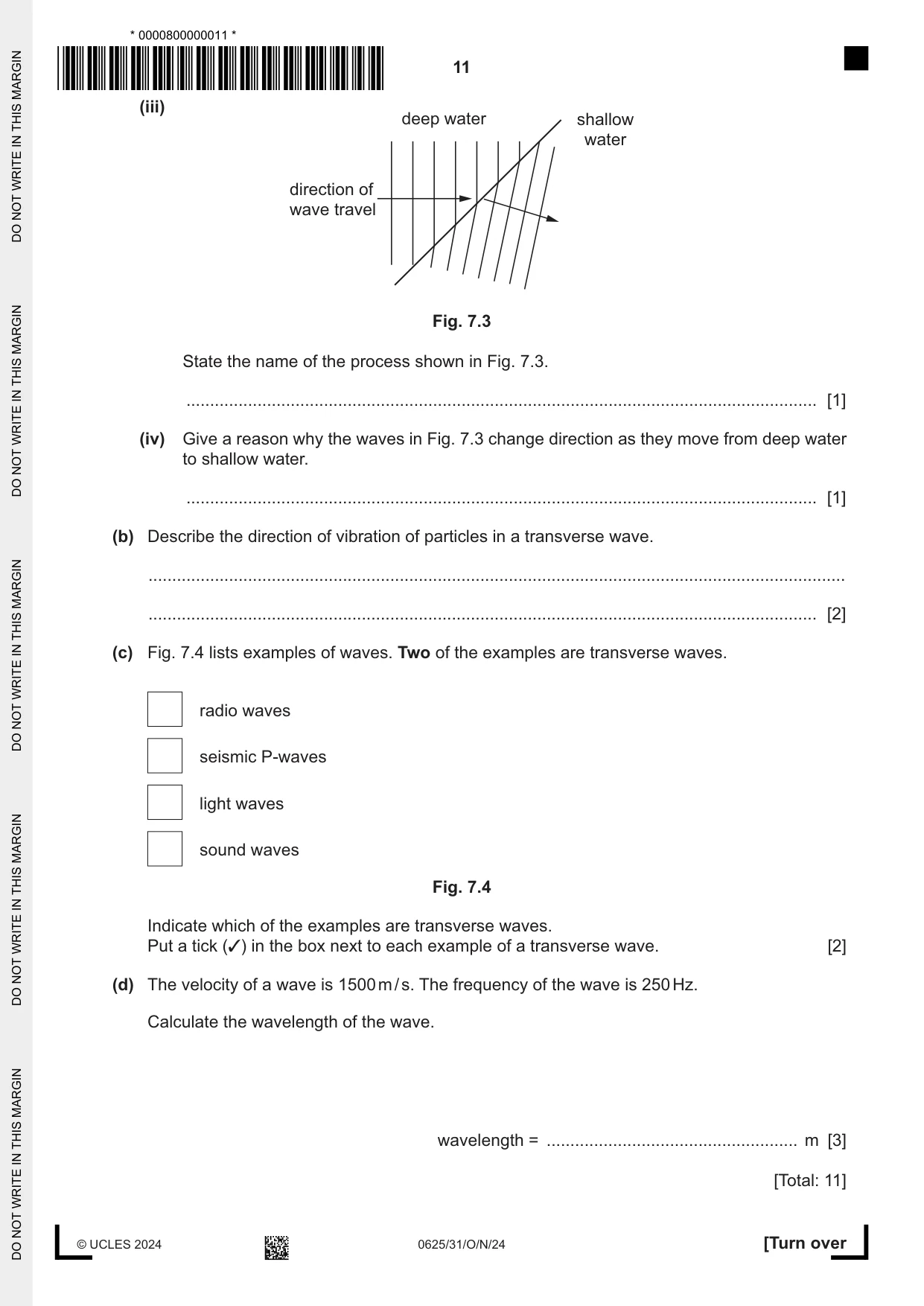
7 (a) A student demonstrates three different processes that change the direction of water waves in a ripple tank. Fig. 7.1, Fig. 7.2 and Fig. 7.3 illustrate the three processes. (i) barrier direction of wave travel Fig. 7.1 State the name of the process shown in Fig. 7.1. ..................................................................................................................................... [1] (ii) barrier direction of wave travel Fig. 7.2 State the name of the process shown in Fig. 7.2. ..................................................................................................................................... [1] (iii) deep water shallow water direction of wave travel Fig. 7.3 State the name of the process shown in Fig. 7.3. ..................................................................................................................................... [1] (iv) Give a reason why the waves in Fig. 7.3 change direction as they move from deep water to shallow water. ..................................................................................................................................... [1] (b) Describe the direction of vibration of particles in a transverse wave. ................................................................................................................................................... ............................................................................................................................................. [2] (c) Fig. 7.4 lists examples of waves. Two of the examples are transverse waves. radio waves seismic P‑waves light waves sound waves Fig. 7.4 Indicate which of the examples are transverse waves. Put a tick (3) in the box next to each example of a transverse wave. [2] (d) The velocity of a wave is 1500 m / s. The frequency of the wave is 250 Hz. Calculate the wavelength of the wave. wavelength = ..................................................... m [3] [Total: 11]
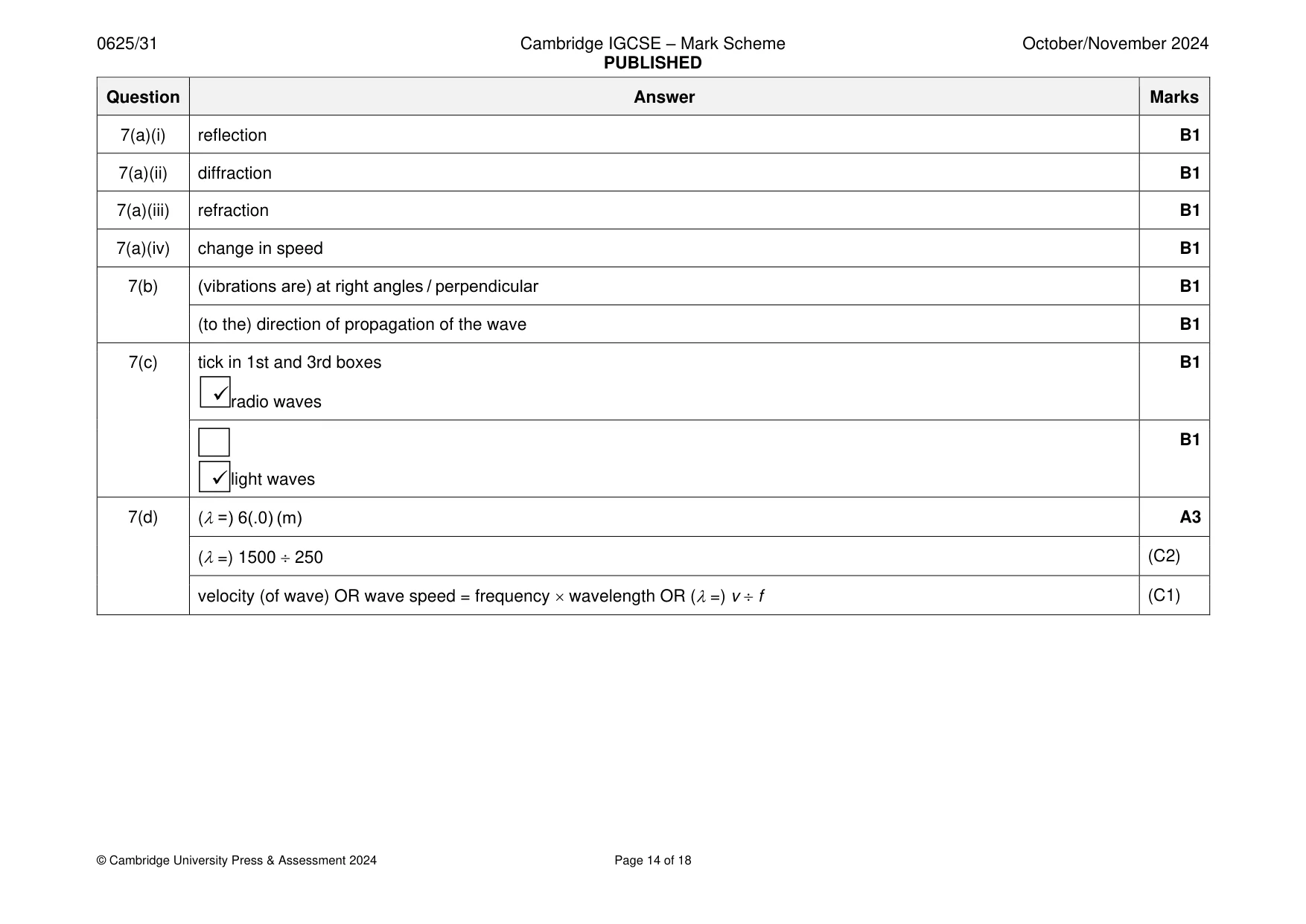
Mark scheme: 7(a)(i) reflection B1 7(a)(ii) diffraction B1 7(a)(iii) refraction B1 7(a)(iv) change in speed B1 7(b) (vibrations are) at right angles / perpendicular B1 (to the) direction of propagation of the wave B1 7(c) tick in 1st and 3rd boxes B1 ✓ radio waves B1 ✓ light waves 7(d) (=) 6(.0) (m) A3 (=) 1500 250 (C2) velocity (of wave) OR wave speed = frequency wavelength OR (=) v f (C1)
Q8 · A ray diagram for a thin converging lens
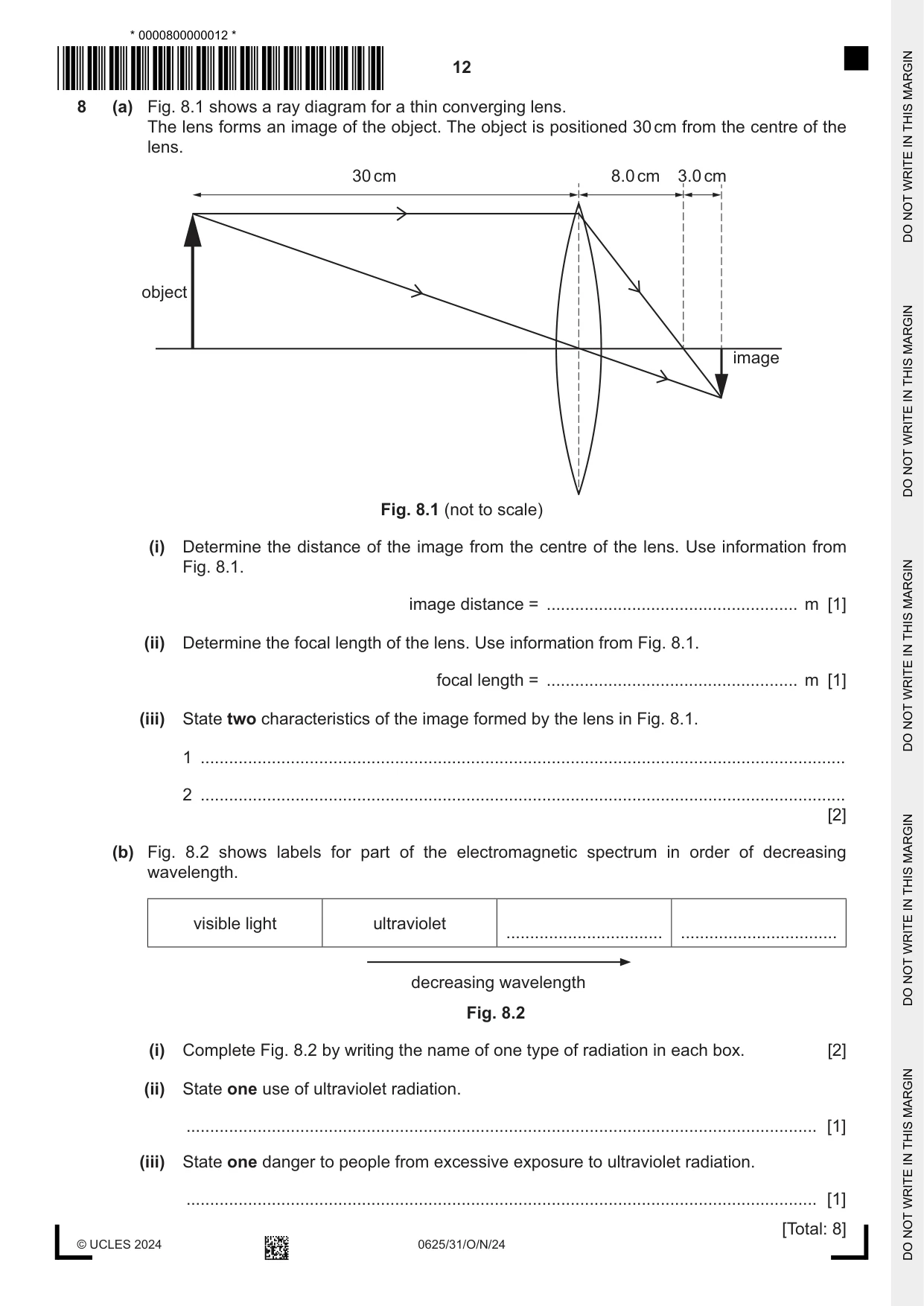
8 (a) Fig. 8.1 shows a ray diagram for a thin converging lens. The lens forms an image of the object. The object is positioned 30 cm from the centre of the lens. 30 cm 8.0 cm 3.0 cm object image Fig. 8.1 (not to scale) (i) Determine the distance of the image from the centre of the lens. Use information from Fig. 8.1. image distance = ..................................................... m [1] (ii) Determine the focal length of the lens. Use information from Fig. 8.1. focal length = ..................................................... m [1] (iii) State two characteristics of the image formed by the lens in Fig. 8.1. 1 ........................................................................................................................................ 2 ........................................................................................................................................ [2] (b) Fig. 8.2 shows labels for part of the electromagnetic spectrum in order of decreasing wavelength. visible light ultraviolet ................................. ................................. decreasing wavelength Fig. 8.2 (i) Complete Fig. 8.2 by writing the name of one type of radiation in each box. [2] (ii) State one use of ultraviolet radiation. ..................................................................................................................................... [1] (iii) State one danger to people from excessive exposure to ultraviolet radiation. ..................................................................................................................................... [1] [Total: 8]
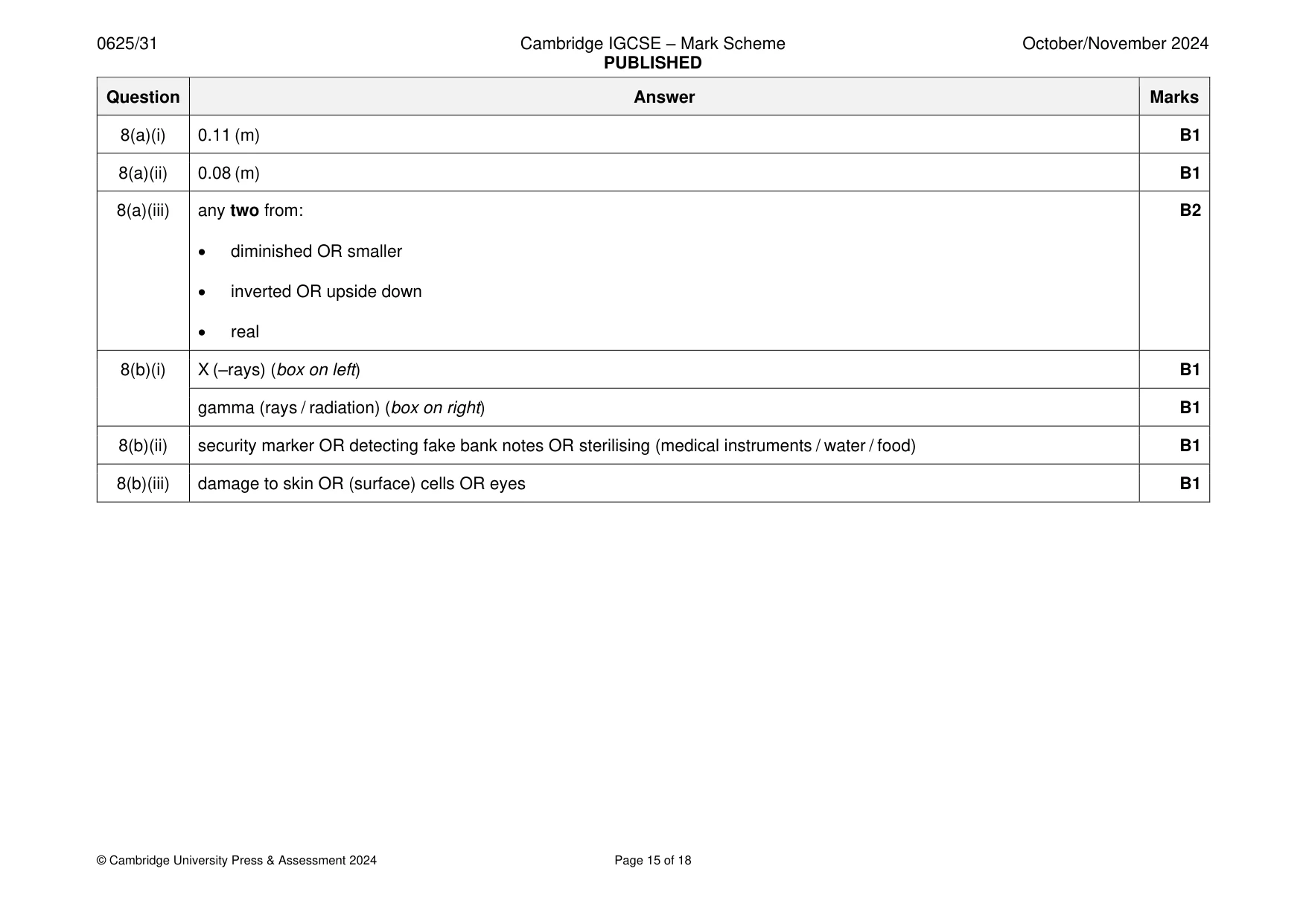
Mark scheme: 8(a)(i) 0.11 (m) B1 8(a)(ii) 0.08 (m) B1 8(a)(iii) any two from: B2 • diminished OR smaller • inverted OR upside down • real 8(b)(i) X (–rays) (box on left) B1 gamma (rays / radiation) (box on right) B1 8(b)(ii) security marker OR detecting fake bank notes OR sterilising (medical instruments / water / food) B1 8(b)(iii) damage to skin OR (surface) cells OR eyes B1
Q9 · A student tests various materials to determine whether they are electrical conductors or…
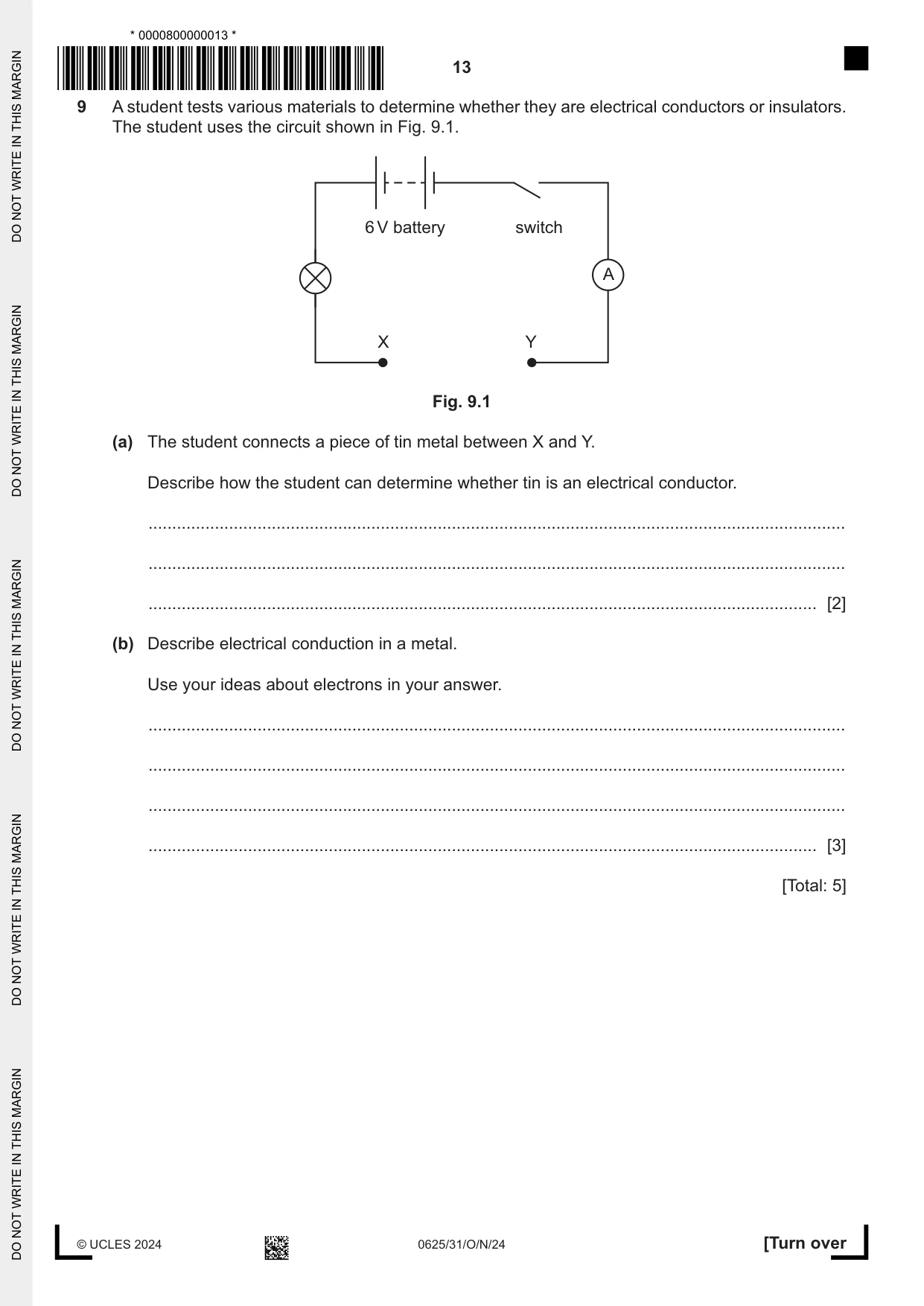
9 A student tests various materials to determine whether they are electrical conductors or insulators. The student uses the circuit shown in Fig. 9.1. 6 V battery switch A X Y Fig. 9.1 (a) The student connects a piece of tin metal between X and Y. Describe how the student can determine whether tin is an electrical conductor. ................................................................................................................................................... ................................................................................................................................................... ............................................................................................................................................. [2] (b) Describe electrical conduction in a metal. Use your ideas about electrons in your answer. ................................................................................................................................................... ................................................................................................................................................... ................................................................................................................................................... ............................................................................................................................................. [3] [Total: 5]
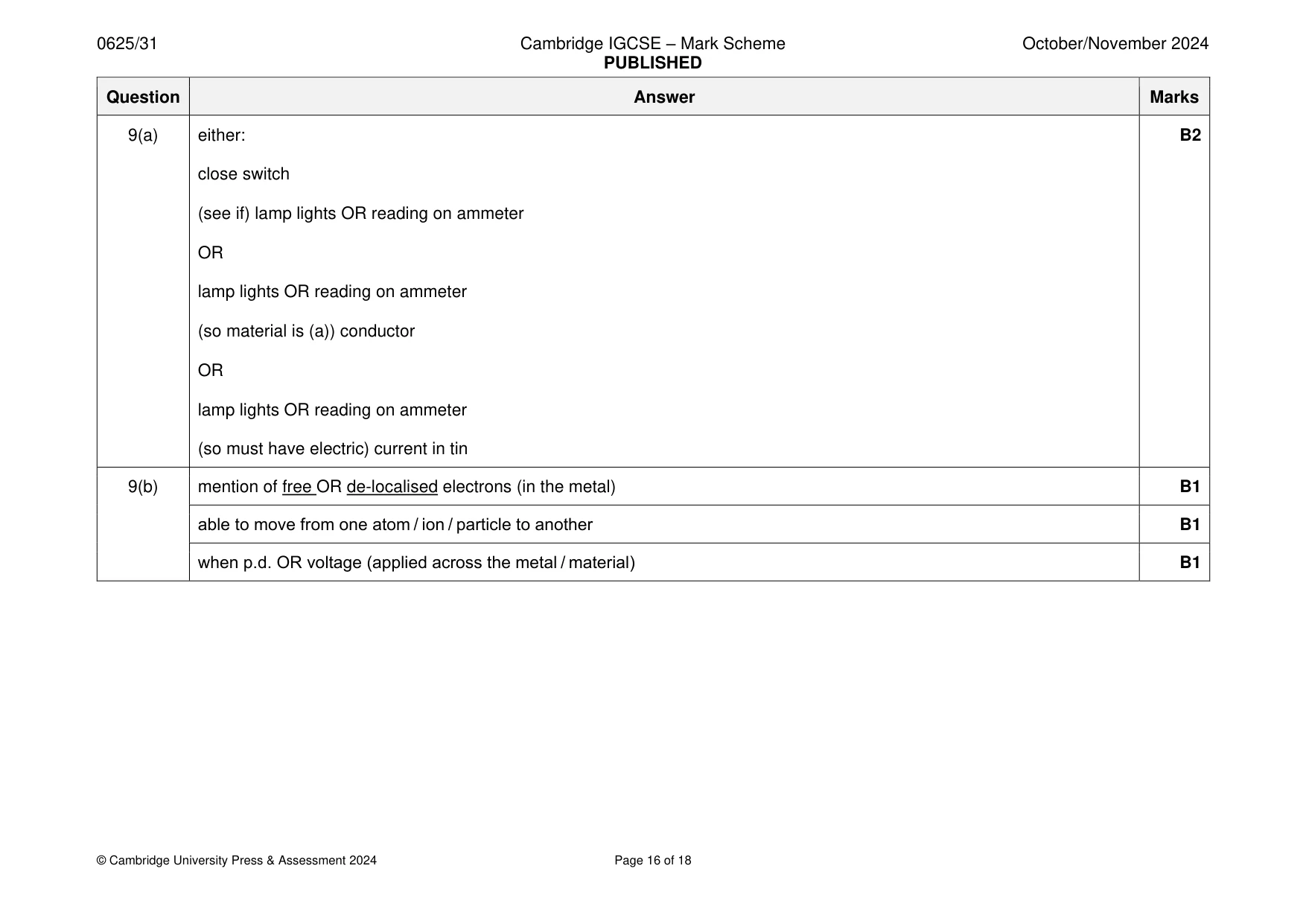
Mark scheme: 9(a) either: B2 close switch (see if) lamp lights OR reading on ammeter OR lamp lights OR reading on ammeter (so material is (a)) conductor OR lamp lights OR reading on ammeter (so must have electric) current in tin 9(b) mention of free OR de-localised electrons (in the metal) B1 able to move from one atom / ion / particle to another B1 when p.d. OR voltage (applied across the metal / material) B1
Q10 · In an experiment, a student uses an electrical heater connected to a power supply
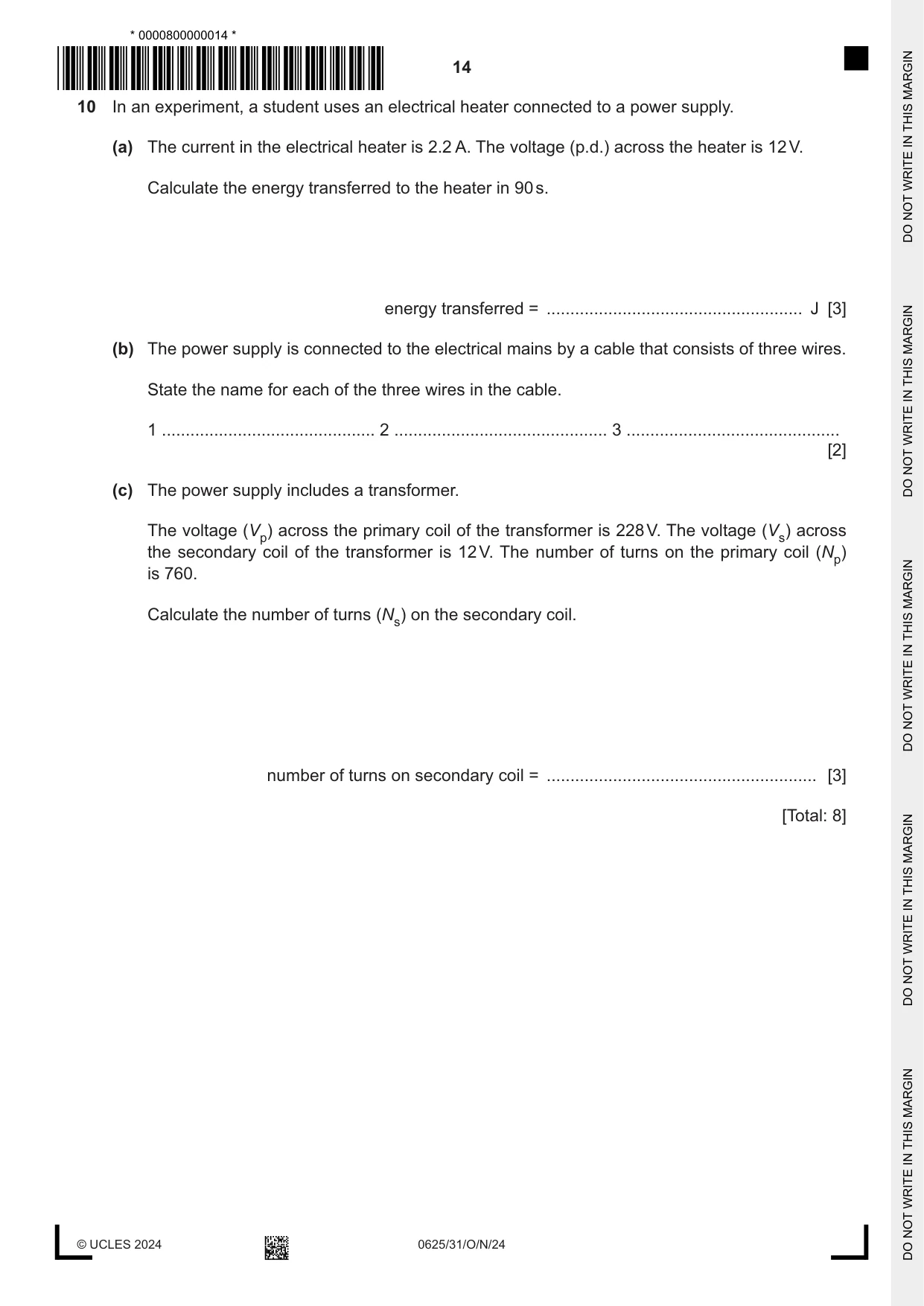
10 In an experiment, a student uses an electrical heater connected to a power supply. (a) The current in the electrical heater is 2.2 A. The voltage (p.d.) across the heater is 12 V. Calculate the energy transferred to the heater in 90 s. energy transferred = ...................................................... J [3] (b) The power supply is connected to the electrical mains by a cable that consists of three wires. State the name for each of the three wires in the cable. 1 ............................................. 2 ............................................. 3 ............................................. [2] (c) The power supply includes a transformer. The voltage (Vp) across the primary coil of the transformer is 228 V. The voltage (Vs) across the secondary coil of the transformer is 12 V. The number of turns on the primary coil (Np) is 760. Calculate the number of turns (Ns) on the secondary coil. number of turns on secondary coil = ......................................................... [3] [Total: 8]
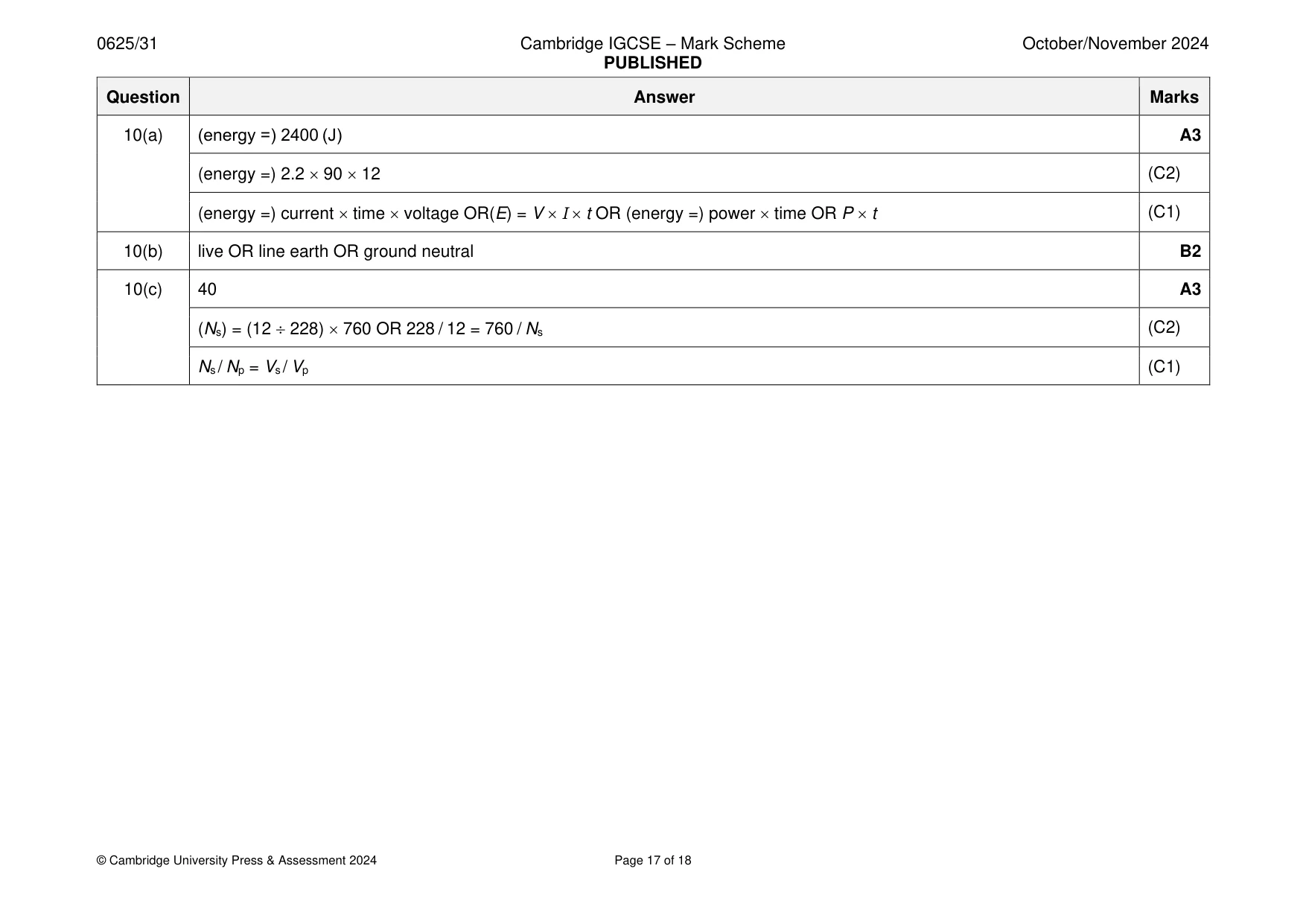
Mark scheme: 10(a) (energy =) 2400 (J) A3 (energy =) 2.2 90 12 (C2) (energy =) current time voltage OR(E) = V I t OR (energy =) power time OR P t (C1) 10(b) live OR line earth OR ground neutral B2 10(c) 40 A3 (Ns) = (12 228) 760 OR 228 / 12 = 760 / Ns (C2) Ns / Np = Vs / Vp (C1)
Q11 · The planets in the Solar System
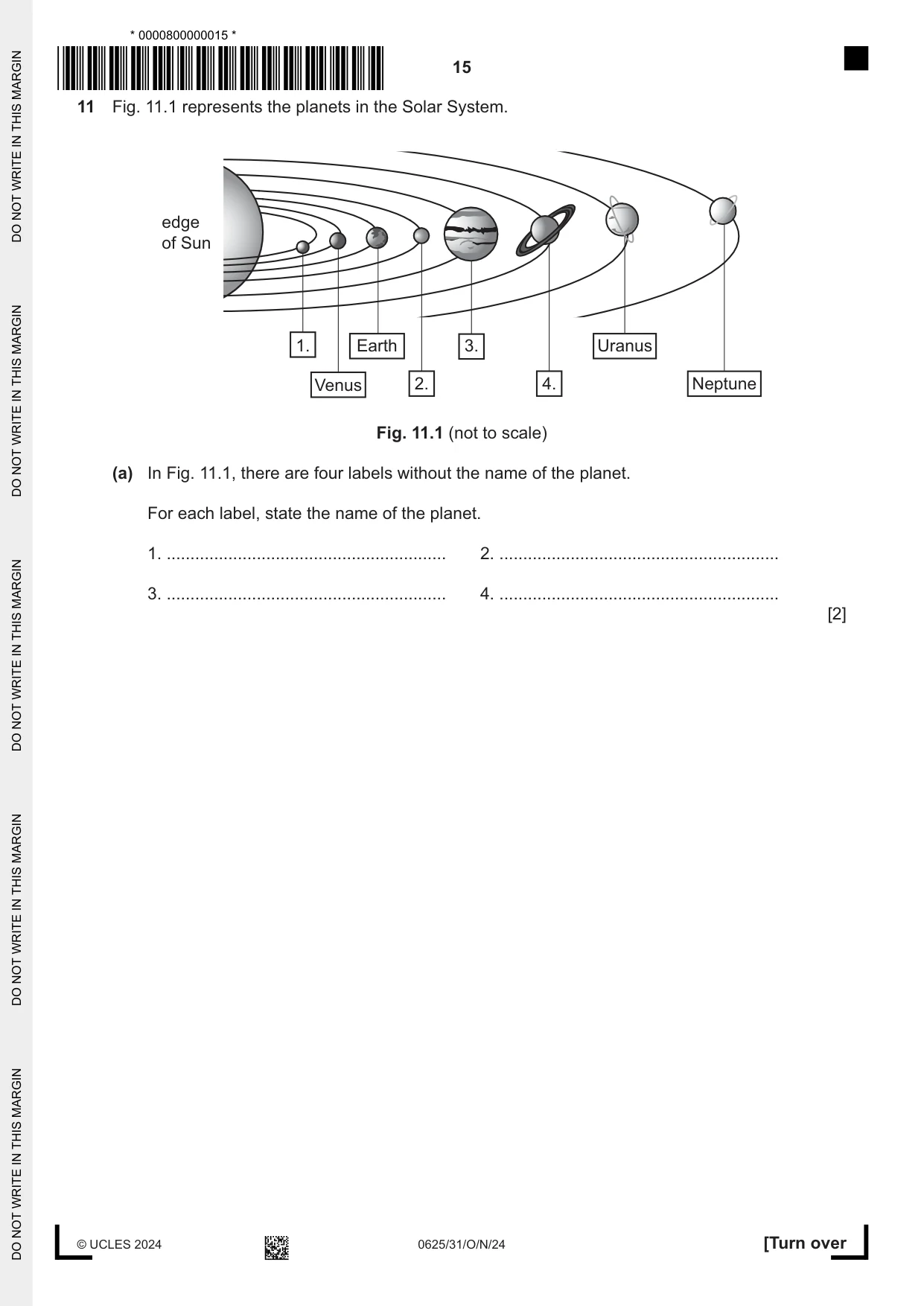
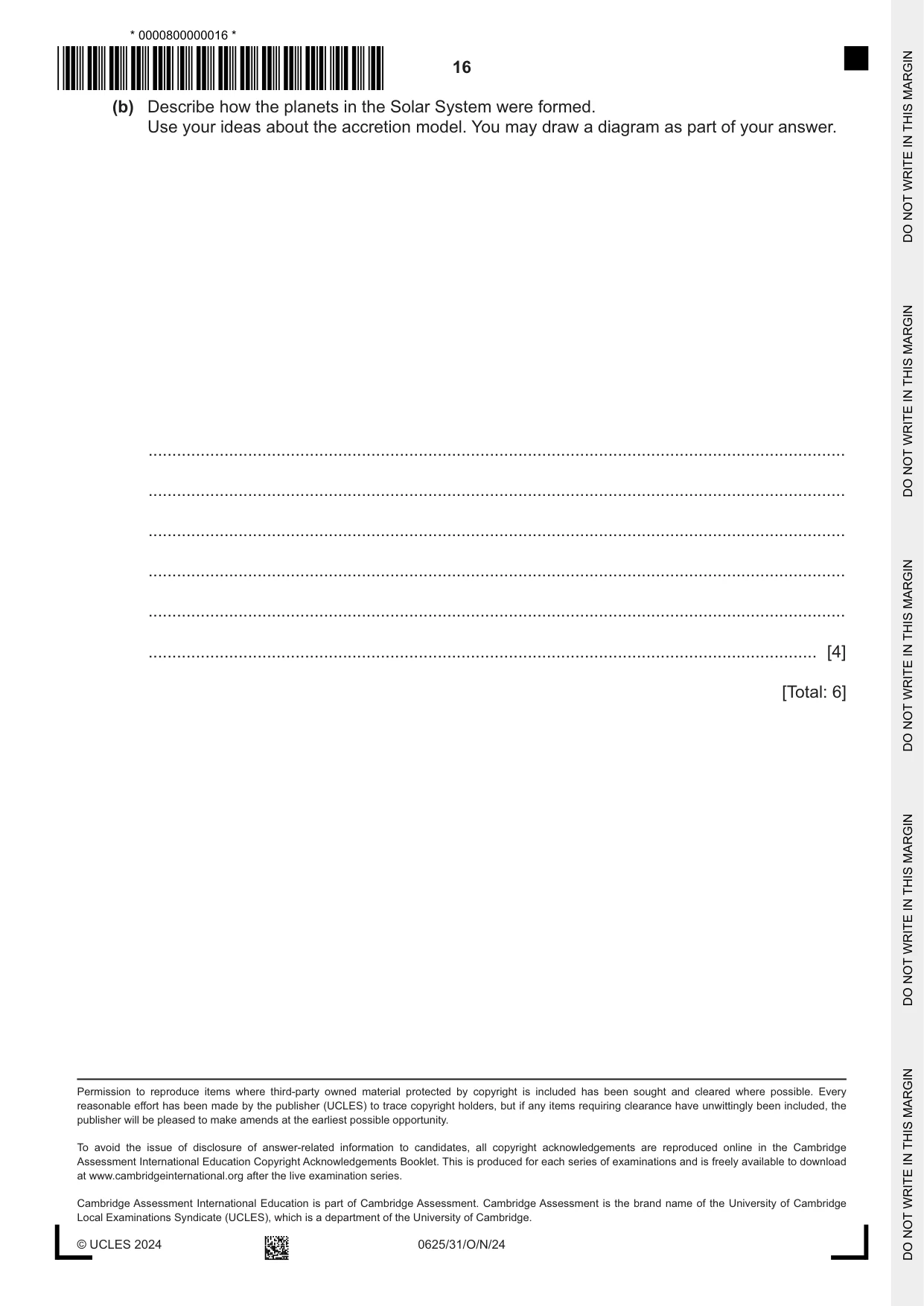
11 Fig. 11.1 represents the planets in the Solar System. edge of Sun 1. Earth 3. Uranus Venus 2. 4. Neptune Fig. 11.1 (not to scale) (a) In Fig. 11.1, there are four labels without the name of the planet. For each label, state the name of the planet. 1. ........................................................... 2. ........................................................... 3. ........................................................... 4. ........................................................... [2] (b) Describe how the planets in the Solar System were formed. Use your ideas about the accretion model. You may draw a diagram as part of your answer. ................................................................................................................................................... ................................................................................................................................................... ................................................................................................................................................... ................................................................................................................................................... ................................................................................................................................................... ............................................................................................................................................. [4] [Total: 6]
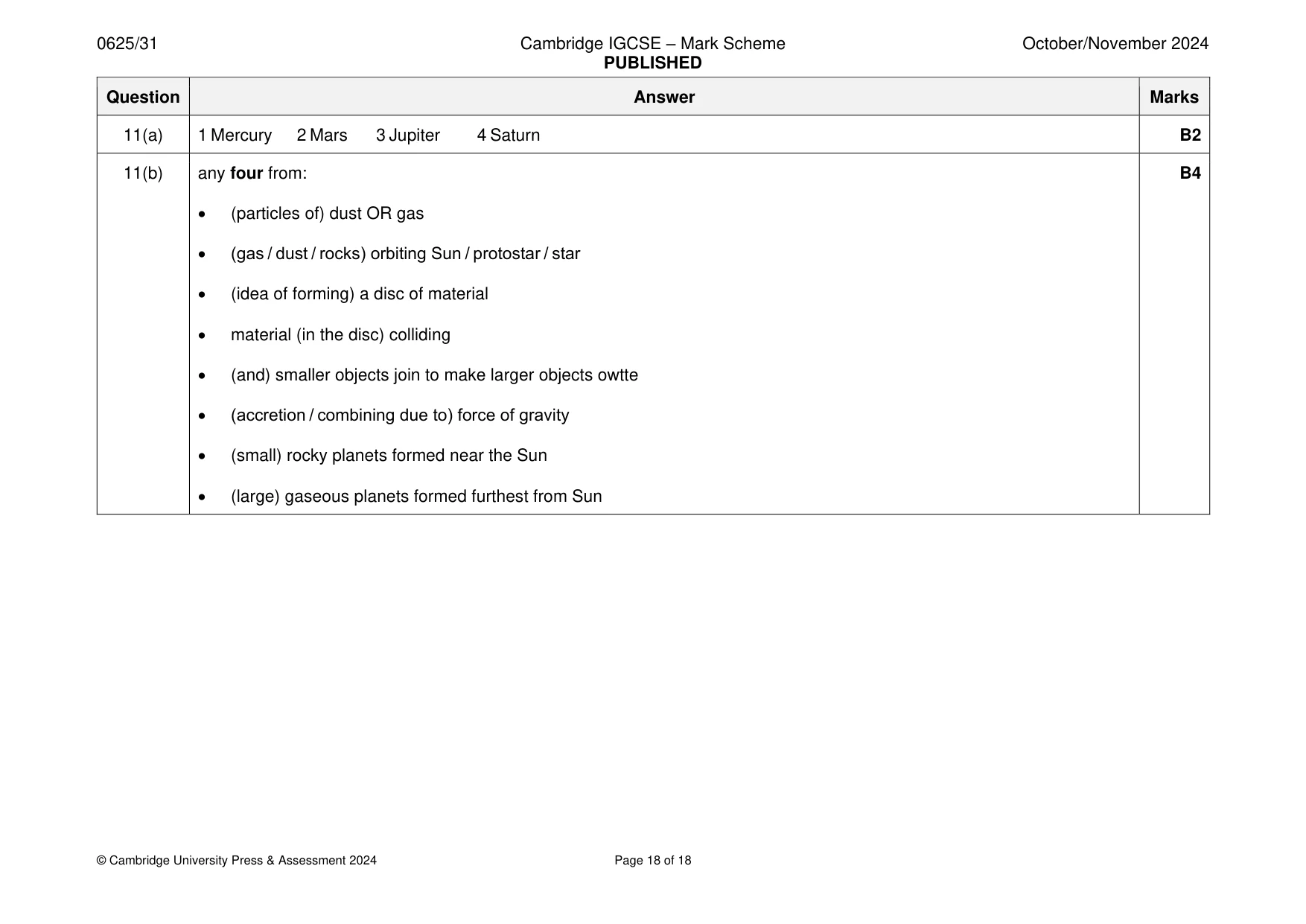
Mark scheme: 11(a) 1 Mercury 2 Mars 3 Jupiter 4 Saturn B2 11(b) any four from: B4 • (particles of) dust OR gas • (gas / dust / rocks) orbiting Sun / protostar / star • (idea of forming) a disc of material • material (in the disc) colliding • (and) smaller objects join to make larger objects owtte • (accretion / combining due to) force of gravity • (small) rocky planets formed near the Sun • (large) gaseous planets formed furthest from Sun
What was in this paper
The subtopics covered by these 11 questions, and how many questions each got. Open one in a new tab to see every Cambridge question on it.
What you needed in this session
Cambridge’s own grade thresholds for 2024 Oct/Nov, Paper 3 · Variant 1. A higher threshold means an easier paper — the bar moves with how the cohort did.