Cambridge IGCSE Physics 0625 — 2011 Oct/Nov Paper 3 · Variant 2
0625/32/O/N/11 · 12 questions · 80 marks · ≈90 min
The question paper and its mark scheme, free to read here and free to download. This is Cambridge’s own paper, exactly as it was sat.
Question paper20 pages

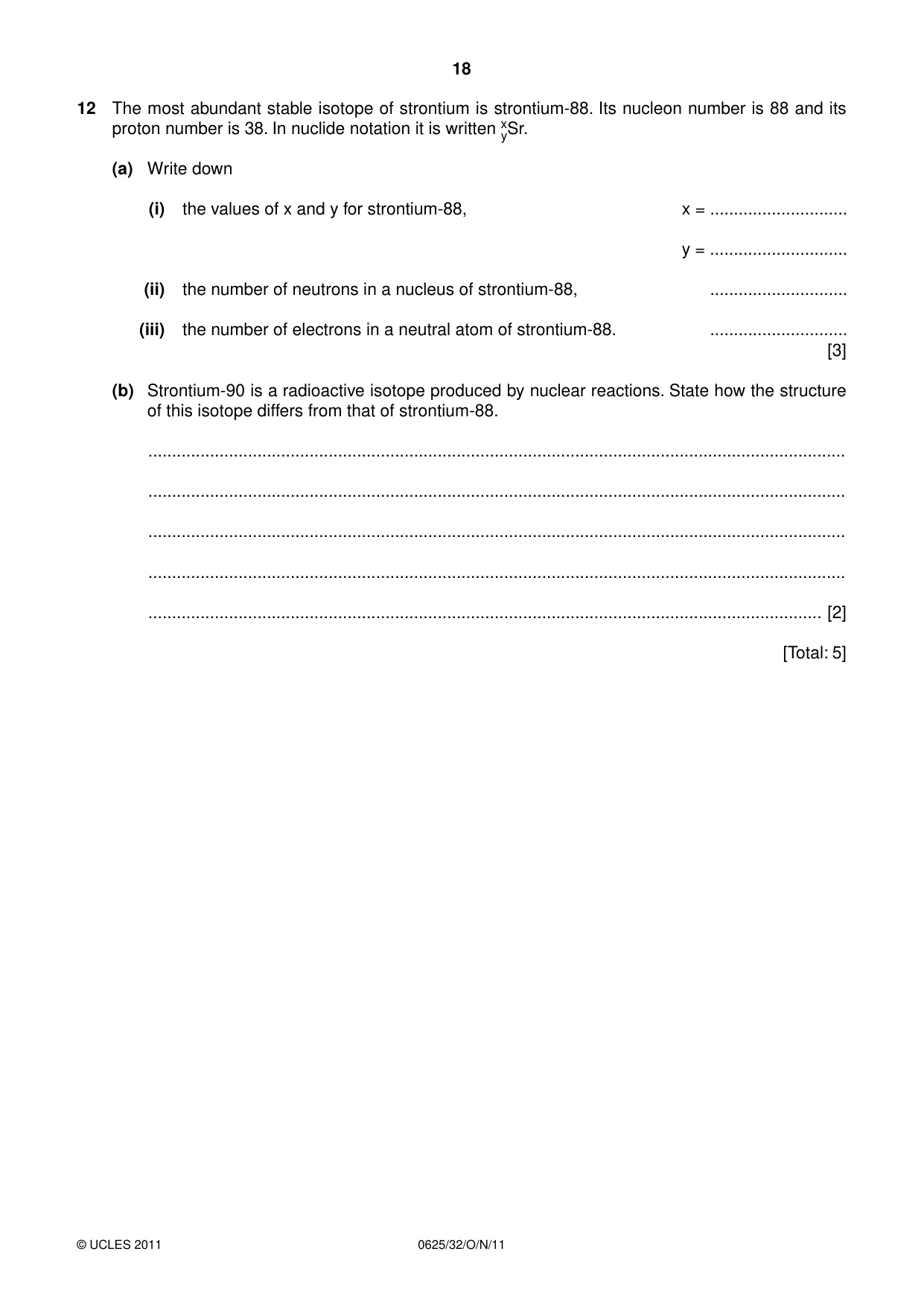

Mark scheme7 pages
Answers below. Sit the paper first if you are practising.
Questions as text
Q1 · A simple pendulum being used by a student to investigate the energy changes at various…
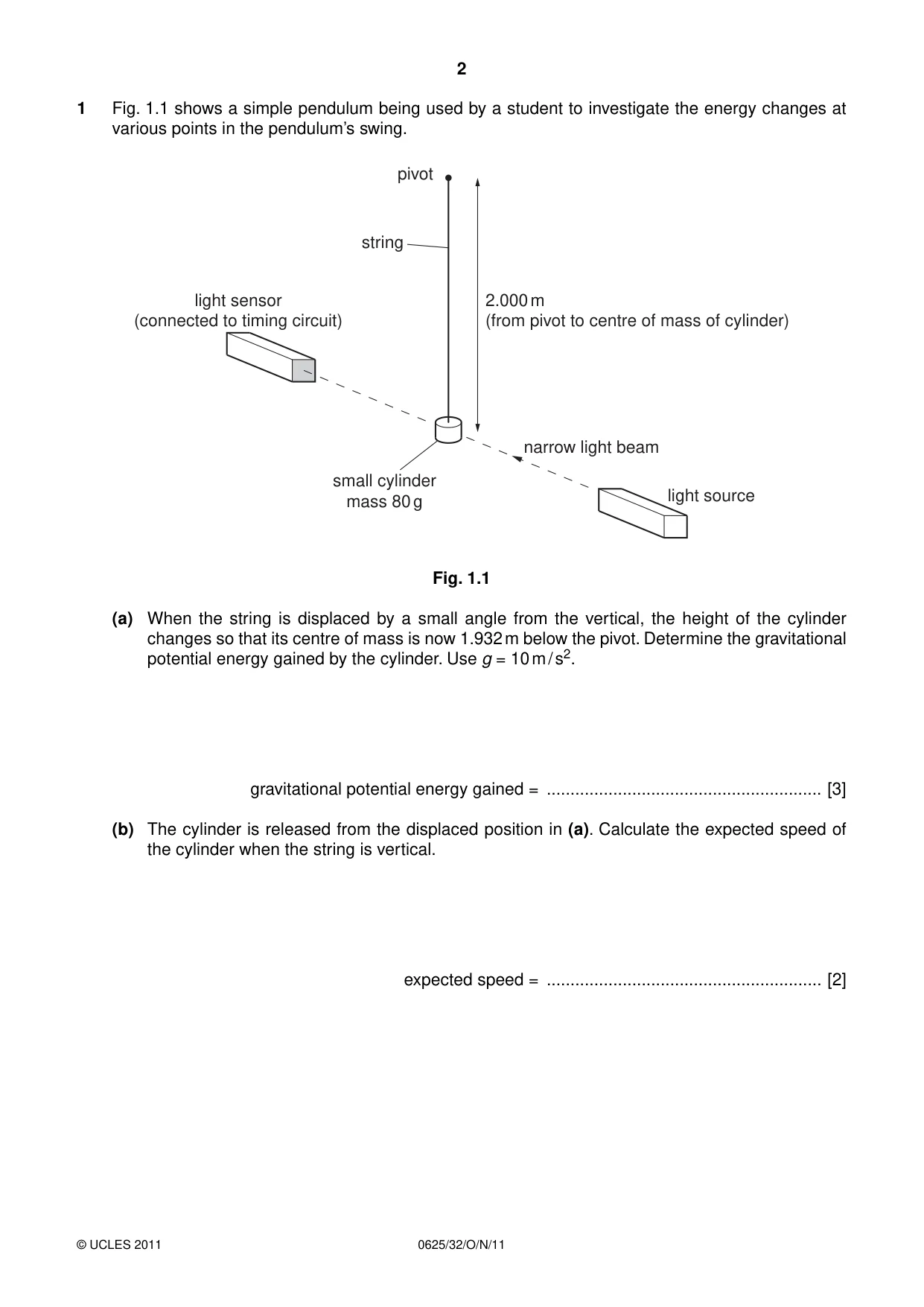
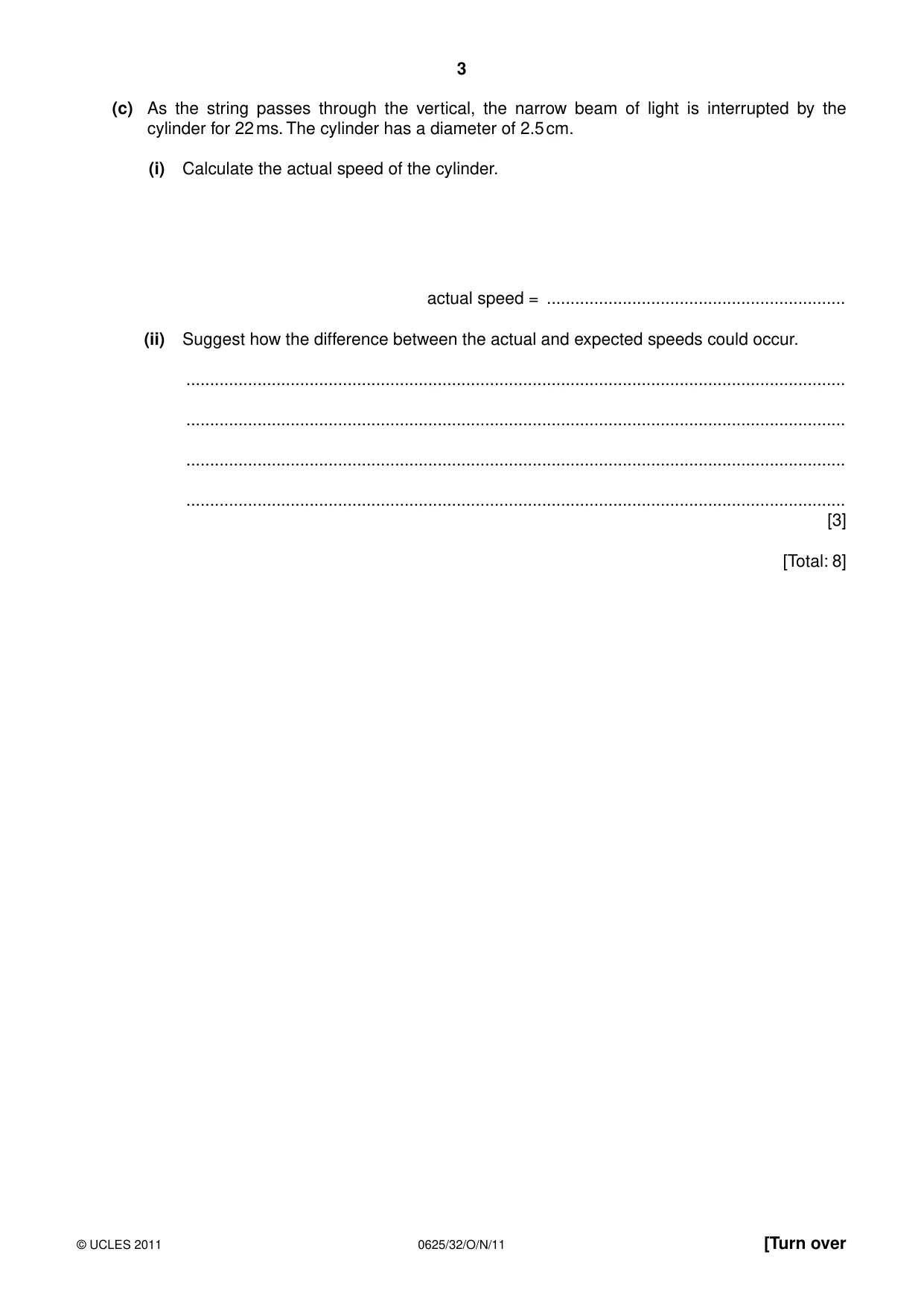
1 Fig. 1.1 shows a simple pendulum being used by a student to investigate the energy changes at various points in the pendulum’s swing. pivot string light sensor 2.000 m (connected to timing circuit) (from pivot to centre of mass of cylinder) narrow light beam small cylinder light source mass 80 g Fig. 1.1 (a) When the string is displaced by a small angle from the vertical, the height of the cylinder changes so that its centre of mass is now 1.932 m below the pivot. Determine the gravitational potential energy gained by the cylinder. Use g = 10 m / s2. gravitational potential energy gained = .......................................................... [3] (b) The cylinder is released from the displaced position in (a). Calculate the expected speed of the cylinder when the string is vertical. expected speed = .......................................................... [2] (c) As the string passes through the vertical, the narrow beam of light is interrupted by the cylinder for 22 ms. The cylinder has a diameter of 2.5 cm. (i) Calculate the actual speed of the cylinder. actual speed = ............................................................... (ii) Suggest how the difference between the actual and expected speeds could occur. ........................................................................................................................................... ........................................................................................................................................... ........................................................................................................................................... ........................................................................................................................................... [3] [Total: 8]
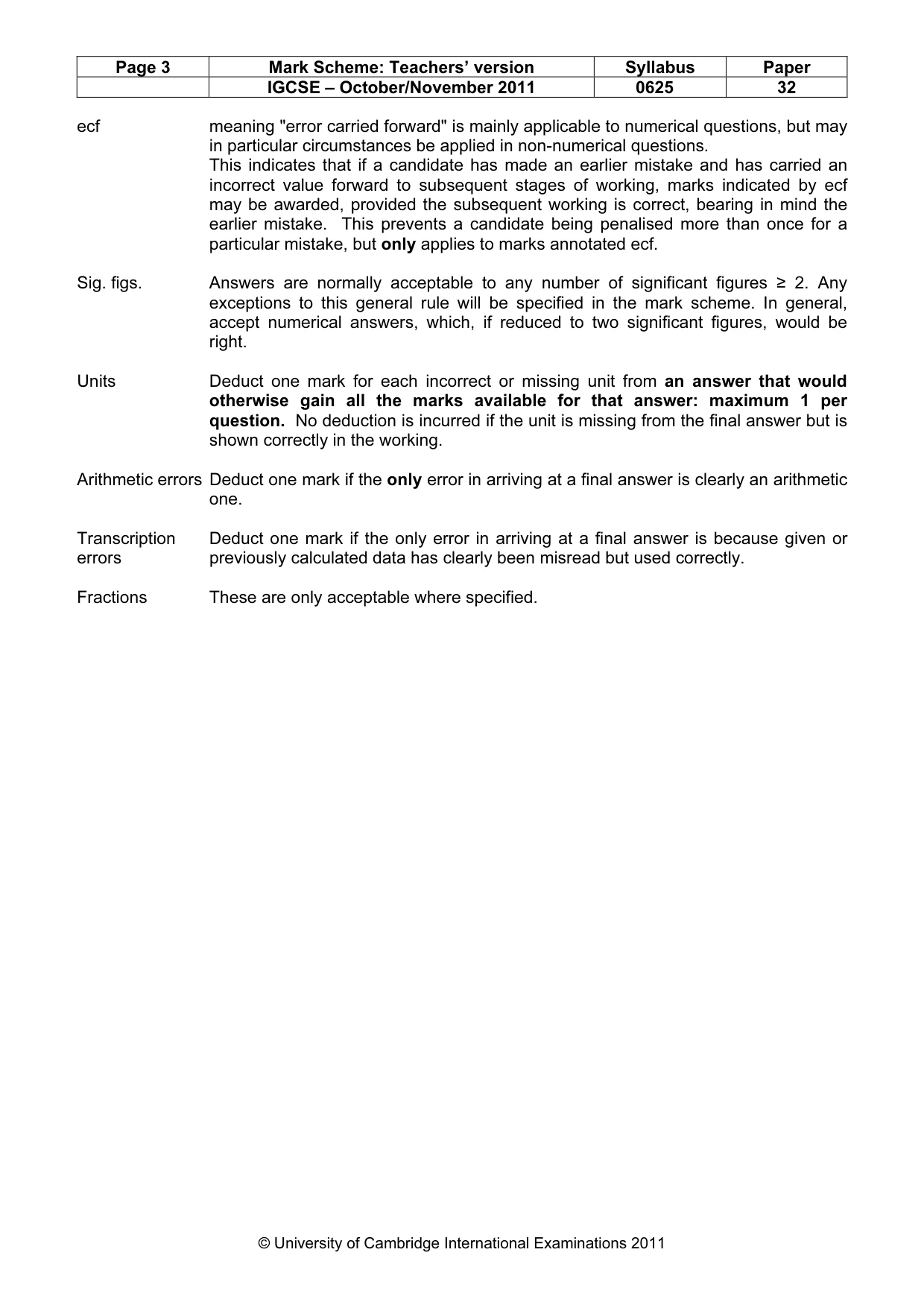
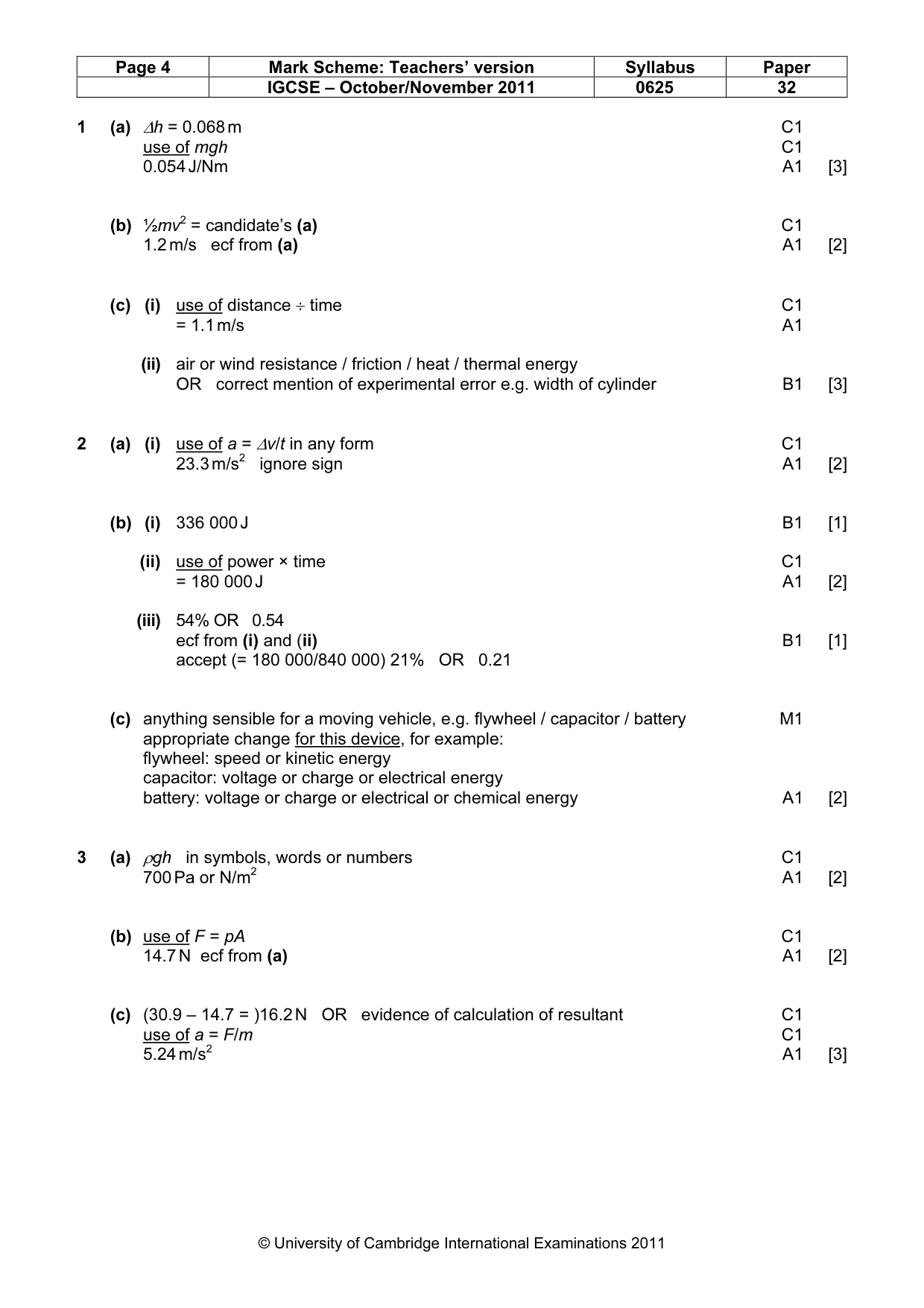
Mark scheme: 1 (a) ∆h = 0.068 m C1 use of mgh C1 0.054 J/Nm A1 [3] (b) ½mv2 = candidate’s (a) C1 1.2 m/s ecf from (a) A1 [2] (c) (i) use of distance ÷ time C1 = 1.1 m/s A1 (ii) air or wind resistance / friction / heat / thermal energy OR correct mention of experimental error e.g. width of cylinder B1 [3]
Q2 · The racing car shown in Fig
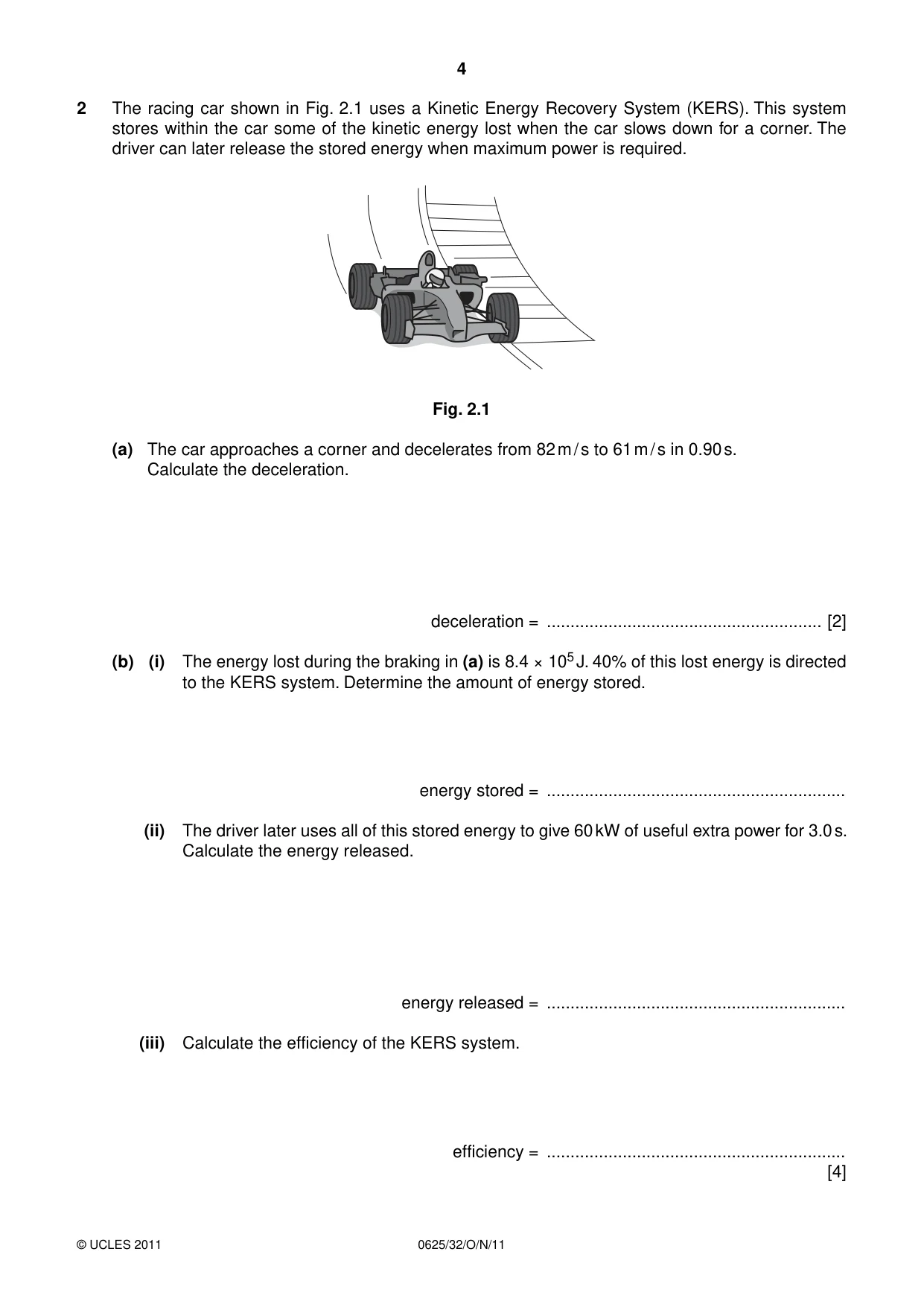
2 The racing car shown in Fig. 2.1 uses a Kinetic Energy Recovery System (KERS). This system stores within the car some of the kinetic energy lost when the car slows down for a corner. The driver can later release the stored energy when maximum power is required. Fig. 2.1 (a) The car approaches a corner and decelerates from 82 m / s to 61 m / s in 0.90 s. Calculate the deceleration. deceleration = .......................................................... [2] (b) (i) The energy lost during the braking in (a) is 8.4 × 10⁵ J. 40% of this lost energy is directed to the KERS system. Determine the amount of energy stored. energy stored = ............................................................... (ii) The driver later uses all of this stored energy to give 60 kW of useful extra power for 3.0 s. Calculate the energy released. energy released = ............................................................... (iii) Calculate the efficiency of the KERS system. efficiency = ............................................................... [4] (c) Suggest a possible device to store energy when a moving vehicle slows down. For this device, state the change that occurs as more energy is stored. device ....................................................................................................................................... change ...................................................................................................................................... ................................................................................................................................................... .............................................................................................................................................. [2] [Total: 8]
Mark scheme: 2 (a) (i) use of a = ∆v/t in any form C1 23.3 m/s2 ignore sign A1 [2] (b) (i) 336 000 J B1 [1] (ii) use of power × time C1 = 180 000 J A1 [2] (iii) 54% OR 0.54 ecf from (i) and (ii) B1 [1] accept (= 180 000/840 000) 21% OR 0.21 (c) anything sensible for a moving vehicle, e.g. flywheel / capacitor / battery M1 appropriate change for this device, for example: flywheel: speed or kinetic energy capacitor: voltage or charge or electrical energy battery: voltage or charge or electrical or chemical energy A1 [2]
Q3 · A house brick of dimensions 21.0 cm × 10.0 cm × 7.00 cm
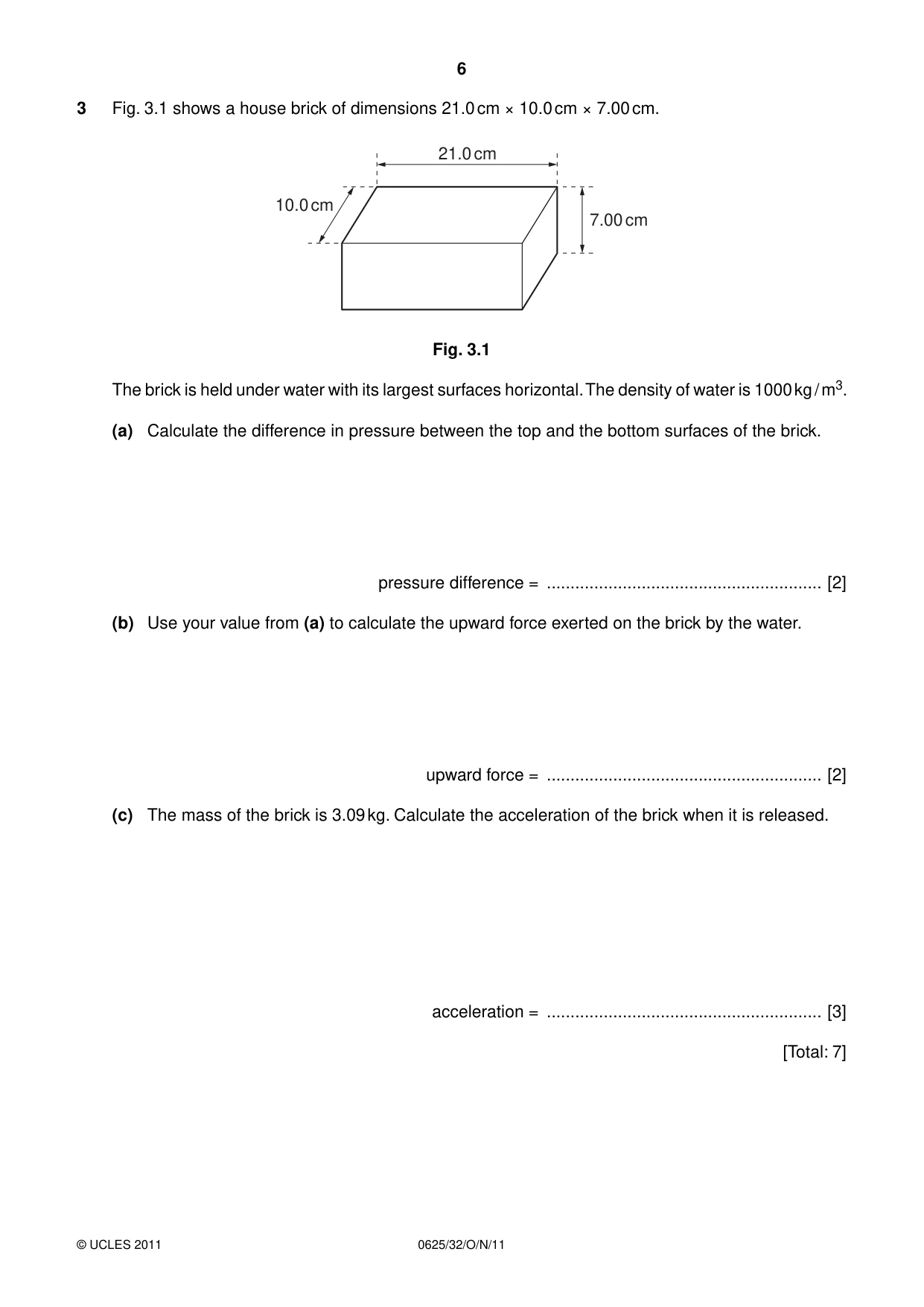
3 Fig. 3.1 shows a house brick of dimensions 21.0 cm × 10.0 cm × 7.00 cm. 21.0 cm 10.0 cm 7.00 cm Fig. 3.1 The brick is held under water with its largest surfaces horizontal. The density of water is 1000 kg / m3. (a) Calculate the difference in pressure between the top and the bottom surfaces of the brick. pressure difference = .......................................................... [2] (b) Use your value from (a) to calculate the upward force exerted on the brick by the water. upward force = .......................................................... [2] (c) The mass of the brick is 3.09 kg. Calculate the acceleration of the brick when it is released. acceleration = .......................................................... [3] [Total: 7]
Mark scheme: 3 (a) ρgh in symbols, words or numbers C1 700 Pa or N/m2 A1 [2] (b) use of F = pA C1 14.7 N ecf from (a) A1 [2] (c) (30.9 – 14.7 = )16.2 N OR evidence of calculation of resultant C1 use of a = F/m C1 5.24 m/s2 A1 [3] IGCSE – October/November 2011 0625 32
Q4 · A sealed balloon containing some helium gas is released and rises into the upper…
4 A sealed balloon containing some helium gas is released and rises into the upper atmosphere. As the balloon rises the temperature of the helium falls and the balloon expands. Explain, in terms of atoms, (a) the effect of the fall in temperature on the helium pressure, ................................................................................................................................................... ................................................................................................................................................... ................................................................................................................................................... ................................................................................................................................................... .............................................................................................................................................. [3] (b) the effect of the expansion of the balloon on the helium pressure. ................................................................................................................................................... ................................................................................................................................................... ................................................................................................................................................... ................................................................................................................................................... .............................................................................................................................................. [3] [Total: 6]
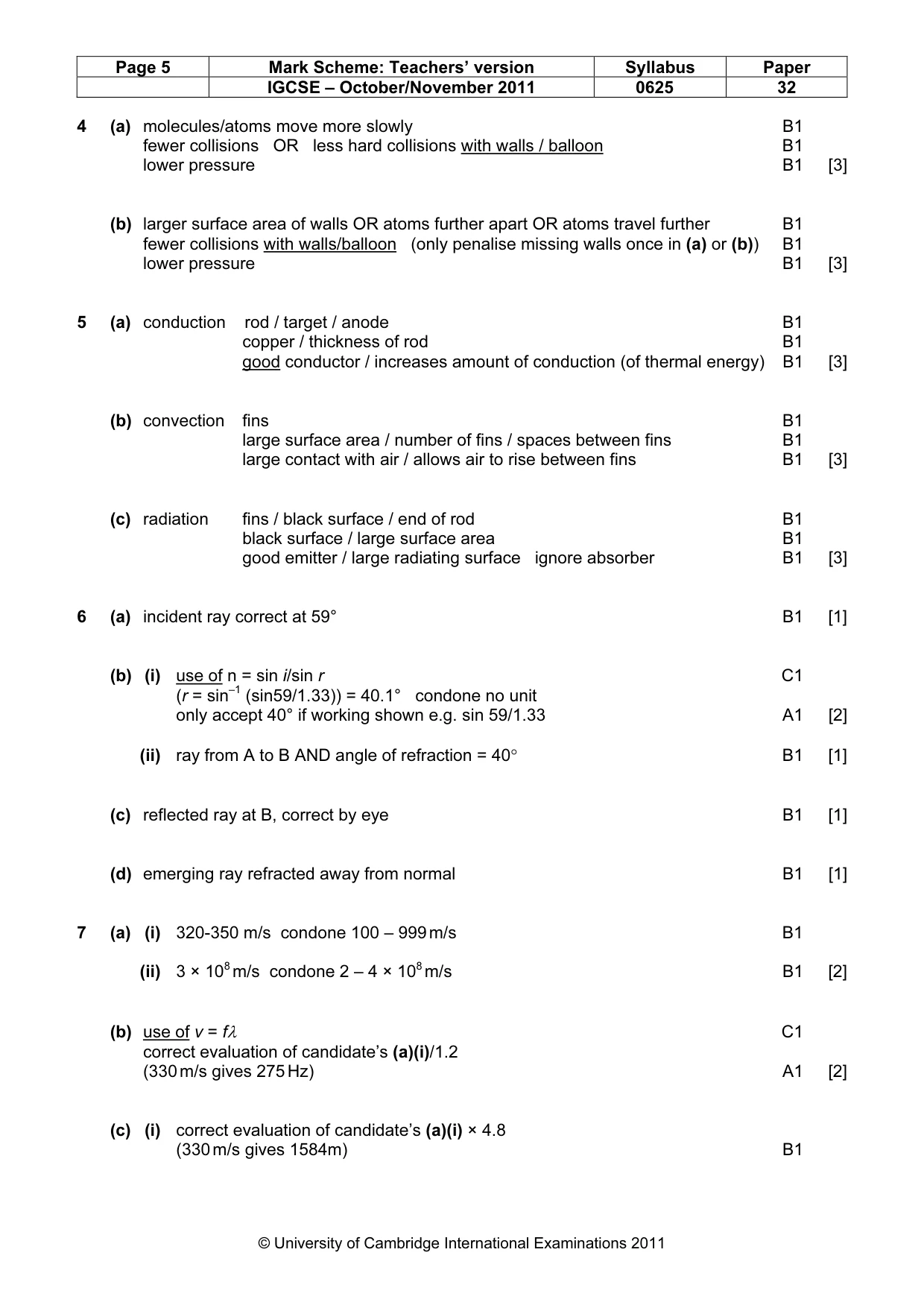
Mark scheme: 4 (a) molecules/atoms move more slowly B1 fewer collisions OR less hard collisions with walls / balloon B1 lower pressure B1 [3] (b) larger surface area of walls OR atoms further apart OR atoms travel further B1 fewer collisions with walls/balloon (only penalise missing walls once in (a) or (b)) B1 lower pressure B1 [3]
Question 5
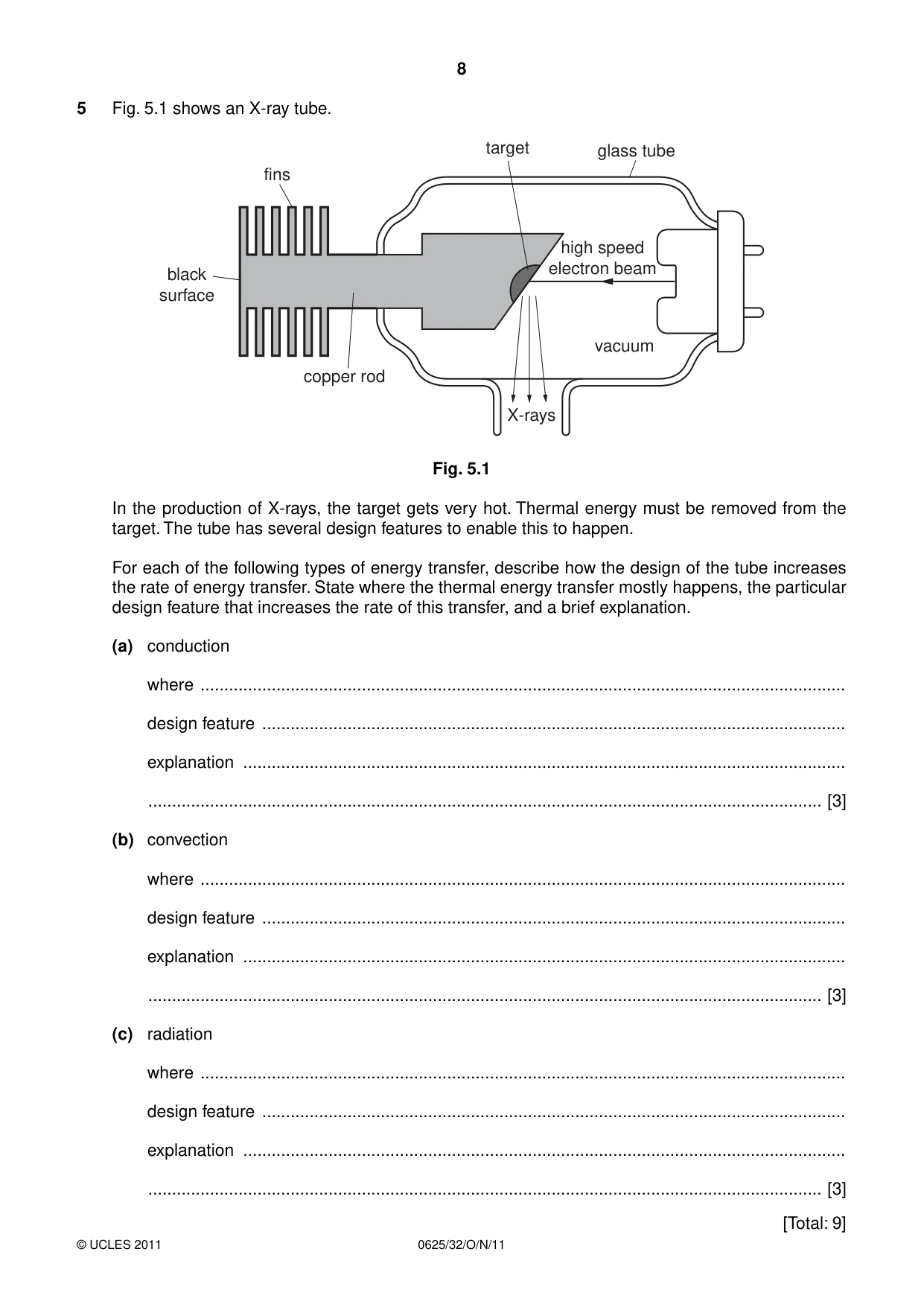
5 Fig. 5.1 shows an X-ray tube. target glass tube fins high speed electron beam black surface vacuum copper rod X-rays Fig. 5.1 In the production of X-rays, the target gets very hot. Thermal energy must be removed from the target. The tube has several design features to enable this to happen. For each of the following types of energy transfer, describe how the design of the tube increases the rate of energy transfer. State where the thermal energy transfer mostly happens, the particular design feature that increases the rate of this transfer, and a brief explanation. (a) conduction where ........................................................................................................................................ design feature ........................................................................................................................... explanation ............................................................................................................................... .............................................................................................................................................. [3] (b) convection where ........................................................................................................................................ design feature ........................................................................................................................... explanation ............................................................................................................................... .............................................................................................................................................. [3] (c) radiation where ........................................................................................................................................ design feature ........................................................................................................................... explanation ............................................................................................................................... .............................................................................................................................................. [3] [Total: 9]
Mark scheme: 5 (a) conduction rod / target / anode B1 copper / thickness of rod B1 good conductor / increases amount of conduction (of thermal energy) B1 [3] (b) convection fins B1 large surface area / number of fins / spaces between fins B1 large contact with air / allows air to rise between fins B1 [3] (c) radiation fins / black surface / end of rod B1 black surface / large surface area B1 good emitter / large radiating surface ignore absorber B1 [3]
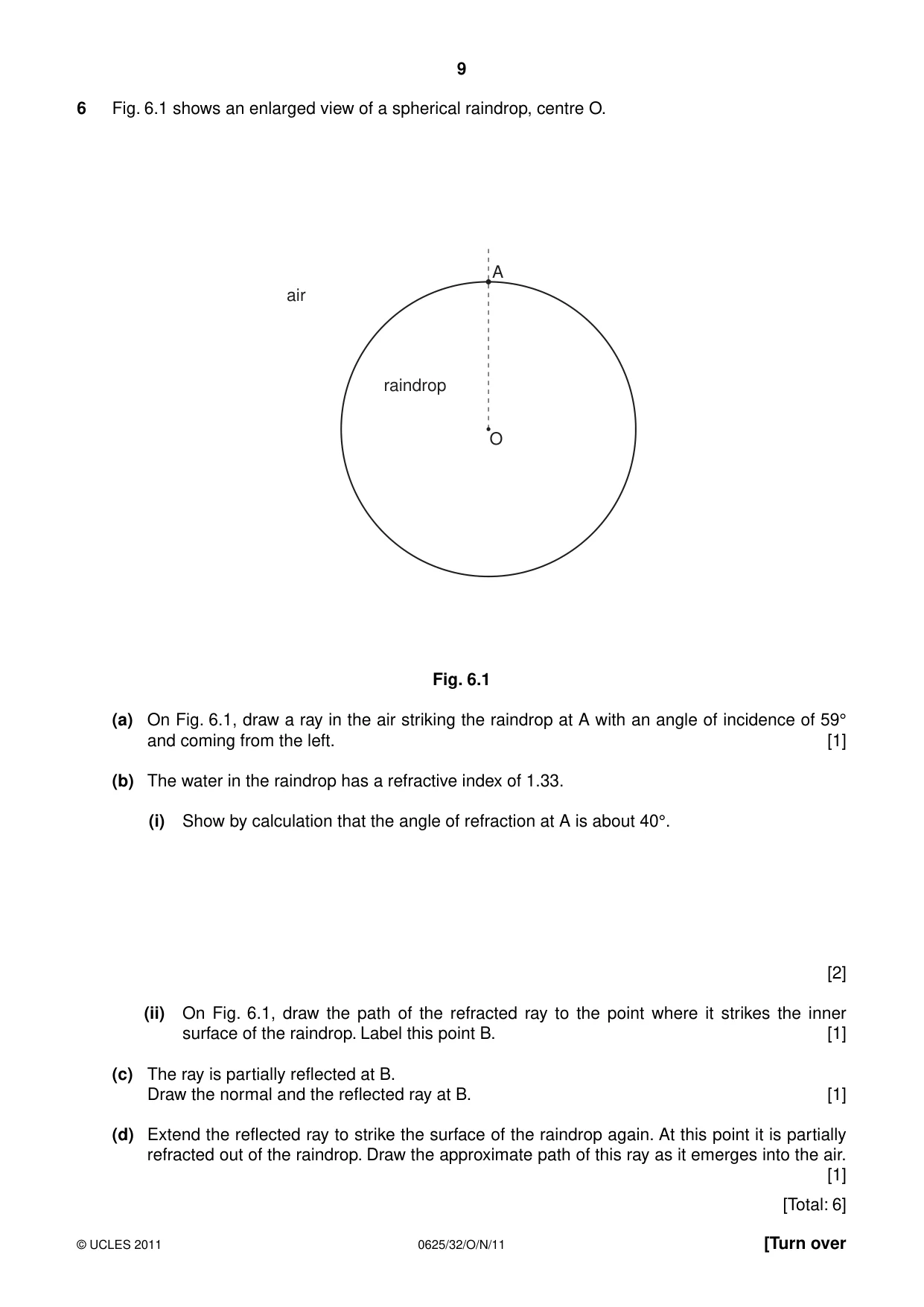
Q6 · An enlarged view of a spherical raindrop, centre O
6 Fig. 6.1 shows an enlarged view of a spherical raindrop, centre O. A air raindrop O Fig. 6.1 (a) On Fig. 6.1, draw a ray in the air striking the raindrop at A with an angle of incidence of 59° and coming from the left. [1] (b) The water in the raindrop has a refractive index of 1.33. (i) Show by calculation that the angle of refraction at A is about 40°. [2] (ii) On Fig. 6.1, draw the path of the refracted ray to the point where it strikes the inner surface of the raindrop. Label this point B. [1] (c) The ray is partially reflected at B. Draw the normal and the reflected ray at B. [1] (d) Extend the reflected ray to strike the surface of the raindrop again. At this point it is partially refracted out of the raindrop. Draw the approximate path of this ray as it emerges into the air. [1] [Total: 6]
Mark scheme: 6 (a) incident ray correct at 59° B1 [1] (b) (i) use of n = sin i/sin r C1 (r = sin–1 (sin59/1.33)) = 40.1° condone no unit only accept 40° if working shown e.g. sin 59/1.33 A1 [2] (ii) ray from A to B AND angle of refraction = 40° B1 [1] (c) reflected ray at B, correct by eye B1 [1] (d) emerging ray refracted away from normal B1 [1]
Q7 · State an approximate value for (i) the speed of sound in air…
7 (a) State an approximate value for (i) the speed of sound in air, ................................................................. (ii) the speed of light in air. ................................................................. [2] (b) Use your value from (a)(i) to calculate the frequency of a sound wave that has a wavelength of 1.2 m. frequency = .......................................................... [2] (c) A meteorologist observes an approaching thunderstorm and records a time difference of 4.8 s between seeing a lightning flash and hearing the thunder that follows. (i) Calculate the distance of the thunderstorm from the meteorologist. distance = ............................................................... (ii) State an assumption you made when calculating this distance. ........................................................................................................................................... ........................................................................................................................................... ........................................................................................................................................... [2] [Total: 6]
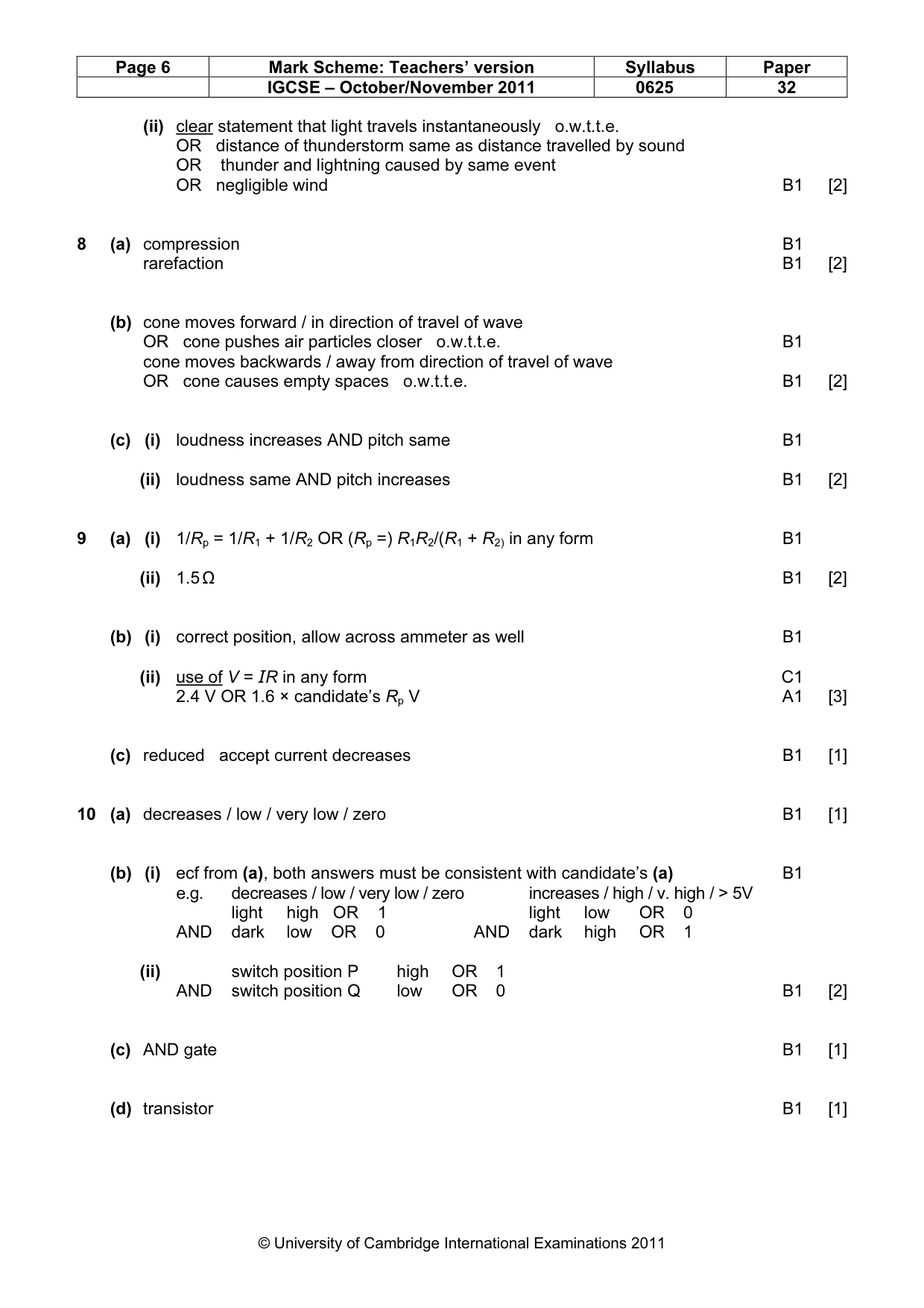
Mark scheme: 7 (a) (i) 320-350 m/s condone 100 – 999 m/s B1 (ii) 3 × 10⁸ m/s condone 2 – 4 × 10⁸ m/s B1 [2] (b) use of v = fλ C1 correct evaluation of candidate’s (a)(i)/1.2 (330 m/s gives 275 Hz) A1 [2] (c) (i) correct evaluation of candidate’s (a)(i) × 4.8 (330 m/s gives 1584m) B1 IGCSE – October/November 2011 0625 32 (ii) clear statement that light travels instantaneously o.w.t.t.e. OR distance of thunderstorm same as distance travelled by sound OR thunder and lightning caused by same event OR negligible wind B1 [2]
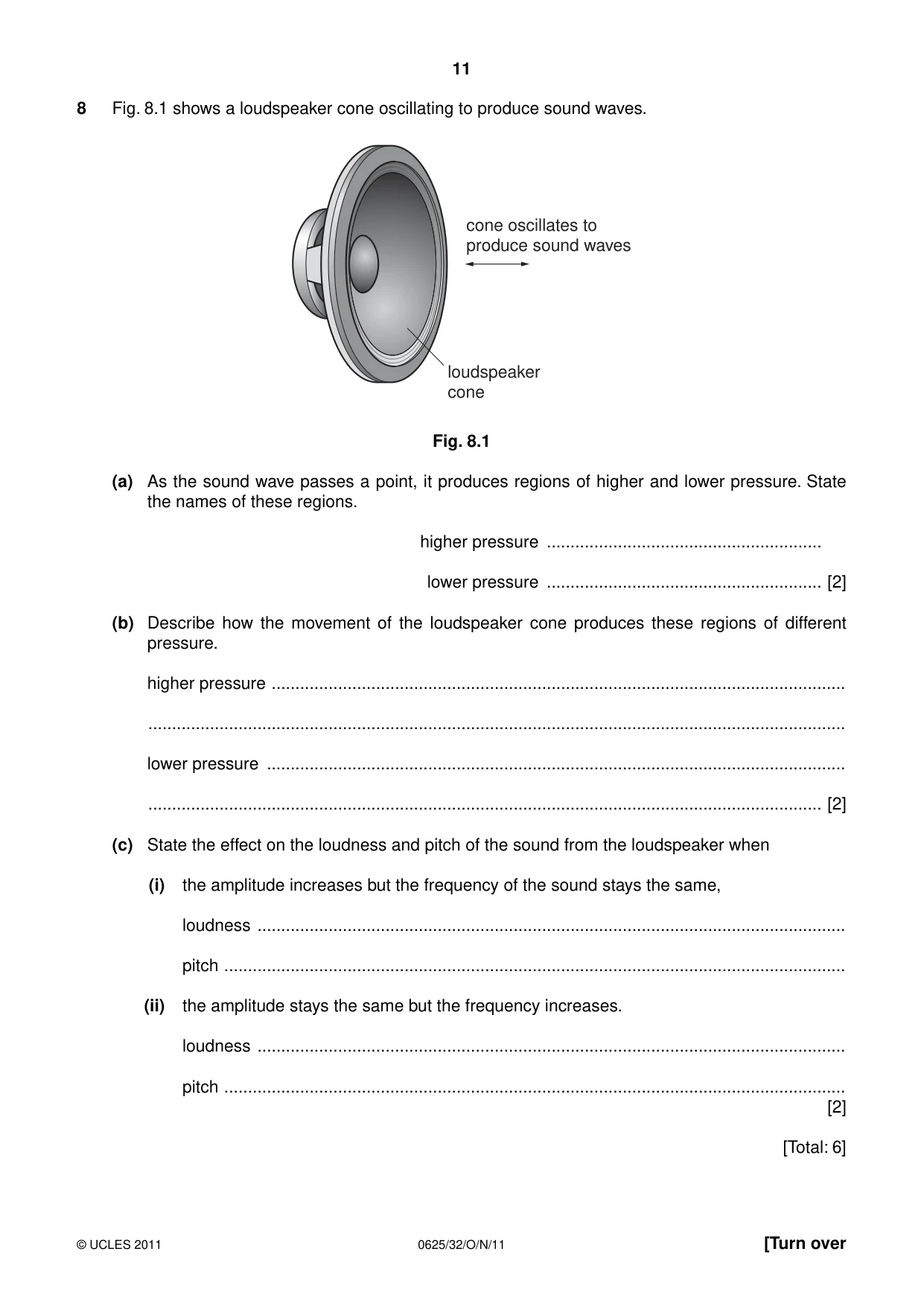
Q8 · A loudspeaker cone oscillating to produce sound waves
8 Fig. 8.1 shows a loudspeaker cone oscillating to produce sound waves. cone oscillates to produce sound waves loudspeaker cone Fig. 8.1 (a) As the sound wave passes a point, it produces regions of higher and lower pressure. State the names of these regions. higher pressure .......................................................... lower pressure .......................................................... [2] (b) Describe how the movement of the loudspeaker cone produces these regions of different pressure. higher pressure ......................................................................................................................... ................................................................................................................................................... lower pressure .......................................................................................................................... .............................................................................................................................................. [2] (c) State the effect on the loudness and pitch of the sound from the loudspeaker when (i) the amplitude increases but the frequency of the sound stays the same, loudness ............................................................................................................................ pitch ................................................................................................................................... (ii) the amplitude stays the same but the frequency increases. loudness ............................................................................................................................ pitch ................................................................................................................................... [2] [Total: 6]
Mark scheme: 8 (a) compression B1 rarefaction B1 [2] (b) cone moves forward / in direction of travel of wave OR cone pushes air particles closer o.w.t.t.e. B1 cone moves backwards / away from direction of travel of wave OR cone causes empty spaces o.w.t.t.e. B1 [2] (c) (i) loudness increases AND pitch same B1 (ii) loudness same AND pitch increases B1 [2]
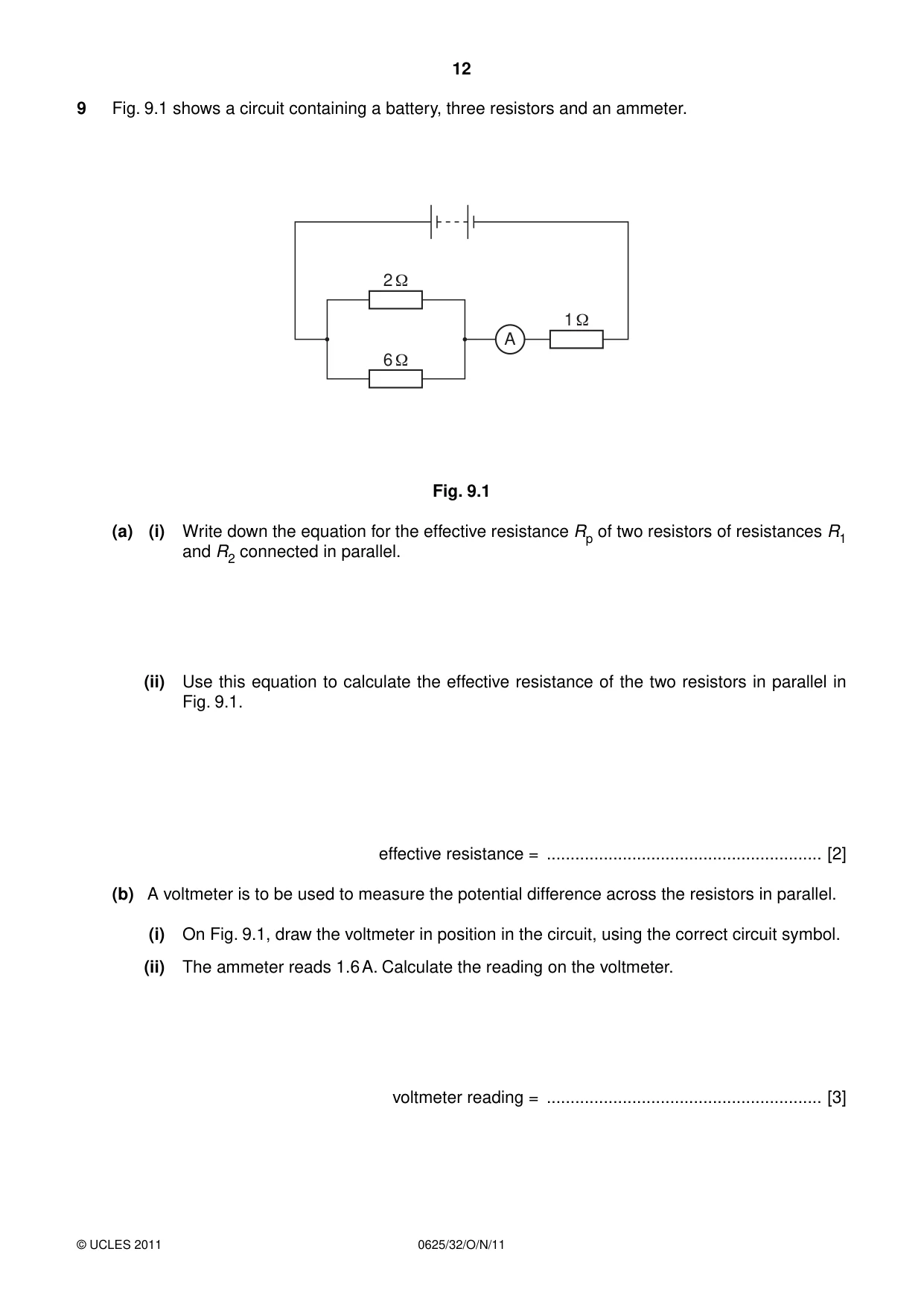
Q9 · A circuit containing a battery, three resistors and an ammeter
9 Fig. 9.1 shows a circuit containing a battery, three resistors and an ammeter. 2 Ω 1 Ω A 6 Ω Fig. 9.1 (a) (i) Write down the equation for the effective resistance Rp of two resistors of resistances R1 and R2 connected in parallel. (ii) Use this equation to calculate the effective resistance of the two resistors in parallel in Fig. 9.1. effective resistance = .......................................................... [2] (b) A voltmeter is to be used to measure the potential difference across the resistors in parallel. (i) On Fig. 9.1, draw the voltmeter in position in the circuit, using the correct circuit symbol. (ii) The ammeter reads 1.6 A. Calculate the reading on the voltmeter. voltmeter reading = .......................................................... [3] (c) State what happens to the ammeter reading if the 1 Ω resistor is replaced by a 3 Ω resistor. ................................................................................................................................................... .............................................................................................................................................. [1] [Total: 6]
Mark scheme: 9 (a) (i) 1/Rp = 1/R1 + 1/R2 OR (Rp =) R1R2/(R1 + R2) in any form B1 (ii) 1.5 Ω B1 [2] (b) (i) correct position, allow across ammeter as well B1 (ii) use of V = IR in any form C1 2.4 V OR 1.6 × candidate’s Rp V A1 [3] (c) reduced accept current decreases B1 [1]
Q10 · The circuit shown in Fig
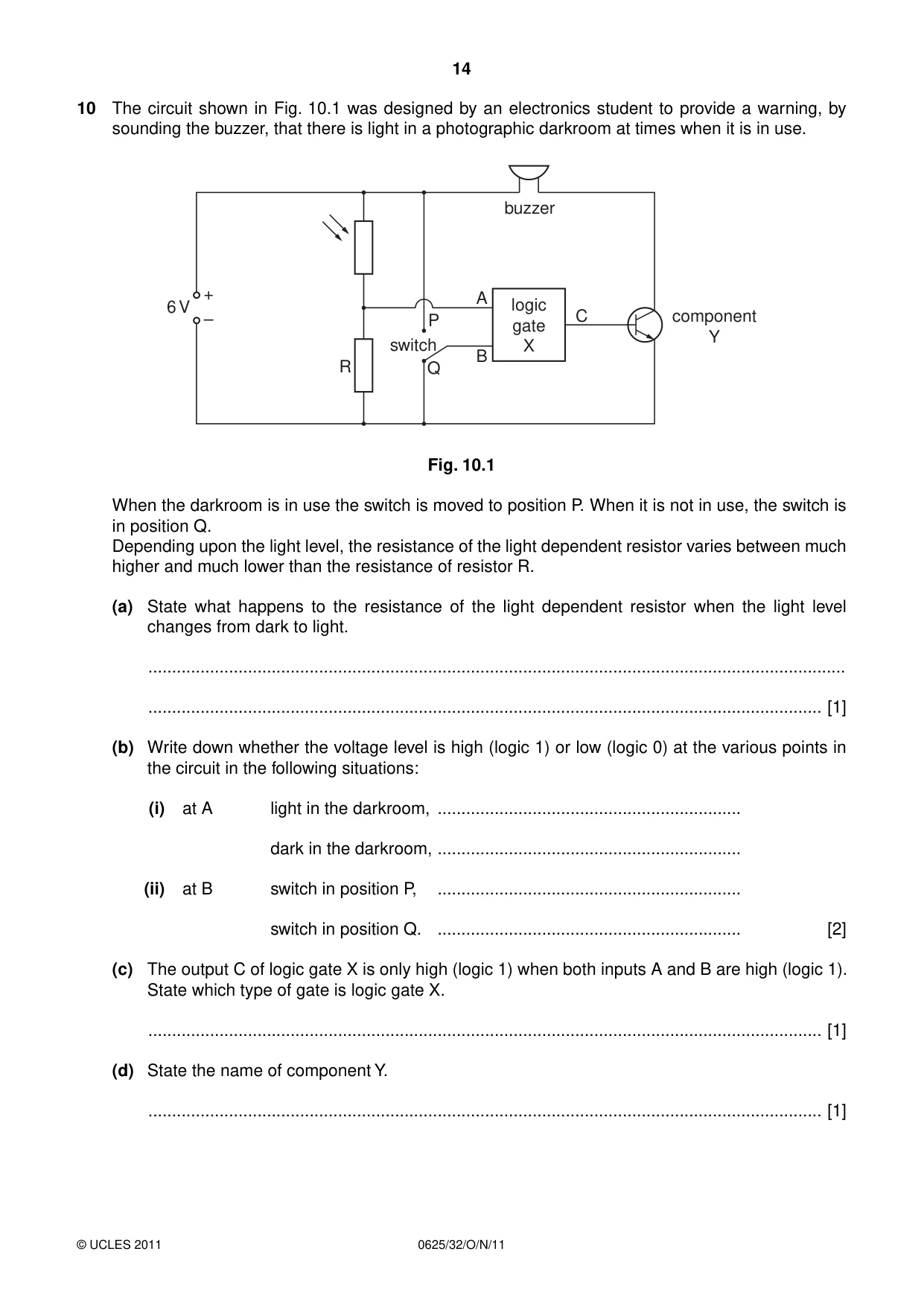
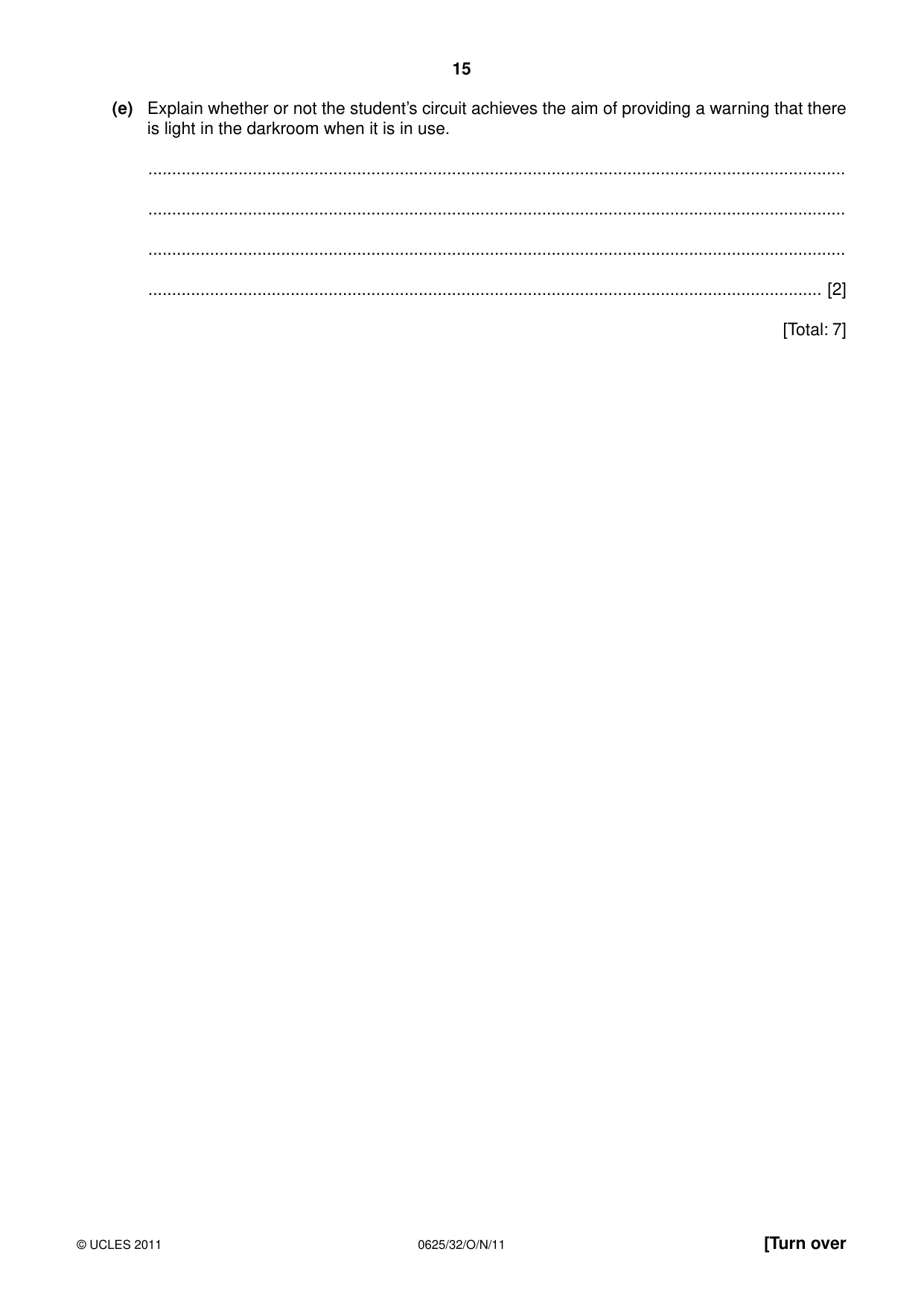
10 The circuit shown in Fig. 10.1 was designed by an electronics student to provide a warning, by sounding the buzzer, that there is light in a photographic darkroom at times when it is in use. buzzer + A 6 V logic – P C component gate Y switch X B R Q Fig. 10.1 When the darkroom is in use the switch is moved to position P. When it is not in use, the switch is in position Q. Depending upon the light level, the resistance of the light dependent resistor varies between much higher and much lower than the resistance of resistor R. (a) State what happens to the resistance of the light dependent resistor when the light level changes from dark to light. ................................................................................................................................................... .............................................................................................................................................. [1] (b) Write down whether the voltage level is high (logic 1) or low (logic 0) at the various points in the circuit in the following situations: (i) at A light in the darkroom, ................................................................ dark in the darkroom, ................................................................ (ii) at B switch in position P, ................................................................ switch in position Q. ................................................................ [2] (c) The output C of logic gate X is only high (logic 1) when both inputs A and B are high (logic 1). State which type of gate is logic gate X. .............................................................................................................................................. [1] (d) State the name of component Y. .............................................................................................................................................. [1] (e) Explain whether or not the student’s circuit achieves the aim of providing a warning that there is light in the darkroom when it is in use. ................................................................................................................................................... ................................................................................................................................................... ................................................................................................................................................... .............................................................................................................................................. [2] [Total: 7]
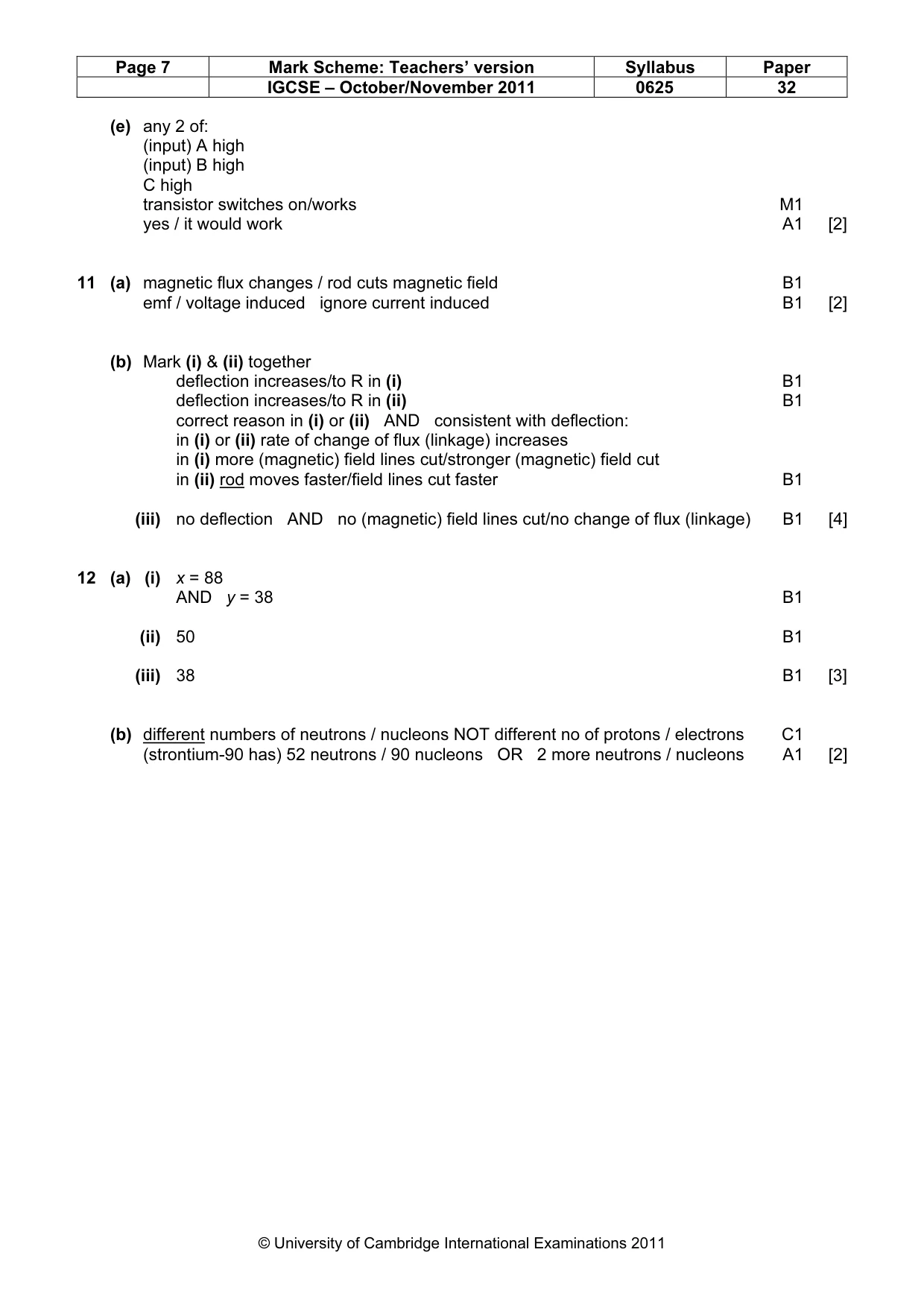
Mark scheme: 10 (a) decreases / low / very low / zero B1 [1] (b) (i) ecf from (a), both answers must be consistent with candidate’s (a) B1 e.g. decreases / low / very low / zero increases / high / v. high / > 5V light high OR 1 light low OR 0 AND dark low OR 0 AND dark high OR 1 (ii) switch position P high OR 1 AND switch position Q low OR 0 B1 [2] (c) AND gate B1 [1] (d) transistor B1 [1] IGCSE – October/November 2011 0625 32 (e) any 2 of: (input) A high (input) B high C high transistor switches on/works M1 yes / it would work A1 [2]
Q11 · In the laboratory demonstration shown in Fig
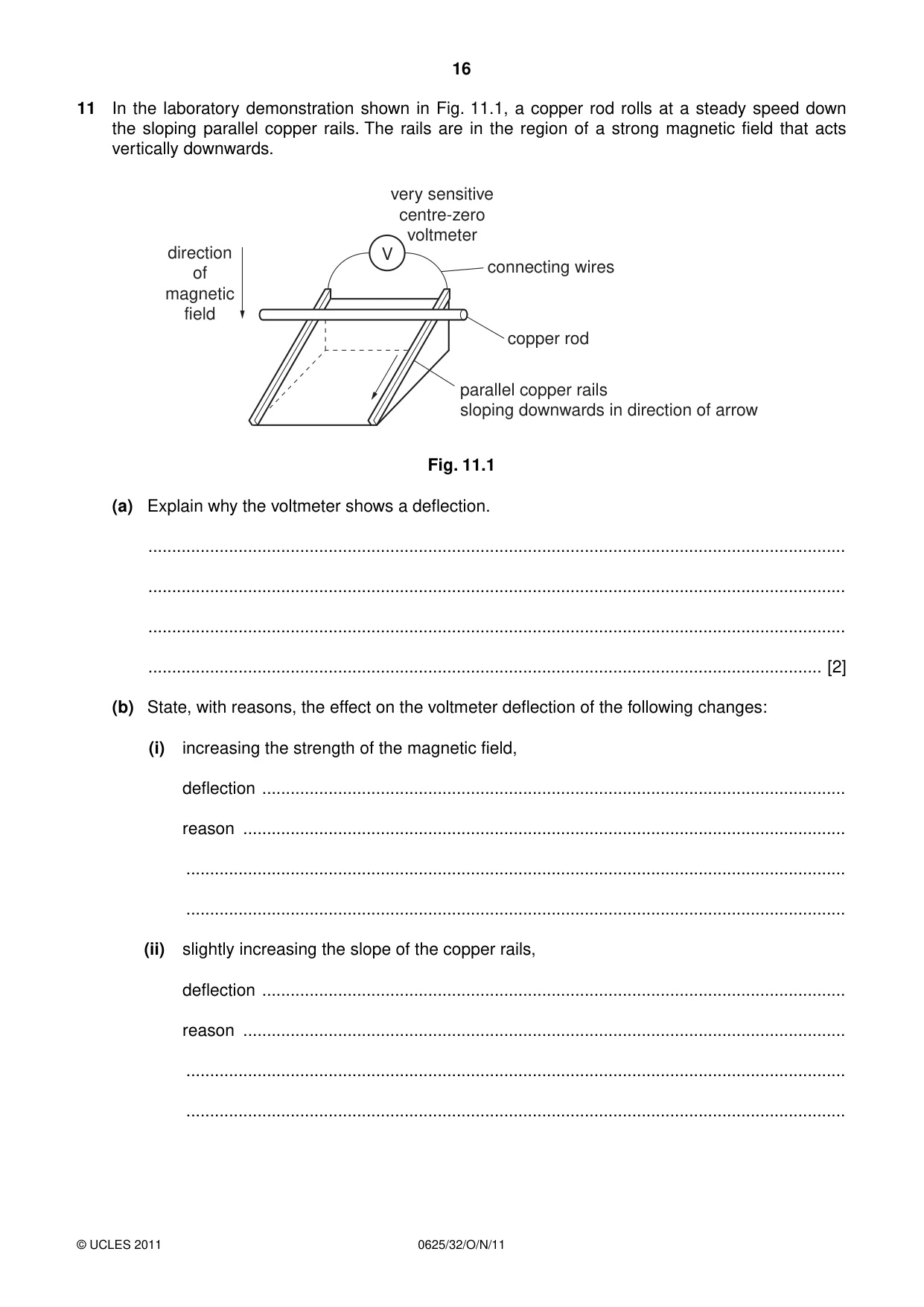
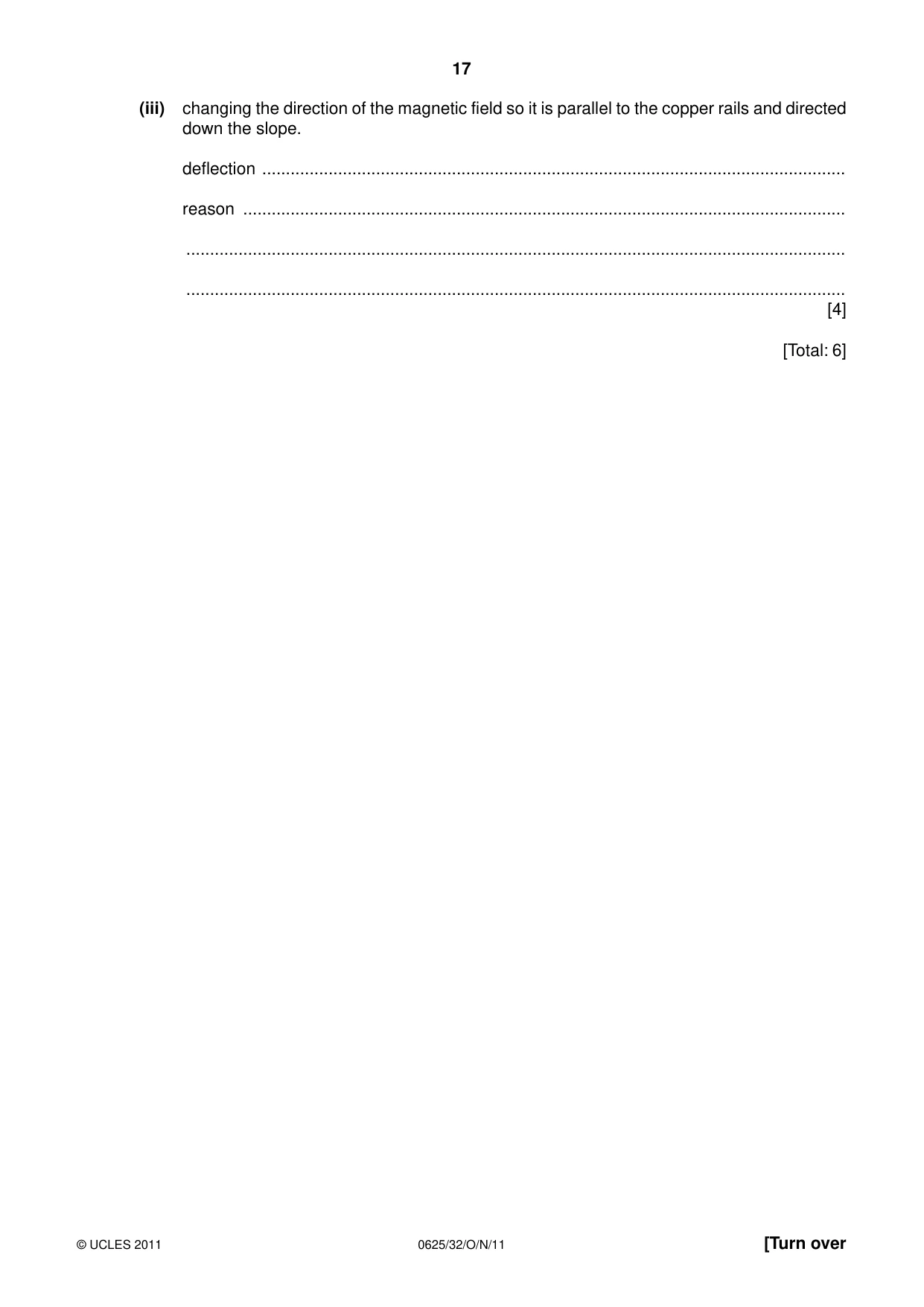
11 In the laboratory demonstration shown in Fig. 11.1, a copper rod rolls at a steady speed down the sloping parallel copper rails. The rails are in the region of a strong magnetic field that acts vertically downwards. very sensitive centre-zero voltmeter direction V connecting wires of magnetic field copper rod parallel copper rails sloping downwards in direction of arrow Fig. 11.1 (a) Explain why the voltmeter shows a deflection. ................................................................................................................................................... ................................................................................................................................................... ................................................................................................................................................... .............................................................................................................................................. [2] (b) State, with reasons, the effect on the voltmeter deflection of the following changes: (i) increasing the strength of the magnetic field, deflection ........................................................................................................................... reason ............................................................................................................................... ........................................................................................................................................... ........................................................................................................................................... (ii) slightly increasing the slope of the copper rails, deflection ........................................................................................................................... reason ............................................................................................................................... ........................................................................................................................................... ........................................................................................................................................... (iii) changing the direction of the magnetic field so it is parallel to the copper rails and directed down the slope. deflection ........................................................................................................................... reason ............................................................................................................................... ........................................................................................................................................... ........................................................................................................................................... [4] [Total: 6]
Mark scheme: 11 (a) magnetic flux changes / rod cuts magnetic field B1 emf / voltage induced ignore current induced B1 [2] (b) Mark (i) & (ii) together deflection increases/to R in (i) B1 deflection increases/to R in (ii) B1 correct reason in (i) or (ii) AND consistent with deflection: in (i) or (ii) rate of change of flux (linkage) increases in (i) more (magnetic) field lines cut/stronger (magnetic) field cut in (ii) rod moves faster/field lines cut faster B1 (iii) no deflection AND no (magnetic) field lines cut/no change of flux (linkage) B1 [4]
Q12 · The most abundant stable isotope of strontium is strontium-88
12 The most abundant stable isotope of strontium is strontium-88. Its nucleon number is 88 and its proton number is 38. In nuclide notation it is written xySr. (a) Write down (i) the values of x and y for strontium-88, x = ............................. y = ............................. (ii) the number of neutrons in a nucleus of strontium-88, ............................. (iii) the number of electrons in a neutral atom of strontium-88. ............................. [3] (b) Strontium-90 is a radioactive isotope produced by nuclear reactions. State how the structure of this isotope differs from that of strontium-88. ................................................................................................................................................... ................................................................................................................................................... ................................................................................................................................................... ................................................................................................................................................... .............................................................................................................................................. [2] [Total: 5]
Mark scheme: 12 (a) (i) x = 88 AND y = 38 B1 (ii) 50 B1 (iii) 38 B1 [3] (b) different numbers of neutrons / nucleons NOT different no of protons / electrons C1 (strontium-90 has) 52 neutrons / 90 nucleons OR 2 more neutrons / nucleons A1 [2]
What was in this paper
The subtopics covered by these 12 questions, and how many questions each got. Open one in a new tab to see every Cambridge question on it.
What you needed in this session
Cambridge’s own grade thresholds for 2011 Oct/Nov, Paper 3 · Variant 2. A higher threshold means an easier paper — the bar moves with how the cohort did.