Questions as text
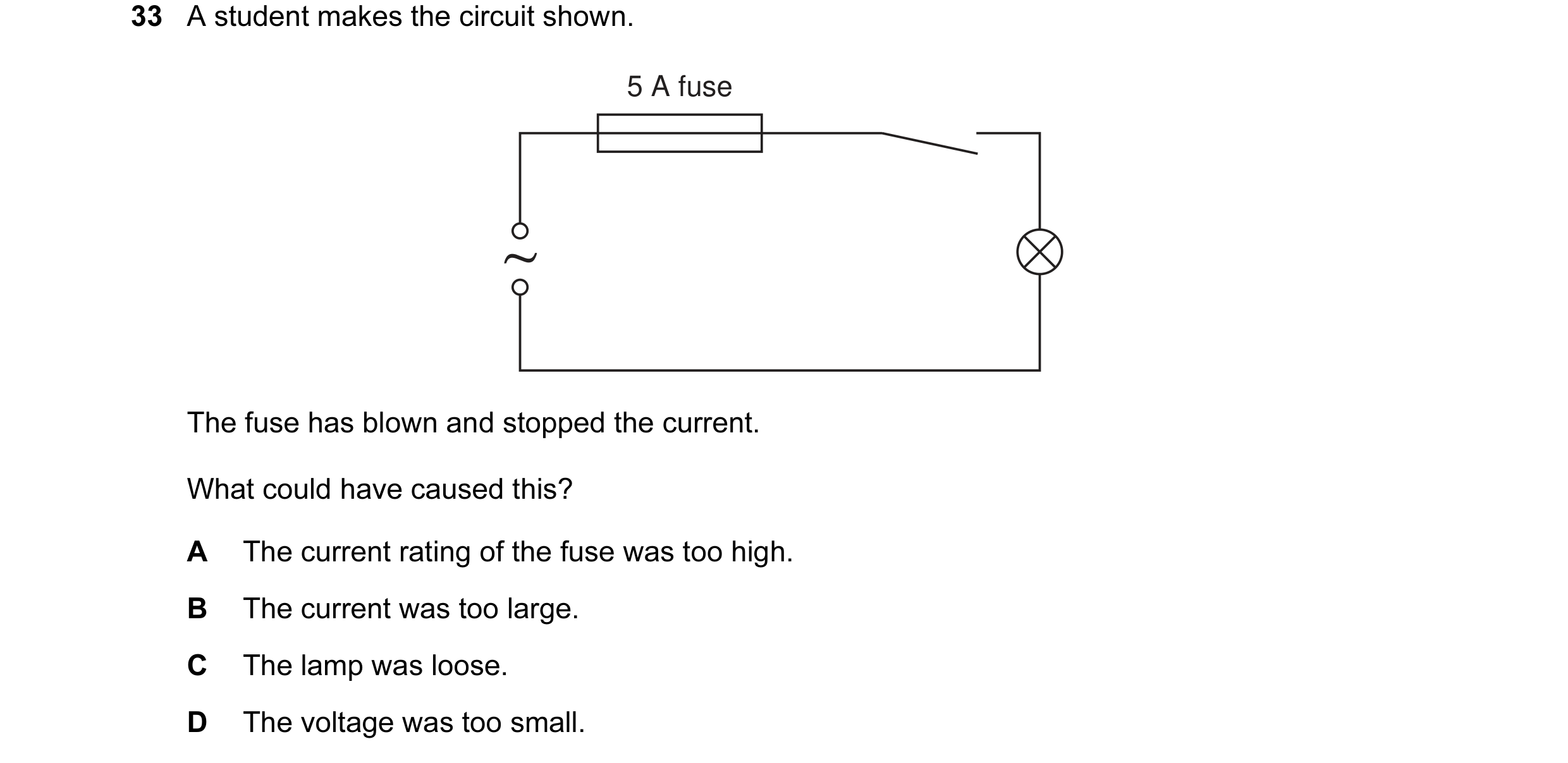
Q1 · A student makes the circuit shown 0625/11 May/June 2005
33 A student makes the circuit shown. 5 A fuse The fuse has blown and stopped the current. What could have caused this? A The current rating of the fuse was too high. B The current was too large. C The lamp was loose. D The voltage was too small.
1 marks
Answer: B
This question in 0625/11 May/June 2005
Q2 · Why are the electric lamps in a house lighting circuit normally connected in parallel? 0625/11 Oct/Nov 2005
32 Why are the electric lamps in a house lighting circuit normally connected in parallel? A The current in every circuit must be the same. B The lamps are always switched on and off at the same time. C The voltage across each lamp must be the mains voltage. D When one of the lamps blows, all the others go out.
1 marks
Answer: C
This question in 0625/11 Oct/Nov 2005
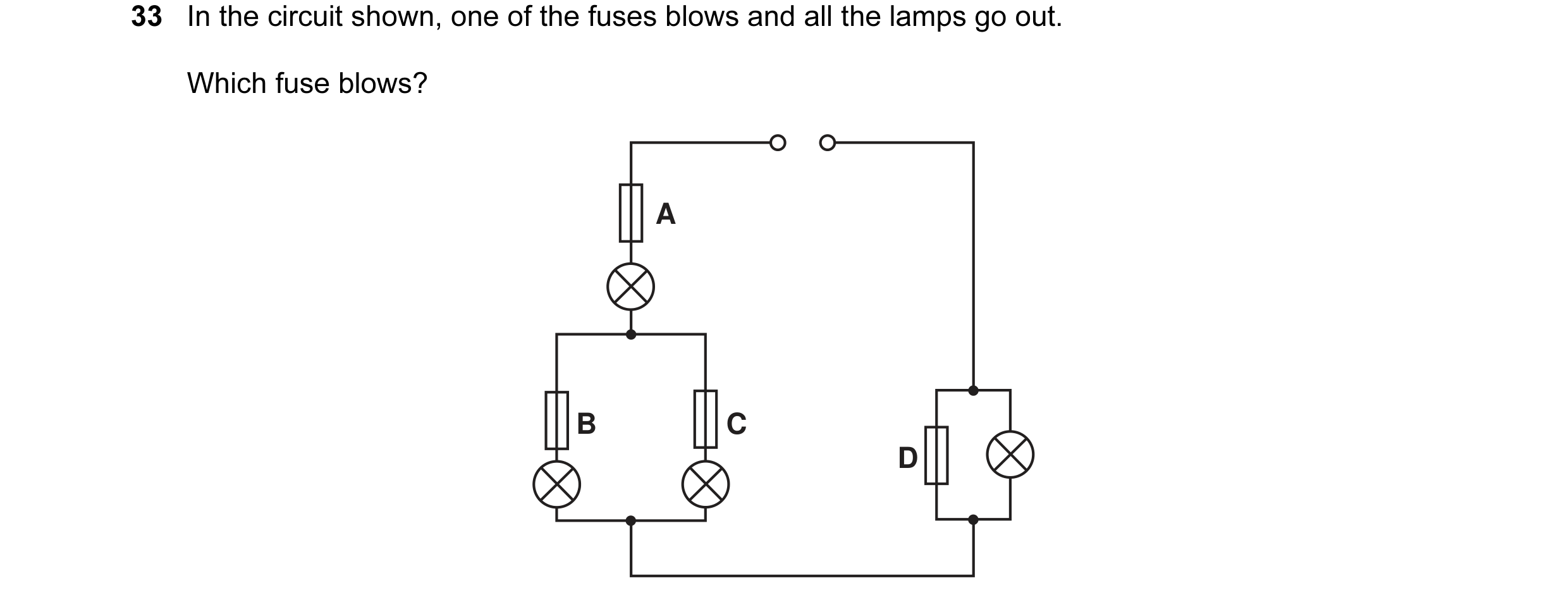
Q3 · In the circuit shown, one of the fuses blows and all the lamps go out 0625/11 Oct/Nov 2005
33 In the circuit shown, one of the fuses blows and all the lamps go out. Which fuse blows? A B C D
1 marks
Answer: A
This question in 0625/11 Oct/Nov 2005
Q4 · Why is a fuse used in an electrical circuit in a house? 0625/11 May/June 2006
33 Why is a fuse used in an electrical circuit in a house? A to increase the circuit resistance B to keep the power used to a minimum value C to prevent a short-circuit from occurring D to stop the cables from carrying too much current
1 marks
Answer: D
This question in 0625/11 May/June 2006
Q5 · An electric power tool is being used outdoors in a shower of rain 0625/11 May/June 2006
34 An electric power tool is being used outdoors in a shower of rain. What is the greatest hazard to the user? A The cable gets hot and causes burns. B The circuit-breaker cuts off the current. C The current passes through water and causes a shock. D The tool rusts.
1 marks
Answer: C
This question in 0625/11 May/June 2006
Q6 · What is the symbol for a fuse? 0625/11 May/June 2007
33 What is the symbol for a fuse? A B C D
1 marks
Answer: B
This question in 0625/11 May/June 2007
Q7 · A cable in a house is carrying too much current 0625/11 May/June 2007
34 A cable in a house is carrying too much current. What is the greatest danger? A appliances not working B electric shock C fire D low power
1 marks
Answer: C
This question in 0625/11 May/June 2007
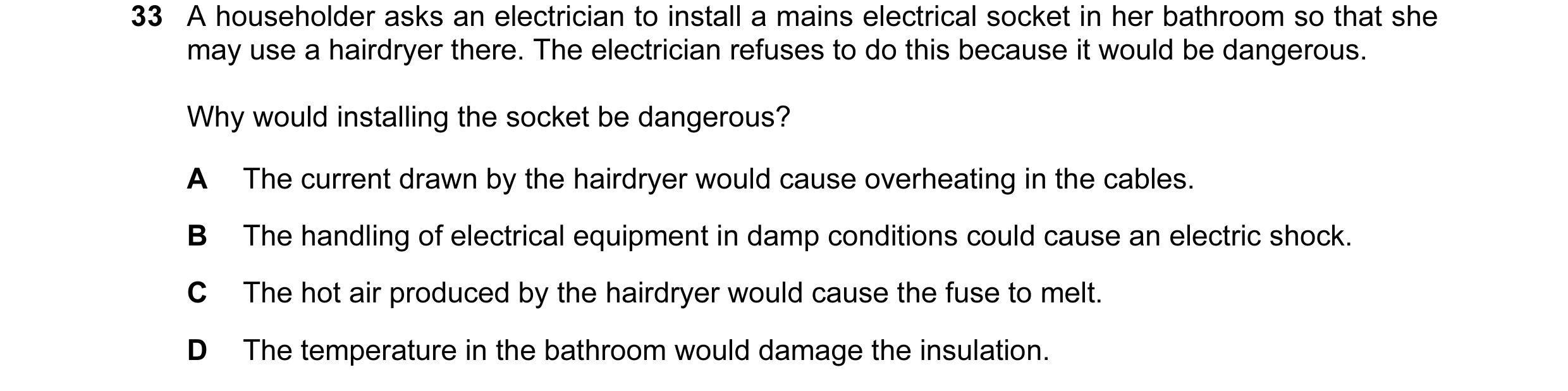
Q8 · A householder asks an electrician to install a mains electrical socket in her bathroom so… 0625/11 Oct/Nov 2007
33 A householder asks an electrician to install a mains electrical socket in her bathroom so that she may use a hairdryer there. The electrician refuses to do this because it would be dangerous. Why would installing the socket be dangerous? A The current drawn by the hairdryer would cause overheating in the cables. B The handling of electrical equipment in damp conditions could cause an electric shock. C The hot air produced by the hairdryer would cause the fuse to melt. D The temperature in the bathroom would damage the insulation.
1 marks
Answer: B
This question in 0625/11 Oct/Nov 2007
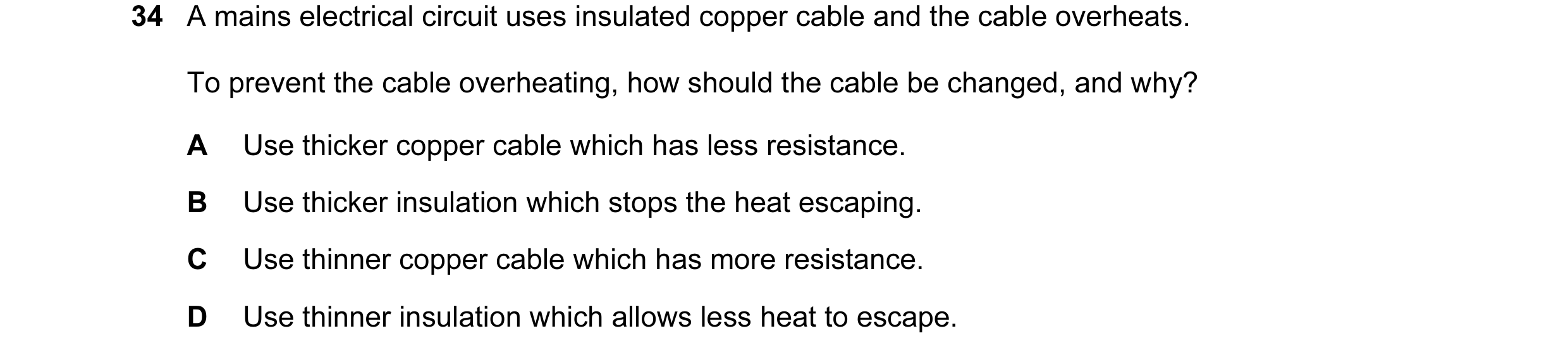
Q9 · A mains electrical circuit uses insulated copper cable and the cable overheats 0625/11 Oct/Nov 2007
34 A mains electrical circuit uses insulated copper cable and the cable overheats. To prevent the cable overheating, how should the cable be changed, and why? A Use thicker copper cable which has less resistance. B Use thicker insulation which stops the heat escaping. C Use thinner copper cable which has more resistance. D Use thinner insulation which allows less heat to escape.
1 marks
Answer: A
This question in 0625/11 Oct/Nov 2007
Q10 · The device X in this circuit is designed to cut off the electricity supply automatically… 0625/11 May/June 2008
32 The device X in this circuit is designed to cut off the electricity supply automatically if too much current flows. X What is device X? A a fuse B a switch C a resistor D an ammeter
1 marks
Answer: A
This question in 0625/11 May/June 2008
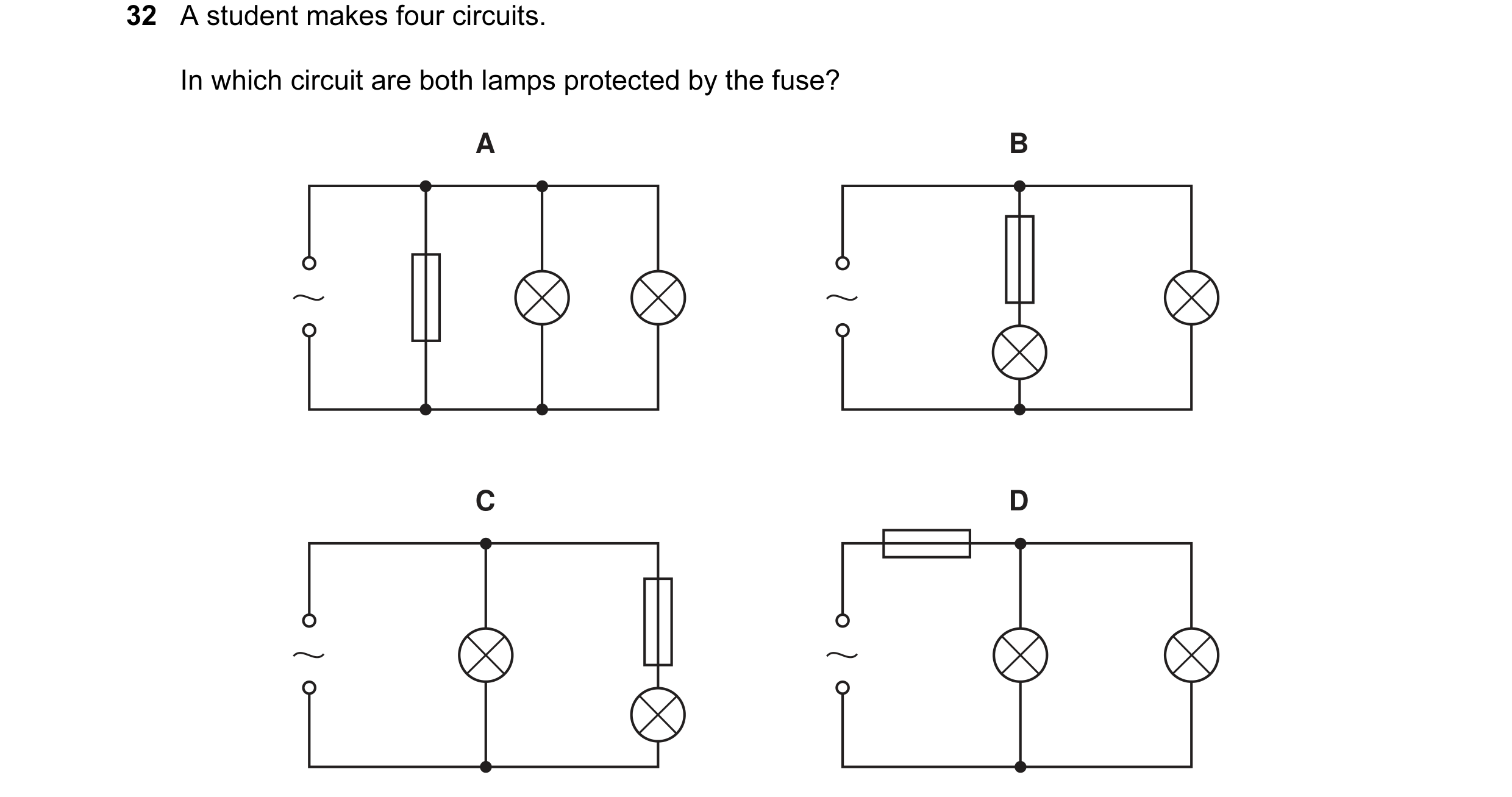
Q11 · A student makes four circuits 0625/11 Oct/Nov 2008
32 A student makes four circuits. In which circuit are both lamps protected by the fuse? A B C D
1 marks
Answer: D
This question in 0625/11 Oct/Nov 2008
Q12 · A mains circuit can safely supply a current of 40 A 0625/11 Oct/Nov 2008
33 A mains circuit can safely supply a current of 40 A. A hairdryer takes 2 A. It is connected to the circuit by a lead which can safely carry up to 5 A. Which fuse is best to use in the plug fitted to the hairdryer lead? A 1 A fuse B 3 A fuse C 10 A fuse D 50 A fuse
1 marks
Answer: B
This question in 0625/11 Oct/Nov 2008
Q13 · Either a fuse or a circuit-breaker can be used to protect electrical cables from large… 0625/11 May/June 2009
32 Either a fuse or a circuit-breaker can be used to protect electrical cables from large currents that could cause overheating. X cable live electrical Y Y Y appliance supply neutral cable If a fuse is used, in which position in the circuit should it be connected, and if a circuit-breaker is used, in which position should it be connected? position position of of fuse circuit-breaker A X X B X Y C Y X D Y Y
1 marks
Answer: A
This question in 0625/11 May/June 2009
Q14 · The current in a lamp at full brightness is 0.25 A 0625/11 May/June 2009
33 The current in a lamp at full brightness is 0.25 A. The flexible cable to the lamp is designed for currents up to 5.0 A, so it can safely carry the 0.25 A taken by the lamp. Which fuse should be inserted in the plug at the other end of the flexible cable? A 0.2 A B 1.0 A C 5.0 A D 10.0 A
1 marks
Answer: B
This question in 0625/11 May/June 2009
Q15 · A certain electrical appliance is powered from a mains supply 0625/11 Oct/Nov 2009
32 A certain electrical appliance is powered from a mains supply. The appliance normally uses a current of 3 A, but the current briefly rises to 4 A at the instant the appliance is switched on. The cable to the appliance is designed for currents up to 6 A. The fuses available to protect the cable are rated at 1 A, 3 A, 5 A and 13 A. Which fuse should be used? A 1 A B 3 A C 5 A D 13 A
1 marks
Answer: C
This question in 0625/11 Oct/Nov 2009
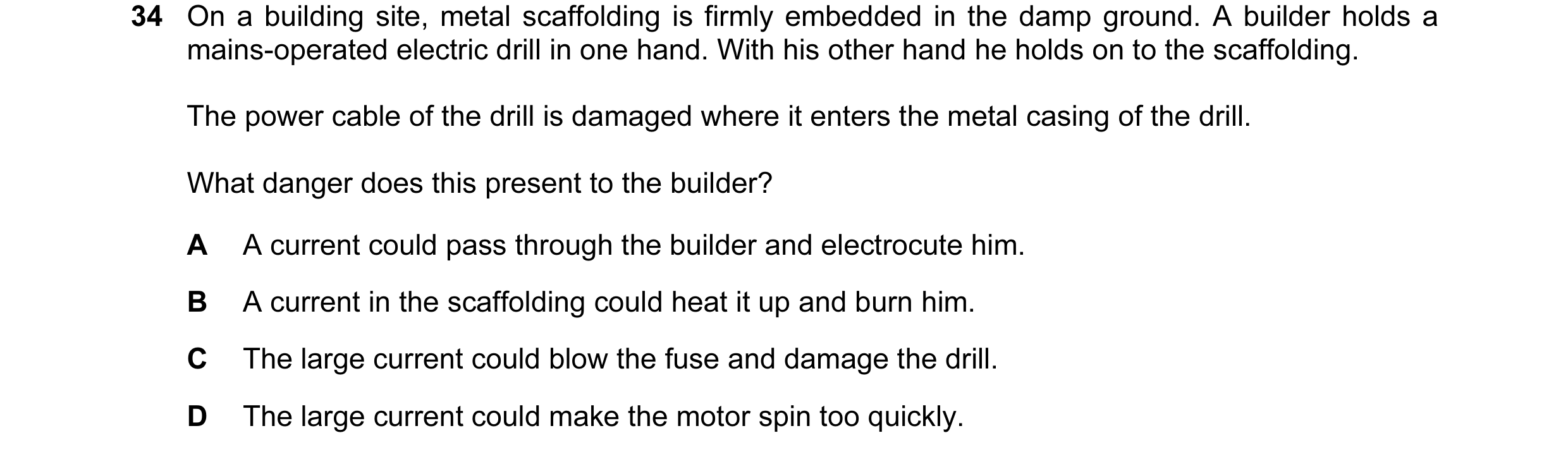
Q16 · On a building site, metal scaffolding is firmly embedded in the damp ground 0625/11 Oct/Nov 2009
33 On a building site, metal scaffolding is firmly embedded in the damp ground. A builder holds a mains-operated electric drill in one hand. With his other hand he holds on to the scaffolding. The power cable of the drill is damaged where it enters the metal casing of the drill. What danger does this present to the builder? A A current could pass through the builder and electrocute him. B A current in the scaffolding could heat it up and burn him. C The large current could blow the fuse and damage the drill. D The large current could make the motor spin too quickly.
1 marks
Answer: A
This question in 0625/11 Oct/Nov 2009
Q17 · A certain electrical appliance is powered from a mains supply 0625/12 Oct/Nov 2009
31 A certain electrical appliance is powered from a mains supply. The appliance normally uses a current of 3 A, but the current briefly rises to 4 A at the instant the appliance is switched on. The cable to the appliance is designed for currents up to 6 A. The fuses available to protect the cable are rated at 1 A, 3 A, 5 A and 13 A. Which fuse should be used? A 1 A B 3 A C 5 A D 13 A
1 marks
Answer: C
This question in 0625/12 Oct/Nov 2009
Q18 · On a building site, metal scaffolding is firmly embedded in the damp ground 0625/12 Oct/Nov 2009
34 On a building site, metal scaffolding is firmly embedded in the damp ground. A builder holds a mains-operated electric drill in one hand. With his other hand he holds on to the scaffolding. The power cable of the drill is damaged where it enters the metal casing of the drill. What danger does this present to the builder? A A current could pass through the builder and electrocute him. B A current in the scaffolding could heat it up and burn him. C The large current could blow the fuse and damage the drill. D The large current could make the motor spin too quickly.
1 marks
Answer: A
This question in 0625/12 Oct/Nov 2009
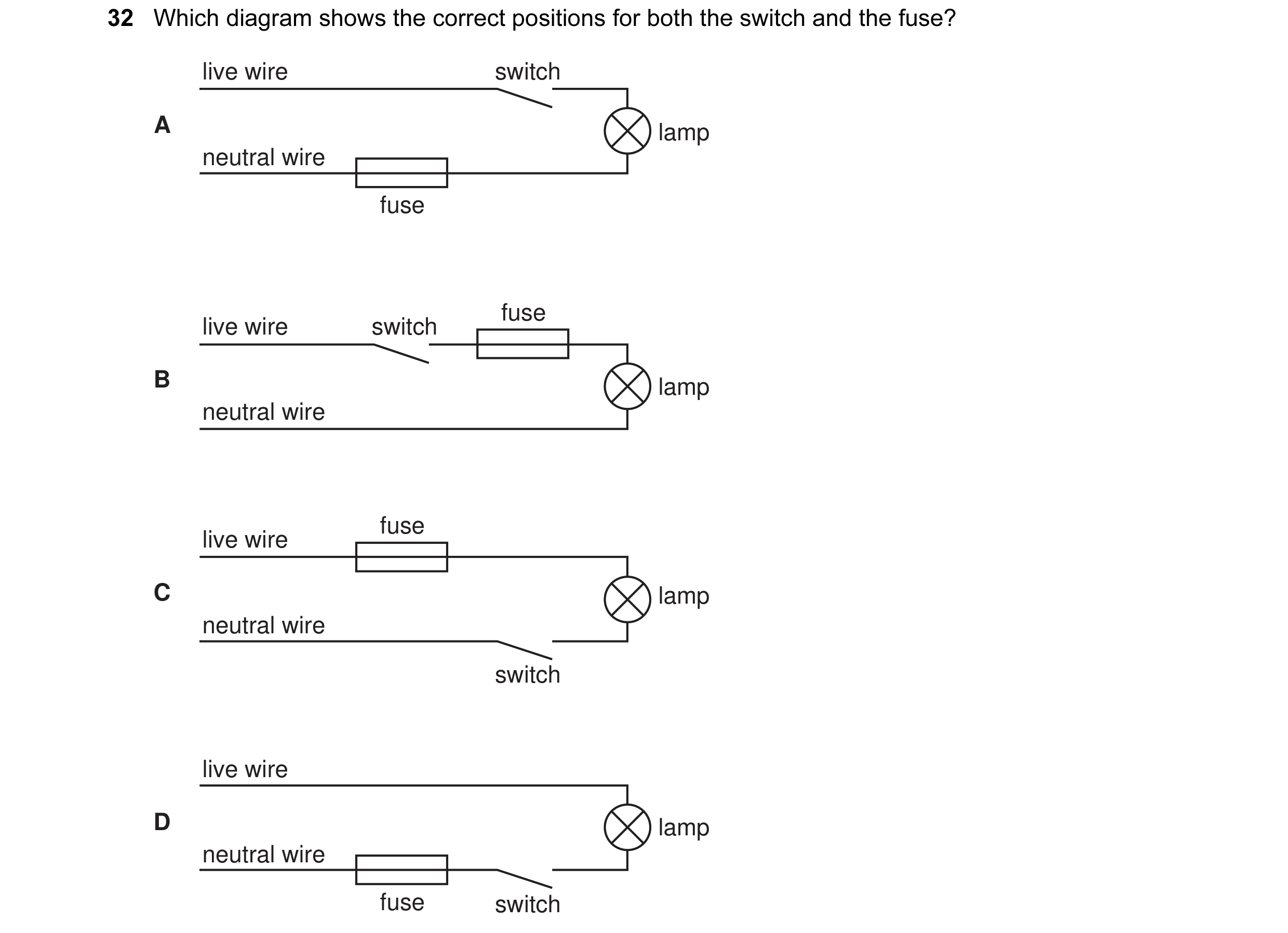
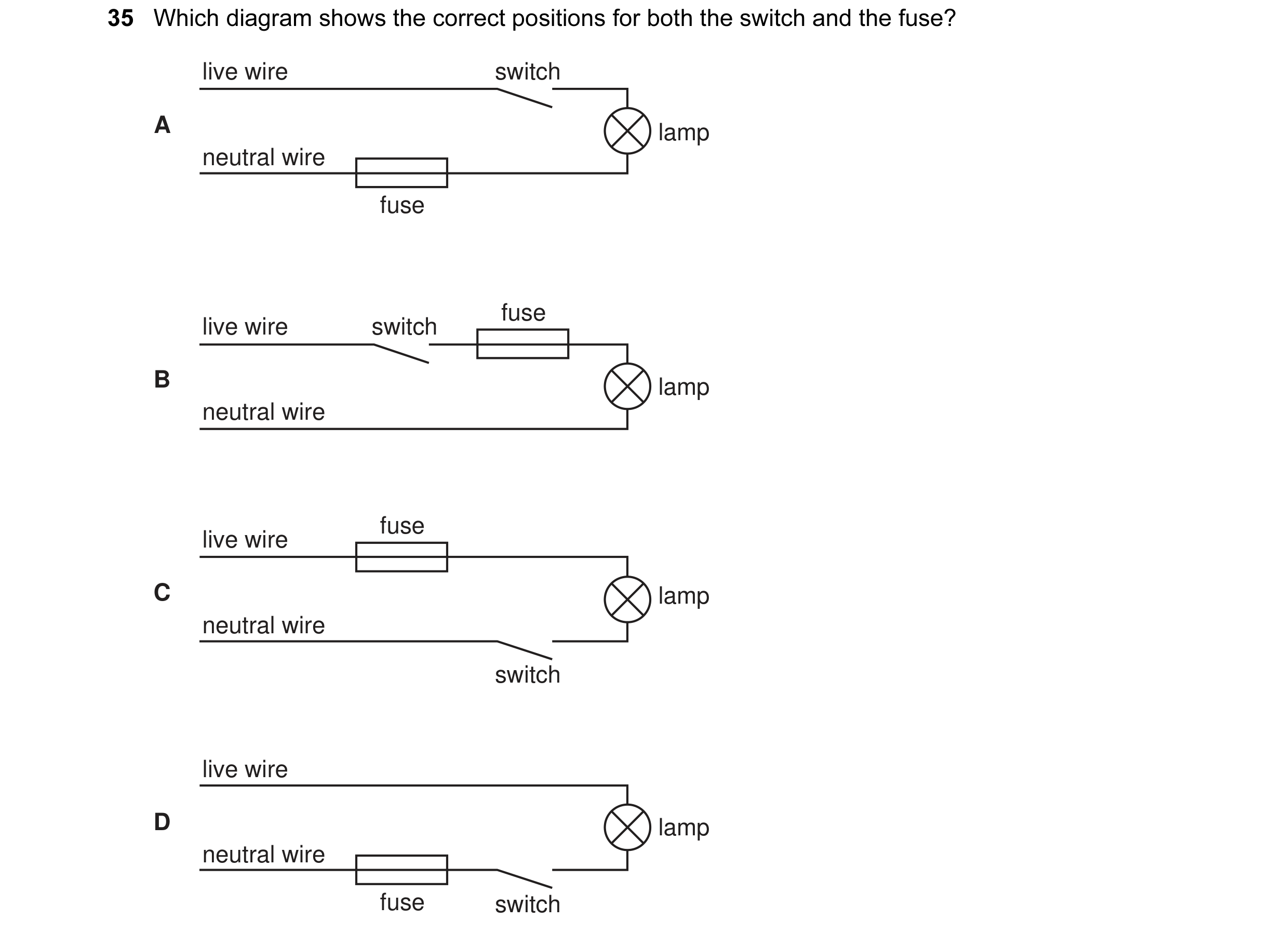
Q19 · Which diagram shows the correct positions for both the switch and the fuse? 0625/11 May/June 2010
32 Which diagram shows the correct positions for both the switch and the fuse? live wire switch A lamp neutral wire fuse fuse live wire switch B lamp neutral wire fuse live wire C lamp neutral wire switch live wire D lamp neutral wire fuse switch
1 marks
Answer: B
This question in 0625/11 May/June 2010
Q20 · After some building work in a house, a bare (uninsulated) live wire is left protruding… 0625/11 May/June 2010
33 After some building work in a house, a bare (uninsulated) live wire is left protruding from a wall. What is the greatest hazard? A a fire B a fuse will blow C an electric shock D no current will flow
1 marks
Answer: C
This question in 0625/11 May/June 2010
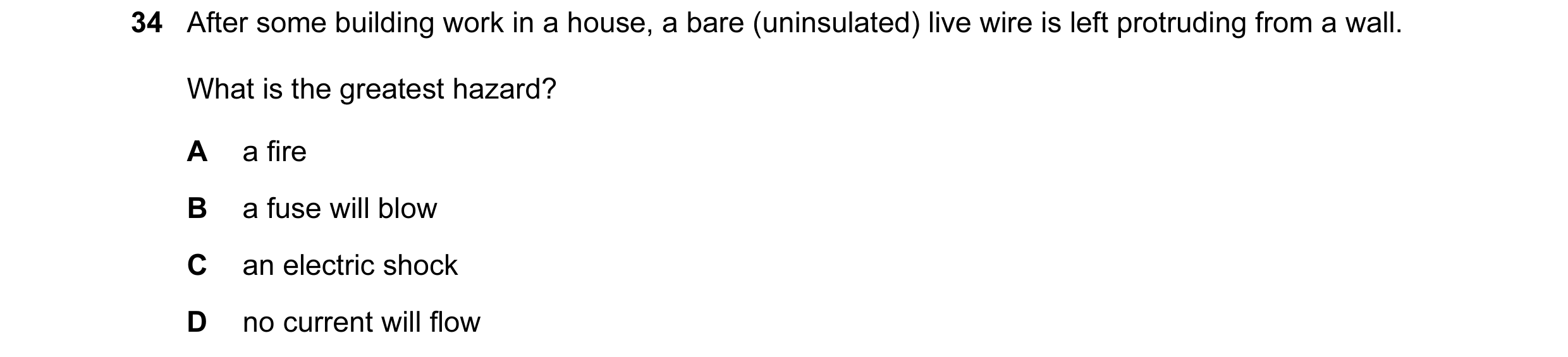
Q21 · After some building work in a house, a bare (uninsulated) live wire is left protruding… 0625/12 May/June 2010
34 After some building work in a house, a bare (uninsulated) live wire is left protruding from a wall. What is the greatest hazard? A a fire B a fuse will blow C an electric shock D no current will flow
1 marks
Answer: C
This question in 0625/12 May/June 2010
Q22 · Which diagram shows the correct positions for both the switch and the fuse? 0625/12 May/June 2010
35 Which diagram shows the correct positions for both the switch and the fuse? live wire switch A lamp neutral wire fuse fuse live wire switch B lamp neutral wire fuse live wire C lamp neutral wire switch live wire D lamp neutral wire fuse switch
1 marks
Answer: B
This question in 0625/12 May/June 2010
Q23 · A fuse is a safety device for use in an electrical appliance 0625/11 Oct/Nov 2010
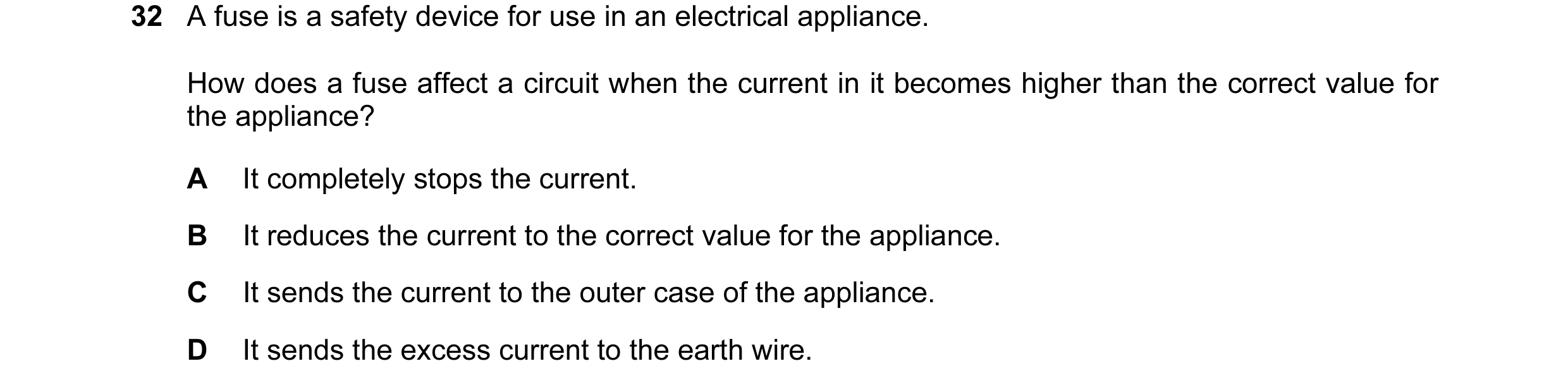
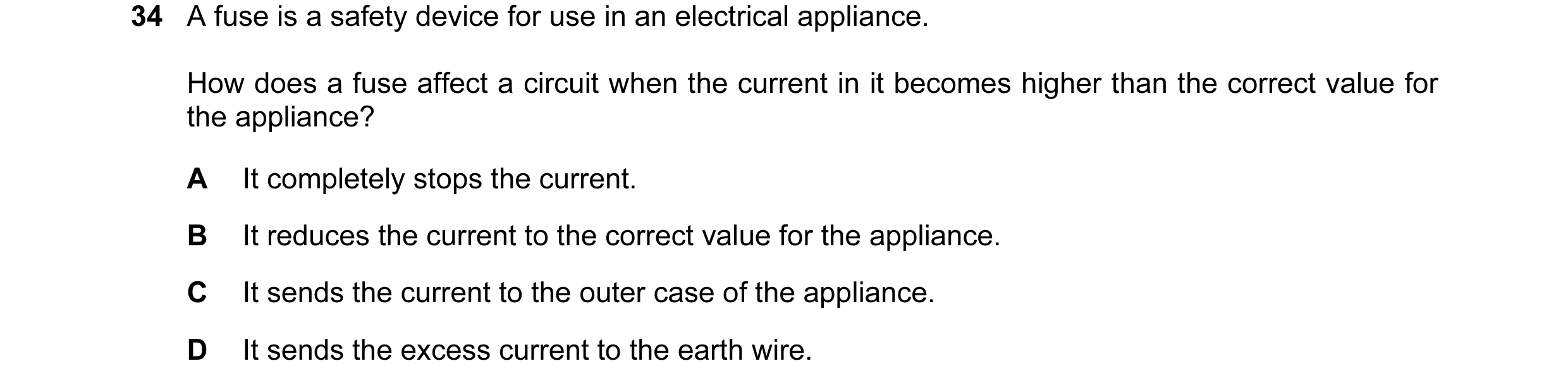
33 A fuse is a safety device for use in an electrical appliance. How does a fuse affect a circuit when the current in it becomes higher than the correct value for the appliance? A It completely stops the current. B It reduces the current to the correct value for the appliance. C It sends the current to the outer case of the appliance. D It sends the excess current to the earth wire.
1 marks
Answer: A
This question in 0625/11 Oct/Nov 2010
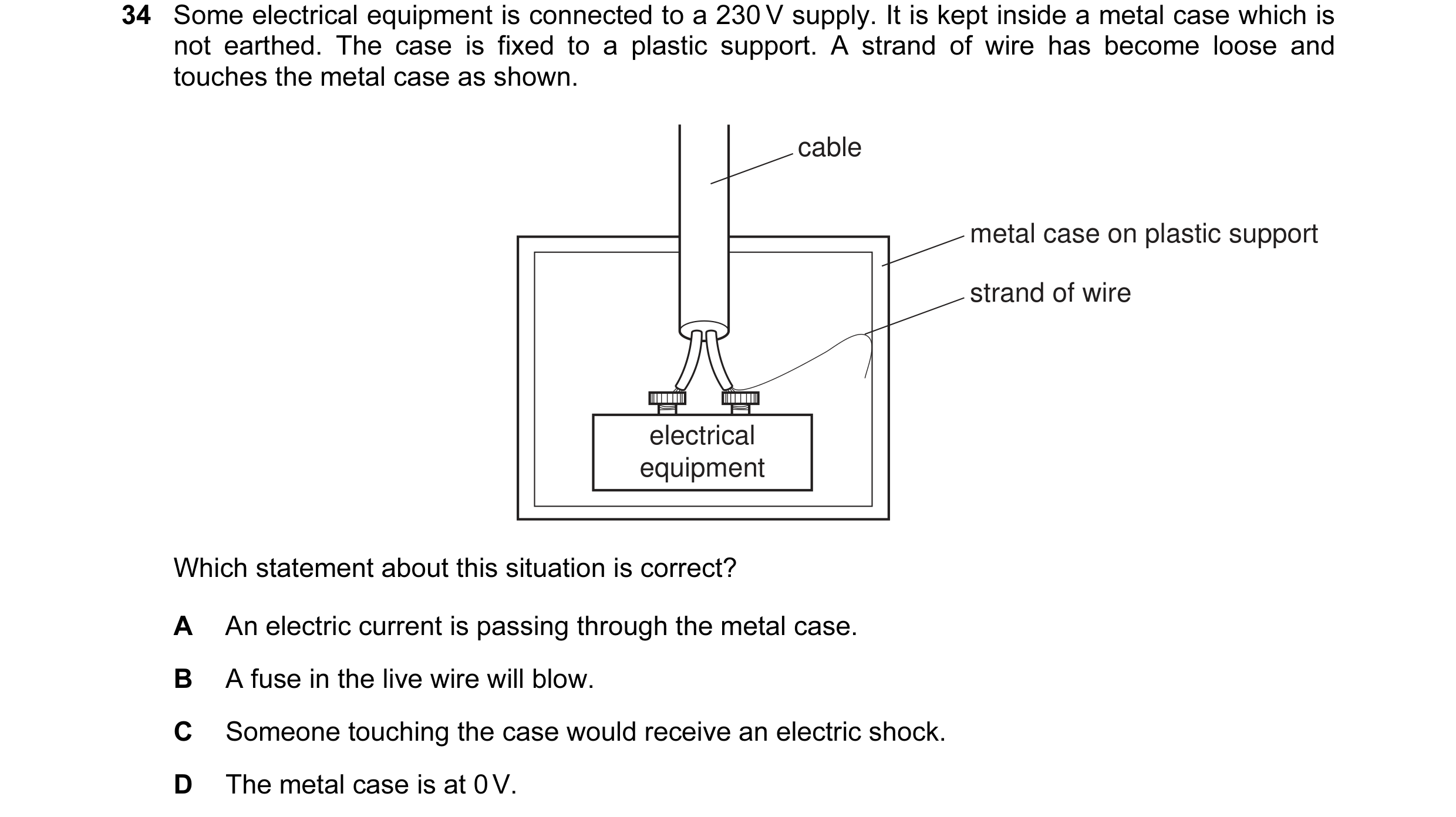
Q24 · Some electrical equipment is connected to a 230 V supply 0625/11 Oct/Nov 2010
34 Some electrical equipment is connected to a 230 V supply. It is kept inside a metal case which is not earthed. The case is fixed to a plastic support. A strand of wire has become loose and touches the metal case as shown. cable metal case on plastic support strand of wire electrical equipment Which statement about this situation is correct? A An electric current is passing through the metal case. B A fuse in the live wire will blow. C Someone touching the case would receive an electric shock. D The metal case is at 0 V.
1 marks
Answer: C
This question in 0625/11 Oct/Nov 2010
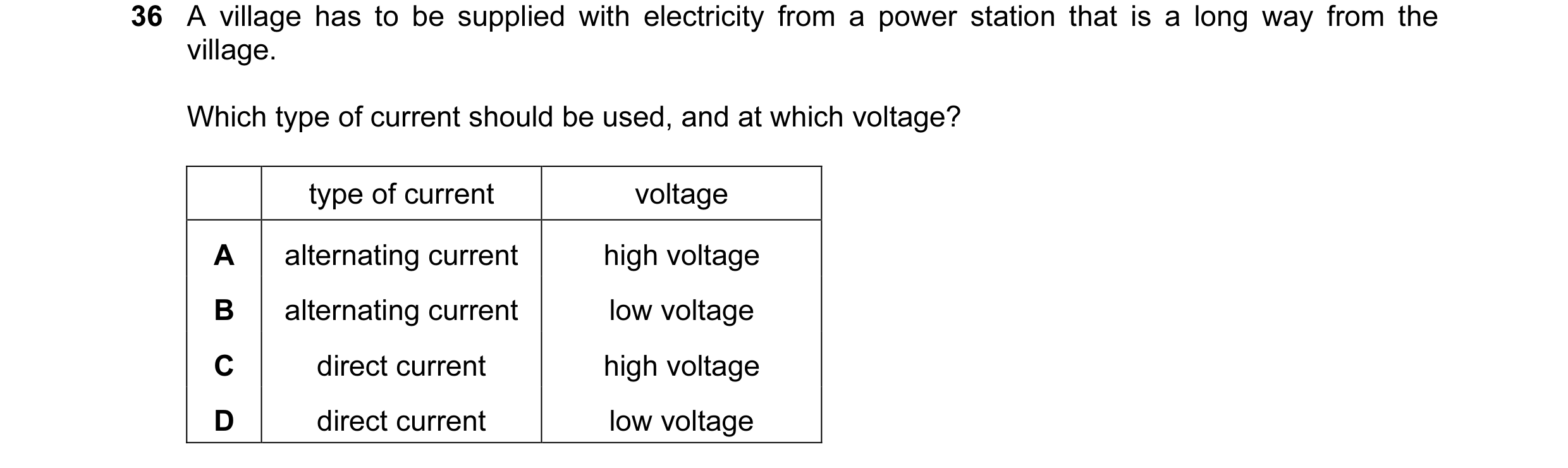
Q25 · A village has to be supplied with electricity from a power station that is a long way… 0625/11 Oct/Nov 2010
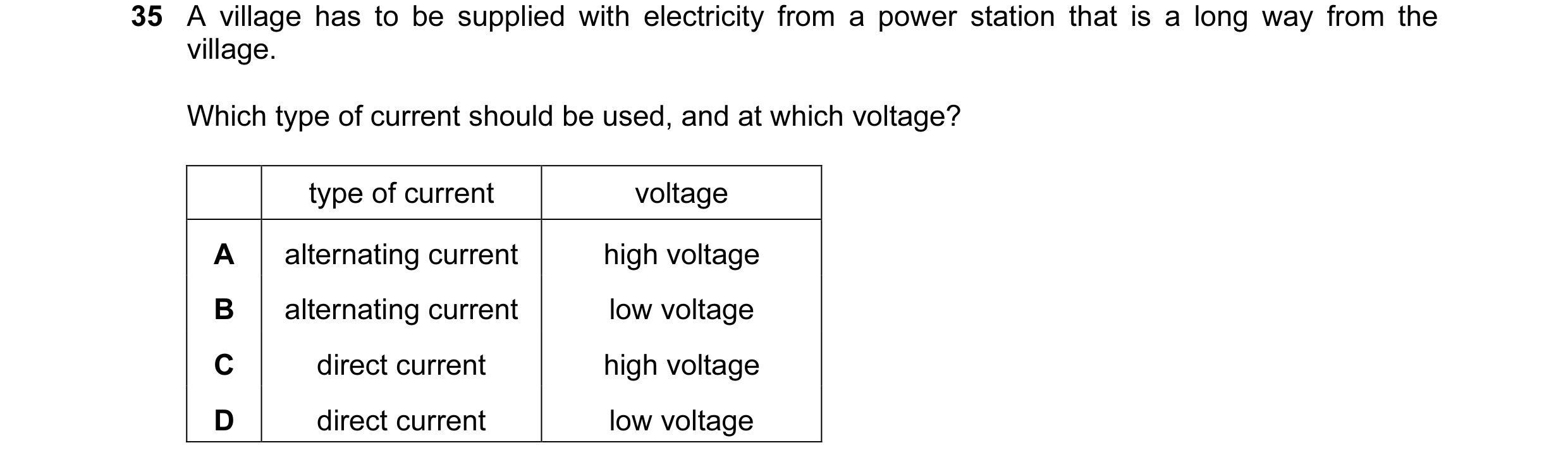
36 A village has to be supplied with electricity from a power station that is a long way from the village. Which type of current should be used, and at which voltage? type of current voltage A alternating current high voltage B alternating current low voltage C direct current high voltage D direct current low voltage
1 marks
Answer: A
This question in 0625/11 Oct/Nov 2010
Q26 · Some electrical equipment is connected to a 230 V supply 0625/12 Oct/Nov 2010
31 Some electrical equipment is connected to a 230 V supply. It is kept inside a metal case which is not earthed. The case is fixed to a plastic support. A strand of wire has become loose and touches the metal case as shown. cable metal case on plastic support strand of wire electrical equipment Which statement about this situation is correct? A An electric current is passing through the metal case. B A fuse in the live wire will blow. C Someone touching the case would receive an electric shock. D The metal case is at 0 V.
1 marks
Answer: C
This question in 0625/12 Oct/Nov 2010
Q27 · A fuse is a safety device for use in an electrical appliance 0625/12 Oct/Nov 2010
32 A fuse is a safety device for use in an electrical appliance. How does a fuse affect a circuit when the current in it becomes higher than the correct value for the appliance? A It completely stops the current. B It reduces the current to the correct value for the appliance. C It sends the current to the outer case of the appliance. D It sends the excess current to the earth wire.
1 marks
Answer: A
This question in 0625/12 Oct/Nov 2010
Q28 · A village has to be supplied with electricity from a power station that is a long way… 0625/12 Oct/Nov 2010
35 A village has to be supplied with electricity from a power station that is a long way from the village. Which type of current should be used, and at which voltage? type of current voltage A alternating current high voltage B alternating current low voltage C direct current high voltage D direct current low voltage
1 marks
Answer: A
This question in 0625/12 Oct/Nov 2010
Q29 · A fuse is a safety device for use in an electrical appliance 0625/13 Oct/Nov 2010
34 A fuse is a safety device for use in an electrical appliance. How does a fuse affect a circuit when the current in it becomes higher than the correct value for the appliance? A It completely stops the current. B It reduces the current to the correct value for the appliance. C It sends the current to the outer case of the appliance. D It sends the excess current to the earth wire.
1 marks
Answer: A
This question in 0625/13 Oct/Nov 2010
Q30 · Some electrical equipment is connected to a 230 V supply 0625/13 Oct/Nov 2010
35 Some electrical equipment is connected to a 230 V supply. It is kept inside a metal case which is not earthed. The case is fixed to a plastic support. A strand of wire has become loose and touches the metal case as shown. cable metal case on plastic support strand of wire electrical equipment Which statement about this situation is correct? A An electric current is passing through the metal case. B A fuse in the live wire will blow. C Someone touching the case would receive an electric shock. D The metal case is at 0 V.
1 marks
Answer: C
This question in 0625/13 Oct/Nov 2010
Q31 · In this circuit, a component at X automatically protects the wiring from overheating if… 0625/11 May/June 2011
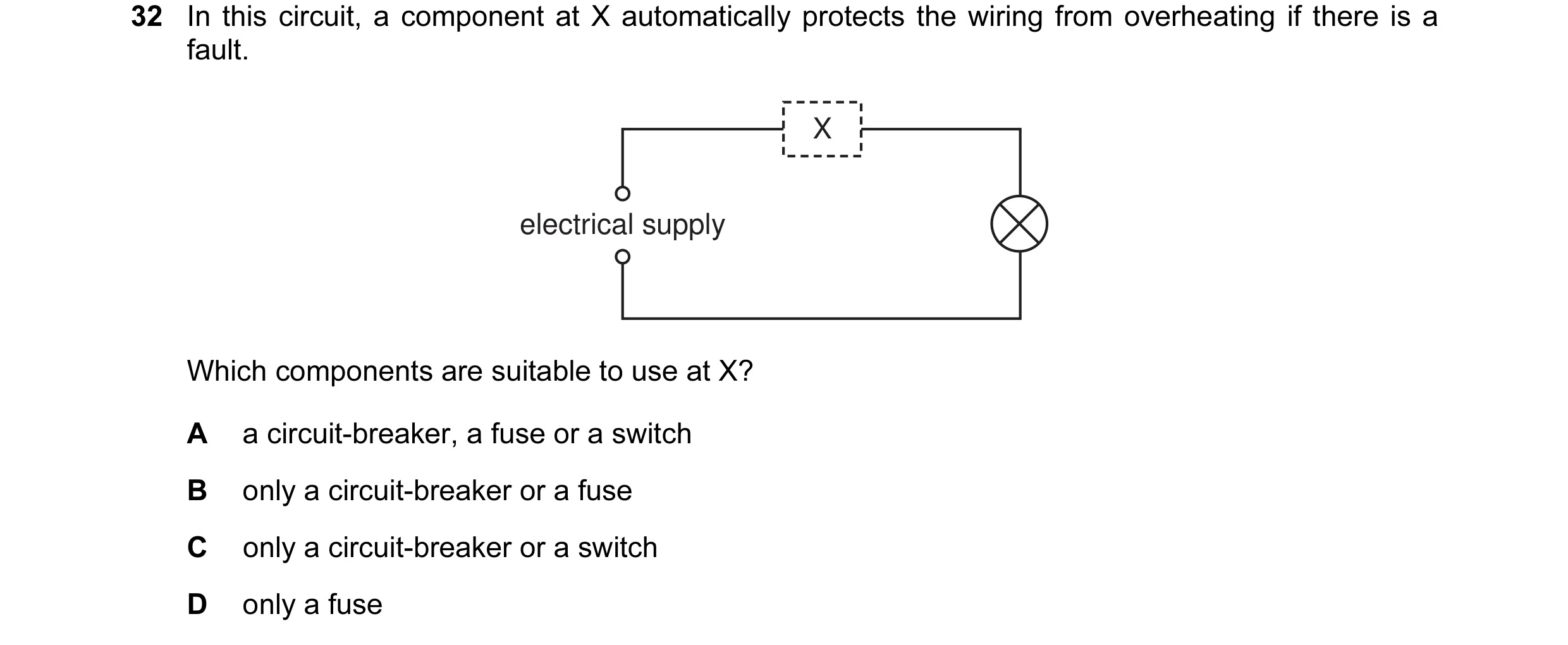
32 In this circuit, a component at X automatically protects the wiring from overheating if there is a fault. X electrical supply Which components are suitable to use at X? A a circuit-breaker, a fuse or a switch B only a circuit-breaker or a fuse C only a circuit-breaker or a switch D only a fuse
1 marks
Answer: B
This question in 0625/11 May/June 2011
Q32 · In this circuit, a component at X automatically protects the wiring from overheating if… 0625/12 May/June 2011
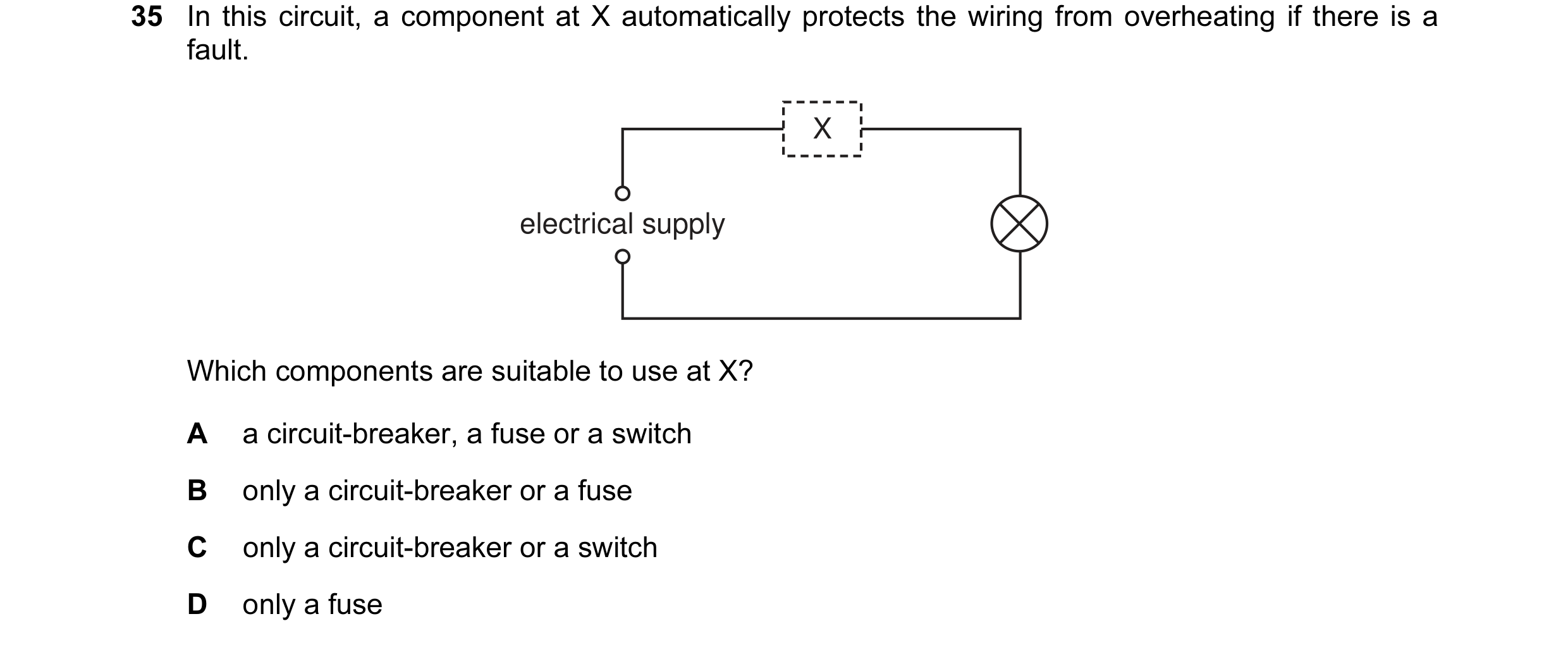
35 In this circuit, a component at X automatically protects the wiring from overheating if there is a fault. X electrical supply Which components are suitable to use at X? A a circuit-breaker, a fuse or a switch B only a circuit-breaker or a fuse C only a circuit-breaker or a switch D only a fuse
1 marks
Answer: B
This question in 0625/12 May/June 2011
Q33 · In this circuit, a component at X automatically protects the wiring from overheating if… 0625/13 May/June 2011
35 In this circuit, a component at X automatically protects the wiring from overheating if there is a fault. X electrical supply Which components are suitable to use at X? A a circuit-breaker, a fuse or a switch B only a circuit-breaker or a fuse C only a circuit-breaker or a switch D only a fuse
1 marks
Answer: B
This question in 0625/13 May/June 2011
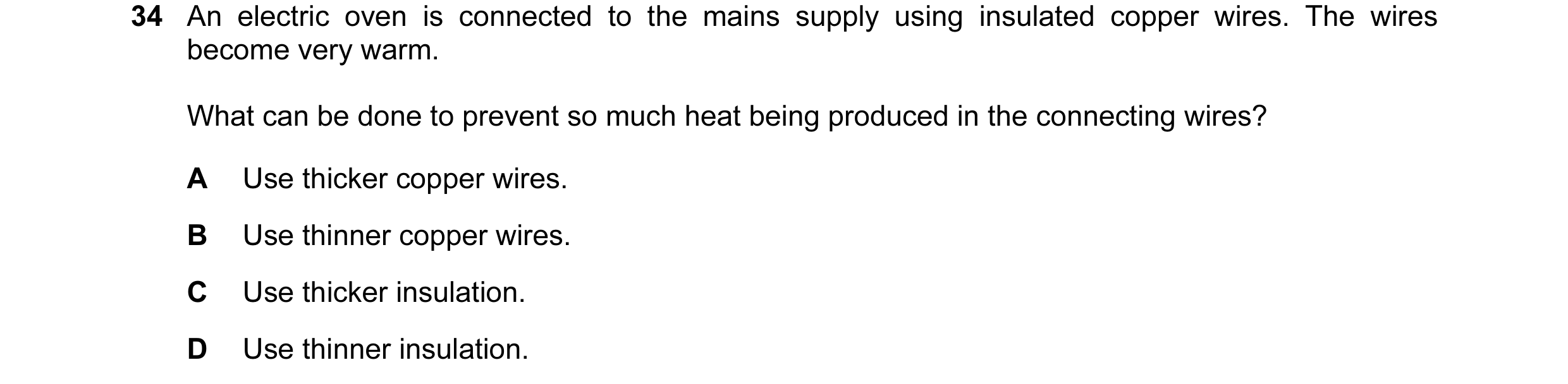
Q34 · An electric oven is connected to the mains supply using insulated copper wires 0625/11 Oct/Nov 2012
34 An electric oven is connected to the mains supply using insulated copper wires. The wires become very warm. What can be done to prevent so much heat being produced in the connecting wires? A Use thicker copper wires. B Use thinner copper wires. C Use thicker insulation. D Use thinner insulation.
1 marks
Answer: A
This question in 0625/11 Oct/Nov 2012
Q35 · An electric oven is connected to the mains supply using insulated copper wires 0625/12 Oct/Nov 2012
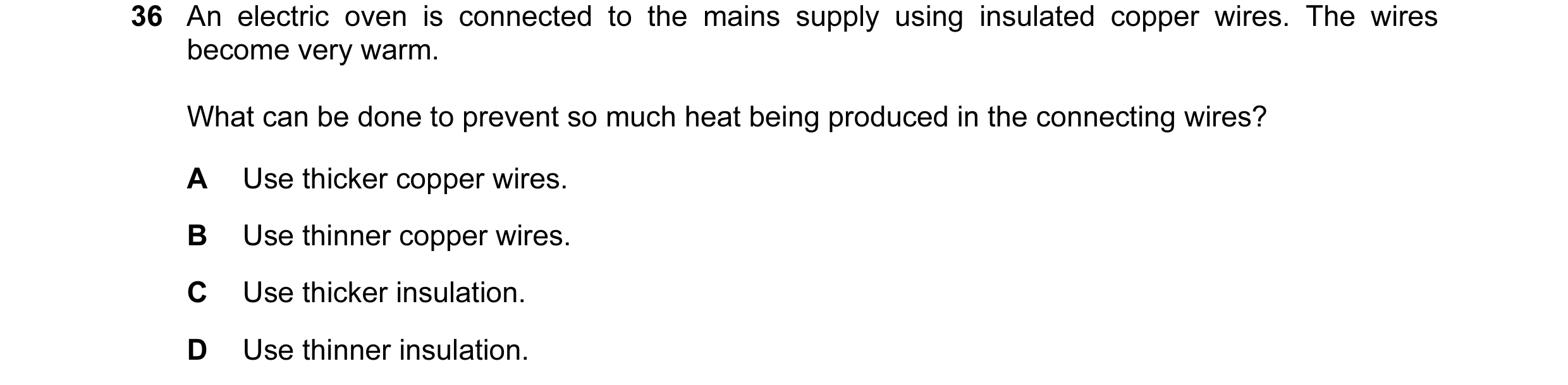
36 An electric oven is connected to the mains supply using insulated copper wires. The wires become very warm. What can be done to prevent so much heat being produced in the connecting wires? A Use thicker copper wires. B Use thinner copper wires. C Use thicker insulation. D Use thinner insulation.
1 marks
Answer: A
This question in 0625/12 Oct/Nov 2012
Q36 · An electric oven is connected to the mains supply using insulated copper wires 0625/13 Oct/Nov 2012
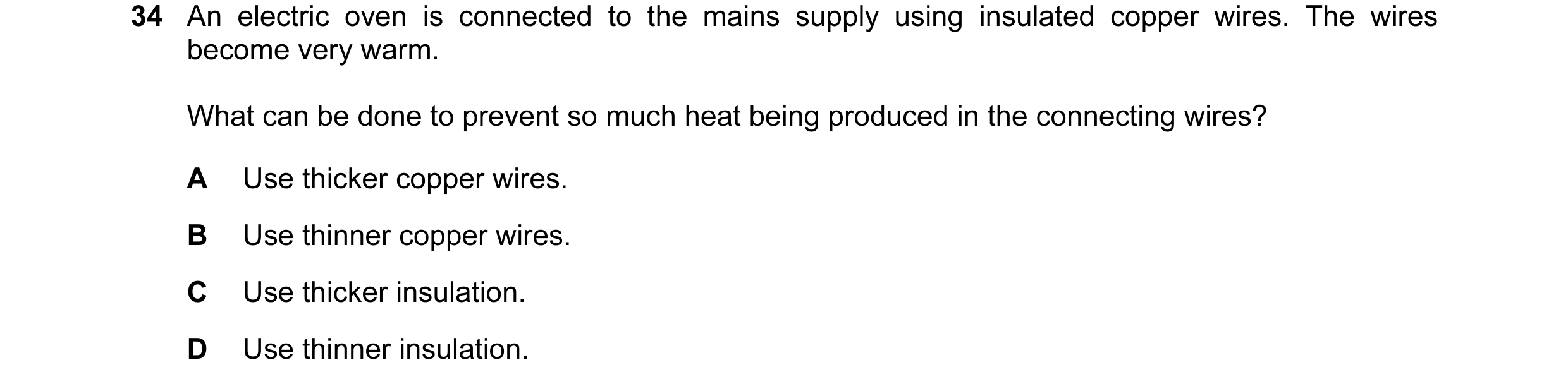
34 An electric oven is connected to the mains supply using insulated copper wires. The wires become very warm. What can be done to prevent so much heat being produced in the connecting wires? A Use thicker copper wires. B Use thinner copper wires. C Use thicker insulation. D Use thinner insulation.
1 marks
Answer: A
This question in 0625/13 Oct/Nov 2012
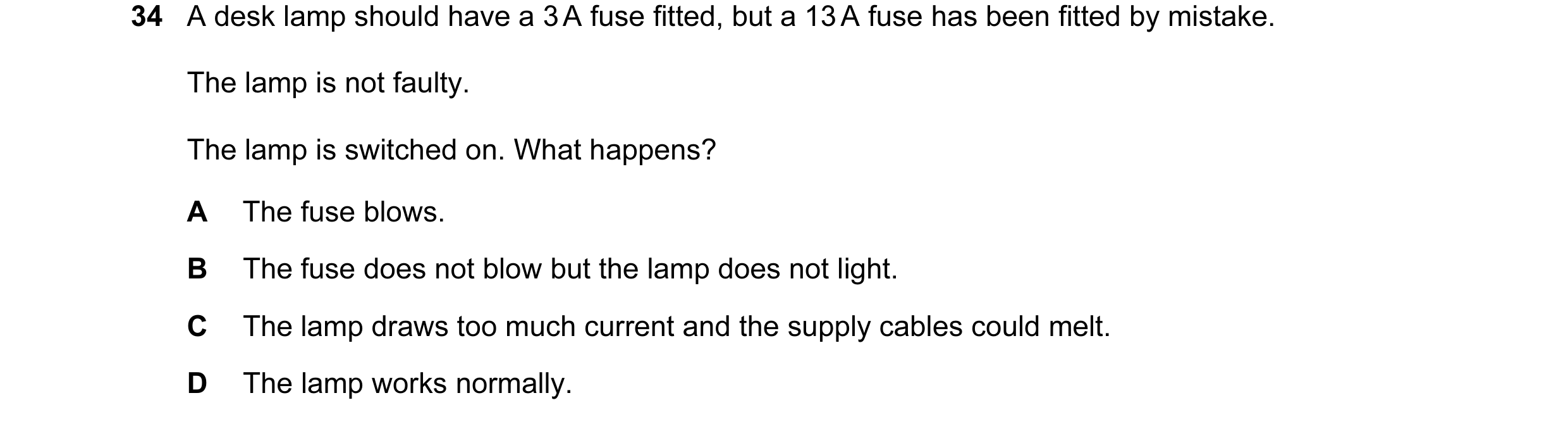
Q37 · A desk lamp should have a 3 A fuse fitted, but a 13 A fuse has been fitted by mistake 0625/11 May/June 2013
34 A desk lamp should have a 3 A fuse fitted, but a 13 A fuse has been fitted by mistake. The lamp is not faulty. The lamp is switched on. What happens? A The fuse blows. B The fuse does not blow but the lamp does not light. C The lamp draws too much current and the supply cables could melt. D The lamp works normally.
1 marks
Answer: D
This question in 0625/11 May/June 2013
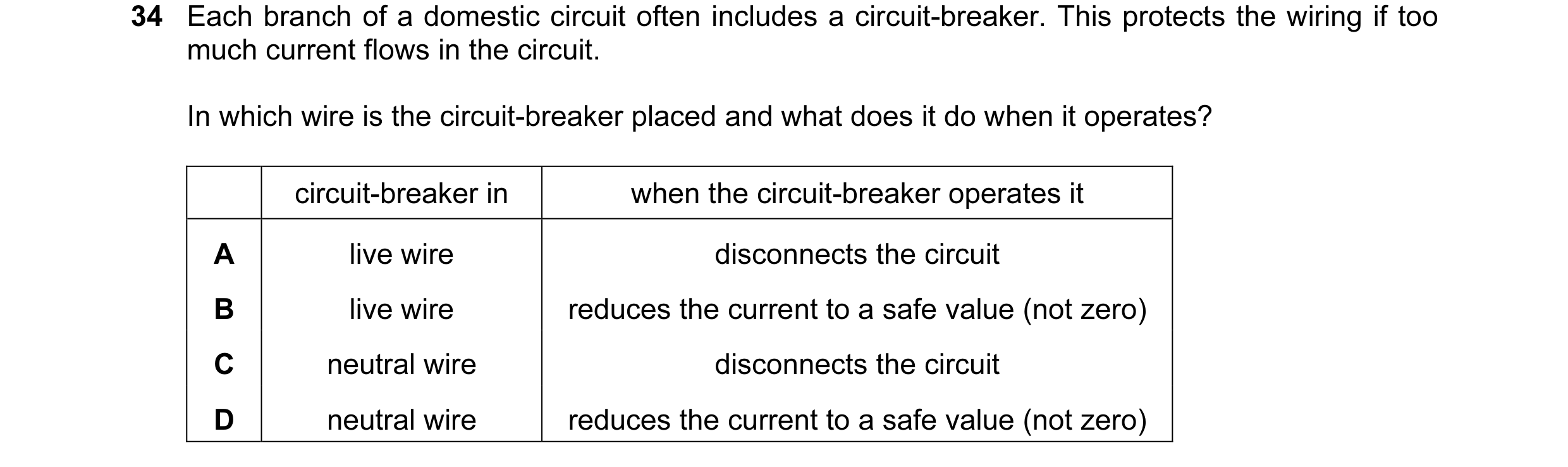
Q38 · Each branch of a domestic circuit often includes a circuit-breaker 0625/12 May/June 2013
34 Each branch of a domestic circuit often includes a circuit-breaker. This protects the wiring if too much current flows in the circuit. In which wire is the circuit-breaker placed and what does it do when it operates? circuit-breaker in when the circuit-breaker operates it A live wire disconnects the circuit B live wire reduces the current to a safe value (not zero) C neutral wire disconnects the circuit D neutral wire reduces the current to a safe value (not zero)
1 marks
Answer: A
This question in 0625/12 May/June 2013
Q39 · A desk lamp should have a 3 A fuse fitted, but a 13 A fuse has been fitted by mistake 0625/13 May/June 2013
34 A desk lamp should have a 3 A fuse fitted, but a 13 A fuse has been fitted by mistake. The lamp is not faulty. The lamp is switched on. What happens? A The fuse blows. B The fuse does not blow but the lamp does not light. C The lamp draws too much current and the supply cables could melt. D The lamp works normally.
1 marks
Answer: D
This question in 0625/13 May/June 2013
Q40 · The diagram shows the connections to an electric heater 0625/11 Oct/Nov 2013
34 The diagram shows the connections to an electric heater. Three fuses have been added to the circuit. heating element plastic fuse 1 case live fuse 3 fuse 2 neutral heater Which of the fuses are correctly placed? A fuse 1, fuse 2 and fuse 3 B fuse 1 and fuse 2 only C fuse 1 only D fuse 2 only
1 marks
Answer: C
This question in 0625/11 Oct/Nov 2013
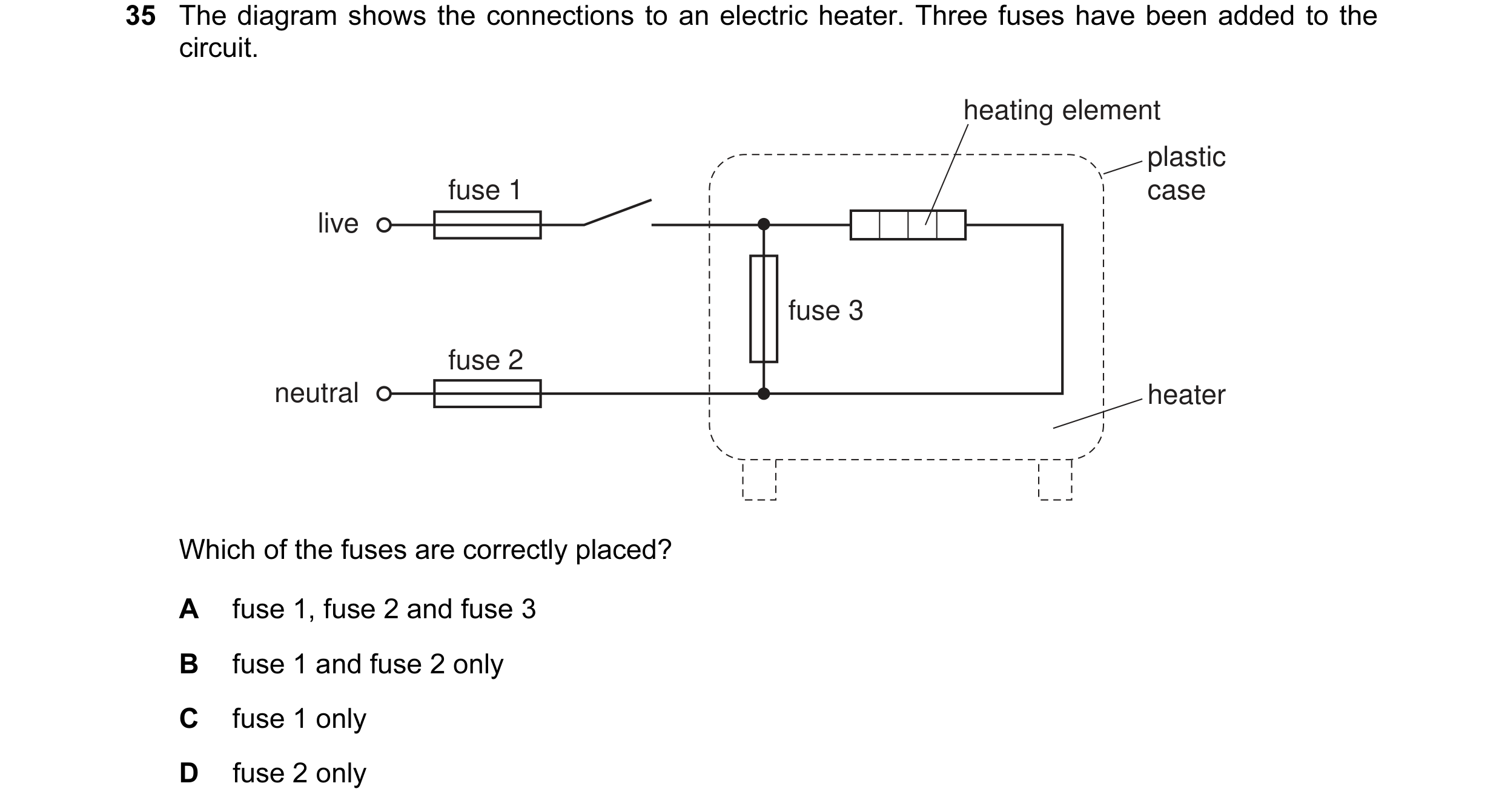
Q41 · The diagram shows the connections to an electric heater 0625/12 Oct/Nov 2013
35 The diagram shows the connections to an electric heater. Three fuses have been added to the circuit. heating element plastic fuse 1 case live fuse 3 fuse 2 neutral heater Which of the fuses are correctly placed? A fuse 1, fuse 2 and fuse 3 B fuse 1 and fuse 2 only C fuse 1 only D fuse 2 only
1 marks
Answer: C
This question in 0625/12 Oct/Nov 2013
Q42 · An electric motor is connected to the mains supply by insulated wires 0625/13 Oct/Nov 2013
34 An electric motor is connected to the mains supply by insulated wires. The circuit is protected by a fuse, but the connecting wires become hot. insulated connecting wire live M motor neutral insulated connecting wire How could the wires be prevented from becoming so hot? A Connect a second fuse in the neutral wire. B Use a fuse with a higher current rating. C Use thicker connecting wires. D Use thicker insulation on the connecting wires.
1 marks
Answer: C
This question in 0625/13 Oct/Nov 2013
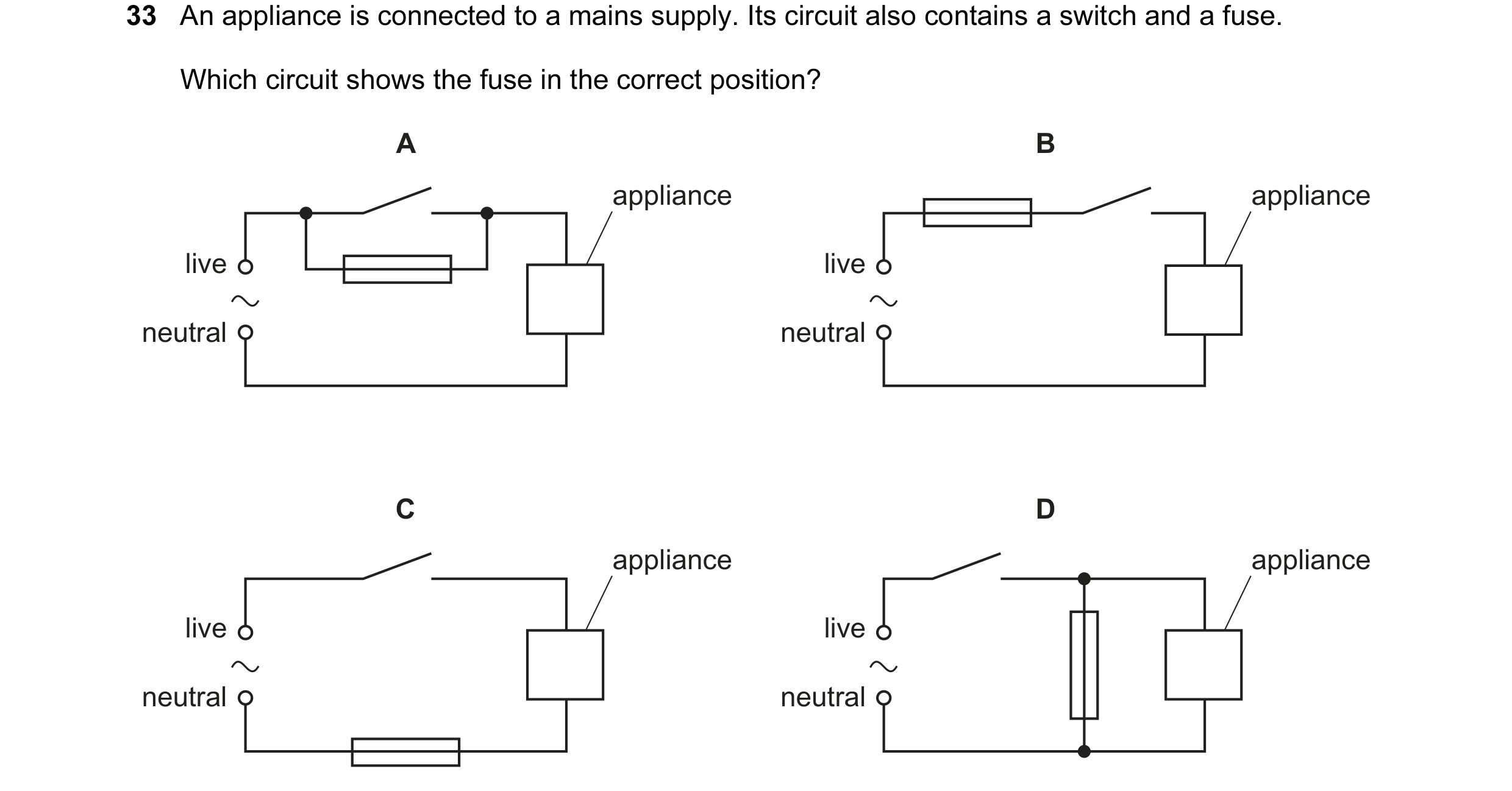
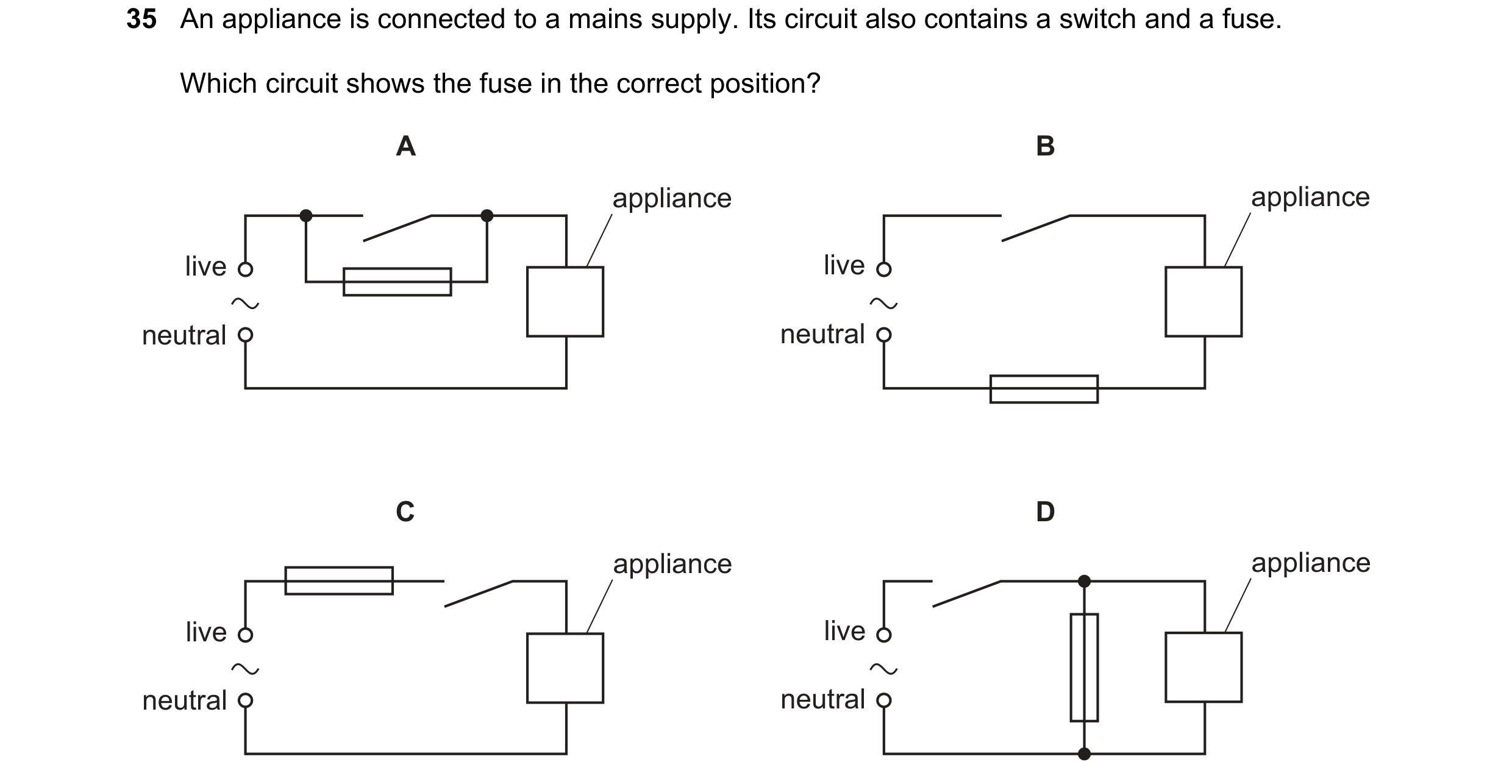
Q43 · An appliance is connected to a mains supply 0625/11 May/June 2014
33 An appliance is connected to a mains supply. Its circuit also contains a switch and a fuse. Which circuit shows the fuse in the correct position? A B appliance appliance live live neutral neutral C D appliance appliance live live neutral neutral
1 marks
Answer: B
This question in 0625/11 May/June 2014
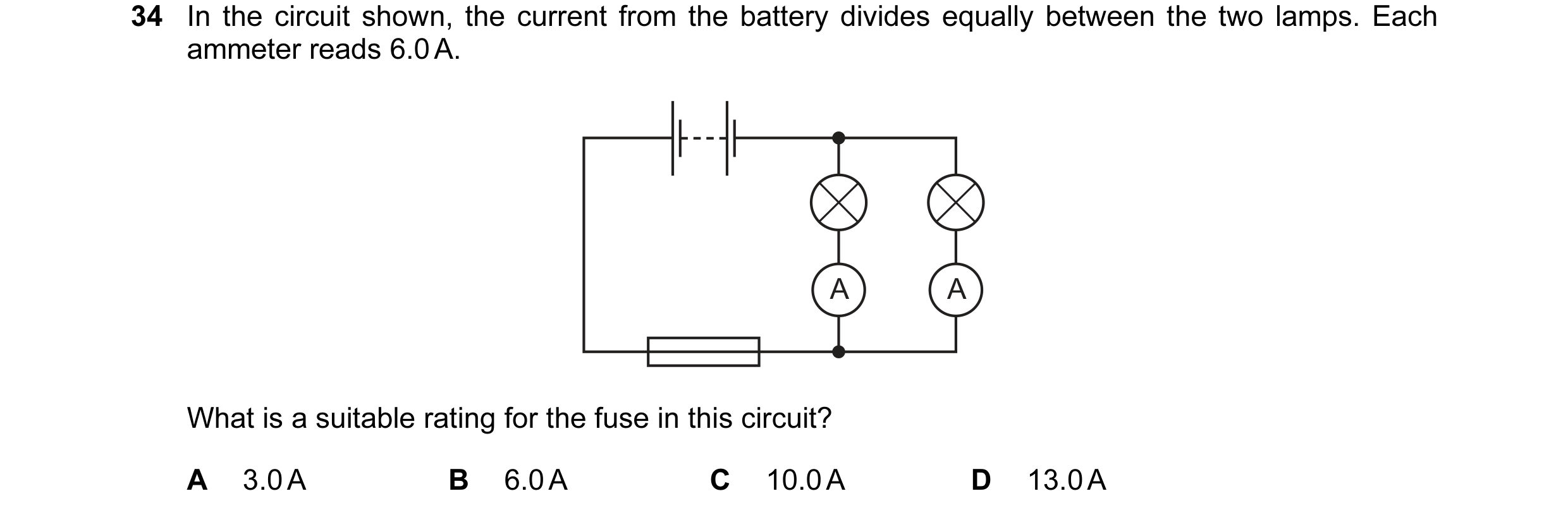
Q44 · In the circuit shown, the current from the battery divides equally between the two lamps 0625/12 May/June 2014
34 In the circuit shown, the current from the battery divides equally between the two lamps. Each ammeter reads 6.0 A. A A What is a suitable rating for the fuse in this circuit? A 3.0 A B 6.0 A C 10.0 A D 13.0 A
1 marks
Answer: D
This question in 0625/12 May/June 2014
Q45 · An appliance is connected to a mains supply 0625/13 May/June 2014
31 An appliance is connected to a mains supply. Its circuit also contains a switch and a fuse. Which circuit shows the fuse in the correct position? A B appliance appliance live live neutral neutral C D appliance appliance live live neutral neutral
1 marks
Answer: B
This question in 0625/13 May/June 2014
Q46 · The current in a kettle is 10 A and it is protected by a 13 A fuse 0625/11 Oct/Nov 2014
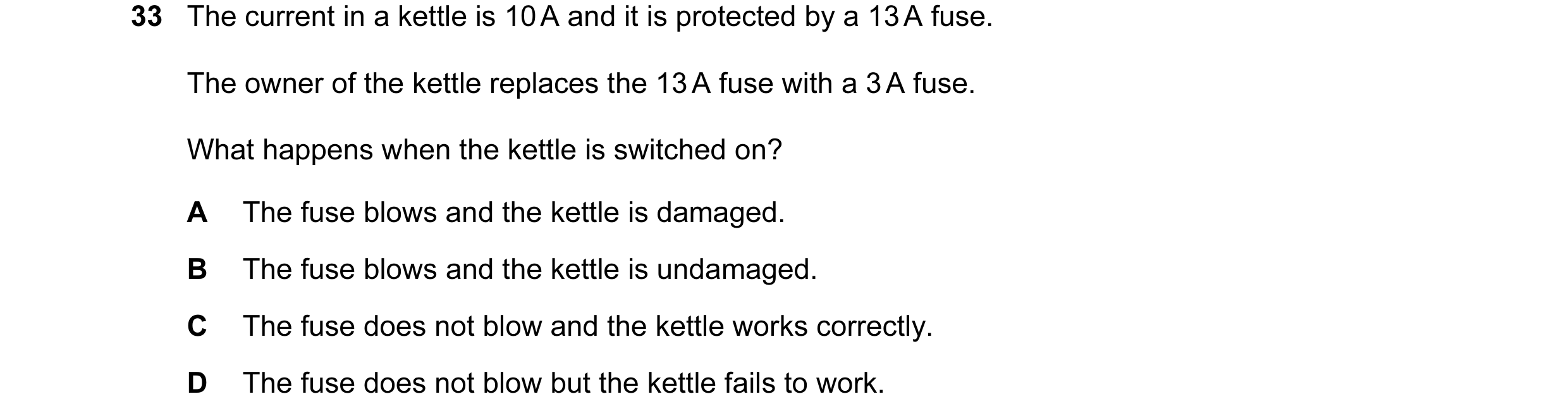
33 The current in a kettle is 10 A and it is protected by a 13 A fuse. The owner of the kettle replaces the 13 A fuse with a 3 A fuse. What happens when the kettle is switched on? A The fuse blows and the kettle is damaged. B The fuse blows and the kettle is undamaged. C The fuse does not blow and the kettle works correctly. D The fuse does not blow but the kettle fails to work.
1 marks
Answer: B
This question in 0625/11 Oct/Nov 2014
Q47 · The current in a kettle is 10 A and it is protected by a 13 A fuse 0625/12 Oct/Nov 2014
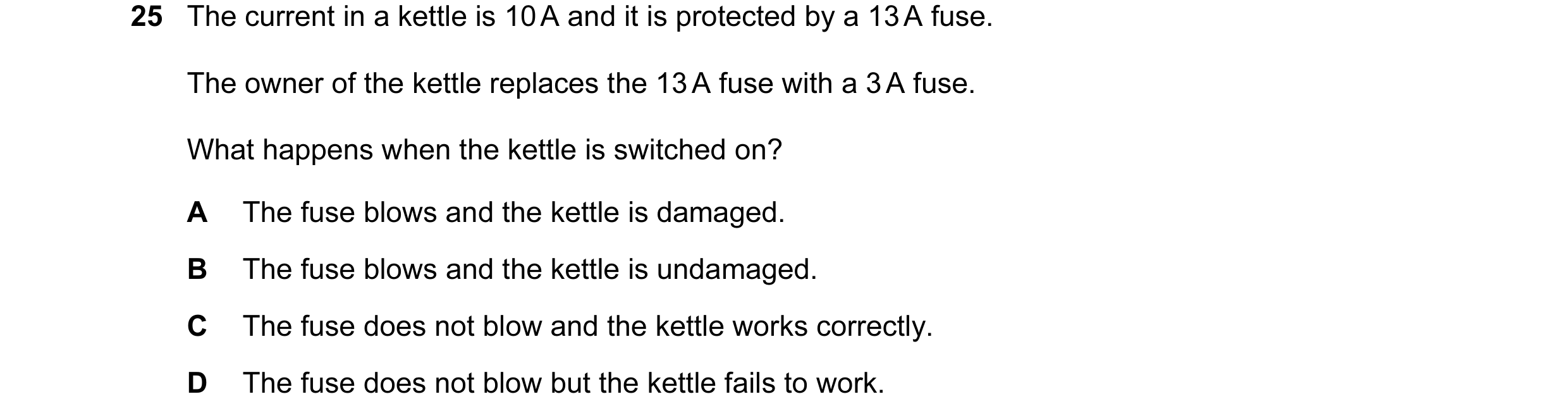
25 The current in a kettle is 10 A and it is protected by a 13 A fuse. The owner of the kettle replaces the 13 A fuse with a 3 A fuse. What happens when the kettle is switched on? A The fuse blows and the kettle is damaged. B The fuse blows and the kettle is undamaged. C The fuse does not blow and the kettle works correctly. D The fuse does not blow but the kettle fails to work.
1 marks
Answer: B
This question in 0625/12 Oct/Nov 2014
Q48 · The current in an electrical heater is 5.0 A 0625/13 Oct/Nov 2014
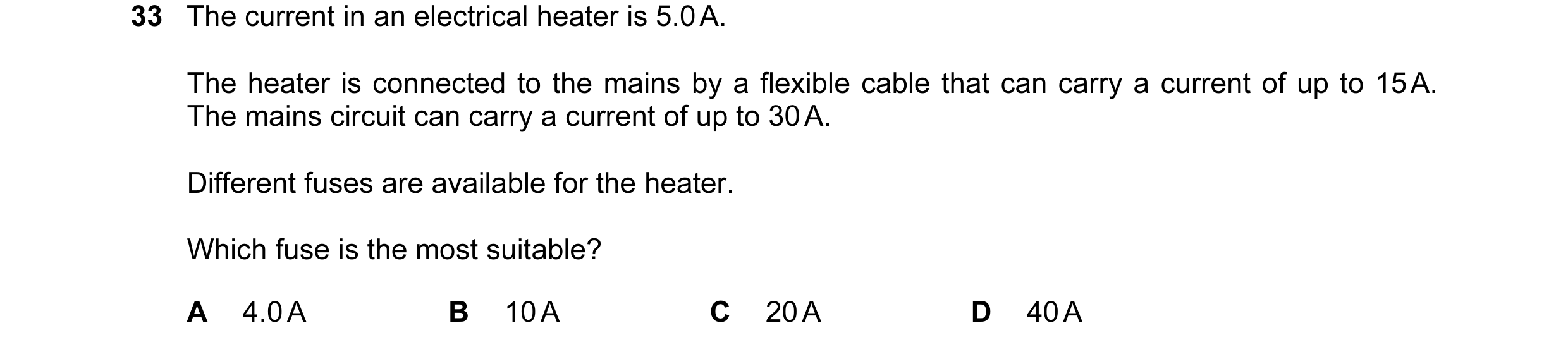
33 The current in an electrical heater is 5.0 A. The heater is connected to the mains by a flexible cable that can carry a current of up to 15 A. The mains circuit can carry a current of up to 30 A. Different fuses are available for the heater. Which fuse is the most suitable? A 4.0 A B 10 A C 20 A D 40 A
1 marks
Answer: B
This question in 0625/13 Oct/Nov 2014
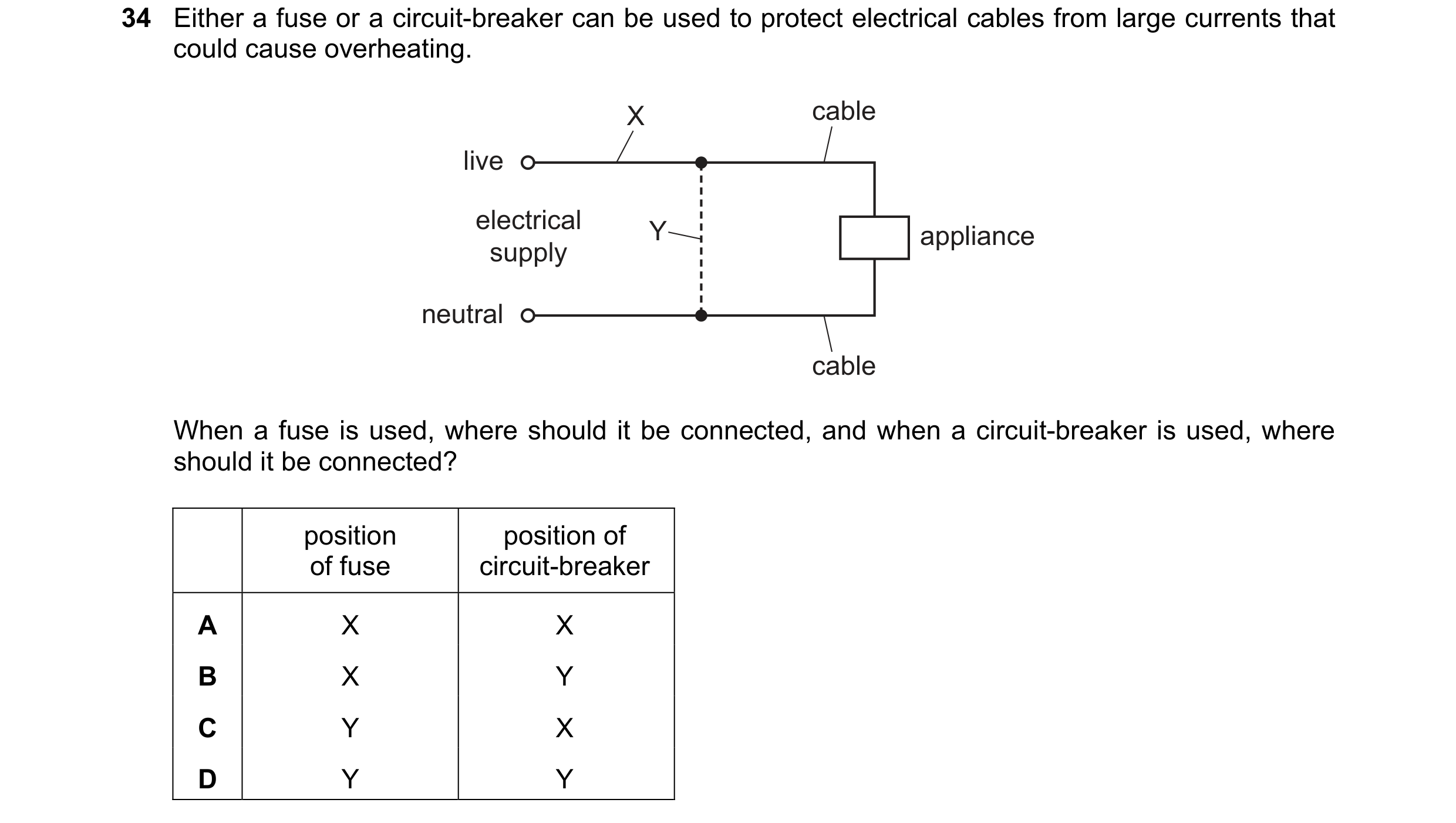
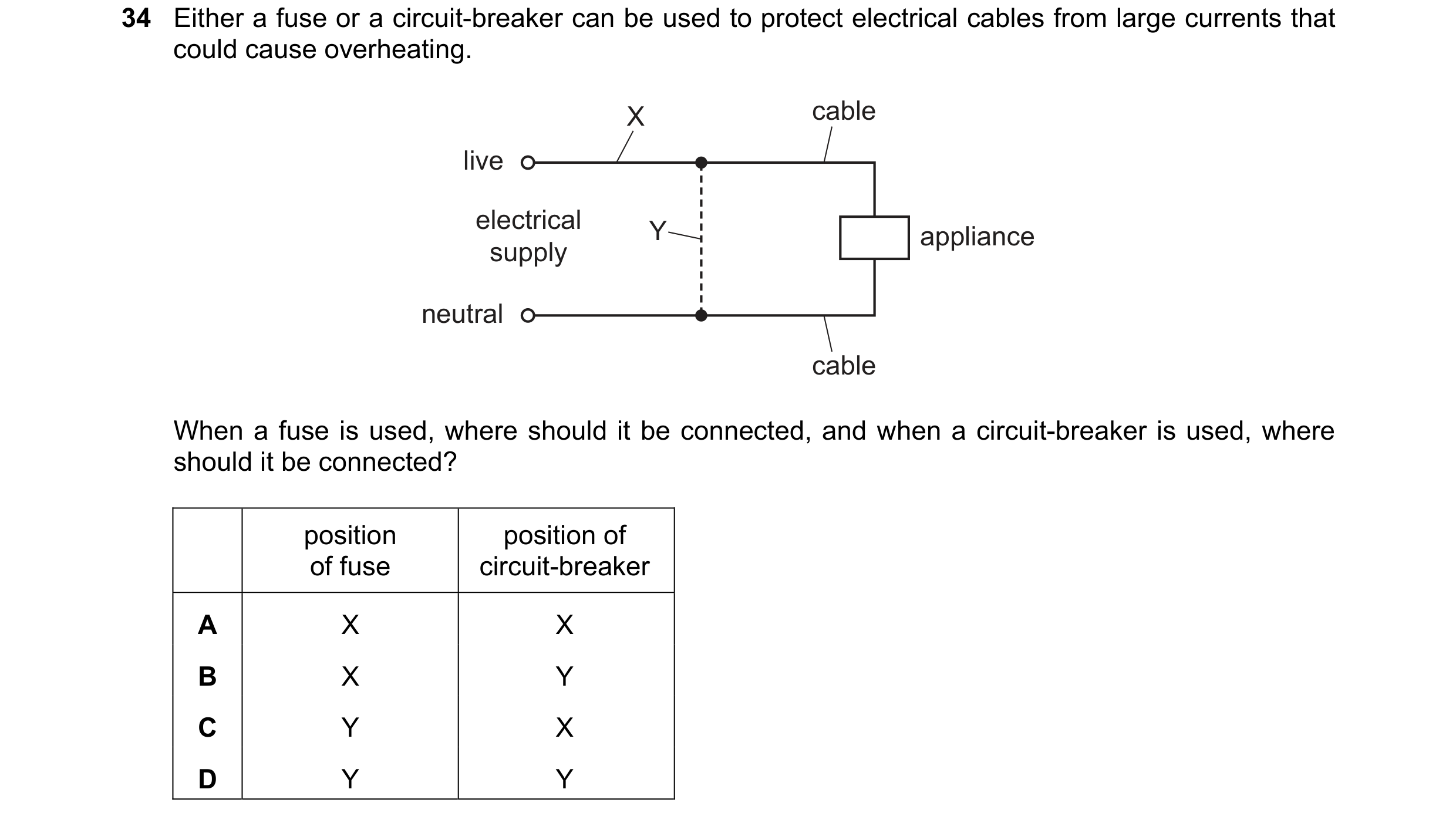
Q49 · Either a fuse or a circuit-breaker can be used to protect electrical cables from large… 0625/12 Feb/March 2015
33 Either a fuse or a circuit-breaker can be used to protect electrical cables from large currents that could cause overheating. X cable live electrical Y appliance supply neutral cable When a fuse is used, where should it be connected, and when a circuit-breaker is used, where should it be connected? position position of of fuse circuit-breaker A X X B X Y C Y X D Y Y
1 marks
Answer: A
This question in 0625/12 Feb/March 2015
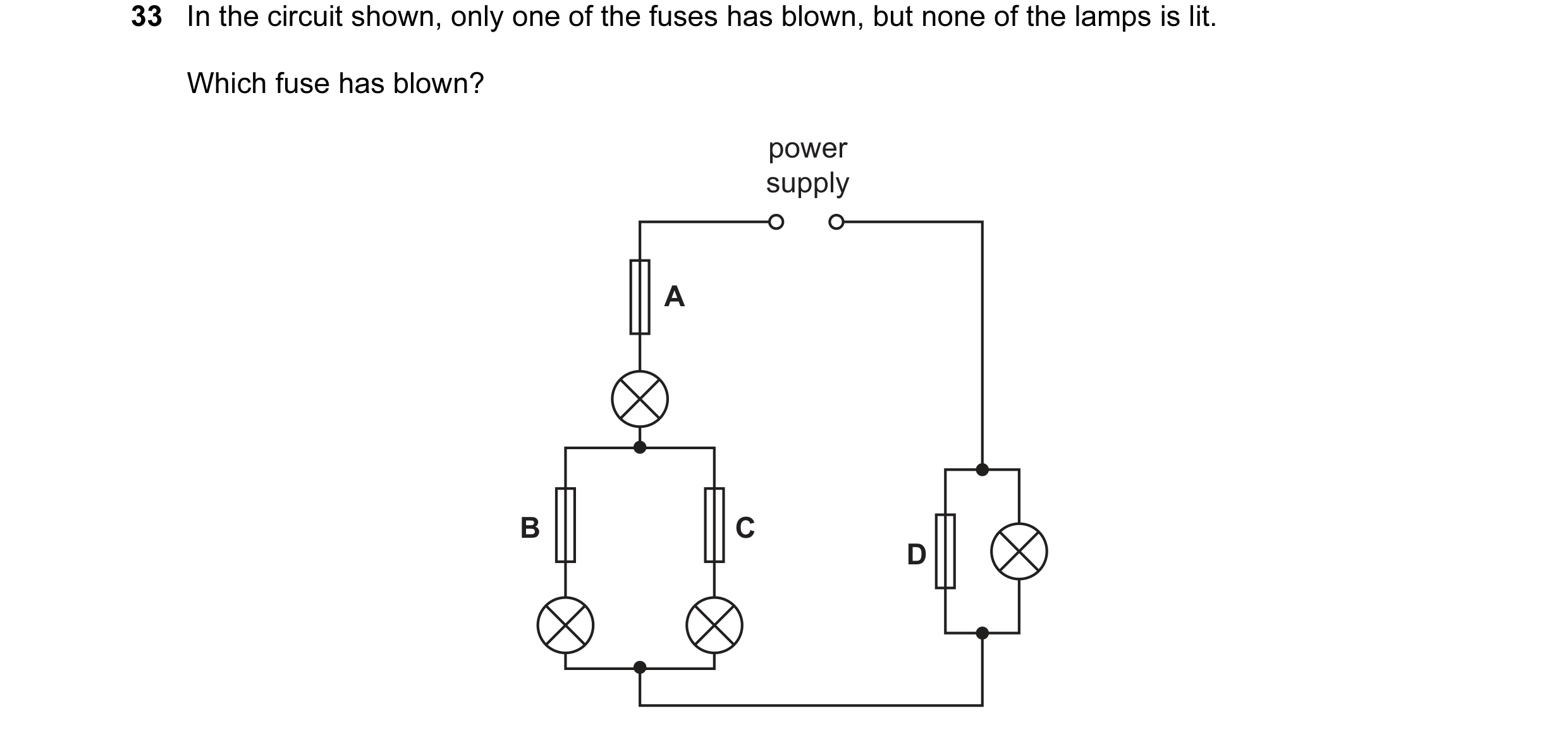
Q50 · In the circuit shown, only one of the fuses has blown, but none of the lamps is lit 0625/11 May/June 2015
33 In the circuit shown, only one of the fuses has blown, but none of the lamps is lit. Which fuse has blown? power supply A B C D
1 marks
Answer: A
This question in 0625/11 May/June 2015
Q51 · In the circuit shown, only one of the fuses has blown, but none of the lamps is lit 0625/12 May/June 2015
33 In the circuit shown, only one of the fuses has blown, but none of the lamps is lit. Which fuse has blown? power supply A B C D
1 marks
Answer: A
This question in 0625/12 May/June 2015
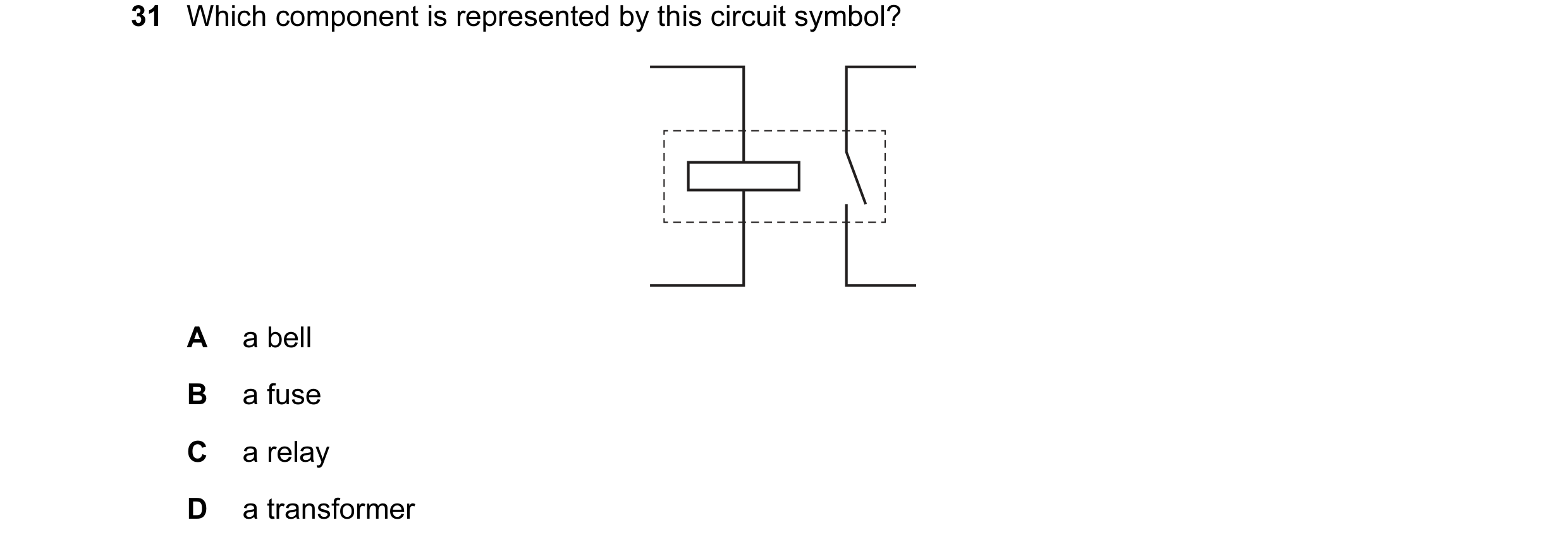
Q52 · Which component is represented by this circuit symbol? 0625/13 May/June 2015
31 Which component is represented by this circuit symbol? A a bell B a fuse C a relay D a transformer
1 marks
Answer: C
This question in 0625/13 May/June 2015
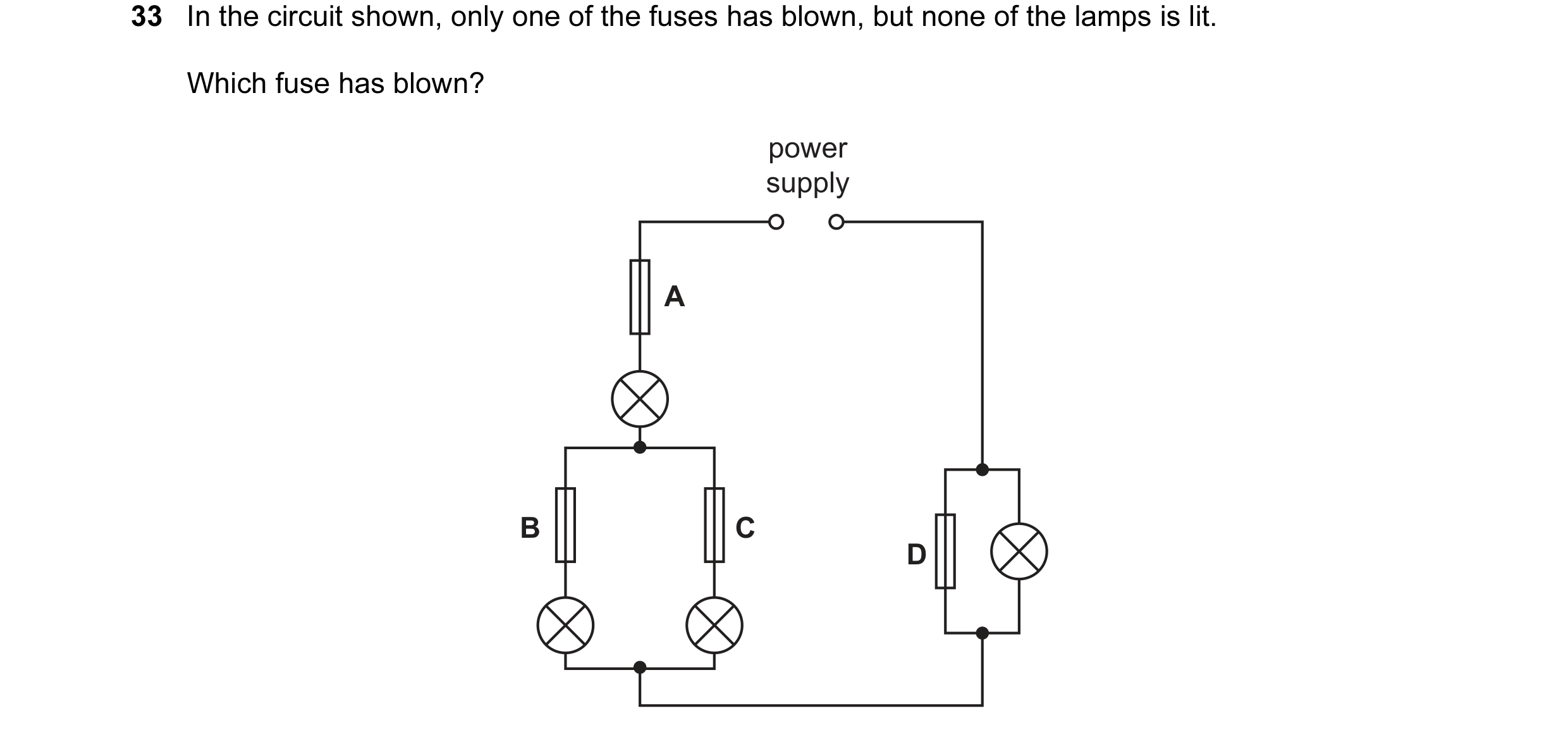
Q53 · In the circuit shown, only one of the fuses has blown, but none of the lamps is lit 0625/13 May/June 2015
33 In the circuit shown, only one of the fuses has blown, but none of the lamps is lit. Which fuse has blown? power supply A B C D
1 marks
Answer: A
This question in 0625/13 May/June 2015
Q54 · In an electrical circuit, what is the purpose of a fuse? 0625/14 May/June 2015
35 In an electrical circuit, what is the purpose of a fuse? A to connect the metal case of an appliance to the earth B to cut off the electrical supply if the current is too large C to keep an electrical appliance dry in damp conditions D to maintain a steady voltage as the current varies
1 marks
Answer: B
This question in 0625/14 May/June 2015
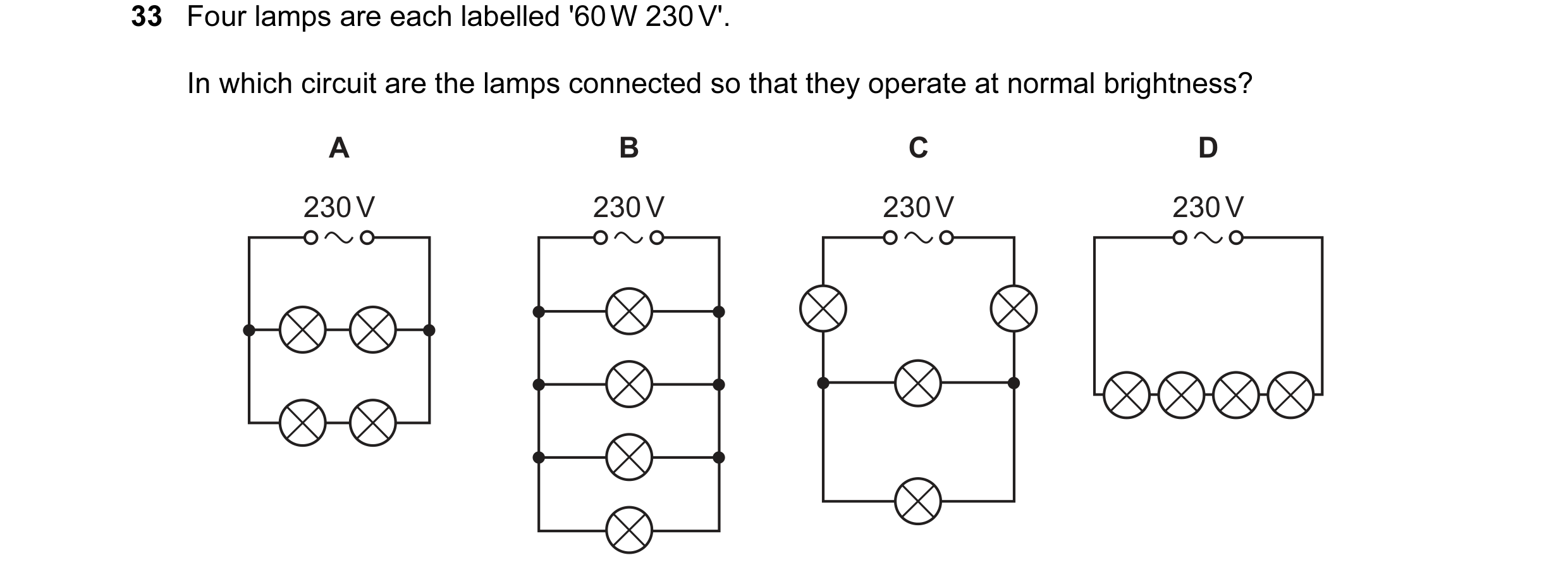
Q55 · Four lamps are each labelled '60 W 230 V' 0625/11 Oct/Nov 2015
33 Four lamps are each labelled '60 W 230 V'. In which circuit are the lamps connected so that they operate at normal brightness? A B C D 230 V 230 V 230 V 230 V
1 marks
Answer: B
This question in 0625/11 Oct/Nov 2015
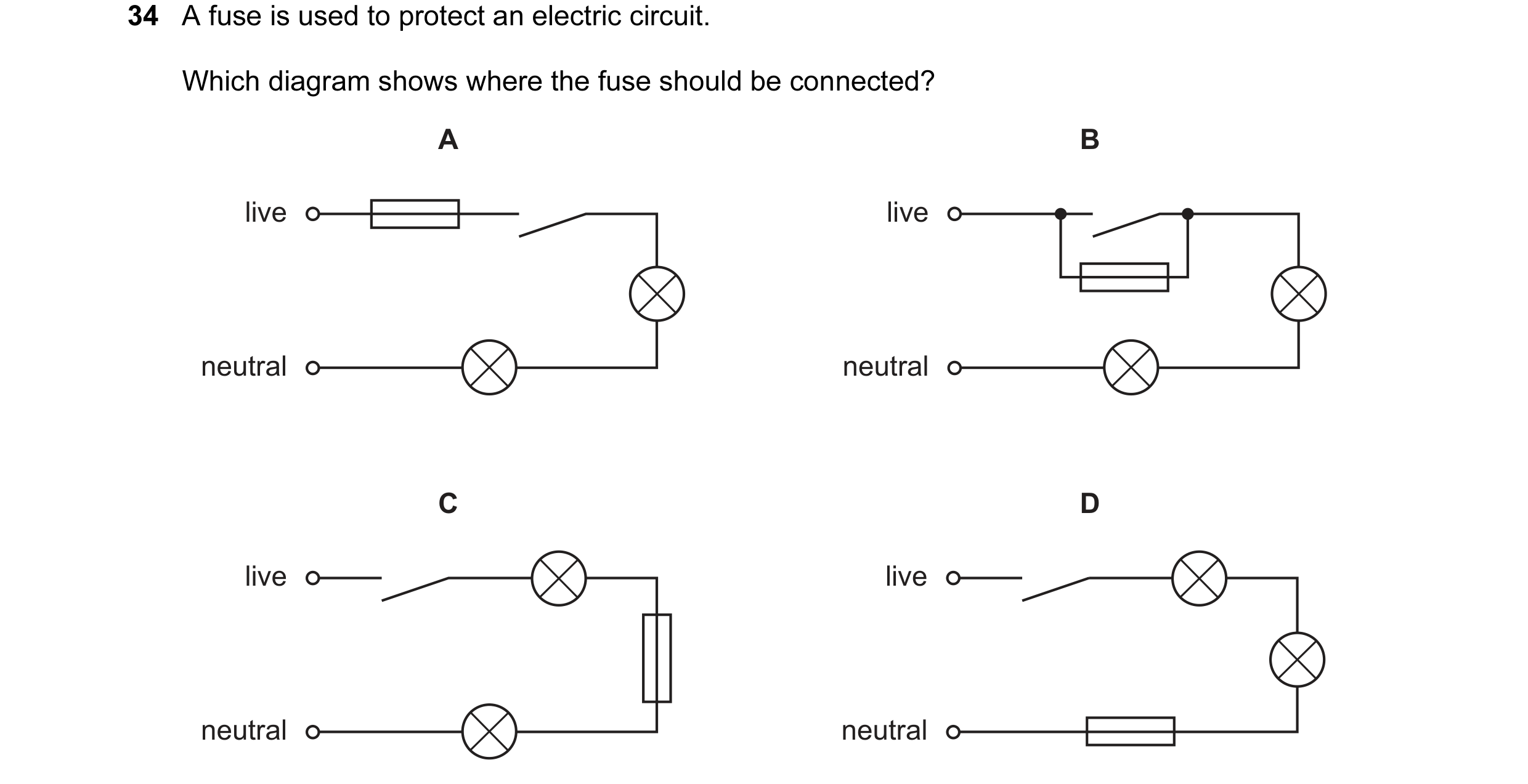
Q56 · A fuse is used to protect an electric circuit 0625/12 Oct/Nov 2015
34 A fuse is used to protect an electric circuit. Which diagram shows where the fuse should be connected? A B live live neutral neutral C D live live neutral neutral
1 marks
Answer: A
This question in 0625/12 Oct/Nov 2015
Q57 · After some building work in a house, a bare (uninsulated) live wire is left protruding… 0625/12 Feb/March 2016
34 After some building work in a house, a bare (uninsulated) live wire is left protruding from a wall. What is the greatest hazard? A a fire B a fuse blows C an electric shock D no current flows
1 marks
Answer: C
This question in 0625/12 Feb/March 2016
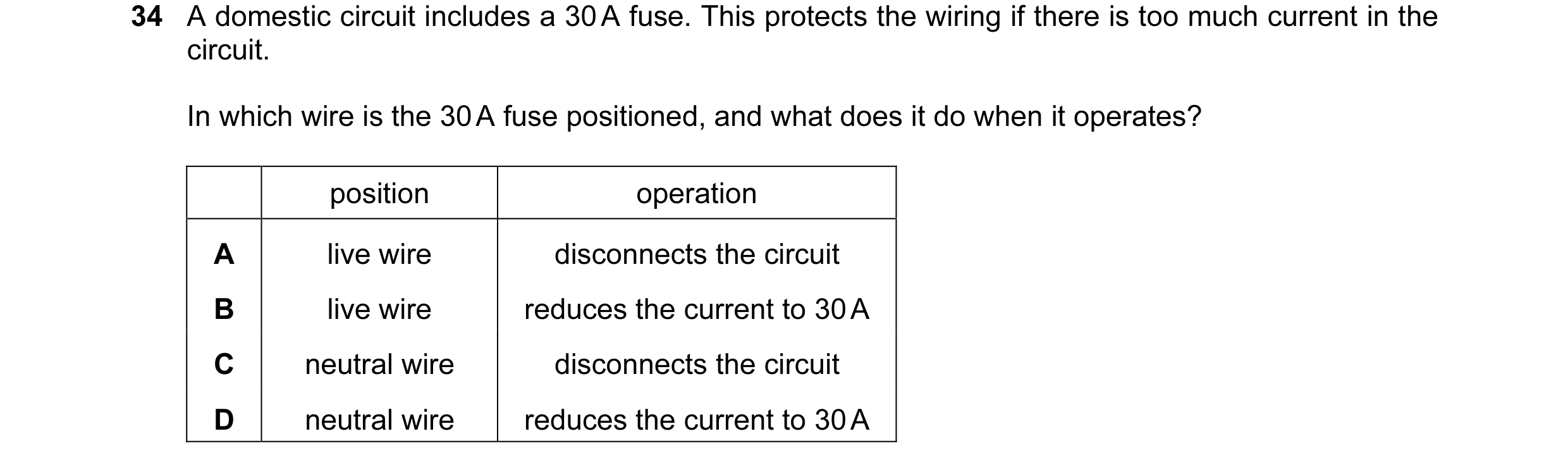
Q58 · A domestic circuit includes a 30 A fuse 0625/11 May/June 2016
34 A domestic circuit includes a 30 A fuse. This protects the wiring if there is too much current in the circuit. In which wire is the 30 A fuse positioned, and what does it do when it operates? position operation A live wire disconnects the circuit B live wire reduces the current to 30 A C neutral wire disconnects the circuit D neutral wire reduces the current to 30 A
1 marks
Answer: A
This question in 0625/11 May/June 2016
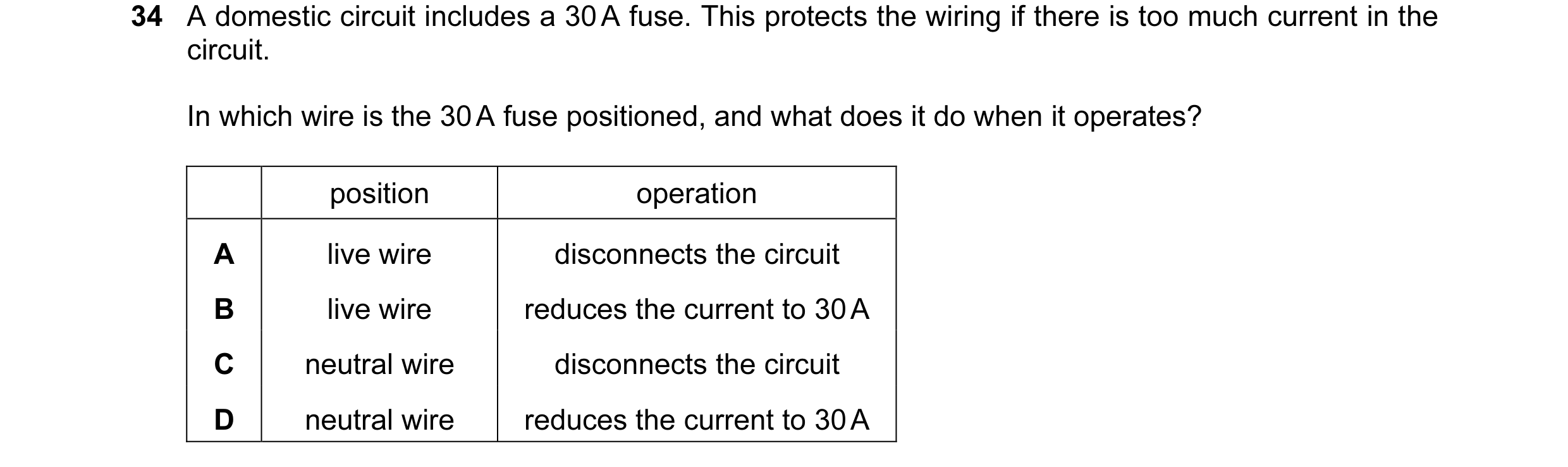
Q59 · A domestic circuit includes a 30 A fuse 0625/12 May/June 2016
34 A domestic circuit includes a 30 A fuse. This protects the wiring if there is too much current in the circuit. In which wire is the 30 A fuse positioned, and what does it do when it operates? position operation A live wire disconnects the circuit B live wire reduces the current to 30 A C neutral wire disconnects the circuit D neutral wire reduces the current to 30 A
1 marks
Answer: A
This question in 0625/12 May/June 2016
Q60 · Why are lamps in a house lighting circuit connected in parallel rather than in series? 0625/13 May/June 2016
31 Why are lamps in a house lighting circuit connected in parallel rather than in series? A If one lamp stops working, the remaining lamps become brighter. B Less current is taken from the power supply. C The lamps can be turned off independently using switches. D When more lamps are added, their brightness decreases.
1 marks
Answer: C
This question in 0625/13 May/June 2016
Q61 · A domestic circuit includes a 30 A fuse 0625/13 May/June 2016
34 A domestic circuit includes a 30 A fuse. This protects the wiring if there is too much current in the circuit. In which wire is the 30 A fuse positioned, and what does it do when it operates? position operation A live wire disconnects the circuit B live wire reduces the current to 30 A C neutral wire disconnects the circuit D neutral wire reduces the current to 30 A
1 marks
Answer: A
This question in 0625/13 May/June 2016
Q62 · Two electrical appliances are connected to the mains supply 0625/11 Oct/Nov 2016
34 Two electrical appliances are connected to the mains supply. The cable connected to one appliance includes an earth wire. The cable connected to the second appliance does not need an earth wire. What is a reason for this difference? A One appliance has a metal case, but the other appliance does not. B One appliance is fitted with a fuse, but the other appliance is not. C One appliance is fitted with a switch, but the other appliance is not. D One appliance needs more current than the other appliance.
1 marks
Answer: A
This question in 0625/11 Oct/Nov 2016
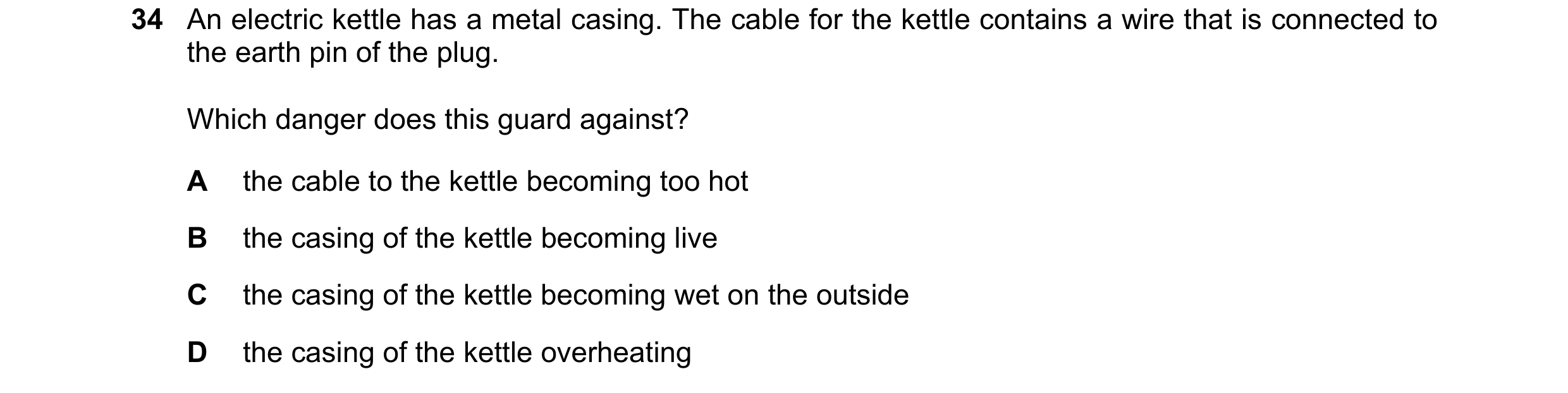
Q63 · An electric kettle has a metal casing 0625/12 Oct/Nov 2016
34 An electric kettle has a metal casing. The cable for the kettle contains a wire that is connected to the earth pin of the plug. Which danger does this guard against? A the cable to the kettle becoming too hot B the casing of the kettle becoming live C the casing of the kettle becoming wet on the outside D the casing of the kettle overheating
1 marks
Answer: B
This question in 0625/12 Oct/Nov 2016
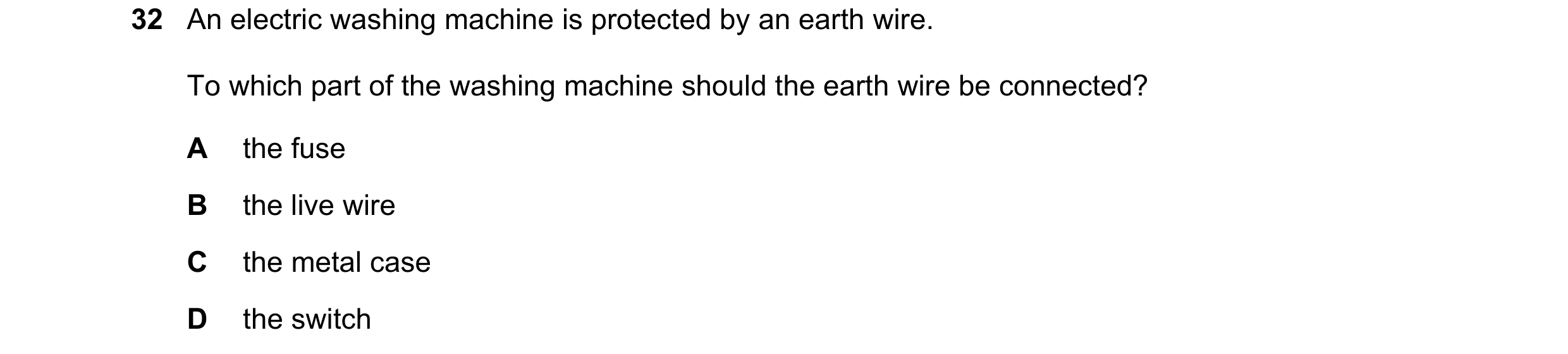
Q64 · An electric washing machine is protected by an earth wire 0625/13 Oct/Nov 2016
32 An electric washing machine is protected by an earth wire. To which part of the washing machine should the earth wire be connected? A the fuse B the live wire C the metal case D the switch
1 marks
Answer: C
This question in 0625/13 Oct/Nov 2016
Q65 · Why is a fuse used in an electrical circuit? 0625/13 Oct/Nov 2016
34 Why is a fuse used in an electrical circuit? A so that the current can have only one value B to prevent the current becoming too large C to provide a path to earth if a fault occurs D to save electrical energy
1 marks
Answer: B
This question in 0625/13 Oct/Nov 2016
Q66 · In this circuit, a component at X automatically protects the wiring from overheating if… 0625/12 Feb/March 2017
35
In this circuit, a component at X automatically protects the wiring from overheating if there is a
fault.
electrical supply
Which row indicates components that are suitable?
circuit .
breaker fuse switch
JV key
JY = suitable
X = not suitable
0 ONO DW >
~~ KOM
Kk 4 4
~*~ {Kw K&
1 marks
Answer: B
This question in 0625/12 Feb/March 2017
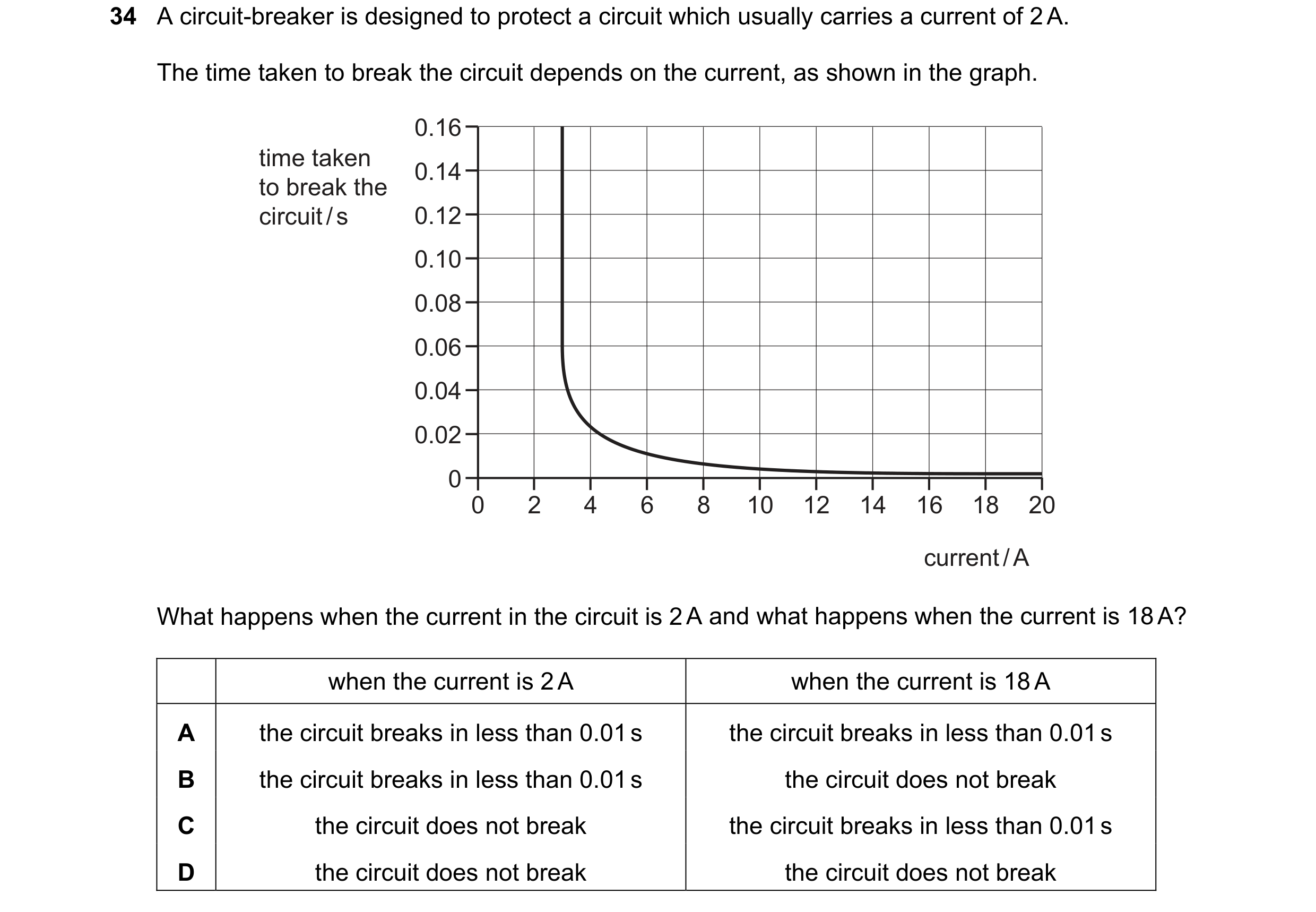
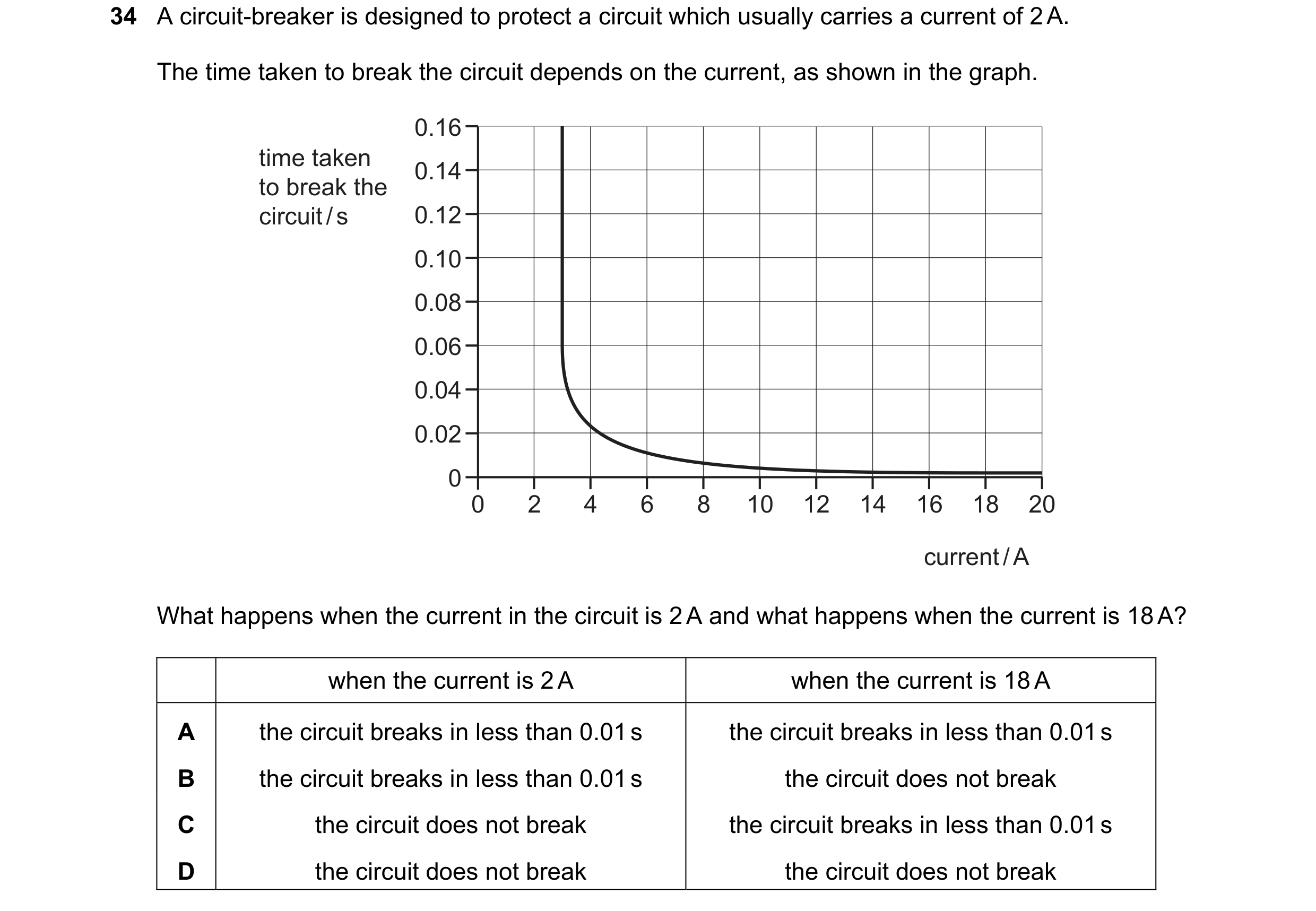
Q67 · A circuit-breaker is designed to protect a circuit which usually carries a current of 2 A 0625/11 May/June 2017
34 A circuit-breaker is designed to protect a circuit which usually carries a current of 2 A. The time taken to break the circuit depends on the current, as shown in the graph. 0.16 time taken 0.14 to break the circuit / s 0.12 0.10 0.08 0.06 0.04 0.02 0 0 2 4 6 8 10 12 14 16 18 20 current / A What happens when the current in the circuit is 2 A and what happens when the current is 18 A? when the current is 2 A when the current is 18 A A the circuit breaks in less than 0.01 s the circuit breaks in less than 0.01 s B the circuit breaks in less than 0.01 s the circuit does not break C the circuit does not break the circuit breaks in less than 0.01 s D the circuit does not break the circuit does not break
1 marks
Answer: C
This question in 0625/11 May/June 2017
Q68 · A circuit-breaker is designed to protect a circuit which usually carries a current of 2 A 0625/12 May/June 2017
34 A circuit-breaker is designed to protect a circuit which usually carries a current of 2 A. The time taken to break the circuit depends on the current, as shown in the graph. 0.16 time taken 0.14 to break the circuit / s 0.12 0.10 0.08 0.06 0.04 0.02 0 0 2 4 6 8 10 12 14 16 18 20 current / A What happens when the current in the circuit is 2 A and what happens when the current is 18 A? when the current is 2 A when the current is 18 A A the circuit breaks in less than 0.01 s the circuit breaks in less than 0.01 s B the circuit breaks in less than 0.01 s the circuit does not break C the circuit does not break the circuit breaks in less than 0.01 s D the circuit does not break the circuit does not break
1 marks
Answer: C
This question in 0625/12 May/June 2017
Q69 · A circuit-breaker is designed to protect a circuit which usually carries a current of 2 A 0625/13 May/June 2017
34 A circuit-breaker is designed to protect a circuit which usually carries a current of 2 A. The time taken to break the circuit depends on the current, as shown in the graph. 0.16 time taken 0.14 to break the circuit / s 0.12 0.10 0.08 0.06 0.04 0.02 0 0 2 4 6 8 10 12 14 16 18 20 current / A What happens when the current in the circuit is 2 A and what happens when the current is 18 A? when the current is 2 A when the current is 18 A A the circuit breaks in less than 0.01 s the circuit breaks in less than 0.01 s B the circuit breaks in less than 0.01 s the circuit does not break C the circuit does not break the circuit breaks in less than 0.01 s D the circuit does not break the circuit does not break
1 marks
Answer: C
This question in 0625/13 May/June 2017
Q70 · An appliance is connected to a mains supply 0625/11 Oct/Nov 2017
35 An appliance is connected to a mains supply. Its circuit also contains a switch and a fuse. Which circuit shows the fuse in the correct position? A B appliance appliance live live neutral neutral C D appliance appliance live live neutral neutral
1 marks
Answer: C
This question in 0625/11 Oct/Nov 2017
Q71 · An appliance is connected to a mains supply 0625/12 Oct/Nov 2017
35 An appliance is connected to a mains supply. Its circuit also contains a switch and a fuse. Which circuit shows the fuse in the correct position? A B appliance appliance live live neutral neutral C D appliance appliance live live neutral neutral
1 marks
Answer: C
This question in 0625/12 Oct/Nov 2017
Q72 · An appliance is connected to a mains supply 0625/13 Oct/Nov 2017
34 An appliance is connected to a mains supply. Its circuit also contains a switch and a fuse. Which circuit shows the fuse in the correct position? A B appliance appliance live live neutral neutral C D appliance appliance live live neutral neutral
1 marks
Answer: C
This question in 0625/13 Oct/Nov 2017
Q73 · Either a fuse or a circuit-breaker can be used to protect electrical cables from large… 0625/11 Oct/Nov 2018
34 Either a fuse or a circuit-breaker can be used to protect electrical cables from large currents that could cause overheating. X cable live electrical Y appliance supply neutral cable When a fuse is used, where should it be connected, and when a circuit-breaker is used, where should it be connected? position position of of fuse circuit-breaker A X X B X Y C Y X D Y Y
1 marks
Answer: A
This question in 0625/11 Oct/Nov 2018
Q74 · Either a fuse or a circuit-breaker can be used to protect electrical cables from large… 0625/12 Oct/Nov 2018
34 Either a fuse or a circuit-breaker can be used to protect electrical cables from large currents that could cause overheating. X cable live electrical Y appliance supply neutral cable When a fuse is used, where should it be connected, and when a circuit-breaker is used, where should it be connected? position position of of fuse circuit-breaker A X X B X Y C Y X D Y Y
1 marks
Answer: A
This question in 0625/12 Oct/Nov 2018
Q75 · Either a fuse or a circuit-breaker can be used to protect electrical cables from large… 0625/13 Oct/Nov 2018
34 Either a fuse or a circuit-breaker can be used to protect electrical cables from large currents that could cause overheating. X cable live electrical Y appliance supply neutral cable When a fuse is used, where should it be connected, and when a circuit-breaker is used, where should it be connected? position position of of fuse circuit-breaker A X X B X Y C Y X D Y Y
1 marks
Answer: A
This question in 0625/13 Oct/Nov 2018
Q76 · The current in a kettle is 10 A and the kettle is protected by a 13 A fuse 0625/12 Feb/March 2019
33 The current in a kettle is 10 A and the kettle is protected by a 13 A fuse. The owner of the kettle replaces the 13 A fuse with a 3 A fuse. What happens when the kettle is switched on? A The fuse melts and the kettle might be damaged. B The fuse melts and the kettle is undamaged. C The fuse does not melt and the kettle works correctly. D The fuse does not melt but the kettle fails to work.
1 marks
Answer: B
This question in 0625/12 Feb/March 2019
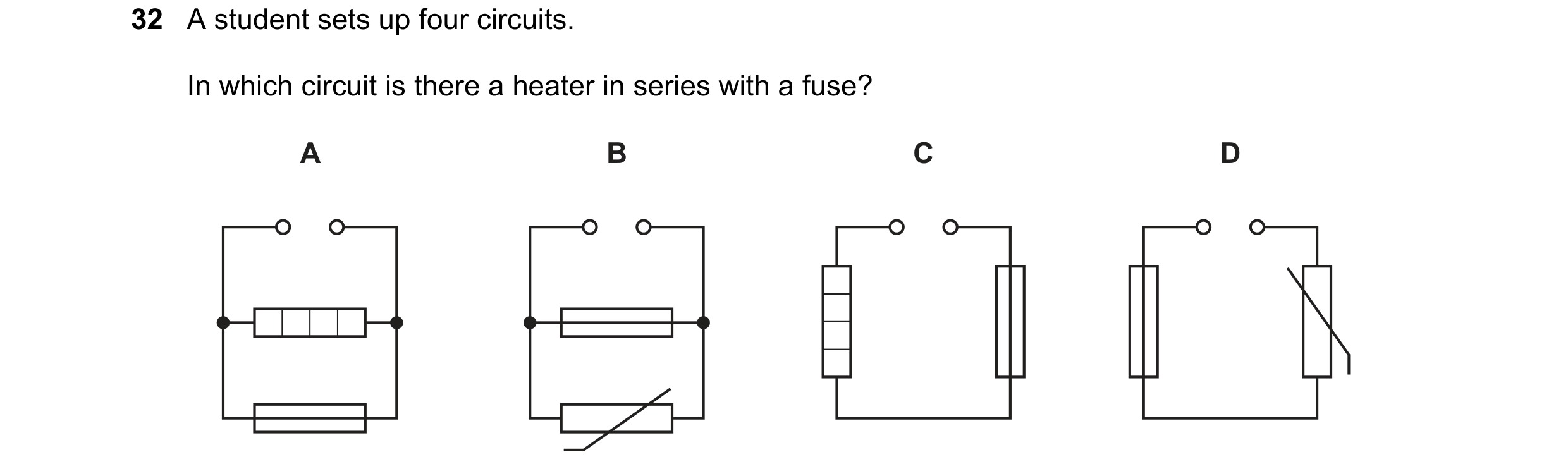
Q77 · A student sets up four circuits 0625/11 May/June 2019
32 A student sets up four circuits. In which circuit is there a heater in series with a fuse? A B C D
1 marks
Answer: C
This question in 0625/11 May/June 2019
Q78 · An electric heater is plugged into the mains supply using a fused plug 0625/11 May/June 2019
35 An electric heater is plugged into the mains supply using a fused plug. The current in the heater is 10 A. The cable attached to the heater is rated at 15 A. The fuses available are rated at 1 A, 3 A, 5 A and 13 A. Which fuse should be used? A 1 A B 3 A C 5 A D 13 A
1 marks
Answer: D
This question in 0625/11 May/June 2019
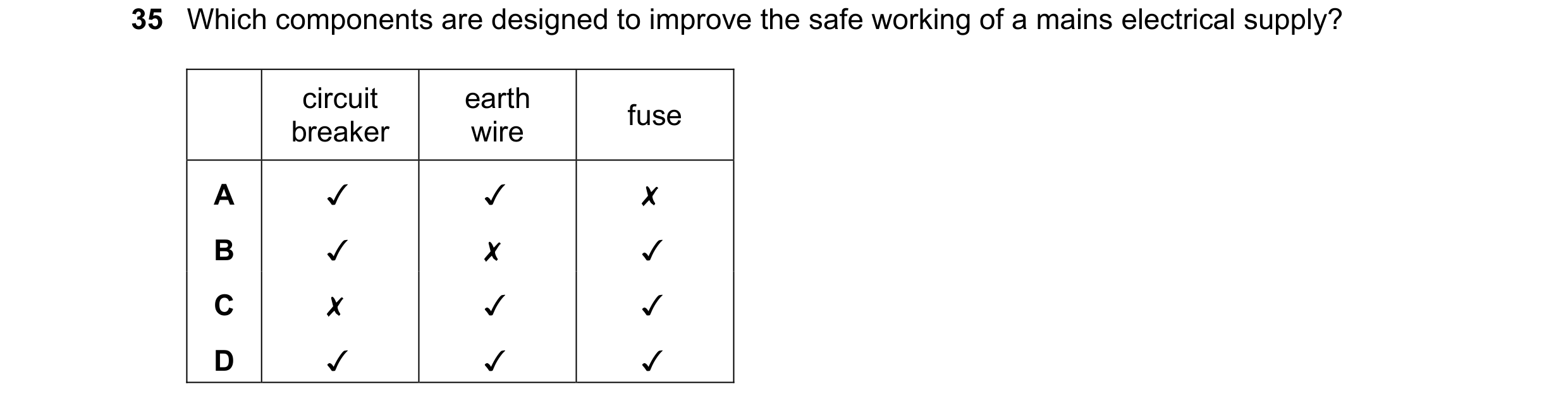
Q79 · Which components are designed to improve the safe working of a mains electrical supply? 0625/12 May/June 2019
35 Which components are designed to improve the safe working of a mains electrical supply?
circuit earth
breaker wire
fuse
1 marks
Answer: D
This question in 0625/12 May/June 2019
Q80 · The diagram shows a lead-lined box used for storing radioactive sources 0625/12 May/June 2019
40 The diagram shows a lead-lined box used for storing radioactive sources. Why is the inside of the box lined with lead? A It helps the sources to stay radioactive for longer. B It makes the box heavier. C It makes the radioactive sources more stable. D It reduces the amount of radiation that can escape from the box.
1 marks
Answer: D
This question in 0625/12 May/June 2019
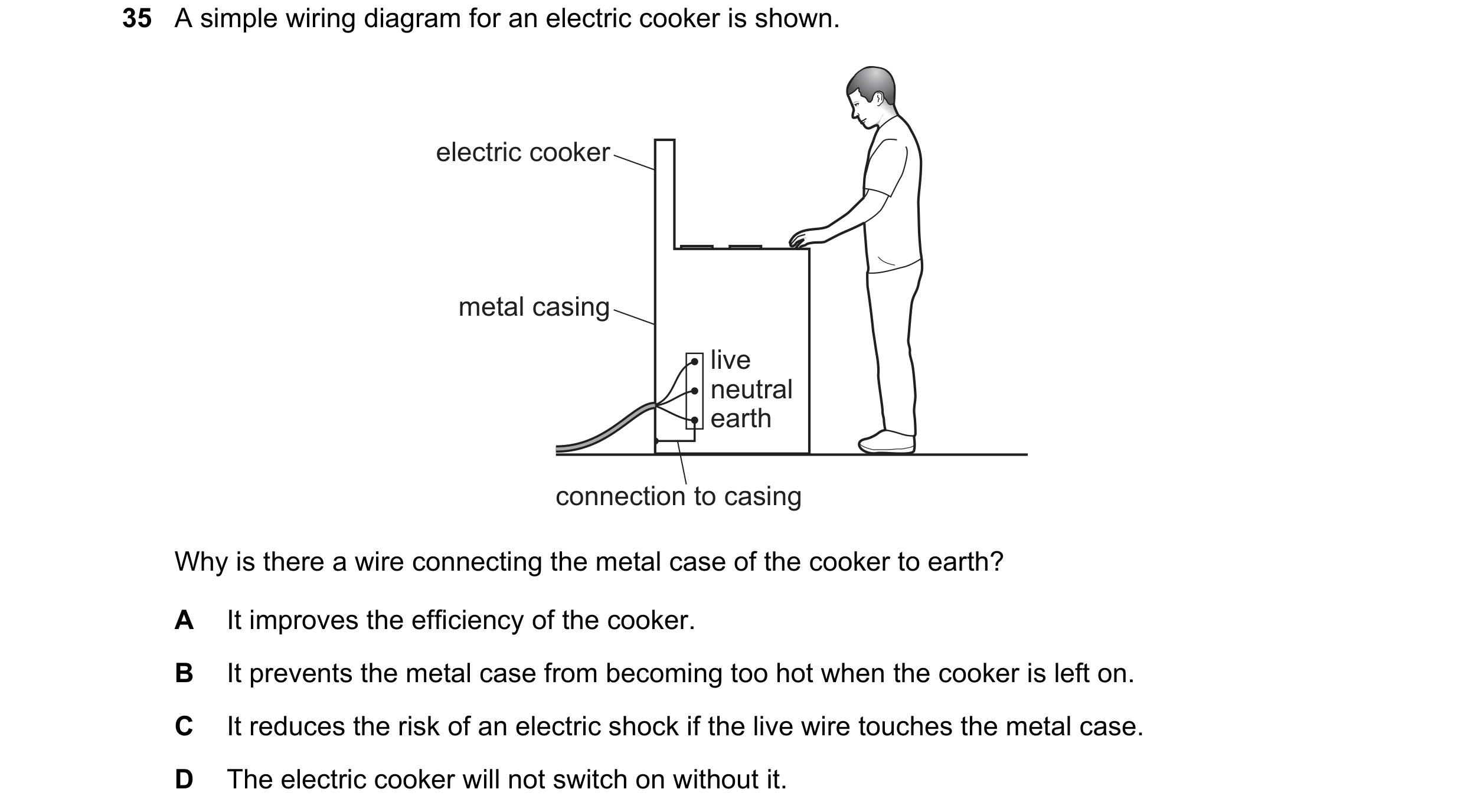
Q81 · A simple wiring diagram for an electric cooker is shown 0625/13 May/June 2019
35 A simple wiring diagram for an electric cooker is shown. electric cooker metal casing live neutral earth connection to casing Why is there a wire connecting the metal case of the cooker to earth? A It improves the efficiency of the cooker. B It prevents the metal case from becoming too hot when the cooker is left on. C It reduces the risk of an electric shock if the live wire touches the metal case. D The electric cooker will not switch on without it.
1 marks
Answer: C
This question in 0625/13 May/June 2019
Q82 · Where must a fuse be connected in a mains electric circuit? 0625/11 Oct/Nov 2019
34 Where must a fuse be connected in a mains electric circuit? A the earth wire only B the live wire only C the neutral wire only D the live wire and the earth wire
1 marks
Answer: B
This question in 0625/11 Oct/Nov 2019
Q83 · Where must a fuse be connected in a mains electric circuit? 0625/12 Oct/Nov 2019
34 Where must a fuse be connected in a mains electric circuit? A the earth wire only B the live wire only C the neutral wire only D the live wire and the earth wire
1 marks
Answer: B
This question in 0625/12 Oct/Nov 2019
Q84 · Why are some radioactive sources stored in boxes made from lead? 0625/12 Oct/Nov 2019
40 Why are some radioactive sources stored in boxes made from lead? A Lead absorbs emissions from the radioactive sources. B Lead decreases the half-life of radioactive sources. C Lead increases the half-life of radioactive sources. D Lead repels emissions from the radioactive sources.
1 marks
Answer: A
This question in 0625/12 Oct/Nov 2019
Q85 · Where must a fuse be connected in a mains electric circuit? 0625/13 Oct/Nov 2019
34 Where must a fuse be connected in a mains electric circuit? A the earth wire only B the live wire only C the neutral wire only D the live wire and the earth wire
1 marks
Answer: B
This question in 0625/13 Oct/Nov 2019
Q86 · Why are some radioactive sources stored in boxes made from lead? 0625/13 Oct/Nov 2019
40 Why are some radioactive sources stored in boxes made from lead? A Lead absorbs emissions from the radioactive sources. B Lead decreases the half-life of radioactive sources. C Lead increases the half-life of radioactive sources. D Lead repels emissions from the radioactive sources.
1 marks
Answer: A
This question in 0625/13 Oct/Nov 2019
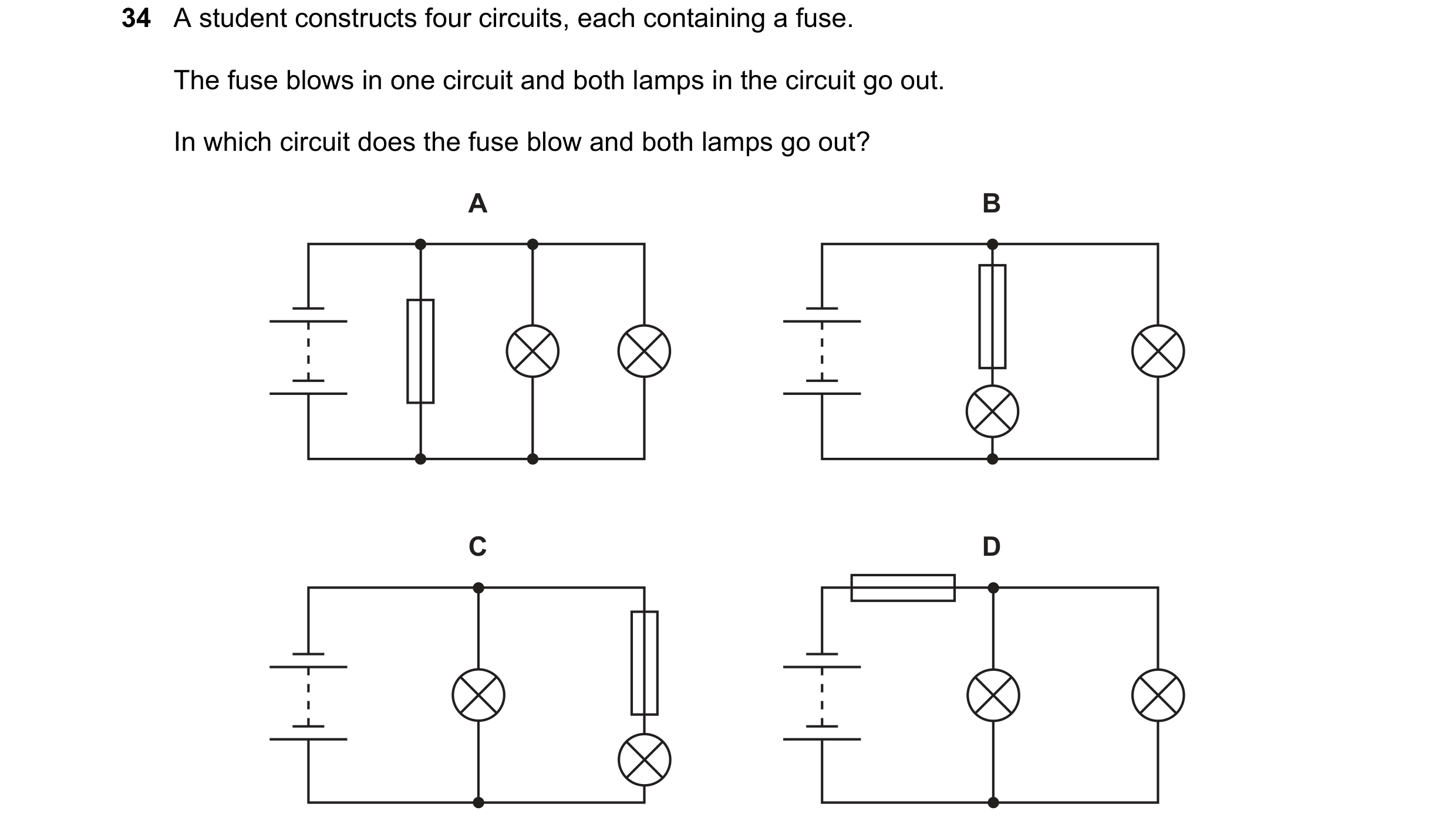
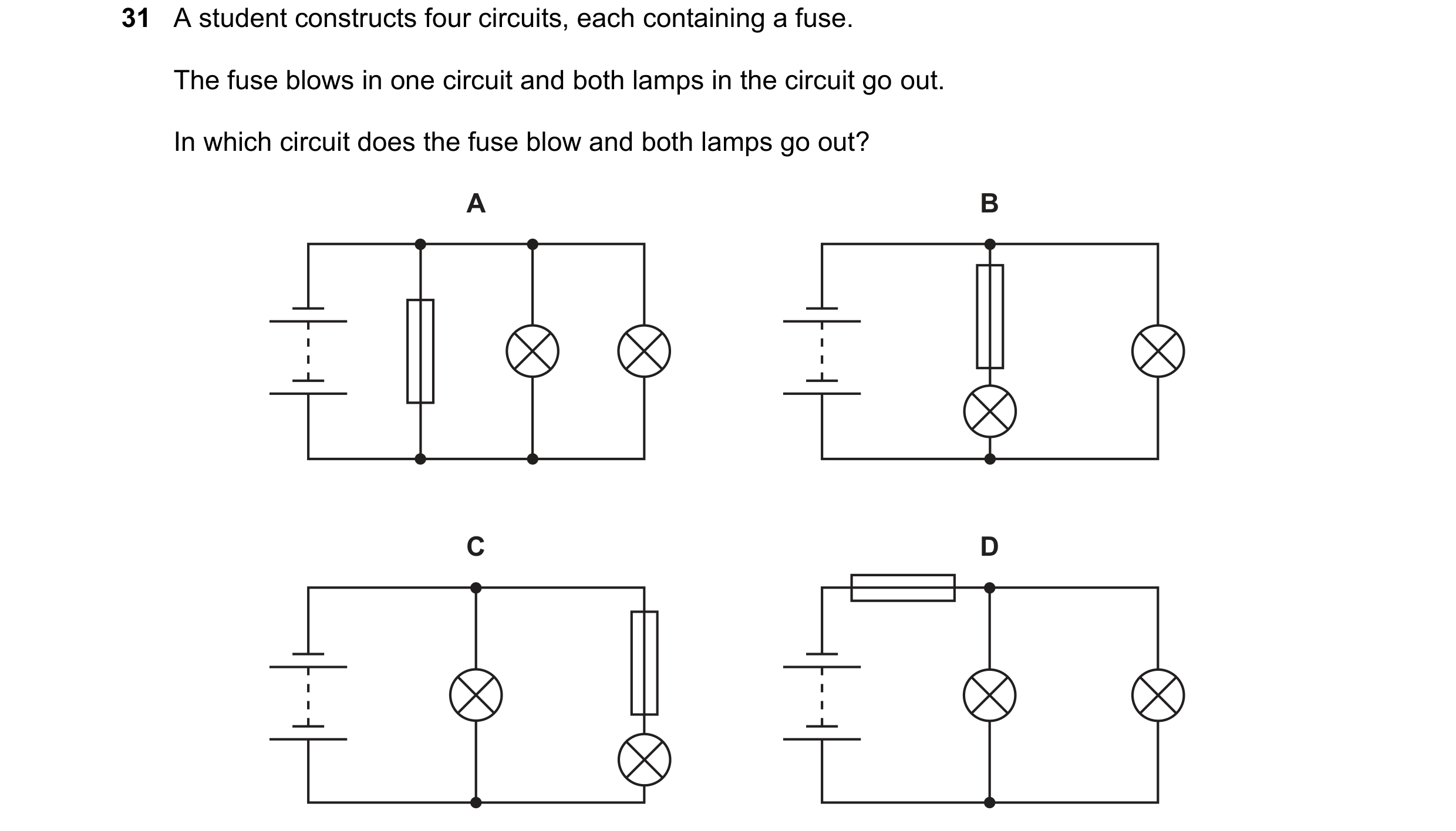
Q87 · A student constructs four circuits, each containing a fuse 0625/11 May/June 2020
34 A student constructs four circuits, each containing a fuse. The fuse blows in one circuit and both lamps in the circuit go out. In which circuit does the fuse blow and both lamps go out? A B C D
1 marks
Answer: D
This question in 0625/11 May/June 2020
Q88 · A student constructs four circuits, each containing a fuse 0625/12 May/June 2020
34 A student constructs four circuits, each containing a fuse. The fuse blows in one circuit and both lamps in the circuit go out. In which circuit does the fuse blow and both lamps go out? A B C D
1 marks
Answer: D
This question in 0625/12 May/June 2020
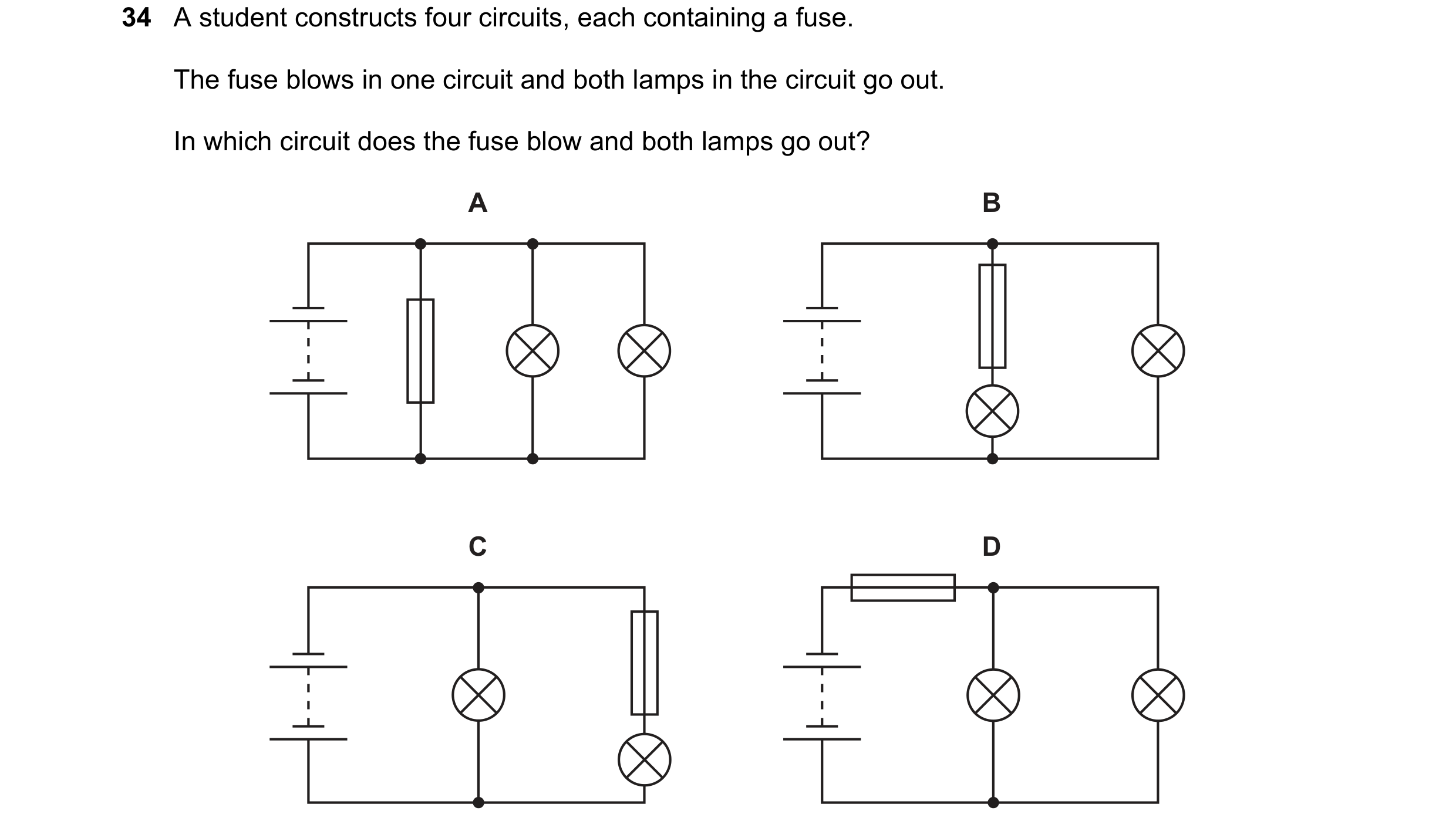
Q89 · A student constructs four circuits, each containing a fuse 0625/13 May/June 2020
34 A student constructs four circuits, each containing a fuse. The fuse blows in one circuit and both lamps in the circuit go out. In which circuit does the fuse blow and both lamps go out? A B C D
1 marks
Answer: D
This question in 0625/13 May/June 2020
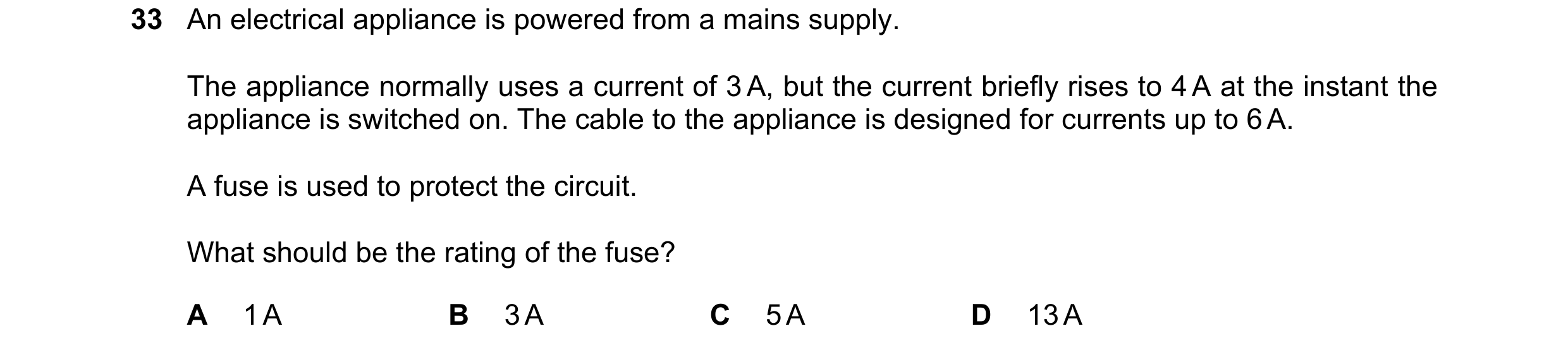
Q90 · An electrical appliance is powered from a mains supply 0625/11 Oct/Nov 2020
33 An electrical appliance is powered from a mains supply. The appliance normally uses a current of 3 A, but the current briefly rises to 4 A at the instant the appliance is switched on. The cable to the appliance is designed for currents up to 6 A. A fuse is used to protect the circuit. What should be the rating of the fuse? A 1 A B 3 A C 5 A D 13 A
1 marks
Answer: C
This question in 0625/11 Oct/Nov 2020
Q91 · An electrical appliance is powered from a mains supply 0625/12 Oct/Nov 2020
33 An electrical appliance is powered from a mains supply. The appliance normally uses a current of 3 A, but the current briefly rises to 4 A at the instant the appliance is switched on. The cable to the appliance is designed for currents up to 6 A. A fuse is used to protect the circuit. What should be the rating of the fuse? A 1 A B 3 A C 5 A D 13 A
1 marks
Answer: C
This question in 0625/12 Oct/Nov 2020
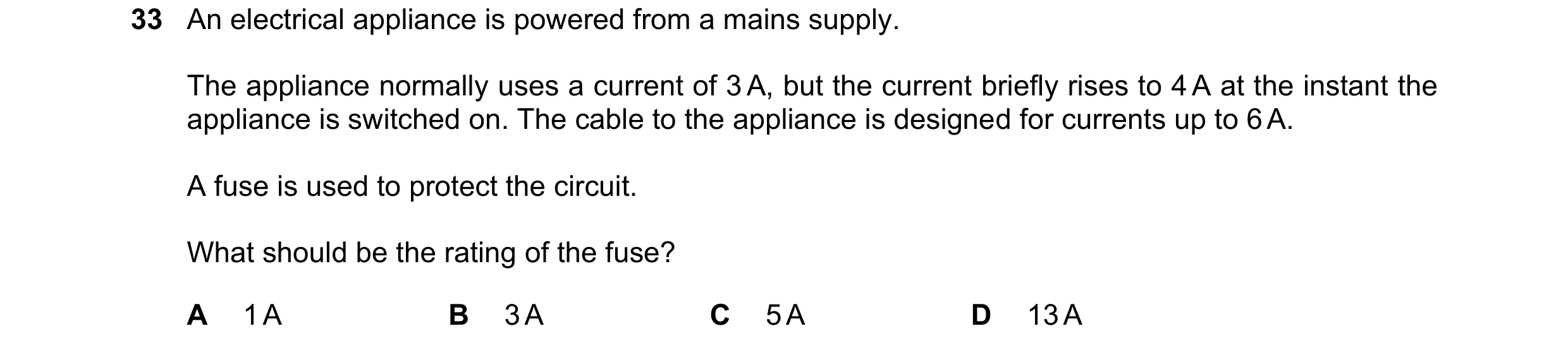
Q92 · An electrical appliance is powered from a mains supply 0625/13 Oct/Nov 2020
33 An electrical appliance is powered from a mains supply. The appliance normally uses a current of 3 A, but the current briefly rises to 4 A at the instant the appliance is switched on. The cable to the appliance is designed for currents up to 6 A. A fuse is used to protect the circuit. What should be the rating of the fuse? A 1 A B 3 A C 5 A D 13 A
1 marks
Answer: C
This question in 0625/13 Oct/Nov 2020
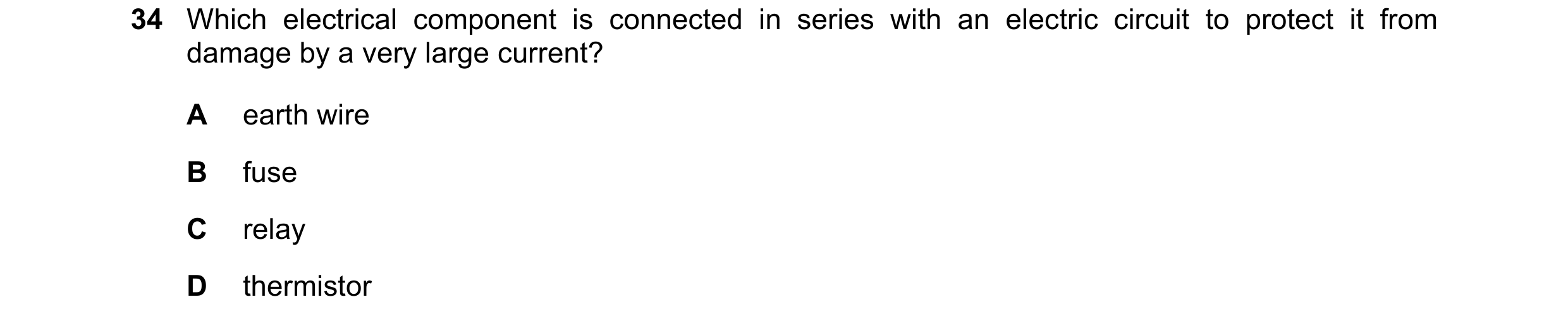
Q93 · Which electrical component is connected in series with an electric circuit to protect it… 0625/12 Feb/March 2021
34 Which electrical component is connected in series with an electric circuit to protect it from damage by a very large current? A earth wire B fuse C relay D thermistor
1 marks
Answer: B
This question in 0625/12 Feb/March 2021
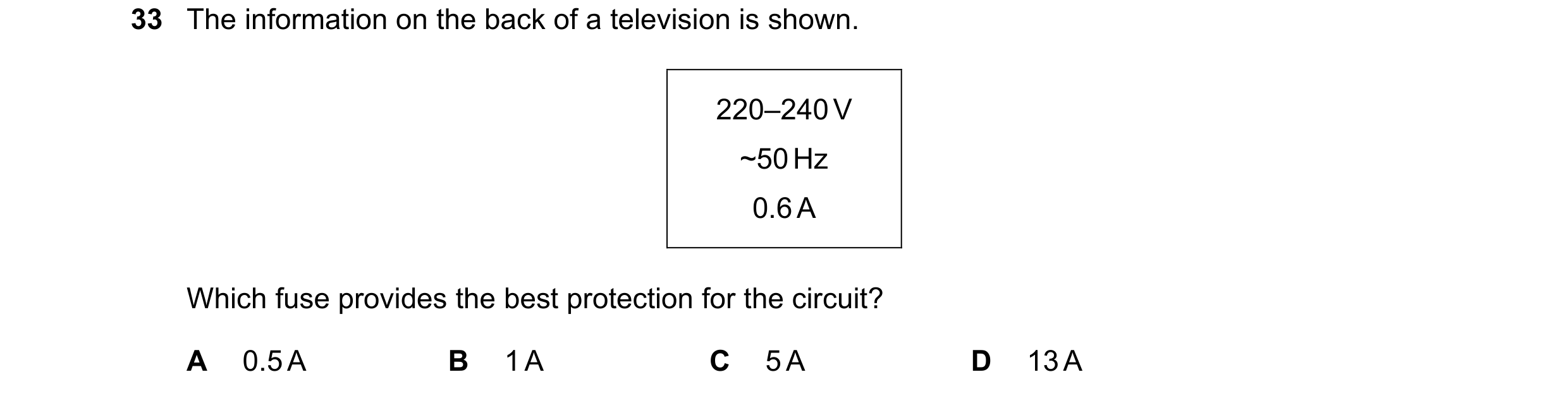
Q94 · The information on the back of a television is shown 0625/12 May/June 2021
33 The information on the back of a television is shown. 220–240 V ~50 Hz 0.6 A Which fuse provides the best protection for the circuit? A 0.5 A B 1 A C 5 A D 13 A
1 marks
Answer: B
This question in 0625/12 May/June 2021
Q95 · Which circuit contains a fuse? 0625/11 Oct/Nov 2021
30 Which circuit contains a fuse? A B A V C D A
1 marks
Answer: C
This question in 0625/11 Oct/Nov 2021
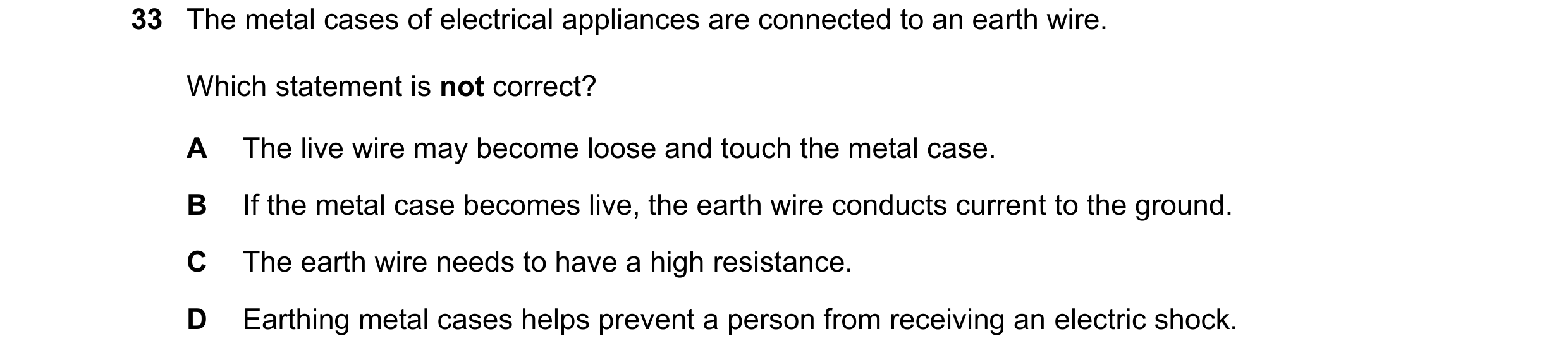
Q96 · The metal cases of electrical appliances are connected to an earth wire 0625/11 Oct/Nov 2021
33 The metal cases of electrical appliances are connected to an earth wire. Which statement is not correct? A The live wire may become loose and touch the metal case. B If the metal case becomes live, the earth wire conducts current to the ground. C The earth wire needs to have a high resistance. D Earthing metal cases helps prevent a person from receiving an electric shock.
1 marks
Answer: C
This question in 0625/11 Oct/Nov 2021
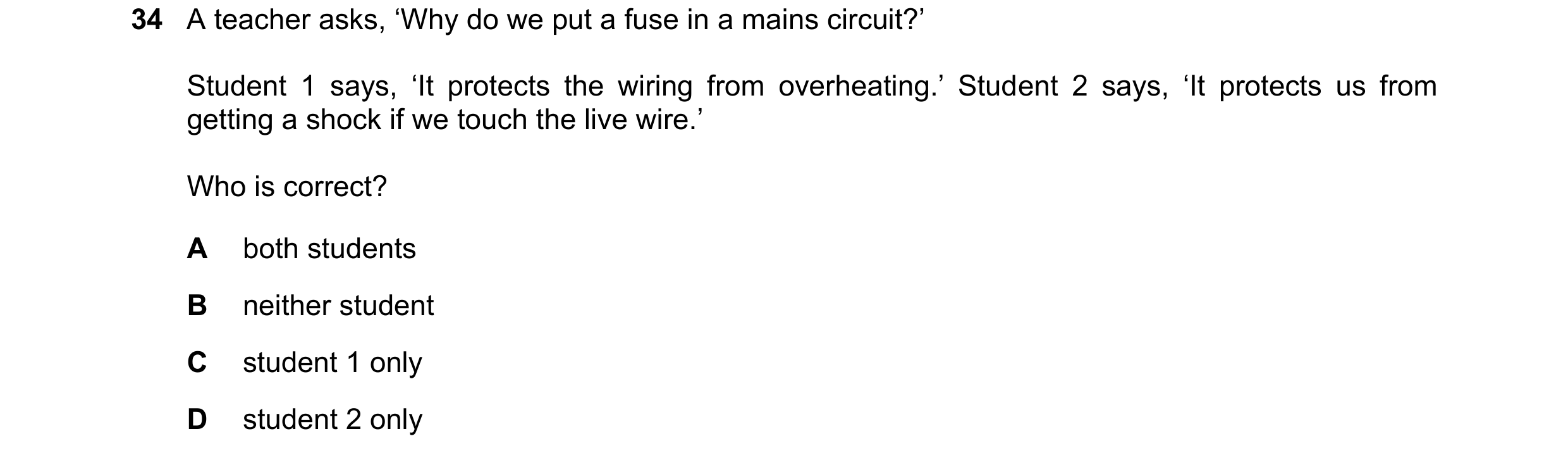
Q97 · A teacher asks, ‘Why do we put a fuse in a mains circuit?’ Student 1 says, ‘It protects… 0625/11 Oct/Nov 2021
34 A teacher asks, ‘Why do we put a fuse in a mains circuit?’ Student 1 says, ‘It protects the wiring from overheating.’ Student 2 says, ‘It protects us from getting a shock if we touch the live wire.’ Who is correct? A both students B neither student C student 1 only D student 2 only
1 marks
Answer: C
This question in 0625/11 Oct/Nov 2021
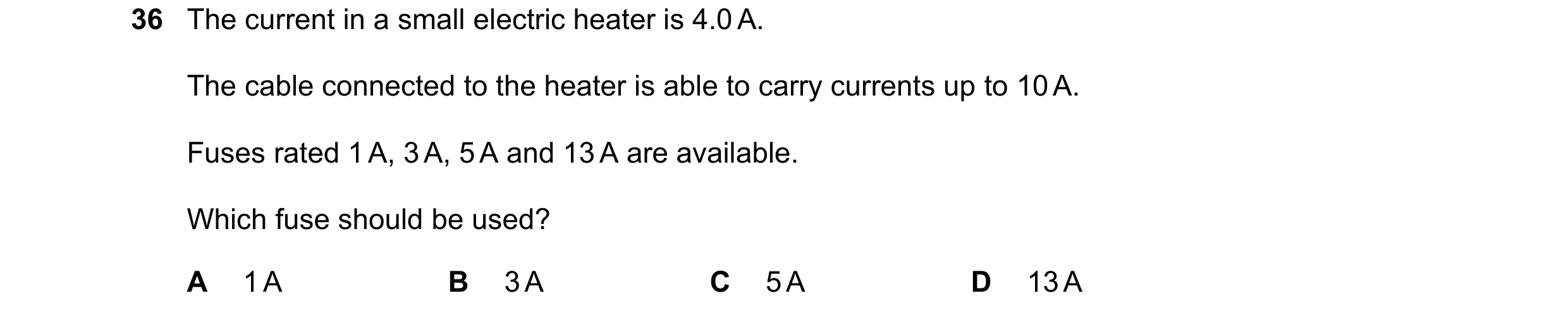
Q98 · The current in a small electric heater is 4.0 A 0625/11 Oct/Nov 2021
36 The current in a small electric heater is 4.0 A. The cable connected to the heater is able to carry currents up to 10 A. Fuses rated 1 A, 3 A, 5 A and 13 A are available. Which fuse should be used? A 1 A B 3 A C 5 A D 13 A
1 marks
Answer: C
This question in 0625/11 Oct/Nov 2021
Q99 · Which circuit contains a fuse? 0625/12 Oct/Nov 2021
30 Which circuit contains a fuse? A B A V C D A
1 marks
Answer: C
This question in 0625/12 Oct/Nov 2021
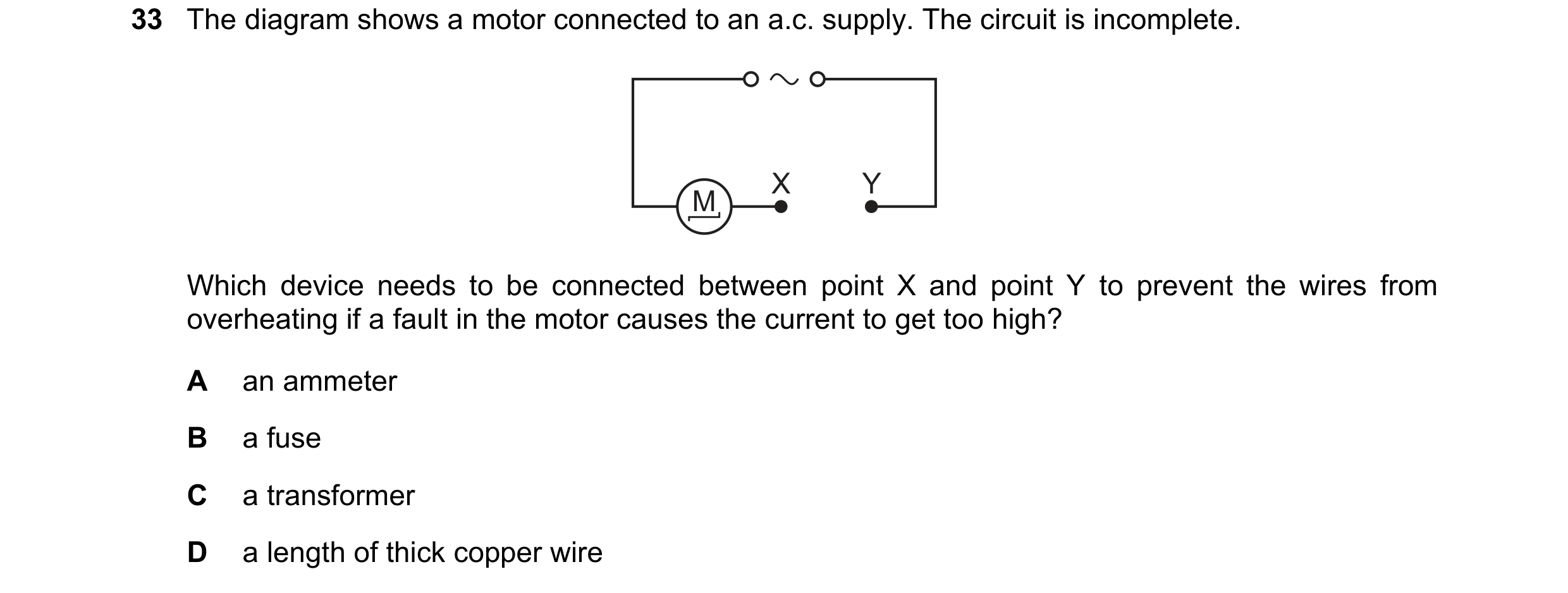
Q100 · The diagram shows a motor connected to an a.c 0625/12 Oct/Nov 2021
33 The diagram shows a motor connected to an a.c. supply. The circuit is incomplete. X Y M Which device needs to be connected between point X and point Y to prevent the wires from overheating if a fault in the motor causes the current to get too high? A an ammeter B a fuse C a transformer D a length of thick copper wire
1 marks
Answer: B
This question in 0625/12 Oct/Nov 2021
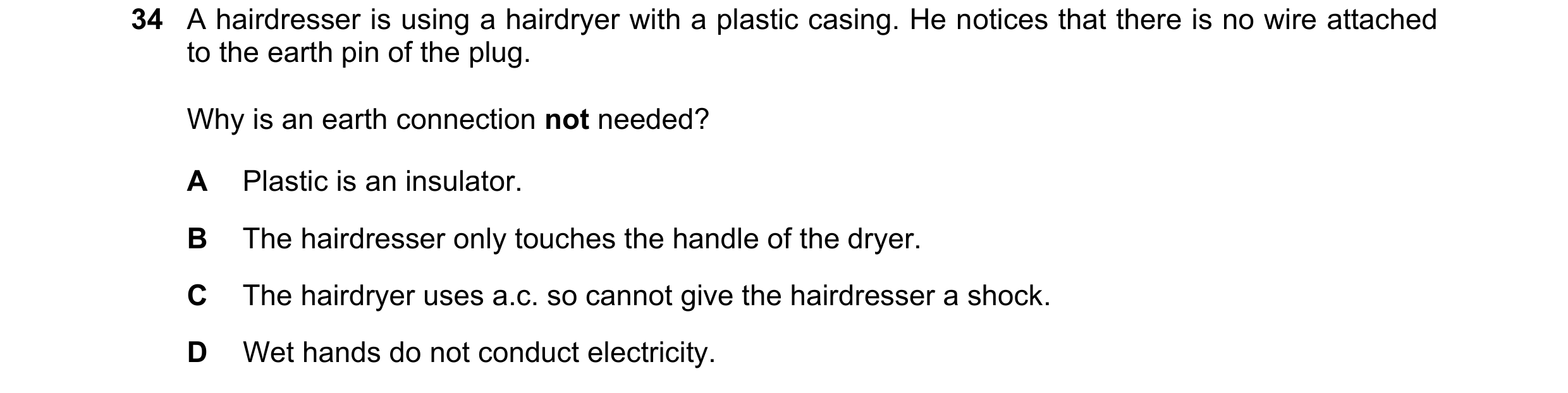
Q101 · A hairdresser is using a hairdryer with a plastic casing 0625/12 Oct/Nov 2021
34 A hairdresser is using a hairdryer with a plastic casing. He notices that there is no wire attached to the earth pin of the plug. Why is an earth connection not needed? A Plastic is an insulator. B The hairdresser only touches the handle of the dryer. C The hairdryer uses a.c. so cannot give the hairdresser a shock. D Wet hands do not conduct electricity.
1 marks
Answer: A
This question in 0625/12 Oct/Nov 2021
Q102 · An electric drill, operating from a supply voltage of 240 V, uses a current of 3.5 A 0625/12 Oct/Nov 2021
36 An electric drill, operating from a supply voltage of 240 V, uses a current of 3.5 A. Which rating of fuse should be used to protect the drill’s cable? A 250 V B 200 V C 5 A D 3 A
1 marks
Answer: C
This question in 0625/12 Oct/Nov 2021
Q103 · Which circuit contains a fuse? 0625/13 Oct/Nov 2021
30 Which circuit contains a fuse? A B A V C D A
1 marks
Answer: C
This question in 0625/13 Oct/Nov 2021
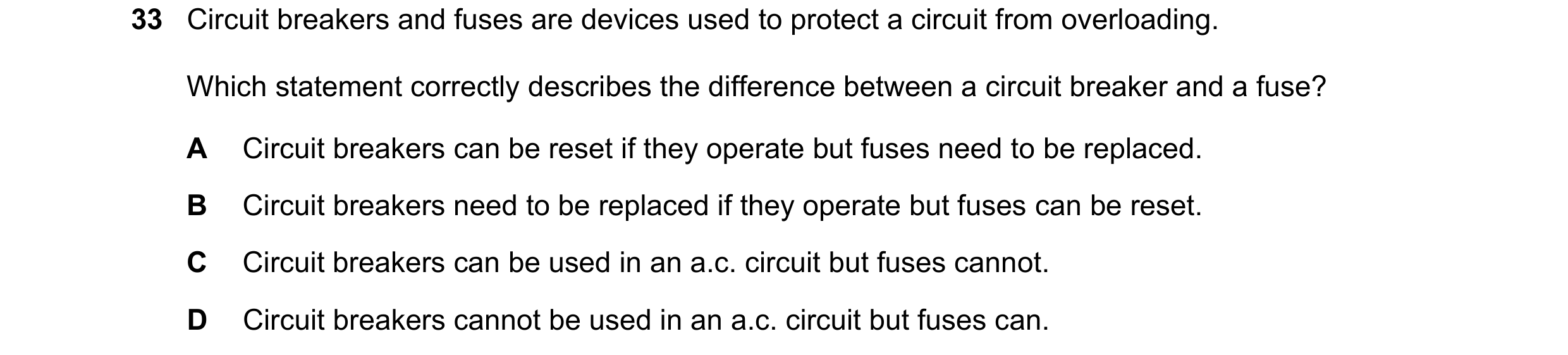
Q104 · Circuit breakers and fuses are devices used to protect a circuit from overloading 0625/13 Oct/Nov 2021
33 Circuit breakers and fuses are devices used to protect a circuit from overloading. Which statement correctly describes the difference between a circuit breaker and a fuse? A Circuit breakers can be reset if they operate but fuses need to be replaced. B Circuit breakers need to be replaced if they operate but fuses can be reset. C Circuit breakers can be used in an a.c. circuit but fuses cannot. D Circuit breakers cannot be used in an a.c. circuit but fuses can.
1 marks
Answer: A
This question in 0625/13 Oct/Nov 2021
Q105 · Why might it be dangerous to use an electrical appliance in damp conditions? 0625/13 Oct/Nov 2021
34 Why might it be dangerous to use an electrical appliance in damp conditions? A It might lead to the fuse blowing. B It might lead to the insulation on the supply cable becoming damaged. C It might lead to an electric shock. D It might lead to the supply cable overheating.
1 marks
Answer: C
This question in 0625/13 Oct/Nov 2021
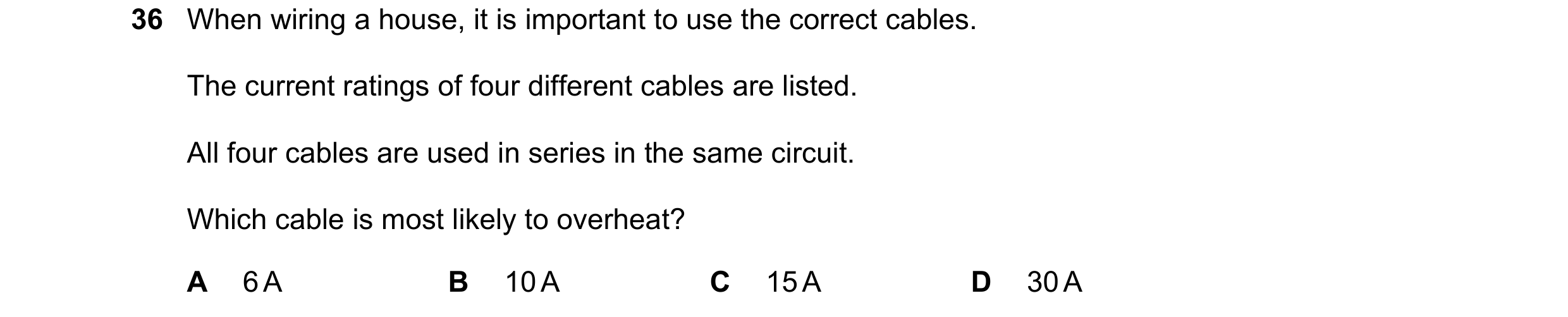
Q106 · When wiring a house, it is important to use the correct cables 0625/13 Oct/Nov 2021
36 When wiring a house, it is important to use the correct cables. The current ratings of four different cables are listed. All four cables are used in series in the same circuit. Which cable is most likely to overheat? A 6 A B 10 A C 15 A D 30 A
1 marks
Answer: A
This question in 0625/13 Oct/Nov 2021
Q107 · A simple wiring diagram for an electric cooker is shown 0625/12 Feb/March 2022
33 A simple wiring diagram for an electric cooker is shown. electric cooker metal case live neutral earth connection to casing Why is there a wire connecting the metal case of the cooker to earth? A It improves the efficiency of the cooker. B It prevents the metal case from becoming too hot when the cooker is left on. C It reduces the risk of an electric shock if the live wire touches the metal case. D The electric cooker will not switch on without it.
1 marks
Answer: C
This question in 0625/12 Feb/March 2022
Q108 · What is the advantage of connecting lamps in parallel in a lighting circuit? 0625/11 May/June 2022
32 What is the advantage of connecting lamps in parallel in a lighting circuit? A A smaller fuse is needed to protect the lamps. B If the filament of one lamp breaks, the remaining lamps stay lit. C The current taken from the supply is less. D The lamps use less power.
1 marks
Answer: B
This question in 0625/11 May/June 2022
Q109 · Why is a fuse used in an electrical circuit? 0625/11 May/June 2022
34 Why is a fuse used in an electrical circuit? A so that the current can have only one value B to prevent the current becoming too large C to provide a path to earth if a fault occurs D to save electrical energy
1 marks
Answer: B
This question in 0625/11 May/June 2022
Q110 · Why is a fuse used in an electrical circuit? 0625/12 May/June 2022
34 Why is a fuse used in an electrical circuit? A so that the current can have only one value B to prevent the current becoming too large C to provide a path to earth if a fault occurs D to save electrical energy
1 marks
Answer: B
This question in 0625/12 May/June 2022
Q111 · Why is a fuse used in an electrical circuit? 0625/13 May/June 2022
34 Why is a fuse used in an electrical circuit? A so that the current can have only one value B to prevent the current becoming too large C to provide a path to earth if a fault occurs D to save electrical energy
1 marks
Answer: B
This question in 0625/13 May/June 2022
Q112 · Which diagram shows the circuit symbol for a fuse? 0625/12 Oct/Nov 2022
32 Which diagram shows the circuit symbol for a fuse? A B C D
1 marks
Answer: D
This question in 0625/12 Oct/Nov 2022
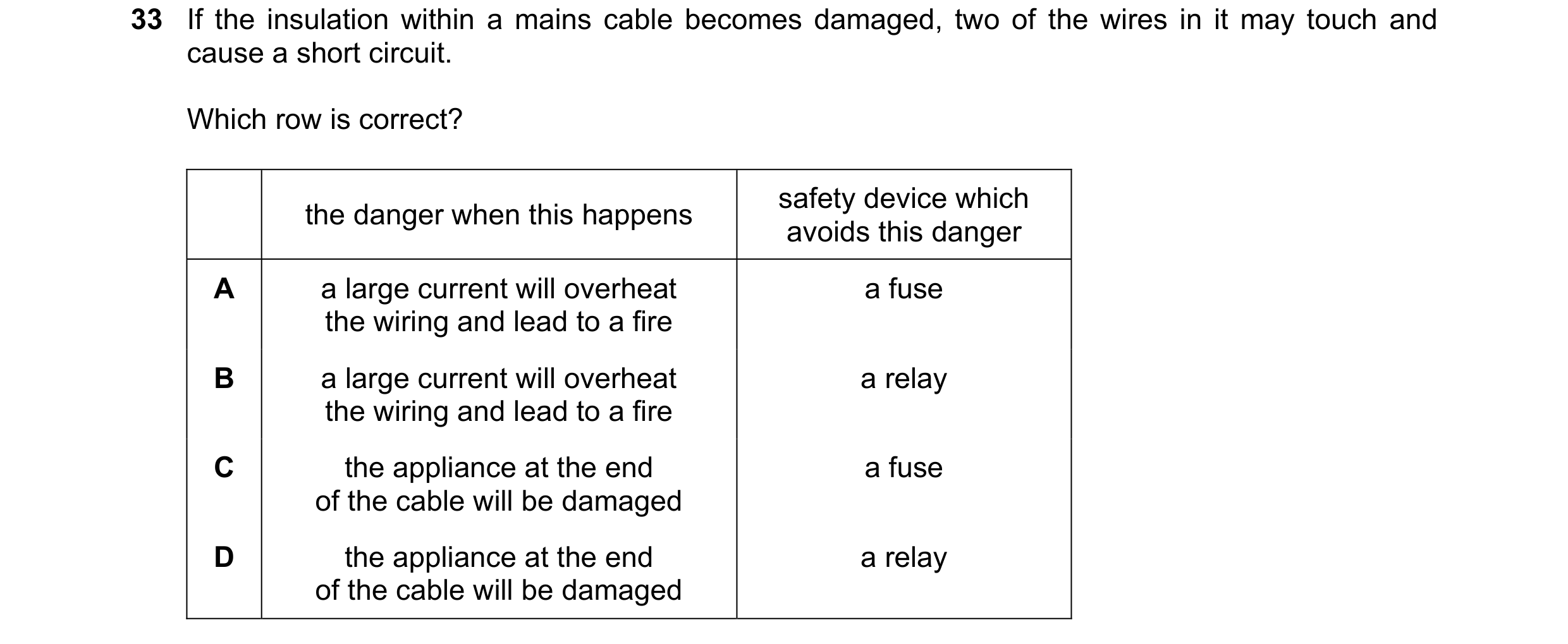
Q113 · If the insulation within a mains cable becomes damaged, two of the wires in it may touch… 0625/12 Oct/Nov 2022
33 If the insulation within a mains cable becomes damaged, two of the wires in it may touch and cause a short circuit. Which row is correct? safety device which the danger when this happens avoids this danger A a large current will overheat a fuse the wiring and lead to a fire B a large current will overheat a relay the wiring and lead to a fire C the appliance at the end a fuse of the cable will be damaged D the appliance at the end a relay of the cable will be damaged
1 marks
Answer: A
This question in 0625/12 Oct/Nov 2022
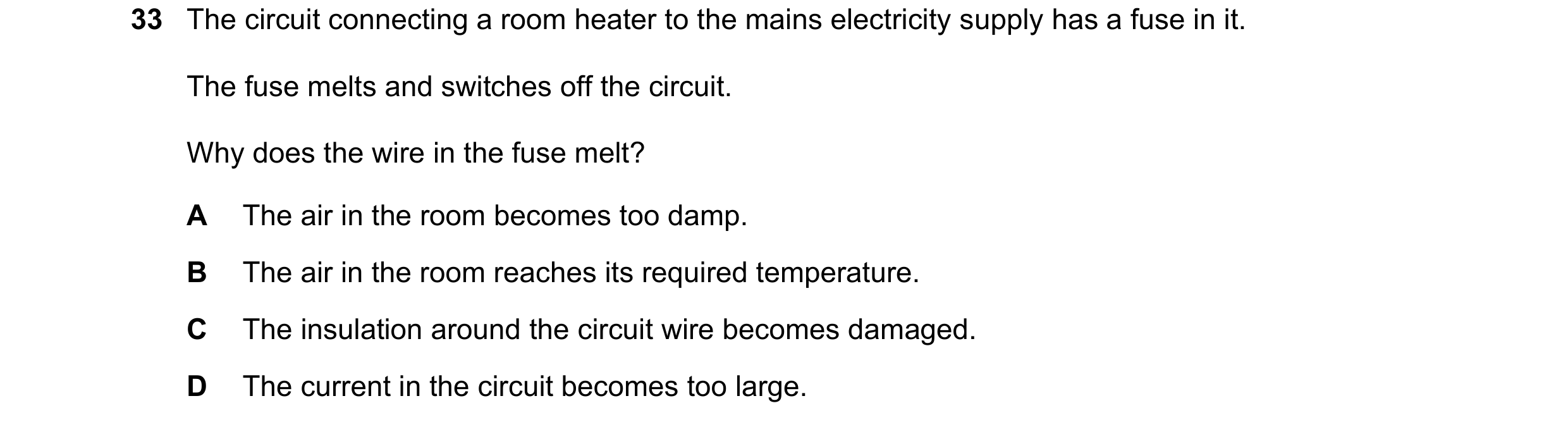
Q114 · The circuit connecting a room heater to the mains electricity supply has a fuse in it 0625/13 Oct/Nov 2022
33 The circuit connecting a room heater to the mains electricity supply has a fuse in it. The fuse melts and switches off the circuit. Why does the wire in the fuse melt? A The air in the room becomes too damp. B The air in the room reaches its required temperature. C The insulation around the circuit wire becomes damaged. D The current in the circuit becomes too large.
1 marks
Answer: D
This question in 0625/13 Oct/Nov 2022
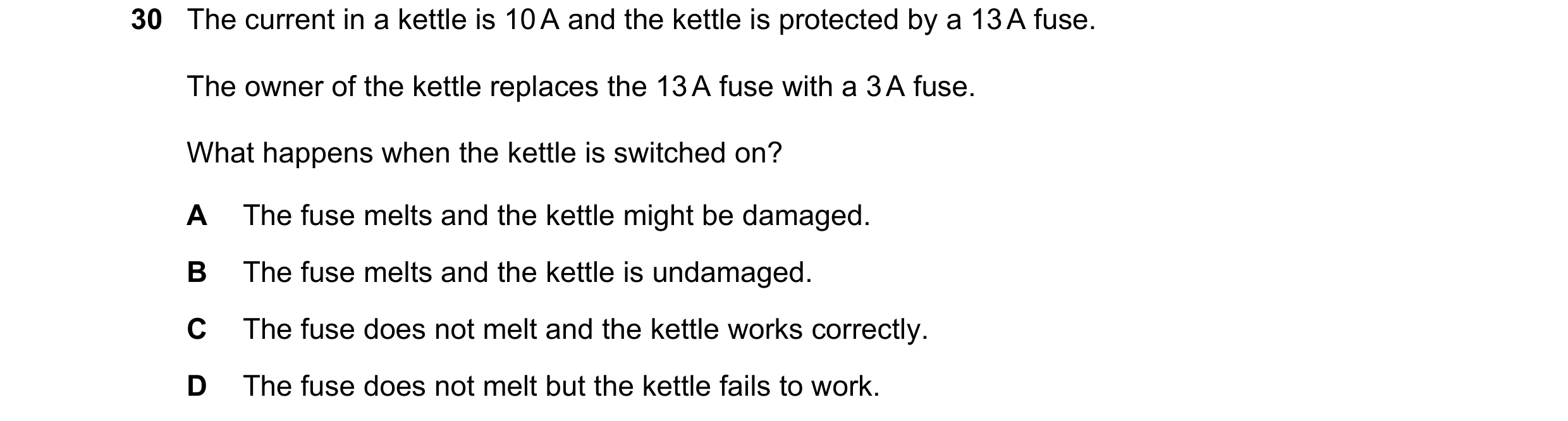
Q115 · The current in a kettle is 10 A and the kettle is protected by a 13 A fuse 0625/12 Feb/March 2023
30 The current in a kettle is 10 A and the kettle is protected by a 13 A fuse. The owner of the kettle replaces the 13 A fuse with a 3 A fuse. What happens when the kettle is switched on? A The fuse melts and the kettle might be damaged. B The fuse melts and the kettle is undamaged. C The fuse does not melt and the kettle works correctly. D The fuse does not melt but the kettle fails to work.
1 marks
Answer: B
This question in 0625/12 Feb/March 2023
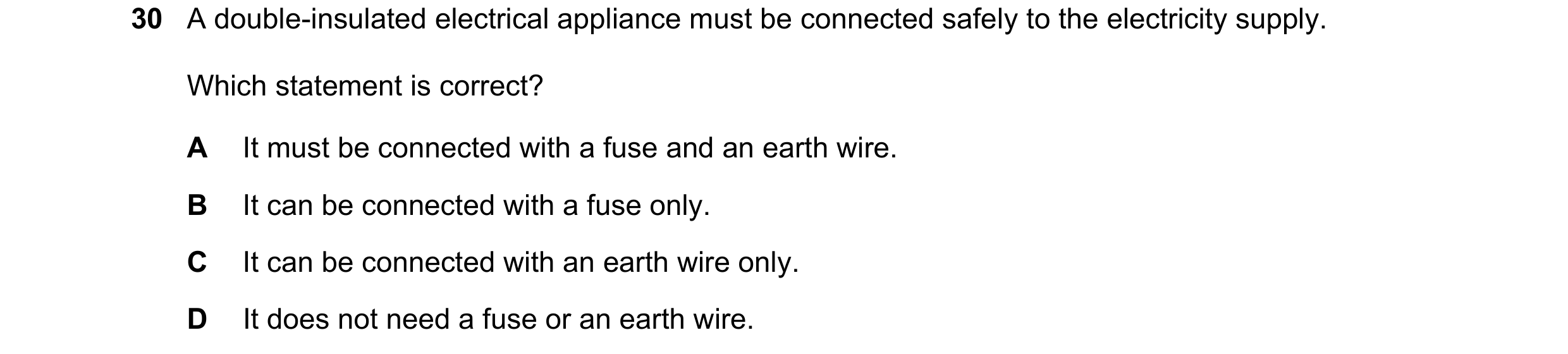
Q116 · A double-insulated electrical appliance must be connected safely to the electricity supply 0625/11 May/June 2023
30 A double-insulated electrical appliance must be connected safely to the electricity supply. Which statement is correct? A It must be connected with a fuse and an earth wire. B It can be connected with a fuse only. C It can be connected with an earth wire only. D It does not need a fuse or an earth wire.
1 marks
Answer: B
This question in 0625/11 May/June 2023
Q117 · Which statement about electrical safety is correct? 0625/12 May/June 2023
30 Which statement about electrical safety is correct? A If a device is double insulated, it does not need a fuse. B A device that has a normal operating current of 3.0 A must be protected by a 3.0 A fuse. C Switches must always be connected into the live supply wire. D The metal casing of an electrical device must be connected to the neutral wire.
1 marks
Answer: C
This question in 0625/12 May/June 2023
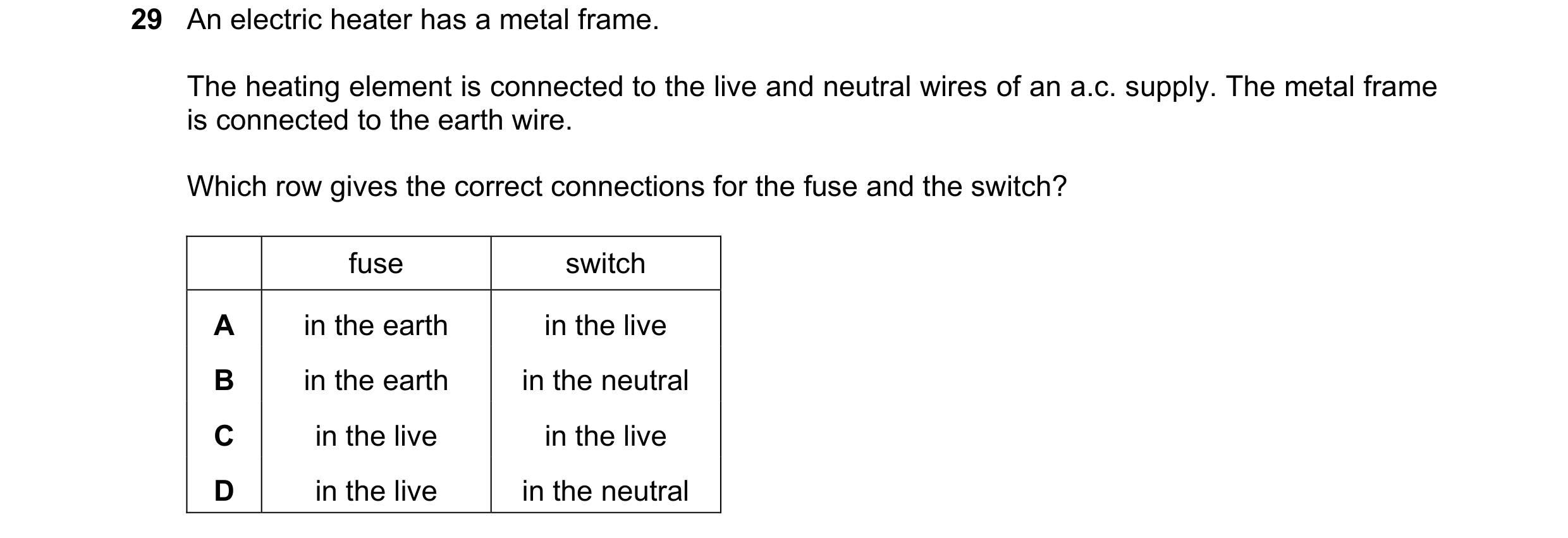
Q118 · An electric heater has a metal frame 0625/13 May/June 2023
29 An electric heater has a metal frame. The heating element is connected to the live and neutral wires of an a.c. supply. The metal frame is connected to the earth wire. Which row gives the correct connections for the fuse and the switch? fuse switch A in the earth in the live B in the earth in the neutral C in the live in the live D in the live in the neutral
1 marks
Answer: C
This question in 0625/13 May/June 2023
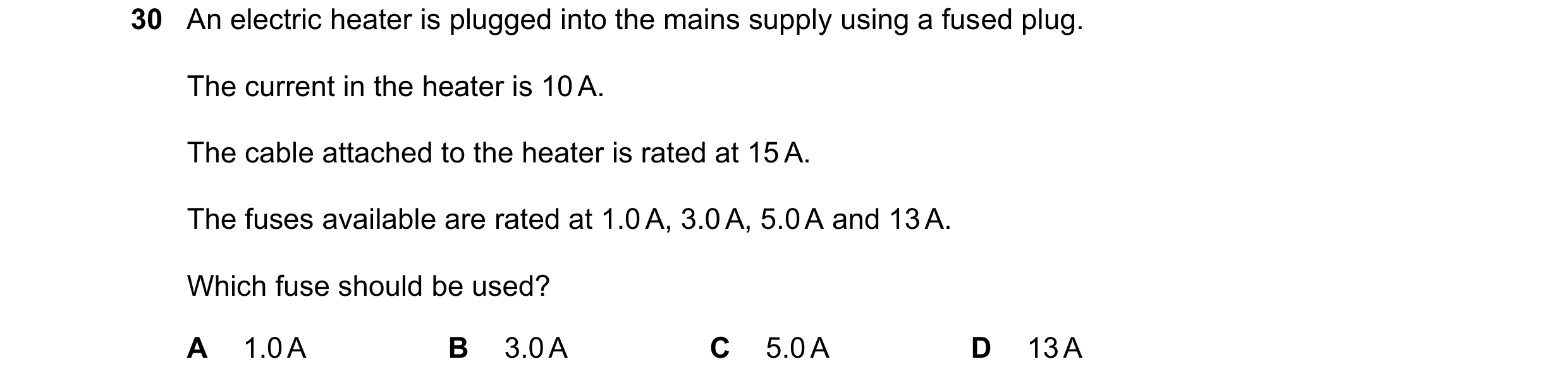
Q119 · An electric heater is plugged into the mains supply using a fused plug 0625/11 Oct/Nov 2023
30 An electric heater is plugged into the mains supply using a fused plug. The current in the heater is 10 A. The cable attached to the heater is rated at 15 A. The fuses available are rated at 1.0 A, 3.0 A, 5.0 A and 13 A. Which fuse should be used? A 1.0 A B 3.0 A C 5.0 A D 13 A
1 marks
Answer: D
This question in 0625/11 Oct/Nov 2023
Q120 · Which statement is correct? 0625/12 Oct/Nov 2023
30 Which statement is correct? A A fuse is included in a circuit to prevent the current becoming too high. B A fuse should be connected to the neutral wire in a plug. C An electric circuit will only work if it includes a fuse. D An earth wire is needed to prevent the fuse blowing.
1 marks
Answer: A
This question in 0625/12 Oct/Nov 2023
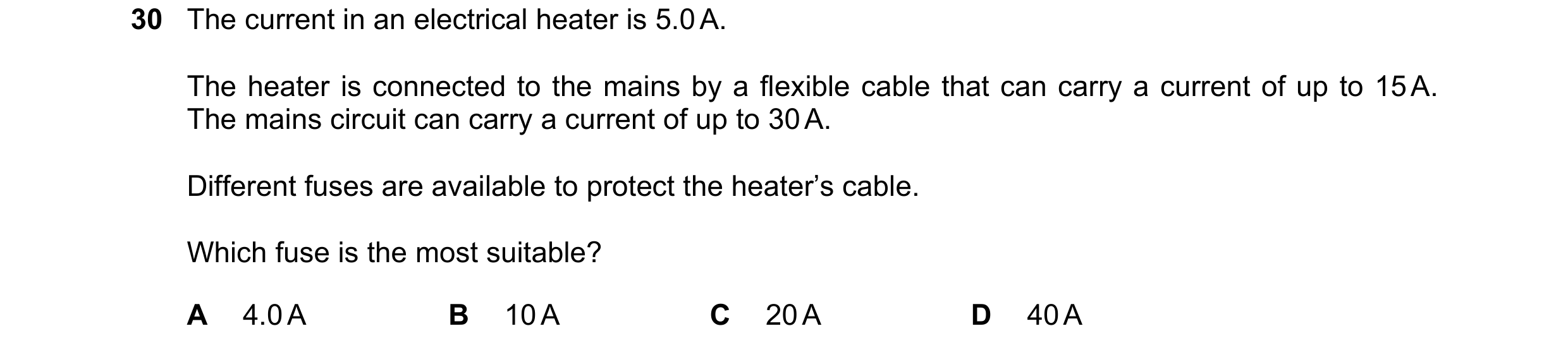
Q121 · The current in an electrical heater is 5.0 A 0625/13 Oct/Nov 2023
30 The current in an electrical heater is 5.0 A. The heater is connected to the mains by a flexible cable that can carry a current of up to 15 A. The mains circuit can carry a current of up to 30 A. Different fuses are available to protect the heater’s cable. Which fuse is the most suitable? A 4.0 A B 10 A C 20 A D 40 A
1 marks
Answer: B
This question in 0625/13 Oct/Nov 2023
Q122 · Into which wire is a switch connected in order to switch a mains appliance on and off… 0625/12 Feb/March 2024
27 Into which wire is a switch connected in order to switch a mains appliance on and off safely? A live B negative C neutral D positive
1 marks
Answer: A
This question in 0625/12 Feb/March 2024
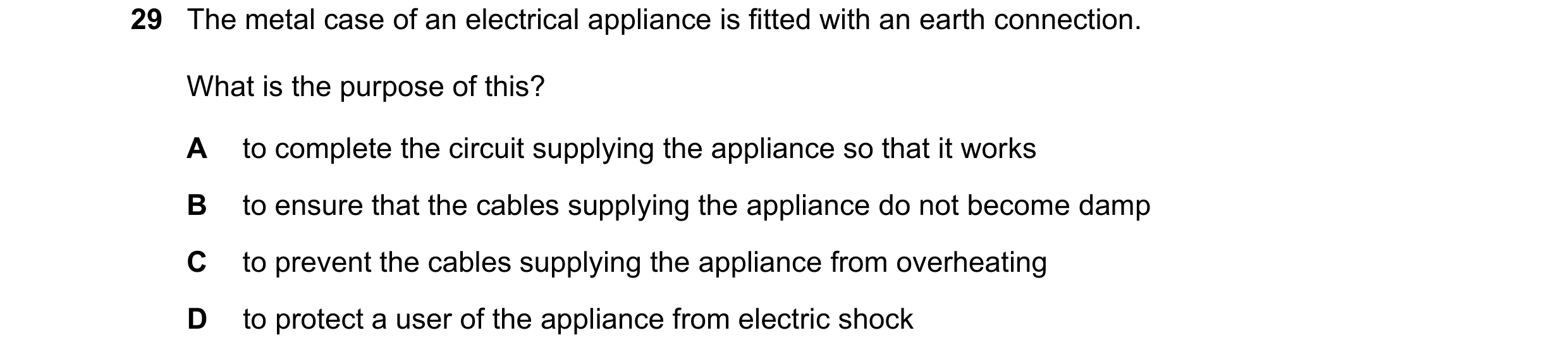
Q123 · The metal case of an electrical appliance is fitted with an earth connection 0625/11 May/June 2024
29 The metal case of an electrical appliance is fitted with an earth connection. What is the purpose of this? A to complete the circuit supplying the appliance so that it works B to ensure that the cables supplying the appliance do not become damp C to prevent the cables supplying the appliance from overheating D to protect a user of the appliance from electric shock
1 marks
Answer: D
This question in 0625/11 May/June 2024
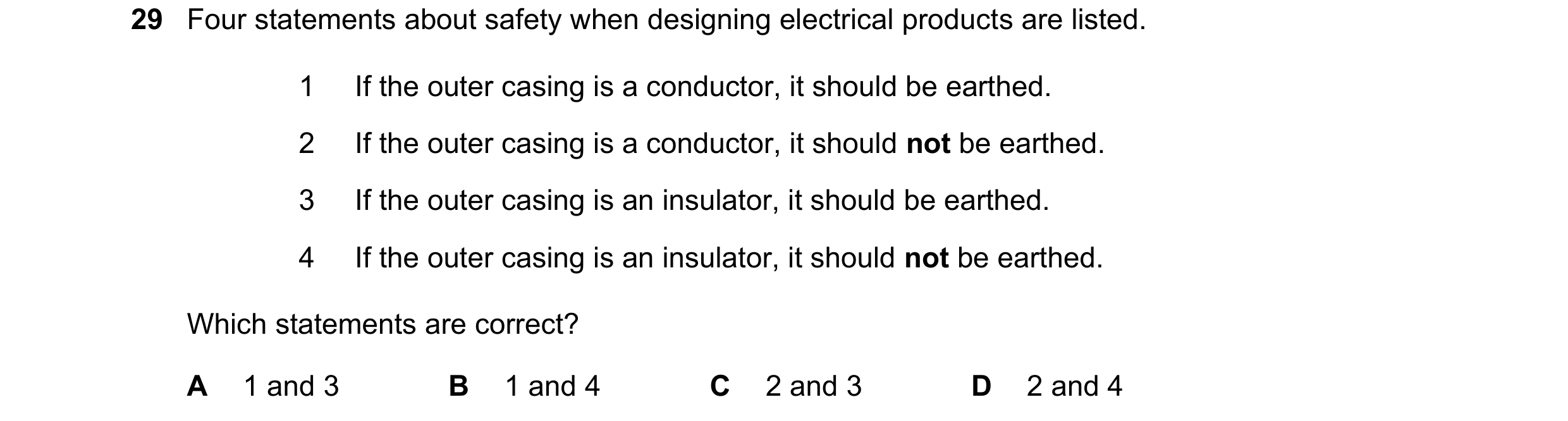
Q124 · Four statements about safety when designing electrical products are listed 0625/13 May/June 2024
29 Four statements about safety when designing electrical products are listed. 1 If the outer casing is a conductor, it should be earthed. 2 If the outer casing is a conductor, it should not be earthed. 3 If the outer casing is an insulator, it should be earthed. 4 If the outer casing is an insulator, it should not be earthed. Which statements are correct? A 1 and 3 B 1 and 4 C 2 and 3 D 2 and 4
1 marks
Answer: B
This question in 0625/13 May/June 2024
Q125 · The mains voltage is 120 V 0625/11 Oct/Nov 2024
30 The mains voltage is 120 V. Which fuse should be fitted to an electric kettle with a power of 1.5 kW? A 3 A B 5 A C 10 A D 13 A
1 marks
Answer: D
This question in 0625/11 Oct/Nov 2024
Q126 · The diagram shows the safety label on an electric oven 0625/12 Oct/Nov 2024
30 The diagram shows the safety label on an electric oven. 60 Hz 240 V ~ 10.1 A The oven is connected to a mains electric circuit. A fuse is placed in the circuit to protect the cabling and prevent overheating if there is fault. Where should the fuse be placed and which rating should the fuse have? position of fuse fuse rating / A A live wire 10 B live wire 13 C neutral wire 10 D neutral wire 13
1 marks
Answer: B
This question in 0625/12 Oct/Nov 2024
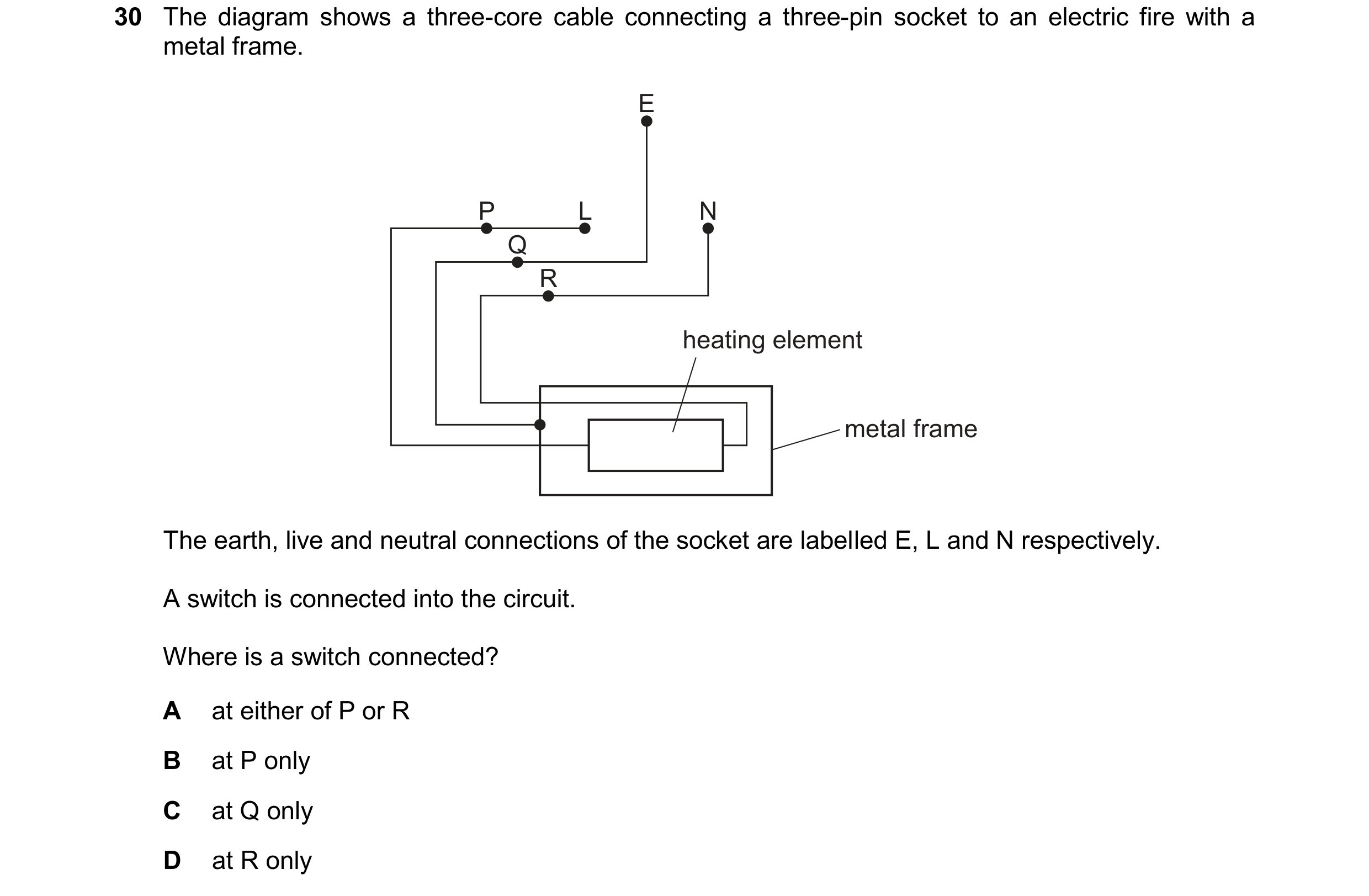
Q127 · The diagram shows a three-core cable connecting a three-pin socket to an electric fire… 0625/13 Oct/Nov 2024
30 The diagram shows a three-core cable connecting a three-pin socket to an electric fire with a metal frame. E P L N Q R heating element metal frame The earth, live and neutral connections of the socket are labelled E, L and N respectively. A switch is connected into the circuit. Where is a switch connected? A at either of P or R B at P only C at Q only D at R only
1 marks
Answer: B
This question in 0625/13 Oct/Nov 2024
Q128 · A mains-operated radio is a double-insulated appliance 0625/11 May/June 2025
28 A mains-operated radio is a double-insulated appliance. Which statement is correct? A The radio does not need a neutral connection. B The radio must be earthed. C The radio circuit is safe without a fuse or trip switch. D The outer casing of the radio cannot become live.
1 marks
Answer: D
This question in 0625/11 May/June 2025
Q129 · A 240 V mains-powered vacuum cleaner has a power output of 2700 W 0625/12 May/June 2025
31 A 240 V mains-powered vacuum cleaner has a power output of 2700 W. Which fuse is suitable for use in the plug of the vacuum cleaner? A 3 A B 5 A C 10 A D 13 A
1 marks
Answer: D
This question in 0625/12 May/June 2025
Q130 · A 240 V mains-powered vacuum cleaner has a power output of 2700 W 0625/13 May/June 2025
31 A 240 V mains-powered vacuum cleaner has a power output of 2700 W. Which fuse is suitable for use in the plug of the vacuum cleaner? A 3 A B 5 A C 10 A D 13 A
1 marks
Answer: D
This question in 0625/13 May/June 2025
Q131 · A student constructs four circuits, each containing a fuse 0625/12 Oct/Nov 2025
31 A student constructs four circuits, each containing a fuse. The fuse blows in one circuit and both lamps in the circuit go out. In which circuit does the fuse blow and both lamps go out? A B C D
1 marks
Answer: D
This question in 0625/12 Oct/Nov 2025
Q132 · Which component is not needed when using an appliance that is double-insulated? 0625/13 Oct/Nov 2025
33 Which component is not needed when using an appliance that is double-insulated? A earth wire B fuse C live wire D neutral wire
1 marks
Answer: A
This question in 0625/13 Oct/Nov 2025

 1 / 38

 2 / 38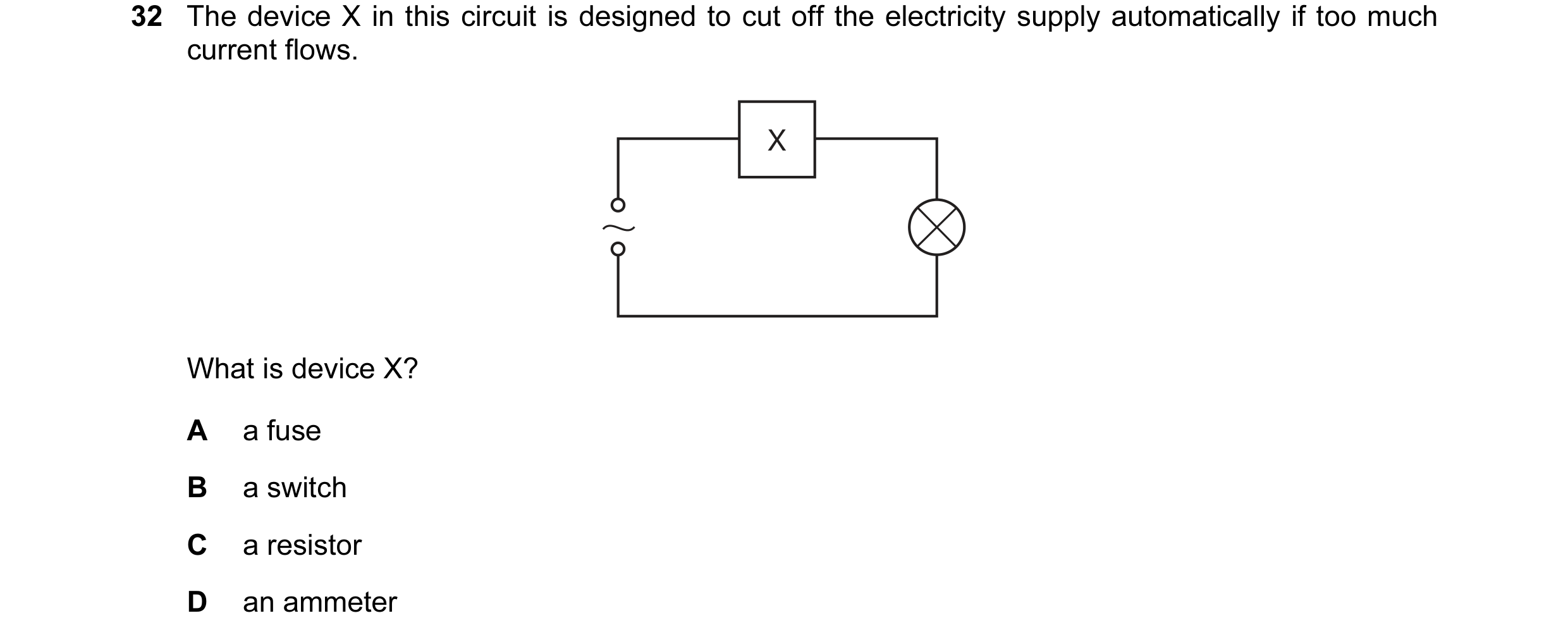
 3 / 38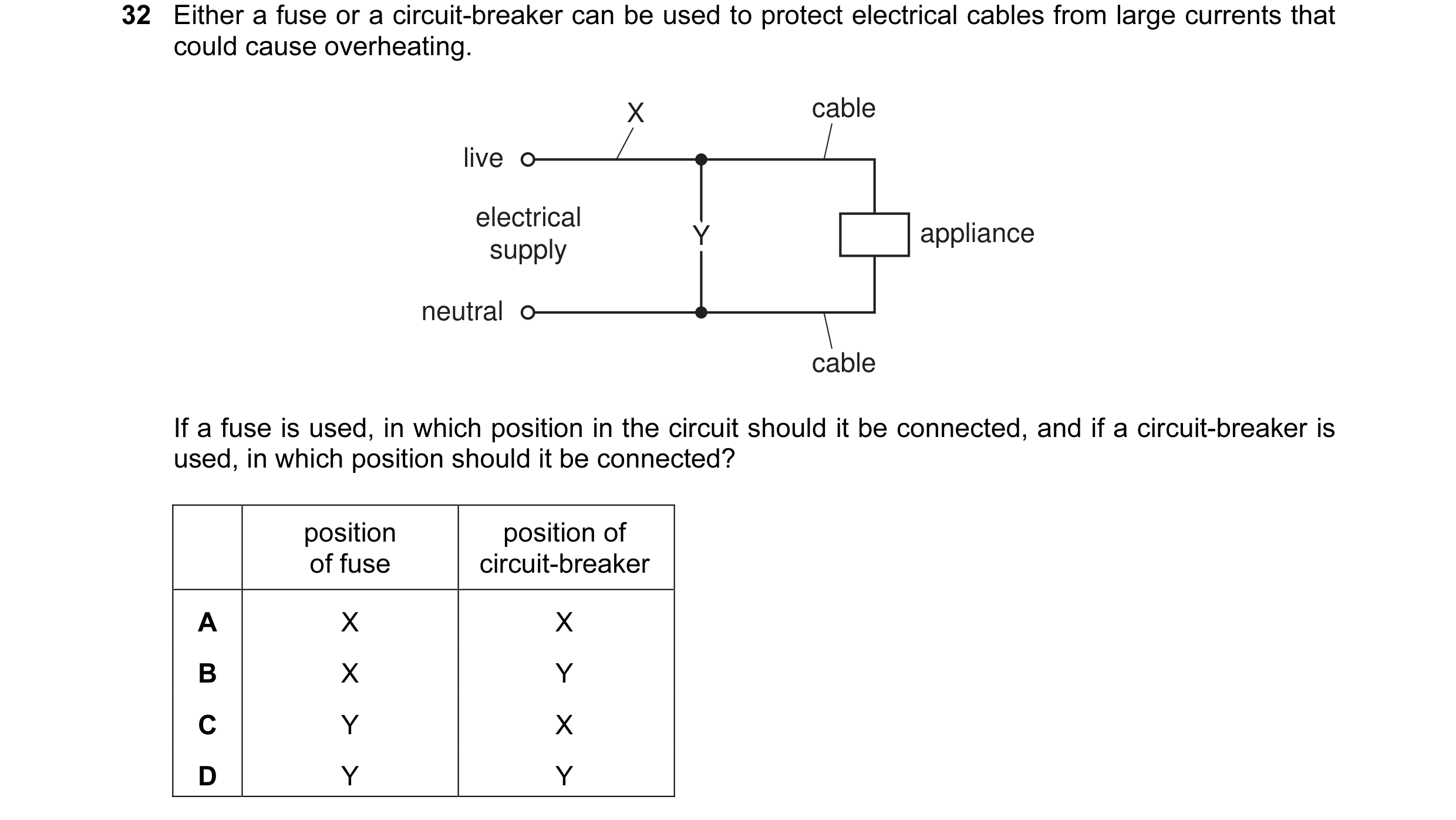

 4 / 38
 5 / 38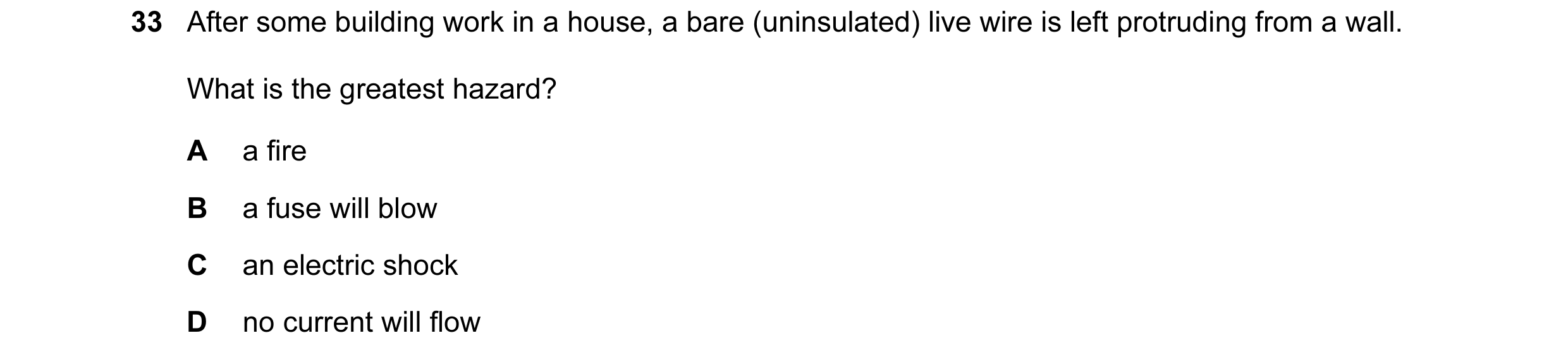
 6 / 38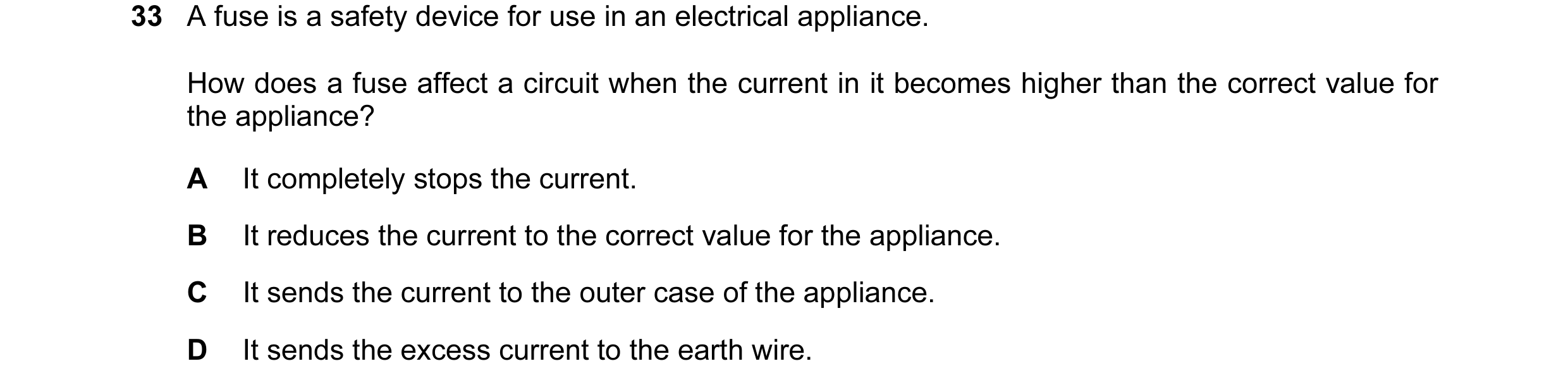
 7 / 38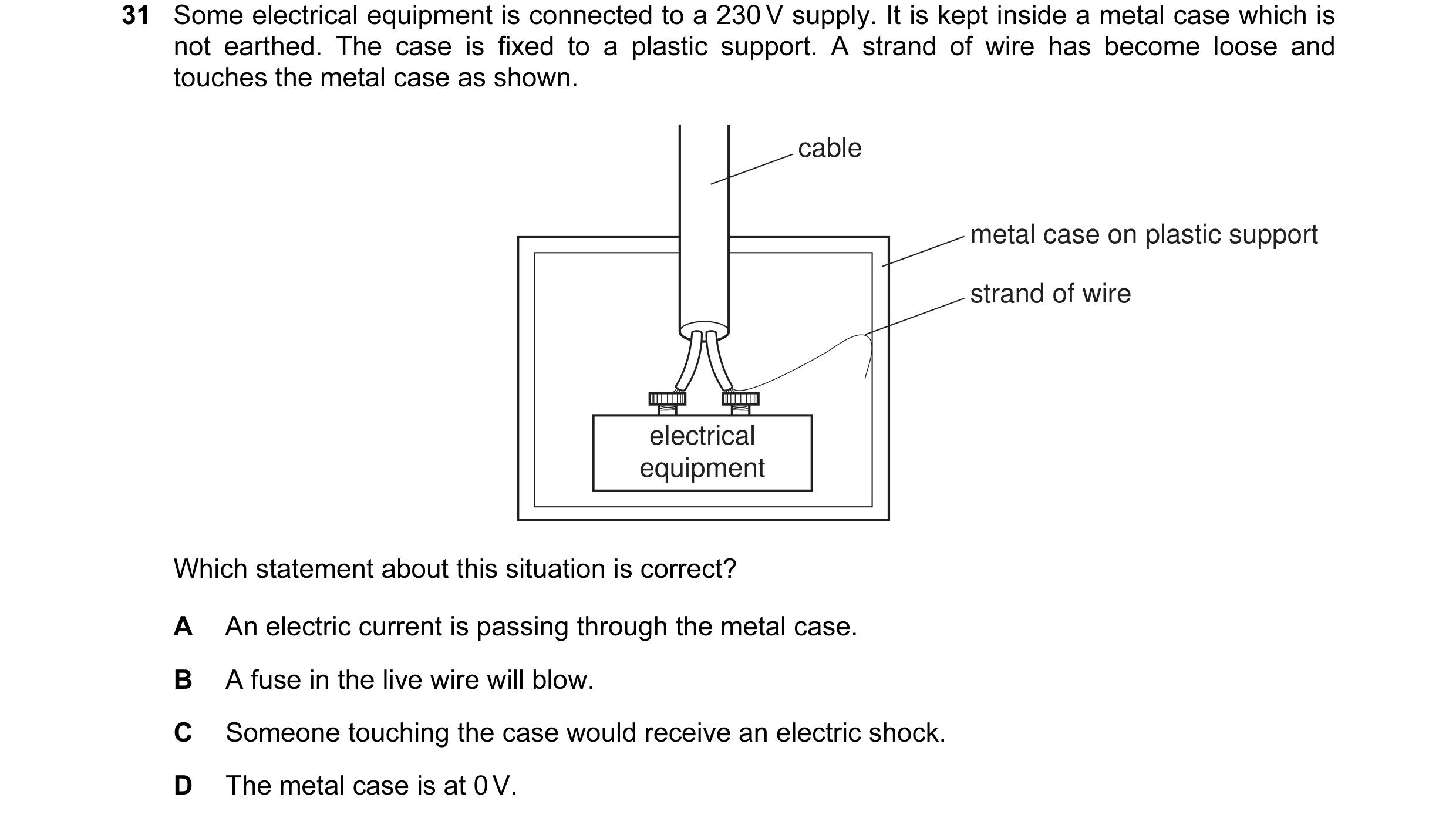
 8 / 38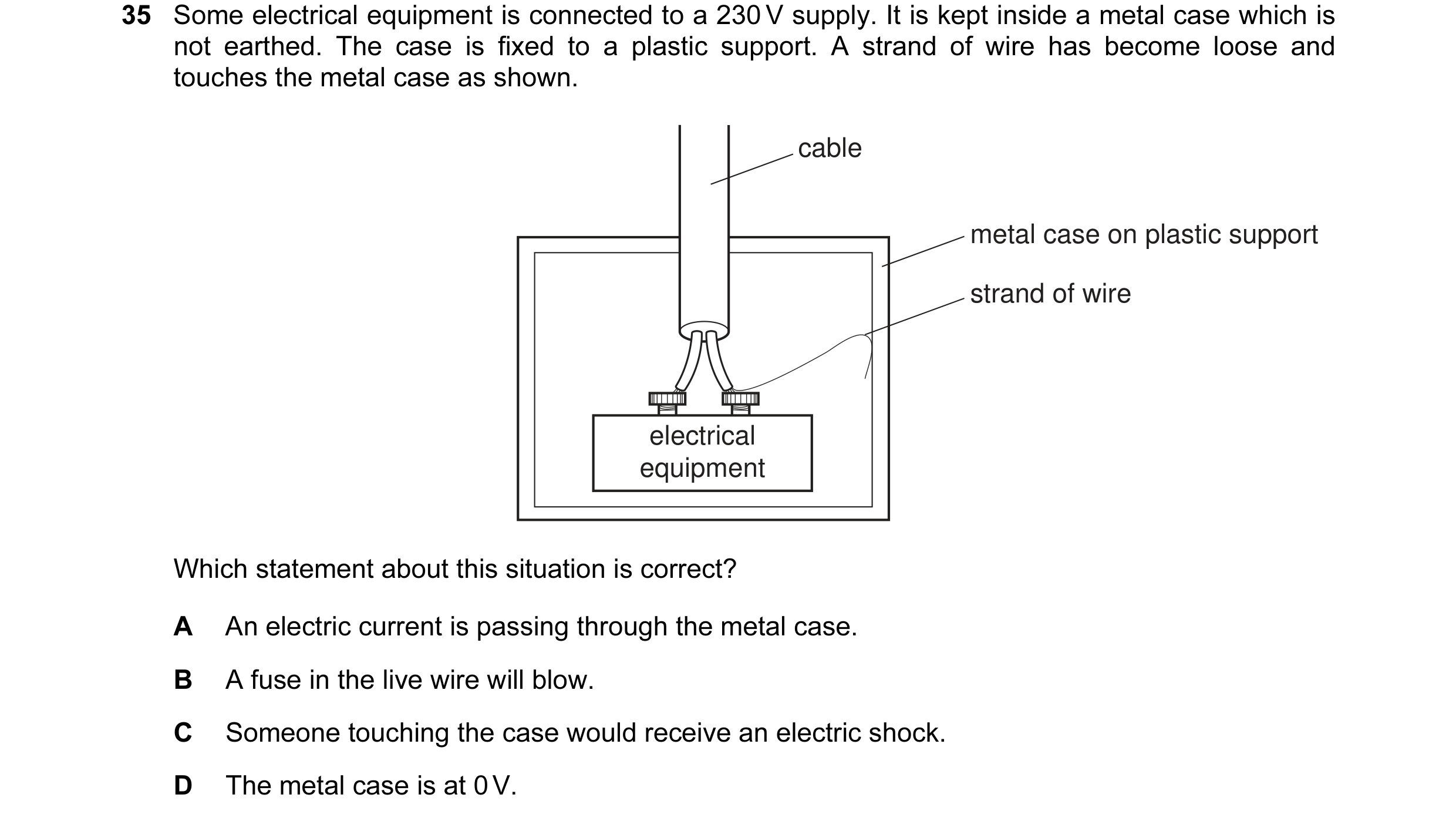
 9 / 38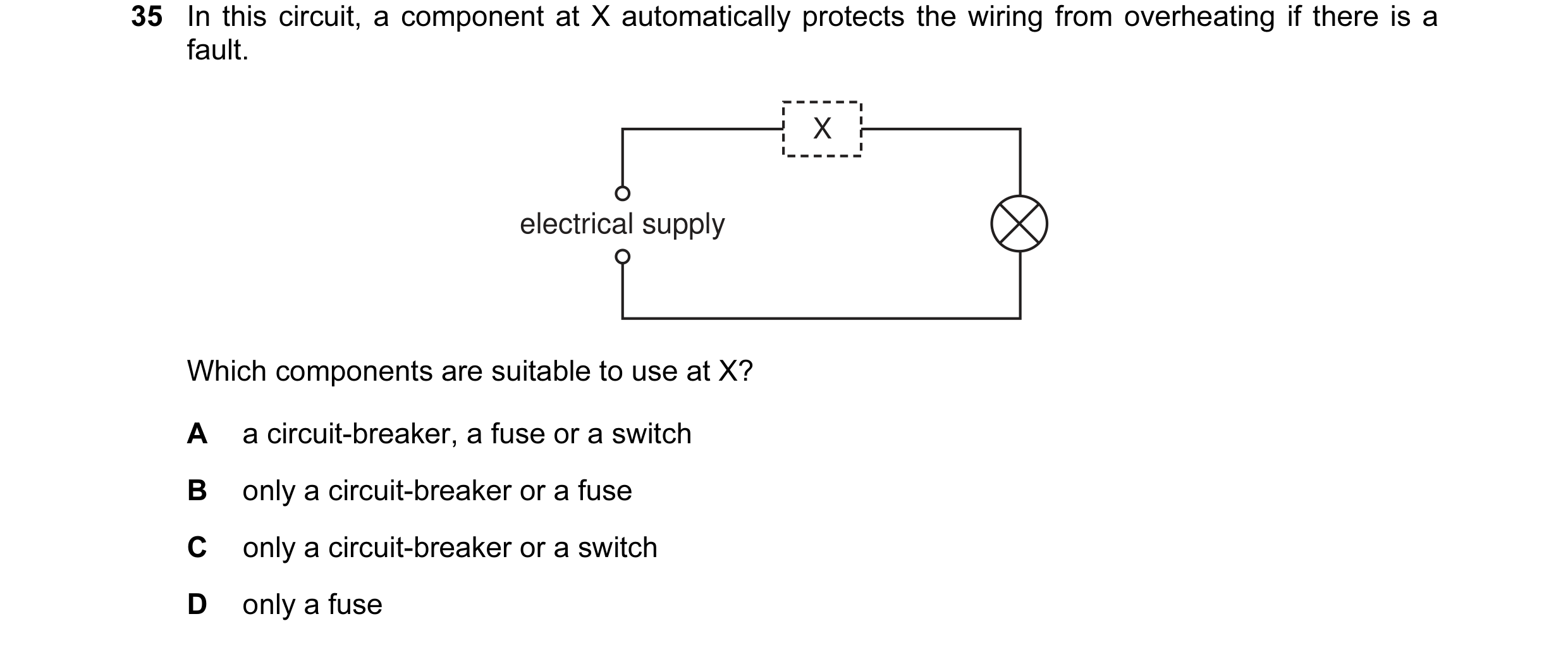
 10 / 38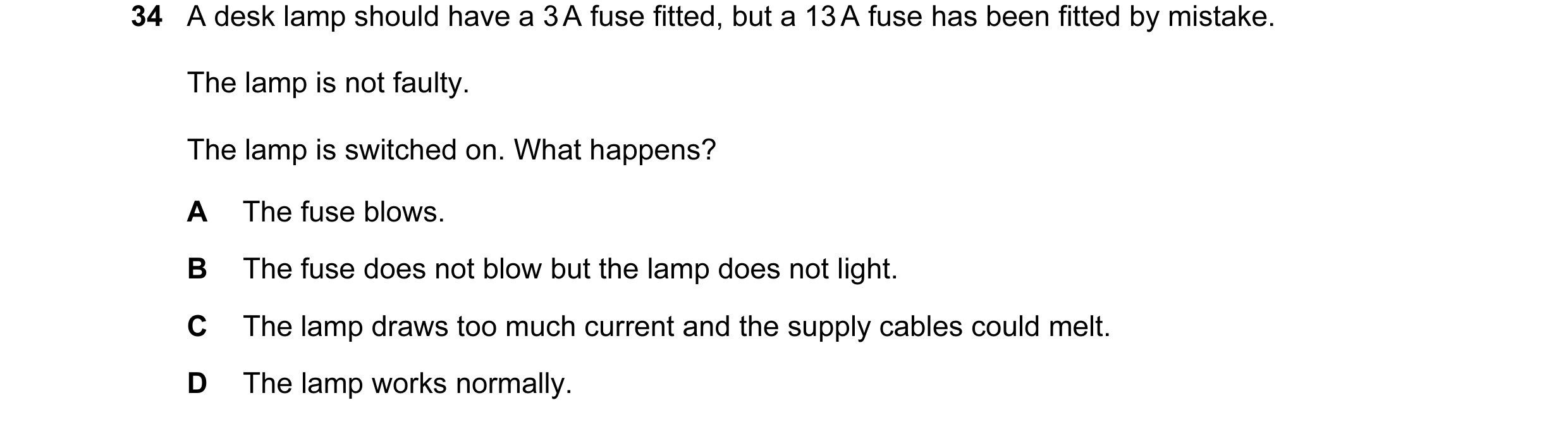
 11 / 38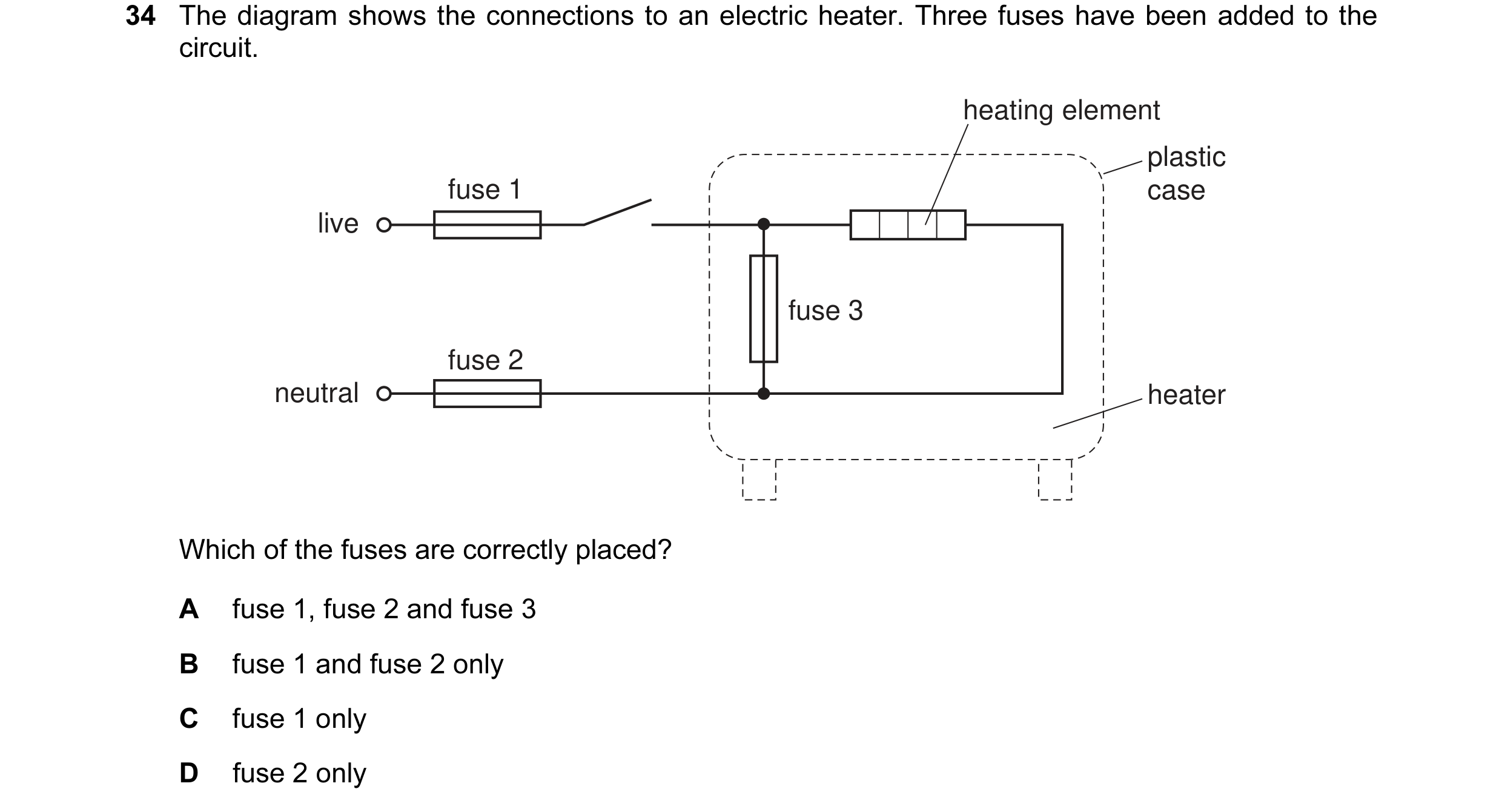
 12 / 38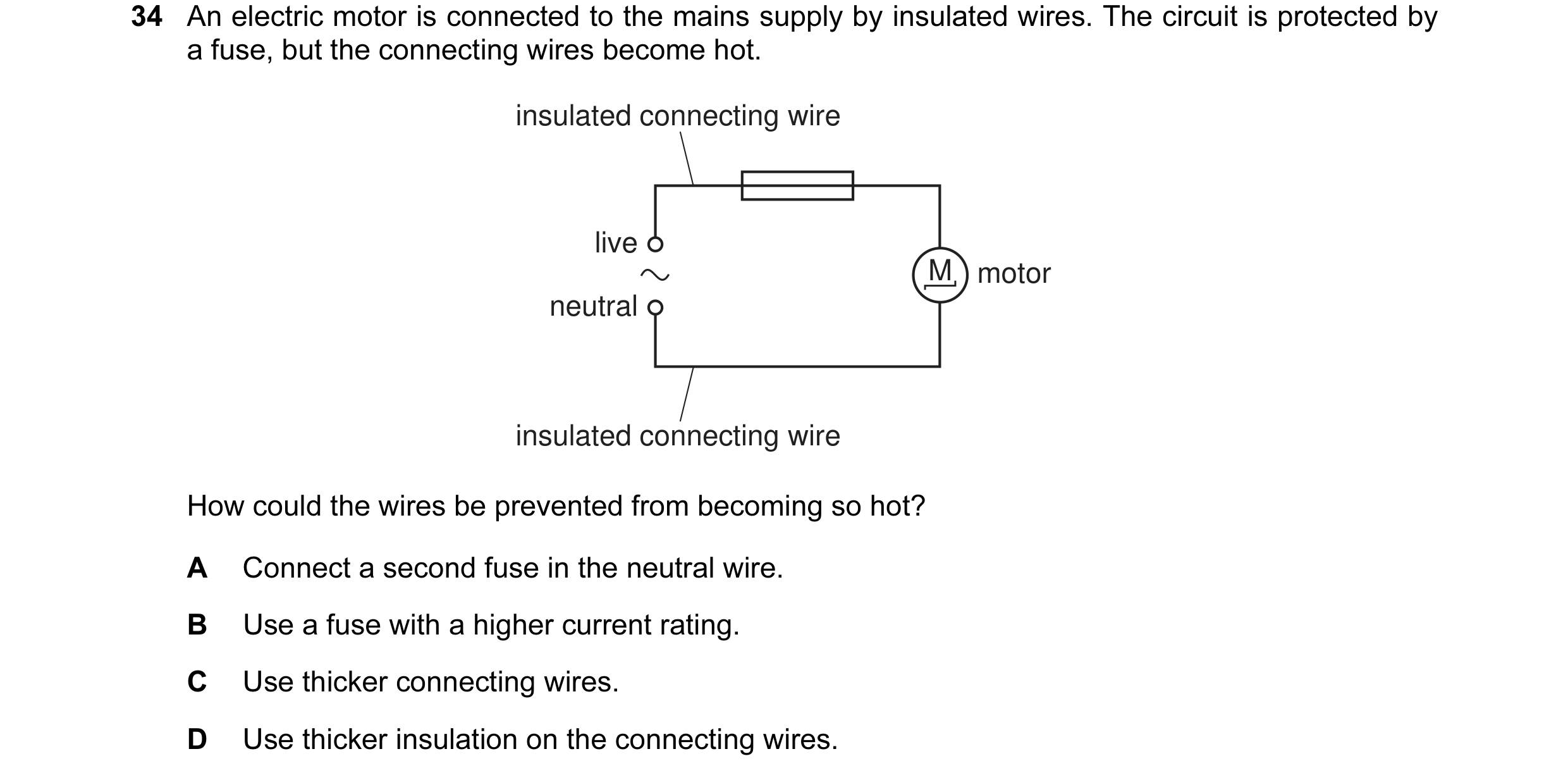
 13 / 38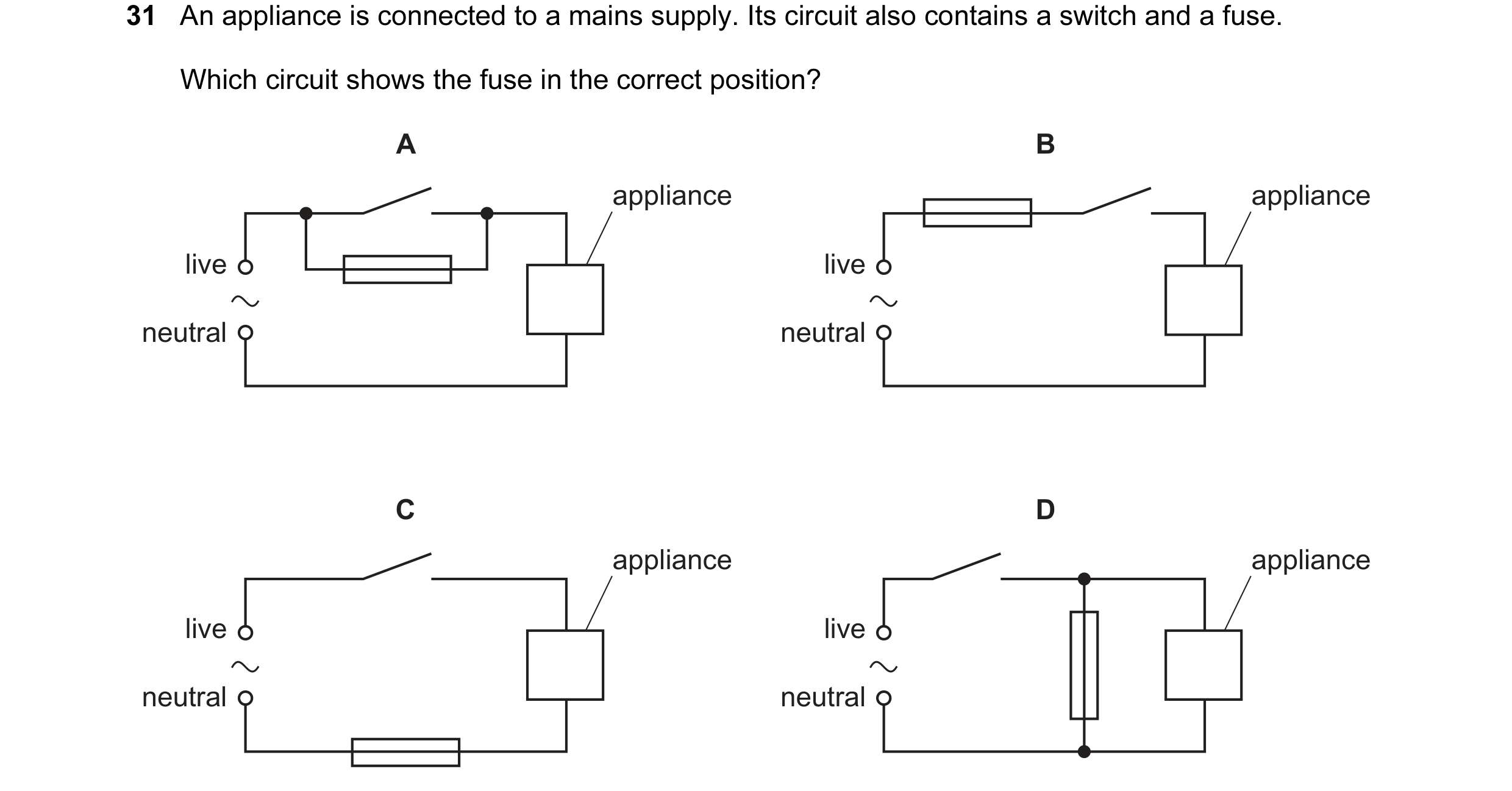
 14 / 38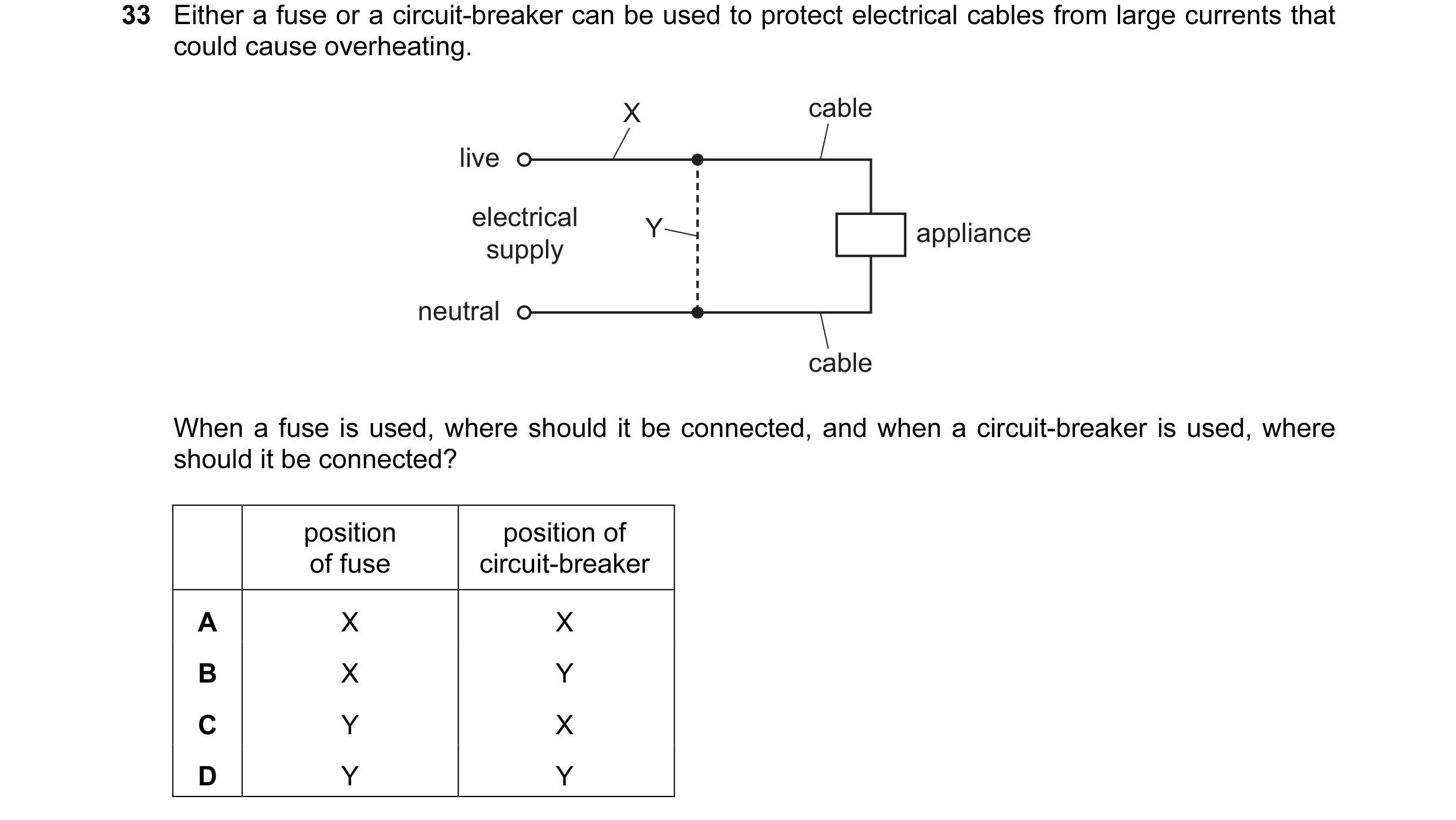
 15 / 38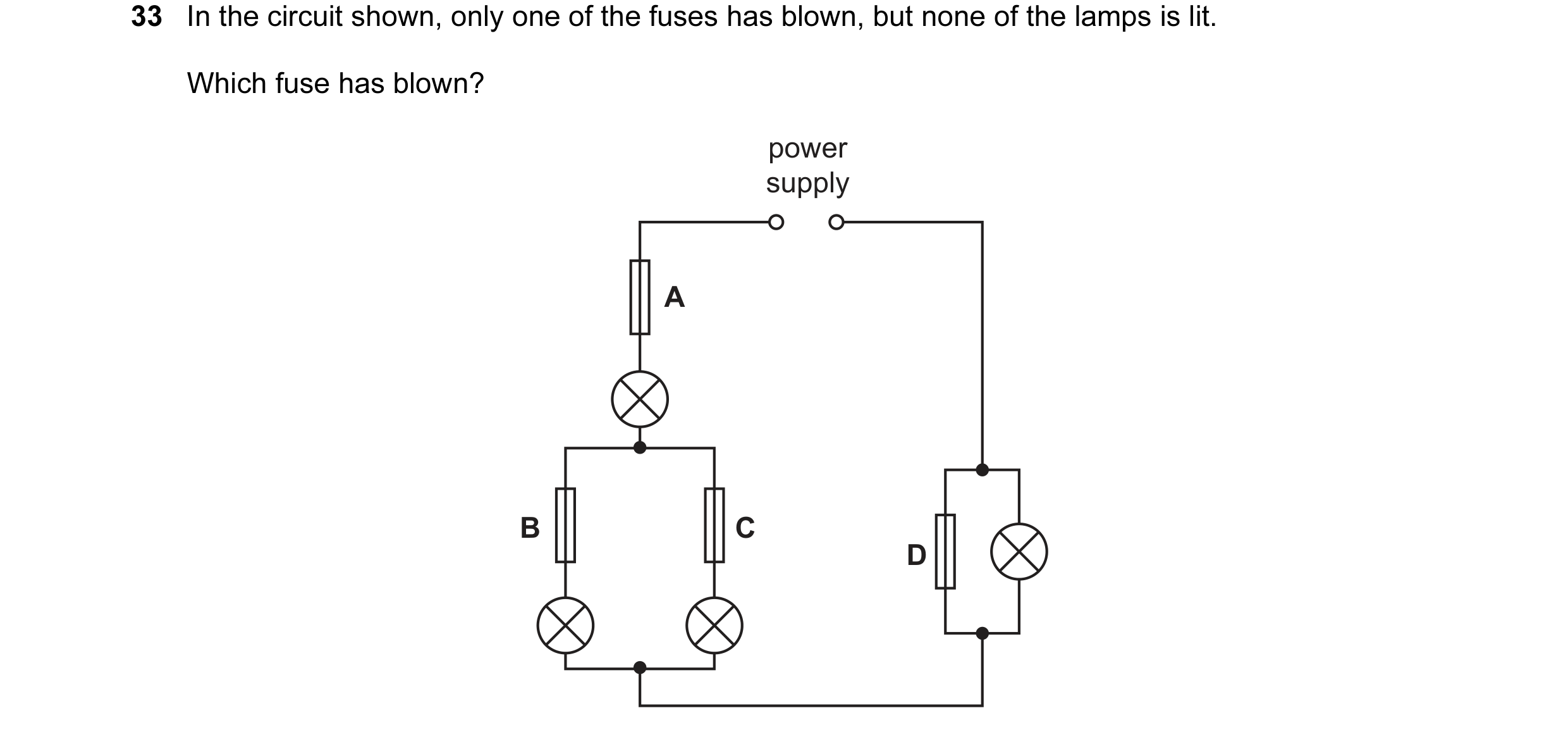
 16 / 38
 17 / 38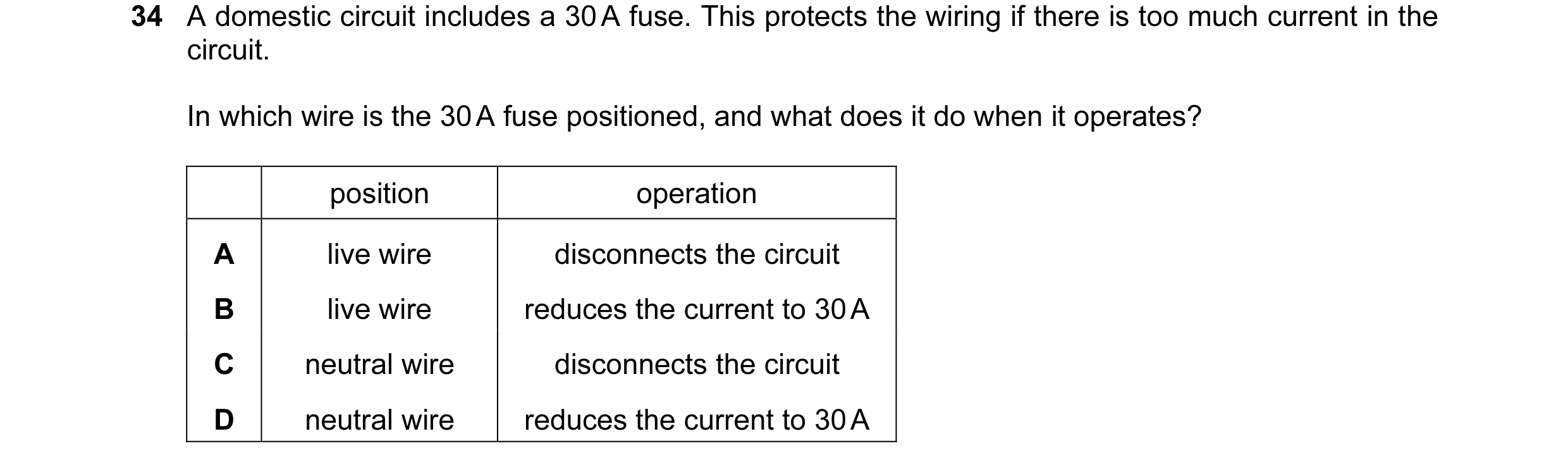

 18 / 38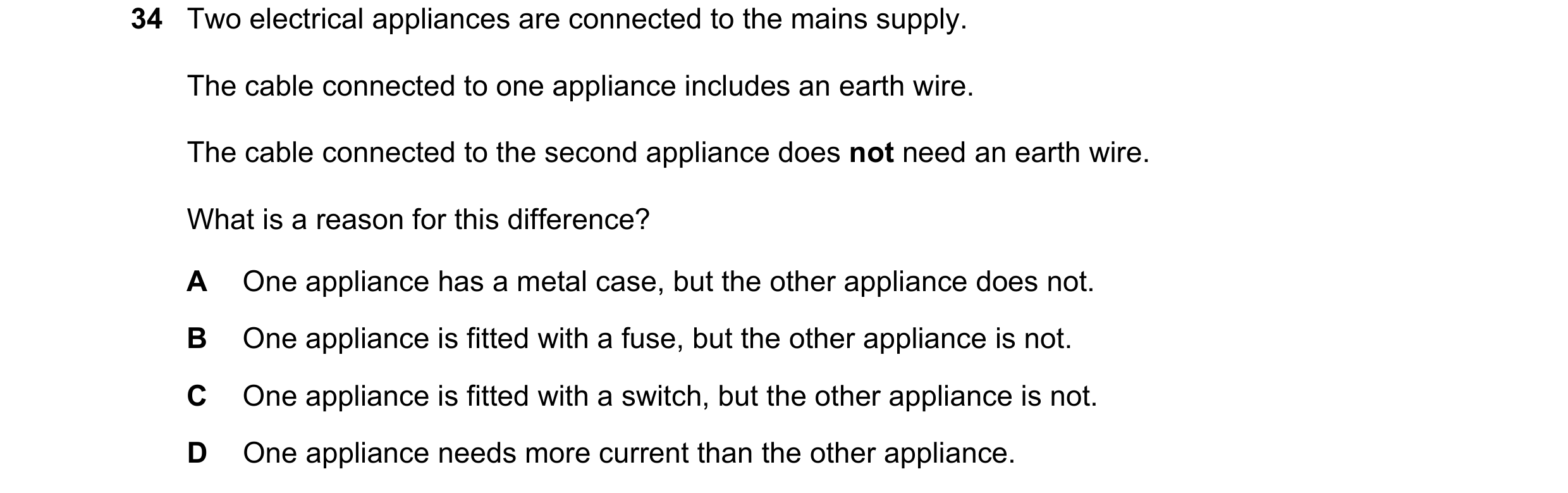
 19 / 38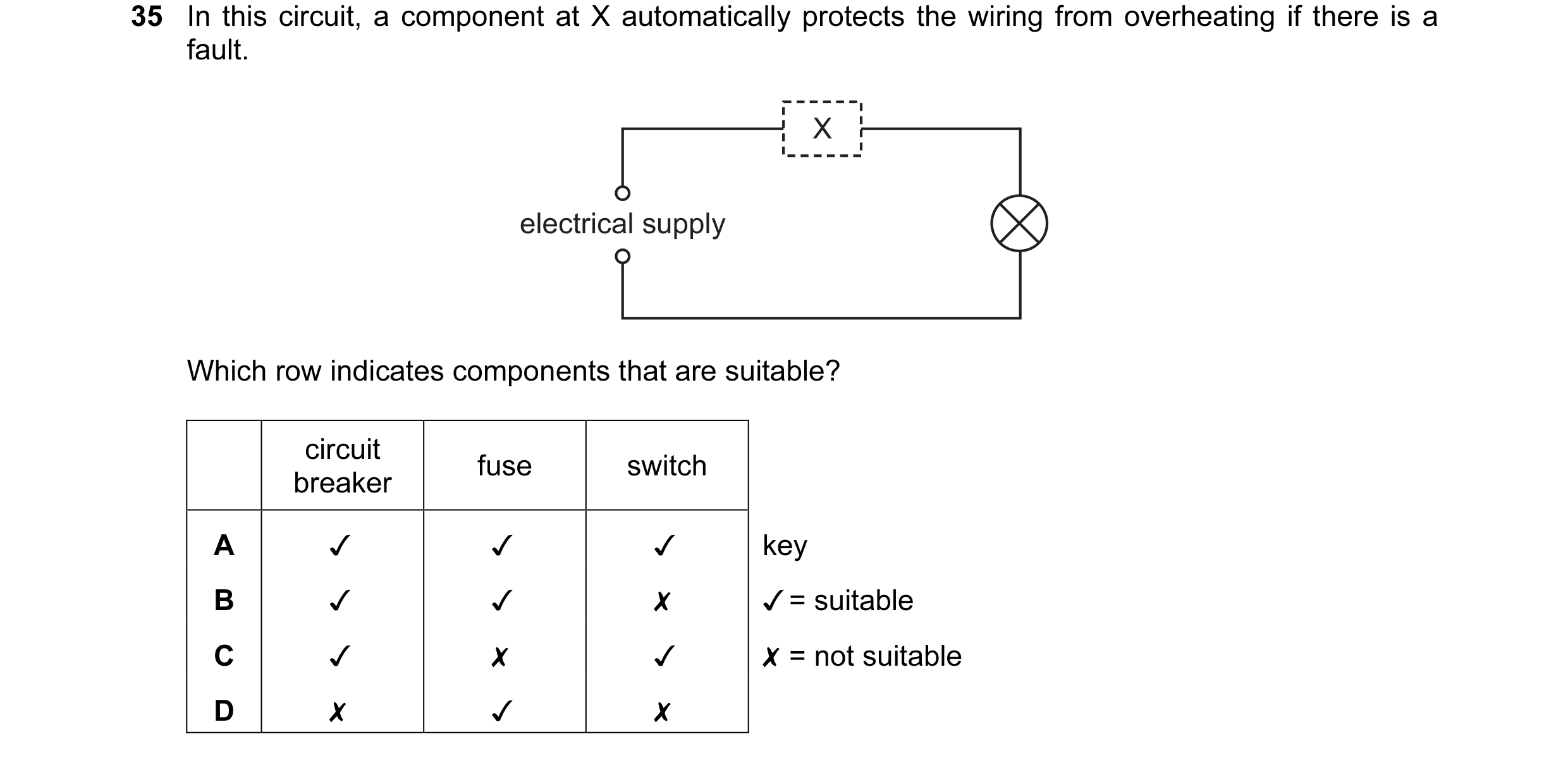
 20 / 38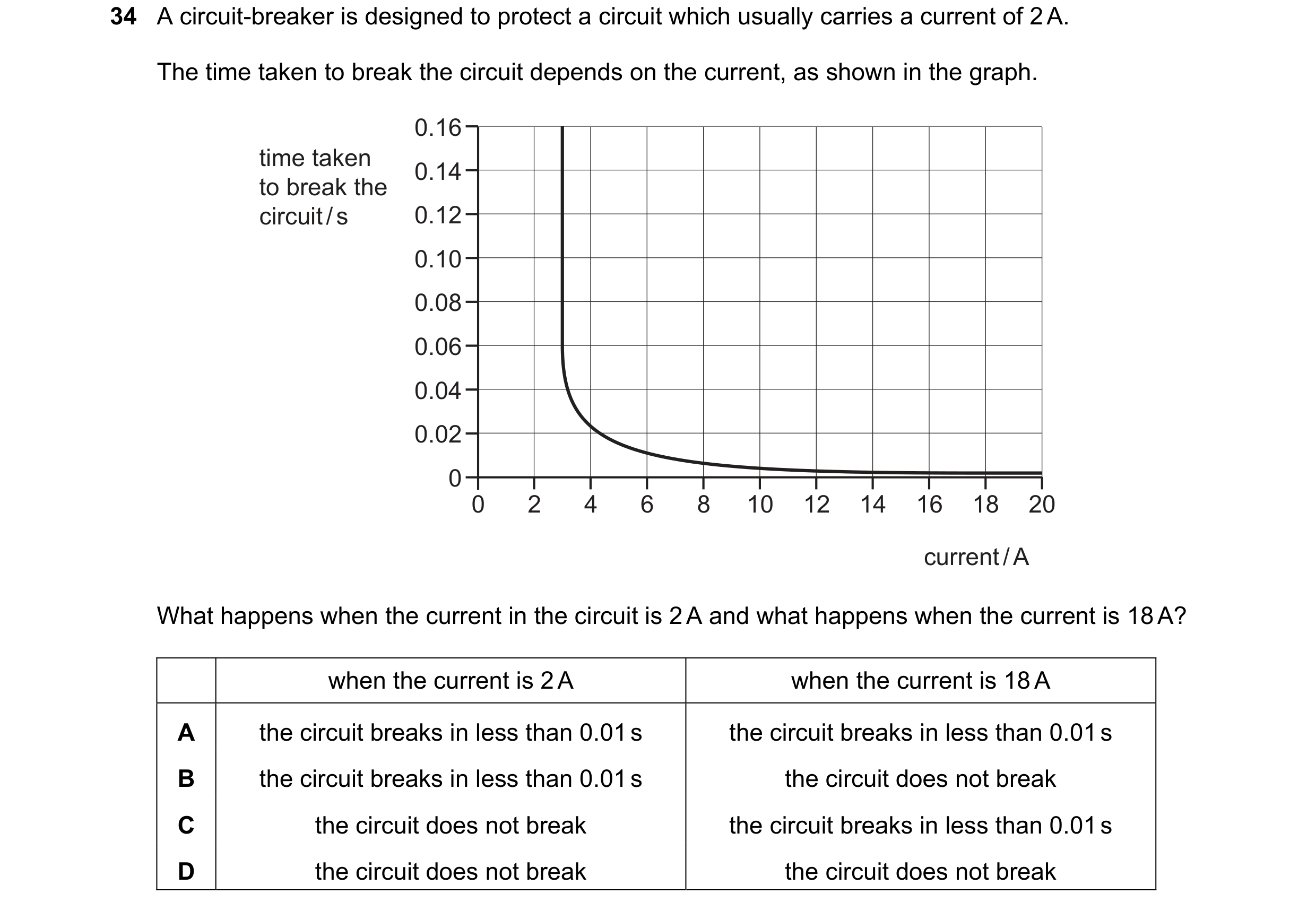
 21 / 38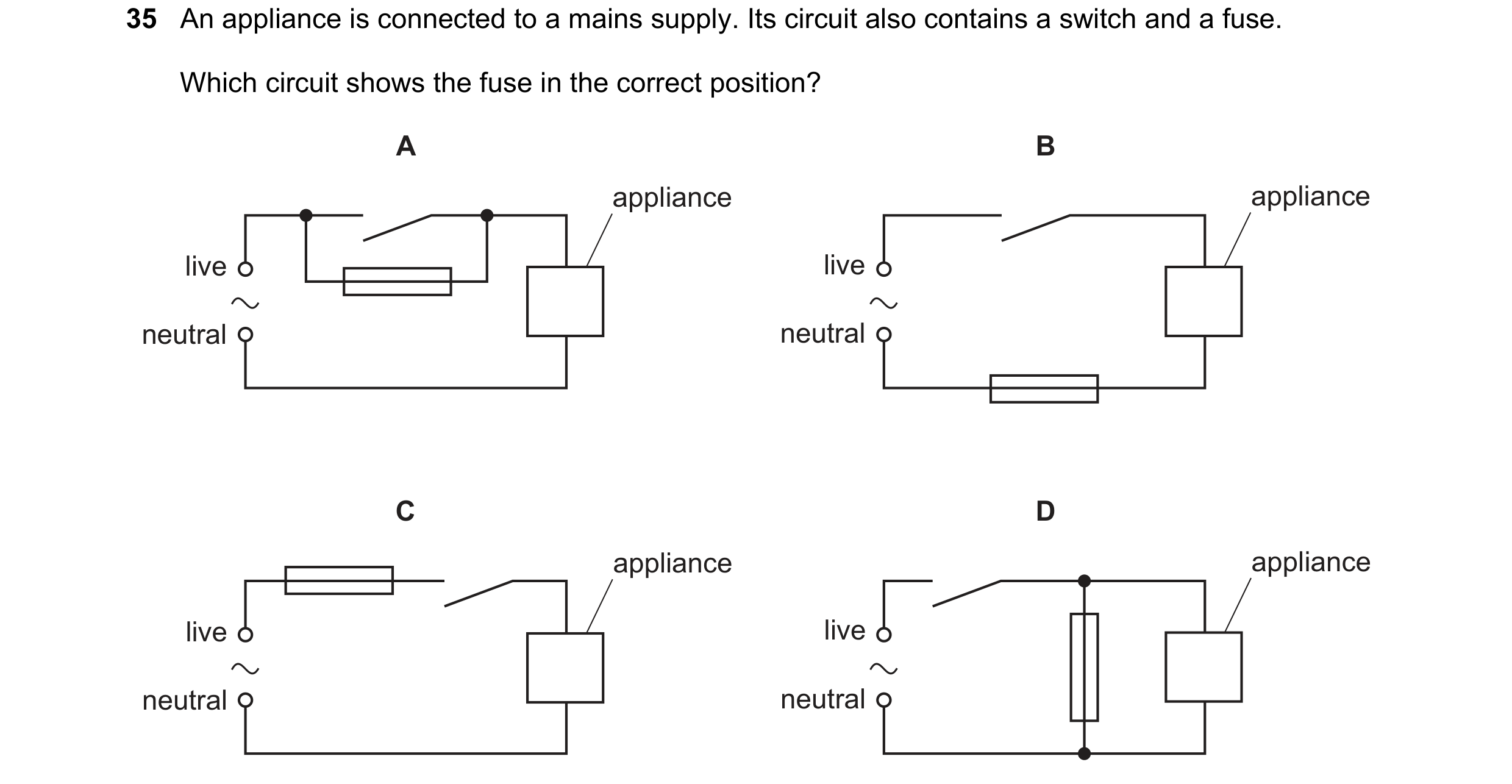
 22 / 38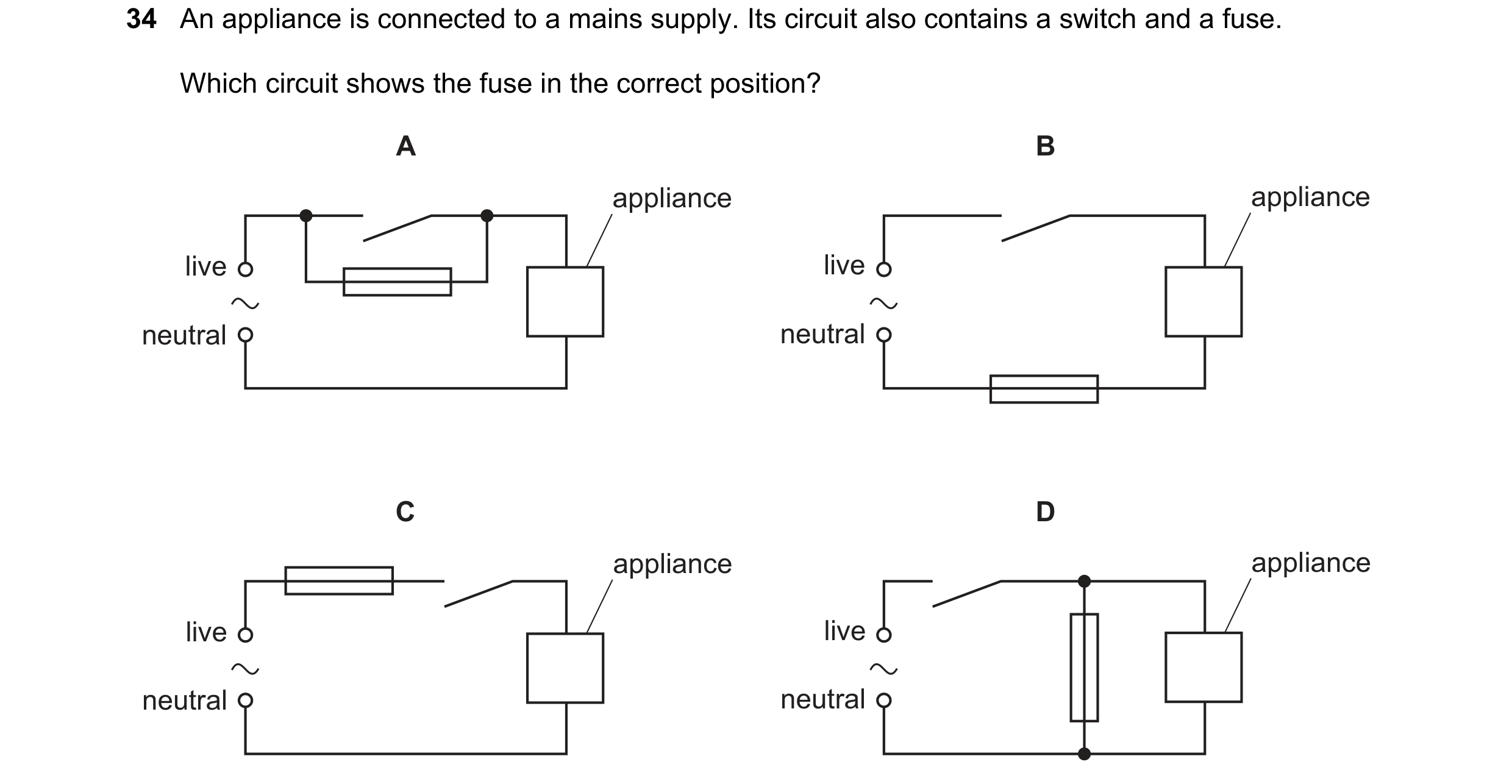
 23 / 38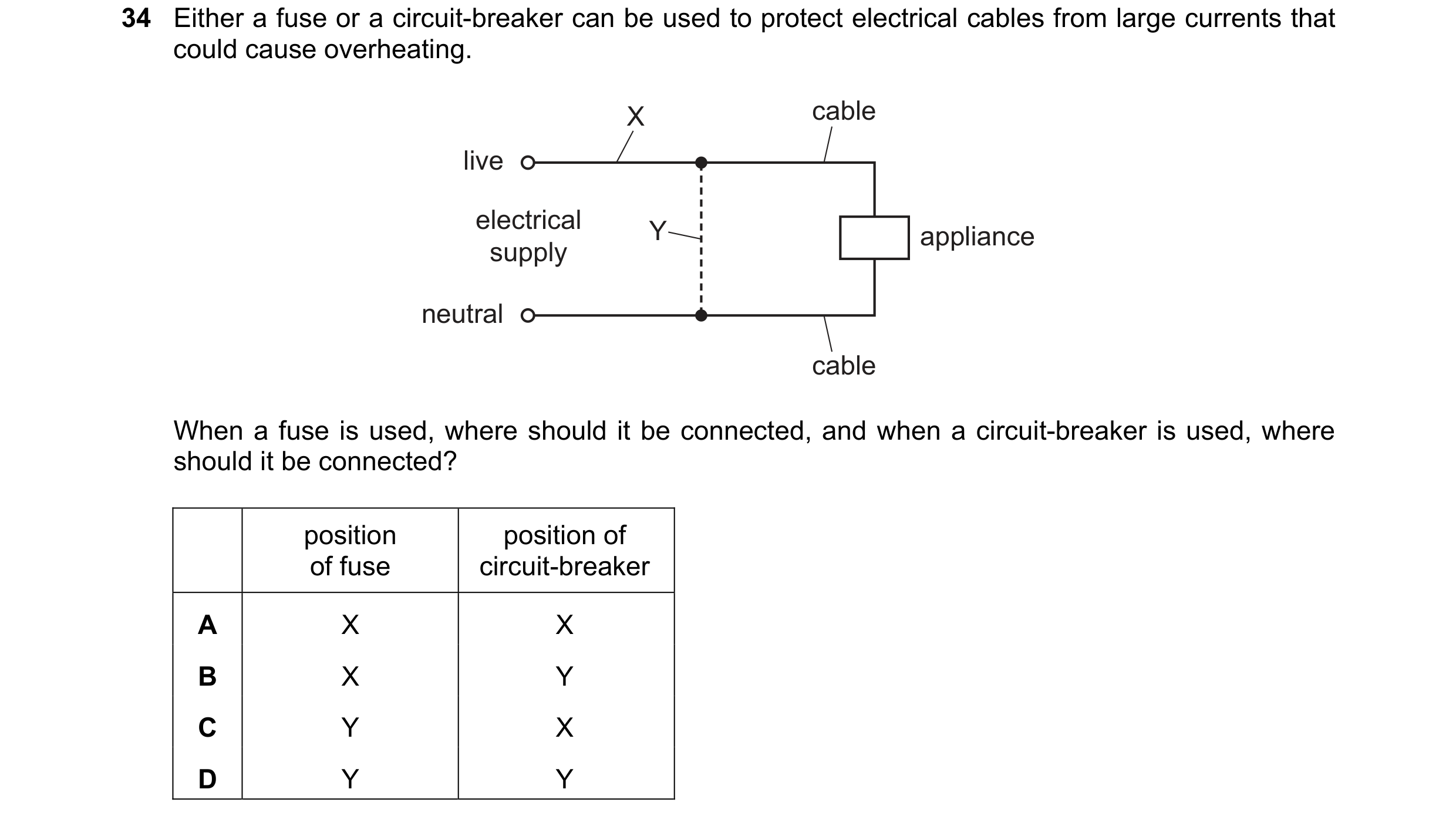
 24 / 38
 25 / 38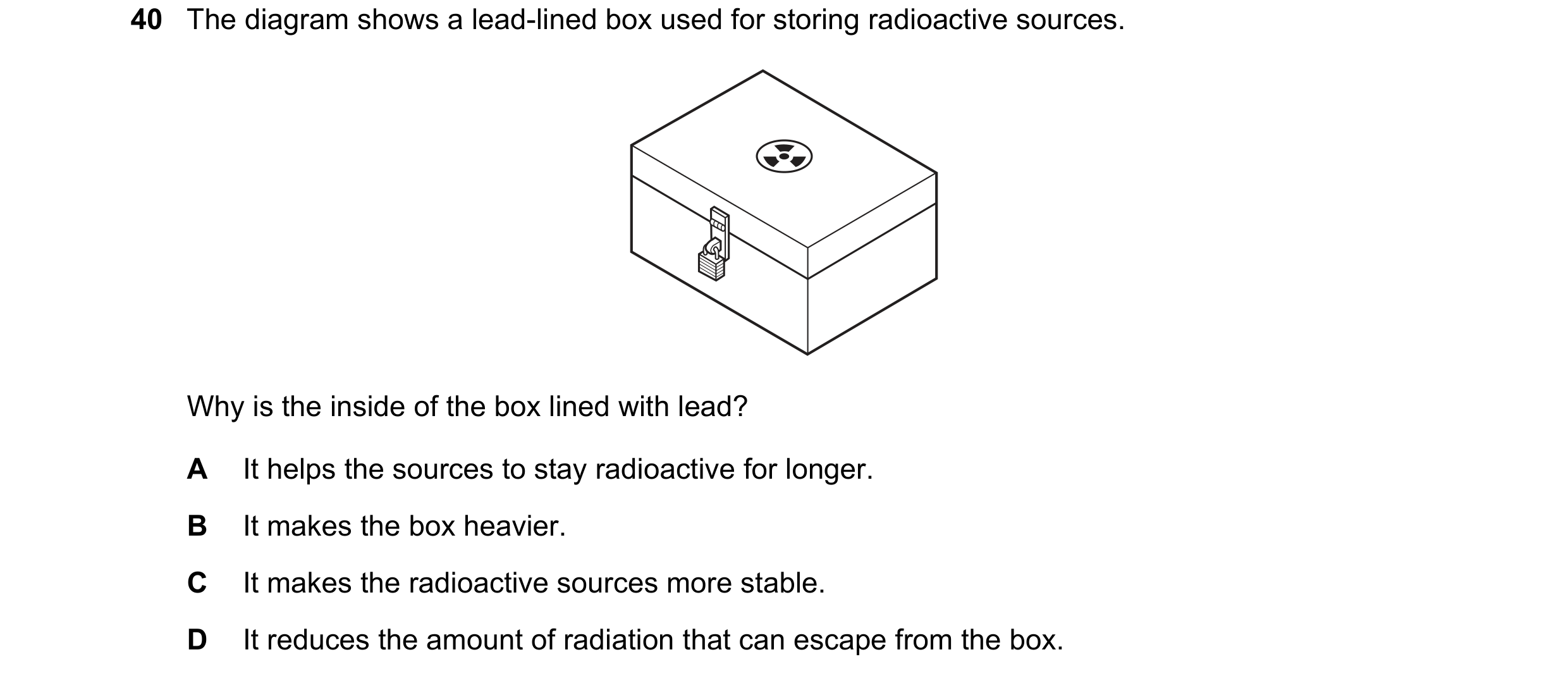

 26 / 38


 27 / 38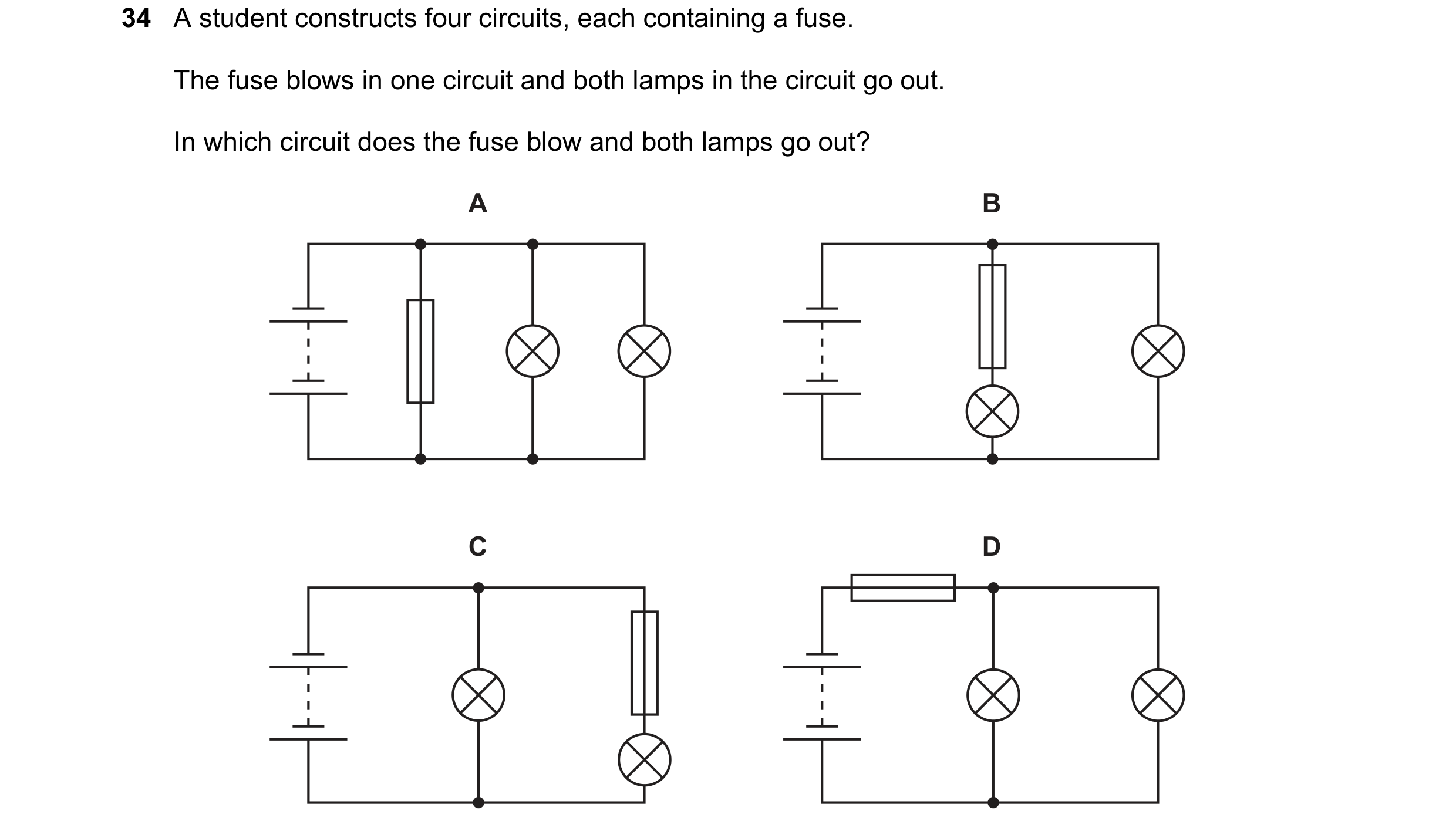
 28 / 38
 29 / 38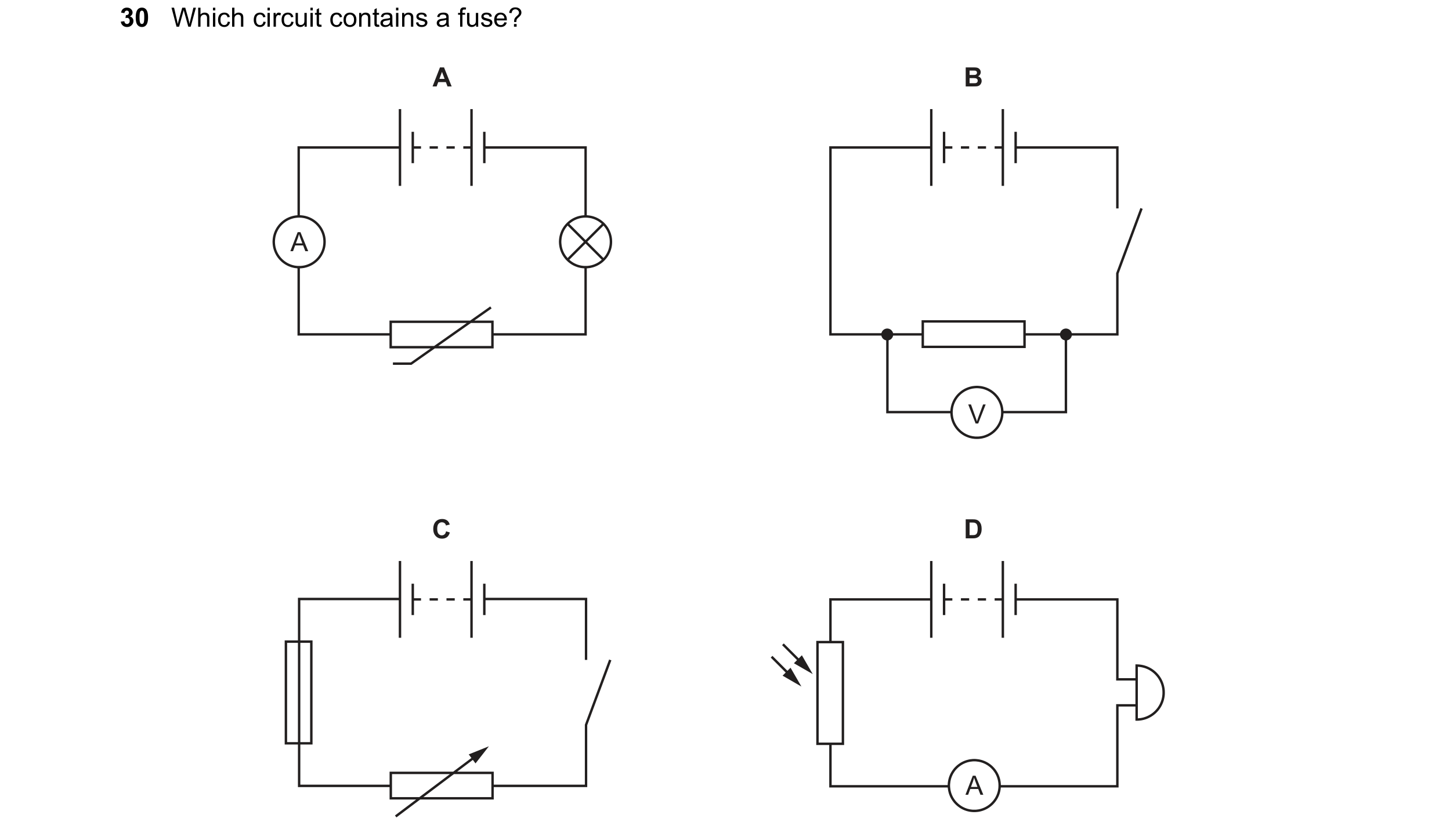
 30 / 38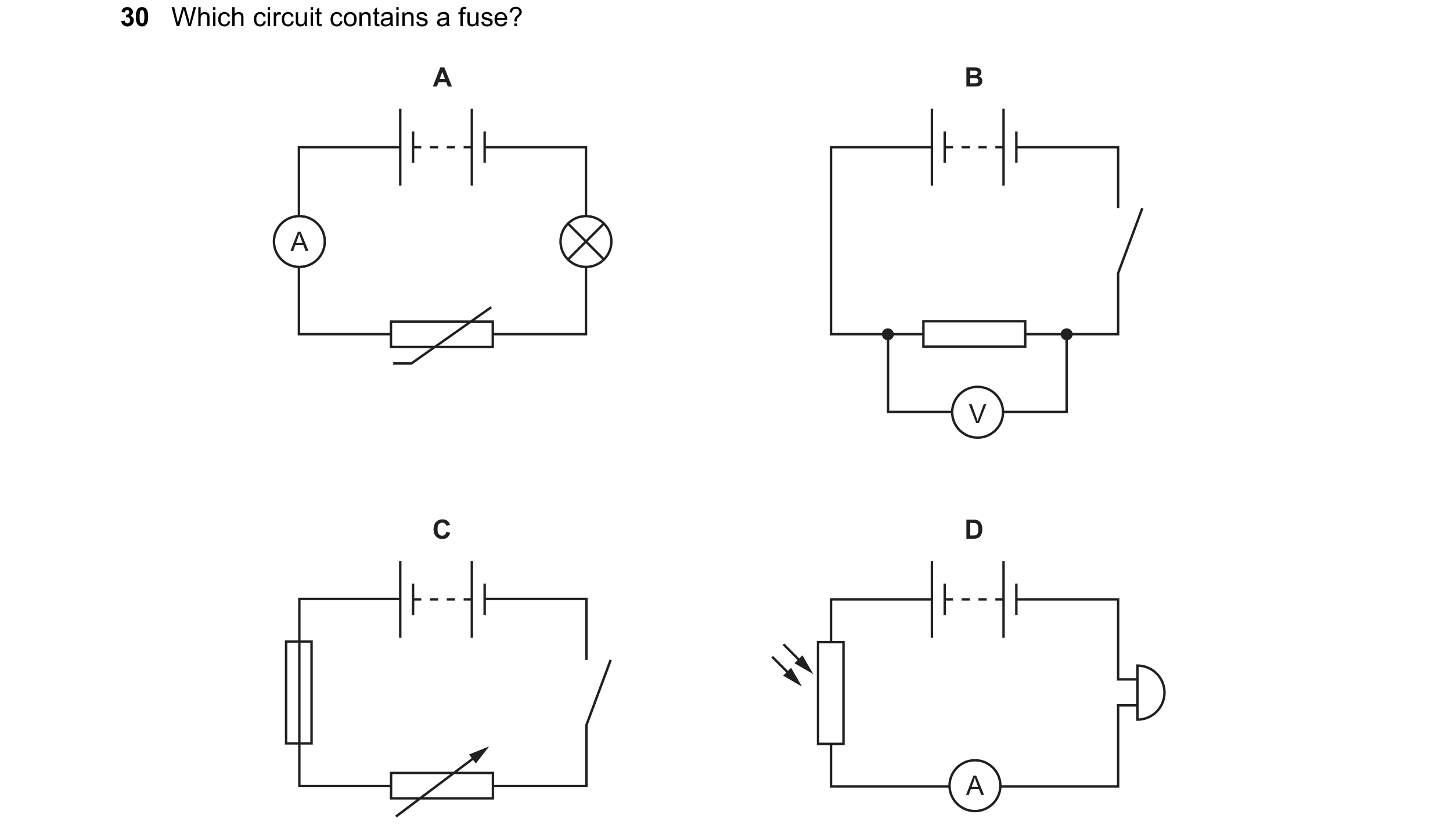
 31 / 38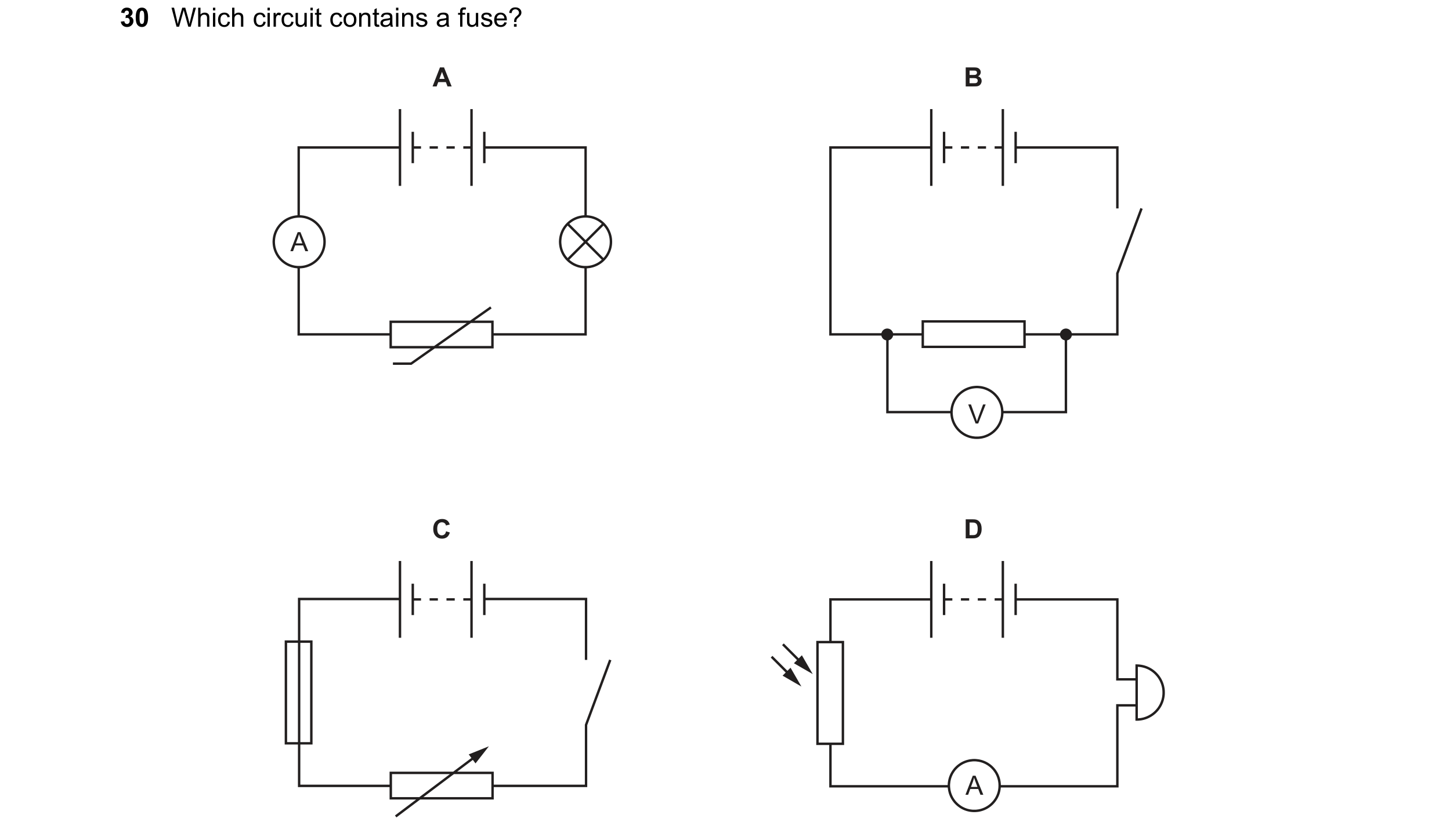

 32 / 38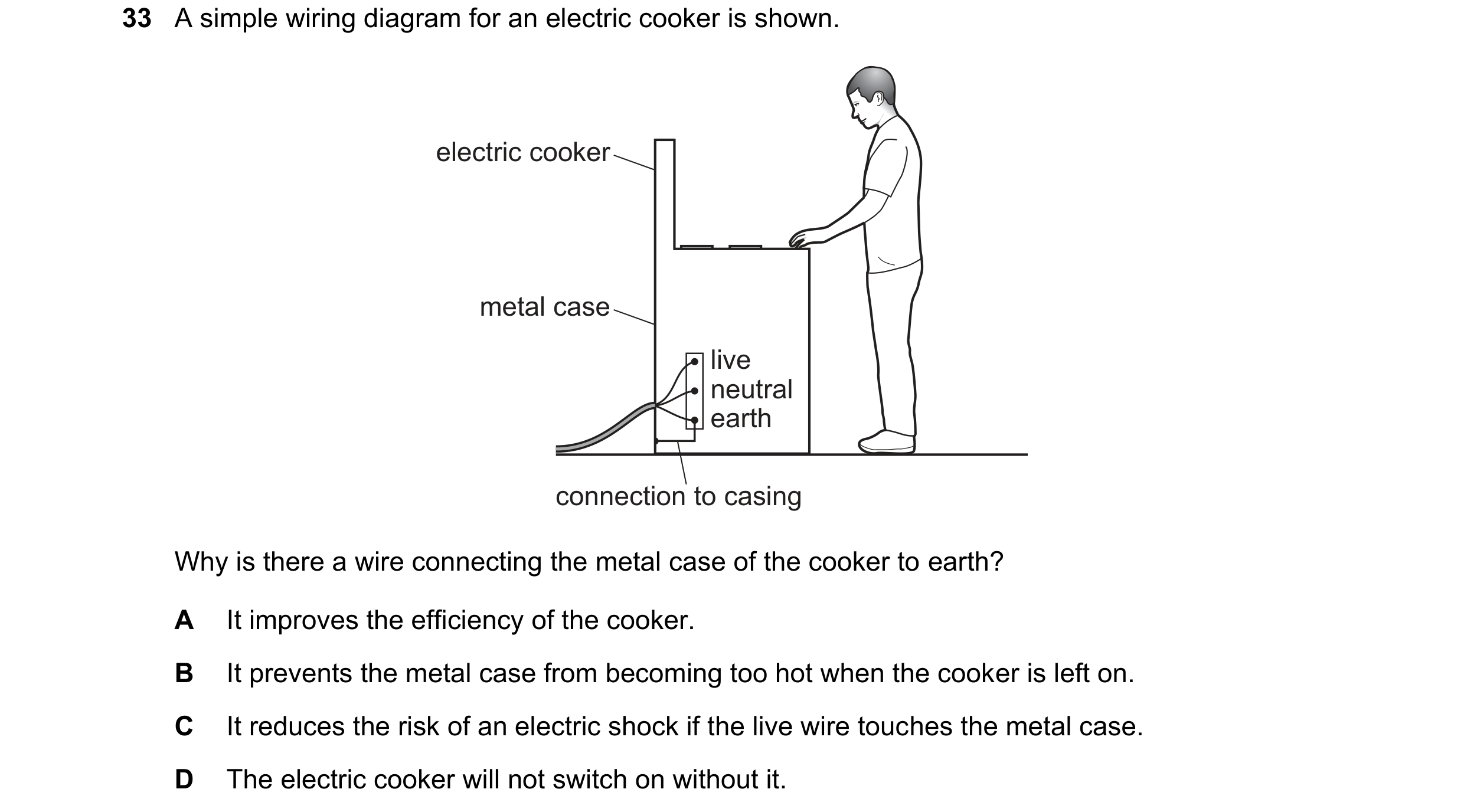



 33 / 38
 34 / 38

 35 / 38
 36 / 38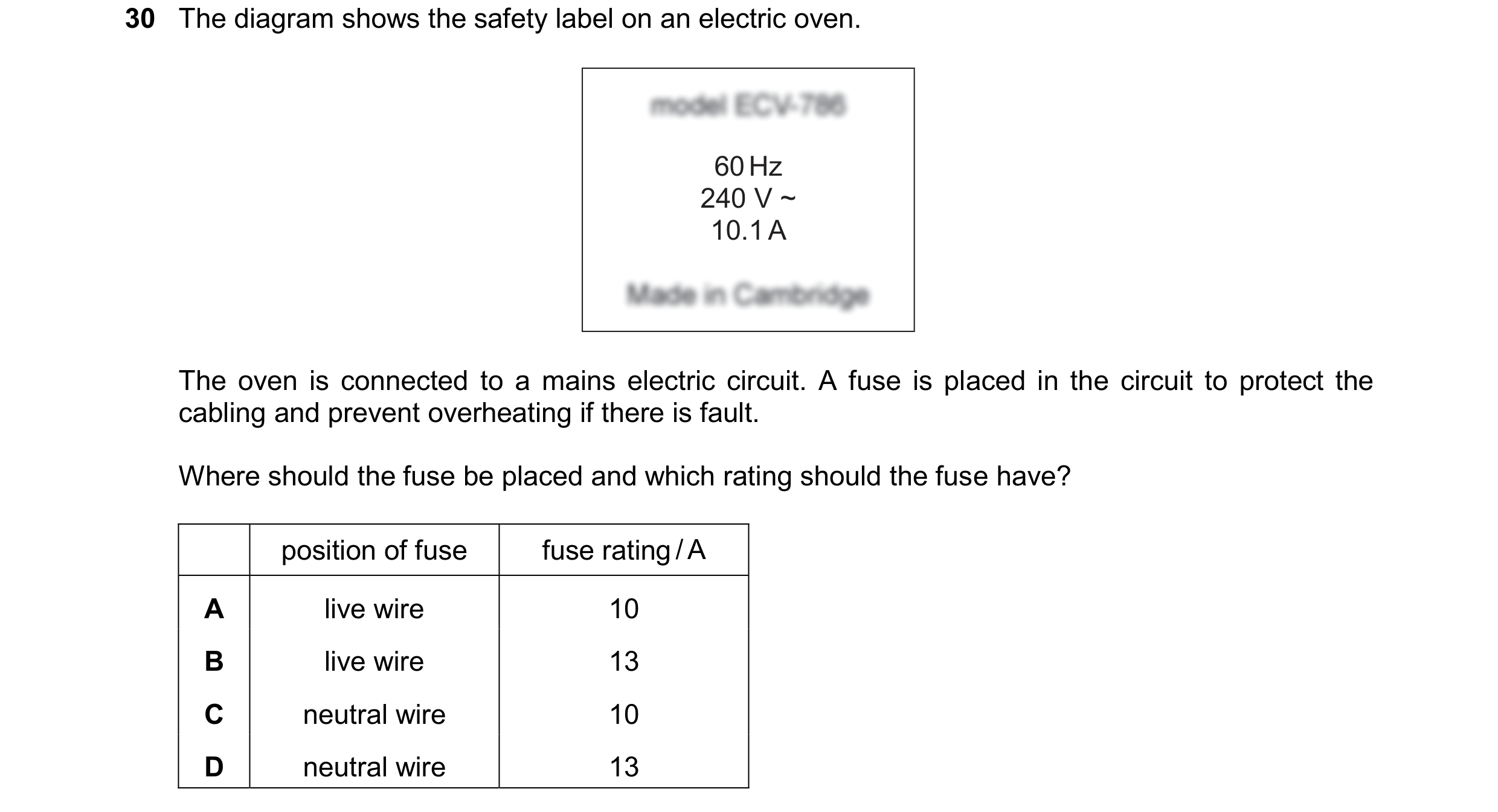
 37 / 38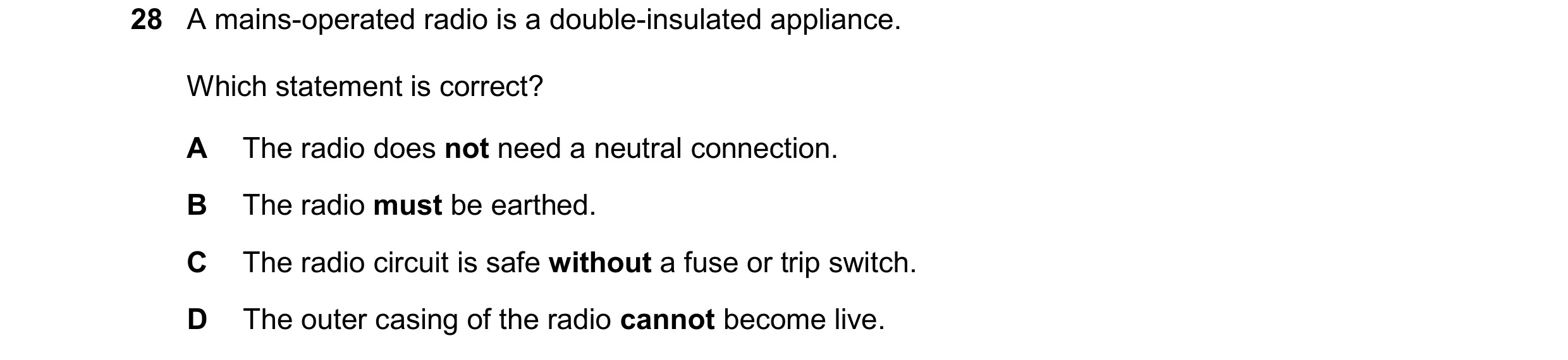


 38 / 38