Questions as text
Q1 · The plug for a television contains a fuse 0625/32 May/June 2017
11 (a) The plug for a television contains a fuse. Explain the purpose of the fuse. … … … [2] (b) The circuit of the television includes transformers. (i) State the metal used for the two coils of each transformer. … [1] (ii) One transformer has an input voltage of 224 V and an output voltage of 16.0 V. The input coil contains 308 turns. Calculate the number of turns on the output coil. number of turns = … [3] [Total: 6]
6 marks
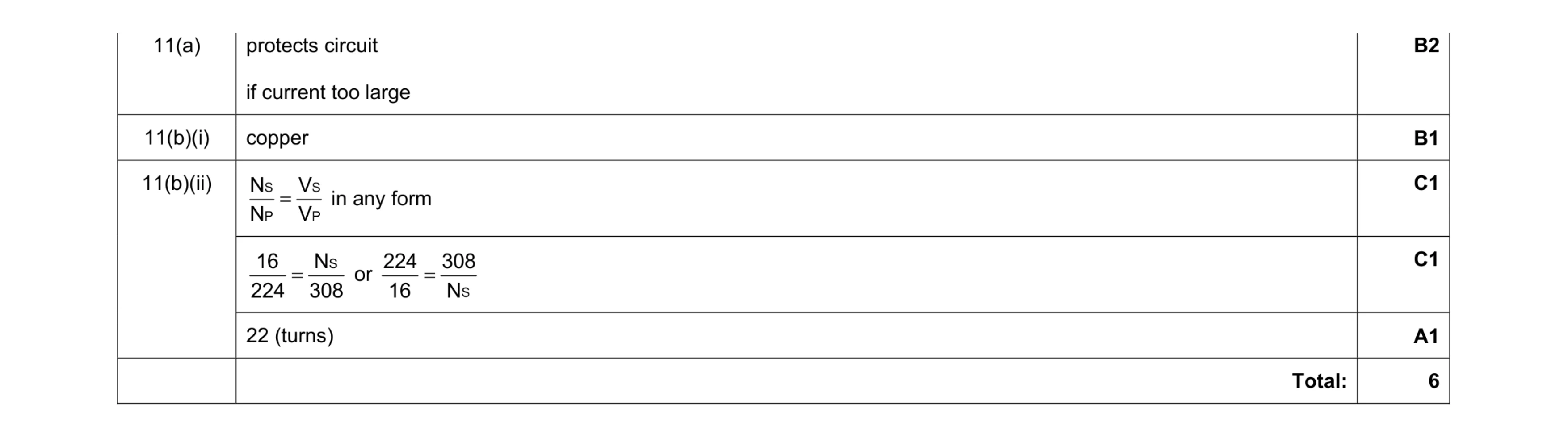
Mark scheme: 11(a) protects circuit if current too large B2 11(b)(i) copper B1 11(b)(ii) S S P P N V N V = in any form C1 S S 16 N 224 308 or 224 308 16 N = = C1 22 (turns) A1 Total: 6
This question in 0625/32 May/June 2017
Q2 · A student investigates electromagnetic induction 0625/31 Oct/Nov 2017
10 (a) A student investigates electromagnetic induction. Fig. 10.1 shows the arrangement she uses. wire S N 0 –2 +2 sensitive centre-zero meter Fig. 10.1 When the student holds the wire stationary, as shown in Fig. 10.1, the reading on the meter is zero. She moves the wire down between the poles of the magnet. Then she holds it stationary and then moves it up. (i) The meter measures the size and direction of the induced electromotive force (e.m.f.). On Fig. 10.2, draw the position of the pointer on the meter at each stage. One has been done for you. 0 0 0 –2 +2 –2 +2 –2 +2 wire moving down wire stationary wire moving up [2] Fig. 10.2 (ii) Describe how the student could increase the size of the induced electromotive force (e.m.f.). … … … [2] (b) A transformer is used near a power station. There are 60 turns on the input coil and 660 turns on the output coil. The input voltage is 25 000 V. Calculate the output voltage. output voltage = … V [3] (c) State two advantages of high-voltage transmission of electrical energy. 1. … 2. … [2] [Total: 9]
9 marks
Mark scheme: 10(a)(i) Pointer(s) not on zero B1 Pointers in opposite directions B1 10(a)(ii) Any 2 from: Increase speed of wire B2 wrap wire into a coil Increase strength of magnet 10(b) Ns/Np = Vs/Vp OR 660 ÷ 60 = Vs ÷ 25 000 C1 Vs or output voltage = (660 / 60) × 25 000 = 11 × 25 000 C1 275 000 (V) A1 10(c) Any 2 from: Reduced energy / power losses B2 Smaller conductors needed Reduced voltage drop (across cable)
This question in 0625/31 Oct/Nov 2017
Q3 · The regions of the electromagnetic spectrum 0625/32 Oct/Nov 2017
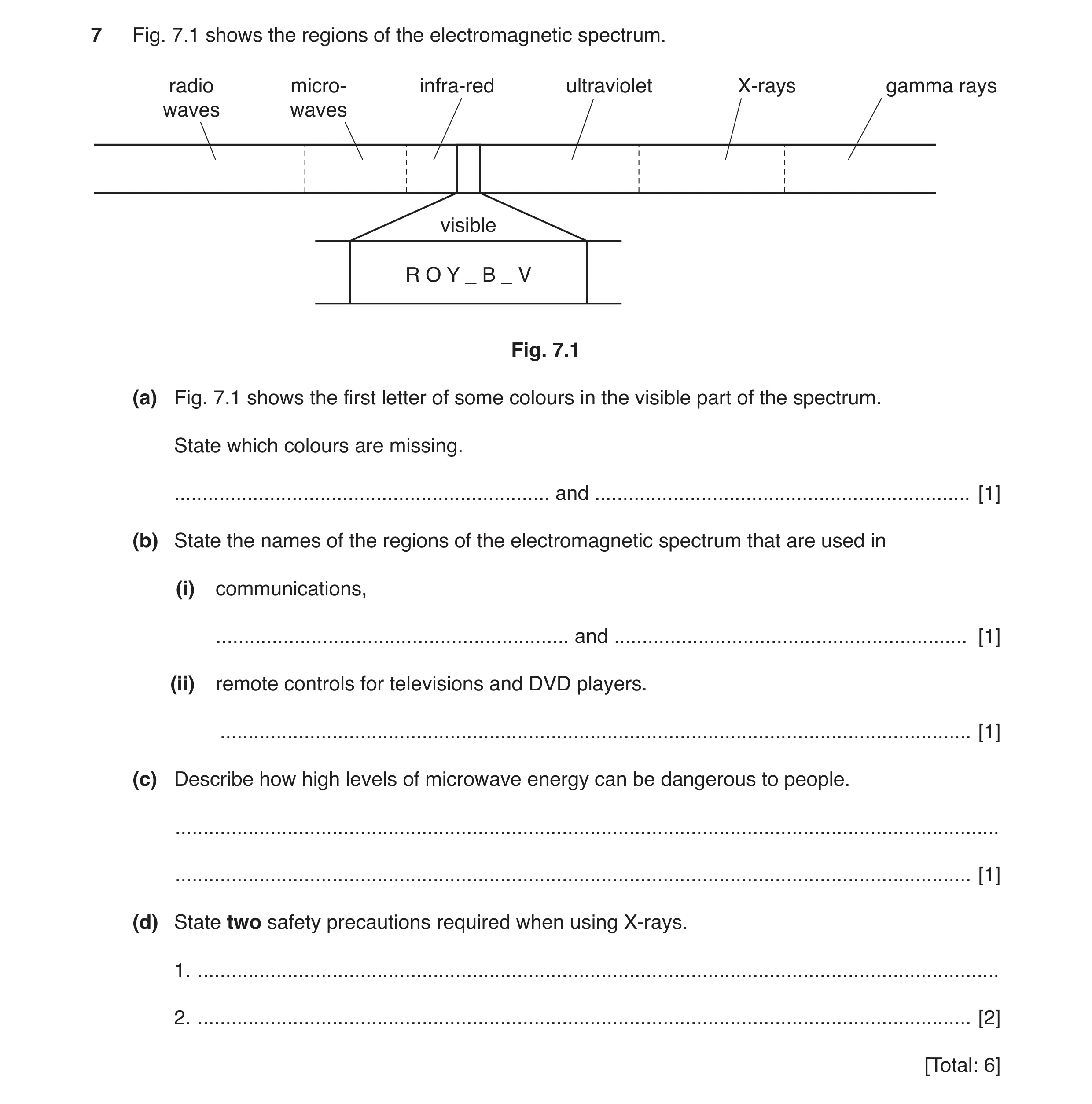
7 Fig. 7.1 shows the regions of the electromagnetic spectrum. radio micro- infra-red ultraviolet X-rays gamma rays waves waves visible R O Y _ B _ V Fig. 7.1 (a) Fig. 7.1 shows the first letter of some colours in the visible part of the spectrum. State which colours are missing. … and … [1] (b) State the names of the regions of the electromagnetic spectrum that are used in (i) communications, … and … [1] (ii) remote controls for televisions and DVD players. … [1] (c) Describe how high levels of microwave energy can be dangerous to people. … … [1] (d) State two safety precautions required when using X-rays. 1. … 2. … [2] [Total: 6]
6 marks
Mark scheme: 7(a) green and indigo B1 7(b) radio and microwaves B1 infra-red B1 7(c) damages cells / heats cells B1 7(d) reduced exposure / leave room / move far away B1 metal apron / exposure badge / metal shielding B1
This question in 0625/32 Oct/Nov 2017
Q4 · State the name of the component represented by the symbol 0625/33 Oct/Nov 2018
10 (a) State the name of the component represented by the symbol . Describe its purpose. name … purpose … [2] (b) Fig. 10.1 shows an electrical cooker hood used in some kitchens. fan driven by motor light Fig. 10.1 The cooker hood removes steam from the kitchen. It has a fan driven by a motor. It also has a lamp. Fig. 10.2 shows a simplified circuit diagram for the cooker hood. Y M T Z S Fig. 10.2 (i) State the type of electrical supply used by the cooker hood. … [1] (ii) Switch S is closed. Switch T is moved to position Y. State the name of any components that are switched on. … [1] (iii) Switch T is moved from position Y to position Z. Suggest how this change affects the motor. … [1] (c) Electrical appliances with metal cases can become dangerous if there is a fault. Suggest a hazard and describe a safety feature to reduce the danger. hazard … … safety feature … … [2] [Total: 7]
7 marks
Mark scheme: 10(a)(i) (name:) (fixed) resistor B1 (purpose:) (to) reduce current B1 10(b)(i) a.c. / alternating (current) B1 10(b)(ii) motor / fan AND lamp B1 10(b)(iii) (the motor / fan / it) slows (down) owtte B1 10(c) (hazard:) live wire touching case OR user gets electric shock / burns OR (electrical) fire OR overheating / wire gets hot B1 (safety feature:) case is earthed B1
This question in 0625/33 Oct/Nov 2018
Q5 · A student rubs a plastic rod with a dry cloth, as shown in Fig 0625/31 May/June 2019
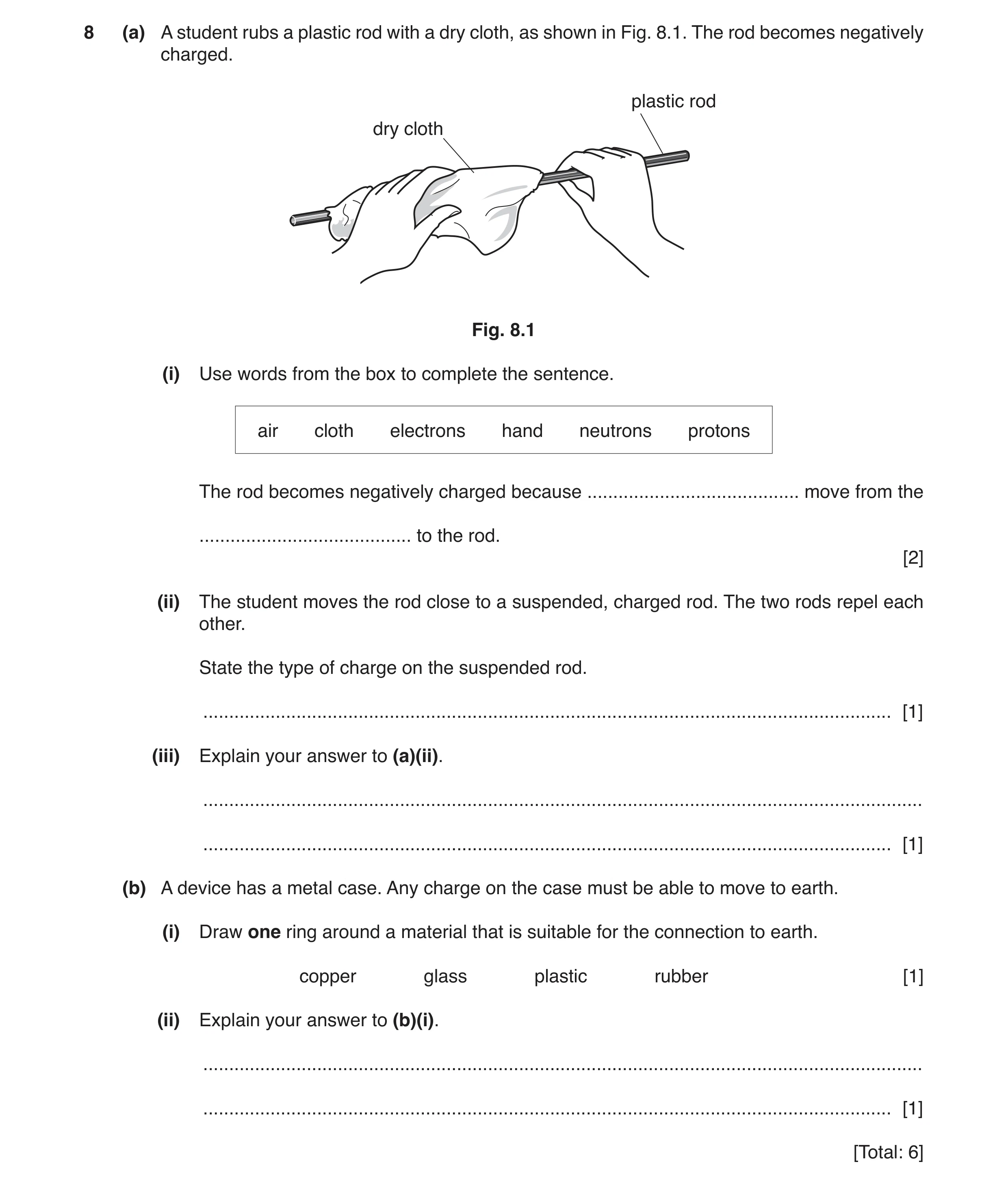
8 (a) A student rubs a plastic rod with a dry cloth, as shown in Fig. 8.1. The rod becomes negatively charged. plastic rod dry cloth Fig. 8.1 (i) Use words from the box to complete the sentence. air cloth electrons hand neutrons protons The rod becomes negatively charged because … move from the … to the rod. [2] (ii) The student moves the rod close to a suspended, charged rod. The two rods repel each other. State the type of charge on the suspended rod. … [1] (iii) Explain your answer to (a)(ii). … … [1] (b) A device has a metal case. Any charge on the case must be able to move to earth. (i) Draw one ring around a material that is suitable for the connection to earth. copper glass plastic rubber [1] (ii) Explain your answer to (b)(i). … … [1] [Total: 6]
6 marks
Mark scheme: 8(a)(i) electrons in 1st space B1 cloth in 2nd space B1 8(a)(ii) negative B1 8(a)(iii) like charges repel (each other) B1 8(b)(i) ring around copper B1 8(b)(ii) (earth wire must be good electrical ) conductor B1
This question in 0625/31 May/June 2019
Question 6 0625/33 May/June 2019
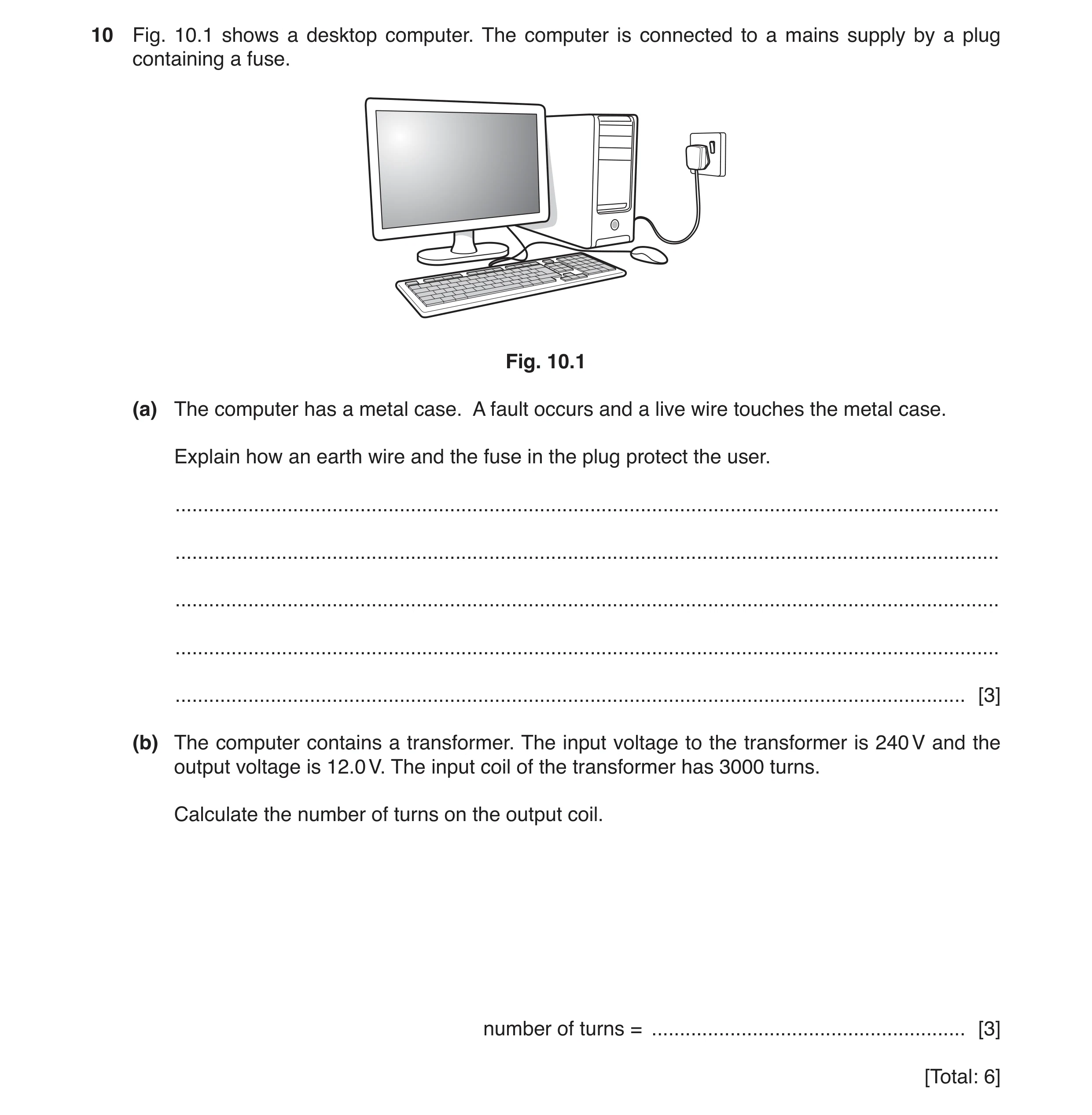
10 Fig. 10.1 shows a desktop computer. The computer is connected to a mains supply by a plug containing a fuse. Fig. 10.1 (a) The computer has a metal case. A fault occurs and a live wire touches the metal case. Explain how an earth wire and the fuse in the plug protect the user. … … … … … [3] (b) The computer contains a transformer. The input voltage to the transformer is 240 V and the output voltage is 12.0 V. The input coil of the transformer has 3000 turns. Calculate the number of turns on the output coil. number of turns = … [3] [Total: 6]
6 marks
Mark scheme: 10(a) any 3 from: earth wire is connected to metal case earth wire has low resistance large current in earth wire fuse in live wire fuse (heats up and) melts this disconnects case/computer/circuit from supply ( and so protects user) B3 10(b) (Vp / Vs ) = (Np / Ns ) in any form C1 240 / 12 = 3000 / Ns OR Ns = 3000 × (12/240) OR Ns = 3000 / 20 C1 150 (turns) A1
This question in 0625/33 May/June 2019
Q7 · A teacher uses a power supply in a metal case 0625/31 May/June 2020
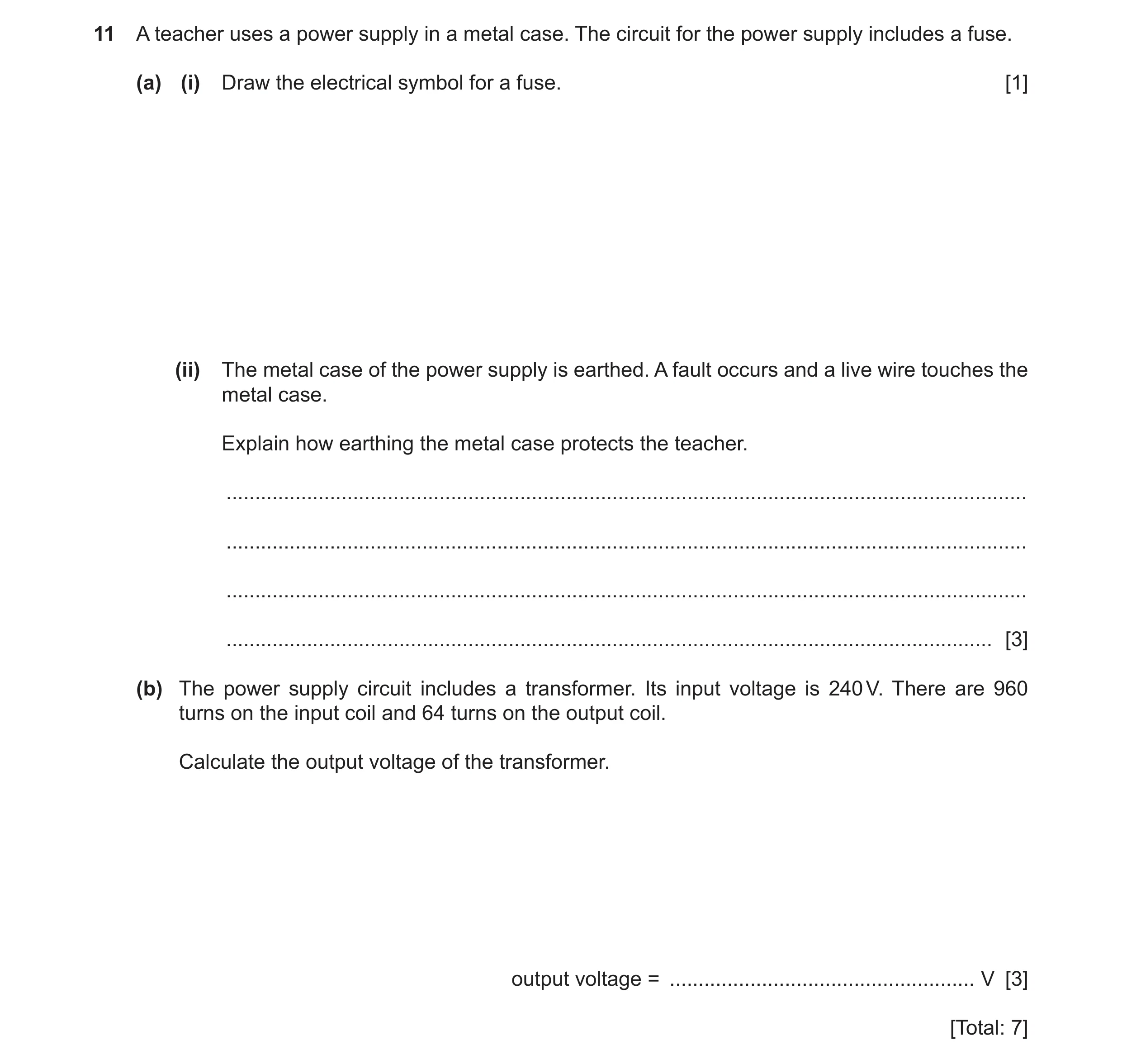
11 A teacher uses a power supply in a metal case. The circuit for the power supply includes a fuse. (a) (i) Draw the electrical symbol for a fuse. [1] (ii) The metal case of the power supply is earthed. A fault occurs and a live wire touches the metal case. Explain how earthing the metal case protects the teacher. … … … … [3] (b) The power supply circuit includes a transformer. Its input voltage is 240 V. There are 960 turns on the input coil and 64 turns on the output coil. Calculate the output voltage of the transformer. output voltage = … V [3] [Total: 7]
7 marks
Mark scheme: 11(a)(i) correct symbol for fuse drawn B1 11(a)(ii) a large current flows to earth / in the live wire OR fuse is connected into live wire OR fuse contains thin / low melting point wire B1 Question Answer Marks any two from: current heats (fuse) wire fuse melts / blows (power supply circuit / metal case) is disconnected from mains (supply) B2 11(b) Vs/ Vp = Ns/ Np in any form C1 (Vs =) (64 × 240) ÷ 960 C1 16 (V) A1
This question in 0625/31 May/June 2020
Q8 · Carbon-14 is a radioactive isotope of carbon 0625/32 May/June 2020
12 (a) Carbon-14 is a radioactive isotope of carbon. An atom of carbon-14 has 6 protons in its nucleus. Another isotope of carbon is carbon-12. (i) Determine the number of protons in a carbon-12 nucleus. … [1] (ii) Determine the number of neutrons in a carbon-14 nucleus. … [1] (iii) Determine the number of electrons orbiting the nucleus of a single carbon-14 atom. … [1] (b) Carbon-14 decays by emitting a β-particle. State what happens to a nucleus of carbon-14 when it emits a β-particle. … [1] (c) People working with radioactive sources need to take safety precautions. (i) A shielding material can absorb ionising radiation and reduce the damage to living tissue. State a suitable material that will absorb all types of naturally occurring nuclear radiation. … [1] (ii) Apart from using shielding, state how a person can reduce the amount of ionising radiation they absorb when they handle samples of radioactive substances. … [1] [Total: 6]
6 marks
Mark scheme: 12(a)(i) 6 B1 12(a)(ii) 8 B1 12(a)(iii) 6 B1 12(b) changes to a different element / gains a proton B1 12(c)(i) lead B1 12(c)(ii) any one from: minimise time for handling maximise distance from source use of shielding prevent contamination B1
This question in 0625/32 May/June 2020
Q9 · A metal kettle used for heating water 0625/32 Oct/Nov 2020
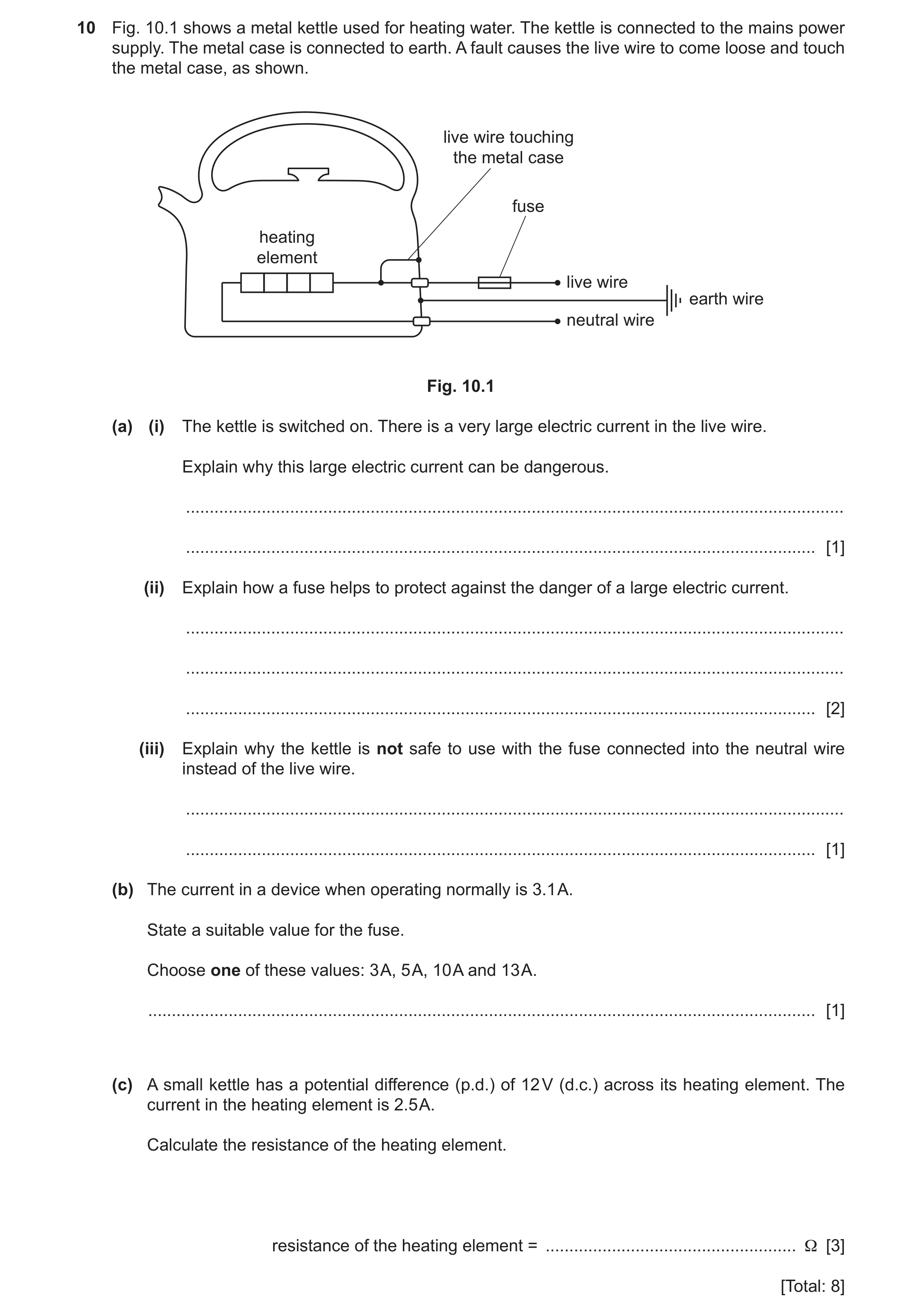
10 Fig. 10.1 shows a metal kettle used for heating water. The kettle is connected to the mains power supply. The metal case is connected to earth. A fault causes the live wire to come loose and touch the metal case, as shown. live wire touching the metal case fuse heating element live wire earth wire neutral wire Fig. 10.1 (a) (i) The kettle is switched on. There is a very large electric current in the live wire. Explain why this large electric current can be dangerous. … … [1] (ii) Explain how a fuse helps to protect against the danger of a large electric current. … … … [2] (iii) Explain why the kettle is not safe to use with the fuse connected into the neutral wire instead of the live wire. … … [1] (b) The current in a device when operating normally is 3.1 A. State a suitable value for the fuse. Choose one of these values: 3 A, 5 A, 10 A and 13 A. … [1] (c) A small kettle has a potential difference (p.d.) of 12 V (d.c.) across its heating element. The current in the heating element is 2.5 A. Calculate the resistance of the heating element. resistance of the heating element = … Ω [3] [Total: 8]
8 marks
Mark scheme: 10(a)(i) (large current produces large) heating effect OR overheating OR (could) cause fire. B1 10(a)(ii) fuse melts B1 breaks circuit OR stops current in circuit B1 10(a)(iii) (metal case / kettle) would still be live OR connected to 240 V / mains (when fuse has melted) B1 10(b) 5 A B1 10(c) (R =) V ÷ I OR V = IR C1 12 ÷ 2.5 C1 4.8 (Ω) A1
This question in 0625/32 Oct/Nov 2020
Q10 · A student uses a laptop computer 0625/32 Feb/March 2021
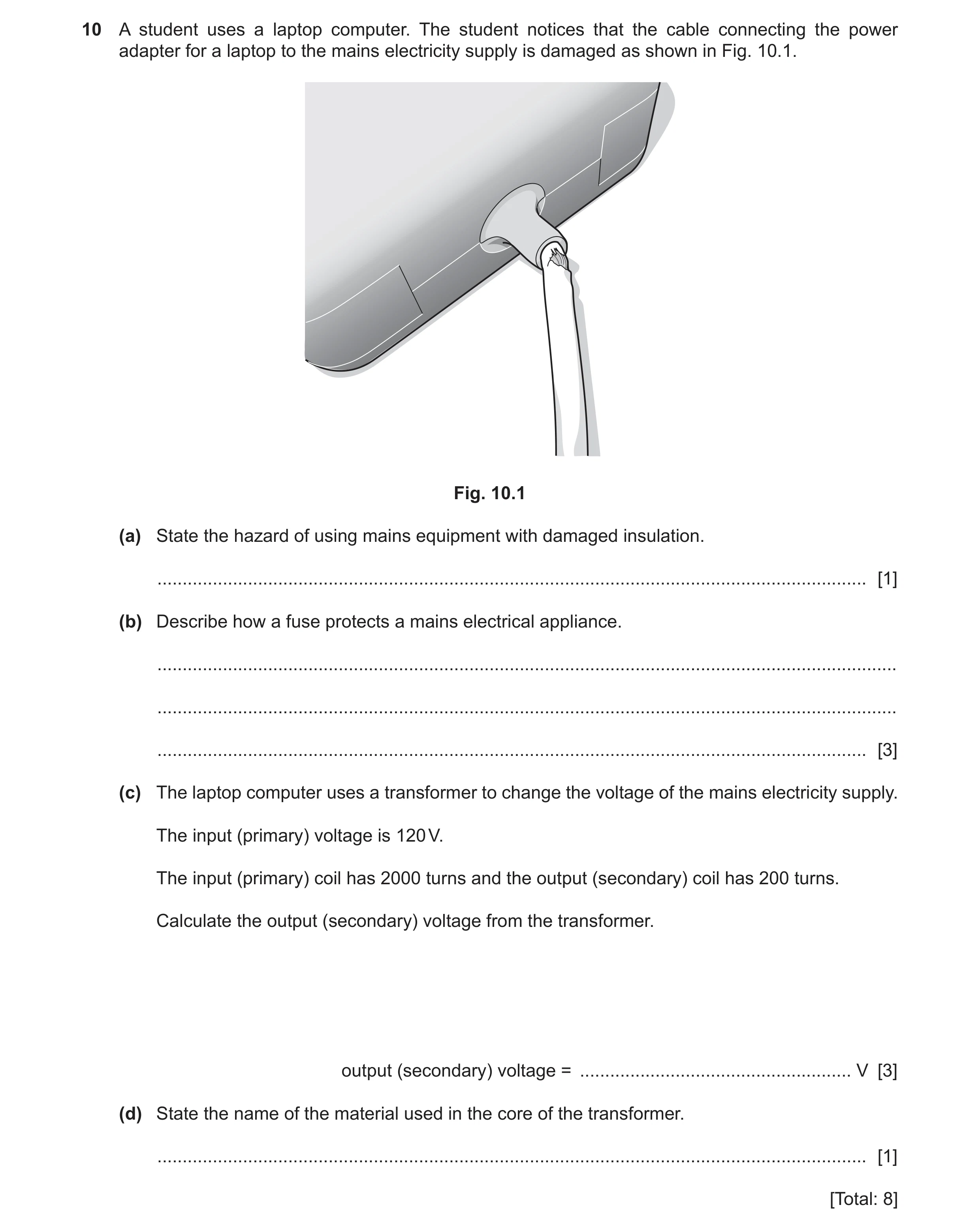
10 A student uses a laptop computer. The student notices that the cable connecting the power adapter for a laptop to the mains electricity supply is damaged as shown in Fig. 10.1. Fig. 10.1 (a) State the hazard of using mains equipment with damaged insulation. … [1] (b) Describe how a fuse protects a mains electrical appliance. … … … [3] (c) The laptop computer uses a transformer to change the voltage of the mains electricity supply. The input (primary) voltage is 120 V. The input (primary) coil has 2000 turns and the output (secondary) coil has 200 turns. Calculate the output (secondary) voltage from the transformer. output (secondary) voltage = … V [3] (d) State the name of the material used in the core of the transformer. … [1] [Total: 8]
8 marks
Mark scheme: 10(a) electrocution OR overheating / fire B1 10(b) large current (in fuse) B1 (causes) fuse / it to melt B1 isolating appliance from supply OR prevents current in appliance OR breaks circuit B1 10(c) Vs / Vp = Ns / Np C1 Vs / 120 = 200 / 2000 OR Vs = 120 × 200 / 2000 OR Vs = 120 / 10 C1 12 (V) A1 10(d) (soft) iron B1
This question in 0625/32 Feb/March 2021
Q11 · A battery charger for a laptop computer includes a transformer 0625/32 Feb/March 2022
11 A battery charger for a laptop computer includes a transformer. (a) The primary voltage Vp to the transformer is 240 V. The number of turns on the primary coil Np is 590 turns and the number of turns on the secondary coil Ns of the transformer is 48 turns. Calculate the secondary voltage Vs of the transformer. secondary voltage Vs = … V [3] (b) The plug connecting the transformer to the supply voltage contains a fuse. Describe how a fuse works. … … … … [3] [Total: 6]
6 marks
Mark scheme: 11(a) 20 (V) A3 Vs / 240 = 48 / 590 OR Vs = (48 / 590) × 240 OR Vs = 240 ÷ 12.3 OR 48 / 590 = ? / 240 OR 240 48 590 × (C2) Vs / Vp = Ns / Np in any form (C1) 11(b) large current (in fuse) B1 (causes) fuse to melt B1 isolating appliance from supply OR prevents / stops current in appliance / circuit B1
This question in 0625/32 Feb/March 2022
Q12 · A microwave oven has a metal case and is connected to a 240 V electricity supply 0625/31 May/June 2022
10 A microwave oven has a metal case and is connected to a 240 V electricity supply. (a) The microwave oven is fitted with a 13 A fuse and an earth wire is connected to the metal case of the microwave oven. A fault occurs and the live wire of the microwave oven touches the metal case. Explain how the fuse and an earthed metal case protect the appliance and the user. … … … … … [4] (b) The electric circuit for the microwave oven includes a transformer. The voltage to the primary coil of the transformer Vp is 240 V. The number of turns on the primary coil Np is 70. The number of turns on the secondary coil Ns is 560. Calculate the secondary voltage Vs for the transformer. Vs = … V [3] [Total: 7]
7 marks
Mark scheme: 10(a) any four from: Earth wire keeps case at zero volts/earth (potential) (so) user not electrocuted (live wire touching metal case produces) large current (in fuse/earth wire) (causes) fuse to melt isolating appliance from supply OR (so) no current in appliance OR disconnects/breaks the circuit prevent(s/ing electrical) fire/overheating (in cables/appliance) Question Answer Marks 10(b) 1920 (V) A3 Vs / 240 = 560/70 OR Vs = (560/70) 240 OR Vs = 240 8 OR 560/70 = ? / 240 (C2) Vs/Vp = Ns/Np in any form (C1)
This question in 0625/31 May/June 2022
Q13 · A transformer used on a building site 0625/31 Oct/Nov 2022
9 Fig. 9.1 shows a transformer used on a building site. output socket mains plug for transformer Fig. 9.1 (a) The mains plug for the transformer contains a fuse. (i) Give a reason why the plug includes a fuse. … [1] (ii) Explain how a fuse works. … … [2] (b) The mains input (primary) potential difference (p.d.) to the transformer is 230 V a.c. The number of turns on the input (primary) coil is 314. The number of turns on the output (secondary) coil is 150. Calculate the output (secondary) p.d. from the transformer. output p.d. = … V [3] (c) Fig. 9.2 shows an outline of the transformer. core primary coil secondary coil 314 turns 150 turns 230 V a.c. Fig. 9.2 (i) State a suitable material for the core of the transformer. … [1] (ii) State a suitable material for the primary and secondary coils of the transformer. … [1] (iii) Explain how Fig. 9.2 shows a step-down transformer. … [1] [Total: 9]
9 marks
Mark scheme: 9(a)(i) protects (transformer / wiring) from fire / overheating B1 9(a)(ii) any two from: B2 • large current (in fuse) • (causes) fuse to melt • (and so) prevents current in appliance OR breaks circuit OR isolates appliance from supply. 9(b) 110 (V) A3 Vs / 230 = 150 / 314 OR Vs = (150 / 314) × 230 OR Vs = 230 / 2.093 OR 150 / 314 = ? / 230 C2 Vs / Vp = Ns / Np C1 9(c)(i) (soft) iron B1 9(c)(ii) copper B1 9(c)(iii) fewer turns on output / secondary (than on input coil) B1
This question in 0625/31 Oct/Nov 2022
Q14 · A hazardous scenario of using electricity in a kitchen 0625/33 Oct/Nov 2022
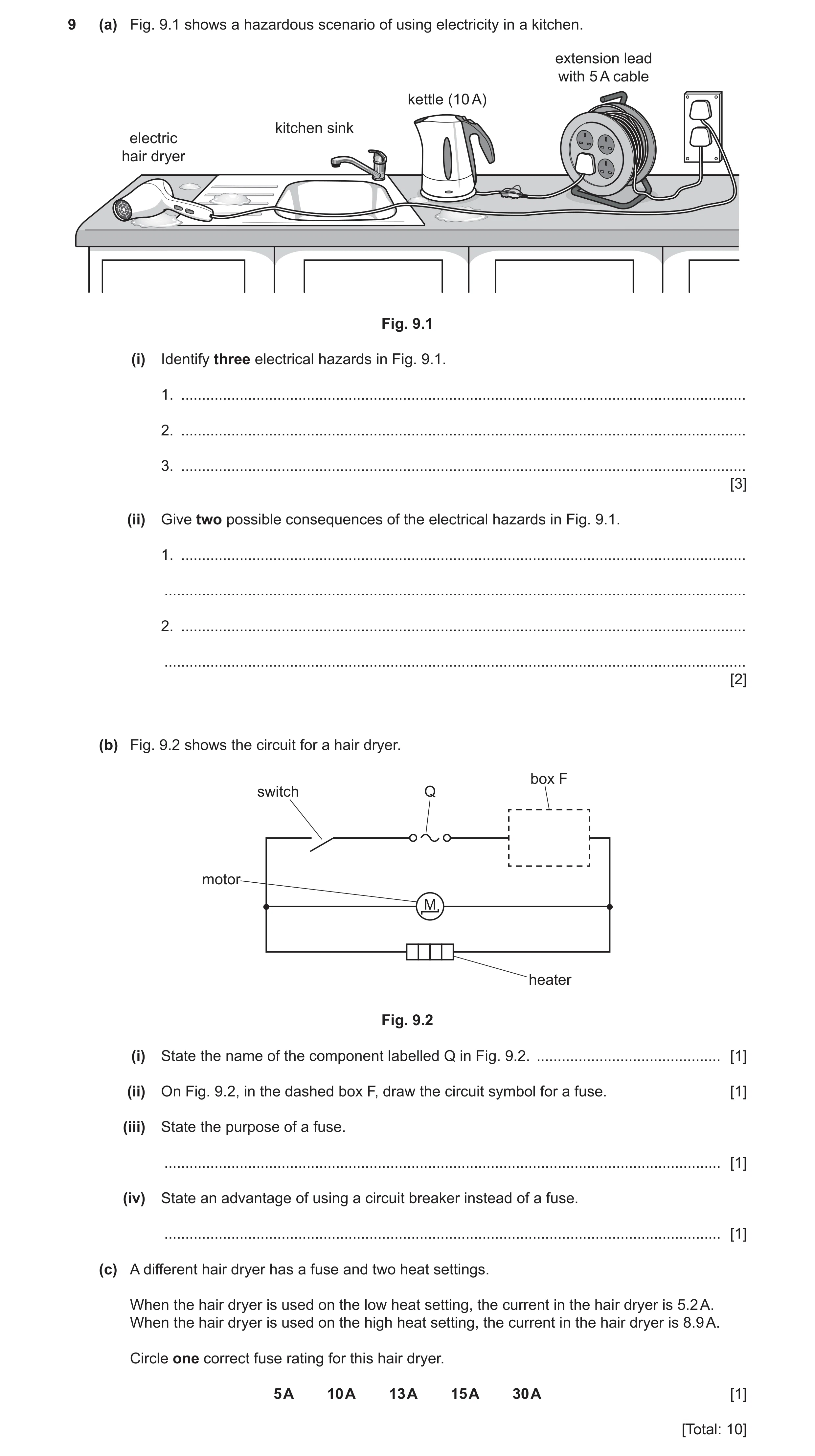
9 (a) Fig. 9.1 shows a hazardous scenario of using electricity in a kitchen. extension lead with 5 A cable kettle (10 A) kitchen sink electric hair dryer Fig. 9.1 (i) Identify three electrical hazards in Fig. 9.1. 1. … 2. … 3. … [3] (ii) Give two possible consequences of the electrical hazards in Fig. 9.1. 1. … … 2. … … [2] (b) Fig. 9.2 shows the circuit for a hair dryer. box F switch Q motor M heater Fig. 9.2 (i) State the name of the component labelled Q in Fig. 9.2. … [1] (ii) On Fig. 9.2, in the dashed box F, draw the circuit symbol for a fuse. [1] (iii) State the purpose of a fuse. … [1] (iv) State an advantage of using a circuit breaker instead of a fuse. … [1] (c) A different hair dryer has a fuse and two heat settings. When the hair dryer is used on the low heat setting, the current in the hair dryer is 5.2 A. When the hair dryer is used on the high heat setting, the current in the hair dryer is 8.9 A. Circle one correct fuse rating for this hair dryer. 5 A 10 A 13 A 15 A 30 A [1] [Total: 10]
10 marks
Mark scheme: 9(a)(i) any three from: B3 damaged insulation owtte coiled cables damp / wet conditions 5 A / thin cable connected to (10 A) kettle owtte 9(a)(ii) overheating / fire B1 electric shock B1 9(b)(i) a. c. (power) supply B1 9(b)(ii) B1 9(b)(iii) to protect a circuit / prevents excess currents owtte B1 9(b)(iv) easy to reset / quick to reset OR reusable B1 9(c) 13 A B1
This question in 0625/33 Oct/Nov 2022
Question 15 0625/32 Feb/March 2023
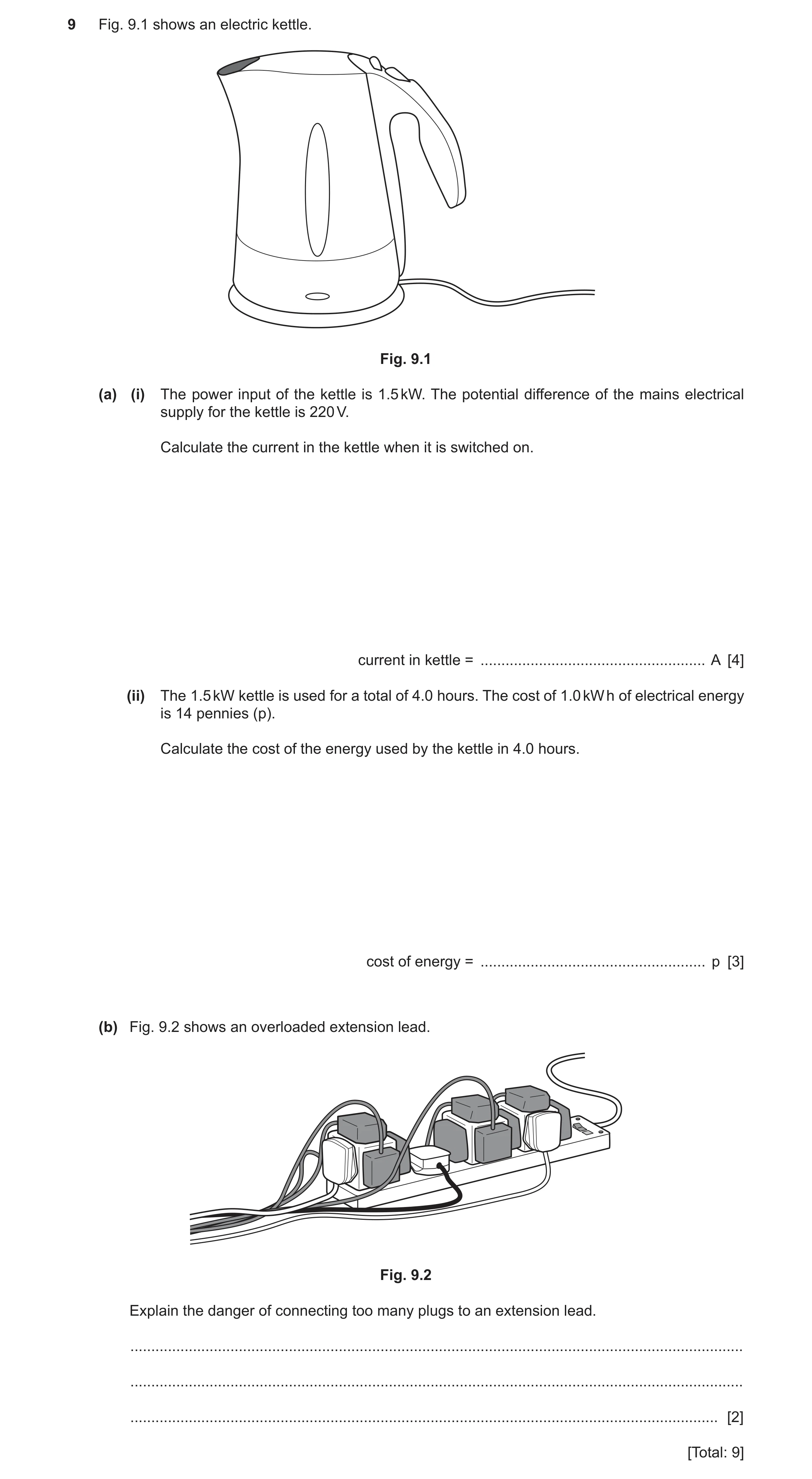
9 Fig. 9.1 shows an electric kettle. Fig. 9.1 (a) (i) The power input of the kettle is 1.5 kW. The potential difference of the mains electrical supply for the kettle is 220 V. Calculate the current in the kettle when it is switched on. current in kettle = … A [4] (ii) The 1.5 kW kettle is used for a total of 4.0 hours. The cost of 1.0 kW h of electrical energy is 14 pennies (p). Calculate the cost of the energy used by the kettle in 4.0 hours. cost of energy = … p [3] (b) Fig. 9.2 shows an overloaded extension lead. Fig. 9.2 Explain the danger of connecting too many plugs to an extension lead. … … … [2] [Total: 9]
9 marks
Mark scheme: 9(a)(i) (I =) 6.8 (A) A4 (I =) 1500 ÷ 220 (C2) P = I V OR (I =) P ÷ V (C1) 1.5 kW = 1500 W (C1) 9(a)(ii) (cost of energy =) 84 (p) A3 (cost of energy =) 1.5 4(.0) 14 (C2) (cost of energy =) power time cost of 1 kW h (C1) OR number of kW h cost of 1 kW h 9(b) large current (in extension lead / socket) B1 (can cause) overheating / fire B1
This question in 0625/32 Feb/March 2023
Q16 · A student has a desktop computer that connects to the 240 V a.c 0625/32 May/June 2023
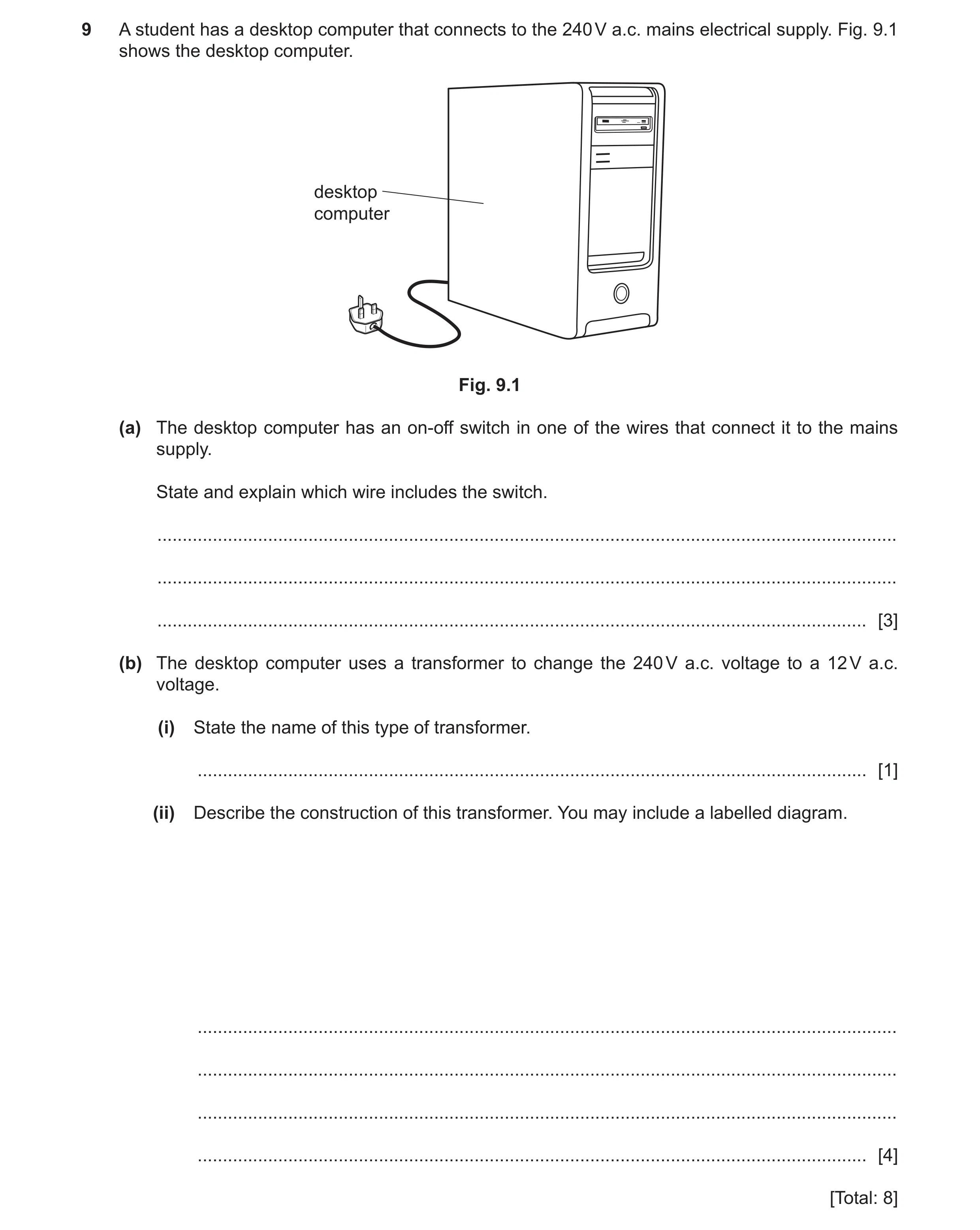
9 A student has a desktop computer that connects to the 240 V a.c. mains electrical supply. Fig. 9.1 shows the desktop computer. desktop computer Fig. 9.1 (a) The desktop computer has an on-off switch in one of the wires that connect it to the mains supply. State and explain which wire includes the switch. … … … [3] (b) The desktop computer uses a transformer to change the 240 V a.c. voltage to a 12 V a.c. voltage. (i) State the name of this type of transformer. … [1] (ii) Describe the construction of this transformer. You may include a labelled diagram. … … … … [4] [Total: 8]
8 marks
Mark scheme: 9(a) (switch is in) the live wire B1 (so when switch is off, desktop is) disconnected from supply / mains(voltage) OR high voltage B1 (so) no current (in computer / circuit) OR no risk of electrocution B1 9(b)(i) step-down (transformer) B1 9(b)(ii) any four from: (soft) iron core two coils of copper wire primary coil AND secondary coil transformer equation stated turns ratio of 20 : 1 OR 240 : 12 owtte OR use of transformer equation B4
This question in 0625/32 May/June 2023
Q17 · An electric water heater 0625/32 Oct/Nov 2023
9 Fig. 9.1 shows an electric water heater. The heater is connected to the mains electrical supply. water heater plastic cover Fig. 9.1 Fig. 9.2 shows the electrical safety label for the heater. Water Heater Model xxxxxx1 230 V (volts) 720 W (watts) Disconnect from the mains supply before removing the plastic cover. Fig. 9.2 (a) (i) Explain why the safety label states, ‘Disconnect from the mains supply before removing the plastic cover.’ … … [1] (ii) The heater is switched on. Calculate the current in the heater. Use the information in Fig. 9.2. current = … A [3] (b) Table 9.1 shows some electrical meter readings for the water heater. Table 9.1 date meter reading / kW h 1st October 3771 31st October 3797 Electrical energy costs 18 cents per kW h. Calculate the cost of using the heater from 1st October until 31st October. cost = … cents [3] [Total: 7]
7 marks
Mark scheme: 9(a)(i) (prevent) risk of (electric) shock / electrocution B1 9(a)(ii) 3.1 (A) A3 720/230 (C2) (current =) power / voltage OR (I =) P / V (C1) 9(b) 468 (cents) A3 26 18 (C2) (cost =) number of kWh cost per kWh (C1) number of kWh = 3797 – 3771 OR 26 (C1)
This question in 0625/32 Oct/Nov 2023
Q18 · The power cable for connecting a desktop computer to the mains electricity circuit 0625/31 May/June 2024
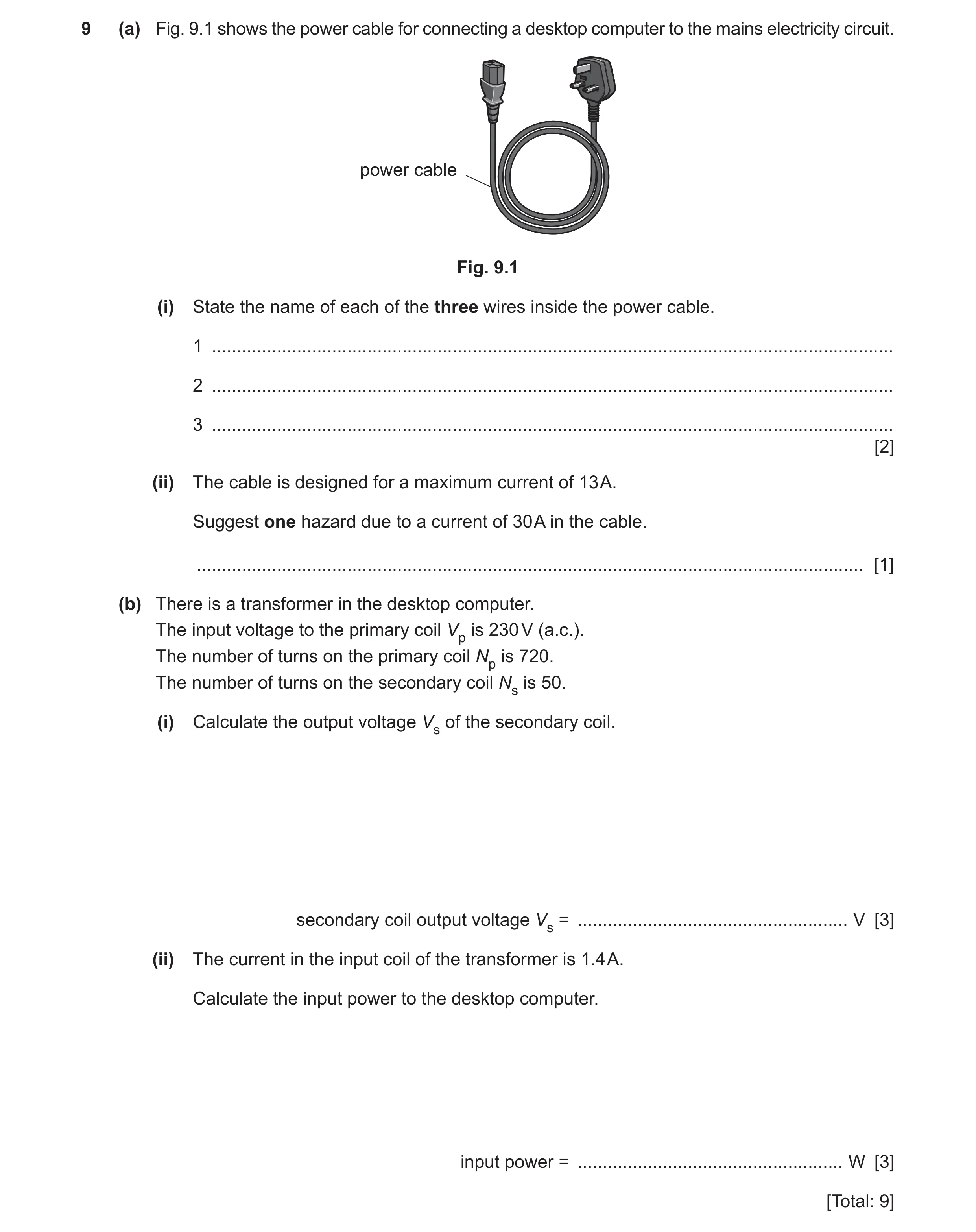
9 (a) Fig. 9.1 shows the power cable for connecting a desktop computer to the mains electricity circuit. power cable Fig. 9.1 (i) State the name of each of the three wires inside the power cable. 1 … 2 … 3 … [2] (ii) The cable is designed for a maximum current of 13 A. Suggest one hazard due to a current of 30 A in the cable. … [1] (b) There is a transformer in the desktop computer. The input voltage to the primary coil Vp is 230 V (a.c.). The number of turns on the primary coil Np is 720. The number of turns on the secondary coil Ns is 50. (i) Calculate the output voltage Vs of the secondary coil. secondary coil output voltage Vs = … V [3] (ii) The current in the input coil of the transformer is 1.4 A. Calculate the input power to the desktop computer. input power = … W [3] [Total: 9]
9 marks
Mark scheme: 9(a)(i) live (wire) neutral (wire) earth (wire) 3 correct – 2 marks 1 or 2 correct – 1 mark B2 9(a)(ii) idea of (cable) overheating OR (insulation) melting / burning B1 9(b)(i) (secondary coil voltage Vs =) 16 (V) A3 230 / Vs = 720 / 50 OR (Vs =) {230 50} ÷ 720 (C2) (Vp / Vs) = (Np / Ns) in any form (C1) 9(b)(ii) (P =) 320 (W) A3 (P =) 1.4 230 (C2) (P =) I V (C1)
This question in 0625/31 May/June 2024
Q19 · An electricity cable that has a fault 0625/32 May/June 2024
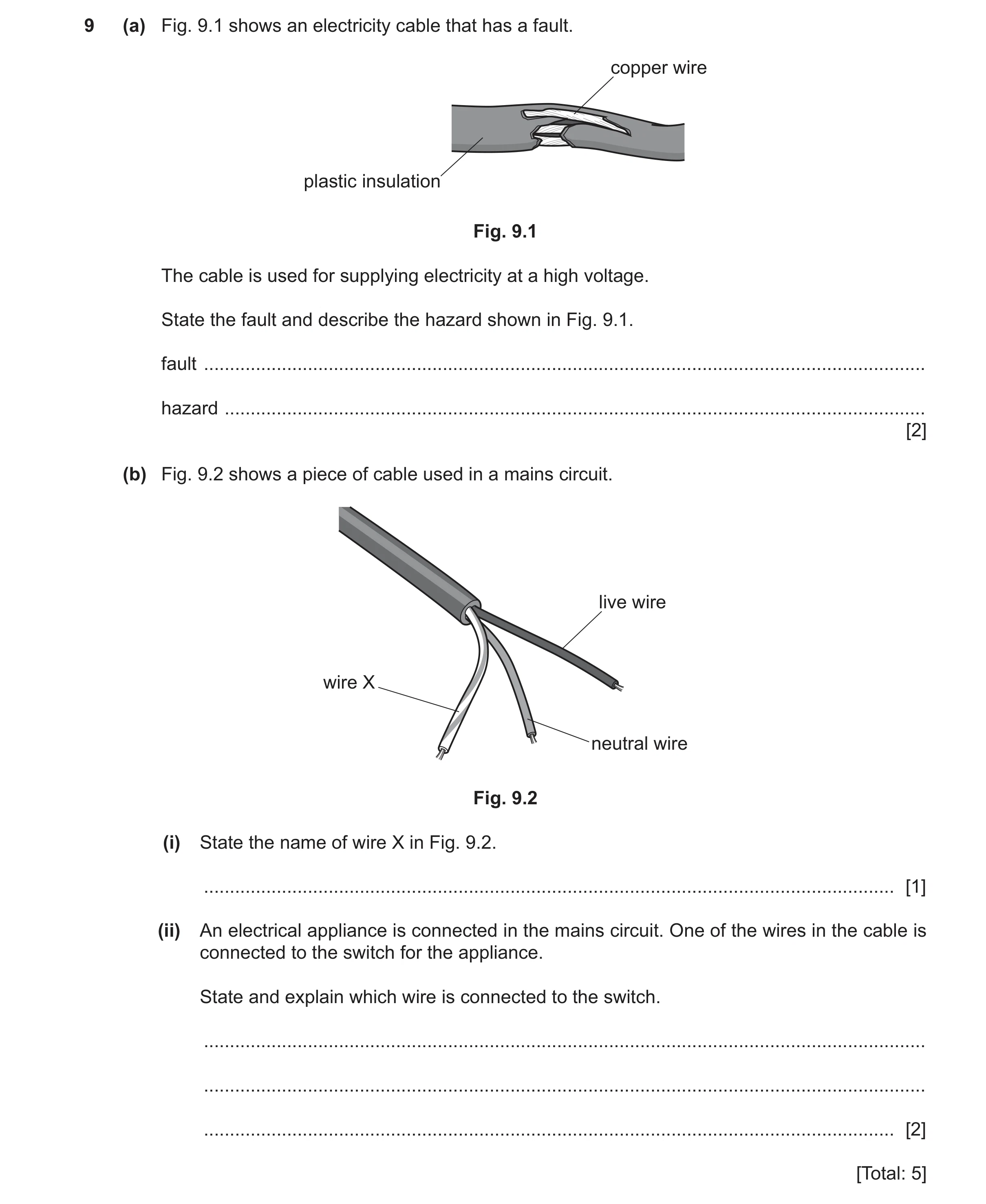
9 (a) Fig. 9.1 shows an electricity cable that has a fault. copper wire plastic insulation Fig. 9.1 The cable is used for supplying electricity at a high voltage. State the fault and describe the hazard shown in Fig. 9.1. fault … hazard … [2] (b) Fig. 9.2 shows a piece of cable used in a mains circuit. live wire wire X neutral wire Fig. 9.2 (i) State the name of wire X in Fig. 9.2. … [1] (ii) An electrical appliance is connected in the mains circuit. One of the wires in the cable is connected to the switch for the appliance. State and explain which wire is connected to the switch. … … … [2] [Total: 5]
5 marks
Mark scheme: 9(a) fault: insulation damaged owtte B1 hazard: electrocution OR electric shock B1 9(b)(i) earth (wire) B1 9(b)(ii) (switch is connected in) live (wire) M1 (so appliance is) disconnected from main / supply OR disconnected from high voltage (when switch is open / off) A1
This question in 0625/32 May/June 2024
Q20 · In an experiment, a student uses an electrical heater connected to a power supply 0625/31 Oct/Nov 2024
10 In an experiment, a student uses an electrical heater connected to a power supply. (a) The current in the electrical heater is 2.2 A. The voltage (p.d.) across the heater is 12 V. Calculate the energy transferred to the heater in 90 s. energy transferred = … J [3] (b) The power supply is connected to the electrical mains by a cable that consists of three wires. State the name for each of the three wires in the cable. 1 … 2 … 3 … [2] (c) The power supply includes a transformer. The voltage (Vp) across the primary coil of the transformer is 228 V. The voltage (Vs) across the secondary coil of the transformer is 12 V. The number of turns on the primary coil (Np) is 760. Calculate the number of turns (Ns) on the secondary coil. number of turns on secondary coil = … [3] [Total: 8]
8 marks
Mark scheme: 10(a) (energy =) 2400 (J) A3 (energy =) 2.2 90 12 (C2) (energy =) current time voltage OR(E) = V I t OR (energy =) power time OR P t (C1) 10(b) live OR line earth OR ground neutral B2 10(c) 40 A3 (Ns) = (12 228) 760 OR 228 / 12 = 760 / Ns (C2) Ns / Np = Vs / Vp (C1)
This question in 0625/31 Oct/Nov 2024
Q21 · Part of a d.c 0625/32 Oct/Nov 2024
9 (a) Fig. 9.1 represents part of a d.c. electric motor. The coil of wire rotates at a steady speed. current coil of wire Fig. 9.1 State two ways to make the coil rotate faster. 1 … 2 … [2] (b) Fig. 9.2 shows an electric fan. Fig. 9.2 The electric motor for the fan requires 120 V a.c. The mains voltage is 220 V a.c. A transformer steps down the mains voltage as shown in Fig. 9.3. primary coil secondary coil 800 turns mains voltage 220 V a.c. output voltage 120 V a.c. Fig. 9.3 Calculate the number of turns on the secondary coil. Use the information in Fig. 9.3. number of turns on the secondary coil = … [3] (c) A plug connects the transformer to the mains supply. There is a fuse in the plug. Describe how a fuse works. … … … [2] [Total: 7]
7 marks
Mark scheme: 9(a) any two from: B2 • increase (battery) voltage OR larger current in coil • increase strength of magnet(ic) field OR strong(er) magnet • increase number of turns (in coil) 9(b) 440 (turns) A3 (NS =) 800 120 / 220 (C2) VP / VS = NP / NS (C1) 9(c) any two from: B2 • large current (in fuse) • (causes) fuse to melt • isolating appliance from supply OR prevents / stops current in appliance
This question in 0625/32 Oct/Nov 2024
Question 22 0625/31 May/June 2025
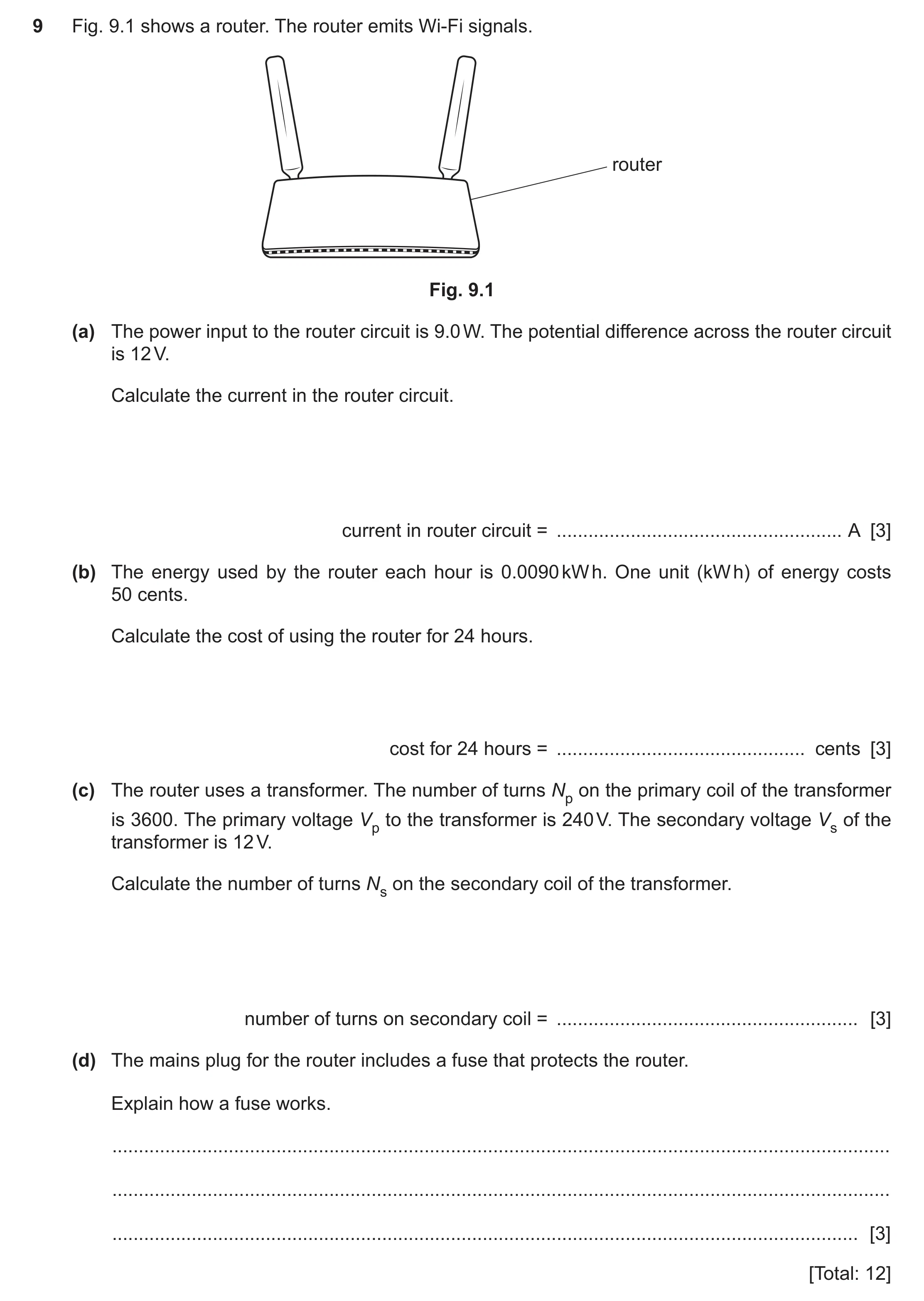
9 Fig. 9.1 shows a router. The router emits Wi-Fi signals. router Fig. 9.1 (a) The power input to the router circuit is 9.0 W. The potential difference across the router circuit is 12 V. Calculate the current in the router circuit. current in router circuit = … A [3] (b) The energy used by the router each hour is 0.0090 kW h. One unit (kW h) of energy costs 50 cents. Calculate the cost of using the router for 24 hours. cost for 24 hours = … cents [3] (c) The router uses a transformer. The number of turns Np on the primary coil of the transformer is 3600. The primary voltage Vp to the transformer is 240 V. The secondary voltage Vs of the transformer is 12 V. Calculate the number of turns Ns on the secondary coil of the transformer. number of turns on secondary coil = … [3] (d) The mains plug for the router includes a fuse that protects the router. Explain how a fuse works. … … … [3] [Total: 12]
12 marks
Mark scheme: 9(a) (current =) 0.75 (A) A3 (current =) 9 ÷ 12 C2 power = IV OR (I =) P ÷ V C1 9(b) 11 (cents) A3 (cost =) 0.009(0) 24 50 OR 0.216 50 OR 0.009 1200 OR 0.45 24 C2 (cost =) (energy in) kW h (number of) hours cost (of one unit) C1 9(c) (Ns =) 180 A3 (Ns =) {12 3600} ÷ 240 OR (Ns =) 3600 ÷ 20 OR 240 ÷ 12 = 3600 ÷ Ns C2 Vs ÷ Vp = Ns ÷ Np C1 9(d) any three from: B3 • idea of large current (in fuse or any part of circuit) • (large current causes) heating in fuse • idea that fuse is made from low melting point wire • fuse / (fuse) wire melts • (and) idea disconnects / isolates (router / wires / circuit) from supply / mains
This question in 0625/31 May/June 2025
Q23 · A mains-powered electric fan heater fixed on a bathroom wall 0625/32 May/June 2025
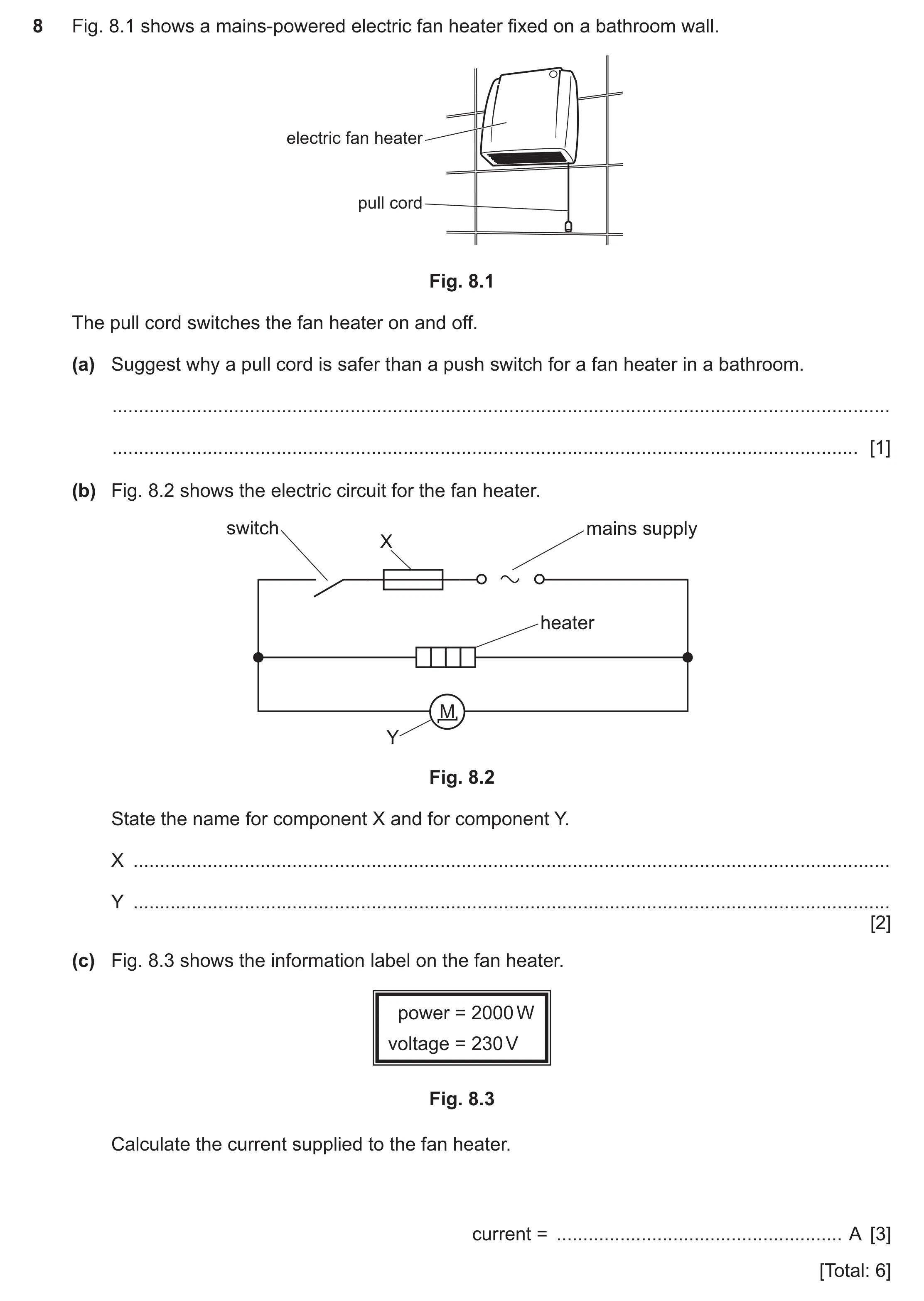
8 Fig. 8.1 shows a mains-powered electric fan heater fixed on a bathroom wall. electric fan heater pull cord Fig. 8.1 The pull cord switches the fan heater on and off. (a) Suggest why a pull cord is safer than a push switch for a fan heater in a bathroom. … … [1] (b) Fig. 8.2 shows the electric circuit for the fan heater. switch mains supply X heater M Y Fig. 8.2 State the name for component X and for component Y. X … Y … [2] (c) Fig. 8.3 shows the information label on the fan heater. power = 2000 W voltage = 230 V Fig. 8.3 Calculate the current supplied to the fan heater. current = … A [3] [Total: 6]
6 marks
Mark scheme: 8(a) reduces risk of electric shock / electrocution OR reference to damp conditions B1 8(b) symbol X: fuse B1 symbol Y: motor B1 8(c) 8.7 (A) A3 2000 ÷ 230 C2 power = current voltage OR (current =) power ÷ voltage C1
This question in 0625/32 May/June 2025
Q24 · A mains-powered electric fan heater fixed on a bathroom wall 0625/33 May/June 2025
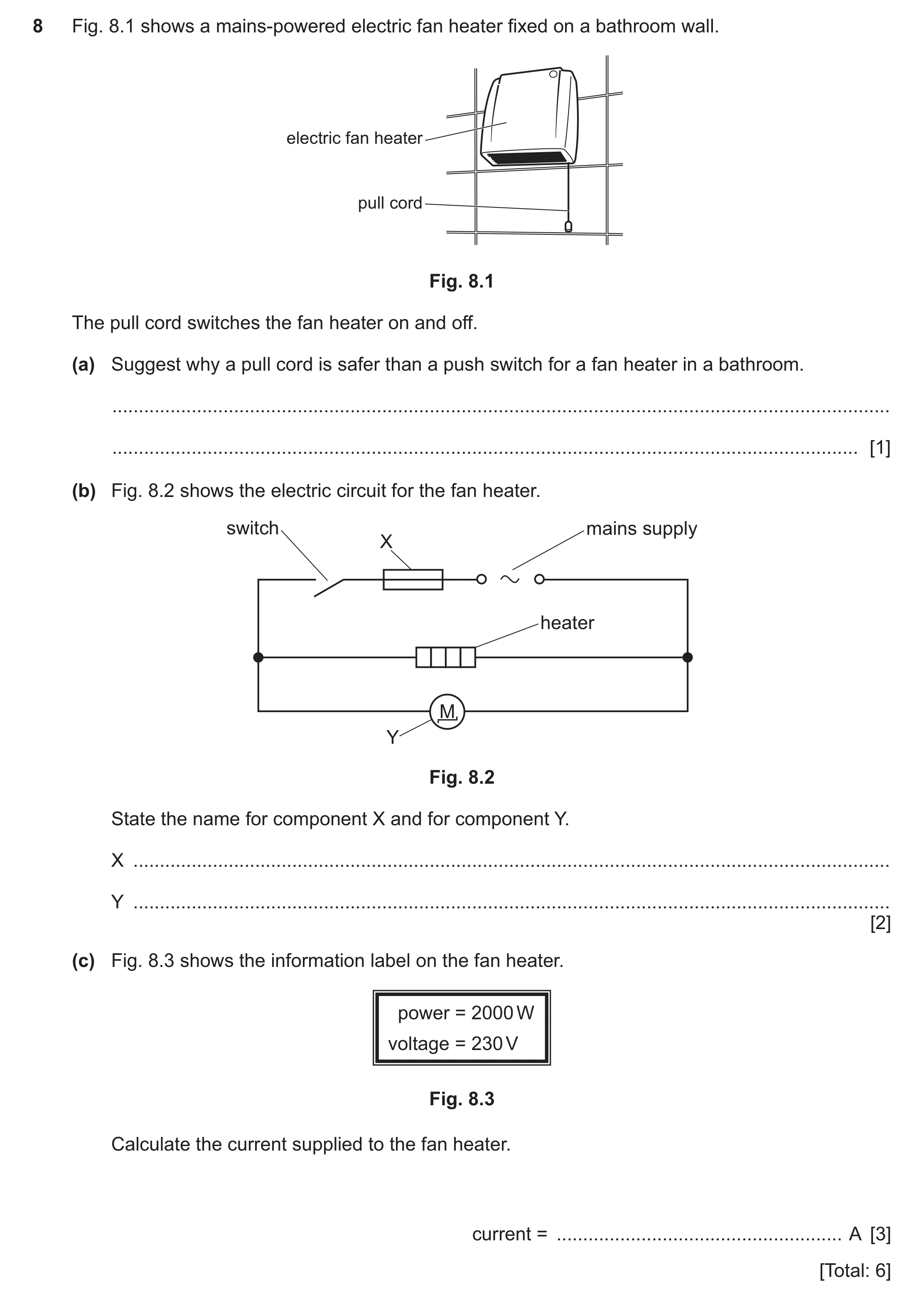
8 Fig. 8.1 shows a mains-powered electric fan heater fixed on a bathroom wall. electric fan heater pull cord Fig. 8.1 The pull cord switches the fan heater on and off. (a) Suggest why a pull cord is safer than a push switch for a fan heater in a bathroom. … … [1] (b) Fig. 8.2 shows the electric circuit for the fan heater. switch mains supply X heater M Y Fig. 8.2 State the name for component X and for component Y. X … Y … [2] (c) Fig. 8.3 shows the information label on the fan heater. power = 2000 W voltage = 230 V Fig. 8.3 Calculate the current supplied to the fan heater. current = … A [3] [Total: 6]
6 marks
Mark scheme: 8(a) reduces risk of electric shock / electrocution OR reference to damp conditions B1 8(b) symbol X: fuse B1 symbol Y: motor B1 8(c) 8.7 (A) A3 2000 ÷ 230 C2 power = current voltage OR (current =) power ÷ voltage C1
This question in 0625/33 May/June 2025
 1 / 26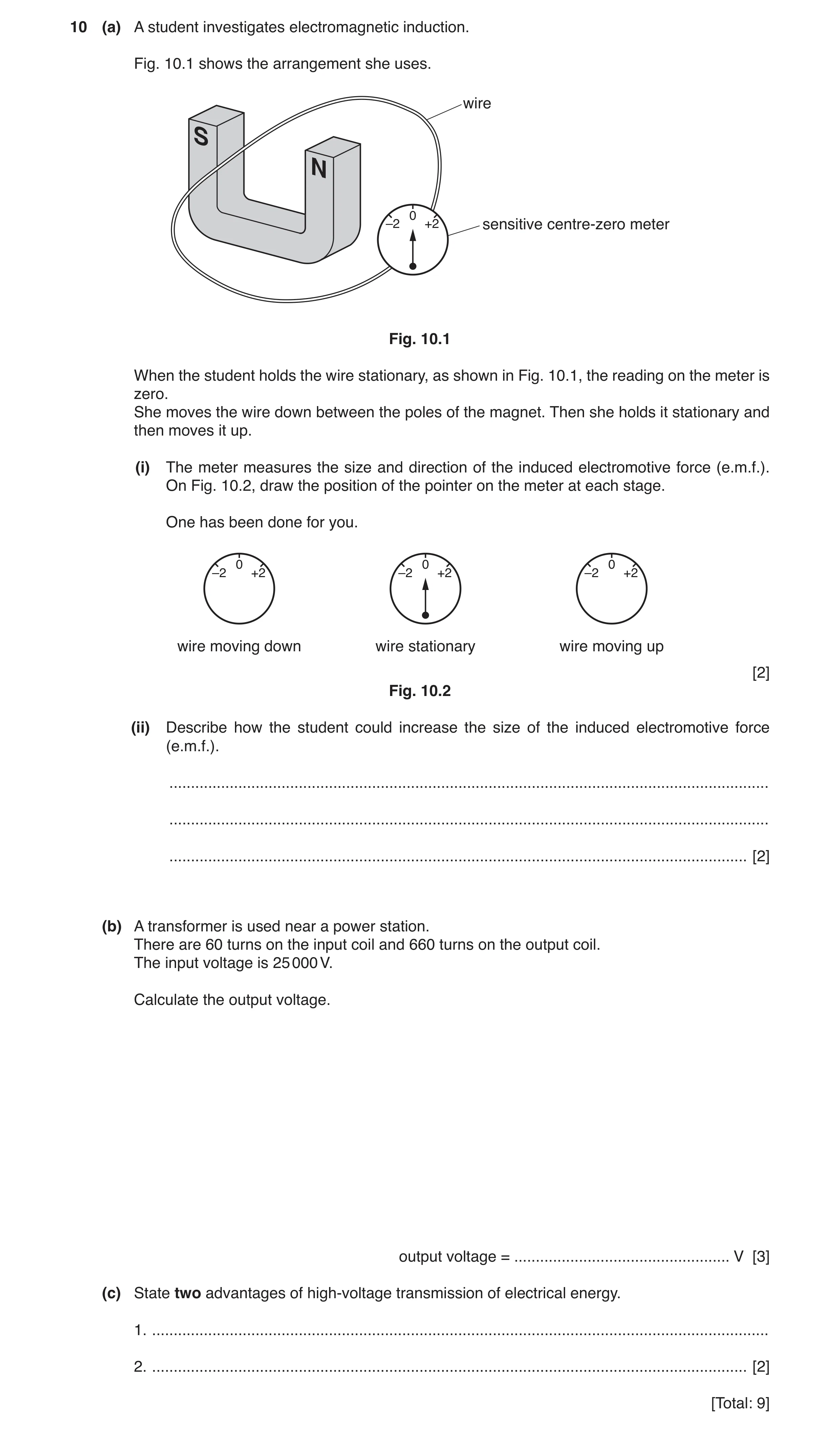
 3 / 26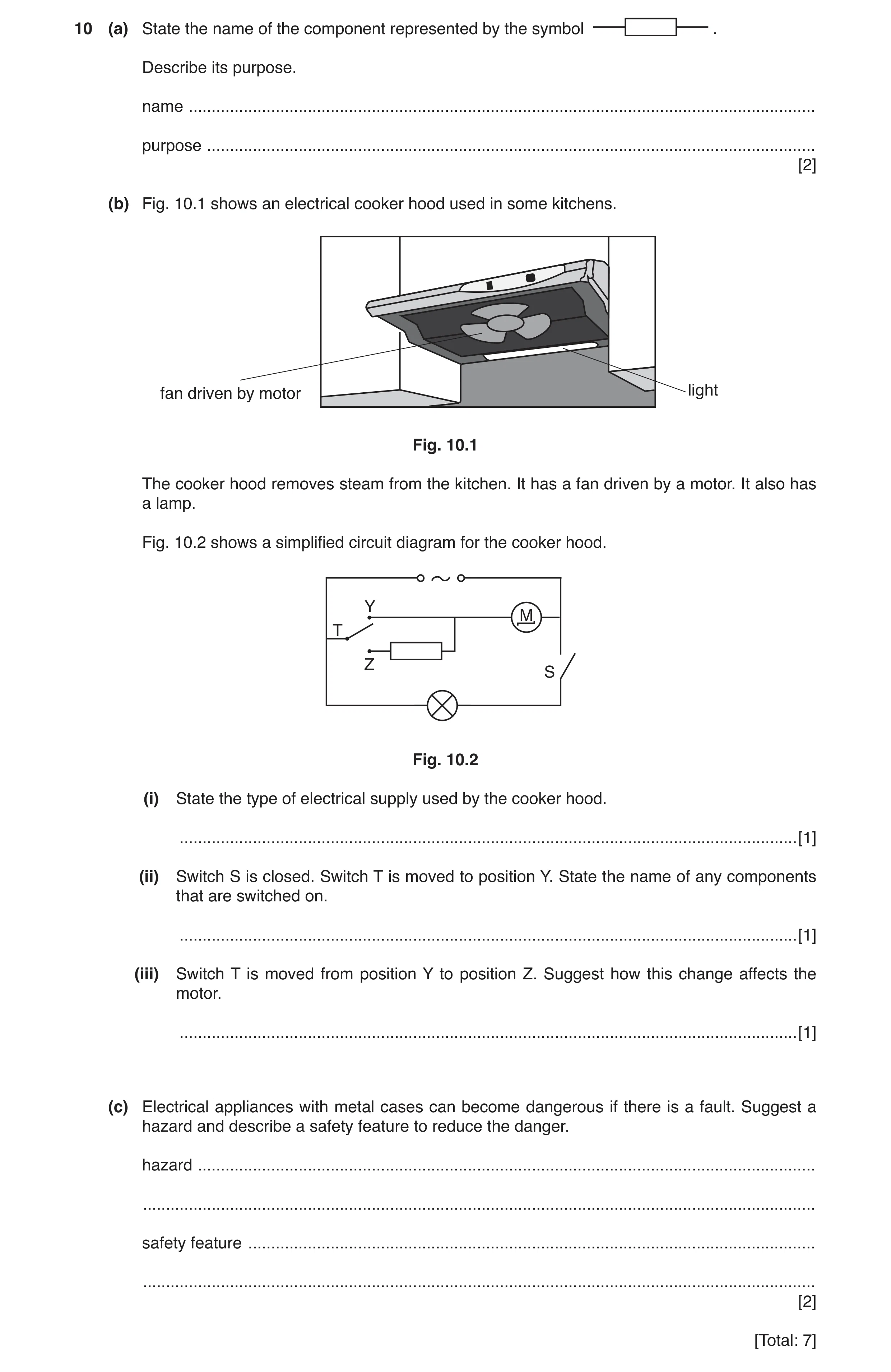
 5 / 26
 6 / 26
 7 / 26
 8 / 26
 9 / 26
 10 / 26
 11 / 26
 12 / 26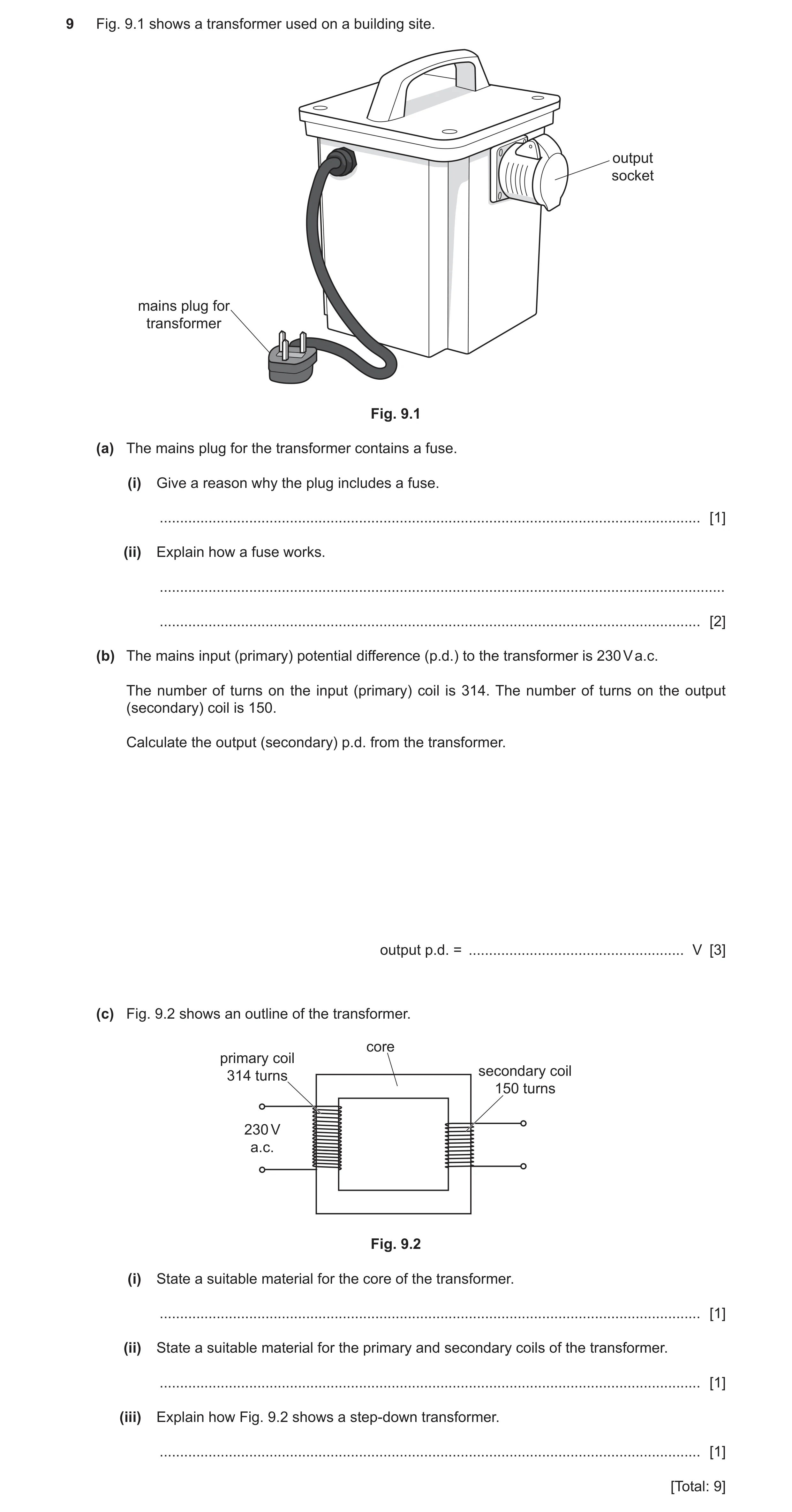
 17 / 26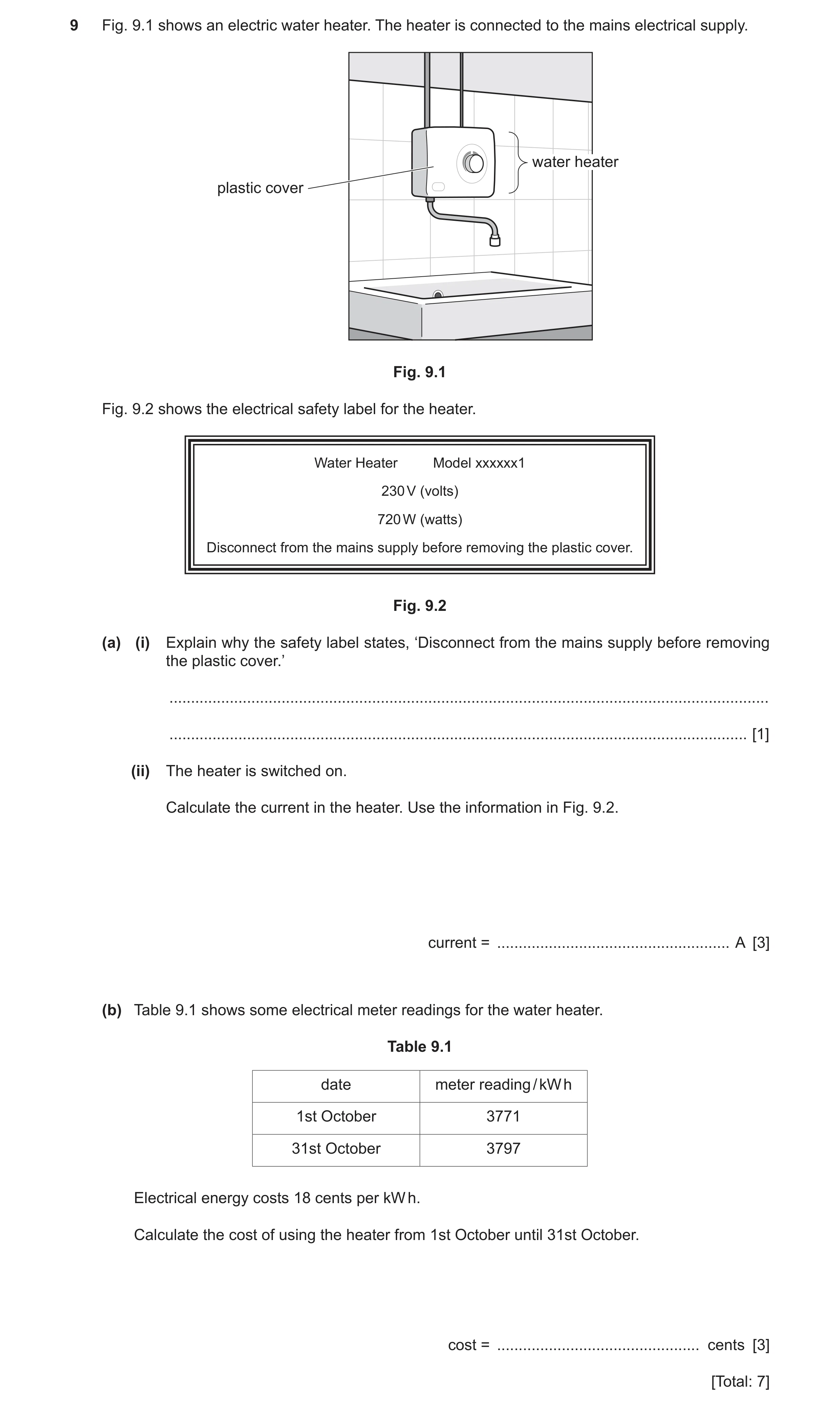
 20 / 26
 21 / 26
 22 / 26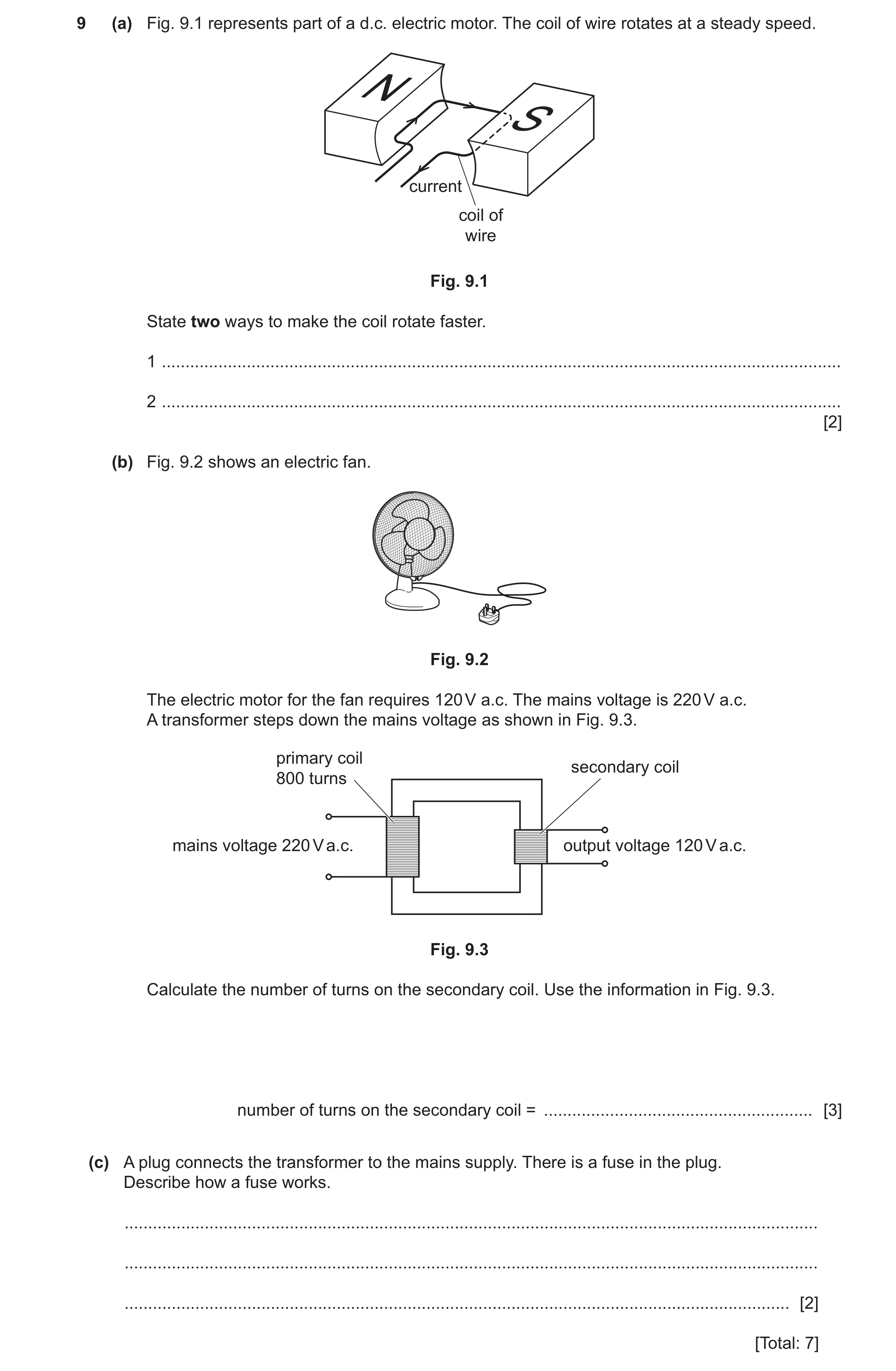
 24 / 26
 25 / 26
 26 / 26
 6
6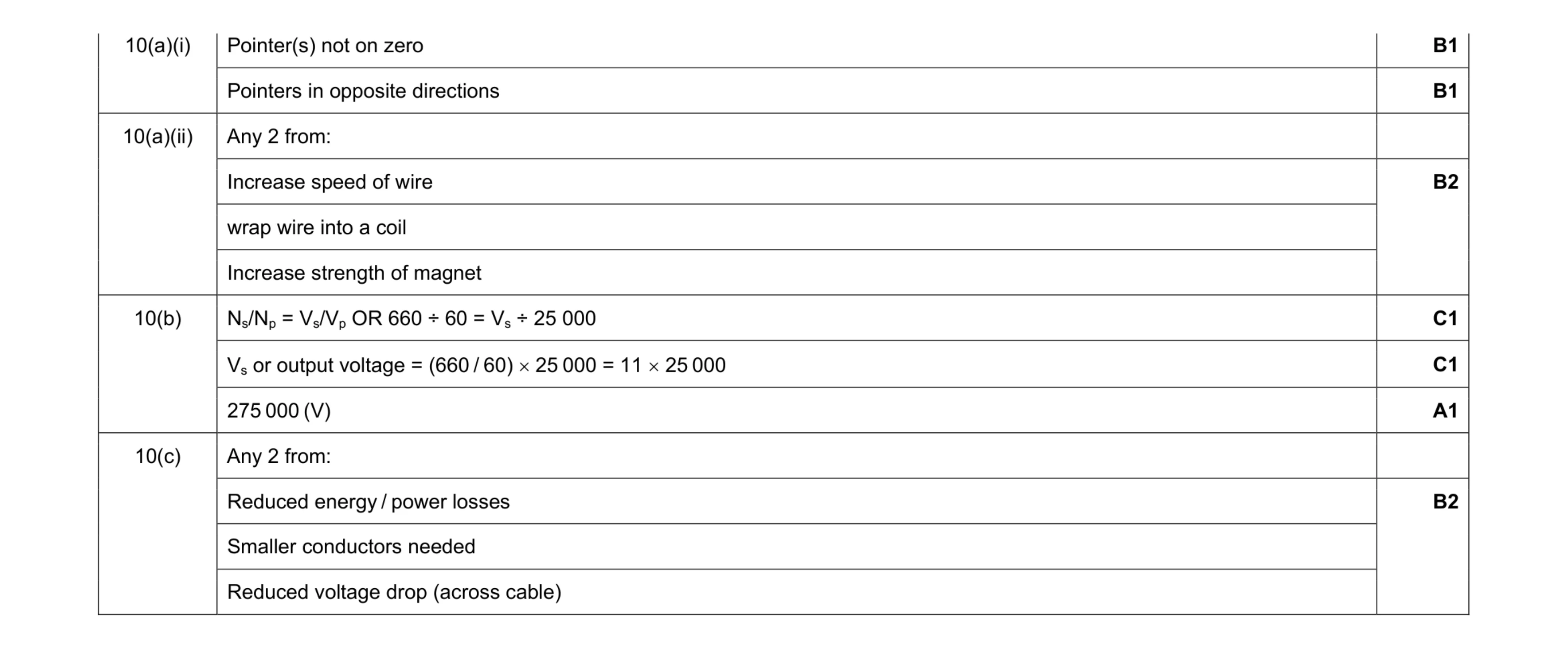 9
9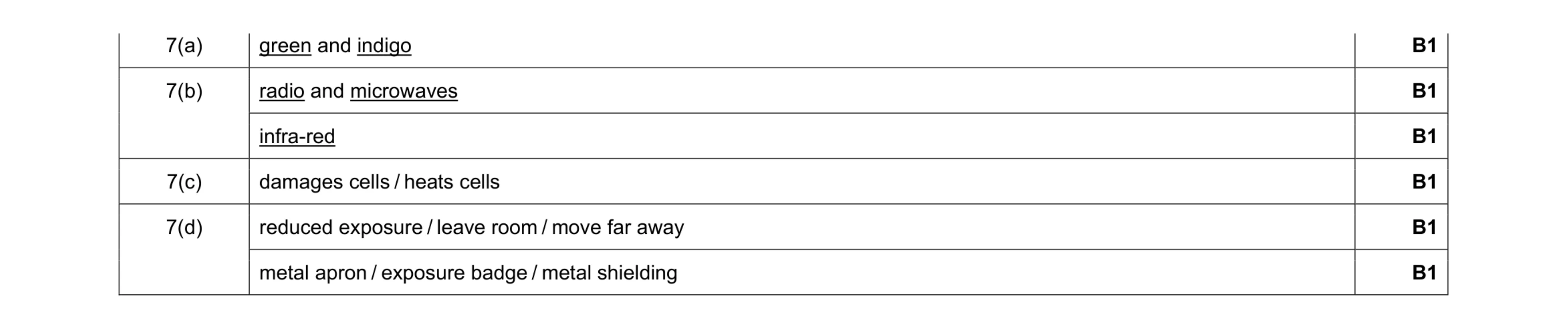 6
6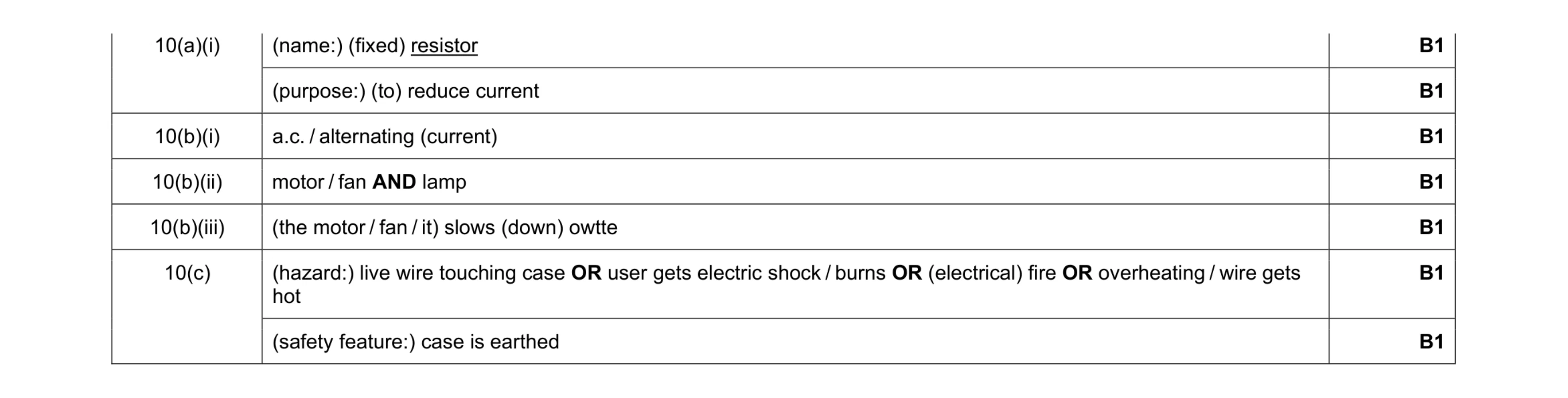 7
7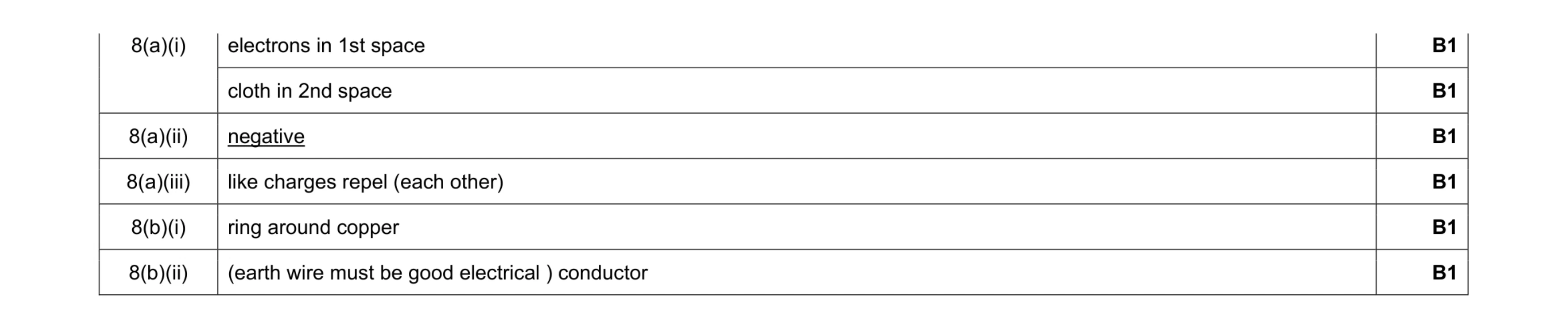 6
6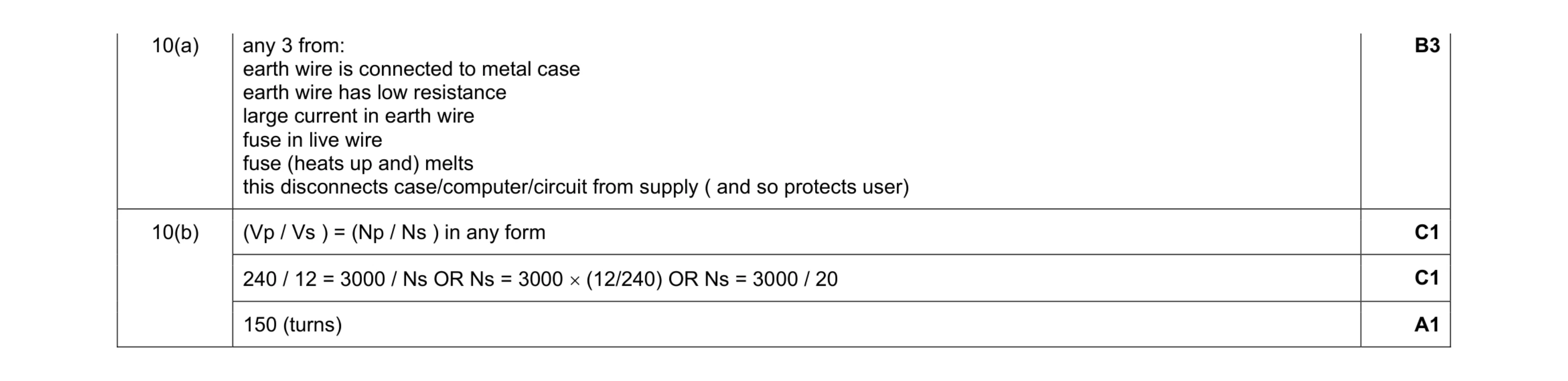 6
6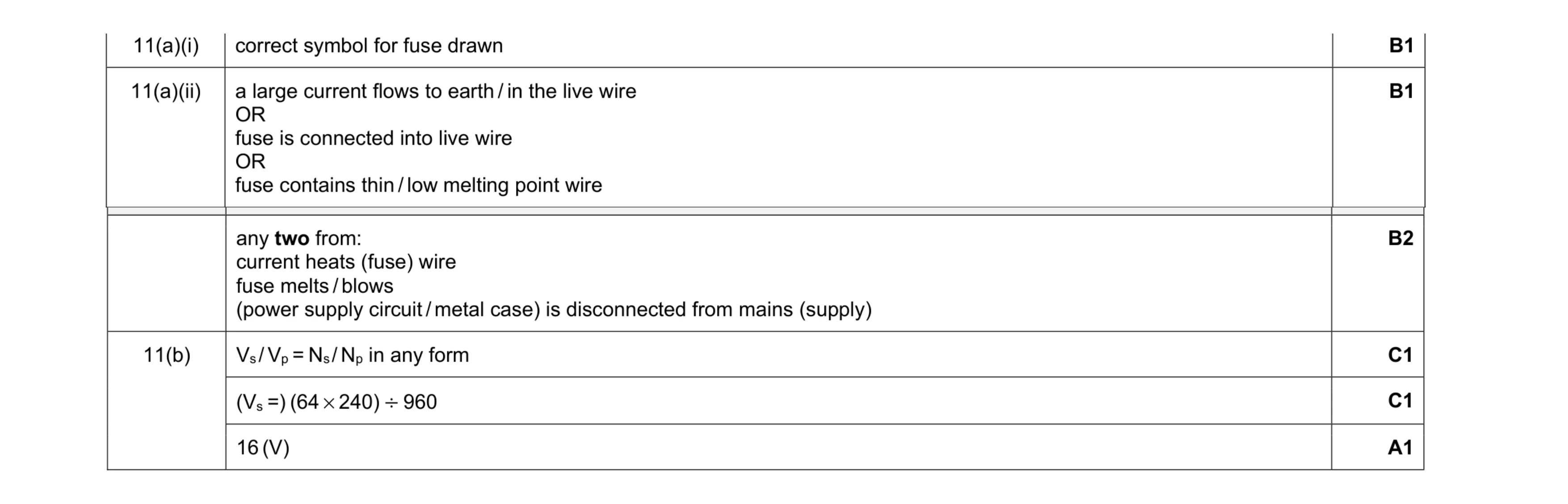 7
7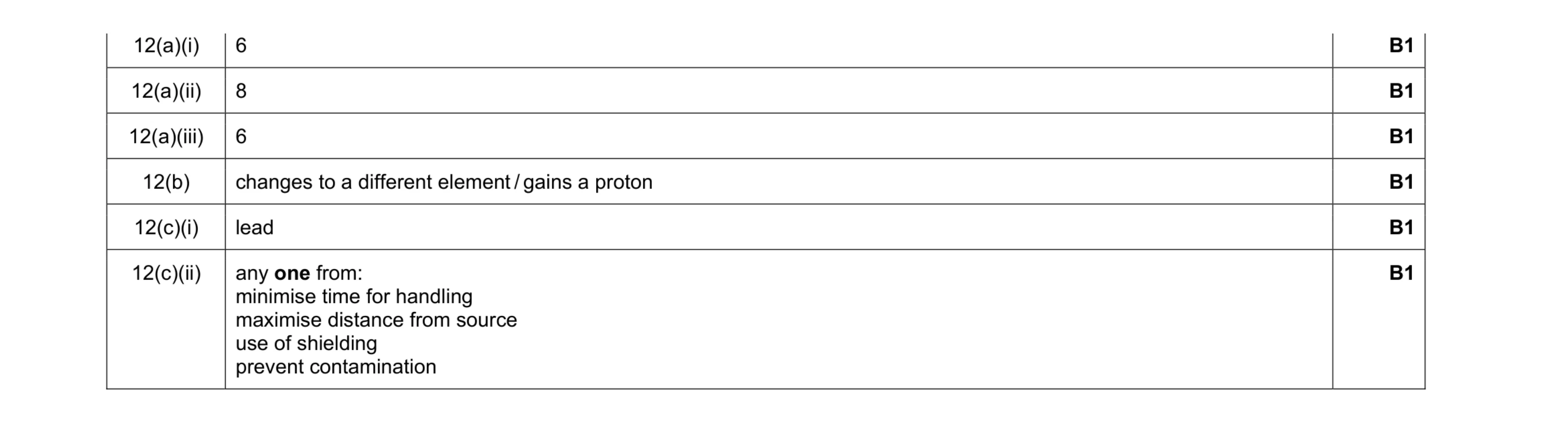 6
6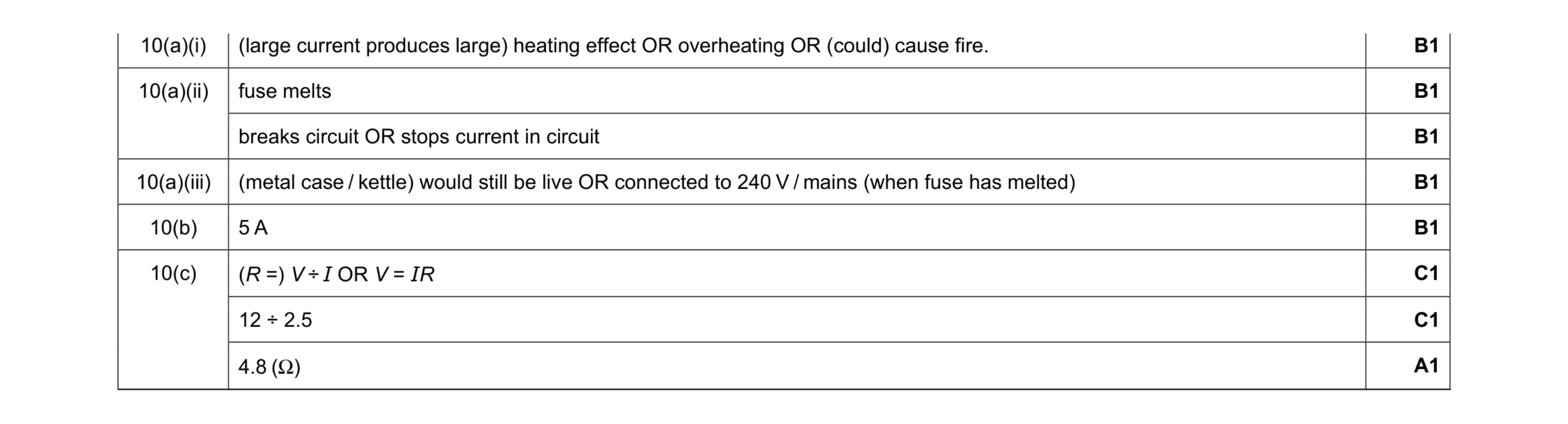 8
8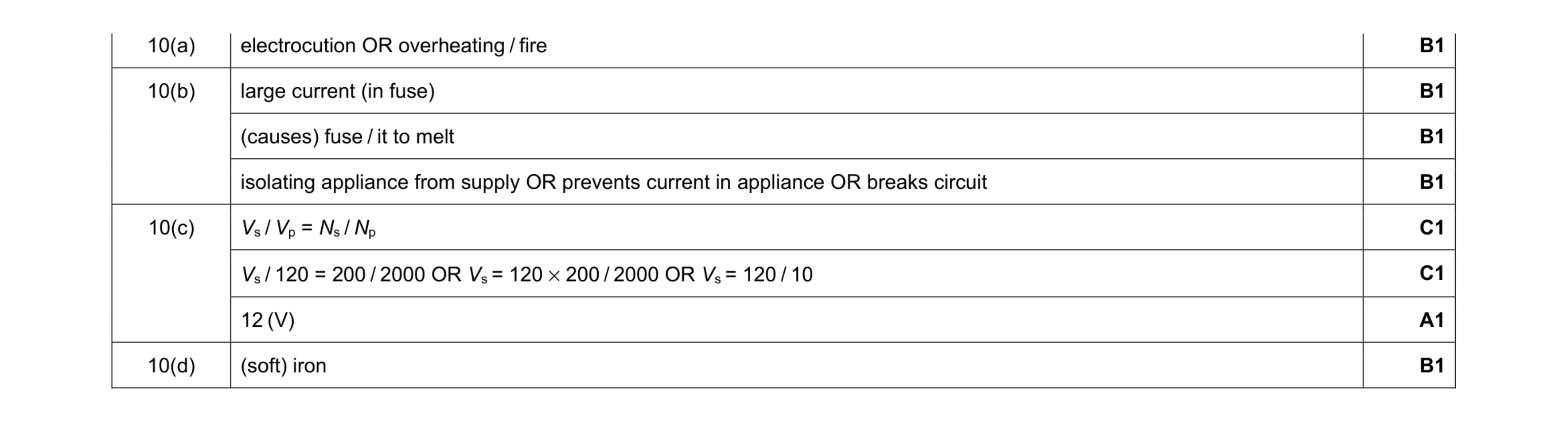 8
8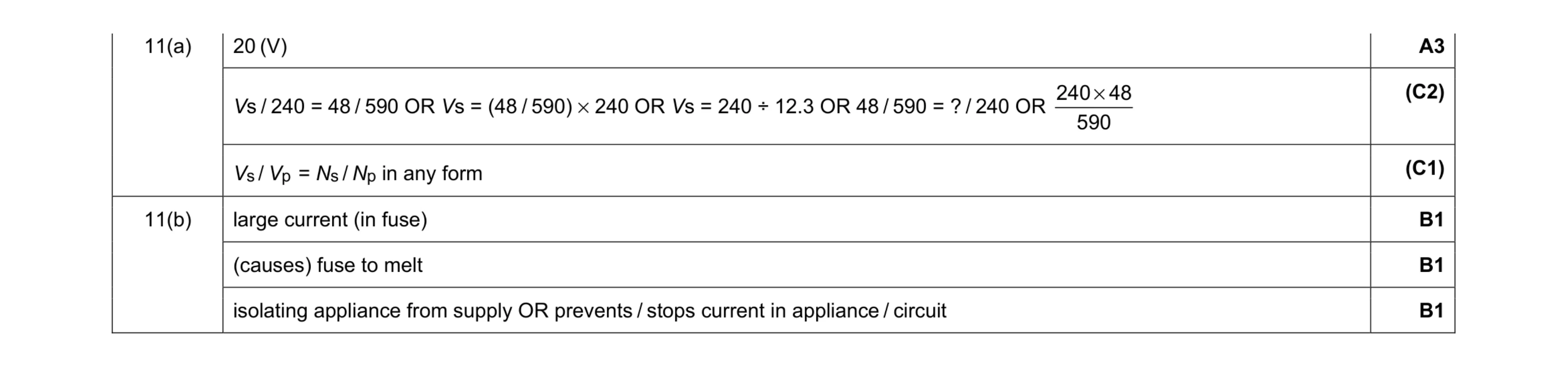 6
6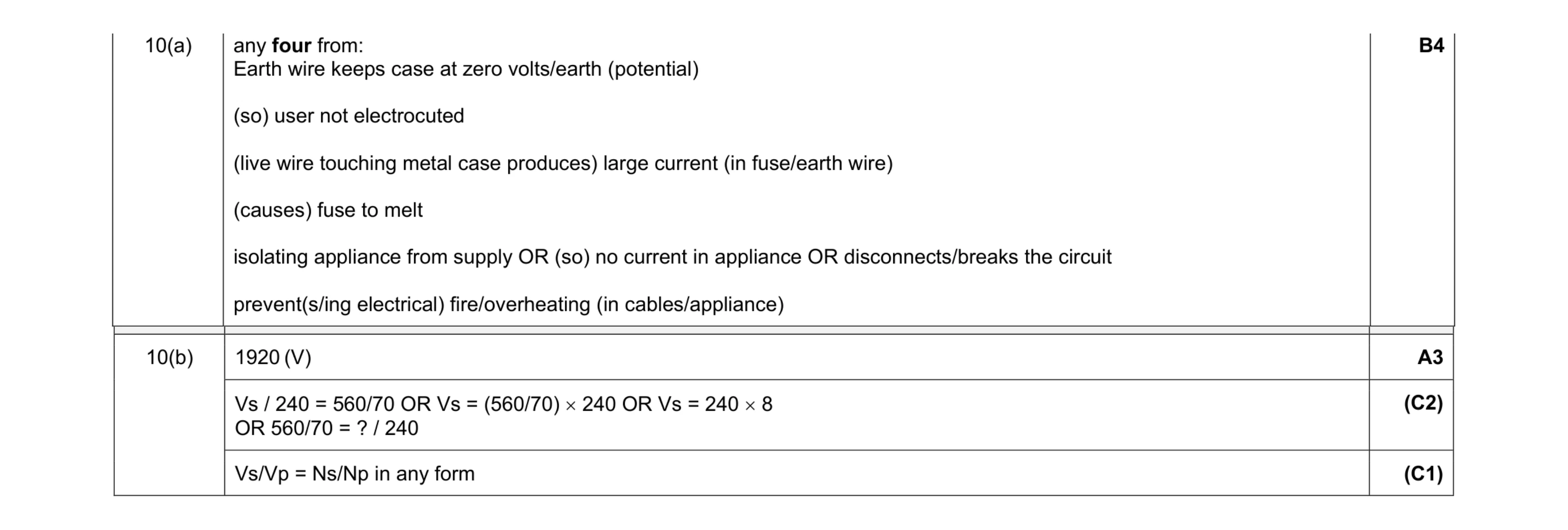 7
7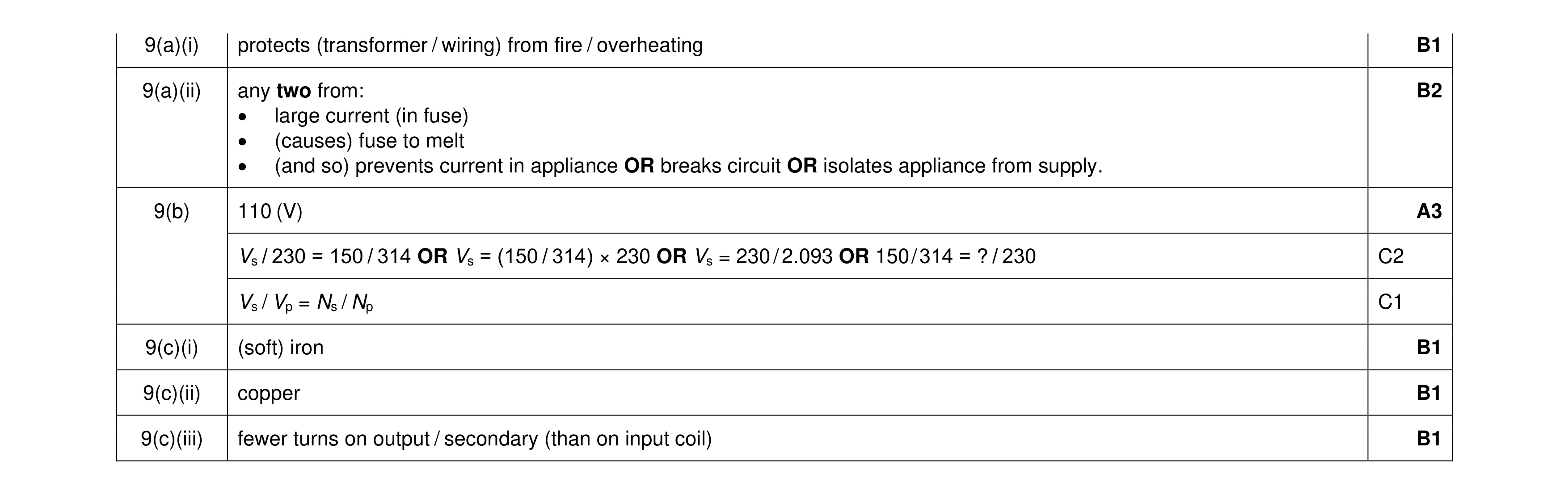 9
9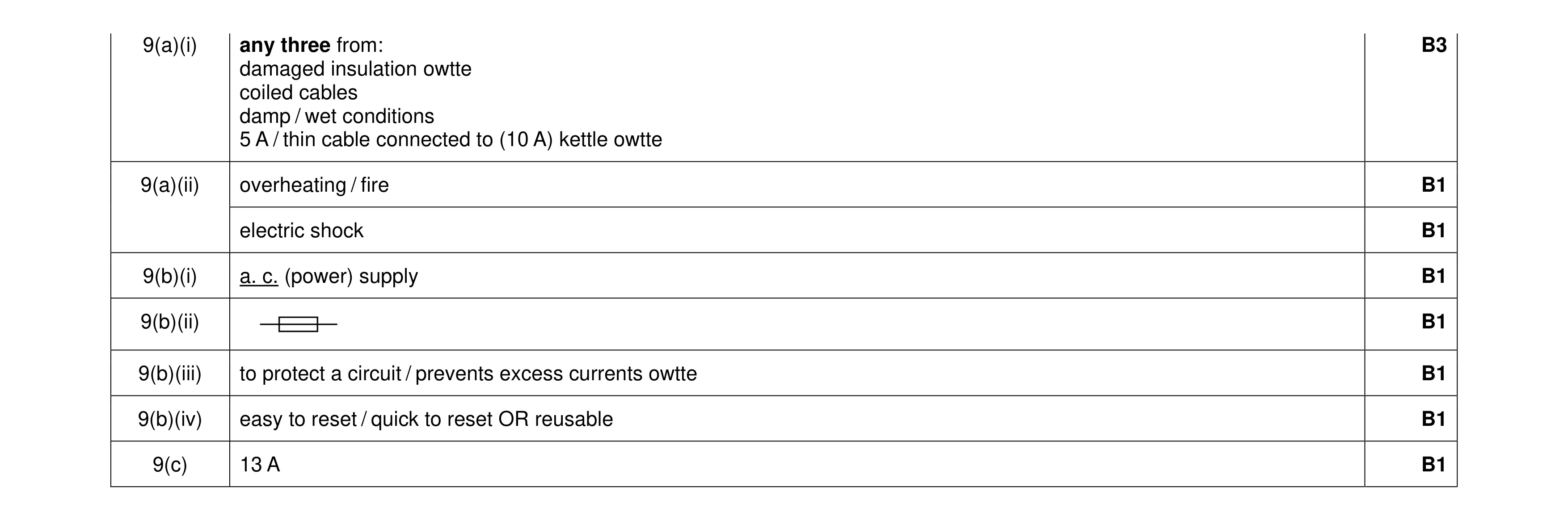 10
10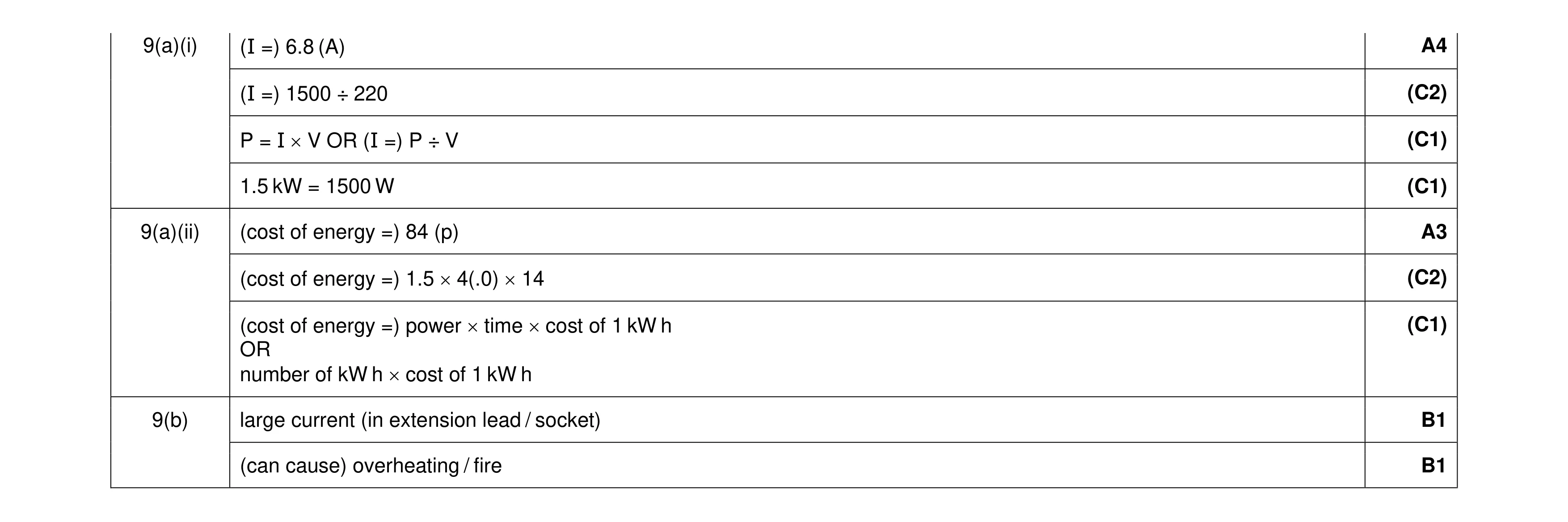 9
9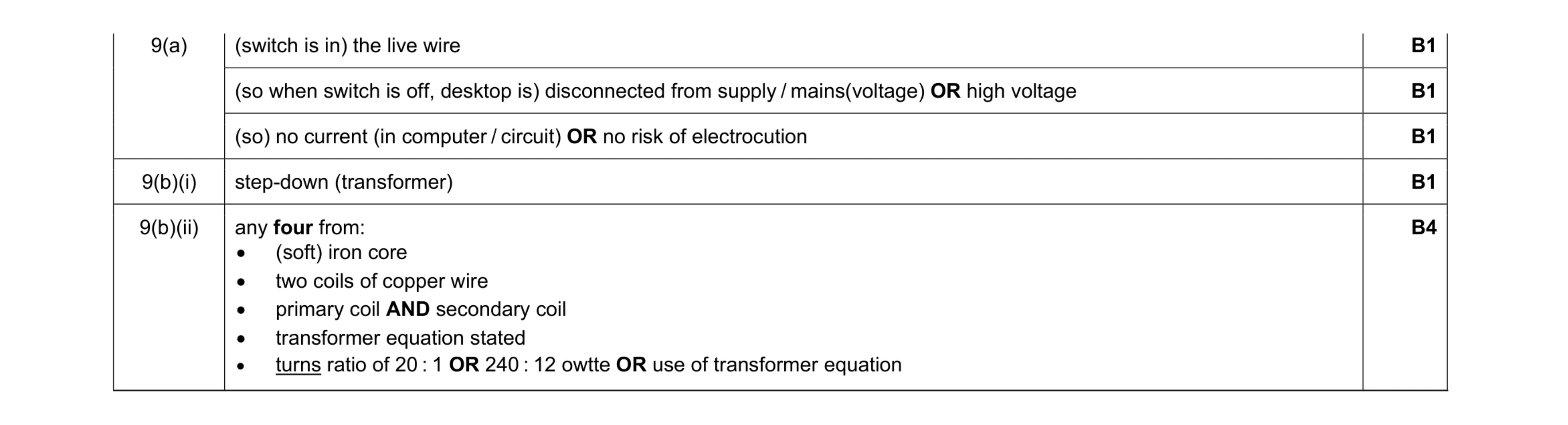 8
8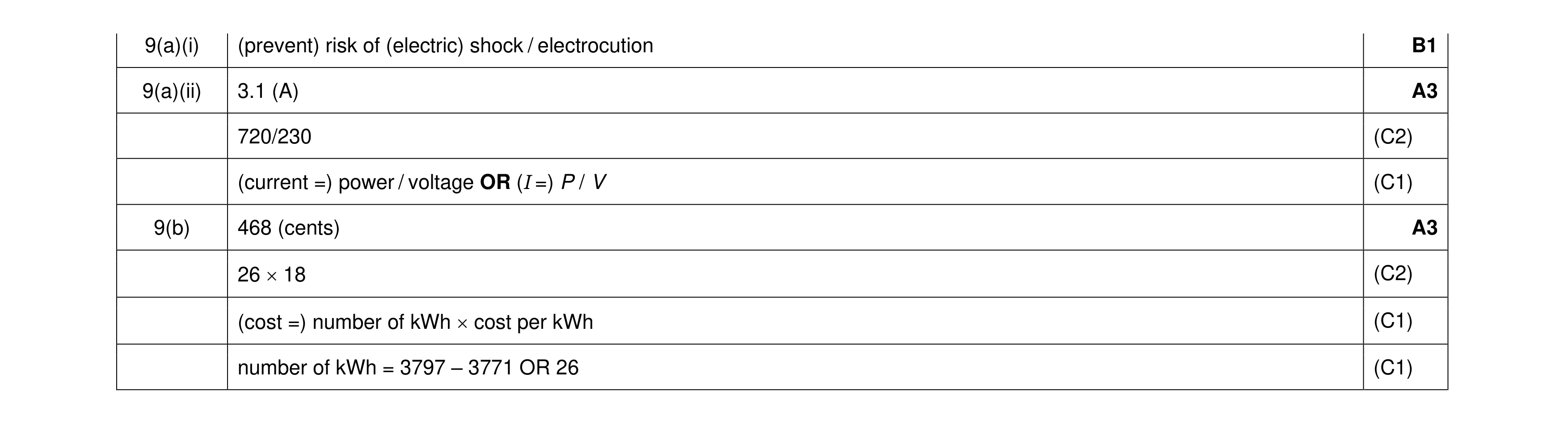 7
7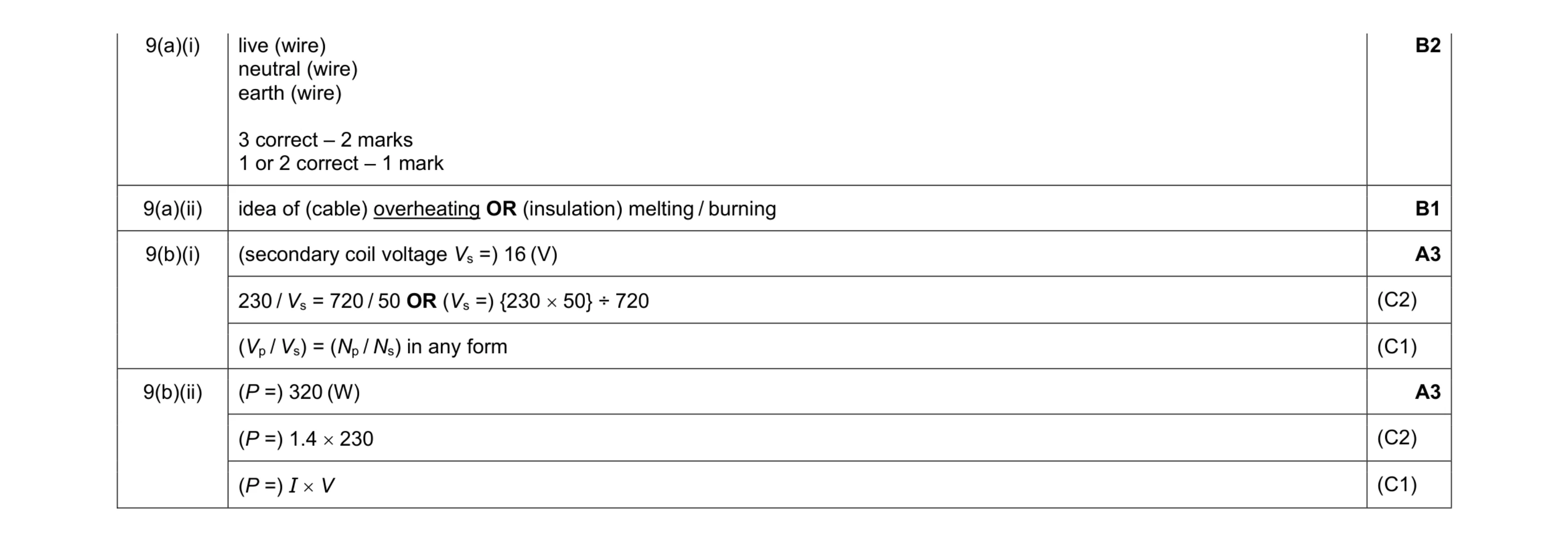 9
9 5
5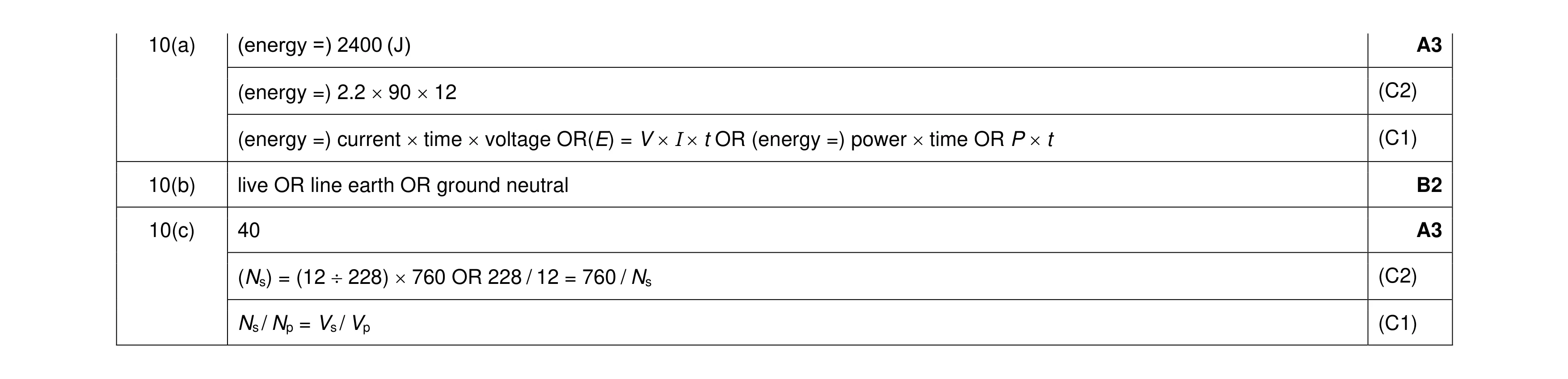 8
8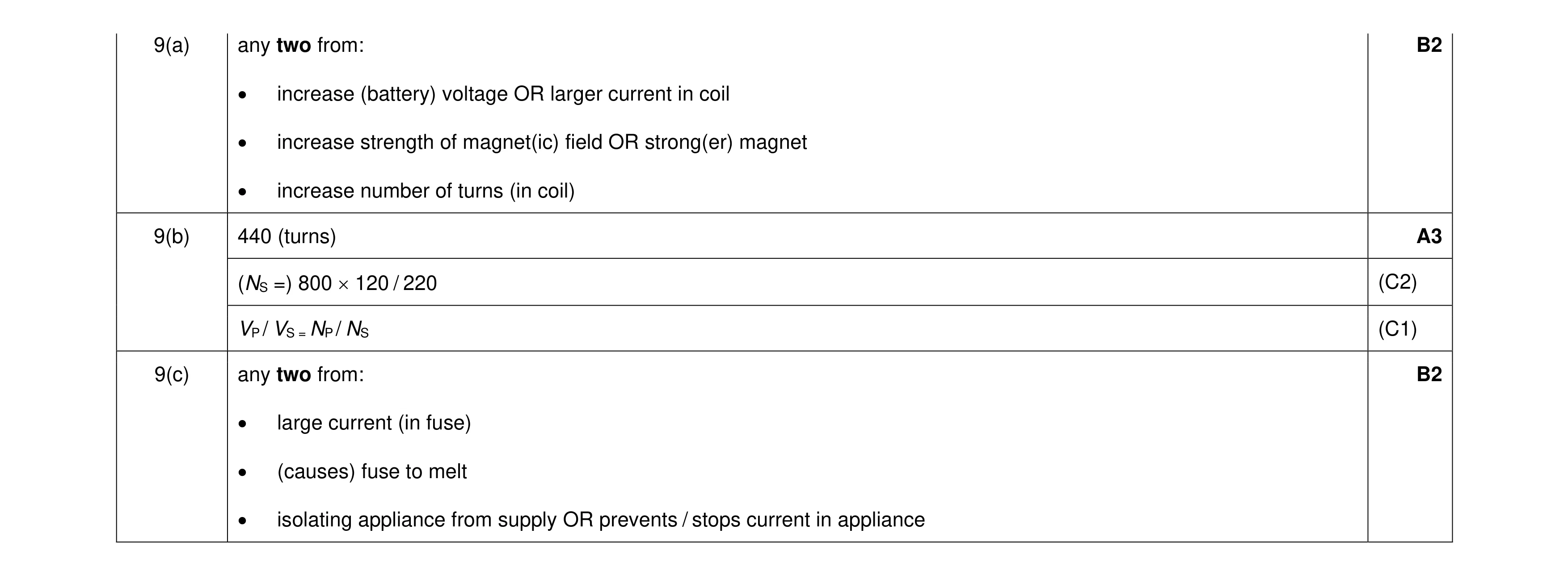 7
7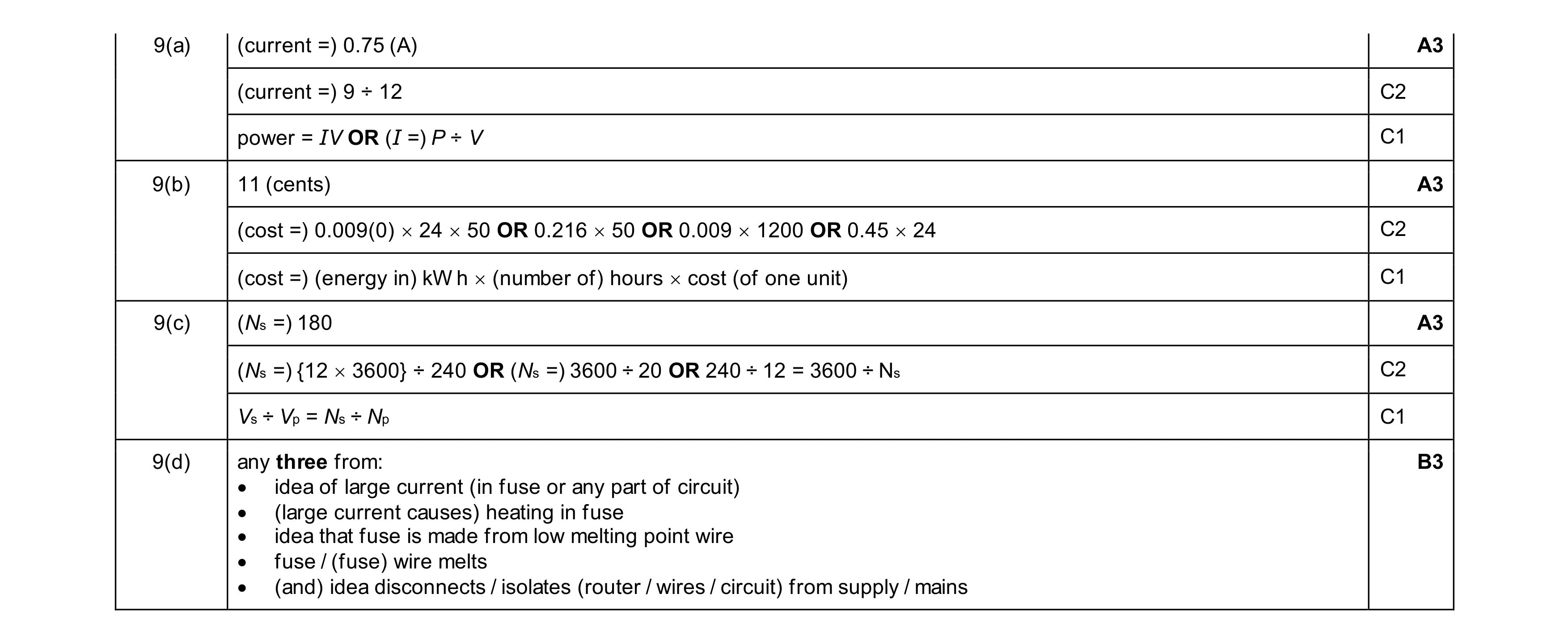 12
12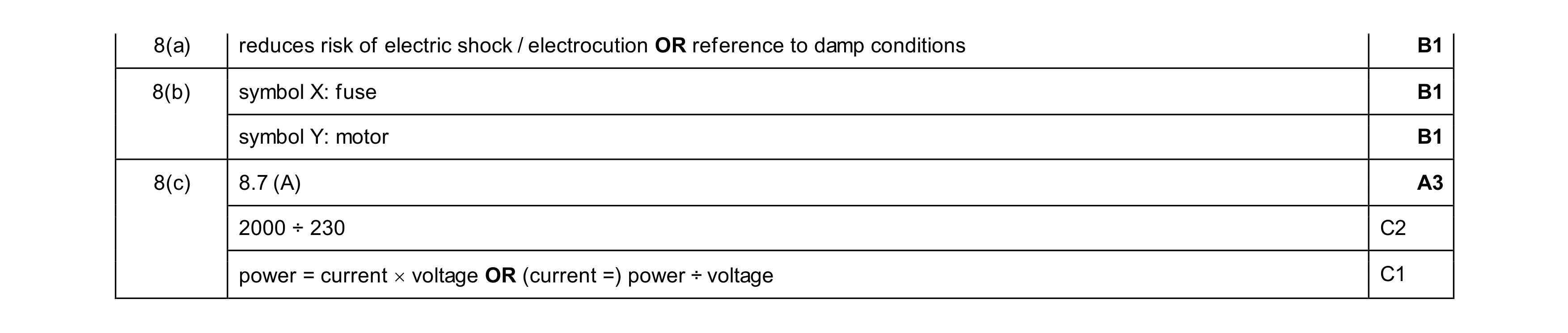 6
6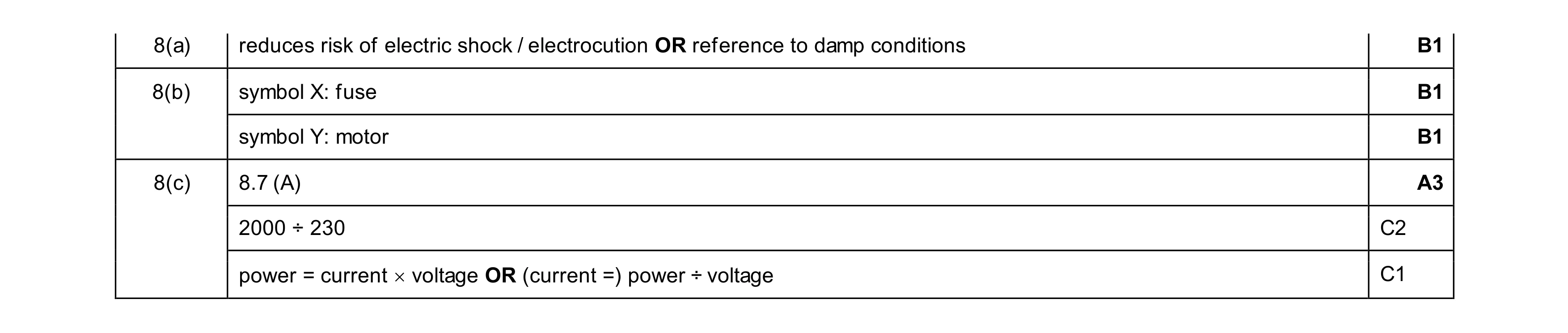 6
6