Questions as text
Q1 · State the nature of γ-rays 0625/43 Oct/Nov 2017
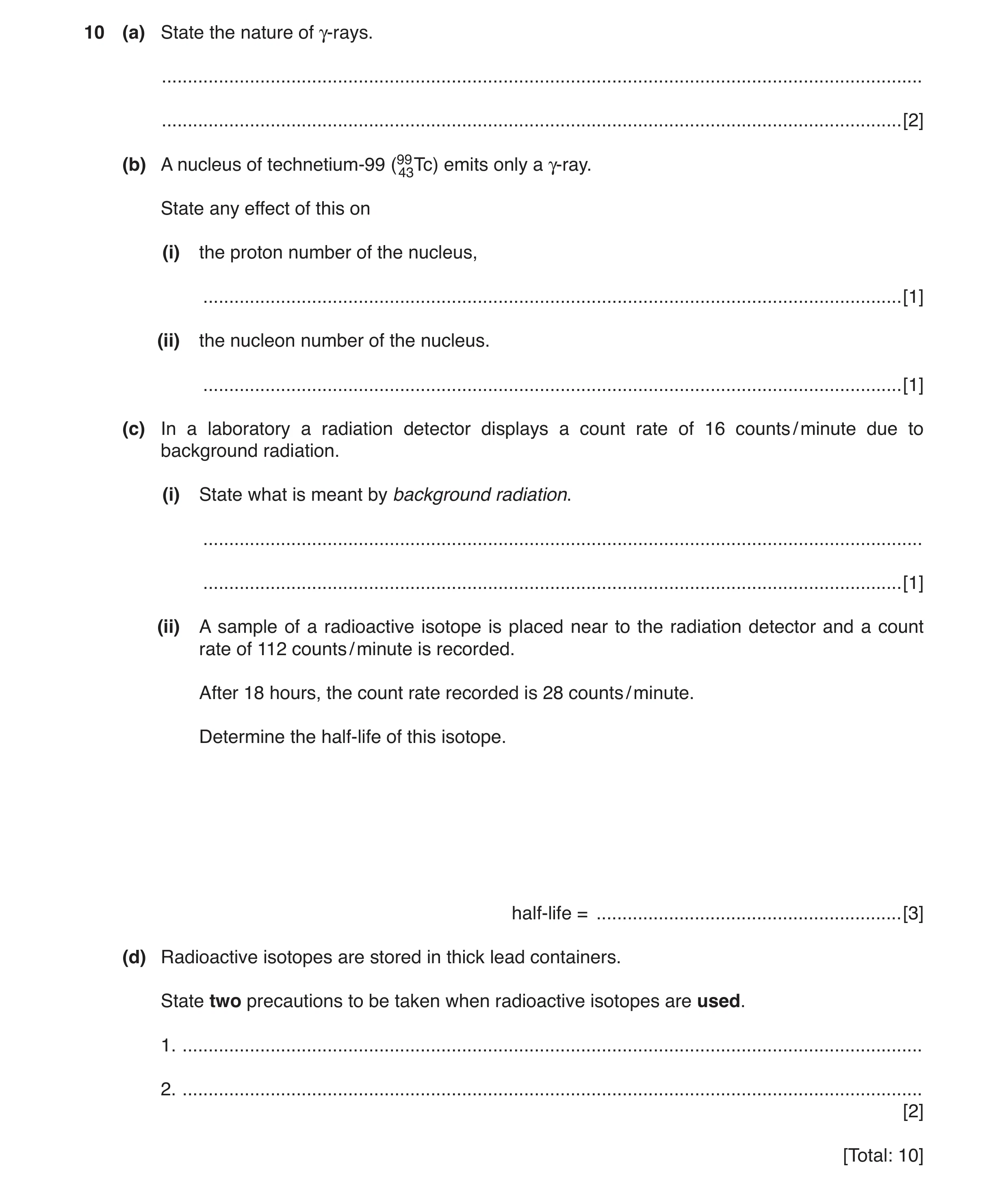
10 (a) State the nature of γ-rays. … … [2] (b) A nucleus of technetium-99 (9943Tc) emits only a γ-ray. State any effect of this on (i) the proton number of the nucleus, … [1] (ii) the nucleon number of the nucleus. … [1] (c) In a laboratory a radiation detector displays a count rate of 16 counts / minute due to background radiation. (i) State what is meant by background radiation. … … [1] (ii) A sample of a radioactive isotope is placed near to the radiation detector and a count rate of 112 counts / minute is recorded. After 18 hours, the count rate recorded is 28 counts / minute. Determine the half-life of this isotope. half-life = … [3] (d) Radioactive isotopes are stored in thick lead containers. State two precautions to be taken when radioactive isotopes are used. 1. … 2. … [2] [Total: 10]
10 marks
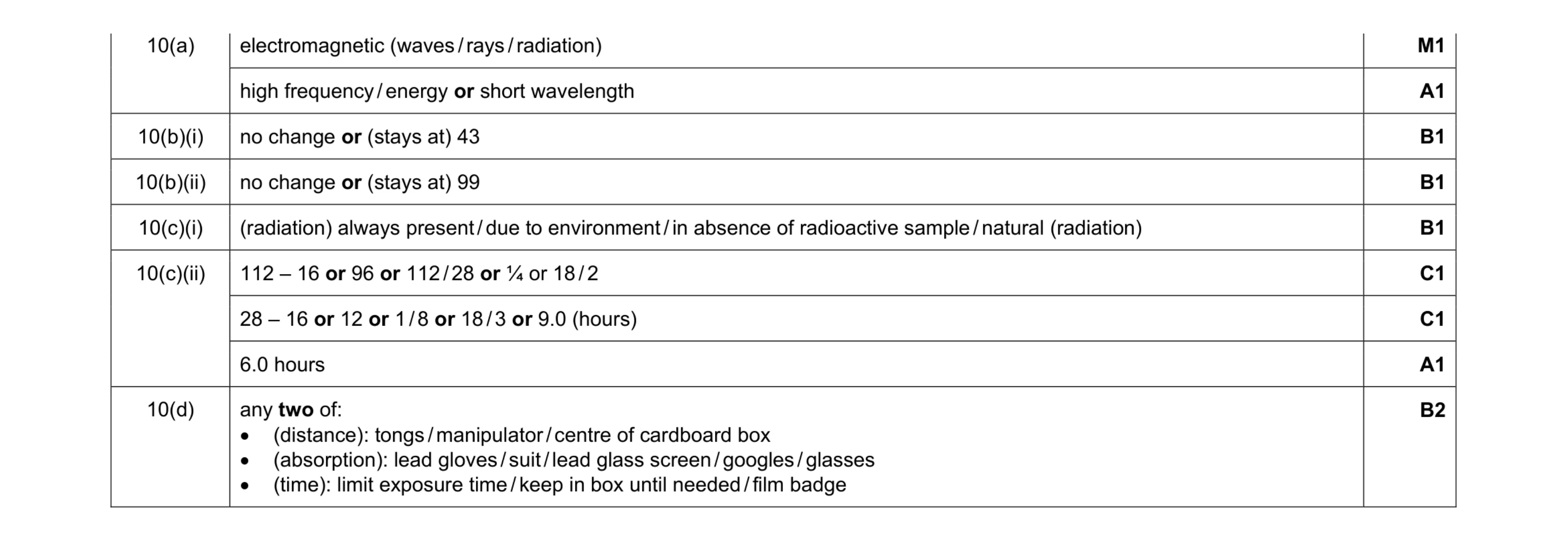
Mark scheme: 10(a) electromagnetic (waves / rays / radiation) M1 high frequency / energy or short wavelength A1 10(b)(i) no change or (stays at) 43 B1 10(b)(ii) no change or (stays at) 99 B1 10(c)(i) (radiation) always present / due to environment / in absence of radioactive sample / natural (radiation) B1 10(c)(ii) 112 – 16 or 96 or 112 / 28 or ¼ or 18 / 2 C1 28 – 16 or 12 or 1 / 8 or 18 / 3 or 9.0 (hours) C1 6.0 hours A1 10(d) any two of: • (distance): tongs / manipulator / centre of cardboard box • (absorption): lead gloves / suit / lead glass screen / googles / glasses • (time): limit exposure time / keep in box until needed / film badge B2
This question in 0625/43 Oct/Nov 2017
Q2 · A defibrillator is a machine that sends an electrical charge through the heart of a… 0625/43 Oct/Nov 2018
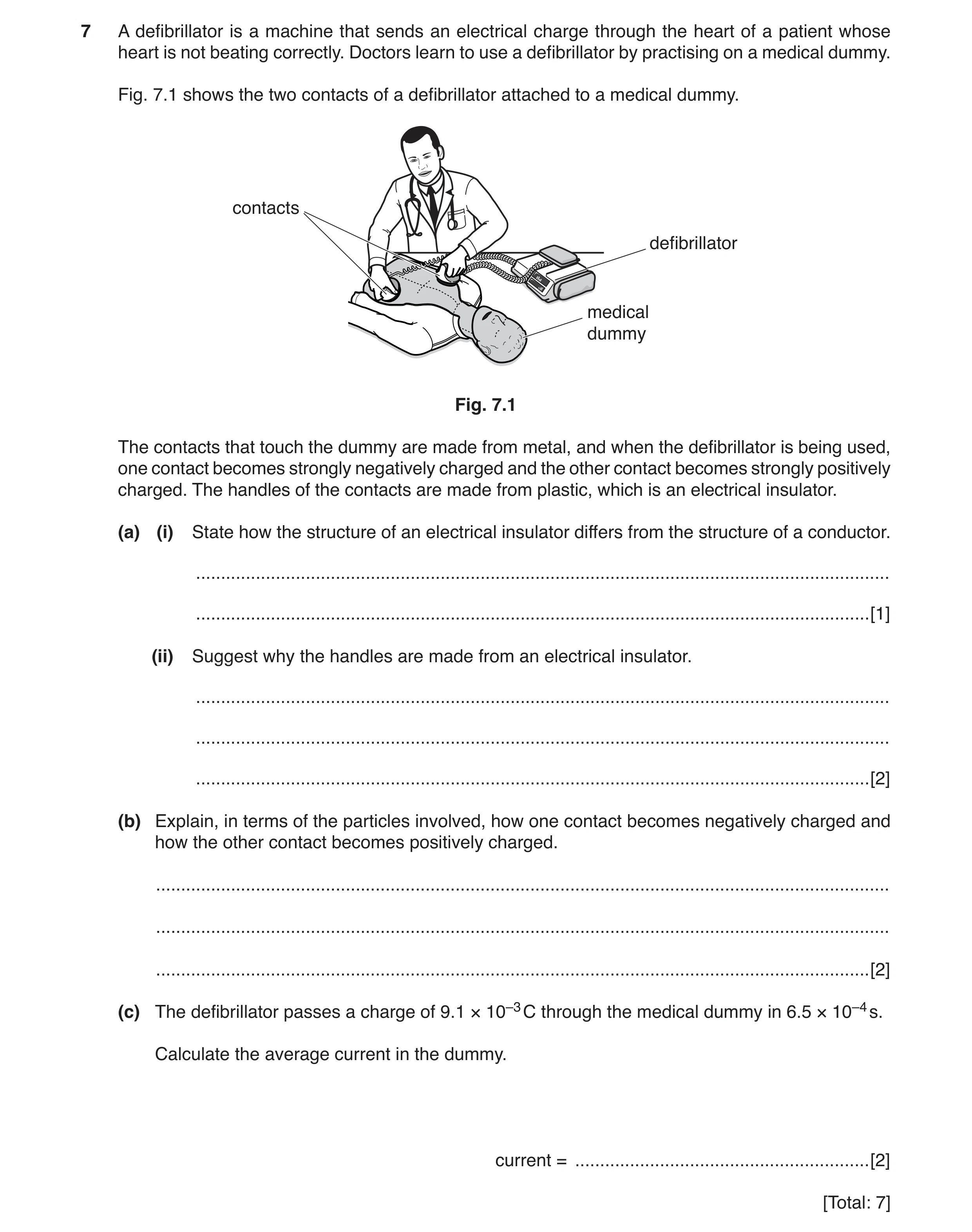
7 A defibrillator is a machine that sends an electrical charge through the heart of a patient whose heart is not beating correctly. Doctors learn to use a defibrillator by practising on a medical dummy. Fig. 7.1 shows the two contacts of a defibrillator attached to a medical dummy. contacts defibrillator medical dummy Fig. 7.1 The contacts that touch the dummy are made from metal, and when the defibrillator is being used, one contact becomes strongly negatively charged and the other contact becomes strongly positively charged. The handles of the contacts are made from plastic, which is an electrical insulator. (a) (i) State how the structure of an electrical insulator differs from the structure of a conductor. … … [1] (ii) Suggest why the handles are made from an electrical insulator. … … … [2] (b) Explain, in terms of the particles involved, how one contact becomes negatively charged and how the other contact becomes positively charged. … … … [2] (c) The defibrillator passes a charge of 9.1 × 10⁻³ C through the medical dummy in 6.5 × 10⁻⁴ s. Calculate the average current in the dummy. current = … [2] [Total: 7]
7 marks
Mark scheme: 7(a)(i) no delocalised / free / mobile electrons in an insulator or electrons fixed (in place) / tightly bound in an insulator B1 7(a)(ii) no charge flows / current in doctor or doctor does not receive an electric shock B1 which might prove fatal / kill / injure / harm doctor or so charge flows / current in patient B1 7(b) electrons move (from one contact to the other) B1 negative contact gains electrons / negative charges and positive contact loses electrons / negative charges B1 7(c) (I =) Q / t or 9.1 × 10⁻³ / 6.5 × 10⁻⁴ C1 14 A A1
This question in 0625/43 Oct/Nov 2018
Q3 · A 240 V mains supply connected to an air‑conditioning unit and a freezer 0625/43 May/June 2019
8 Fig. 8.1 shows a 240 V mains supply connected to an air‑conditioning unit and a freezer. A fuse X is placed in the circuit as shown. X 240 V air-conditioning mains freezer unit supply Fig. 8.1 The freezer has an operating power of 700 W. (a) Calculate the current in the freezer. current = … [2] (b) The maximum operating current of the air‑conditioning unit is 7.5 A. Fuses of current rating 1 A, 3 A, 5 A, 10 A, 13 A and 30 A are available. Suggest a suitable rating for fuse X. Give two reasons for your answer. fuse rating … Reason 1 … … … Reason 2 … … … [3] (c) A fuse is made out of a short length of wire. Explain why fuses of a higher rating are made of thicker wire. … … … … … [3] (d) Electrical energy can be obtained from renewable and non‑renewable sources of energy. (i) State two renewable sources of energy. Source 1 … Source 2 … [2] (ii) State one social, economic or environmental disadvantage of one of your answers to (d)(i). … … … [1] [Total: 11]
11 marks
Mark scheme: 8(a) C1 I (= 700 240 ) = 2.9 A A1 8(b) 13 A fuse B1 any two out of: 2.9 + 7.5 SEEN if too low it would break / blow / melt when the appliances are operating normally if fuse too high wouldn’t break / blow until current was too high which would be dangerous (to people /wires /appliance) B2 8(c) (Resistance inversely proportional to area so) resistance of thicker wire is lower B1 Fuse will melt at higher current B1 because heating effect = I 2 R OR less heating effect (for same current) owtte B1 8(d)(i) Any two renewable sources of energy from: solar, wind, water, hydroelectric, waves, tidal, geothermal B2 8(d)(ii) Any relevant disadvantage for one of their correct answers to (d)(i) e.g.: Energy for wind / waves / Sun not always available Cost of building wind turbines or tidal barrages or hydroelectric dams Wind turbines affect the scenery of some areas Solar (farms) use (agricultural) land / takes up a lot of space B1
This question in 0625/43 May/June 2019
Q4 · A shower that takes in cold water 0625/41 Oct/Nov 2019
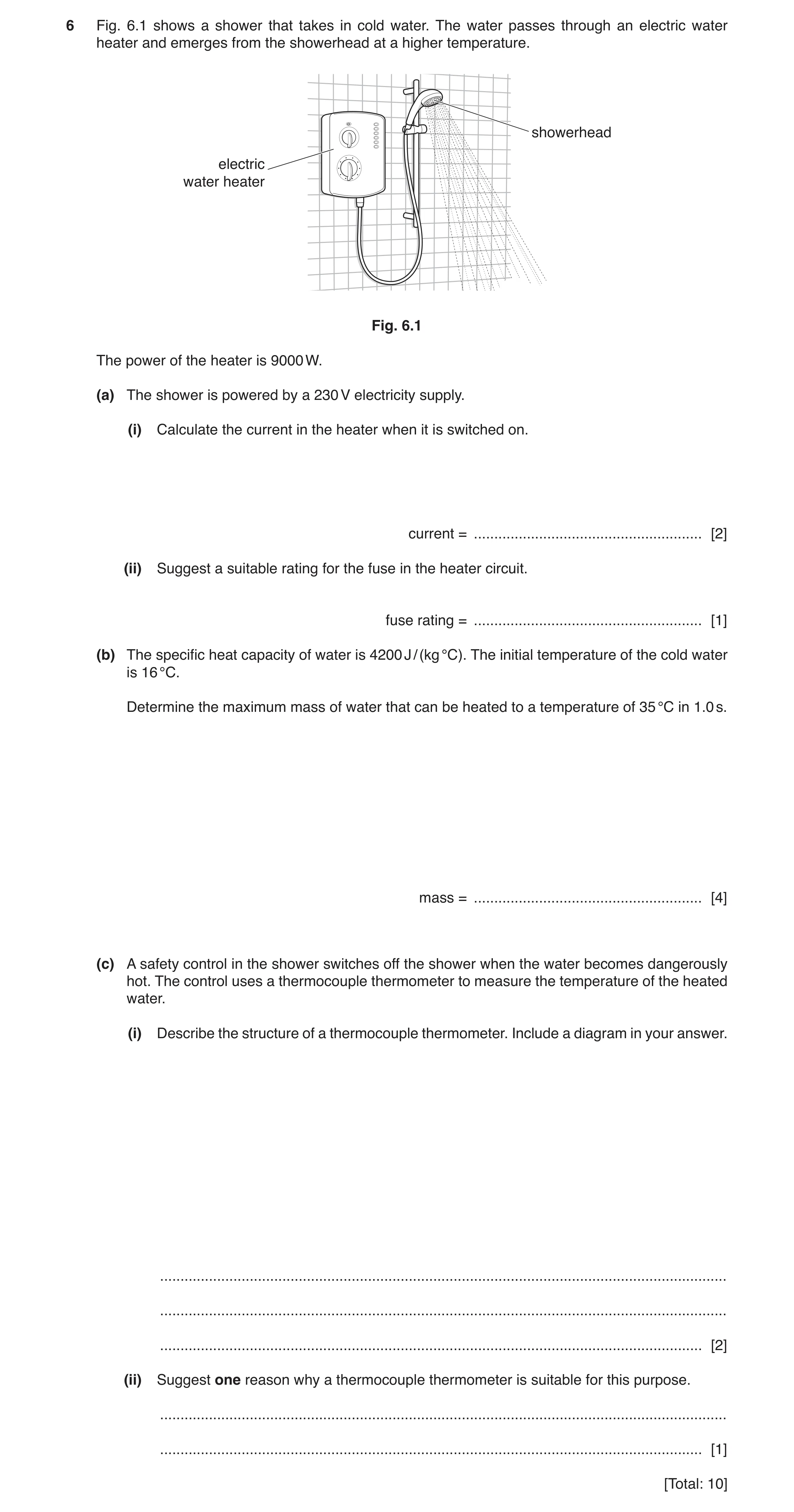
6 Fig. 6.1 shows a shower that takes in cold water. The water passes through an electric water heater and emerges from the showerhead at a higher temperature. showerhead electric water heater Fig. 6.1 The power of the heater is 9000 W. (a) The shower is powered by a 230 V electricity supply. (i) Calculate the current in the heater when it is switched on. current = … [2] (ii) Suggest a suitable rating for the fuse in the heater circuit. fuse rating = … [1] (b) The specific heat capacity of water is 4200 J / (kg °C). The initial temperature of the cold water is 16 °C. Determine the maximum mass of water that can be heated to a temperature of 35 °C in 1.0 s. mass = … [4] (c) A safety control in the shower switches off the shower when the water becomes dangerously hot. The control uses a thermocouple thermometer to measure the temperature of the heated water. (i) Describe the structure of a thermocouple thermometer. Include a diagram in your answer. … … … [2] (ii) Suggest one reason why a thermocouple thermometer is suitable for this purpose. … … [1] [Total: 10]
10 marks
Mark scheme: 6(a)(i) 39 A C1 A1 6(a)(ii) 40 A or any greater integer value (in A) up to and including 60 A B1 6(b) E = Pt or in any form words, symbols or numbers or (E =) Pt or 9000 × 1.0 or 9000 J seen 35 – 16 or 19 (°C) seen m = E /(c∆T) or in any form words, symbols or numbers or (m =) E /(c∆T) or 9000 / (4200 × 19) 0.11 kg C1 C1 C1 A1 6(c)(i) two different metal wiresjoined at one end and voltmeter between free ends or three metal wires and two different joined ABA and voltmeter between free ends B1 B1 6(c)(ii) any one from: quick response / makes measurements fast measures rapidly varying temperatures electrical output small heat capacity robust / rugged B1
This question in 0625/41 Oct/Nov 2019
Q5 · A magnet and a coil are attached separately to a door and a door frame as shown in Fig 0625/43 Oct/Nov 2019
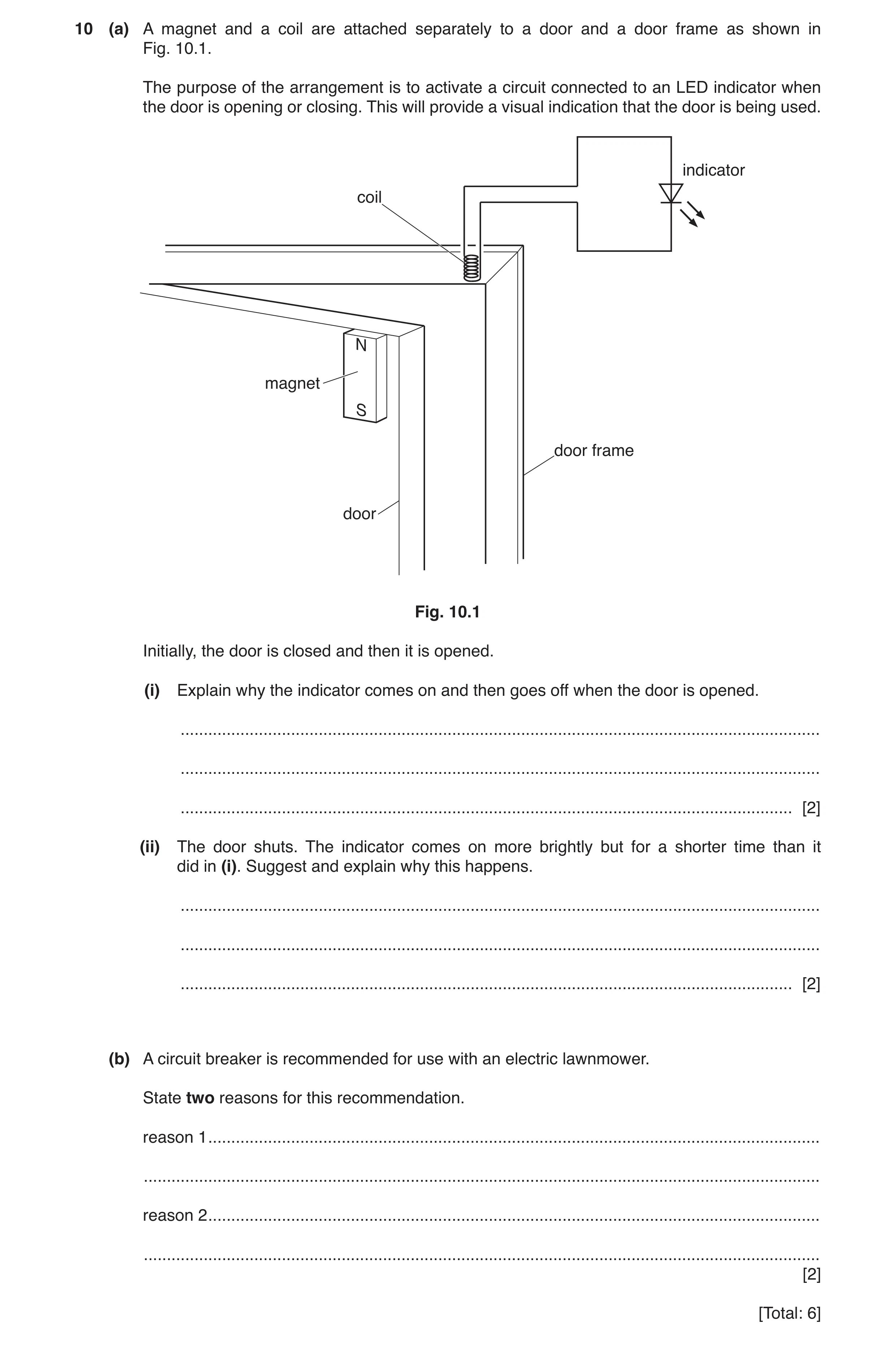
10 (a) A magnet and a coil are attached separately to a door and a door frame as shown in Fig. 10.1. The purpose of the arrangement is to activate a circuit connected to an LED indicator when the door is opening or closing. This will provide a visual indication that the door is being used. indicator coil N magnet S door frame door Fig. 10.1 Initially, the door is closed and then it is opened. (i) Explain why the indicator comes on and then goes off when the door is opened. … … … [2] (ii) The door shuts. The indicator comes on more brightly but for a shorter time than it did in (i). Suggest and explain why this happens. … … … [2] (b) A circuit breaker is recommended for use with an electric lawnmower. State two reasons for this recommendation. reason 1 … … reason 2 … … [2] [Total: 6]
6 marks
Mark scheme: 10(a)(i) induces emf / pd / current (across / in LED) light goes off when magnet no longer directly below coil B1 10(a)(ii) door closes more quickly than it was opened so higher current in LED B1 door / magnet moving for shorter length of time B1 10(b) Any two from: • quick response • protects against electric shock • protects against overheating • (easily) re-settable • avoids damage to lawnmower B2
This question in 0625/43 Oct/Nov 2019
Q6 · A student makes a transformer that uses an alternating current (a.c.) supply with an… 0625/42 May/June 2020
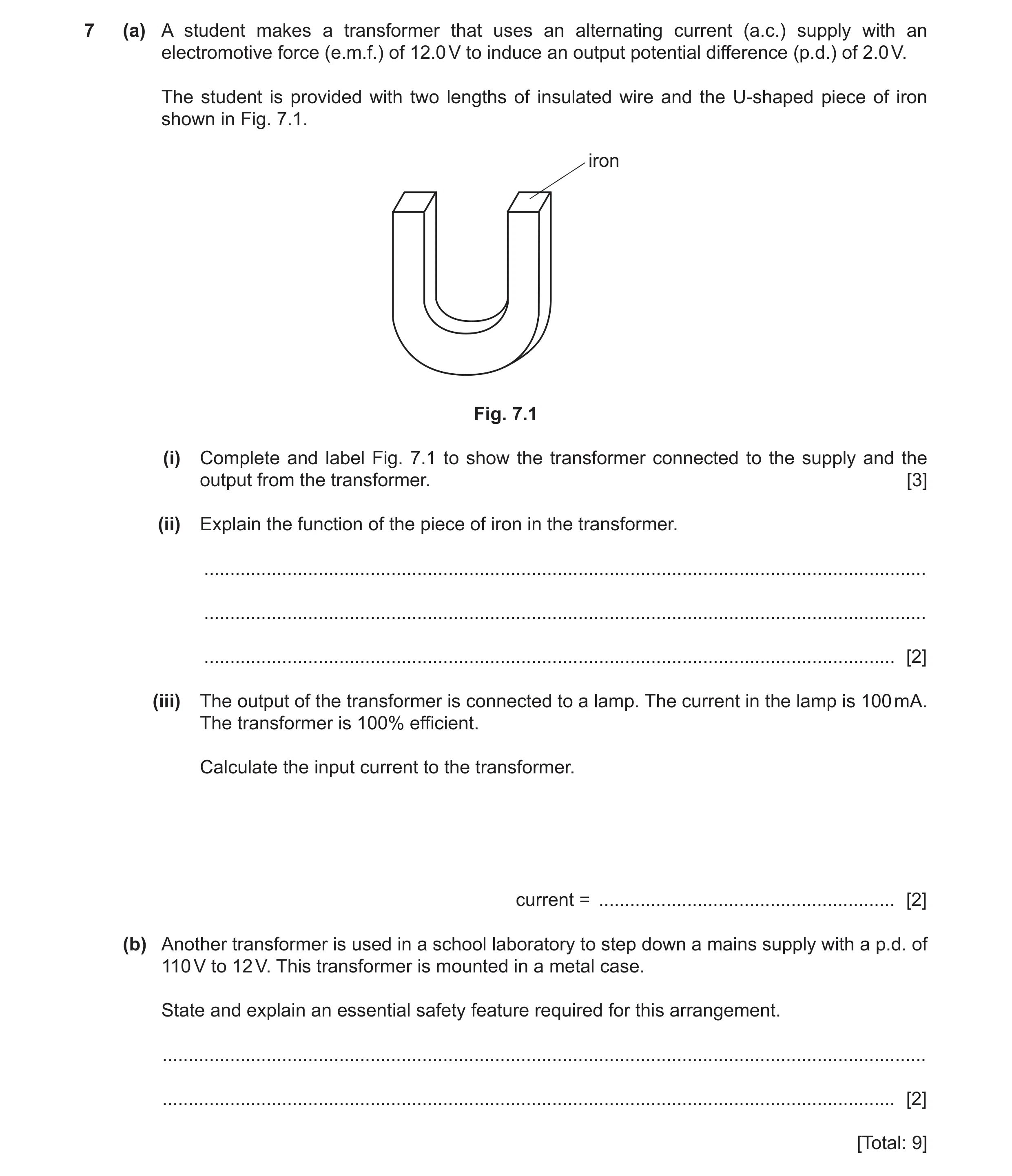
7 (a) A student makes a transformer that uses an alternating current (a.c.) supply with an electromotive force (e.m.f.) of 12.0 V to induce an output potential difference (p.d.) of 2.0 V. The student is provided with two lengths of insulated wire and the U-shaped piece of iron shown in Fig. 7.1. iron Fig. 7.1 (i) Complete and label Fig. 7.1 to show the transformer connected to the supply and the output from the transformer. [3] (ii) Explain the function of the piece of iron in the transformer. … … … [2] (iii) The output of the transformer is connected to a lamp. The current in the lamp is 100 mA. The transformer is 100% efficient. Calculate the input current to the transformer. current = … [2] (b) Another transformer is used in a school laboratory to step down a mains supply with a p.d. of 110 V to 12 V. This transformer is mounted in a metal case. State and explain an essential safety feature required for this arrangement. … … [2] [Total: 9]
9 marks
Mark scheme: 7(a)(i) primary coil wound round iron AND (labelled primary or coil OR connected to labelled supply / 12 V) B1 secondary coil wound round iron AND (labelled secondary OR connected to labelled output / 2 V) B1 significantly more coils around primary B1 Question Answer Marks 7(a)(ii) two from three • links magnetic fields of coils / primary and secondary • stronger magnetic field in secondary • better induction owtte B2 7(a)(iii) V1I1 = V2I2 in any form OR (I1 =) V2I2 / V1 OR (I1 =) 2 × 0.10 / 12 C1 (I1 =) 0.017 A A1 7(b) metal case earthed B1 in case wire falls off / insulation fails / live(wire) touches case B1
This question in 0625/42 May/June 2020
Q7 · State and explain why electrical sockets and plugs used outside in a garden need to be… 0625/42 Oct/Nov 2020
8 (a) State and explain why electrical sockets and plugs used outside in a garden need to be different from those that can be used safely in a room inside a house. … … … … [2] (b) State and explain why fuses and circuit breakers are installed in electrical circuits connected to the mains supply. … … … … [2] [Total: 4]
4 marks
Mark scheme: 8(a) conditions (outdoors) may be damp / wet C1 water conducts (electricity) OR clear statement of need for waterproof / outdoor specification (components) A1 8(b) protects components / appliances / circuit / wires / user / mains supply prevents electrical supply overheating / fires / electrocution / shocks B1 excess current / power in circuit / wires OR fuse melts / blows OR circuit breaker opens B1
This question in 0625/42 Oct/Nov 2020
Q8 · Name the logic gate shown in Fig 0625/42 Oct/Nov 2021
10 (a) Name the logic gate shown in Fig. 10.1. … Fig. 10.1 [1] (b) Fig. 10.2 shows a combination of logic gates. input I output O Fig. 10.2 Complete the right-hand column of Table 10.1, the truth table for the combination of logic gates. You may use the blank column for your working. Table 10.1 input I output O 0 1 [2] (c) An electrical device has a metal case. Explain the benefit of earthing the metal case. … … … [2] (d) (i) Explain how a fuse protects a circuit. … … … [2] (ii) The current in an electric kettle connected to the mains through a fuse is 10 A. Fuses with the following ratings are available. 3 A 9 A 10 A 13 A 30 A Circle the correct fuse rating for this appliance and explain your answer. … … … [2] [Total: 9]
9 marks
Mark scheme: 10(a) OR (gate) B1 10(b) 0 B1 1 B1 10(c) prevents electrocution OR metal case cannot become live OR metal case always at earth potential / voltage B1 (if) live wire touches metal case B1 10(d)(i) if current too high B1 fuse melts B1 10(d)(ii) 13 A (circled) B1 fuse rating/value above but near (to) normal operating current/ 10 A OR fuse rating/value slightly higher (than) normal operating current /10A OWTTE B1
This question in 0625/42 Oct/Nov 2021
Q9 · A kitchen tap that supplies instant boiling water 0625/41 May/June 2022
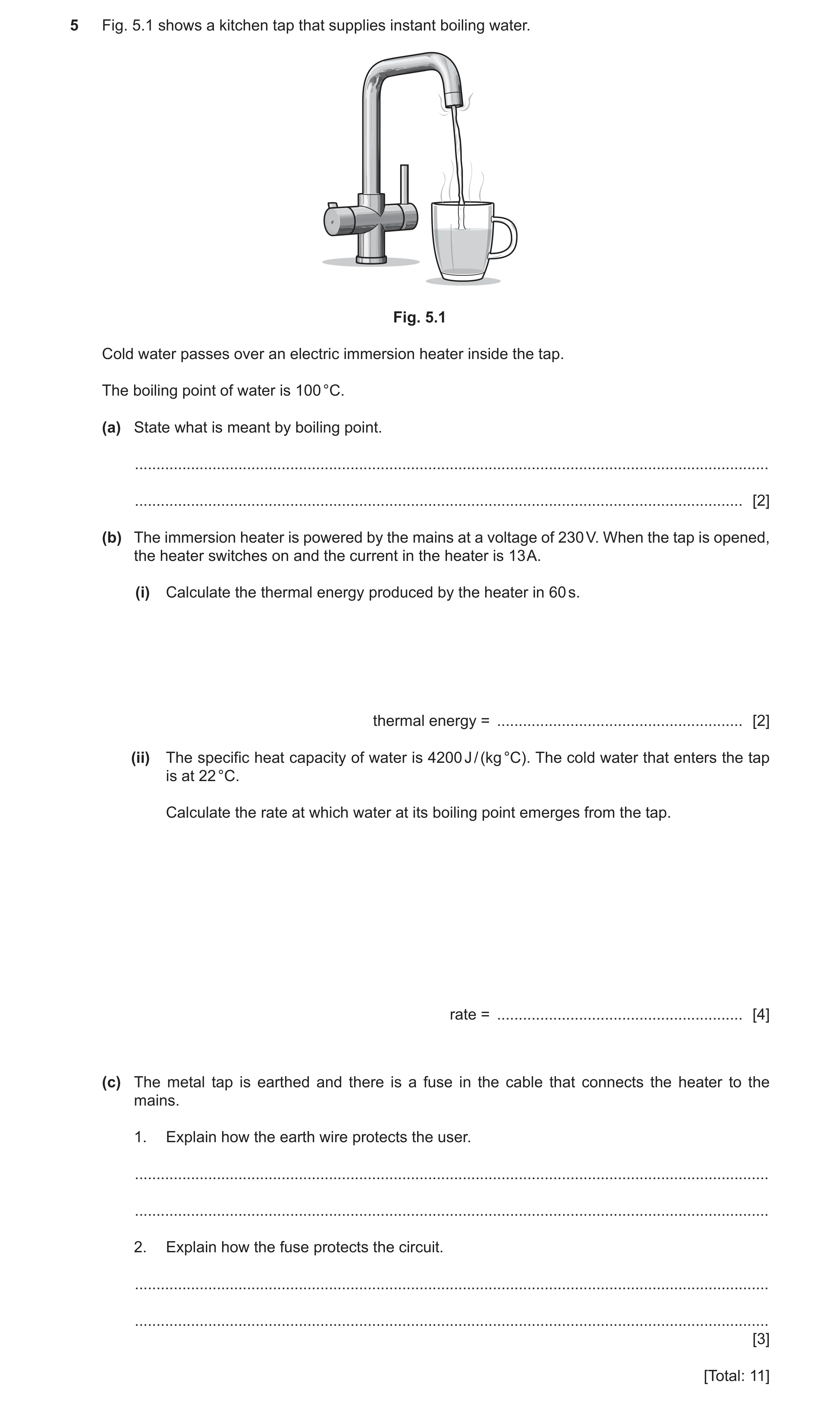
5 Fig. 5.1 shows a kitchen tap that supplies instant boiling water. Fig. 5.1 Cold water passes over an electric immersion heater inside the tap. The boiling point of water is 100 °C. (a) State what is meant by boiling point. … … [2] (b) The immersion heater is powered by the mains at a voltage of 230 V. When the tap is opened, the heater switches on and the current in the heater is 13 A. (i) Calculate the thermal energy produced by the heater in 60 s. thermal energy = … [2] (ii) The specific heat capacity of water is 4200 J / (kg °C). The cold water that enters the tap is at 22 °C. Calculate the rate at which water at its boiling point emerges from the tap. rate = … [4] (c) The metal tap is earthed and there is a fuse in the cable that connects the heater to the mains. 1. Explain how the earth wire protects the user. … … 2. Explain how the fuse protects the circuit. … … [3] [Total: 11]
11 marks
Mark scheme: 5(a) temperature B1 at which liquid becomes a gas or liquid and gas exist together B1 5(b)(i) 1.8 105 J A2 (E =) VIt (in any form) or 230 13 60 or 230 13 or 3000 C1 5(b)(ii) 9.1 10–3 kg / s 9.1 10–3 kg / s A4 (T =) 100 – 22 or 78 or (T =) 100 – 22 or 78 C1 m = E / cT (in any form) or 1.8 105 / (4200 78) or (rate =) P / cT (in any form) or m = E / cT and E = Pt C1 1.8 105 / (4200 78 60) or 5.5 10N or 9.1/9.2 10N or 3000 / (4200 78) or 230 13 / (4200 78) or 9.1 / 9.2 10N C1 5(c) 1 if the tap becomes live or if the (live) cable touches the (metal) tap B1 there is a current to earth / in the earth wire (which blows the fuse) B1 2 the current (in earth wire) is large and fuse melts / blows / stops current / breaks circuit B1
This question in 0625/41 May/June 2022
Q10 · Some properties and values for α-particles, β-particles and γ-radiation 0625/42 May/June 2023
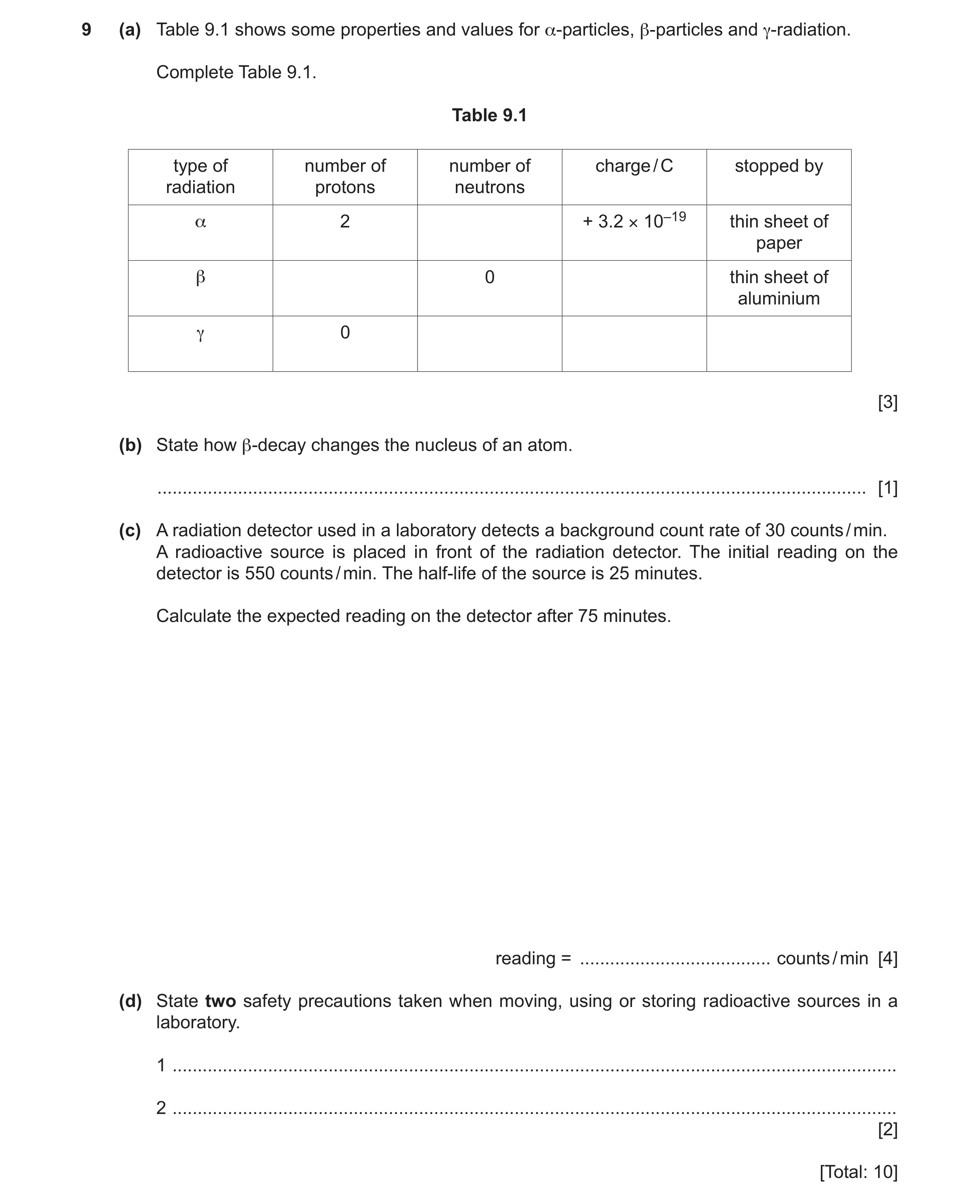
9 (a) Table 9.1 shows some properties and values for α-particles, β-particles and γ-radiation. Complete Table 9.1. Table 9.1 type of number of number of charge / C stopped by radiation protons neutrons α 2 + 3.2 × 10⁻¹⁹ thin sheet of paper β 0 thin sheet of aluminium γ 0 [3] (b) State how β-decay changes the nucleus of an atom. … [1] (c) A radiation detector used in a laboratory detects a background count rate of 30 counts / min. A radioactive source is placed in front of the radiation detector. The initial reading on the detector is 550 counts / min. The half-life of the source is 25 minutes. Calculate the expected reading on the detector after 75 minutes. reading = … counts / min [4] (d) State two safety precautions taken when moving, using or storing radioactive sources in a laboratory. 1 … 2 … [2] [Total: 10]
10 marks
Mark scheme: 9(a) B1 – no. of protons 0 and charge –1.6 10–19 B1 – no. of neutrons 0 and charge 0 and (very) thick concrete / thick lead B1 9(b) (the nucleus has) one less neutron and one more proton B1 9(c) 95 (counts / min) A4 initial count rate due to source = 550 – 30 (counts / min) OR 520 seen C1 (75 min =) 3 half-lives OR (count rate =) 1 / 8 (of initial count rate) C1 final count rate due to source = (520 / 8 =) 65 C1 9(d) any two from: limit time of exposure store sources in lead boxes keep distance from sources avoid contact OR use tongs OR wear gloves B2
This question in 0625/42 May/June 2023
Q11 · A mains electric heater used to heat a small room 0625/42 Feb/March 2025
3 Fig. 3.1 shows a mains electric heater used to heat a small room. shiny metal surface heating elements Fig. 3.1 (a) State the region of the electromagnetic spectrum which radiates thermal energy from the heater. … [1] (b) Explain why the shiny metal surface behind the heating elements increases the thermal energy radiated into the room. … … … [2] (c) The metal outer casing of the heater is earthed. State why this is an important safety feature. … … [1] (d) The mains voltage is 230 V. The two identical heating elements are connected in parallel. Each heating element has a resistance of 89 Ω. (i) Calculate the current in one heating element. current = … [2] (ii) Show that the electrical power of the heater is approximately 1200 W. State any equation you use in words or symbols. [2] (iii) The heater is 95% efficient at converting electrical work done to thermal energy. Calculate the thermal energy emitted by the heater in (d)(ii) in 60 s. Give your answer to two significant figures. thermal energy = … [3] [Total: 11]
11 marks
Mark scheme: 3(a) infrared B1 3(b) shiny surface / it is a good reflector of radiation A2 Any one from: C1 • it is a good reflector • it reflects radiation 3(c) Any one from: B1 • prevents (electric) shock (if live wire touches the metal casing) owtte • if live wire touches the metal casing the current goes to earth 3(d)(i) 2.6 A A2 R = V / I OR (I=) V/R OR (I=) 230 / 89 C1 3(d)(ii) P = IV B1 (I =) 5.2 (A) OR (P =) 2 power of one element OR B1 3(d)(iii) 68 000 J OR 68 kJ A3 E = Pt OR (E =) Pt OR (E =) 1200 60 C1 efficiency = useful energy out / total energy (in) OR 95 100 E C1 (power output of heater =) 95% 1200
This question in 0625/42 Feb/March 2025
 1 / 13
 2 / 13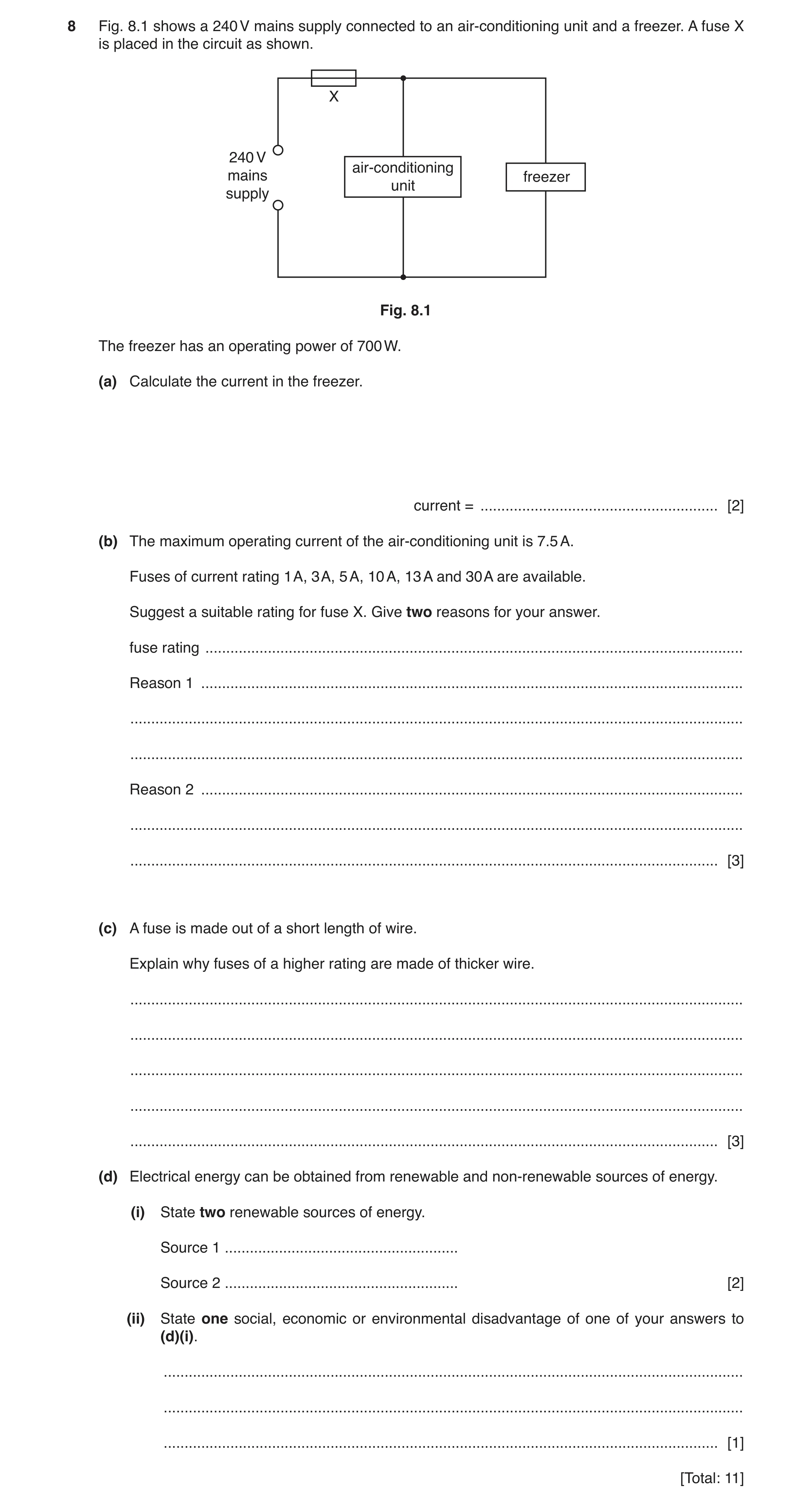
 7 / 13
 8 / 13
![Question 8: (a) Name the logic gate shown in Fig. 10.1. .............................................................. Fig. 10.1 [1] (b) Fig. 10.2 show…](https://img.pastlit.com/crops/866ff260-31d2-48cc-99e6-1e835619dd73/q10.webp)
 11 / 13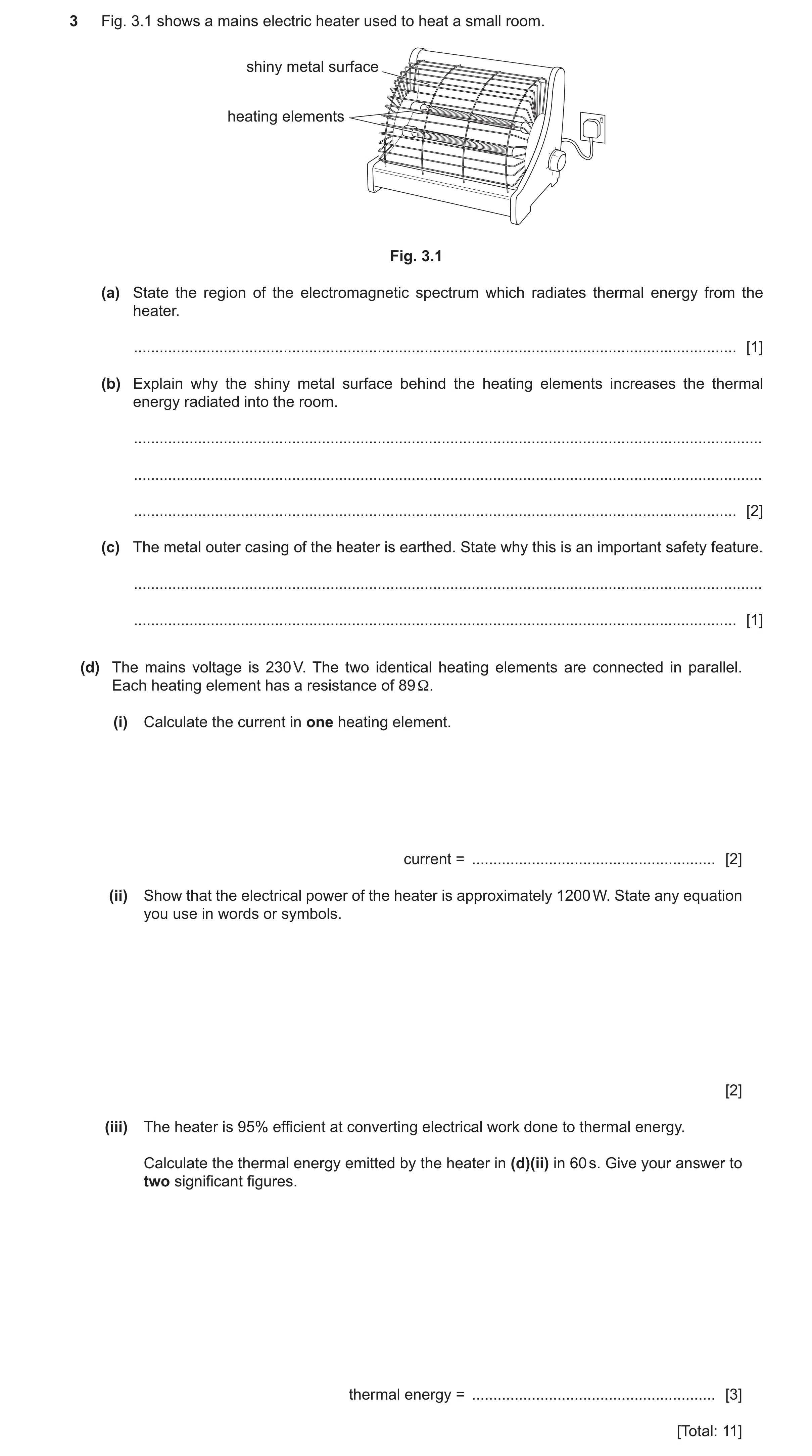
 10
10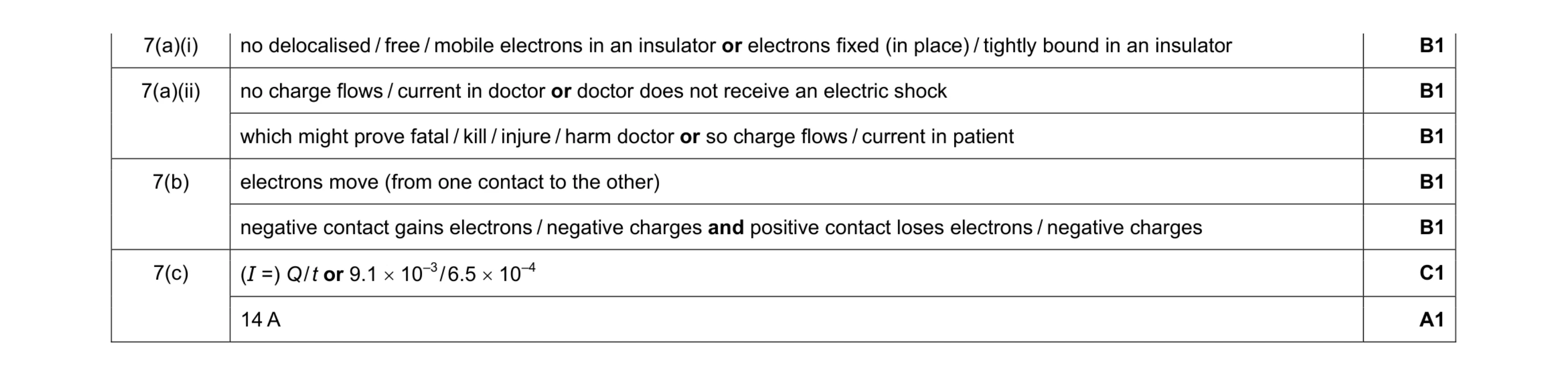 7
7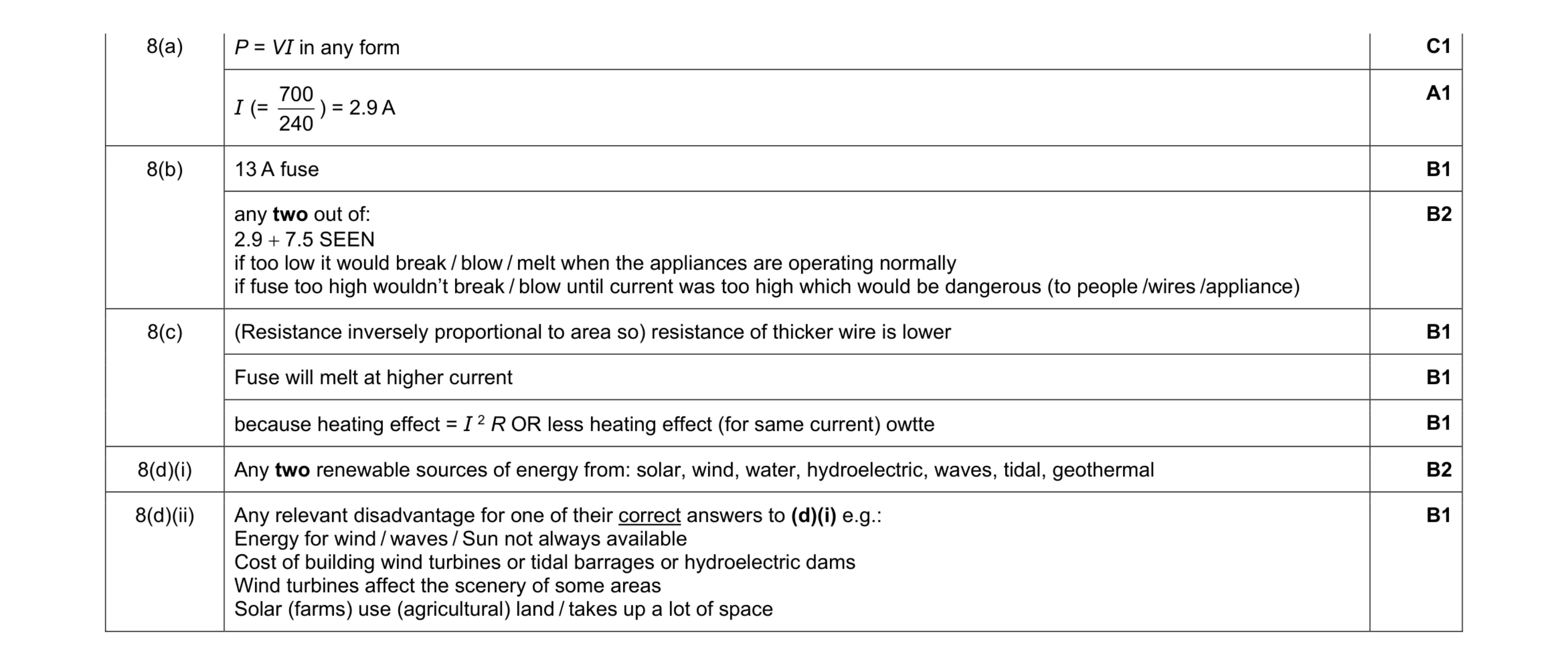 11
11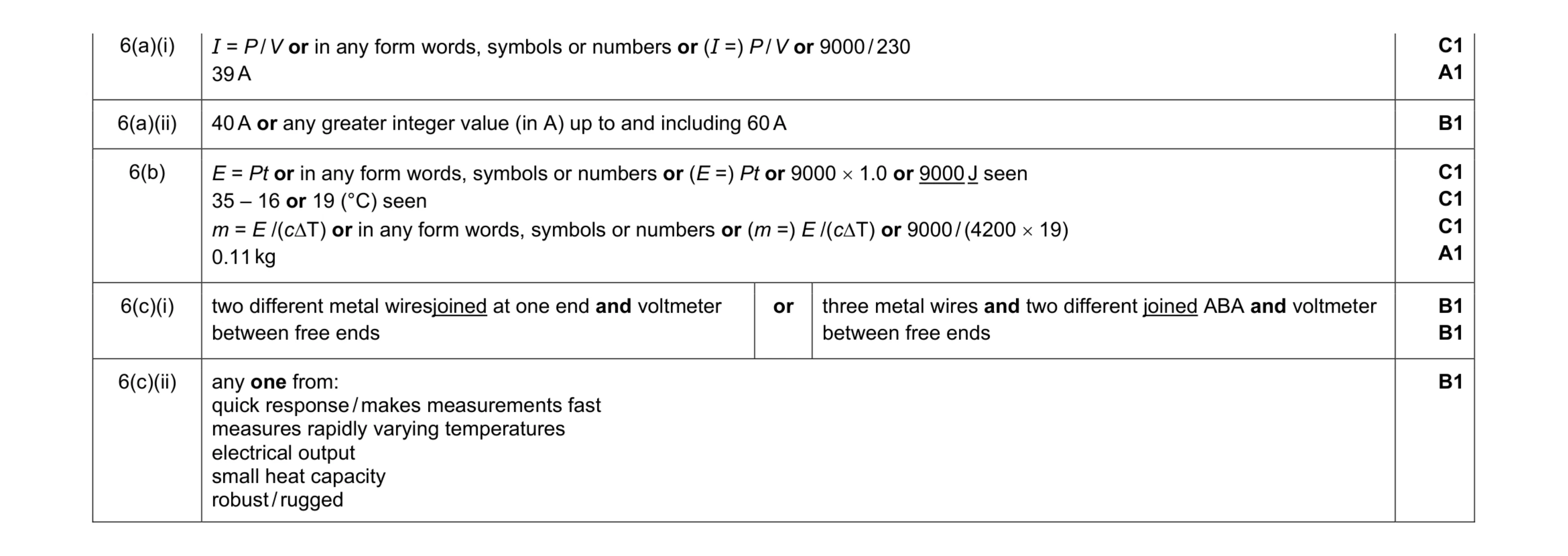 10
10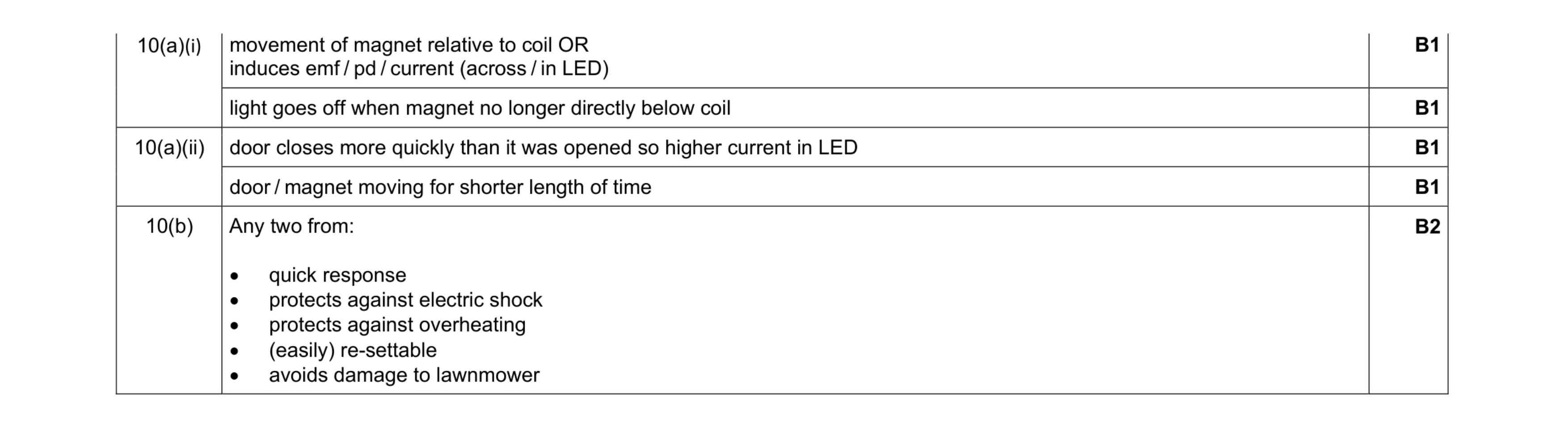 6
6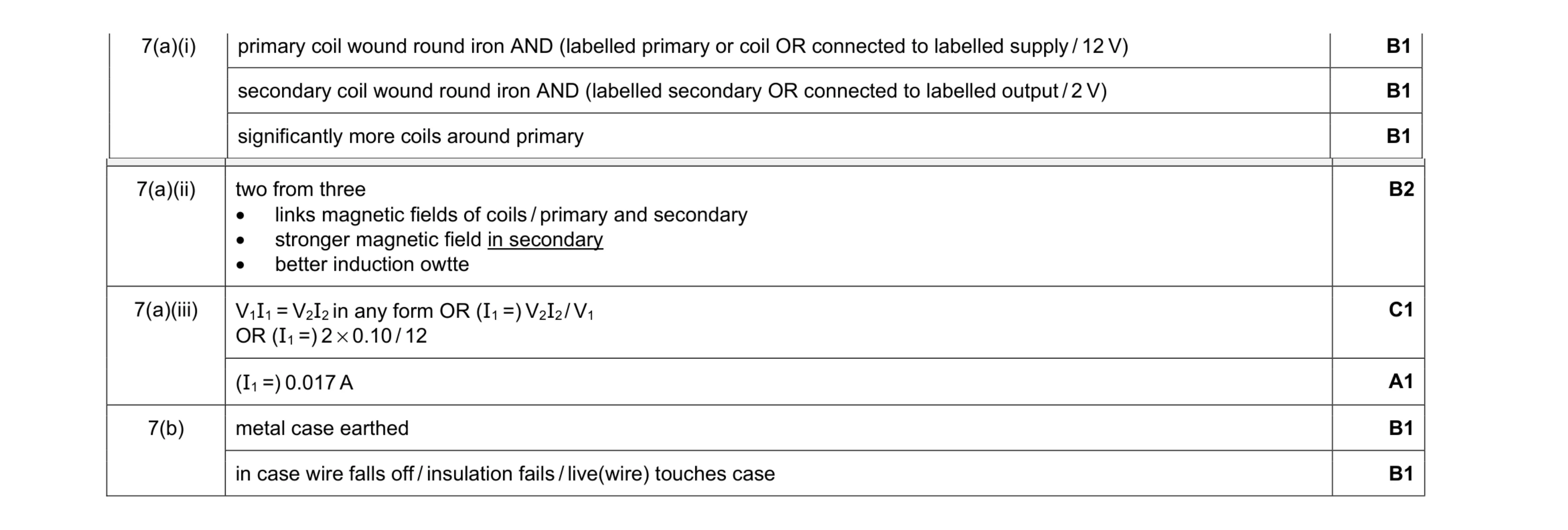 9
9 4
4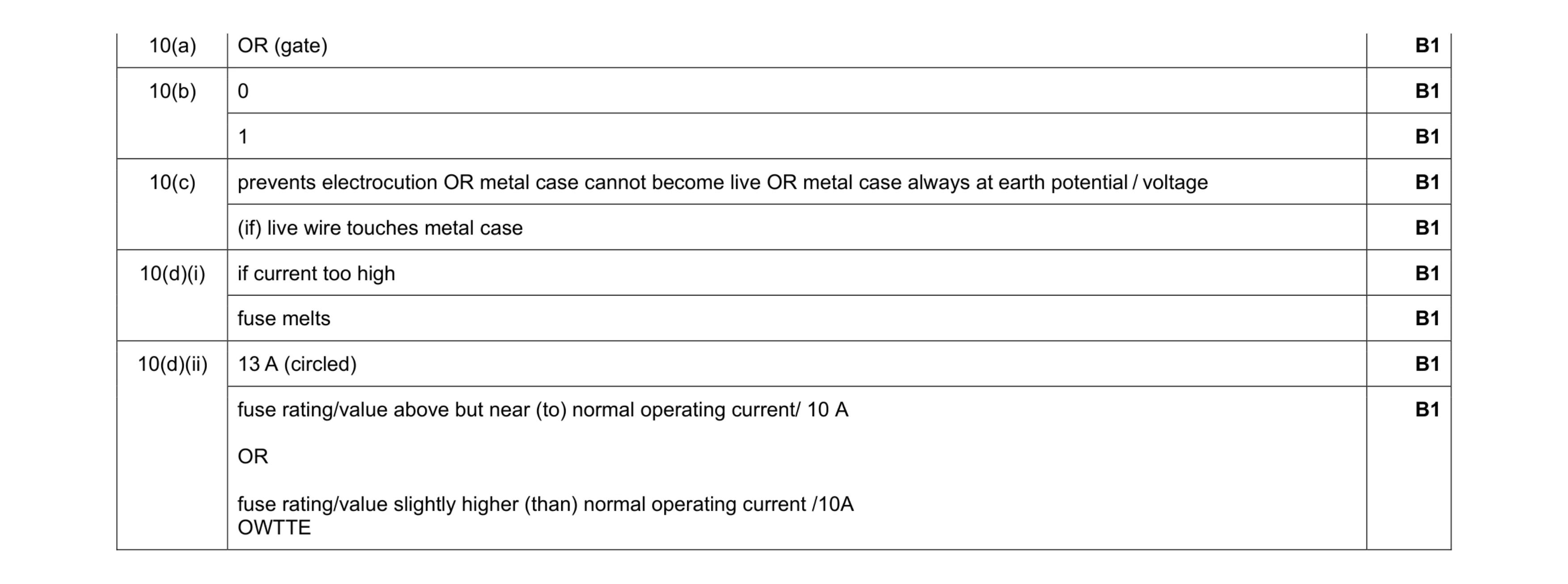 9
9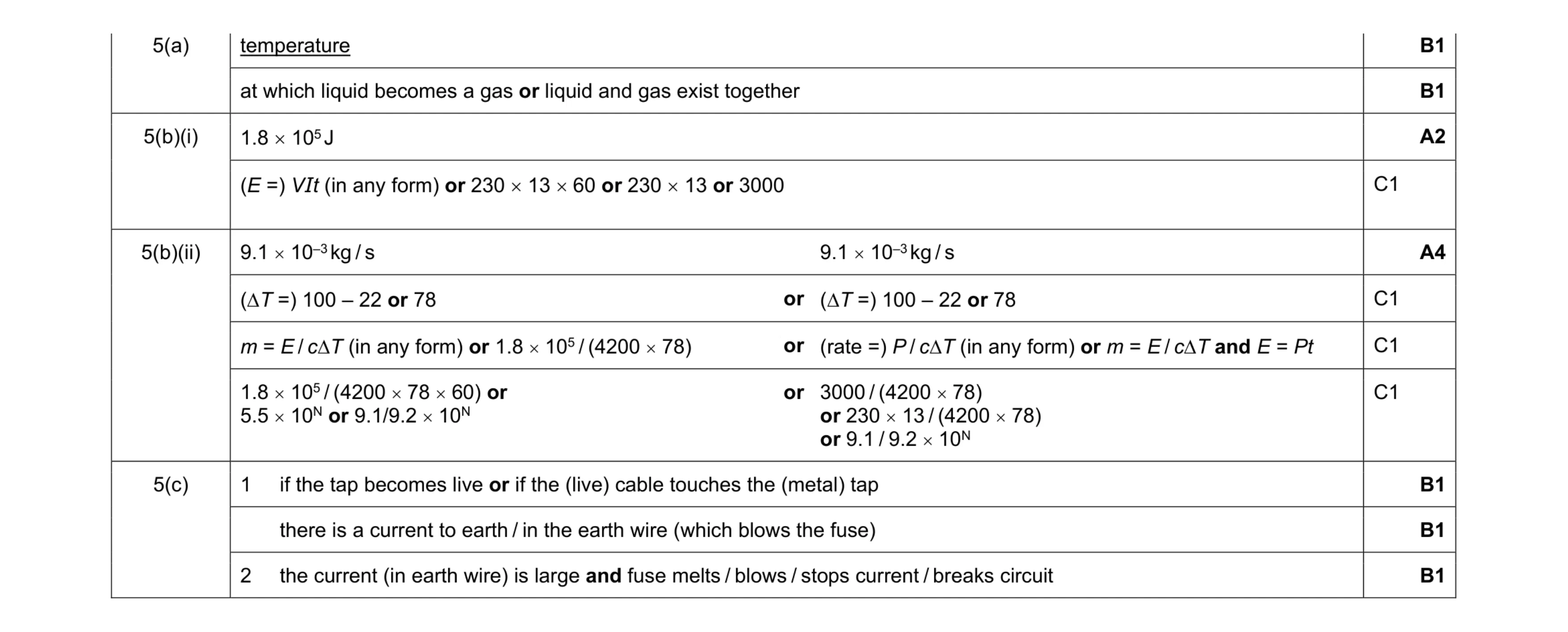 11
11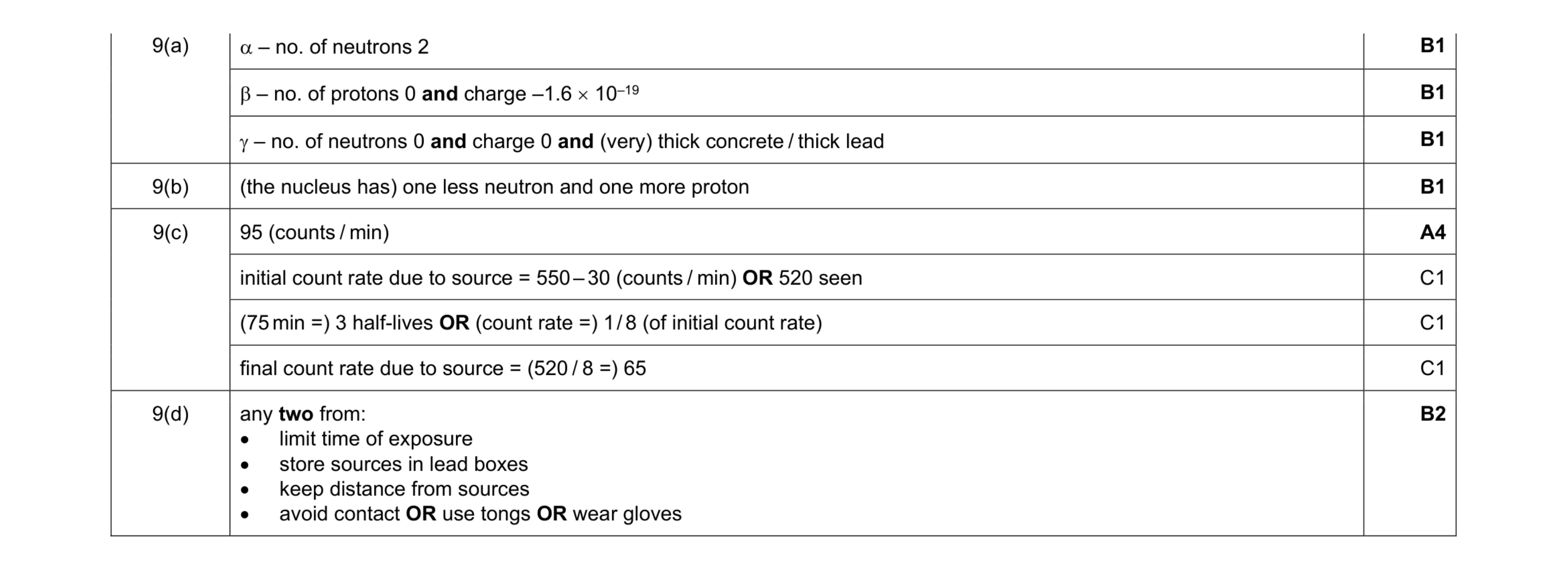 10
10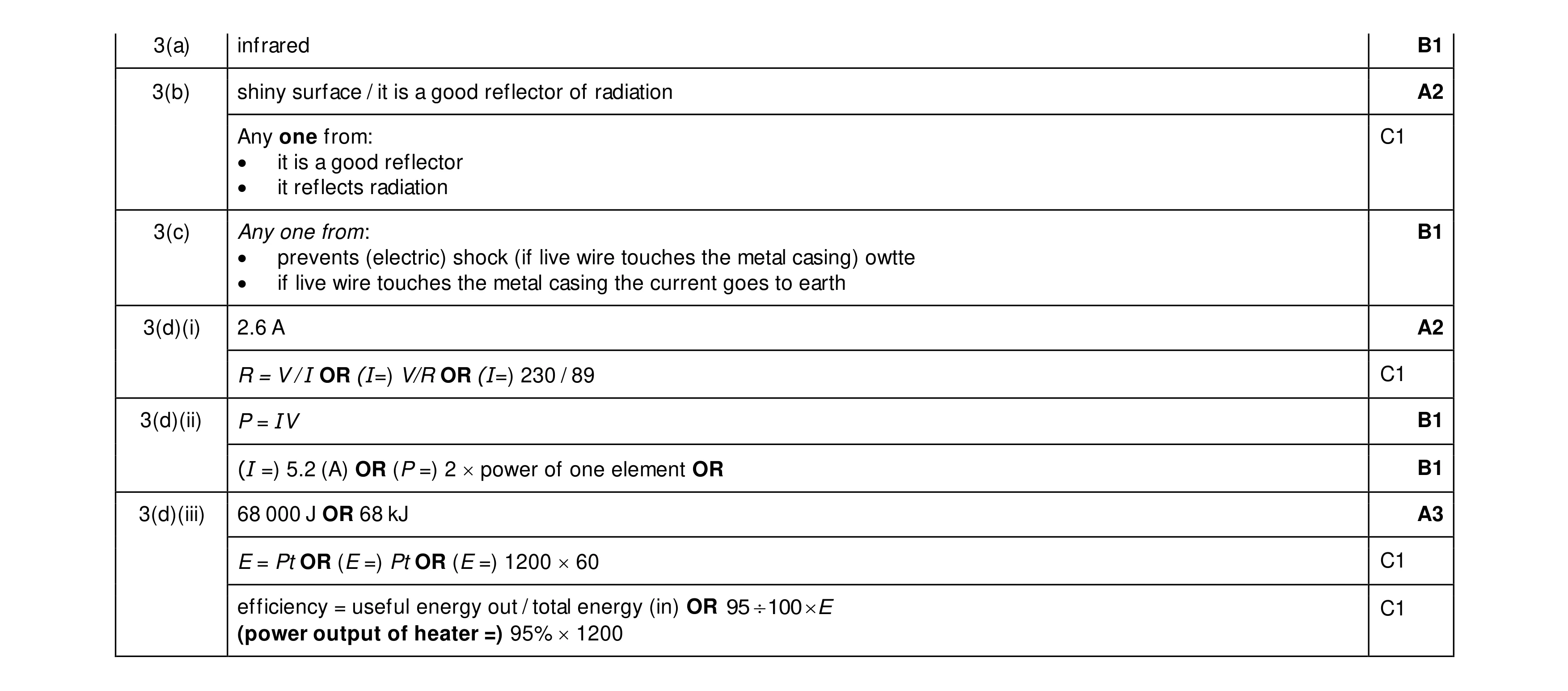 11
11